Healthcare Resume Templates and Examples, from Nurse to Administrator
- ATS Friendly
- Clinical & Non-Clinical
- 17 Real Examples
Healthcare covers hundreds of roles, and each one gets read differently. This hub gives you a real example for the clinical and non-clinical jobs across a hospital or clinic, and points you to a deeper guide built for your exact role. Your license, certifications, and HIPAA and EHR familiarity sit where a healthcare hiring manager looks first.


540k+ resumes created
Healthcare resume templates for clinical and non-clinical roles
Each template below is a real healthcare resume laid out in that format, spanning bedside nursing, allied health, dental, pharmacy, and the non-clinical office roles that keep a practice running. Pick one, then swap in your own license, certifications, and patient-care numbers. Every layout keeps your name, credentials, and HIPAA and EHR skills readable so a healthcare hiring manager sees your qualifications at a glance and an applicant tracking system parses it cleanly. For a role we cover in depth, follow the link to that role's full guide.
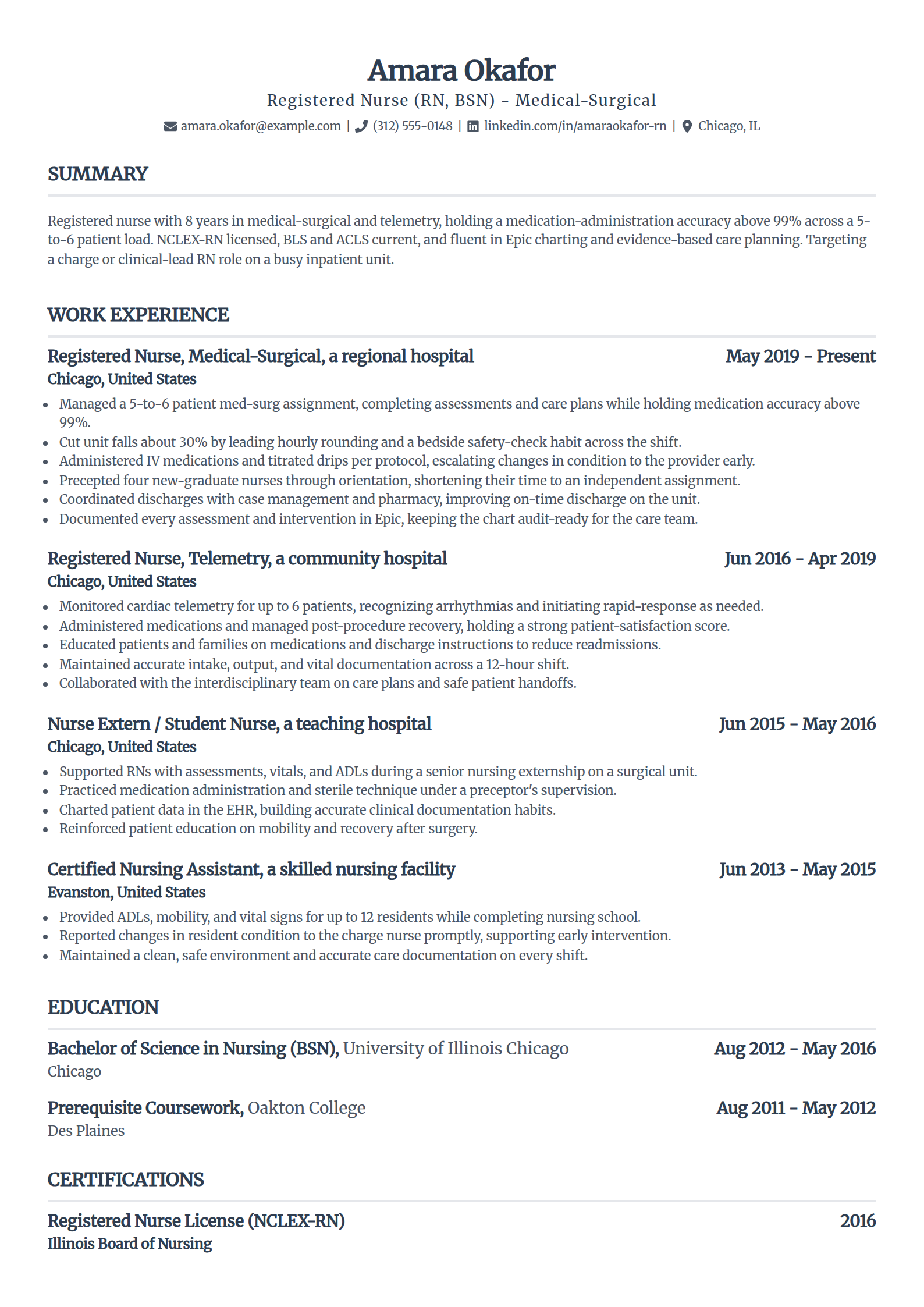
Registered Nurse (RN) Resume Example
See the full nursing resume templates and examples →
Why this resume example works?
- Leads with the NCLEX-RN license, BLS and ACLS, and a medication-accuracy number, the credentials a unit checks first.
- Shows real RN scope, patient assessment, care planning, and IV medication administration, not a generic duties list.
- For deeper nursing examples by specialty and experience, the nursing page carries the full set.
Certified Nursing Assistant (CNA) Resume Example
See the full CNA resume templates and examples →
Why this resume example works?
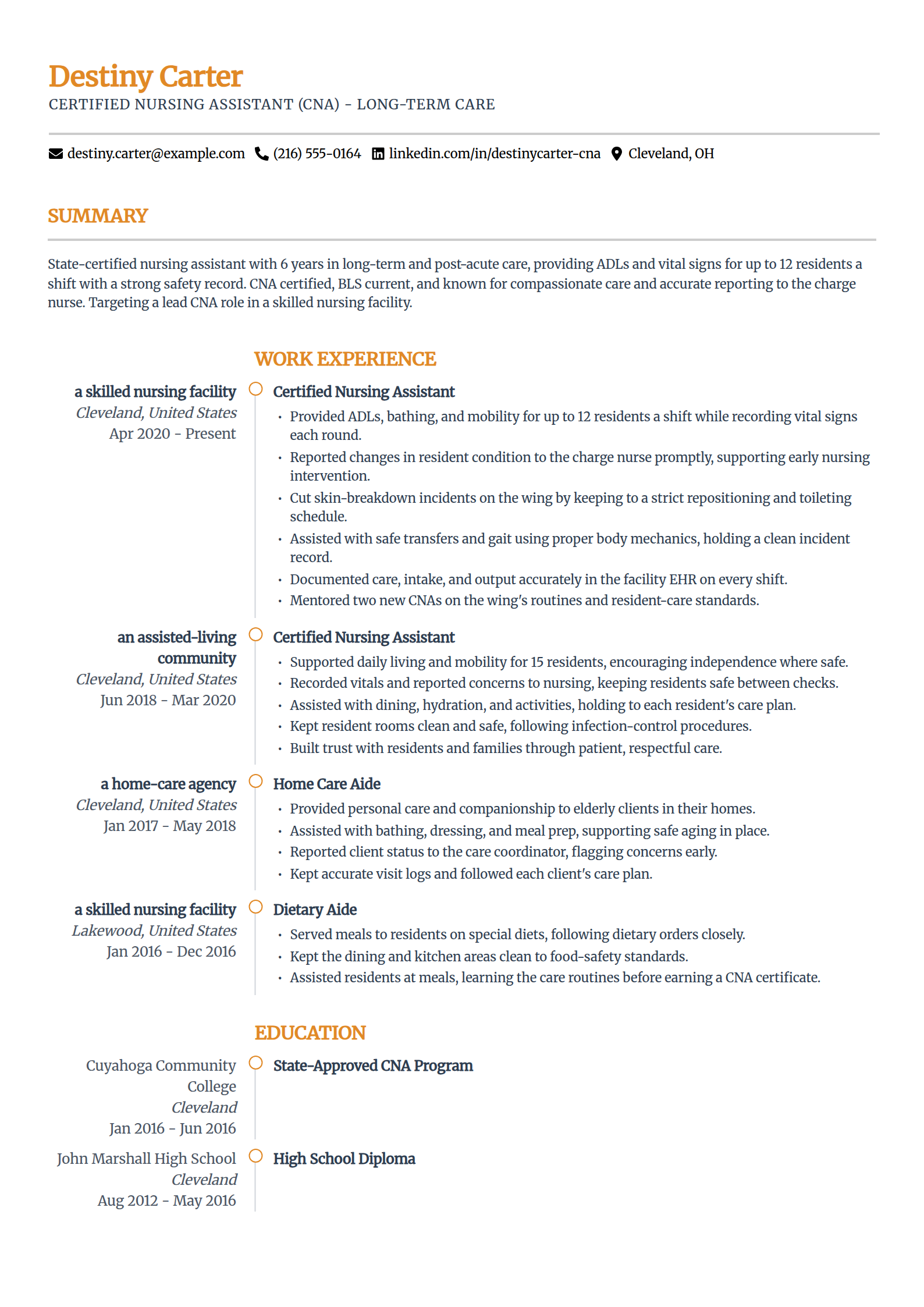
- Leads with the state CNA certification and BLS, and keeps scope honest with ADLs, vitals, and reporting to the nurse.
- Puts a patient-per-shift number and a safety record where a skilled nursing facility looks first.
- For CNA examples from no experience to lead, the CNA page carries the full set.
Licensed Practical Nurse (LPN) Resume Example
See the full LPN resume templates and examples →
Why this resume example works?
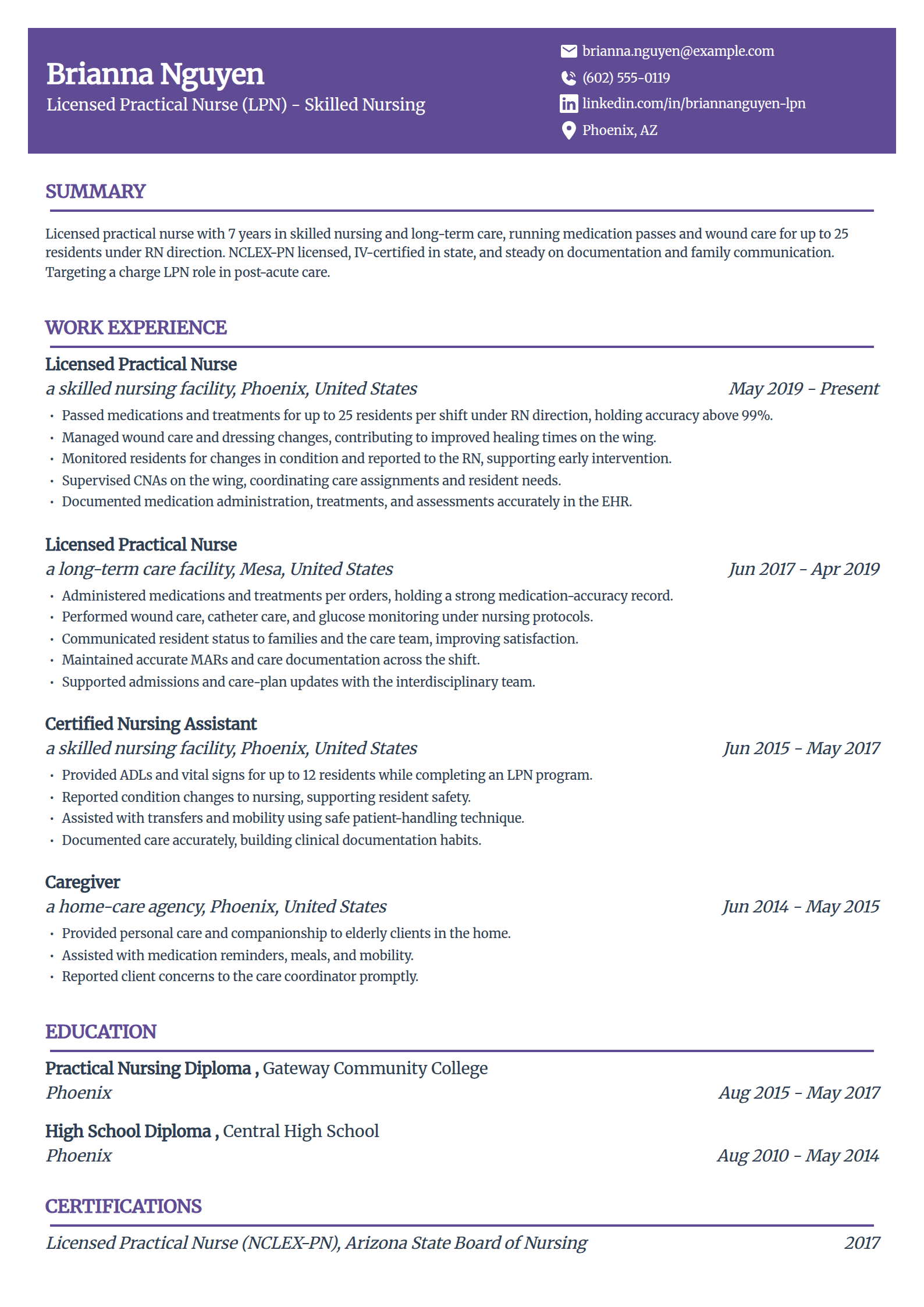
- Leads with the NCLEX-PN license and keeps scope right, medication passes and wound care under RN direction.
- Shows the settings an LPN posting screens for, skilled nursing and long-term care, with a medication-accuracy number.
- For LPN examples by setting, the LPN page carries the full set.
Medical Assistant Resume Example
See the full medical assistant resume templates and examples →
Why this resume example works?
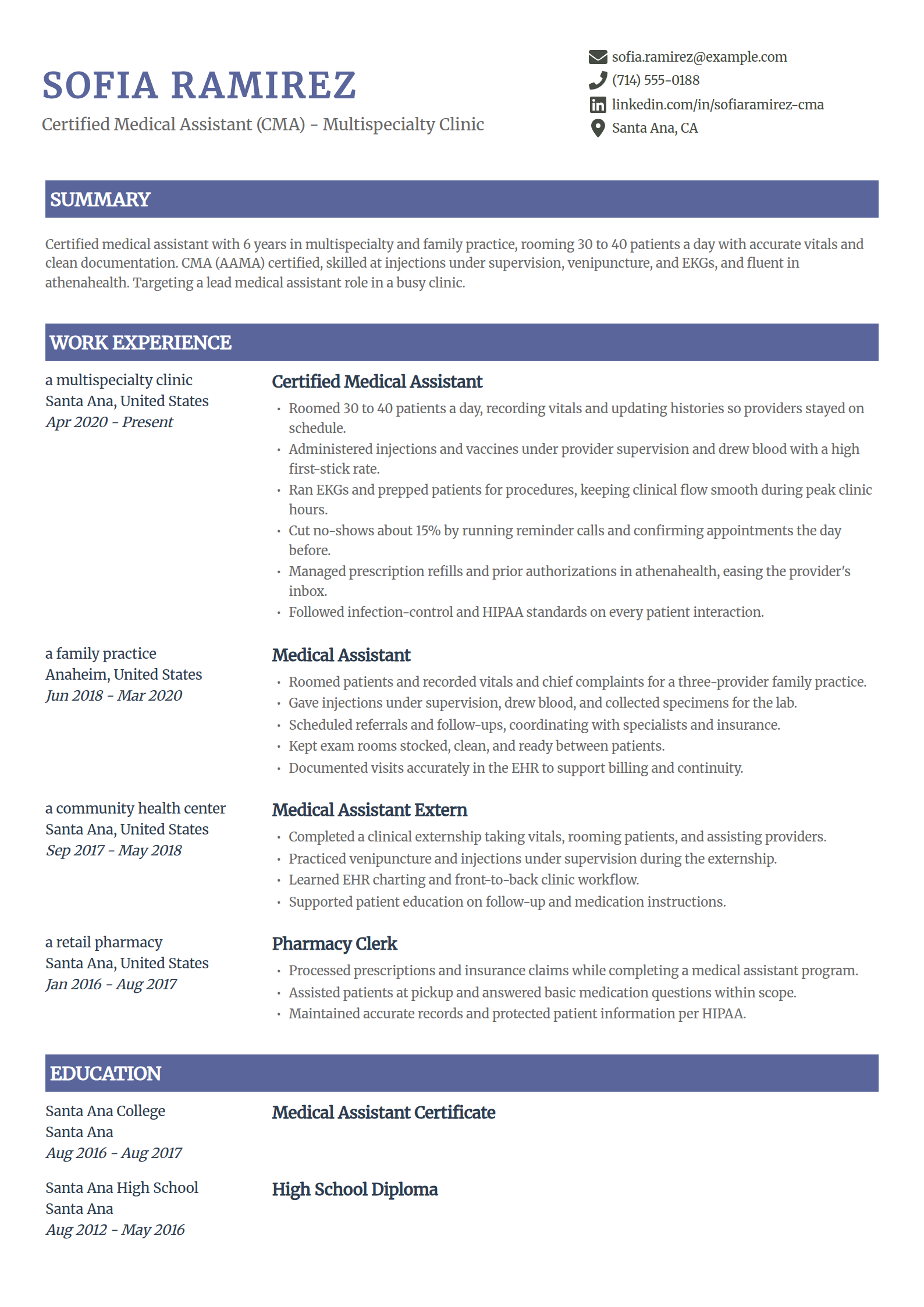
- Leads with the CMA credential and keeps scope accurate, vitals, injections under supervision, venipuncture, and EKG.
- Shows both sides of the role a clinic hires for, clinical rooming and front-and-back-office flow.
- For medical assistant examples from CMA to RMA, the medical assistant page carries the full set.
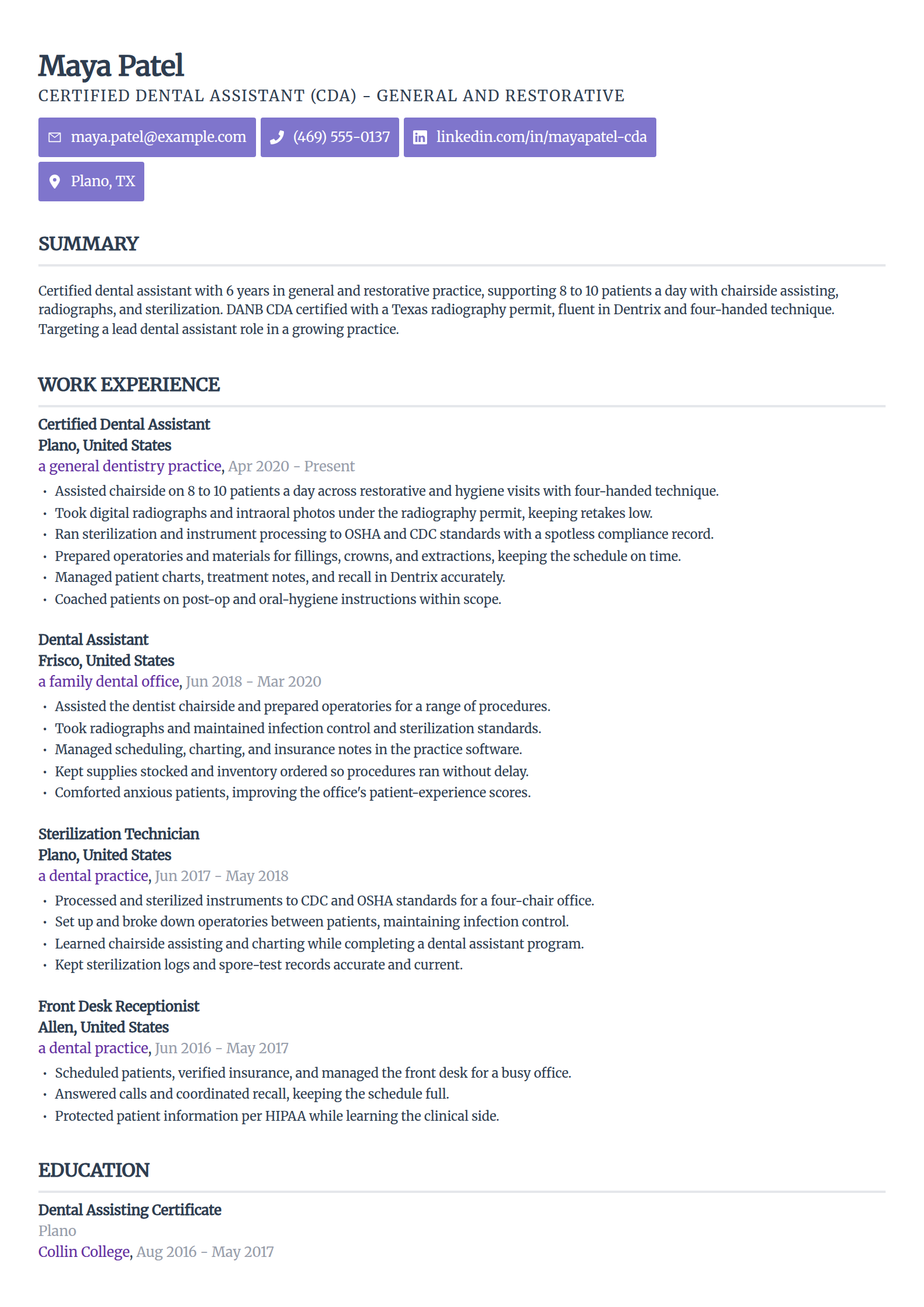
Dental Assistant Resume Example
See the full dental assistant resume templates and examples →
Why this resume example works?
- Leads with the DANB CDA and a radiography permit, and keeps scope right, chairside assisting and x-rays, not scaling.
- Names four-handed technique, sterilization, and Dentrix, the skills a practice screens for.
- For dental assistant examples across office types, the dental assistant page carries the full set.
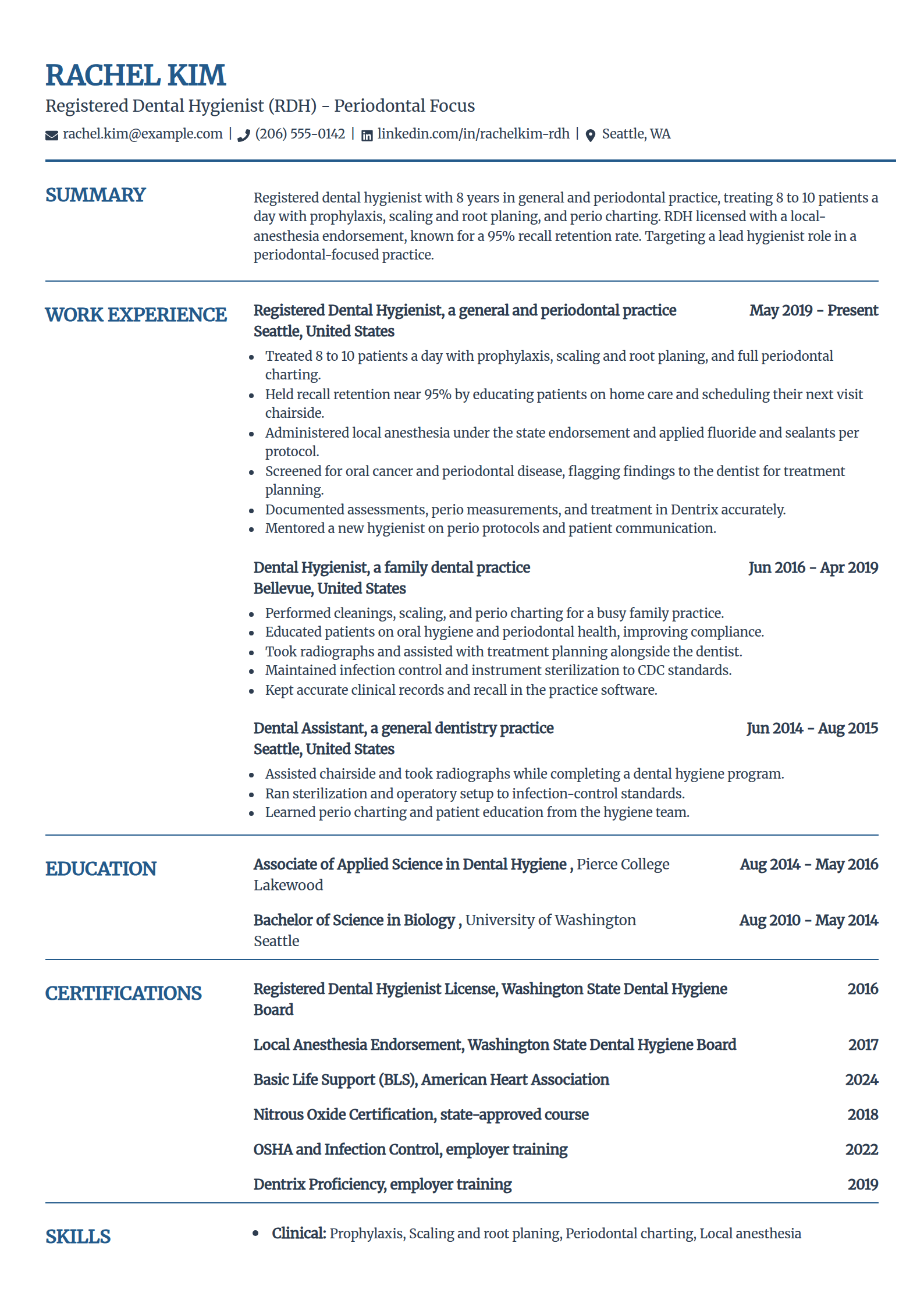
Dental Hygienist Resume Example
See the full dental hygienist resume templates and examples →
Why this resume example works?
- Leads with the RDH license and a local-anesthesia endorsement, the credentials a hygiene role checks first.
- Shows real hygienist scope, prophylaxis, scaling and root planing, and periodontal charting, with a recall number.
- For dental hygiene examples across tracks, the dental hygienist page carries the full set.
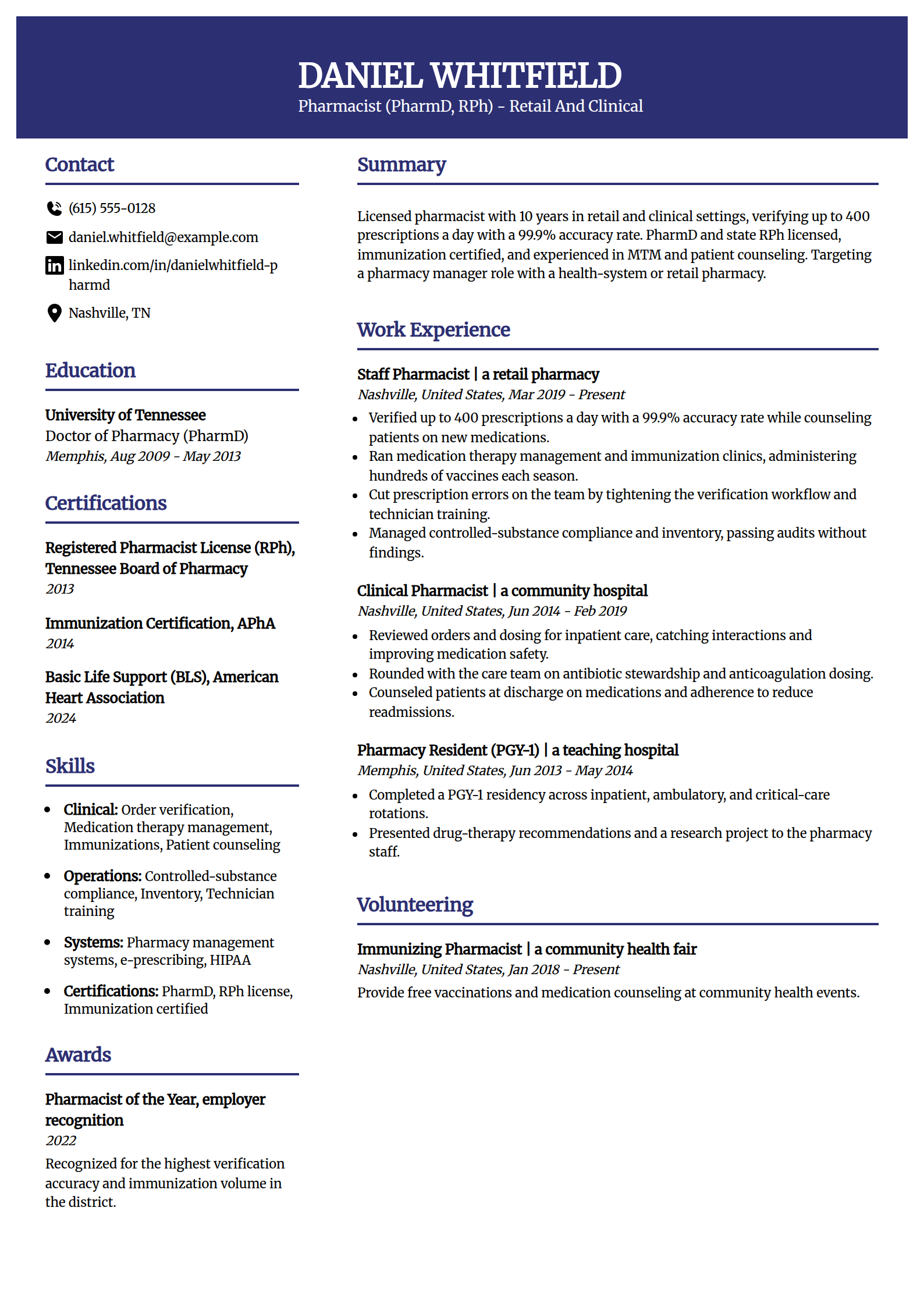
Pharmacist Resume Example
See the full pharmacist resume templates and examples →
Why this resume example works?
- Leads with the PharmD and state RPh license, and a verification-accuracy number a pharmacy screens for.
- Shows real pharmacist scope, order verification, medication therapy management, and immunizations.
- For pharmacist and pharmacy tech examples, the pharmacist page carries the full set.
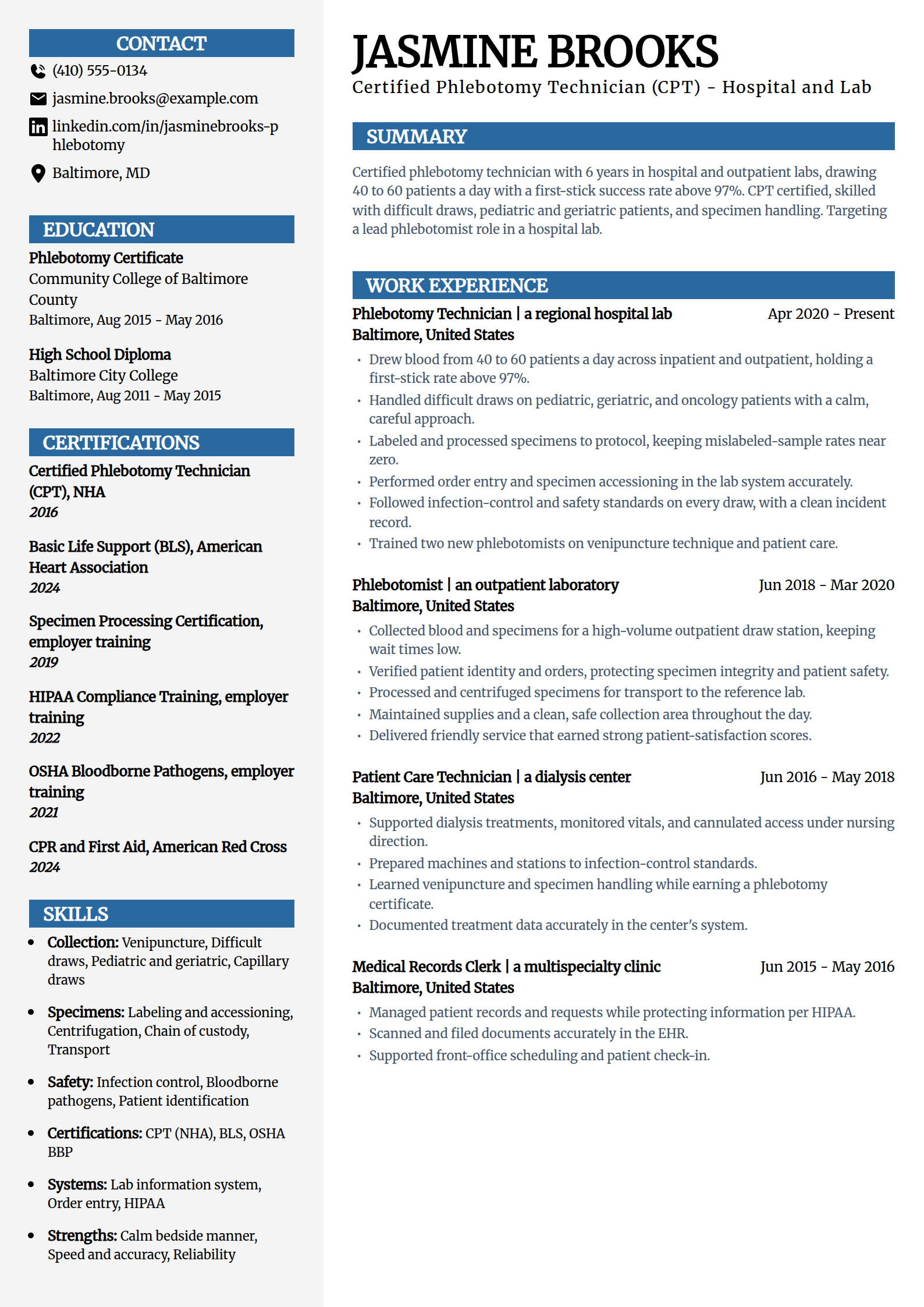
Phlebotomist Resume Example
See the full phlebotomist resume templates and examples →
Why this resume example works?
- Leads with the CPT certification and a first-stick success rate, the number a lab looks for first.
- Keeps scope right, venipuncture and specimen handling, with difficult-draw and specimen-processing skills.
- For phlebotomy examples across lab and hospital settings, the phlebotomist page carries the full set.
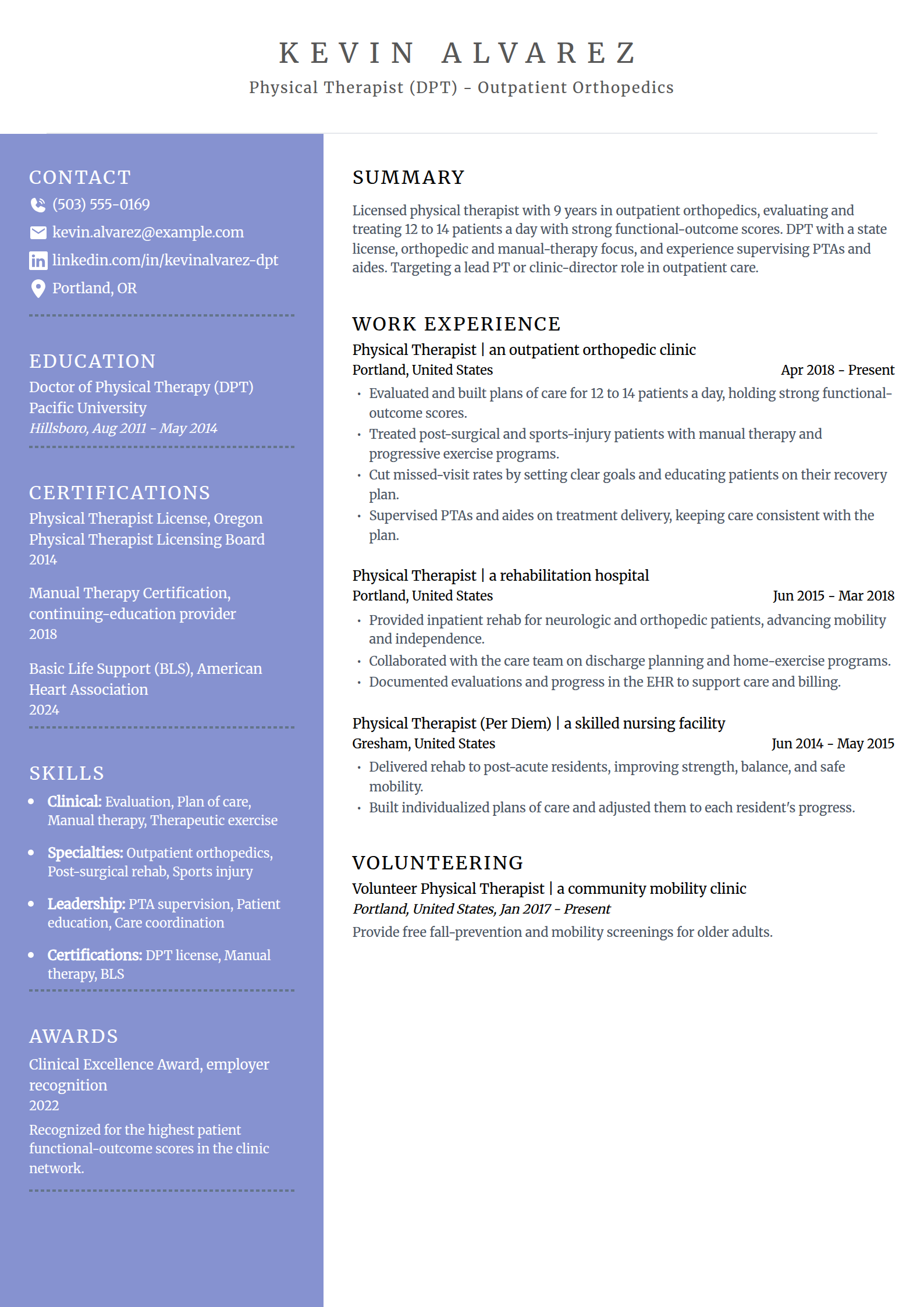
Physical Therapist Resume Example
See the full physical therapist resume templates and examples →
Why this resume example works?
- Leads with the DPT and state license, and keeps scope right, evaluation and plan of care with functional outcomes.
- Shows the specialty a posting screens for, outpatient orthopedics and post-surgical rehab.
- For physical therapist examples from DPT to PTA, the physical therapist page carries the full set.
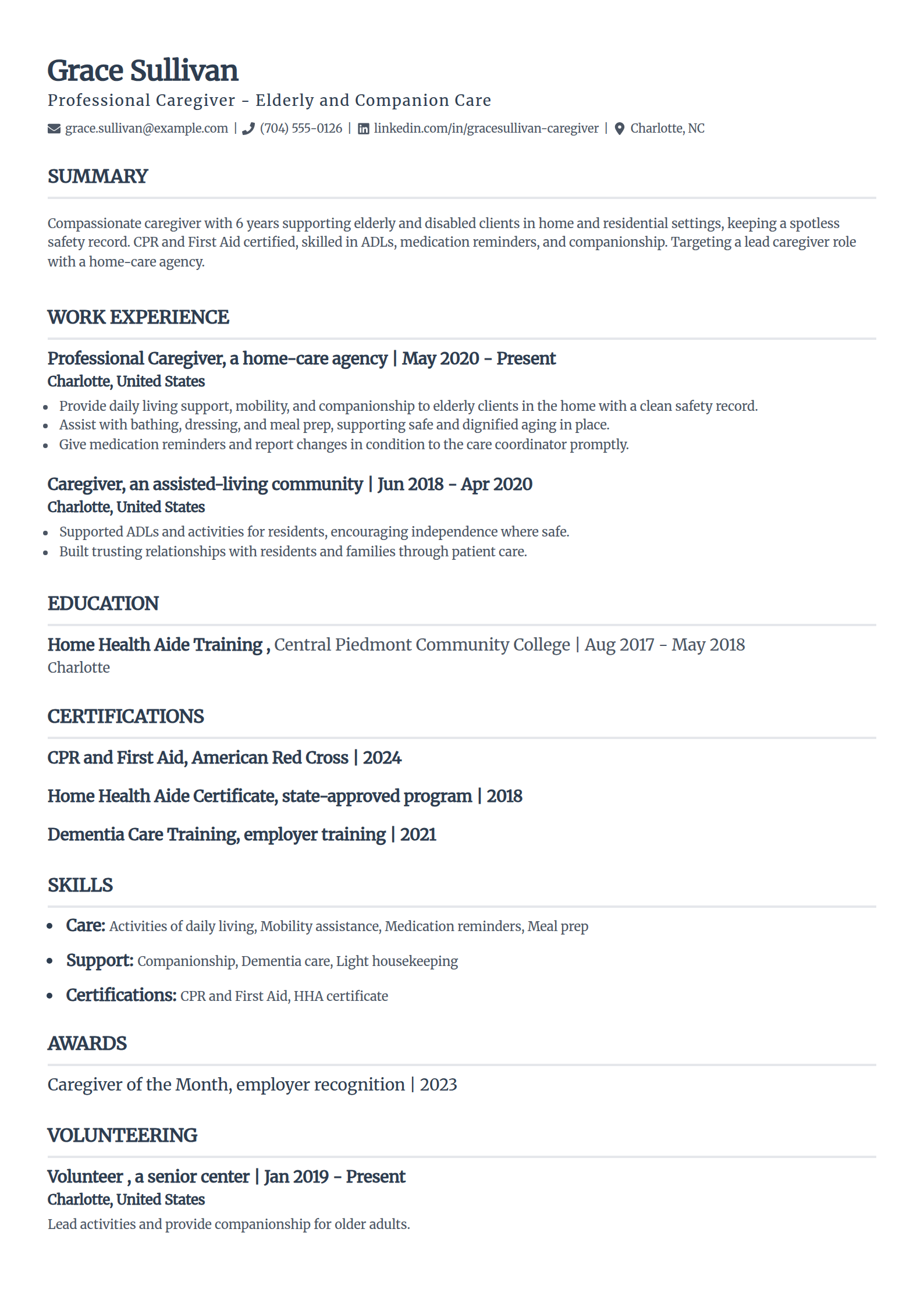
Caregiver Resume Example
See the full caregiver resume templates and examples →
Why this resume example works?
- Leads with CPR and First Aid and keeps scope right, ADLs, mobility, and companionship, not clinical tasks.
- Puts a safety record and real home-care duties where an agency looks first.
- For caregiver and nanny examples, the caregiver page carries the full set.
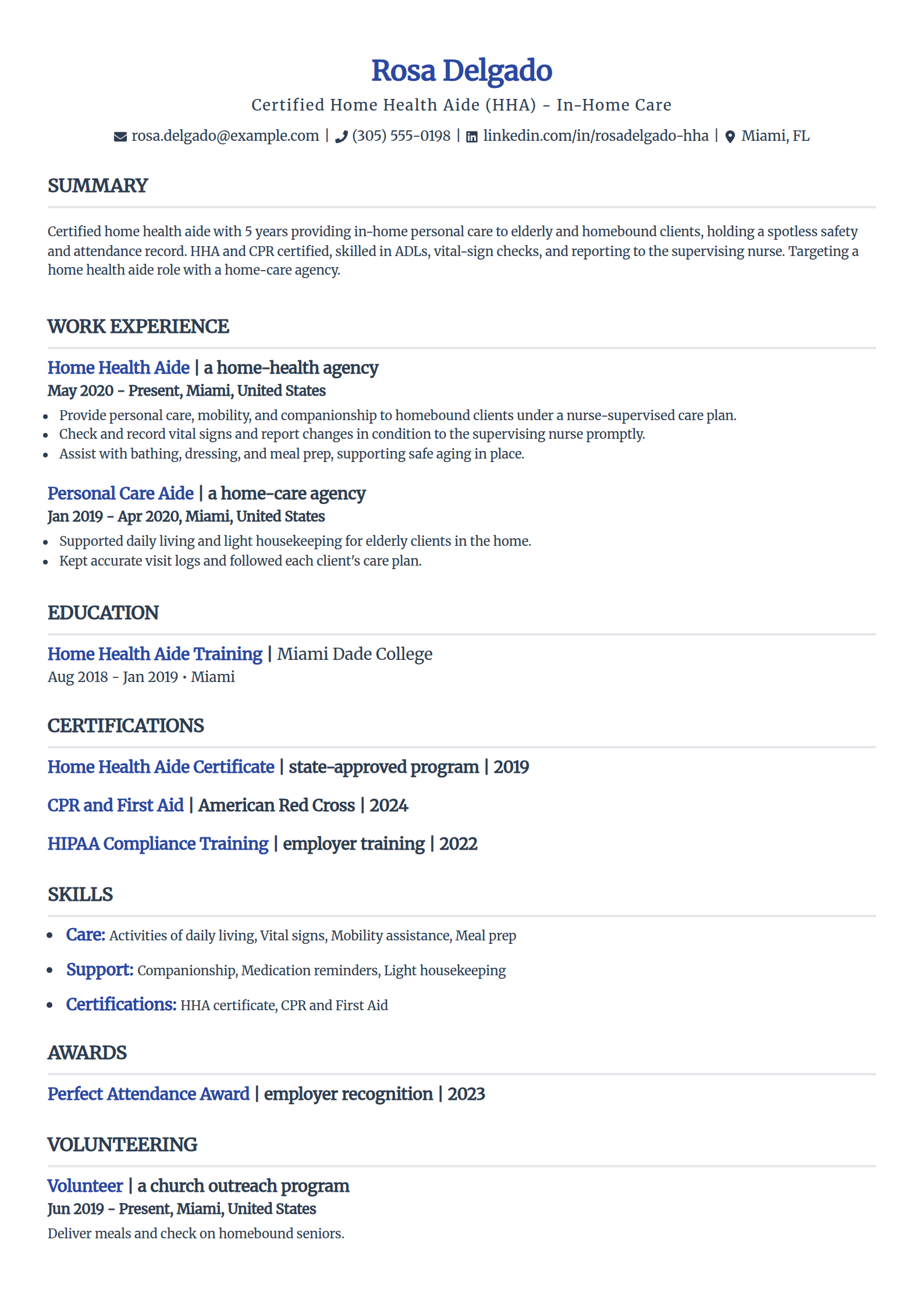
Home Health Aide (HHA) Resume Example
Why this resume example works?
- Leads with the HHA certificate and CPR, and keeps scope right, personal care under a nurse-supervised plan.
- Shows the in-home work an agency screens for, ADLs, vital-sign checks, and reporting to the supervising nurse.
- Fills a tight, ATS-safe page with a clean attendance record and a community volunteer role.
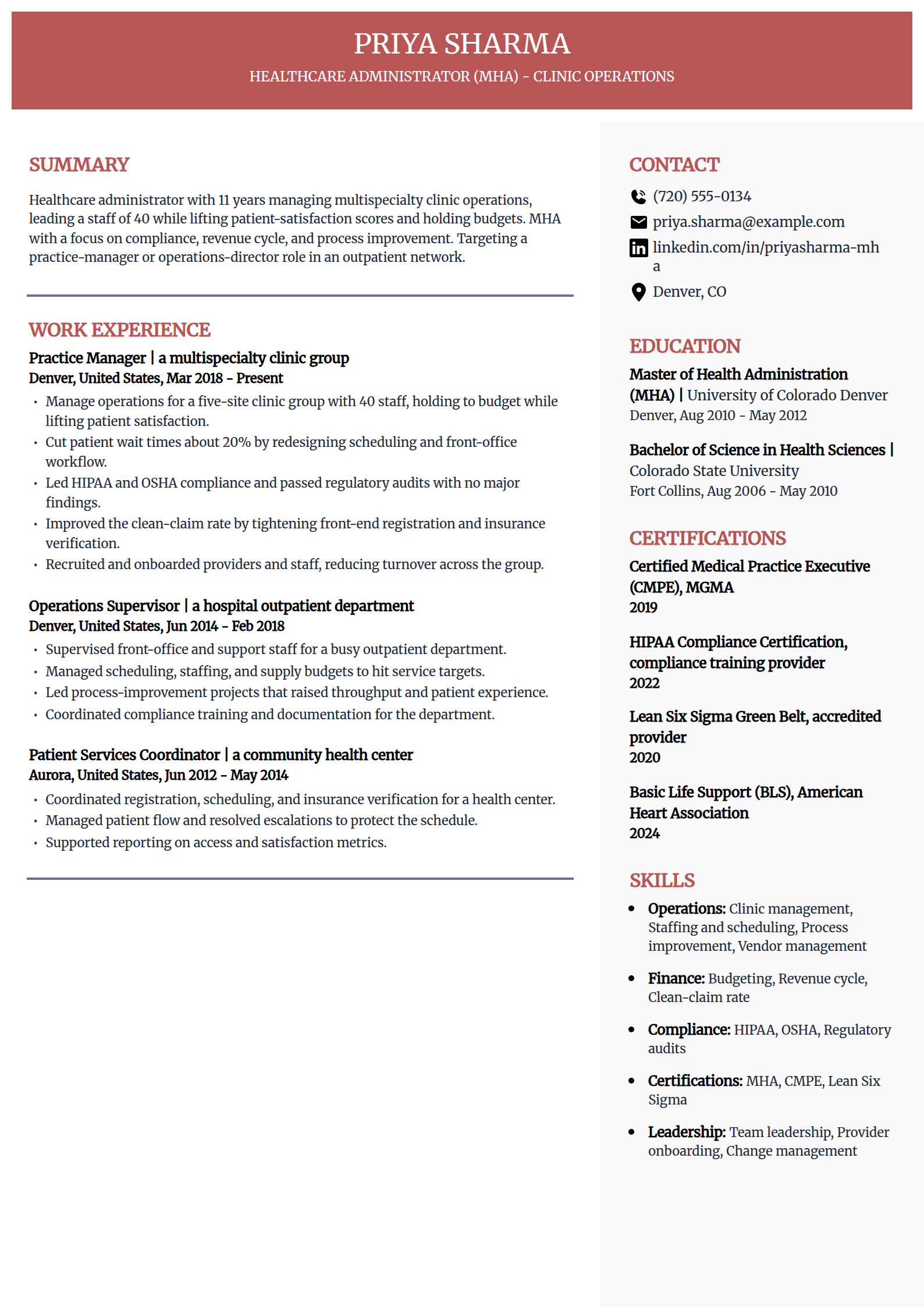
Healthcare Administrator Resume Example
Why this resume example works?
- Leads with the MHA and a CMPE, and quantifies operations, a five-site group and staff of 40 held to budget.
- Shows the non-clinical work a health system hires for, compliance, revenue cycle, and process improvement.
- Names HIPAA and OSHA audits passed, the accountability an operations role screens for.
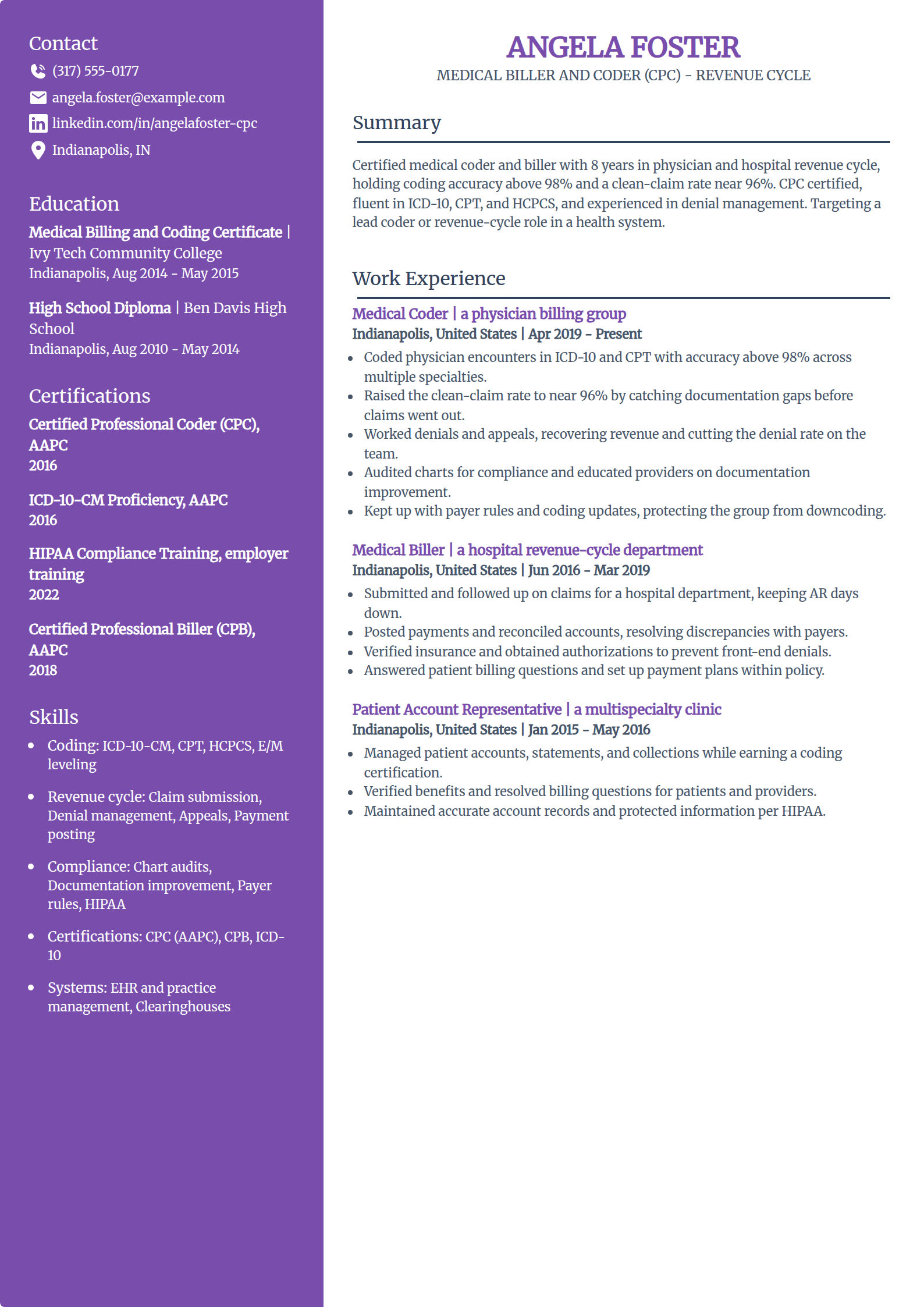
Medical Biller and Coder Resume Example
Why this resume example works?
- Leads with the CPC and coding accuracy plus a clean-claim rate, the numbers a revenue-cycle team screens for.
- Names the real tools of the role, ICD-10, CPT, denial management, and appeals.
- Shows the compliance side, chart audits and documentation improvement, that protects revenue.
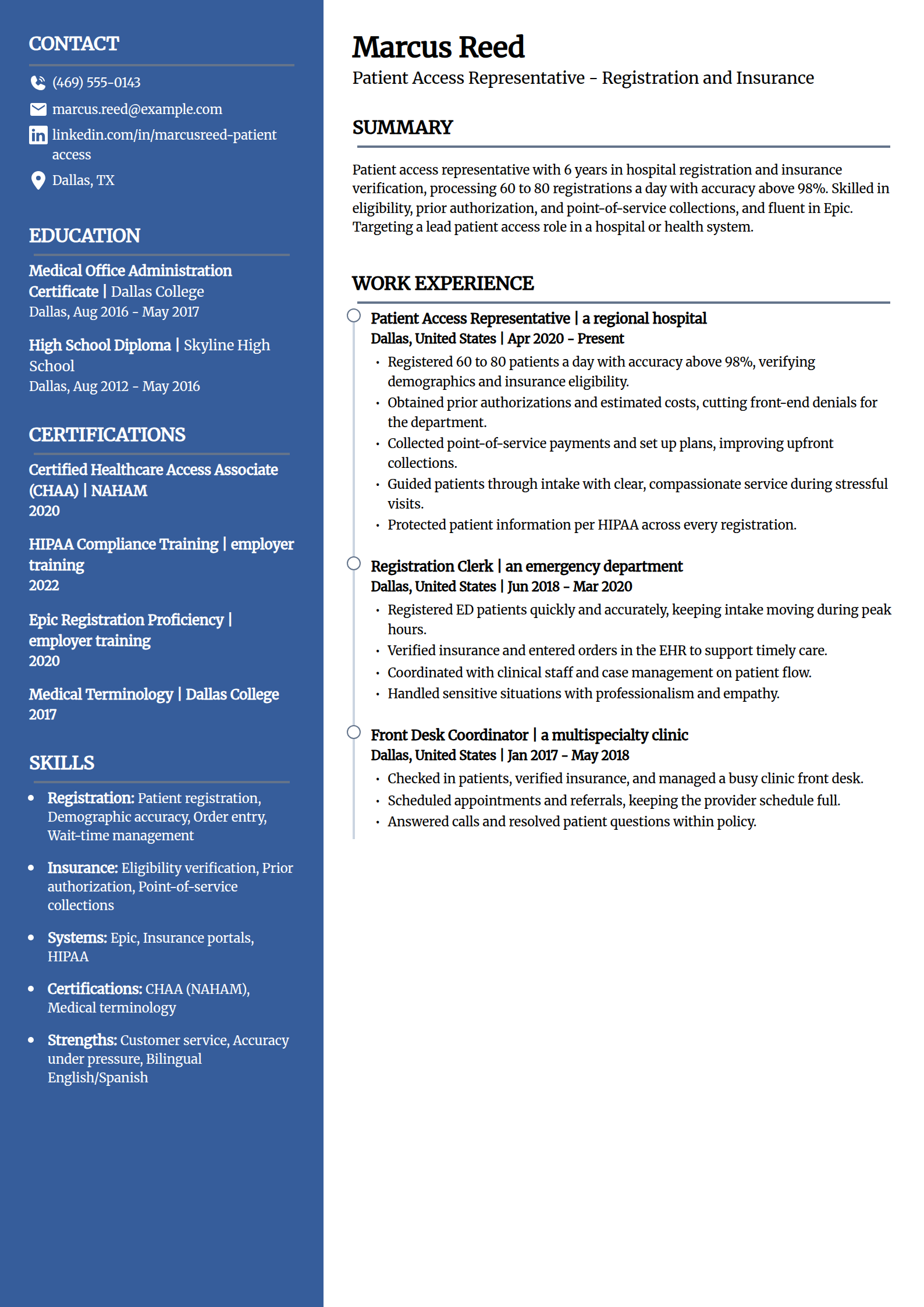
Patient Access Representative Resume Example
Why this resume example works?
- Leads with a registration-accuracy number and the CHAA credential, what a hospital access role checks first.
- Names the real work, eligibility verification, prior authorization, and point-of-service collections.
- Shows Epic fluency and compassionate service, the mix a busy front end needs.
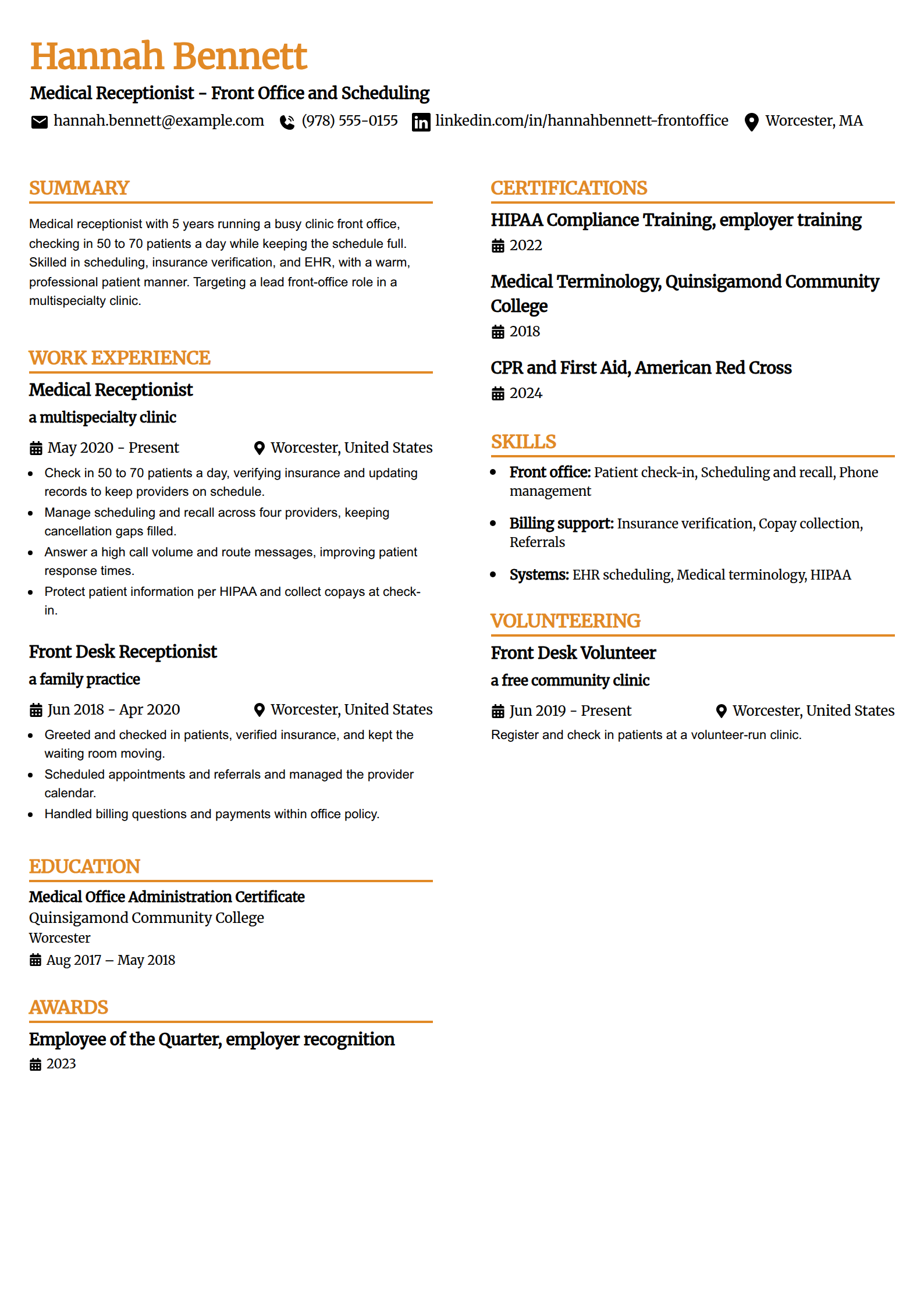
Medical Receptionist Resume Example
Why this resume example works?
- Leads with a check-in volume and scheduling scope, the numbers a busy front office looks for.
- Names insurance verification, recall, and EHR scheduling, the real front-office skills.
- Keeps a tight, ATS-safe layout that fits a full front-office record on one page.
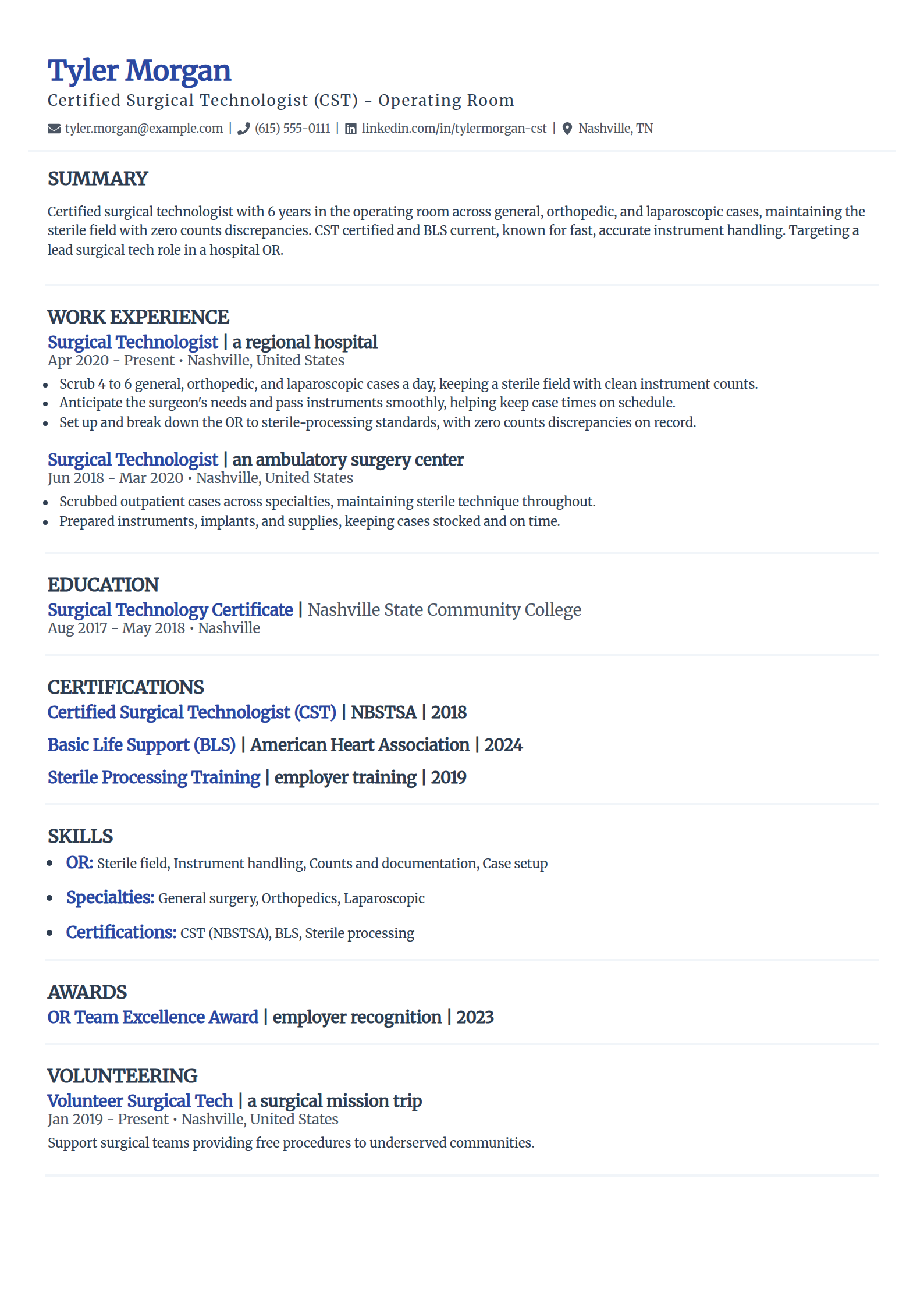
Surgical Technologist Resume Example
Why this resume example works?
- Leads with the CST and keeps scope right, maintaining the sterile field and clean instrument counts.
- Names the specialties an OR screens for, general, orthopedic, and laparoscopic cases.
- Puts a zero-counts-discrepancy record where an operating room looks first.
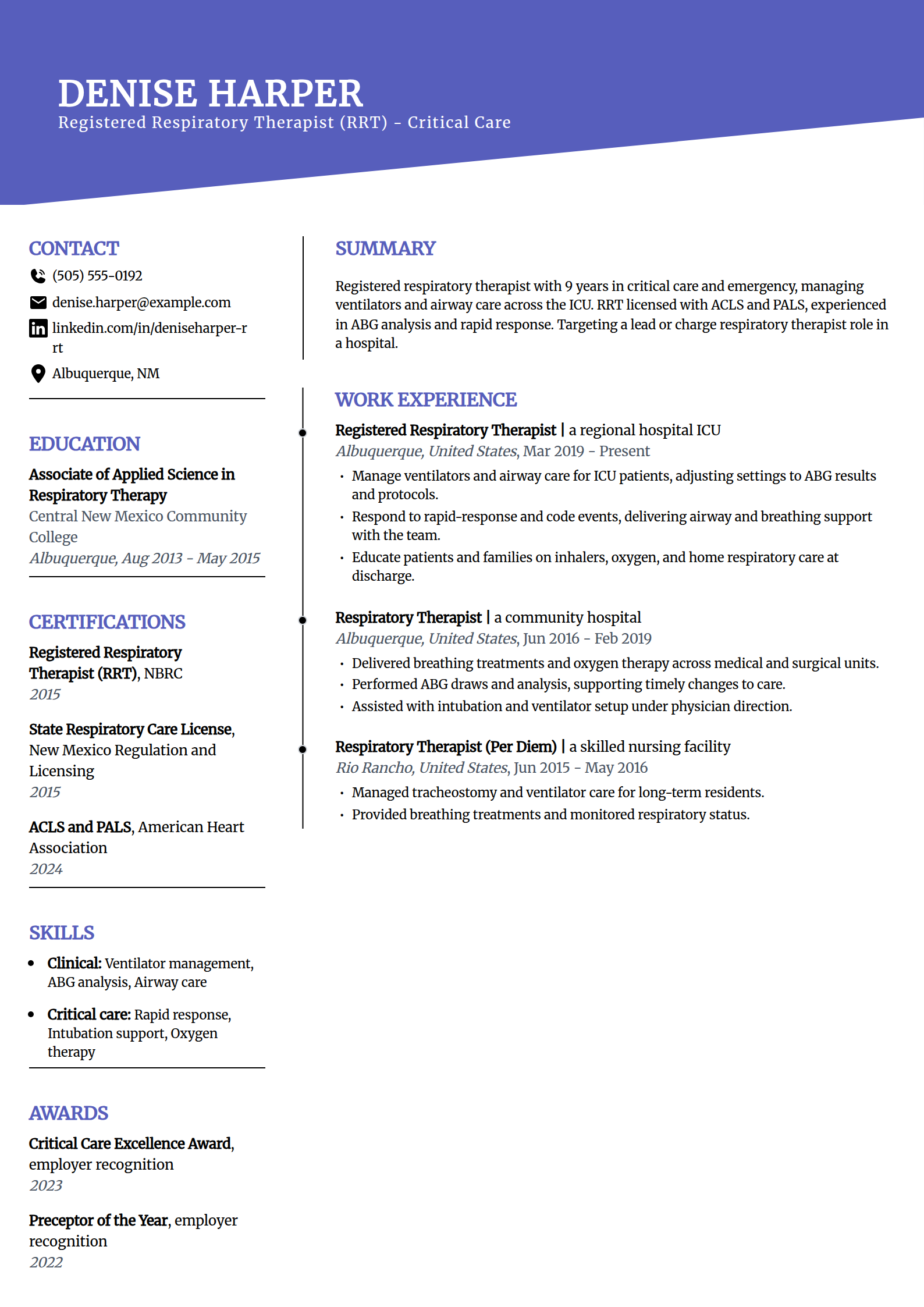
Respiratory Therapist Resume Example
Why this resume example works?
- Leads with the RRT license plus ACLS and PALS, and keeps scope right, ventilator management and ABG analysis.
- Shows the critical-care work a hospital hires for, rapid response and intubation support.
- Uses a two-column layout with awards so a critical-care record fills the page.
Build your healthcare resume
Pick a template above and the editor keeps your layout clean and ATS-safe while you swap in your own license, certifications, and patient-care numbers.
Build my resumeHow to write a healthcare resume in 2026
A healthcare resume gets scanned fast for two things: whether your license or certification is current, and whether your experience matches the exact role. Lead with a short summary that names your credential and your setting, then put your license and certifications in their own section near the top. Keep the format clean so a parser reads it as easily as a hiring manager does, and pick the guide below that matches your specific role for deeper, role-tailored advice.
Put your license and certifications where they get seen
Healthcare hiring is credential-driven. A recruiter checks your license or certification before anything else, so give it a named section near the top with the issuing body and date, and never list one you do not hold.
- List your license or certification by its real name and body: RN (NCLEX-RN), LPN (NCLEX-PN), CMA (AAMA), RDH, CPT, PharmD/RPh, DPT, CST, or RRT.
- Keep BLS, ACLS, or PALS current and dated; many clinical roles will not interview without them.
- If you are studying for a credential, say you are scheduled to sit for the exam, not that you already hold it.
- Non-clinical roles lead with their own credentials: CPC or CCS for coding, CHAA for patient access, MHA or CMPE for administration.
Write to your scope of practice, not a generic duties list (the honest part)
This is where healthcare resumes lose credibility. A hiring manager knows exactly what your role can and cannot do, so claim only what is in your scope and let the specifics prove your level.
- Match the tasks to the role: a CNA does ADLs and vitals, not medication administration; a medical assistant gives injections under supervision but does not run IV therapy.
- Name the setting and patient population: med-surg, telemetry, skilled nursing, outpatient, or the OR read as real experience.
- Attach a modest, credible number: patient load, first-stick rate, medication accuracy, or recall retention, one per bullet.
- For a role we cover in depth, use the linked guide above for role-specific examples and metrics.
Show HIPAA and EHR familiarity, named
Almost every healthcare role touches protected health information and an electronic health record, so make both easy to find.
- Name the EHR you have used: Epic, Cerner, athenahealth, or the practice-management system, matched to the posting.
- List HIPAA training and note it in a bullet where you handled records or patient data.
- For coding and billing roles, name ICD-10, CPT, and the clearinghouse or payer systems you have worked.
- Keep the wording plain; a parser and a hiring manager both search for the exact system names.
Separate clinical and non-clinical experience clearly
Healthcare careers move between bedside and office roles, so make it obvious which lane a job was in and what you carried into the next.
- Lead each role with the job title and setting so a reader places it instantly as clinical or non-clinical.
- When you move from clinical to administrative, name the clinical knowledge that transfers, like scope, terminology, or workflow.
- Keep the summary aimed at the role you want next, whether that is bedside, allied health, or operations.
- One clean page is enough for most healthcare resumes; a second page is only for extensive senior or leadership scope.
Keep the format clean and ATS-safe
A healthcare resume is read by a parser first and a hiring manager second, so a clean layout with standard headings is the safe choice at every level.
- Use a single-column or simple two-column layout with standard headings a parser recognizes; skip heavy graphics.
- Put your license and certification section near the top, not buried at the bottom.
- Save as a PDF so the formatting holds, then run it through the ATS resume checker for a quick format and keyword pass.
- Swap the numbers in the examples above for your own patient load, accuracy, and volume; do not copy them as is.
Common healthcare resume mistakes
- Burying the license or certification. Your credential belongs in a named section near the top with its body and date, not hidden in a sentence.
- Claiming tasks outside your scope. A CNA who lists medication administration or a medical assistant who lists IV therapy fails the phone screen.
- Listing duties instead of results. Lead with a patient load, first-stick rate, or accuracy number, not a copy of the job description.
- Leaving out HIPAA and the EHR. Name the system you used, like Epic or athenahealth, since a posting and a parser both search for it.
- One generic resume for every role. Tailor the summary and lead experience to the exact job, clinical or non-clinical, and follow the role guide that fits.
Frequently asked questions
How do you write a healthcare resume?
Lead with a three-to-four-sentence summary that names your license or certification, your years, your setting, and the role you are targeting. Put your license and certifications in a named section near the top with the issuing body and date. Under each job, write results-first bullets that stay within your scope of practice and carry one credible number, like a patient load or a medication-accuracy rate. Name the EHR you use, note HIPAA, and keep the whole thing to one clean, ATS-safe page.
What should a healthcare resume include?
A healthcare resume includes a credential-first summary, a license and certification section near the top, experience bullets written to your scope of practice, a skills block, and education. The experience section carries the weight: every bullet should show work you can prove and stay within what your role legally does. Name your EHR (Epic, Cerner, athenahealth), note HIPAA, and for clinical roles include BLS, ACLS, or PALS. Non-clinical healthcare roles follow the same shape with coding, billing, or administration credentials instead.
What skills should a healthcare resume have?
Match the posting, then name specific skills grouped by type. Clinical roles name patient assessment, vital signs, medication administration where in scope, and the EHR. Allied health names the procedures the role owns, like venipuncture for a phlebotomist or scaling for a dental hygienist. Non-clinical roles name registration, insurance verification, ICD-10 and CPT coding, or scheduling. Across every healthcare role, HIPAA, BLS, and a named EHR belong on the resume, and you should mirror the exact terms the posting uses.
How do you write a healthcare resume with no experience?
Lead with what you do have. A new clinical candidate leads with the license or certification, BLS, and any clinical or externship hours from training. An entry-level office candidate leads with a certificate, HIPAA training, and any front-desk or customer-service work. Reframe clinical rotations, externships, and volunteer care as real experience, and name the EHR you trained on. Your credential and any supervised or hands-on hours are your strongest early signal, and the role guides linked above show the entry-level shape for each job.
Do you list certifications and licenses on a healthcare resume?
Yes, and near the top. A license or certification is the first thing a healthcare recruiter checks, and many roles will not interview without a current one. Give them a named section with the credential, the issuing body, and the date, such as RN (Illinois Board of Nursing) or CMA (AAMA). Add BLS, ACLS, or PALS for clinical roles and keep the dates current. List only what you hold; if you are studying, say you are scheduled to sit for the exam rather than implying you are already certified.
How long should a healthcare resume be?
One page for most healthcare workers, including nurses, allied health, and office staff. Use a second page only when a manager, administrator, or senior clinician has enough relevant leadership, projects, or scope to justify it, and never pad to reach it. Whichever length you use, lead with your license and most relevant work, keep standard headings, and cut older or unrelated jobs so the space goes to the credentials, scope, and numbers a healthcare hiring manager checks first.
More healthcare resume resources
Build your healthcare resume
Pick a template above and the editor keeps your layout clean and ATS-safe while you swap in your own license, certifications, and patient-care numbers.