Dental Hygienist Resume Templates and Examples by RDH Specialty
- ATS Friendly
- Licensed RDH Scope
- 16 Real Examples
A new-grad RDH, a perio specialty chair, and a public-health sealant program each ask for a different resume, and this page has one built for your exact track. Start from a layout below, then model your own on a real example, from a first hygiene job to a lead RDH. Your license, anesthesia permit, and patients-per-day sit where a hiring office looks first.


540k+ resumes created
Dental hygienist resume templates for every level and setting
Each template below is a real registered dental hygienist resume laid out in that format, sorted by experience level and setting across general, periodontal, pediatric, public health, temp, and corporate practice. Pick one, then swap in your own license, permits, systems, and daily patient load. Every layout keeps your name, RDH credentials, and clinical skills readable so a hiring office sees your strongest work at a glance and an applicant tracking system parses it cleanly.
General Practice Dental Hygienist Resume Template
Why this resume example works?
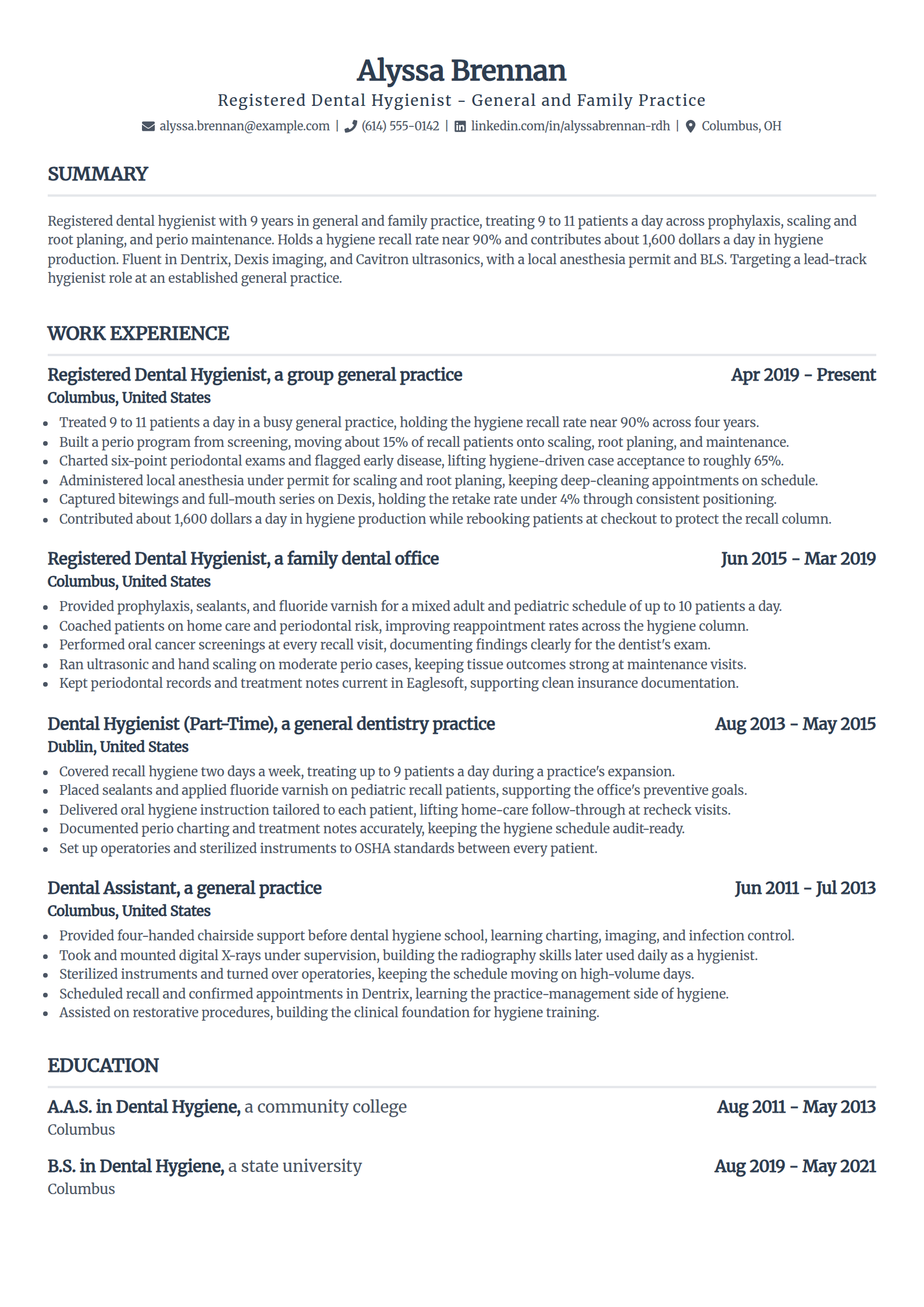
- Opens with a summary that names 9 years, 9 to 11 patients a day, and the RDH license plus local anesthesia permit.
- Shows core hygiene scope a general office wants: prophylaxis, scaling and root planing, perio charting, and oral cancer screening.
- Attaches one number to each bullet, like a recall rate near 90% or hygiene-driven case acceptance around 65%.
- Names the systems a posting screens for, Dentrix, Eaglesoft, and Dexis imaging, in real clinical context.
- Uses a clean, single-column layout an applicant tracking system reads without trouble.
Experienced Dental Hygienist Resume Template
Why this resume example works?
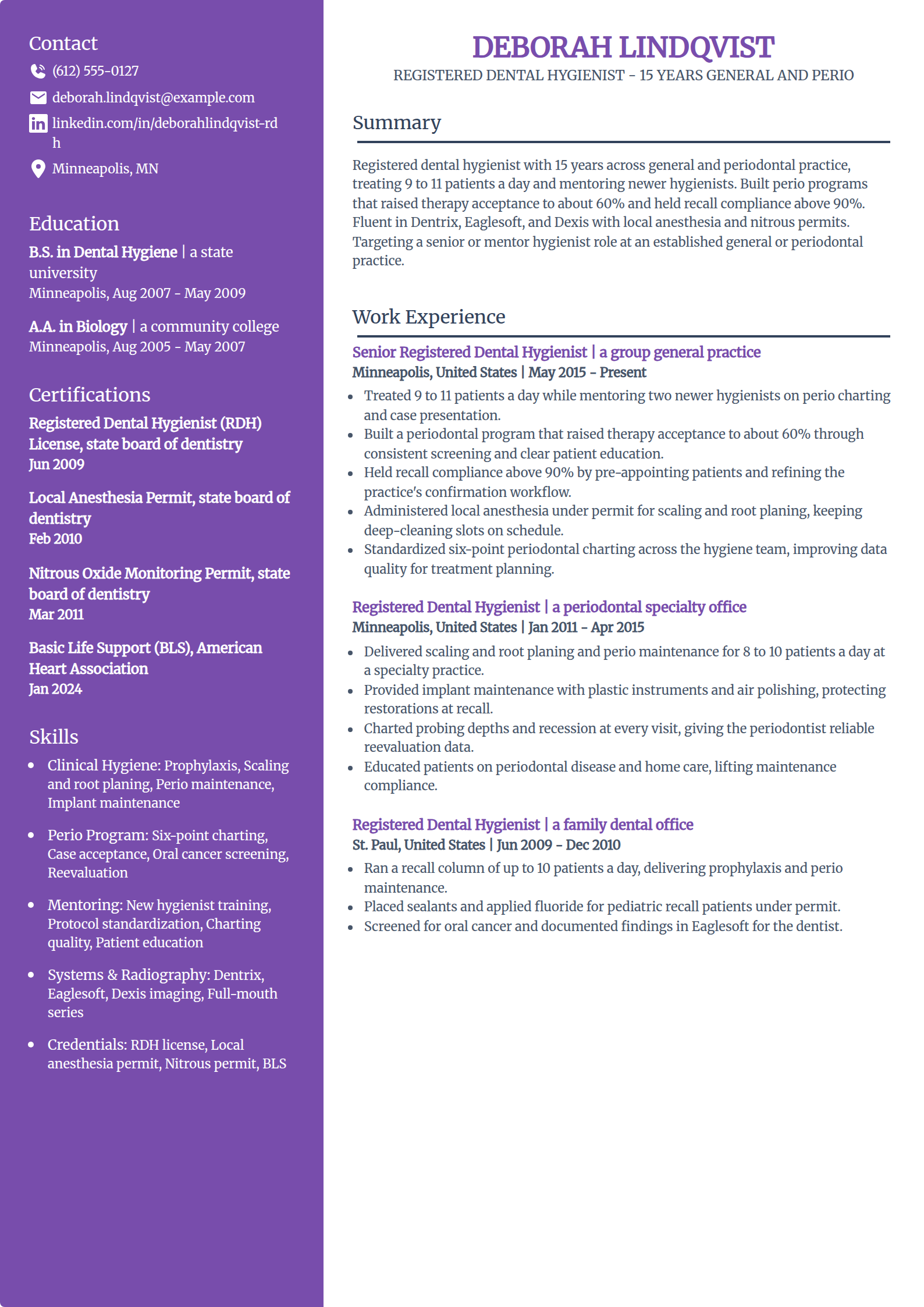
- Leads with 15 years across general and periodontal practice plus mentoring, the depth a senior hygiene posting wants.
- Shows a built perio program that raised therapy acceptance to about 60% and held recall compliance above 90%.
- Keeps the candidate credible at the chair, still treating 9 to 11 patients a day while coaching newer hygienists.
- Names local anesthesia under permit, six-point charting, and implant maintenance, all squarely in RDH scope.
- Uses a Medium layout that carries a deep, multi-setting history without empty space.
New Grad Dental Hygienist Resume Template
Why this resume example works?
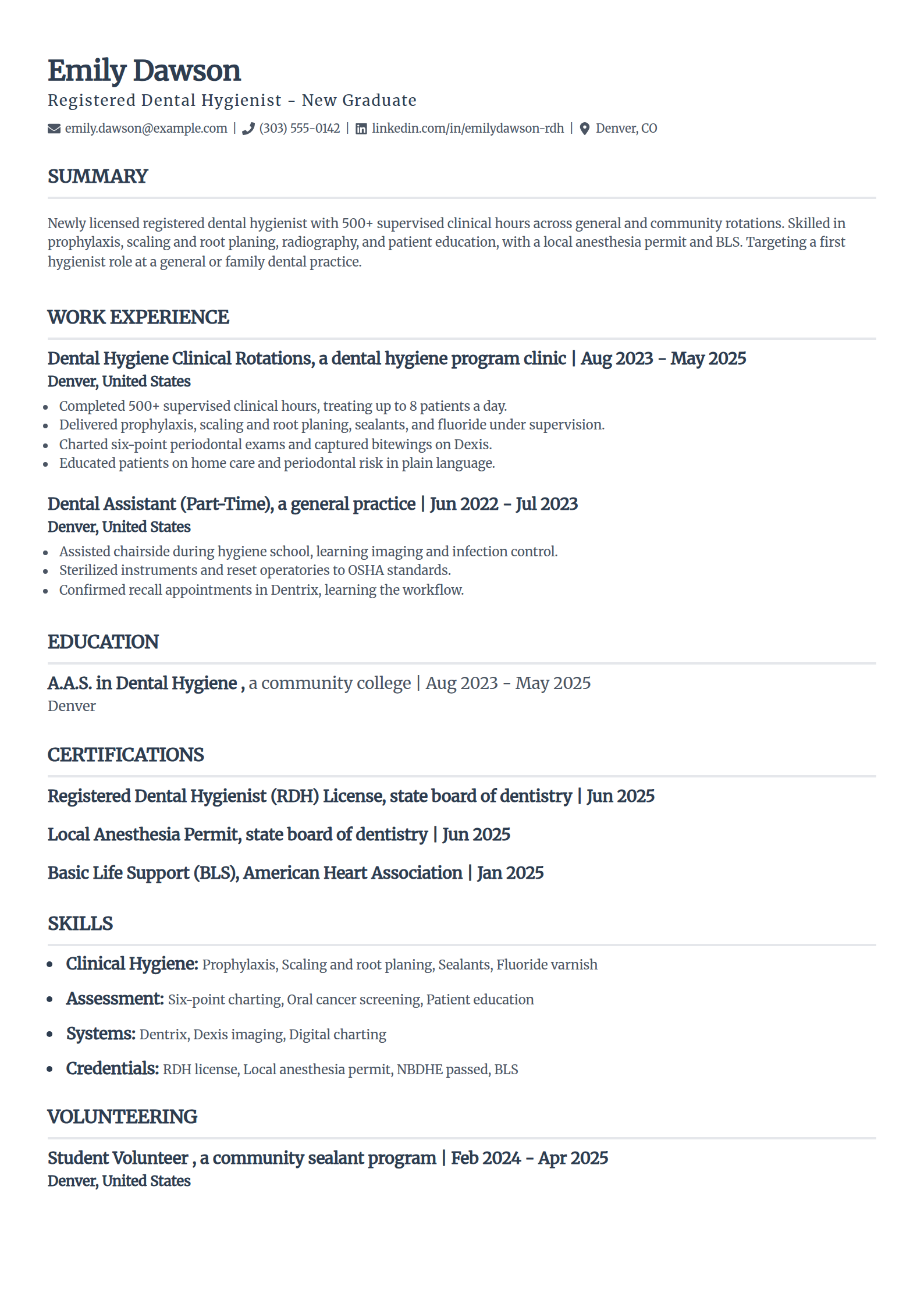
- Written for a recent graduate, leading with 500+ supervised clinical hours and a fresh RDH license and local anesthesia permit.
- Uses clinical rotations and a part-time assisting job as entries, the right move when full-time hygiene experience is new.
- Keeps every bullet honest and quantified, like treating up to 8 patients a day across recall and perio cases.
- Names Dentrix and Dexis, the systems a first hygiene posting screens for, plus a passed NBDHE and BLS.
- Fills a tight, ATS-safe page with a community sealant volunteer role instead of padding.
Entry-Level Dental Hygienist Resume Template
Why this resume example works?
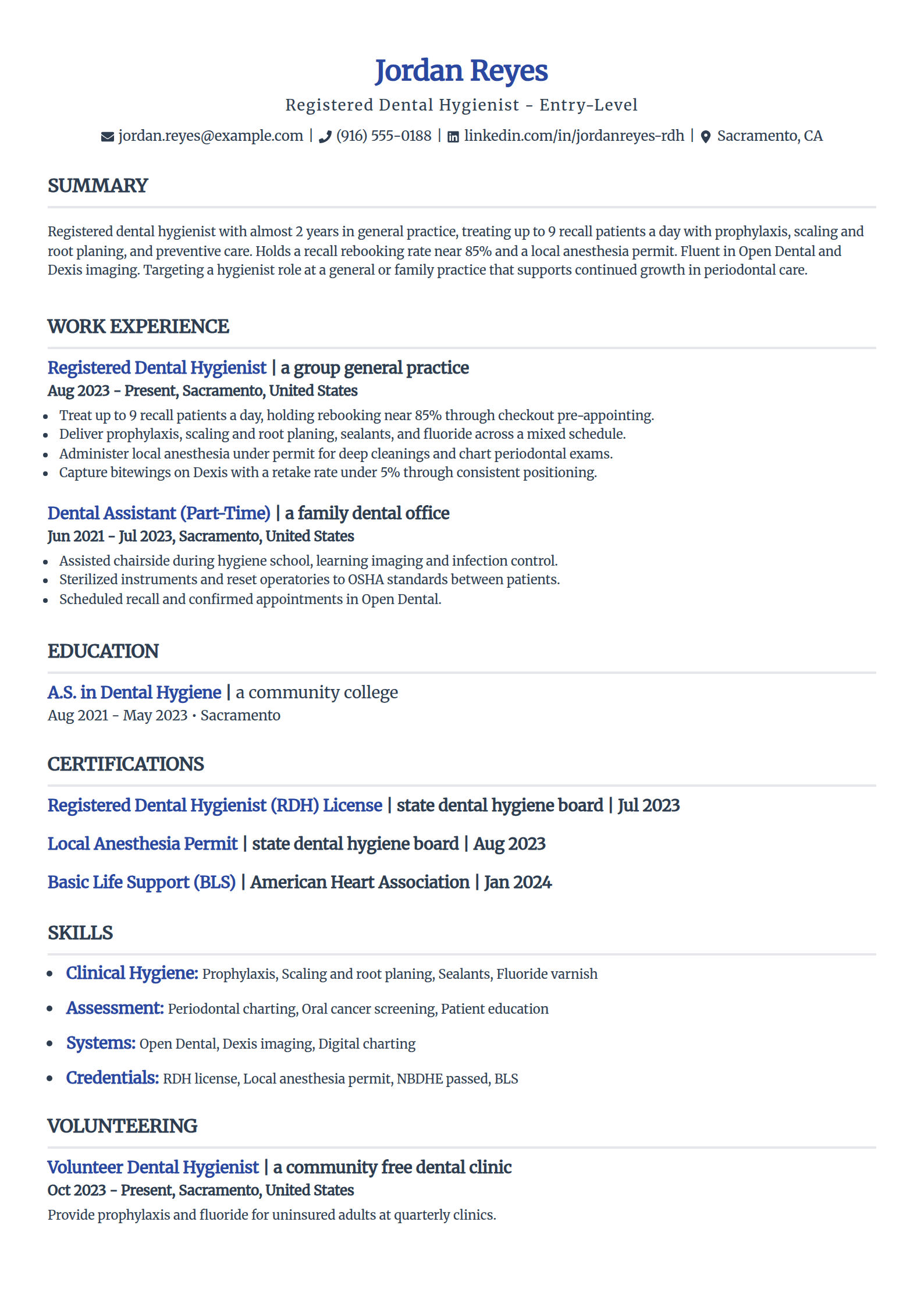
- Written for a hygienist with almost two years, leading with an RDH license and a recall rebooking rate near 85%.
- Shows the everyday hygiene column, prophylaxis, scaling and root planing, sealants, and fluoride across a mixed schedule.
- Keeps early results modest and real, like a radiograph retake rate under 5% through consistent positioning.
- Names Open Dental and Dexis plus a local anesthesia permit, the credentials a general posting checks.
- Fills a plain, ATS-safe page with a free-clinic volunteer role, not invented jobs.
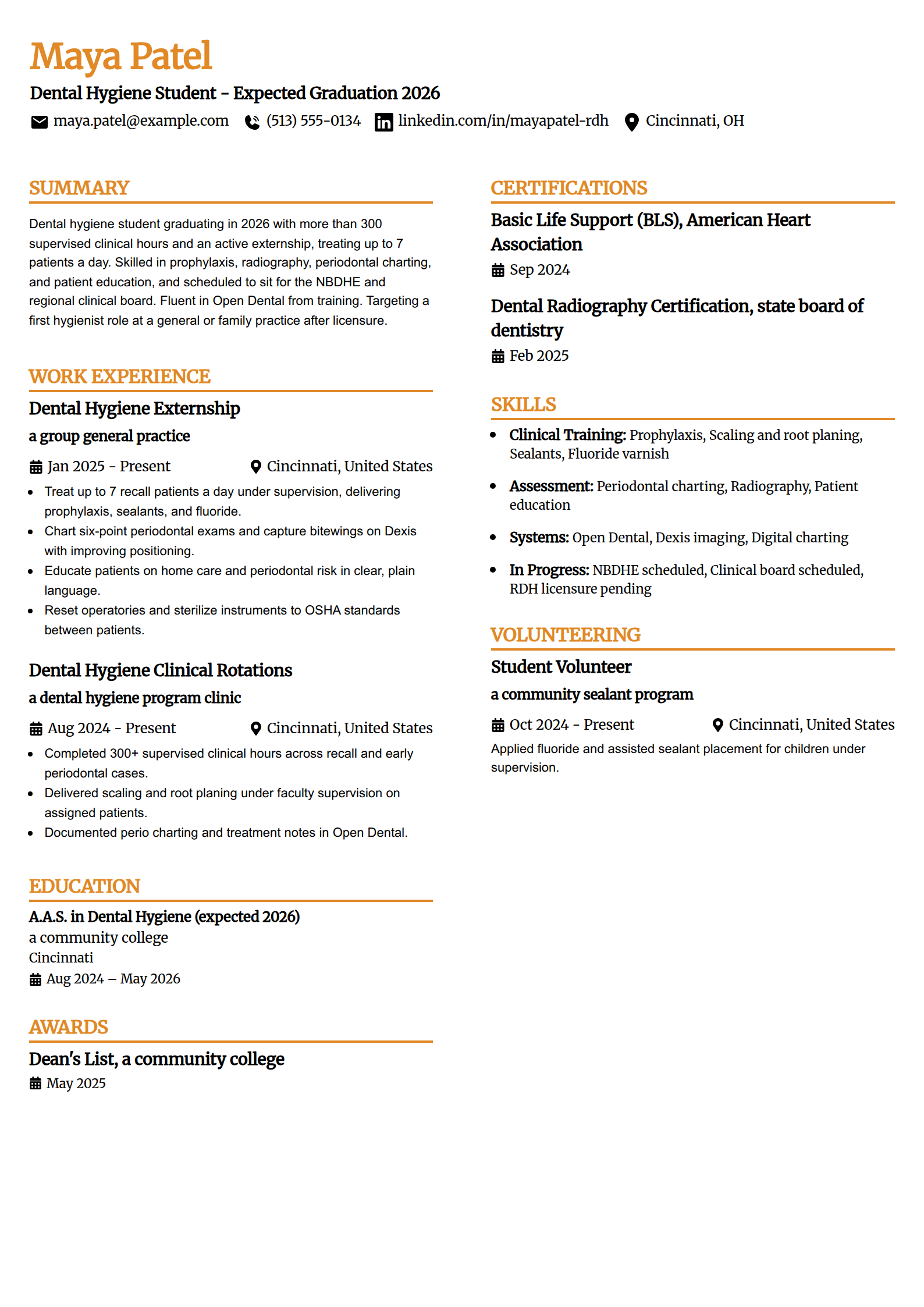
Dental Hygiene Student Resume Template
Why this resume example works?
- Written for a current student, leading with an active externship and an expected 2026 graduation date.
- Uses the externship and clinical rotations as entries, the right shape before a first licensed hygiene role.
- Keeps each bullet honest, like treating up to 7 patients a day under supervision with improving radiograph positioning.
- States exam status precisely, scheduled to sit for the NBDHE and regional clinical board, with licensure pending.
- Fills a tight, ATS-safe page with a Dean's List award and a school sealant volunteer role.
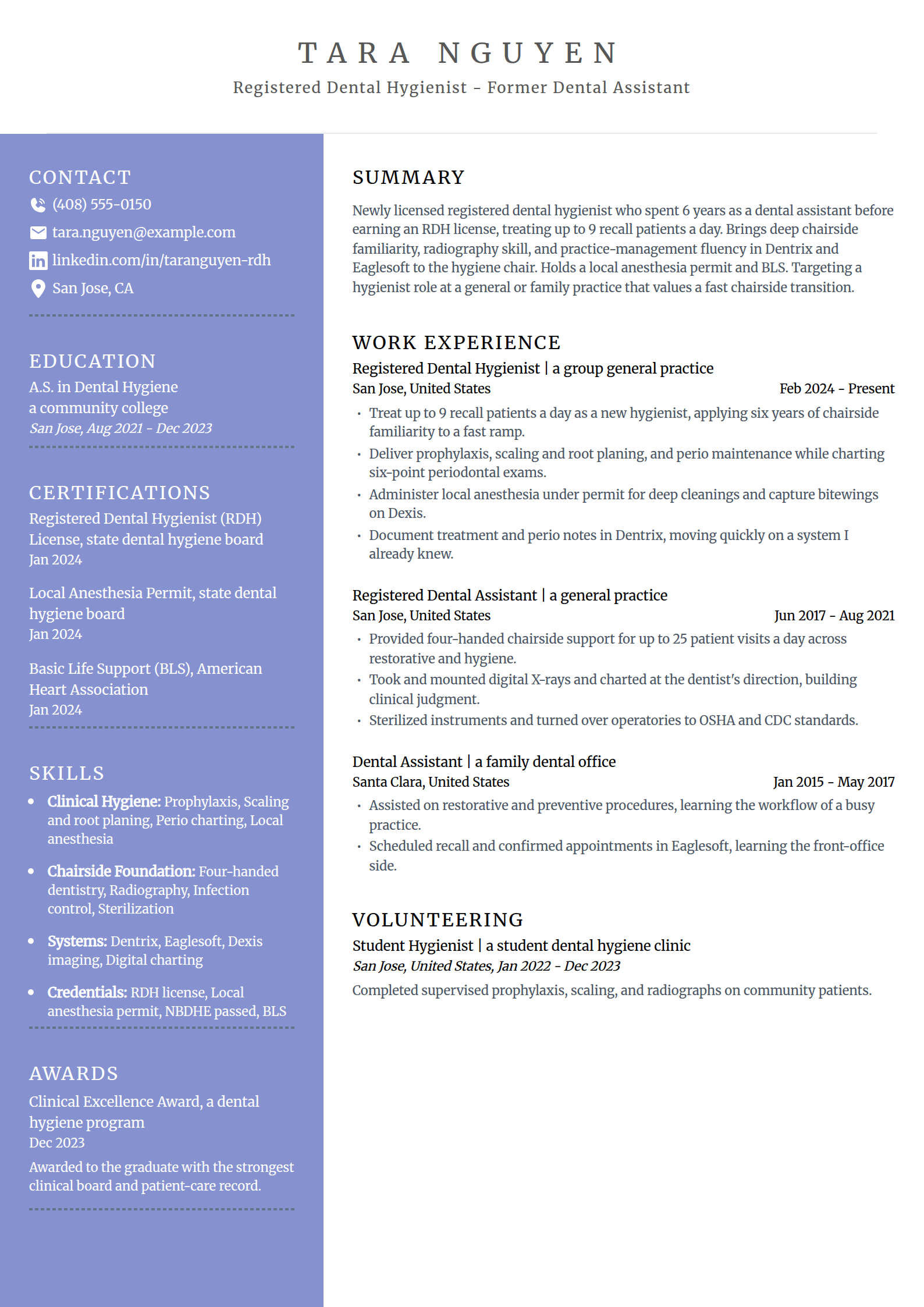
Assistant-to-Hygienist Career Change Resume Template
Why this resume example works?
- Names the step up openly, a new RDH license after six years as a dental assistant, without overclaiming hygiene years.
- Reframes prior chairside work as an asset, radiography skill and practice-management fluency that speed the ramp.
- Shows recent proof inside hygiene scope, treating up to 9 recall patients a day with scaling and root planing.
- Keeps the new credentials concrete, RDH license, local anesthesia permit, and a passed NBDHE.
- Uses a roomy layout with an award and a student-clinic volunteer role so a transition record still looks full.
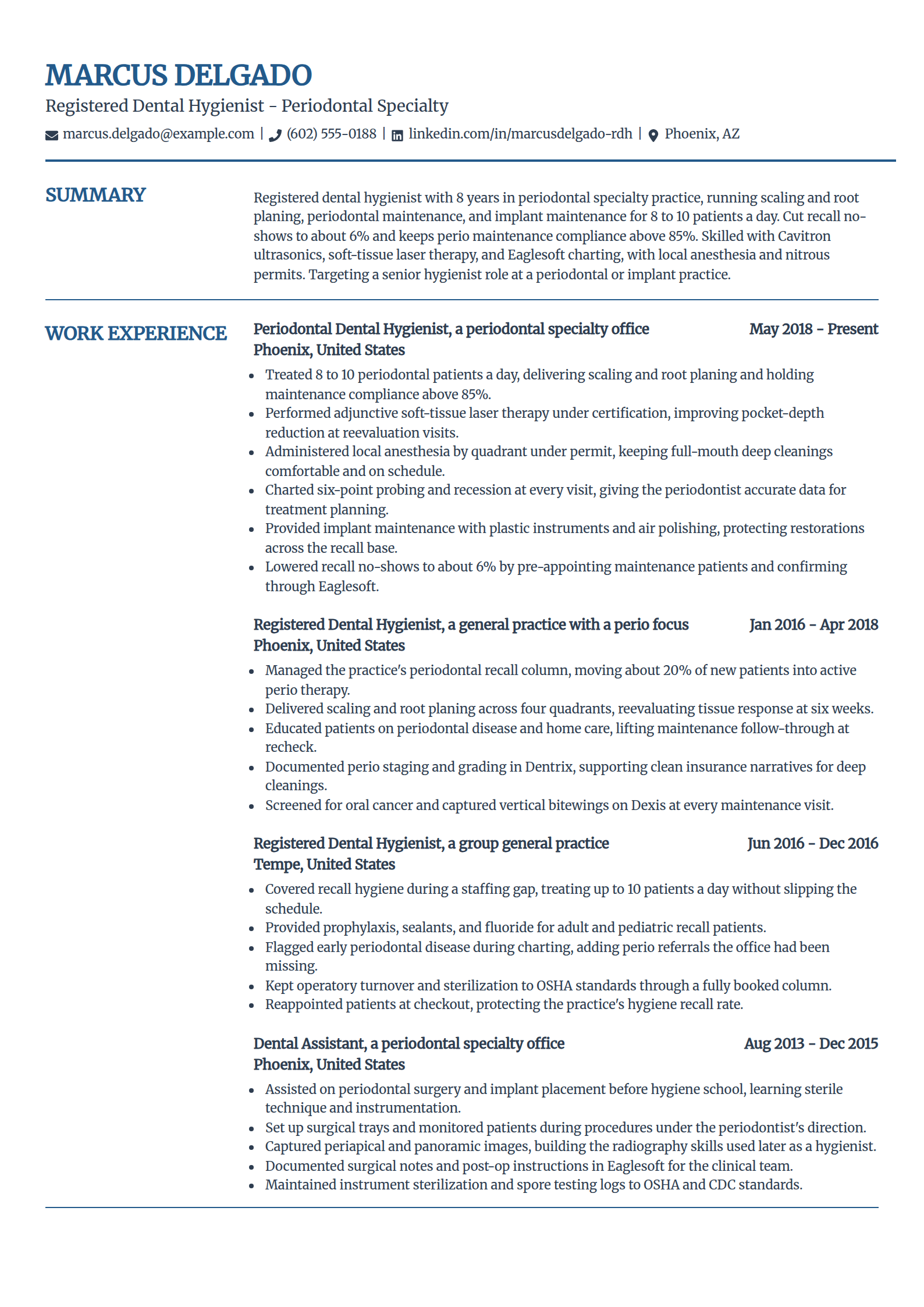
Periodontal Dental Hygienist Resume Template
Why this resume example works?
- Leads with periodontal specialty scope, scaling and root planing and maintenance compliance held above 85%.
- Shows the advanced skills a perio office hires for, soft-tissue laser therapy under certification and implant maintenance.
- Keeps coronal work inside RDH scope, administering local anesthesia by quadrant under permit for deep cleanings.
- Names Eaglesoft charting, Cavitron ultrasonics, and Dexis vertical bitewings, the systems a specialty practice runs.
- Uses a modern layout that carries a dense periodontal history on one clean page.
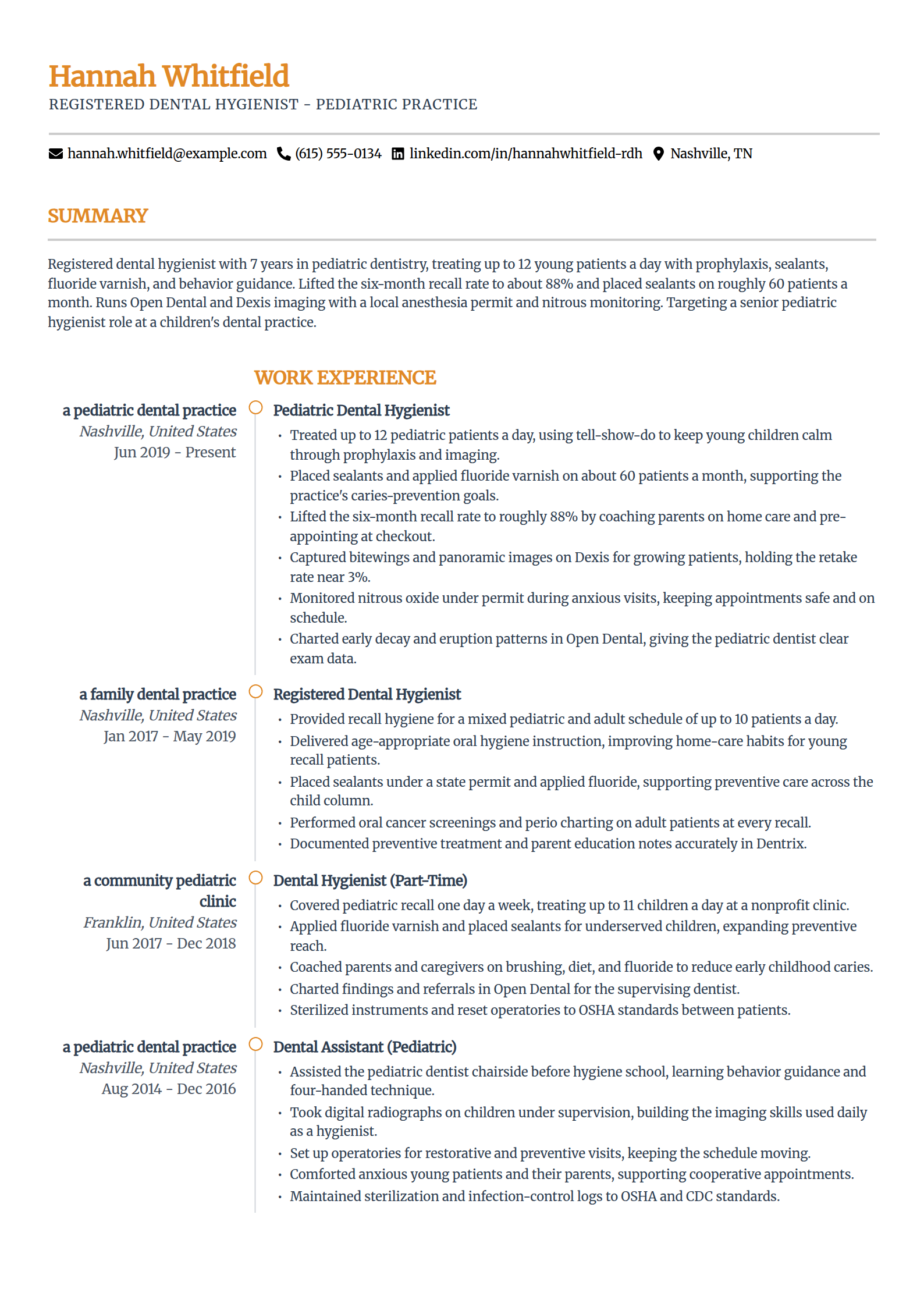
Pediatric Dental Hygienist Resume Template
Why this resume example works?
- Opens with the skill a children's office rewards, keeping up to 12 young patients calm with tell-show-do.
- Shows preventive range inside scope, sealants and fluoride varnish placed on about 60 patients a month.
- Keeps numbers believable for the setting, like a six-month recall rate lifted to roughly 88%.
- Names nitrous oxide monitoring under permit and Open Dental charting, the everyday tools of a pediatric hygiene column.
- Uses a modern layout that fits a seven-year pediatric record cleanly on one page.
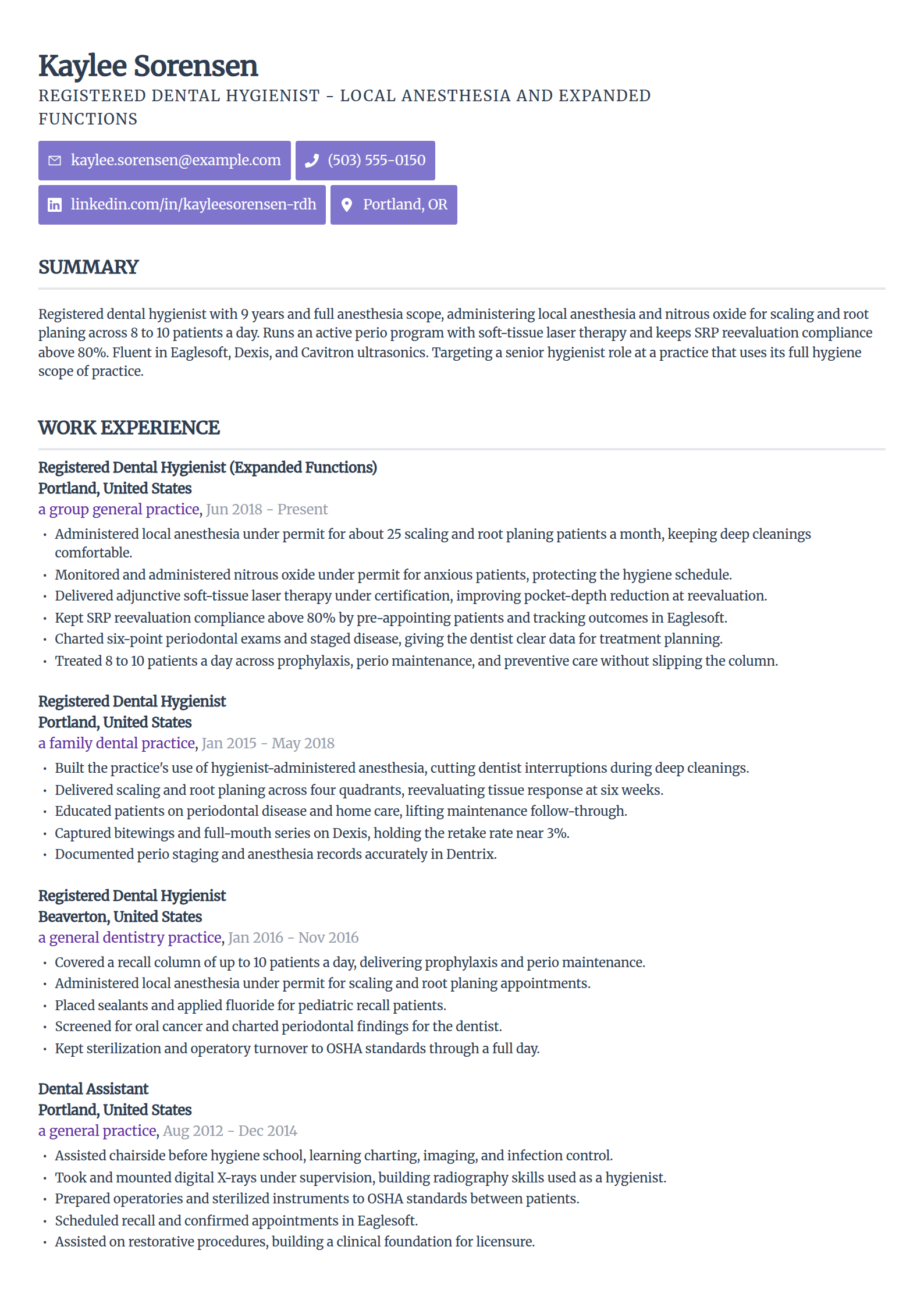
Expanded Functions Dental Hygienist Resume Template
Why this resume example works?
- Leads with full anesthesia scope, administering local anesthesia and nitrous oxide under permit for deep cleanings.
- Keeps every expanded-function claim inside legal scope, like anesthesia for about 25 scaling and root planing patients a month.
- Pairs anesthesia with an active perio program, soft-tissue laser therapy and SRP reevaluation compliance above 80%.
- Names Eaglesoft, Dexis, and Cavitron ultrasonics, the systems a scope-forward practice runs.
- Uses a clean, modern layout that carries a full clinical record on one page.
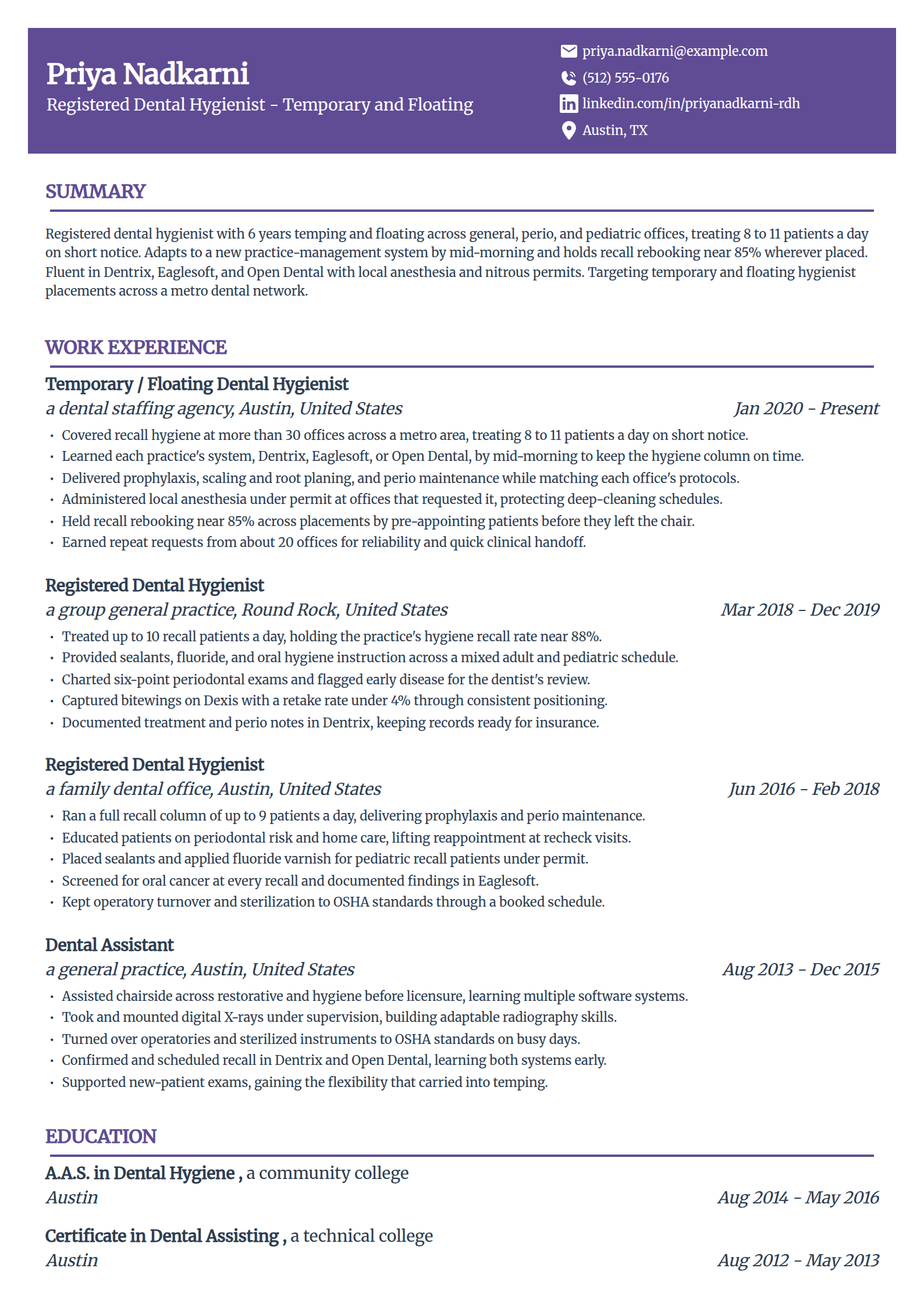
Temp and Floating Dental Hygienist Resume Template
Why this resume example works?
- Opens with the value a staffing agency wants, covering recall at 30-plus offices at 8 to 11 patients a day on short notice.
- Shows real adaptability, learning Dentrix, Eaglesoft, or Open Dental by mid-morning to keep the column on time.
- Keeps results tied to reliability, like recall rebooking near 85% across placements and repeat requests from about 20 offices.
- Names local anesthesia under permit and full-mouth radiography, the scope a covering hygienist is asked to bring.
- Uses a spacious layout that carries a varied, multi-office history on one page.
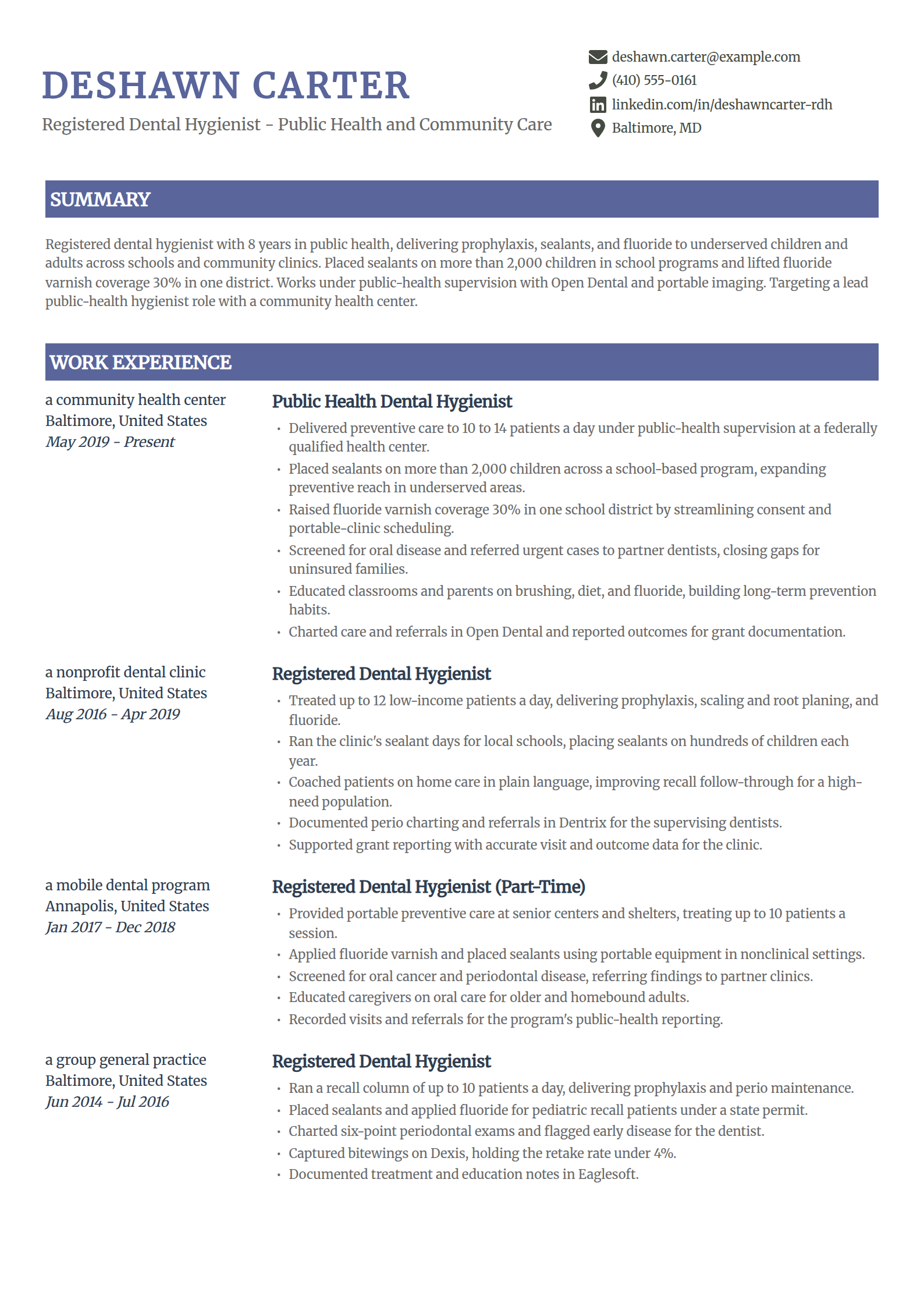
Public Health Dental Hygienist Resume Template
Why this resume example works?
- Leads with community scope, delivering preventive care under public-health supervision at a federally qualified health center.
- Shows program impact inside scope, sealants placed on more than 2,000 children and fluoride coverage lifted 30% in one district.
- Keeps the work honest, screening and referring urgent cases to partner dentists rather than diagnosing or treating them.
- Names Open Dental charting, portable imaging, and grant reporting, the tools a public-health role actually uses.
- Uses a modern two-column layout that carries a school-and-clinic record on one page.
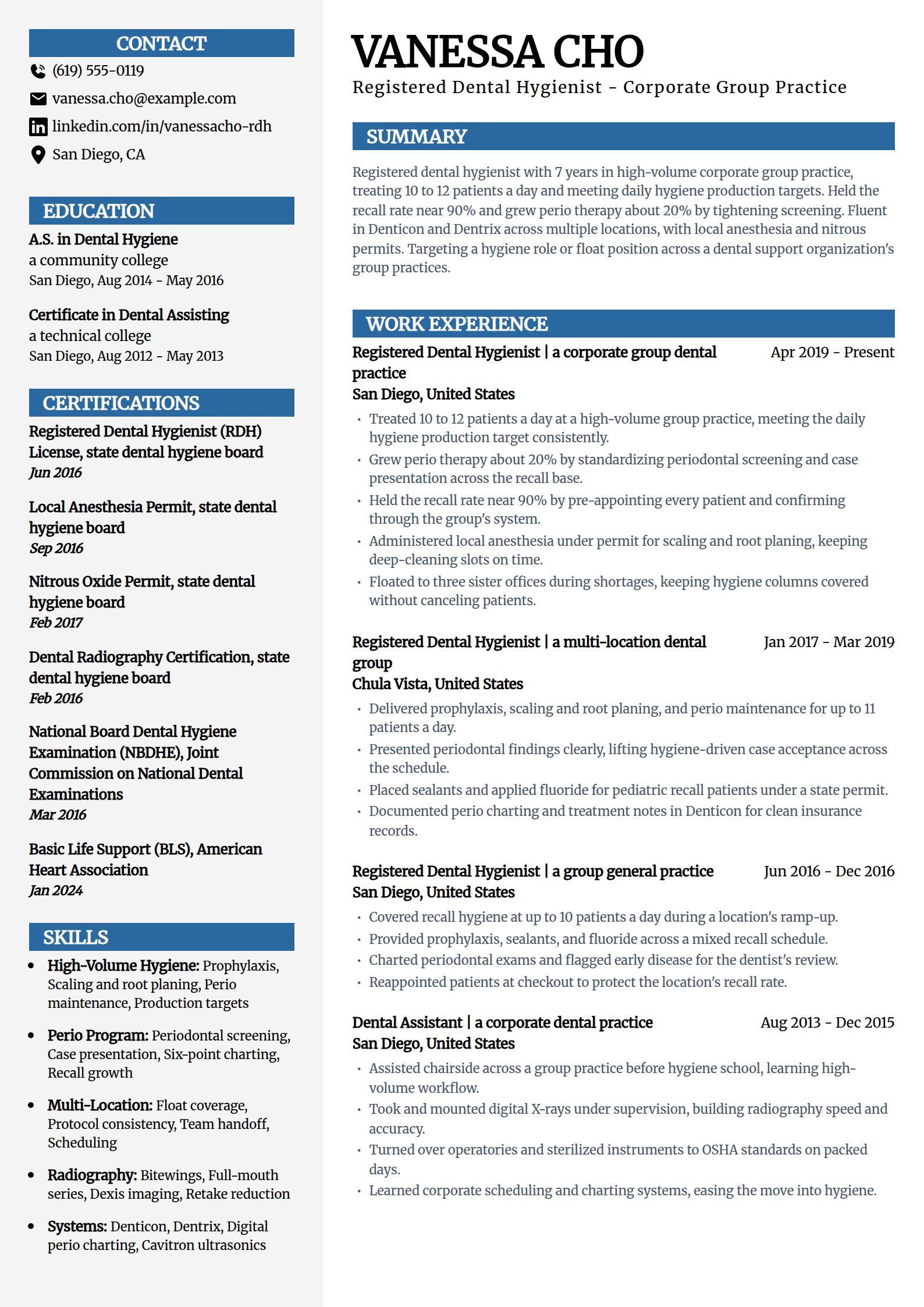
Corporate / DSO Dental Hygienist Resume Template
Why this resume example works?
- Opens with high-volume value, treating 10 to 12 patients a day and meeting the daily hygiene production target.
- Shows the growth a group practice hires for, perio therapy up about 20% by standardizing periodontal screening.
- Keeps results countable, like a recall rate near 90% and coverage floated to three sister offices during shortages.
- Names Denticon and Dentrix across locations plus local anesthesia under permit, the corporate hygiene stack.
- Uses a modern two-column layout that carries a high-volume record cleanly on one page.
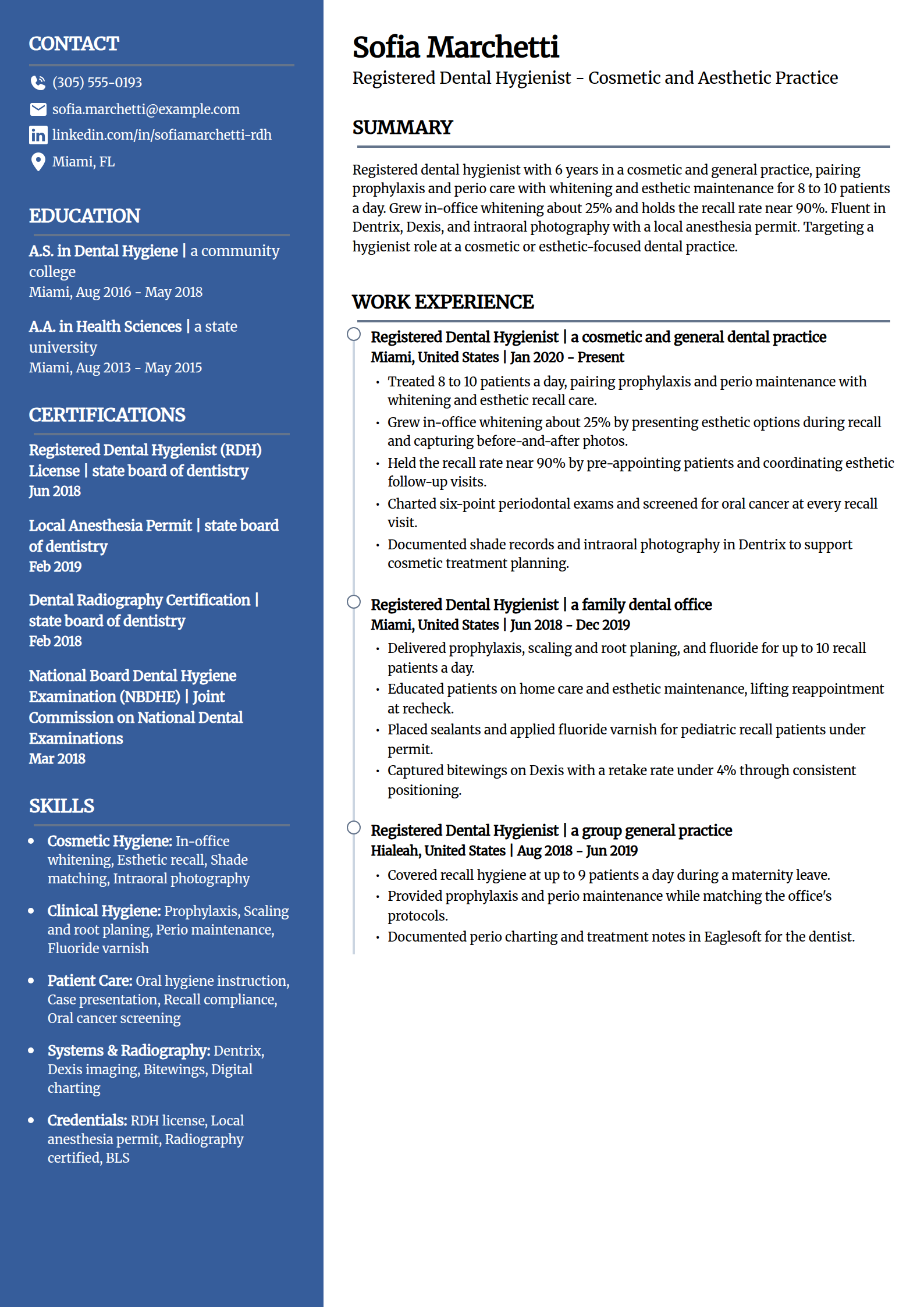
Cosmetic Dental Hygienist Resume Template
Why this resume example works?
- Opens with the hybrid value a cosmetic office wants, pairing prophylaxis and perio care with whitening and esthetic recall.
- Shows growth inside scope, in-office whitening up about 25% by presenting options and capturing intraoral photography.
- Keeps clinical hygiene visible, six-point charting and oral cancer screening at every recall alongside the esthetic work.
- Names Dentrix, Dexis, and shade records, the systems an esthetic-focused practice runs.
- Uses a distinctive layout that still reads cleanly for a hiring office.
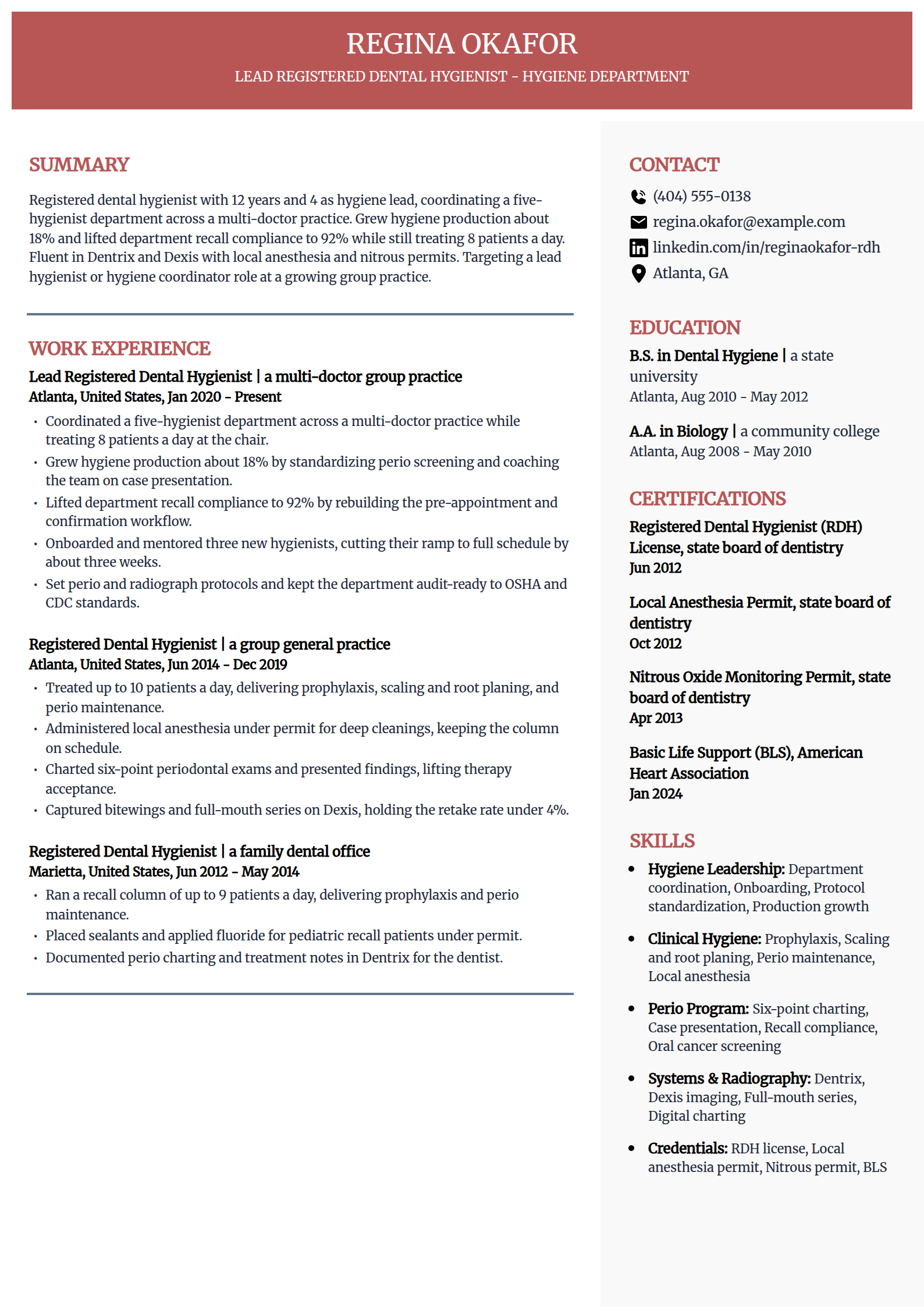
Lead Dental Hygienist Resume Template
Why this resume example works?
- Leads with lead-level scope, coordinating a five-hygienist department across a multi-doctor practice.
- Shows the results a hygiene lead is hired for, production up about 18% and department recall compliance lifted to 92%.
- Keeps the candidate credible at the chair, still treating 8 patients a day while setting perio and radiograph protocols.
- Pairs leadership with training, onboarding three hygienists and cutting their ramp by about three weeks.
- Uses a refined layout that carries a twelve-year record with a leadership arc on one page.
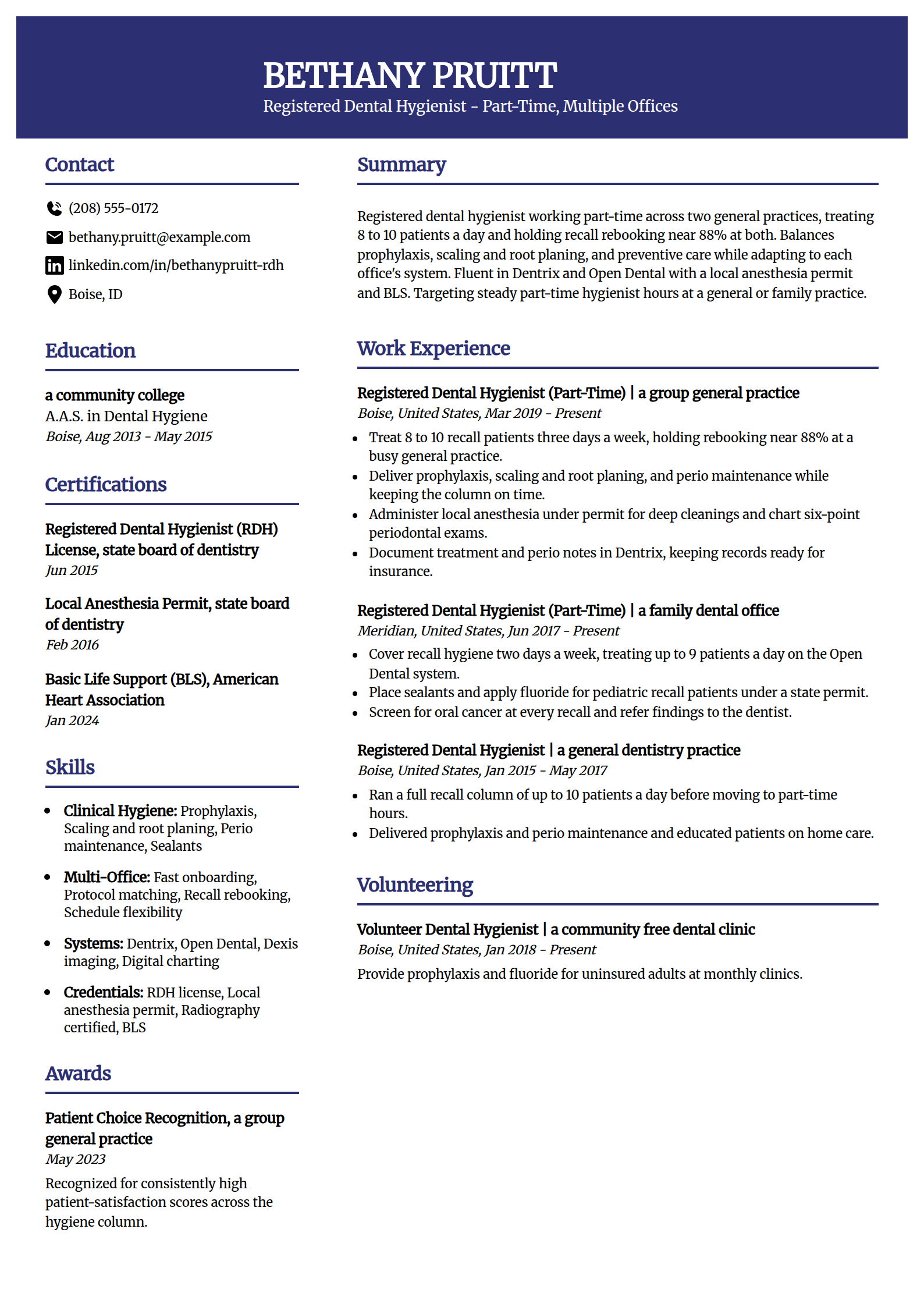
Part-Time Dental Hygienist Resume Template
Why this resume example works?
- Opens with the flexible value a small office wants, covering recall across two general practices on different systems.
- Shows steady results at both, treating 8 to 10 patients a day and holding rebooking near 88%.
- Names local anesthesia under permit, six-point charting, and sealants, the everyday hygiene scope.
- Keeps the sidebar full with an award and a free-clinic volunteer role, so a part-time record still looks complete.
- Uses a roomy layout that stays clean without padding.
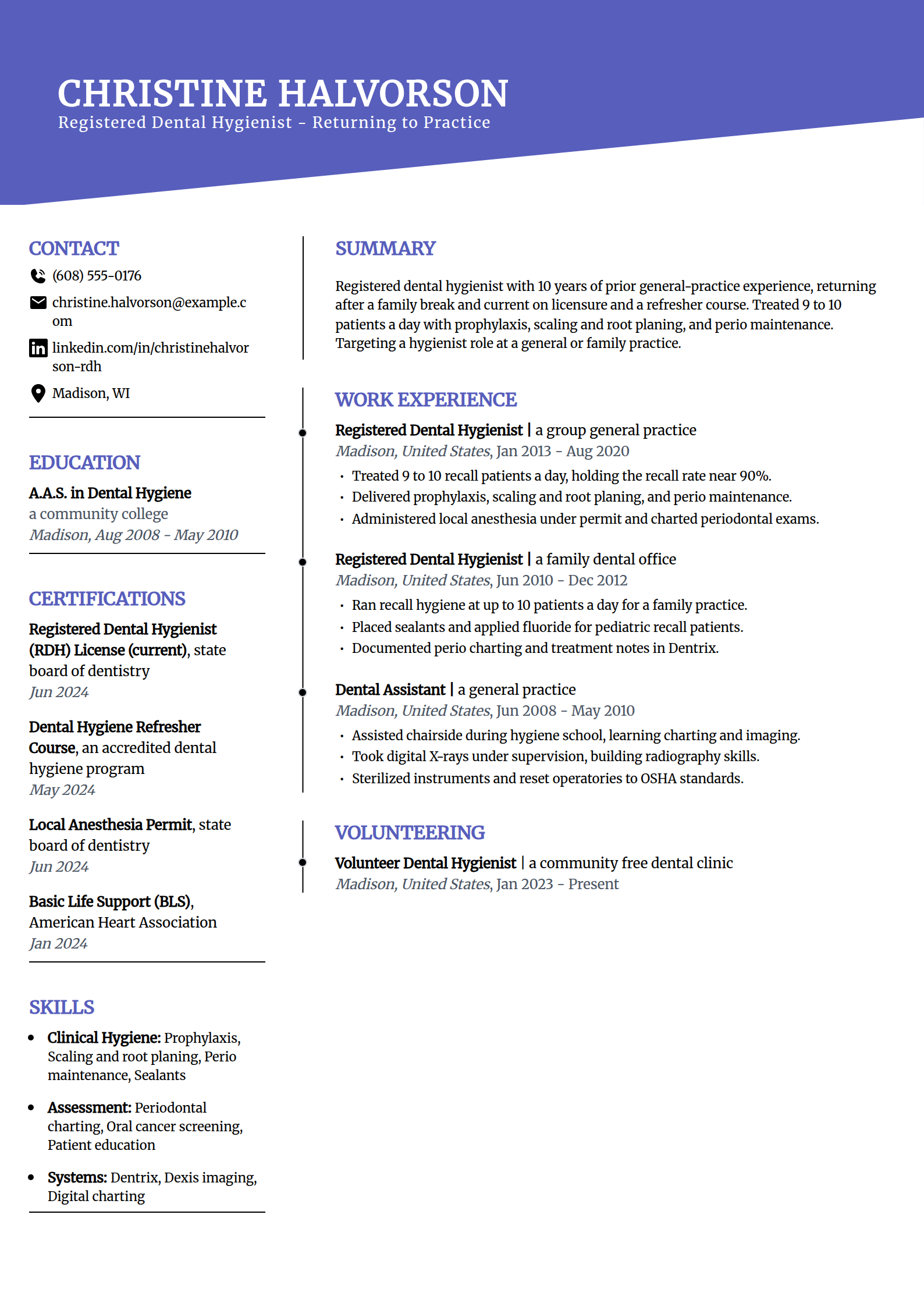
Return-to-Practice Dental Hygienist Resume Template
Why this resume example works?
- Names the gap openly, returning after a family break with a current RDH license and a completed refresher course.
- Leans on a solid prior record, ten years in general practice treating 9 to 10 patients a day with a recall rate near 90%.
- Keeps the recent credentials front and center, a current license, renewed local anesthesia permit, and BLS.
- Names Dentrix and Dexis, refreshed and ready, so an office sees a fast return to a full hygiene column.
- Uses a two-column layout with a volunteer role so a returning record fills the page.
Build your dental hygienist resume
Pick a template above and the editor keeps your layout clean and ATS-safe while you swap in your own license, permits, systems, and patient load.
Build my resumeHow to write a dental hygienist resume in 2026
A dental hygienist resume gets scanned fast by an office looking for two things: are you a licensed RDH who can run a hygiene column from day one, and are your permits current. Lead with a short summary that names your license and scope, then make every bullet a real result with one number and the clinical task behind it. Keep the format clean so a parser reads it as easily as a person does.
Open with a short, license-first summary
Write three to four sentences that name your years and setting, your strongest number, the license and permits a posting checks, and the role you are targeting. An experienced hygienist leads with patients a day and recall rate; a new grad leads with clinical rotation hours and the RDH license. Keep it to about 60 words so it never spills past the top of the page.
Registered dental hygienist with 9 years in general and family practice, treating 9 to 11 patients a day across prophylaxis, scaling and root planing, and perio maintenance. Holds a recall rate near 90% and runs Dentrix, Dexis, and Cavitron ultrasonics, with a local anesthesia permit and BLS. Targeting a lead-track hygienist role at an established general practice.
Write hygienist scope, not assistant duties (the honest part)
This is where most dental resumes blur two different jobs. A hygienist is a licensed RDH, and the resume should read that way. Write your core scope, and never pad it with chairside-assistant tasks as if they were the point of the role.
- Your core RDH scope: prophylaxis, scaling and root planing, periodontal charting and assessment, oral cancer screening, radiographs, sealants, fluoride varnish, and patient education.
- With the right state permit, add local anesthesia and nitrous oxide, and add soft-tissue laser only if you hold the certification. Say the permit is what makes it legal.
- A hygienist does not diagnose restorations, drill or prep teeth, place fillings, extract, or prescribe. Listing dentist-scope work reads as a red flag, not a strength.
- If you assisted chairside earlier, keep it as history under an older role; do not let four-handed assisting lead a hygienist resume.
Make every experience bullet a result with a number
Name the clinical task, the approach, and the outcome, then attach one credible number and the system behind it. Hygienists run full appointments, so keep the numbers honest to that pace.
- Use hygiene metrics: patients a day (a realistic 8 to 12, not 30), recall or reappointment rate, perio-therapy acceptance, hygiene production, or radiograph retake rate.
- Open with a strong verb like treated, charted, administered, scaled, or educated, never "Responsible for" or "Helped with".
- Name the tool or task: "charted six-point periodontal exams in Dentrix and flagged early disease for the dentist's exam".
- Keep one number per bullet and aim for a number in about half of them; a wall of percentages reads as invented.
Put your license and permits where they get seen
Hygiene hiring is license-driven, so a posting checks your credentials first. List them in their own section and never list a permit you do not hold.
- List the RDH license by state with the date, then the local anesthesia permit, nitrous oxide permit, and radiography certification.
- Keep CPR/BLS current and visible; an expired card is a fast reason for an office to pass.
- Add the NBDHE and your regional clinical board (CDCA/ADEX or WREB) if you are recently licensed, and note any refresher course if you are returning.
- New grads and career-changers lead with the program, clinical rotation hours, and the RDH license in place of years.
Match skills and keywords to the job posting
A skills block should read like the posting, grouped so an office manager and a parser both find what they need. List the systems you have actually run, not a generic dump.
- Group by type: clinical hygiene, periodontal care, radiography, patient education, and practice-management software.
- Name specific systems: Dentrix, Eaglesoft, Open Dental, Denticon, and Dexis digital radiography, matched to the role.
- If the posting says "scaling and root planing" or "periodontal charting", use that exact phrasing where it fits your experience.
- Mirror the posting's language, since that is what the applicant tracking system searches for when it ranks your resume.
Keep the format clean and ATS-safe
A hygienist resume is read by a parser first and an office manager second, so a clean layout with standard headings is the safe choice at every level.
- Use a single-column or simple two-column layout with standard headings a parser recognizes; skip heavy graphics and photos.
- Keep it to one page; a hygienist resume rarely needs two, even for a lead or specialist.
- Save as a PDF so the formatting holds, then run it through the ATS resume checker for a quick format and keyword pass.
- Swap the numbers in the templates above for your own patient load, permits, and systems; do not copy them as is.
Common dental hygienist resume mistakes
- Reading like a dental assistant resume. Lead with RDH scope, prophylaxis, scaling and root planing, and perio charting, not four-handed chairside assisting.
- Inflating patients per day. Hygienists run full appointments, so a believable number is 8 to 12 a day; a claim of 30 reads as an assistant's count and undercuts you.
- Burying or omitting the license and permits. The RDH license, local anesthesia permit, and CPR/BLS belong in a named section with dates, not hidden in a sentence.
- Claiming tasks outside RDH scope. A resume that says you diagnosed, drilled, or extracted is a red flag; list what a hygienist legally performs.
- One generic resume for every office. Reorder your bullets and skills so the setting the job names, general, perio, pediatric, or public health, leads the page.
Frequently asked questions
How do you write a dental hygienist resume?
Lead with a three-to-four-sentence summary that names your RDH license, your years and setting, your strongest number, and the role you are targeting. Under each job, write results-first bullets that open with a strong verb and carry one credible number, like treating 9 to 11 patients a day or holding a recall rate near 90%. Name the clinical task or system behind each result, list your license and permits in their own section, and keep the whole thing to one clean, ATS-safe page.
What should a dental hygienist resume include?
A dental hygienist resume includes a license-first summary, experience bullets with real numbers, a licensure and certification section, a grouped skills block, and education. The experience section carries the weight: every bullet should show a task you can prove, such as scaling and root planing, six-point periodontal charting, or administering local anesthesia under permit. Name your RDH license, local anesthesia and nitrous permits, and CPR/BLS outright, and list the software an office runs, like Dentrix, Eaglesoft, or Open Dental.
How do you write a dental hygienist resume with no experience?
Lead with what you do have. A recent graduate leads with the dental hygiene program, clinical rotation hours, and the RDH license, and often puts education near the top. A career-changer from dental assisting reframes prior chairside work honestly, radiography skill and practice-management fluency that transfer. Your license, a passed NBDHE, and completed clinical hours are your strongest early signal. The new-grad, entry-level, student, and career-change examples above show the shape.
What skills should you put on a dental hygienist resume?
Match the posting, then name specific skills and systems grouped by type: clinical hygiene (prophylaxis, scaling and root planing, perio maintenance), periodontal care (six-point charting, oral cancer screening), radiography (Dexis digital X-rays), patient education, and practice-management software (Dentrix, Eaglesoft, Open Dental). Add local anesthesia, nitrous oxide, and soft-tissue laser only if you hold the permit or certification. List what you have actually done, and mirror the posting's exact phrasing, since that is what the applicant tracking system searches for.
How many patients a day should a dental hygienist put on a resume?
List a realistic number, usually 8 to 12 patients a day. Hygienists run full recall and periodontal appointments, so the honest pace is far lower than the 30-plus visits a dental assistant supports. A believable patients-a-day number paired with a recall or reappointment rate reads as credible; an inflated count reads like an assistant's number on a hygienist resume and works against you. Use the figure that matches your actual schedule and setting.
Do you need a local anesthesia certification on a dental hygienist resume?
List it if you hold it, because many hygiene postings ask for it. A local anesthesia permit lets you keep scaling and root planing appointments comfortable and on schedule without interrupting the dentist, so it is worth naming in your certification section with the state and date. Add a nitrous oxide permit and soft-tissue laser certification the same way if you have them. Never list a permit you do not hold, since an office will verify it.
More dental hygienist resume resources
Build your dental hygienist resume
Pick a template above and the editor keeps your layout clean and ATS-safe while you swap in your own license, permits, systems, and patient load.