What Fills the Experience Section: 16 Beginner Dental Assistant Resume Templates
- ATS Friendly
- No Paid Experience Needed
- 16 Real Resumes
A beginner dental assistant resume example should do one thing the guides keep dodging: put something real in the work history. Externship hours, clinical rotations, the school clinic, shadowing, volunteering and the job you already have in another field are all dated entries with numbers on them, not a personality paragraph. The 16 examples below are sorted by what you have so far, from a finished program to no program at all.


540k+ resumes created
Beginner dental assistant resume templates you can edit
Each template below is a real beginner's resume laid out in that format, grouped by what the candidate had when they applied. Not one of them has a paid chairside job in the history, and every one still has four sections of dated work. Pick the closest starting point, then replace the program, the hours and the numbers with your own.
Newly Certified Dental Assistant Resume Template
Why this resume example works?
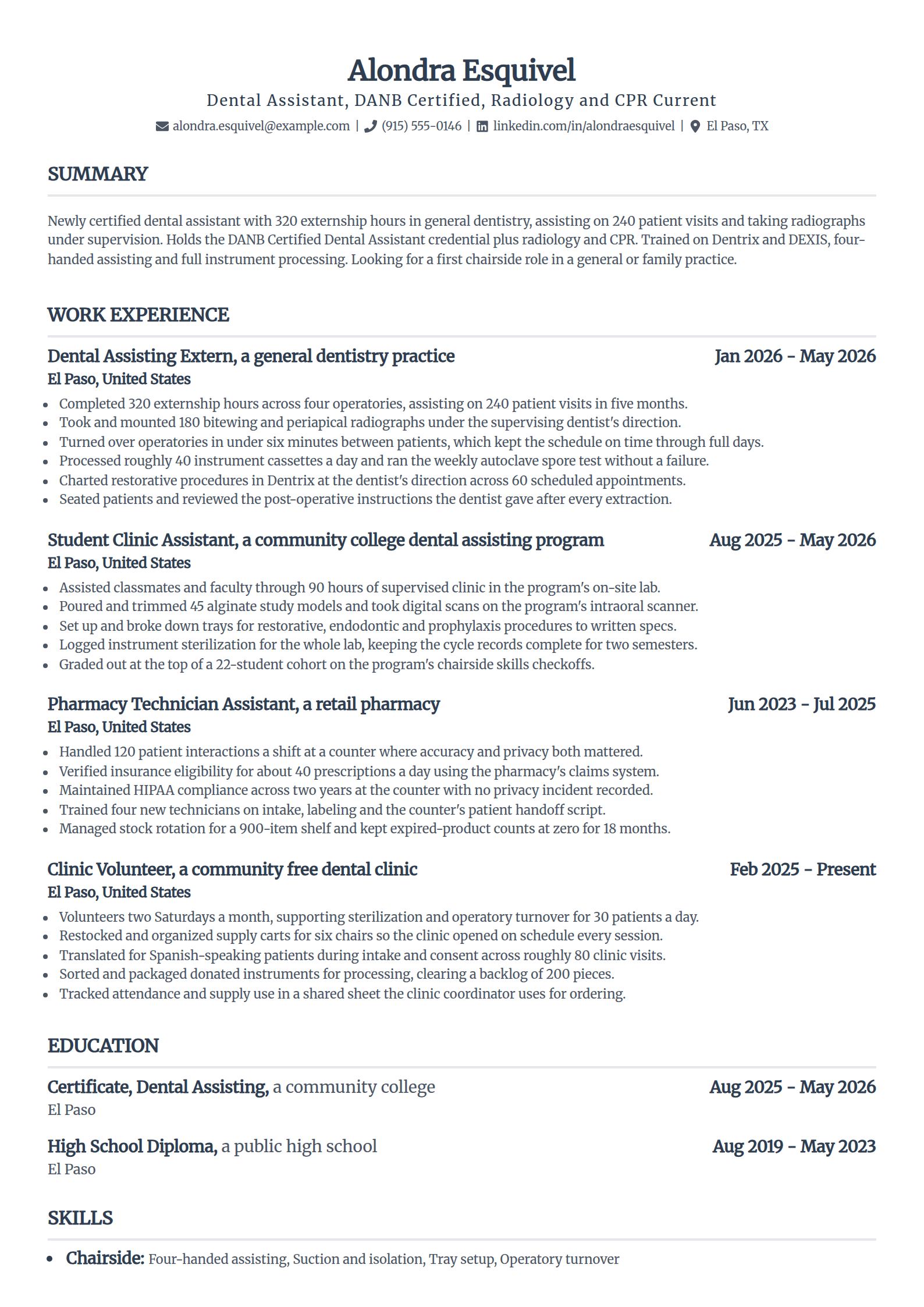
- Four dated entries, none of them a paid chairside job. That is the whole argument of this page rendered on one page.
- Counts the externship the way a practice counts a job: 320 hours, 240 patient visits, 180 radiographs, all with the supervision stated.
- Puts operatory turnover time on the page. Six minutes between patients is the number that tells a practice owner the schedule will hold.
- Keeps the pharmacy job in full rather than hiding it. Two years of HIPAA-covered counter work is directly relevant, and it is the longest thing she has.
- Names the software outright, Dentrix and DEXIS, because a posting matches those and not the phrase dental software.
Externship-Only Dental Assistant Resume Template
Why this resume example works?
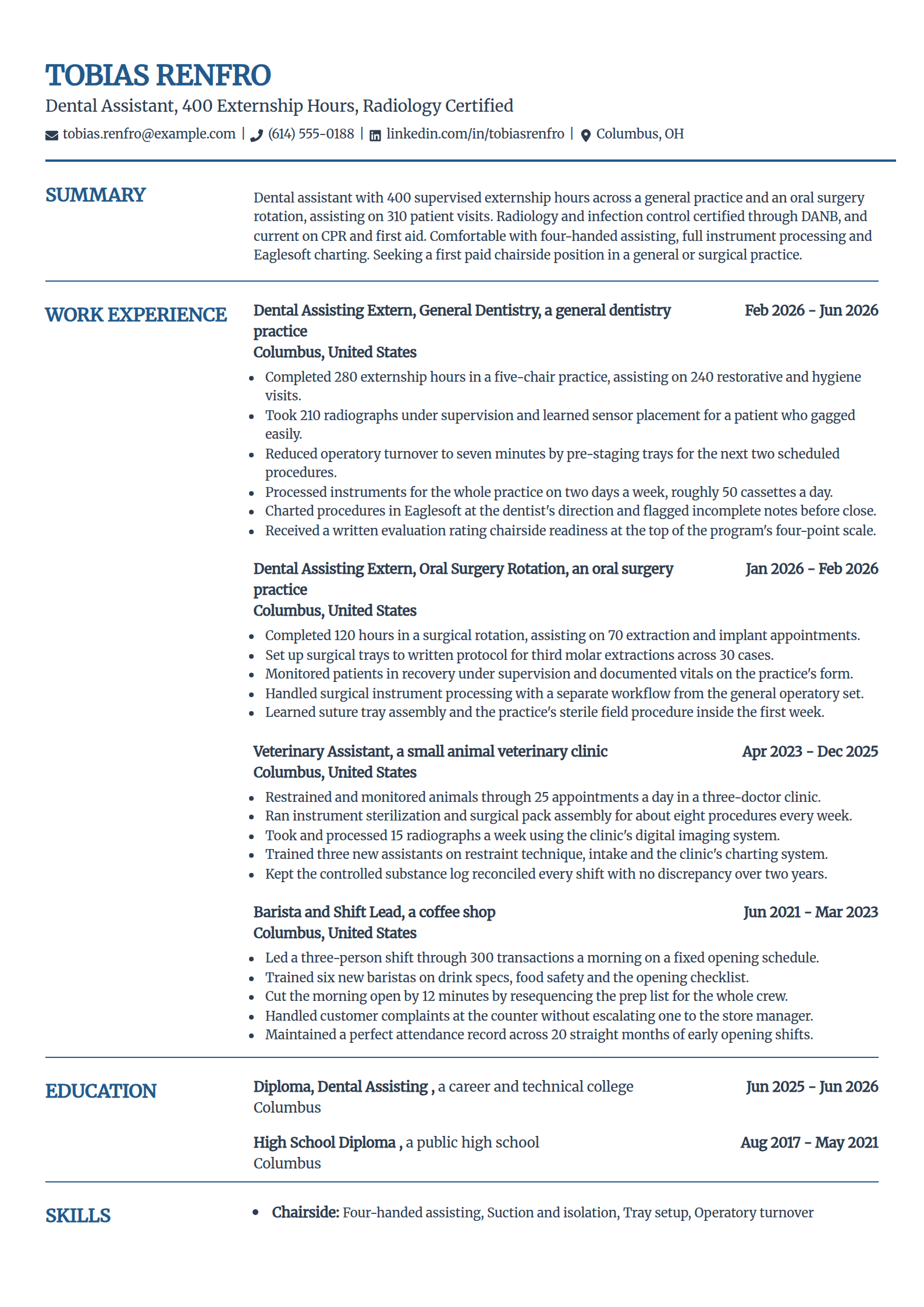
- Splits the externship into two dated entries, general dentistry and an oral surgery rotation, because they were different work in different settings.
- Gives each rotation its own hour count and its own case count, which is what turns 400 hours into something a reader can weigh.
- Includes the written program evaluation as a result, not as a compliment. A rating at the top of the scale is evidence.
- Keeps the veterinary assistant job, where sterilization and surgical pack assembly were already daily work, as a genuine clinical credential.
- Names the sensor-placement problem he solved for a patient who gagged. Small, specific, and the kind of thing only someone who was there would write.
Dental Assisting Student Resume Template
Why this resume example works?
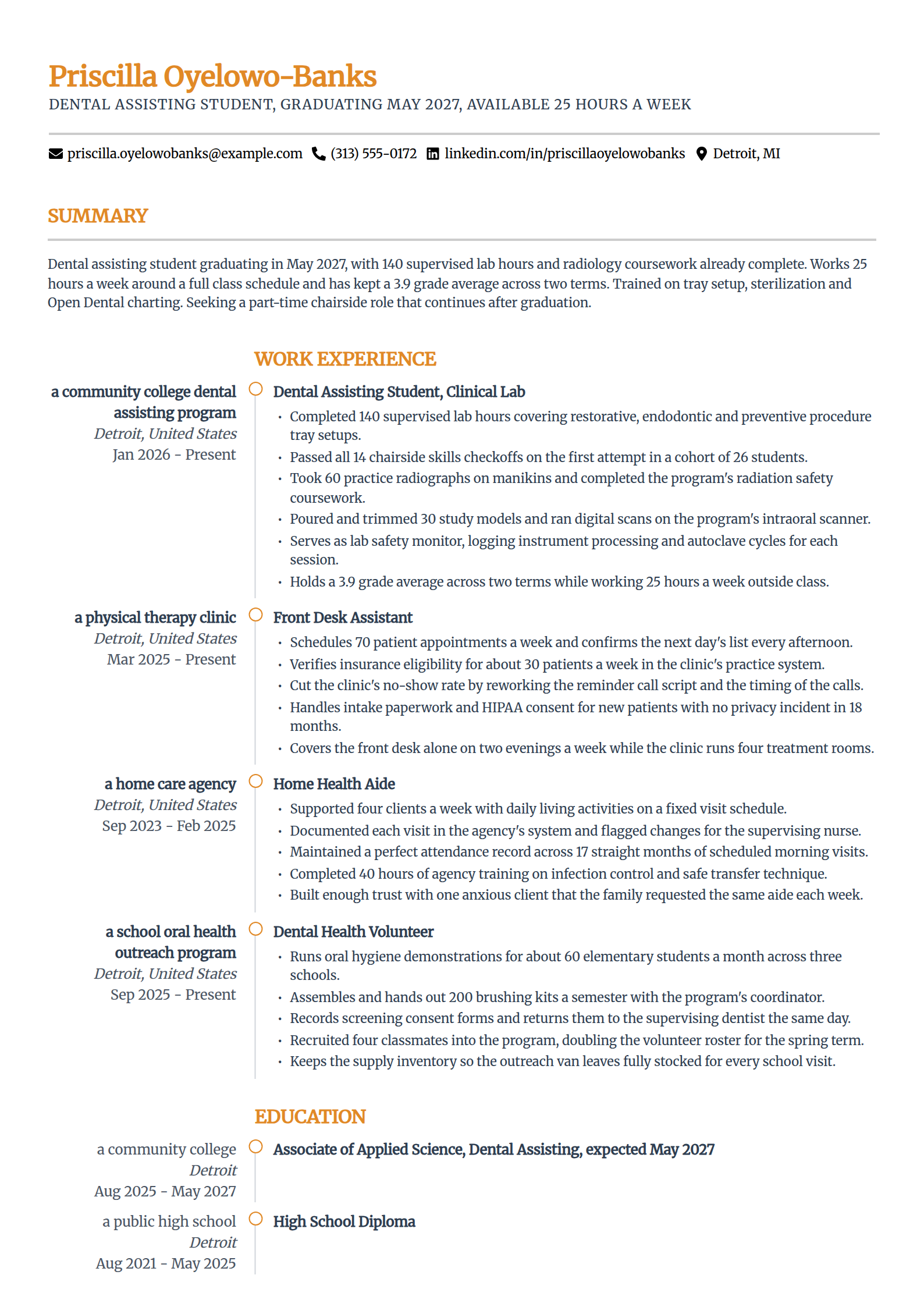
- Puts the graduation date in the headline. Hiding an unfinished program is the thing that ends the conversation in the first phone call.
- Puts availability next to it, 25 hours a week, because a practice hiring a student is solving a schedule problem first.
- Turns coursework into countable work: 140 supervised lab hours, 14 checkoffs passed first time, 60 practice radiographs on manikins.
- Says the radiology coursework is in progress rather than implying the credential is held. That precision is what keeps the rest believable.
- Uses the front desk job at a physical therapy clinic to show scheduling, insurance verification and HIPAA already in hand.
Career Changer Dental Assistant Resume Template
Why this resume example works?
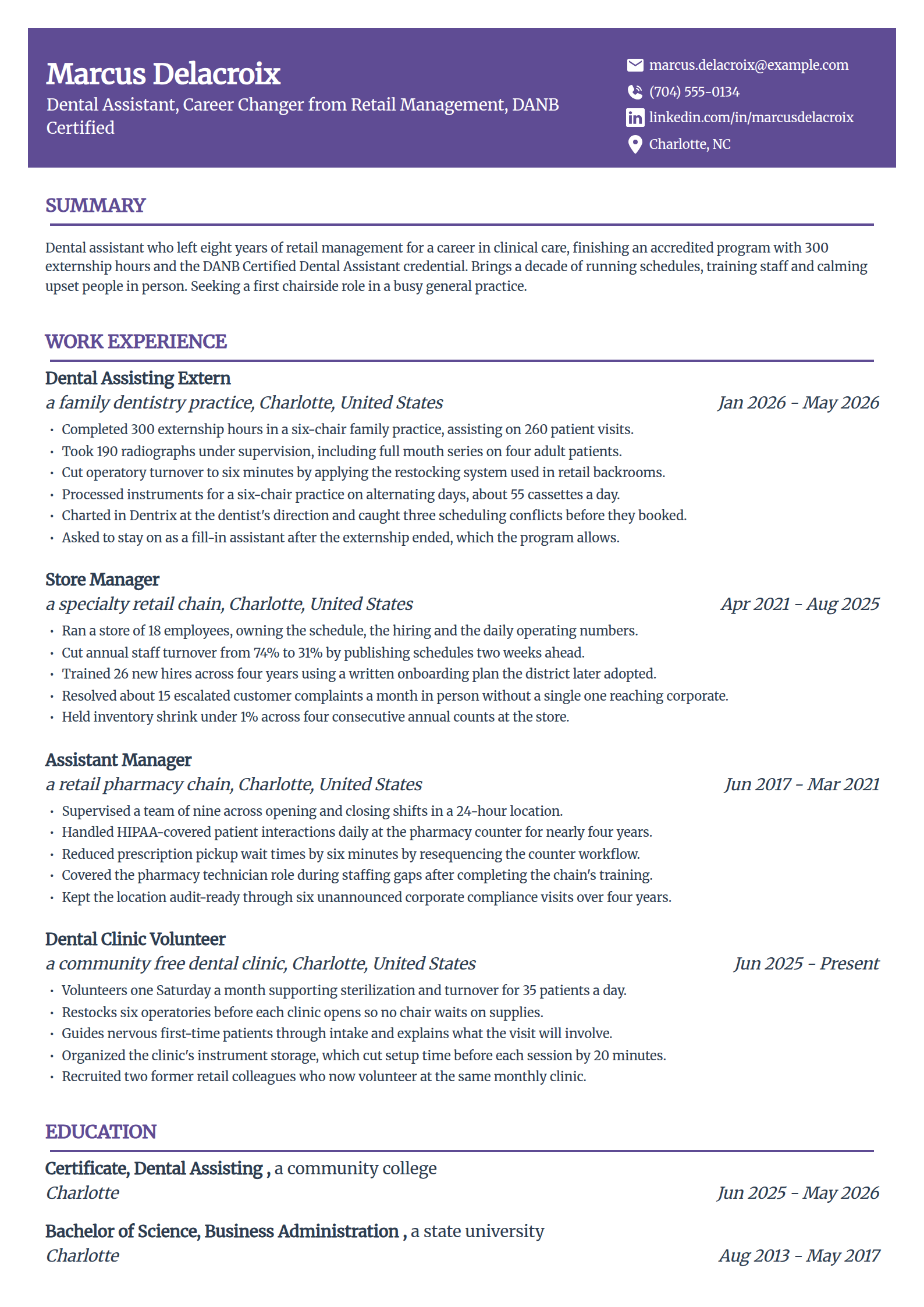
- Keeps eight years of retail management on the page in full. A functional resume would have deleted the strongest evidence he has.
- Picks the transferable numbers that actually transfer: turnover cut from 74% to 31%, 26 people trained, 15 escalated complaints a month handled in person.
- Connects the two careers in one bullet by applying a retail restocking system to operatory turnover, which shows the change is deliberate.
- Leads with the externship anyway, so the dental credential sits above the old career rather than underneath it.
- Mentions being asked to stay on as a fill-in assistant. A practice that already worked with him wanting more of him is the best reference on the page.
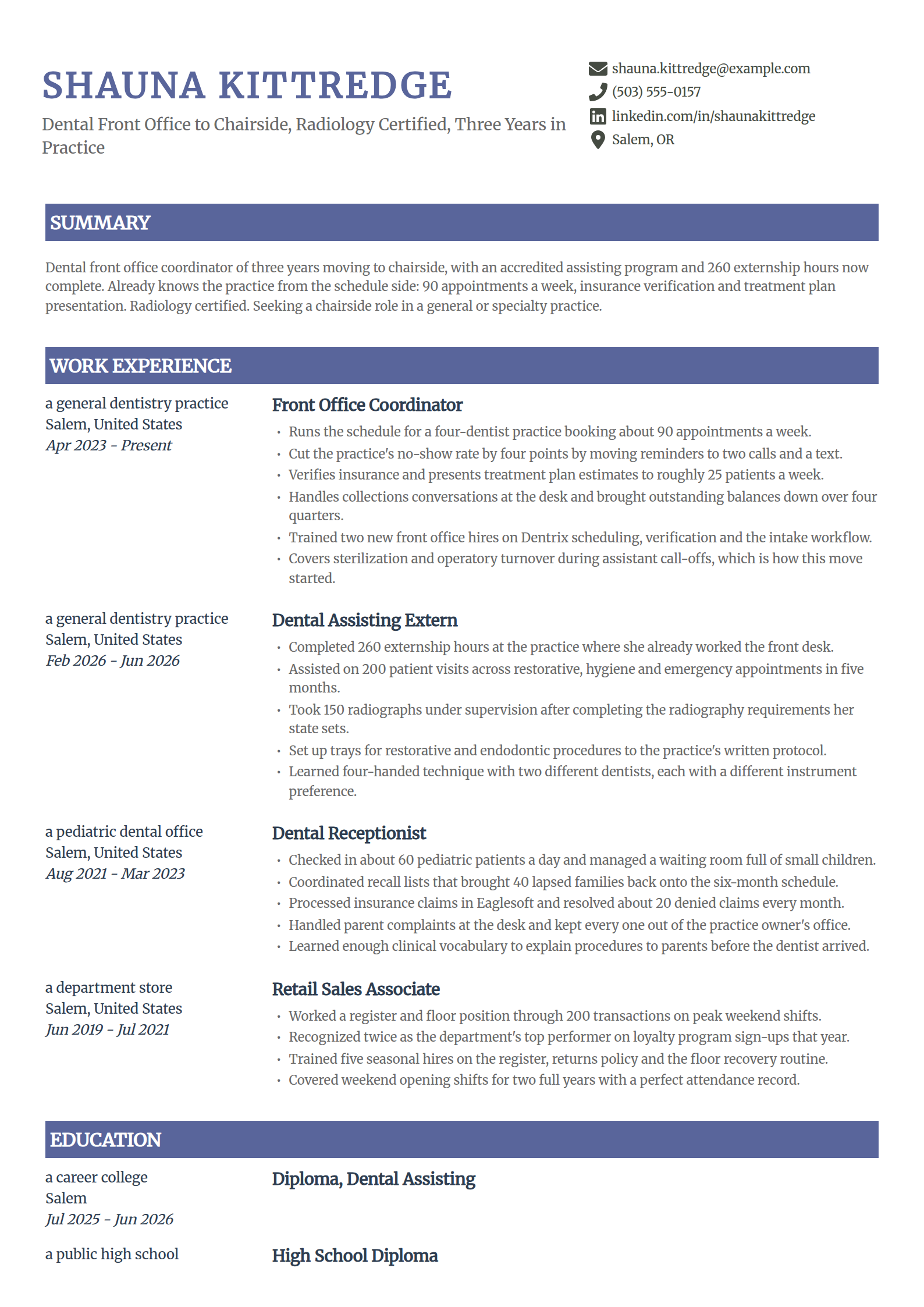
Front Desk to Chairside Dental Assistant Resume Template
Why this resume example works?
- Leads with three years already inside a dental practice, which is a head start no outside candidate has.
- Shows she has been covering sterilization and turnover during assistant call-offs, which is the honest origin of the move.
- Keeps the front office numbers, 90 appointments a week and a no-show rate cut by four points, because a practice values those on a chairside hire too.
- Places the externship second on purpose. The current job is the stronger claim, and the dates make the sequence obvious anyway.
- Names both Dentrix and Eaglesoft, because someone who has run two practice systems will learn a third quickly.
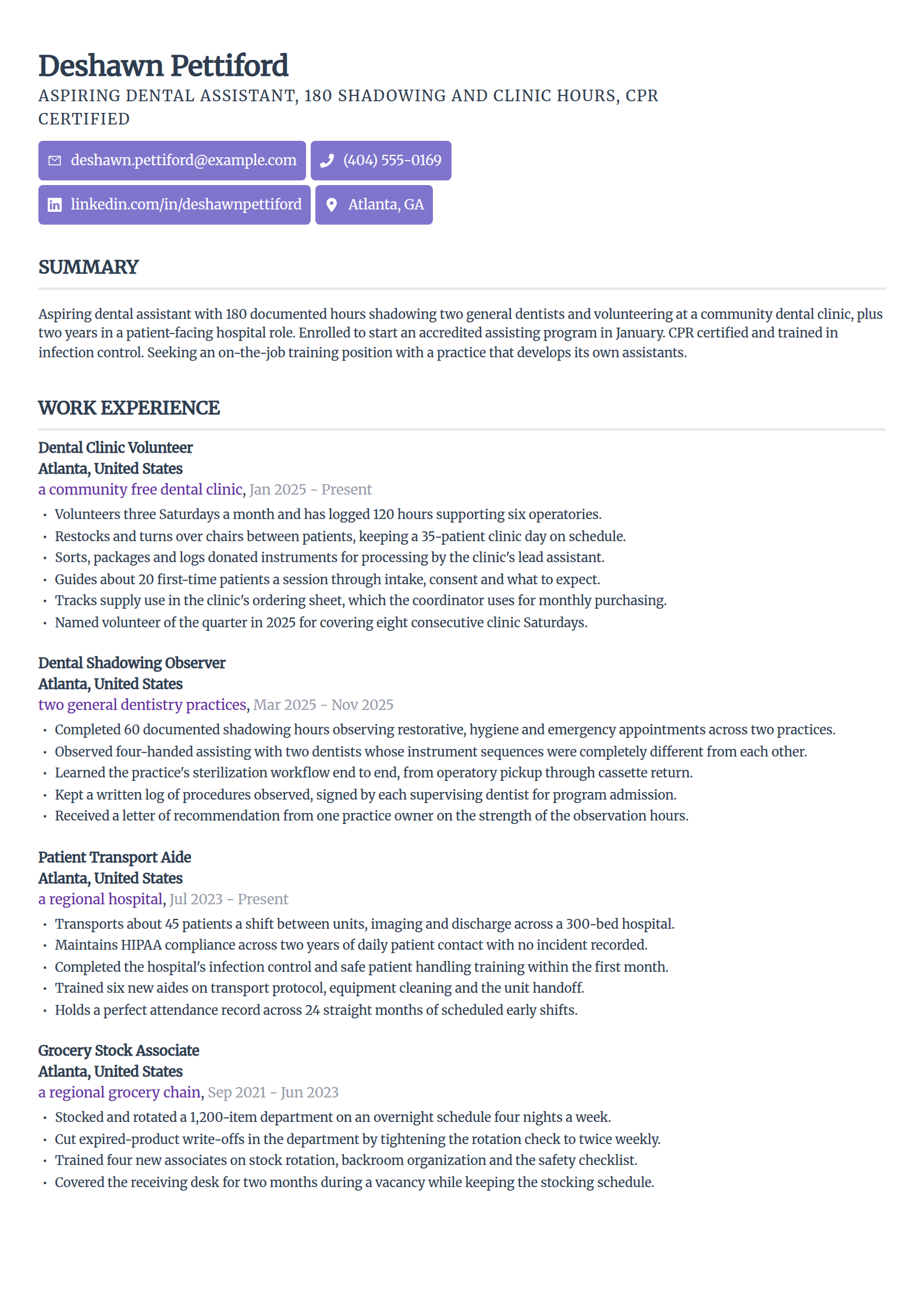
Volunteer and Shadowing Dental Assistant Resume Template
Why this resume example works?
- The hardest version of this reader, and still four dated entries. Nothing here is a hobbies section.
- Counts the unpaid hours precisely, 120 clinic and 60 shadowing, and says the shadowing log was signed by the supervising dentist.
- Uses the hospital transport job for what it proves: two years of daily patient contact, infection control training and a clean HIPAA record.
- States the program start date plainly, so a practice knows exactly what it is committing to and when the credential arrives.
- Asks for the right thing. The headline targets an on-the-job training position rather than a role the candidate is not yet eligible for.
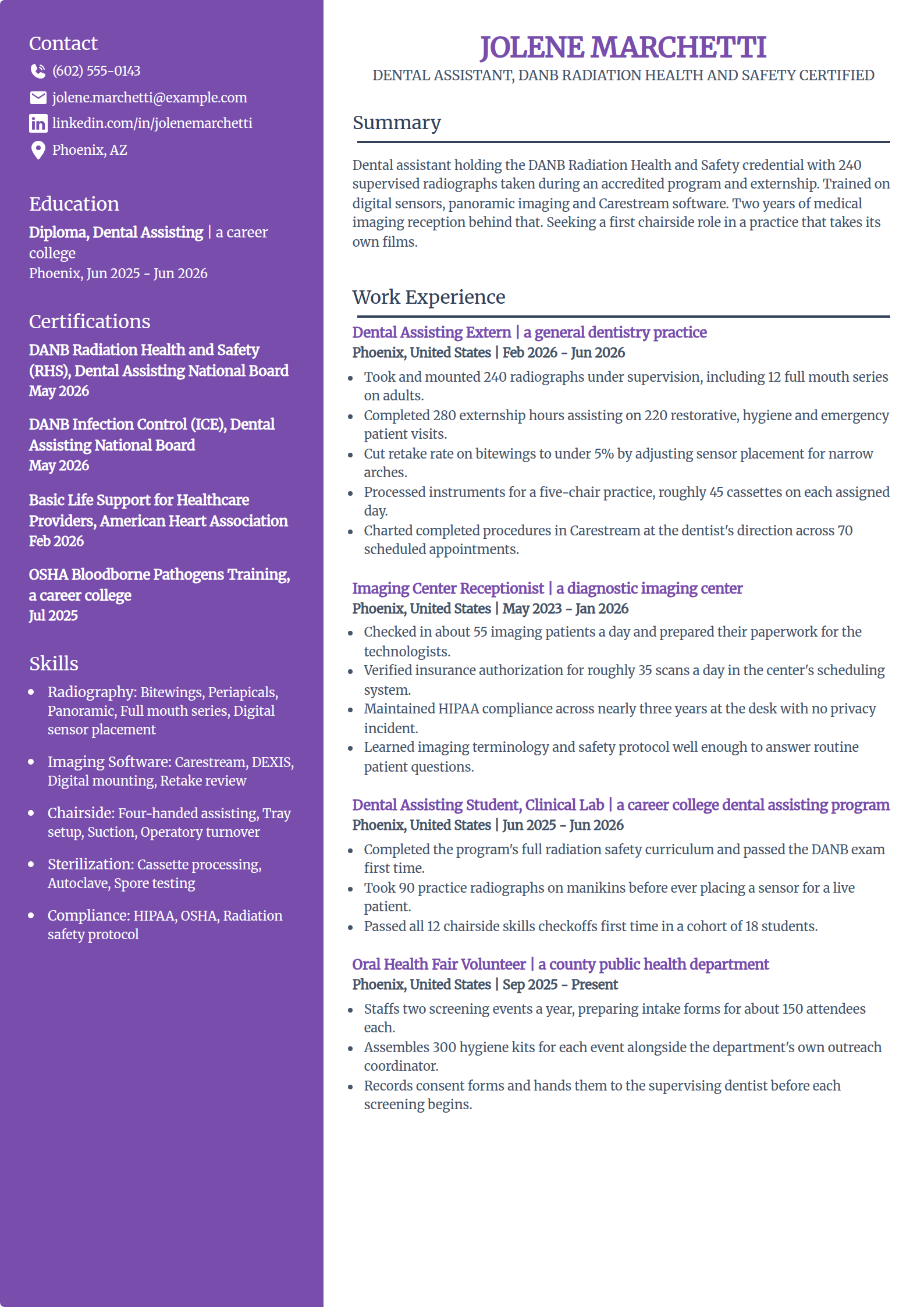
Radiology Certified Dental Assistant Resume Template
Why this resume example works?
- Builds the whole page around the one credential a practice can use on day one, and puts it in the headline.
- Gives the credential a volume number, 240 radiographs taken under supervision, so it reads as practised rather than passed.
- Includes a quality number, a bitewing retake rate under 5%, with the adjustment that produced it. Retakes cost chair time and everyone knows it.
- Uses three years of imaging centre reception as adjacent experience, including the authorization and terminology side of it.
- Names Carestream. A practice running that system will read the resume differently than one that sees imaging software.
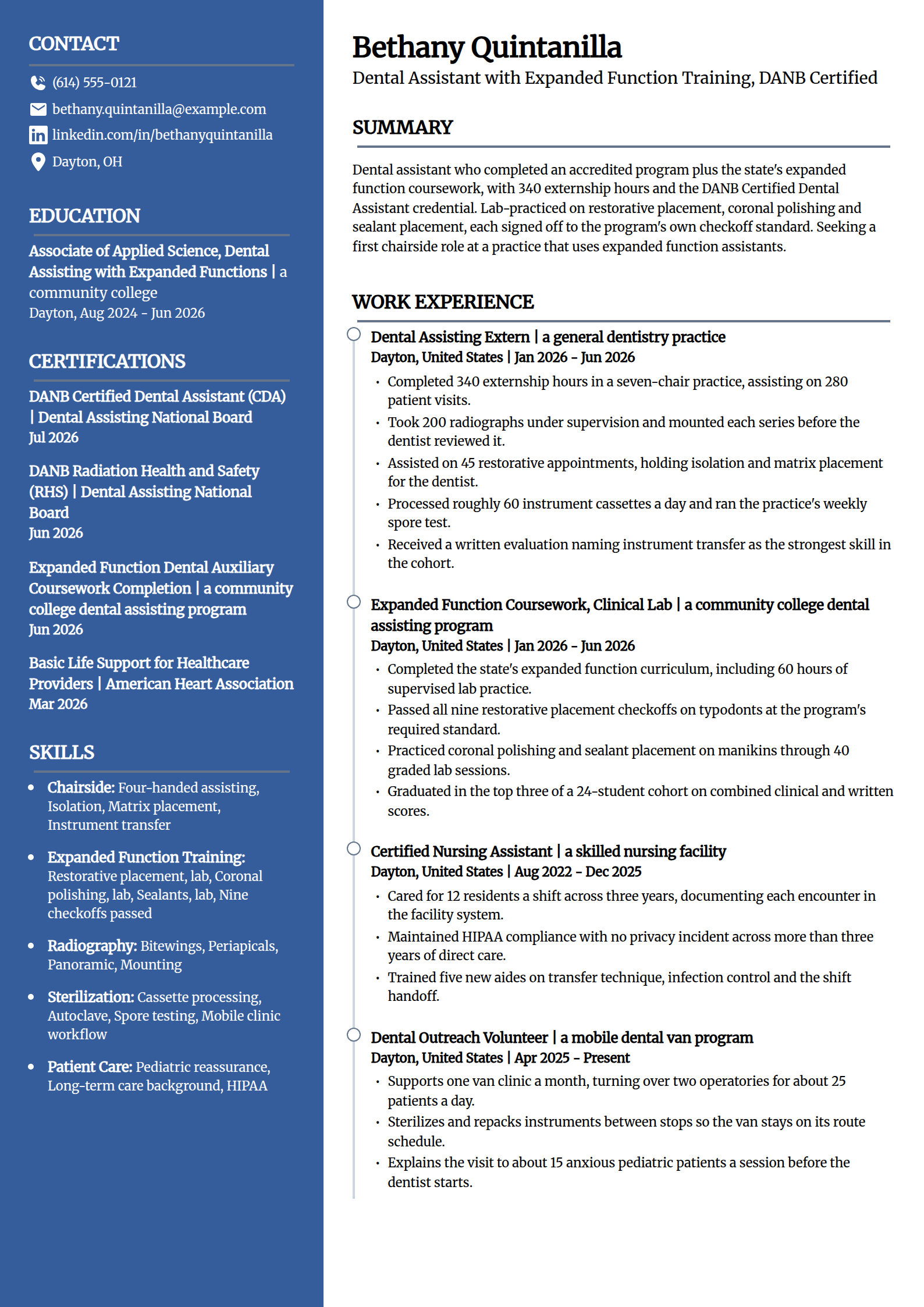
EFDA Trained Dental Assistant Resume Template
Why this resume example works?
- Separates training from practice honestly. The expanded function work is lab checkoffs on typodonts, and the resume says so.
- Gives the coursework its own dated entry with 60 hours and nine restorative checkoffs, which is more convincing than a line in a skills list.
- Keeps the externship's clinical numbers separate, 340 hours and 280 visits, so the two kinds of evidence are not blurred together.
- Uses three years as a nursing assistant for the things that transfer: direct patient care, infection control and a clean privacy record.
- Aims at practices that use expanded function assistants, which is a narrower and better-targeted ask than a general application.
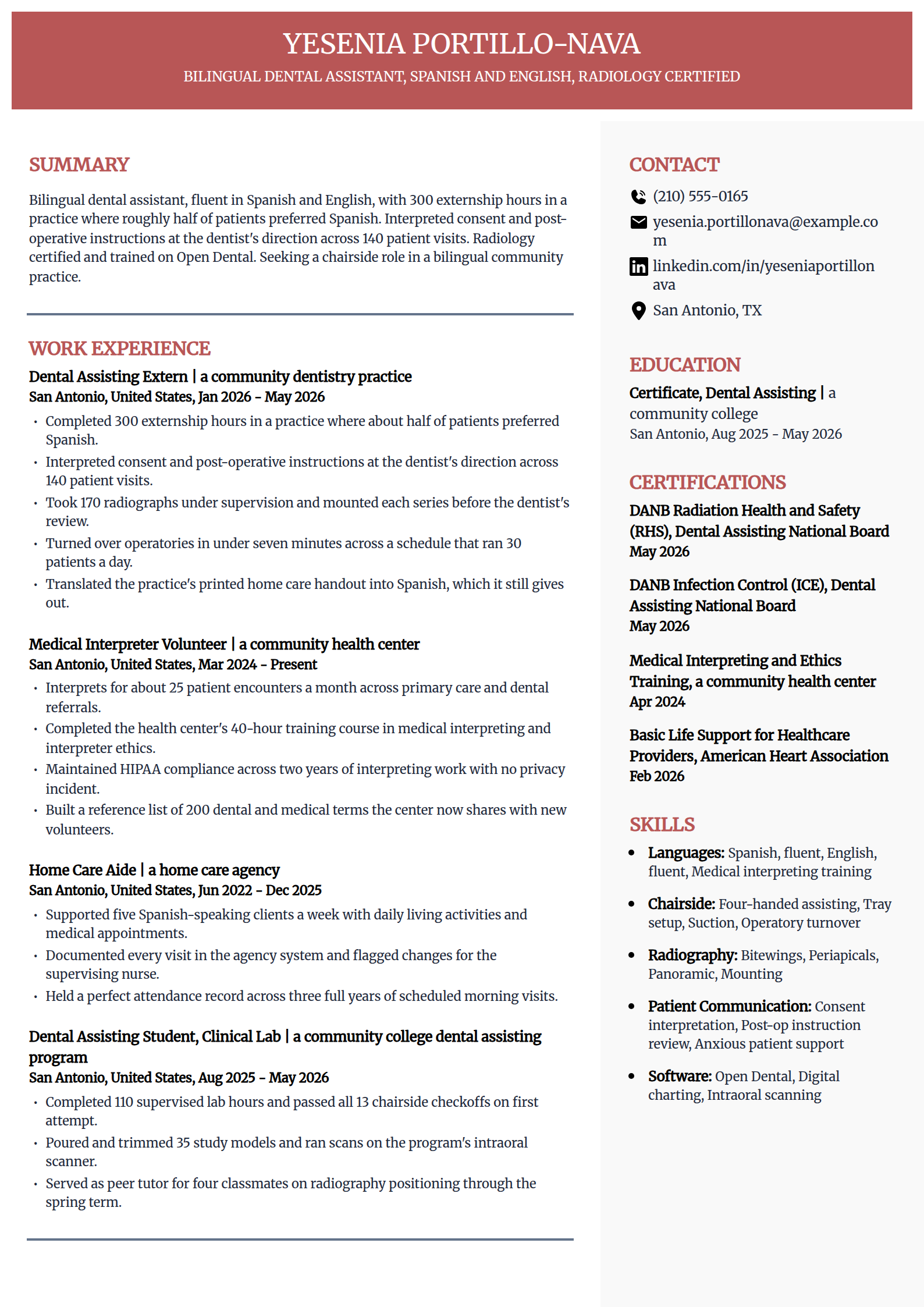
Bilingual Entry-Level Dental Assistant Resume Template
Why this resume example works?
- Treats the second language as clinical work, not a line in a skills box: consent and post-op instructions interpreted across 140 visits.
- States who it was for. A practice where half the patients prefer Spanish is a specific problem this candidate solves.
- Adds the formal interpreting training, 40 hours with ethics, which separates fluency from being trusted with medical consent.
- Includes a lasting artefact, the home care handout she translated and the practice still uses.
- Keeps the home care aide job, which is three years of Spanish-speaking patient contact and a perfect attendance record.
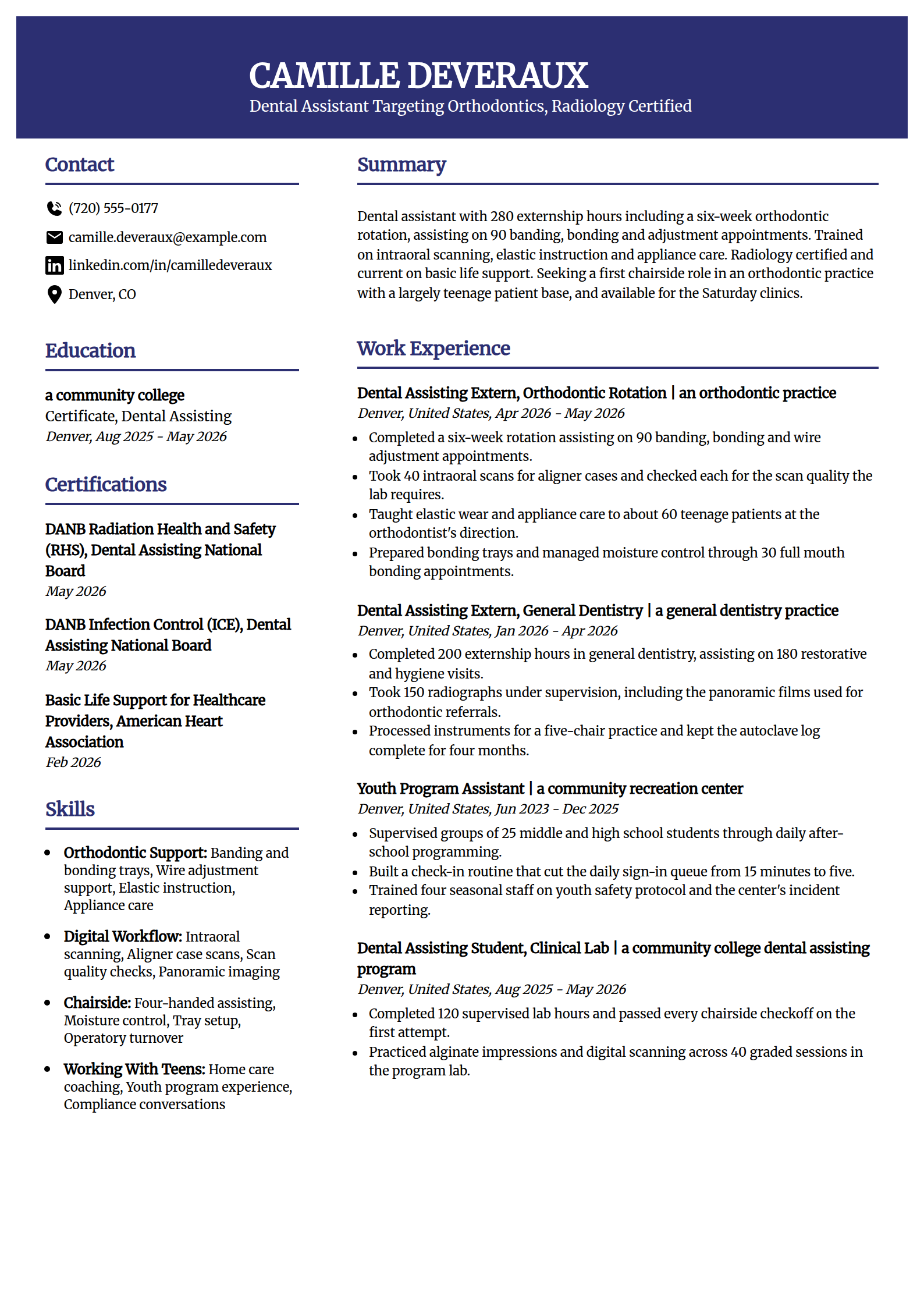
Orthodontic Dental Assistant Resume Template for Beginners
Why this resume example works?
- Uses orthodontic vocabulary correctly throughout, banding, bonding, wire adjustment, elastics, which is how an ortho practice spots a prepared applicant.
- Gives the rotation its own dated entry with 90 appointments on it, rather than mentioning ortho once in a summary.
- Includes the digital workflow, 40 intraoral scans checked against the quality the lab needs, because aligner cases run on that.
- Turns youth work into a clinical asset. Teaching elastic wear to teenagers is the compliance problem an ortho office lives with.
- Keeps the general dentistry externship for the radiographs and the base skills, so the specialty focus does not look thin.
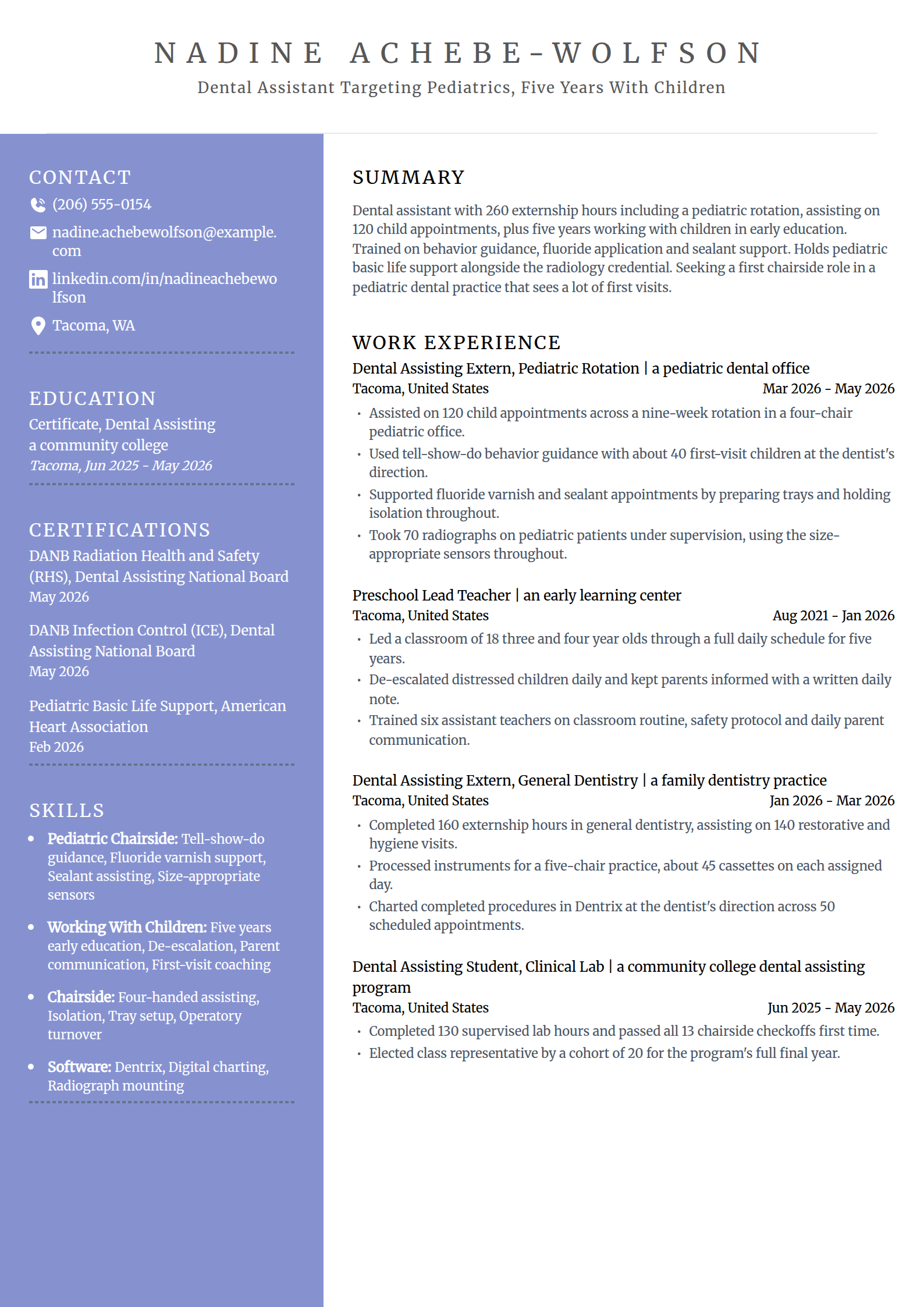
Pediatric Dental Assistant Resume Template for Beginners
Why this resume example works?
- Names the behaviour guidance method, tell-show-do, and says it was used with 40 first-visit children at the dentist's direction.
- Puts five years of preschool teaching on the page as relevant experience, because managing frightened small children is the job.
- Mentions size-appropriate sensors for pediatric radiographs, a detail that only someone who has done it would include.
- Keeps the general dentistry rotation so the clinical base is visible alongside the specialty interest.
- Carries pediatric basic life support rather than the standard card, which is the version a children's practice asks for.
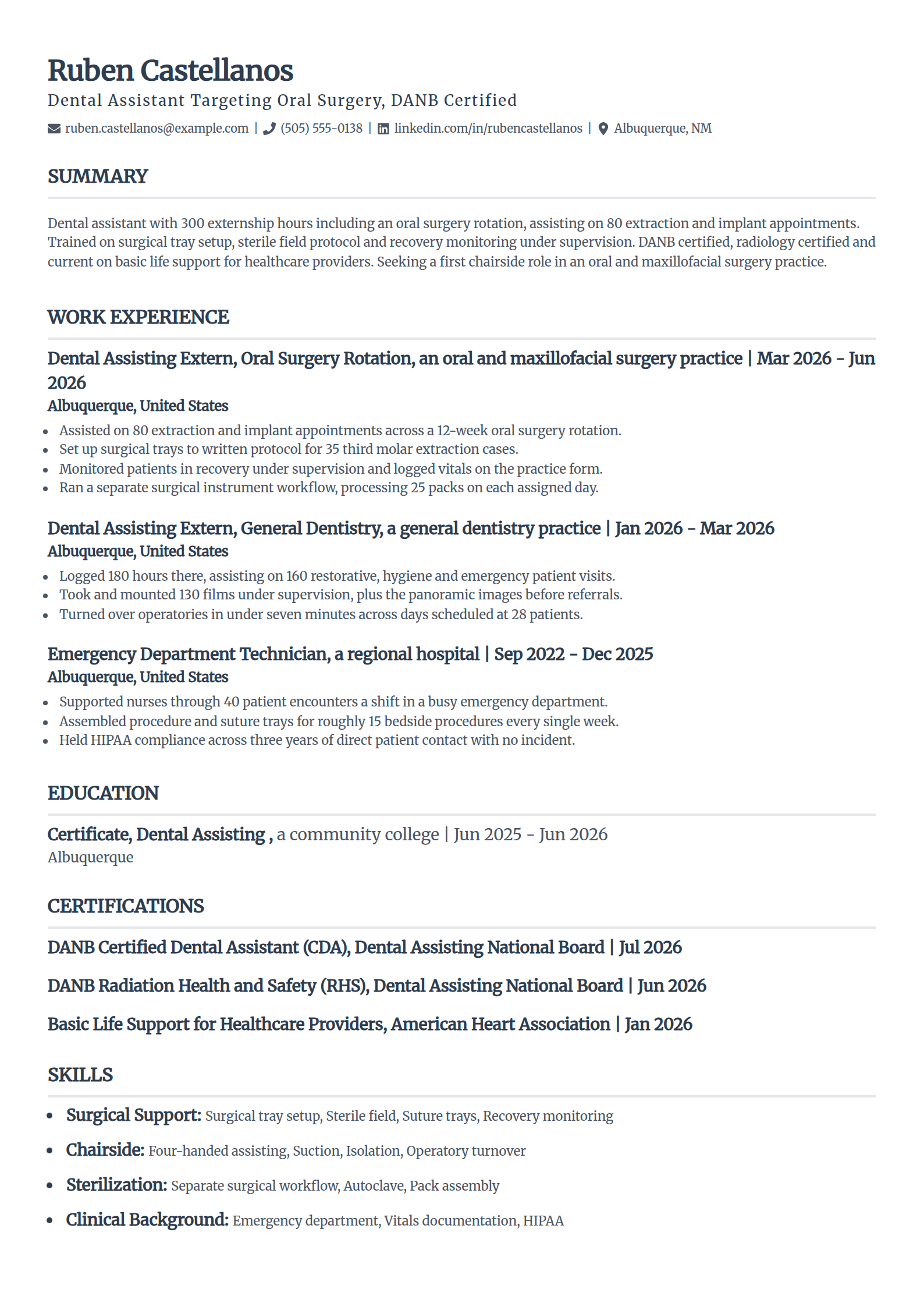
Oral Surgery Dental Assistant Resume Template for Beginners
Why this resume example works?
- Leads with the surgical rotation and counts it properly: 80 extraction and implant appointments across 12 weeks.
- Names the things a surgical practice screens for, sterile field protocol, surgical tray setup and a separate instrument workflow.
- Uses three years as an emergency department technician, where suture trays and vitals documentation were already routine.
- Says recovery monitoring was done under supervision, which keeps the claim inside what an assistant may actually do.
- Stays on a plain single-column layout, which is the right call when a surgical group's applicant system reads it first.
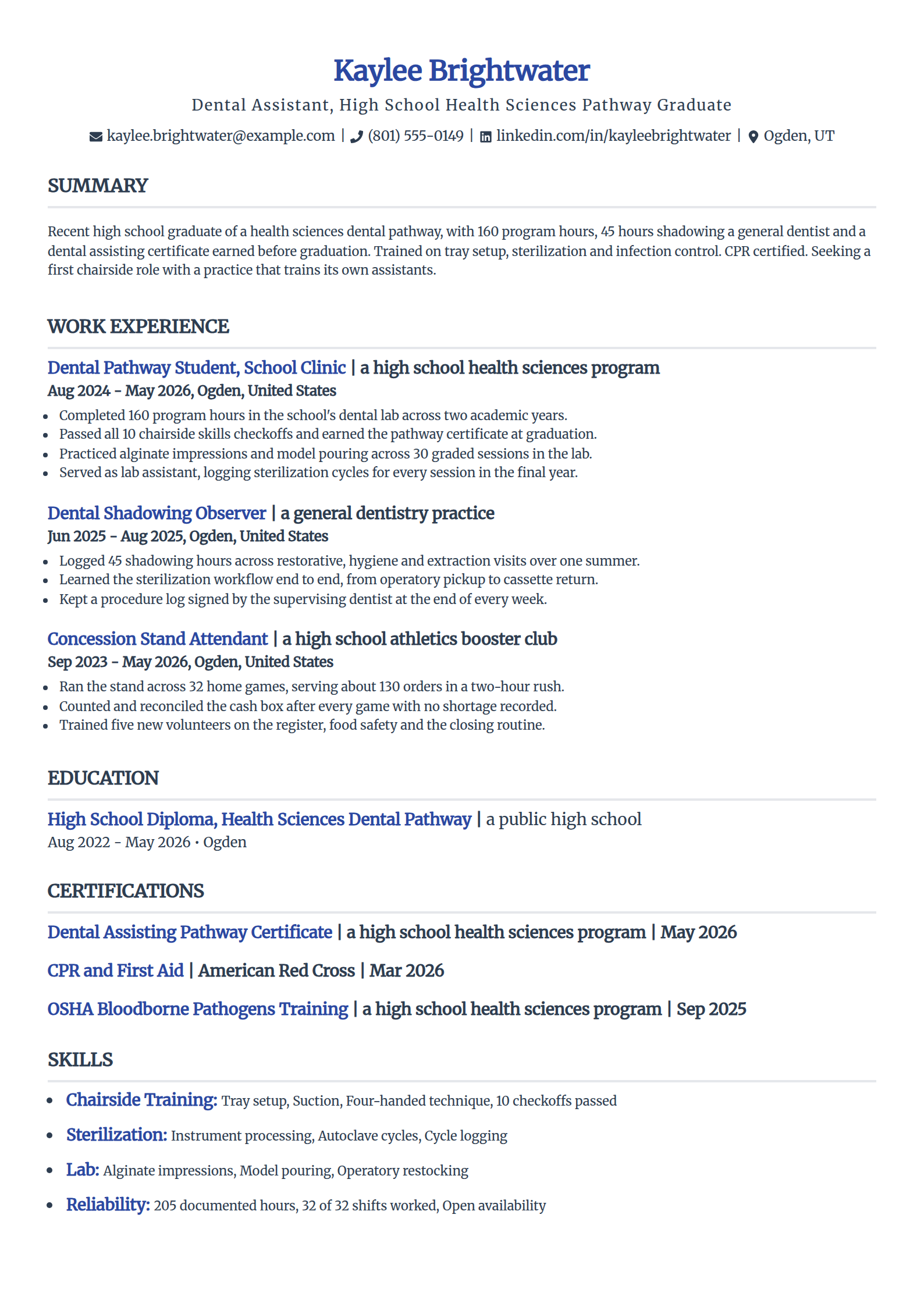
High School Dental Pathway Resume Template
Why this resume example works?
- Keeps every number small and age-appropriate. A recent high school graduate with modest, credible figures beats one with invented ones.
- Formats the school's dental lab as a dated entry with 160 program hours and 10 checkoffs, not as a line under education.
- Adds 45 shadowing hours with a dentist-signed log, which is the only outside verification this candidate can offer.
- Keeps the concession stand job, because counting a cash box and training five volunteers is real work with real numbers.
- Targets practices that train their own assistants, which is the honest and most likely route for this reader.
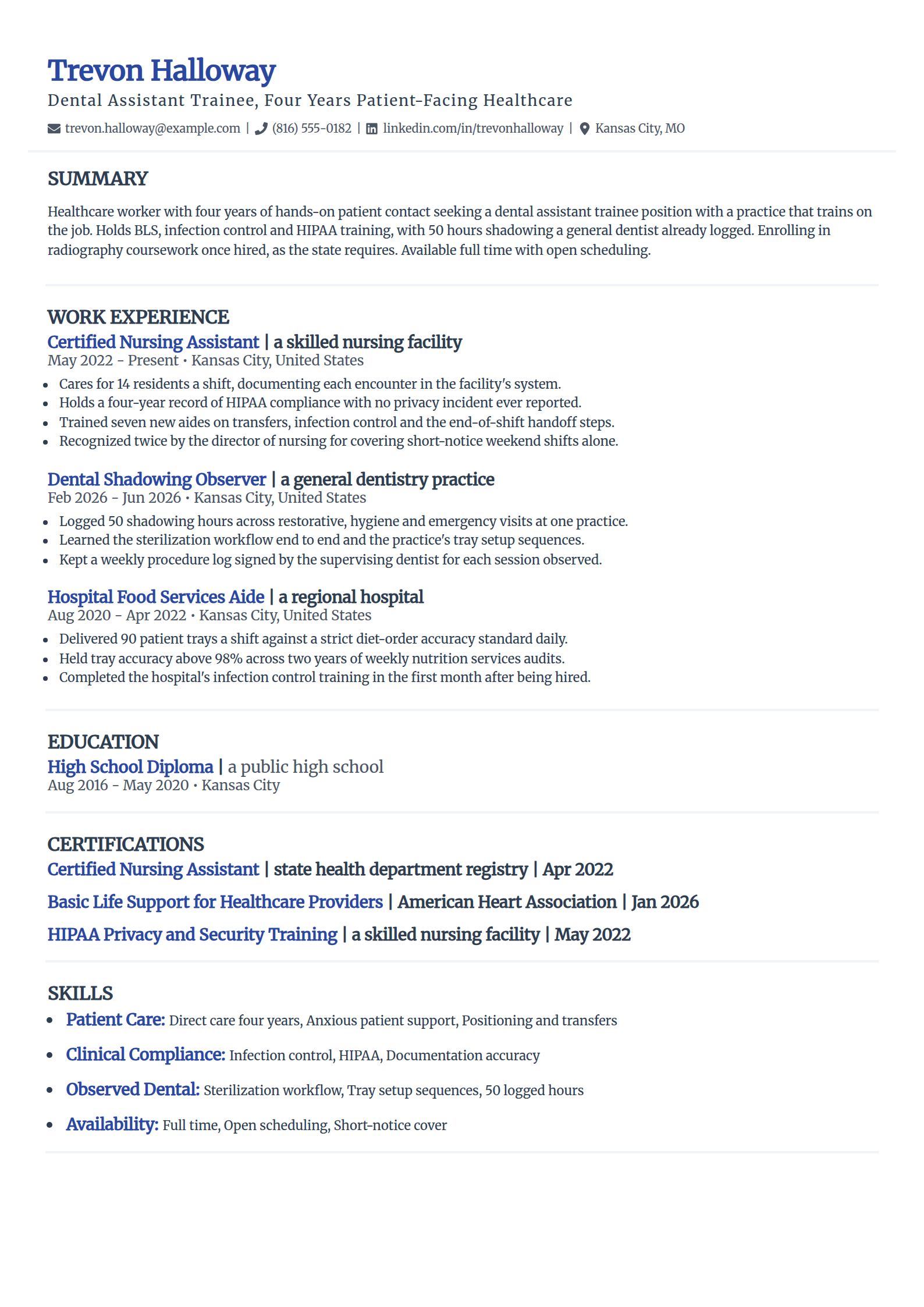
On-the-Job Training Dental Assistant Resume Template
Why this resume example works?
- Claims nothing it does not hold. There is no program and no dental credential on this page, and the headline says trainee.
- Leads with four years of hands-on patient care as a nursing assistant, which is the strongest thing this candidate owns.
- Adds 50 dentist-signed shadowing hours, so the interest in dentistry is documented rather than asserted.
- States the plan out loud: radiography coursework once hired, as the state requires. That answers the practice's first objection.
- Puts open availability on the page, because a practice training someone from scratch is buying time as much as skill.
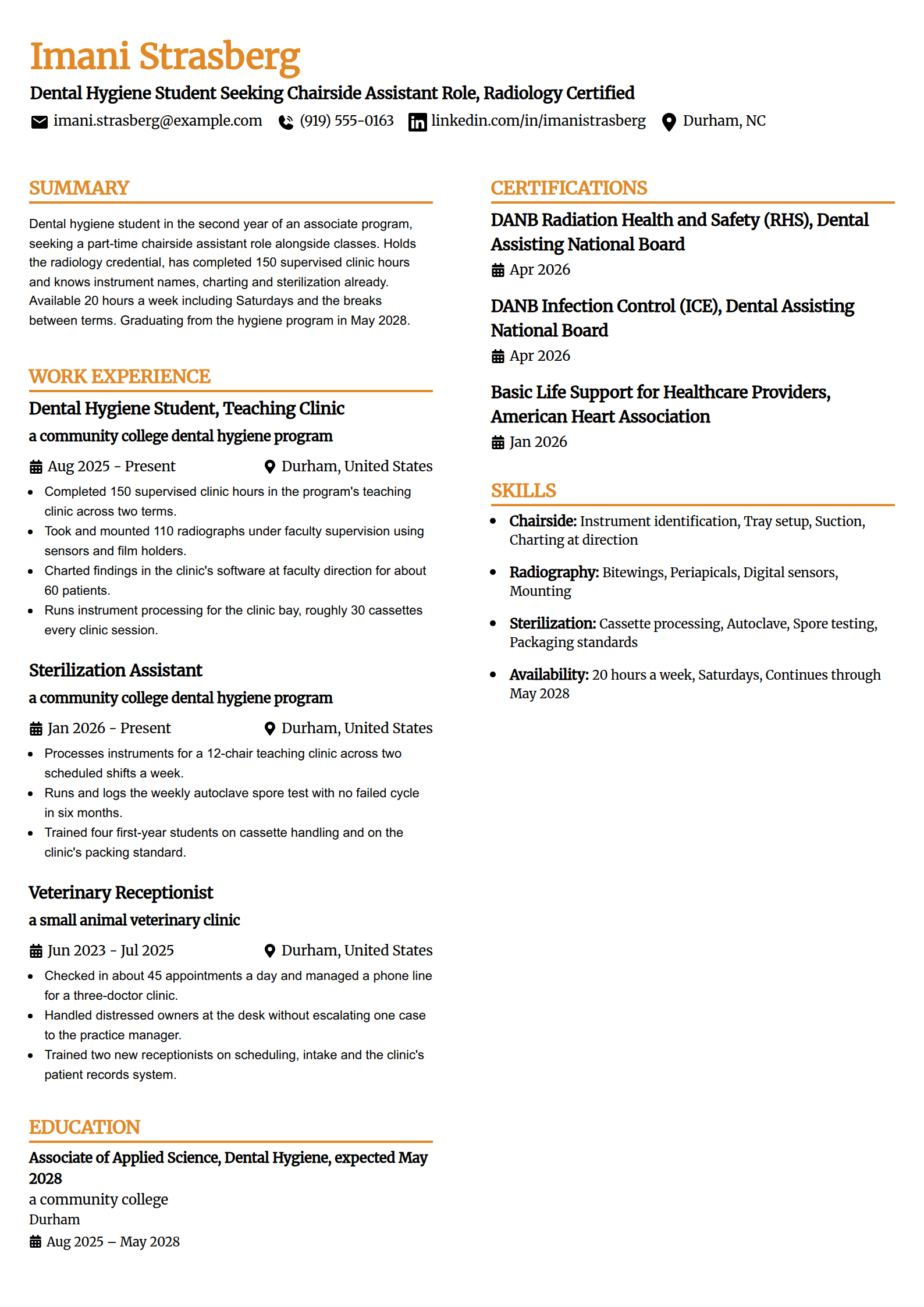
Dental Hygiene Student Assistant Resume Template
Why this resume example works?
- Applies for the assistant job it is actually applying for. Nothing here claims hygiene scope, which is the trap for this candidate.
- Uses the teaching clinic as dated work with 150 supervised hours and 110 radiographs behind it.
- Includes the paid sterilization shift at the same program, because processing 30 cassettes a session is directly the job.
- Says the graduation date, so a practice knows this is a role with a horizon and can plan around it.
- Lists availability including Saturdays and breaks between terms, which is the detail that makes a student hire workable.
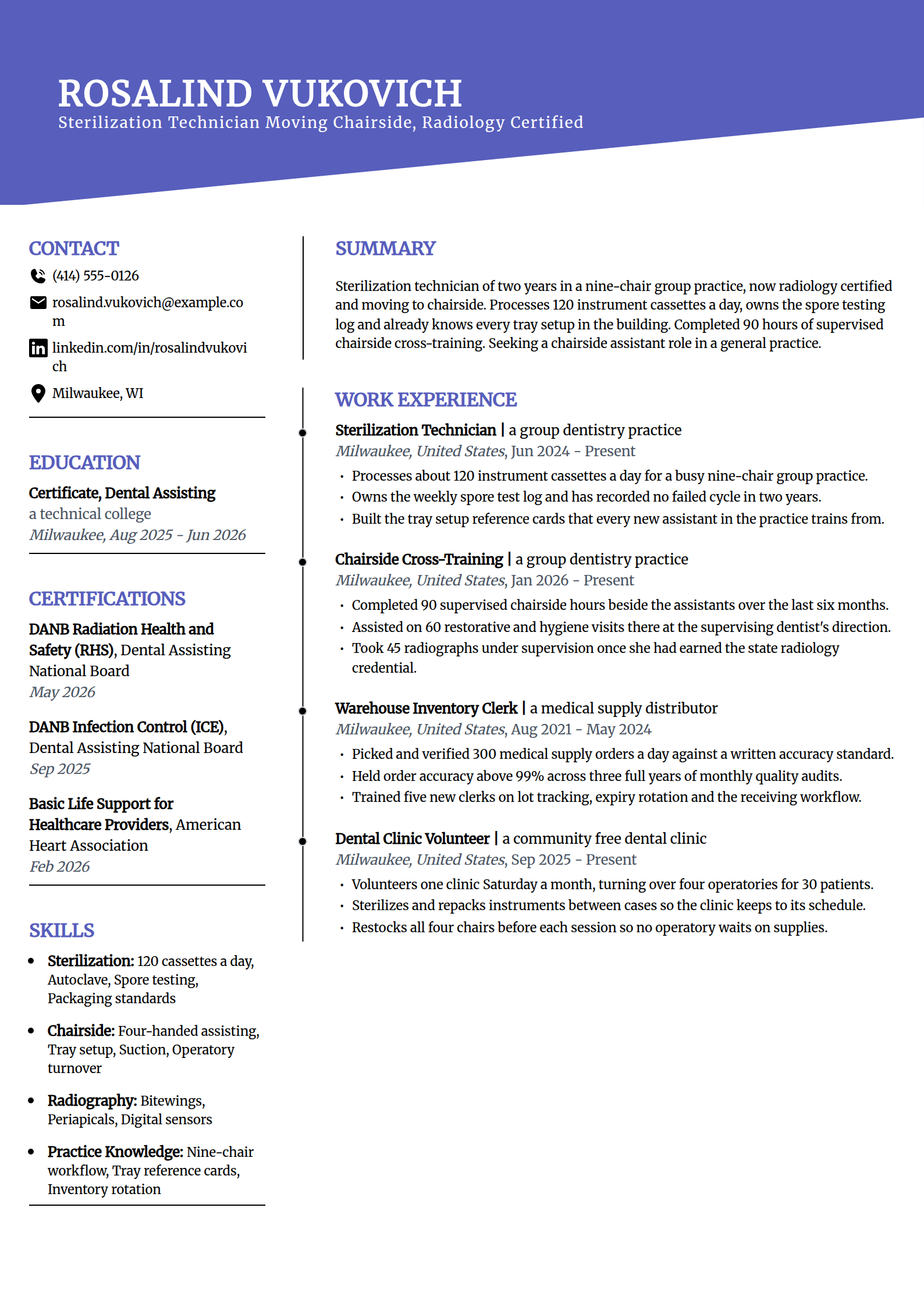
Sterilization Technician to Chairside Resume Template
Why this resume example works?
- Starts from inside a practice. Two years on the sterilization bench means she already knows every tray setup in the building.
- Gives the current role a volume number, 120 cassettes a day, and an accuracy record, no failed spore test in two years.
- Makes the cross-training its own dated entry with 90 supervised hours, which is the bridge between the bench and the chair.
- Includes an artefact of initiative, the tray setup reference cards new assistants now train from.
- Keeps the medical supply warehouse job for its accuracy standard, which is the same discipline sterilization runs on.
Build your first dental assistant resume on one of these templates
Pick the example that matches what you have so far, open it in the builder, and swap in your own hours, credentials and numbers. An afternoon of work and you have a page a practice manager can read between patients.
Build my resumeHow to write a beginner dental assistant resume
A practice hiring a first-time assistant is asking two questions: can you be trusted around patients and instruments, and will you turn up. Almost everything on the page should answer one of those.
Do not use a functional resume, whatever the guides say
Several of the pages ranking for this search recommend a functional layout, skills first and work history demoted or dropped. Do not do it. Every example on this page is reverse chronological with dated entries, and that is the only format worth sending.
- Dental groups and larger practices run applications through parsing software, and a functional layout is what it handles worst.
- A hiring dentist reads a missing work history as something being hidden. That is a worse first impression than an empty one.
- The gap is real either way. Reverse chronological with honest entries shows what you have; functional just makes the reader hunt for it.
- Use standard section headings: Summary or Objective, Work Experience, Education, Certifications, Skills.
- One page, PDF unless the form asks otherwise, then run it through the ATS resume checker before you send it.
Fill the experience section, do not apologize for it
The usual advice for an empty work history is to add hobbies and interests. You almost certainly have entries instead. Each of these gets a title, dates and two to five bullets, exactly like a paid job.
- Your externship or clinical rotation. Give the hour count, the number of patient visits and the setting. If you rotated through two practices, that is two entries.
- The school clinic or lab. Supervised hours, skills checkoffs passed, models poured, scans taken.
- Shadowing, if it was documented. Say the hours and that the log was signed by the supervising dentist.
- Volunteering at a community or mobile clinic. Operatories turned over, instruments processed, patients supported.
- The paid job you already have in another field. Caregiving, pharmacy, veterinary, hospitality and retail all carry things a practice wants.
- A dental pathway in high school, or expanded function coursework, both count as dated entries rather than education footnotes.
The numbers a beginner actually has
You do not need production figures. You need the countable things you did, and you have more of them than you think.
- Externship hours and patient visits assisted, with the supervision stated.
- Radiographs taken and mounted, if you hold the radiology credential. Add a retake rate if you tracked one.
- Instrument cassettes processed a day, and how long the autoclave log or spore test has run clean.
- Operatory turnover time between patients, which tells a practice owner whether the schedule will hold.
- Skills checkoffs passed and where you finished in your cohort, if it was near the top.
- Attendance. Shifts worked out of shifts scheduled is a fact; reliable is a word.
- One number per bullet. Two in one sentence makes both look invented.
Credentials, and what varies by state
Dental assisting is regulated state by state, and the difference is large. Two things follow: list what you hold precisely, and check your own state's rules rather than trusting a general article.
- Name national credentials in full with the acronym: DANB Certified Dental Assistant (CDA), National Entry Level Dental Assistant (NELDA), Radiation Health and Safety (RHS), Infection Control (ICE).
- Add your state credential if you hold one, such as a Registered Dental Assistant licence, with the issuing board.
- CPR or BLS for healthcare providers, plus OSHA bloodborne pathogens and HIPAA training, all with dates.
- What you may do with radiographs, coronal polishing, sealants and expanded functions depends on your state, so check your state dental board before claiming any of it.
- If a credential is in progress, write in progress and give the expected date. Never imply you hold something you do not.
- Some states allow on-the-job training with no program at all. If yours does, say plainly that you are seeking a trainee position.
Name the software and the procedures
A practice's posting is matched against specific words. Chairside experience matches almost nothing; the system name and the procedure name match exactly.
- Practice management software by name: Dentrix, Eaglesoft, Open Dental, Curve Dental. Imaging by name too: DEXIS, Carestream.
- Procedures you assisted on, spelled the way a posting spells them: restorative, endodontic, prophylaxis, extractions, implants, sealants.
- The chairside vocabulary: four-handed assisting, suction and isolation, moisture control, instrument transfer, tray setup.
- The sterilization vocabulary: instrument processing, cassette systems, autoclave operation, spore testing.
- If you are aiming at a specialty, use its words. Banding and bonding for orthodontics, tell-show-do for pediatrics, sterile field for oral surgery.
- List only what you have actually done or been trained on. The first week finds out either way.
Objective or summary, and which one you need
One or the other, never both, and at this stage the choice is usually easy.
- No paid work in any field yet: write an objective of two to three sentences that leads with what you bring, hours and credentials, and ends with the kind of practice you want.
- A year or more of paid work in another field: write a summary instead, built on your credentials, your externship numbers and what transfers.
- Either way, lead with what you have already done. Never open with what you hope to gain from the practice.
- A summary that starts with the word seeking is an objective with the wrong heading. Rewrite it or relabel it.
- Copyable summaries and objectives for this role live on the dental assistant resume summary page linked below. This page does not repeat them.
Common beginner dental assistant resume mistakes
- Using a functional resume because an article recommended it. Skills-first layouts parse badly and read as concealment. Reverse chronological with dated entries, every time.
- Leaving the work history empty and filling the space with hobbies. Your externship hours, rotations, shadowing and volunteering are entries, and so is the job you already have somewhere else.
- Claiming a credential you have not earned yet. Write in progress with the expected date. A practice verifies DANB and state registrations, so this one always surfaces.
- Listing duties a dental assistant may not legally perform. Nothing on the page should imply scaling, diagnosis, treatment planning or anaesthesia, and what you may do with radiographs and expanded functions depends on your state.
- Writing cash handling of the dental world: chairside experience, dental software, good with patients. Name the system, the procedure and the tool instead, because that is what the posting matches.
- Hiding that you are still in the program. Put the graduation date in the headline. It comes up in the first phone call regardless, and hiding it is what costs the interview.
Frequently asked questions
What should a beginner dental assistant resume include?
Five things. A header with your name, city, phone and any credential letters you hold. Either an objective or a summary, never both, decided by how much paid work you have in any field. A work experience section with dated entries: your externship or clinical rotation with its hour count and patient visits, the school clinic, documented shadowing, volunteering, and the paid job you already have somewhere else. Your education with the program and its completion or expected date. And a certifications block plus a skills block that names real systems such as Dentrix, Eaglesoft, Open Dental or DEXIS, along with the procedures you assisted on. Keep it to one page and reverse chronological.
How do you write a dental assistant resume with no experience?
Fill the experience section rather than apologizing for it, and resist the advice to use a functional format. Your externship is a job-shaped thing: give the hours, the number of patient visits, the radiographs you took under supervision and the setting. The school clinic is another entry, with supervised hours and skills checkoffs passed. Documented shadowing counts if the log was signed by the supervising dentist. So does volunteering at a community clinic, and so does the paid work you already do in caregiving, pharmacy, veterinary, hospitality or retail, because a practice wants people who show up, handle nervous patients and follow a protocol. Use an objective rather than a summary if you have no paid history at all.
Can you get a dental assistant job with no experience or certification?
In some states, yes, because they allow practices to train assistants on the job; in others a program, a registration or a background check is required before you can work chairside at all. The requirement is set by your state dental board, not by a national rule, so check theirs rather than trusting a general article. What travels everywhere is that most states expect radiation safety training before you take radiographs. If your state allows on-the-job training, say plainly in your headline that you are seeking a trainee position, lead with any patient-facing work you have, add documented shadowing hours, and state your plan for the radiography coursework once hired.
What skills should a beginner dental assistant put on a resume?
Name systems and procedures, not qualities. The chairside vocabulary a posting screens for: four-handed assisting, suction and isolation, moisture control, instrument transfer, tray and operatory setup. The sterilization side: instrument processing, cassette systems, autoclave operation, spore testing. Radiography, if you hold the credential: bitewings, periapicals, panoramic, digital sensor placement and mounting. The practice management software by name, such as Dentrix, Eaglesoft, Open Dental or Curve Dental, and imaging software such as DEXIS or Carestream. Add the procedures you assisted on, spelled the way a posting spells them. If you are targeting a specialty, use its words. List only what you have done or been trained on.
Should a beginner dental assistant resume have an objective or a summary?
One or the other, never both. If you have no paid job in any field yet, write an objective: two or three sentences that lead with what you bring, your program, your externship hours and your credentials, and close with the kind of practice you want. If you have a year or more of paid work somewhere else, write a summary instead, built on your credentials, your externship numbers and the parts of that job that transfer. Either way, open with what you have already done rather than what you hope to get. A summary that begins with the word seeking is really an objective wearing the wrong label.
How long should a beginner dental assistant resume be?
One page, and at this stage that is rarely a struggle. Every example here fits a single page, including ones carrying four dated entries, two education lines and six certifications. If you are running over, cut the oldest unrelated job to two bullets, drop high school once you have a dental program on the page, and delete any bullet without a number or a specific procedure in it. Do not pad with hobbies, a references line or an objective that repeats your summary. A practice manager reads a stack of these between patients, so the page that says the most in the first third is the one that gets called.
More beginner dental assistant resume resources
Build your first dental assistant resume on one of these templates
Pick the example that matches what you have so far, open it in the builder, and swap in your own hours, credentials and numbers. An afternoon of work and you have a page a practice manager can read between patients.