Dental Assistant Resume Examples, Entry-Level to Specialty
- ATS Friendly
- Every Dental Role
- 19 Real Examples
General dentistry, an ortho chair, or a first externship each call for a different resume, and this page has one built for your exact track. Start from a layout below, then model your own on a real example, from a first job with no experience to a lead RDA. Every credential, from DANB CDA to radiology and EFDA, sits where a hiring manager looks first.


540k+ resumes created
Dental assistant resume templates for every level and specialty
Each template below is a real dental assistant resume laid out in that format, sorted by experience level and specialty across general, orthodontic, oral surgery, pediatric, endodontic, and periodontal care. Pick one, then swap in your own credentials, tools, and daily patient load. Every layout keeps your name, certifications, and clinical skills readable so a hiring manager sees your strongest work at a glance and an applicant tracking system parses it cleanly.
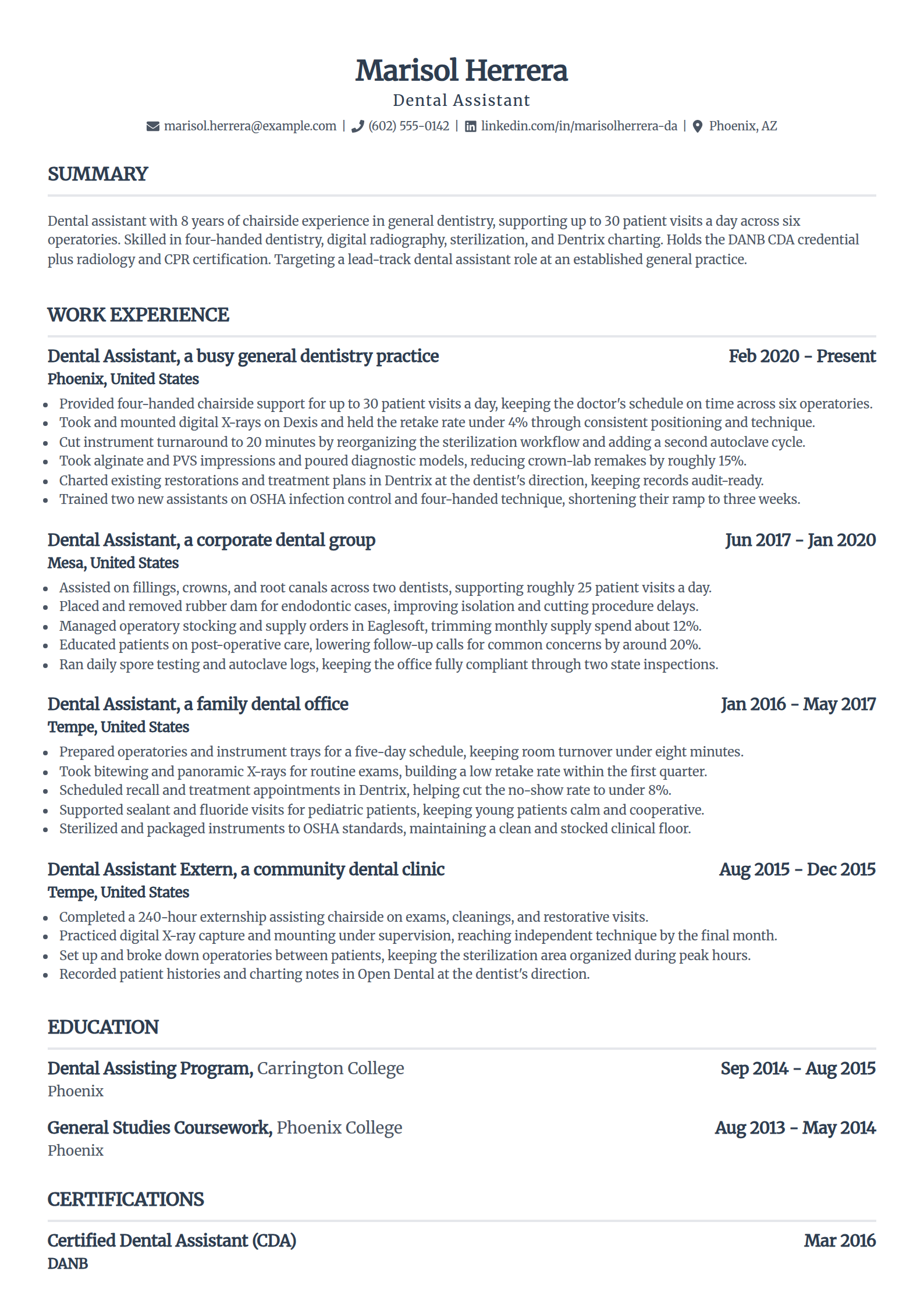
Dental Assistant Resume Template (Experienced)
Why this resume example works?
- Opens with a summary that names 8 years, up to 30 patient visits a day, and the DANB CDA credential.
- Shows the chairside range a general practice wants: four-handed dentistry, radiography, impressions, and Dentrix charting.
- Attaches one number to each bullet, like an X-ray retake rate under 4% or instrument turnaround cut to 20 minutes.
- Names the tools a posting screens for, Dexis digital radiography, Eaglesoft, and Open Dental, in real context.
- Uses a clean, single-column layout an applicant tracking system reads without trouble.
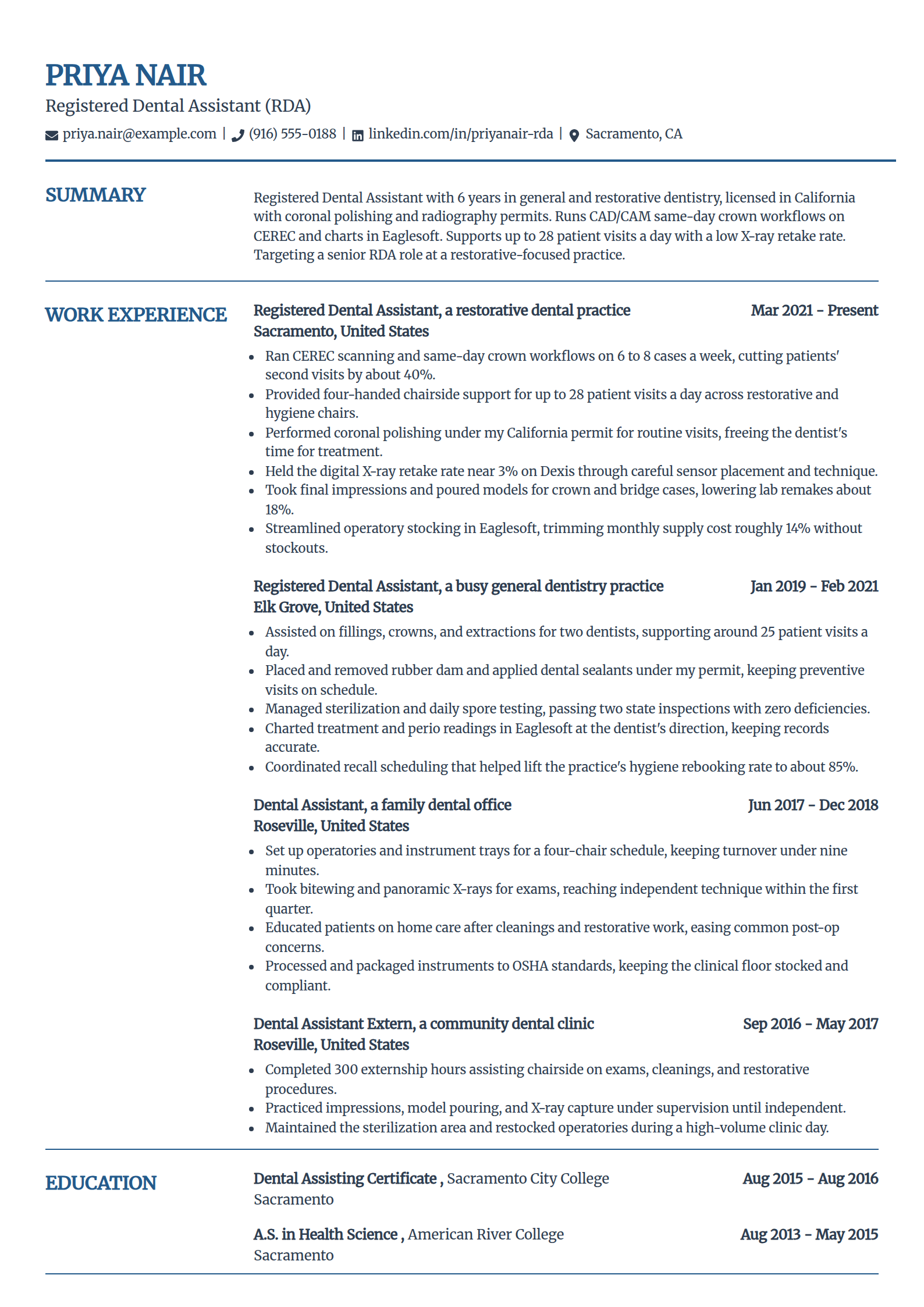
Registered Dental Assistant (RDA) Resume Template
Why this resume example works?
- Leads with state licensure and a permit for coronal polishing, the credentials an RDA posting checks first.
- Shows the restorative range a practice hires for, CEREC same-day crowns and final impressions on crown and bridge cases.
- Keeps each result countable, like second visits cut about 40% or the X-ray retake rate held near 3%.
- Names the CAD/CAM and software stack a posting lists, CEREC, Dexis, and Eaglesoft, without a keyword wall.
- Uses a modern layout that carries a six-year restorative history on one clean page.
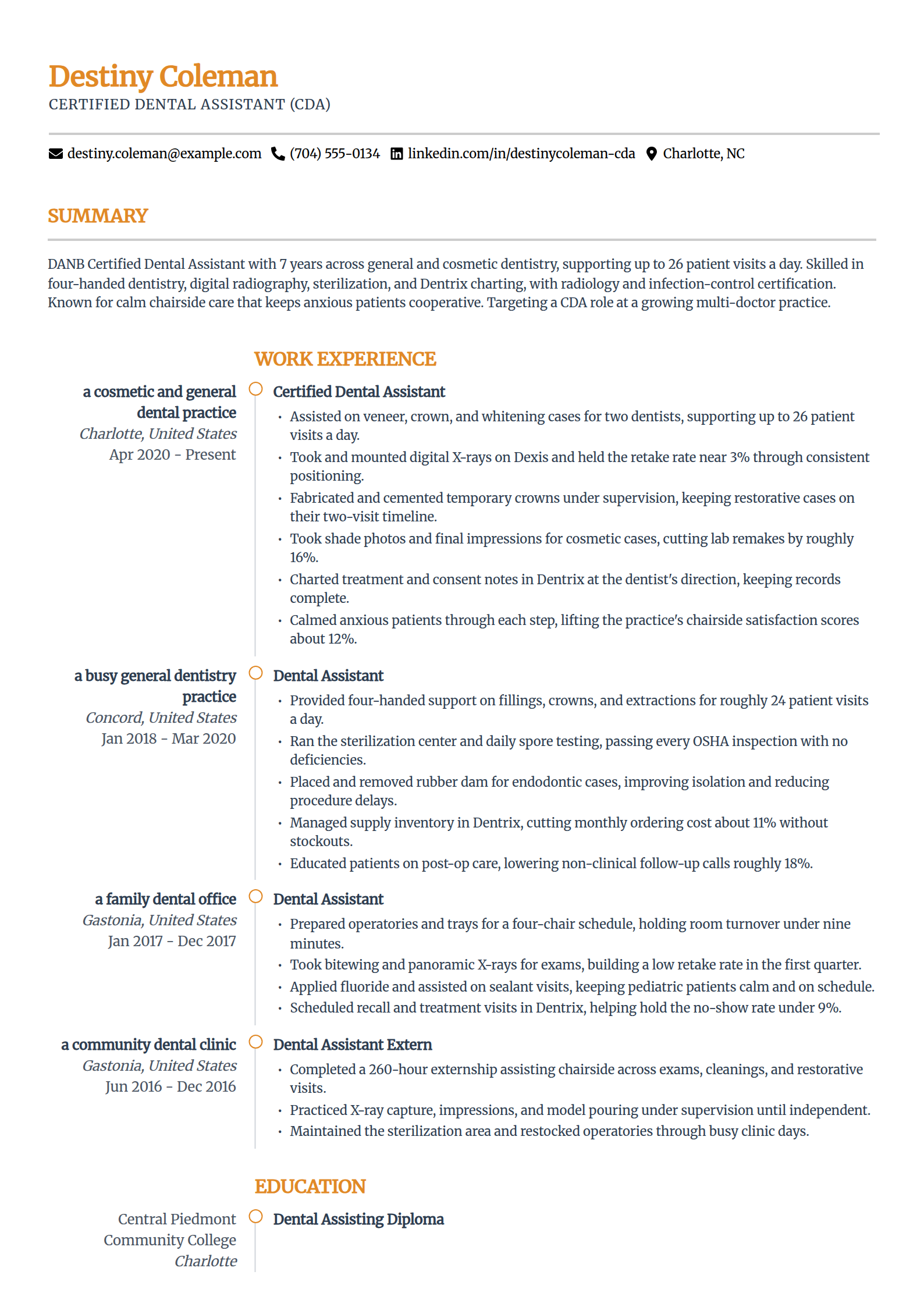
Certified Dental Assistant (CDA) Resume Template
Why this resume example works?
- Puts the DANB CDA, radiology, and infection-control certifications up top where a credential-driven posting looks.
- Shows cosmetic and general range, assisting on veneers and crowns while fabricating and cementing temporaries.
- Ties chairside work to a number, like an X-ray retake rate near 3% or lab remakes cut about 16%.
- Names Dentrix charting and Dexis imaging, the everyday systems a general practice expects.
- Uses a modern layout that still reads cleanly for a hiring manager scanning fast.
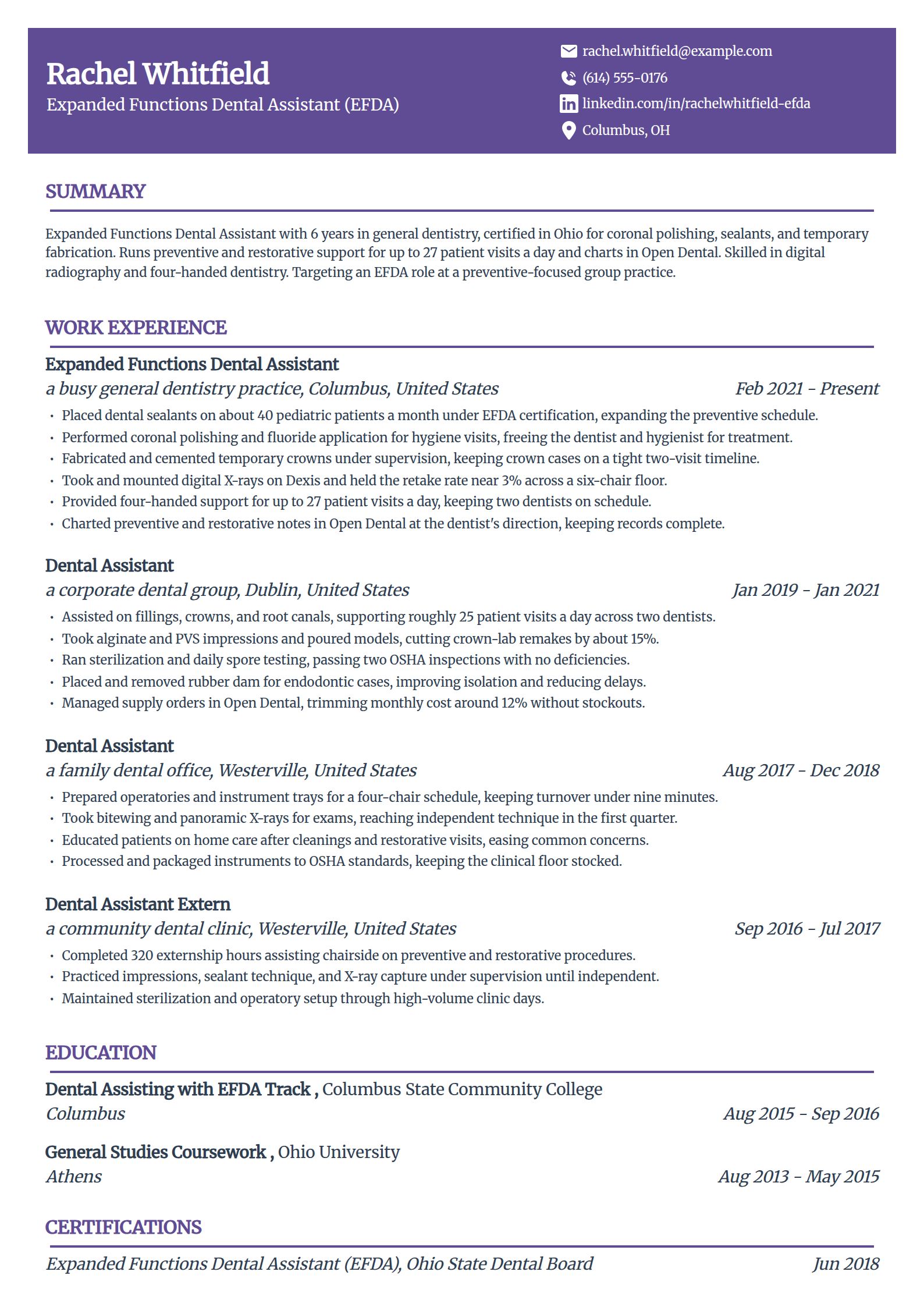
Expanded Functions Dental Assistant (EFDA) Resume Template
Why this resume example works?
- Leads with the EFDA credential and names the functions it covers, coronal polishing, sealants, fluoride, and temporaries.
- Keeps every expanded-function claim inside legal scope, like sealants placed on about 40 patients a month under certification.
- Pairs preventive work with restorative support across a six-chair floor, showing real chairside range.
- Names Open Dental charting and Dexis imaging, the systems a preventive-focused group runs.
- Uses a spacious layout that carries a full preventive and restorative record on one page.
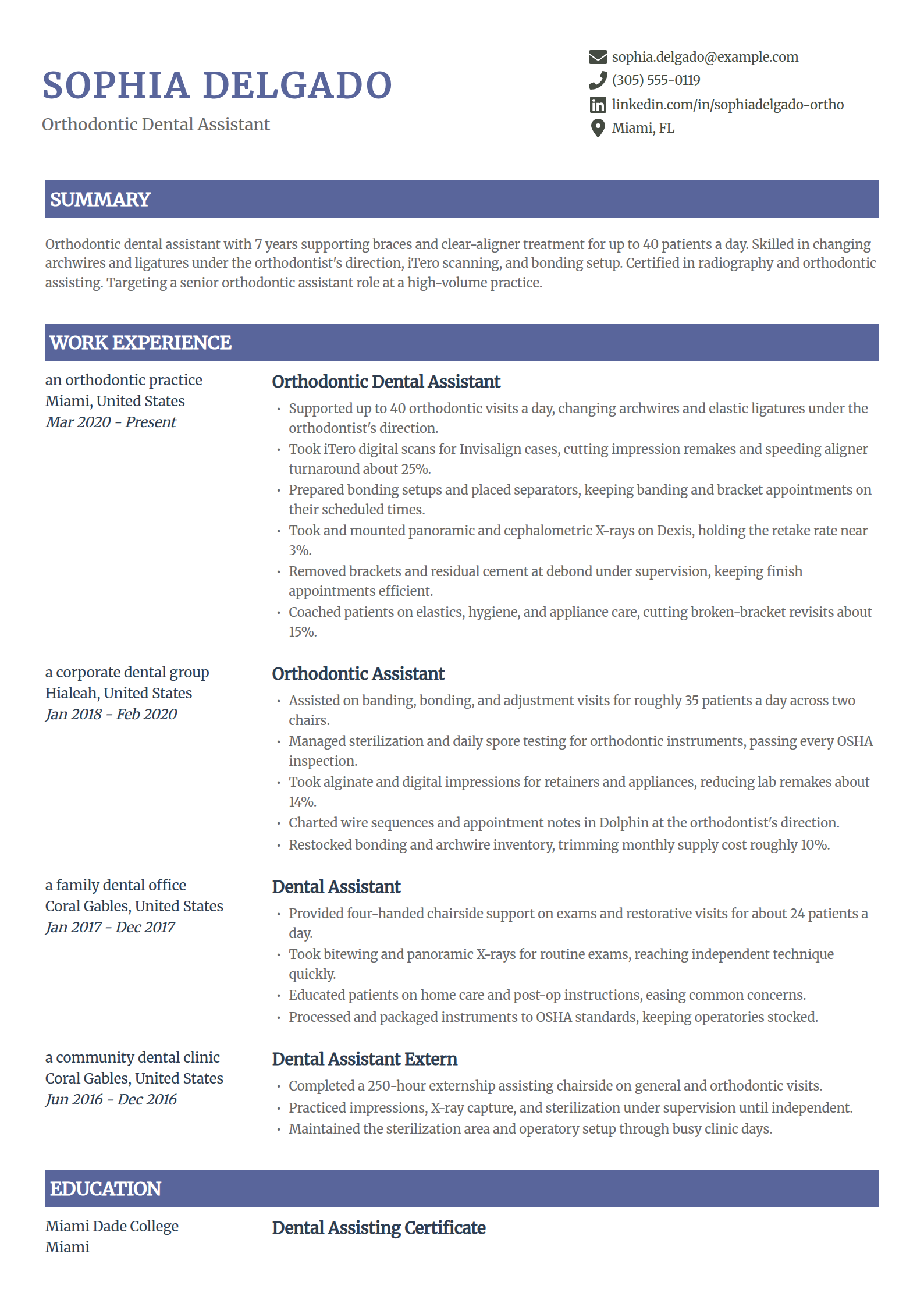
Orthodontic Dental Assistant Resume Template
Why this resume example works?
- Opens with orthodontic volume, up to 40 visits a day changing archwires and ligatures under the orthodontist's direction.
- Shows the digital workflow a modern ortho practice hires for, iTero scanning for Invisalign and bonding setups.
- Keeps results tied to a task, like aligner turnaround sped about 25% or broken-bracket revisits cut 15%.
- Names the imaging and software a posting lists, panoramic and cephalometric X-rays on Dexis and Dolphin charting.
- Uses a modern two-column layout that carries a dense ortho history on one page.
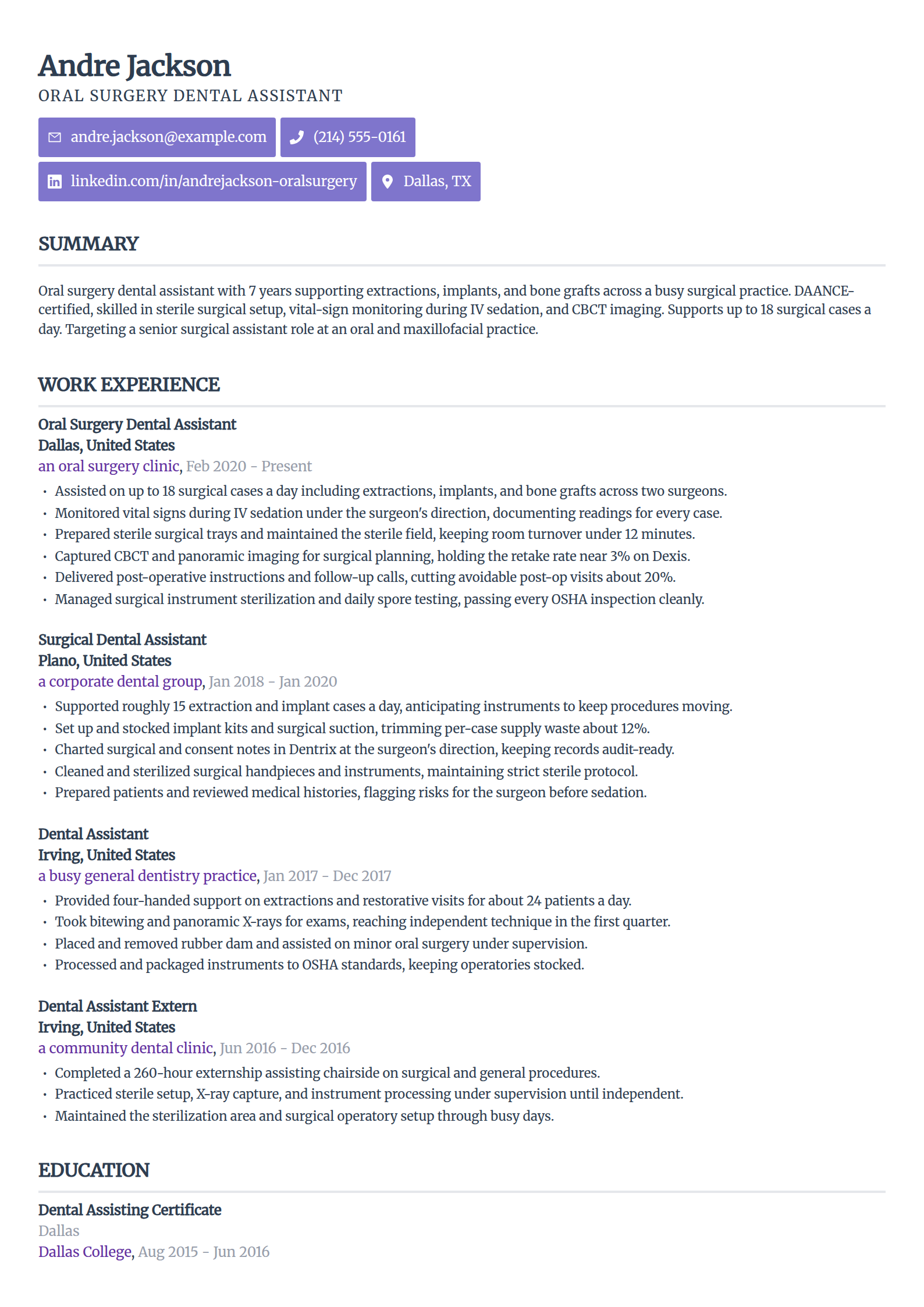
Oral Surgery Dental Assistant Resume Template
Why this resume example works?
- Leads with DAANCE certification and surgical volume, up to 18 extraction, implant, and graft cases a day.
- Shows the surgical skills a practice needs, sterile tray setup and vital-sign monitoring during IV sedation under direction.
- Keeps each result modest and countable, like room turnover under 12 minutes or post-op visits cut about 20%.
- Names CBCT and panoramic imaging plus Dentrix documentation, the systems an oral surgery clinic runs.
- Uses a clean, modern layout that carries a deep surgical history on one page.
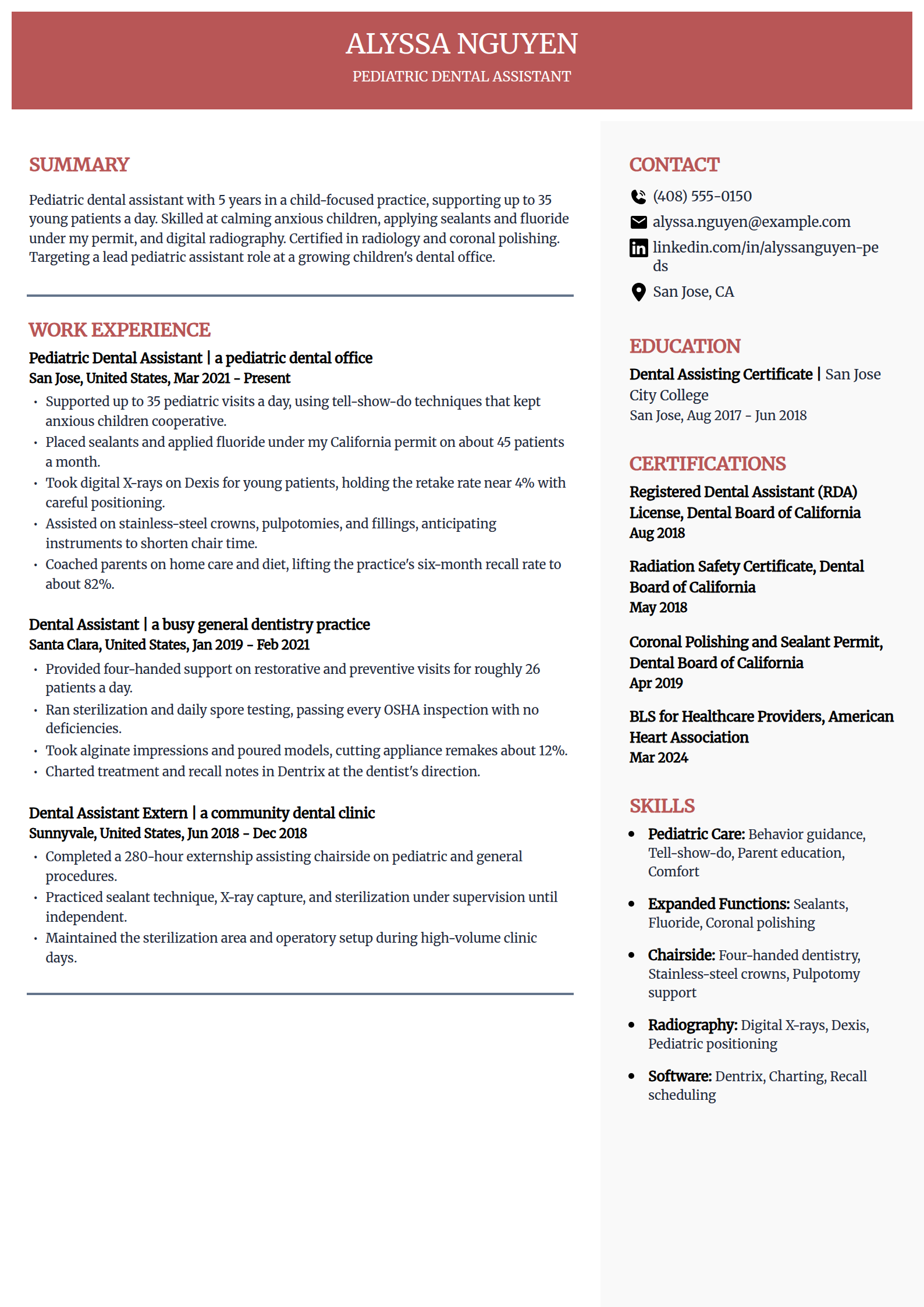
Pediatric Dental Assistant Resume Template
Why this resume example works?
- Opens with the skill a children's office rewards, keeping up to 35 young patients cooperative with tell-show-do.
- Shows preventive range inside scope, sealants and fluoride placed under a state permit on about 45 patients a month.
- Pairs behavior guidance with real assisting, stainless-steel crowns and pulpotomy support at the chair.
- Keeps numbers believable for the setting, like a six-month recall rate lifted to about 82%.
- Uses a refined layout that fits a five-year pediatric record cleanly on one page.
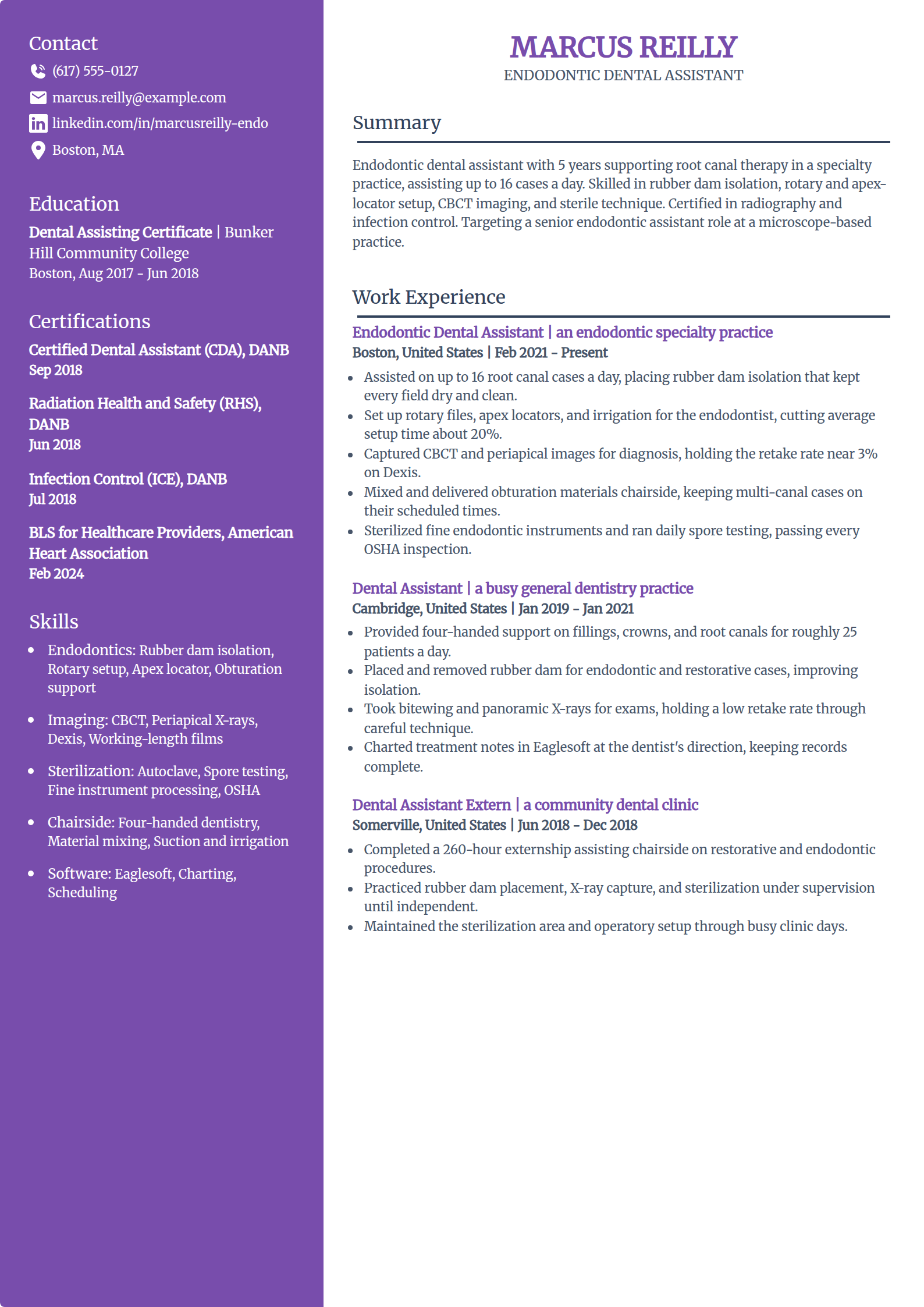
Endodontic Dental Assistant Resume Template
Why this resume example works?
- Leads with root canal volume, up to 16 cases a day with rubber dam isolation on every field.
- Shows the specialty setup an endodontist needs, rotary files, apex locators, and irrigation ready to go.
- Keeps results tied to a task, like setup time cut about 20% or the X-ray retake rate held near 3%.
- Names CBCT and periapical imaging on Dexis plus Eaglesoft charting, the systems a specialty practice runs.
- Uses a Medium layout that fits a focused endodontic record without empty space.
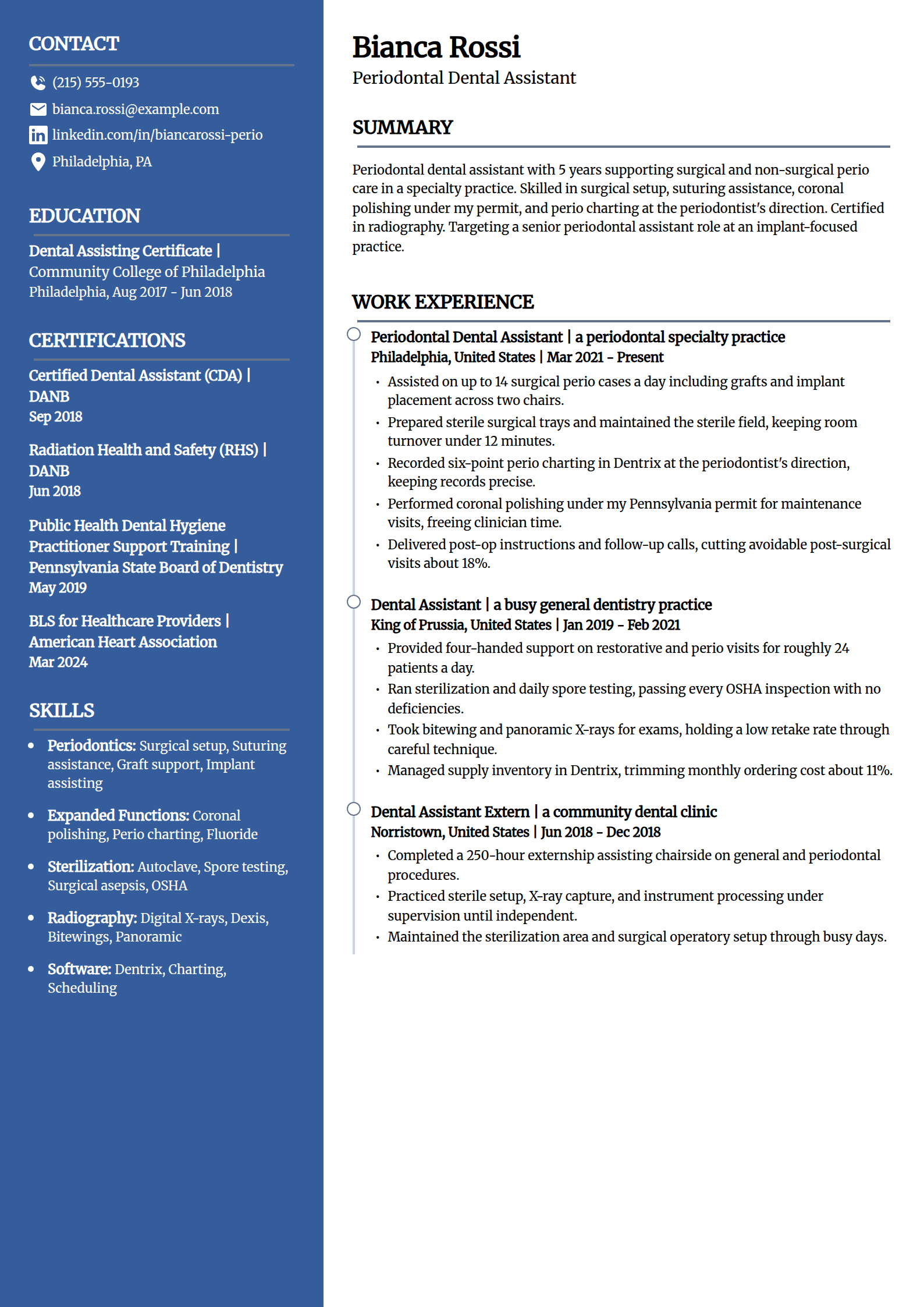
Periodontal Dental Assistant Resume Template
Why this resume example works?
- Opens with surgical support, up to 14 perio cases a day including grafts and implant placement across two chairs.
- Shows the specialty skills a periodontist needs, sterile tray setup, suturing assistance, and six-point perio charting.
- Keeps coronal polishing inside scope by naming the state permit, then ties it to freed clinician time.
- Names Dentrix charting and Dexis imaging plus daily spore testing, the compliance work a surgical office expects.
- Uses a distinctive layout that still reads cleanly for a hiring manager.
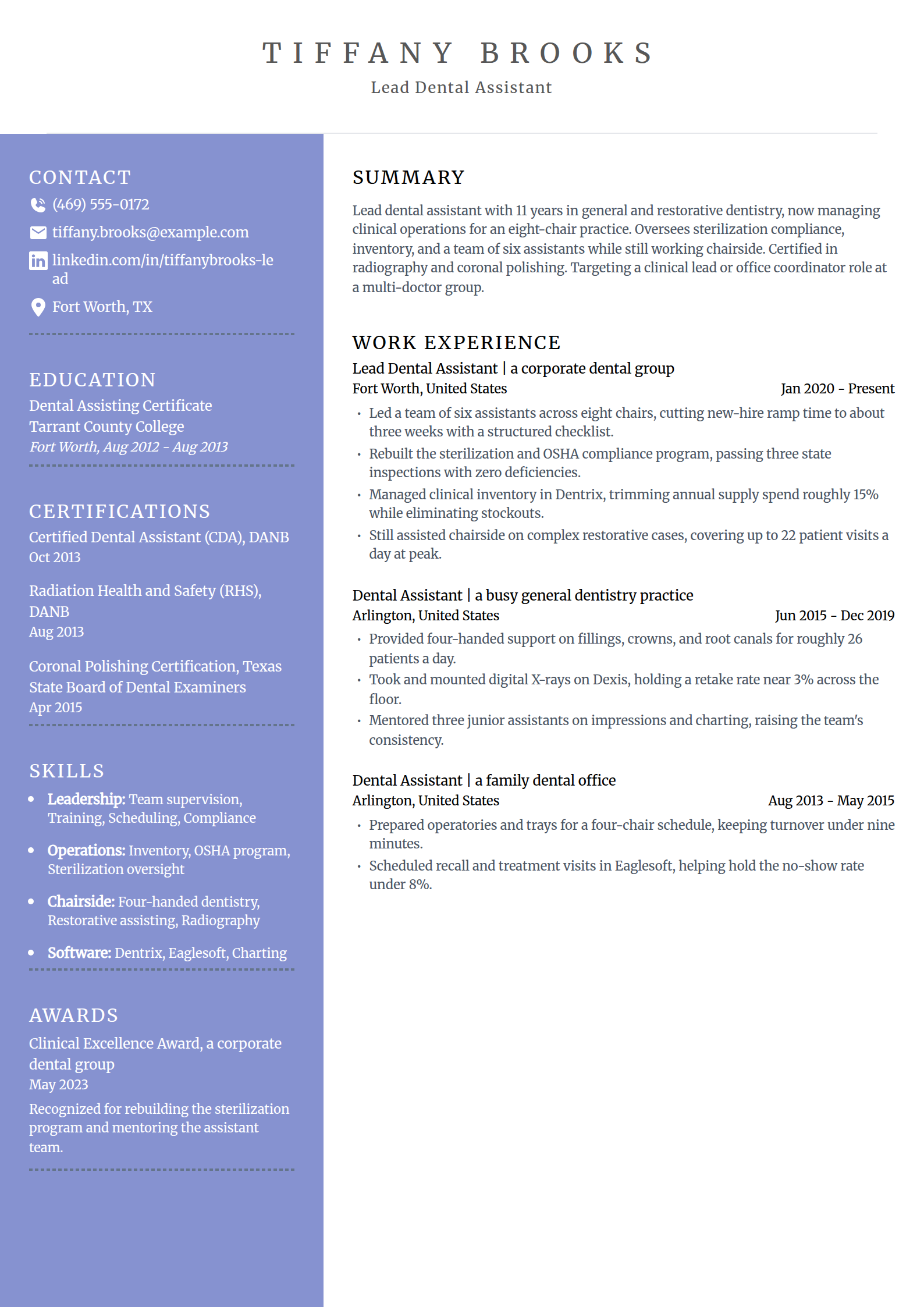
Lead Dental Assistant Resume Template
Why this resume example works?
- Leads with lead-level scope, a team of six assistants across eight chairs and full OSHA compliance ownership.
- Shows the results a clinical lead is hired for, three inspections passed with zero deficiencies and supply spend cut about 15%.
- Keeps the candidate credible at the chair, still assisting on complex restorative cases up to 22 visits a day.
- Pairs management with training, new-hire ramp cut to about three weeks with a structured checklist.
- Uses a roomy layout with an award entry so an eleven-year record still looks full.
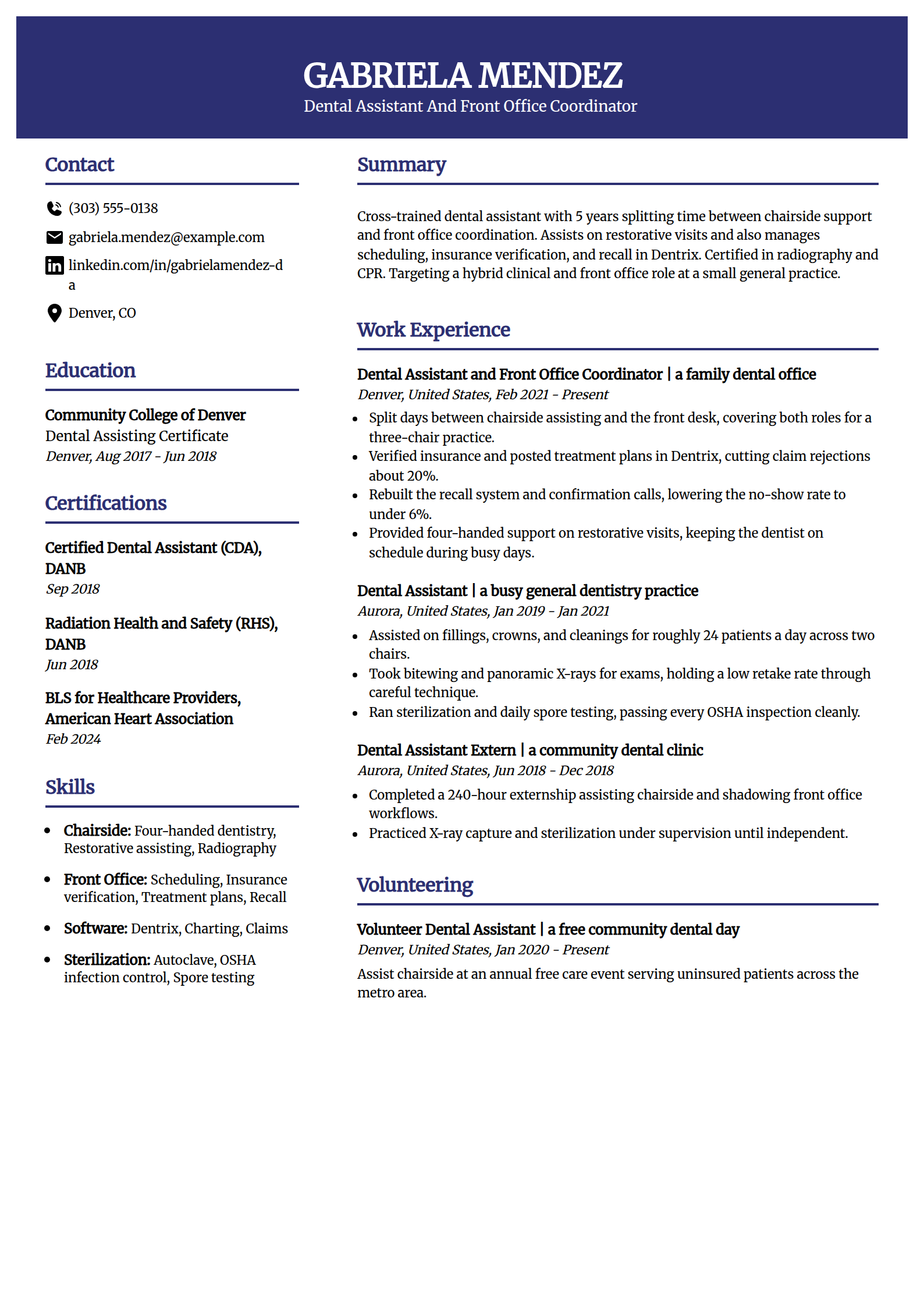
Dental Assistant and Front Office Resume Template
Moving up to practice manager? See 16 office manager resume examples →
Why this resume example works?
- Opens with the cross-trained value a small practice wants, covering both the chair and the front desk.
- Shows the administrative range a hybrid role hires for, insurance verification and treatment plans in Dentrix.
- Keeps results tied to a system, like claim rejections cut about 20% or the no-show rate lowered under 6%.
- Keeps the clinical side visible, four-handed restorative support that holds the dentist's schedule.
- Uses a roomy layout with a volunteer entry so a five-year hybrid record still looks complete.
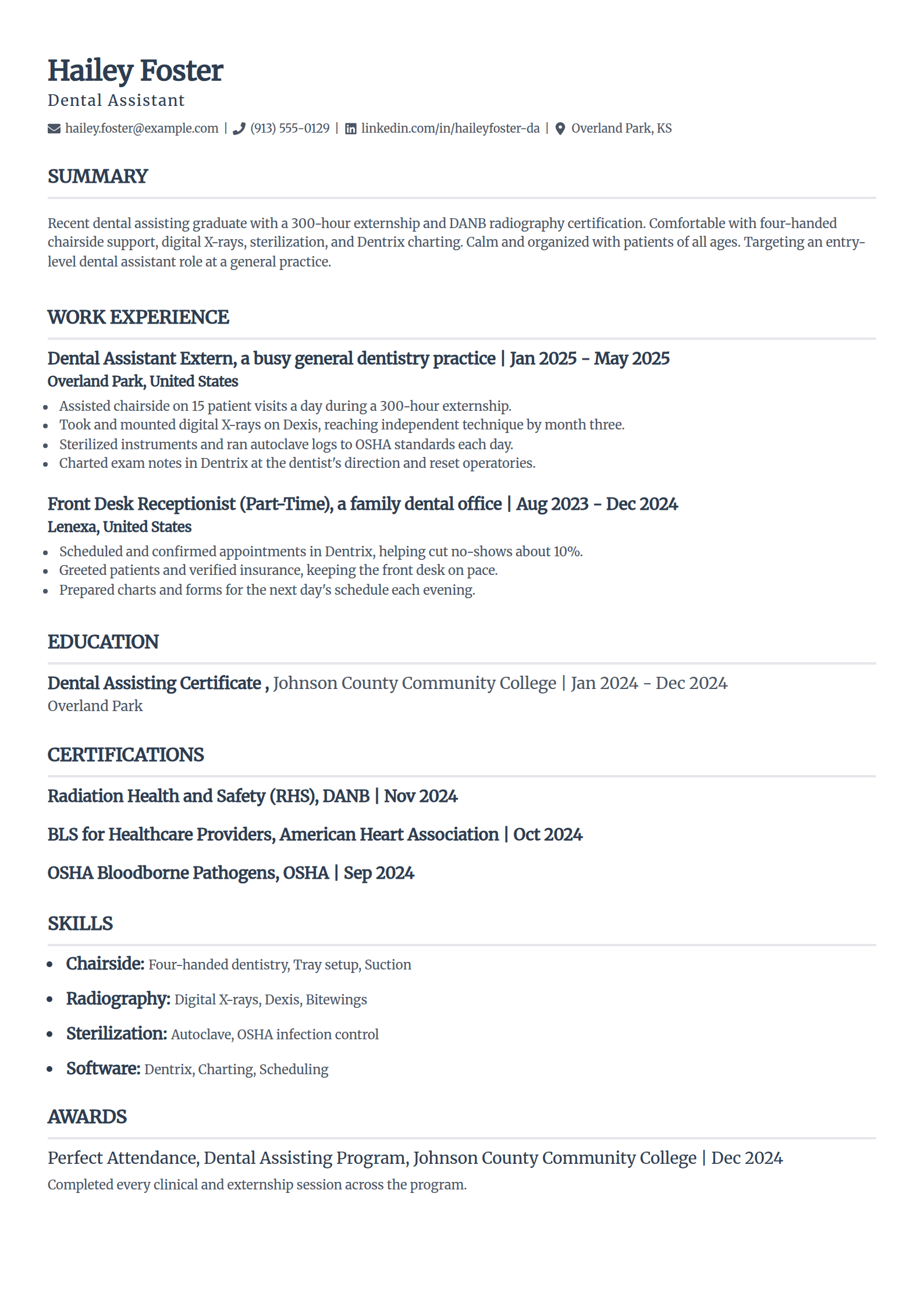
Entry-Level Dental Assistant Resume Template
Why this resume example works?
- Written for a recent program graduate, leading with a 300-hour externship and DANB radiography certification.
- Uses the externship and a front-desk job as entries, the right move when full-time chairside experience is new.
- Keeps every bullet honest and quantified, like 15 patient visits a day or independent X-ray technique by month three.
- Names Dentrix and Dexis, the systems an entry-level posting screens for, plus BLS and OSHA credentials.
- Fills a tight, ATS-safe page with a certificate and an attendance award instead of padding.
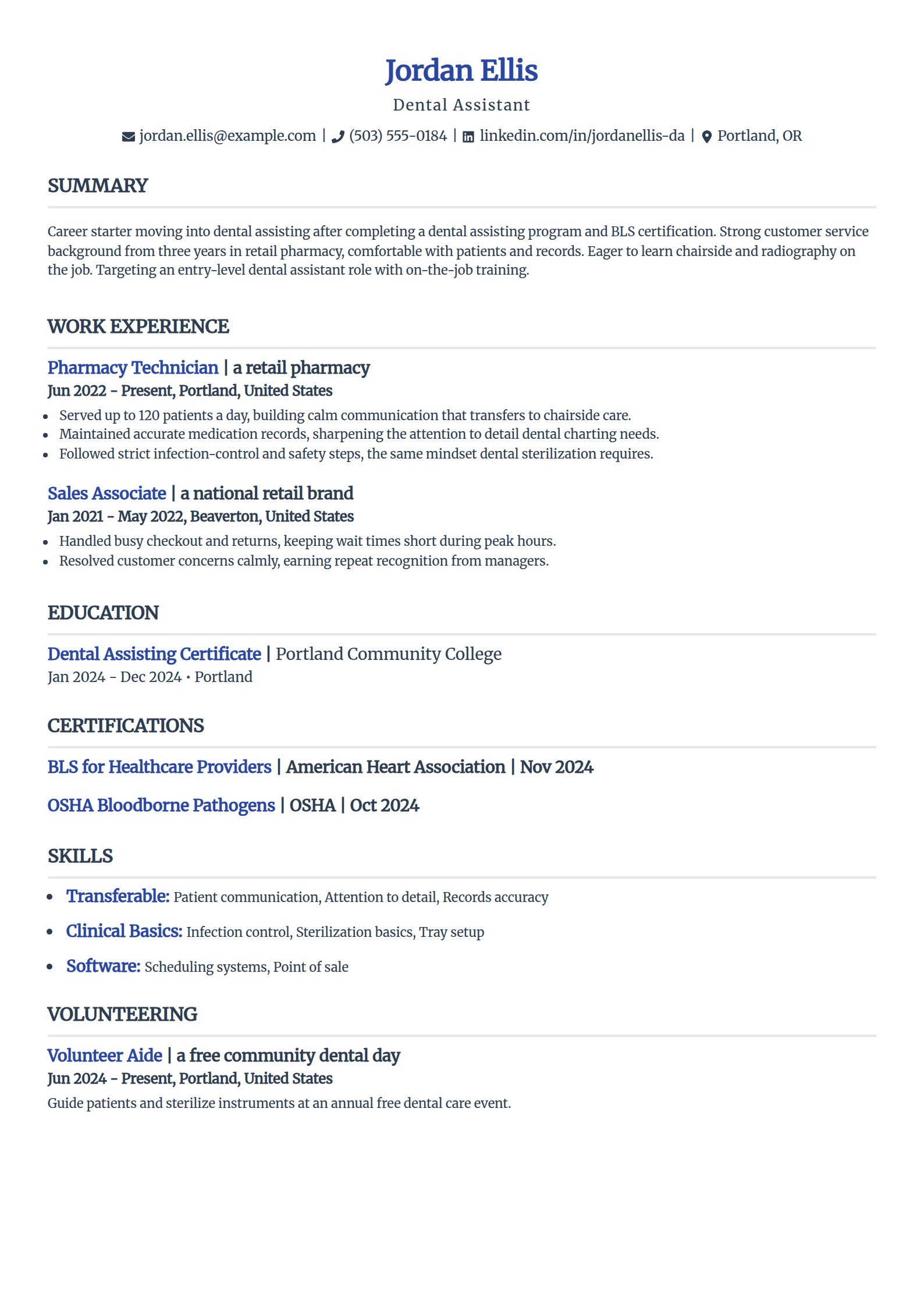
Dental Assistant Resume Template (No Experience)
16 beginner dental assistant resume examples: externship only, career changer, no program yet →
Why this resume example works?
- Written for a career starter, leading with a completed dental assisting program and BLS certification.
- Reframes prior healthcare and retail work as an asset, patient communication and infection-control habits.
- Keeps early bullets real and small, like serving up to 120 pharmacy patients a day with calm communication.
- Shows the clinical basics a first dental role expects, sterilization, tray setup, and infection control.
- Fills a plain, ATS-safe page with a certificate and a community-clinic volunteer role, not invented jobs.
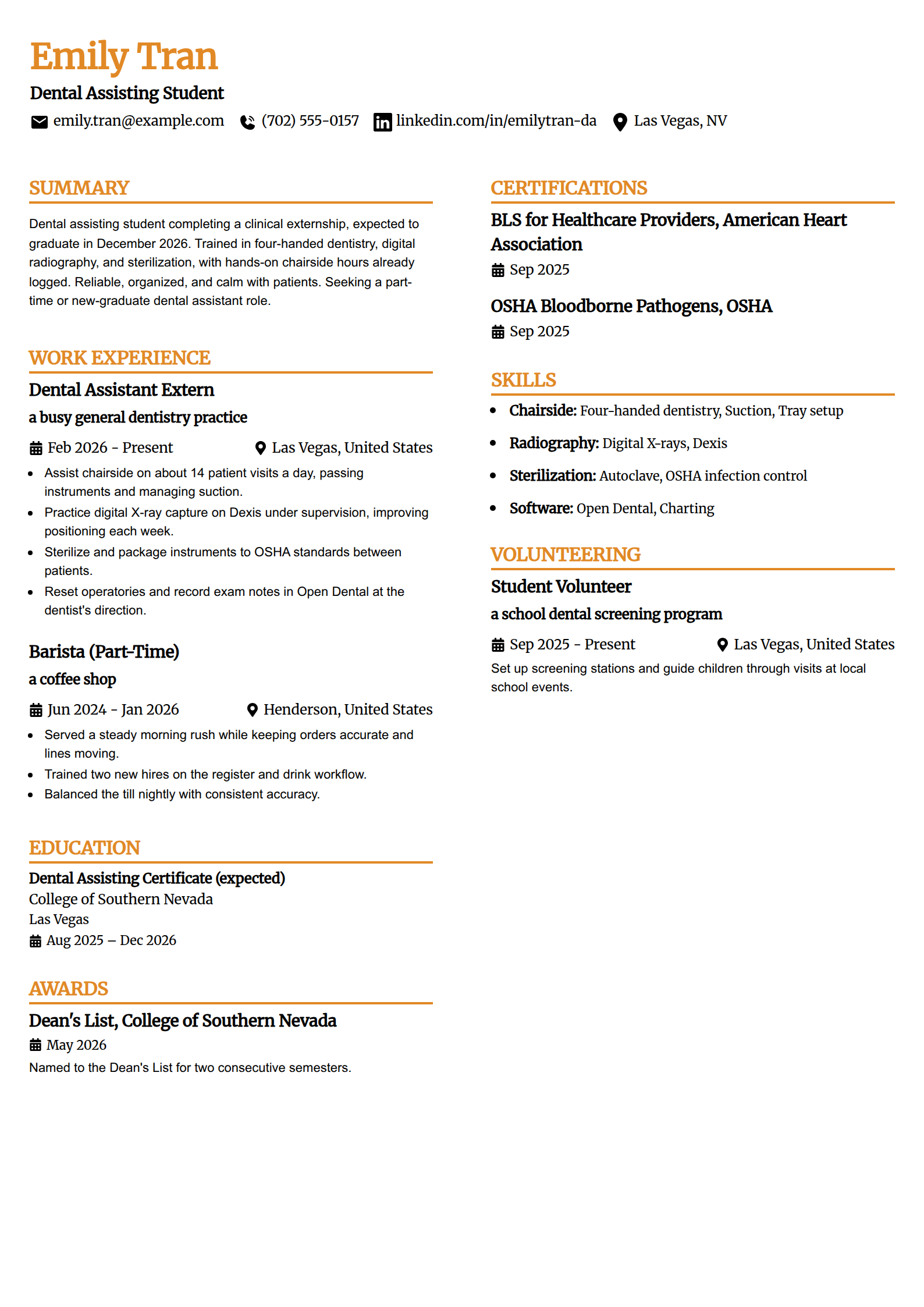
Dental Assisting Student Resume Template
Why this resume example works?
- Written for a current student, leading with an active externship and an expected 2026 graduation date.
- Uses the externship and a part-time job as entries, the right shape before a first full-time dental role.
- Keeps each bullet honest, like assisting on about 14 visits a day and improving X-ray positioning each week.
- Shows the tools a new-grad screen wants, Dexis capture, autoclave sterilization, and Open Dental charting.
- Fills a tight, ATS-safe page with a Dean's List award and a school-screening volunteer role.
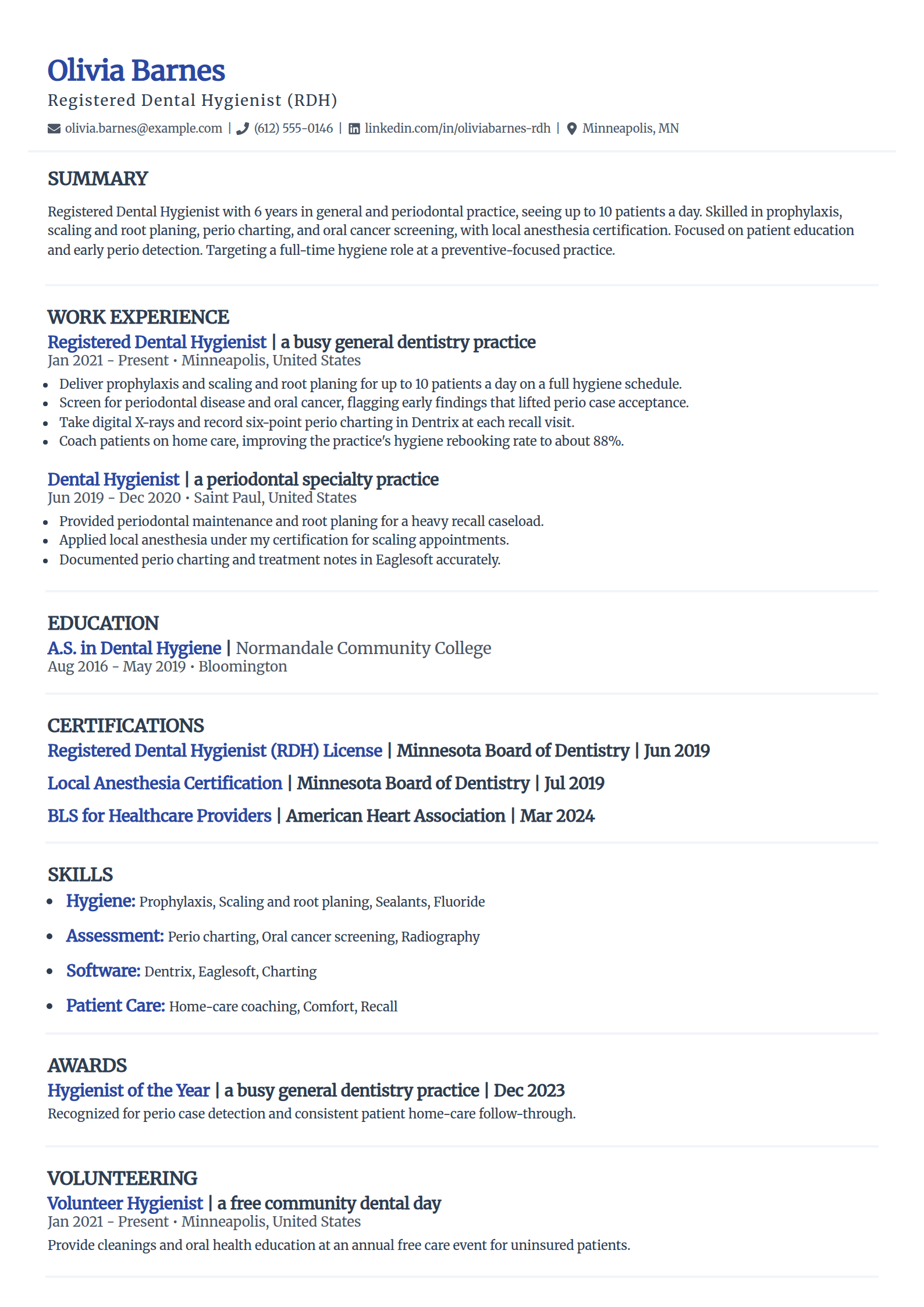
Dental Hygienist Resume Template
Why this resume example works?
- Written for the licensed role next to assisting, leading with the RDH license and local anesthesia certification.
- Shows what is squarely in hygienist scope, prophylaxis, scaling and root planing, and perio and oral cancer screening.
- Keeps each result tied to care, like a hygiene rebooking rate near 88% or early perio findings that lift case acceptance.
- Names Dentrix and Eaglesoft charting plus radiography, the systems a hygiene schedule runs on.
- Fills a refined, ATS-safe page with an award and a free-clinic volunteer role.
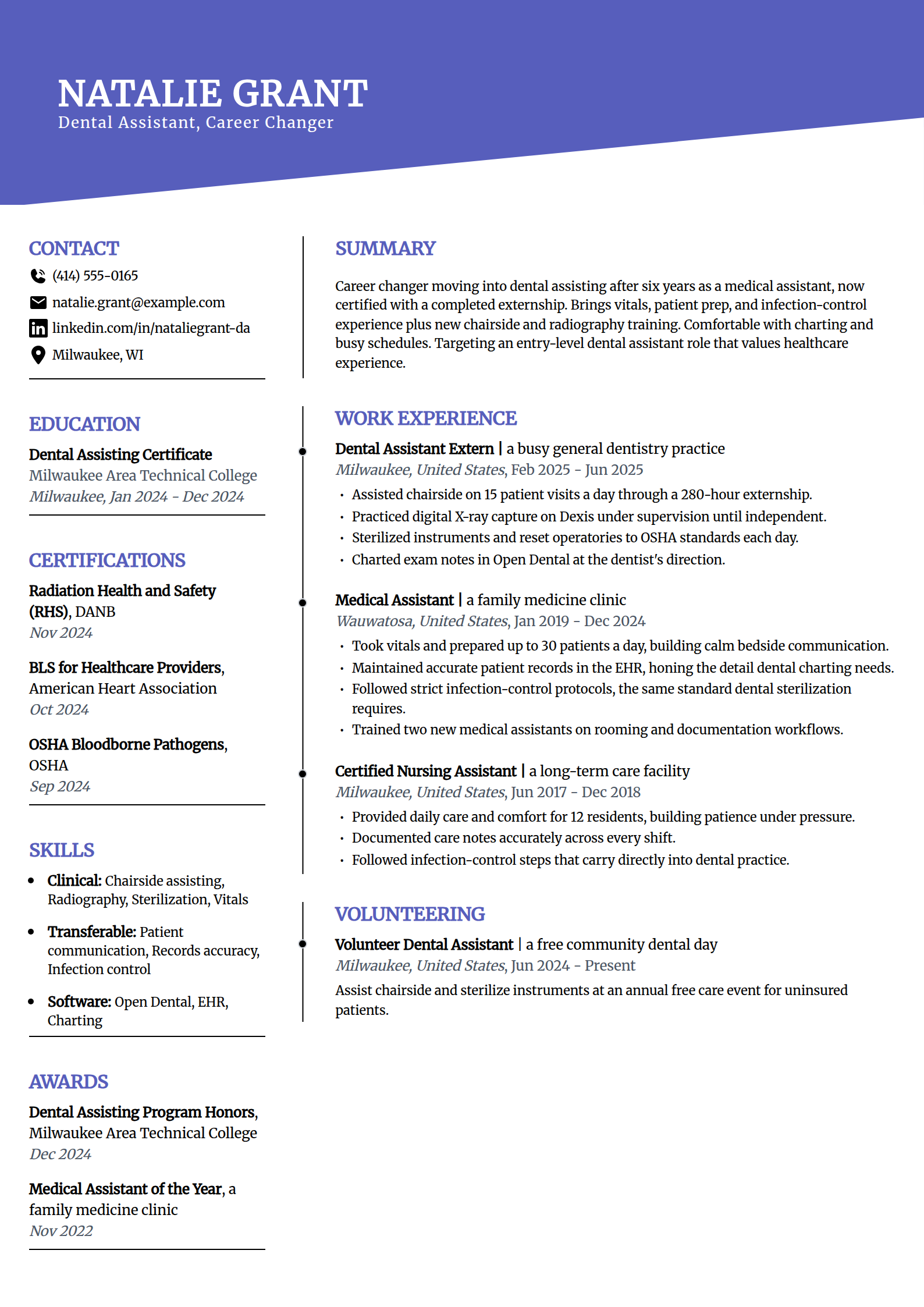
Career-Change Dental Assistant Resume Template
Why this resume example works?
- Names the pivot openly, a dental assisting certificate and externship after six years as a medical assistant.
- Reframes prior healthcare work as an asset, vitals, patient prep, and infection-control habits that transfer.
- Shows recent proof inside dental scope, a 280-hour externship with independent Dexis X-ray capture.
- Keeps the new credentials concrete, DANB radiography, BLS, and OSHA, without overclaiming dental years.
- Lists awards without long descriptions, keeping the layout clean and balanced.
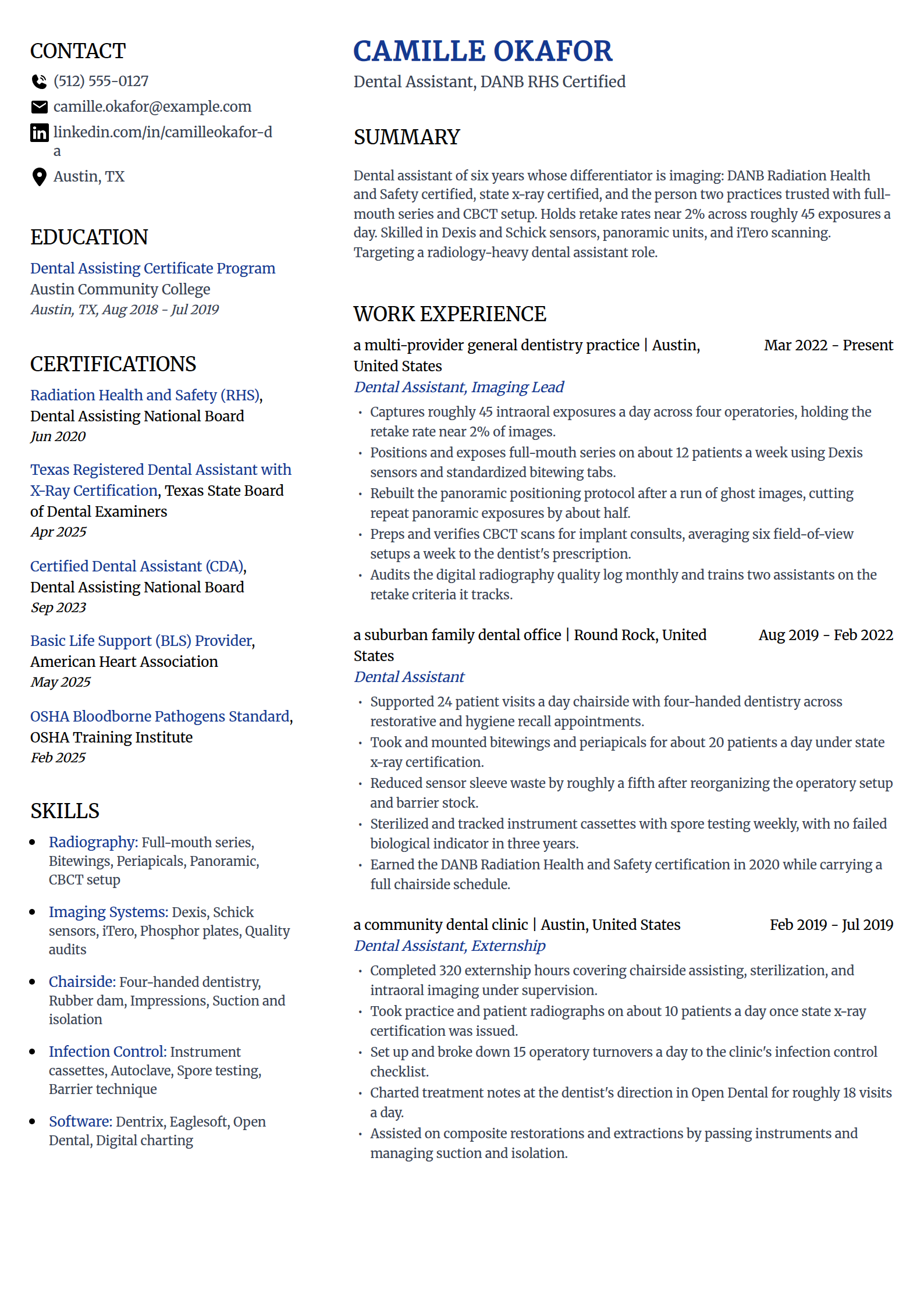
Radiology-Certified Dental Assistant Resume Template
Why this resume example works?
- Puts the imaging credential in the headline, DANB RHS certified, because x-ray certification is its own hiring filter in many states.
- Carries both credentials a radiology-heavy posting checks, the DANB Radiation Health and Safety exam and a state x-ray certification.
- Makes the differentiator countable, roughly 45 exposures a day with the retake rate held near 2% of images.
- Names the imaging stack a practice actually runs, Dexis and Schick sensors, panoramic units, phosphor plates, and CBCT setup.
- Shows judgment, not just technique, with a rebuilt panoramic positioning protocol that halved repeat exposures.
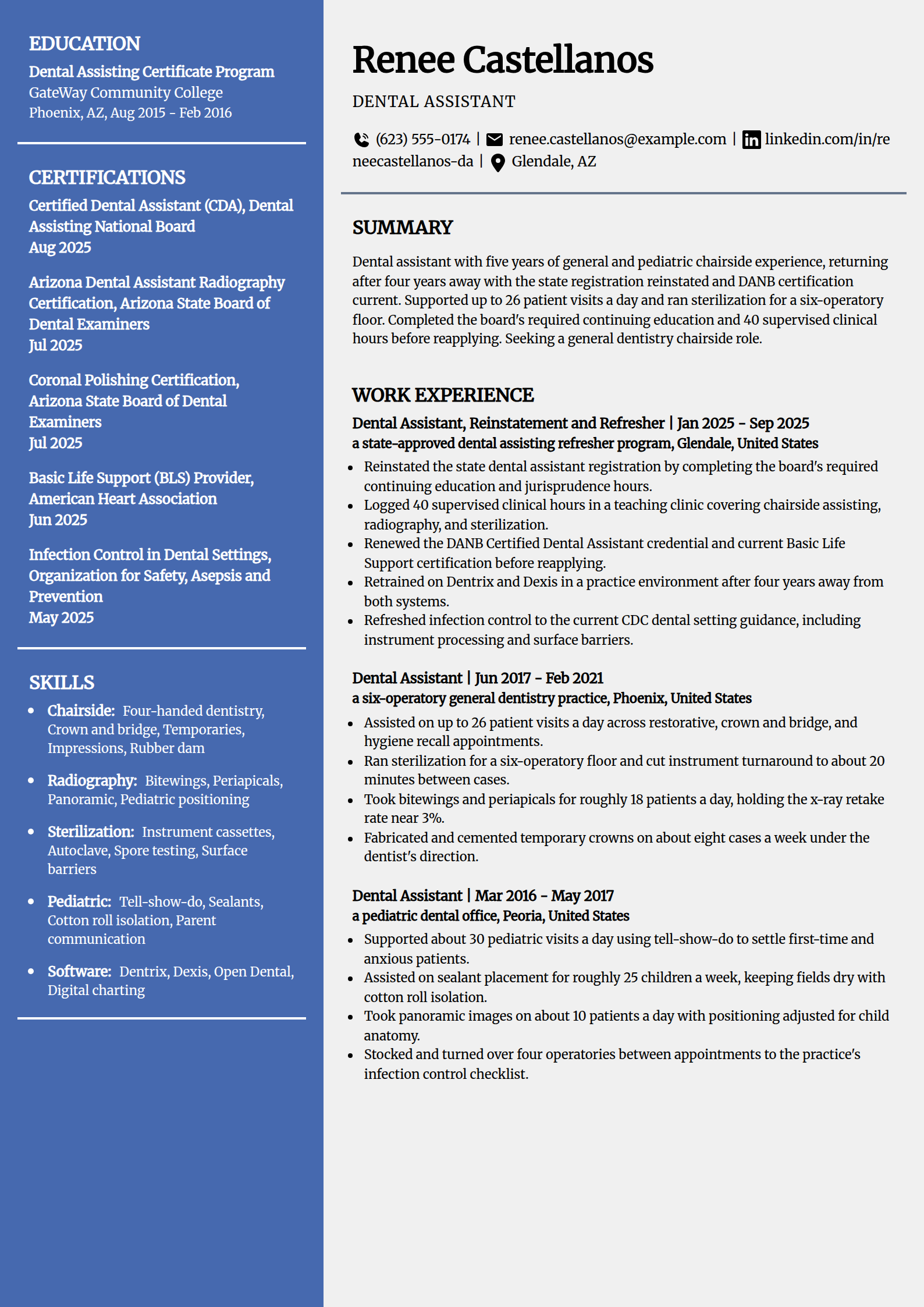
Dental Assistant Resume Template for Returning After a Career Gap
Why this resume example works?
- Answers the licensing question first, because a dental resume with a lapsed registration does not get read past the summary.
- Makes the most recent entry the reinstatement itself, so the newest dated line on the page is current clinical work.
- Names what the board actually required, continuing education with current BLS, infection control, and jurisprudence hours.
- Adds 40 supervised clinical hours and a retrain on Dentrix and Dexis, which answers the real worry about four years away.
- Keeps the pre-gap numbers intact, up to 26 visits a day and instrument turnaround near 20 minutes, so the experience still counts.
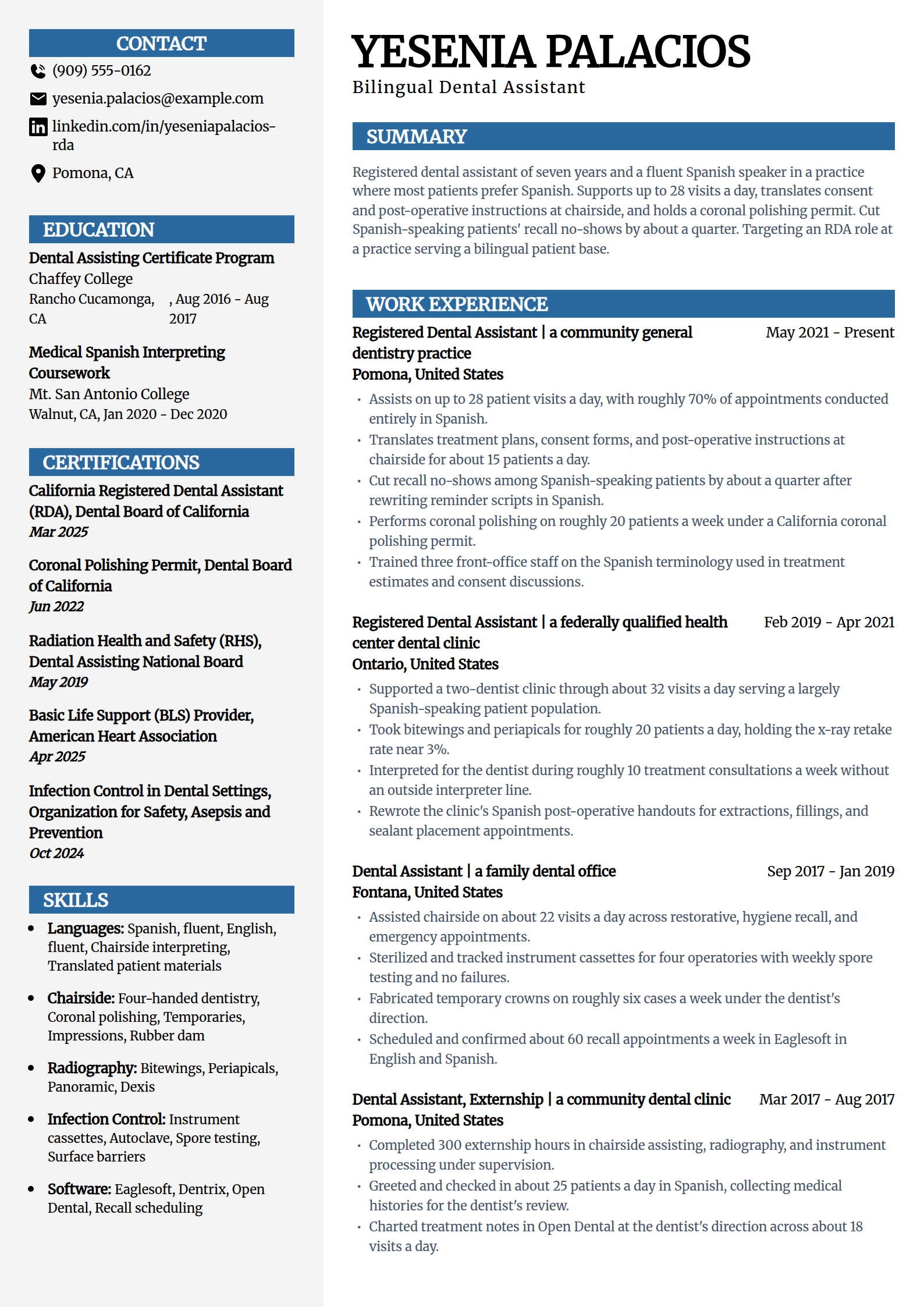
Bilingual Dental Assistant Resume Template
Why this resume example works?
- Puts bilingual in the headline, which matches postings that list Spanish as a requirement rather than a nice-to-have.
- Treats the language as clinical work, translating consent and post-operative instructions at chairside for about 15 patients a day.
- Attaches a result to the language skill, recall no-shows among Spanish-speaking patients cut by about a quarter.
- Keeps the RDA credentials and the coronal polishing permit in front, so the resume is not only about language.
- Uses a two-column layout that puts languages at the top of the skills column where a screener looks for it.
Build your dental assistant resume
Pick a template above and the editor keeps your layout clean and ATS-safe while you swap in your own credentials, systems, and patient load.
Build my resumeHow to write a dental assistant resume in 2026
A dental assistant resume gets scanned fast by an office manager checking two things: can you work chairside on their team from day one, and are your credentials current. Lead with a short summary that names your level and certifications, then make every bullet a real result with one number and the tool or task behind it. Keep the format clean so a parser reads it as easily as a person does.
Open with a short, credential-first summary
Write three to four sentences that name your years and setting, your strongest number, the certifications a posting checks, and the role you are targeting. An experienced assistant leads with patient volume and the DANB CDA; a new grad leads with externship hours and radiography certification. Keep it to about 60 words so it never spills past the top of the page.
Dental assistant with 8 years of chairside experience in general dentistry, supporting up to 30 patient visits a day. Skilled in four-handed dentistry, digital radiography, sterilization, and Dentrix charting, with the DANB CDA credential plus radiology and CPR certification. Targeting a lead-track dental assistant role at an established general practice.
Make every experience bullet a result with a number
Name the task, the approach, and the outcome, then attach one credible number and the tool behind it. This is what separates a resume that gets a callback from a duty list, and it keeps you honest about scope.
- Use dental metrics: patients supported per day, operatories run, X-ray retake rate, chair turnover, sterilization turnaround, sealants placed, or recall no-shows cut.
- Open with a strong verb like assisted, took, sterilized, charted, or trained, never "Responsible for" or "Helped with".
- Name the tool or task: "took and mounted digital X-rays on Dexis and held the retake rate under 4%".
- Stay inside your scope: assistants take X-rays, do coronal polishing and sealants under EFDA, and assist procedures; they do not diagnose, drill, extract, or prescribe.
Put certifications and licenses where they get seen
Dental hiring is credential-driven, so match what you lead with to where you are, and never list a permit you do not hold.
- List the DANB CDA, state RDA, and radiology (DANB RHS or state) certifications by name, with the issuer and date.
- Add expanded functions only if you are certified: EFDA, coronal polishing, sealant, or nitrous oxide monitoring, per your state.
- Keep CPR/BLS and OSHA current and visible; an expired card is a fast reason for a practice to pass.
- New grads and career-changers lead with the program, externship hours, and radiography certification in place of years.
Match skills and keywords to the job posting
A skills block should read like the posting, grouped so an office manager and a parser both find what they need. List the systems you have actually run, not a generic dump.
- Group by type: chairside and four-handed dentistry, radiography, sterilization and infection control, impressions, and practice-management software.
- Name specific systems: Dentrix, Eaglesoft, Open Dental, Dexis digital radiography, CEREC or CAD-CAM, and iTero, matched to the role.
- If the posting says "four-handed dentistry" or "digital radiography", use that exact phrasing where it fits your experience.
- Mirror the posting's language, since that is what the applicant tracking system searches for when it ranks your resume.
Keep the format clean and ATS-safe
A dental assistant resume is read by a parser first and an office manager second, so a clean layout with standard headings is the safe choice at every level.
- Use a single-column or simple two-column layout with standard headings a parser recognizes; skip heavy graphics and photos.
- Keep it to one page; a dental assistant resume rarely needs two, even for a lead.
- Save as a PDF so the formatting holds, then run it through the ATS resume checker for a quick format and keyword pass.
- Swap the numbers in the templates above for your own patient load, credentials, and systems; do not copy them as is.
Common dental assistant resume mistakes
- Listing duties instead of results. Replace "assisted the dentist" with "provided four-handed support for up to 30 patient visits a day across six operatories".
- Burying or omitting certifications. The DANB CDA, state RDA, radiology, and CPR/BLS belong in a named section with dates, not hidden in a sentence.
- Claiming tasks outside your scope. A resume that says you diagnosed, drilled, or extracted reads as a red flag; list what you actually assist with and perform under certification.
- Leaving out the systems you use. A practice running Dentrix or Eaglesoft screens for it, so name the software and imaging you have actually used.
- One generic resume for every office. Reorder your bullets and skills so the specialty the job names, general, ortho, oral surgery, or pediatric, leads the page.
Frequently asked questions
How do you write a dental assistant resume?
Lead with a three-to-four-sentence summary that names your level, your certifications, your strongest number, and the role you are targeting. Under each job, write results-first bullets that open with a strong verb and carry one credible number, like supporting up to 30 patient visits a day or holding an X-ray retake rate under 4%. Name the task or system behind each result, list your DANB CDA and radiology certifications in their own section, and keep the whole thing to one clean, ATS-safe page.
What should a dental assistant resume include?
A dental assistant resume includes a credential-first summary, experience bullets with real numbers, a certifications section, a grouped skills block, and education. The experience section carries the weight: every bullet should show a task you can prove, such as taking and mounting digital X-rays on Dexis or running sterilization to OSHA standards. Name your certifications outright, the DANB CDA, state RDA, radiology, and CPR/BLS, and list the software a practice runs, like Dentrix, Eaglesoft, or Open Dental.
How do you write a dental assistant resume with no experience?
Lead with what you do have. A recent graduate leads with the dental assisting program, externship hours, and radiography certification, then keeps BLS and OSHA visible. A career-changer reframes prior healthcare or customer-service work honestly, patient communication, records accuracy, and infection-control habits that transfer. Certifications and a completed externship are your strongest early signal. The entry-level, no-experience, and student examples above show the shape.
What skills should you put on a dental assistant resume?
Match the posting, then name specific skills and systems grouped by type: chairside and four-handed dentistry, radiography (Dexis digital X-rays), sterilization and infection control, impressions, and practice-management software (Dentrix, Eaglesoft, Open Dental). Add expanded functions only if you are certified, coronal polishing, sealants, and fluoride under an EFDA credential. List what you have actually done and can discuss in an interview, and mirror the posting's exact phrasing, since that is what the applicant tracking system searches for.
How long should a dental assistant resume be?
One page. A dental assistant resume rarely needs two, even for a lead or a specialist with ten-plus years. Lead with your most recent and most relevant chairside work, keep standard headings, and cut older or unrelated roles so the space goes to the experience and certifications that match the job. If you are a new grad, one page filled with your externship, program, and credentials is exactly right.
Do you need certifications on a dental assistant resume?
Yes, list every current credential in its own section with the issuer and date. Dental hiring is credential-driven, so the DANB CDA, your state RDA, radiology certification (DANB RHS or state), CPR/BLS, and OSHA all belong where an office manager can see them fast. Add expanded functions only if you actually hold them, EFDA, coronal polishing, sealant, or nitrous oxide monitoring, since a practice will verify them. Never list a permit you do not have.
How do you get back into dental assisting after years off?
Clear the credential first, then put that on the resume as your most recent entry. Requirements differ by state and also differ between a registration that merely expired and one that was cancelled, so check your own state dental board before anything else. Most boards want recent continuing education that includes current BLS, infection control, and an ethics or jurisprudence component, and some require supervised clinical hours or a refresher program. Write the reinstatement into your work history with dates, name the board requirements you completed, and add any retraining on current software and imaging systems. The returning-after-a-career-gap example above shows the layout.
Does being bilingual help on a dental assistant resume?
Yes, and it belongs higher than most people put it. Plenty of practices list bilingual Spanish as a stated requirement rather than a bonus, so it goes in your headline or summary, not buried at the bottom. Say which languages and at what level, then show the clinical work the language does: translating consent forms and post-operative instructions at chairside, interpreting during treatment consultations, or rewriting patient handouts. Attaching one result to it, such as a drop in recall no-shows among Spanish-speaking patients, turns a line item into a reason to interview you.
More dental assistant resume resources
Build your dental assistant resume
Pick a template above and the editor keeps your layout clean and ATS-safe while you swap in your own credentials, systems, and patient load.