16 Medical Assistant Resume Examples, Clinical to Admin
- ATS Friendly
- Medical Assistant Specific
- 16 Role Examples
Start from a parser-safe layout, then build your own on a medical assistant resume that matches your track. Every role below is a full resume in that template, showing the certification, clinical tasks, and numbers a clinic screens for first.


540k+ resumes created
Editable medical assistant resume templates
Each template below is a real medical assistant resume in that format, sorted by the path you are on. Pick one, then swap in your own certification, specialty, clinical skills, and results. All of them keep your name, contact details, and dates where an applicant tracking system expects to read them.
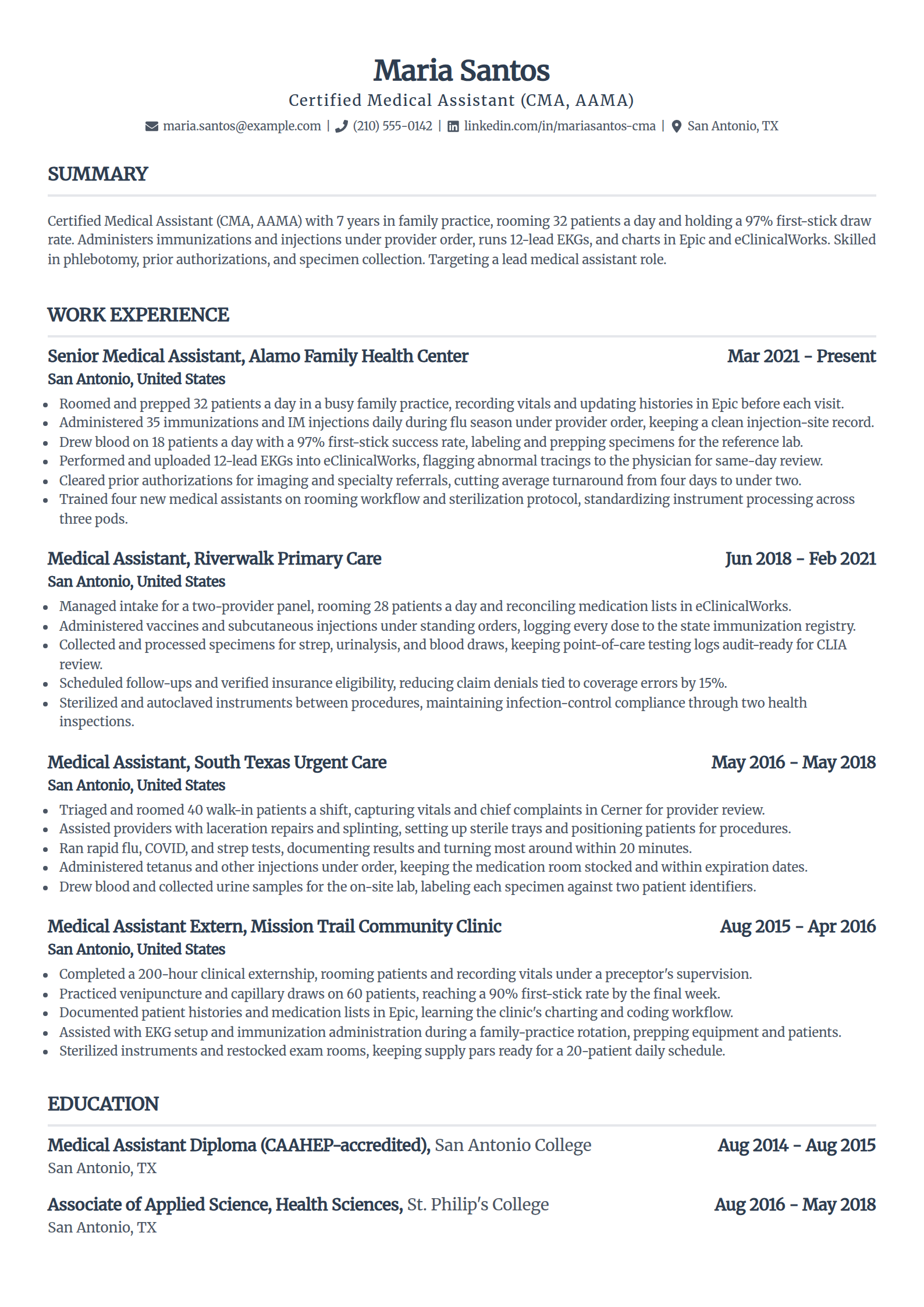
Certified Medical Assistant (CMA) Resume Template
Why this resume example works?
- States CMA (AAMA) in the header, the exact credential phrasing a family-practice screen reads first.
- Leads with rooming 32 patients a day and a 97% first-stick draw rate, the throughput a clinic hires on.
- Names Epic and eClinicalWorks by hand, the EHRs an applicant tracking system matches on a posting.
- Keeps every task in scope: vitals, injections under order, venipuncture, and EKGs, never IV therapy.
- Uses a clean single-column layout a resume parser reads top to bottom without dropping a section.
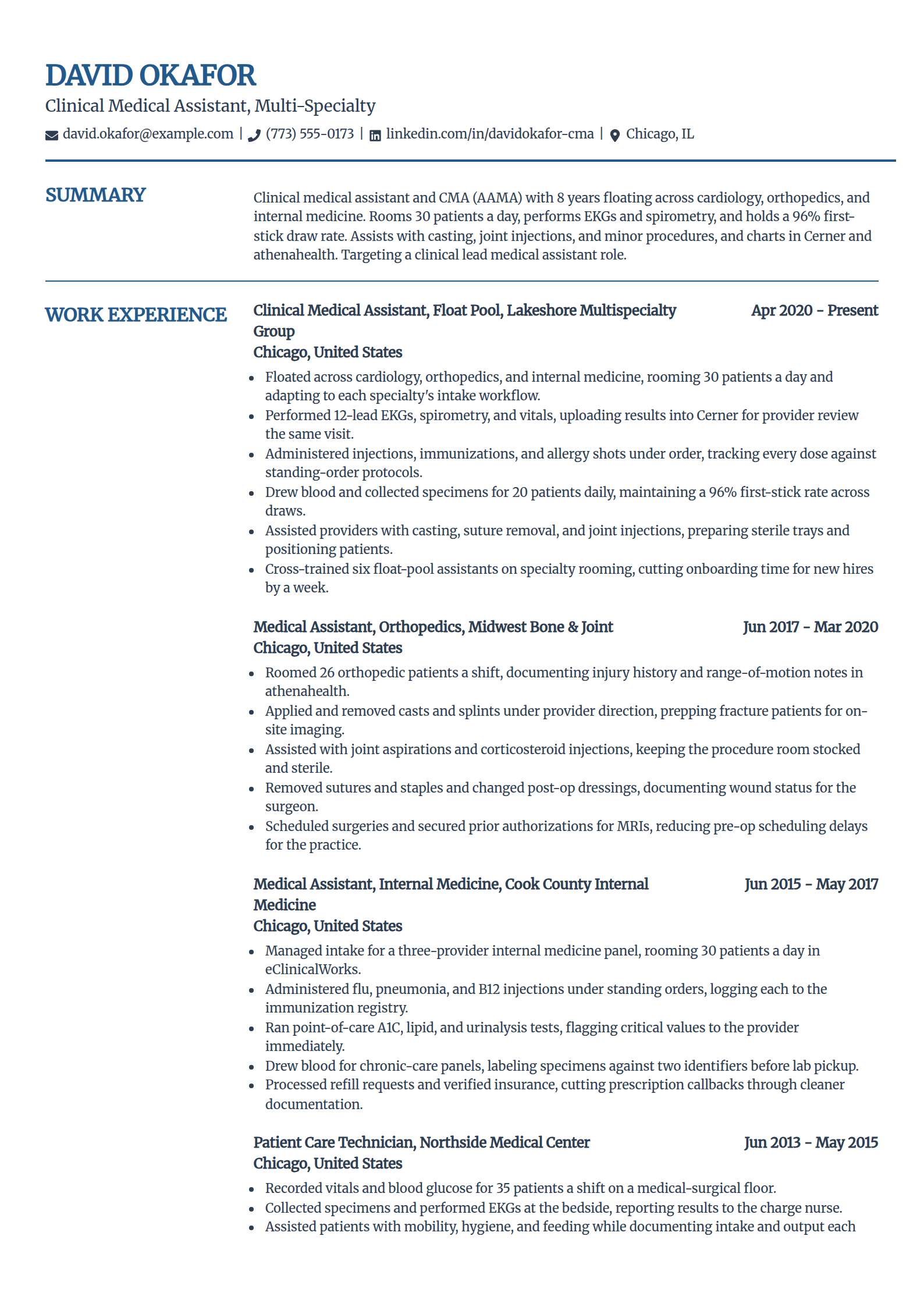
Clinical Medical Assistant Resume Template
Why this resume example works?
- Frames the scope as a float across cardiology, orthopedics, and internal medicine, showing range up front.
- Leads with EKGs, spirometry, and a 96% first-stick rate, the clinical breadth a specialty group wants.
- Names Cerner and athenahealth and procedure-assist skills like casting and joint-injection setup.
- Shows a patient-care-technician start, filling the dense layout with a real clinical progression.
- Keeps procedure work as assist-and-setup, staying inside what a medical assistant can legally do.
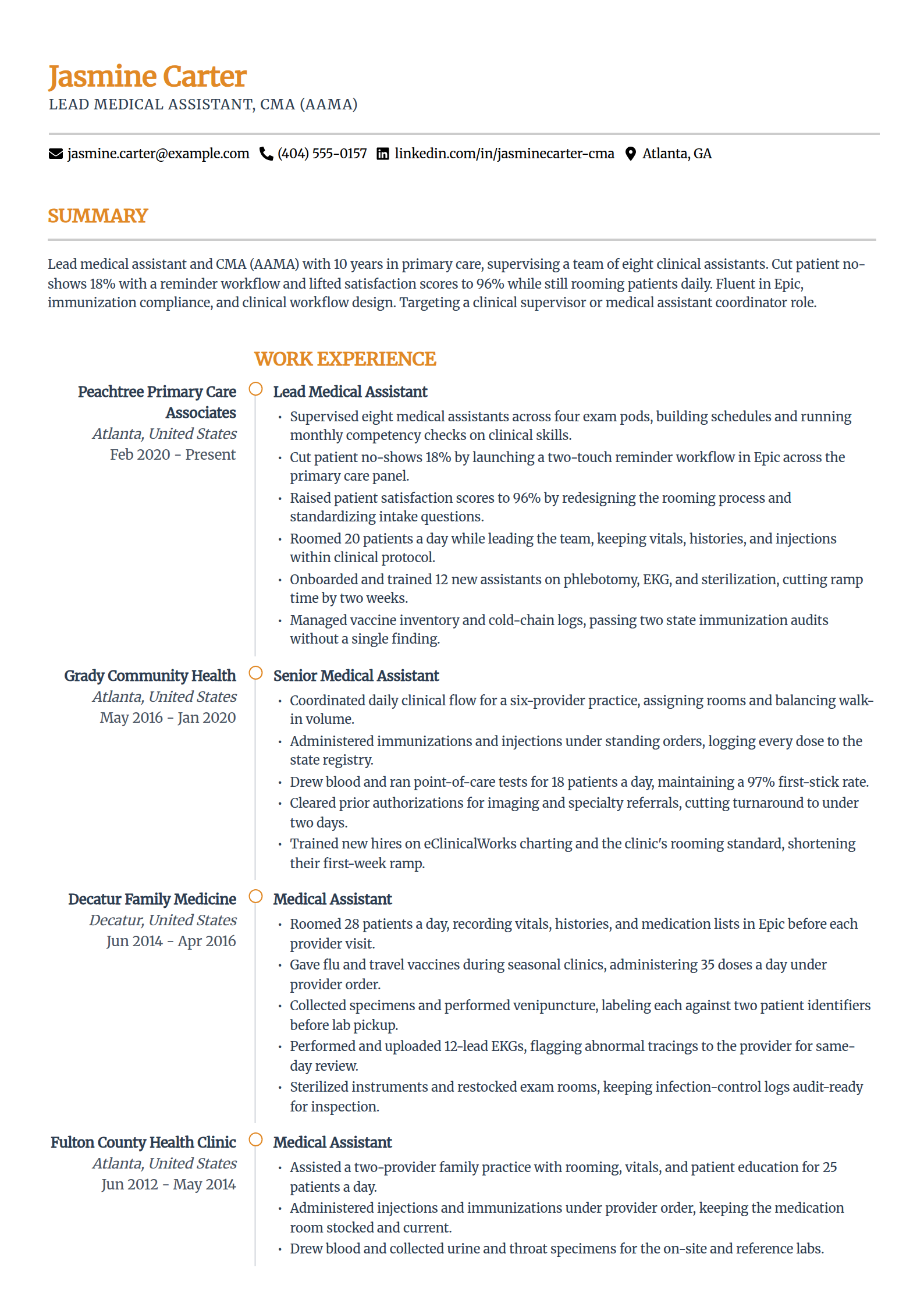
Lead & Senior Medical Assistant Resume Template
Why this resume example works?
- Leads with supervising eight assistants and a no-show cut of 18%, the leadership result a lead role screens for.
- Pairs a 96% satisfaction score with staying clinical, so the resume shows both management and hands-on skill.
- Shows onboarding and competency checks, the team-building scope a clinical supervisor is judged on.
- Names Epic, immunization audits, and cold-chain logs, the compliance work a senior MA owns.
- Fills a dense two-column layout with four progressive roles that map a clean path to lead.
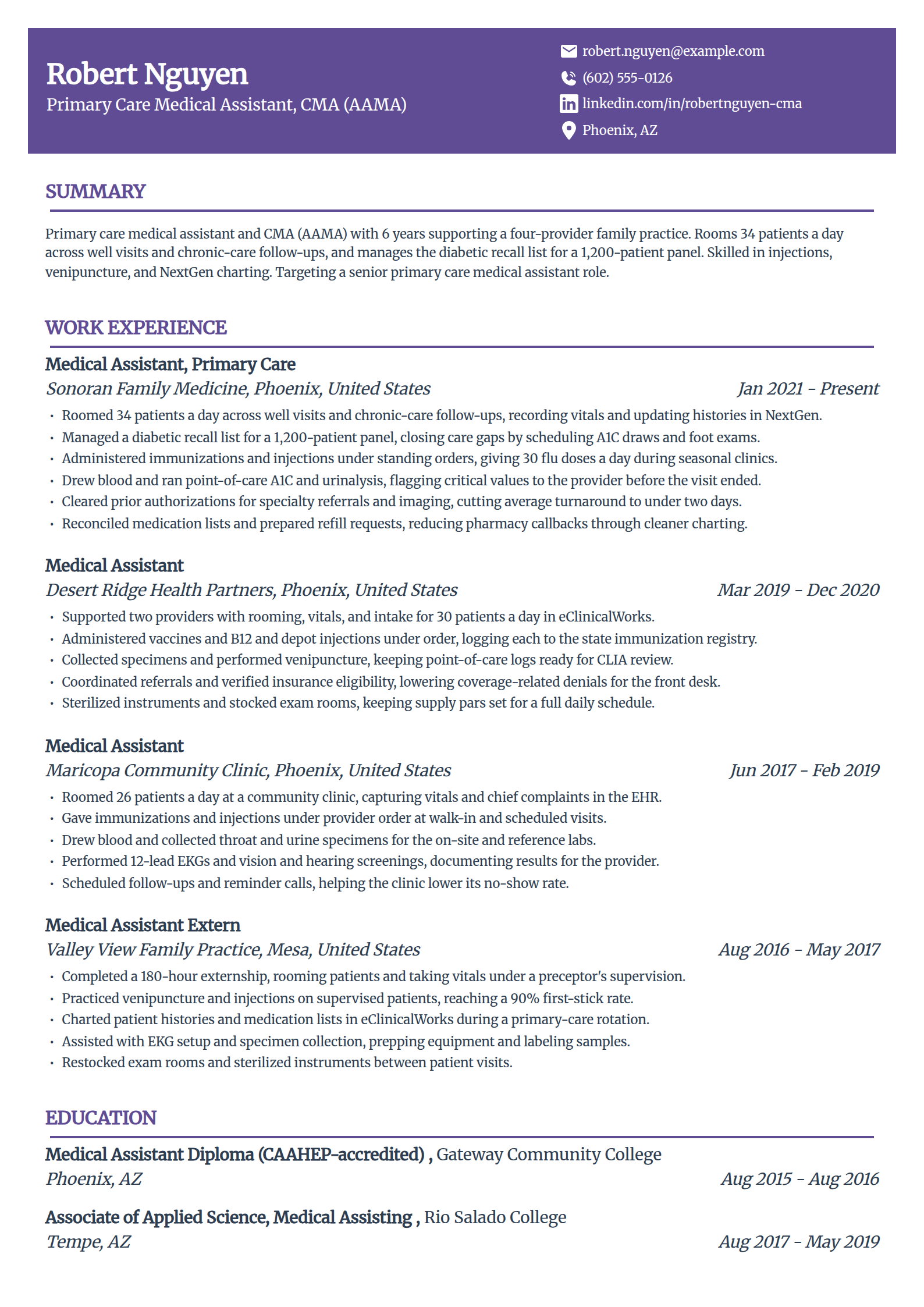
Family Practice Medical Assistant Resume Template
Why this resume example works?
- Leads with rooming 34 patients a day and managing a 1,200-patient diabetic recall list, the primary-care scope.
- Shows care-gap closure and chronic-care follow-ups, the panel work a family practice values most.
- Names NextGen and eClinicalWorks, the EHRs a primary-care posting lists by name.
- Keeps immunizations and injections under standing orders, phrased inside medical-assistant scope.
- Fills a full, scannable page so the well-visit and chronic-care story reads at a glance.
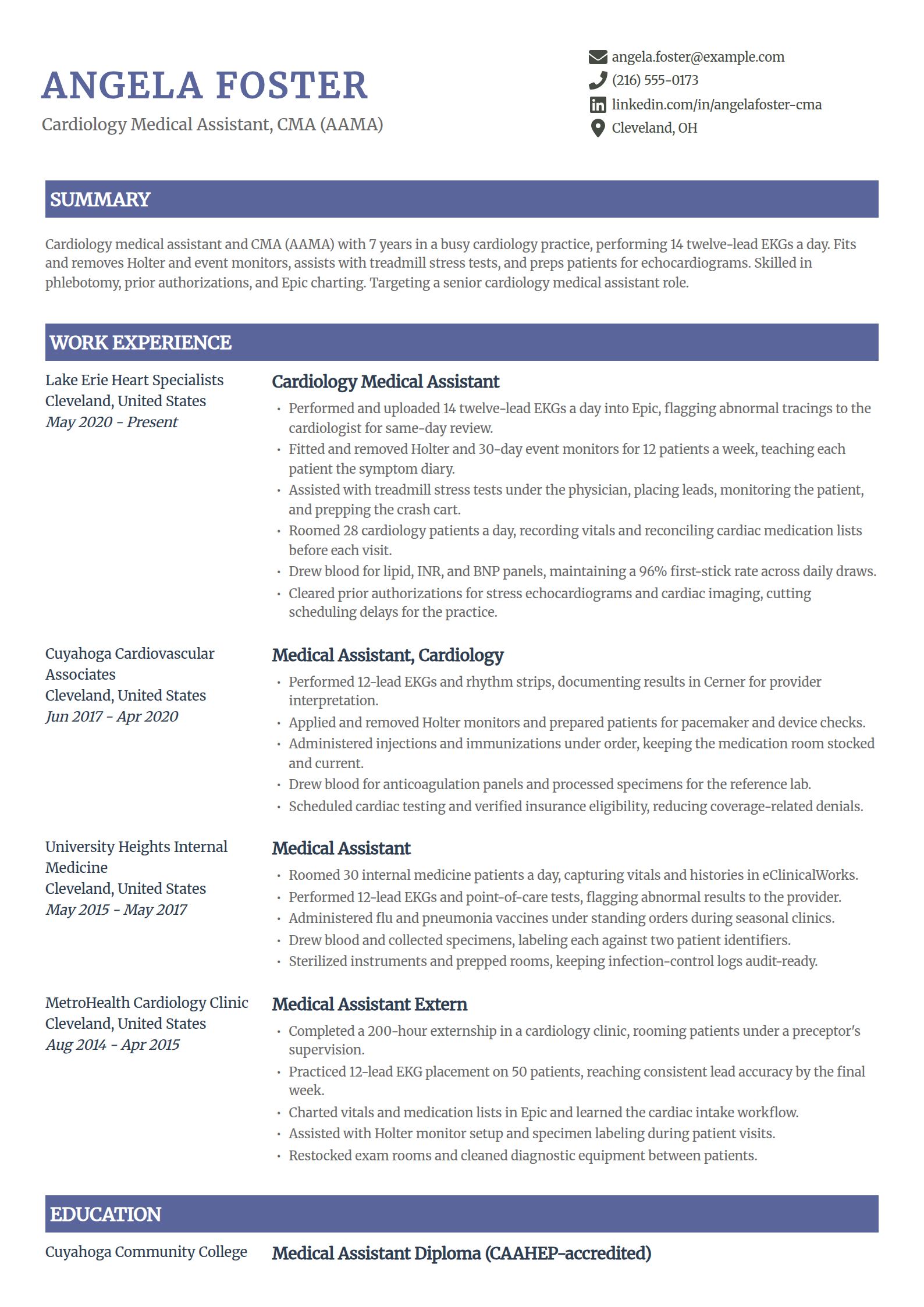
Cardiology Medical Assistant Resume Template
Why this resume example works?
- Leads with 14 twelve-lead EKGs a day and Holter and event-monitor fitting, the cardiology tasks a practice hires on.
- Shows stress-test assist framed as supporting the physician, keeping the work inside MA scope.
- Carries the Certified Cardiographic Technician credential alongside the CMA, both named with their issuers.
- Names Epic and Cerner and cardiac panels like BNP and INR, the tools a cardiology posting matches.
- Fills a rich layout with four cardiology-focused roles that show the specialty depth clearly.
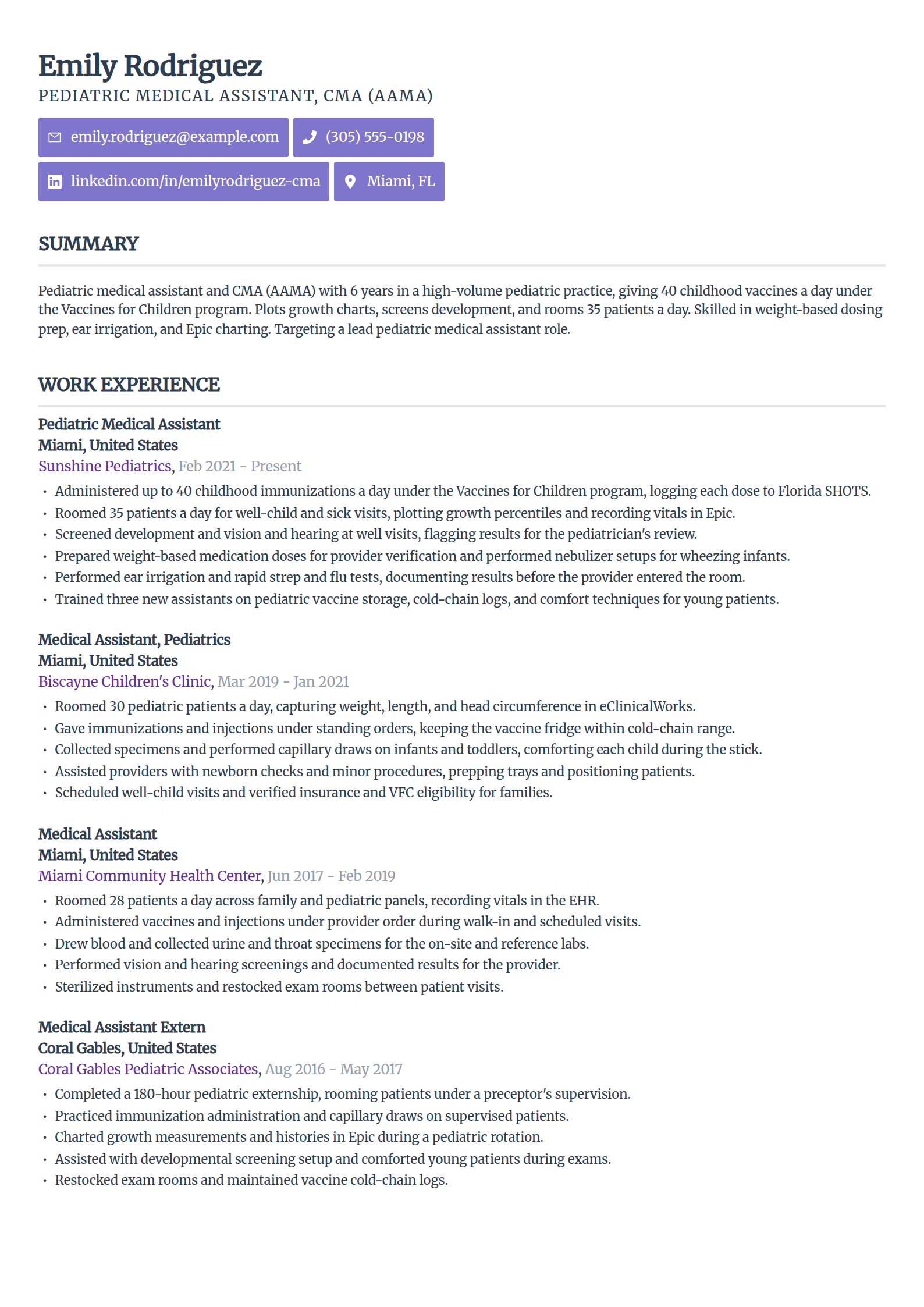
Pediatric Medical Assistant Resume Template
Why this resume example works?
- Leads with 40 childhood vaccines a day under the Vaccines for Children program, the pediatric throughput a clinic reads first.
- Shows growth charting and developmental screening, the well-child tasks a pediatric practice expects.
- Names Epic and the Florida SHOTS registry, and keeps weight-based dosing as prep for provider verification.
- Carries CMA (AAMA) plus vaccine storage and handling, the credential set a pediatric role screens for.
- Fills the page with vaccine, screening, and comfort-care work, not a thin one-job history.
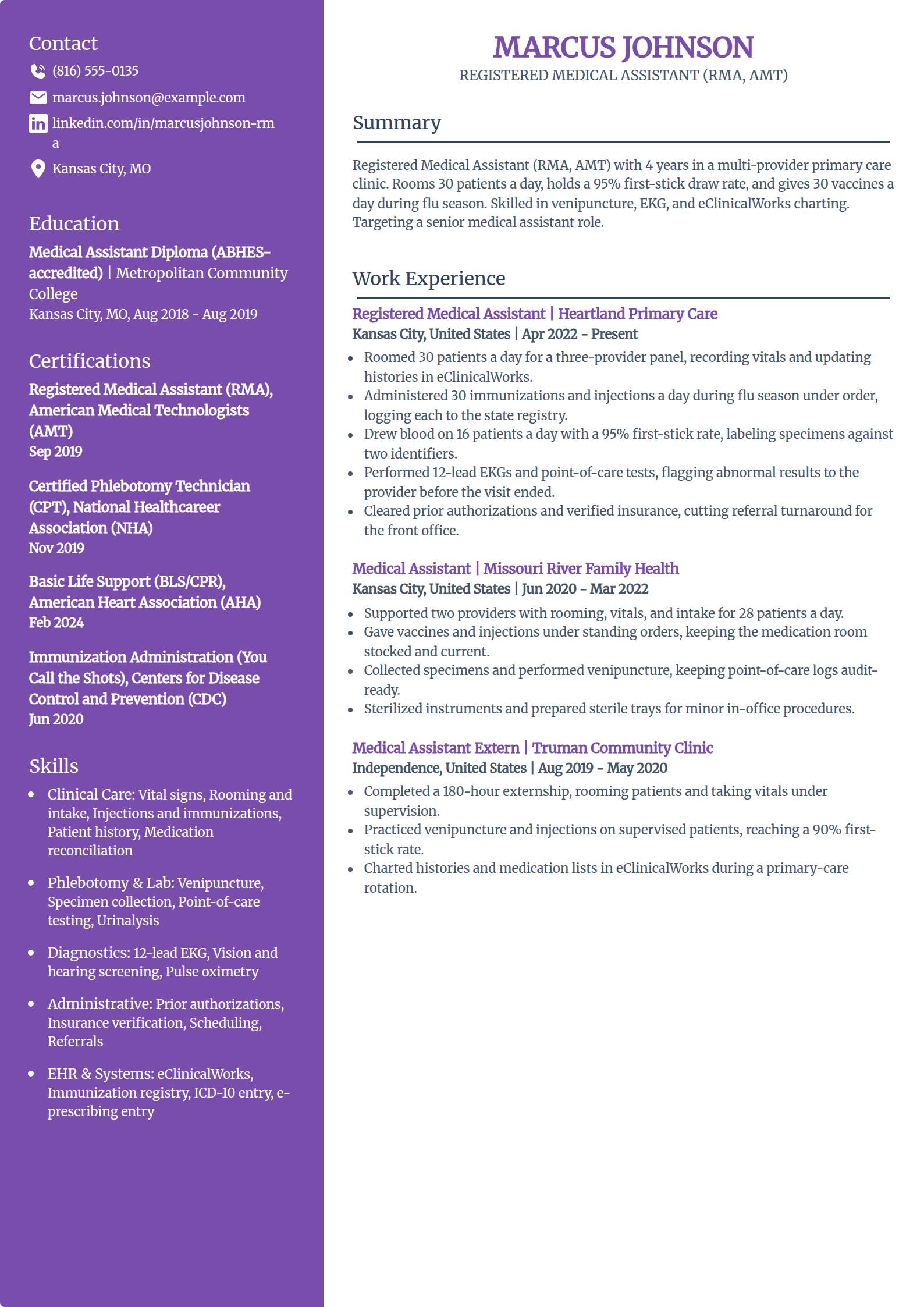
Registered Medical Assistant (RMA) Resume Template
Why this resume example works?
- States RMA (AMT) in the header, the exact credential and body a posting screens for.
- Leads with rooming 30 patients a day and a 95% first-stick rate, the core throughput a clinic wants.
- Names eClinicalWorks and the state immunization registry, so a screener sees the systems by name.
- Keeps three focused roles including an externship, so the early-career story reads clean, not padded.
- Holds every task in scope: injections under order, venipuncture, and EKG, never IV therapy.
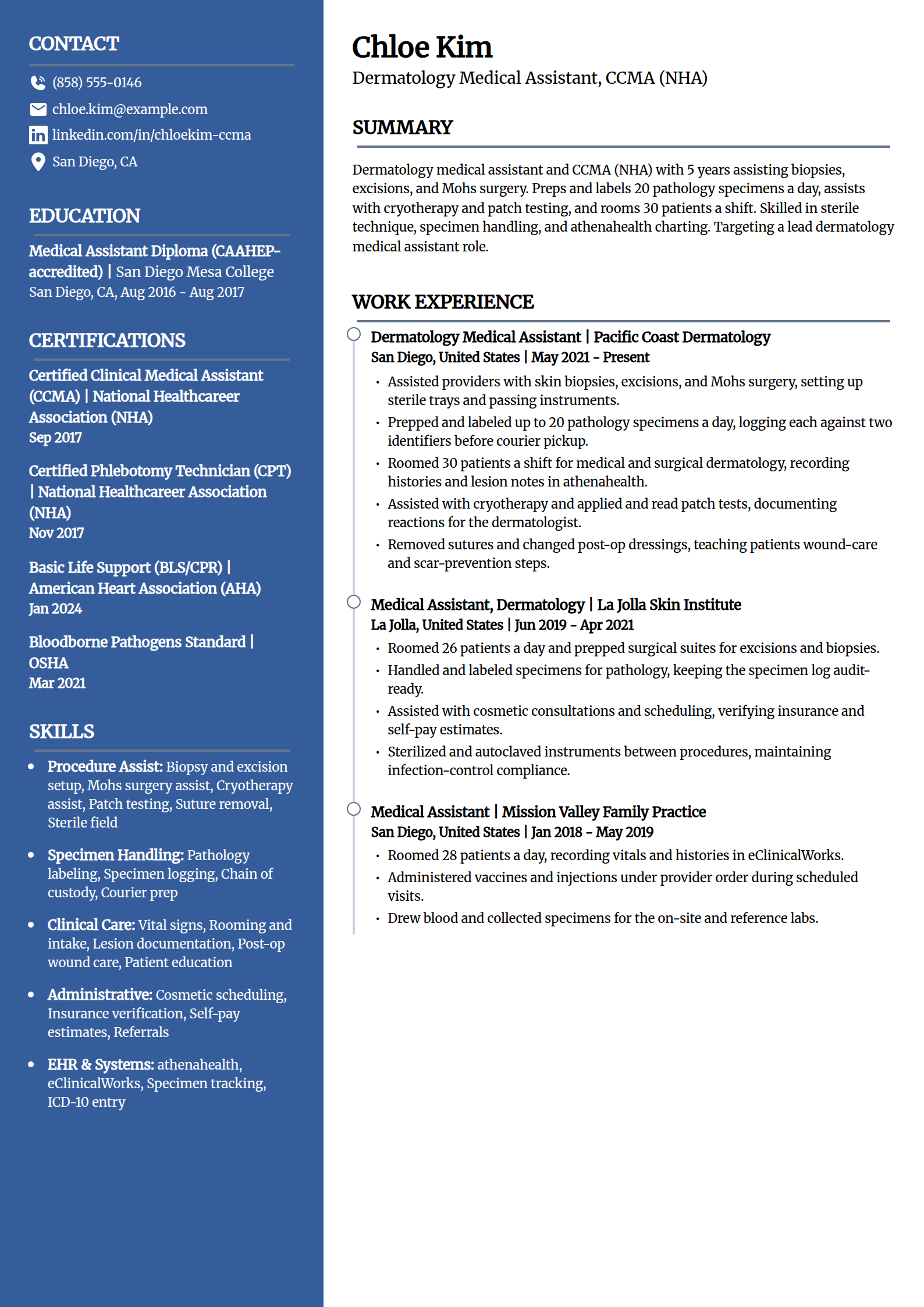
Dermatology Medical Assistant Resume Template
Why this resume example works?
- Leads with assisting biopsies, excisions, and Mohs surgery, the surgical-derm scope a practice hires on.
- Shows prepping 20 pathology specimens a day, the specimen-handling accuracy a dermatology lab depends on.
- Keeps cosmetic work as rooming and scheduling, not injecting, staying inside medical-assistant scope.
- Names athenahealth and sterile-field and patch-testing skills, the derm keywords a posting lists.
- Uses a modern layout that keeps the procedure-assist focus clear without crowding.
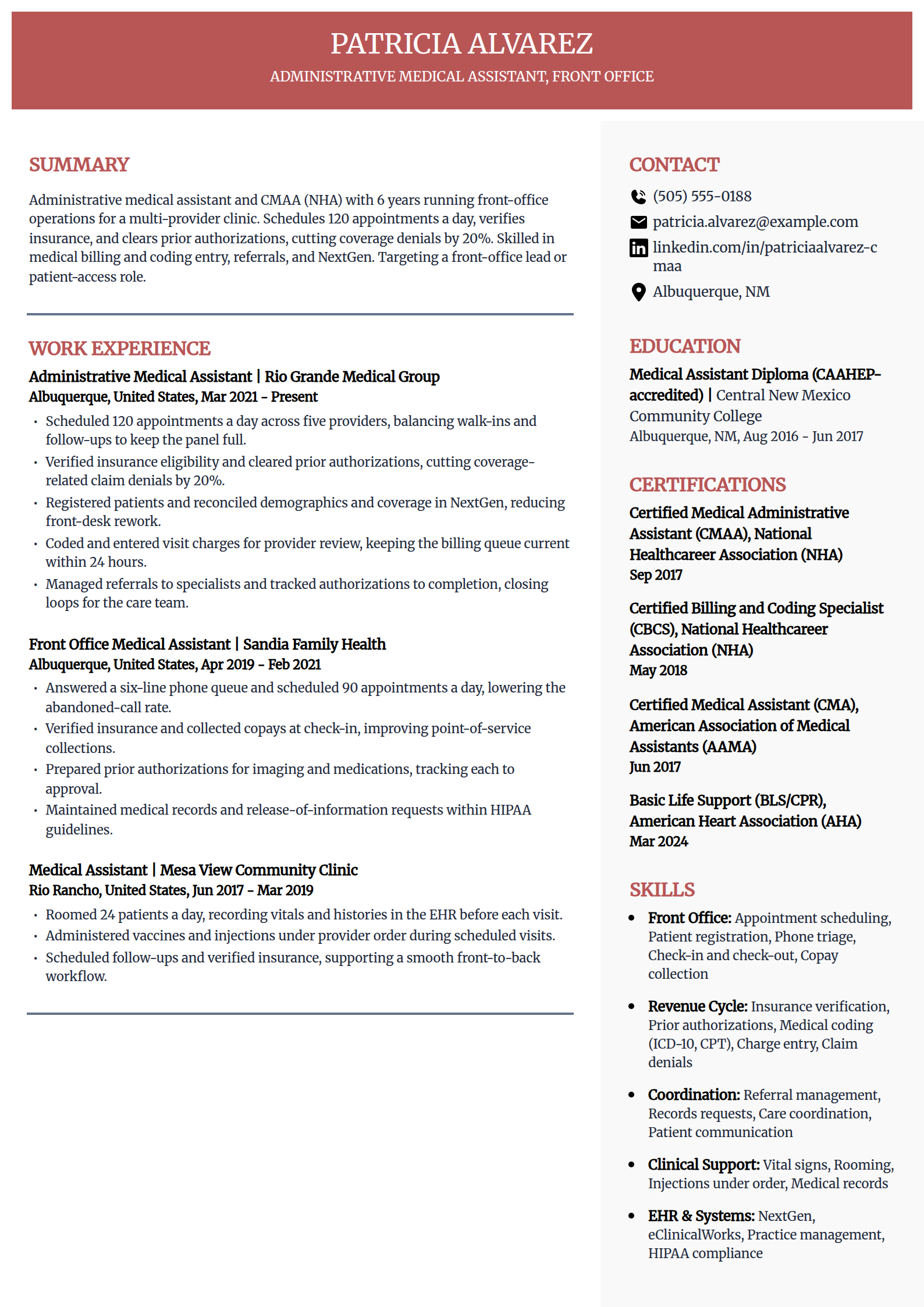
Administrative Medical Assistant Resume Template
Why this resume example works?
- Leads with scheduling 120 appointments a day and cutting coverage denials 20%, the front-office result a clinic hires on.
- Carries the CMAA and billing-and-coding credentials, the administrative certifications the role screens for.
- Names NextGen, prior authorizations, and ICD-10 and CPT coding, the revenue-cycle keywords on the posting.
- Keeps a clinical-support block so the resume shows both front-desk and back-office range.
- Uses a two-column layout that separates operations scope from the credential sidebar cleanly.
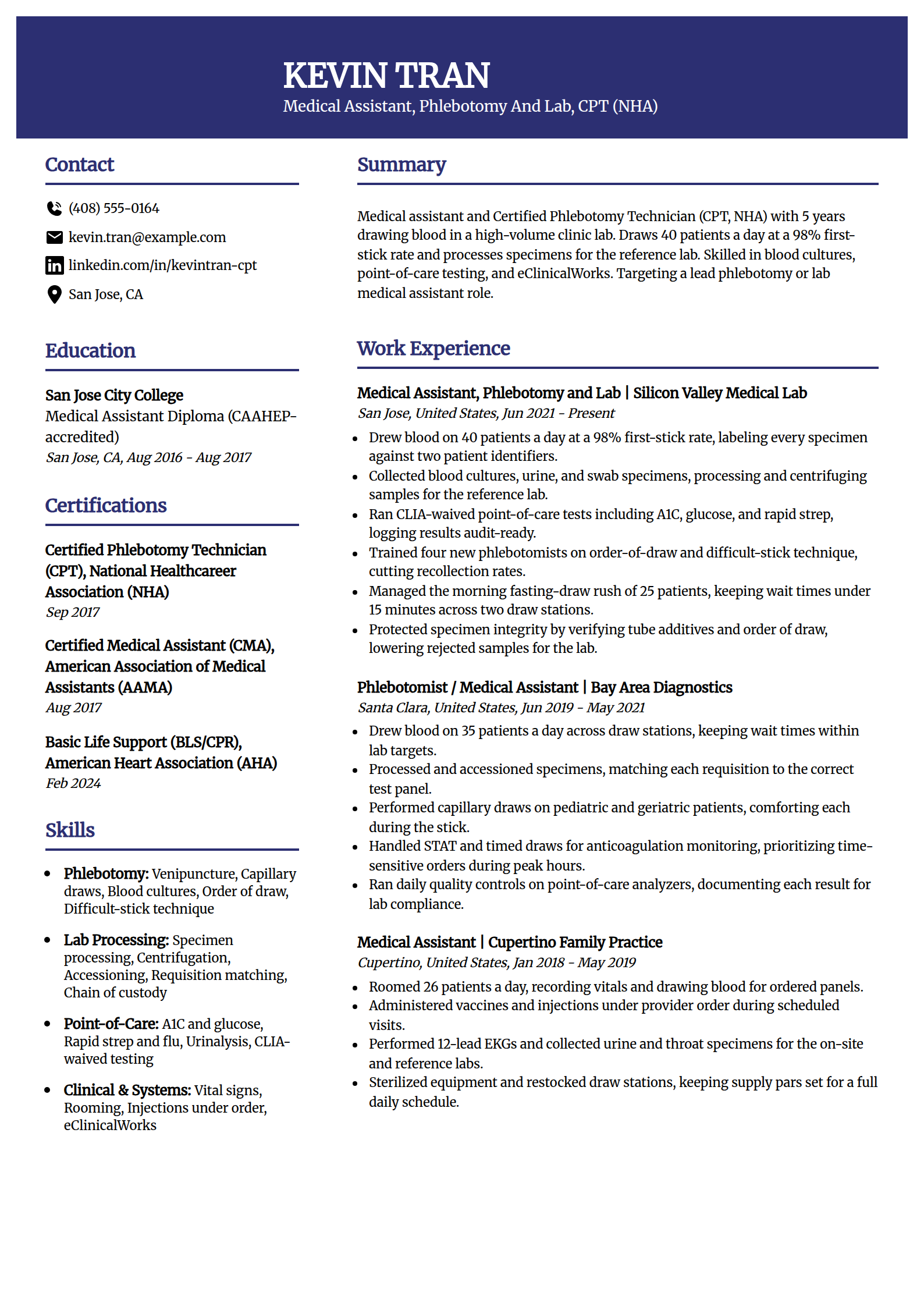
Phlebotomy Medical Assistant Resume Template
Why this resume example works?
- Leads with drawing 40 patients a day at a 98% first-stick rate, the number a clinic lab hires a phlebotomist on.
- States CPT (NHA) in the header, the exact phlebotomy credential and body a lab posting screens for.
- Names blood cultures, centrifugation, and CLIA-waived point-of-care testing, the lab keywords on the posting.
- Shows training four new phlebotomists on order-of-draw, proving depth past the daily stick.
- Uses a roomy layout that keeps the draw-and-process focus clear and easy to scan.
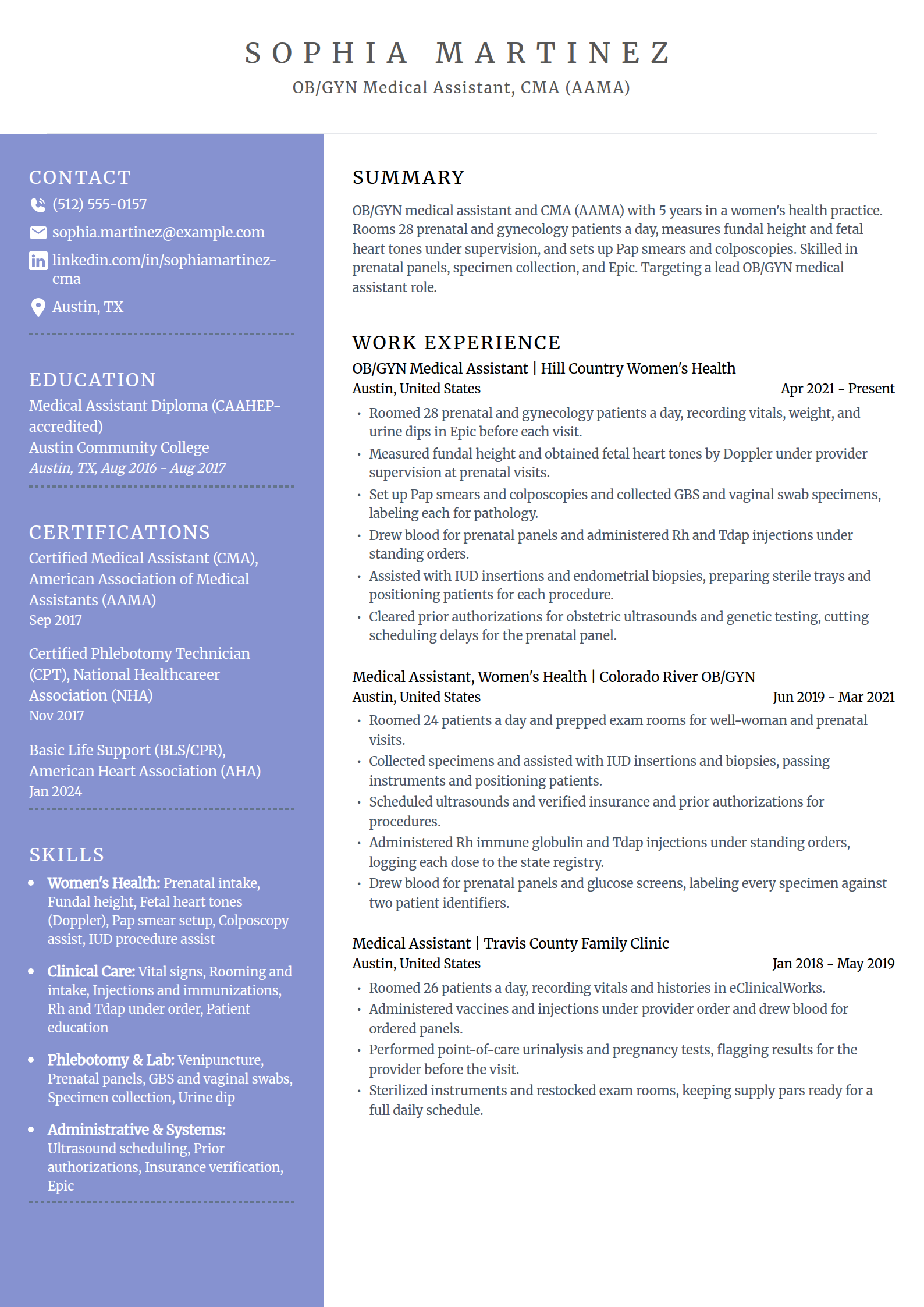
OB/GYN Medical Assistant Resume Template
Why this resume example works?
- Leads with rooming 28 prenatal and gynecology patients a day, the women's-health throughput a practice reads first.
- Phrases fundal height and fetal heart tones as done under provider supervision, keeping the work in scope.
- Shows Pap-smear and colposcopy setup and GBS and prenatal-panel collection, the OB/GYN tasks a posting names.
- Carries CMA (AAMA) and CPT, and keeps Rh and Tdap injections under standing orders.
- Fills a roomy two-column layout so the prenatal and gynecology scope both read clearly.
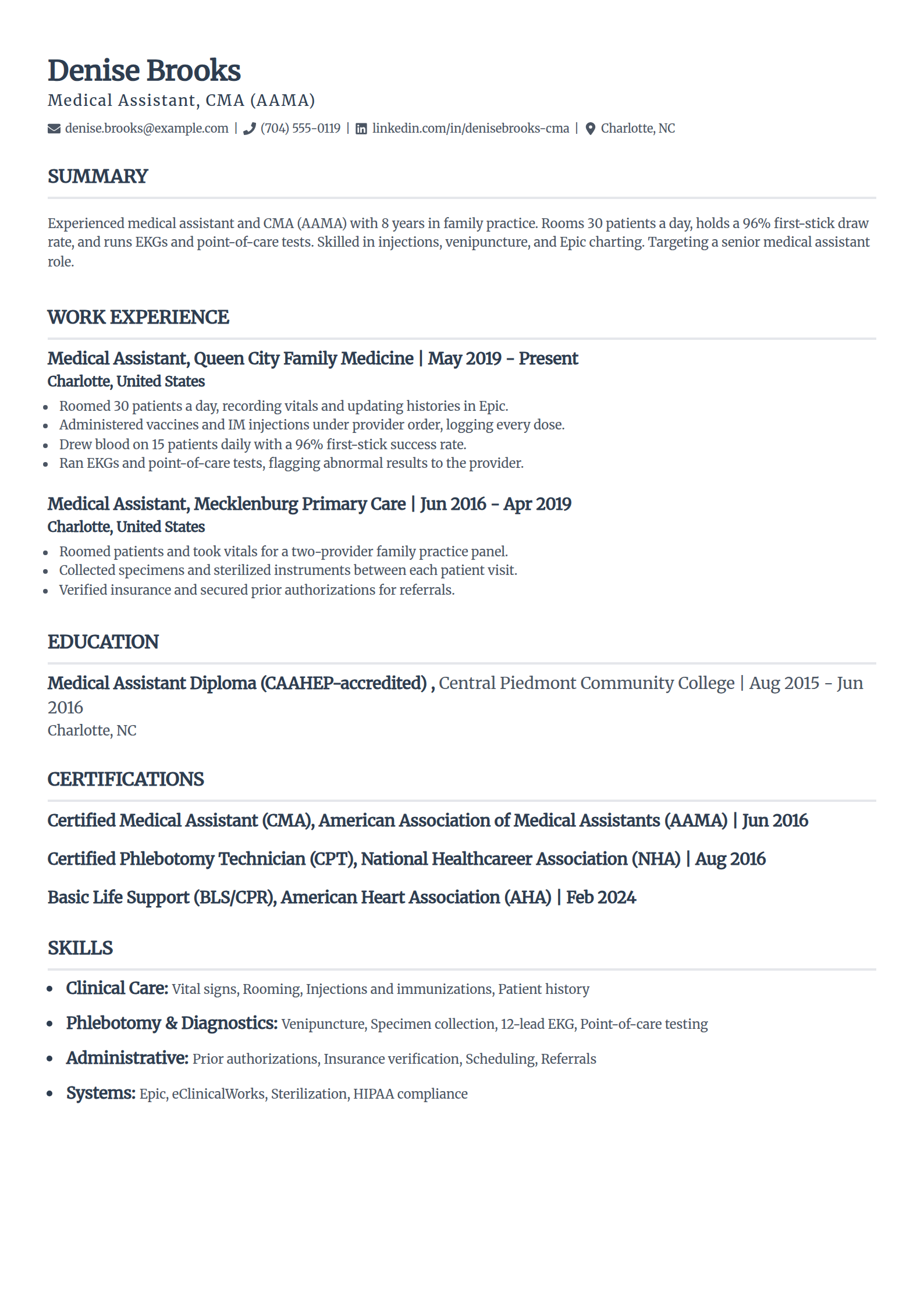
Experienced Medical Assistant Resume Template
Why this resume example works?
- Leads with rooming 30 patients a day and a 96% first-stick rate, the throughput an experienced MA is measured on.
- States CMA (AAMA) precisely and names Epic, so the credential and EHR sit in the top third.
- Keeps tight, one-line bullets that fit eight years of general practice on one clean page.
- Holds every task in scope: injections under order, venipuncture, EKG, and point-of-care tests.
- Uses a simple reverse-chronological layout that a parser reads without dropping a heading.
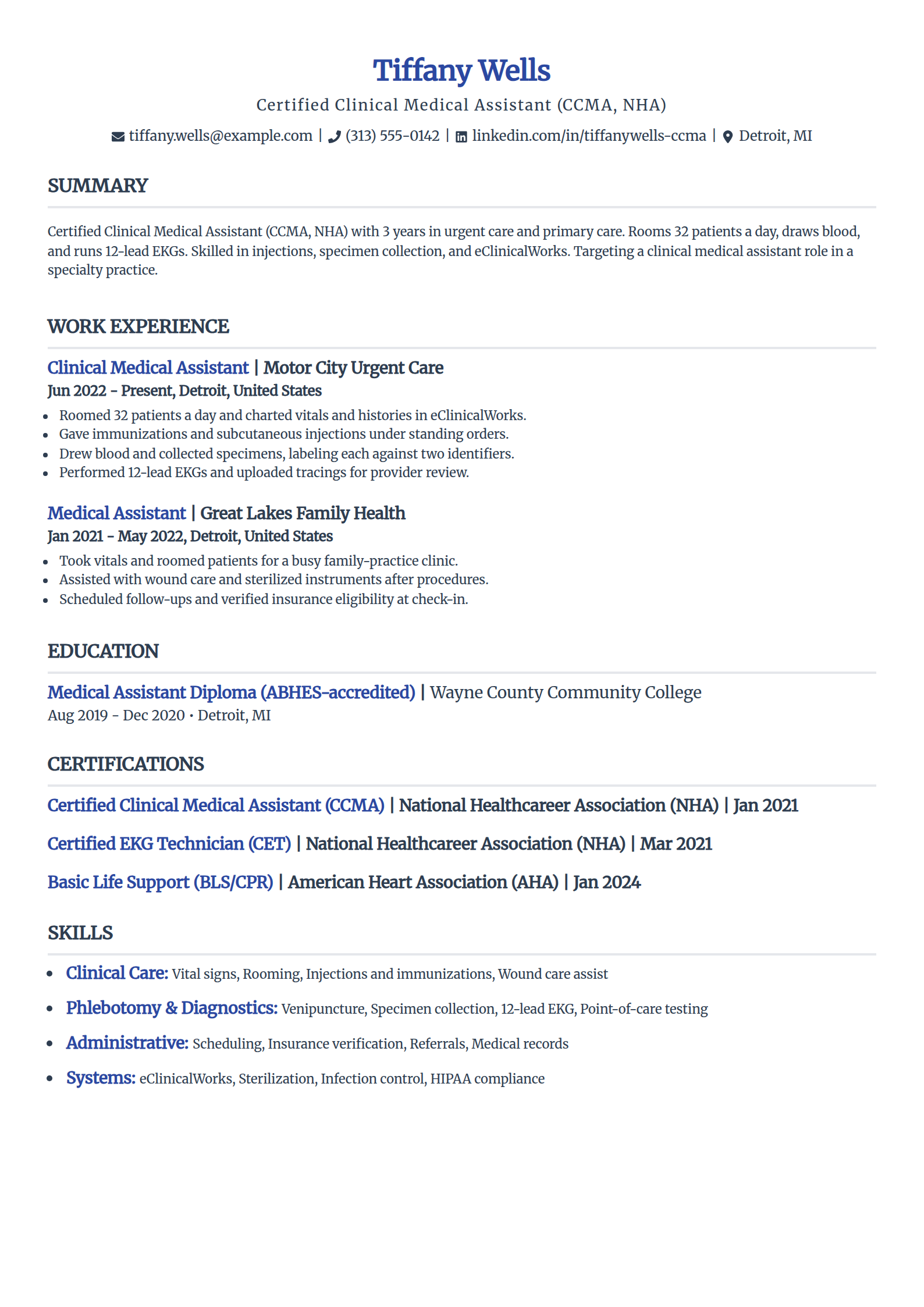
CCMA Medical Assistant Resume Template
Why this resume example works?
- States Certified Clinical Medical Assistant (CCMA, NHA) in the header, spelled out then abbreviated.
- Leads with rooming 32 patients a day and running 12-lead EKGs, the clinical work a specialty practice wants.
- Names eClinicalWorks and keeps injections under standing orders, phrased inside medical-assistant scope.
- Keeps two tight roles so a three-year clinical story fits on one clean page.
- Uses a minimal layout that puts the CCMA credential and clinical skills where a screener looks first.
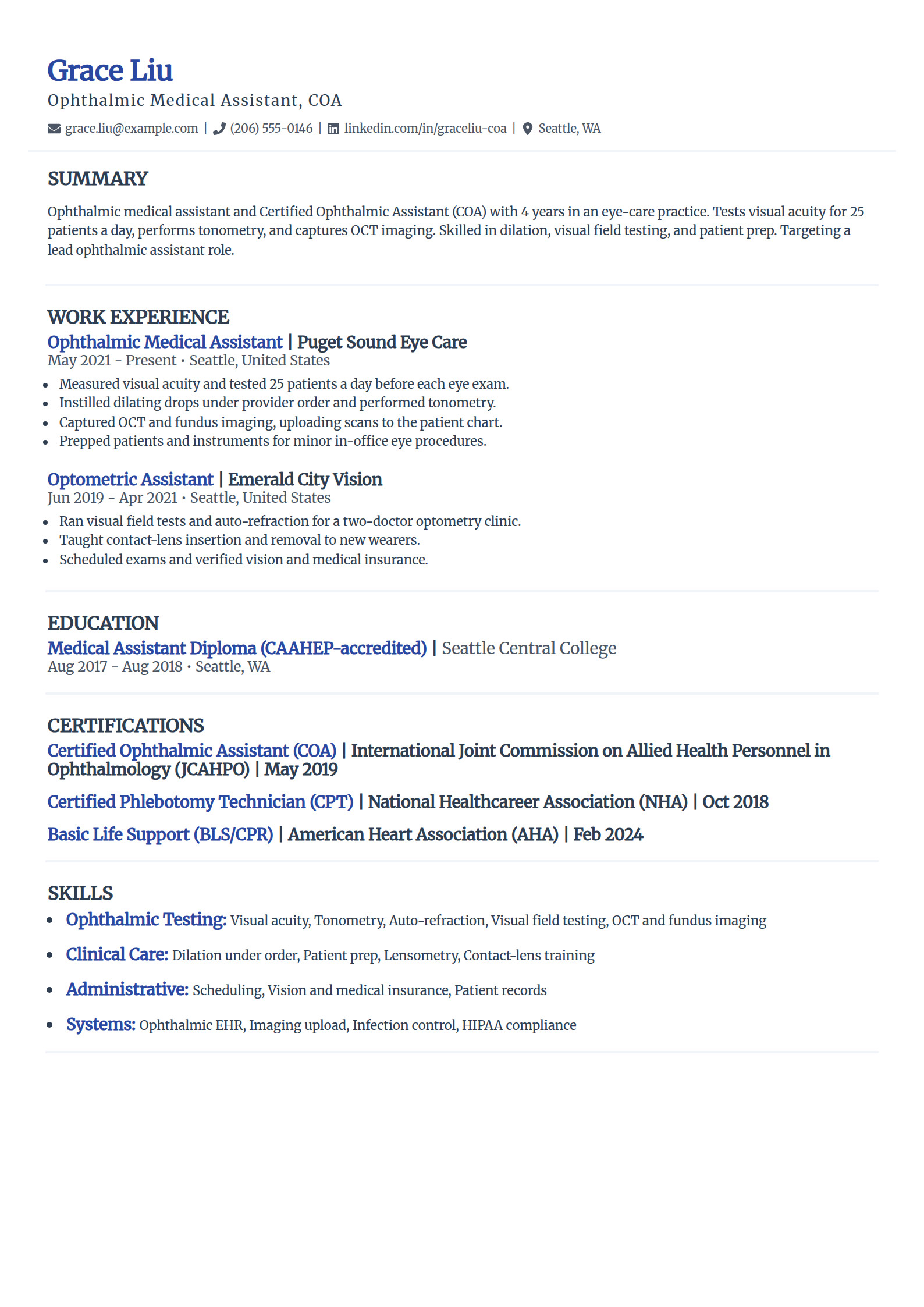
Ophthalmic Medical Assistant Resume Template
Why this resume example works?
- Leads with visual-acuity testing for 25 patients a day and tonometry, the eye-care tasks a practice hires on.
- Carries the Certified Ophthalmic Assistant (COA) credential, named with JCAHPO as its issuer.
- Keeps dilating drops as instilled under provider order, staying inside medical-assistant scope.
- Names OCT and fundus imaging and visual field testing, the ophthalmic keywords a posting lists.
- Uses a clean layout that fits specialty eye-care experience on one tidy page.
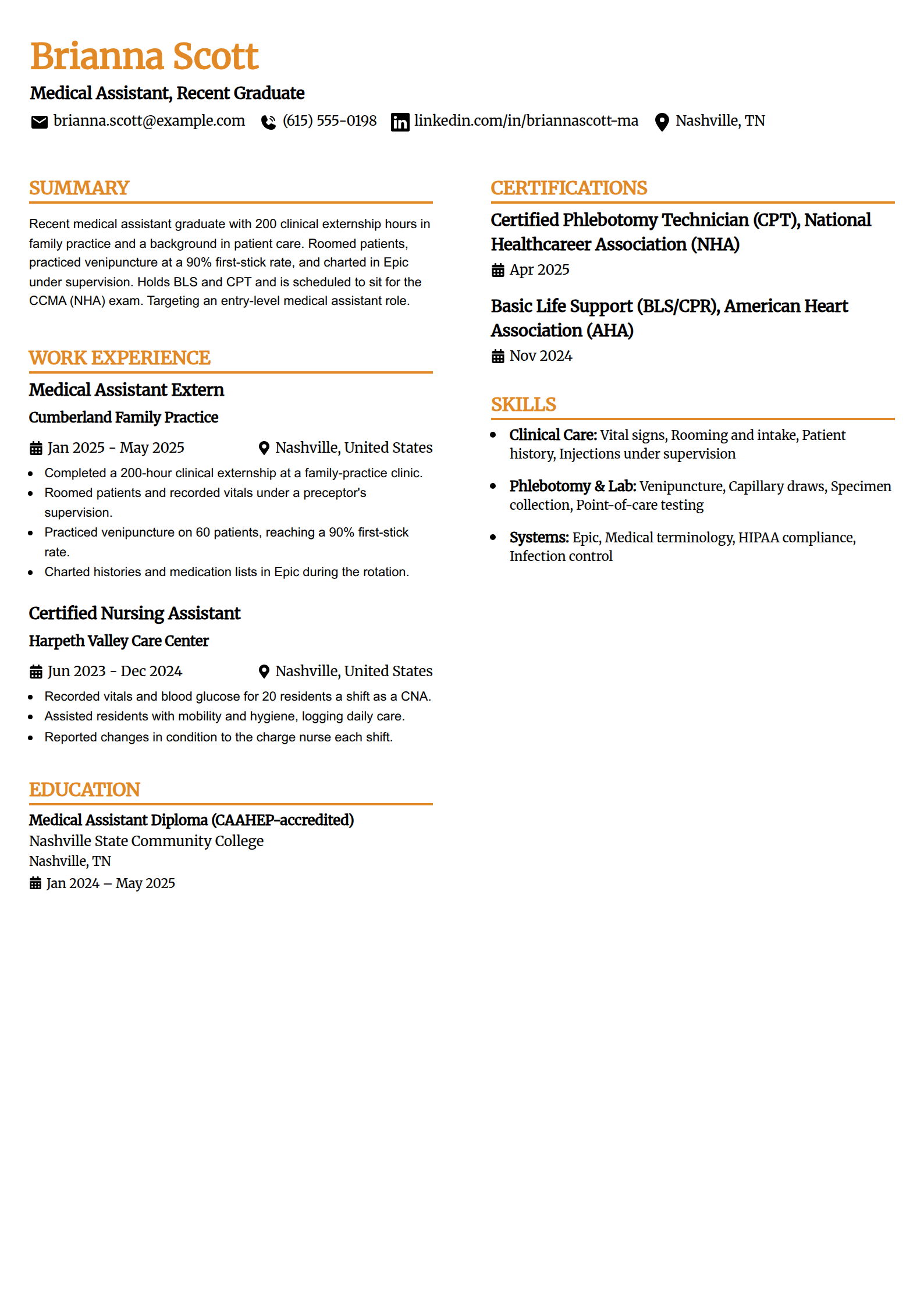
Entry-Level Medical Assistant Resume Template
Why this resume example works?
- Leads with 200 externship hours and a 90% first-stick rate, the clinical hours a new grad shows in place of years.
- Phrases the credential as scheduled to sit for the CCMA exam, the correct way to state an upcoming exam.
- Turns a CNA role into real patient-care experience with vitals and blood-glucose numbers.
- Names Epic and keeps injections under supervision, so a screener sees the tools and the scope.
- Uses a tight two-entry layout that fills the page without inflating a short history.
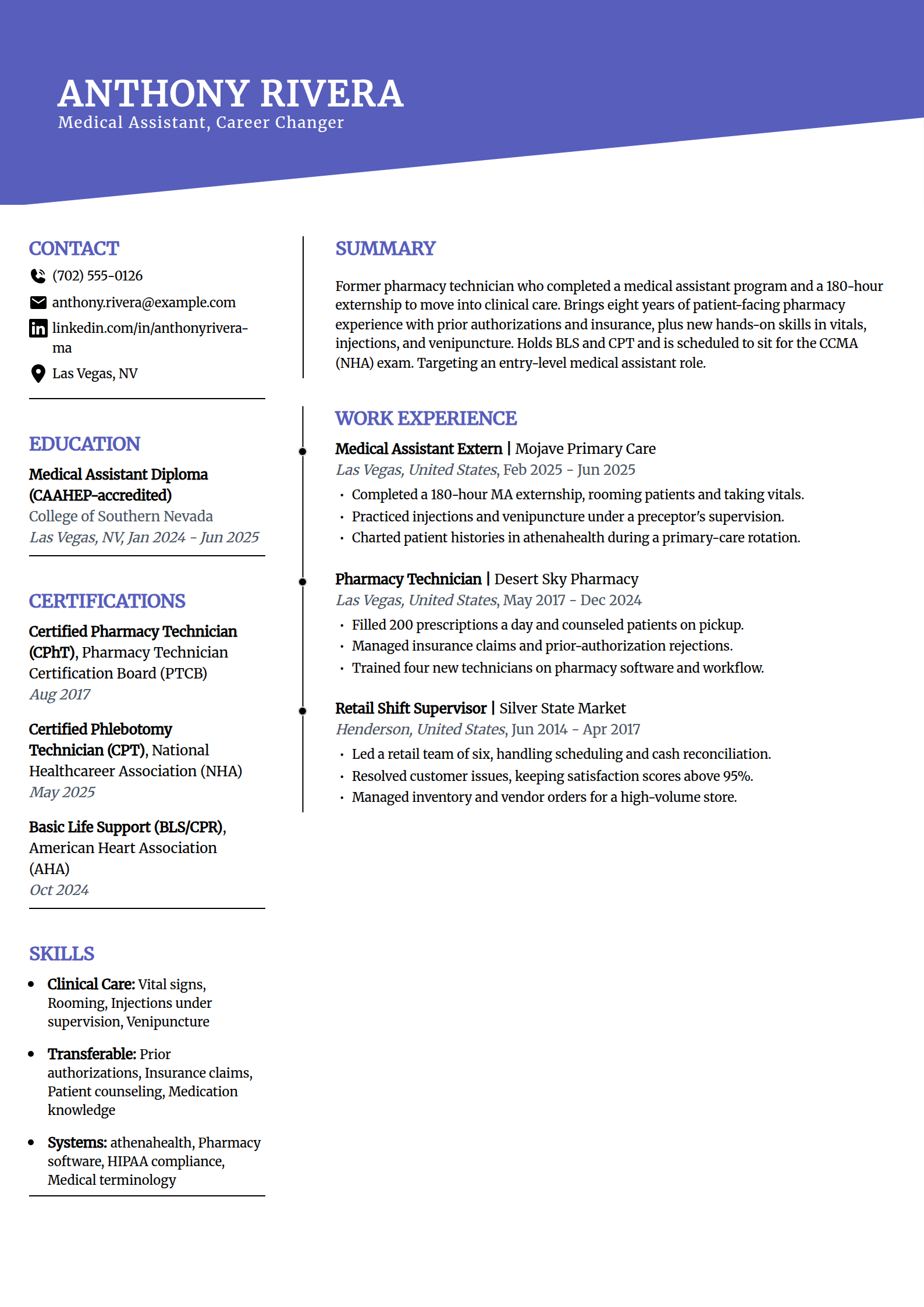
Career-Changer Medical Assistant Resume Template
Why this resume example works?
- Frames the move from pharmacy technician into clinical care, the career-change story stated up front.
- Bridges the switch with transferable prior-auth and insurance work plus new externship clinical skills.
- Phrases the credential as scheduled to sit for the CCMA exam, precise about an upcoming exam date.
- Names athenahealth and keeps injections under supervision, so the new clinical scope reads correctly.
- Uses a two-column layout that separates transferable strengths from the new medical-assistant training.
Build your medical assistant resume
Pick a template above and the editor keeps the layout parser-safe while you swap in your own certification, specialty, clinical skills, and numbers.
Build my resumeHow to write a medical assistant resume in 2026
A medical assistant resume gets read twice: a fast human skim for your certification and clinical scope, then an ATS keyword match against the posting. These moves satisfy both without padding.
Lead with a summary that names your certification, setting, and one number
Write three or four sentences that open with your title and setting, state your CMA, RMA, or CCMA status, and land on one result a clinic cares about, such as patients roomed per day or your first-stick rate. New grads and career-changers use the same shape with externship hours in place of years. For deeper, copyable wording, our medical assistant resume summary and objective pages carry ready examples.
Certified Medical Assistant (CMA, AAMA) with 7 years in family practice, rooming 32 patients a day at a 97% first-stick draw rate, who administers immunizations under provider order, runs 12-lead EKGs, and charts in Epic.
Quantify impact with the numbers a clinic actually tracks
Lead each bullet with a verb, then attach the result. Medical assistant impact is countable, so use the number your role owns and keep it believable.
- Throughput: roomed 32 patients a day, or administered 40 vaccines a day during flu season under provider order.
- Phlebotomy: drew blood on 18 patients a day at a 97% first-stick rate, labeling specimens against two identifiers.
- Diagnostics: performed and uploaded 14 twelve-lead EKGs a day, flagging abnormal tracings for same-day review.
- Front office: cleared prior authorizations in under two days, or cut no-shows 18% with a reminder workflow.
State your certification and licenses precisely
The certification is a screen, not a footnote. Phrase each one the way the credentialing body does and keep it near the top.
- Certified: write "Certified Medical Assistant (CMA, AAMA)", spelled out on first use, then the acronym.
- Registered or clinical: "Registered Medical Assistant (RMA, AMT)" or "Certified Clinical Medical Assistant (CCMA, NHA)".
- Exam pending: write "scheduled to sit for the CCMA exam", never "currently sitting for", since an exam is sat once on a date.
- Add-ons: CPT phlebotomy (NHA), CET EKG (NHA), and BLS/CPR (AHA) each belong here, listed with the issuing body.
Name your clinical and administrative skills and keywords
A medical assistant resume splits into clinical and administrative skills, and an ATS matches the exact tool the posting lists, so write them out by name where they are true. Our medical assistant resume skills page keeps the full keyword list.
- Clinical: vital signs, rooming and intake, injections and immunizations under order, venipuncture, EKG, specimen collection.
- EHRs by name: Epic, Cerner, athenahealth, eClinicalWorks, or NextGen, matched to whichever the posting names.
- Administrative: scheduling, insurance verification, prior authorizations, referrals, and ICD-10 and CPT coding entry.
- Compliance: HIPAA, infection control, sterilization, and OSHA bloodborne-pathogen standards.
Keep the format ATS-safe and the length to one page
A medical assistant resume gets filtered by software before a person reads it, and the field expects a short, single page.
- Keep it to one page; cut old duty-style bullets before you add a second page.
- Use a single-column or clean two-column layout with standard headings so a parser reads your credential, skills, and dates in order.
- Put your CMA, RMA, or CCMA and a skills block in the top third where a screener looks first.
- Save as a PDF unless the application asks for Word, and run the draft through the ATS resume checker before you send it. Browse every layout on the resume templates hub.
Common medical assistant resume mistakes
- Claiming a task out of scope. A medical assistant takes vitals, gives injections under order, and draws blood; it does not run IV therapy or manage a ventilator. Drop anything a supervising provider would not delegate.
- Writing "certified medical assistant" with no body. State the credential exactly: CMA (AAMA), RMA (AMT), or CCMA (NHA), and "scheduled to sit for the CCMA exam" if it is pending.
- Listing duties instead of results. "Roomed patients" is a task; "roomed 32 patients a day at a 97% first-stick rate" is proof.
- Naming a generic "EHR" instead of the system. Write Epic, Cerner, athenahealth, eClinicalWorks, or NextGen so the ATS matches the posting.
- Running a medical assistant resume to two pages. Keep it to one, and lead with your certification and clinical numbers, not a long objective.
Frequently asked questions
What should a medical assistant resume include?
A three or four sentence summary that names your certification, setting, and one result; a work section where every bullet leads with a verb and a number; your CMA, RMA, or CCMA status near the top; a skills block split into clinical and administrative that names your EHR, such as Epic or eClinicalWorks; and your education and clinical training. Keep it to one page and put the certification in the top third.
How do I list CMA, RMA, or CCMA certification on a resume?
State it exactly, spelled out on first use then abbreviated, near the top of the resume. Write "Certified Medical Assistant (CMA, AAMA)", "Registered Medical Assistant (RMA, AMT)", or "Certified Clinical Medical Assistant (CCMA, NHA)", each with its credentialing body. If your exam is coming up, write "scheduled to sit for the CCMA exam", never "currently sitting for", because an exam is sat once on a date. Add CPT phlebotomy, CET EKG, and BLS/CPR with their issuers.
What skills and keywords should I put on a medical assistant resume?
Split them into clinical and administrative and name both outright. Clinical: vital signs, rooming and intake, injections and immunizations under order, venipuncture, EKG, and specimen collection. Administrative: scheduling, insurance verification, prior authorizations, referrals, and ICD-10 and CPT coding entry. Name your EHR by hand, such as Epic, Cerner, athenahealth, eClinicalWorks, or NextGen, and make sure the tools in your skills block also appear in your experience bullets.
How do I write a medical assistant resume with no experience?
Lead with your externship or clinical hours in place of years, then keep it to one page. Show the hours you completed, the skills you practiced under supervision, such as venipuncture and rooming, and a number like your first-stick rate. Add any patient-facing role, like a CNA or caregiver job, with its vitals and care numbers. State your certification status precisely, including "scheduled to sit for the CCMA exam" if it is pending.
How long should a medical assistant resume be?
One page. Clinics and their applicant tracking systems expect a single, dense page, and a longer resume reads as unfocused for this role. Lead with your certification and your clinical numbers, keep bullets to one or two lines, and cut old duty-style lines before you ever consider a second page.
Should a medical assistant resume have a summary or an objective?
Use a summary if you have a year or more of paid medical-assistant experience, and an objective if you are a new grad or career-changer leading with externship hours. A resume carries one or the other, never both. For copyable wording either way, our medical assistant resume summary page covers experienced candidates and the objective page covers new grads and exam-pending applicants.
More medical assistant resume resources
Build your medical assistant resume
Pick a template above and the editor keeps the layout parser-safe while you swap in your own certification, specialty, clinical skills, and numbers.