Phlebotomist Resume Templates and Examples, Entry-Level to Lead
- ATS Friendly
- Certified & No-Experience
- 16 Real Examples
Hospital floors, an outpatient draw station, the ER, a mobile route, a donor center, or pediatrics, this page has a resume built for your exact setting. Start from a layout below, then model your own on a real example, from a newly certified tech with only externship hours to a lead running a team. Your CPT credential, draw volume, and first-stick rate sit right where a lab manager looks first.


540k+ resumes created
Phlebotomist resume templates for every setting and experience level
Each template below is a real phlebotomy resume laid out in that format, sorted by setting and level across hospital, outpatient, ER, mobile, donor and plasma centers, pediatrics, and the lead and career-change paths. Pick one, then swap in your own CPT credential, draw volume, first-stick rate, and the LIS you run. Every layout keeps your certification and collection numbers readable so a lab manager sees your specialty at a glance and an applicant tracking system parses it cleanly.
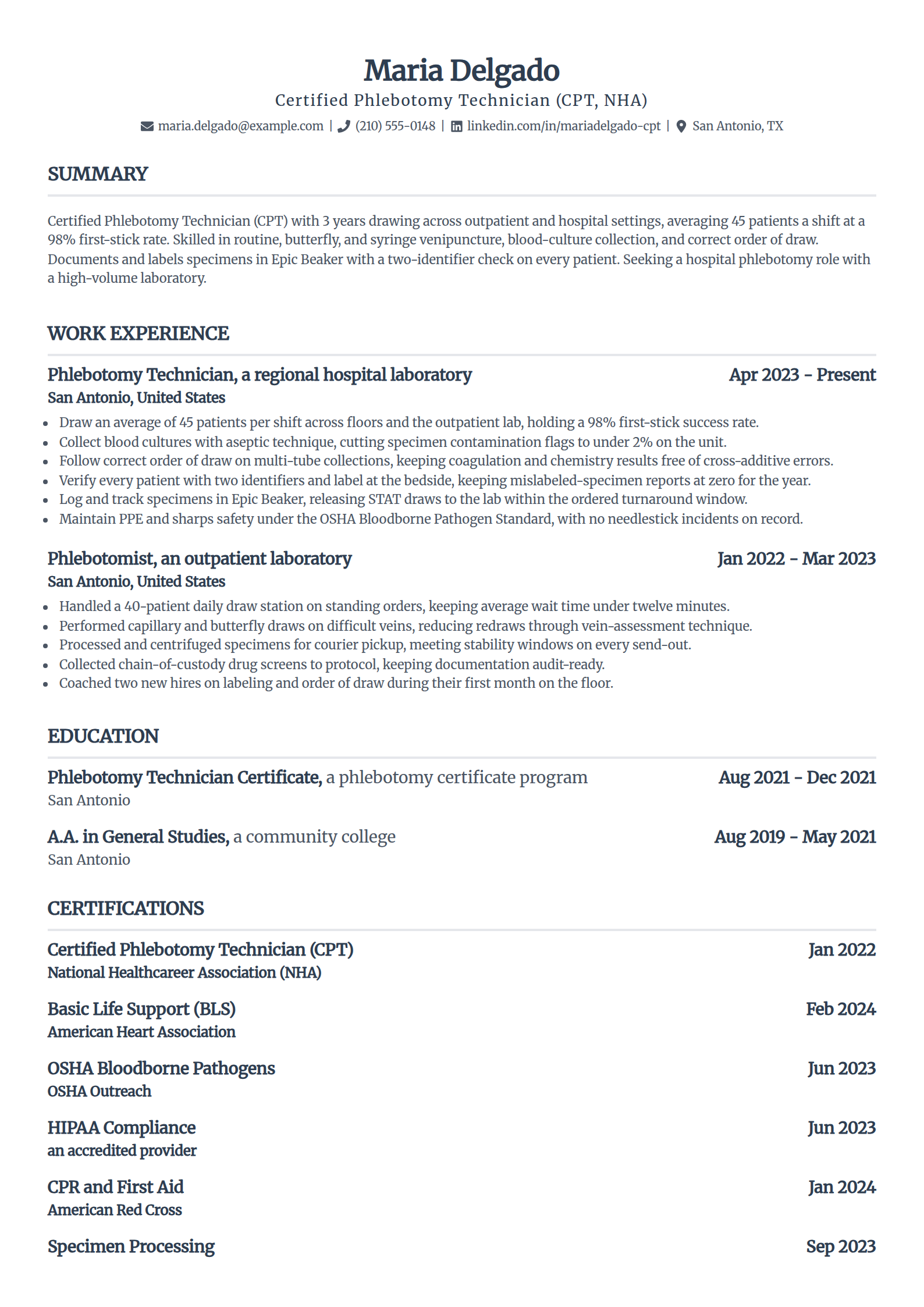
Certified Phlebotomy Technician Resume Template
Why this resume example works?
- Opens with the credential a lab screens for first, the CPT (NHA), plus 45 patients a shift at a 98% first-stick rate.
- Ties results to method, blood cultures collected aseptically with contamination held under 2%.
- Names the correct order of draw and two-identifier verification, the accuracy details a reviewer checks.
- Shows the systems a lab runs, Epic Beaker, Cerner PathNet, and Sunquest, not a vague tools line.
- Uses a clean, single-column layout an applicant tracking system reads without trouble.
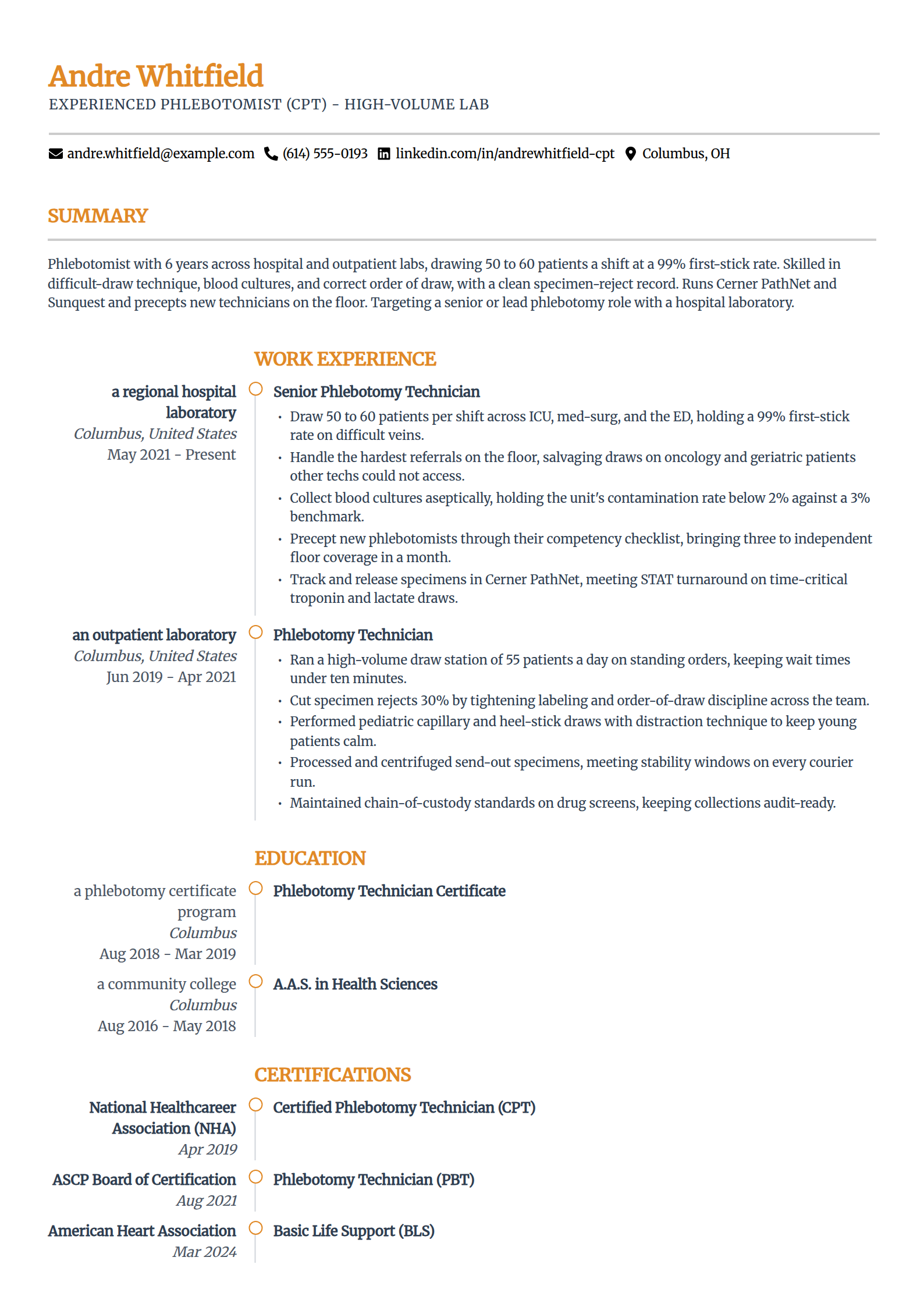
Experienced Phlebotomist Resume Template
Why this resume example works?
- Leads with depth a senior role wants, 6 years drawing 50 to 60 patients a shift at a 99% first-stick rate.
- Shows the value on hard cases, salvaging draws on oncology and geriatric veins other techs cannot access.
- Ties a result to a task, specimen rejects cut 30% by tightening labeling and order-of-draw discipline.
- Names both the CPT and ASCP PBT credentials and the preceptor work a lead track expects.
- Uses a modern layout that still reads cleanly for a recruiter scanning fast.
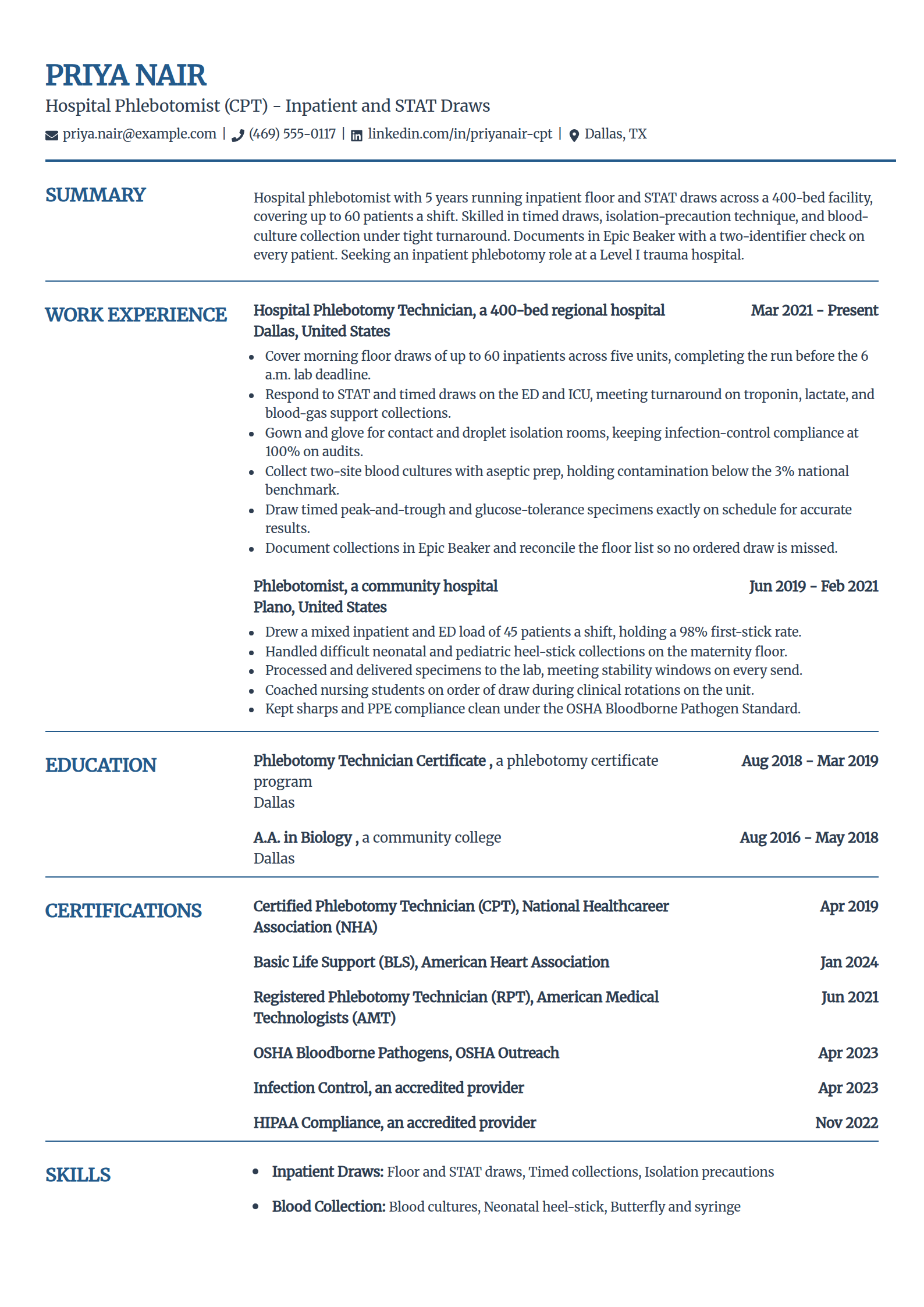
Hospital Phlebotomist Resume Template
Why this resume example works?
- Leads with the setting a hospital hires for, morning floor draws of up to 60 inpatients before the lab deadline.
- Shows the acute skills that matter, STAT and timed draws with isolation-precaution technique.
- Ties aseptic technique to a number, two-site blood cultures held below the 3% contamination benchmark.
- Names Epic Beaker documentation and the floor-list reconciliation an inpatient role expects.
- Uses a modern layout that carries a dense hospital history on one clean page.
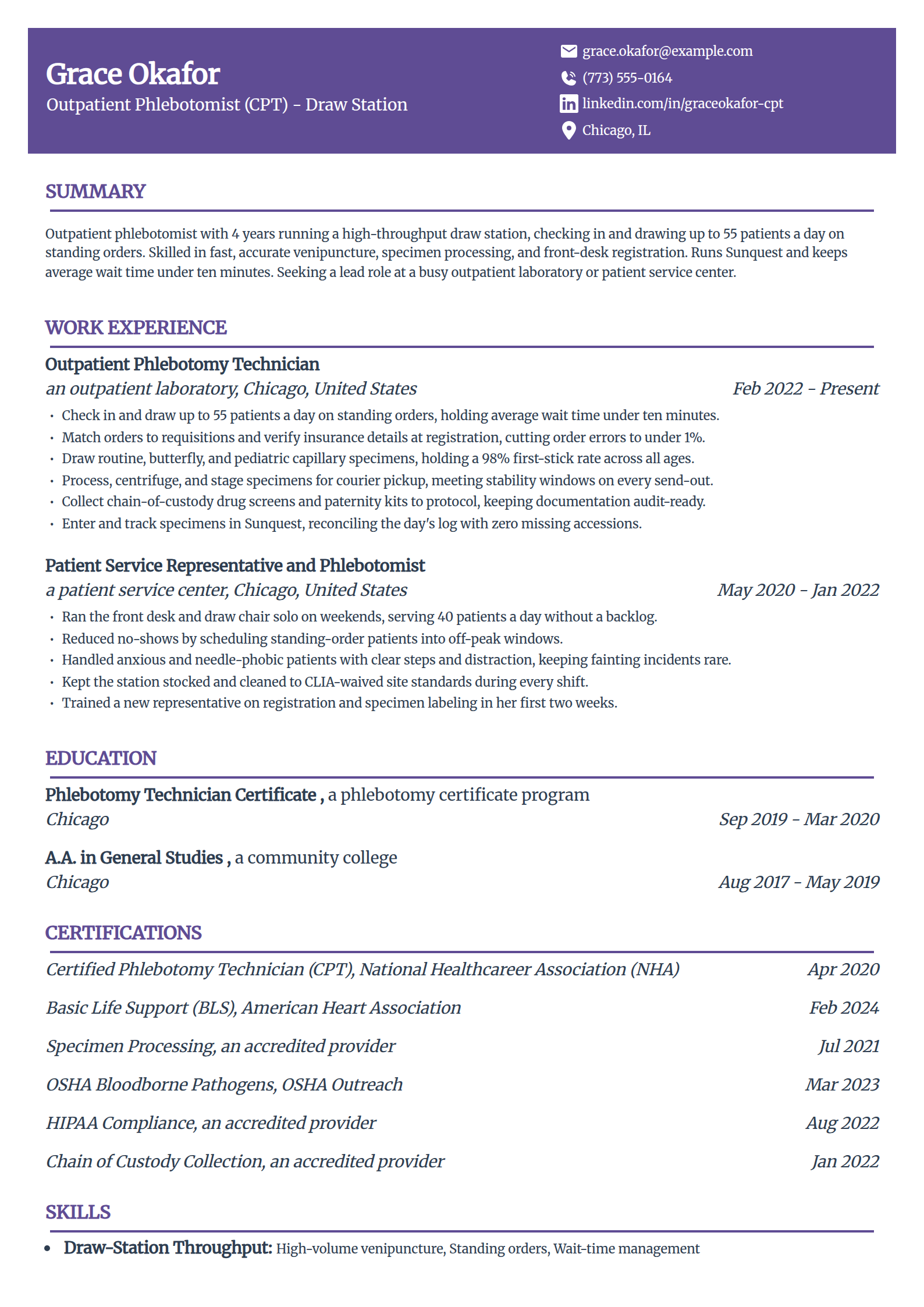
Outpatient Draw-Station Phlebotomist Resume Template
Why this resume example works?
- Leads with throughput a draw station rewards, up to 55 patients a day with wait time under ten minutes.
- Shows the front-desk side too, matching orders to requisitions and cutting order errors under 1%.
- Ties speed to accuracy, a 98% first-stick rate across all ages on standing orders.
- Names Sunquest accession tracking and chain-of-custody drug-screen collection to protocol.
- Uses a spacious layout that carries a high-volume outpatient record on one page.
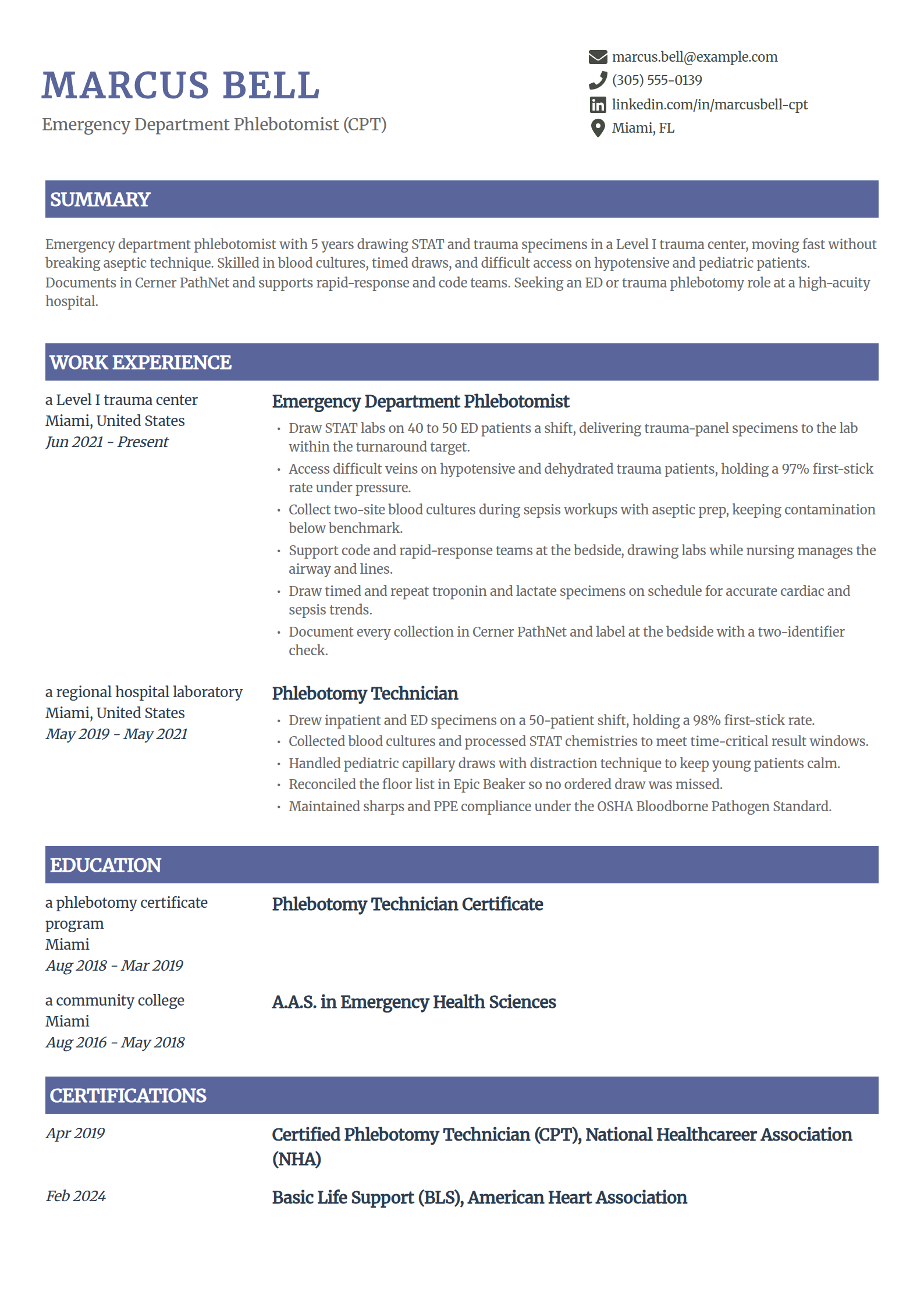
ER / Trauma Phlebotomist Resume Template
Why this resume example works?
- Leads with the acuity an ED hires for, STAT trauma-panel draws delivered within turnaround.
- Shows difficult access under pressure, a 97% first-stick rate on hypotensive and dehydrated patients.
- Ties aseptic technique to sepsis workups, two-site blood cultures held below benchmark.
- Reflects real teamwork, drawing labs at the bedside while nursing manages the airway and lines.
- Uses a modern two-column layout that carries a dense ED history on one page.
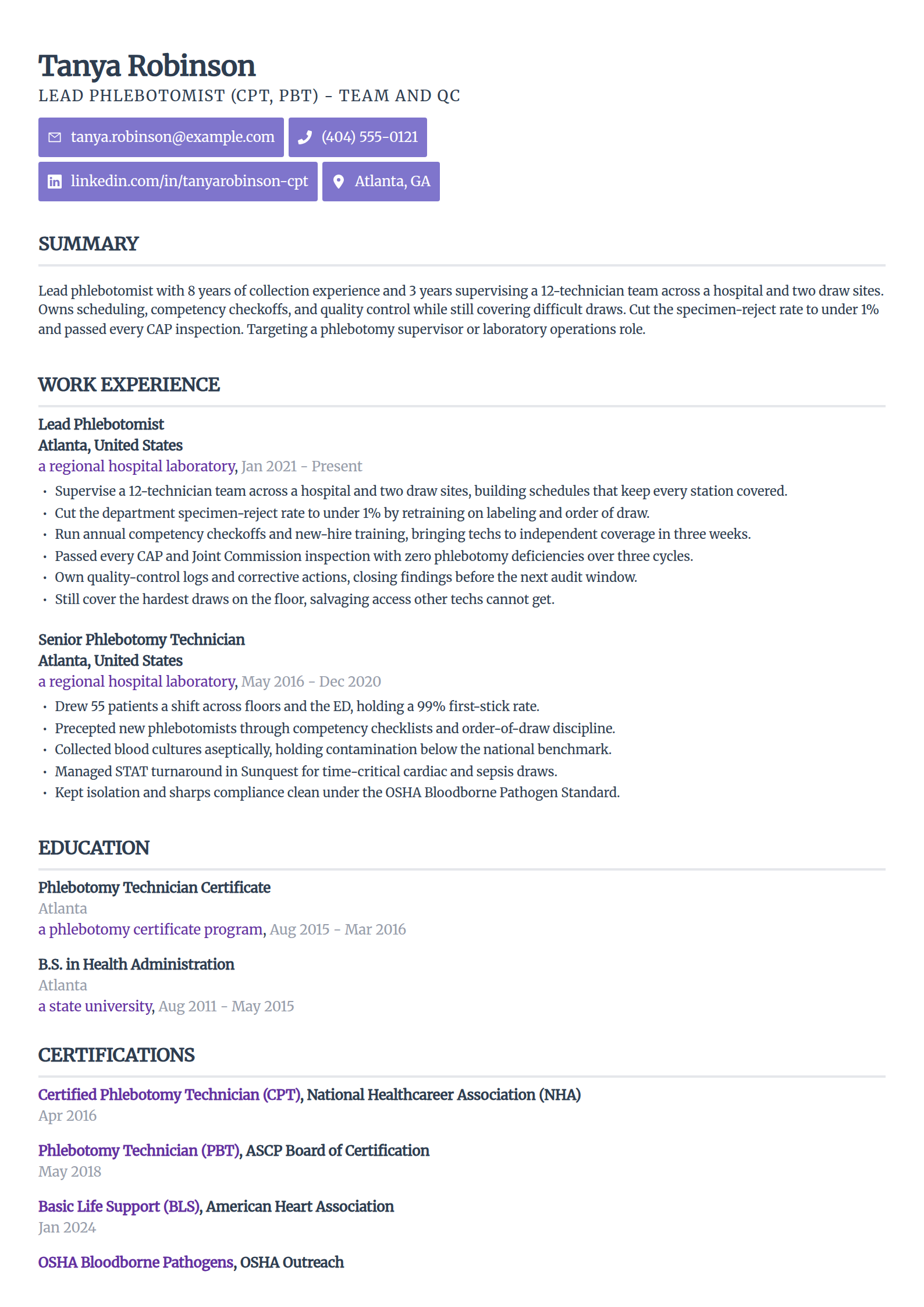
Lead Phlebotomist Resume Template
Why this resume example works?
- Leads with supervisory scope, a 12-technician team across a hospital and two draw sites.
- Shows the results a lead owns, the specimen-reject rate cut to under 1% through retraining.
- Ties quality to inspections, every CAP and Joint Commission survey passed with zero deficiencies.
- Keeps the clinical roots visible, still covering the hardest draws other techs cannot get.
- Uses a clean, modern layout that carries an eight-year leadership record on one page.
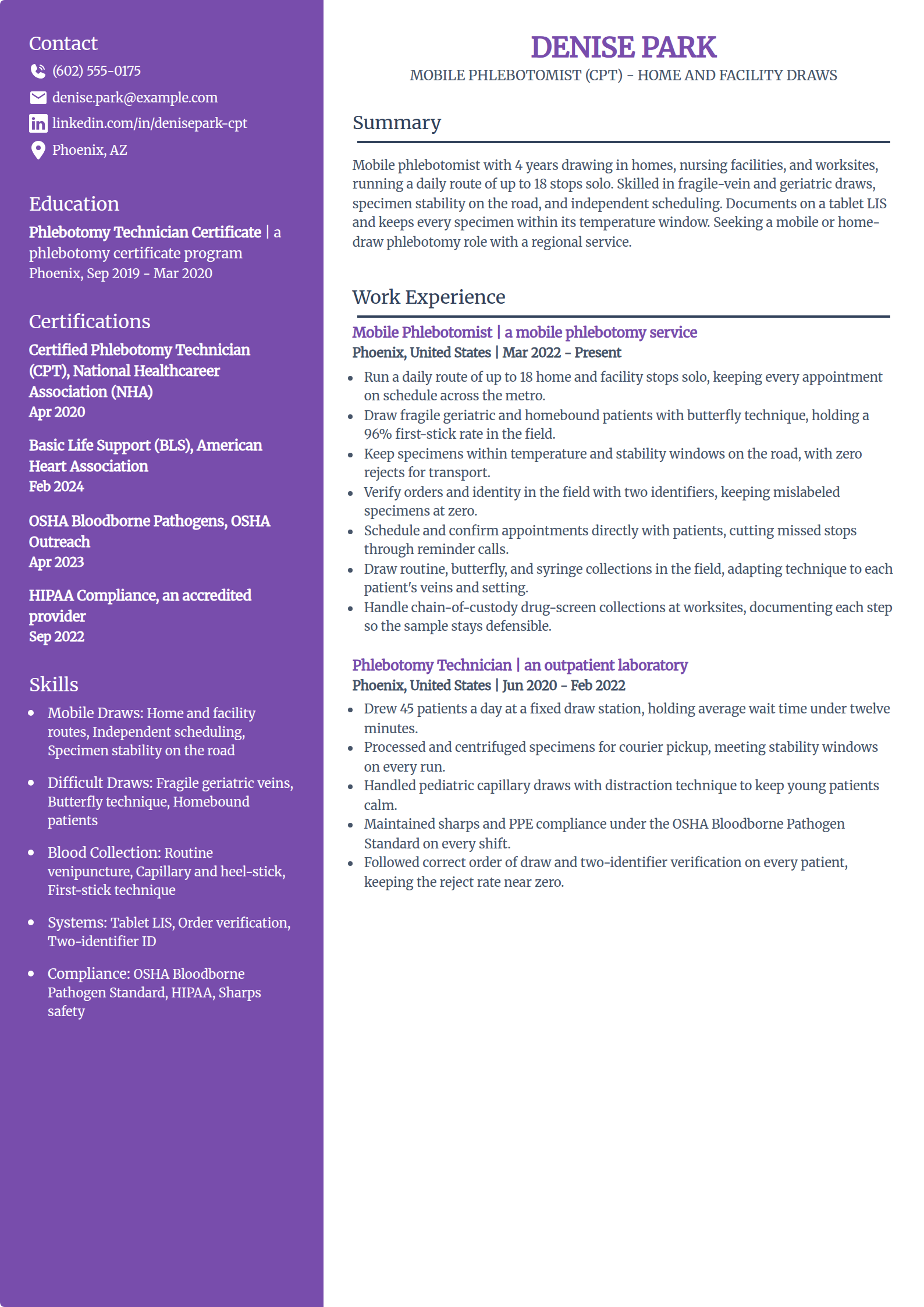
Mobile Phlebotomist Resume Template
Why this resume example works?
- Leads with the independence a mobile role rewards, a daily route of up to 18 home and facility stops solo.
- Shows the skill that matters here, fragile geriatric and homebound draws at a 96% first-stick rate.
- Ties logistics to a result, specimens kept within temperature windows with zero transport rejects.
- Names field order verification and two-identifier labeling, the accuracy a mobile role demands.
- Uses a Medium layout that fits a four-year mobile record without empty space.
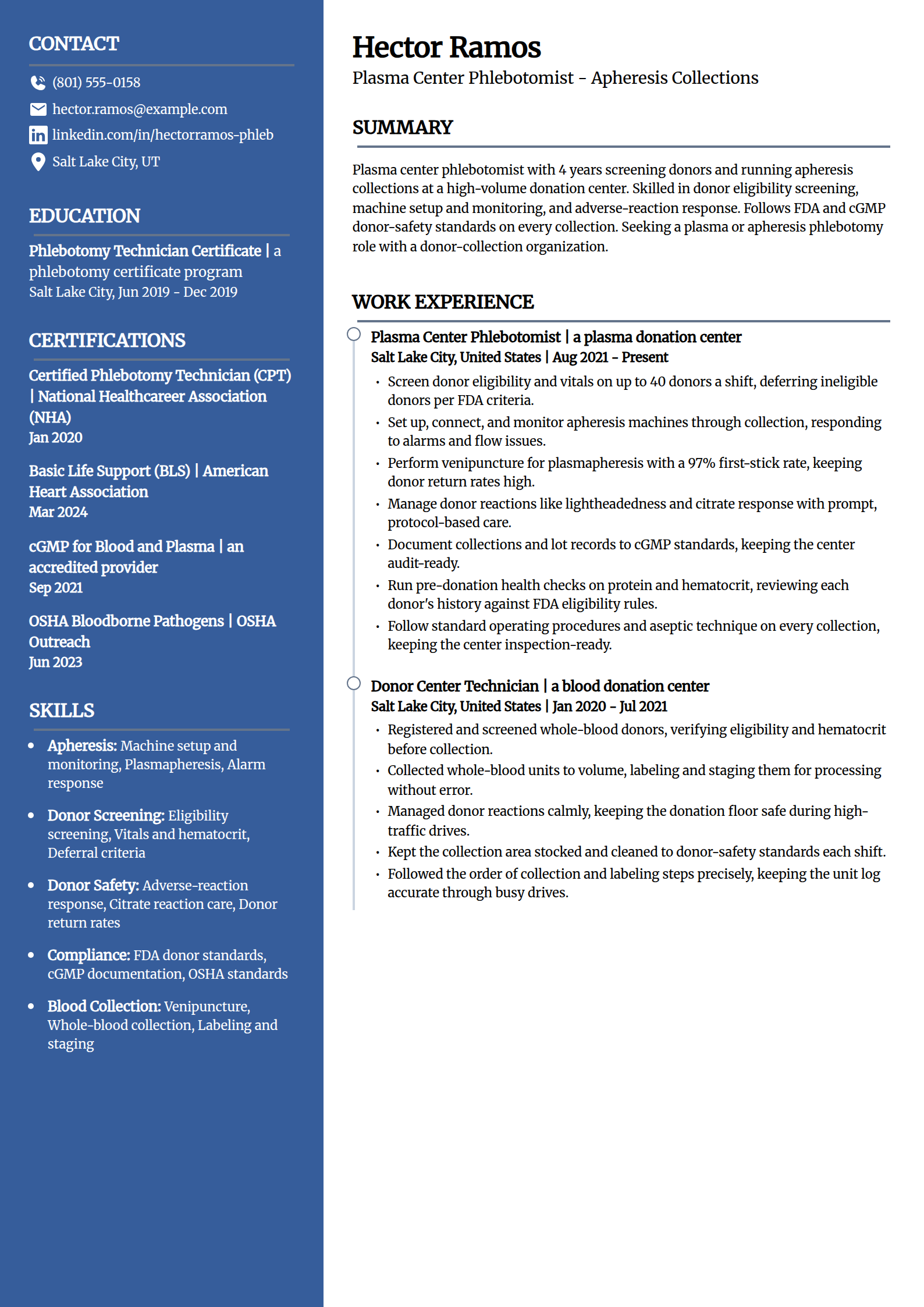
Plasma Center Phlebotomist Resume Template
Why this resume example works?
- Leads with the donor-center scope, screening eligibility and running apheresis on up to 40 donors a shift.
- Shows the machine work a plasma center hires for, apheresis setup, monitoring, and alarm response.
- Ties technique to donor retention, a 97% first-stick rate that keeps donors coming back.
- Names FDA donor-safety criteria and cGMP documentation an audited center expects.
- Uses a distinctive layout that still reads cleanly for a recruiter.
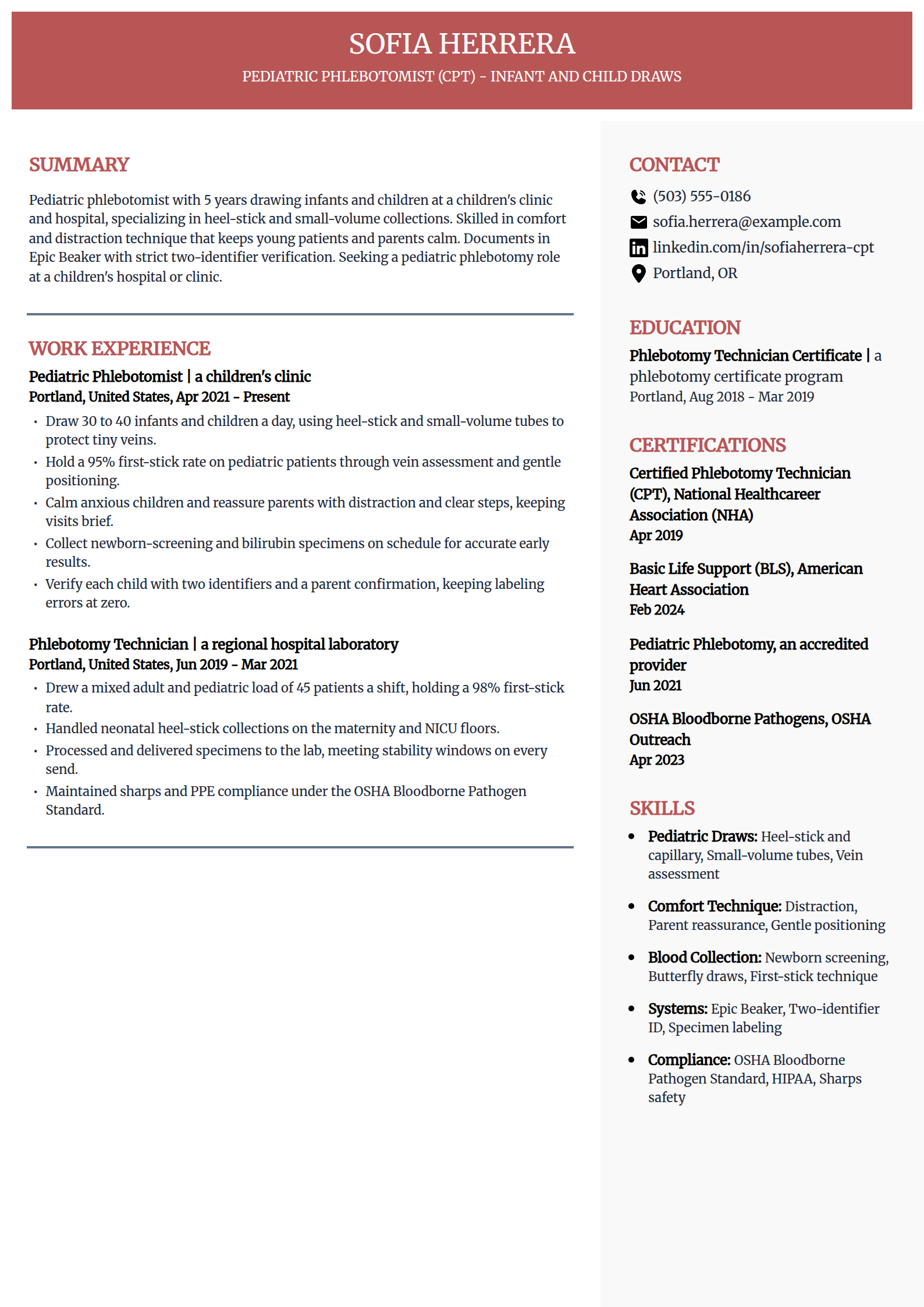
Pediatric Phlebotomist Resume Template
Why this resume example works?
- Leads with the specialty a children's clinic hires for, 30 to 40 infant and child draws a day.
- Shows the technique that matters, heel-stick and small-volume collections to protect tiny veins.
- Ties skill to a number, a 95% first-stick rate through vein assessment and gentle positioning.
- Reflects the soft skill parents notice, calming children with distraction and clear steps.
- Uses a refined layout that fits a five-year pediatric record cleanly on one page.
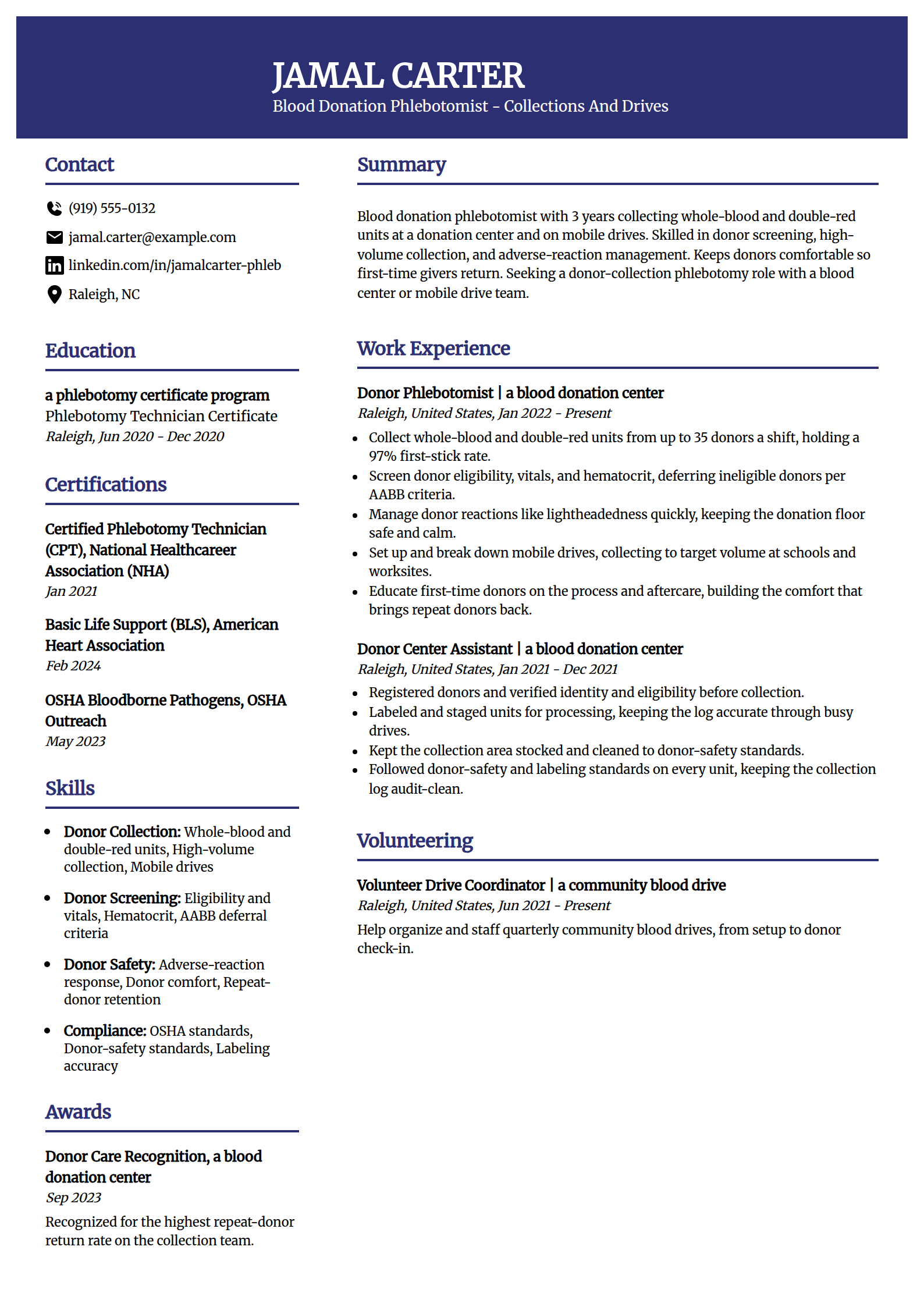
Blood Donation Phlebotomist Resume Template
Why this resume example works?
- Leads with donor-collection scope, whole-blood and double-red units from up to 35 donors a shift.
- Shows the screening a blood center requires, eligibility, vitals, and hematocrit against AABB criteria.
- Reflects the safety side, managing donor reactions to keep the floor calm during drives.
- Names mobile-drive setup and donor-comfort work that brings first-time givers back.
- Uses a roomy layout with a filled sidebar so a three-year donor record looks complete.
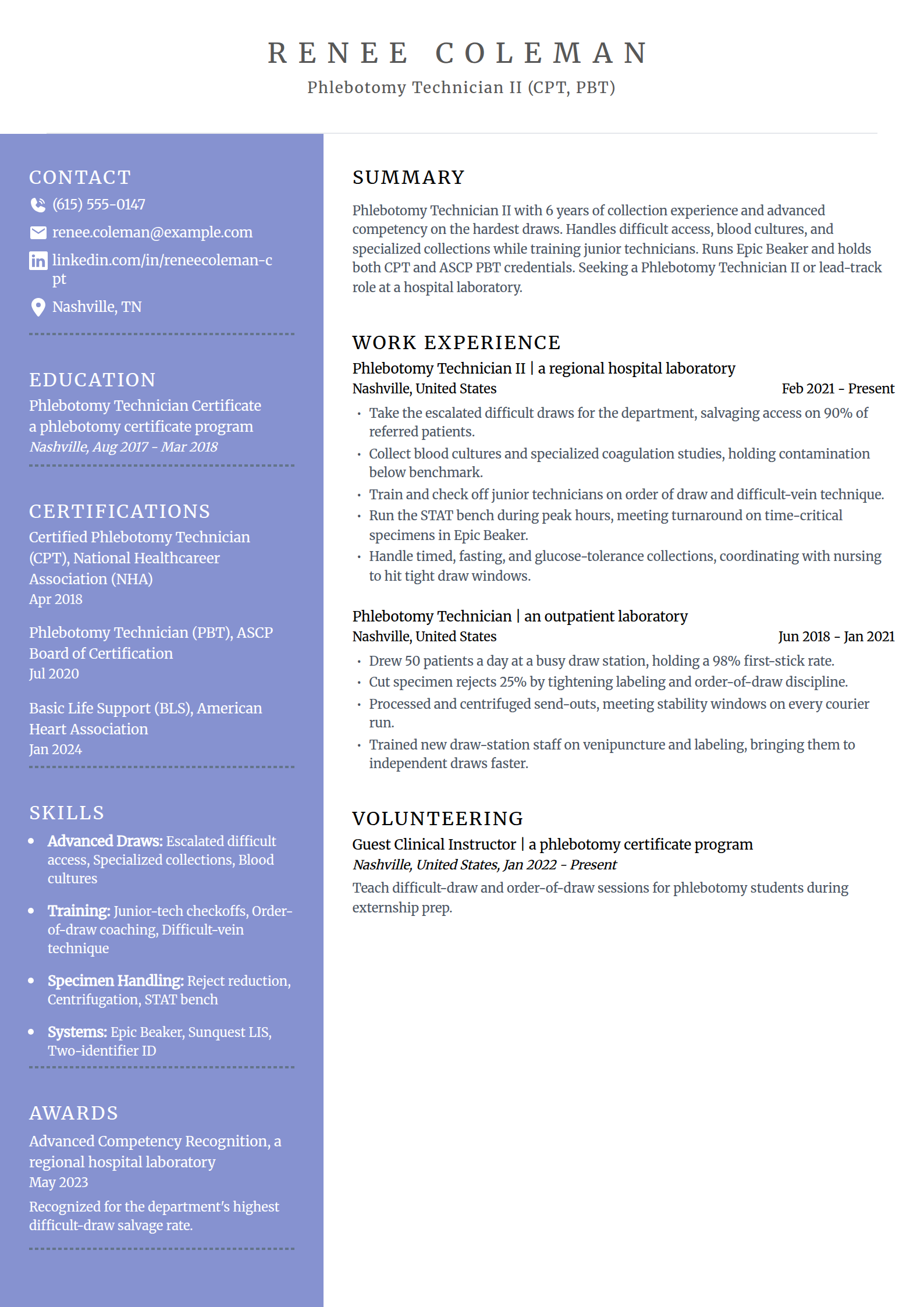
Phlebotomy Technician II Resume Template
Why this resume example works?
- Leads with the advanced rung, taking the department's escalated difficult draws at a 90% salvage rate.
- Shows the specialized work a Tech II owns, blood cultures and coagulation studies below benchmark.
- Reflects the training role, checking off junior technicians on order of draw and difficult veins.
- Names both the CPT and ASCP PBT credentials the ladder rung expects.
- Uses a roomy layout with an award so a six-year advanced record looks full.
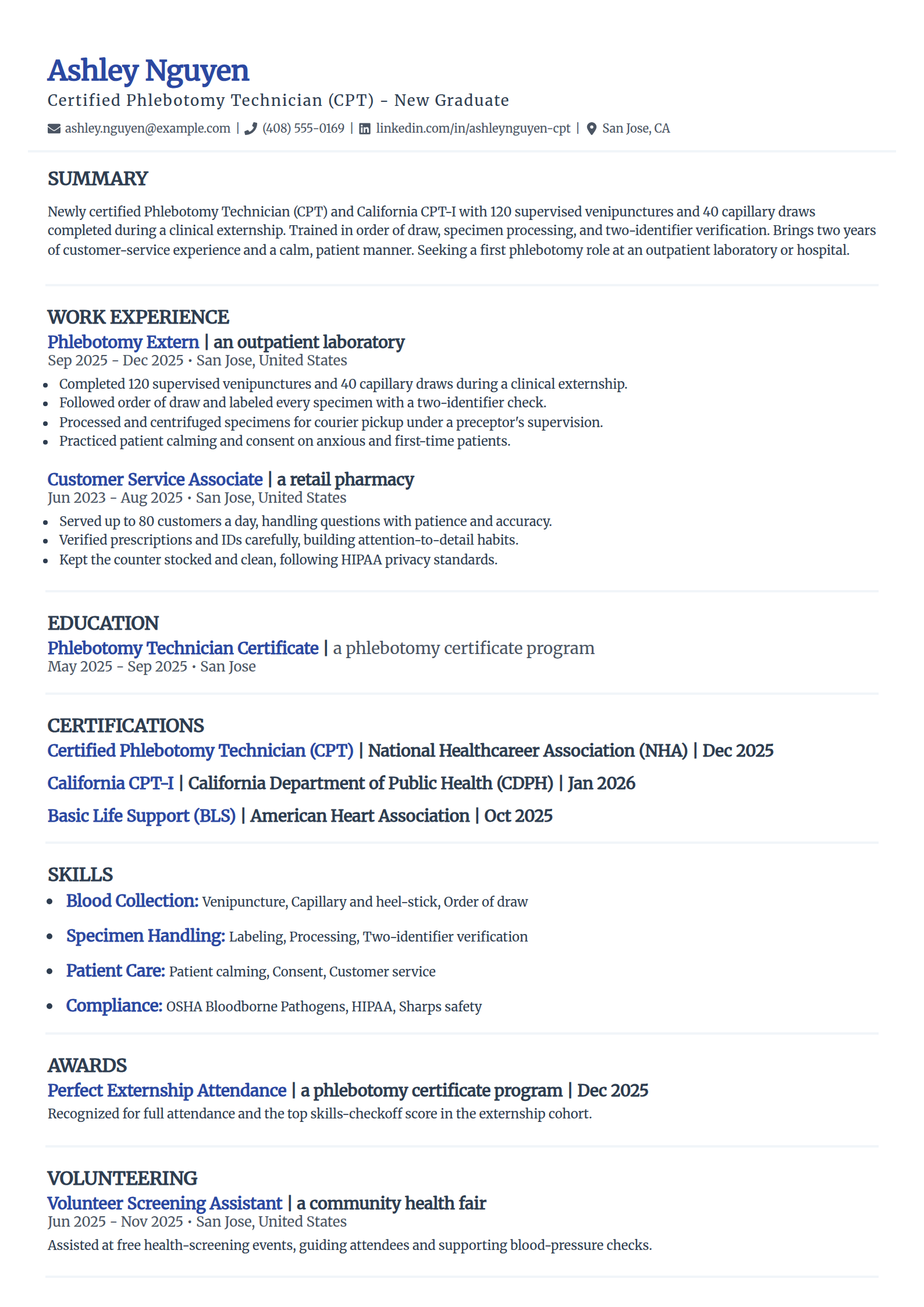
Entry-Level Phlebotomist Resume Template
16 more examples built for a first phlebotomy job →
Why this resume example works?
- Written for no paid experience, leading with 120 supervised venipunctures and 40 capillary draws from an externship.
- Shows the credentials that clear the first screen, the CPT (NHA) and the California CPT-I.
- Keeps the scope honest, all externship draws done under a preceptor's supervision.
- Turns two years of customer service into transferable attention-to-detail and patient-calming skills.
- Fills a tight, ATS-safe page with a skills award and a health-fair volunteer role instead of padding.
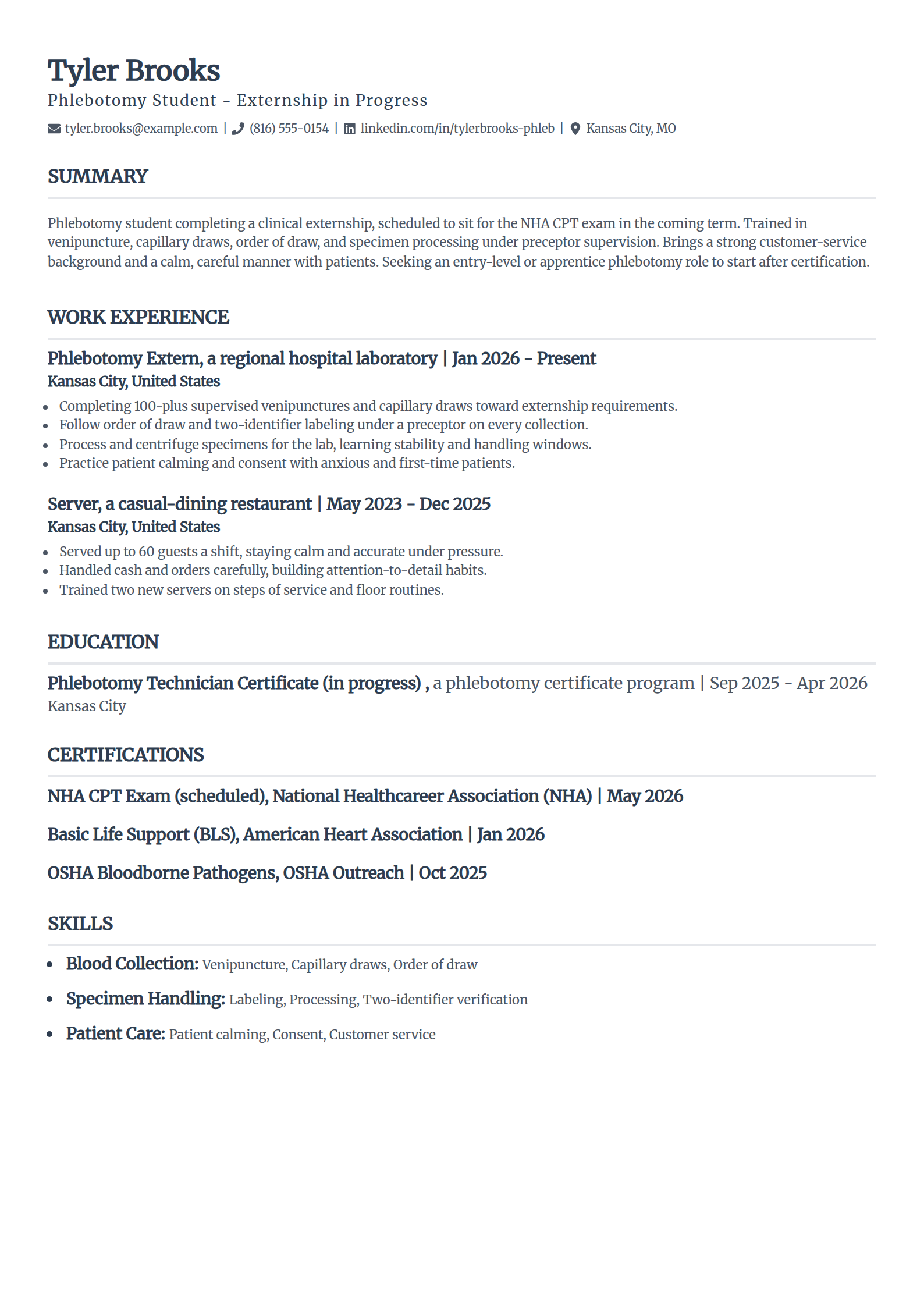
Phlebotomy Student & Externship Resume Template
16 more examples for candidates with externship hours only →
Why this resume example works?
- Written for an in-program candidate, leading with the externship and the scheduled NHA CPT exam date.
- States the exam correctly, scheduled to sit for the CPT exam, not implying a credential already held.
- Shows the supervised hours already logged, venipunctures and capillary draws under a preceptor.
- Turns a prior service job into transferable composure and attention-to-detail signals.
- Fills a tight, ATS-safe page cleanly, the right shape for a first pre-certification resume.
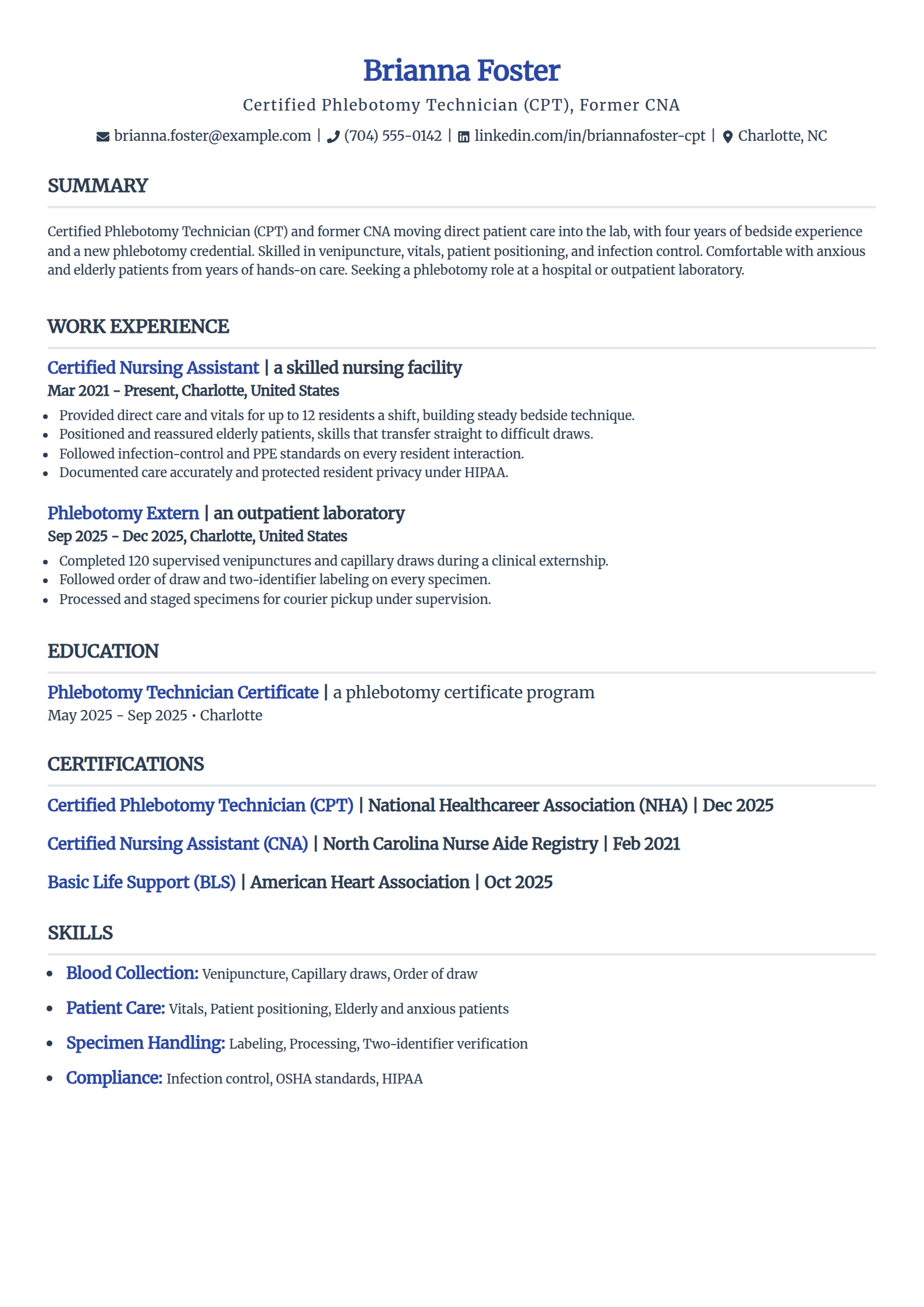
CNA-to-Phlebotomist Resume Template
Why this resume example works?
- Written for a career change, leading with the new CPT and four years of CNA bedside experience.
- Shows the transferable clinical work, vitals, patient positioning, and infection control from direct care.
- Keeps scope correct, no clinical claim beyond what a CNA and a new phlebotomist can own.
- Names the externship draws logged under supervision, the bridge into the lab.
- Fills a tight, ATS-safe page with the patient-care record that makes difficult draws easier.
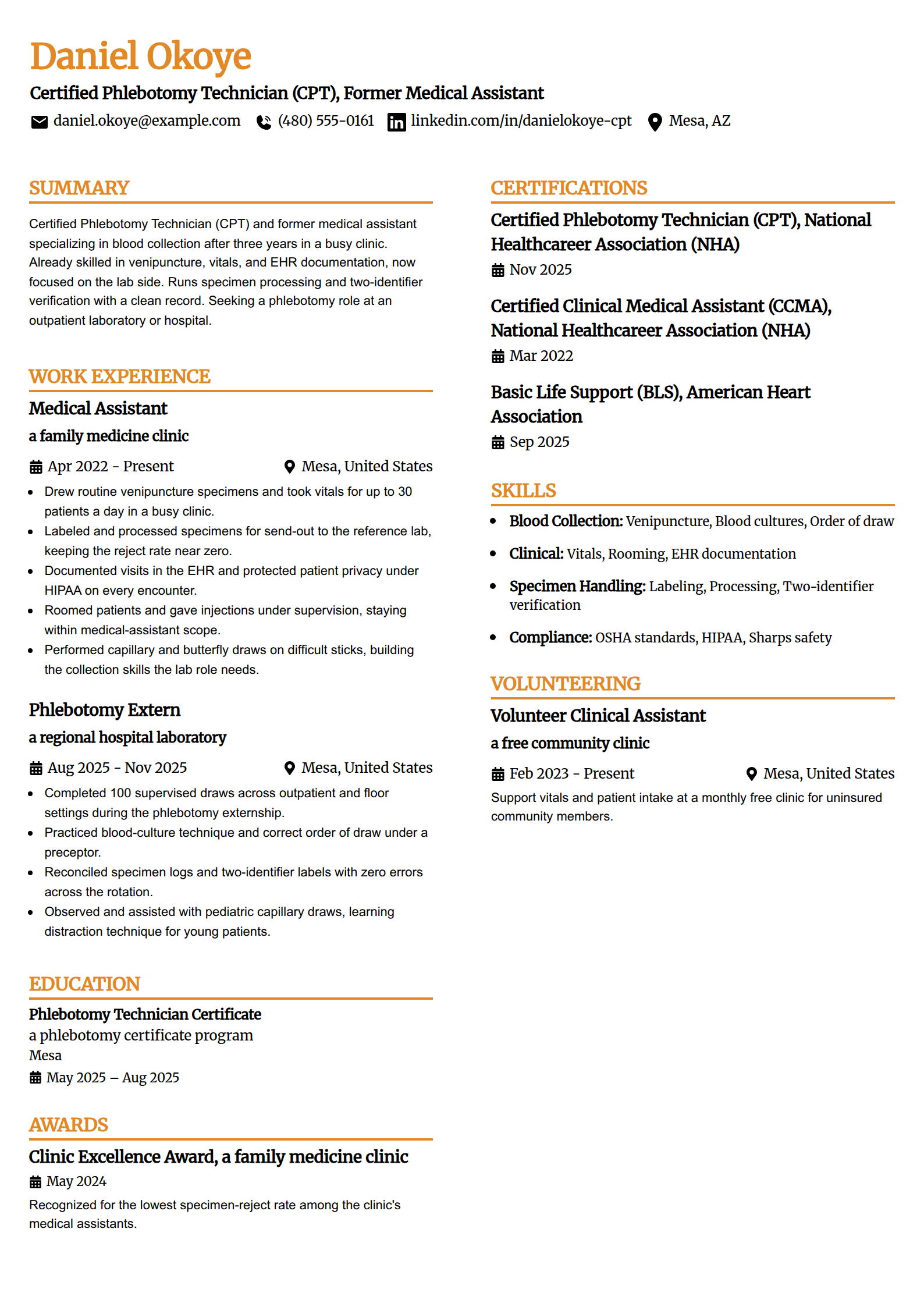
Medical Assistant to Phlebotomist Resume Template
Why this resume example works?
- Written for the MA-to-lab move, leading with the new CPT and three years already drawing in a clinic.
- Shows the head start, routine venipuncture and specimen processing done in a medical-assistant role.
- Keeps scope honest, rooming and injections noted as done under supervision, within MA scope.
- Names blood-culture technique and order of draw practiced during the phlebotomy externship.
- Fills a tight, ATS-safe page with a clinic award and a free-clinic volunteer role.
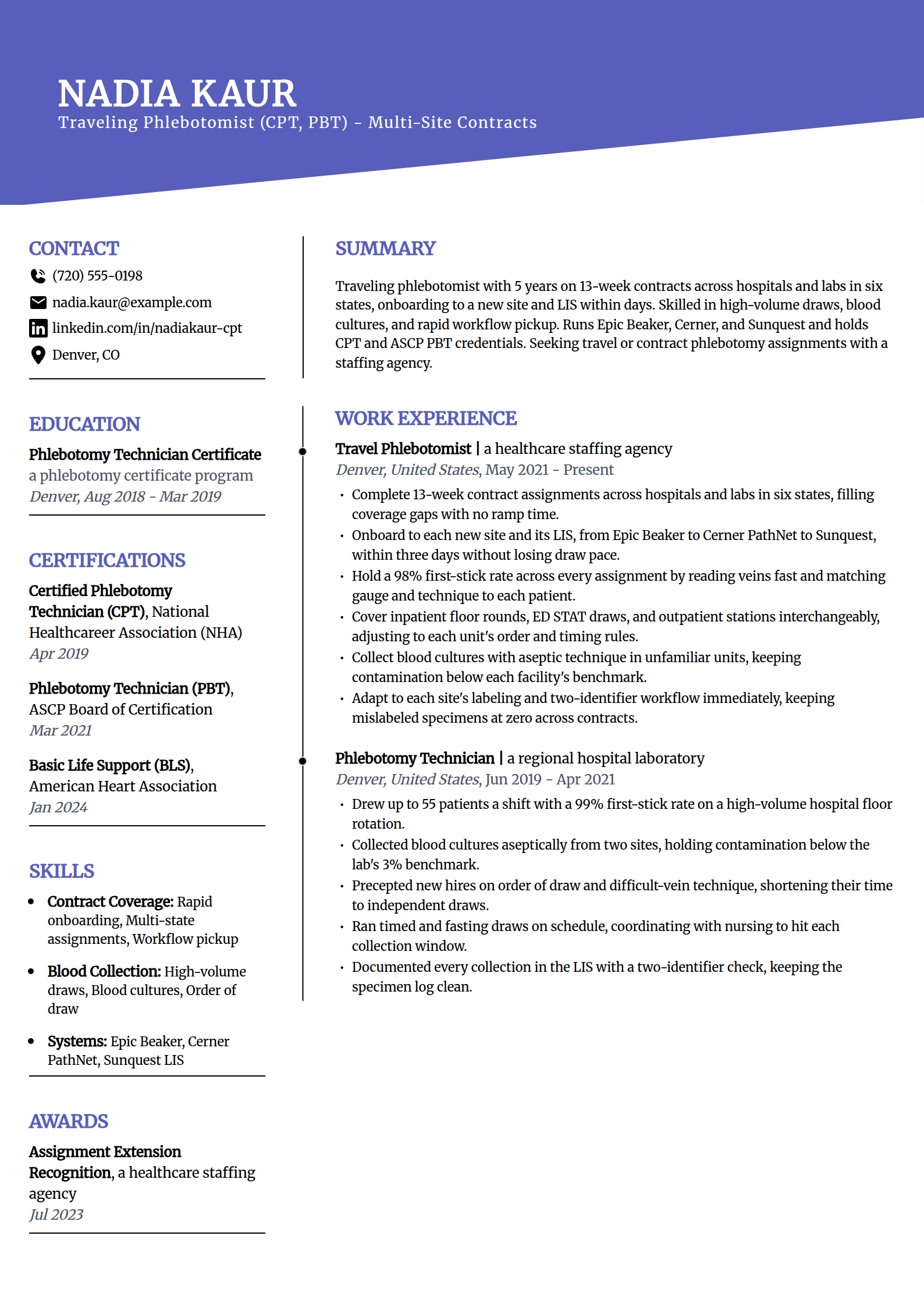
Traveling Phlebotomist Resume Template
Why this resume example works?
- Leads with the strength a travel role rewards, 13-week assignments across six states filling coverage gaps.
- Shows the adaptability that matters, onboarding to a new site and LIS within three days.
- Names multi-LIS fluency, Epic Beaker, Cerner, and Sunquest, that a contract role needs from day one.
- Keeps the first-stick rate front and center, held at 98% across every assignment.
- Lists an award without a long description, keeping the layout clean and balanced.
Build your phlebotomist resume
Pick a template above and the editor keeps your layout clean and ATS-safe while you swap in your own certification, draw volume, and first-stick rate.
Build my resumeHow to write a phlebotomist resume in 2026
A lab manager scans a phlebotomy resume for two things: are you certified, and can you prove clean, high-volume collection. Lead with a short summary or objective that names your CPT credential and your setting, then make every bullet a result with one number, like draws per shift, first-stick rate, or a specimen-reject reduction. Keep the format simple so a parser reads it as easily as a person does.
Lead with a credential summary, or an objective if you are new
If you have a year or more of paid experience, open with a three-to-four-sentence summary that names your CPT credential, your setting, your strongest number, and the role you are targeting. If you are newly certified or still in an externship, use a short objective instead: lead with your certificate and clinical externship hours, since a summary of paid experience you do not have yet reads thin. Keep either to about 60 words so it never spills past the top of the page.
Certified Phlebotomy Technician (CPT) with 3 years drawing across outpatient and hospital settings, averaging 45 patients a shift at a 98% first-stick rate. Skilled in routine, butterfly, and syringe venipuncture, blood-culture collection, and correct order of draw. Documents and labels specimens in Epic Beaker with a two-identifier check on every patient. Seeking a hospital phlebotomy role with a high-volume laboratory.
Make every experience bullet a result with a number
Name the setting or task, the technique, and the outcome, then attach one credible number and the system that produced it. This is what separates a resume that gets a callback from a duty list.
- Use realistic phlebotomy metrics: draws per shift (often 30 to 60 in high-volume settings), first-stick success rate (high-90s is credible; never claim 100%), and specimen-reject reductions.
- Open with a strong verb like drew, collected, salvaged, or reduced, never "Responsible for" or "Helped with".
- Name the method or tool: "cut specimen rejects 30% by tightening labeling and order-of-draw discipline".
- Keep numbers modest and level-accurate: a new grad shows supervised externship draws, an experienced tech shows volume and first-stick; one number per bullet is plenty.
Put your certification and scope where a manager can see them
Your certification is the first thing a lab verifies, so put it by your name and in a certifications block. Get the issuing body and acronym exactly right, and keep every claim inside a phlebotomist's actual scope.
- Name the credential and its issuer: CPT from the NHA, PBT from the ASCP Board of Certification, or RPT from AMT, plus BLS from the AHA.
- If you work in California, Nevada, Louisiana, or Washington, list your state certification or license, since those states require it.
- Stay in scope: phlebotomists draw blood and collect and process specimens; they do not diagnose, interpret results, or administer IV medications, so do not imply otherwise.
- No experience yet? Lead with your certificate program and the number of supervised venipunctures and clinical hours from your externship, and say plainly if you are scheduled to sit for the exam.
Match skills and keywords to the job posting
A skills block should read like the posting, grouped so a recruiter and a parser both find what they need. List the collection skills and systems you have actually used, not a generic dump.
- Group by type: blood collection (venipuncture, butterfly, capillary, heel-stick), specimen handling (order of draw, labeling, centrifugation), aseptic technique (blood cultures), and systems.
- Name the LIS or EHR you run: Epic Beaker, Cerner (Oracle Health) PathNet, or Sunquest.
- Name the setting outright, hospital, outpatient, ER, mobile, donor center, or pediatrics, since managers filter on it.
- If the posting says "order of draw" or "specimen integrity", use that exact phrasing where it fits, since that is what the applicant tracking system searches for.
Keep the format clean and ATS-safe
A phlebotomy resume is read by a parser first and a manager second, so a clean layout with standard headings is the safe choice at every level.
- Use a single-column or simple two-column layout with standard headings a parser recognizes; skip heavy graphics and photos.
- Keep it to one page for under about ten years of experience; most phlebotomists, including new grads, fit a strong record on a single page.
- Save as a PDF so the formatting holds, then run it through our ATS resume checker for a quick format and keyword pass.
- Swap the numbers in the templates above for your own draw volume, first-stick rate, and certifications; do not copy them as is.
Common phlebotomist resume mistakes
- Burying your certification. A lab needs to see your CPT, PBT, or RPT credential and its issuing body in seconds, so put it by your name and in a certifications block, not at the bottom.
- Claiming skills outside a phlebotomist's scope. Do not list diagnosing, interpreting results, or IV therapy; a manager reads that as a scope error and stops trusting the resume.
- Listing duties instead of outcomes. Replace "drew blood from patients" with "drew 45 patients a shift at a 98% first-stick rate with zero mislabeled specimens".
- Skipping metrics because you think phlebotomy has none. Draws per shift, first-stick rate, and specimen-reject reductions are all countable; use realistic figures and never claim a 100% stick rate.
- Writing a summary of experience you do not have. If you are newly certified, use an objective that leads with your certificate and externship hours instead of an empty experience summary.
Frequently asked questions
Do you need to be certified to put phlebotomist on your resume?
Certification is not federally required everywhere, but the large majority of US employers require or strongly prefer it, so lead your resume with your credential. Four states, California, Nevada, Louisiana, and Washington, require state certification or licensure to work as a phlebotomist. The common entry credential is the CPT (Certified Phlebotomy Technician) from the NHA; the ASCP issues the PBT and AMT issues the RPT. Name the credential and its issuing body exactly, and place it by your name and in a certifications block where a lab manager can find it fast.
How do you write a phlebotomist resume with no experience?
Lead with what you do have. Use an objective instead of a summary, and open with your phlebotomy certificate program and the number of supervised venipunctures and clinical hours from your externship. Treat the externship as a real experience entry with quantified bullets, keep the scope honest as supervised work, and pull transferable skills from any customer-service or patient-care background. If you are scheduled to sit for the CPT exam, say so plainly with the date. The entry-level and student examples above show the shape.
What skills should you put on a phlebotomist resume?
Match the posting, then name specific collection skills and systems grouped by type: blood collection (routine, butterfly, and syringe venipuncture, capillary and heel-stick draws), specimen handling (correct order of draw, labeling, processing, centrifugation), aseptic technique (blood-culture collection), and patient identification with two identifiers. Add the LIS or EHR you run, like Epic Beaker, Cerner PathNet, or Sunquest, and the compliance basics: the OSHA Bloodborne Pathogen Standard, sharps safety, and HIPAA. List what you have actually done and mirror the posting's phrasing, since that is what the applicant tracking system searches for.
What certifications matter for a phlebotomist and who issues them?
The most common entry credential is the CPT (Certified Phlebotomy Technician) from the NHA (National Healthcareer Association). The ASCP Board of Certification issues the PBT (Phlebotomy Technician), and AMT (American Medical Technologists) issues the RPT (Registered Phlebotomy Technician). Most employers also want current BLS or CPR from the American Heart Association. Name the issuing body and the acronym exactly, and if you work in California, Nevada, Louisiana, or Washington, add your required state certification or license.
How long is phlebotomy school and what is the entry path?
Phlebotomy is a postsecondary nondegree certificate program, not a degree, and most programs run about four to eight months including a required clinical externship with a set number of supervised venipunctures and hours. Some accelerated programs run shorter. Most programs prepare you to sit for the NHA CPT exam. On your resume, list the certificate program and, while you are still in it, the externship hours you have completed and your scheduled exam date.
Should a phlebotomist resume be one page, and what metrics should you include?
One page is right for most phlebotomists with under about ten years of experience, including new grads and career changers; two pages are acceptable for a lead, multi-site, or long hospital record when the second page carries results, not filler. Quantify with realistic figures: draws per shift or day (often 30 to 60 in high-volume settings), first-stick success rate (high-90s is credible, never 100%), daily patient volume, and any specimen-reject or wait-time reductions. One number per bullet is plenty.
More phlebotomist resume resources
Build your phlebotomist resume
Pick a template above and the editor keeps your layout clean and ATS-safe while you swap in your own certification, draw volume, and first-stick rate.