16 CNA Resume Examples, New Grad to Medication Aide
- ATS Friendly
- CNA Specific
- 16 Real Examples
A CNA resume is read fast, so it has to show your certification, your patient load, and the bedside skills a unit needs at a glance. Pick a clean layout below, then model your own on a real example built for your setting, from a no-experience new grad to a hospital, hospice, or memory care aide. Every example stays inside CNA scope so a nurse reviewer trusts it.


540k+ resumes created
Editable CNA resume templates
Each template below is a real certified nursing assistant resume laid out in that format, sorted by setting and experience level. Choose one, then swap in your own patient load, certifications, and the EHR your unit runs. Every layout keeps your name, CNA certification, and dates clean so a charge nurse or hiring manager reads your experience at a glance and an applicant tracking system parses it without trouble.
Entry-Level CNA Resume Template (No Experience)
Why this resume example works?
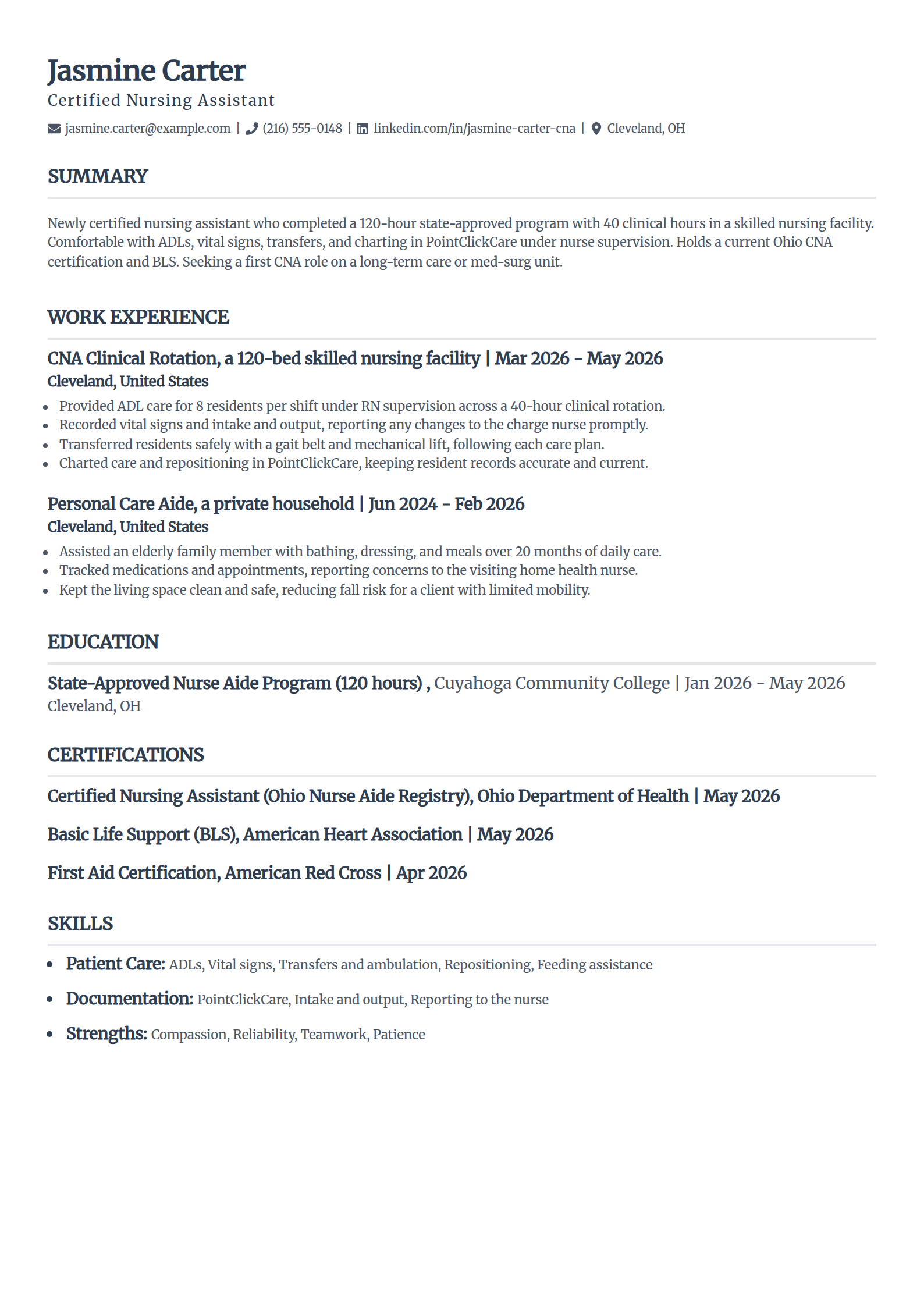
- Written for a first CNA job, it leads with a 120-hour state-approved program and 40 clinical hours instead of paid years.
- Names the bedside skills a unit expects, ADLs, vital signs, transfers, and PointClickCare charting, all under nurse supervision.
- Turns a personal caregiving stretch into real experience without overstating it past CNA scope.
- Lists the credentials a screener checks first, an Ohio CNA certification, BLS, and First Aid.
- Uses a tight, ATS-safe single-column layout that fills the page cleanly without padding.
New CNA Graduate Resume Template
Why this resume example works?
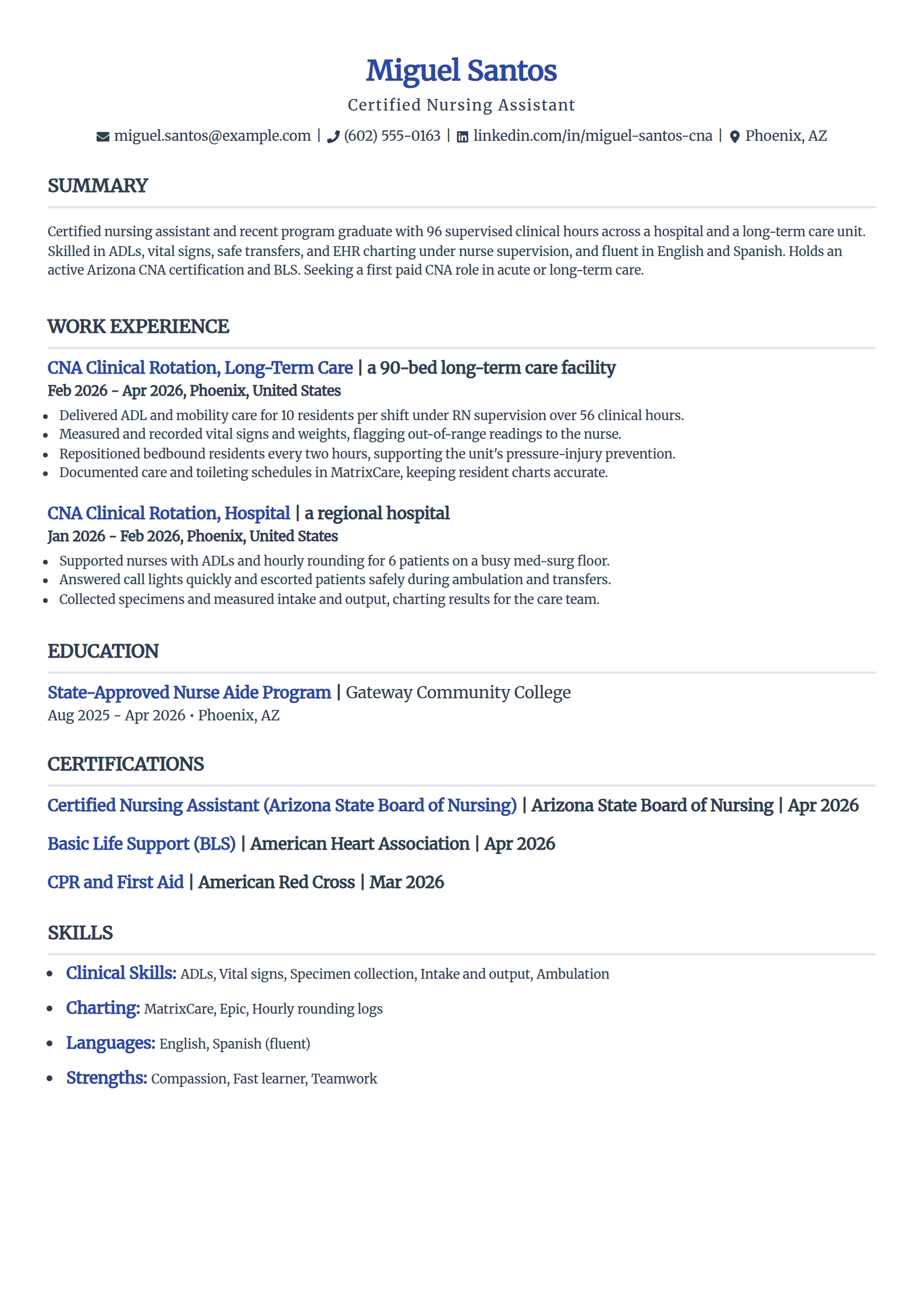
- Built for a recent program graduate, it leads with 96 supervised clinical hours across a hospital and a long-term care unit.
- Shows real bedside tasks from clinicals, ADLs, vital signs, repositioning, and MatrixCare charting under RN supervision.
- Adds a bilingual skill (English and Spanish) that a busy unit values, without inflating the record.
- States the Arizona CNA certification and BLS up front, the two credentials a posting screens for.
- Keeps a plain, parser-friendly layout that reads cleanly for a new candidate with no paid years.
Experienced CNA Resume Template
Why this resume example works?
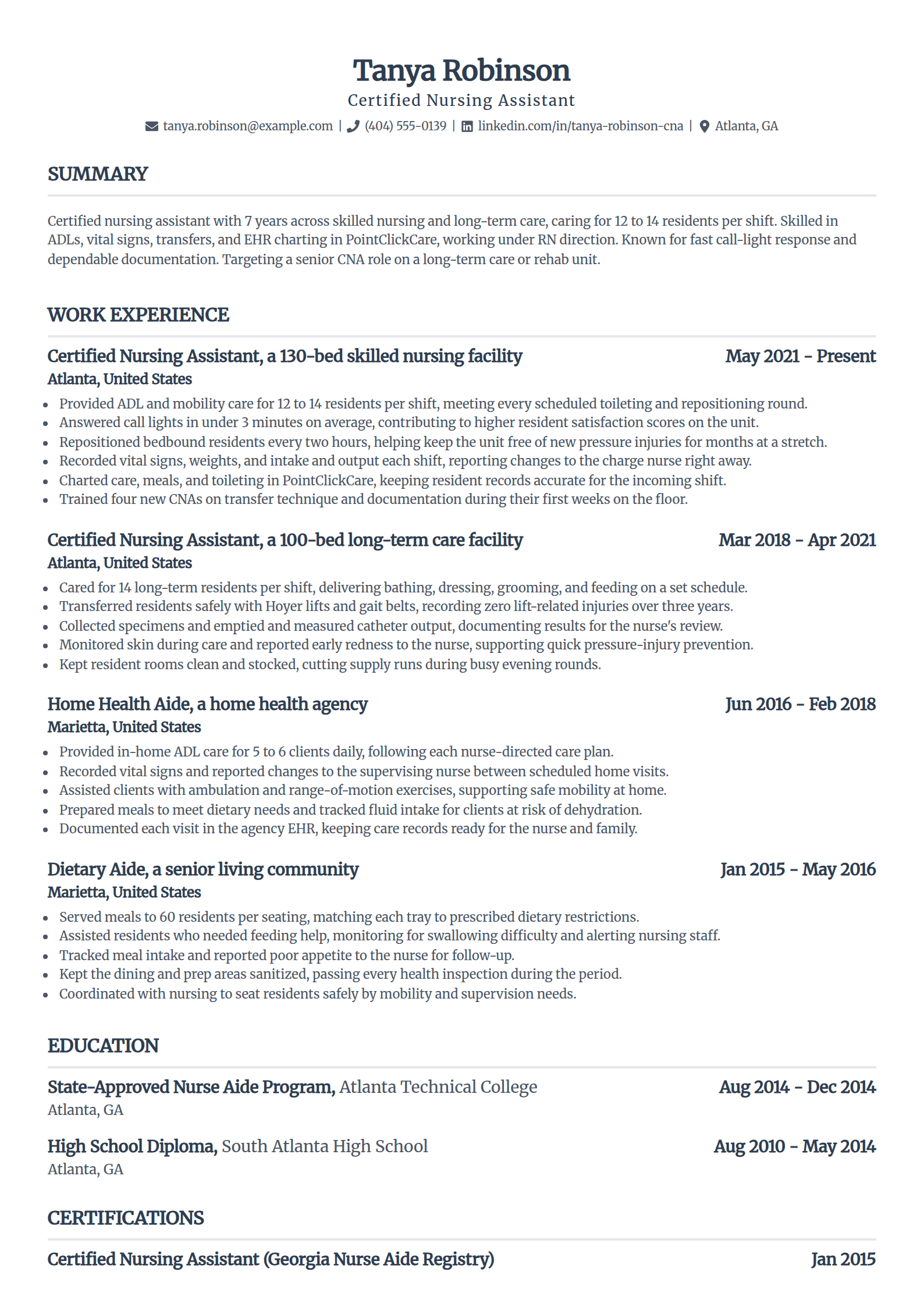
- Opens with a summary that names 7 years and a 12-to-14 resident load per shift, the number a manager reads first.
- Leads each bullet with a strong verb and one modest number, like answering call lights in under 3 minutes.
- Keeps every task in CNA scope, ADLs, vitals, transfers, catheter output, and reporting to the nurse.
- Names the systems a unit runs on, PointClickCare and MatrixCare, as applicant-tracking keywords.
- Uses a clean single-column layout that carries a full seven-year history on one page.
Hospital & Acute-Care CNA Resume Template
Why this resume example works?
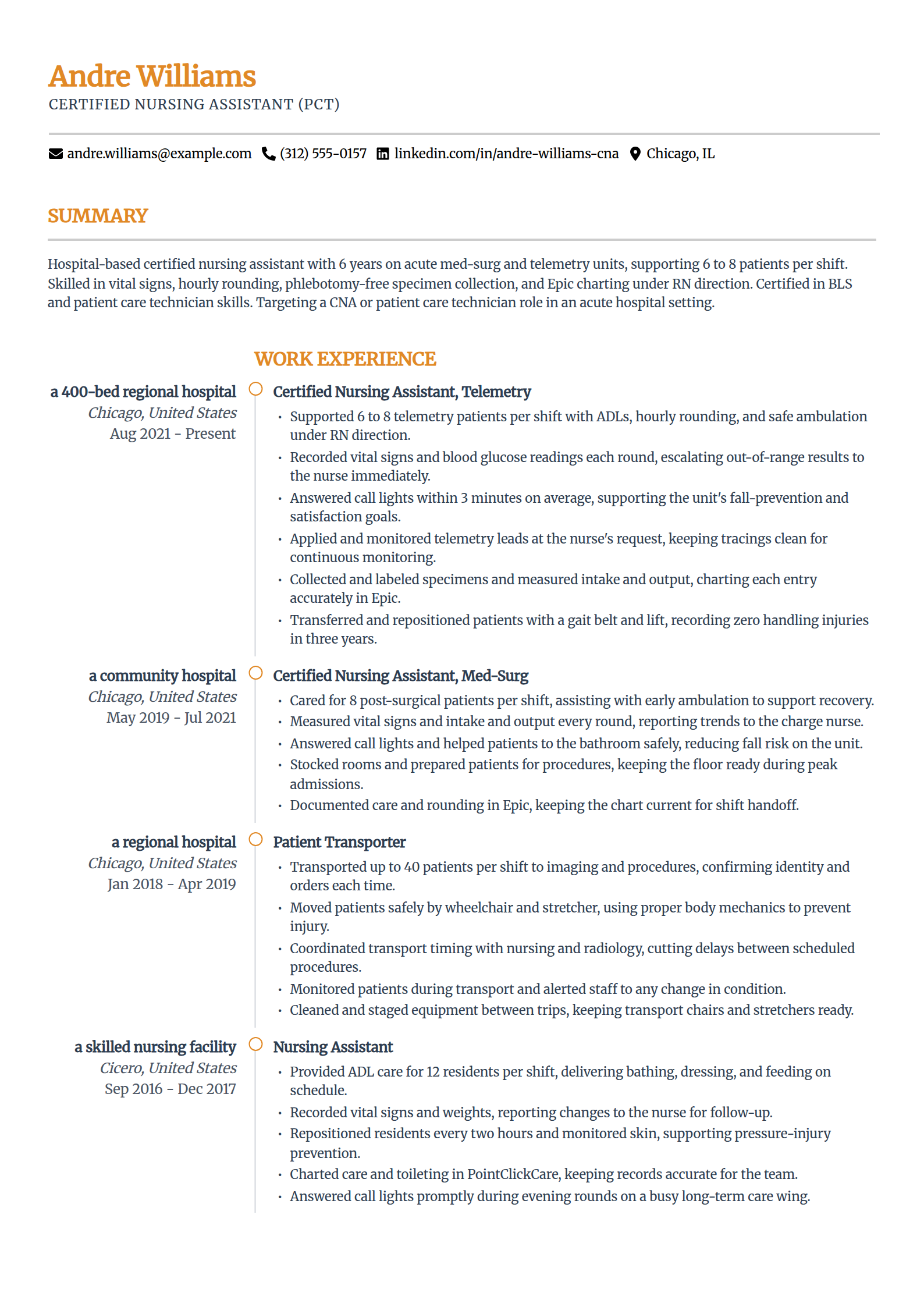
- Frames an acute-care aide up top, 6 years on telemetry and med-surg supporting 6 to 8 patients per shift.
- Shows acute tasks a hospital expects, hourly rounding, blood glucose checks, and telemetry lead placement at the nurse's request.
- Names Epic charting and specimen collection, the daily workflow of a hospital patient care technician.
- Backs the role with a CPCT/A patient care technician credential alongside the state CNA and BLS.
- Uses a modern layout that carries a deep acute-care history on one clean page.
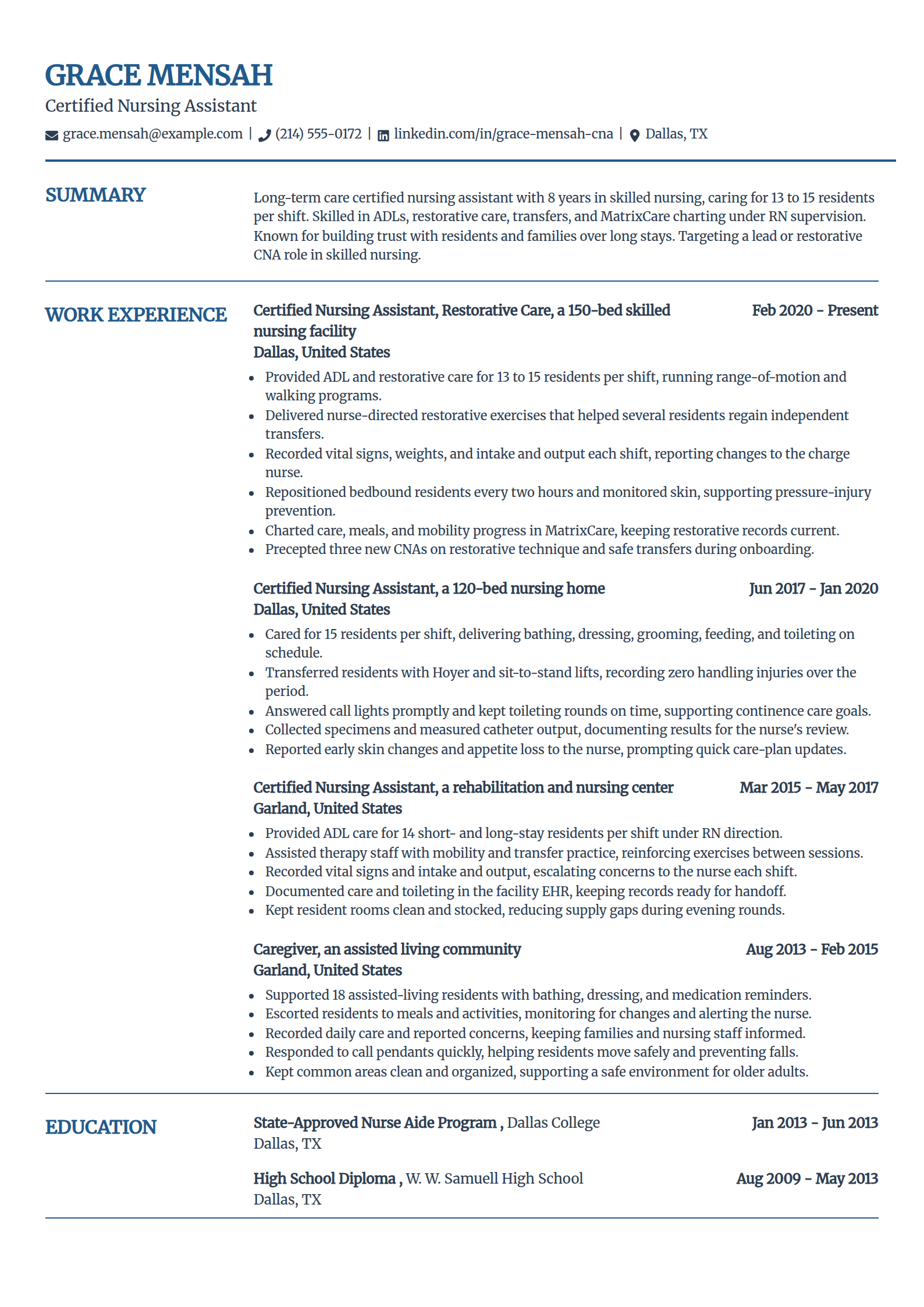
Long-Term Care CNA Resume Template
Why this resume example works?
- Leads with the long-term care load firms hire for, 13 to 15 residents per shift over 8 years in skilled nursing.
- Shows restorative work an interviewer values, running range-of-motion programs that helped residents regain transfers.
- Keeps every bullet in scope, ADLs, continence care, transfers, and skin checks under RN supervision.
- Names the credential and system up front, a Restorative Nursing Assistant certificate and MatrixCare.
- Uses a clean, modern layout that fits a dense long-term care history on one page.
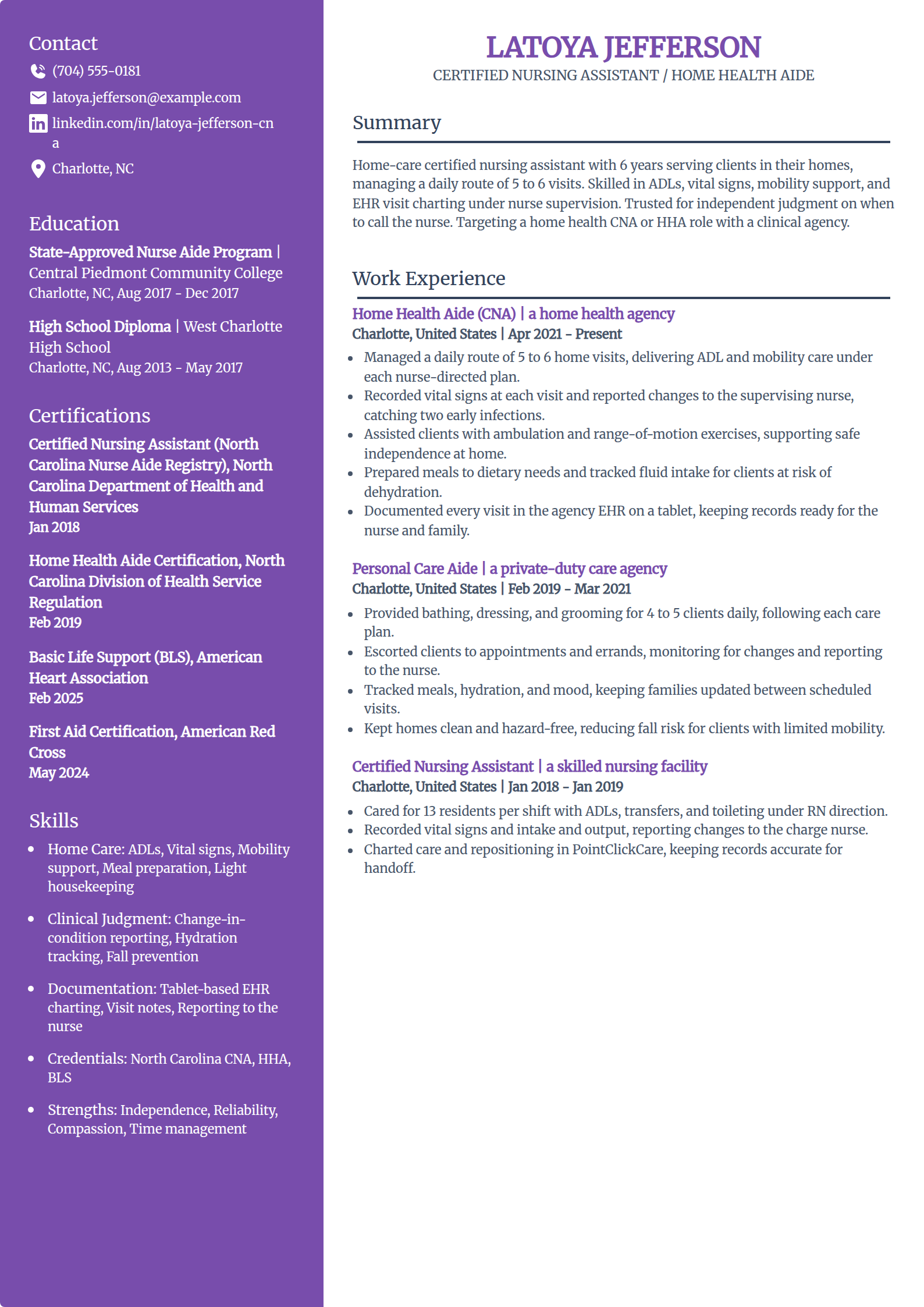
Home Health CNA Resume Template
Why this resume example works?
- Opens with home-care scope, a daily route of 5 to 6 visits over 6 years under nurse-directed care plans.
- Shows the independent judgment home care needs, catching two early infections and reporting them to the nurse.
- Keeps tasks in scope, ADLs, vital signs, mobility support, and tablet-based EHR visit charting.
- Names the North Carolina CNA and HHA credentials that a home health agency requires.
- Uses a Medium layout that fits a six-year home-care record without empty space.
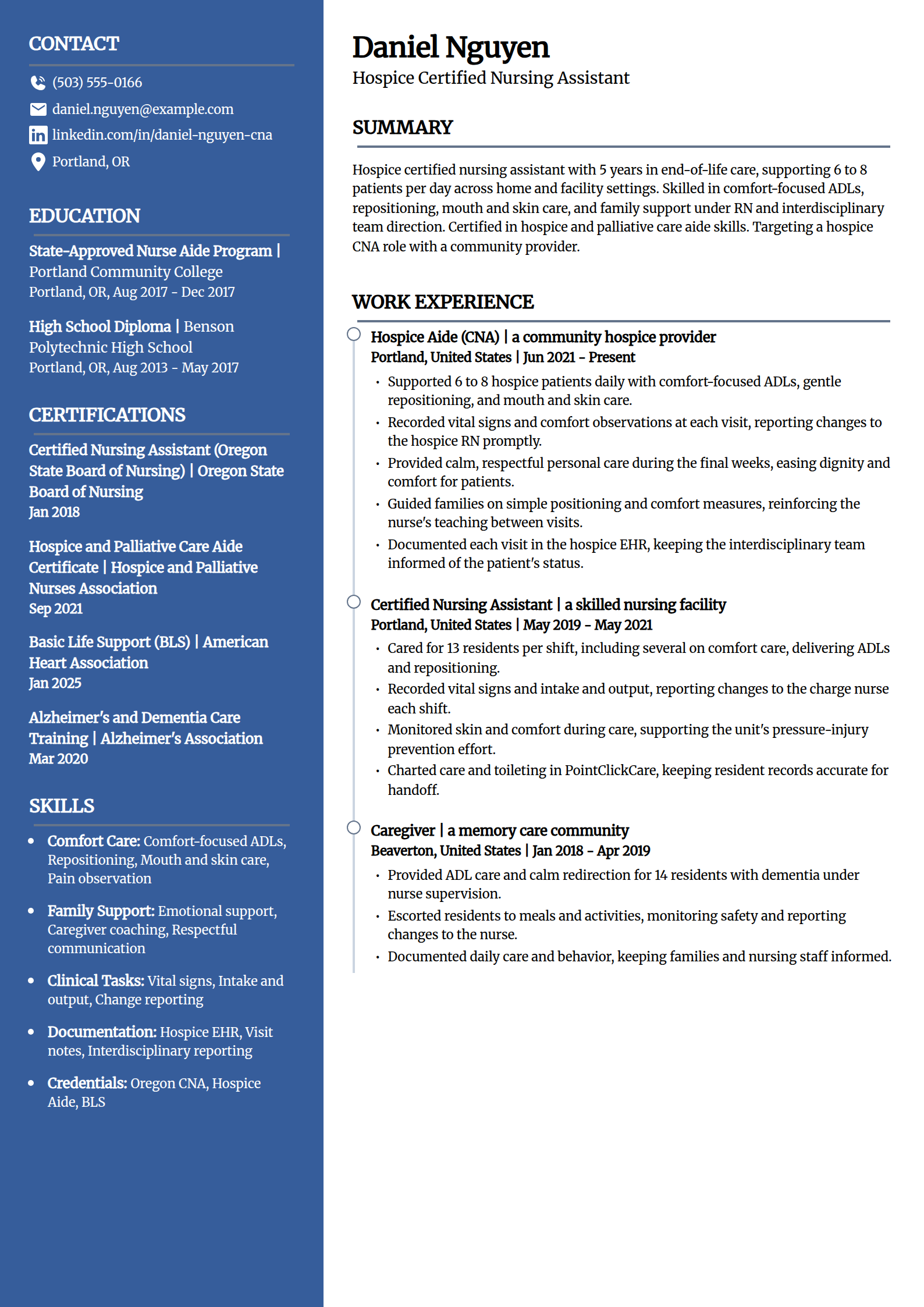
Hospice CNA Resume Template
Why this resume example works?
- Leads with hospice scope, 5 years supporting 6 to 8 patients a day with comfort-focused ADLs and mouth and skin care.
- Shows the family support hospice depends on, coaching relatives on simple comfort measures between nurse visits.
- Keeps every task in scope, gentle repositioning and comfort observations reported to the hospice RN.
- Backs the role with a Hospice and Palliative Care Aide certificate that fits the setting.
- Uses a distinctive layout that still reads cleanly for a hiring nurse.
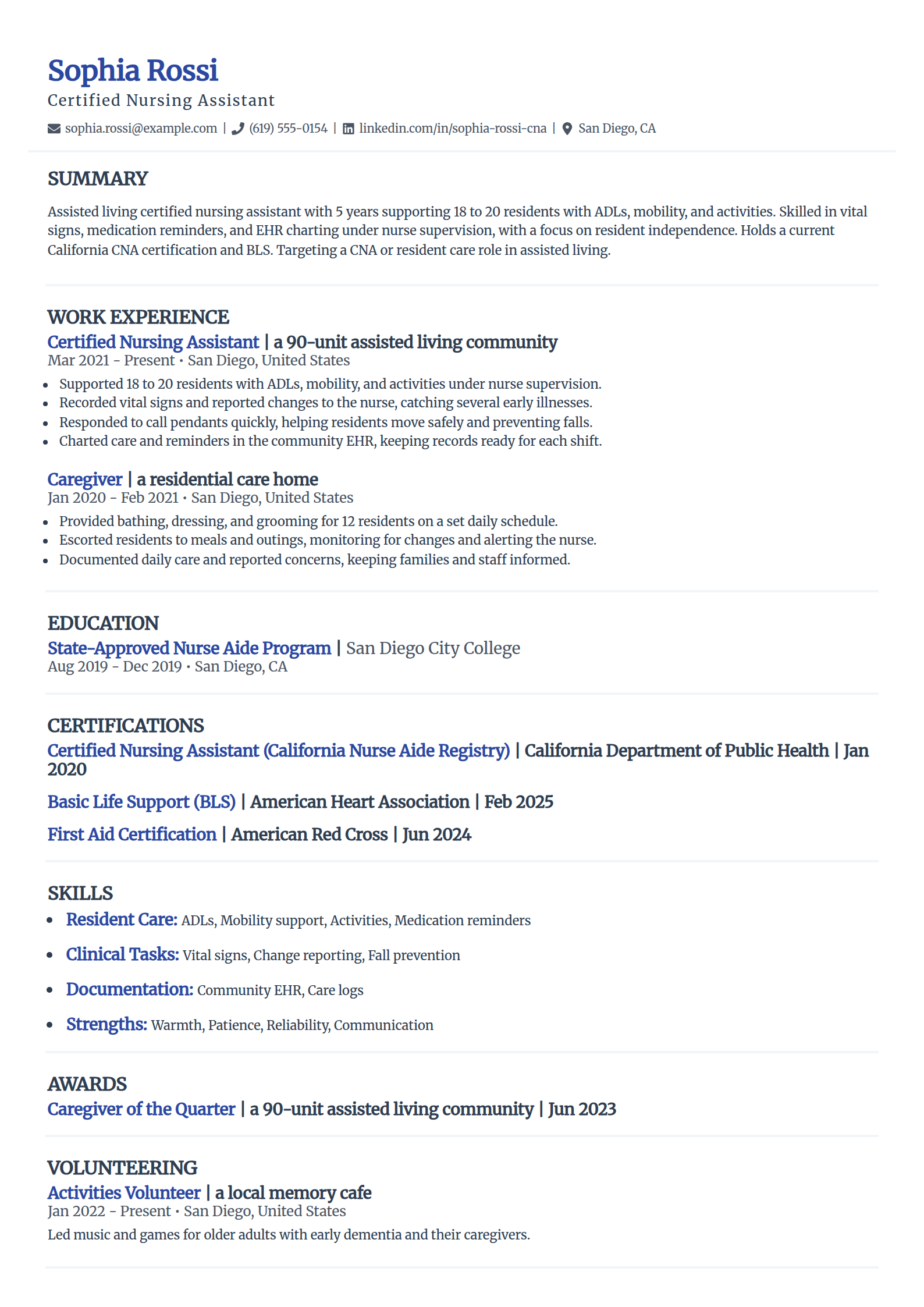
Assisted Living CNA Resume Template
Why this resume example works?
- Frames assisted living scope, 5 years supporting 18 to 20 residents with ADLs, mobility, and activities.
- Keeps medication work honest, giving reminders only, never administering, which stays inside plain CNA scope.
- Shows fall prevention a community values, responding to call pendants quickly to keep residents safe.
- Lists the California CNA and BLS credentials a posting screens for, with a caregiver award in the sidebar.
- Uses a refined, uncluttered layout that fits a five-year record on one clean page.
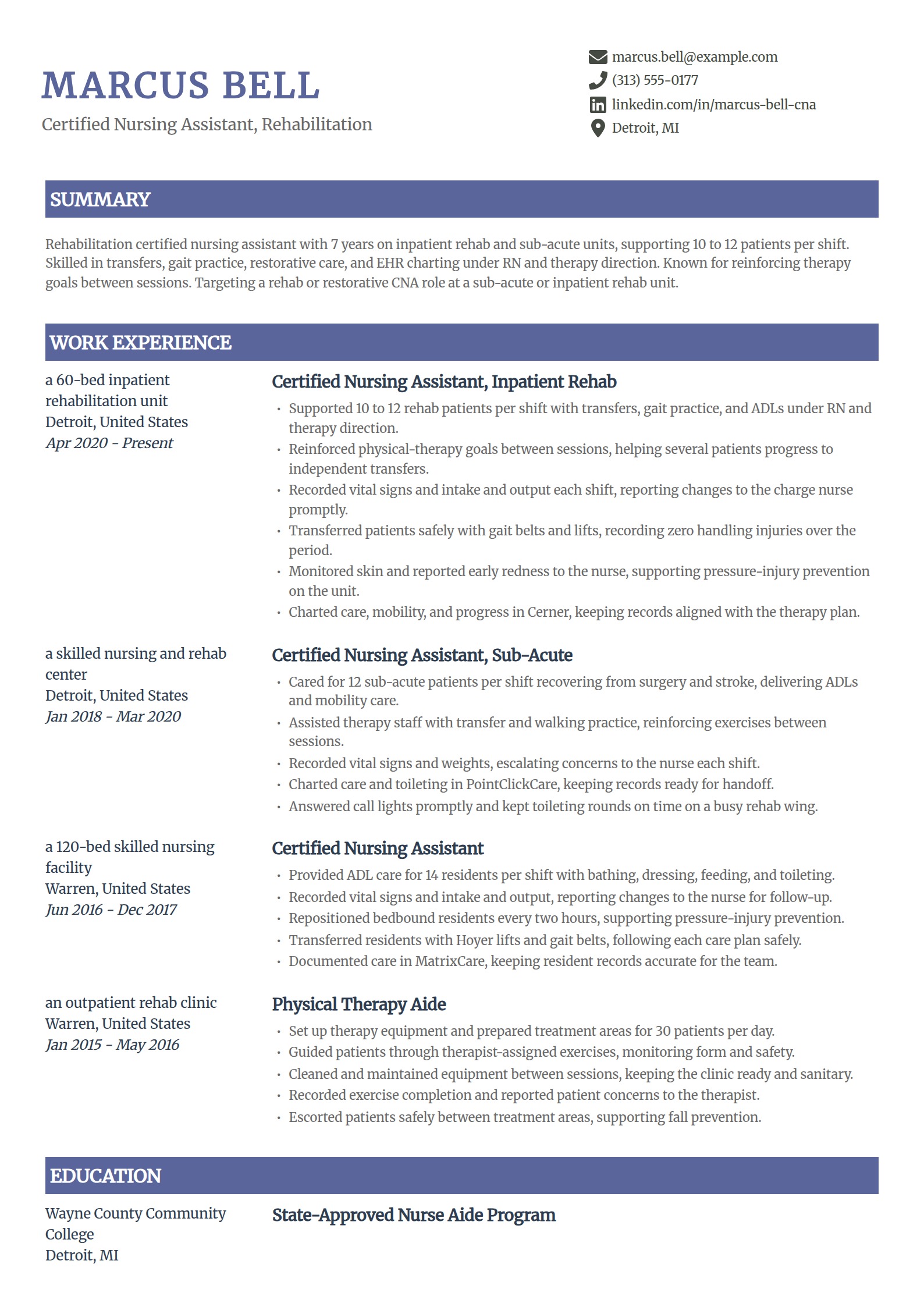
Rehabilitation CNA Resume Template
Why this resume example works?
- Opens with rehab scope, 7 years on inpatient rehab and sub-acute units supporting 10 to 12 patients per shift.
- Shows the therapy-support work a rehab unit needs, reinforcing PT goals that helped patients reach independent transfers.
- Keeps tasks in scope, gait practice, transfers, restorative care, and Cerner charting under RN and therapy direction.
- Backs the role with a Restorative Nursing Assistant certificate that fits the rehab setting.
- Fills a visually rich two-column layout while staying easy to skim in one pass.
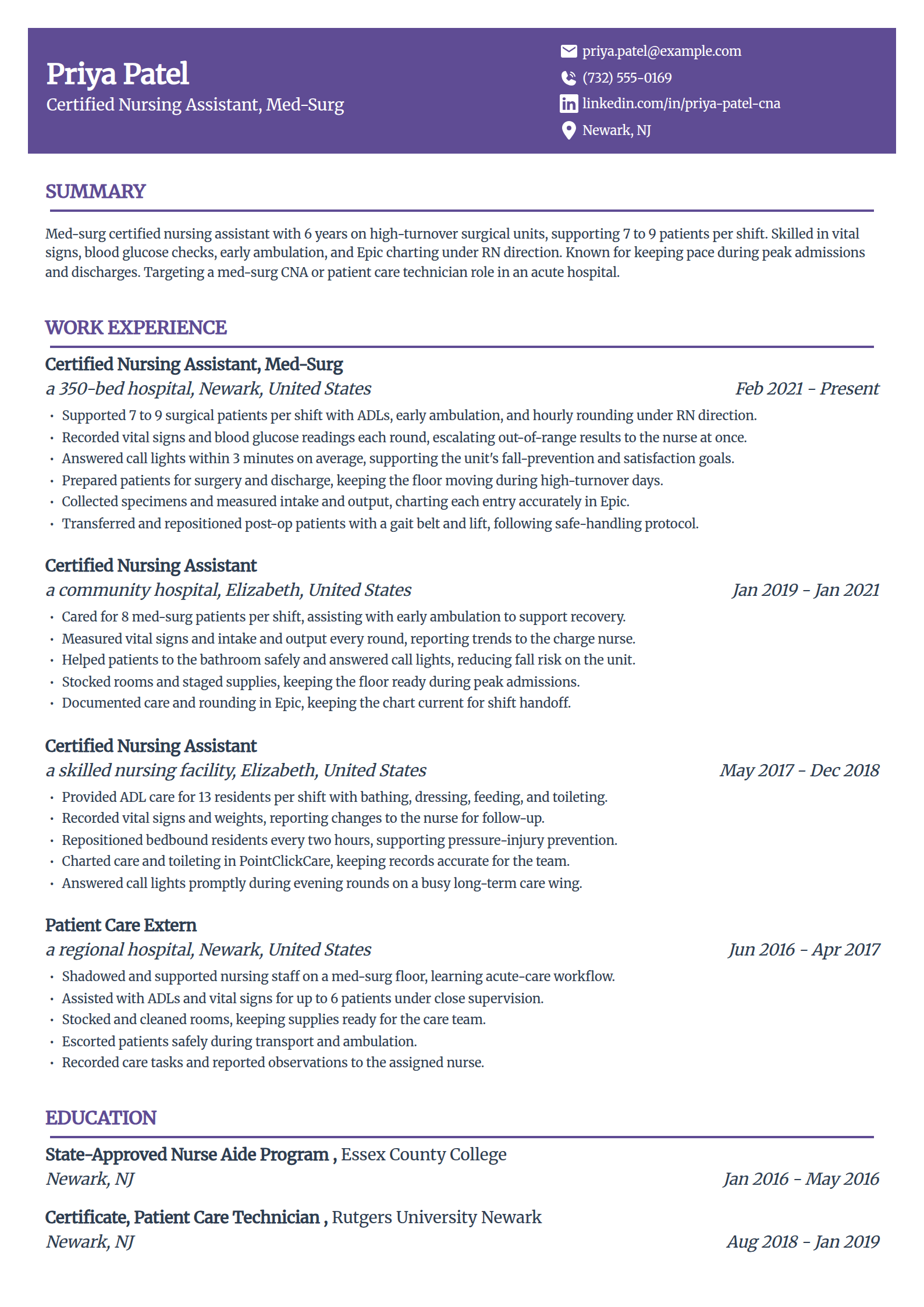
Med-Surg CNA Resume Template
Why this resume example works?
- Frames med-surg scope, 6 years on high-turnover surgical units supporting 7 to 9 patients per shift.
- Shows the pace a surgical floor needs, prepping patients for surgery and discharge during high-turnover days.
- Keeps tasks in scope, vital signs, blood glucose checks, early ambulation, and Epic charting under RN direction.
- Names a CPCT/A credential and specimen collection, the workflow a hospital posting lists.
- Uses a modern layout that carries a busy acute-care history on one clean page.
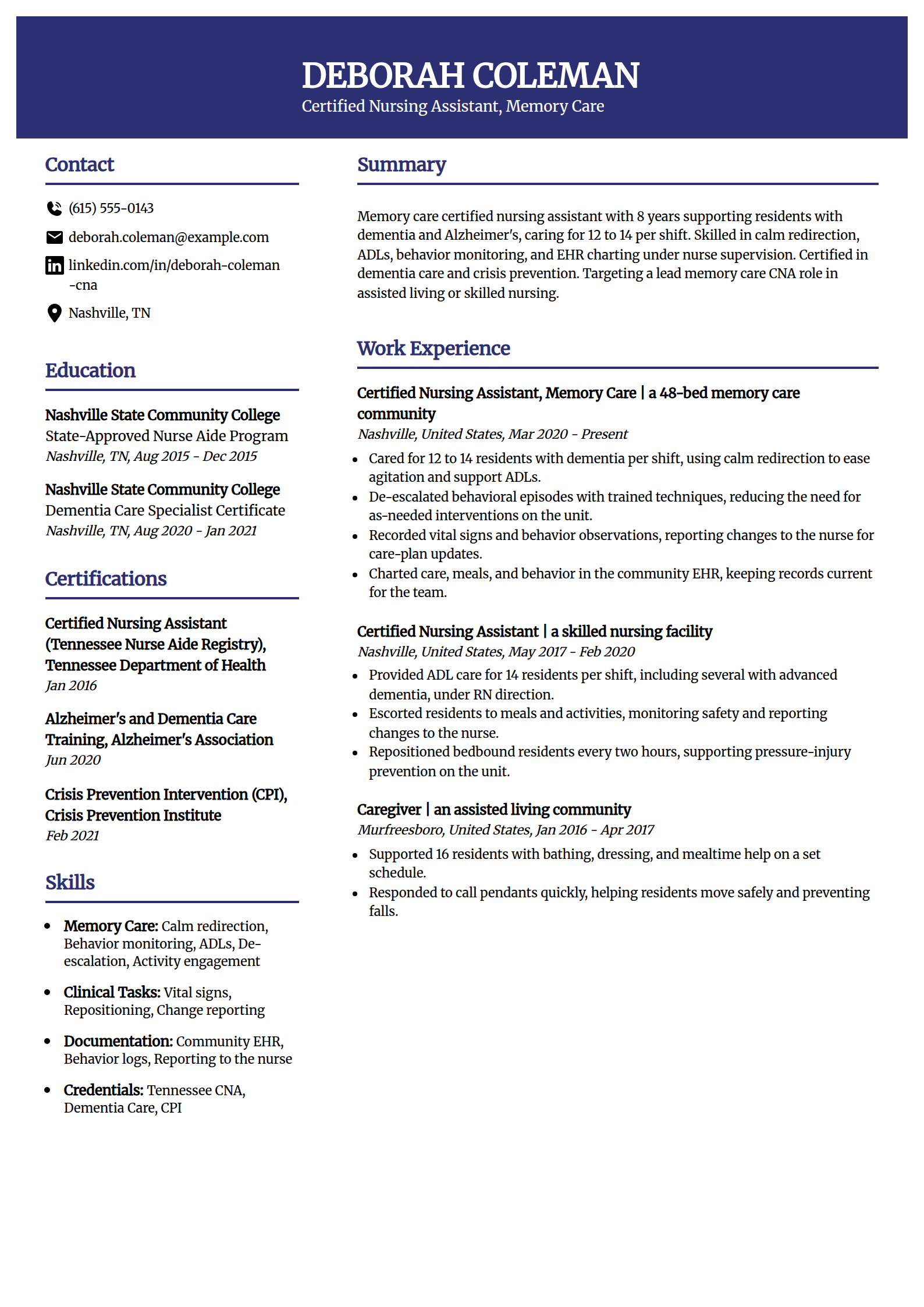
Memory Care & Dementia CNA Resume Template
Why this resume example works?
- Leads with memory care scope, 8 years supporting 12 to 14 residents with dementia and Alzheimer's per shift.
- Shows the de-escalation a memory unit needs, using calm redirection to ease agitation and reduce as-needed interventions.
- Keeps tasks in scope, ADLs, behavior monitoring, and repositioning with changes reported to the nurse.
- Backs the role with dementia care training and Crisis Prevention Intervention (CPI) credentials.
- Uses a roomy two-column layout with the sidebar filled so the page reads complete.
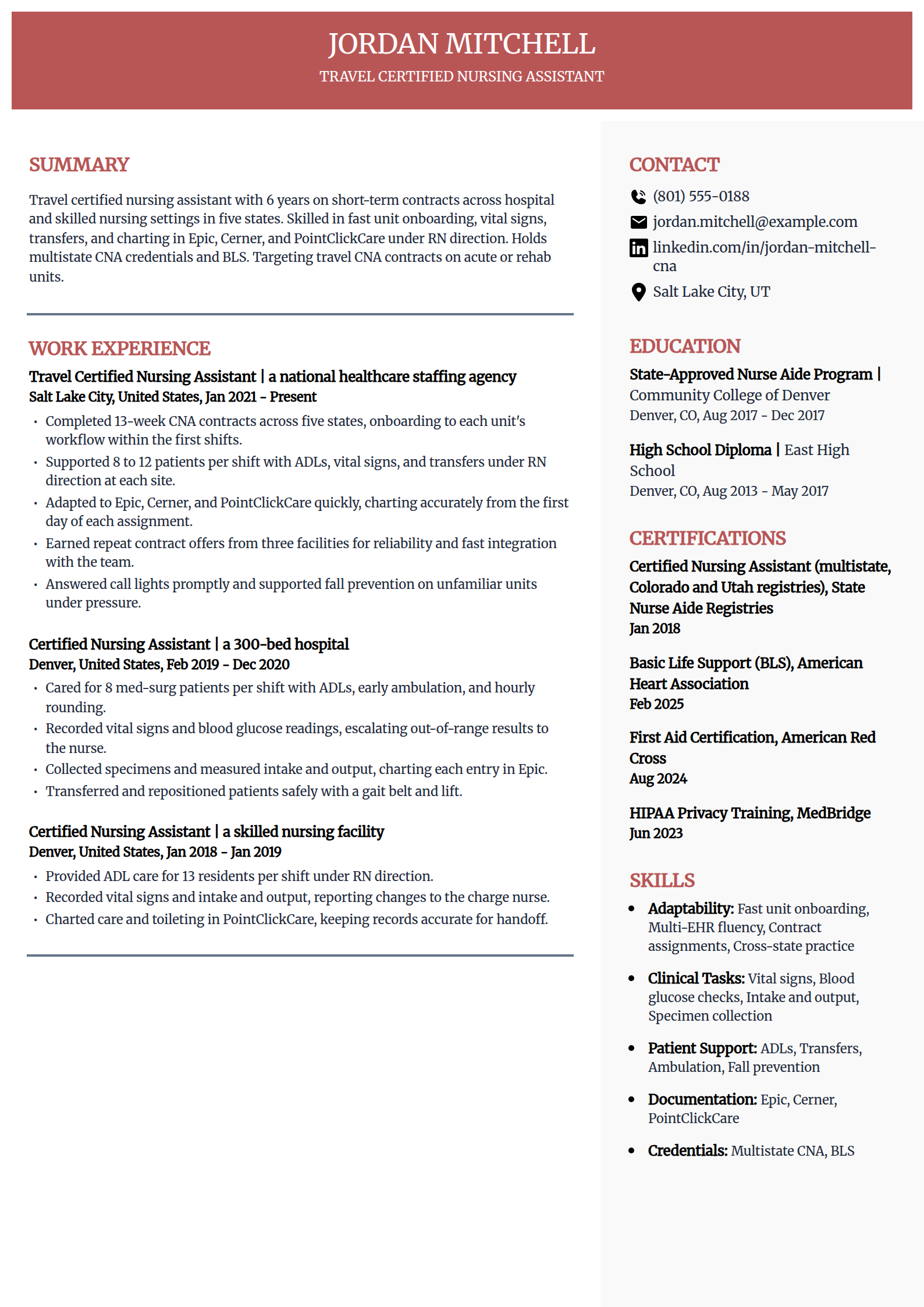
Travel CNA Resume Template
Why this resume example works?
- Opens with travel scope, 6 years of 13-week contracts across five states in hospital and skilled nursing settings.
- Shows the adaptability agencies want, onboarding to each unit's workflow within the first shifts.
- Names multi-EHR fluency, Epic, Cerner, and PointClickCare, the systems a travel contract expects.
- Keeps tasks in scope, ADLs, vital signs, and transfers under RN direction at every site.
- Uses a refined, executive layout that fits a multi-contract record cleanly.
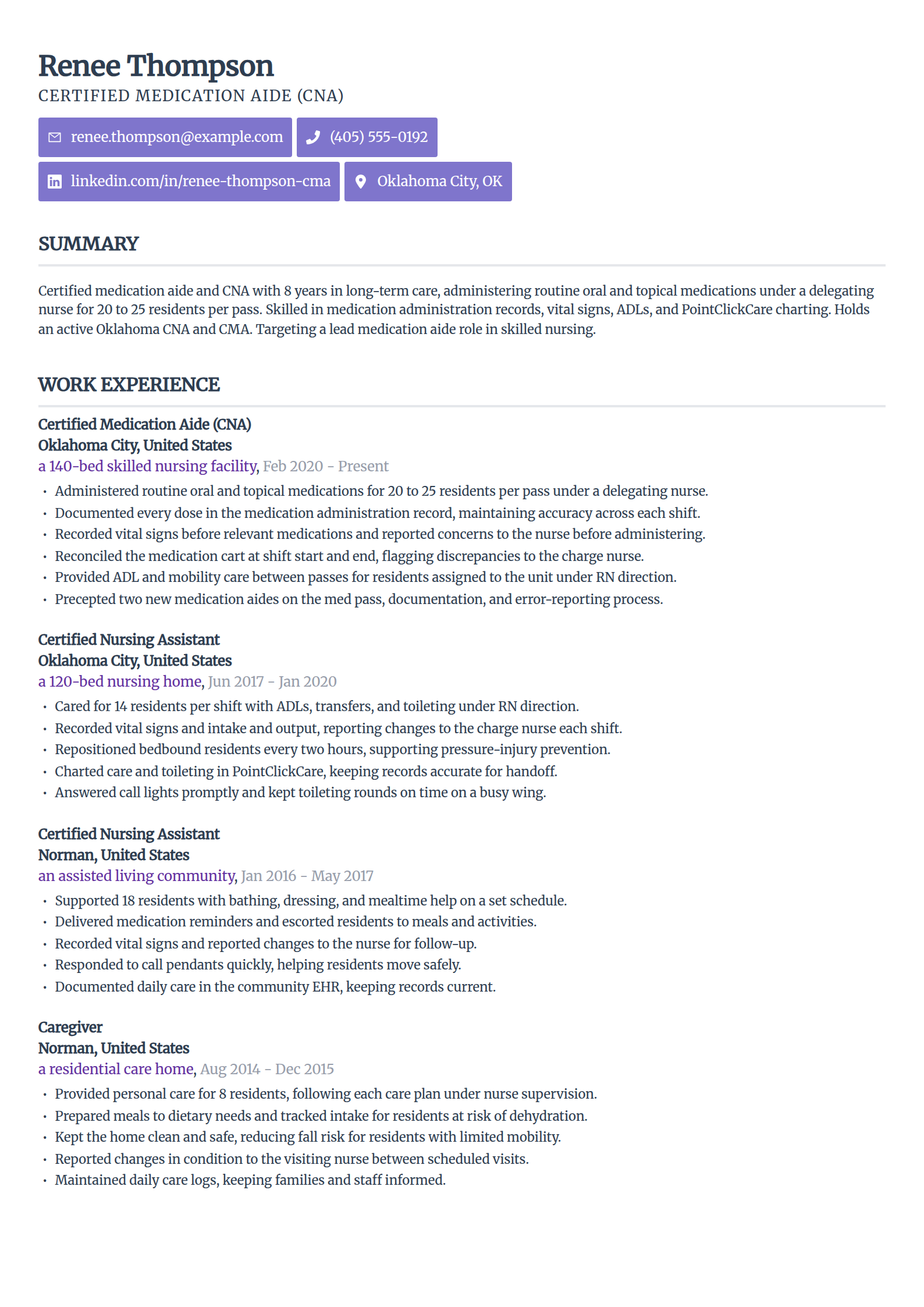
Certified Medication Aide Resume Template
Why this resume example works?
- Frames medication aide scope precisely, administering routine oral and topical meds for 20 to 25 residents under a delegating nurse.
- Shows the accuracy a med pass needs, documenting every dose in the MAR and reconciling the cart each shift.
- Is the one example that gives medications, and it states the delegating-nurse supervision that makes it legal.
- Names the Oklahoma CNA and Certified Medication Aide credentials that the role requires.
- Uses a clean, modern layout that carries a dense long-term care history on one page.
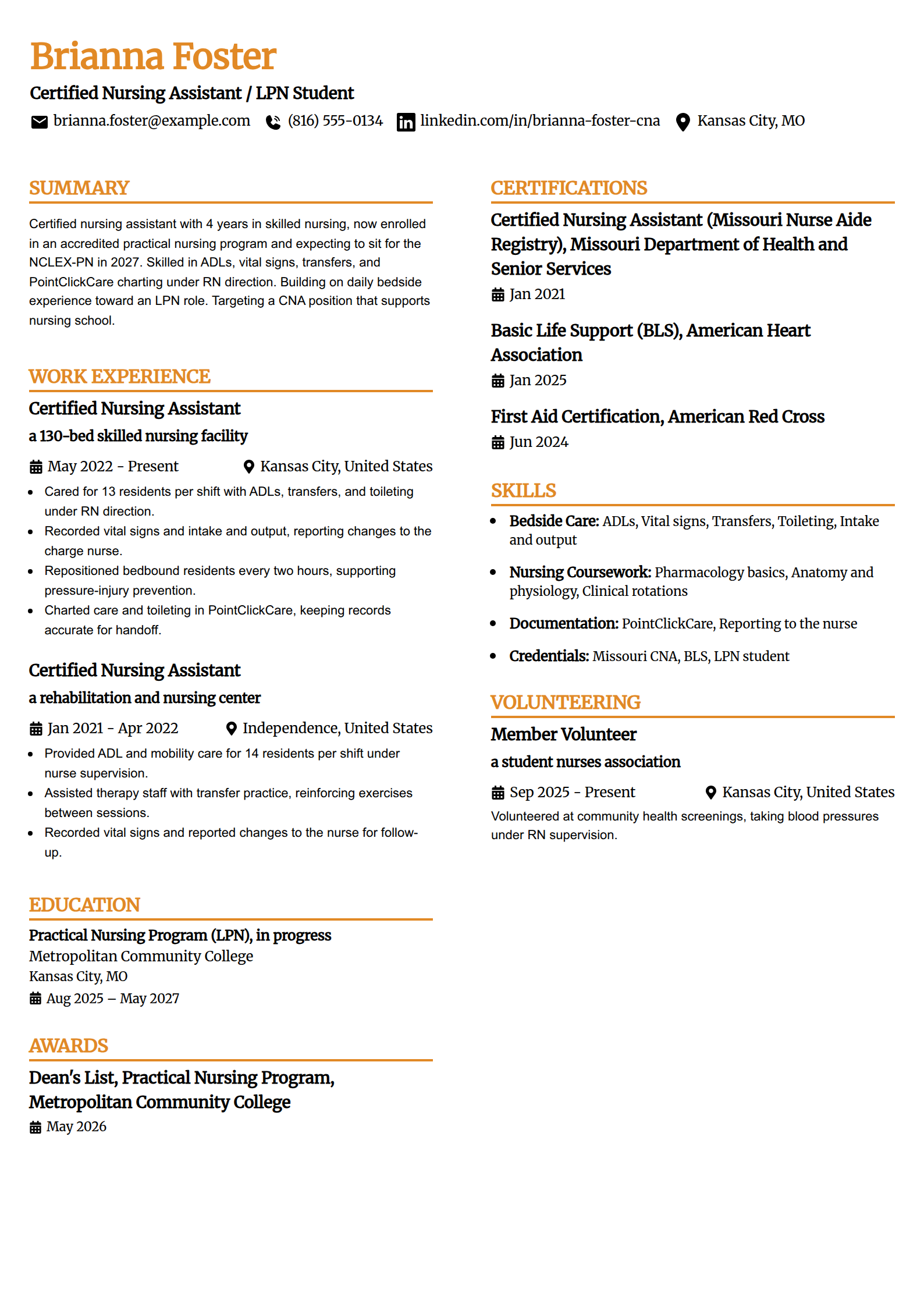
CNA-to-LPN Career-Change Resume Template
Why this resume example works?
- Names the move openly, a working CNA now in an accredited practical nursing program, scheduled to sit for the NCLEX-PN in 2027.
- Keeps the credential phrasing precise, stating the exam on a date rather than claiming a license not yet earned.
- Shows current bedside experience, 4 years of ADLs, vitals, and transfers under RN direction, as the base for an LPN role.
- Adds nursing coursework and a student association role that show recent commitment without overstating scope.
- Uses a tight, ATS-safe layout that fits a focused four-year record without empty space.
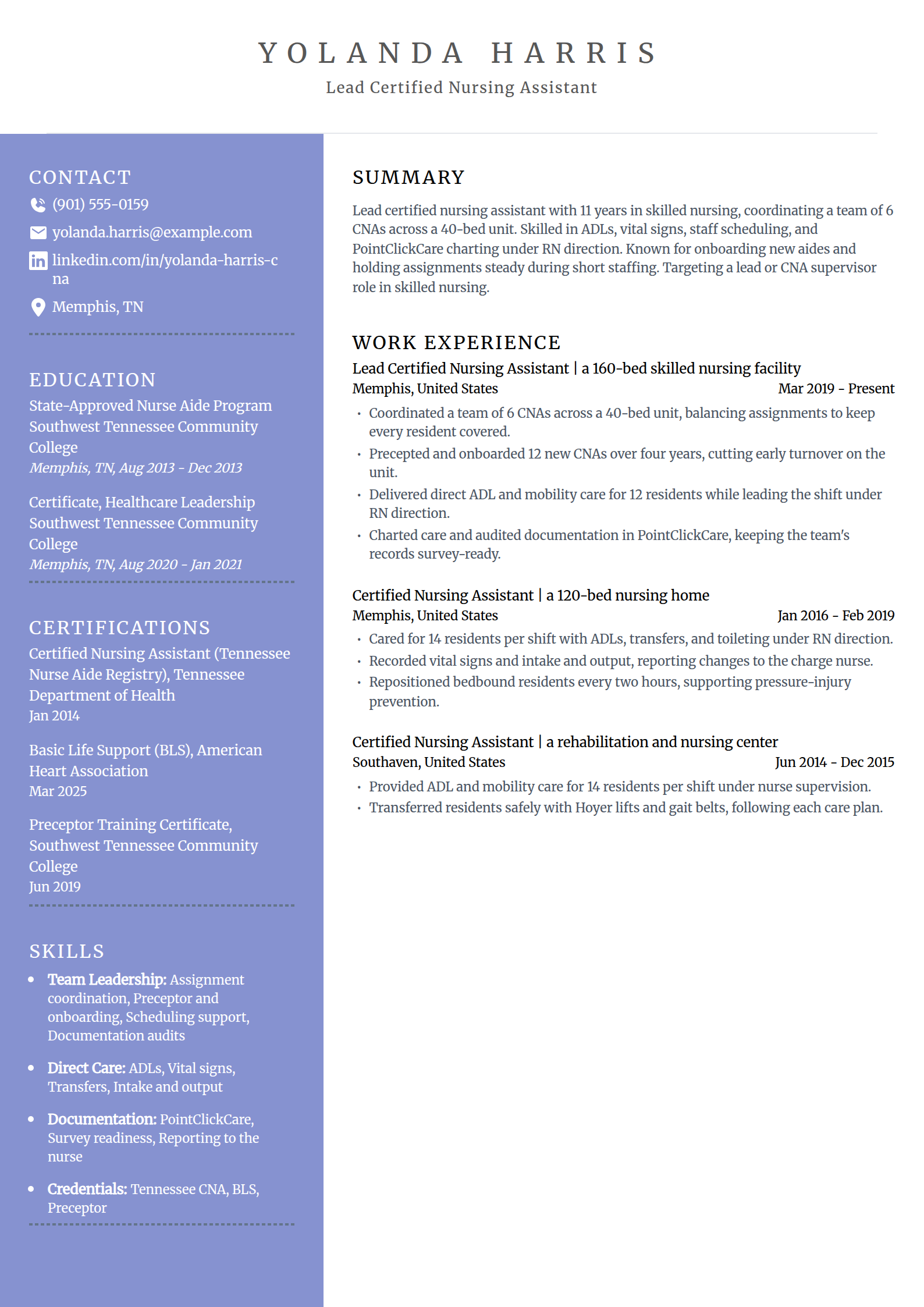
Senior & Lead CNA Resume Template
Why this resume example works?
- Leads with lead scope, 11 years coordinating a team of 6 CNAs across a 40-bed unit under RN direction.
- Turns experience into leadership, precepting 12 new CNAs and cutting early turnover on the unit.
- Keeps hands-on care visible, delivering direct ADLs for 12 residents while leading the shift.
- Names the survey-readiness work a facility values, auditing documentation in PointClickCare.
- Uses a roomy layout with a filled sidebar so a senior record still looks complete.
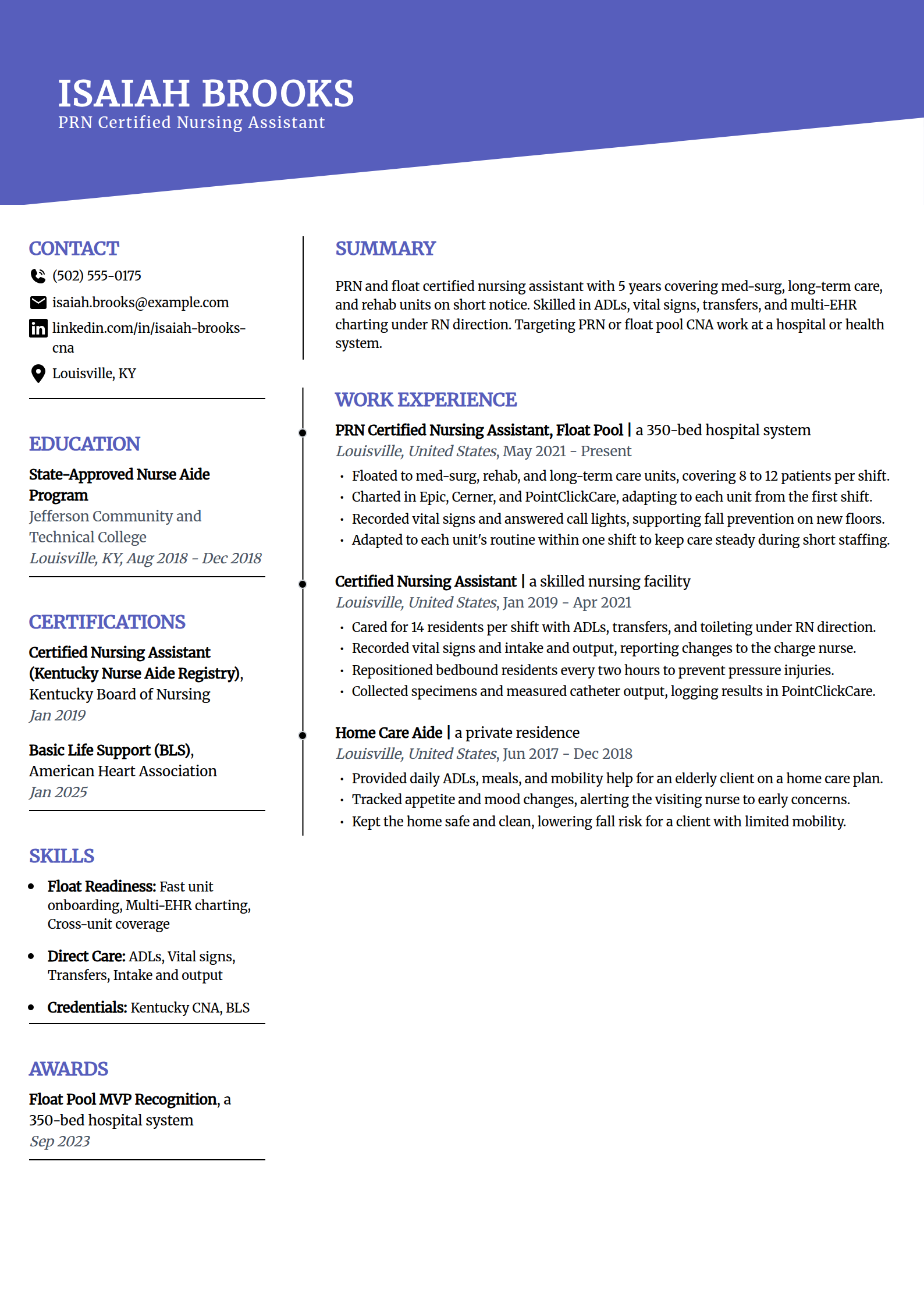
PRN & Float CNA Resume Template
Why this resume example works?
- Opens with float scope, 5 years covering med-surg, long-term care, and rehab units on short notice.
- Shows the flexibility a float pool needs, charting in Epic, Cerner, and PointClickCare from the first shift.
- Keeps tasks in scope, ADLs, vital signs, and transfers under RN direction on unfamiliar floors.
- Names the Kentucky CNA and BLS credentials a float role requires, with a float pool award in the sidebar.
- Lists awards without long descriptions, keeping the two-column layout clean and balanced.
Build your CNA resume
Pick a template above and the editor keeps your layout clean and ATS-safe while you swap in your own patient load, certifications, and the EHR your unit runs.
Build my resumeHow to write a CNA resume in 2026
A CNA resume is read by someone who checks two things first: your certification and whether the bedside work matches the unit. Lead with your CNA certification and BLS, then prove your experience with patient load, ADLs, and vitals, one modest number each. These moves make yours easy to skim and easy for an applicant tracking system to parse.
Open with a short CNA summary
Write three to four sentences that name your certification and years, your patient or resident load, one or two systems you use, and the role you are targeting. If you are new, use your program and clinical hours in place of years. Lead with what you have done at the bedside, not what you want from the employer.
Certified nursing assistant with 5 years in skilled nursing, caring for 12 to 14 residents per shift. Skilled in ADLs, vital signs, transfers, and PointClickCare charting under RN direction. Holds a current state CNA certification and BLS. Targeting a long-term care CNA role.
Lead experience with ADLs, vitals, and patient load
The work a CNA resume is hired for is concrete, so name it and attach one modest number to each bullet. Open every line with a strong verb, never "Responsible for".
- Patient load: state how many you care for, like providing ADL care for 12 to 14 residents per shift.
- Vitals and I/O: name what you record, such as vital signs, weights, and intake and output, reported to the nurse.
- Mobility: name the equipment, like transferring residents with a Hoyer lift and gait belt with no handling injuries.
- Prevention: use outcomes a CNA can own, such as repositioning every two hours to prevent pressure injuries.
List your CNA certification, BLS, and training the right way
This is the section a nurse manager reads first, so get the exact wording right.
- List your state CNA certification and the registry, like "Certified Nursing Assistant, Ohio Nurse Aide Registry".
- Add BLS or CPR with the issuer (American Heart Association) and keep the date current.
- New CNAs state the program and hours, like "120-hour state-approved program, 40 clinical hours", in place of years.
- Add role-specific training where you have it: dementia or Alzheimer's care, restorative aide, or a medication aide (CMA) credential.
Keep the resume inside CNA scope (the honest rule)
The fastest way to lose a nurse reviewer's trust is to claim work a CNA cannot do. Match the resume to what you are actually certified and supervised to do.
- CNAs work under RN or LPN supervision. Use ADLs, vitals, transfers, repositioning, intake and output, specimen collection, and EHR charting.
- Do not write "administered medications", "started IVs", or "performed wound care" on a plain CNA resume; those are outside CNA scope.
- Only a Certified Medication Aide (CMA or QMA) gives routine oral and topical medications, and only under a delegating nurse. Say so explicitly if that is you.
- Catheter care means emptying and measuring output, not insertion. Report changes to the nurse; a CNA does not assess, diagnose, or write care plans.
Match your skills to the posting's keywords
A CNA skills list should read like the job description. Split it so a hiring manager and a parser both find what they need.
- Direct care: ADLs, bathing and grooming, feeding assistance, toileting, peri-care, and skin checks.
- Clinical tasks: vital signs, blood glucose checks, intake and output, specimen collection, and catheter care.
- Mobility and safety: Hoyer lift, gait belt, sit-to-stand, ambulation, fall prevention, and safe patient handling.
- Systems: name the EHR outright, like PointClickCare, MatrixCare, Epic, or Cerner, matching the posting's wording.
Keep it to one clean, ATS-safe page
Hospitals and long-term care facilities run applicant tracking systems, so a clean one-page resume is the standard for almost every CNA.
- Use a single-column or simple two-column layout with standard headings a parser recognizes.
- Hold it to one page and lead with your most recent role in reverse-chronological order.
- Save as a PDF so the formatting holds, then run it through the ATS resume checker for a quick format pass.
- Swap the numbers in the templates above for your own patient load, certifications, and systems; do not copy them as is.
Common CNA resume mistakes
- Writing vague duties like "took care of patients". Say what you did: "provided ADL care for 12 to 14 residents per shift".
- Claiming work outside CNA scope. "Administered medications" on a plain CNA resume reads as a red flag unless you are a Certified Medication Aide under a delegating nurse.
- Leaving the CNA certification vague. Name the state and registry, and keep your BLS date current so a screener trusts it.
- Listing an EHR with no result. Tie the system to what you did, like charting care and repositioning in PointClickCare each shift.
- Padding a no-experience resume with filler. Lead with your program hours, clinical rotation, and real bedside skills instead.
Frequently asked questions
What should a CNA resume include?
A CNA resume needs your contact details, a short summary, your CNA certification and BLS, work history in reverse-chronological order, education with your nurse aide program, and a skills list. Lead each role with your patient or resident load and the bedside work you did: ADLs, vital signs, transfers, repositioning, intake and output, and specimen collection, all under RN supervision. Name the EHR you charted in, such as PointClickCare, MatrixCare, Epic, or Cerner. Keep it to one clean page.
How do I write a CNA resume with no experience?
Lead with your training and clinical hours instead of paid years. State your state-approved nurse aide program, like a 120-hour program with 40 clinical hours, and the bedside skills you practiced there: ADLs, vital signs, transfers, and charting under nurse supervision. Put your CNA certification and BLS near the top. Fill the page honestly with a caregiving role, a clinical rotation, or volunteering rather than padding. The entry-level and new-graduate examples above show the shape.
What skills should I put on a CNA resume?
Split your skills so a hiring manager and a parser both find what they need. Direct care: ADLs, bathing and grooming, feeding assistance, toileting, and skin checks. Clinical tasks: vital signs, blood glucose checks, intake and output, specimen collection, and catheter care (emptying and measuring). Mobility and safety: Hoyer lift, gait belt, ambulation, and fall prevention. Finally, name the EHR you use, like PointClickCare or Epic, matching the words in the job posting.
Can a CNA say they administered medications on a resume?
No, not on a plain CNA resume. A certified nursing assistant works under RN or LPN supervision and does not administer medications, start IVs, or perform sterile wound care. The one exception is a Certified Medication Aide (CMA or QMA), who gives routine oral and topical medications under a delegating nurse and can say so, stating that supervision plainly. If you are a standard CNA, list medication reminders instead, and keep the rest of the resume inside CNA scope so a nurse reviewer trusts it.
What certifications does a CNA resume need?
At a minimum, your state CNA certification listed on the Nurse Aide Registry and a current BLS or CPR card from the American Heart Association. Name the state and registry, like "Certified Nursing Assistant, Texas Nurse Aide Registry". Add role-specific training where you have it: Alzheimer's and dementia care, restorative nursing assistant, a patient care technician (CPCT/A) credential for hospital roles, or a Certified Medication Aide credential if you pass medications. Keep every certification date current.
How long should a CNA resume be?
One page for almost every CNA. Lead with your most recent role and keep the experience and results that matter for the unit you are targeting, summarizing or dropping older, unrelated jobs to make room for patient load, ADLs, and the EHR the posting names. A single, skimmable page reads best for a charge nurse or hiring manager and parses cleanly through an applicant tracking system.
More cna resume resources
Build your CNA resume
Pick a template above and the editor keeps your layout clean and ATS-safe while you swap in your own patient load, certifications, and the EHR your unit runs.