Your First Phlebotomy Job: 16 Entry-Level Resume Examples
- ATS Friendly
- No Paid Draws Yet
- 16 Real Examples
An entry-level phlebotomist resume leads with the certification, then treats the externship like a job: the site, real dates, the documented number of unaided venipunctures and capillary sticks, the systems you charted in and the settings you drew in. Add BLS, the safety training and any healthcare-adjacent work, and keep it to one page. The 16 examples below show it done for 16 different routes into the field.


540k+ resumes created
Editable templates for a first phlebotomy resume
Every template below is a real phlebotomy resume with no paid draws in it, laid out in that format. Pick one, then swap in your own certification, externship site and stick counts. Each layout keeps your credential, your documented hours and your dated entries where a lab manager looks first and where an applicant tracking system can parse them.
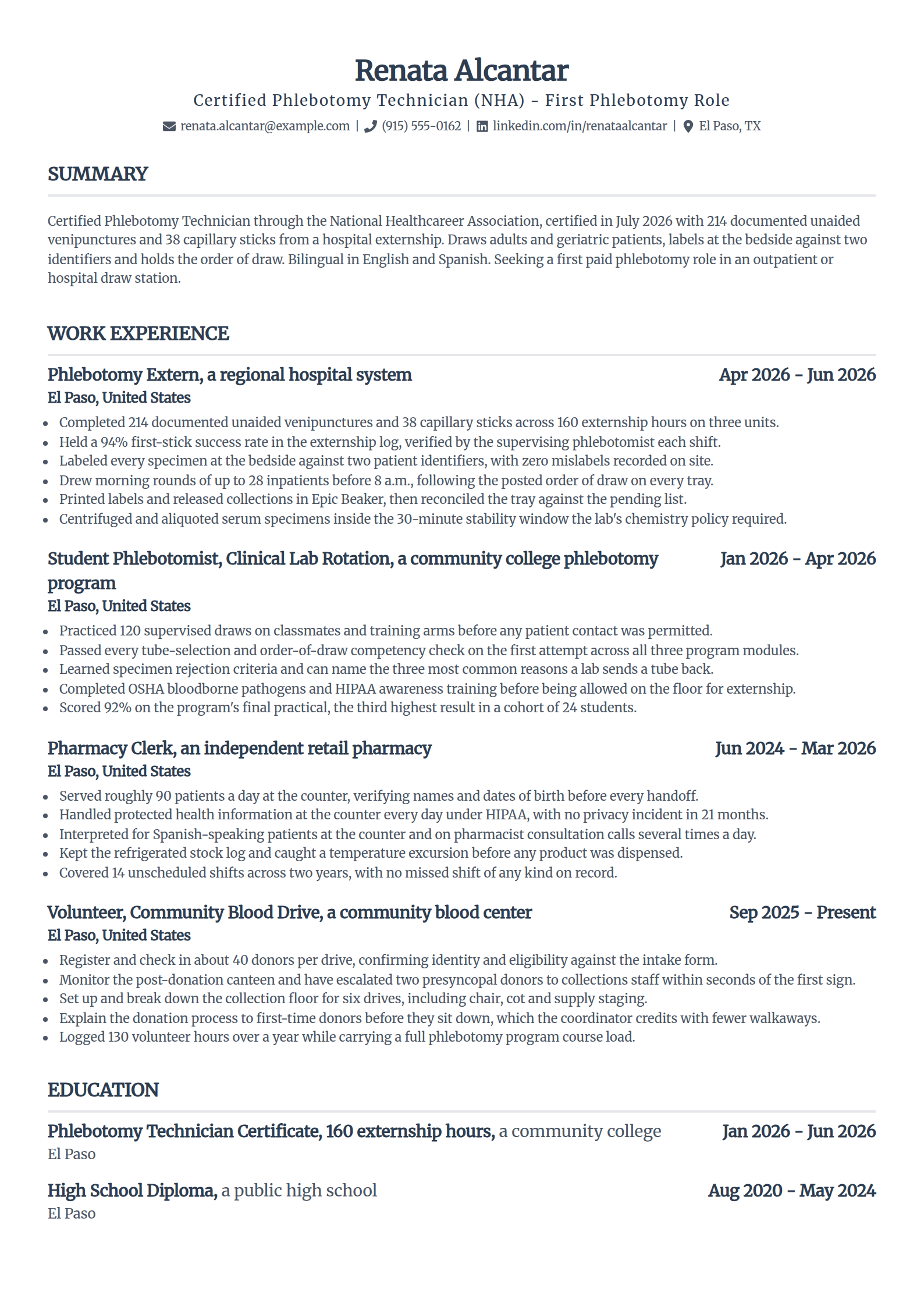
Newly Certified Phlebotomist Resume Template (No Experience)
Why this resume example works?
- Opens with the credential and its issuing body, which is the first filter on nearly every phlebotomy posting.
- Gives the externship the two numbers a lab manager asks for: 214 documented unaided venipunctures and 38 capillary sticks.
- States the first-stick rate as a logged figure verified by the supervising phlebotomist, not as a claim about skill.
- Names Epic Beaker and the bedside two-identifier standard, which is the vocabulary postings are written in.
- Keeps the pharmacy job on the page because two years of HIPAA-covered counter work is directly relevant.
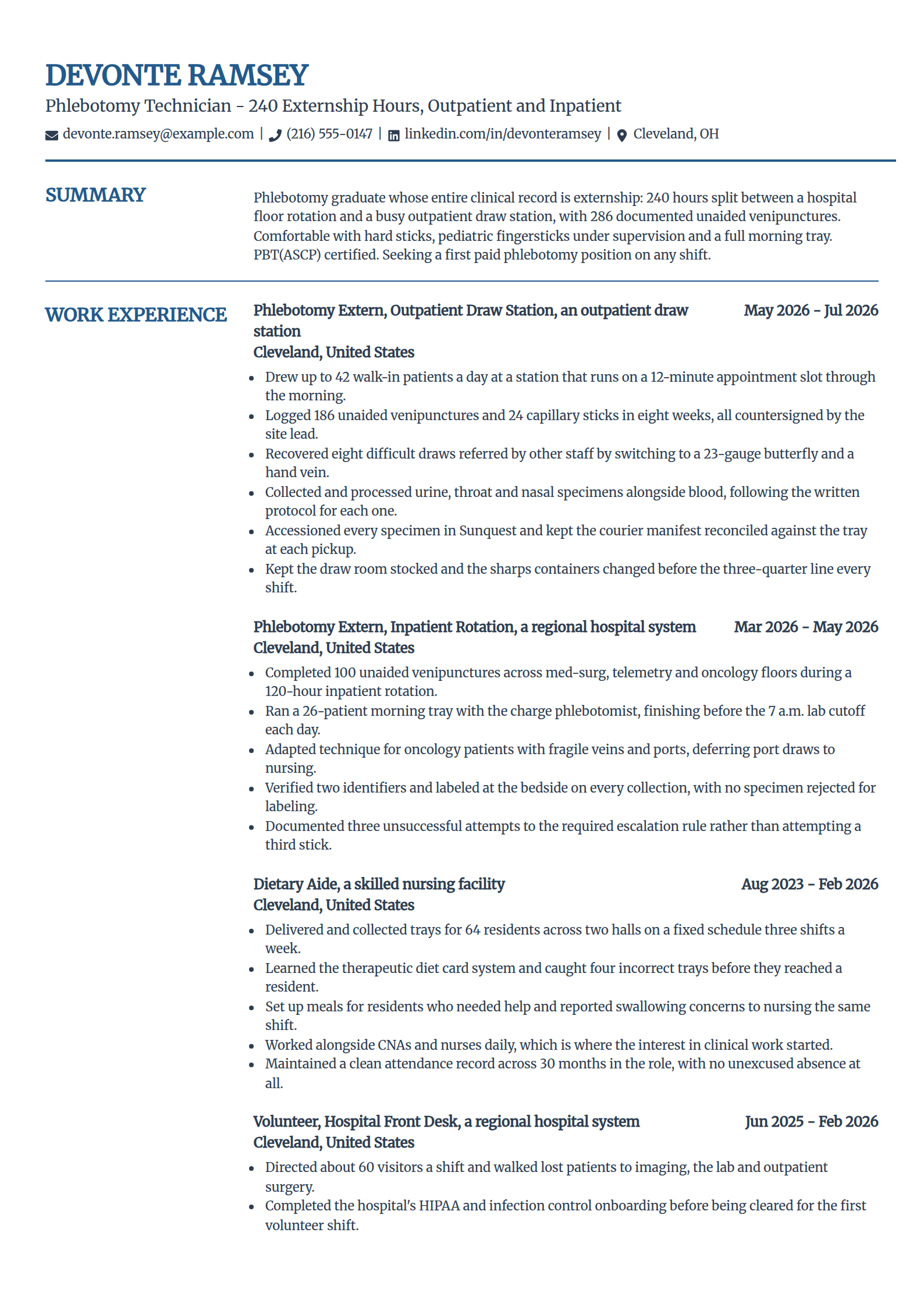
Phlebotomy Externship Resume Template
Why this resume example works?
- Splits the externship into two dated entries, outpatient and inpatient, so each site's volume reads on its own.
- Shows pace, up to 42 walk-in patients a day on a 12-minute appointment slot, which is what a draw station screens for.
- Includes the difficult draws referred by other staff and the gauge change that recovered them, which is real technique.
- Names the escalation rule by its behavior: attempts documented rather than a third stick attempted.
- Carries non-blood collection and Sunquest accessioning, both of which appear in outpatient postings.
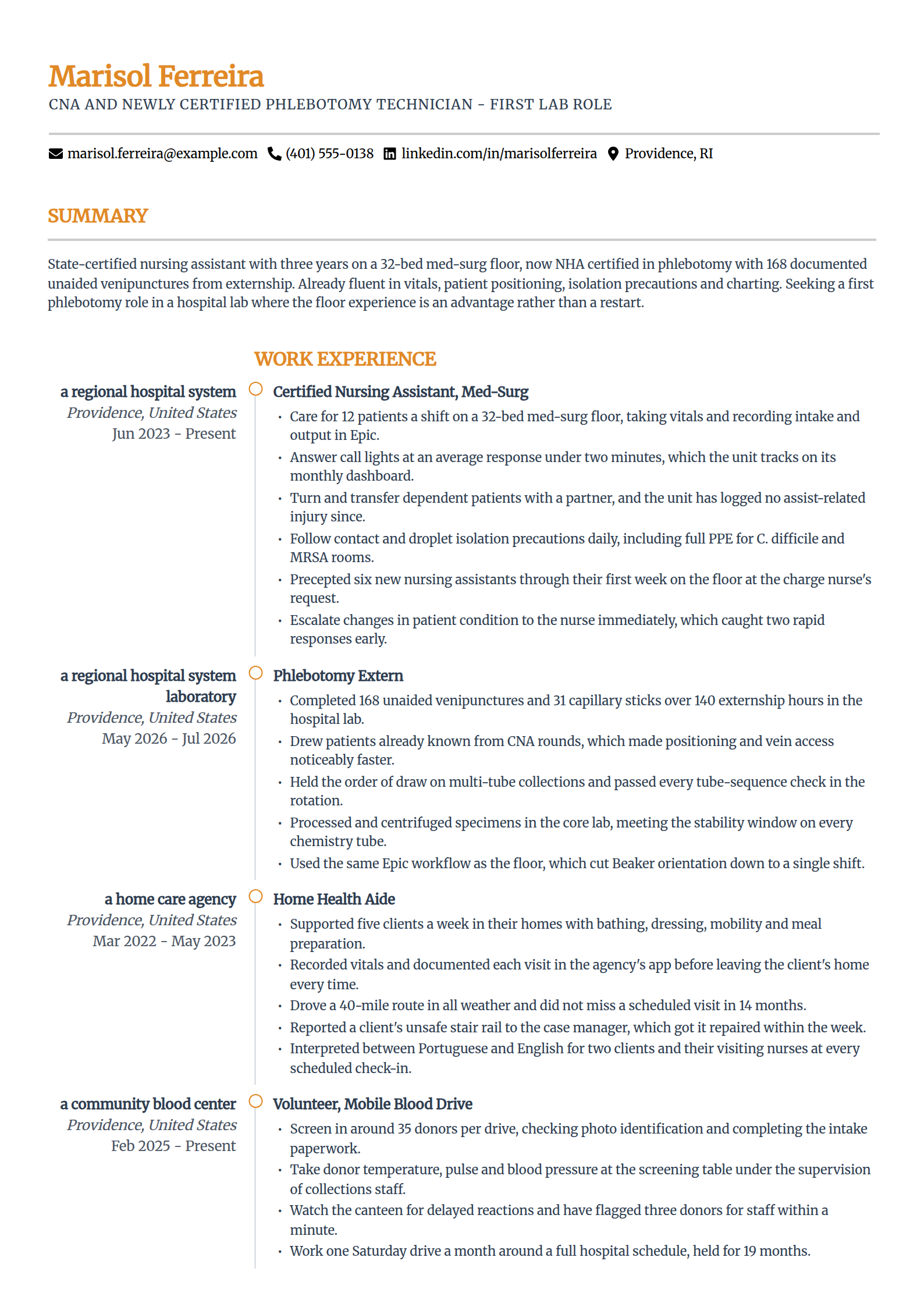
CNA to Phlebotomist Resume Template
Why this resume example works?
- Keeps CNA scope honest: vitals, intake and output, transfers and isolation precautions, with no drawing before training.
- Turns the floor experience into a lab argument, since positioning and vein access are faster for someone who knows patients.
- Points out the Epic overlap, which cut orientation on Beaker to a single shift and is a real hiring cost saved.
- Puts both credentials on the page under their real issuers, the NHA certification and the state nurse aide registry.
- Uses the donor screening volunteering to show vitals and hemoglobin work outside the hospital job.
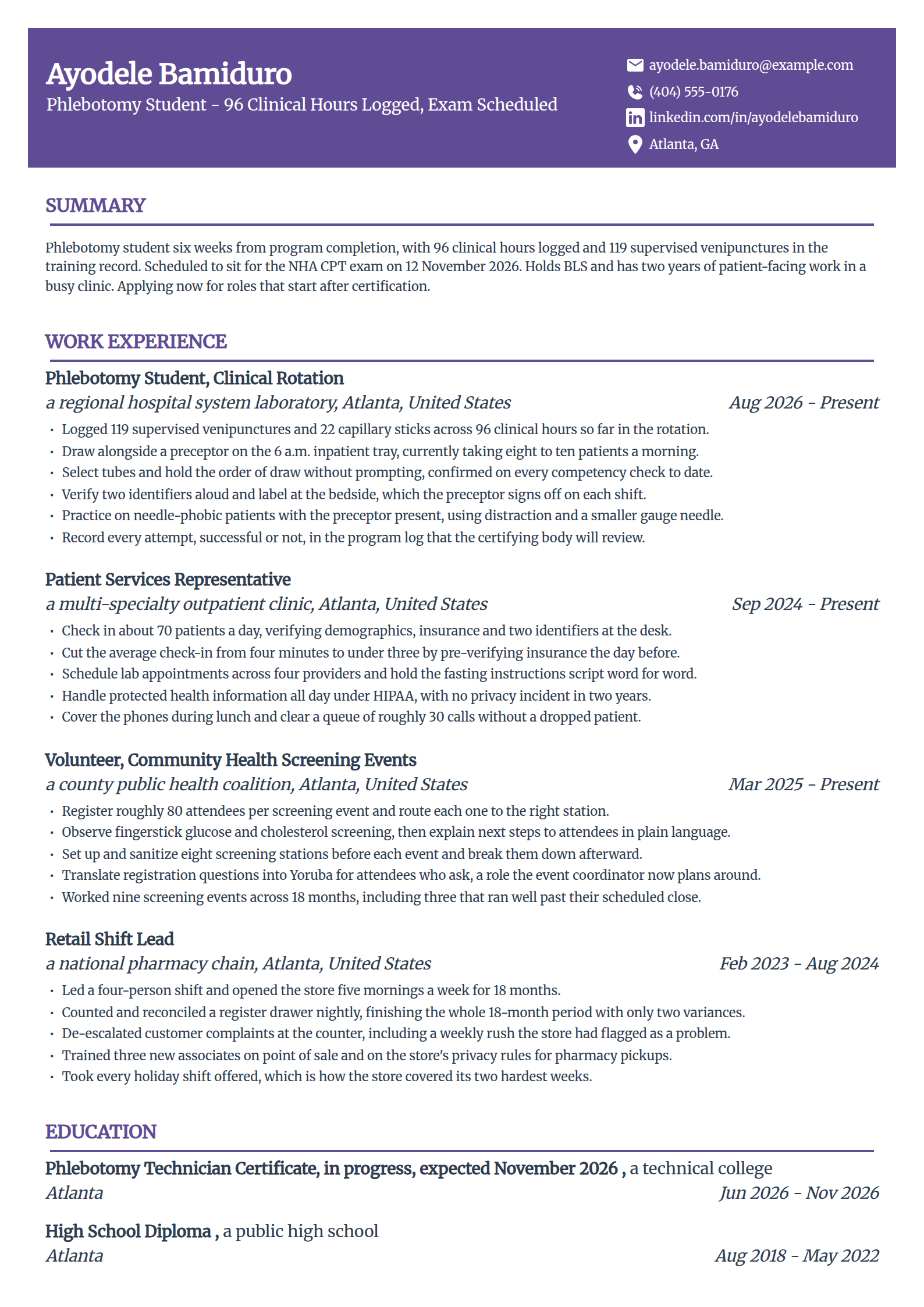
Phlebotomy Student Resume Template (Rotation Hours Only)
Why this resume example works?
- Names the exam date outright, scheduled to sit on 12 November 2026, which lets a manager plan a start date.
- Reports the training log honestly as hours and supervised draws so far, not as a finished total.
- Shows the front desk job as clinical-adjacent: two identifiers at check-in, fasting instructions, lab scheduling.
- States availability from December, which answers the question a hiring manager would otherwise have to ask.
- Lists the language skill with the setting it was used in, rather than as a bare line in a skills block.
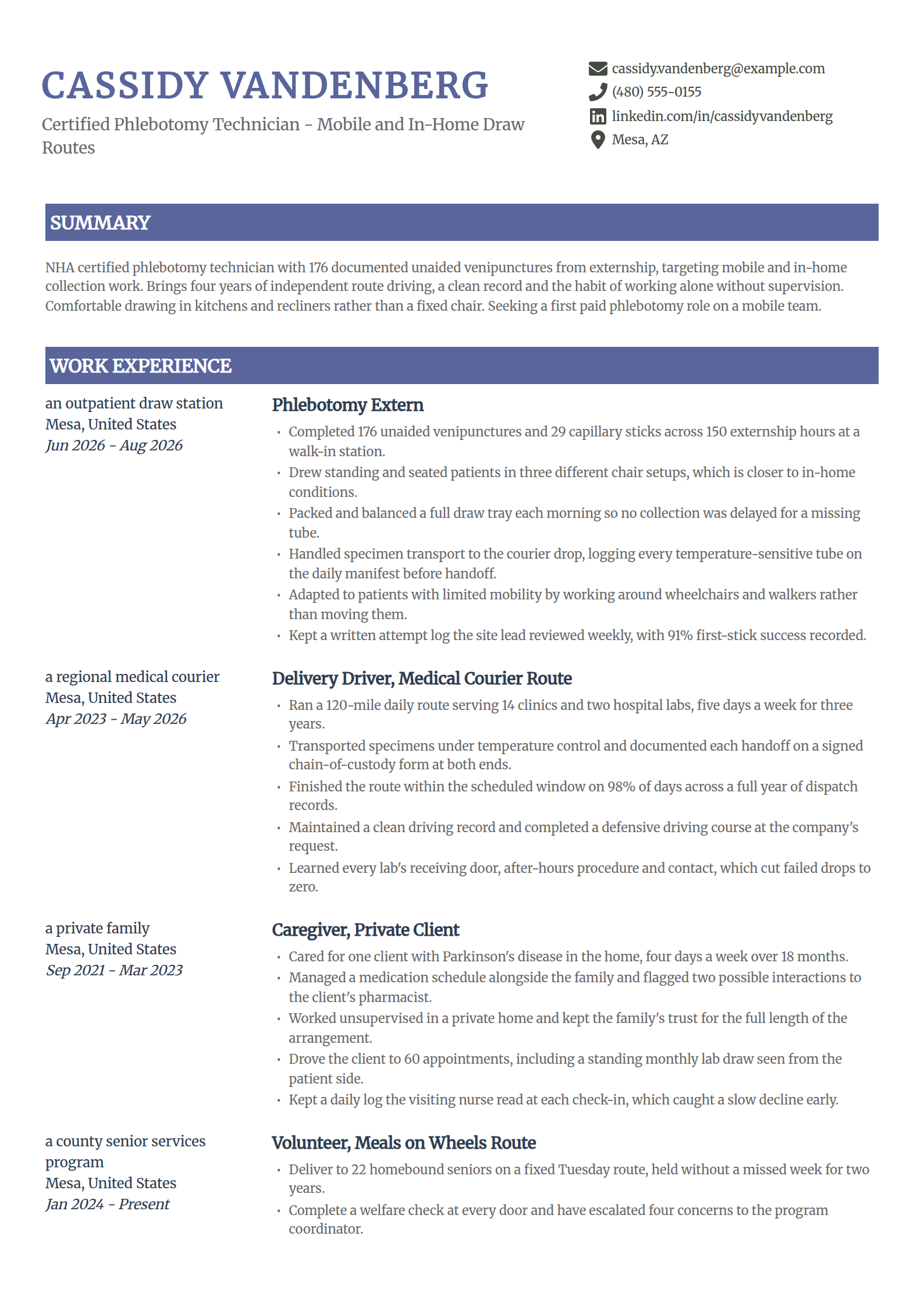
Mobile Phlebotomist Resume Template (Entry Level)
Why this resume example works?
- Argues the mobile case with three years of independent route work, 120 miles a day across 14 clinics and two labs.
- Carries the chain-of-custody and temperature-controlled transport language a mobile employer already uses.
- Notes drawing in three different chair setups, which is the detail that says in-home conditions were considered.
- Uses the private caregiving role to show what working unsupervised inside someone's home actually requires.
- Puts the clean driving record and the defensive driving course on the page, both of which mobile postings ask for.
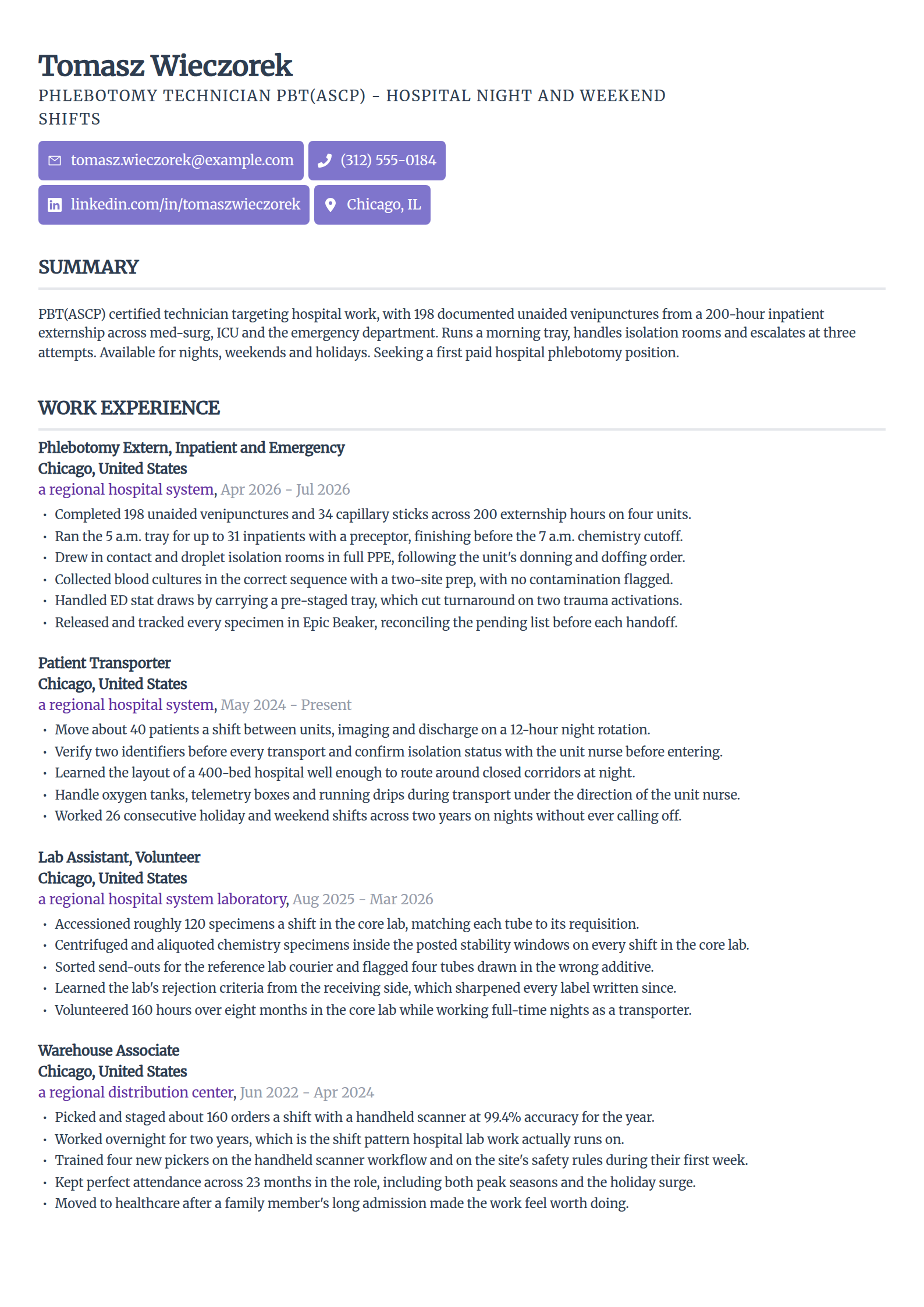
Hospital Phlebotomist Resume Template (Entry Level)
Why this resume example works?
- Covers the four settings a hospital lab cares about, med-surg, telemetry, ICU and the emergency department.
- Describes the morning tray in hospital terms: up to 31 inpatients finished before the 7 a.m. chemistry cutoff.
- Includes blood cultures with the two-site prep and no flagged contamination, which is a real competency question.
- Shows isolation room work in full PPE with the donning and doffing order, which a floor manager checks for.
- States night and weekend availability, since that is the shift pattern hospital labs actually need filled.
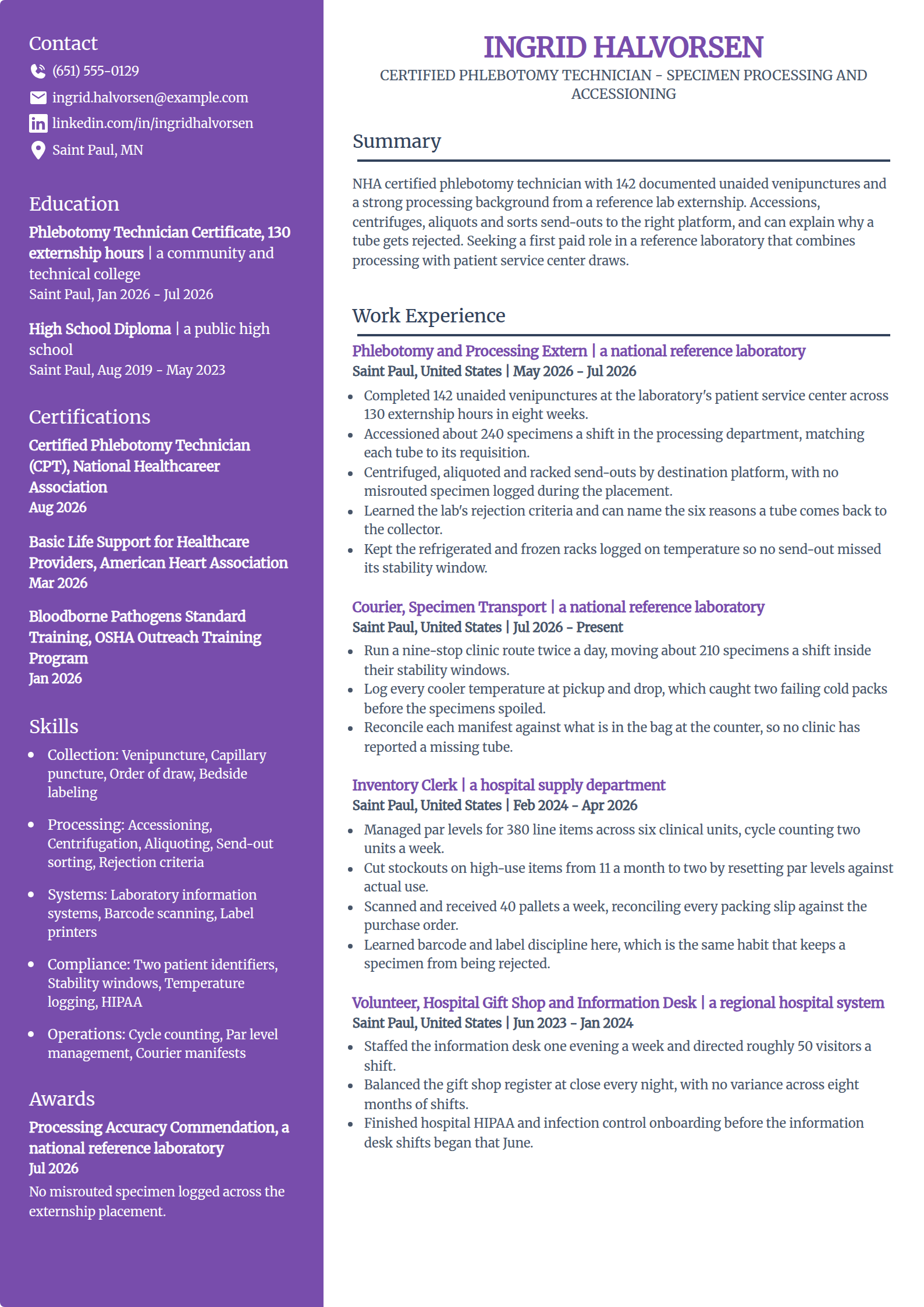
Reference Lab Phlebotomist and Processing Resume Template
Why this resume example works?
- Combines the two jobs a reference lab actually hires for, patient service center draws and processing volume.
- Quantifies processing at about 240 specimens a shift with no misrouted specimen logged during the placement.
- Names the rejection criteria from the receiving side, which is exactly the knowledge that prevents recollections.
- Uses the supply clerk job for the barcode and label discipline it built, rather than listing it as unrelated work.
- Keeps temperature logging and stability windows on the page, both of which are send-out requirements.
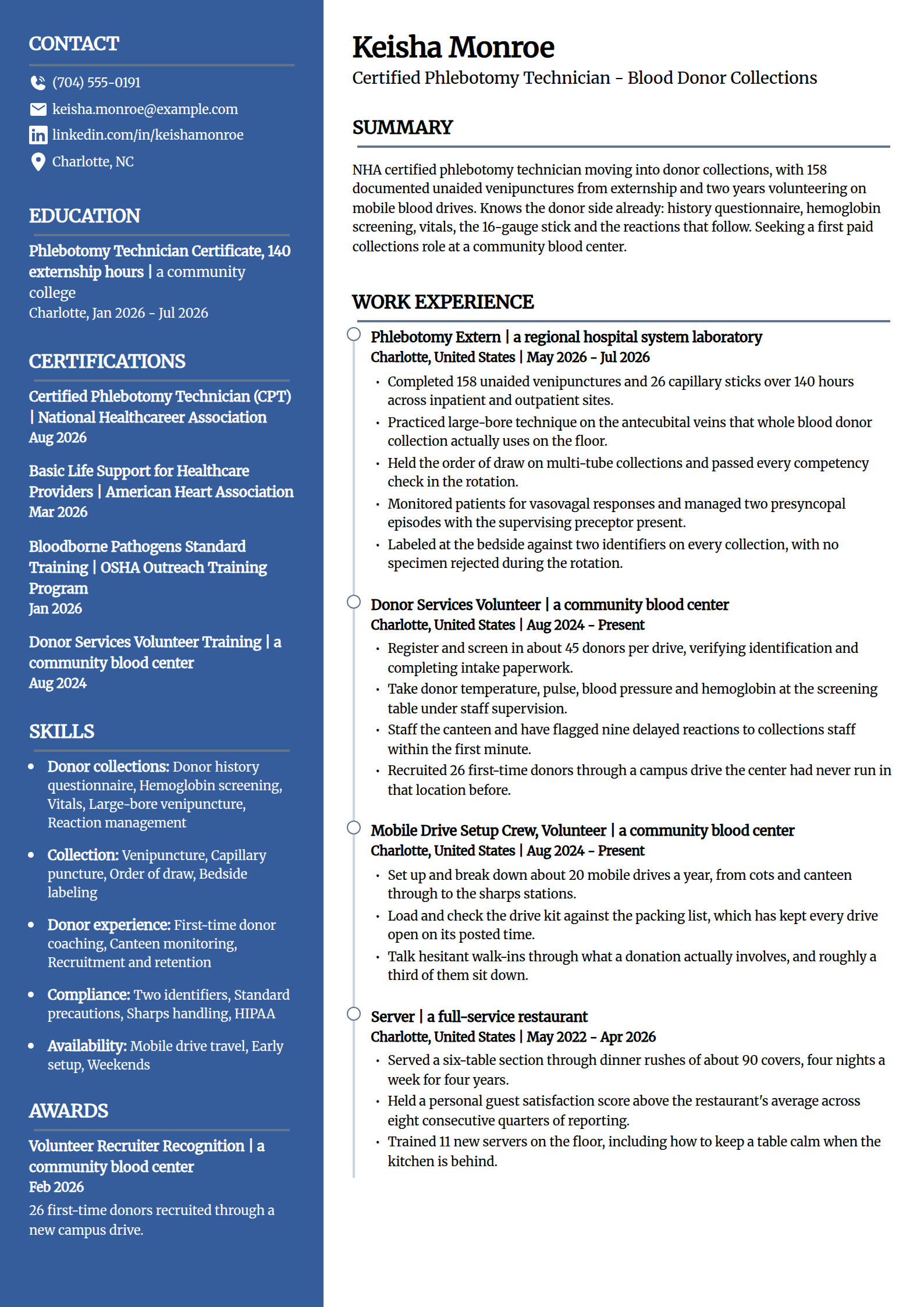
Blood Donor Center Phlebotomist Resume Template
Why this resume example works?
- Shows the donor-side workflow specifically: history questionnaire, hemoglobin screening, vitals and the canteen.
- Notes practice with large-bore antecubital technique, which is the stick donor collection actually uses.
- Counts reaction management, nine delayed reactions flagged within the first minute, which is the safety competency.
- Adds recruitment, 26 first-time donors from a drive the center had not run before, since centers hire on donor experience.
- Keeps four years of restaurant service on the page, because a donor floor is a customer floor with needles.
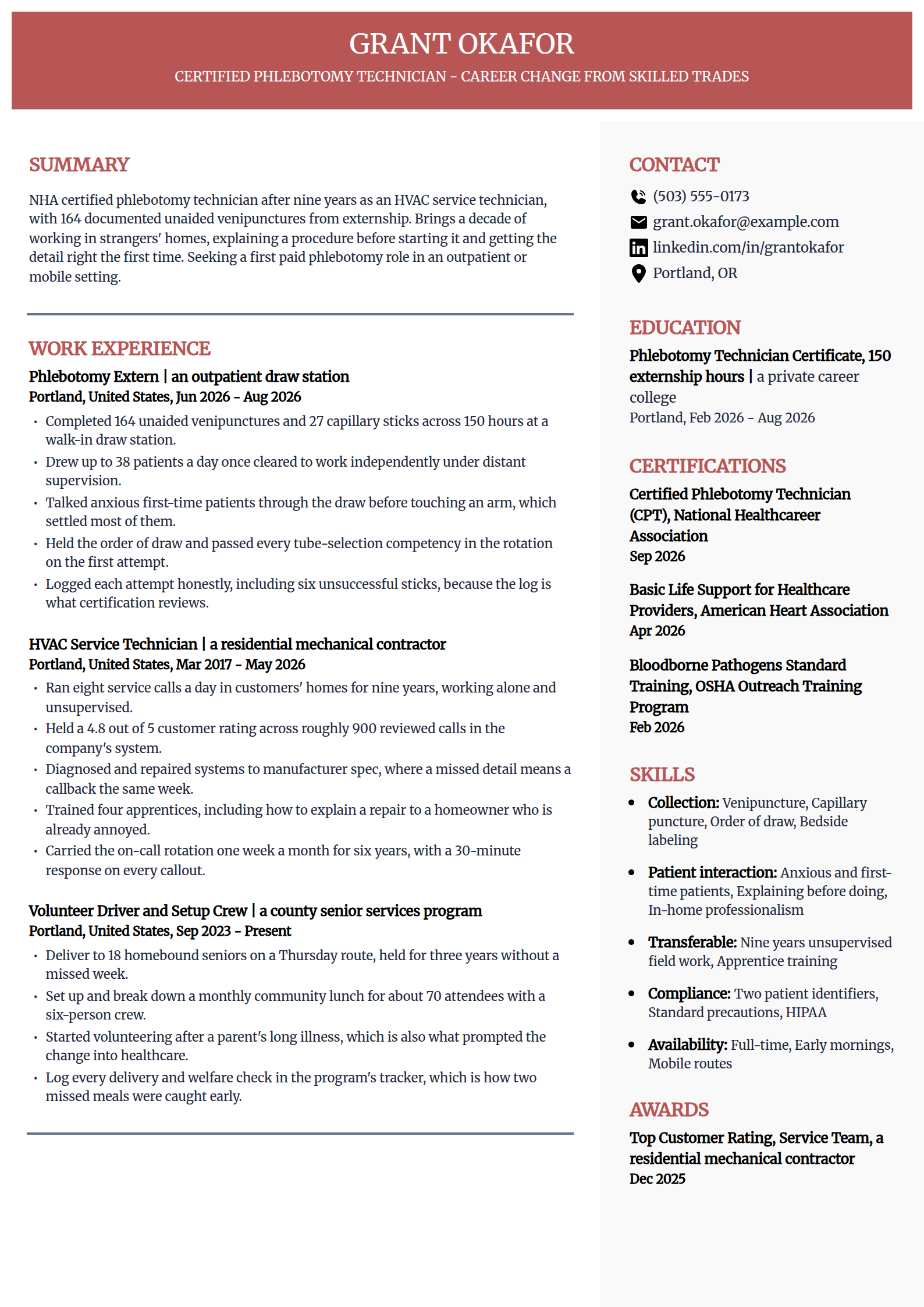
Career Change to Phlebotomy Resume Template
Why this resume example works?
- Names the change in the headline instead of hiding nine years of HVAC work behind a vague summary.
- Translates the old job into the new one: a decade of working alone in strangers' homes, explaining before starting.
- Carries a verifiable service number, 4.8 out of 5 across roughly 900 reviewed calls, which is rare on a career-change resume.
- Includes the six unsuccessful sticks in the externship bullet, because the log is what certification actually reviews.
- Keeps the volunteer route on the page and links it to the reason for the change without turning into an essay.
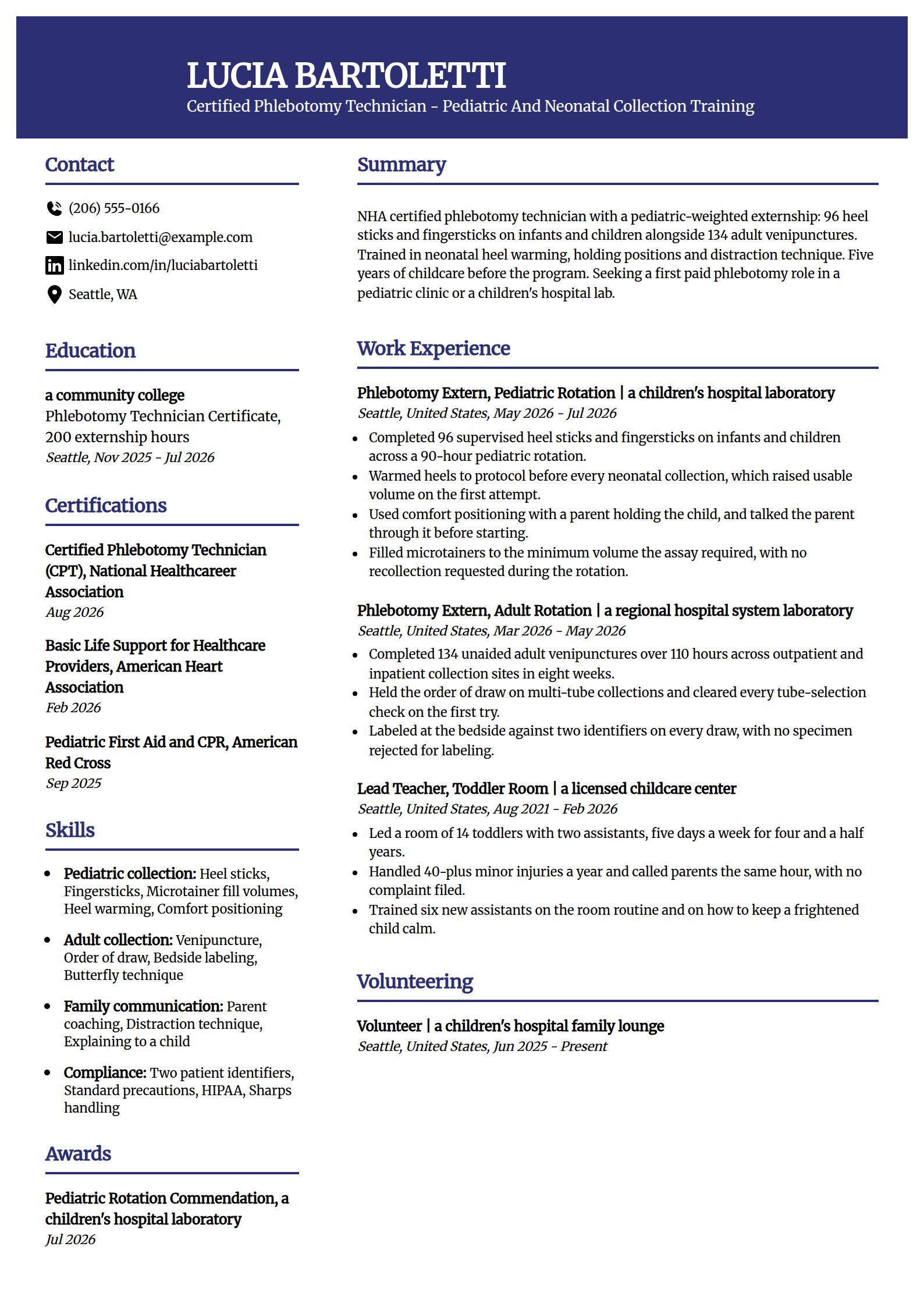
Pediatric Phlebotomy Resume Template (Entry Level)
Why this resume example works?
- Splits the externship into a pediatric rotation and an adult rotation, each with its own count and hours.
- Names the pediatric technique outright: heel warming, comfort positioning with a parent, microtainer fill volumes.
- Reports a result that matters in pediatrics, no recollection requested during the rotation.
- Uses four and a half years of toddler-room teaching as the evidence for keeping a frightened child calm.
- Keeps pediatric first aid and CPR separate from BLS, because they are different certificates.
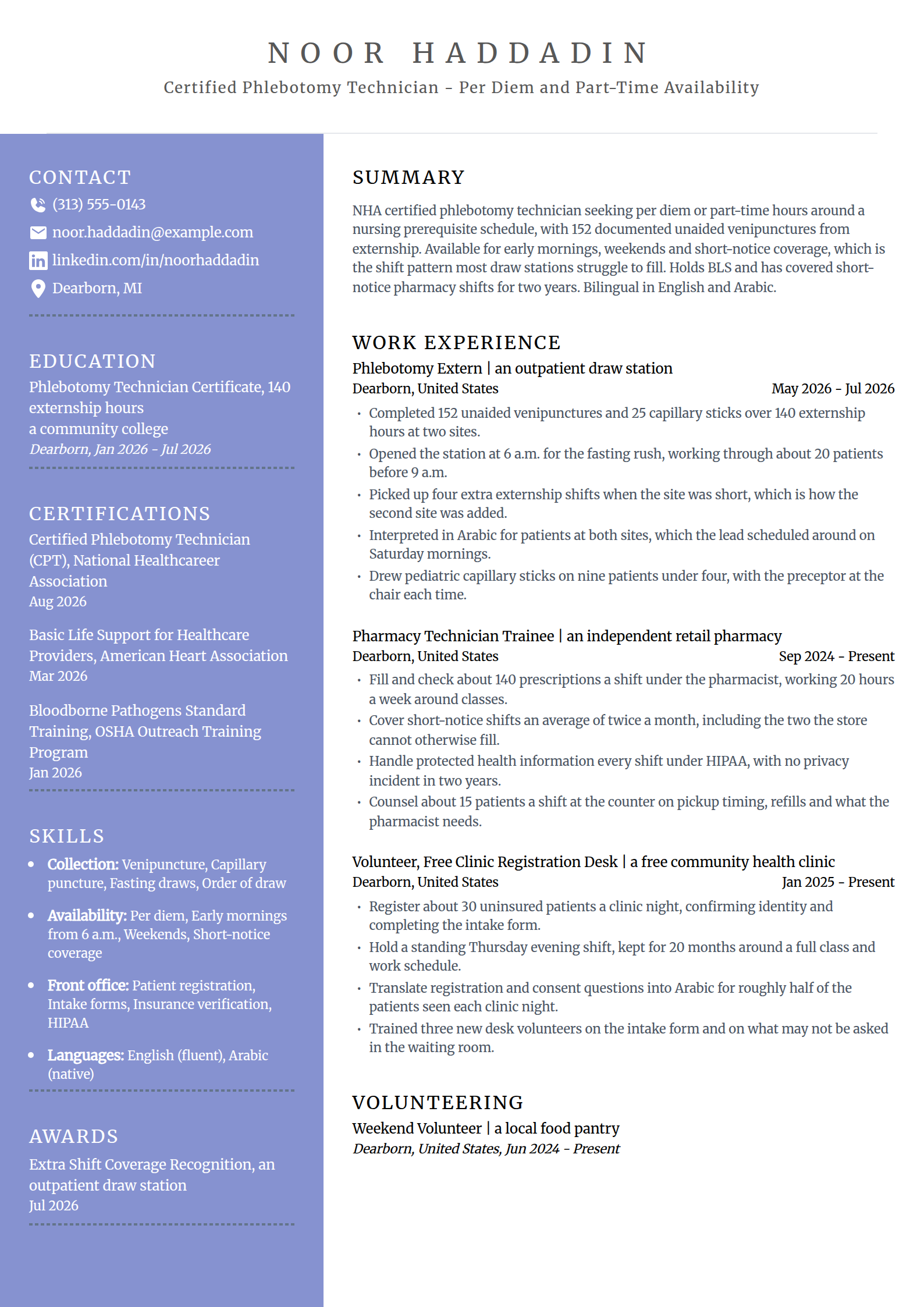
Per Diem Phlebotomist Resume Template (Entry Level)
Why this resume example works?
- Puts the availability in the headline, because per diem hiring is a scheduling decision before it is a skills decision.
- Names the specific hours most stations struggle to fill: early mornings, weekends and short-notice coverage.
- Proves the short-notice claim with a record, roughly two extra shifts a month covered at the pharmacy.
- Shows the 6 a.m. fasting rush by volume, about 20 patients before 9 a.m., which is what an opener needs to handle.
- Carries a standing 20-month Thursday clinic shift, which is the strongest reliability signal a student can offer.
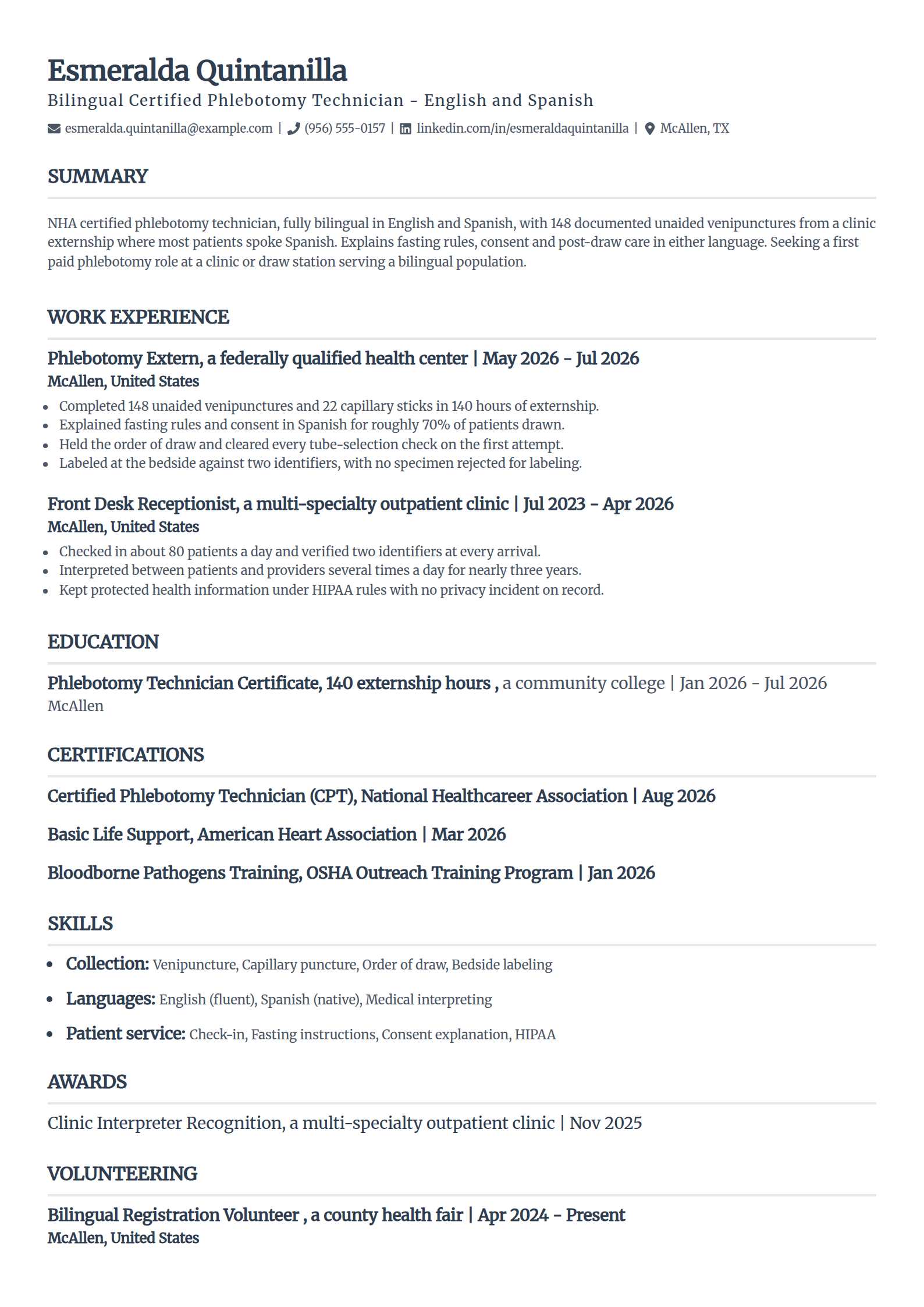
Bilingual Phlebotomist Resume Template (Entry Level)
Why this resume example works?
- Puts bilingual in the headline, because in many markets it is the line that decides which resume gets called.
- Ties the language to the work: fasting rules and consent explained in Spanish for about 70% of patients drawn.
- Backs it with nearly three years of daily interpreting at a clinic front desk rather than a self-rated skill line.
- Keeps the certification, BLS and bloodborne pathogens training in one compact block near the top.
- Stays short and plain, which is the right shape for a first resume in this field.
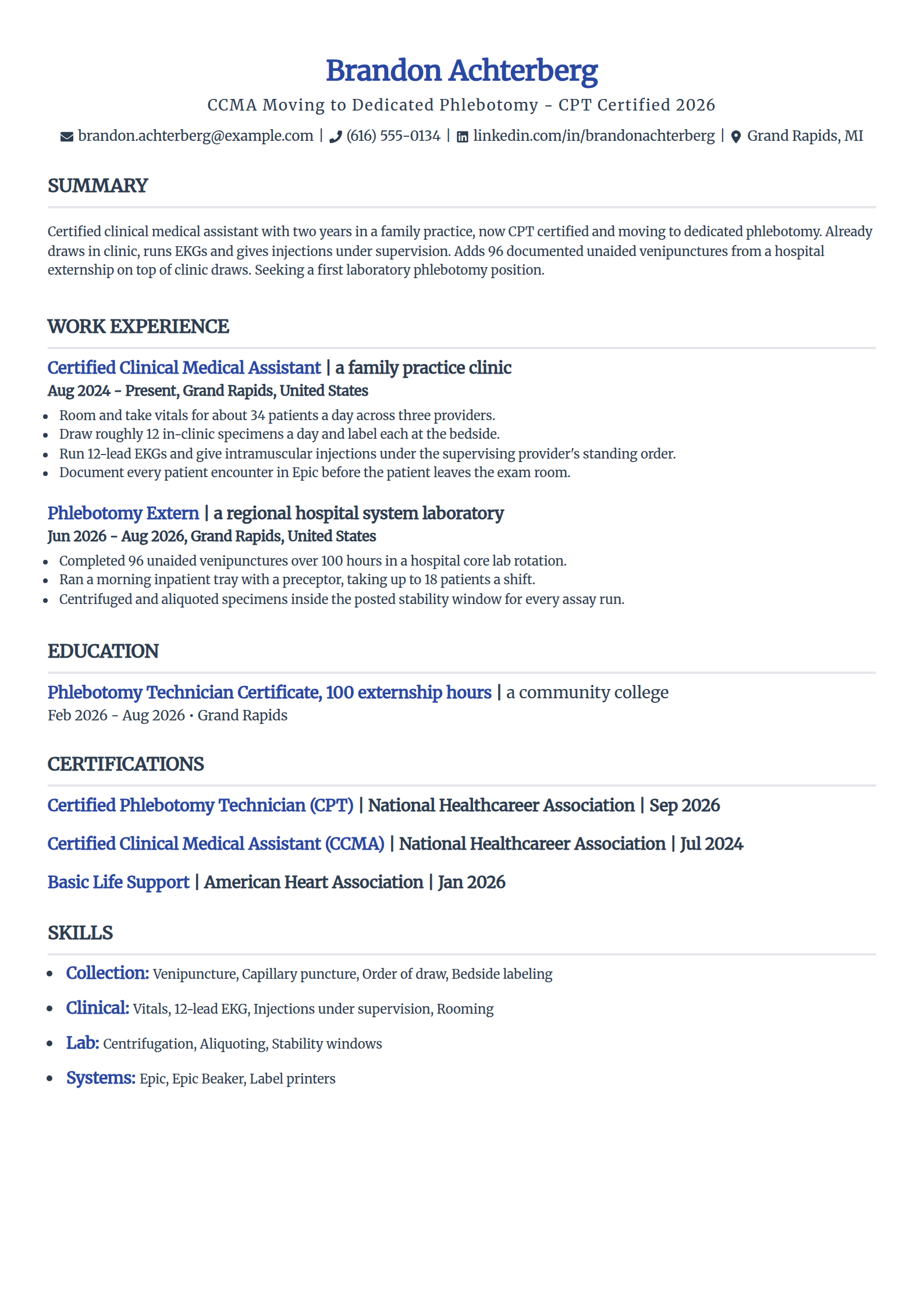
Medical Assistant to Phlebotomist Resume Template
Why this resume example works?
- Shows that clinic draws already happen, roughly 12 in-clinic specimens a day labeled at the bedside.
- Keeps MA scope accurate: EKGs and injections under the supervising provider's standing order, and no IV therapy.
- Adds the hospital externship on top rather than instead, which is the honest shape of this transition.
- Lists both NHA credentials with their dates so a reader can see the CCMA came first and the CPT followed.
- Explains the move implicitly by naming the target, a first laboratory position rather than another clinic job.
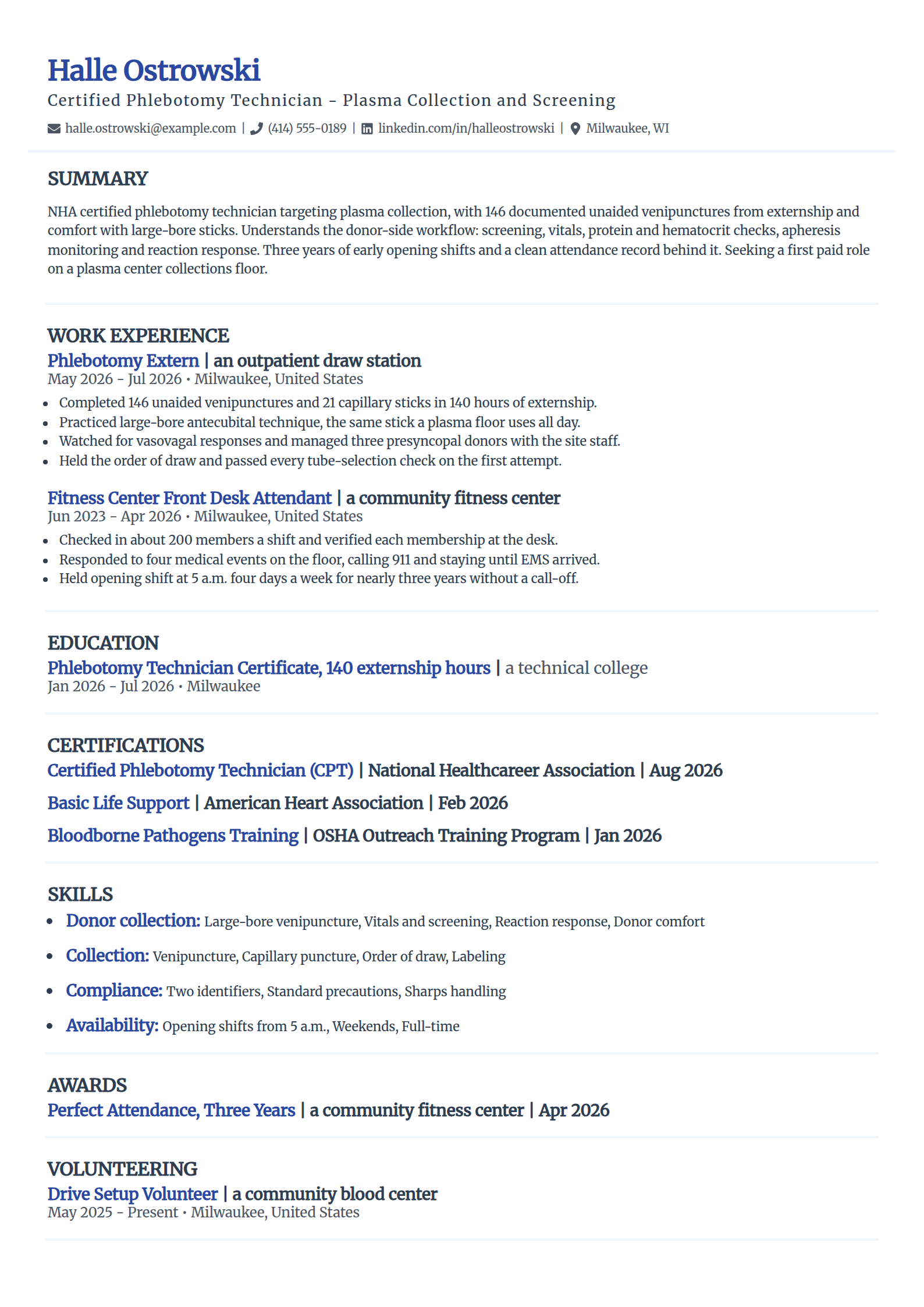
Plasma Center Phlebotomist Resume Template (Entry Level)
Why this resume example works?
- Targets plasma specifically rather than sending a generic phlebotomy resume to a donation center.
- Names the donor-side workflow a plasma floor runs on: screening, vitals, protein and hematocrit, apheresis monitoring.
- Shows reaction response with a count, three presyncopal patients managed with staff during the externship.
- Uses three years of 5 a.m. opening shifts as evidence for a start time plasma centers genuinely need covered.
- Includes responding to four medical events on a gym floor, which is real composure rather than a claimed trait.
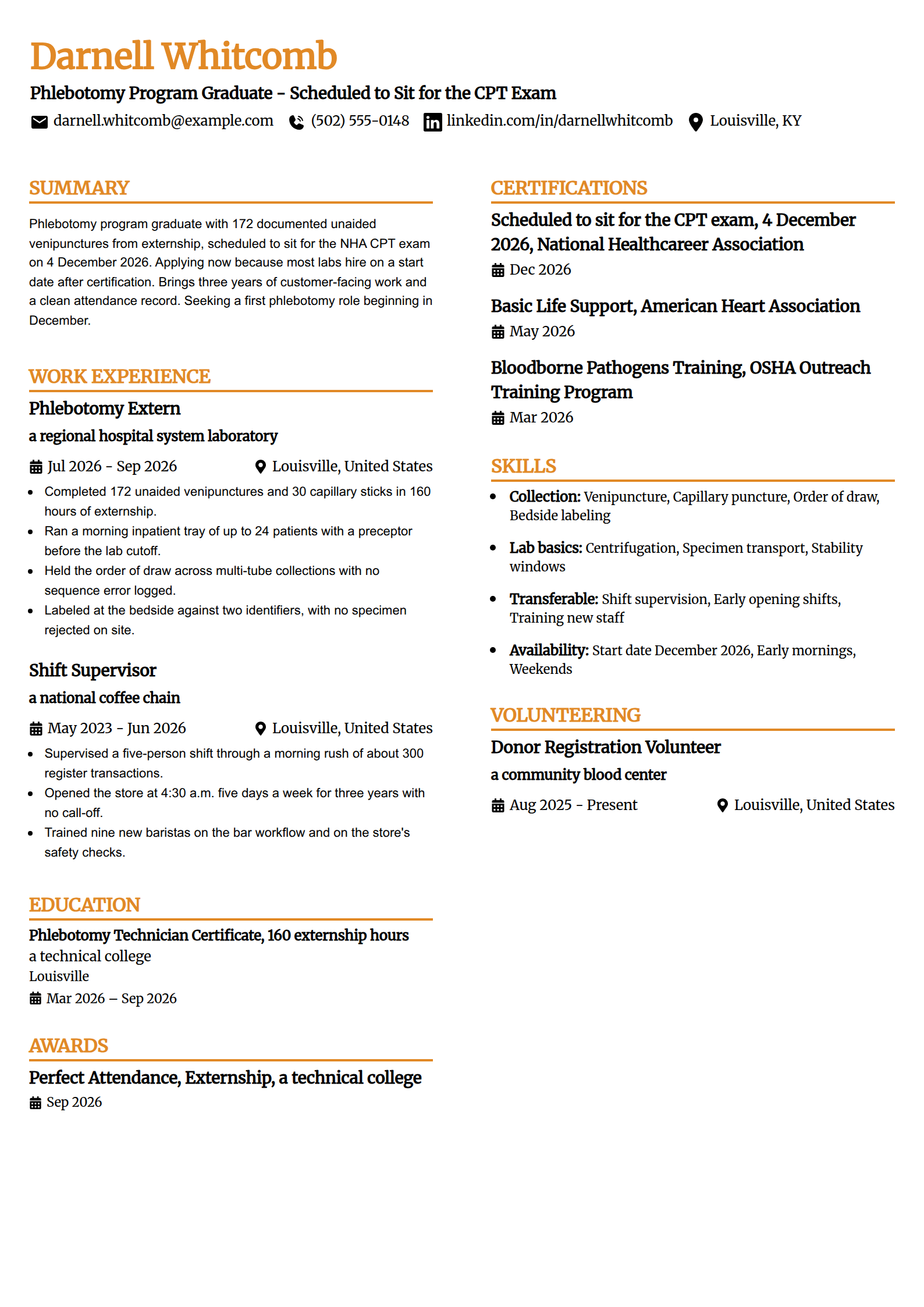
Phlebotomy Resume Template Before Certification
Why this resume example works?
- Writes the exam correctly, scheduled to sit on 4 December 2026, rather than the vague phrasing most candidates use.
- Explains why the application is early, because labs hire on a start date after certification.
- Still leads with the externship numbers, 172 unaided venipunctures across 160 hours, so the page is not just a promise.
- Puts the certification line in the certifications block with its date, where a screener expects to find it.
- Uses three years of 4:30 a.m. opening shifts as the reliability evidence a first-time healthcare hire needs.
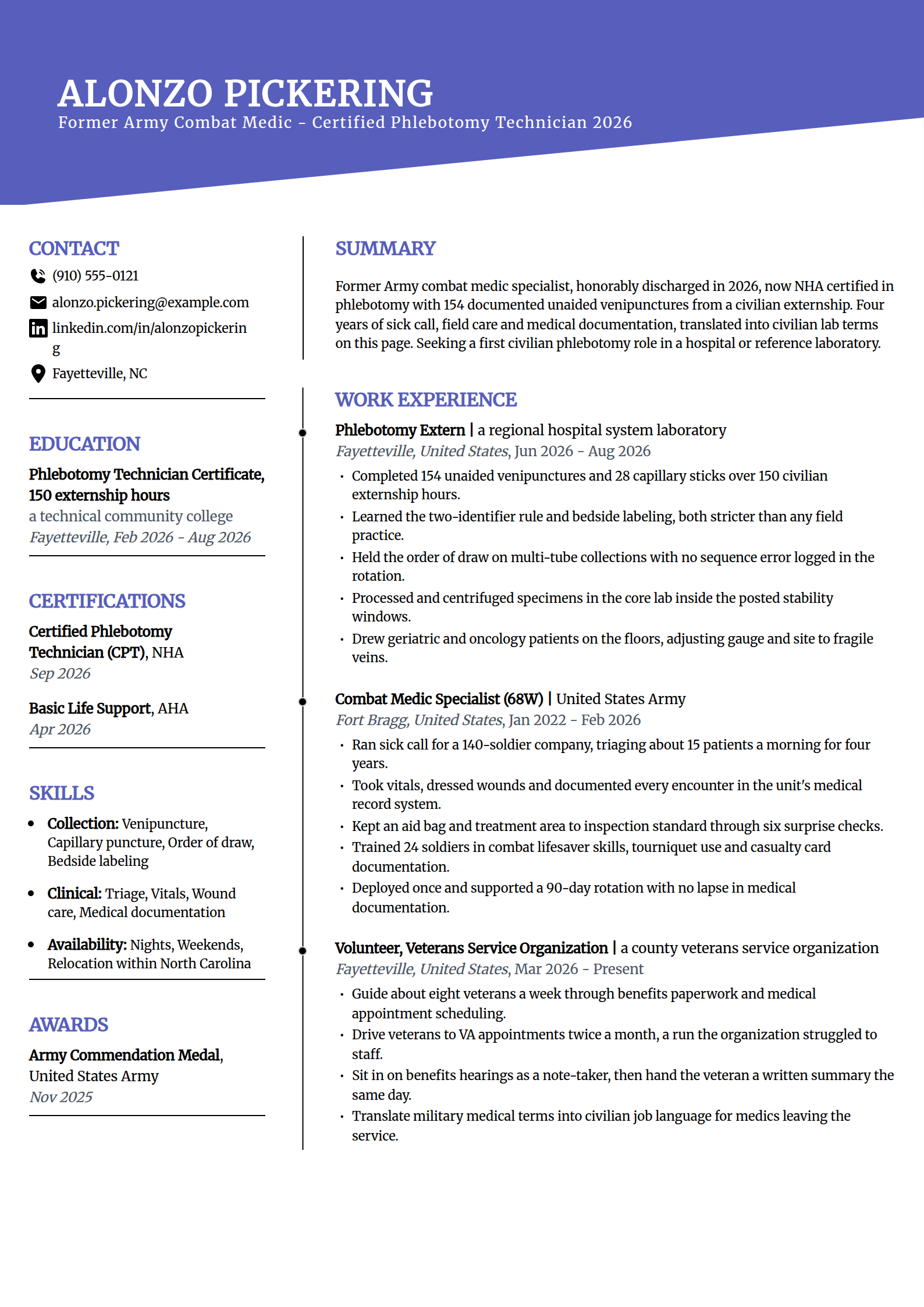
Military Medic to Phlebotomist Resume Template
Why this resume example works?
- Leads with the civilian externship, which is both the newest entry and the one a lab manager is looking for.
- Translates the military role into civilian terms: sick call for a 140-soldier company, about 15 patients a morning.
- Names the one thing that is genuinely different, the two-identifier and bedside-labeling rule civilian labs enforce.
- Keeps the MOS code visible as 68W so a reader who knows it can place the experience immediately.
- States relocation and shift flexibility, which matters for someone who has just left a duty station.
Build your first phlebotomy resume
Start from a template above and the editor keeps the layout parser-safe while you fill in your certification, your externship site and the counts from your training log.
Build my resumeHow to write a phlebotomy resume with no paid experience
Three things decide this page: the credential, the externship written like a job, and the numbers from your training log. Below is what goes where, and what to write when the honest answer is a number from a log rather than from a payroll record.
Put the certification where a screener finds it in five seconds
Credential first is not a style choice in this field. Most postings screen on it before anything else, so it belongs in the headline and again in a certifications block.
- Write the credential with its issuing body and date: Certified Phlebotomy Technician (CPT), National Healthcareer Association, September 2026.
- Use the exact designation. PBT(ASCP), RPT(AMT), CPT and NCPT are different credentials from different bodies, and a lab manager knows which is which.
- Not certified yet? Write "scheduled to sit for the CPT exam on 4 December 2026". An exam is sat once, on a date, so never write "currently sitting for".
- Add BLS from the American Heart Association or the American Red Cross, plus bloodborne pathogens and HIPAA training.
- A handful of states license phlebotomists rather than leaving it to certification, California among them, with its own tiers. Check your state's current requirement before you put a license level on the page.
Write the externship like a job, because it is one
The single biggest mistake on these resumes is a line under Education that says "completed clinical externship". It goes in the experience section with everything a job entry gets.
- Title, site type, city and real start and end dates. "Phlebotomy Extern, a regional hospital system, March to May 2026".
- The settings you drew in, named: med-surg, telemetry, oncology, ICU, the emergency department, an outpatient station, pediatrics.
- The volume you handled per shift or per day, such as a 26-patient morning tray finished before the lab cutoff.
- The systems you used: Epic Beaker, Cerner, Sunquest, Meditech, handheld label printers, the accessioning workflow.
- Two or more externship sites get two or more entries, so each site's volume reads on its own.
Use the numbers your training log actually documents
This is the field's one reliable way to prove competence without a job. Every program logs it, every certifying body reviews it, and almost no entry-level resume puts it on the page.
- Unaided venipunctures and capillary sticks, counted separately, as your log records them.
- Total externship or clinical hours, and the split between sites if there was more than one.
- First-stick rate only if the program tracked it and a supervisor signed it off. Otherwise leave it out.
- Age ranges you drew: adult, geriatric, pediatric, neonatal heel sticks. These are different competencies.
- Never round up and never estimate. Certifying bodies count differently, so use your own documented number and be ready to show the log.
Name the safety vocabulary postings are written in
Match the posting's phrasing. That is the whole honest version of ATS advice here, and it works because phlebotomy postings name the same handful of practices every time.
- Two patient identifiers, verified aloud, and labeling at the bedside rather than at the counter.
- Order of draw and tube selection, including blood cultures and the additives you have handled.
- The three-attempt escalation rule, which says more about your judgment than a high stick count does.
- Specimen processing: centrifugation, aliquoting, stability windows, accessioning, courier manifests, rejection criteria.
- Standard precautions, sharps handling, PPE for contact and droplet isolation, and CLIA-waived point-of-care testing where you have done it.
Formatting, order and length
One page, always, at this stage. The order below is what these examples use and what a lab manager scans in about eight seconds.
- Lead the experience section with your phlebotomy training and externship, even when a job you still hold started earlier. Then run the rest newest first.
- Order the page summary, experience, education, certifications, skills. Move certifications above education when the posting names a credential as required.
- Keep every entry dated and visible. A skills-only layout hides the dates a lab manager is scanning for.
- A clean single column parses best. A two-column layout works when the side column holds contact, certifications and skills only.
- Send a PDF unless the posting asks for a Word file, and name the file with your own name and the role.
- Browse the full set at /resume-templates if none of the 16 layouts above fits.
Honestly: the functional resume advice for this field is wrong
Most guides written for no-experience phlebotomists recommend a functional or skills-based layout that groups abilities at the top and pushes dates down or out. It is bad advice here specifically.
- A lab manager is scanning for three dated facts: when you certified, where you did your externship, and how many sticks are in your log.
- A layout that hides dates hides all three, and it reads as a cover-up when the only thing you are missing is a paycheck.
- Phlebotomy hiring runs on verifiable things. A lab can check a credential, call a site and ask to see a training log.
- The strongest entry-level resume in this field is the one that makes every checkable fact easy to find.
- All 16 examples above are reverse chronological with the externship written like a job, and none needed a functional layout to fill a page.
Common entry-level phlebotomy resume mistakes
- Burying the externship under Education as one line. It is the only clinical work you have, and it deserves a dated entry with volume, settings and systems like any job.
- Leaving the stick count off. "Completed clinical externship" tells a lab manager nothing. "214 documented unaided venipunctures and 38 capillary sticks across 160 hours" tells them everything.
- Writing the credential vaguely. "Phlebotomy certified" is not a credential. CPT from the NHA, PBT(ASCP) and RPT(AMT) are, and they are not interchangeable.
- Rounding the numbers up. A lab can ask to see the training log, and an inflated count is the fastest way to end an interview early.
- Claiming tasks outside scope. Entry-level phlebotomists do not start IV lines for infusion, give medications, draw arterial samples or interpret results, and a lab manager spots it instantly.
- Dropping the non-healthcare job. Retail, food service and driving all carry things this field needs: throughput, privacy discipline, showing up early. Keep them and write them for what they prove.
Frequently asked questions
What should an entry-level phlebotomist resume include?
Six things, in this order. A three to four sentence summary naming your certification, your documented stick count and the setting you want. Your certification with its issuing body and date, plus BLS and bloodborne pathogens training. The externship written like a job, with the site type, real dates, the settings you drew in and the volume you handled. The numbers from your training log, unaided venipunctures and capillary sticks counted separately. Any healthcare-adjacent or customer-facing work, kept for what it proves about privacy, throughput and attendance. A skills block naming systems such as Epic Beaker or Sunquest, the order of draw, two patient identifiers and specimen processing. Keep it to one page.
Does a phlebotomy externship count as experience on a resume?
Yes, and putting it anywhere other than the experience section is the most common mistake on these resumes. An externship has a site, a supervisor, real dates, a patient load and a documented outcome, which is everything a job entry has except a paycheck. Write it exactly as you would write a job: title, site type, city, start and end dates, then bullets carrying your stick counts, the units you rotated through, the systems you charted in and the volume you handled per shift. If you had two externship sites, give each its own entry so the volume at each one reads clearly.
How do you write a phlebotomist resume with no experience?
Lead with the credential, then let the training log carry the page. Put your certification and its issuing body in the headline and in a certifications block. Write the externship as a dated job entry with the settings, the systems and the number of unaided venipunctures and capillary sticks your program documented. Add BLS, bloodborne pathogens and HIPAA training. Then keep your non-healthcare work on the page and write it for what it proves: privacy discipline at a pharmacy counter, throughput in a restaurant, early opening shifts, a clean attendance record. Do not use a functional or skills-based layout, because it hides the dates a lab manager is scanning for.
Which phlebotomy certification should go on your resume?
The one you actually hold, written with its exact designation and issuing body. The common national credentials are CPT from the National Healthcareer Association, PBT(ASCP) from the ASCP Board of Certification, RPT(AMT) from American Medical Technologists and NCPT from the National Center for Competency Testing. They are not interchangeable, and some employers name a preferred one in the posting, so match the posting's wording where it applies to you. A handful of states license phlebotomists rather than relying on certification alone, California among them with its own tiers, so check your state's current requirement before putting a license level on the page.
Should you put your number of successful sticks on a phlebotomy resume?
Yes, and it is the single most useful number you can give. Write what your training log documents, with unaided venipunctures and capillary sticks counted separately, and name the hours they came from. Do not round up and do not estimate, because a lab can ask to see the log and an inflated count ends the conversation. Add a first-stick rate only if your program tracked it and a supervisor signed it off. Certifying bodies count differently and set different minimums, so use your own documented number rather than a figure you read online, and check your body's current requirement directly.
How long should an entry-level phlebotomist resume be?
One page. At this stage a second page signals padding rather than experience, and lab managers screen quickly on a handful of facts. If you are running long, cut jobs older than about five years to two lines each, delete any bullet without a number, a setting or a system in it, and drop soft-skill lists entirely. Every example on this page fits a single page, including the former combat medic with four years of service behind him and the medical assistant carrying two credentials.
More entry-level phlebotomist resume resume resources
Build your first phlebotomy resume
Start from a template above and the editor keeps the layout parser-safe while you fill in your certification, your externship site and the counts from your training log.