20 No-Experience Resume Examples, First Job to Career Change
- No Experience Needed
- ATS Friendly
- 20 Real Examples
With no paid job history, an entry-level resume example should fill the experience section with what you have actually done: coursework and projects, volunteering, campus jobs, caregiving, and military service, each written like a job with dates and one result. Education moves above experience, and the whole thing stays on one page. Every example below does that in a parser-safe layout, so find the situation that matches yours and swap in your own details.


540k+ resumes created
Beginner resume templates you can edit
Every template below is a real first-time resume laid out in that format, filtered by the situation you are in. Pick one, then swap in your own school, volunteering, and skills. Each keeps your name, dates, and contact details where an applicant tracking system expects to find them.
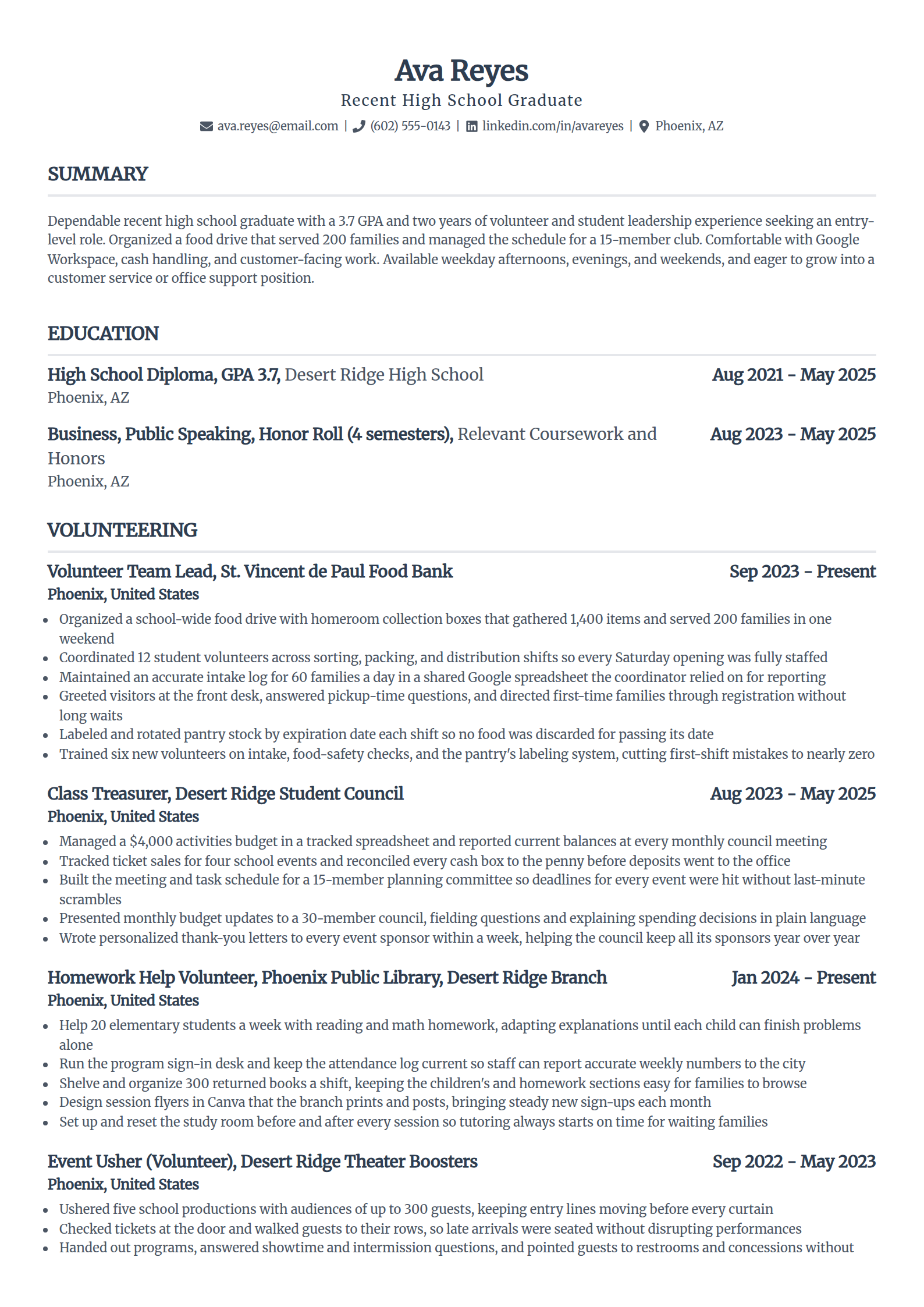
Resume Example With No Work Experience
Why this resume example works?
- Leads with a dependable-graduate framing and a GPA, so a reader with no job history to scan still gets a signal.
- Puts volunteering and student leadership where a work section would sit, which is exactly what a no-experience resume should do.
- Turns a food drive into proof by naming the 200 families it served, one countable detail instead of a vague claim.
- Names real tools, Google Workspace and cash handling, rather than saying hard worker.
- Keeps the whole thing to one honest page that reads as a starting point, not a gap.
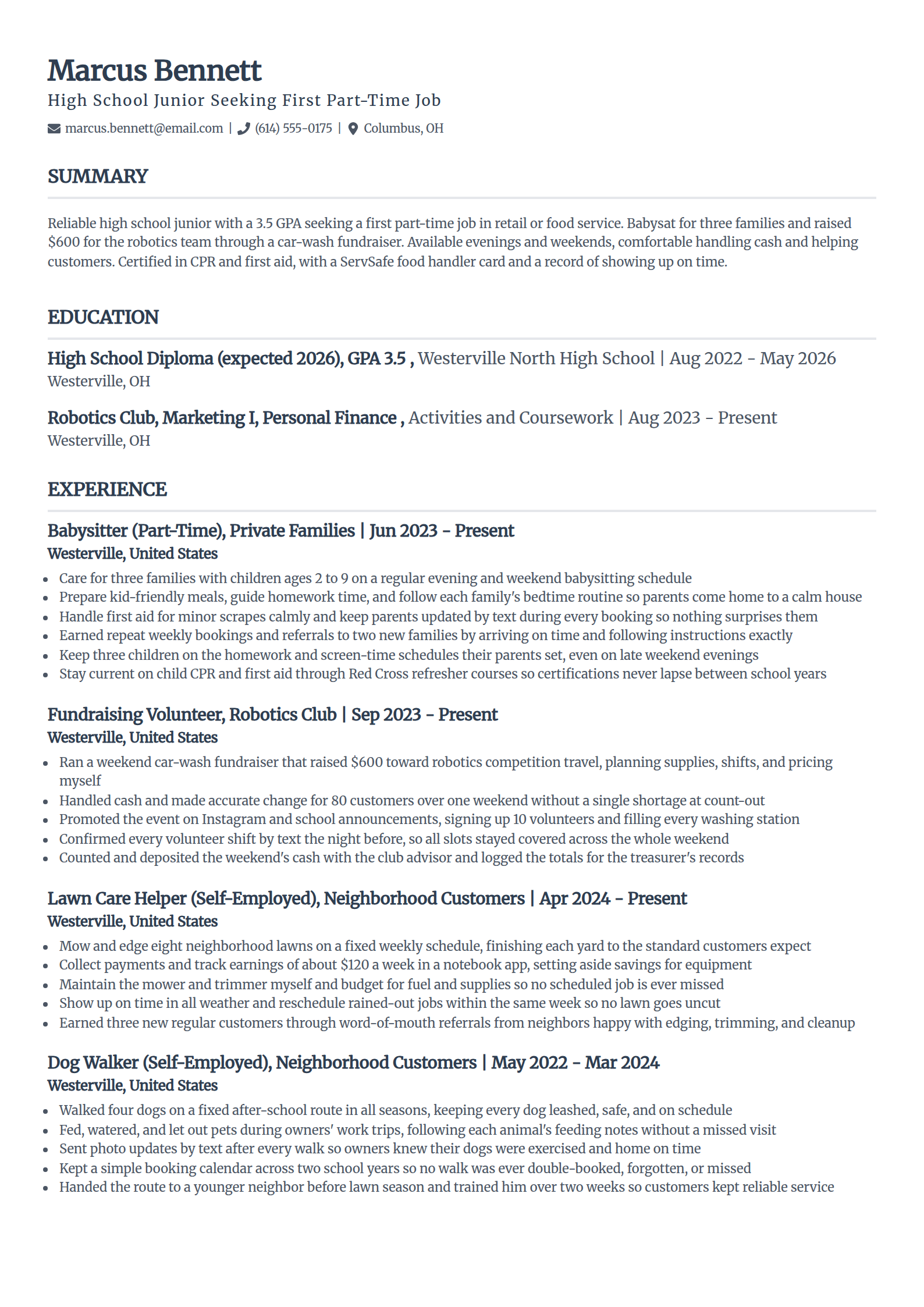
First Job Resume Template (Teenager)
Why this resume example works?
- Names the target, a first part-time job, so a manager reads it for reliability, not tenure.
- Counts real responsibility: three families babysat and $600 raised, both checkable and age-appropriate.
- States availability up front, which is the first thing a shift manager needs to know.
- Frames a fundraiser as cash-handling and customer experience, the exact skills the job needs.
- Keeps a confident tone about small, real tasks so a thin history reads as a solid start.
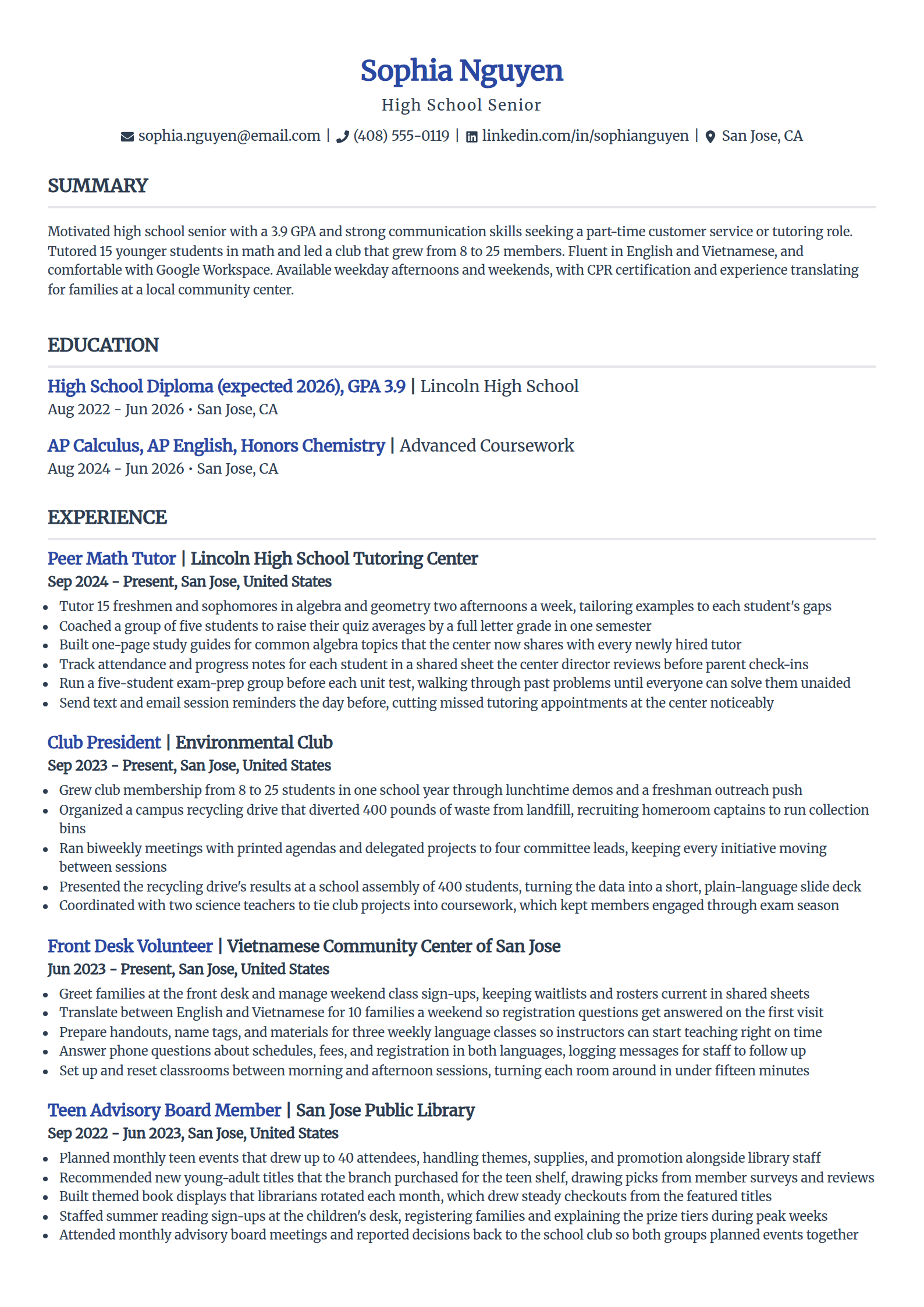
High School Student Resume Template
Why this resume example works?
- Opens with the GPA and a clear target role, the two things a student resume has to establish fast.
- Shows measured impact, a club grown from 8 to 25 members, instead of listing memberships.
- Turns tutoring into a workload number, 15 students, that stands in for job experience.
- Adds a second language, which is a real hiring edge for customer-facing roles.
- Reads as capable and specific, so no work history does not read as no value.
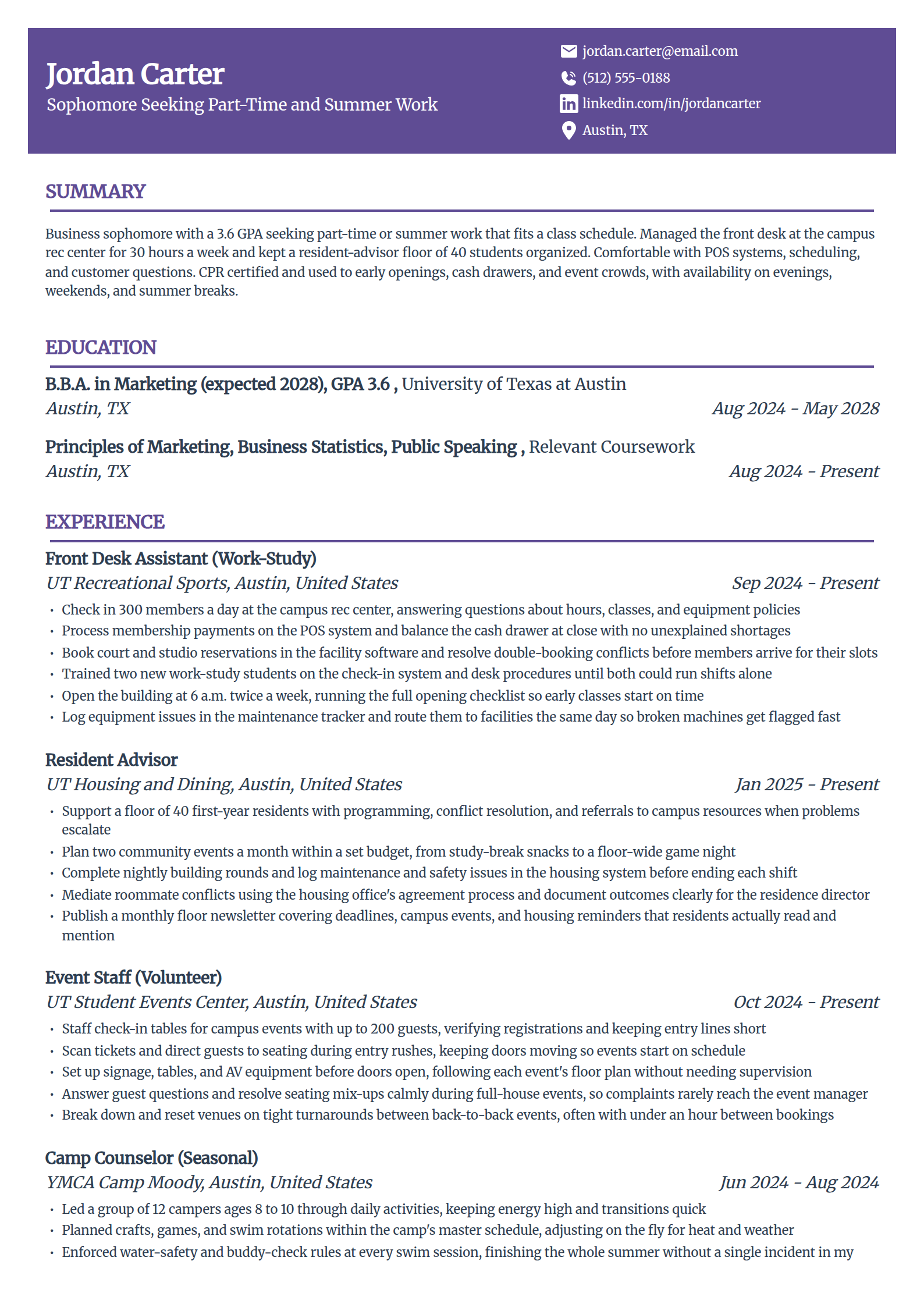
College Student Resume Template
Why this resume example works?
- States the constraint honestly, work that fits a class schedule, which employers of students expect.
- Backs the front-desk claim with hours worked, 30 a week, so the part-time role has real weight.
- Names transferable systems, POS and scheduling, that map straight to the target jobs.
- Shows responsibility for 40 residents, a leadership signal stronger than most first jobs.
- Keeps the summary two to three sentences, the length this page recommends.
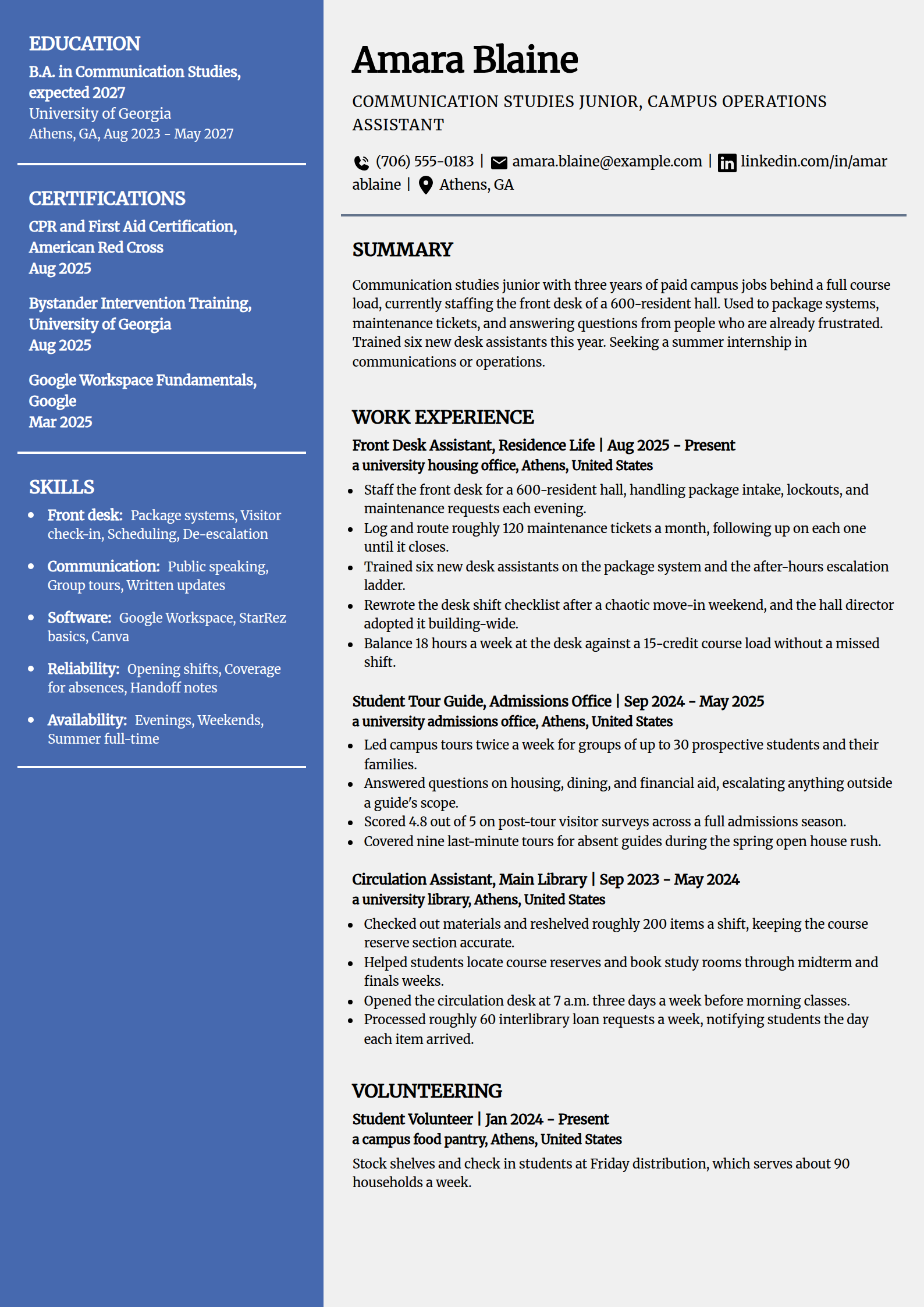
Campus Job and Work-Study Resume Template
Why this resume example works?
- Treats the campus job as a job, with the housing office, the dates, and what the shift actually involves.
- Counts work at campus scale, 120 maintenance tickets a month and a 600-resident hall, not invented business impact.
- Names the hours, 18 a week against 15 credits, which is the proof an employer of students wants.
- Shows three years of campus roles stacked in order, so the reader sees a work history rather than odd jobs.
- Puts a process improvement in, the rewritten desk checklist, which is rare on a student resume and lands.
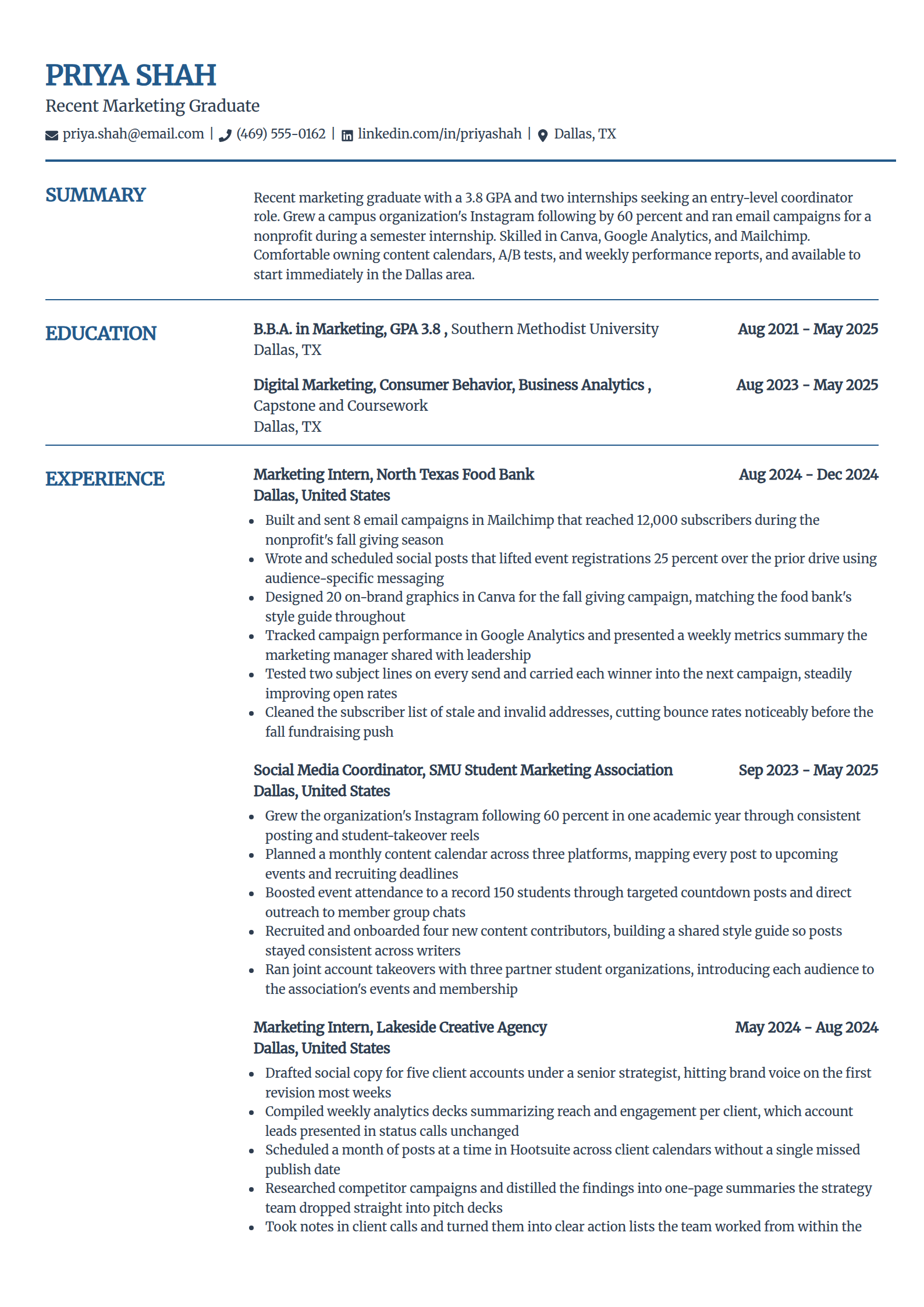
Recent Graduate Resume Template
Why this resume example works?
- Leads with the degree and two internships, which is how a new grad substitutes for full-time years.
- Carries one strong result, a 60 percent follower gain, rather than a list of duties.
- Names the exact stack a coordinator posting screens for: Canva, Google Analytics, Mailchimp.
- Ties internship work to real deliverables, email campaigns and graphics, not just attendance.
- Positions internships as experience, so the resume competes with candidates who have a year in.
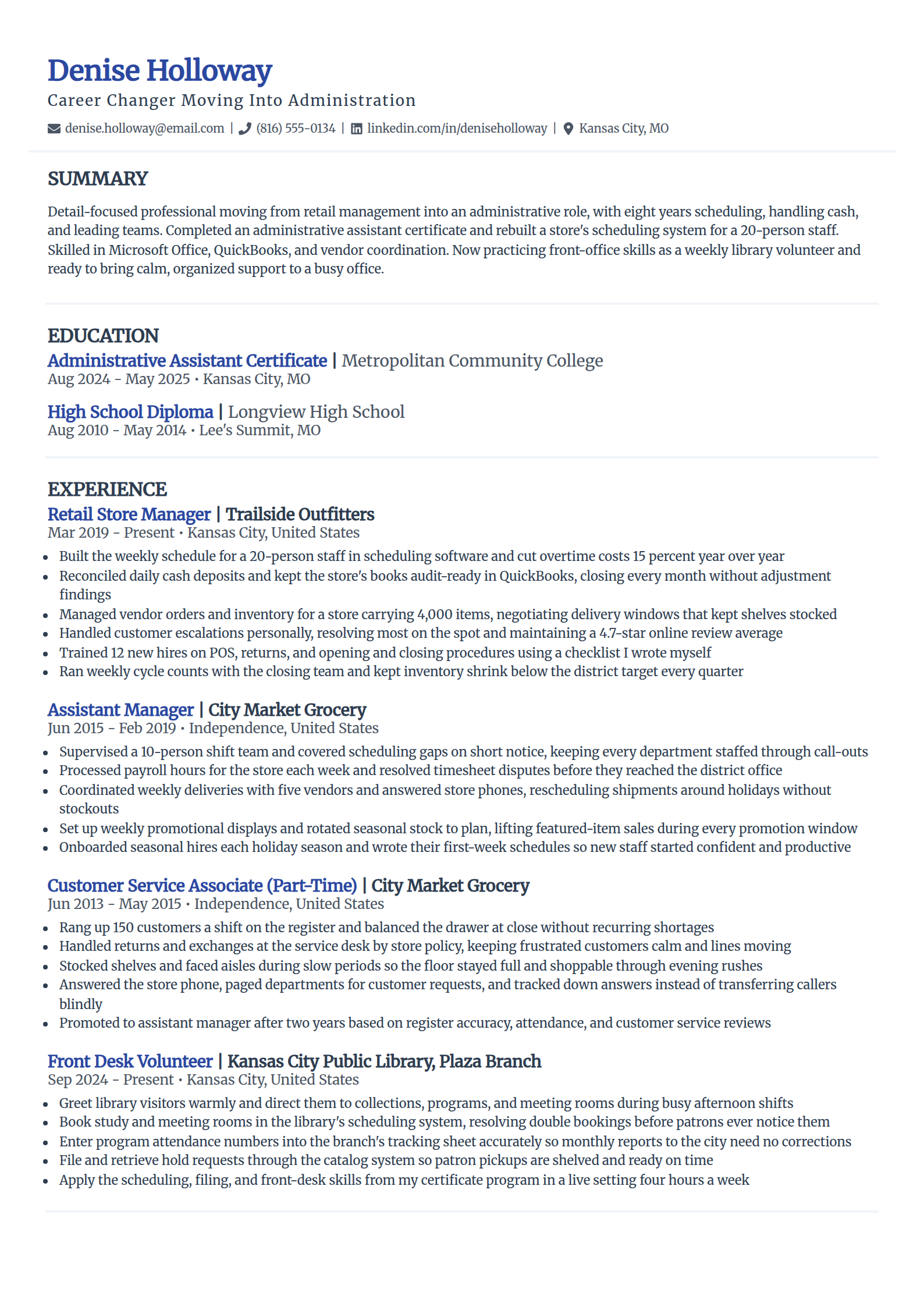
Career-Change Resume Template (New Field)
Why this resume example works?
- Frames prior work as an asset, eight years of scheduling and cash handling, not a detour.
- Shows the person closed the gap by completing a certificate for the new field.
- Translates retail management into admin proof: scheduling a 20-person staff and vendor coordination.
- Names the office tools, Microsoft Office and QuickBooks, that the target role actually lists.
- Leads with the current role so the pivot stays honest and easy for a reader to follow.
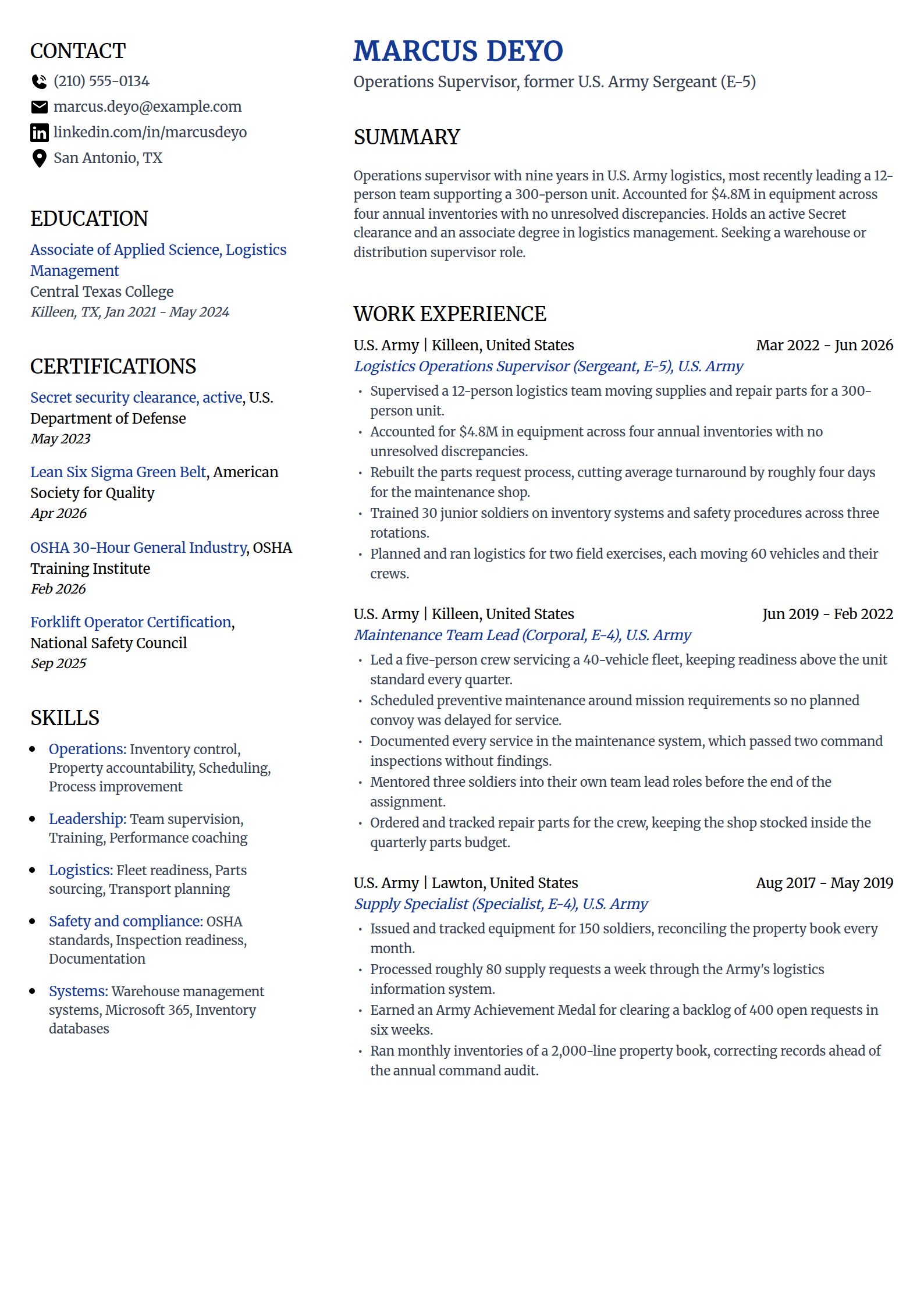
Military to Civilian Resume Template
Why this resume example works?
- Leads every title with the civilian job and puts the rank in parentheses, because rank tells a civilian manager nothing.
- Gives scope in units a hiring manager can compare, a 12-person team supporting a 300-person unit.
- Puts a dollar figure on accountability, $4.8M in equipment across four inventories with no unresolved discrepancies.
- Drops the acronyms and says what the work was, inventory systems, preventive maintenance, and parts turnaround.
- States the clearance as a fact with its level, and adds the forklift and OSHA cards a warehouse posting asks for.
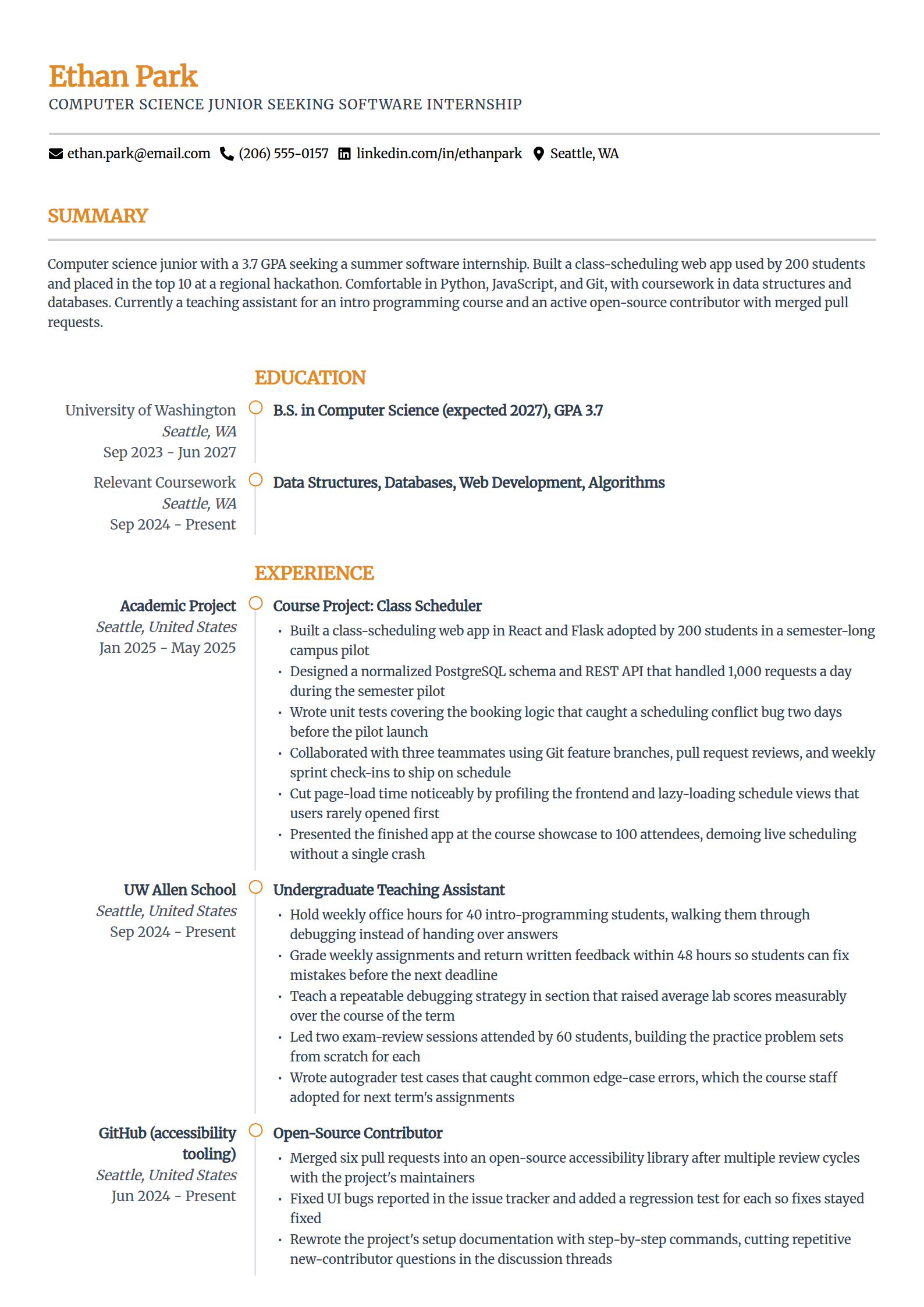
Internship Resume Template (Student)
Why this resume example works?
- Names the exact goal, a summer software internship, so a recruiter reads for potential and fit.
- Leads with a project that shipped and got used, 200 students, which beats a coursework list.
- Puts a course project in the experience slot, the right move when there is no job yet.
- Names the languages and tools an internship posting matches on: Python, JavaScript, Git.
- Adds a hackathon result, real proof of building under pressure with a team.
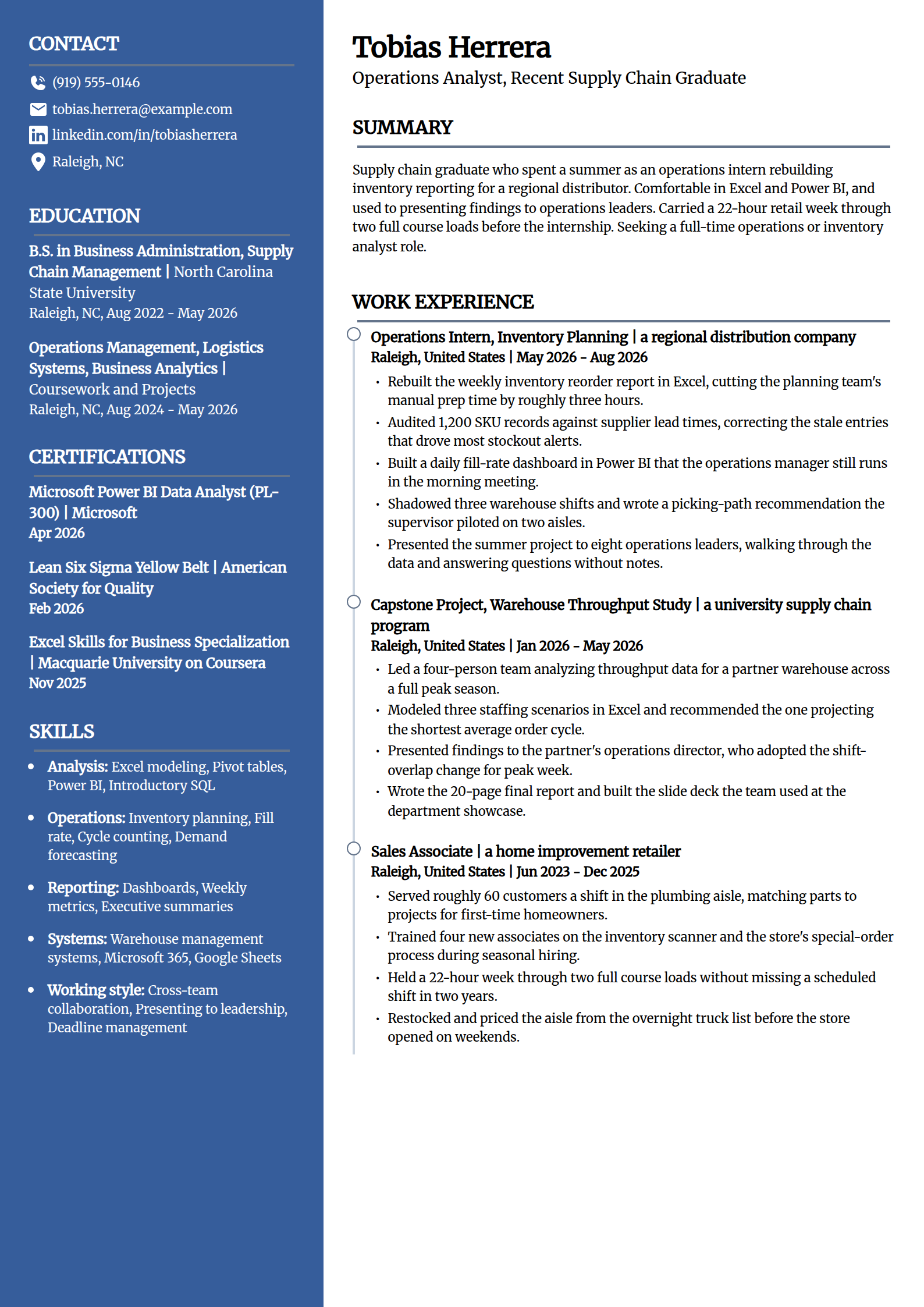
Internship to Full-Time Resume Template
Why this resume example works?
- Gives the internship a descriptive title, Operations Intern in Inventory Planning, instead of the bare word Intern.
- Writes the summer like a job, with an audit of 1,200 SKU records and a dashboard the manager still runs.
- Puts the capstone project in the experience section, which is where a four-month team project earns its space.
- Keeps the retail job on the page, because a 22-hour week through two course loads is evidence of reliability.
- Names the tools a first analyst posting screens for, Excel and Power BI, and backs each with something built.
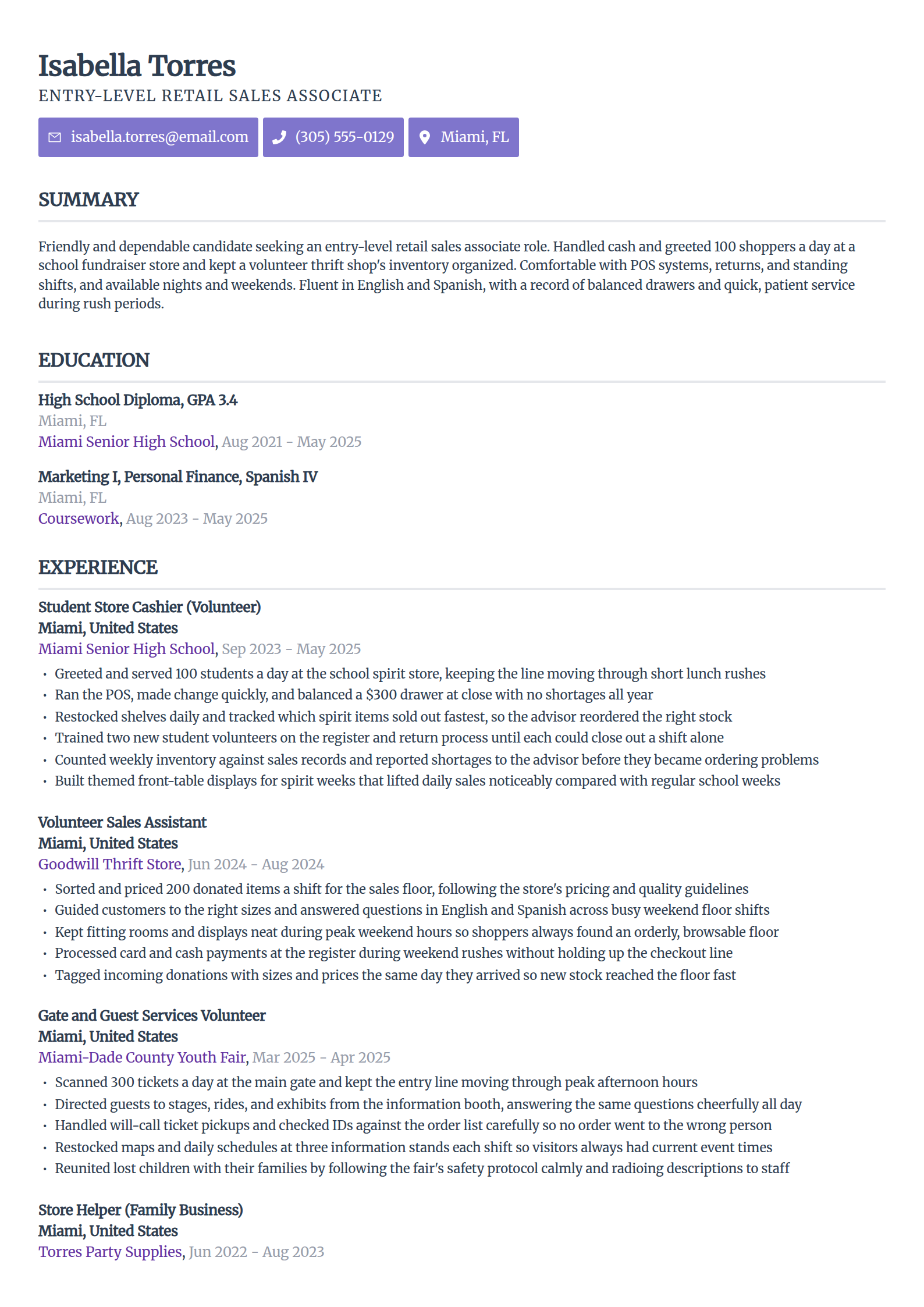
Entry-Level Retail Resume Template
Why this resume example works?
- Targets the exact role, retail sales associate, and matches the traits a store hires for.
- Counts customer volume, 100 shoppers a day, so a volunteer store role reads like real retail.
- Names POS, returns, and standing shifts, the concrete parts of the job a manager cares about.
- States night and weekend availability, which decides half of retail hiring.
- Uses volunteer sales work as proof, the right substitute when there is no paid history.
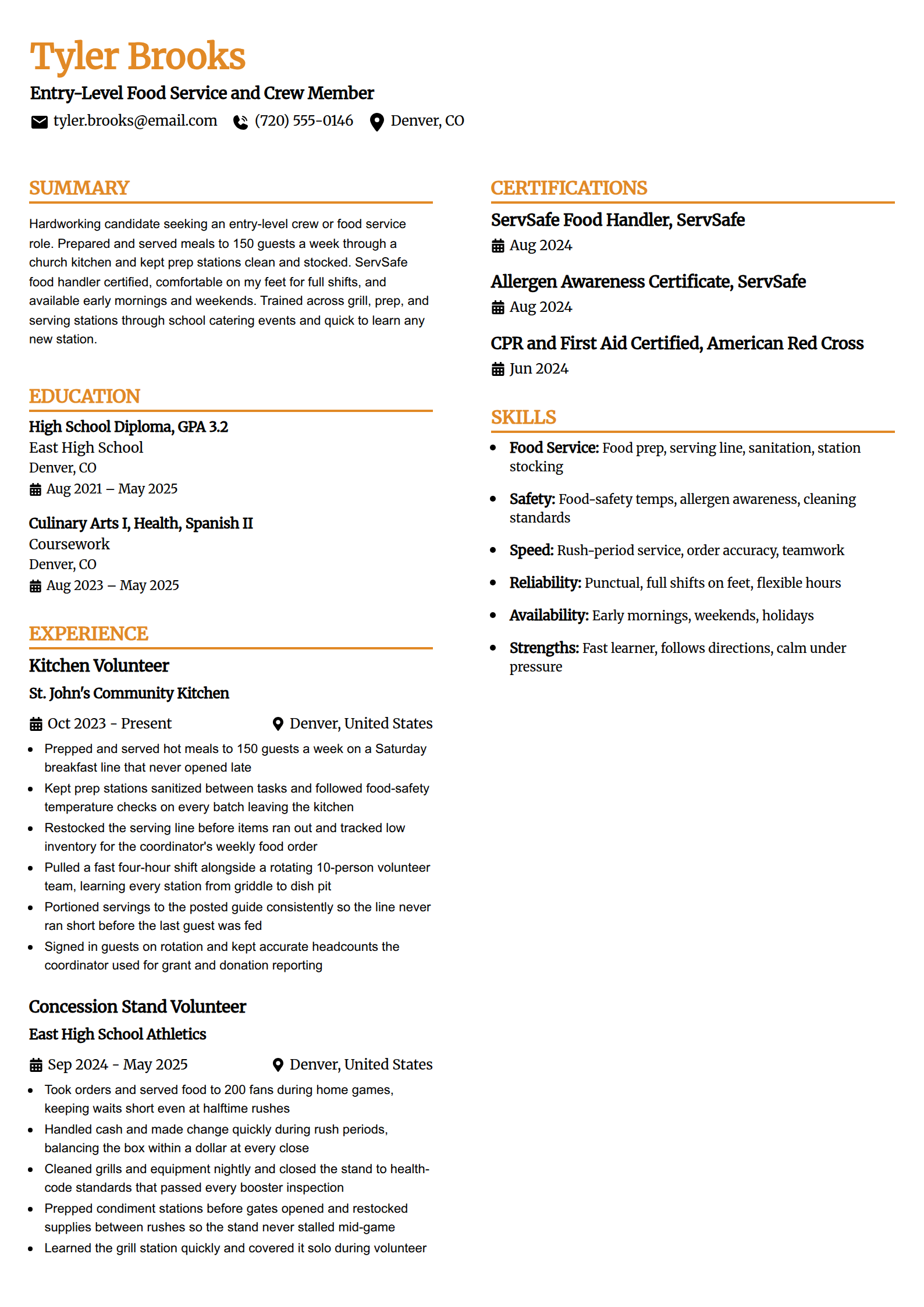
Food Service Resume Template (No Experience)
Why this resume example works?
- Leads with the target and a real serving number, 150 guests a week, from volunteer kitchen work.
- Puts the ServSafe food handler card up front, the one credential food employers look for.
- Names the physical reality, full shifts on your feet, that the job actually requires.
- Shows food-safety habits, sanitized stations and temperature checks, in the bullets.
- States early and weekend availability, which is what restaurant scheduling turns on.
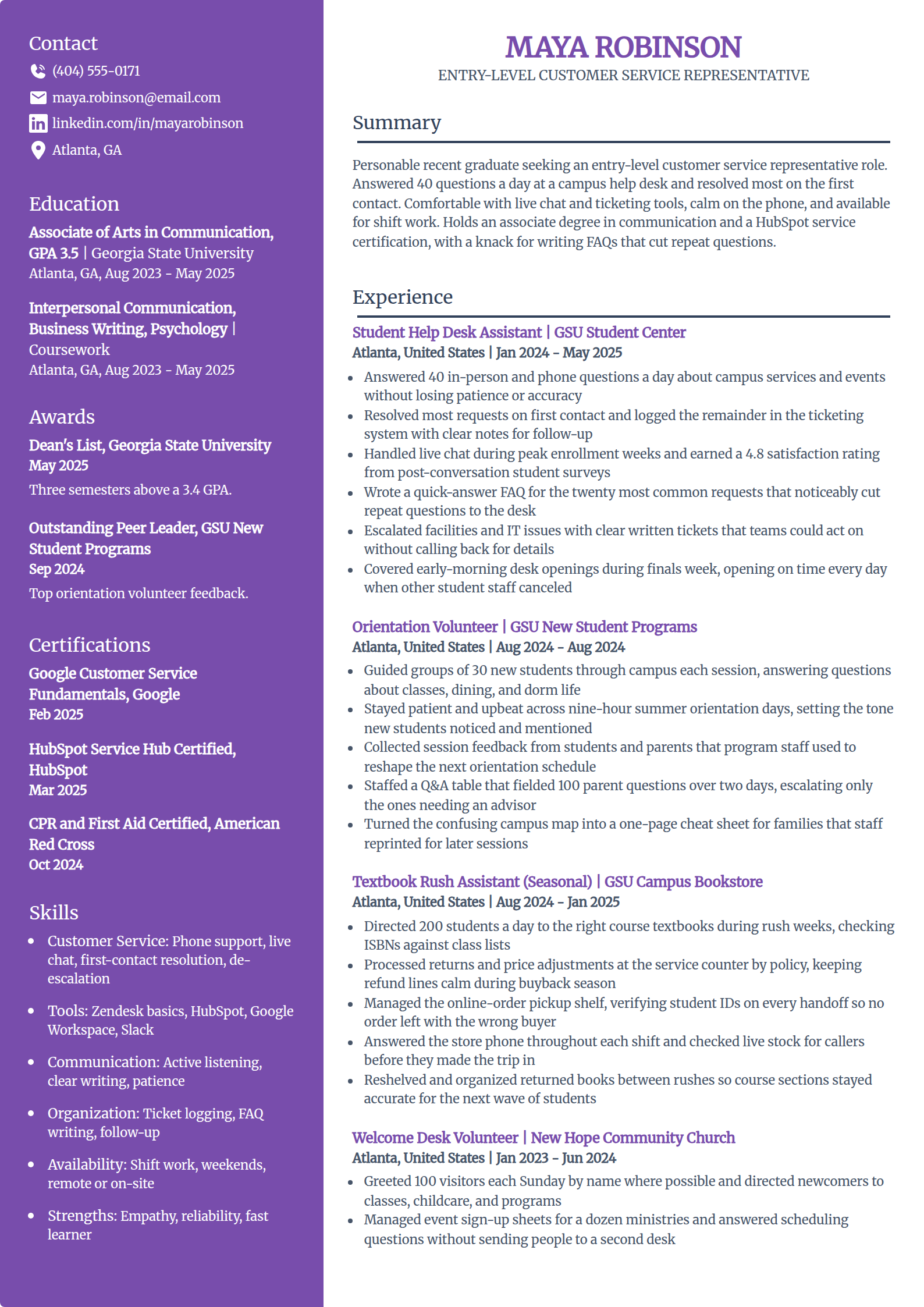
Entry-Level Customer Service Resume Template
Why this resume example works?
- Names the role and a daily volume, 40 questions, so a help-desk shift reads like a real support job.
- Claims first-contact resolution, the metric customer service teams are measured on.
- Names live chat and ticketing tools, the systems a support posting expects.
- Signals temperament, calm on the phone, which is a genuine hiring factor for the role.
- States shift availability plainly, which support teams schedule around.
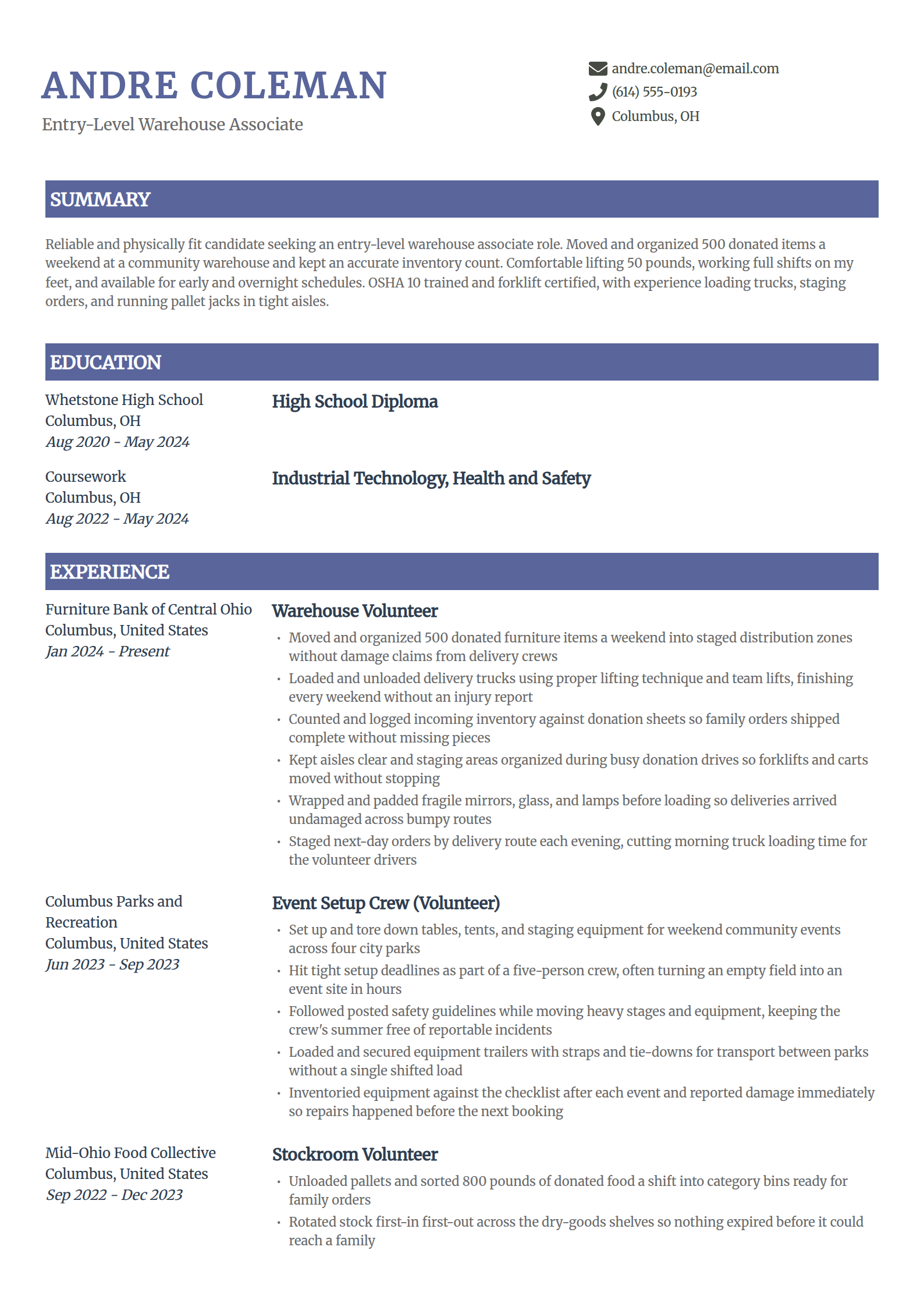
Entry-Level Warehouse Resume Template
Why this resume example works?
- Opens with the traits a warehouse hires for, reliable and physically fit, then proves them.
- Counts throughput, 500 items a weekend, so volunteer warehouse work reads as the real thing.
- States the lifting requirement, 50 pounds, and shift availability, which the job description asks for.
- Carries the OSHA 10 and forklift certifications that move a beginner up the stack.
- Shows safe handling and inventory accuracy, the parts of the job that keep a worker employed.
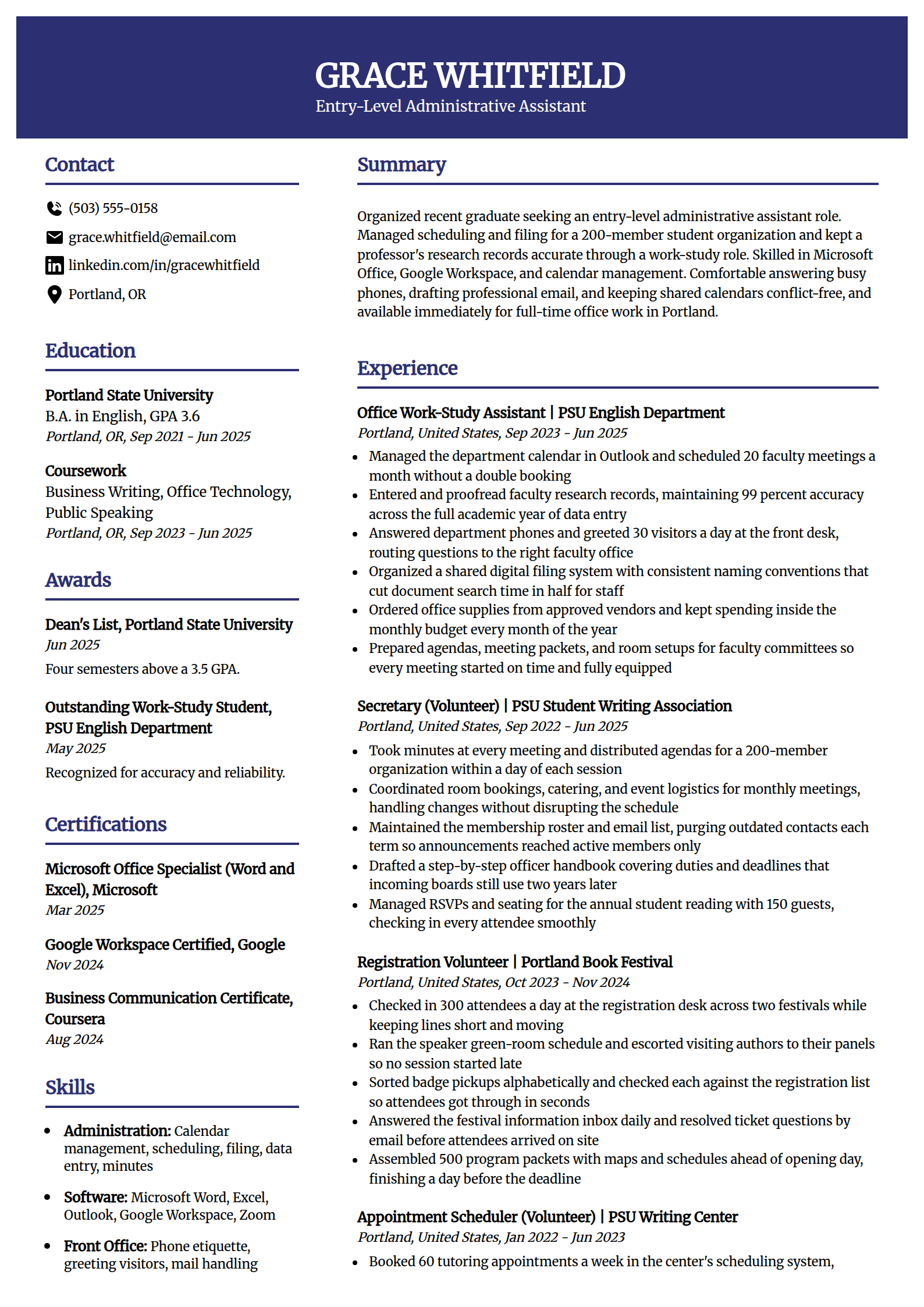
Entry-Level Administrative Assistant Resume Template
Why this resume example works?
- Leads with organized and names the target, the trait and role an admin posting screens for.
- Uses a work-study job and a student-org role as real administrative experience.
- Backs the records claim with accuracy, a detail an office manager trusts.
- Names Microsoft Office and calendar management, the day-one tools of the job.
- Shows scale, a 200-member organization, so the coordination work has weight.
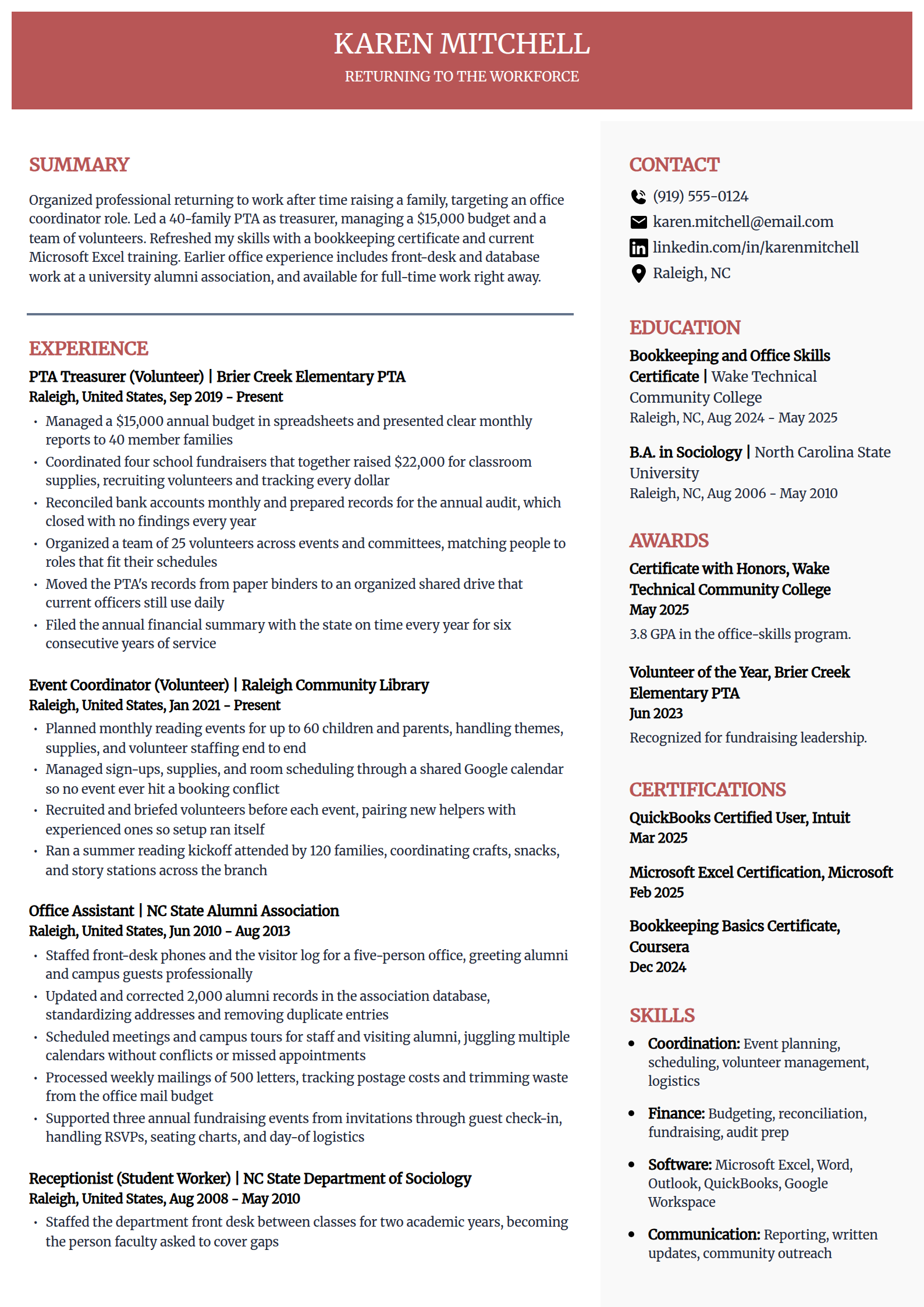
Returning to Work Resume Template
Why this resume example works?
- Names the gap honestly and reframes it, so a reader is not left guessing about the timeline.
- Turns PTA treasurer work into real numbers, a $15,000 budget and a volunteer team.
- Shows current skills through a recent certificate and Excel training, which answers the freshness question.
- Targets a specific role, office coordinator, that the volunteer experience actually supports.
- Leads with organized professional, keeping the focus on capability rather than the time away.
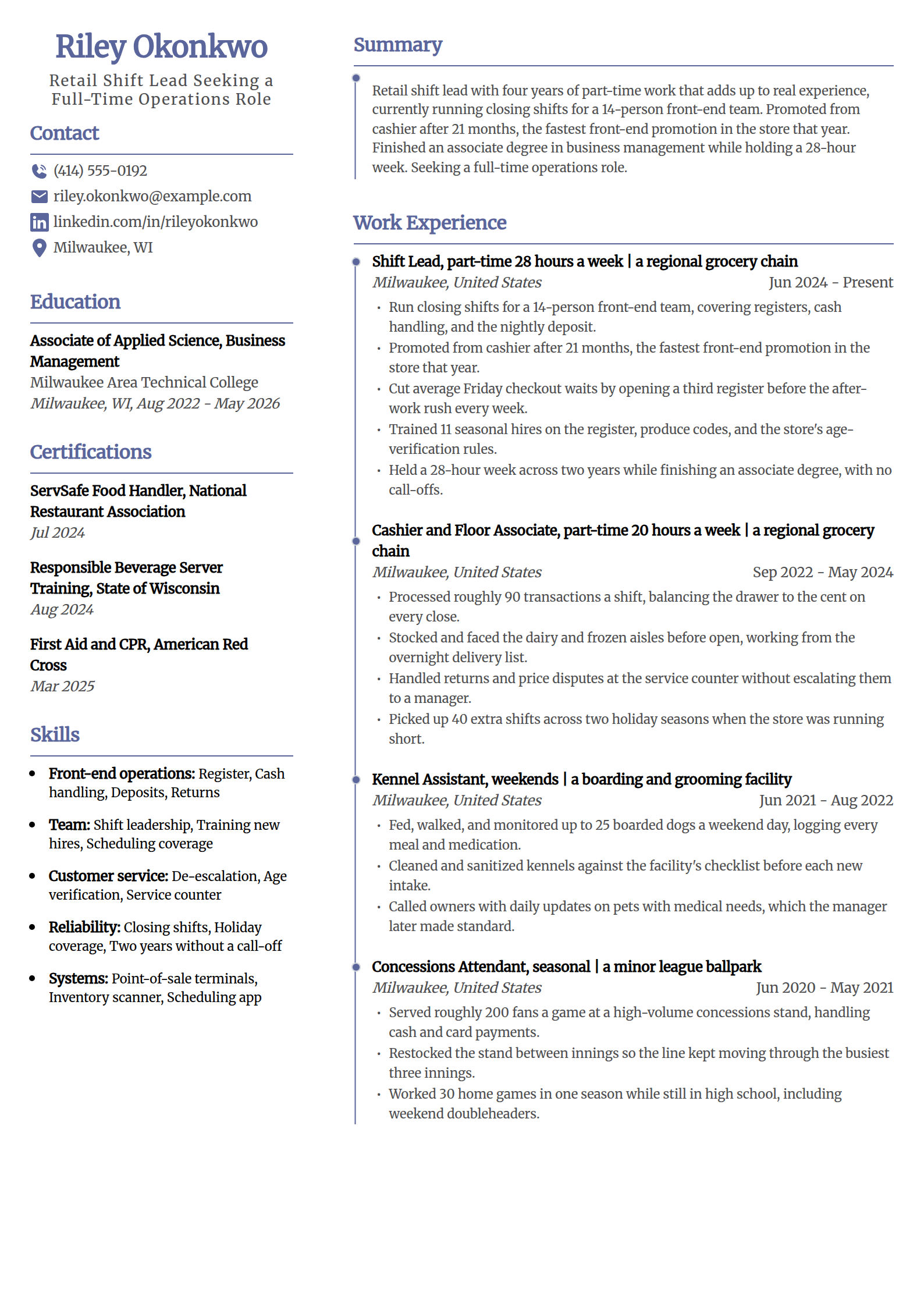
Part-Time to Full-Time Resume Template
Why this resume example works?
- Puts the hours in every job title, 28 a week and 20 a week, so four years of shifts stop reading as casual.
- Leads the current role with the promotion, cashier to shift lead in 21 months, which is the strongest evidence here.
- Shows supervision of a 14-person front-end team, the detail that separates this from a first-job resume.
- Keeps the older seasonal and weekend jobs, because an unbroken run since high school is itself the argument.
- Pairs the degree finished alongside the job with a reliability record, two years of closing shifts and no call-offs.
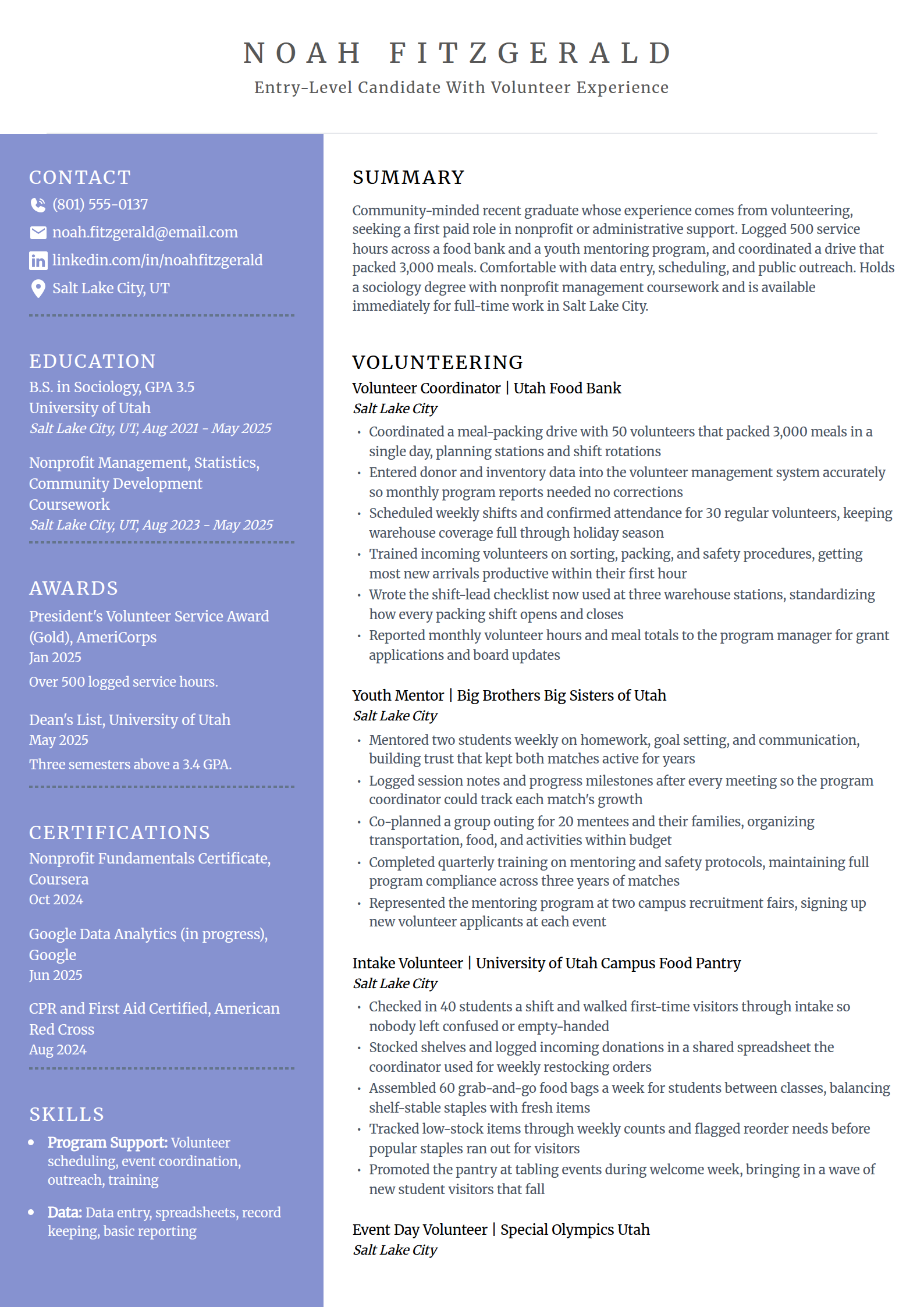
Volunteer Experience Resume Template
Why this resume example works?
- Says plainly the experience is volunteer work, then makes that the resume's strength.
- Counts it like a job: 500 service hours and a drive that packed 3,000 meals.
- Puts volunteering in its own labeled section, so a reader sees sustained commitment.
- Names office skills, data entry and scheduling, that transfer to the target roles.
- Targets nonprofit and admin support, where volunteer depth is a genuine advantage.
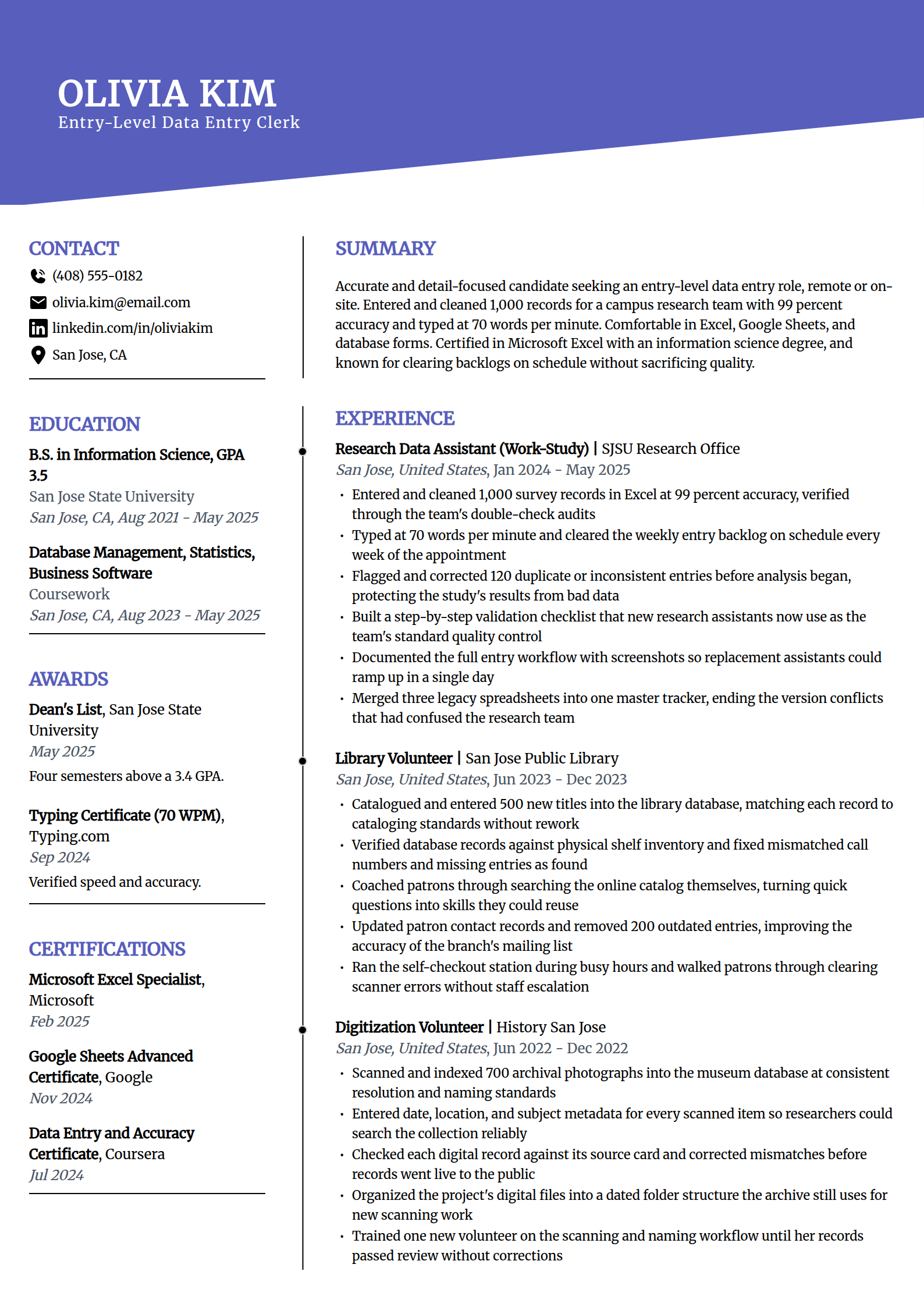
Entry-Level Data Entry Resume Template
Why this resume example works?
- Leads with the two traits data entry hires for, accuracy and attention to detail.
- Pairs a volume number, 1,000 records, with an accuracy rate, 99 percent, so neither looks gamed.
- Names a typing speed, 70 words per minute, a concrete and checkable data-entry metric.
- Lists Excel, Google Sheets, and database forms, the exact tools the posting expects.
- States remote or on-site, widening the roles the resume fits.
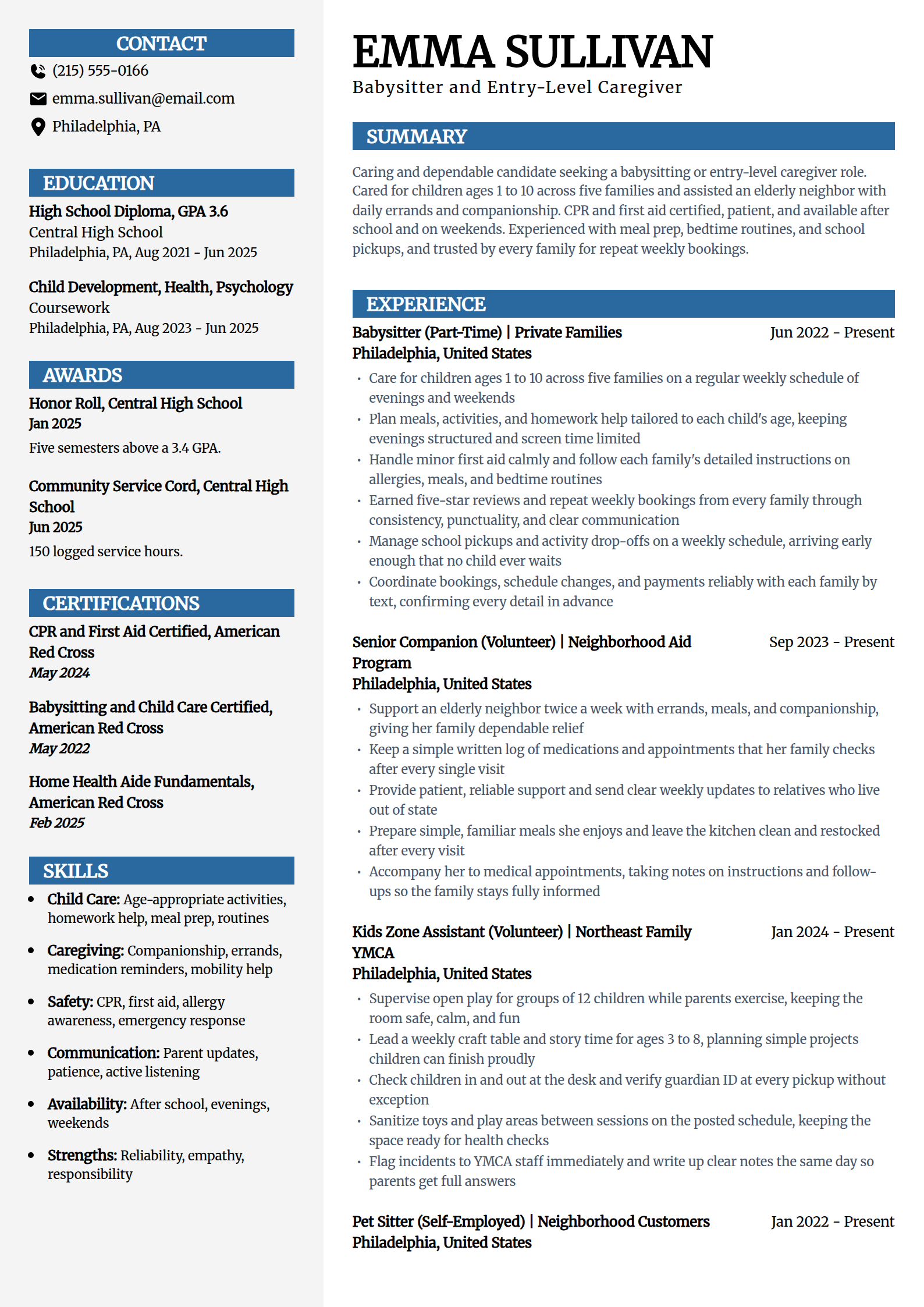
Babysitter and Caregiver Resume Template
Why this resume example works?
- Names the role and the traits parents and families screen for, caring and dependable.
- Shows range, children ages 1 to 10 across five families, which reads as real experience.
- Puts CPR and first aid certification up front, the credential caregiving families ask about.
- Adds elder-care work, broadening the resume to entry-level caregiver roles too.
- States availability, after school and weekends, which decides most caregiving hires.
Build your first resume
Pick a template above and the editor keeps the layout parser-safe while you swap in your own school, volunteering, and skills. No experience section needed to start.
Build my resumeHow to write a resume with no experience in 2026
A resume with no paid job history is not a shorter resume, it is a resume built on different proof. Education, volunteering, projects, and real responsibility fill the space a work section usually holds. These moves satisfy the applicant tracking system and the manager reading it.
Open with a summary that names your target and one real detail
Write two to three sentences that say the role you want, then one specific thing that qualifies you: a GPA, volunteer hours, people served, or a project that shipped. Skip the word experienced and skip listing what you do not have.
Motivated high school senior with a 3.9 GPA seeking a part-time customer service role, having tutored 15 students in math and grown a campus club from 8 to 25 members.
Replace the experience section with what you actually have
When there is no job to list, these count as experience, and every ranking resume above uses them. Put the strongest one where a work section would sit.
- Volunteering: a food bank, a mentoring program, or event setup, described with real numbers.
- Projects and coursework: a class project that shipped, a capstone, a portfolio piece.
- Leadership and activities: club officer, team captain, student council, treasurer.
- Informal work: babysitting, tutoring, yard work, or a family business, framed as a role.
Use numbers, even without a job title
A number turns a task into proof. You have more of them than you think.
- People: children babysat, students tutored, guests served, shoppers helped.
- Money and things: dollars raised, items sorted, records entered, a budget managed.
- Growth and results: a club that grew, a grade that rose, a drive that hit a total.
Name your skills and tools instead of adjectives
An applicant tracking system matches the exact tool a posting lists, so write them out where they are true. Google Workspace, Microsoft Excel, a POS system, or ServSafe beats hardworking and fast learner every time. Add six to eight skills that mix these tools with real soft skills.
Lead with education and add certifications
With a thin work history, education moves near the top. Free and low-cost certifications are a fast way to add proof.
- List your school, graduation year, GPA if it is 3.0 or higher, and relevant coursework.
- Add certifications you can earn quickly: CPR and first aid, ServSafe, Google or Microsoft skills, OSHA 10.
- Note honors, the dean's list, or a service award if you have one.
Keep the format ATS-safe and to one page
A first resume should parse cleanly and fit on one page. The templates above are built for that.
- Use a single-column, standard-heading layout and skip tables, text boxes, and icon columns.
- Keep your name and contact details in the body of the page, not the header or footer.
- Save as a PDF unless the posting asks for a Word document.
Common no-experience resume mistakes
- Leaving the experience section empty instead of filling it with volunteering, projects, or leadership. You almost always have something that counts.
- Apologizing for the gap. Writing "no experience but willing to learn" wastes the line that should name your target and one real strength.
- Listing only adjectives. "Hardworking, motivated, team player" tells a manager nothing; "served 150 guests a week" tells them everything.
- Padding to two pages. A first resume that fits one clean page reads as focused, not thin.
- Using a decorative, two-column template that a parser cannot read, then wondering why the application went nowhere.
Frequently asked questions
How do I write a resume with no work experience?
Lead with a two to three sentence summary that names the role you want and one real detail, such as a GPA, volunteer hours, or a project. Then fill the experience section with what you have: volunteering, class projects, leadership roles, and informal work like babysitting or tutoring, each written with a number. Add a skills section that names your tools, list your education and any certifications, and keep it to one page.
What do I put on a resume if I have no experience?
Put your education first, then use volunteering, school or personal projects, extracurricular leadership, and informal work in place of a job history. Name specific tools and skills, add quick certifications like CPR, ServSafe, or a Google or Microsoft course, and include honors or awards. The examples above show each of these standing in for paid work.
Should I use an objective or a summary if I have no experience?
Either works, and you should use only one, never both. A two to three sentence summary that names your target and one strength is the safer default. A short objective earns its place for a true first job or a career change, where saying what you are aiming for adds context a summary cannot. Both should lead with what you bring, not what you want from the employer.
How long should a first-job resume be?
One page. With little or no work history there is no reason to run longer, and a single clean page reads as focused. Fill it with education, volunteering, projects, skills, and certifications rather than padding, and use the space to add detail to what you have rather than to stretch.
Do volunteering, coursework, and certifications count as experience?
Yes. Volunteering, class and personal projects, and certifications are legitimate experience on a first resume, and many hiring managers weigh them the same as a first job. Describe volunteer roles with numbers the way you would a job, list projects that shipped or that you presented, and add quick certifications to show initiative. Every example on this page is built this way.
Which resume template is best for a first job with no experience?
A clean single-column template with standard headings, such as Standard, Classic, or Simple above. Those parse cleanly in applicant tracking systems and keep your education, skills, and dates where a manager expects them. Save the more decorative formats for a portfolio, since a first application is where a parser-safe layout matters most.
More entry-level resume resources
Build your first resume
Pick a template above and the editor keeps the layout parser-safe while you swap in your own school, volunteering, and skills. No experience section needed to start.