Digital Marketing Resume Examples for SEO, PPC, Email, and Social
- ATS Friendly
- One Example Per Channel
- 16 Editable Templates
Your channel decides what belongs on the page. An SEO resume leads with organic sessions and technical fixes; a paid search resume leads with return on ad spend and cost per acquisition. Pick the example below that matches the job you are applying for, then swap in your own campaigns and numbers.


540k+ resumes created
Editable digital marketing resume templates by channel and level
Every template below is a full digital marketing resume laid out in that format, built for one specific channel or career stage. Filter by style, open the one that fits your track, then replace the campaigns, tools, and metrics with your own. Each layout keeps your channels, platforms, and results where a hiring manager looks first and parses cleanly in an applicant tracking system.
SEO Specialist Resume Template
Why this resume example works?
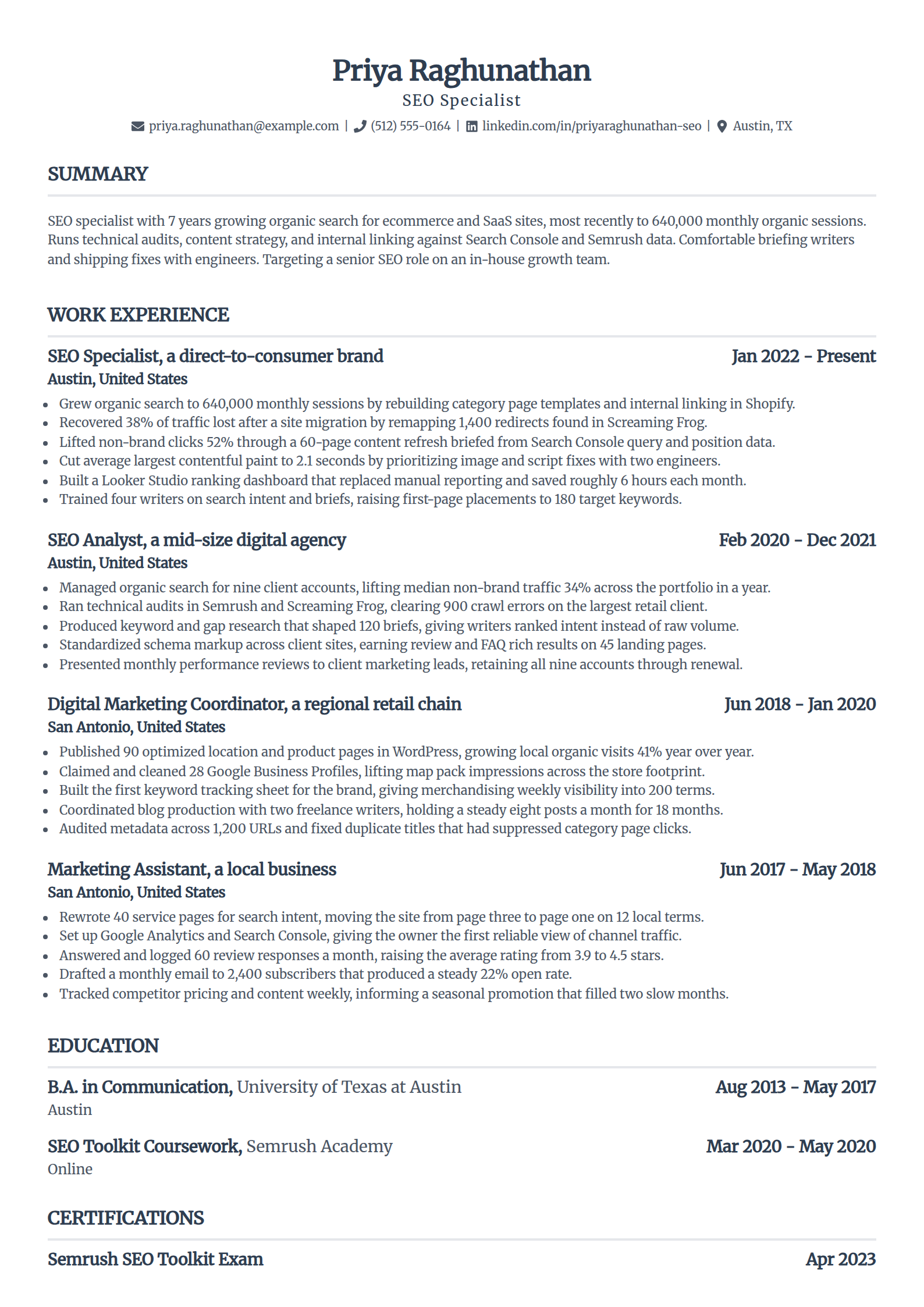
- Leads with the number an SEO role is judged on, organic search grown to 640,000 monthly sessions.
- Separates technical work from content work, with a migration recovery and a 60-page refresh both stated as outcomes.
- Names the stack a posting screens for, Search Console, Semrush, and Screaming Frog, inside real project context.
- Shows the cross-team reality of the job, image and script fixes shipped with two engineers.
- Keeps a single-column layout that an applicant tracking system reads without trouble.
PPC and Paid Search Resume Template
Why this resume example works?
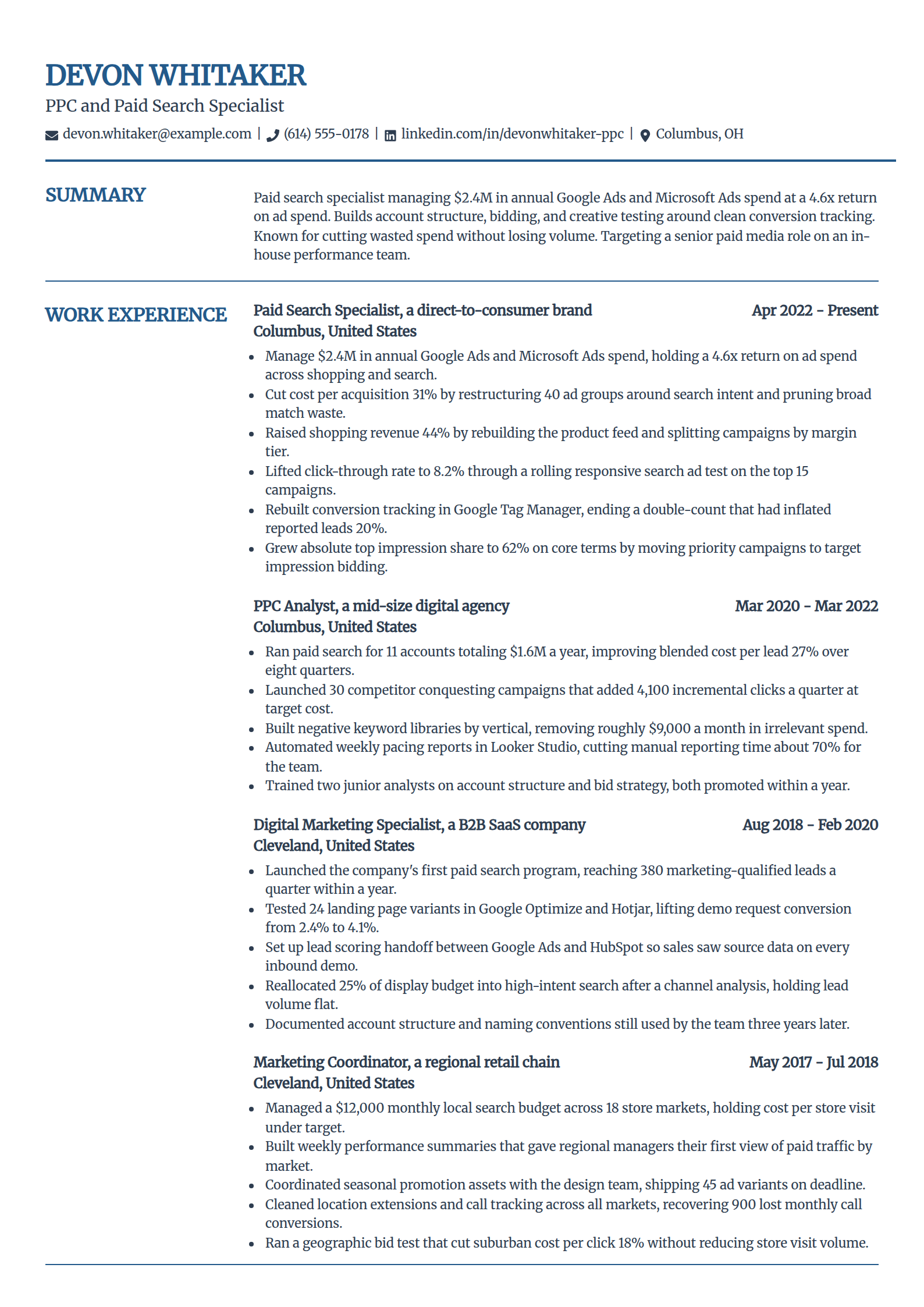
- Opens with budget scale and efficiency together, $2.4M in annual spend held at a 4.6x return on ad spend.
- Uses paid search metrics correctly, cost per acquisition, click-through rate, and absolute top impression share.
- Shows account craft rather than button-pushing, 40 ad groups restructured and broad match waste pruned.
- Includes the measurement fix that senior roles ask about, a double-count corrected in Google Tag Manager.
- Carries a dense multi-account history on one page without crowding the results.
Digital Marketing Manager Resume Template
Why this resume example works?
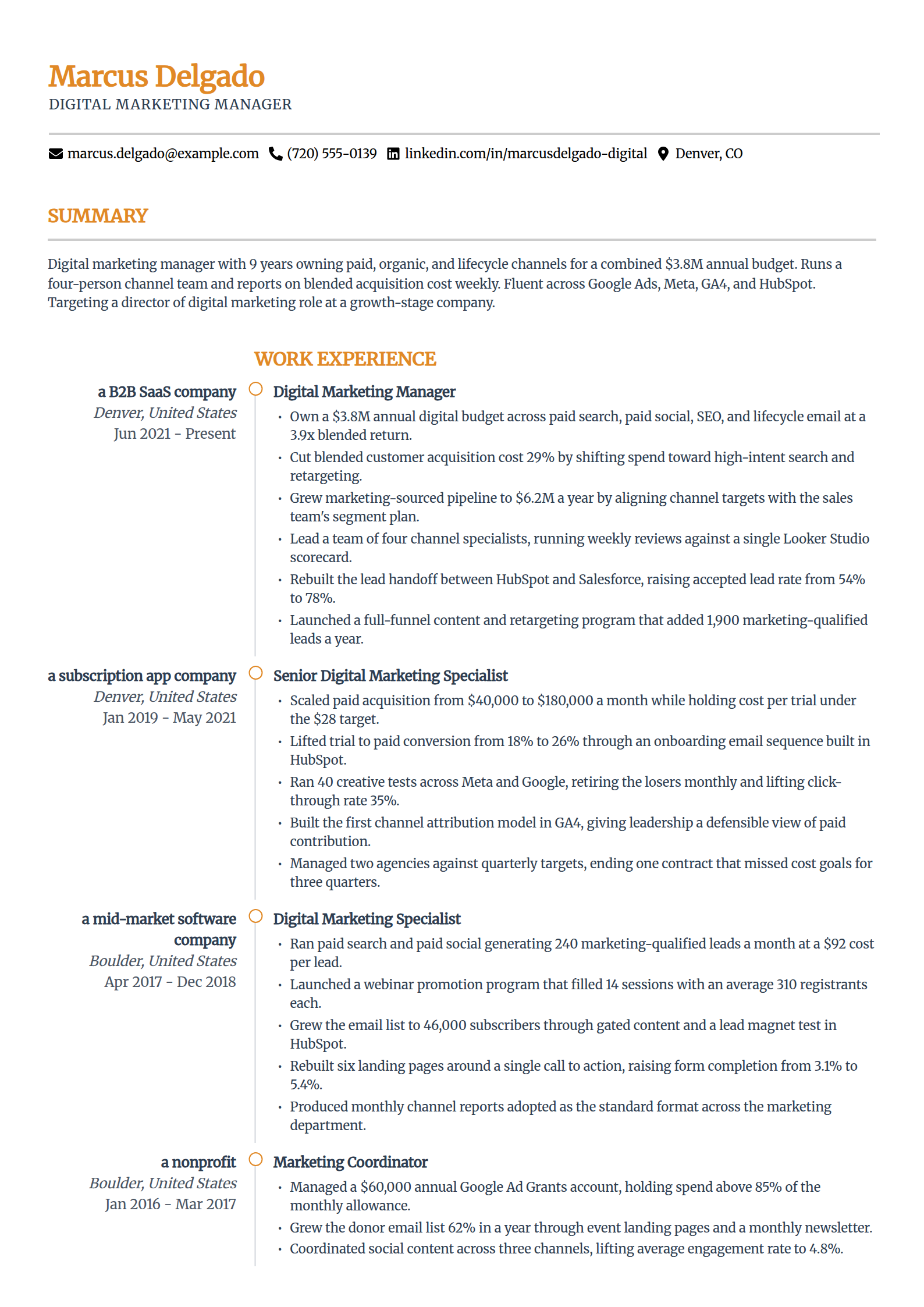
- Establishes ownership immediately, a $3.8M budget across paid, organic, and lifecycle at a 3.9x blended return.
- Shows people leadership as well as channel skill, four specialists managed against one shared scorecard.
- Connects marketing to revenue the way a manager is measured, $6.2M in marketing-sourced pipeline.
- Names the systems work a manager owns, the HubSpot to Salesforce handoff that lifted accepted lead rate.
- Uses a modern layout that stays readable when a hiring manager scans it in under a minute.
Head of Digital Marketing Resume Template
Why this resume example works?
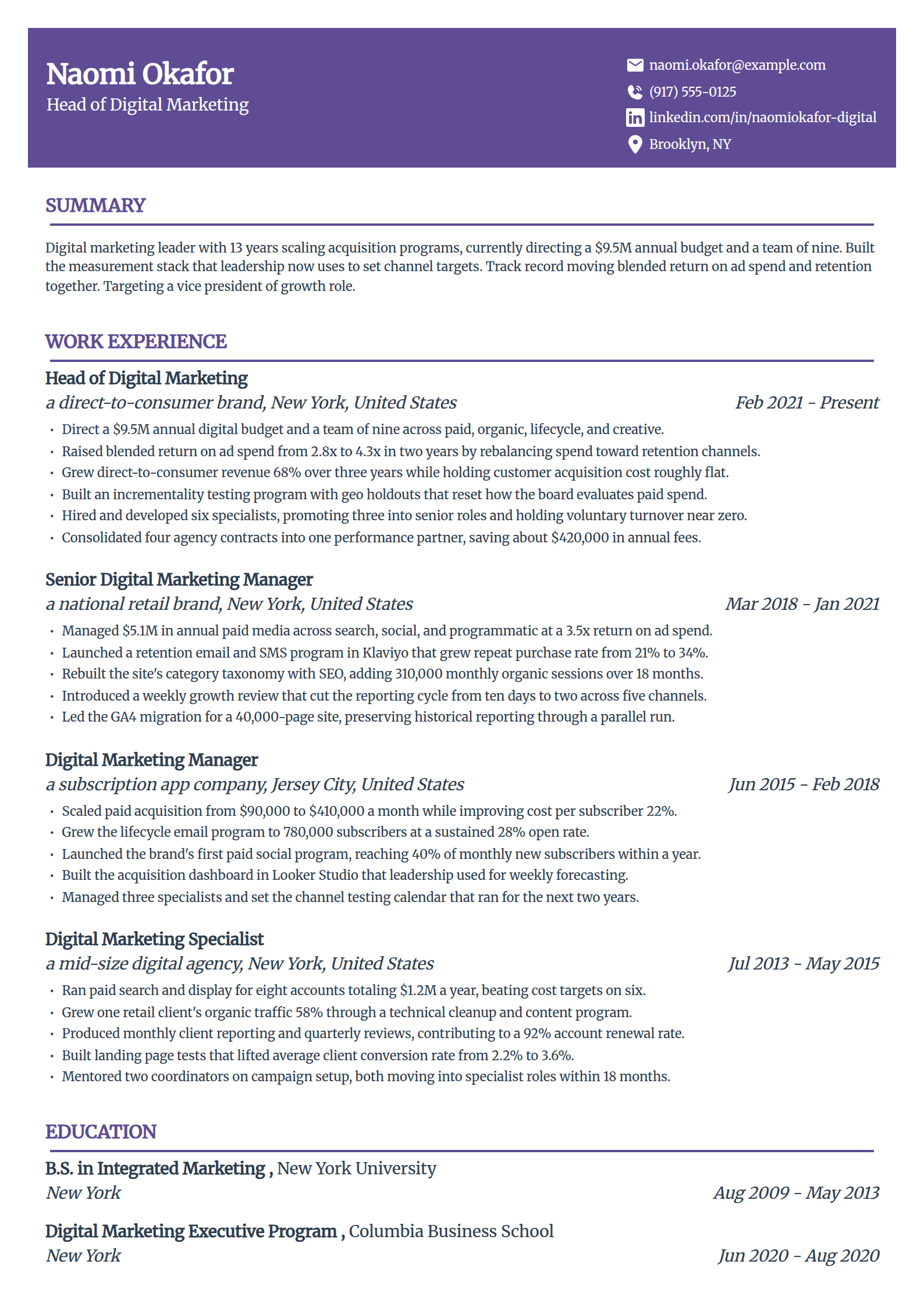
- Frames scope in the terms a leadership hire is screened on, a $9.5M budget and a team of nine.
- Pairs growth with efficiency, 68% revenue growth delivered while acquisition cost stayed roughly flat.
- Shows judgment, not just output, with a geo holdout program that changed how the board evaluates spend.
- Includes hiring and development results, six specialists hired and three promoted into senior roles.
- Reserves the second half of the page for earlier roles so 13 years fit without a second page.
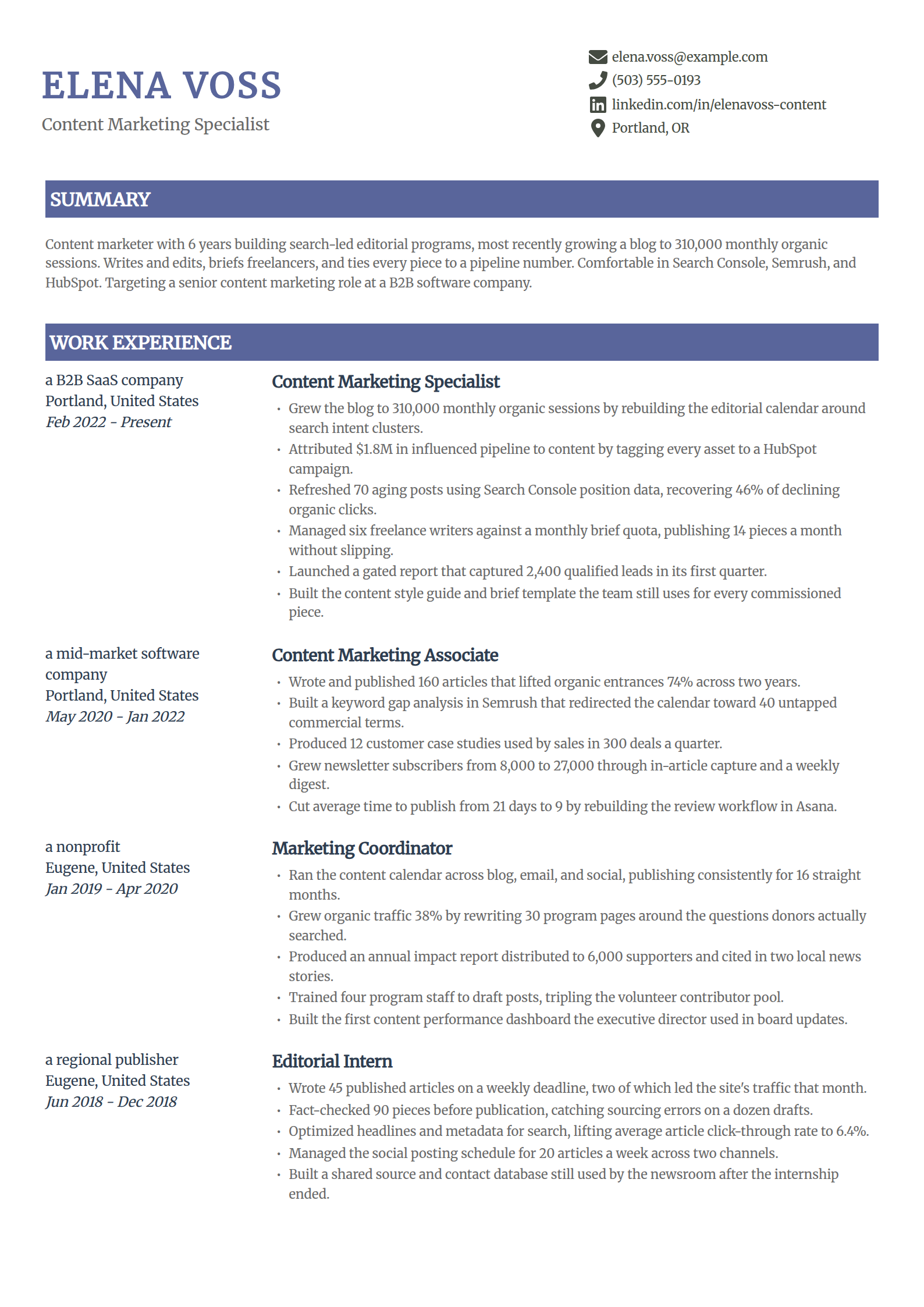
Content Marketing Resume Template
Why this resume example works?
- Leads with the traffic number content is hired to move, a blog grown to 310,000 monthly organic sessions.
- Ties writing to revenue, $1.8M in influenced pipeline tracked through campaign tagging.
- Shows editorial operations as well as craft, six freelancers managed at 14 published pieces a month.
- Proves the refresh skill that separates senior content roles, 46% of declining organic clicks recovered.
- Uses a visually rich layout that suits a content portfolio without hiding the numbers.
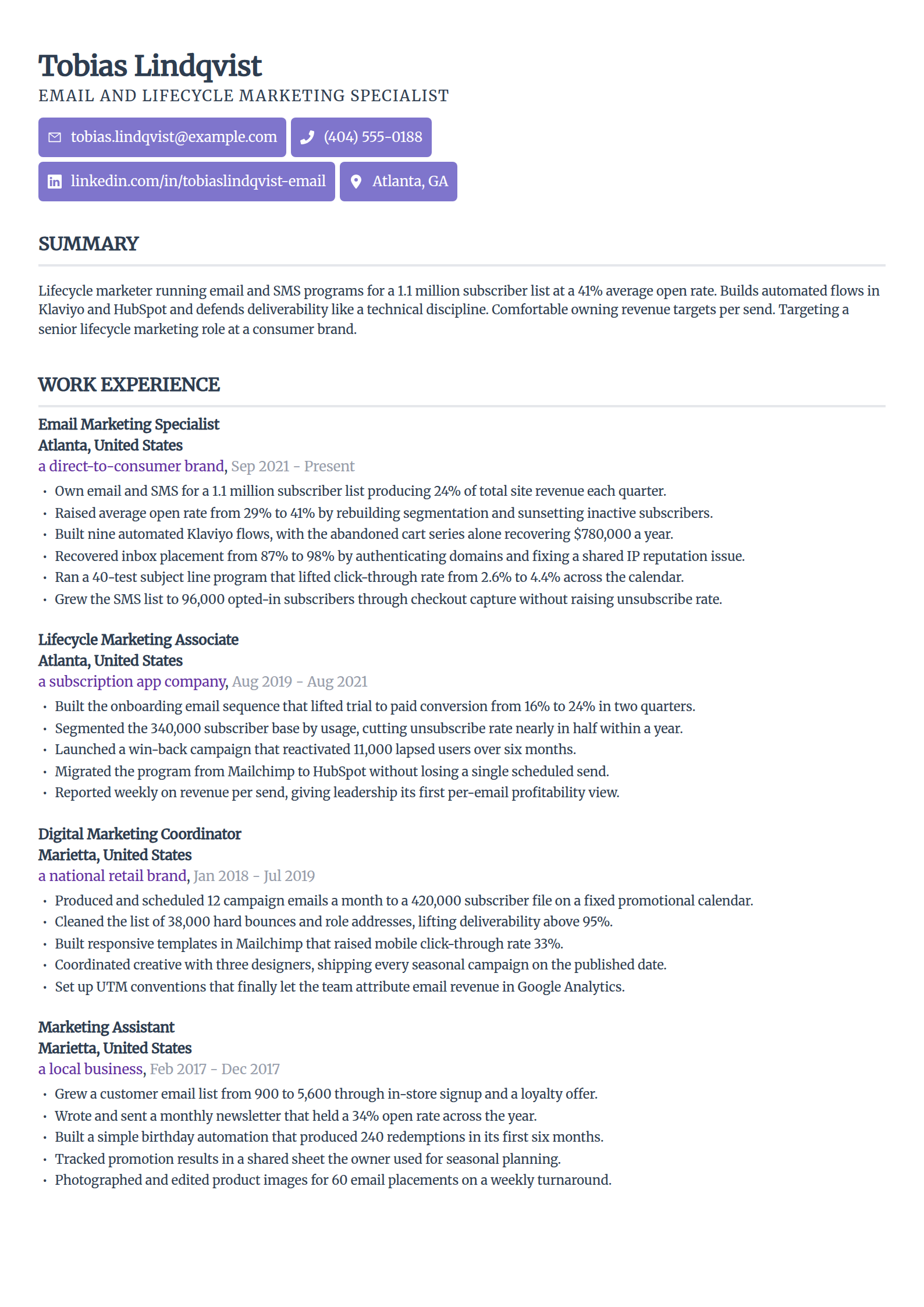
Email Marketing Resume Template
Why this resume example works?
- Opens with list scale and business contribution together, 1.1 million subscribers driving 24% of site revenue.
- Uses the metrics an email role is actually measured on, open rate, click-through rate, and revenue per send.
- Treats deliverability as the technical discipline it is, inbox placement recovered from 87% to 98%.
- Names the automation work behind the number, nine Klaviyo flows with the abandoned cart series called out.
- Keeps a clean modern structure so a long lifecycle history stays scannable.
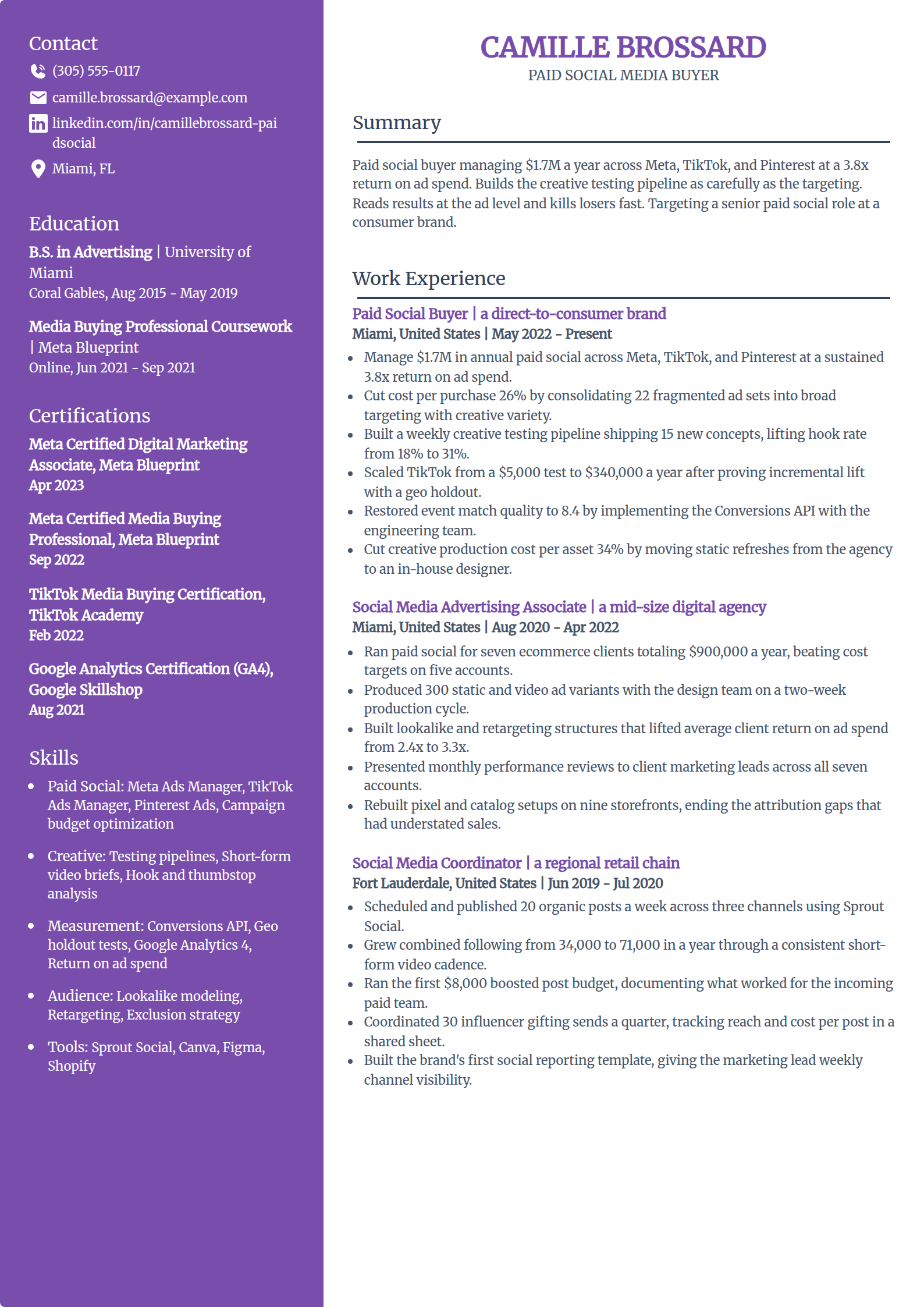
Paid Social Media Buyer Resume Template
Why this resume example works?
- States the spend and the efficiency in one line, $1.7M a year held at a 3.8x return on ad spend.
- Shows the modern paid social skill set, account consolidation into broad targeting with creative variety.
- Reports creative as a system, a weekly pipeline of 15 concepts that lifted hook rate from 18% to 31%.
- Includes the technical work buyers get asked about, the Conversions API implementation behind an 8.4 match quality.
- Proves incrementality thinking by scaling a channel only after a geo holdout confirmed the lift.
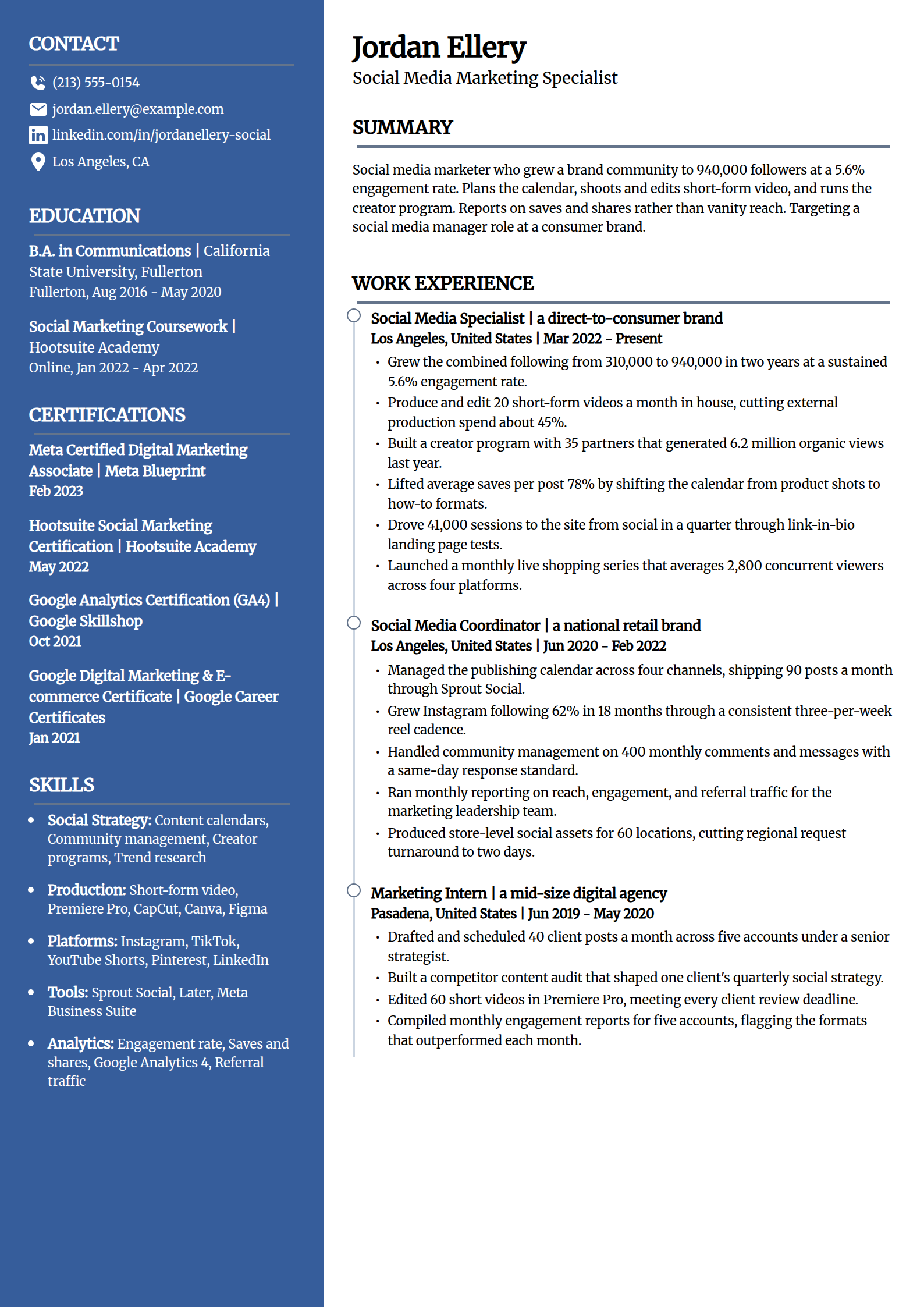
Social Media Marketing Resume Template
Why this resume example works?
- Pairs audience size with quality, 940,000 followers held at a 5.6% engagement rate.
- Shows production capability, 20 short-form videos a month made in house at a 45% cost reduction.
- Reports the metric that signals real social skill, average saves per post lifted 78%.
- Connects social to the site, 41,000 sessions driven in a quarter through link-in-bio testing.
- Uses a visually rich template that fits a creative role while keeping results legible.
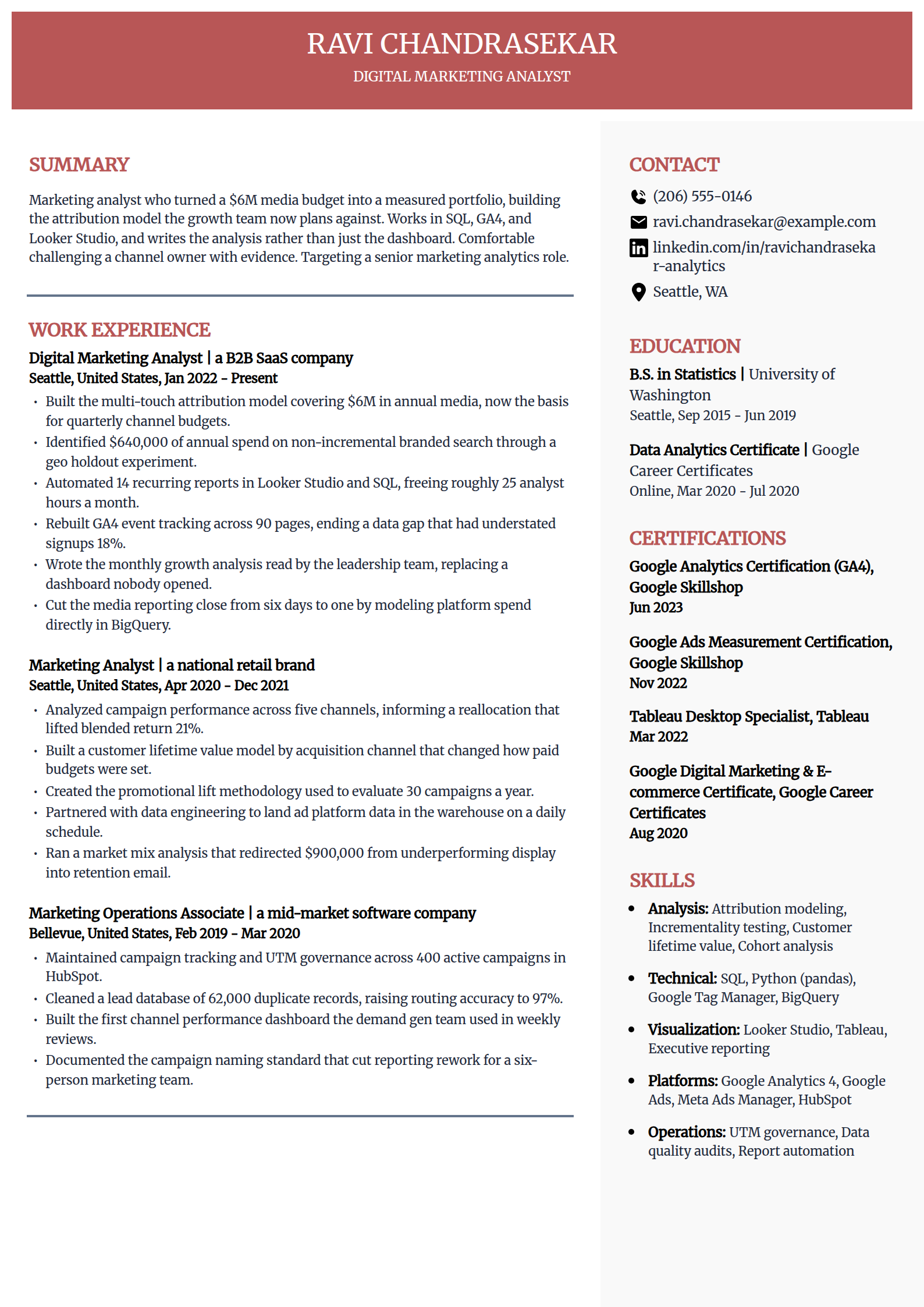
Digital Marketing Analyst Resume Template
Why this resume example works?
- Leads with the artifact analysts are hired to build, an attribution model covering $6M in annual media.
- Shows the finding that pays for the role, $640,000 of non-incremental branded search spend identified.
- Names real technical skills, SQL, BigQuery, and Google Tag Manager, rather than listing software generically.
- Includes the data-quality work behind good analysis, GA4 event tracking rebuilt across 90 pages.
- Ends on the human skill analysts are screened for, a written monthly analysis leadership actually reads.
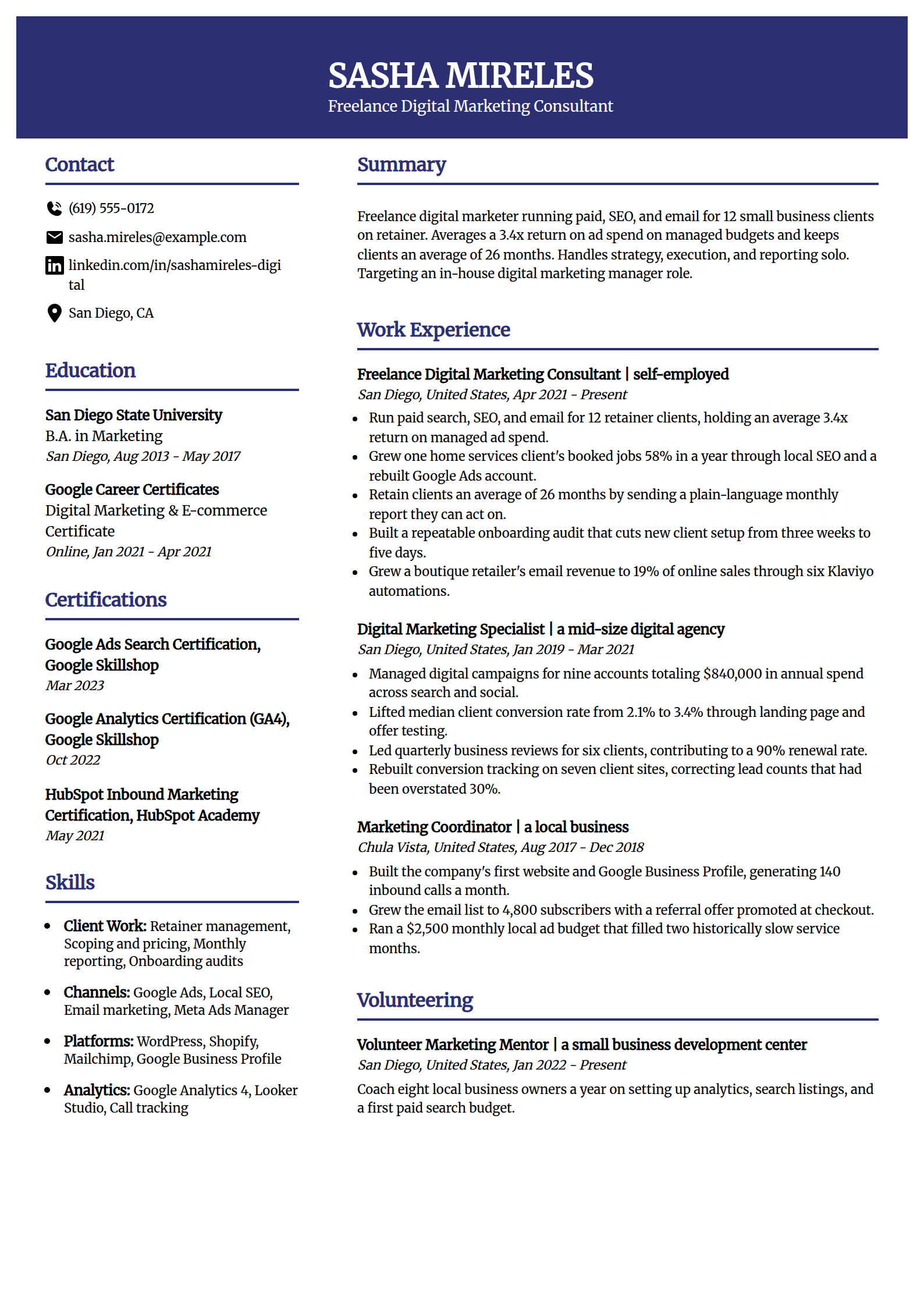
Freelance Digital Marketing Resume Template
Why this resume example works?
- Answers the question every freelance resume faces, scope, with 12 retainer clients and the channels run for them.
- Uses retention as proof of quality, an average client tenure of 26 months.
- Gives one client result in full detail so the range does not read as a list of logos.
- Shows business operations, a repeatable onboarding audit that cut setup from three weeks to five days.
- Includes agency employment before the freelance years so the timeline reads as a career, not a gap.
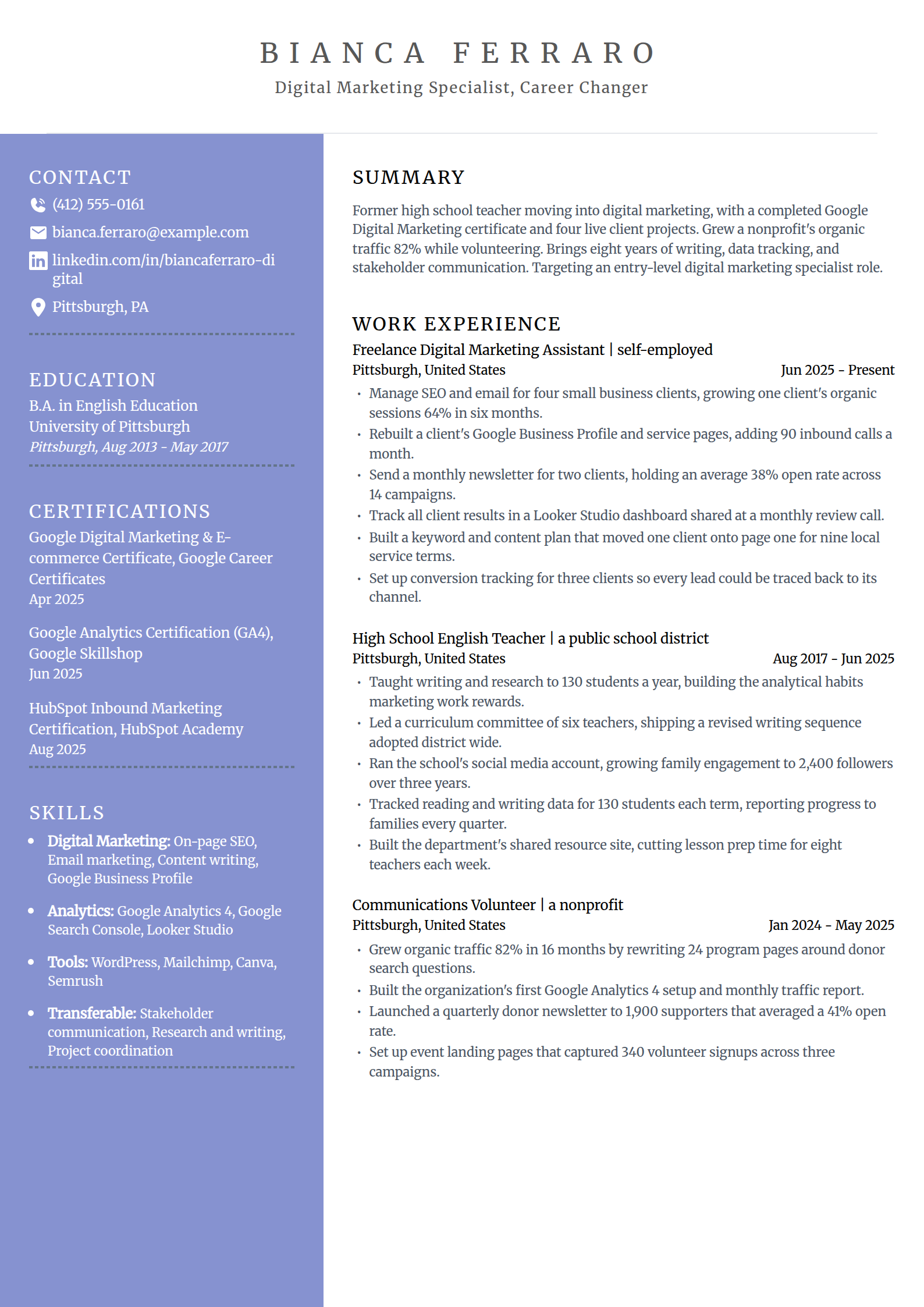
Career Change Digital Marketing Resume Template
Why this resume example works?
- Puts the new work first, freelance client projects above the eight-year teaching career.
- Carries a real marketing number from real work, a nonprofit's organic traffic grown 82% while volunteering.
- Names the certification that signals commitment without pretending it replaces experience.
- Reframes the prior career honestly, writing and data tracking, rather than claiming marketing years.
- Keeps the target role explicit so a recruiter does not have to guess at the pivot.
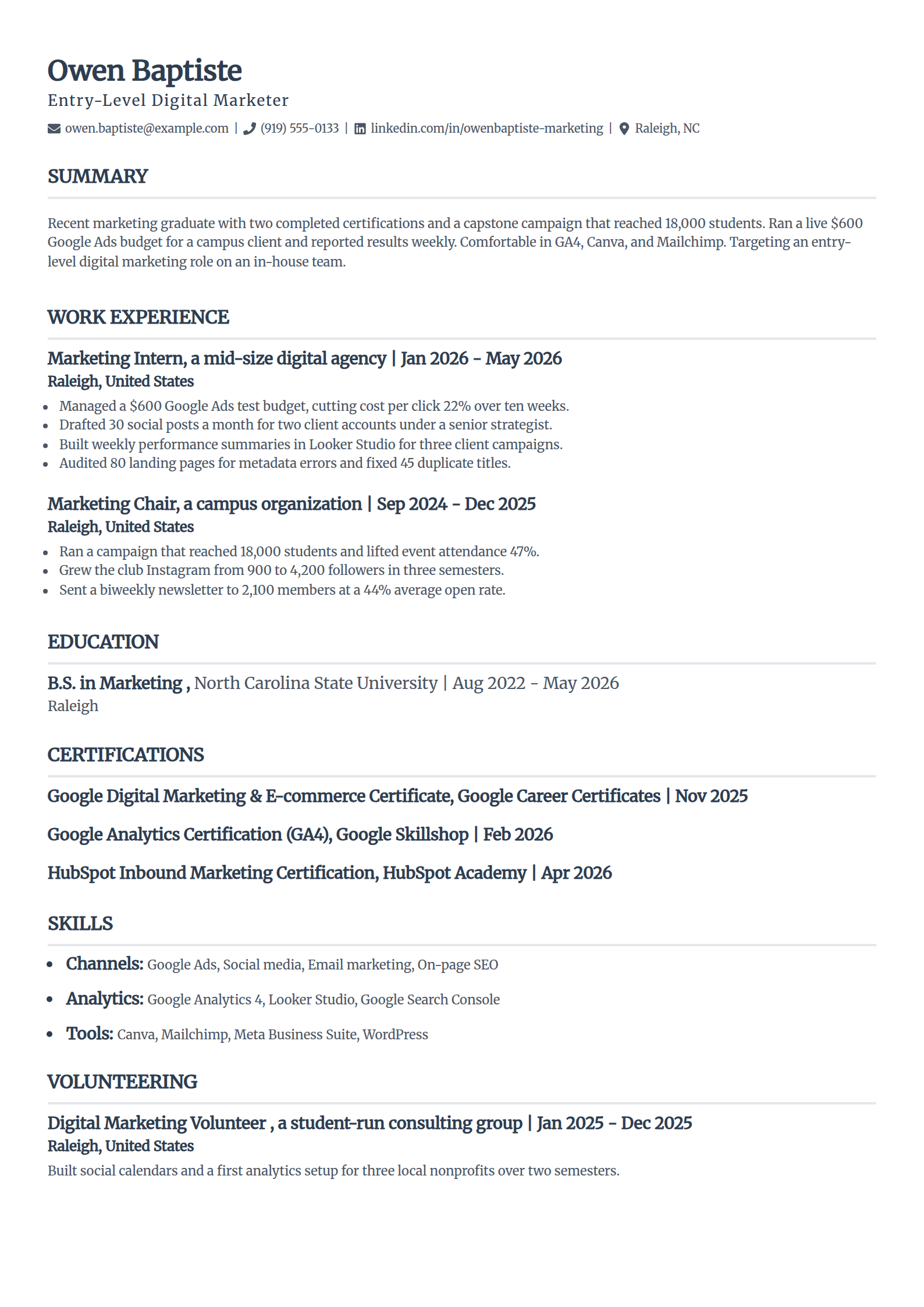
Entry-Level Digital Marketing Resume Template (No Experience)
Why this resume example works?
- Turns a first internship into evidence, a $600 test budget managed with cost per click cut 22%.
- Treats a campus leadership role as real experience, a campaign that reached 18,000 students.
- Keeps every number sized to the level, so nothing on the page fails a hiring manager's sniff test.
- Puts two completed certifications where a screener sees them, which is the strongest early signal.
- Fills one clean page with projects and coursework instead of padding with a skills wall.
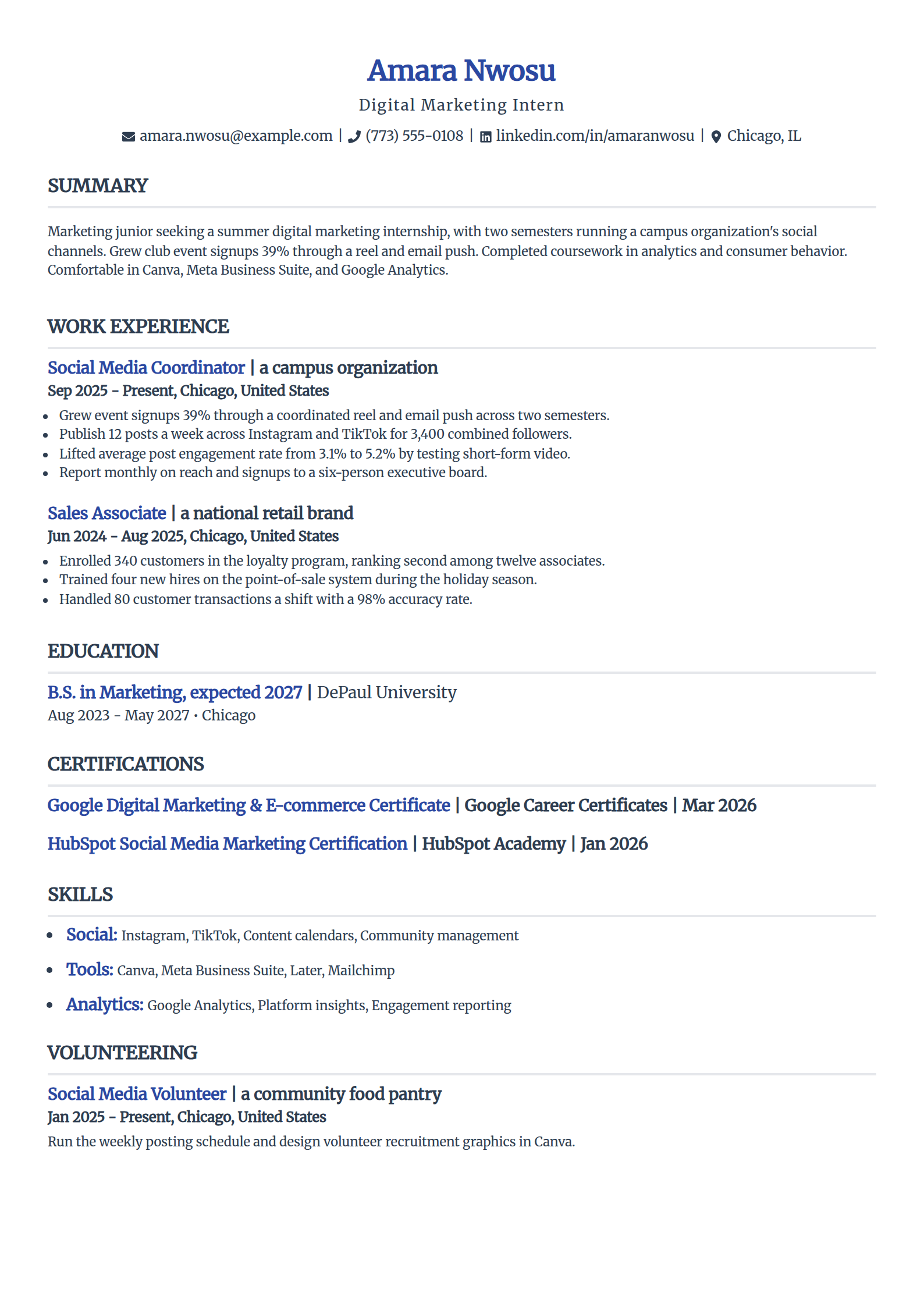
Digital Marketing Intern Resume Template
Why this resume example works?
- Leads with the campus role that is actually relevant, not the part-time job that came first.
- Shows a result an undergraduate can genuinely own, event signups grown 39% through a reel and email push.
- Includes the retail job for work ethic and keeps it short so it does not crowd the marketing content.
- States the expected graduation year plainly so a recruiter can check internship eligibility.
- Uses a plain template that reads well when a campus recruiter opens 200 resumes in a sitting.
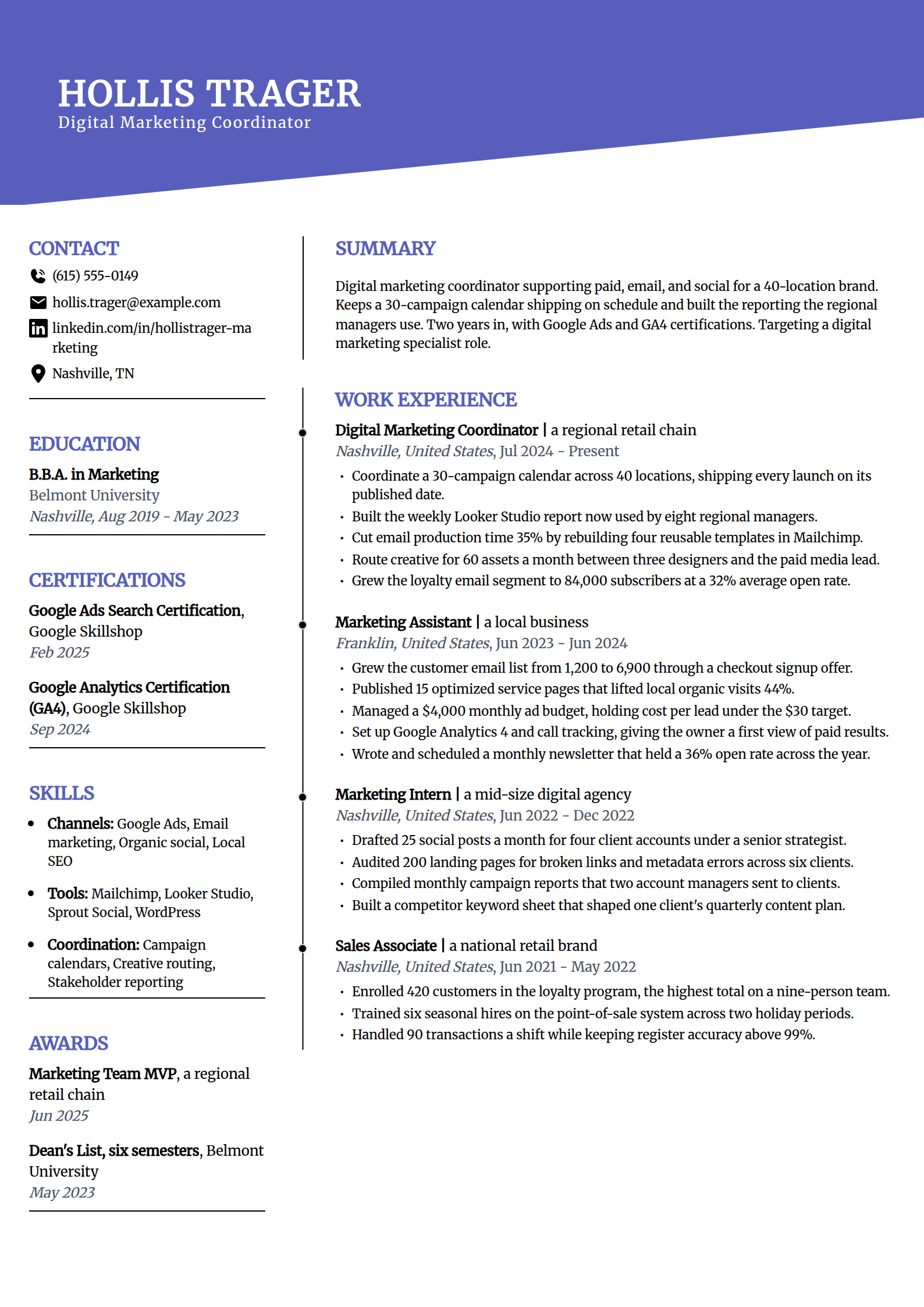
Digital Marketing Coordinator Resume Template
Why this resume example works?
- Describes coordination as an outcome, a 30-campaign calendar across 40 locations shipped on schedule.
- Shows initiative beyond the job description, a weekly report now used by eight regional managers.
- Includes an efficiency win, email production time cut 35% through reusable templates.
- Builds a credible three-year story from intern to coordinator without inflating any single role.
- Uses the sidebar for certifications and awards so the main column stays on results.
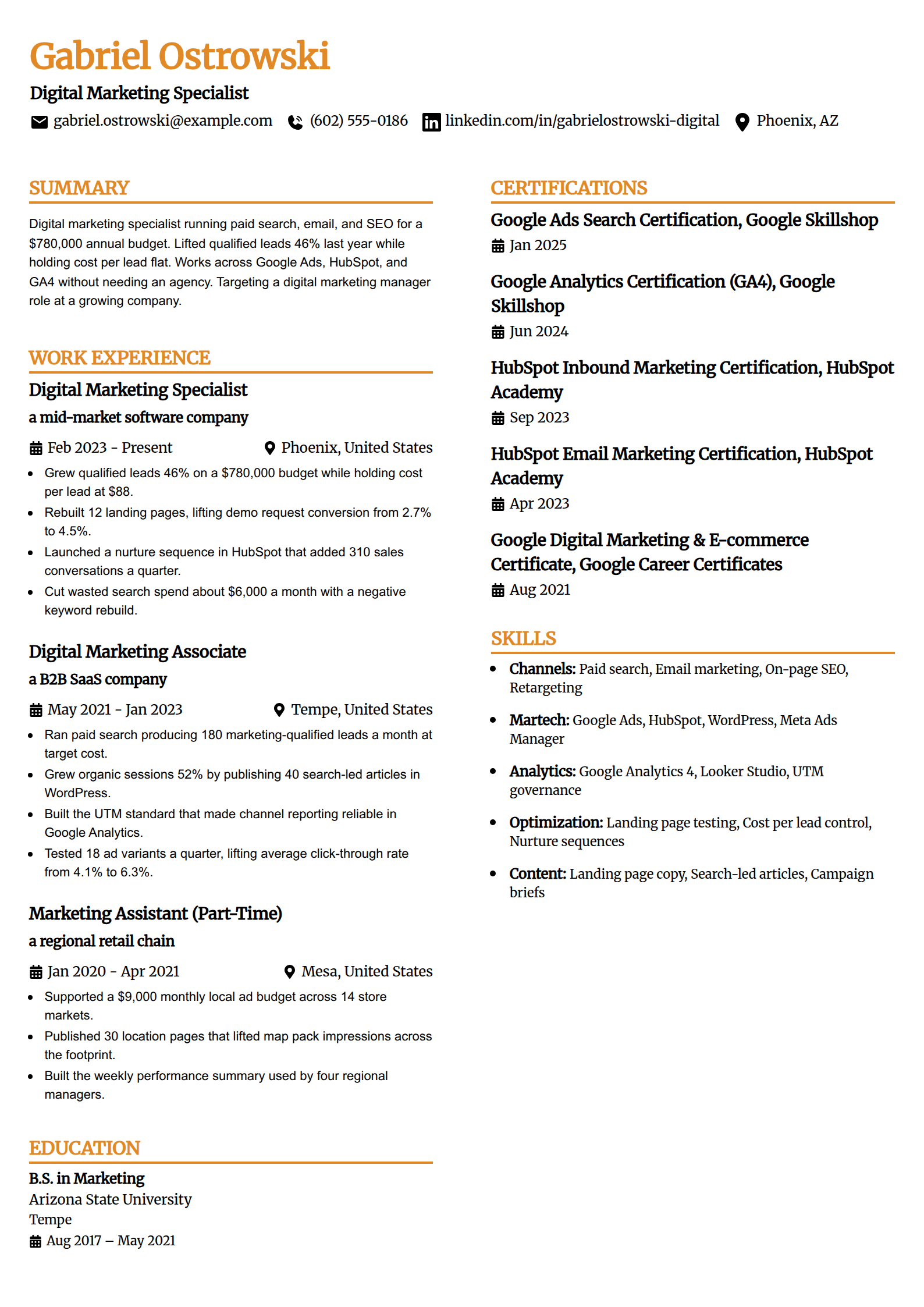
Digital Marketing Specialist Resume Template
Why this resume example works?
- Shows the generalist's real value, three channels run on a $780,000 budget without an agency.
- Pairs growth with control, qualified leads up 46% while cost per lead stayed at $88.
- Includes conversion work, 12 landing pages rebuilt to lift demo requests from 2.7% to 4.5%.
- Names a waste reduction, roughly $6,000 a month recovered through a negative keyword rebuild.
- Keeps certifications and skills in a sidebar so three roles fit in the main column.
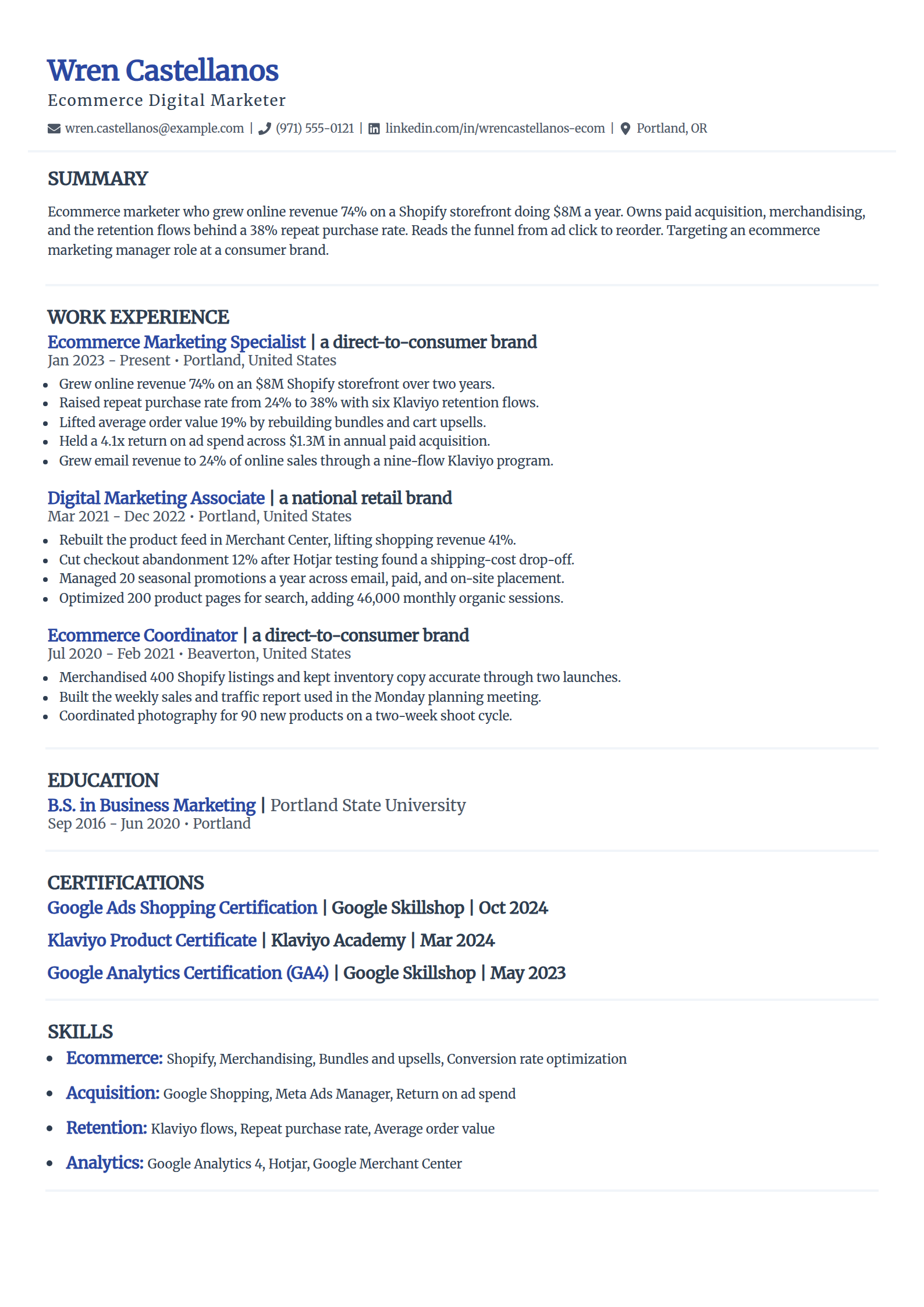
Ecommerce Digital Marketing Resume Template
Why this resume example works?
- Uses ecommerce metrics rather than generic marketing ones, average order value and repeat purchase rate.
- Shows both halves of the funnel, $1.3M in paid acquisition and the retention flows behind a 38% repeat rate.
- Names the platform work a posting asks for, Shopify merchandising and a rebuilt Merchant Center feed.
- Includes a conversion fix traced to research, checkout abandonment cut after a Hotjar finding.
- Fits three roles and a full skills block on one page in a clean two-column layout.
Build your digital marketing resume
Start from the template that matches your channel, then swap in your own campaigns, platforms, and numbers. The builder keeps the layout intact while you edit, so the version you send parses as cleanly as the example you started from.
Build my resumeHow to write a digital marketing resume
Digital marketing hiring is channel-specific. A paid search manager and a content marketer are screened by different people against different numbers, so the resume that wins is the one that reads like it was written for that posting.
Lead with your channel, not the words digital marketing
Your summary has three or four sentences to place you. Spend them on the channel you actually run, the scale you run it at, and the strongest number you own.
- Name the channel in the first clause: "Paid search specialist managing $2.4M in annual Google Ads spend" beats "results-driven digital marketing professional".
- Give scale a unit that fits your channel: budget for paid, sessions for SEO, list size for email, followers plus engagement rate for social.
- Add the strongest single number you can defend, then the tools a posting would name, then the role you are targeting.
- Keep it to three to four sentences of substance across 50 to 70 words, and cut every adjective that is not doing work.
Use the metric that belongs to the channel
The fastest way to look like you have not done the job is to attach the wrong number to it. Each channel has a vocabulary, and hiring managers read it as a competence check.
- Paid search and paid social: return on ad spend, cost per acquisition, cost per click, click-through rate, impression share.
- SEO: organic sessions, non-brand clicks, ranking positions, crawl and index coverage, Core Web Vitals.
- Email and lifecycle: open rate, click-through rate, revenue per send, deliverability, list growth.
- Ecommerce: conversion rate, average order value, repeat purchase rate. Analytics: attribution, incrementality, model accuracy.
Claim the numbers you can actually defend
Most digital marketing advice tells you to quantify everything. Nobody tells you what to do when the win was the team's, the account was the agency's, or the tracking was broken. Say it accurately, because an interviewer will ask how you got the number.
- If you contributed to a result rather than owning it, write the contribution: "ran the paid half of a launch that drove 12,000 signups", not "drove 12,000 signups".
- If you managed an agency rather than the account, say managed. Hiring managers value it, and claiming hands-on work you did not do collapses in the first interview.
- If tracking was unreliable, use the operational win instead: a reporting cycle shortened, a double-count fixed, a feed rebuilt. Those are real and checkable.
- Skip percentage swings you cannot reconstruct. One number you can walk through beats three you cannot.
Show certifications and education for where you are
Certifications carry the most weight at the start of a digital marketing career and steadily less after that. Place them accordingly.
- New grads and career changers put certifications high on the page: Google Ads, the Google Analytics Certification for GA4, HubSpot, and Meta Blueprint are the names screeners recognize.
- Experienced marketers keep certifications to a short block and give the space to campaign results instead.
- Career changers pair the certificate with real projects, even unpaid ones, because a certificate alone shows study rather than judgment.
- List a certification only if you hold it now. Write "in progress" with the expected date rather than implying it is finished.
Match skills to the posting and keep the format clean
A digital marketing resume is parsed before it is read, and the skills block is where a posting's phrasing should reappear. Group it so a person can scan it too.
- Group skills by type: channels, platforms and martech, analytics and measurement, and content or creative.
- Name systems exactly: Google Analytics 4 rather than analytics, Meta Ads Manager rather than social ads, Looker Studio rather than dashboards.
- If the posting says "paid media strategy" or "marketing automation", use that phrasing where it honestly applies, since that is what the tracking system searches for.
- Keep it to one page through the specialist level, save as a PDF, then run it through the free ATS resume checker for a format and keyword pass before you apply.
Common digital marketing resume mistakes
- Calling yourself a digital marketer without naming a channel. Recruiters hire an SEO, a paid search manager, or an email marketer, so lead with the one you want to be hired for.
- Listing platforms as skills with no result attached. "Google Ads, Meta Ads, HubSpot" proves nothing; a campaign outcome that names the platform proves everything.
- Borrowing the company's numbers. Total company revenue is not your metric. Use the channel result you influenced and state your role in it plainly.
- Claiming a level the numbers contradict. An intern who reports a 40% revenue lift reads as invented; keep results sized to the budget and team you actually had.
- Sending one resume to every posting. Reorder your bullets and skills so the channel the job names appears in the summary and in the first two bullets under your current role.
Frequently asked questions
How do you write a digital marketing resume?
Lead with a three-to-four-sentence summary that names your channel, the scale you run it at, your strongest defensible number, and the role you are targeting. Under each job, write results-first bullets that open with a strong verb and carry one credible metric, like holding a 4.6x return on ad spend across $2.4M in annual spend or growing organic search to 640,000 monthly sessions. Name the platform or method behind each result, group your skills to match the posting's phrasing, and keep it to one clean page through the specialist level.
What should a digital marketing resume include?
A digital marketing resume includes a channel-first summary, experience bullets carrying channel-specific metrics, a grouped skills block naming real platforms, and certifications placed according to your level. The experience section does the work: each bullet should show something that changed because of you, such as cost per acquisition cut 31% after an account restructure or inbox placement recovered from 87% to 98%. Name the tools a posting screens for, like Google Analytics 4, Google Ads, Meta Ads Manager, HubSpot, Klaviyo, or Semrush, in the context of the result they produced.
How do you write a digital marketing resume with no experience?
Lead with what you have actually done rather than what you have studied. Put projects, internships, and campus or volunteer campaigns above any unrelated work history, and give each one a real number, even a small one, like a $600 test budget managed or event signups grown 39%. Place two or three completed certifications high on the page, since Google Ads, the Google Analytics Certification for GA4, and HubSpot are the strongest early signals a screener recognizes. Link a portfolio if you have one. The entry-level, intern, and career-change examples above show the shape.
What skills should you put on a digital marketing resume?
Match the posting, then name specific systems grouped by type: channels (paid search, paid social, SEO, email, content), platforms and martech (Google Ads, Meta Ads Manager, HubSpot, Klaviyo, Shopify, WordPress), analytics and measurement (Google Analytics 4, Google Search Console, Looker Studio, Google Tag Manager), and research tools (Semrush, Ahrefs, Hotjar). Add the strategic work the role names, such as conversion rate optimization, marketing automation, or incrementality testing. List only what you have run and can discuss in an interview.
Which certifications are worth putting on a digital marketing resume?
The ones a screener recognizes and that match the channel you are applying for. For paid search that is the Google Ads certifications, which are issued per product such as Search, Display, Shopping, Video, and Measurement. For analytics it is the Google Analytics Certification covering GA4. For inbound, email, and content work it is the HubSpot Academy certifications, and for paid social it is Meta Blueprint. Career changers often add the Google Digital Marketing and E-commerce Certificate as a foundation. List a certification only while you hold it, and mark anything unfinished as in progress with its expected date.
How long should a digital marketing resume be?
One page for interns, coordinators, entry-level marketers, and specialists, which covers most of the market. Use a second page only when a manager or a marketer with roughly eight or more years has enough budget, team, and campaign scope to fill it, and never pad to reach it. Whatever the length, lead with your most recent and most relevant channel work, keep standard section headings a parser recognizes, and cut older or unrelated roles so the space goes to the work that matches the posting.
More digital marketing resume resources
Build your digital marketing resume
Start from the template that matches your channel, then swap in your own campaigns, platforms, and numbers. The builder keeps the layout intact while you edit, so the version you send parses as cleanly as the example you started from.