Marketing Resume Examples, from Coordinator to Director
- ATS Friendly
- Every Marketing Role
- 16 Real Examples
Digital, content, social, SEO, brand, product, or growth, this page has a resume built for your exact track and level. Start from a layout below, then model your own on a real example, from a summer intern to a marketing director. Every campaign result, from lead volume to return on ad spend, sits where a hiring manager looks first.


540k+ resumes created
Editable marketing resume templates for every specialty
Each template below is a real marketing resume laid out in that format, sorted by specialty and level across digital, content, social, SEO, brand, product, growth, email, and events. Pick one, then swap in your own campaigns, tools, and metrics. Every layout keeps your name, channels, and results readable so a hiring manager sees your strongest work at a glance and an applicant tracking system parses it cleanly.
Marketing Manager Resume Template
Why this resume example works?
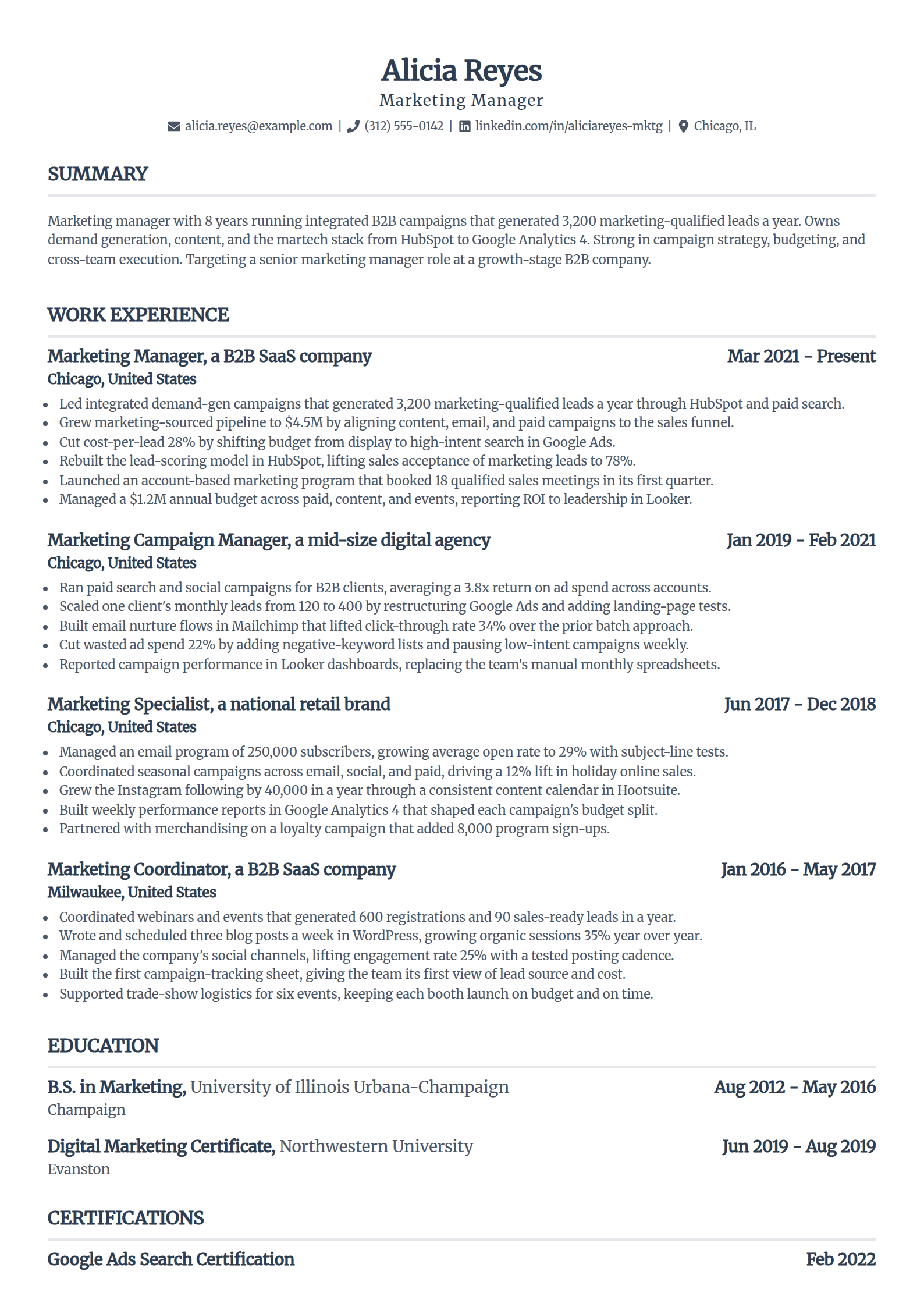
- Opens with a summary that names 8 years, integrated B2B campaigns, and 3,200 marketing-qualified leads a year.
- Shows the ownership a manager role wants: demand gen, budget, and the HubSpot and Google Analytics 4 stack.
- Attaches one number to each bullet, like cost-per-lead cut 28% or marketing-sourced pipeline grown to $4.5M.
- Names the martech a posting screens for, HubSpot, Google Ads, and Looker, in real campaign context.
- Uses a clean, single-column layout an applicant tracking system reads without trouble.
Digital Marketing Manager Resume Template
Why this resume example works?
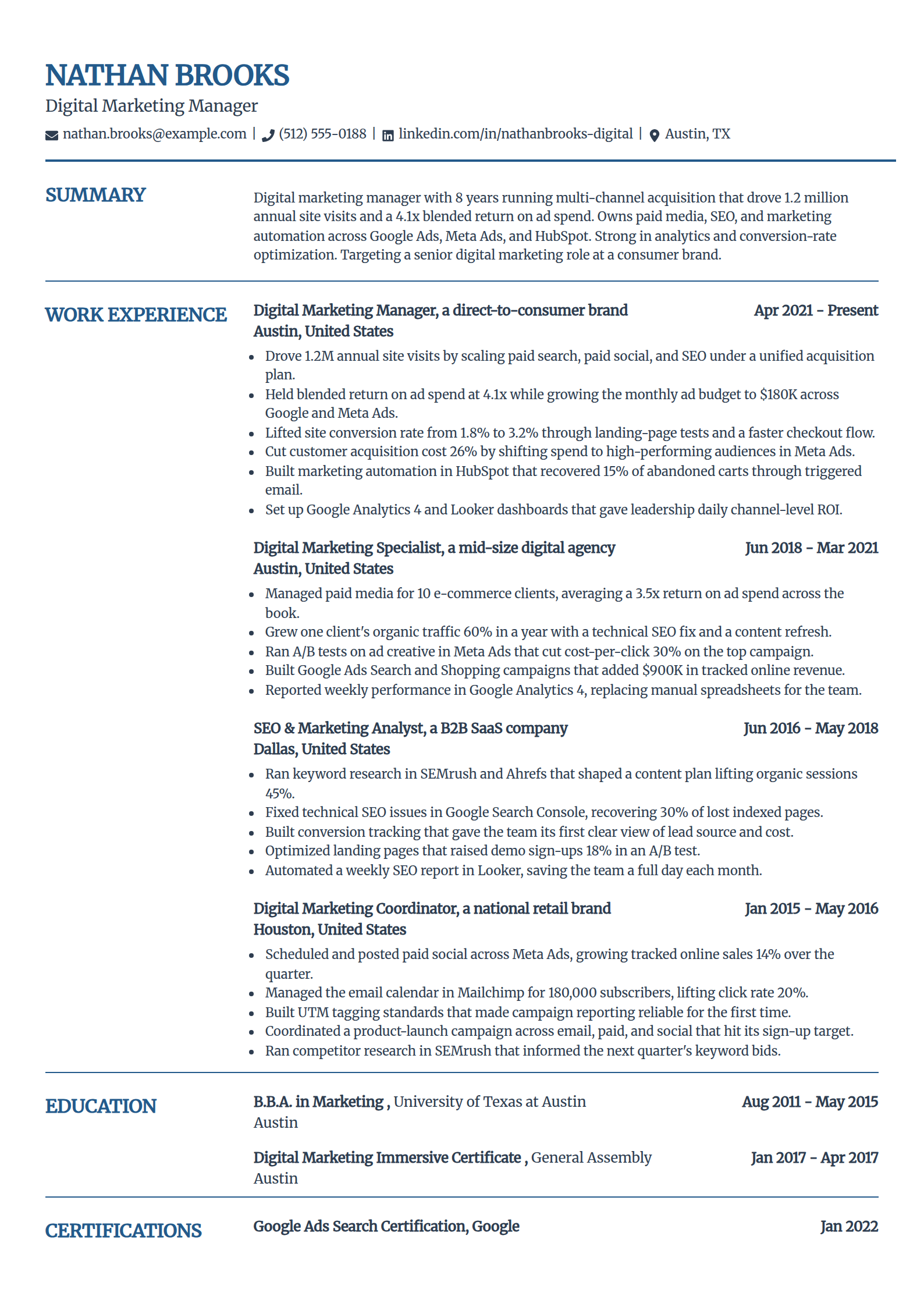
- Leads with acquisition scale, 1.2 million annual site visits and a 4.1x blended return on ad spend.
- Shows the paid, SEO, and automation mix a digital role hires for across Google Ads, Meta Ads, and HubSpot.
- Keeps each result countable, like site conversion lifted from 1.8% to 3.2% or acquisition cost cut 26%.
- Names the tools a posting lists, SEMrush, Ahrefs, and Google Search Console, without a keyword wall.
- Uses a modern layout that carries a dense multi-channel history on one clean page.
Content Marketing Manager Resume Template
Why this resume example works?
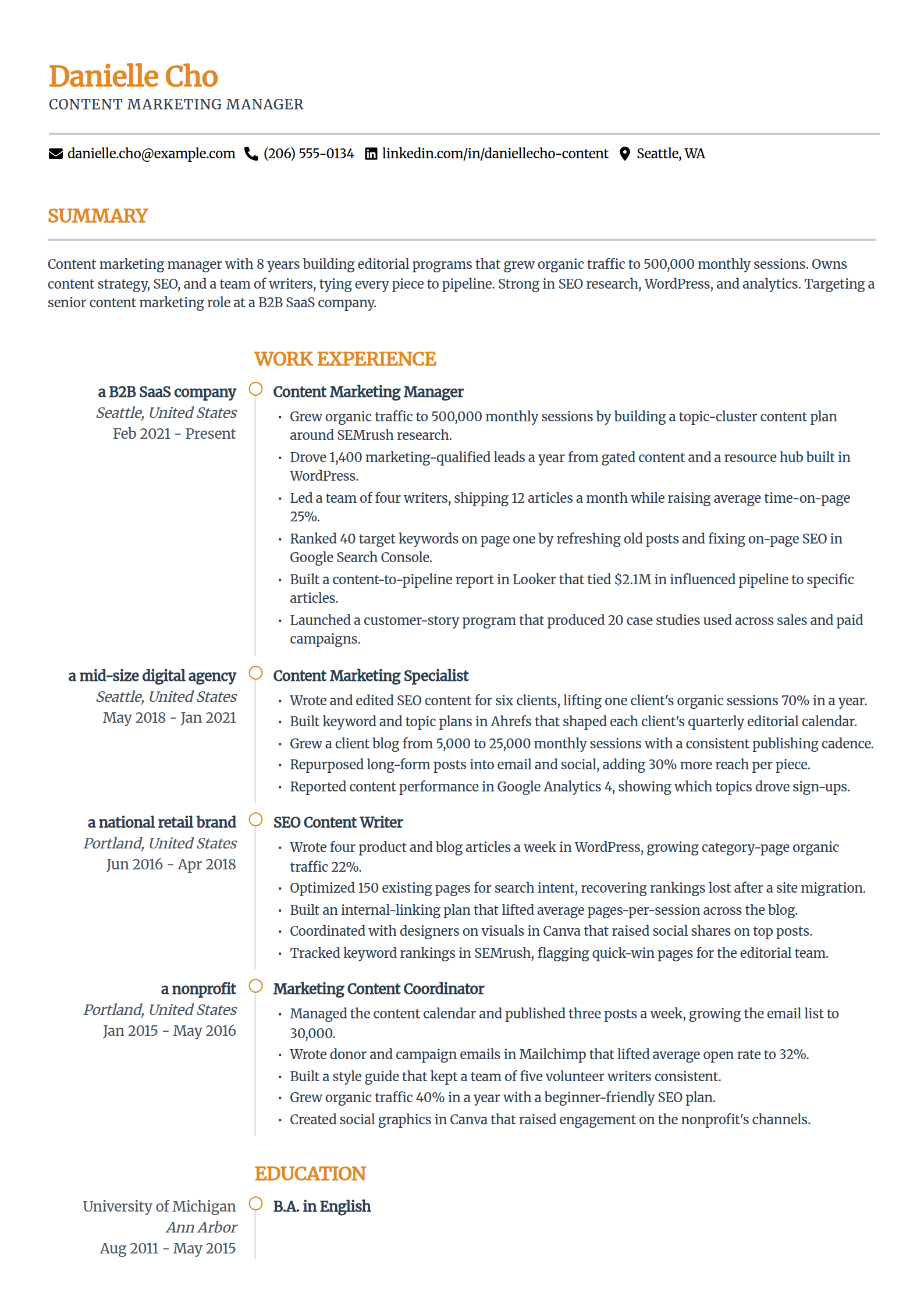
- Opens with the metric a content role rewards, organic traffic grown to 500,000 monthly sessions.
- Ties content to revenue, 1,400 marketing-qualified leads a year and $2.1M in influenced pipeline.
- Shows team and SEO scope, four writers led and 40 target keywords ranked on page one.
- Names WordPress, SEMrush, and Google Search Console, the editorial and SEO tools a posting screens for.
- Uses a modern layout that still reads cleanly for a hiring manager scanning fast.
Marketing Director Resume Template
Why this resume example works?
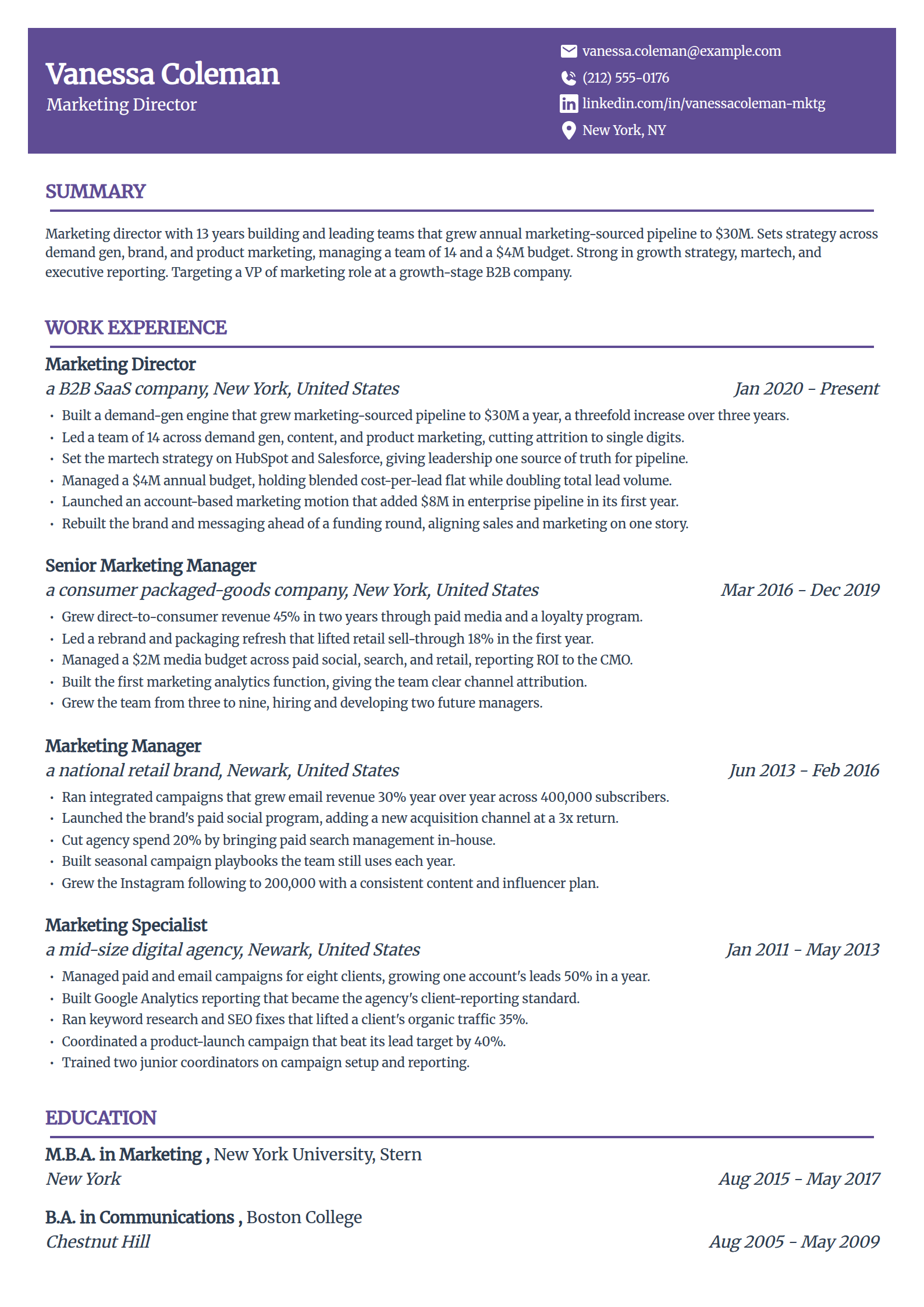
- Leads with director-level scope, marketing-sourced pipeline grown to $30M and a team of 14.
- Shows the results a VP role rewards, a $4M budget managed and attrition cut to single digits.
- Pairs strategy with delivery, an ABM motion that added $8M and a rebrand ahead of a funding round.
- Keeps every number believable for the level, tied to a specific program or budget decision.
- Uses a spacious layout that carries a 13-year leadership record on one page.
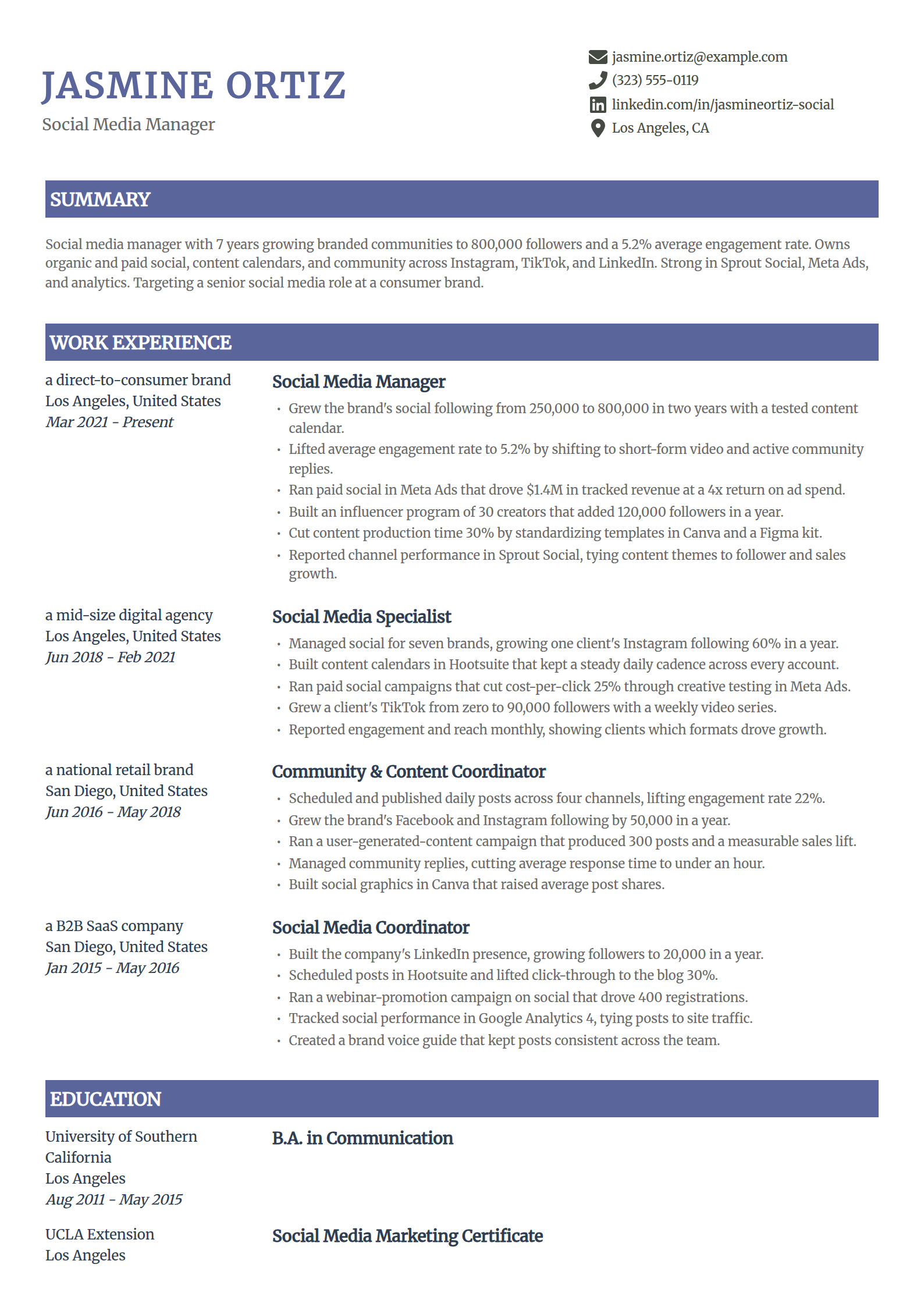
Social Media Manager Resume Template
Why this resume example works?
- Opens with community scale, a following grown from 250,000 to 800,000 at a 5.2% engagement rate.
- Shows the paid and organic mix a social role hires for, including $1.4M in Meta Ads revenue at 4x.
- Names the platforms and tools a posting lists, Instagram, TikTok, Sprout Social, and Hootsuite.
- Keeps results tied to content, like an influencer program that added 120,000 followers in a year.
- Uses a modern layout that carries a dense social history on one page.
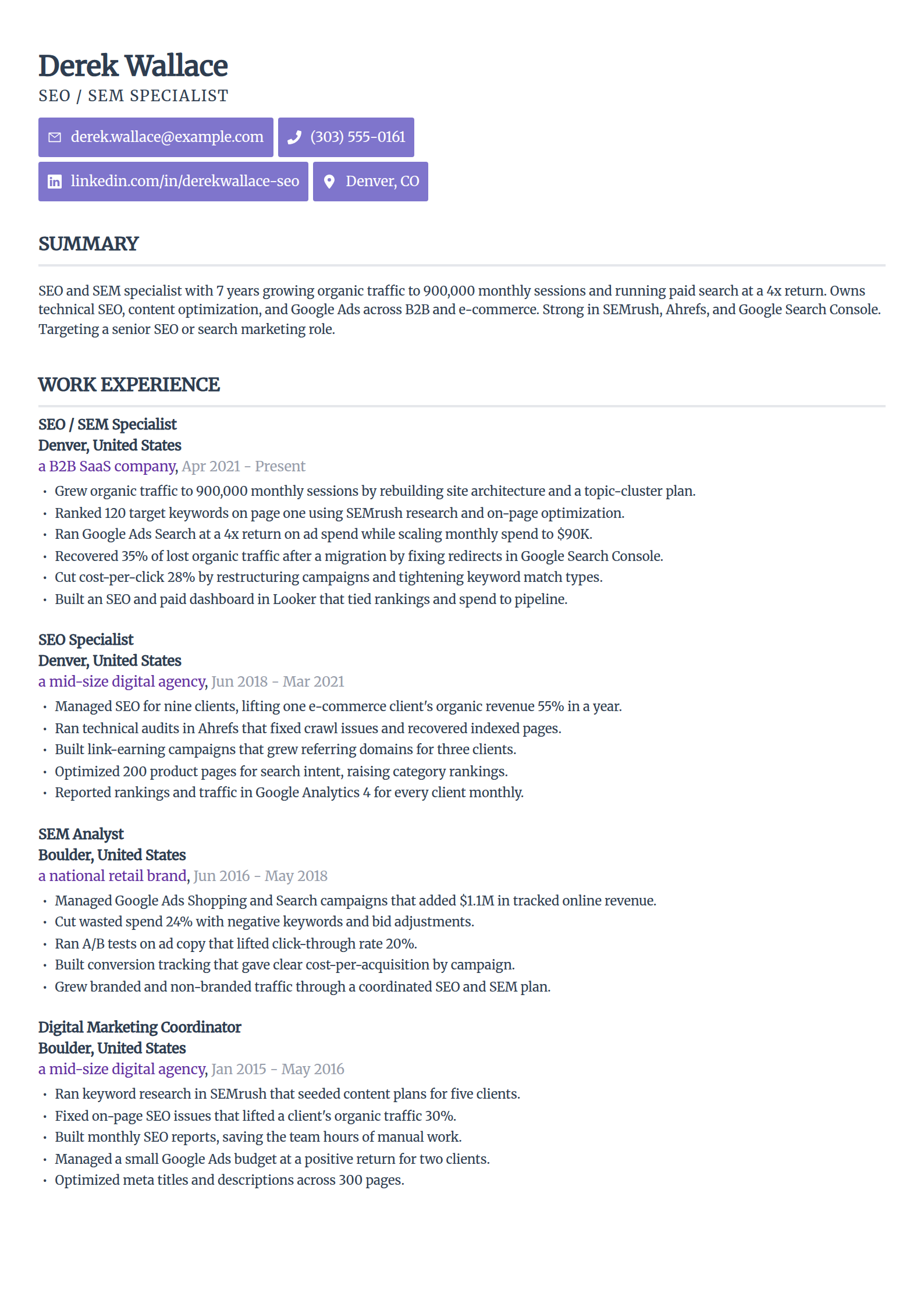
SEO & SEM Specialist Resume Template
Why this resume example works?
- Leads with search scale, organic traffic grown to 900,000 monthly sessions and paid search run at 4x.
- Shows the technical and paid work a role hires for, 120 keywords ranked and cost-per-click cut 28%.
- Names SEMrush, Ahrefs, Google Search Console, and Google Ads, the exact tools a posting screens for.
- Keeps each result modest, like 35% of lost organic traffic recovered after a site migration.
- Uses a clean, modern layout that carries a deep search history on one page.
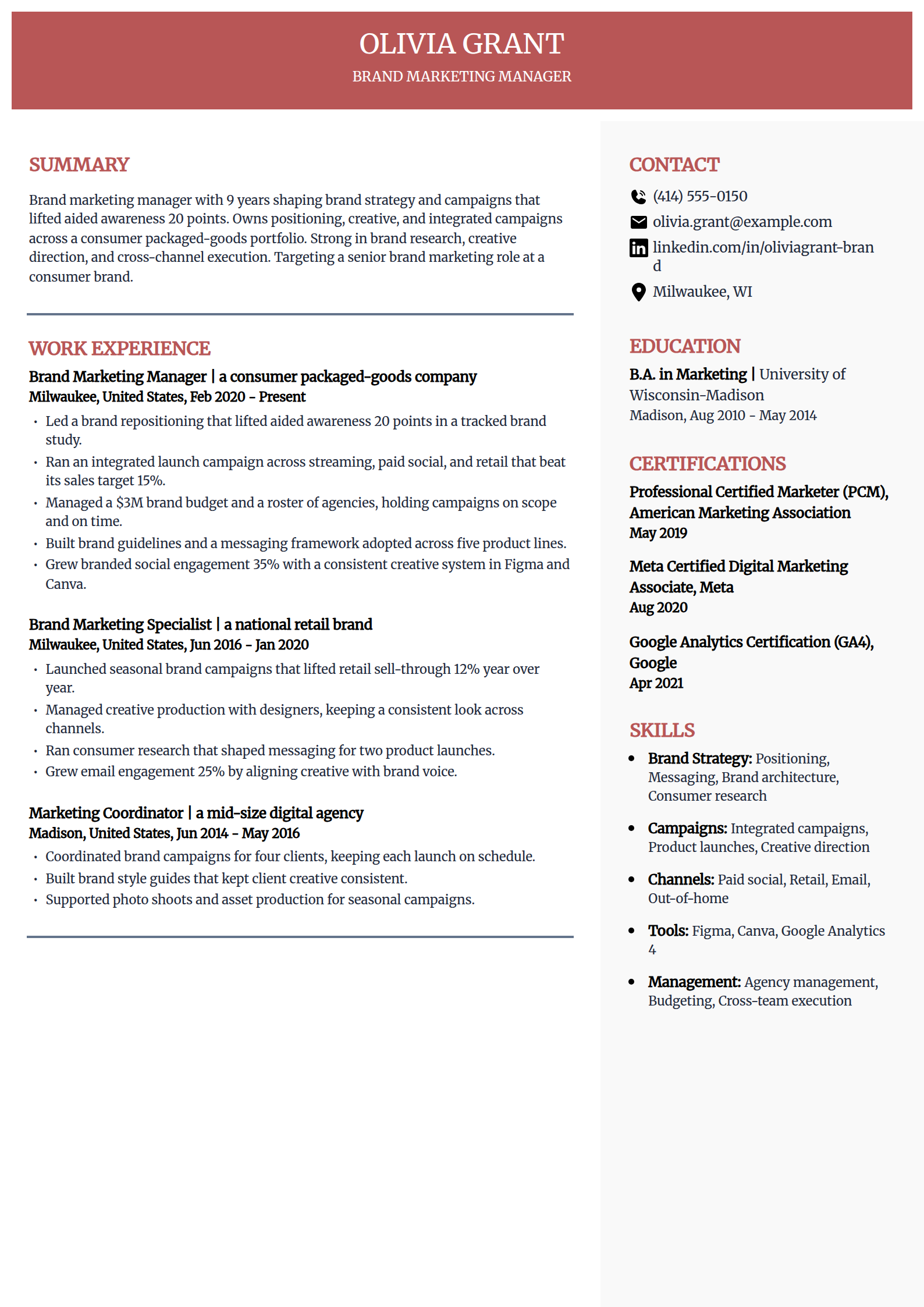
Brand Marketing Manager Resume Template
Why this resume example works?
- Opens with brand impact, aided awareness lifted 20 points in a tracked brand study.
- Shows the campaign and budget scope a brand role rewards, a $3M budget and a launch that beat target 15%.
- Keeps the creative thread visible, brand guidelines and a system built in Figma and Canva.
- Ties results to sell-through, retail lifted 12% year over year through seasonal campaigns.
- Uses a refined two-column layout that fits a nine-year brand record cleanly on one page.
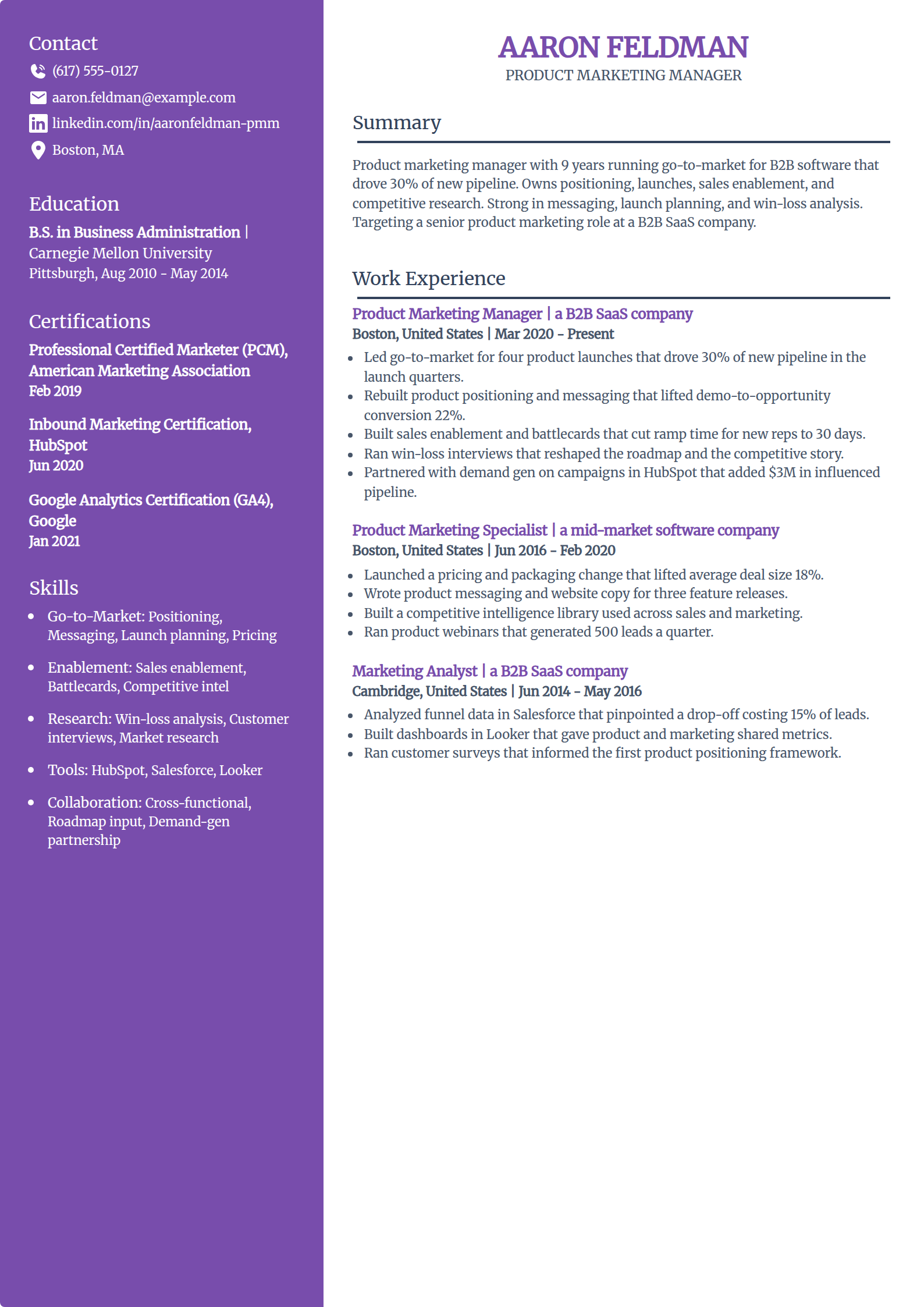
Product Marketing Manager Resume Template
Why this resume example works?
- Leads with go-to-market impact, four launches that drove 30% of new pipeline in the launch quarters.
- Shows the enablement a PMM role hires for, battlecards that cut new-rep ramp to 30 days.
- Pairs positioning with proof, messaging that lifted demo-to-opportunity conversion 22%.
- Names the win-loss research and the HubSpot and Salesforce stack a posting lists.
- Uses a Medium layout that fits a nine-year product marketing record without empty space.
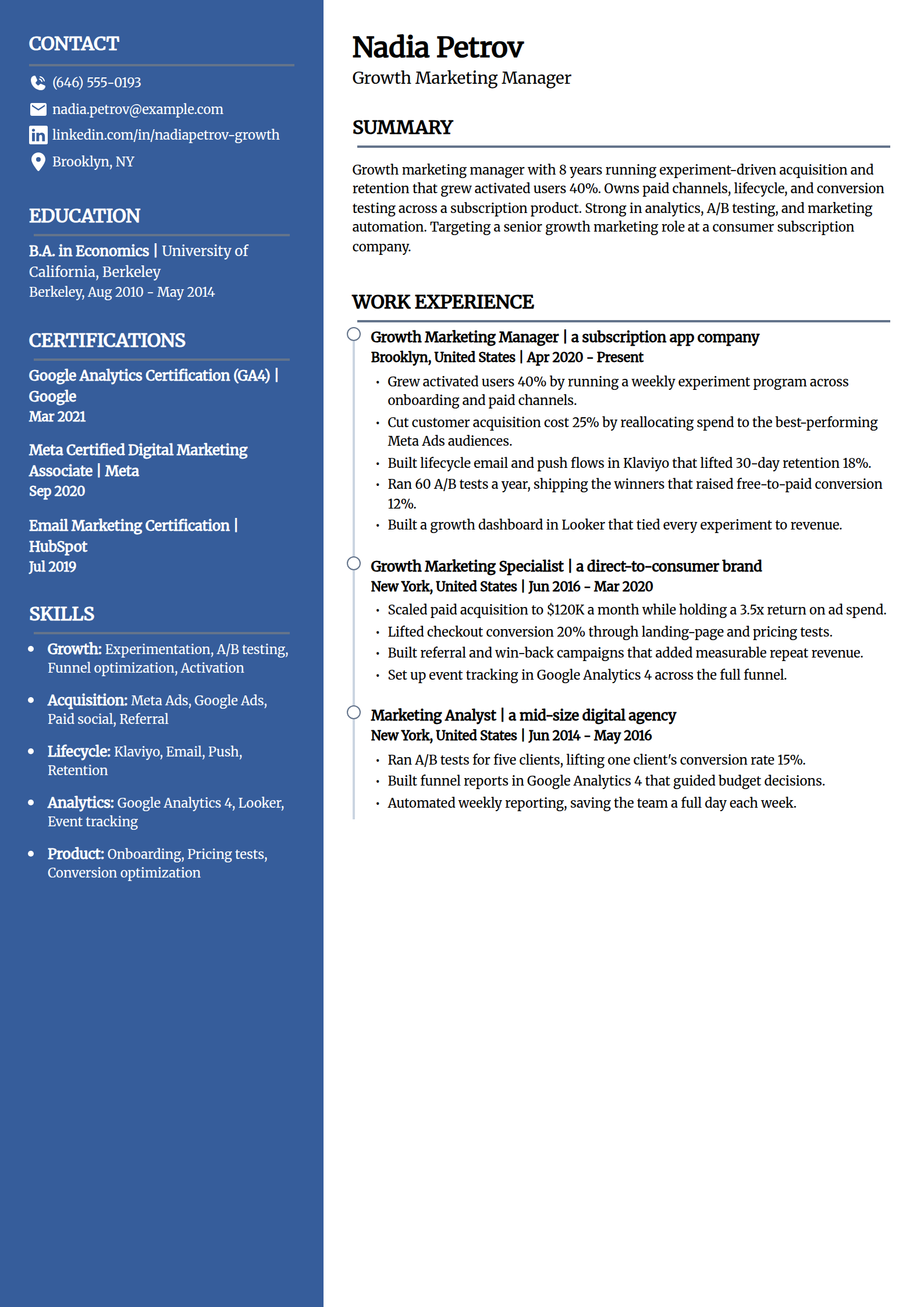
Growth Marketing Manager Resume Template
Why this resume example works?
- Opens with experiment-driven growth, activated users up 40% from a weekly test program.
- Shows the acquisition and retention mix a growth role hires for, acquisition cost cut 25% in Meta Ads.
- Keeps results tied to a test, 60 A/B tests a year that raised free-to-paid conversion 12%.
- Names Klaviyo, Google Analytics 4, and Looker, the lifecycle and analytics tools a posting screens for.
- Uses a distinctive layout that still reads cleanly for a hiring manager.
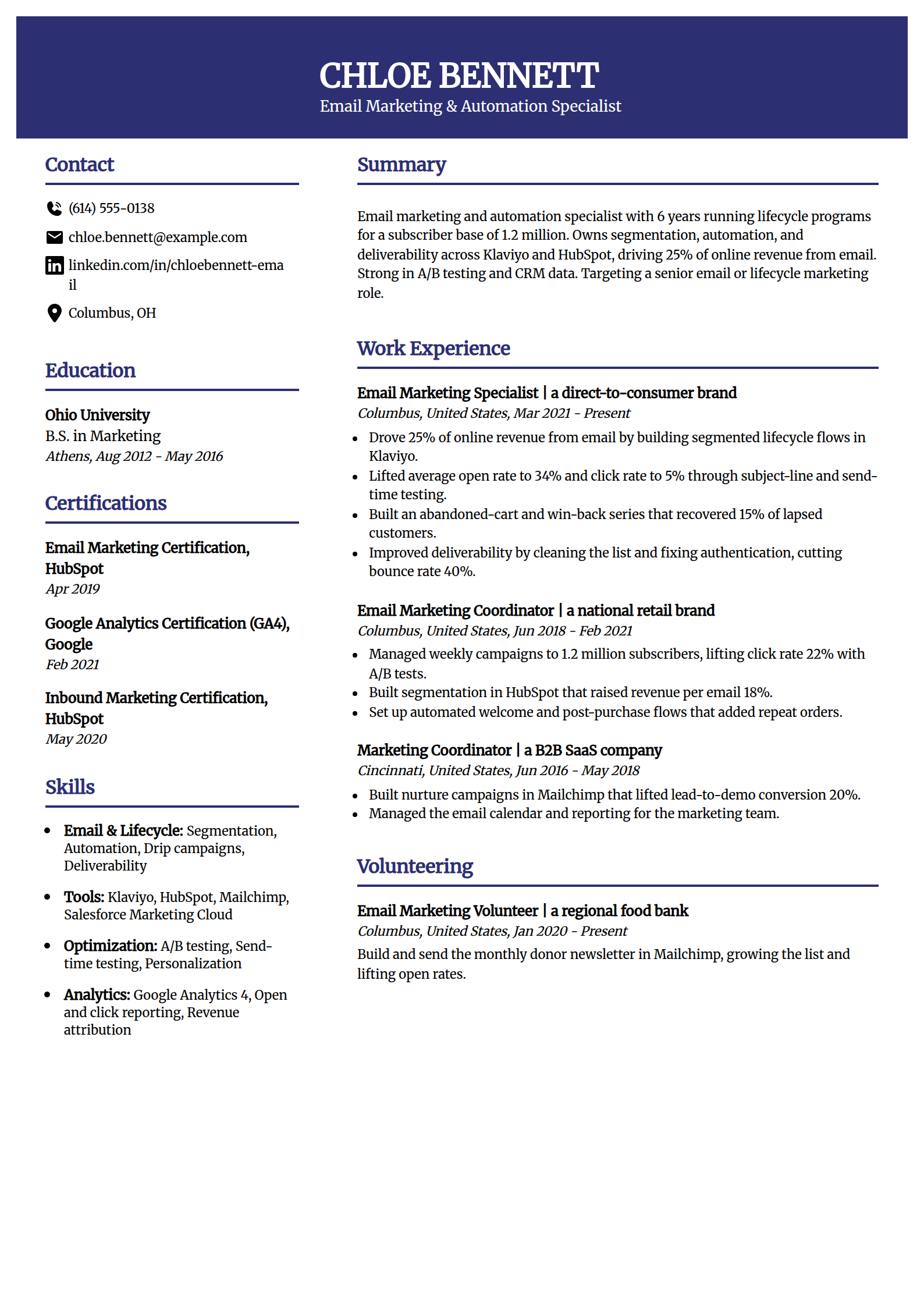
Email Marketing & Automation Specialist Resume Template
Why this resume example works?
- Leads with email revenue, 25% of online revenue driven from segmented Klaviyo lifecycle flows.
- Shows the metrics an email role rewards, open rate lifted to 34% and click rate to 5%.
- Keeps deliverability visible, list cleaning and authentication that cut bounce rate 40%.
- Names Klaviyo, HubSpot, and Salesforce Marketing Cloud, the automation tools a posting lists.
- Uses a roomy layout with a filled volunteer section so a six-year record still looks complete.
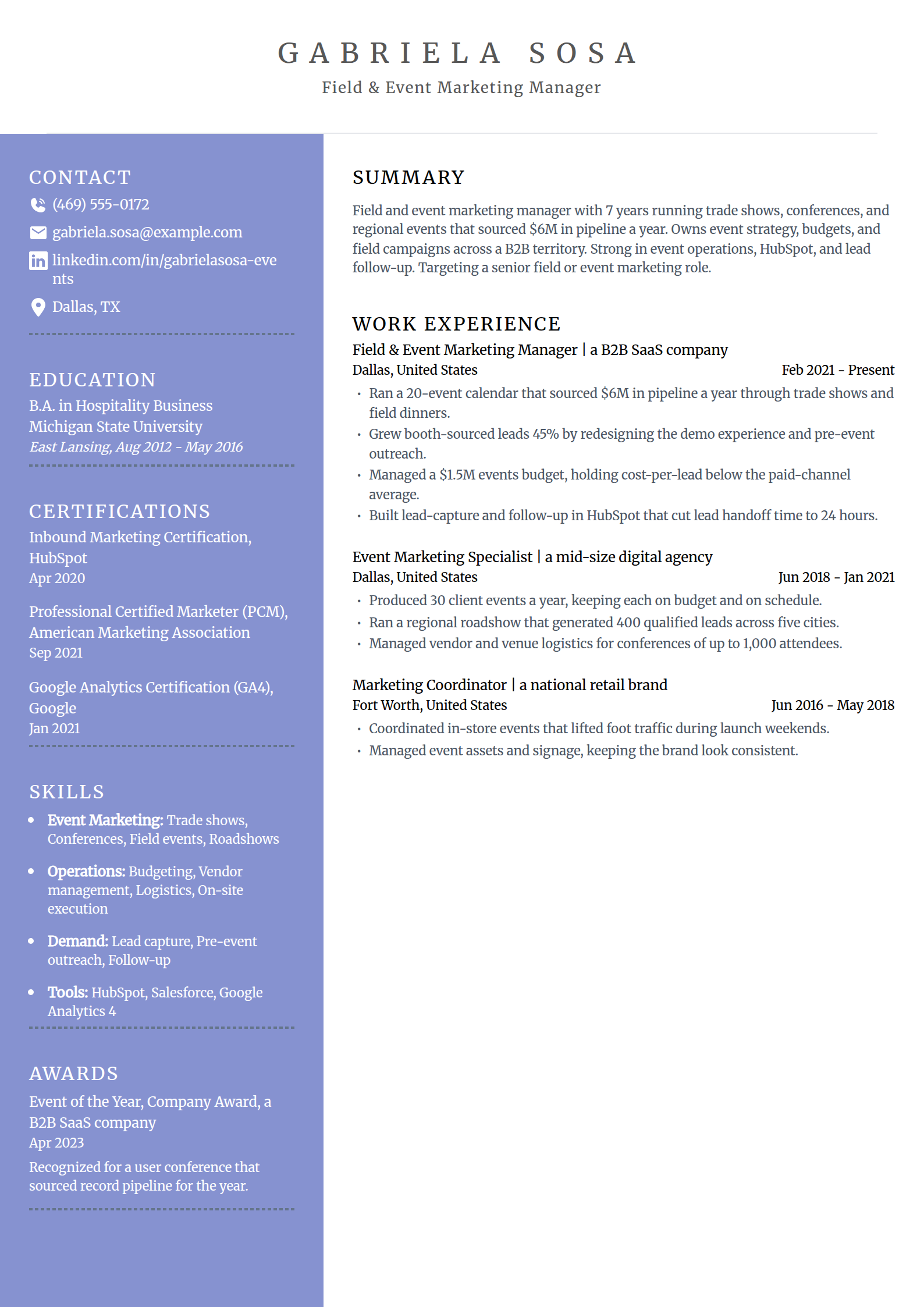
Field & Event Marketing Manager Resume Template
Why this resume example works?
- Opens with event impact, a 20-event calendar that sourced $6M in pipeline a year.
- Shows the operations an event role hires for, a $1.5M budget held below the paid-channel cost-per-lead.
- Keeps results tied to a program, booth-sourced leads up 45% from a redesigned demo experience.
- Names HubSpot and Salesforce, the lead-capture and follow-up tools a posting lists.
- Uses a roomy layout with an award entry so a seven-year field record still looks full.
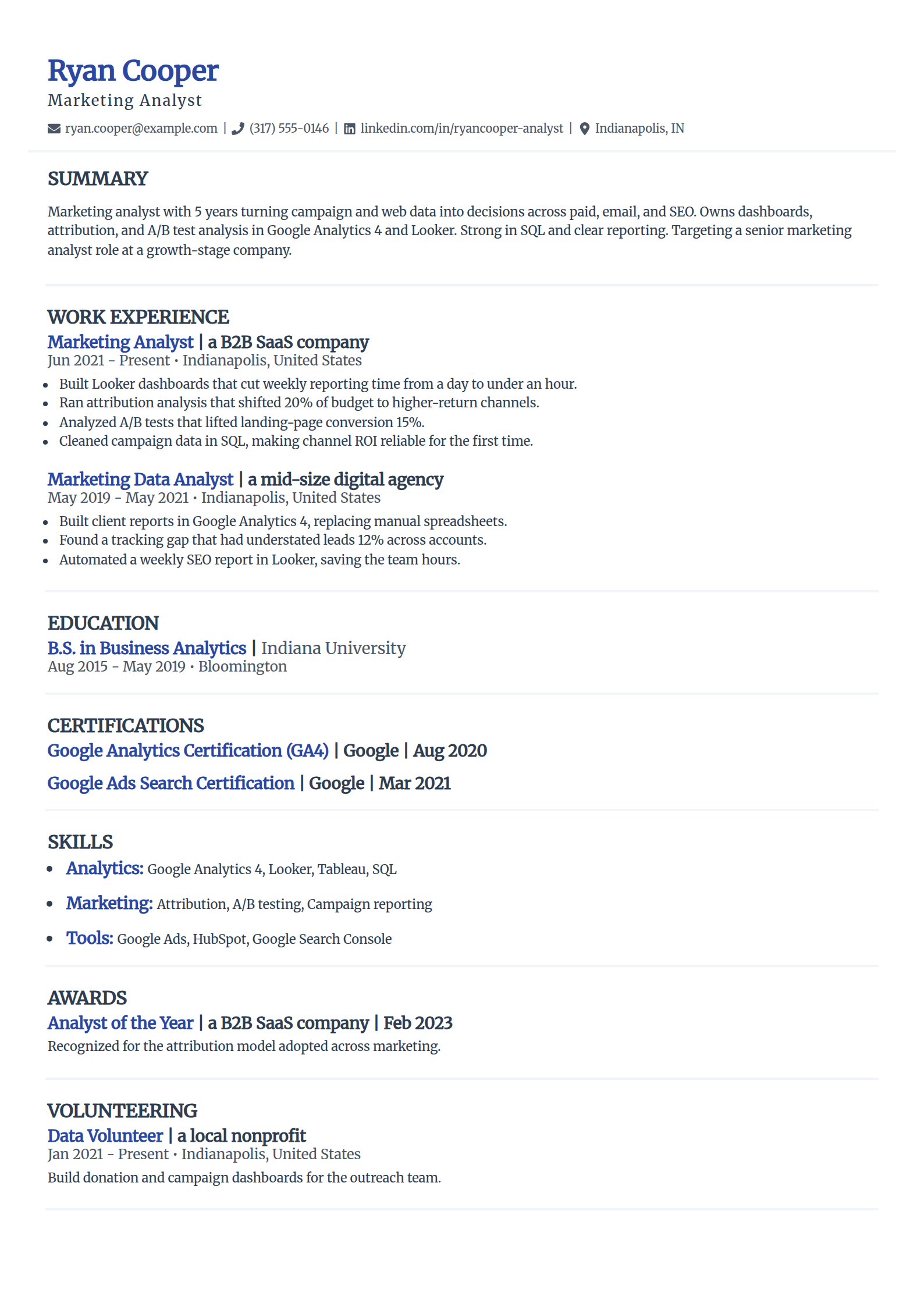
Marketing Analyst Resume Template
Why this resume example works?
- Written for a data-focused analyst, leading with Looker dashboards that cut reporting to under an hour.
- Keeps a focused five-year record tight, each bullet carrying one number like budget shifted 20% by channel.
- Names the stack a posting lists, Google Analytics 4, Looker, Tableau, and SQL.
- Fills a refined, ATS-safe page with an analyst-of-the-year award and a data-volunteer role.
- Uses a clean layout that keeps the focus on attribution and clear reporting.
Entry-Level Marketing Coordinator Resume Template
Why this resume example works?
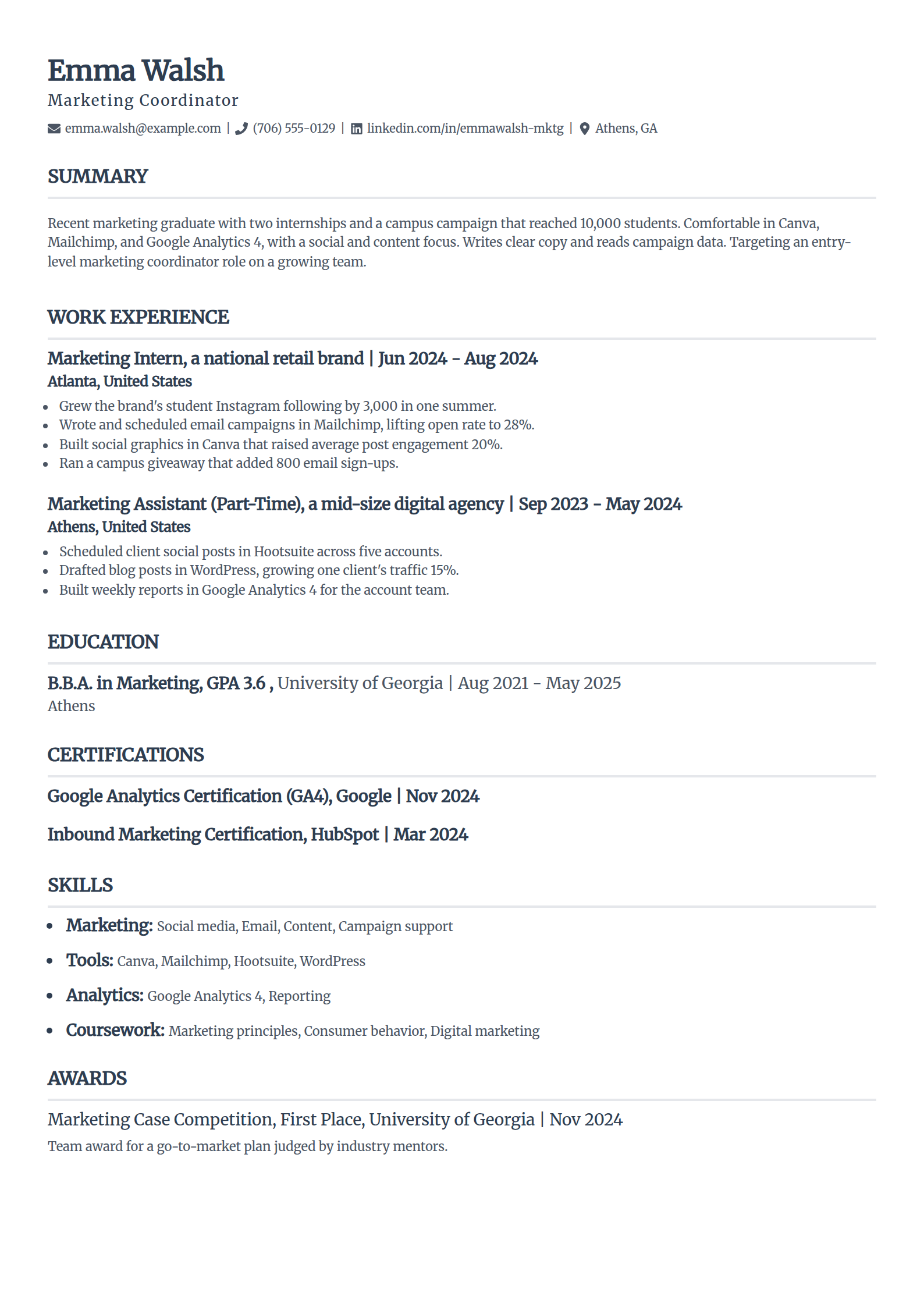
- Written for a 2025 marketing grad, leading with two internships and a campus campaign reaching 10,000 students.
- Uses internships and part-time work as entries, the right move when full-time experience does not exist yet.
- Keeps every bullet honest and quantified, like an open rate lifted to 28% or 800 email sign-ups added.
- Names Canva, Mailchimp, Hootsuite, and Google Analytics 4, the tools a coordinator posting screens for.
- Fills a tight, ATS-safe page with a GPA, certifications, and a case-competition win instead of padding.
Marketing Intern Resume Template
Why this resume example works?
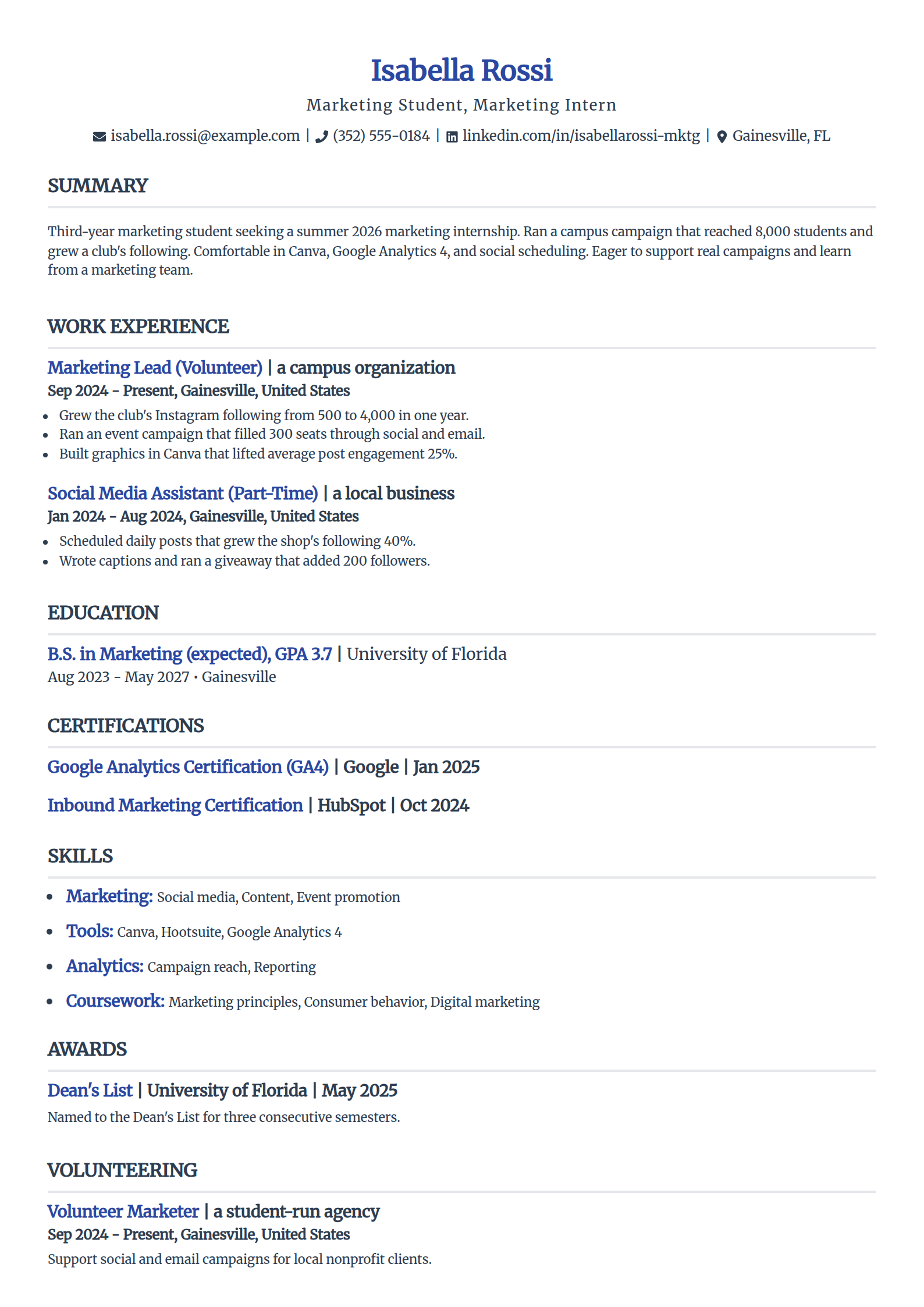
- Written for a third-year marketing student, leading with a campus campaign that reached 8,000 students.
- Uses a club marketing role and a part-time social job as entries, the right shape for a first internship.
- Keeps each bullet real and small, like a club following grown from 500 to 4,000 in a year.
- Shows the tools an internship screen wants, Canva, Hootsuite, and Google Analytics 4, plus coursework.
- Fills a plain, ATS-safe page with an expected graduation date and honest early wins, not invented jobs.
Marketing Specialist Resume Template
Why this resume example works?
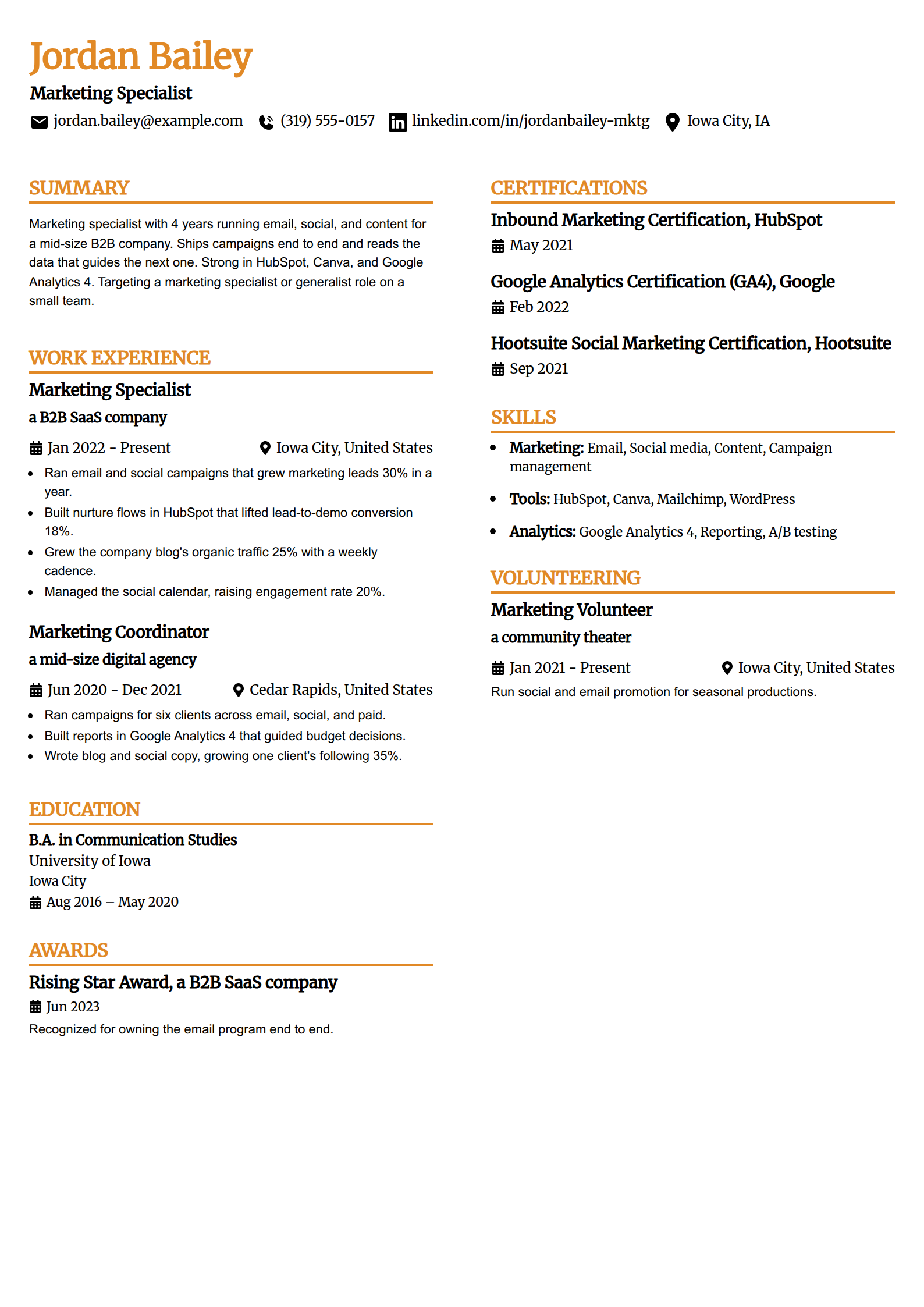
- Written for a generalist, leading with email and social campaigns that grew marketing leads 30% in a year.
- Keeps a focused four-year record tight, each bullet carrying one number like conversion lifted 18%.
- Names the stack a small-team posting lists, HubSpot, Canva, Mailchimp, and Google Analytics 4.
- Fills a tight, ATS-safe page with a rising-star award and a community-theater volunteer role.
- Uses a clean layout that keeps the focus on shipped campaigns and results.
Career-Change Marketing Resume Template
Why this resume example works?
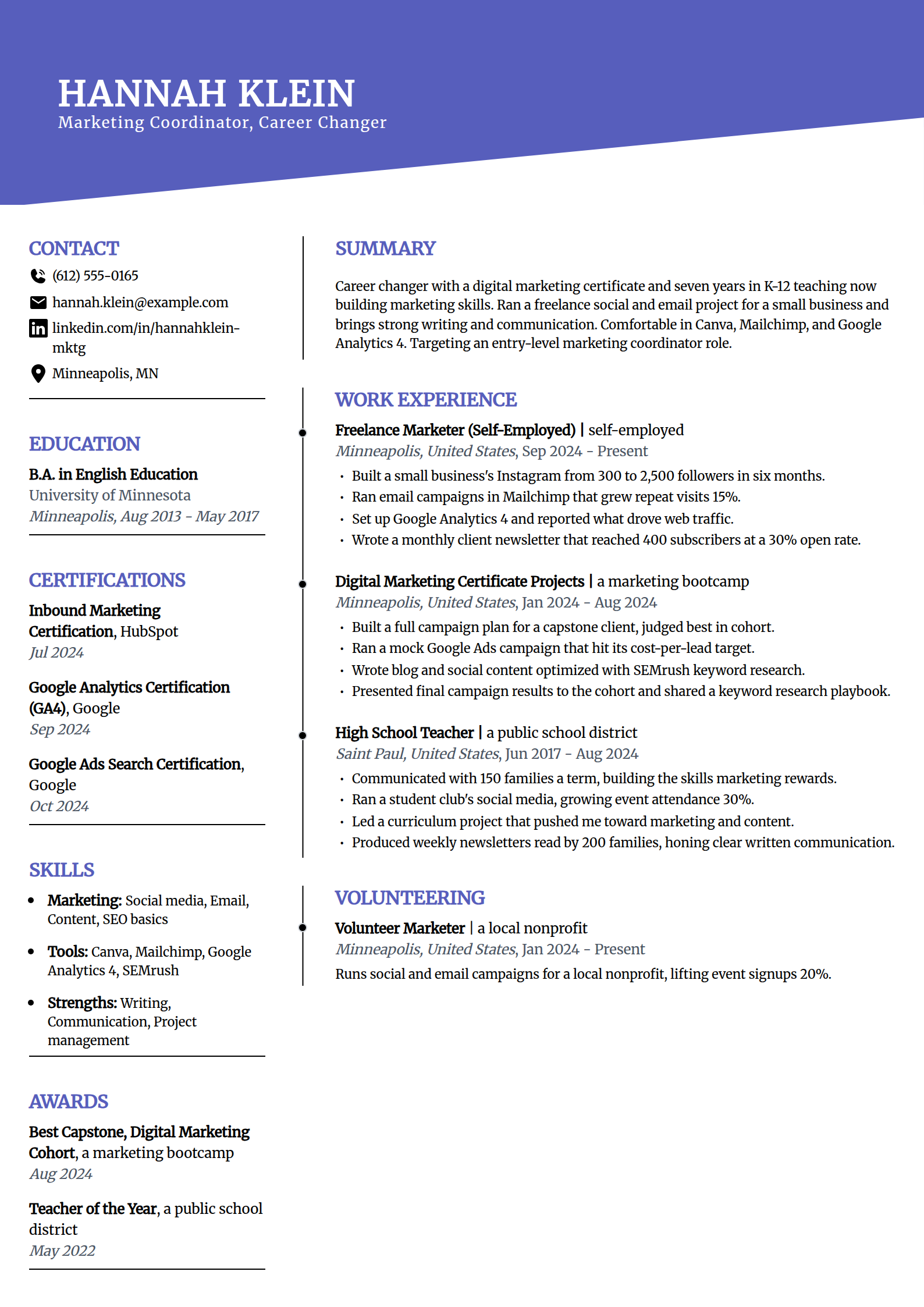
- Names the pivot openly, a digital marketing certificate after seven years in teaching.
- Shows recent proof, a freelance project that grew a small business's Instagram from 300 to 2,500 followers.
- Reframes prior work as an asset, family communication and a student club's social growth of 30%.
- Keeps the new skills concrete, Canva, Mailchimp, Google Analytics 4, and SEMrush, without overclaiming years.
- Lists awards without long descriptions, keeping the layout clean and balanced.
Build your marketing resume
Pick a template above and the editor keeps your layout clean and ATS-safe while you swap in your own campaigns, tools, and metrics.
Build my resumeHow to write a marketing resume in 2026
A marketing resume gets scanned fast by someone checking two things: can you run the specific work on their team, and can you prove it moved a number. Lead with a short summary that names your specialty and level, then make every bullet a campaign result with one metric and the tool that produced it. Keep the format clean so a parser reads it as easily as a person does.
Open with a short, specialty-first summary
Write three to four sentences that name your years and focus, your strongest number, the tools a posting would list, and the role you are targeting. A digital marketer leads with acquisition scale and paid channels; a content marketer leads with organic traffic and SEO. Keep it to about 60 words so it never spills past the top of the page.
Marketing manager with 8 years running integrated B2B campaigns that generated 3,200 marketing-qualified leads a year. Owns demand generation, content, and the martech stack from HubSpot to Google Analytics 4. Targeting a senior marketing manager role at a growth-stage B2B company.
Make every experience bullet a result with a number
Name the campaign, the approach, and the outcome, then attach one credible metric and the tool that produced it. This is what separates a resume that gets a callback from a duty list.
- Use marketing metrics: leads and MQLs, conversion rate, return on ad spend, cost-per-lead, organic traffic, open and click rate, follower growth, or pipeline dollars.
- Open with a strong verb like grew, drove, launched, cut, or built, never "Responsible for" or "Helped with".
- Name the method or tool: "cut cost-per-lead 28% by shifting budget from display to high-intent search in Google Ads".
- Keep numbers modest and level-accurate: a coordinator grows a following, a director moves pipeline; one number per bullet is plenty.
Show education and certifications for your level
Match what you lead with to where you are in your career, and never claim experience you do not have.
- New grads and interns lead with internships, a campus campaign or club role, and coursework, then keep the degree and GPA visible.
- Experienced marketers lead with campaign impact and keep education to a line; the degree matters less each year you work.
- List certifications that map to the role: Google Ads and Google Analytics (GA4) for digital, HubSpot for inbound and email, Hootsuite for social.
- Career-changers show the certificate or bootcamp plus a portfolio of real projects, and reframe prior-industry strengths honestly.
Match skills and keywords to the job posting
A skills block should read like the posting, grouped so a hiring manager and a parser both find what they need. List the tools you have actually run, not a generic dump.
- Group by type: channels, martech and analytics tools, content and design, and strategy or leadership.
- Name specific systems: Google Analytics 4, HubSpot, Google Ads, Meta Ads, SEMrush, Klaviyo, Looker, or WordPress, matched to the role.
- If the posting says "Google Ads campaign management" or "marketing automation", use that exact phrasing where it fits.
- Mirror the posting's language, since that is what the applicant tracking system searches for when it ranks your resume.
Keep the format clean and ATS-safe
A marketing resume is read by a parser first and a person second, so a clean layout with standard headings is the safe choice at every level.
- Use a single-column or simple two-column layout with standard headings a parser recognizes; skip heavy graphics and photos.
- Keep it to one page for most marketers; use a second page only when a director or 8-plus-year record genuinely needs it.
- Save as a PDF so the formatting holds, then run it through the ATS resume checker for a quick format and keyword pass.
- Swap the numbers in the templates above for your own campaigns, tools, and metrics; do not copy them as is.
Common marketing resume mistakes
- Listing duties instead of results. Replace "managed social media" with "grew the following from 250,000 to 800,000 at a 5.2% engagement rate".
- Leaving out numbers. Marketing is measured, so a resume with no leads, traffic, conversion, or return on ad spend reads as untested; add one metric per bullet.
- Dumping every tool you have opened. A 30-item skills wall reads as noise; list the martech the role uses and that you can speak to in an interview.
- Claiming a level you have not reached. An intern who "drove 40% revenue growth" fails the sniff test; use campaign metrics that fit your seniority.
- One generic resume for every posting. Reorder your bullets and skills so the specialty the job names, digital, content, social, or SEO, leads the page.
Frequently asked questions
How do you write a marketing resume?
Lead with a three-to-four-sentence summary that names your specialty, your level, your strongest number, and the role you are targeting. Under each job, write results-first bullets that open with a strong verb and carry one credible metric, like generating 3,200 marketing-qualified leads a year or cutting cost-per-lead 28% in Google Ads. Name the tool or channel that produced each result, group your skills to match the posting, and keep the whole thing to one clean, ATS-safe page for most levels.
What should a marketing resume include?
A marketing resume includes a specialty-first summary, experience bullets with campaign metrics, a grouped skills block, and education plus certifications matched to your level. The experience section carries the weight: every bullet should show a result you can prove, such as organic traffic grown to 500,000 monthly sessions or a following built to 800,000. In 2026 many postings also expect named martech, so list the tools you actually run, like Google Analytics 4, HubSpot, Google Ads, Meta Ads, or SEMrush.
How do you write a marketing resume with no experience?
Lead with what you do have. A new grad leads with internships, a campus campaign or club marketing role, and coursework, then keeps the degree, GPA, and certifications visible. A career-changer leads with a certificate or bootcamp plus a portfolio of real projects, and reframes prior-industry strengths like writing and communication honestly. Certifications such as Google Ads, Google Analytics (GA4), and HubSpot are your strongest early signal. The intern, entry-level, and career-change examples above show the shape.
How long should a marketing resume be?
One page for most marketers, including interns, new grads, coordinators, and specialists. Use a second page only when a director or a marketer with roughly eight or more years has enough relevant campaign, budget, and team experience to justify it, and never pad to reach it. Whichever length you use, lead with your most recent and most relevant work, keep standard headings, and cut older or unrelated roles so the space goes to the work that matches the job you want.
What skills should you put on a marketing resume?
Match the posting, then name specific tools and channels grouped by type: channels (paid search, paid social, email, SEO, content), martech and analytics (Google Analytics 4, HubSpot, Google Ads, Meta Ads, SEMrush, Looker), and content or design (WordPress, Canva, Figma). Add the strategy work the role cares about, like demand generation, ABM, marketing automation, or conversion optimization. List what you have actually run and can discuss in an interview, and mirror the posting's exact phrasing, since that is what the applicant tracking system searches for.
How do you quantify a marketing resume?
Attach one credible number to a result, not a duty. Use the metrics you have access to: lead and MQL volume, conversion rate, return on ad spend, cost-per-lead, organic traffic growth, email open and click rate, follower growth, or influenced pipeline. Even an operational win counts, like cutting campaign launch time or recovering 35% of lost organic traffic after a migration. Keep one number per bullet and keep it modest and level-accurate, so a coordinator grows a following while a director moves pipeline.
More marketing resume resources
Build your marketing resume
Pick a template above and the editor keeps your layout clean and ATS-safe while you swap in your own campaigns, tools, and metrics.