16 Product Manager Resume Examples, APM to Group PM
- ATS Friendly
- Associate to Group PM
- 16 Real Examples
A product manager resume is judged on what you shipped and the impact it drove, not a list of features. Pick a clean layout below, then model your own on a real example built for your track, from associate PM to senior, technical, growth, platform, or data PM.


540k+ resumes created
Editable product manager resume templates
Each template below is a real product manager resume laid out in that format, sorted by track and seniority. Choose one, then swap in your own shipped work, the impact behind each launch, and the skills a posting names. Every layout keeps your name, contact details, and dates clean so a hiring manager reads your experience at a glance and an applicant tracking system parses it without trouble.
Experienced Product Manager Resume Template
Why this resume example works?
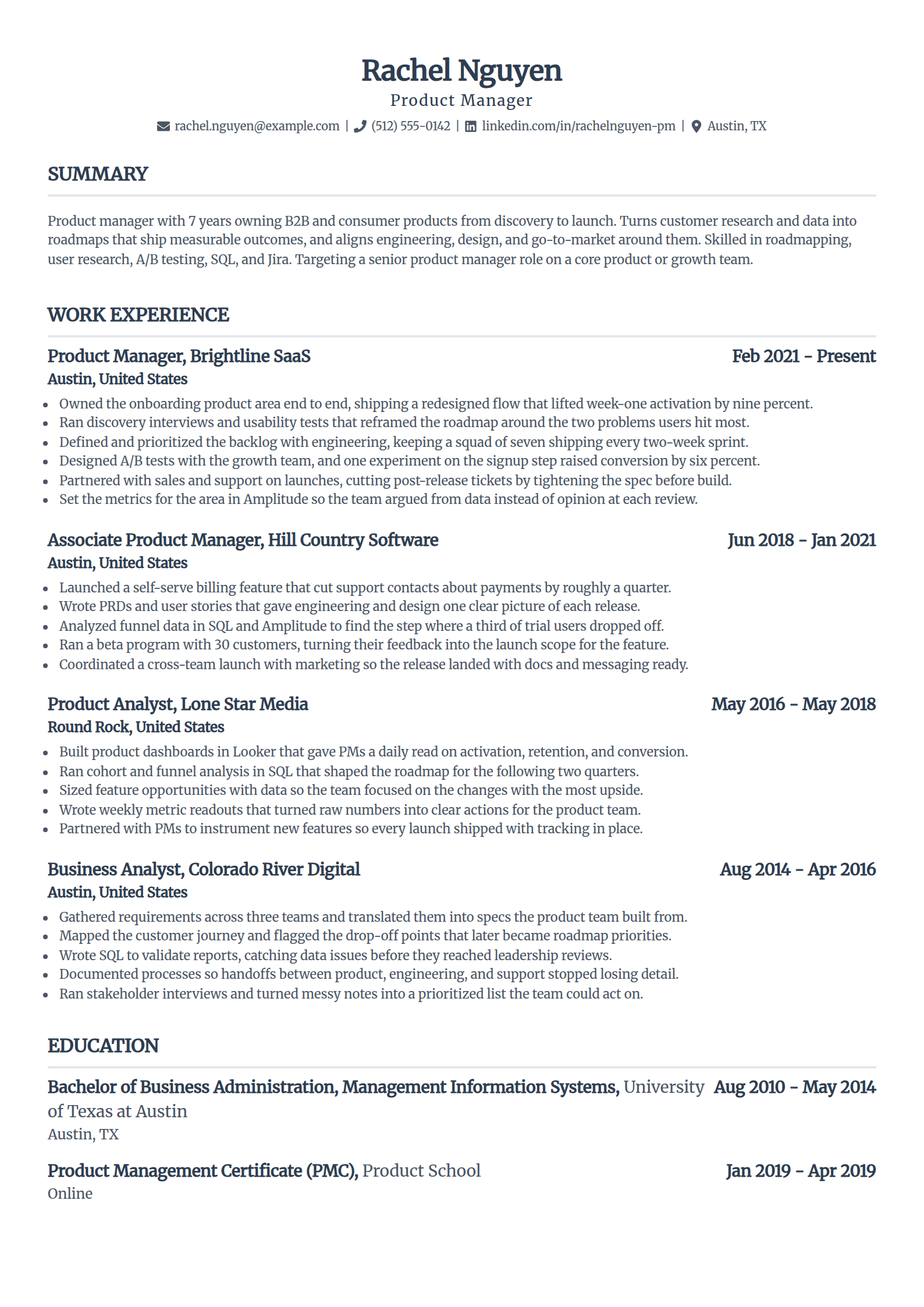
- Opens with a summary that names 7 years, roadmaps, and shipped outcomes, the scope a hiring manager reads first.
- Leads each bullet with a strong verb and the impact, such as lifting week-one activation by nine percent.
- Names the exact tools a PM posting lists, roadmapping, user research, A/B testing, SQL, and Jira.
- Uses a single-column layout with standard headings that an applicant tracking system parses cleanly.
- Backs the experience with real credentials, a Product School PMC and a Pragmatic certification.
Senior Product Manager Resume Template
Why this resume example works?
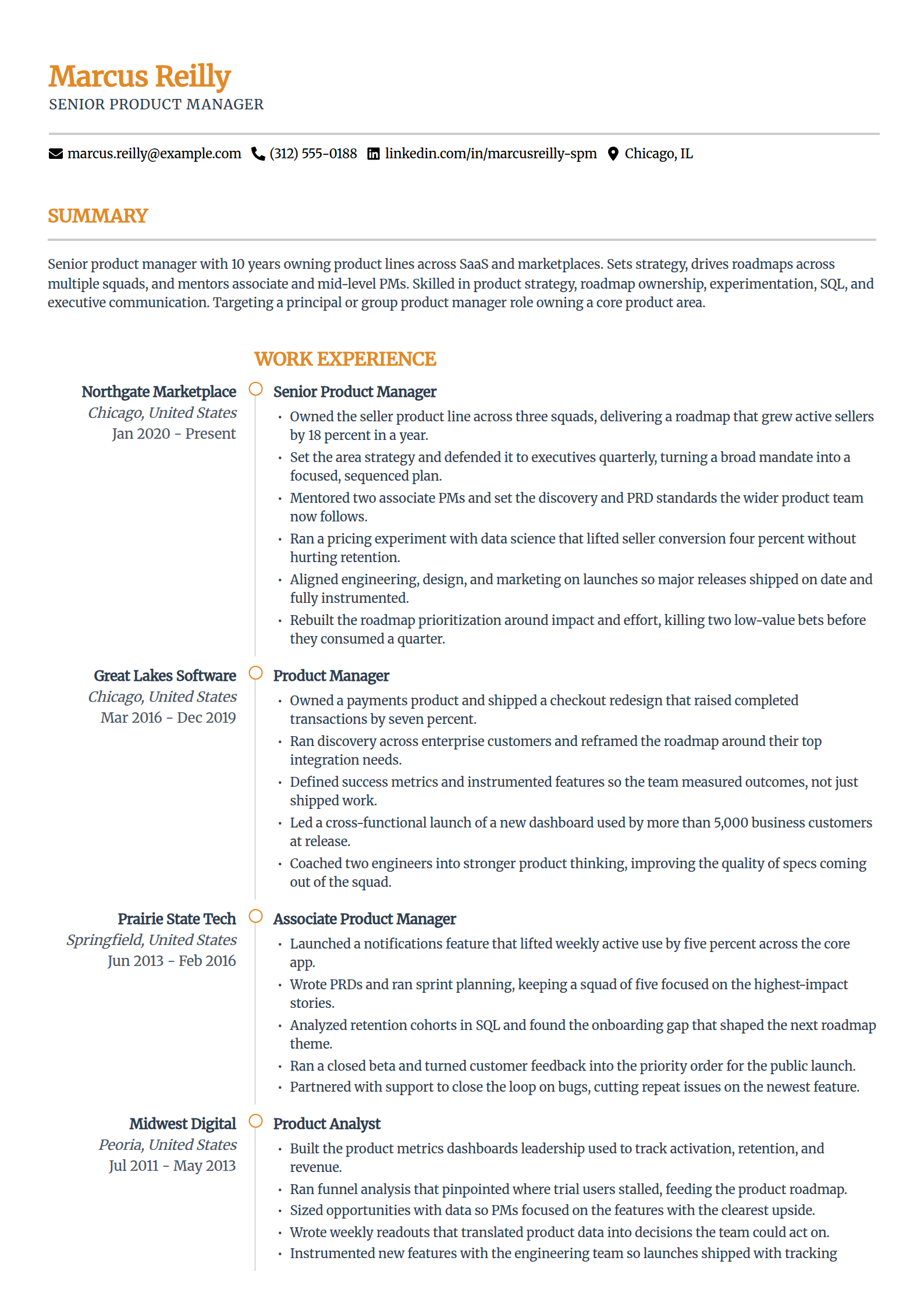
- Frames senior scope up top, owning a product line across three squads and mentoring associate PMs.
- Shows leadership impact a team can quote, a roadmap that grew active sellers 18 percent in a year.
- Carries the work a senior PM owns, strategy defended to executives and experiments that changed direction.
- Names a full toolset, product strategy, roadmap ownership, SQL, and experimentation, across ten years.
- Fills a dense layout with four roles, showing a clear climb from analyst to senior PM.
Technical Product Manager Resume Template
Why this resume example works?
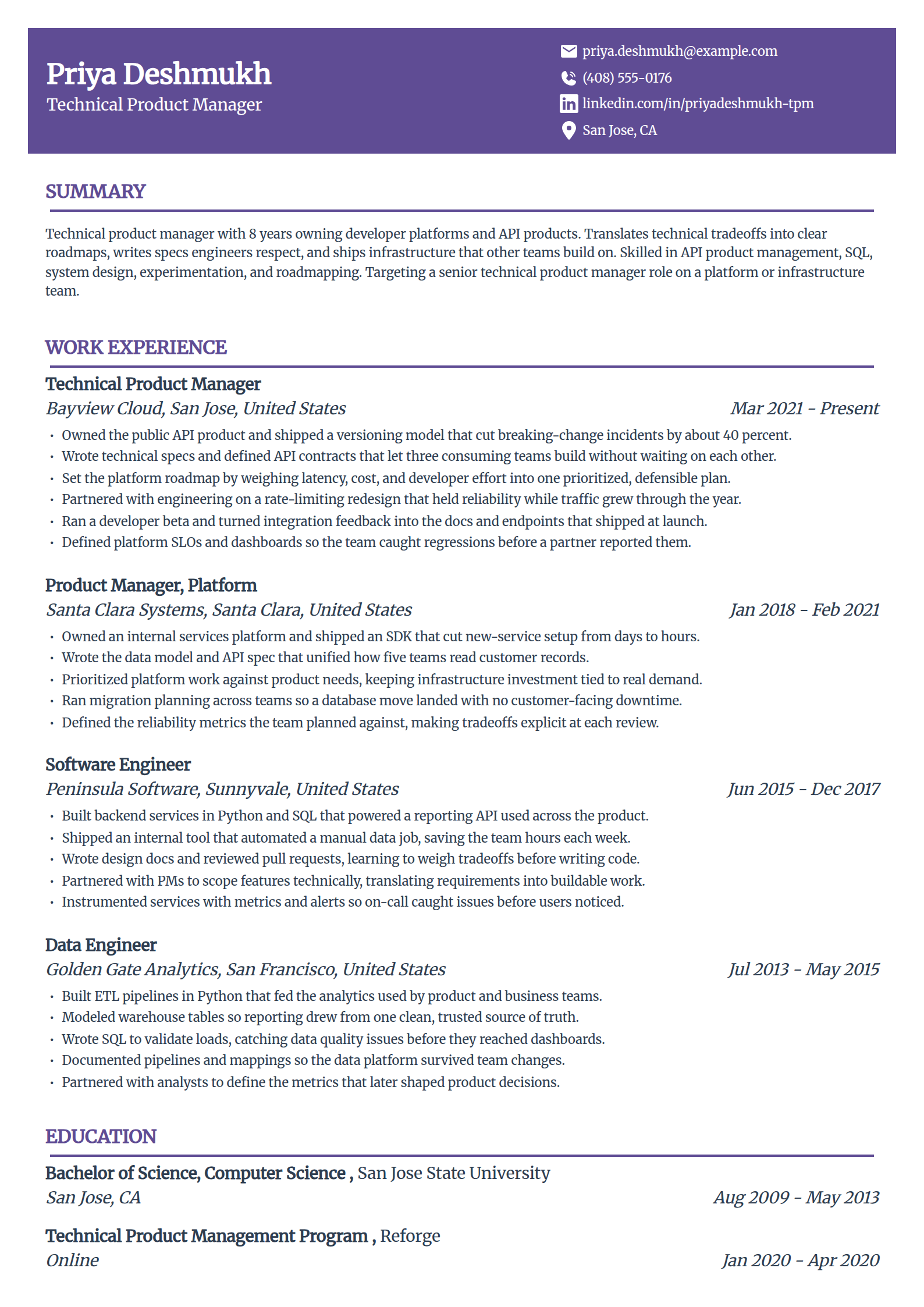
- Leads with platform work teams depend on, an API versioning model that cut breaking-change incidents 40 percent.
- Shows the technical bridge a role wants, specs and API contracts three consuming teams built against.
- Names the technical PM stack, API product management, SQL, system design, and SLOs.
- Backs the resume with an engineering history so the technical depth reads as real, not claimed.
- Uses a modern layout that carries an eight-year platform history without crowding the page.
Growth Product Manager Resume Template
Why this resume example works?
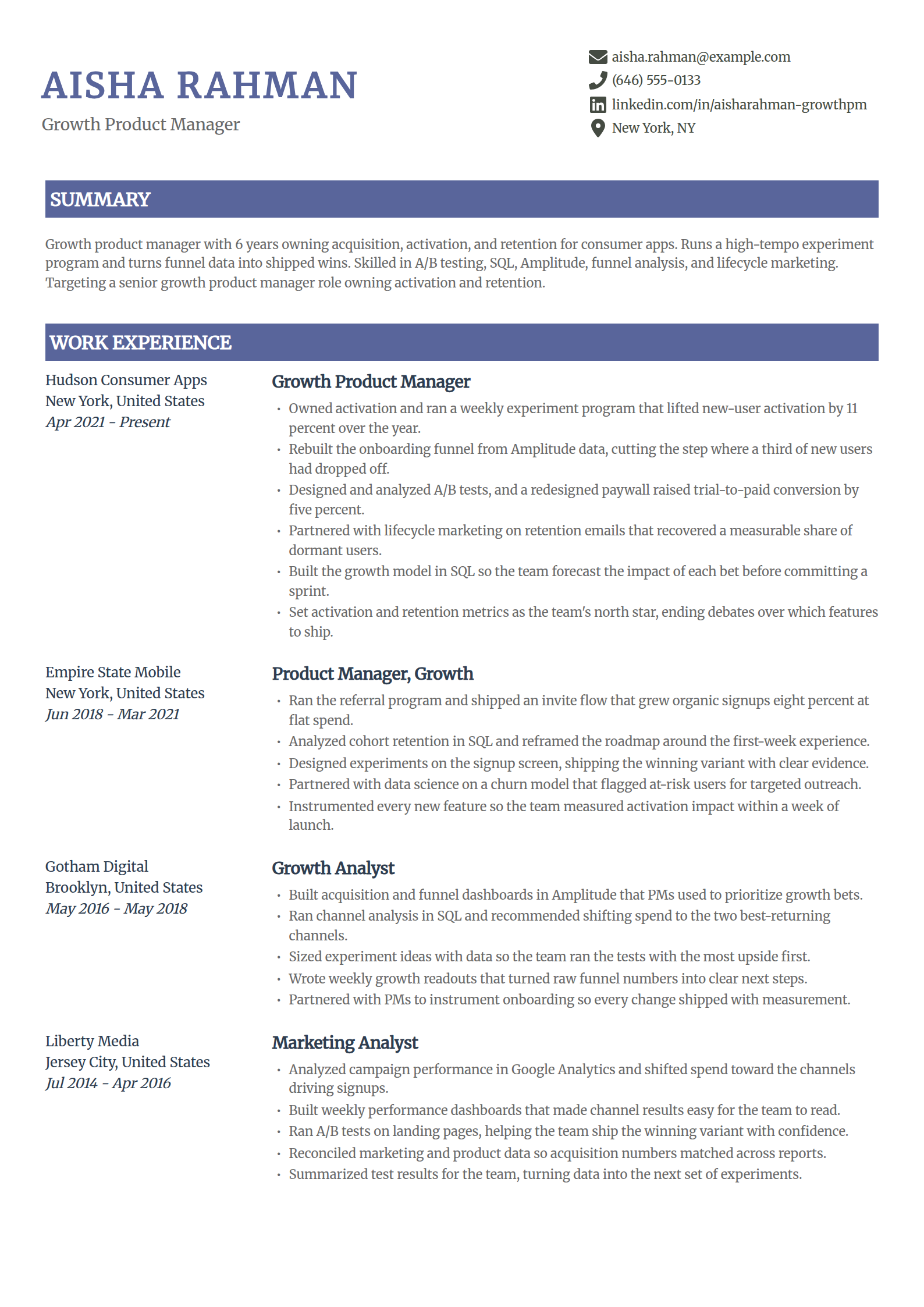
- Opens with growth impact, a weekly experiment program that lifted new-user activation 11 percent over the year.
- Names the growth stack, A/B testing, SQL, Amplitude, and funnel analysis, the keywords on a growth PM posting.
- Shows the funnel work growth teams hire for, rebuilding the onboarding step where a third of users dropped off.
- Ties experiments to outcomes, a paywall redesign that raised trial-to-paid conversion five percent.
- Fills a visually rich layout with four roles while staying easy to skim in one pass.
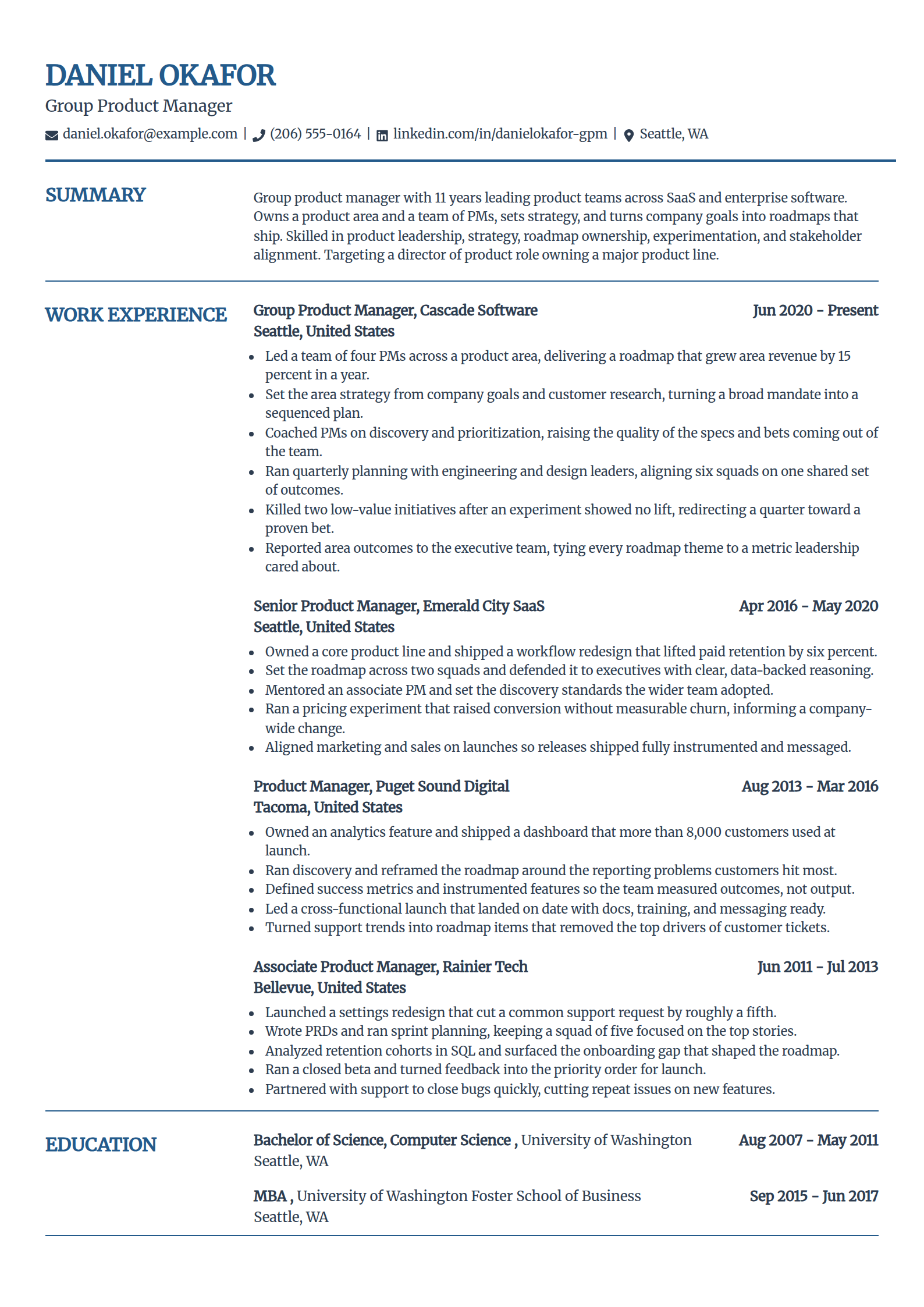
Group Product Manager Resume Template
Why this resume example works?
- Frames leadership scope, managing four PMs across a product area that grew area revenue 15 percent.
- Shows the work a people-leader owns, quarterly planning aligning six squads on one set of outcomes.
- Names the leadership stack, product leadership, strategy, roadmap ownership, and experimentation.
- Backs the resume with a CS degree and an MBA that fit a product-leadership path.
- Uses a clean, modern layout that fits four roles and a clear climb to group PM on one page.
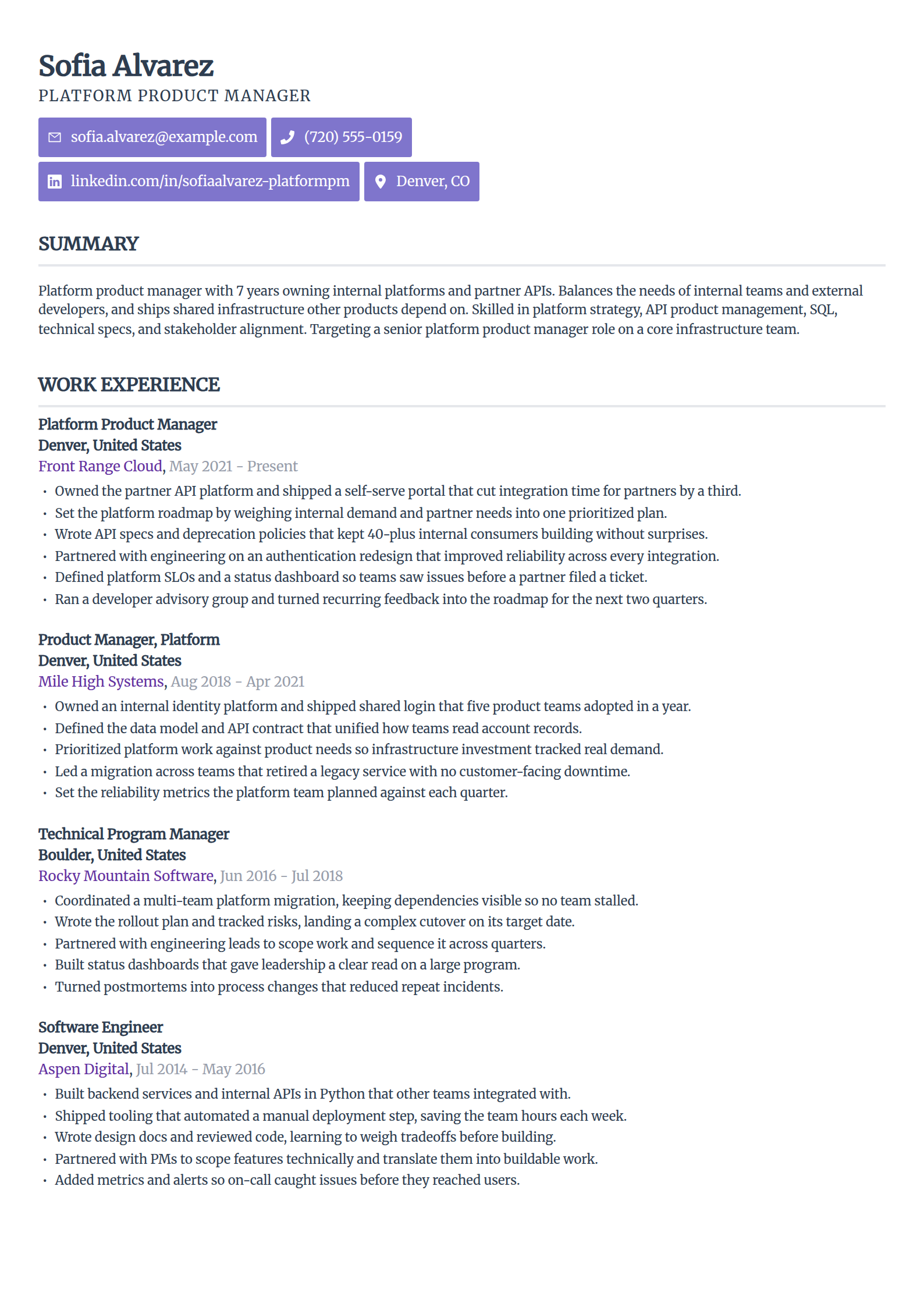
Platform & API Product Manager Resume Template
Why this resume example works?
- Leads with platform impact, a self-serve partner portal that cut integration time by a third.
- Shows the balance a platform PM owns, weighing internal demand and partner needs into one roadmap.
- Names the platform stack, platform strategy, API product management, technical specs, and SLOs.
- Carries an engineering and technical-program history so the infrastructure depth reads as real.
- Uses a clean, modern layout that carries a seven-year platform history without crowding.
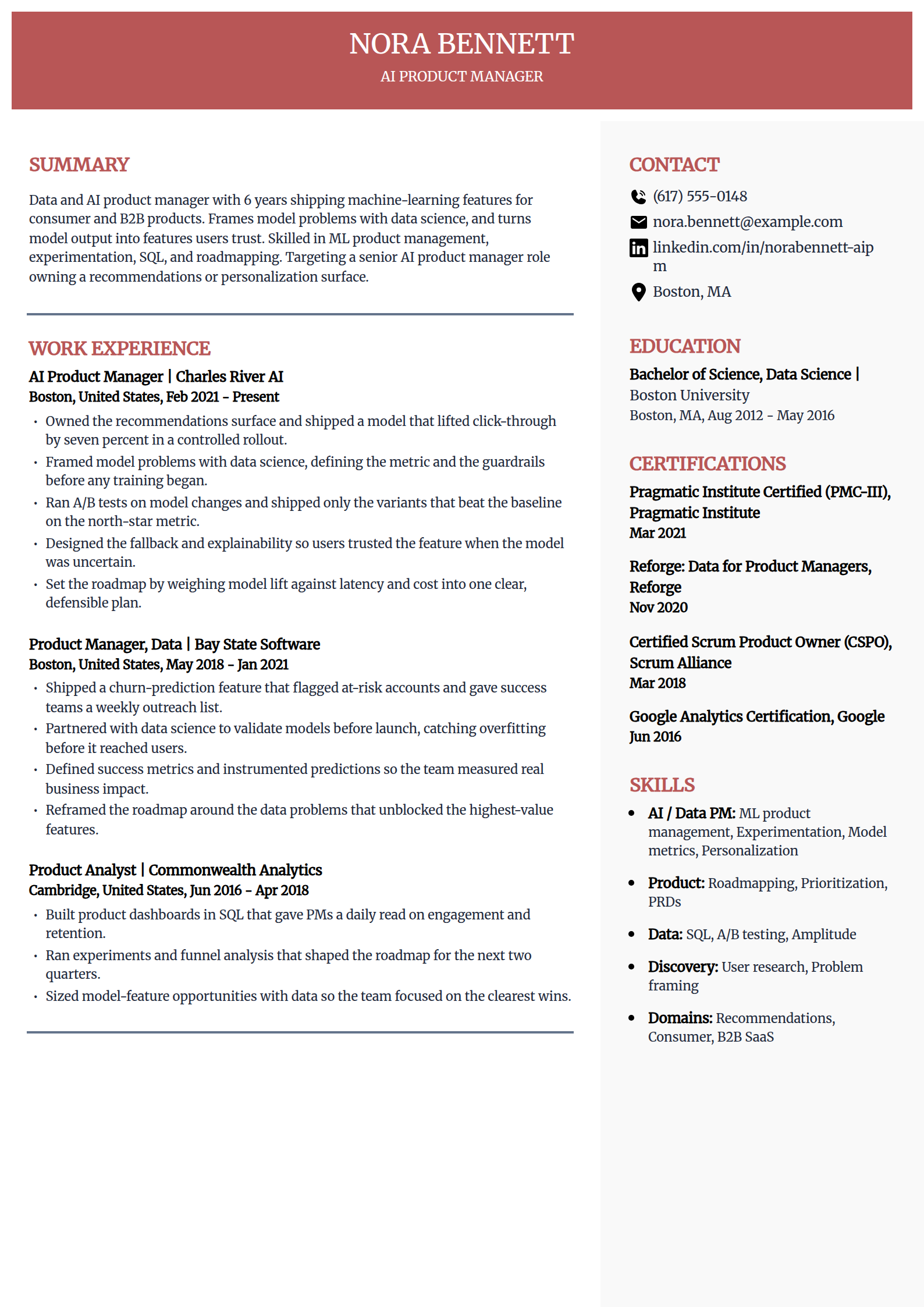
Data & AI Product Manager Resume Template
Why this resume example works?
- Opens with model impact, a recommendations model that lifted click-through seven percent in a controlled rollout.
- Names the AI PM stack, ML product management, experimentation, model metrics, and SQL.
- Shows the rigor a team wants, defining the metric and guardrails before any model training began.
- Foregrounds trust, designing the fallback and explainability so users trusted an uncertain model.
- Uses a refined layout that fits a focused six-year data-and-AI history on one clean page.
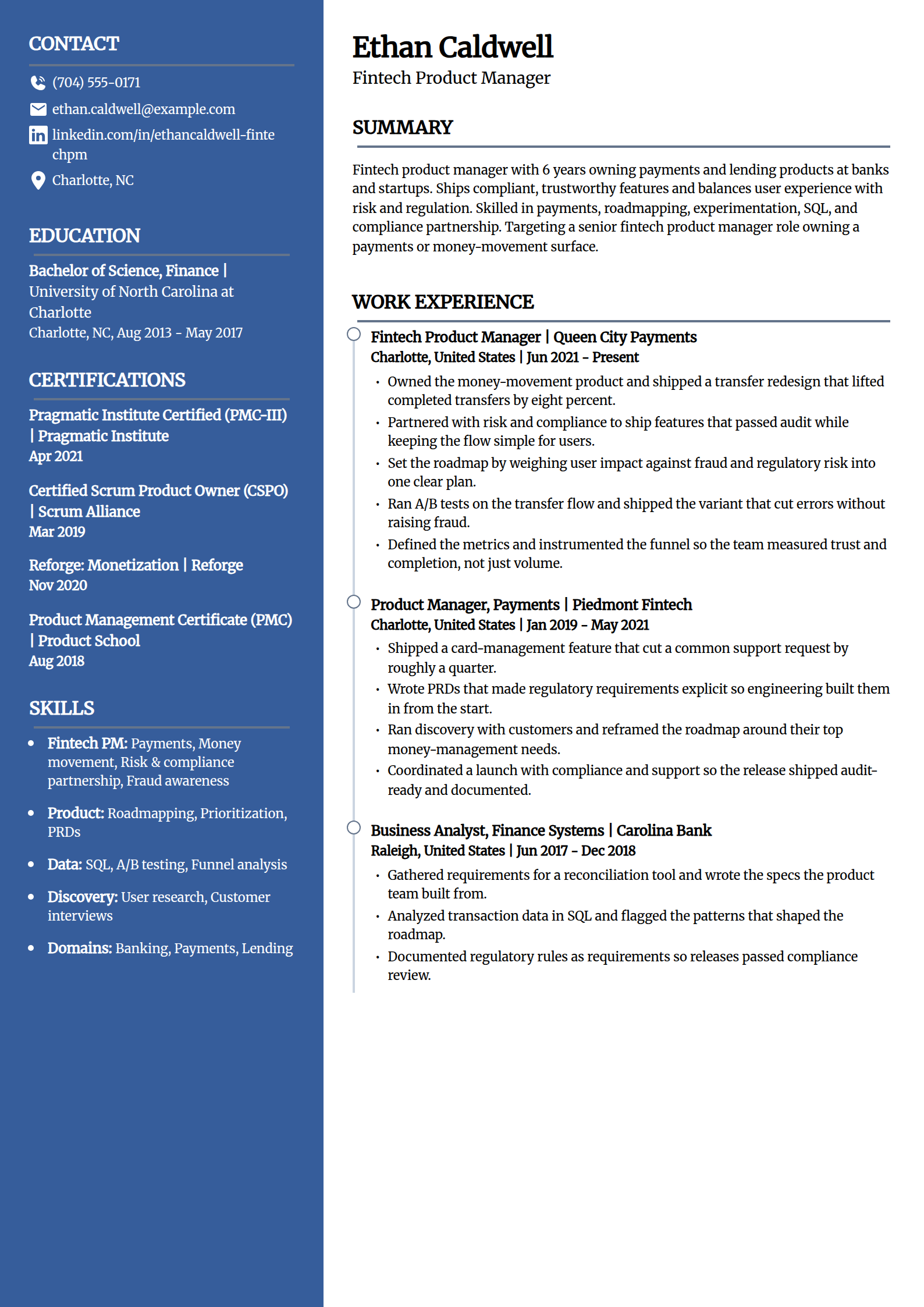
Fintech Product Manager Resume Template
Why this resume example works?
- Leads with money-movement impact, a transfer redesign that lifted completed transfers eight percent.
- Shows the fintech balance, shipping compliant features that passed audit while keeping the flow simple.
- Names the fintech PM stack, payments, risk and compliance partnership, SQL, and A/B testing.
- Keeps every metric modest and believable for a regulated, trust-sensitive product.
- Uses a distinctive layout that still keeps sections easy to scan for a fintech hiring manager.
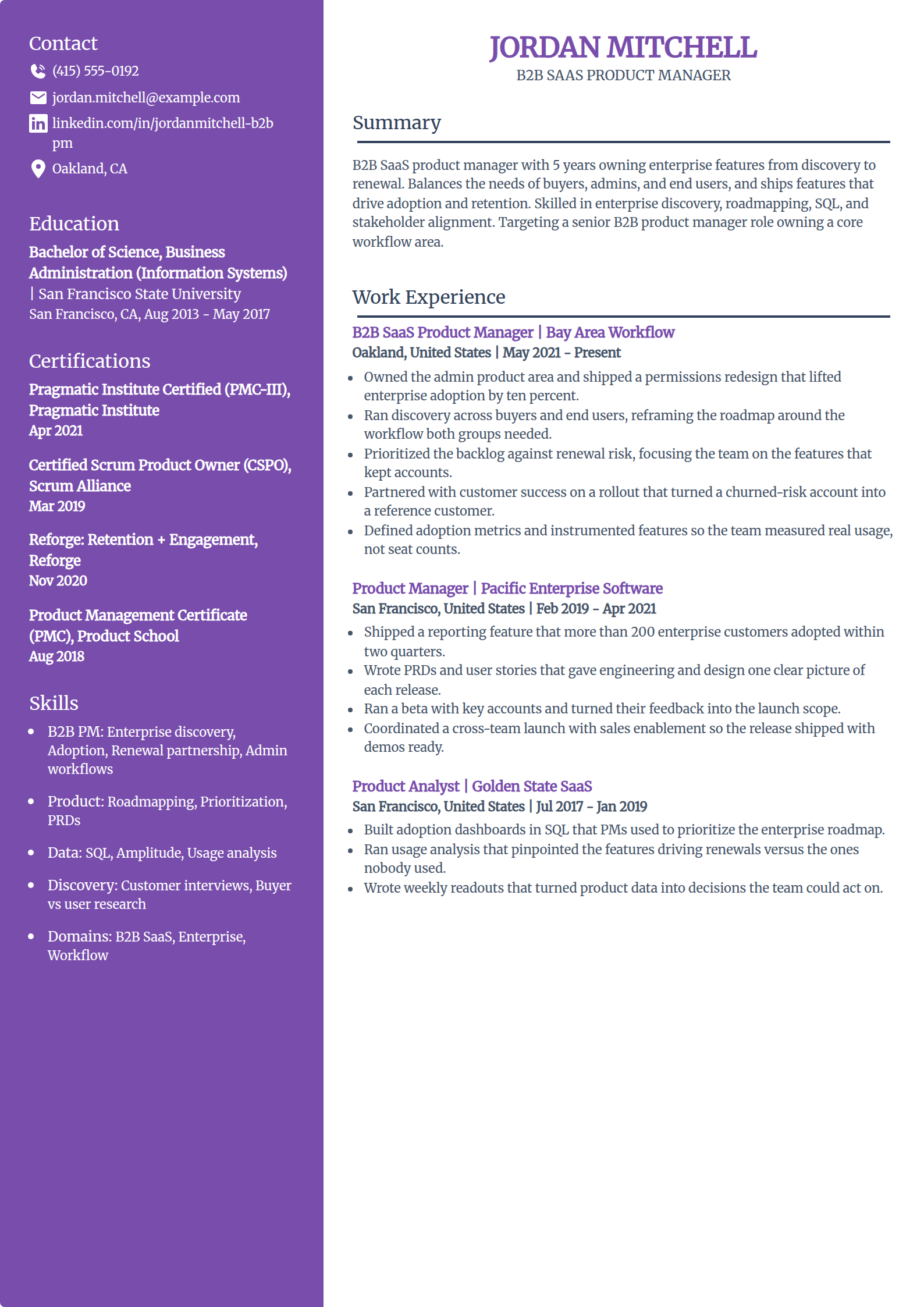
B2B SaaS Product Manager Resume Template
Why this resume example works?
- Opens with enterprise impact, a permissions redesign that lifted enterprise adoption ten percent.
- Shows the B2B balance, running discovery across buyers and end users to reframe the roadmap.
- Names the B2B PM stack, enterprise discovery, adoption, renewal partnership, and SQL.
- Ties the work to retention, prioritizing the backlog against renewal risk to keep accounts.
- Keeps a Medium layout with three focused roles instead of padding a shorter history.
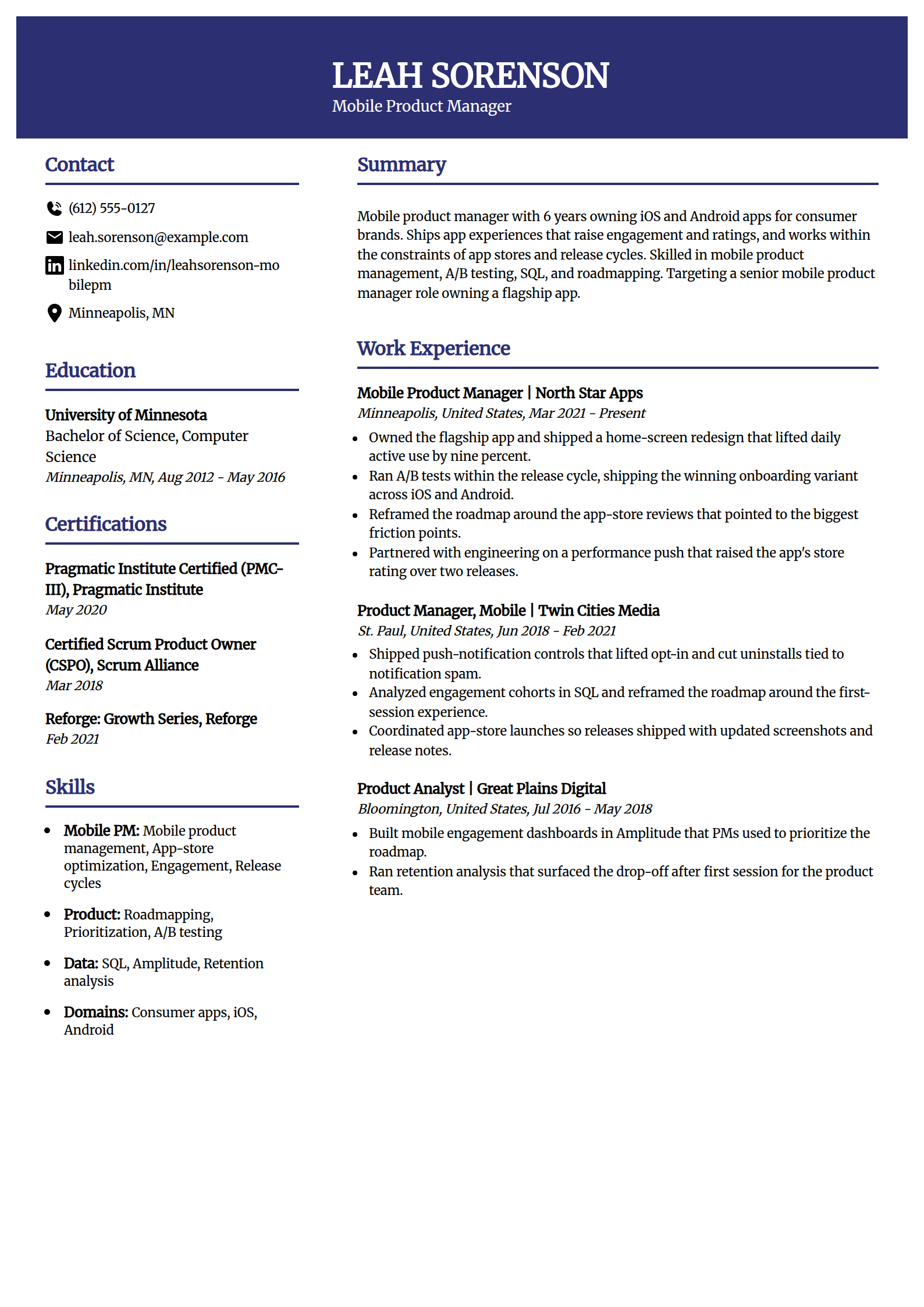
Mobile Product Manager Resume Template
Why this resume example works?
- Leads with app impact, a home-screen redesign that lifted daily active use nine percent.
- Names the mobile PM stack, mobile product management, A/B testing, SQL, and app-store optimization.
- Shows the work mobile teams hire for, running A/B tests within the release cycle across iOS and Android.
- Uses a roomy two-column layout with the education, certifications, and skills sidebar filled so the page reads complete.
- Keeps every metric modest and believable rather than reaching for inflated numbers.
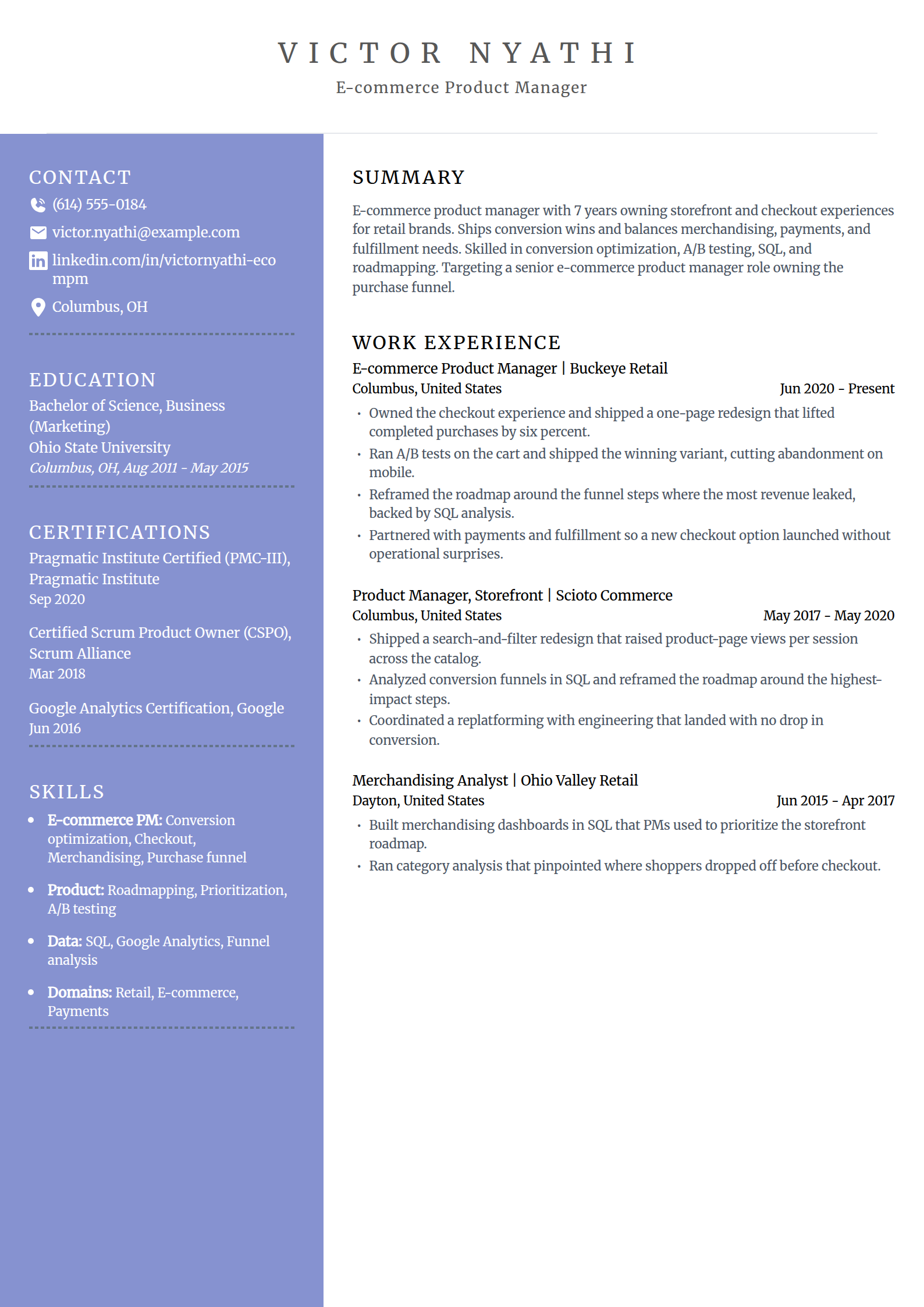
E-commerce Product Manager Resume Template
Why this resume example works?
- Leads with conversion impact, a one-page checkout redesign that lifted completed purchases six percent.
- Names the e-commerce PM stack, conversion optimization, A/B testing, SQL, and the purchase funnel.
- Shows the revenue work, reframing the roadmap around the funnel steps where the most revenue leaked.
- Carries a marketing and merchandising history that fits a storefront and checkout role.
- Uses a roomy layout with a filled sidebar so a seven-year history still looks full.
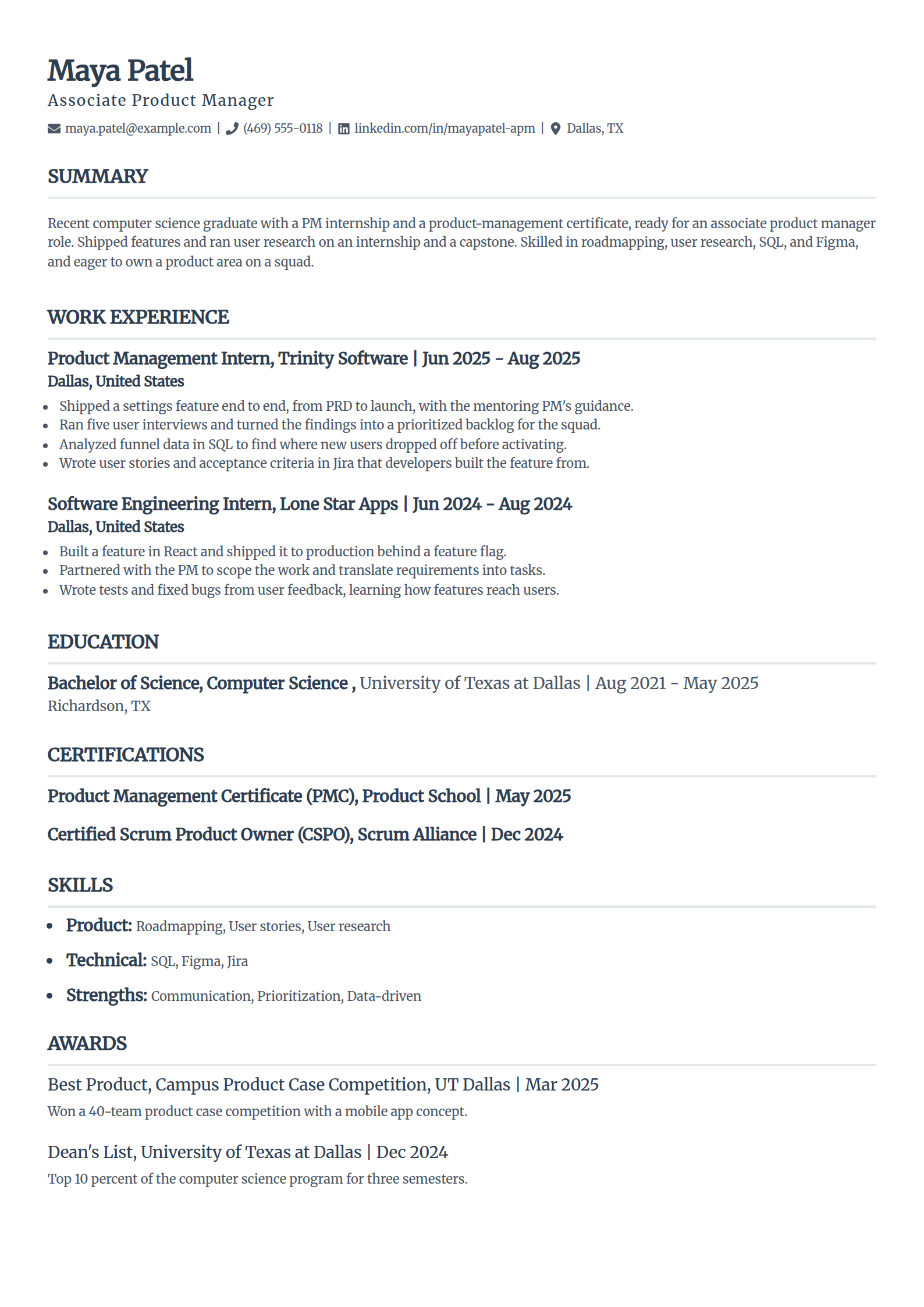
Associate Product Manager Resume Template (Entry-Level)
Why this resume example works?
- Written for a first PM job, leading with a PM internship, a CS degree, and a product-management certificate.
- Uses the internship to show real PM tasks, shipping a feature from PRD to launch and running user interviews.
- Fills the page honestly with a product-case-competition win and a Dean's List award instead of padding history.
- Keeps bullets short and specific so limited experience still reads confident on one clean page.
- Uses a tight, ATS-safe single-column layout that fits a beginner's resume without empty space.
Engineer to Product Manager Resume Template
Why this resume example works?
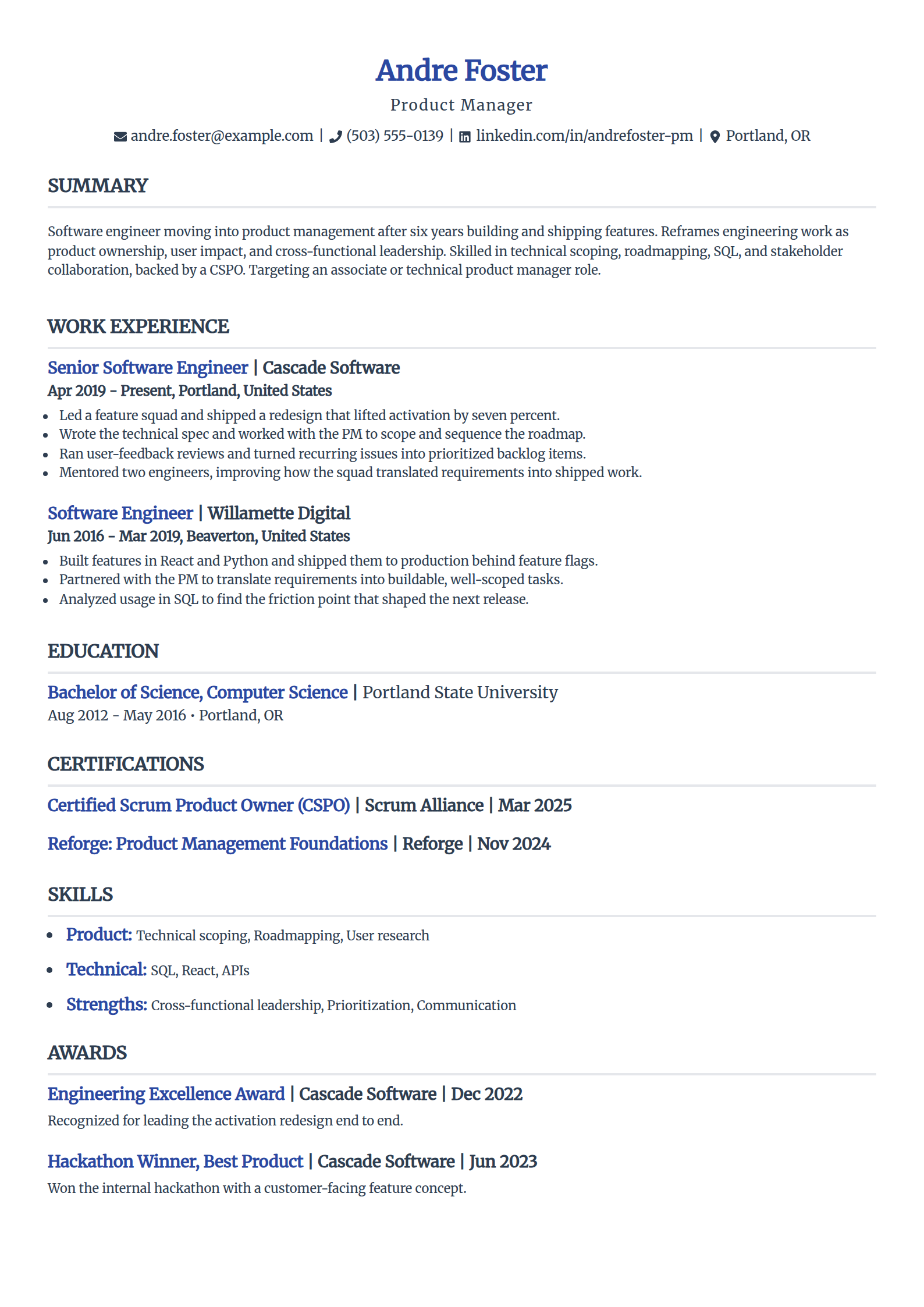
- Reframes six years of engineering as product ownership, user impact, and cross-functional leadership.
- Pulls the PM-relevant wins forward, leading a feature squad on a redesign that lifted activation seven percent.
- Names the crossover stack, technical scoping, roadmapping, SQL, and stakeholder collaboration, with a CSPO.
- Fills the page with an engineering-excellence award and a hackathon win that fit the pivot.
- Uses a plain, ATS-safe layout that keeps the focus on shipped, user-facing work.
MBA to Product Manager Resume Template
Why this resume example works?
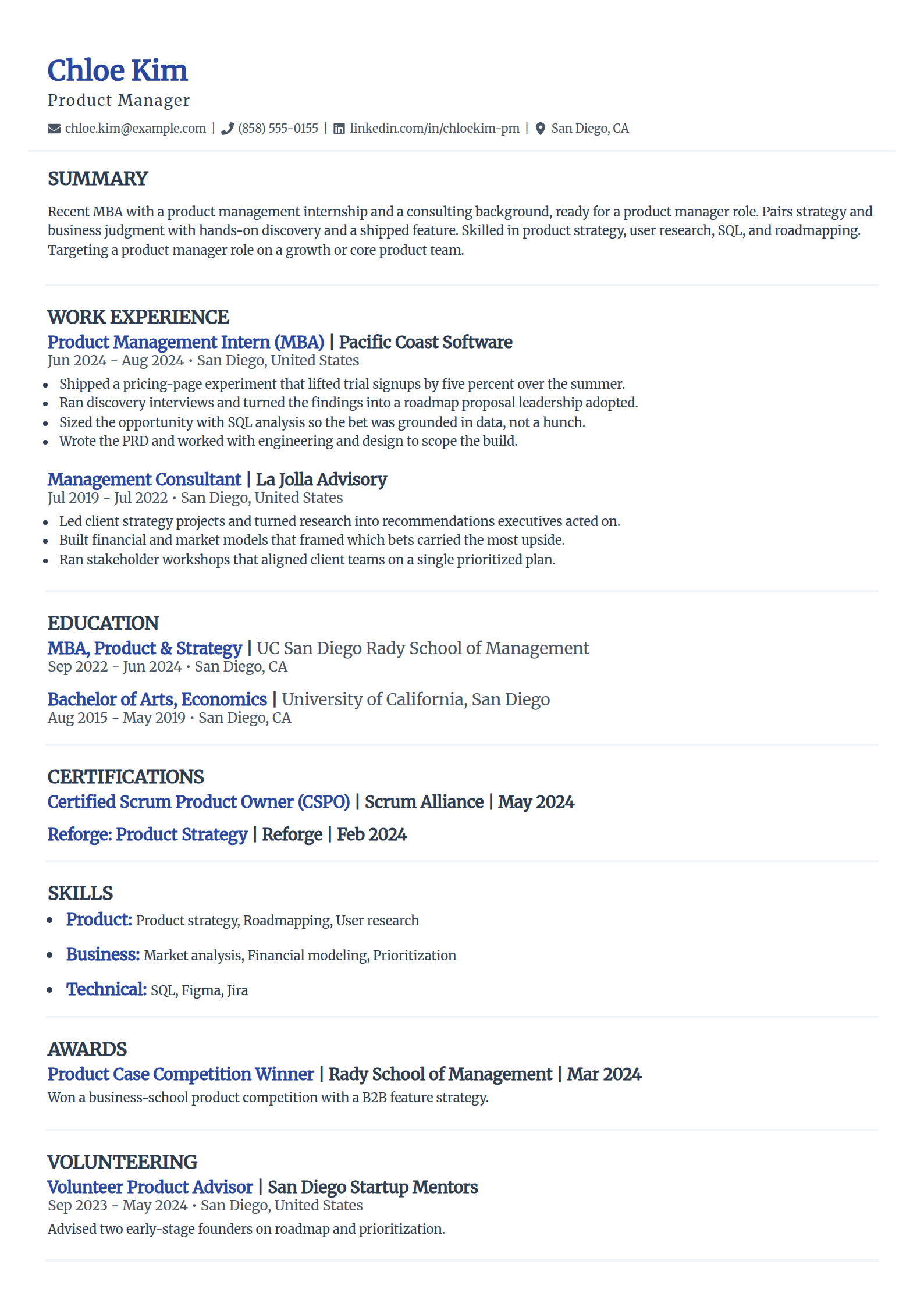
- Written for the MBA path, pairing strategy and business judgment with a shipped internship feature.
- Shows real product work, a pricing-page experiment that lifted trial signups five percent over the summer.
- Names the MBA-to-PM stack, product strategy, user research, SQL, and roadmapping, with a CSPO.
- Fills the page with a case-competition win and startup product-advising that fit the pivot.
- Uses a refined, uncluttered layout that carries the consulting-to-product story on one page.
Product Owner Resume Template
Why this resume example works?
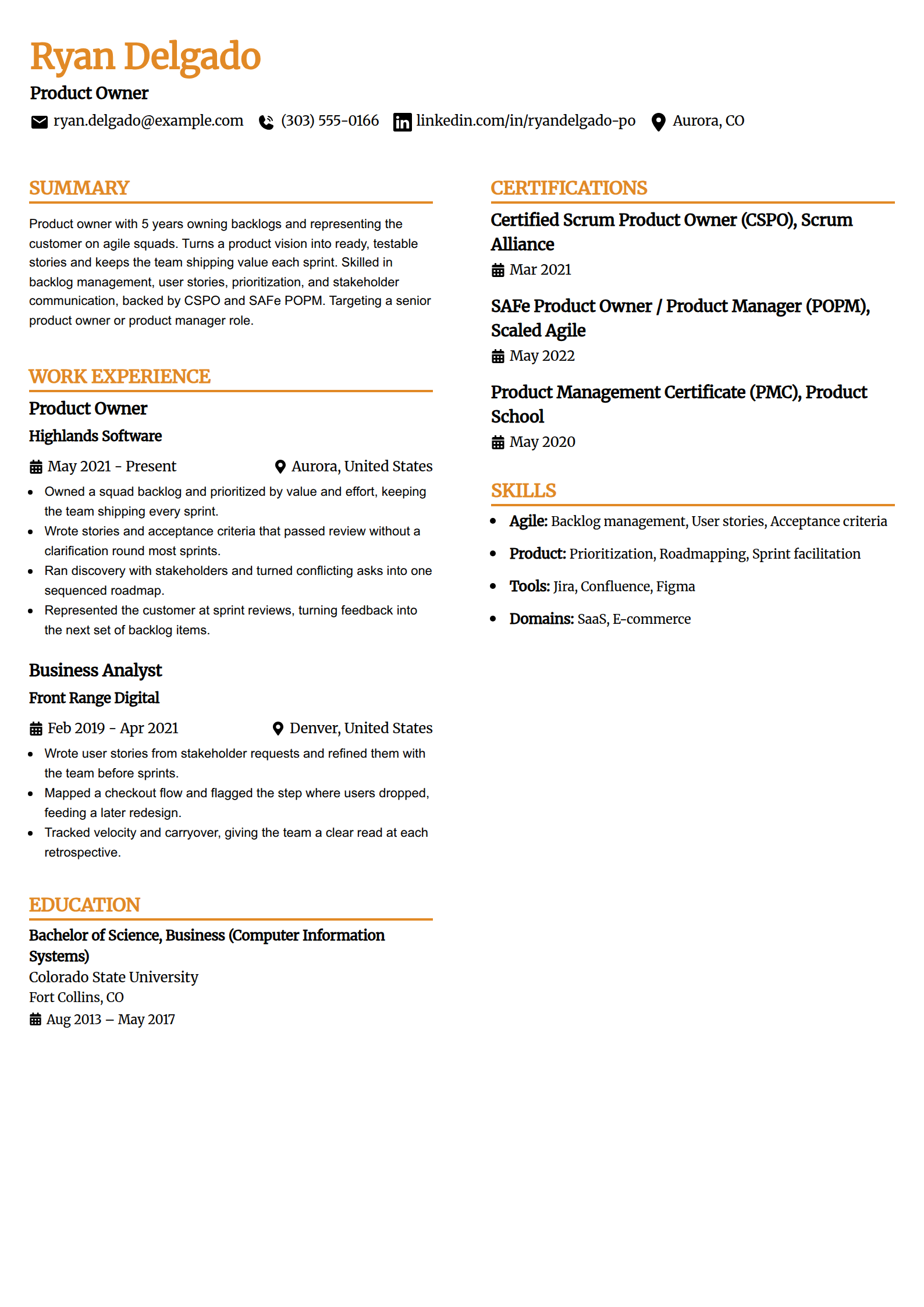
- Leads with backlog ownership, prioritizing by value and effort so the squad shipped every sprint.
- Shows the product-owner core, writing stories and acceptance criteria that passed review without rework.
- Names the agile stack, backlog management, user stories, prioritization, and Jira, with CSPO and SAFe POPM.
- Keeps bullets short and results-focused so a five-year history reads clean and focused.
- Uses a modern layout that carries the product owner story clearly.
Healthcare Product Manager Resume Template
Why this resume example works?
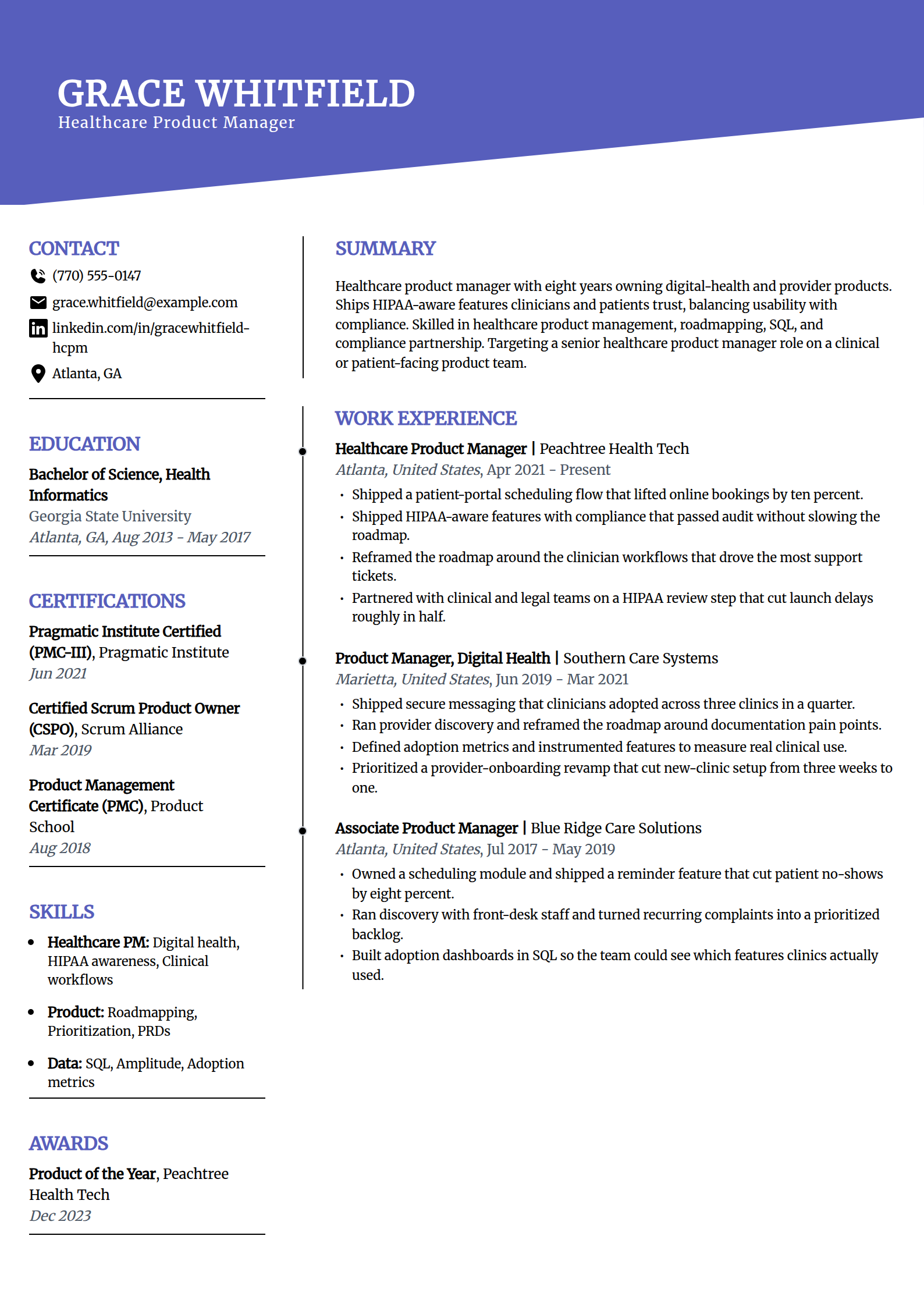
- Leads with digital-health impact, a patient-portal scheduling flow that lifted online bookings ten percent.
- Names the healthcare PM stack, digital health, HIPAA awareness, clinical workflows, and SQL.
- Shows the compliance balance, shipping HIPAA-aware features that passed audit without slowing the roadmap.
- Lists awards cleanly, keeping the two-column layout balanced and easy to skim.
- Carries a health-informatics degree and a Pragmatic certification that fit the role.
Build your product manager resume
Pick a template above and the editor keeps your layout clean and ATS-safe while you swap in your own shipped work, metrics, and the impact behind each launch.
Build my resumeHow to write a product manager resume in 2026
A product manager resume is read for what you shipped and the impact it drove, not the features you touched. In the first few seconds a hiring manager wants the outcome behind your work and the skills you used, so lead with those and prove each with one number. These moves make yours easy to skim and easy for an applicant tracking system to parse.
Open with a short, specific summary
Write three to four sentences that name your title and years, the kind of products you own, two or three skills you bring, and the role you are targeting. Lead with what you have shipped and the outcome it drove, not adjectives about yourself.
Product manager with 5 years owning B2B and consumer products from discovery to launch. Turns customer research and data into roadmaps that ship measurable outcomes, and aligns engineering, design, and go-to-market around them. Skilled in roadmapping, user research, A/B testing, SQL, and Jira. Targeting a senior product manager role on a core product or growth team.
Lead experience with the outcome, then the work
The work a PM is hired for is measurable, so name what changed and attach one credible number. Open every line with a strong verb, never "Responsible for".
- Outcome first: say what shipped and what it moved, like lifting week-one activation nine percent with a redesigned onboarding.
- Show the product work behind it: discovery, a PRD, an experiment, or a launch, matching the posting's terms.
- Name a metric you owned: activation, retention, conversion, or adoption, and keep the number modest and believable.
- One number per bullet: a six percent conversion lift or a churn cut reads as real; a fabricated 300 percent reads as invented.
Match skills to your track, not a generic list
Product roles split by track, and the skills you name signal which one you fit. List the ones for your track so a hiring manager and a parser both find the keywords.
- Core PM: product strategy, roadmapping, prioritization, user research, PRDs, and stakeholder communication.
- Growth PM: A/B testing, funnel and cohort analysis, SQL, Amplitude or Mixpanel, and lifecycle work.
- Technical and platform PM: API product management, system design, technical specs, and SLOs.
- Domain PM: name your domain too, payments and compliance for fintech, HIPAA for healthcare, checkout for e-commerce.
Show education and certifications that fit
A degree in business, computer science, or a related field helps, but shipped work carries the most weight. A certification adds signal when PM experience is light.
- Breaking in: a Product School PMC, a Reforge program, or a CSPO shows you have learned the craft.
- Technical PM: a CS degree or a cloud certification backs the technical depth a platform role expects.
- Career-changers: lead with the shipped feature or internship first; the certification supports it, not the reverse.
- Senior roles: a Pragmatic certification or an MBA can help, but roadmap ownership and outcomes matter more.
Keep it to one clean, ATS-safe page
A product manager resume is a quick read, so one page in a simple layout is the standard. The templates above are built this way.
- Use a single-column or clean two-column layout with standard headings a parser recognizes.
- Hold it to one page and lead with your most recent role in reverse-chronological order.
- Save as a PDF so the formatting holds, then run it through the ATS resume checker for a quick clean-format pass.
- Swap the numbers in the templates above for your own shipped work and outcomes; do not copy them as is.
Common product manager resume mistakes
- Listing features with no outcome. "Launched a dashboard" is output; "launched a dashboard 8,000 customers adopted" is impact.
- Hiding the metrics. Name the activation, retention, or conversion you moved in the bullets; those are what a PM is measured on.
- A generic skills list that does not match your track. A growth PM names A/B testing and Amplitude; a technical PM names APIs and system design.
- Inflated numbers. A six percent conversion lift reads as real; a fabricated 300 percent revenue jump reads as invented and gets cut.
- Running to two pages or using a heavy design with tables. Keep one clean page a hiring manager and an ATS both read easily.
Frequently asked questions
What should a product manager resume include?
A product manager resume needs your contact details, a short summary, your work history in reverse-chronological order, education, skills, and certifications. Lead the summary and each job with what you shipped and the outcome it drove: the feature you launched, the metric you moved, and the discovery, experiment, or roadmap work behind it. Name the skills for your track so an applicant tracking system matches them to the posting, and add a credential like a Product School PMC or a CSPO. Keep it to one clean page.
How do I write a product manager resume with no PM experience?
Lead with the most product-like work you have: a PM internship, a shipped feature, a case competition, or product ownership inside an engineering or analyst role. Show real PM tasks, running user interviews, writing a PRD, sizing an opportunity with data, and shipping something. Name the tools you know, such as SQL, Figma, and Jira, and add a credential like a Product School certificate or a CSPO. Use a tight, one-page template and fill it honestly with an award or a project rather than padding thin history. The associate PM and career-change examples above show the shape.
What skills and tools do you put on a product manager resume?
Match the skills to your track and to the job posting. A core PM lists product strategy, roadmapping, prioritization, user research, and PRDs; a growth PM adds A/B testing, SQL, and Amplitude or Mixpanel; a technical or platform PM adds API product management, system design, and SLOs; a domain PM names its domain, payments and compliance for fintech, HIPAA for healthcare. Back the list with a credential like a Product School PMC, a Reforge program, or a CSPO that fits your track.
Do you need to be technical to be a product manager?
It depends on the role. A technical or platform product manager works closely with engineering on APIs, data models, and system tradeoffs, so a technical background and skills like SQL and system design help a lot. Many core, growth, and domain PM roles value customer discovery, prioritization, and outcomes more than deep coding. On your resume, match the skills to the posting: lead with technical depth for a technical PM role and with discovery and impact for a core PM role. The technical PM example above shows the first case.
Product manager vs project manager resume: what is different?
The two own different things. A product manager owns the what and the why, product strategy, the roadmap, and the outcomes a feature drives, so the resume leads with shipped work and metrics like activation and retention. A project manager owns the how and the when, the schedule, scope, and delivery across a team, so that resume leads with on-time delivery, budget, and risk. If your work is mostly running timelines and coordinating delivery, use a project manager template instead; this page links one.
How long should a product manager resume be?
One page. A product manager resume is a quick read, so keep it to a single, skimmable page led by your most recent role. Focus on your last few roles and the launches that show measurable impact and the skills the posting names. If you have a long history, keep the roles that show your strongest product ownership and outcomes and drop older or unrelated positions to make room for what matters.
More product manager resume resources
Build your product manager resume
Pick a template above and the editor keeps your layout clean and ATS-safe while you swap in your own shipped work, metrics, and the impact behind each launch.