16 Sales Resume Examples, Quota-Crushing to Entry-Level
- ATS Friendly
- Quota-Driven
- 16 Real Examples
Pick a clean, parser-safe layout, then borrow from full sales resumes across every level and specialty. Each example shows how to turn quota, revenue, and deal size into bullets a hiring manager scans in seconds.


540k+ resumes created
Editable sales resume templates
Every template below is a real sales resume rendered in that layout, filtered by the role you are targeting. Pick one, then swap in your own quota attainment, revenue closed, and CRM. All of these parse cleanly in the applicant tracking systems sales teams use.
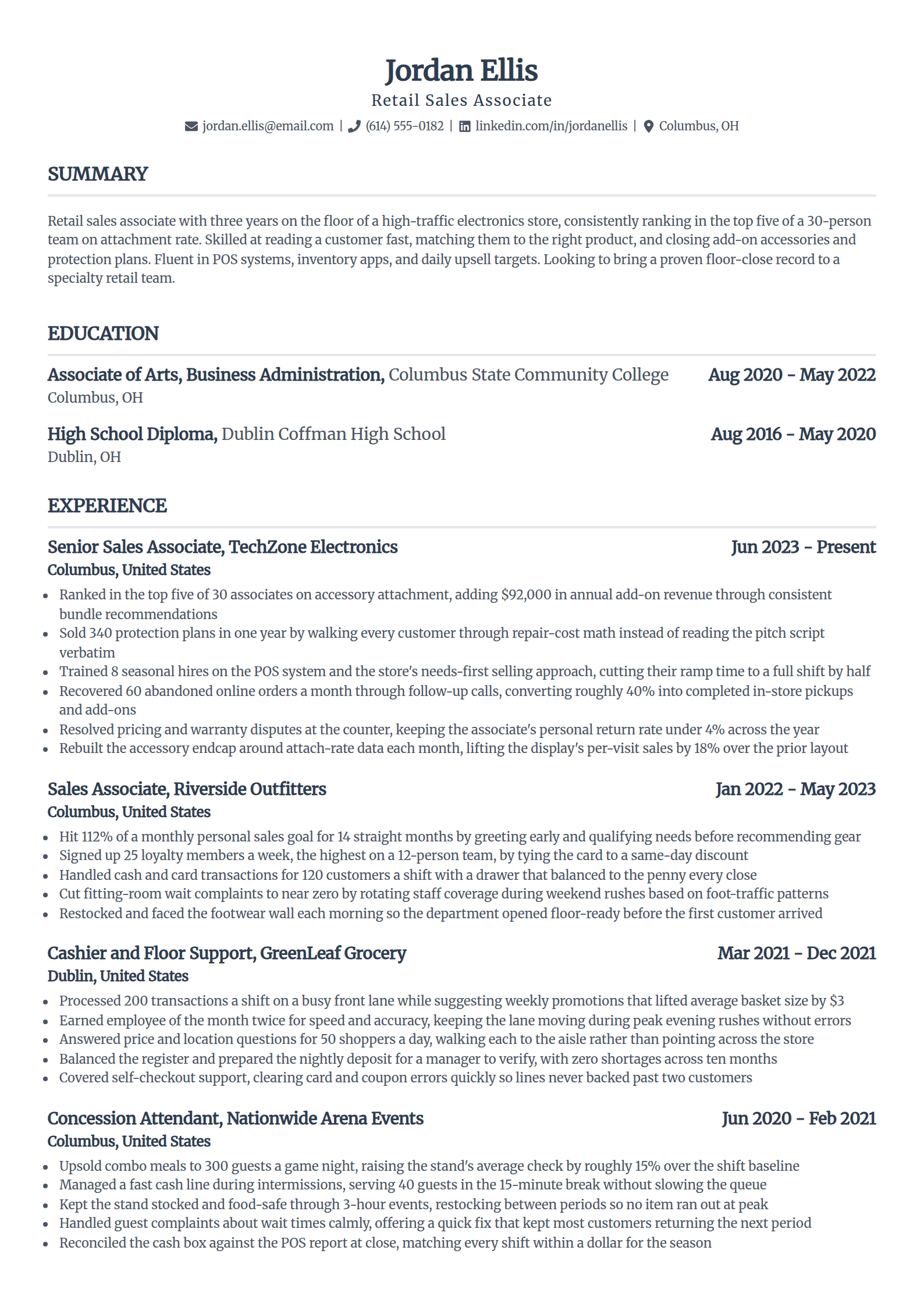
Sales Associate Resume Template
Why this resume example works?
- Opens with a floor ranking and attachment-rate strength, the two numbers a retail hiring manager scans for first.
- Turns everyday selling into proof: protection plans sold and add-on revenue added, not vague customer service.
- Names the real tools, POS systems and loyalty programs, that the job description actually screens for.
- Keeps a single-column layout so the applicant tracking system reads the dates and titles cleanly.
- Shows steady growth from concession stand to senior associate, which reads as reliability, not job hopping.
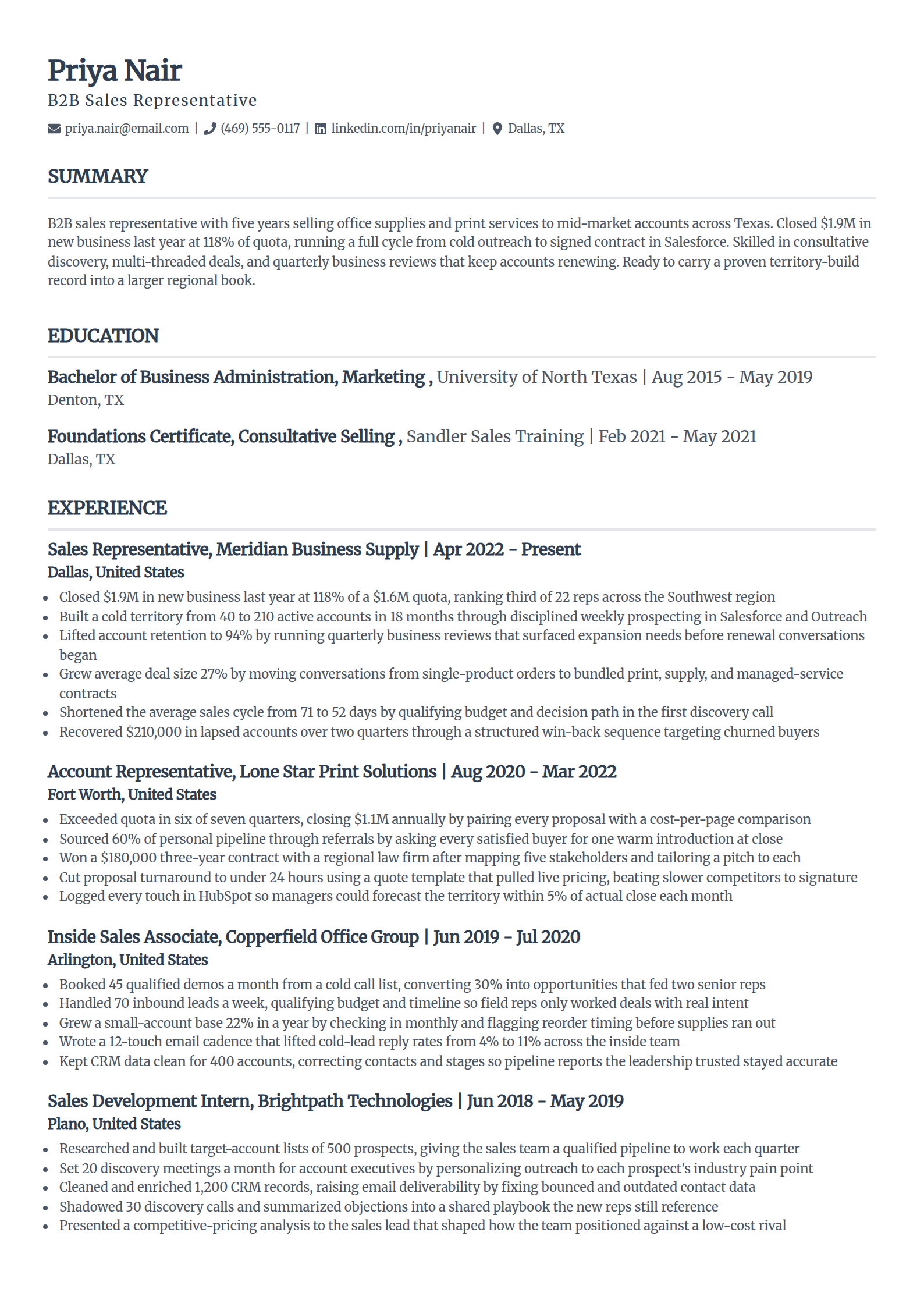
Sales Representative Resume Template
Why this resume example works?
- Leads with quota attainment and revenue closed, the exact proof a B2B sales manager looks for up top.
- Each bullet lands a result, from territory build to retention rate, instead of listing daily duties.
- Names the CRM and prospecting stack, Salesforce and Outreach, so the resume matches the posting's keywords.
- Carries one credible number per bullet, which keeps the achievements believable rather than inflated.
- Reverse-chronological order and clean headings make it easy for a recruiter to follow the career step by step.
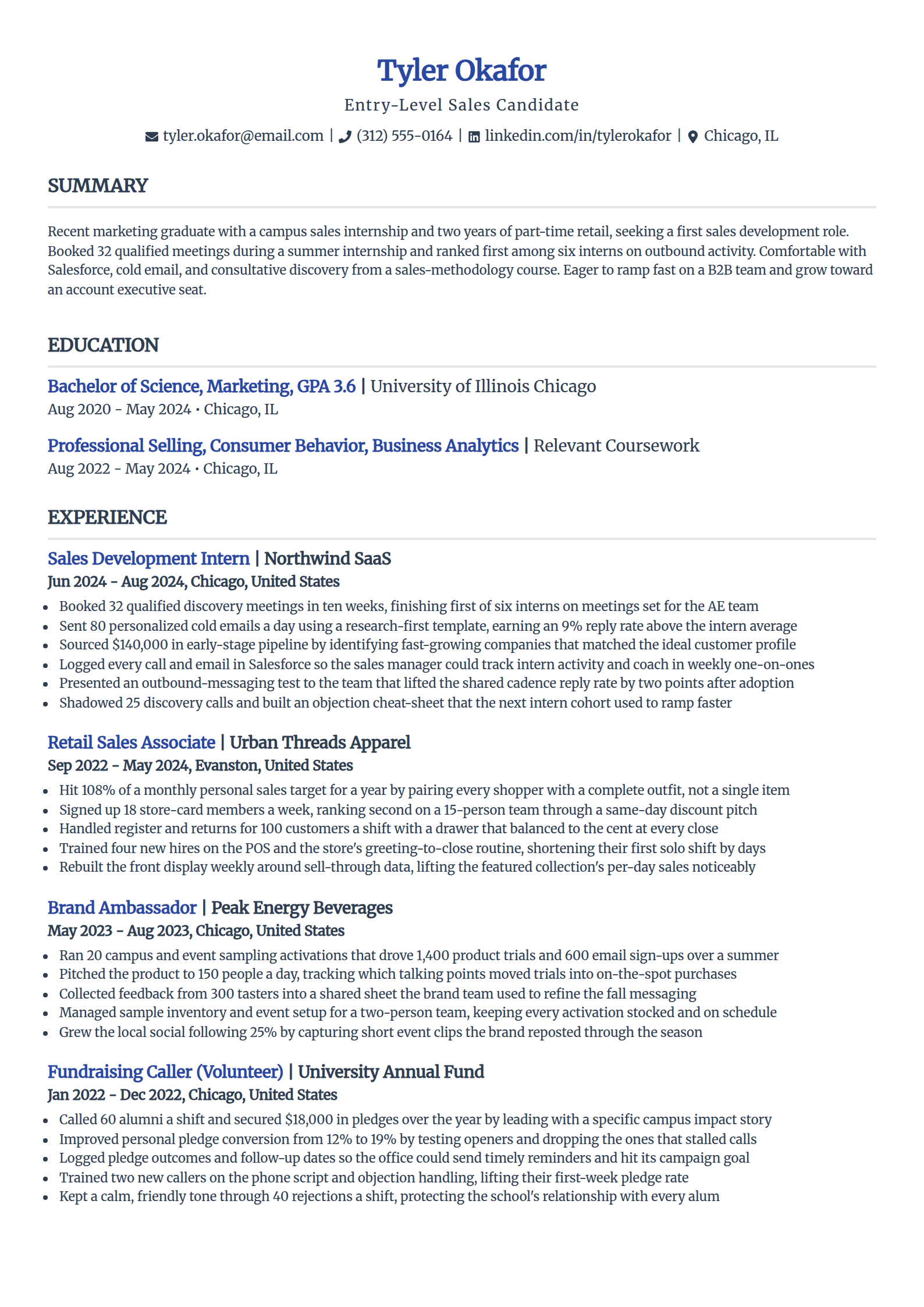
Entry-Level Sales Resume Template
Why this resume example works?
- Turns a summer internship into hard proof, 32 meetings booked and a first-place ranking, so thin history still signals results.
- Frames retail and campus work as real selling, with quota and loyalty sign-ups, exactly what an SDR role needs.
- Names Salesforce and cold-email skills learned in coursework, giving a keyword match without overclaiming.
- Leads with the target role so a hiring manager reads it for coachability, not for years on the job.
- Keeps every claim modest and countable, which is what makes a no-experience sales resume credible.
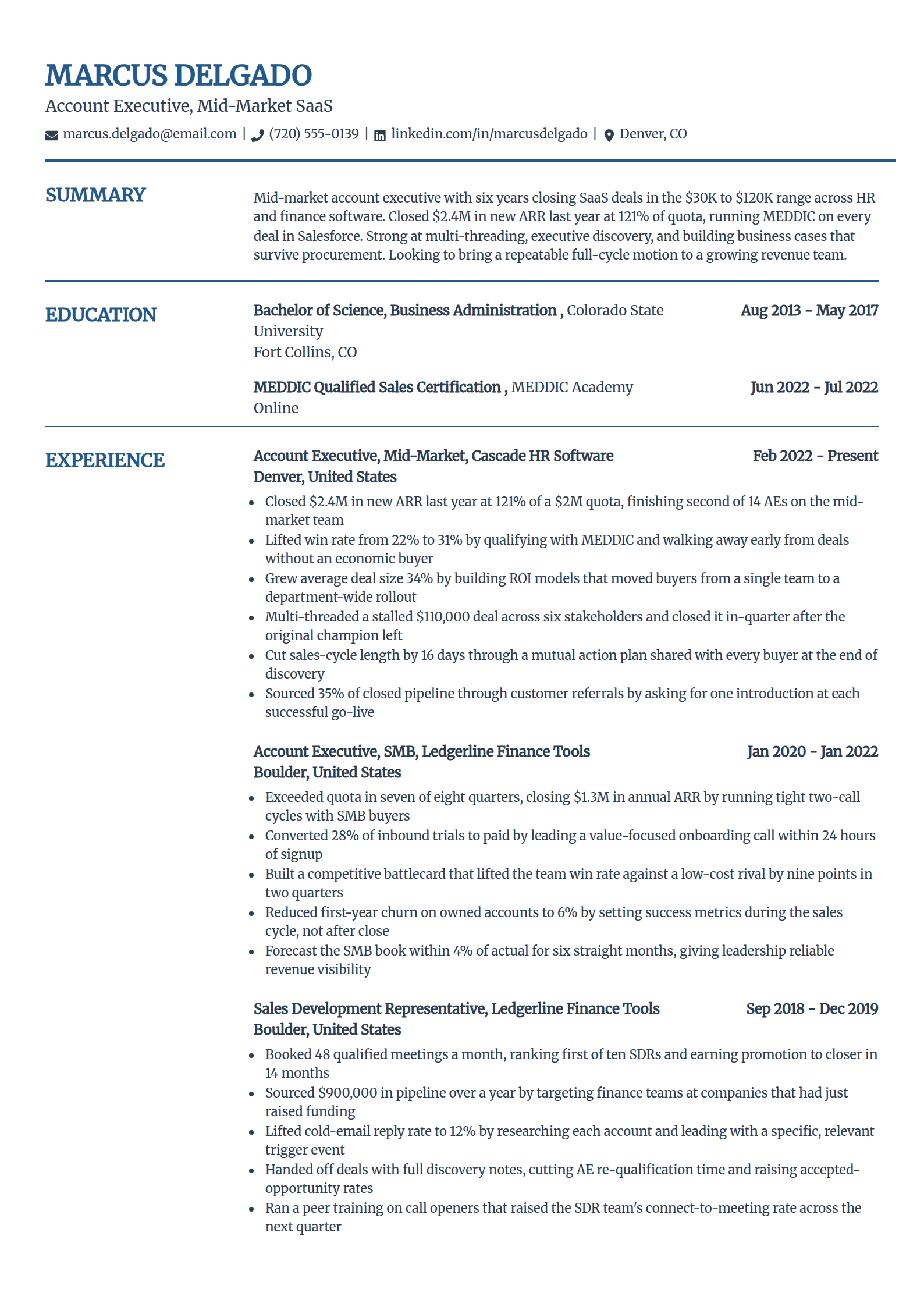
Account Executive Resume Template
Why this resume example works?
- Opens with new ARR closed and quota percentage, the headline numbers every AE resume should lead with.
- Shows the full funnel, from win-rate lift to deal-size growth, proving control over the whole sales cycle.
- Names the methodology, MEDDIC, and the tools that a modern revenue team expects to see on the page.
- Traces a clean SDR-to-closer path, which tells a hiring manager the candidate earned the seat.
- Balances closing metrics with churn and forecast accuracy, signaling a rep who keeps the accounts they win.
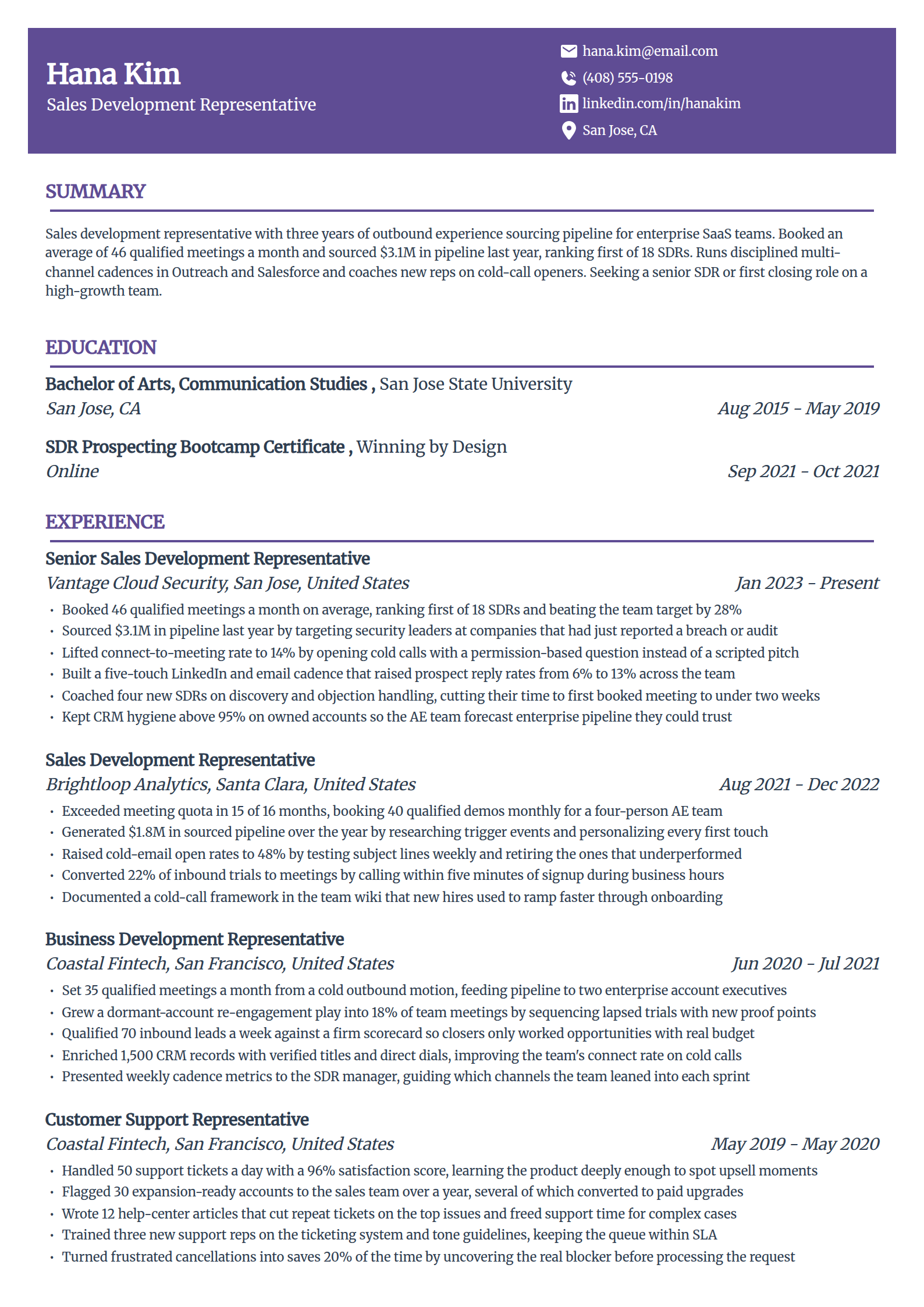
Inside Sales & SDR Resume Template
Why this resume example works?
- Leads with meetings booked and pipeline sourced, the two metrics an SDR is measured on every month.
- Sticks to activity and pipeline numbers rather than closed revenue, which is honest for the role and reads as credible.
- Names the outbound stack, Outreach, Salesforce, and Sales Navigator, matching the tools in the posting.
- Shows coaching of new reps, a signal of readiness for a senior SDR or first closing seat.
- Quantifies cold-call and email results so a manager can picture the candidate's daily output.
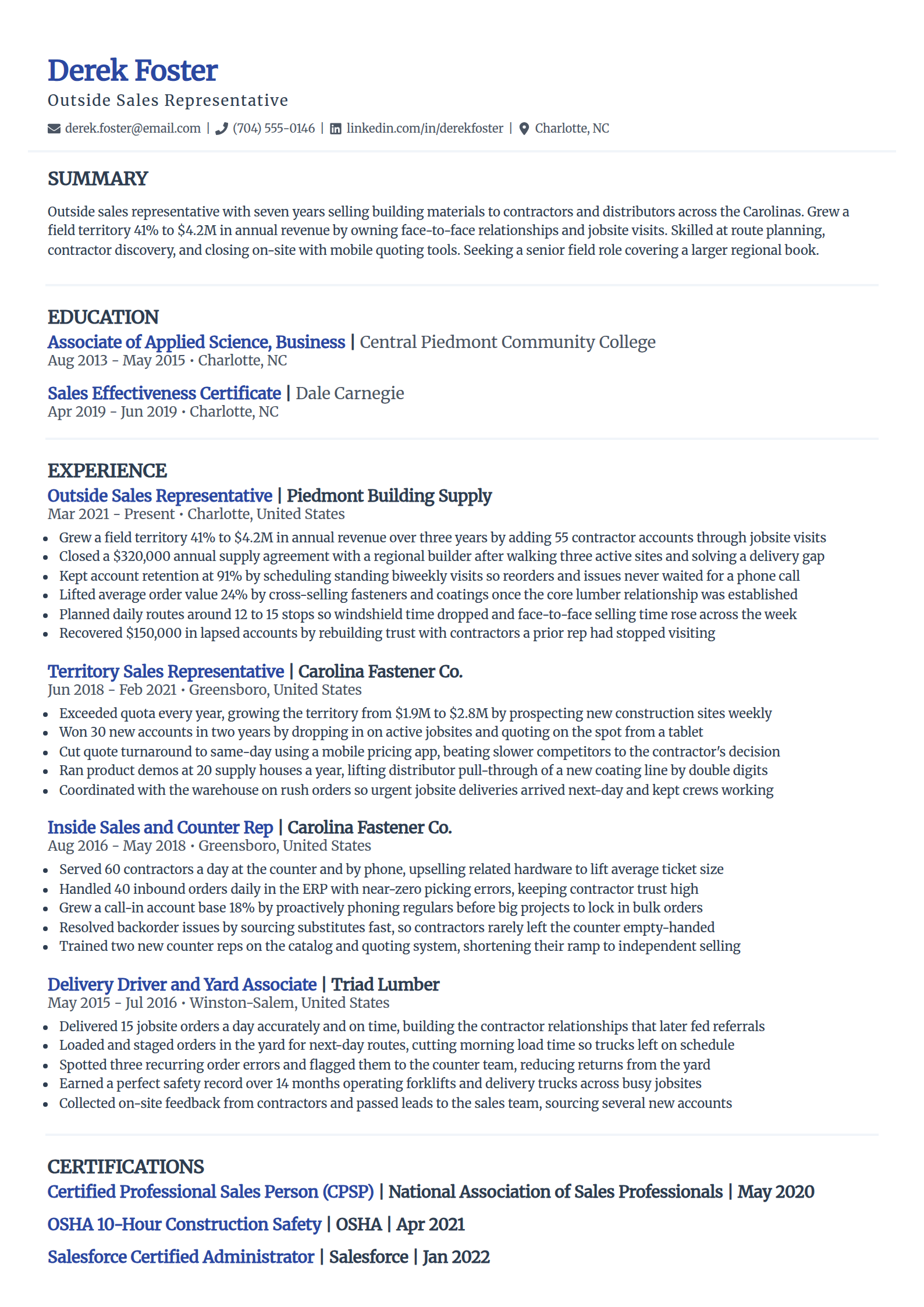
Outside Sales Resume Template
Why this resume example works?
- Opens with territory growth and revenue, the numbers a field sales manager wants before anything else.
- Highlights face-to-face selling, jobsite visits and route planning, the real work of an outside role.
- Shows cross-sell and win-back results, proving the rep grows accounts rather than just maintaining them.
- Names the industry and products sold, so a building-materials or distribution hiring manager sees fit fast.
- Traces a path from delivery driver to senior rep, which reads as someone who knows the customer deeply.
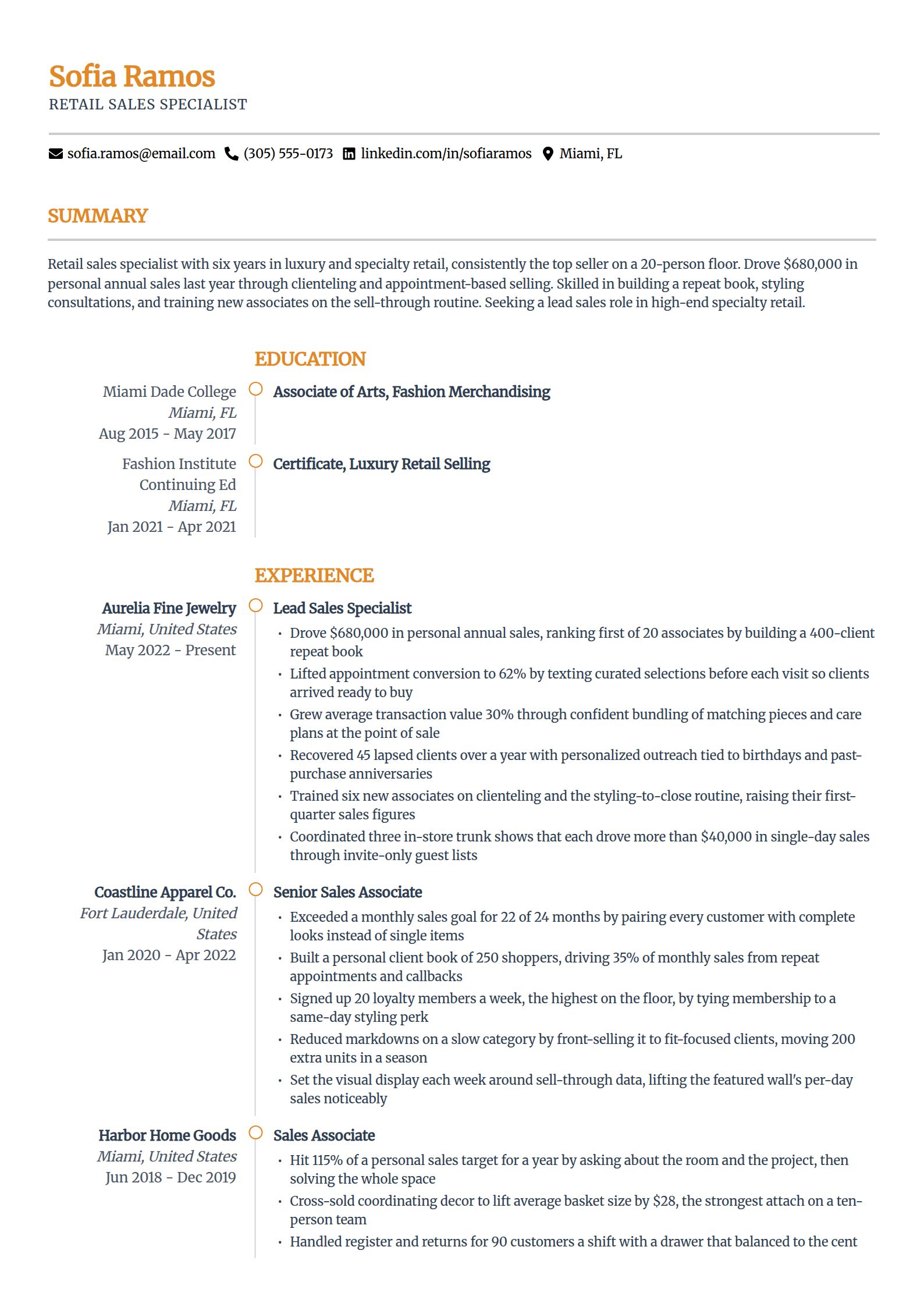
Retail Sales Resume Template
Why this resume example works?
- Leads with personal annual sales volume and a top-seller ranking, the clearest proof in specialty retail.
- Shows clienteling and appointment selling, the higher-skill moves that separate a specialist from a cashier.
- Quantifies a repeat client book, which tells a luxury or specialty employer the sales are durable.
- Names the products and POS tools so the resume matches the store's category and systems.
- Includes training and trunk-show results, signaling readiness for a lead or key-holder role.
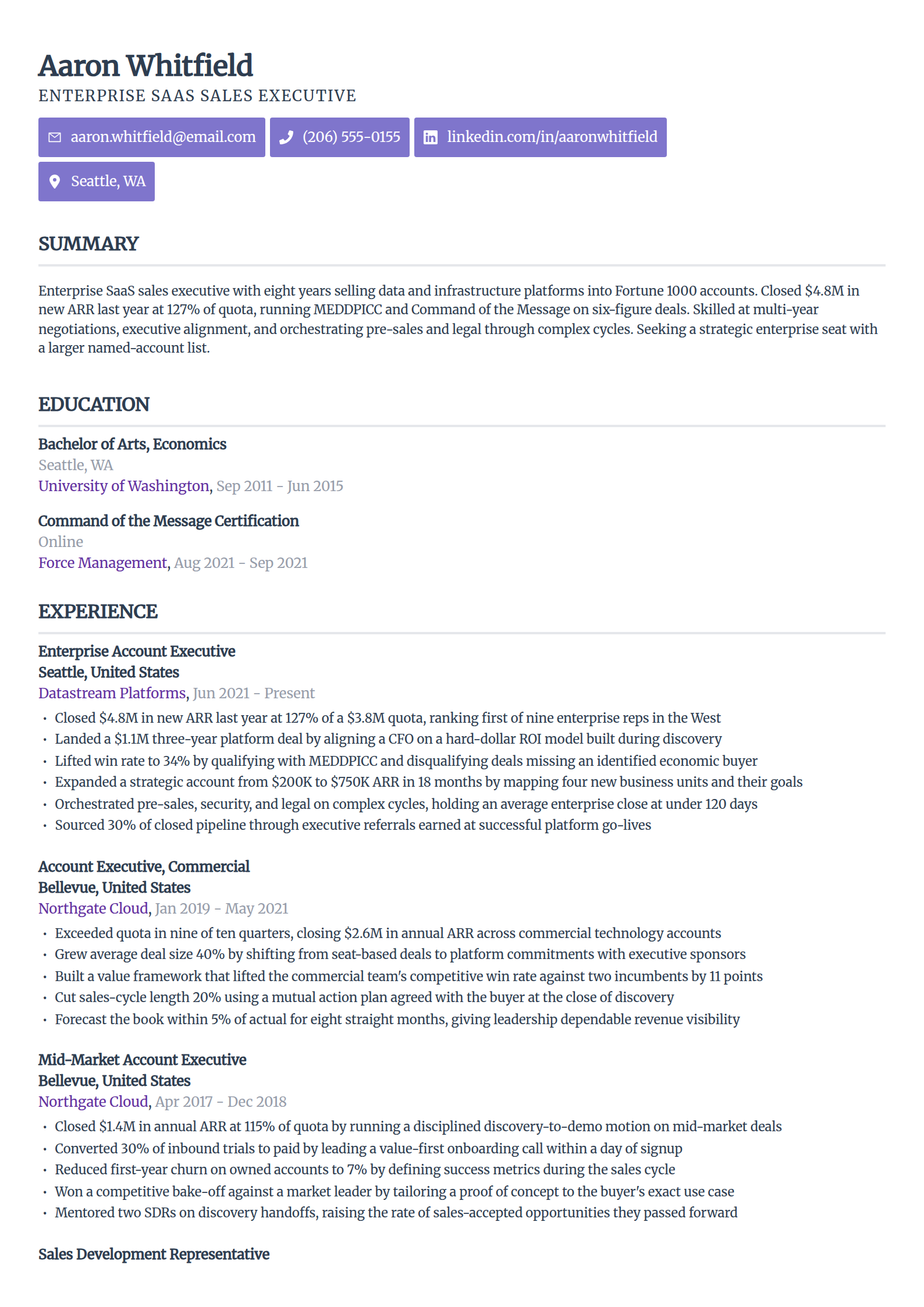
SaaS & Tech Sales Resume Template
Why this resume example works?
- Opens with new ARR and quota attainment at enterprise scale, the exact proof a SaaS hiring team scans for.
- Names MEDDPICC and Command of the Message, the methodologies enterprise sales orgs run on.
- Shows expansion and multi-year deals, proving the rep grows land-and-expand accounts over time.
- Highlights orchestrating pre-sales, security, and legal, which is the reality of complex tech cycles.
- Keeps deal sizes and cycle length concrete, so a manager can size the candidate against their own motion.
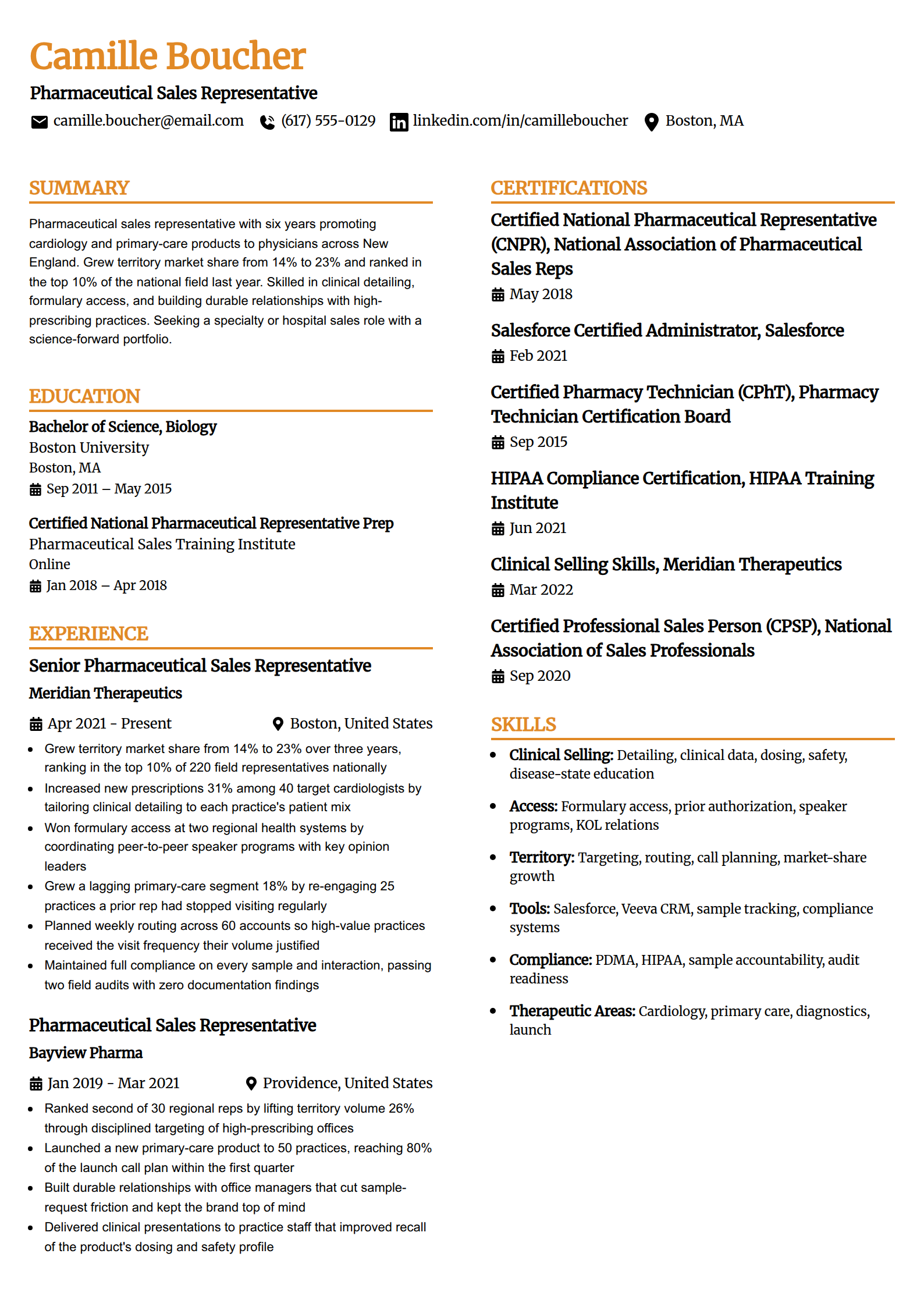
Pharmaceutical Sales Resume Template
Why this resume example works?
- Leads with market-share growth and a national ranking, the performance signals pharma managers weigh most.
- Names clinical detailing, formulary access, and speaker programs, the real levers of the role.
- Shows a science background and a pharmacy-tech start, which builds credibility for clinical conversations.
- Flags full compliance and clean audits, a non-negotiable in regulated pharmaceutical sales.
- Quantifies prescription lift and launch execution without stacking unbelievable percentages.
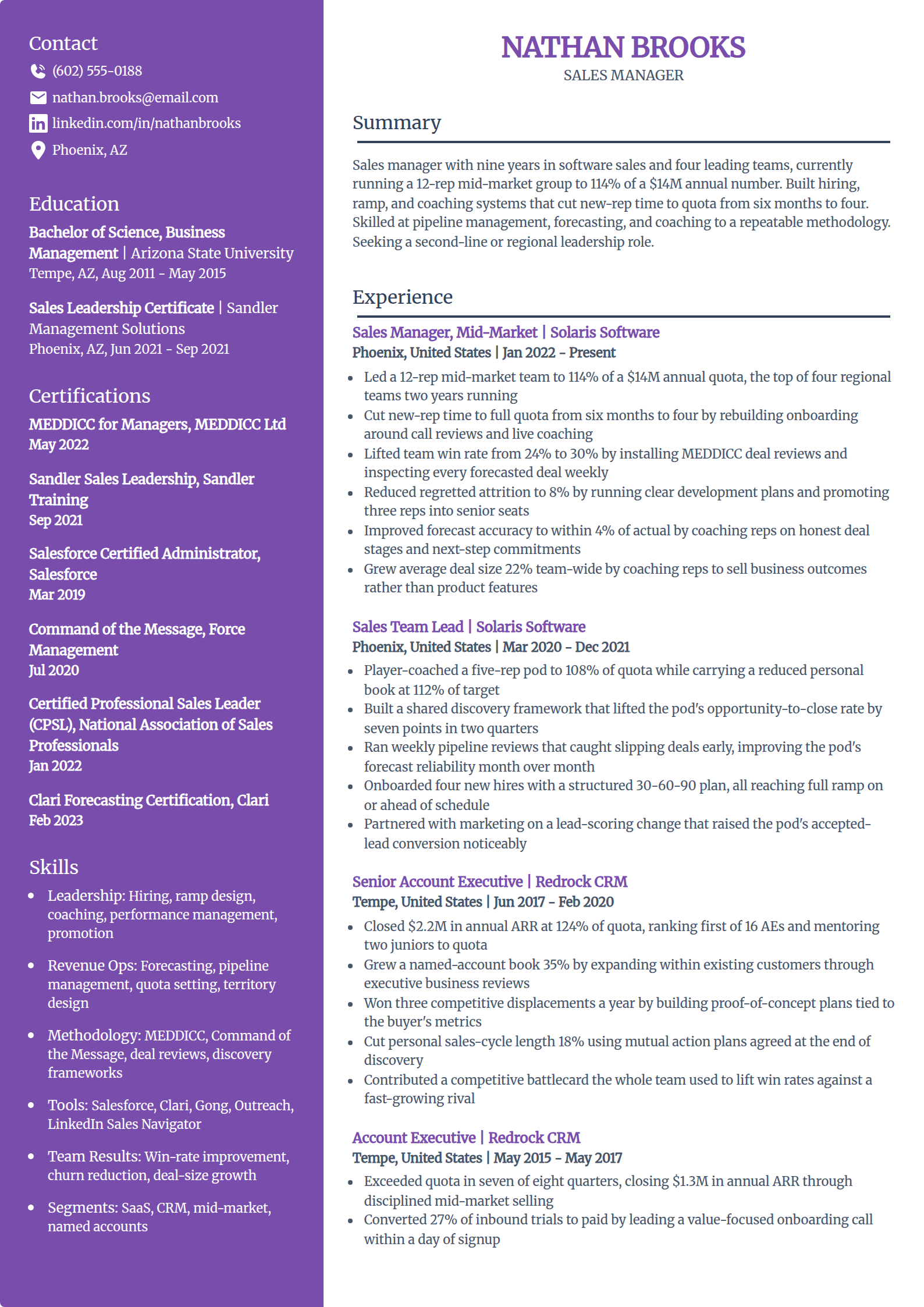
Sales Manager Resume Template
Why this resume example works?
- Opens with team size and team-to-quota attainment, the first thing a director looks for in a manager.
- Shows leadership results, ramp time cut and win rate lifted, not just the candidate's own closing history.
- Separates player-coach and pure management roles, so the progression into leadership is clear.
- Names the coaching methodology and forecasting tools that a modern sales org runs on.
- Includes attrition and promotion numbers, proving the manager builds and keeps a strong team.
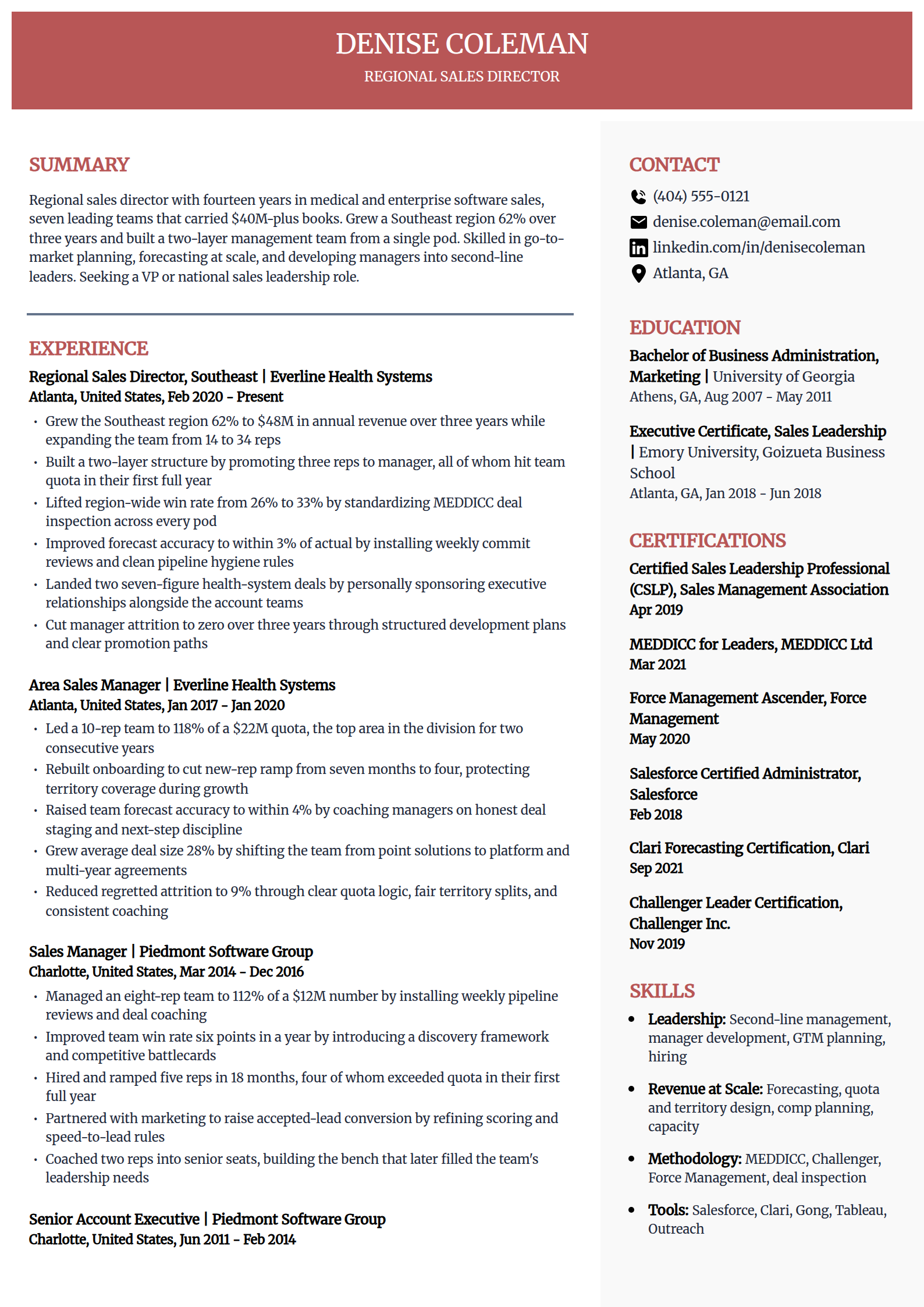
Sales Director Resume Template
Why this resume example works?
- Leads with region-level growth and revenue at scale, the results a VP hires a director to deliver.
- Shows building a second layer of management, the clearest signal of readiness for a bigger org.
- Quantifies win-rate lift and forecast accuracy across teams, not just one book of business.
- Names the go-to-market and forecasting discipline that separates a director from a senior manager.
- Traces a full path from top rep to director, so the leadership record reads as earned, not titled.
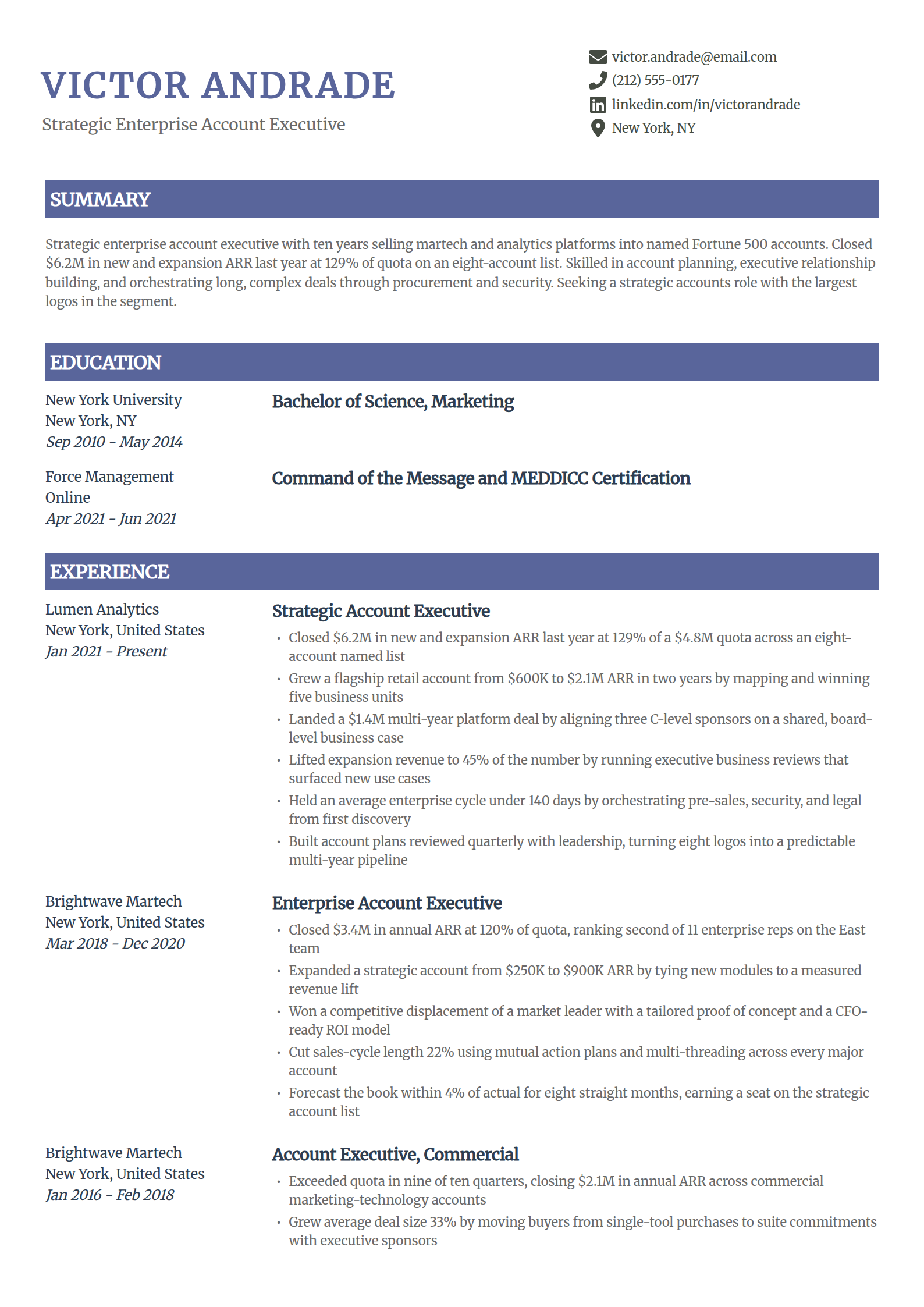
Enterprise Account Executive Resume Template
Why this resume example works?
- Opens with new and expansion ARR on a named-account list, the shape of a true enterprise number.
- Shows growing a single logo from six to seven figures, the land-and-expand story enterprise teams prize.
- Highlights aligning C-level sponsors on a board-level business case, the real work of strategic selling.
- Names account planning and deal orchestration through procurement, security, and legal.
- Keeps cycle length and account count concrete, so a leader can map the candidate to their segment.
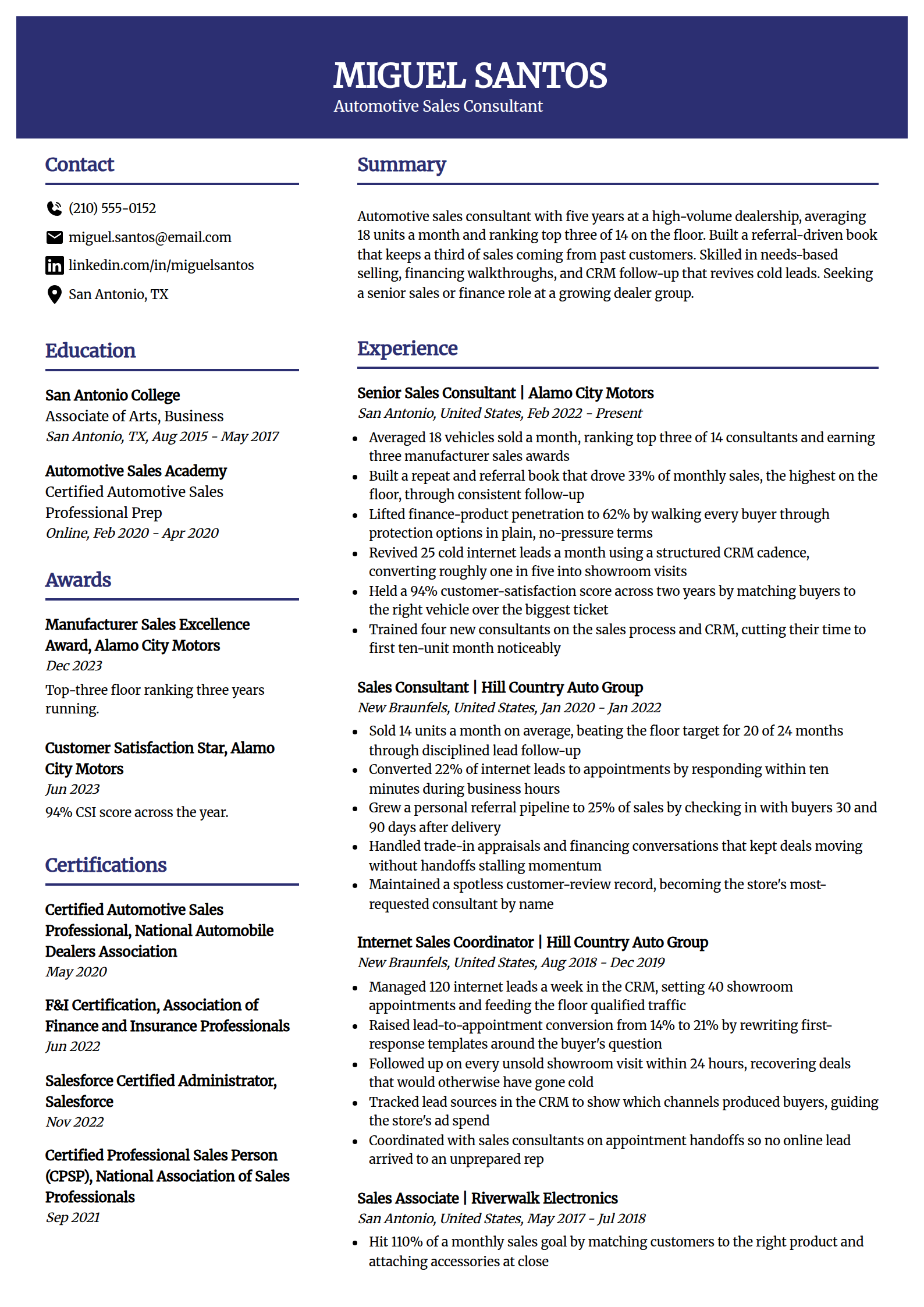
Automotive Sales Resume Template
Why this resume example works?
- Leads with units sold a month and a floor ranking, the numbers every dealership hiring manager checks.
- Shows a referral and repeat book, which tells a sales manager the business is built to last.
- Quantifies finance-product penetration and lead conversion, the metrics that drive dealership profit.
- Names the CRM and lead tools, DealerSocket and VinSolutions, matching the store's systems.
- Highlights a strong customer-satisfaction score, which dealers weigh alongside raw volume.
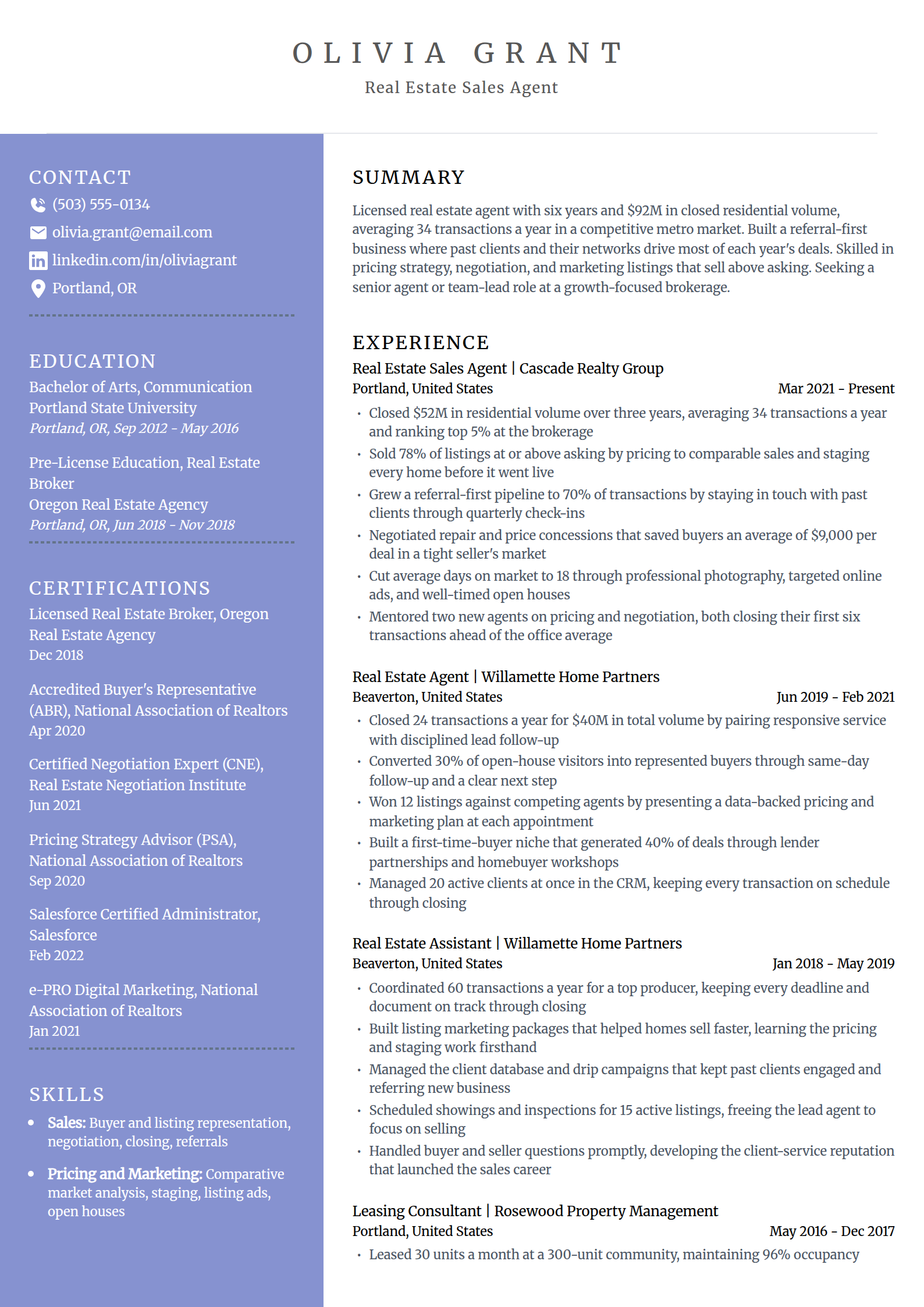
Real Estate Sales Resume Template
Why this resume example works?
- Opens with closed volume and transactions a year, the two numbers a brokerage measures an agent by.
- Shows list-to-sale performance and days on market, proving pricing and marketing skill, not just activity.
- Highlights a referral-first pipeline, the sign of a durable book rather than one good year.
- Names the license and designations, ABR and CNE, that qualify the agent for buyer and listing work.
- Traces a path from leasing to top producer, which reads as steady, earned growth in the field.
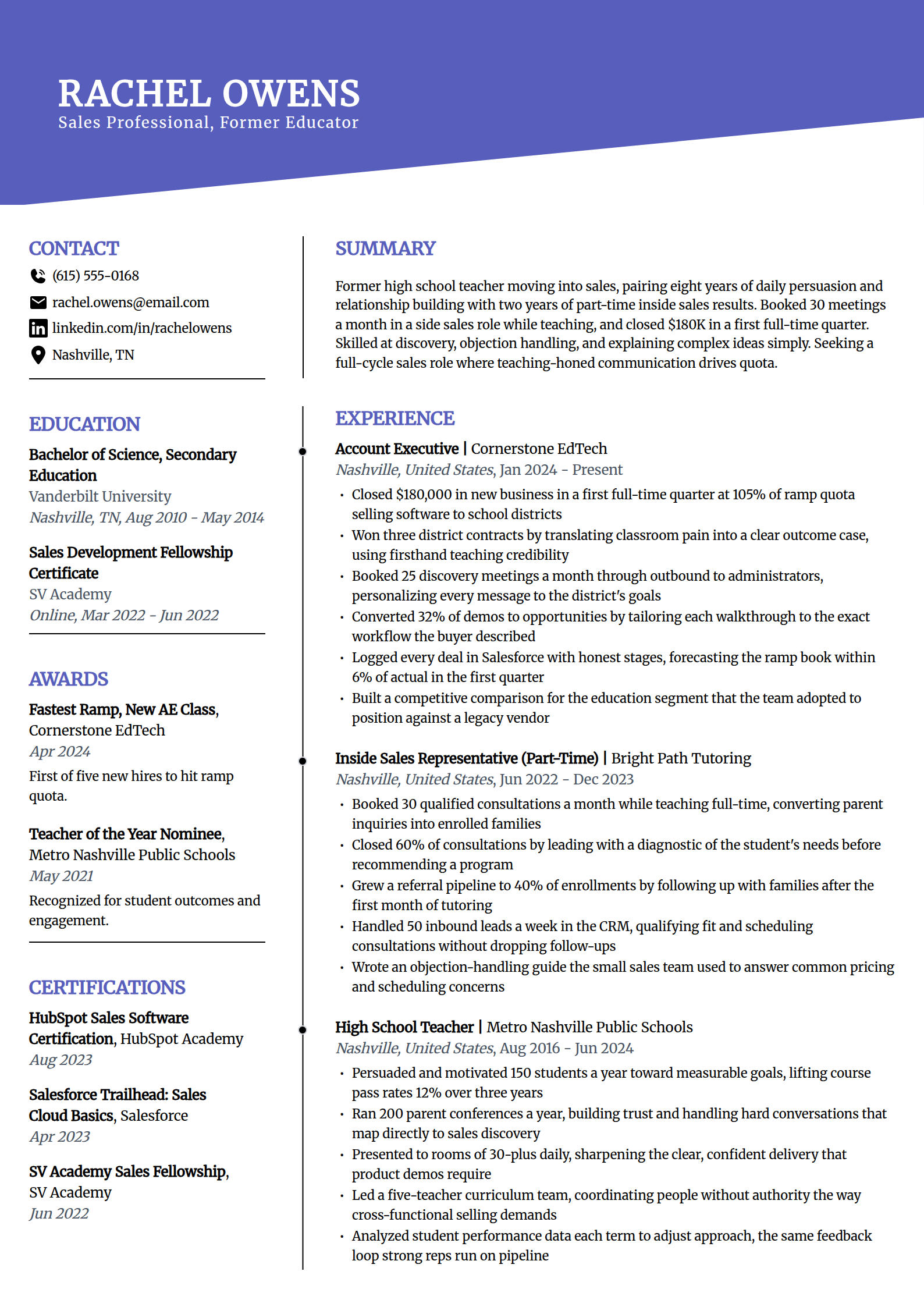
Career-Change Sales Resume Template
Why this resume example works?
- Leads with early sales results, ramp quota hit and deals closed, so the pivot reads as proven, not hoped for.
- Translates teaching into sales strengths, persuasion and discovery, tied to concrete classroom numbers.
- Keeps a part-time sales role up front, showing the candidate tested the move before committing.
- Names the CRM and sales-fellowship training that closes the tools gap a career-changer worries about.
- Frames prior experience as an asset for one segment, EdTech, rather than apologizing for a switch.
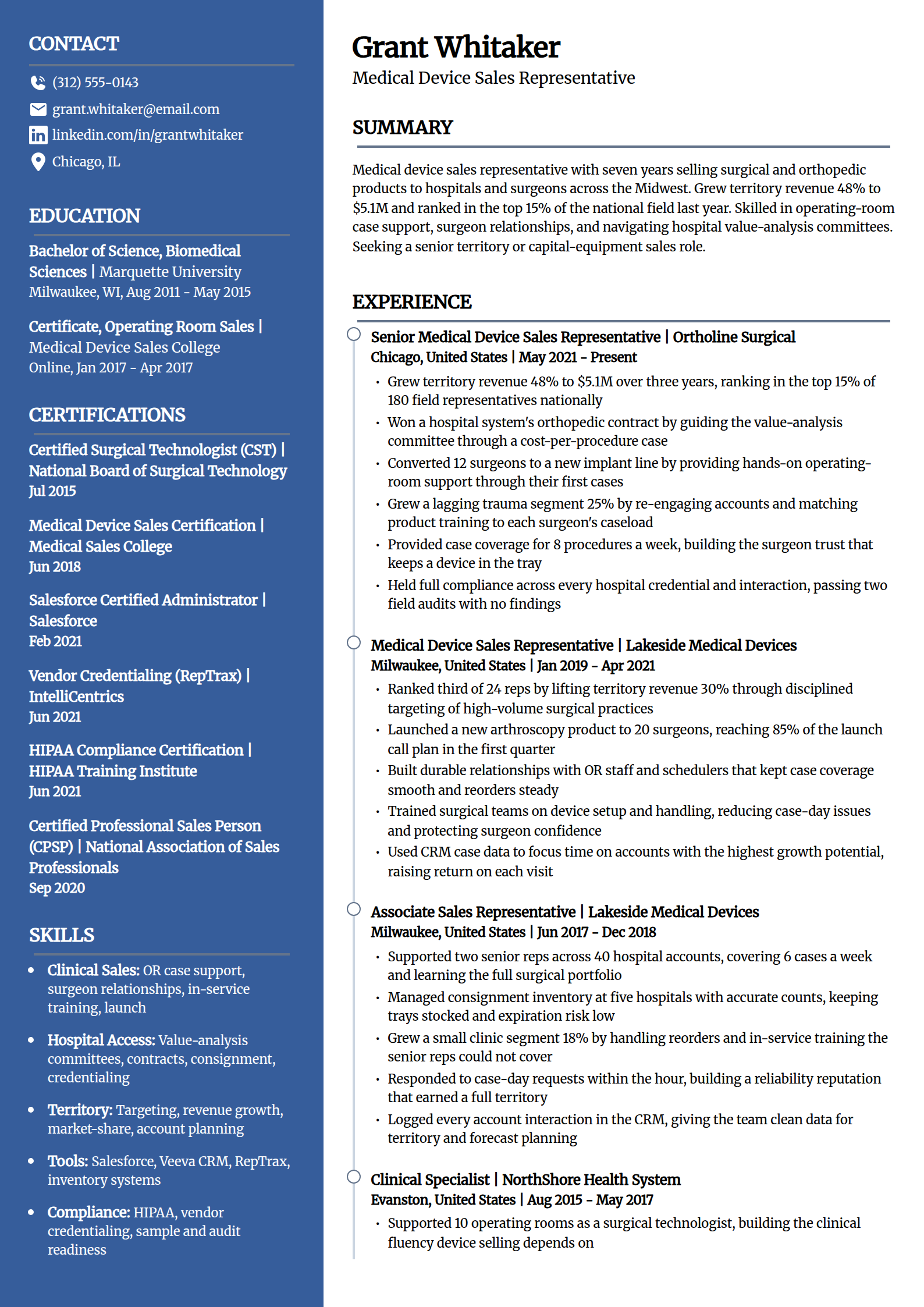
Medical Device Sales Resume Template
Why this resume example works?
- Opens with territory revenue growth and a national ranking, the performance proof device managers scan for.
- Shows operating-room case support and surgeon conversions, the real work behind the numbers.
- Highlights navigating value-analysis committees, the gatekeeper of every hospital device deal.
- Draws on a surgical-tech background, which gives instant clinical credibility in the OR.
- Flags credentialing and compliance, both non-negotiable for hospital access in device sales.
Build your sales resume
Pick a template above, borrow the shape of the example that fits your role, and the editor keeps the layout parser-safe while you swap in your own quota, revenue, and deal size.
Build my resumeHow to write a sales resume in 2026
A sales resume is judged on one question: can you hit the number? Every section should answer it with proof. These moves make the answer obvious to a recruiter and to the applicant tracking system.
Lead with a summary built on your number
Write three to four sentences that name the segment you sell into, your last full year of quota attainment, your average deal size, and the CRM and methodology you run. A summary beats an objective at every level, so lead with proof rather than what you want.
Mid-market account executive with six years closing SaaS deals in the $30K to $120K range, closing $2.4M in new ARR last year at 121% of quota running MEDDIC in Salesforce.
Quantify every bullet, one number at a time
Sales is the most measurable job on a resume, so a bullet with no number is a wasted line. Lead with a strong verb, then attach the single figure that proves it.
- Attainment: closed $1.9M in new business at 118% of a $1.6M quota, ranking third of 22 reps.
- Growth: grew average deal size 27% by moving buyers from single orders to bundled contracts.
- Efficiency: shortened the average sales cycle from 71 to 52 days by qualifying budget in the first call.
Quantify even without closed revenue
New reps, SDRs, and career-changers can still lead with numbers. Use the metrics your role is actually measured on instead of borrowing a closer's.
- SDR or BDR: meetings booked, pipeline sourced, connect rate, reply rate, ranking against the team.
- Retail or associate: units sold, attachment rate, loyalty sign-ups, personal sales versus goal.
- No closed deals yet: internship results, campus or fundraising totals, and conversion rates you drove.
Match the posting's CRM and methodology
Mirror the exact CRM, tools, and sales methodology the job description names, where they are true for you. If the posting says Salesforce, Outreach, and MEDDIC, those words should appear in your skills and bullets so the parser and the recruiter both find them.
Keep the format ATS-safe
Sales teams screen with applicant tracking systems too. A clean layout keeps your quota numbers and titles intact through the parse.
- Use a single-column layout with standard headings; skip tables, text boxes, and graphics.
- Keep your name and contact details in the body of the page, not the header or footer.
- Save as a PDF unless the application asks for a Word document.
Common sales resume mistakes
- Listing duties instead of results. "Managed a territory" says nothing; "grew a territory 41% to $4.2M" is proof.
- Leaving off numbers. A sales resume with no quota, revenue, or ranking gives a manager nothing to trust.
- Stacking three percentages in one bullet. One credible number reads as real; a wall of stats reads as invented.
- Claiming metrics your role could not own. An SDR who books meetings should not claim seven-figure closes.
- Using tables or a graphic header that many applicant tracking systems cannot read, scrambling your dates and titles.
Frequently asked questions
What should a sales resume summary include?
Three to four sentences naming the segment you sell into, your last full year of quota attainment, your average deal size, and the CRM and methodology you run. Lead with your strongest number so a hiring manager sees your track record in the first line.
How do I quantify a sales resume if I have not closed deals yet?
Use the metrics your role is measured on. SDRs lead with meetings booked and pipeline sourced; retail associates use units sold and attachment rate; new grads use internship results, campus or fundraising totals, and conversion rates. Any real, countable result beats a vague claim.
Should a sales resume have a summary or an objective?
Use a summary. A resume carries one or the other, never both, and a summary lets you lead with proof: your quota attainment, revenue, and deal size. Even entry-level candidates should write a summary built from internship or part-time sales results.
Which resume template is best for sales?
A single-column, standard-heading layout such as Standard, Classic, or Professional Edge above. Those parse cleanly in applicant tracking systems and keep your quota numbers, titles, and dates in the order a sales manager expects to read them.
How long should a sales resume be?
One page for associates, SDRs, and reps with under about ten years of experience. Move to two pages only once you have the tenure and multiple roles to fill it. Lead every job with your strongest, most quantified bullet so a recruiter sees your best number first.
What skills should I put on a sales resume?
Split them into CRM and tools (Salesforce, HubSpot, Outreach, LinkedIn Sales Navigator), methodology (MEDDIC, Challenger, Sandler, SPIN), and selling skills (prospecting, discovery, negotiation, closing). List only what the posting names and what you can back up in an interview.
More sales resume resources
Build your sales resume
Pick a template above, borrow the shape of the example that fits your role, and the editor keeps the layout parser-safe while you swap in your own quota, revenue, and deal size.