How to List Producer Credits, With 16 Resume Templates
- ATS Friendly
- Credit List Format
- 16 Producing Tracks
A producer resume example should carry four things: the credit you received, the production it was on, the scope underneath it in real numbers, and the software a posting names. In film and television the credit is the resume item, so the credit list leads the page. Pick the example below that matches the kind of producing you do.


540k+ resumes created
One template per kind of producing you could be hired to do
A line producer defending a bottom line, a music producer with 41 released credits, and a news producer stacking a 6pm against a hard network handoff are three different jobs that share one word. Each template below is a complete one-page resume for one of them, with the credits, software and numbers that job is actually screened on.
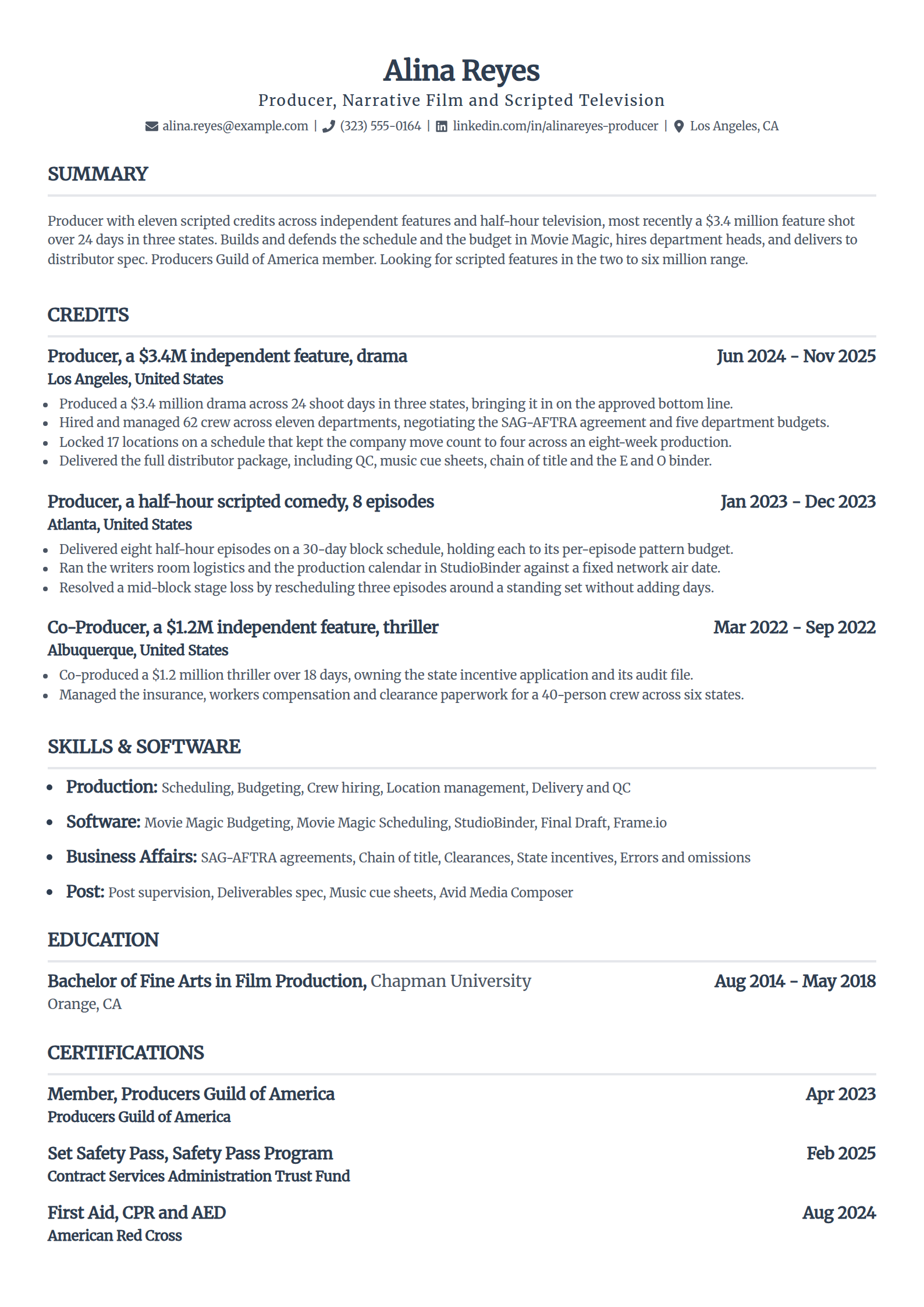
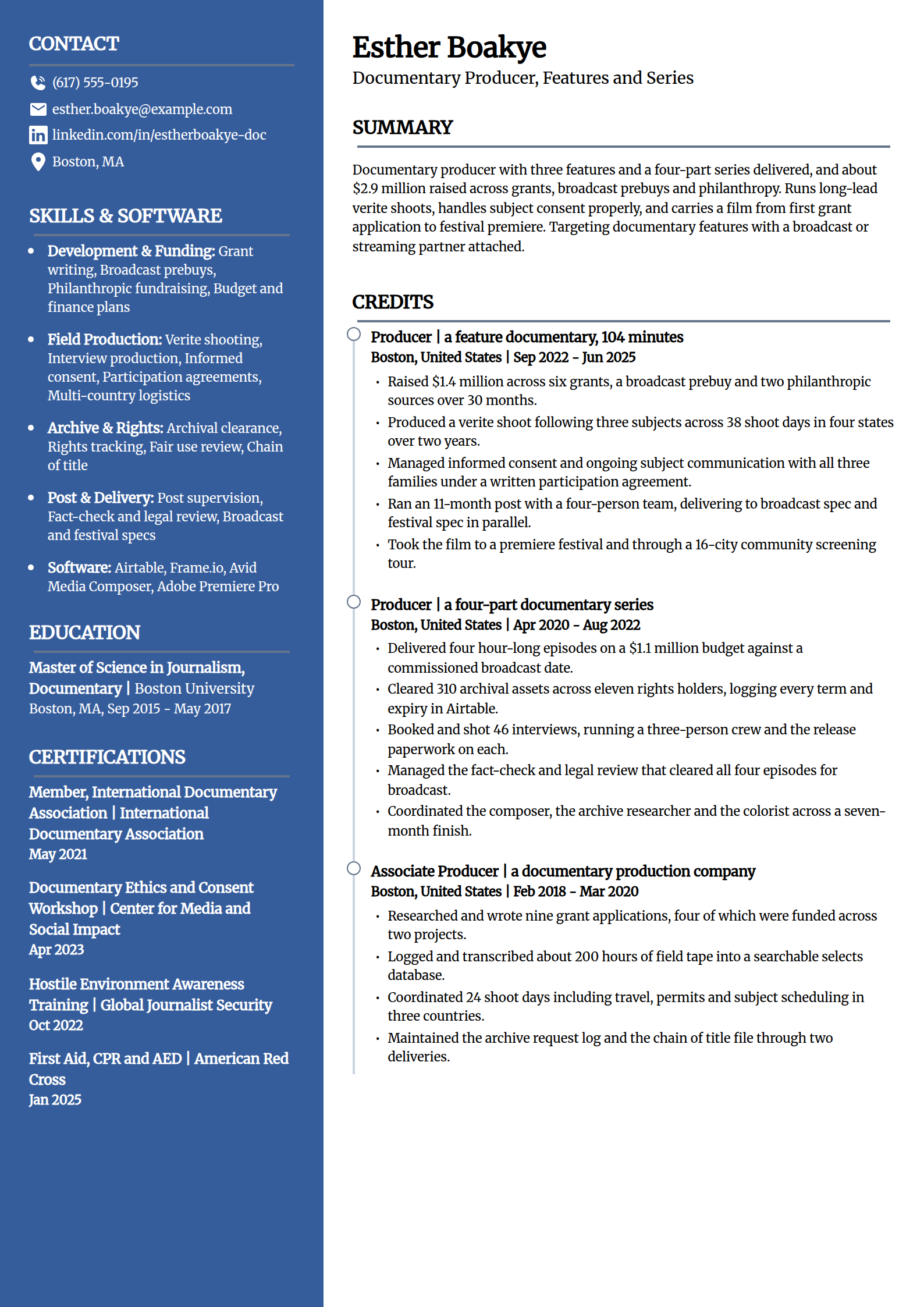
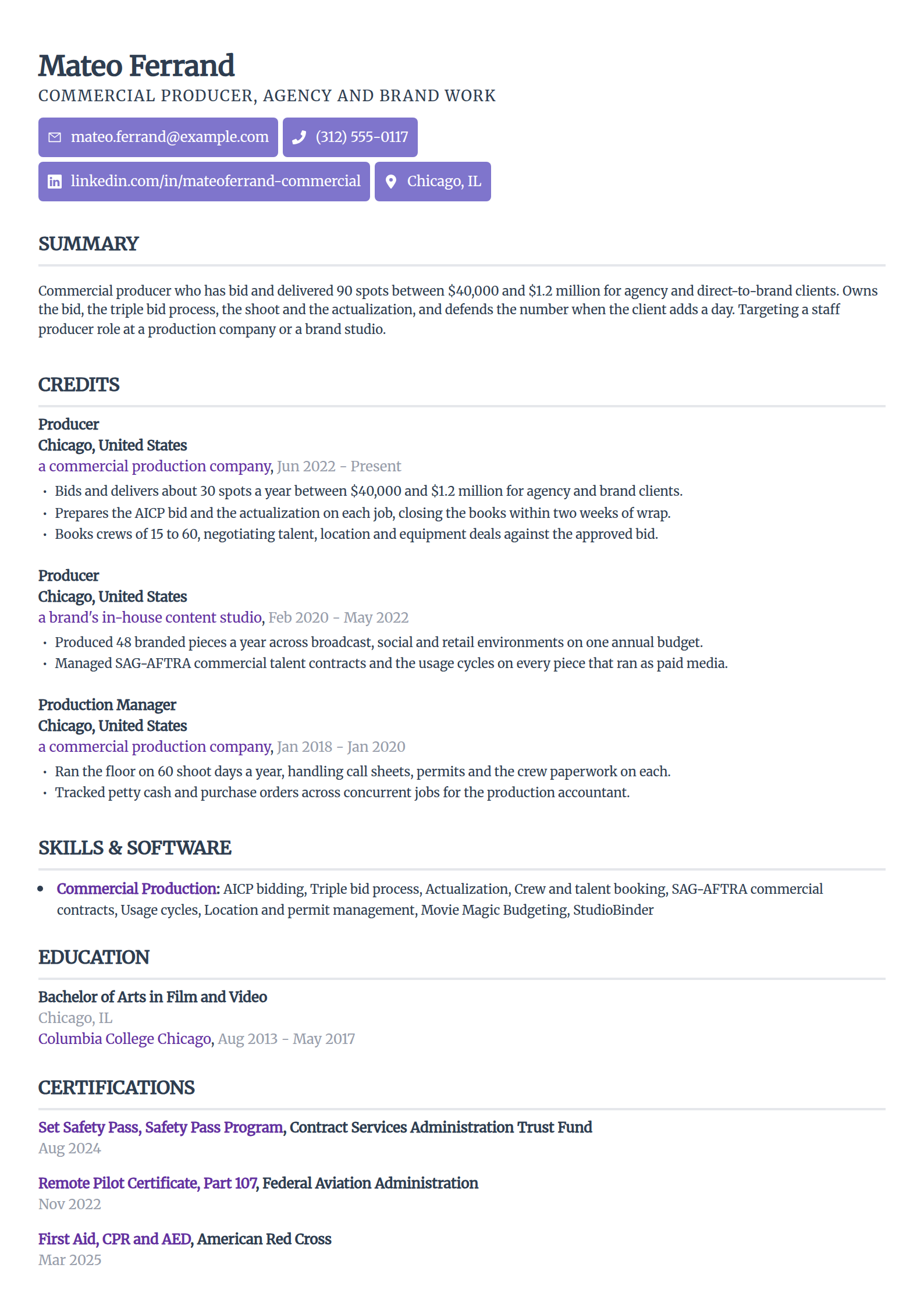
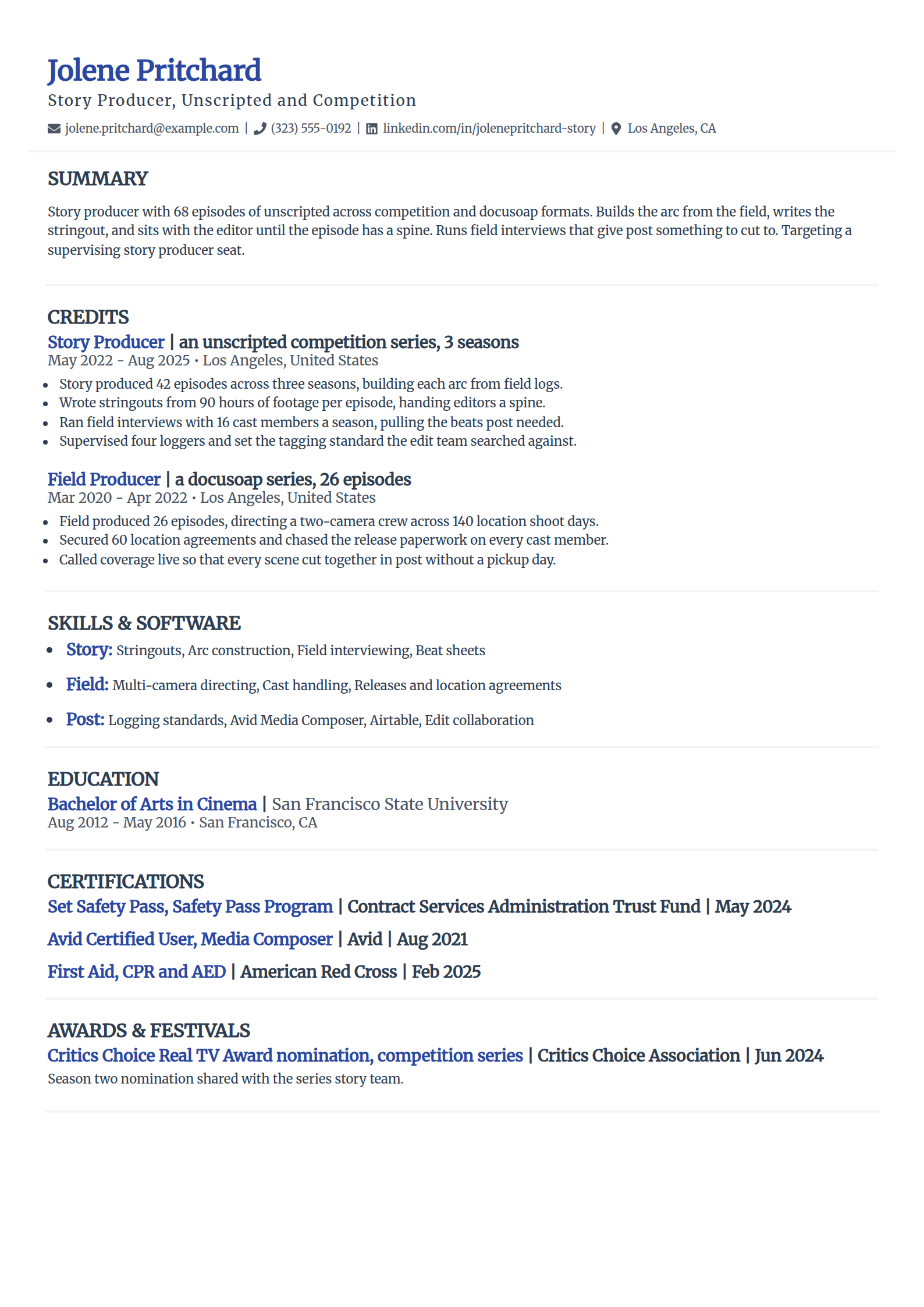
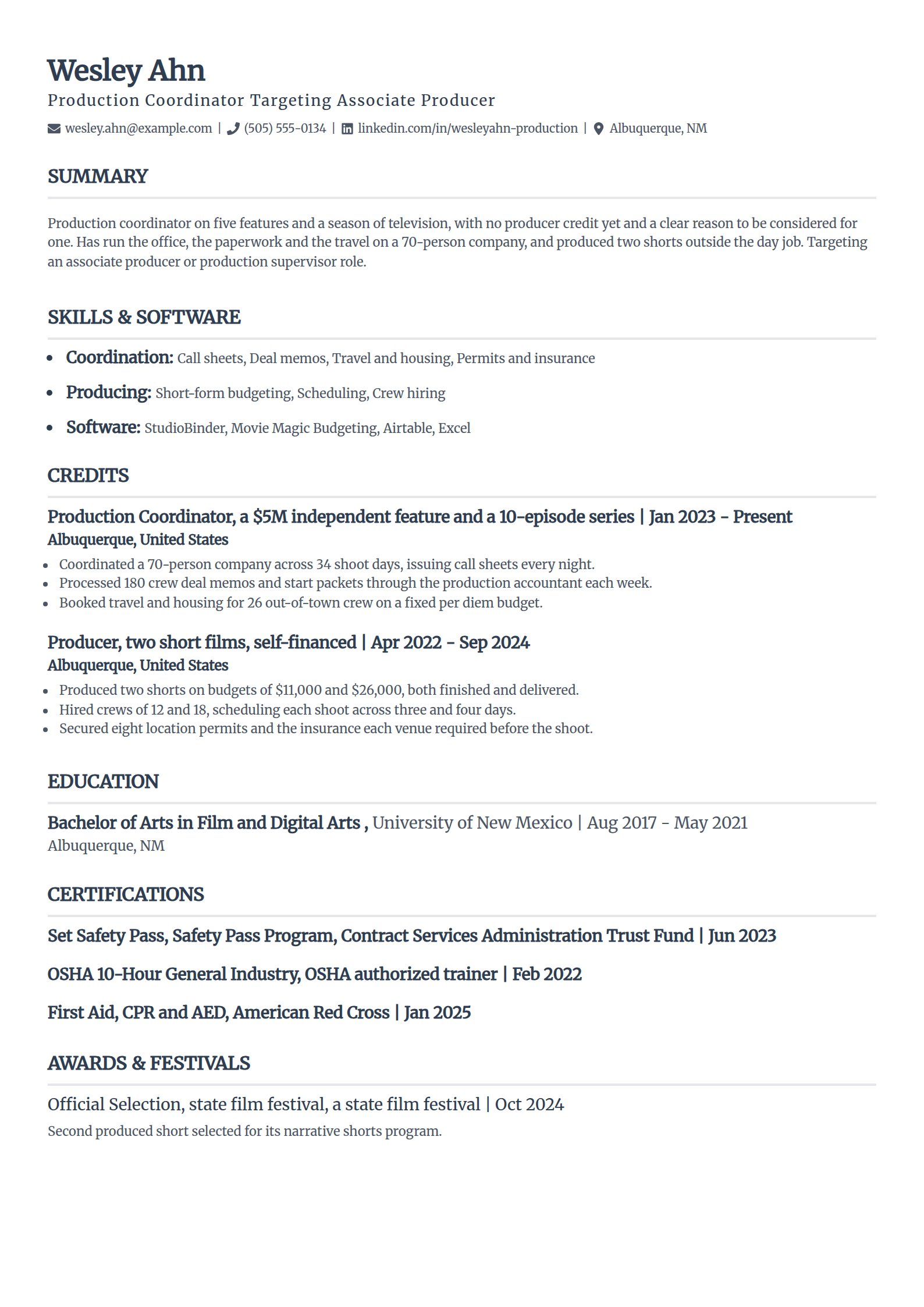
Film and TV Producer Resume Template
Why this resume example works?
- Heads the experience section Credits, which is what the section is called in this business, and leads the page with it.
- Names each production by budget and type rather than by title, so the scope is readable without a single real credit being faked.
- Puts the scope under every credit: budget, shoot days, states, crew size, departments, locations, company moves.
- Ends with delivery, including QC, cue sheets, chain of title and the errors and omissions binder, which is where producer jobs actually finish.
- Names Movie Magic, StudioBinder and Final Draft outright, because that is the phrasing a producing posting is written in.
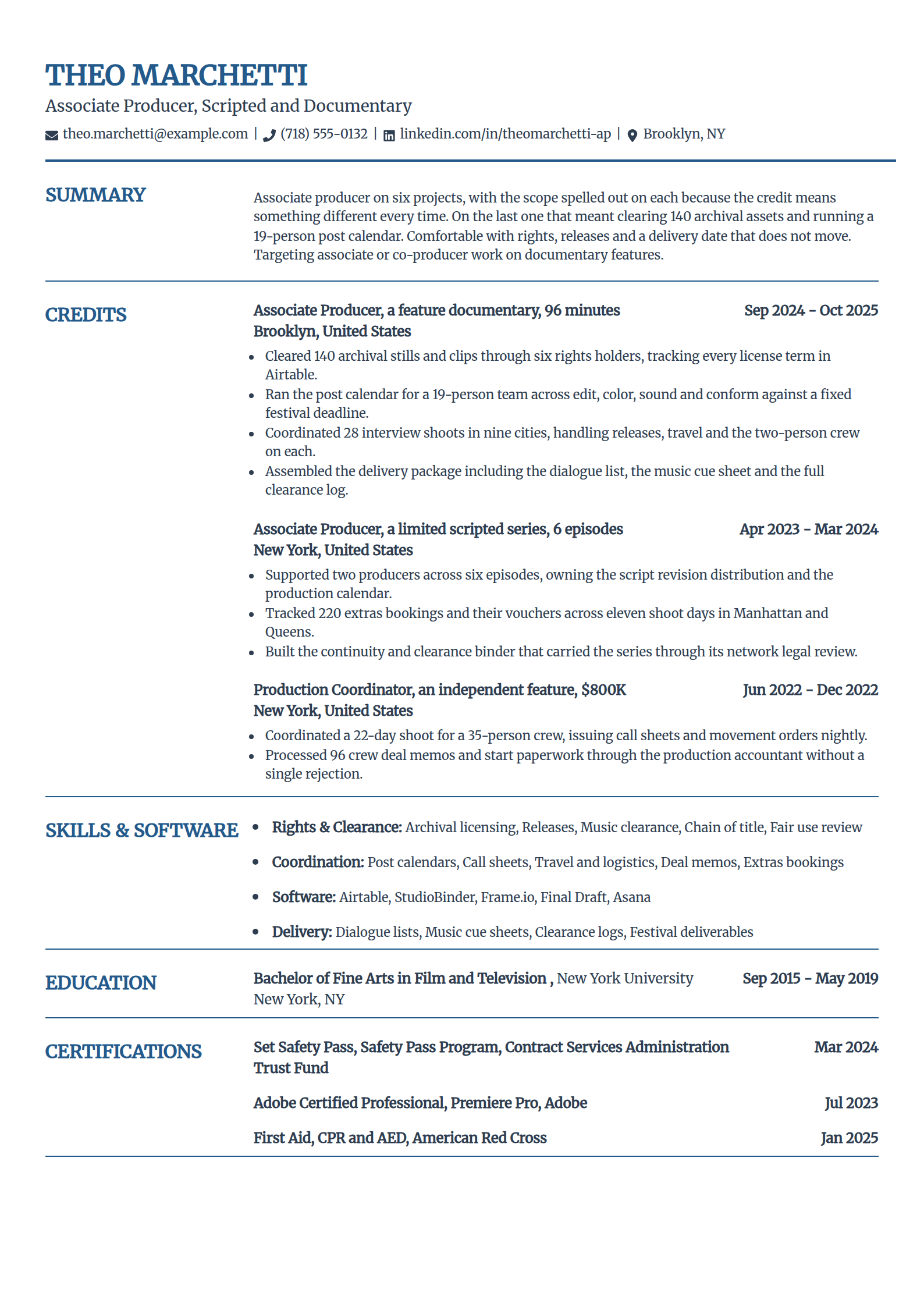
Associate Producer Resume Template
Why this resume example works?
- Says in the summary that the credit means something different every time, then spells out the scope on each one.
- Quantifies the work the credit hides: assets cleared, rights holders, post team size, interview shoots, cities.
- Shows rights and clearance as a named competence, which is the most common real content of an associate producer job.
- Keeps the production coordinator entry underneath, because that is where the paperwork discipline was learned.
- Lists the delivery artifacts by name, so a documentary post supervisor knows this person has closed a show before.
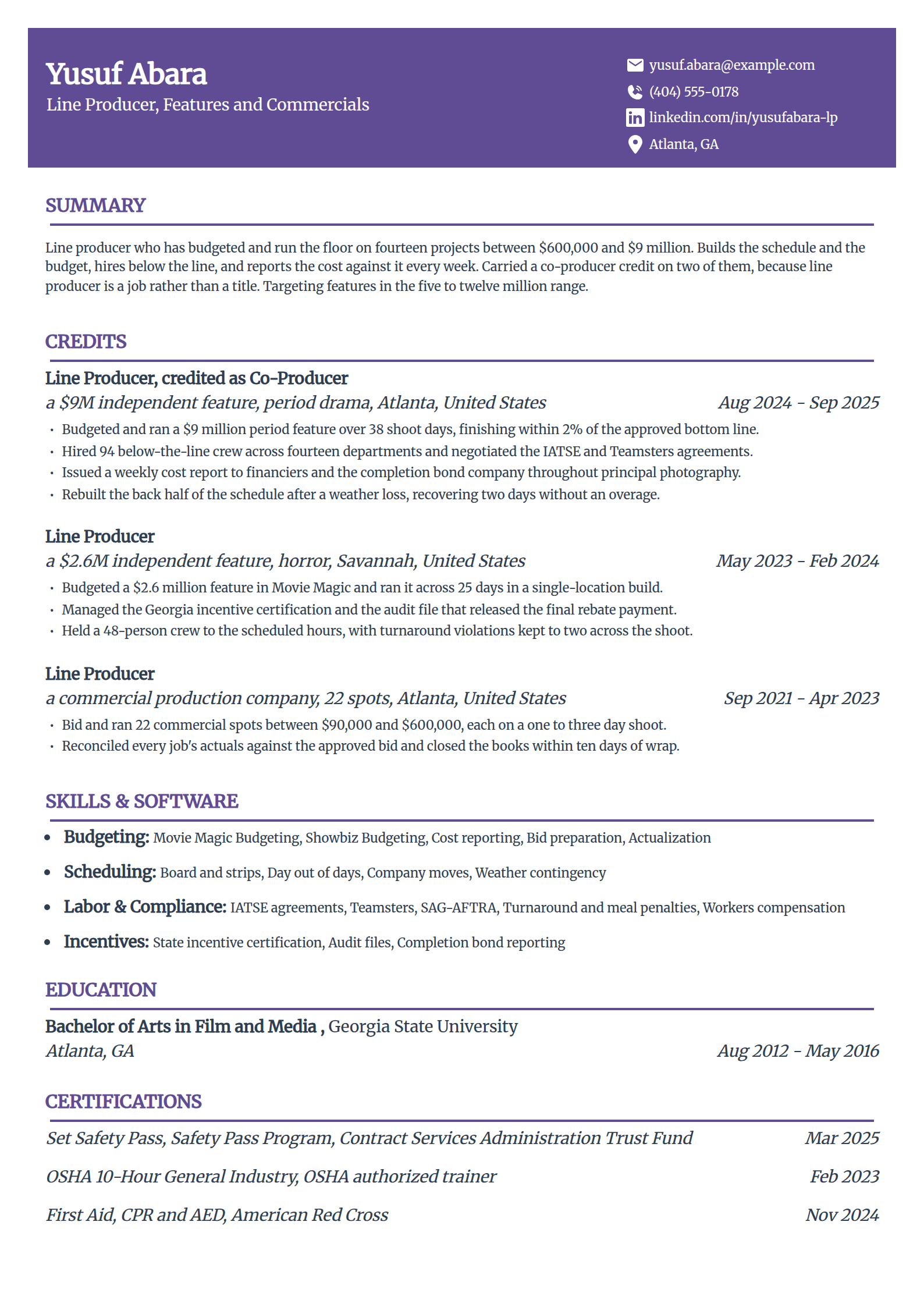
Line Producer Resume Template
Why this resume example works?
- States the credit and the job separately on the top entry, Line Producer credited as Co-Producer, which is how this actually works.
- Gives the number that matters most to whoever is hiring: finished within 2% of the approved bottom line.
- Names the labor agreements, IATSE and Teamsters and SAG-AFTRA, because a line producer is hired to handle them.
- Includes the weather recovery, since rebuilding a schedule without an overage is the whole argument for the role.
- Carries a commercial block underneath, which is where most line producers keep working between features.
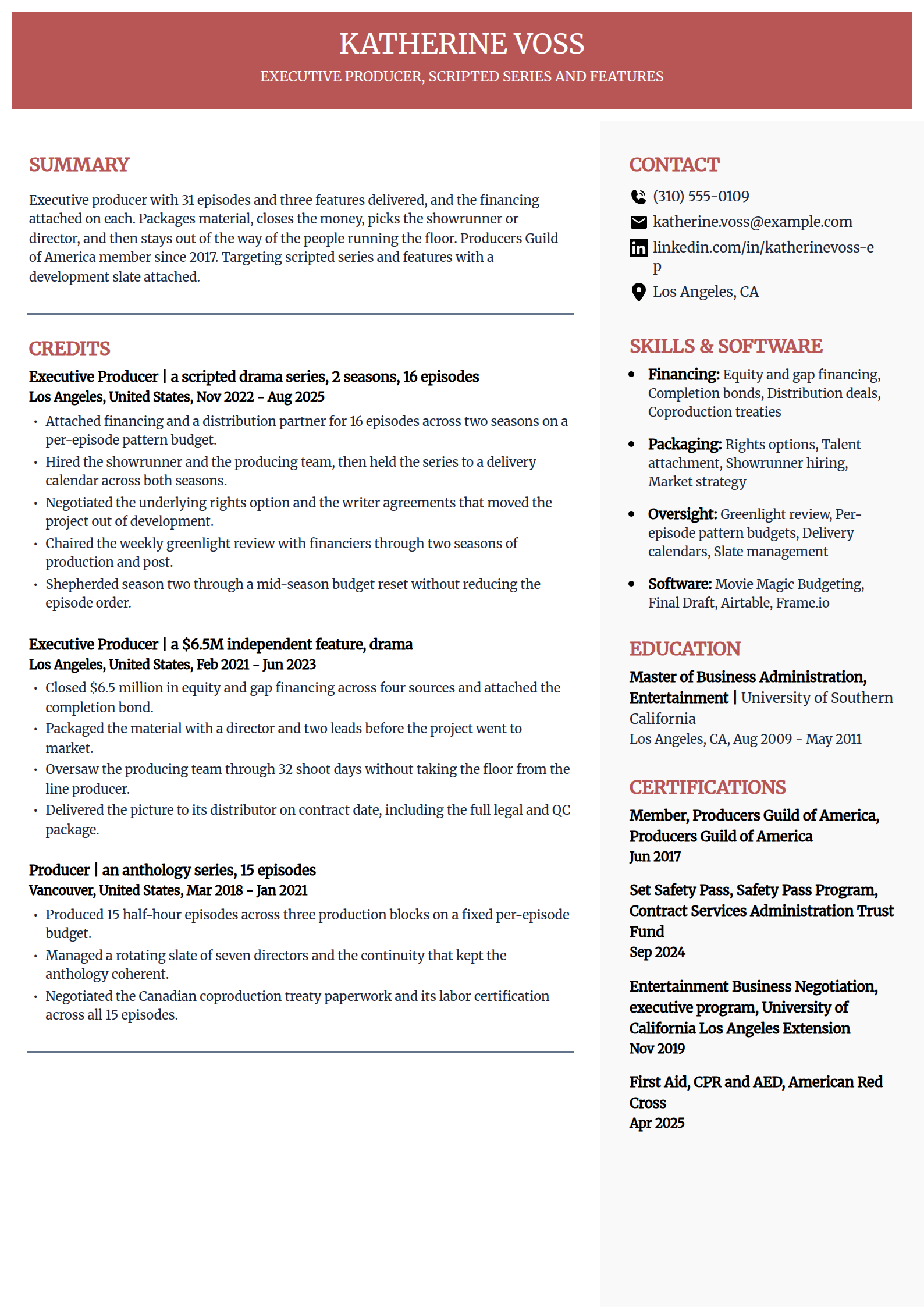
Executive Producer Resume Template
Why this resume example works?
- Leads with what an executive producer is actually judged on: financing attached, partners closed, material packaged.
- States plainly that the producing team ran the floor, which is more credible than claiming the day-to-day as well.
- Counts episodes and features delivered rather than listing a decade of titles nobody will check line by line.
- Names the rights option and the writer agreements, the two documents that move a project out of development.
- Keeps the earlier producer credit visible, so the financing experience reads as earned rather than inherited.
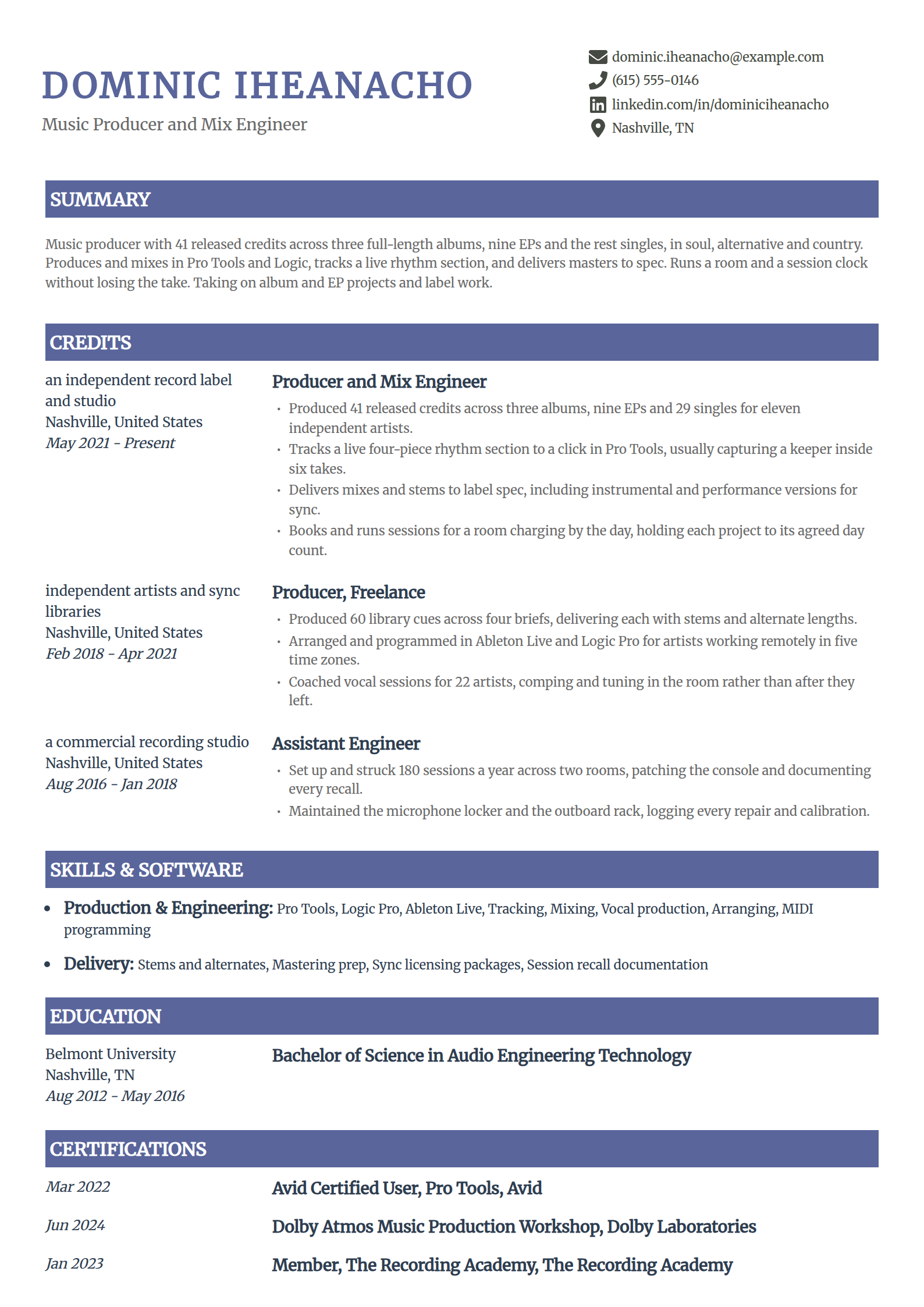
Music Producer Resume Template
Why this resume example works?
- Counts the discography the way a label reads it: albums, EPs and singles separately, with a total credit count.
- Describes the room and the session clock, which is what a studio or a label is actually buying.
- Names Pro Tools, Logic and Ableton and says what each is used for rather than listing them as a software line.
- Includes delivery to label spec with stems and alternates, the part that separates a producer from a hobbyist.
- Keeps the assistant engineer years, because 180 sessions a year is where the console knowledge came from.
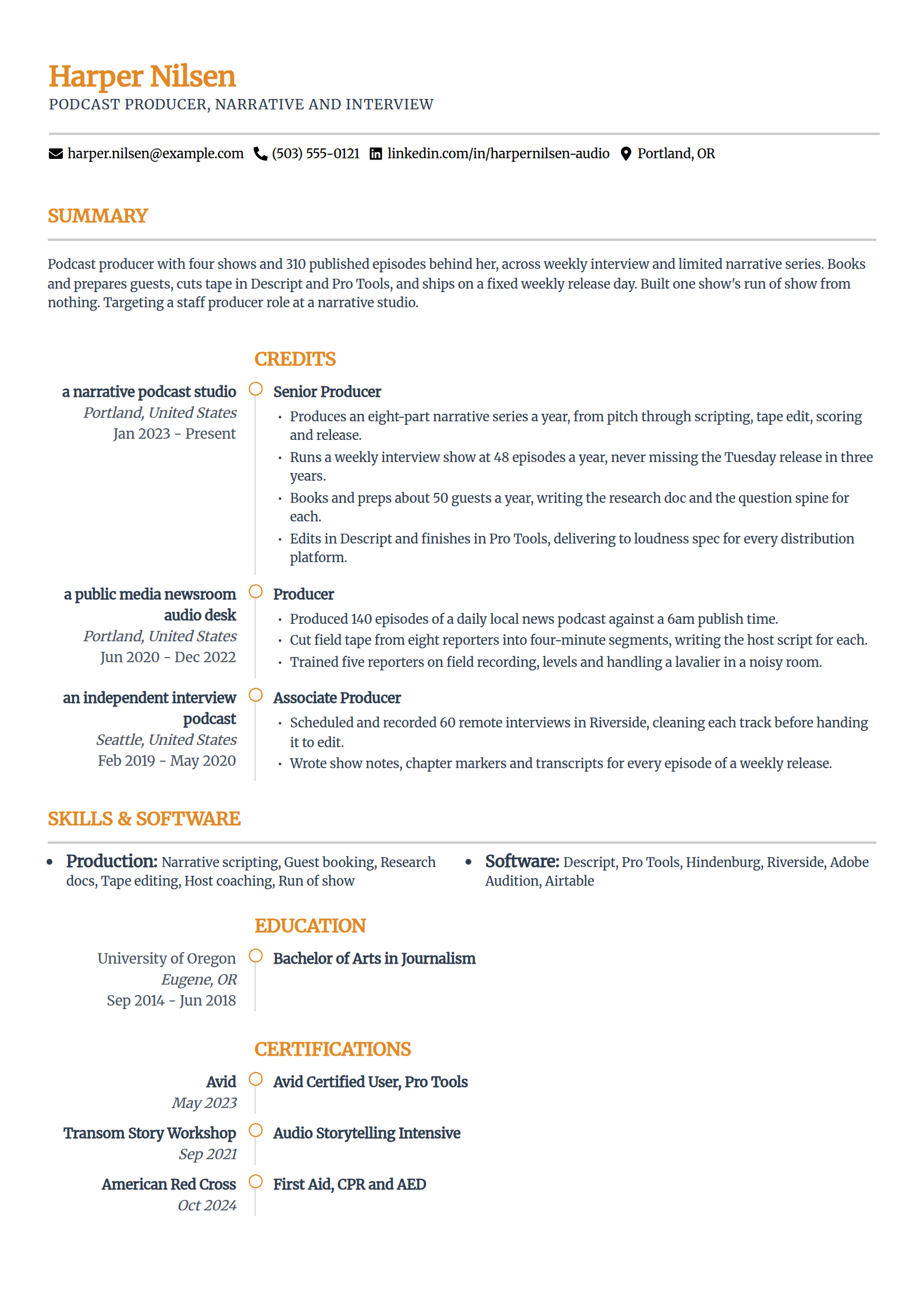
Podcast Producer Resume Template
Why this resume example works?
- Counts shows and published episodes, which is the podcast equivalent of a credit list and the first thing a studio asks.
- Puts the release discipline on the page: never missing a Tuesday in three years is the hardest thing in weekly audio.
- Separates narrative work from interview work, because studios hire for one or the other and rarely both.
- Names Descript, Pro Tools, Hindenburg and Riverside, the exact stack a podcast posting lists.
- Includes delivering to loudness spec, which tells a hiring producer this person has shipped to platforms before.
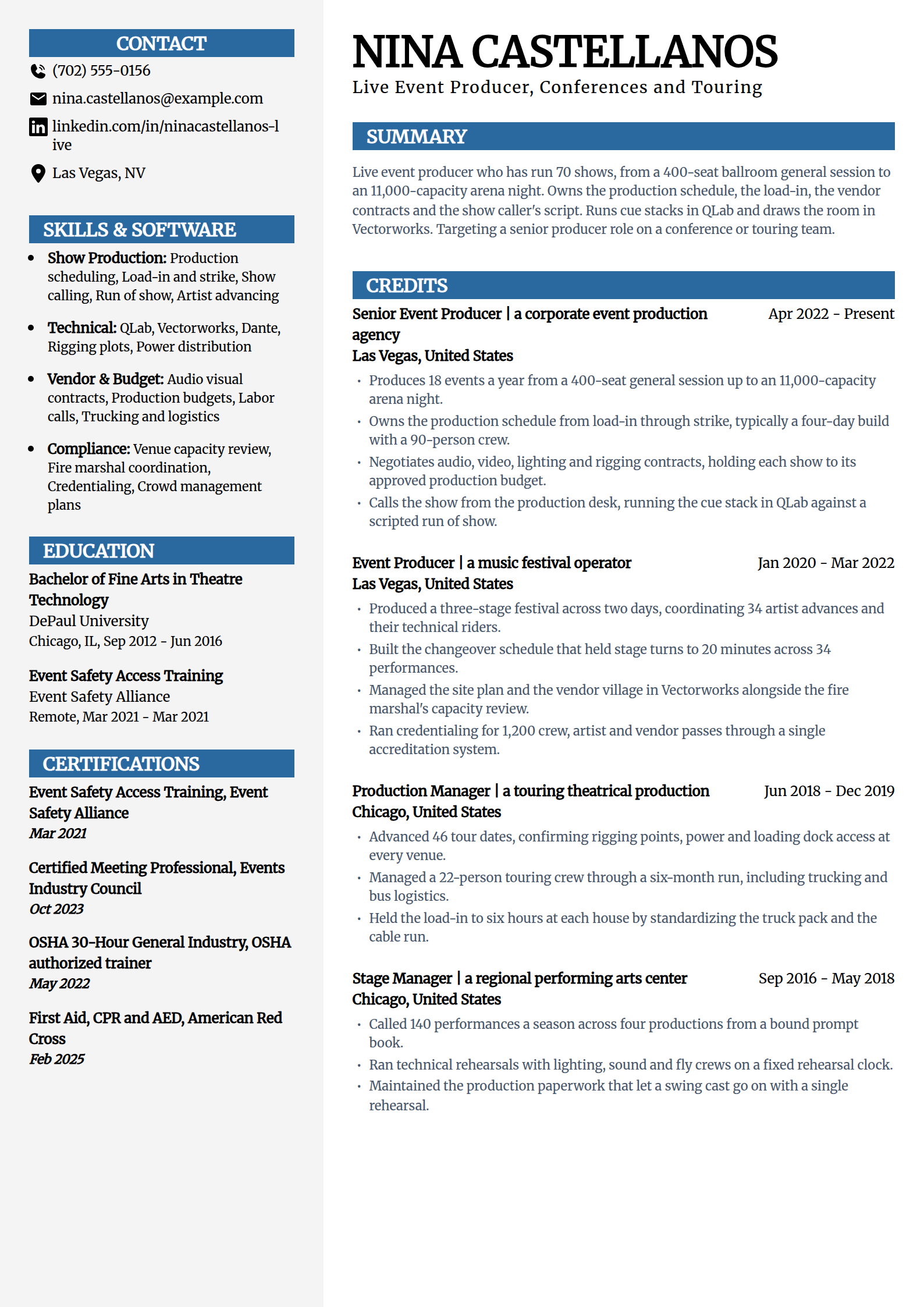
Live Event Producer Resume Template
Why this resume example works?
- Spans the room sizes in the summary, from a 400-seat general session to an 11,000-capacity arena night.
- Shows the production schedule as the deliverable, with build days and crew size on the headline entry.
- Includes calling the show from the production desk, which is the skill that separates a producer from a coordinator.
- Names QLab, Vectorworks and Dante, plus the fire marshal capacity review that no competitor page mentions.
- Keeps the stage management years, because 140 called performances is where show calling is actually learned.
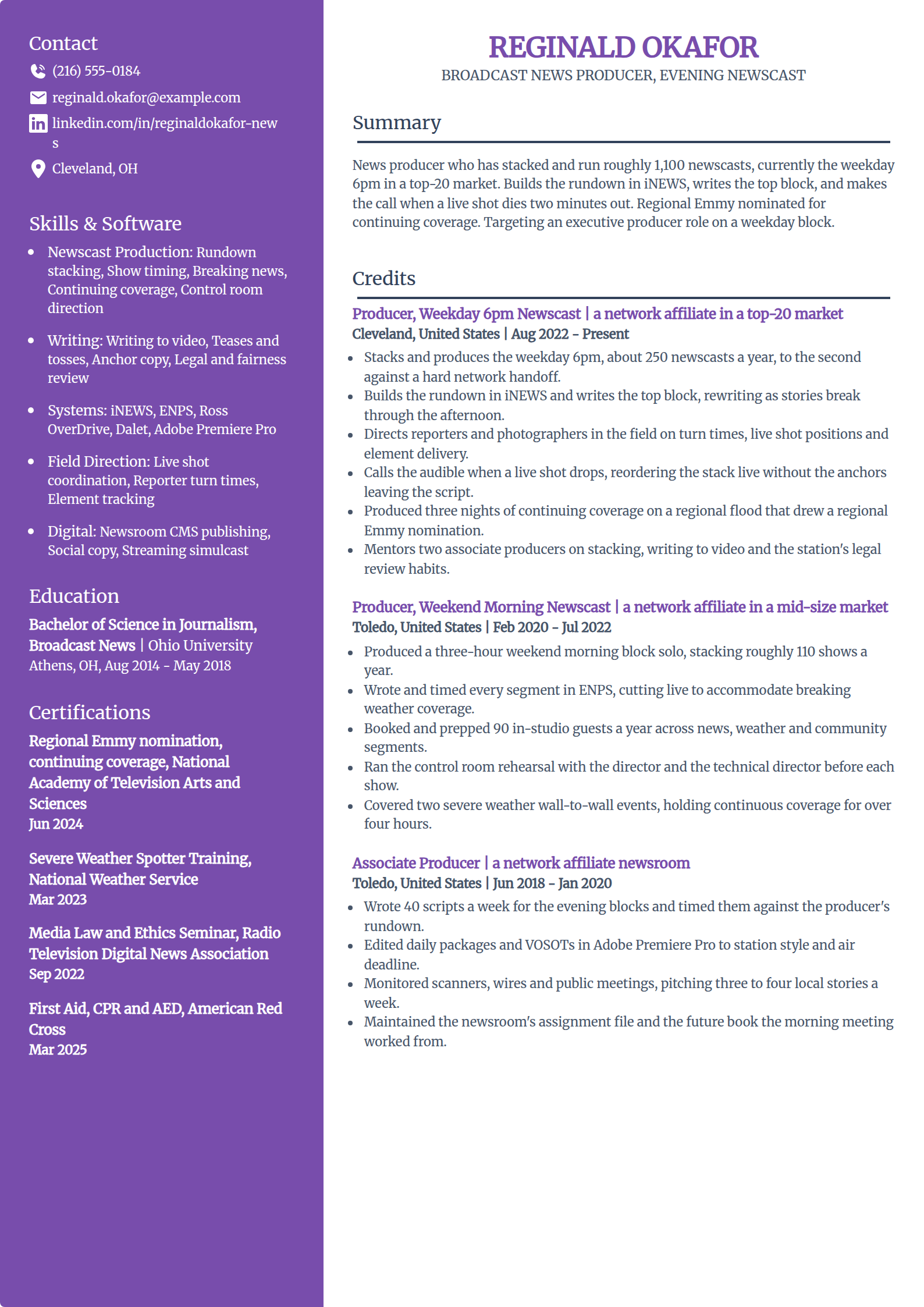
Broadcast News Producer Resume Template
Why this resume example works?
- Counts newscasts produced, which is the number every news director asks for before anything else on the page.
- Names the show and the market size, because a weekday 6pm in a top-20 market is a specific, checkable job.
- Includes the moment the job is really about: reordering the stack live when a live shot drops.
- Names iNEWS, ENPS, Ross OverDrive and Dalet, the newsroom systems a posting screens on.
- Puts the regional Emmy nomination with its awarding body rather than as a vague award line.
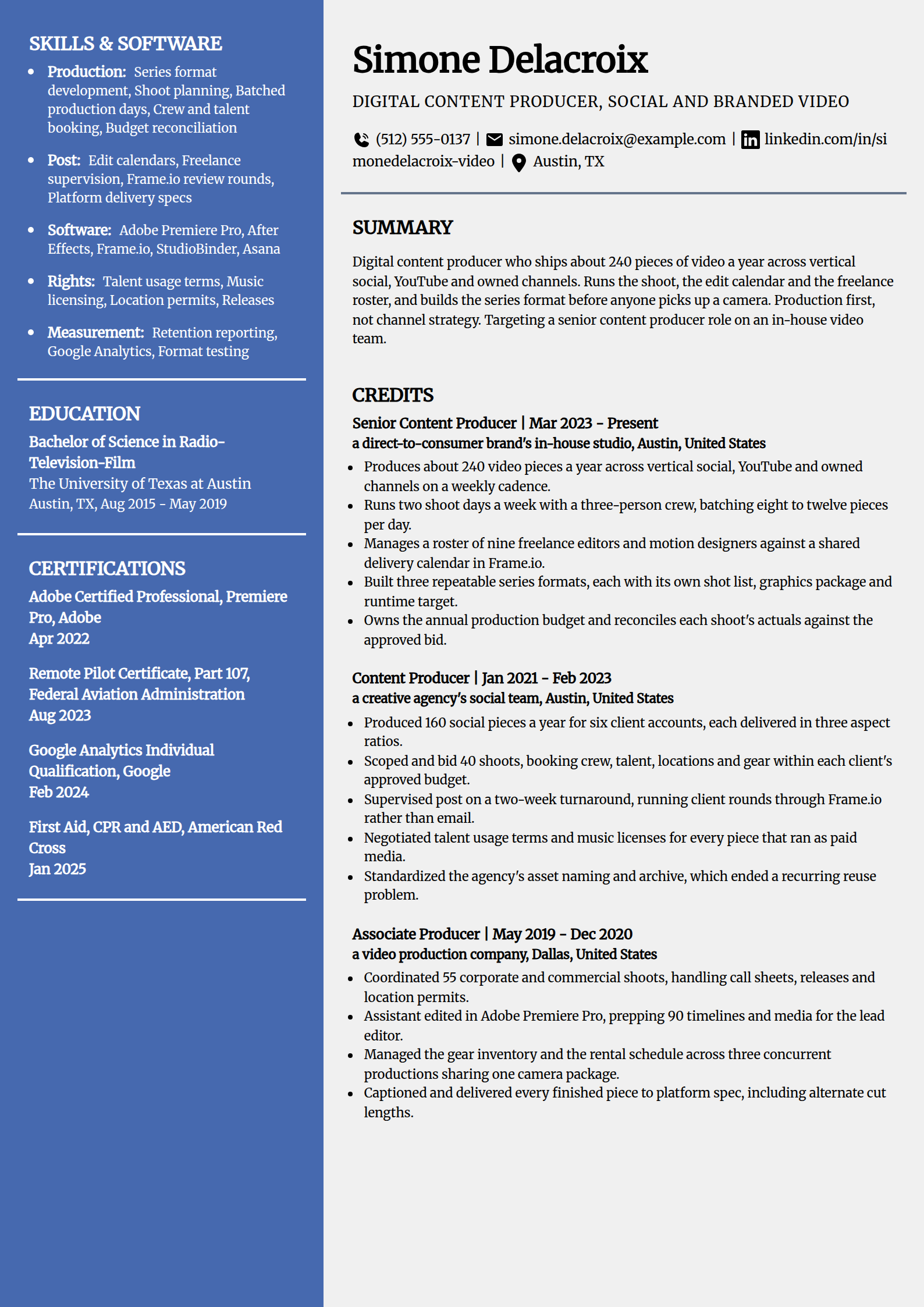
Digital Content Producer Resume Template
Why this resume example works?
- Counts output per year and the shoot cadence behind it, which is how in-house video teams are staffed and measured.
- Shows batching, eight to twelve pieces a shoot day, the single most useful thing a content producer knows.
- Treats the freelance roster as a managed resource with a shared delivery calendar rather than a list of names.
- Keeps rights on the page, talent usage terms and music licenses, which most content resumes leave off entirely.
- Stays on production rather than drifting into channel strategy, so it reads as a producer and not a marketer.
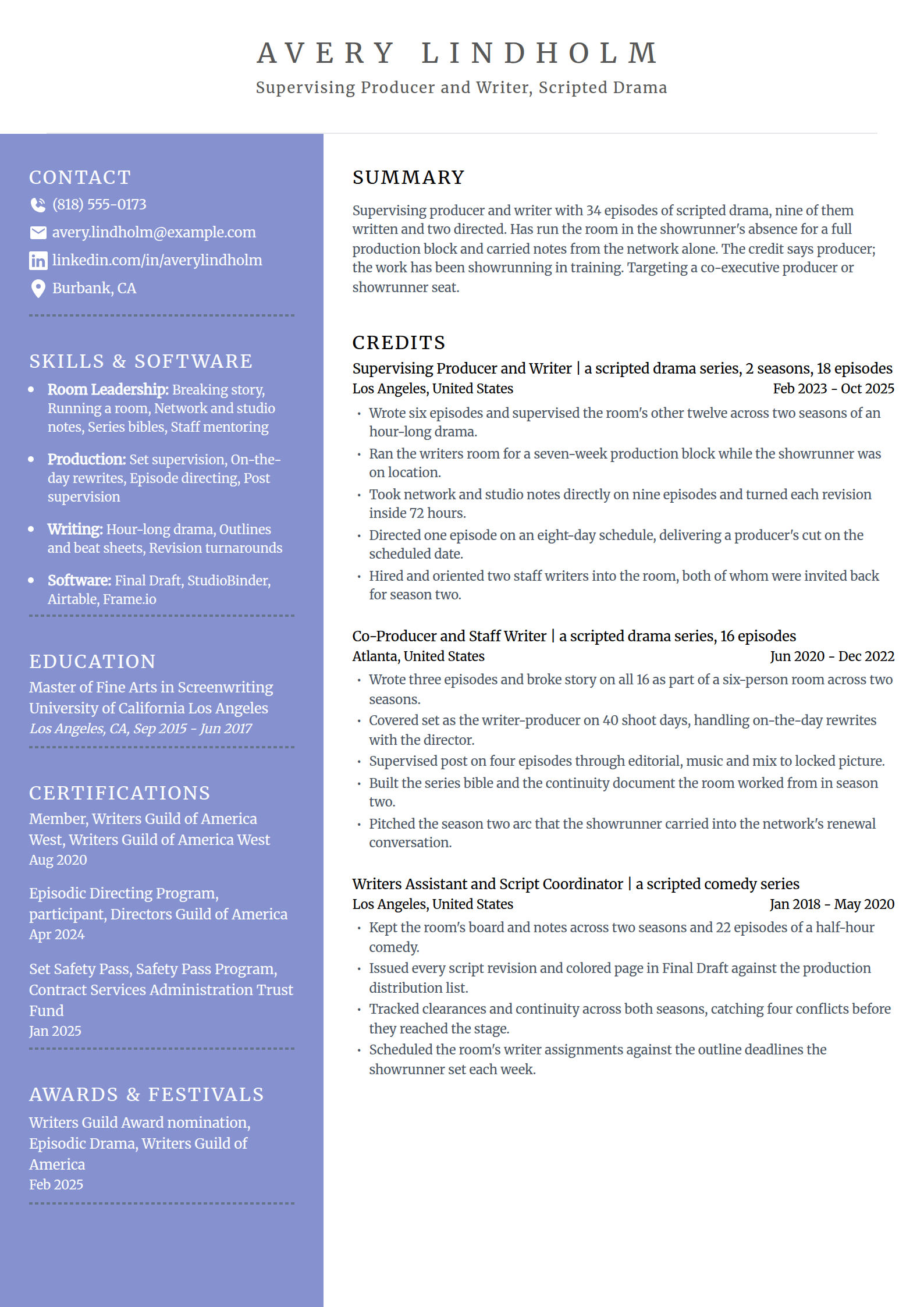
Showrunner Track Producer Resume Template
Why this resume example works?
- Says the quiet part in the summary: the credit says producer, the work has been showrunning in training.
- Evidences that claim rather than asserting it, with a room run for a seven-week block in the showrunner's absence.
- Separates episodes written from episodes supervised, because a showrunner hire is judged on both.
- Includes taking network and studio notes directly, which is the specific responsibility that gets handed up.
- Keeps the writers assistant years visible, since every showrunner in television started by keeping the board.
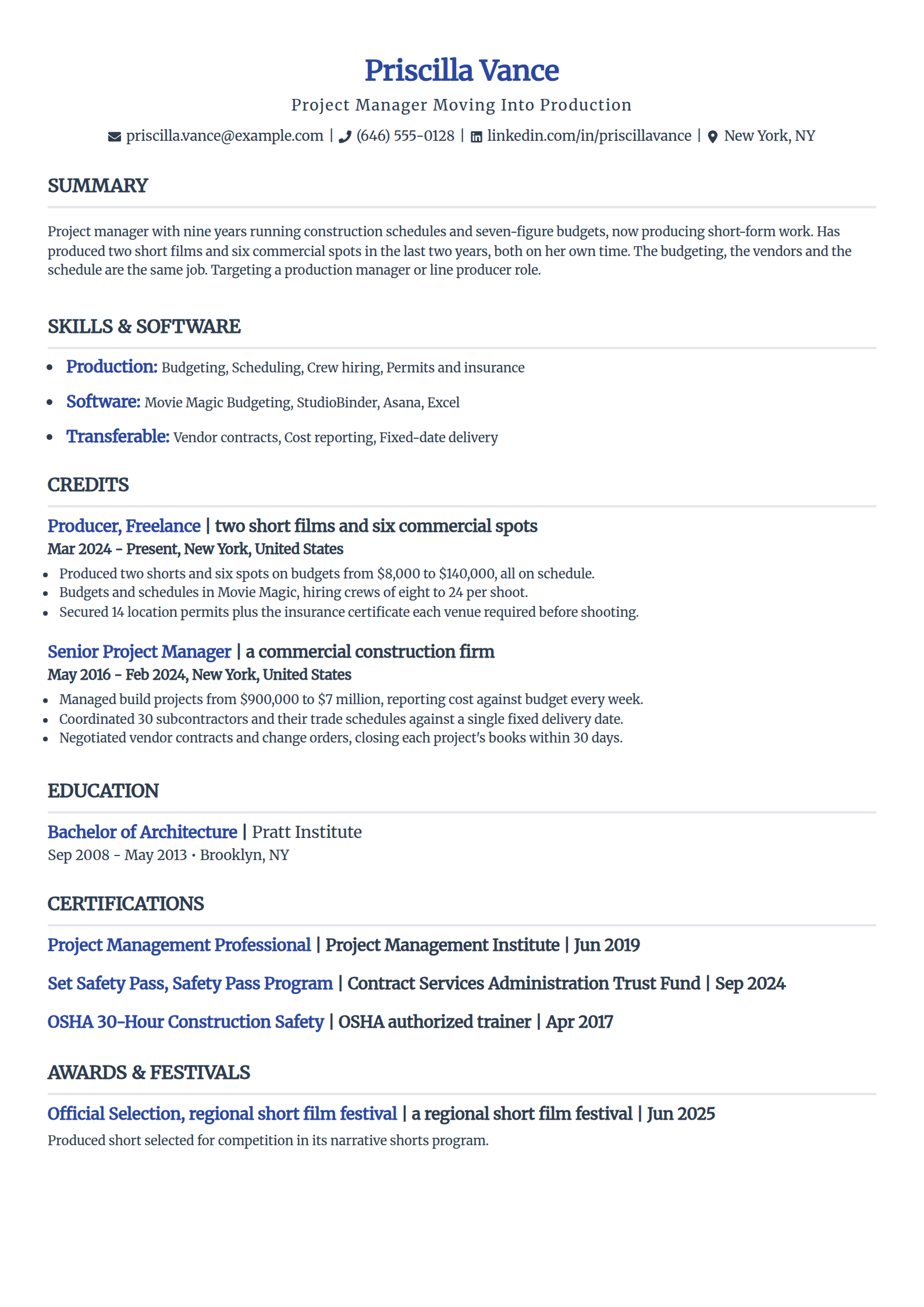
Career Changer Producer Resume Template
Why this resume example works?
- Leads with skills and software instead of credits, which is the right order when the credit list is still short.
- Puts the two shorts and six spots first anyway, because a small real credit beats a large adjacent one.
- Translates construction project management into the same three nouns producing uses: budget, schedule, vendors.
- Keeps the nine-year career visible rather than hiding it, with the budget range stated so the scale is clear.
- Carries a festival selection as an award, which is how a short film becomes a checkable credential.
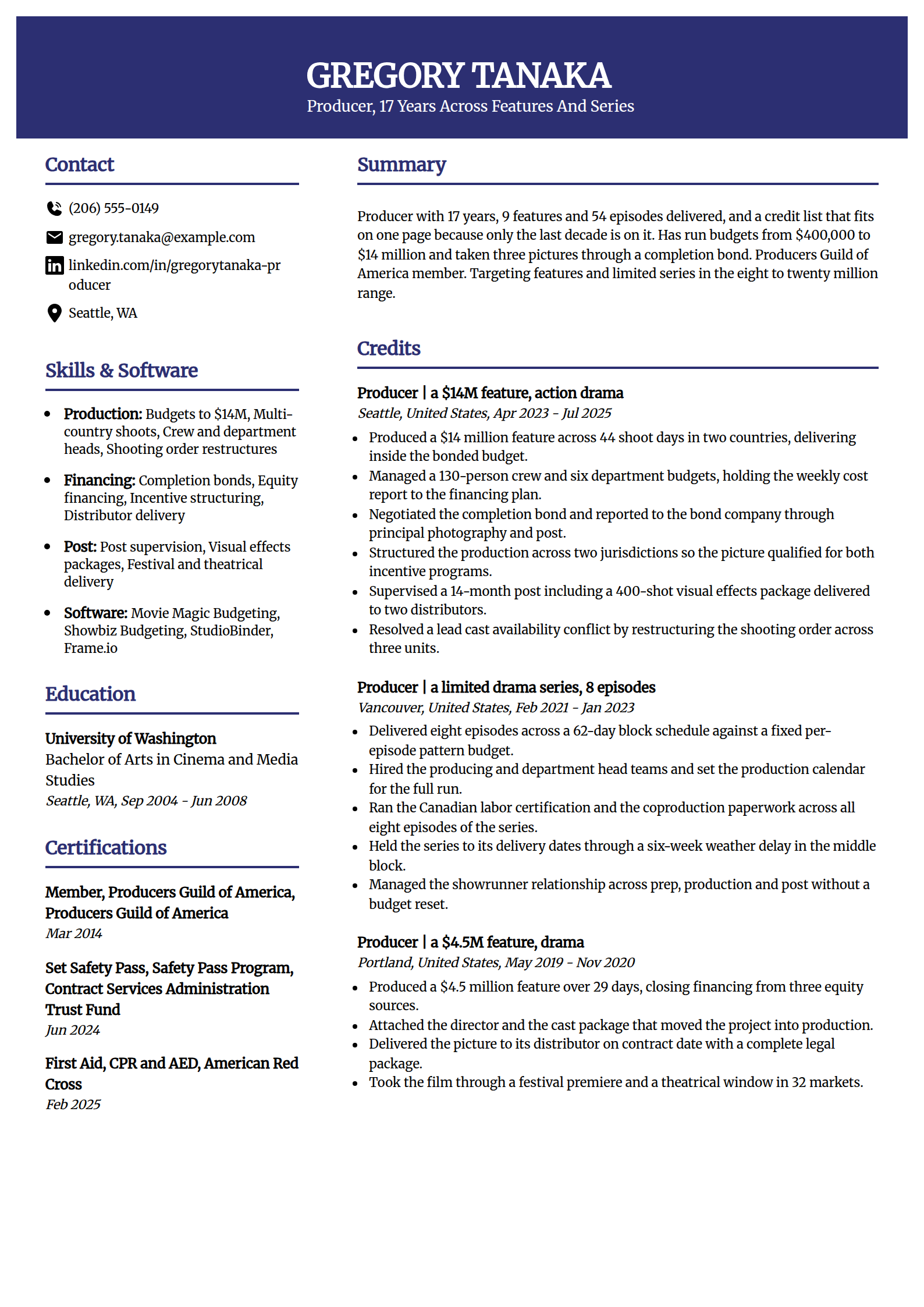
Senior Producer Resume Template, 10+ Years
Why this resume example works?
- Says outright that only the last decade is on the page, which is the right call at 17 years and 9 features.
- Gives the budget range across the career in one line so a hiring conversation can start at the right number.
- Includes the completion bond relationship, which is the credential that separates a senior producer from a mid-level one.
- Shows the problem that was solved, restructuring across three units around a cast availability conflict.
- Keeps post on the page, including a 400-shot visual effects package, because delivery is half the job at this level.
Documentary Producer Resume Template
Why this resume example works?
- Leads with money raised, because documentary producing is a fundraising job before it is a production job.
- Breaks the financing down by source, grants and a broadcast prebuy and philanthropy, which is how it really arrives.
- Puts informed consent and the written participation agreement on the page, the ethical spine of the work.
- Counts archival assets and rights holders, since clearance is where documentary budgets and schedules go wrong.
- Includes the grant writing years underneath, which is what makes the fundraising claim above believable.
Commercial Producer Resume Template
Why this resume example works?
- Names the AICP bid and the triple bid process, the two things an agency producer is hired to run.
- Gives the spot count and the budget range together, which is how commercial producers are actually sized up.
- Includes actualization and closing the books, the unglamorous half of the job that decides if you work again.
- Covers SAG-AFTRA commercial contracts and usage cycles, a liability most branded content resumes never mention.
- Uses a single wide skills block, which suits a role where the whole competence list reads as one stack.
Story Producer Resume Template
Why this resume example works?
- Counts episodes story produced, which is the credit unit in unscripted and the number a showrunner asks for first.
- Describes the actual deliverable, a stringout cut from 90 hours of footage that hands editors a spine.
- Shows field interviewing as the source of the arc rather than as a separate interviewing skill.
- Includes supervising loggers and setting the tagging standard, the invisible work that makes a post team fast.
- Carries the field producer credit underneath, because story and field are the two halves of unscripted producing.
Production Coordinator to Producer Resume Template
Why this resume example works?
- Leads with skills rather than credits, correctly, because there is no producer credit on a studio project yet.
- States the gap plainly in the summary and then gives the reason to be considered anyway.
- Counts the coordinating work at real scale: a 70-person company, 34 shoot days, 180 deal memos.
- Puts two self-financed shorts on as producer credits, which is exactly what they are and how they should be listed.
- Keeps a festival selection as an award, which turns a small short into something a hiring producer can verify.
Build your producer resume
Pick a template above and the editor keeps the layout clean and ATS-safe while you swap in your own credits, budgets and shoot days.
Build my resumeHow to write a producer resume
Producing is not one job, and the resume that gets you a feature will not get you a 6pm newscast. What every version shares is that the work is already counted somewhere: a budget, a rundown, a release schedule, a call sheet.
Lead with credits, because in this business the credit is the resume item
Head the section Credits and list them most recent first. For each one, give the project and its type, then your credit, then the scope underneath it. That order is the convention and departing from it reads as inexperience.
Line Producer, credited as Co-Producer | a $9M independent feature, period drama | 38 shoot days, 94 crew
On this page fourteen examples lead with credits and two lead with skills. Lead with skills instead only when:
- You have no producer credit yet and are moving up from coordinating, assisting or another department.
- You are changing careers into producing and your transferable competence is the actual argument.
- Even then, put whatever small credits you do have directly underneath. A self-financed short is a credit.
Put the scope under the credit, because the credit alone says nothing
Line producer is a job rather than a title, and the person doing it often carries a different credit. Associate producer is the most elastic credit in the business. A reader cannot tell what you did from the credit, so tell them.
The scope numbers that belong under a producing credit:
- Budget, and whether it came in. The approved bottom line is the number that gets you hired again.
- Shoot days, episodes delivered, runtime, or spots completed, depending on the format.
- Crew size and the number of departments you hired or managed.
- Locations, company moves, countries or jurisdictions, and any incentive program you certified.
- What you delivered at the end: the distributor package, the broadcast spec, the festival deliverables.
Name the software the way the posting does
Producing postings are written as tool lists, and the tools differ completely between formats. Listing Premiere Pro on a line producer resume tells a reader you have not read the job.
Match the stack to the kind of producing you do:
- Film and TV: Movie Magic Budgeting and Scheduling, Showbiz Budgeting, StudioBinder, Final Draft, Frame.io.
- Broadcast news: iNEWS, ENPS, Ross OverDrive, Dalet, and the editing system your station cuts on.
- Music: Pro Tools, Logic Pro, Ableton Live, and what you deliver, stems, alternates, mastering prep.
- Podcast: Descript, Pro Tools, Hindenburg, Riverside, and delivery to loudness spec.
- Live events: QLab, Vectorworks, Dante, plus rigging plots and power distribution.
Write a summary that states your credit count and what you are targeting
Three to four sentences, 50 to 70 words. Open with the credit and the medium, not an adjective. The ranking pages open with words like focused and adaptable, and then say nothing a reader can check.
Producer with eleven scripted credits across independent features and half-hour television, most recently a $3.4 million feature shot over 24 days in three states. Builds and defends the schedule and the budget in Movie Magic, hires department heads, and delivers to distributor spec. Looking for scripted features in the two to six million range.
What a producer summary has to carry:
- The credit you hold and the number of projects behind it.
- The budget range, episode count or output volume you have actually worked at.
- The software and the business-affairs competence a posting would name.
- The kind of work you want next, stated as a range or a format rather than a wish.
Add a reel or portfolio link, and know what belongs behind it
A producer's link is not a shooter's reel. Nobody is assessing your camera work. They are checking that the projects exist and that you are attached to them the way you say.
What a producing link should show:
- The finished projects themselves, or trailers, with the credit block visible.
- A one-page credit list as a downloadable file, formatted the same way as the resume.
- For unscripted and digital, a short selection of pieces rather than everything you have made.
- Put the link in the contact line at the top. A link buried at the bottom does not get clicked.
Keep it to one page in a layout a portal can parse
One page covers every example here, including a producer with 17 years and nine features. At that length you list the last decade and let the interview cover the rest.
What keeps a producer resume parseable:
- Standard headings, with the experience section headed Credits rather than something invented.
- A single column, or a clean two-column layout with the credits on the wide side.
- Real text rather than text inside images, and consistent date formats down the whole page.
- If you are running out of room, drop the oldest credits rather than the scope lines under the recent ones.
Common producer resume mistakes
- Listing credits with no scope under them. A line that reads Associate Producer, then a project name, then nothing, tells a hiring producer you may have done anything from clearing archival to fetching coffee. Put the budget, the shoot days, the episode count or the crew size underneath every credit.
- Writing it as a corporate job history. Published producer resume examples are built as a standard reverse-chronological employment list with duties under each role. In film and television the credit is the resume item, headed Credits, listed most recent first, project and type then your credit.
- Claiming the floor when you did not run it. An executive producer who writes bullets about managing the daily crew reads as either inflating or confused about the role. Say what you attached, closed, hired and oversaw, and let the line producer have the day to day.
- Filling the skills section with creative vision and adaptability. Every applicant writes those. Producing is counted in budgets, shoot days, episodes, crew and delivery dates, and the software is named in the posting. Use those words instead.
- Treating all producing as one job. A music producer's discography, a news producer's rundown, a live producer's load-in and a line producer's bottom line are not interchangeable. Pick the version of the resume that matches the posting rather than sending one generic page everywhere.
Frequently asked questions
What should a producer resume include?
A producer resume needs a three-to-four-sentence summary naming your credit, your medium and your credit count, a Credits section listing projects most recent first, a skills and software block naming the stack your format actually uses, education, and any guild membership or safety training. The Credits section is the core: for each project give the project and its type, then the credit you received, then the scope underneath it in real numbers, meaning budget, shoot days, episodes delivered, crew size, locations and what you delivered at the end. Add a link to the finished work in the contact line at the top. One page is enough at any level, including fifteen or more years of credits.
How do you list credits on a producer resume?
Most recent first, and for each one give three things in order: the project name or a description of it, the production type such as feature, limited series, short, spot or album, and the credit you received. Then put the scope underneath as bullets. The credit is the item that goes on your resume in this business, which is why the section is headed Credits rather than Experience. If the job you did and the credit you got differ, which is common with line producing, state both: Line Producer, credited as Co-Producer. Never invent or inflate a credit on a real title, because it is the one thing in this industry that is trivially checkable and never forgiven.
What is the difference between a line producer and an associate producer resume?
A line producer resume is built around the number. It leads with budgets built and defended, shoot days, crew size, the labor agreements handled, and whether the picture came in on the approved bottom line. A line producer is hired to run the floor and the money, so every entry should carry a figure. An associate producer resume has to do the opposite work: the credit is the most elastic one in the business, so it must spell out what the job actually was on each project, whether that was archival clearance, post calendars, interview production, or running the paperwork for a 70-person company. One proves a number, the other defines a role. Both are written as a credit list.
Should a producer resume include a reel or portfolio link?
Yes, in the contact line at the top rather than buried at the bottom. What sits behind it differs from an editor's or a shooter's reel, because nobody is assessing your craft on the camera or the timeline. Link the finished projects or their trailers with the credit block visible, and include a one-page credit list as a downloadable file formatted the same way as the resume. For unscripted and digital content work, a short curated selection reads better than a complete archive. If a project has not been released and cannot be shared, list it on the resume and say it is unreleased rather than linking something that does not open.
How long should a producer resume be?
One page, including a producer with seventeen years and nine features. Every example on this page is a single page. At that level you list roughly the last decade of credits, give each one its scope in numbers, and let the interview cover the earlier work. If you are running out of room, drop the oldest credits rather than the scope lines under the recent ones, because the scope is what makes any of it readable to someone deciding whether to call you. A separate full credit list can live behind the link in your contact line, and that is the right place for the complete filmography.
How do you write a producer resume with no producer credits yet?
Lead with skills and software instead of credits, which is the one case where that order is correct, and then put whatever small credits you do have directly underneath. A self-financed short you produced is a producer credit and should be listed as one, with its budget and crew size. Coordinating and assisting work counts and should be counted at real scale: company size, shoot days, deal memos processed, travel booked. If you are changing careers, translate the adjacent experience into the three nouns producing uses, budget, schedule and vendors, rather than hoping the reader makes that leap. Two examples on this page are built exactly this way.
More producer resume resources
Build your producer resume
Pick a template above and the editor keeps the layout clean and ATS-safe while you swap in your own credits, budgets and shoot days.