16 Acting Resume Templates, From Film to Voiceover
- Casting-Ready Format
- Credits by Medium
- 16 Real Examples
An acting resume follows its own rules: one page, credits grouped by medium, then training and special skills. Start from a clean template, then borrow the structure from real actor resumes across film, stage, and screen.


540k+ resumes created
Editable acting and theatre resume templates
Every template below is a real acting resume laid out in that style, filtered by the kind of work you do. Pick one, then swap in your own credits, training, and special skills. Each keeps the one-page, credits-by-medium structure a casting director expects to see.
Film Actor Resume Template
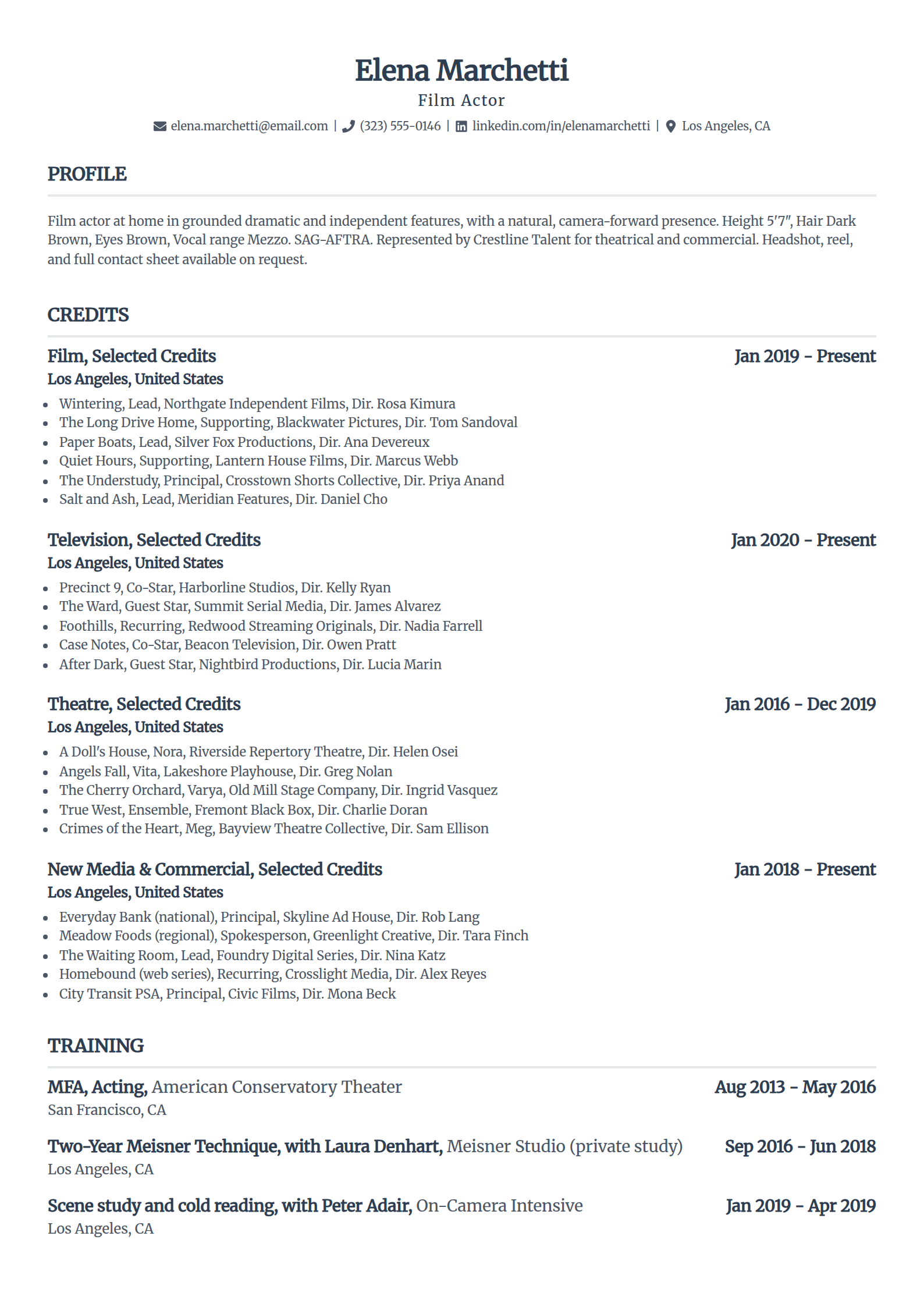
Why this resume example works?
- Groups credits by medium and keeps film and television in separate sections, which is the professional convention.
- Uses the credit-line format casting reads fast: production, role type, production company, and director.
- Opens with a short profile plus vitals and union status, the header an actor resume leads with.
- Names the role type (Lead, Supporting, Principal) on every credit so the level of each part is clear.
- Keeps special skills specific and honest, listing only trained accents rather than a padded skills dump.
Theatre Resume Template
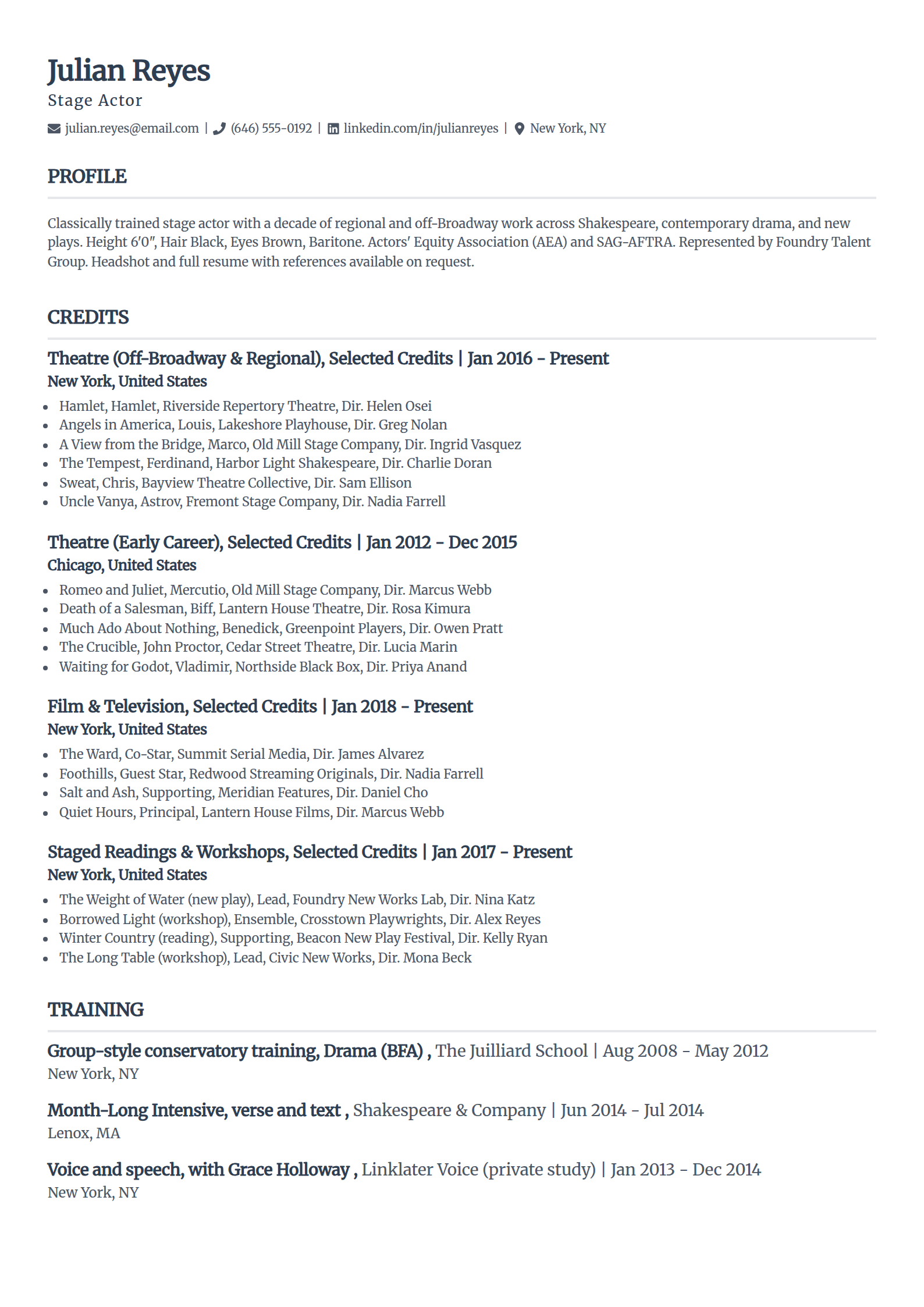
Why this resume example works?
- Leads with theatre credits in the show, role, theatre, director format that stage casting expects.
- Separates off-Broadway and regional work from early-career credits so the trajectory reads clearly.
- Puts classical training and union status up top, the first things a stage director scans for.
- Lists verse, dialect, and stage-combat skills that matter for classical and new-play casting.
- Keeps a clean single-column layout, the safest and most traditional look for a theatre resume.
Television Actor Resume Template
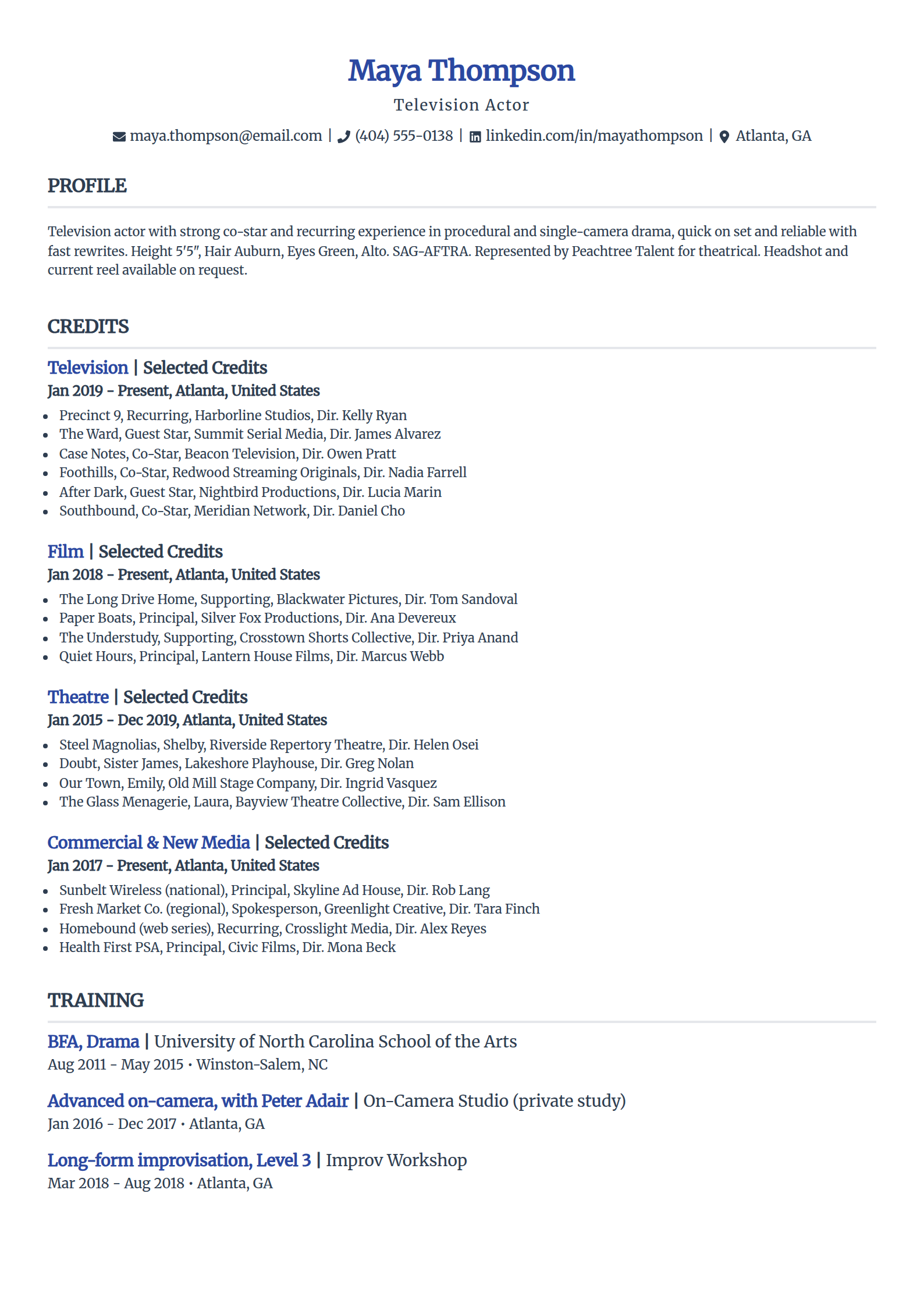
Why this resume example works?
- Leads with television credits and the exact role types casting uses: Guest Star, Co-Star, Recurring.
- Keeps film and TV in separate sections, signaling the actor knows industry resume conventions.
- Names the director on every credit, which lets a casting office verify and place the work.
- Highlights on-camera skills, self-tape and cold reading, that TV auditions rely on.
- Stays to one clean page so a busy casting director gets the whole picture in one glance.
Musical Theatre Resume Template
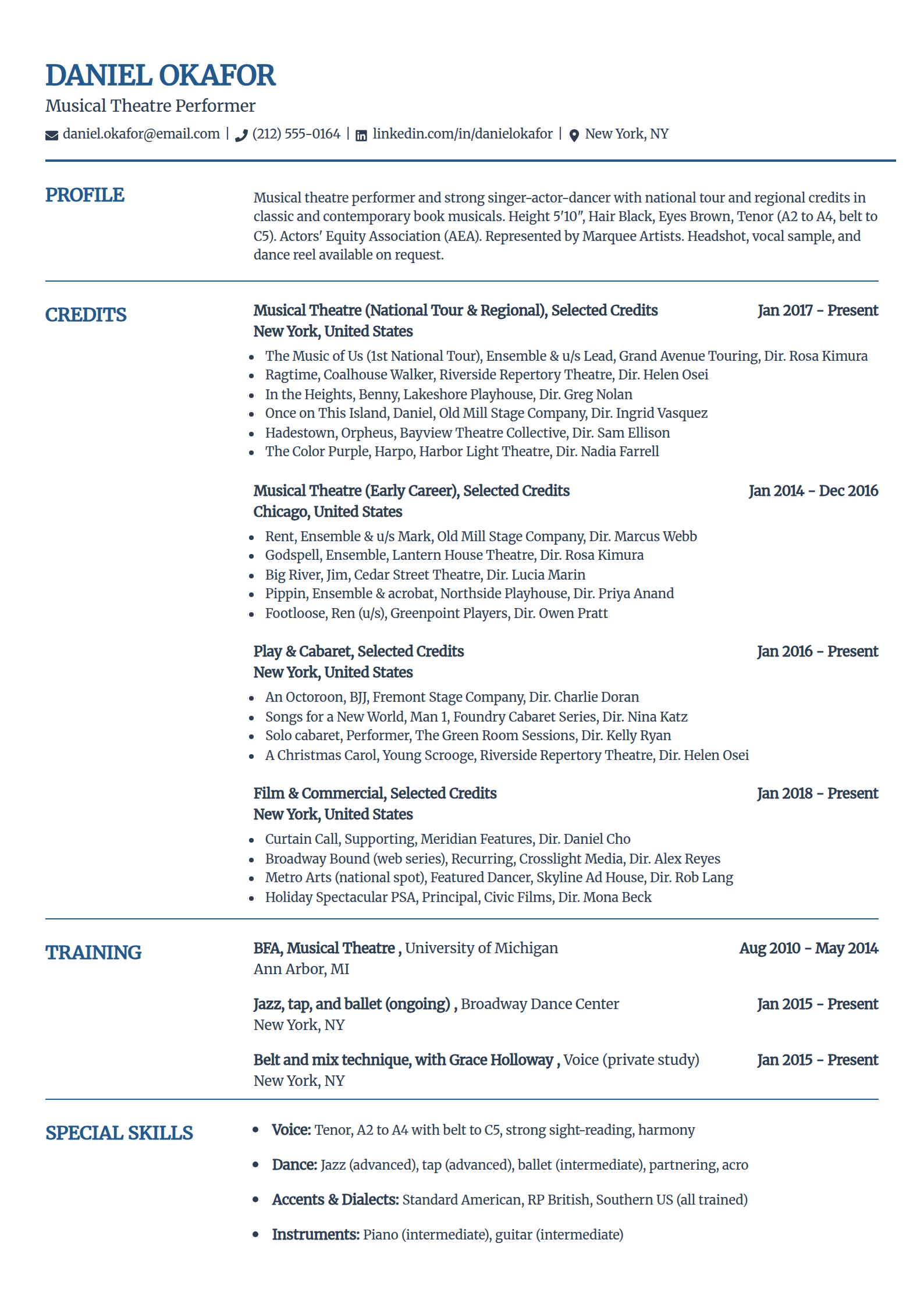
Why this resume example works?
- States vocal range and type in the profile, the single most important detail for a musical audition.
- Groups musical theatre credits with role and theatre, and notes understudy and dance-captain tracks.
- Separates dance skill levels by style, jazz, tap, and ballet, so a choreographer can cast accurately.
- Leads with a national tour credit, the kind of line that moves a musical theatre resume to the top.
- Keeps training current, showing ongoing voice and dance study rather than a degree alone.
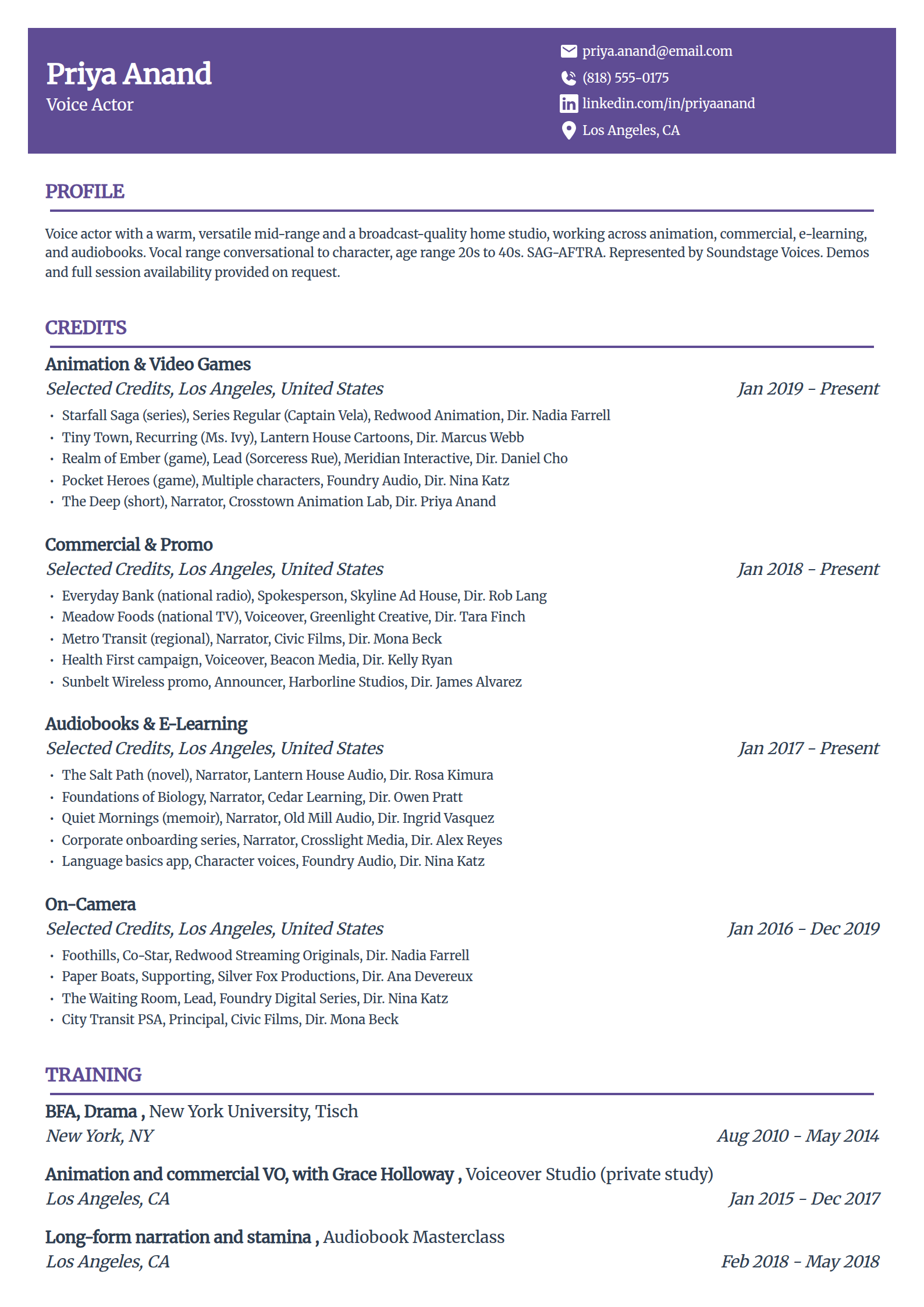
Voice Actor Resume Template
Why this resume example works?
- Groups voice credits by genre, animation, commercial, and audiobooks, the way voice casting sorts them.
- Names the home-studio setup and gear, which tells a client the actor can deliver broadcast audio remotely.
- Lists role types like Series Regular and Narrator so the scope of each voice credit is clear.
- Keeps accents and languages to trained, castable options rather than a long unverified list.
- Reads as a working voice actor, pairing on-camera roots with a focused voiceover credit list.
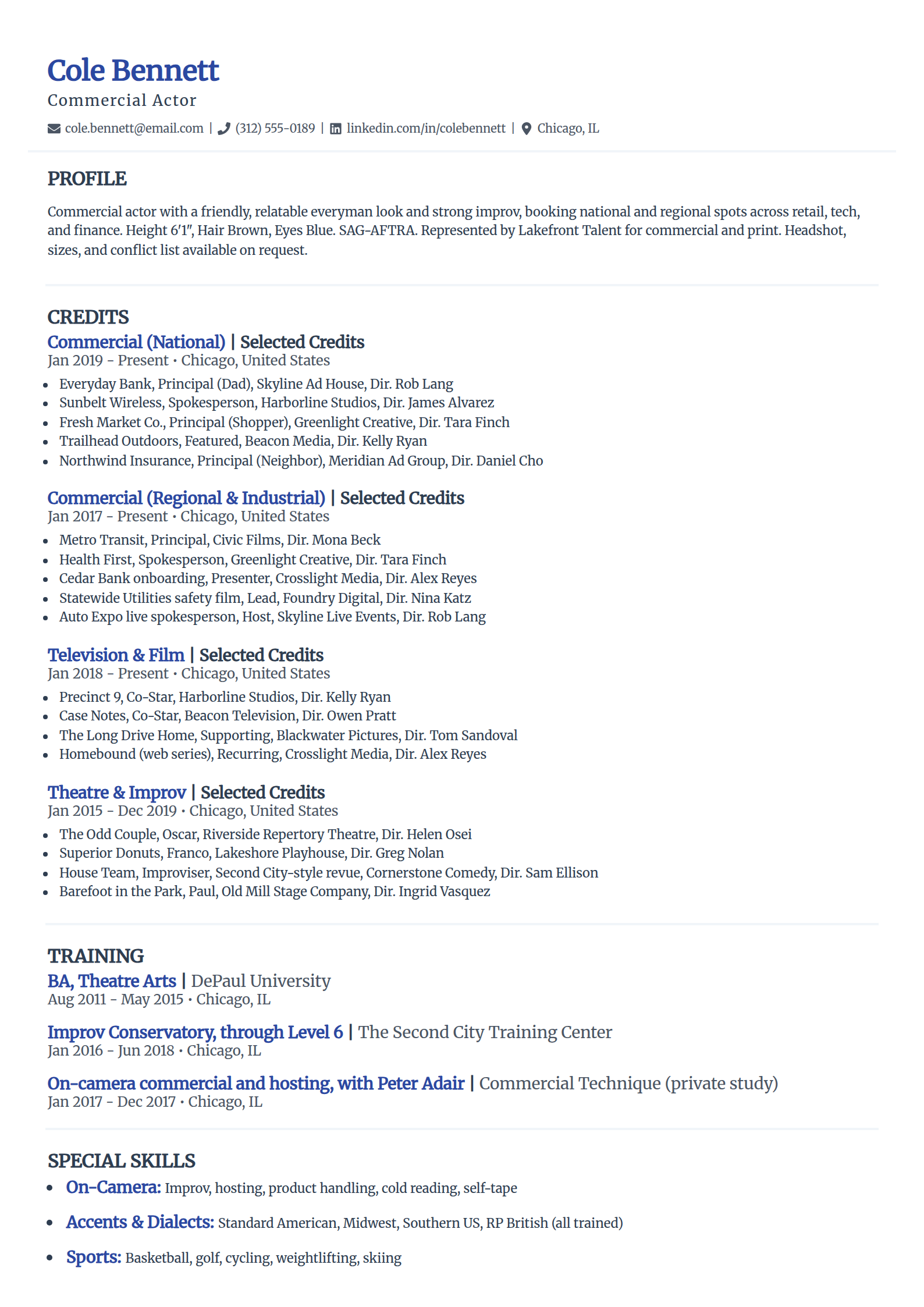
Commercial Actor Resume Template
Why this resume example works?
- Separates national from regional and industrial spots, the distinction commercial casting cares about.
- Notes conflicts and sizing availability in the profile, exactly what a commercial session needs.
- Leads with improv and hosting skills, the traits that book relatable everyman commercial roles.
- Uses role types like Principal and Spokesperson so the size of each booking is obvious.
- Keeps the look clean and friendly, matching the approachable brand of a commercial performer.
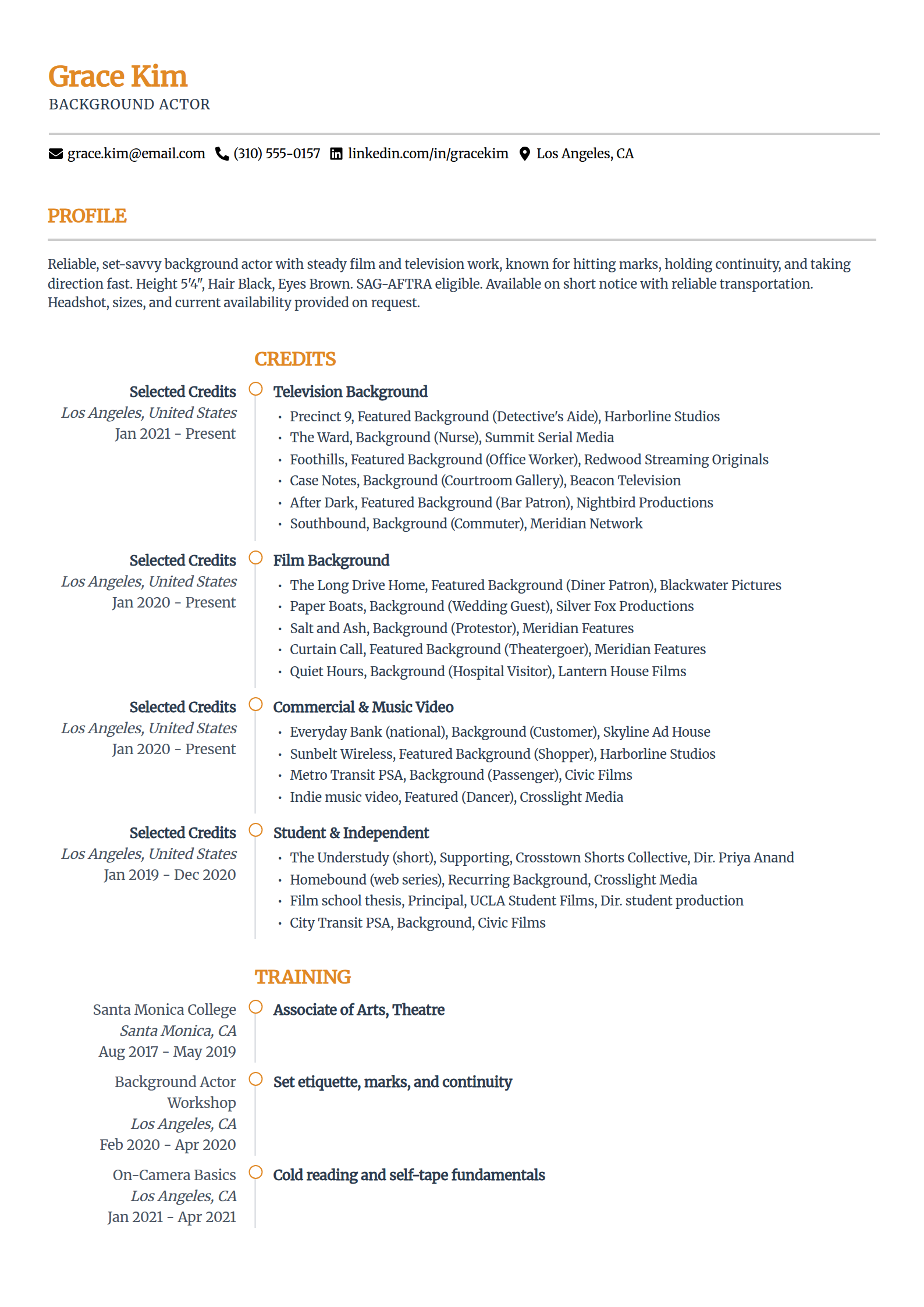
Background Actor Resume Template
Why this resume example works?
- Leads with reliability and set skills, hitting marks and holding continuity, which is what background booking rewards.
- Groups background work by medium and notes Featured Background where the actor was upgraded.
- Lists wardrobe options and logistics, a car and flexible schedule, that background casting asks about.
- Stays honest about union eligibility rather than overstating status, which casting checks.
- Keeps everything to one skimmable page, the format a background coordinator wants.
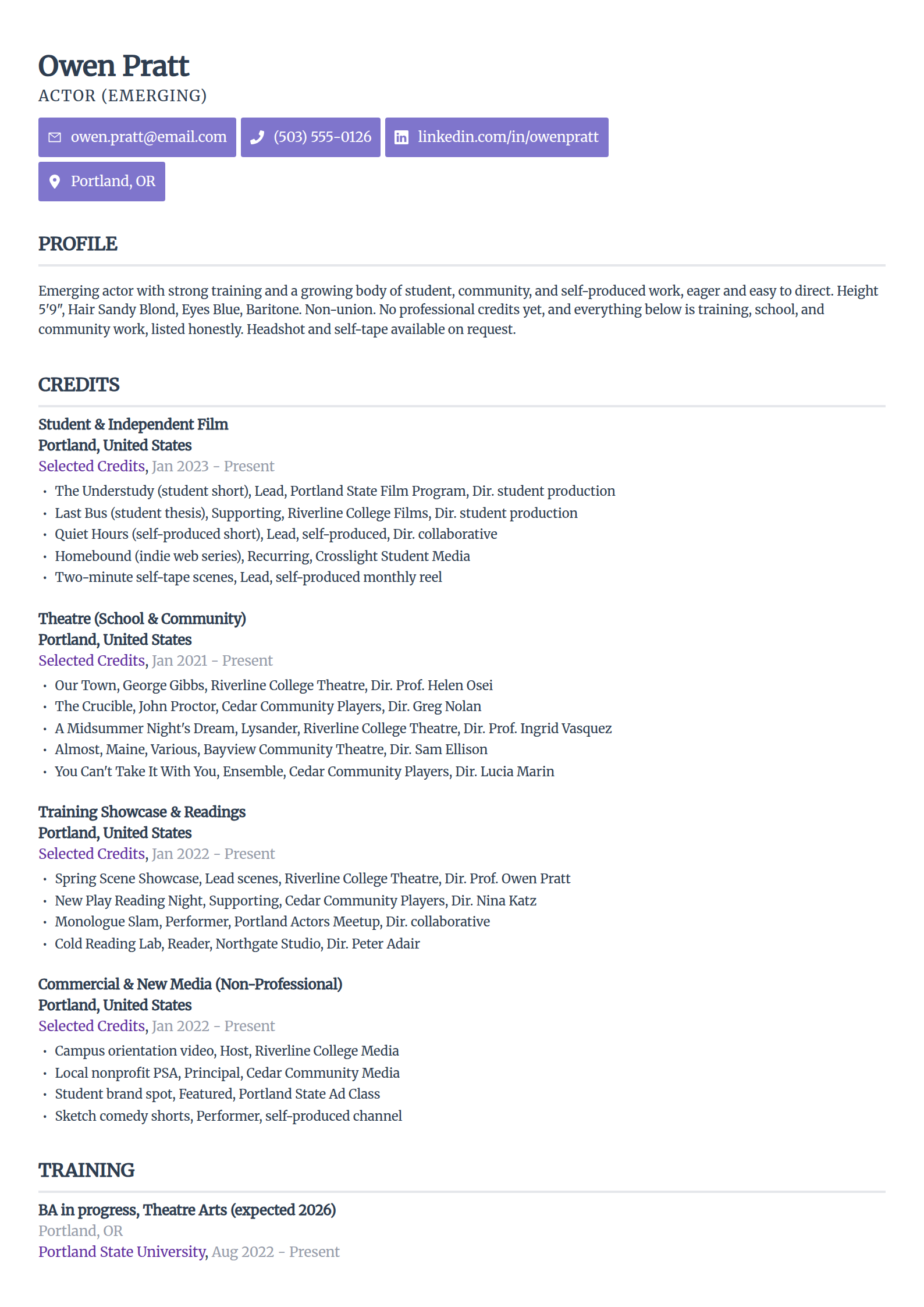
Beginner Acting Resume Template (No Credits)
Why this resume example works?
- States plainly that there are no professional credits yet, then leads with training and honest school work.
- Fills the credits section with student films, community theatre, and self-tapes, which are legitimate beginner lines.
- Never invents a professional role, the fastest way a new actor loses a casting director's trust.
- Puts strong training and studio work up front, the real currency of a beginner's resume.
- Lists castable, in-training skills honestly instead of padding with claims that fall apart in the room.
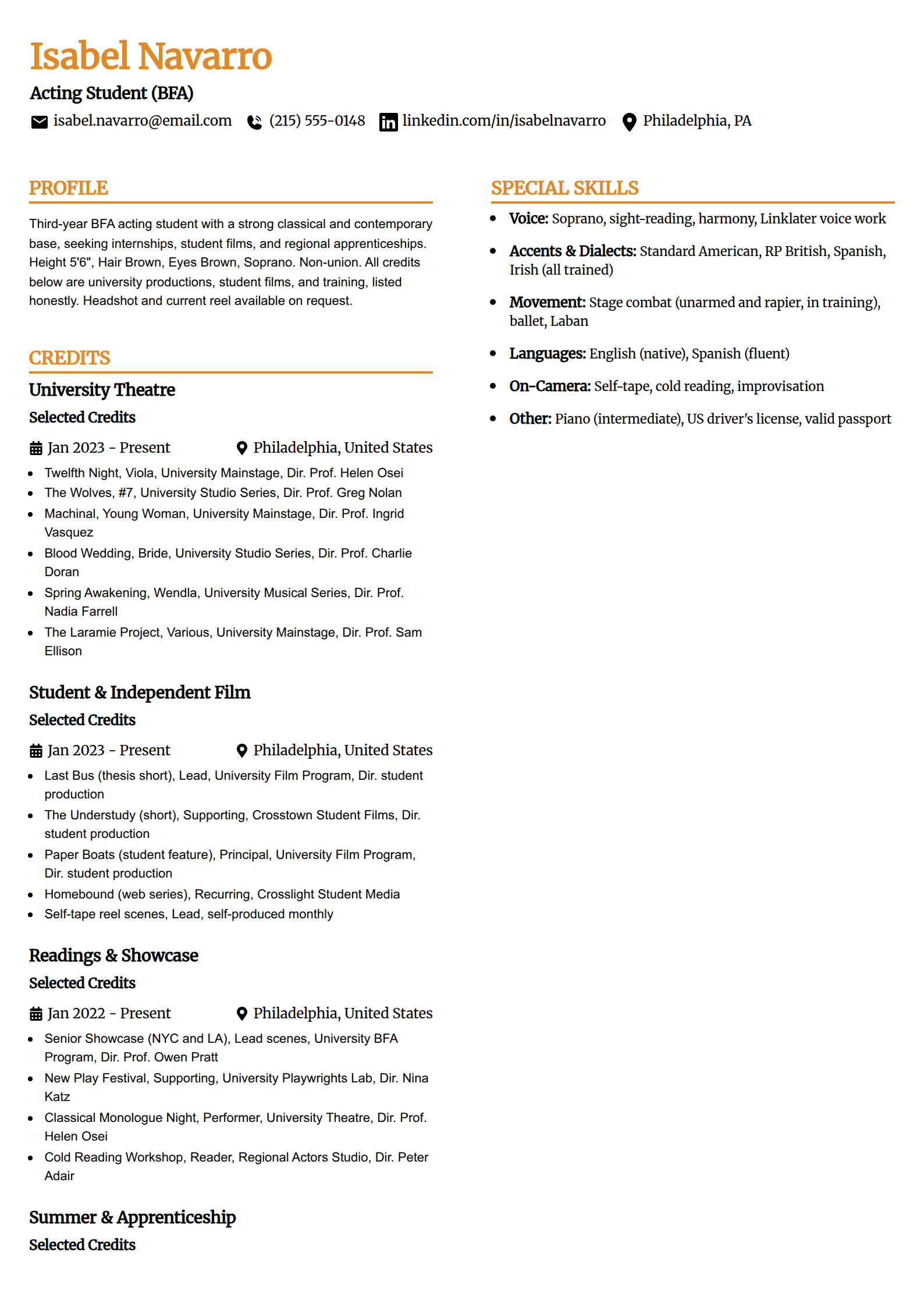
Drama Student Resume Template
Why this resume example works?
- Leads with university productions and roles, the core credits a BFA student has to show.
- Adds student films and a summer apprenticeship, broadening the reel beyond the mainstage.
- Puts the conservatory training and voice and movement work where a casting intern looks first.
- Notes the degree is in progress with an expected year, which is honest and normal for a student.
- Keeps skills specific to trained work, matching the credibility a showcase audience expects.
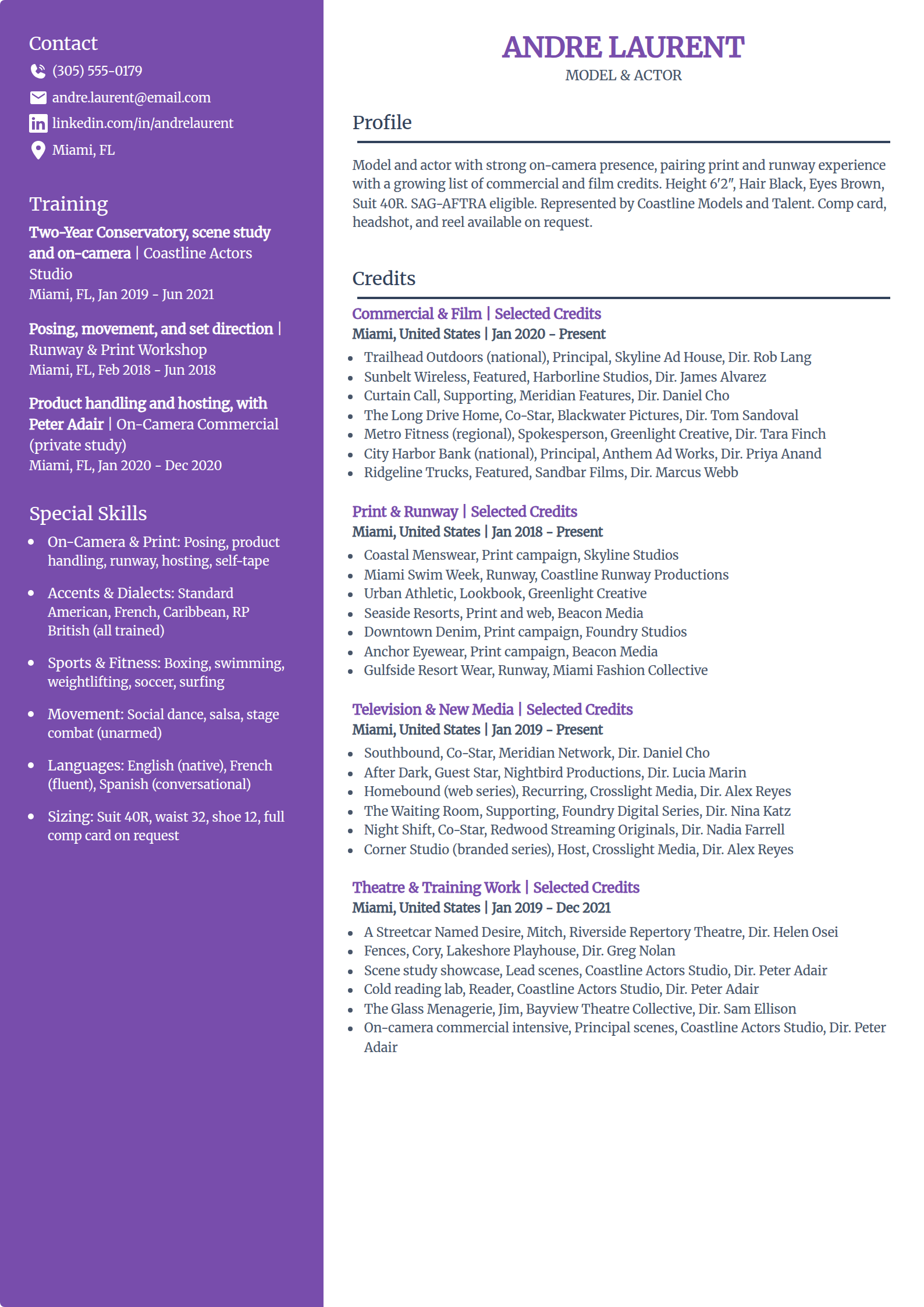
Model & Actor Resume Template
Why this resume example works?
- Balances acting credits with a separate print and runway section, the split a model-actor needs.
- States height, sizing, and a comp-card note in the profile, the details modeling submissions require.
- Uses acting role types on the screen credits so the performing side reads as more than a look.
- Lists physical and movement skills, boxing and dance, that book both commercial and fashion work.
- Keeps union eligibility and representation clear for the acting side of the business.
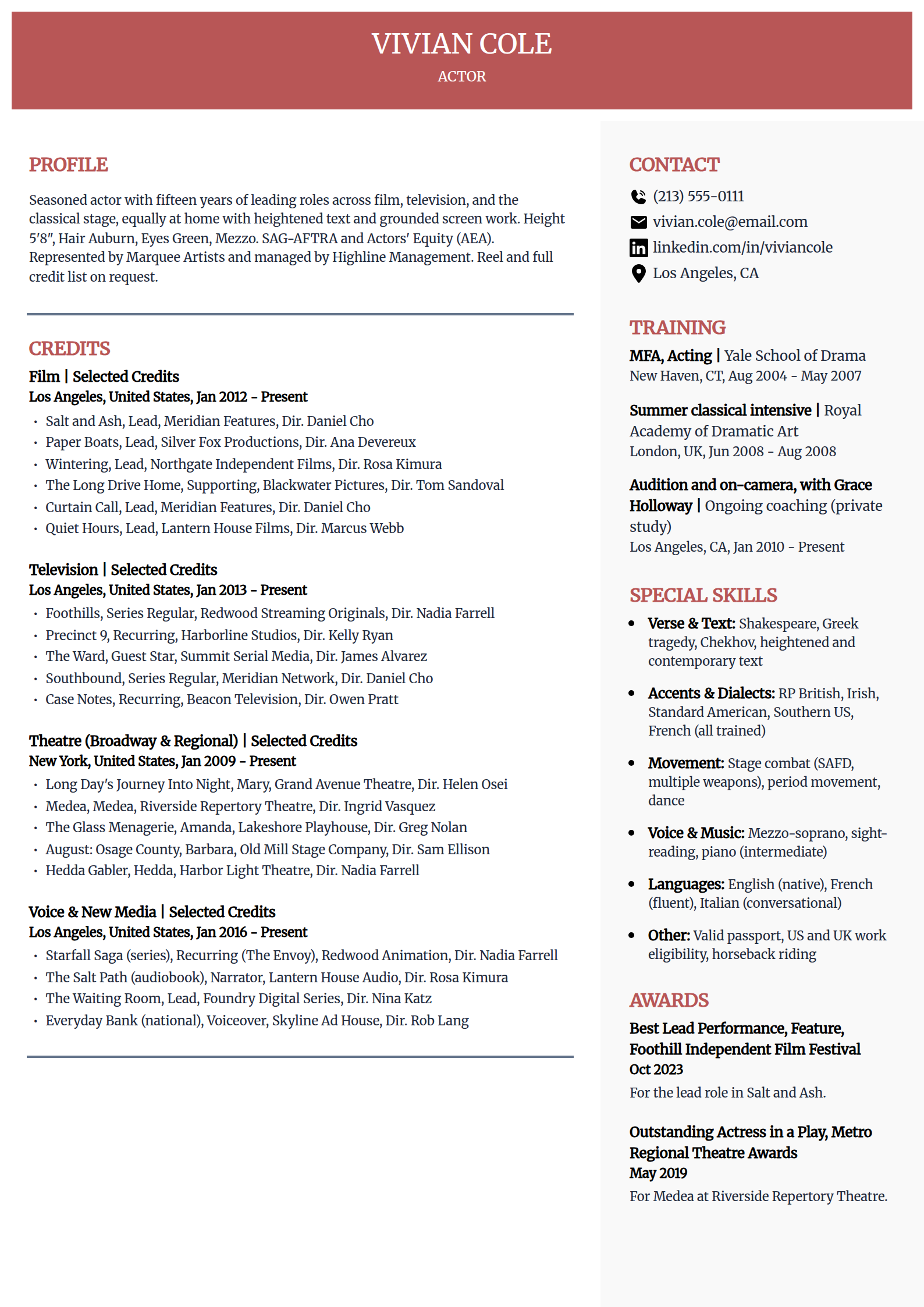
Experienced Actor Resume Template
Why this resume example works?
- Leads with lead film and series-regular credits, the strongest lines a seasoned actor can show.
- Groups film, television, theatre, and voice separately so a deep resume stays easy to read.
- Notes both SAG-AFTRA and Equity plus management, the full professional footprint of a working lead.
- Carries top-tier training and awards without clutter, letting the credits do the talking.
- Keeps role types precise, Lead and Series Regular, so the level of the career is unmistakable.
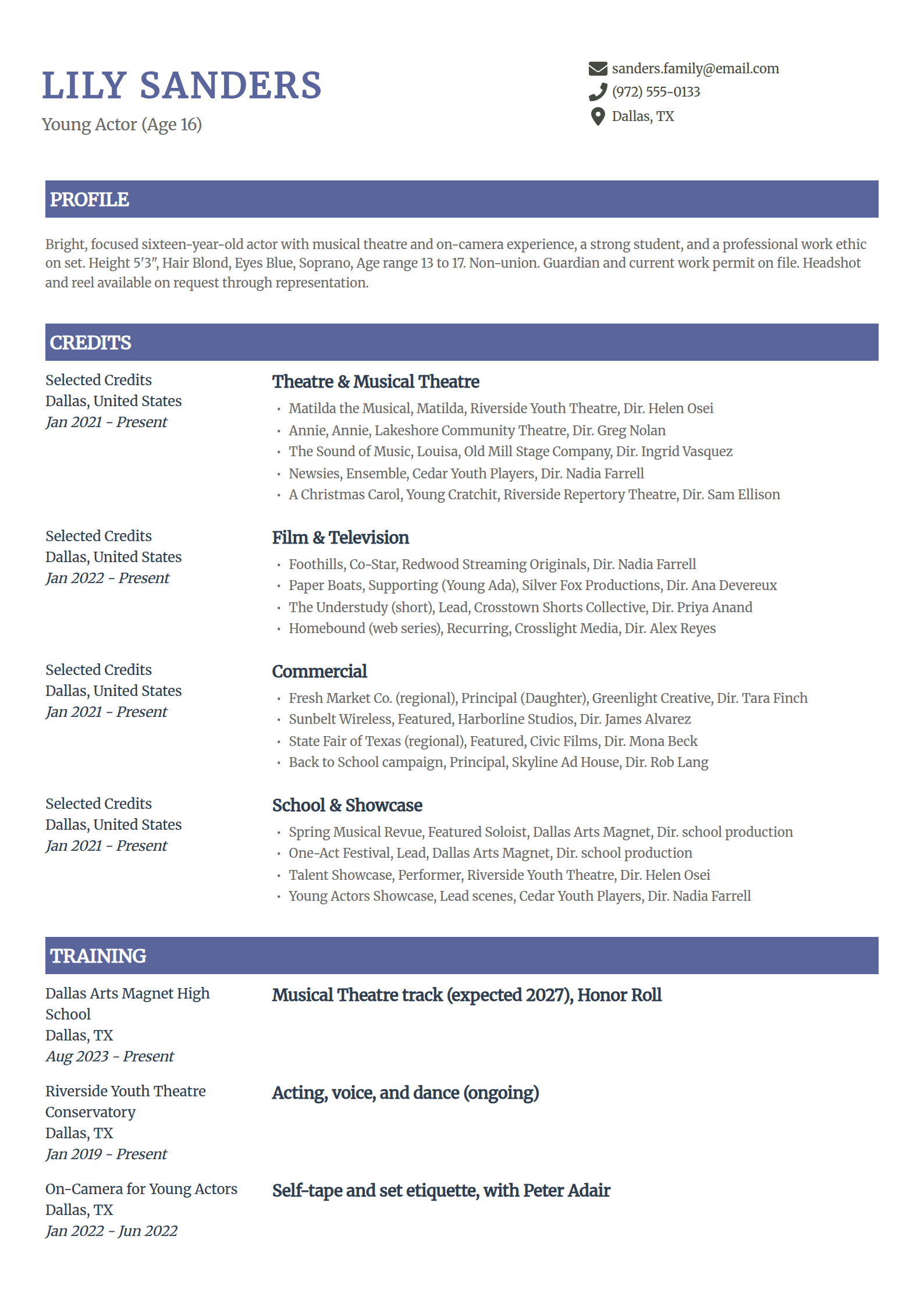
Teen Actor Resume Template
Why this resume example works?
- States age range and that a work permit and guardian are on file, the details young-performer casting needs.
- Leads with age-appropriate musical theatre and youth credits, which read as real and castable.
- Keeps contact through representation and a family email, the safe convention for a minor's resume.
- Notes strong-student status and youth training, signals a set values in a young actor.
- Lists skills like gymnastics and singing that open up the roles teens actually audition for.
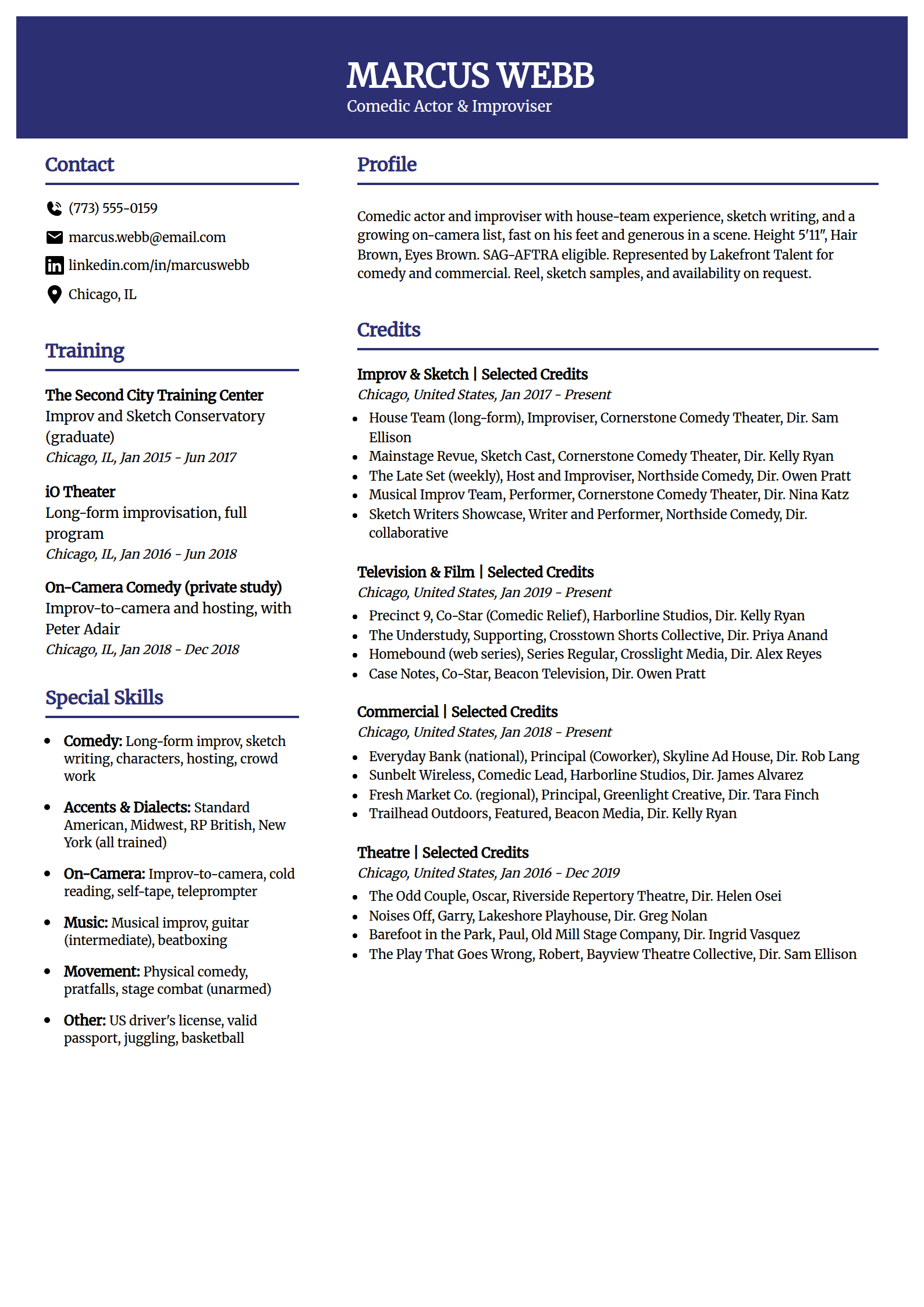
Comedy & Improv Resume Template
Why this resume example works?
- Leads with house-team and sketch credits, the currency of a comedy and improv resume.
- Names the training theaters and full conservatory programs that comedy casting recognizes.
- Adds on-camera comedic roles so the resume shows range beyond the live stage.
- Lists comedy-specific skills, characters, hosting, and crowd work, that book the room.
- Keeps a lively but readable layout that fits a comedic brand without losing the credits.
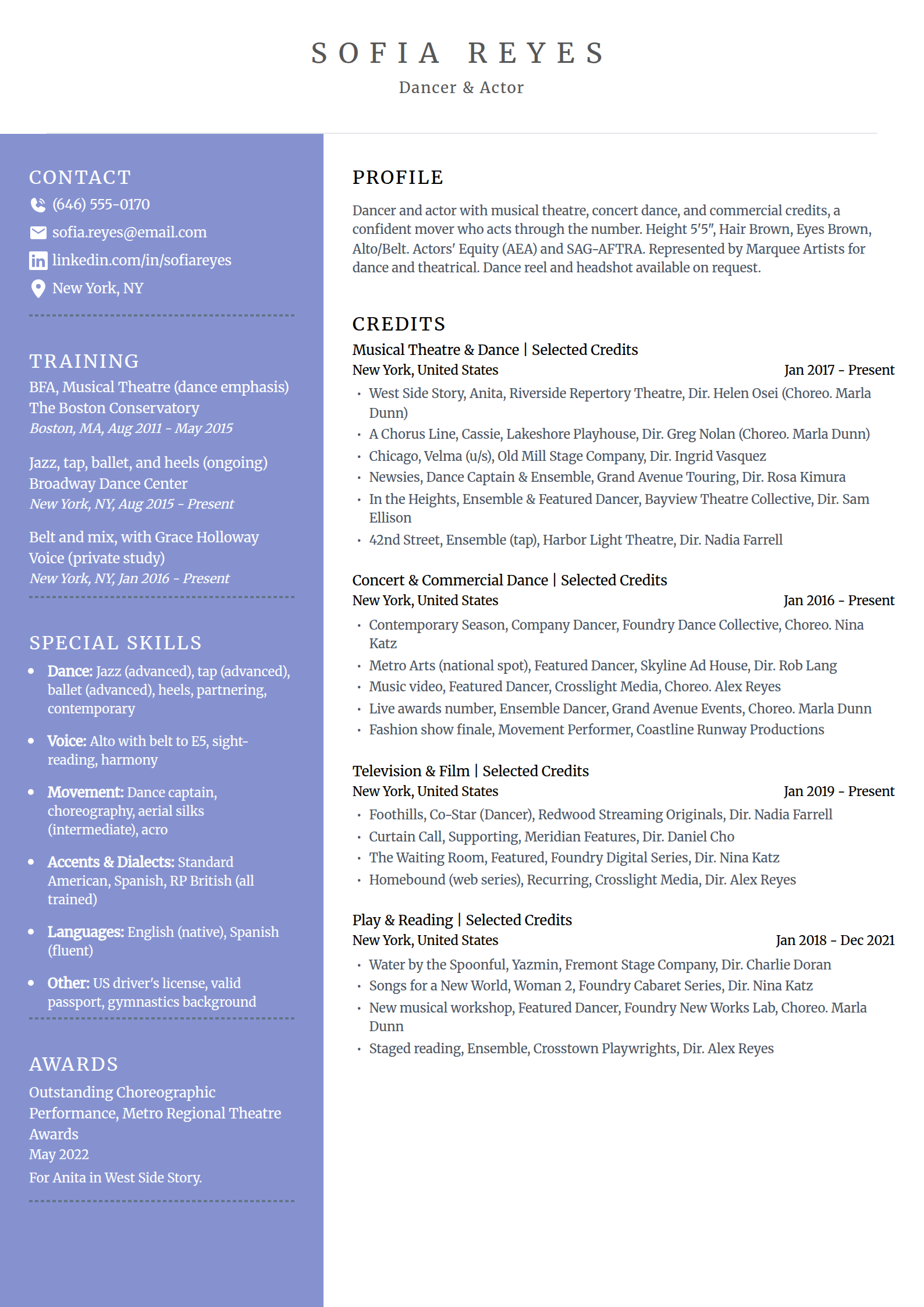
Dancer & Actor Resume Template
Why this resume example works?
- Leads with musical theatre and dance credits and notes the choreographer, which dance casting looks for.
- Separates concert and commercial dance from stage work so the full movement resume is clear.
- Lists dance styles by level and flags dance-captain roles, signaling leadership and range.
- States vocal range alongside dance, the triple-threat detail a musical audition needs.
- Fills the sidebar with detailed movement and voice skills that book dance-heavy productions.
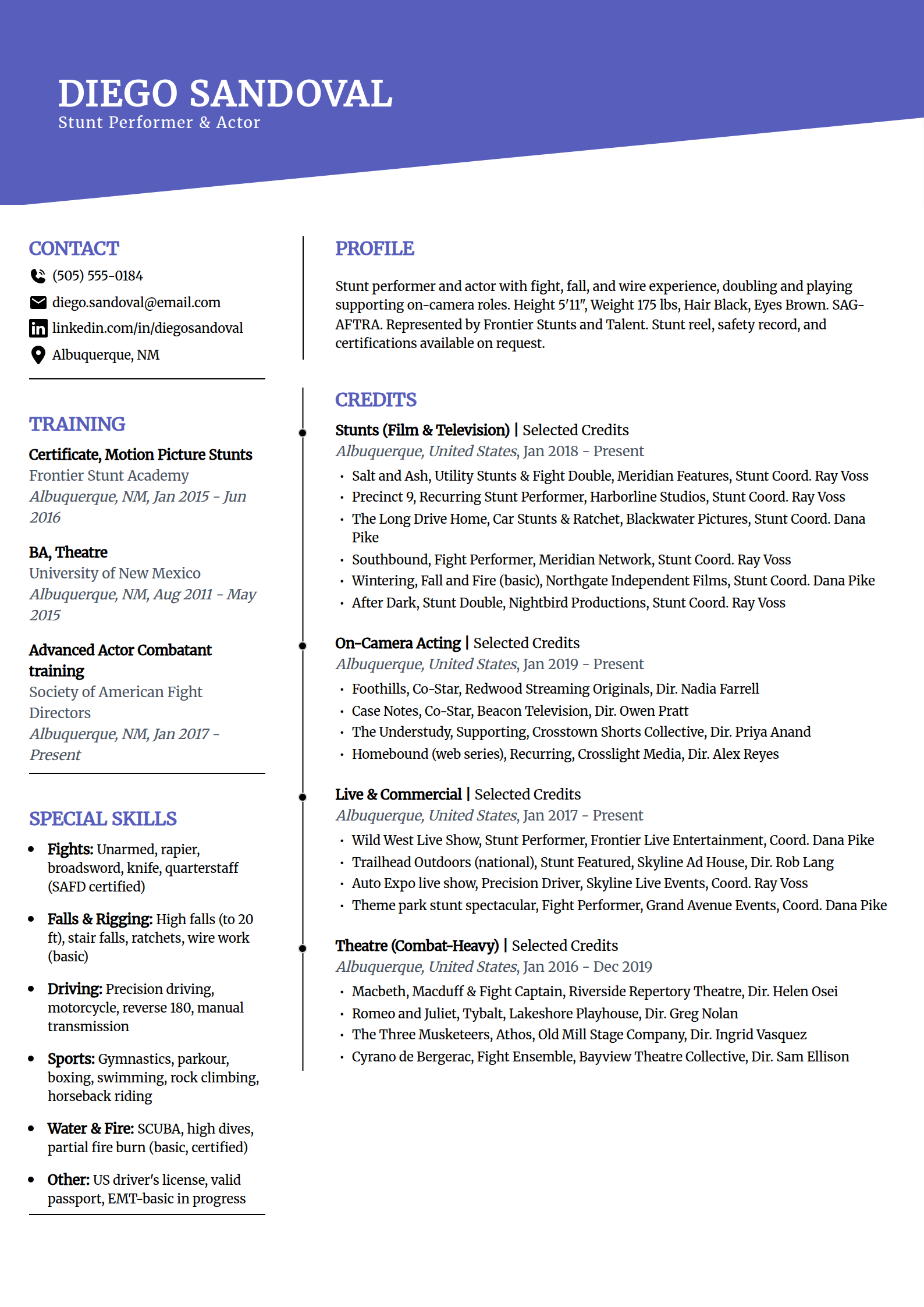
Stunt Performer Resume Template
Why this resume example works?
- Leads with stunt credits and names the stunt coordinator, the reference that matters in the stunt world.
- Separates stunts from on-camera acting so both sides of the career are visible.
- Lists certified fight, fall, and driving skills with specifics, which is how stunt work is cast.
- States height, weight, and union status, the vitals a stunt coordinator matches for doubling.
- Backs the skills with real training and certifications, since safety claims must be verifiable.
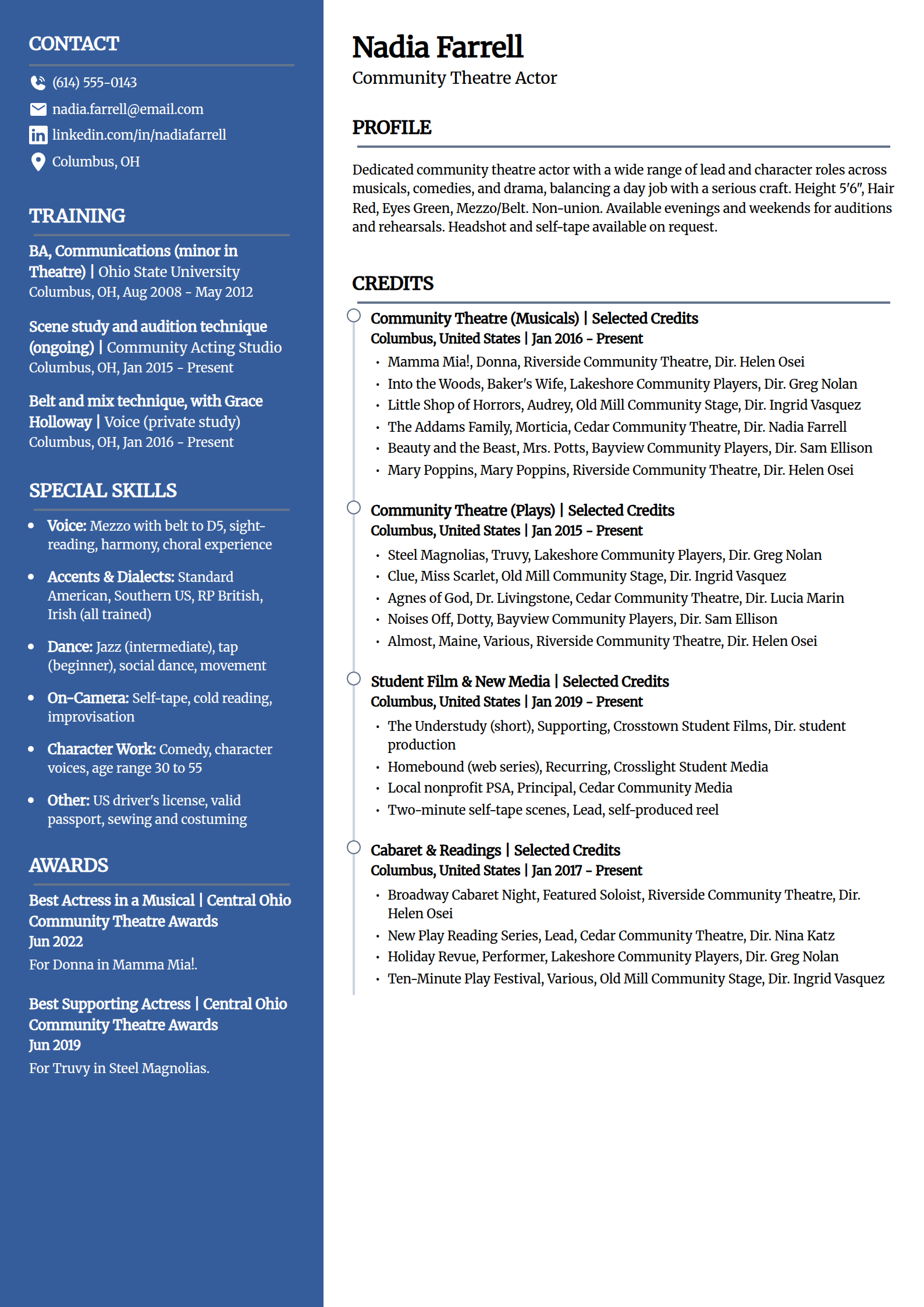
Community Theatre Resume Template
Why this resume example works?
- Groups community musicals and plays separately, showing real range across lead and character roles.
- Leads with strong named roles so a serious hobbyist reads as a capable, castable actor.
- Adds student film and cabaret work, broadening the resume beyond the community stage.
- Notes availability and non-union status honestly, which local and regional casting expects.
- Lists voice, dance, and character skills that fit the wide roles community theatre casts.
Build your acting resume
Pick a template above, follow the credits-by-medium structure from the example that fits you, and swap in your own roles, training, and special skills on one clean page.
Build my resumeHow to write an acting resume in 2026
An acting resume is not a work-history resume. It is one page, it groups credits by medium, and it lists roles, training, and skills without duty bullets. These rules are what tell a casting director you know the business.
Keep it to one page with the actor's header
Fit everything on a single page, headshot on the back for in-person submissions. Start with your name, contact through your rep or a professional email, and your vitals: height, hair, eyes, vocal range, and union status. A representation line goes here if you are signed.
Height 5'7", Hair Dark Brown, Eyes Brown, Mezzo. SAG-AFTRA. Represented by Crestline Talent. Headshot and reel available on request.
Group credits by medium, never combine film and TV
Give each medium its own section and list the strongest work first. Film and television always sit in separate sections; combining them reads as unprofessional.
- Film and TV: title, role type (Lead, Supporting, Co-Star, Recurring, Guest Star), production company or network, director.
- Theatre: show, role, theatre or company, director.
- Order sections by where your strongest credits are, and within each, lead with the best role.
List training with the program and the teacher
Training tells casting how you work. Name the school or conservatory, then the master classes, private coaching, and workshops, with the teacher's name where it carries weight.
- Degree or conservatory first (BFA, MFA, or a named studio program).
- Then technique study: Meisner, voice and speech, on-camera, stage combat, with the coach named.
- Ongoing study reads as current, so keep recent workshops on the page.
Make special skills castable and honest
List physical stats and skills a role could actually call for: vocal range and type, dialects (only trained ones), stage combat, dance styles by level, instruments, sports, and driving. A padded skills list that falls apart in the room costs you the next audition, so claim only what you can do on demand.
When you have no credits, lead with training
A new actor never invents a professional role. Build the resume from what is real and let training carry it.
- List student films, school and community theatre, staged readings, and self-produced work honestly, labeled as such.
- Put your training and studio work at the top, since it is your strongest material.
- State your type and castable skills, and keep the whole thing to one confident page.
Common acting resume mistakes
- Combining film and television in one section. Casting reads that as someone who does not know the format.
- Inventing credits or inflating a background role to a principal. It is easy to check and it ends the audition.
- Running past one page. An acting resume is always a single page, trimmed to your strongest work.
- Padding special skills with untrained accents or dance you cannot do on demand. Claim only what holds up in the room.
- Listing home address and personal details. Use representation or a professional email, and for minors, contact through a guardian or rep.
Frequently asked questions
How should an acting resume be formatted?
One page, with your name and vitals (height, hair, eyes, vocal range, union status) at the top, then credits grouped by medium, then training and special skills. List roles, not duty bullets. For in-person submissions, staple it to the back of your headshot.
How do you list credits on an acting resume?
Group them by medium and keep film and television separate. For film and TV, list the title, your role type (Lead, Supporting, Co-Star, Recurring, Guest Star), the production company or network, and the director. For theatre, list the show, your role, the theatre, and the director.
What goes on an acting resume with no experience?
Lead with training, then list student films, school and community theatre, staged readings, and self-produced work, labeled honestly. Never invent a professional credit. Add your type, vitals, and castable special skills, and keep it to one page.
What special skills should go on an acting resume?
Only skills a role could call for and that you can do on demand: vocal range and type, trained dialects, stage combat, dance styles by level, instruments, sports, and driving. Do not list an accent as a skill unless you have trained it, since casting will test it.
Do I need a different resume for theatre and film?
The format is the same one-page structure, but you reorder it. A theatre resume leads with stage credits and classical training; a film or TV resume leads with screen credits and on-camera skills. Put the section with your strongest, most relevant work first for the role you are submitting for.
Which template is best for an acting resume?
A clean, single-column layout with clear section headings reads best and is what most casting directors expect. A creative job does not mean a graphic-heavy resume. The templates above keep the credits-by-medium structure while offering a range of looks for general and portfolio use.
More acting resume resources
Build your acting resume
Pick a template above, follow the credits-by-medium structure from the example that fits you, and swap in your own roles, training, and special skills on one clean page.