Dance Resume Templates and Examples for Performers and Teachers
- Audition & Teacher Formats
- Credits by Choreographer
- 16 Real Examples
A dance resume is really two documents. Auditioning dancers use a credits-and-training layout that names the choreographer on every line; dance teachers use a results-driven format with student numbers and certifications. Both are below, with 16 real examples you can build from.


540k+ resumes created
Editable dance and dance teacher resume templates
Each template below is a real dance resume laid out in that style, sorted by the kind of work you do. Performer examples keep the audition structure a company or casting panel expects: credits grouped and named by choreographer, then training and special skills. Dance teacher examples switch to a results format with class sizes, recital productions, and certifications. Pick one, then swap in your own credits or teaching numbers.
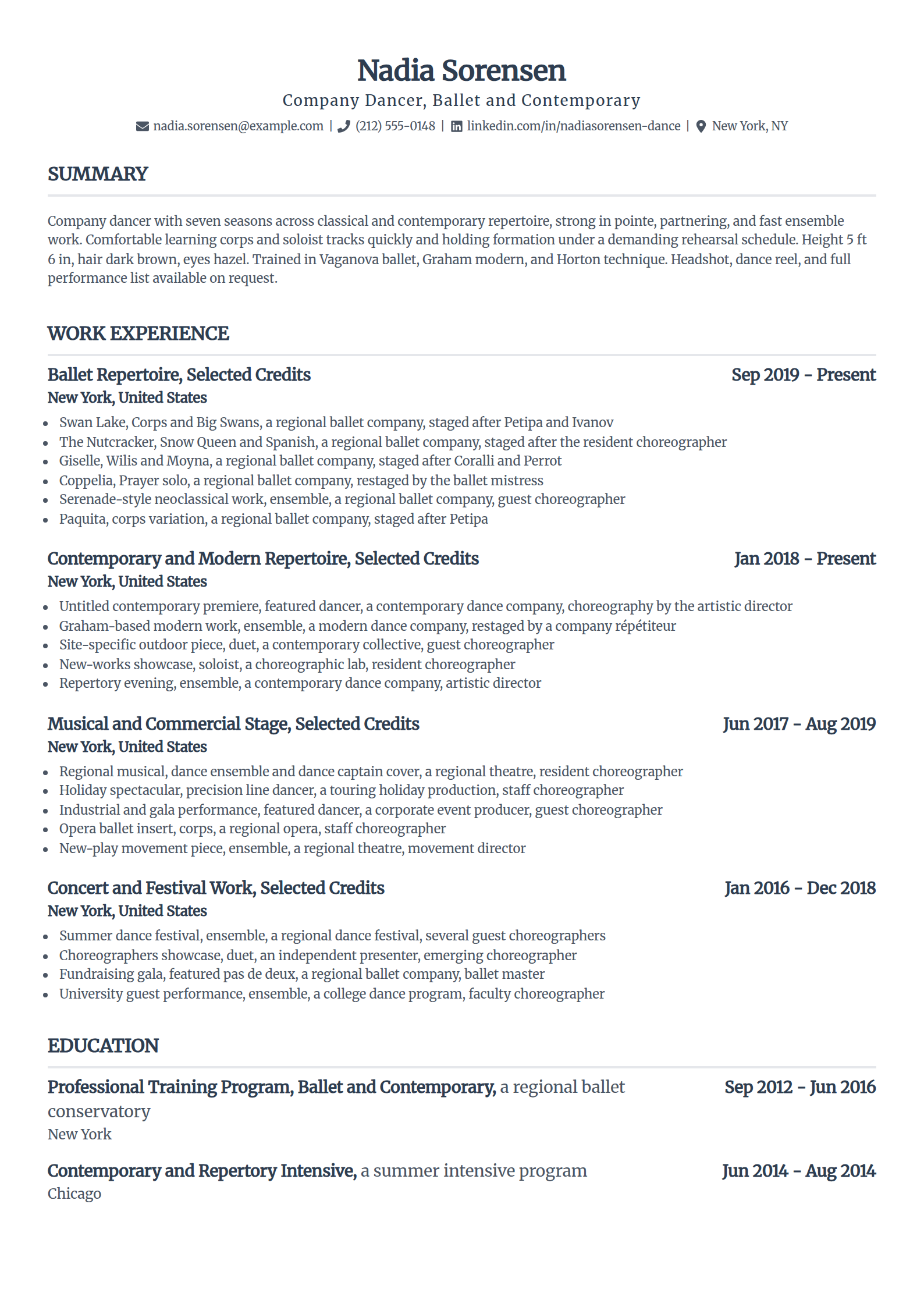
Company Dancer Resume Template
Why this resume example works?
- Groups credits by repertoire, ballet, contemporary, and stage, the way a company director reads a dancer's history.
- Names the choreographer or staging on every line, which is the dance equivalent of an acting director credit.
- Opens with a profile plus physical stats and training, the header a company audition expects up top.
- Keeps technique specific, Vaganova, Graham, and Horton, rather than a vague list of styles.
- Fits a full seven-season record on one clean page a panel can scan fast.
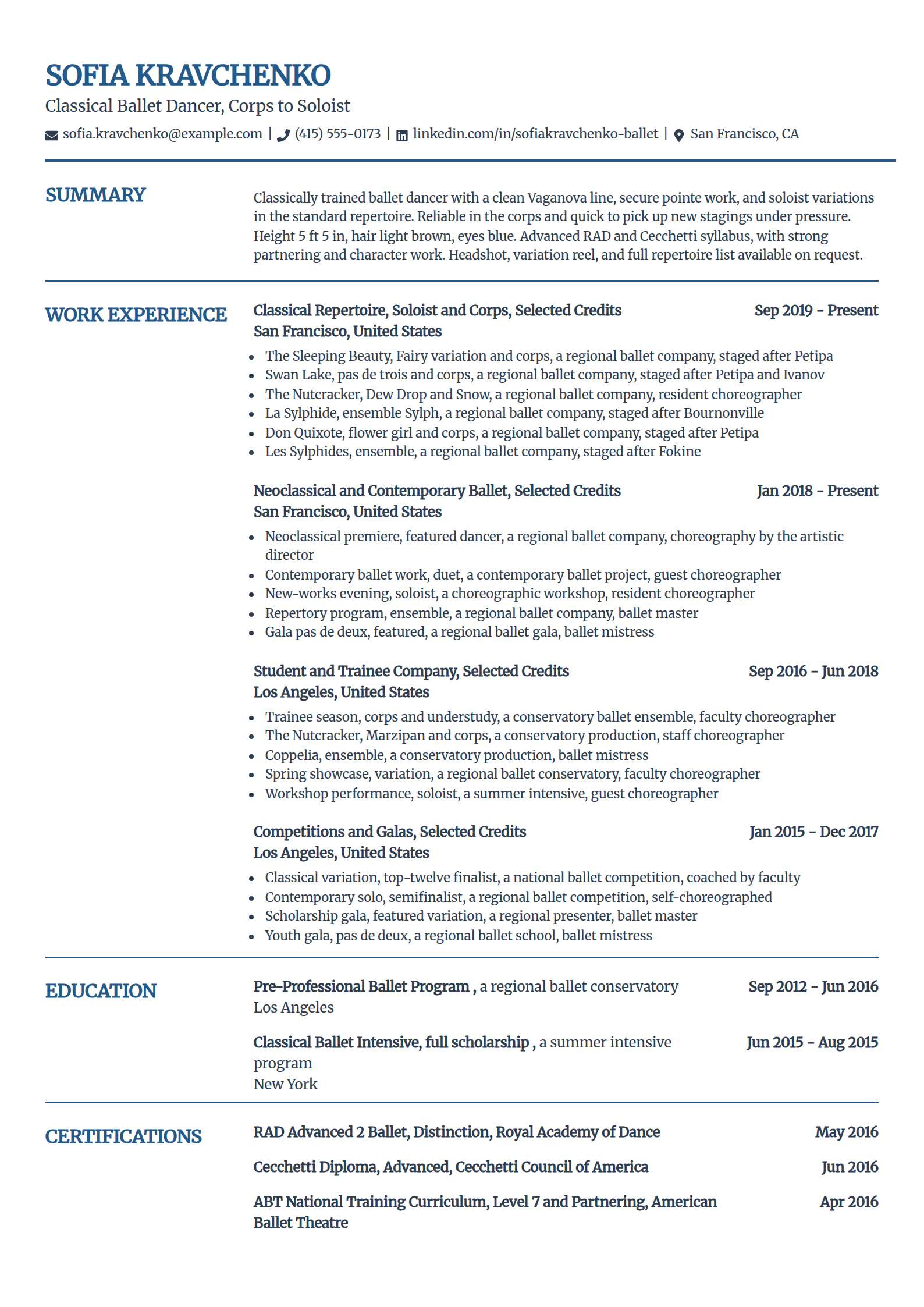
Ballet Dancer Resume Template
Why this resume example works?
- Leads with classical repertoire and role level, corps, soloist, and variations, so a ballet company reads the level fast.
- Uses public-domain staging notation, staged after Petipa and Bournonville, exactly as playbills credit classical work.
- Lists graded syllabus exams, RAD Advanced 2 and ABT levels, the credentials a ballet audition verifies.
- States pointe and partnering separately, the details that decide casting in the classical repertoire.
- Keeps the layout clean and traditional, the safe look for a classical ballet submission.
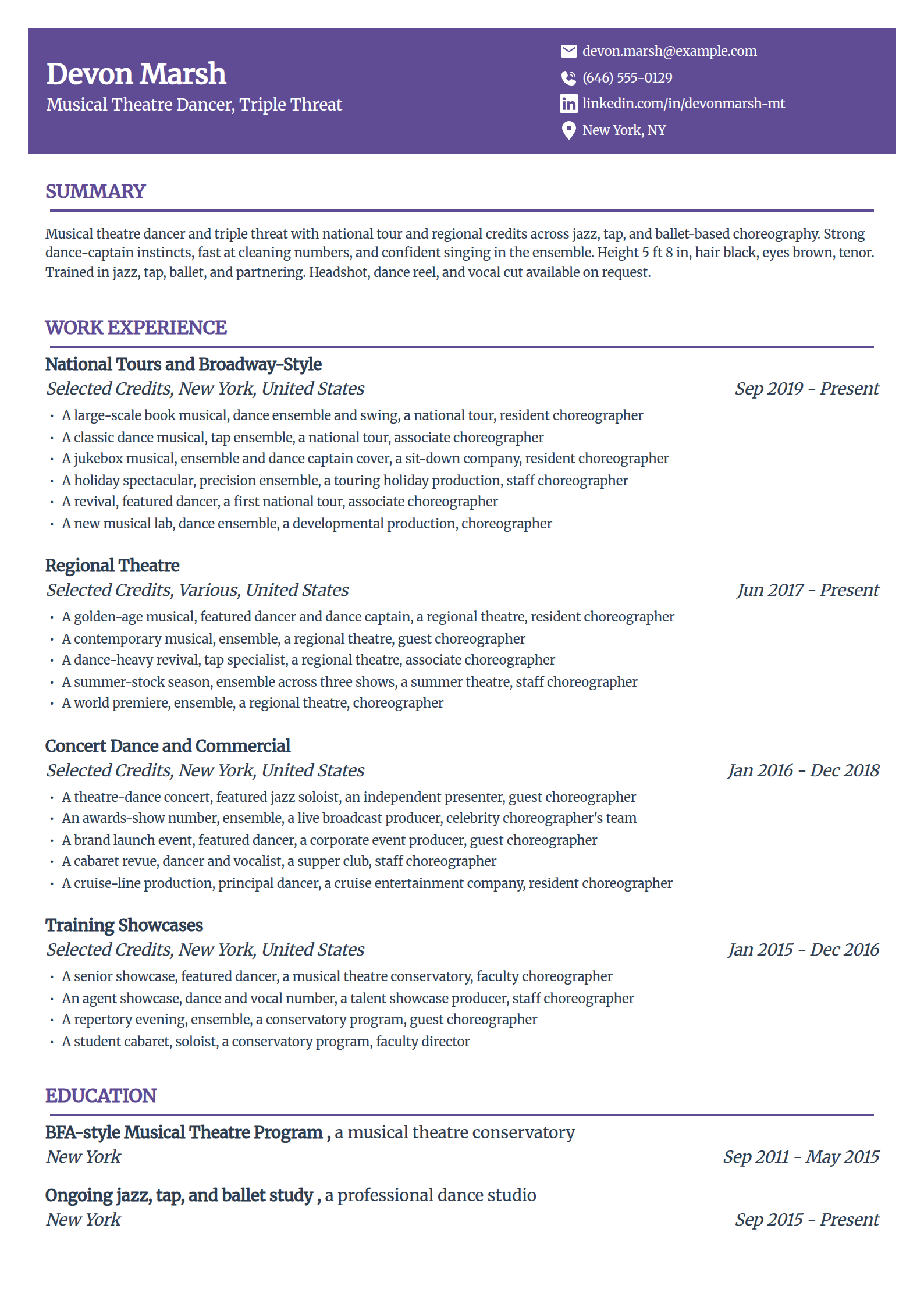
Musical Theatre Dancer Resume Template
Why this resume example works?
- Separates national tours from regional and concert work, the split a musical audition wants to see.
- States the vocal range in the profile, the triple-threat detail that decides an ensemble booking.
- Notes dance-captain and swing tracks on the credits, which signal reliability to a stage manager.
- Lists jazz, tap, and ballet with partnering, the exact combination a dance call tests.
- Keeps the credits list readable while carrying a deep record on a single page.
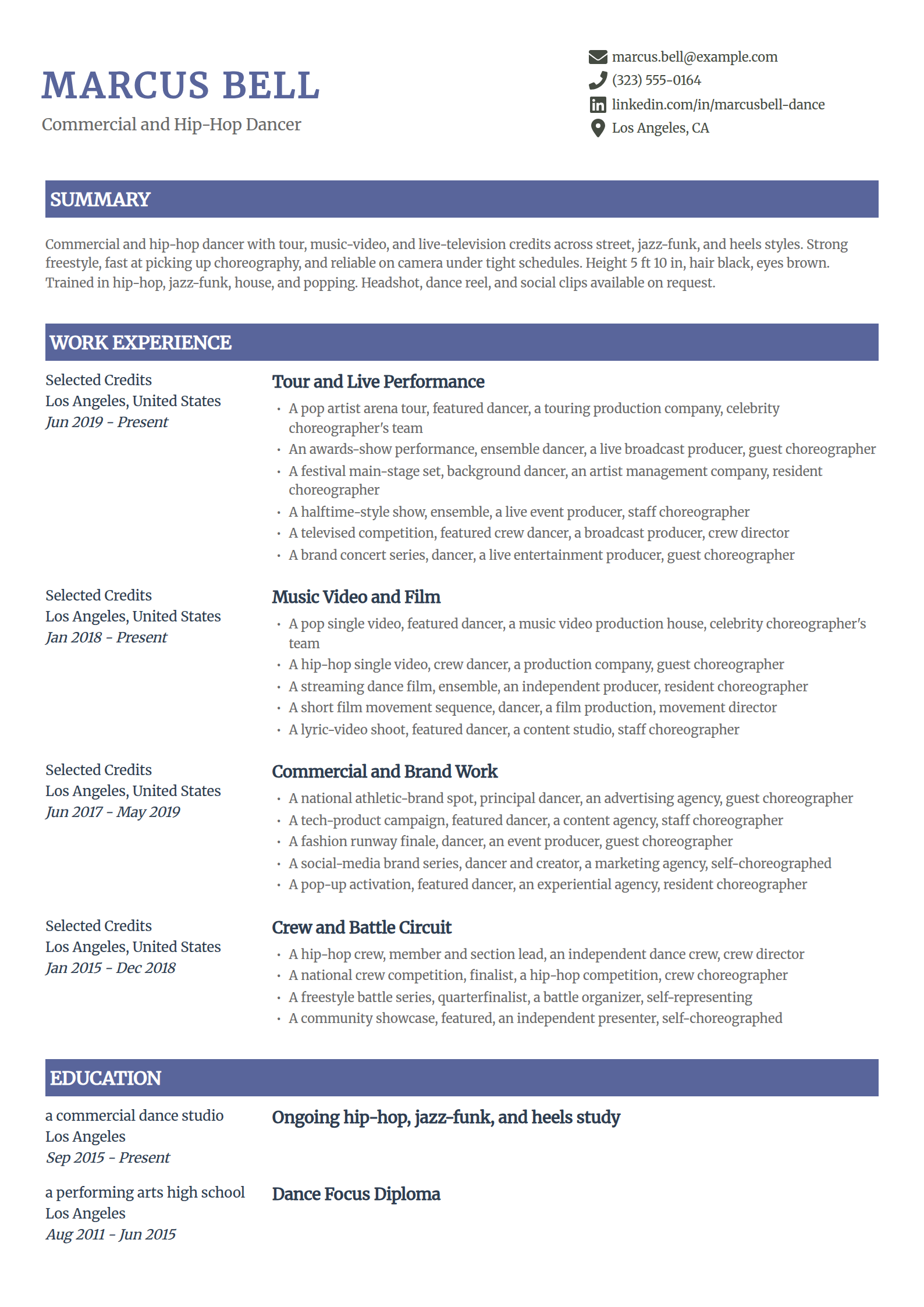
Commercial & Hip-Hop Dancer Resume Template
Why this resume example works?
- Leads with tour, music-video, and live-television credits, the currency of commercial dance casting.
- Names the choreographer or choreographer's team on each line, the reference a commercial call checks.
- Lists street and studio styles honestly, hip-hop, house, popping, and jazz-funk, by real vocabulary.
- Adds on-camera and freestyle skills that commercial and music-video work actually books.
- Uses a bold, modern layout that fits a commercial brand without burying the credits.
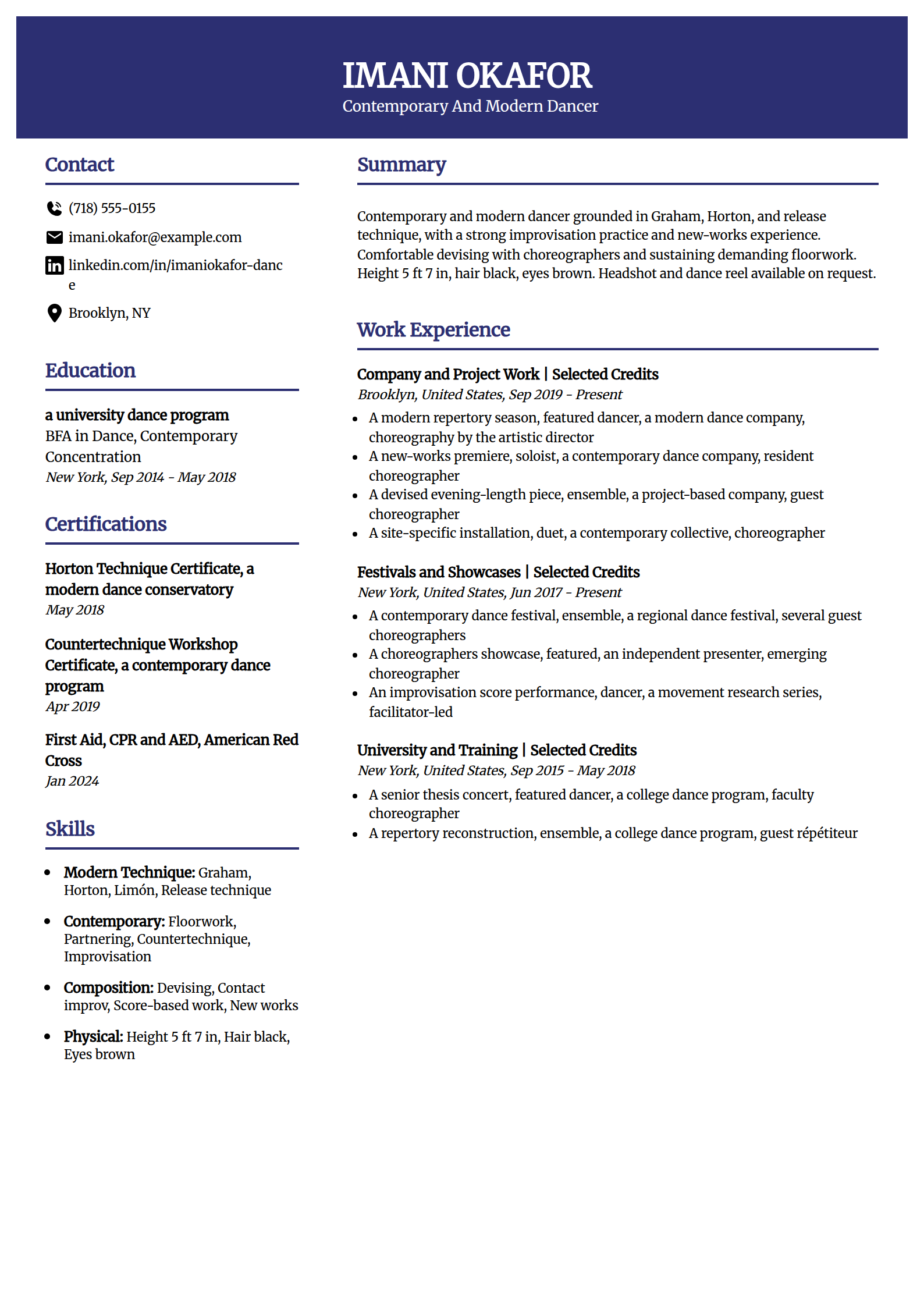
Contemporary Dancer Resume Template
Why this resume example works?
- Leads with company and new-works credits, the record a contemporary company hires from.
- Names real modern technique, Graham, Horton, Limon, and release, instead of a generic style list.
- Separates devised and improvisation work, the composition skills contemporary choreographers look for.
- Fills the sidebar with training and certifications so a spacious layout still reads complete.
- Keeps the whole record to one page a company can review between auditions.
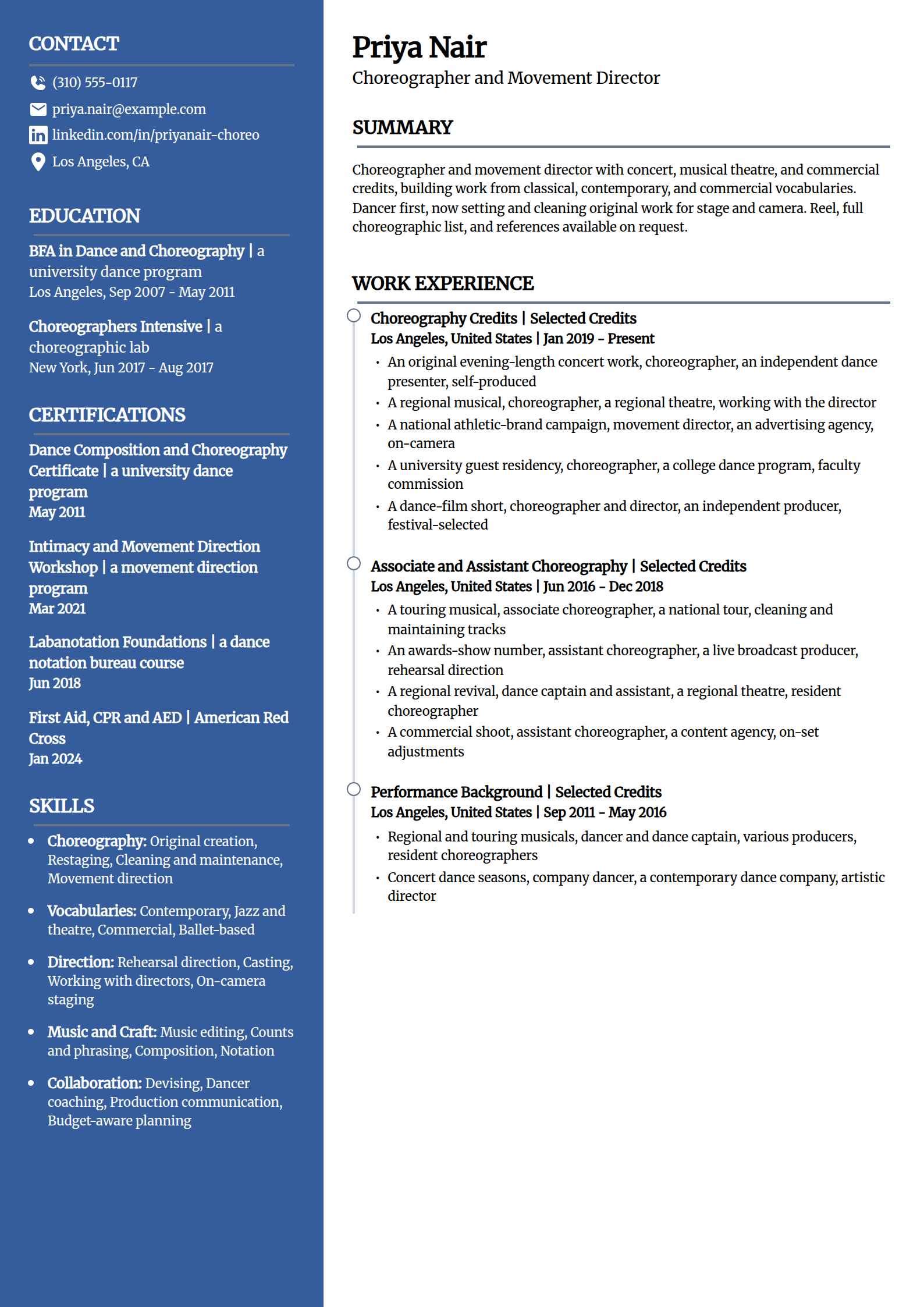
Choreographer Resume Template
Why this resume example works?
- Leads with choreography credits and separates original work from associate and assistant roles.
- Names the production and venue on each credit so a producer can place and verify the work.
- Keeps a short performance-background section, showing the dancer roots behind the choreography.
- Lists craft skills like restaging, cleaning, and music editing that a hiring producer needs.
- Uses a distinctive layout that fits a creative role while staying easy to read.
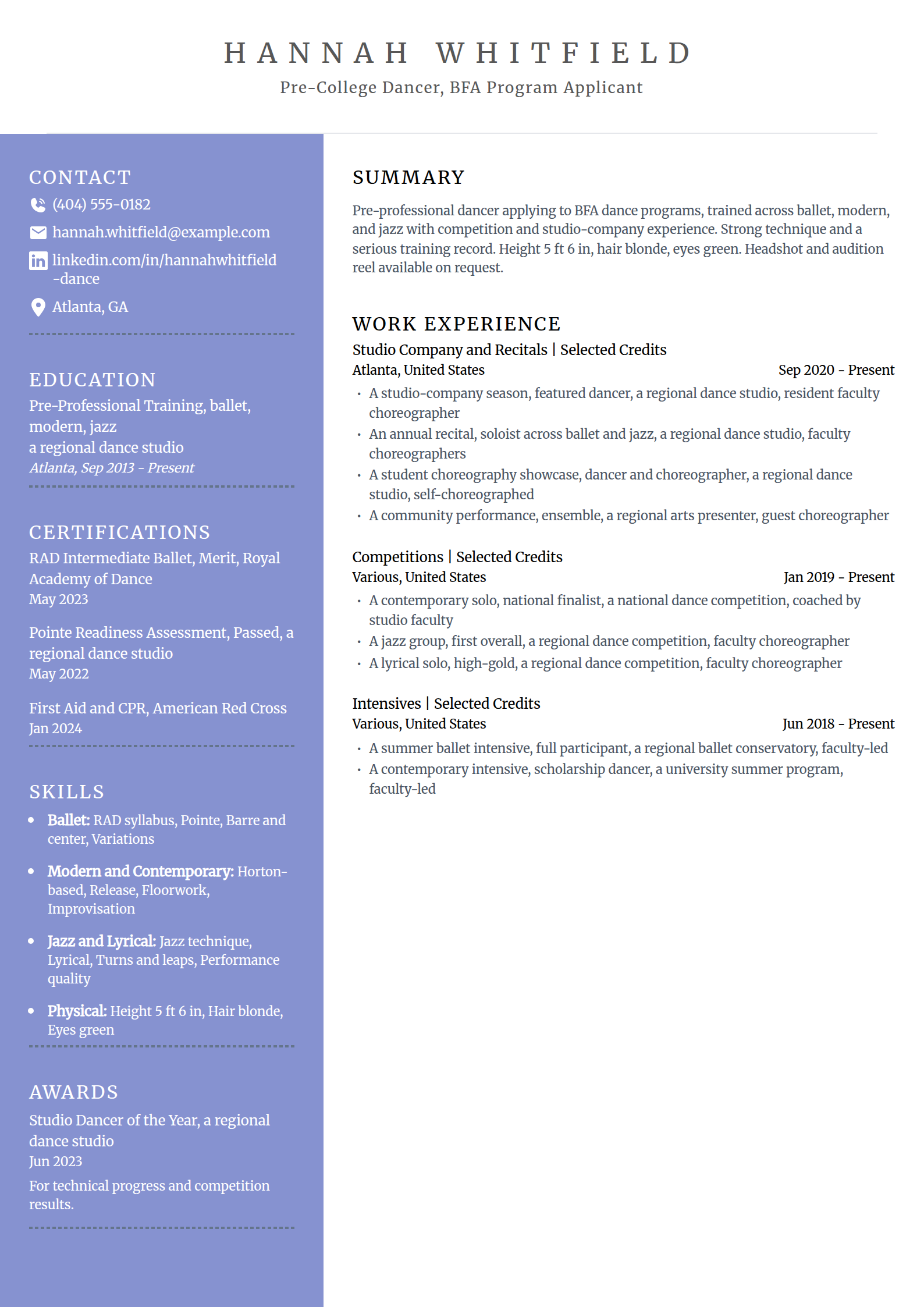
College Dance Audition Resume Template
Why this resume example works?
- Written for a BFA applicant, leading with studio-company, recital, and competition credits.
- Puts training and graded ballet exams up front, the record a college audition panel weighs first.
- Keeps competition results honest, finalist and first-overall placements, without inflating them.
- Lists technique by style and level so a faculty reviewer sees the range clearly.
- Fills a roomy layout with real training instead of padding, the right shape for a young dancer.
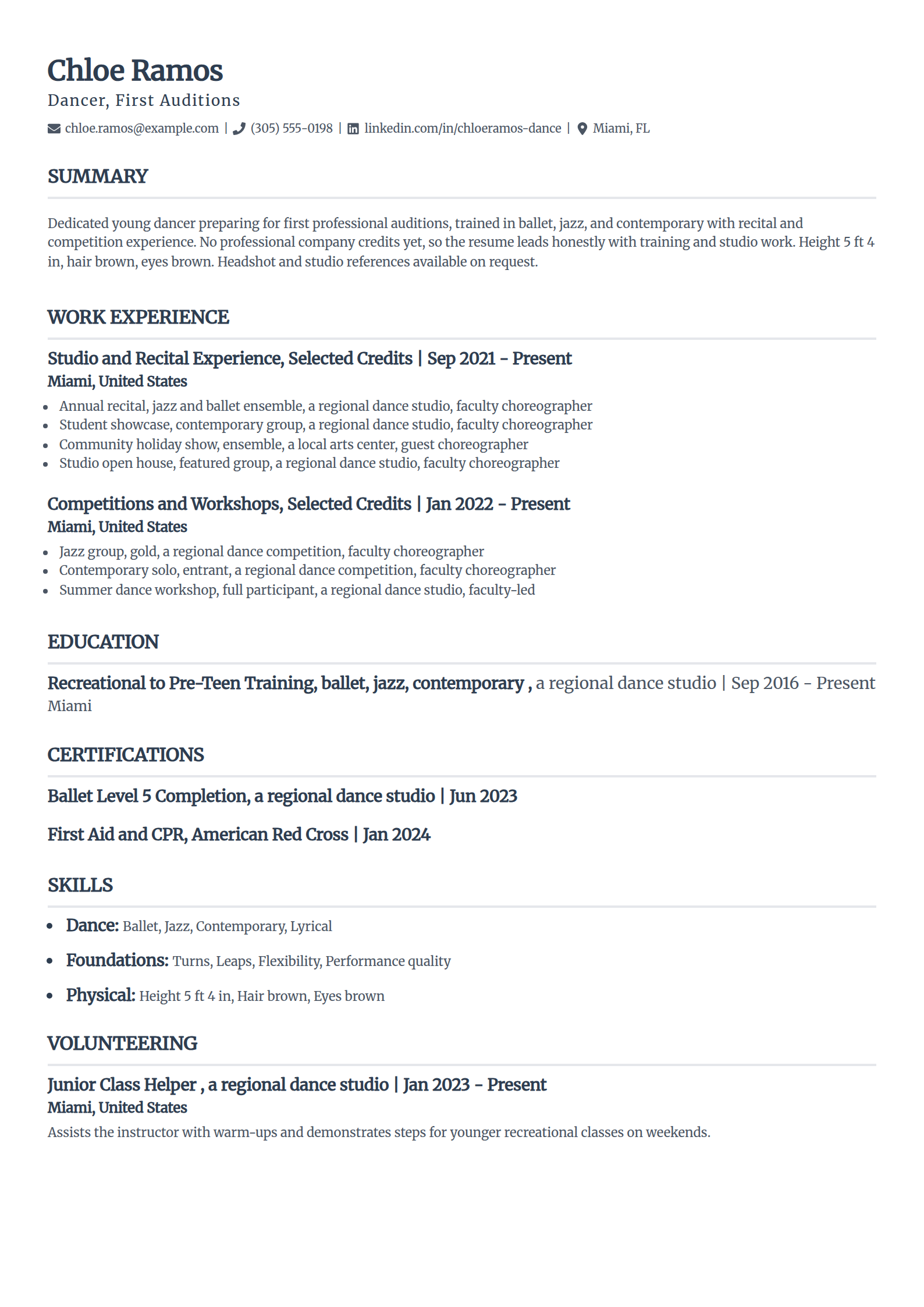
Beginner Dance Resume Template (No Experience)
Why this resume example works?
- States plainly there are no professional company credits yet, then leads with training and studio work.
- Fills the credits with recitals, competitions, and community shows, which are legitimate beginner lines.
- Never invents a company credit, the fastest way a new dancer loses a panel's trust.
- Adds a junior class-helper role, showing responsibility and studio commitment beyond taking class.
- Keeps everything to one honest page, the right length for a first audition resume.
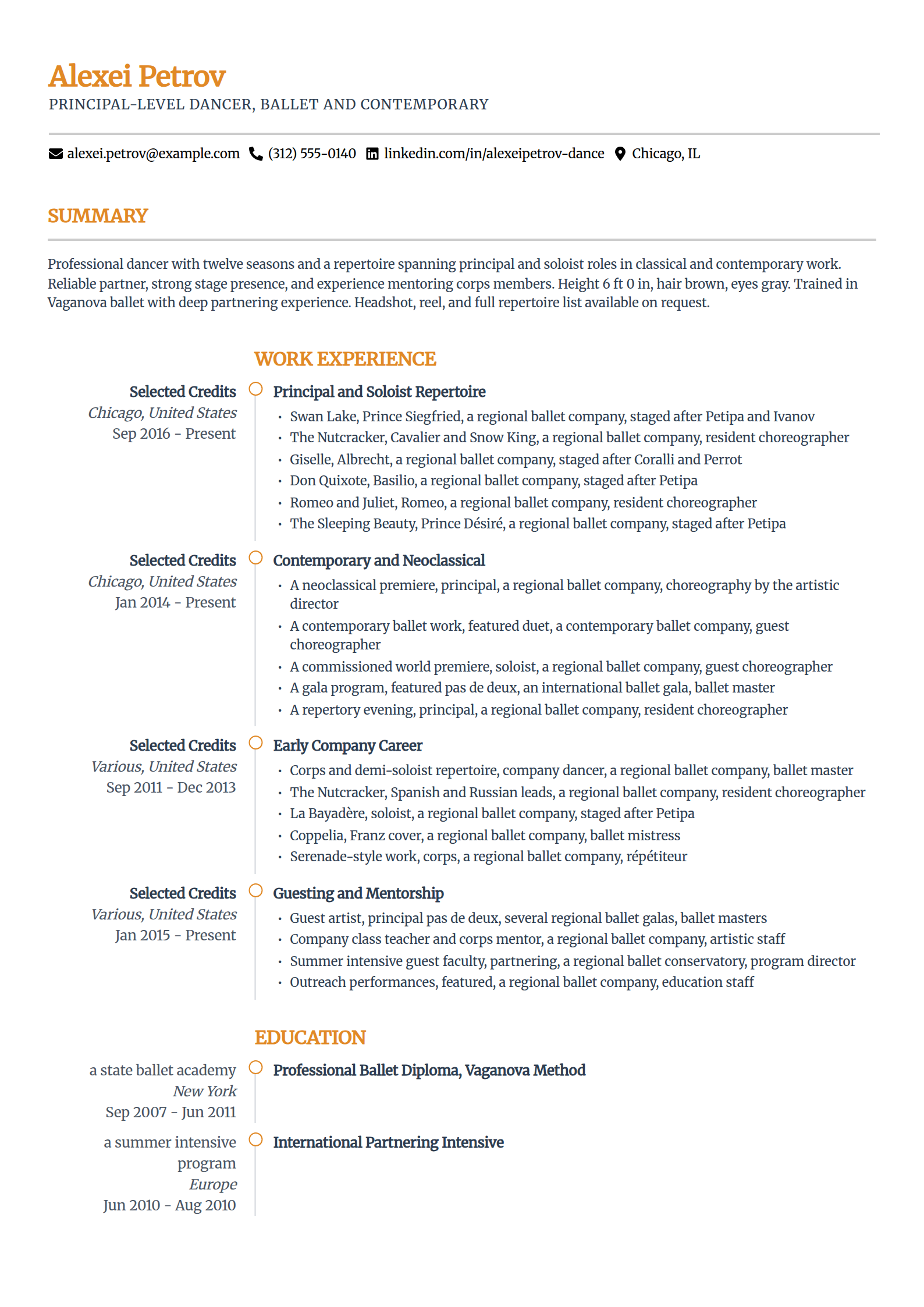
Experienced Dancer Resume Template
Why this resume example works?
- Leads with principal and soloist roles in the standard repertoire, the strongest lines a seasoned dancer has.
- Groups classical, contemporary, and guesting separately so a deep record stays easy to read.
- Names the staging and choreographer on each role, keeping a twelve-season resume verifiable.
- Shows mentoring and company-class teaching, the leadership a senior dancer brings to a company.
- Keeps role level precise, principal and soloist, so the level of the career is unmistakable.
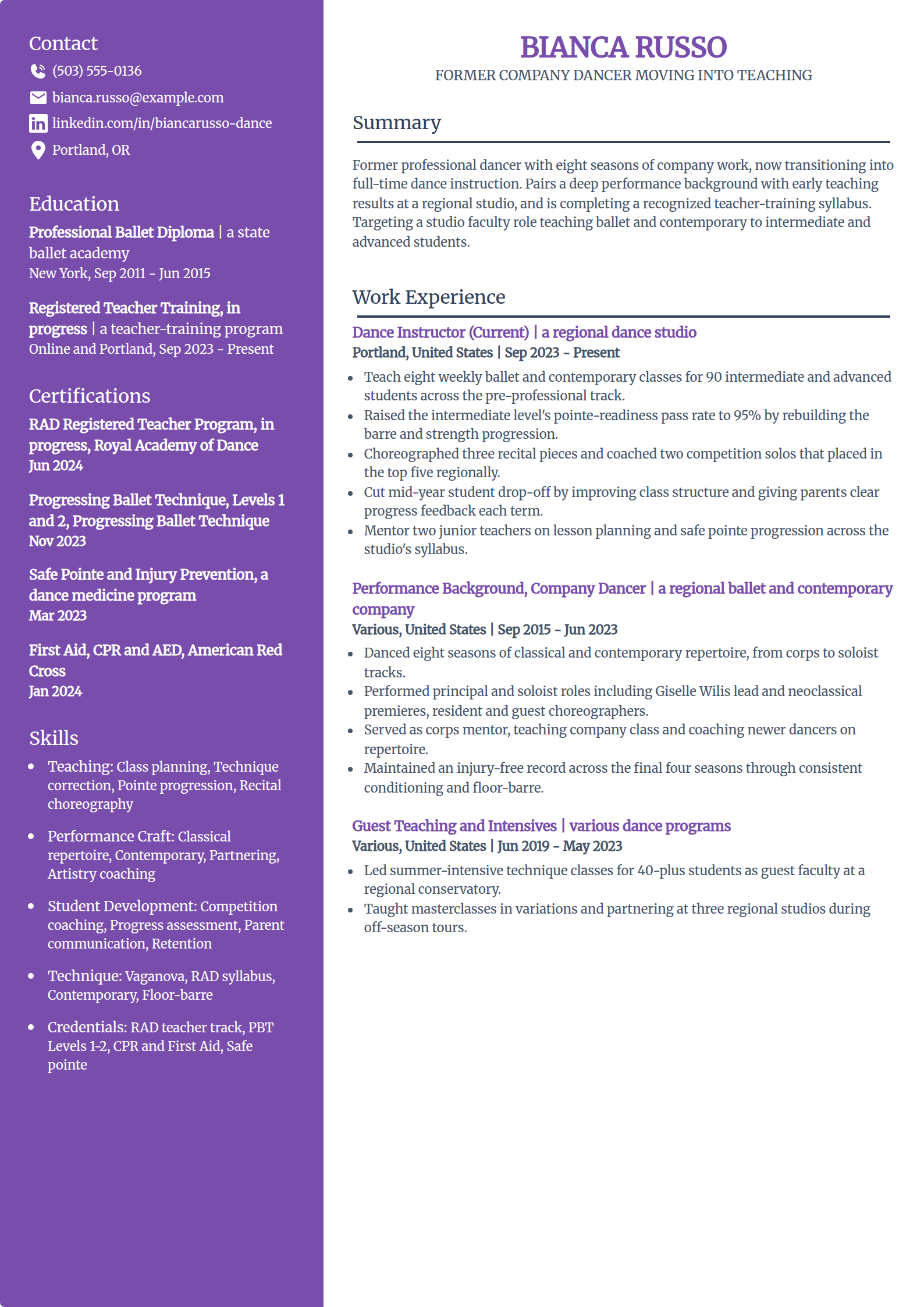
Dancer to Teacher Resume Template
Why this resume example works?
- Bridges both formats, pairing a performance background with early teaching results at a studio.
- Leads the current teaching role with real numbers, class load, pass rates, and competition placements.
- Keeps the company career below it, showing the technical depth a studio wants in a new teacher.
- Lists a teacher-training syllabus in progress, RAD and PBT, so the transition reads as deliberate.
- Frames the target clearly, a studio faculty role, instead of leaving the pivot unexplained.
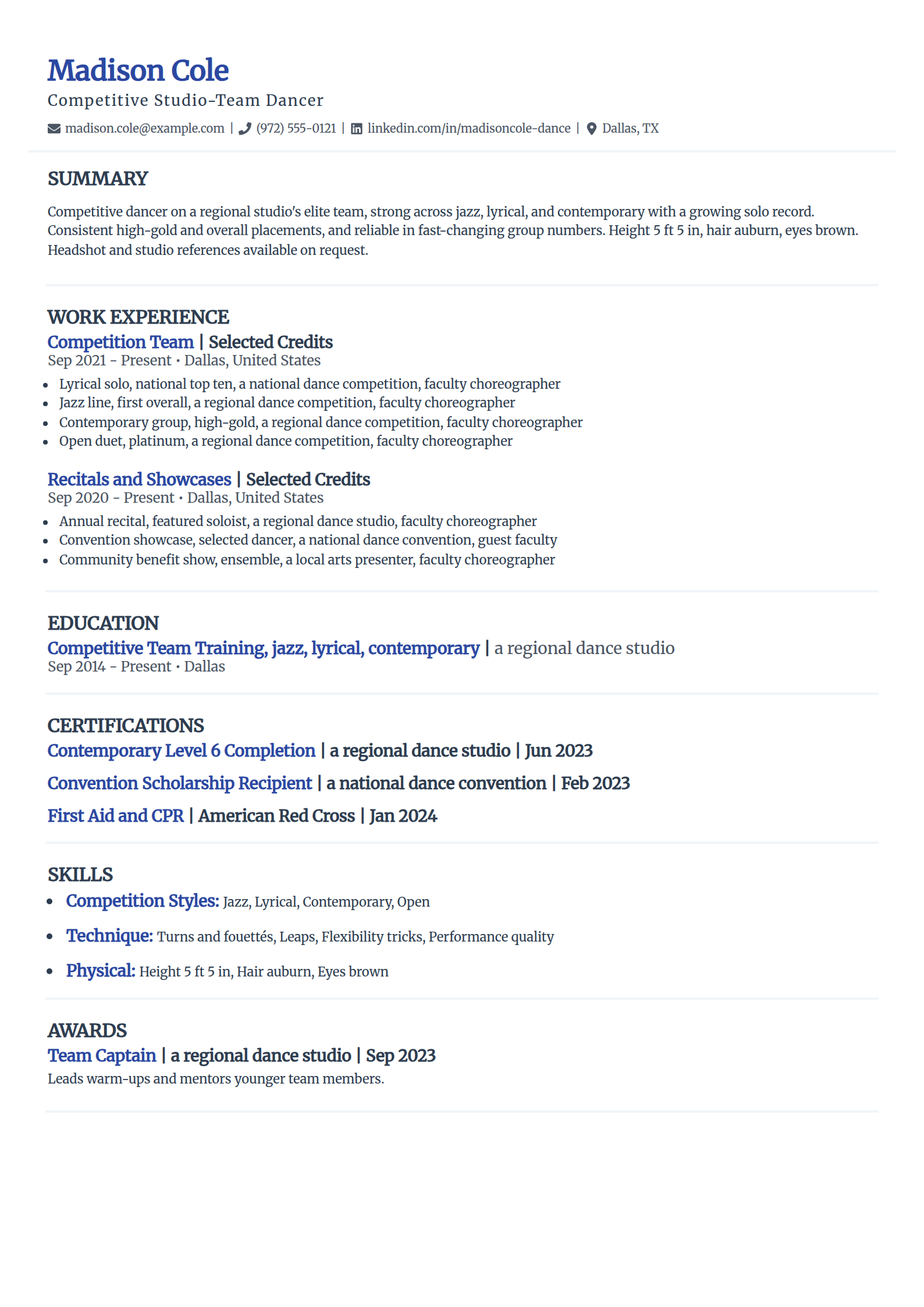
Competition Dancer Resume Template
Why this resume example works?
- Leads with competition placements, national top-ten and first-overall, the record a studio team is judged on.
- Groups solos, duets, and lines so a reviewer sees both individual and group strength.
- Lists jazz, lyrical, and contemporary, the styles a competition dancer is cast across.
- Adds a team-captain note, signaling leadership and reliability to a studio or program.
- Keeps a tight, clean page, the right length for a teen dancer's real record.
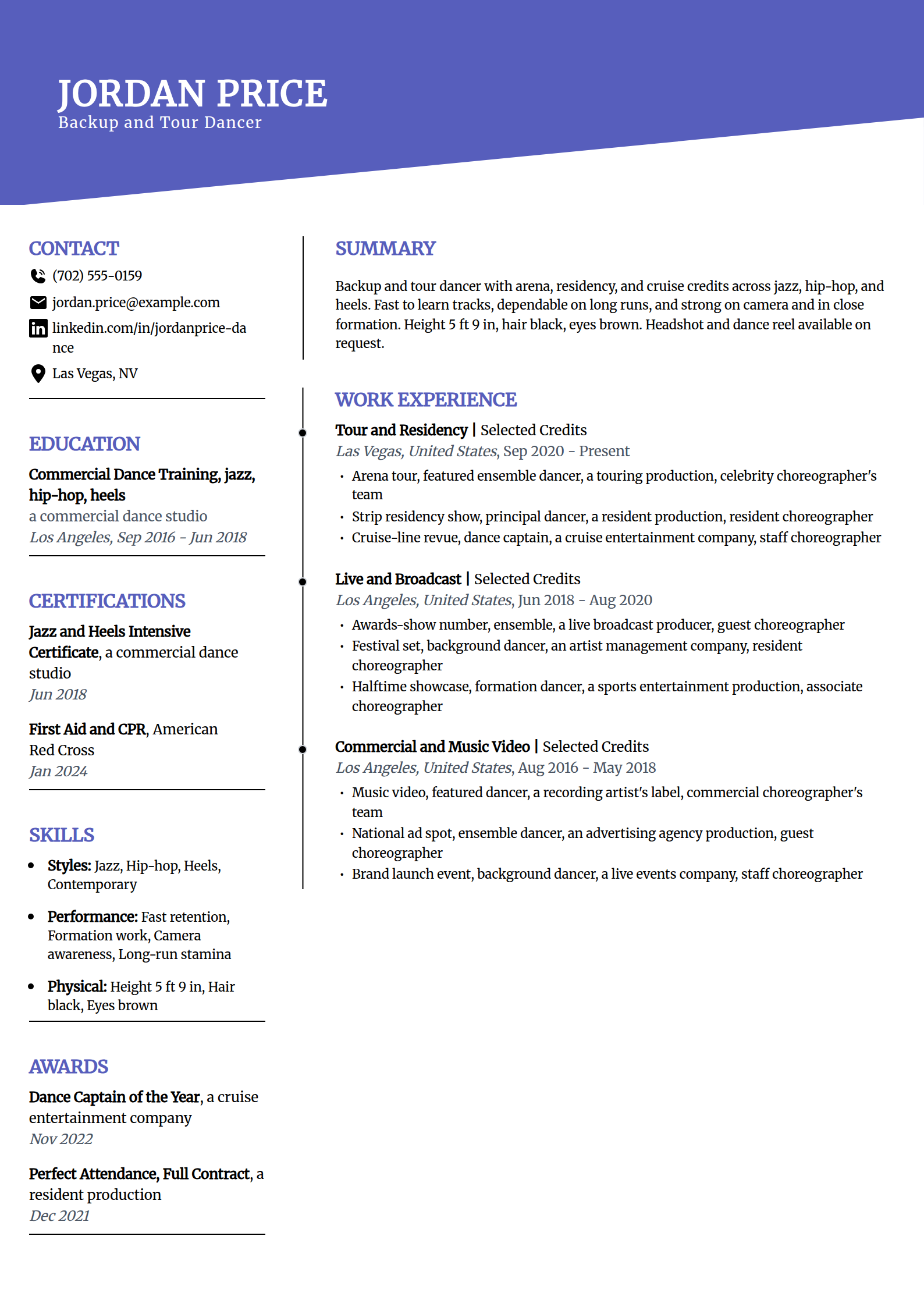
Backup & Tour Dancer Resume Template
Why this resume example works?
- Leads with tour, residency, and cruise credits, the work a backup dancer is booked for.
- Names the choreographer or choreographer's team on each credit, the reference a tour call checks.
- Notes dance-captain duty, showing a dancer who can hold and clean tracks on a long run.
- Lists awards without long descriptions, keeping a busy layout clean and balanced.
- Keeps physical stats and styles clear, the details a commercial tour casts from.
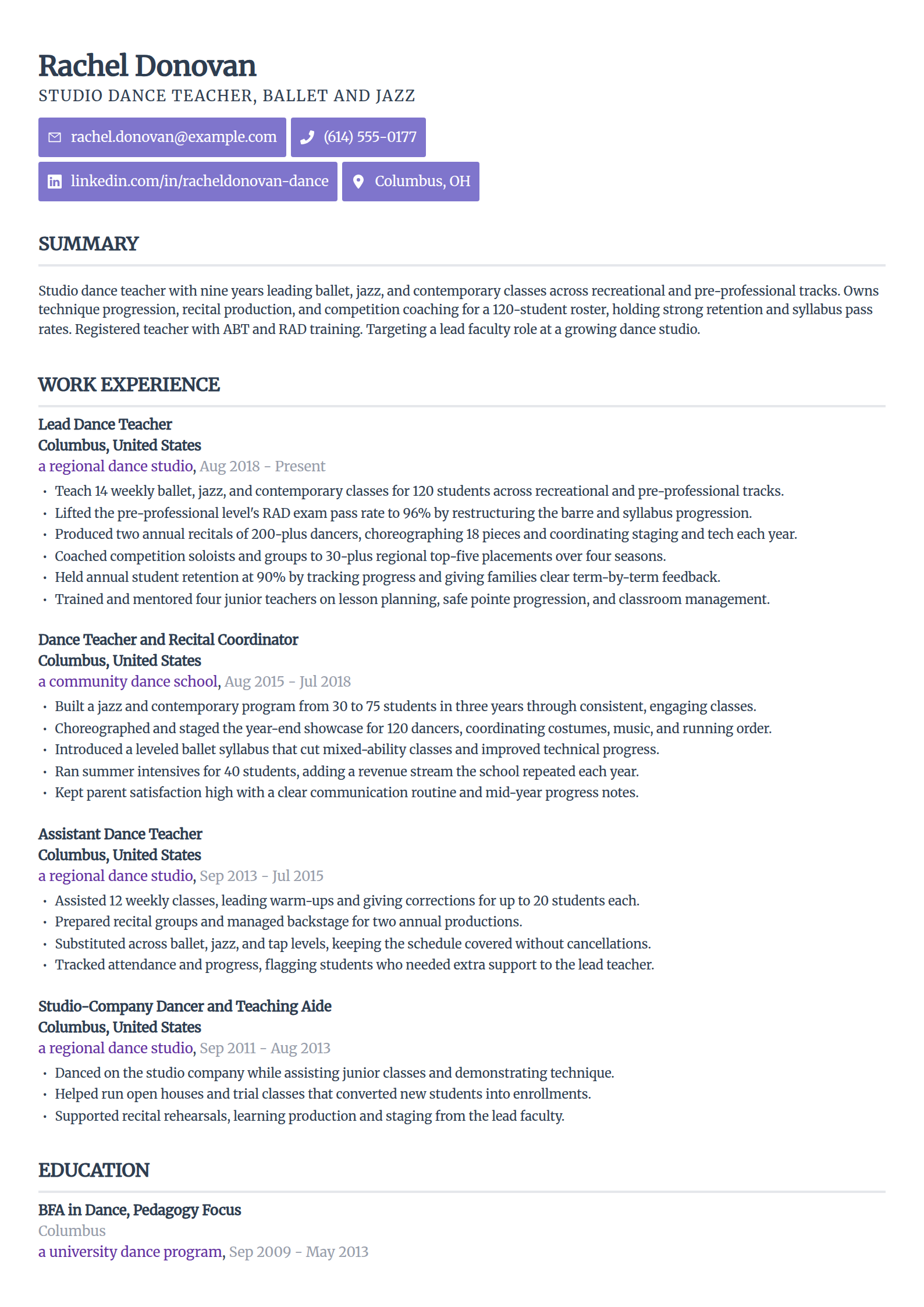
Studio Dance Teacher Resume Template
Why this resume example works?
- Switches to the teacher format, leading with a class load and a student roster instead of credits.
- Carries the numbers a studio hires on, a 96% syllabus pass rate and 30-plus competition placements.
- Shows recital production, choreographing and staging shows for 200-plus dancers a year.
- Lists real teaching credentials, ABT NTC certified and RAD Registered Teacher, that studios verify.
- Uses results bullets a studio owner recognizes, not the credit lines a performer would use.
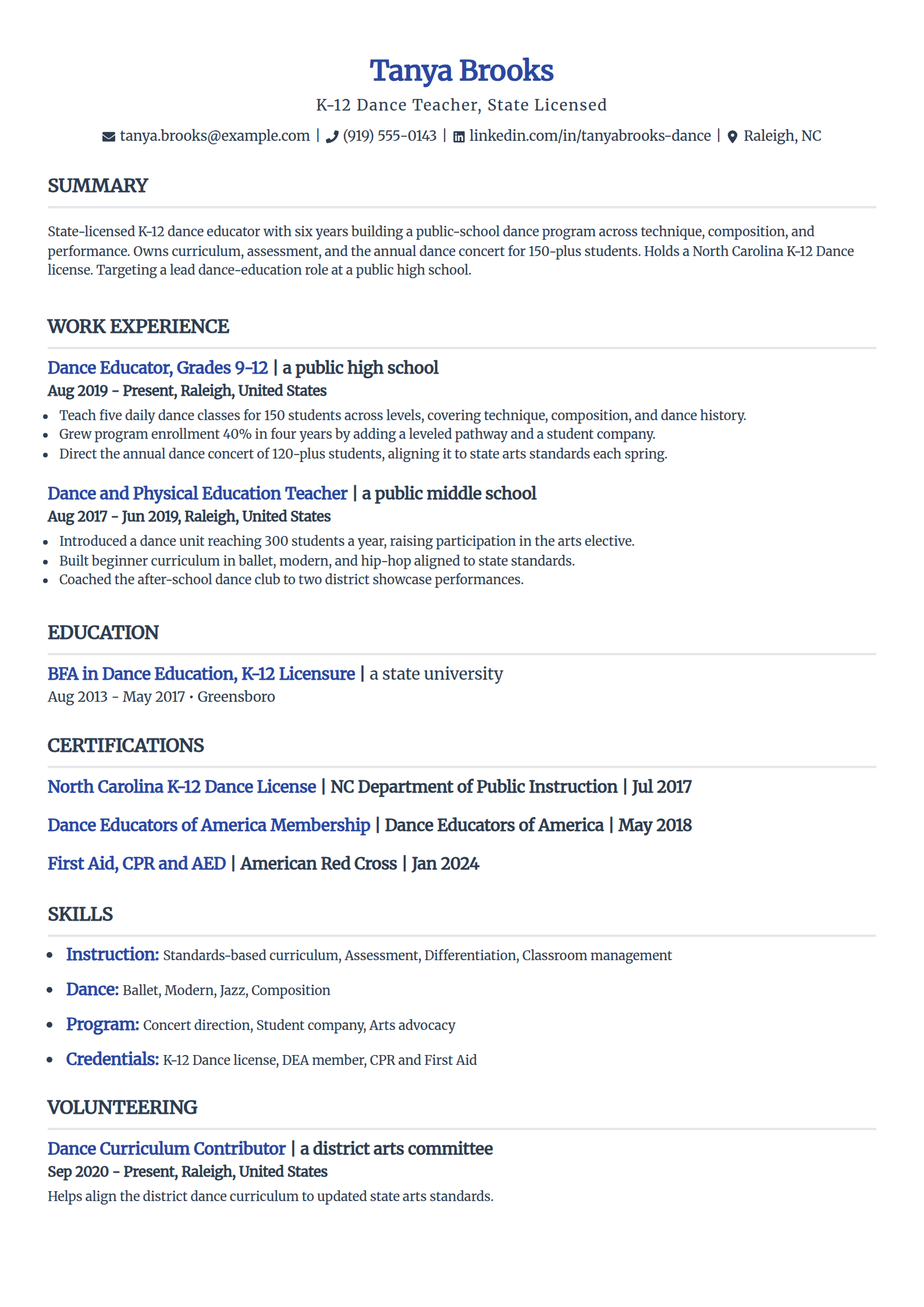
School Dance Teacher Resume Template
Why this resume example works?
- Leads with a state K-12 dance license, the first thing a public-school hiring panel checks.
- Carries the numbers a district screens for, 40% enrollment growth and a 120-dancer annual concert.
- Ties the work to state arts standards, the language a school administrator expects.
- Keeps the format clean and parser-safe, the standard for a district applicant tracking system.
- Shows curriculum and assessment, the classroom skills a dance-education role is hired on.
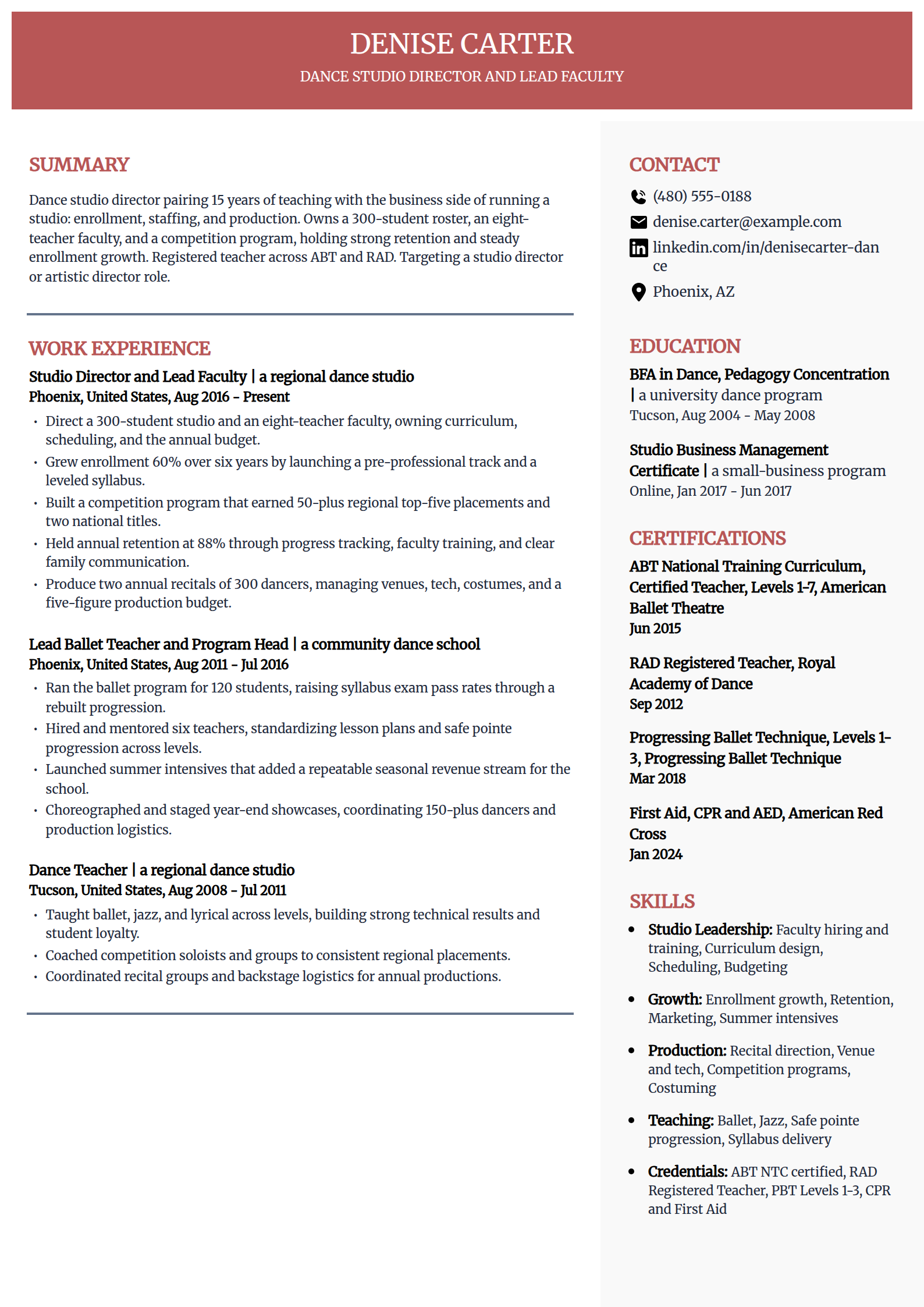
Dance Studio Director Resume Template
Why this resume example works?
- Pairs teaching with the business side, a 300-student roster and an eight-teacher faculty.
- Carries the numbers a studio role is judged on, 60% enrollment growth and steady retention.
- Shows production scope, two annual recitals of 300 dancers and a competition program with titles.
- Names credentials and business training, ABT and RAD plus studio management, that back the role.
- Uses a refined layout that fits a leadership record on one page.
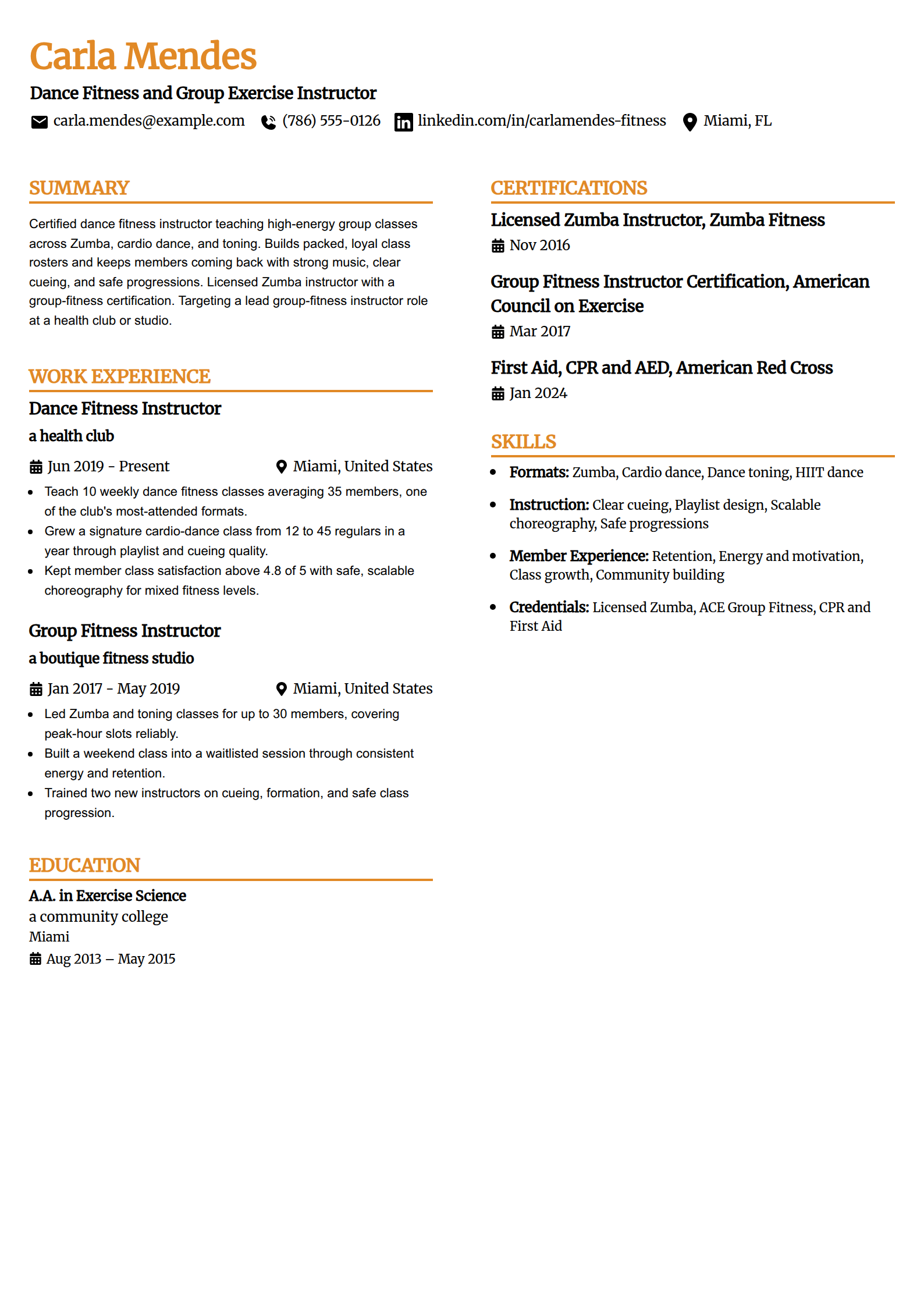
Dance Fitness Instructor Resume Template
Why this resume example works?
- Leads with a group-fitness class load and attendance, the numbers a health club hires on.
- Carries a growth story, a class built from 12 to 45 regulars, that shows real member retention.
- Lists the licenses a club requires, a Zumba license and an ACE group-fitness certification.
- Names formats plainly, Zumba, cardio dance, and toning, so a hiring manager sees the fit.
- Keeps a tight, clean page focused on class results rather than dance credits.
Build your dance resume
Pick the format that fits, a performer layout for auditions or a results layout for teaching, then follow the closest example above and swap in your own credits or student numbers.
Build my resumeHow to write a dance resume in 2026
Before you pick a template, decide which resume you are writing. An auditioning dancer and a dance teacher need two different documents, and using the wrong one is the quickest way to look like you do not know the field. The guidance below covers both, starting with the choice itself.
Decide first: performer resume or dance teacher resume
This is the honest split most guides skip. The two formats share almost nothing beyond your name, so choose based on the job in front of you.
- Auditioning to dance? Use the performer format: credits grouped and named by choreographer, training, special skills, physical stats, and a headshot note, on one page with no duty bullets.
- Applying to teach at a studio or school? Use the corporate format: results bullets with student numbers, recital productions, and certifications, and drop the physical stats and headshot.
- Career-changing from performing to teaching? Lead with your first teaching results, keep a short performance-background section below, and note any teacher-training syllabus in progress.
Performer resume: profile, stats, and a headshot note
Open with your name and contact, then your stats where they are customary: height, and hair and eyes for commercial work. Add a short profile naming your strongest techniques and a line like "Headshot and dance reel available on request". For an in-person audition, staple your resume to the back of an 8 by 10 headshot.
Company dancer with seven seasons across classical and contemporary repertoire, strong in pointe and partnering. Height 5 ft 6 in, hair dark brown, eyes hazel. Trained in Vaganova ballet and Graham modern. Headshot and dance reel available on request.
List credits by choreographer, grouped by type
Performance credits are the core of an audition resume. Group them by repertoire or medium and name the choreographer, the way an acting resume names the director.
- Format each line as production or piece, your role, the company or venue, and the choreographer or staging.
- Group by type: classical repertoire, contemporary, musical or commercial stage, and concert or festival work.
- For classical work, credit the staging honestly, such as "staged after Petipa", rather than claiming original choreography.
- Lead each group with your strongest role, and keep the whole resume to one page.
Dance teacher resume: lead with measurable outcomes
A studio or school reads a teacher resume like any other results resume. Replace credit lines with bullets that prove what your students achieved.
- Name your class load and roster: "Teach 14 weekly classes for 120 students across recreational and pre-professional tracks".
- Use the numbers a studio owns: syllabus pass rates, recital productions, competition placements, retention, and enrollment growth.
- Open with a strong verb, taught, coached, produced, or grew, and keep one credible number per bullet.
- Skip the physical stats and headshot; they belong on a performer resume, not a teaching application.
Training, technique, and certifications
Training tells a company or a studio how you work. Name the studio or conservatory, then the techniques and any graded credentials.
- List techniques by name and level: ballet (Vaganova, Cecchetti, RAD), jazz, contemporary, modern (Graham, Horton), tap, and hip-hop.
- Performers list graded syllabus exams (RAD, Cecchetti, ABT National Training Curriculum) and pointe or partnering credentials.
- Studio teachers list ABT NTC, RAD Registered Teacher, Progressing Ballet Technique, and Dance Educators of America membership.
- School dance teachers list the state K-12 dance license and endorsement, plus current CPR and First Aid.
Keep the format clean and parser-safe
A studio or district resume is read by an applicant tracking system first, so a teacher resume uses a simple layout with standard headings. A performer resume stays one page and is often reviewed by a person, but clean still wins.
- Use standard section headings and a readable font; skip heavy graphics inside the resume body.
- Keep it to one page for auditions and for most teaching records under about ten years.
- Save as a PDF so the layout holds, then run a teaching resume through our ATS resume checker for a quick format pass.
- Swap the numbers and credits in the templates above for your own; do not copy them as is.
Common dance resume mistakes
- Using one resume for both auditions and teaching jobs. They are different documents; a credits list does not sell a studio, and results bullets do not sell a company.
- Leaving the choreographer off performance credits. Naming the choreographer or staging is what tells a panel the credit is real and how to verify it.
- Inventing a company credit or inflating an ensemble role. It is easy to check in the dance world and it ends the audition.
- Putting physical stats or a headshot on a dance teacher resume. Studios and schools want student outcomes and certifications, not vitals.
- Padding special skills with untrained styles. List only techniques you can perform on demand, since a class or callback will test them.
Frequently asked questions
What should a dance resume include?
For an auditioning dancer, include your name and contact, physical stats where they are customary (height, and hair and eyes for commercial work), a short profile, performance credits grouped by type and named by choreographer, training and technique, special skills, and a headshot note. Keep it to one page. A dance teacher resume drops the stats and headshot and instead leads with class sizes, recital productions, competition results, and certifications.
How do you write a dance resume with no experience?
Lead with training, then list recitals, competitions, summer intensives, and community or school productions, labeled honestly. Never invent a professional company credit. Add your techniques by style and level, any graded exams, and a headshot note, and keep the whole thing to one page. Assisting a younger class or helping backstage counts and shows commitment.
What is the difference between a dancer resume and a dance teacher resume?
They are two different documents. A dancer resume follows audition conventions: credits grouped and named by choreographer, training, special skills, physical stats, and a headshot, with no duty bullets. A dance teacher resume follows the standard corporate format: results bullets with student numbers, recital productions, competition placements, and certifications, and no physical stats or headshot. Use the one that matches the job you are applying for.
How long should a dance resume be?
One page. An audition resume is always a single page, trimmed to your strongest credits and current training. A dance teacher resume also fits one page for most records under about ten years; lead with your most recent role and cut older, unrelated work so the space goes to what matches the job.
Do you need a headshot on a dance resume?
For an audition, yes. The standard is an 8 by 10 headshot with the resume trimmed to size and stapled to the back for in-person submissions, plus a line on the resume noting a headshot and reel are available. A dance teacher resume does not use a headshot, since studios and schools hire on student outcomes and certifications rather than a look.
What skills and certifications go on a dance resume?
List techniques by name and level: ballet (Vaganova, Cecchetti, RAD), jazz, contemporary, modern (Graham, Horton), tap, and hip-hop. Performers add graded syllabus exams (RAD, Cecchetti, ABT National Training Curriculum) and pointe or partnering credentials. Studio teachers list ABT NTC, RAD Registered Teacher, Progressing Ballet Technique, and Dance Educators of America membership; school dance teachers list a state K-12 dance license and current CPR and First Aid.
More dance resume resources
Build your dance resume
Pick the format that fits, a performer layout for auditions or a results layout for teaching, then follow the closest example above and swap in your own credits or student numbers.