19 Data Analyst Resume Examples, Intern to Data Science
- ATS Friendly
- Analyst to Data Scientist
- 19 Real Examples
Five things make a data analyst resume example worth copying: a short summary naming your track and years, bullets that lead with what the analysis changed, one credible number per bullet, the tools a posting names such as SQL, Python, and Tableau, and a certification. Pick a clean layout below, then model your own on the example built for your track, from a student chasing an internship to a data scientist or data engineer.


540k+ resumes created
Editable data analyst resume templates
Each template below is a real data analyst resume laid out in that format, sorted by track and seniority. Choose one, then swap in your own SQL, Python, and dashboard work, the impact behind each project, and your certifications. Every layout keeps your name, contact details, and dates clean so a hiring manager reads your experience at a glance and an applicant tracking system parses it without trouble.
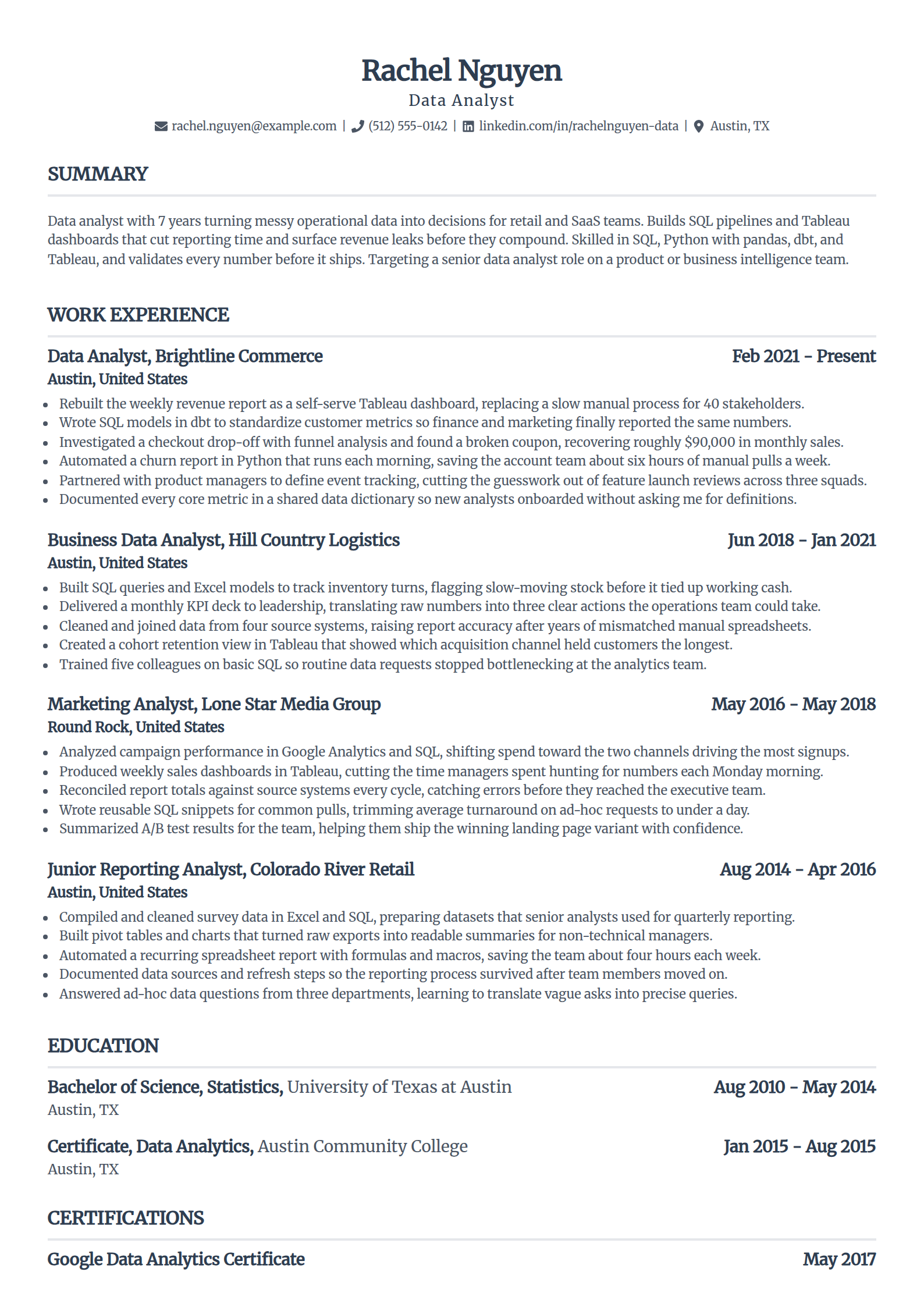
Experienced Data Analyst Resume Template
Why this resume example works?
- Opens with a summary that names 7 years, SQL pipelines, and Tableau dashboards, the scope a hiring manager reads first.
- Leads each bullet with a strong verb and the impact behind the work, such as recovering roughly $90,000 in monthly sales.
- Names the exact tools an analyst posting lists, SQL, Python with pandas, dbt, and Tableau, instead of a vague skills line.
- Uses a single-column layout with standard headings that an applicant tracking system parses cleanly.
- Backs the experience with real credentials, a Google Data Analytics Certificate and Tableau Desktop Specialist.
Data Scientist Resume Template
Why this resume example works?
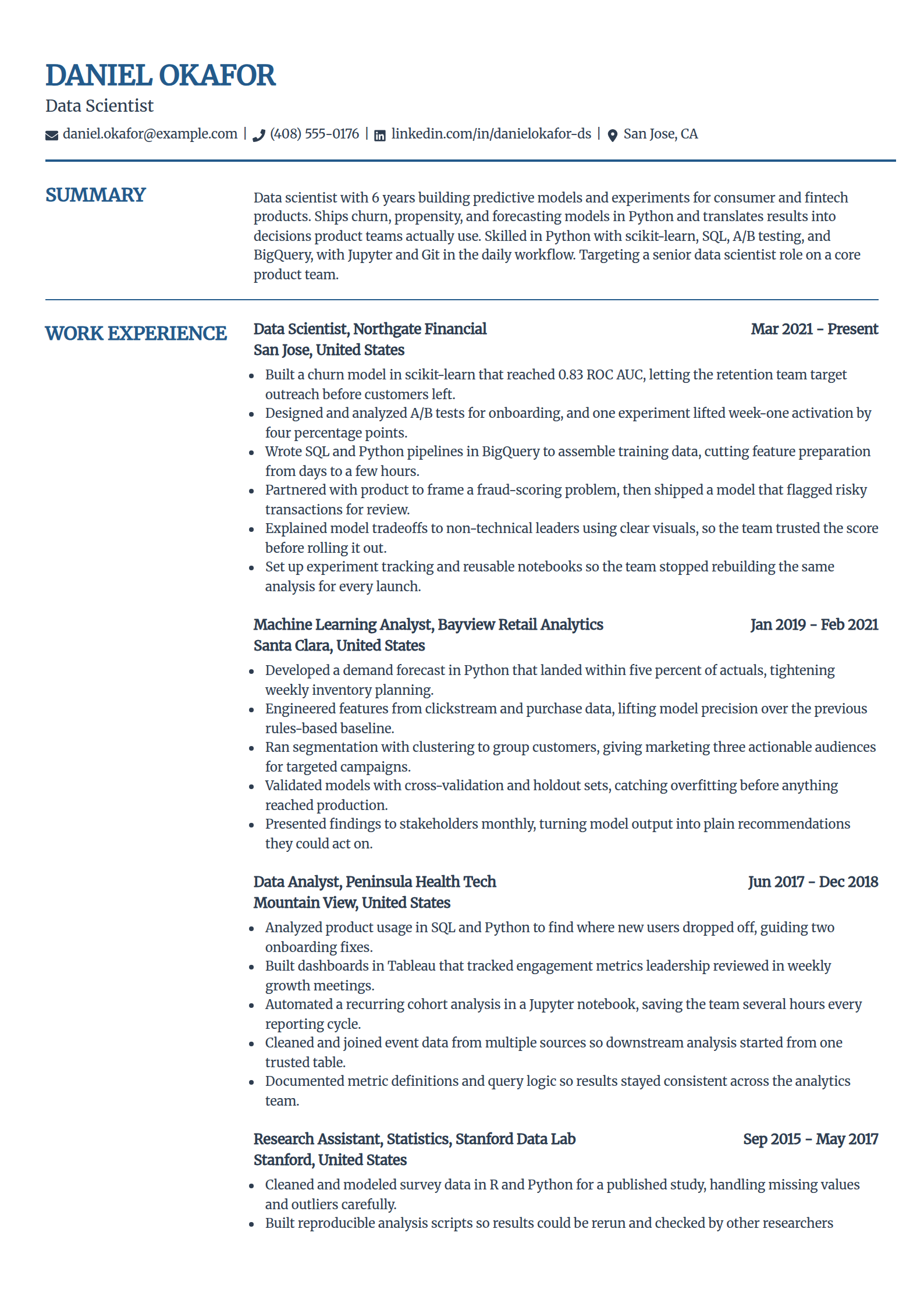
- Leads with modeling and experimentation, a churn model at 0.83 ROC AUC and an A/B test that lifted activation.
- Names the data science stack outright, Python with scikit-learn, SQL, A/B testing, and BigQuery, with Jupyter and Git.
- Shows the full arc a team wants, from problem framing to a model shipped and monitored in production.
- Pairs a statistics master's with credentials like the Azure Data Scientist Associate and a Deep Learning Specialization.
- Uses a clean, modern layout that fits a dense modeling history on one readable page.
Senior & Lead Data Scientist Resume Template
Why this resume example works?
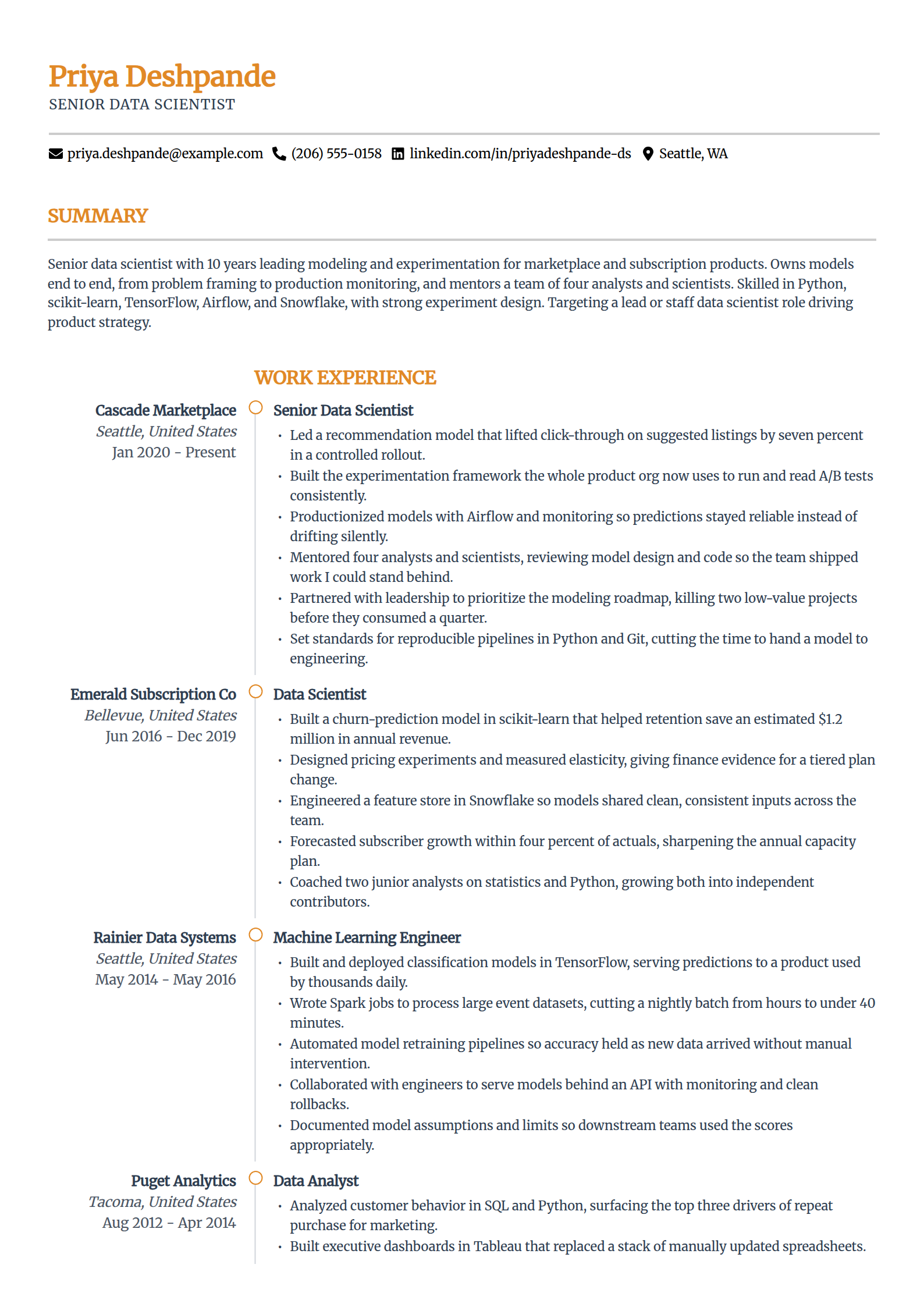
- Frames senior scope up top, owning models end to end and mentoring a team of four analysts and scientists.
- Shows leadership impact a team can quote, a recommendation model that lifted click-through seven percent in a controlled rollout.
- Carries a production stack, Python, scikit-learn, TensorFlow, Airflow, and Snowflake, across the experience and skills.
- Balances hands-on modeling with roadmap and code-review work so the resume reads as a working lead, not a title.
- Fills a dense layout with four roles, showing a clear climb from analyst to senior data scientist.
Data Engineer Resume Template
Why this resume example works?
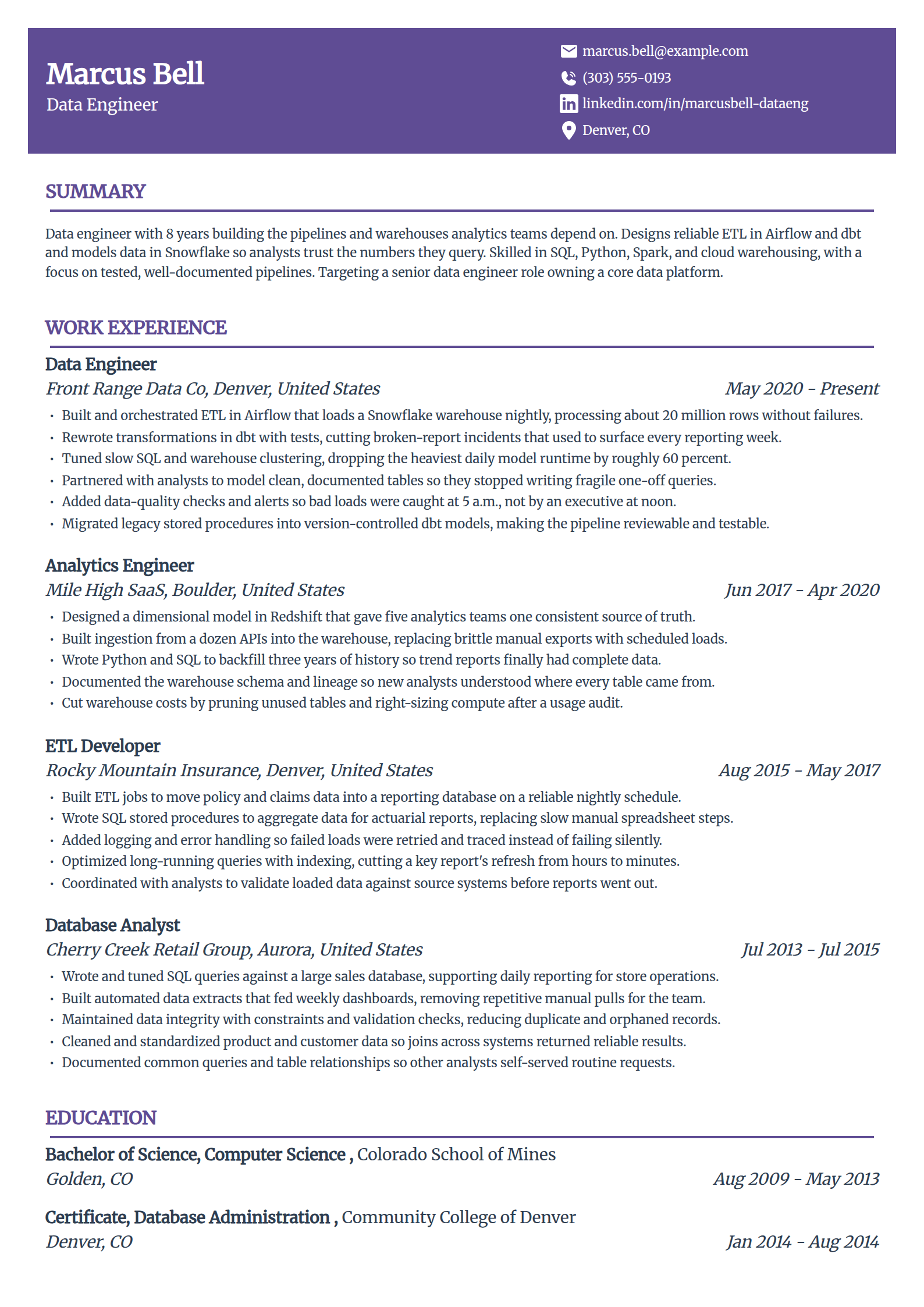
- Leads with the pipelines analytics teams depend on, ETL in Airflow that loads a Snowflake warehouse of about 20 million rows nightly.
- Shows engineering impact, cutting the heaviest daily model runtime by roughly 60 percent through tuning and clustering.
- Names the data platform stack a posting lists, SQL, Python, Spark, dbt, Snowflake, and Redshift.
- Foregrounds reliability, data-quality tests and alerts that catch bad loads before an executive sees a broken report.
- Uses a modern layout that carries an eight-year platform history without crowding the page.
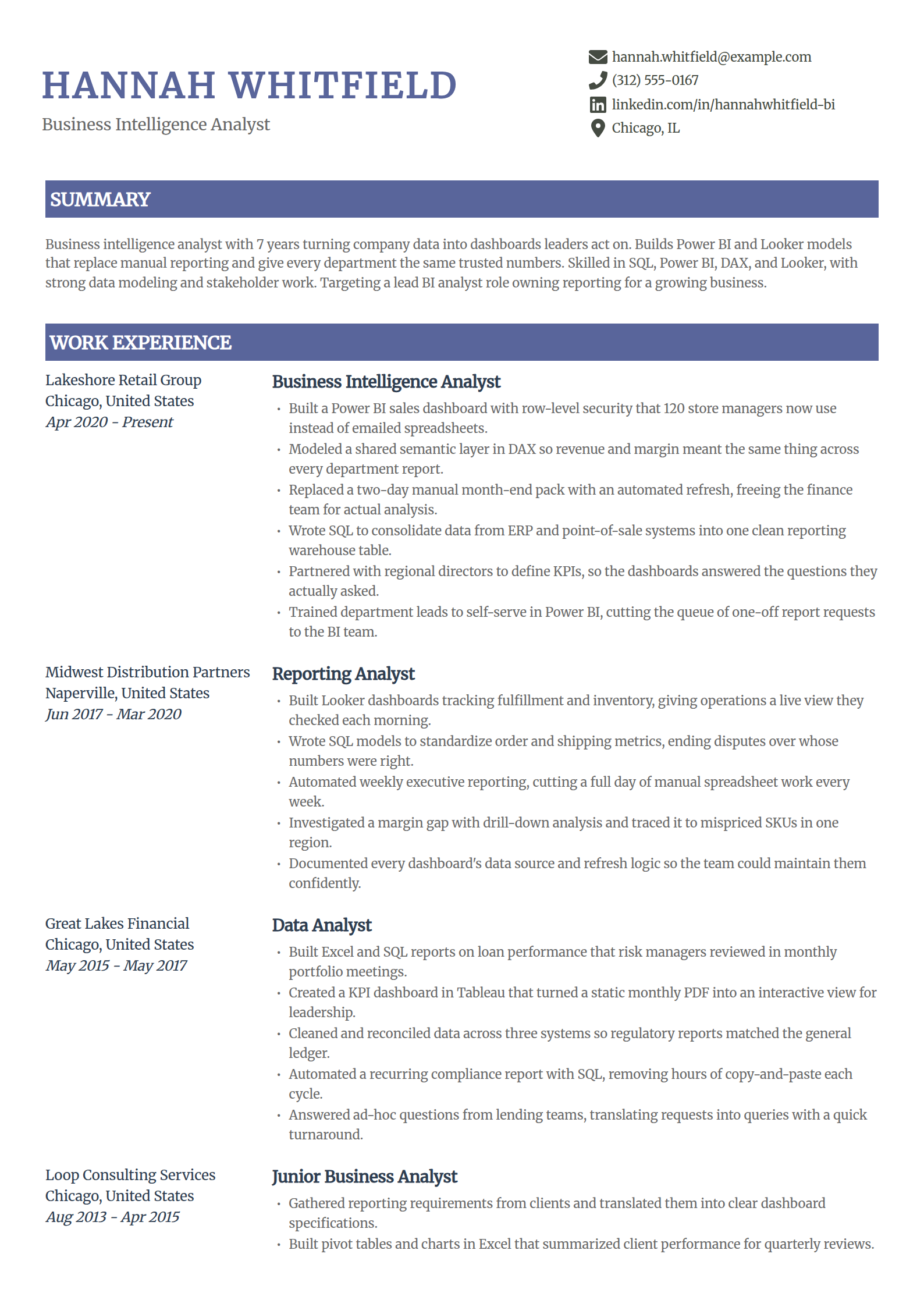
Business Intelligence (BI) Analyst Resume Template
Why this resume example works?
- Opens with the reporting work BI teams hire for, a Power BI dashboard 120 store managers use instead of emailed spreadsheets.
- Names BI tools by name, Power BI, DAX, Looker, and SQL, the exact keywords on a business intelligence posting.
- Shows a shared semantic layer so revenue and margin mean the same thing across every department report.
- Puts a Microsoft Power BI Data Analyst (PL-300) credential where a reviewer looks for it.
- Fills a visually rich layout with four roles while staying easy to skim in one pass.
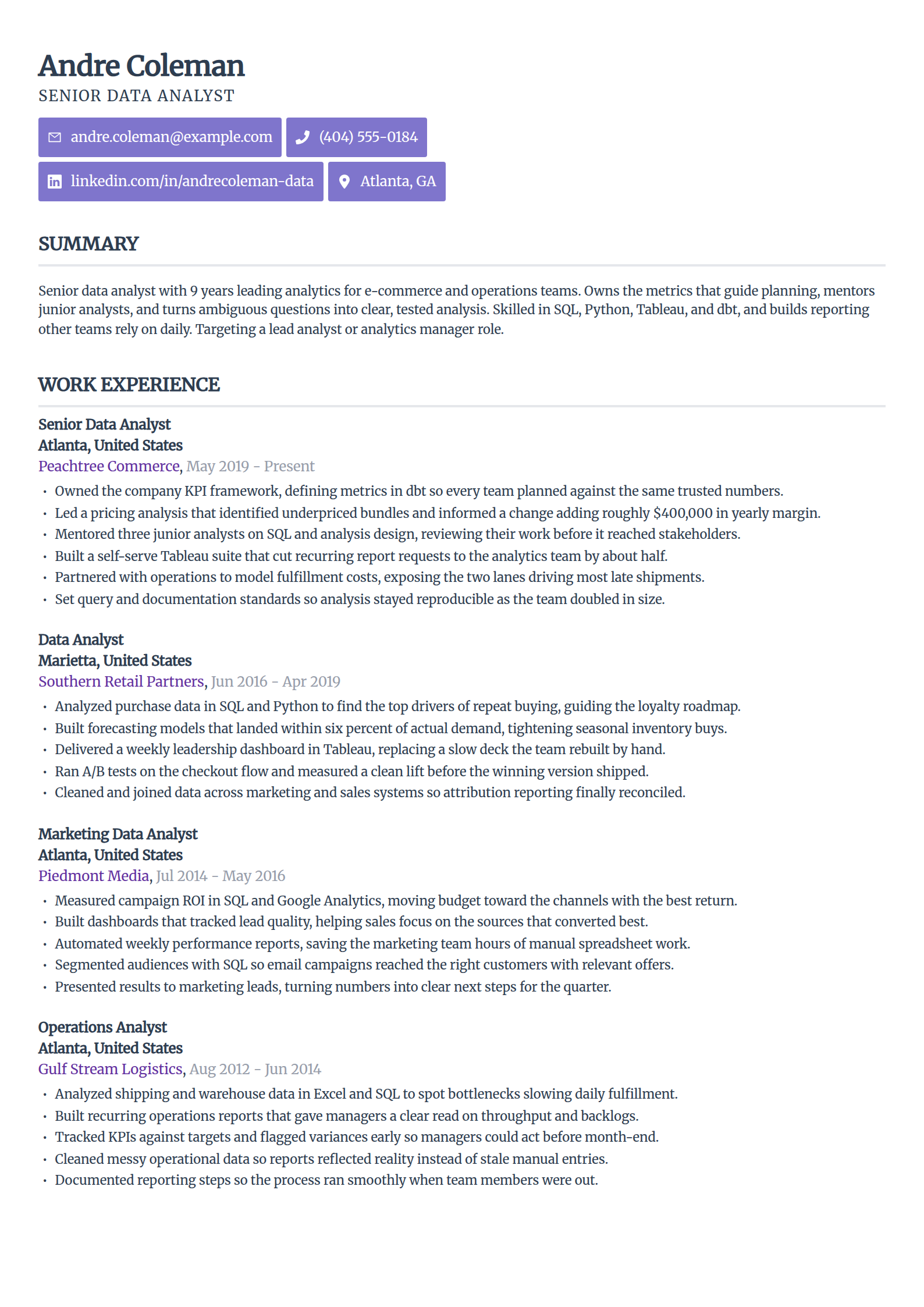
Senior & Lead Data Analyst Resume Template
Why this resume example works?
- Leads with ownership scope, defining the company KPI framework so every team plans against the same numbers.
- Turns analysis into leadership, mentoring three junior analysts and setting query and documentation standards.
- Shows business impact, a pricing analysis that informed a change adding roughly $400,000 in yearly margin.
- Names the analyst stack, SQL, Python, Tableau, and dbt, across a nine-year history.
- Uses a clean, modern layout that carries four roles without feeling crowded.
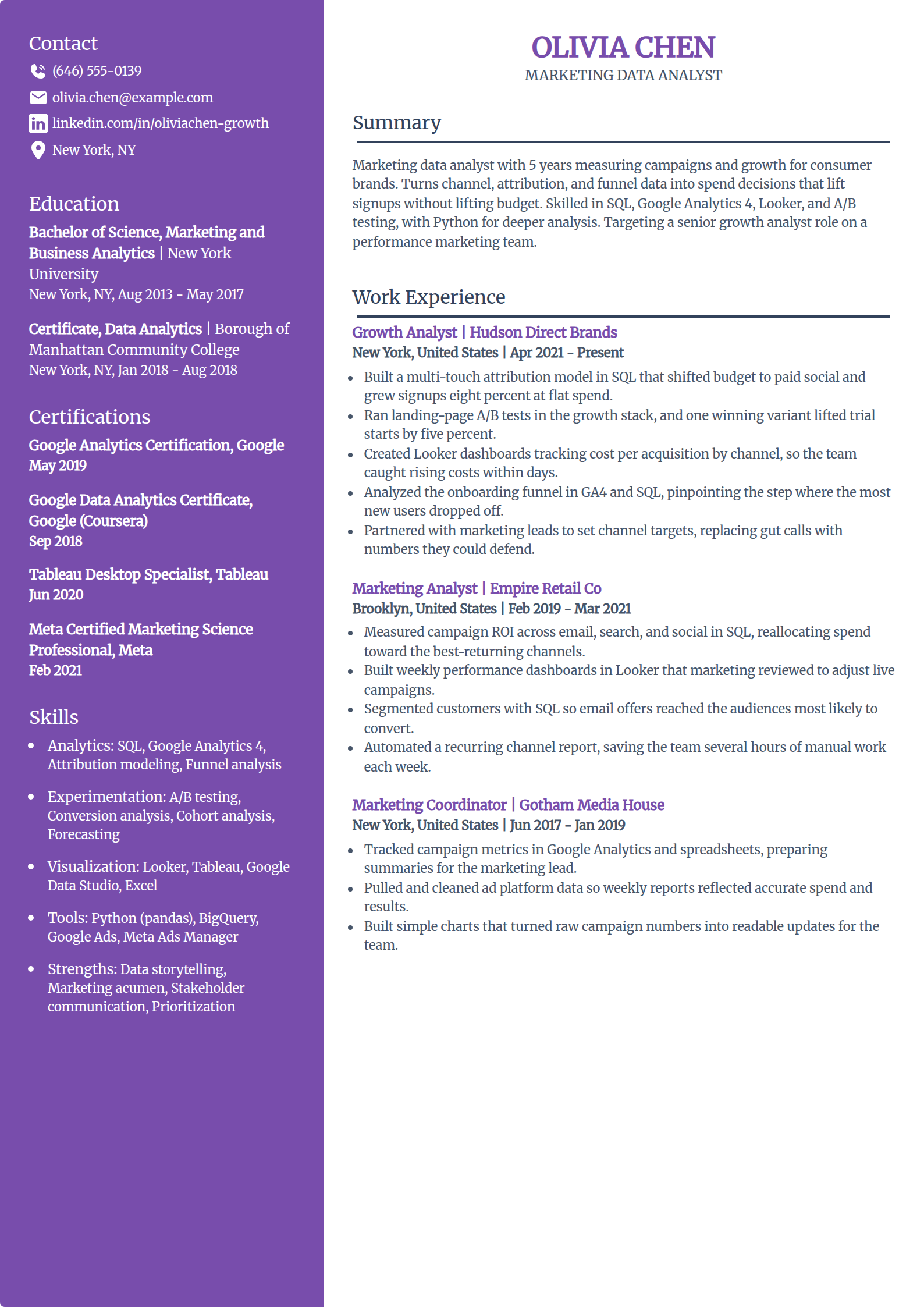
Marketing & Growth Analyst Resume Template
Why this resume example works?
- Opens with growth impact, an attribution model that grew signups eight percent at flat spend.
- Names the marketing analytics stack, SQL, Google Analytics 4, Looker, and A/B testing, with Python for deeper work.
- Ties the analysis to spend decisions, shifting budget toward the channels with the best return.
- Keeps a Medium layout with three focused roles instead of padding a shorter history.
- Backs the work with a Google Analytics Certification and a Google Data Analytics Certificate.
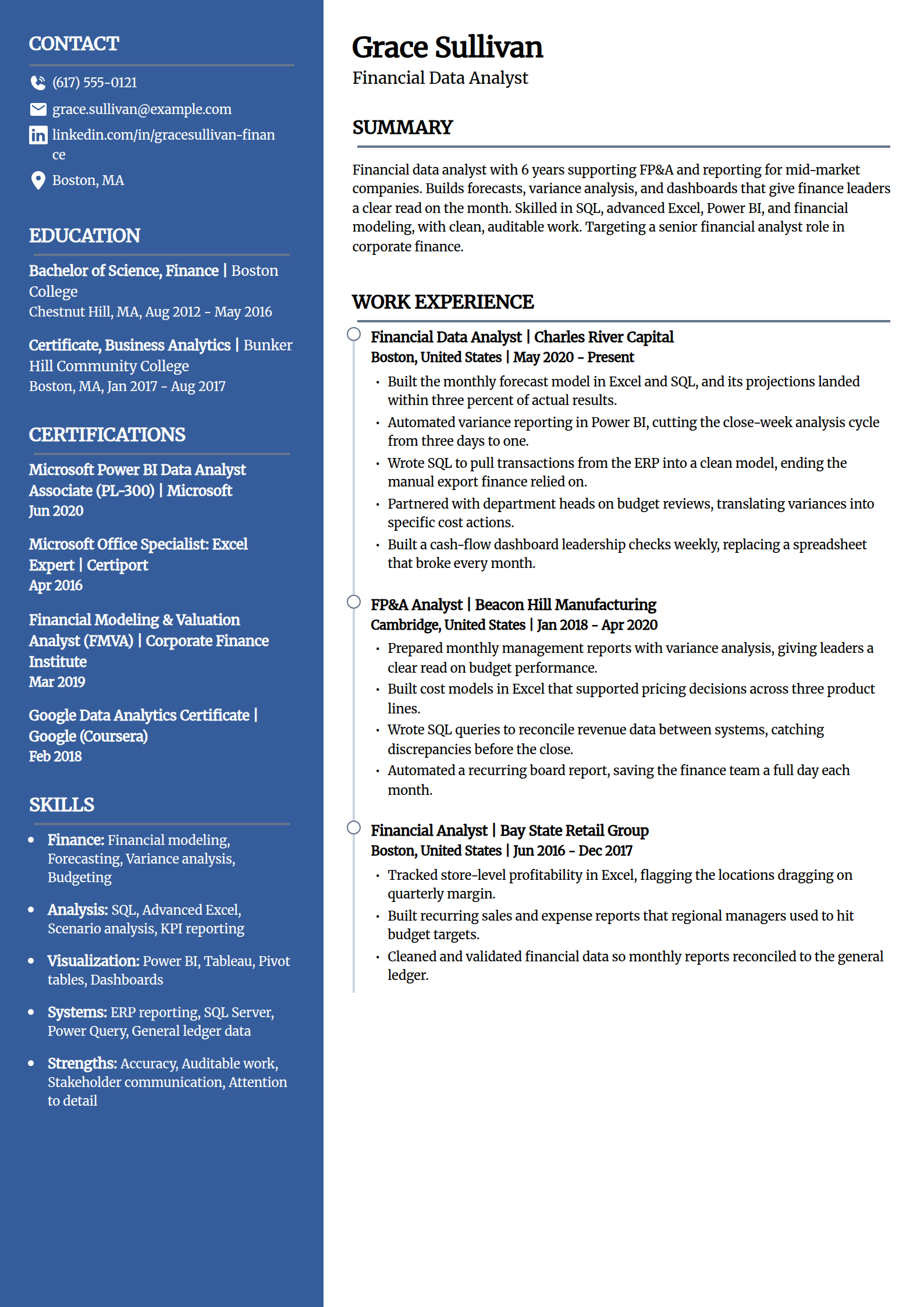
Financial Data Analyst Resume Template
Why this resume example works?
- Leads with FP&A scope, a monthly forecast model whose projections landed within three percent of actuals.
- Names the finance analyst stack, SQL, advanced Excel, Power BI, and financial modeling.
- Shows the impact finance values, cutting the close-week analysis cycle from three days to one.
- Carries a Financial Modeling and Valuation Analyst credential alongside the Power BI PL-300.
- Uses a distinctive layout that still keeps sections easy to scan for a finance hiring manager.
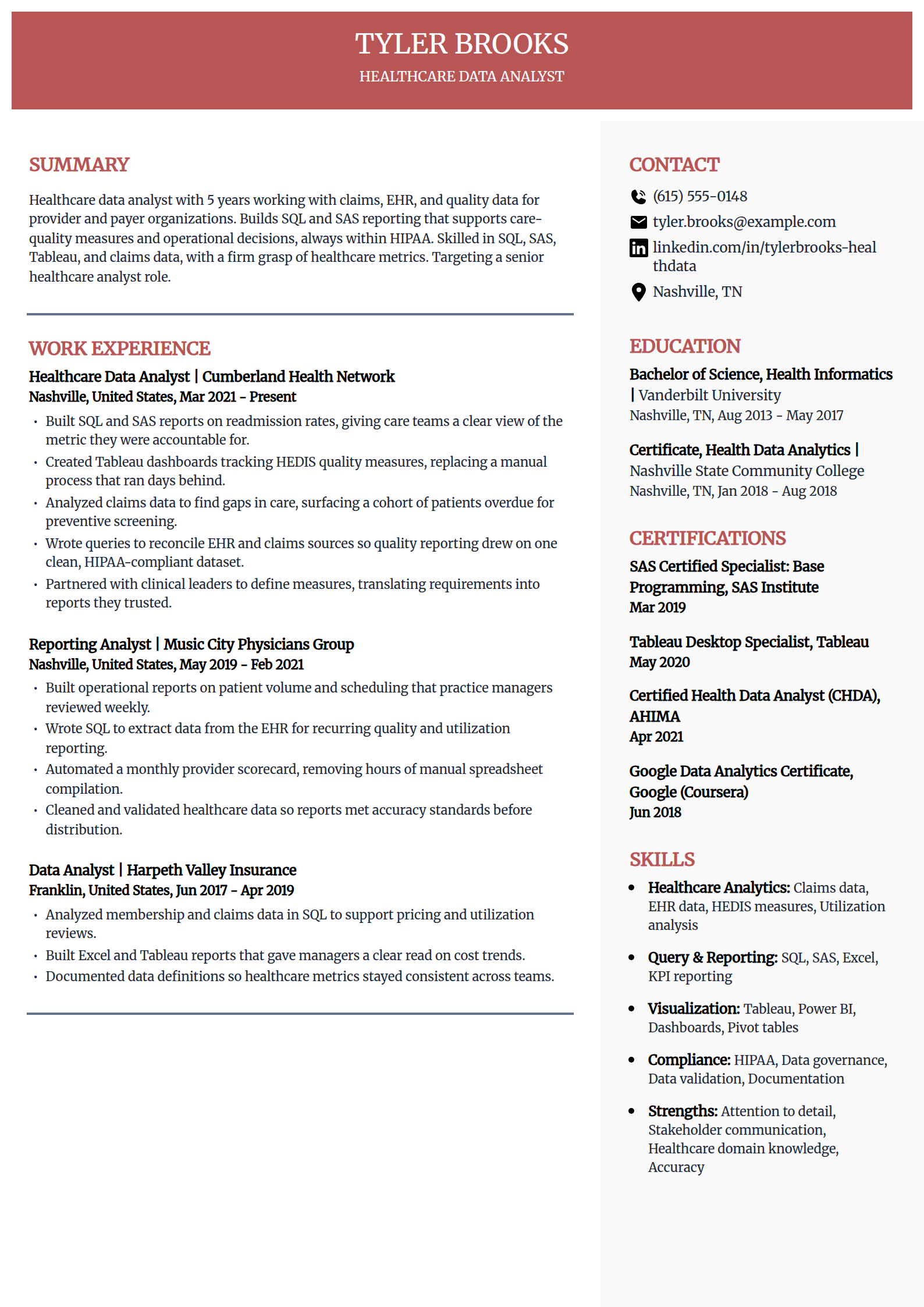
Healthcare Data Analyst Resume Template
Why this resume example works?
- Opens with healthcare scope, claims and EHR reporting on readmissions and HEDIS quality measures.
- Names the healthcare analytics stack, SQL, SAS, and Tableau, plus claims and EHR data.
- Keeps the work compliant, reconciling sources into one clean, HIPAA-compliant dataset.
- Pairs a Certified Health Data Analyst credential with a SAS Base Programming certification.
- Uses a refined layout that fits a focused five-year healthcare history on one clean page.
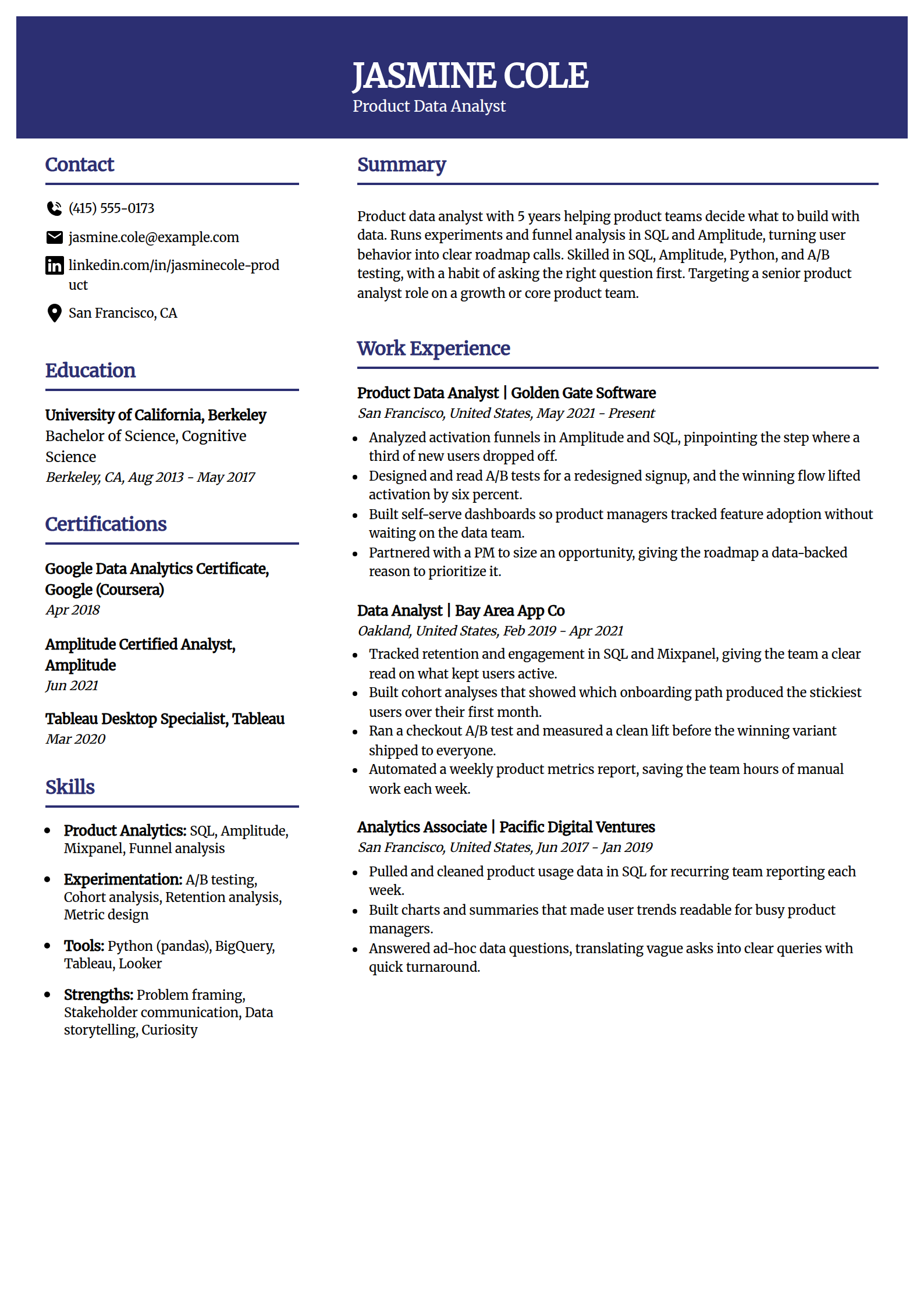
Product Data Analyst Resume Template
Why this resume example works?
- Leads with product impact, an A/B test on a redesigned signup that lifted activation by six percent.
- Names the product analytics stack, SQL, Amplitude, Mixpanel, and A/B testing, with Python for depth.
- Shows the funnel work product teams hire for, pinpointing the step where a third of new users dropped off.
- Uses a roomy two-column layout with the education, certifications, and skills sidebar filled so the page reads complete.
- Keeps every metric modest and believable rather than reaching for inflated numbers.
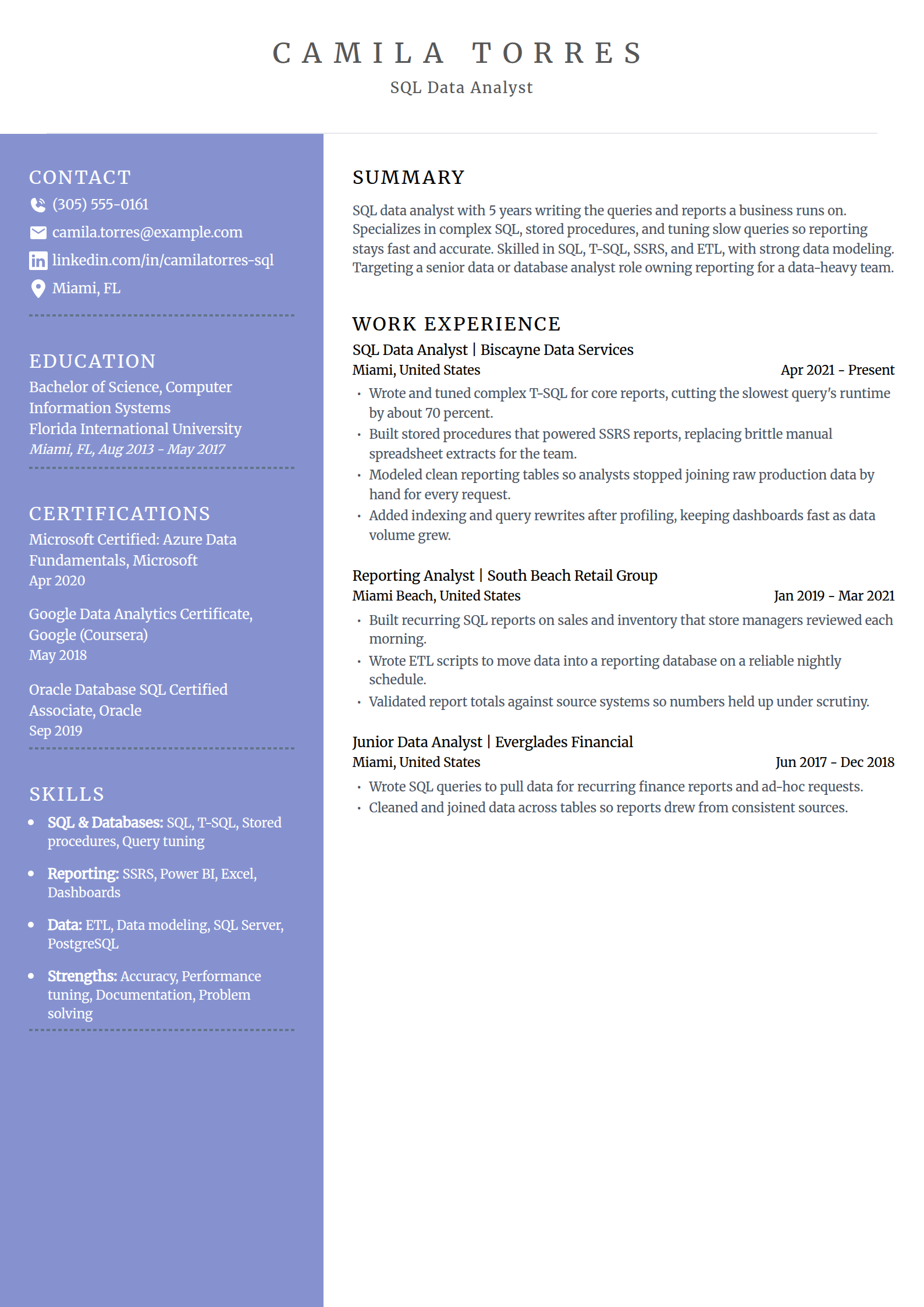
SQL & Database Analyst Resume Template
Why this resume example works?
- Leads with the SQL depth the role screens for, tuning a slow query to cut its runtime by about 70 percent.
- Names the database stack, SQL, T-SQL, stored procedures, SSRS, and ETL, the keywords on a database analyst posting.
- Shows the reporting a business runs on, stored procedures powering SSRS reports instead of manual extracts.
- Carries an Oracle Database SQL and Azure Data Fundamentals credential that fit the role.
- Uses a roomy layout with a filled sidebar so a focused, five-year history still looks full.
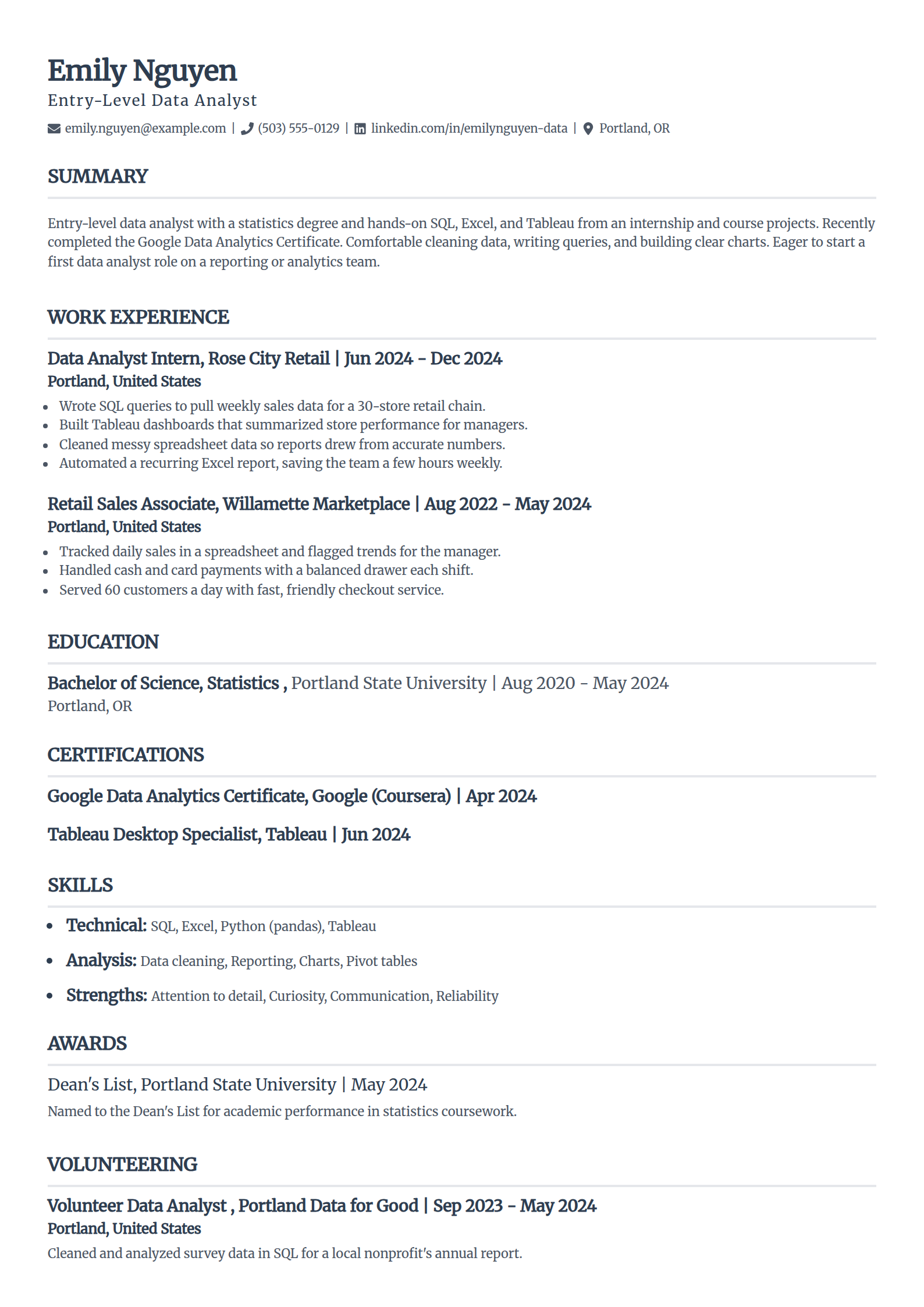
Entry-Level Data Analyst Resume Template (No Experience)
Why this resume example works?
- Written for a first data job, leading with a statistics degree, an internship, and the Google Data Analytics Certificate.
- Uses the internship to show real analyst tasks, writing SQL and building Tableau dashboards for store managers.
- Fills the page honestly with a Dean's List award and data-for-good volunteering instead of padding thin work history.
- Keeps bullets short and specific so limited experience still reads confident on one clean page.
- Uses a tight, ATS-safe single-column layout that fits a beginner's resume without empty space.
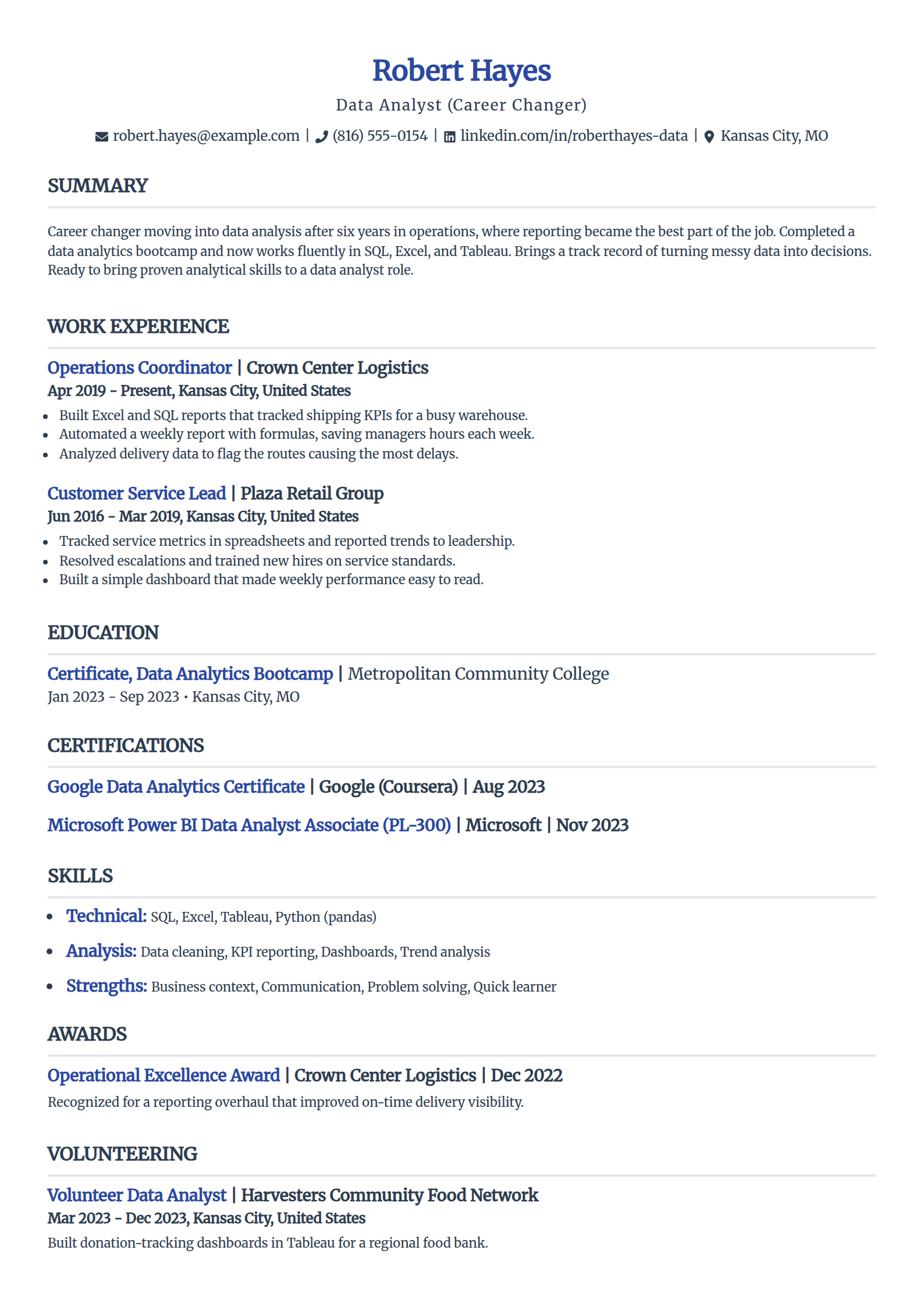
Career-Change Data Analyst Resume Template
Why this resume example works?
- Names the change openly and reframes six years in operations as reporting and analysis experience.
- Pulls the transferable work forward, building Excel and SQL reports and automating recurring KPI work.
- Shows recent commitment to the switch with a data analytics bootcamp and a Google Data Analytics Certificate.
- Fills the page with an operational-excellence award and analytics volunteering so the pivot reads intentional.
- Uses a plain, ATS-safe layout that keeps the focus on proven analytical skills.
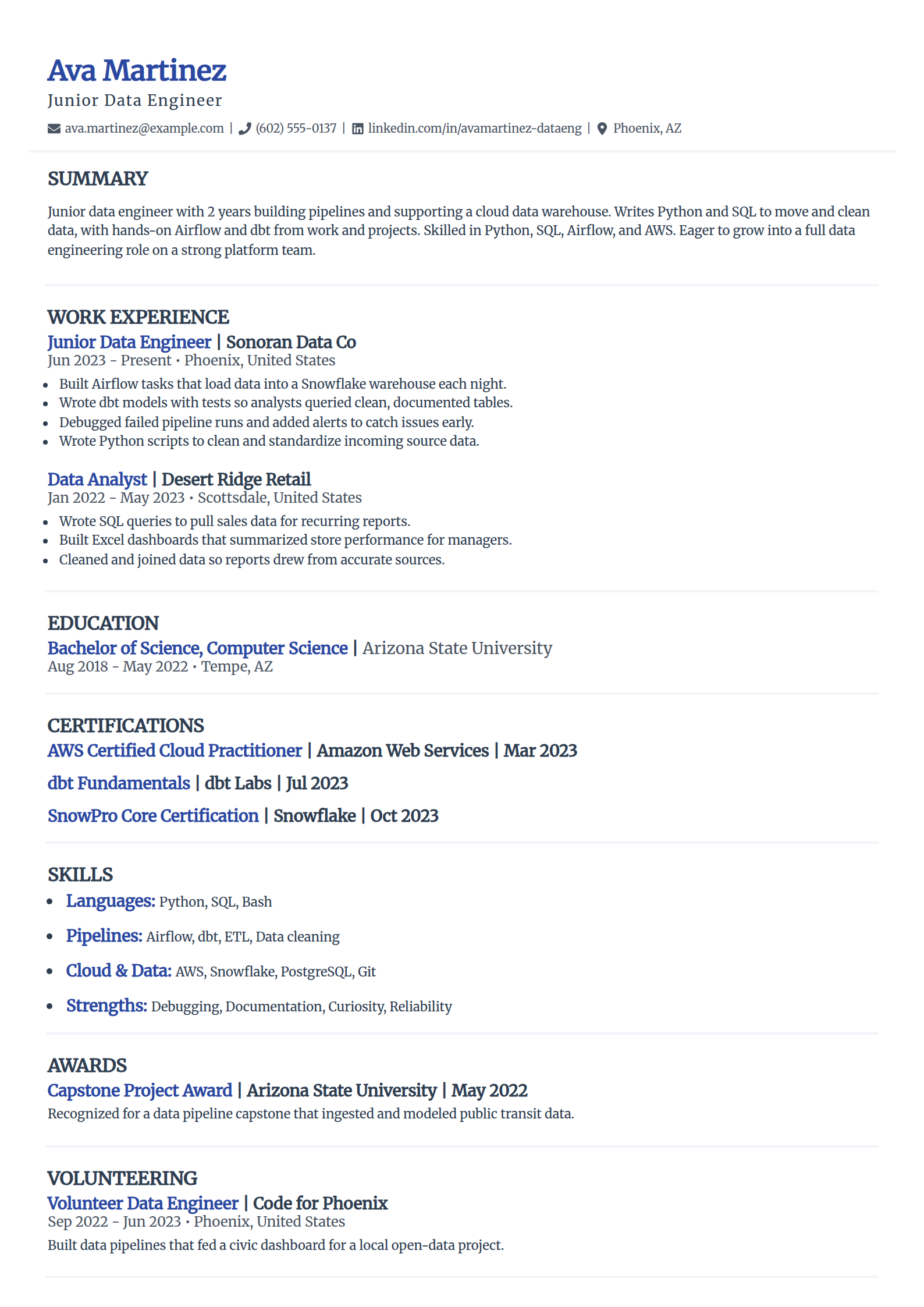
Junior Data Engineer Resume Template
Why this resume example works?
- Written for an early-career engineer, leading with Airflow tasks and dbt models built on the job.
- Names the entry-level data engineering stack, Python, SQL, Airflow, dbt, and AWS.
- Shows real pipeline work, debugging failed runs and adding alerts to catch issues early.
- Fills the page with a capstone award and civic-tech volunteering that fit a junior engineer.
- Uses a refined, uncluttered layout that fits a shorter two-year history on one page.
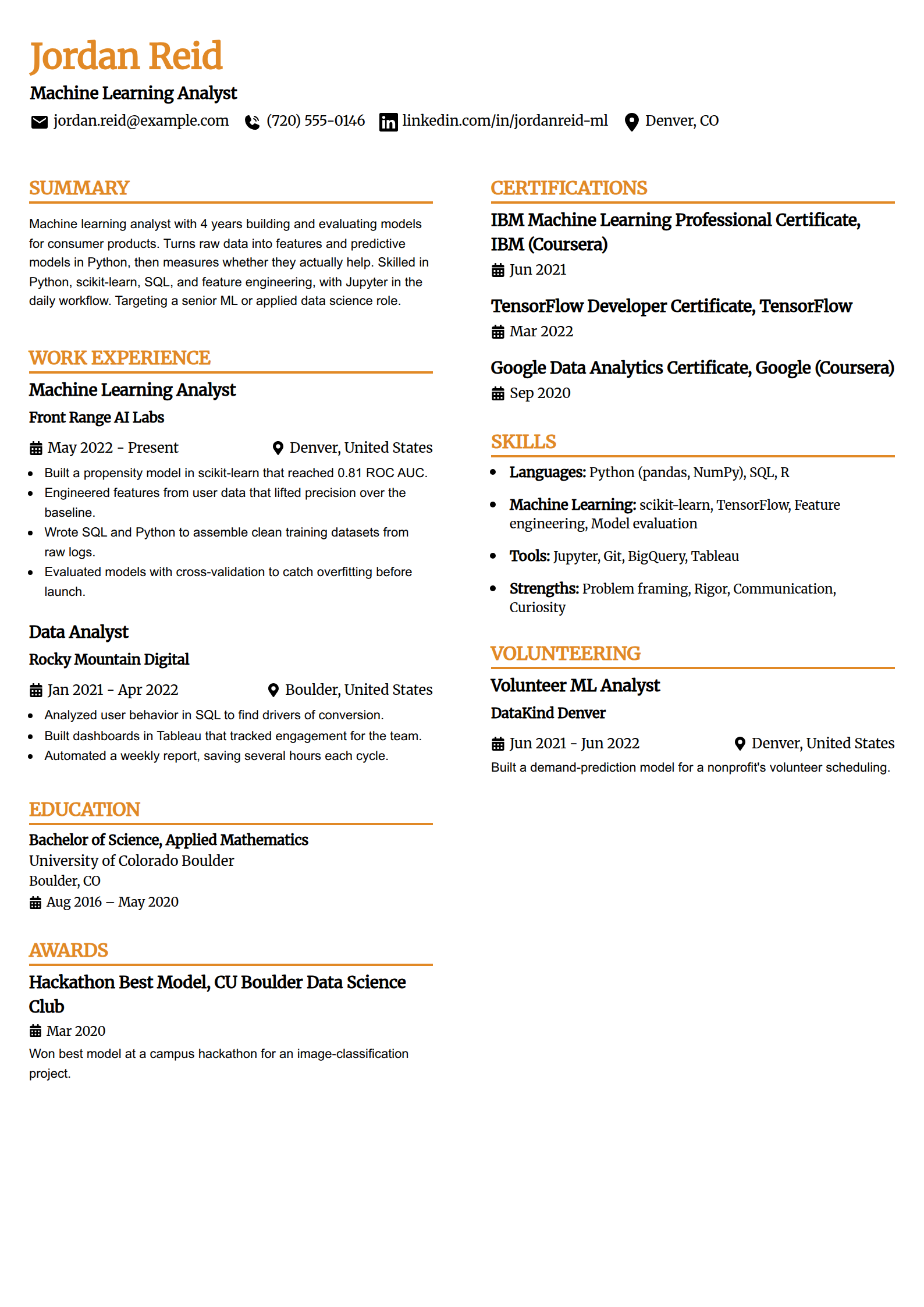
Machine Learning Analyst Resume Template
Why this resume example works?
- Leads with modeling, a propensity model at 0.81 ROC AUC and features that lifted precision over the baseline.
- Names the ML stack, Python with scikit-learn and TensorFlow, plus feature engineering and model evaluation.
- Shows the rigor a team wants, evaluating models with cross-validation to catch overfitting before launch.
- Fills the page with a hackathon best-model award and DataKind volunteering that fit the specialty.
- Keeps bullets short and results-focused so a four-year history reads clean and technical.
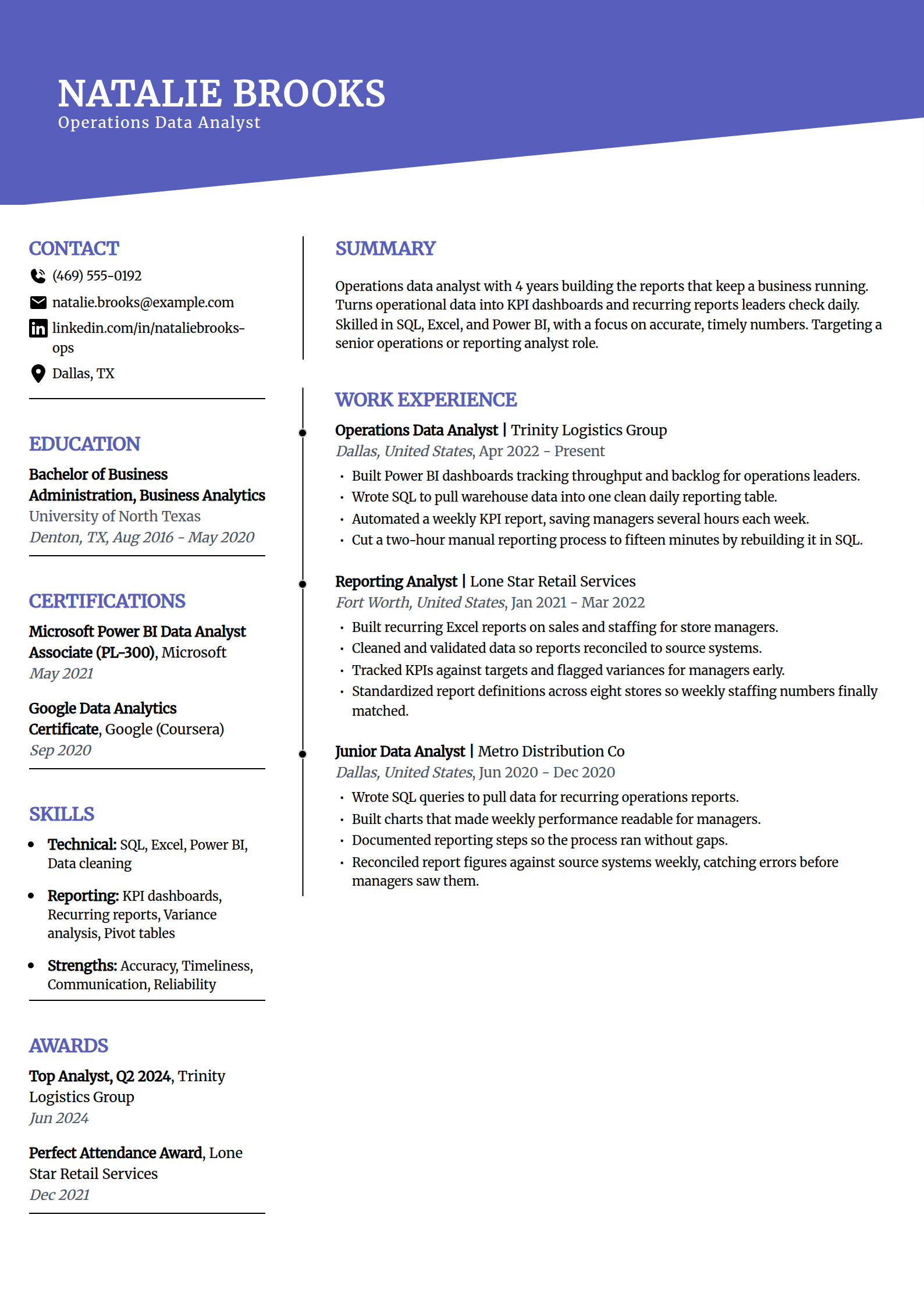
Operations & Reporting Analyst Resume Template
Why this resume example works?
- Leads with the reporting a business runs on, Power BI dashboards tracking throughput and backlog for operations leaders.
- Names the reporting stack, SQL, Excel, and Power BI, with a focus on accurate, timely numbers.
- Shows the day-to-day analyst work, pulling warehouse data into one clean daily reporting table.
- Lists awards without long descriptions, keeping the two-column layout clean and balanced.
- Carries a Microsoft Power BI Data Analyst (PL-300) credential that matches the role.
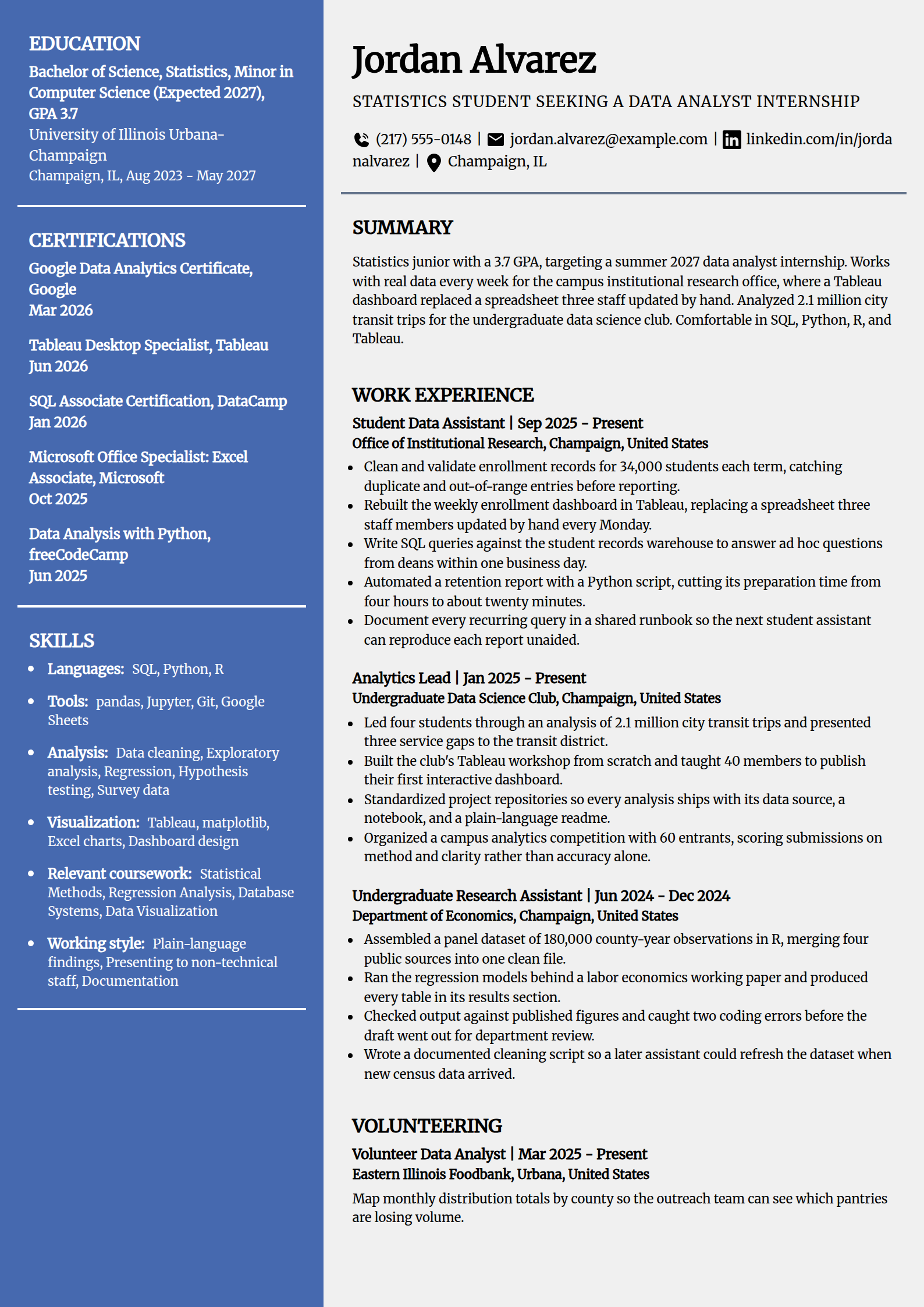
Data Analyst Intern Resume Template (Still in School)
Why this resume example works?
- Says up front that the degree is expected in 2027, so a recruiter screening for interns knows the status immediately.
- Treats a campus job as real analyst work, with enrollment records cleaned for 34,000 students and a dashboard rebuilt in Tableau.
- Describes the club project the way a hiring manager reads it: the dataset, the question, and what the findings changed.
- Names tools an internship posting lists, SQL, Python with pandas, R, and Tableau, next to the coursework that taught them.
- Fills the page with a research assistantship and food bank volunteering instead of padding a thin work history.
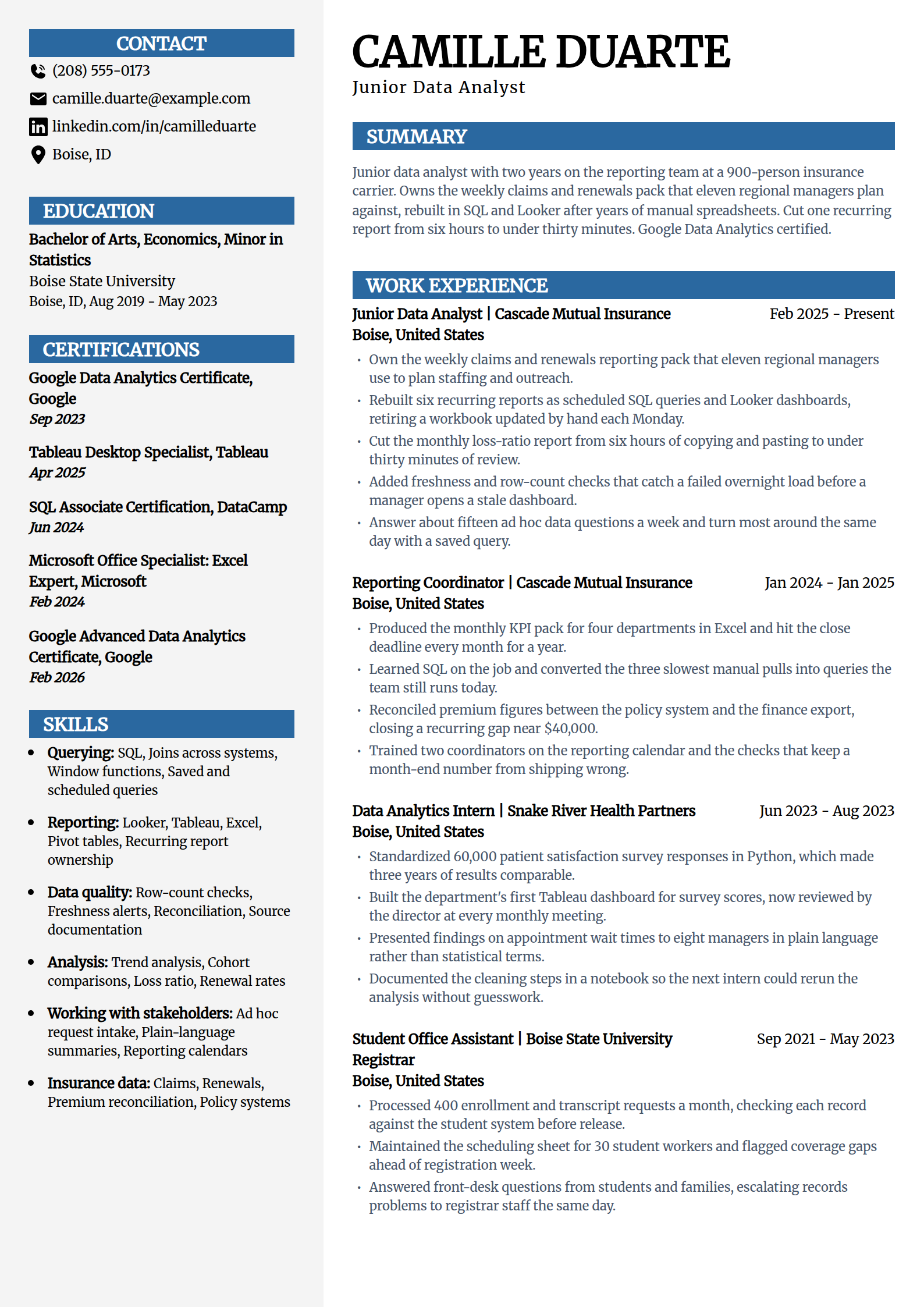
Junior Data Analyst Resume Template (1 to 2 Years)
Why this resume example works?
- Shows ownership at a junior level, one weekly reporting pack that eleven regional managers plan against.
- Proves the promotion story by putting the coordinator role underneath, where SQL was learned on the job.
- Carries one honest automation win, a six-hour monthly report cut to under thirty minutes of review.
- Adds the data-quality habits a team promotes for, freshness and row-count checks that catch a failed load early.
- Keeps numbers at the scale a two-year analyst really owns instead of reaching for company-wide impact.
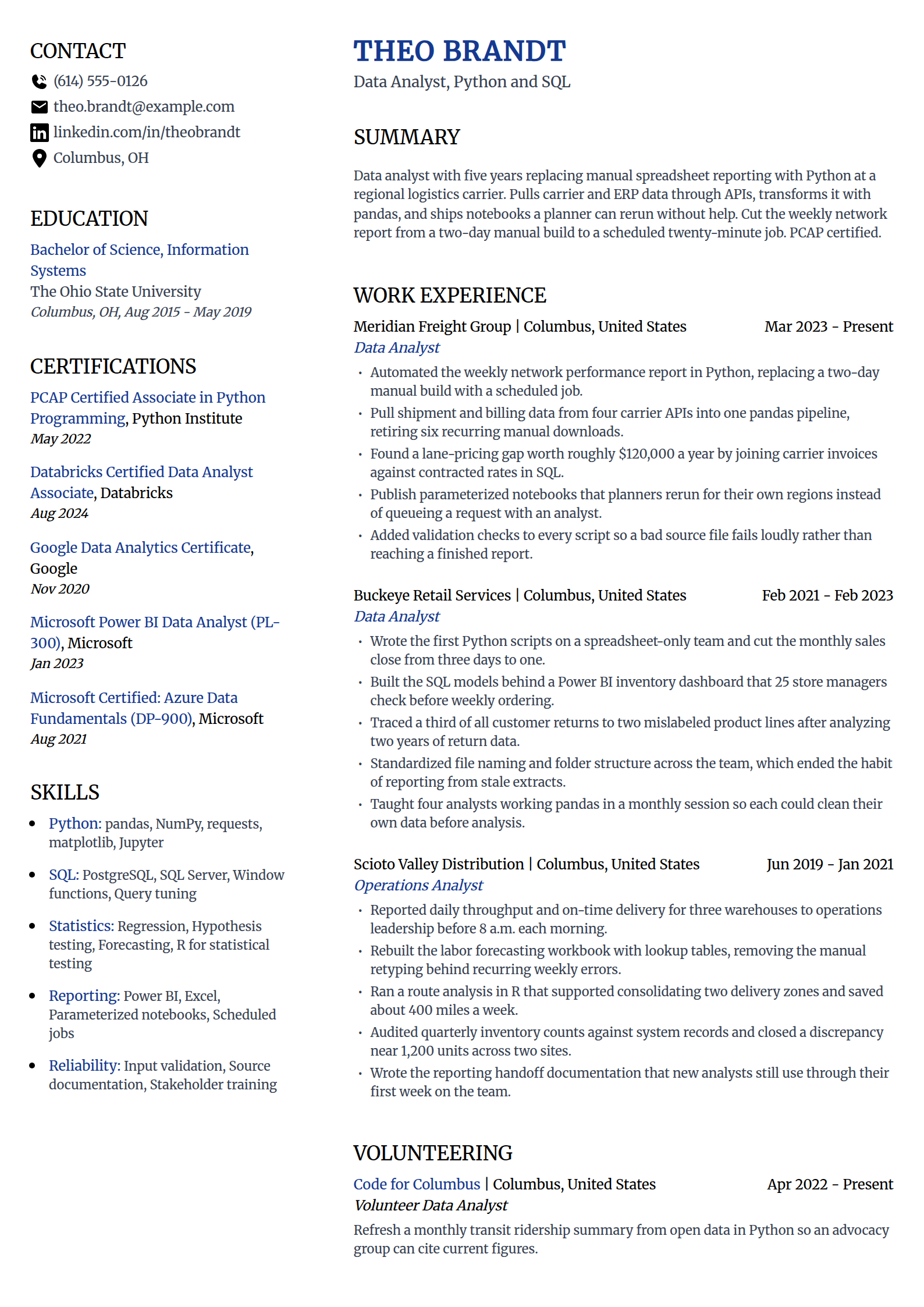
Python Data Analyst Resume Template
Why this resume example works?
- Puts Python to work on reporting rather than modeling, replacing a two-day manual build with a scheduled job.
- Names the library stack a Python analyst posting lists, pandas, NumPy, requests, matplotlib, and Jupyter.
- Shows the analysis that pays for the automation, a lane-pricing gap worth about $120,000 a year found in SQL.
- Proves the work reaches other people, with parameterized notebooks planners rerun for their own regions.
- Keeps R in the statistics skills line, which is where a general analyst uses it, rather than overclaiming a second language.
Build your data analyst resume
Pick a template above and the editor keeps your layout clean and ATS-safe while you swap in your own SQL, dashboards, and the impact behind each project.
Build my resumeHow to write a data analyst resume in 2026
A data analyst resume is read for impact, not tasks. In the first few seconds a hiring manager wants the decisions your analysis drove and the tools you used, so lead with those and prove each with one number. These moves make yours easy to skim and easy for an applicant tracking system to parse.
Open with a short, specific summary
Write three to four sentences that name your title and years, the kind of analysis you do, two or three tools you know, and the role you are targeting. Lead with what you have shipped, not adjectives about yourself.
Data analyst with 5 years turning operational data into decisions for retail and SaaS teams. Builds SQL pipelines and Tableau dashboards that cut reporting time and surface revenue leaks. Skilled in SQL, Python with pandas, dbt, and Tableau. Targeting a senior data analyst role on a product or business intelligence team.
Lead experience with impact, then the tool
The work an analyst is hired for is measurable, so name what changed and attach one credible number. Open every line with a strong verb, never "Responsible for".
- Impact first: say what the analysis changed, like recovering $90,000 in monthly sales by finding a broken checkout coupon.
- Name the tool that did it: a Tableau dashboard, a dbt model, a Python script, or a SQL query, matching the posting's terms.
- Show reporting you own: a self-serve dashboard 40 stakeholders use, or a report automated from a two-day manual process.
- Keep one number per bullet and keep it modest: a six percent A/B lift or a forecast within five percent reads as real.
Match tools to your track, not a generic list
Data roles split by specialty, and the tools you name signal which one you fit. List the stack for your track so a hiring manager and a parser both find the keywords.
- Analyst and BI: SQL, Excel, Tableau or Power BI with DAX, Looker, and dbt for modeling clean reporting tables.
- Data scientist and ML: Python with pandas and scikit-learn, TensorFlow, A/B testing, and Jupyter for modeling and experiments.
- Data engineer: SQL, Python, Airflow, Spark, dbt, and a warehouse like Snowflake, Redshift, or BigQuery for pipelines.
- Specialty analysts: name your domain data too, GA4 for marketing, financial modeling for finance, claims and EHR for healthcare.
Show education and certifications that fit
A degree in statistics, computer science, economics, or a related field helps, but a real certificate carries weight when experience is light. List the ones that match your track.
- Entry-level and career-changers: the Google Data Analytics Certificate and a Tableau Desktop Specialist show hands-on skill.
- BI and reporting: the Microsoft Power BI Data Analyst (PL-300) is the credential a BI posting looks for.
- Data engineering and cloud: an AWS, Google Cloud, or Databricks data certification signals platform skill.
- Data science: the Azure Data Scientist Associate (DP-100) or a deep learning specialization backs a modeling resume.
Keep it to one clean, ATS-safe page
A data analyst resume is a quick read, so one page in a simple layout is the standard. The templates above are built this way.
- Use a single-column or clean two-column layout with standard headings a parser recognizes.
- Hold it to one page and lead with your most recent role in reverse-chronological order.
- Save as a PDF so the formatting holds, then run it through the ATS resume checker for a quick clean-format pass.
- Swap the numbers in the templates above for your own impact, projects, and tools; do not copy them as is.
Common data analyst resume mistakes
- Listing tasks with no impact. "Built dashboards" is a duty; "built a Tableau dashboard 40 stakeholders use instead of spreadsheets" is proof.
- Hiding the tools. Name SQL, Python, and your BI tool in the bullets and skills; those are the keywords a parser matches to the posting.
- A generic tool list that does not match your track. A data engineer names Airflow and dbt; a data scientist names scikit-learn, not the same line.
- Inflated numbers. A model at 0.83 ROC AUC or a forecast within five percent reads as real; a fabricated 40 percent revenue lift reads as invented.
- Running to two pages or using a heavy design with tables. Keep one clean page a hiring manager and an ATS both read easily.
Frequently asked questions
What should a data analyst resume include?
A data analyst resume needs your contact details, a short summary, your work history in reverse-chronological order, education, skills, and certifications. Lead the summary and each job with impact and the tool behind it: the dashboard that replaced a manual report, the analysis that changed a decision, and the SQL, Python, or Tableau you used. Name the stack for your track so an applicant tracking system matches it to the posting, and add a certificate like the Google Data Analytics Certificate. Keep it to one clean page.
How do I write a data analyst resume with no experience?
Lead with a relevant degree, an internship or course projects, and a certificate like the Google Data Analytics Certificate. Show real analyst tasks even from a project or internship: writing SQL queries, cleaning data, and building a Tableau or Excel dashboard. Name the tools you know, such as SQL, Excel, Python, and Tableau, since those are the keywords a parser looks for. Use a tight, one-page template and fill it honestly with an award or volunteering entry rather than padding thin work history. The entry-level example above shows the shape.
What skills and tools do you put on a data analyst resume?
Match the tools to your track and to the job posting. A general analyst lists SQL, Excel, Python with pandas, and Tableau or Power BI; a BI analyst adds DAX and Looker; a data engineer names Airflow, Spark, dbt, and a warehouse like Snowflake or Redshift; a data scientist names scikit-learn, TensorFlow, and A/B testing. Split the list so a hiring manager and a parser both find what they need, and back it with a certification, such as the Power BI PL-300 or an AWS data certificate, that fits your track.
Data analyst vs data scientist vs data engineer resume: what is different?
The tools and the impact you show are different. A data analyst resume leads with SQL, dashboards, and the decisions your reporting drove. A data scientist resume leads with models and experiments, naming Python with scikit-learn, A/B testing, and metrics like ROC AUC or forecast error. A data engineer resume leads with pipelines and warehouses, naming Airflow, Spark, dbt, and Snowflake, plus reliability work like data-quality tests. Pick the template above that matches your track and lead with the work that role is hired for.
Which resume template is best for a data analyst?
Use a clean, one-page template with standard headings and a single-column or simple two-column layout, so an applicant tracking system parses it and a hiring manager reads it fast. Reverse-chronological order works best because it puts your most recent role first. The templates above are each built this way and sorted by track and seniority, from entry-level analyst to data scientist, BI analyst, and data engineer, so you can pick the one that matches your target job and swap in your own numbers.
How long should a data analyst resume be?
One page. A data analyst resume is a quick read, so keep it to a single, skimmable page led by your most recent role. Focus on your last few roles and the projects that show measurable impact and the tools the posting names. If you have a long history, keep the roles that show your strongest analysis and drop older or unrelated positions to make room for what matters.
More data analyst resume resources
Build your data analyst resume
Pick a template above and the editor keeps your layout clean and ATS-safe while you swap in your own SQL, dashboards, and the impact behind each project.