Clinical Bench or Industrial Lab? 16 Lab Technician Resume Examples
- ATS Friendly
- Clinical & Industrial
- 16 Real Examples
A lab technician resume example should show four things: the bench work you actually run, the instruments and systems you run it on, your certification status stated plainly, and quality-control work with a number attached. Hospital bench, manufacturing QC, research, pharma, or environmental, each has its own example below. Start from the layout that matches your lab, then swap in your own specimen volumes, methods and credentials.


540k+ resumes created
Laboratory technician resume templates you can edit
Each template below is a real laboratory resume laid out in that format, sorted by the kind of lab it was written for. The clinical layouts put certification and analyzer experience where a hospital manager looks first; the industrial ones lead with methods, instruments and the quality system the plant runs under. Pick one, then replace the specimen counts, methods and credentials with your own.
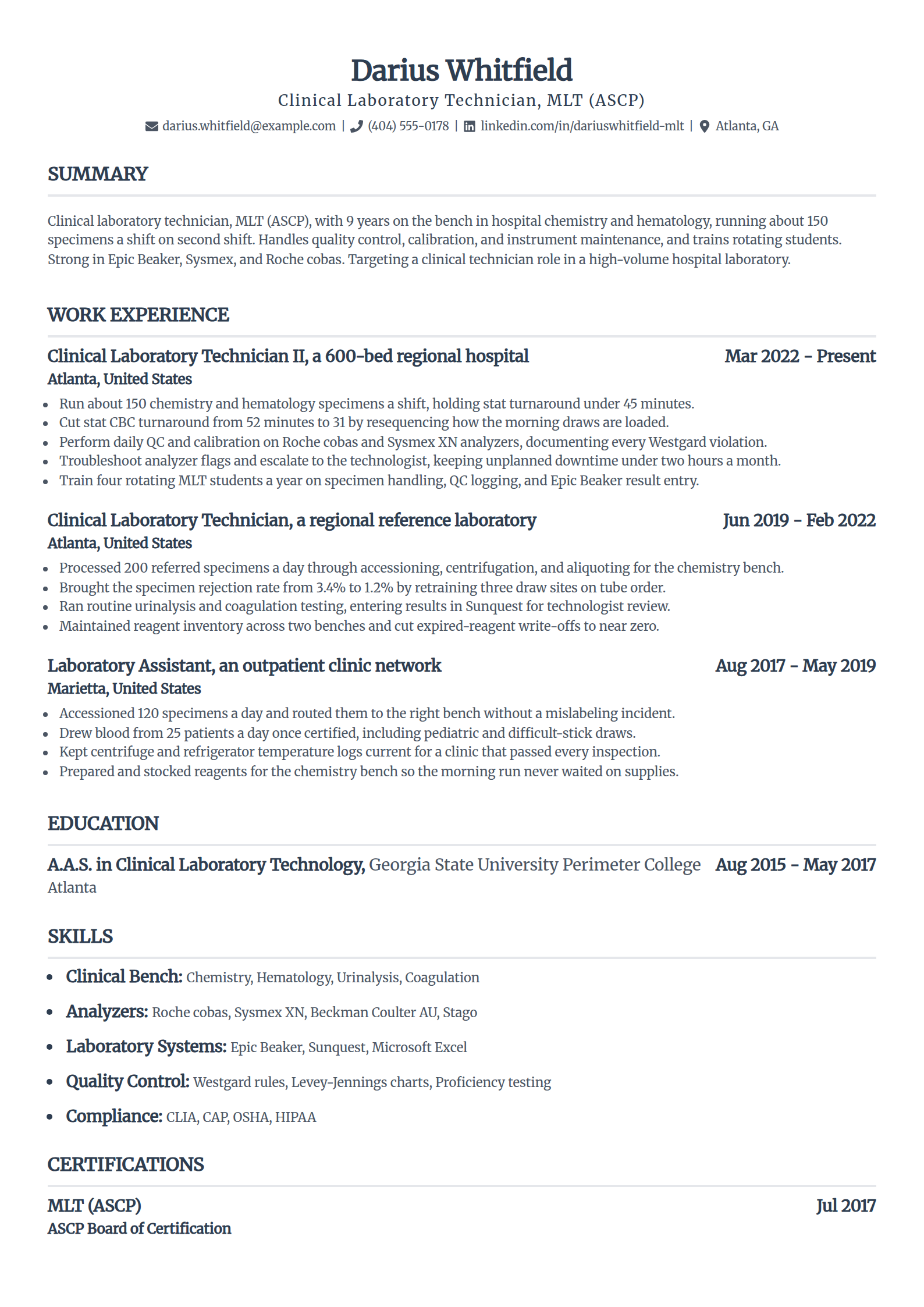
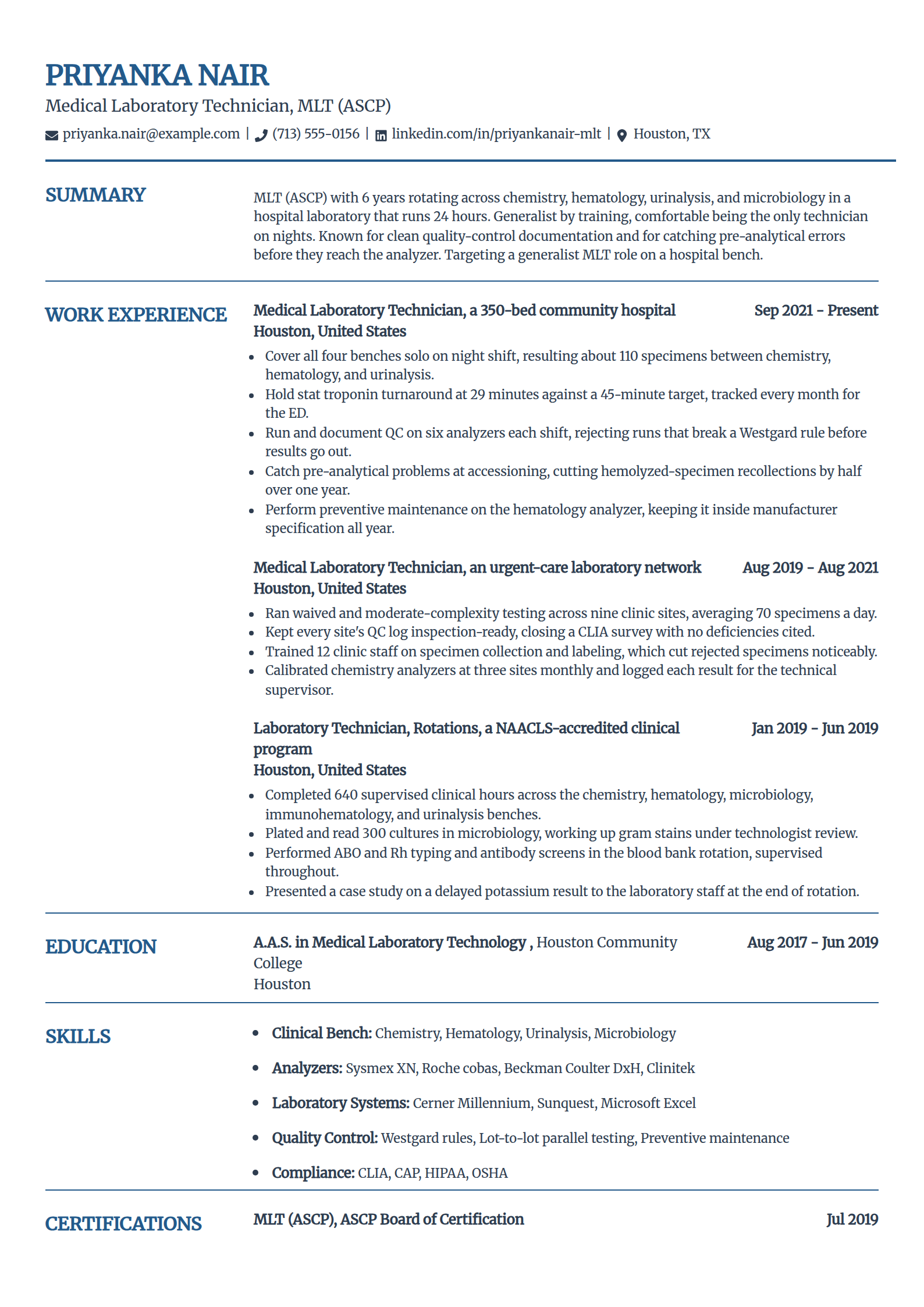
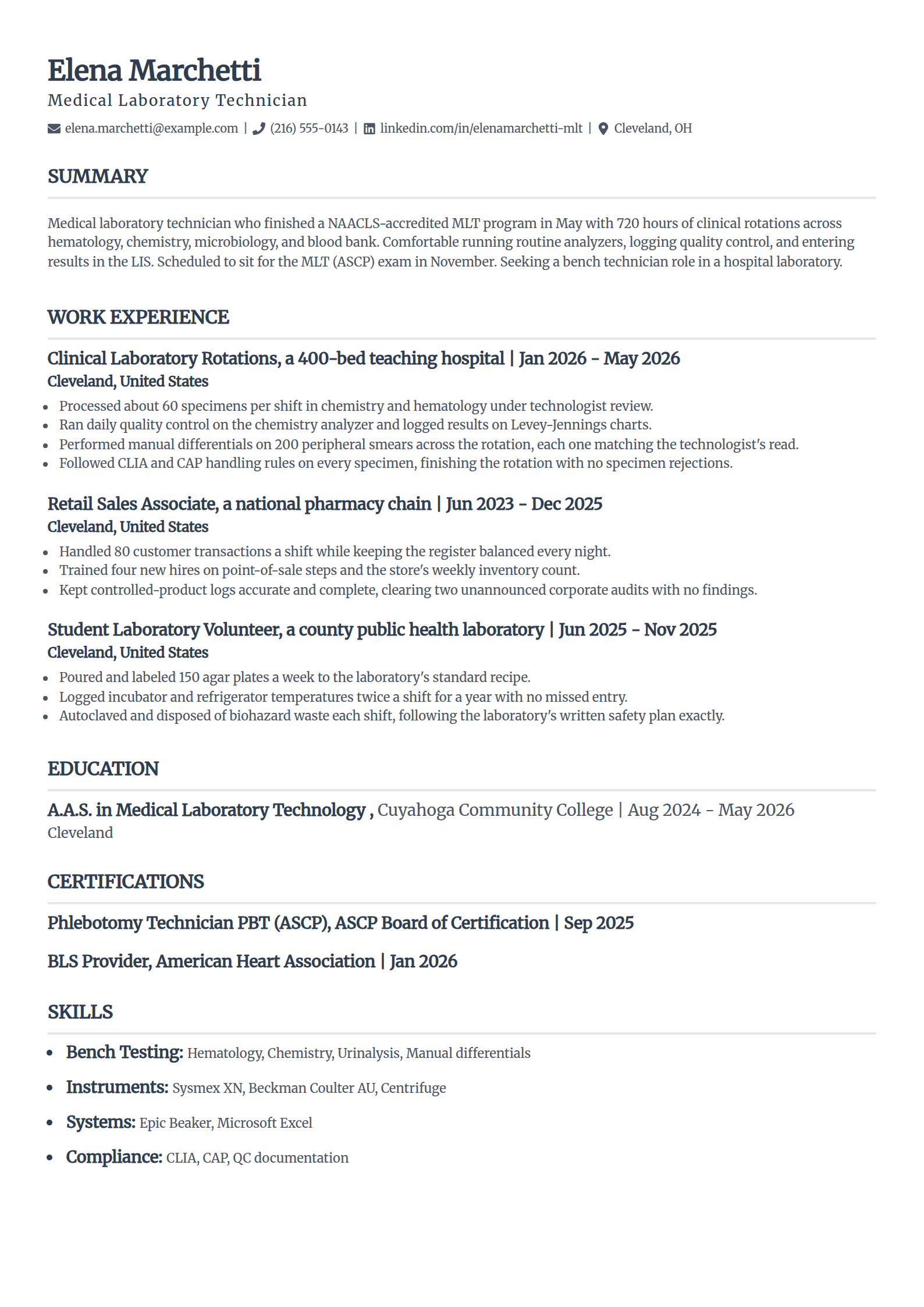
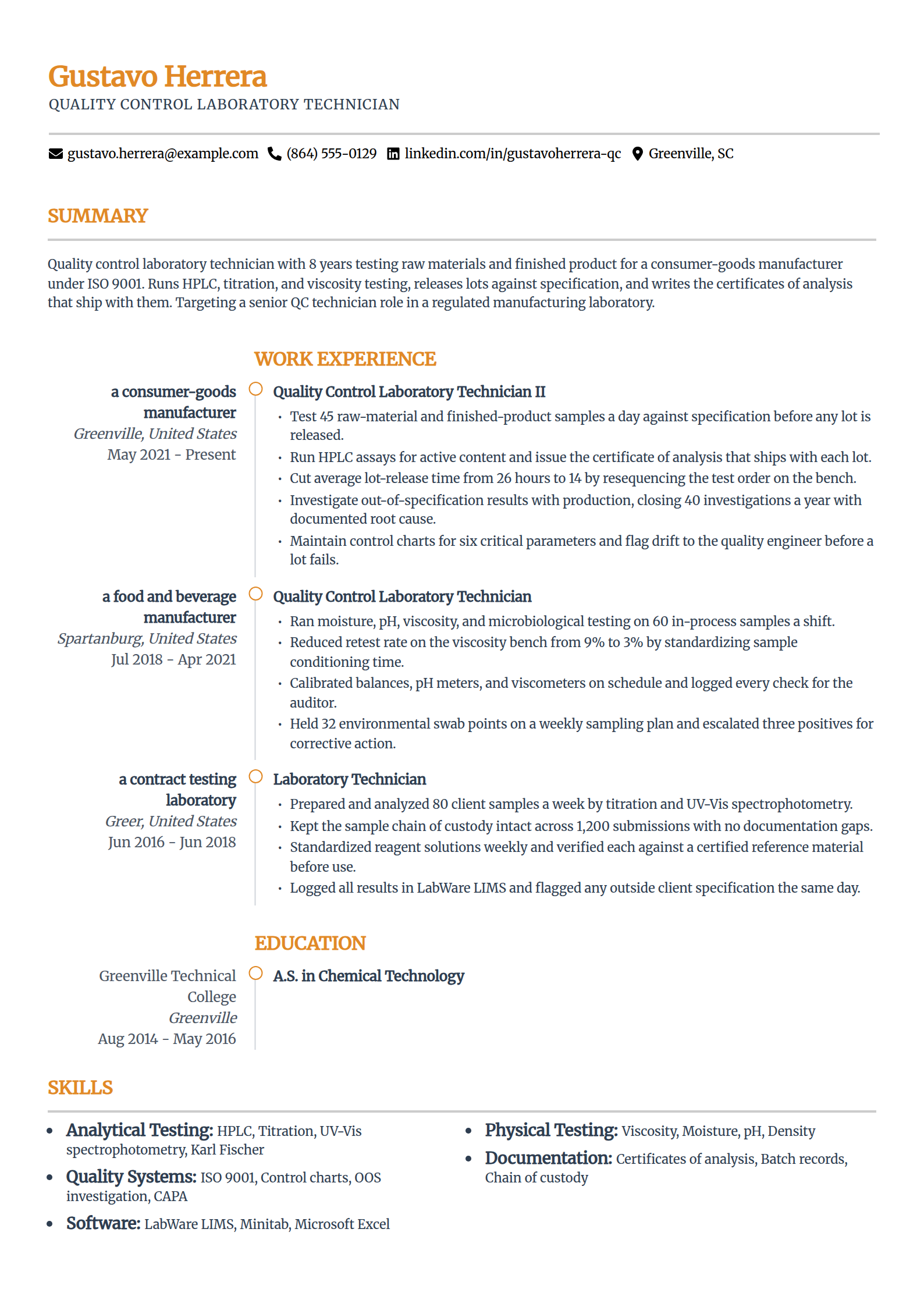
Clinical Laboratory Technician Resume Template
Why this resume example works?
- Puts the credential in the headline, MLT (ASCP), which is the first thing a hospital laboratory screens for.
- Leads with throughput a manager can picture, about 150 chemistry and hematology specimens a shift on seconds.
- Shows the quality-control work the job is really judged on, daily QC and calibration with every Westgard violation documented.
- Names the systems a posting lists, Epic Beaker, Sunquest, Roche cobas and Sysmex XN, in real context.
- Keeps one number per bullet and stays inside technician scope, escalating analyzer problems to the technologist.
Medical Laboratory Technician (MLT) Resume Template
Why this resume example works?
- Written for the generalist a small hospital hires, covering chemistry, hematology, urinalysis and microbiology.
- Shows the thing night-shift postings care about, covering four benches alone and holding stat troponin at 29 minutes.
- Turns a documentation habit into an accomplishment, a night-shift bench checklist the laboratory now issues to new hires.
- Uses clinical rotations as a dated entry, which is how a recent graduate fills a work history honestly.
- Carries the pharmacy technician years without pretending they were laboratory work.
Entry-Level Lab Technician Resume Template (No Experience)
Why this resume example works?
- Leads with 720 hours of clinical rotations, which is the experience a new graduate actually has to sell.
- States the exam status correctly, scheduled to sit for the MLT (ASCP) exam in November, not a credential already held.
- Uses rotations, a retail job and a laboratory volunteer stint as three dated entries instead of an empty work history.
- Keeps the retail job on the page for the transferable parts, register accuracy and controlled-product logs.
- Fills a tight, ATS-safe page with real coursework, a phlebotomy certification and four skill groups, not filler.
Quality Control Lab Technician Resume Template
Why this resume example works?
- Opens with the decision the job exists to make, releasing lots against specification before anything ships.
- Shows the paperwork a manufacturer hires for, certificates of analysis and 40 out-of-specification investigations a year.
- Names the quality system outright, ISO 9001, with two surveillance audits passed on the test records.
- Attaches one number to each result, like lot-release time cut from 26 hours to 14 by resequencing the bench.
- Keeps the production-operator start visible, which explains how the candidate reads a manufacturing floor.
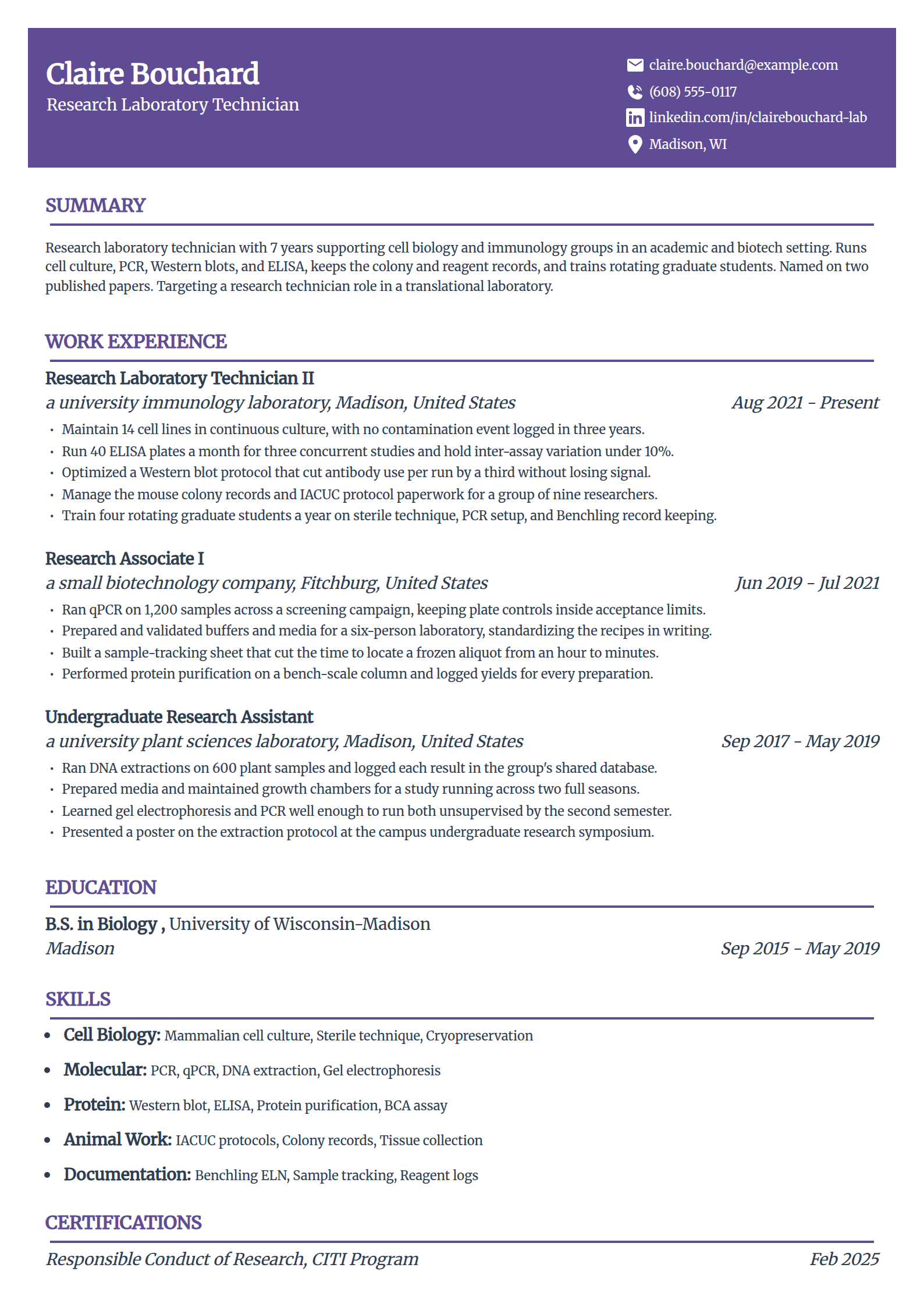
Research Lab Technician Resume Template
Why this resume example works?
- Leads with the techniques a principal investigator is staffing for, cell culture, PCR, Western blot and ELISA.
- Proves reliability the way a research group measures it, 14 cell lines with no contamination event in three years.
- Shows the unglamorous work that keeps a laboratory running, colony records and IACUC protocol paperwork.
- Names authorship honestly, credited on two peer-reviewed papers for methods work, with no overstatement.
- Carries the undergraduate assistant years, which is where most research technicians genuinely start.
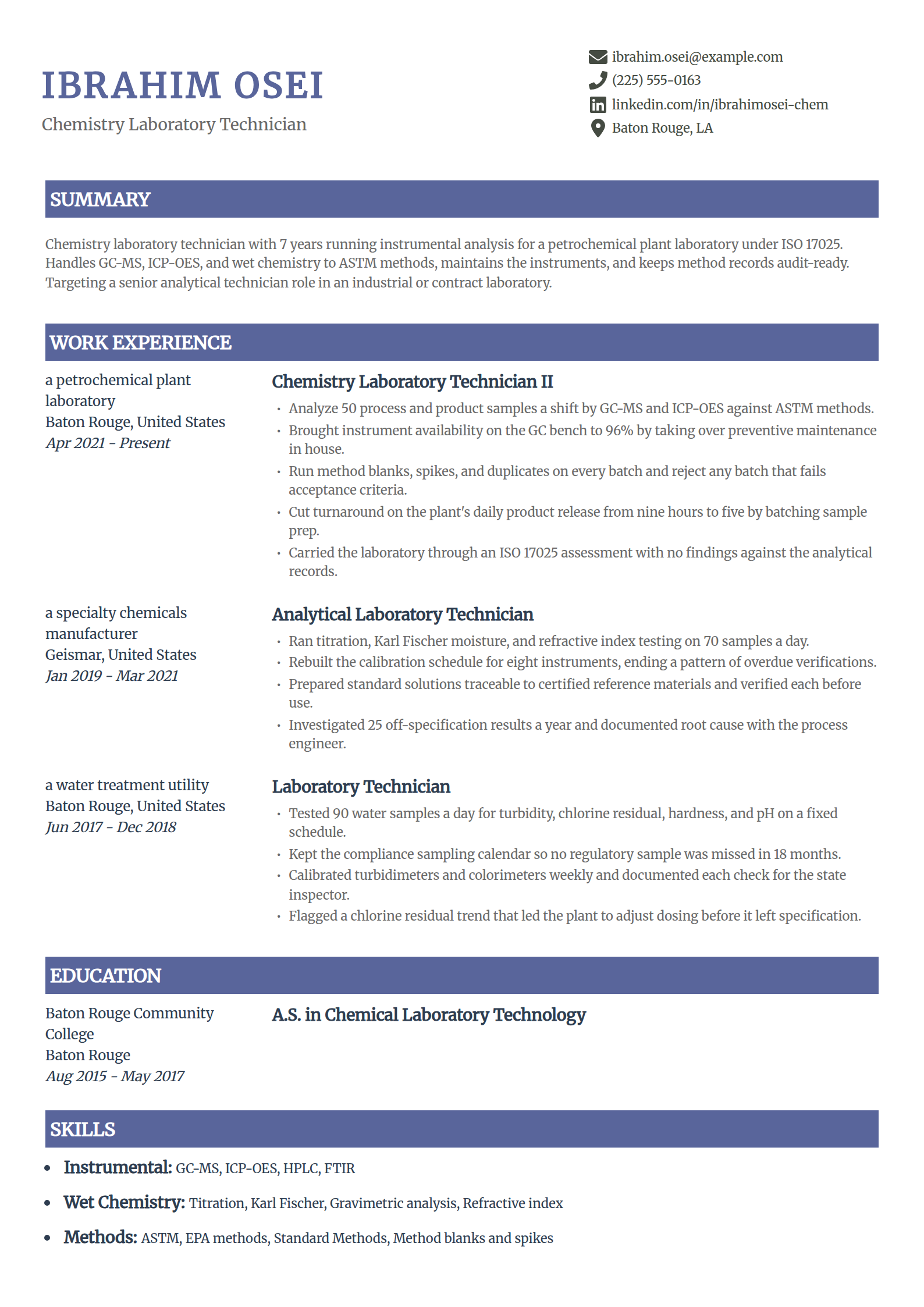
Chemistry Lab Technician Resume Template
Why this resume example works?
- Names the instruments an industrial posting screens for, GC-MS and ICP-OES, and the ASTM methods they run under.
- Shows ownership beyond running samples, preventive maintenance taken in house and GC availability at 96%.
- Proves the data is defensible, method blanks, spikes and duplicates on every batch with failures rejected.
- Puts the accreditation on the page, an ISO 17025 assessment passed with no findings against the analytical records.
- Keeps the utility and teaching-laboratory start, which is how many analytical technicians build their method range.
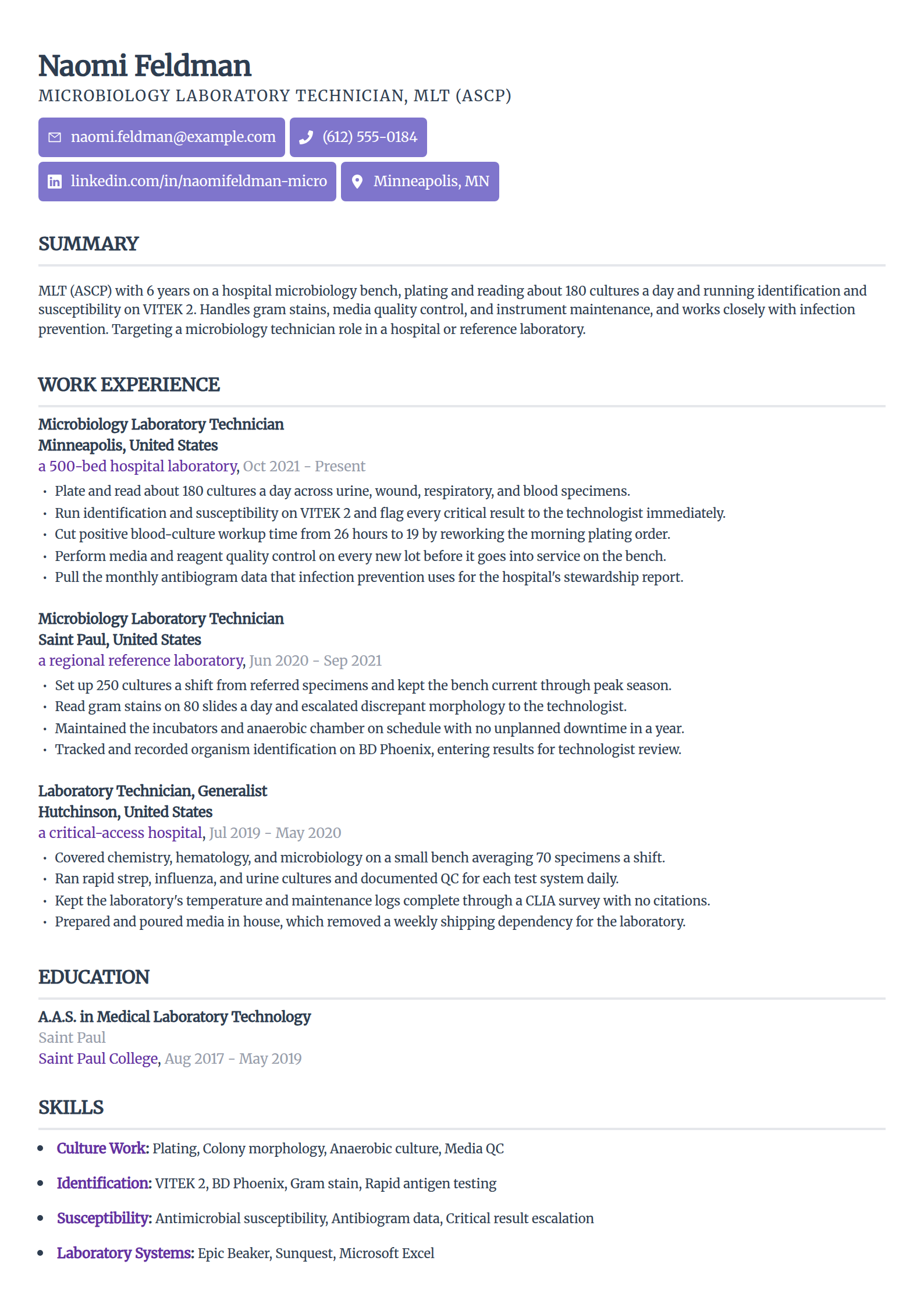
Microbiology Lab Technician Resume Template
Why this resume example works?
- Leads with plate volume, about 180 cultures a day across urine, wound, respiratory and blood specimens.
- Names the identification platforms a micro bench runs on, VITEK 2 and BD Phoenix, plus gram stains.
- Shows the work that connects the bench to the hospital, monthly antibiogram data for antimicrobial stewardship.
- Keeps critical results inside scope, flagged to the technologist immediately rather than interpreted.
- Proves consistency with proficiency testing, every CAP microbiology event since 2021 without a graded error.
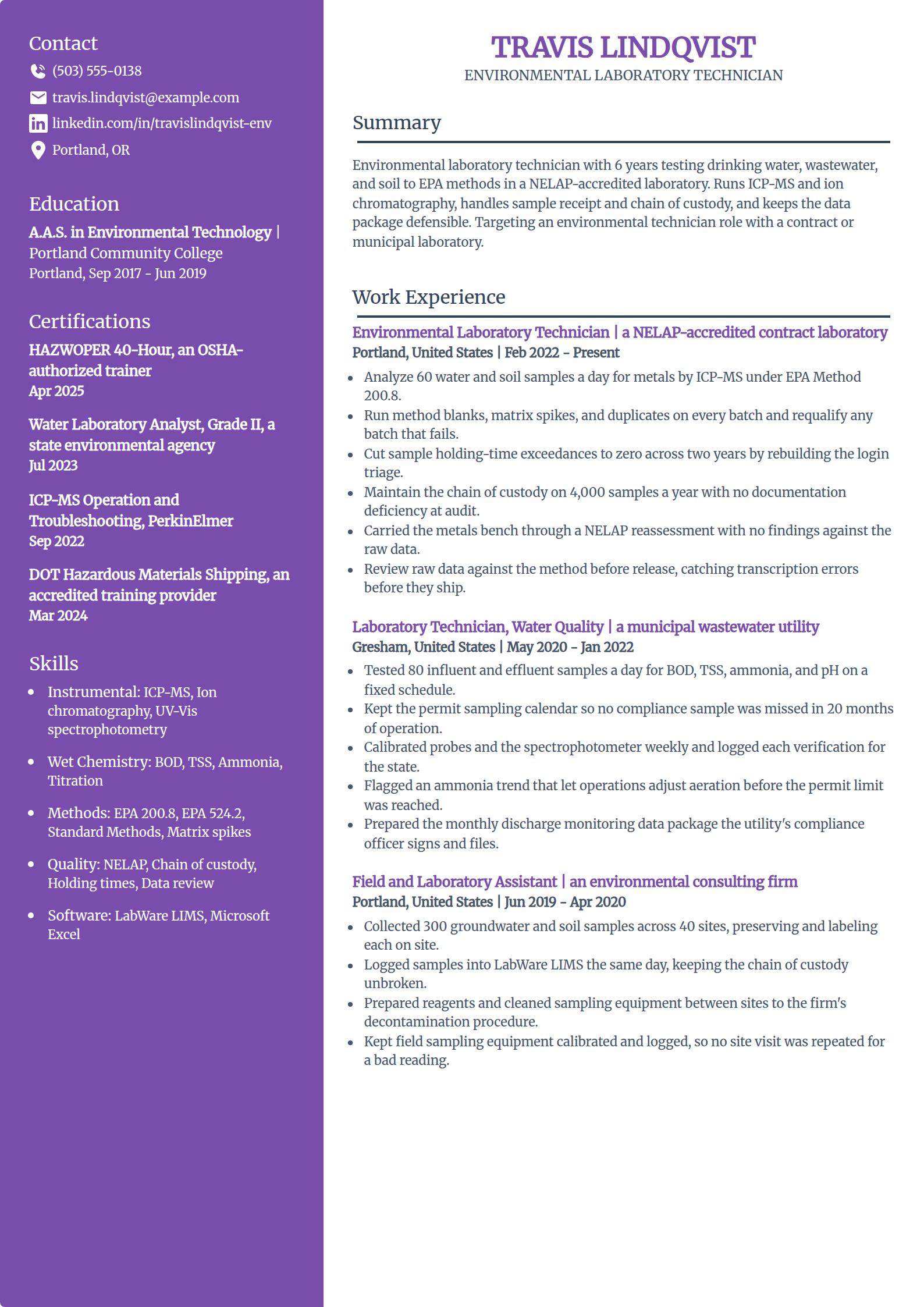
Environmental Lab Technician Resume Template
Why this resume example works?
- Names the regulatory method, EPA Method 200.8 for metals by ICP-MS, which is what a contract laboratory searches for.
- Shows the accreditation that wins the work, NELAP, with a reassessment passed on the raw data.
- Leads with the failure mode this job exists to prevent, holding-time exceedances taken to zero over two years.
- Keeps chain of custody on the page, 4,000 samples a year with no documentation deficiency at audit.
- Includes the field sampling years, which many municipal and consulting postings ask for directly.
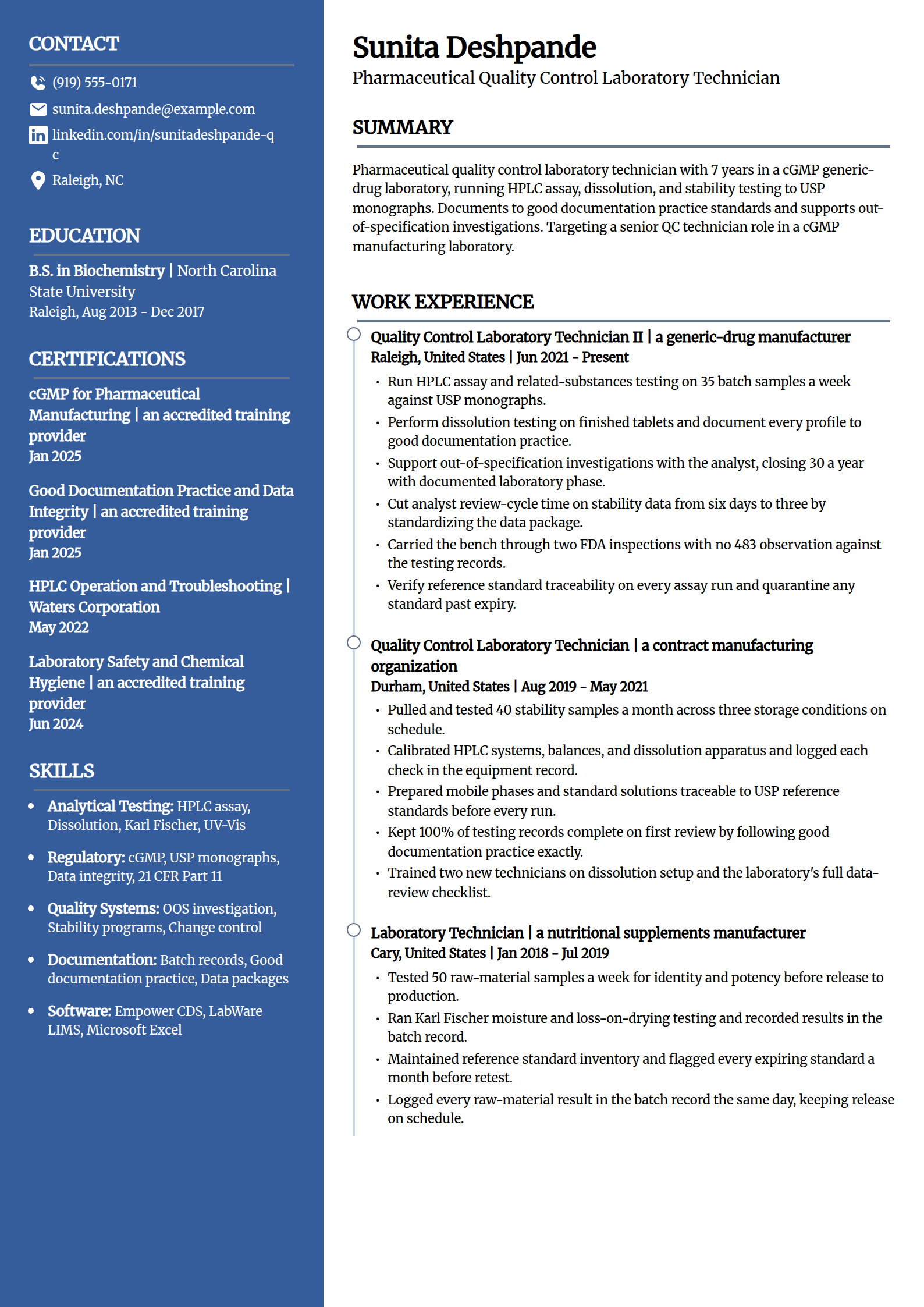
Pharmaceutical QC Lab Technician Resume Template (cGMP)
Why this resume example works?
- Speaks the regulated vocabulary a cGMP laboratory screens for: USP monographs, dissolution, stability and OOS.
- Puts good documentation practice in the bullets, not just the skills list, because that is what an auditor checks.
- Shows the inspection record plainly, two FDA inspections with no observation against the testing records.
- Ties a process fix to a number, stability data review cut from six days to three by standardizing the data package.
- Names the software a pharma posting lists, Empower CDS and LabWare LIMS, alongside the instruments.
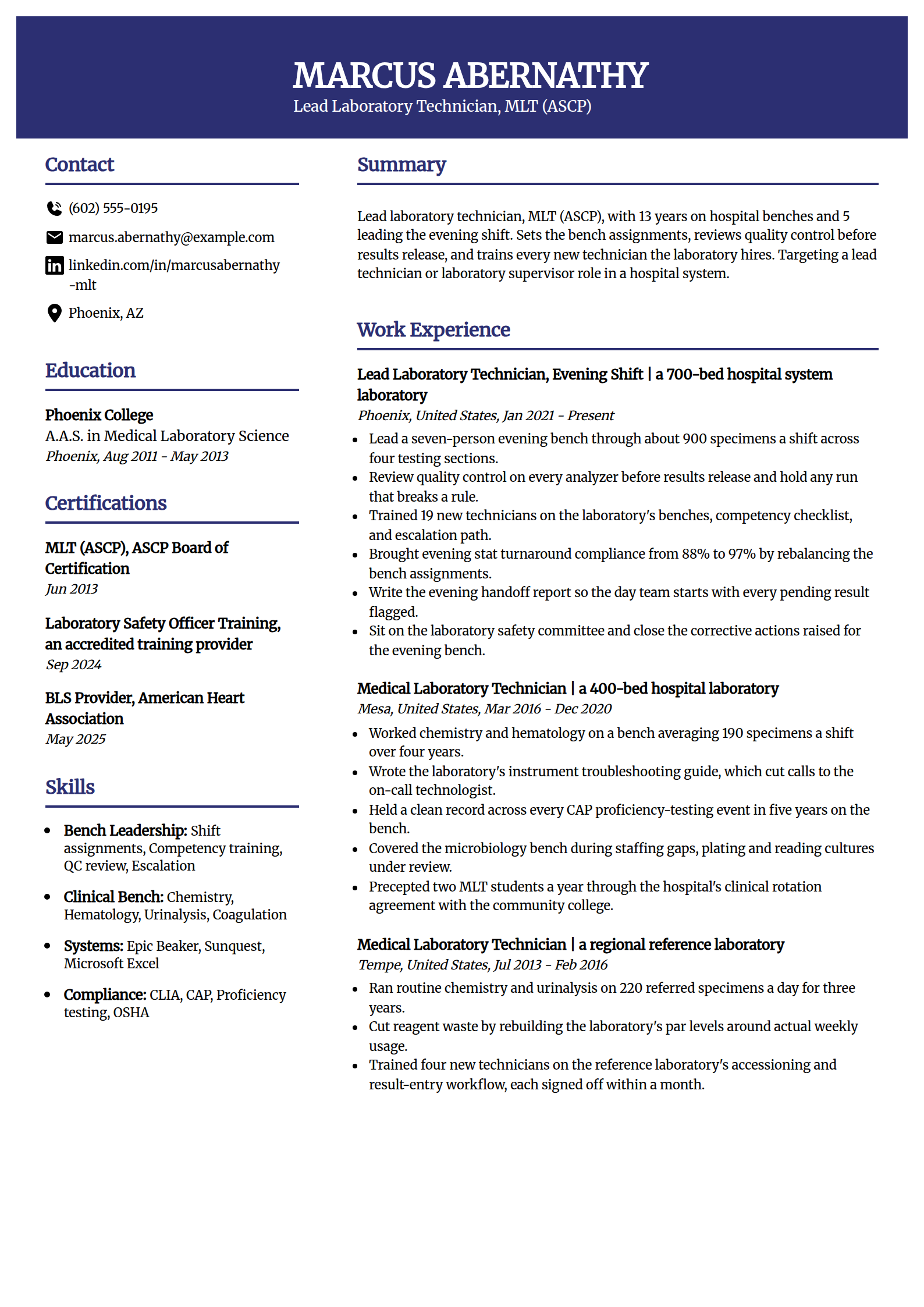
Senior & Lead Lab Technician Resume Template
Why this resume example works?
- Separates the two spans a lead is hired on, 13 years on the bench and 5 running a shift.
- Shows lead work concretely, bench assignments, QC review before results release, and holding any run that breaks a rule.
- Counts the people, 19 new technicians trained, which is the number a supervisor posting actually wants.
- Keeps one operational metric, evening stat turnaround compliance raised from 88% to 97%.
- Stops short of technologist scope, so the claims stay credible for a lead technician.
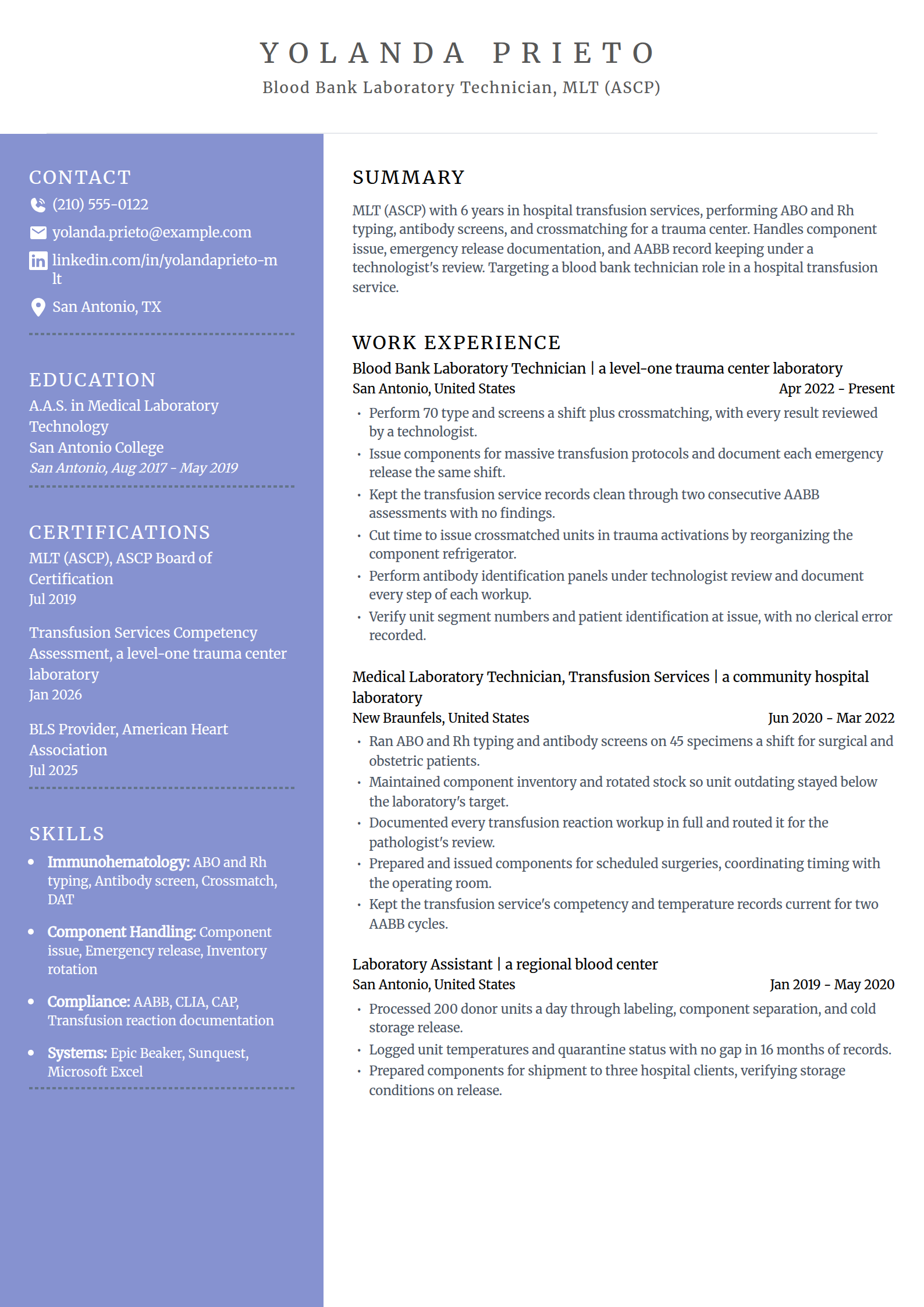
Blood Bank & Transfusion Services Technician Resume Template
Why this resume example works?
- Names the specific testing a transfusion service hires for, ABO and Rh typing, antibody screens and crossmatching.
- Shows trauma-center work that sets this bench apart, component issue under massive transfusion protocols.
- Puts the standard on the page, AABB, with clean assessments across two consecutive inspection cycles.
- Keeps every claim inside technician scope, with technologist review named rather than implied.
- Uses the blood-center processing years to explain where the component handling knowledge came from.
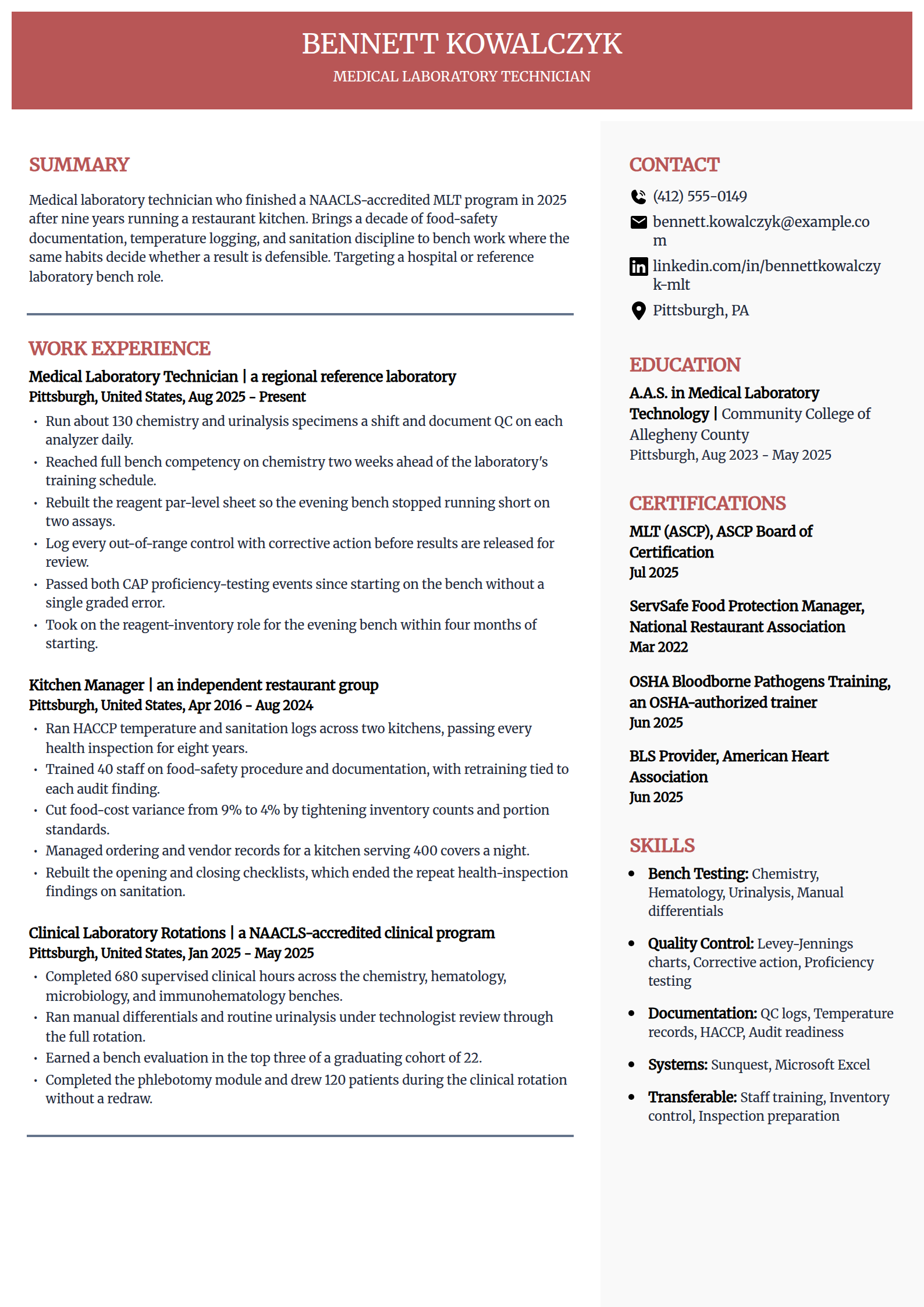
Career-Change Lab Technician Resume Template
Why this resume example works?
- Names the pivot openly, a NAACLS-accredited MLT program finished in 2025 after nine years running a kitchen.
- Reframes the old job on the strength that transfers, eight years of HACCP logs and inspections passed.
- Puts the new bench work first anyway, about 130 specimens a shift with QC documented daily.
- Gives one early-progress signal a hiring manager can check, full chemistry competency two weeks ahead of schedule.
- Keeps the food-safety certification on the page, where it reads as evidence rather than as leftover history.
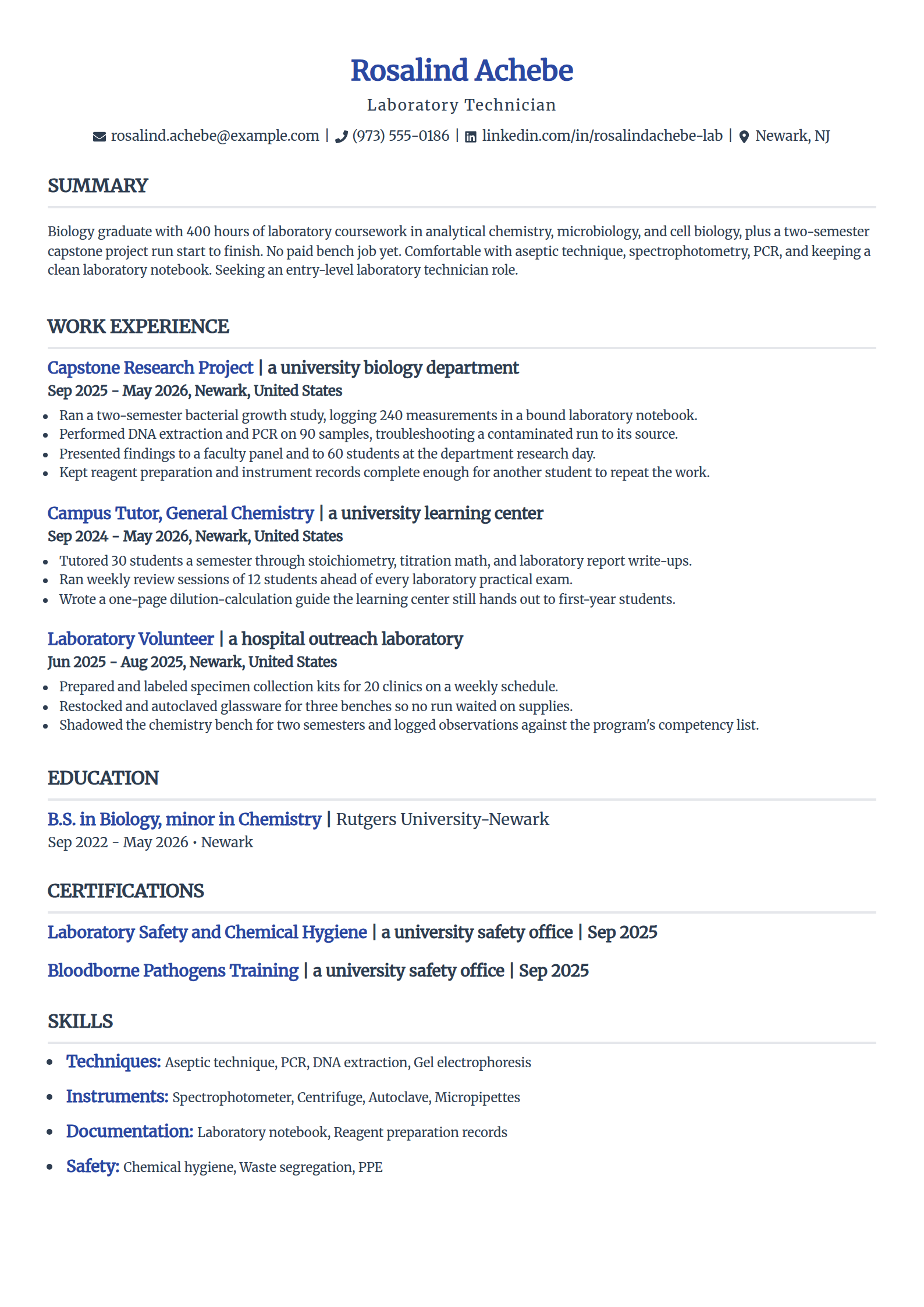
Lab Technician Resume Template With Coursework Only
Why this resume example works?
- Says plainly there is no paid bench job yet, then spends the page on what there is instead.
- Turns a two-semester capstone into a dated entry, with 240 logged measurements and a contamination problem traced.
- Counts the laboratory hours, 400 across analytical chemistry, microbiology and cell biology.
- Shows the habit a laboratory manager most wants in a new hire, records clean enough for someone else to repeat the work.
- Uses tutoring and a volunteer stint to fill the page honestly rather than inflating the coursework.
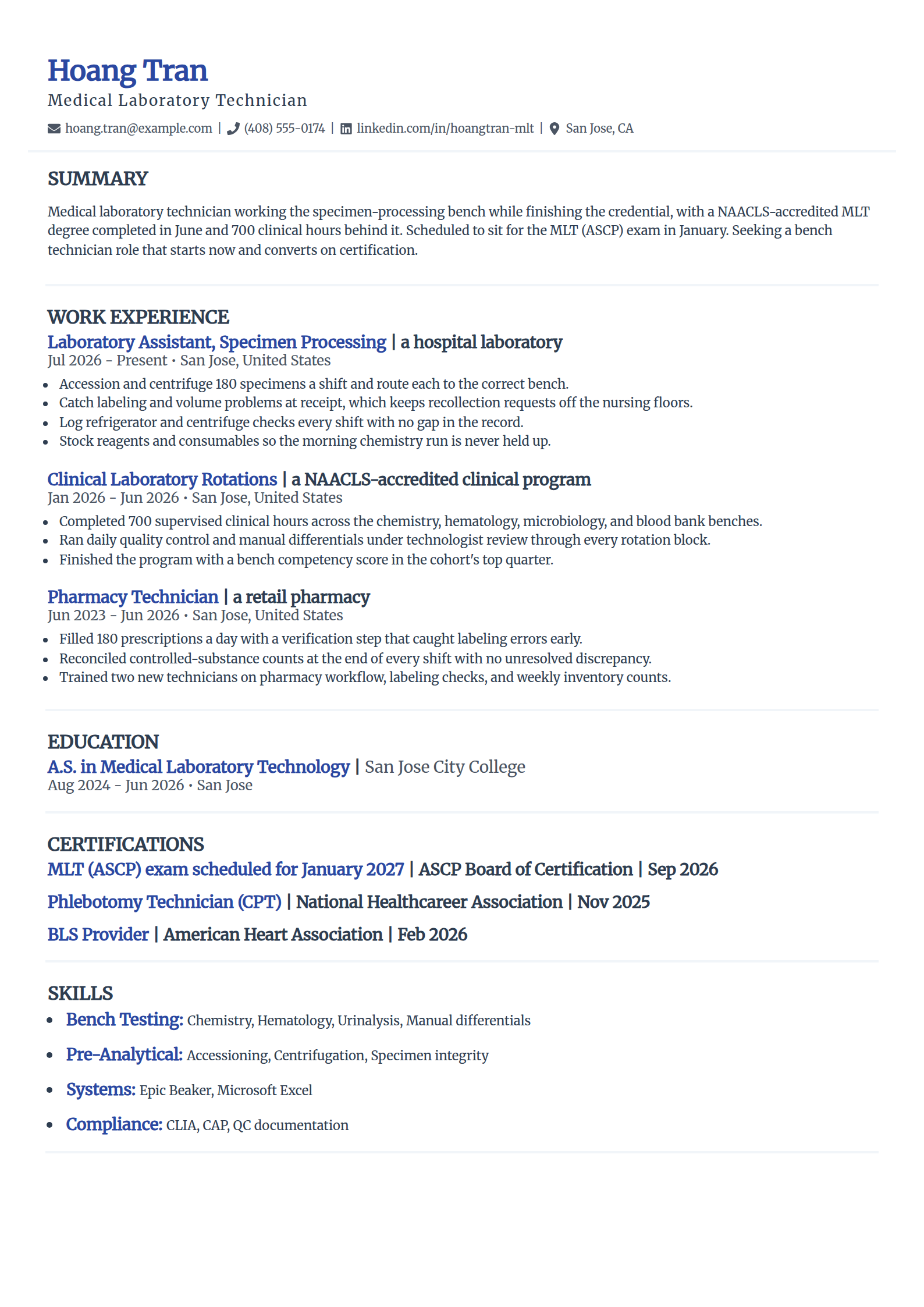
Lab Technician Resume Template for ASCP Exam Candidates
Why this resume example works?
- Gets the credential wording exactly right, scheduled to sit for the MLT (ASCP) exam in January, with the date on the page.
- Answers the employer's real question up front, a role that starts now and converts on certification.
- Shows the degree is already finished, a NAACLS-accredited program completed in June with 700 clinical hours.
- Uses the current specimen-processing job as proof of laboratory habits, not as a placeholder.
- Keeps the pharmacy technician years for the accuracy and controlled-inventory record they demonstrate.
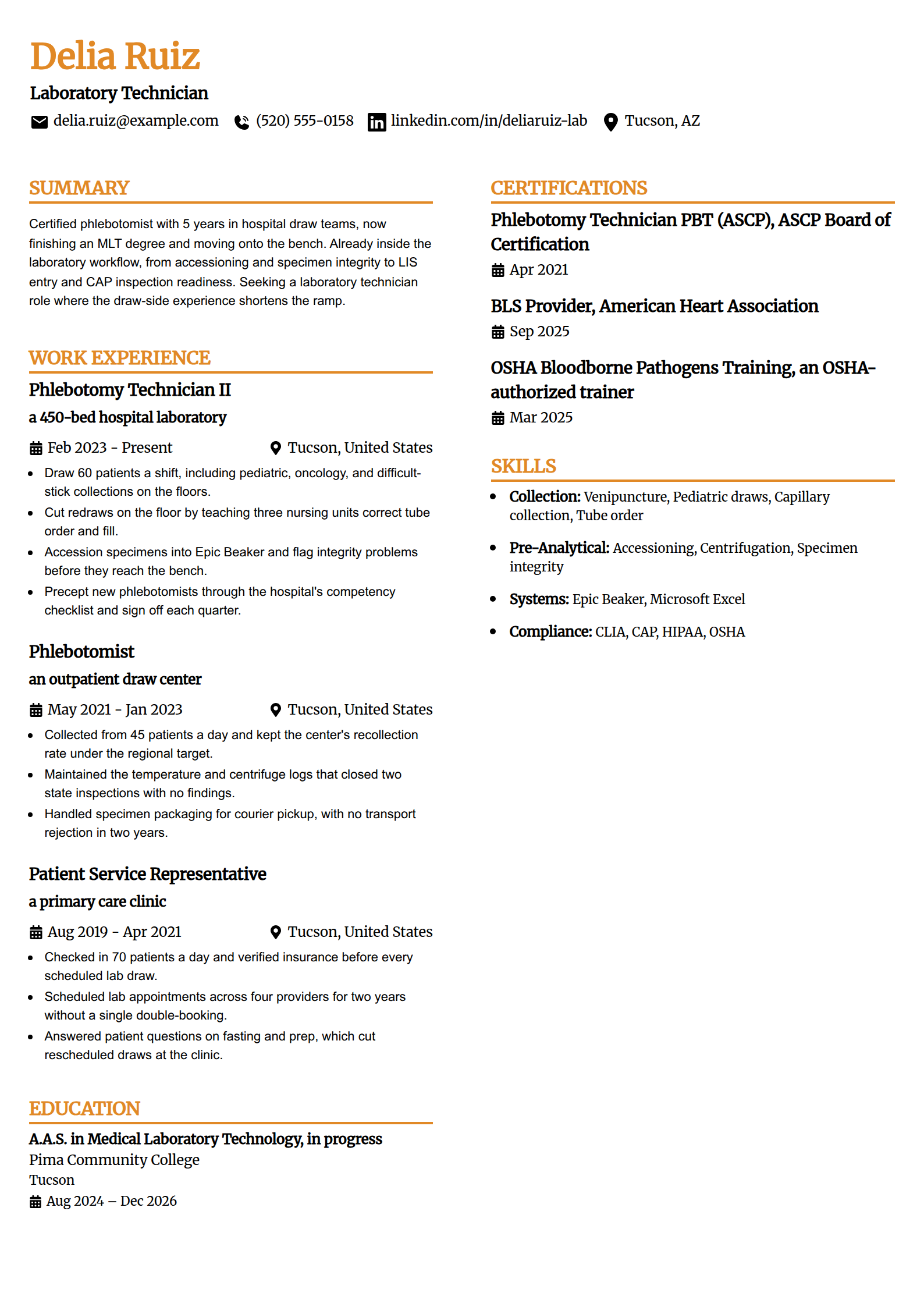
Phlebotomist to Lab Technician Resume Template
Why this resume example works?
- Names the move in the first line, a certified phlebotomist finishing an MLT degree and heading for the bench.
- Argues the advantage a hiring manager cares about, already inside the workflow from accessioning to LIS entry.
- Shows influence beyond the draw, three nursing units taught correct tube order to cut redraws.
- Keeps the degree honest with an in-progress label and a completion date, rather than implying it is finished.
- Carries the front-desk year for the scheduling and patient-prep work that keeps draws from being repeated.
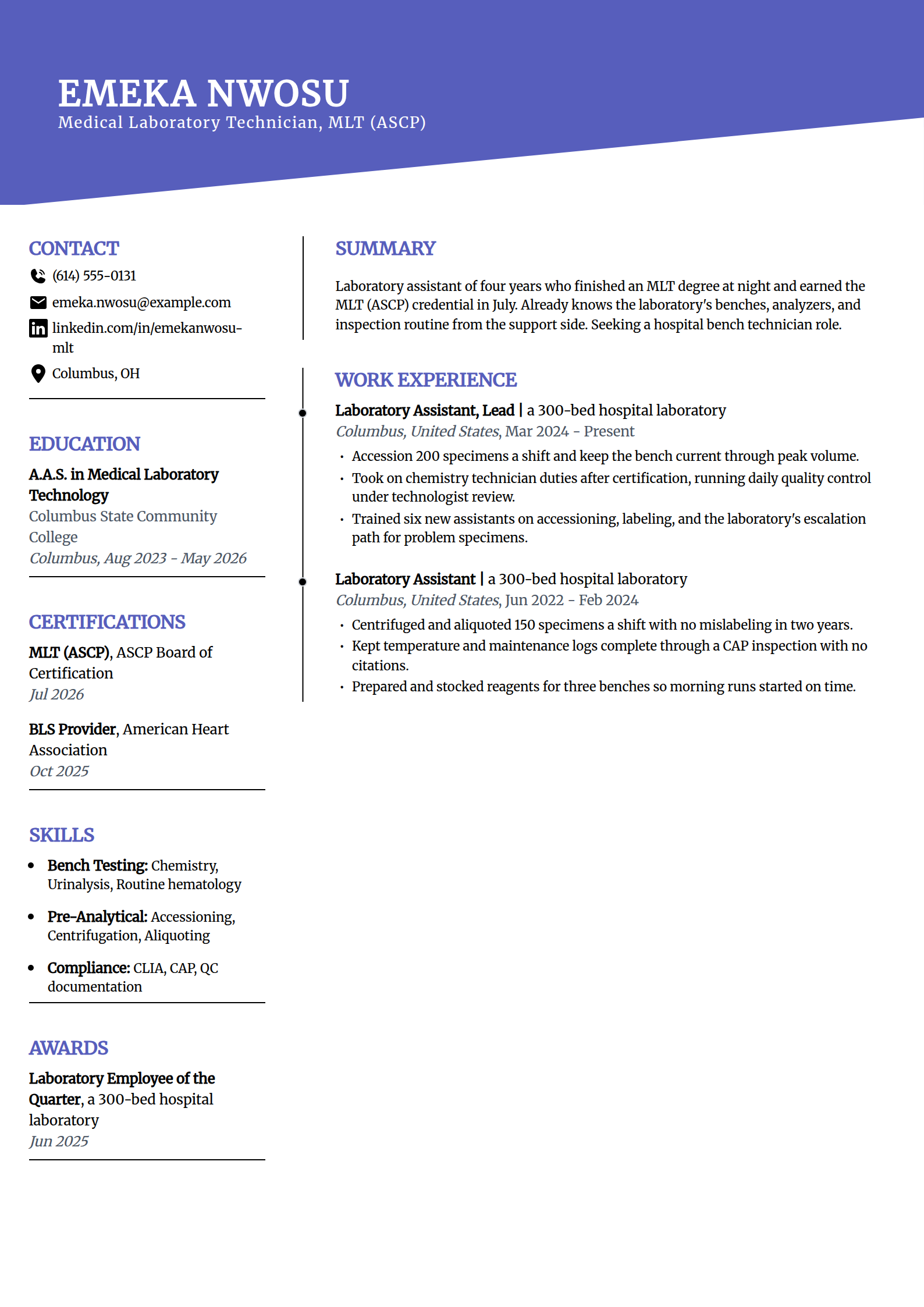
Lab Assistant to Lab Technician Resume Template
Why this resume example works?
- Leads with the new credential and the date it was earned, MLT (ASCP) in July, since that is what changed.
- Shows the step-up already happening, chemistry technician duties taken on after certification under review.
- Keeps the assistant record as evidence of reliability, 150 specimens a shift with no mislabeling in two years.
- Names the inspection outcome, logs complete through a CAP inspection with no citations.
- Fits a short, ATS-safe page with an award and three skill groups instead of padding a thin history.
Build your lab technician resume
Pick a template above and the editor keeps the layout clean and ATS-safe while you swap in your own benches, instruments, methods and credentials.
Build my resumeHow to write a lab technician resume in 2026
Two things decide whether your resume gets a call: whether the reader can tell what you run on the bench, and whether your certification status is clear in the first few seconds. Everything else is supporting detail. Lead with the lab you work in, name the instruments and methods outright, and put one number on every result you claim.
Say which lab you work in, in the first line
A hospital laboratory and a pharmaceutical QC laboratory read for different things and share almost no vocabulary. Open with the setting, your credential status and the volume you handle, so the reader knows within one sentence whether you fit. Keep the summary to three or four sentences and around 60 words.
Clinical laboratory technician, MLT (ASCP), with 9 years on the bench in hospital chemistry and hematology, running about 150 specimens a shift on second shift. Handles quality control, calibration, and instrument maintenance, and trains rotating students. Strong in Epic Beaker, Sysmex, and Roche cobas.
Put certification status where it cannot be missed
Certification is the fastest screen in this field, so it belongs in the headline or the first line of your summary, not only in a section at the bottom.
- Hold the credential? Write it the way the board writes it, MLT (ASCP), and give the year you earned it.
- Still testing? Say "scheduled to sit for the MLT (ASCP) exam in January" with the month. An exam is sat once, on a date.
- In a state with laboratory personnel licensing, name the license and its status alongside the national credential.
- In an industrial lab with no single national credential, list the training the role runs on instead: cGMP, GLP, HAZWOPER, ISO 9001 internal auditor.
Name instruments, methods and systems outright
A skills block that says "laboratory equipment" tells a hiring manager nothing and gives a parser nothing to match. Name the models and the methods you have actually run.
- Clinical: the analyzers (Roche cobas, Sysmex XN, Beckman Coulter, VITEK 2) and the LIS (Epic Beaker, Sunquest, Cerner).
- Industrial and pharma: HPLC, GC-MS, ICP-OES, dissolution, Karl Fischer, plus the LIMS and the chromatography data system.
- Environmental: the method numbers, because the postings use them: EPA 200.8, EPA 524.2, Standard Methods.
- Research: the techniques, PCR and qPCR, Western blot, ELISA, cell culture, and the electronic lab notebook you keep records in.
Make quality control an accomplishment, not a duty
Every lab technician runs QC, so listing it proves nothing. What separates resumes is what happened because you ran it well.
- Use the numbers your lab already tracks: turnaround time, specimen rejection rate, proficiency-testing performance, investigations closed.
- Name the framework, Westgard rules and Levey-Jennings charts on the clinical side, control charts and CAPA on the industrial side.
- Say what the inspection found: "passed a CAP inspection with no citations" beats "maintained compliance".
- Keep one number per bullet, and keep it modest. A technician improves a process; a technician does not move a plant's yield alone.
Stay inside your scope
Claims that cross into technologist or pathologist territory get caught in the interview. Technicians run routine and moderate-complexity testing, quality control, calibration and maintenance, and enter results for review. Diagnostic interpretation, independent validation of high-complexity assays and signing out reports are not technician work, so leave them off. Naming the review step is a strength, not a weakness: it shows you know how a regulated lab runs.
Keep the format clean and one page
A laboratory resume is parsed before it is read, and almost every technician fits on one page.
- Use standard headings and a single-column or simple two-column layout; skip graphics, photos and text boxes.
- Put certifications and skills where they survive a fast scan, near the top or immediately after experience.
- Save as a PDF, then run it through the ATS resume checker for a format and keyword pass.
- Swap the specimen counts, methods and credentials in the templates above for your own; do not copy them as they are.
Common lab technician resume mistakes
- Burying certification at the bottom. MLT (ASCP) or your exam date belongs in the headline or the first line of the summary, where the screen happens.
- Writing duty lists. Replace "performed routine testing and quality control" with "cut stat CBC turnaround from 52 minutes to 31 by resequencing the morning draws".
- Saying "laboratory equipment" instead of naming it. Write Roche cobas, VITEK 2, HPLC, ICP-MS, Epic Beaker, whichever you have actually run.
- Using one resume for a hospital and a manufacturing job. The two read for different vocabulary; reorder your bullets and skills to match the posting.
- Claiming work above technician scope, like interpreting results or validating high-complexity assays. It reads as a stretch and does not survive an interview.
- Leaving the work history blank with no paid bench job. Clinical rotations, a capstone, coursework hours and laboratory volunteering are dated entries too.
Frequently asked questions
What should a lab technician resume include?
Five things, in this order: a three-to-four-sentence summary naming your lab setting, credential status and daily volume; experience bullets that each carry one number, like specimens per shift, turnaround time or investigations closed; a skills block that names instruments, methods and systems outright rather than saying "laboratory equipment"; your certification with the year, or your exam date if you are still testing; and your degree or program with its accreditation. Keep it to one clean page with standard headings, since a parser reads it before a person does.
How do you write a lab technician resume with no experience?
Treat everything you have actually done in a lab as a dated work entry. Clinical rotations with their hour count, a capstone or research project, laboratory coursework and any volunteering all belong in the experience section, not hidden under education. Put your certification status next, including a scheduled exam date if you have one. Then keep any unrelated job on the page for the parts that transfer, like documentation, inventory accuracy or passing inspections. The entry-level and coursework-only examples above show both versions of this.
Do you need MLT (ASCP) certification to get a lab technician job?
For clinical work in a hospital or reference laboratory, MLT (ASCP) is the standard credential and most postings either require it or strongly prefer it, so your resume needs to state where you stand. If you have it, write it the way the board does, MLT (ASCP), with the year. If you are still testing, say you are scheduled to sit for the exam and give the month. Industrial laboratories are different: quality control, pharmaceutical, environmental and research roles usually have no single national technician credential, and list method and system training instead, such as cGMP, GLP, HAZWOPER or an ISO 9001 internal auditor course.
How long should a lab technician resume be?
One page for almost everyone, including lead technicians with ten or more years. The work is specific enough that a second page usually means older roles that no longer help, or duty lists that should have been cut. Keep your three most recent and most relevant positions, trim the earliest one to the bullets that still say something, and use the space you free for certifications and a skills block that names real instruments and methods.
What skills and keywords should a lab technician resume list?
Match the posting first, then name systems specifically. Clinical resumes list the benches (chemistry, hematology, urinalysis, microbiology, blood bank), the analyzers (Roche cobas, Sysmex XN, VITEK 2), the LIS (Epic Beaker, Sunquest, Cerner), and the quality and compliance vocabulary (Westgard rules, Levey-Jennings charts, proficiency testing, CLIA, CAP). Industrial resumes list instruments (HPLC, GC-MS, ICP-MS, dissolution, Karl Fischer), the LIMS, and the regime the lab runs under (cGMP, USP, GLP, ISO 9001, ISO 17025, NELAP, EPA methods). List only what you have run and can discuss in an interview.
How is a clinical lab resume different from a QC or pharmaceutical one?
They are different documents built from the same career. A clinical resume leads with your credential, the benches you cover, specimen volume and turnaround time, and it lives inside CLIA and CAP. A quality control or pharmaceutical resume leads with methods and instruments, the lots or batches you release, and the regime you work under, whether that is ISO 9001 on a manufacturing floor or cGMP and USP monographs in pharma, where out-of-specification investigations and good documentation practice carry real weight. If you are applying to both, keep one base resume and reorder the summary, bullets and skills to match the posting rather than sending the same page to each.
More lab technician resume resources
Build your lab technician resume
Pick a template above and the editor keeps the layout clean and ATS-safe while you swap in your own benches, instruments, methods and credentials.