16 Business Analyst Resume Examples, Entry-Level to Senior
- ATS Friendly
- Entry-Level to Senior BA
- 16 Real Examples
A business analyst resume is judged on the decisions your requirements drove and the process work behind them, not a list of duties. Pick a clean layout below, then model your own on a real example built for your track, from entry-level BA to IT, agile, healthcare, finance, or Salesforce.


540k+ resumes created
Editable business analyst resume templates
Each template below is a real business analyst resume laid out in that format, sorted by track and seniority. Choose one, then swap in your own requirements, process, and stakeholder work, the impact behind each project, and your certifications. Every layout keeps your name, contact details, and dates clean so a hiring manager reads your experience at a glance and an applicant tracking system parses it without trouble.
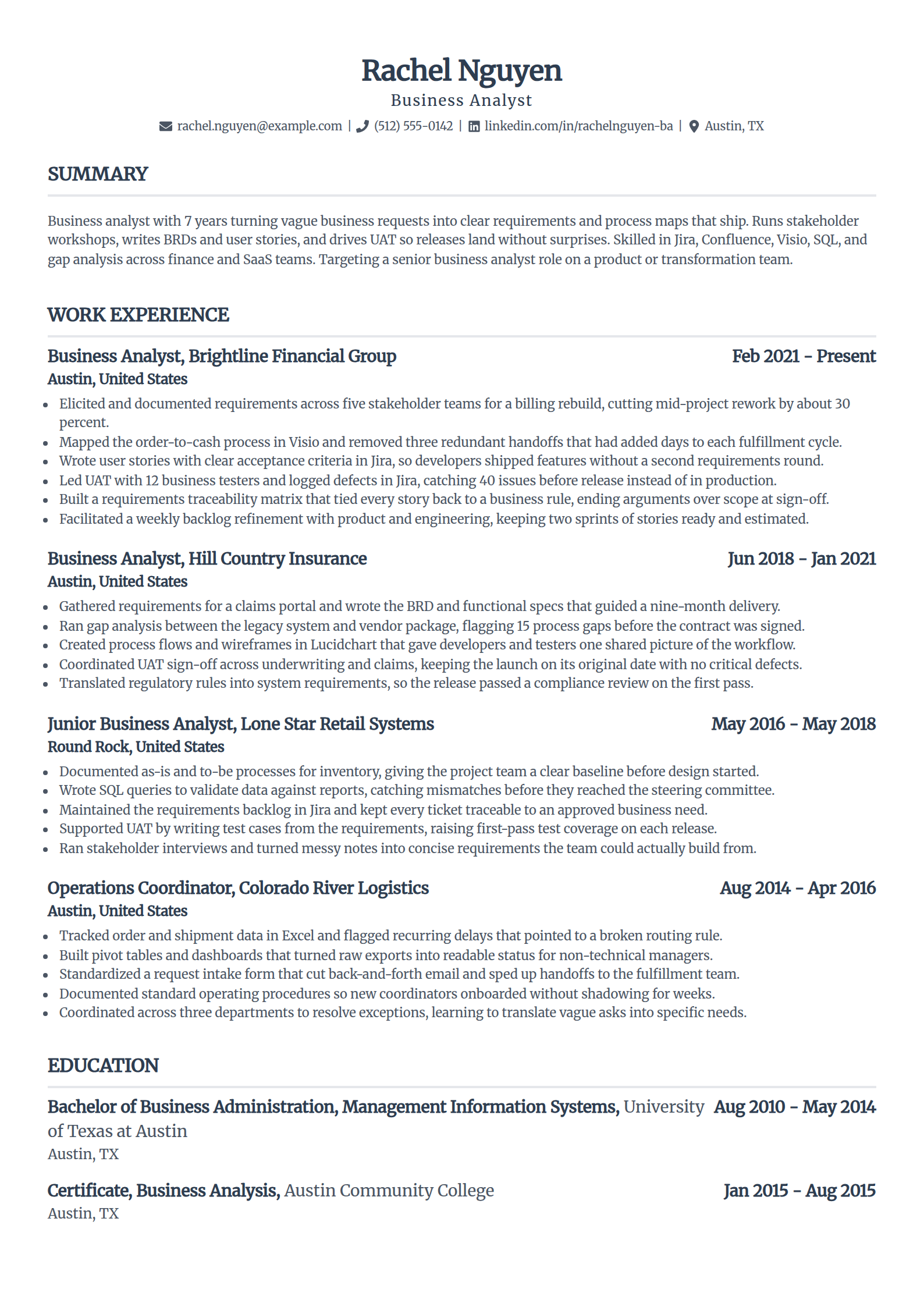
Experienced Business Analyst Resume Template
Why this resume example works?
- Opens with a summary that names 7 years, stakeholder workshops, BRDs, and UAT, the scope a hiring manager reads first.
- Leads each bullet with a strong verb and the outcome, such as cutting mid-project rework by about 30 percent.
- Names the exact tools a BA posting lists, Jira, Confluence, Visio, and SQL, instead of a vague skills line.
- Uses a single-column layout with standard headings that an applicant tracking system parses cleanly.
- Backs the experience with real credentials, a CBAP and a PMI-PBA, where a reviewer looks for them.
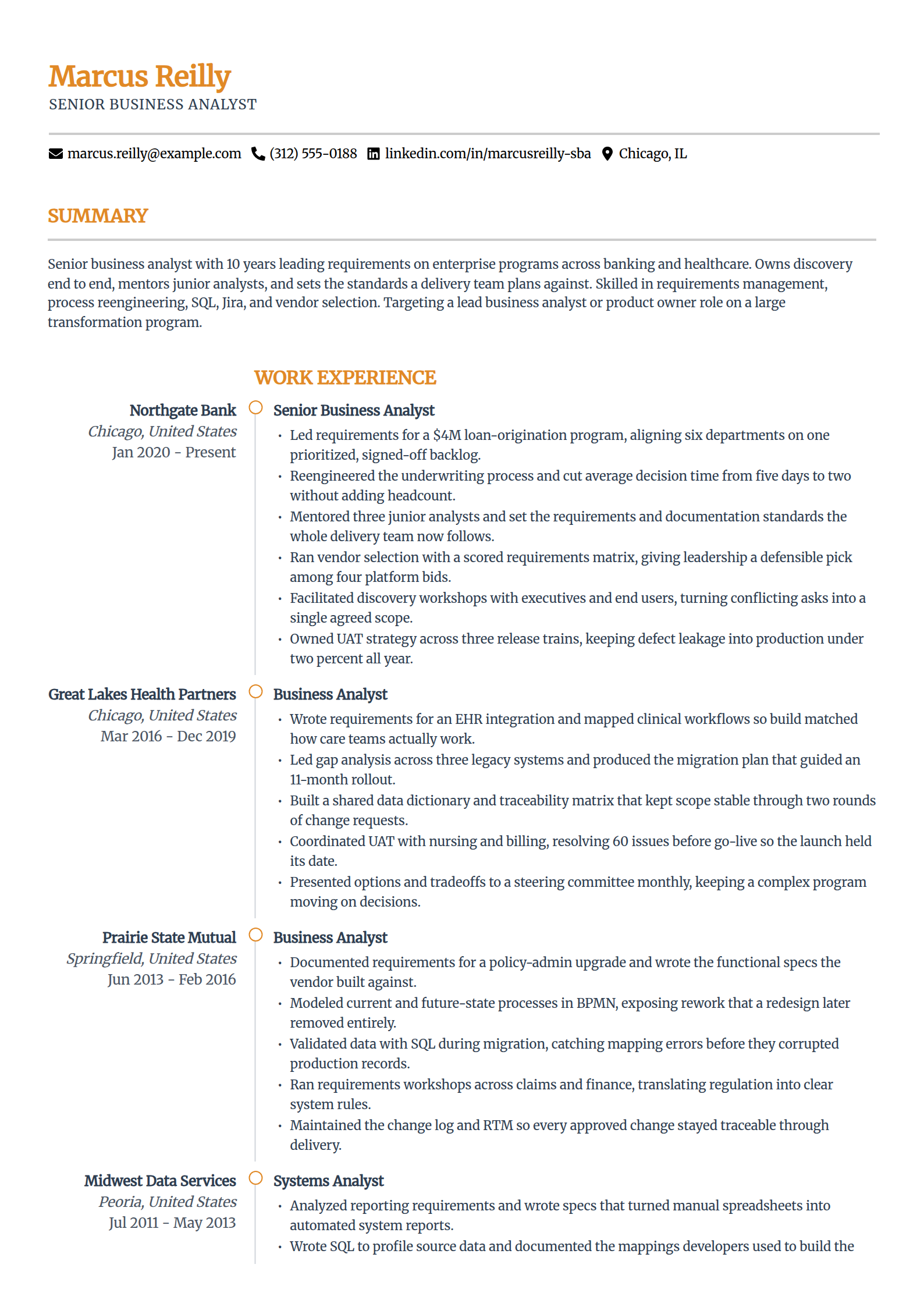
Senior Business Analyst Resume Template
Why this resume example works?
- Frames senior scope up top, leading requirements on a $4M program and mentoring three junior analysts.
- Shows leadership impact a team can quote, cutting an underwriting decision from five days to two.
- Carries the work a lead owns, vendor selection with a scored matrix and UAT strategy across three release trains.
- Names an enterprise toolset, Jira, Confluence, SQL, and Azure DevOps, across a ten-year history.
- Fills a dense layout with four roles, showing a clear climb from systems analyst to senior BA.
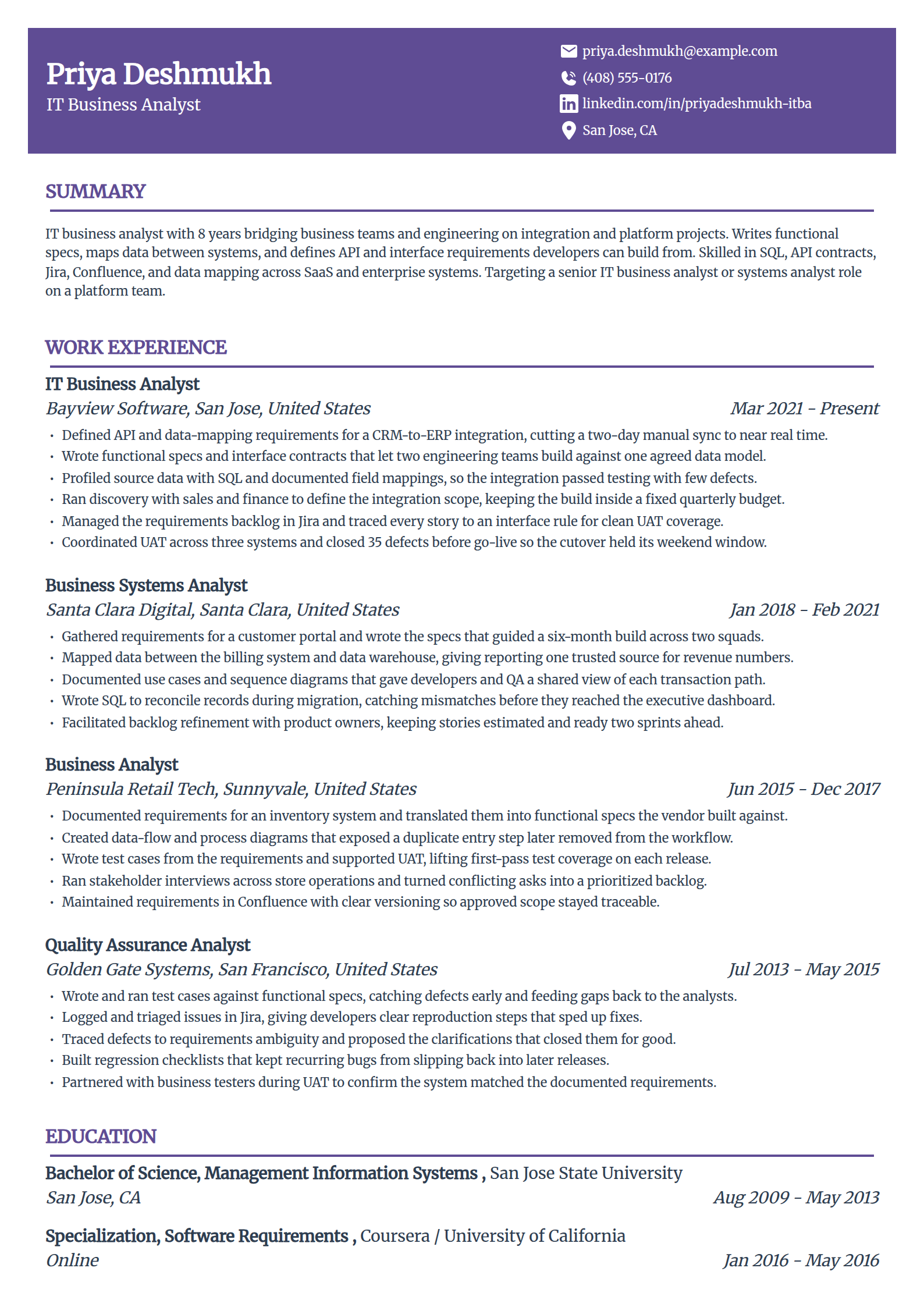
IT Business Analyst Resume Template
Why this resume example works?
- Leads with the integration work IT teams hire for, API and data-mapping requirements that cut a two-day sync to near real time.
- Shows the technical bridge a role wants, functional specs and interface contracts two engineering teams built against.
- Names the IT BA stack, SQL, REST APIs, data modeling, and Jira, the keywords on an IT business analyst posting.
- Foregrounds clean delivery, tracing every story to an interface rule so UAT closed 35 defects before go-live.
- Uses a modern layout that carries an eight-year platform history without crowding the page.
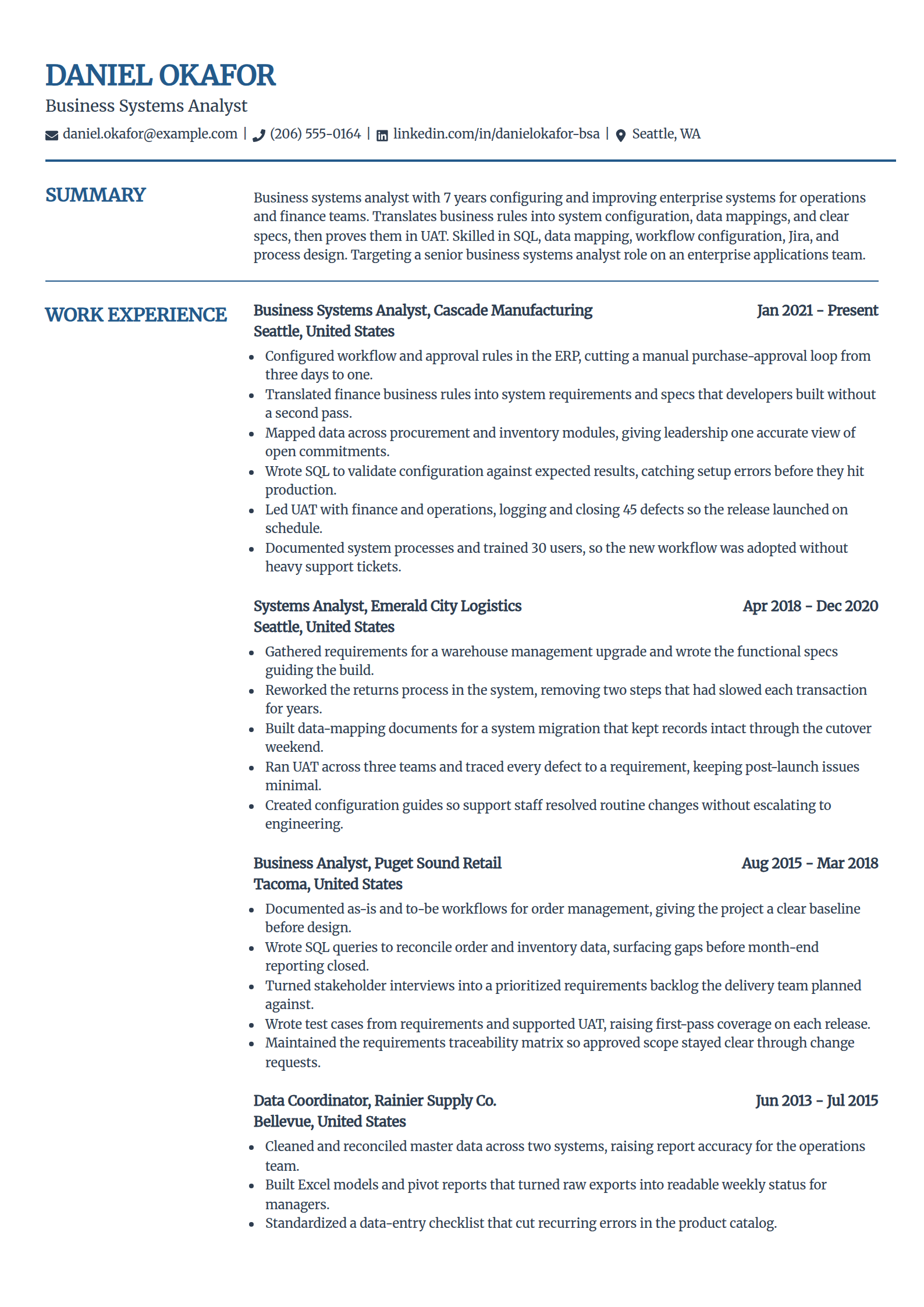
Business Systems Analyst Resume Template
Why this resume example works?
- Opens with system configuration impact, cutting a manual purchase-approval loop from three days to one.
- Shows the translate-to-build skill, turning finance business rules into specs developers built without a second pass.
- Names the systems-analyst stack, workflow configuration, data mapping, SQL, and ServiceNow.
- Backs the work with adoption, documenting the process and training 30 users so support tickets stayed low.
- Uses a clean, modern layout that fits a dense enterprise-systems history on one readable page.
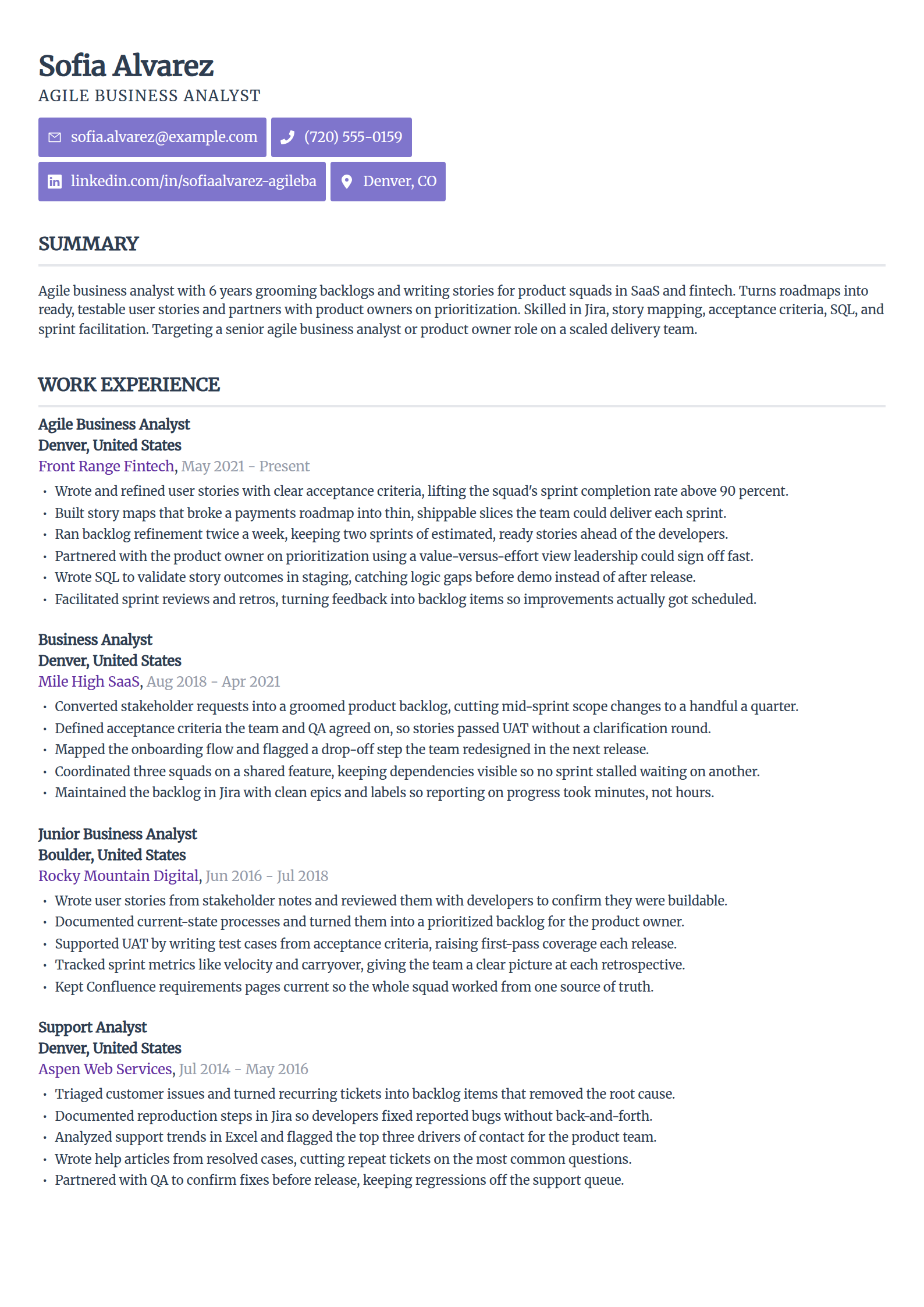
Agile & Scrum Business Analyst Resume Template
Why this resume example works?
- Leads with agile delivery, user stories with clear acceptance criteria that lifted sprint completion above 90 percent.
- Shows the backlog work a squad depends on, story maps that broke a roadmap into shippable slices.
- Names the agile BA stack, Jira, story mapping, acceptance criteria, and SQL, plus CSPO and AAC credentials.
- Pairs analysis with facilitation, running backlog refinement twice a week and turning retros into scheduled work.
- Uses a clean, modern layout that carries four roles and a clear agile focus without crowding.
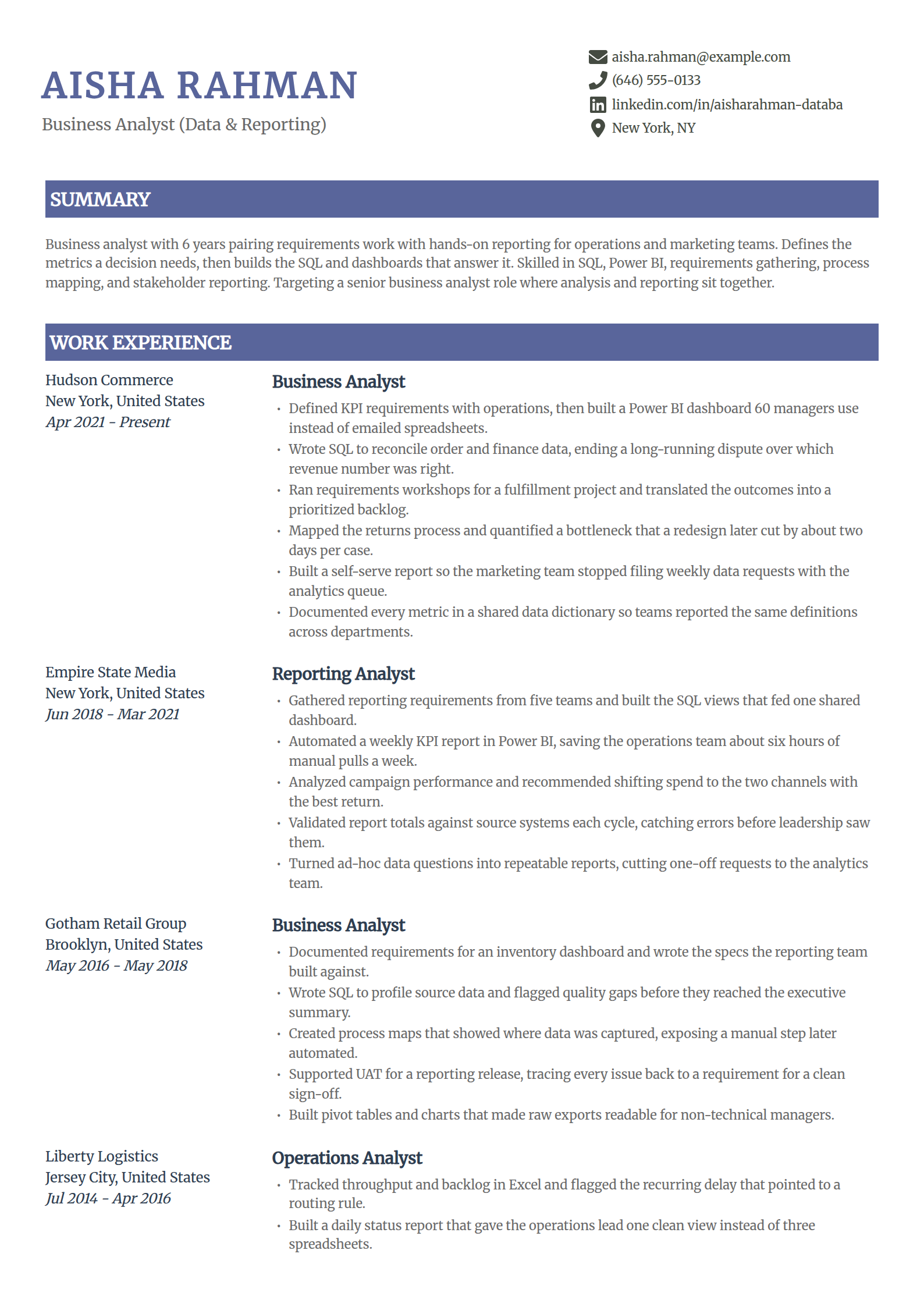
Data & Reporting Business Analyst Resume Template
Why this resume example works?
- Pairs requirements with hands-on reporting, defining KPIs then building a Power BI dashboard 60 managers use.
- Shows the analysis a data-leaning BA owns, SQL reconciliation that ended a dispute over the right revenue number.
- Names both sides of the stack, requirements gathering and process mapping plus SQL, Power BI, and a data dictionary.
- Keeps the BA lens front and center so the resume reads as analysis, not a pure data-analyst role.
- Fills a visually rich layout with four roles while staying easy to skim in one pass.
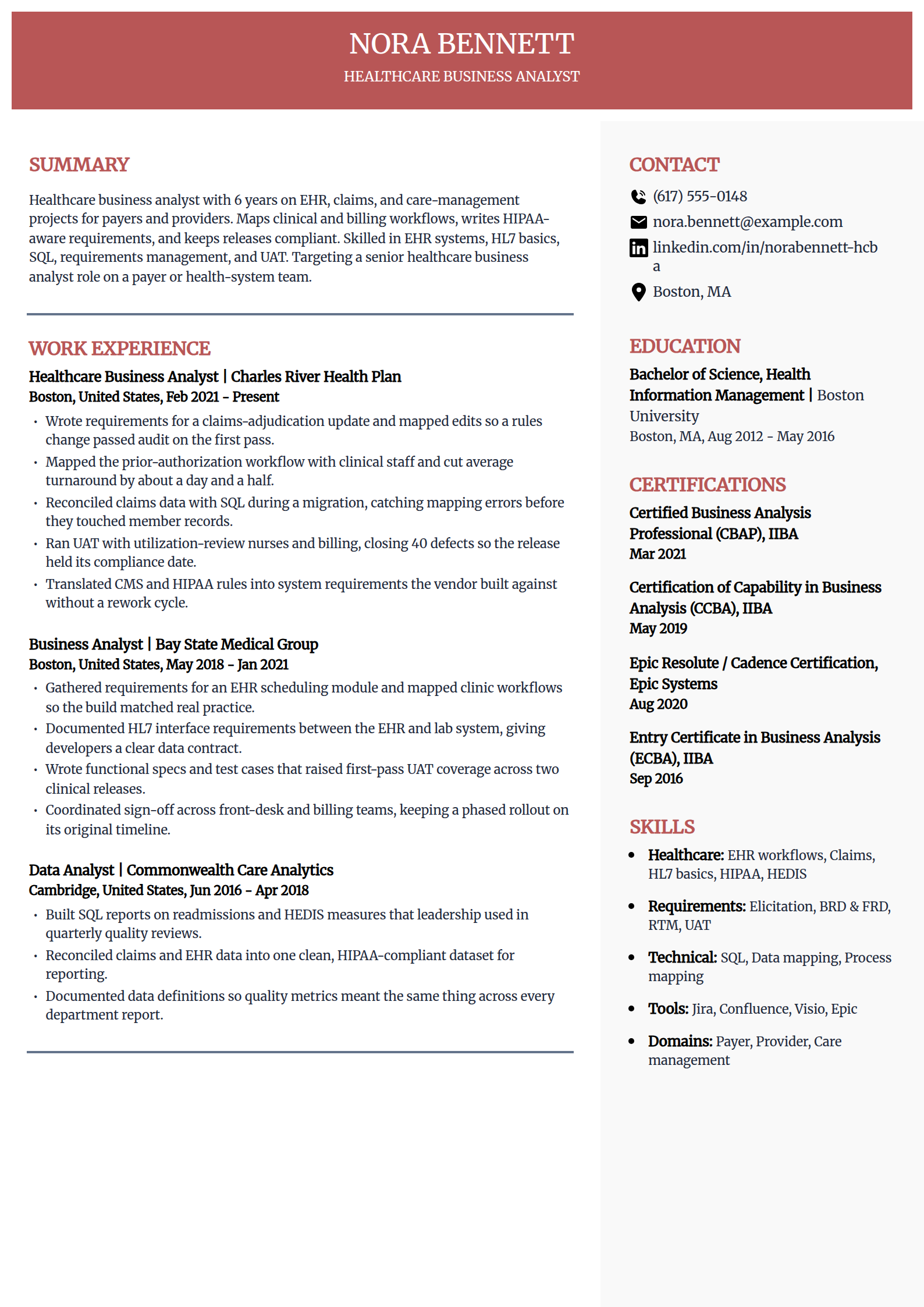
Healthcare Business Analyst Resume Template
Why this resume example works?
- Opens with payer scope, a claims-adjudication update and a prior-auth workflow trimmed by about a day and a half.
- Names the healthcare BA stack, EHR workflows, HL7 basics, HIPAA, and SQL, plus an Epic certification.
- Keeps the work compliant, translating CMS and HIPAA rules into requirements that passed audit on the first pass.
- Shows clinical partnership, mapping workflows with nurses and billing so the build matched real practice.
- Uses a refined layout that fits a focused six-year healthcare history on one clean page.
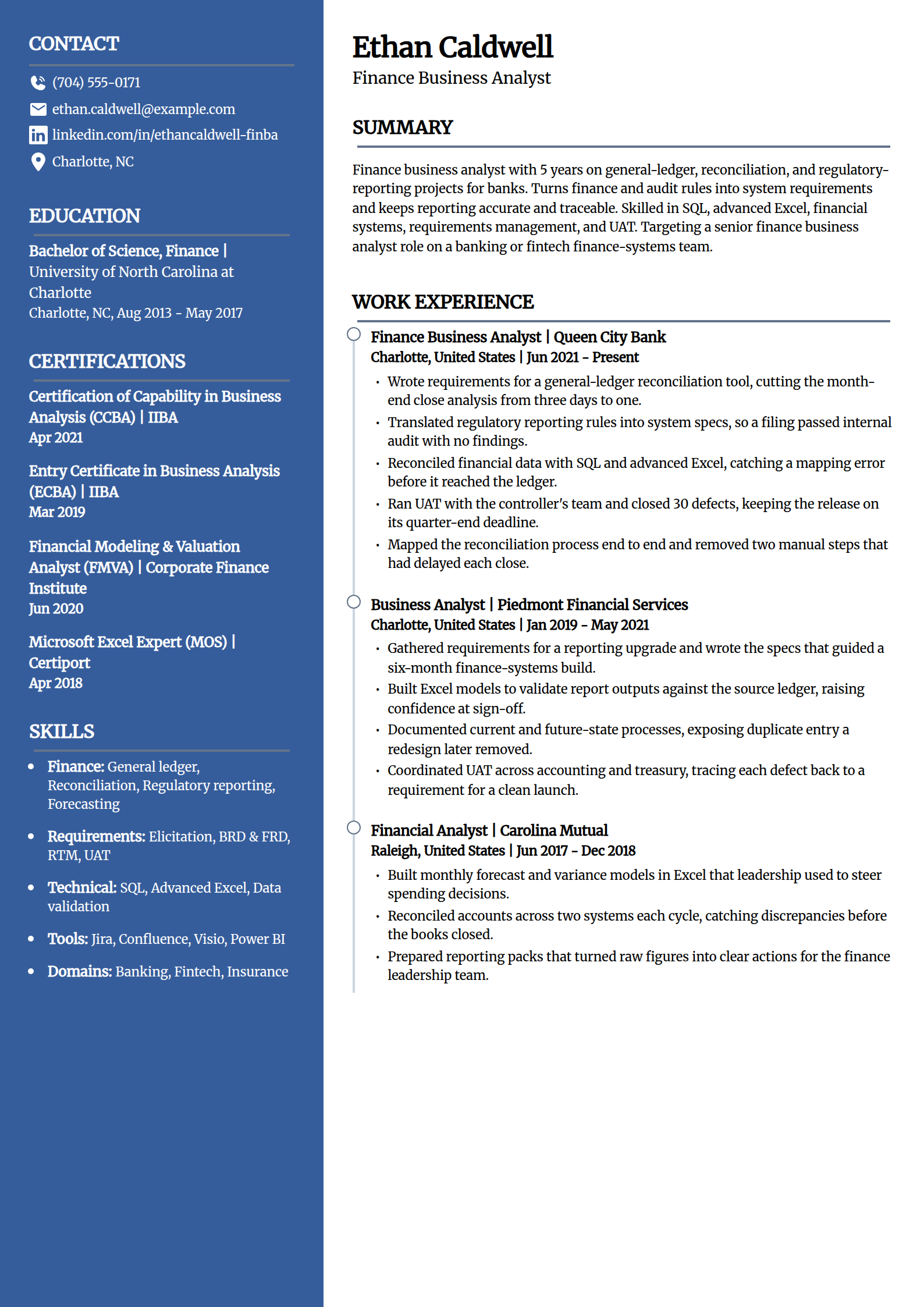
Finance Business Analyst Resume Template
Why this resume example works?
- Leads with finance-systems scope, a general-ledger reconciliation tool that cut month-end close from three days to one.
- Names the finance BA stack, SQL, advanced Excel, general ledger, and regulatory reporting.
- Shows the rigor finance values, translating regulatory rules into specs so a filing passed audit with no findings.
- Carries an FMVA credential alongside the CCBA, matching a banking finance-systems role.
- Uses a distinctive layout that still keeps sections easy to scan for a finance hiring manager.
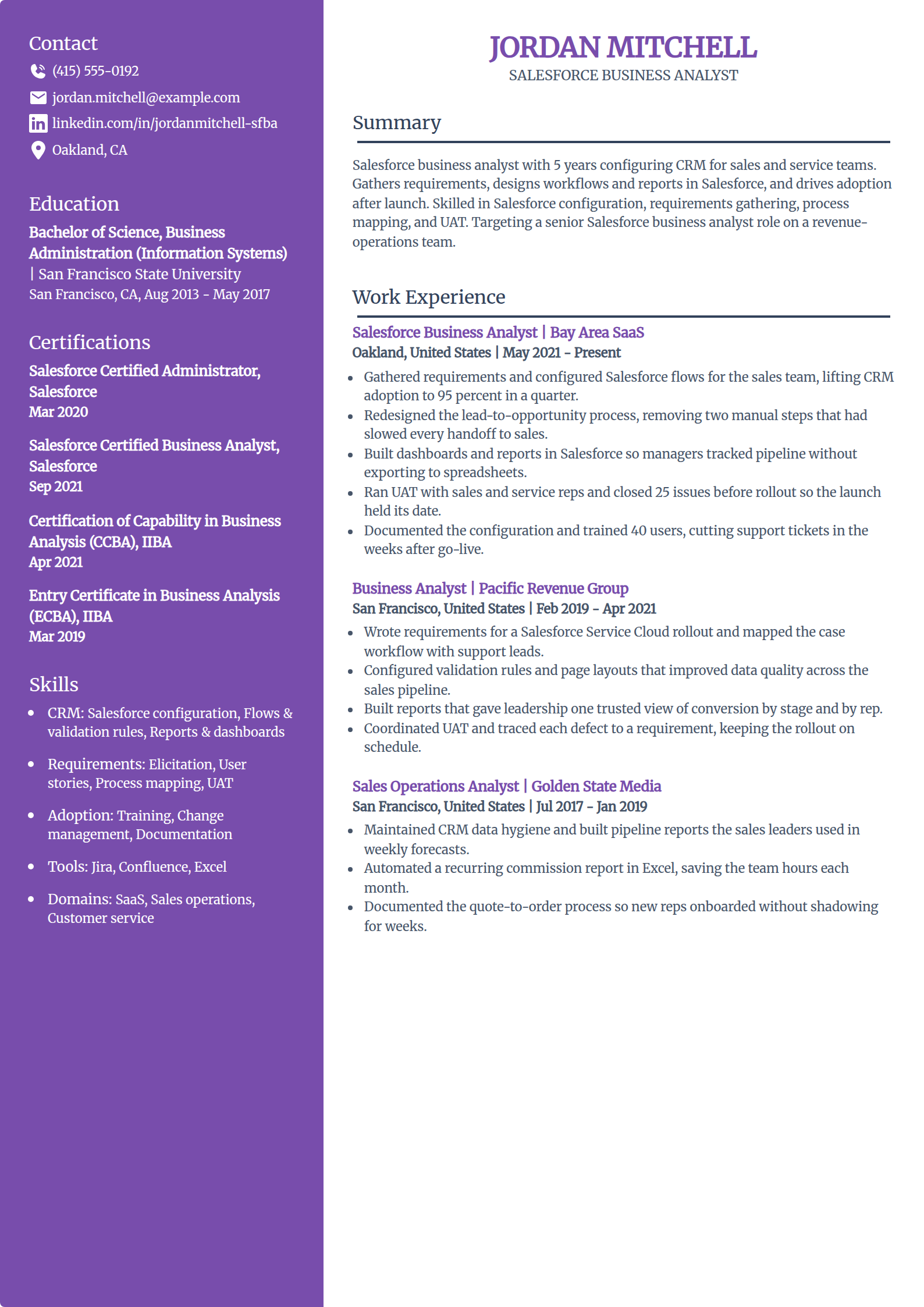
Salesforce Business Analyst Resume Template
Why this resume example works?
- Opens with CRM impact, configuring Salesforce flows that lifted adoption to 95 percent in a quarter.
- Names the tools a Salesforce BA posting lists, Salesforce configuration, flows, validation rules, and reports.
- Shows the redesign work, removing two manual steps from the lead-to-opportunity handoff.
- Pairs a Salesforce Administrator and Salesforce Business Analyst credential with a CCBA.
- Keeps a Medium layout with three focused roles instead of padding a shorter history.
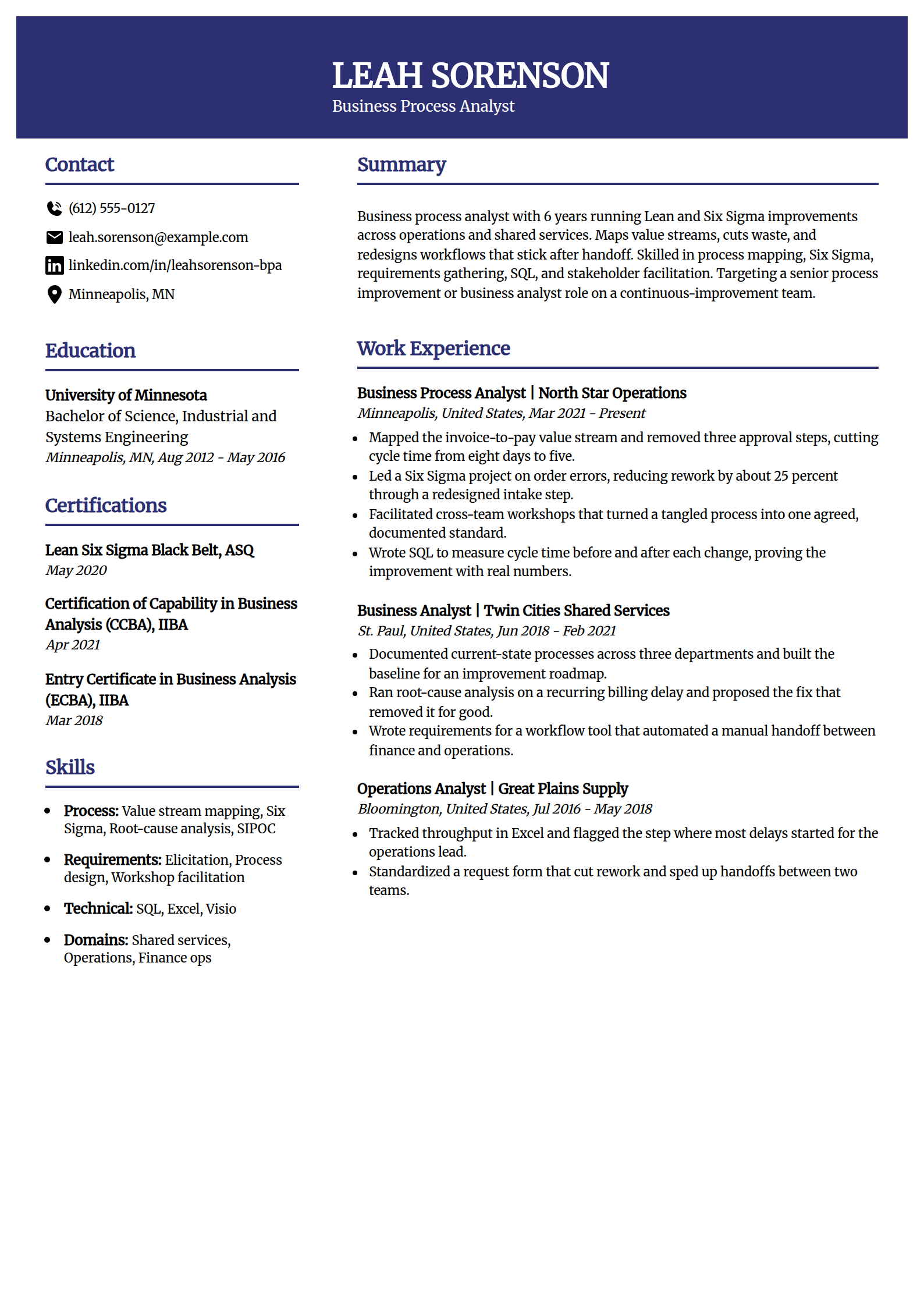
Process Improvement Analyst Resume Template
Why this resume example works?
- Leads with Lean impact, mapping the invoice-to-pay value stream and cutting cycle time from eight days to five.
- Names the process stack, value stream mapping, Six Sigma, root-cause analysis, and SQL, backed by a Black Belt.
- Shows measured improvement, a Six Sigma project that reduced order rework by about 25 percent.
- Uses a roomy two-column layout with the education, certifications, and skills sidebar filled so the page reads complete.
- Keeps every metric modest and believable rather than reaching for inflated numbers.
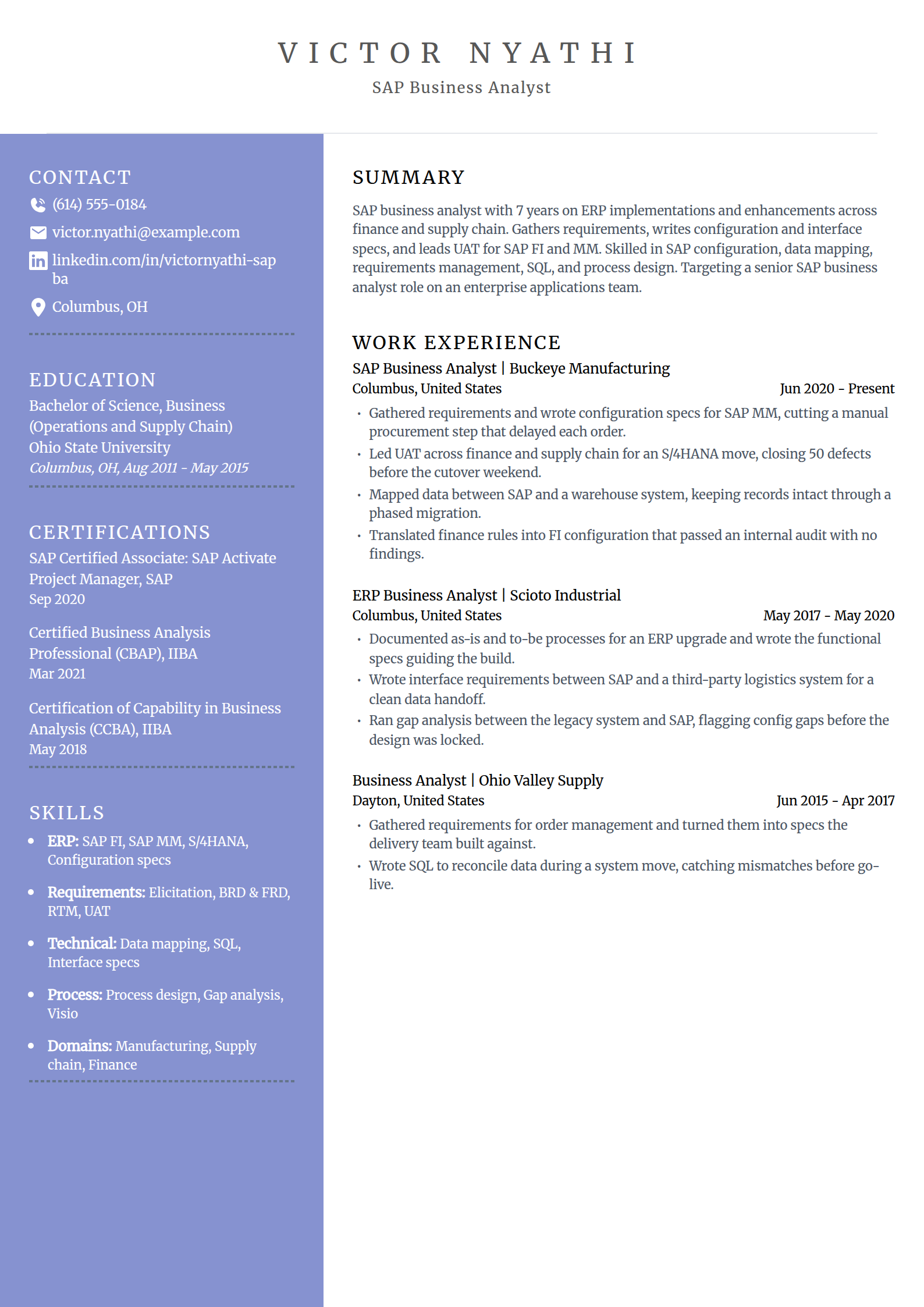
SAP & ERP Business Analyst Resume Template
Why this resume example works?
- Leads with ERP scope, configuration specs for SAP MM and a UAT effort that closed 50 defects before cutover.
- Names the SAP stack, SAP FI, SAP MM, S/4HANA, and data mapping, the keywords on an ERP BA posting.
- Shows the migration work, keeping records intact through a phased move and passing an FI audit with no findings.
- Carries an SAP Activate certification alongside a CBAP that fits the role.
- Uses a roomy layout with a filled sidebar so a focused platform history still looks full.
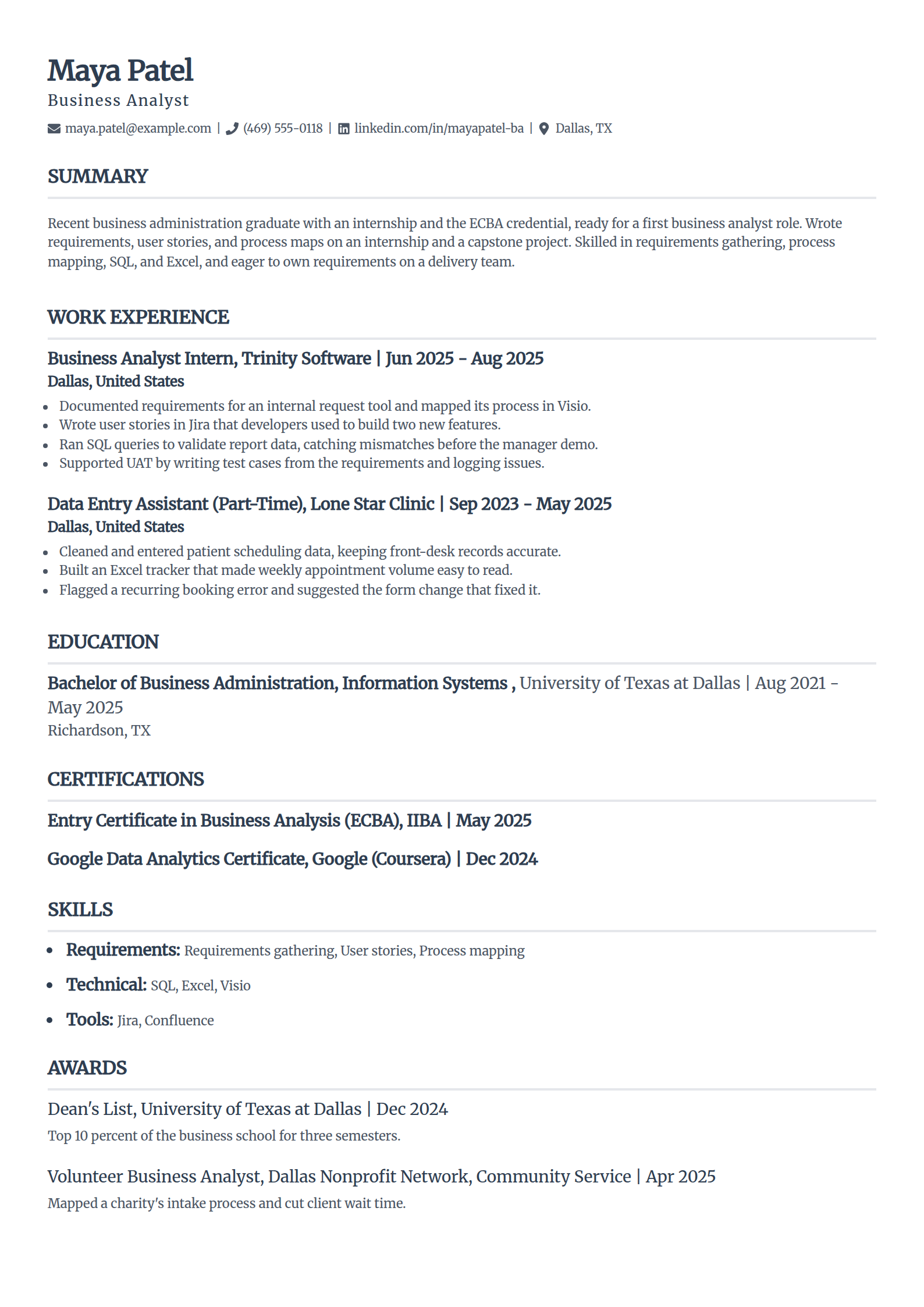
Entry-Level Business Analyst Resume Template (No Experience)
Why this resume example works?
- Written for a first BA job, leading with an internship, a business degree, and the ECBA credential.
- Uses the internship to show real BA tasks, documenting requirements, writing user stories, and mapping a process.
- Fills the page honestly with a Dean's List award and volunteer BA work instead of padding thin history.
- Keeps bullets short and specific so limited experience still reads confident on one clean page.
- Uses a tight, ATS-safe single-column layout that fits a beginner's resume without empty space.
Career-Change Business Analyst Resume Template
Why this resume example works?
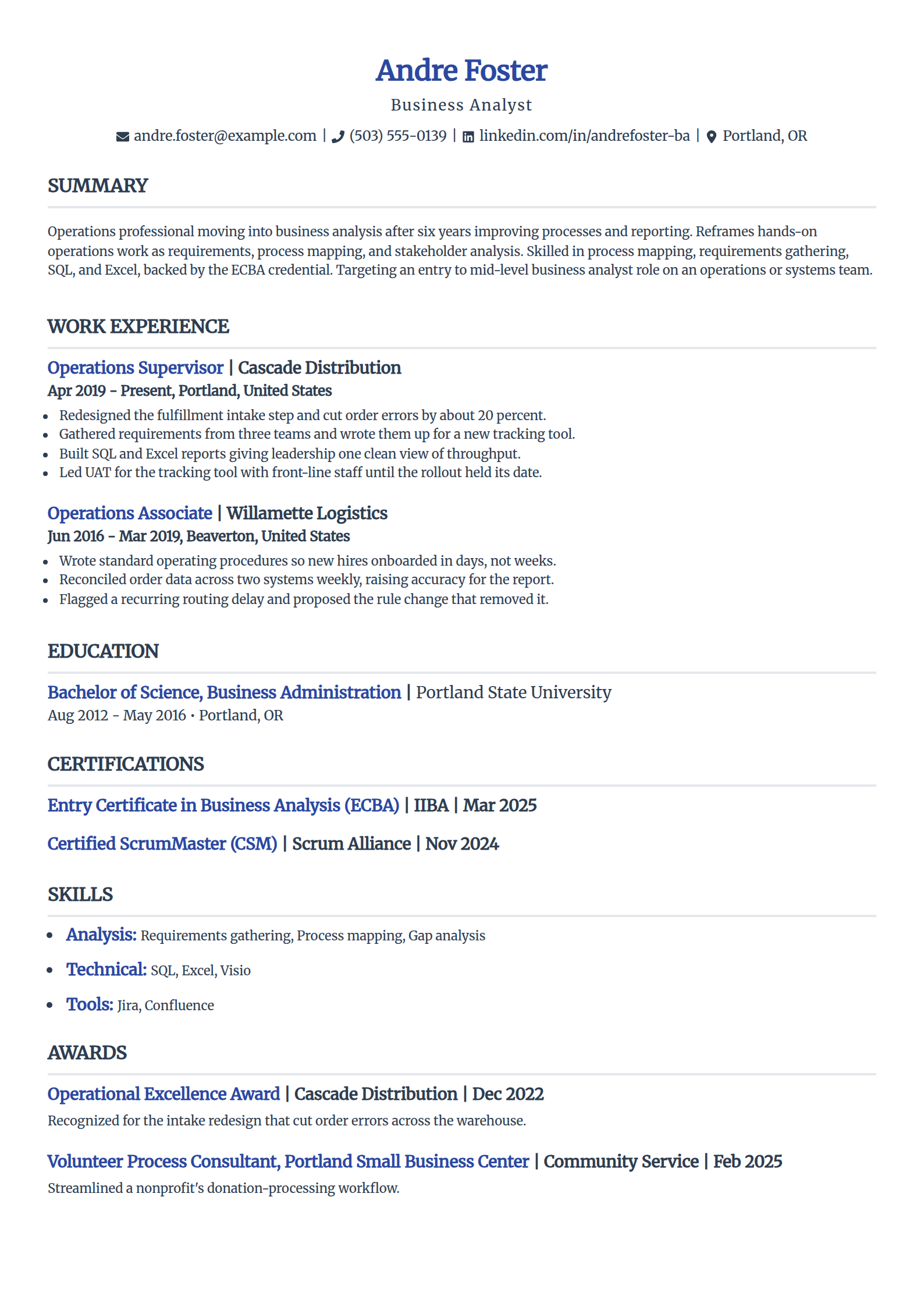
- Reframes six years in operations as requirements, process mapping, and stakeholder work a BA role wants.
- Pulls the transferable wins forward, a redesigned intake step that cut order errors by about 20 percent.
- Shows recent commitment to the switch with the ECBA credential and a Certified ScrumMaster course.
- Fills the page with an operational-excellence award and volunteer process work so the pivot reads intentional.
- Uses a plain, ATS-safe layout that keeps the focus on proven analytical skills.
Junior Business Analyst Resume Template
Why this resume example works?
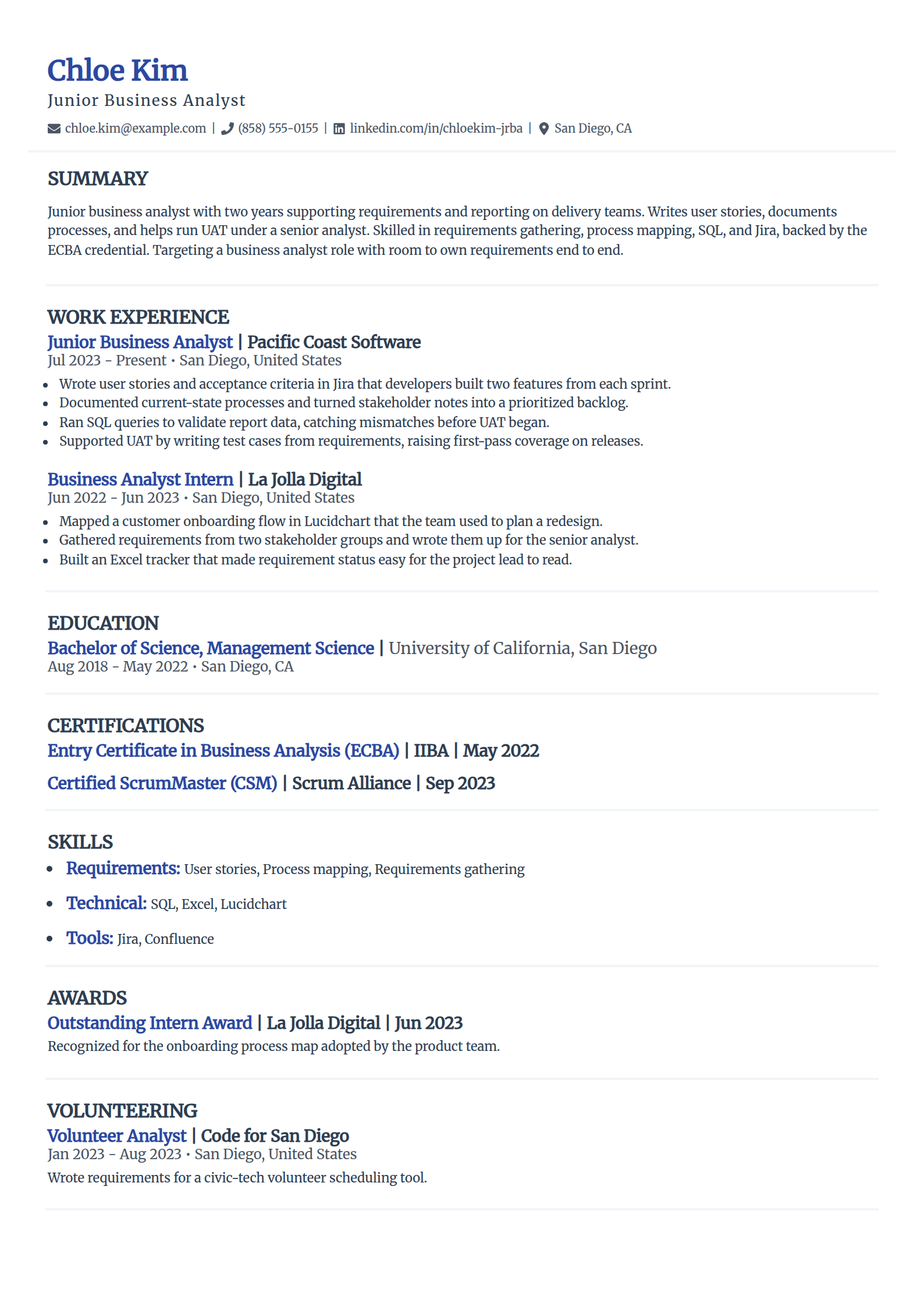
- Written for an early-career BA, leading with user stories and process work done under a senior analyst.
- Names the entry-level BA stack, requirements gathering, process mapping, SQL, and Jira, backed by the ECBA.
- Shows real delivery, writing test cases from requirements and validating report data before UAT.
- Fills the page with an outstanding-intern award and civic-tech volunteering that fit a junior BA.
- Uses a refined, uncluttered layout that fits a shorter two-year history on one page.
Business Analyst to Product Owner Resume Template
Why this resume example works?
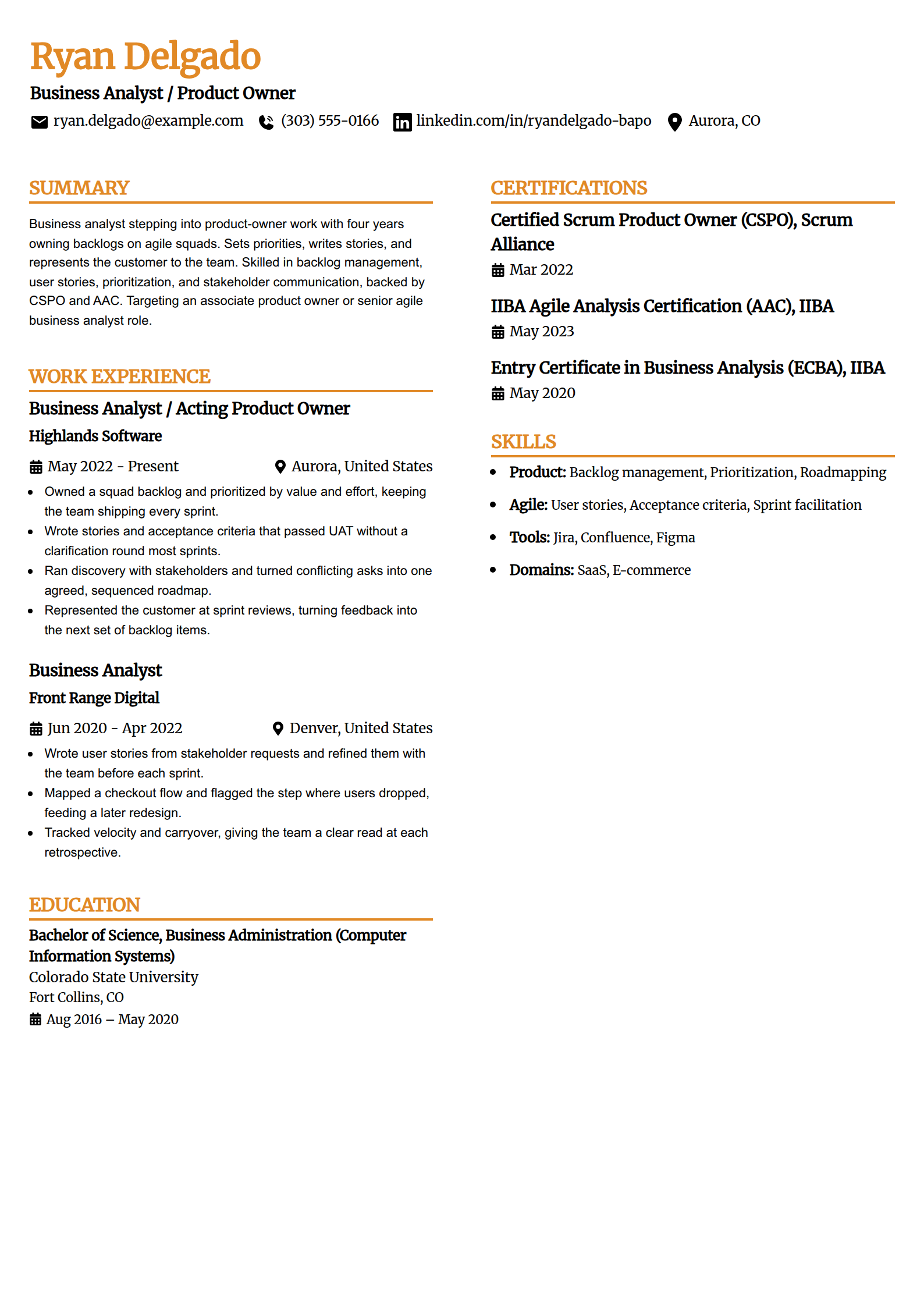
- Leads with backlog ownership, prioritizing by value and effort so the squad shipped every sprint.
- Shows the product-owner move, representing the customer at sprint reviews and turning feedback into work.
- Names the crossover stack, backlog management, user stories, prioritization, and Jira, with CSPO and AAC.
- Keeps bullets short and results-focused so a four-year history reads clean and focused.
- Uses a modern layout that carries the shift from BA to product owner clearly.
Operations Business Analyst Resume Template
Why this resume example works?
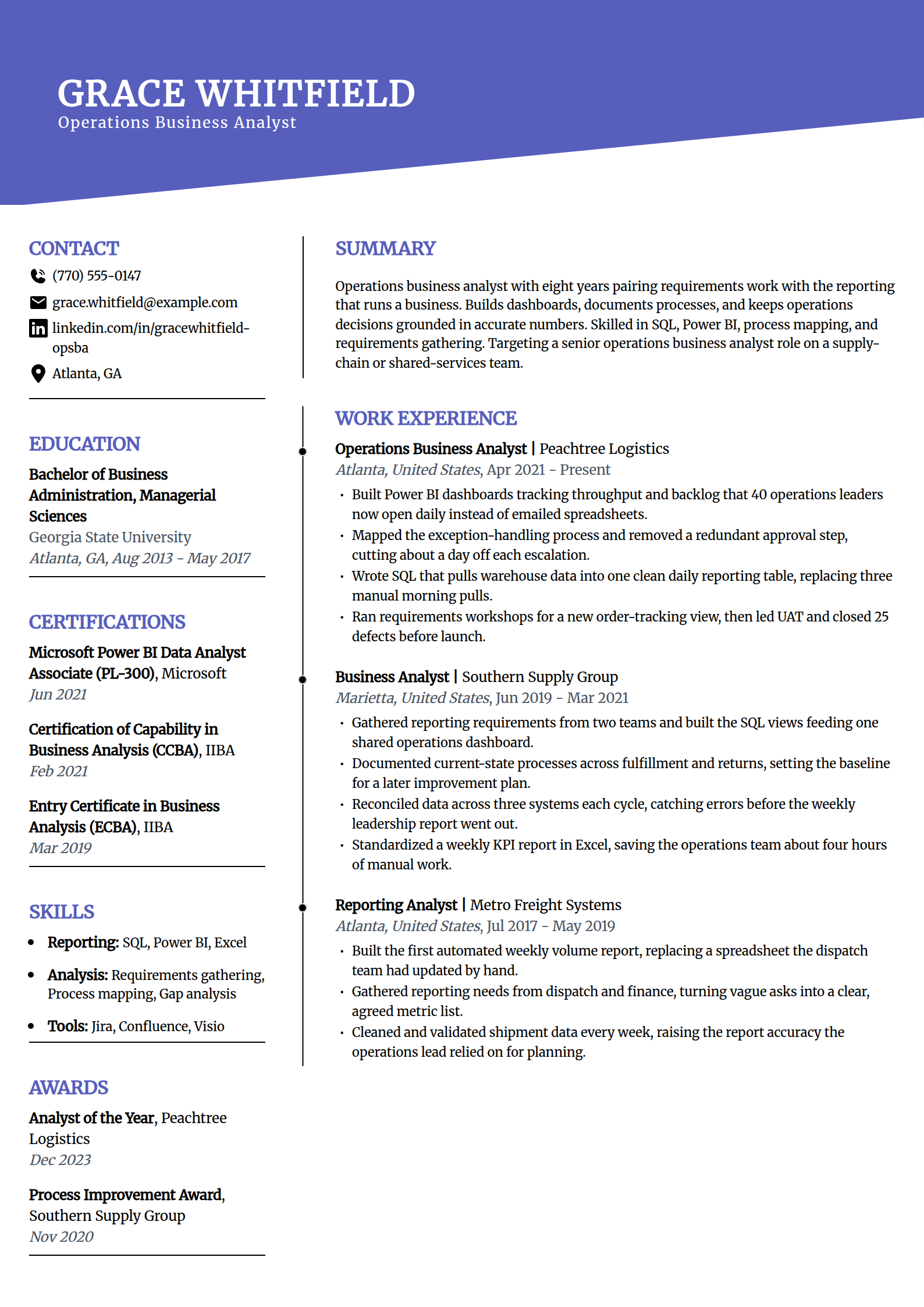
- Leads with the reporting operations run on, Power BI dashboards tracking throughput and backlog leaders use daily.
- Names the operations BA stack, SQL, Power BI, process mapping, and requirements gathering.
- Shows the day-to-day work, pulling warehouse data into one clean daily reporting table.
- Lists awards without long descriptions, keeping the two-column layout clean and balanced.
- Carries a Microsoft Power BI Data Analyst (PL-300) credential that matches the role.
Build your business analyst resume
Pick a template above and the editor keeps your layout clean and ATS-safe while you swap in your own requirements, process work, and the impact behind each project.
Build my resumeHow to write a business analyst resume in 2026
A business analyst resume is read for the decisions your requirements drove, not the tasks you handled. In the first few seconds a hiring manager wants the process you improved and the tools you used, so lead with those and prove each with one number. These moves make yours easy to skim and easy for an applicant tracking system to parse.
Open with a short, specific summary
Write three to four sentences that name your title and years, the kind of analysis you do, two or three tools you know, and the role you are targeting. Lead with what you have delivered, requirements signed off or a process improved, not adjectives about yourself.
Business analyst with 5 years turning vague requests into clear requirements and process maps that ship. Runs stakeholder workshops, writes BRDs and user stories, and drives UAT so releases land without surprises. Skilled in Jira, Confluence, Visio, and SQL. Targeting a senior business analyst role on a product or transformation team.
Lead experience with impact, then the method
The work a BA is hired for is measurable, so name what changed and attach one credible number. Open every line with a strong verb, never "Responsible for".
- Impact first: say what your analysis changed, like cutting mid-project rework 30 percent by tightening requirements up front.
- Name the method that did it: a BRD, a process map, a set of user stories, or UAT, matching the posting's terms.
- Show requirements you own: a signed-off backlog, a traceability matrix, or a workflow you mapped and redesigned.
- Keep one number per bullet and keep it modest: a two-day cycle-time cut or 40 defects caught in UAT reads as real.
Match tools and methods to your track
Business analysis splits by track, and the tools you name signal which one you fit. List the stack for your track so a hiring manager and a parser both find the keywords.
- Core and agile BA: Jira, Confluence, user stories, acceptance criteria, process mapping in Visio or Lucidchart, and UAT.
- IT and systems BA: functional specs, data mapping, API requirements, SQL, and use cases for the build team.
- Domain BA: name your domain too, Epic and HL7 for healthcare, general ledger for finance, Salesforce config for CRM, SAP FI and MM for ERP.
- Data-leaning BA: add SQL and a BI tool like Power BI or Tableau, but keep requirements and process front and center.
Show education and certifications that fit
A degree in business, information systems, or a related field helps, but a real certification carries weight when experience is light. List the ones that match your track and level.
- Entry-level and career-changers: the ECBA needs no work experience, only 21 hours of professional development.
- Mid-level: the CCBA recognizes documented BA hours and signals you are past the beginner stage.
- Senior: the CBAP or the PMI-PBA is the credential a senior business analyst posting looks for.
- Track-specific: the AAC for agile, a Salesforce Administrator for CRM, SAP Activate for ERP, or a Six Sigma belt for process work.
Keep it to one clean, ATS-safe page
A business analyst resume is a quick read, so one page in a simple layout is the standard. The templates above are built this way.
- Use a single-column or clean two-column layout with standard headings a parser recognizes.
- Hold it to one page and lead with your most recent role in reverse-chronological order.
- Save as a PDF so the formatting holds, then run it through the ATS resume checker for a quick clean-format pass.
- Swap the numbers in the templates above for your own impact, projects, and tools; do not copy them as is.
Common business analyst resume mistakes
- Listing duties with no impact. "Gathered requirements" is a task; "gathered requirements that cut mid-project rework 30 percent" is proof.
- Hiding the method and tools. Name your BRDs, user stories, process maps, Jira, and SQL in the bullets and skills; those are the keywords a parser matches.
- A generic tool list that does not match your track. An IT BA names data mapping and APIs; a healthcare BA names Epic and HL7, not the same line.
- Chasing a senior credential too early. The CBAP and CCBA need documented BA hours; an entry-level reader should list the ECBA, which needs none.
- Running to two pages or using a heavy design with tables. Keep one clean page a hiring manager and an ATS both read easily.
Frequently asked questions
What should a business analyst resume include?
A business analyst resume needs your contact details, a short summary, your work history in reverse-chronological order, education, skills, and certifications. Lead the summary and each job with impact and the method behind it: the requirements that cut rework, the process you mapped and redesigned, and the Jira, Visio, or SQL you used. Name the tools and methods for your track so an applicant tracking system matches them to the posting, and add a certification like the ECBA or CBAP. Keep it to one clean page.
How do I write a business analyst resume with no experience?
Lead with a relevant degree, an internship or course projects, and the ECBA credential, which needs no work experience. Show real BA tasks even from a project or internship: documenting requirements, writing user stories, mapping a process, and helping with UAT. Name the tools you know, such as Jira, Confluence, Visio, SQL, and Excel, since those are the keywords a parser looks for. Use a tight, one-page template and fill it honestly with an award or volunteer work rather than padding thin history. The entry-level example above shows the shape.
What skills and tools do you put on a business analyst resume?
Match the tools and methods to your track and to the job posting. A core BA lists requirements elicitation, user stories, process mapping, Jira, Confluence, and SQL; an IT or systems BA adds data mapping, API requirements, and functional specs; a data-leaning BA adds Power BI or Tableau; a domain BA names its systems, Epic and HL7 for healthcare, general ledger for finance, Salesforce for CRM, SAP FI and MM for ERP. Split the list so a hiring manager and a parser both find what they need, and back it with a certification like the ECBA, CCBA, or CBAP.
Which certification is best for a business analyst?
It depends on your experience. The ECBA (Entry Certificate in Business Analysis) is the entry-level credential and needs no work experience, only 21 hours of professional development, so it fits students and career-changers. The CCBA recognizes documented BA hours for mid-level analysts. The CBAP is the senior credential, and the PMI-PBA is a strong alternative. For a specialty, add the IIBA Agile Analysis Certification for agile work, a Salesforce Administrator for CRM, or SAP Activate for ERP. List the one you have earned, not one you are years away from qualifying for.
Business analyst vs data analyst resume: what is different?
The two lead with different work. A business analyst resume leads with requirements, process mapping, and the decisions your analysis drove, naming BRDs, user stories, stakeholder workshops, and UAT. A data analyst resume leads with SQL, dashboards, and metrics, naming Python, Tableau, and A/B tests. There is overlap for a data-leaning BA, but keep requirements and process front and center on a business analyst resume. If your work is mostly querying and dashboards, use a data analyst template instead; this page links one.
How long should a business analyst resume be?
One page. A business analyst resume is a quick read, so keep it to a single, skimmable page led by your most recent role. Focus on your last few roles and the projects that show measurable impact and the methods the posting names. If you have a long history, keep the roles that show your strongest requirements and process work and drop older or unrelated positions to make room for what matters.
More business analyst resume resources
Build your business analyst resume
Pick a template above and the editor keeps your layout clean and ATS-safe while you swap in your own requirements, process work, and the impact behind each project.