Nursing Student Resume Examples and Templates, Written Before You Are an RN
- ATS Friendly
- Clinical Hours First
- 16 Student Examples
A nursing student resume needs five things: a three to four sentence summary naming your program and total clinical hours, your rotations written as real experience entries with facility, unit, dates and hours, a licensure line that states your NCLEX status precisely, certifications led by BLS, and a skills block split into clinical, procedures and systems. Sixteen examples below show it done for sixteen different starting points.


540k+ resumes created
Editable nursing student resume templates
Each template below is a real nursing student resume laid out in that format, filtered by the look you want. Pick one, then swap in your own program, clinical hours and rotation sites. All of them keep your licensure line, certifications and dates where a hospital's applicant tracking system expects to find them.
Nursing Student Resume Template (Clinical Rotations Only)
Why this resume example works?
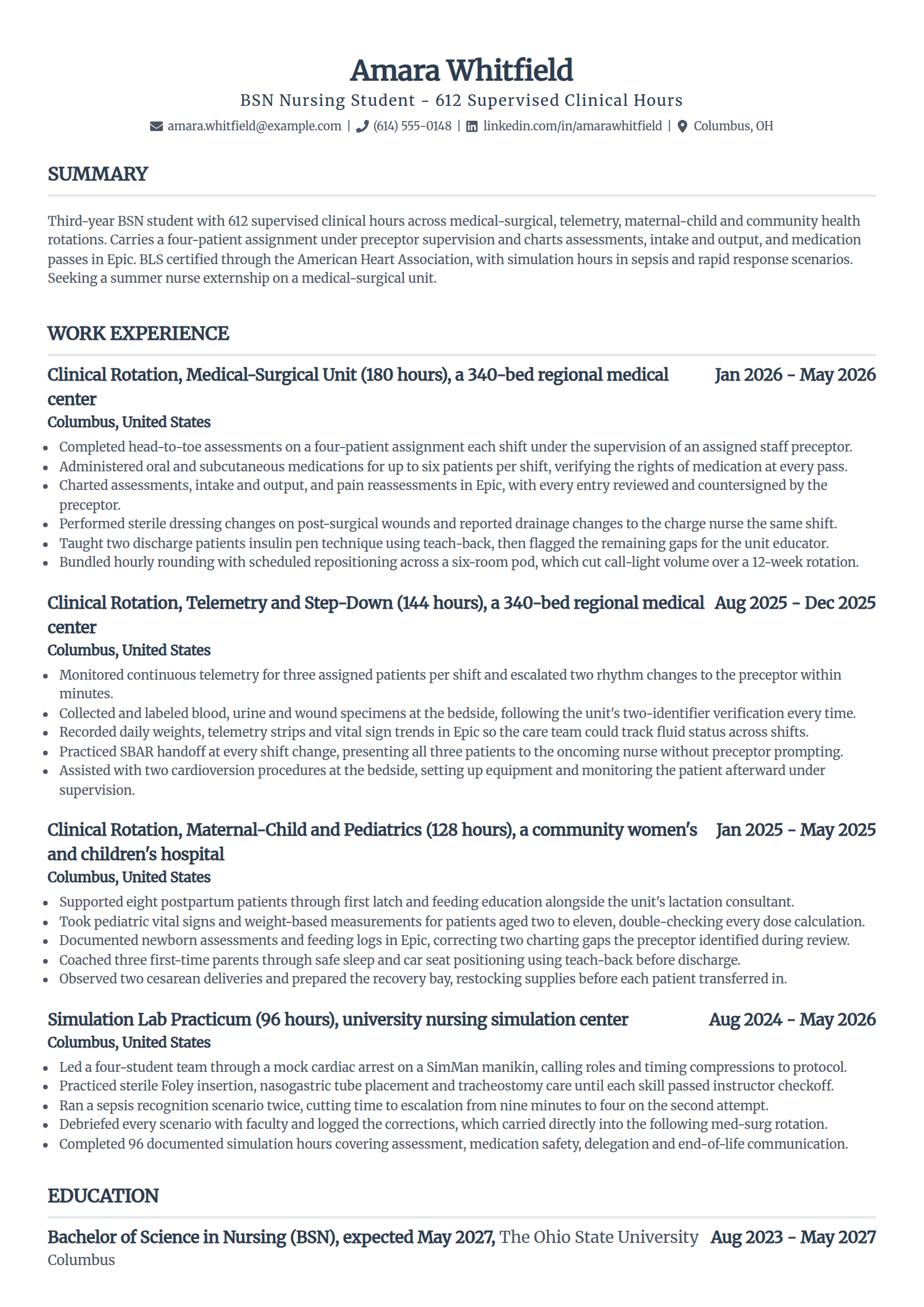
- Puts total clinical hours in the headline and the summary, which is the number that stands in for years of experience.
- Writes each rotation as a real experience entry with facility type, unit, dates and the hours behind it.
- Names the patient assignment size, four patients under preceptor supervision, so a reader can picture the shift.
- Keeps simulation lab in its own entry with documented hours instead of burying it as a line in the skills block.
- States supervision in the bullets, which reads as accurate to any nurse manager and protects you in the interview.
Nursing Student Resume Example With No Healthcare Experience
Why this resume example works?
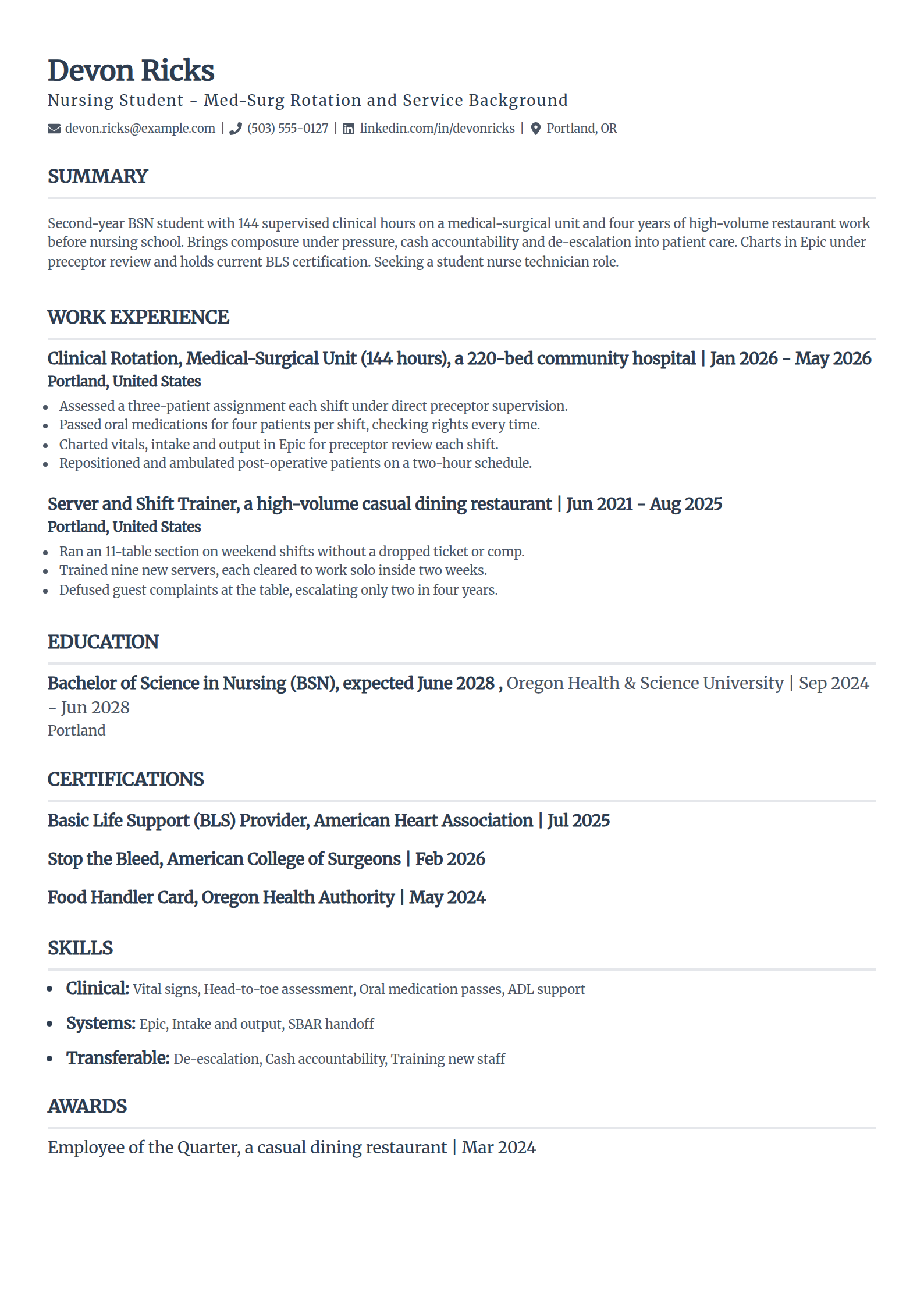
- Leads with the one clinical rotation completed rather than apologizing for the jobs that came before it.
- Names the transfer instead of claiming it: an 11-table section is throughput, training nine servers is teaching.
- Keeps the restaurant job on the page, because four years of steady work answers a question a blank resume raises.
- Holds the whole thing to one page, which is the right length when the clinical record is still short.
- Carries BLS at the top, the certification nearly every student nurse technician posting screens for.
Accelerated BSN (ABSN) Student Resume Template
Why this resume example works?
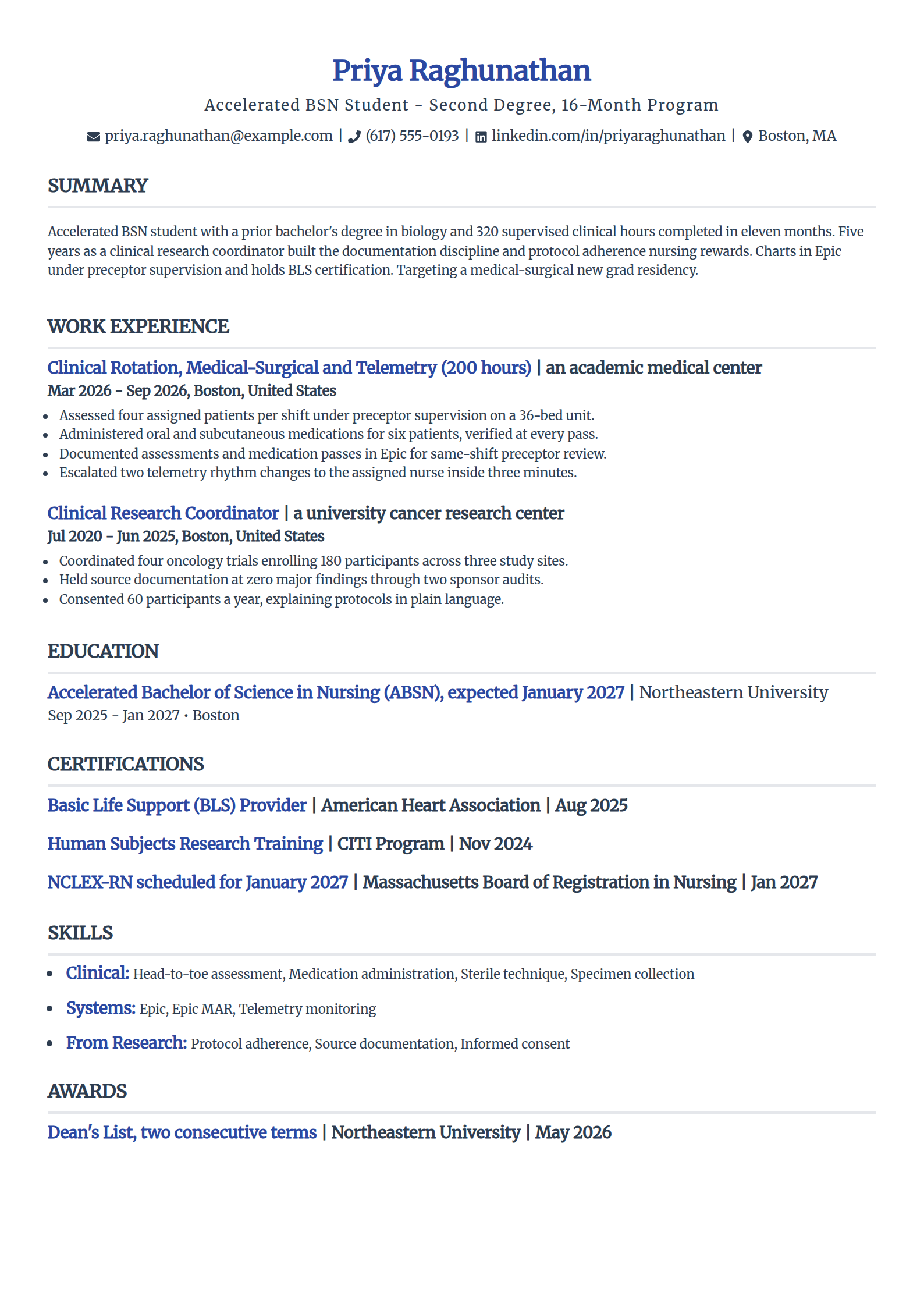
- Says accelerated in the headline, which explains 320 clinical hours inside eleven months without the reader doing math.
- Treats the prior career as an asset with a number attached, four trials and 180 participants, not as a gap to excuse.
- Connects the old job to the new one in one sentence: source documentation and protocol adherence transfer directly.
- Dates the NCLEX-RN precisely, so a recruiter can line the start date up against the program's January finish.
- Stays on one page even with two careers on it, which is what an accelerated cohort's resume has to do.
ADN Nursing Student Resume Template (Community College)
Why this resume example works?
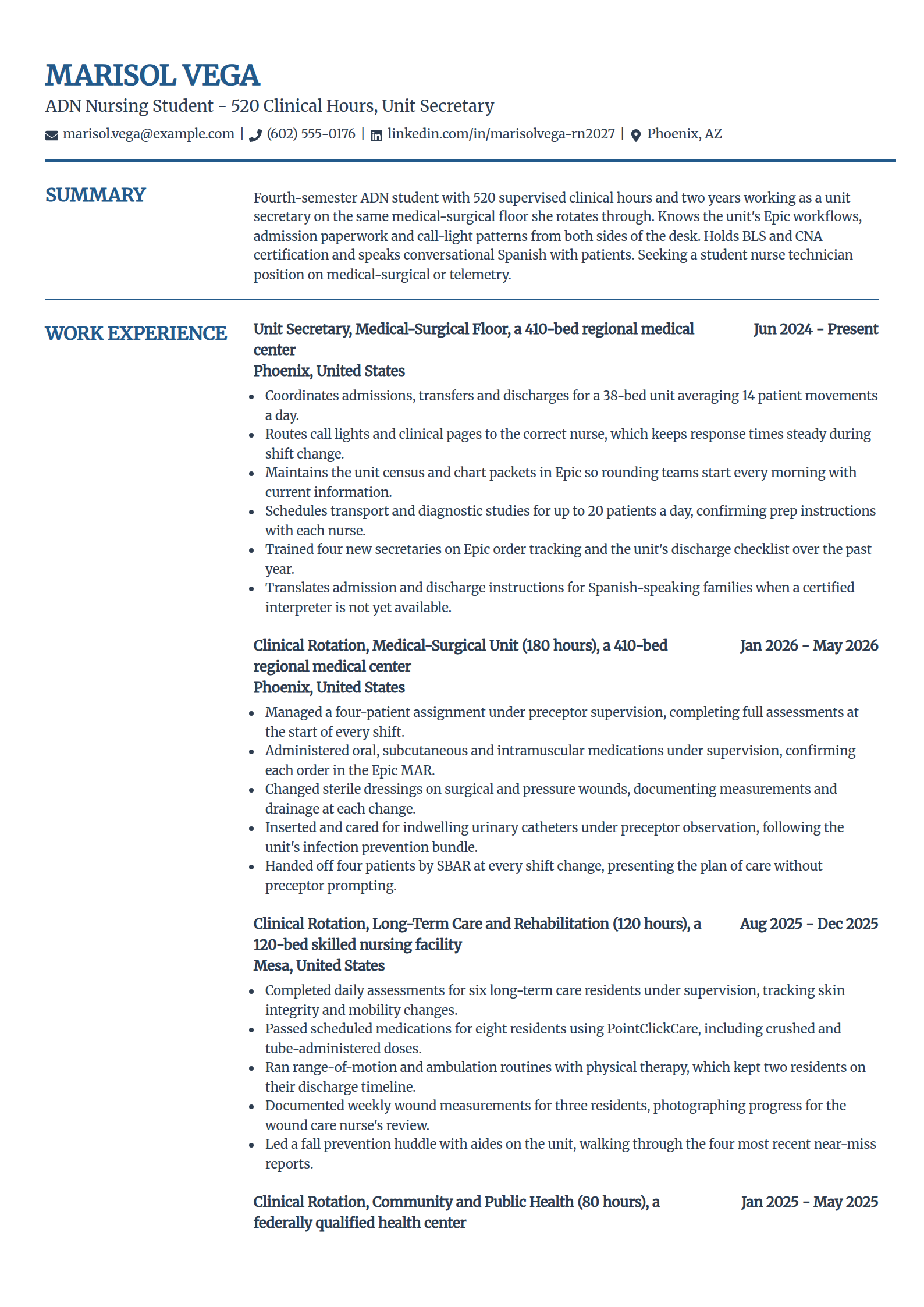
- Leads with the paid hospital job, because two years as a unit secretary on the same floor is the strongest thing here.
- Shows the system knowledge a manager values: Epic workflows, census, transfers and transport for a 38-bed unit.
- Splits rotations across acute, long-term care and community health so the reader sees breadth, not one setting.
- Lists the planned RN-to-BSN bridge in education, answering the degree question before anyone has to ask it.
- Puts conversational Spanish in its own skills line, which is a real staffing need on most medical-surgical floors.
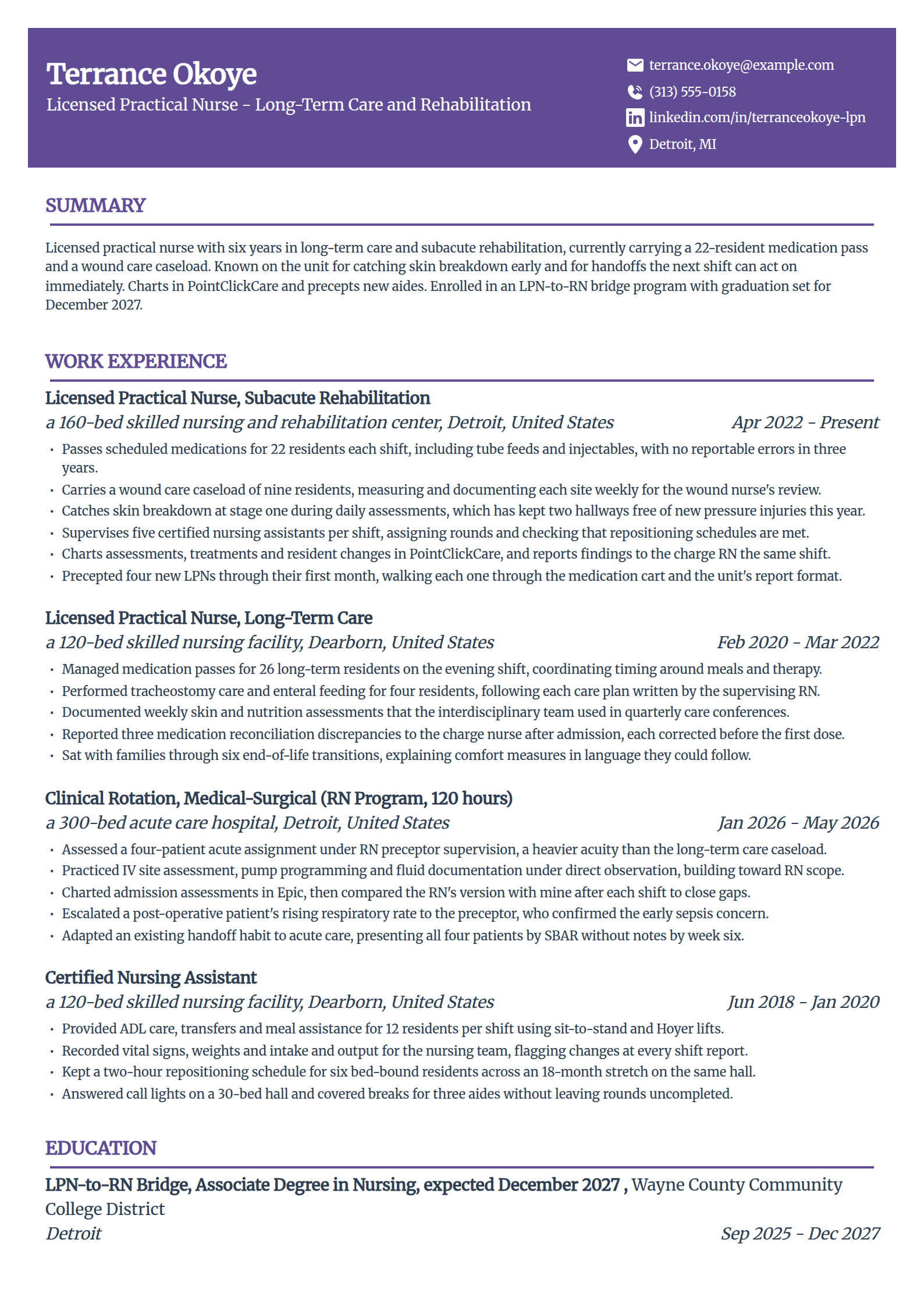
LPN to RN Bridge Student Resume Template
Why this resume example works?
- Writes as the licensed LPN he already is, not as an RN student, which is the single most important call on this page.
- Keeps the bridge program in education with its graduation date, where it reads as trajectory rather than short tenure.
- Quantifies the current job honestly: a 22-resident medication pass and a nine-resident wound caseload.
- Adds the RN-program rotation as its own entry so the acute care exposure is visible without overstating scope.
- Shows supervision of aides and precepting new LPNs, the leadership signal a charge nurse looks for in a bridge hire.
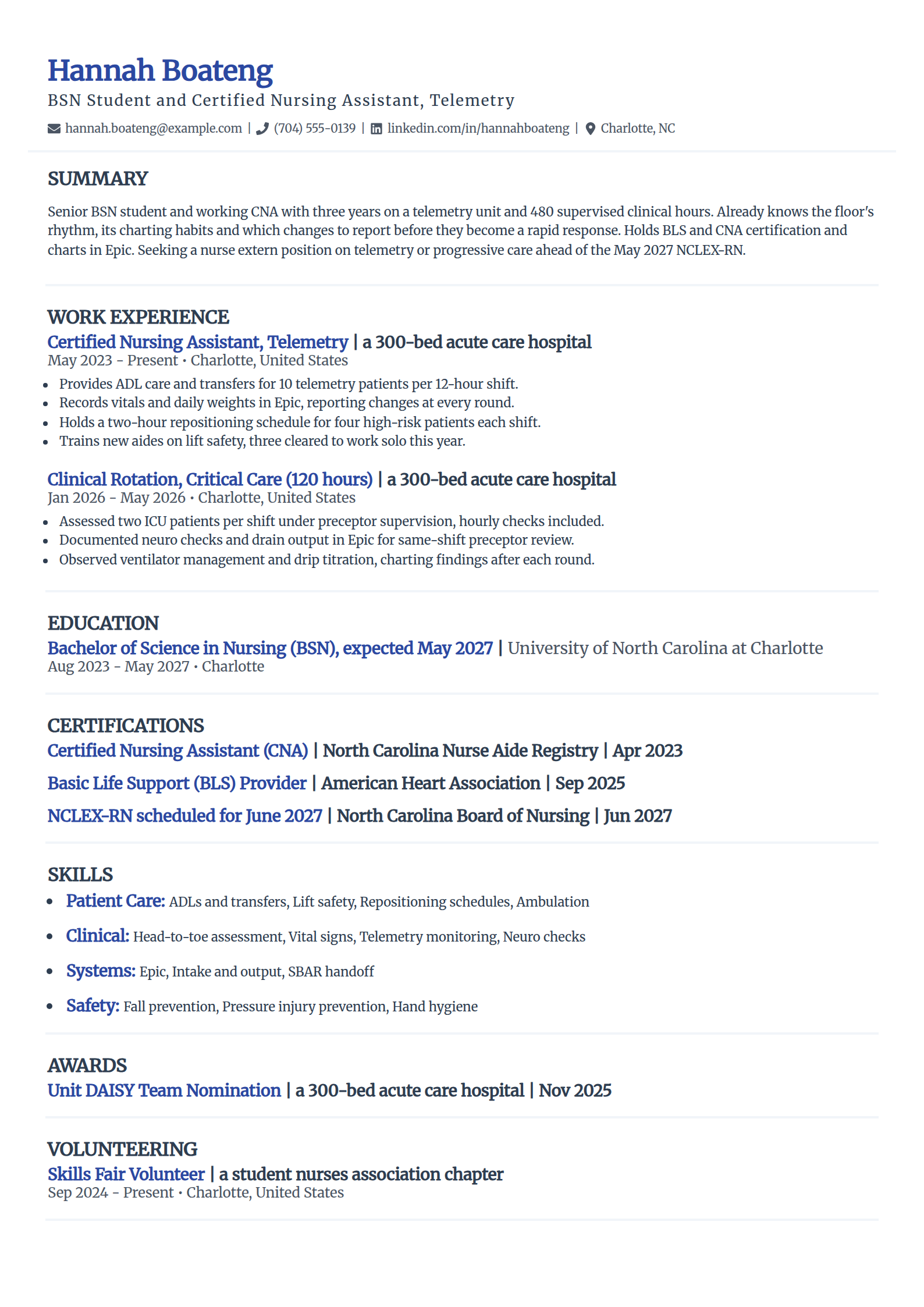
Nursing Student Resume Example With CNA Experience
Why this resume example works?
- Runs the CNA job first, because three years on telemetry is the part a hiring manager can verify today.
- Keeps every CNA bullet inside CNA scope: ADLs, transfers, vitals, repositioning and reporting changes.
- Follows with the critical care rotation, which shows where she is going without claiming she is there yet.
- Turns a habit into a number: a two-hour repositioning schedule held for four high-risk patients each shift.
- Trains new aides, which is the cheapest credible way for a student to show teaching on a one-page resume.
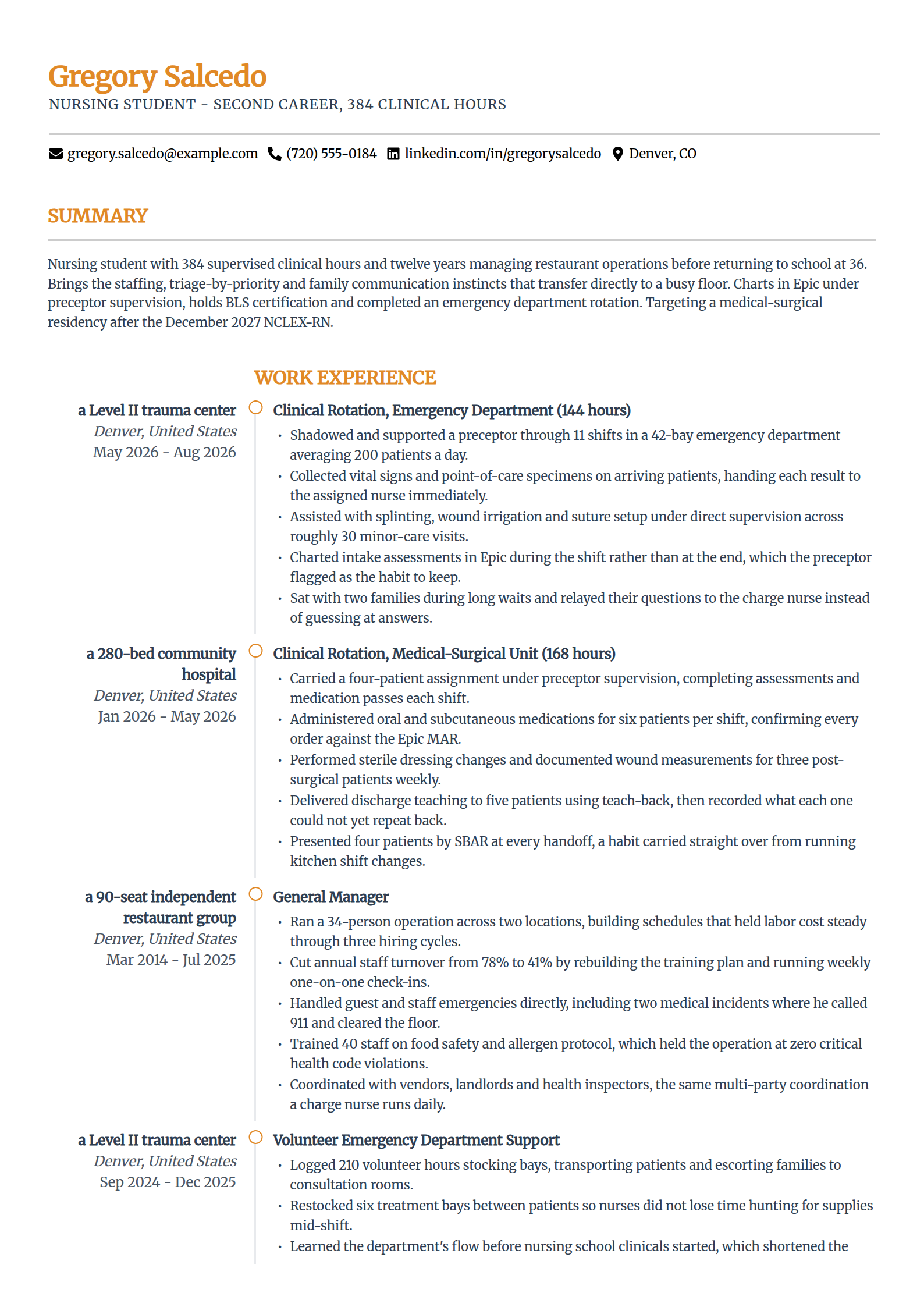
Career Change to Nursing Resume Template
Why this resume example works?
- Puts the two clinical rotations above twelve years of restaurant management, which is the correct order once you are in a program.
- Picks the transferable results that actually map: cutting turnover from 78% to 41% is retention, not food service trivia.
- Names two real medical incidents handled on the floor, which is a crisis-response claim a reader can picture.
- Adds 210 volunteer emergency department hours, the bridge that makes the career change look deliberate.
- Does not hide the age of the career change, because a 36-year-old second-career nurse is a hiring strength on most units.
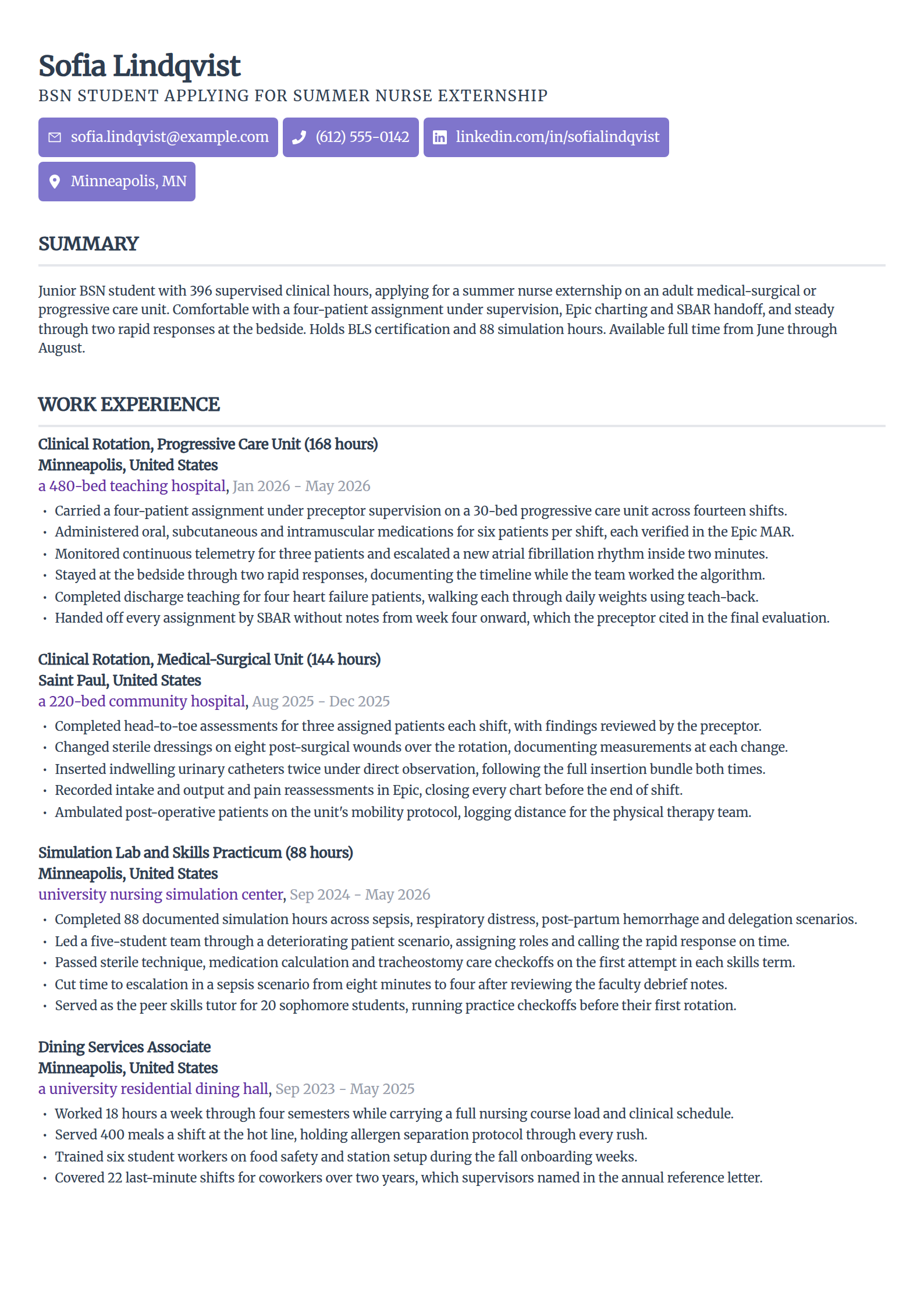
Nurse Extern Resume Template (Summer Externship)
Why this resume example works?
- Says what she is applying for in the headline, because extern programs read hundreds of near-identical student resumes.
- Leads with the progressive care rotation, since externships are assigned by unit and the unit manager reads this first.
- Documents 88 simulation hours with the scenario types, which is how simulation stops reading as filler.
- Puts availability in the skills block: full time June through August, 12-hour shifts, weekends. Programs screen on that.
- Keeps the campus dining job, which shows eighteen hours a week held alongside a full clinical schedule.
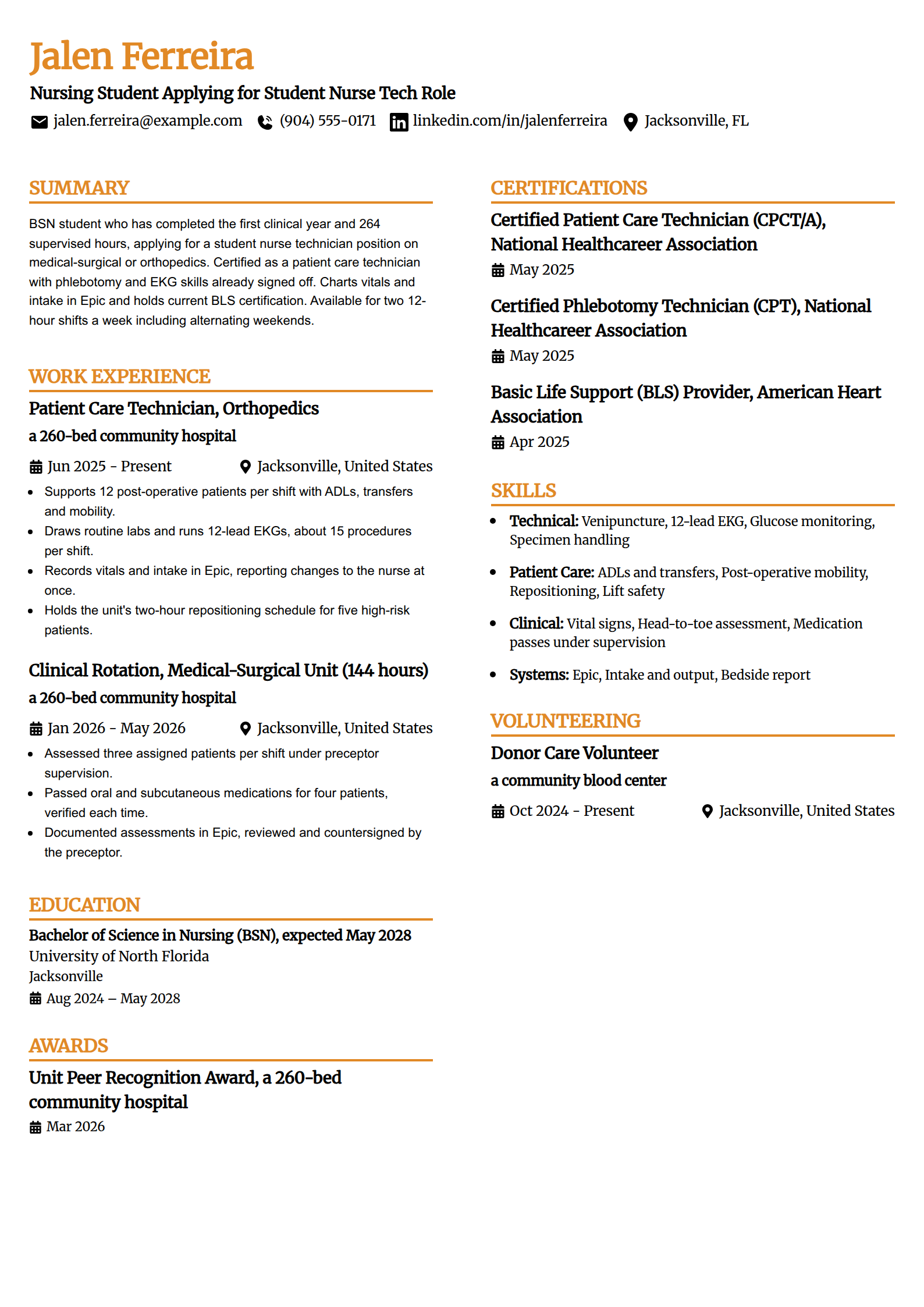
Student Nurse Technician Resume Template (PCT Roles)
Why this resume example works?
- Leads with the patient care technician job, which is the closest thing to the posting being applied for.
- Counts the technical work: roughly 15 draws and EKGs a shift, the volume a tech posting cares about.
- Carries the CPCT/A and CPT certifications, both real National Healthcareer Association credentials for this role.
- States shift availability, two 12-hour shifts a week including alternating weekends, which decides many of these hires.
- Keeps the clinical rotation short, because the paid job already proves what the rotation would be claiming.
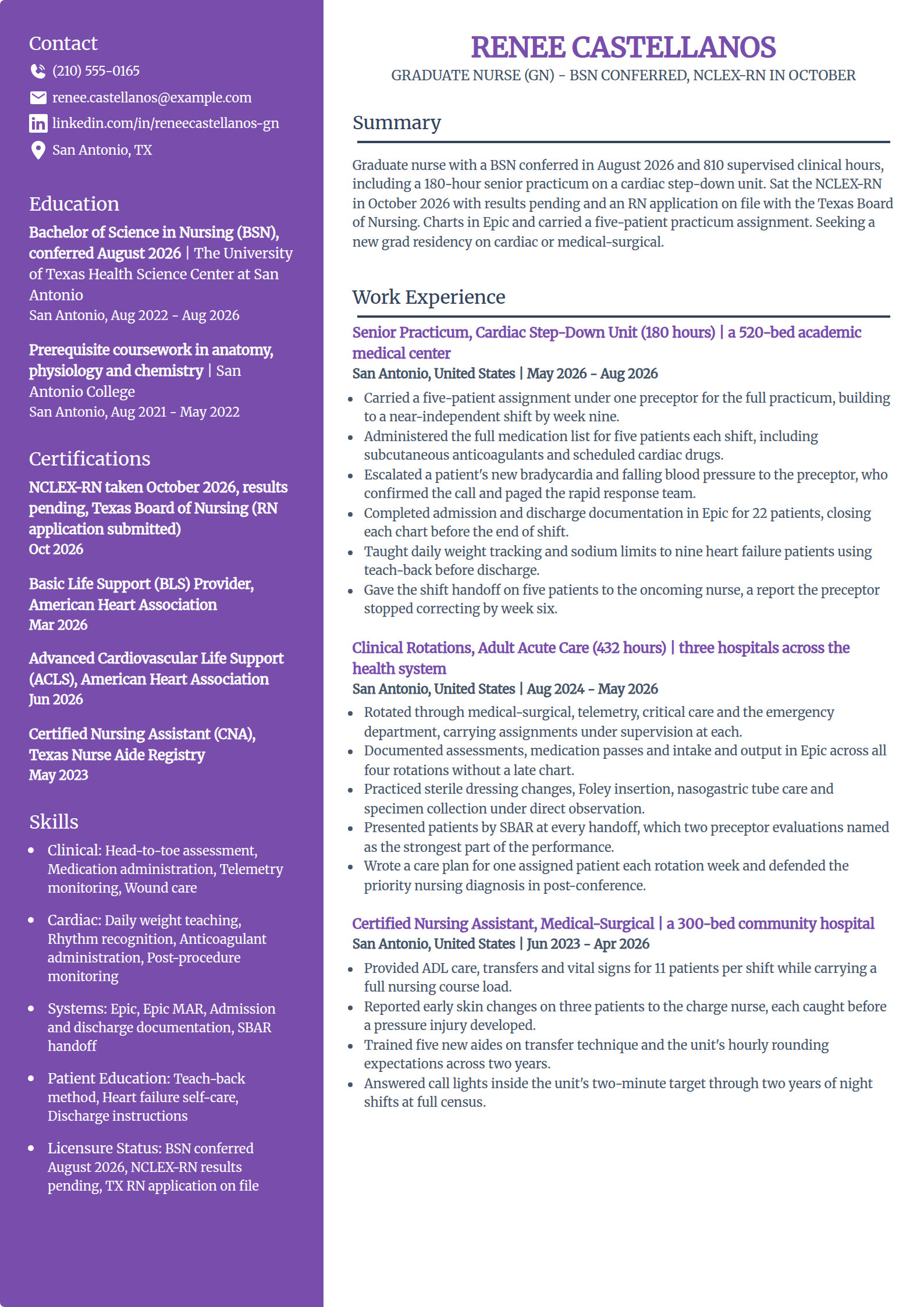
New Grad Nurse Resume Template Before the NCLEX (Graduate Nurse)
Why this resume example works?
- Uses Graduate Nurse (GN) in the headline, the accurate title between conferral and licensure.
- States the licensure position in full: NCLEX-RN taken in October, results pending, RN application on file with the state board.
- Leads with the 180-hour senior practicum and a five-patient assignment, the closest thing a new grad has to a staff shift.
- Groups 432 rotation hours into one entry instead of eight thin ones, which keeps the page readable.
- Keeps the CNA job that ran alongside school, because working through a nursing program is a durability signal.
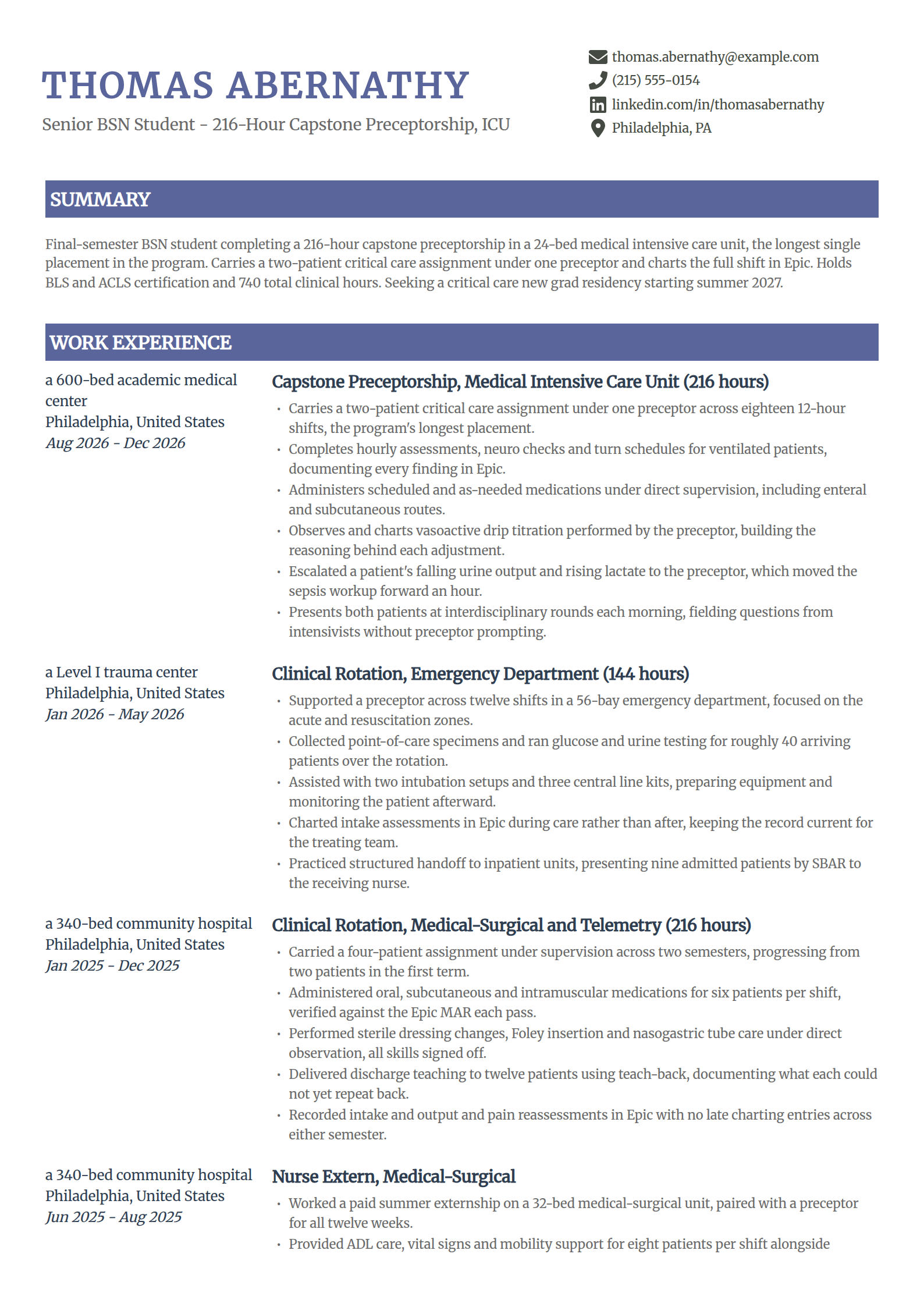
Senior Practicum Resume Template (Capstone Preceptorship)
Why this resume example works?
- Gives the capstone its own entry with 216 hours and one preceptor, which is what separates it from a rotation.
- Describes the progression honestly, building toward a near-independent shift by week nine, without claiming independence.
- Charts the ICU work in student-appropriate terms: hourly assessments and turn schedules performed, drip titration observed.
- Adds the paid summer externship with its competency checklist, which doubles as a reference a manager can call.
- Totals 740 supervised hours in the skills block, so the number is findable in a five-second scan.
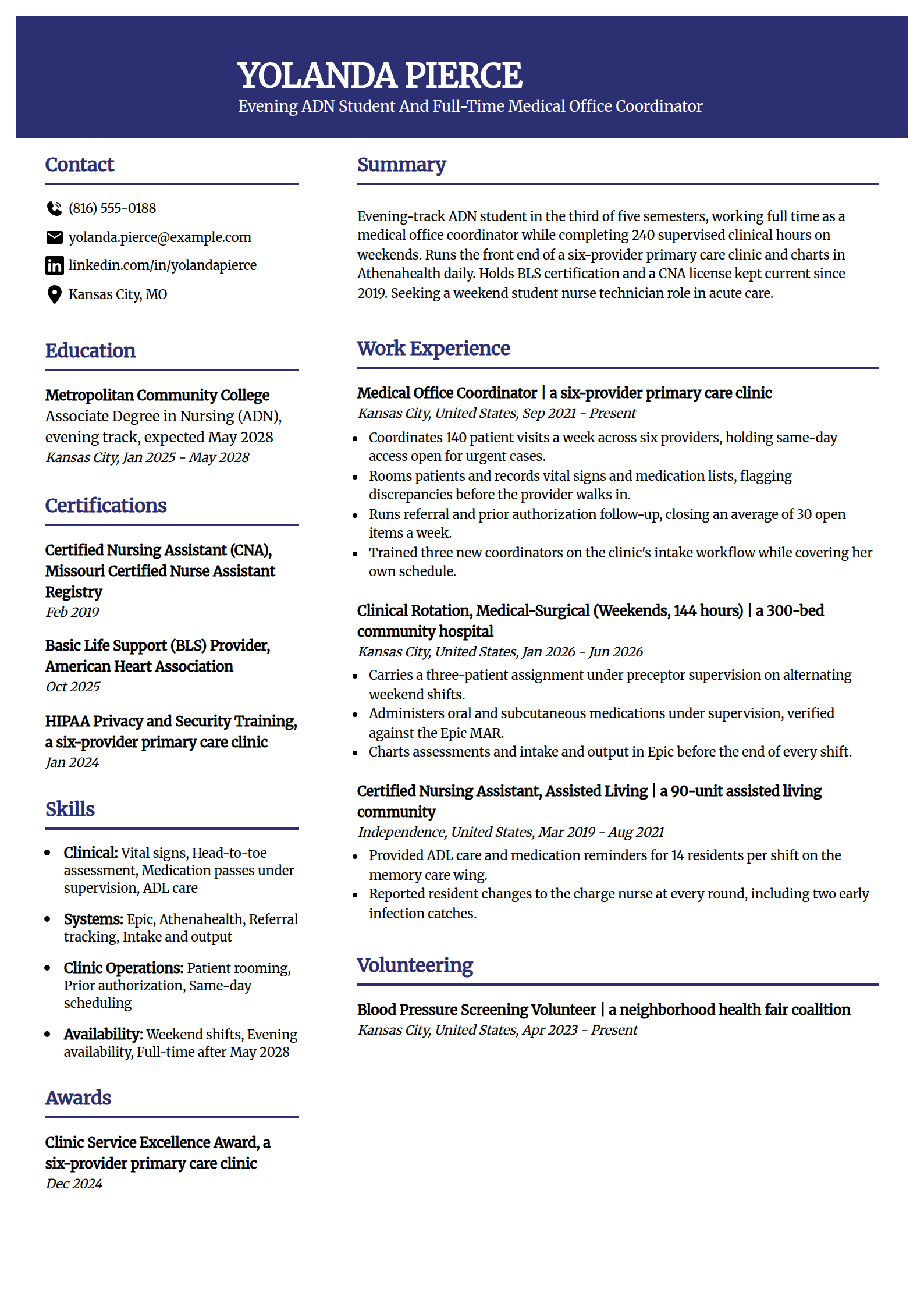
Part-Time Nursing Student Resume Template (Working Full Time)
Why this resume example works?
- Runs the full-time clinic job first, because it is current, paid and healthcare-adjacent all at once.
- Says evening track in the headline, which explains a five-semester timeline without sounding like slow progress.
- Labels the rotation as weekend clinicals, showing exactly how school and a full-time job fit together.
- Keeps the older CNA role for continuity, since a license held current since 2019 is worth the two lines.
- Puts weekend and evening availability in the skills block, which is the only thing some student tech postings filter on.
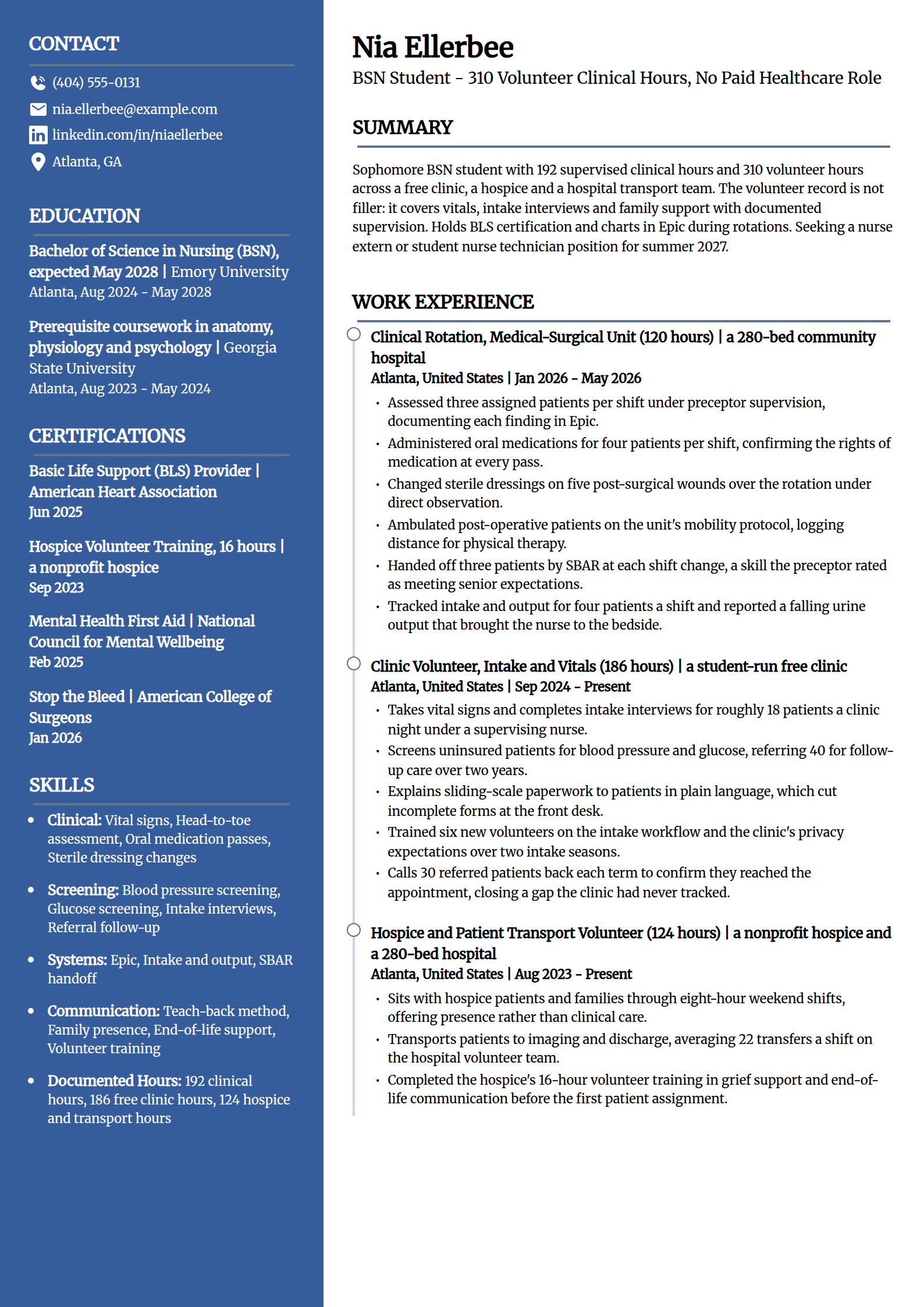
Nursing Student Resume Template With Volunteer Clinical Hours
Why this resume example works?
- Treats volunteering as documented hours, 186 at a free clinic and 124 in hospice and transport, not as a character reference.
- Names the supervised clinical tasks inside the volunteer work: vitals, intake interviews and screening referrals.
- Splits the hour totals into their own skills line so a reader sees 502 documented hours without adding anything up.
- Keeps the hospice line honest, offering presence rather than clinical care, which is exactly what the role is.
- Shows volunteer training completed, sixteen hours including grief support, which turns goodwill into a credential.
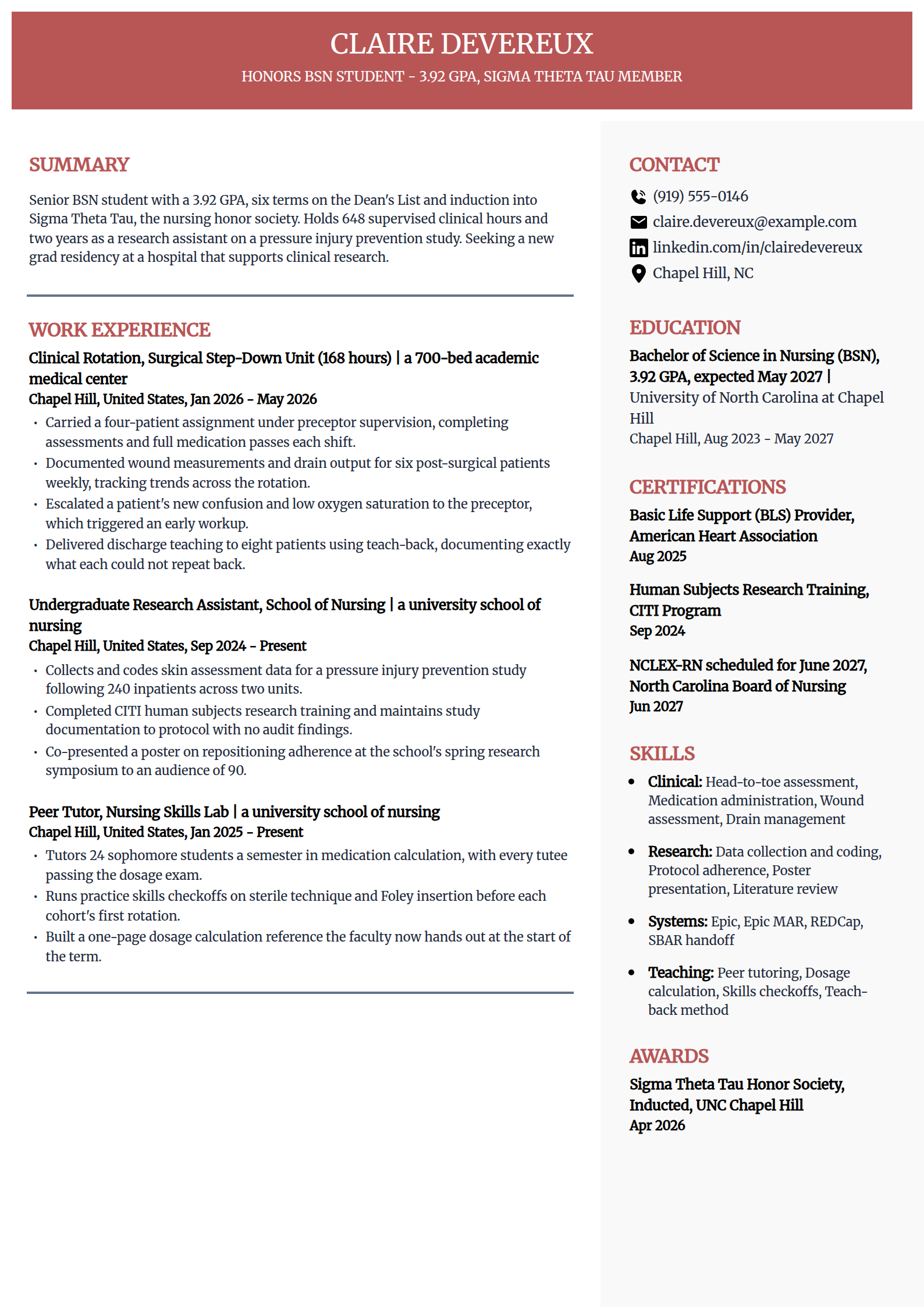
Honors Nursing Student Resume Template (Dean's List and Sigma Theta Tau)
Why this resume example works?
- Puts the 3.92 GPA in the headline, which is one of the few cases where a GPA earns top-of-page space.
- Names Sigma Theta Tau rather than writing honor society, because the reader in nursing knows the name.
- Backs the honors with work: two years of research assistance on a pressure injury prevention study.
- Connects research to the bedside, applying the study's prevention protocol to assigned patients on the unit.
- Adds peer tutoring with a result, every tutee passing the dosage exam, which is teaching evidence at student scale.
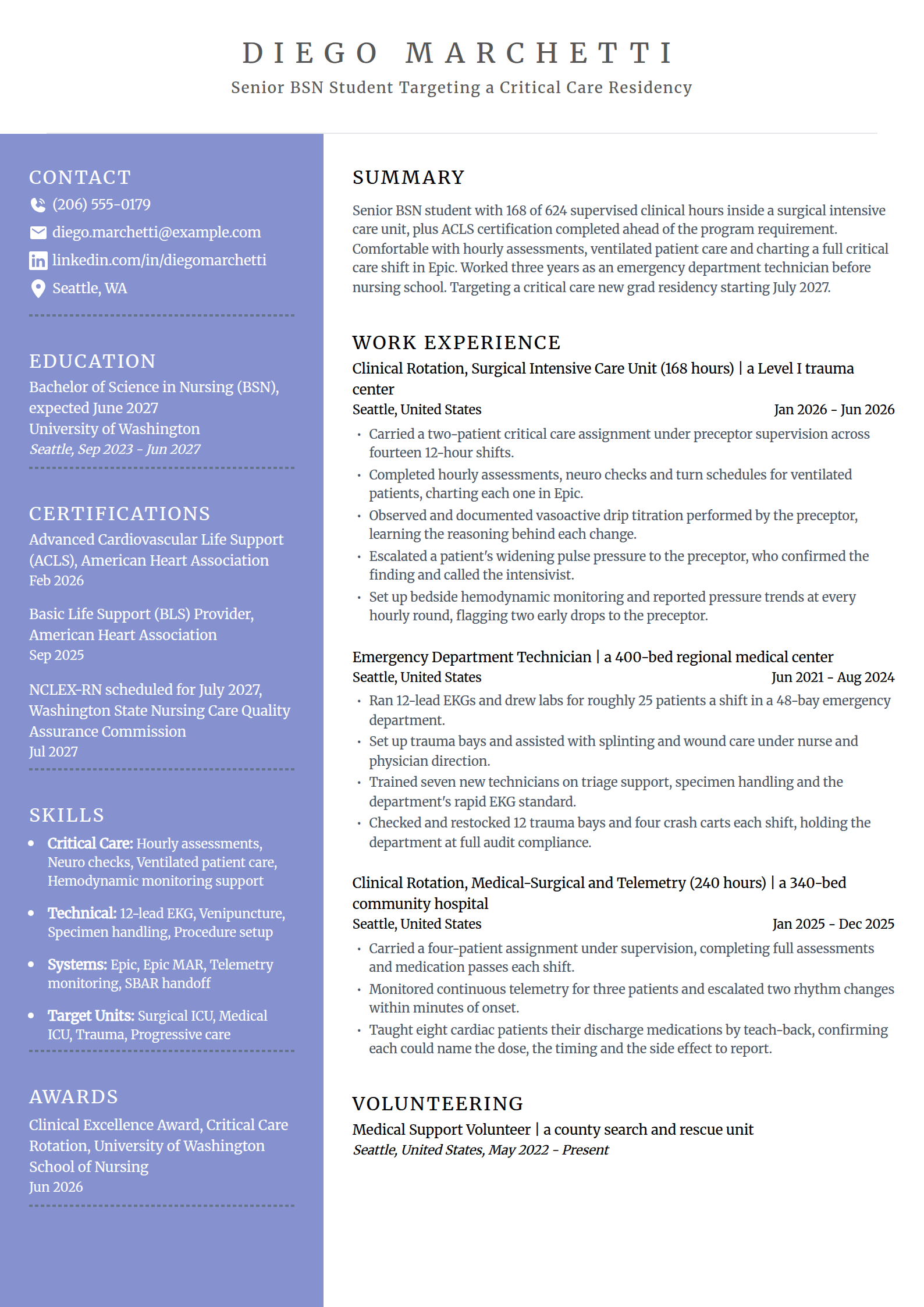
Nursing Student Resume Template for ICU and Critical Care
Why this resume example works?
- Moves the surgical ICU rotation to the top, which is how you tell a critical care residency you are serious.
- Adds ACLS completed ahead of the program requirement, a credential a student can genuinely hold.
- Claims observation where it belongs: drip titration observed and documented, not performed.
- Uses the three years as an emergency department technician as proof of tolerance for the environment, with volume attached.
- Lists target units by name, so the reader knows which residency track to route the application to.
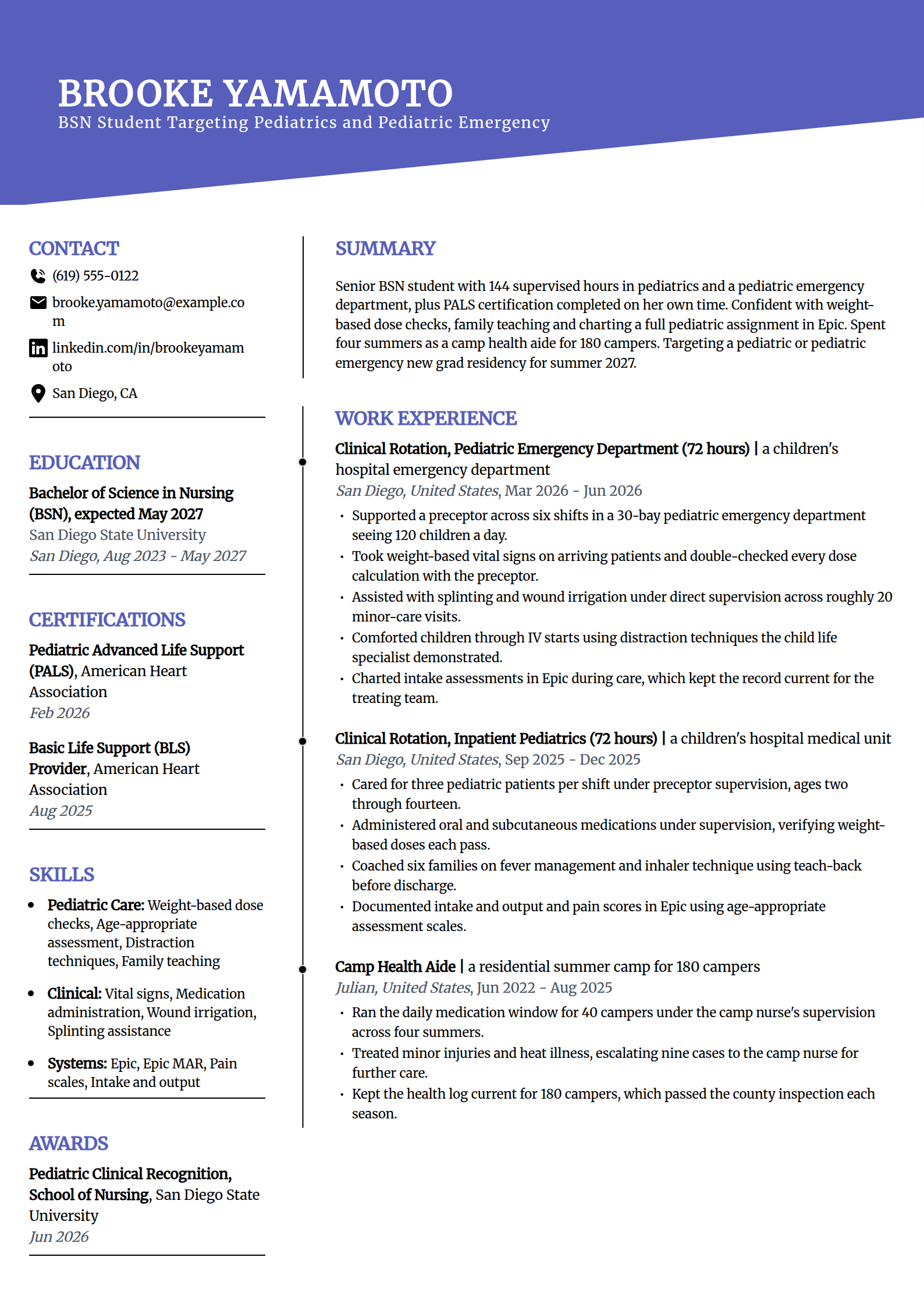
Nursing Student Resume Template for Pediatrics and the ED
Why this resume example works?
- Holds PALS, the certification pediatric and pediatric emergency units screen for, completed on her own time.
- Names weight-based dose checks in the first skills line, which is the pediatric-specific competency on this page.
- Shows both pediatric settings, inpatient and the emergency department, so the reader can place her either way.
- Uses distraction technique during IV starts, a detail only someone who was actually there would write down.
- Turns four summers of camp health work into a medication window for 40 campers, run under the camp nurse.
Build your nursing student resume
Pick a template above and the editor keeps your layout parser-safe while you swap in your own rotations, clinical hours and licensure status.
Build my resumeHow to write a nursing student resume in 2026
A nurse recruiter reads the top third of your page for three things: what program you are in, how many supervised clinical hours you have, and whether you can legally be hired yet. Put all three above the fold, write your rotations as experience rather than coursework, and keep every bullet inside what a student is allowed to do.
Open with a summary that names your program, your hours and your target
Three to four sentences. Say what program you are in and when it ends, give your total supervised clinical hours, name the patient assignment size you carry and the system you chart in, then say what you are applying for. Use an objective only if you have not started rotations yet, because once you have clinical hours you have content, and a summary carries it better.
Third-year BSN student with 612 supervised clinical hours across medical-surgical, telemetry, maternal-child and community health rotations. Carries a four-patient assignment under preceptor supervision and charts assessments, intake and output, and medication passes in Epic. BLS certified through the American Heart Association, with simulation hours in sepsis and rapid response scenarios. Seeking a summer nurse externship on a medical-surgical unit.
Write clinical rotations as experience entries, not as coursework
Rotations are the work you have done. Give them the same shape you would give a job, and group them so a nurse manager reads your exposure in one pass instead of scanning eight one-line entries.
- Title each entry with the unit and the hours: "Clinical Rotation, Medical-Surgical Unit (180 hours)". The hours are the credential.
- Name the facility by type and size, such as a 340-bed regional medical center, and give the city and the dates.
- Say what you carried. A four-patient assignment under preceptor supervision tells a reader more than a list of tasks.
- Group related rotations into one entry when you have many. Med-surg and telemetry can share an entry; keep specialty rotations separate.
- Give simulation its own entry with documented hours and the scenario types. Sixteen sepsis and rapid response hours is practice; "participated in simulation lab" is filler.
State your NCLEX and licensure status precisely
This is the line that decides whether a recruiter can move your application forward, and it is the line most student resumes get wrong. Put it in your certifications block and say exactly where you are.
- Not yet eligible: "BSN expected May 2027, NCLEX-RN scheduled for July 2027". Name the month, not "soon".
- Taken, results not back: "NCLEX-RN taken October 2026, results pending, RN application submitted to the Texas Board of Nursing".
- Graduated, not yet licensed: use Graduate Nurse or GN after your name, never RN. A recruiter verifies licensure before the interview, and the overstatement ends the application.
- Already licensed as something else, such as an LPN or CNA: list that license as current and active, with the issuing board, and keep the RN program in education.
- Never write RN, BSN in your header before the license is issued. Write the degree you hold and the status of the exam.
Build the skills block out of what you have actually done
Split it so a screener can find the posting's words. Nursing postings name systems and procedures directly, and matching that language is the whole of the ATS advice worth giving.
- Clinical: head-to-toe assessment, vital signs, pain reassessment, neuro checks, telemetry monitoring, fall and pressure injury prevention.
- Procedures: medication administration, sterile dressing changes, Foley insertion and care, specimen collection, glucose monitoring, nasogastric tube care.
- Systems: Epic, Cerner, Meditech or PointClickCare, plus the MAR, intake and output, and SBAR handoff. Name the one you actually charted in.
- Certifications worth their line: BLS Provider from the American Heart Association first, then ACLS or PALS if the unit you want requires them, plus CNA, CPCT/A or CPT if you hold them.
- Hours, when you have them: total supervised clinical hours, capstone hours, simulation hours, volunteer clinical hours. Numbers do the work a job title would.
Formatting and length
One page, no exceptions at the student stage. Two pages is a decision you earn later with a work history, not with a longer list of rotations.
- Use a single-column layout, or a simple two-column one that keeps contact, education, certifications and skills in the sidebar. Hospital parsers scramble tables, text boxes and graphics, not a clean side column.
- Order the page summary, clinical experience, education, certifications, skills. Rotations outrank the transcript because they describe work you have done.
- Keep education directly under your experience with the expected graduation date. The one exception is a nursing school application resume, where education leads.
- Compress non-healthcare jobs to two or three lines each. They belong on the page; they do not belong in detail.
- Save as PDF unless the posting asks for something else, and name the file with your own name and the role.
Honestly: the scope line most student resumes cross
Read your bullets as a nurse manager would and ask whether a student could legally have done each one. Managing a patient assignment alone, pushing IV medications, titrating drips, triaging arrivals and taking verbal orders are not student tasks, and a resume claiming them gets read as either careless or dishonest. The fix costs you nothing: write performed under preceptor supervision, or observed and documented, and the same work suddenly reads as accurate. Nobody expects a student to have practiced independently. They expect you to know that you have not.
Common nursing student resume mistakes
- Leaving clinical rotations off, or listing them as coursework. They are the experience section of a student resume. Facility type, unit, dates, hours and what you carried, the same as any job.
- Writing RN after your name before the license is issued. Use your degree and your exam status instead, because licensure is verified before an interview and the correction is not recoverable.
- Claiming tasks outside student scope. "Managed a six-patient assignment" and "administered IV push medications" are the two that show up most; both read as untrue to anyone who has precepted a student.
- Burying the hours. Total supervised clinical hours is the number that stands in for years of experience on a student resume, and it belongs in the summary, not in a footnote.
- Dropping the non-healthcare jobs entirely. Four years of steady restaurant or retail work answers a question a sparse resume raises; trim it to three lines, but keep it on the page.
Frequently asked questions
What should a nursing student resume include?
Five things, in this order. A summary of three to four sentences naming your program, expected graduation and total supervised clinical hours. Your clinical rotations written as experience entries with facility type, unit, dates, hours and the patient assignment you carried. An education block with your program and prerequisite coursework. A certifications block led by BLS and carrying your exact NCLEX status. A skills block split into clinical, procedures and systems, naming the EHR you charted in. Keep it to one page.
Do you put clinical rotations on a nursing student resume?
Yes, and they belong in your experience section rather than under education. Title each entry with the unit and the hours, such as "Clinical Rotation, Medical-Surgical Unit (180 hours)", name the facility by type and size, give the city and the dates, and write bullets describing what you did under supervision. Group related rotations into one entry if you have many, and keep specialty rotations separate so a manager hiring for that specialty can find them.
Should a nursing student resume have an objective or a summary?
A summary, once you have started clinical rotations. Clinical hours, a patient assignment and charting experience are content, and a summary carries content better than a statement of what you want. Use an objective only if you have not begun rotations yet, and even then lead with what you bring, such as prerequisite coursework and a CNA certification, before naming the role you are targeting. Never put both on one resume.
How do you put NCLEX status on a resume before you are licensed?
Put it in your licenses and certifications block and state it precisely. If the exam is ahead of you, write "BSN expected May 2027, NCLEX-RN scheduled for July 2027". If you have taken it, write "NCLEX-RN taken October 2026, results pending" and add that your RN application is on file with the state board. If you have graduated but are not licensed, use Graduate Nurse or GN after your name. Never write RN before the license is issued.
How long should a nursing student resume be?
One page. At the student stage there is no version of this resume that needs two, and a nurse recruiter reading dozens of them will not thank you for the second. Compress non-healthcare jobs to two or three lines, group similar rotations into one entry, and cut anything that is not a clinical hour, a credential or a result. Length becomes a real decision later, after a few years of licensed practice.
What do you put on a nursing student resume with no healthcare experience?
Your rotations first, even if you have only completed one. Then your certifications, led by BLS. Then the jobs you have actually held, with the transfer named rather than implied: an eleven-table section is throughput under pressure, closing a store is cash accountability, coaching a youth team is teaching. Add volunteer clinical hours if you have them, with the hour count and the supervised tasks. The one thing not to do is leave the page half empty to avoid mentioning non-nursing work.
More nursing student resume resources
Build your nursing student resume
Pick a template above and the editor keeps your layout parser-safe while you swap in your own rotations, clinical hours and licensure status.