PA Resume Templates: New Grad, PA-C, and 9 Specialty Examples
- ATS Friendly
- Split by Specialty
- 16 Real Examples
A physician assistant resume example should show four things fast: the specialty and setting you practice in, your certification and licensure status, the patient volume you carry, and the procedures you actually perform. Everything else is supporting detail. Pick the example that matches the posting you are answering, then swap in your own panel size, procedure log and credentials.


540k+ resumes created
Physician assistant resume templates you can edit
Each template below is a real PA resume laid out in that format, grouped by the specialty it was written for. The clinic layouts put panel size and chronic disease work where a practice manager looks first; the hospital and surgical ones lead with case volume, procedures and call. Pick one, then replace the volumes, procedures and credentials with your own.
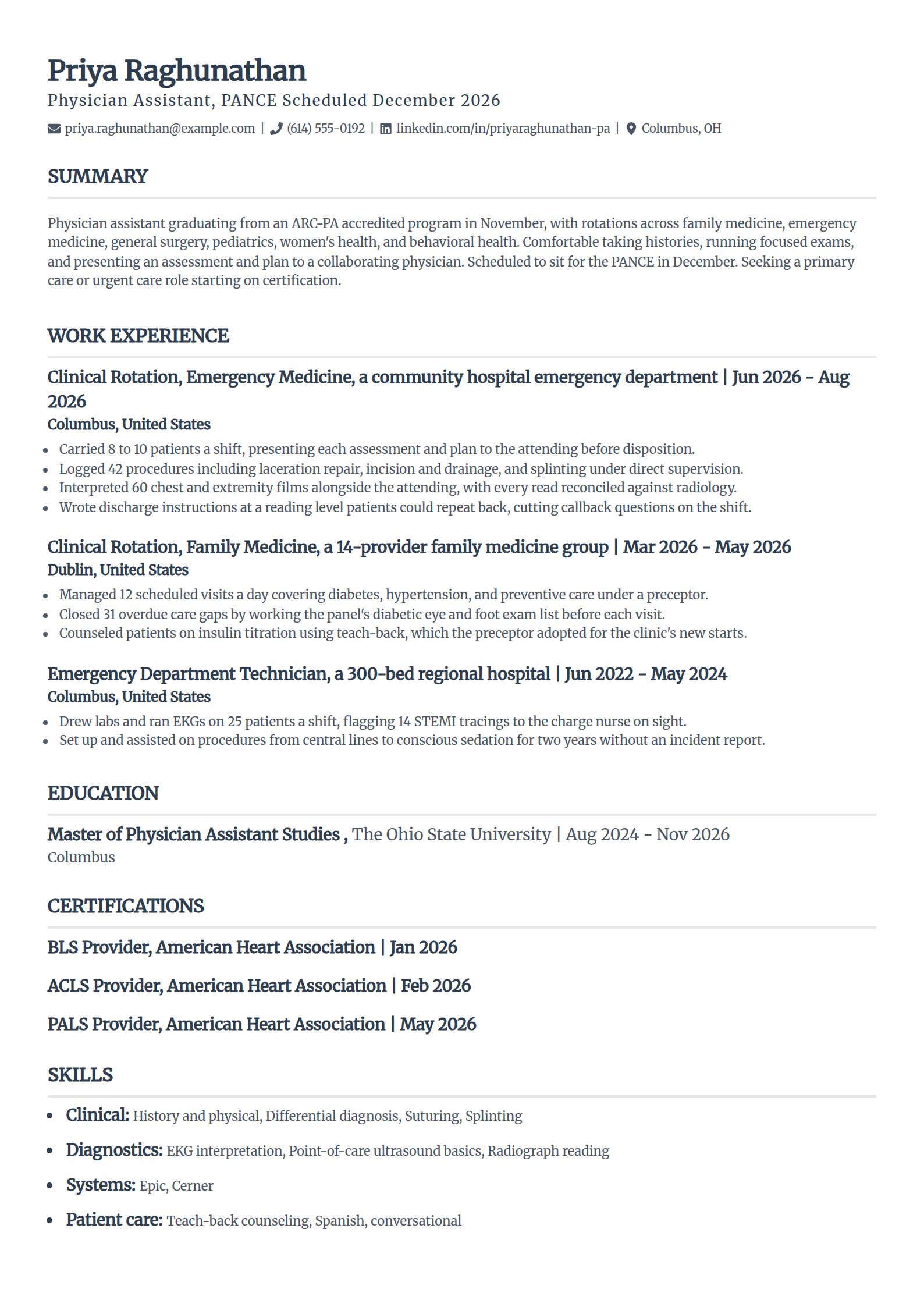
New Grad Physician Assistant Resume Template (PANCE Pending)
Why this resume example works?
- States the exam status correctly in the headline, scheduled to sit for the PANCE in December, with the month on the page.
- Turns rotations into dated work entries, which is the only way a pre-certification candidate shows a real work history.
- Attaches a procedure log to the strongest rotation, 42 procedures under direct supervision, instead of listing skills abstractly.
- Keeps the ED technician years visible, because two years beside a resuscitation is an argument for a new grad.
- Names the rotations by specialty so a hiring manager can see the candidate has already worked in their setting.
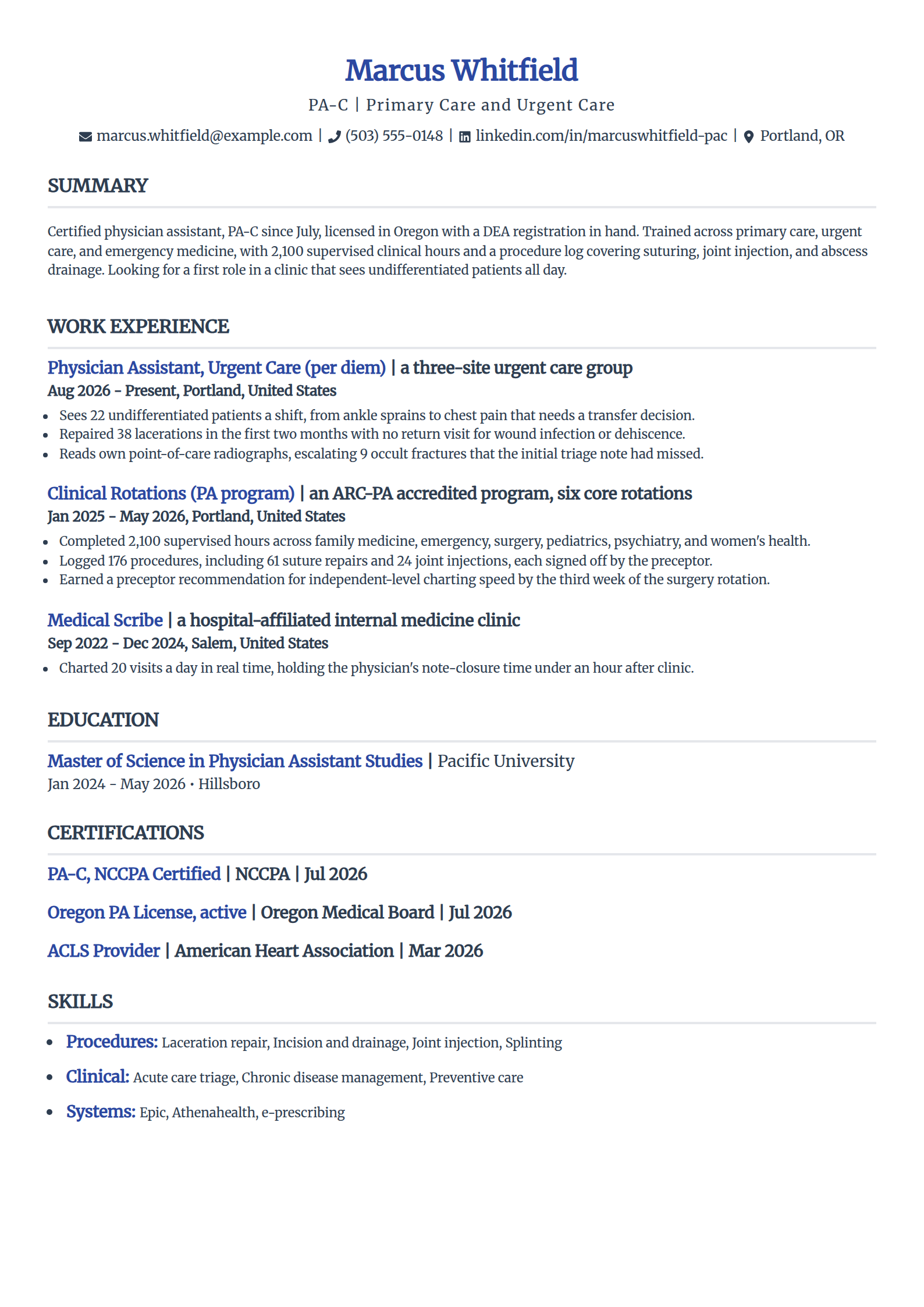
Newly Certified PA-C Resume Template for a First Job
Why this resume example works?
- Leads with what changed, PA-C since July, licensed, with a DEA registration already in hand.
- Shows the per diem urgent care shifts as real practice, 22 undifferentiated patients a shift, not as a placeholder.
- Counts the training, 2,100 supervised hours and 176 logged procedures, which is the volume a new PA genuinely owns.
- Keeps the scribe years for the charting speed they prove, a real advantage in a first clinical job.
- Puts one number on every bullet, including 9 occult fractures caught that the triage note had missed.
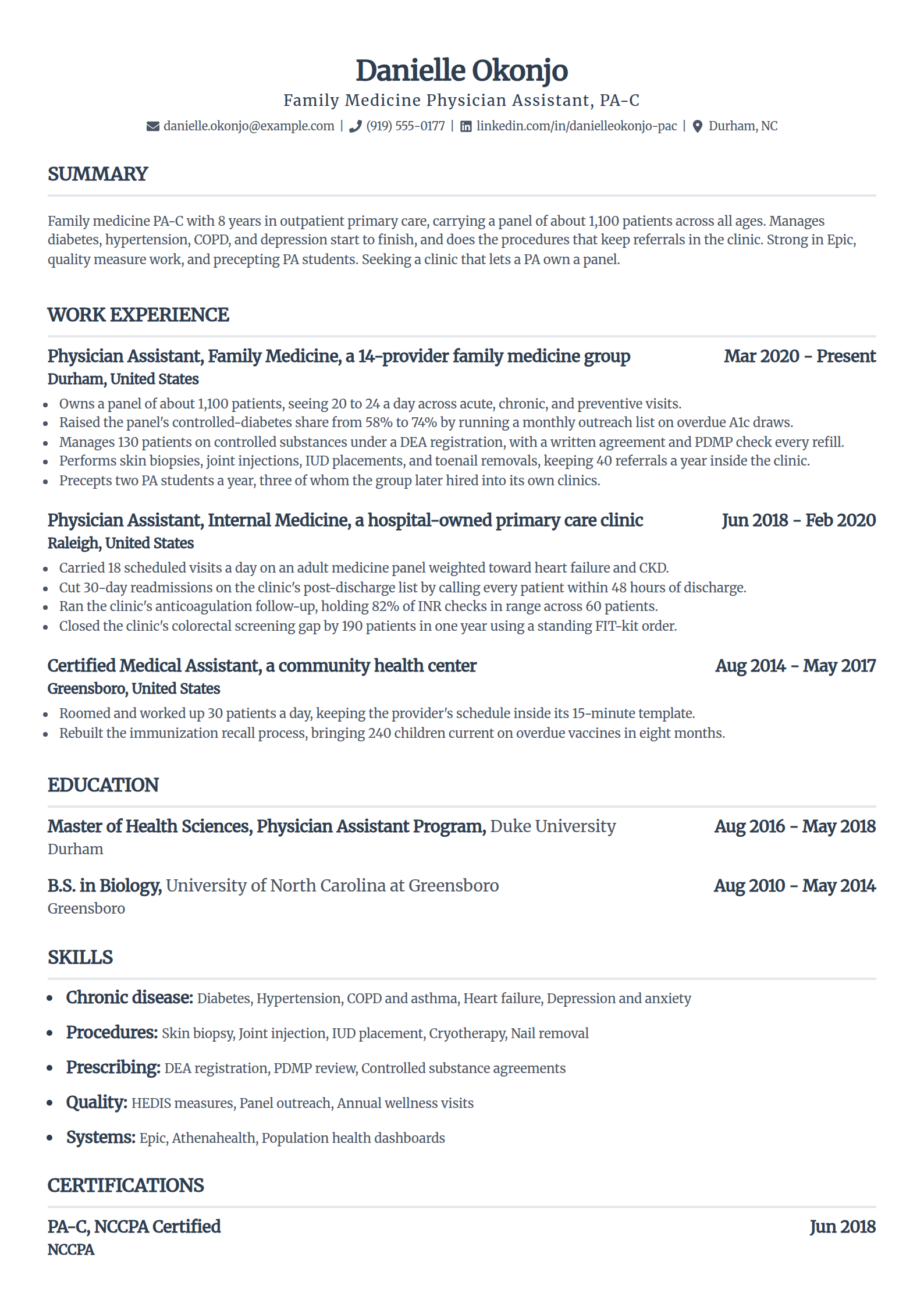
Family Medicine PA Resume Template
Why this resume example works?
- Opens with the number a primary care practice hires on, a panel of about 1,100 patients across all ages.
- Shows chronic disease work as an outcome, controlled-diabetes share moved from 58% to 74% through a monthly outreach list.
- Names the prescribing reality plainly, 130 patients on controlled substances with a written agreement and a PDMP check.
- Proves the procedures keep money in the clinic, 40 referrals a year retained through biopsies, injections and IUD placements.
- Carries the medical assistant years, which explains how this PA reads a clinic workflow from the inside.
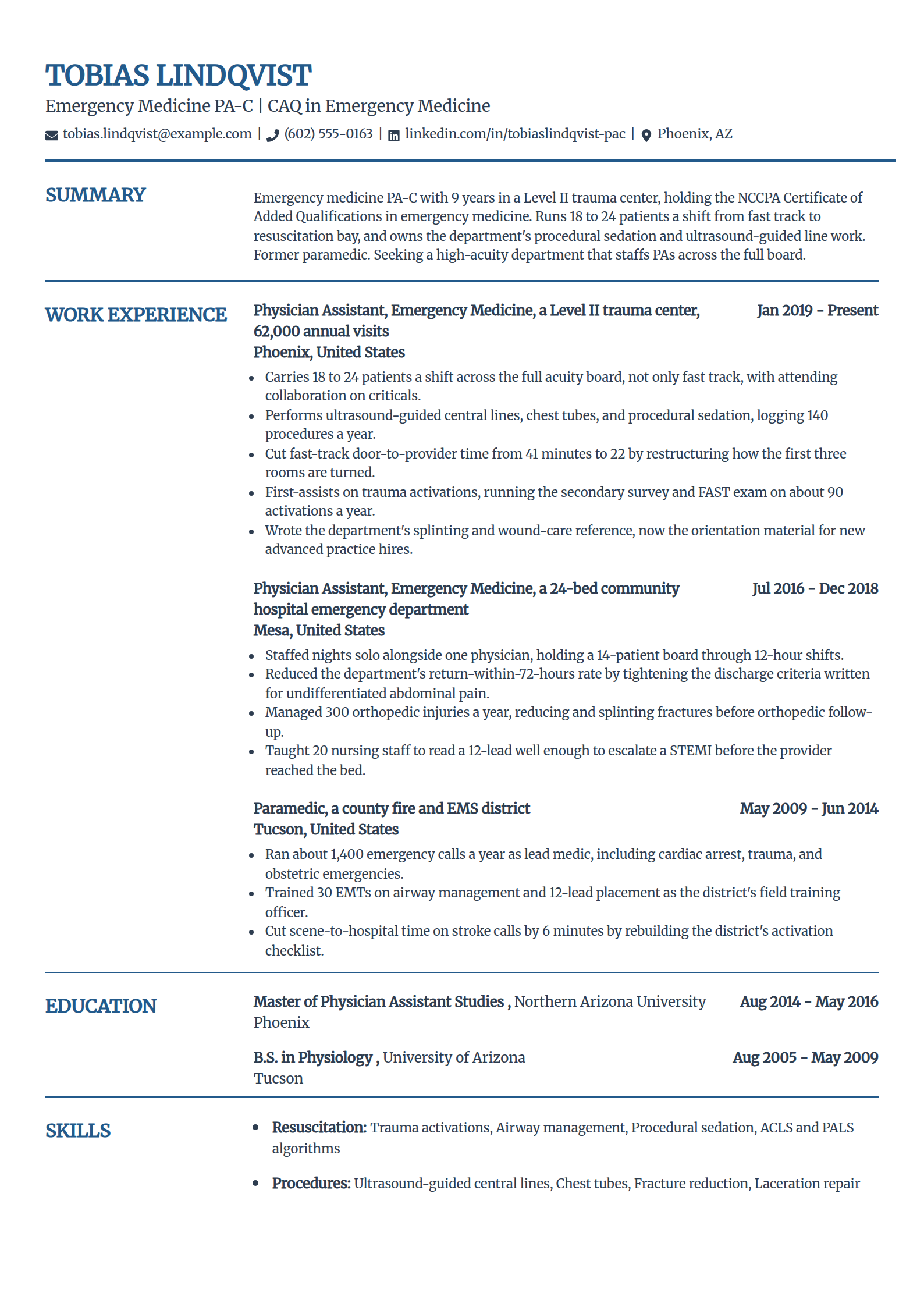
Emergency Medicine PA Resume Template
Why this resume example works?
- Puts the specialty credential in the headline, the NCCPA Certificate of Added Qualifications in emergency medicine.
- Answers the question every ED asks a PA applicant, whether they work the full board or only fast track.
- Counts the procedures a department is staffing for, 140 a year including ultrasound-guided lines and chest tubes.
- Shows one throughput number, fast-track door-to-provider cut from 41 minutes to 22, which is how an ED measures value.
- Keeps the paramedic years for the field judgment they built, not as filler at the bottom of the page.
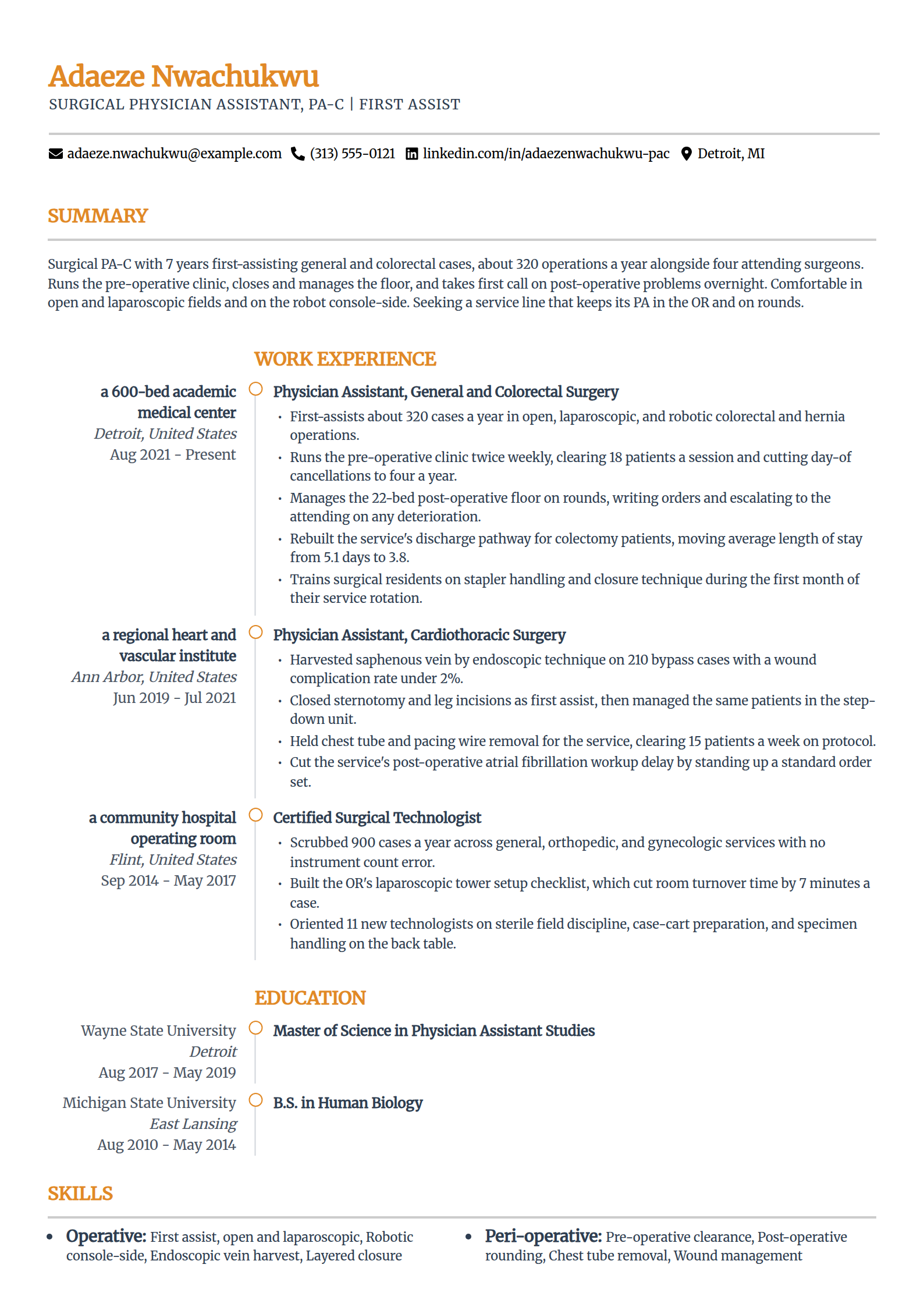
Surgical PA Resume Template (First Assist)
Why this resume example works?
- Leads with case volume in the right unit, about 320 operations a year across open, laparoscopic and robotic fields.
- Shows the whole job a surgical PA does, clinic, operating room and floor, which a service line needs covered.
- Stays inside scope by saying first assist every time, a distinction that gets checked in the interview.
- Attaches a number a surgeon cares about, length of stay moved from 5.1 days to 3.8 on a rebuilt discharge pathway.
- Carries the surgical technologist start, which is where a lot of credible OR knowledge comes from.
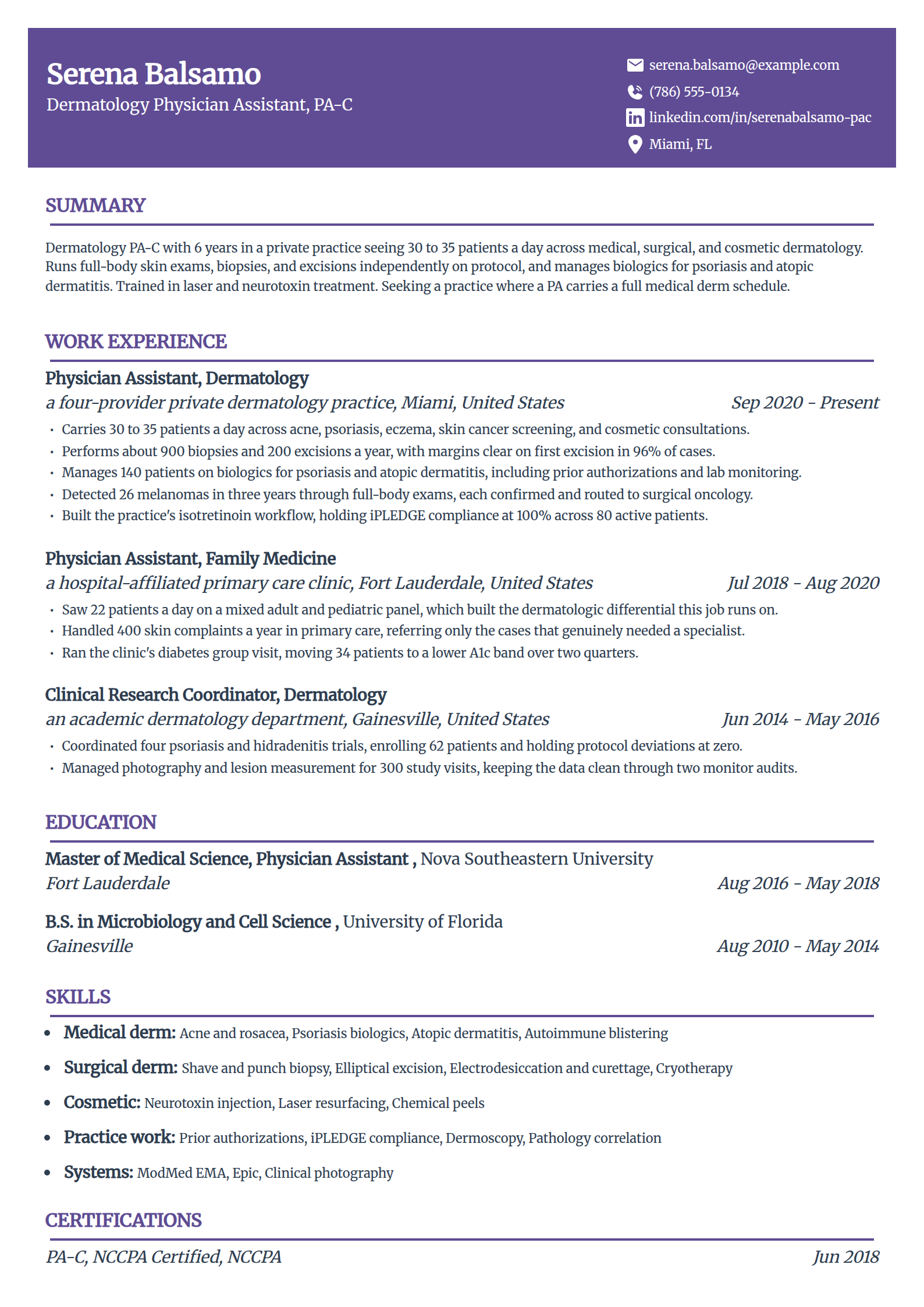
Dermatology PA Resume Template
Why this resume example works?
- Shows the throughput dermatology runs on, 30 to 35 patients a day, which is the first thing a practice checks.
- Splits the three halves of the specialty on the page: medical, surgical and cosmetic, rather than blurring them.
- Proves surgical quality with a modest number, margins clear on first excision in 96% of about 200 excisions a year.
- Names the administrative work nobody else lists, biologics prior authorizations and iPLEDGE compliance.
- Uses the primary care years to explain where the dermatologic differential was built.
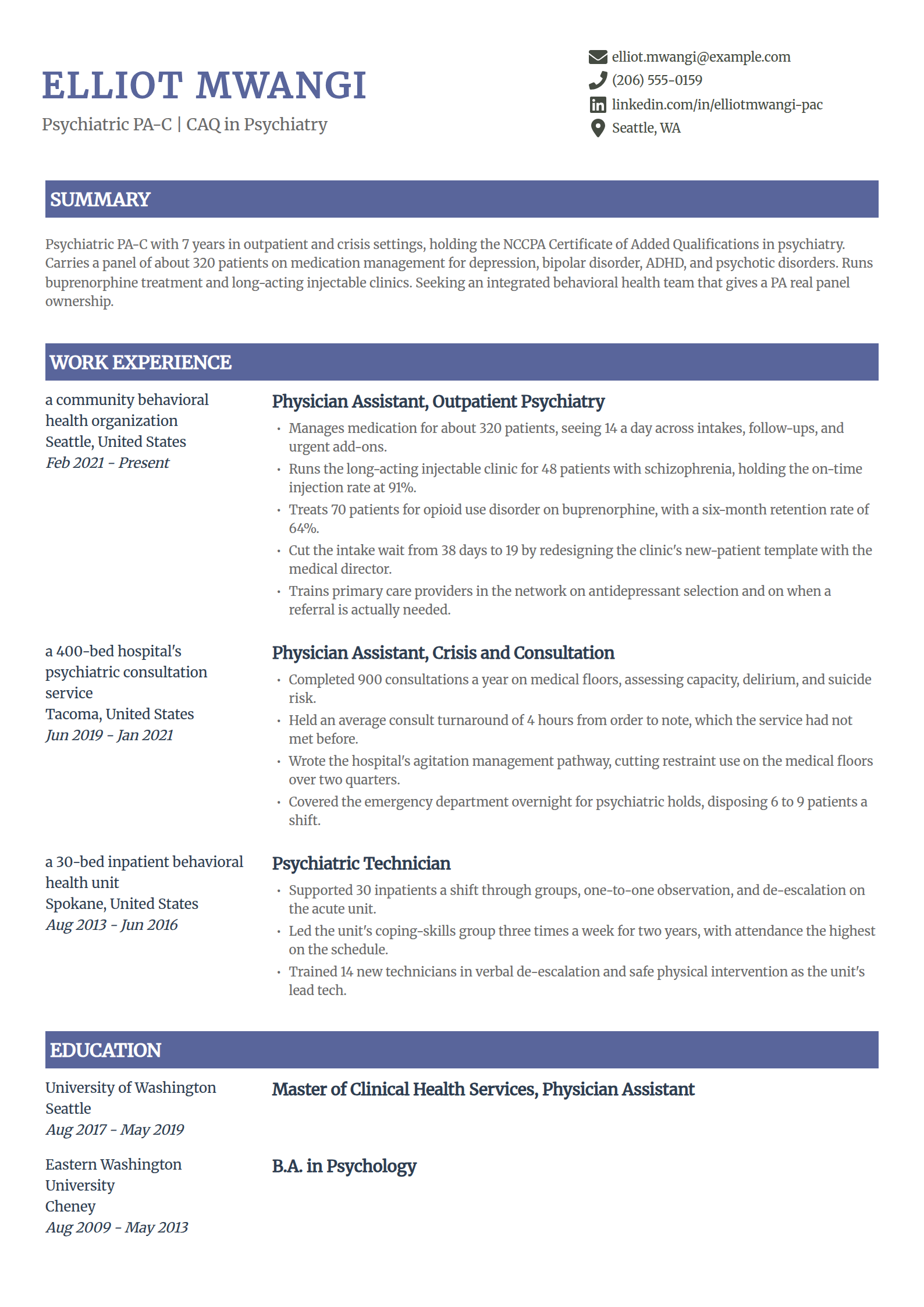
Psychiatric PA Resume Template
Why this resume example works?
- Measures the work the way psychiatry actually does, a panel of about 320 patients rather than procedures.
- Names the clinics a behavioral health employer staffs for, long-acting injectables and buprenorphine treatment.
- Uses retention as the outcome number, 64% at six months on buprenorphine, which is the metric that matters here.
- Shows an access fix a director would notice, intake wait cut from 38 days to 19.
- Carries the psychiatric technician years, where the de-escalation skill on this resume came from.
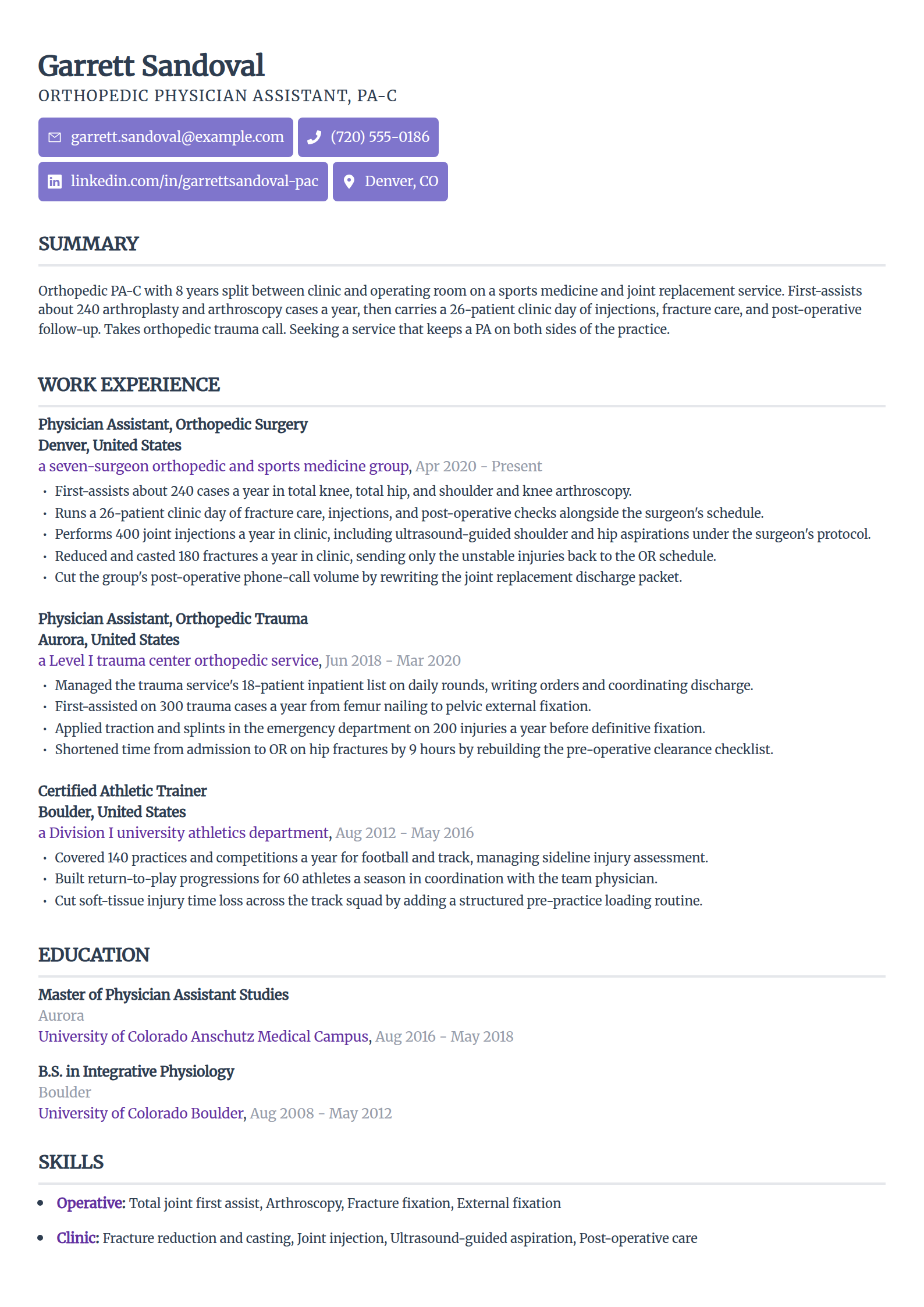
Orthopedic PA Resume Template
Why this resume example works?
- Shows both halves of an orthopedic PA job, about 240 cases a year in the OR and a 26-patient clinic day.
- Counts the clinic procedures outright, 400 joint injections a year including ultrasound-guided aspirations.
- Names the trauma work separately, because orthopedic trauma call is its own hiring question.
- Gives one operational win, hip fracture time from admission to OR shortened by 9 hours on a rebuilt checklist.
- Keeps the athletic trainer years, which explains the musculoskeletal exam depth without claiming more.
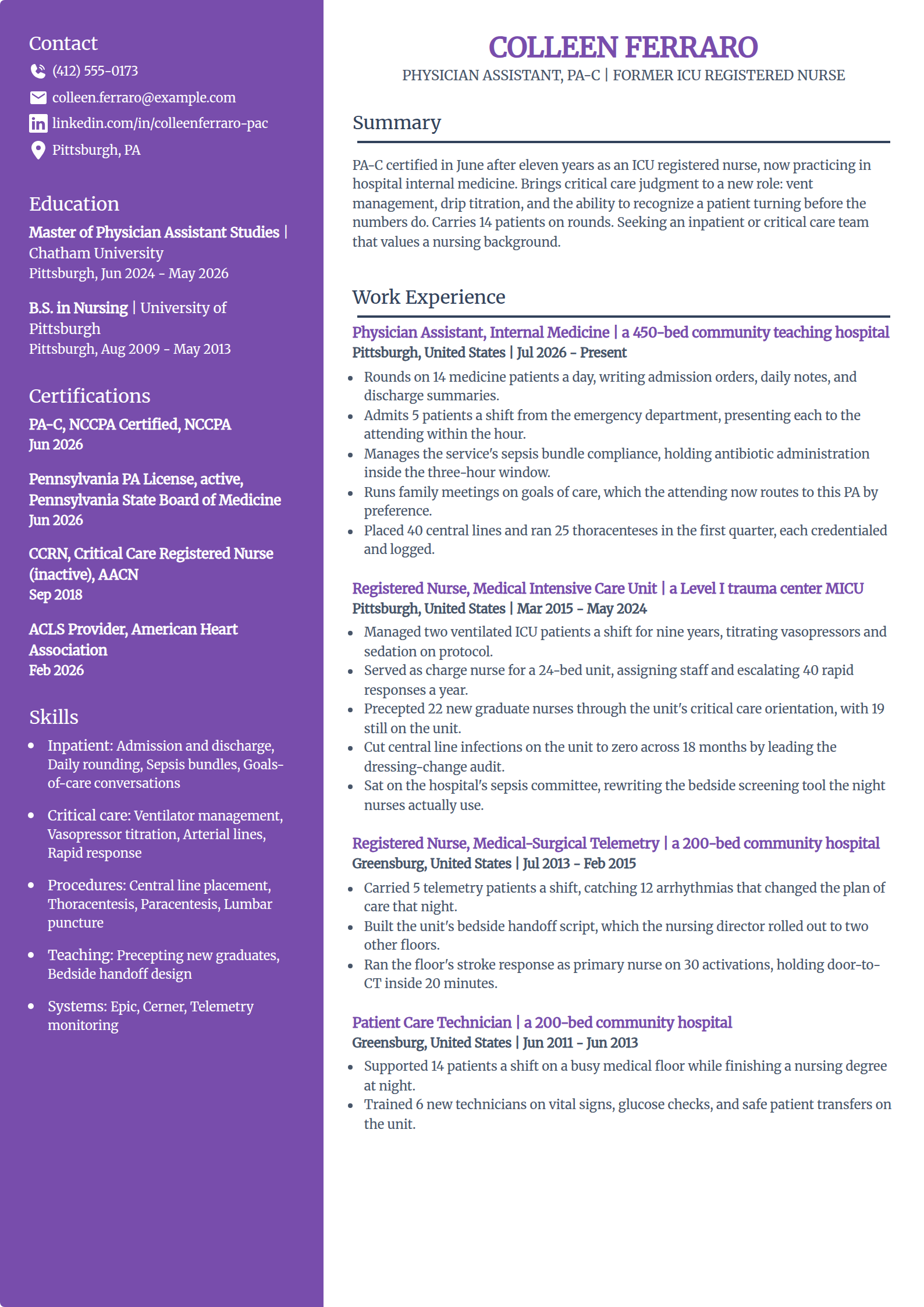
RN to PA Resume Template (Career Change)
Why this resume example works?
- Names the pivot in the headline, PA-C and former ICU registered nurse, instead of hiding eleven years of nursing.
- Argues the transfer specifically, vent management and drip titration, not a vague claim about patient care.
- Shows the new role is already working, 14 patients on rounds and 5 admissions a shift within months of certifying.
- Keeps the CCRN on the page marked inactive, which is honest and still signals the depth behind it.
- Uses the charge nurse and precepting record as evidence of judgment, which is what a new PA has to prove.
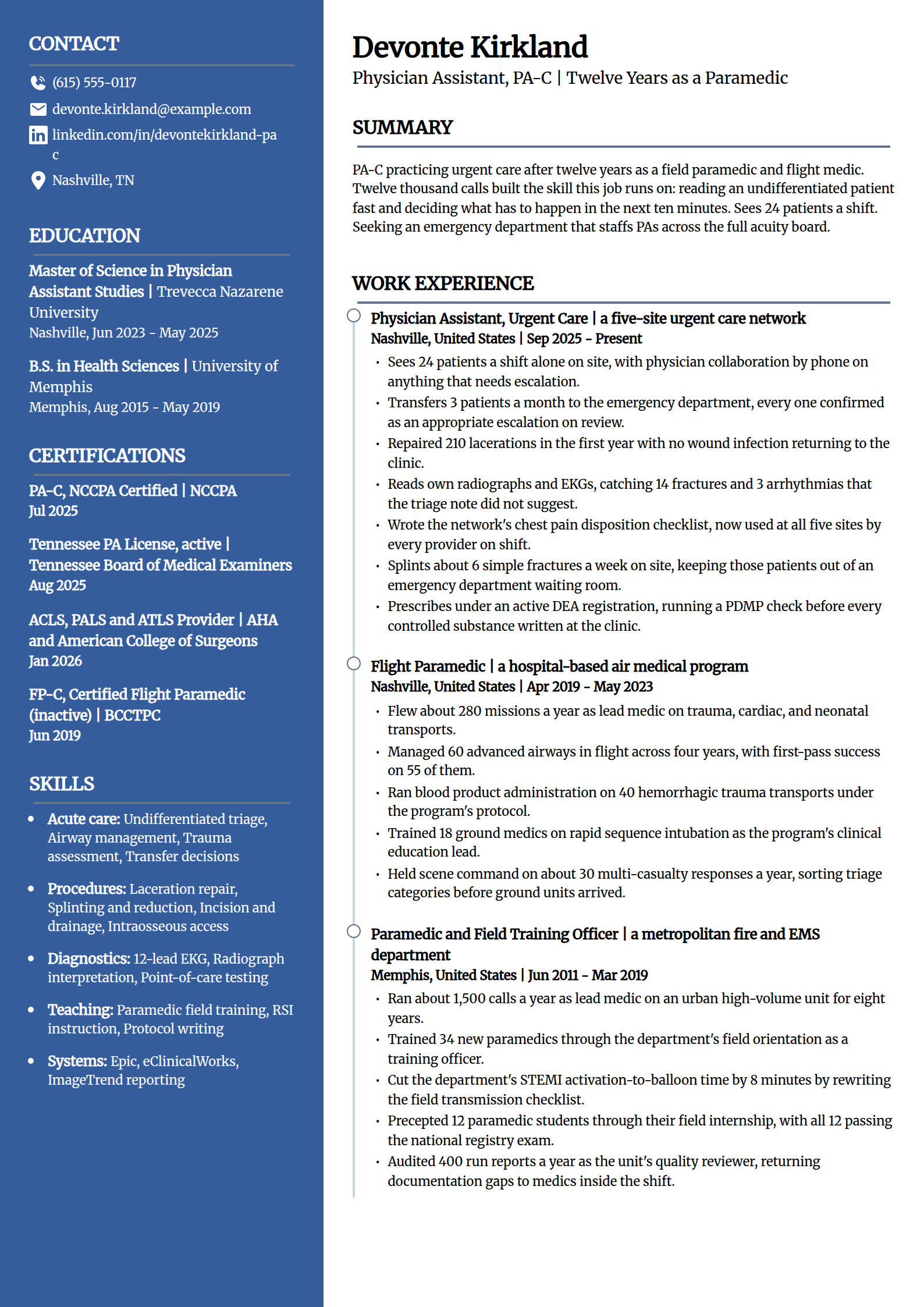
Paramedic to PA Resume Template (Career Change)
Why this resume example works?
- States the case in one line: twelve years and twelve thousand calls built the skill this job runs on.
- Shows solo-provider judgment with a number, 3 transfers a month, every one confirmed appropriate on review.
- Keeps the flight medic years with real numbers, 60 in-flight advanced airways with first-pass success on 55.
- Lists the FP-C as inactive rather than quietly dropping it, which reads as accurate rather than padded.
- Names the target plainly, an emergency department that staffs PAs across the full acuity board.
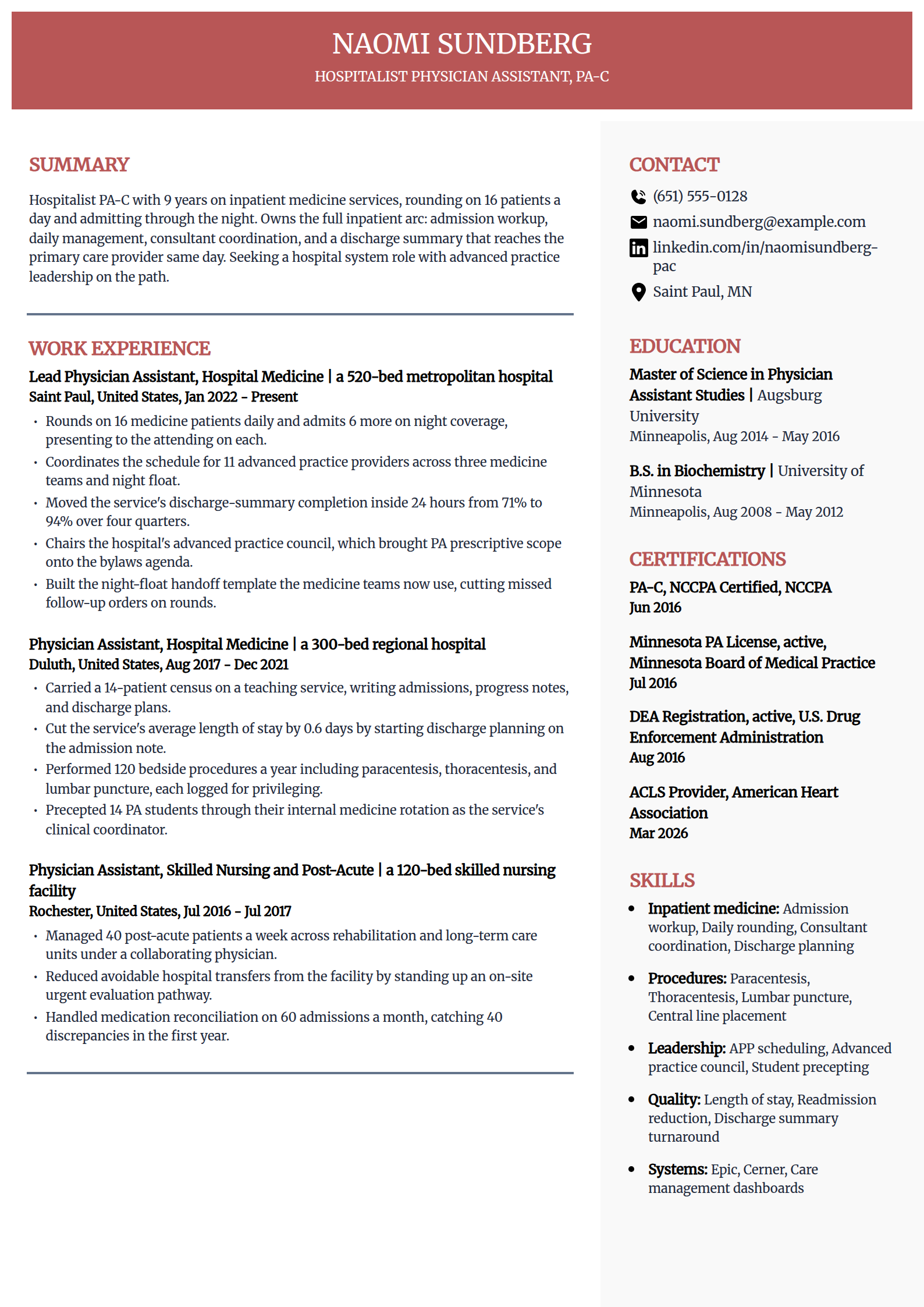
Hospitalist PA Resume Template for a Hospital System Role
Why this resume example works?
- Describes the inpatient arc end to end, admission workup through a discharge summary that reaches the primary care provider.
- Shows the system-level work a hospital is hiring for, scheduling 11 advanced practice providers across three teams.
- Gives the quality number a medical director tracks, discharge summaries inside 24 hours moved from 71% to 94%.
- Proves influence beyond the service by naming the advanced practice council and what it changed.
- Keeps the skilled nursing year, which reads as range across the post-acute continuum rather than a gap.
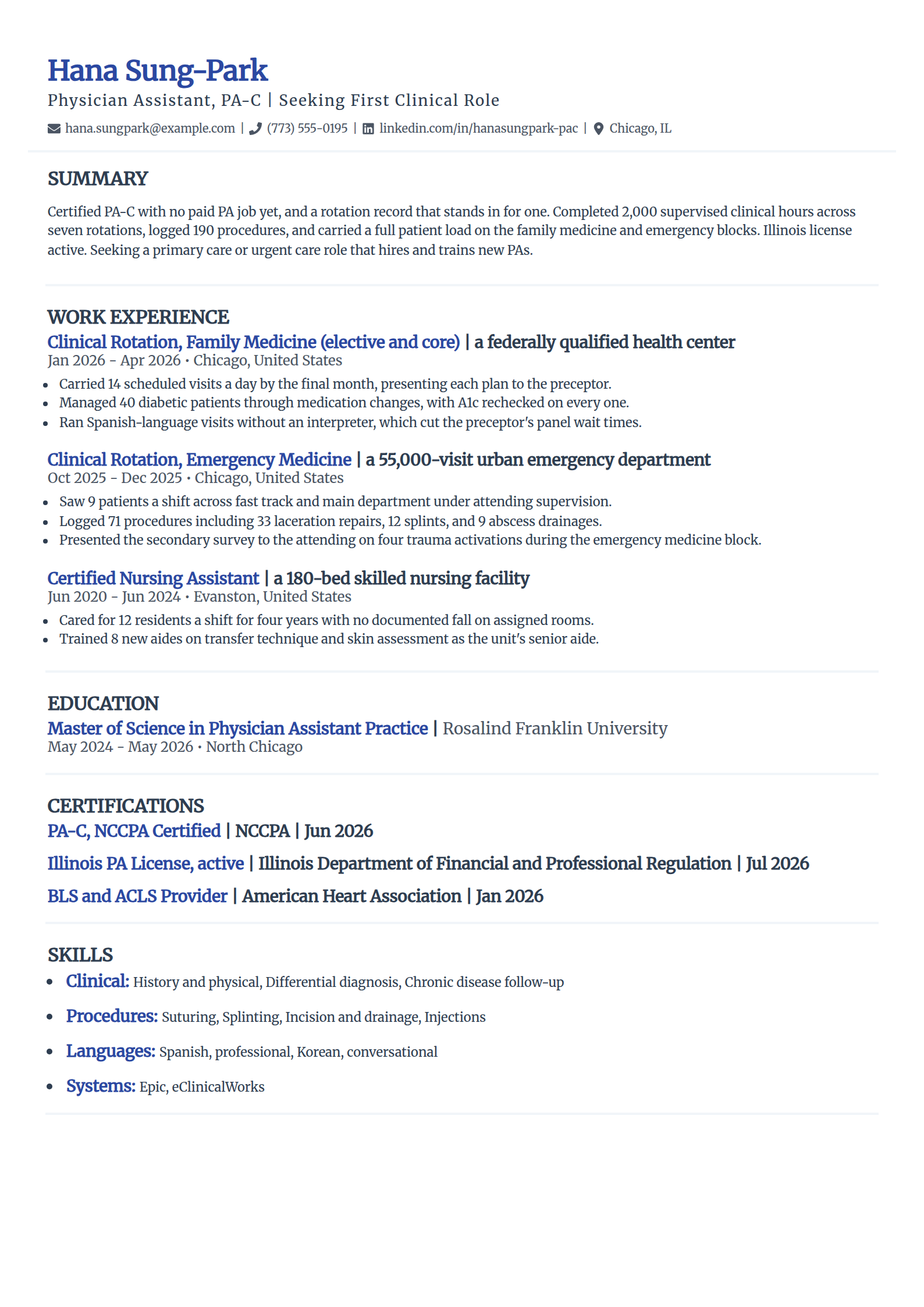
PA Resume Template With Rotations Only (No Paid PA Job)
Why this resume example works?
- Says plainly in the first line that there is no paid PA job yet, then spends the page on what there is instead.
- Counts the training honestly, 2,000 supervised hours across seven rotations and 190 logged procedures.
- Gives each rotation a date range, a setting and a patient load, which is what turns it into experience.
- Names a language skill as a clinical asset, Spanish visits run without an interpreter, with the effect on wait times.
- Keeps the nursing assistant years for the reliability they show, not as padding under education.
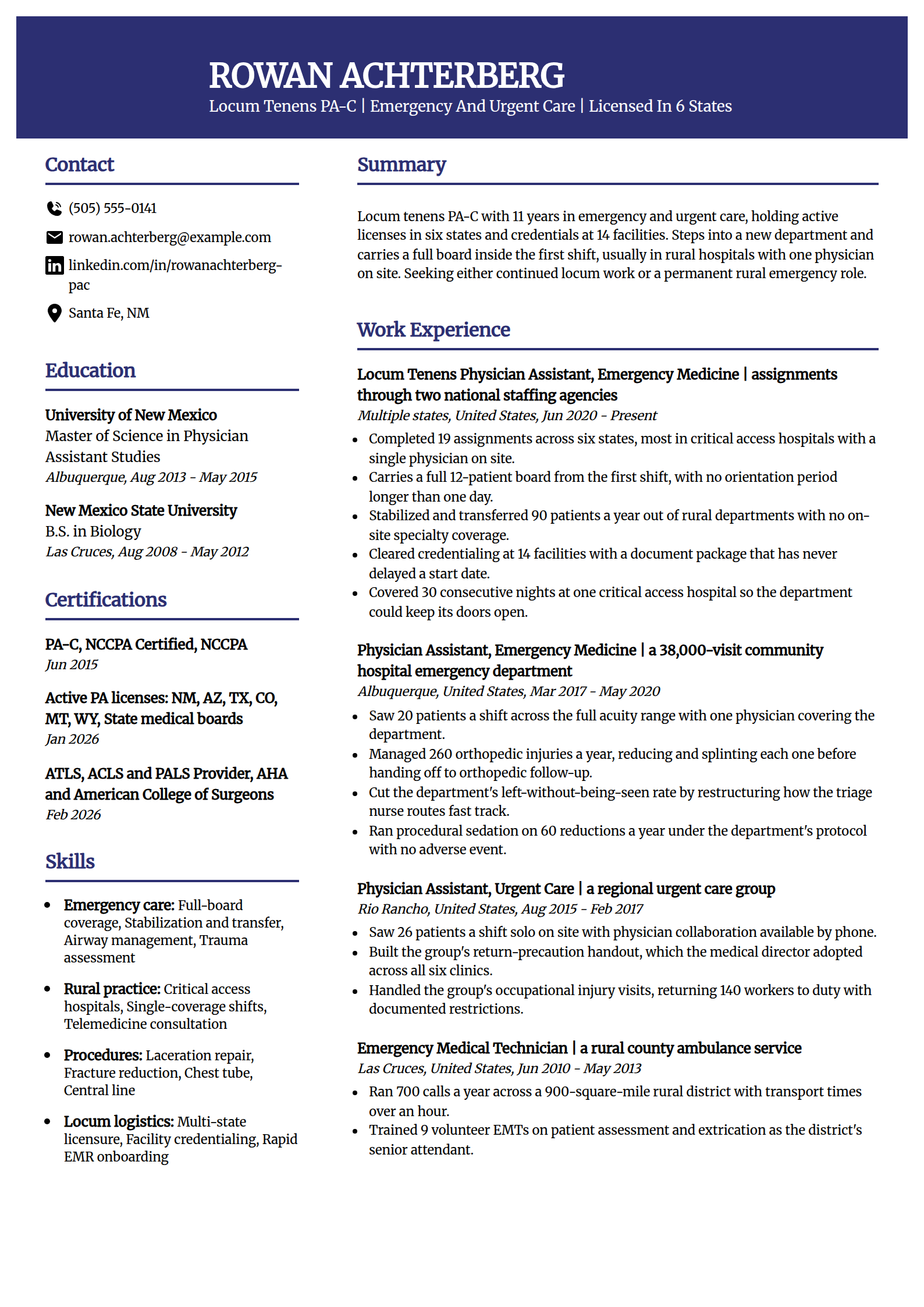
Locum Tenens PA Resume Template
Why this resume example works?
- Solves the problem every locum resume has, grouping 19 assignments under the agencies so it does not read as job-hopping.
- Puts the multi-state licensure in the headline, since that is the first thing a locum recruiter screens on.
- Names the setting precisely, critical access hospitals with a single physician on site, which is a different job.
- Shows the ramp speed a locum is bought for, a full board from the first shift with no long orientation.
- Treats credentialing as a skill with evidence, 14 facilities cleared without delaying a start date.
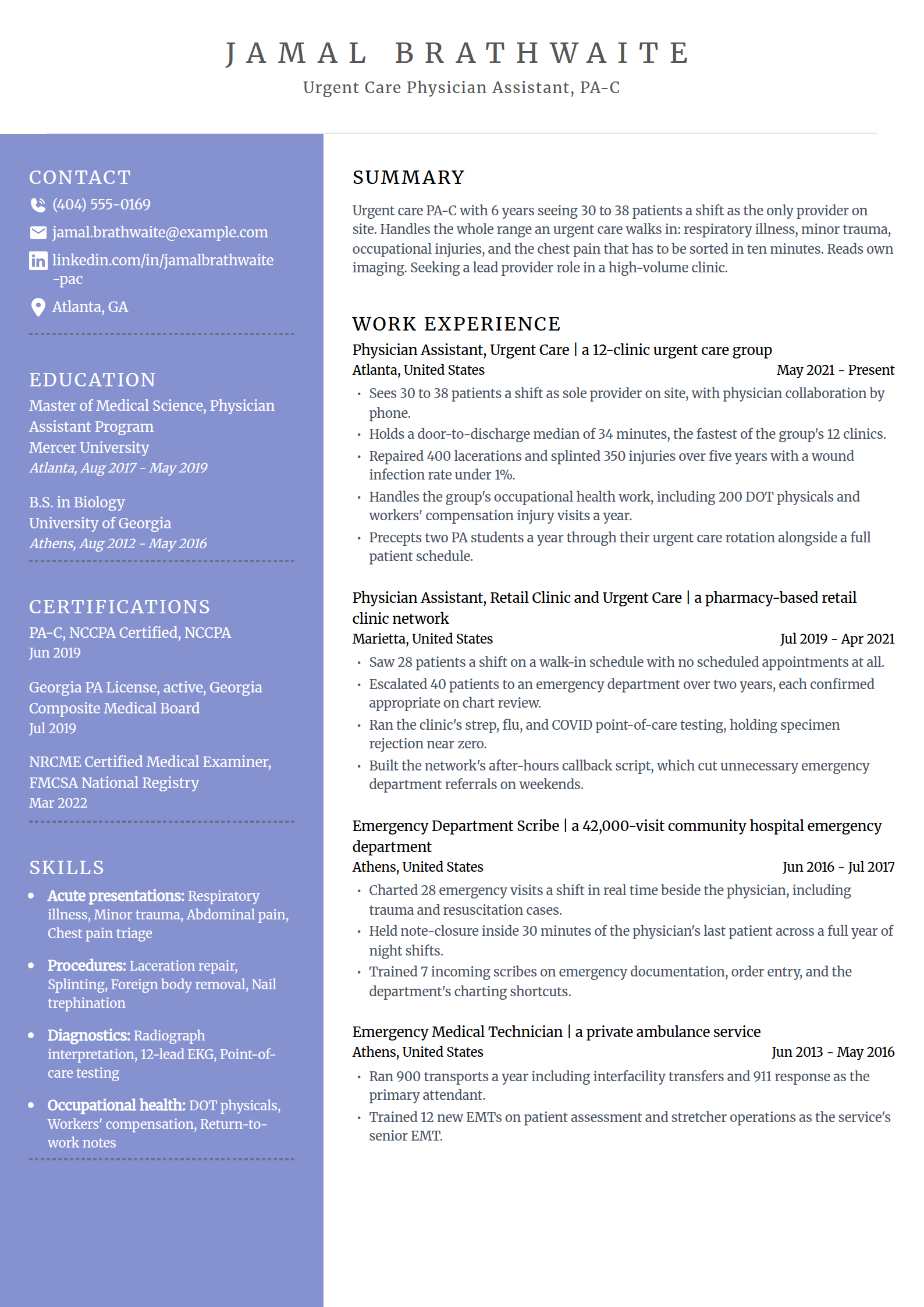
Urgent Care PA Resume Template
Why this resume example works?
- Leads with the volume and the autonomy together, 30 to 38 patients a shift as the only provider on site.
- Gives the number an urgent care group compares clinics on, a door-to-discharge median of 34 minutes.
- Covers the occupational health work most urgent care resumes leave out, including DOT physicals.
- Shows the safety side of solo practice, escalations confirmed appropriate on chart review.
- Uses the scribe and EMT years to explain the charting speed and the triage instinct behind the volume.
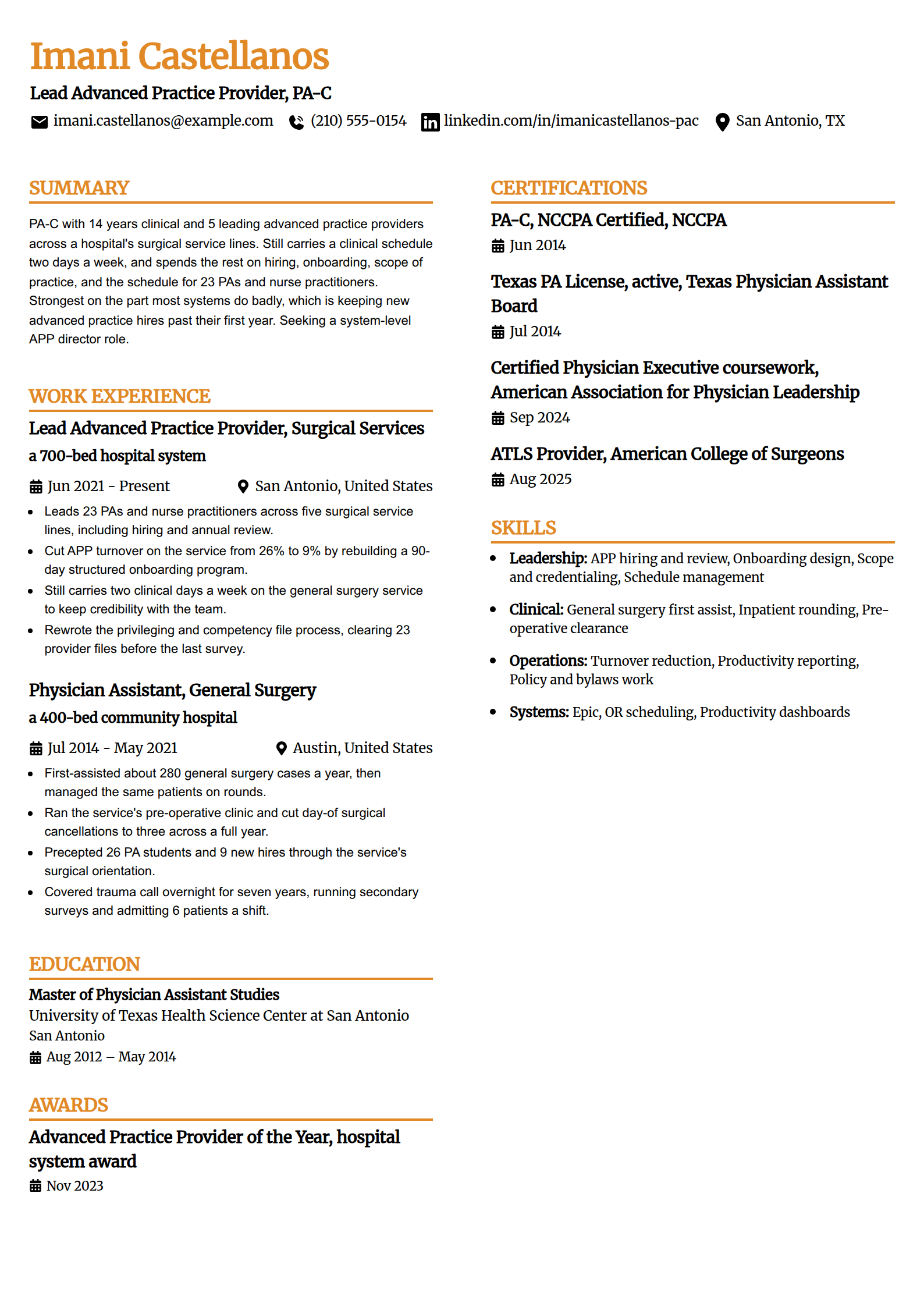
Lead Advanced Practice Provider Resume Template
Why this resume example works?
- Separates the two spans a leadership posting reads for, 14 years clinical and 5 leading providers.
- Counts the people, 23 PAs and nurse practitioners across five service lines, which is the size of the job.
- Gives the number that proves the leadership worked, turnover cut from 26% to 9% on a rebuilt onboarding program.
- Keeps two clinical days a week on the page, because a lead who stopped practicing loses the room.
- Names the unglamorous administrative work, privileging and competency files cleared before a survey.
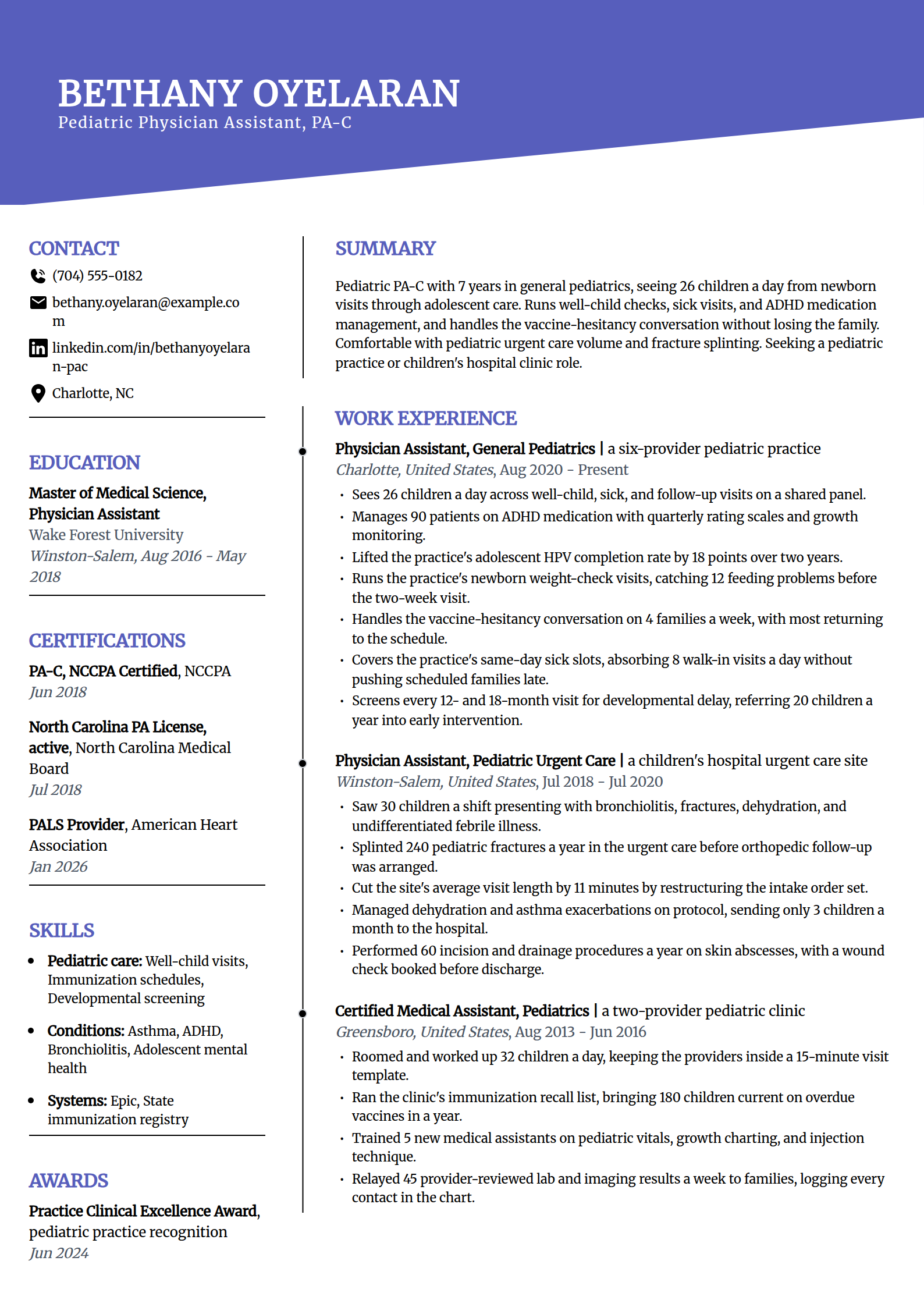
Pediatric PA Resume Template
Why this resume example works?
- Names the age span up front, newborn visits through adolescent care, which is how a pediatric practice reads a resume.
- Uses a pediatric quality measure as the outcome, adolescent HPV completion lifted by 18 points.
- Puts the vaccine-hesitancy conversation in a bullet, because it is real work and nobody else lists it.
- Shows pediatric urgent care volume separately, including 240 fractures splinted a year.
- Keeps the pediatric medical assistant years, which is a credible route into this specialty.
Build your physician assistant resume
Pick a template above and the editor keeps the layout clean and ATS-safe while you swap in your own specialty, patient volume, procedures and credentials.
Build my resumeHow to write a physician assistant resume in 2026
A PA resume gets screened on two points in the first few seconds: the specialty you practice in and your certification and licensure status. Everything after that is supporting detail. Lead with the setting, name the procedures outright, and put one number on every result you claim.
Say which specialty and setting you work in, in the first line
An emergency department and a dermatology practice read for different vocabulary and share almost no procedure list. Open with the specialty, your credential status and the volume you carry, so the reader can place you inside one sentence. Keep the summary to three or four sentences and around 60 words.
Emergency medicine PA-C with 9 years in a Level II trauma center, holding the NCCPA Certificate of Added Qualifications in emergency medicine. Runs 18 to 24 patients a shift from fast track to the resuscitation bay, and owns the department's procedural sedation and ultrasound-guided line work.
Resume or CV, honestly
Send a resume. PA programs teach the academic CV, which is the right document for a faculty appointment, a residency or fellowship application, or a research post.
- For a clinical job, the practice manager or recruiter reading your application wants one page, two at most for a long specialty career.
- A five-page CV listing every rotation, poster and student society does not read as thorough to that reader. It reads as unsorted.
- Keep the CV as your own master file, then cut a targeted resume from it for each posting you answer.
Put certification and licensure status where it cannot be missed
Credential status is the fastest screen in this field, so it belongs in your headline or the first line of your summary, not only in a block at the bottom.
- Certified? Write PA-C after your name and give the year, then list the state license separately with its status.
- Still testing? Say "scheduled to sit for the PANCE in December" with the month. An exam is sat once, on a date.
- Prescribing controlled substances? Say the DEA registration is active. Some postings screen on it directly.
- Applying across state lines? Name every active license, and say which ones are pending rather than implying they are issued.
- Deep in one specialty? An NCCPA Certificate of Added Qualifications is worth the headline space. Board certification is a physician credential, so do not claim it.
Turn rotations into experience if you have no paid PA job yet
A blank work history is the single biggest problem on a new grad PA resume, and it is usually self-inflicted. Rotations are supervised clinical work, so they belong in the experience section.
- Give each rotation a date range, the setting and the specialty, formatted exactly like a job entry.
- Put your patient load on the page: "carried 8 to 10 patients a shift, presenting each plan to the attending".
- Use your procedure log. Counts of suture repairs, injections and splints are the only volume numbers you own yet.
- Keep pre-PA clinical work visible. EMT, ED tech, RN, medical assistant and scribe years are an argument, not filler.
- Total your supervised hours once, in the summary or under the rotation block, rather than repeating them.
Write procedures and patient volume, not duty lists
Every PA takes histories and orders tests, so listing it proves nothing. What separates resumes is the volume you carry and what changed because you carried it.
- Use the numbers your practice already tracks: patients per shift, panel size, cases per year, procedure counts, throughput time.
- Name the procedures you perform rather than the category: chest tubes, ultrasound-guided lines, excisions, joint injections.
- Say what improved and by how much, like "door-to-provider cut from 41 minutes to 22", not "improved efficiency".
- Keep one number per bullet and keep it modest. A PA improves a service; a PA does not move a hospital's whole margin alone.
- Say collaborating or supervising physician where the workflow needs it. Naming the review step reads as competence, not weakness.
Keep the format clean, parse-safe, and one page
Your resume is parsed before a person reads it, and almost every PA fits on one page.
- Use standard headings and a single-column or simple two-column layout; skip photos, text boxes and graphics.
- Put certification and licensure near the top, where a fast scan will actually reach them.
- Reorder your bullets and skills for each posting rather than sending one resume to a clinic and a hospital.
- Save as a PDF, then run it through the ATS resume checker for a format and keyword pass.
- Swap the volumes, procedures and credentials in the templates above for your own; do not copy them as they are.
Common physician assistant resume mistakes
- Putting your license number on the page. Your license status is publicly verifiable by name through the state board, so the number adds nothing and invites misuse. Name the state and say the license is active.
- Listing your PANCE score. It is pass or fail to an employer. Say you are certified, or give the date you are scheduled to sit.
- Sending the academic CV. Program faculty teach the CV and clinical employers want a resume. Keep the CV as your master file and cut a one-page resume from it.
- Leaving the work history blank as a new grad. Rotations, a procedure log and pre-PA clinical jobs are dated entries, and a resume without them looks like no experience at all.
- Writing duty lists. Replace "performed patient assessments and ordered diagnostic testing" with "cut fast-track door-to-provider time from 41 minutes to 22 by restructuring how the first three rooms turn".
- Using one resume for every specialty. An emergency posting and a dermatology posting screen for different vocabulary, so reorder the summary, bullets and skills to match the job description you are answering.
Frequently asked questions
What should a physician assistant resume include?
Five things, in this order: a three-to-four-sentence summary naming your specialty, setting, credential status and patient volume; experience bullets that each carry one number, such as patients per shift, panel size, cases per year or a throughput time; a skills block that names procedures, conditions and systems outright rather than saying "patient care"; your certification and state license with their status, plus a DEA registration if you prescribe controlled substances; and your master's degree with the program. Keep it to one clean page with standard headings, since a parser reads it before a person does.
Should a physician assistant send a resume or a CV?
Send a resume for a clinical job. PA programs teach the academic CV, which is the right document for a faculty appointment, a residency or fellowship application, or a research post, and it runs several pages because it lists everything. A practice manager or clinical recruiter wants one page, two at most for a long specialty career, showing what you treat, what you perform and what you have improved. Keep your CV as a master file of everything you have done, then cut a targeted one-page resume from it for each posting.
How do you write a physician assistant resume with no experience?
Treat your rotations as work entries, because that is what they are. Give each one a date range, the setting and the specialty, then put your patient load and your procedure log in the bullets: "carried 8 to 10 patients a shift" and "logged 42 procedures including laceration repair and splinting" are real experience statements. State your certification status next, including the month you are scheduled to sit for the PANCE if you have not tested yet. Then keep any pre-PA clinical job on the page, since EMT, ED tech, medical assistant, RN and scribe years are an argument rather than filler. The new grad and rotations-only examples above show both versions of this.
How long should a physician assistant resume be?
One page for almost everyone, including PAs with ten or more years in one specialty. Two pages are defensible for a long career across several specialties, or for a lead role where the leadership record genuinely needs the space. A longer document usually means an unedited CV, or older roles and rotations that no longer help. Keep your three most recent and most relevant positions, trim the earliest one to the bullets that still say something, and use the space you free for procedures, credentials and a skills block that names real conditions and systems.
What skills and keywords should a physician assistant resume list?
Match the posting first, then name things specifically. Across specialties the constants are the procedures you perform, the conditions you manage, the diagnostics you interpret, and the EMR you work in, usually Epic, Cerner, Athenahealth or a specialty system like ModMed. After that it splits by specialty: an emergency resume lists airway management, procedural sedation, ultrasound-guided lines, fracture reduction and point-of-care ultrasound; a dermatology resume lists shave and punch biopsy, excision, dermoscopy, biologics and iPLEDGE; a psychiatry resume lists psychopharmacology, long-acting injectables, buprenorphine treatment, suicide risk assessment and capacity evaluation. List only what you have done and can discuss in an interview.
How do you list rotations, certification, and licensure on a PA resume?
Rotations go in the experience section as dated entries, one per rotation or grouped under a single "Clinical Rotations" heading with the specialties named, each carrying a patient load and a procedure count. Certification goes in your headline as PA-C, and again in a certifications block with the year you earned it; if you are still testing, write that you are scheduled to sit for the PANCE and give the month. Licensure gets its own line naming the state and saying the license is active or pending, and a DEA registration gets a line of its own if you prescribe controlled substances. Leave off your license number and your PANCE score: the first is a privacy risk and publicly verifiable anyway, and the second is pass or fail to an employer.
More physician assistant resume resources
Build your physician assistant resume
Pick a template above and the editor keeps the layout clean and ATS-safe while you swap in your own specialty, patient volume, procedures and credentials.