A Stay-at-Home Mom Resume Can Name the Gap and Still Get Read
- ATS Friendly
- Gap Framing Built In
- 17 Real Examples
A stay-at-home mom resume needs the usual parts plus one dated Full-Time Parent entry carrying real activity: a certification earned, a volunteer role with a number on it, freelance or part-time work. The years at home are rarely what sinks an application; what sinks it is a page that tries to hide them, or bills laundry and meal planning as job duties. Find the example below that matches your break and the work you are going back to, then swap in your own dates, numbers, and credentials.


540k+ resumes created
Resume templates for a return to work, sorted by the break and the destination
Two years out and ten years out are different resume problems, and so are returning to a clinic, a classroom, an office, and a sales floor. Each template below is a full resume for one of those situations, with the break written into the work history rather than left as a hole a screener has to guess about. Pick the one closest to your own, then replace the names, dates, and numbers with yours.
Stay-at-Home Mom Resume Template for Returning to a Former Career
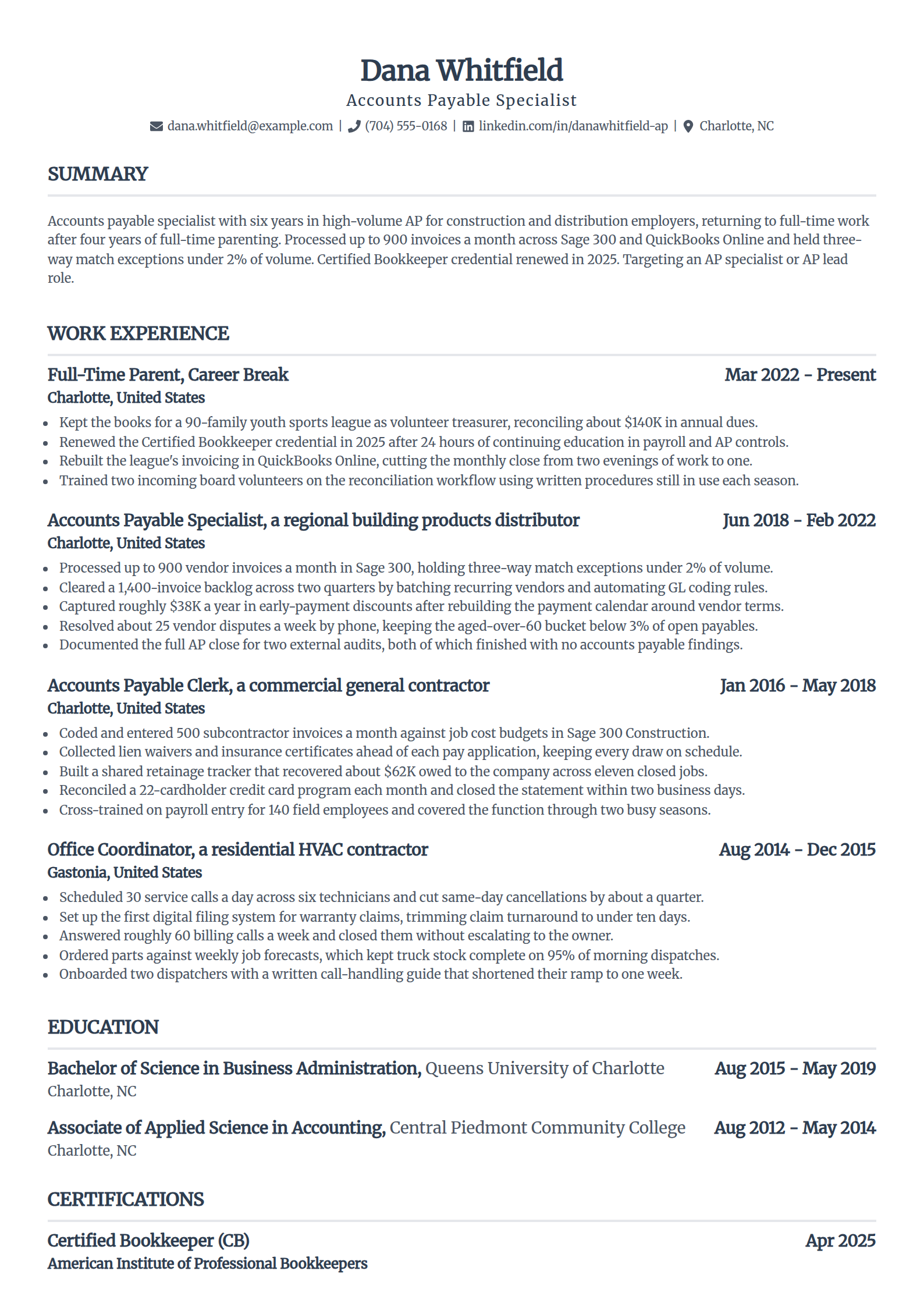
Why this resume example works?
- Opens with the old job title, not the break, so the first line a screener reads is the one they are hiring for.
- Writes the break in as a dated Full-Time Parent entry at the top of the work history, which closes the timeline question before it is asked.
- Fills that entry with work a reference could confirm: a volunteer treasurer role reconciling about $140K in dues and a credential renewed in 2025.
- Keeps the earlier career bullets intact and numbered, including 900 invoices a month and three-way match exceptions under 2%.
- Uses a single-column layout an applicant tracking system reads cleanly, with no graphics between the dates and the titles.
Career-Change Resume Template for a Stay-at-Home Mom
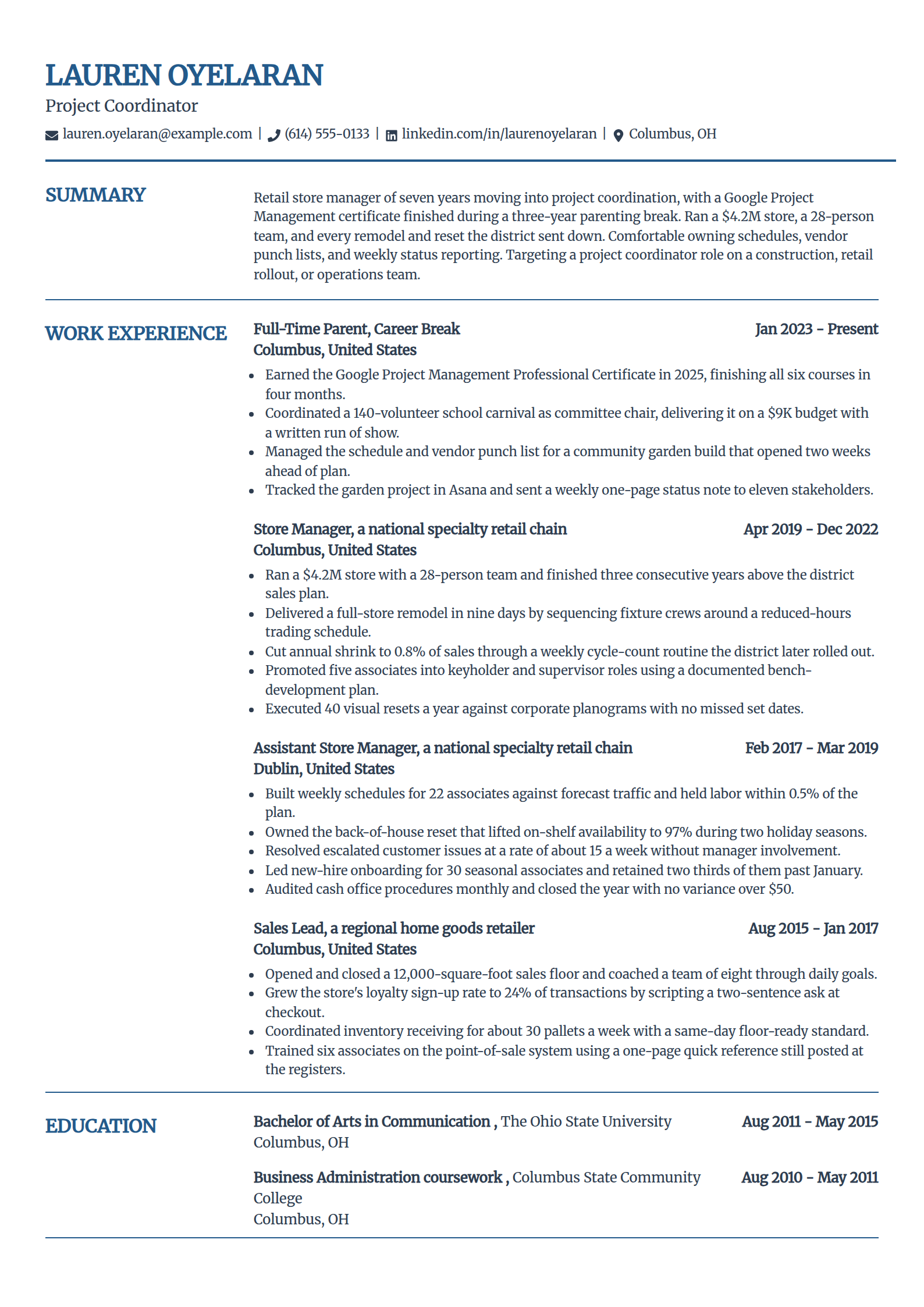
Why this resume example works?
- Headlines the target job, project coordinator, rather than the job she left, so the pivot reads as a decision instead of a fallback.
- Puts the new credential in the break entry, a project management certificate finished in four months, which is the evidence the pivot needs.
- Translates retail management into coordination language a hiring manager recognizes: schedules, vendor punch lists, and weekly status notes.
- Keeps one hard number per bullet, like a nine-day remodel and shrink held at 0.8% of sales, so the old field still proves competence.
- Groups skills under the new field's headings, which is what matches a project coordinator posting word for word.
Stay-at-Home Mom Resume Template Built on Volunteer Experience
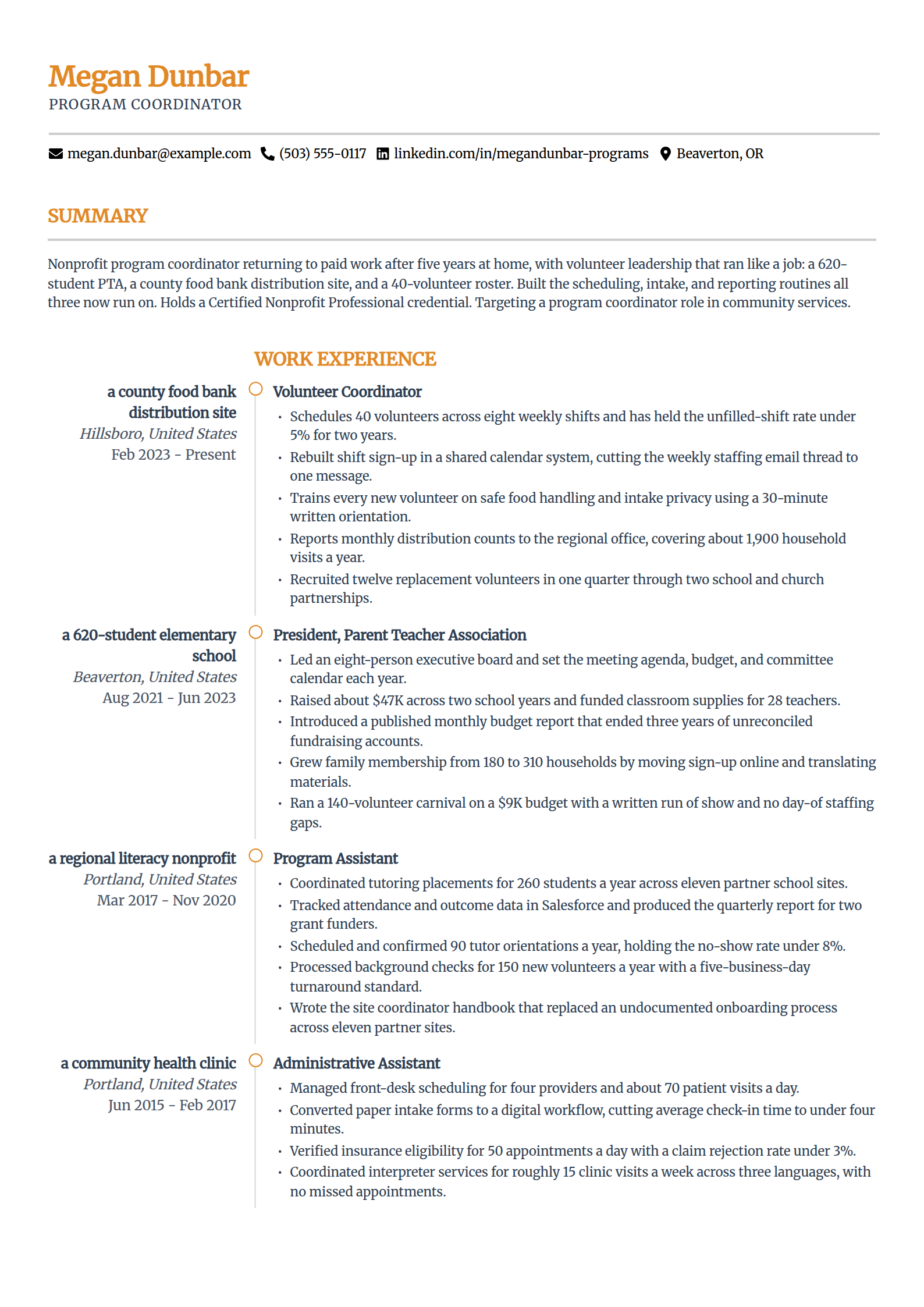
Why this resume example works?
- Treats two volunteer roles as real jobs in the work history, with titles, dates, locations, and numbered results, because that is how they should be read.
- Shows scale instead of sentiment: 40 volunteers scheduled across eight weekly shifts and about 1,900 household visits reported a year.
- Gives the PTA presidency a budget and an outcome, roughly $47K raised and membership grown from 180 to 310 households.
- Carries the paid nonprofit history underneath so the volunteer work reads as continuity, not as a substitute for a career.
- Reserves the Volunteering section for smaller commitments, keeping the work history for roles that carried real responsibility.
Stay-at-Home Mom Resume Template With Freelance Work
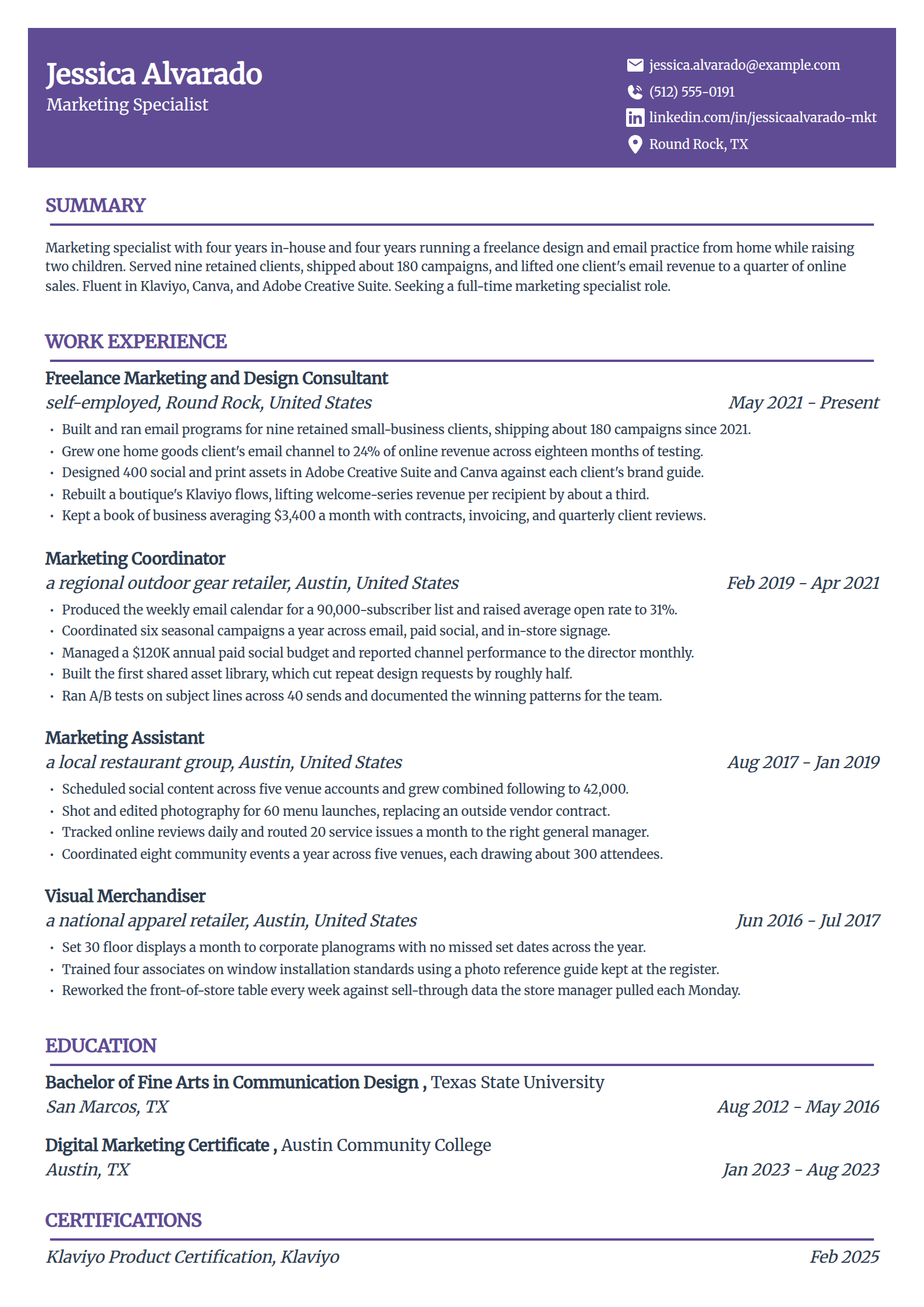
Why this resume example works?
- Lists the freelance practice as self-employed with a start date and no end date, which reads as current work rather than a gap filler.
- Quantifies the book of business, nine retained clients and about 180 campaigns, so a reader can size the work without asking.
- Names the exact tools a posting screens for, Klaviyo, Adobe Creative Suite, and Canva, inside real client outcomes.
- Shows the business side as well as the craft: contracts, invoicing, and quarterly client reviews on a $3,400 monthly average.
- Keeps the in-house marketing history visible so the resume proves she can work inside a team, not only alone.
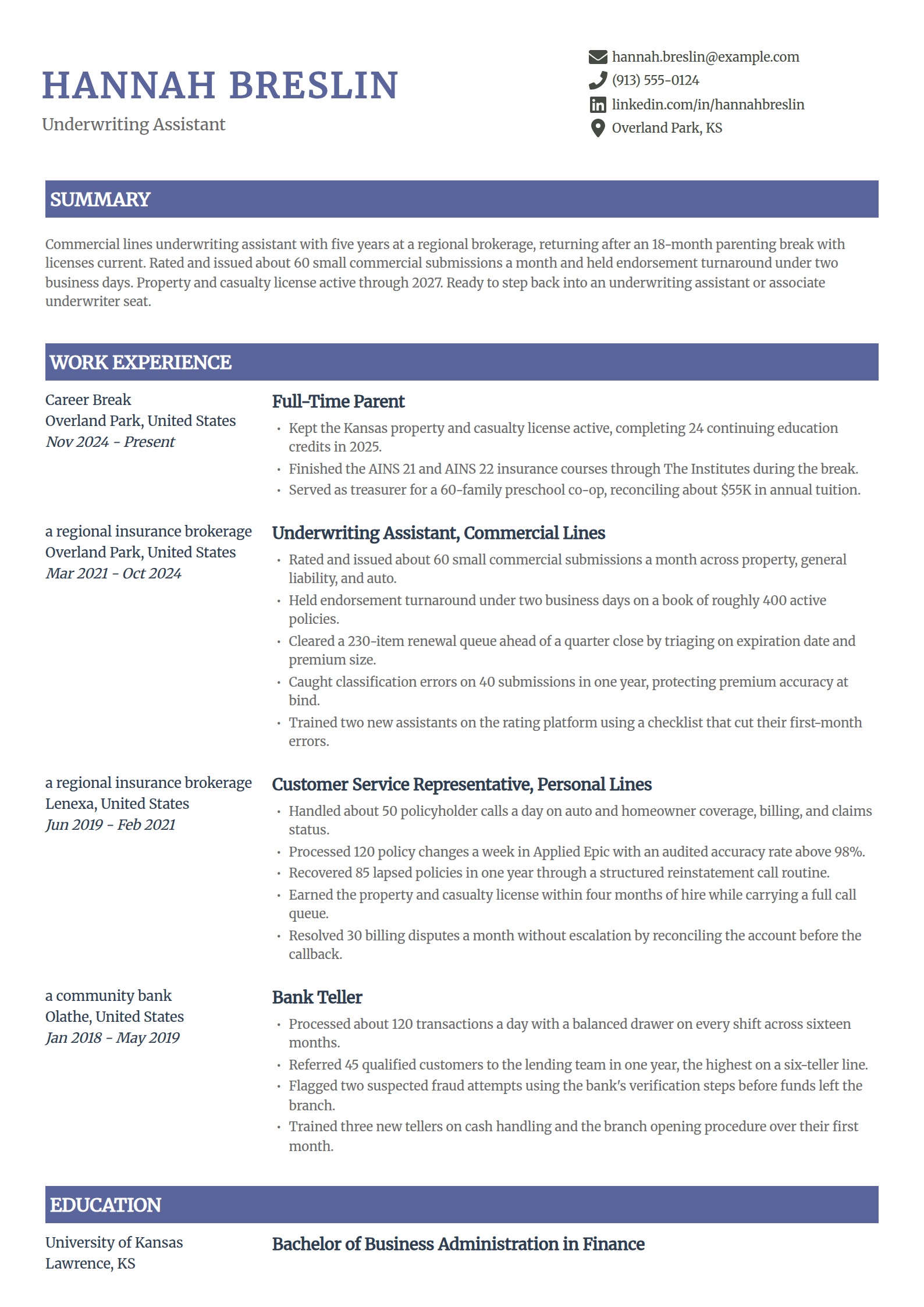
Resume Template for Returning to Work After a 1 to 2 Year Break
Why this resume example works?
- Keeps a straight reverse-chronological spine, which is the right call for a short break and the format most hiring teams expect.
- Holds the break entry to three lines, because an 18-month gap needs accounting for, not explaining at length.
- Leads the summary with licenses current, the detail that decides whether an underwriting resume moves forward at all.
- Shows the license was maintained through the break with 24 continuing education credits completed in 2025.
- Leaves the previous role's numbers untouched, including about 60 submissions a month and endorsement turnaround under two days.
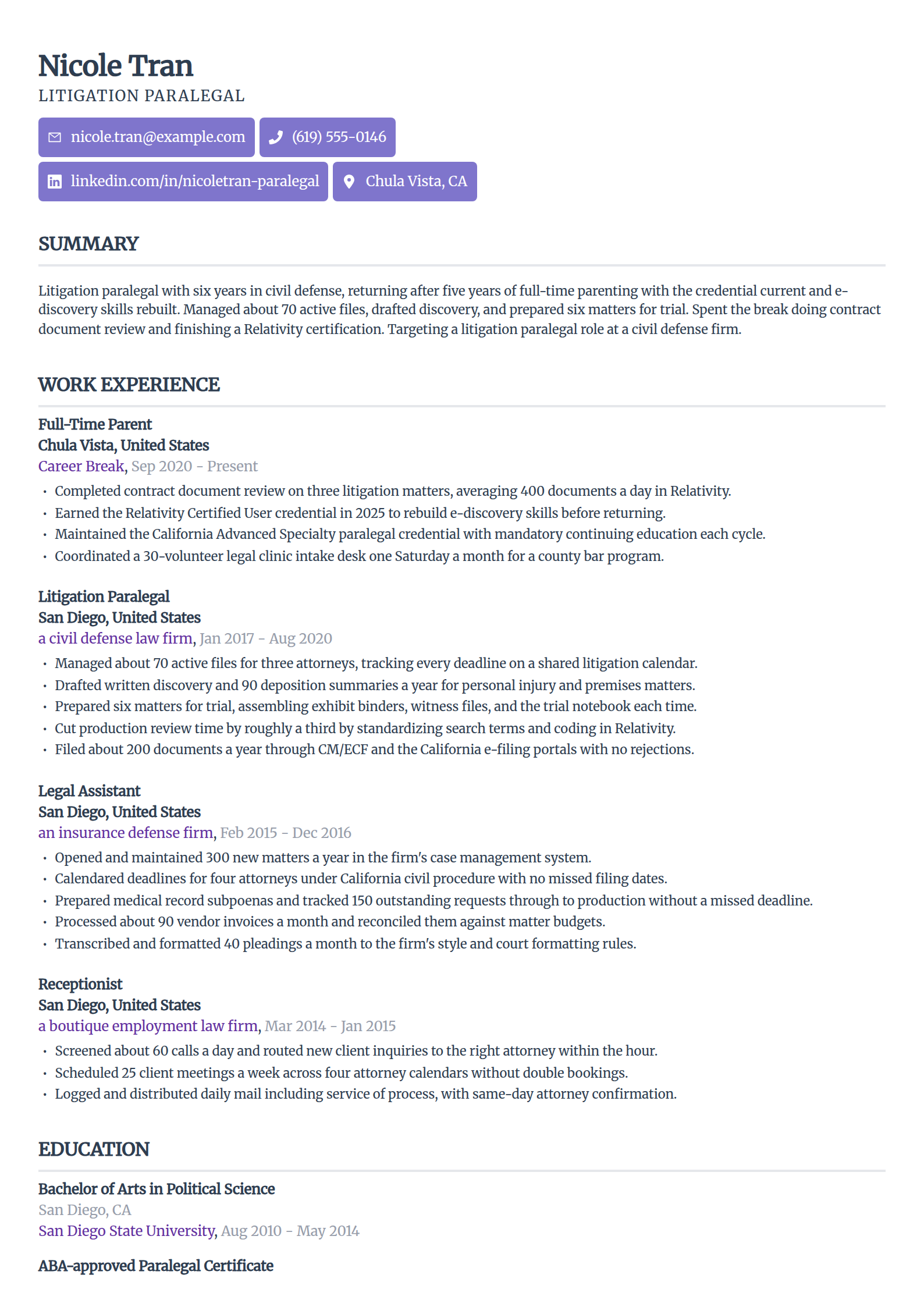
Resume Template for Returning to Work After 5 Years at Home
Why this resume example works?
- Answers the obvious five-year worry directly in the break entry: contract document review on three live matters at about 400 documents a day.
- Pairs the break with a dated recertification, a Relativity credential earned in 2025, which proves the technical skill was rebuilt and not just claimed.
- States in the summary that the credential is current, so nobody has to hunt the certifications section to find out.
- Keeps the litigation numbers that still matter, about 70 active files and 90 deposition summaries a year.
- Lists the earlier receptionist job in brief, which shows the full arc without spending space a five-year-old role has not earned.
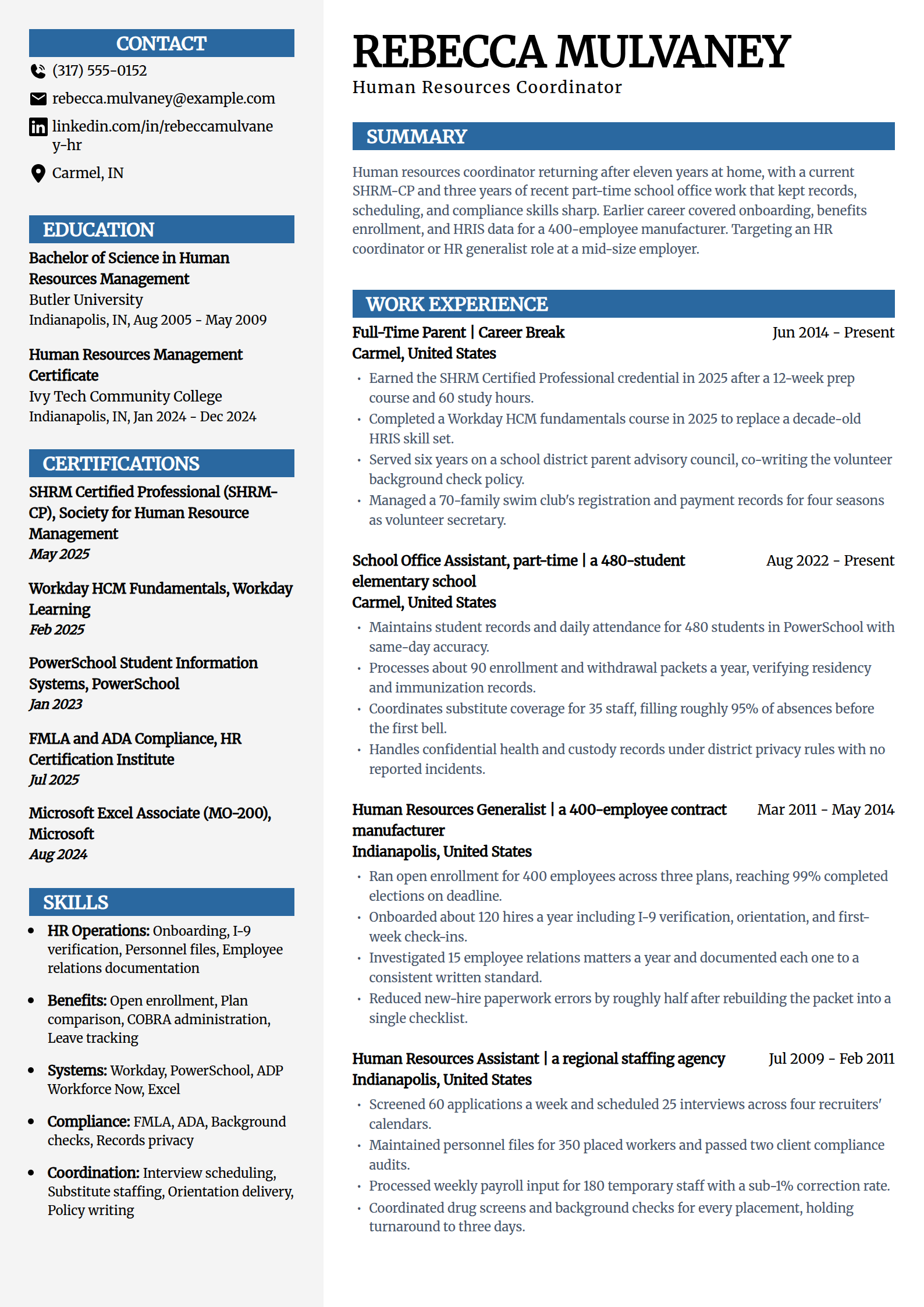
Resume Template for Returning to Work After 10 Years or More
Why this resume example works?
- Puts a current part-time job directly under the break entry, which is what turns an eleven-year gap into a timeline with something recent in it.
- Leads the summary with the new credential, a SHRM-CP earned in 2025, rather than with a career that ended in 2014.
- Replaces a decade-old systems skill set honestly, naming a Workday course finished in 2025 instead of leaving an obsolete HRIS on the page.
- Compresses the pre-break jobs to four bullets each, because recency beats depth once a decade has passed.
- Keeps the two-column layout readable by putting certifications in the sidebar where a screener checks for them first.
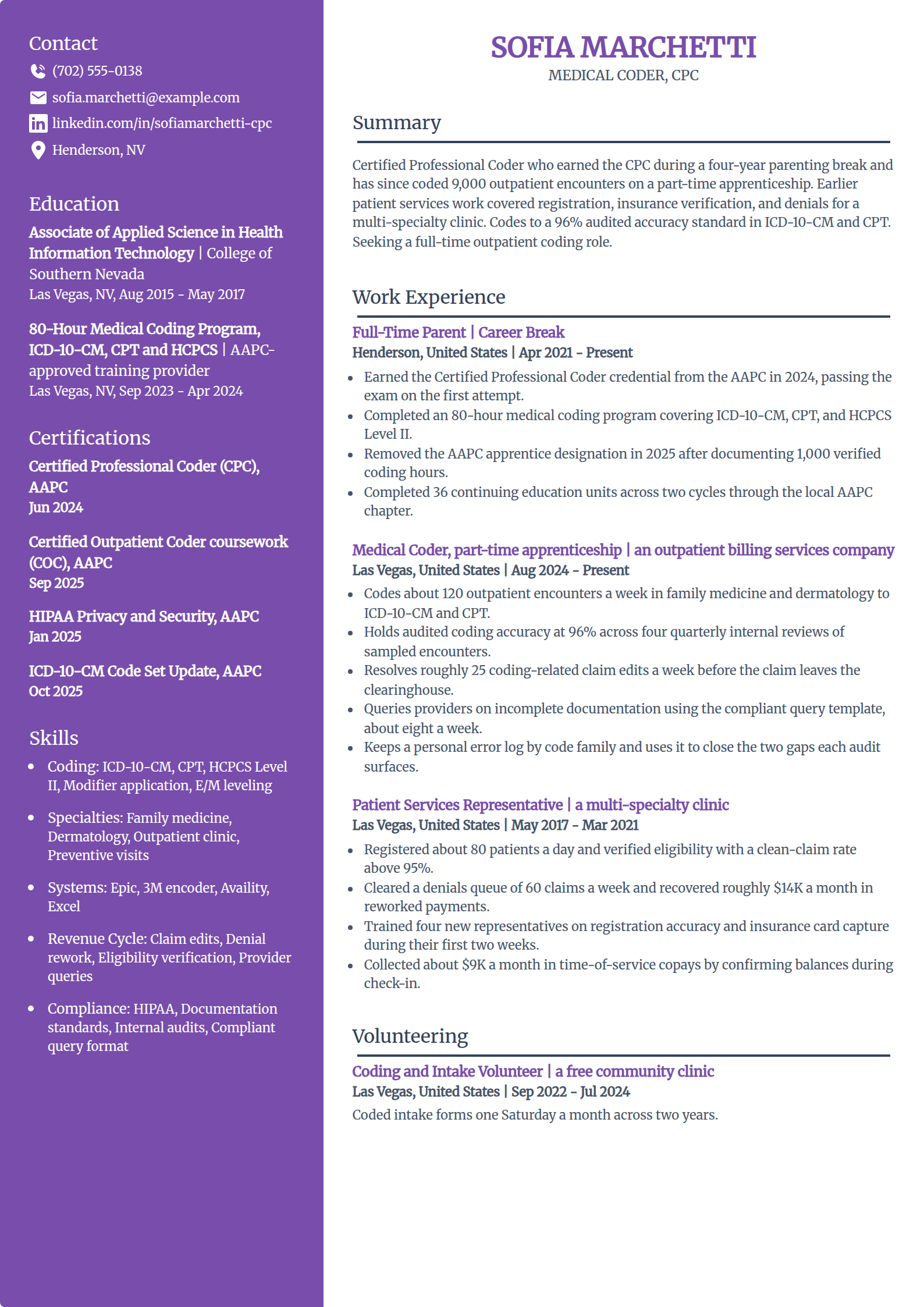
Stay-at-Home Mom Resume Template With a New Certification
Why this resume example works?
- Puts the credential in the headline, Medical Coder CPC, which is how a credential-gated field screens the first ten seconds.
- Dates the certification and says it was passed on the first attempt, a detail hiring managers in coding actually ask about.
- Shows the credential being used, about 120 encounters a week at 96% audited accuracy, so it is not a certificate with nothing behind it.
- Explains the apprentice designation being removed after 1,000 verified hours, which answers a question specific to this credential.
- Keeps the earlier patient services job, because registration and denials experience is what makes a new coder employable faster.
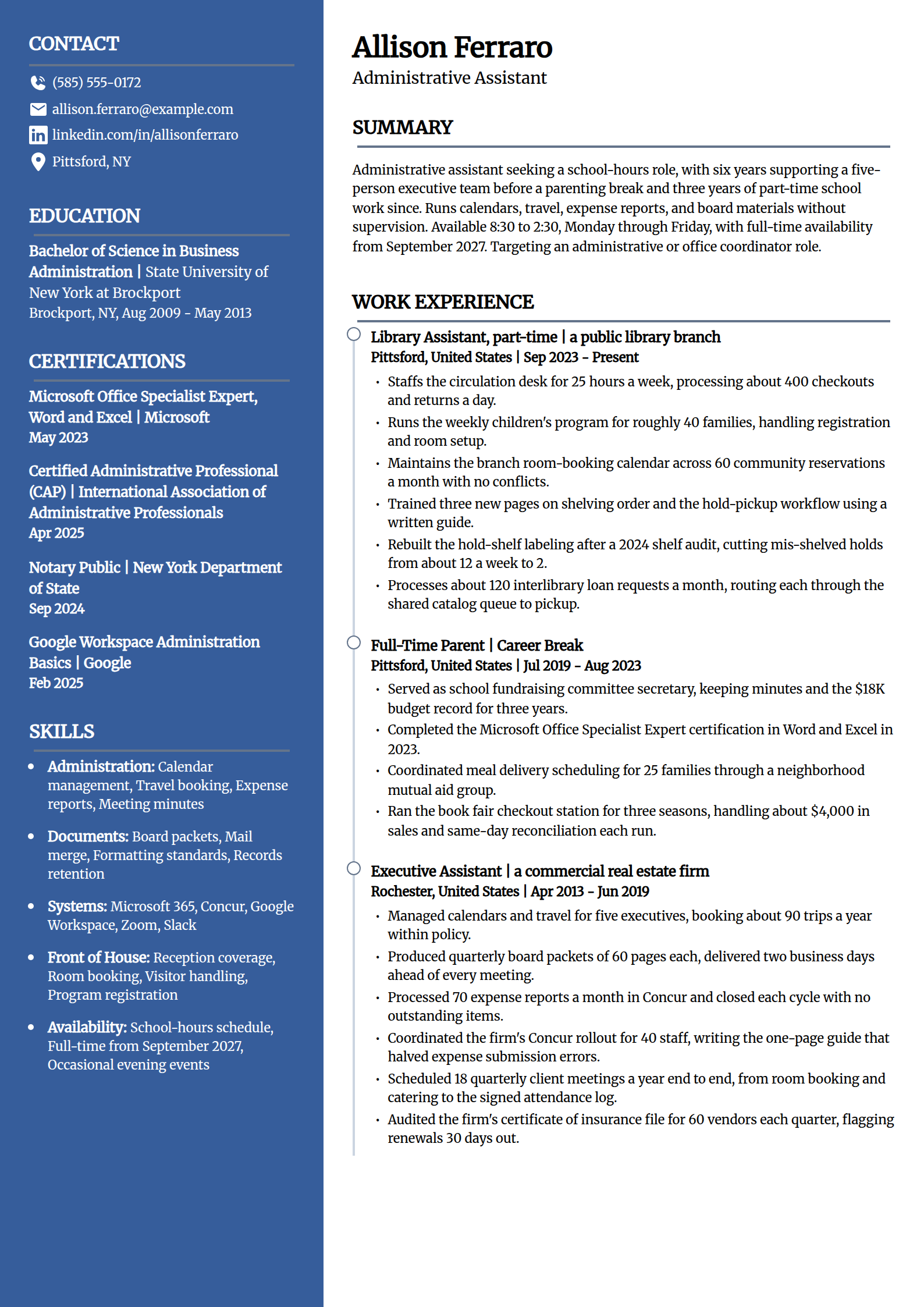
Part-Time and School-Hours Resume Template for a Stay-at-Home Mom
Why this resume example works?
- States the hours wanted in the summary, 8:30 to 2:30 Monday through Friday, and names the month full-time availability starts.
- Repeats availability as a skills category, so a hiring manager skimming the sidebar sees it without reading a paragraph.
- Leads with the current part-time library job rather than the break, which shows a working routine already in place.
- Keeps the pre-break executive assistant numbers, 90 trips booked a year and 60-page board packets, to prove the ceiling is higher than the current role.
- Attaches a number to the part-time work too, about 400 checkouts a day, so nobody reads it as a filler job.
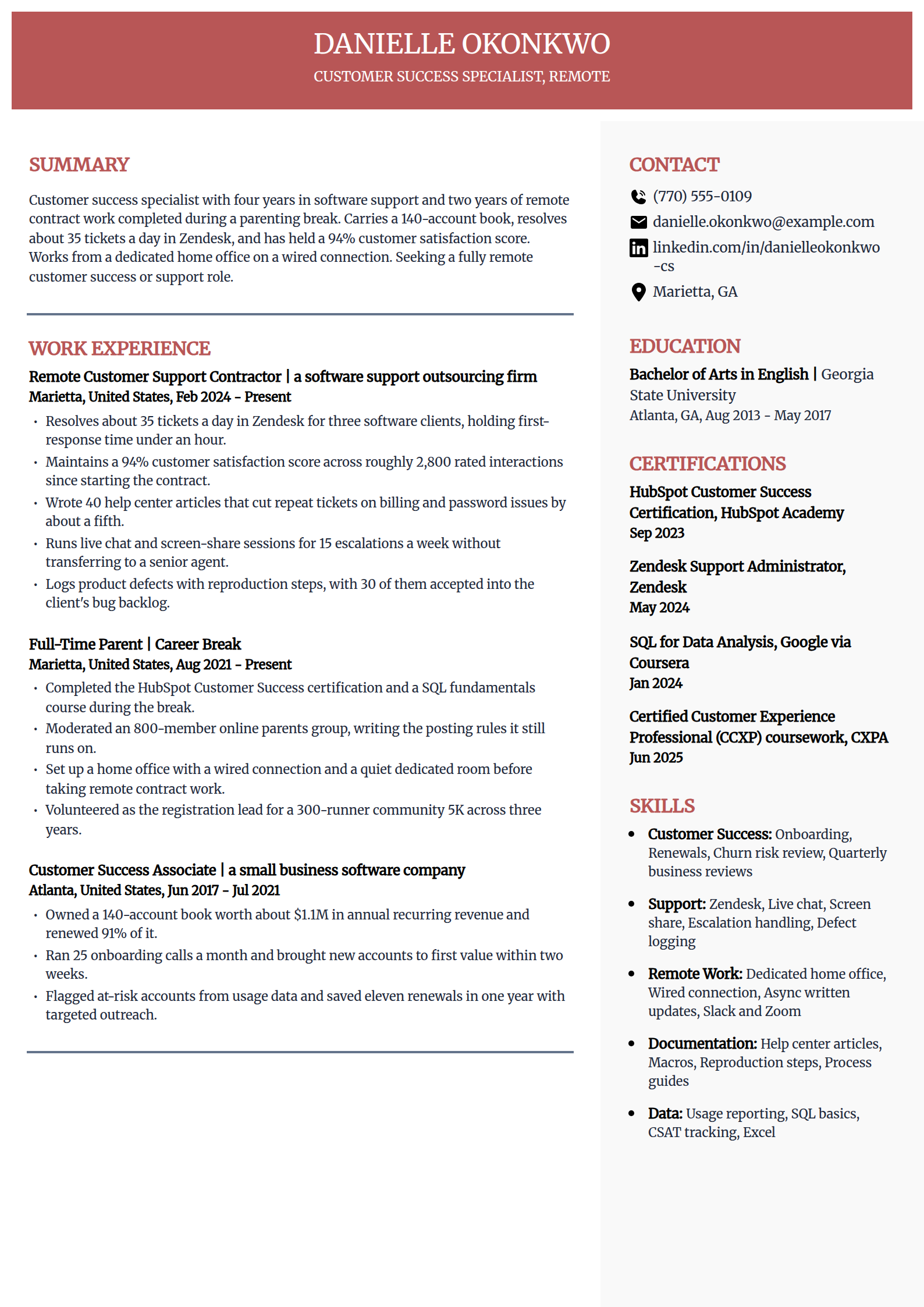
Remote Work Resume Template for a Stay-at-Home Mom
Why this resume example works?
- Says remote in the headline, which is what a remote-first employer filters on before reading anything else.
- Proves remote work has already happened, two years of contract support at about 35 tickets a day, instead of asking to be trusted with it.
- Names the setup in plain terms, a dedicated room and a wired connection, because remote hiring managers ask and most resumes never say.
- Carries a satisfaction number across a large base, 94% over roughly 2,800 rated interactions, which is harder to dismiss than a testimonial.
- Keeps the pre-break account management history, a 140-account book renewed at 91%, so the resume is not only support work.
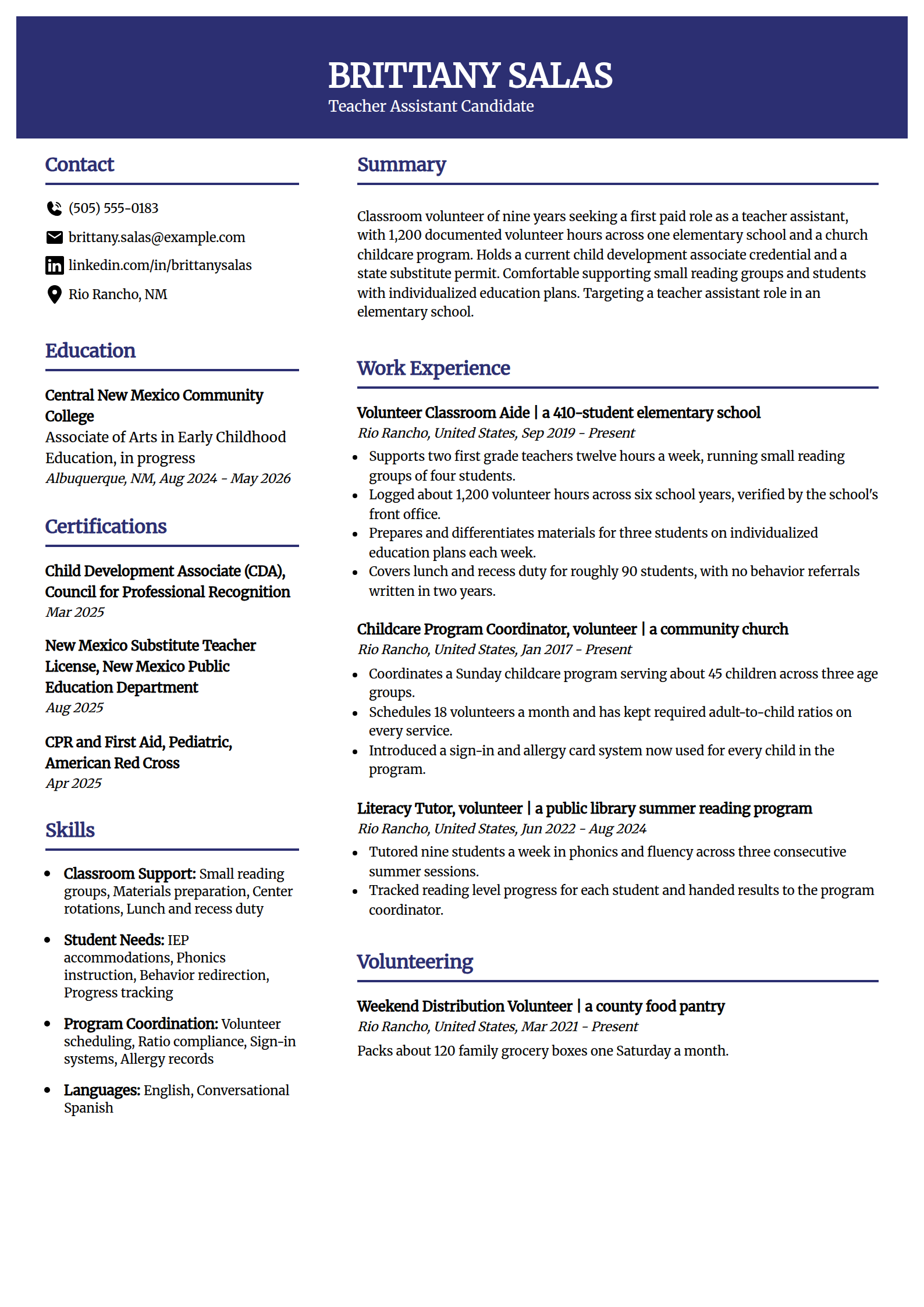
Stay-at-Home Mom Resume Template With No Formal Work History
More first-job resume examples with no paid experience →
Why this resume example works?
- Builds a full work history out of three unpaid roles, each with a title, an organization, dates, and results, because that is what they are.
- Puts a verifiable number on the volunteering, about 1,200 hours logged across six school years and confirmed by the front office.
- Leans into the one case where the at-home years count as experience, a childcare target, through named roles rather than parenting duties.
- Shows the credential that makes a first paid role possible, a Child Development Associate plus a state substitute license.
- Lists the in-progress degree with its expected date, which reads as momentum rather than as an unfinished item.
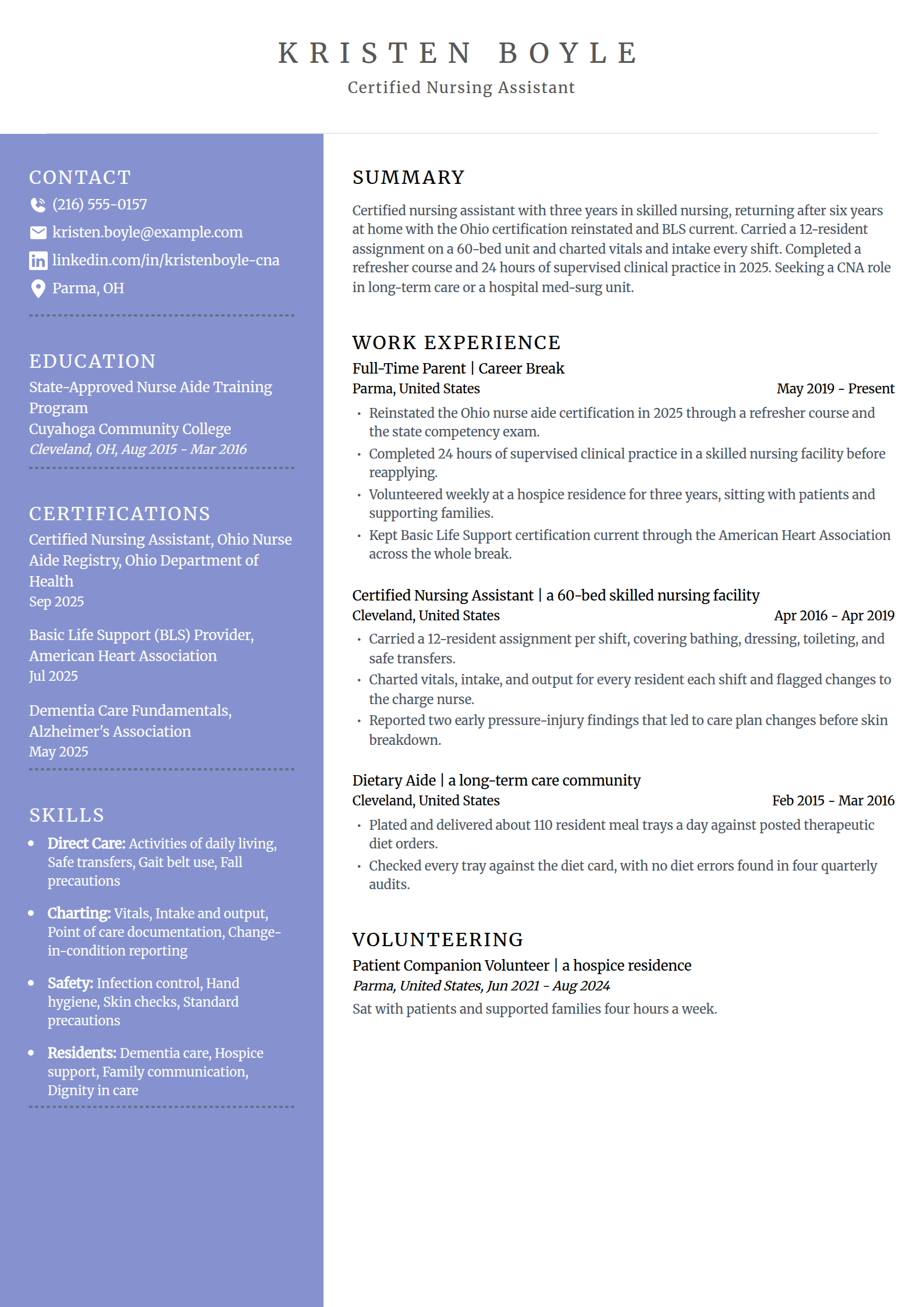
Stay-at-Home Mom Resume Template for Returning to Healthcare
See 16 CNA resume examples by setting and experience level →
Why this resume example works?
- Answers the licensure question first, because a clinical resume with a lapsed certification does not get read past the summary.
- Shows exactly how the certification came back, a refresher course, the state competency exam, and 24 hours of supervised clinical practice.
- Keeps every task inside nursing assistant scope: bathing, dressing, transfers, vitals, intake and output, and reporting changes to the charge nurse.
- Uses a modest, level-accurate number, a 12-resident assignment per shift, rather than an outcome a nursing assistant cannot own.
- Fills the sidebar with a hospice volunteering entry, which keeps patient-facing work on the timeline through the whole break.
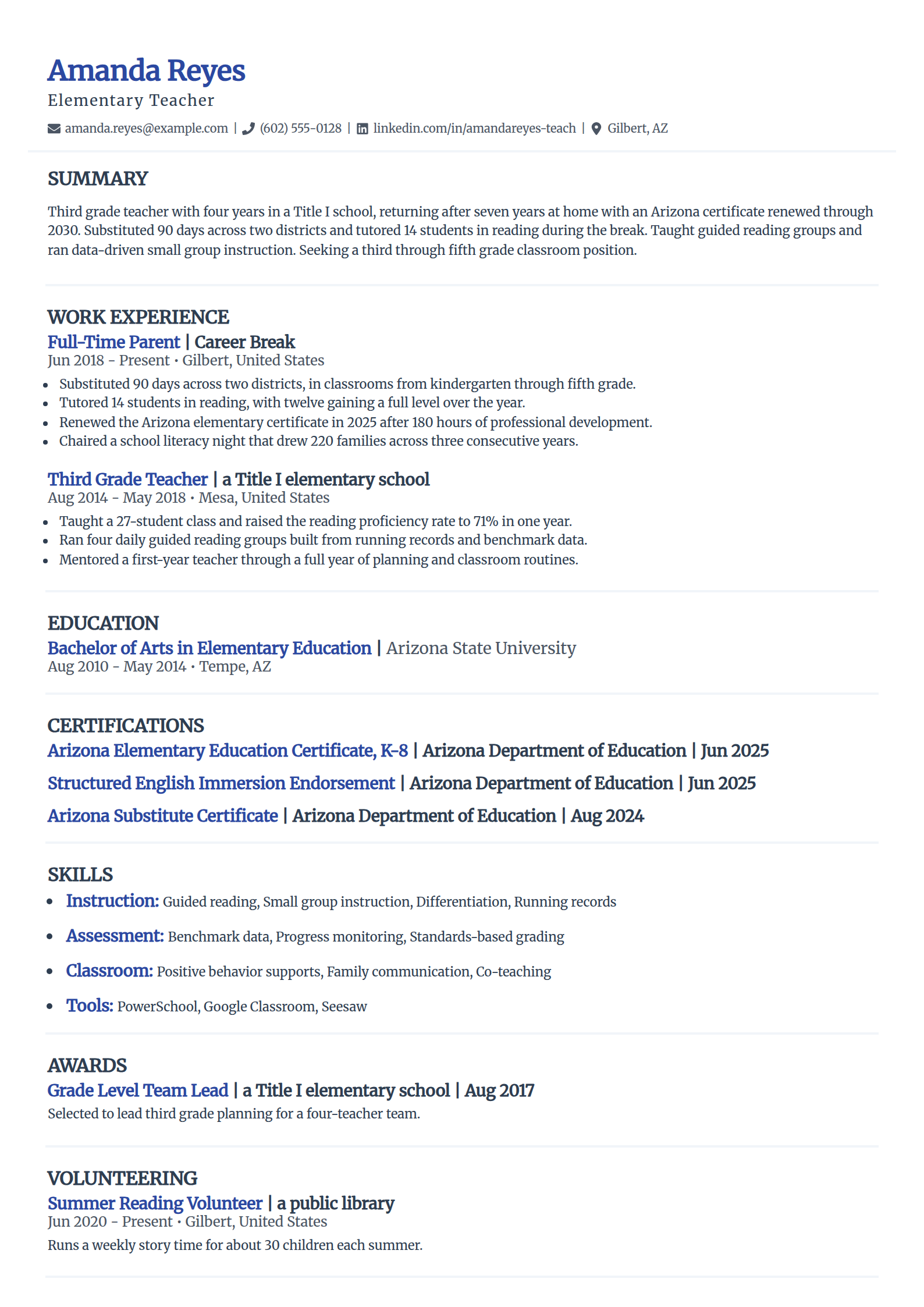
Stay-at-Home Mom Resume Template for Returning to Teaching
See 23 teacher resume examples from preschool to college →
Why this resume example works?
- Names the certificate and its expiration year in the summary, which is the first thing a district screener verifies.
- Counts the substitute days, 90 across two districts, turning the break into recent classroom time with a number on it.
- Shows instructional work continuing through the break: 14 students tutored, twelve of them gaining a full reading level.
- Keeps the classroom results that matter to a principal, a 27-student class and reading proficiency at 71%.
- Uses a tight two-entry layout, which suits a teacher whose credential and recent coverage carry more weight than job count.
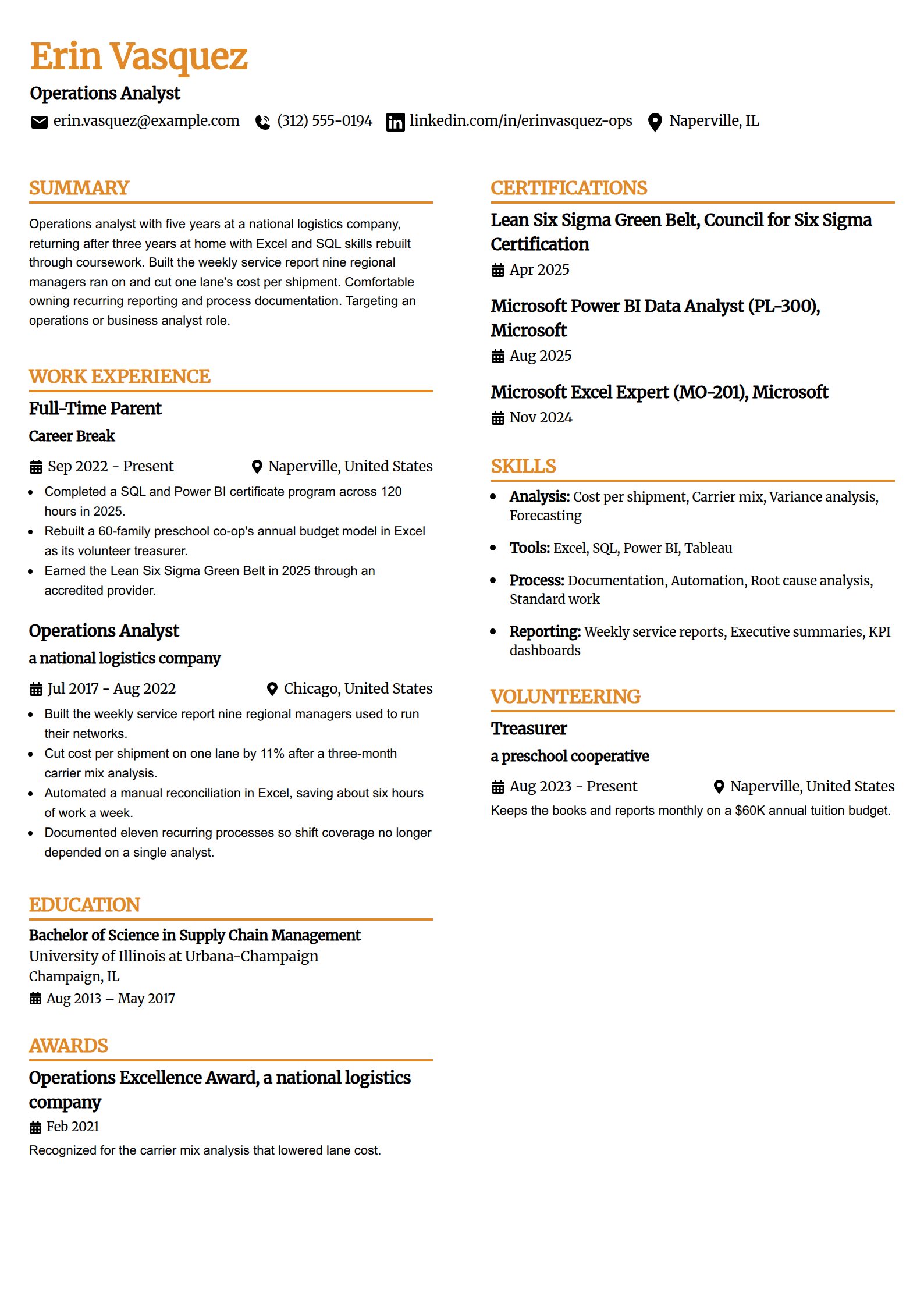
Stay-at-Home Mom Resume Template for an Office or Corporate Return
17 administrative assistant resume examples, entry level to executive →
Why this resume example works?
- Puts the rebuilt technical skills in the break entry, a 120-hour SQL and Power BI program, which is what a corporate analyst screen looks for.
- Adds a second credential with a date, a Green Belt earned in 2025, so the break shows two completed things rather than a plan.
- Keeps the strongest pre-break results in place, including a lane cost cut of 11% after a three-month analysis.
- Mentions the volunteer treasurer work once, in the sidebar, where it supports the story without crowding the analyst bullets.
- Holds every bullet to one line, which is what makes a two-entry resume look deliberate instead of thin.
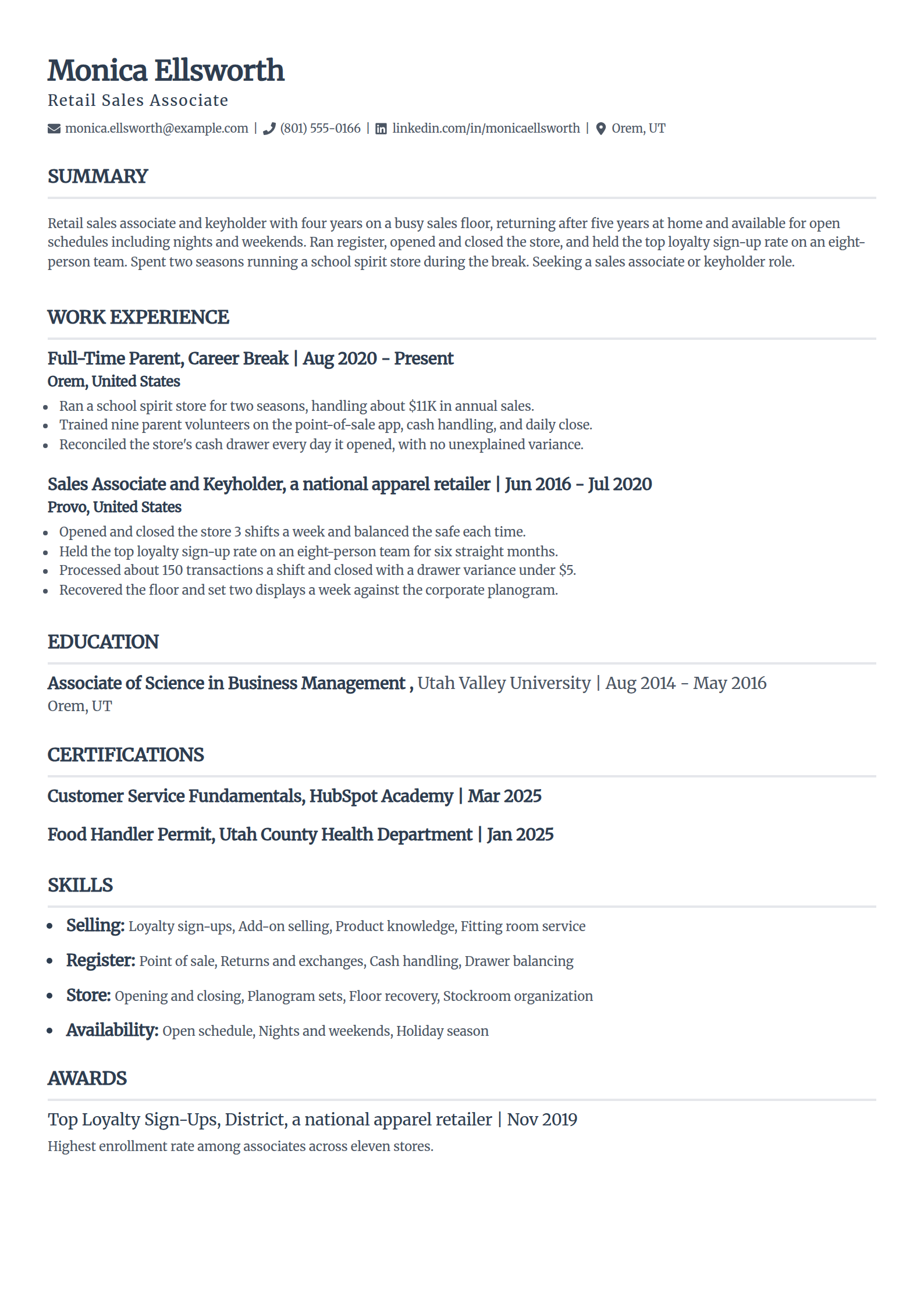
Stay-at-Home Mom Resume Template for Retail and Customer Service
17 retail resume examples, seasonal associate to store manager →
Why this resume example works?
- States open availability including nights and weekends, which is the single thing most retail managers screen for first.
- Gives the break a commercial number, about $11K in annual sales through a school spirit store, in the language of the job being applied for.
- Repeats the keyholder duties that matter to a hiring manager: opening, closing, and balancing the safe three shifts a week.
- Carries a drawer accuracy figure under $5 variance, which is a trust signal no adjective can replace.
- Keeps the format plain so a store manager reading it on a phone between shifts gets everything in one screen.
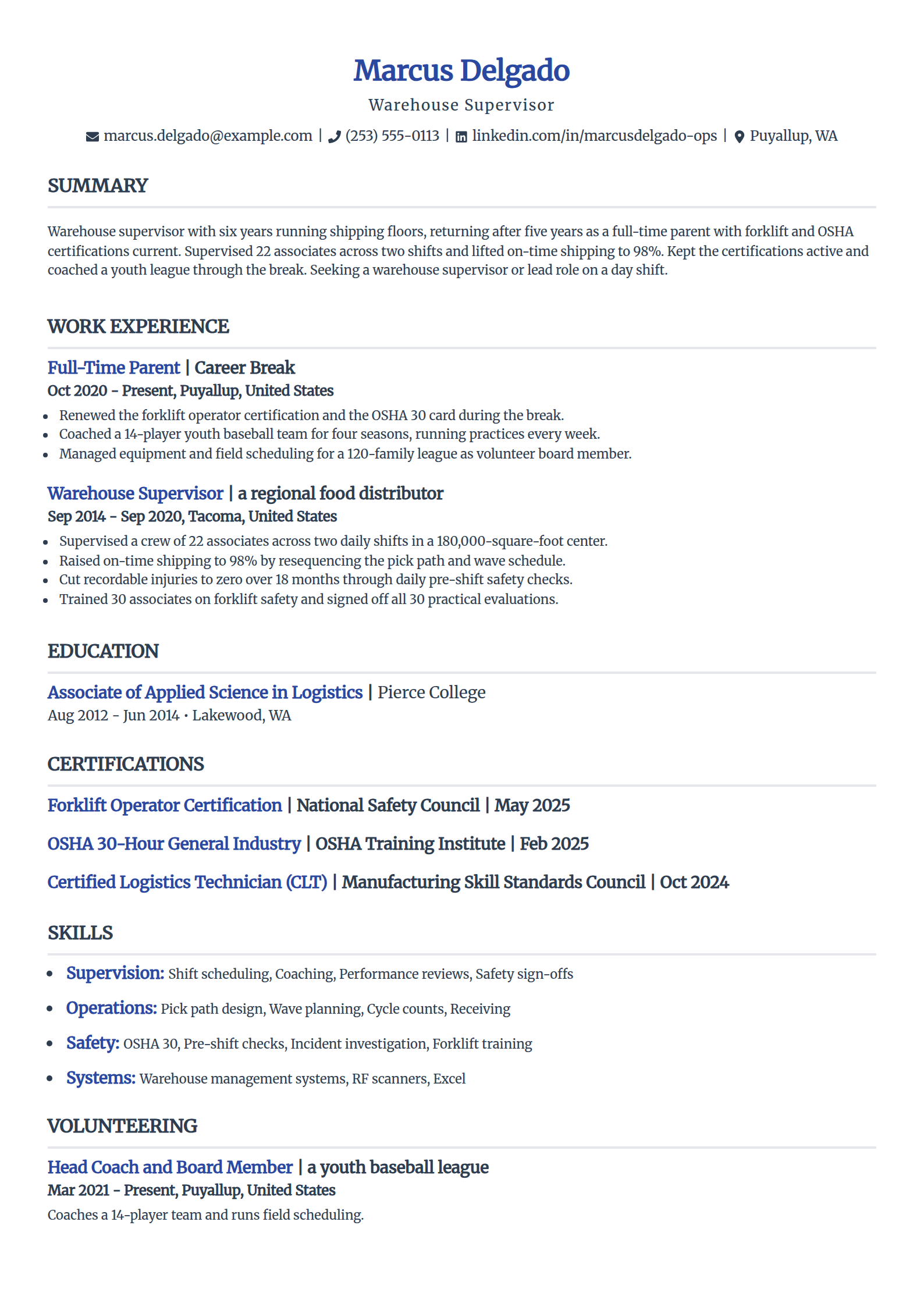
Stay-at-Home Dad Resume Template
See warehouse resume examples from entry level to lead →
Why this resume example works?
- Uses exactly the same structure as every other example on this page, because the advice does not change with the parent's gender.
- Leads with certifications kept current through the break, a forklift card and OSHA 30, which is what a warehouse hiring manager checks.
- Puts a supervisory scale number up front, 22 associates across two shifts, so the resume aims at a lead role rather than a line job.
- Turns coaching a youth team into a scheduling and logistics bullet instead of a personality note.
- States the shift wanted in the summary, which saves the recruiter a phone call and often decides the callback.
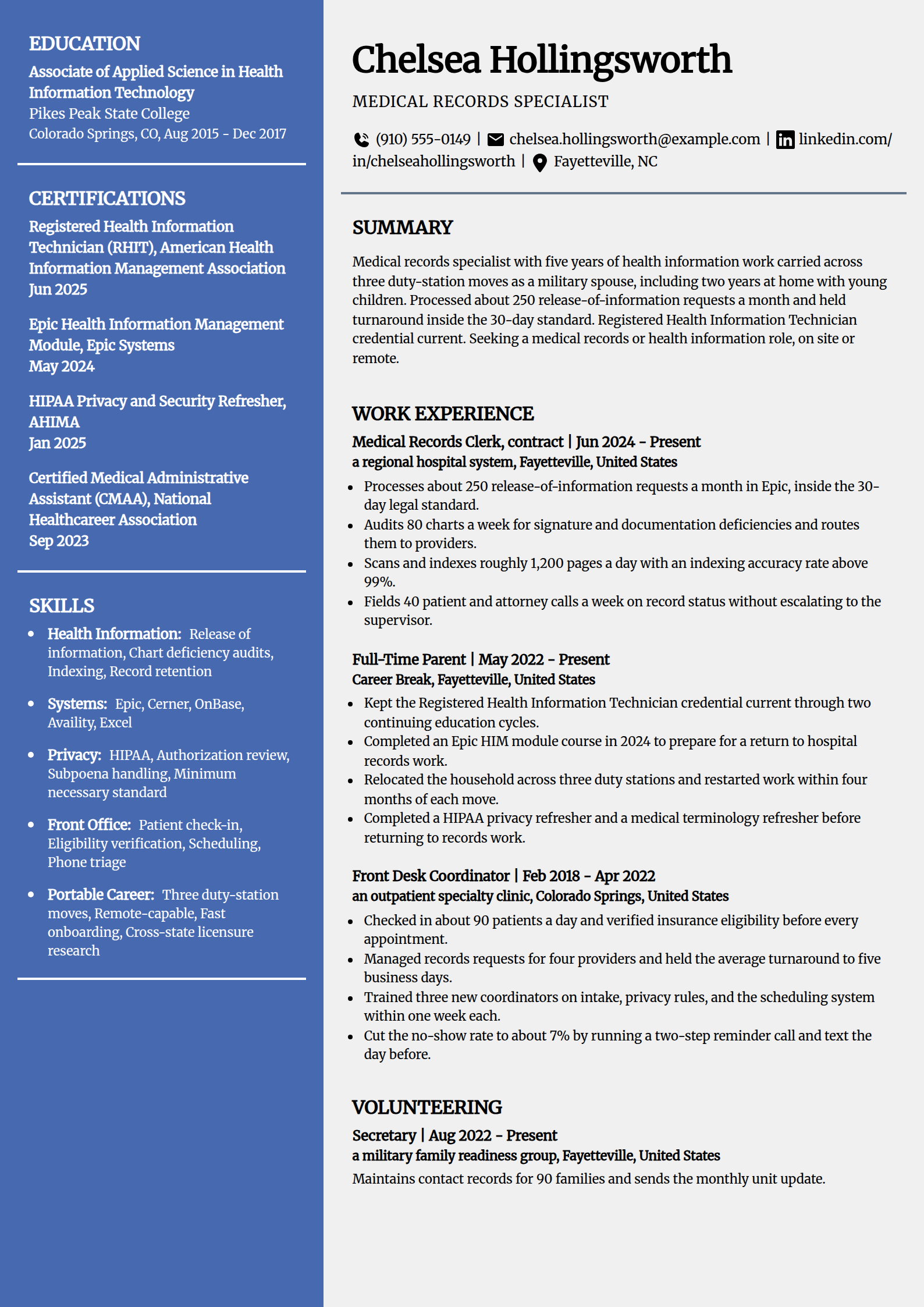
Military Spouse Resume Template for Returning to Work
Why this resume example works?
- Explains the pattern a recruiter would otherwise read as job hopping: five years of health information work carried across three duty-station moves.
- Turns relocation into a strength with a concrete claim, work restarted within four months of each move.
- Leads with a current contract role at about 250 release-of-information requests a month, so the most recent line is paid work.
- Keeps the credential visible and current, an RHIT maintained through two continuing education cycles during the break.
- Adds a portable-career skills block naming remote capability and fast onboarding, which is what a spouse-friendly employer screens for.
Start from the example that matches your break
Pick the template above that fits how long you were out and where you are headed, then build your own version with your dates, your numbers, and your credentials in place.
Build my resumeHow to write a stay-at-home mom resume
The resume has one job: make the years at home a settled fact by the end of the first screen, then spend the rest of the page on what you can do. The order below is the order a screener reads in.
Should you put stay-at-home mom on your resume?
Put the break on the resume, with dates, and call it what it is. A dated Full-Time Parent or Career Break entry in the work history answers the timeline question in one line, and a screener who has the answer stops looking for it.
What the advice columns recommend, and what this page disagrees with, is dressing the break up:
- Skip the invented titles. Family CEO, Household CEO, Chief Home Officer and Manager, Smith Family read as a joke to the person screening, and they make the entry impossible to verify.
- Skip the household duties as bullets. Meal planning, laundry rotations, and managing a family budget are not what the job pays for, and listing them invites the comparison you do not want.
- Do give the entry real content: a certification earned, a volunteer role with a number attached, freelance or contract work, a course finished, a part-time job.
- Do keep it short. Two to four bullets is enough for a break; the entry exists to close a question, not to compete with your career.
- One exception: when the job you want is childcare, early education, or household and estate management, the at-home years are relevant experience and deserve real bullets.
Writing the summary when your last paid job was years ago
Lead with the job title you want and the credential that qualifies you for it, then name the break in the same breath rather than hiding it mid-page. Three to four sentences, no more.
Accounts payable specialist with six years in high-volume AP, returning to full-time work after four years of full-time parenting. Processed up to 900 invoices a month across Sage 300 and QuickBooks Online. Certified Bookkeeper credential renewed in 2025. Targeting an AP specialist or AP lead role.
Three things that summary does, in order:
- Opens with the role, not the break, so the first words match the job title on the posting.
- Names the break in one clause and moves on, which reads as confidence rather than as an apology.
- Ends with the credential and the target, which tells the screener exactly which pile to put it in.
What counts as experience during the break
Anything someone outside your household could confirm. If a reference, a certificate number, or an organization could back it up, it belongs in the work history with dates and a result:
- Volunteer roles with real responsibility: PTA board, team treasurer, program coordinator, classroom aide, committee chair. Give them titles, dates, and one number each.
- Certifications and licenses earned or renewed, with the month and the issuing body. These are the strongest single item a break entry can carry.
- Freelance, contract, and side-business work, listed as self-employed with a start date, client count, and what the work produced.
- Part-time or seasonal jobs, even short ones, because the most recent dated line on the page carries more weight than people expect.
- Coursework with a completed credential attached. A finished certificate counts; a list of videos watched does not.
Reverse-chronological or skills-first: pick by the length of the break
Most of the advice on this query pushes a functional, skills-first resume for any gap over about four years. Half of that is right. The format is only worth the trade when a straight timeline genuinely tells the wrong story.
The rule this page's examples follow:
- Break under about three years: keep reverse-chronological. The timeline still reads cleanly and recruiters trust it.
- Break of five years or more with a relevant credential or recent part-time work: still reverse-chronological, with the break and the recent work at the top. Nine of the examples above do exactly this.
- Break of ten years or more with nothing recent: lead with a skills and certifications block, then a condensed history. Add something recent as soon as you can, because recency is what a hybrid format cannot fake.
- A fully functional resume with no dates anywhere reads as concealment. Applicant tracking systems also parse dated roles more reliably, so the format costs you twice.
Skills and keywords that survive the screen
Time management, multitasking, and organization appear on nearly every competing page, which is exactly why they do nothing. A skill only works when it is attached to the thing it produced.
Convert each soft claim into its evidence, the way the examples above do:
- Instead of scheduling, write the shift coverage: 40 volunteers across eight weekly shifts with the unfilled rate under 5%.
- Instead of budgeting, write the budget: about $47K raised across two school years, with a published monthly report.
- Instead of communication, write the audience: a weekly one-page status note to eleven stakeholders.
- Then match the posting's own phrasing for the hard skills, naming systems outright: Epic, PowerSchool, Workday, Dentrix, Sage 300, QuickBooks Online, Zendesk, Relativity.
- Keep the skills block to four to six categories. A long undifferentiated list reads as padding, which is the thing a returning candidate can least afford.
Formatting so the resume parses and the dates make sense
A returning resume gets read more carefully than most, so the structure has to hold up:
- Use month and year on every entry, including the break. Year-only dates make a gap look vaguer than it is.
- Keep one column of real content. Two-column layouts are fine when the main column carries the work history and the sidebar carries contact details, skills, and certifications.
- Put certifications in their own section with issuer and date, never buried in a sentence.
- Save as a PDF unless the posting asks for a Word file, and name the file with your own name.
- Run the finished resume through an ATS check before you send it, and fix anything the parser reads in the wrong field.
Common mistakes on a stay-at-home mom resume
- Apologizing for the break in the summary. A sentence that starts with unfortunately or after taking time off argues against you before the screener has formed an opinion.
- Inventing a corporate title for parenting. Family CEO and Chief Home Officer are the most recommended advice on this query and the fastest way to lose a serious reader.
- Leaving the gap silent. An unexplained three-year hole makes a recruiter guess, and the guess is rarely the generous one. One dated entry ends it.
- Listing household duties as bullets. Meal planning and running a family calendar are real work and the wrong content; they invite a comparison with paid candidates that you will lose.
- Letting a credential lapse and saying nothing. If a license or certification expired, say what you did about it, with the month it came back. Silence on a lapsed credential is read as a lapsed skill set.
- Stripping every date to hide the timeline. A functional resume with no dates reads as concealment to a human and parses badly for a machine.
Frequently asked questions
Should you put stay-at-home mom on your resume?
Yes, as a short dated entry in your work history. A line reading Full-Time Parent, Career Break, with the month and year it started and ended, settles the timeline question in one pass. Give it two to four bullets of real activity such as a certification earned, a volunteer role with a number on it, or freelance work. Leave out household duties, and leave out any attempt to make the entry sound like a corporate job.
What job title should you use for the time at home?
Full-Time Parent or Career Break. Both are plain, verifiable, and understood instantly. Avoid Family CEO, Household CEO, Chief Home Officer, and Manager of the Smith Family. Those titles are widely recommended and they consistently read as a joke to the person screening, which costs you the benefit the entry was supposed to buy. The exception is a childcare, early education, or household management job, where Nanny, Childcare Provider, or Household Manager may be the literal and accurate title for paid work you actually did.
How do you explain a 10-year employment gap on a resume?
With a dated break entry and something recent underneath it. After ten years, a hiring manager's real question is not where you were but what you have done lately, so the strongest move is to add one current item: a part-time job, a contract engagement, a volunteer role with responsibility, or a certification earned this year. Put that recent item directly under the break entry, lead the summary with the newest credential rather than the career that ended a decade ago, and compress the pre-break jobs to about four bullets each.
Is a functional resume better for a stay-at-home mom?
Usually not, and the advice to default to one is the most common bad recommendation on this topic. Keep a reverse-chronological resume for any break under about three years, and for longer breaks where you hold a current credential or recent part-time work. A skills-first hybrid is worth it only after roughly ten years out with nothing recent to show, and even then it should keep dated entries. A fully functional resume with no dates anywhere reads as concealment to a human and parses unreliably for an applicant tracking system.
What skills should a stay-at-home mom put on a resume?
The hard skills the posting names, plus soft skills only where you can attach evidence. Time management, multitasking, and organization appear on nearly every competing resume and carry almost no weight on their own. Replace each one with the thing it produced: 40 volunteers scheduled across eight weekly shifts, about $47K raised in two school years, a weekly status note to eleven stakeholders. Then name real systems outright, such as Epic, PowerSchool, Workday, QuickBooks Online, or Zendesk, using the posting's own phrasing.
Does this advice apply to stay-at-home dads?
Yes, without changes. The structure on this page, a dated Full-Time Parent entry, real activity inside it, and a summary that leads with the target role, works the same regardless of which parent stayed home. The stay-at-home dad example above uses exactly the same layout as the others. The same holds for anyone whose break came from caregiving for a parent or partner, health recovery, or a military relocation: name it plainly, date it, and fill it with what a reference could confirm.
More stay-at-home mom resume resources
Start from the example that matches your break
Pick the template above that fits how long you were out and where you are headed, then build your own version with your dates, your numbers, and your credentials in place.