17 Caregiver, Nanny & Babysitter Resume Examples
- ATS Friendly
- Caregiver & Nanny Specific
- 17 Real Examples
Families and home-care agencies hire on two things: the credentials at the top of your resume and proof you gave real, hands-on care. Start from a layout below, then model your own on a real example built for your track, whether you are a first-time babysitter, a home health aide, or a lead caregiver. Every example keeps a clean, ATS-safe layout.


540k+ resumes created
Editable caregiver and nanny resume templates
Each template below is a real caregiver, nanny, or babysitter resume laid out in that format, sorted by specialty and experience level across adult care and childcare. Choose one, then swap in your own clients, certifications, and daily duties. Every layout keeps your name, credentials, and dates clean so a hiring family reads your experience at a glance and an applicant tracking system parses it without trouble.
Caregiver Resume Template
Why this resume example works?
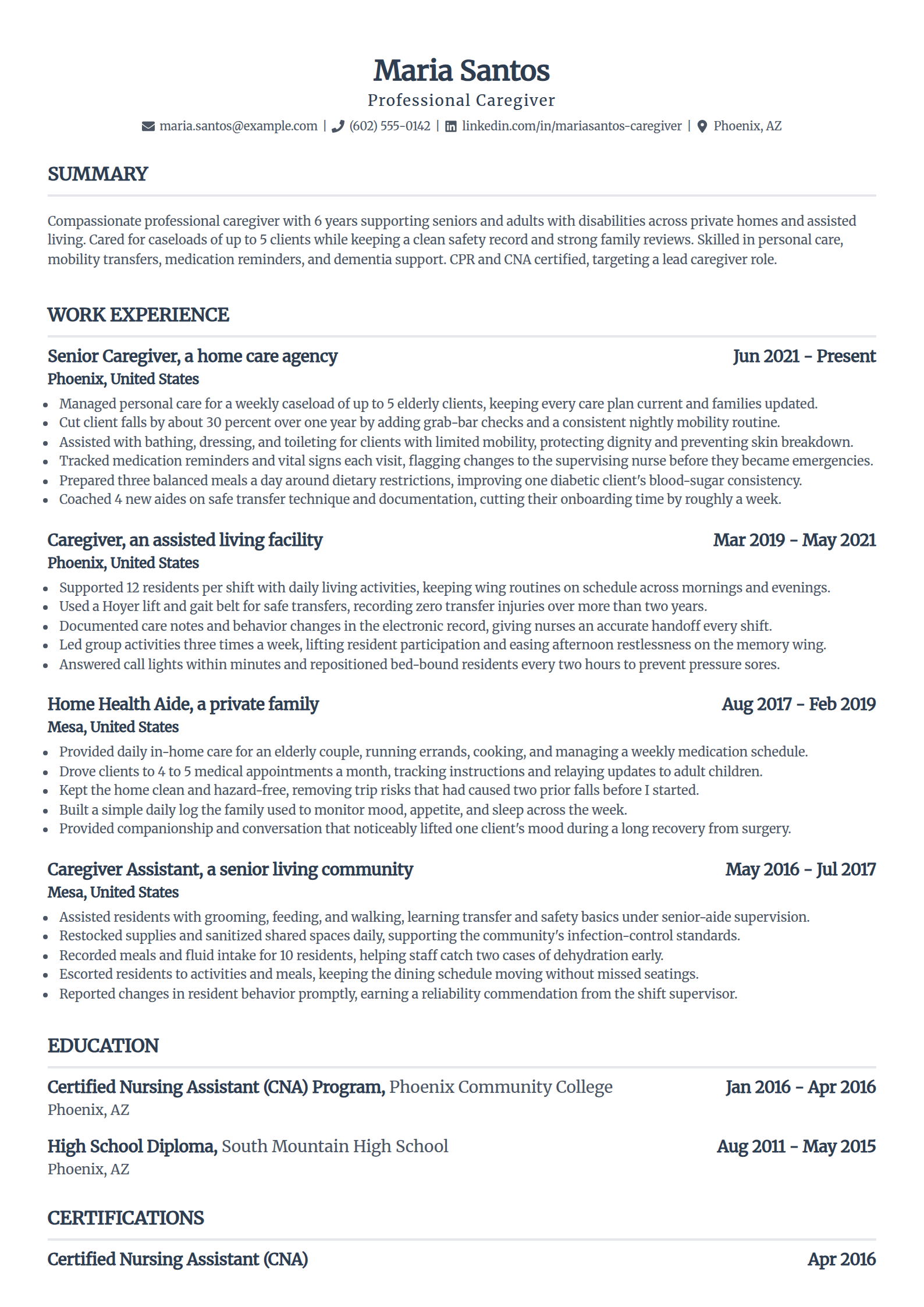
- Opens with a summary that names 6 years, caseloads of up to 5 clients, and CPR and CNA certification.
- Uses a clean, single-column layout that a home-care agency and an applicant tracking system both parse cleanly.
- Leads bullets with real results, like cutting client falls about 30 percent with grab-bar checks and a nightly routine.
- Keeps every duty scope-accurate: ADLs, safe transfers with a Hoyer lift, medication reminders, and vital-sign monitoring.
- Puts the credentials a caregiver posting screens for, CNA, HHA, CPR, and dementia care, where a recruiter reads them first.
Entry-Level Caregiver Resume Template (No Experience)
Why this resume example works?
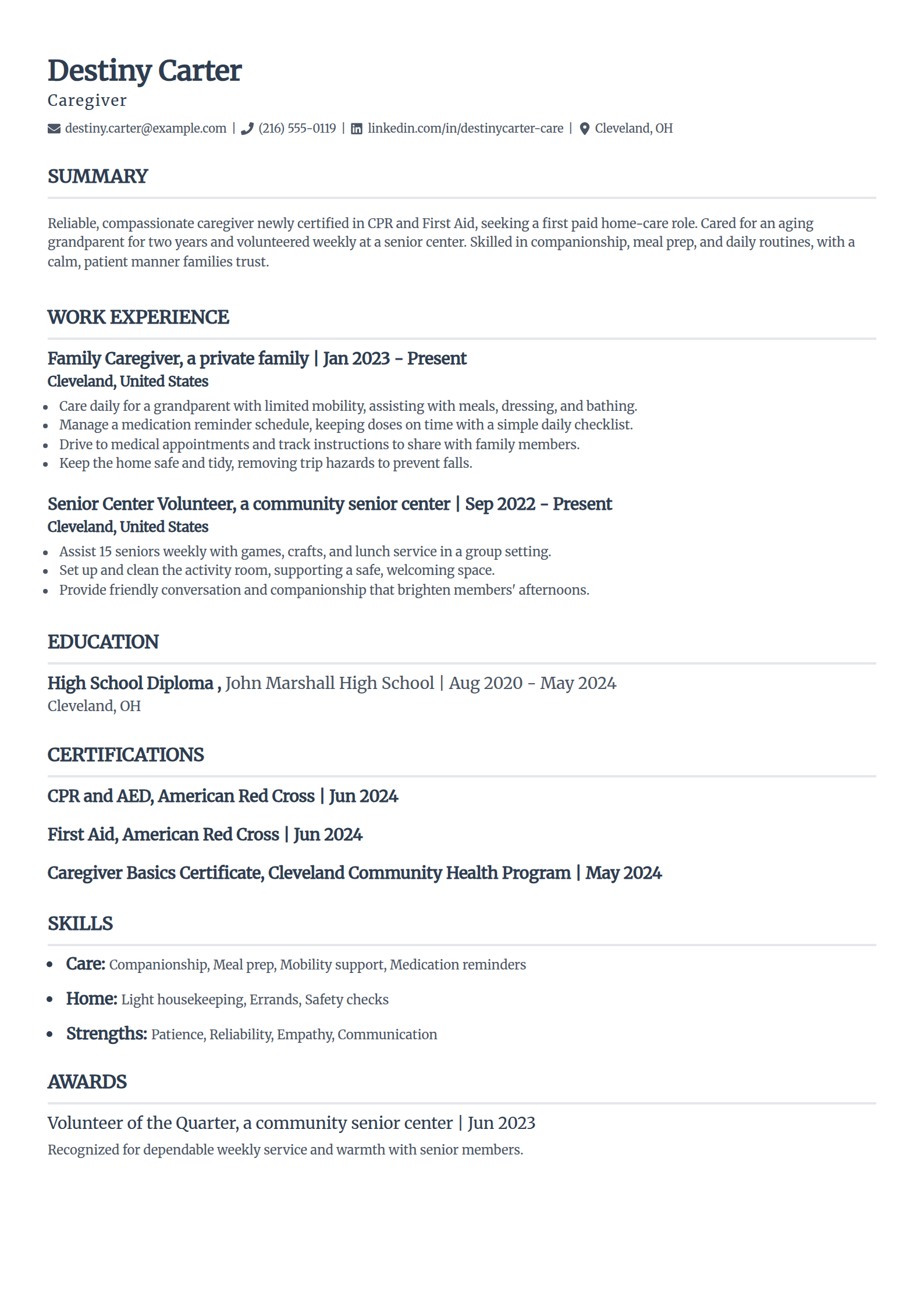
- Written for a first paid role, leading with fresh CPR and First Aid certification and a calm, patient manner.
- Turns unpaid experience into proof, showing two years caring for a grandparent and weekly senior-center volunteering.
- Keeps each bullet concrete, like managing a medication reminder schedule or removing trip hazards to prevent falls.
- Fills the page honestly with a volunteer award instead of padding or inflated numbers.
- Uses a tight, ATS-safe single-column layout that fits a beginner's record without empty space.
Senior & Lead Caregiver Resume Template
Why this resume example works?
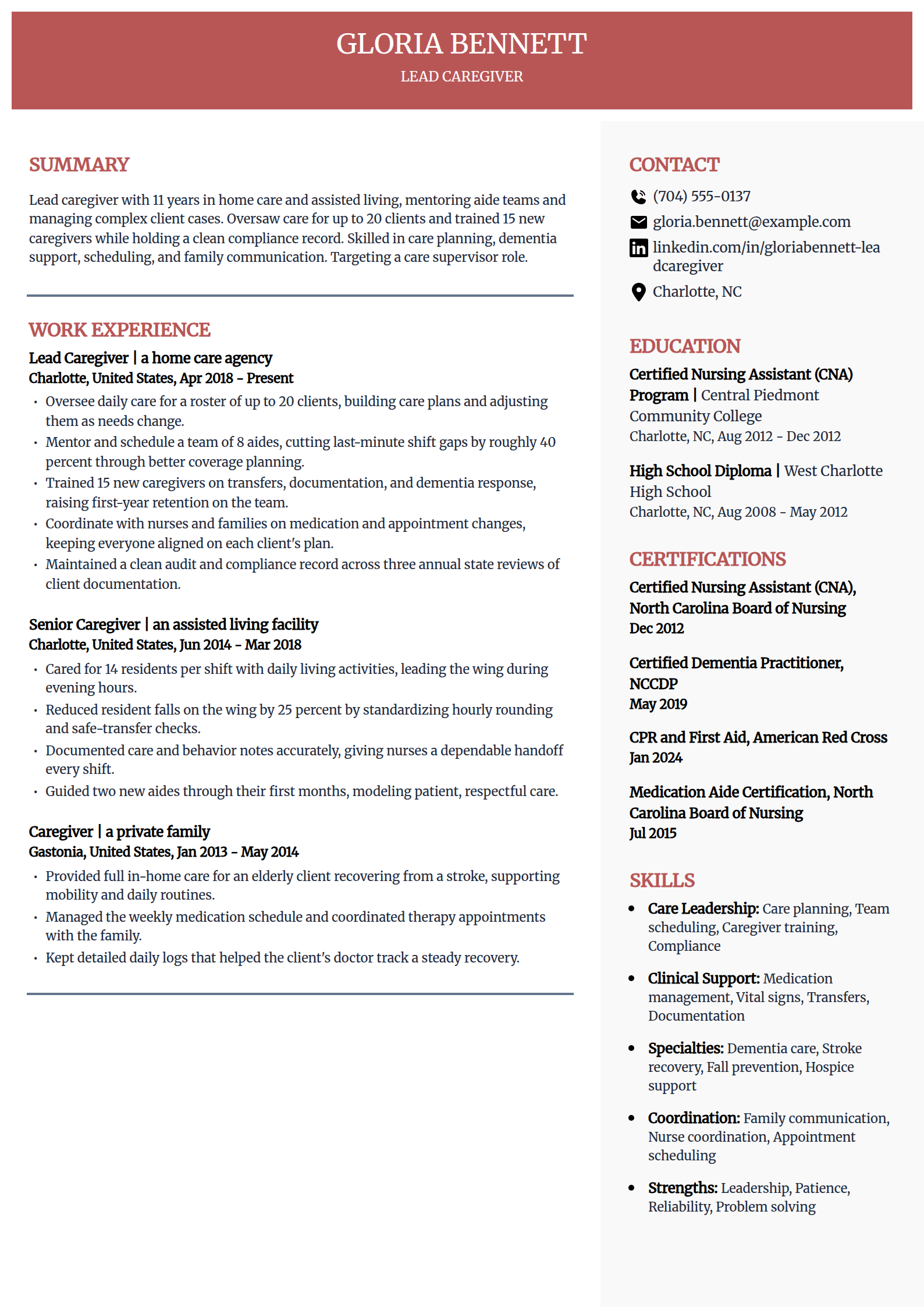
- Leads with lead-caregiver scope, 11 years, a roster of up to 20 clients, and 15 caregivers trained.
- Shows the supervision a promotion rewards, cutting last-minute shift gaps about 40 percent through better coverage.
- Backs the leadership with a clean compliance record across three annual state documentation reviews.
- Keeps each result modest and believable, one number per bullet, so the seniority reads as earned.
- Uses a refined layout that fits a long care history cleanly on one page.
Elderly & Senior Caregiver Resume Template
Why this resume example works?
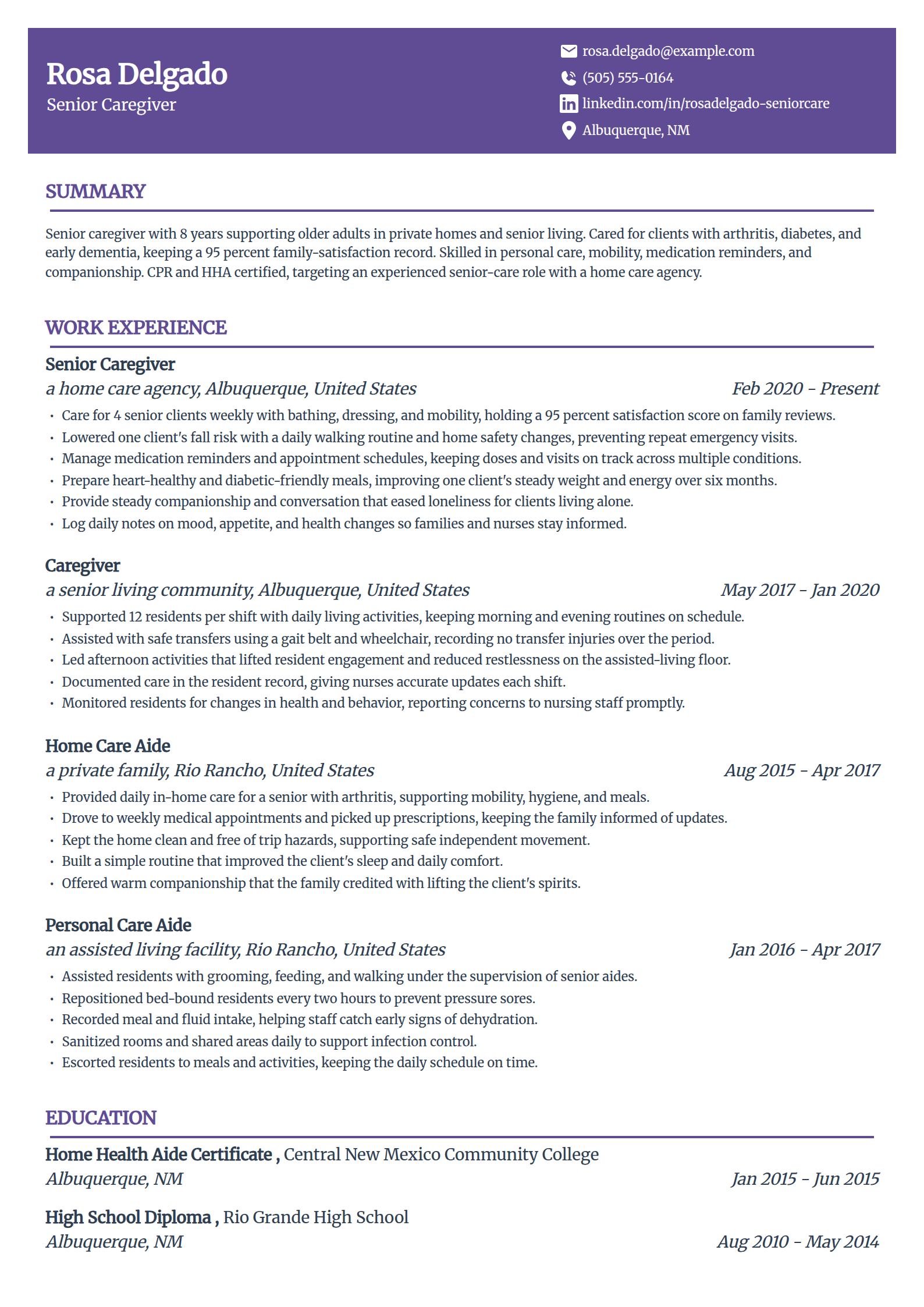
- Opens with senior-care scope, 8 years, a 95 percent family-satisfaction record, and HHA certification.
- Names the conditions a senior-care posting lists, arthritis, diabetes, and early dementia, with matching care.
- Shows real outcomes, like lowering a client's fall risk with a daily walking routine and home safety changes.
- Keeps duties scope-accurate: personal care, safe transfers with a gait belt, medication reminders, and companionship.
- Uses a clean, modern layout that carries a dense senior-care history on one page.
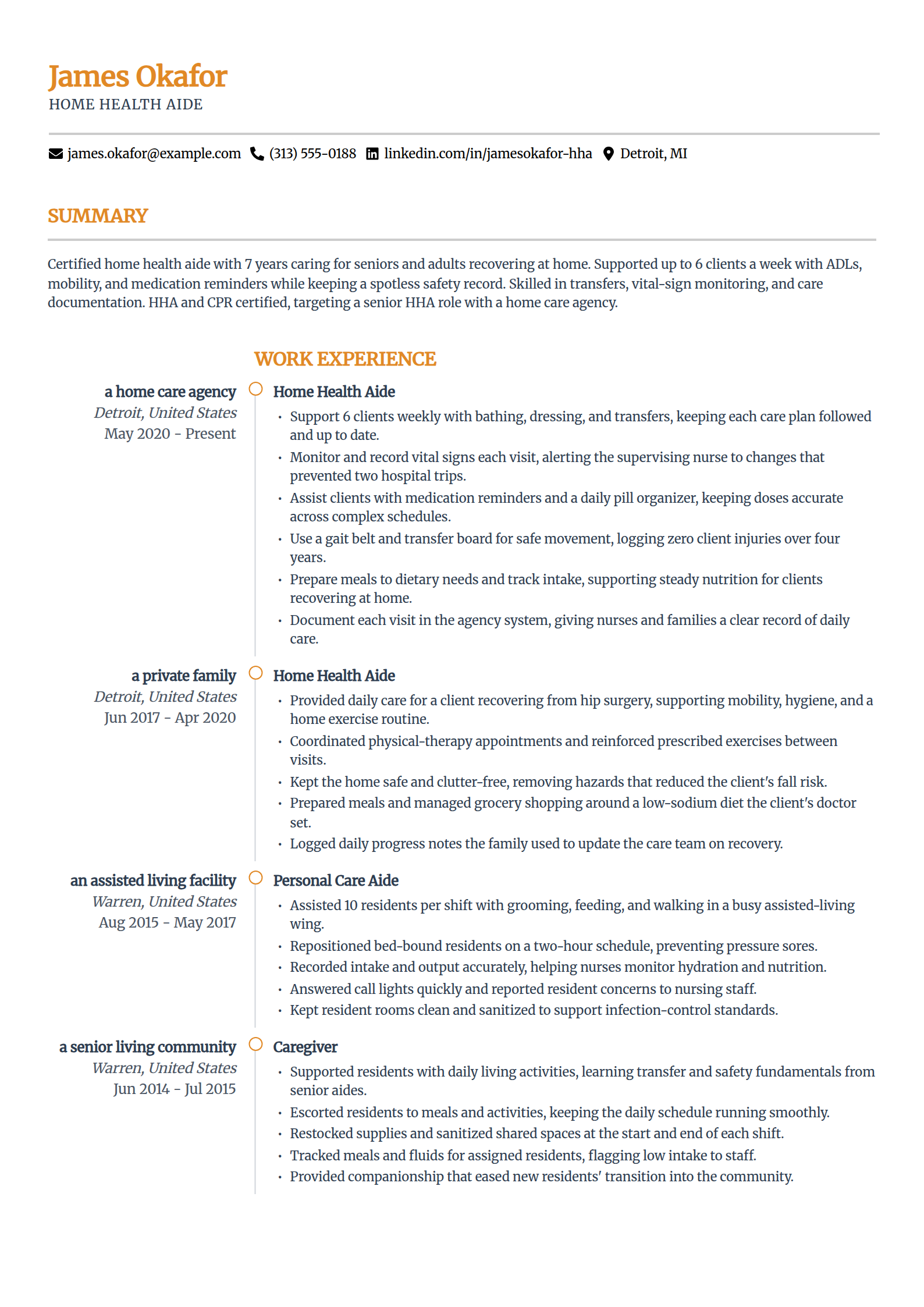
Home Health Aide (HHA) Resume Template
Why this resume example works?
- Leads with HHA scope, 7 years, up to 6 clients a week, and a spotless safety record.
- Shows the recovery work agencies hire for, supporting a client after hip surgery with mobility and prescribed exercises.
- Ties vital-sign monitoring to a real result, alerting the nurse to changes that prevented two hospital trips.
- Names the credentials an HHA posting screens for, HHA certification, CNA, CPR, and safe patient handling.
- Uses a modern one-page layout that carries a dense home-care history without crowding.
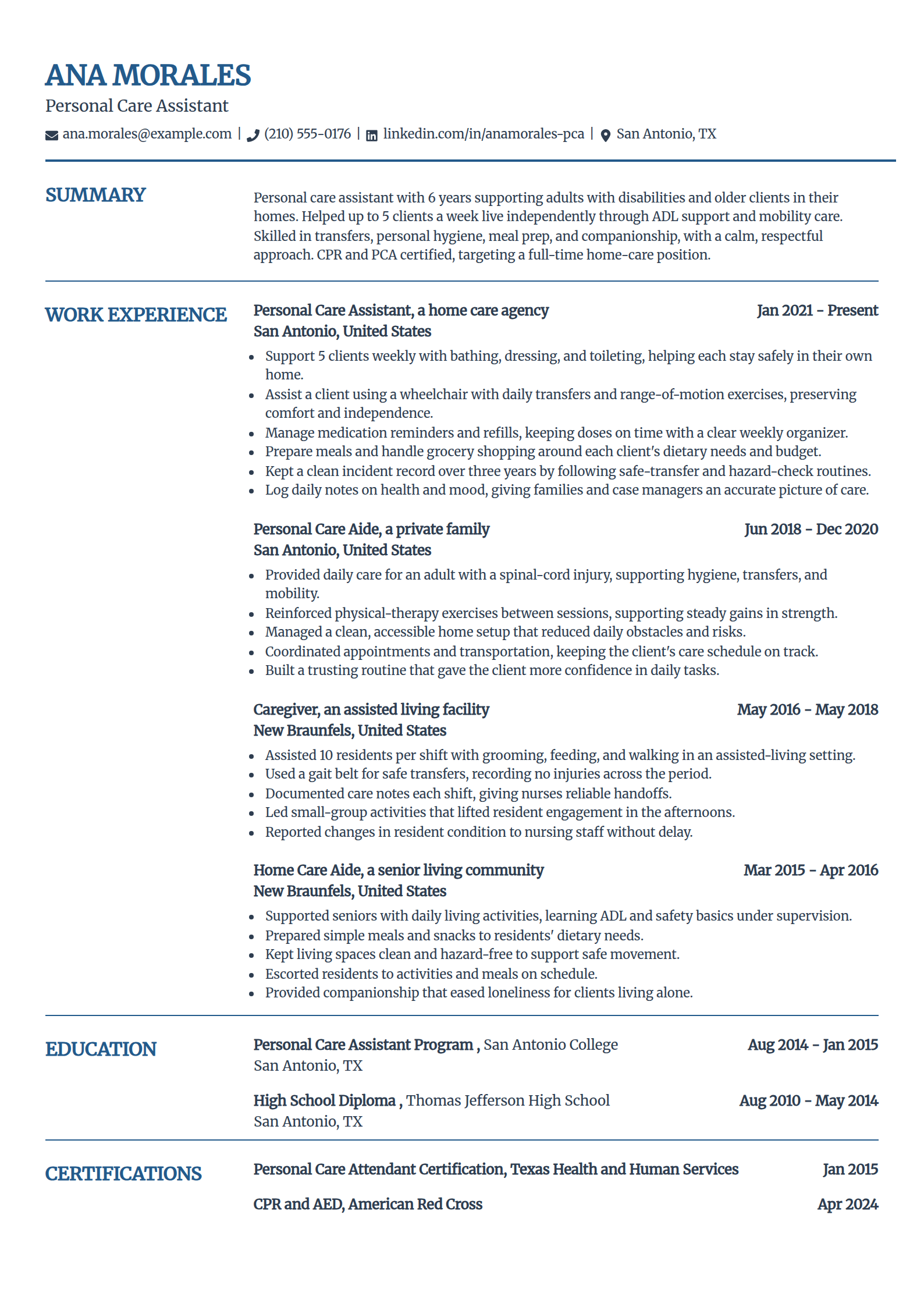
Personal Care Assistant (PCA) Resume Template
Why this resume example works?
- Opens with PCA scope, 6 years, up to 5 clients a week, and a focus on independent living.
- Shows disability-support work honestly, assisting a client with a spinal-cord injury with transfers and exercises.
- Keeps duties scope-accurate: ADLs, medication reminders, meal prep, and documentation for case managers.
- Backs the work with PCA and HHA certification plus safe-transfer training a posting recognizes.
- Uses a modern layout that reads cleanly for a hiring family or agency.
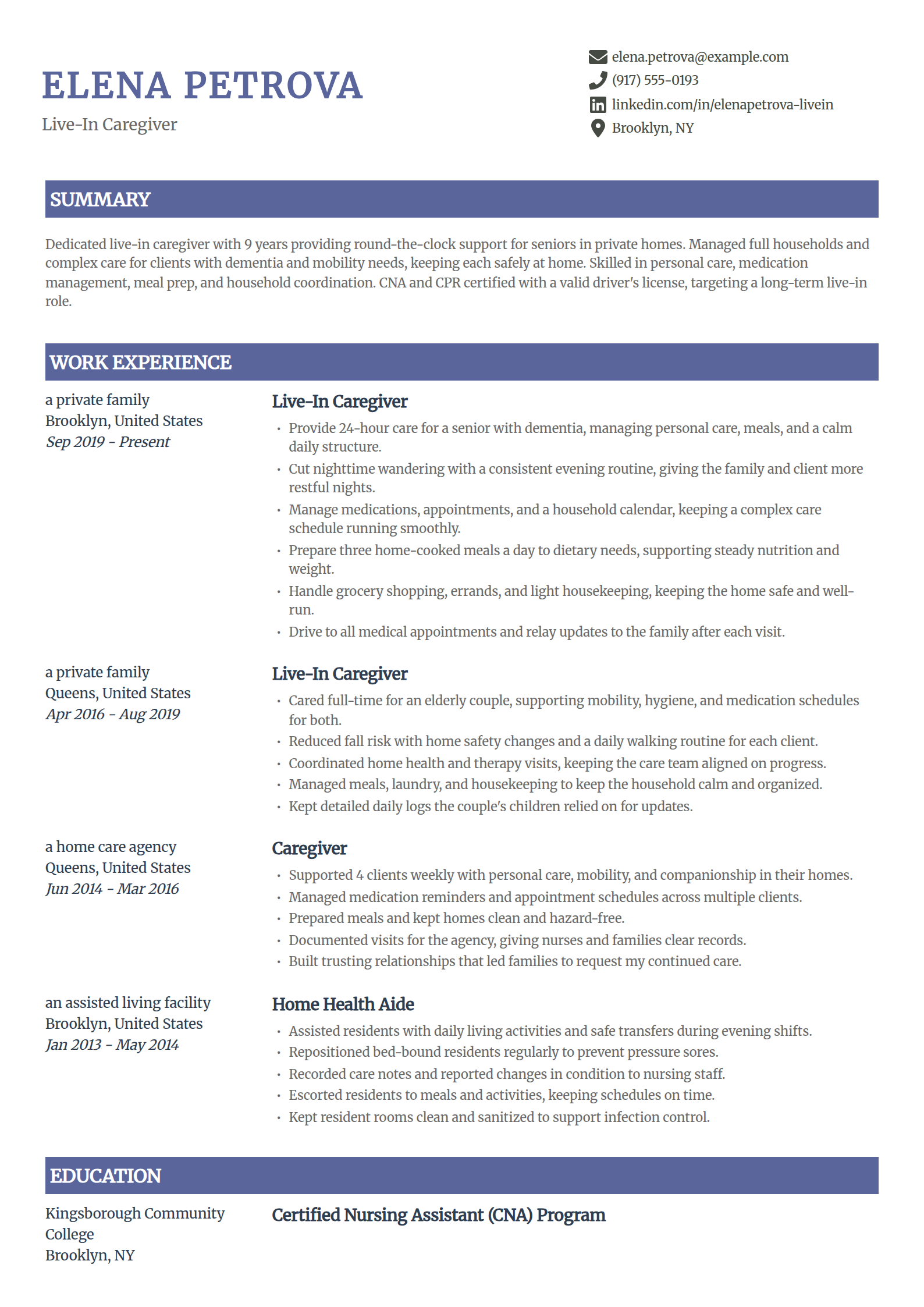
Live-In Caregiver Resume Template
Why this resume example works?
- Leads with live-in scope, 9 years of round-the-clock care and full household management for seniors.
- Shows the dementia work families need, cutting nighttime wandering with a consistent evening routine.
- Balances care and home life, managing medications, appointments, meals, and a household calendar.
- Notes a valid driver's license and CNA certification, the credentials a live-in posting expects.
- Uses a results-first layout that stays easy to skim in one pass.
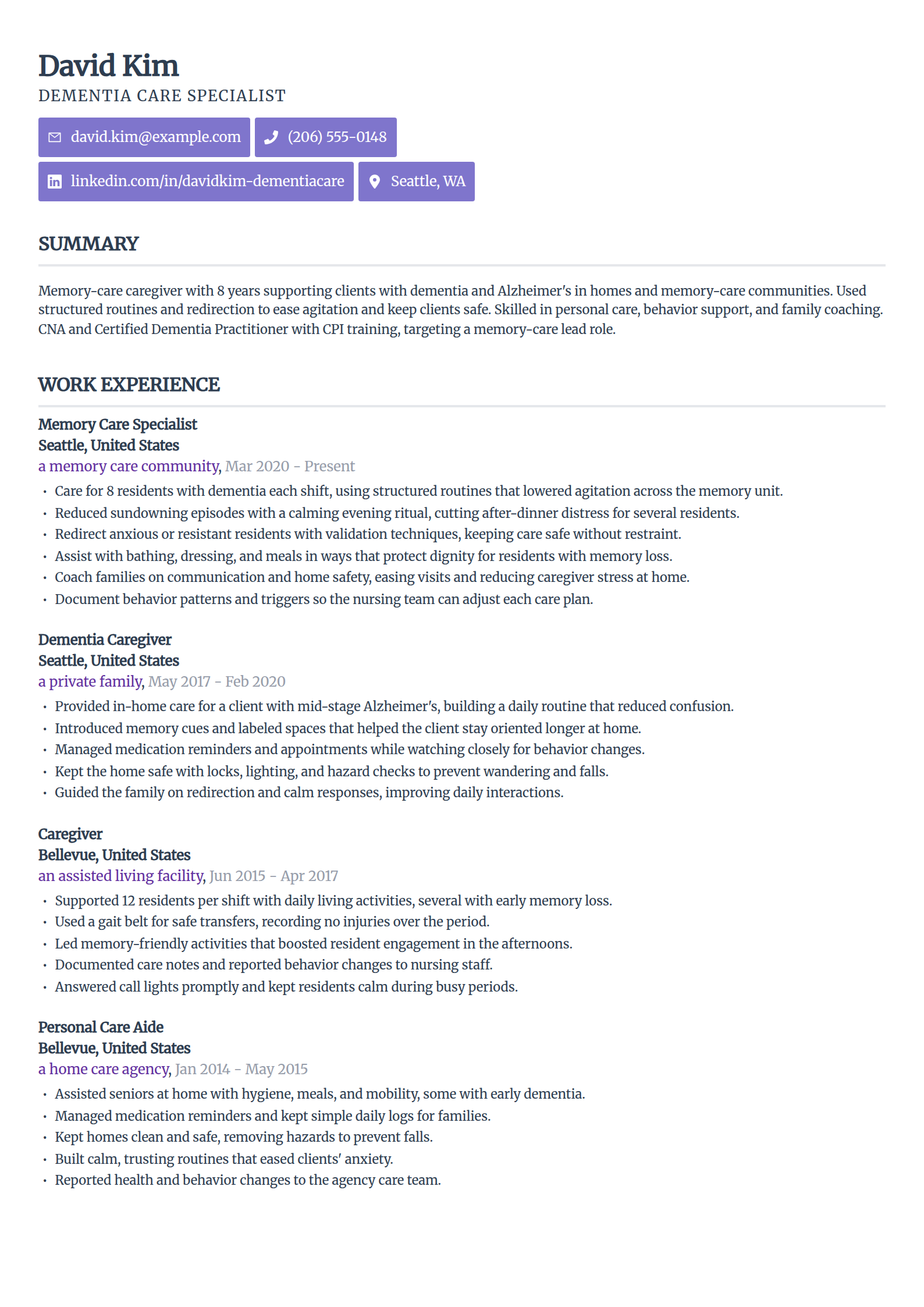
Dementia & Alzheimer's Caregiver Resume Template
Why this resume example works?
- Opens with memory-care scope, 8 years using structured routines and redirection to keep clients calm and safe.
- Shows a real result, easing sundowning with a calming evening ritual that cut after-dinner distress.
- Keeps the approach safe and honest, redirecting resistant residents with validation, never restraint.
- Backs the work with a Certified Dementia Practitioner credential, CPI training, and Alzheimer's Association training.
- Uses a clean, modern layout that carries a dense memory-care history on one page.
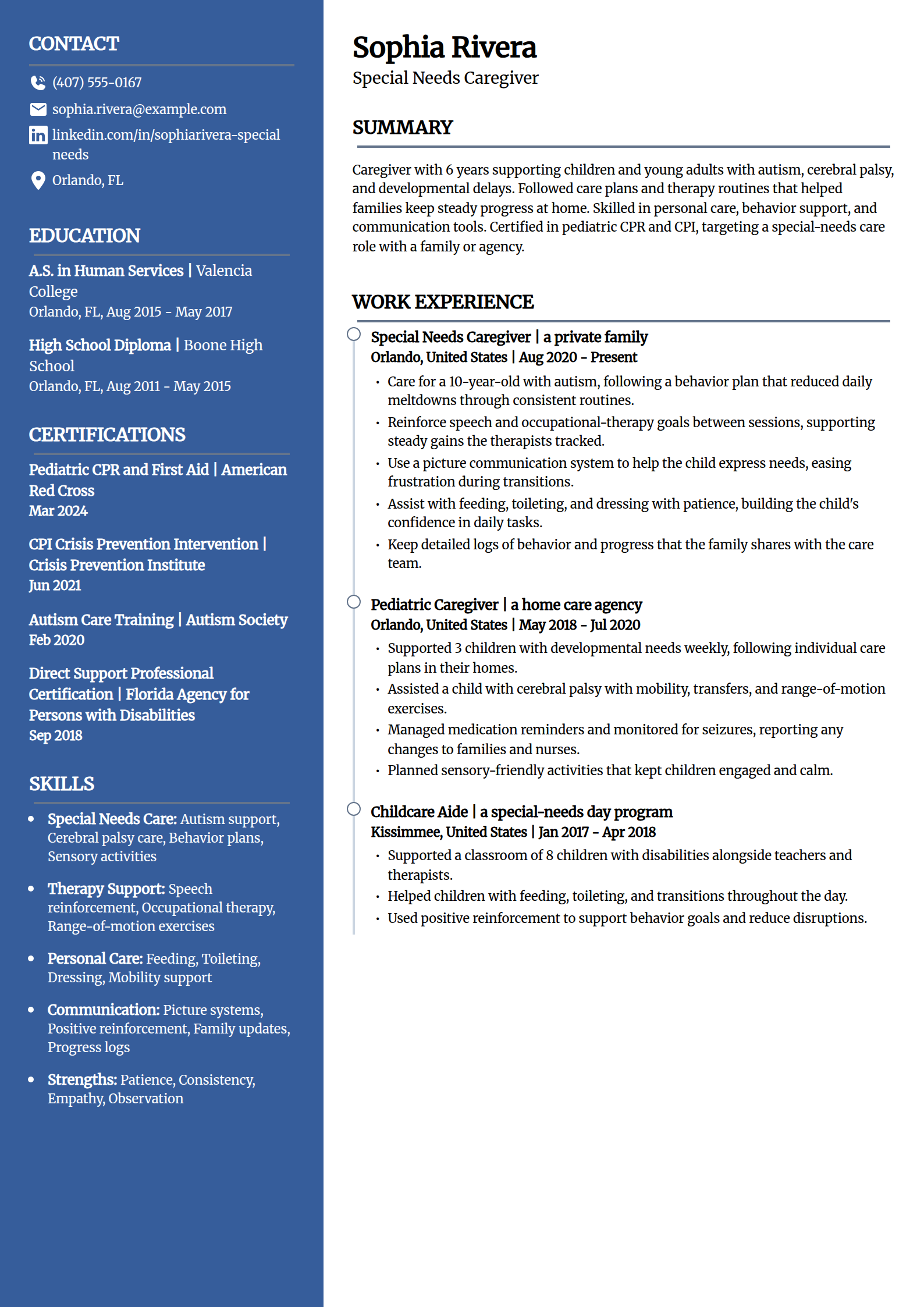
Special Needs Caregiver Resume Template
Why this resume example works?
- Frames special-needs scope, 6 years supporting children with autism, cerebral palsy, and developmental delays.
- Shows the therapy support families value, reinforcing speech and occupational-therapy goals between sessions.
- Names a real tool, a picture communication system that helped a child express needs and ease transitions.
- Backs the work with pediatric CPR, CPI, and autism-care training a special-needs posting recognizes.
- Uses a distinctive layout that still reads cleanly for a hiring family.
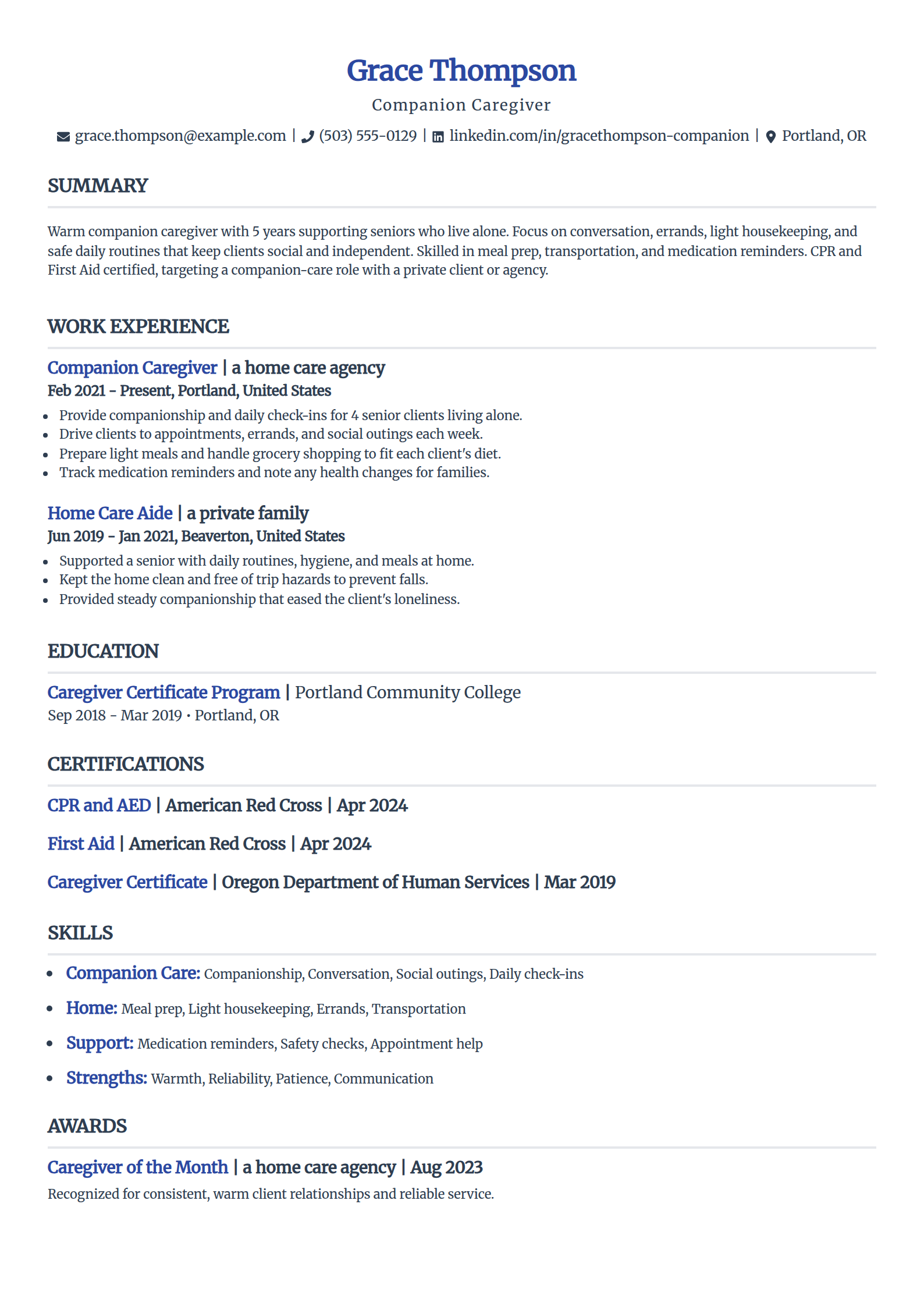
Companion Caregiver Resume Template
Why this resume example works?
- Written for companion care, leading with 5 years supporting seniors who live alone.
- Keeps the focus where the role sits, on companionship, errands, transportation, and safe daily routines.
- Names light, honest duties, meal prep, medication reminders, and social outings, without over-claiming.
- Fills the sidebar with a Caregiver of the Month award instead of padding.
- Uses a plain, ATS-safe layout that fits a focused companion-care record on one page.
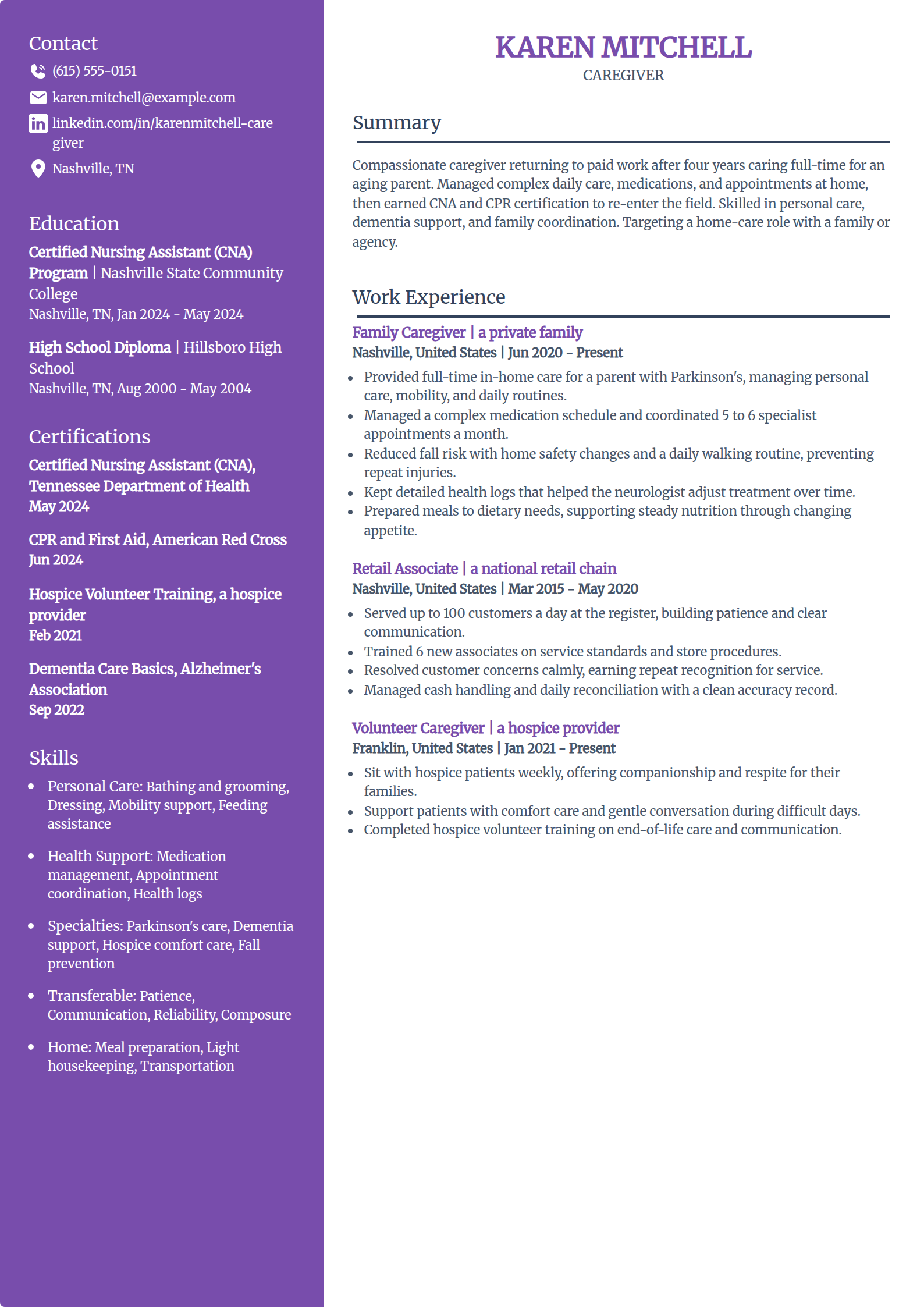
Family Caregiver Returning to Work Resume Template
Why this resume example works?
- Names the gap openly, reframing four years caring full-time for a parent with Parkinson's as real experience.
- Shows recent commitment with a new CNA credential earned to re-enter the field.
- Pulls transferable proof forward, managing a complex medication schedule and 5 to 6 appointments a month.
- Bridges the resume with prior retail work that built patience and clear communication.
- Uses a Medium layout that fills a returner's record without empty space.
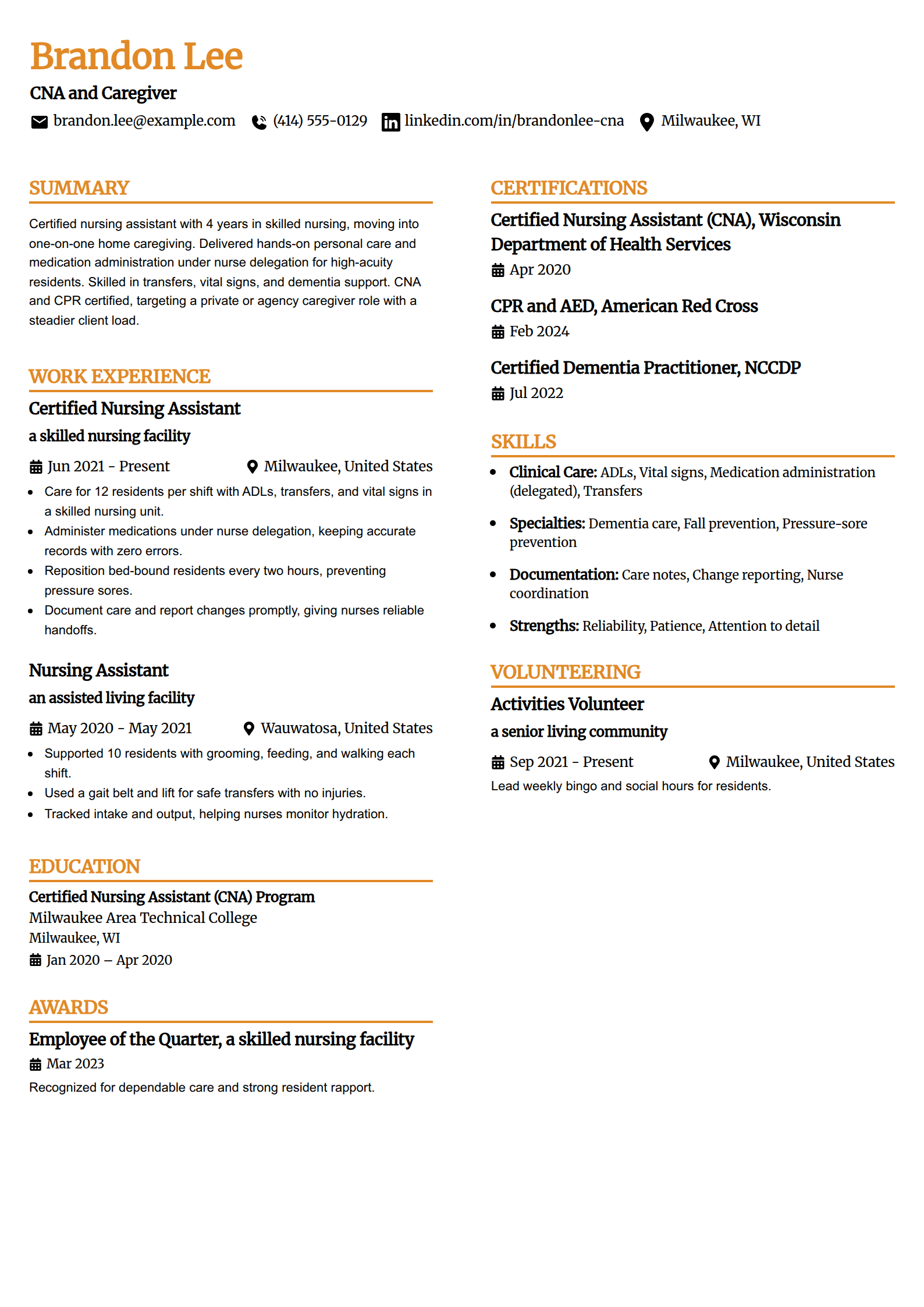
CNA Caregiver Resume Template
Why this resume example works?
- Leads with CNA scope, 4 years in skilled nursing moving into one-on-one home caregiving.
- Keeps the one clinical claim precise, administering medications under nurse delegation with an accurate record.
- Shows core CNA work, ADLs, transfers, vital signs, and repositioning to prevent pressure sores.
- Fills the sidebar with an Employee of the Quarter award and a volunteer activities role.
- Uses a refined layout that fits a focused CNA record on one clean page.
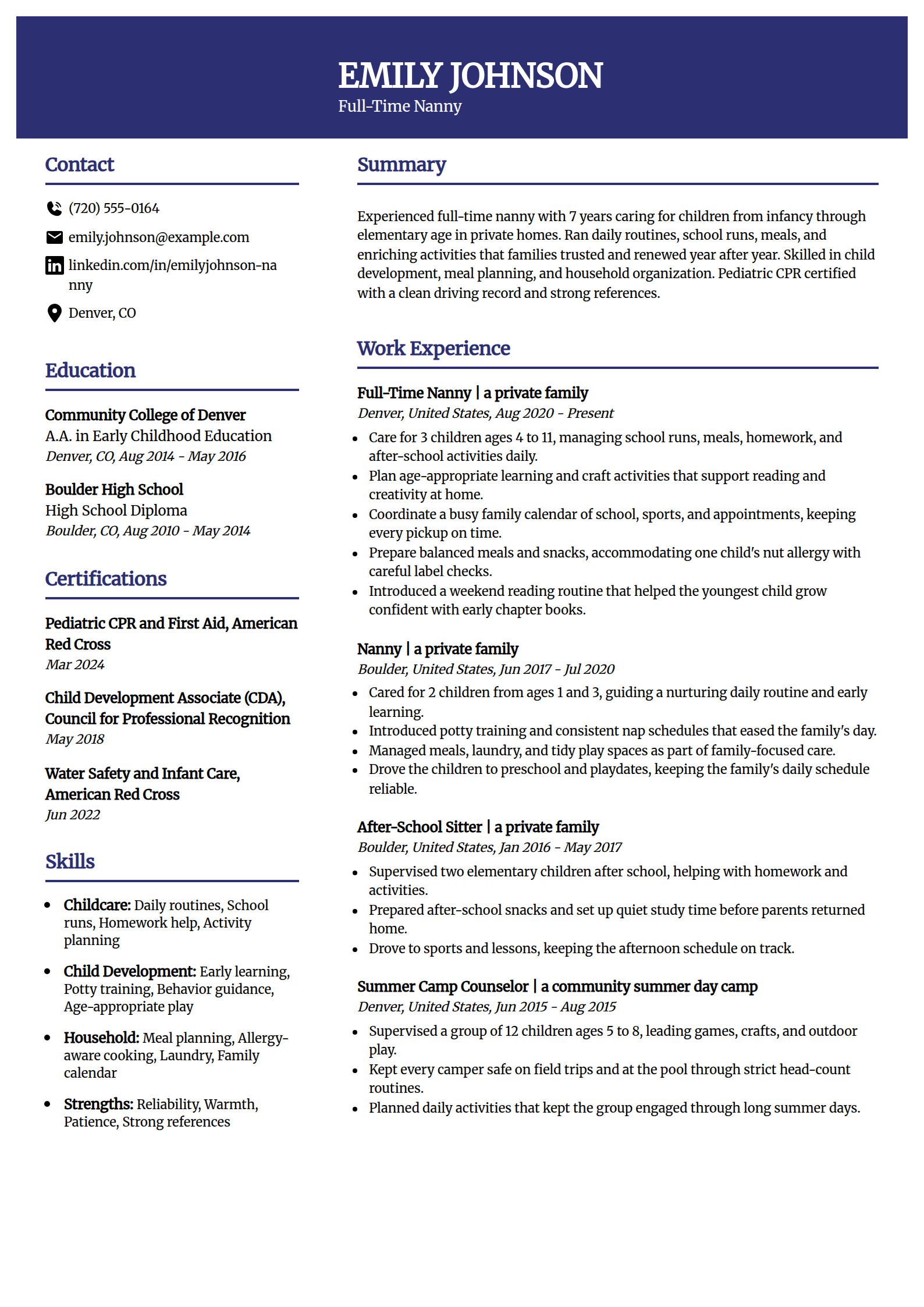
Nanny Resume Template
Why this resume example works?
- Opens with nanny scope, 7 years caring for children from infancy through elementary age in private homes.
- Shows the trust families renew for, running school runs, meals, homework, and a busy family calendar.
- Handles safety without medical claims, accommodating one child's nut allergy with careful label checks.
- Names the credentials a nanny posting lists, pediatric CPR, a CDA, a clean driving record, and strong references.
- Uses a roomy two-column layout with the sidebar filled so the record reads complete.
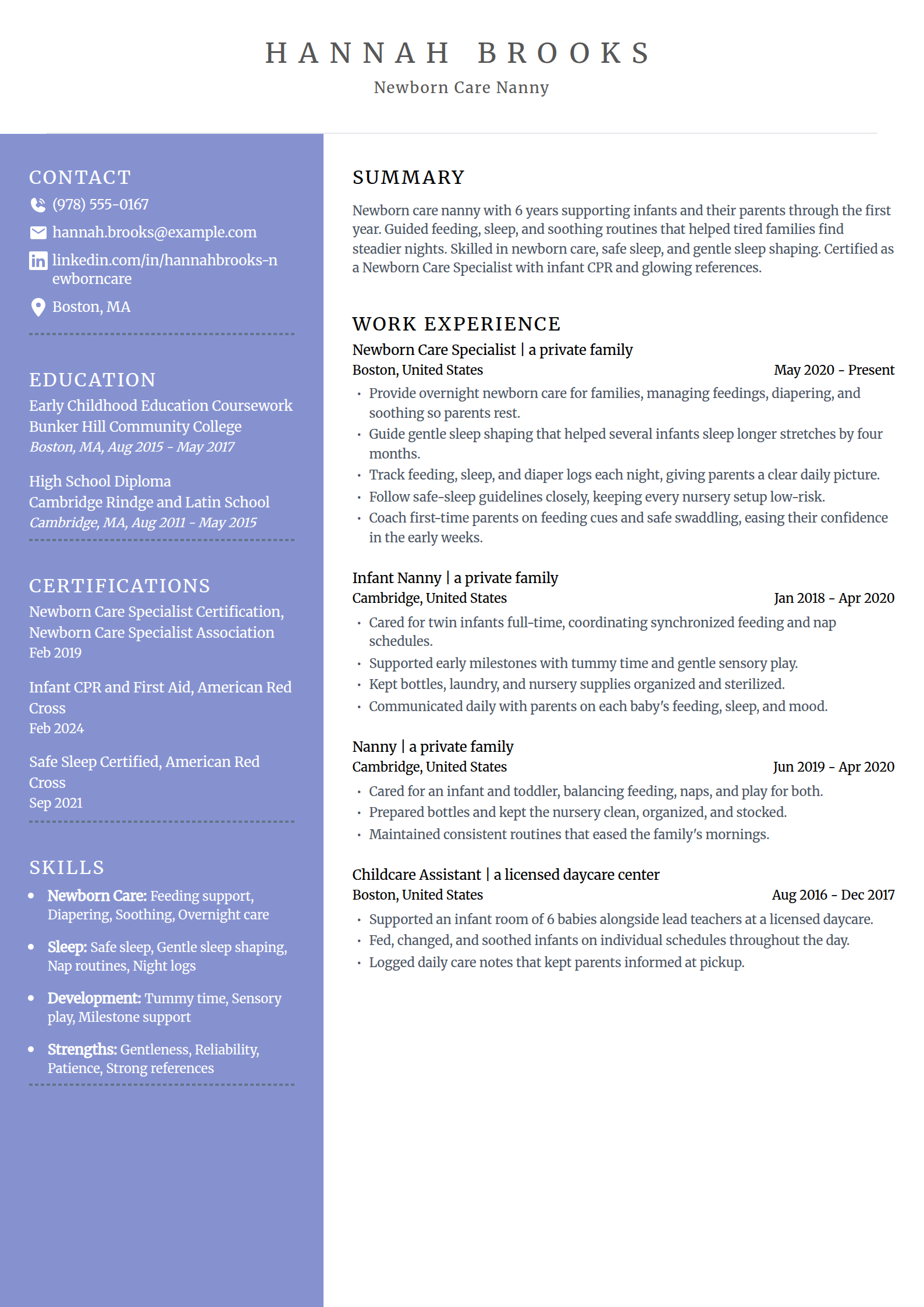
Newborn & Infant Nanny Resume Template
Why this resume example works?
- Frames newborn scope, 6 years supporting infants and parents through the first year.
- Shows the overnight work new parents hire for, managing feedings, diapering, and soothing so parents rest.
- Keeps claims gentle and honest, guiding safe sleep and gentle sleep shaping, never medical treatment.
- Backs the work with a Newborn Care Specialist certification and infant CPR.
- Uses a roomy layout with a filled sidebar so a focused newborn-care record still looks full.
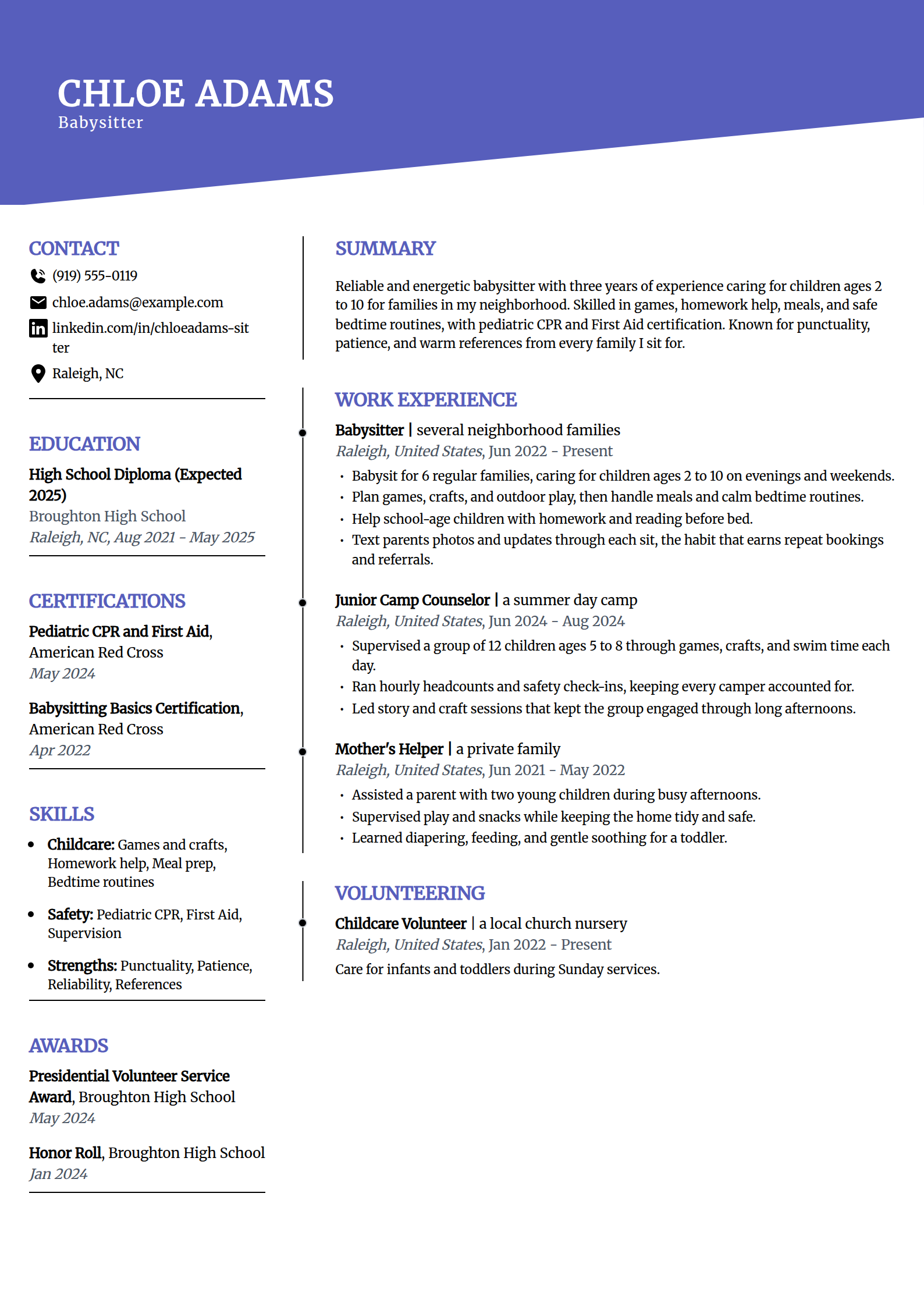
Babysitter Resume Template
Why this resume example works?
- Written for a first resume, leading with three years sitting for 6 neighborhood families and pediatric CPR.
- Keeps numbers teen-appropriate, ages 2 to 10 and families served, with no inflated impact claims.
- Shows real babysitter duties, games, homework help, meals, and calm bedtime routines.
- Fills the page with school awards and church-nursery volunteering instead of padding.
- Lists awards without long descriptions, keeping the layout clean and balanced.
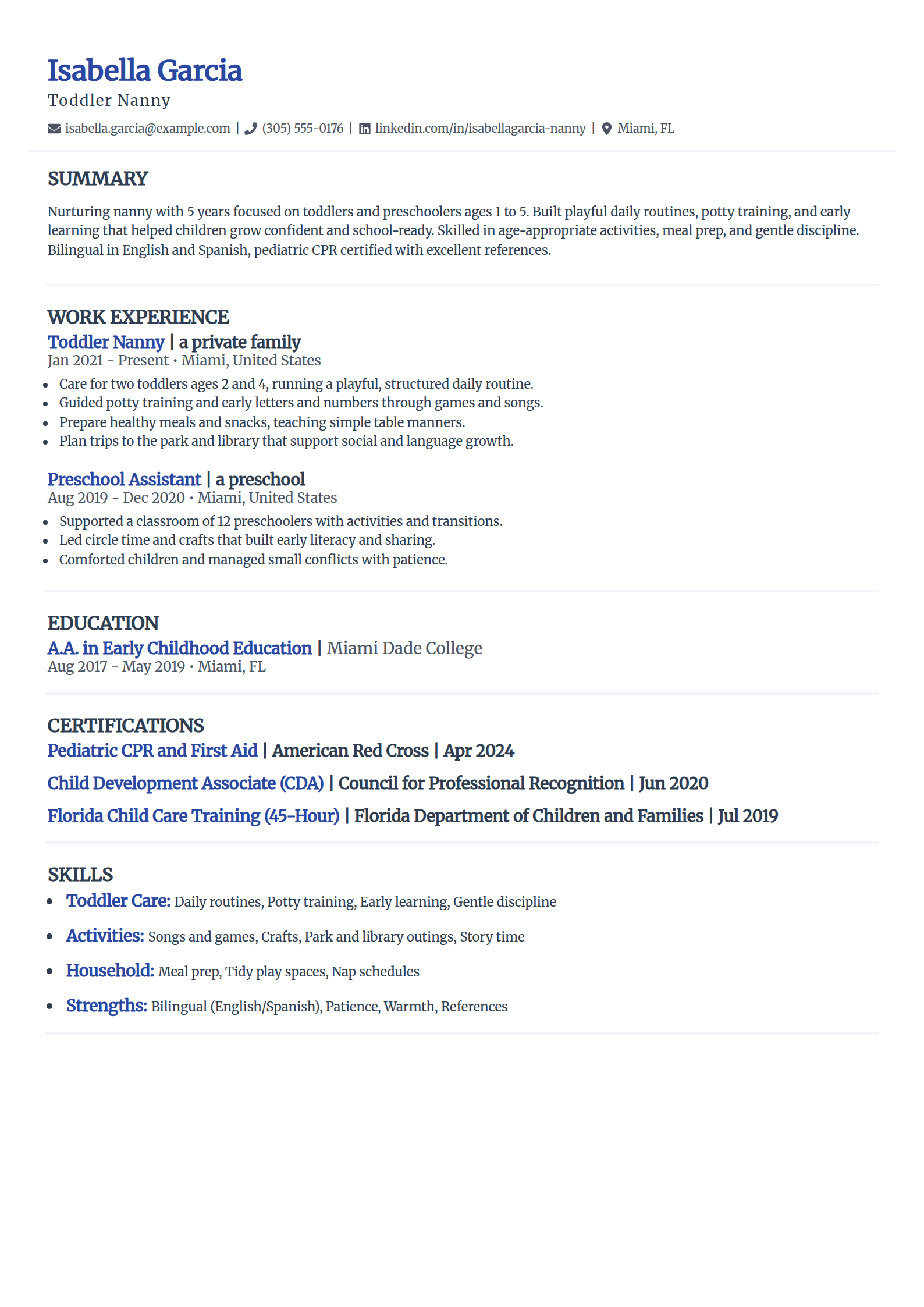
Toddler & Preschool Nanny Resume Template
Why this resume example works?
- Leads with toddler focus, 5 years caring for children ages 1 to 5 with playful, structured routines.
- Shows early-learning work families want, potty training and early letters and numbers through games and songs.
- Adds a real differentiator, bilingual English and Spanish, alongside pediatric CPR and a CDA.
- Keeps two focused roles tight and readable with a preschool-assistant role rounding out the record.
- Uses a refined, uncluttered layout that keeps the focus on care and early learning.
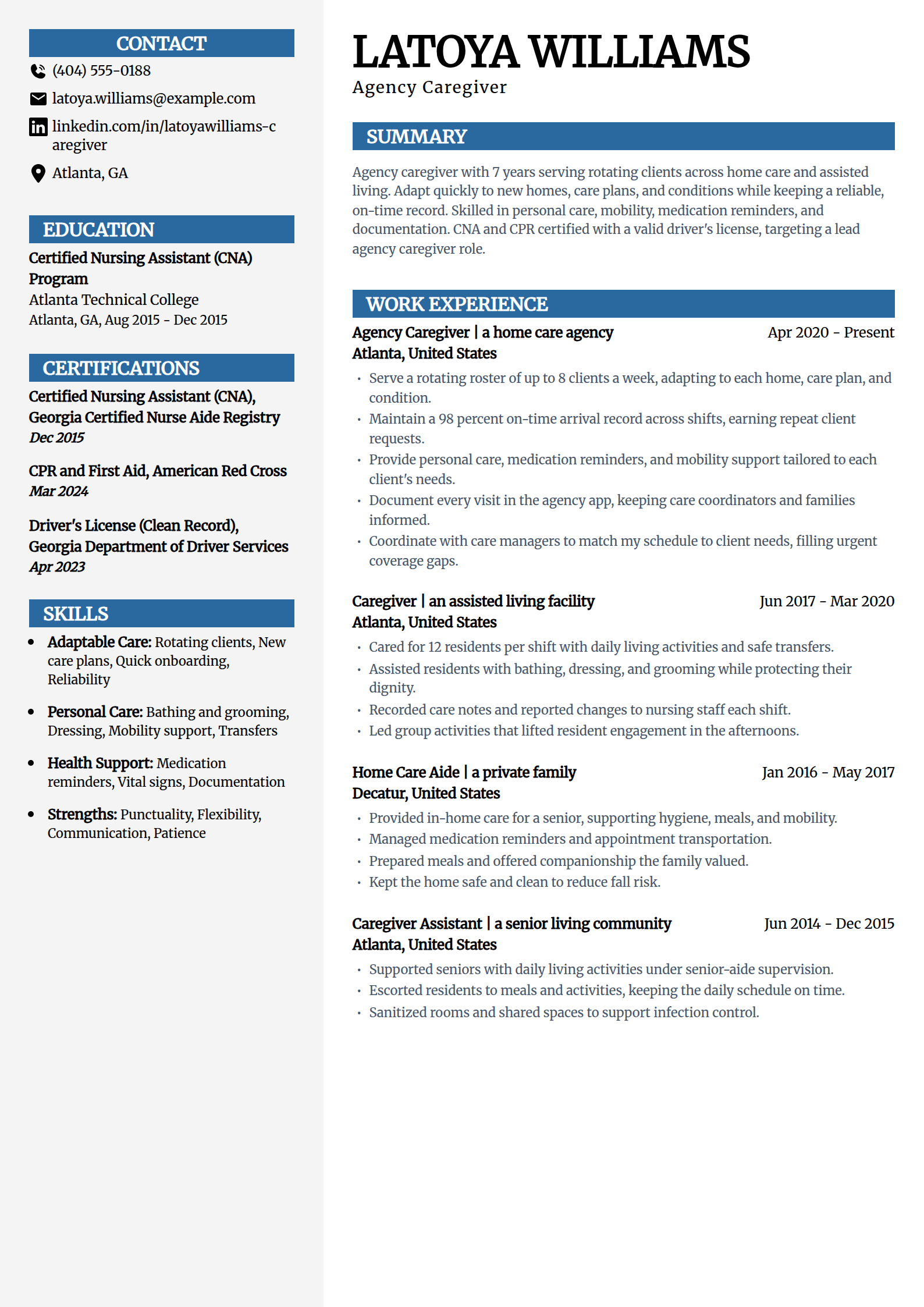
Agency Caregiver Resume Template
Why this resume example works?
- Opens with agency scope, 7 years serving a rotating roster of up to 8 clients a week.
- Shows the reliability agencies value, a 98 percent on-time arrival record that earned repeat client requests.
- Highlights adaptability, adjusting quickly to each new home, care plan, and condition.
- Notes CNA certification and a valid driver's license, the credentials an agency posting expects.
- Uses a two-column layout with a filled sidebar that carries a varied agency record cleanly.
Build your caregiver or nanny resume
Pick a template above and the editor keeps your layout clean, one-page, and ATS-safe while you swap in your own clients, ages, duties, and certifications.
Build my resumeHow to write a caregiver or nanny resume in 2026
A family or agency reads a care resume fast, checking two things: do you hold the certifications the role needs, and can you prove you gave safe, hands-on care. Lead with a short summary, put your credentials where they are easy to find, and back each role with concrete duties and one modest number. These moves make yours easy to trust and easy for an applicant tracking system to parse.
Open with a short caregiver summary
Write three to four sentences that name your years and specialty, your caseload or the ages you care for, your strongest certifications, and the role you are targeting. Lead with the care you gave, not what you want from the family. Keep it to about 60 words so it never spills past the top of the page.
Compassionate professional caregiver with 6 years supporting seniors and adults with disabilities across private homes and assisted living. Cared for caseloads of up to 5 clients while keeping a clean safety record and strong family reviews. Skilled in personal care, mobility transfers, medication reminders, and dementia support. CPR and CNA certified, targeting a lead caregiver role.
Prove each role with duties and one number
The work a care resume is hired for is hands-on, so name the real duty and attach one credible number where you can. Open every line with a strong verb, never "Responsible for" or "Helped with".
- Impact: state the result and the number, like cutting client falls about 30 percent with grab-bar checks and a nightly routine.
- Scope: name the caseload or ages, such as caring for up to 5 clients a week or 3 children ages 4 to 11.
- Method: name the real task or tool, like using a Hoyer lift and gait belt for safe transfers with zero injuries.
- Stay in scope: reminders, monitoring, and reporting for caregivers; feeding, sleep, and play for nannies. No diagnosing or treatment.
Put your certifications and licenses up top
Families and agencies screen on credentials first, so make them easy to find near the top of the page.
- List CPR and First Aid on every caregiver and childcare resume; add CNA or HHA certification for adult-care roles that require it.
- Add specialty training where it fits: Certified Dementia Practitioner or CPI for memory care, a Newborn Care Specialist credential or CDA for childcare.
- Name a valid driver's license and clean driving record for live-in, nanny, and companion roles that involve transportation.
- Entry-level and no-experience candidates lead with fresh CPR and First Aid plus volunteer or family care in place of years.
Match skills to the words a posting uses
A care skills list should read like the job posting. Split it so a hiring family and a parser both find what they need.
- Adult care: personal care, ADLs, safe transfers, fall prevention, medication reminders, vital signs, and documentation.
- Specialties: dementia and Alzheimer's care, hospice support, post-surgery recovery, and disability support, named where they apply.
- Childcare: daily routines, meal planning, potty training, homework help, safe sleep, and age-appropriate activities.
- Soft skills that matter here: empathy, patience, reliability, discretion, and clear communication, backed by proof in your bullets.
Keep it to one clean, ATS-safe page
Home-care agencies run applicant tracking systems and families skim on a phone, so a clean one-page resume is the standard for nearly every candidate.
- Use a simple layout with standard headings a parser recognizes; the templates above are all ATS-safe.
- Hold it to one page and lead with your most recent role; cut older, unrelated jobs to make room for care duties.
- Save as a PDF so the formatting holds, then run it through the ATS resume checker for a quick format pass.
- Swap the duties and numbers in the templates above for your own clients, ages, and certifications; do not copy them as is.
Common caregiver and nanny resume mistakes
- Writing vague lines like "took care of clients" with no detail. Say what you did: "assisted 5 clients weekly with bathing, transfers, and medication reminders".
- Claiming clinical scope you do not hold. Caregivers and aides give medication reminders and monitor vitals; only a CNA administers medication, and only under nurse delegation. No IV therapy or diagnosing.
- Burying certifications at the bottom. CPR, First Aid, CNA, and HHA are what a family screens for first, so put them where they are easy to find.
- Inflating numbers, especially on entry-level and babysitter resumes. Volunteer care, family care, and ages of children are believable; a fake impact percentage is not.
- Using a busy, graphics-heavy design that a home-care agency's applicant tracking system cannot parse. A clean, one-page layout is the safer choice.
Frequently asked questions
How do you write a caregiver resume?
Lead with a three-to-four-sentence summary that names your years, specialty, caseload, strongest certifications, and target role. Put CPR, First Aid, and any CNA or HHA certification near the top where a family or agency reads them first. Under each job, write duty-first bullets that open with a strong verb and carry one modest number, like caring for up to 5 clients a week or cutting falls about 30 percent with a nightly routine. Keep every duty in scope, reminders and monitoring rather than diagnosing, and hold the whole resume to one clean page.
What should a caregiver resume with no experience include?
Lead with the proof you do have. A no-experience caregiver leads with fresh CPR and First Aid certification, then shows unpaid care as real experience: caring for a family member, volunteering at a senior center, or a babysitting record. Keep each bullet concrete, like managing a medication reminder schedule or removing trip hazards to prevent falls, and fill the page with a volunteer award instead of padding. Modest, believable details beat an inflated number that reads as invented. The entry-level and babysitter examples above show the shape.
What certifications should be on a caregiver or nanny resume?
CPR and First Aid belong on nearly every caregiver and childcare resume. For adult care, add a CNA or HHA certification where the role requires it, plus specialty training like a Certified Dementia Practitioner credential or CPI for memory care. For childcare, add a Newborn Care Specialist certification or a Child Development Associate (CDA), and note a clean driving record for nanny and live-in roles that involve transportation. List certifications near the top so a family or agency finds them fast, and only claim credentials you actually hold.
How do you write a nanny or babysitter resume?
Lead on trust, reliability, and the ages you care for, not medical claims. Name your years with children, the ages you have cared for, and the real duties you handle: school runs, meals, homework, safe sleep, potty training, and age-appropriate activities. Put pediatric CPR and First Aid, a clean driving record, and strong references near the top, since families screen on those first. A first-time babysitter leads with CPR certification and a record of sitting for neighborhood families. The nanny, newborn, toddler, and babysitter examples above show the format.
How long should a caregiver resume be?
One page is the standard for nearly every caregiver, nanny, and babysitter. Home-care agencies run applicant tracking systems, and families skim fast on a phone, so a single, clean page led by your most recent role is what they expect. Only a very experienced lead caregiver with a long, relevant history might run slightly longer, and never past two pages. Cut older, unrelated jobs to make room for care duties, certifications, and the ages or caseload you have handled.
What skills should a caregiver put on a resume?
Match the posting, then group your skills so a parser and a family both find them. Adult-care resumes list personal care, ADLs, safe transfers, fall prevention, medication reminders, vital signs, and documentation, plus specialties like dementia or hospice support where they apply. Childcare resumes list daily routines, meal planning, potty training, homework help, safe sleep, and age-appropriate activities. Add the soft skills the work depends on, empathy, patience, reliability, and clear communication, and back each one with proof in your bullets rather than a bare list.
More caregiver resume resources
Build your caregiver or nanny resume
Pick a template above and the editor keeps your layout clean, one-page, and ATS-safe while you swap in your own clients, ages, duties, and certifications.