Nanny Resume Examples, Reference-Ready and ATS-Safe
- ATS Friendly
- Nanny & Newborn Specific
- 16 Real Examples
Families hire on trust: the ages you have cared for, how long you stayed, and the credentials at the top of the page. Start from a layout below, then model your own on a real example built for your track, from a first-time sitter to a newborn care specialist or a live-in household manager. Every example keeps a clean, one-page layout a parser reads without trouble.


540k+ resumes created
Nanny resume templates for every age and household
Each template below is a real nanny resume laid out in that format, sorted by specialty and experience level across full-time, live-in, newborn care, nanny-share, special-needs, and the babysitter-to-nanny path. Pick one, then swap in your own ages cared for, tenure, credentials, and daily duties. Every layout keeps your name, certifications, and dates clean so a hiring family reads your experience at a glance and an applicant tracking system parses it without trouble.
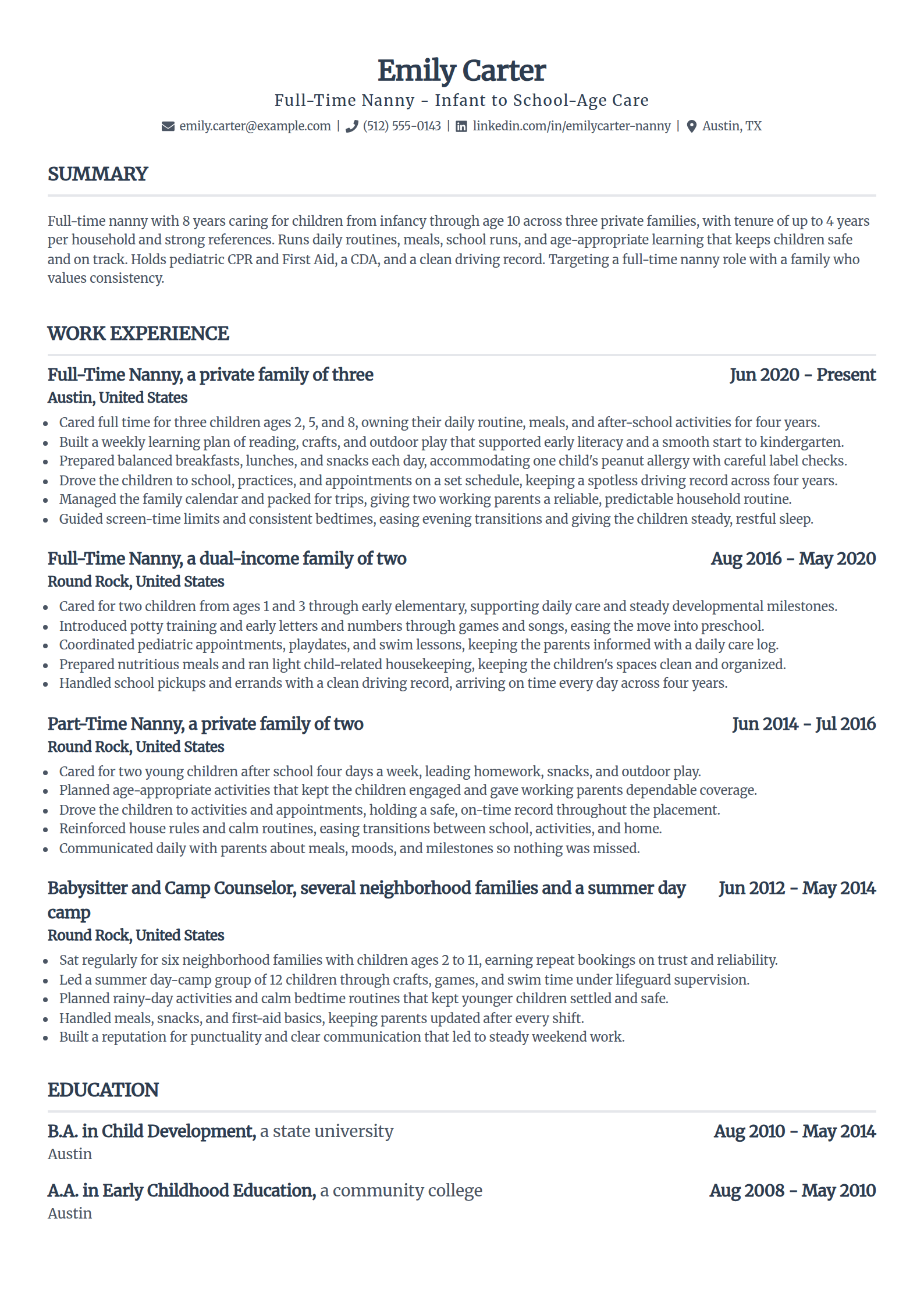
Full-Time Nanny Resume Template
Why this resume example works?
- Opens with the numbers a family screens for, 8 years caring for children infancy through age 10 with up to 4 years per household.
- Keeps every duty a nanny owns, daily routines, meals, school runs, and age-appropriate learning, not vague childcare.
- Handles safety without medical claims, accommodating one child's peanut allergy with careful label checks.
- Names the credentials a nanny posting lists, pediatric CPR, a CDA, and a clean driving record, up where they are read first.
- Uses a clean, single-column layout that a hiring family and an applicant tracking system both parse cleanly.
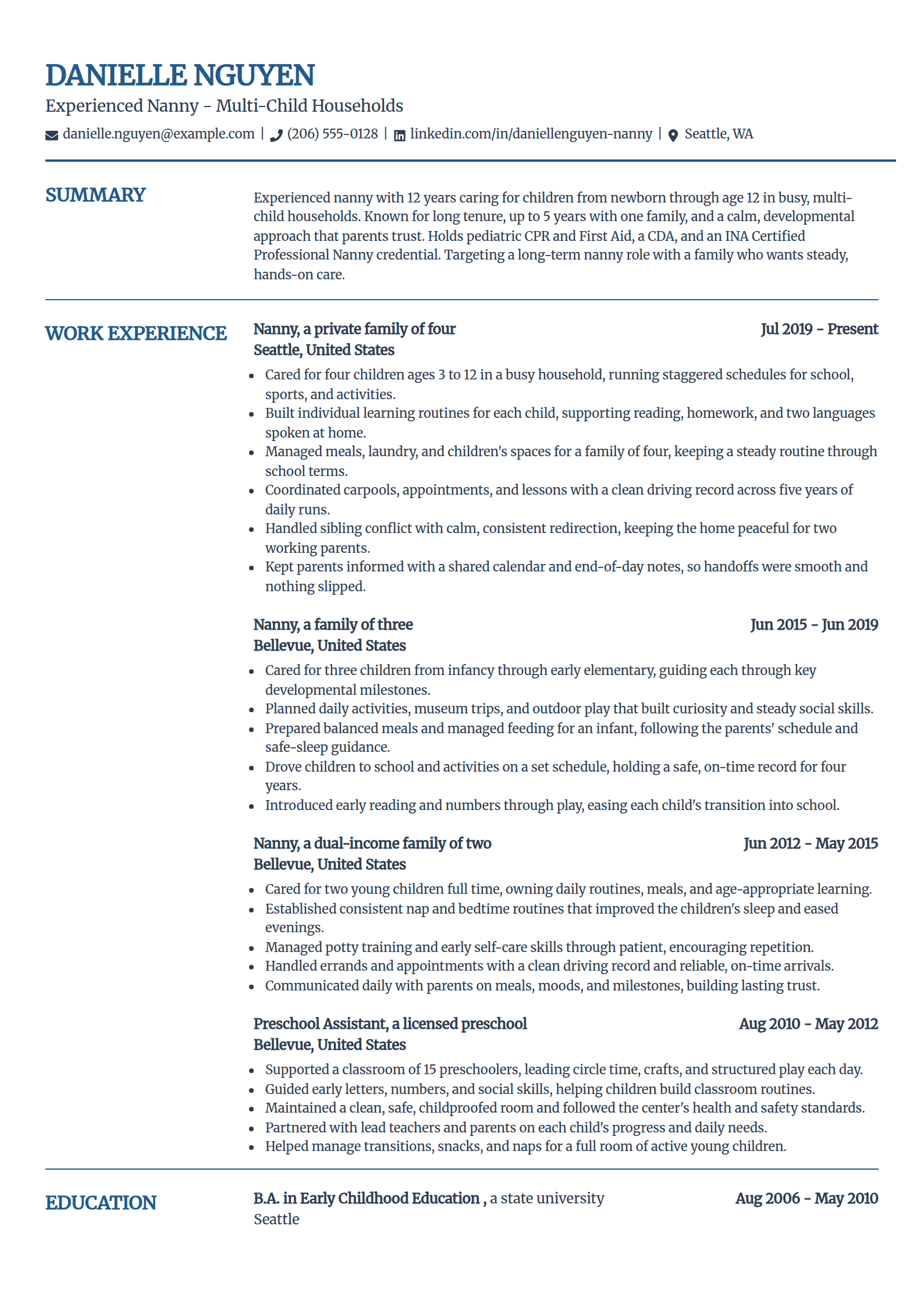
Experienced Nanny Resume Template
Why this resume example works?
- Leads with the depth a long-term role wants, 12 years caring for children newborn through age 12 in multi-child homes.
- Shows the trust that earns tenure, up to 5 years with one family running staggered school, sports, and activity schedules.
- Keeps each bullet a result, guiding milestones and easing sibling conflict with calm, consistent redirection.
- Names the credentials families verify, pediatric CPR, a CDA, and an INA Certified Professional Nanny credential.
- Uses a modern layout that carries a dense, 12-year care history on one clean page.
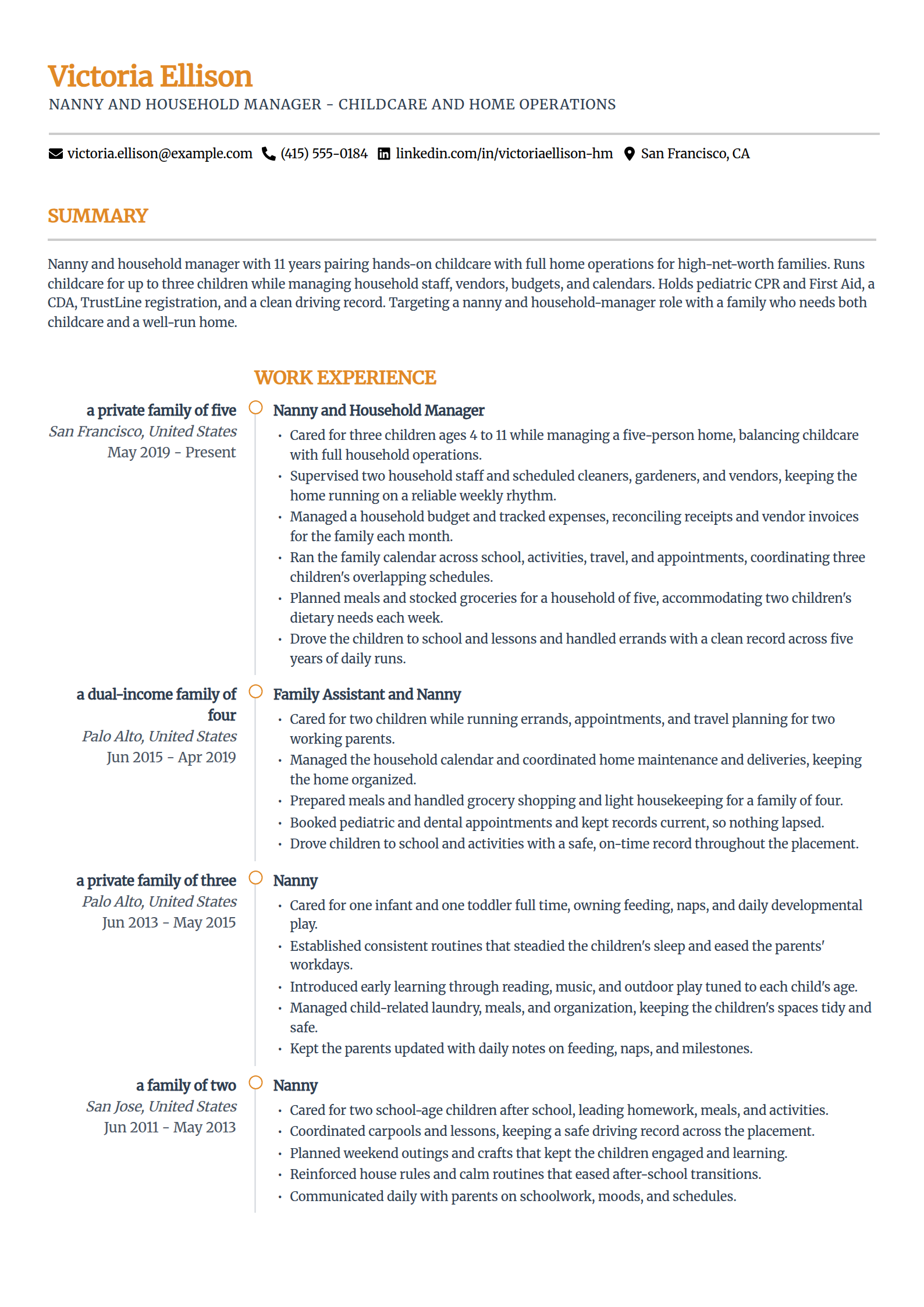
Nanny and Household Manager Resume Template
Why this resume example works?
- Leads at the right altitude, pairing childcare for three children with full home operations for a five-person household.
- Shows the ops work this hybrid role owns, supervising two staff and scheduling cleaners, gardeners, and vendors.
- Adds the numbers a principal expects, managing a household budget and reconciling vendor invoices each month.
- Names the trust credentials a private home requires, TrustLine registration, a CDA, and a clean driving record.
- Uses a modern layout that carries both a childcare and a household-management record on one page.
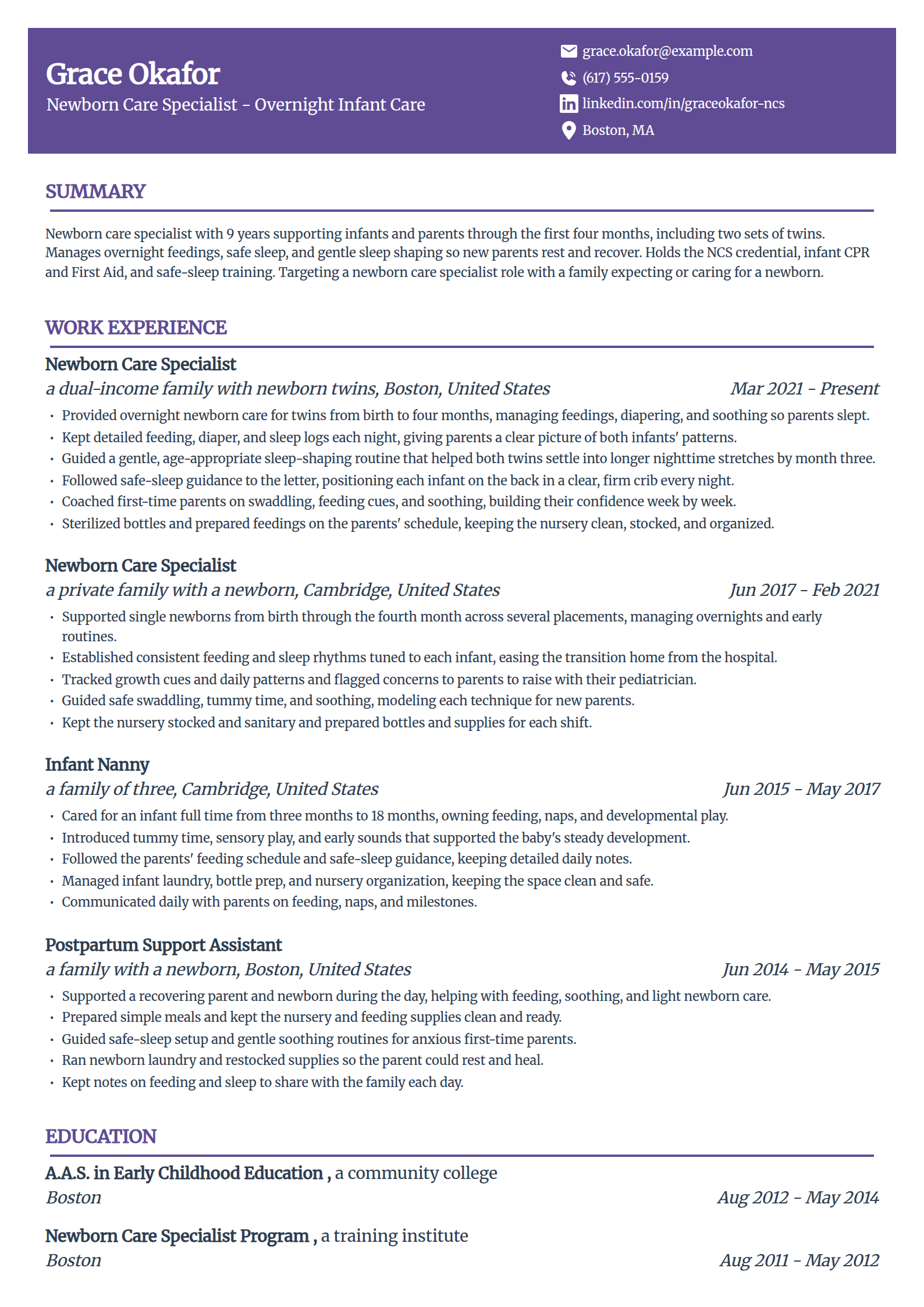
Newborn Care Specialist (NCS) Resume Template
Why this resume example works?
- Frames the specialty, 9 years supporting infants and parents through the first four months, including two sets of twins.
- Shows the overnight work new parents hire for, managing feedings, diapering, and soothing so parents sleep.
- Keeps claims safe and honest, guiding gentle sleep shaping and safe sleep, never medical treatment.
- Backs the work with the real credential set, the NCS credential, infant CPR, and safe-sleep training.
- Uses a spacious layout that carries a dense newborn-care record cleanly on one page.
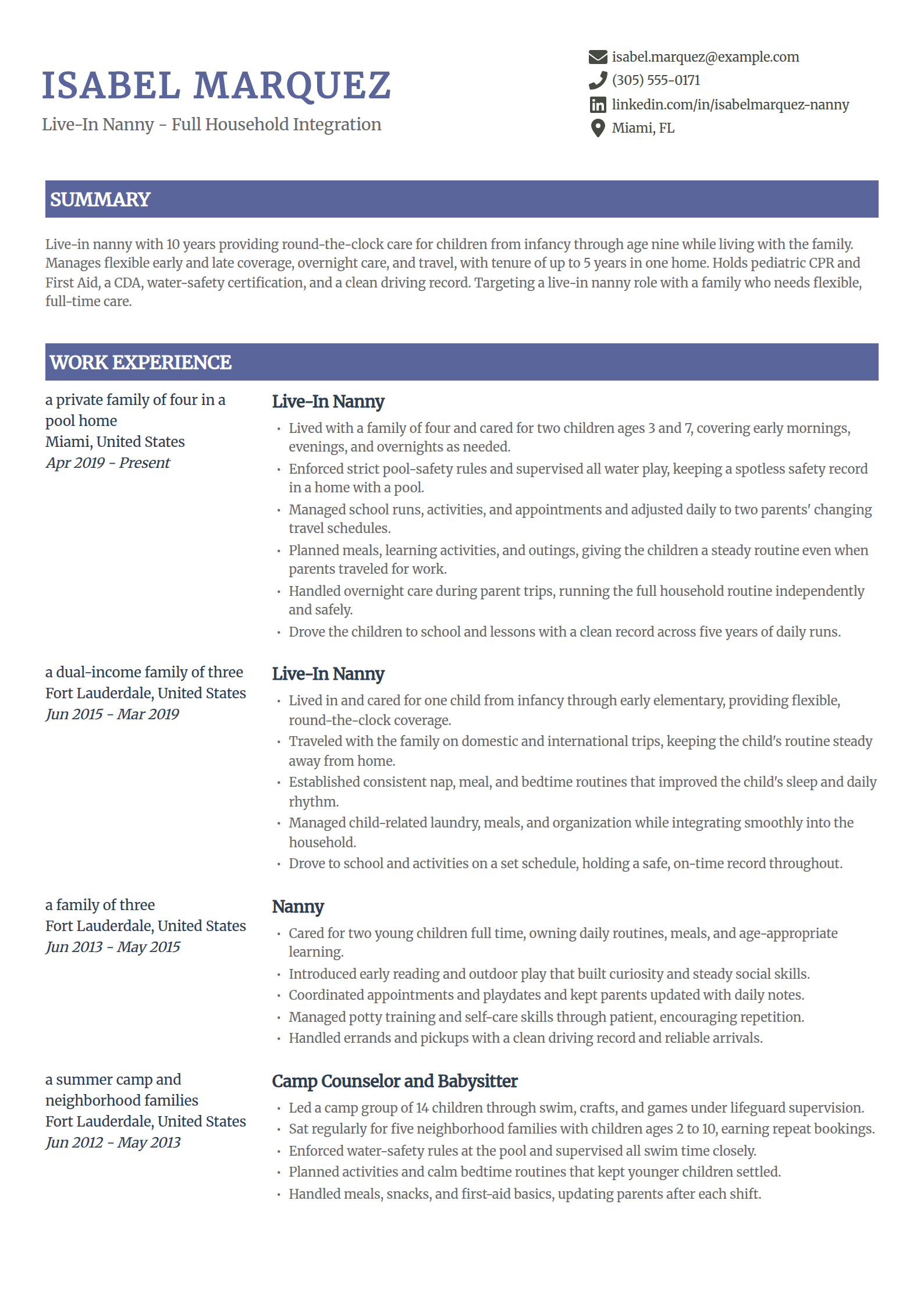
Live-In Nanny Resume Template
Why this resume example works?
- Leads with live-in scope, 10 years of round-the-clock care with tenure of up to 5 years in one home.
- Shows the flexibility families need, covering early mornings, evenings, overnights, and travel as schedules change.
- Handles a pool home safely, enforcing strict water-safety rules with a spotless record and lifeguard certification.
- Names the credentials a live-in posting expects, pediatric CPR, a CDA, water safety, and a clean driving record.
- Uses a results-first layout that stays easy to skim in one pass.
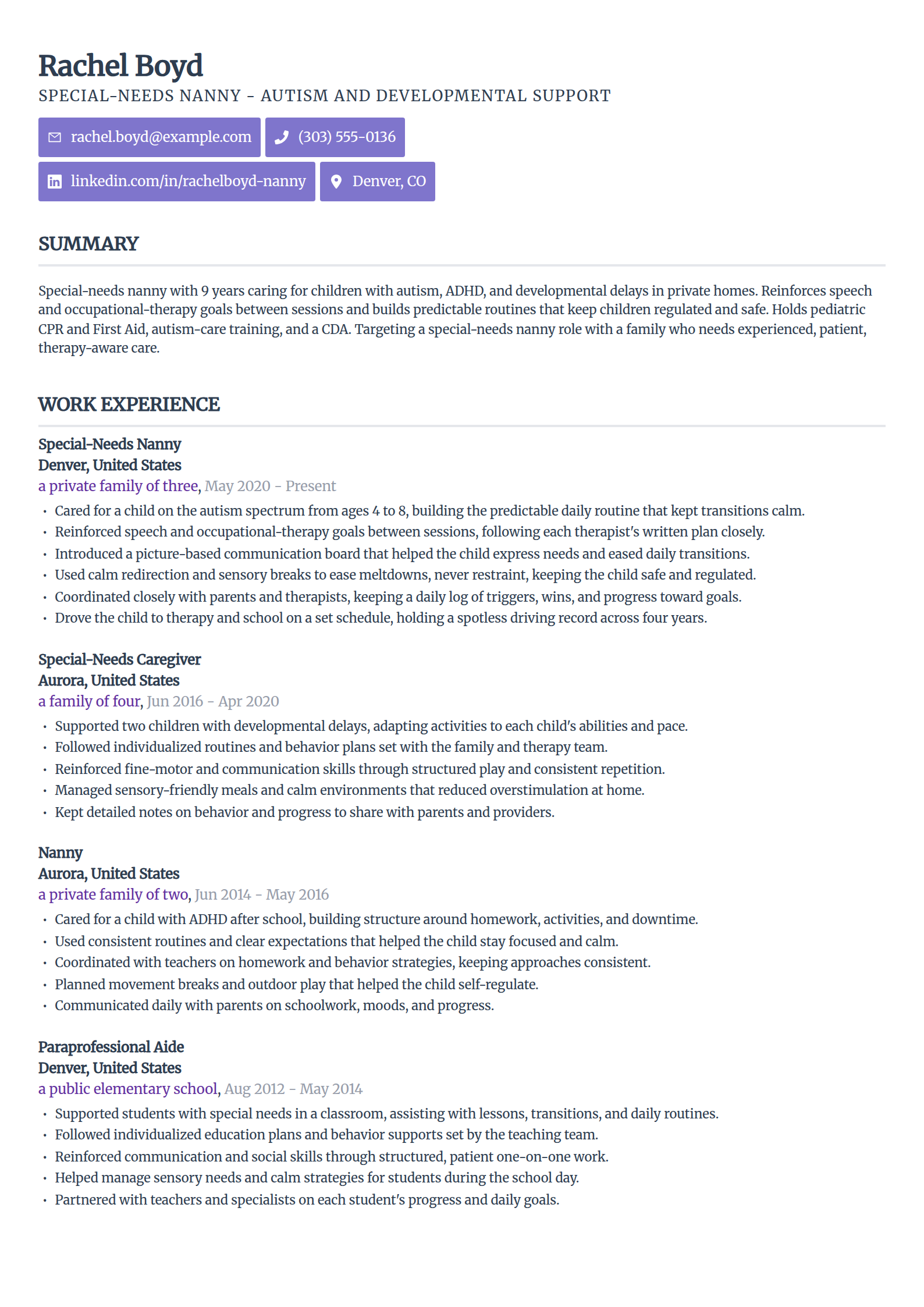
Special-Needs Nanny Resume Template
Why this resume example works?
- Frames the specialty, 9 years caring for children with autism, ADHD, and developmental delays in private homes.
- Shows the therapy support families value, reinforcing speech and occupational-therapy goals between sessions.
- Names a real tool, a picture communication board that helped a child express needs and eased transitions.
- Keeps the approach safe, easing meltdowns with calm redirection and sensory breaks, never restraint.
- Uses a modern layout that carries a dense special-needs record on one clean page.
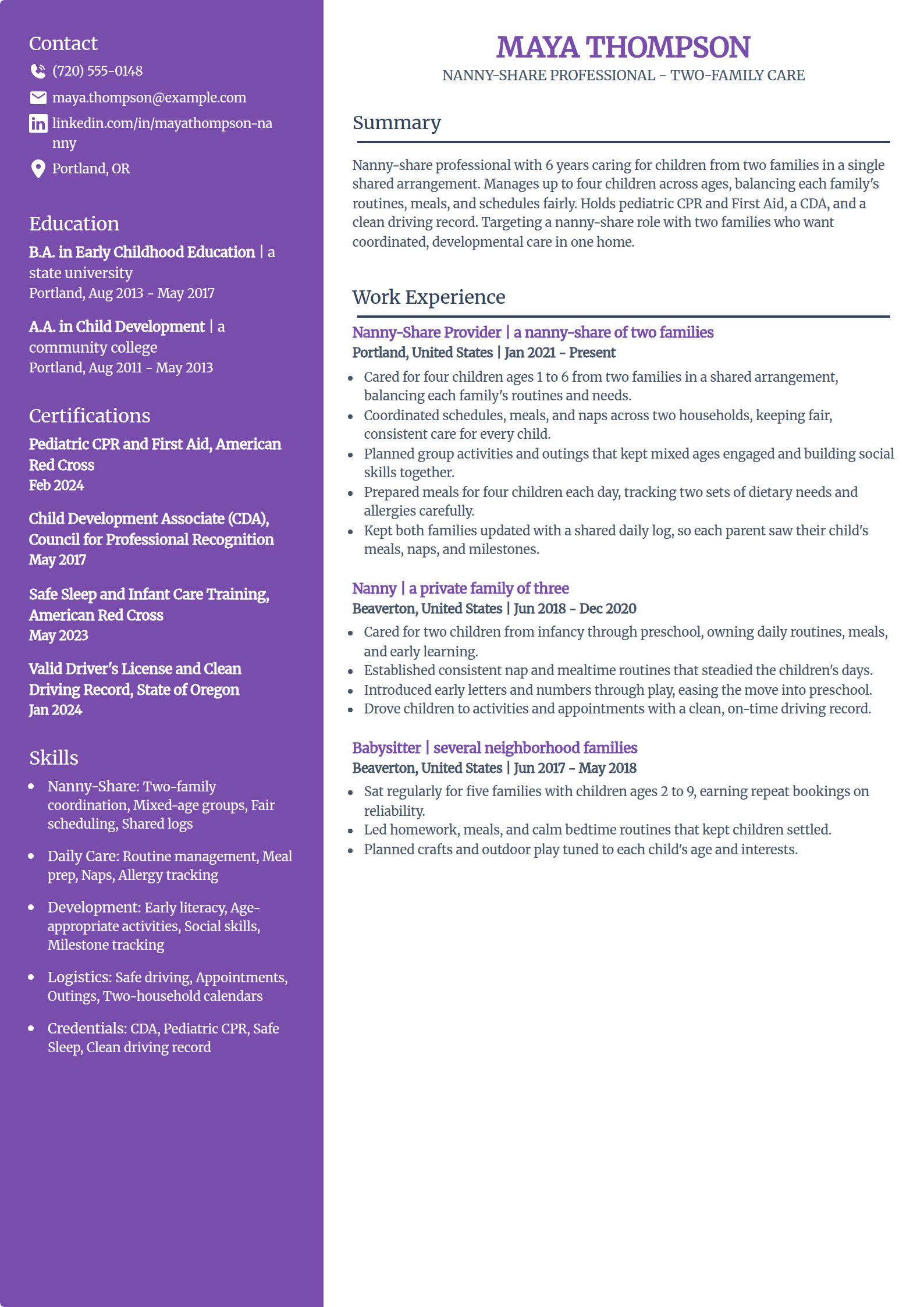
Nanny-Share Resume Template
Why this resume example works?
- Leads with the arrangement two families hire for, caring for up to four children ages 1 to 6 in a shared setup.
- Shows the coordination a share requires, balancing two households' routines, meals, and naps fairly.
- Handles two sets of dietary needs and allergies carefully while preparing meals for four children a day.
- Names the credentials both families verify, pediatric CPR, a CDA, and a clean driving record.
- Uses a Medium layout that fits a focused nanny-share record without empty space.
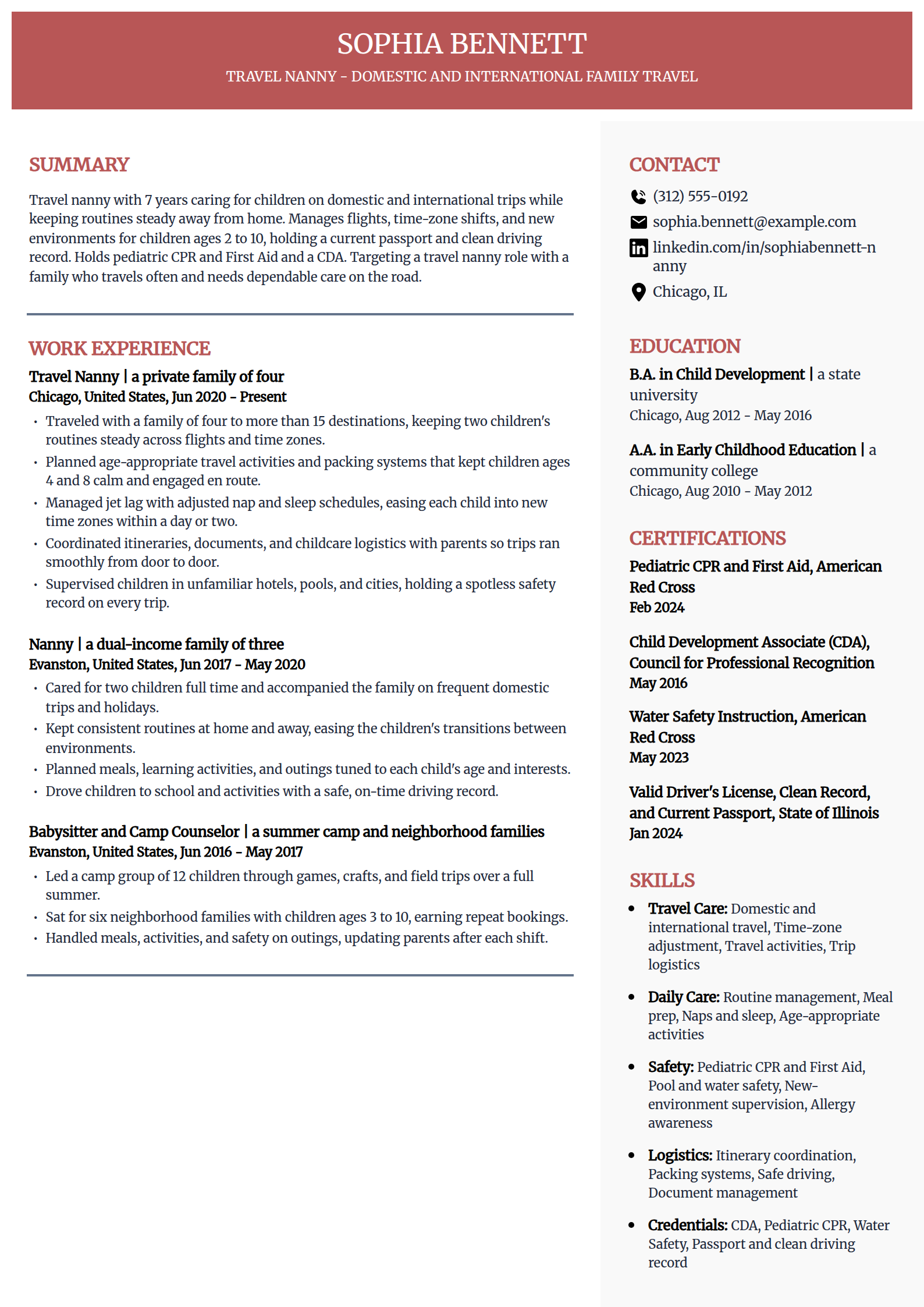
Travel Nanny Resume Template
Why this resume example works?
- Leads with travel scope, 7 years caring for children on domestic and international trips to over 15 destinations.
- Shows the skill travel families pay for, keeping routines steady across flights and easing children into new time zones.
- Adds the logistics a travel role owns, coordinating itineraries, documents, and childcare from door to door.
- Names the credentials a travel posting expects, pediatric CPR, a CDA, water safety, and a current passport.
- Uses a refined layout that fits a seven-year travel-care record cleanly on one page.
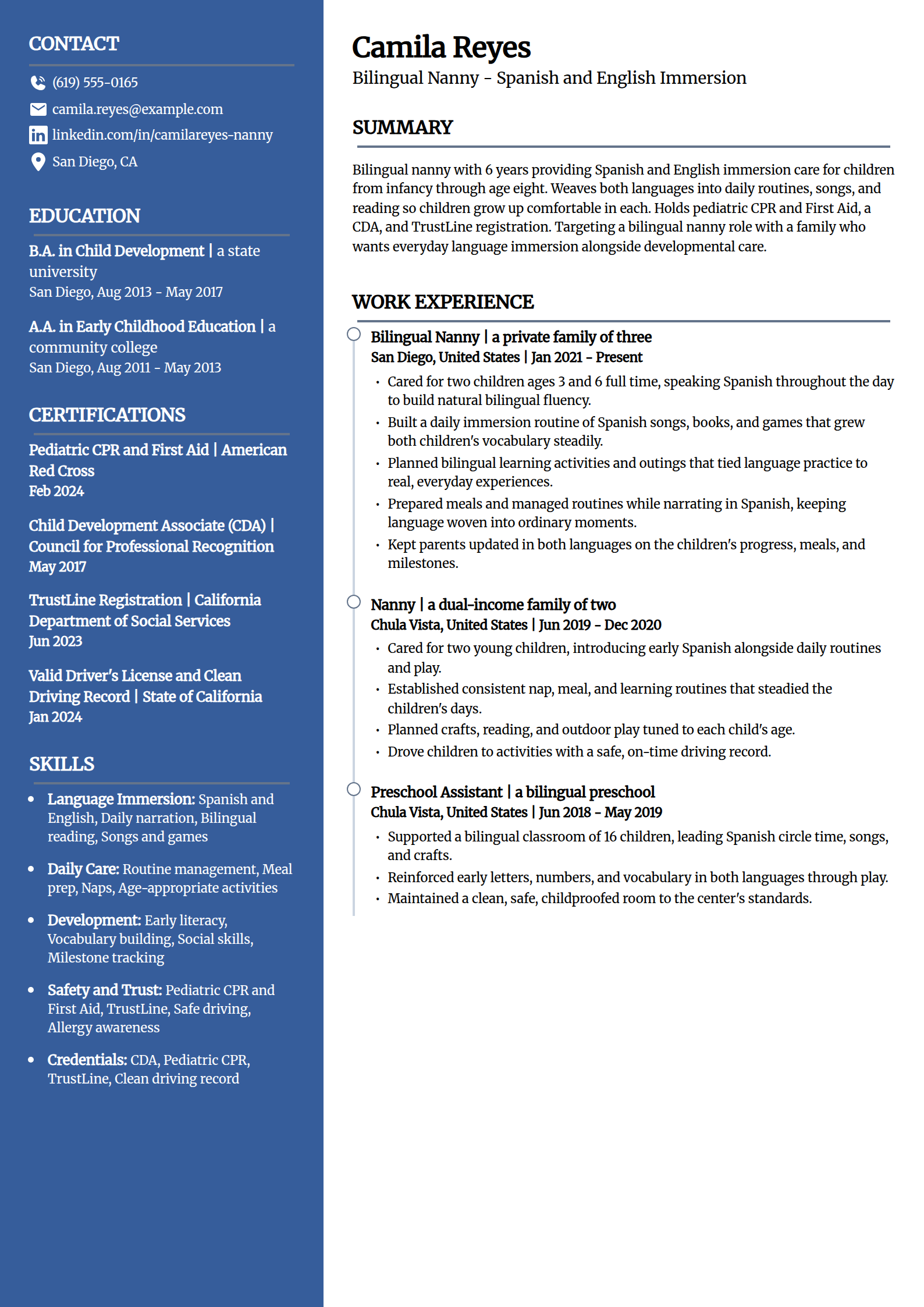
Bilingual Nanny Resume Template
Why this resume example works?
- Leads with the differentiator families seek, 6 years of Spanish and English immersion care from infancy to age eight.
- Shows how immersion actually works, weaving both languages into daily routines, songs, and reading.
- Ties language to development, growing children's vocabulary through everyday narration, not flash-card drills.
- Names the trust credentials a private home requires, pediatric CPR, a CDA, and TrustLine registration.
- Uses a distinctive layout that still reads cleanly for a hiring family.
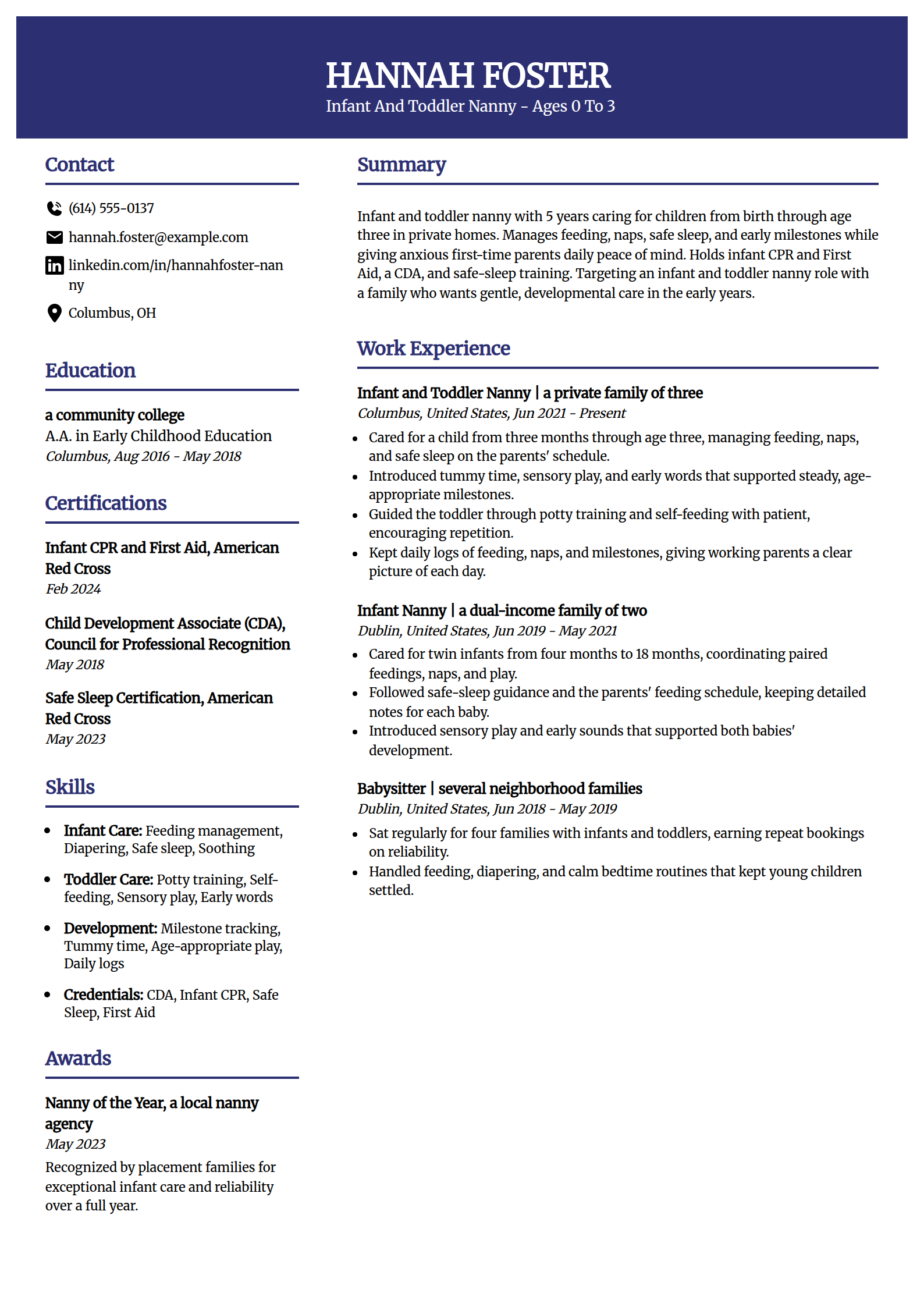
Infant and Toddler Nanny Resume Template
Why this resume example works?
- Leads with age focus, 5 years caring for children from birth through age three in private homes.
- Shows the early-years work parents need, managing feeding, naps, safe sleep, and first milestones.
- Keeps claims gentle, guiding potty training and self-feeding with patient, encouraging repetition.
- Backs the work with the right credentials, infant CPR, a CDA, and safe-sleep training.
- Uses a roomy two-column layout with a filled sidebar so a focused record still reads complete.
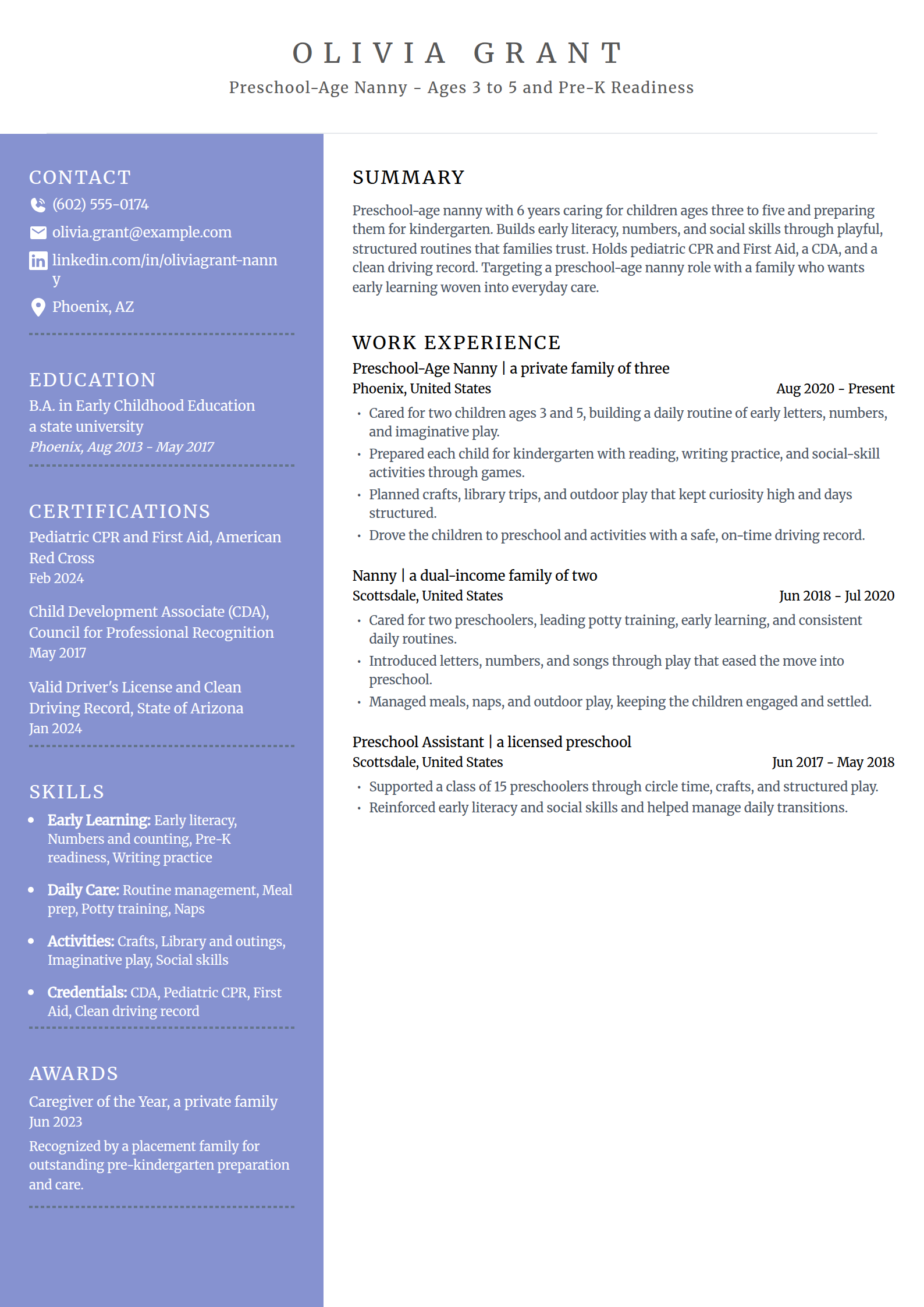
Preschool-Age Nanny Resume Template
Why this resume example works?
- Leads with age focus, 6 years caring for children ages 3 to 5 and preparing them for kindergarten.
- Shows the early-learning work families want, building letters, numbers, and social skills through play.
- Keeps the routine concrete, pairing reading and writing practice with crafts, library trips, and outdoor play.
- Names the credentials a nanny posting lists, pediatric CPR, a CDA, and a clean driving record.
- Uses a roomy layout with a filled sidebar so a six-year record looks complete.
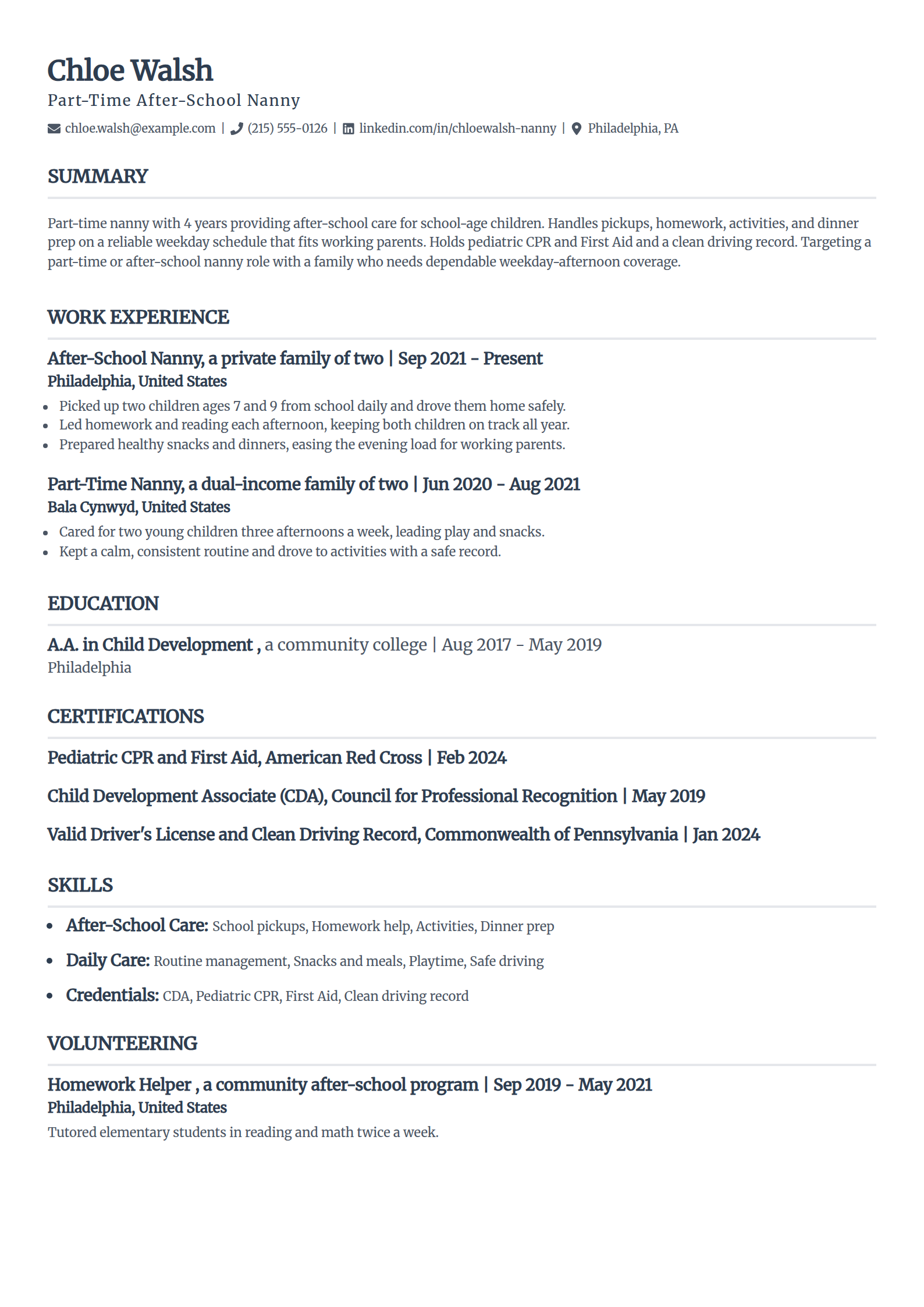
Part-Time and After-School Nanny Resume Template
Why this resume example works?
- Written for weekday-afternoon coverage, 4 years handling pickups, homework, and dinner on a reliable schedule.
- Shows the ownership a part-time role has, driving two children safely and keeping them on track through the year.
- Keeps duties concrete, snacks, dinners, activities, and playdates that ease the evening load for working parents.
- Names the credentials an after-school posting expects, pediatric CPR, a CDA, and a clean driving record.
- Fills a tight, ATS-safe page with tutoring volunteer work instead of padding.
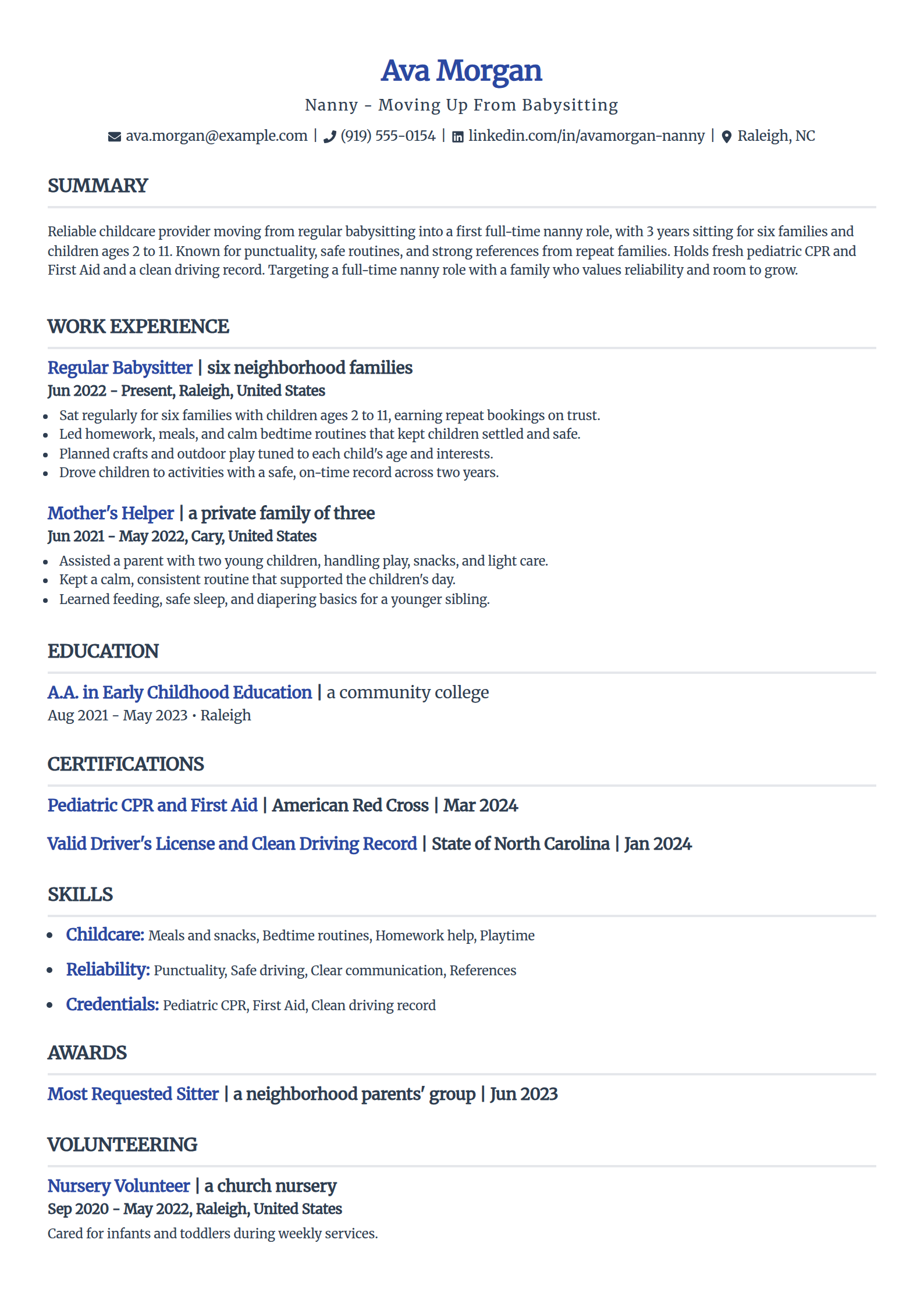
Babysitter-to-Nanny Resume Template
Why this resume example works?
- Written for the move up, a sitter with 3 years and six families stepping into a first full-time nanny role.
- Turns a sitting record into proof, showing repeat bookings, safe routines, and strong references.
- Keeps numbers honest, ages 2 to 11 and families served, with no inflated impact claims.
- Names the credential that clears the first screen, fresh pediatric CPR and First Aid, plus a clean driving record.
- Fills a tight, ATS-safe page with church-nursery volunteering and a most-requested-sitter award.
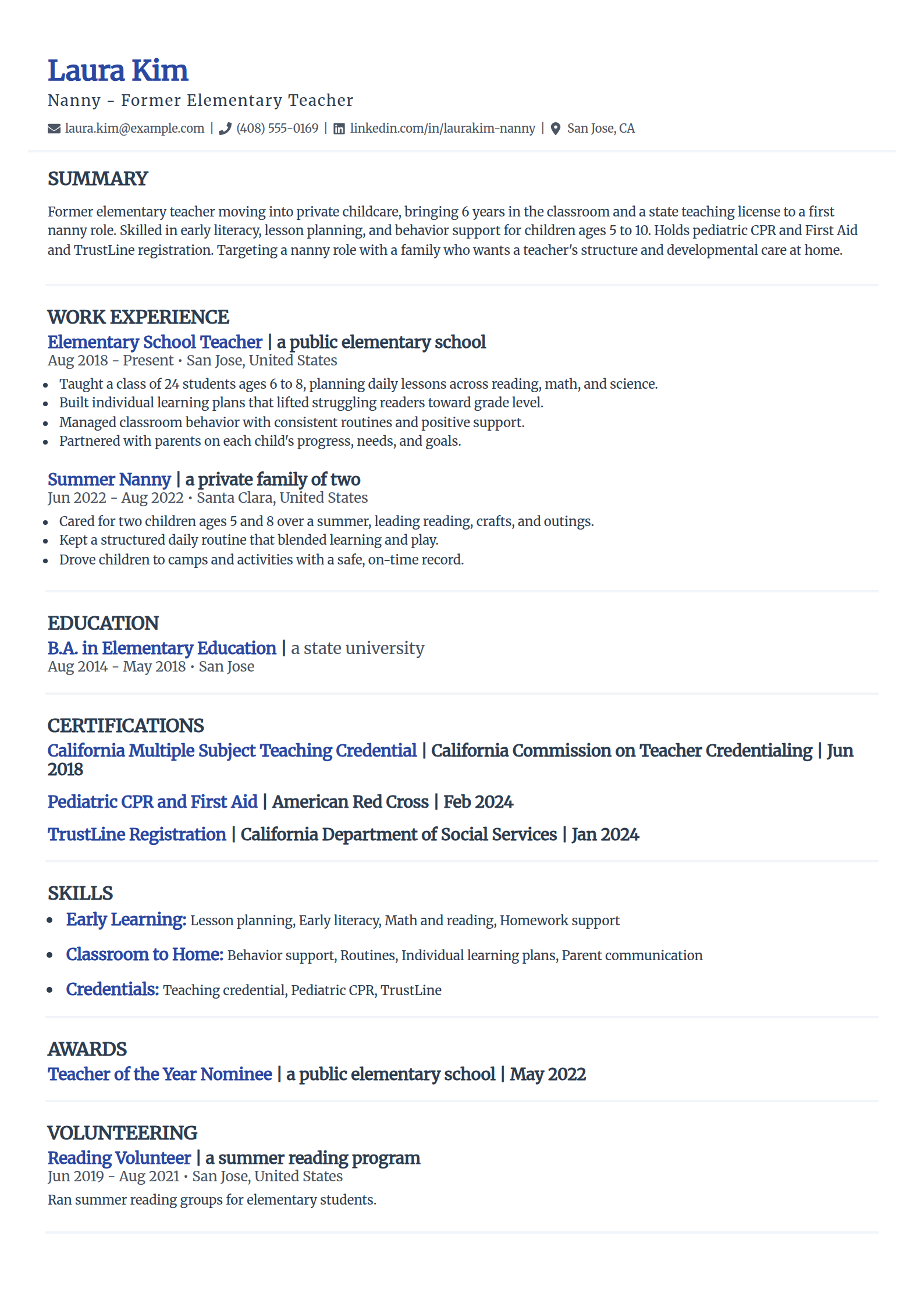
Teacher-to-Nanny Resume Template
Why this resume example works?
- Written for a career change, reframing 6 years in the classroom and a teaching license for private childcare.
- Pulls transferable proof forward, lesson planning, early literacy, and behavior support families want at home.
- Shows recent childcare directly, a summer nanny role caring for two children ages 5 and 8.
- Names the credentials a private home requires, the teaching credential, pediatric CPR, and TrustLine registration.
- Fills a tight, ATS-safe page with a reading-volunteer role and a teacher-of-the-year nomination.
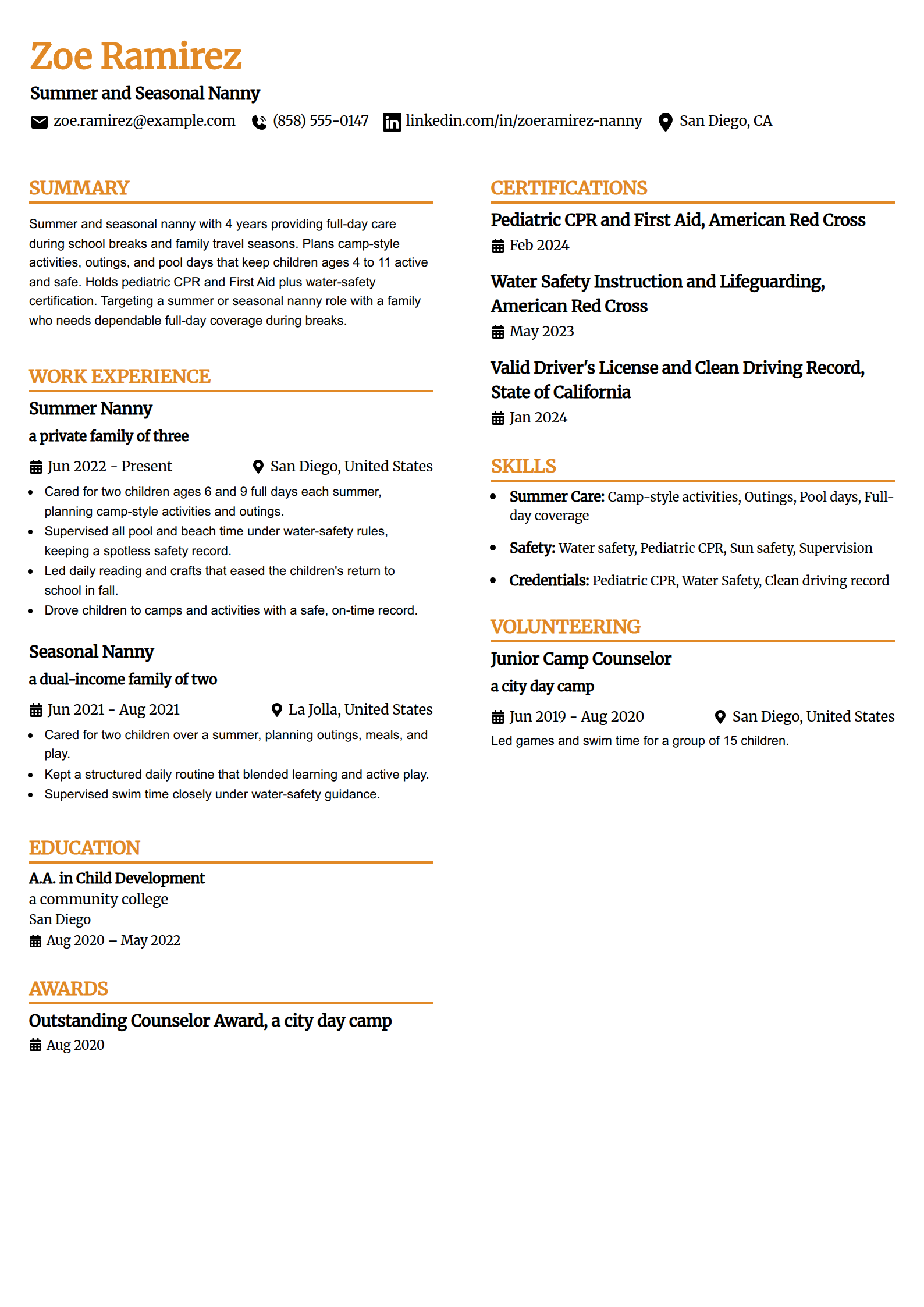
Summer and Seasonal Nanny Resume Template
Why this resume example works?
- Written for school breaks, 4 years of full-day summer care planning camp-style activities and outings.
- Shows the safety a summer role demands, supervising all pool and beach time under water-safety rules.
- Keeps learning in the mix, daily reading and crafts that ease each child's return to school in fall.
- Names the credentials a seasonal posting expects, pediatric CPR, water safety, and a clean driving record.
- Fills a tight, ATS-safe page with a junior-counselor role and an outstanding-counselor award.
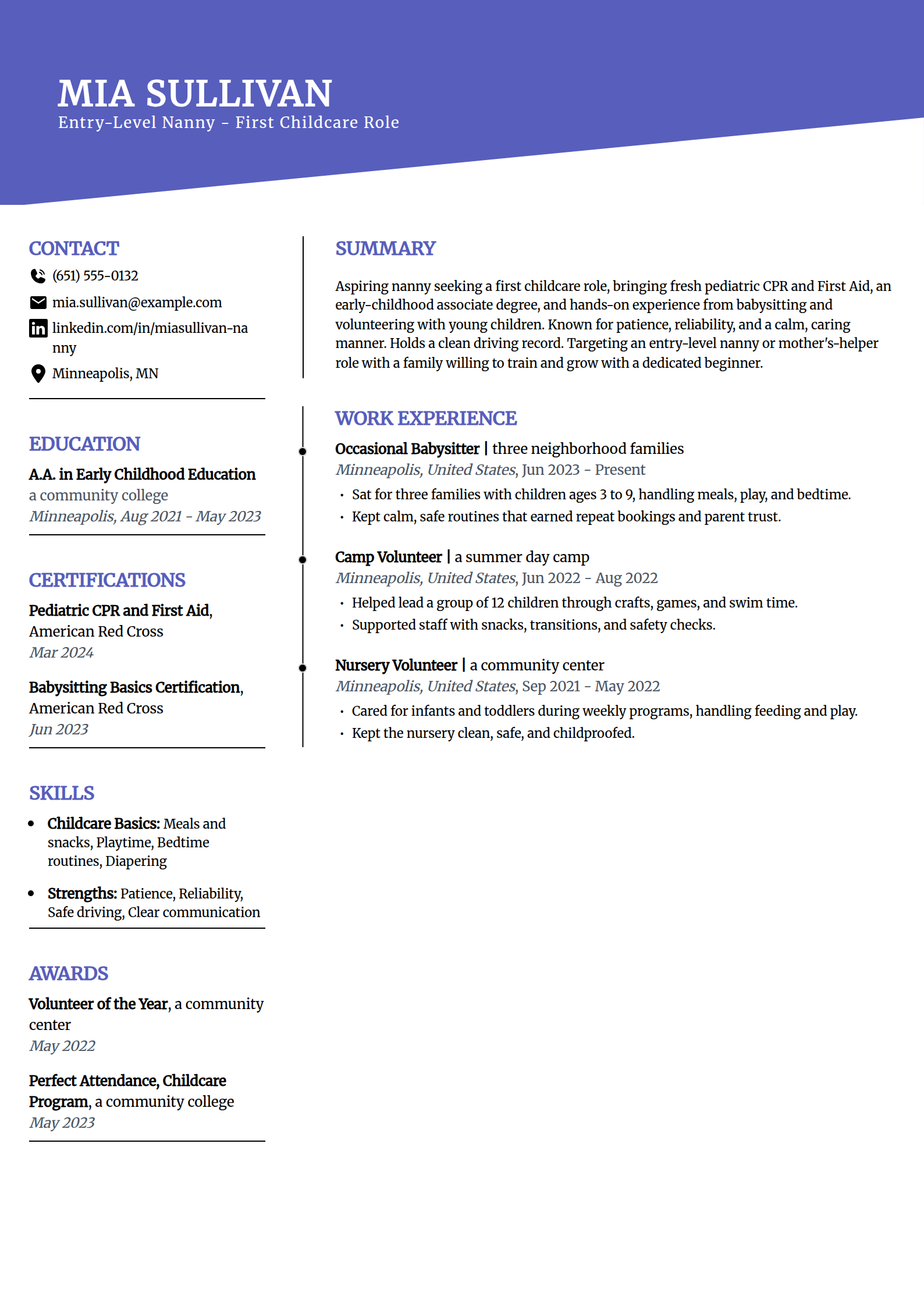
Entry-Level Nanny Resume Template (No Experience)
Why this resume example works?
- Written for a first childcare job, leading with fresh pediatric CPR and an early-childhood associate degree.
- Turns unpaid experience into proof, babysitting, a camp-volunteer role, and a community-center nursery.
- Keeps numbers beginner-appropriate, ages cared for and families served, with no inflated claims.
- Fills the page honestly with a volunteer-of-the-year award and a perfect-attendance record instead of padding.
- Lists awards without long descriptions, keeping the layout clean and balanced.
Build your nanny resume
Pick a template above and the editor keeps your layout clean, one-page, and ATS-safe while you swap in your own ages cared for, tenure, duties, and certifications.
Build my resumeHow to write a nanny resume in 2026
Families and agencies read a nanny resume fast, checking two things: do you hold the certifications the role needs, and can you prove steady, safe care. Lead with a short summary that names the ages you care for and your credentials, back each role with concrete duties and one modest number, and keep the whole thing to one clean page. These moves make yours easy to trust and easy for an applicant tracking system to parse.
Open with an ages-and-credentials summary
Write three to four sentences that name your years with children, the ages you have cared for, your tenure with families, your strongest certifications, and the role you are targeting. Lead with what you bring, not what you want from the family. Keep it to about 60 words so it never spills past the top of the page.
Full-time nanny with 8 years caring for children from infancy through age 10 across three private families, with tenure of up to 4 years per household and strong references. Runs daily routines, meals, school runs, and age-appropriate learning that keeps children safe and on track. Holds pediatric CPR and First Aid, a CDA, and a clean driving record. Targeting a full-time nanny role with a family who values consistency.
Prove each role with duties and one number
The work a nanny resume is hired for is hands-on, so name the real duty and attach one credible number where you can. Open every line with a strong verb, never "Responsible for" or "Helped with".
- Scope: name the ages and household, like caring for three children ages 2, 5, and 8 or twin infants from four months.
- Impact: show what changed, such as easing a child's start to kindergarten or guiding a gentle sleep-shaping routine.
- Method: name the real task or tool, like a picture communication board, safe-sleep guidance, or a daily care log.
- Stay in scope: feeding, sleep, play, learning, and safe transport for nannies. No diagnosing, no treatment, no medication on your own authority.
Put your certifications and licenses up top
Families screen on credentials first, so make them easy to find near the top of the page. This is also where the nanny, babysitter, and household-manager tracks show their difference.
- List CPR and First Aid on every nanny resume; use pediatric or infant CPR for baby and toddler roles. The American Red Cross and American Heart Association are the recognized issuers.
- Add the credential that fits your track: a Newborn Care Specialist (NCS) credential for newborn work, a Child Development Associate (CDA) or INA Certified Professional Nanny for career nannies.
- Name a valid driver's license and clean driving record for any role with school runs, errands, or travel, and water-safety certification for pool households.
- No-experience candidates lead with fresh CPR and First Aid plus babysitting, camp, tutoring, or volunteering with children in place of years.
Match skills and keywords to the job posting
A nanny skills list should read like the posting. Split it so a hiring family and a parser both find what they need, and name the ages and duties outright.
- Daily care: routines, meal prep, safe sleep, potty training, homework help, and age-appropriate activities.
- Specialties: newborn and infant care, special-needs support, bilingual immersion, and household management, named where they apply.
- Logistics: school runs, safe driving, appointment scheduling, and the family calendar, since many families filter on driving.
- Soft skills that matter here: patience, reliability, discretion, and clear communication, backed by proof in your bullets.
Keep it to one clean, ATS-safe page
Agencies run applicant tracking systems and families skim on a phone, so a clean one-page resume is the standard for nearly every nanny.
- Use a simple layout with standard headings a parser recognizes; the templates above are all ATS-safe.
- Hold it to one page and lead with your most recent role; cut older, unrelated jobs to make room for childcare duties.
- Save as a PDF so the formatting holds, then run it through our ATS resume checker for a quick format pass.
- Swap the ages, duties, and numbers in the templates above for your own; do not copy them as is.
Common nanny resume mistakes
- Writing a babysitter resume for a nanny role. If your bullets describe occasional evenings instead of owning a child's daily routine and development, it reads as sitting; lead with ages cared for, tenure, and the routine you ran.
- Leaving out ages, tenure, and household size. These are the numbers families screen for, so name them: three children ages 2, 5, and 8, or 4 years with one family.
- Claiming clinical scope you do not hold. Nannies follow parent instruction; they do not diagnose or medicate on their own authority. Newborn work is safe sleep and feeding, not medical treatment.
- Burying your certifications at the bottom. CPR and First Aid, a CDA, or an NCS credential are what a family reads first, so put them near the top.
- Inflating numbers, especially on entry-level and babysitter resumes. Ages of children and families served are believable; a fake impact percentage is not.
Frequently asked questions
What should a nanny put on a resume?
Lead with a three-to-four-sentence summary that names your years with children, the ages you have cared for, your tenure with families, and your strongest certifications. Put CPR and First Aid, plus any CDA or Newborn Care Specialist credential, near the top where a family reads them first. Under each job, write duty-first bullets that open with a strong verb and carry one modest number, like caring for three children ages 2, 5, and 8 or staying 4 years with one family. Name a clean driving record for roles with school runs, and keep the whole resume to one clean page.
What is the difference between a nanny and a babysitter resume?
A babysitter resume shows occasional, short-notice care: evenings and weekends, games, meals, and bedtime for a range of families. A nanny resume shows ownership of a child's daily routine and development over time: consistent schedules, meals, learning, transport, and real tenure with one or a few families. If you are moving up from sitting, lead with your longest, most consistent placements, the ages you have cared for, and the credential that clears the first screen, and treat each regular family as an experience entry with quantified bullets. The babysitter-to-nanny example above shows the shape.
How do you write a nanny resume with no experience?
Lead with the proof you do have. A no-experience nanny leads with fresh pediatric CPR and First Aid, then shows unpaid or informal care as real experience: babysitting for neighbors, camp counseling, tutoring, or volunteering in a church or community-center nursery. Keep each bullet concrete, like handling meals, play, and bedtime for children ages 3 to 9, and fill the page with a volunteer award instead of padding. Modest, believable details beat an inflated number that reads as invented. The entry-level and babysitter-to-nanny examples above show the format.
What certifications should a nanny have on a resume?
CPR and First Aid belong on nearly every nanny resume, and pediatric or infant CPR fits baby and toddler roles; the American Red Cross and American Heart Association are the recognized issuers. Add the credential that matches your track: a Newborn Care Specialist (NCS) credential for newborn work, a Child Development Associate (CDA) or an INA Certified Professional Nanny credential for career nannies, and water-safety certification for pool households. Note a valid driver's license and clean driving record for any role with school runs or travel, and TrustLine registration where a state or family requires it. List them near the top, and only claim credentials you actually hold.
How long should a nanny resume be?
One page is the standard for nearly every nanny, newborn care specialist, and babysitter. Families skim fast on a phone and agencies run applicant tracking systems, so a single, clean page led by your most recent placement is what they expect. Only a very experienced household manager with a long, relevant history might run slightly longer, and never past two pages. Cut older, unrelated jobs to make room for childcare duties, credentials, and the ages or tenure you have handled.
What skills should a nanny put on a resume?
Match the posting, then group your skills so a parser and a family both find them. List daily-care skills like routines, meal prep, safe sleep, potty training, homework help, and age-appropriate activities, plus specialties such as newborn care, special-needs support, or bilingual immersion where they apply. Add the logistics families filter on, school runs, safe driving, and appointment scheduling. Then name the soft skills the work depends on, patience, reliability, discretion, and clear communication, and back each one with proof in your bullets rather than a bare list.
More nanny resume resources
Build your nanny resume
Pick a template above and the editor keeps your layout clean, one-page, and ATS-safe while you swap in your own ages cared for, tenure, duties, and certifications.