16 Teacher Assistant Resume Examples, Preschool to High School
- ATS Friendly
- Preschool to High School
- 16 Classroom Examples
A teacher assistant resume example should carry five things: a three-sentence summary naming your grade band and assignment type, classroom bullets with real counts, your ParaPro or state paraprofessional status, the accommodations and platforms you have actually run, and current CPR and First Aid. Find the example below that matches the room you want to work in, then swap in your own numbers and credentials.


540k+ resumes created
Editable teacher assistant resume templates for every classroom assignment
A preschool aide, a one-on-one behavioral aide, and a high school credit-recovery assistant are three different postings, screened on three different things. Each template below is a complete resume for one of those assignments, built with the credentials and platforms that posting actually names. Pick the one closest to the job you want, then replace the names, dates, and numbers with yours.
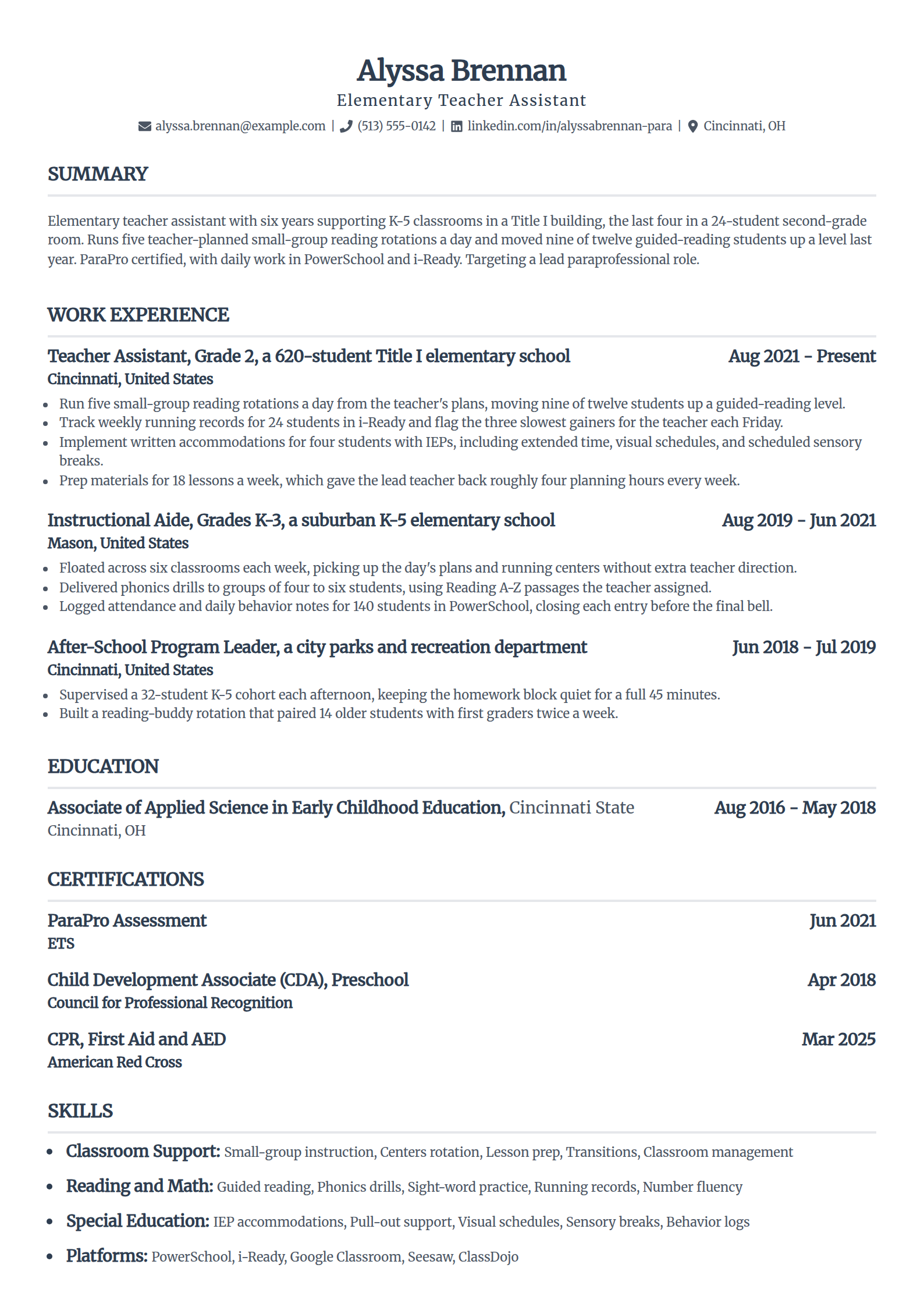
Elementary Teacher Assistant Resume Template
Why this resume example works?
- Opens with the grade and the building type, so a principal knows within one sentence if this is a fit.
- Counts the work instead of claiming traits: five reading rotations a day, 24 students tracked, nine of twelve moved up a level.
- States the accommodations run for four students with IEPs, which is the part a special education coordinator reads first.
- Places the ParaPro Assessment near the top, since it is the Title I gate in most districts.
- Uses a single-column layout an applicant tracking system reads cleanly, with no graphics between dates and titles.
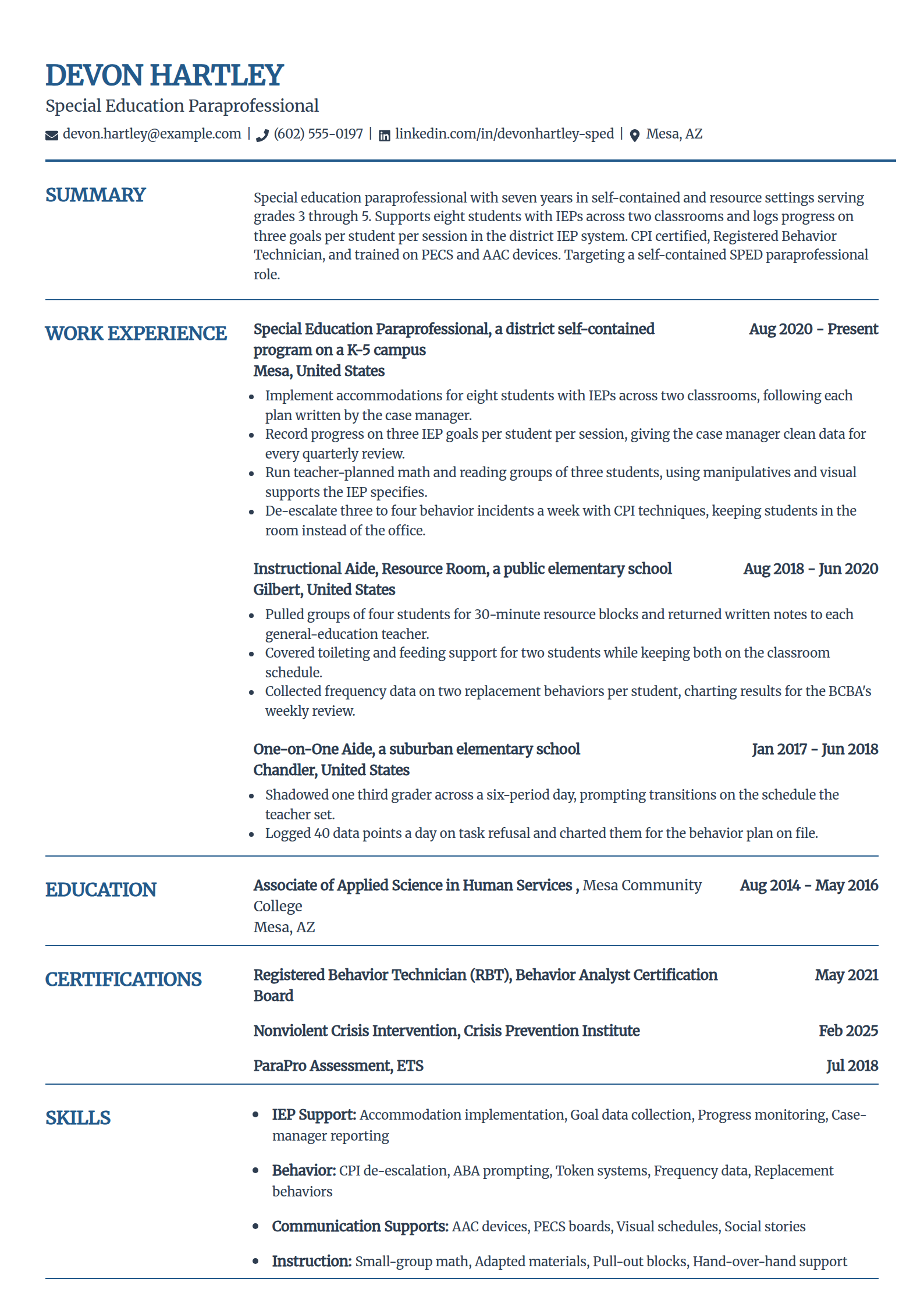
Special Education Teacher Assistant Resume Template
Why this resume example works?
- Leads with the setting, self-contained and resource, because that is how special education postings are written and filtered.
- Reports the data work explicitly: progress on three IEP goals per student per session, handed to the case manager each quarter.
- Stays inside scope of practice, implementing the plan the case manager wrote rather than claiming to write or change it.
- Names the behavior and communication credentials a SPED room screens for, including CPI, RBT, and PECS training.
- Lists personal care openly, since toileting and feeding support are part of the job and leaving them out costs interviews.
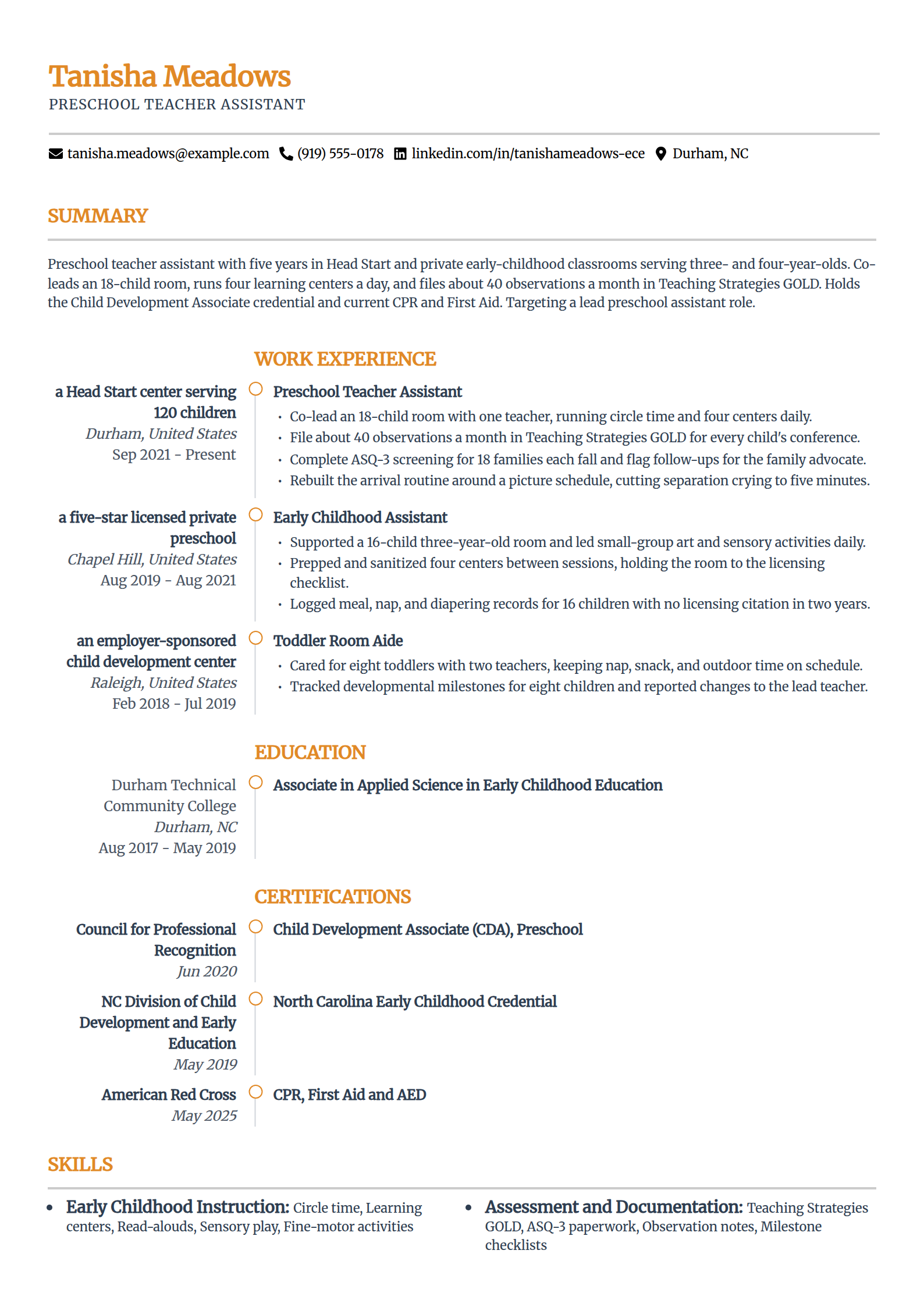
Preschool Teacher Assistant Resume Template
Why this resume example works?
- Puts the Child Development Associate credential up front, which is the credential early childhood programs ask about first.
- Uses the documentation tools a Head Start director recognizes, including about 40 observations a month in Teaching Strategies GOLD.
- Turns routine work into outcomes: a picture-schedule arrival routine that cut separation crying to under five minutes.
- Shows the screening paperwork an early childhood program runs on, with ASQ-3 completed for 18 families each fall.
- Keeps licensing compliance visible with daily meal, nap, and diapering records and a clean citation record.
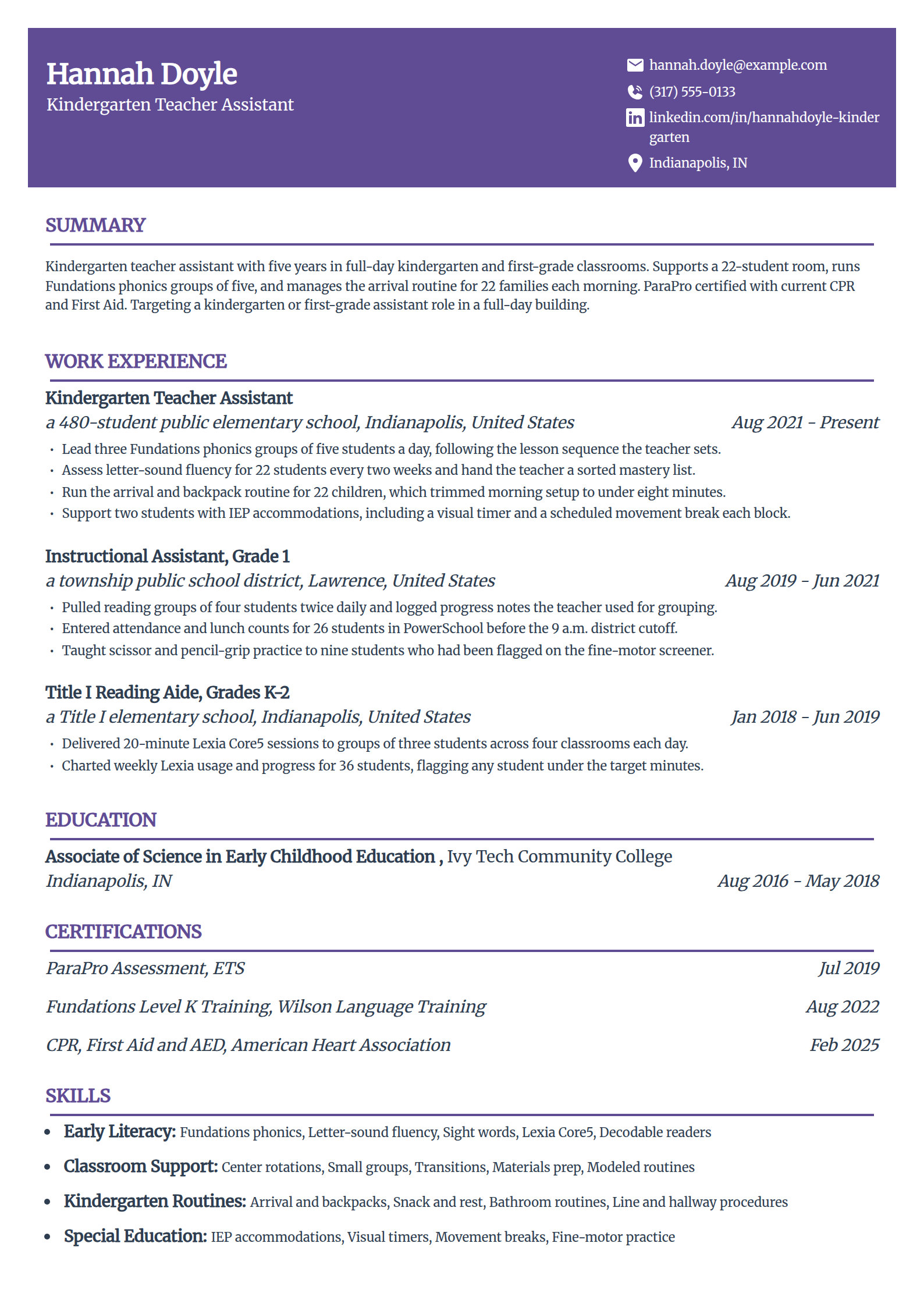
Kindergarten Teacher Assistant Resume Template
Why this resume example works?
- Names the phonics program by name, Fundations, instead of saying early literacy support, which is what the posting searches for.
- Quantifies the assessment work, with letter-sound fluency checked for 22 students every two weeks and sorted for the teacher.
- Shows the unglamorous routines that make a kindergarten room run, including an arrival routine trimmed to under eight minutes.
- Names the student information system and the deadline it runs on, attendance and lunch counts entered before the district cutoff.
- Pairs the ParaPro Assessment with a curriculum training, which reads as a candidate who keeps learning the programs in use.
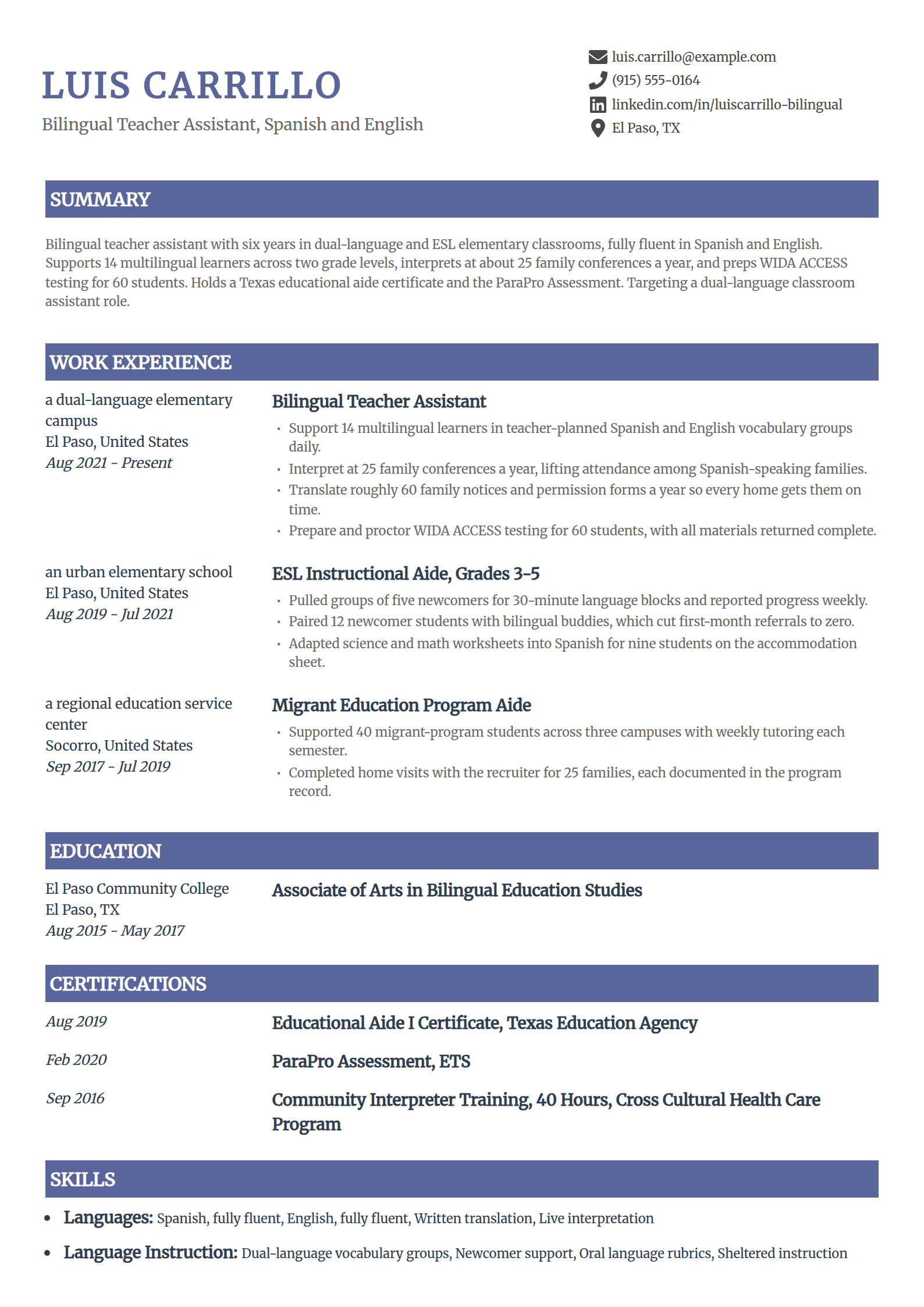
Bilingual Teacher Assistant Resume Template
Why this resume example works?
- States the languages and the fluency level plainly at the top, because a dual-language posting screens on that line alone.
- Counts the bilingual work separately from the classroom work: 25 conferences interpreted and about 60 notices translated a year.
- Cites the state language assessment, WIDA ACCESS, which signals the candidate has already worked a testing window.
- Surfaces the state educational aide certificate, since several states gate bilingual aide roles on exactly that credential.
- Keeps the migrant education work in the history, which is relevant proof for a bilingual aide rather than unrelated filler.
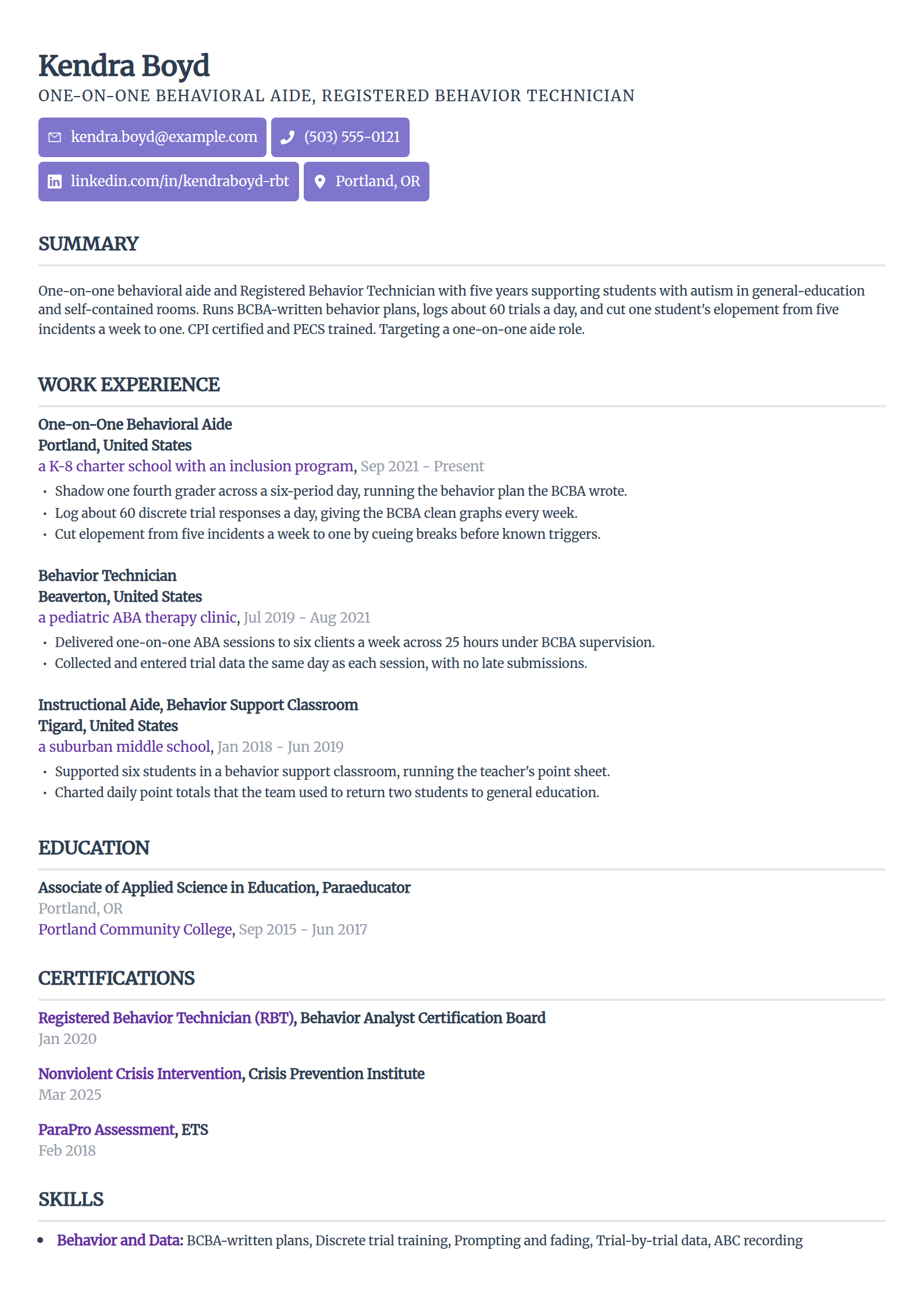
One-on-One Behavioral Aide Resume Template
Why this resume example works?
- Puts the Registered Behavior Technician credential in the headline, which is the fastest filter on a behavior team posting.
- Describes the job accurately as running a plan a BCBA wrote, not designing behavior programs, which keeps it inside scope.
- Carries the one number that matters on this assignment: elopement cut from five incidents a week to one.
- Shows the data volume, about 60 trial responses logged a day, because reliable data collection is what the role is paid for.
- Ends on the outcome a behavior team reads for, two students returned to general education off the point-sheet data.
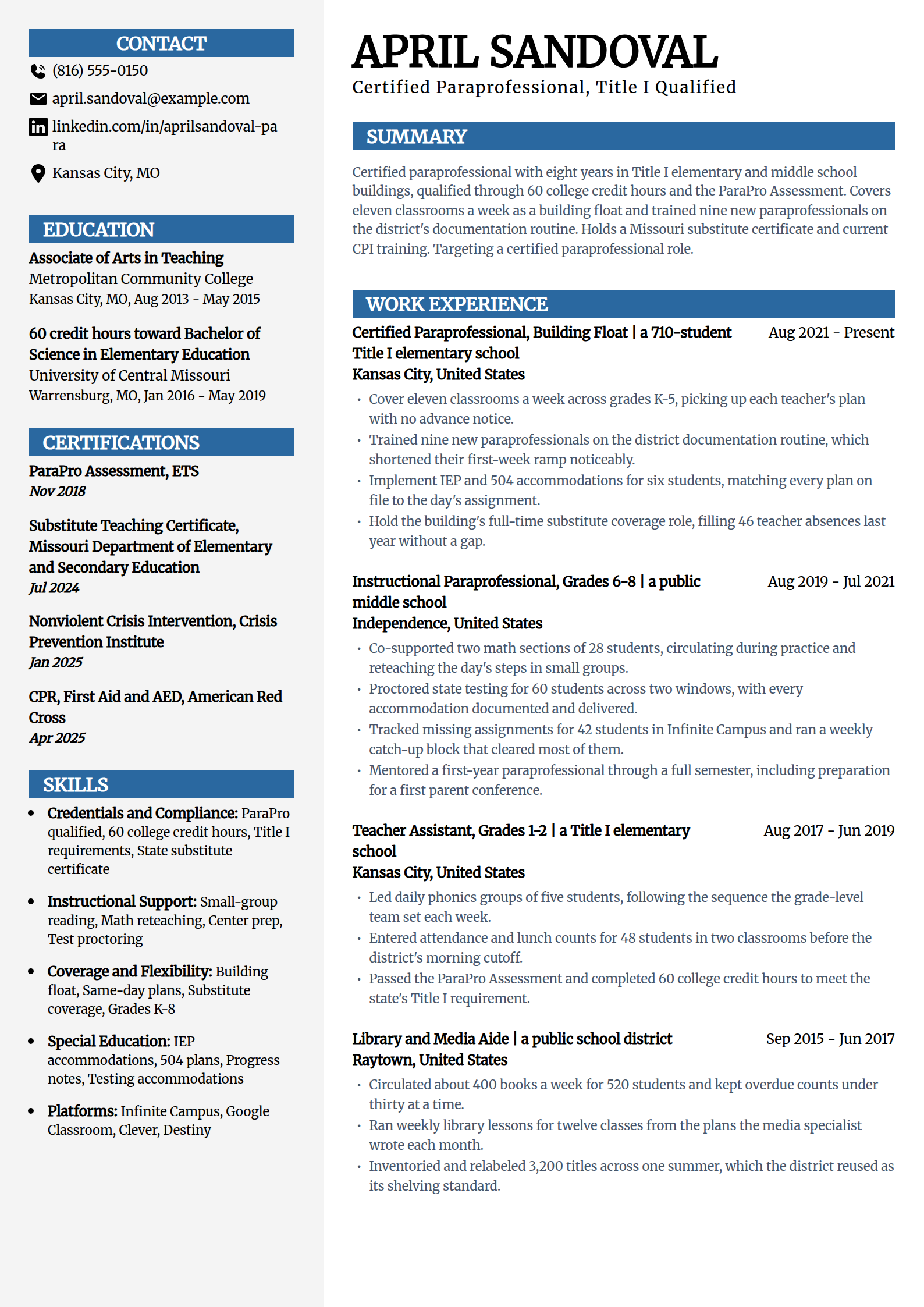
Certified Paraprofessional Resume Template
Why this resume example works?
- Spells out how the certification was earned, 60 college credit hours plus the ParaPro Assessment, since Title I funding depends on it.
- Proves range rather than a single room: eleven classrooms a week across grades K-5 as the building float.
- Adds a leadership line that costs nothing to verify, nine new paraprofessionals trained on the documentation routine.
- Adds the state substitute certificate, which turns one hire into coverage for 46 teacher absences a year.
- Groups the credentials into their own skills block so a human resources screener can confirm eligibility in one glance.
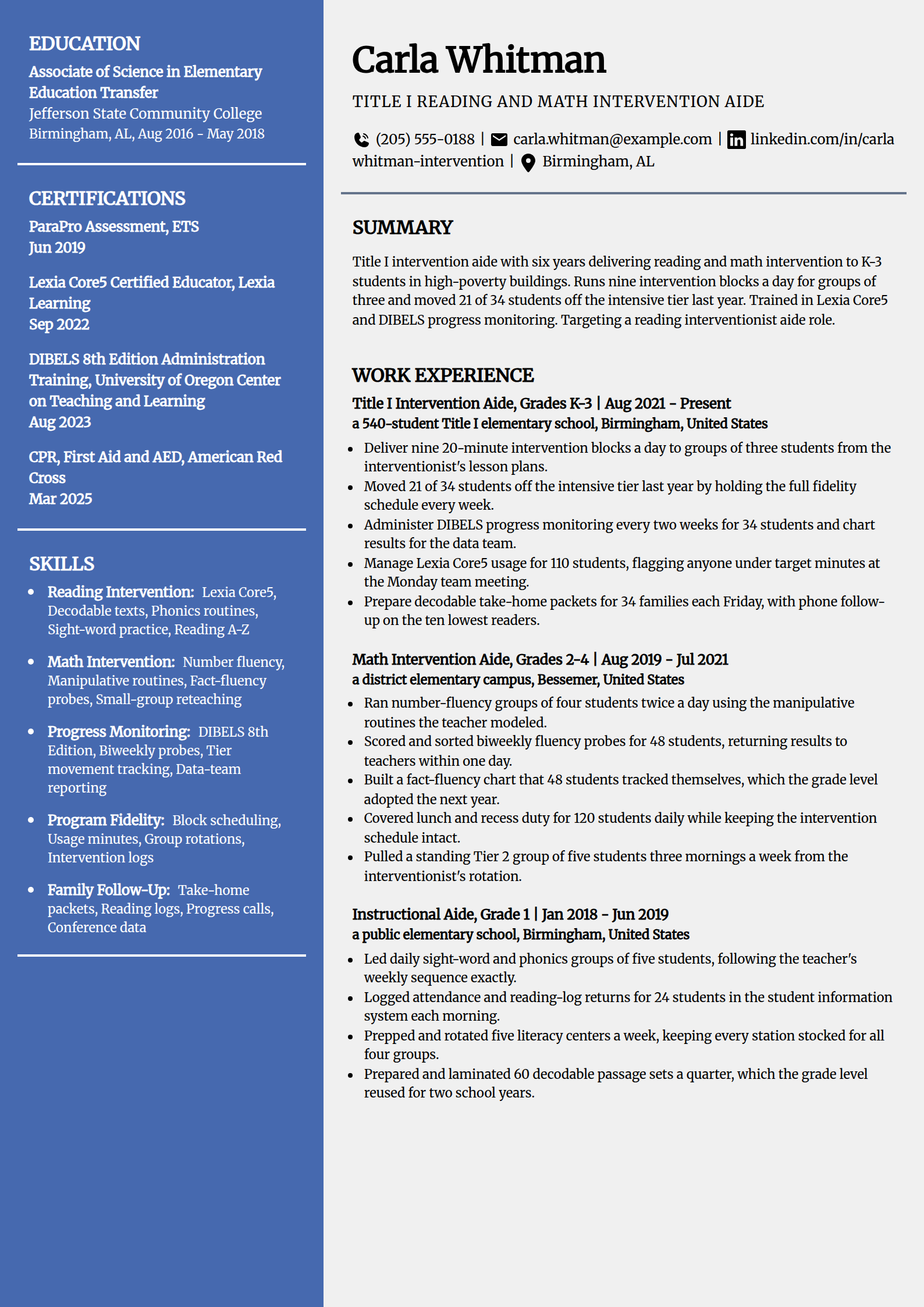
Title I Reading and Math Intervention Aide Resume Template
Why this resume example works?
- Leads with the schedule load, nine intervention blocks a day, which is the first thing an interventionist checks for.
- Reports tier movement, 21 of 34 students off the intensive tier, rather than claiming to raise scores school-wide.
- Names the programs by name, Lexia Core5 and DIBELS, because intervention postings list those products directly.
- Credits fidelity, holding the full schedule every week, which is the honest reason intervention works when it works.
- Leaves the family follow-up visible: weekly take-home packets and calls on the ten lowest readers.
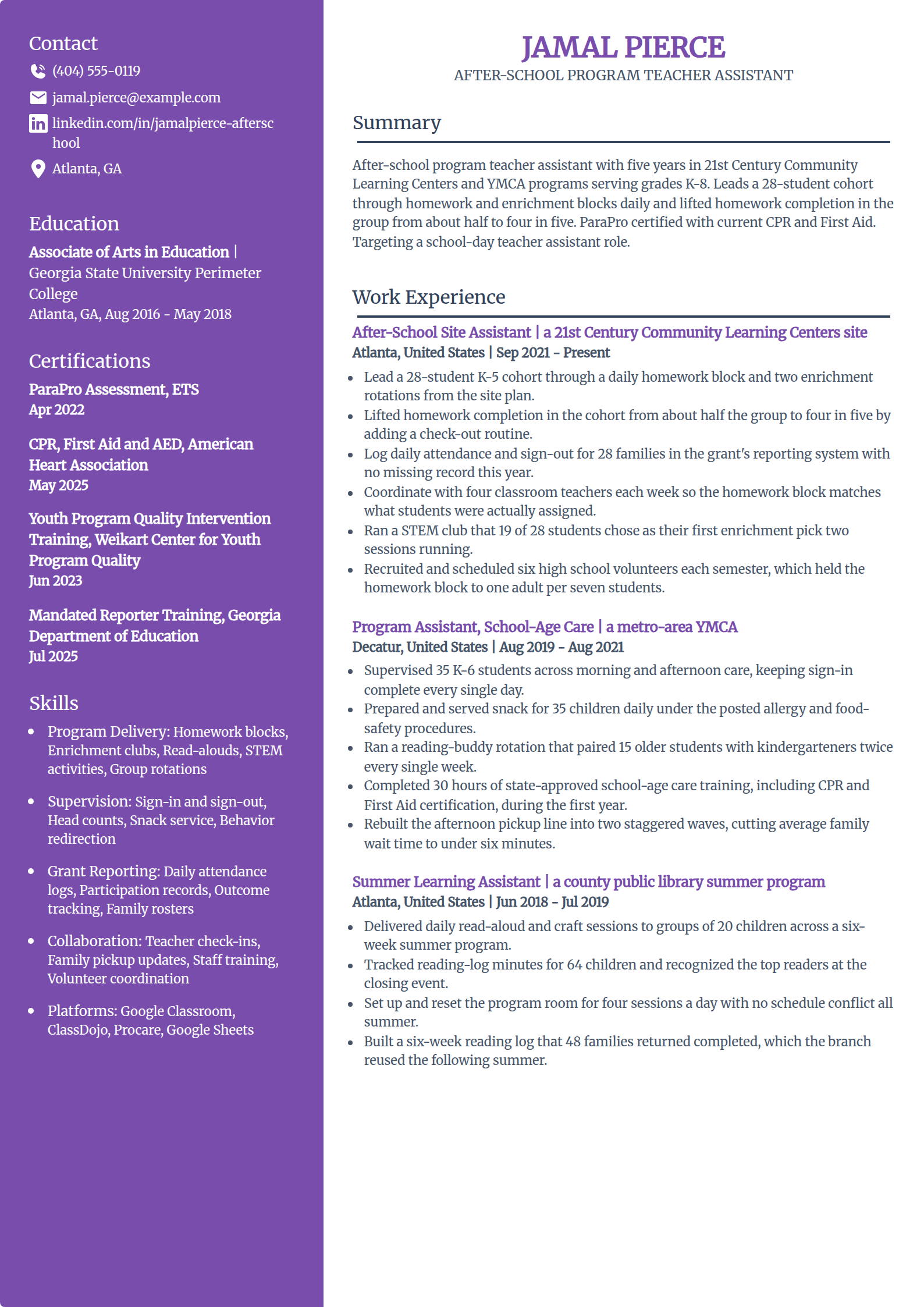
After-School Program Teacher Assistant Resume Template
Why this resume example works?
- Identifies the funding stream, a 21st Century Community Learning Centers site, which district hiring staff recognize immediately.
- Shows a real outcome from a change the candidate made: homework completion moved from about half the group to four in five.
- Highlights the grant reporting, since after-school sites live or die on clean attendance and participation records.
- Proves coordination with classroom teachers, which is what separates a program aide from a babysitter in a principal's eyes.
- Positions the role as a step toward school-day work, so the application reads as a direction rather than a stopgap.
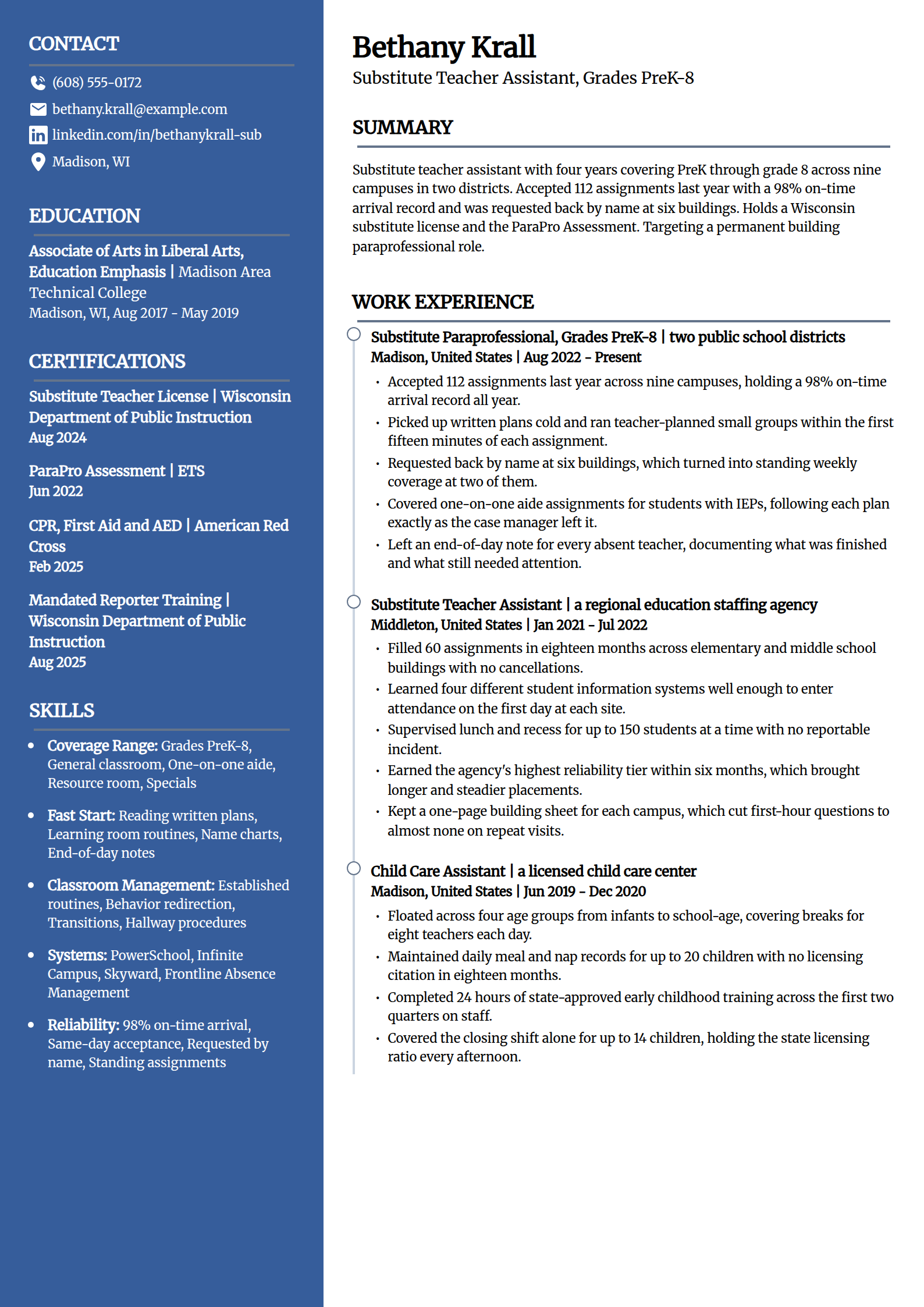
Substitute Teacher Assistant Resume Template
Why this resume example works?
- Turns scattered assignments into one strong number: 112 assignments across nine campuses in a single year.
- Leads on the two things a scheduler cares about, a 98% on-time arrival record and same-day availability.
- Uses being requested back by name at six buildings as the closest thing a substitute has to a performance review.
- Shows the range covered, PreK through grade 8 and one-on-one aide assignments, which is the whole value of a substitute.
- Lists four student information systems, because learning a new one on arrival is a real part of the work.
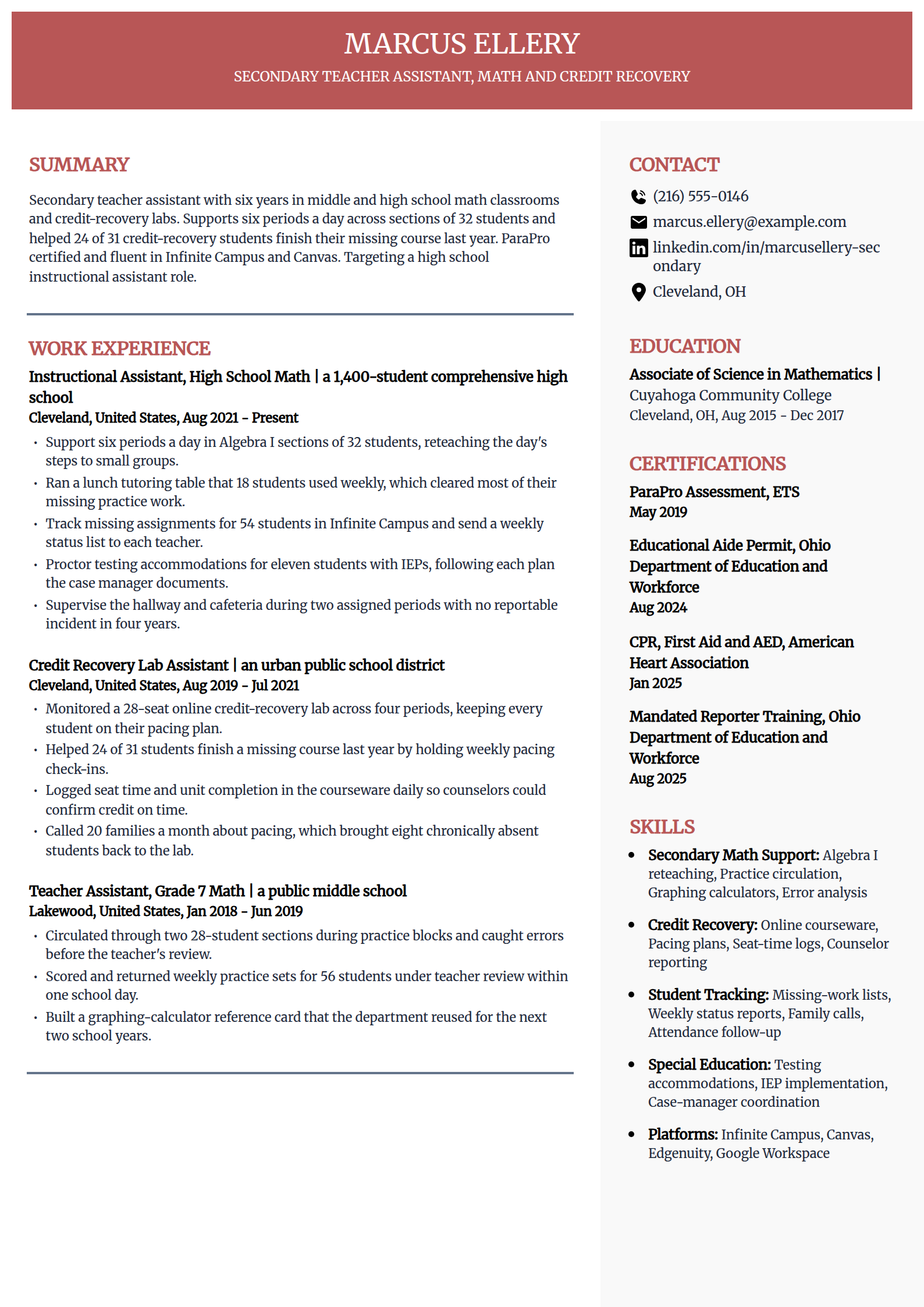
Middle and High School Teacher Assistant Resume Template
Why this resume example works?
- Names the subject, Algebra I, instead of saying classroom support, because secondary postings are written by department.
- Carries a credit-recovery result, 24 of 31 students finishing a missing course, which maps straight to a graduation rate.
- Sizes the period load at six a day across sections of 32, so a department head can place the coverage immediately.
- Includes testing accommodations for eleven students with IEPs, which secondary buildings need staffed every window.
- Mentions the platforms secondary schools actually run, Infinite Campus and Canvas, not generic office software.
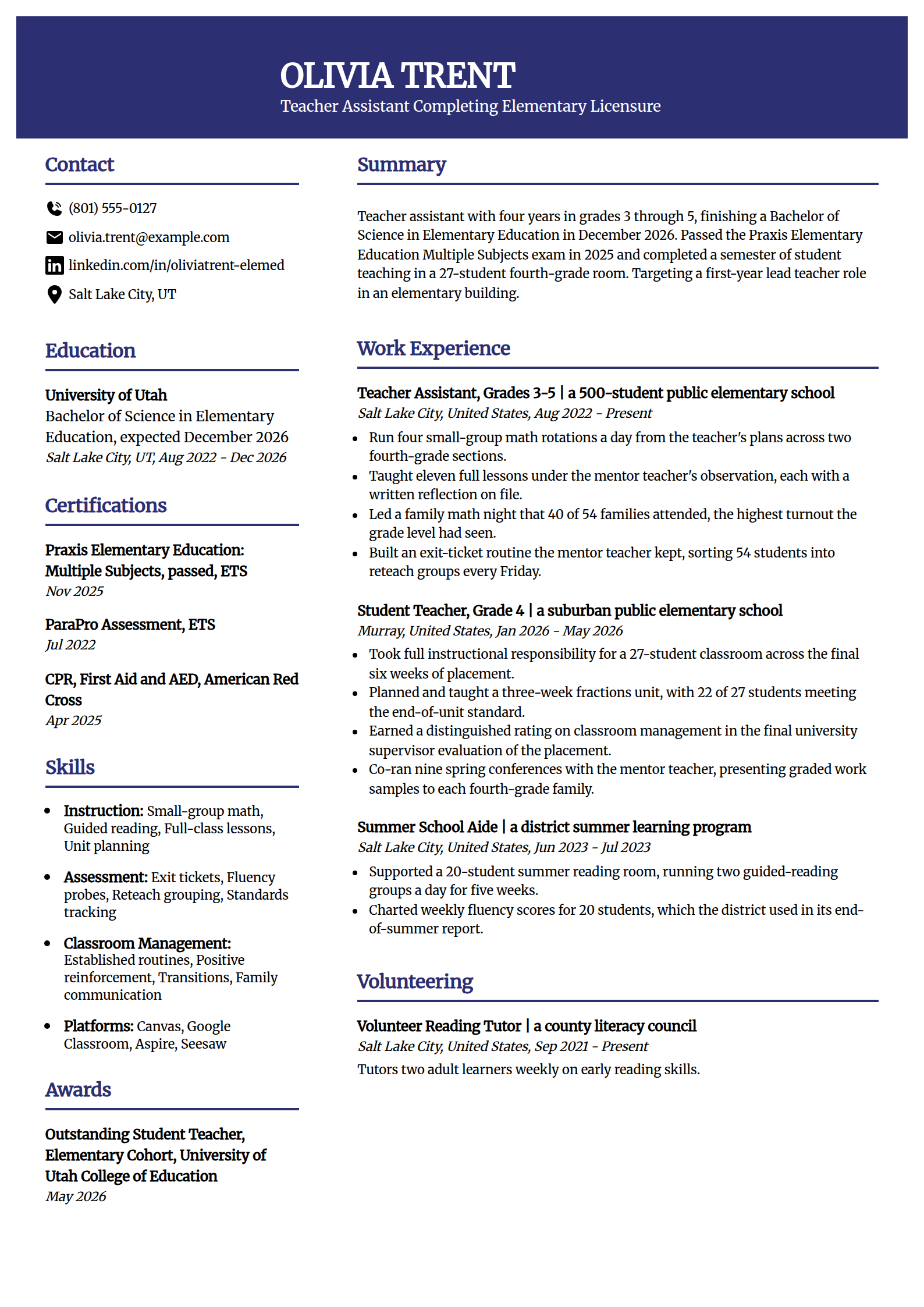
Teacher Assistant to Lead Teacher Resume Template
Why this resume example works?
- Headlines the licensure progress, since a principal hiring a first-year teacher screens on the credential before anything else.
- States the exam precisely, passed the Praxis Elementary Education Multiple Subjects exam in 2025, with a date.
- Separates student teaching from the paraprofessional job so the full-responsibility weeks are not buried in aide duties.
- Surfaces instruction the candidate owned: eleven observed lessons and a three-week fractions unit with a stated result.
- Retains the family math night, because turnout of 40 of 54 families is evidence of the hardest part of first-year teaching.
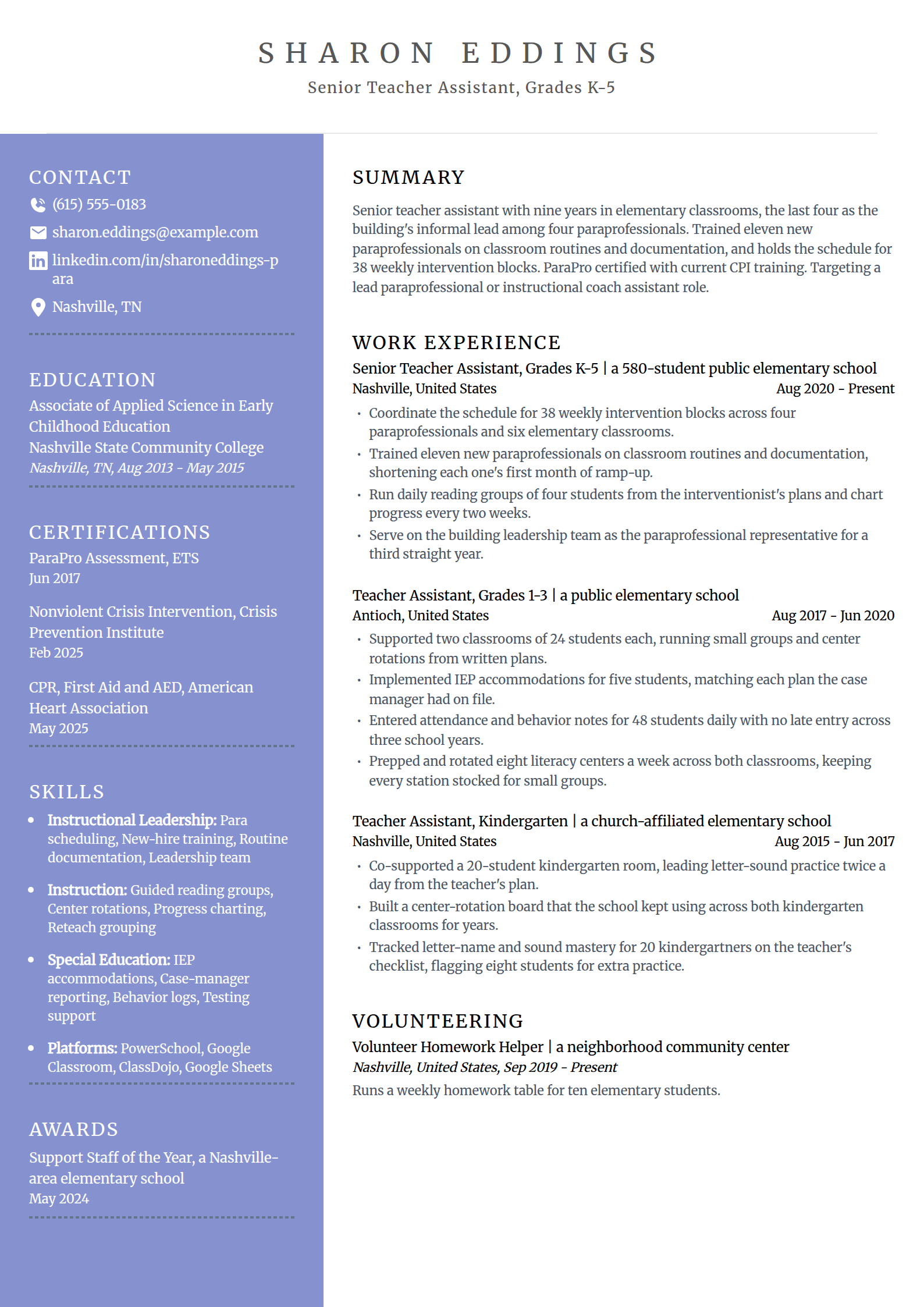
Experienced Teacher Assistant Resume Template
Why this resume example works?
- Claims the informal leadership plainly, lead among four paraprofessionals, which is how most buildings actually run.
- Quantifies that leadership with the schedule owned, 38 weekly intervention blocks across six classrooms.
- Uses training eleven new paraprofessionals as the proof of seniority, which is more credible than a years count alone.
- Keeps the building leadership team seat, since representation signals trust from administrators who could be called as references.
- Compresses nine years into three entries so the page stays one page without dropping the early classroom work.
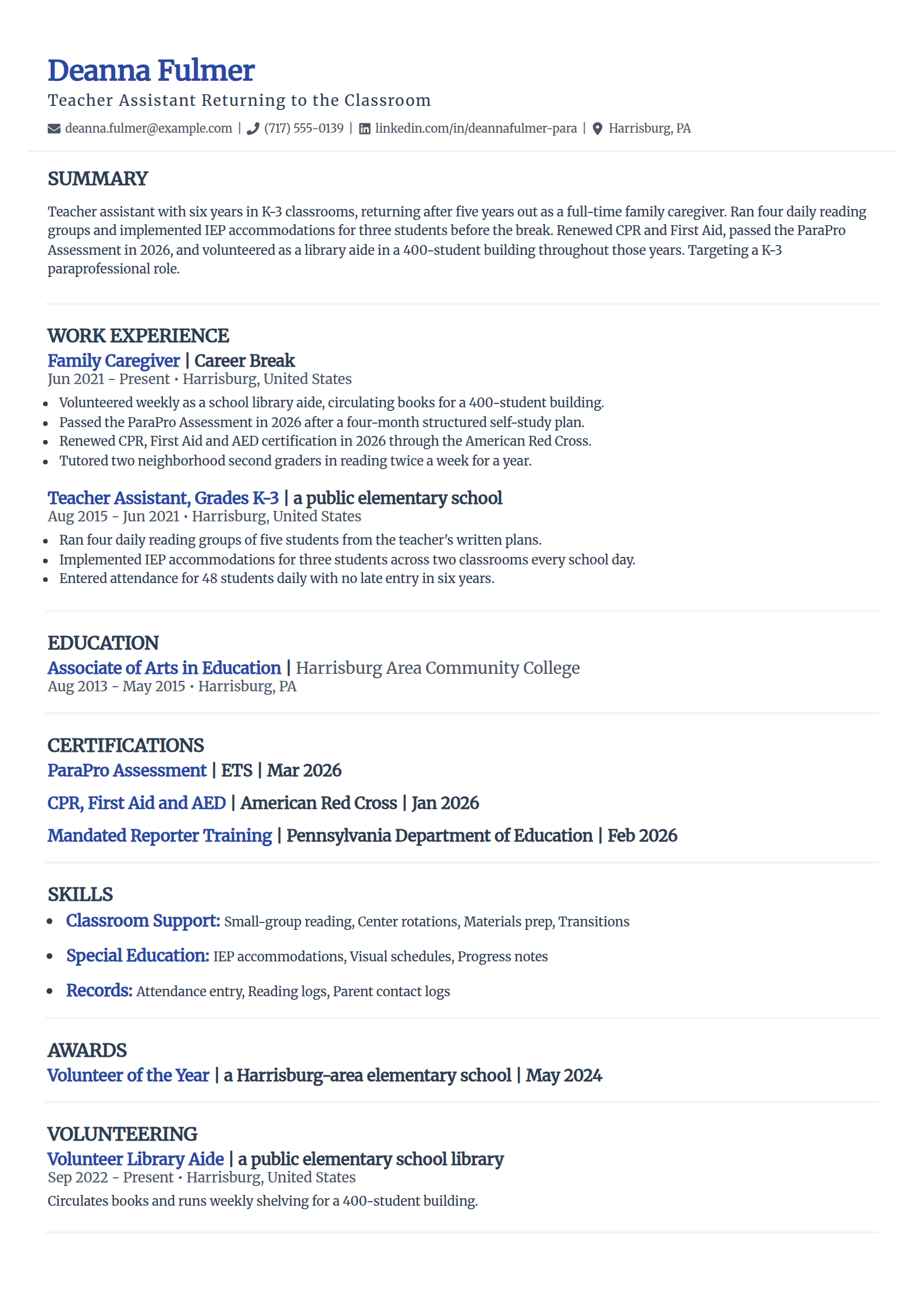
Teacher Assistant Resume Template After a Career Gap
Why this resume example works?
- Names the break as a dated Family Caregiver entry, which answers the timeline question before a screener has to ask it.
- Fills the break with things a reference can confirm: a weekly library volunteer role, a passed exam, a renewed certification.
- Puts the 2026 ParaPro Assessment date on the page, since a recent credential is the strongest signal a returner can give.
- Keeps the six years of prior classroom work intact and numbered rather than shortening it to make room for the gap.
- Stays on one page with a plain layout, which matters when the application is read by a district clerk and not a designer.
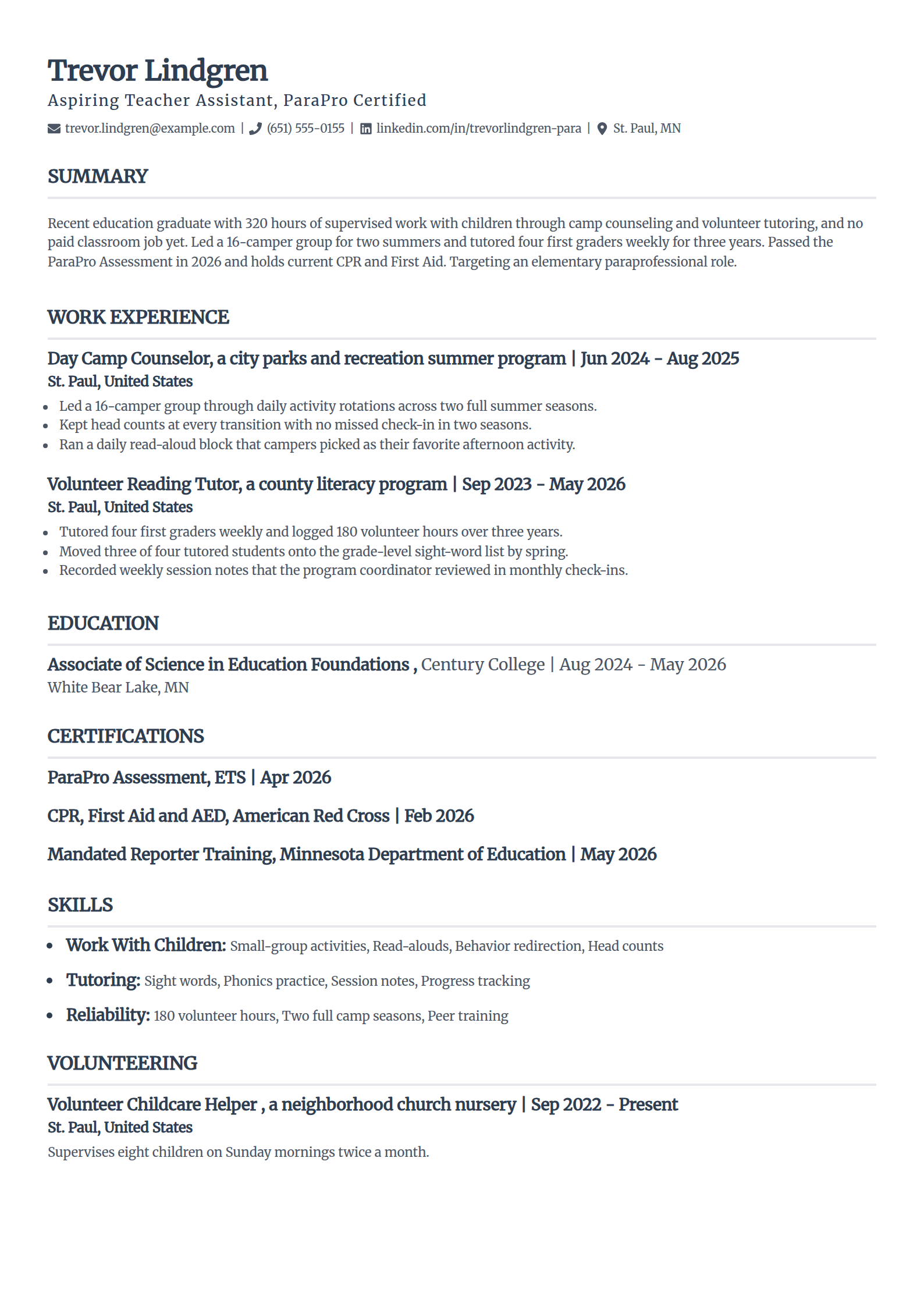
Teacher Assistant Resume Template With No Experience
Why this resume example works?
- Says there is no paid classroom job yet and then gives the substitute: 320 supervised hours with children.
- Counts volunteer tutoring in hours, 180 logged over three years, because hours are what a district can verify.
- Picks work with children that transfers cleanly, camp counseling and literacy tutoring, not unrelated jobs padded to look relevant.
- Carries the ParaPro Assessment, which lets a candidate with no classroom history clear the same gate as everyone else.
- Runs a plain reverse-chronological layout, so nothing about the format invites a second look at the thin history.
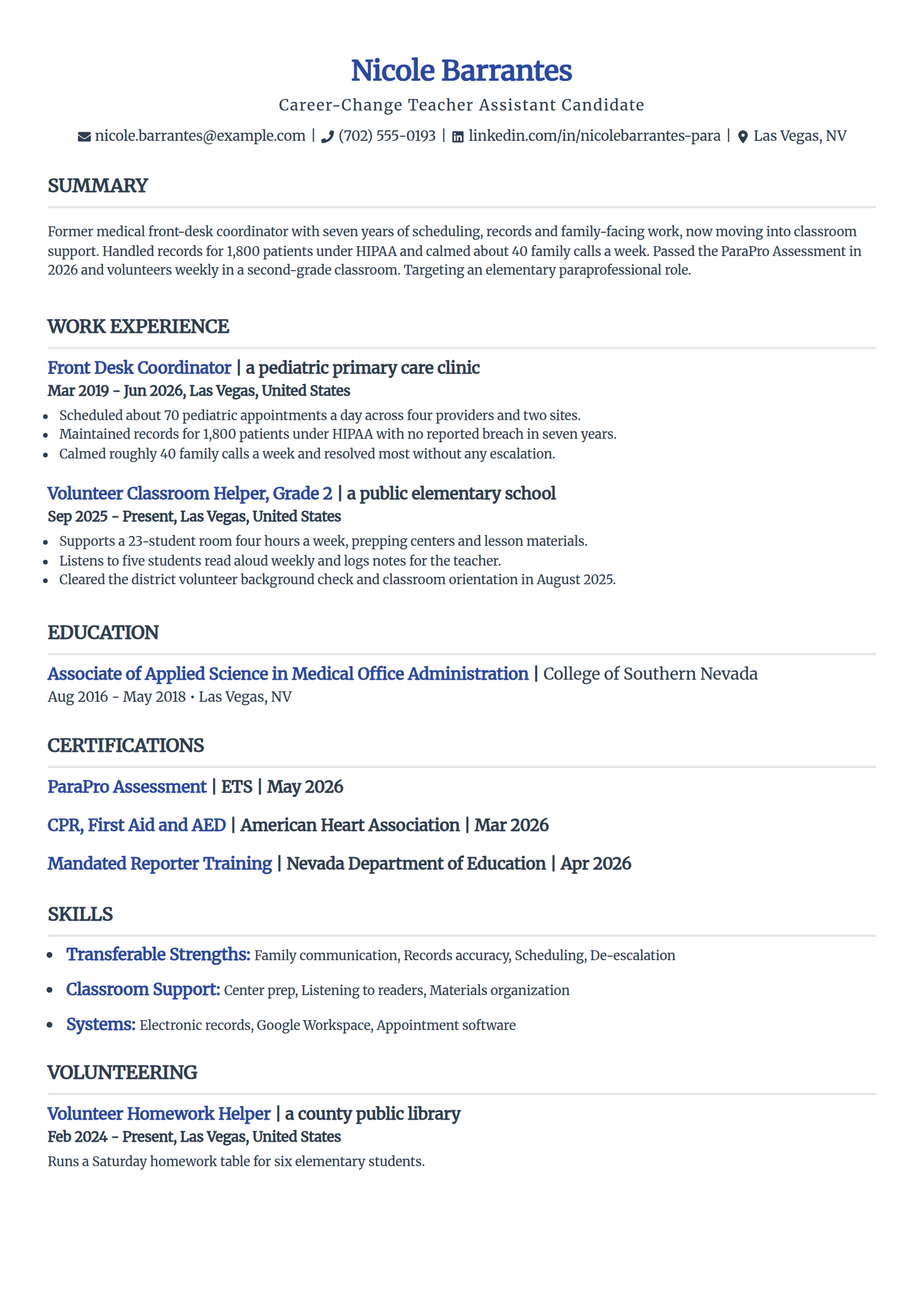
Career-Change Teacher Assistant Resume Template
Why this resume example works?
- Headlines the target, a career-change teacher assistant candidate, so the pivot reads as a decision rather than a fallback.
- Translates front-desk work into the language a school uses: family communication, records accuracy, de-escalation.
- Keeps the strongest number from the old field, records for 1,800 patients with no reported breach in seven years.
- Adds a current classroom volunteer role, which is the cheapest and fastest way to make a pivot credible.
- Dates the ParaPro Assessment to 2026, which closes the qualification question the old resume would raise.
Build your teacher assistant resume
Pick a template above and the editor keeps the layout clean and ATS-safe while you swap in your own grade band, classroom numbers, and paraprofessional credential.
Build my resumeHow to write a teacher assistant resume in 2026
The job has two screens. A district clerk checks that you meet the paraprofessional requirement, then a principal or special education coordinator checks that you have actually done the classroom work their opening needs. Write for both, in that order.
Open with a summary that names the room
Three to four sentences, and the first one carries the grade band and the assignment type: elementary, preschool, self-contained special education, one-on-one, intervention, bilingual. A principal reading twenty applications is sorting them into rooms, and a summary that says classroom support without saying which room makes them guess. Put your strongest countable fact in the second sentence and your credential status in the third.
Special education paraprofessional with seven years in self-contained and resource settings serving grades 3 through 5, supporting eight students with IEPs across two classrooms.
Count the classroom work instead of claiming traits
Patient, caring and flexible is on every applicant's resume and screens for nothing. Numbers a school can picture do the work instead. The countable things in this job are:
- Students per group and groups per day, like five small-group reading rotations a day for groups of four.
- Students with IEPs supported, and how many accommodations you implement across how many classrooms.
- Movement you contributed to, like nine of twelve students up one guided-reading level, stated as your part of a team effort.
- Data you collect, such as progress on three IEP goals per student per session or 60 trial responses a day.
- Coverage, such as classrooms floated per week, teacher absences filled, or students supervised at arrival and dismissal.
Put the paraprofessional credential where the clerk looks
Federal Title I rules push districts to hire paraprofessionals who hold an associate degree, two years of college credit, or a passing score on a state-approved assessment such as the ParaPro Assessment. Name which route you took and the date. If your state issues an educational aide permit or paraprofessional license, put that line directly under it, and keep CPR, First Aid and AED current because many postings make it a condition of the offer.
Match the posting's words, including the ones you would not choose
Districts write these postings with specific vocabulary, and the resume that reuses it reads as a closer match. Mirror the phrasing you see, then back each term with something you have done:
- Paraprofessional, instructional aide, teacher aide and one-on-one aide are different words for overlapping jobs; use the one in the posting.
- Special education postings search for IEP accommodations, behavior support, data collection, adaptive equipment and AAC.
- Early childhood postings search for the Child Development Associate credential, learning centers and developmental screening.
- Intervention postings name their products outright, including Lexia Core5, i-Ready, DIBELS and Fundations.
- Name the student information system you have actually used, whether PowerSchool, Infinite Campus or Skyward.
Keep it to one page in a layout a district system can read
One page covers almost every teacher assistant, including candidates with ten years in. Use standard headings, a single or clean two-column layout, real text rather than text inside images, and consistent dates, because district portals parse the file before a human opens it. Browse the full set of ATS-friendly layouts on the resume templates hub if the one above is not your style.
Common teacher assistant resume mistakes
- Leading with soft traits. Patient, caring and flexible appears on nearly every application and screens for nothing. Lead with the grade band, the assignment type, and a number.
- Hiding the credential. If you passed the ParaPro Assessment, hold an associate degree, or carry a state educational aide permit, put it near the top with its date, because that line is what a district clerk is checking.
- Claiming work outside the role. A paraprofessional implements the plan a certified teacher or case manager writes. Saying you wrote IEPs or set accommodations reads as inaccurate to anyone who works in a school.
- Writing duty lists with no scale. Replace "assisted students with classwork" with "ran five small-group reading rotations a day for groups of four, from the teacher's plans".
- Mixing up the two teaching assistant jobs. A K-12 paraprofessional resume and a university teaching assistant resume target different hirers; if you are applying to a graduate program department, use the academic resume templates instead.
Frequently asked questions
What should a teacher assistant resume include?
A teacher assistant resume needs a three-to-four-sentence summary naming your grade band and assignment type, a work history written as countable classroom work, your paraprofessional qualification, and a grouped skills block. Show how you qualify under the Title I paraprofessional rules, whether that is an associate degree, two years of college credit, or a passing score on a state-approved assessment such as the ParaPro Assessment. Add current CPR, First Aid and AED, any behavior or early childhood credential such as CPI or the Child Development Associate, and the platforms you have used, like PowerSchool, Google Classroom or Lexia Core5.
How do you write a teacher assistant resume with no experience?
Lead with the supervised hours you do have and name them in hours, not adjectives. Camp counseling, volunteer tutoring, church nursery work, coaching and babysitting all count as supervised work with children, and a number like 180 logged tutoring hours over three years is something a district can verify. Pass the ParaPro Assessment or finish the credit hours your state accepts before you apply, since that single line puts you through the same gate as a candidate with classroom years. Then pick a plain one-page layout and keep the history in reverse-chronological order.
What skills should a teacher assistant put on a resume?
Group them by what the posting screens for rather than listing traits. Instructional support covers small-group reading and math, center rotations, lesson prep and materials. Special education covers IEP accommodation implementation, behavior data collection, visual schedules, AAC and PECS. Classroom operations covers attendance entry, arrival and dismissal duty, transitions and family contact logs. Then name the specific products you have used, including PowerSchool or Infinite Campus, Google Classroom, Seesaw, ClassDojo, i-Ready, Lexia Core5 and DIBELS. Skills you can discuss on the first day belong on the page; the rest do not.
Do you need a certification on a teacher assistant resume?
For a Title I-funded position in most districts, yes, you need to meet the paraprofessional requirement, and the resume is where you prove it. The usual routes are an associate degree, roughly two years of college credit, or a passing score on a state-approved assessment such as the ParaPro Assessment. Several states also issue an educational aide permit or paraprofessional license on top of that. Beyond the requirement, CPR, First Aid and AED are often a condition of employment, CPI Nonviolent Crisis Intervention opens behavior and self-contained roles, and the Child Development Associate credential carries weight in preschool settings.
Should a teacher assistant resume use an objective or a summary?
Use a summary if you have worked in a classroom in any paid or volunteer capacity, which is almost everyone. A summary leads with what you bring, and three to four sentences naming your grade band, your strongest number, and your credential status will always beat a sentence about what you are seeking. Use an objective only when you are switching in from an unrelated field and the resume needs to explain the direction, and even then lead the objective with what you bring rather than what you want. A resume carries one or the other, never both.
How long should a teacher assistant resume be?
One page, including candidates with ten years in the classroom. Districts hire on the credential plus a handful of specifics about the rooms you have worked in, and both fit on a page. If you are running out of room, cut older unrelated jobs and trim the earliest classroom entries to two or three bullets rather than shrinking the font or dropping the credentials. Every example on this page is one page, and each one keeps the summary, the work history, the qualification and the skills block visible.
More teacher assistant resume resources
Build your teacher assistant resume
Pick a template above and the editor keeps the layout clean and ATS-safe while you swap in your own grade band, classroom numbers, and paraprofessional credential.