16 Ways to Fill a College Graduate Resume Before Your First Job
- ATS Friendly
- Built Without a Career Job
- 16 Graduate Examples
A college graduate resume example should carry four things: the degree with its graduation date, the evidence you actually have (internship, campus job, research, leadership, capstone, service), a skills block naming tools rather than traits, and a summary that says what you are targeting. The degree is the short part. Pick the example below that matches what you have.


540k+ resumes created
One template per kind of evidence a graduate actually has
A finance graduate with a credit internship, a psychology graduate who worked 25 hours a week and never got one, and an engineering graduate whose capstone was a real municipal project are three different applications. Each template below is a complete one-page resume for one of them, with the coursework, credentials and numbers that version of the reader can genuinely claim.
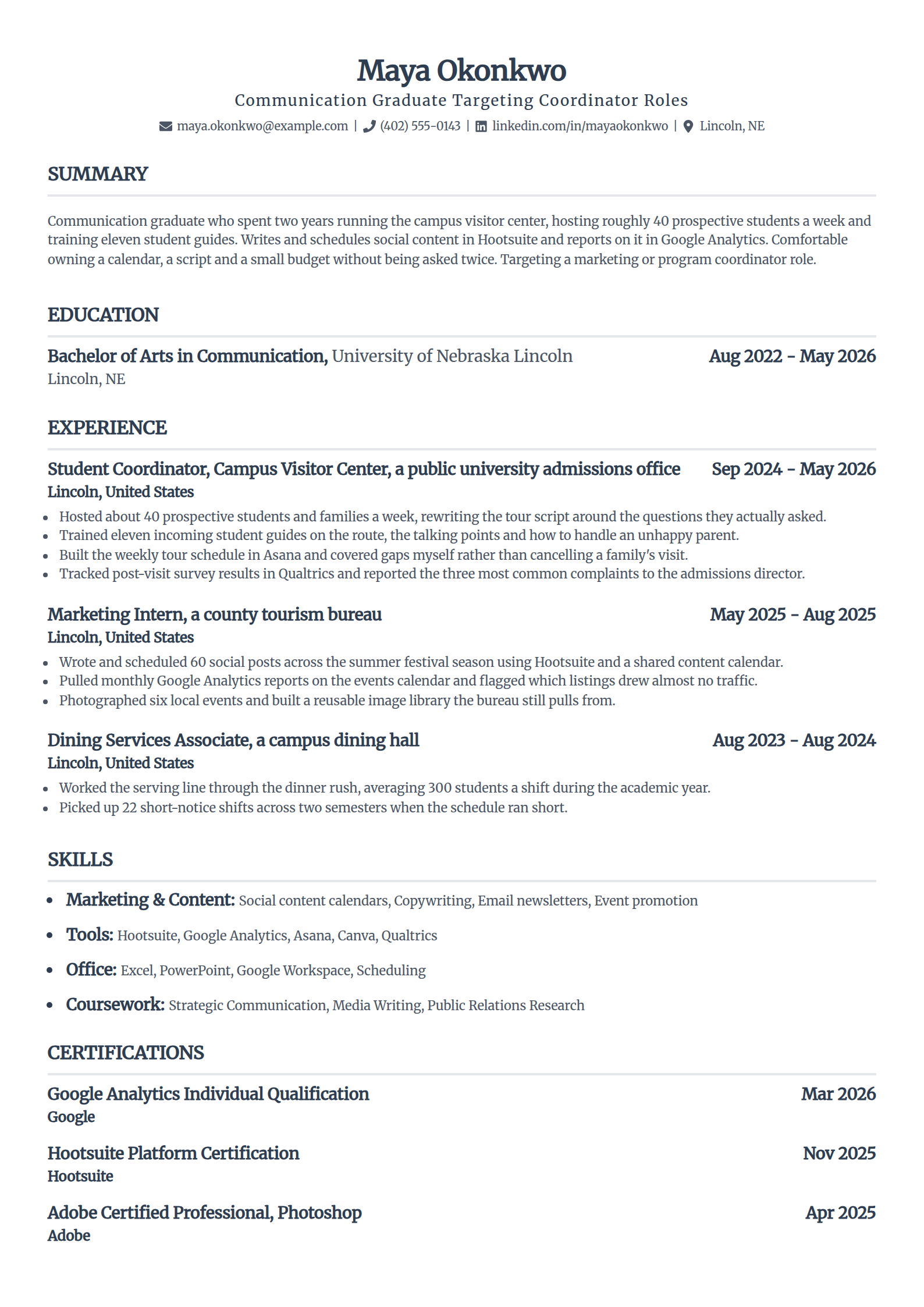
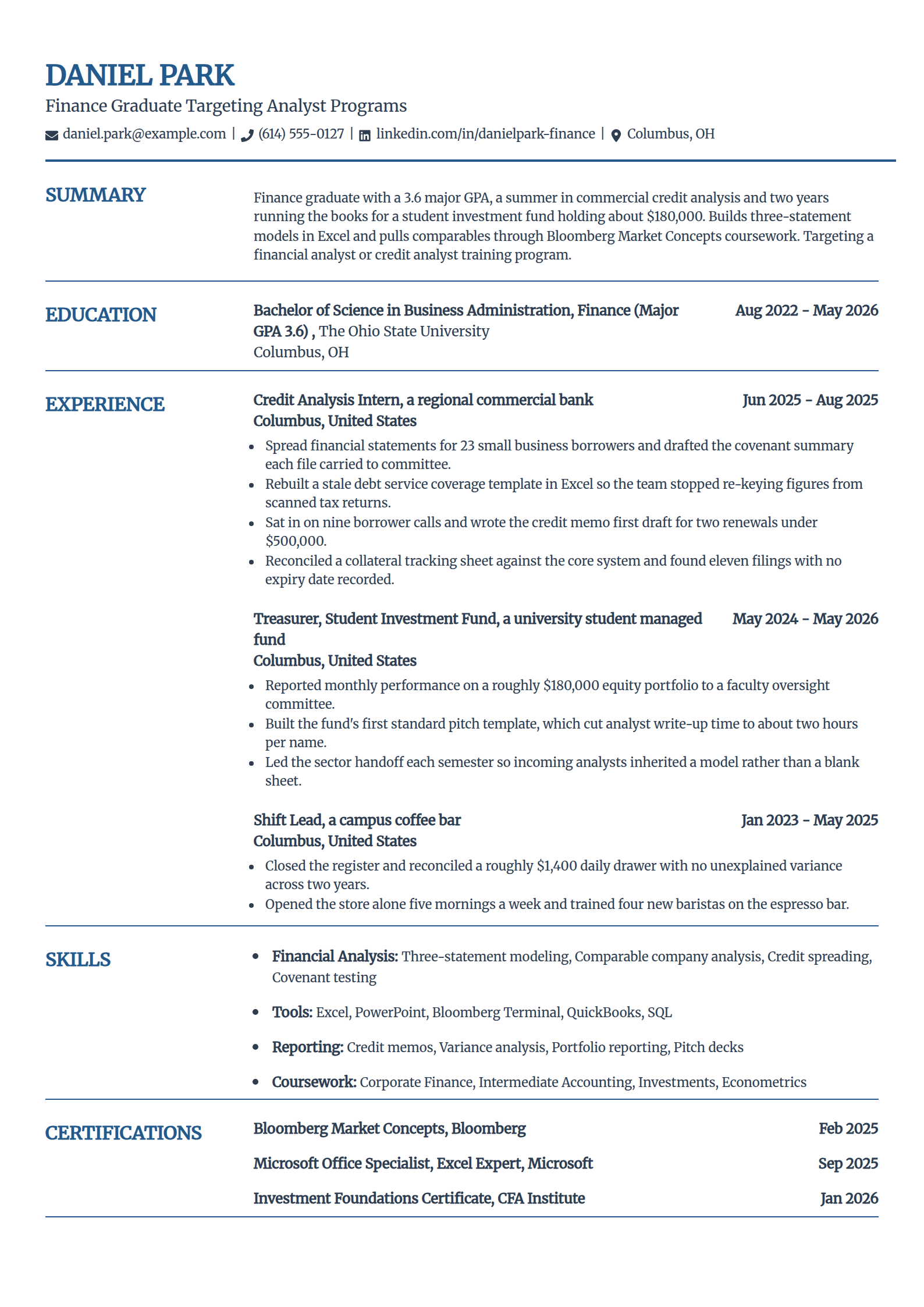
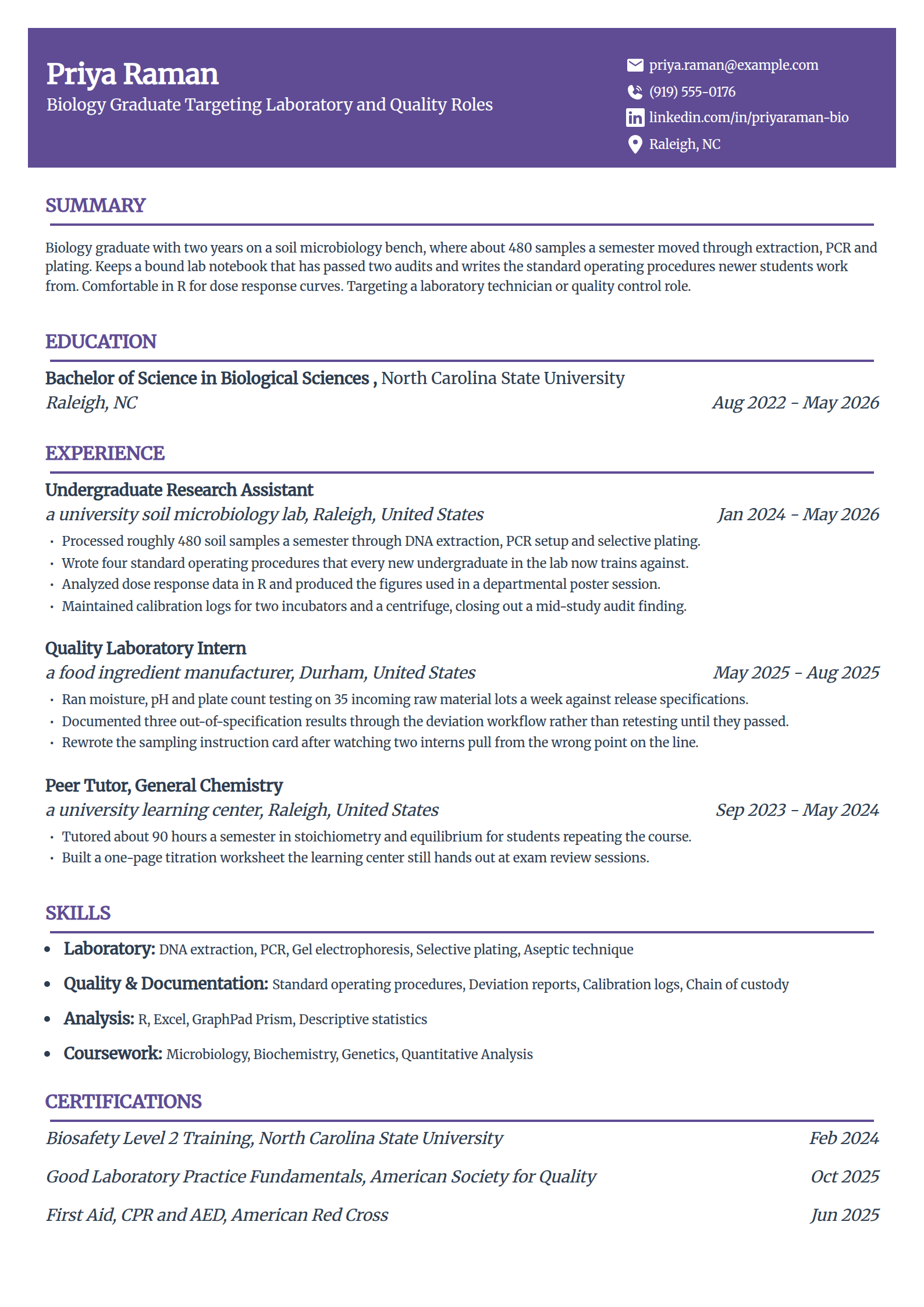
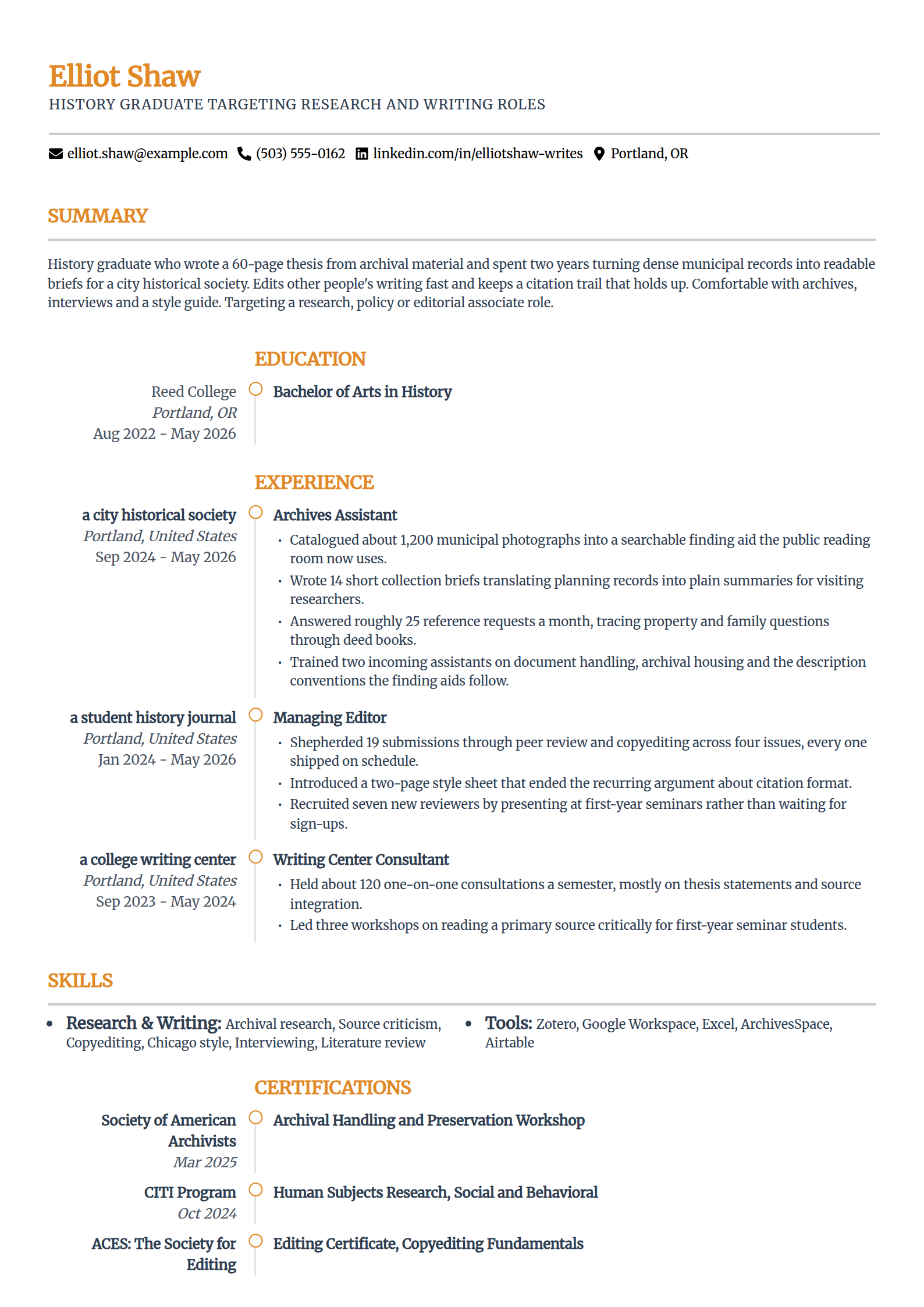
Recent College Graduate Resume Template
Why this resume example works?
- Puts education above the work history, which is where it belongs while the degree is the newest thing on the page.
- Counts the campus job properly: students hosted per week, guides trained, surveys tracked, not a list of duties.
- Names Hootsuite, Google Analytics, Asana and Qualtrics, so a coordinator posting's tool list has something to match.
- Keeps the dining hall job on the page, because 22 picked-up shifts is evidence of reliability a manager reads fast.
- Carries no GPA at all, which is the right call when the GPA is not the strongest thing available.
Business Degree Graduate Resume Template
Why this resume example works?
- Labels the 3.6 as a major GPA rather than quietly implying it is cumulative, which is the honest version of that line.
- Leads the internship with spread statements and covenant summaries, the actual work an analyst program screens for.
- Treats the student investment fund as a job, with the portfolio size and the reporting line stated plainly.
- Shows the coffee bar as cash accountability, not filler: a reconciled drawer is a finance-relevant fact.
- Lists Bloomberg Market Concepts and the CFA Institute foundation certificate, both real and both checkable.
STEM Degree Graduate Resume Template
Why this resume example works?
- Quantifies bench work the way a lab does: samples per semester, techniques by name, procedures written.
- Shows documentation discipline, including closing out an audit finding, which is what separates a lab hire from a student.
- Puts the out-of-specification result on the page instead of hiding it, because handling one correctly is the skill.
- Splits skills into laboratory, quality and analysis, so a quality control posting and a research posting both find their words.
- Keeps the tutoring entry short and specific, with hours and the one artifact that outlived the job.
Liberal Arts Graduate Resume Template
Why this resume example works?
- Converts a humanities degree into countable work: photographs catalogued, briefs written, reference requests answered.
- Names the methods outright, archival research and source criticism, instead of saying strong research skills.
- Uses the student journal as management experience, with submissions shepherded and a deadline record.
- Lists Zotero, ArchivesSpace and Airtable, which is what turns a liberal arts resume into a searchable one.
- Leaves the GPA off entirely and lets a 60-page thesis and a 1,200-item finding aid carry the weight.
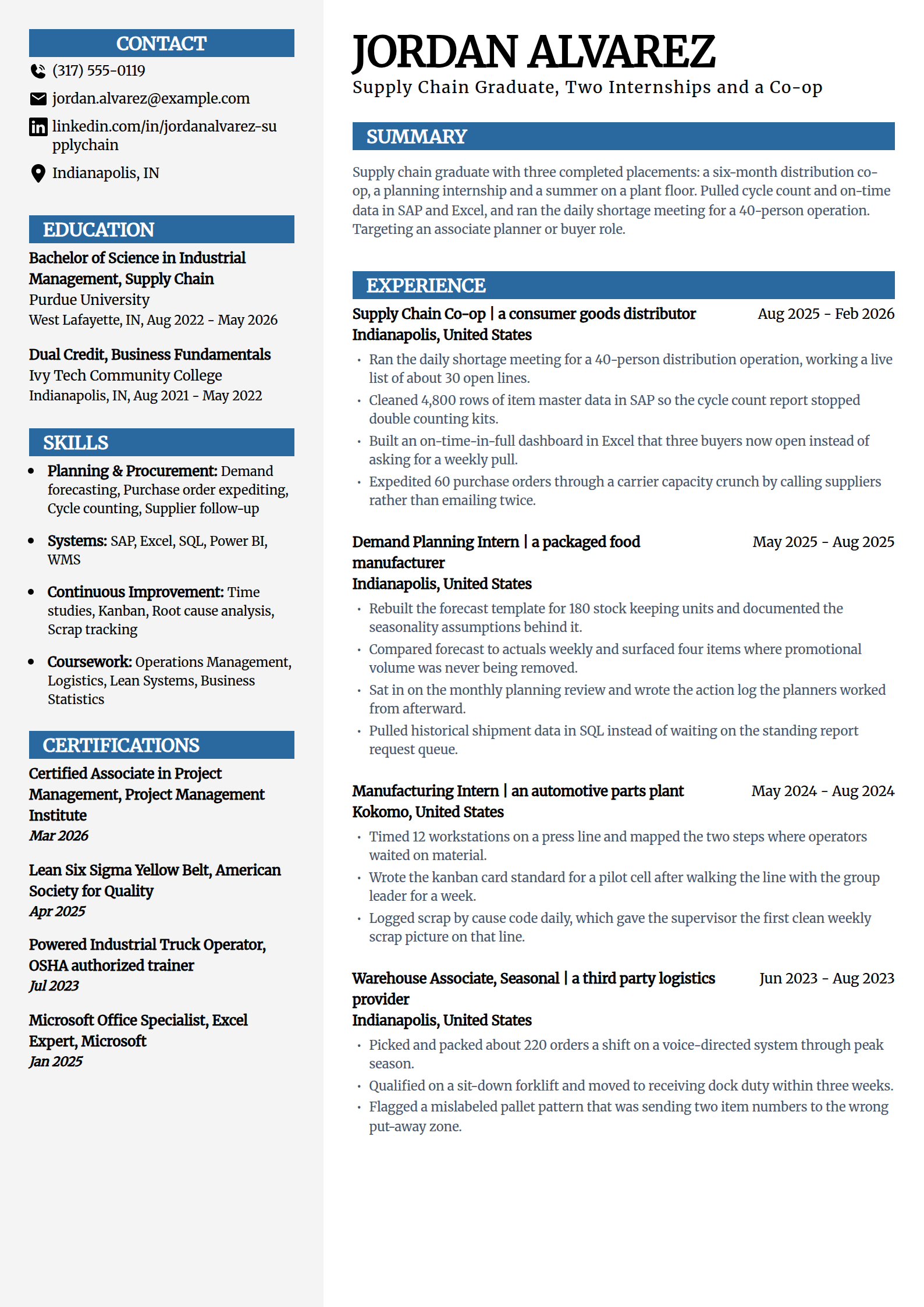
College Graduate With Internship Experience Resume Template
Why this resume example works?
- Flips the order and puts work experience above education, because three completed placements outrank the degree line.
- Treats the six-month co-op as a job, with a daily meeting owned and a live list of open lines worked.
- Shows progression across three summers rather than three disconnected logos, which is what a recruiter reads for.
- Keeps the seasonal warehouse job, since a forklift qualification and a mislabeling catch are supply chain facts.
- Names SAP, SQL and Power BI separately from the planning skills, so both halves of a posting get matched.
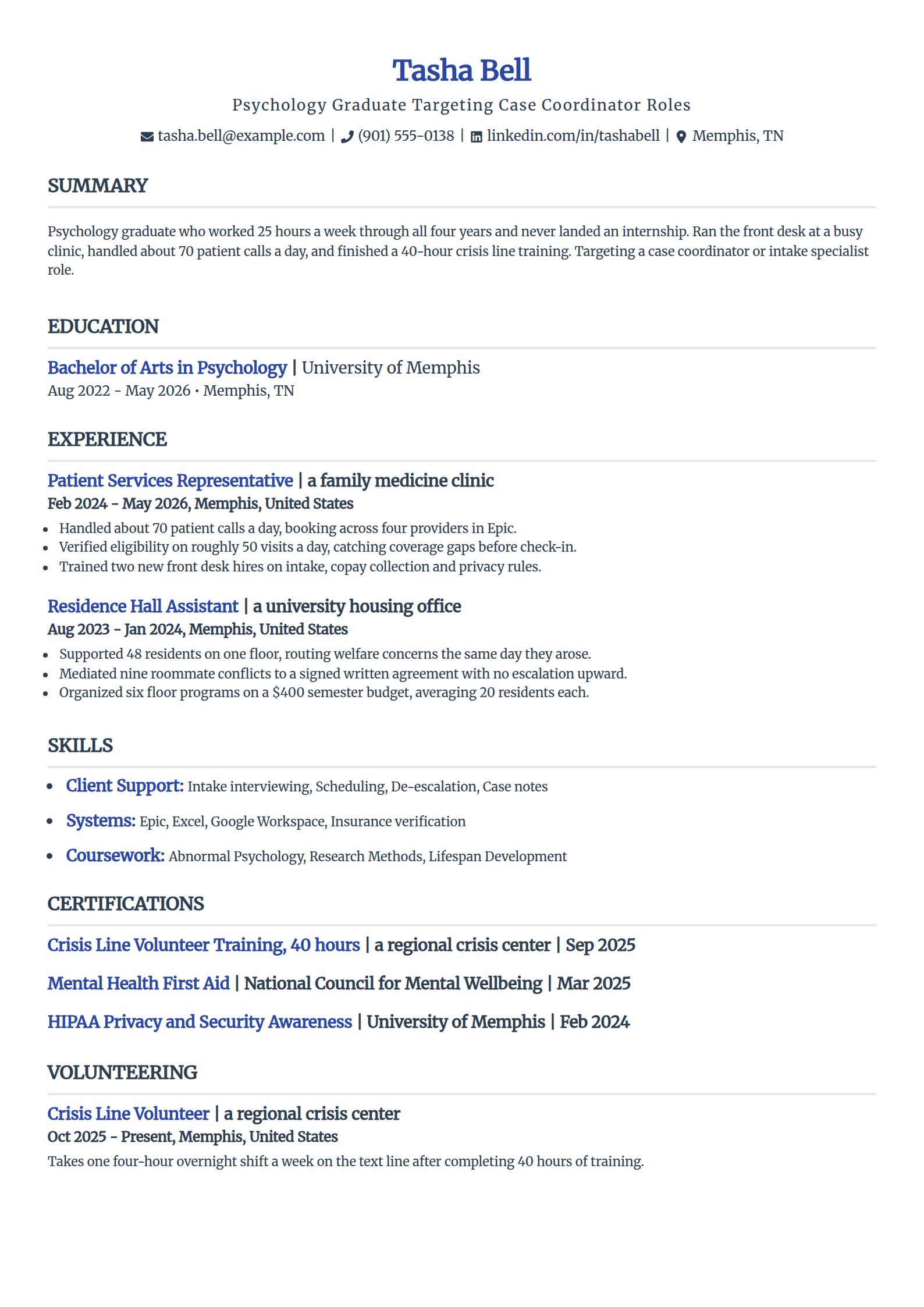
College Graduate Resume Template With No Internship
Why this resume example works?
- Says in the summary that there was no internship and moves straight on, which reads as confidence rather than a gap.
- Turns a clinic front desk into the exact work an intake role does: calls, scheduling, eligibility, privacy rules.
- Uses the residence hall assistant role for the part employers care about, mediated conflicts and welfare routing.
- Puts the 40-hour crisis line training in certifications and the shift itself in volunteering, so both are visible.
- Keeps every skill concrete. Nothing on this page says teamwork, communication or critical thinking.
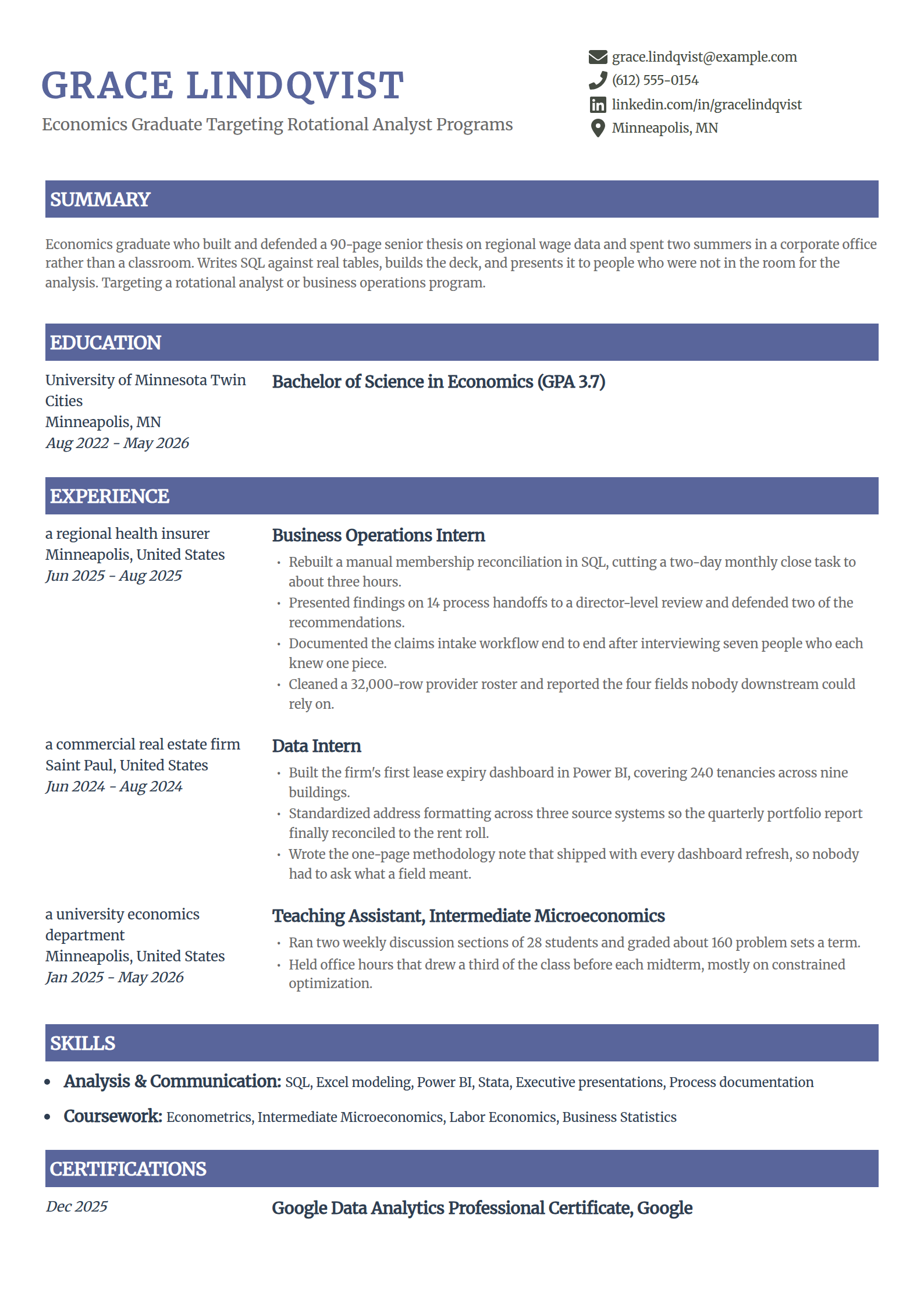
First Corporate Job Resume Template for Graduates
Why this resume example works?
- Shows the one thing rotational programs screen for: analysis that was presented to people who were not in the room.
- Puts a real before and after on a process, a two-day close task rebuilt in SQL, without claiming a percentage lift.
- Includes the 3.7 GPA because it clears the 3.0 bar and this reader has no decade of work to outrank it.
- Pairs two summer internships with a teaching assistantship, which covers both the analytical and the explaining half.
- Groups analysis and communication in one skills line, because that pairing is what the job actually is.
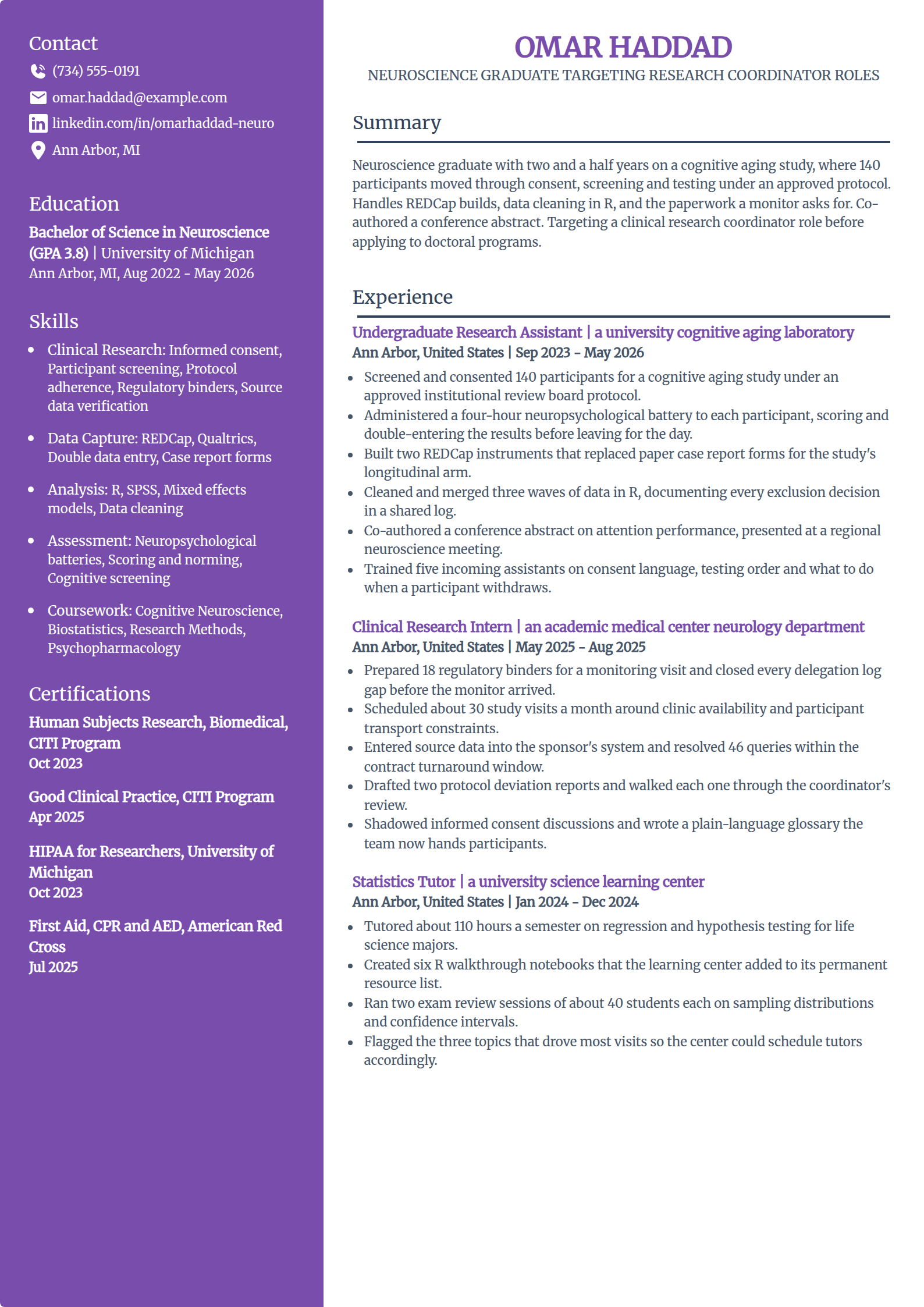
Research Coordinator Resume Template for Graduates
Why this resume example works?
- Leads with participants screened and consented, which is the number a clinical research coordinator posting asks for.
- Names the regulatory work plainly: protocol, institutional review board, delegation log, monitoring visit, queries.
- Separates data capture tools from analysis tools, because REDCap competence and R competence are screened apart.
- States the doctoral plan in the summary rather than hiding it, since a coordinator role is openly a stepping stone.
- Lists both CITI modules with their dates, which is the first thing a research manager checks on this resume.
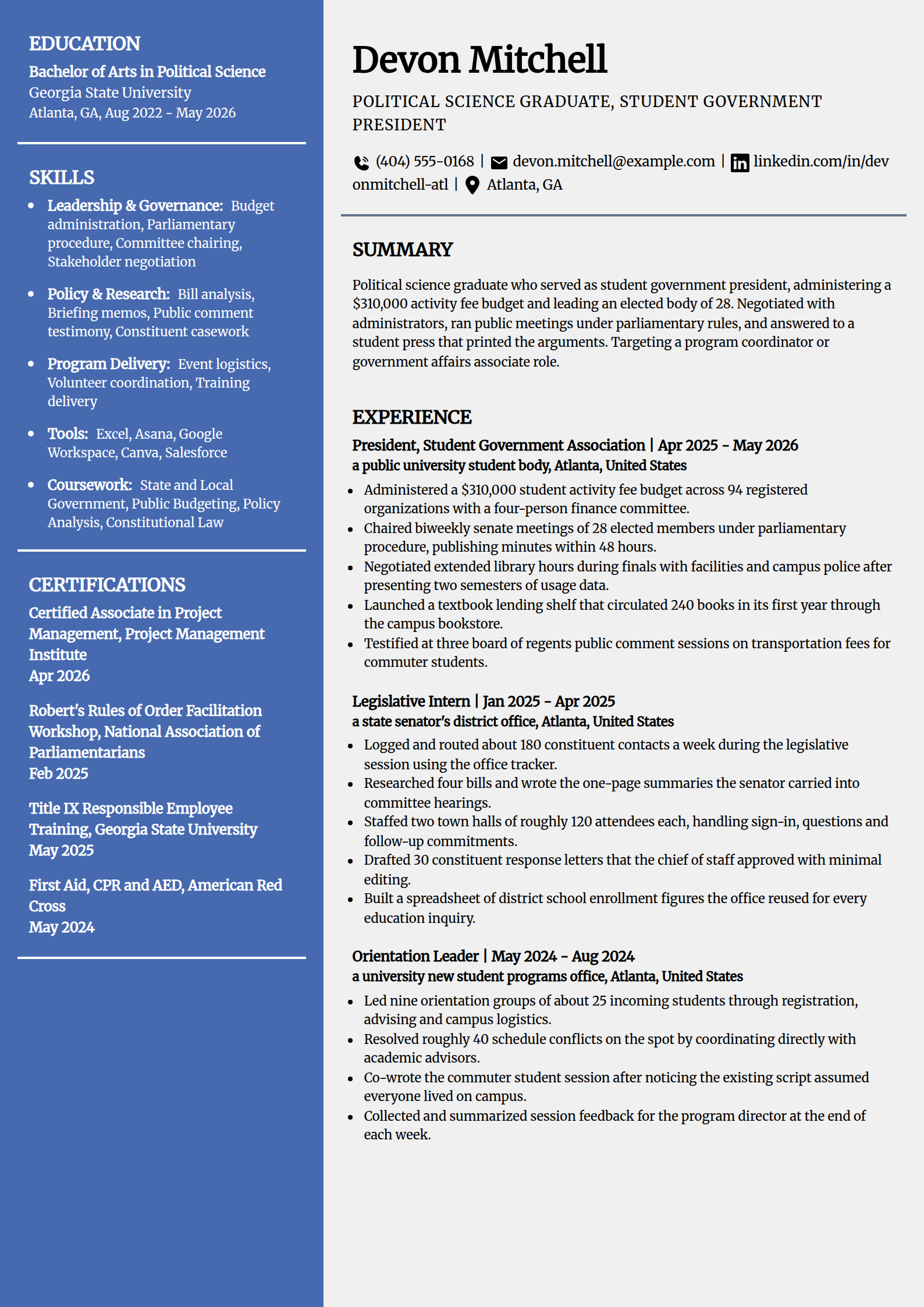
Campus Leadership Resume Template for Graduates
Why this resume example works?
- Treats student government as a real job with a budget figure, a headcount and a governing procedure named.
- Shows negotiation with an outcome attached, extended library hours won by bringing two semesters of usage data.
- Includes testifying at public comment sessions, which is the closest thing an undergraduate has to stakeholder work.
- Pairs the elected role with a legislative internship, so the leadership reads as a track rather than a popularity contest.
- Keeps the orientation leader entry for the operational detail: groups run, conflicts resolved, a session rewritten.
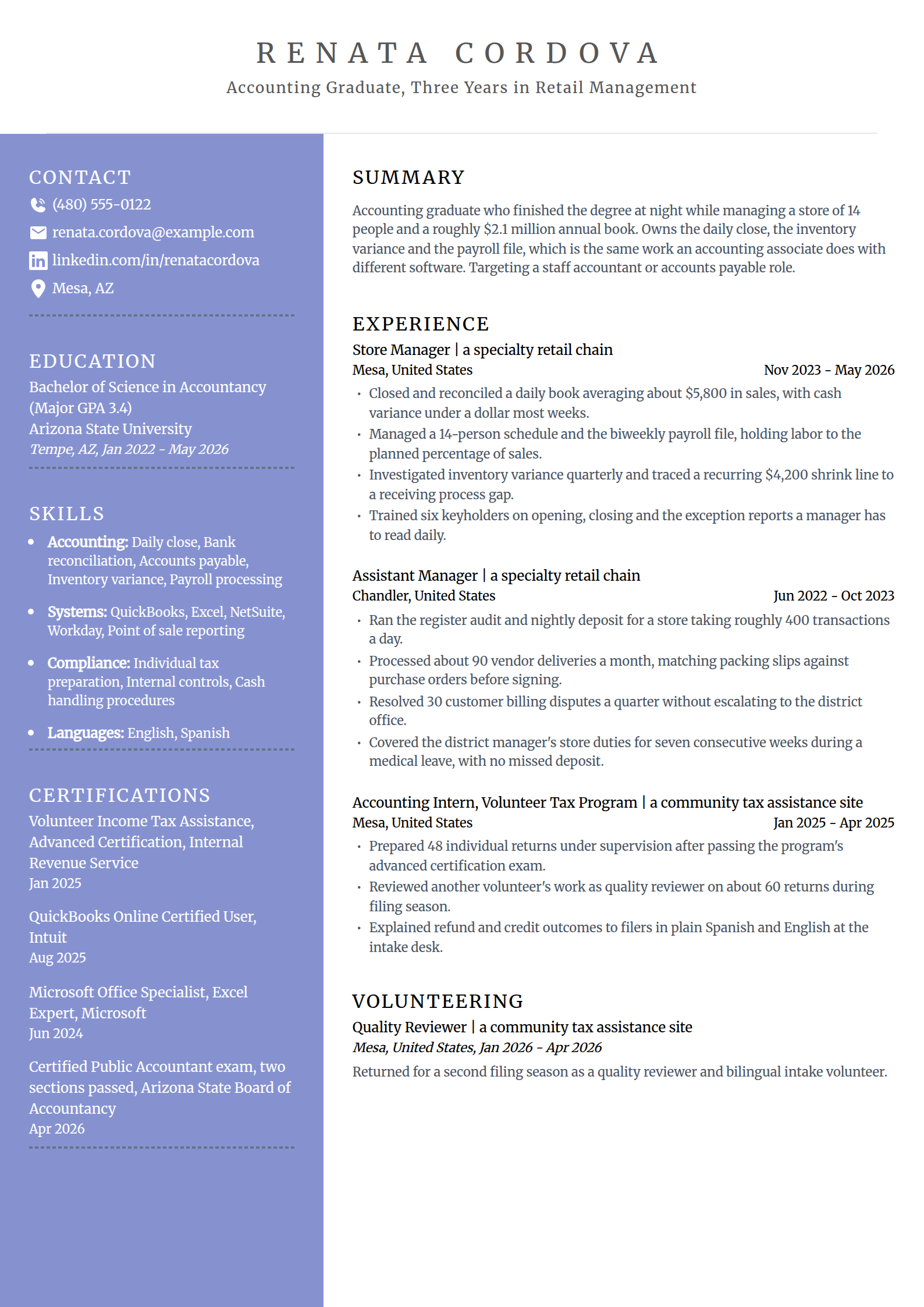
Career Changer Resume Template for New Graduates
Why this resume example works?
- Puts work experience first, which is correct here: three years managing a store outranks a degree finished at night.
- Translates retail into accounting language, daily close, cash variance, inventory variance, payroll file.
- Names the shrink investigation with a figure and a cause, which is the kind of story an interviewer follows up on.
- Shows the volunteer tax program twice, as supervised preparation and then as a quality reviewer the next season.
- Reports two passed CPA exam sections as what they are, sections passed, not an implied credential.
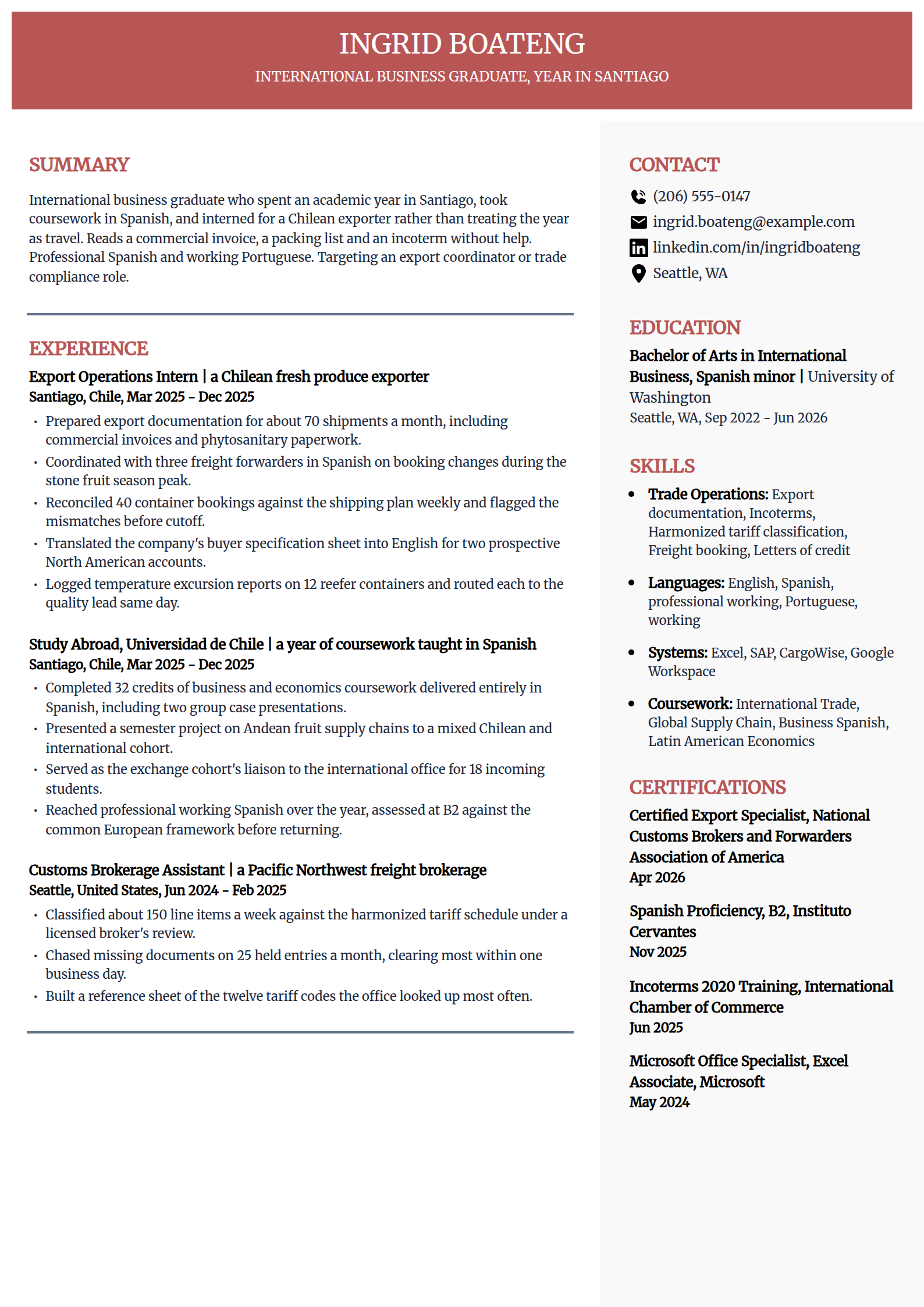
Study Abroad Resume Template for College Graduates
Why this resume example works?
- Puts the year abroad in the experience section as an internship, not in a travel line, because it was paid work.
- Lists the exchange itself as a separate entry with credits completed and the language the coursework was taught in.
- States the language level against a named framework, B2 on the common European scale, instead of claiming fluency.
- Names the documents, commercial invoices and phytosanitary paperwork, which is how an export posting is written.
- Keeps the domestic brokerage job in place, so the year abroad reads as part of a line rather than an interruption.
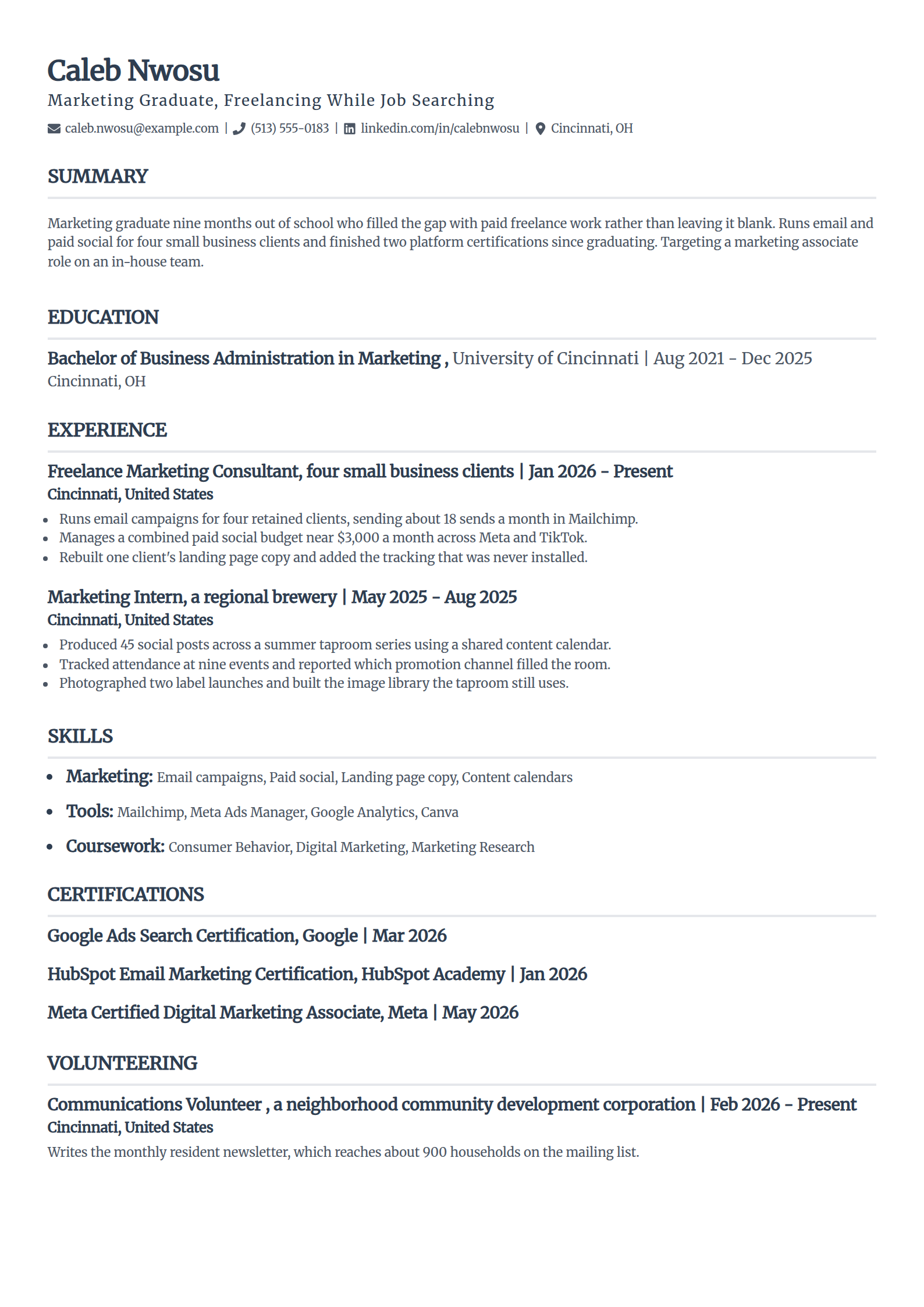
Resume Template for Graduates Still Job Searching
Why this resume example works?
- Fills the months since graduation with paid freelance work written in the present tense, so there is no blank stretch.
- Puts real client numbers on that work, four retained clients and a monthly ad budget, rather than calling it consulting.
- Shows three certifications all dated after graduation, which answers the only real question about the gap.
- Adds a volunteer newsletter with its circulation, which keeps a second current entry on the page.
- Never apologizes anywhere in the copy, because an explained gap is a fact and not a confession.
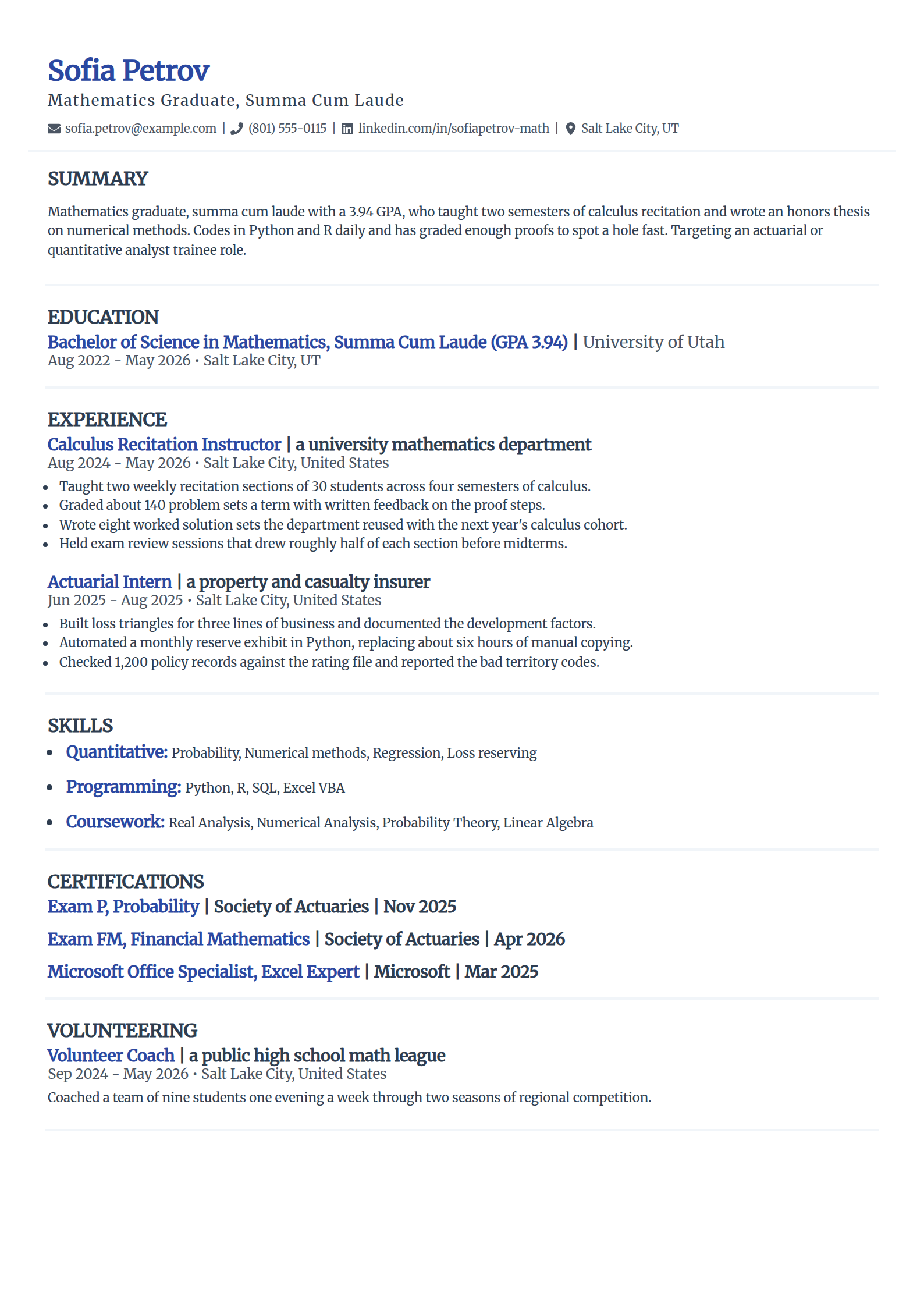
Honors Graduate Resume Template
Why this resume example works?
- Puts summa cum laude and the 3.94 in the degree line itself, which is the only place honors belong on a one-page resume.
- Backs the GPA with teaching, four semesters of recitation and 140 graded problem sets a term, so it is not the only claim.
- Lists two passed actuarial exams with the issuing society, the credential that actually moves this application.
- Shows automation with a concrete before, roughly six hours of manual copying replaced by a Python script.
- Keeps a volunteer coaching entry, which gives an otherwise academic page a second kind of evidence.
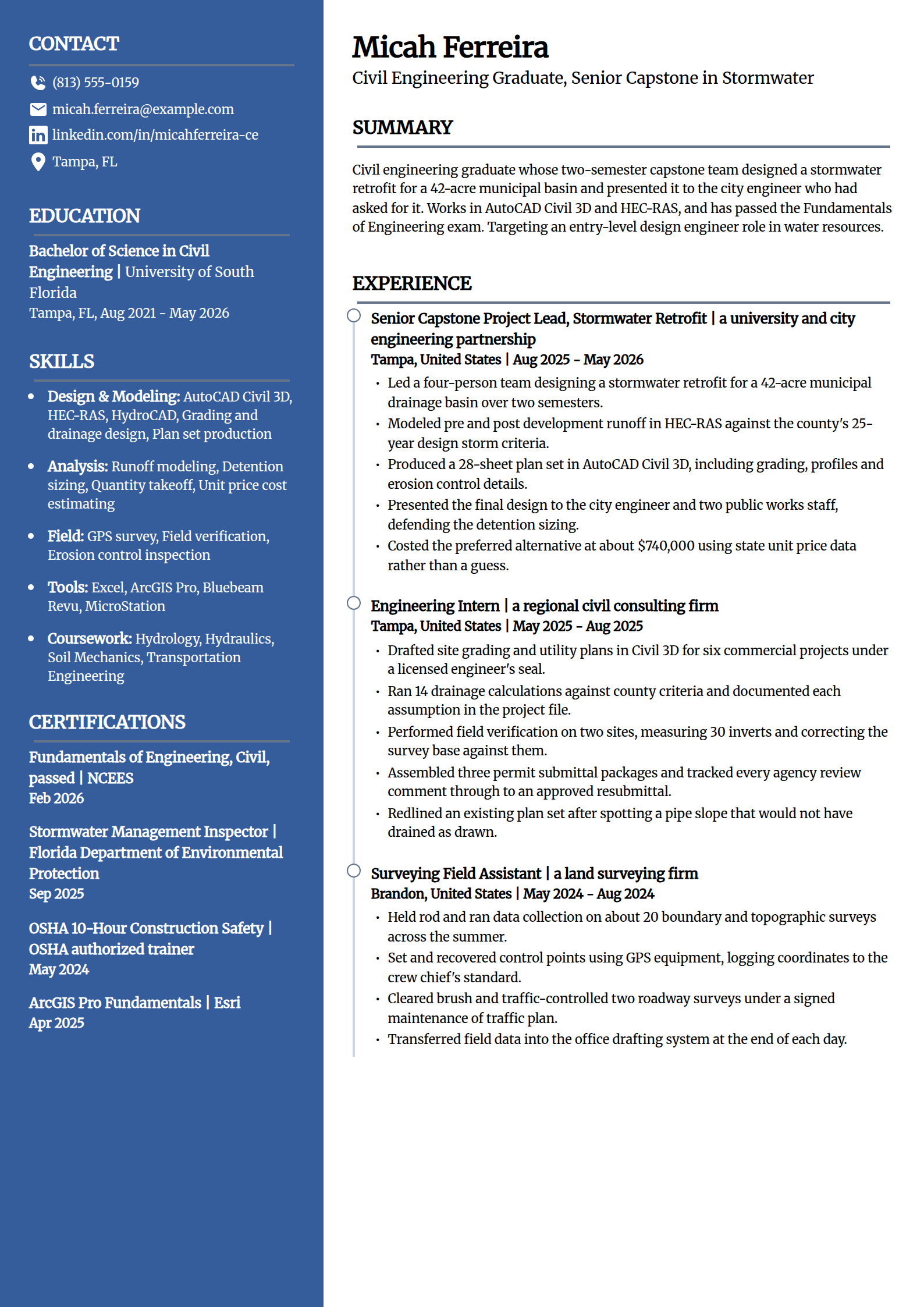
Capstone Project Resume Template for Graduates
Why this resume example works?
- Writes the capstone as a job entry with a title, dates and a team size, because that is what a two-semester project is.
- Names the deliverable precisely, a 28-sheet plan set and a modelled design storm, not a vague team project.
- Ends the entry with the presentation to the city engineer who requested it, which makes the project real work.
- Puts the passed Fundamentals of Engineering exam in certifications, the single credential this posting looks for.
- Keeps the surveying summer, since field verification is the part a design office cannot teach quickly.
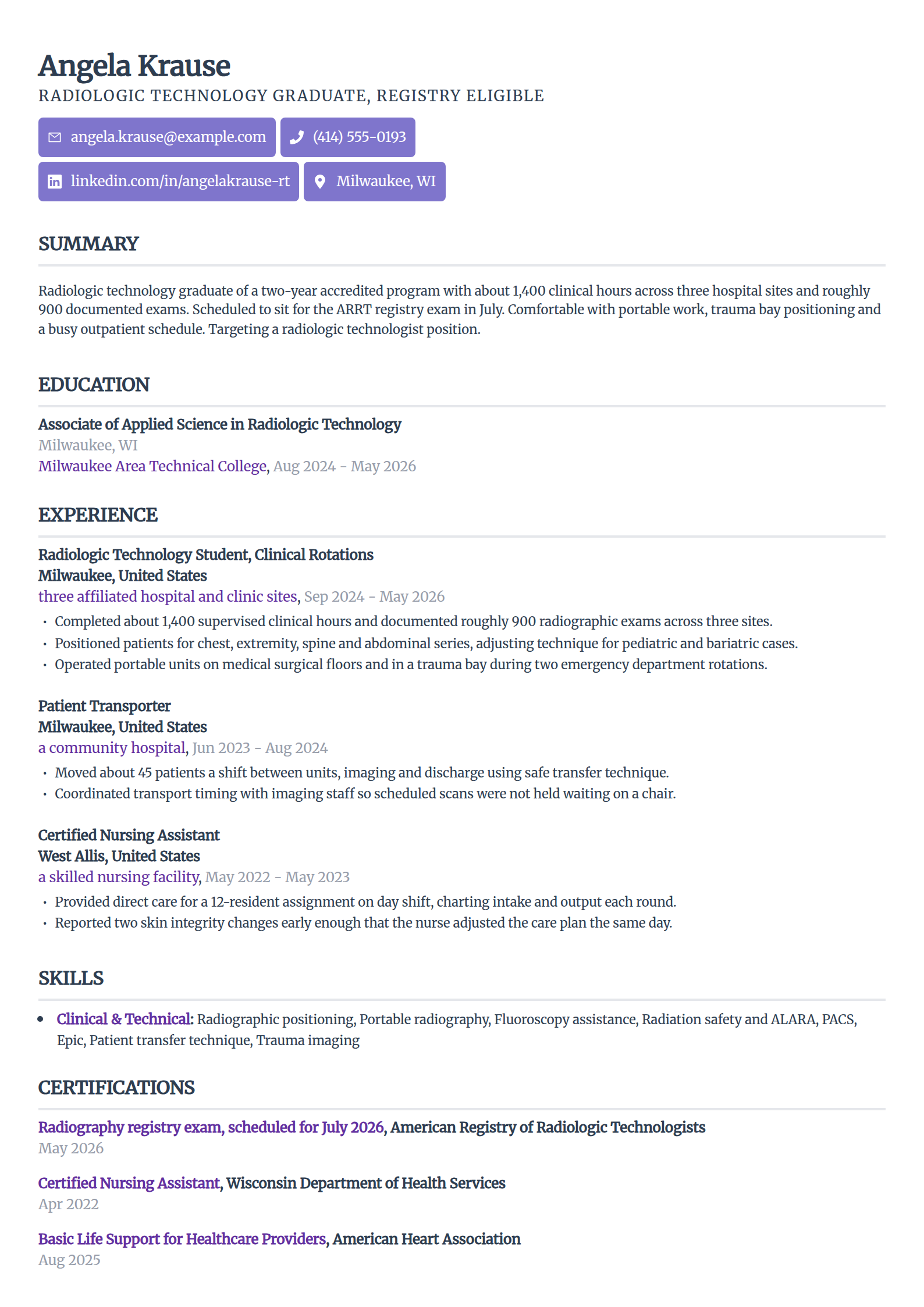
Associate Degree Graduate Resume Template
Why this resume example works?
- Treats clinical rotations as the experience section, with hours completed and exams documented across three sites.
- Phrases the registry exam correctly, scheduled to sit in July, rather than the sloppy currently sitting for.
- Shows the two-year degree as a complete credential, which it is, with no apology for its length anywhere on the page.
- Keeps the transporter and nursing assistant jobs, because patient handling is directly relevant to imaging work.
- Uses a single wide skills block, which suits a clinical role where everything is one competency list.
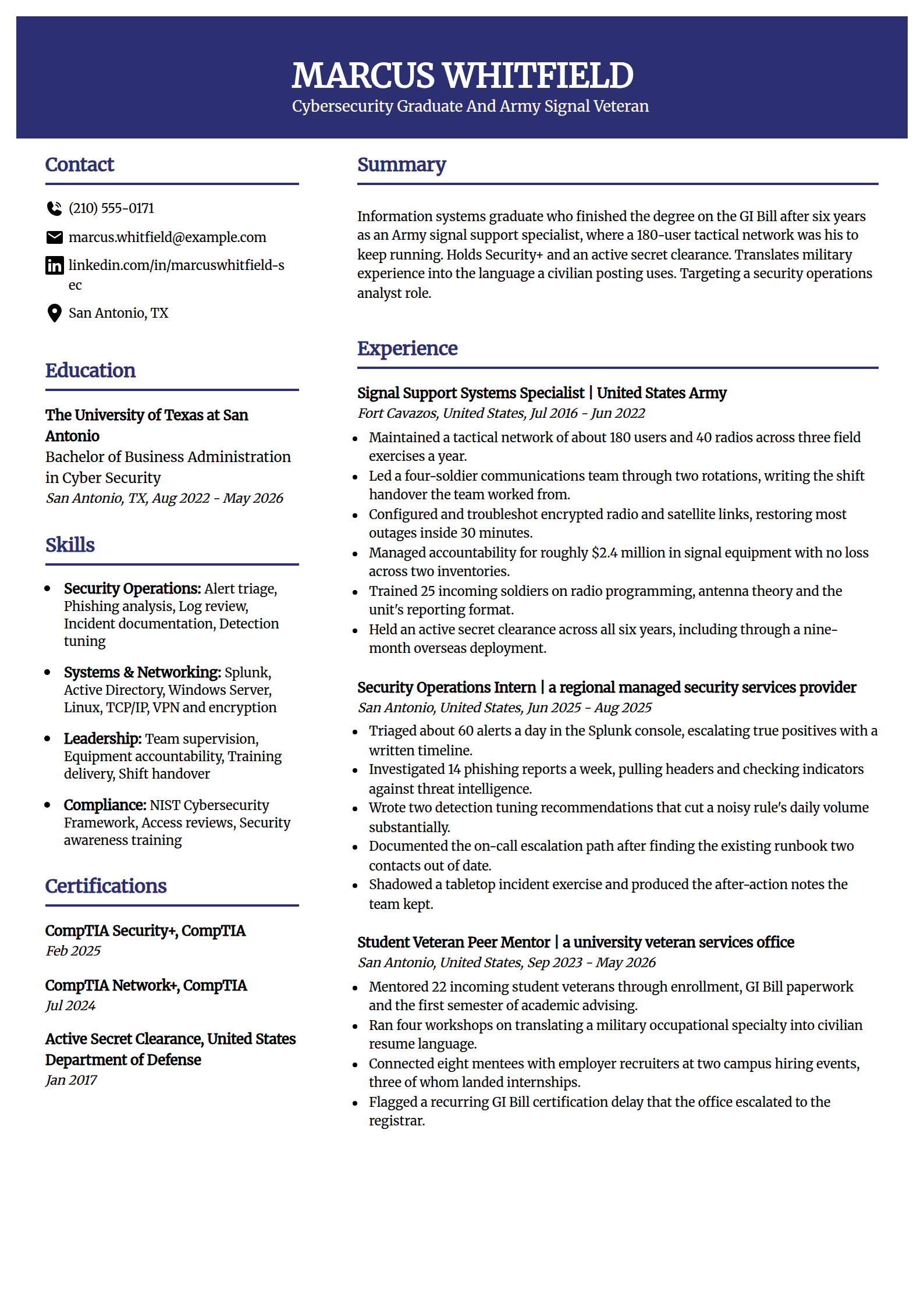
Veteran College Graduate Resume Template
Why this resume example works?
- Leads with the service record, correctly, because six years of signal work outranks a degree finished afterward.
- Translates military duties into civilian terms already: network users, equipment accountability, team supervision.
- States the clearance twice, in the summary and as a dated entry, which is what a cleared posting screens on.
- Adds a civilian security internship so a hiring manager does not have to imagine how the service work transfers.
- Uses the peer mentor role to show the translation skill itself, four workshops on rewriting a military specialty.
Build your college graduate resume
Pick a template above and the editor keeps the layout clean and ATS-safe while you swap in your own degree, coursework and numbers.
Build my resumeHow to write a college graduate resume
The degree takes two lines. Everything above and below it is what decides the application, and most of it already happened to you: a campus job, a lab, a club you ran, a capstone, a shift you covered when nobody else would.
Put education above your work history only while the degree is the newest thing you have
A new graduate's degree is the most recent completed credential on the page, so it reads first. That stops being true the moment there is a year or more of paid, relevant work above it.
On this page thirteen examples lead with education and three lead with experience. Use the second order when any of these is true:
- You finished one or more full internships or a co-op in the field you are applying to.
- You worked a year or more in a job whose duties map onto the posting, even if you worked it while studying.
- You served in the military or held a full-time role before or during the degree.
- You graduated more than about two years ago, at which point the graduation date stops being the headline.
Count what you did instead of describing what you were enrolled in
Every section on a graduate resume gets stronger the moment a number appears in it. The numbers exist already; most graduates have just never written them down.
Numbers a new graduate can almost always find:
- Hours: clinical, externship, tutoring, lab, volunteer, or hours a week worked while studying.
- People: students taught, residents supported, members recruited, guides trained, mentees carried.
- Volume: samples processed, calls handled, tickets sold, shifts covered, orders picked, posts published.
- Money: a club budget administered, a drawer reconciled, an ad budget managed, a project costed.
- Scope: credits completed, pages written, sites rotated through, clients retained, items catalogued.
Put your GPA on only when it clears 3.0, and say which GPA it is
The threshold published across resume sites contradicts itself, which is why most graduates guess. US university career centers are consistent: 3.0 and above goes on, below 3.0 comes off.
Bachelor of Science in Accountancy, Major GPA 3.4 | Arizona State University | May 2026
The rule nobody publishes is the one that helps most:
- Cumulative 3.0 or higher: list it in the degree line and move on.
- Cumulative under 3.0 but major GPA above it: list the major GPA and label it Major GPA, so nobody is misled.
- Both under 3.0: leave the GPA off completely. Nobody will ask why it is missing.
- Honors go in the degree line too, as the Latin honor itself, not as a separate section.
- Once you have a year of relevant work, drop the GPA whatever it is. It stops carrying anything.
When you have no internship, name the thing you do have
The weakest answer to no internship is a list of personality traits. The strongest is the work you were already doing while everyone else was interning.
Three of the sixteen examples above carry no internship at all. Each one leans on something specific instead:
- A paid campus or off-campus job, written as the job it was, with its volume and its responsibility.
- A capstone or senior project, written as an entry with dates, a team size and a deliverable.
- Research or lab work, with samples, participants or procedures counted.
- An elected or appointed campus role, with the budget, the headcount and the decisions it carried.
- Volunteer work with a real commitment behind it, such as a trained crisis line shift held weekly.
Write a summary, not an objective, unless the degree is genuinely all you have
A summary says what you bring; an objective says what you want. Three to four sentences, 50 to 70 words, and it should name a number and a target role.
Communication graduate who ran a campus visitor center for two years, hosting roughly 40 prospective students a week and training eleven guides. Writes and schedules social content in Hootsuite and reports on it in Google Analytics. Targeting a marketing or program coordinator role.
The parts of a graduate summary that do the work:
- What you studied and what you spent your time on, in the same sentence.
- One number, the strongest one on the page, repeated here so it is read first.
- The tools or methods a posting would list by name.
- The role you are applying for, stated plainly, so nobody has to deduce it.
Keep it to one page in a layout a portal can parse
One page covers every example here, including the veteran with six years of service and three jobs on the page. Applicant portals read the file before a person opens it.
What keeps a graduate resume parseable:
- Standard headings in a standard order, with the degree spelled out rather than abbreviated.
- A single column, or a clean two-column layout with the main content on the wide side.
- Real text rather than text inside images, and consistent date formats down the whole page.
- Relevant coursework as a short line under the degree, not as its own half-page section.
- If you run out of room, cut the oldest unrelated job before you cut the skills block.
Common college graduate resume mistakes
- Answering no experience with personality traits. Teamwork, communication and critical thinking appear on every graduate resume ever submitted, which is exactly why they prove nothing. Replace each one with the thing that would demonstrate it: a shift covered, a conflict mediated, a group taught, a deadline held.
- Leaving the GPA ambiguous. A bare 3.4 next to a degree reads as cumulative. If it is your major GPA, label it. If your cumulative is under 3.0 and you list it anyway, you have handed a screener a reason without being asked for one.
- Burying the capstone in an education bullet. A two-semester senior project with a team, a client and a deliverable is a job entry. Give it a title, dates and bullets, the same as any internship.
- Writing an objective that asks for something. An objective saying you are seeking an opportunity to grow tells a hiring manager what you want from them. Even a graduate with no experience has something to lead with: hours, coursework, a project, a credential.
- Hiding the months since graduation. A blank stretch after a graduation date invites the worst explanation. Freelance work, a certification earned, a volunteer commitment or a bridge job all go on the page, dated, with no apology attached.
Frequently asked questions
What should a college graduate resume include?
A college graduate resume needs a three-to-four-sentence summary naming what you studied and what you are targeting, an education section with the degree, institution and graduation date, an experience section built from whatever you actually have, a skills block naming tools and methods rather than traits, and certifications. For a new graduate, education sits above the work history, because the degree is the newest completed thing on the page. The experience section can be filled with internships, campus jobs, research, a capstone project, elected campus roles or committed volunteer work, and each entry should carry a number: hours completed, people served, volume handled or budget managed. One page is enough at this stage without exception.
Should you put your GPA on a college graduate resume?
Put it on if your cumulative GPA is 3.0 or higher, and leave it off if it is not. That threshold is what US university career centers consistently teach, and it is lower than some resume sites claim. The rule those sites skip is the useful one: if your cumulative GPA is under 3.0 but your major GPA is above it, list the major GPA and label it as a major GPA so nobody is misled. If both are under 3.0, leave the GPA off entirely and let the rest of the page work. Nobody will ask why it is missing. Once you have a year or more of relevant paid work, drop the GPA regardless of the number, because by then it carries nothing.
What do you put on a resume if you never had an internship?
Name the work you were doing instead. A paid campus or off-campus job counts as a job and should be written as one, with its volume and its responsibility: calls handled, residents supported, shifts covered, a drawer reconciled. A capstone or senior project is an experience entry with a title, dates, a team size and a deliverable. Research or lab work counts, with samples, participants or procedures counted. An elected or appointed campus role counts, with its budget and headcount. A real volunteer commitment counts, such as a trained crisis line shift held weekly. Three of the sixteen examples on this page were built with no internship at all, and none of them lists teamwork or communication as a skill.
Should a recent college graduate use a resume objective or a summary?
Use a summary in almost every case. A summary states what you bring and ends by naming the role you are applying for, which covers everything an objective does and adds evidence. Keep it to three or four sentences, 50 to 70 words, and put your strongest number in it. An objective is only the better choice when the degree is genuinely the only thing on the page, with no job, no project, no research and no campus role behind it, which is rarer than most graduates assume. Even then, lead with what you bring rather than what you want: hours completed, coursework finished, or a credential earned.
How long should a recent college graduate resume be?
One page, with no exceptions at this stage. Every example on this page is a single page, including a veteran with six years of service and three roles listed, and a supply chain graduate with four placements. If you are running out of room, cut the oldest unrelated job, trim relevant coursework to one line under the degree, and shorten older entries to two bullets rather than dropping the skills block or shrinking the font below readable. The skills block is what a screener matches against the posting, so it is the last thing to go. If you ever do spill onto a second page later in your career, the convention is that the second page should be at least half full.
How do you explain still job searching months after graduating?
Fill the time rather than explaining it. A dated entry covering the months since graduation answers the question before anyone asks it, and it does not have to be a career job: freelance or contract work with real client numbers, a certification earned after your graduation date, a volunteer commitment with a scope attached, or a bridge job written honestly all work. Put the current work in the present tense so the page reads as active. Keep any certifications dated after graduation visible, because that is the clearest evidence you kept moving. Do not apologize anywhere in the copy and do not add a line explaining the gap; a filled timeline is the explanation.
More college graduate resume resources
Build your college graduate resume
Pick a template above and the editor keeps the layout clean and ATS-safe while you swap in your own degree, coursework and numbers.