College Student Resume Templates Built Without a Single Job
- ATS Friendly
- Zero Paid Jobs
- 16 Real Examples
With no job history, your resume leads with education, then fills the experience section with what you have actually done: class and capstone projects, club and student government roles, teams, unpaid research, volunteering and informal work such as tutoring or sitting. Give each one a title, real dates and one honest number. Keep it to one page, in date order. The 16 examples below show it done for 16 different situations.


540k+ resumes created
Editable templates for a blank work history
Every template below is a real student resume with nothing paid in it, laid out in that format. Pick one, then swap in your own classes, clubs, projects and numbers. Each layout keeps your school, expected graduation and dated entries where a reader looks first and where an applicant tracking system can parse them.
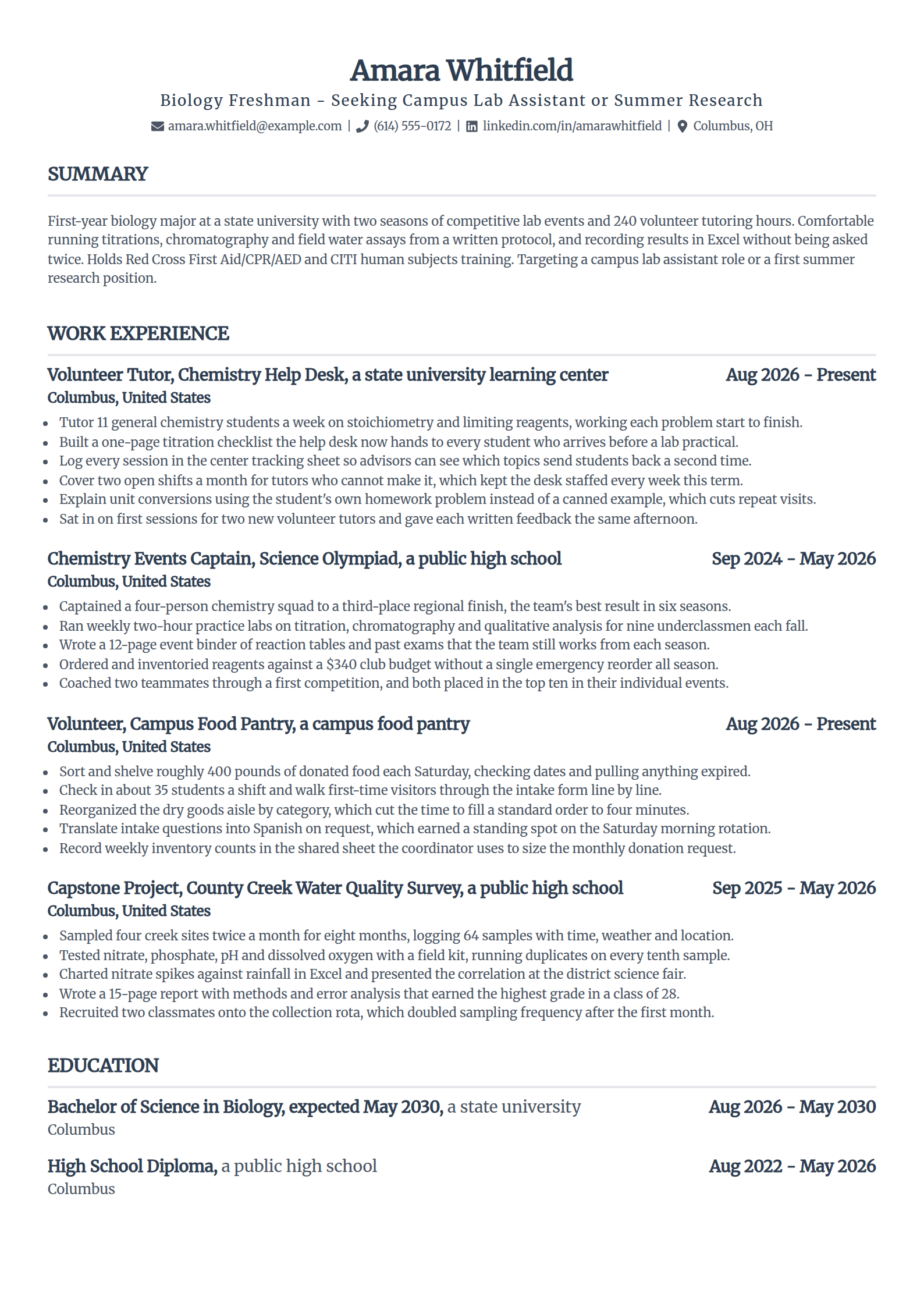
Freshman Resume Template (No Work History)
Why this resume example works?
- Puts high school activities in the experience section with dates and titles, instead of dumping them in a lesser block at the bottom.
- Gives the tutoring role a countable scale, 11 students a week, so a reader can picture the work rather than guess at it.
- Treats the senior capstone like a job: eight months of sampling, 64 logged samples, a named method and a written report.
- Names the expected graduation year up top, which is the first thing a campus lab or internship screener checks.
- Carries a Spanish line and a CITI training certificate, both of which are real qualifications a freshman can genuinely hold.
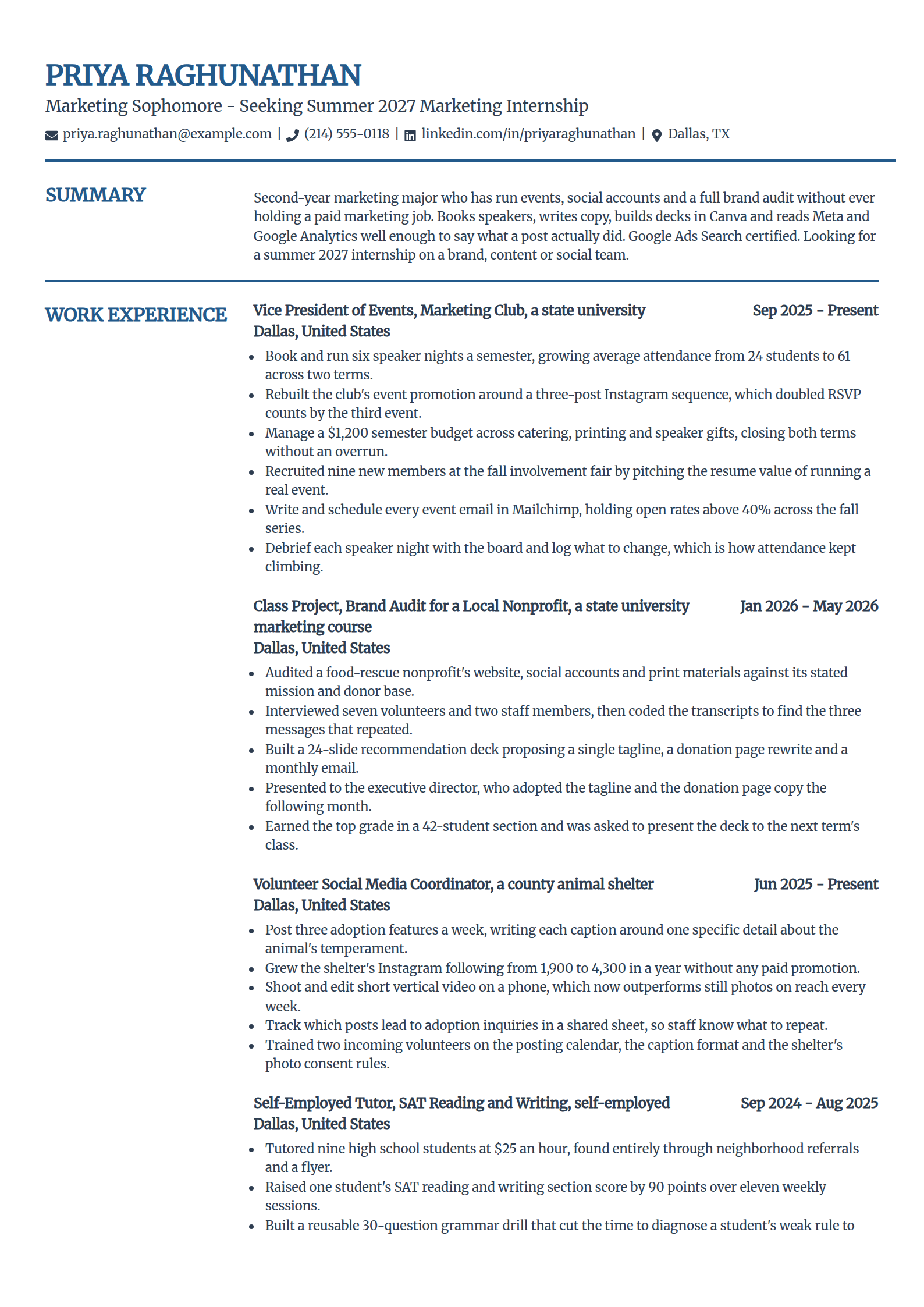
Sophomore Resume Template for a First Internship
Why this resume example works?
- Opens by naming the target, a summer 2027 marketing internship, so the reader never has to work out what this resume is for.
- Shows a club officer role doing real marketing work: attendance from 24 to 61, a budget closed on plan, emails above a 40% open rate.
- Treats the course brand audit as a client project, complete with interviews, a deck and a recommendation the nonprofit adopted.
- Lists the informal tutoring work with its rate and its results, which answers the reliability question a sparse resume raises.
- Puts three free certifications on the page, each from the platform that issued it, which is what a marketing screener recognizes.
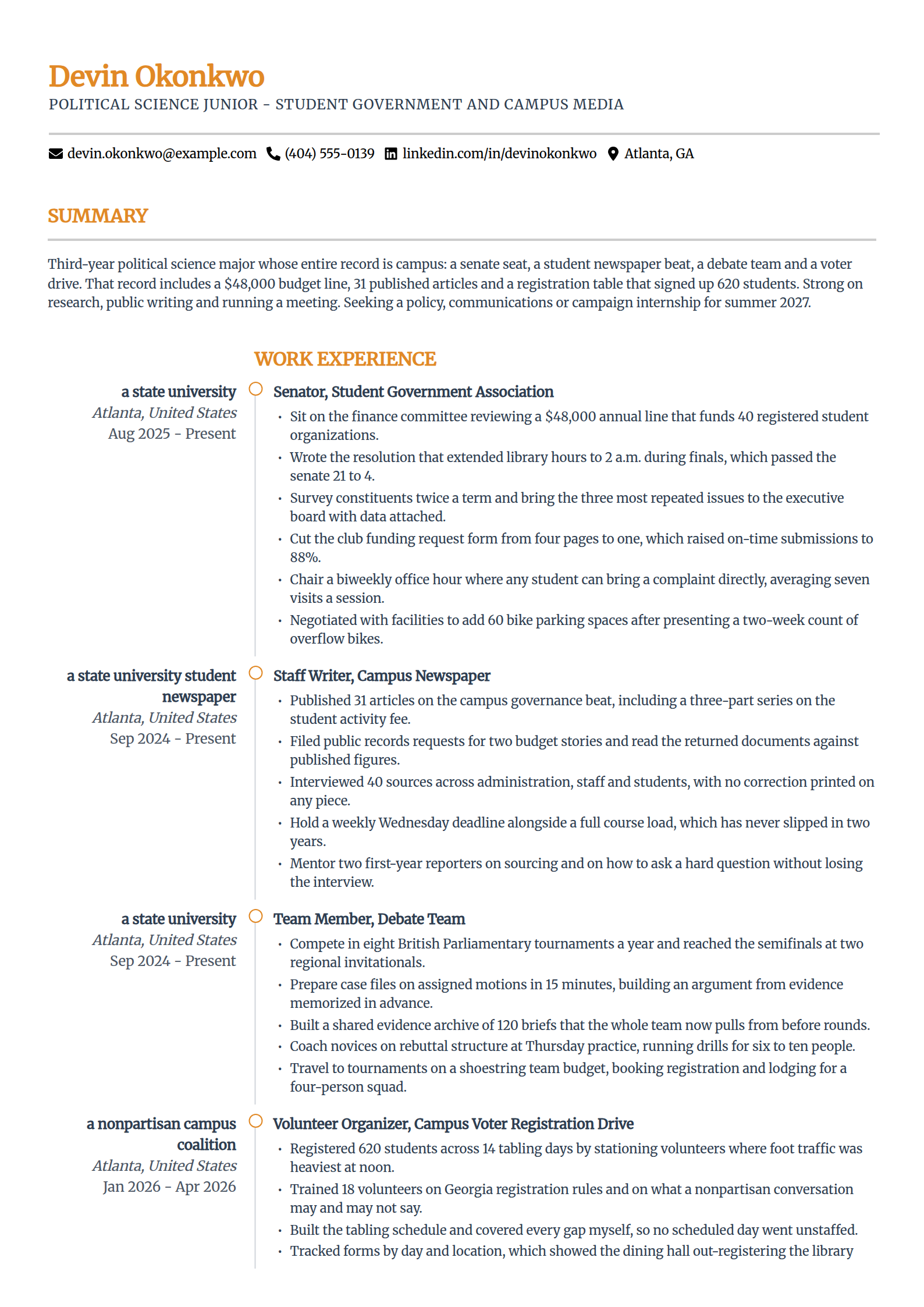
Junior Resume Template Built From Campus Activities
Why this resume example works?
- Leads with the scale of the student government seat, a $48,000 budget line across 40 organizations, not with the title alone.
- Attaches an outcome to the legislative work: the library hours resolution passed 21 to 4 and the funding form hit 88% on-time.
- Counts published work, 31 articles with no printed correction, which is the number an editor or policy office screens on.
- Keeps debate on the page as a skill, not a hobby, by describing the 15-minute case prep an employer can recognize.
- Gives the voter drive a real result, 620 registrations across 14 tabling days, with the method that produced it.
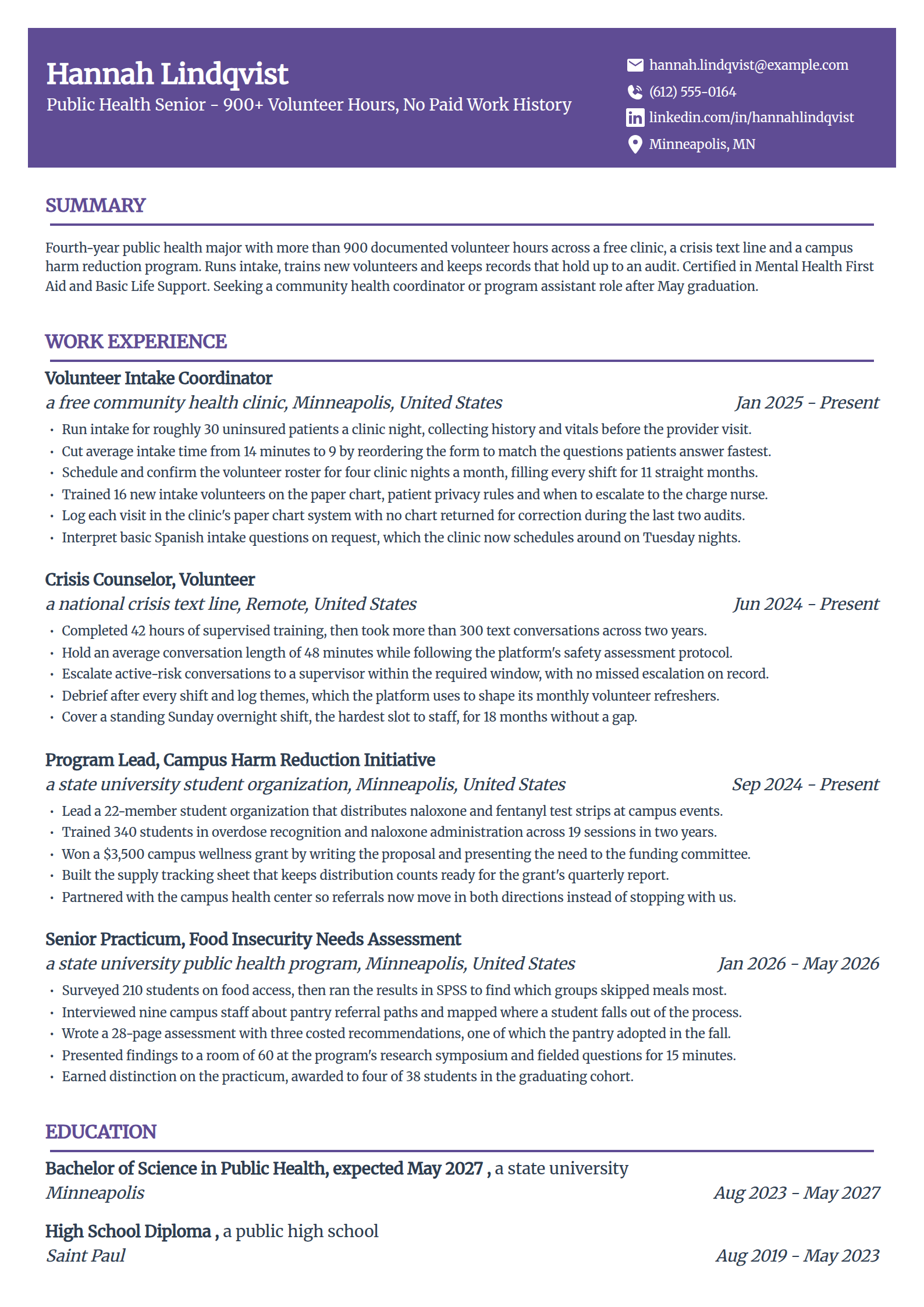
Senior Resume Template With Volunteer Experience Only
Why this resume example works?
- States the volunteer total as a documented figure, more than 900 hours, which turns unpaid work into something a reader can weigh.
- Shows process ownership rather than attendance: intake time cut from 14 minutes to 9 by reordering the form.
- Names the hardest shift taken and kept, a standing Sunday overnight for 18 months, which is evidence of reliability.
- Puts grant money on the page, a $3,500 award written and pitched by this student, with what it funded.
- Carries clinical-adjacent credentials under their real names, BLS from the American Heart Association and Mental Health First Aid.
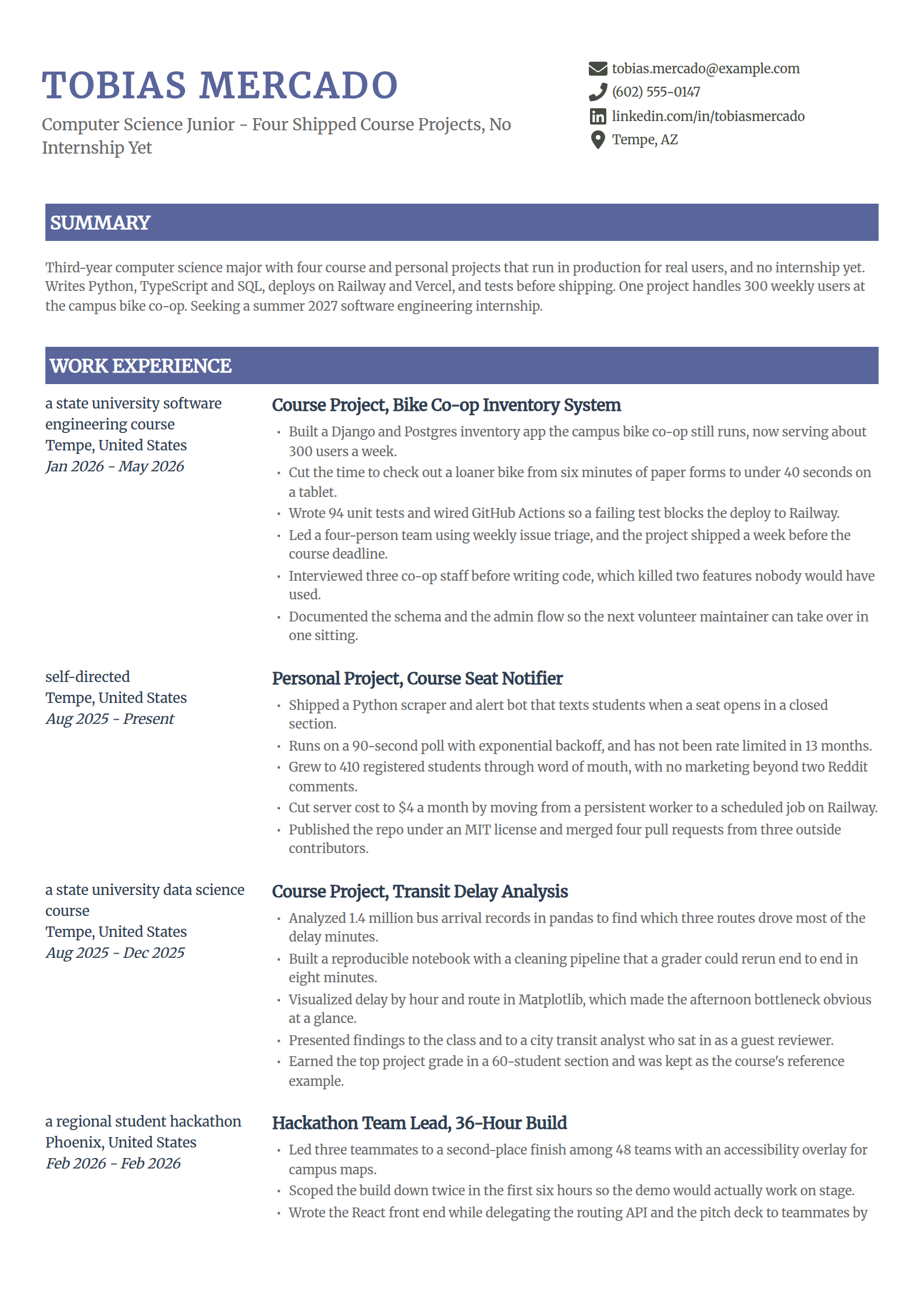
Resume Template With Academic Projects Instead of Jobs
Why this resume example works?
- Every project has real users behind it, including a course app the bike co-op still runs for about 300 people a week.
- Shows engineering practice, not just code: 94 unit tests, a CI gate that blocks a failing deploy, and documented handover.
- Gives one project an operating number a hiring manager respects, server cost cut to $4 a month by changing the runtime shape.
- Describes the research step before the build, three staff interviews that killed two features nobody would have used.
- Uses the hackathon entry to show judgment under pressure: the scope was cut twice so the demo would actually run.
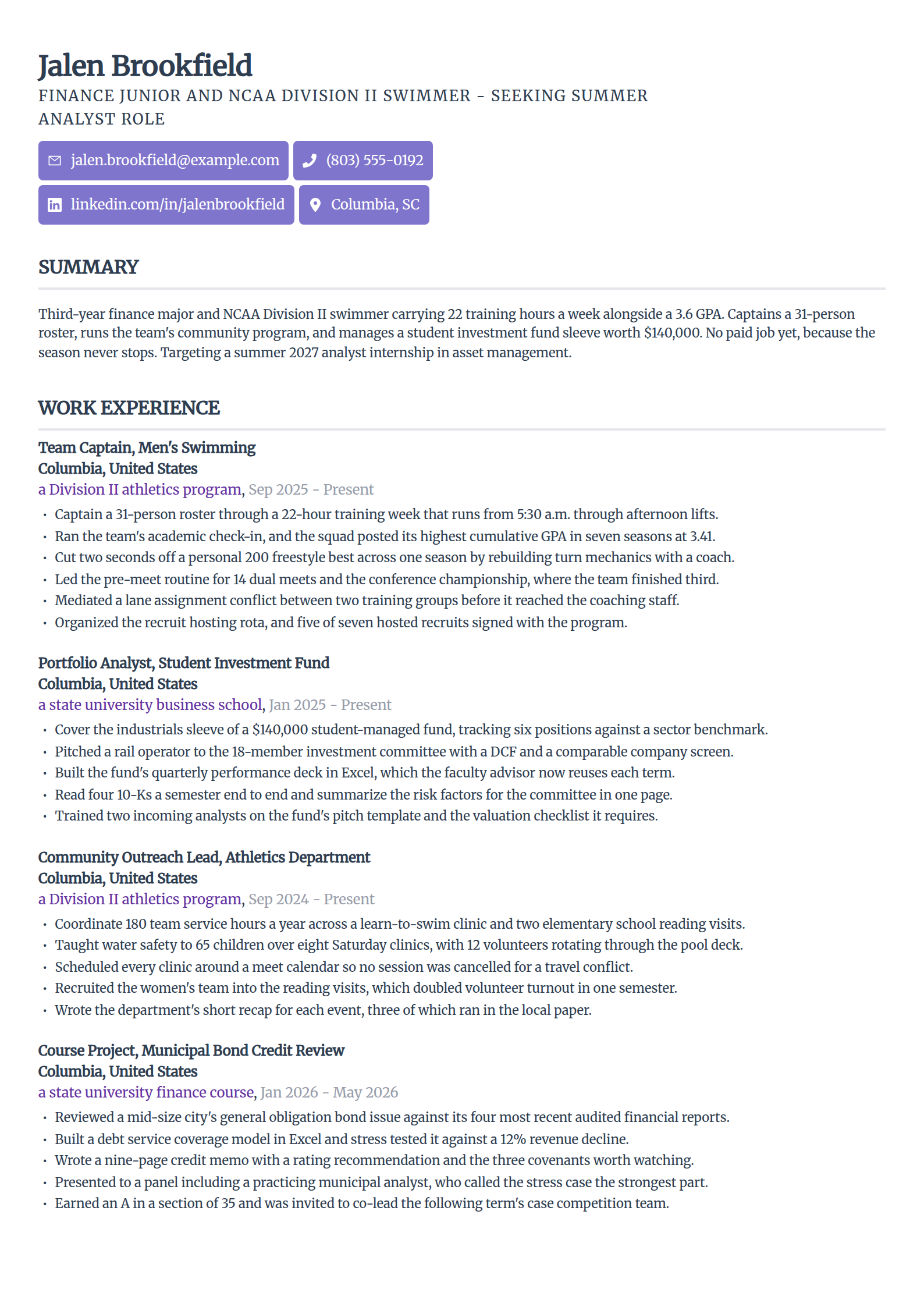
Student Athlete Resume Template (No Paid Work)
Why this resume example works?
- Makes the invisible time commitment visible: a 22-hour training week stated as a number rather than implied by the sport.
- Turns the captaincy into management evidence, a 31-person roster and the squad's best cumulative GPA in seven seasons.
- Pairs athletics with a finance credential the target role screens on, a $140,000 fund sleeve and a pitch to an investment committee.
- Keeps the service work concrete, 180 team hours and 65 children taught water safety across eight clinics.
- Puts the GPA on the page because it is above the bar, and ties it to the conference all-academic selection that verifies it.
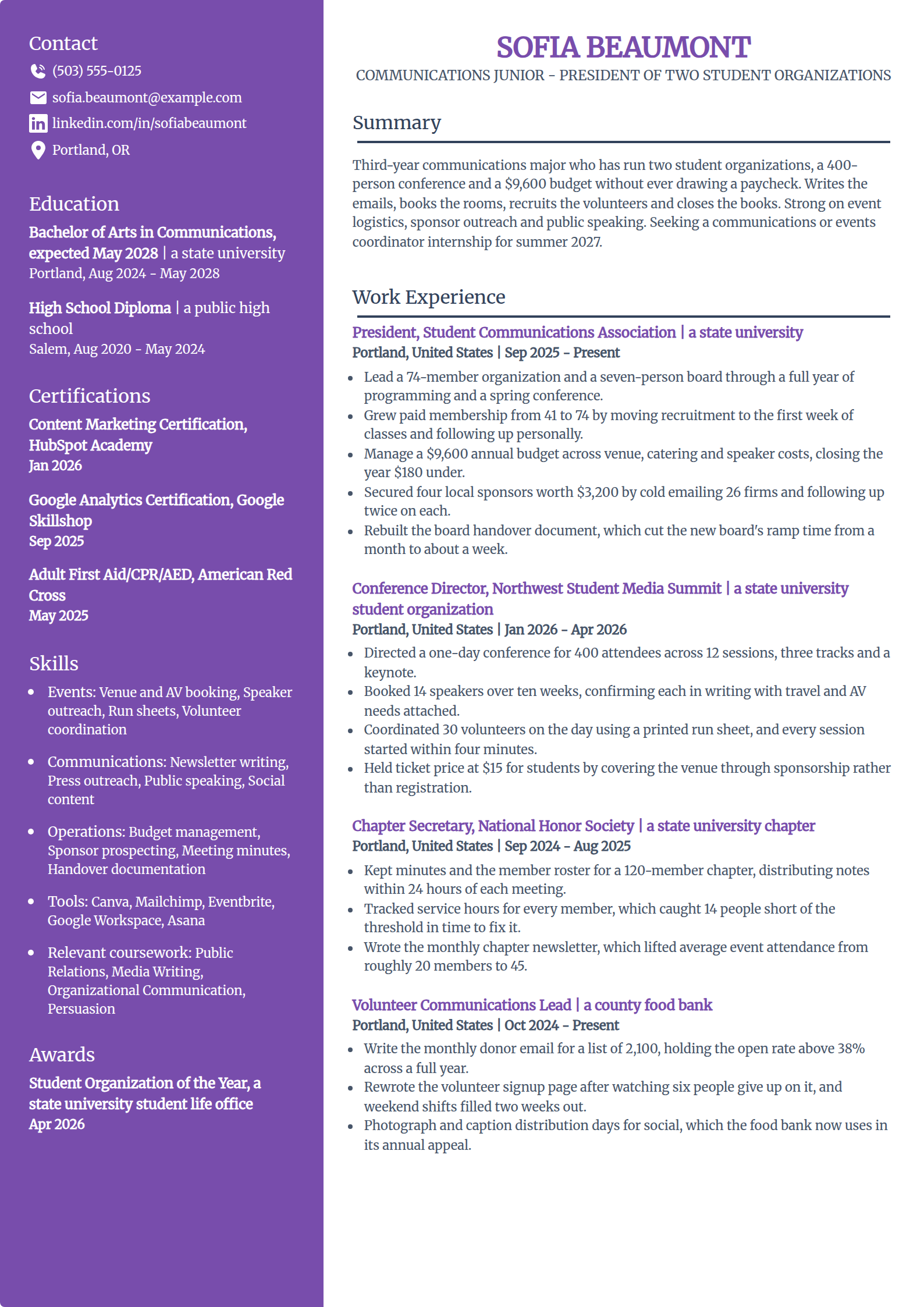
Club Leadership Resume Template for Students
Why this resume example works?
- Treats a club presidency as a job with a budget, a headcount and a result: membership from 41 to 74 and a year closed under plan.
- Quantifies the sponsorship work honestly, $3,200 raised from 26 cold emails, which shows the effort behind the number.
- Gives the conference its real scale, 400 attendees across 12 sessions, with 30 volunteers run from a printed schedule.
- Includes the unglamorous win, a rewritten handover document that cut the next board's ramp from a month to a week.
- Keeps the secretary role on the page for the tracking detail, catching 14 members short of a service threshold in time to fix it.
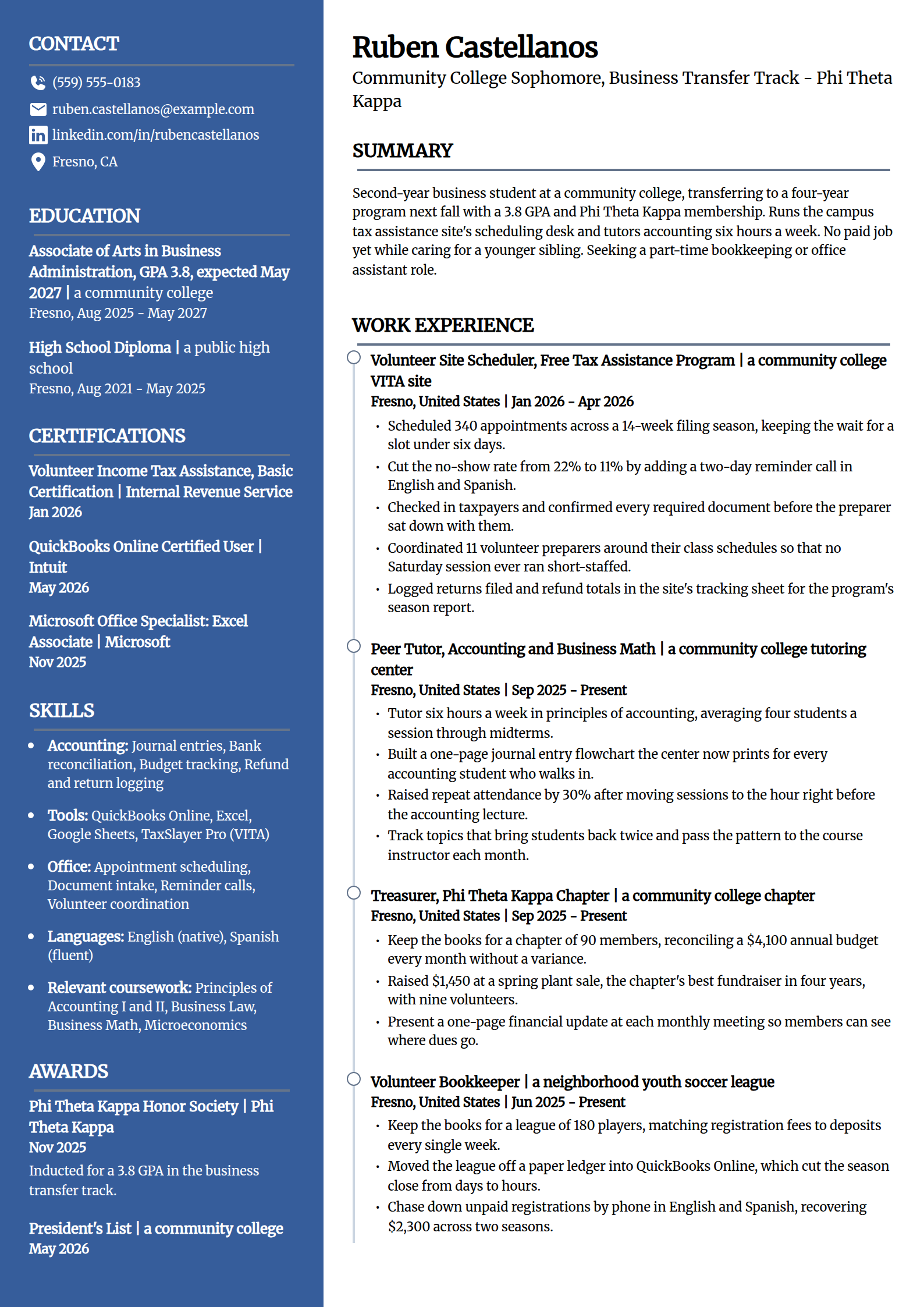
Community College Resume Template (No Experience)
Why this resume example works?
- Names the transfer plan and the GPA in the summary, which is what a community college applicant is actually being screened on.
- Shows a measurable operational fix, a no-show rate cut from 22% to 11% by adding a bilingual reminder call.
- Puts real, free credentials on the page: the IRS VITA basic certification and a QuickBooks Online certified user badge.
- Uses the treasurer role to prove the accounting claim, a $4,100 budget reconciled monthly with no variance.
- Says plainly why there is no paid job, caregiving for a sibling, without turning the resume into an explanation.
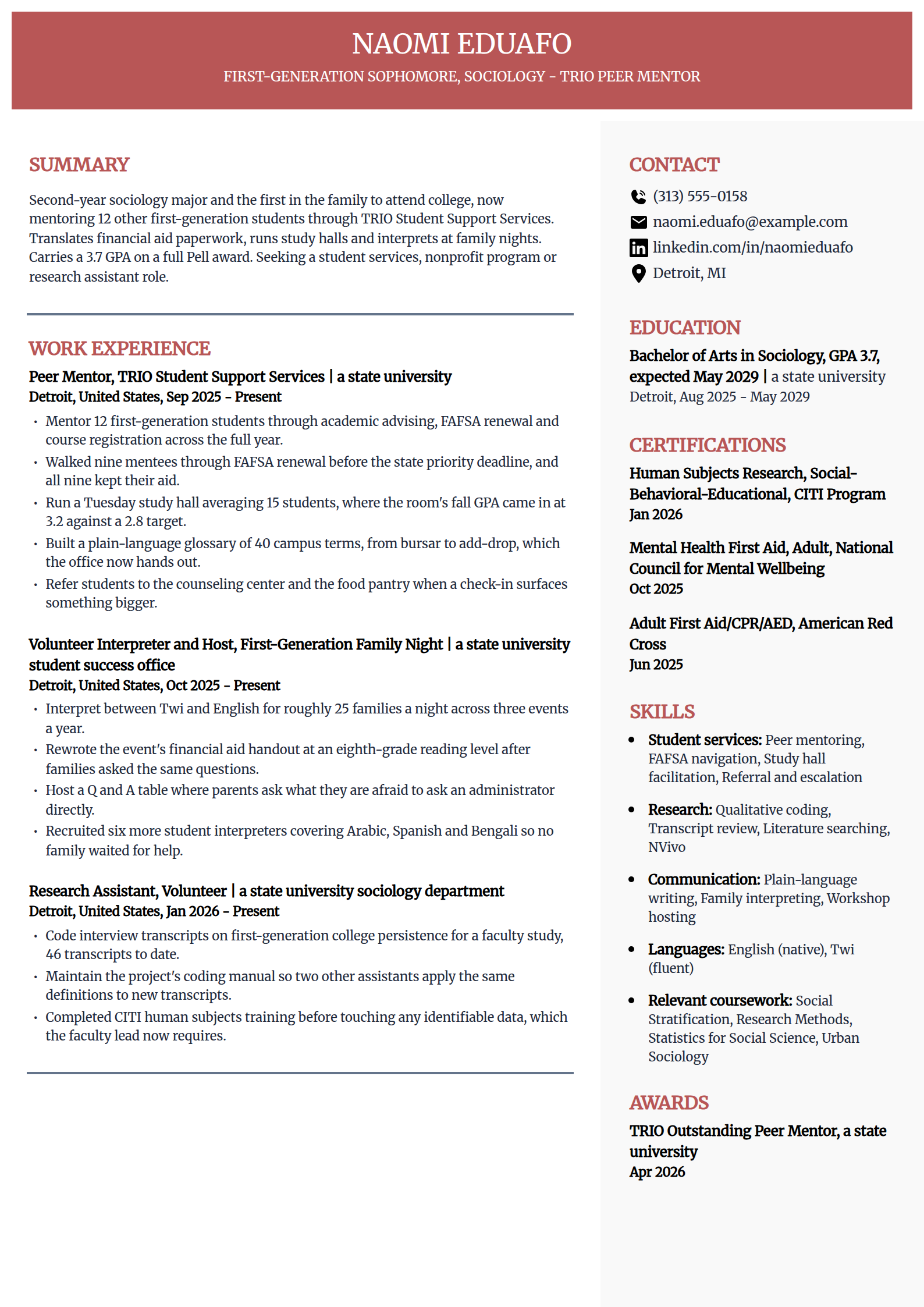
First-Generation College Student Resume Template
Why this resume example works?
- Names the mentoring load, 12 first-generation students a semester, so peer mentoring reads as a role rather than a label.
- Carries a result that matters to a student services employer: nine mentees through FAFSA renewal, all nine keeping their aid.
- Shows a product, a plain-language glossary of 40 campus terms that the office now hands out on its own.
- Uses the family-night interpreting to put a language skill in context, roughly 25 families a night across three events.
- Mentions CITI training before touching identifiable data, which tells a research employer this person understands the rules.
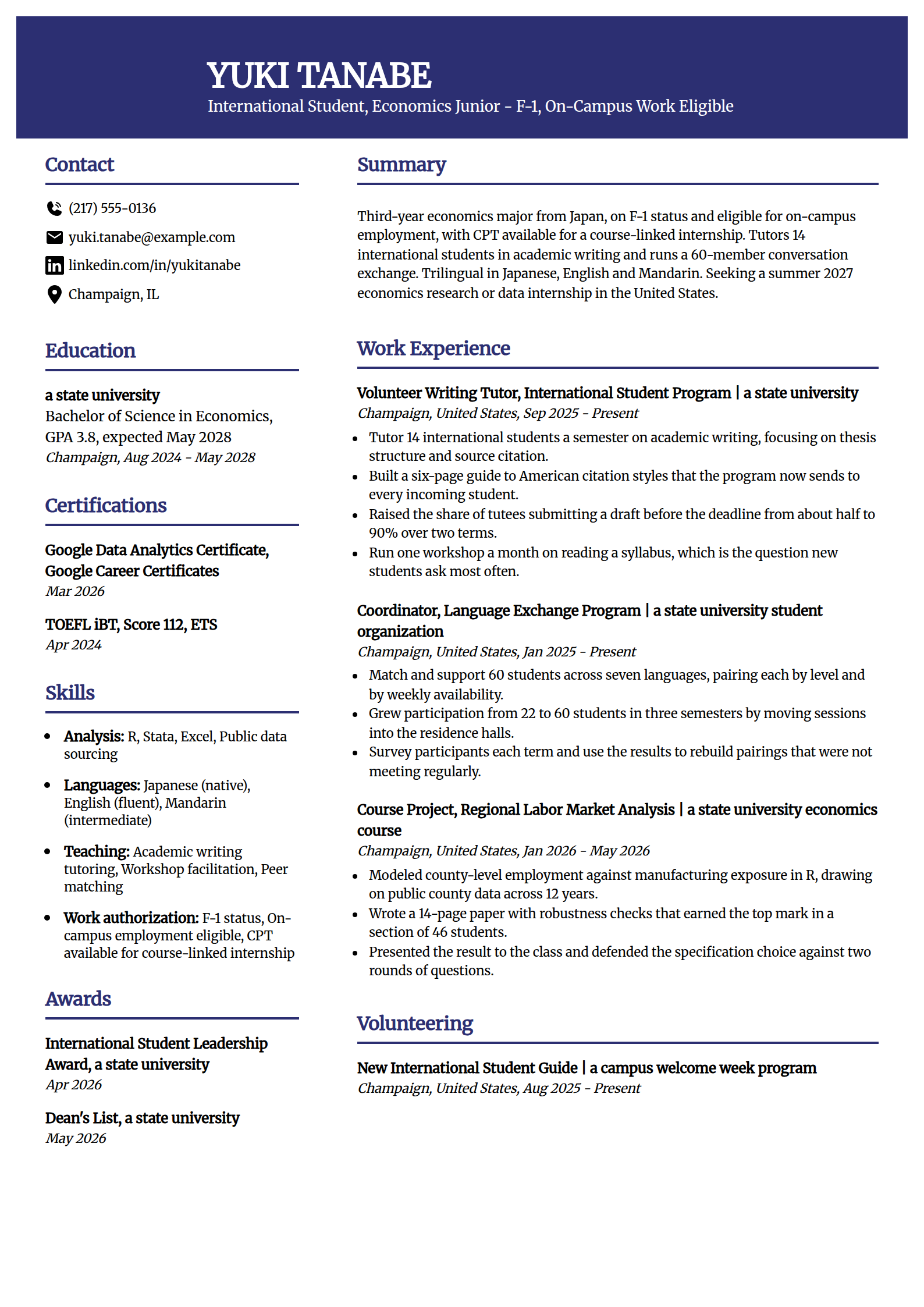
International Student Resume Template (F-1)
Why this resume example works?
- States work authorization the way a school states it, F-1 status with on-campus eligibility and CPT available, so nobody has to guess.
- Puts the authorization line in the skills column rather than the summary, where it answers the question without dominating the page.
- Gives the tutoring work an outcome, draft submissions before the deadline moving from about half to 90% over two terms.
- Shows program growth with the reason attached, 22 to 60 participants after moving sessions into the residence halls.
- Lists the TOEFL score as a dated credential, which is the evidence an employer wants rather than a claim of fluency.
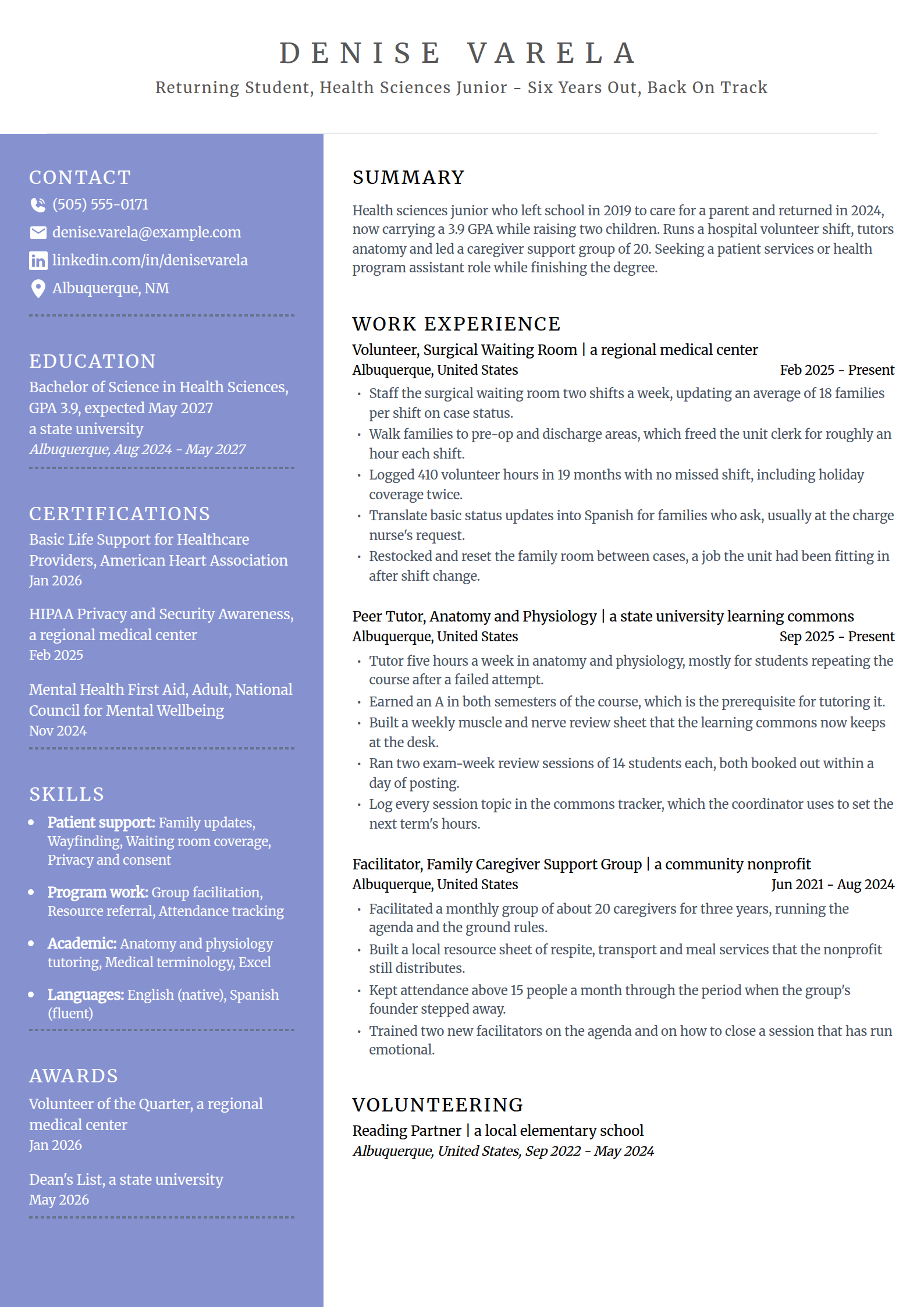
Returning Student Resume Template After a Gap
Why this resume example works?
- Names the gap and its reason in one clause, caregiving from 2019, and then moves on instead of leaving a reader to speculate.
- Fills the gap years with dated entries, a three-year support group facilitation, so the timeline has no blank stretch.
- Quantifies the hospital volunteering, 410 hours across 19 months with no missed shift, which is the reliability question answered.
- Puts the strong GPA on the page because it reframes the return as a success rather than a restart.
- Keeps the certifications current and healthcare-specific, BLS and HIPAA awareness, matching the roles being targeted.
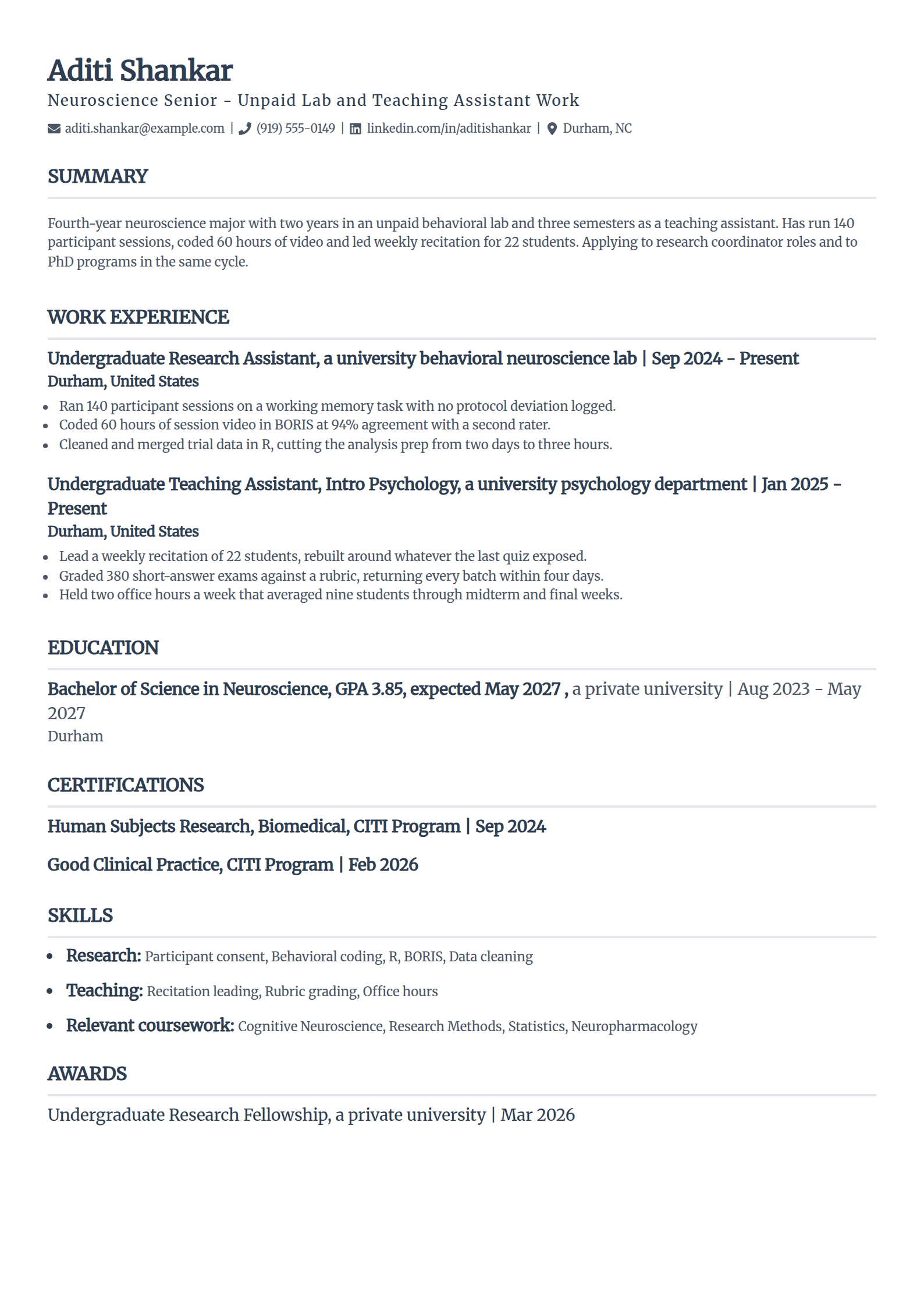
Research Assistant and TA Resume Template (Unpaid)
Why this resume example works?
- Counts the lab work in the units a research employer uses: 140 participant sessions and 60 hours of coded video.
- Gives the coding work a reliability figure, 94% agreement with a second rater, which is what a coordinator screens on.
- Shows the teaching assistantship as workload, a 22-student recitation and 380 exams returned within four days.
- Lists both CITI certificates separately, human subjects and Good Clinical Practice, because they are different qualifications.
- Keeps to two entries and short bullets, which is what this layout holds cleanly on a single page.
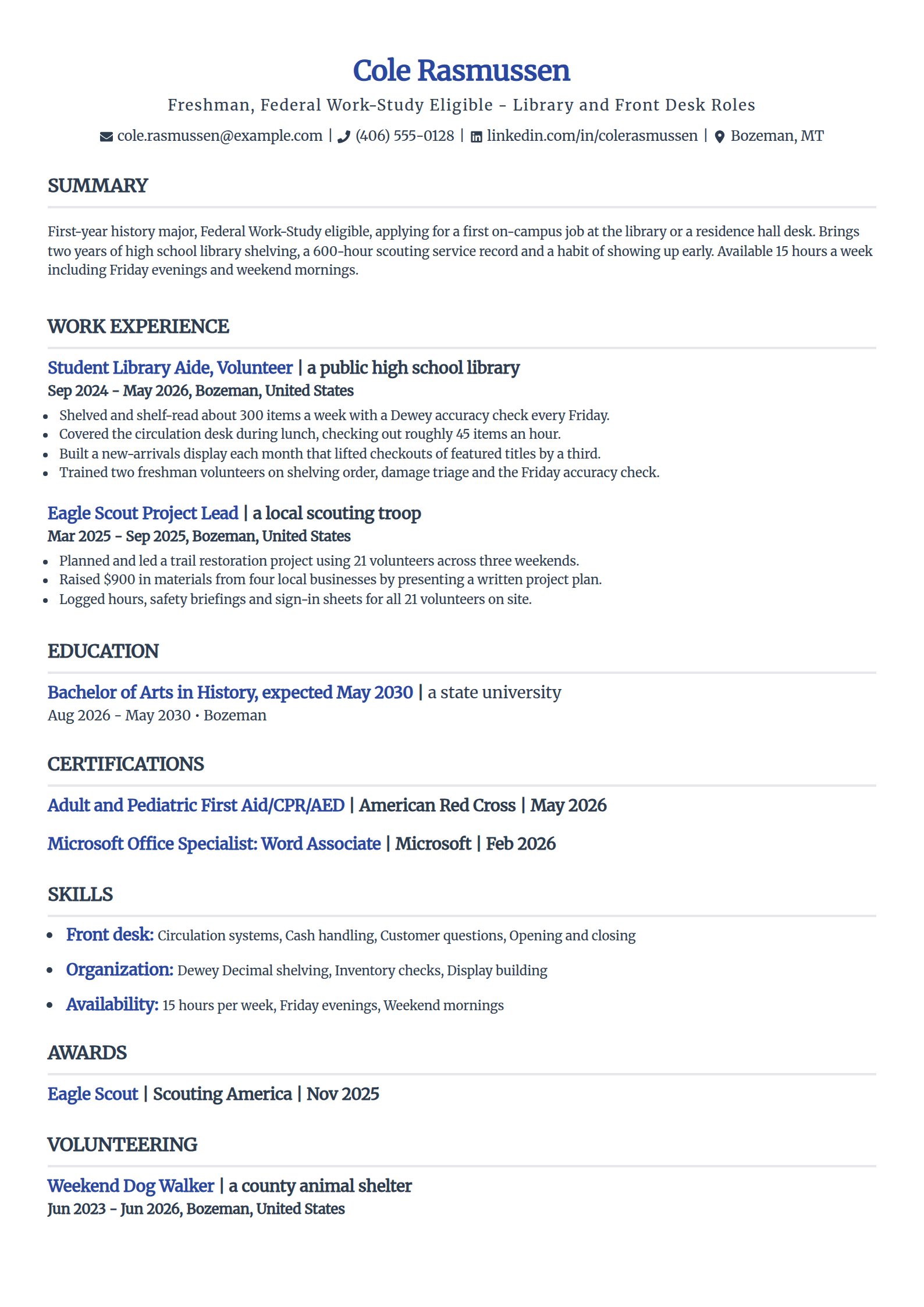
Work-Study Resume Template for a First Campus Job
Why this resume example works?
- Says Federal Work-Study eligible in the headline, which is the single fact a campus hiring office needs before reading further.
- Ends the summary with concrete availability, 15 hours a week including Friday evenings, because campus jobs are scheduled around gaps.
- Shows the volunteer library work in the terms of the job being applied for, shelving accuracy and circulation desk coverage.
- Uses the Eagle Scout project as project management evidence: 21 volunteers, three weekends and $900 raised from local businesses.
- Keeps the whole page short and plain, which is right for a first application and easy for a student office to skim.
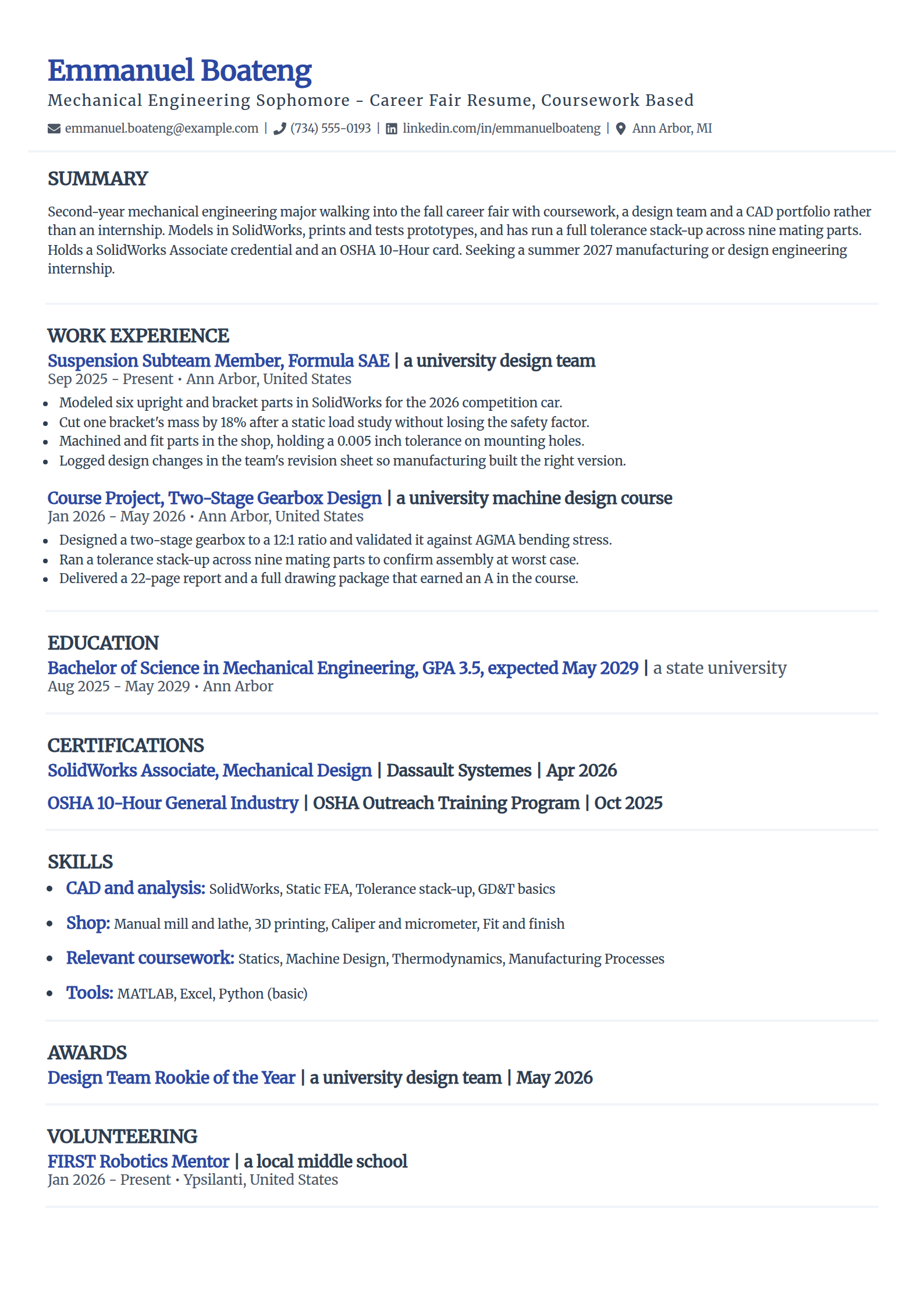
Career Fair Resume Template Built on Coursework
Why this resume example works?
- Says up front that this is coursework and a design team rather than an internship, which recruiters respect more than vagueness.
- Puts the design team work in engineering units, a bracket 18% lighter after a load study with the safety factor held.
- Names a tolerance, 0.005 inch on mounting holes, which is the detail that separates a real shop story from a claim.
- Shows a full deliverable from the course, a validated gearbox with a tolerance stack-up and a drawing package.
- Fits on one page with wide margins, which matters when a recruiter is holding 200 of these at a fair table.
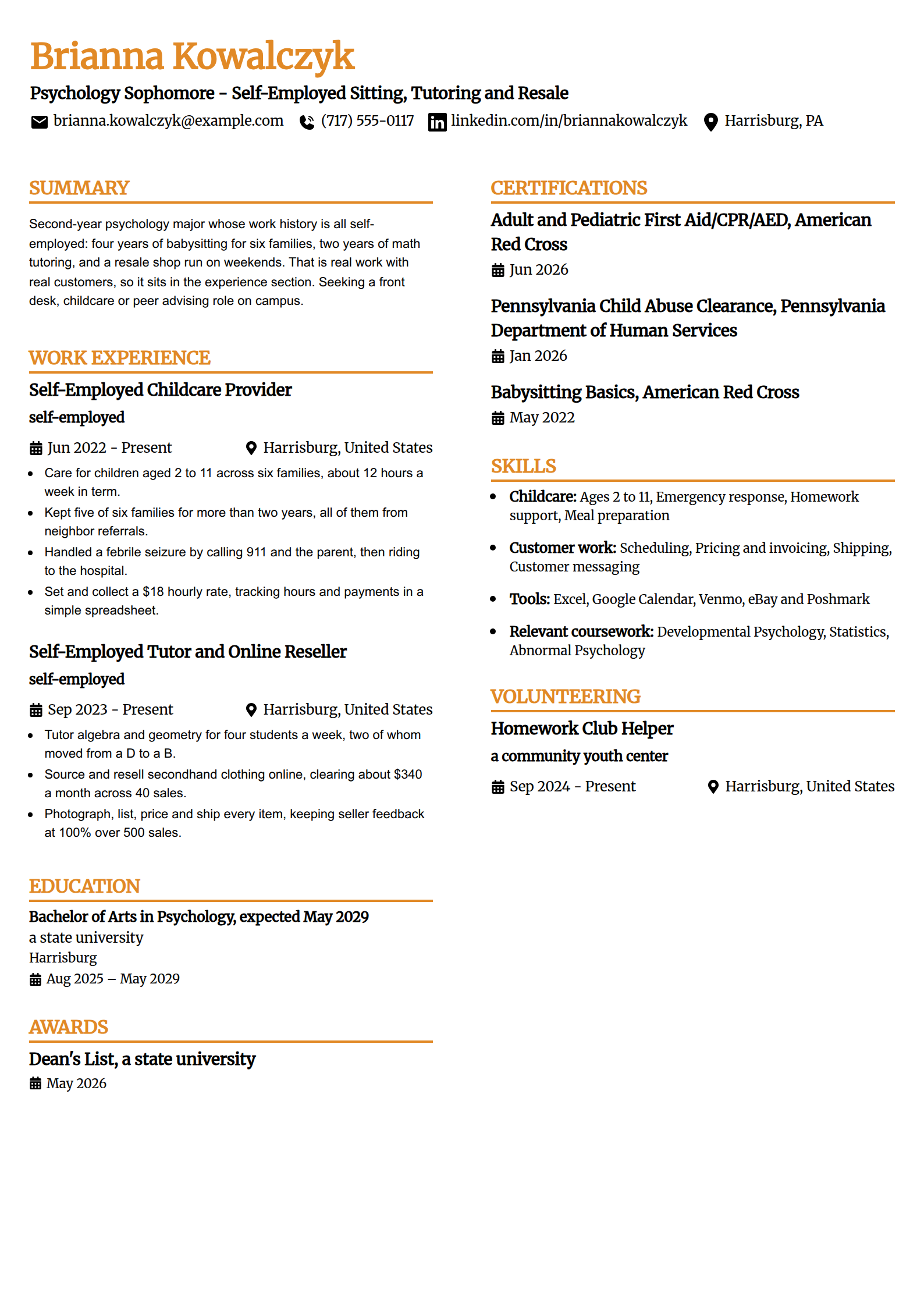
Resume Template for Babysitting, Tutoring and Resale Work
Why this resume example works?
- Calls the informal work self-employment and puts it in the experience section, because that is what it is.
- Shows retention as the proof of quality, five of six families kept for more than two years, all from referrals.
- Includes the moment that demonstrates judgment, handling a febrile seizure by calling 911 and the parent.
- Treats resale as a small operation with numbers: about $340 a month, 40 sales, 100% feedback across 500 transactions.
- Carries the clearance a childcare employer legally needs, a Pennsylvania child abuse clearance with its issuing department.
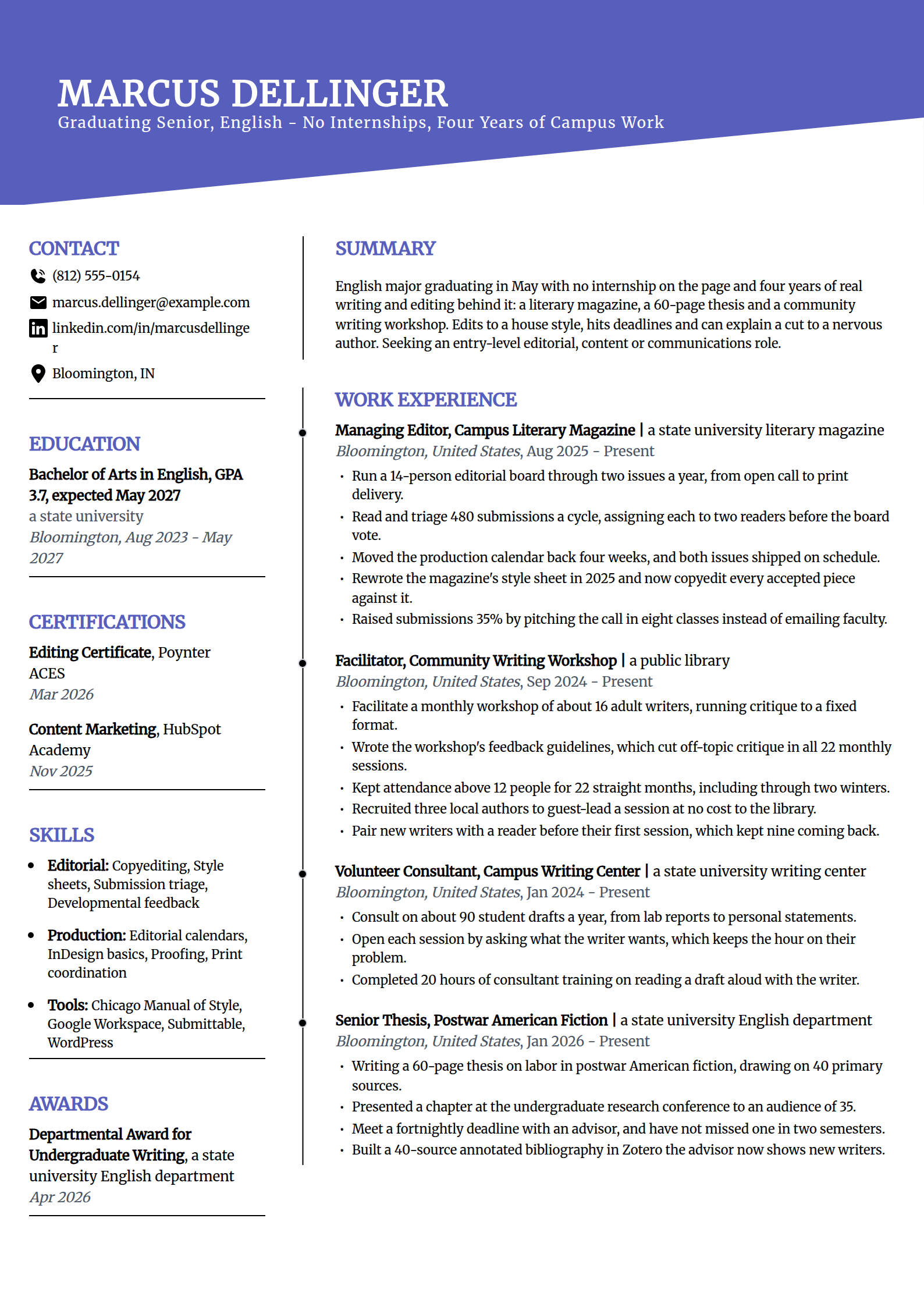
Graduating Senior Resume Template With No Internships
Why this resume example works?
- Names the missing internship in the summary and then argues past it with four years of dated editorial work.
- Gives the magazine role a workload a publisher recognizes, 480 submissions a cycle triaged to two readers each.
- Shows a schedule fix rather than a claim of being organized: the calendar moved back four weeks and both issues shipped on time.
- Counts the workshop's persistence, attendance above 12 for 22 straight months, which is harder than a one-off success.
- Puts the thesis on the page as ongoing work with a page count, a source count and a deadline record.
Build your first college resume
Start from any template above and the editor keeps the layout parser-safe while you fill the experience section with your own projects, clubs and volunteering.
Build my resumeHow to write a college resume when you have no experience
The section order changes, not the rules. Education moves to the top, the experience section fills with unpaid and academic work, and every entry still carries a title, dates and a result. Below is what goes where.
Put education first, and make it carry weight
Until you have a job to point at, this is your strongest section. It sits directly under the summary and holds more than a school name.
- School, degree and expected graduation month and year. Write "expected May 2029", never a blank end date.
- GPA only when it is 3.5 or above. Below that, leave it off and let coursework and honors fill the space.
- Relevant coursework, four to six classes that match the posting, named the way the catalog names them.
- Honors that a stranger can verify: Dean's List, Phi Theta Kappa, a departmental award, a named scholarship.
- Community college students keep the transfer plan here, because it tells the reader where this timeline is going.
Fill the experience section with what you have actually done
"No experience" is almost never literally true. Anything with a start date, a role and a result belongs in Experience, under its own heading, in date order.
- Class and capstone projects, written as projects: what you built or studied, the method, the size and the outcome.
- Club, chapter and student government offices, with the headcount and the budget you were responsible for.
- Athletics, including the training hours a week, because that is the part a reader cannot see from the sport's name.
- Unpaid research, teaching assistantships and tutoring, counted in sessions, hours, students or transcripts.
- Volunteering with its hour total and its hardest recurring commitment, which is where reliability shows.
- Informal self-employment: babysitting, tutoring, lawn care, reselling, repairs. Give it a title, a rate and a retention number.
Write bullets that carry one honest number
A student bullet fails for the same reason any bullet fails: it says what you were supposed to do instead of what changed. Numbers fix that, and student-sized numbers are everywhere once you look.
- Countable things you already know: members, attendees, students tutored, hours logged, samples run, shifts covered, dollars in a club budget.
- One number per bullet. Two makes the line read as invented, and a student resume cannot afford that.
- Keep the scale believable for your age. A club fundraiser raising $1,450 is credible; a 40% revenue lift is not.
- Open with a specific verb: captained, tutored, reconciled, registered, triaged, ran, machined, coded.
- Aim for 15 to 24 words a bullet, one or two lines. A five-word fragment tells the reader nothing.
Build the skills block out of tools, systems and coursework
Match the posting's phrasing. That is the whole honest version of ATS advice, and it works because student postings name software and classes directly.
- Software you have really used: Excel, SPSS, R, SolidWorks, QuickBooks, Canva, Mailchimp, Figma, a lab notebook system.
- A "Relevant coursework" category, which lets a reader see the subject knowledge without expanding the education block.
- Languages with an honest level: native, fluent, conversational, basic. Do not inflate this; it gets tested in interviews.
- Free certifications you can actually finish this month, from Google, HubSpot, Microsoft, the IRS VITA program or the American Red Cross.
- For international students, a short work authorization line stating status and what it permits.
Formatting and length
One page, no exceptions at this stage. If you are running long, the problem is padding, not achievement.
- Lead the experience section with the entries that match the job, then run the rest newest first. Most students have several roles running at once, so order those by what you want read first.
- Keep every entry dated and visible. A skills-only layout hides the dates a reader looks for first.
- Order the page summary, education, experience, then certifications and skills. Education drops below experience once you have a year of paid work.
- Use plain headings a parser expects: Education, Work Experience, Certifications, Skills. "My Journey" is not a heading.
- A clean single column parses best. A two-column layout is fine when the side column holds contact, skills and certifications only.
- Send a PDF unless the posting asks for a Word file, and name the file with your own name and the role.
- Browse the full set at /resume-templates if none of the 16 layouts above fits your program.
Honestly: the skills-based resume everyone recommends for you is the wrong call
Nearly every guide written for students with no experience tells them to use a functional or skills-based format, which groups abilities at the top and pushes dates out of sight. Do not do it.
- Dates are the first thing a reader looks for. A resume that hides them reads as concealment from someone whose only real problem is being nineteen.
- Recruiters have seen the format used to paper over employment gaps, so it carries a suspicion you have not earned.
- The format is not what is holding you back. An experience section left empty because the work in it was unpaid is.
- Put the projects, the club offices, the team and the tutoring in that section with their real dates, and the page fills itself.
- All 16 examples above are dated and ordered, and none of them needed a functional layout to look full.
Common mistakes on a no-experience college resume
- Leaving the experience section empty because nothing in it was paid. Unpaid work with a start date, a role and a result is experience, and it belongs there with everything else.
- Burying real work in an "Activities" list at the bottom. A one-line mention of a club presidency wastes the strongest thing on the page.
- Bullets with no number in them. "Participated in fundraising events" says nothing; "raised $1,450 at a spring plant sale with nine volunteers" is the same fact made checkable.
- Listing every activity since ninth grade. Four strong dated entries beat eleven thin ones, and the page has to stay at one.
- Padding with soft skills. "Team player, hard worker, detail oriented" takes a line and proves nothing. Name the software, the coursework and the languages instead.
- Putting a GPA below 3.5 on the page. It invites a comparison you lose, and nobody asks why it is missing at this stage.
Frequently asked questions
What should a college student with no experience put on a resume?
Five things, in this order. A two to three sentence summary naming what you are studying, your expected graduation and the role you want. An education block with school, degree, expected graduation, relevant coursework and any honors, plus your GPA if it is 3.5 or above. An experience section filled with class and capstone projects, club and student government offices, athletics, unpaid research or tutoring, volunteering and informal self-employed work, each with a title, real dates and one honest number. A short certifications block with anything free you have finished. A skills block naming software, coursework and languages. Keep it to one page, leading the experience section with the entries that match the job and running the rest newest first.
Should a college student with no experience use an objective or a summary?
Use a short summary and stop worrying about the label. The old advice was to write an objective because you have nothing to summarize, but the two formats have collapsed into the same three lines in practice, and what matters is the content. Name what you are studying, your expected graduation, one specific thing you have done, and the role you are targeting. Never open with what you want from the employer. Never put both an objective and a summary on the same resume.
Do you put your GPA on a resume with no experience?
Only if it is 3.5 or above. At that level it is one of the few verifiable achievements you have, so it earns its line in the education block next to your expected graduation. Below 3.5, leave it off entirely. No reader asks why a GPA is missing from a student resume, and the space is better spent on relevant coursework, an honor society or a departmental award. If your major GPA is well above your cumulative one, you can list the major GPA as long as you label it clearly as such.
Does volunteer work count as experience on a college resume?
Yes, and it belongs in the experience section rather than in a separate list at the bottom. A reader is looking for evidence that you show up, learn a process and finish things, and unpaid work proves all three. Write it exactly as you would write a job: a title, the organization, the city, real start and end dates, and bullets carrying a result. Hour totals help, because they turn something vague into something countable. One of the examples above is built on more than 900 documented volunteer hours and never mentions a paycheck.
Can you put class projects on a resume instead of jobs?
Yes, and for many students they are the strongest entries on the page. Give the project a title, the course or program it ran under, and its real dates, then write bullets the way you would for work: what you built or studied, the method you used, the scale, and what came of it. A project with a real user, a real client or a presented result is worth more than a generic job. If several projects are relevant, group them under a heading such as Projects rather than scattering them through the experience section.
How long should a college student resume with no experience be?
One page. That is not a preference at this stage; a second page signals that the first one is padded. If you are running long, cut activities older than high school graduation, delete any bullet without a number or a specific detail in it, and drop the soft-skill list entirely. Every example on this page fits a single page, including the ones with four dated entries and a full coursework block. Keep the margins reasonable and the font readable rather than shrinking both to fit more in.
More college student resume, no experience resume resources
Build your first college resume
Start from any template above and the editor keeps the layout parser-safe while you fill the experience section with your own projects, clubs and volunteering.