16 CS Resume Examples, From Bootcamp to PhD
- ATS Friendly
- Student to Senior
- 16 CS Examples
A strong CS resume leads with projects and a named stack, not a wall of coursework. Each example below is a full computer science resume rendered in a real, editable template, from a first internship application to a senior specialist. Copy the layout, then swap in your own languages, projects, and numbers.


540k+ resumes created
Editable computer science resume templates
Each template below is a real computer science resume laid out in that format, filtered by what you need. Pick one, then swap in your own projects, languages, coursework, and results. All of them keep your name, contact details, and dates where an applicant tracking system expects to read them.
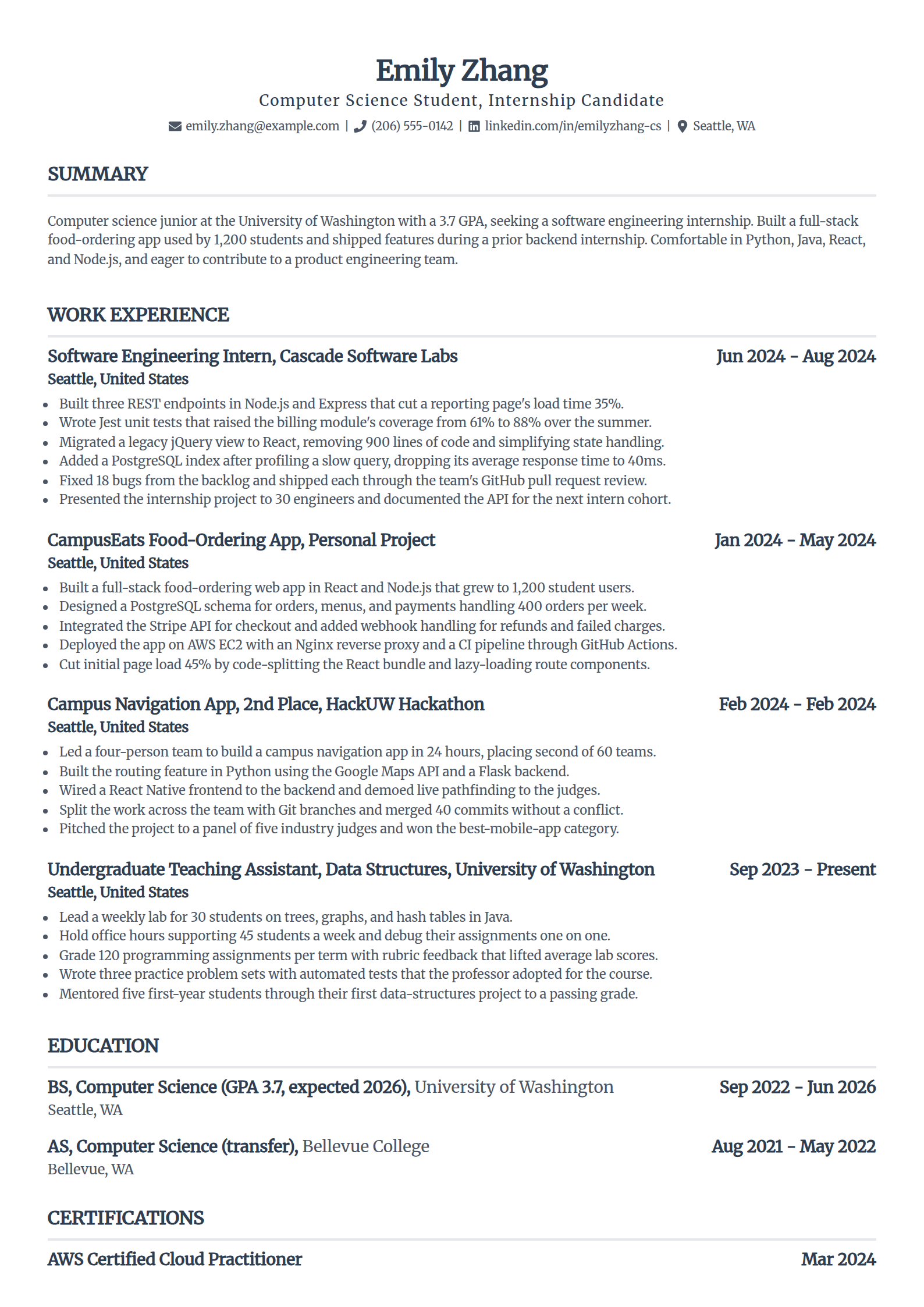
Computer Science Student Resume Template
Why this resume example works?
- Leads the header with the degree, expected year, and 3.7 GPA, the details an intern screen looks for.
- Turns a course build into real experience: a food-ordering app grown to 1,200 users with a stack named.
- Fills the page with an internship, a hackathon, and a teaching-assistant role instead of a thin job history.
- Names Python, Java, React, and Node.js so a screener sees the stack even before the first full-time role.
- Keeps a clean single-column layout that a resume parser reads top to bottom without dropping sections.
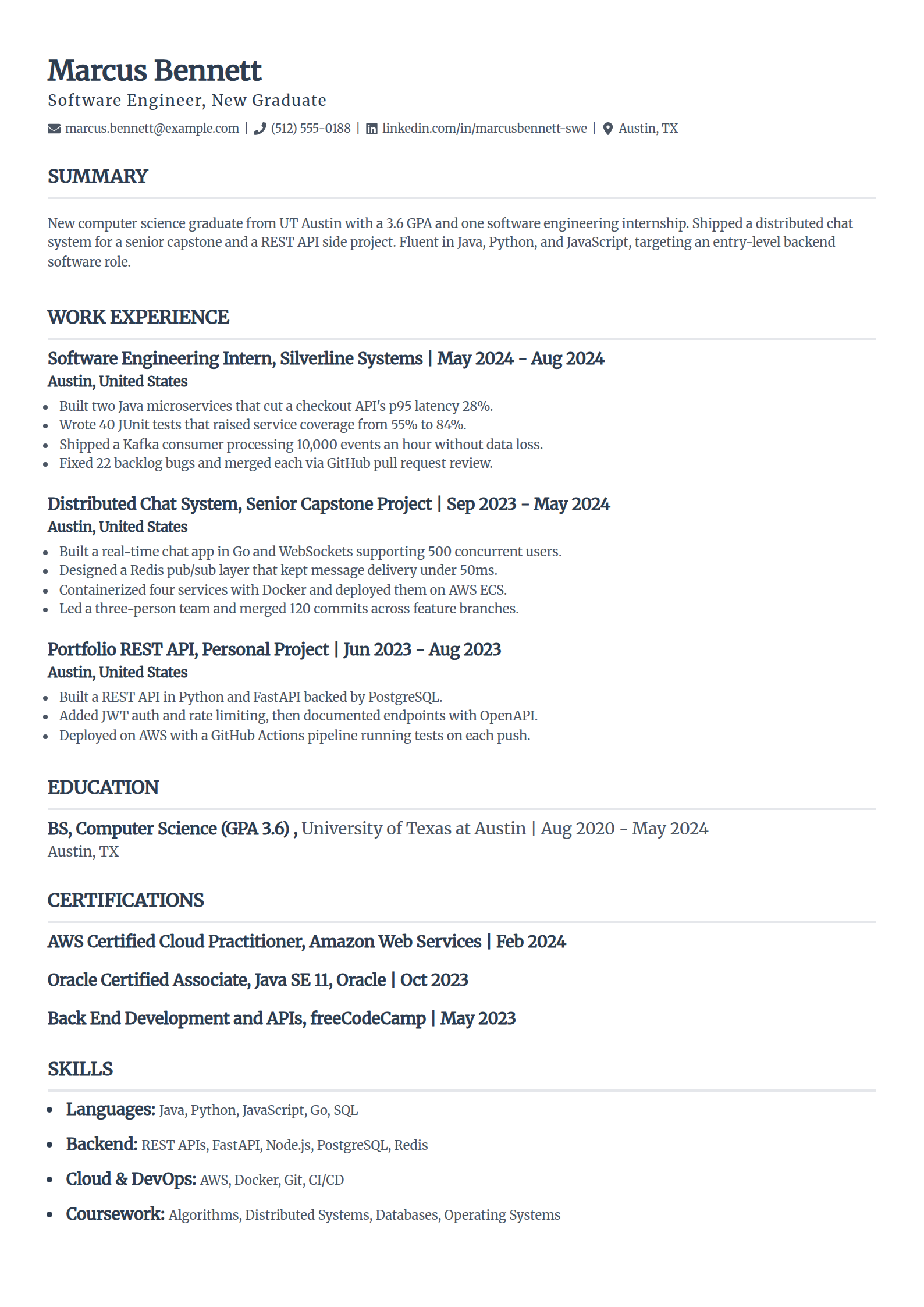
New Grad Software Engineer Resume Template
Why this resume example works?
- Opens with the CS degree and GPA, then one internship, the right order for a first full-time application.
- Leads with a latency cut, 28% on a checkout API, instead of a duty, so the impact reads first.
- Uses a senior capstone as a real project with a number: a chat system serving 500 concurrent users.
- Names Java, Go, Docker, and AWS, the exact stack keywords an ATS matches against the posting.
- Keeps bullets short and scannable so the two-column classic layout stays clean in a parser.
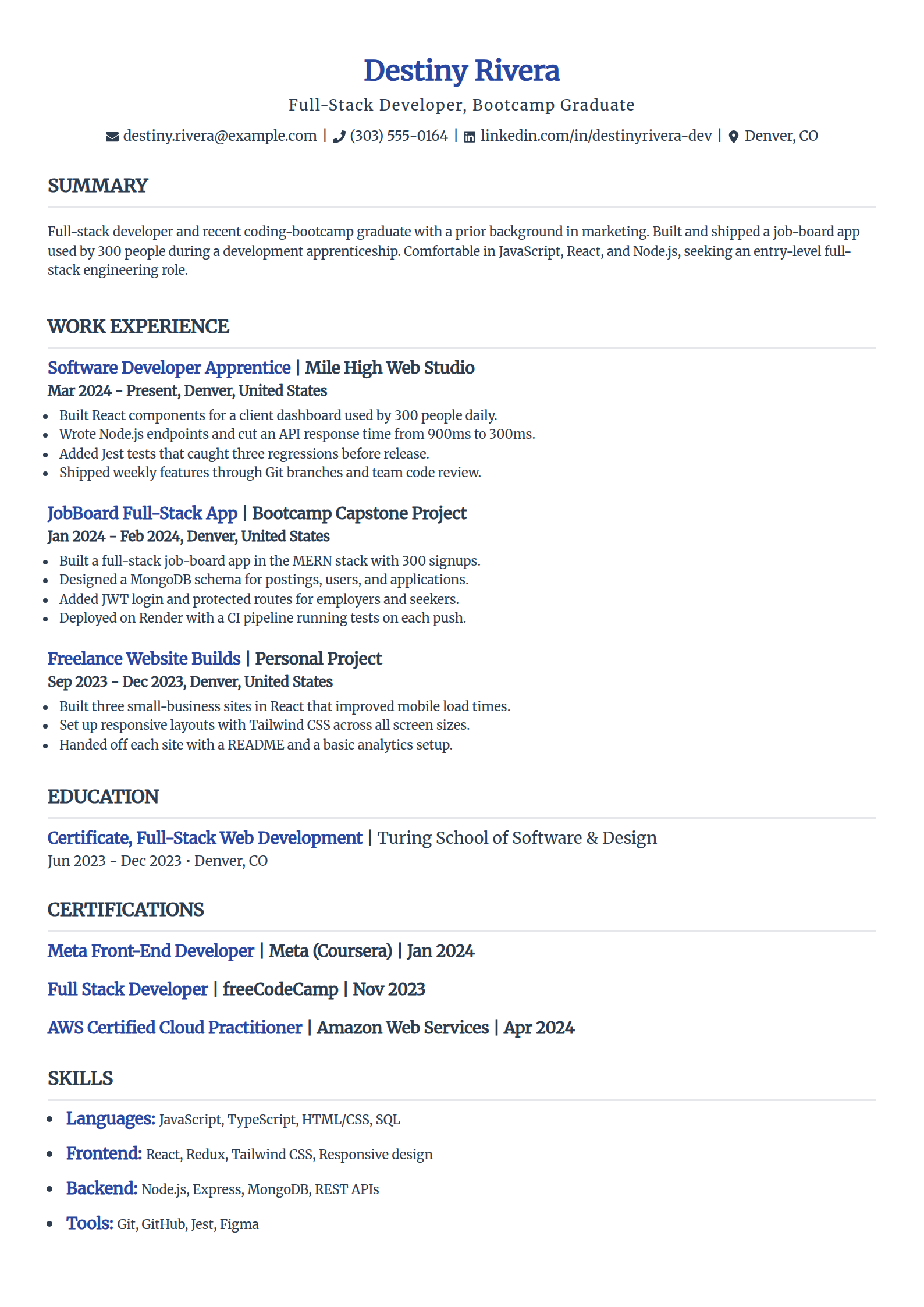
Bootcamp Graduate Resume Template
Why this resume example works?
- Frames a career change honestly, pairing the bootcamp certificate with a shipped apprenticeship project.
- Leads with a result a hiring manager trusts: an API response time cut from 900ms to 300ms.
- Treats the capstone as experience, a full MERN job-board app with 300 signups, not a footnote.
- Names React, Node.js, and MongoDB outright, the stack a junior full-stack posting screens for.
- Keeps the plain, single-column simple layout so a parser reads the projects and skills cleanly.
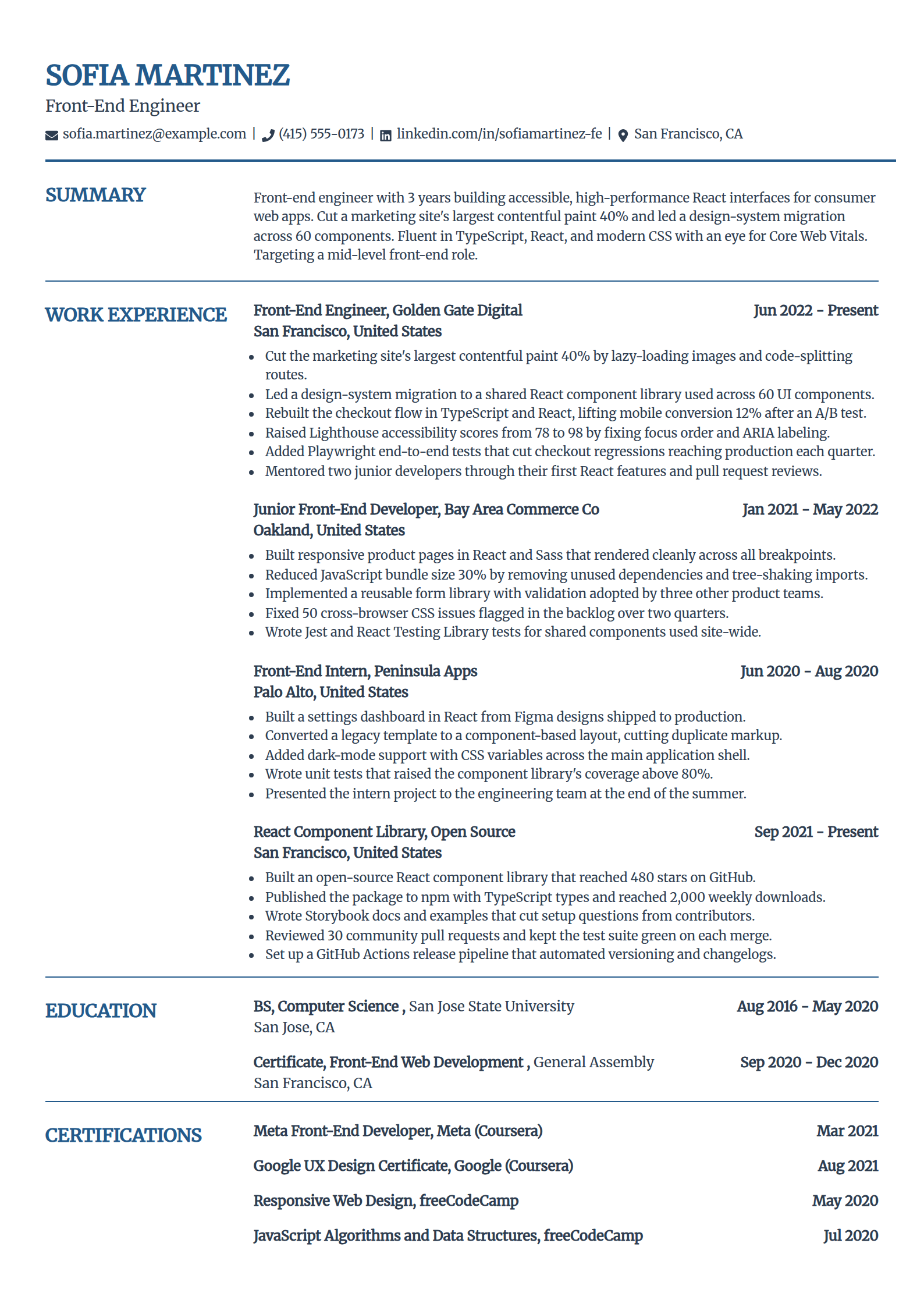
Front-End Developer Resume Template
Why this resume example works?
- Leads with a performance win, a 40% cut in largest contentful paint, the metric front-end roles hire on.
- Names TypeScript, React, and modern CSS, plus Core Web Vitals and WCAG, the exact front-end keywords.
- Shows an accessibility gain, Lighthouse from 78 to 98, the work that separates a builder from a stylist.
- Includes an open-source component library with 480 stars, proving skills beyond the day job.
- Groups skills by real front-end axes so a recruiter finds the framework and tooling match fast.
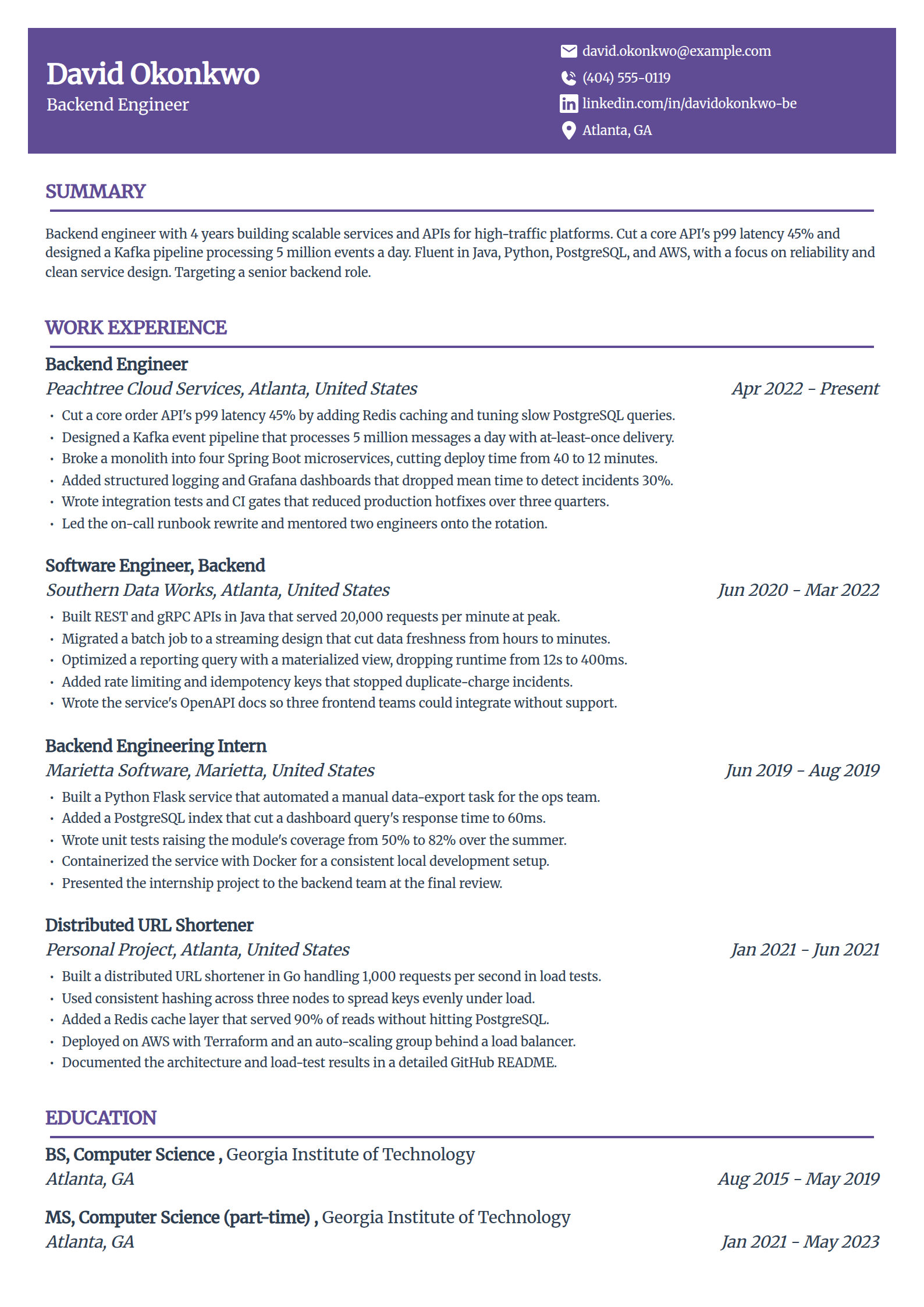
Back-End Developer Resume Template
Why this resume example works?
- Opens with a p99 latency cut, 45% on a core API, the reliability result a backend role screens for.
- Names Java, Spring Boot, Kafka, PostgreSQL, and Redis, the service and data keywords an ATS matches.
- Shows a monolith split into microservices with a concrete deploy-time gain, proving system design work.
- Ties a Kafka pipeline to a real scale number, 5 million events a day, so the metric reads credible.
- Keeps the layout scannable so the stack and observability tools stay readable in a parser.
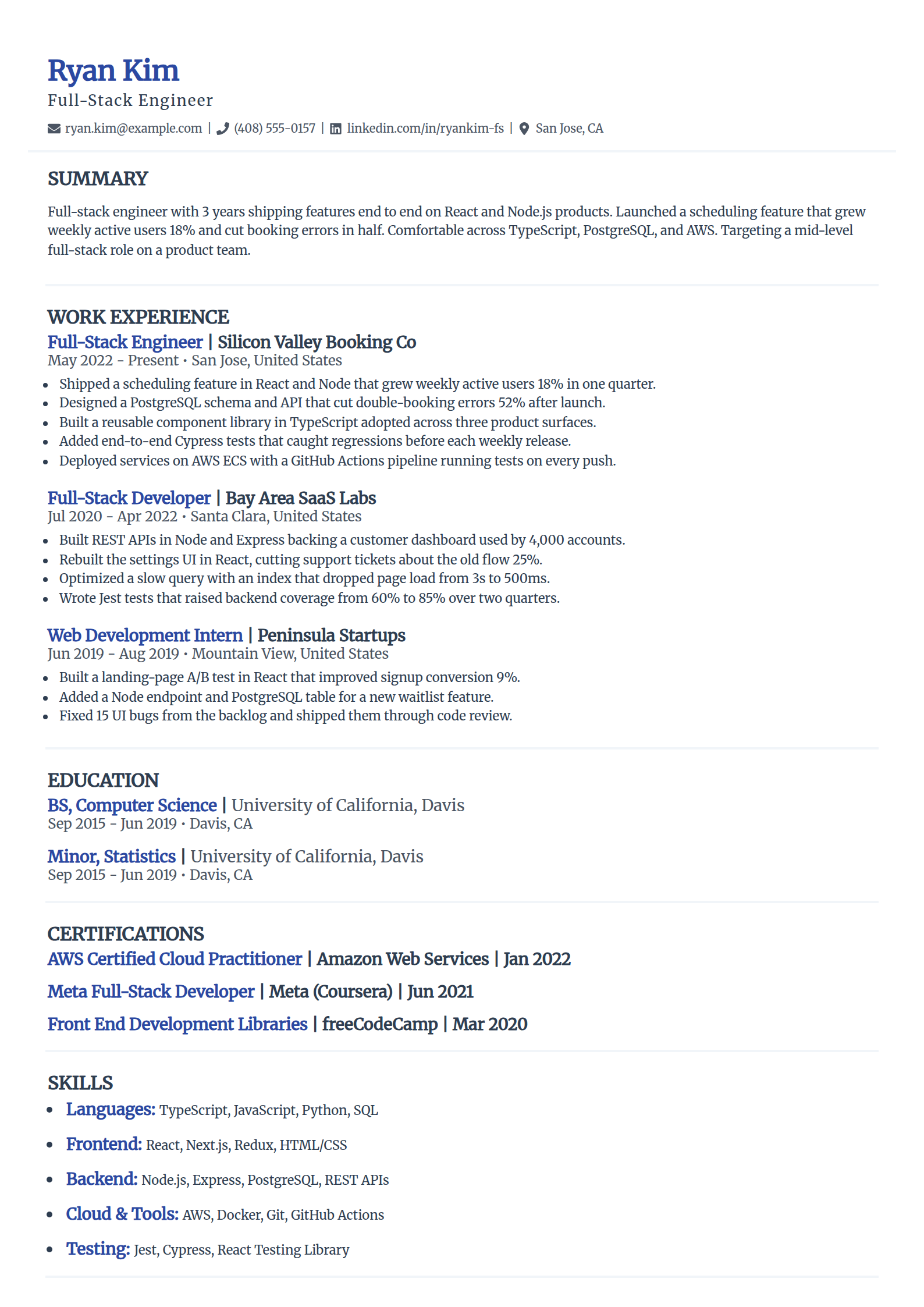
Full-Stack Developer Resume Template
Why this resume example works?
- Frames end-to-end ownership: a shipped scheduling feature that grew weekly active users 18%.
- Pairs a frontend and backend stack, React with Node and PostgreSQL, the range a full-stack posting wants.
- Ties a schema change to a real outcome, double-booking errors cut 52%, so the work reads as impact.
- Names AWS, Docker, and Cypress, the cloud, container, and testing keywords a screener looks for.
- Keeps each bullet tight so the elegant layout stays clean and parser-safe.
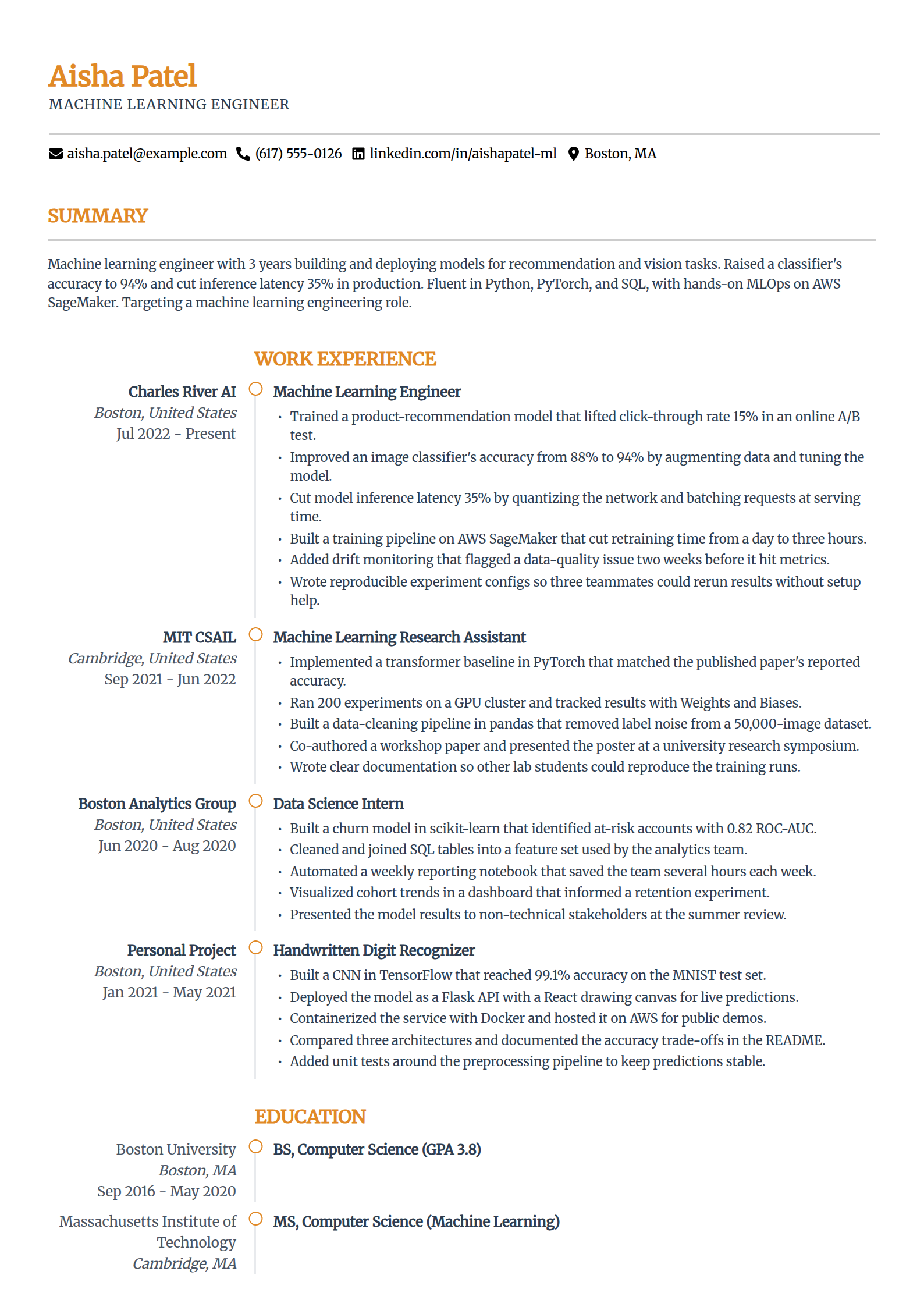
Data & Machine Learning Resume Template
Why this resume example works?
- Leads with model impact, accuracy raised to 94% and inference latency cut 35%, the numbers ML roles read.
- Names Python, PyTorch, TensorFlow, and scikit-learn, plus AWS SageMaker for the MLOps side.
- Shows research alongside production, a lab role and a deployed project, covering both hiring tracks.
- Ties a click-through gain to an A/B test, so the metric reads as measured rather than claimed.
- Separates modeling, data, and MLOps skills so a recruiter matches the exact posting fast.
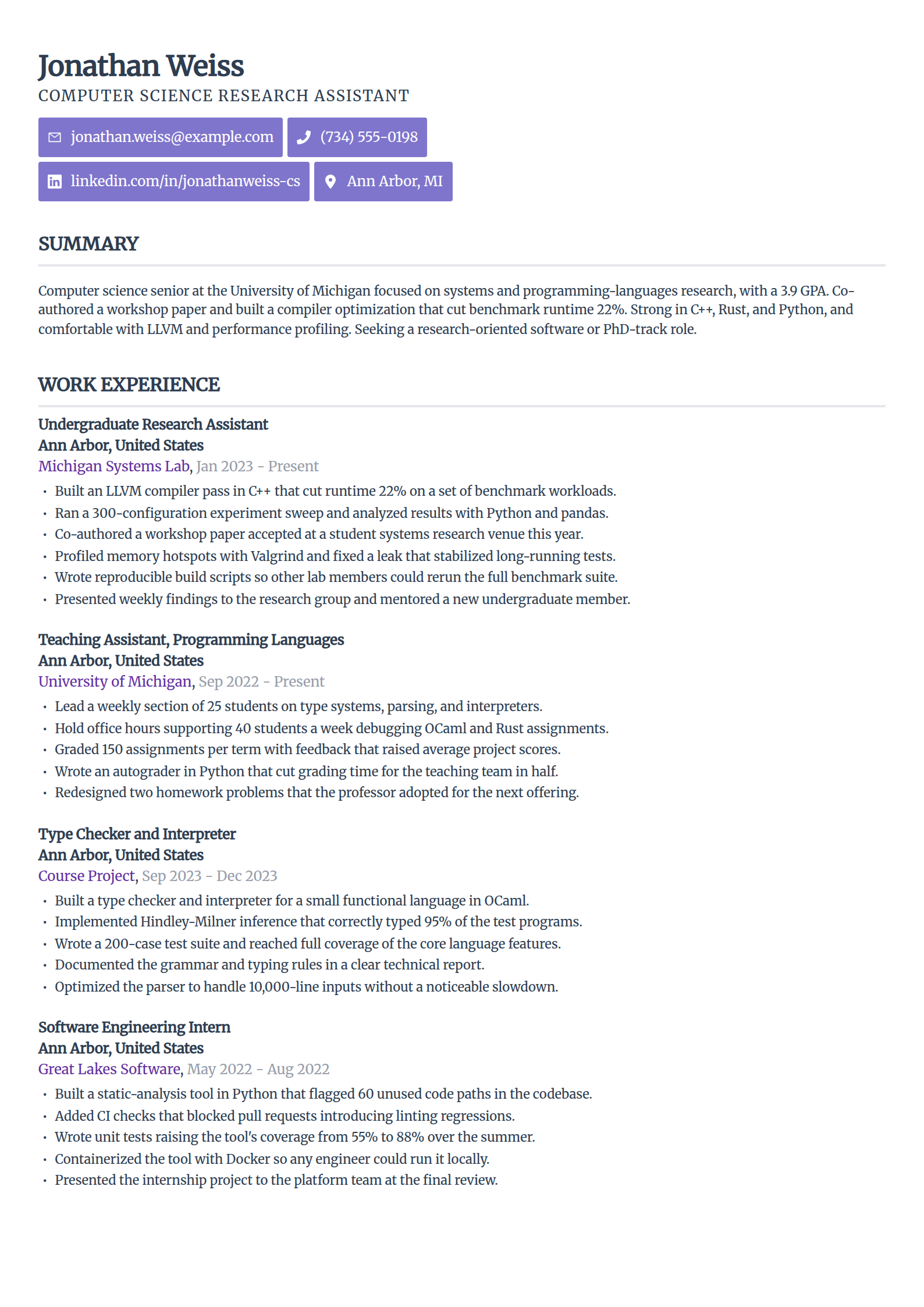
CS Research Assistant Resume Template
Why this resume example works?
- Leads with a research result, a compiler pass that cut benchmark runtime 22%, plus a workshop paper.
- Names C++, Rust, LLVM, and OCaml, the systems and languages keywords a research role screens for.
- Fills the page with a lab role, a teaching-assistant role, and a course project, all with numbers.
- Shows reproducible build scripts and profiling, the habits that mark a real researcher, not a student.
- Lists relevant coursework so a PhD or research team sees the foundation behind the projects.
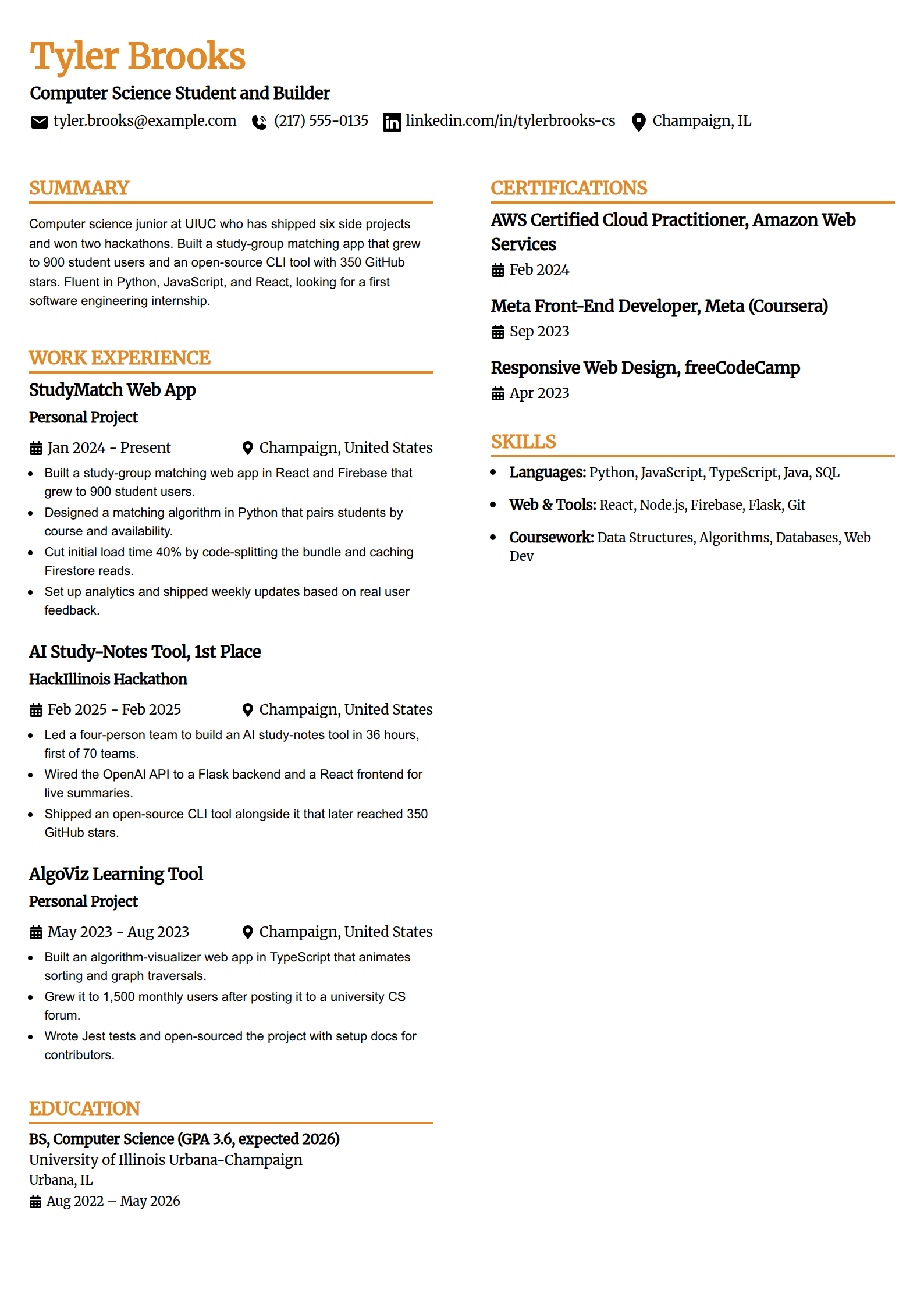
CS Resume With No Experience (Projects Template)
Why this resume example works?
- Proves that projects replace a job history: a study-app grown to 900 users leads the page, not a summary.
- Turns hackathons into wins with numbers, first of 70 teams, so a screener sees results without a job.
- Names an open-source tool with 350 GitHub stars, evidence a recruiter can click and verify.
- Names Python, React, and Firebase in the bullets and skills so the stack shows even with no employer.
- Puts the AWS and Meta certificates plus in-progress CS coursework where a screener expects credentials.
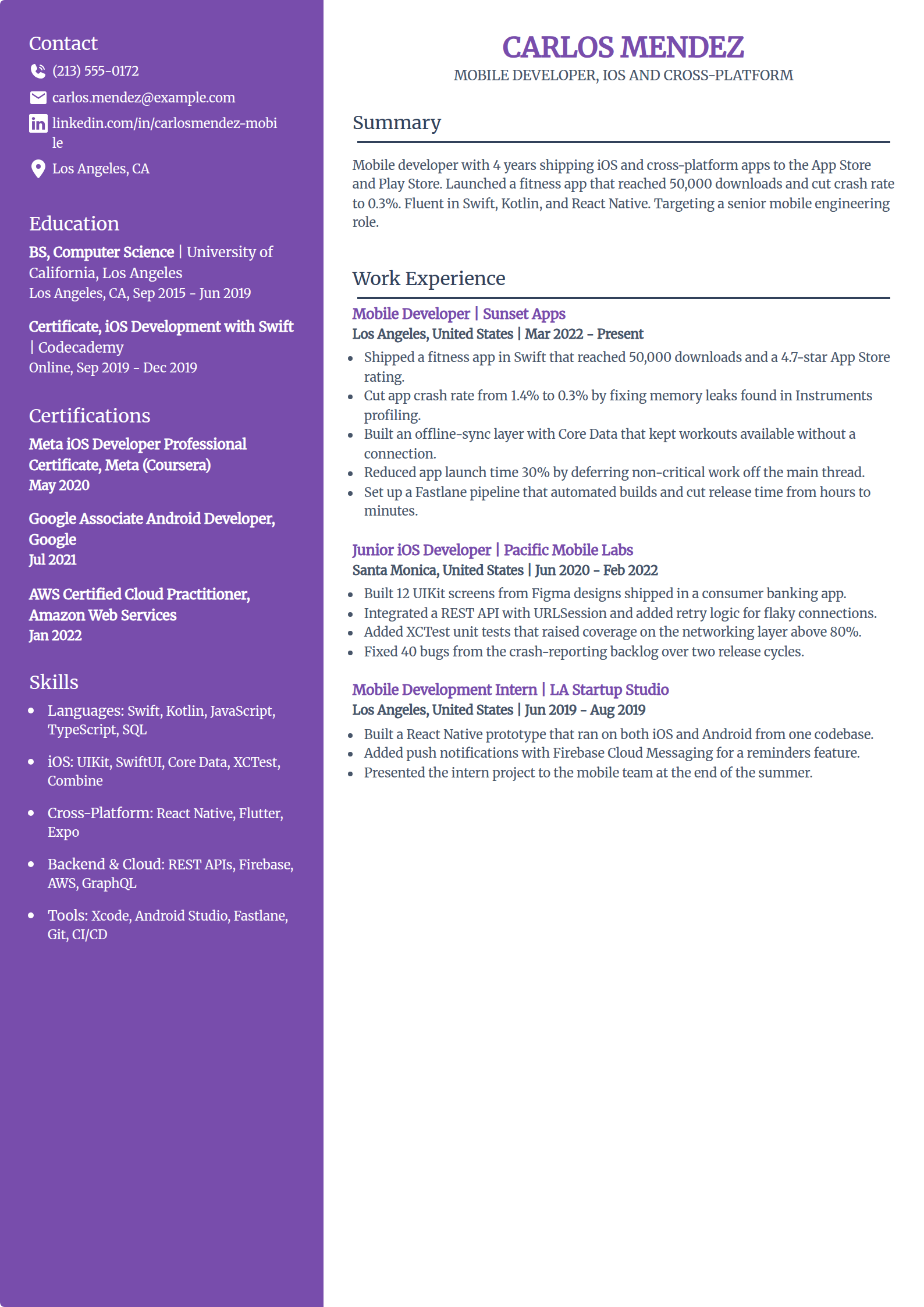
Mobile Developer Resume Template
Why this resume example works?
- Leads with a shipped app: 50,000 downloads and a 4.7-star rating, the outcome a mobile role hires on.
- Names Swift, Kotlin, and React Native, covering the native and cross-platform tracks postings split on.
- Shows a crash-rate cut to 0.3% tied to Instruments profiling, proving work past the first build.
- Includes a Fastlane release pipeline, the delivery skill that separates a mobile engineer from a coder.
- Keeps recent, higher-impact roles at the top so the strongest work carries the page.
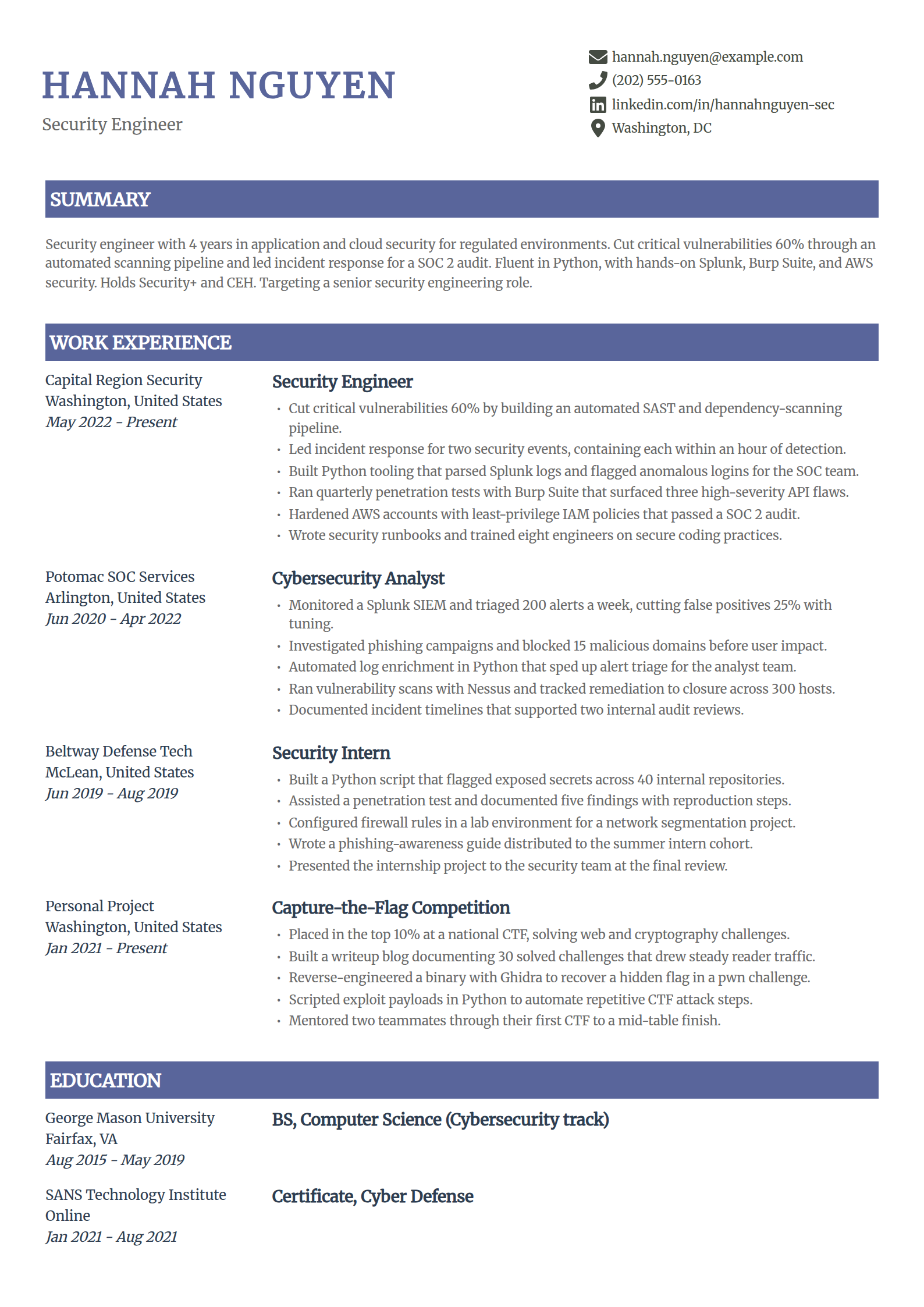
Cybersecurity Resume Template
Why this resume example works?
- Leads with a risk result, critical vulnerabilities cut 60%, the number a security team screens for.
- Names Security+, CEH, and OSCP up front, the certifications that gate most security roles.
- Names Splunk, Burp Suite, and Ghidra in the bullets, the exact tools a SOC or AppSec posting lists.
- Shows incident response and a passed SOC 2 audit, proving the work landed in a real environment.
- Uses a CTF project to show hands-on skill a recruiter can verify beyond the job history.
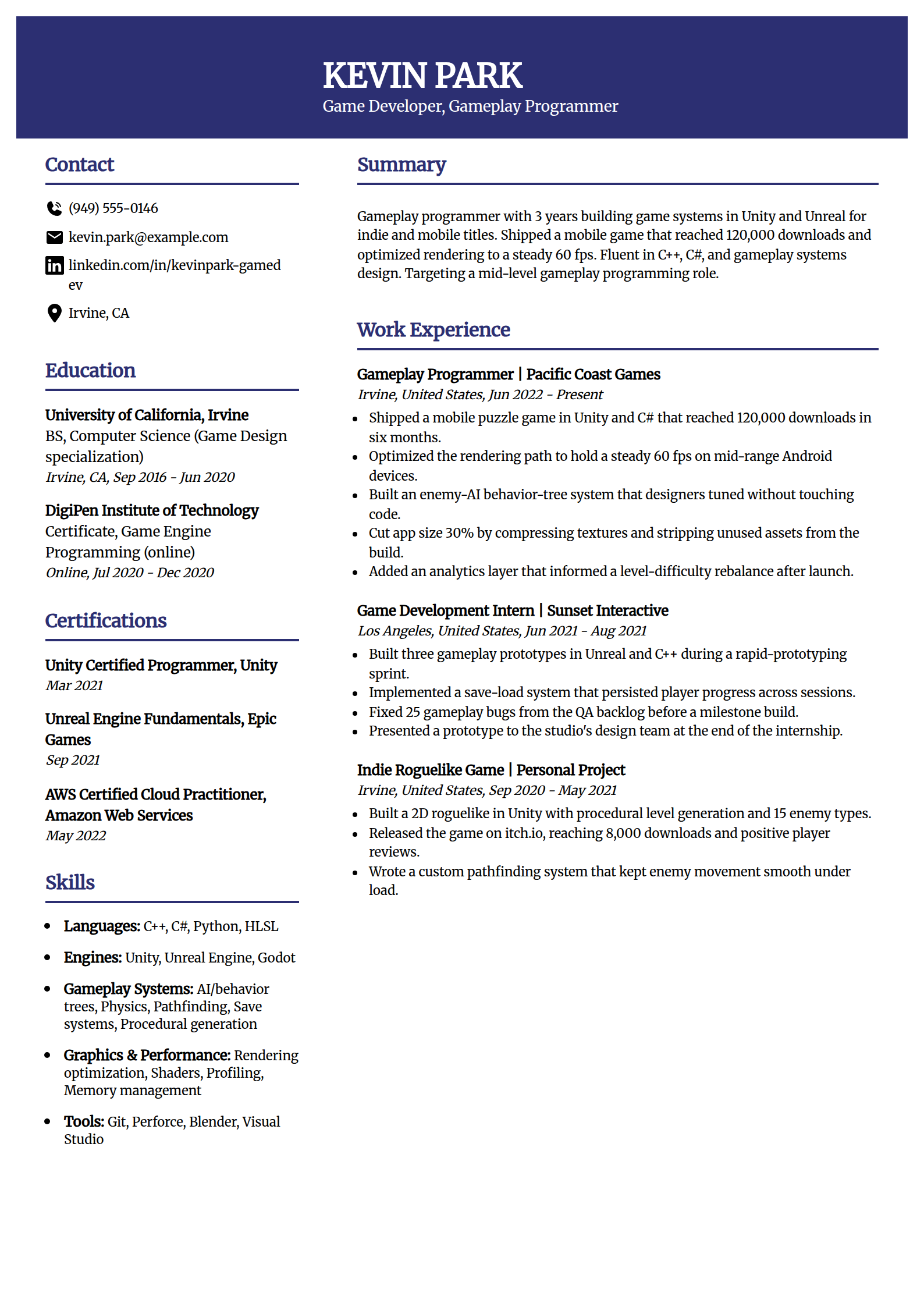
Game Developer Resume Template
Why this resume example works?
- Leads with a shipped title: 120,000 downloads and a steady 60 fps, the results a studio reads first.
- Names Unity, Unreal, C++, and C#, the engine and language keywords a gameplay posting screens for.
- Shows an AI behavior-tree system designers could tune, the gameplay-programming depth studios want.
- Includes a released indie game, proving the candidate ships a project all the way to players.
- Groups engines, gameplay systems, and graphics so a recruiter matches the exact role quickly.
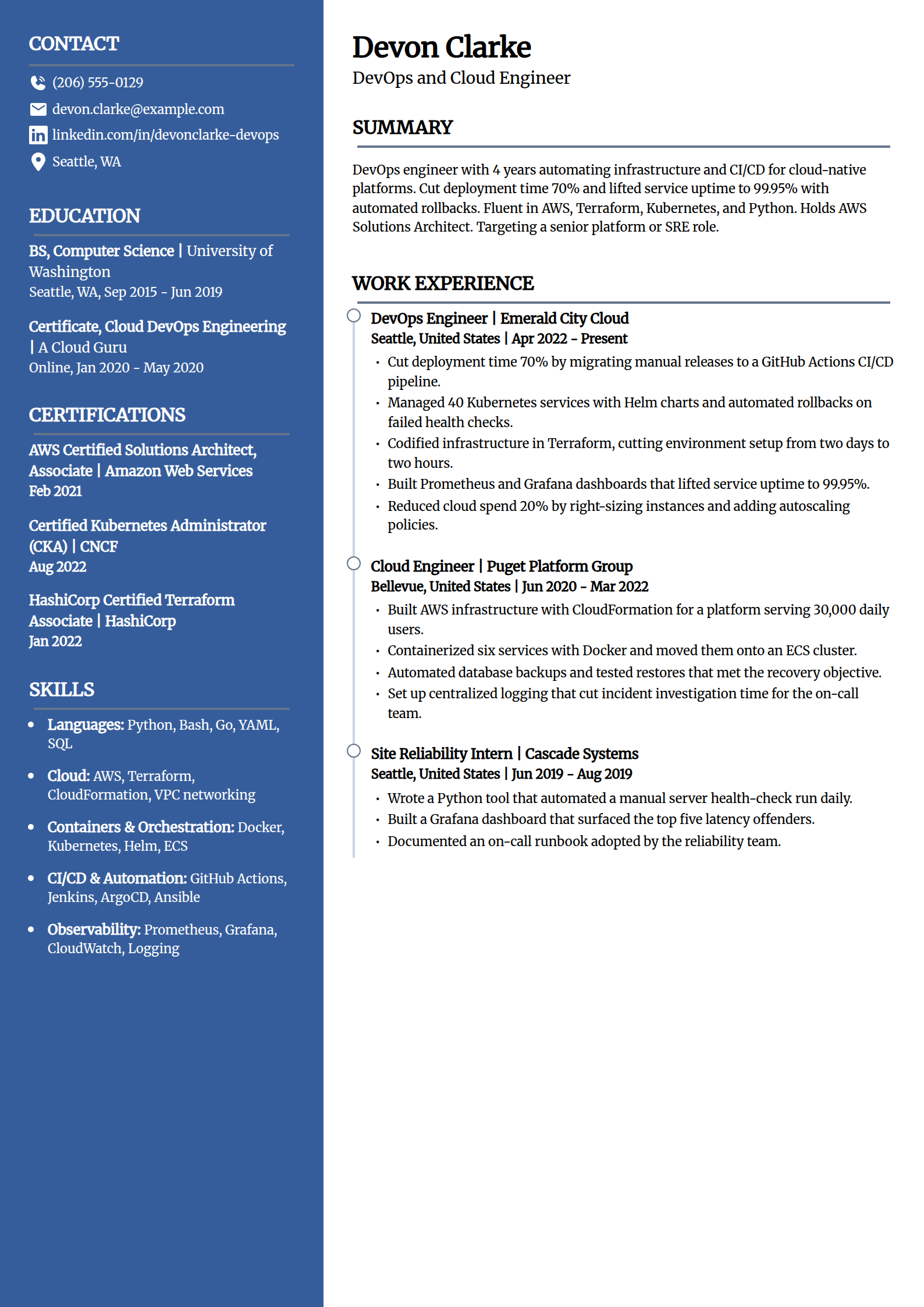
DevOps & Cloud Engineer Resume Template
Why this resume example works?
- Leads with a deployment-time cut, 70% via a CI/CD pipeline, the result a platform role hires on.
- Names AWS, Terraform, Kubernetes, and Docker, the infrastructure keywords an ATS matches directly.
- Ties an uptime figure, 99.95%, to Prometheus and Grafana, so the reliability claim reads as measured.
- Shows the CKA and Terraform Associate certs, the credentials a senior platform posting expects.
- Carries a cloud-cost cut, proving the engineer optimizes spend, not just ships infrastructure.
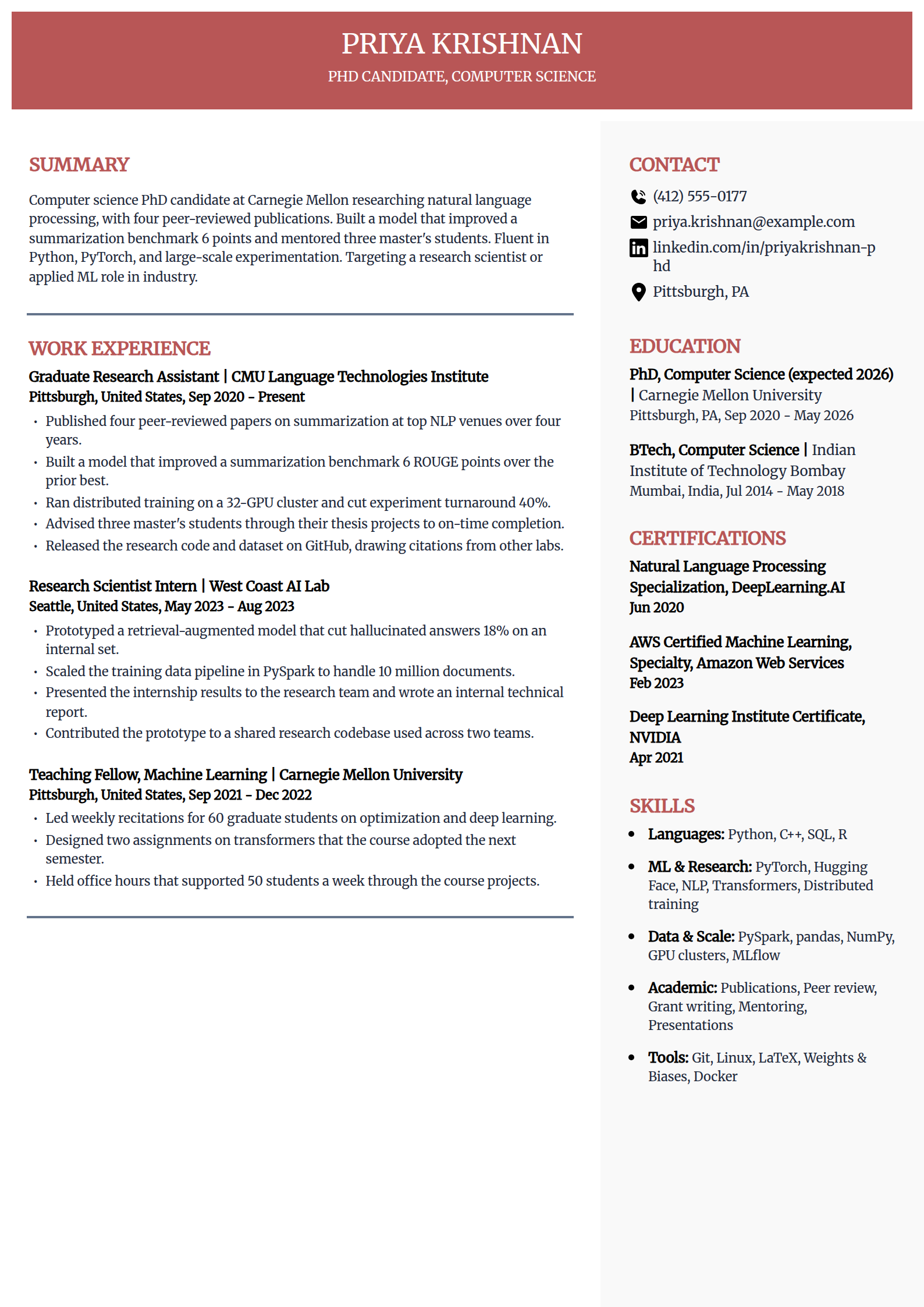
PhD & Academic CS Resume Template
Why this resume example works?
- Leads with four peer-reviewed publications and a benchmark gain, the record an academic role reads first.
- Bridges to industry with a research internship result, hallucinations cut 18%, not just papers.
- Names PyTorch, Hugging Face, and distributed training, the applied ML keywords a lab or company matches.
- Shows advising and teaching, the mentorship a faculty or research-scientist role expects.
- Keeps publications and academic skills grouped so both academic and industry screens find the fit.
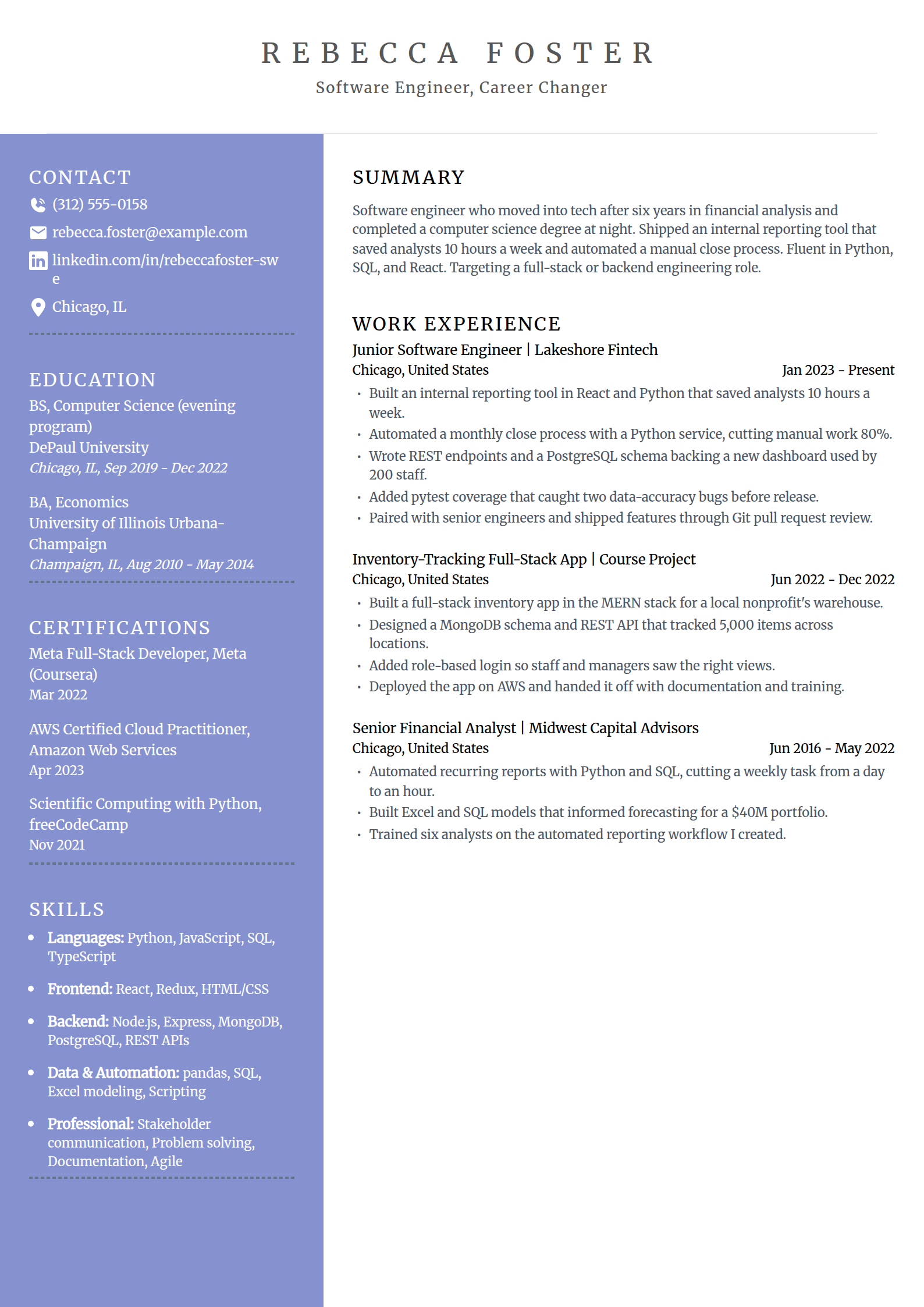
Career Changer CS Resume Template
Why this resume example works?
- Frames the pivot as a strength: a night-school CS degree plus a shipped tool that saved 10 hours a week.
- Leads current engineering work first, so the new career reads before the prior one, not after.
- Bridges the old role with transferable proof, automating reports 80% in Python, tying past to present.
- Names React, Node.js, and PostgreSQL so a screener sees the current stack, not just the old title.
- Keeps the prior career brief and technical, showing the path without crowding the software story.
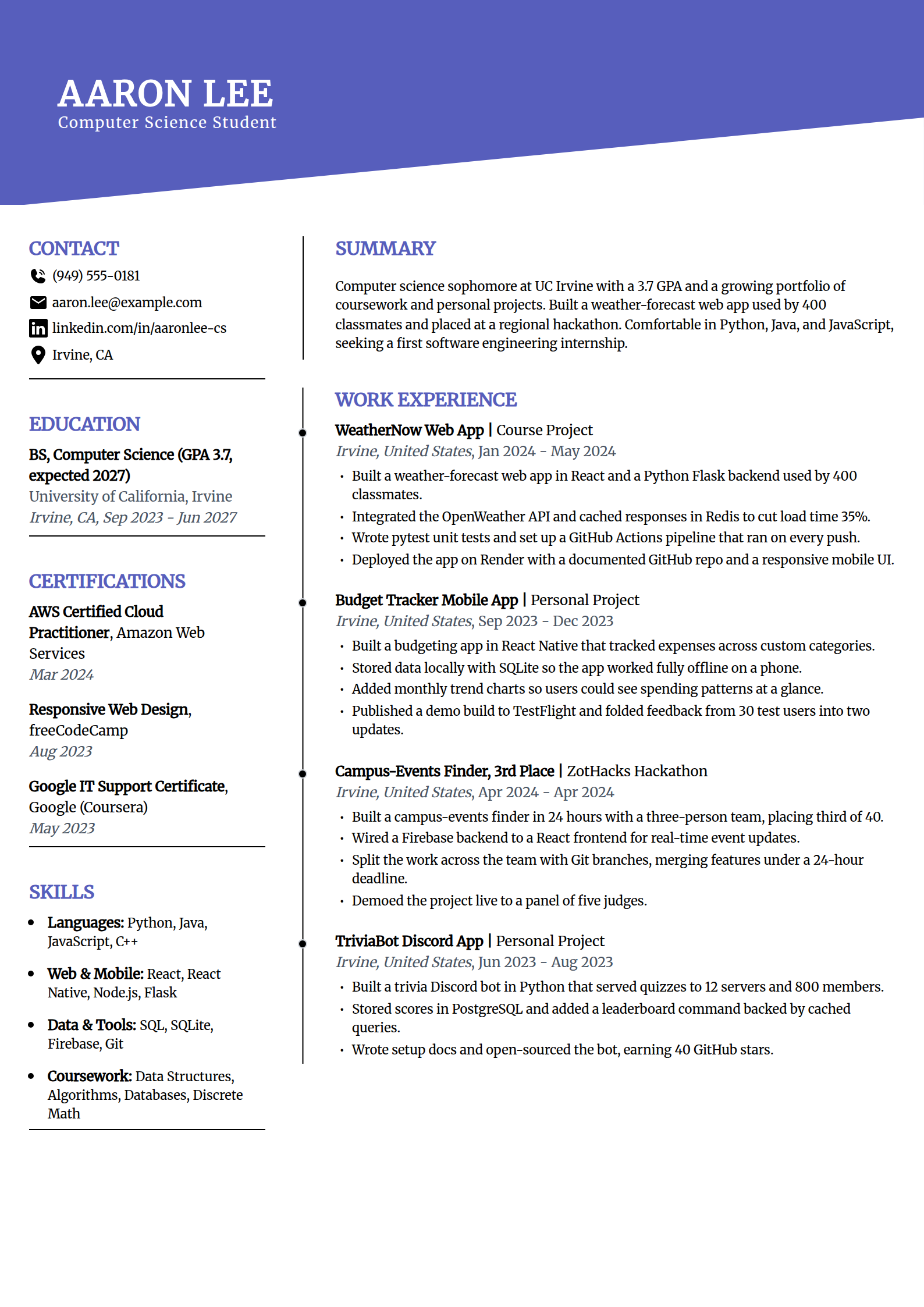
CS Student Resume (Projects Only) Template
Why this resume example works?
- Shows a first-year-friendly resume built entirely from coursework and personal projects, no jobs needed.
- Leads with a class project used by 400 classmates, a real number that beats a vague skills list.
- Names Python, Java, React Native, and Firebase across three projects so the stack is unmistakable.
- Folds a third-place hackathon finish into the project itself, so the win reads as shipped work.
- Lists relevant coursework and GPA, the context an intern screen wants from a student with no experience.
Build your computer science resume
Pick a template above and the editor keeps the layout parser-safe while you swap in your own projects, languages, coursework, and numbers.
Build my resumeHow to write a computer science resume in 2026
A CS resume gets read twice: a fast human skim for projects and results, then an ATS keyword match against the posting. These moves satisfy both, and they work whether you have an internship or only class projects.
Open with a summary that names your track, level, and one number
Write two to three sentences that state whether you are a student, new grad, or specialist, name your strongest language or framework, and land on one result. Students use a project number, such as users or accuracy, in place of years. Keep it to about 50 to 70 words.
Computer science junior with a 3.7 GPA seeking a software engineering internship; built a full-stack app in React and Node that grew to 1,200 users and shipped features during a backend internship.
Let projects stand in for work experience
If you have little or no paid experience, projects are your experience section, not a side note. Treat each one like a job so a recruiter reads it that way.
- Use the project name as the title and label it Personal Project, Course Project, a named hackathon, or Open Source so the context is clear.
- Write real bullets: what you built, the stack you used, and one number such as users, GitHub stars, latency, or accuracy.
- Pull from your capstone, coursework builds, hackathons, teaching or research roles, and clubs, so the page fills without padding.
Put education, GPA, and coursework where a student screen looks
For students and new grads, education sits near the top and carries more weight than it will later. Give a recruiter the details they screen on.
- List your degree as "BS, Computer Science" with your school and expected or actual graduation year.
- Include your GPA when it is about 3.3 or higher; leave it off if it is lower and let projects carry the page.
- Add a short relevant-coursework line (Data Structures, Algorithms, Databases, Operating Systems) while you are still early-career.
Name your languages, frameworks, and the tools you actually use
An applicant tracking system matches the exact language and framework the posting lists, so write them out by name where they are true, and make sure they also appear in a project bullet.
- Languages: Python, Java, C++, JavaScript and TypeScript, Go, SQL, whichever you have shipped code in.
- Frameworks and data: React, Node.js, Spring Boot, PostgreSQL, MongoDB, and for ML, PyTorch or TensorFlow.
- Tools and cloud: Git, Docker, Kubernetes, AWS, CI/CD, and match the posting's phrasing rather than listing everything you have touched.
Keep the format ATS-safe
CS resumes get filtered by software before a person reads them. A clean single-column layout keeps your projects and skills readable.
- Skip tables, icon columns, and text boxes that scramble in a parser, and put a Technical Skills block in the top third.
- Keep your name and contact details in the body, not the header or footer, so nothing is lost.
- Save as a PDF unless the application asks for a Word document, and run the draft through the ATS resume checker before you send it.
Common computer science resume mistakes
- Hiding projects at the bottom or leaving them out. With little work history, projects are your experience section; give them real bullets and a number.
- Listing a language you cannot use in an interview. The tools in your skills block should also show up in a project or job bullet.
- Writing duties instead of results. "Worked on a web app" is a task; "built a React app that grew to 1,200 users" is proof.
- Naming a generic "programming" or "web development" instead of the exact stack. Write Python, React, PostgreSQL, or PyTorch so the ATS matches.
- Using a two-column, icon-heavy template that a parser cannot read, then wondering why the application stalls.
Frequently asked questions
What should a computer science resume include?
A two to three sentence summary that names your track and one result; an experience or projects section where every bullet leads with a verb and a number; your education with GPA and relevant coursework if you are early-career; a technical skills block that names your languages and frameworks; and any certifications. Keep it to one page for students and anyone with under about ten years of experience, and put your skills in the top third.
How do I write a computer science resume with no experience?
Lead with your strongest project and let projects fill the experience section. Use your capstone, coursework builds, hackathons, open-source work, and any teaching or research role, and write each one like a job: the project name as the title, a label such as Personal Project or a named hackathon, and real bullets naming what you built, the stack, and one number such as users, GitHub stars, or accuracy. Name your languages and frameworks so a screener sees the stack even without a paid role.
How do I put projects on a CS resume?
Treat each project as an experience entry. Put the project name where a job title goes, label the "company" as Personal Project, Course Project, the hackathon name, or Open Source, and give it two to four bullets. Each bullet should say what you built, name the language and framework, and carry one credible number, such as a user count, a latency cut, GitHub stars, or a model's accuracy. Link a live demo or repo where you have one.
Should I put my GPA on a computer science resume?
Include your GPA if it is about 3.3 or higher, especially as a student or new grad, since intern and new-grad screens often look for it. If it is lower, leave it off and let your projects, internships, and skills carry the page. Once you have a few years of full-time experience, drop the GPA regardless and lead with your work.
What skills should I list on a computer science resume?
List the languages and frameworks you have actually shipped code in, grouped so a recruiter scans them fast. Name your languages (Python, Java, C++, JavaScript and TypeScript, SQL), your frameworks and data stores (React, Node.js, Spring Boot, PostgreSQL, MongoDB, or PyTorch and TensorFlow for ML), and your tools and cloud (Git, Docker, Kubernetes, AWS, CI/CD). Match the posting's phrasing, and make sure every skill also appears in a project or job bullet.
Which resume template is best for a computer science student?
A clean single-column template with standard headings, such as Standard, Classic, or Simple above. Those layouts parse cleanly in applicant tracking systems and keep your projects, skills, and dates where a recruiter expects them. Save the visually rich, two-column formats for a portfolio site; for the application itself, a template only helps by staying out of the parser's way.
How long should a computer science resume be?
One page for students, interns, new grads, and engineers with under about ten years of experience. Two pages are fine for senior engineers, researchers with a long publication list, or managers, but only if the second page earns its space with real results. Cut old coursework and duty-style bullets before you add a page.
More computer science resume resources
Build your computer science resume
Pick a template above and the editor keeps the layout parser-safe while you swap in your own projects, languages, coursework, and numbers.