19 Software Engineer Resume Examples, Intern to Staff Engineer
- ATS Friendly
- Every Level & Stack
- 19 Real Examples
A software engineer resume example should show four things: a summary naming your stack and level, experience bullets that each carry one real number, a skills block grouped the way a posting lists it, and education or certifications matched to where you are. Front end, back end, platform, mobile, data, or machine learning, this page has a resume built for your exact track. Start from a layout below and model your own on a real example, from a summer intern to a staff engineer.


540k+ resumes created
Editable software engineer and developer resume templates
Each template below is a real engineering resume laid out in that format, sorted by track and level across front end, back end, full stack, DevOps, mobile, data, and machine learning. Pick one, then swap in your own projects, systems, and metrics. Every layout keeps your name, stack, and impact bullets clean so a hiring manager reads your strongest work at a glance and an applicant tracking system parses it without trouble.
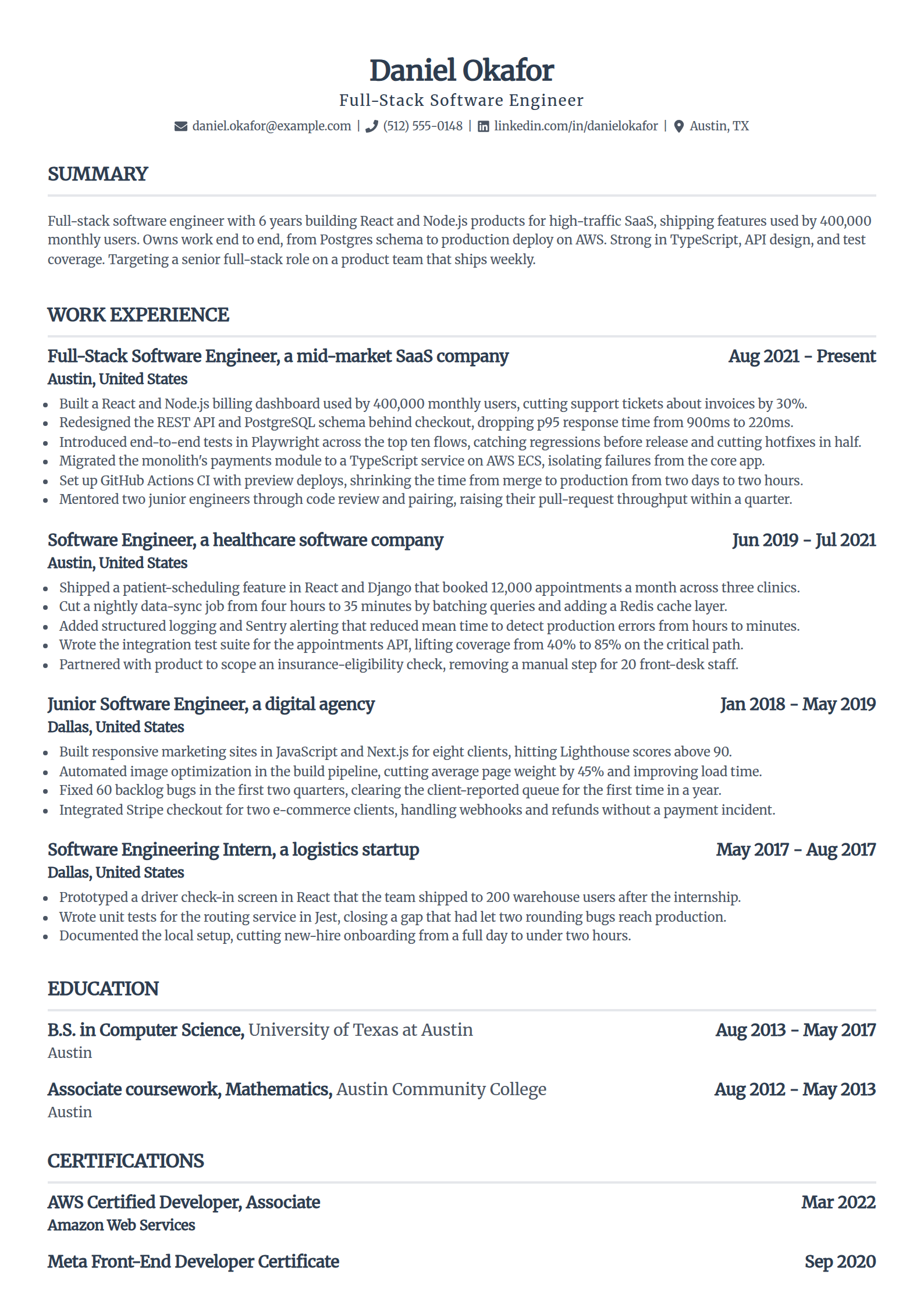
Full-Stack Software Engineer Resume Template
Why this resume example works?
- Opens with a summary that names 6 years, React and Node.js, and 400,000 monthly users on the products shipped.
- Shows end-to-end ownership a product team wants: schema, API, tests, and a production deploy on AWS.
- Attaches one number to each bullet, like p95 latency cut from 900ms to 220ms or merge-to-production down to two hours.
- Names the exact stack a posting screens for, TypeScript, PostgreSQL, and GitHub Actions, without keyword stuffing.
- Uses a clean, single-column layout an applicant tracking system parses without trouble.
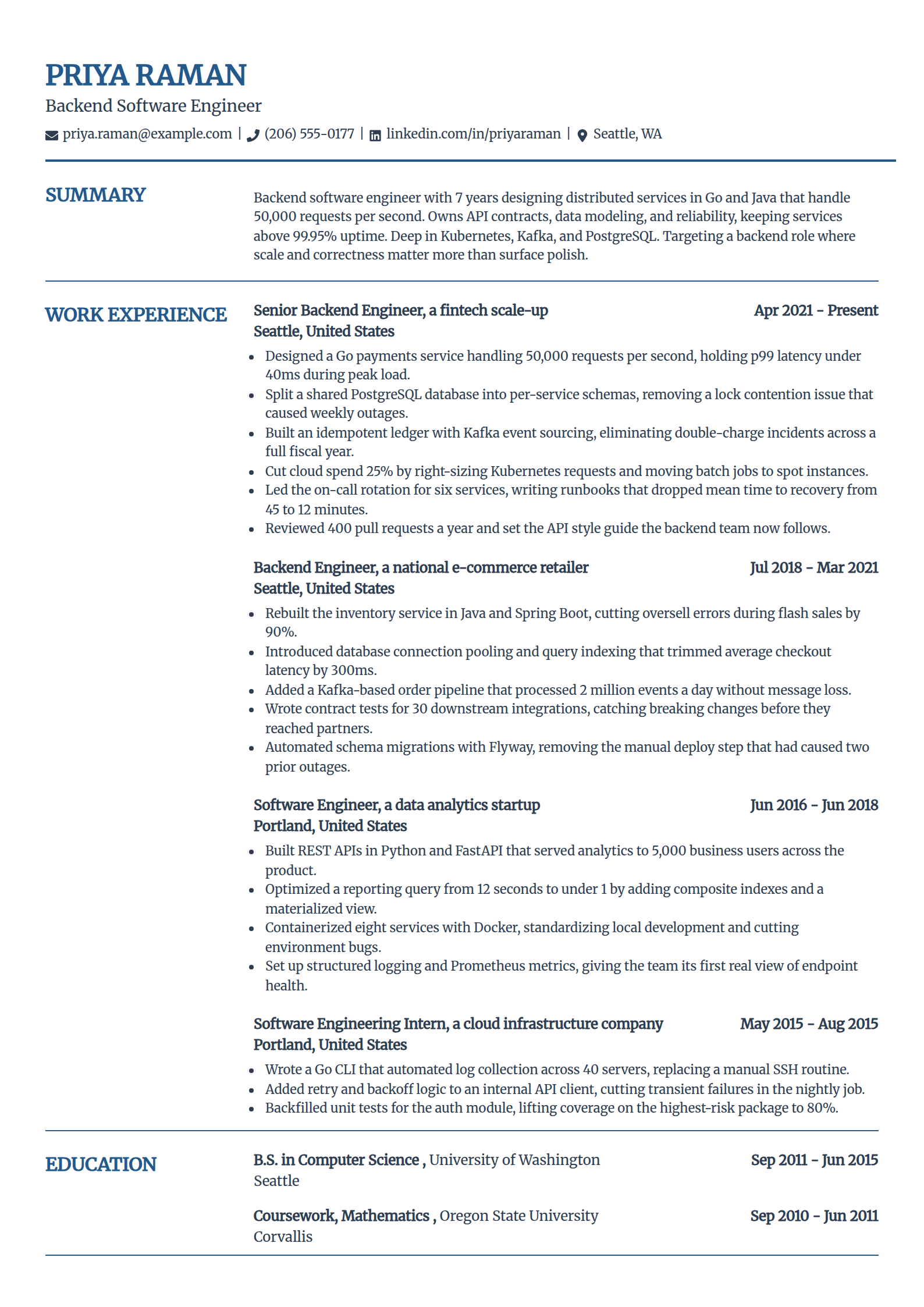
Backend Software Engineer Resume Template
Why this resume example works?
- Leads with scale a backend role hires for, a Go service handling 50,000 requests per second under a 40ms p99.
- Shows the reliability work that matters, on-call ownership and a recovery time cut from 45 to 12 minutes.
- Names the distributed-systems tools a posting lists, Kafka, Kubernetes, and PostgreSQL, in real context.
- Keeps each result modest and countable, like a 25% cloud-cost cut or double-charge incidents removed for a year.
- Uses a modern layout that carries a dense senior backend history on one clean page.
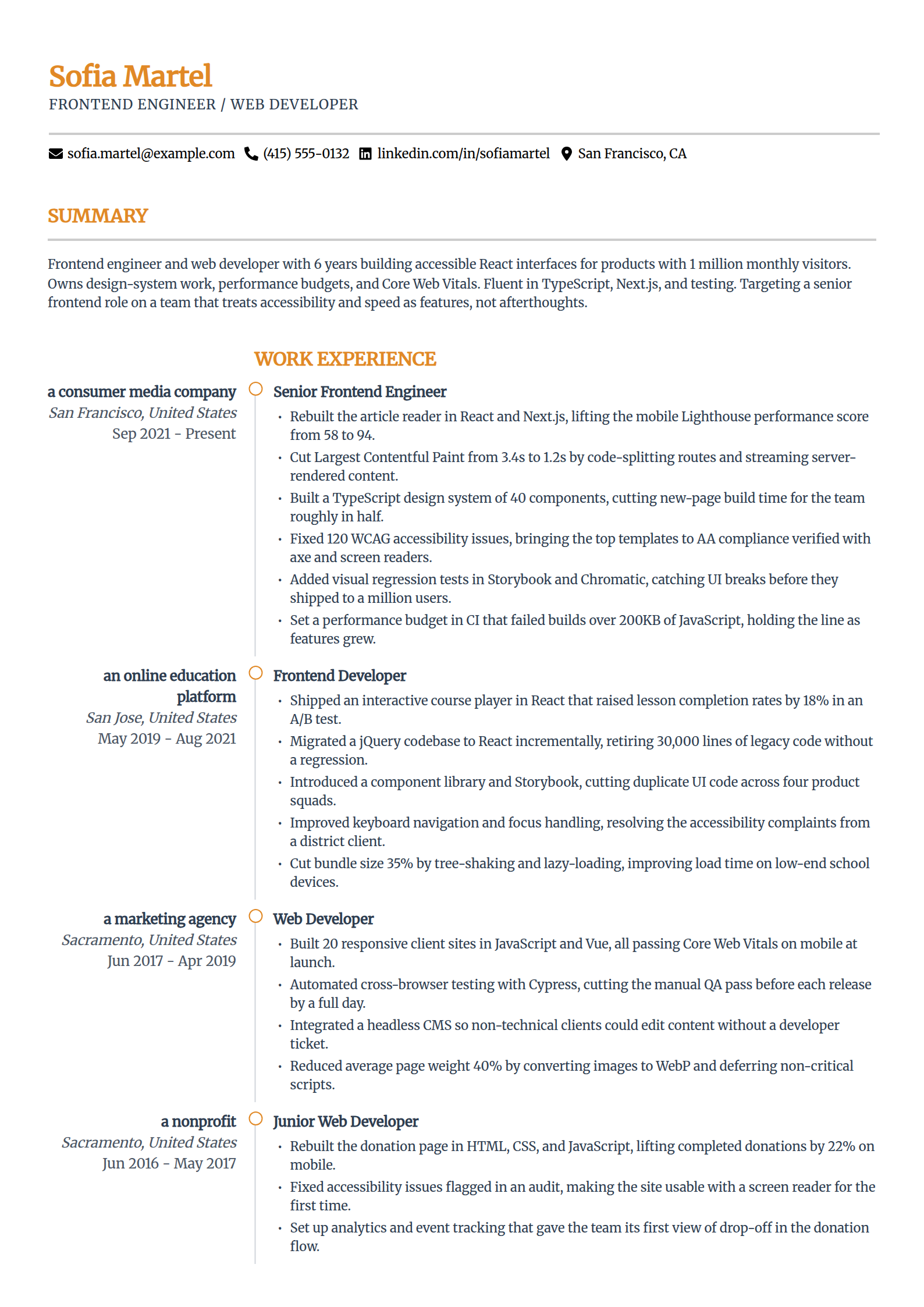
Frontend Engineer & Web Developer Resume Template
Why this resume example works?
- Opens with the metrics a frontend team rewards, a Lighthouse score lifted from 58 to 94 and LCP cut to 1.2s.
- Shows design-system and accessibility work, 40 components built and 120 WCAG issues fixed to AA.
- Names React, Next.js, and TypeScript alongside the testing tools a posting screens for.
- Ties each result to users, like a performance budget that held the line across a million monthly visitors.
- Uses a modern layout that still reads cleanly for a hiring manager scanning fast.
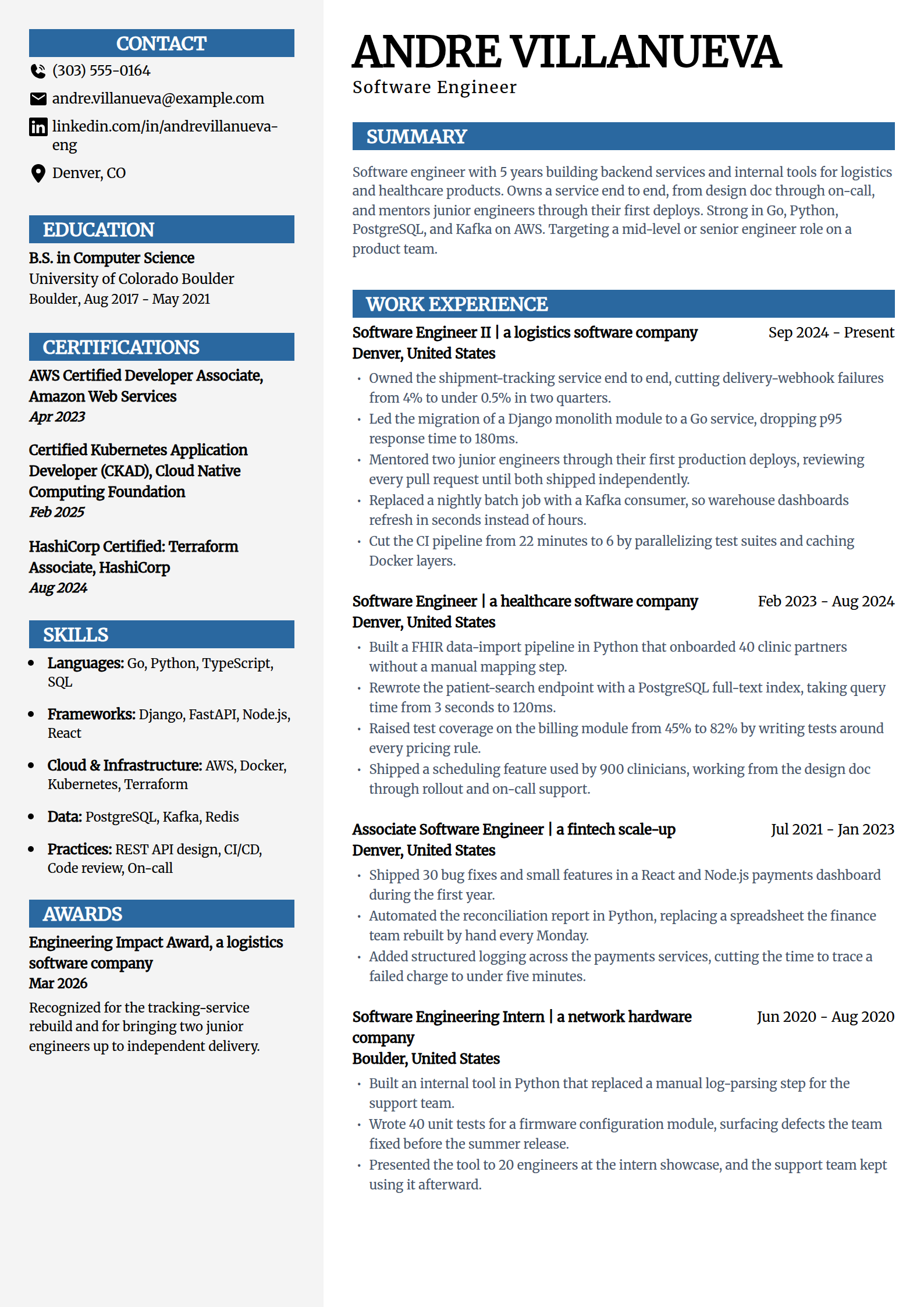
Mid-Level Software Engineer Resume Template
Why this resume example works?
- Opens with the scope a mid-level hire is judged on, one service owned end to end from design doc through on-call.
- Shows the first rung of leadership without overclaiming it, two junior engineers mentored to independent delivery.
- Attaches one number to each result, like webhook failures cut from 4% to under 0.5% or a CI run dropped to six minutes.
- Names the stack a mid-level posting screens for, Go, Python, PostgreSQL, Kafka, and Terraform on AWS.
- Fits a five-year record, internship included, on one page so nothing on it reads as padding.
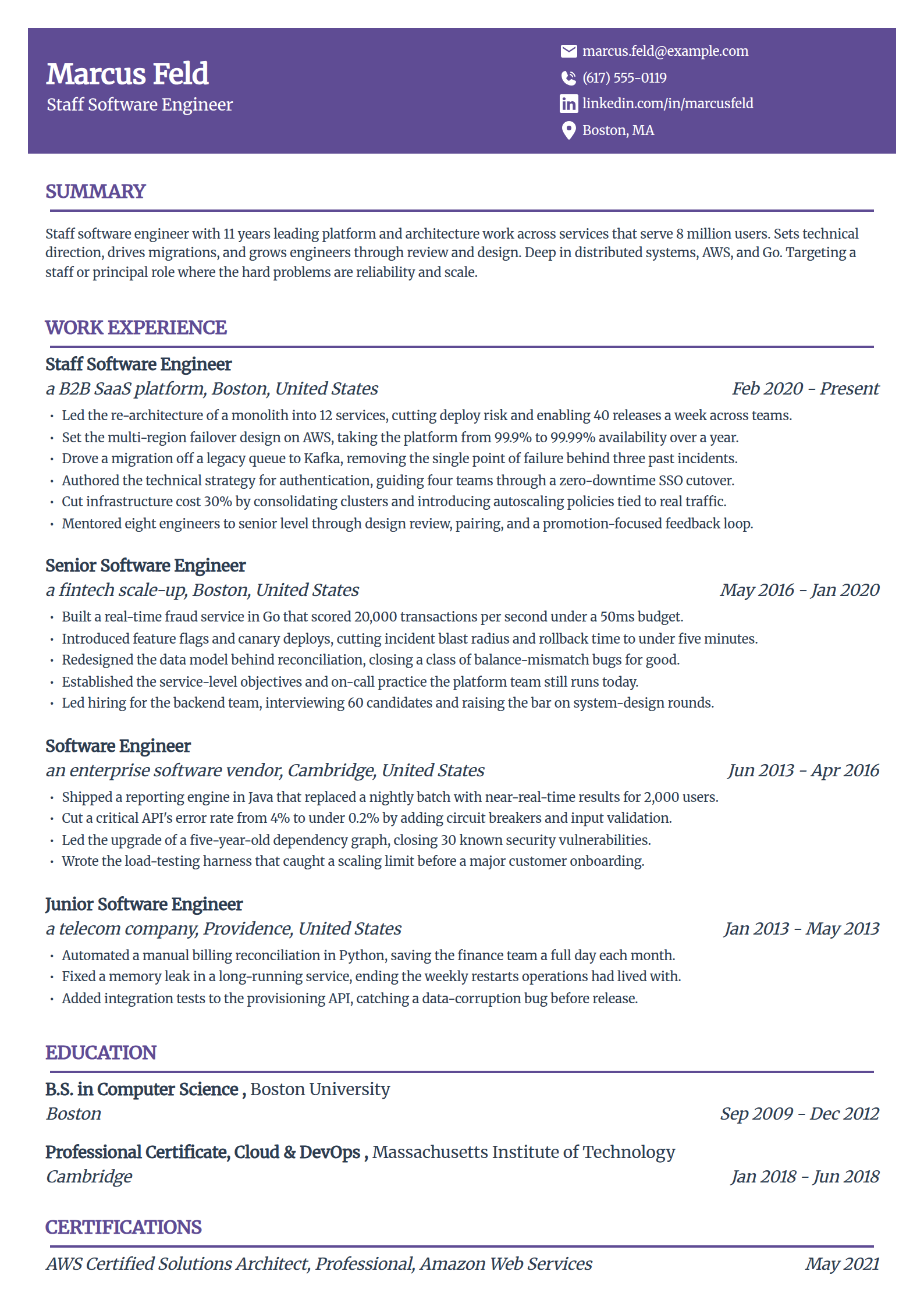
Senior & Staff Software Engineer Resume Template
Why this resume example works?
- Leads with staff-level scope, a monolith split into 12 services enabling 40 releases a week across teams.
- Shows the impact a staff role rewards, availability taken from 99.9% to 99.99% and a 30% infrastructure-cost cut.
- Pairs architecture with people, mentoring eight engineers to senior and leading a zero-downtime SSO migration.
- Keeps each number believable for the level, tied to a specific migration or design decision.
- Uses a spacious layout that carries an 11-year architecture record on one page.
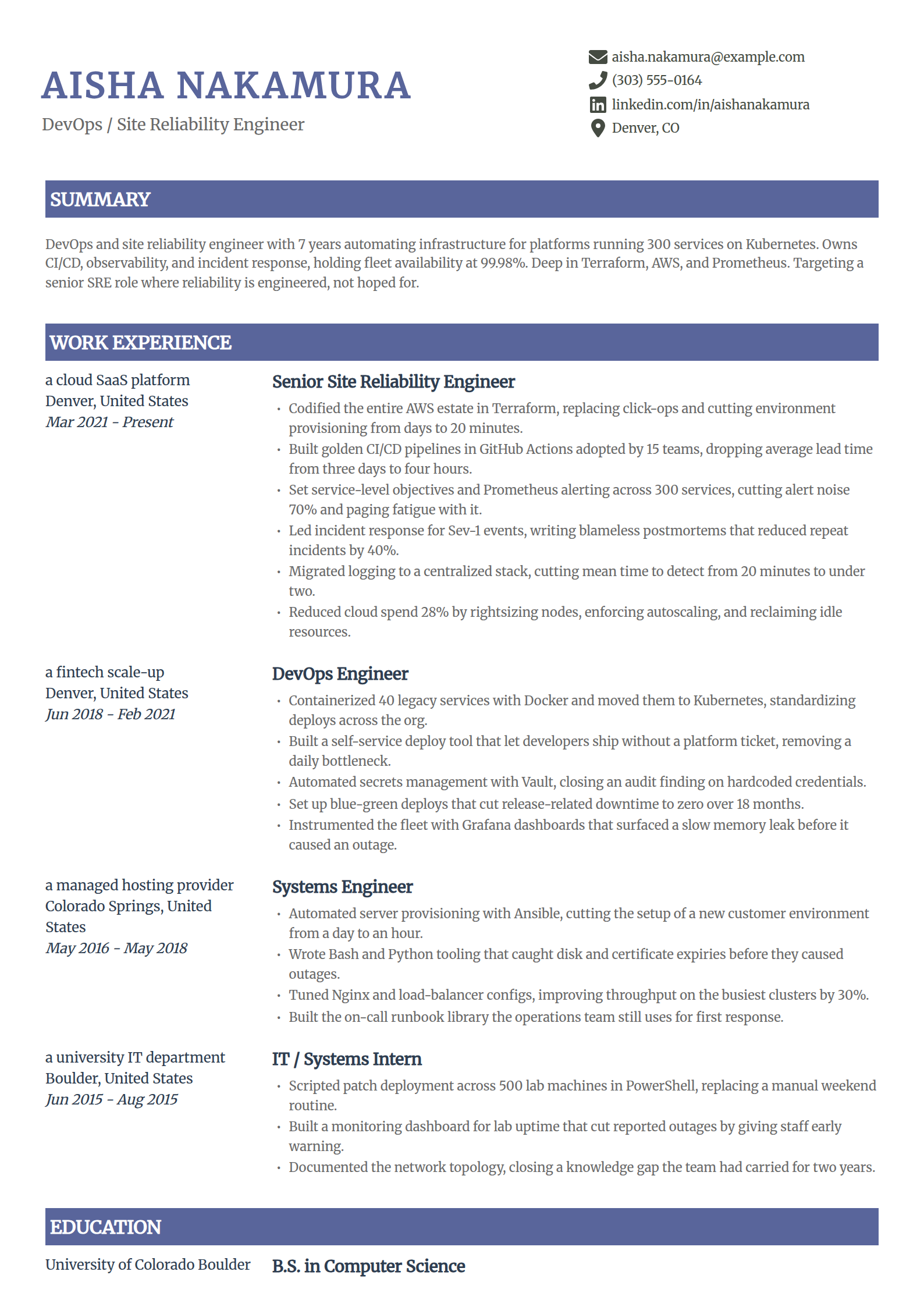
DevOps & SRE Resume Template
Why this resume example works?
- Opens with reliability scope, 300 services on Kubernetes held at 99.98% availability.
- Shows the automation a DevOps role hires for, the whole AWS estate in Terraform and golden CI/CD pipelines.
- Names Prometheus, Grafana, and Vault, the observability and secrets tools a posting lists.
- Ties results to on-call life, alert noise cut 70% and mean time to detect dropped to under two minutes.
- Uses a modern two-column layout that carries a dense SRE history on one page.
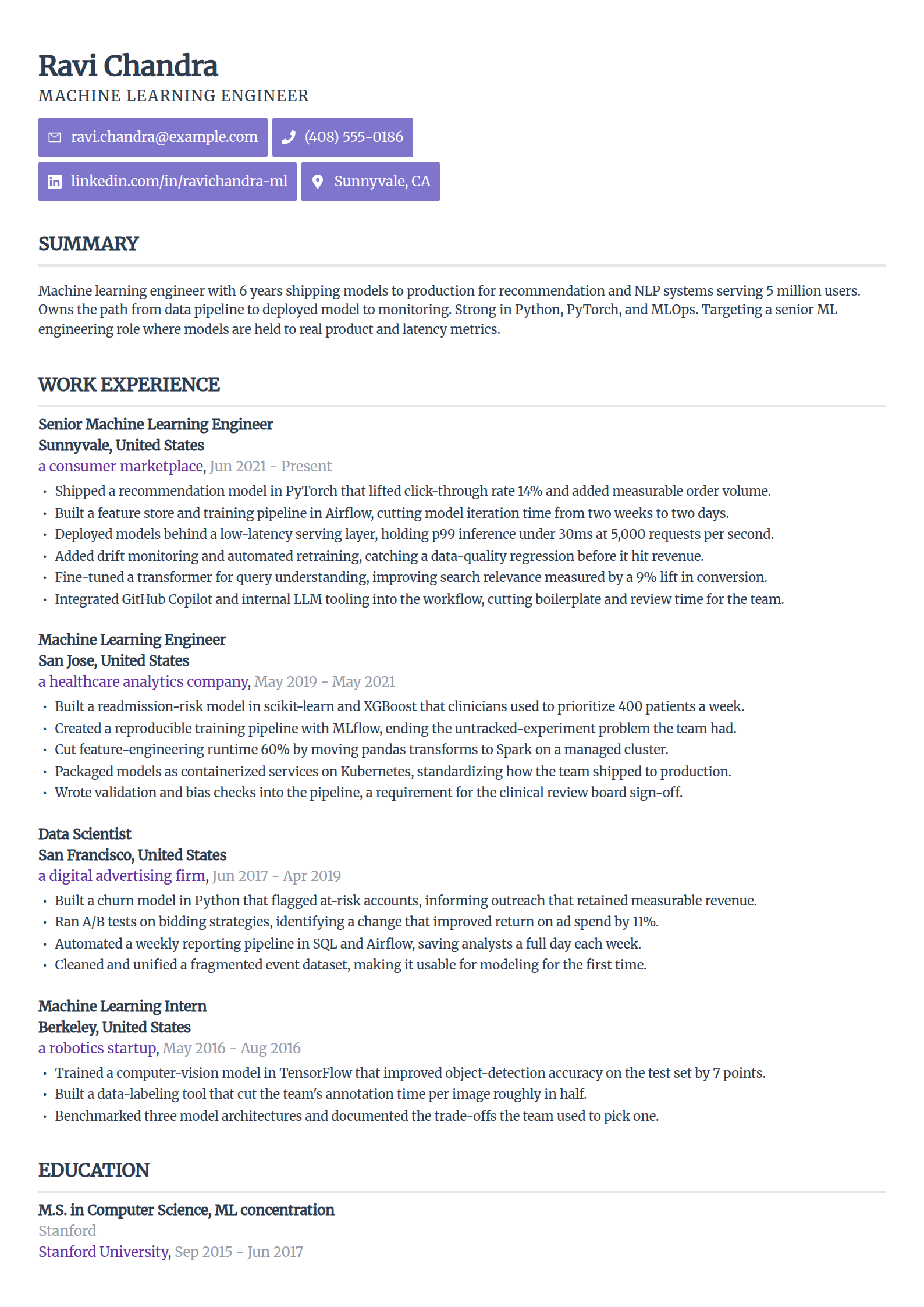
Machine Learning & AI Engineer Resume Template
Why this resume example works?
- Leads with production ML, a PyTorch recommendation model that lifted click-through rate 14% for 5 million users.
- Shows the MLOps a team hires for, a feature store and pipeline that cut iteration from two weeks to two days.
- Names the stack a posting screens for, PyTorch, Airflow, SageMaker, and Hugging Face, in real context.
- Keeps the AI-tooling line honest, GitHub Copilot and internal LLMs used to cut boilerplate, not as hype.
- Uses a clean, modern layout that carries a deep ML history on one page.
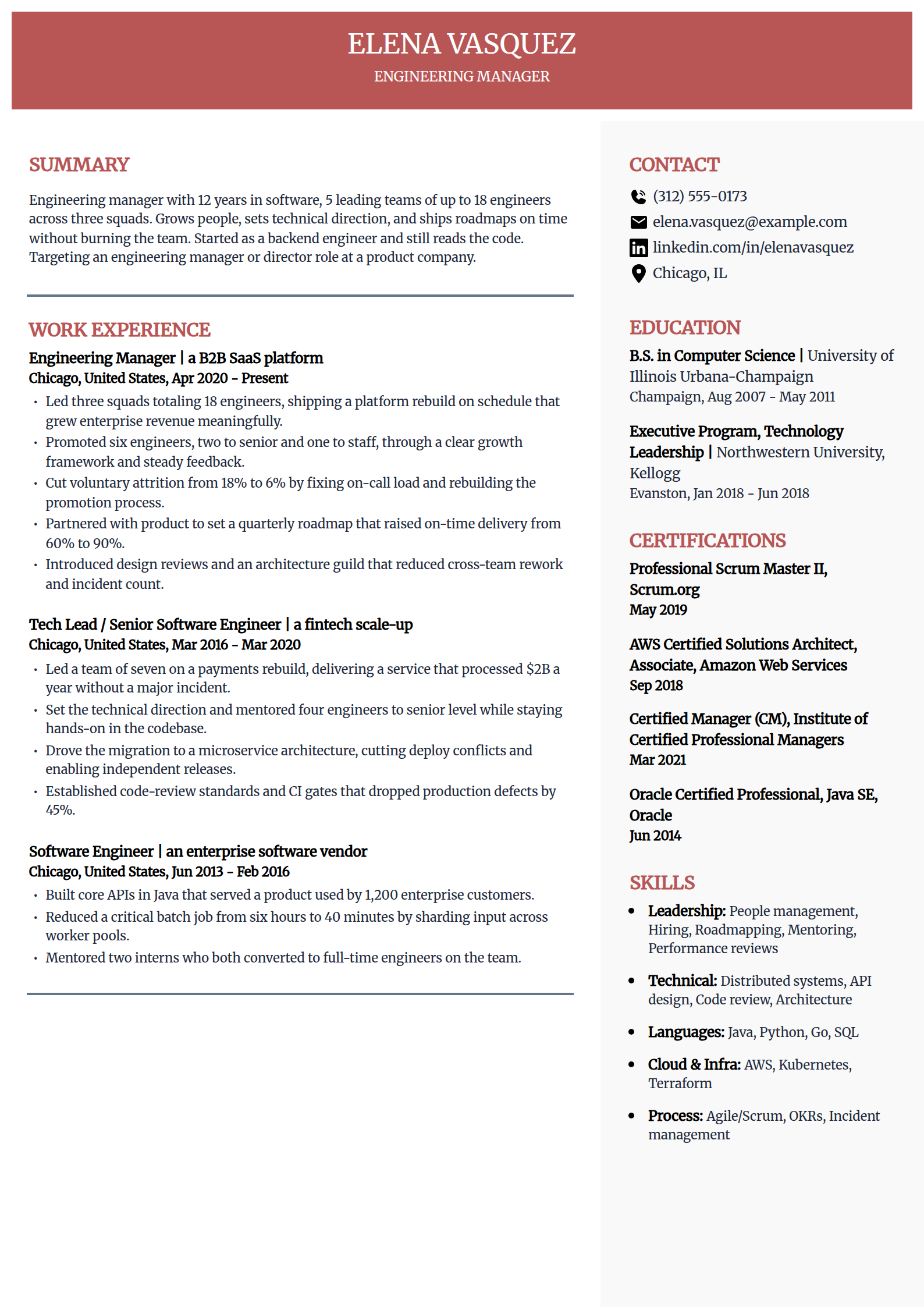
Engineering Manager & Tech Lead Resume Template
Why this resume example works?
- Leads with management scope, three squads of 18 engineers shipping a platform rebuild on schedule.
- Shows the people results a director role rewards, six promotions and attrition cut from 18% to 6%.
- Keeps the technical thread visible, a payments rebuild that processed $2B a year without a major incident.
- Pairs delivery with process, on-time delivery raised from 60% to 90% through a clear roadmap.
- Uses a refined two-column layout that fits a leadership record cleanly on one page.
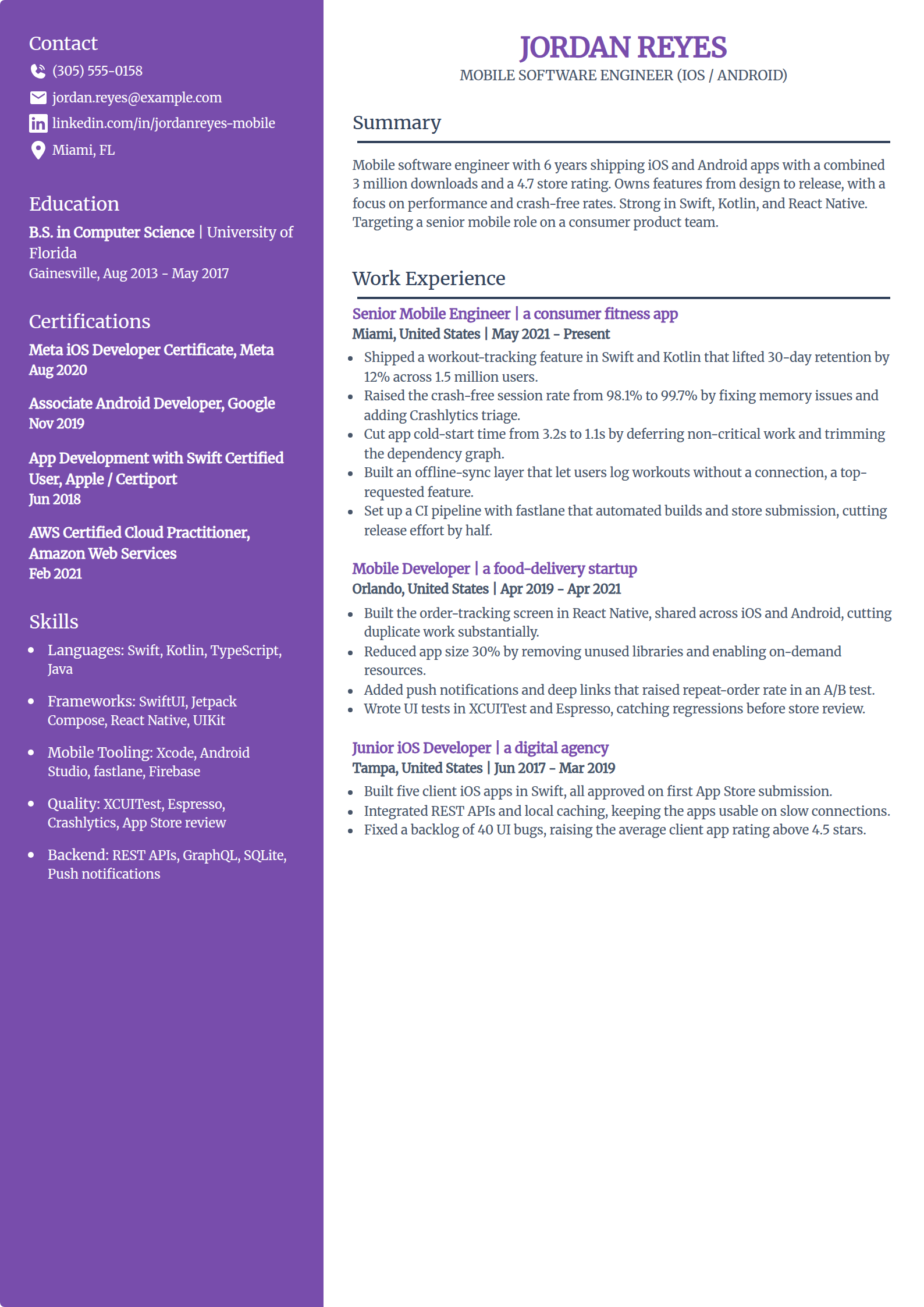
Mobile Developer (iOS & Android) Resume Template
Why this resume example works?
- Opens with app impact, features in Swift and Kotlin across apps with 3 million downloads and a 4.7 rating.
- Shows the quality metrics a mobile team screens for, crash-free sessions raised to 99.7% and cold start cut to 1.1s.
- Names SwiftUI, Jetpack Compose, React Native, and fastlane, the mobile stack a posting lists.
- Keeps each result believable, tied to a retention lift or a release-automation win.
- Uses a Medium layout that fits a six-year mobile record without empty space.
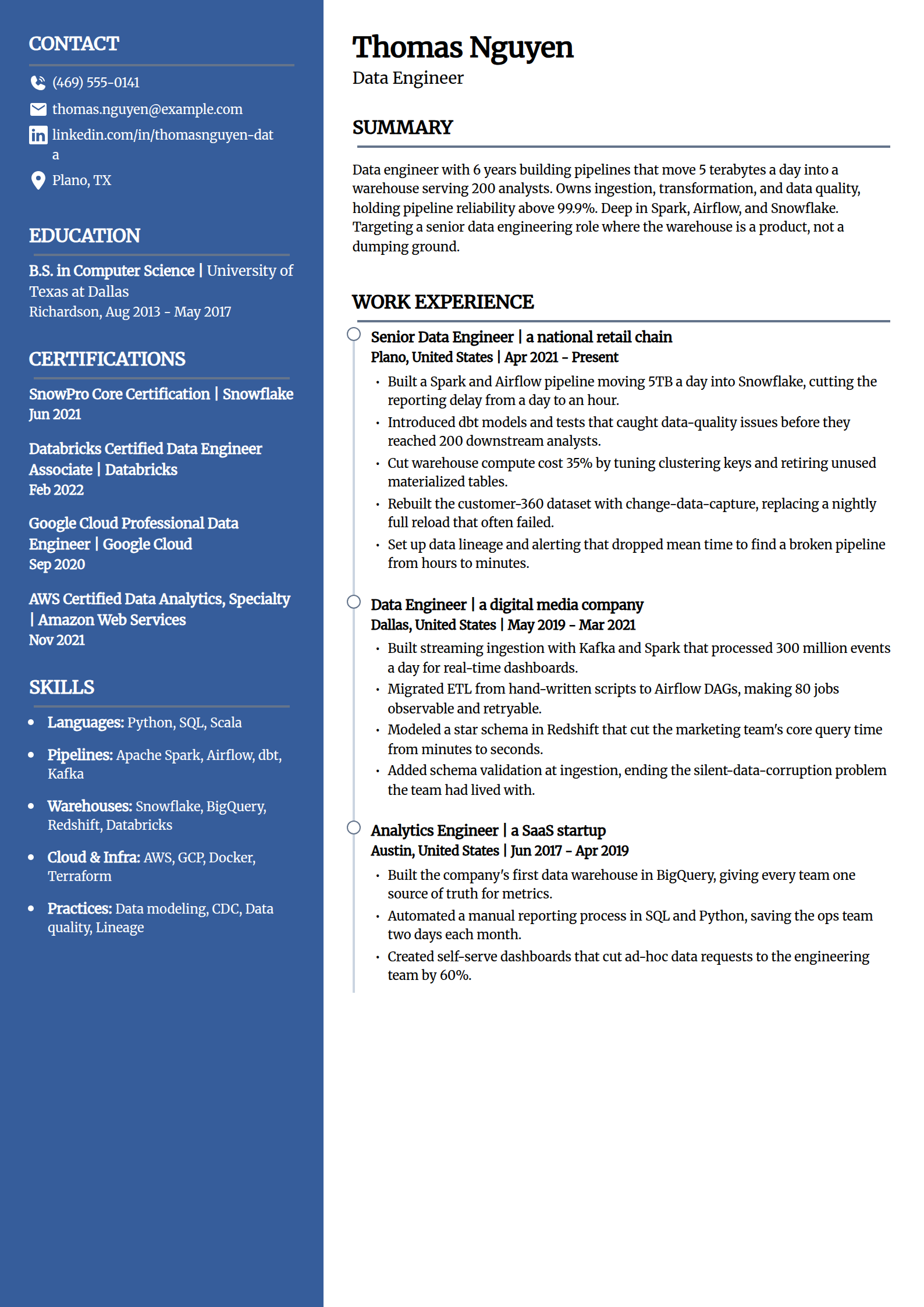
Data Engineer Resume Template
Why this resume example works?
- Leads with pipeline scale, 5TB a day moved into Snowflake serving 200 analysts at 99.9% reliability.
- Shows the data-quality work a team hires for, dbt tests and lineage that catch breakage before analysts do.
- Names Spark, Airflow, Kafka, and dbt, the exact tools a data-engineering posting screens for.
- Keeps each result modest, like a 35% warehouse-cost cut or reporting delay dropped from a day to an hour.
- Uses a distinctive layout that still reads cleanly for a hiring manager.
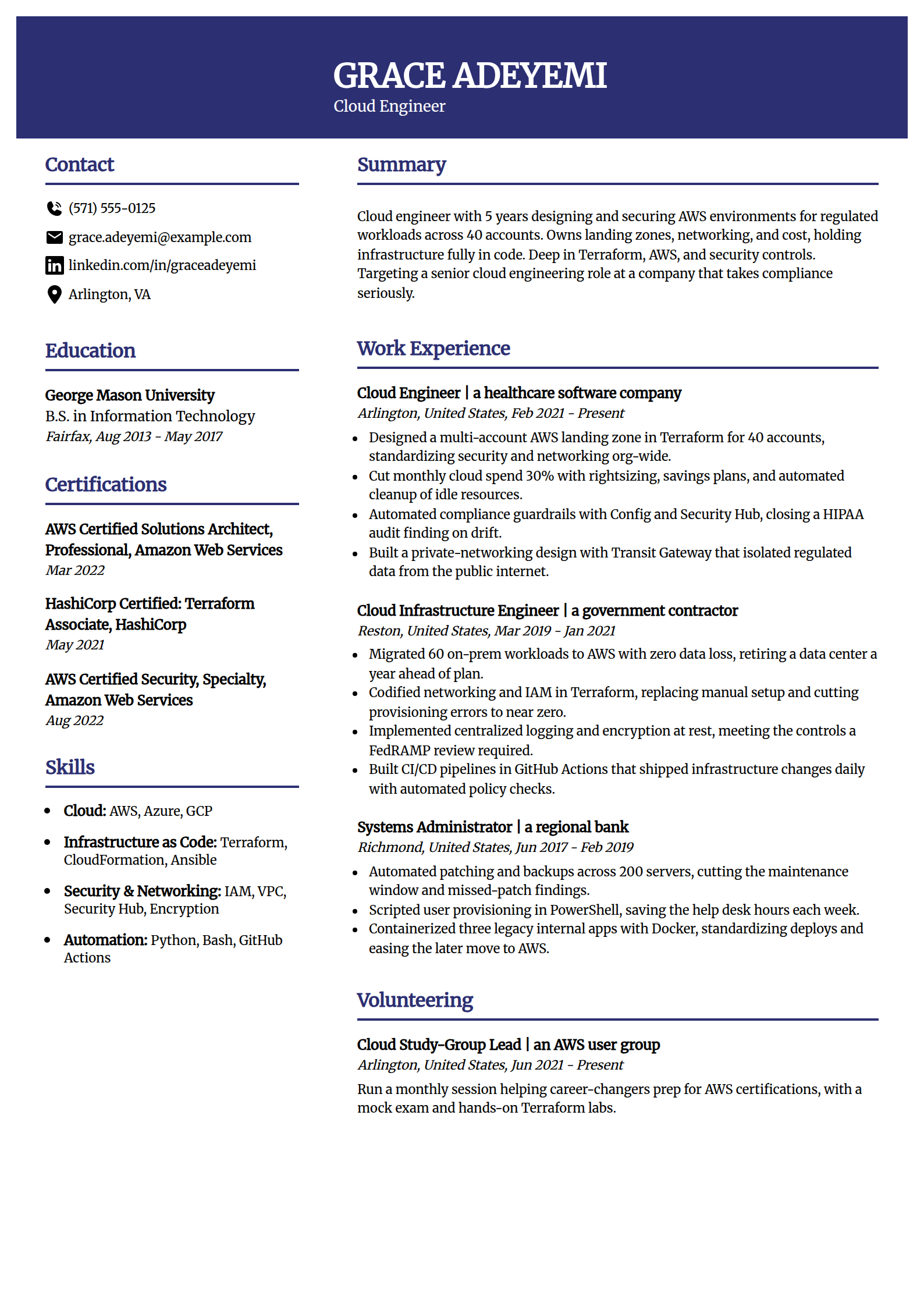
Cloud Engineer Resume Template
Why this resume example works?
- Opens with cloud scope, a multi-account AWS landing zone in Terraform across 40 accounts.
- Shows the compliance work a regulated employer hires for, HIPAA guardrails and a FedRAMP-ready control set.
- Names Terraform, IAM, and Security Hub, the infrastructure-as-code and security tools a posting lists.
- Keeps results countable, a 30% cost cut and 60 workloads migrated with zero data loss.
- Uses a roomy layout with a filled sidebar so a focused five-year record still looks complete.
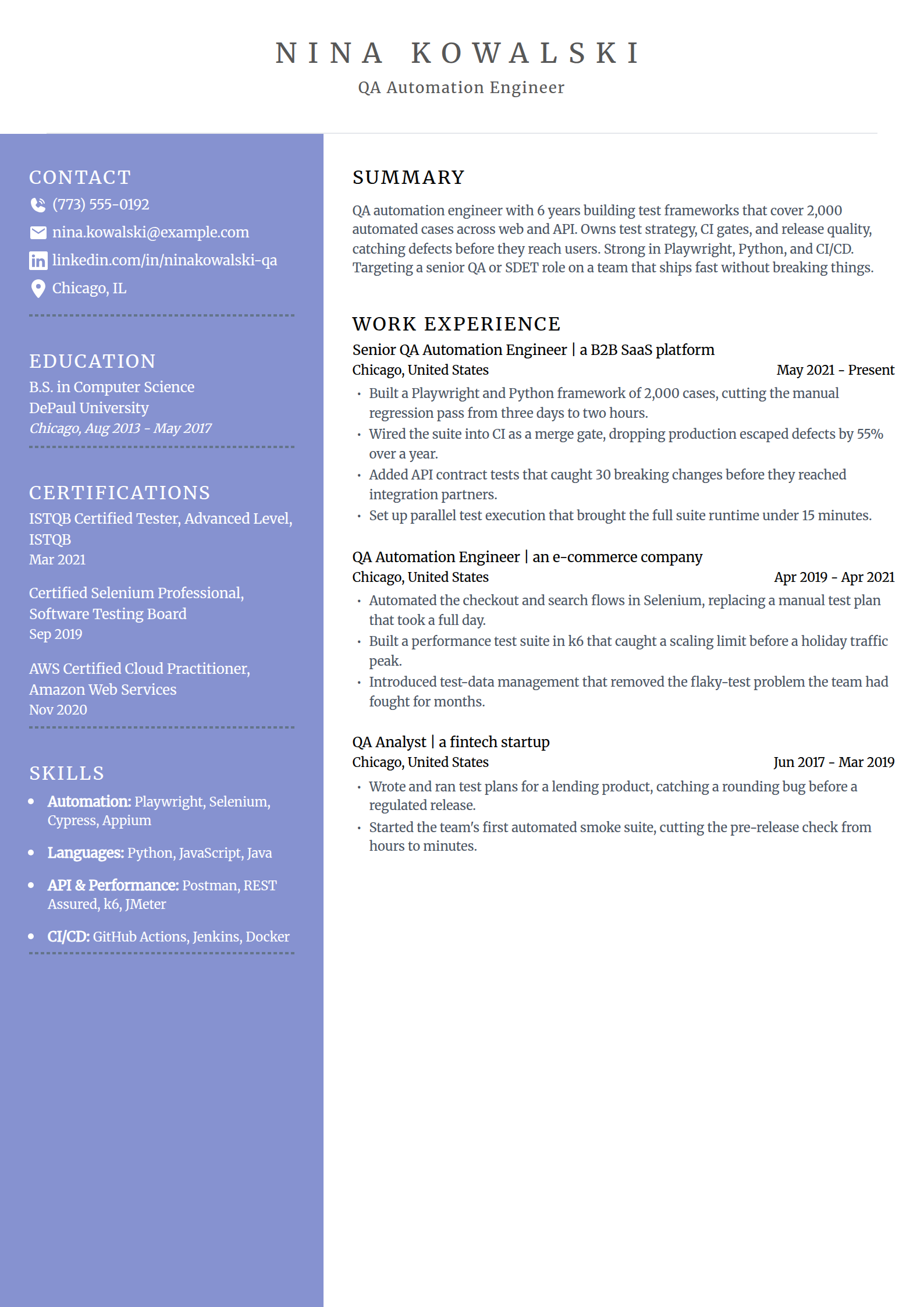
QA & Test Automation Engineer Resume Template
Why this resume example works?
- Leads with a real framework, 2,000 Playwright cases that cut the regression pass from three days to two hours.
- Shows the release-quality result an SDET role rewards, escaped defects down 55% after wiring tests into CI.
- Names Playwright, Selenium, k6, and REST Assured, the automation and performance tools a posting screens for.
- Keeps each result tied to a flow, like contract tests that caught 30 breaking changes before partners.
- Uses a roomy layout with a filled sidebar so a six-year QA record still looks full.
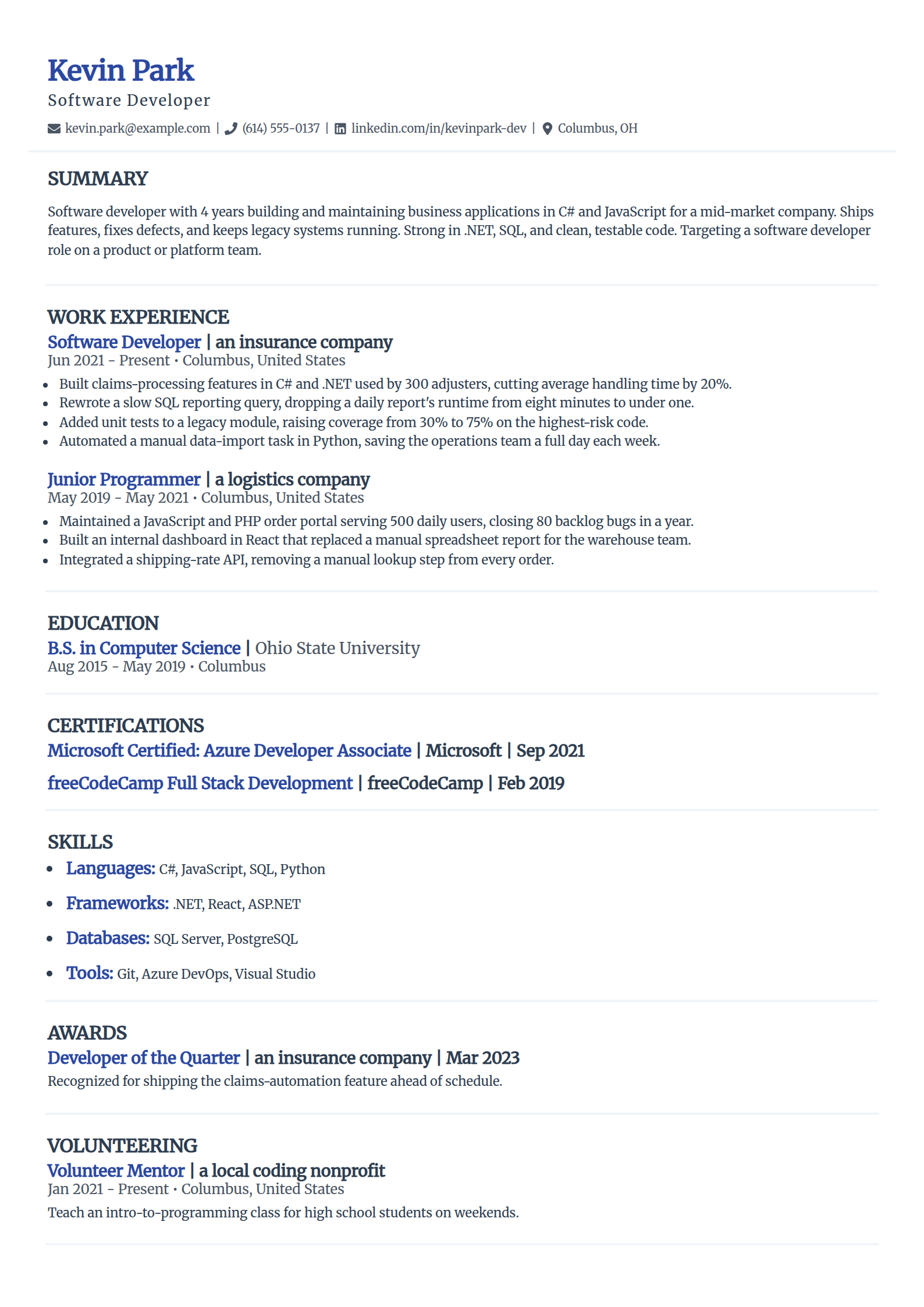
Software Developer & Programmer Resume Template
Why this resume example works?
- Written for a generalist developer, leading with C# and .NET features used by 300 adjusters.
- Keeps a focused four-year record tight, each bullet carrying one number like handling time cut 20%.
- Names the stack a mid-market posting lists, .NET, SQL Server, and Azure DevOps.
- Fills a refined, ATS-safe page with a developer-of-the-quarter award and a coding-mentor volunteer role.
- Uses a clean layout that keeps the focus on shipped features and reliability.
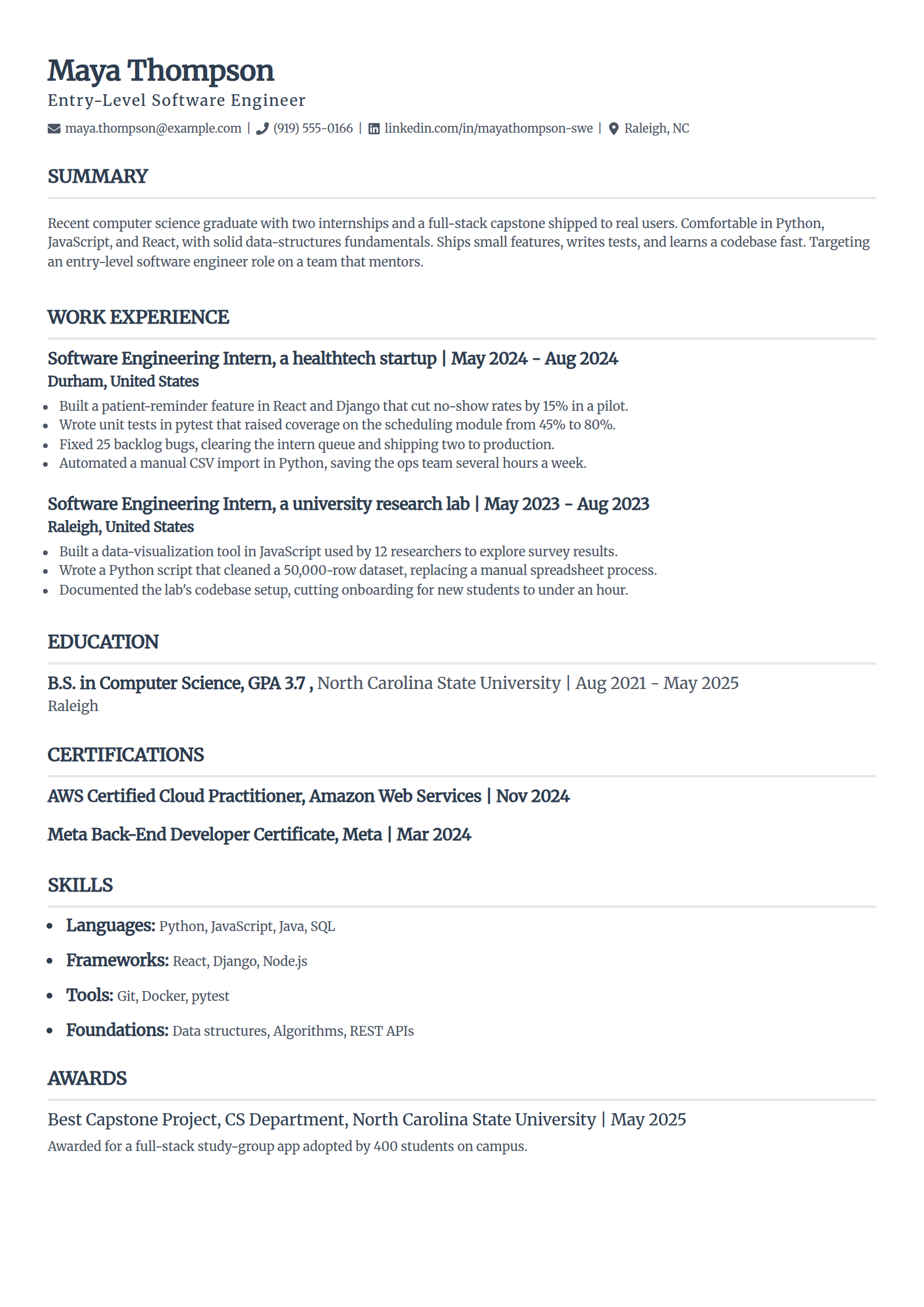
Entry-Level & Junior Software Engineer Resume Template
Why this resume example works?
- Written for a 2025 CS grad, leading with two internships and a full-stack capstone shipped to real users.
- Uses internships and projects as entries, the right move when full-time software experience does not exist yet.
- Keeps every bullet honest and quantified, like no-show rates cut 15% or test coverage raised to 80%.
- Shows the fundamentals a screen checks, data structures, algorithms, and a clean Git and testing workflow.
- Fills a tight, ATS-safe page with a GPA, certifications, and a capstone award instead of padding.
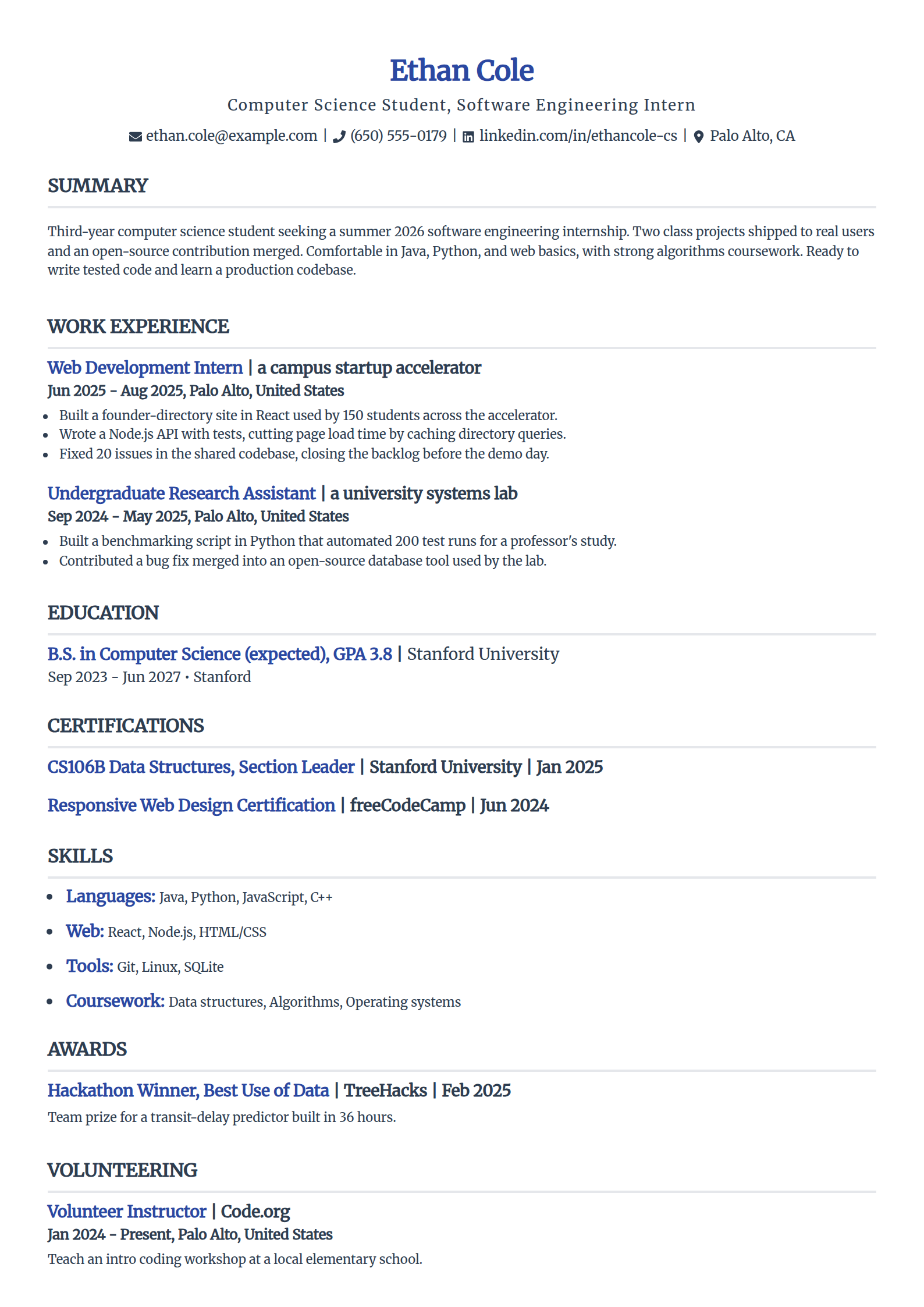
Software Engineering Intern Resume Template
Why this resume example works?
- Written for a third-year CS student, leading with two shipped class projects and a merged open-source fix.
- Uses coursework, a section-leader role, and a hackathon win as entries, the right shape for a first internship.
- Keeps each bullet real and small, like a benchmarking script that automated 200 test runs.
- Shows the fundamentals an internship screen wants, algorithms coursework and comfort in Java and Python.
- Fills a plain, ATS-safe page with an expected graduation date and honest early wins, not invented jobs.
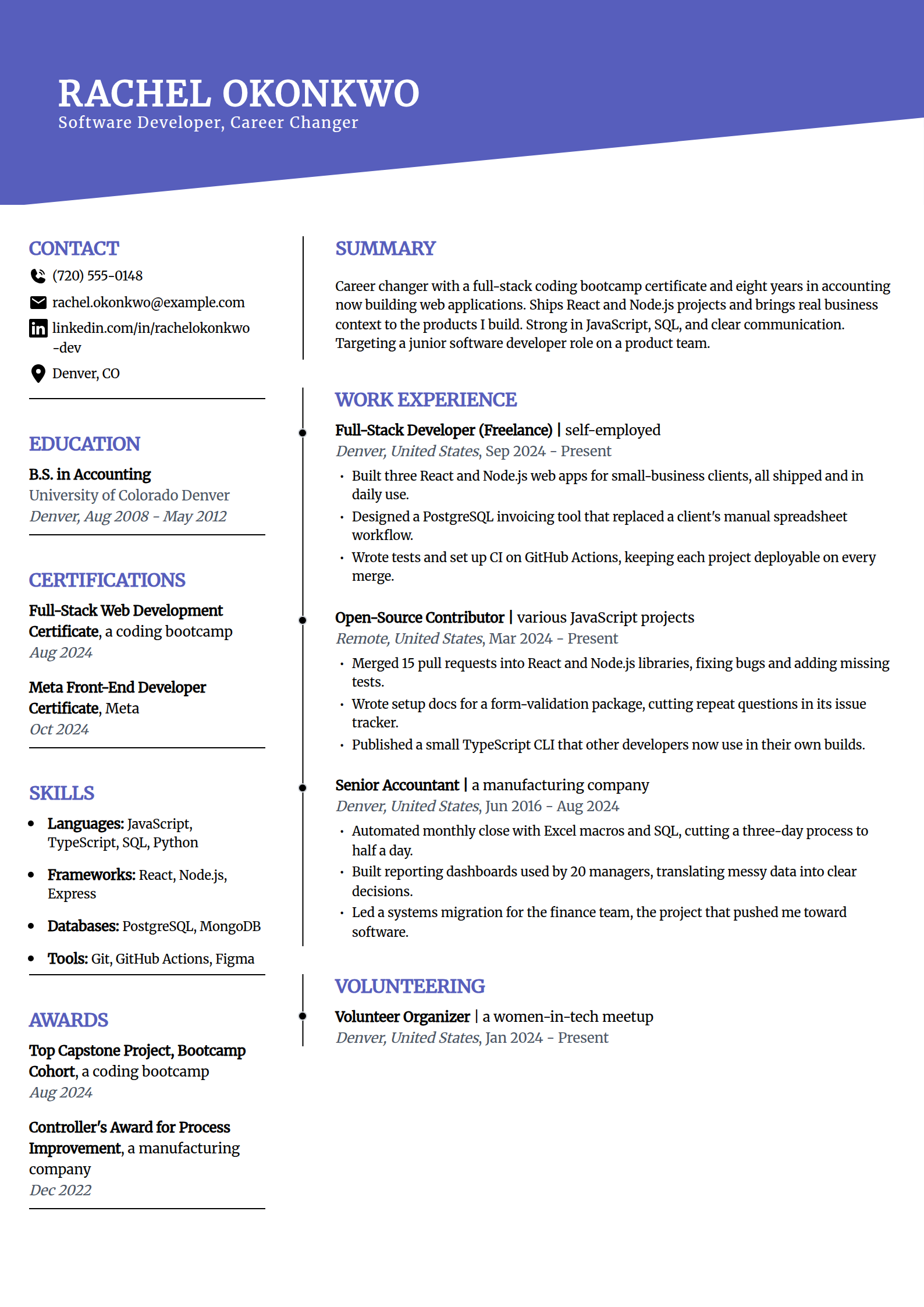
Bootcamp Grad & Career-Change Resume Template
Why this resume example works?
- Names the pivot openly, a full-stack bootcamp certificate after eight years in accounting.
- Shows recent proof, three shipped React and Node.js apps in daily use by small-business clients.
- Reframes prior work as an asset, automating a three-day close to half a day and building manager dashboards.
- Keeps the new skills concrete, JavaScript, PostgreSQL, and CI on GitHub Actions, without overclaiming years.
- Lists awards without long descriptions, keeping the layout clean and balanced.
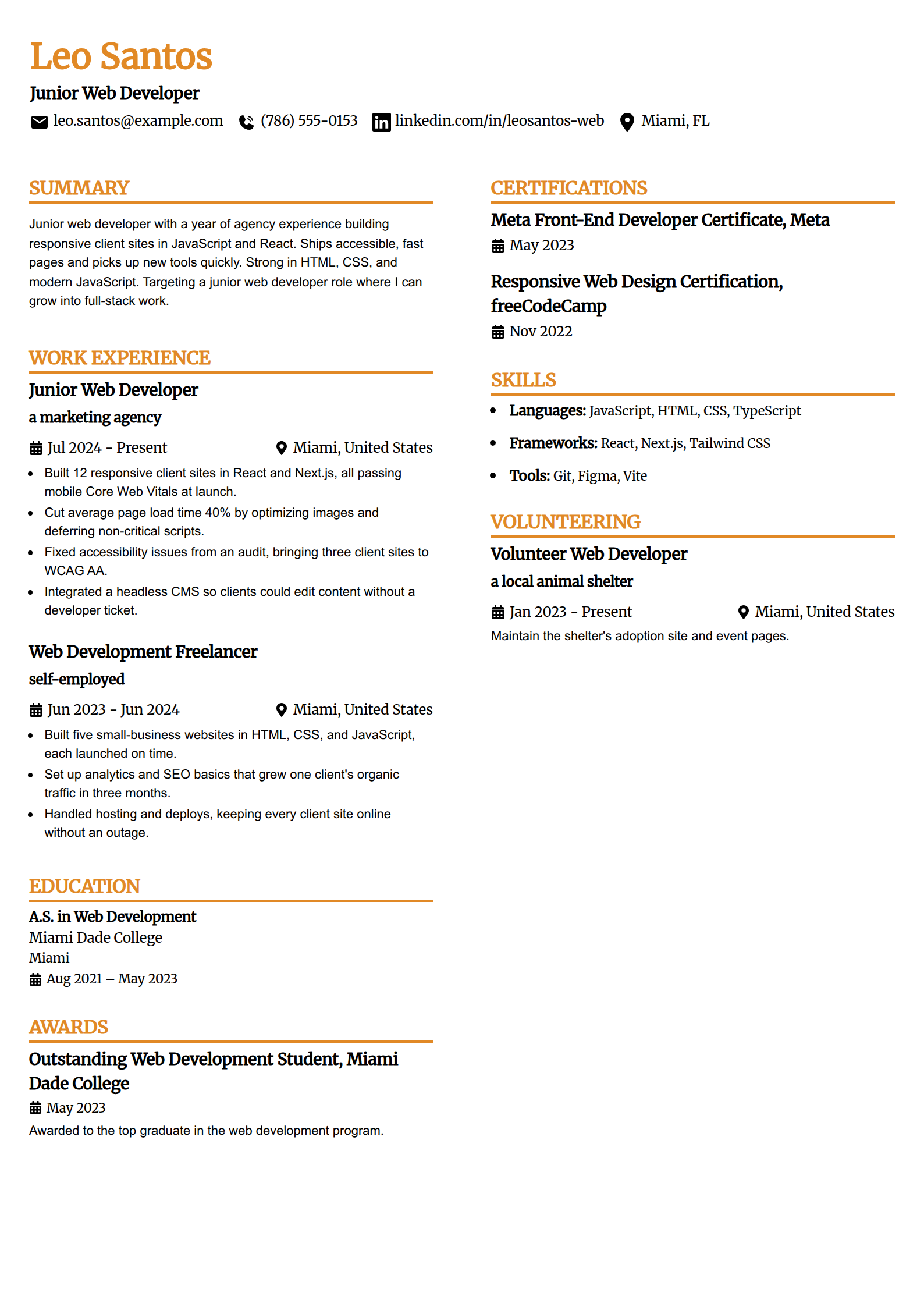
Junior Web Developer Resume Template
Why this resume example works?
- Leads with a year of agency work, 12 responsive client sites that all passed mobile Core Web Vitals at launch.
- Shows the results a web-developer posting rewards, load time cut 40% and three sites brought to WCAG AA.
- Names React, Next.js, and Tailwind CSS, the modern front-end stack an agency screens for.
- Keeps freelance work honest and specific, five sites launched on time with hosting and SEO handled.
- Fills a tight, ATS-safe page with a top-graduate award and a shelter-website volunteer role.
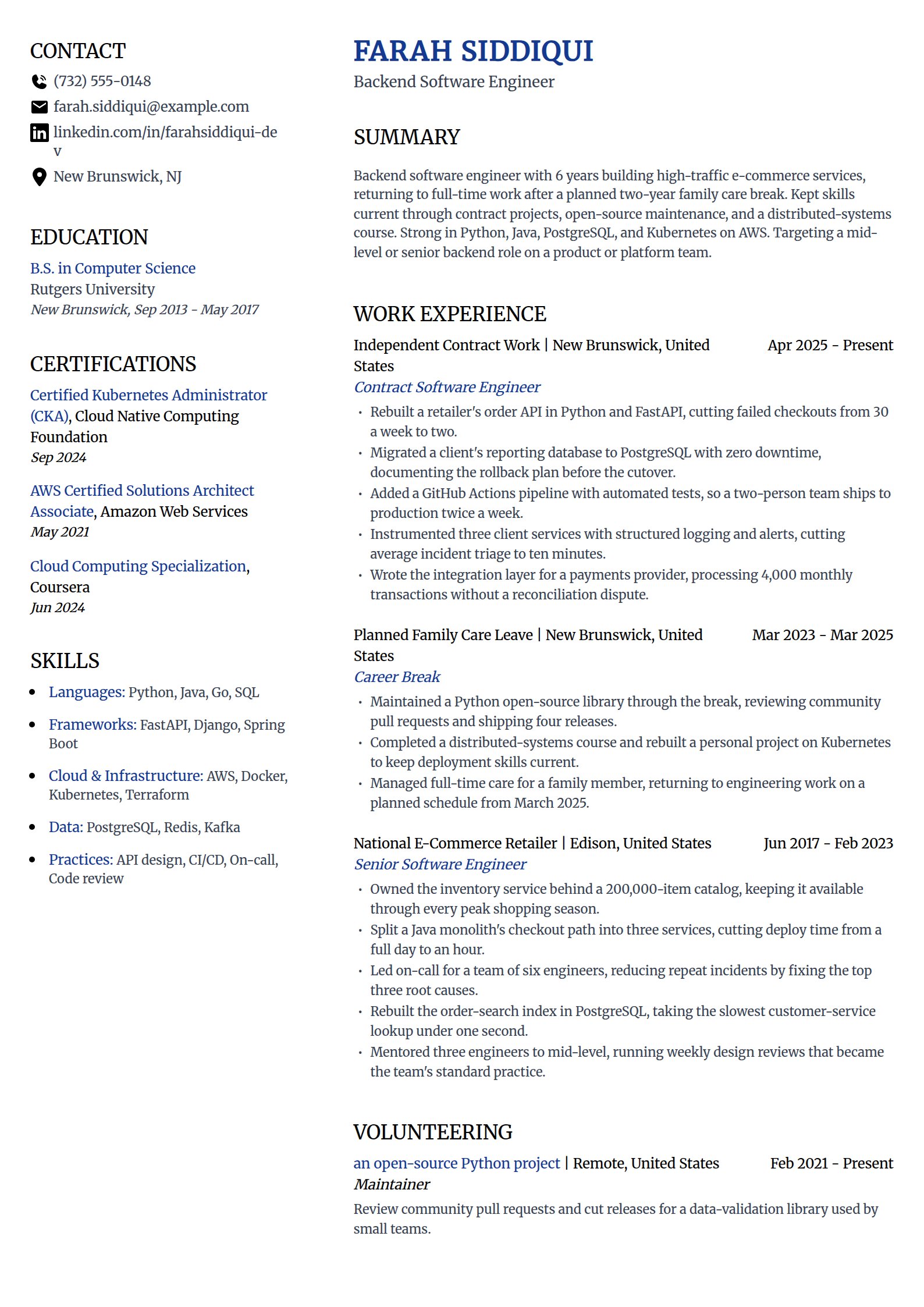
Software Engineer Returning After a Career Break Resume Template
Why this resume example works?
- Keeps the timeline honest and reverse-chronological, with the break listed and dated like any other entry.
- Labels the break plainly as family care leave, so a recruiter reads a decision instead of guessing at a hole.
- Leads with current proof, contract work shipped this year in Python, FastAPI, and PostgreSQL.
- Shows the skills stayed live through the break, an open-source library maintained and a project rebuilt on Kubernetes.
- Leaves the pre-break senior record intact underneath, so six years of e-commerce scale still carry the page.
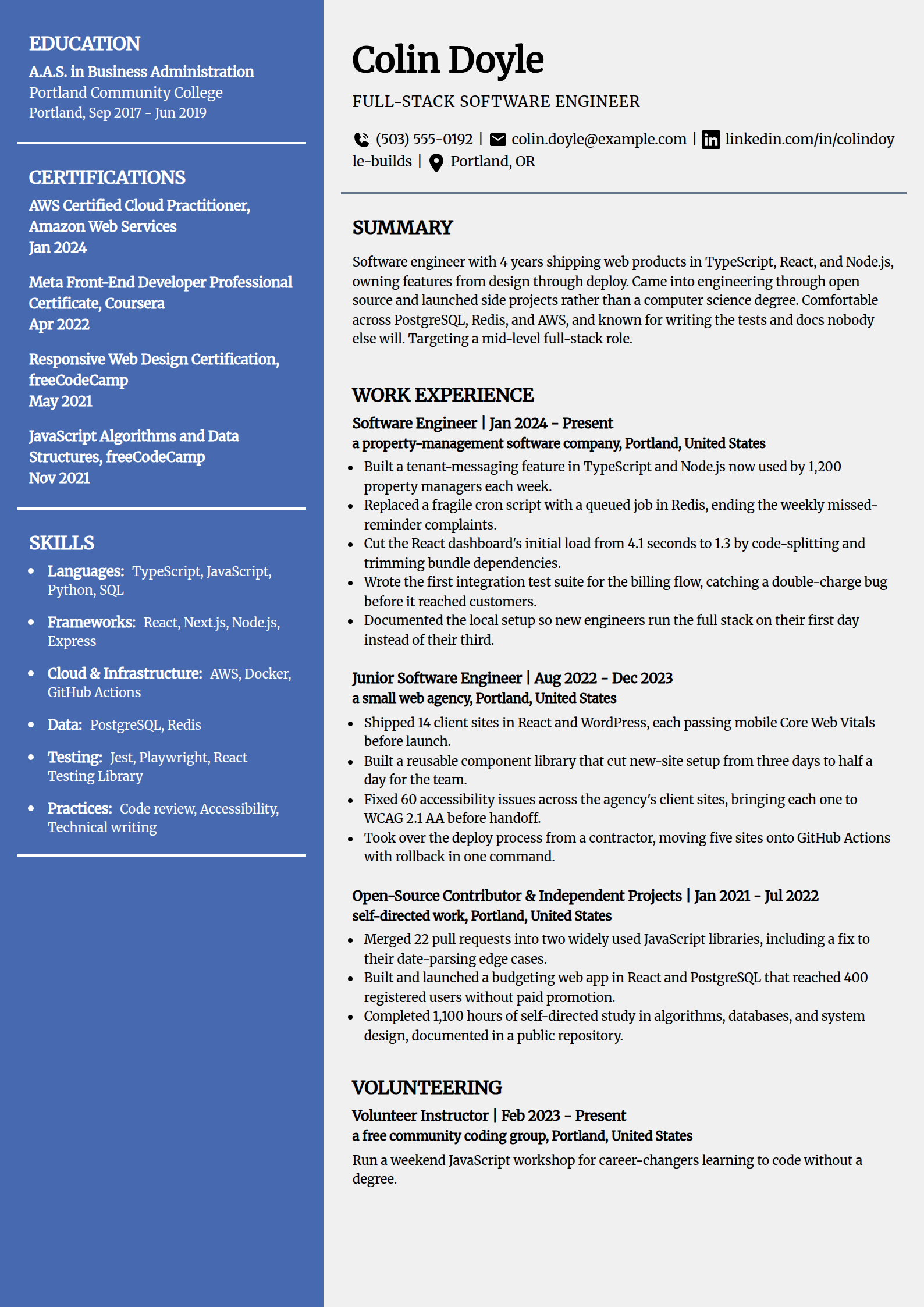
Self-Taught Software Engineer Resume Template (No CS Degree)
Why this resume example works?
- Names the route in plainly, through open source and launched projects, and never apologizes for the missing degree.
- Turns the pre-hire years into a dated entry, with merged pull requests and a launched app standing in for a first job.
- Carries a number in most bullets, like a dashboard load cut from 4.1 seconds to 1.3 by code-splitting.
- Keeps the real associate degree in place and lets certifications back the stack, instead of hiding the education section.
- Names the tools a mid-level posting asks for, React, Next.js, Node.js, PostgreSQL, and Playwright.
Build your software engineer resume
Pick a template above and the editor keeps your layout clean and ATS-safe while you swap in your own projects, systems, and metrics.
Build my resumeHow to write a software engineer resume in 2026
A software resume gets scanned fast by someone checking two things: can you do the specific work on their team, and can you prove it. Lead with a short summary that names your stack and level, then make every bullet an accomplishment with a number and the tool that produced it. Keep the format clean so a parser reads it as easily as a person does.
Open with a short, stack-first summary
Write three to four sentences that name your years and focus, your strongest number, the stack a posting would list, and the role you are targeting. A backend engineer leads with scale and languages; a frontend engineer leads with performance and framework. Keep it to about 60 words so it never spills past the top of the page.
Full-stack software engineer with 6 years building React and Node.js products for high-traffic SaaS, shipping features used by 400,000 monthly users. Strong in TypeScript, API design, and test coverage on AWS. Targeting a senior full-stack role on a product team that ships weekly.
Make every experience bullet an accomplishment with a number
Name the problem, the approach, and the result, then attach one credible metric and the tool that produced it. This is what separates a resume that gets a callback from a duty list.
- Use engineering metrics: latency, throughput, uptime, error rate, build or deploy time, cost, and user or request volume.
- Open with a strong verb like built, shipped, cut, migrated, or led, never "Responsible for" or "Helped with".
- Name the method or tool: "cut p95 latency from 900ms to 220ms by redesigning the API and adding an index".
- Keep numbers modest and level-accurate: an intern ships a feature, a staff engineer moves availability a fraction of a percent.
Show education, projects, and certifications for your level
Match what you lead with to where you are in your career, and never claim experience you do not have.
- New grads and interns lead with internships, a capstone or class projects shipped to real users, and open-source contributions.
- Experienced engineers lead with impact and keep education to a line; the degree matters less each year you work.
- List certifications that map to the role: AWS, Google Cloud, or Azure for cloud work, CKA for Kubernetes, a framework cert for front end.
- Career-changers show the bootcamp or coursework plus a portfolio of shipped projects, and reframe prior-industry strengths honestly.
- Self-taught engineers with no computer science degree list open source and launched projects as dated entries, keep the real degree or diploma in place, and let certifications back the stack.
- Returning after a break? Keep the dates in order and give the break its own short, labelled entry, then lead with the most recent work you have done.
Match skills and keywords to the job posting
A skills block should read like the posting, grouped so a hiring manager and a parser both find what they need. List what you have actually used, not a generic dump.
- Group by type: languages, frameworks, cloud and infrastructure, databases, and tools or practices.
- Name specific systems: React, Django, Spring Boot, Kubernetes, Terraform, Kafka, PostgreSQL, or Snowflake, matched to the role.
- In 2026, listing AI-assisted tools like GitHub Copilot or Cursor is expected on many teams; add them only if you actually use them.
- Mirror the posting's exact phrasing where it fits, since that is what the applicant tracking system searches for.
Keep the format clean and ATS-safe
A software resume is read by a parser first and a person second, so a clean layout with standard headings is the safe choice at every level.
- Use a single-column or simple two-column layout with standard headings a parser recognizes; skip heavy graphics and photos.
- Most engineers fit one page; use a second only when a senior or staff record genuinely needs it.
- Save as a PDF so the formatting holds, then run it through the ATS resume checker for a quick format pass.
- Swap the numbers in the templates above for your own projects, systems, and metrics; do not copy them as is.
Common software engineer resume mistakes
- Writing duty lists with no number. Replace "worked on the checkout API" with "cut checkout API p95 latency from 900ms to 220ms by redesigning the schema".
- Dumping every technology you have touched. A 40-item skills wall reads as noise; list the stack the role uses and that you can speak to in an interview.
- Burying the impact. Lead each bullet with what changed, not the task, so a hiring manager scanning in seconds sees the result first.
- Claiming a level you have not reached. An intern or junior should not describe owning architecture; a screen catches the mismatch fast.
- A five-page resume of side projects. Keep it to one page for most levels and let your strongest, most relevant work carry it.
- Hiding a gap by stretching dates or switching to a skills-only layout. Give the break a short label, keep the chronology, and spend the page on recent work.
Frequently asked questions
How do you write a software engineer resume?
Lead with a three-to-four-sentence summary that names your stack, your level, your strongest number, and the role you are targeting. Under each job, write results-first bullets that open with a strong verb and carry one credible metric, like cutting p95 latency from 900ms to 220ms or shipping a feature used by 400,000 monthly users. Name the tool or method that produced each result, group your skills to match the posting, and keep the whole thing to one clean, ATS-safe page for most levels.
What should a software engineer resume include in 2026?
The core is the same as always: a stack-first summary, impact bullets with numbers, a grouped skills block, and education or certifications matched to your level. What is new in 2026 is that many teams now expect AI-assisted development tools like GitHub Copilot or Cursor in your skills block, so list them if you actually use them. Teams also run leaner after the 2023 correction, so the bar on concrete, quantified impact is higher: every bullet should prove something changed because of your work.
How do you write a software engineer resume with no experience?
Lead with what you do have. A new grad leads with internships, a capstone or class projects shipped to real users, and any open-source contributions, then shows the fundamentals a screen checks: data structures, algorithms, and a clean Git and testing workflow. A career-changer leads with a bootcamp or coursework plus a portfolio of shipped projects and reframes prior-industry strengths honestly. A self-taught developer with no computer science degree does the same thing with open source and launched projects, listing them as dated entries rather than leaving the work history blank. Reliability and real, quantified projects carry more weight than invented job history, which an interviewer will see through. The intern, entry-level, self-taught, and career-change examples above show the shape.
How long should a software engineer resume be?
One page for most engineers, including interns, new grads, and mid-level developers. Use a second page only when a senior or staff engineer has enough relevant architecture, scale, or leadership experience to justify it, and never pad to reach it. Whichever length you use, lead with your most recent and most relevant work, keep standard headings, and cut older or unrelated roles so the space goes to the work that matches the job you want.
What skills and keywords do software engineer resumes need?
Match the posting, then name specific systems grouped by type: languages (Python, Java, Go, TypeScript, SQL), frameworks (React, Next.js, Node.js, Django, Spring Boot), cloud and infrastructure (AWS, GCP, Kubernetes, Terraform, Docker), and databases (PostgreSQL, Redis, Snowflake). Add the practices the role cares about, like REST or GraphQL API design, CI/CD, testing, and on-call for backend and platform roles. List what you have actually used and can discuss in an interview, and mirror the posting's exact phrasing, since that is what the applicant tracking system searches for.
How do you write a mid-level software engineer resume?
Lead with ownership. A mid-level resume should show that you have taken a service or a feature from design through production and on-call by yourself, and that you have started pulling other people up, whether that is mentoring a junior engineer or running the design review. Keep the numbers at your level: a service you own, a pipeline you sped up, a coverage gap you closed, rather than the org-wide architecture claims a staff resume makes. Three to five years fits comfortably on one page, so trim the early internship bullets to the ones that still say something. The mid-level example above shows the shape.
How do you explain a career gap on a software engineer resume?
Name it and move on. Keep your dates in normal reverse-chronological order and give the break its own entry with a short, plain label like career break, family care leave, or medical leave, so a recruiter reads a decision instead of guessing at a hole. Do not switch to a functional or skills-only layout to disguise it, since reverse-chronological is easier for a person to read and cleaner for a parser. Then spend the rest of the page on current proof: recent contract work, open-source maintenance, a course you finished, or a project you rebuilt on today's tooling. The career-break example above does exactly that.
Do you need a separate resume for software developer and web developer roles?
You need one base resume that you tailor per posting, not a different resume for every title. Software engineer, software developer, and web developer overlap heavily, so the same experience can serve all three; what changes is emphasis. For a web developer role, lead with front-end frameworks, accessibility, and Core Web Vitals; for a backend or platform role, lead with services, data, and reliability. Reorder your bullets and skills to match the posting rather than writing a new resume from scratch.
More software engineer resume resources
Build your software engineer resume
Pick a template above and the editor keeps your layout clean and ATS-safe while you swap in your own projects, systems, and metrics.