QA Tester Resume Templates and Examples: Manual, Automation, Game, and Embedded
- ATS Friendly
- Manual and Automation
- 16 Real Resumes
A QA hiring manager reads your resume the way you would read a defect report, looking for specifics that can be checked. That means the tools you have actually run, numbers with a denominator attached, and evidence you can write a bug somebody else can reproduce. The 16 examples below cover the disciplines this job splits into, including four routes in for people with no paid testing job yet.


540k+ resumes created
QA tester resume templates you can edit
Each template below is a real QA resume laid out in that format, grouped by the kind of testing it was written for. The automation and API layouts put the framework, the pipeline and the runtime numbers where an engineering manager looks; the entry-level ones give self-directed testing work its own dated section instead of burying it under a hobbies heading. Pick one, then replace the tools, the domain and the numbers with your own.
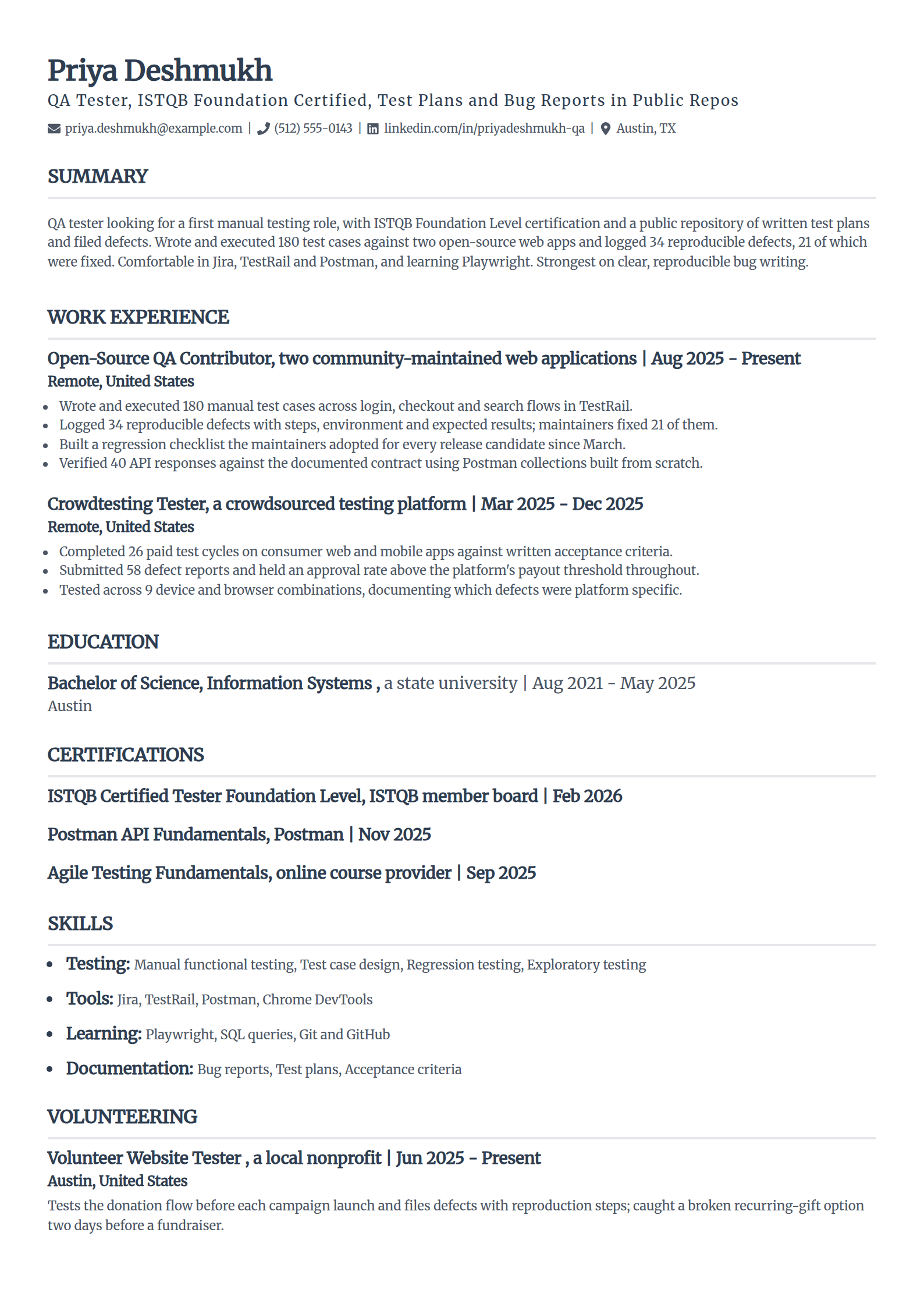
Entry-Level QA Tester Resume Template (No Experience)
Why this resume example works?
- Formats open-source contribution and crowdtesting as dated jobs with bullets, which is what they are. Unpaid testing is still testing.
- Gives the defect numbers a denominator: 34 filed, 21 fixed. A bare defect count with no outcome reads as invented.
- Names the tools in use, Jira, TestRail and Postman, and marks Playwright as still being learned rather than claiming it.
- Puts ISTQB Foundation in the header, which is the credential a junior posting most often names.
- Leads the summary with the thing this candidate is genuinely best at, writing a reproducible bug report.
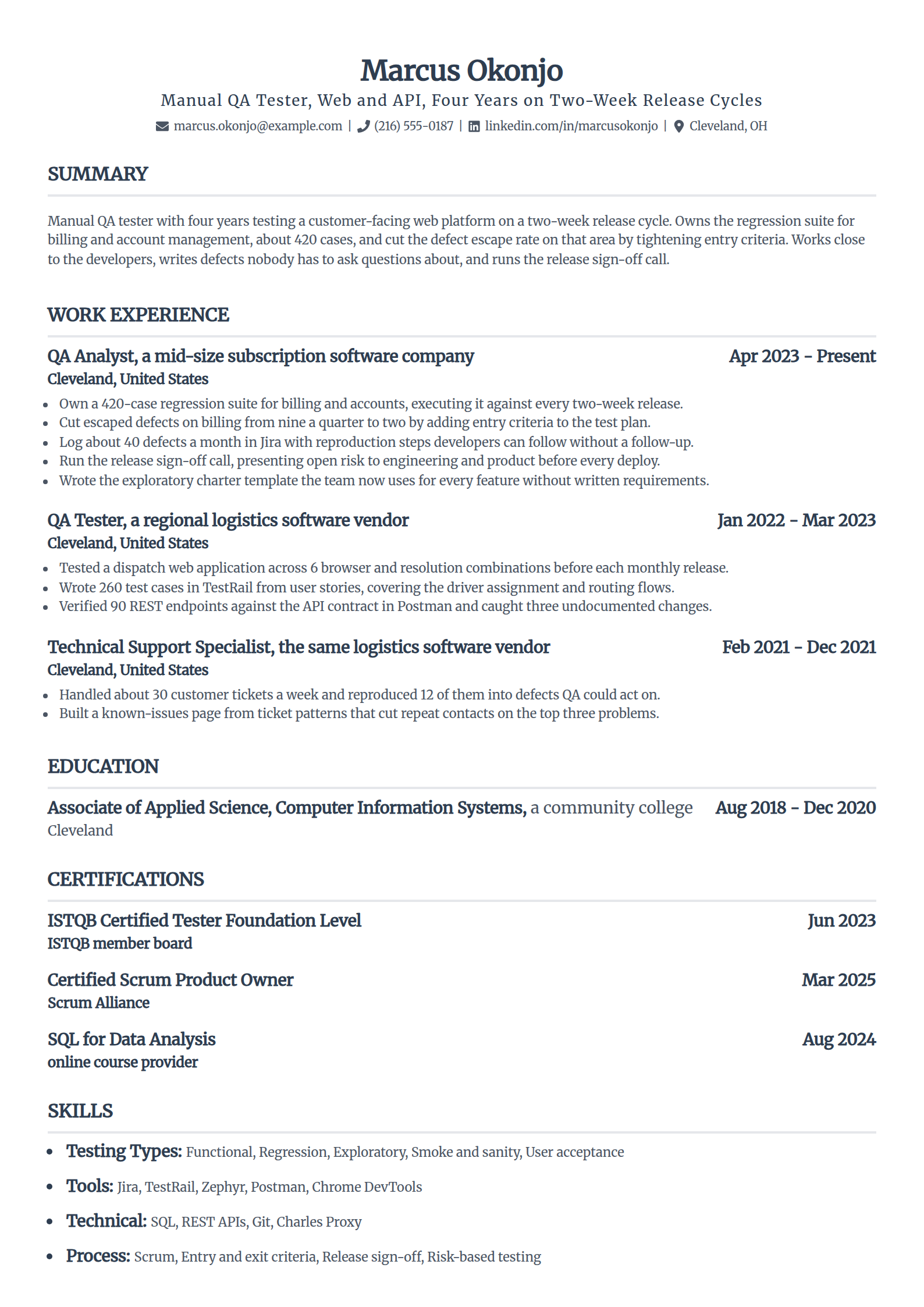
Manual QA Tester Resume Template
Why this resume example works?
- Owns something specific, a 420-case regression suite for billing, instead of listing testing as an activity.
- Uses escape rate, which is the metric a QA lead actually tracks, and shows the change with both numbers.
- Puts release sign-off on the page, the responsibility that separates a senior manual tester from a junior one.
- Names the API work in Postman, because manual does not mean UI-only and a posting screens for that.
- Keeps the support role at the bottom, which explains where the defect-writing discipline came from.
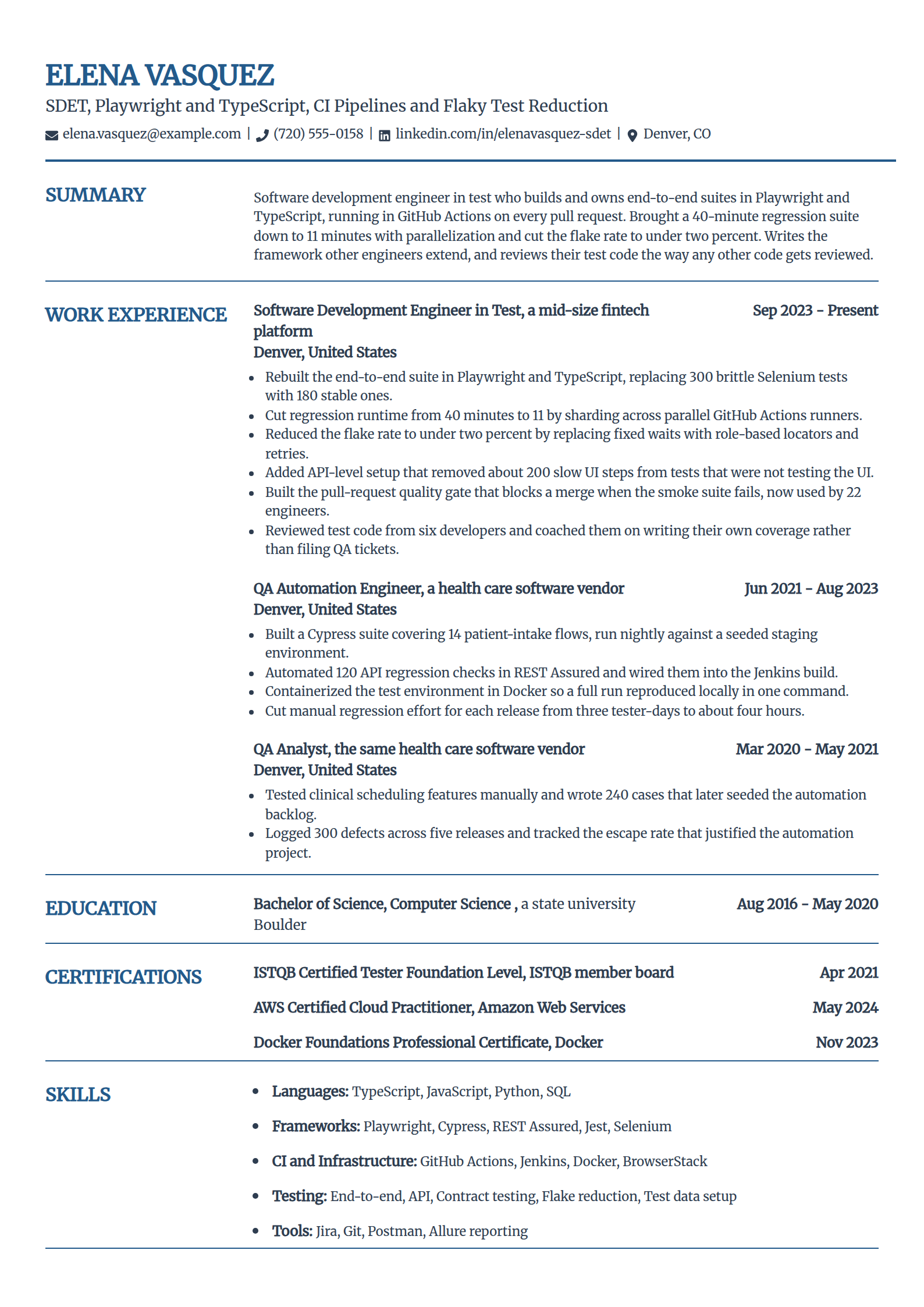
Automation Tester and SDET Resume Template
Why this resume example works?
- Reads like an engineer who specializes in quality rather than a tester who dabbles in scripts, which is the screen this role fails.
- Gives the runtime change with both ends, 40 minutes to 11, plus the technique that produced it.
- Names flake rate, the number every automation team argues about and almost no resume mentions.
- Shows judgment, not just output: API-level setup replacing UI steps in tests that were never testing the UI.
- Ends with reviewing other engineers' test code, which is what separates an SDET from a script author.
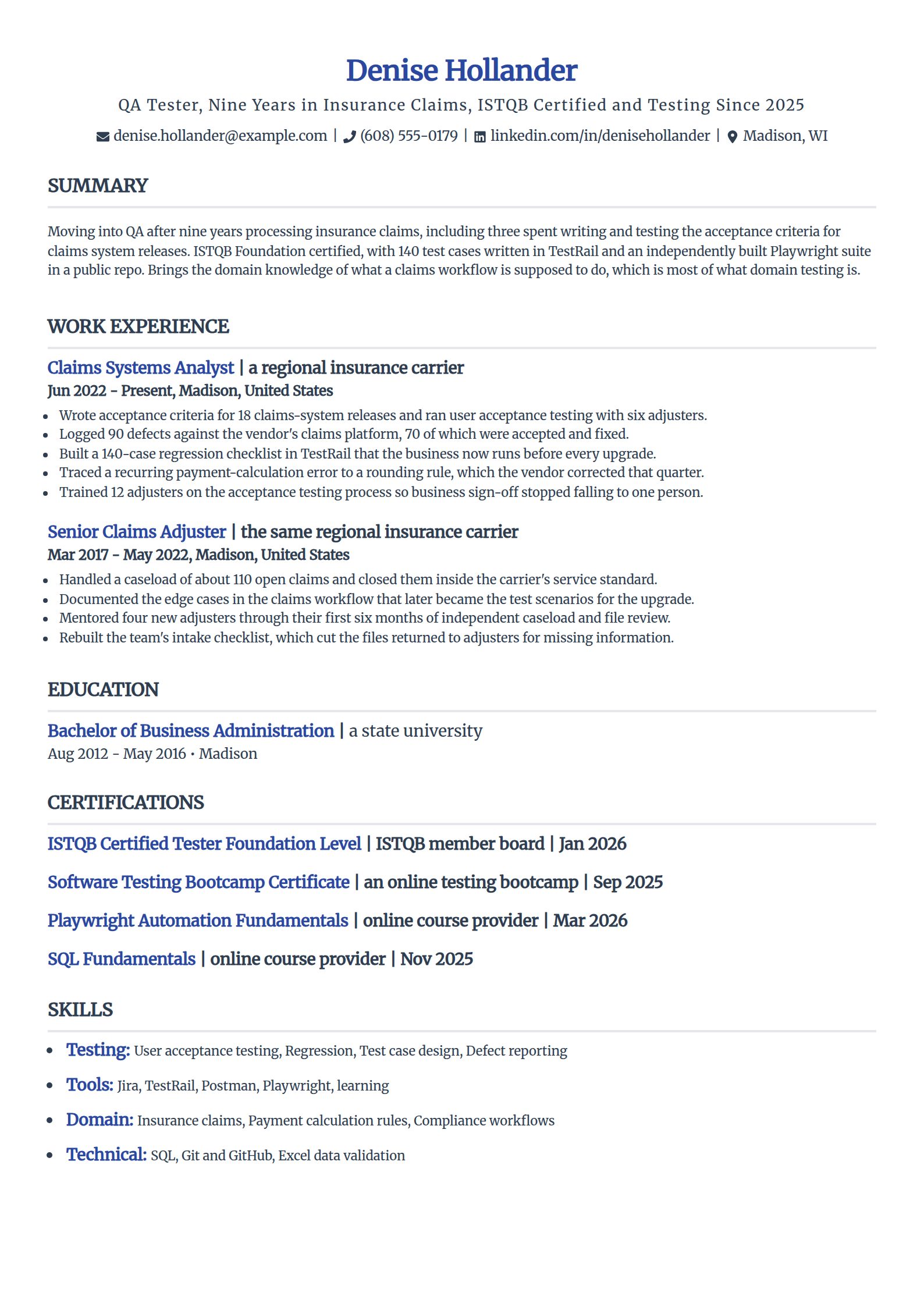
Career Change QA Tester Resume Template
Why this resume example works?
- Finds the testing already inside the old job: acceptance criteria, user acceptance testing and 90 logged defects.
- Turns nine years of domain knowledge into the argument, because claims logic is what claims software gets wrong.
- States the transition in the headline with a date, so nobody has to reconstruct the timeline.
- Lists the bootcamp and the ISTQB certification with dates, which shows the change was planned rather than improvised.
- Keeps a defect that was traced to a root cause on the page, which is the closest thing to a QA work sample here.
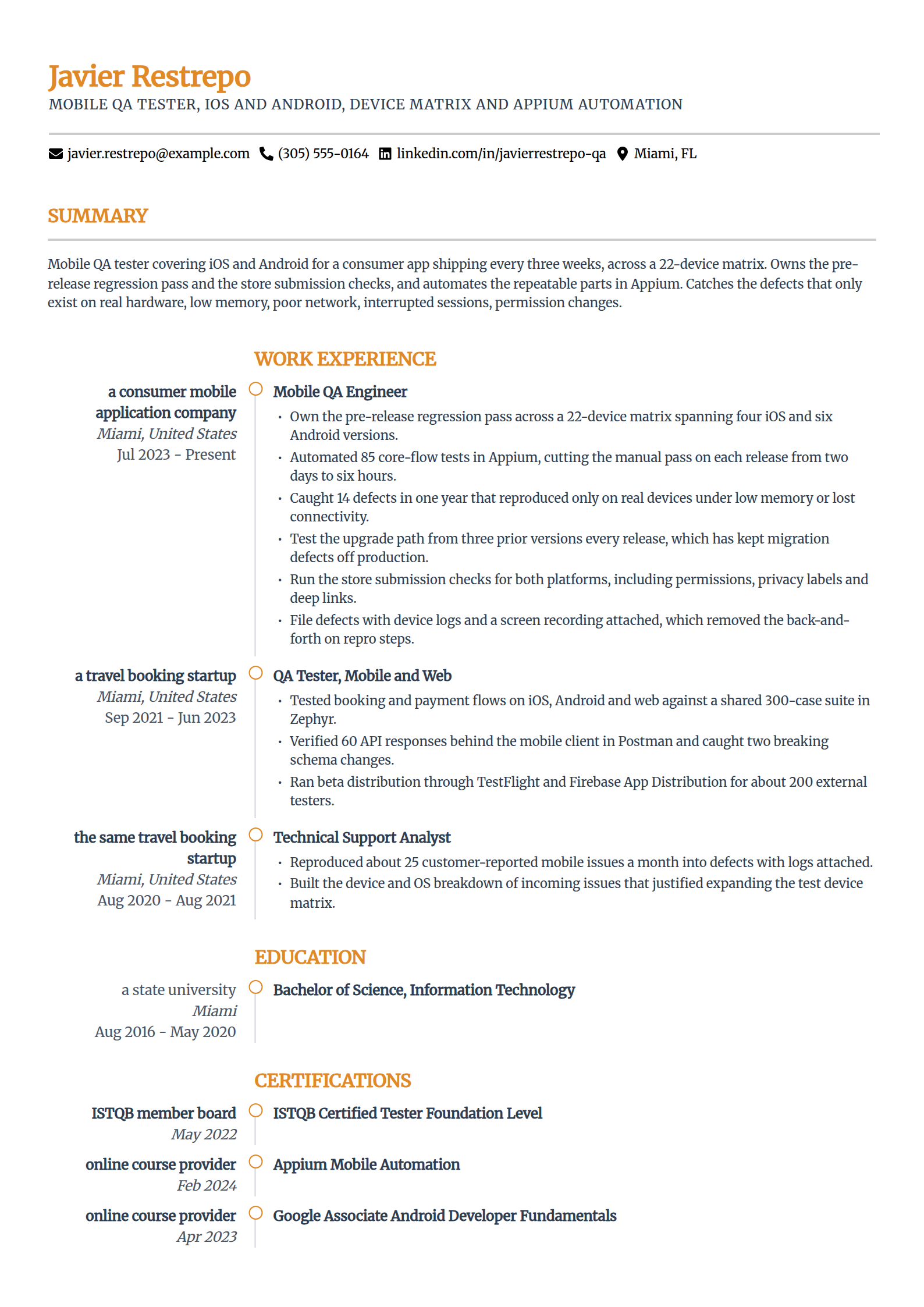
Mobile QA Tester Resume Template (iOS and Android)
Why this resume example works?
- Sizes the device matrix, 22 devices across four iOS and six Android versions, which is how mobile QA scope is described.
- Counts the defects that only reproduce on real hardware, the argument for hiring a mobile specialist at all.
- Includes upgrade-path testing from three prior versions, a step teams skip until a migration bug reaches production.
- Names the store submission checks, permissions, privacy labels and deep links, which is real release work.
- Says logs and a screen recording are attached to every defect, which is why the developers stopped asking for repro steps.
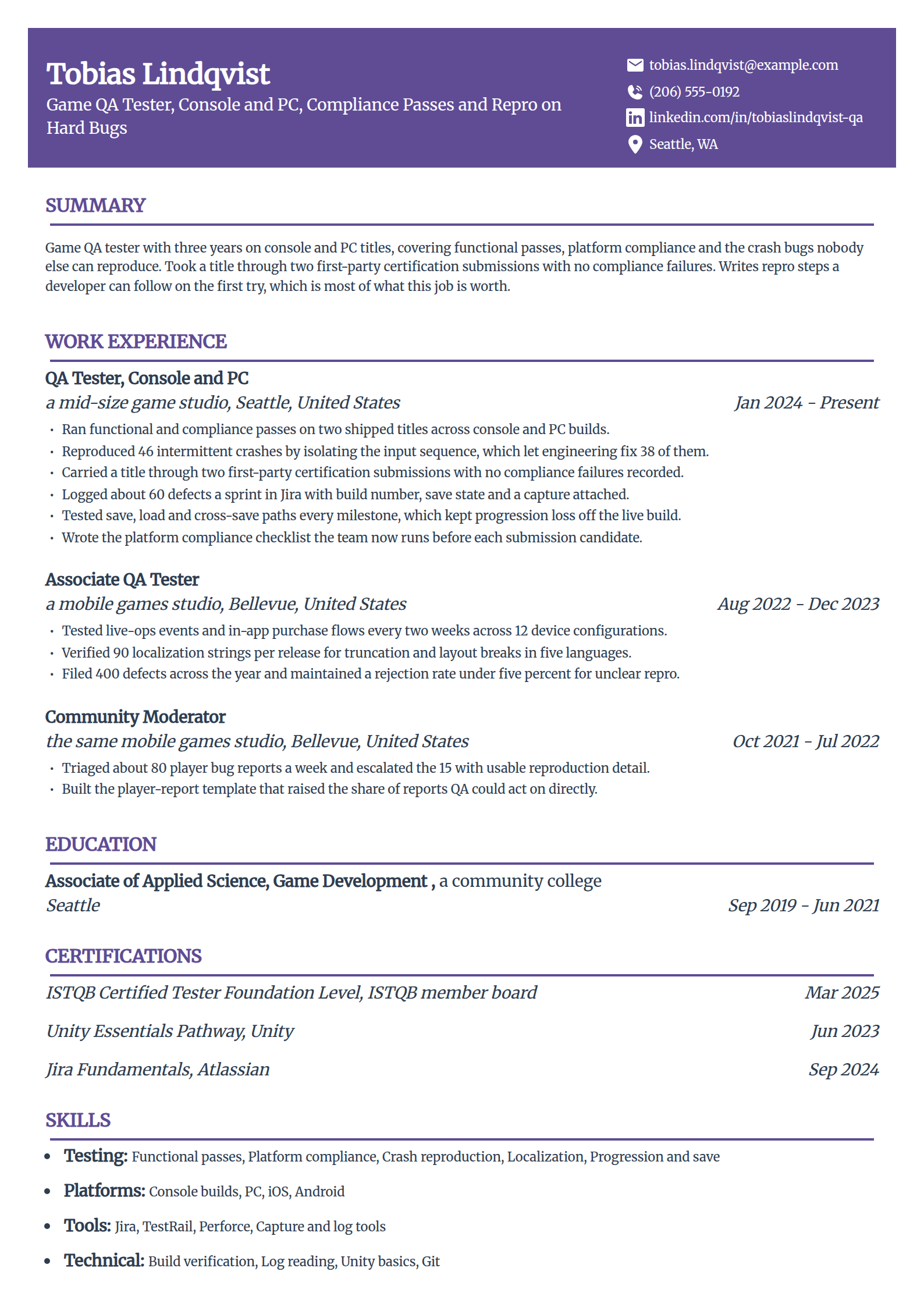
Game QA Tester Resume Template
Why this resume example works?
- Leads with certification submissions passed, the outcome a games studio measures QA on at milestone time.
- Counts reproduced intermittent crashes with the fixes that followed, which is the hardest work in game QA.
- Includes build number, save state and a capture in every defect, the detail a games pipeline needs.
- Keeps localization and live-ops testing visible, because most studio postings ask for both.
- Shows the community moderation job as the source of the triage skill rather than as unrelated history.
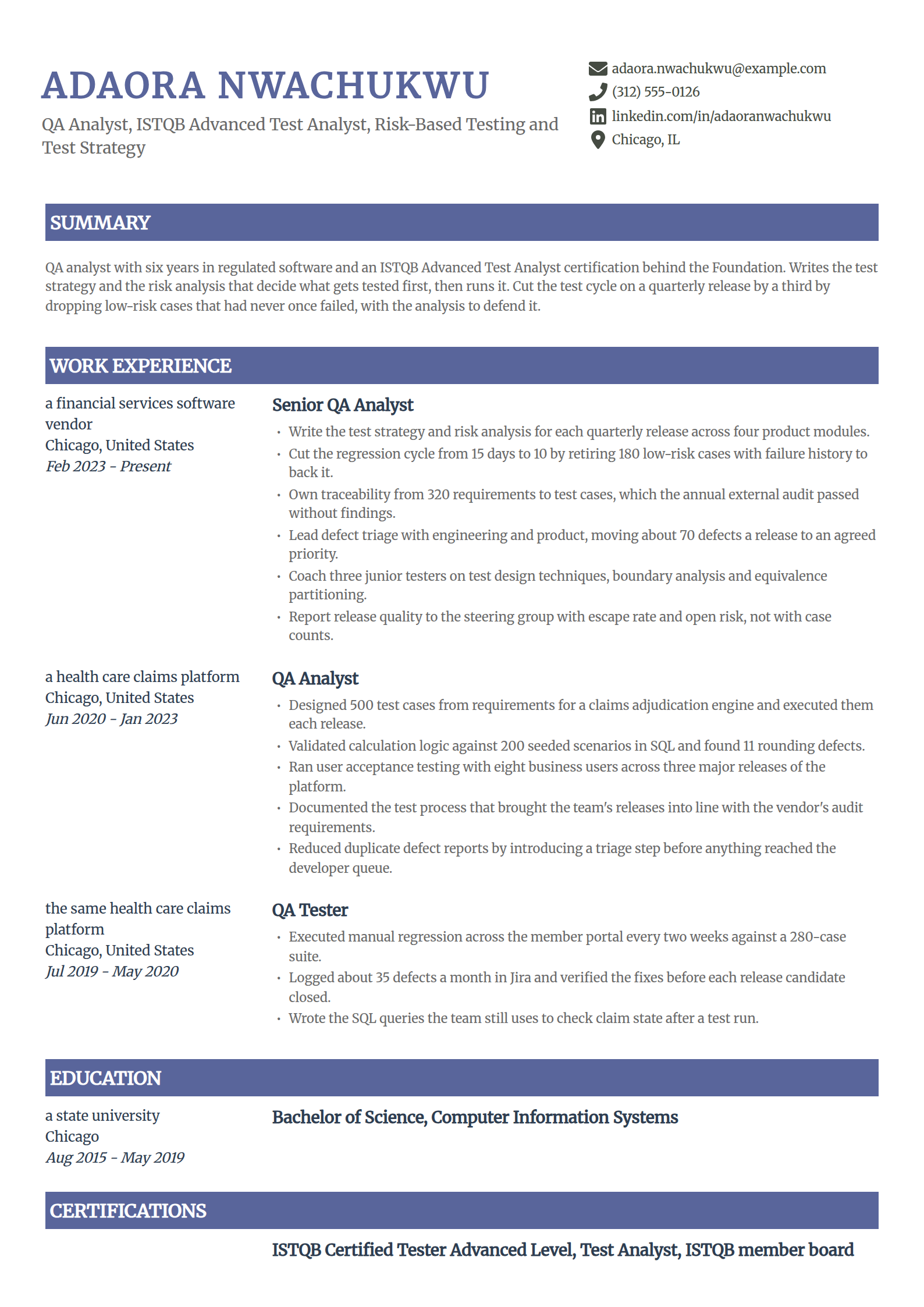
ISTQB Certified QA Analyst Resume Template
Why this resume example works?
- Puts the certification to work instead of just listing it: test strategy, risk analysis and named design techniques.
- Shows the courage a strategy role needs, retiring 180 low-risk cases with failure history to defend the decision.
- Names traceability across 320 requirements, which is the artifact an audit actually asks to see.
- Reports to leadership in escape rate and open risk, not in test case counts, which is the senior move.
- Holds the Advanced Level above the Foundation, a progression a hiring manager can read at a glance.
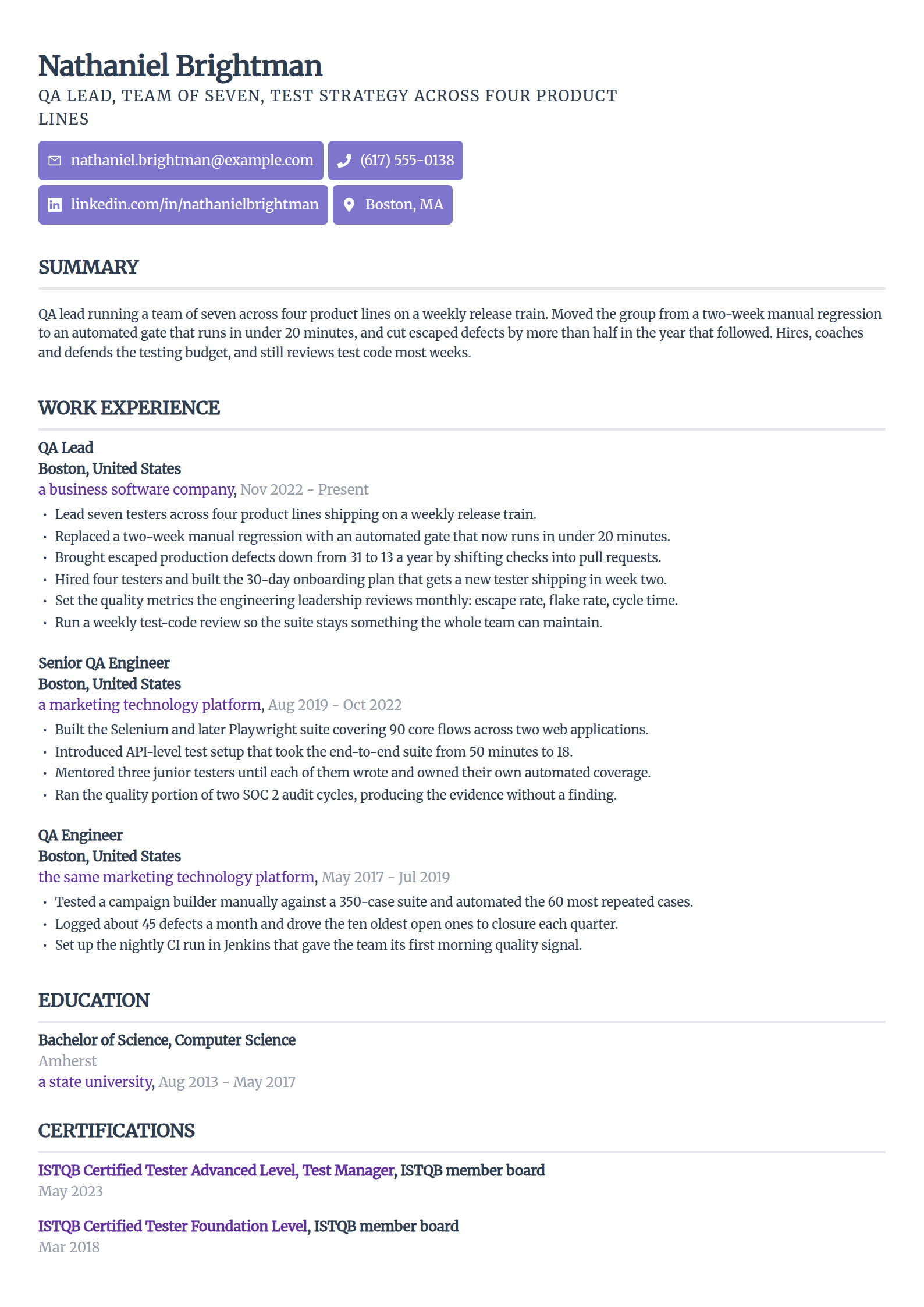
QA Lead Resume Template
Why this resume example works?
- Opens with what is being led: seven testers, four product lines, a weekly release train.
- Shows a structural change, two-week manual regression replaced by a gate that runs in under 20 minutes.
- Gives escaped defects with both ends of the year, so the improvement is checkable rather than asserted.
- Includes hiring and a written onboarding plan, which is half of what a lead is actually paid for.
- Still reviews test code weekly, which is what keeps a lead credible with the engineers they manage.
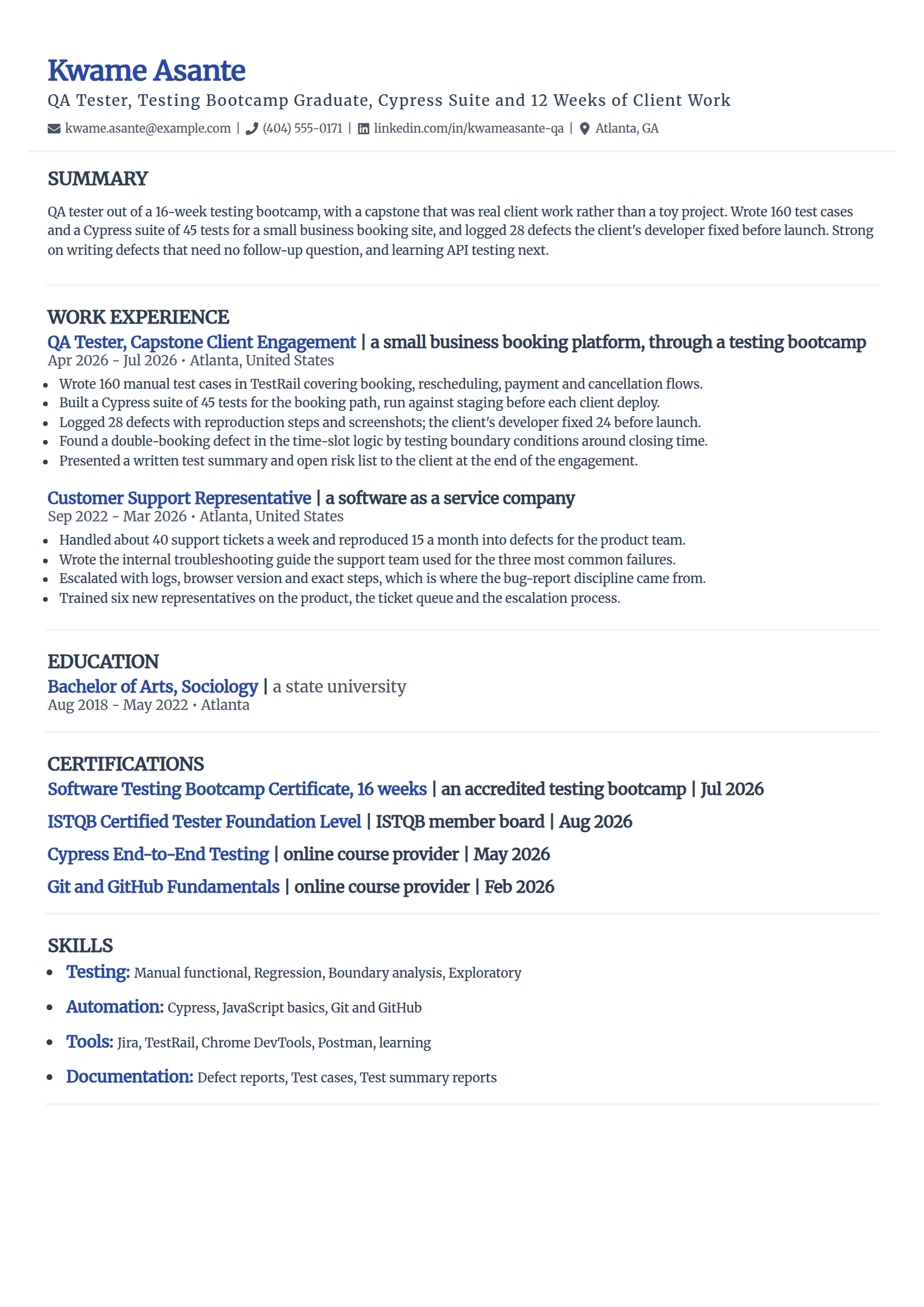
Bootcamp QA Tester Resume Template
Why this resume example works?
- Treats the capstone as client work with a deliverable and an outcome, not as a course assignment.
- Reports the defects that got fixed, 24 of 28, which is the number that shows the reports were usable.
- Names a specific find, a double-booking defect at a boundary condition, which is evidence of test design.
- Uses the support job to explain where the bug-writing came from, rather than dropping it as unrelated.
- Says what is being learned next, API testing, without claiming it as a current skill.
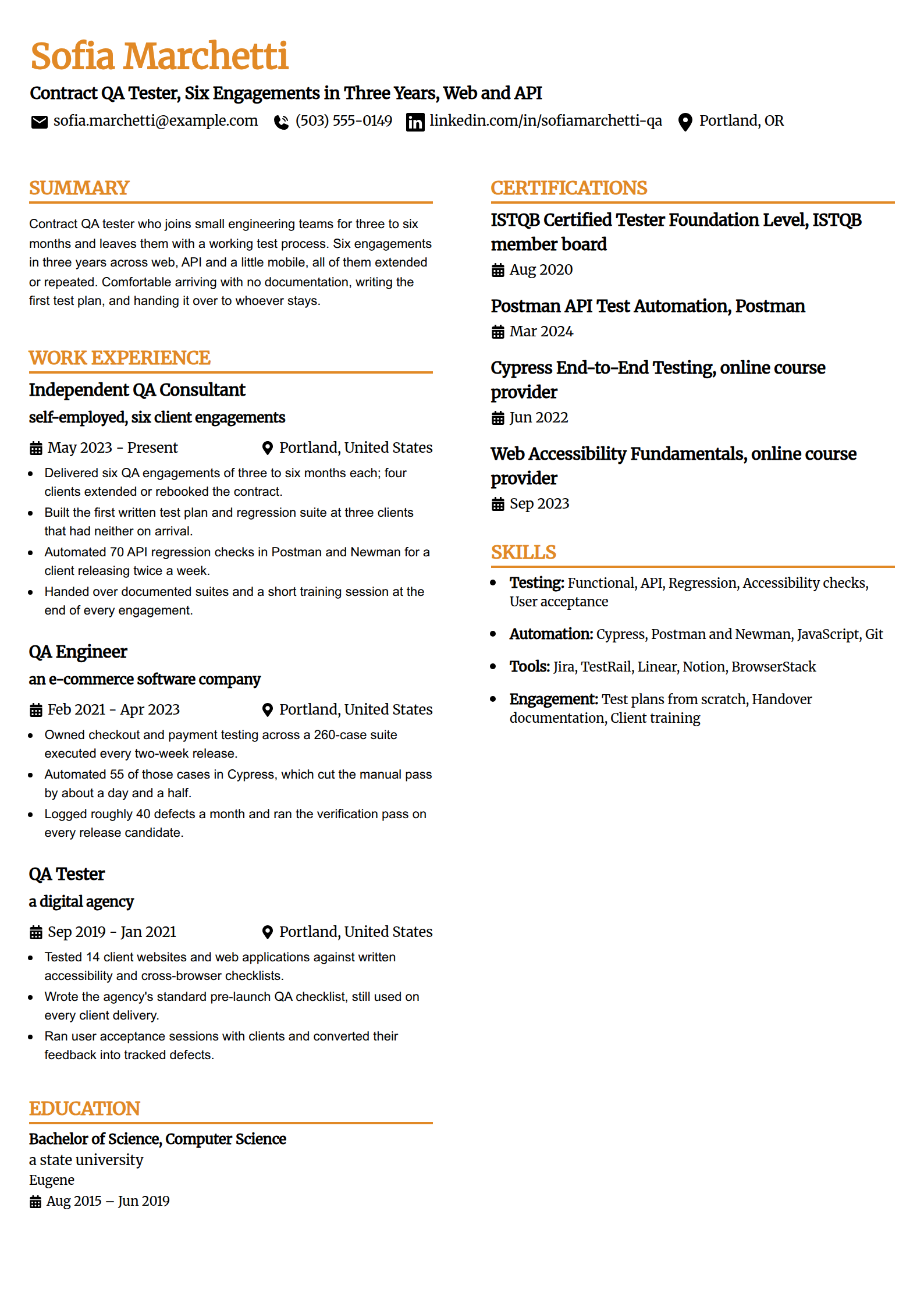
Freelance and Contract QA Tester Resume Template
Why this resume example works?
- Groups six engagements under one heading, which keeps a contract history from reading as job hopping.
- Puts extensions and repeat bookings on the page, the strongest quality signal a contractor has.
- Names the recurring deliverable: a first test plan and a regression suite where neither existed.
- Includes handover and training, because a client buying a contractor is buying what stays behind.
- Keeps two permanent roles underneath, so the page is not read as someone who has only ever freelanced.
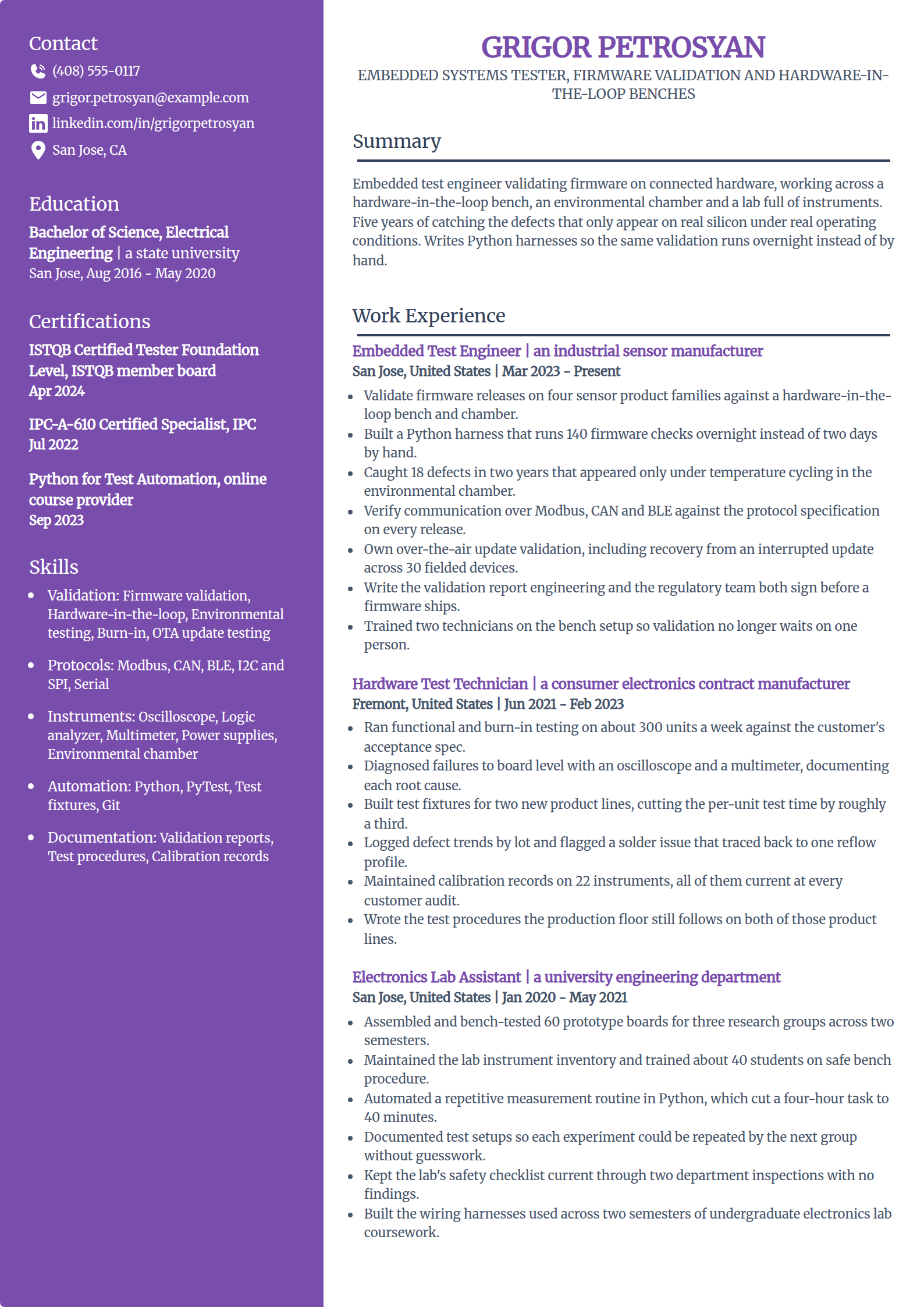
Embedded and Hardware Tester Resume Template
Why this resume example works?
- Names the bench, the chamber and the instruments, because embedded postings screen on equipment as much as on process.
- Counts the defects that appeared only under temperature cycling, which is the case for having a lab at all.
- Lists the protocols by name, Modbus, CAN and BLE, the way a job description lists them.
- Includes interrupted-update recovery, the over-the-air failure mode that actually bricks fielded devices.
- Shows the Python harness that turned two days of manual validation into an overnight run.
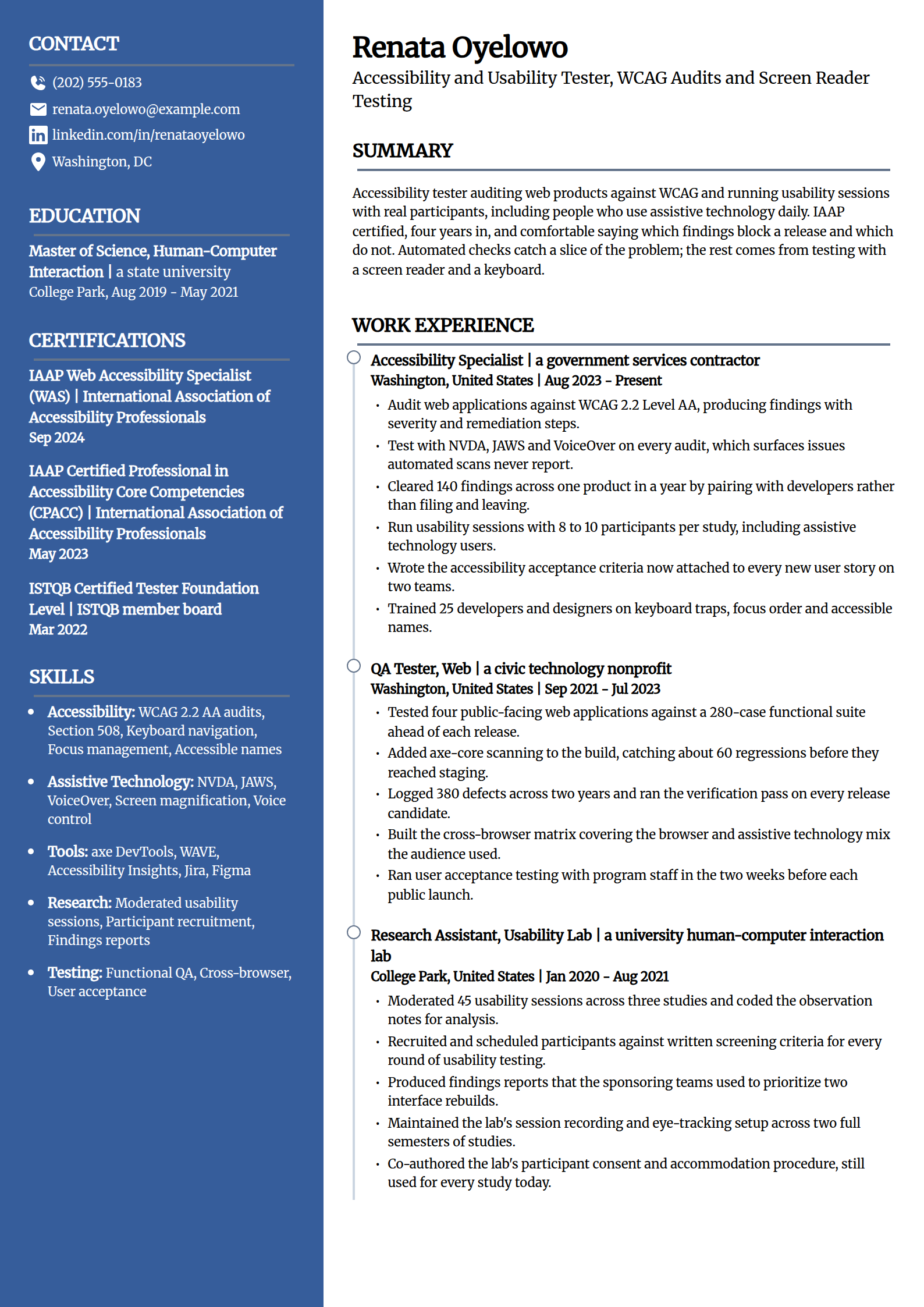
Accessibility and Usability Tester Resume Template
Why this resume example works?
- Names the standard and the level, WCAG 2.2 AA, rather than saying accessibility testing and leaving it there.
- Lists the screen readers used by name, which is the line that separates real audit work from running a scanner.
- Counts findings cleared, not findings raised, because filing an issue and leaving is the failure mode here.
- Shows usability research alongside the audits, including sessions with assistive technology users.
- Holds both IAAP credentials, which is what a government or enterprise accessibility posting asks for.
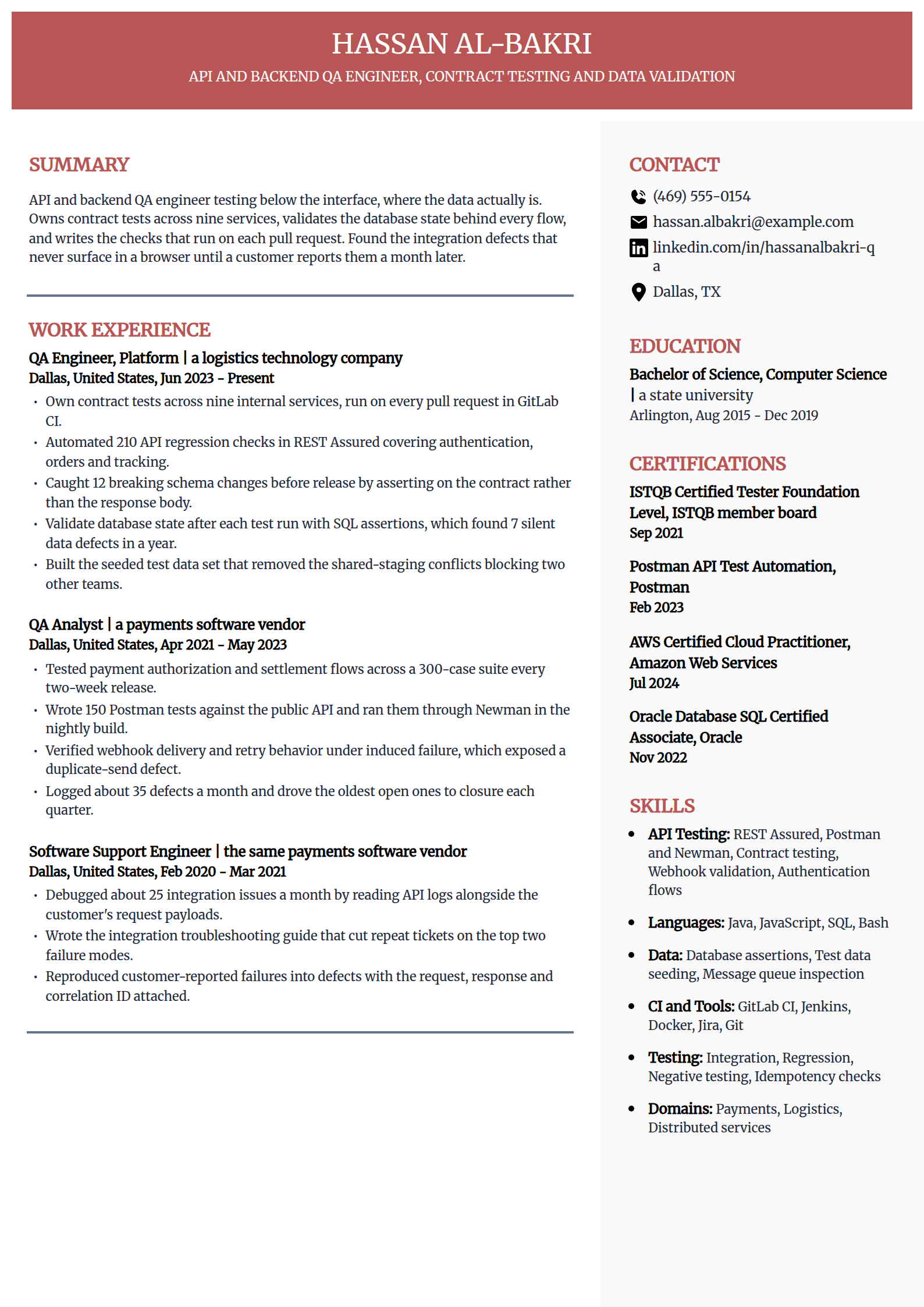
API and Backend Tester Resume Template
Why this resume example works?
- Says where the testing happens, below the interface across nine services, which is the whole positioning.
- Names contract testing specifically and shows what it caught, 12 breaking schema changes before release.
- Includes database assertions, because a flow can return 200 and still write the wrong row.
- Covers webhook retry behavior under induced failure, the kind of negative testing most resumes skip.
- Mentions the seeded test data that unblocked two other teams, which is engineering work, not just testing.
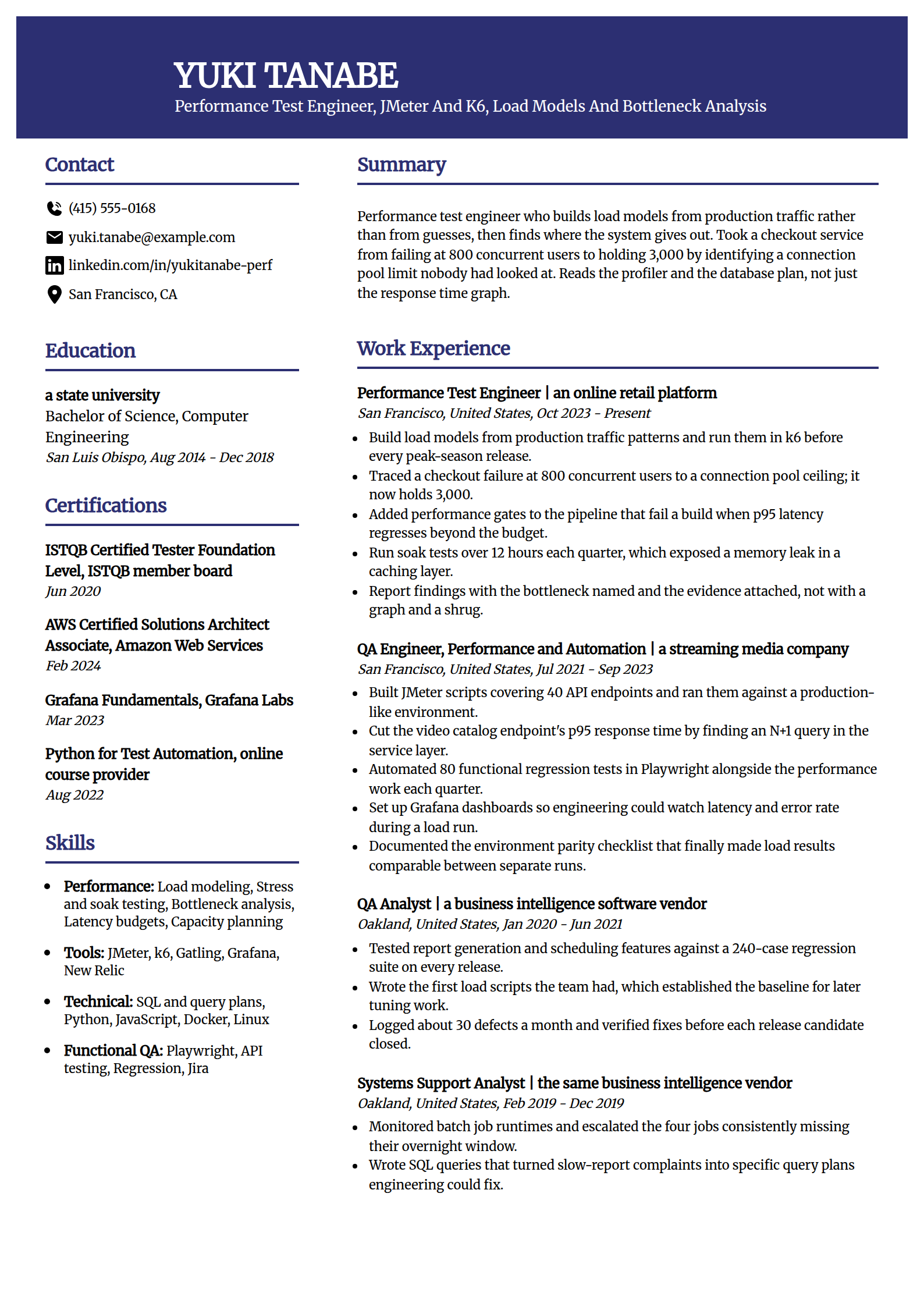
Performance and Load Tester Resume Template
Why this resume example works?
- Builds load models from production traffic rather than from guesses, which is the first thing a senior reviewer checks.
- Names the bottleneck found, a connection pool ceiling, with the before and after concurrency numbers.
- Includes a latency budget enforced in the pipeline, which turns performance from an event into a gate.
- Shows a soak test finding a memory leak, the defect class a short load run never surfaces.
- Reads the query plan and the profiler, not just the response time graph, and the bullets say so.
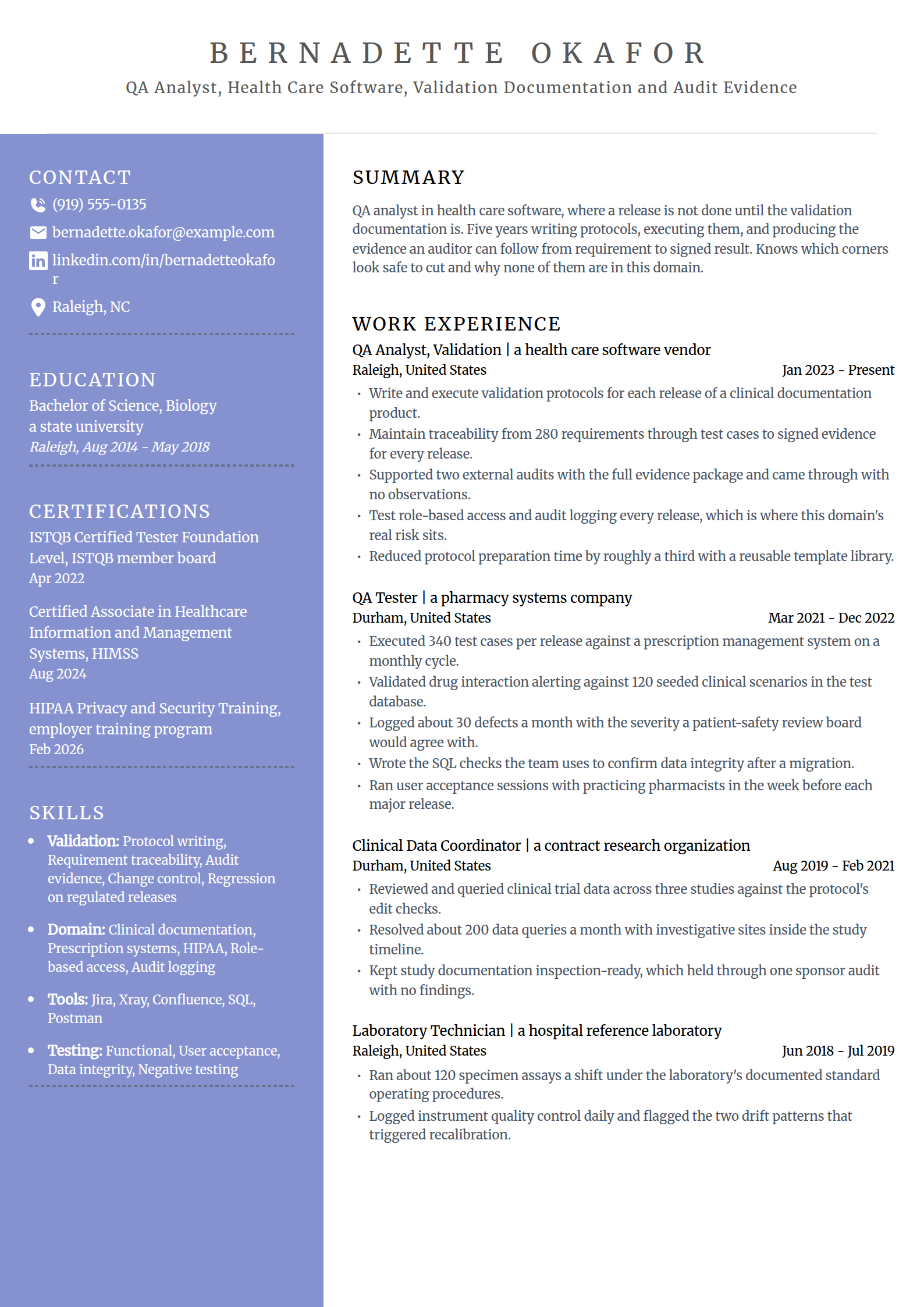
Regulated Industry QA Analyst Resume Template
Why this resume example works?
- Says plainly that a release is not done until the validation documentation is, which is the job in this domain.
- Names the audits supported and their outcome, because that is the evidence a regulated employer hires on.
- Tests role-based access and audit logging every release, the two controls that carry the real risk here.
- Keeps the clinical background visible, which is why the severity calls on patient-facing defects are trusted.
- Shows a process improvement, a reusable protocol template, rather than only compliance activity.
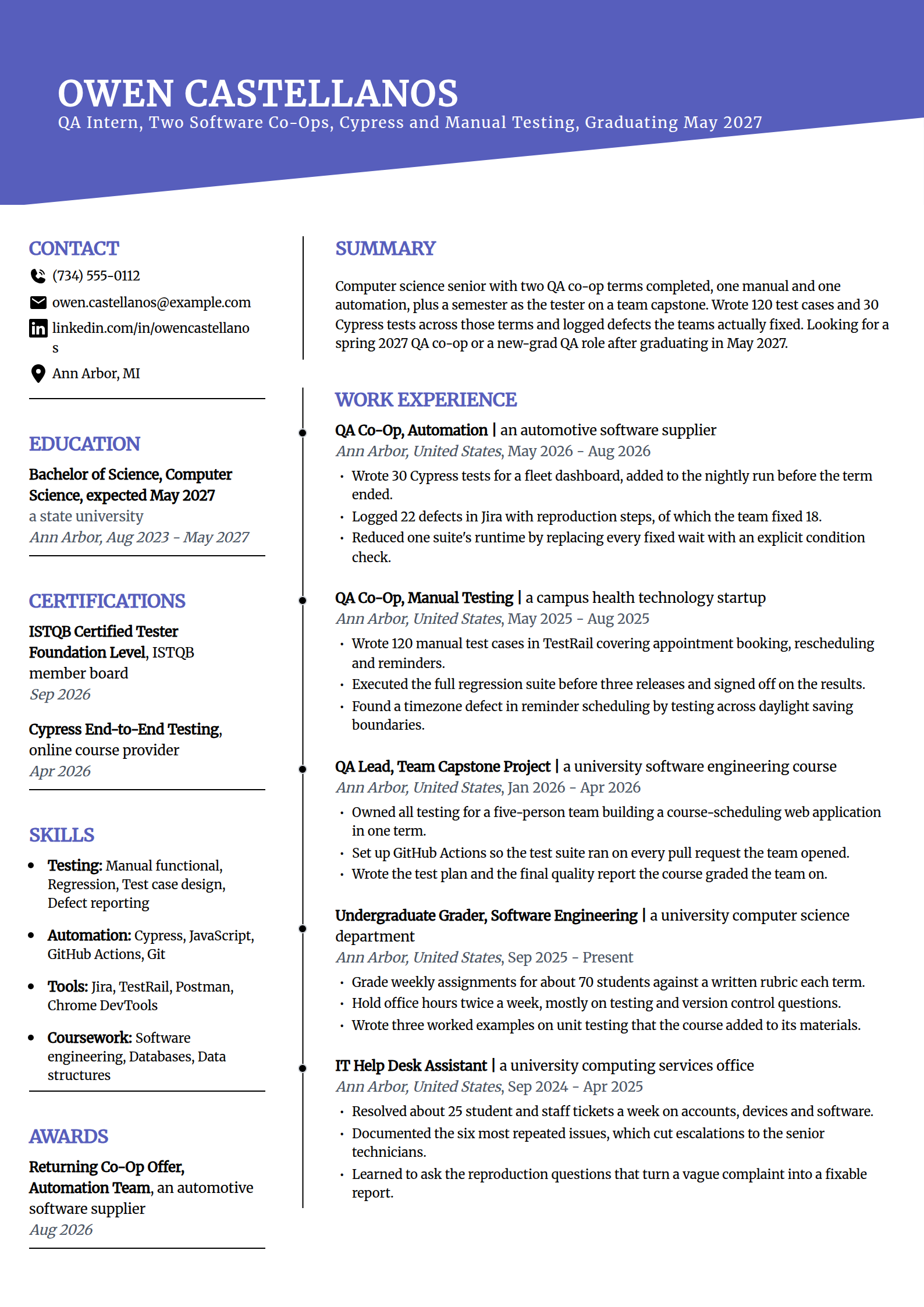
QA Intern and Co-Op Resume Template
Why this resume example works?
- Puts two co-op terms and a capstone on one page with a concrete deliverable from each.
- Shows the automation term produced tests that stayed, added to the nightly run before the term ended.
- Names a real find, a timezone defect at a daylight saving boundary, which is a test design story.
- Includes the returning co-op offer, the clearest signal that the first term went well.
- Keeps the help desk job for what it taught, asking the questions that turn a complaint into a fixable report.
Start your QA resume from the discipline you test in
Open the example closest to the testing you do, swap in your tools, your domain and your own numbers, and add the link to your repository. A page a QA lead can verify beats a page that only asserts.
Build my resumeHow to write a QA tester resume in 2026
A QA resume is read the way you would read a defect report: the reader is looking for specifics they can check. Name the tools you have actually run, attach a denominator to every number, and give them evidence you can write a bug somebody else can reproduce. Vague quality language is the one thing this audience is trained to distrust.
Manual or automation: the honest version
Most first QA jobs are manual, and manual testing is not a lesser skill. What loses interviews is the mismatch: a resume that reads like a tester who occasionally scripts will be screened out of automation roles, and a resume claiming automation on the strength of one course gets found out in the technical screen instead.
- Applying for automation roles? The page has to read like an engineer who specializes in quality: a language, a framework, a pipeline, and code you can show.
- Have some automation but not much? Say exactly what, as in "wrote 30 Cypress tests for the booking flow". That is credible and specific; "automation testing" as a skill bullet is neither.
- Applying for manual roles? Lead with test design, exploratory charters, risk analysis and defect quality, and stop apologizing for not automating.
- Use the title the posting uses. QA Analyst, QA Engineer, Test Automation Engineer and SDET parse differently and screen differently.
Show the bug report, it is your work sample
QA candidates are hired on the quality of their defect writing more than on anything else on the page, and the interview will test it directly. So show it, the way a designer shows a portfolio.
- Link a public repository with a real test framework in it, even a small one. A GitHub link does more than another skills bullet.
- A short written sample bug report, linked or attached, is worth more than a claim that your reports are clear.
- Say what a defect of yours cost or prevented: a double-booking bug caught before launch, a migration defect kept off production.
- If you have filed issues on an open-source project, name the project and how many were accepted.
- Crowdtesting cycles count too. Give the number completed and the approval rate if it was good.
The numbers a QA lead recognizes, and the ones they do not
Everybody says quantify. Almost nobody says which numbers survive scrutiny. These do, because a QA lead can picture where they came from.
- Test cases written and executed, tied to a suite or an area: "a 420-case regression suite for billing".
- Defects logged, with what happened next. A filed count alone says nothing about whether they were any good.
- Escape rate, stated with both ends: "nine escaped defects a quarter down to two".
- Suite runtime before and after, and flake rate, if you work in automation. Those two numbers are the whole conversation.
- Device or browser matrix size, release cadence supported, and people onboarded, where they fit the role.
- Leave out coverage percentages you do not personally control, and any lone "reduced bugs by 30%" with no denominator. That is the fastest way to look like you invented it.
Name the tools the way the posting names them
A QA posting screens on exact tool names, and the spelling matters more here than in most fields. Matching the posting's wording is not gaming the system; it is answering the question that was asked.
- Frameworks and libraries: Selenium, Playwright, Cypress, Appium, REST Assured, JMeter, k6, PyTest, Jest.
- Trackers and test management: Jira, TestRail, Zephyr, Xray, qTest, Confluence.
- CI and infrastructure: Jenkins, GitHub Actions, GitLab CI, Docker, BrowserStack, Sauce Labs.
- Write it how they write it. If the posting says Cypress, write Cypress, not Cypress.io.
- List only what you have used in a bullet somewhere on the page. A tool that appears in your skills block and nowhere else is the first thing a technical screen will pick.
Certifications: what ISTQB does and does not do for you
ISTQB Foundation Level is the credential QA postings name most often, and it is a knowledge exam rather than a practical one. That tells you exactly where it helps and where it stops.
- Early career, or moving into QA from another field: it is worth having. It is verifiable proof you know the vocabulary, and some employers filter on it.
- Several years in, with frameworks built and teams coached: your outcomes carry the page and the Foundation certificate adds very little.
- The Advanced levels are worth listing when your work matches them, as with a test analyst or test manager role. Do not claim a level your experience will not support in conversation.
- Domain and platform certificates can matter more in context: a cloud certificate for infrastructure-heavy testing, accessibility credentials for audit work.
- Requirements and exam details change, so check the current position with the certification board rather than with a blog post.
One page, standard headings, and a skills block that parses
One page is the norm below roughly ten years of experience, and two is the practical maximum for a lead. Beyond that you are asking a busy reader to work for it.
- Use standard headings: Summary, Work Experience, Education, Certifications, Skills. Every example on this page does.
- Group the skills block by type, languages, frameworks, tools, CI, testing types, so a reader finds what they came for in one pass.
- No experience yet? Put education and your testing projects above work history, and give each project a date range like a job.
- Skip the skill rating bars. A five-star self-rating on Selenium tells a reviewer nothing and parses as nothing.
- Save as PDF unless the form asks otherwise, then run it through the ATS resume checker for a format and keyword pass.
Common QA tester resume mistakes
- Listing a tool you have only watched a course on. The technical screen finds it in about two questions, and it costs you the rest of the interview.
- A defect count with no denominator. "Logged 500 defects" could be a year or a career, and could be 500 duplicates. Say over what period, on what product, and what happened to them.
- Describing duties instead of outcomes. "Performed manual testing" is a job description; "cut escaped billing defects from nine a quarter to two" is a reason to call you.
- Claiming a coverage percentage you do not control. Code coverage belongs to the whole team, and quoting it as a personal achievement reads as borrowed.
- Hiding the automation you do have. "Wrote 30 Cypress tests for the booking flow" is better than a skills bullet saying automation, and honest about the scale.
- No link to anything. A repository with a small test framework in it, or one written sample bug report, is worth more than a third page of skills.
Frequently asked questions
What should a QA tester resume include?
Five things. A summary of two to three sentences naming your testing type, your domain and your strongest number. A skills block grouped by languages, frameworks, tools, CI and testing types, listing only what you have actually run. Experience bullets that each carry one checkable number, such as the size of a suite you own, escaped defects before and after, or suite runtime before and after. Certifications, with ISTQB Foundation if you hold it. And a link to something real, a repository with a test framework in it or a written sample bug report, because defect writing is the skill this job is hired on. One page below roughly ten years of experience.
How do you write a QA tester resume with no experience?
Do testing work that leaves a trace, then format it as a job rather than as a hobby. File defects on an open-source project and give the number accepted. Write a test plan for a real public application and put it in a repository. Build a small Playwright or Cypress suite and link it. Complete crowdtesting cycles and report how many and at what approval rate. Each of those gets a title, a date range and two to four bullets with numbers, exactly like paid work. Then put education and projects above work history, add ISTQB Foundation if you have it, and keep the tools you are still learning clearly marked as such rather than claimed.
What skills and tools should a QA tester put on a resume?
Name them specifically, and spell them the way the posting does. Frameworks: Selenium, Playwright, Cypress, Appium, REST Assured, JMeter, k6, PyTest, Jest. Test management and tracking: Jira, TestRail, Zephyr, Xray, qTest. CI and infrastructure: Jenkins, GitHub Actions, GitLab CI, Docker, BrowserStack. Languages that match your work: Java, JavaScript or TypeScript, Python, SQL. Then the testing types themselves: functional, regression, exploratory, API, contract, performance, accessibility, user acceptance. Group them by category so a reader finds what they came for in one pass, and list only what appears in a bullet somewhere else on the page.
Is ISTQB certification worth putting on a QA resume?
It depends on where you are. Early in your career, or moving into QA from another field, it is worth having and worth listing: it is verifiable proof you know the vocabulary and the standard techniques, and some employers filter on it, particularly larger organizations in finance, health care and government. Several years in, with frameworks you built and testers you have coached, your outcomes carry the page and the Foundation certificate adds very little. The Advanced levels are worth listing when your actual work matches them. Requirements and exam details change, so check the current position with the certification board rather than with a blog post.
How long should a QA tester resume be?
One page below roughly ten years of experience, and two pages as the practical maximum for a lead or principal with results that fill the space. Every example on this page fits a single page, including the ones carrying four roles and a certifications block. If you are running over, cut the oldest role to two bullets, drop the tools you no longer use, and delete any bullet that has neither a number nor a named tool in it. A hiring manager screening a stack of QA resumes gives each one a couple of minutes, so a tight page beats a padded two.
Should a QA resume lead with manual or automation testing?
Lead with whatever the posting is actually hiring for, and be honest about the gap. Most first QA jobs are manual, and manual testing is not a lesser skill: test design, exploratory testing and risk analysis are what stop defects reaching production. If you are applying for automation roles, the page has to read like an engineer who specializes in quality, with a language, a framework, a pipeline and code you can show. If you have some automation but not much, say exactly what, as in "wrote 30 Cypress tests for the booking flow". That is credible. Claiming automation on the strength of one course does not fail at the resume screen, it fails in the technical interview, which is worse.
More qa tester resume resources
Start your QA resume from the discipline you test in
Open the example closest to the testing you do, swap in your tools, your domain and your own numbers, and add the link to your repository. A page a QA lead can verify beats a page that only asserts.