Read Your Ticket Numbers First: 16 Help Desk Resume Templates
- ATS Friendly
- Ticket Numbers Included
- 16 Desk Examples
A help desk resume example should carry four things: the tier and support model you work in, the ticketing platform by name, the numbers your own system already reports, and the tool stack the posting lists. Help desk work is measured ticket by ticket, so open ServiceNow or Jira before you write. Pick the example below that matches the desk you want.


540k+ resumes created
One template per desk you could actually be hired onto
A tier 1 technician clearing a password queue, a managed services technician juggling 22 client tenants, and a Mac support technician living in Jamf are three different postings with three different screens. Each template below is a complete one-page resume for one of them, written with the platforms, certifications and metrics that posting names.
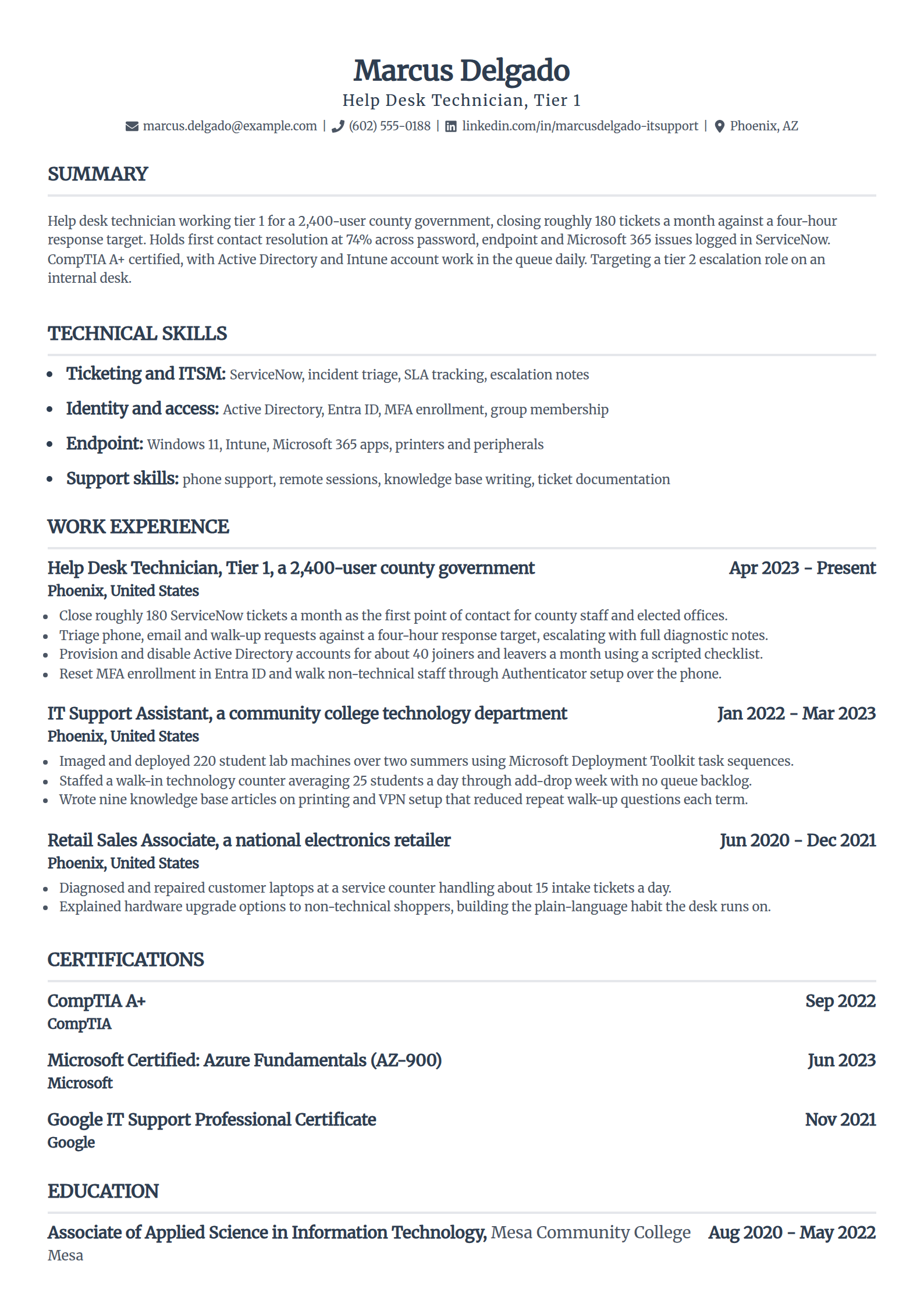
Tier 1 Help Desk Technician Resume Template
Why this resume example works?
- Opens with the tier and the user count, so a hiring manager knows the scale of the desk in the first line.
- Gives the monthly ticket volume and the first contact resolution rate, both read straight off the ticketing system.
- Names ServiceNow, Active Directory, Entra ID and Intune, which is the exact stack a tier 1 posting lists.
- Counts account provisioning separately from ticket volume, because joiner and leaver work is its own screen.
- Puts the technical skills block directly under the summary, where a recruiter matches it against the posting.
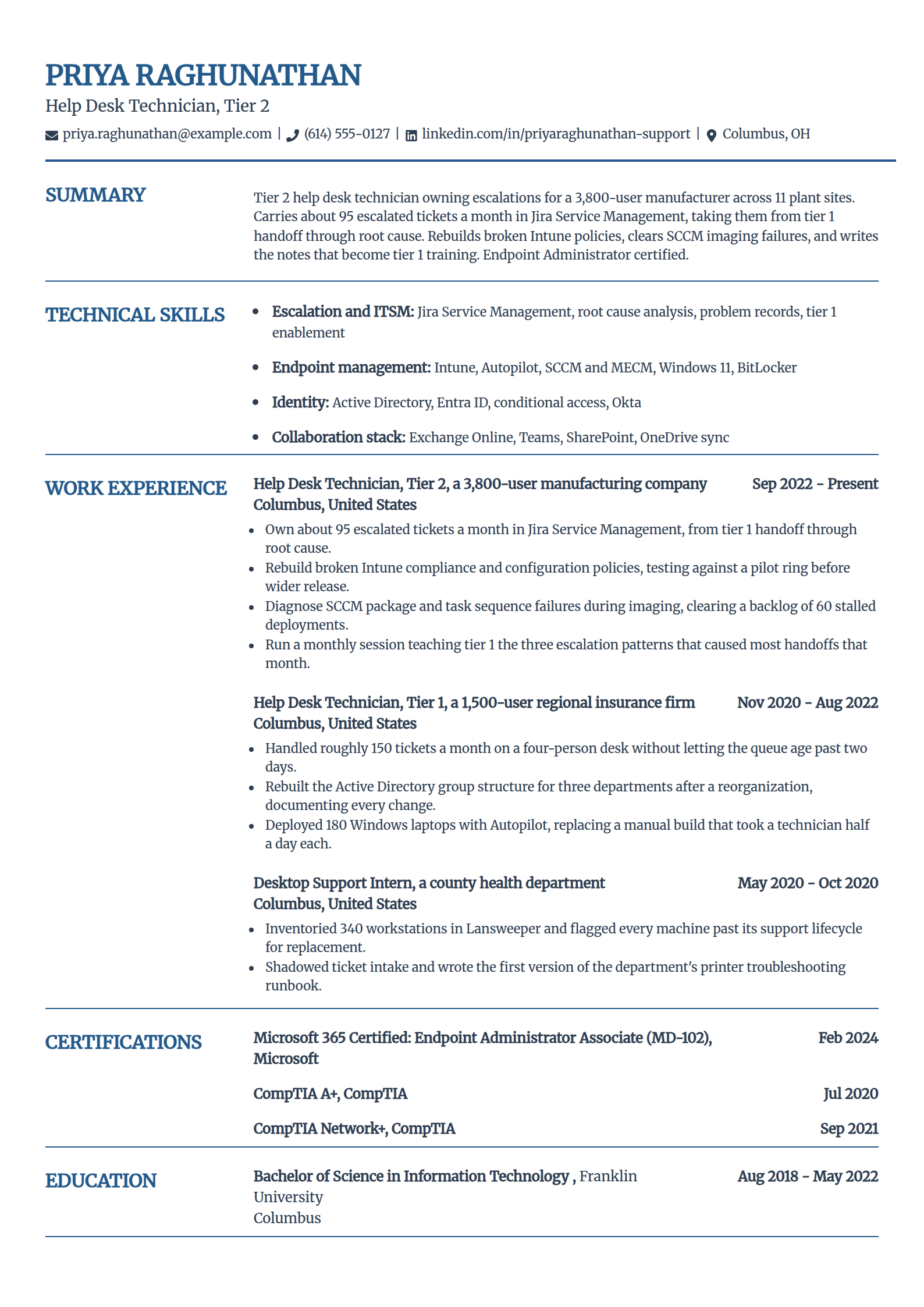
Tier 2 Help Desk Technician Resume Template
Why this resume example works?
- Describes the job as escalation ownership rather than ticket volume, which is the real difference between the tiers.
- Shows endpoint management depth: Intune policy rebuilds and SCCM task sequence failures, not generic troubleshooting.
- Includes teaching tier 1 the patterns behind the handoffs, the work that gets a technician promoted off the queue.
- Keeps the tier 1 years visible underneath, because every credible tier 2 resume has to show where the depth came from.
- Leads with the escalation certification that matters here, the Microsoft endpoint administrator track.
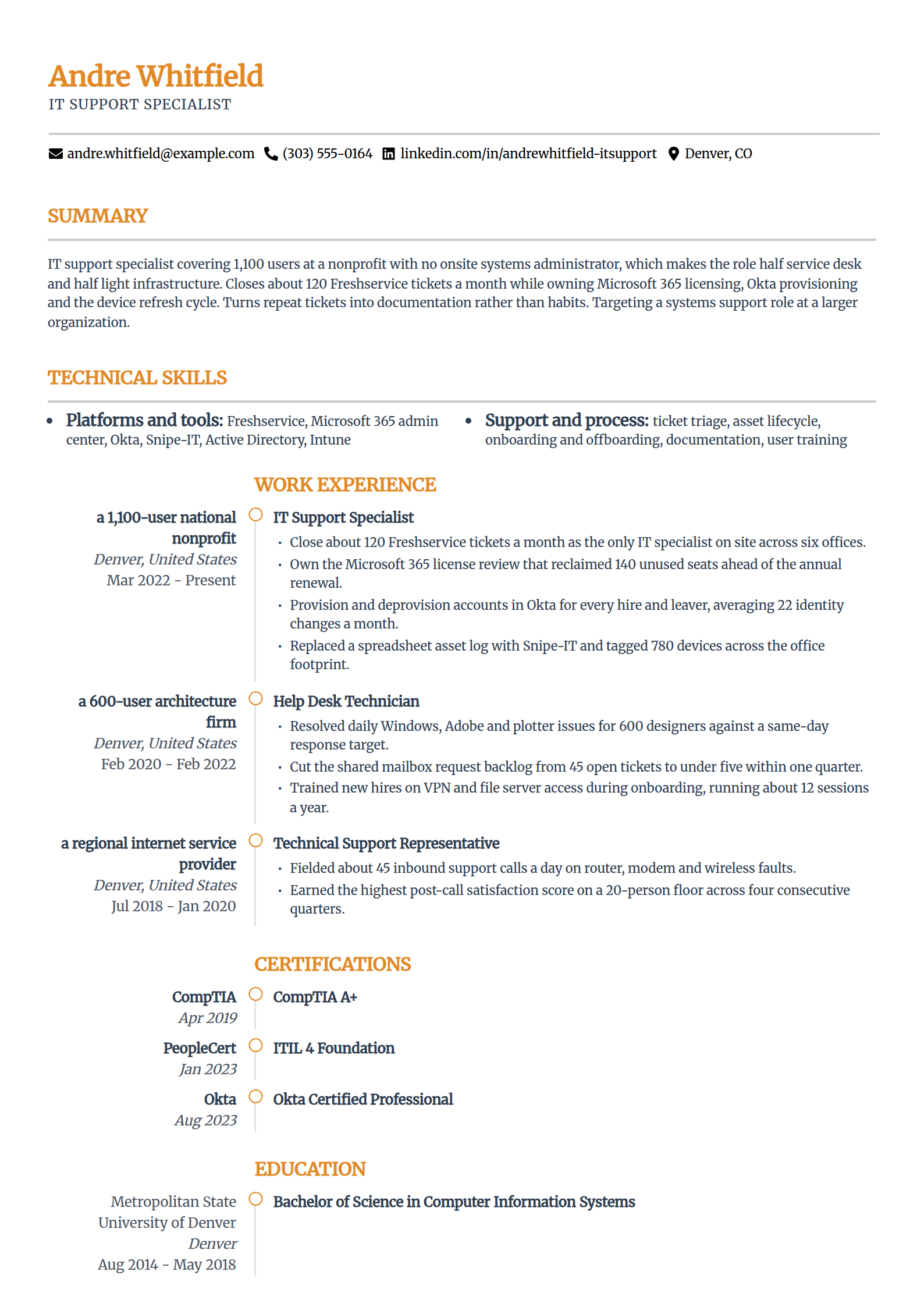
IT Support Specialist Resume Template
Why this resume example works?
- States the thing that defines this title: one person covering a site with no systems administrator behind them.
- Pairs ticket volume with ownership work, licensing reviews and identity provisioning, which a pure desk role lacks.
- Quantifies an administrative win, the unused licenses reclaimed before renewal, in language a finance lead understands.
- Shows an asset system being introduced rather than maintained, which reads as initiative without claiming a title.
- Keeps the two skill groups short, so a recruiter scanning a one-column layout still finds the platform names.
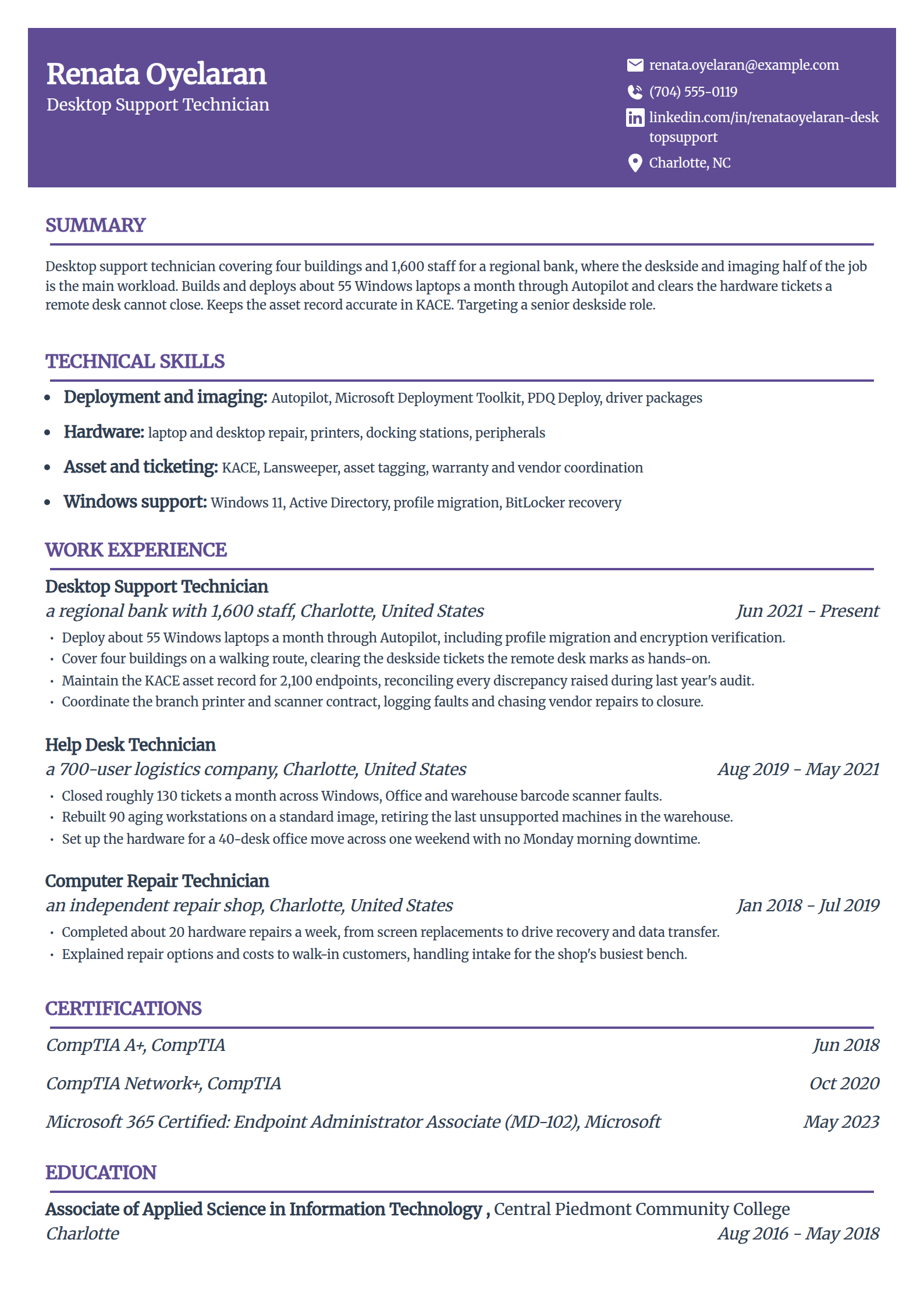
Desktop Support Technician Resume Template
Why this resume example works?
- Counts laptops deployed a month, which is the metric a deskside posting actually screens on.
- Says plainly that the role covers the tickets a remote desk marks as hands-on, so the boundary is clear.
- Treats asset accuracy as the work it is, with an audit reconciliation number rather than a claim about being organized.
- Names the imaging stack by tool, Autopilot and Microsoft Deployment Toolkit, instead of writing device deployment.
- Includes bench repair years, which is where most deskside technicians learn hardware properly.
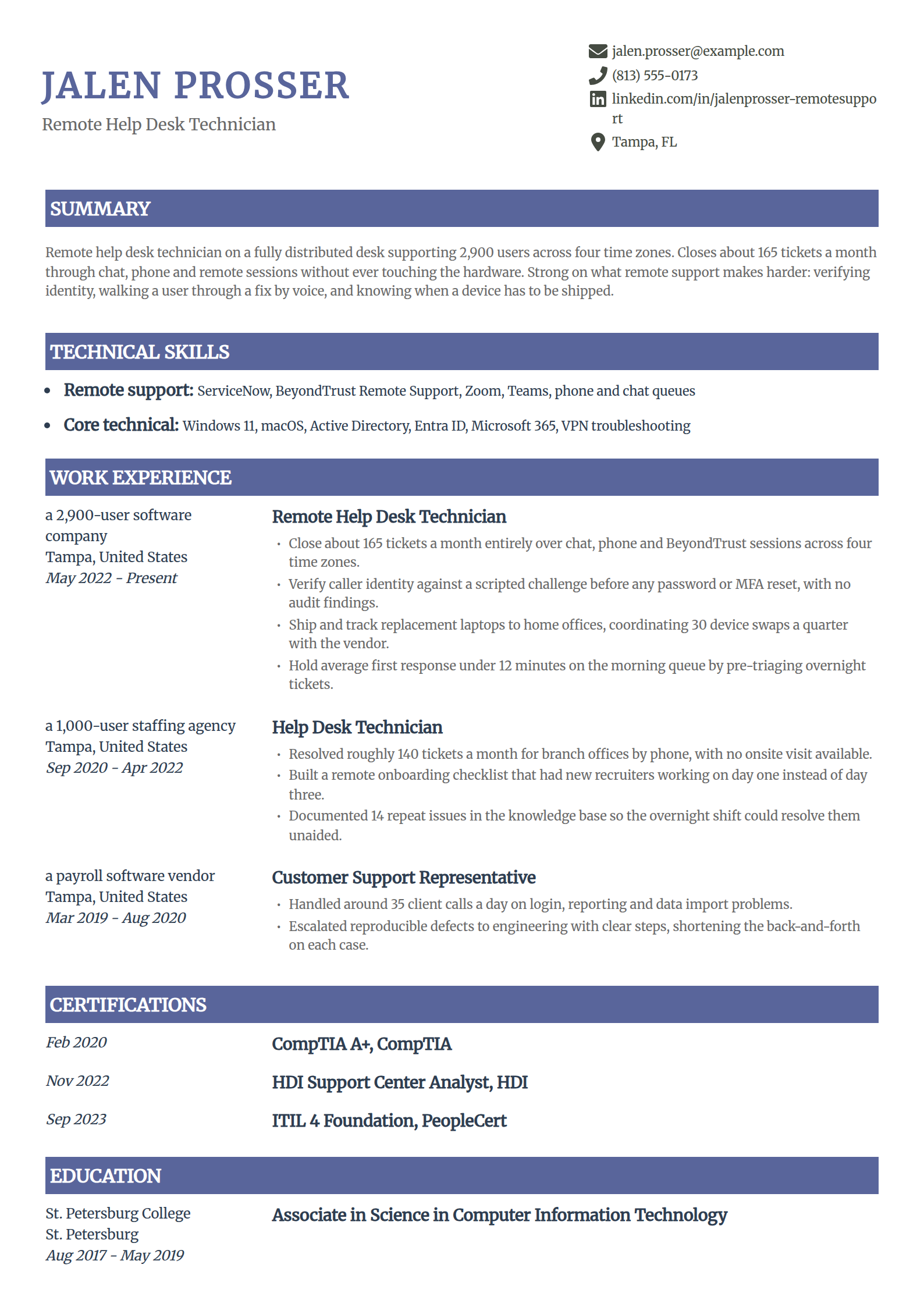
Remote Help Desk Technician Resume Template
Why this resume example works?
- Names the hard part of remote support in the summary: identity verification, voice-led fixes, and when to ship a device.
- Reports first response time, the metric a distributed desk is managed on, rather than resolution time alone.
- Shows a scripted identity challenge with a clean audit record, which answers the security question before it is asked.
- Counts device swaps coordinated with a logistics vendor, logistics work an onsite resume never has to prove.
- Covers four time zones explicitly, since shift coverage is the first thing a remote manager checks.
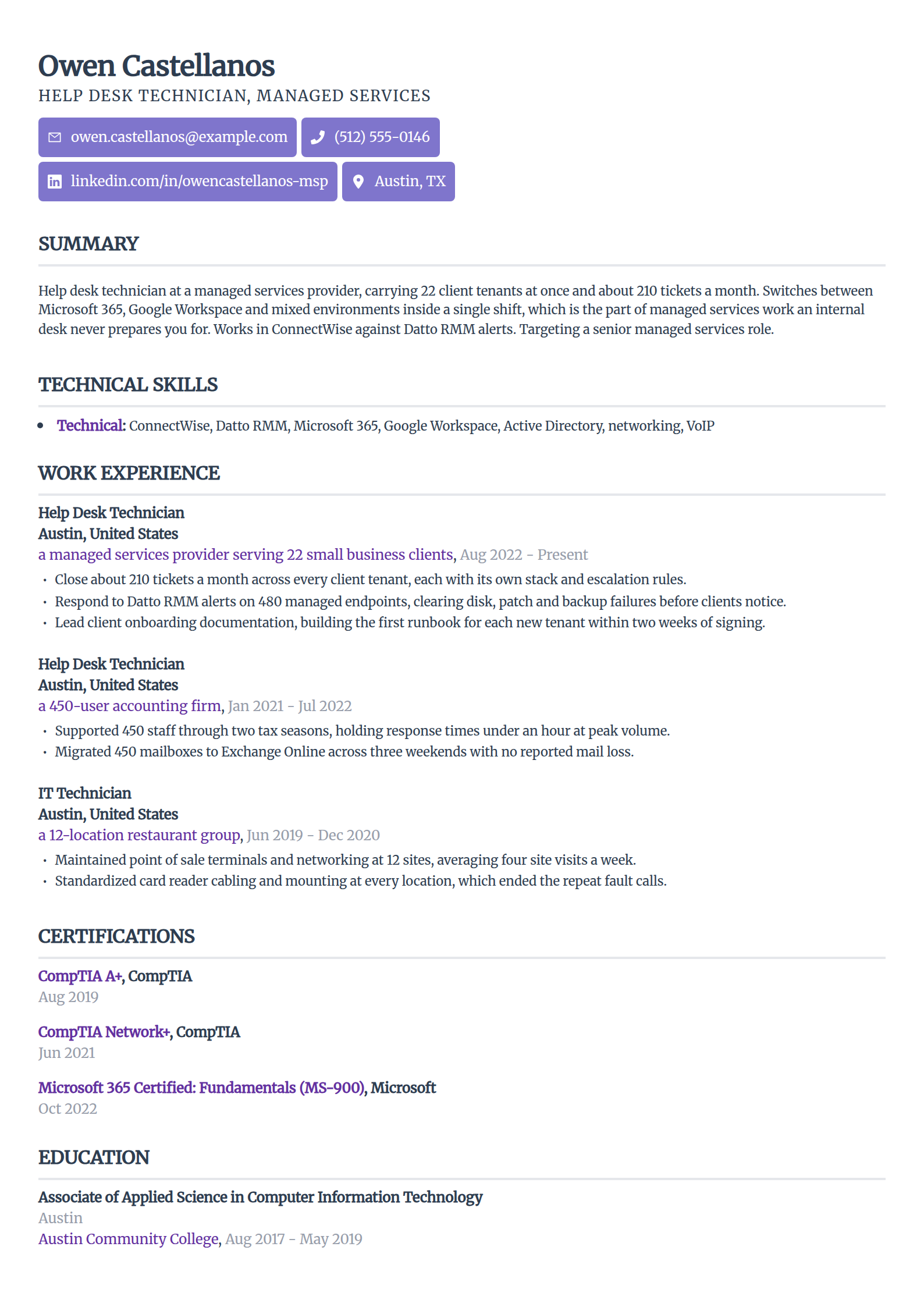
MSP Help Desk Technician Resume Template
Why this resume example works?
- Leads with tenant count, the number that separates managed services work from an internal desk at the same volume.
- Shows alert-driven work from a monitoring platform, not just inbound tickets, which is how a provider actually runs.
- Mentions building the first runbook for each new client, the documentation habit every provider interviews for.
- Keeps the single skill block dense with platform names, because this layout gives the sidebar very little room.
- Includes multi-site retail support, evidence of handling many environments before the provider role.
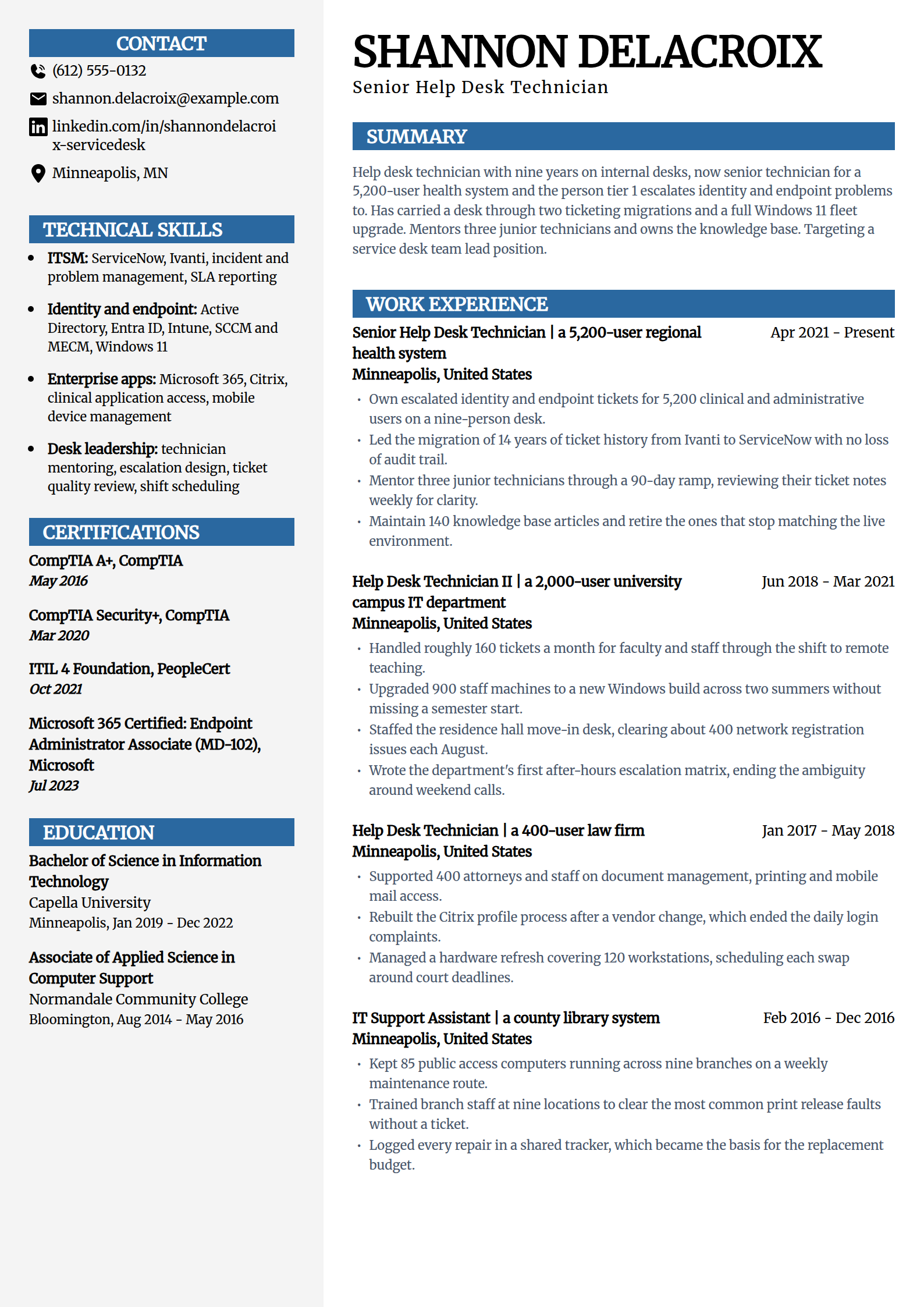
Experienced Help Desk Technician Resume Template
Why this resume example works?
- Fits nine years and four roles onto one page by trimming the oldest entries rather than shrinking the type.
- Gives a career-scale proof point, a ticket history migration with the audit trail intact, that no junior can match.
- Shows mentoring with a mechanism, weekly ticket note review, instead of claiming to be a team player.
- Owns the knowledge base including the retirements, which is the part of documentation work people skip.
- Uses a two-column layout so two degrees and four certifications stay visible beside a long history.
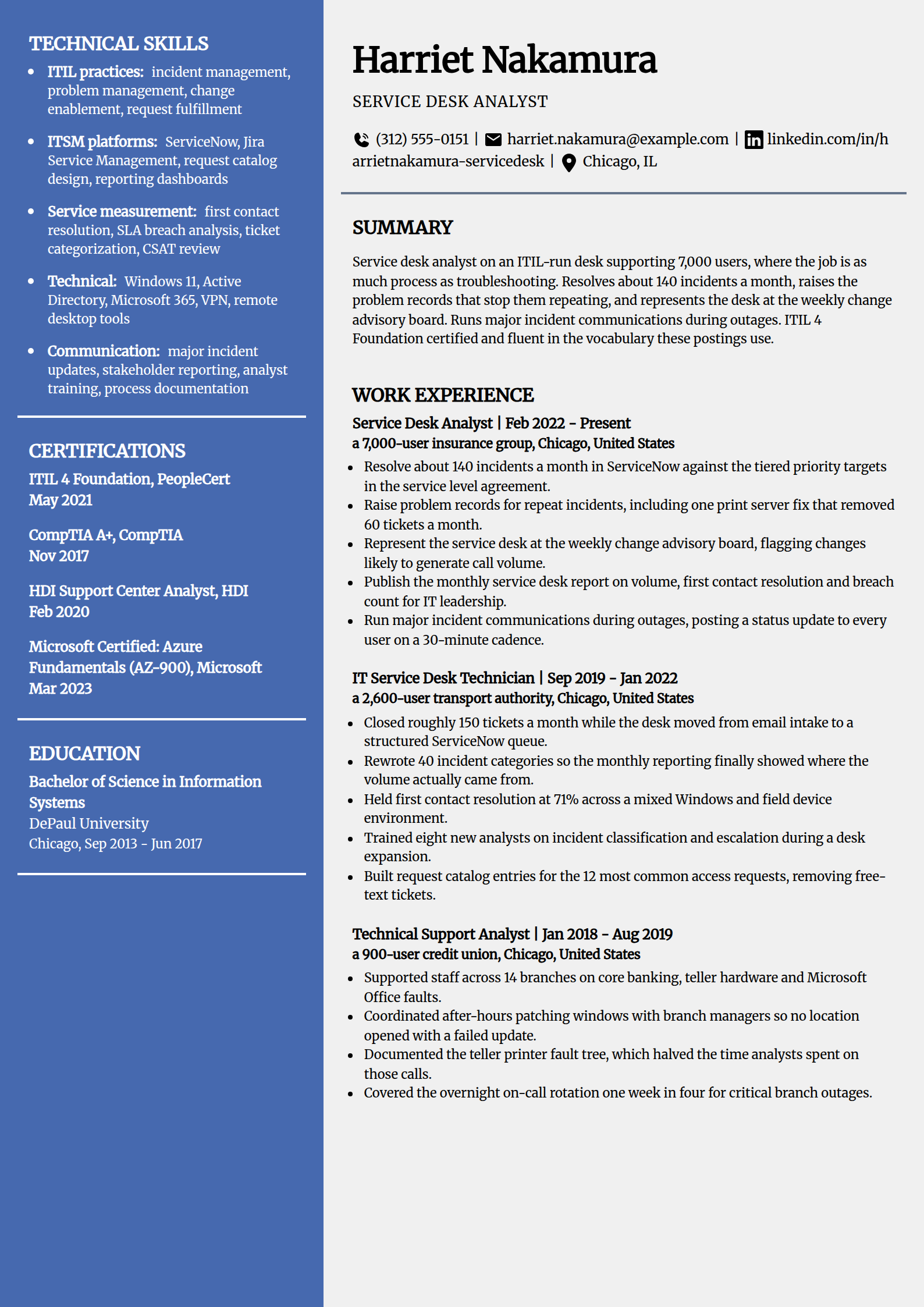
Service Desk Analyst Resume Template
Why this resume example works?
- Written in ITIL vocabulary throughout, because that is the language a service desk analyst posting is written in.
- Separates incident work from problem records, which is the distinction that proves the certification is more than a card.
- Puts the analyst in the change advisory board, process involvement that a pure troubleshooting resume cannot show.
- Includes major incident communications, the highest-visibility thing an analyst does and the first thing managers ask about.
- Reports on the desk rather than only working it, which is the step toward a service delivery role.
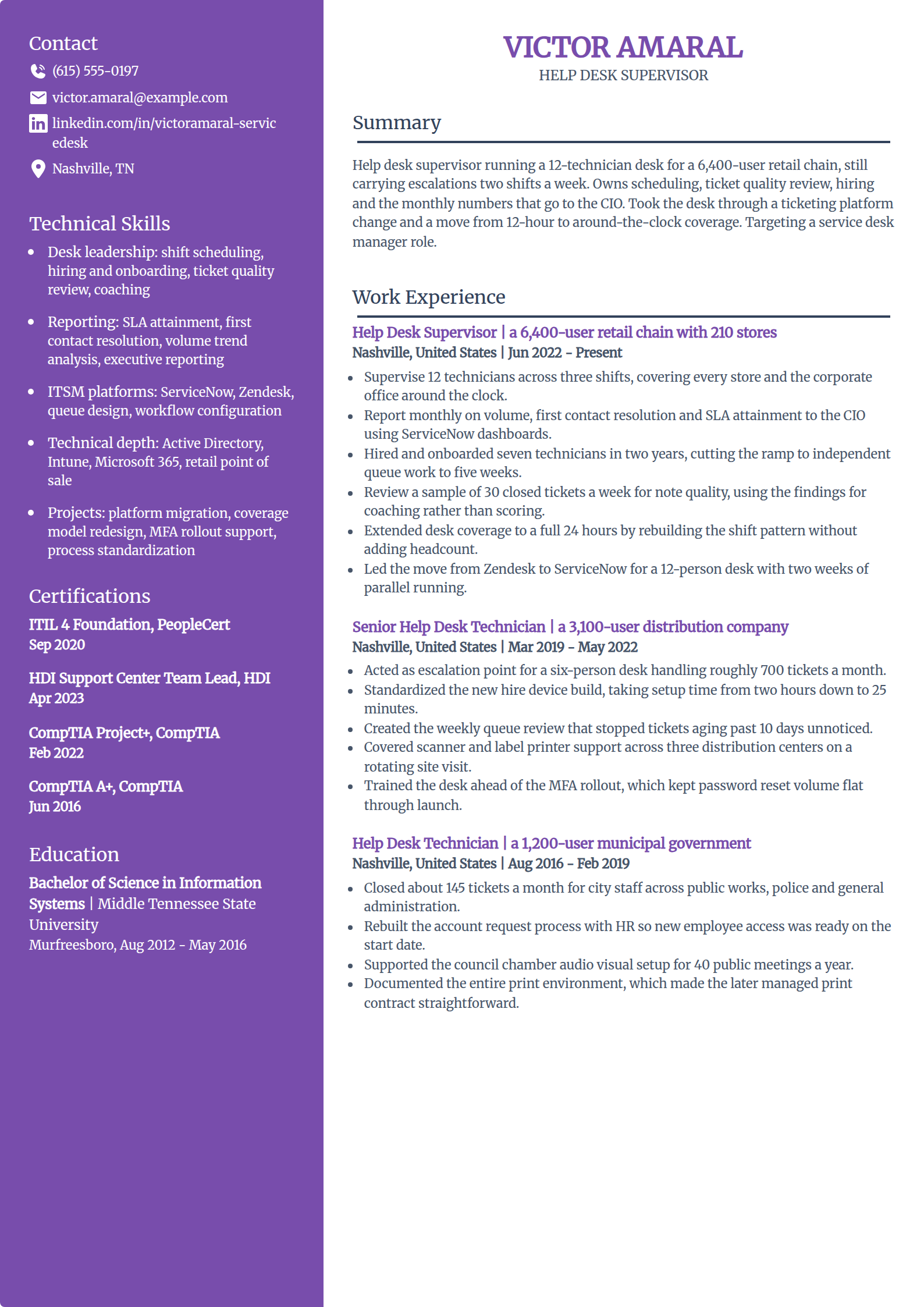
Help Desk Supervisor Resume Template
Why this resume example works?
- Shows both halves of the job, supervising twelve technicians while still taking escalations two shifts a week.
- Makes hiring and ramp time a measurable outcome, which is what separates a supervisor from a senior technician.
- Frames ticket quality review as coaching rather than scoring, a distinction any experienced desk manager will notice.
- Counts a coverage model change delivered without extra headcount, the kind of result a CIO remembers.
- Carries a team lead certification alongside the technical ones, since the posting screens for both.
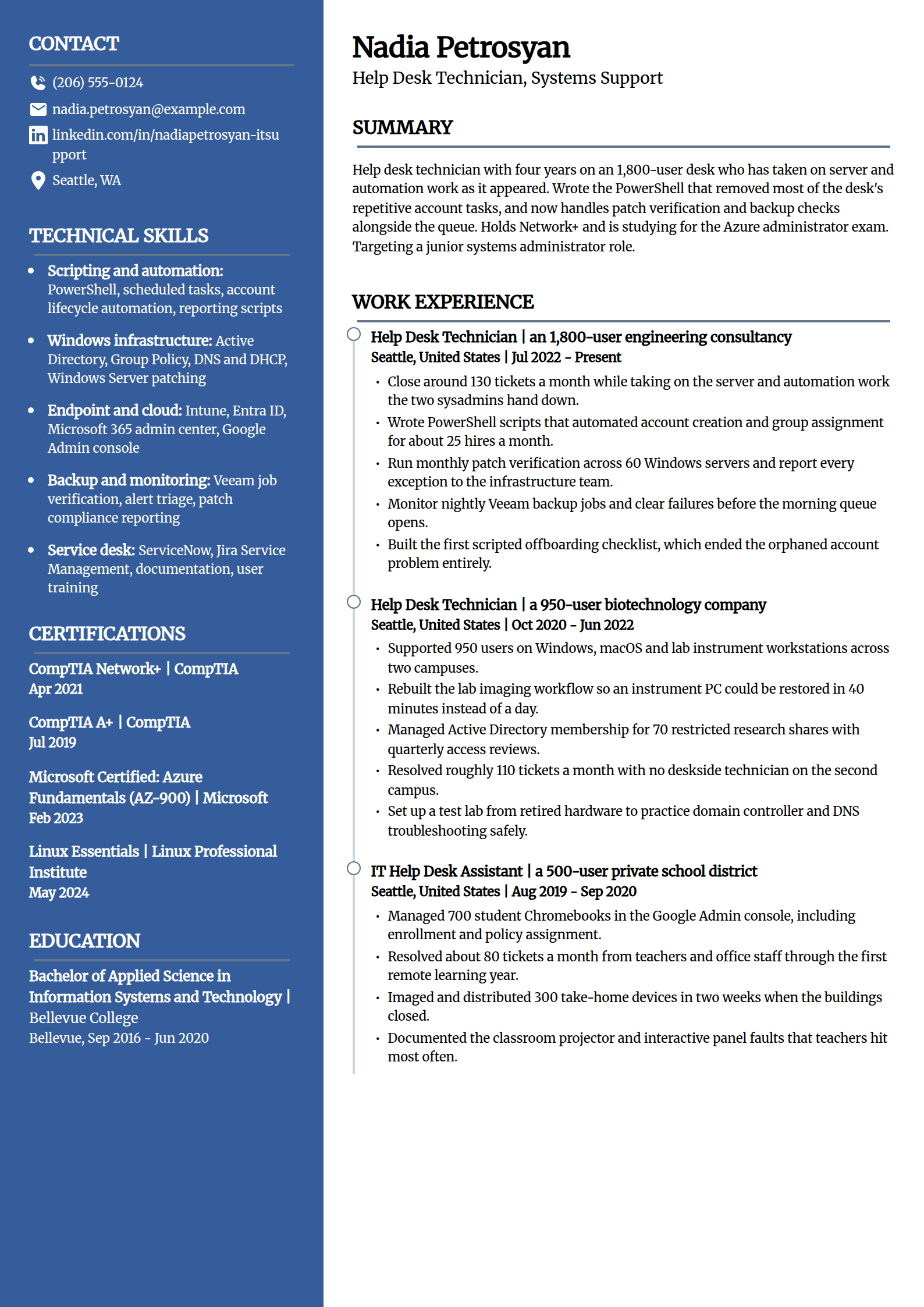
Help Desk to Systems Administration Resume Template
Why this resume example works?
- Stays a help desk resume while showing the server work, which is what makes the next step believable rather than aspirational.
- Names the automation concretely, PowerShell for account creation and group assignment, with the volume it covers.
- Includes patch verification and backup job monitoring, the two tasks a junior administrator inherits first.
- Mentions a home test lab for domain controller practice, which reads as genuine curiosity rather than filler.
- Lists Linux Essentials alongside the Windows certifications, since most infrastructure teams run both.
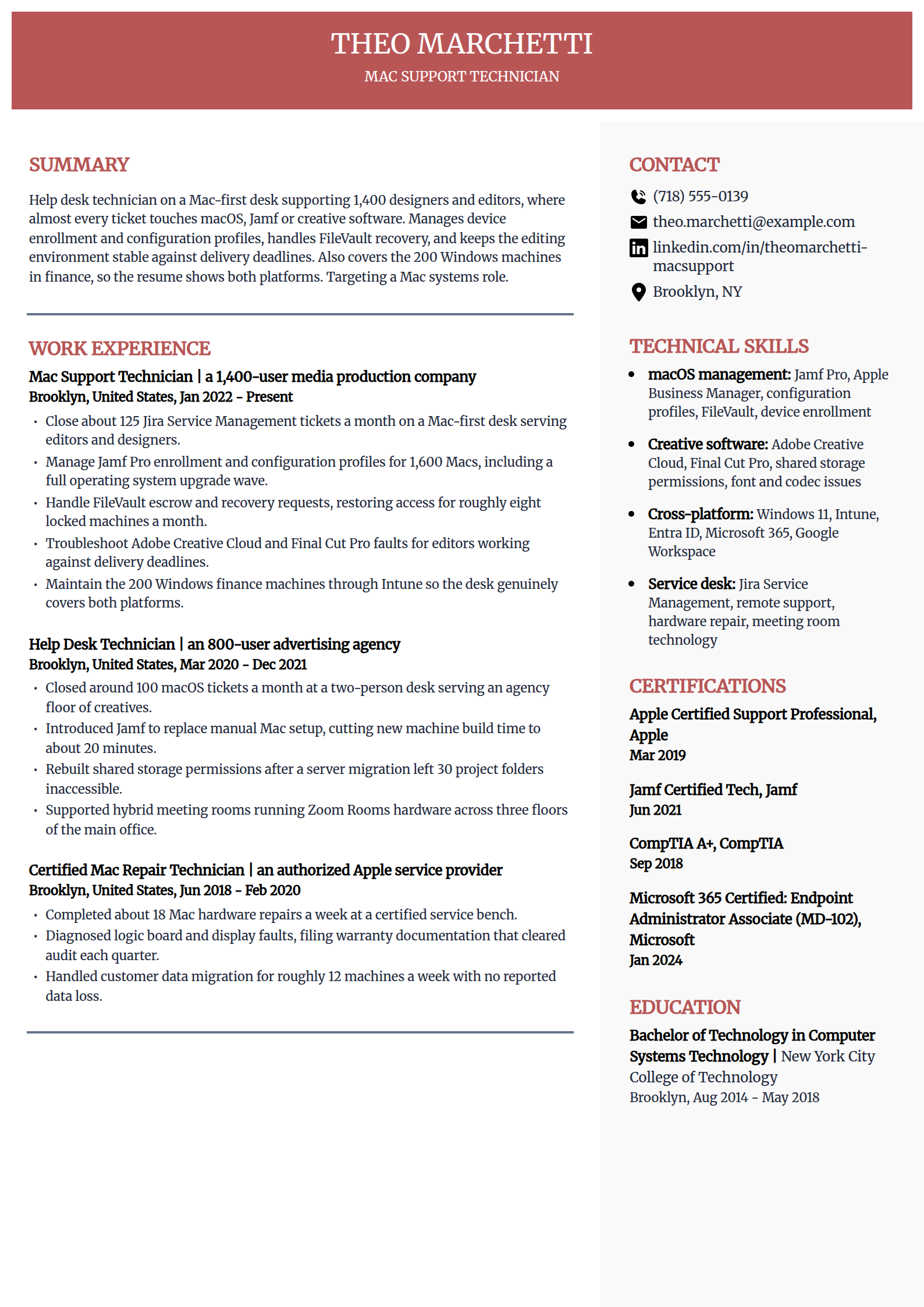
Mac Support Technician Resume Template
Why this resume example works?
- Says Mac-first in the opening line, because a creative studio and a Windows shop are not the same job market.
- Names Jamf Pro, Apple Business Manager and FileVault outright, which is what a Mac desk posting searches on.
- Keeps the Windows machines in finance on the page, so the resume is not locked out of mixed environments.
- Includes creative software support, Adobe and Final Cut, because that is most of the ticket volume in this setting.
- Starts the history at an authorized service bench, where hardware depth on Apple equipment actually comes from.
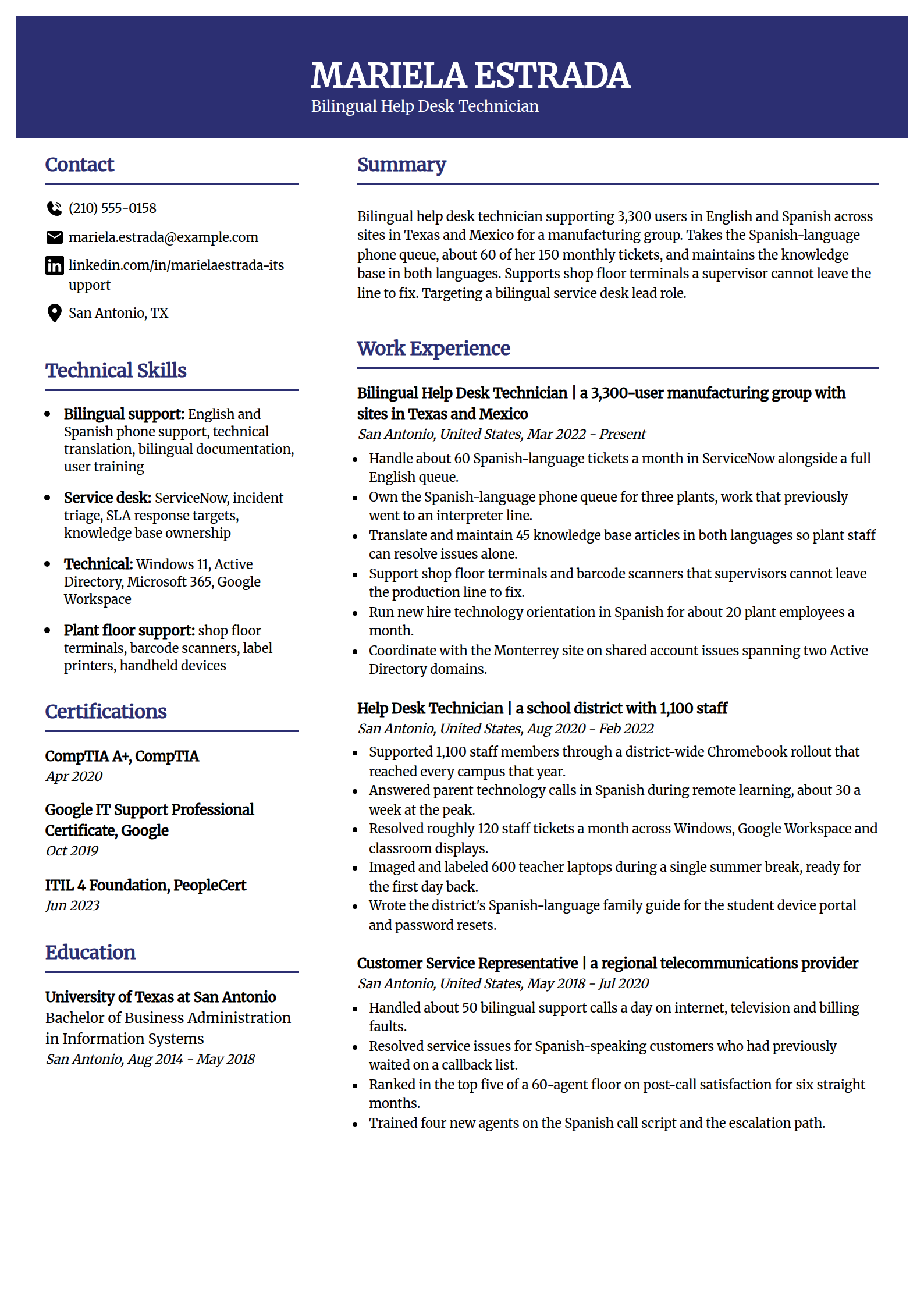
Bilingual Help Desk Technician Resume Template
Why this resume example works?
- Quantifies the second language instead of listing it, with the share of monthly tickets handled in Spanish.
- Shows the queue being brought in-house from an interpreter line, which puts a cost against the skill.
- Counts knowledge base articles maintained in both languages, documentation work only a bilingual technician can do.
- Includes shop floor terminals and scanners, the plant hardware a generic help desk resume never mentions.
- Keeps cross-border coordination on the page, since two Active Directory domains is a real technical detail.
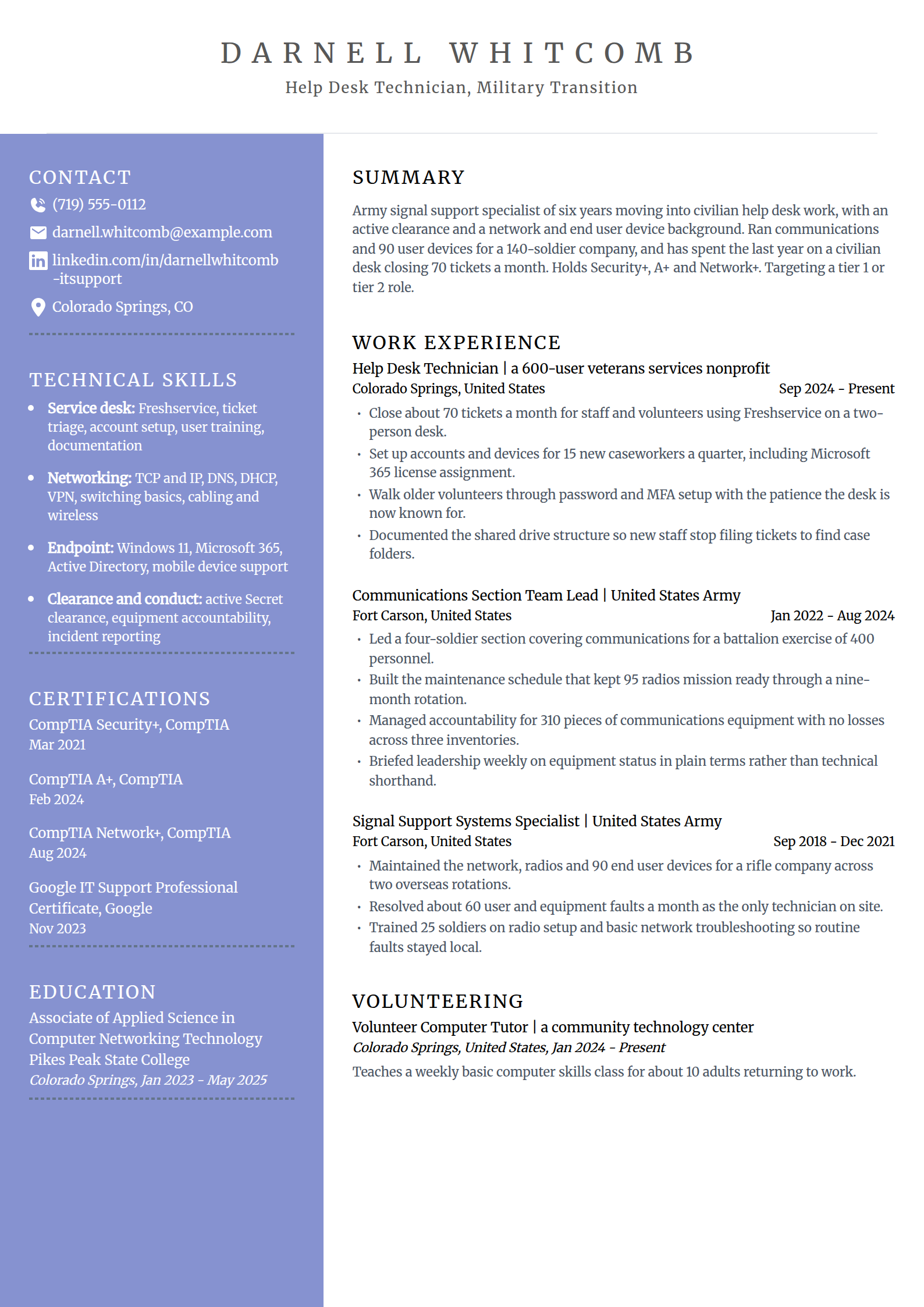
Veteran Transition Help Desk Resume Template
Why this resume example works?
- Translates the military record into civilian terms: devices supported, faults resolved, people trained.
- Puts a current civilian desk role at the top, which answers the only real doubt about a transitioning candidate.
- States the clearance plainly, because for many contractor desks it is the single most valuable line on the page.
- Uses equipment accountability as the proof of process discipline rather than claiming attention to detail.
- Leads with certifications, since Security+ and A+ are what a civilian screener recognizes immediately.
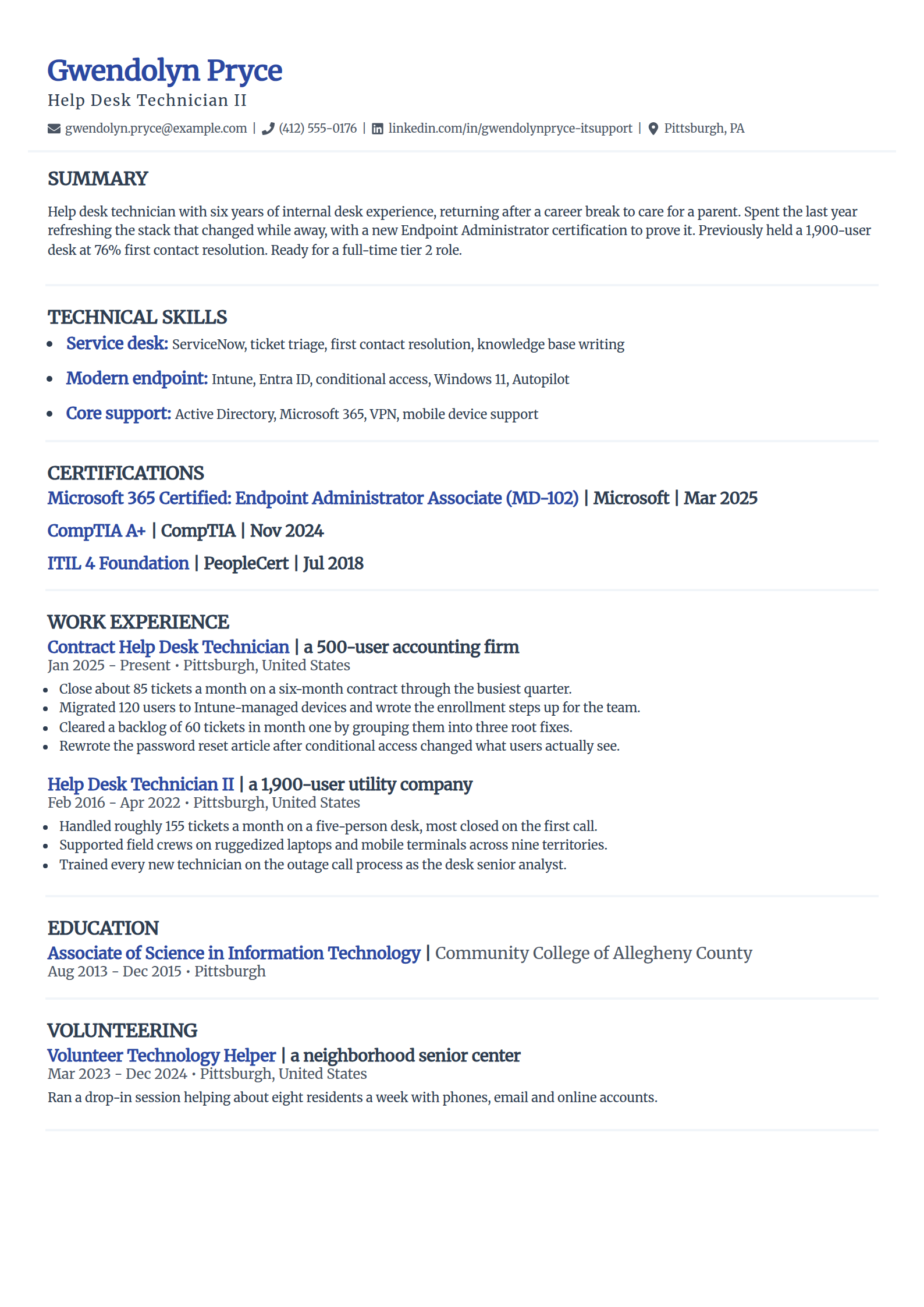
Returning to Help Desk Resume Template
Why this resume example works?
- Names the break and its reason in the summary, so nobody has to guess at the gap in the dates.
- Answers the currency question first with a new endpoint administrator certification earned this year.
- Uses a short contract role to prove recent hands-on work rather than asking the reader to assume skills carried over.
- Keeps the six-year record intact, because a 1,900-user desk is still the strongest thing on the page.
- Shows the stack that changed during the break being learned deliberately: Intune, Entra ID, conditional access.
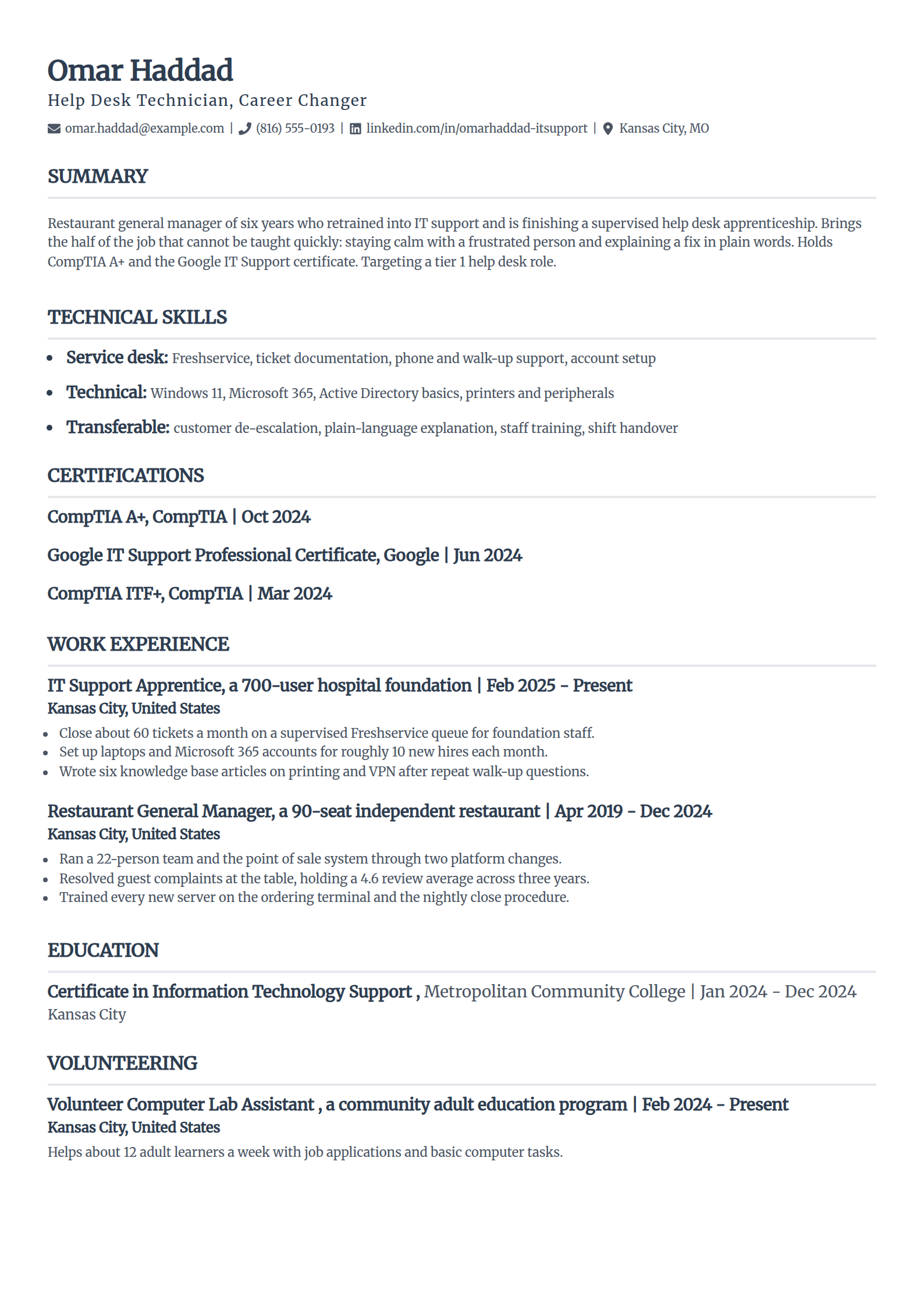
Career-Change Help Desk Resume Template
Why this resume example works?
- Puts the certifications above the work history, the one case where that order is right.
- Leads with the supervised apprentice queue rather than the restaurant years, so the page reads forward.
- Translates the old job into desk language: de-escalation, plain explanation, training people on a terminal.
- Keeps the point of sale platform changes visible, because that is genuine systems experience under pressure.
- Holds every bullet to one line, which is what the tightest layouts need to stay on a single page.
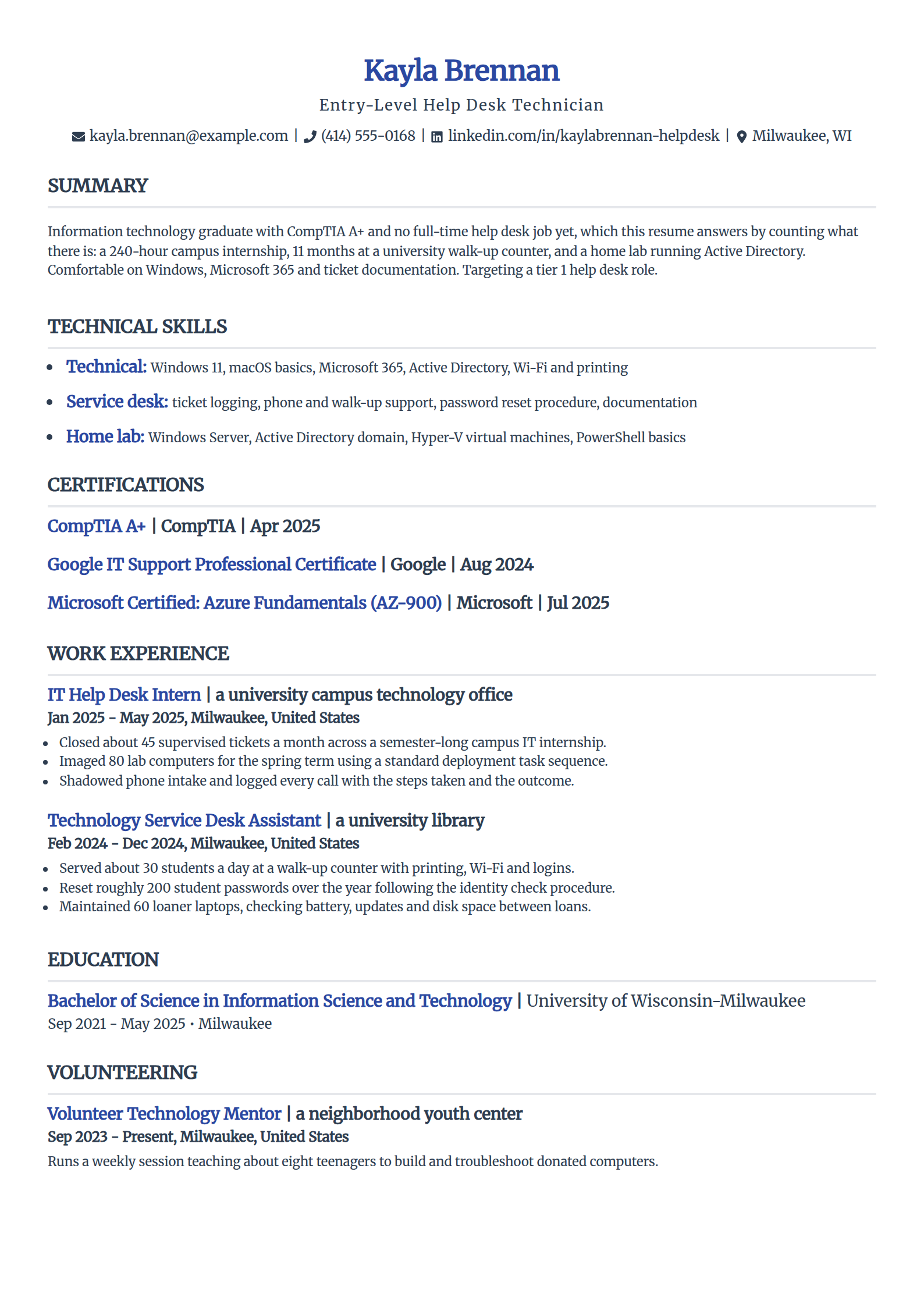
Entry-Level Help Desk Resume Template
Why this resume example works?
- Says there is no full-time desk job yet and then counts what there is, which is more convincing than hiding it.
- Uses internship hours and supervised ticket volume as real numbers, because they are the only volume at this stage.
- Puts CompTIA A+ above the work history, the correct order when the certification is the strongest line on the page.
- Lists the home lab as its own skill group, naming Active Directory and Hyper-V rather than saying self-taught.
- Keeps the walk-up counter job on the page, since 30 students a day is customer-facing technical work.
Build your help desk resume
Pick a template above and the editor keeps the layout clean and ATS-safe while you swap in your own tier, tool stack and ticket numbers.
Build my resumeHow to write a help desk resume in 2026
Two people read this resume. A recruiter matches your technical skills block against the tool names in the posting, then the desk manager checks whether the numbers you report look like their desk. Write for both, in that order.
Open your ticketing system before you write a word
This is the one thing that separates a help desk resume that gets a call from one that reads like every other. Your own system already holds numbers nobody else can claim, and almost no published example uses them.
Pull these, then put them in the summary and the bullets:
- Tickets closed per week or per month, and the size of the queue you carry.
- First contact resolution rate, which is the single most recognized help desk metric there is.
- Average first response or handle time, and how it sits against the response target you work to.
- Users supported, sites or stores covered, and for managed services, client tenants.
- Devices imaged or deployed, accounts provisioned, and knowledge base articles written.
Say which tier and which support model, because they are different jobs
A resume that just says help desk technician makes a manager guess. Tier 1 is volume, triage and resolution against a target; tier 2 and 3 is escalation ownership, endpoint management and root cause.
Tier 2 Help Desk Technician | 3,800-user manufacturer, 11 sites | escalation owner for endpoint and identity
Then say how the support reaches the user, because each one is screened differently:
- Deskside or onsite, where imaging, hardware and walking a building are the work.
- Remote or distributed, where identity verification, voice-led troubleshooting and device shipping are the work.
- Managed services, where tenant count and switching between client stacks is the work.
- Internal single-site, where you are often the only technician and own more than tickets.
Name the stack exactly as the posting names it
Help desk postings are written as tool lists, so a technical skills block near the top does more work here than on most resumes. Match the posting's phrasing rather than a generic category.
Group the names instead of running one long line:
- Ticketing and ITSM: ServiceNow, Jira Service Management, Freshservice, Zendesk or Ivanti, whichever you have used.
- Identity: Active Directory, Entra ID, Okta, MFA enrollment, conditional access, group membership.
- Endpoint: Intune, Autopilot, SCCM or MECM, Jamf Pro, Windows 11, macOS, BitLocker or FileVault.
- Productivity and collaboration: Microsoft 365, Google Workspace, Exchange Online, Teams, meeting room hardware.
- Networking basics the desk actually touches: DNS, DHCP, VPN, wireless and printing.
Put certifications above your work history only when they are the strongest thing you have
CompTIA A+ is the certification help desk postings name most, with ITIL 4 Foundation and the Google IT Support certificate close behind, and Microsoft endpoint administrator above them for tier 2 work.
Where the block goes depends on what you are selling. On this page twelve examples keep certifications below the work history and four put them above:
- Above the work history if you have no full-time desk job yet, are changing careers, are transitioning out of the military, or are returning after a break.
- Below it once you have a year or more on a desk, because by then the ticket numbers are the stronger argument.
- Always with the issuing body and the date, since a recruiter checks whether a certification is current.
- Never padded with every course you have ever opened. Three to four relevant entries read stronger than ten.
Keep it to one page in a layout a portal can parse
One page covers every help desk resume including the nine-year example above. If none of the sixteen layouts suits you, the resume templates hub carries the full ATS-friendly set.
Applicant portals parse the file before a person opens it, so keep the layout plain:
- Standard section headings in the order a recruiter reads them.
- A single column, or a clean two-column layout.
- Real text rather than text inside images.
- Consistent date formats down the whole page.
- If you are running out of room, trim the oldest roles to two bullets rather than cutting the skills block.
Common help desk resume mistakes
- Writing a summary with no numbers in it. Published help desk examples open with words like focused, ambitious, persistent and adept, and then say nothing measurable. Your ticketing system reports volume, first contact resolution and response time; a desk manager reads a resume without them as someone who never looked.
- Naming technology that is no longer in service. Example pages still publish Windows XP, DNS and WINS as a skills line. Listing dead technology dates you instantly. Name what the posting names: Intune, Entra ID, Jamf, ServiceNow, Autopilot.
- Leaving the tier and the support model off. Tier 1 and tier 2 are different screens, and deskside, remote and managed services desks are different jobs. A reader who cannot tell which one you have done assumes the easiest.
- Listing customer service as a personality trait. Every applicant writes it. Show it instead: calls handled a day, satisfaction scores from the post-ticket survey, non-technical users walked through a fix by phone.
- Burying the tools in paragraphs. A recruiter matches a posting's tool names against your resume in a few seconds. Group them in a skills block near the top, using the posting's own phrasing rather than generic categories.
Frequently asked questions
What should a help desk resume include?
A help desk resume needs a three-to-four-sentence summary that names your tier, support model and ticket volume, a grouped technical skills block directly under it, a work history written in numbers your ticketing system reports, certifications, and education. The skills block should group ticketing and ITSM platforms, identity tools, endpoint management, productivity suites and the networking basics the desk touches, using the same phrasing as the posting. The work history should count tickets closed, first contact resolution, users supported, devices deployed and accounts provisioned, rather than describing duties. One page is enough at any level.
How do you write a help desk resume with no experience?
Count what you have instead of apologizing for what you do not. Internship hours, supervised ticket volume, a campus walk-up counter, lab machines imaged, student passwords reset following an identity procedure and devices maintained are all real support work, and each one carries a number. A home lab belongs on the page as its own skills group, named properly: Windows Server, an Active Directory domain, virtual machines, PowerShell. Put CompTIA A+ above your work history, because at this stage the certification is the strongest line you have. Retail, food service and call center jobs stay on the page as evidence of handling frustrated people.
What skills should you put on a help desk resume?
Group them the way a posting is written rather than listing traits. Ticketing and ITSM covers ServiceNow, Jira Service Management, Freshservice, Zendesk or Ivanti, plus incident triage and escalation notes. Identity covers Active Directory, Entra ID, Okta, MFA enrollment and group membership. Endpoint covers Intune, Autopilot, SCCM or MECM, Jamf Pro, Windows 11, macOS and disk encryption. Productivity covers Microsoft 365 or Google Workspace, Exchange Online and Teams. Add the networking basics a desk actually touches: DNS, DHCP, VPN, wireless and printing. Name only what you have used, because the interview goes straight to this list.
Is CompTIA A+ enough to get a help desk job?
A+ is the certification help desk postings name most often, and it is usually enough to clear the first screen for a tier 1 role, but on its own it rarely wins the job. What turns it into an interview is evidence that you have done support work with it: an internship, a campus or library service desk, a repair bench, volunteer technology help, or a home lab you can talk about in detail. Pair it with ITIL 4 Foundation or the Google IT Support certificate if you are aiming at a structured service desk, and with the Microsoft endpoint administrator track if you are aiming past tier 1.
What is the difference between a tier 1 and a tier 2 help desk resume?
A tier 1 resume is written around volume and resolution. It leads with tickets closed, first contact resolution, response time against the target, and the account and password work that makes up most of the queue. A tier 2 resume is written around ownership and depth. It leads with escalated tickets taken from tier 1 through to root cause, endpoint management work such as Intune policy and imaging failures, and the problem records or documentation that stop the same ticket coming back. A tier 2 resume still shows its tier 1 years, because that is where the depth is proven to have come from.
How long should a help desk resume be?
One page, including technicians with nine or more years on a desk. Hiring for this role happens on the tool stack, the certifications and a handful of numbers, and all three fit on a page; every example here is one page, including a senior technician with two degrees and four certifications. If you are running out of room, cut unrelated early jobs and trim the oldest technical roles to two bullets rather than shrinking the font or dropping the skills block. The skills block is the part a recruiter matches against the posting, so it is the last thing to go.
More help desk resume resources
Build your help desk resume
Pick a template above and the editor keeps the layout clean and ATS-safe while you swap in your own tier, tool stack and ticket numbers.