18 Customer Service Resume Examples, Call Center to CSM
- ATS Friendly
- Support Specific
- 18 Sub-Role Examples
A customer service resume example should open with your title and the channels you work, then prove it with the numbers a support manager tracks: contacts a shift, first-contact resolution, satisfaction scores, and the platforms you use named outright. The 18 below do that for one specific job each, from a call center floor to a hotel front desk, so you can start from the closest match.


540k+ resumes created
Editable customer service resume templates
Every template below is a real support resume laid out in that format, filtered by what matters to you. Pick one, then swap in your own channel, tools, and numbers. All of them keep your contact details and dates where an applicant tracking system expects to find them.
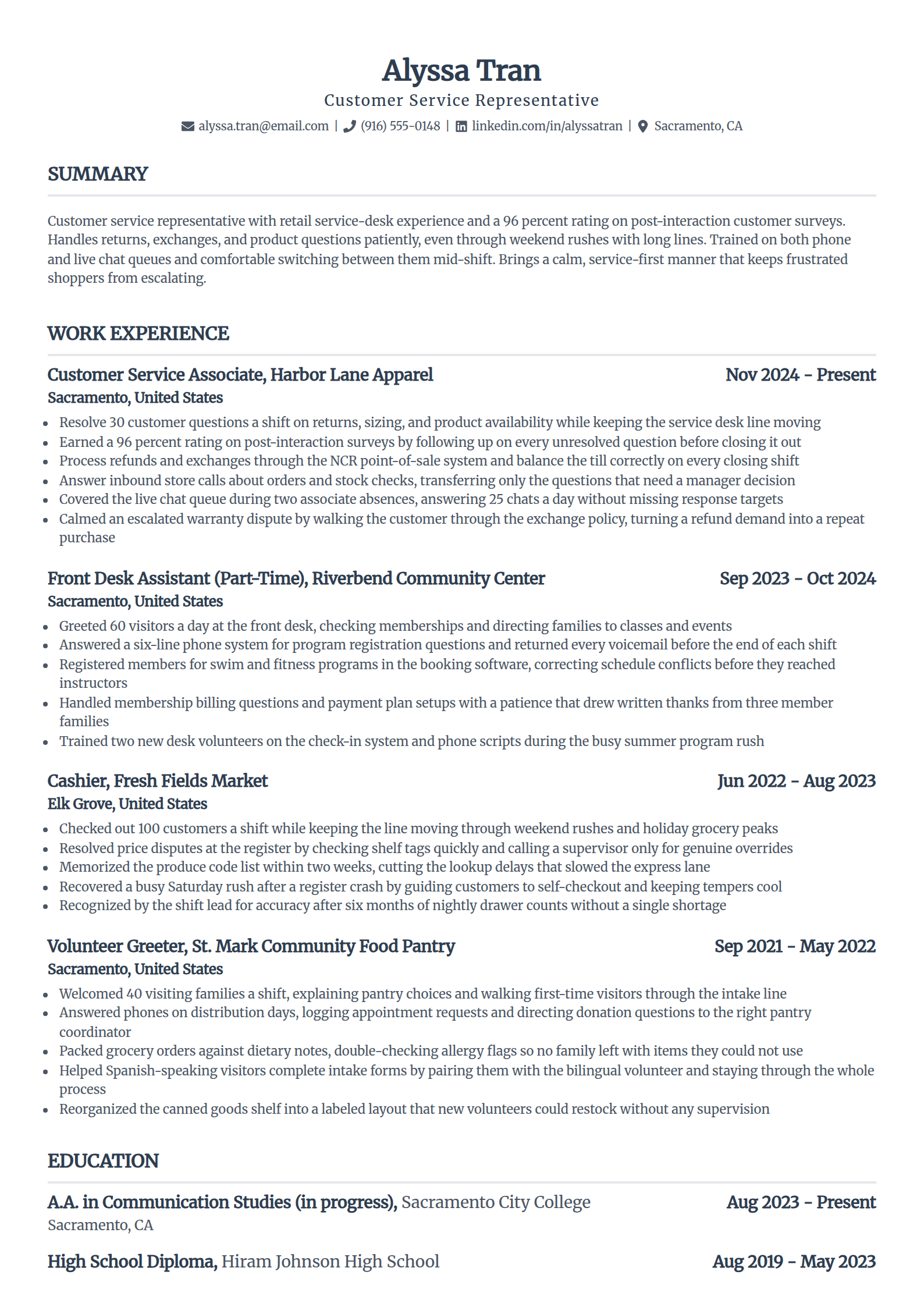
Entry-Level Customer Service Resume Template
Why this resume example works?
- Names the exact title in the first clause so a recruiter frames the whole resume as support work.
- Turns limited experience into proof with one number, the 96% survey rating, instead of vague enthusiasm.
- Lists the real tasks, returns and product questions, that a support posting screens for.
- States the channels it is ready for, phone and chat, so the fit is obvious.
- Keeps a calm, service-first tone that reads like someone who can take the call.
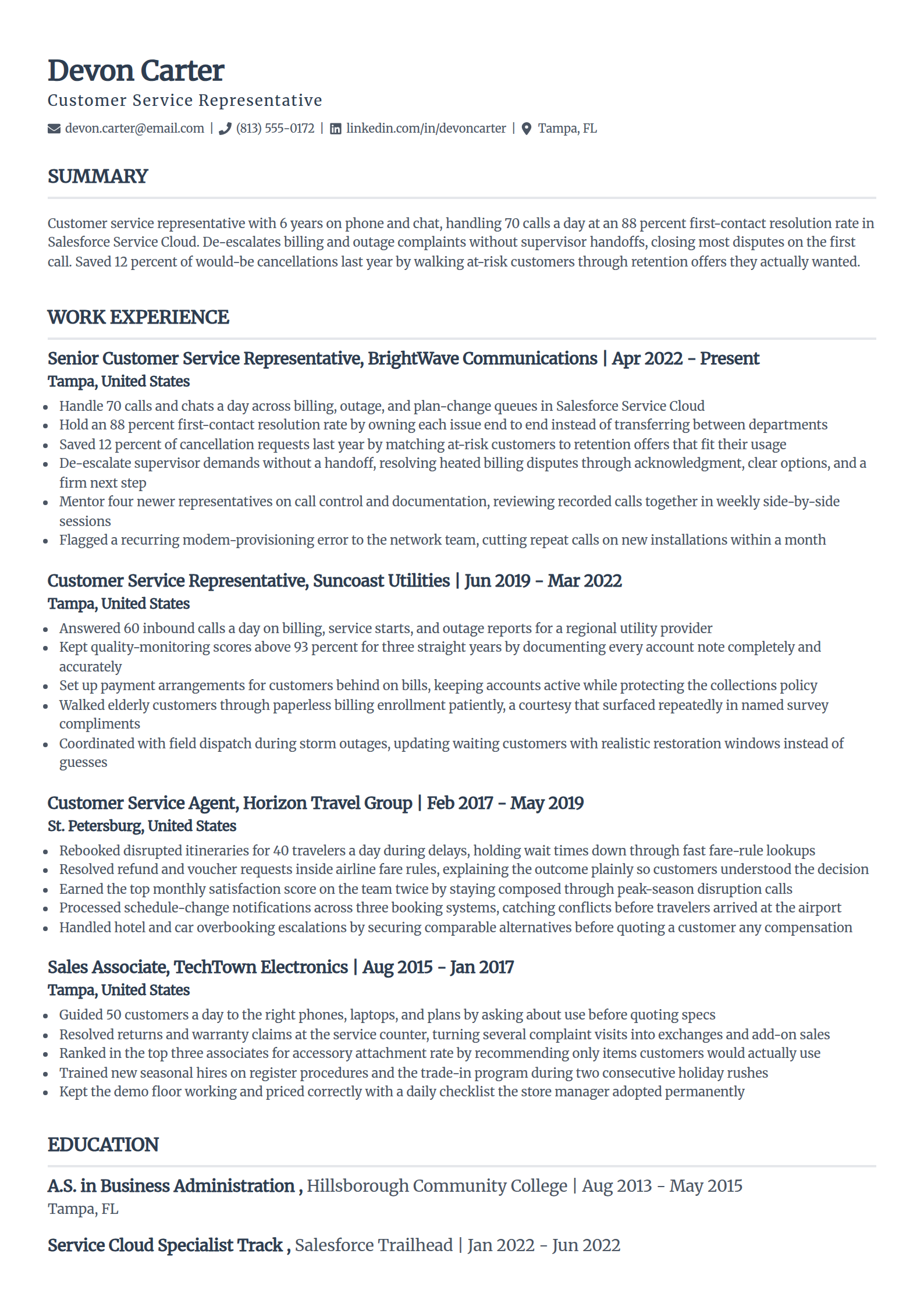
Experienced Customer Service Representative Resume Template
Why this resume example works?
- Leads with call volume and a first-contact resolution rate, the two numbers a hiring manager scans for.
- Names the CRM by name, Salesforce Service Cloud, which an ATS keyword match rewards.
- Shows judgment, de-escalating without a supervisor, that separates an experienced rep from a new hire.
- Ends on a business result, saving cancellations, not a list of duties.
- Reads like a full three sentences of proof with no filler.
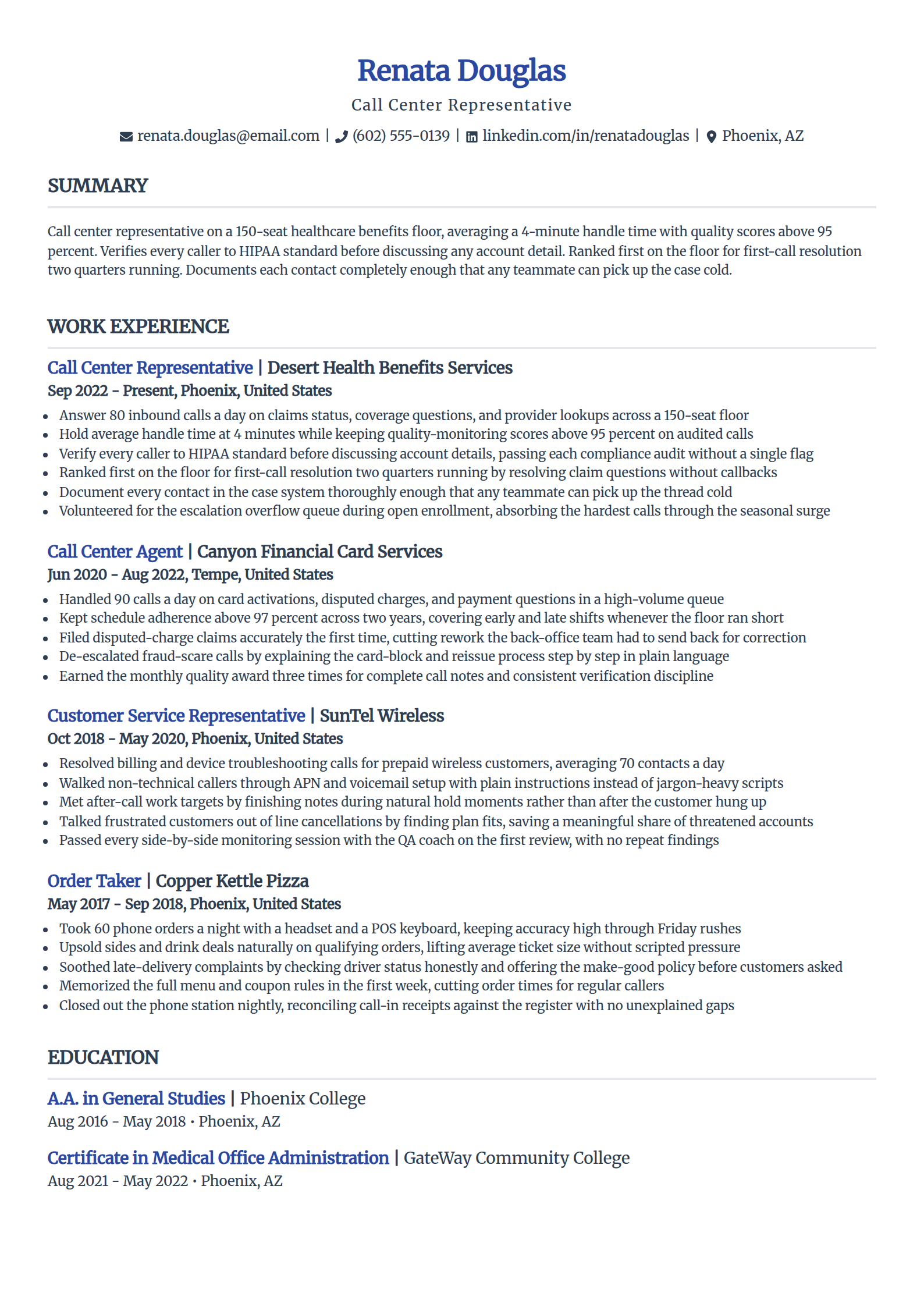
Call Center Representative Resume Template
Why this resume example works?
- Puts the title and the floor size up front so the scale of the environment is clear.
- Pairs speed, a 4-minute handle time, with quality above 95% so neither looks gamed.
- Names HIPAA-standard verification, the compliance signal a healthcare center needs.
- Carries a ranking result, top first-call resolution, that is concrete and checkable.
- Keeps the documentation habit visible, which quality teams weigh heavily.
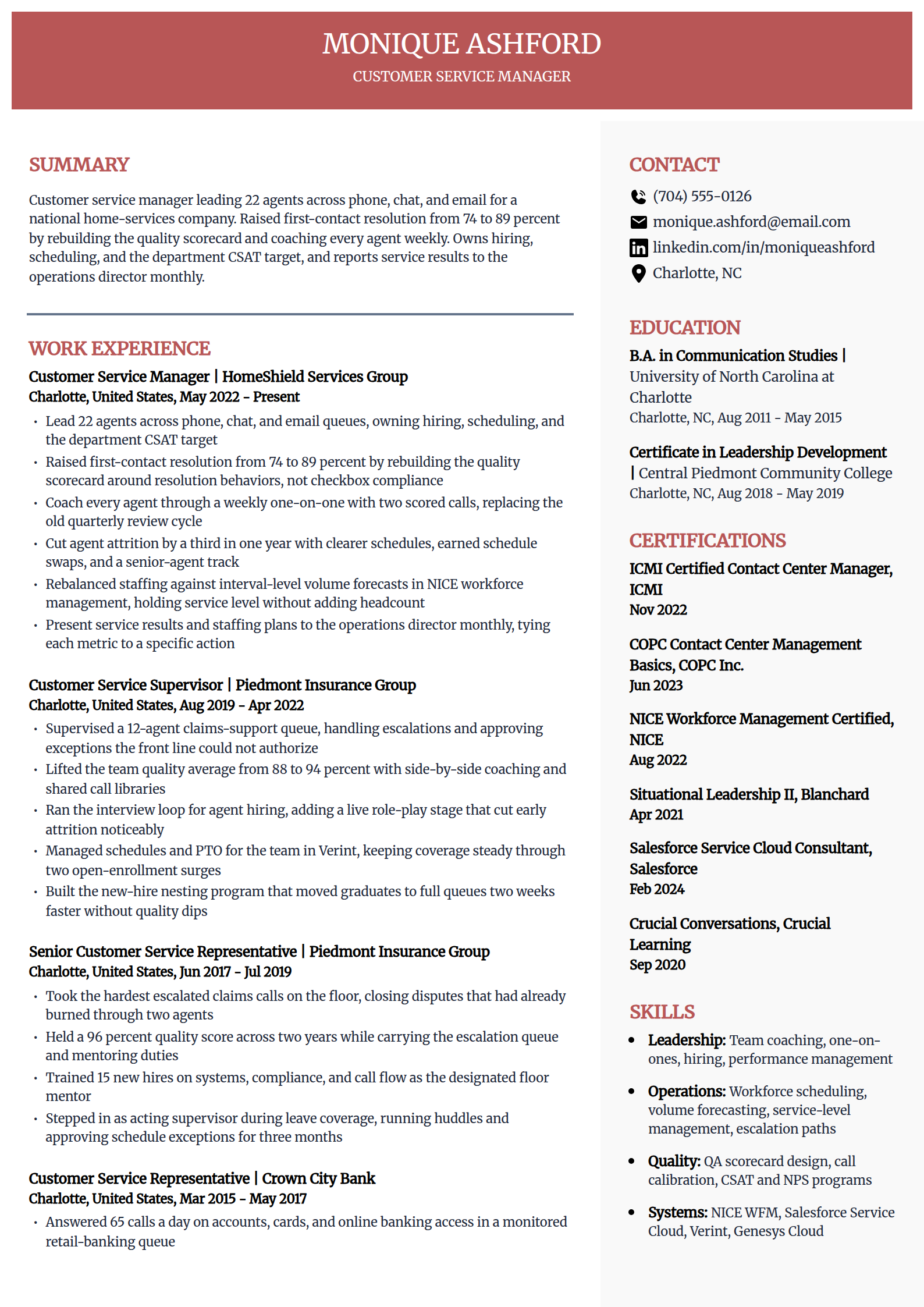
Customer Service Manager Resume Template
Why this resume example works?
- Separates the leadership scope, 22 agents across three channels, from individual-contributor work.
- Shows a before-and-after result, resolution from 74% to 89%, tied to a specific action.
- Names the levers a manager actually pulls: the scorecard and weekly coaching.
- Claims ownership of hiring, scheduling, and CSAT, the manager's real accountability.
- Keeps the numbers credible by tying each one to how it moved.
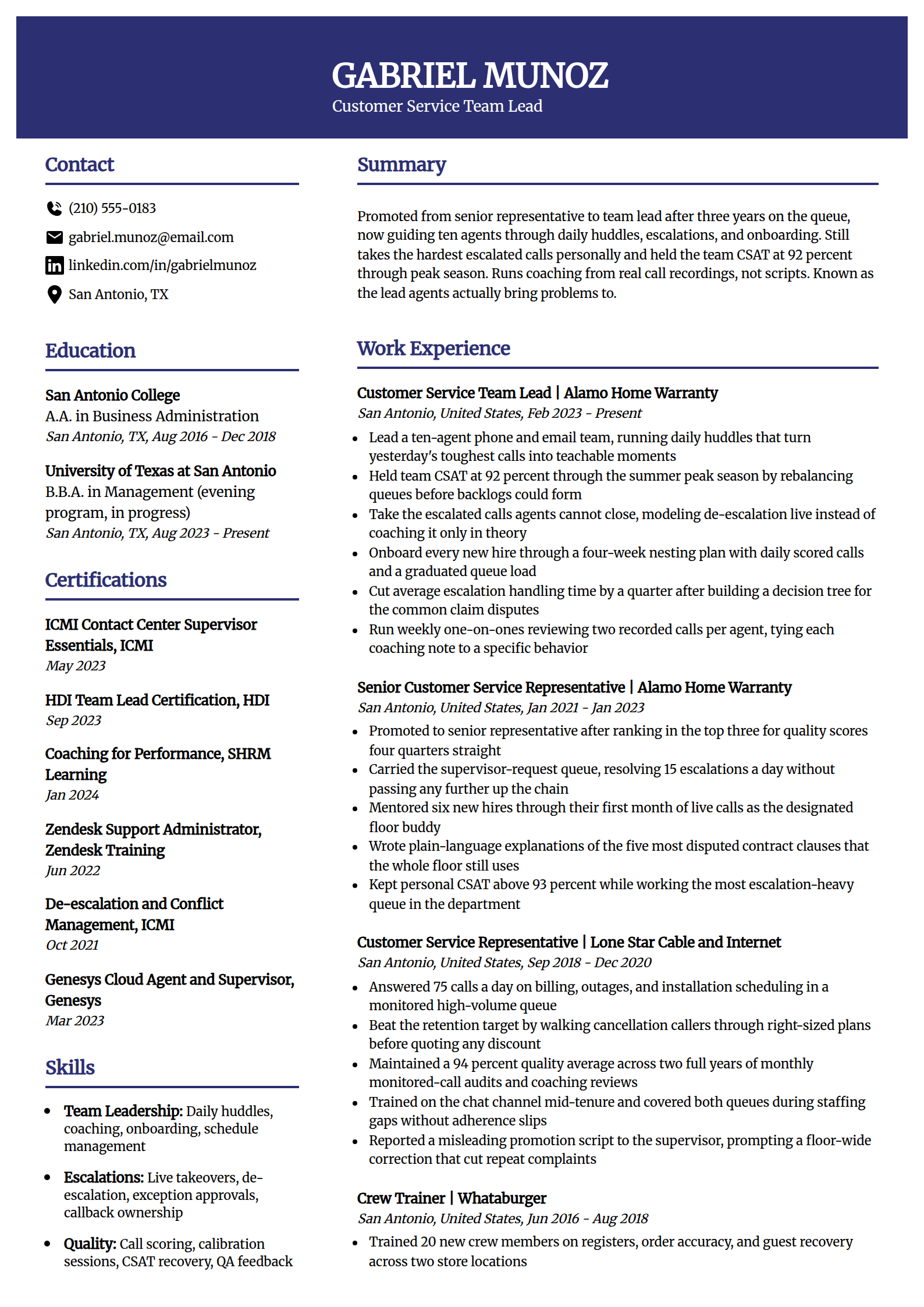
Customer Service Team Lead Resume Template
Why this resume example works?
- Opens with the promotion, signaling the company already trusts this person to lead.
- Shows the lead still works the queue, taking escalations, which frontline teams respect.
- Carries a result under pressure, a 92% score through peak season.
- Names the daily work of a lead: huddles, escalations, and onboarding.
- Leads with a verb, promoted, instead of the standard role-with-number opener.
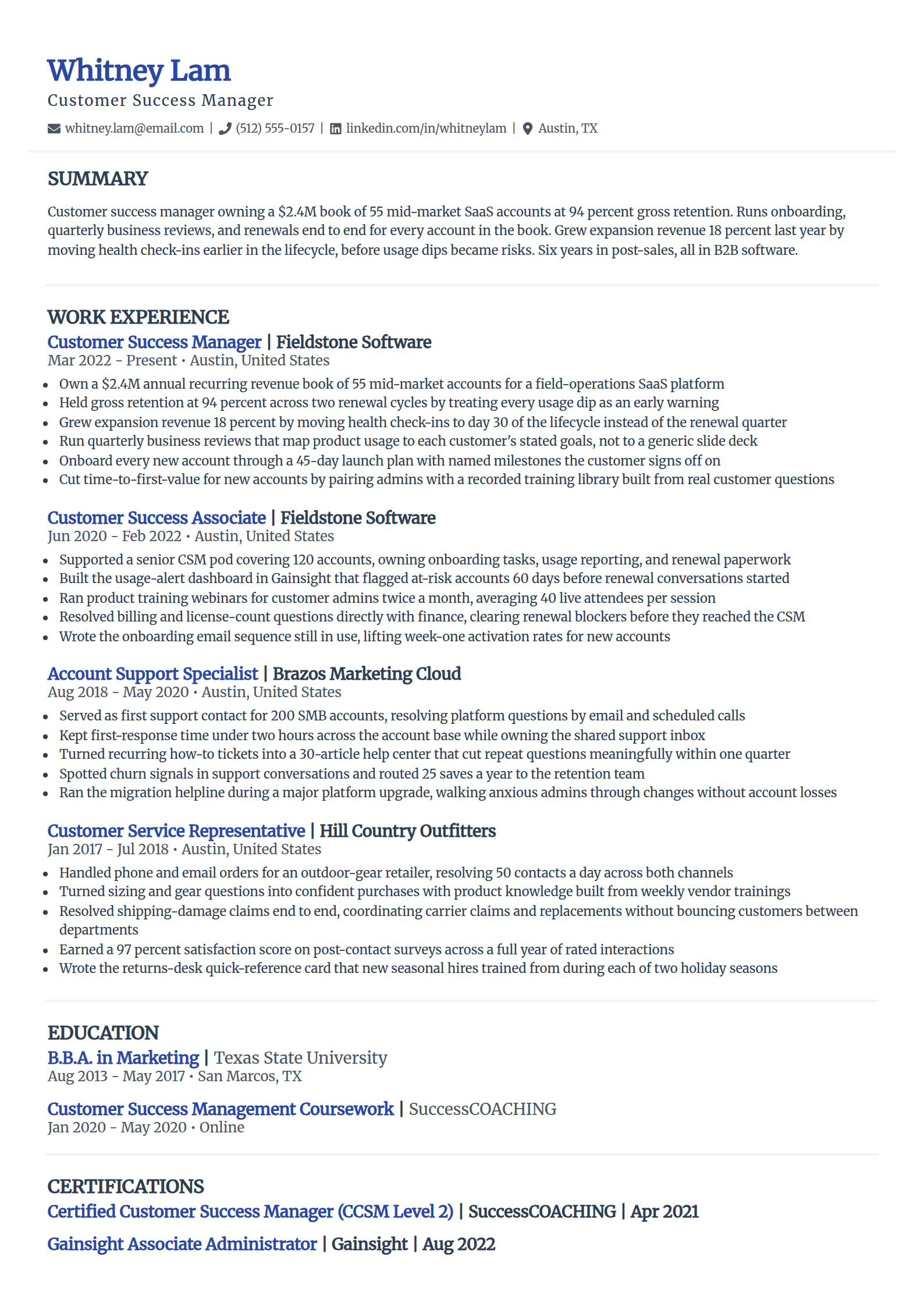
Customer Success Manager Resume Template
Why this resume example works?
- Leads with the two numbers success teams hire on: book size and retention rate.
- Names the success motions, onboarding, business reviews, and renewals, in plain terms.
- Shows expansion, not just retention, which is the harder half of the job.
- Ties the expansion result to a real behavior, earlier check-ins.
- Keeps the SaaS and mid-market context so the fit is unambiguous.
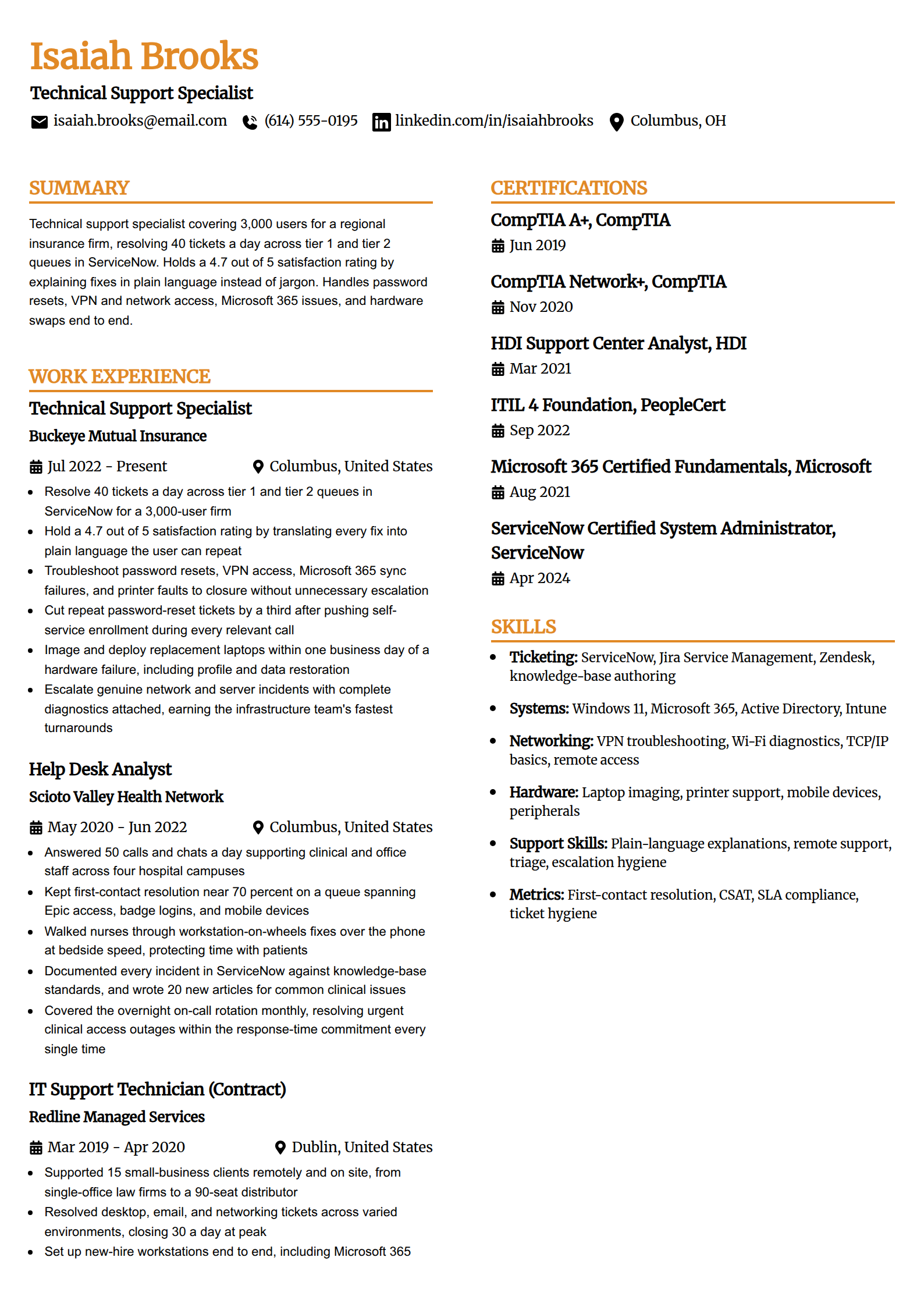
Technical Support & Help Desk Resume Template
Why this resume example works?
- Names the user base and the ticket tool, ServiceNow, both of which postings screen for.
- Quantifies throughput, 40 tickets a day, without hiding the queue tiers it covers.
- Highlights plain-language explanation, the skill that separates support from IT.
- Carries a satisfaction number, 4.7 out of 5, on the work that matters.
- Lists the actual issues it resolves so the scope is concrete.
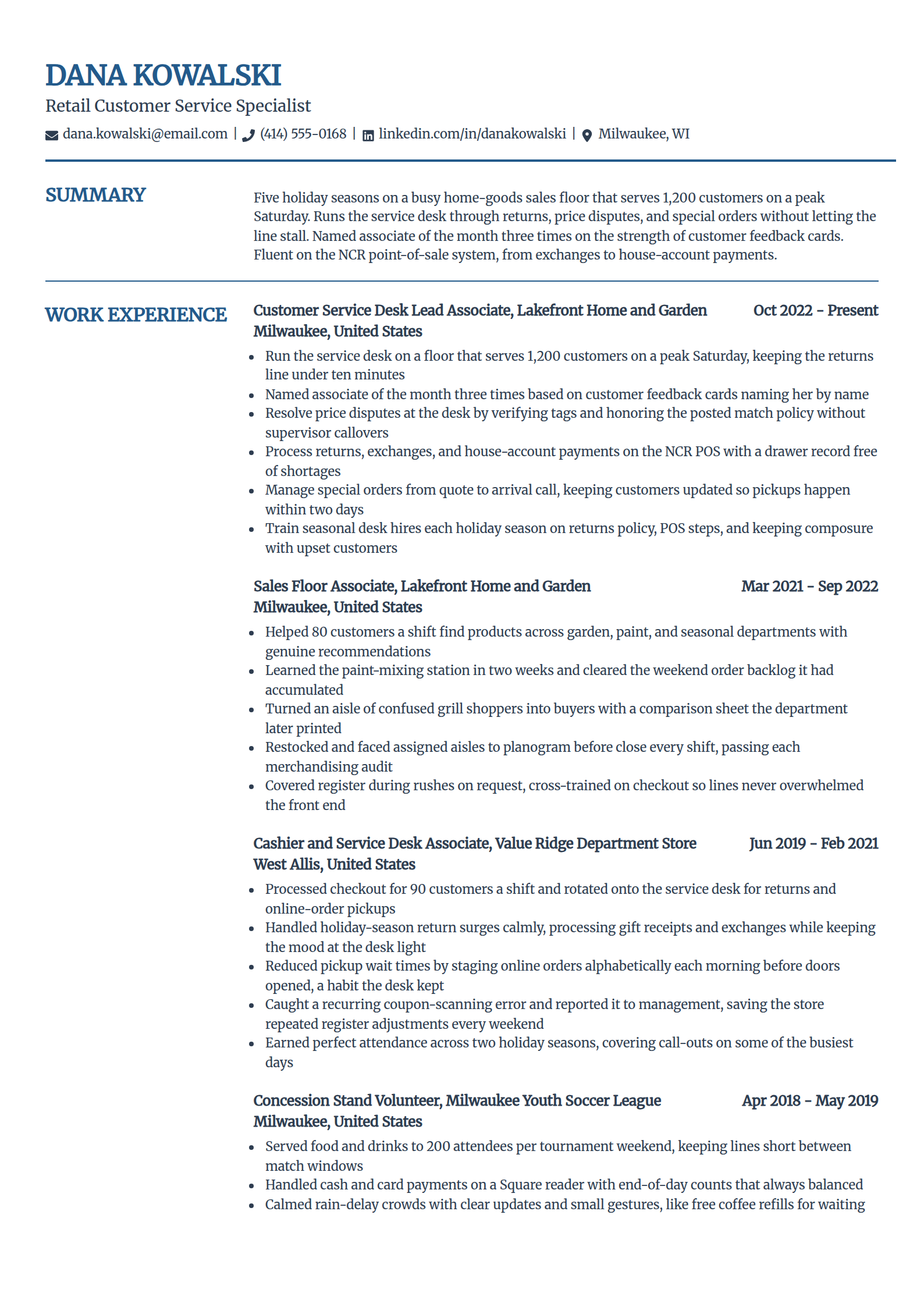
Retail Customer Service Resume Template
Why this resume example works?
- Leads with the setting and the peak-season volume instead of a job title, for variety.
- Shows retail-specific tasks: returns, price disputes, and special orders.
- Carries a recognition result, associate of the month, tied to feedback.
- Names the POS system, the tool a retail hiring manager expects.
- Keeps a grounded tone that fits a busy floor, not a corporate desk.
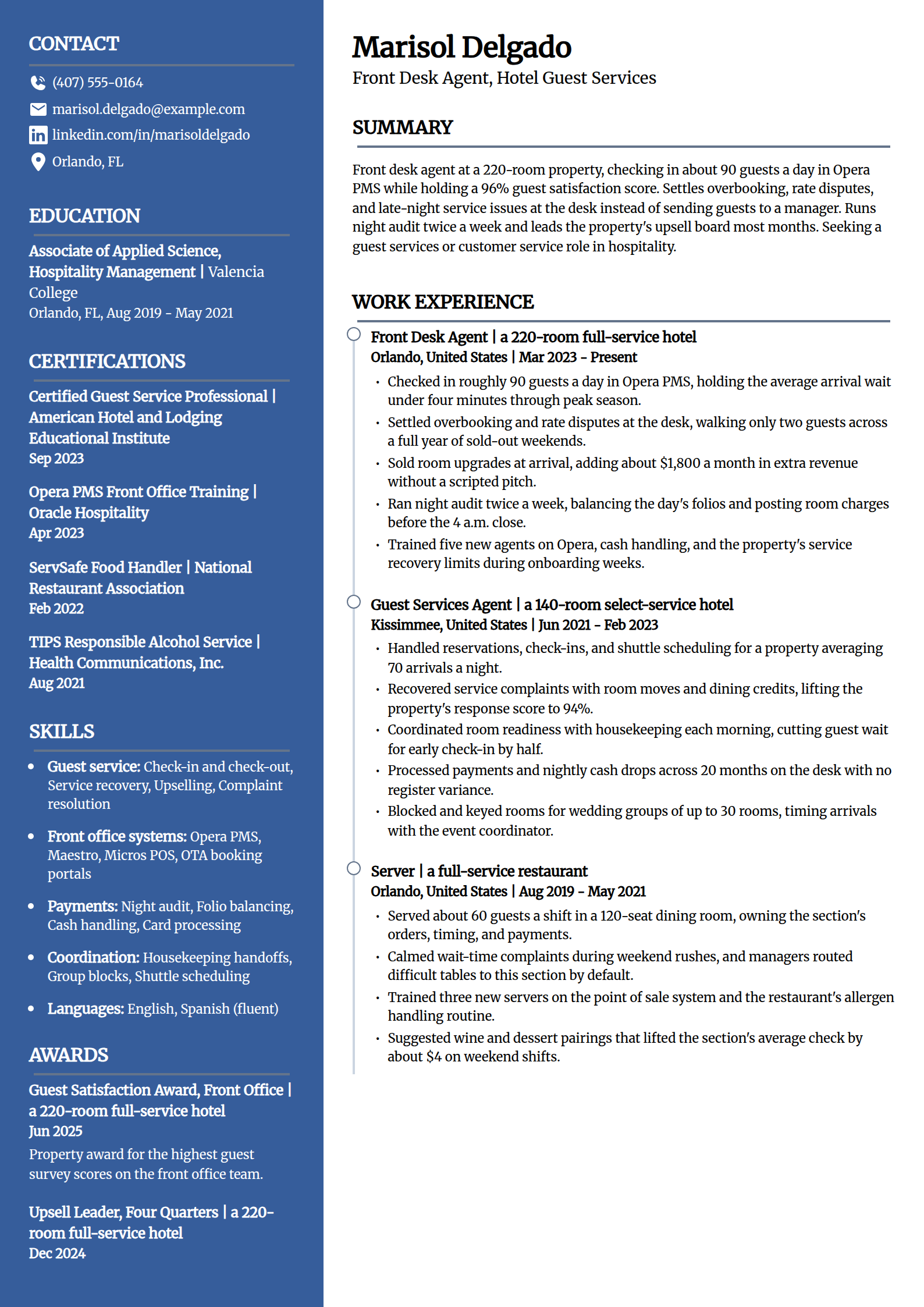
Hotel Front Desk & Guest Services Resume Template
Why this resume example works?
- Names Opera PMS the way the other examples name Zendesk, because hospitality postings screen for the property system.
- Sizes the property and the arrivals, 220 rooms and about 90 check-ins a day, the front desk version of call volume.
- Proves service recovery with a hard number, only two guests walked across a year of sold-out weekends.
- Carries a revenue result an agent can honestly own, about $1,800 a month in upgrades sold at arrival.
- Keeps night audit and cash handling visible, the back-office half of the job no other example here covers.
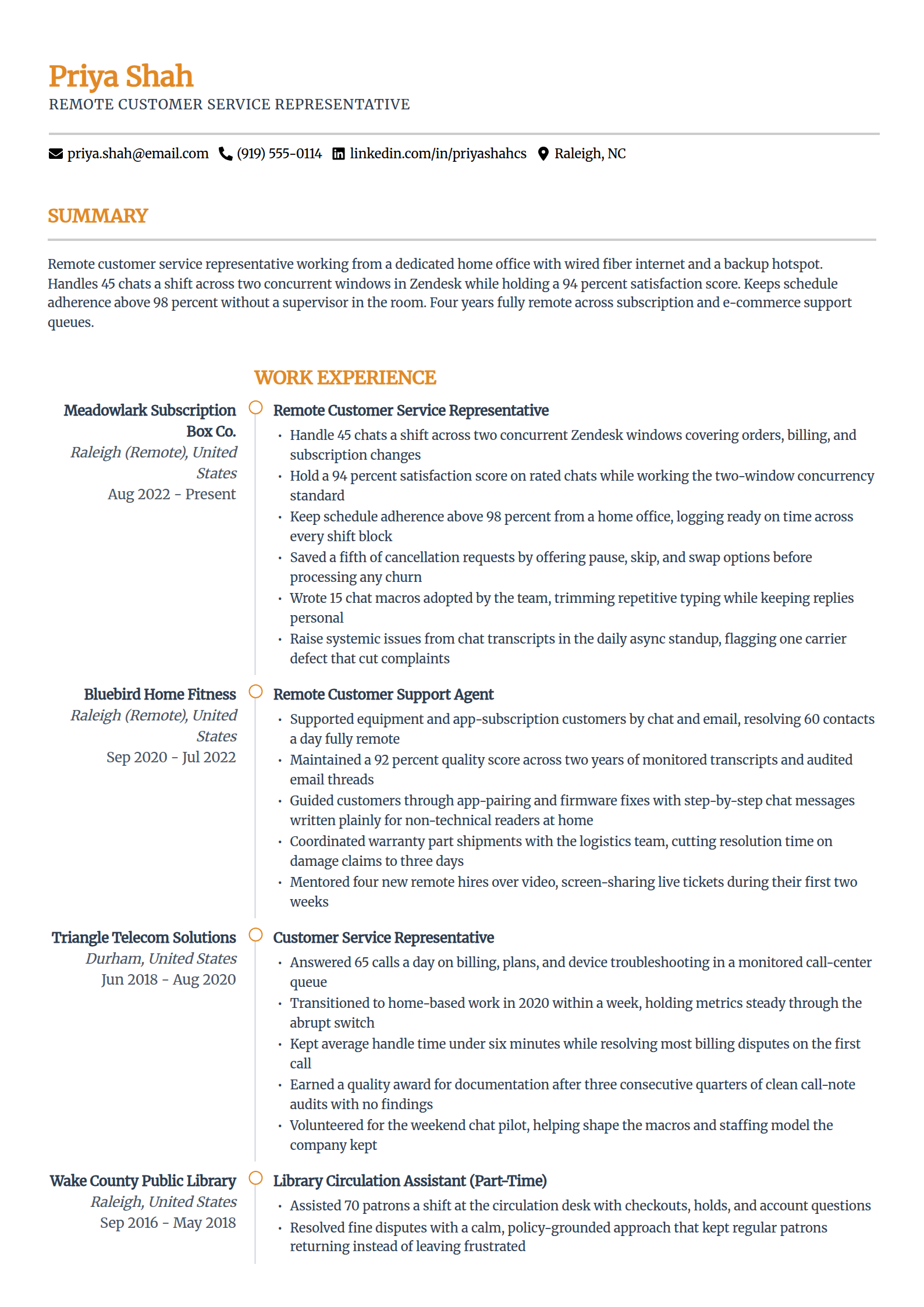
Remote Customer Service Resume Template
Why this resume example works?
- Names the remote setup plainly, which is the first thing a work-from-home posting checks.
- Shows chat capacity, 45 a shift across two windows, a real remote-support metric.
- Names Zendesk, the platform most remote queues run on.
- Calls out self-management and schedule adherence, the trait remote managers worry about.
- Keeps the satisfaction score visible so speed is not the only proof.
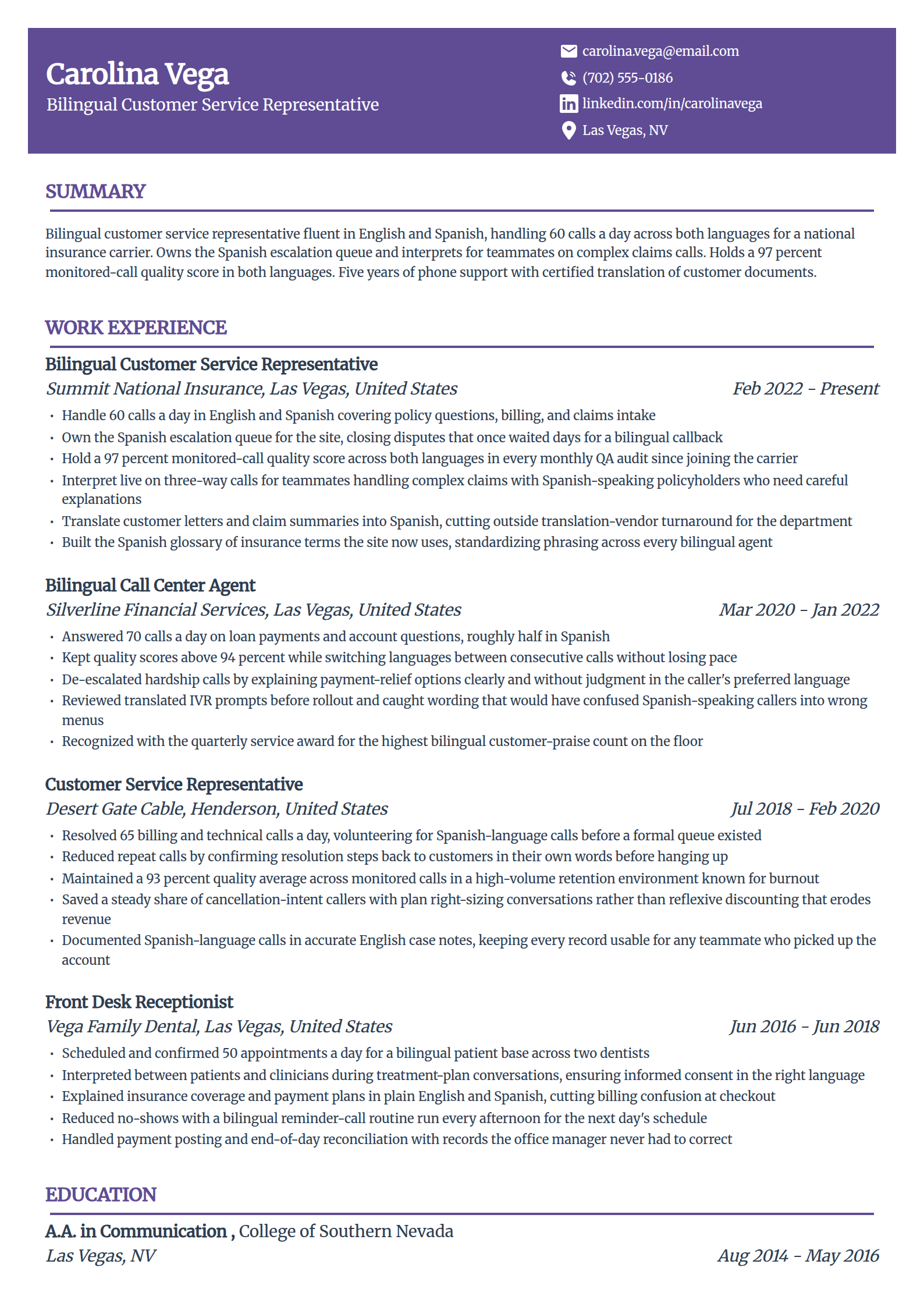
Bilingual Customer Service Resume Template
Why this resume example works?
- Puts the language pair in the first line, the exact detail a bilingual posting filters on.
- Shows the skill in action: owning the Spanish escalation queue and interpreting.
- Carries a monitored-call quality score, which support teams treat as objective.
- Names the call volume so the workload is clear across both languages.
- Keeps the value concrete rather than just claiming fluency.
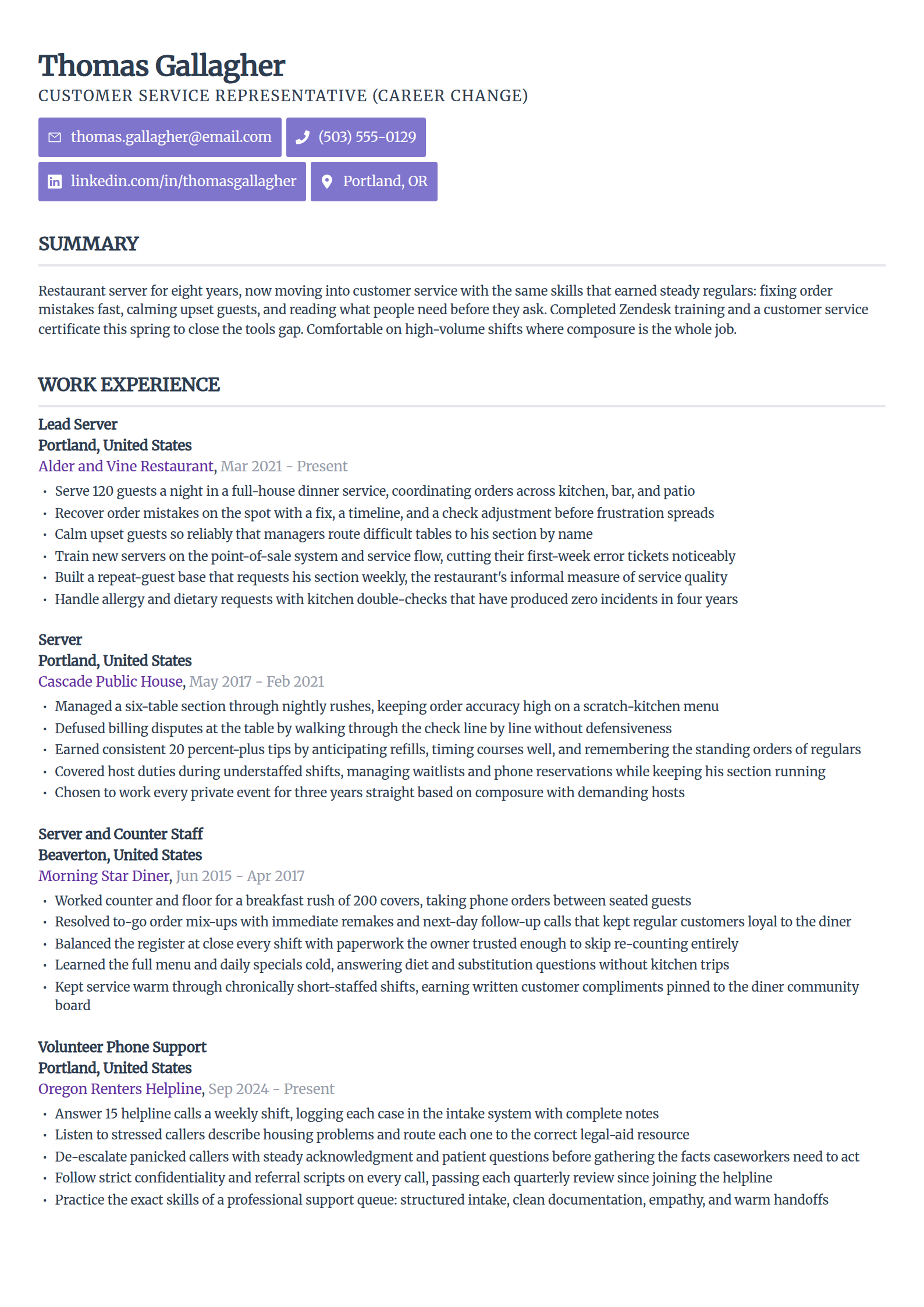
Career-Change Customer Service Resume Template
Why this resume example works?
- Frames the prior career as an asset, translating server skills into support strengths.
- Quantifies the background with eight years so the experience is not vague.
- Names transferable moments, fixing mistakes and calming customers, that map directly to support.
- Shows initiative with recent Zendesk training, closing the tools gap a recruiter would flag.
- Leads with the old role, which keeps the career-change story honest and clear.
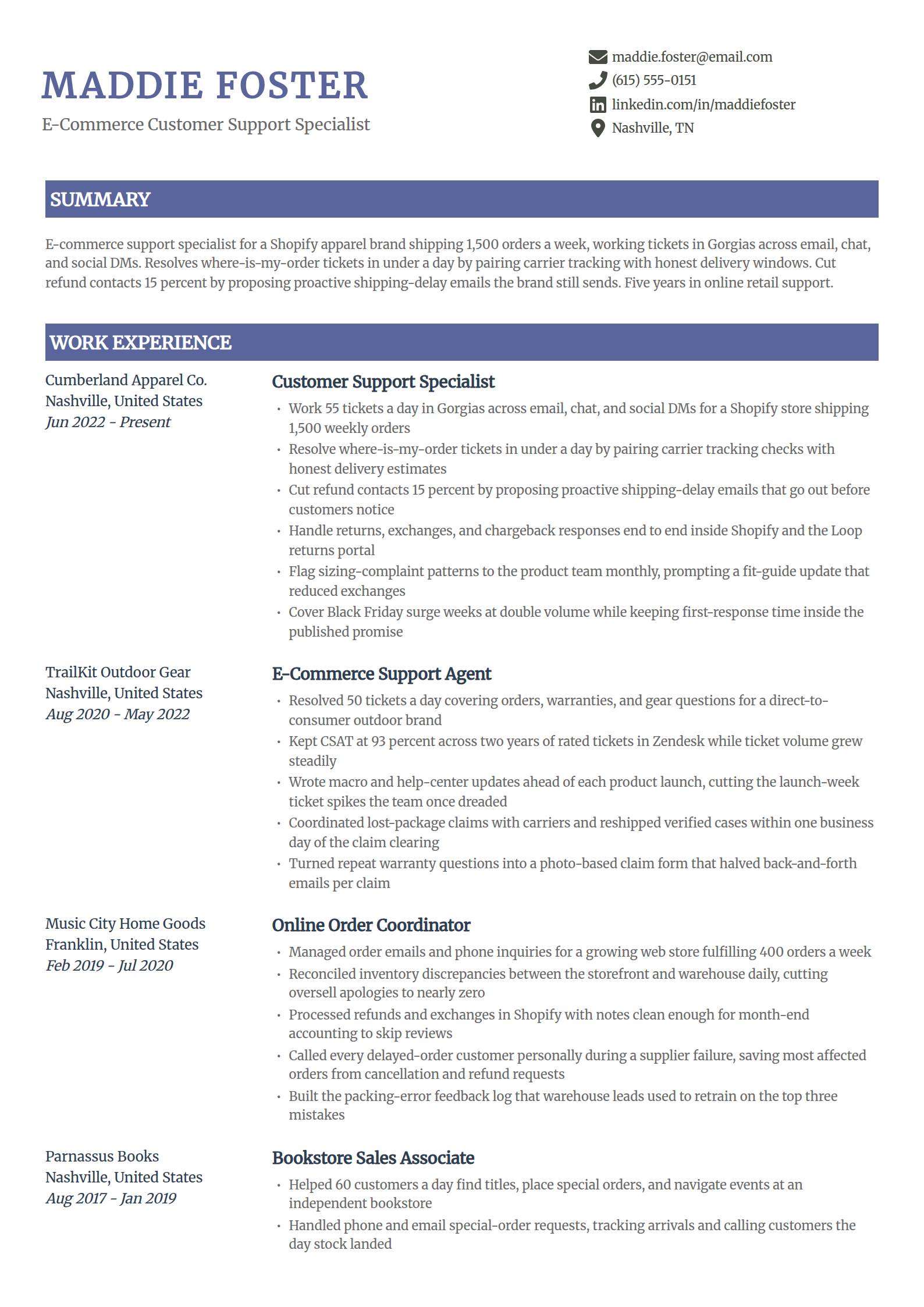
E-Commerce Customer Support Resume Template
Why this resume example works?
- Names the order volume so the scale of the store is clear.
- Lists the exact stack, Shopify and Gorgias, that an e-commerce posting screens for.
- Shows a resolution speed, under a day, on the most common ticket type.
- Carries a proactive result, fewer refund contacts, from a specific change.
- Keeps the focus on the ticket types unique to online retail.
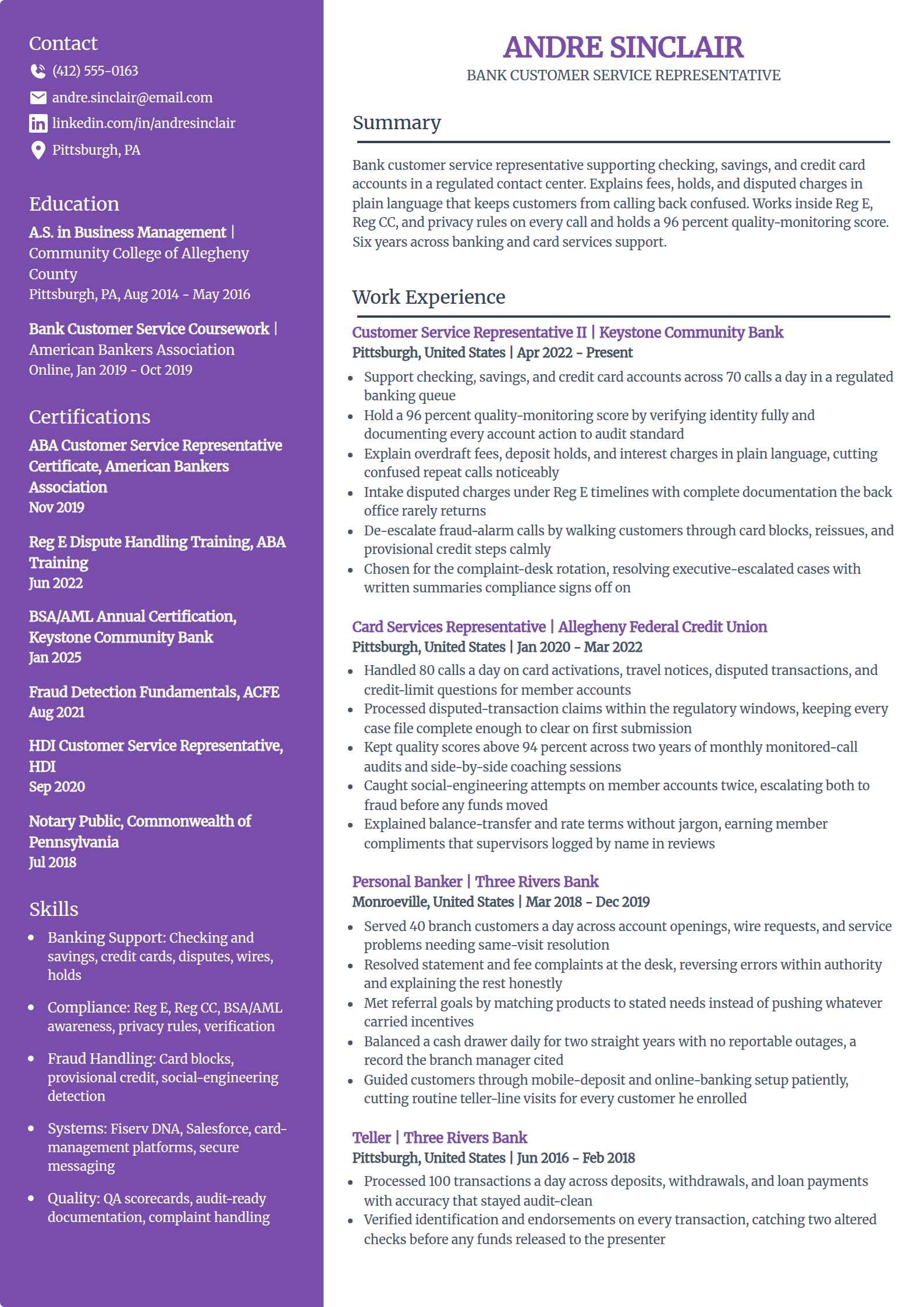
Bank & Financial Services Customer Service Resume Template
Why this resume example works?
- Names the account types it supports so the banking context is immediate.
- Shows compliance awareness, working inside the rules, which financial employers require.
- Highlights plain-language fee explanations, a real customer pain point in banking.
- Carries a quality-monitoring score, the metric call centers audit.
- Keeps disputed-charge handling visible, a common and sensitive banking task.
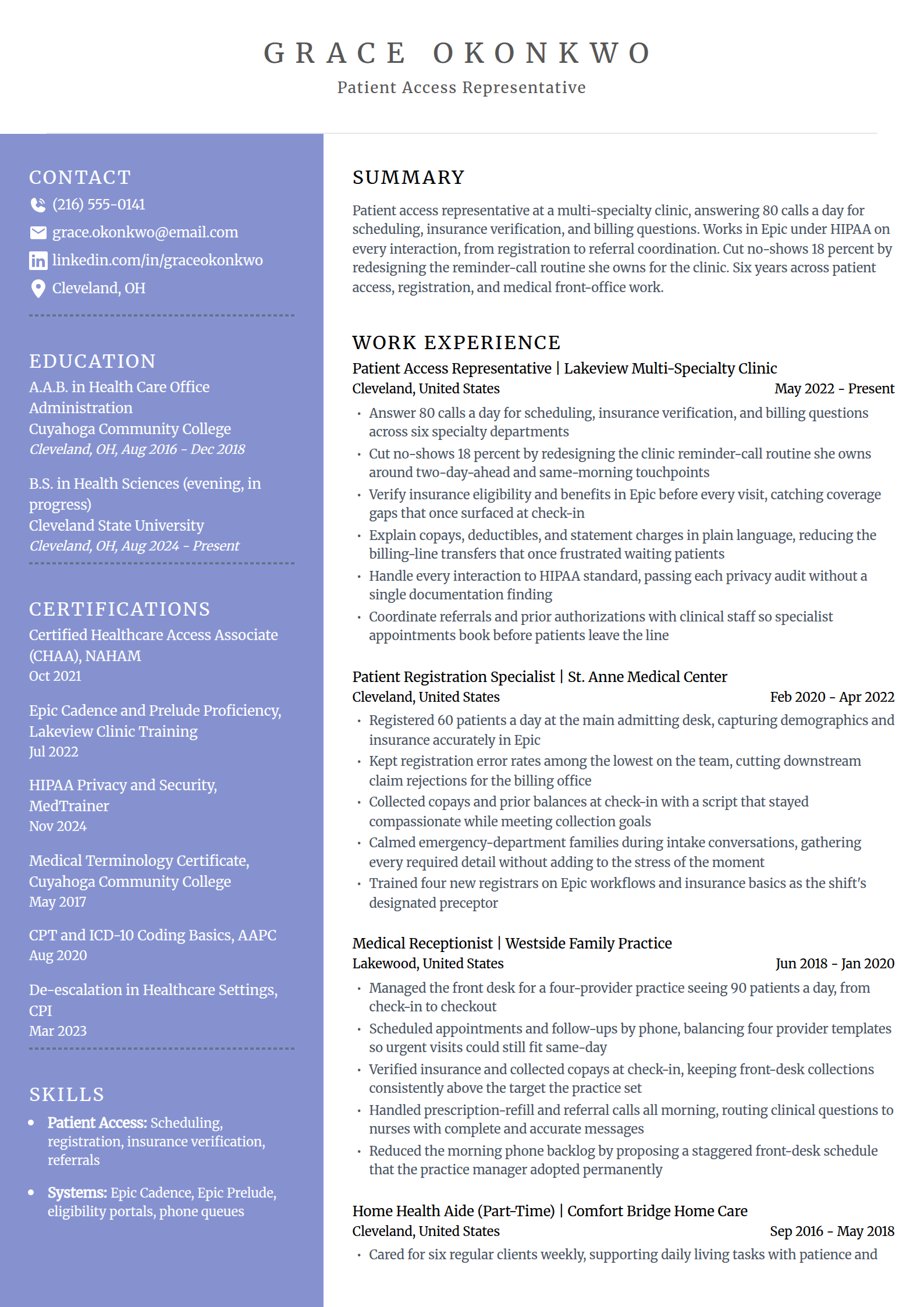
Healthcare Customer Service (Patient Access) Resume Template
Why this resume example works?
- Names the patient access title and the clinic setting healthcare employers use.
- Shows the core tasks: scheduling, insurance verification, and billing questions.
- Names Epic and HIPAA, two signals a healthcare front-office posting looks for.
- Carries an outcome, fewer no-shows, from a concrete change the rep owned.
- Keeps the daily call volume visible so the workload is clear.
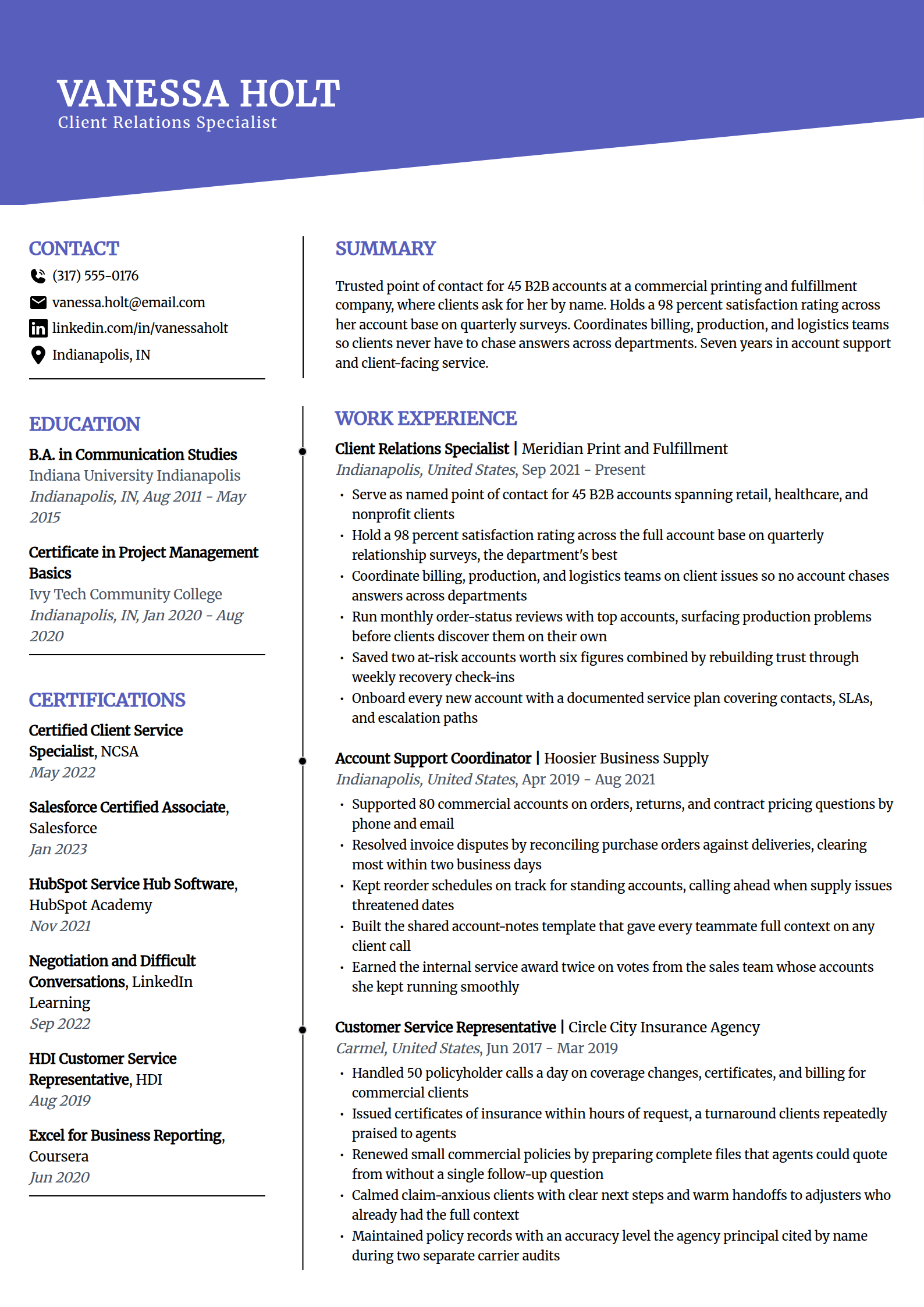
Client Relations & Account Support Resume Template
Why this resume example works?
- Leads with the account count instead of a title, keeping the openers varied.
- Shows the relationship depth, being asked for by name, that account roles value.
- Carries a survey rating, 98%, that is specific to the accounts served.
- Names the cross-team coordination that separates account support from a call queue.
- Keeps the B2B context clear so the fit reads correctly.
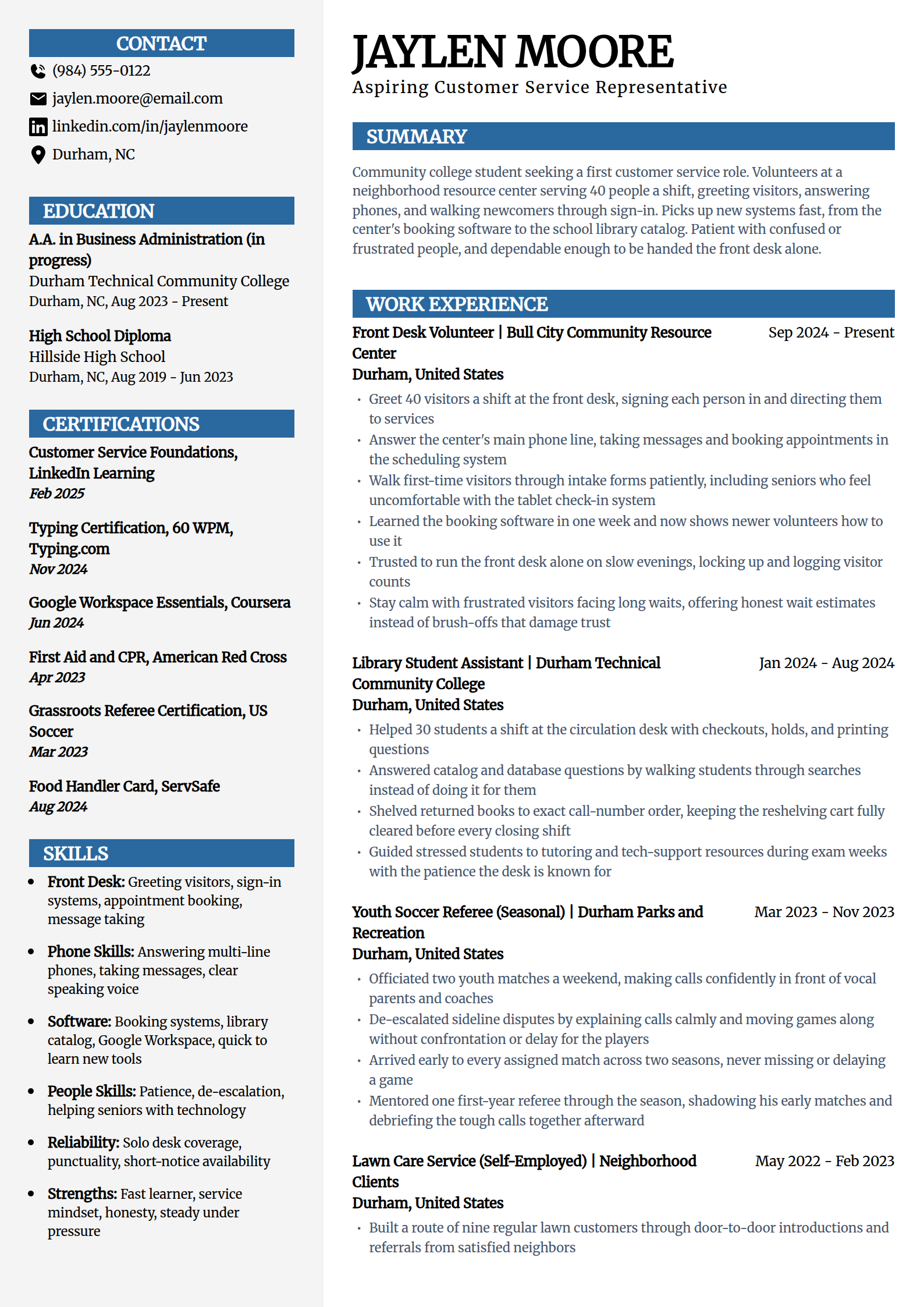
Customer Service Resume Template With No Experience
Why this resume example works?
- States the goal plainly, a first role, so a recruiter reads it for potential, not tenure.
- Turns volunteer work into real experience with a number, 40 people a shift.
- Names concrete tasks, greeting and phones, that map to entry support work.
- Shows the two traits that matter with no track record: fast learning and patience.
- Leads with the candidate's status, keeping the no-experience story honest.
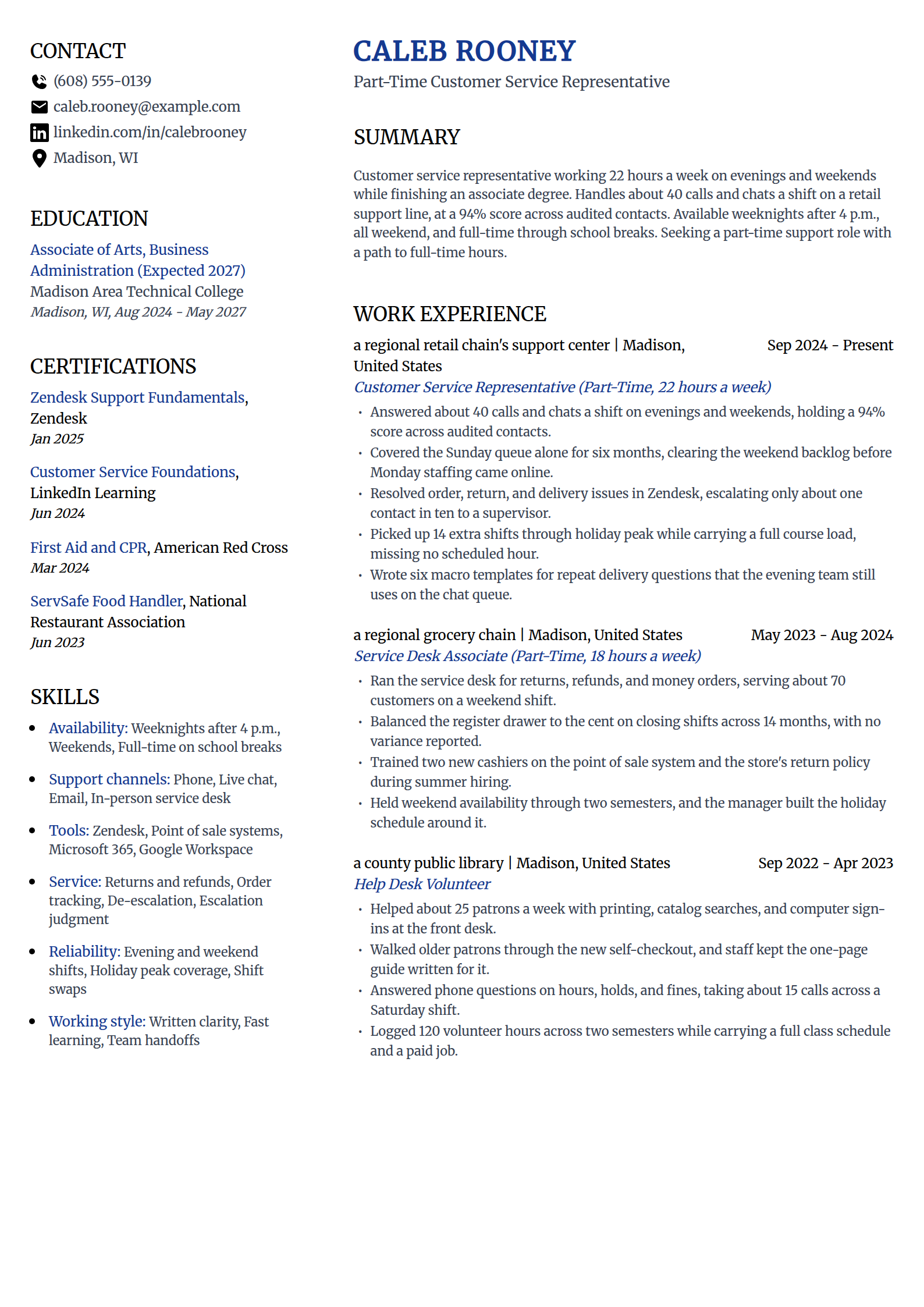
Part-Time Customer Service Resume Template
Why this resume example works?
- States availability outright, weeknights after 4 p.m. and weekends, the first thing a part-time posting checks.
- Puts the hours inside each job title, 22 and 18 a week, so a short schedule reads as steady work.
- Holds the same metrics a full-time rep shows, about 40 contacts a shift at a 94% audited score.
- Covers the shifts managers struggle to fill, the Sunday queue and 14 extra shifts through holiday peak.
- Names Zendesk and the point of sale system, so a part-time history still carries the tools a posting lists.
Build your customer service resume
Pick a template above and the editor keeps the layout parser-safe while you swap in your own channel, tools, and numbers.
Build my resumeHow to write a customer service resume in 2026
A support resume gets read twice: a fast human skim and an ATS keyword match. These moves satisfy both without padding.
Lead with a summary that names your channel and volume
Write two to three sentences that open with your title, name the channels you work (phone, chat, email), and land on one number a manager cares about. New candidates lead with the same shape using volunteer or part-time proof.
Customer service representative with 4 years on phone and chat, resolving 70 contacts a day at an 88% first-contact rate.
Quantify every bullet you can
Lead each bullet with a verb, then attach the scale or the result. Numbers turn a duty into proof.
- Volume: handled 70 or more calls a day while holding a 4-minute average handle time.
- Quality: kept a 95% quality-monitoring score across audited calls for six straight months.
- Impact: cut cancellations 12% by walking at-risk customers through a retention offer.
Name your tools, do not just say CRM
An applicant tracking system matches the exact tool the posting lists, so write the systems out by name where they are true.
- Support platforms: Zendesk, Salesforce Service Cloud, Freshdesk, Intercom, ServiceNow.
- Phone and workforce tools: Five9, Genesys, NICE, and the dialer or IVR you used.
- Channel and commerce tools: live chat, email, Shopify, and any order or ticketing system.
Balance hard skills with the soft ones you can prove
Pair the tools above with the judgment skills a bot cannot copy: de-escalation, active listening, and clear writing. Prove each one with a moment, not an adjective. Show a saved account rather than claiming you are a great communicator.
Keep the format ATS-safe
Support resumes get filtered by software before a person sees them. A clean single-column layout keeps your data readable.
- Skip tables, columns, icons, and text boxes that scramble in a parser.
- Keep your name and contact details in the body, not the header or footer.
- Save as a PDF unless the application asks for a Word document.
Common customer service resume mistakes
- Listing soft skills as adjectives with no proof. "Excellent communicator" is filler; "resolved 70 calls a day at 88% first contact" is proof.
- Hiding the CRM and channel experience a posting screens for, or leaving the tools off entirely.
- Writing duties instead of results. "Answered phones" is a task; "answered 70 calls a day and saved 12% of cancellations" is an outcome.
- Using a two-column template with icons that a resume parser cannot read cleanly.
- Sending one resume everywhere instead of mirroring the exact tools, channel, and title in each posting.
Frequently asked questions
What should a customer service resume include?
A two to three sentence summary that names your channels and one metric, a work section where every bullet leads with a verb and a number, a skills section that names your tools by name, and your education or certifications. Keep it to one page unless you have more than about ten years to show.
How do I write a customer service resume summary?
Write two to three sentences. Open with your title and the channels you work, name one number a manager cares about such as calls a day or a satisfaction score, and close with the strength you are known for. Skip the objective; even entry-level candidates have volunteer or part-time proof to lead with.
What skills should I put on a customer service resume?
Balance the tools you use with the judgment you can prove. Name your support platforms outright, such as Zendesk, Salesforce Service Cloud, or ServiceNow, and pair them with de-escalation, active listening, clear writing, and problem-solving. Prove each soft skill with a moment rather than an adjective.
How do I write a customer service resume with no experience?
Lead with volunteer work, part-time jobs, or school activities where you helped people, and give them real bullets with numbers. Name any tool you have touched, add a short training or certificate if you have one, and keep the summary focused on patience, fast learning, and a service mindset.
Which resume template is best for customer service?
A clean single-column template with standard headings, such as Standard, Classic, or Simple above. Those layouts parse cleanly in applicant tracking systems and keep your title, tools, and dates where a recruiter expects them. Save the visually rich formats for portfolios, not support applications.
Is customer service still a good field to build a resume for in 2026?
Support hiring is shifting. Chatbots and self-service now handle the simple, scripted contacts, so employers screen harder for the judgment those tools lack: de-escalating an upset customer, saving a cancellation, and solving a problem that spans several departments. Build your resume around those moments, not around how many calls you can take.
More customer service resume resources
Build your customer service resume
Pick a template above and the editor keeps the layout parser-safe while you swap in your own channel, tools, and numbers.