16 Receptionist Resume Examples, Corporate to Dental
- ATS Friendly
- Front Desk & Medical
- 16 Real Examples
A receptionist resume is judged on how fast a hiring manager reads your phone volume, scheduling, and software. Pick a clean layout below, then model your own on a real example built for your setting, from a corporate front desk to a medical or dental office.


540k+ resumes created
Editable receptionist resume templates
Each template below is a real receptionist resume laid out in that format, sorted by the kind of front desk you work. Choose one, then swap in your own call volume, appointments scheduled, software, and certifications. Every layout keeps your name, contact details, and dates clean so a hiring manager reads your experience at a glance and an applicant tracking system parses it without trouble.
Experienced Front Desk Receptionist Resume Template
Why this resume example works?
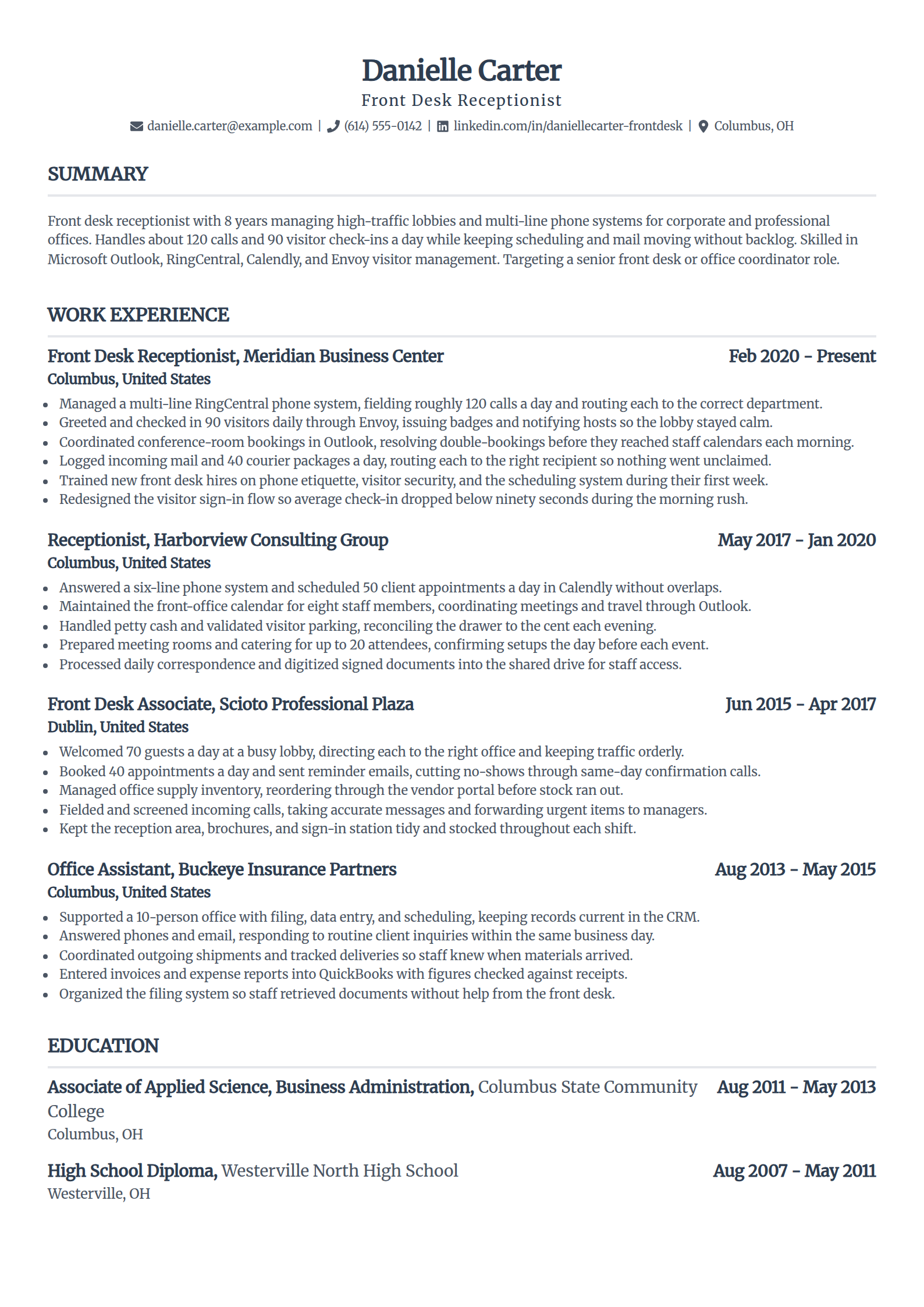
- Opens with a summary that names 8 years, roughly 120 calls a day, and 90 visitor check-ins, the scope a hiring manager reads first.
- Leads each bullet with a strong verb and one number, such as routing 120 calls or logging 40 packages a day, instead of listing duties.
- Names the real tools front desks run on, RingCentral, Microsoft Outlook, Calendly, and Envoy visitor management.
- Uses a single-column layout with standard headings that an applicant tracking system parses cleanly.
- Backs the experience with practical credentials, a Notary Public commission and Certified Administrative Professional, near the bottom.
Medical Receptionist Resume Template
Why this resume example works?
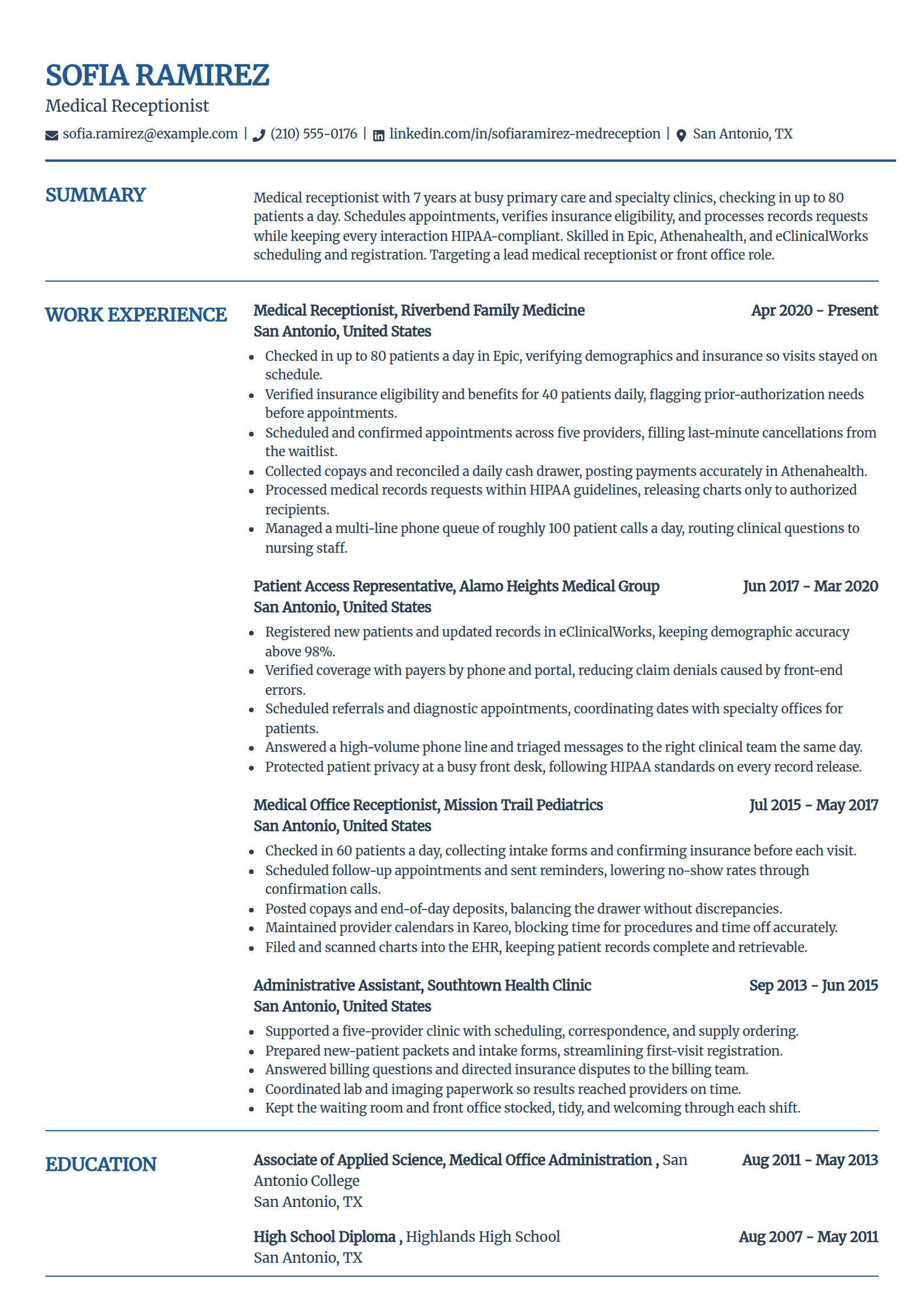
- Leads with the front-office work medical practices hire for, checking in up to 80 patients a day and verifying insurance for 40.
- Names EHR systems by name, Epic, Athenahealth, and eClinicalWorks, the exact keywords a clinic posting lists.
- Keeps scope honest: scheduling, check-in, insurance verification, records requests, and copays, with clinical questions routed to nurses.
- Puts HIPAA compliance and a Certified Medical Administrative Assistant credential where a reviewer looks for them.
- Uses a clean, modern layout that stays readable while fitting a full front-office history on one page.
Medical Front Office Coordinator Resume Template
Why this resume example works?
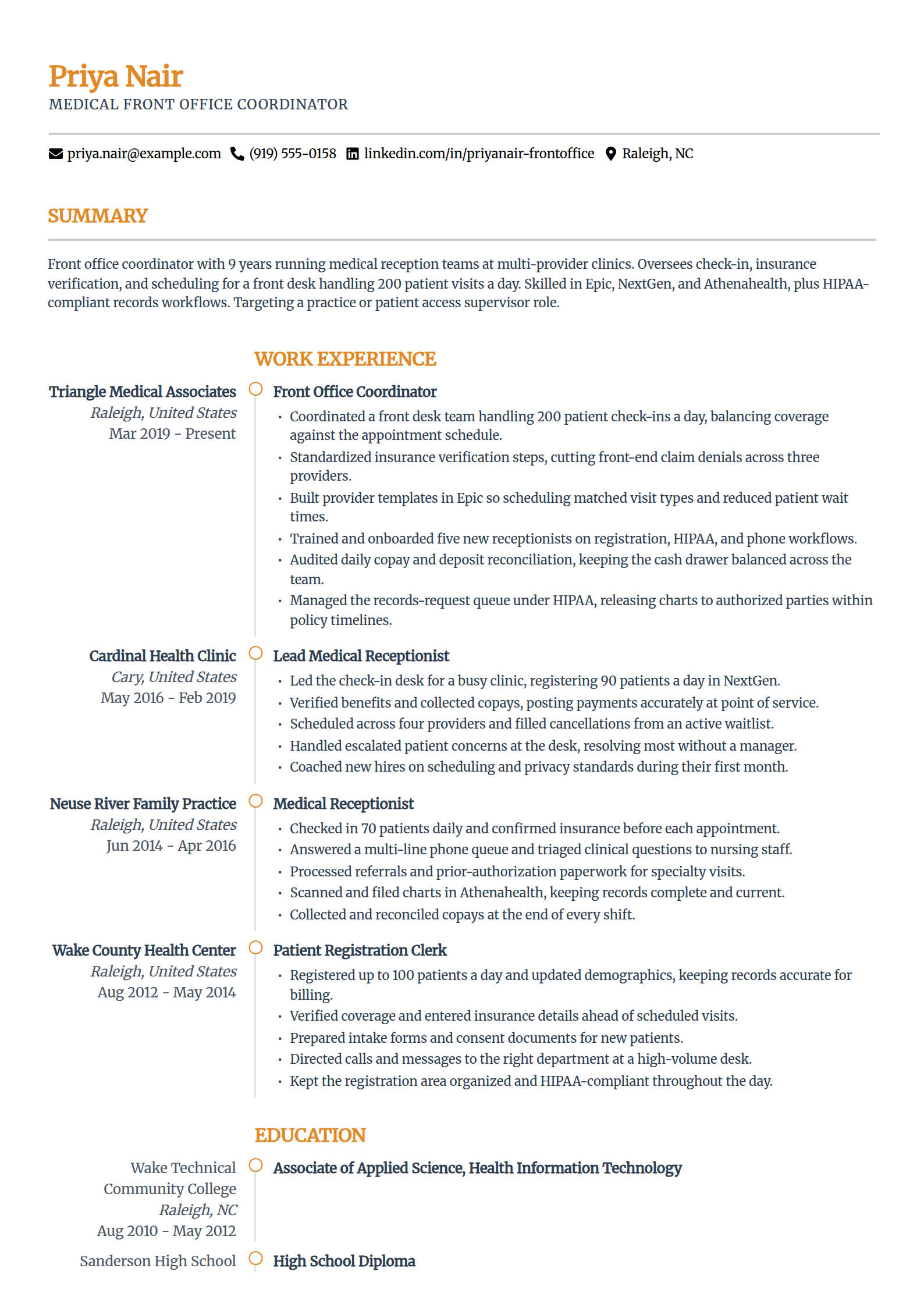
- Frames a senior front-office role up top, coordinating a desk that handles 200 patient check-ins a day.
- Shows leadership scope a practice can quote, standardized insurance verification and five receptionists trained on HIPAA.
- Carries the systems a multi-provider clinic runs, Epic, NextGen, and Athenahealth, across the experience and skills.
- Balances team-management bullets with hands-on registration work so the resume reads as a working coordinator, not a title.
- Fills a dense layout with four roles, showing a clear climb from registration clerk to coordinator.
Senior & Lead Receptionist Resume Template
Why this resume example works?
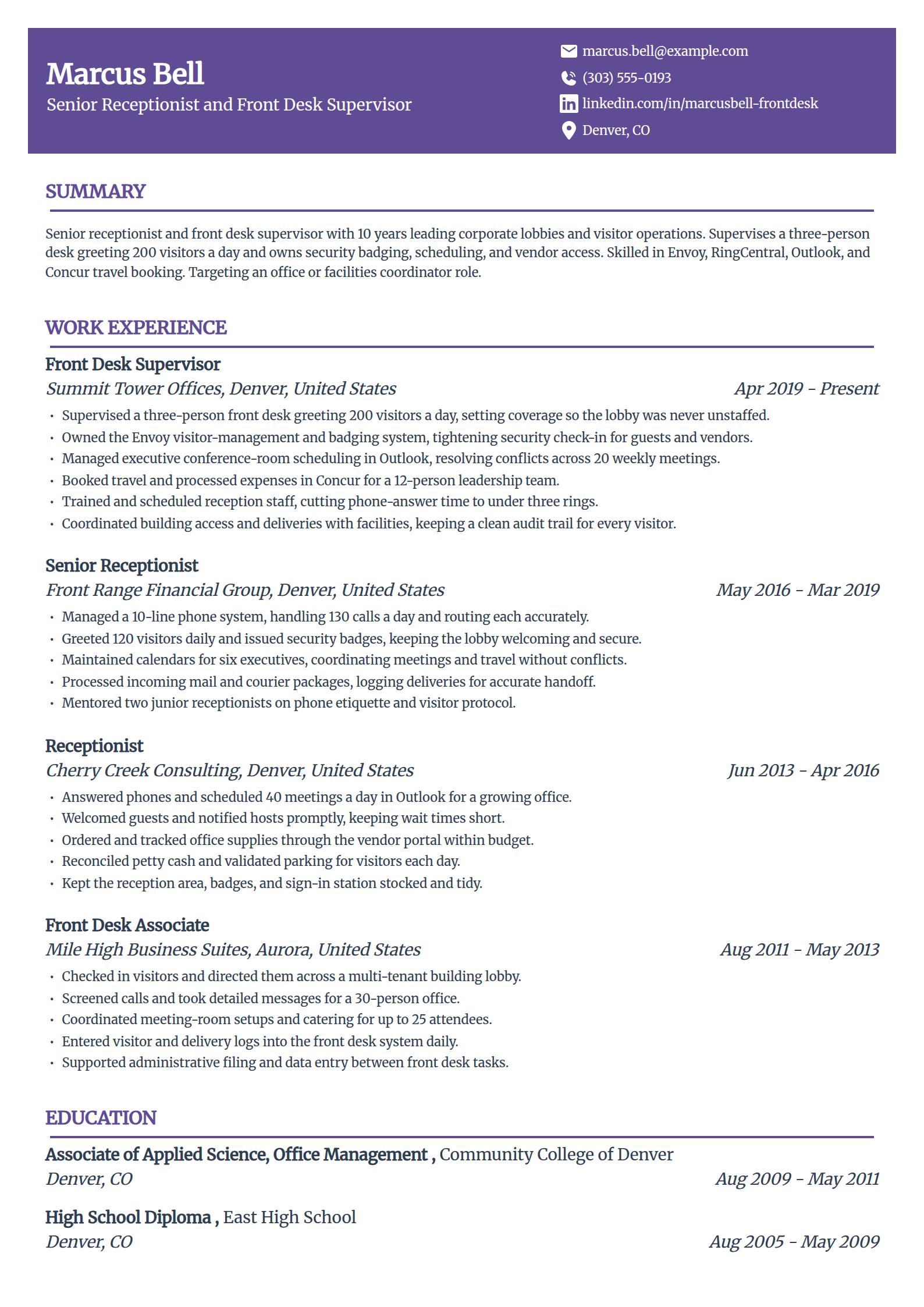
- Leads with supervisor scope, a three-person desk greeting 200 visitors a day and full ownership of security badging.
- Turns front desk work into leadership, setting coverage, training staff, and cutting phone-answer time to under three rings.
- Names corporate-lobby tools, Envoy, RingCentral, Outlook, and Concur travel and expense booking.
- Keeps each bullet to one credible number so the seniority reads as earned, not inflated.
- Uses a modern layout that carries a 10-year history without crowding the page.
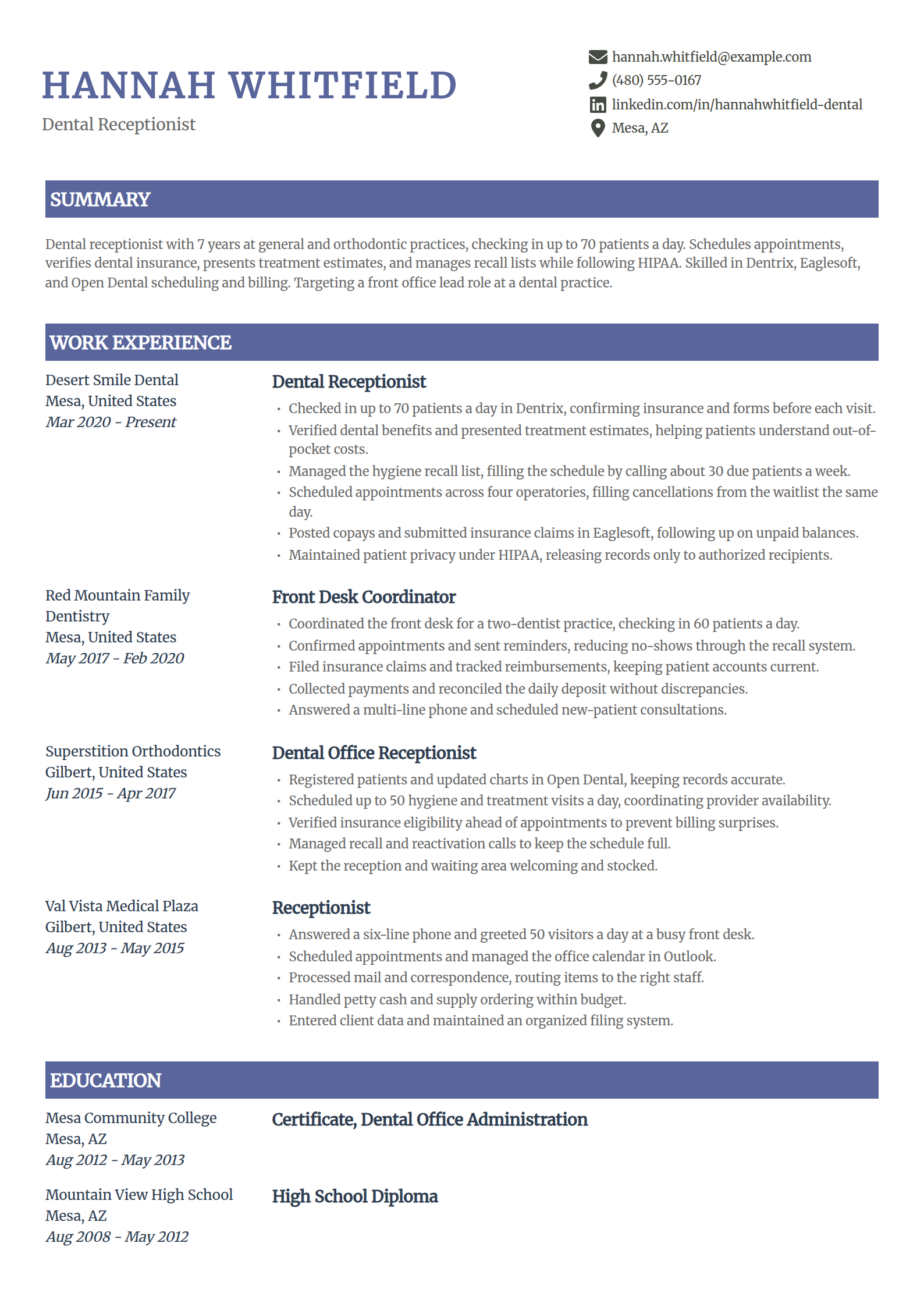
Dental Receptionist Resume Template
Why this resume example works?
- Opens with the front-desk work a dental office hires for, checking in up to 70 patients a day and running the hygiene recall list.
- Names practice software outright, Dentrix, Eaglesoft, and Open Dental, the keywords on a dental front-office posting.
- Shows dental-specific tasks a reviewer expects, verifying benefits, presenting treatment estimates, and submitting claims.
- Keeps scope to the front office and pairs it with HIPAA privacy and a Dentrix front-office certificate.
- Fills a visually rich layout with four roles while staying easy to skim in one pass.
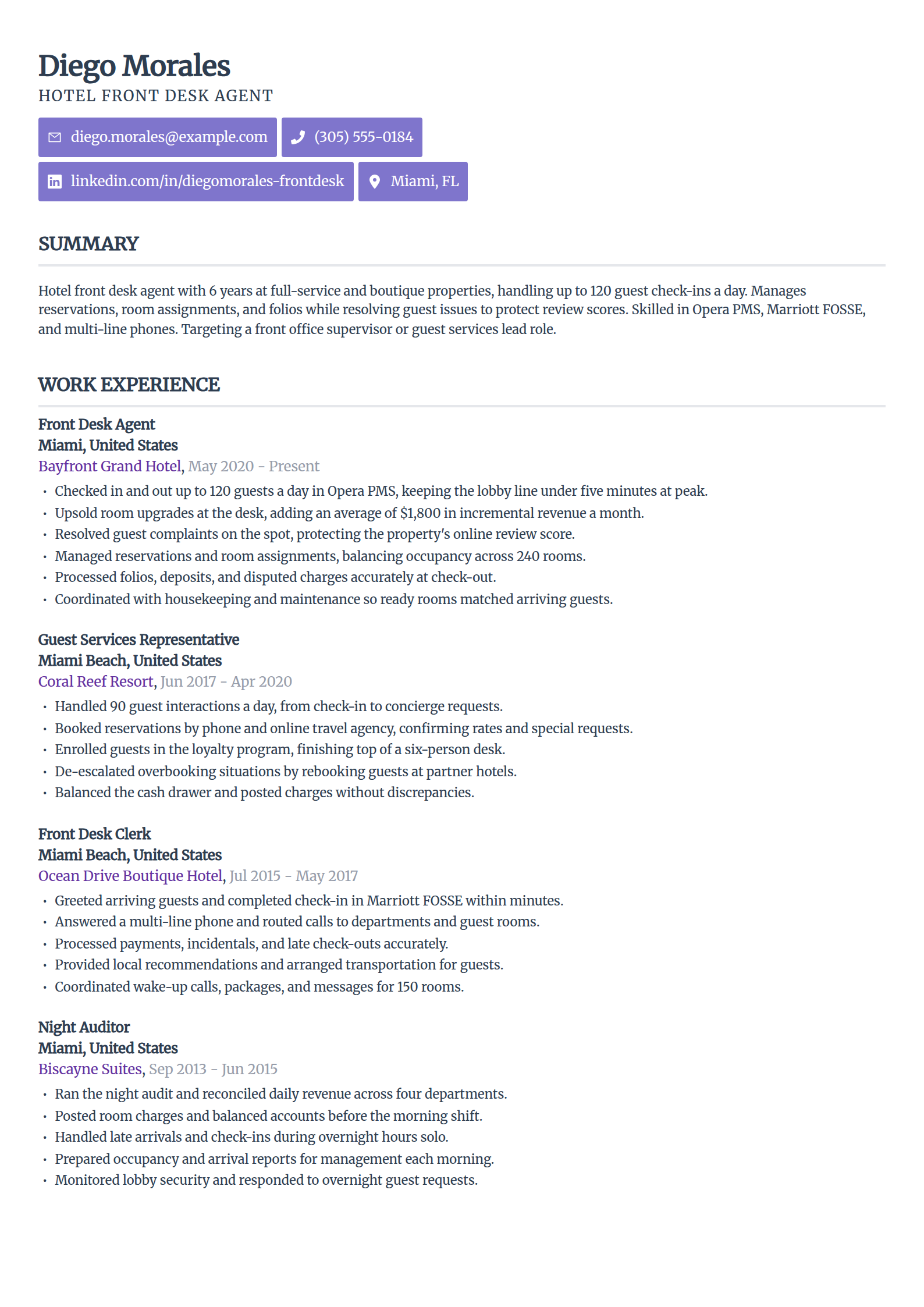
Hotel & Hospitality Front Desk Resume Template
Why this resume example works?
- Leads with hospitality scope, up to 120 guest check-ins a day and reservations balanced across 240 rooms.
- Shows revenue impact a property values, an average of $1,800 a month in upsold room upgrades.
- Names property systems by name, Opera PMS and Marriott FOSSE, plus guest-recovery and loyalty work.
- Carries hospitality credentials, a Certified Front Desk Representative and Guest Service Professional, that fit the role.
- Uses a clean, modern layout that reads fast at a busy front office and parses cleanly for ATS.
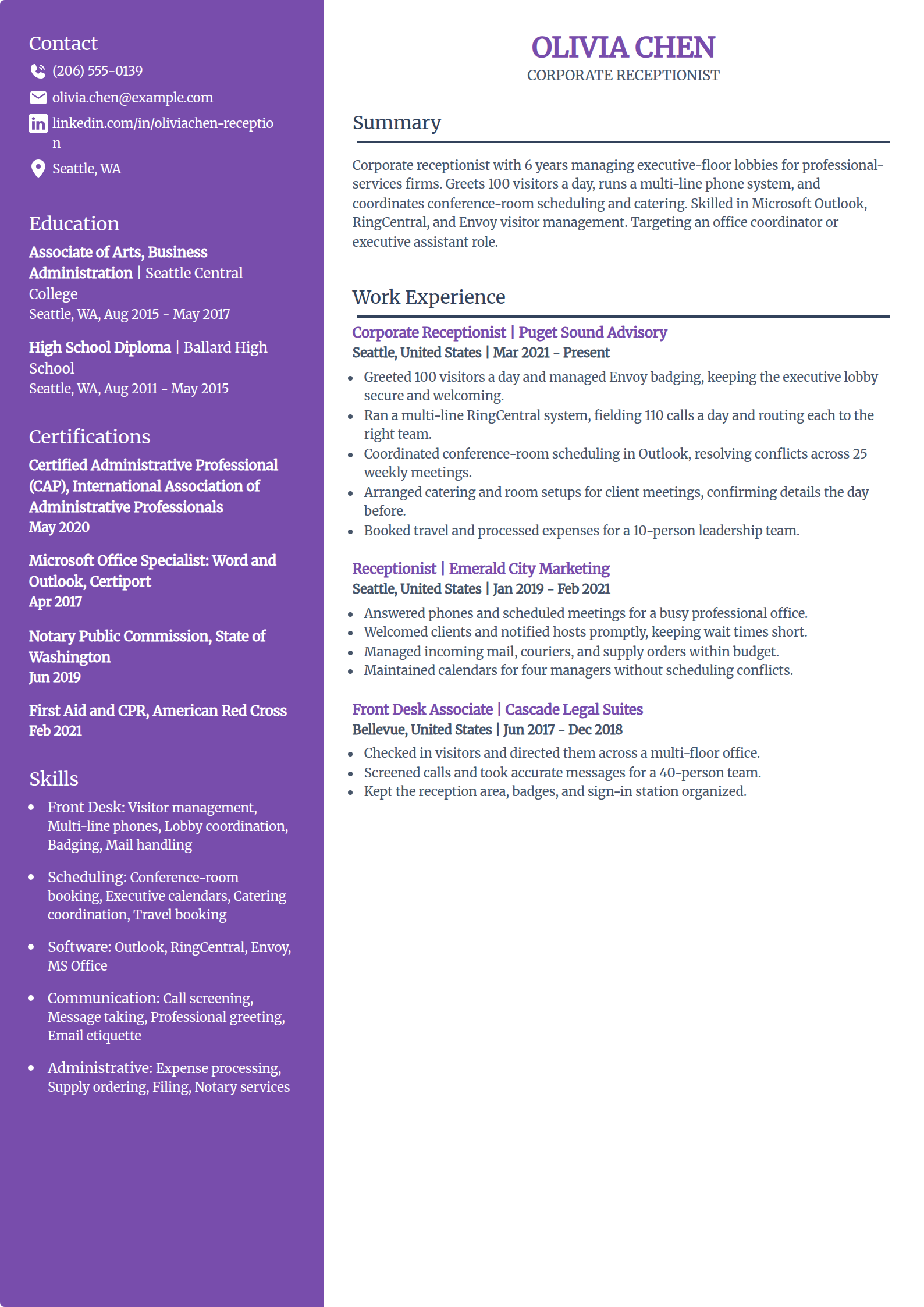
Corporate & Office Receptionist Resume Template
Why this resume example works?
- Opens with executive-floor scope, greeting 100 visitors a day and coordinating catering and conference-room scheduling.
- Ties front desk work to the office it supports, booking travel and expenses for a 10-person leadership team.
- Names the corporate stack, Outlook, RingCentral, and Envoy, so the resume matches a professional-services posting.
- Keeps a Medium layout with three focused roles instead of padding a shorter history.
- Backs the experience with a Certified Administrative Professional credential and Notary commission.
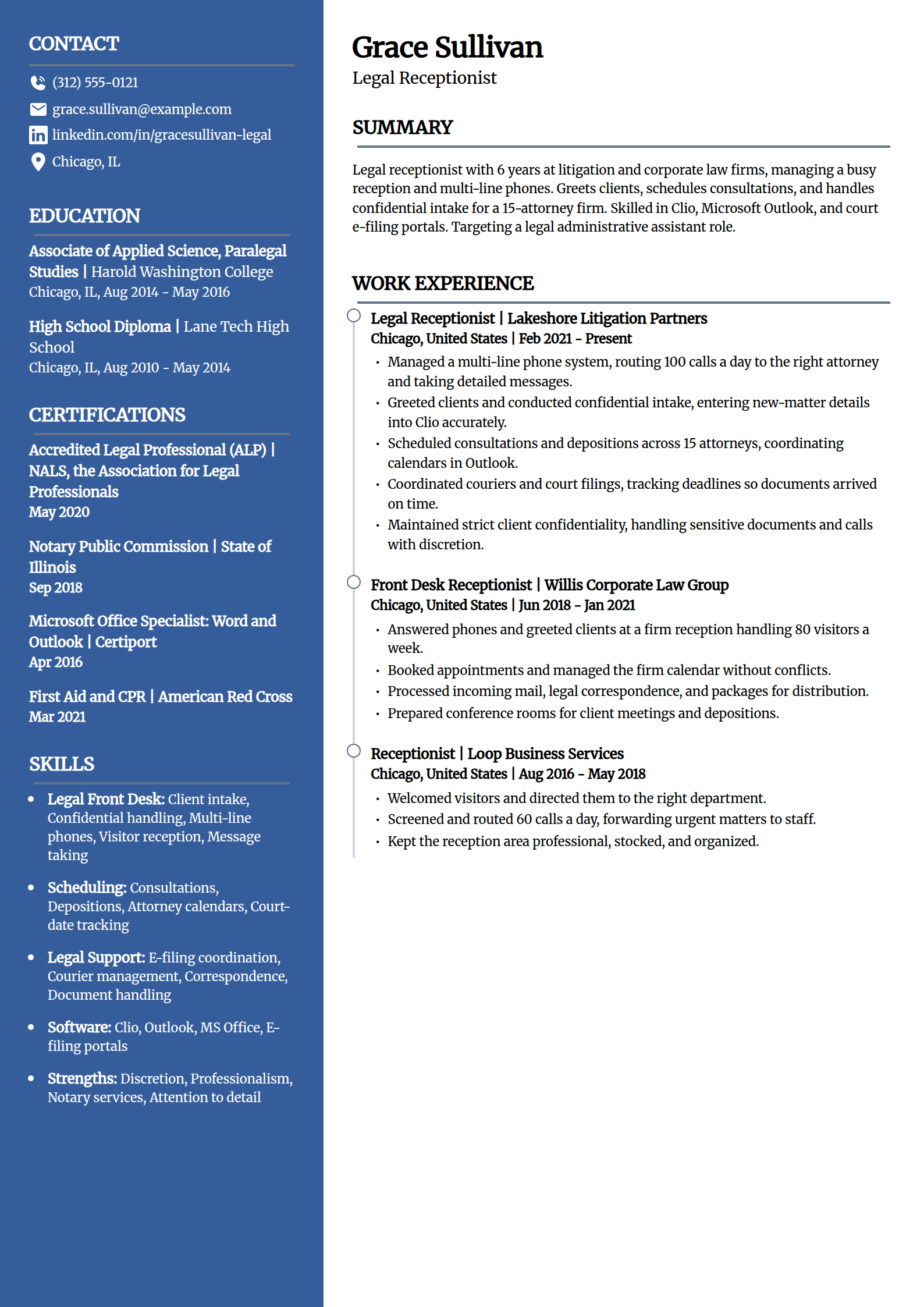
Law Firm & Legal Receptionist Resume Template
Why this resume example works?
- Leads with a law-firm front desk, routing 100 calls a day and handling confidential client intake for 15 attorneys.
- Names legal tools a firm expects, Clio and court e-filing portals, alongside consultation and deposition scheduling.
- Foregrounds discretion and confidentiality, the trait a firm screens for, without overstating the role.
- Carries an Accredited Legal Professional credential and Notary commission that fit a legal front office.
- Uses a distinctive layout that still keeps sections easy to scan for a hiring partner.
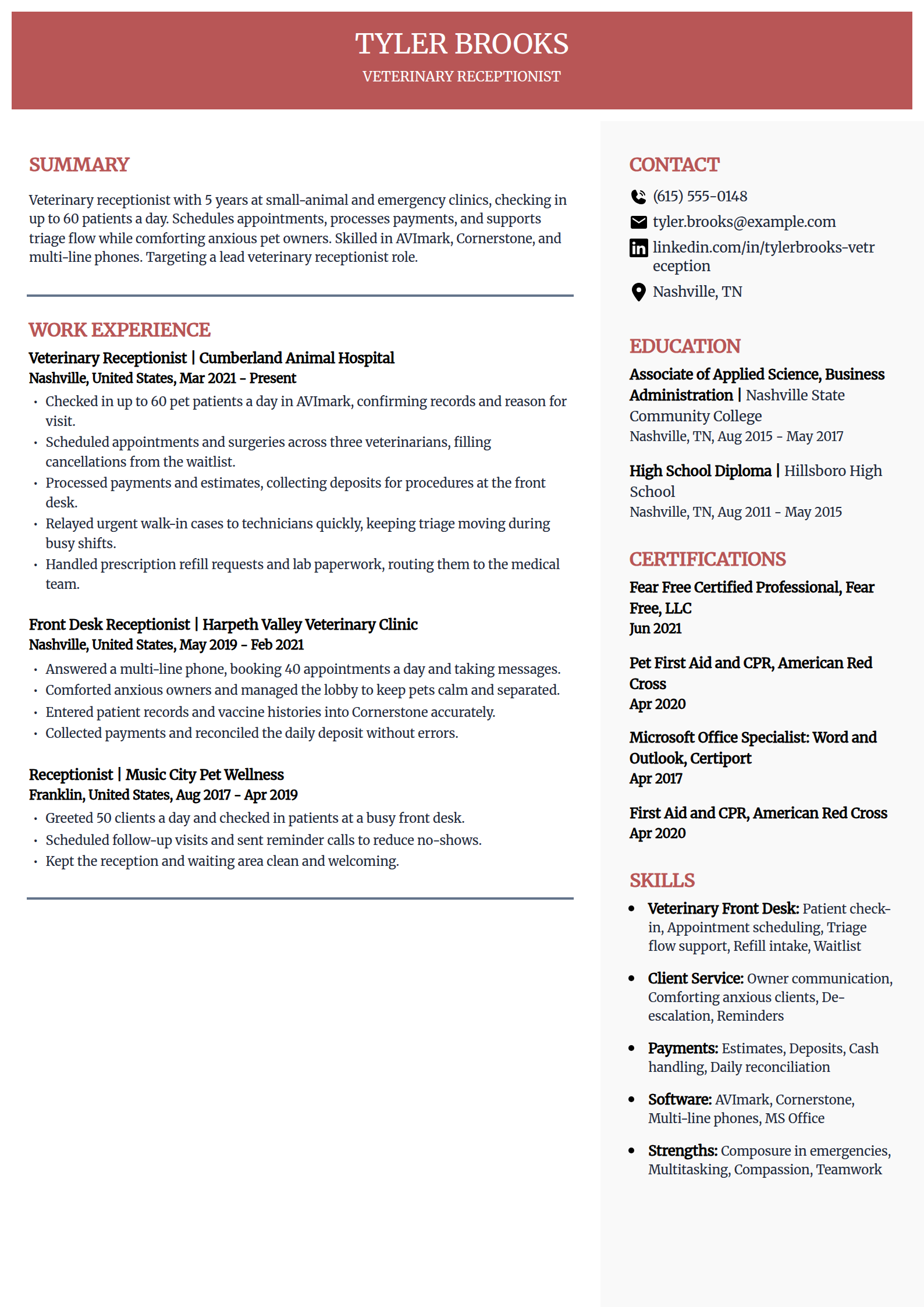
Veterinary Receptionist Resume Template
Why this resume example works?
- Opens with clinic scope, checking in up to 60 pet patients a day and scheduling across three veterinarians.
- Shows the front-desk role in triage flow, relaying urgent walk-ins to technicians rather than claiming clinical work.
- Names practice software, AVImark and Cornerstone, and pairs it with a Fear Free certification that fits the setting.
- Highlights the calm, client-facing skills a busy animal hospital needs, comforting anxious owners and managing the lobby.
- Uses a refined layout that fits a five-year history on one clean page.
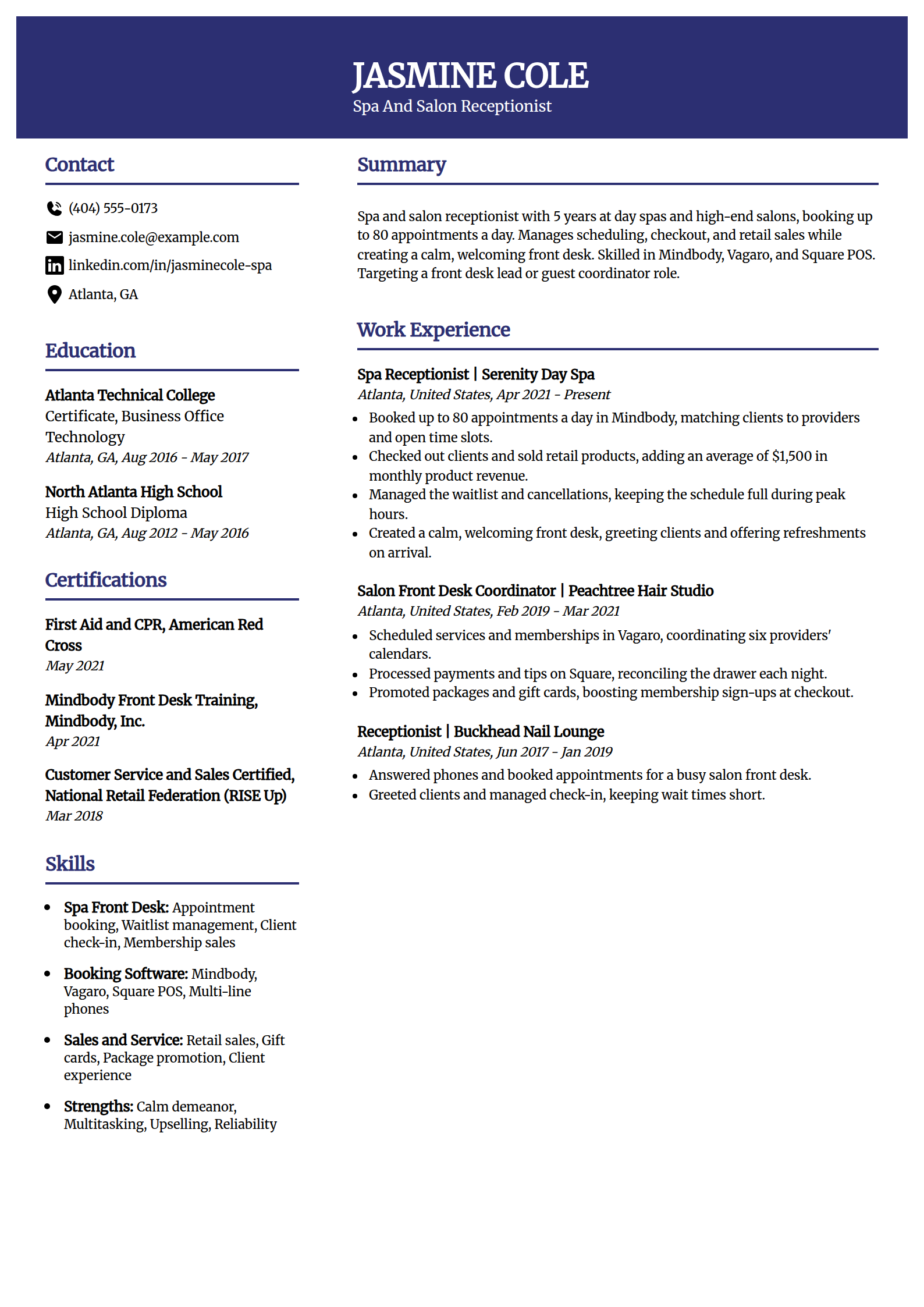
Spa & Salon Receptionist Resume Template
Why this resume example works?
- Leads with booking scope, up to 80 appointments a day, and ties checkout to $1,500 in monthly retail revenue.
- Names booking systems by name, Mindbody, Vagaro, and Square POS, the tools a spa or salon posting lists.
- Shows the guest-experience angle a front desk is hired for, a calm arrival and a full schedule at peak.
- Uses a roomy two-column layout with the contact, education, and skills sidebar filled so the page reads complete.
- Keeps every metric modest and believable for a front-desk role rather than reaching for corporate numbers.
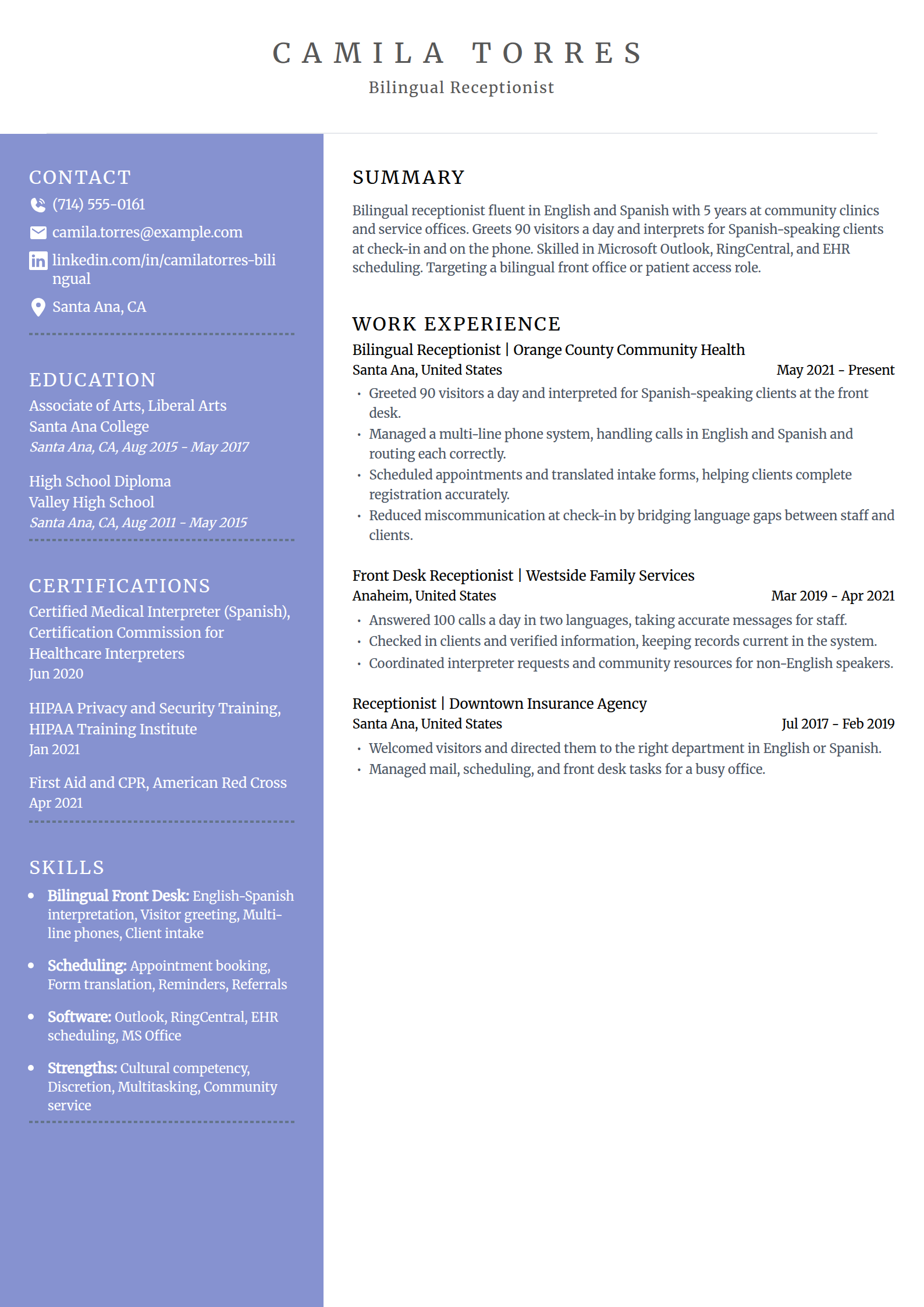
Bilingual Receptionist Resume Template
Why this resume example works?
- Names the bilingual skill in the headline and summary, interpreting English and Spanish at check-in and on the phone.
- Shows where the language helps, greeting 90 visitors a day and translating intake forms so clients register accurately.
- Carries a Certified Medical Interpreter credential that proves the language claim rather than just asserting it.
- Keeps the front-desk fundamentals visible, a multi-line phone system and scheduling in the EHR.
- Uses a roomy layout with a filled sidebar so a focused, five-year history still looks full.
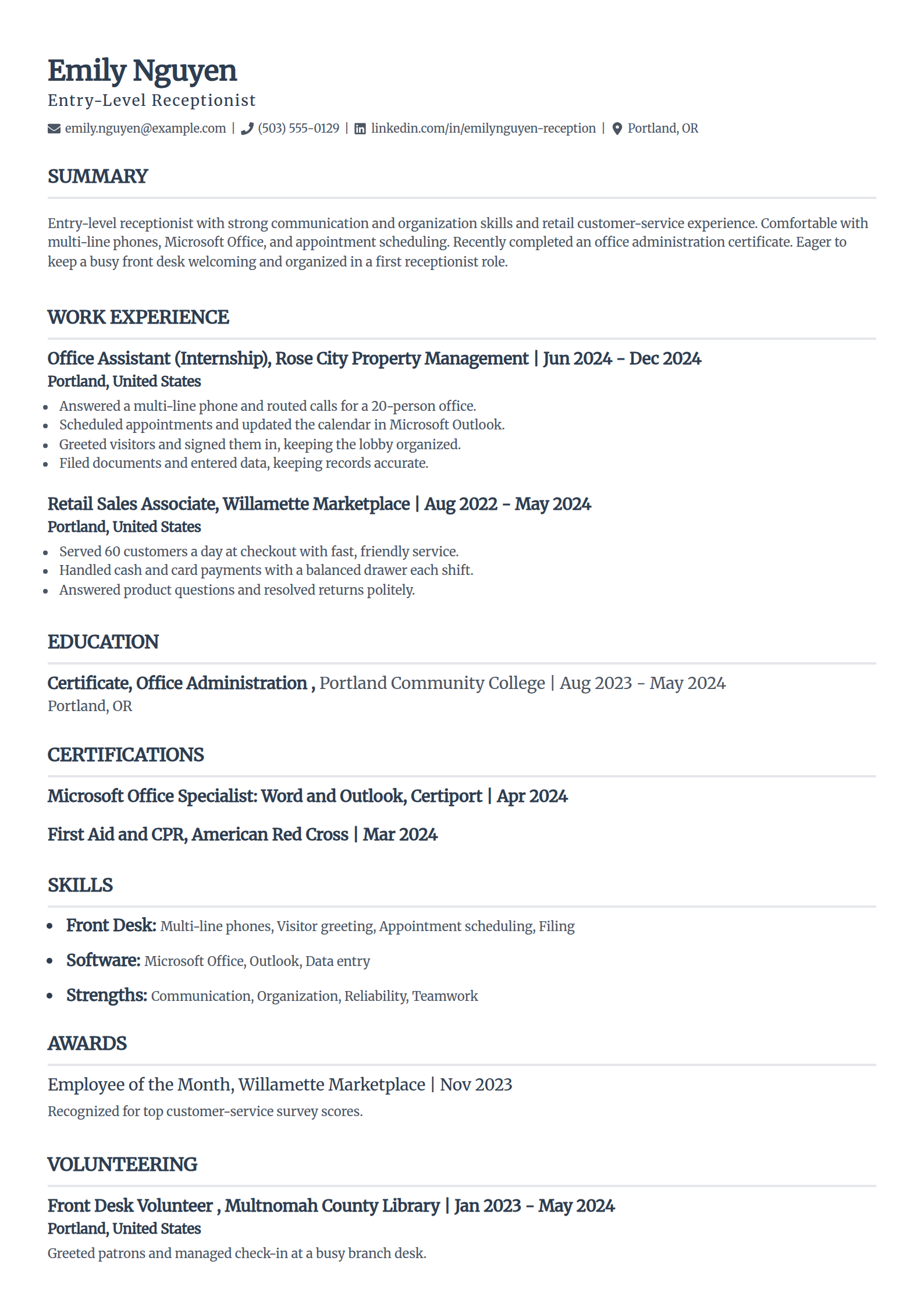
Entry-Level Receptionist Resume Template (No Experience)
Why this resume example works?
- Written for a first receptionist job, leading with communication skills, a recent office-administration certificate, and retail service.
- Uses an internship and a retail role to show real front-desk tasks, answering a multi-line phone and scheduling in Outlook.
- Fills the page honestly with a volunteering entry and an award instead of padding thin work history.
- Keeps bullets short and specific so limited experience still reads confident on one clean page.
- Uses a tight, ATS-safe single-column layout that fits a beginner's resume without empty space.
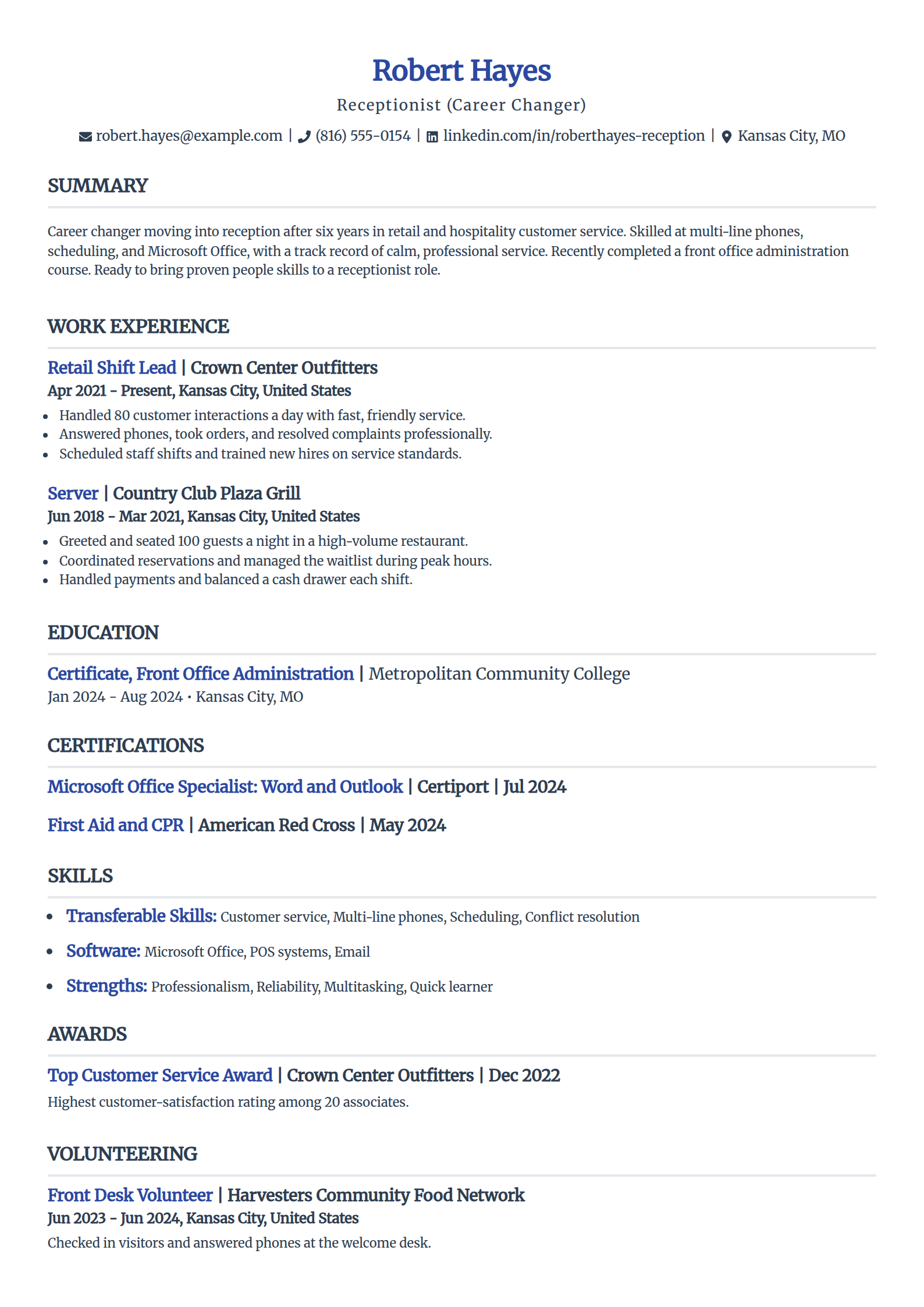
Career-Change Receptionist Resume Template
Why this resume example works?
- Names the change openly and reframes six years of retail and hospitality service as receptionist-ready skills.
- Pulls the transferable work forward, answering phones, resolving complaints, and managing a reservation waitlist.
- Shows recent commitment to the switch with a front office administration certificate near the top.
- Fills the page with a service award and front-desk volunteering so the pivot reads intentional, not thin.
- Uses a plain, ATS-safe layout that keeps the focus on proven people skills.
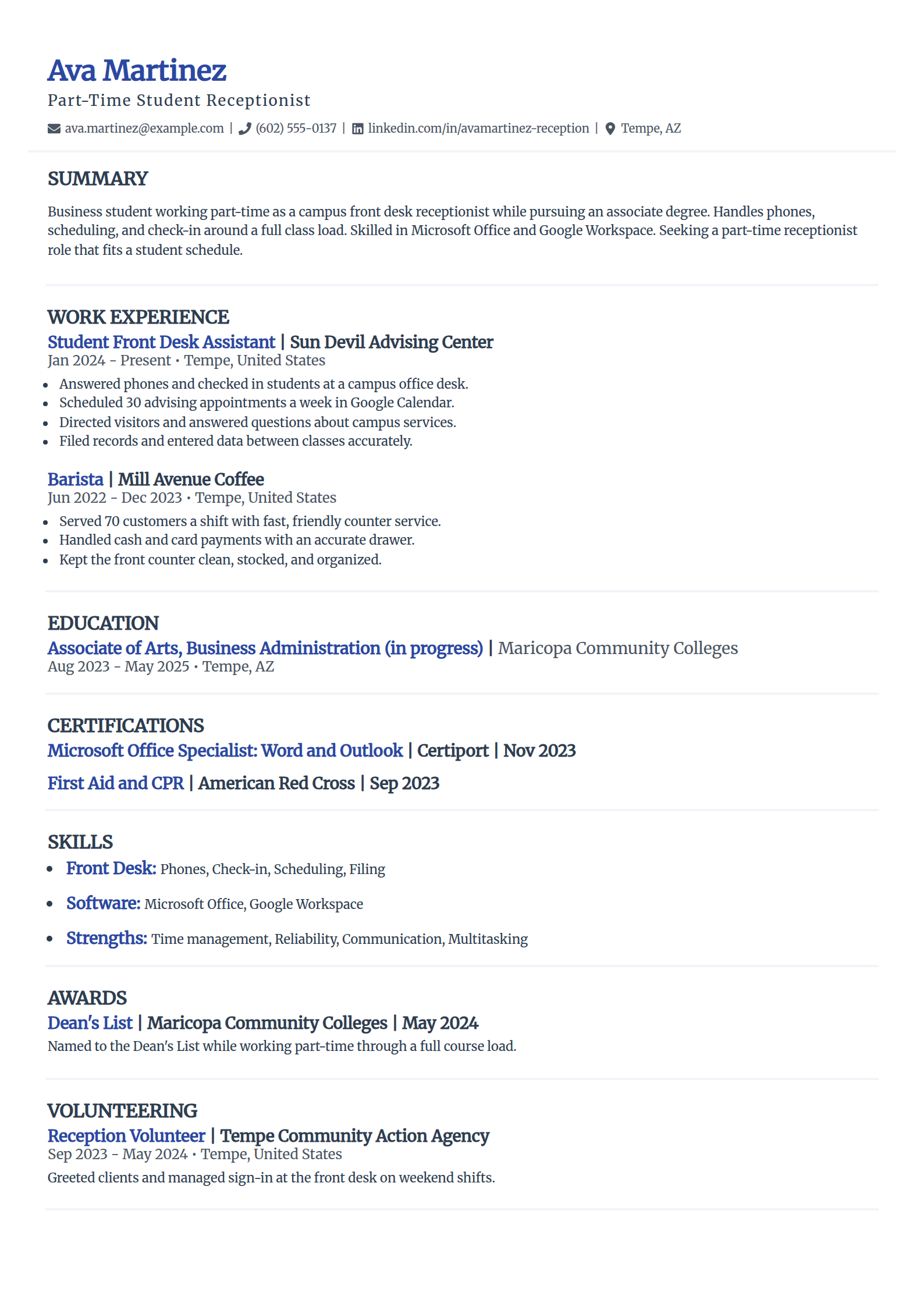
Part-Time & Student Receptionist Resume Template
Why this resume example works?
- Written for a student, leading with a campus front-desk job worked around a full class load.
- Shows real receptionist tasks, checking in students and scheduling 30 advising appointments a week.
- Pairs the front-desk role with a part-time service job so availability and reliability both read clearly.
- Fills the sidebar honestly with a Dean's List award and reception volunteering rather than inflated bullets.
- Uses a refined, uncluttered layout that fits a shorter student history on one page.
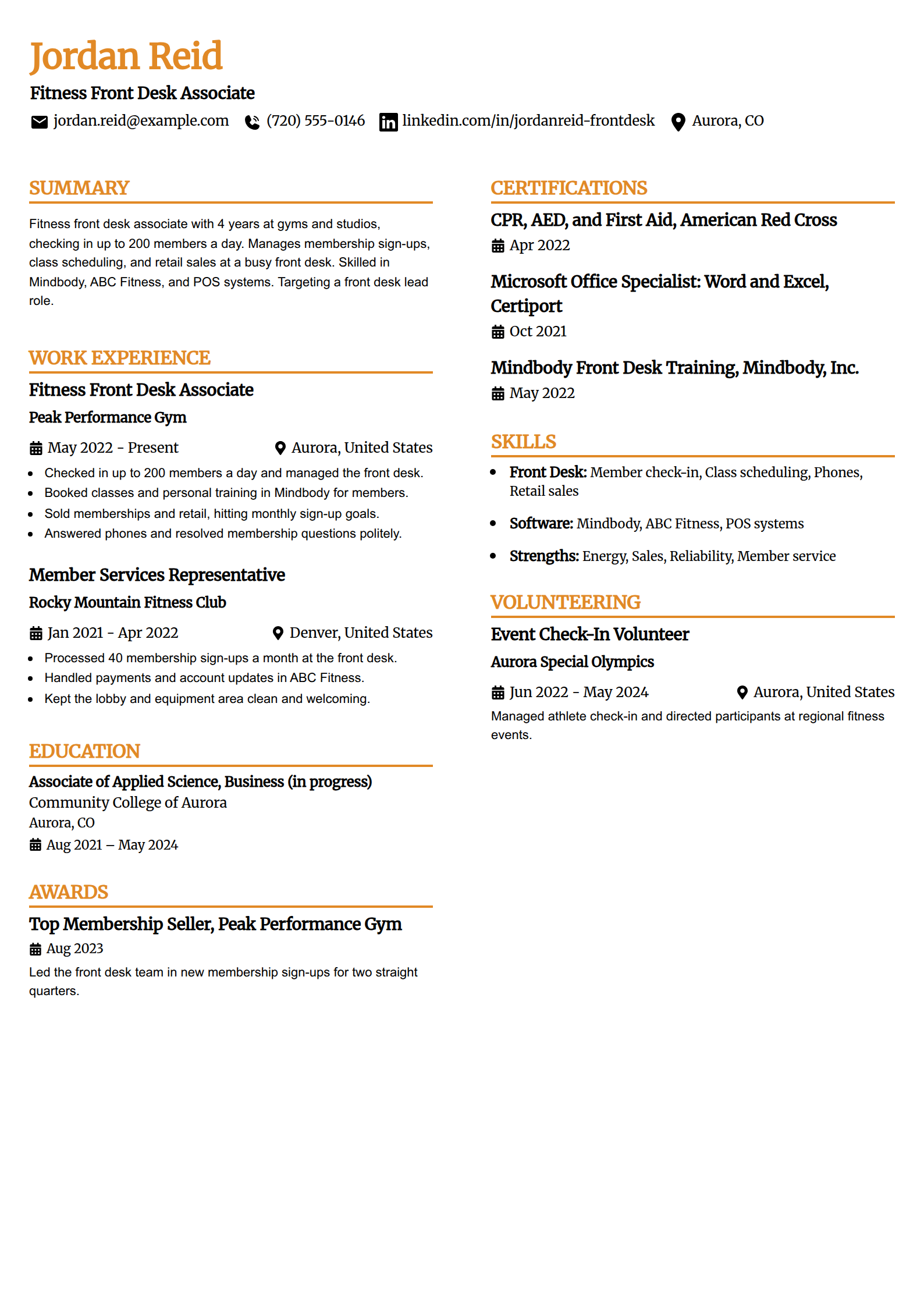
Gym & Fitness Front Desk Resume Template
Why this resume example works?
- Leads with member-facing scope, checking in up to 200 members a day and hitting monthly membership goals.
- Names fitness front-desk systems, Mindbody and ABC Fitness, plus class booking and retail sales.
- Puts a CPR, AED, and First Aid certification up front, the credential a gym front desk needs.
- Keeps bullets short and results-focused so a four-year history reads clean and energetic.
- Fills the page with a top-seller award and event-check-in volunteering that fit the setting.
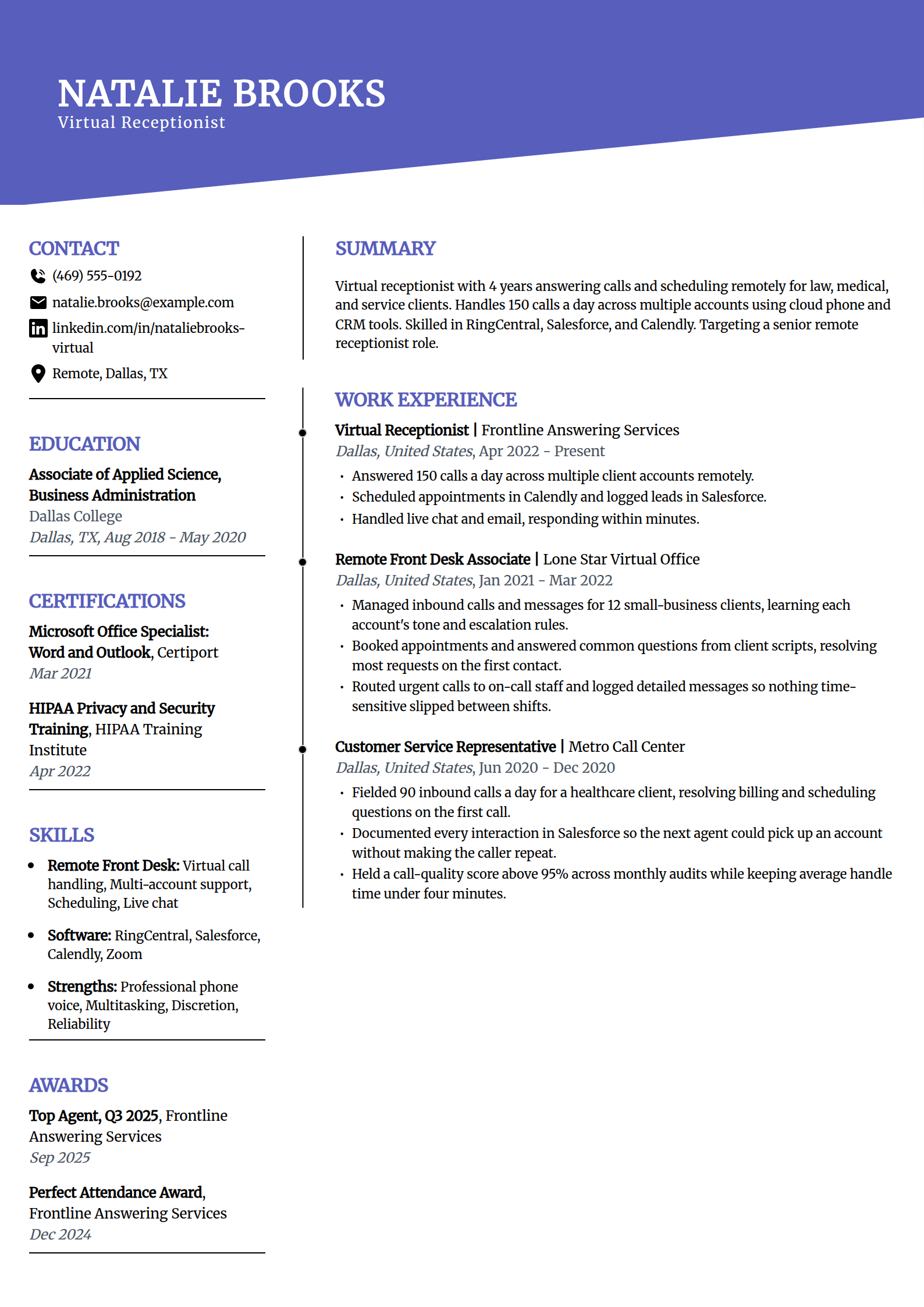
Virtual & Remote Receptionist Resume Template
Why this resume example works?
- Leads with remote scope, answering 150 calls a day across multiple client accounts from a home office.
- Names the cloud stack a virtual role runs on, RingCentral, Salesforce, and Calendly, plus live chat.
- Shows the multi-account skill that separates virtual reception, handling calls for 12 small-business clients.
- Lists awards without long descriptions, keeping the two-column layout clean and balanced.
- Carries HIPAA training for medical accounts, the credential a remote answering service asks for.
Build your receptionist resume
Pick a template above and the editor keeps your layout clean and ATS-safe while you swap in your own call volume, appointments, and software.
Build my resumeHow to write a receptionist resume in 2026
A receptionist resume is read fast. In the first few seconds a hiring manager wants your call volume, the appointments you schedule, and the software you run, so lead with those and prove them with one number each. These moves make yours easy to skim and easy for an applicant tracking system to parse.
Open with a short front-desk summary
Write three to four sentences that name your title and years, the daily scope you handle, one or two systems you know, and the role you are targeting. Lead with what you have done at a front desk, not what you want from the employer.
Front desk receptionist with 5 years managing busy lobbies and multi-line phone systems. Handles about 100 calls and 70 visitor check-ins a day while keeping scheduling and mail moving without backlog. Skilled in Microsoft Outlook, RingCentral, and Calendly. Targeting a senior front desk or office coordinator role.
Lead experience with phones, scheduling, and software
The work a receptionist is hired for is concrete, so name it and attach one modest number to each bullet. Open every line with a strong verb, never "Responsible for".
- Phones: state your daily call volume and the system, such as fielding 120 calls a day on a RingCentral multi-line phone.
- Scheduling: name what you book and where, like scheduling 50 appointments a day in Calendly or Outlook without overlaps.
- Visitors and mail: greeting 90 visitors a day, issuing badges in Envoy, or logging 40 packages keeps the scope clear.
- Software: name Microsoft Office, Outlook, a scheduling tool, a CRM like Salesforce, or a POS, matching the posting's exact terms.
For medical and dental front desks, show scope and HIPAA
Medical, dental, and veterinary receptionists are front-office roles. Show the administrative work and name your systems, and keep clinical tasks off the resume unless you actually did them.
- Name the EHR or practice software: Epic, Athenahealth, eClinicalWorks, NextGen, Dentrix, or Eaglesoft, whichever you used.
- Show the real duties: check-in, insurance verification and eligibility, referrals, records requests, copays, and scheduling.
- State HIPAA compliance plainly and add a Certified Medical Administrative Assistant or HIPAA training credential.
- Keep scope honest: a medical receptionist schedules and verifies, and routes clinical questions to nurses; it is not a clinical role.
Match your skills to the posting's keywords
A receptionist skills list should read like the job description. Split it so a hiring manager and a parser both find what they need.
- Front desk: multi-line phone systems, visitor management, mail handling, appointment scheduling, and calendar management.
- Software: Microsoft Office and Outlook, plus the specific scheduling, EHR, CRM, or POS tools the posting names.
- Service: professional greeting, call screening, message taking, de-escalation, and, if you have it, bilingual support.
- Add credentials that fit the setting: Notary Public, CPR and First Aid, Microsoft Office Specialist, or HIPAA training.
Keep it to one clean, ATS-safe page
A receptionist resume is a quick read, so one page in a simple layout is the standard. The templates above are built this way.
- Use a single-column or clean two-column layout with standard headings a parser recognizes.
- Hold it to one page and lead with your most recent front-desk role in reverse-chronological order.
- Save as a PDF so the formatting holds, then run it through the ATS resume checker for a quick clean-format pass.
- Swap the numbers in the templates above for your own call volume, appointments, and systems; do not copy them as is.
Common receptionist resume mistakes
- Listing duties with no numbers. "Answered phones" is a task; "fielded 120 calls a day on a multi-line system" is proof.
- Opening bullets with "Responsible for". Lead with a strong verb, such as managed, scheduled, verified, or greeted.
- Leaving software off. Name Outlook, your scheduling tool, and any EHR, CRM, or POS; those are the keywords a parser matches.
- Overstating a medical front desk. A medical receptionist schedules, checks in, and verifies insurance; it does not do clinical care.
- Running to two pages or using a heavy two-column design with tables. Keep one clean page a hiring manager and ATS both read easily.
Frequently asked questions
What should a receptionist resume include?
A receptionist resume needs your contact details, a short front-desk summary, your work history in reverse-chronological order, education, and a skills list. Lead the summary and each job with concrete scope: your daily call volume, the appointments you schedule, the visitors you check in, and the software you run, such as Microsoft Outlook, RingCentral, or a scheduling tool. Add credentials that fit your setting, like a Notary Public commission, CPR and First Aid, or HIPAA training for a medical office. Keep it to one clean page.
How do I write a receptionist resume with no experience?
Lead with transferable customer-service work and any front-desk tasks you have done, even in a different job. Retail, hospitality, an internship, or volunteering all show you can answer a multi-line phone, greet visitors, and schedule appointments. Name the software you know, such as Microsoft Office and Outlook, and add a certificate or a credential like Microsoft Office Specialist if you have one. Use a tight, one-page template and fill it honestly with an award or volunteering entry rather than padding thin work history. The entry-level example above shows the shape.
What skills do you put on a receptionist resume?
Split your skills so both a hiring manager and an applicant tracking system find what they need. List front-desk skills like multi-line phone systems, visitor management, appointment scheduling, and calendar management; software like Microsoft Office, Outlook, and the specific scheduling, EHR, CRM, or POS tools you use; and service skills like professional greeting, call screening, message taking, and de-escalation. Match the wording to the job posting, and add bilingual support if you have it, since it is a strong differentiator for a front desk.
What does a medical receptionist put on a resume, and is it a clinical role?
A medical receptionist is a front-office role, not a clinical one. Put the administrative work on your resume: patient check-in, appointment scheduling, insurance verification and eligibility, referrals, records requests, copay collection, and HIPAA compliance. Name the EHR you used, such as Epic, Athenahealth, or eClinicalWorks, because that is the keyword a clinic posting looks for. Keep clinical tasks like taking vitals or giving injections off the resume unless you actually did them in a different role; a medical receptionist schedules and verifies, and routes clinical questions to nurses.
Which resume template is best for a receptionist?
Use a clean, one-page template with standard headings and a single-column or simple two-column layout, so an applicant tracking system parses it and a hiring manager reads it fast. Reverse-chronological order works best because it puts your most recent front-desk role first. The templates above are each built this way and sorted by setting, from a corporate front desk to a medical, dental, or hotel office, so you can pick the one that matches your target job and swap in your own numbers.
How long should a receptionist resume be?
One page. A receptionist resume is a quick read, so keep it to a single, skimmable page led by your most recent role. Focus on your last few front-desk or customer-service jobs, and drop older or unrelated positions to make room for the scope and software that matter. If you have a long history, keep the roles that show phone volume, scheduling, and the systems the posting names, and summarize the rest.
More receptionist resume resources
Build your receptionist resume
Pick a template above and the editor keeps your layout clean and ATS-safe while you swap in your own call volume, appointments, and software.