Data Entry Resume Examples for Office, Remote, and Medical Keying Work
- ATS Friendly
- Speed and Accuracy First
- 16 Examples
Hiring for data entry comes down to three numbers: how fast you key, how accurate you are, and how much you get through in a day. Most resumes for these jobs name none of them. Every example below leads with all three, then splits by the two things that change the work, the records you key and where you key them, from a first office job to a lead running eleven clerks.


540k+ resumes created
Data entry resume templates for every record type and setting
Each template below is a real data entry resume laid out in that format, covering office, remote, medical, claims, order entry and production keying work from a first job through team lead. Pick one, then swap in your own typing speed, accuracy rate and daily volume. Every layout keeps those numbers near the top where a hiring manager looks first, and parses cleanly for an applicant tracking system on the way in.
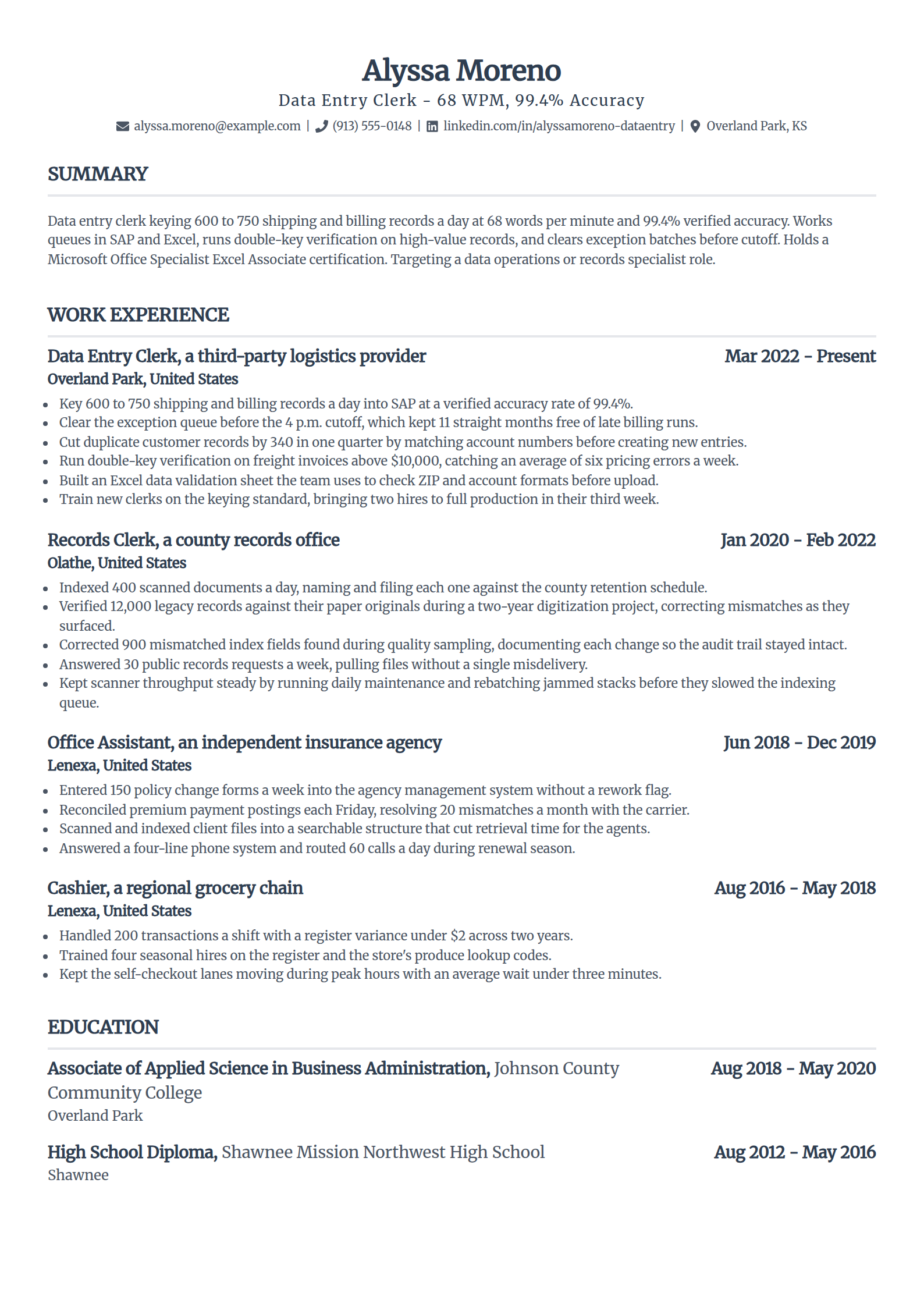
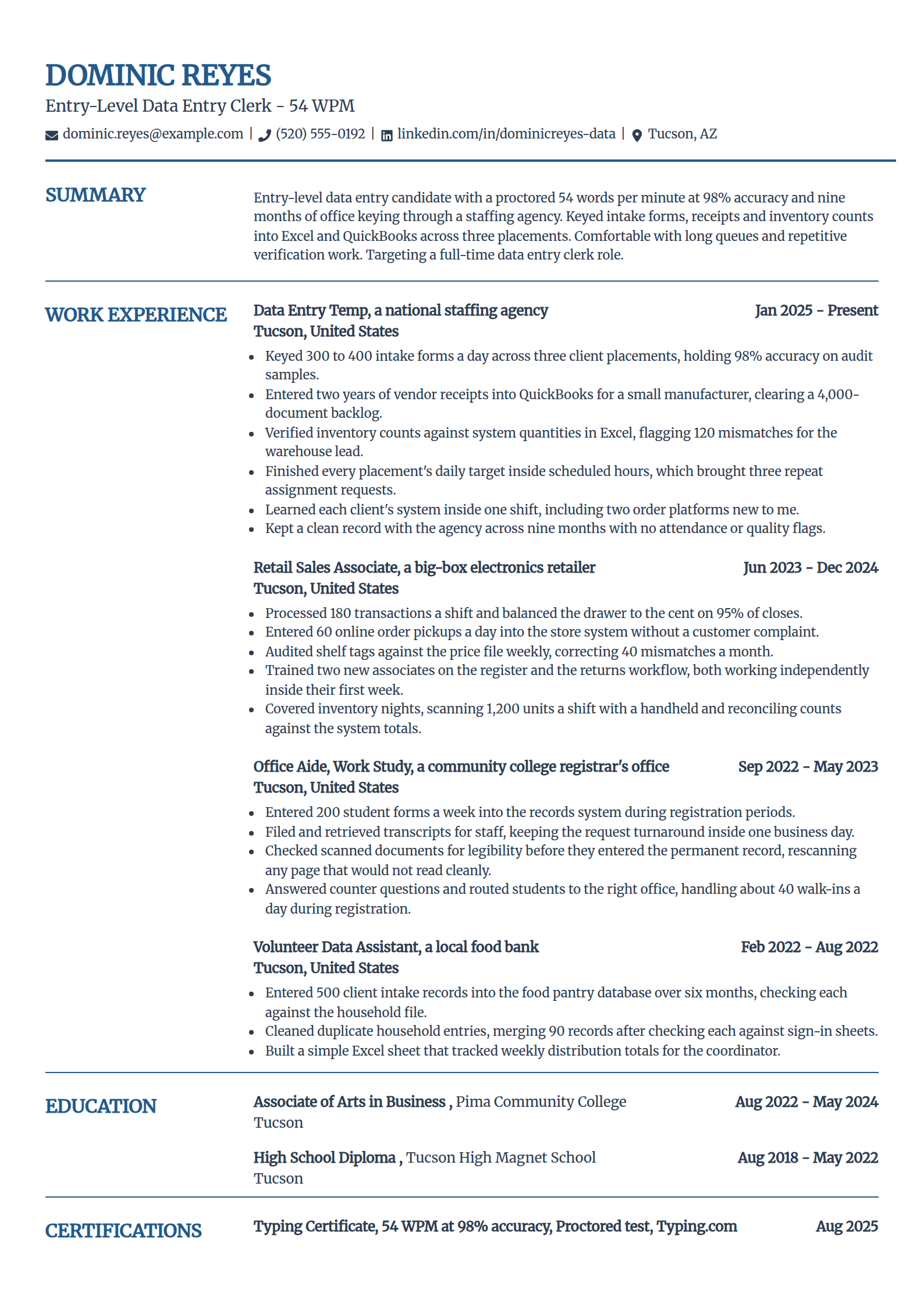
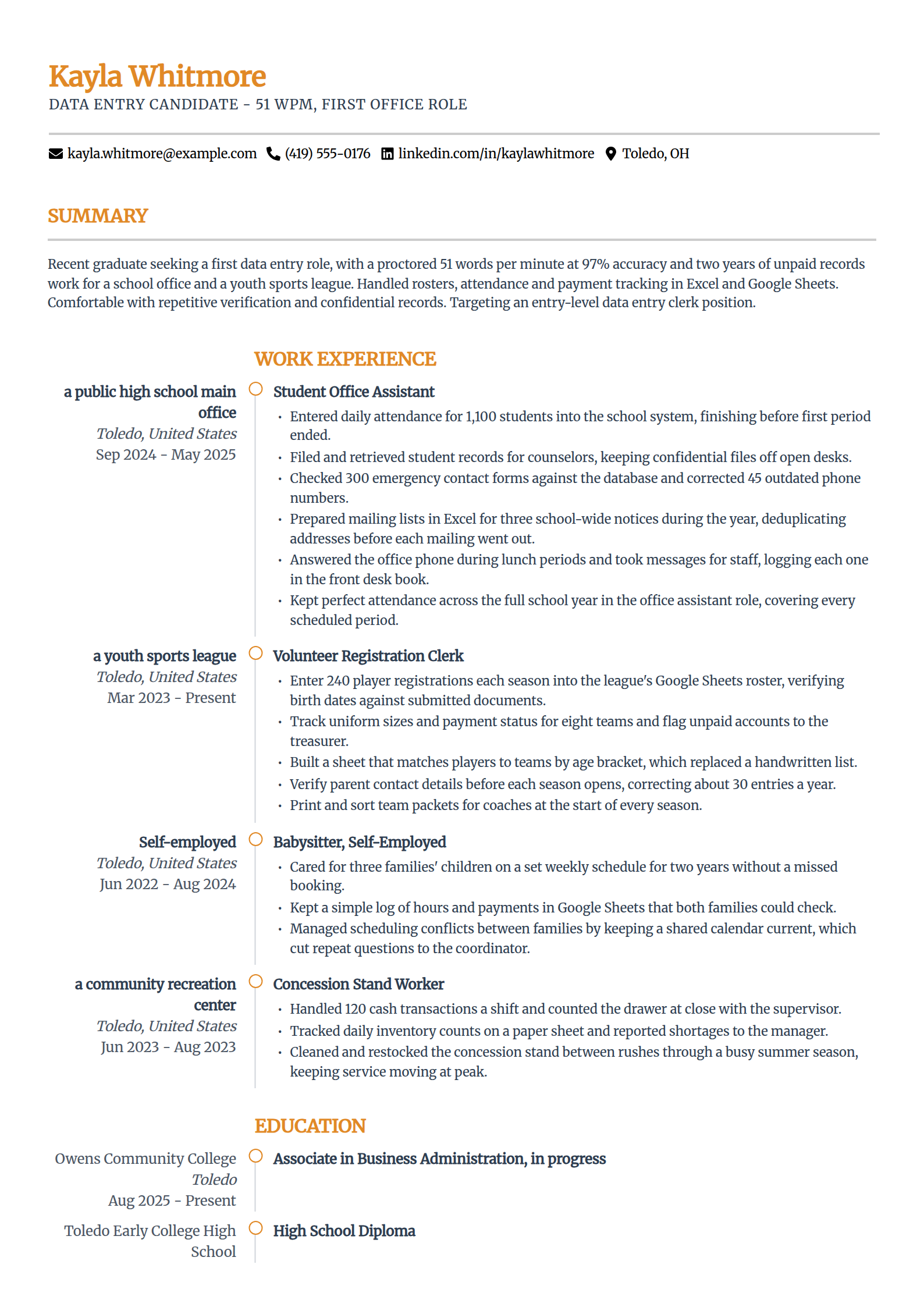
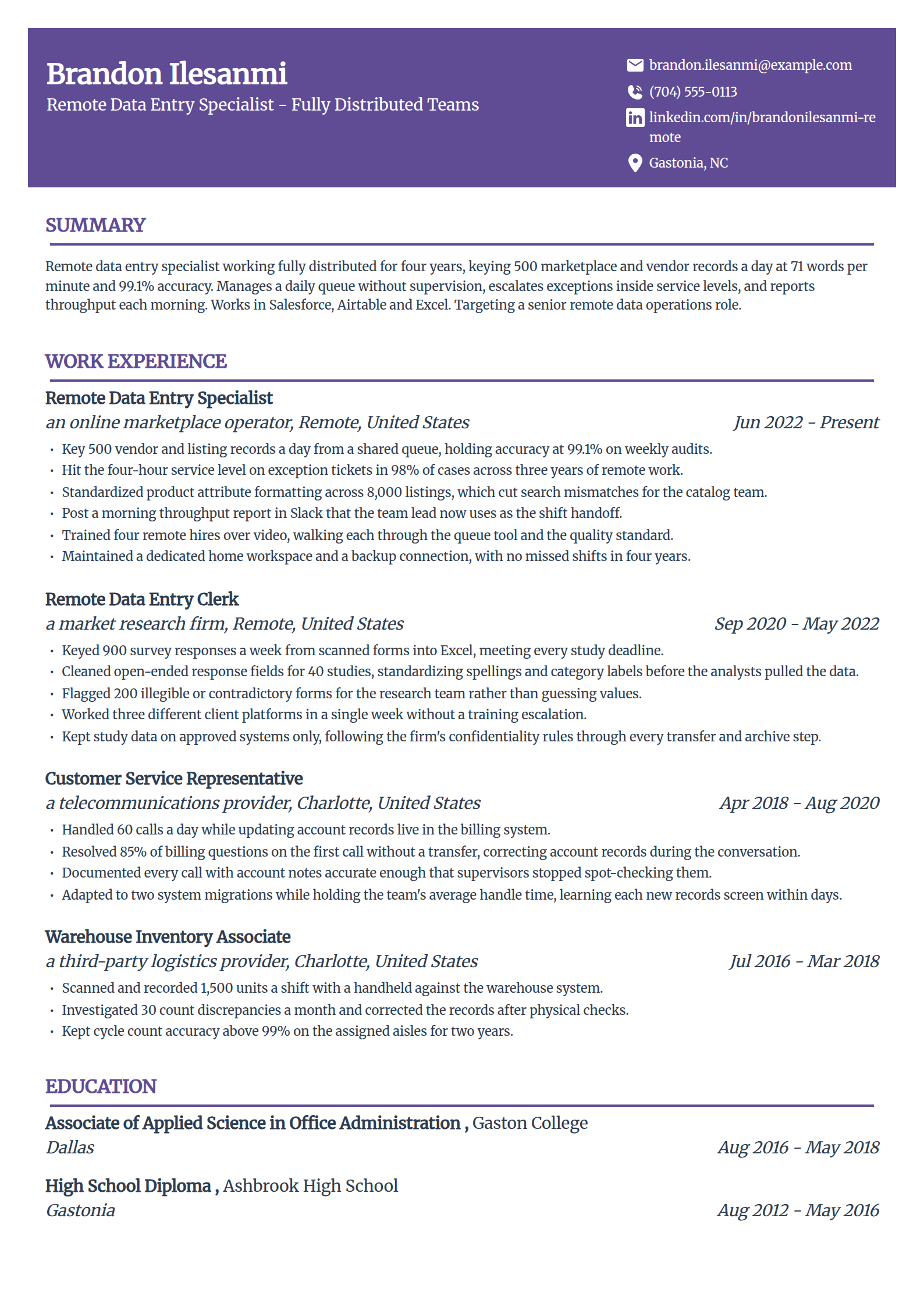
Data Entry Clerk Resume Template
Why this resume example works?
- Opens with all three hiring numbers in one line: 600 to 750 records a day, 68 words per minute, 99.4% verified accuracy.
- Names the system keyed into, SAP, rather than saying data entry software, which is what a posting is actually matching on.
- Shows a quality habit with a result behind it: double-key verification catching six pricing errors a week.
- Includes the cleanup work that gets clerks promoted, 340 duplicate customer records removed in a quarter.
- Keeps the records and cashier history short, so the page stays about keying rather than about a career path.
Entry-Level Data Entry Resume Template
Why this resume example works?
- Leads with a proctored 54 words per minute, which beats every adjective a beginner could use instead.
- Turns temp work into evidence by naming the placements, the daily counts and the repeat assignment requests.
- Uses a backlog number, 4,000 documents cleared, which shows stamina for the part of the job people quit over.
- Points out learning speed, a new client system picked up inside one shift, the thing agencies screen for.
- Keeps the retail job on the page for register accuracy, which is a real transferable detail signal.
Data Entry Resume Template With No Experience
Why this resume example works?
- Builds the whole page from school office work, volunteer records and informal jobs, which is what this reader actually has.
- States a tested 51 words per minute and 97% accuracy instead of calling itself detail oriented.
- Counts the work honestly: 1,100 attendance records a day, 240 registrations a season, 45 phone numbers corrected.
- Shows initiative at a believable scale, a Google Sheets roster that replaced a handwritten list.
- Names confidentiality, because a school office handles protected records and a hiring manager will notice.
Remote Data Entry Resume Template (Work From Home)
Why this resume example works?
- Answers the question every remote manager has first: four years fully distributed with no missed shifts.
- Uses a service level number, four-hour exception turnaround met 98% of the time, which proves self-management.
- Shows async communication as a skill, a morning throughput post the team now uses as its shift handoff.
- Mentions the workspace and backup connection briefly, because remote postings list both as requirements.
- Keeps the call center and warehouse history, which explains where the accuracy habit came from.
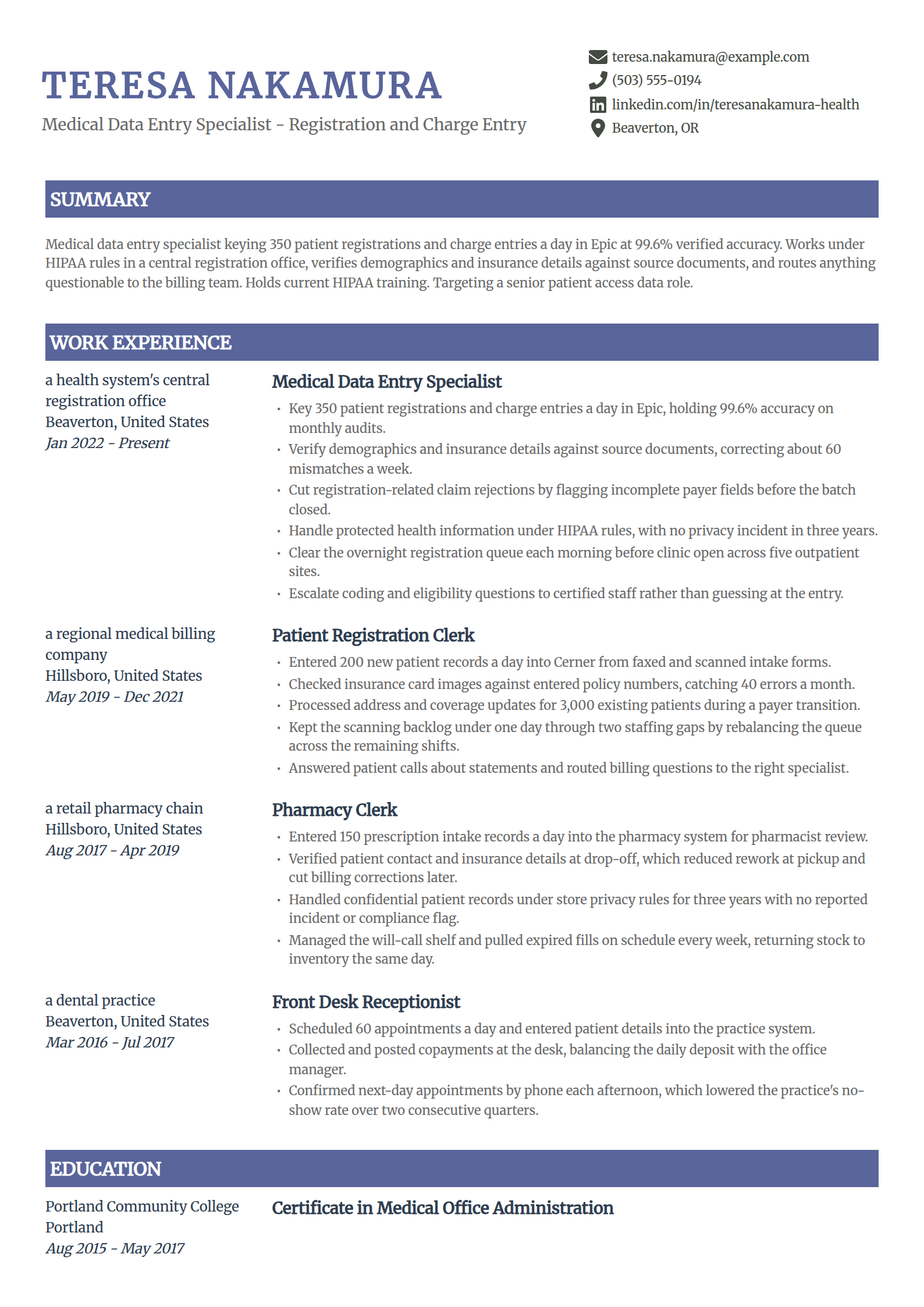
Medical Data Entry Resume Template (Registration and Charge Entry)
Why this resume example works?
- Names Epic and Cerner outright, which is how a health system screens a patient access resume.
- Puts HIPAA on the page as practice rather than as a word: three years with no privacy incident.
- Shows the downstream value of accurate keying, fewer claim rejections caused by incomplete payer fields.
- Stays inside scope by escalating coding and eligibility questions to certified staff instead of guessing.
- Uses the daily registration count, 350 a day, which tells a manager exactly what pace to expect.
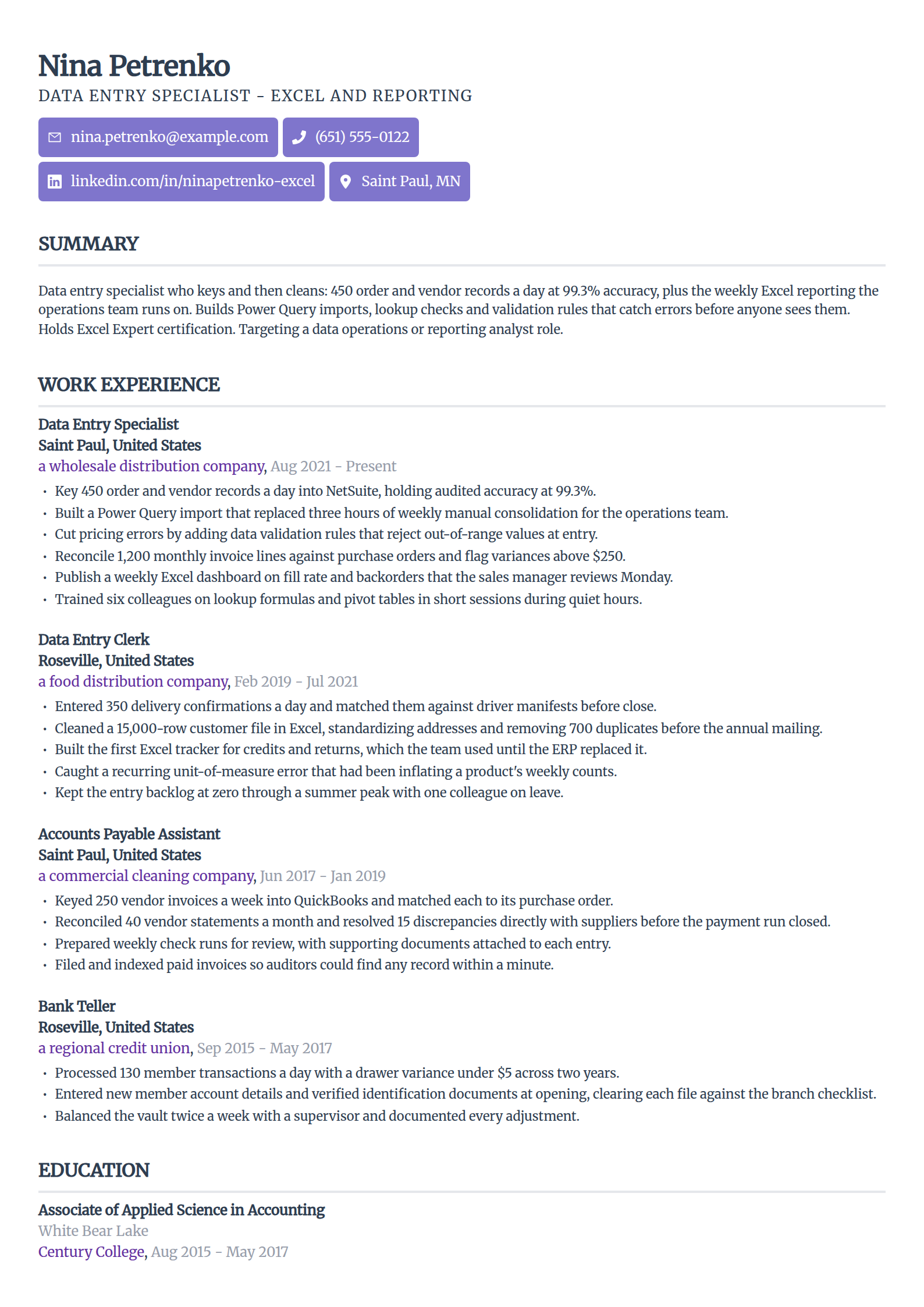
Data Entry Resume Template With an Excel Focus
Why this resume example works?
- Separates keying from cleaning, and claims both, which is what turns a clerk job into a data operations job.
- Gives Excel work a business result: a Power Query import that replaced three hours of manual consolidation.
- Shows prevention rather than correction, validation rules that reject out-of-range values at entry.
- Carries the Excel Expert certification, which is worth more on this resume than any adjective.
- Ends each role with a number a manager can verify, from 1,200 invoice lines to 700 duplicates removed.
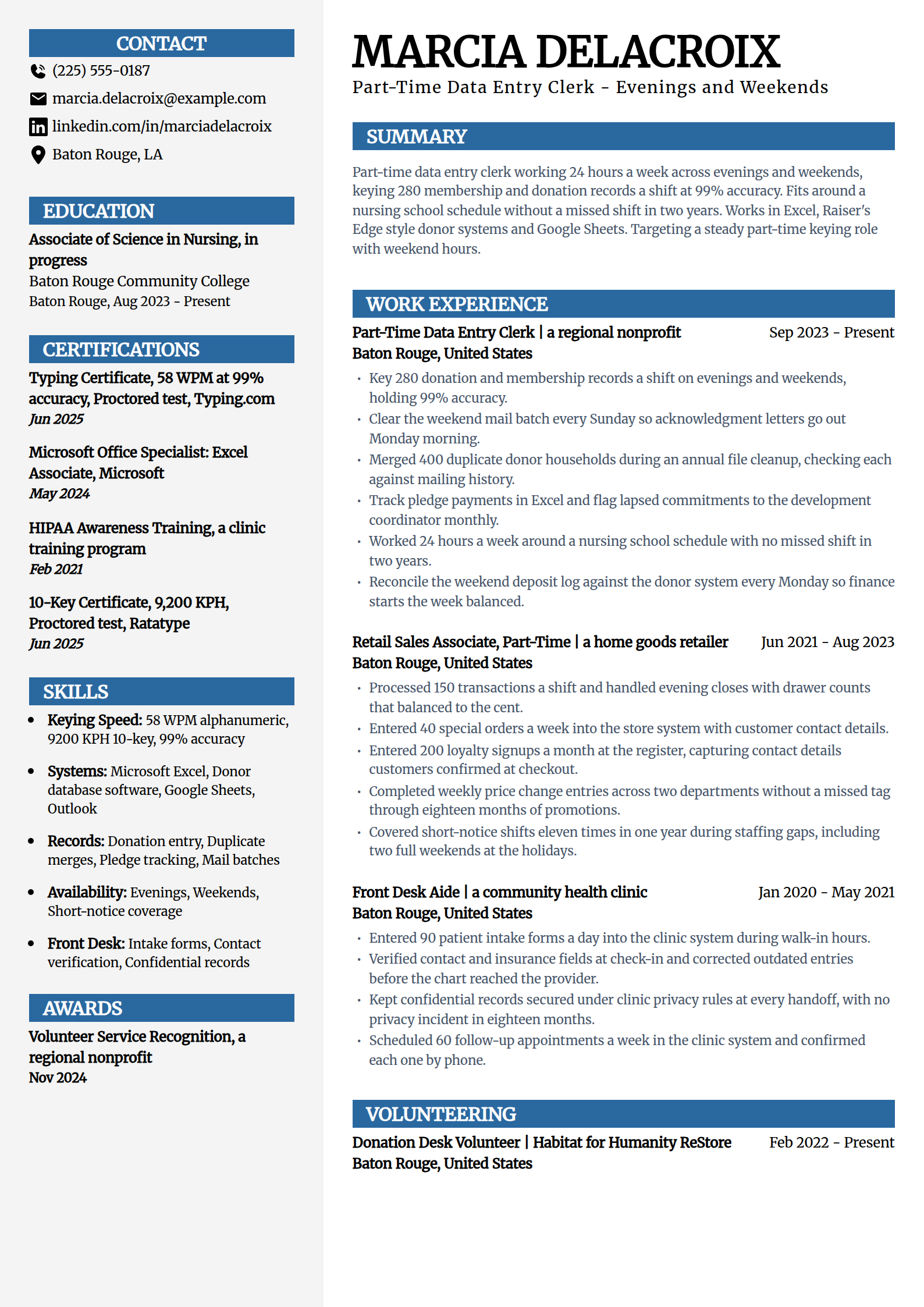
Part-Time Data Entry Resume Template (Evenings and Weekends)
Why this resume example works?
- States the availability up front, 24 hours a week on evenings and weekends, which is the first filter for part-time roles.
- Turns reliability into a number: two years around a nursing school schedule with no missed shift.
- Shows ownership of a recurring deadline, the Sunday mail batch that makes Monday's letters go out.
- Includes a cleanup project, 400 duplicate donor households merged, so the role reads as more than keying.
- Keeps the clinic front desk work visible for confidentiality and intake experience.
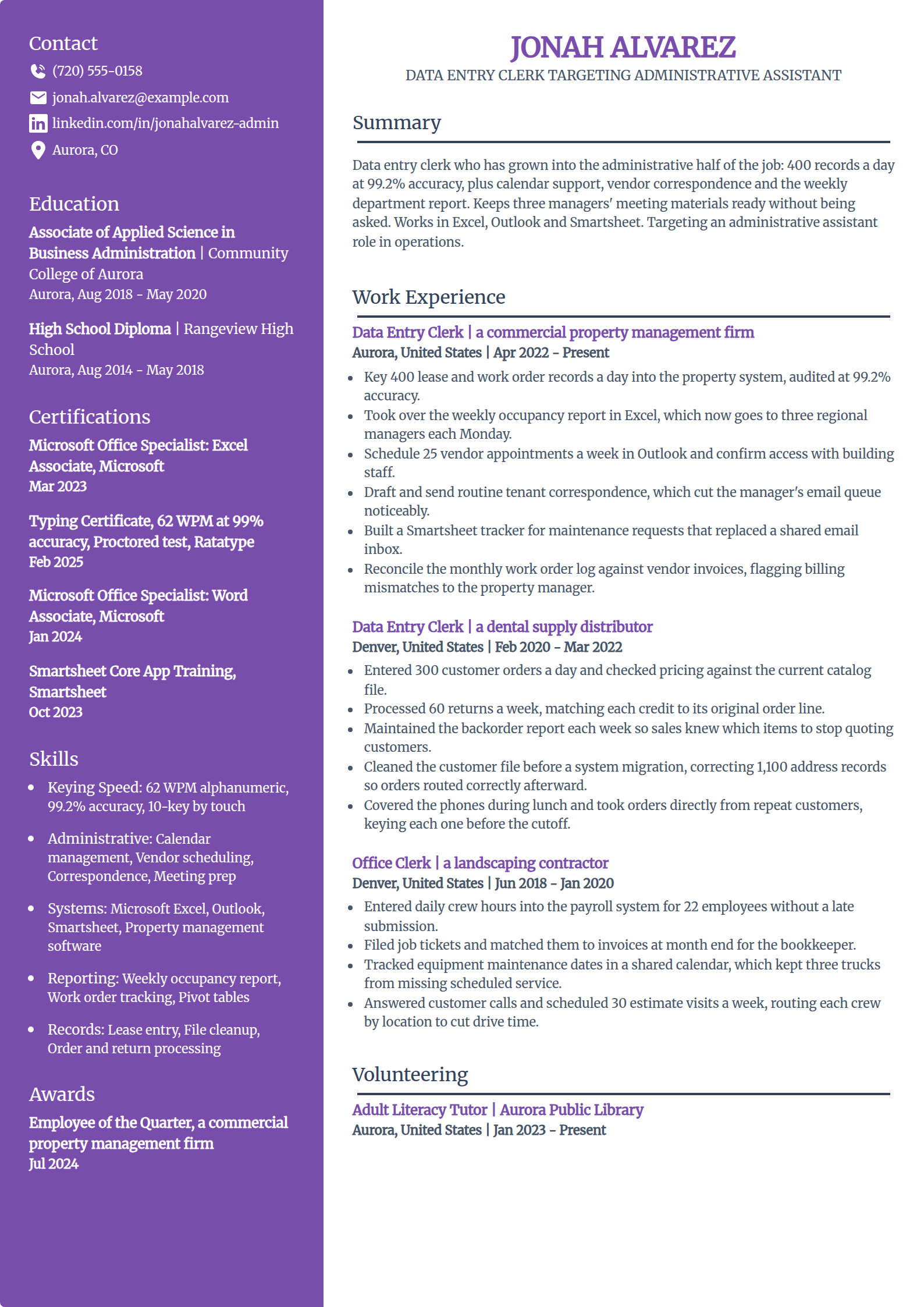
Data Entry to Administrative Assistant Resume Template
Why this resume example works?
- Leads with the administrative work already being done under a data entry title, which is how this move is won.
- Names concrete admin duties: a weekly report for three regional managers, 25 vendor appointments a week.
- Keeps the keying numbers in place, because they are still the proof of reliability behind the promotion.
- Shows a tool built rather than used, a Smartsheet tracker that replaced a shared email inbox.
- Targets one role, administrative assistant in operations, instead of asking to be considered for anything.
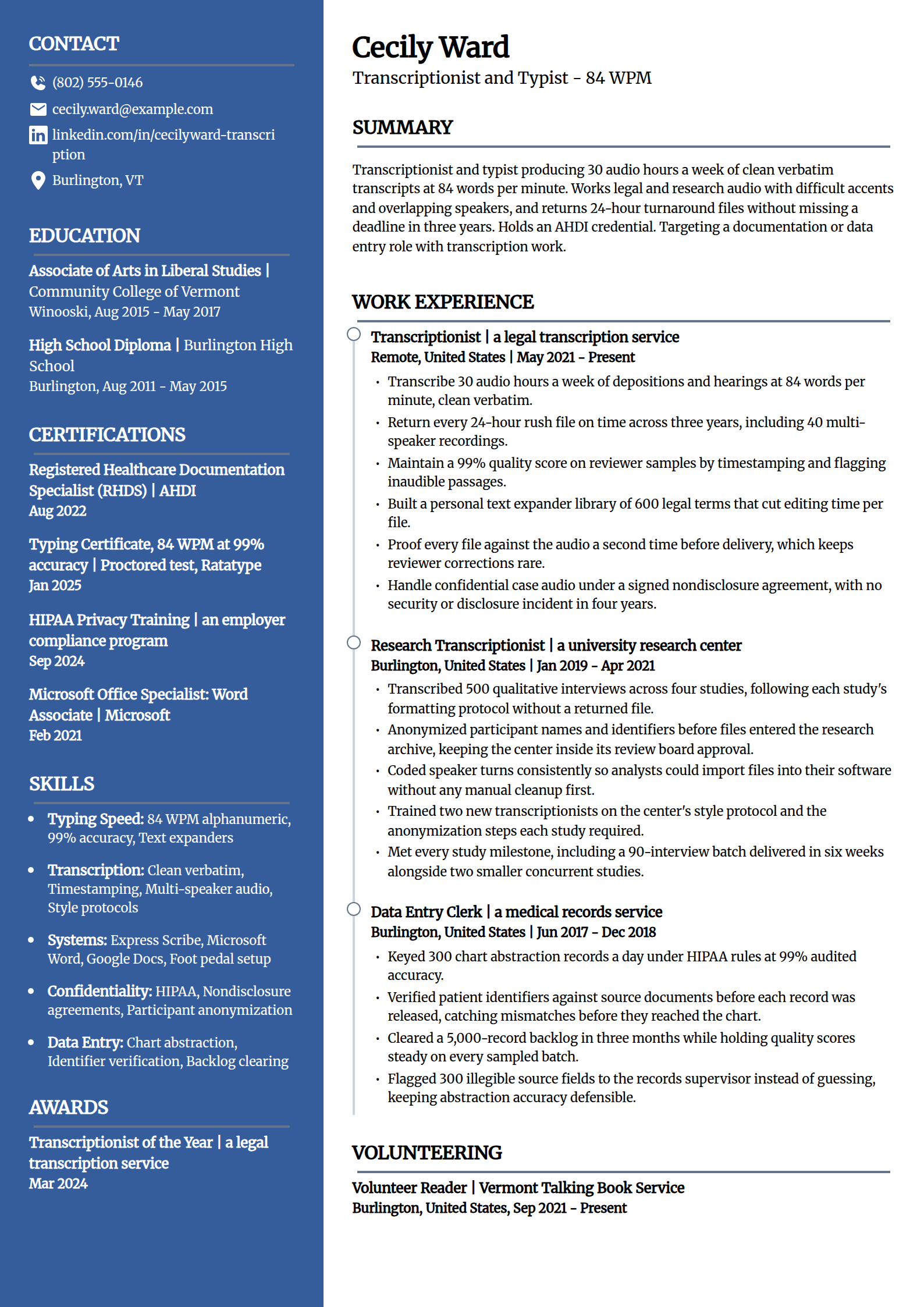
Typist and Transcriptionist Resume Template
Why this resume example works?
- Uses audio hours a week as the volume metric, which is how transcription work is actually measured.
- Pairs 84 words per minute with a quality score, because speed without a review score means little here.
- Names the hard cases, multi-speaker recordings and difficult audio, rather than claiming general accuracy.
- Shows a tooling habit that saves time, a 600-term expander library built for legal vocabulary.
- Carries the AHDI credential and the data entry history, so it reads for both kinds of posting.
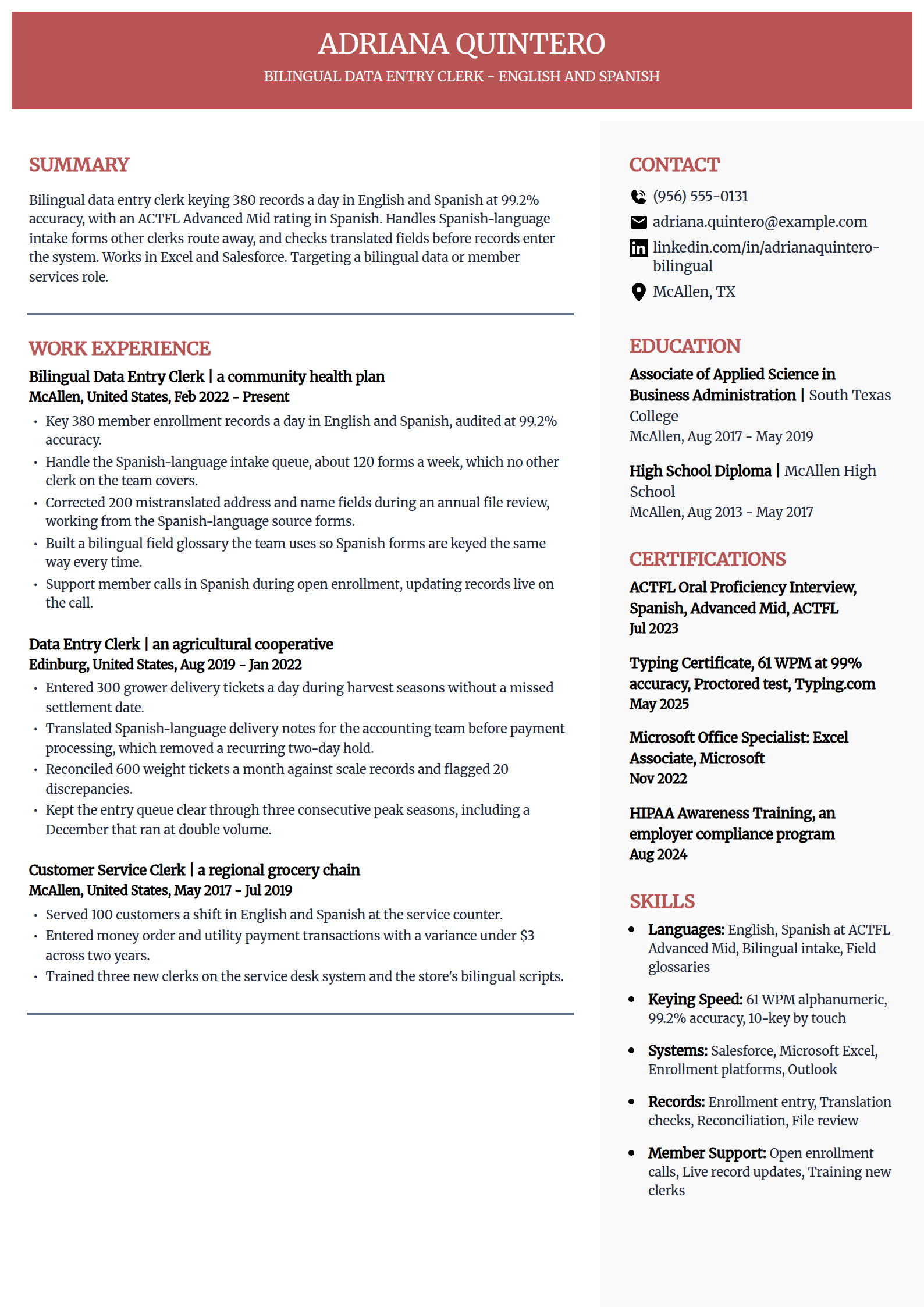
Bilingual Data Entry Resume Template (English and Spanish)
Why this resume example works?
- Rates the language instead of claiming it, an ACTFL Advanced Mid, which a hiring manager can interpret.
- Shows work only this candidate covers, a 120-form Spanish intake queue nobody else on the team takes.
- Gives the language skill a quality result, 200 mistranslated fields corrected in one file review.
- Includes a lasting contribution, a bilingual field glossary the whole team keys against.
- Keeps the standard data entry numbers so the resume still reads as a keying resume first.
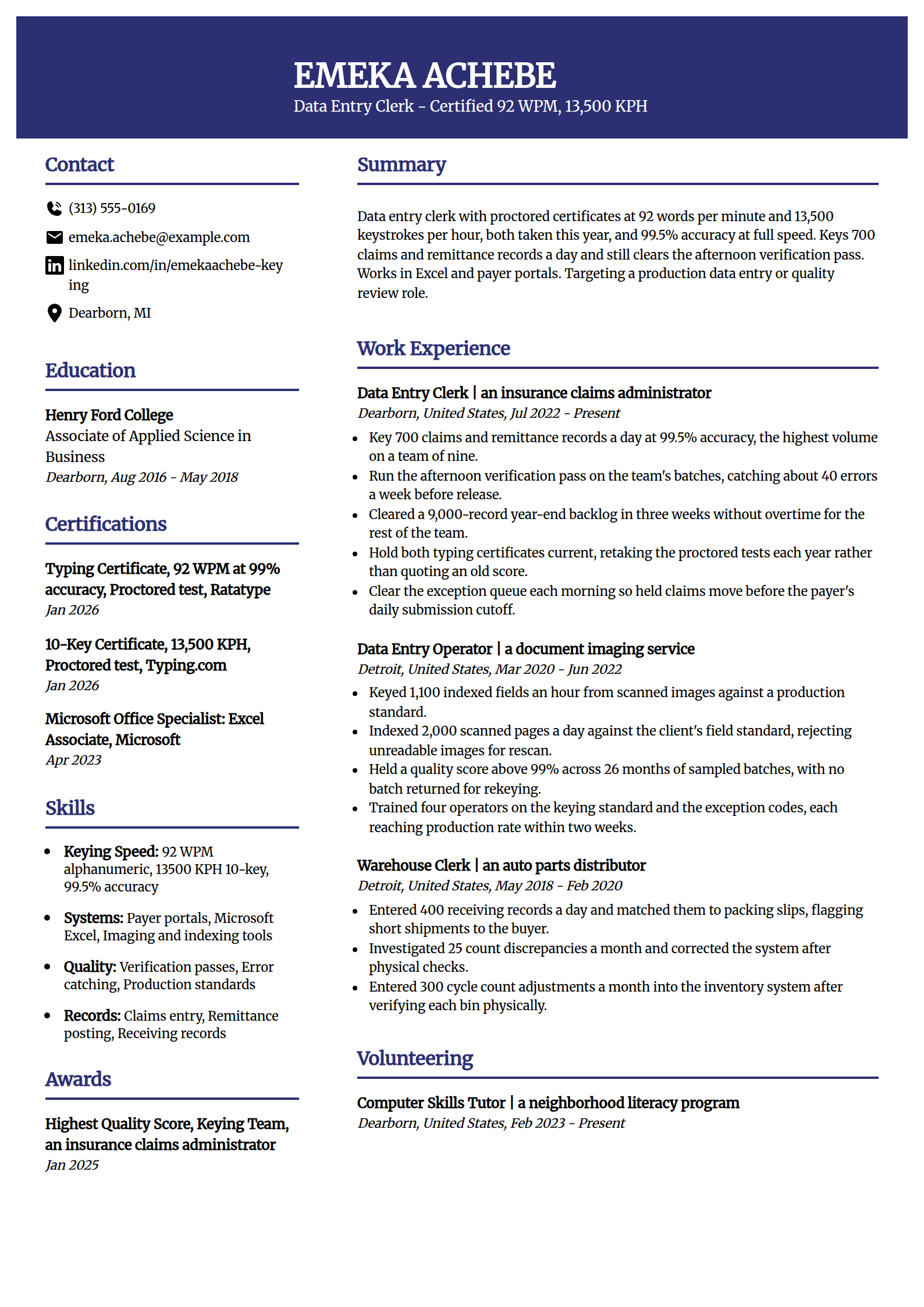
Data Entry Resume Template With a Typing Certification
Why this resume example works?
- Puts both certificates and their dates on the page, which is the difference between a claim and a credential.
- Backs the speed with sustained accuracy at volume, 700 records a day at 99.5%.
- Shows the speed being useful to other people, an afternoon verification pass over the team's batches.
- Mentions retaking the proctored tests each year, a small honest detail that makes the whole page credible.
- Uses a backlog result, 9,000 records in three weeks, that only a genuinely fast keyer could claim.
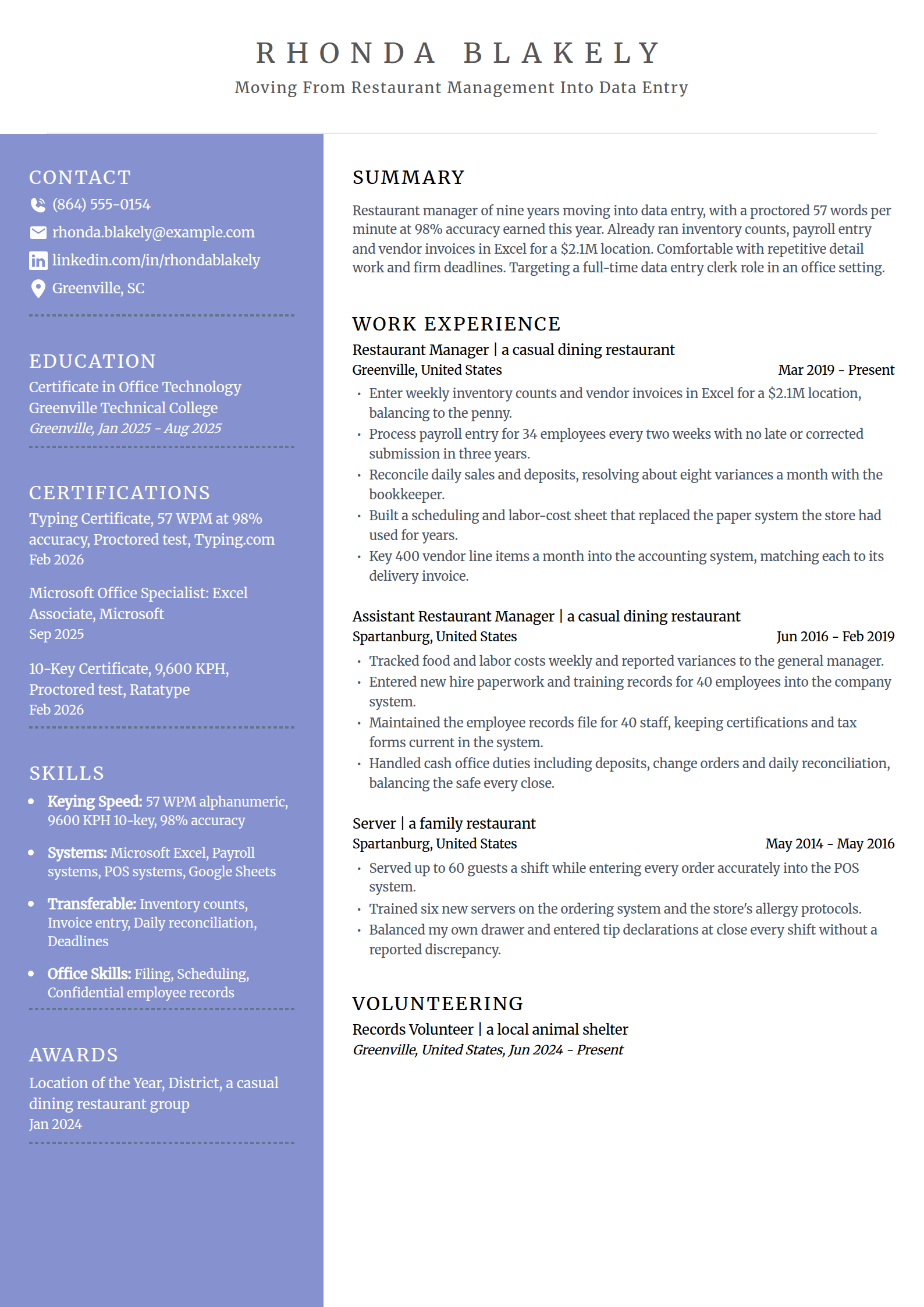
Career Change Into Data Entry Resume Template
Why this resume example works?
- Finds the data work inside the old job: inventory counts, payroll entry and vendor invoices in Excel.
- Leads with a current proctored speed, which stops the resume reading as a manager asking for a step down.
- Uses accuracy proof a restaurant can genuinely offer, balancing a $2.1M location's books to the penny.
- Names the certificate earned on purpose for this move rather than leaving the switch unexplained.
- Keeps the management history short, because the target job does not need nine years of it.
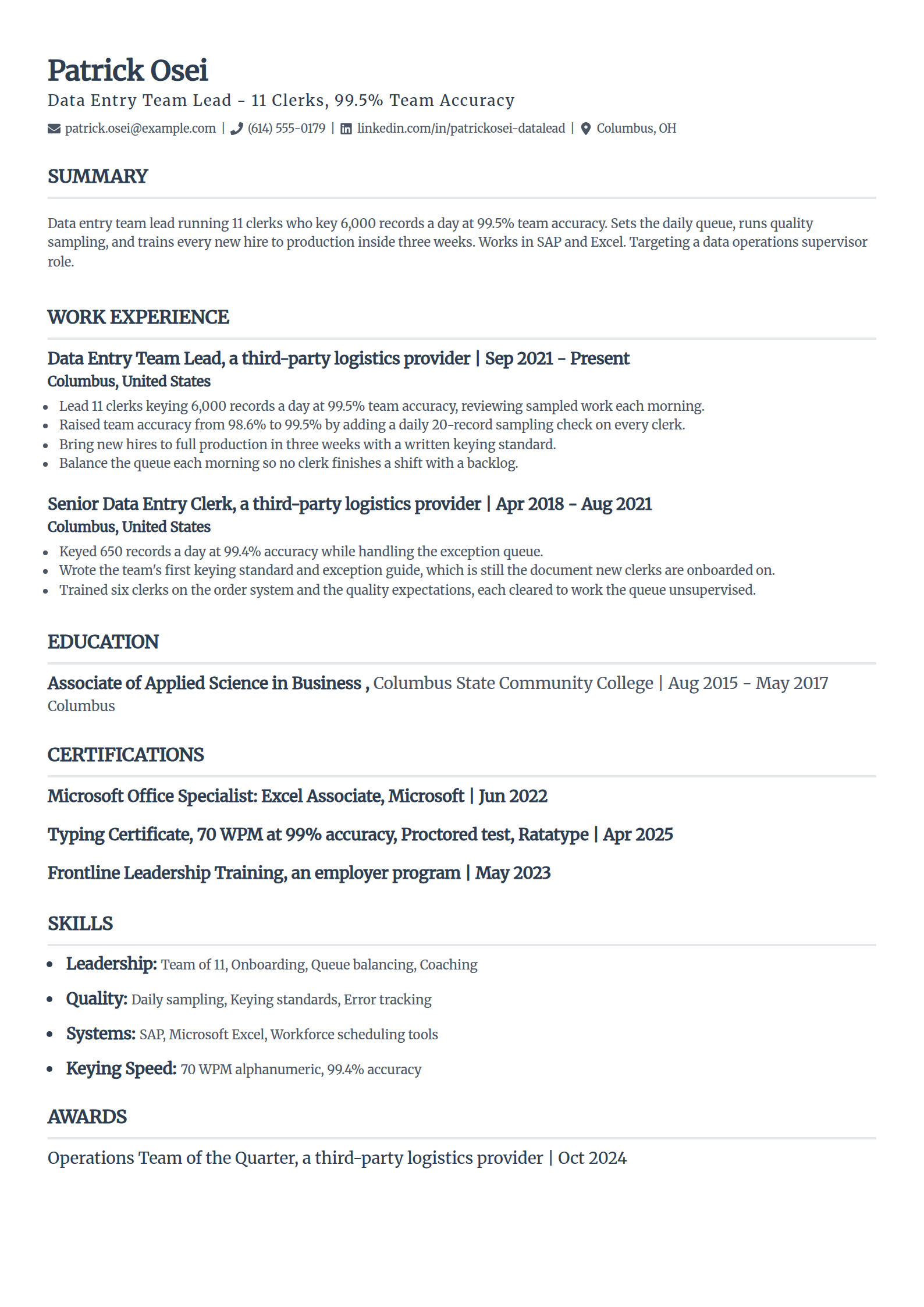
Data Entry Team Lead Resume Template
Why this resume example works?
- Leads with scope, 11 clerks and 6,000 records a day, so the level is clear in the first line.
- Owns a team quality improvement with the method behind it, daily sampling that lifted accuracy from 98.6%.
- Counts onboarding speed, new hires at full production in three weeks, which is a lead's real deliverable.
- Shows the clerk years underneath, including the keying standard still used for training.
- Keeps one page for a supervisory candidate, which most team lead resumes fail to do.
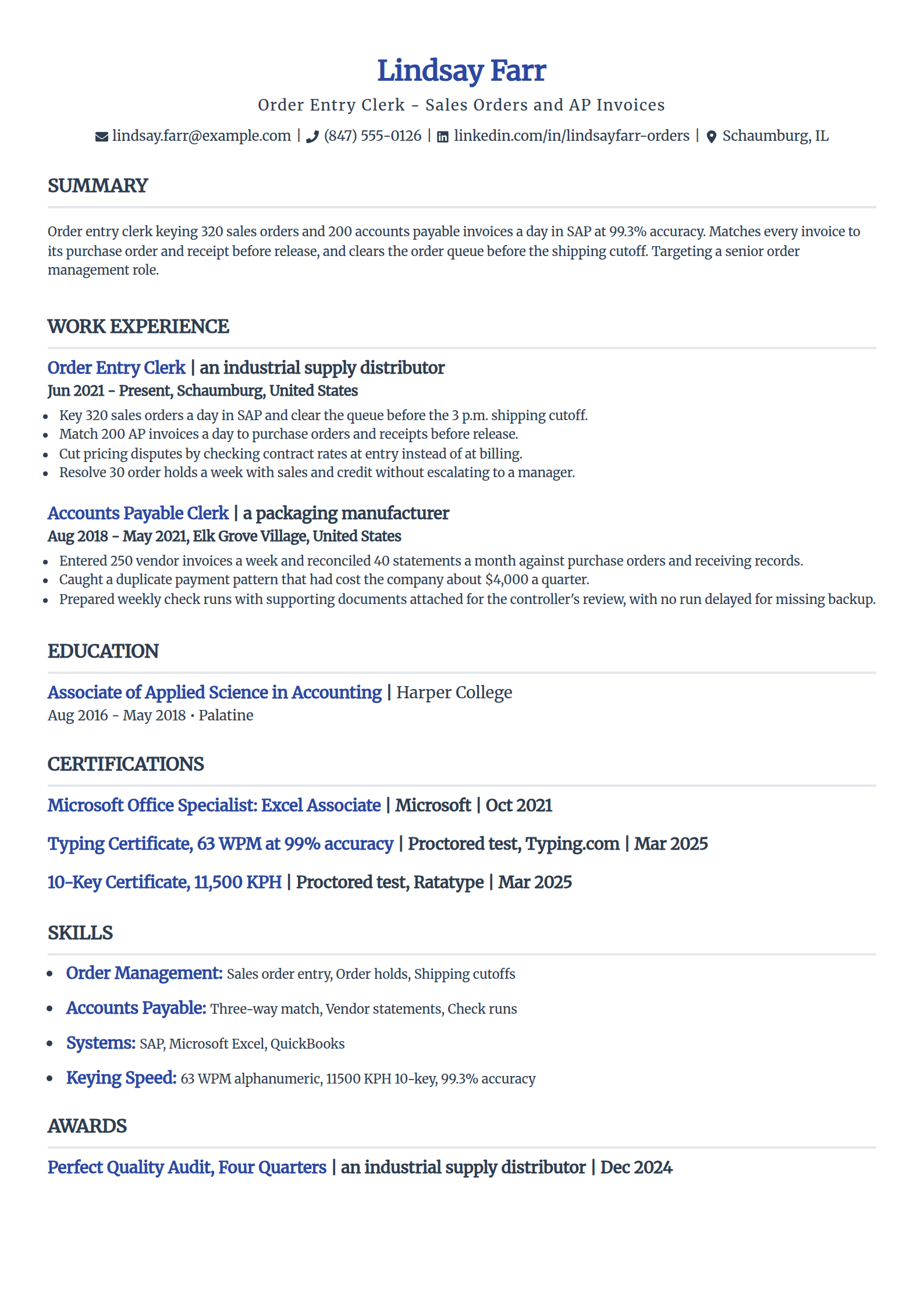
Order Entry and Invoice Data Entry Resume Template
Why this resume example works?
- Splits the two record types cleanly, 320 sales orders and 200 invoices a day, instead of one vague total.
- Names the three-way match, which is the accounts payable phrase a posting will use.
- Shows a saved cost with a real cause, a duplicate payment pattern worth about $4,000 a quarter.
- Ties accuracy to a deadline that matters, clearing the queue before the shipping cutoff.
- Resolves order holds with sales and credit directly, which reads as judgment rather than escalation.
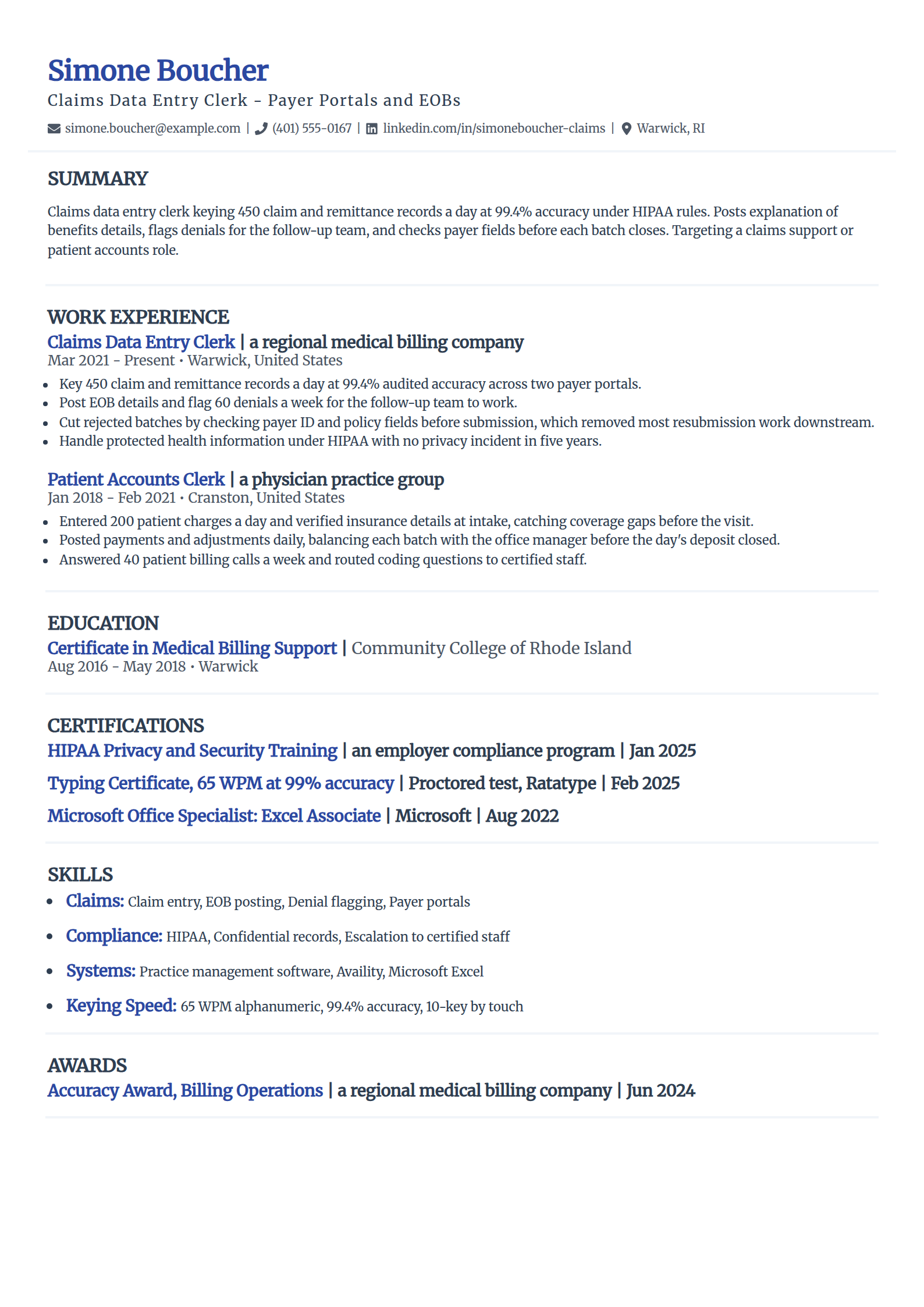
Insurance and Claims Data Entry Resume Template
Why this resume example works?
- Uses claims vocabulary correctly: remittance records, EOB posting, denials flagged for the follow-up team.
- Prevents rework at the source by checking payer ID and policy fields before a batch is submitted.
- Keeps HIPAA compliance as a five-year record rather than a line in a skills list.
- Stays in scope by routing coding questions to certified staff, which a billing manager will check for.
- Carries a daily volume and an accuracy rate together, the pair claims employers screen on.
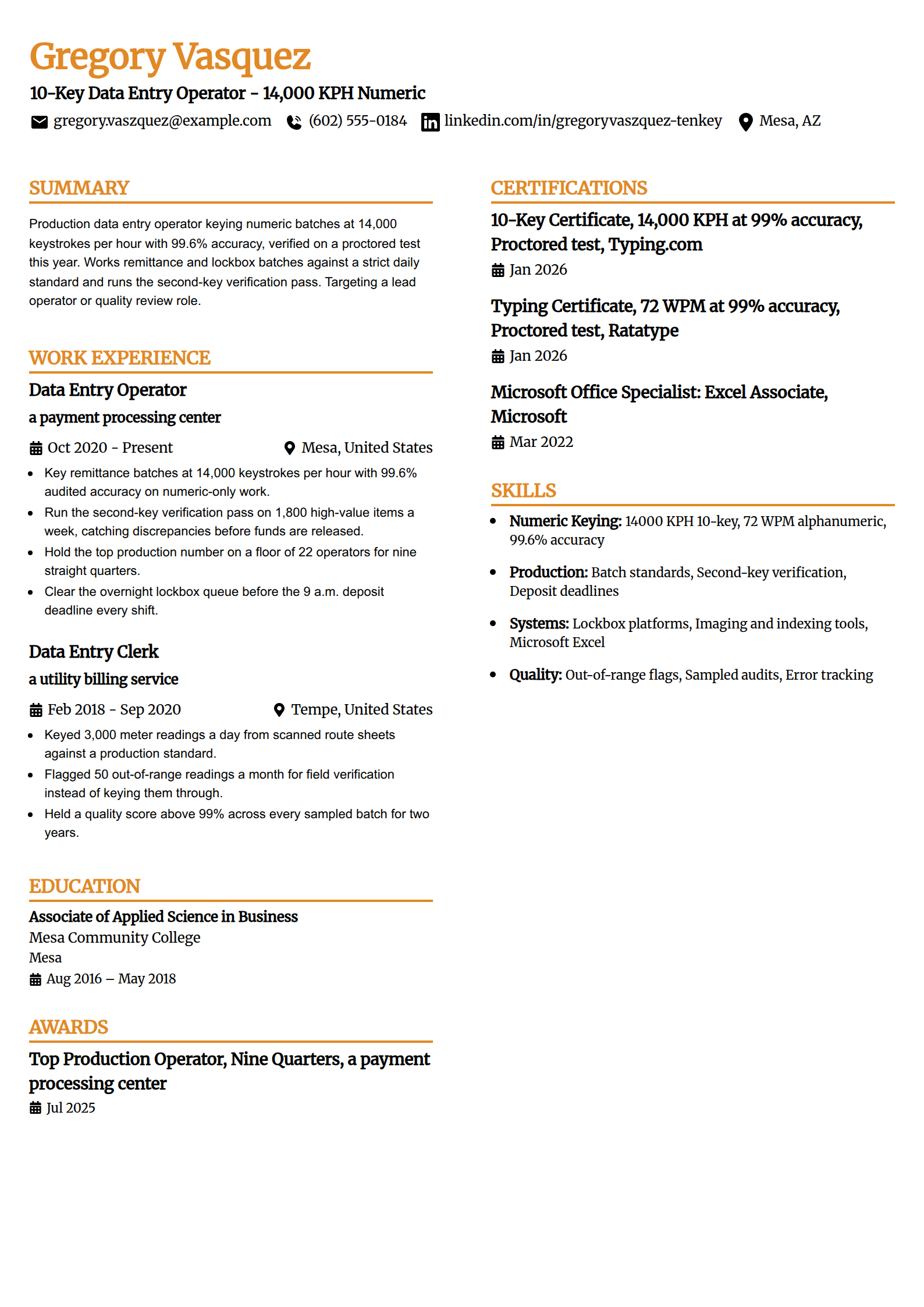
10-Key Data Entry Operator Resume Template
Why this resume example works?
- Uses keystrokes per hour, not words per minute, which is the right unit for numeric production work.
- Pairs 14,000 KPH with 99.6% audited accuracy, since speed alone gets rejected on a production floor.
- Shows consistency over time, top production on a floor of 22 operators for nine straight quarters.
- Names the deadline the job lives by, clearing the lockbox queue before the 9 a.m. deposit.
- Includes judgment, 50 out-of-range meter readings flagged a month rather than keyed through.
Build your data entry resume
Pick a template above and the editor keeps your layout clean and ATS-safe while you swap in your own speed, accuracy and daily record counts.
Build my resumeHow to write a data entry resume in 2026
Data entry hiring runs on three numbers: speed, accuracy and daily volume. A resume without them says nothing a hiring manager can use, which is why so many get skipped. Put all three in the first two lines, then make every bullet name a record type, a system and a count.
Open with speed, accuracy and what you key
Three to four sentences. Name the records you key and how many a day, your typing speed and accuracy, the systems you work in, and the role you want. If you have not held a data entry job yet, write an objective of two to three sentences instead, and still lead with your tested speed and the closest records work you have done, whether that was a school office, a volunteer database or inventory counts.
Data entry clerk keying 600 to 750 shipping and billing records a day at 68 words per minute and 99.4% verified accuracy. Works queues in SAP and Excel, runs double-key verification on high-value records, and clears exception batches before cutoff. Holds a Microsoft Office Specialist Excel Associate certification. Targeting a data operations or records specialist role.
Get your typing numbers right
This is the one place a data entry resume can be checked in ten minutes, so the numbers have to hold up.
- Alphanumeric work is measured in words per minute. Most postings ask for 40 to 60, so a tested 55 is a good number, not a modest one.
- Numeric work is measured in keystrokes per hour. Postings commonly ask for 8,000 to 12,000 KPH on 10-key.
- Always pair speed with accuracy. A speed with no accuracy rate beside it reads as a guess, and 100% reads as a lie.
- Take a proctored test, then name the test and the date. "68 WPM at 99%, proctored, June 2025" survives scrutiny; "fast typist" does not.
- Claim only what you can repeat under pressure, because plenty of employers test on the day.
Make bullets specific about records, systems and volume
Generic phrasing is what sinks these resumes. Name the record type, the system it went into, and how many you handled.
- Open with a verb like keyed, verified, reconciled, indexed, flagged or cleared, never "Responsible for" or "Assisted with".
- Name the system by name: SAP, NetSuite, QuickBooks, Salesforce, Epic, Excel. That is what a posting matches on.
- Give the count and the window. "Keyed 450 claim records a day" tells a manager the pace they are hiring.
- Add the quality step you own, such as double-key verification, audit sampling or an exception queue you clear.
- Include what you fixed, not only what you entered. Duplicate merges, corrected fields and backlogs cleared are the bullets that get read twice.
Match the skills block to the job you are applying for
Data entry postings vary more than they look. Reorder your skills so the first line answers the posting.
- Office and general: Excel with VLOOKUP and pivot tables, Google Sheets, Outlook, scanning and indexing, 10-key by touch.
- Medical: Epic or Cerner, patient registration and charge entry, insurance verification, HIPAA, medical terminology.
- Claims and billing: claim entry, EOB posting, denial flagging, payer portals, three-way match for accounts payable work.
- Remote: queue management, service levels, async reporting, a dedicated workspace and a reliable connection.
- Never claim a coding or clinical credential you do not hold. Keying charge data is not the same job as certified medical coding, and a billing manager knows the difference.
Formatting and length
One page, always, including team leads. These are roles where the resume itself is a sample of your attention to detail.
- Use a single-column layout with standard headings, and proofread twice. A typo on a data entry resume is a disqualifying argument all by itself.
- Put speed and accuracy in the summary and again in the skills block, since some screeners read only one of them.
- Keep unrelated jobs to two lines each, but keep them. Steady work history counts for a lot in a high-turnover field.
- Save as a PDF unless the posting asks for a Word file, and name the file with your own name.
Honestly: the typing certificate matters more than the resume design here
For most office jobs, a certificate is a nice extra. For data entry it is closer to the whole interview, because employers hire on measurable throughput and half of them test you on the day anyway. Spend twenty minutes taking a proctored typing and 10-key test, put the real result and its date on the page, and retake it each year. That single line does more for a data entry application than any layout choice, and an inflated number does more damage here than anywhere else on a resume.
Common data entry resume mistakes
- Writing "performed data entry duties" instead of naming the records, the system and the count. "Keyed 450 claim records a day in Epic at 99.4%" is the same job described in a way that gets an interview.
- Claiming a typing speed with no accuracy rate, no test and no date. An untested number invites the on-the-day test to be the whole interview, and 100% accuracy reads as invented.
- Listing "attention to detail" and "fast learner" in place of numbers. Every applicant claims both, so neither line does any work.
- Using words per minute for 10-key work. Numeric keying is measured in keystrokes per hour, and using the wrong unit signals you have not done the job.
- Sending a data entry resume with a typo in it. On these applications the document is the work sample, and a hiring manager who finds one error stops reading.
Frequently asked questions
What should a data entry resume include?
Your typing speed and accuracy, the records you key and your daily volume, and the systems you key into, all in the first two lines. Then a summary of three to four sentences carrying those numbers, experience bullets that each name a record type, a system and a count, a skills block ordered to match the posting, and certifications such as a proctored typing certificate, Microsoft Office Specialist Excel or HIPAA training. Keep it to one page.
How do I write a data entry resume with no experience?
Take a proctored typing and 10-key test first, then build the page around that number and whatever records work you have already done. School office work, a volunteer database, a sports league roster, inventory counts at a retail job and tracking your own hours in a spreadsheet all count, and all of them can carry a number. Use an objective of two to three sentences rather than a summary, name the entry-level role you want, and keep the counts honest and small. Nobody expects office throughput from a first office job.
Should you put your typing speed on a data entry resume?
Yes, and put it in two places: the summary and the skills block. Give the alphanumeric speed in words per minute, add keystrokes per hour if you do 10-key work, and always pair speed with an accuracy percentage. Take a proctored test and name the test and the date so the number is checkable. Most postings ask for 40 to 60 words per minute and around 8,000 to 12,000 keystrokes per hour, so a tested 55 WPM is a solid number. Do not round up, because many employers test on the day.
What skills do employers look for on a data entry resume?
Typing speed and accuracy first, then the specific systems you key into, because that is what an applicant tracking system matches. Excel is close to universal, and knowing VLOOKUP, pivot tables and data validation puts you ahead of most applicants. After that it depends on the posting: Epic or Cerner and HIPAA for medical, payer portals and EOB posting for claims, SAP or NetSuite and three-way match for order entry and accounts payable, and queue management for remote roles. Add the quality practices you actually use, such as double-key verification or audit sampling.
Do you need a summary or an objective on a data entry resume?
A summary if you have done the work, an objective if this is a first job, a career change or a return after a break. A resume carries one or the other, never both. The summary runs three to four sentences and opens with your volume, speed and accuracy. The objective runs two to three, still opens with what you bring, your tested speed and the closest records work you have done, then names the role you are targeting. Neither one should open with what you want from the employer.
How do I get a remote data entry job with my resume?
Prove you can run your own day, since that is what a remote manager is really buying. Name the systems you have worked in remotely, show that you hit deadlines or service levels without supervision, and include any history of working from home with reliable attendance. Add the practical details a remote posting lists, such as a dedicated workspace and a reliable connection, in one short line rather than a paragraph. Then keep the speed and accuracy numbers exactly as you would for an office job, because the throughput bar does not change.
More data entry resume resources
Build your data entry resume
Pick a template above and the editor keeps your layout clean and ATS-safe while you swap in your own speed, accuracy and daily record counts.