17 Retail Resume Examples, Seasonal to Store Manager
- ATS Friendly
- Retail Specific
- 17 Role Examples
A retail resume example should open with your role and store type, then carry the numbers a store manager actually tracks: conversion, units per transaction, drawer accuracy, or shrink, with your POS systems named instead of called a register. Each of the 17 below is a full resume for one specific retail job, built so you can swap in your own store, systems, and results.


540k+ resumes created
Editable retail resume templates
Each template below is a real retail resume laid out in that format, sorted by the job you are after. Choose one, then swap in your own role, POS systems, metrics, and results. All of them keep your name, contact details, and dates where an applicant tracking system expects to read them.
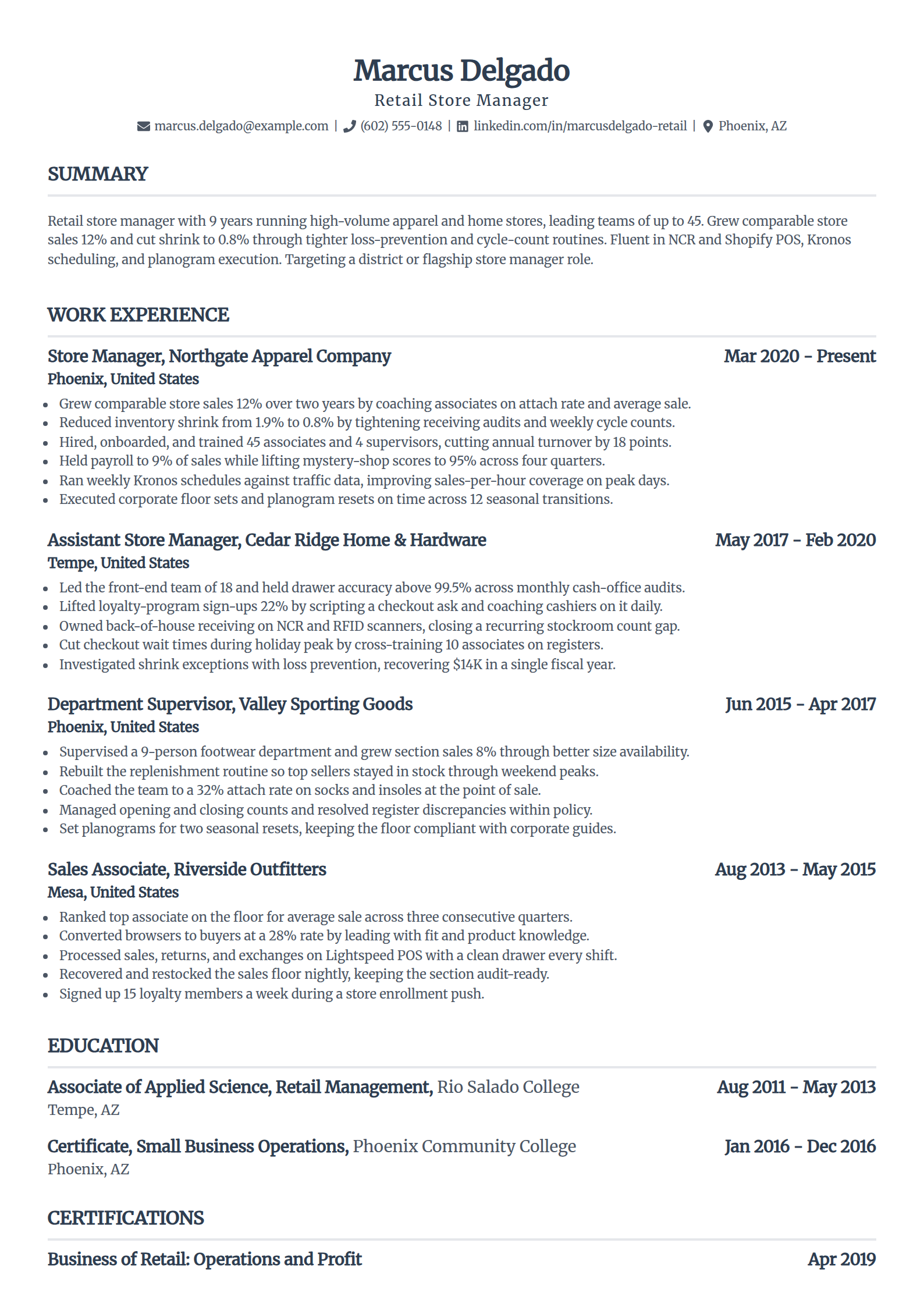
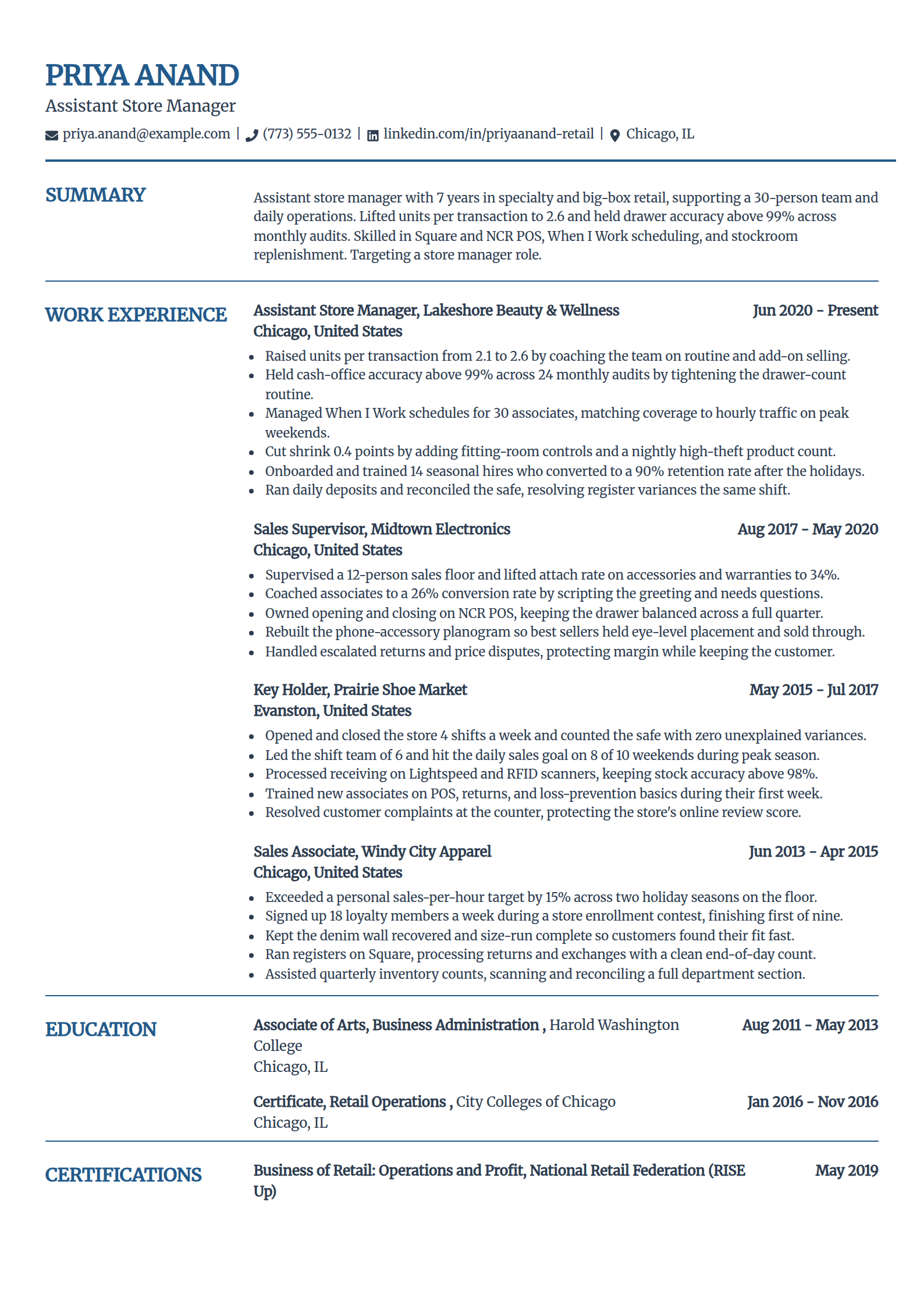
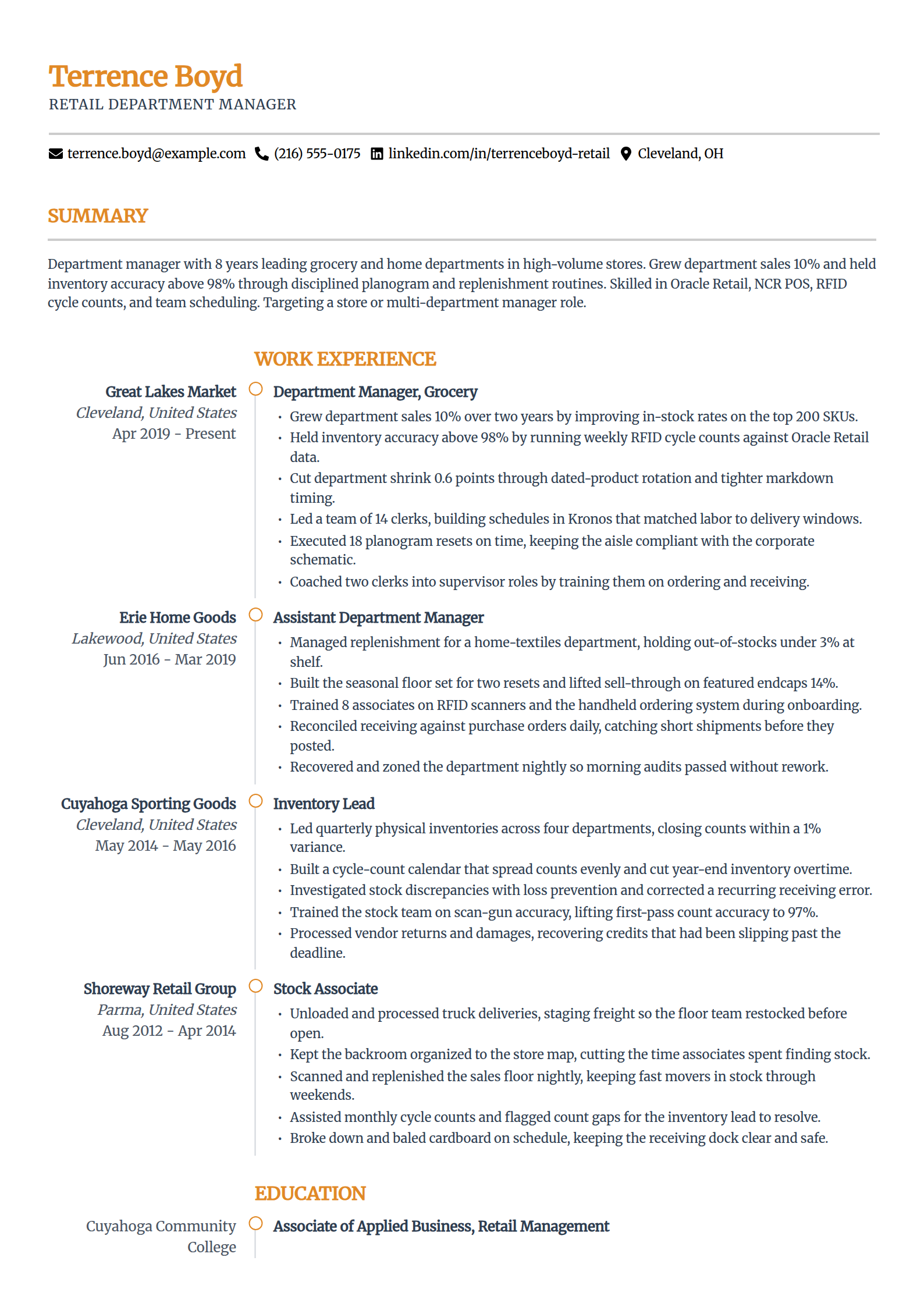
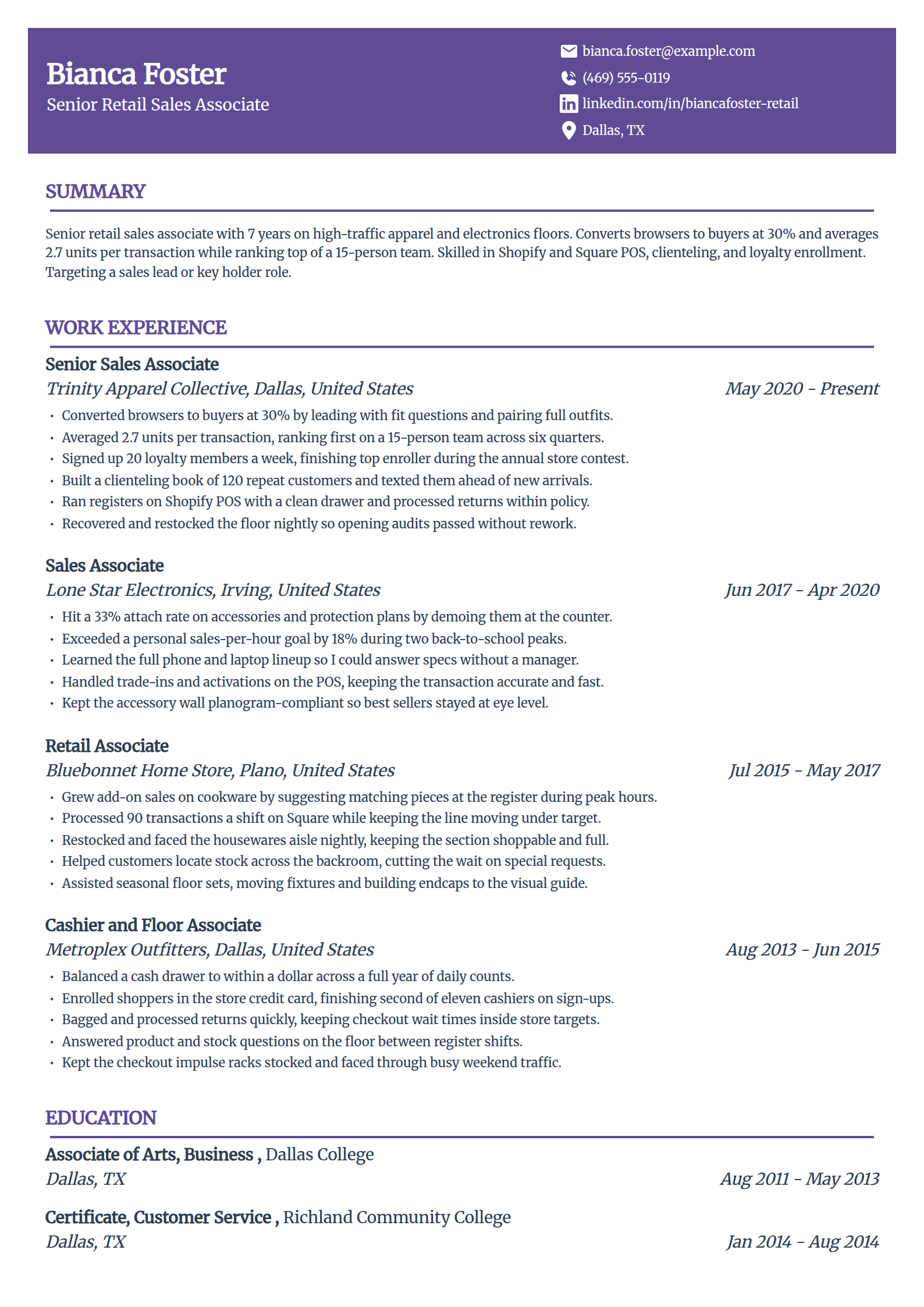
Retail Store Manager Resume Template
Why this resume example works?
- Leads with 12% comparable store sales growth and shrink cut to 0.8%, the P&L numbers a district hires a manager on.
- Shows 45 associates hired and trained plus payroll held to 9% of sales, the labor scope a store manager owns.
- Names NCR and Shopify POS, Kronos scheduling, and planogram execution, the exact systems on a retail posting.
- Ties a 95% mystery-shop score and lower turnover to coaching, so the result reads as method, not a claim.
- Keeps a clean single-column layout a resume parser reads top to bottom without dropping a section.
Assistant Store Manager Resume Template
Why this resume example works?
- Leads with units per transaction lifted to 2.6 and drawer accuracy above 99%, the results a store manager screens for.
- Shows When I Work scheduling for a 30-person team, the coverage-and-labor scope an assistant manager runs.
- Names Square and NCR POS, cash-office reconciliation, and fitting-room controls, the operations keywords on the posting.
- Ties a 0.4-point shrink cut to added loss-prevention counts, proving the number came from real work.
- Fills a dense layout with four progressive roles that map the path toward store manager.
Department Manager Resume Template
Why this resume example works?
- Leads with 10% department sales growth and inventory accuracy above 98%, the metrics a department is judged on.
- Names Oracle Retail, RFID cycle counts, and Kronos, pairing the ordering system with the labor tool.
- Shows 18 on-time planogram resets and dated-product rotation, the in-stock and shrink work the role owns.
- Ties a 0.6-point shrink cut to rotation and markdown timing, so the result reads as a repeatable routine.
- Fills a dense two-column layout with four roles that trace stock associate to department manager.
Experienced Retail Sales Associate Resume Template
Why this resume example works?
- Leads with a 30% conversion rate and 2.7 units per transaction, the selling KPIs a floor role is measured on.
- Shows a clienteling book of 120 repeat customers and top loyalty enrollment, the repeat-sales signal managers want.
- Names Shopify and Square POS, so a screener sees the checkout systems the posting lists.
- Keeps every metric modest and in scope for an associate, drawer accuracy and attach, never store revenue.
- Fills a full page with four roles that show a clear climb from cashier to senior associate.
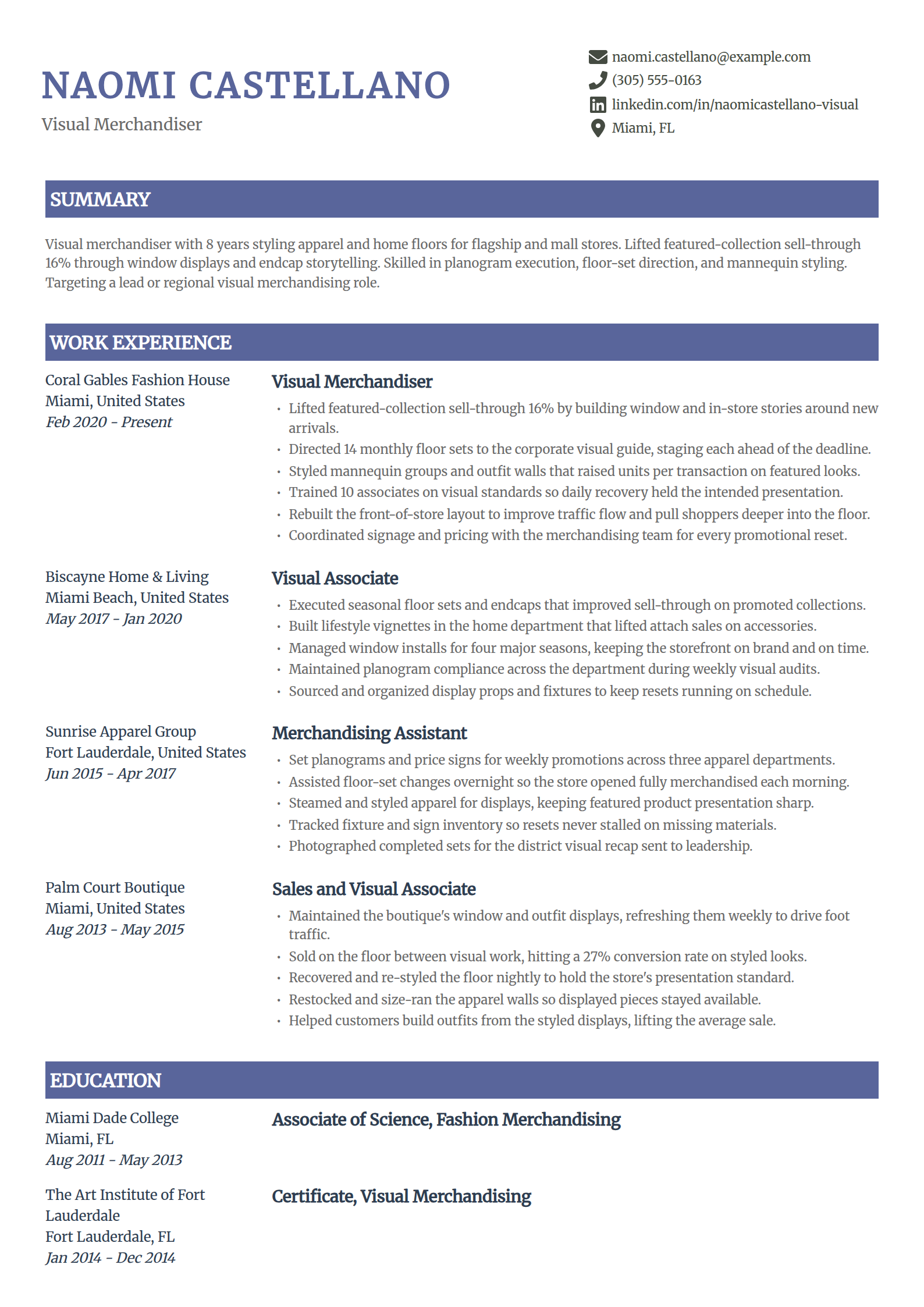
Visual Merchandiser Resume Template
Why this resume example works?
- Leads with featured-collection sell-through up 16%, the result window and endcap work is hired to drive.
- Shows 14 monthly floor sets staged ahead of deadline, the reset cadence a visual role is expected to hold.
- Names planogram execution, mannequin styling, and Adobe Photoshop, the merchandising and creative tools on the posting.
- Ties display storytelling to units per transaction, so the creative work connects to a sales number.
- Fills a rich, visual-forward layout that fits a merchandiser presenting their eye for presentation.
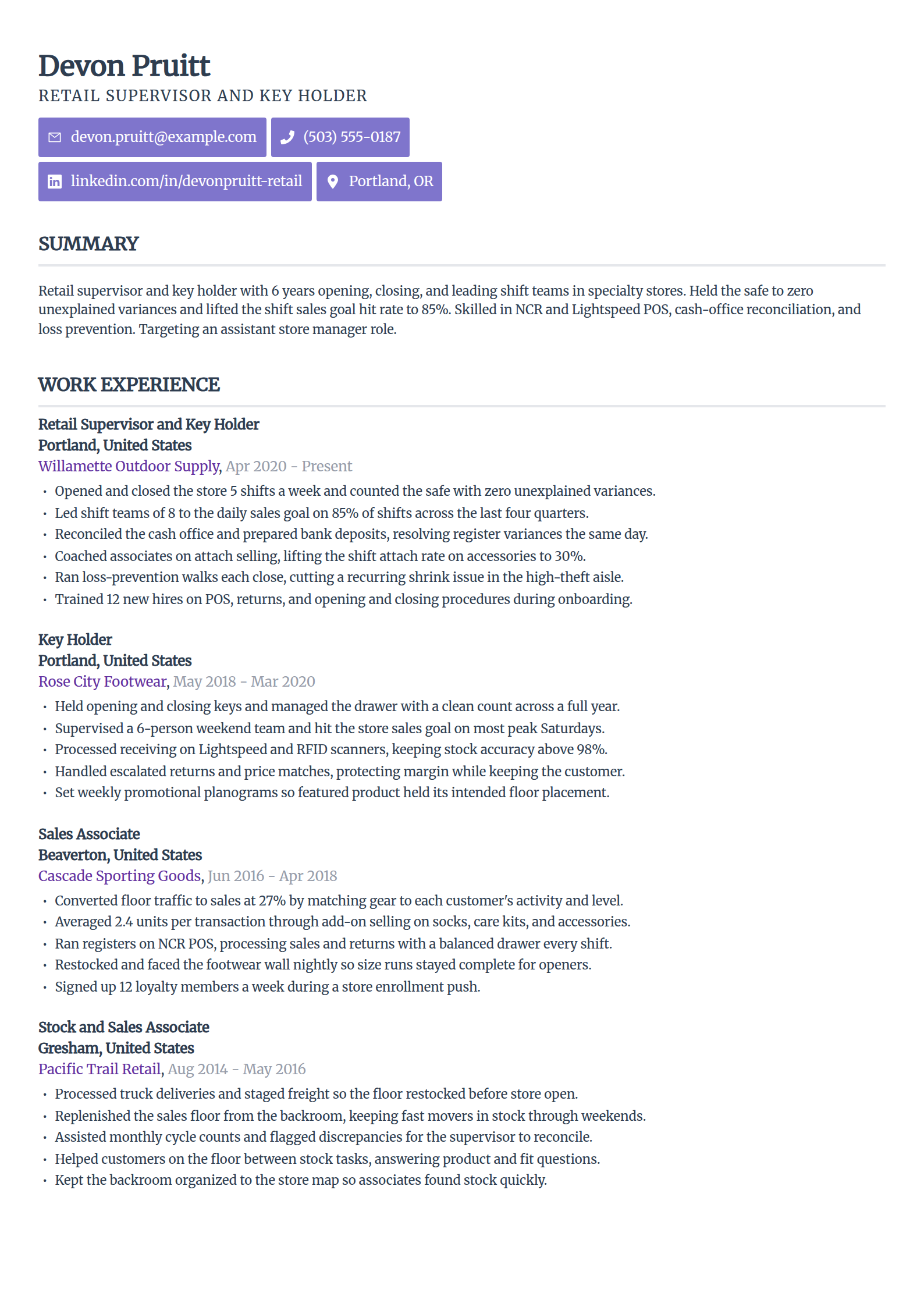
Retail Supervisor & Key Holder Resume Template
Why this resume example works?
- Leads with zero unexplained safe variances and an 85% shift-goal hit rate, the trust a key holder is given.
- Shows opening and closing five shifts a week plus cash-office reconciliation, the responsibilities the role names.
- Names NCR and Lightspeed POS, RFID scanners, and loss-prevention walks, the operations keywords on the posting.
- Ties a shrink cut to nightly LP walks, proving the number came from a routine rather than luck.
- Fills a dense layout with four roles that map the step from associate to assistant store manager.
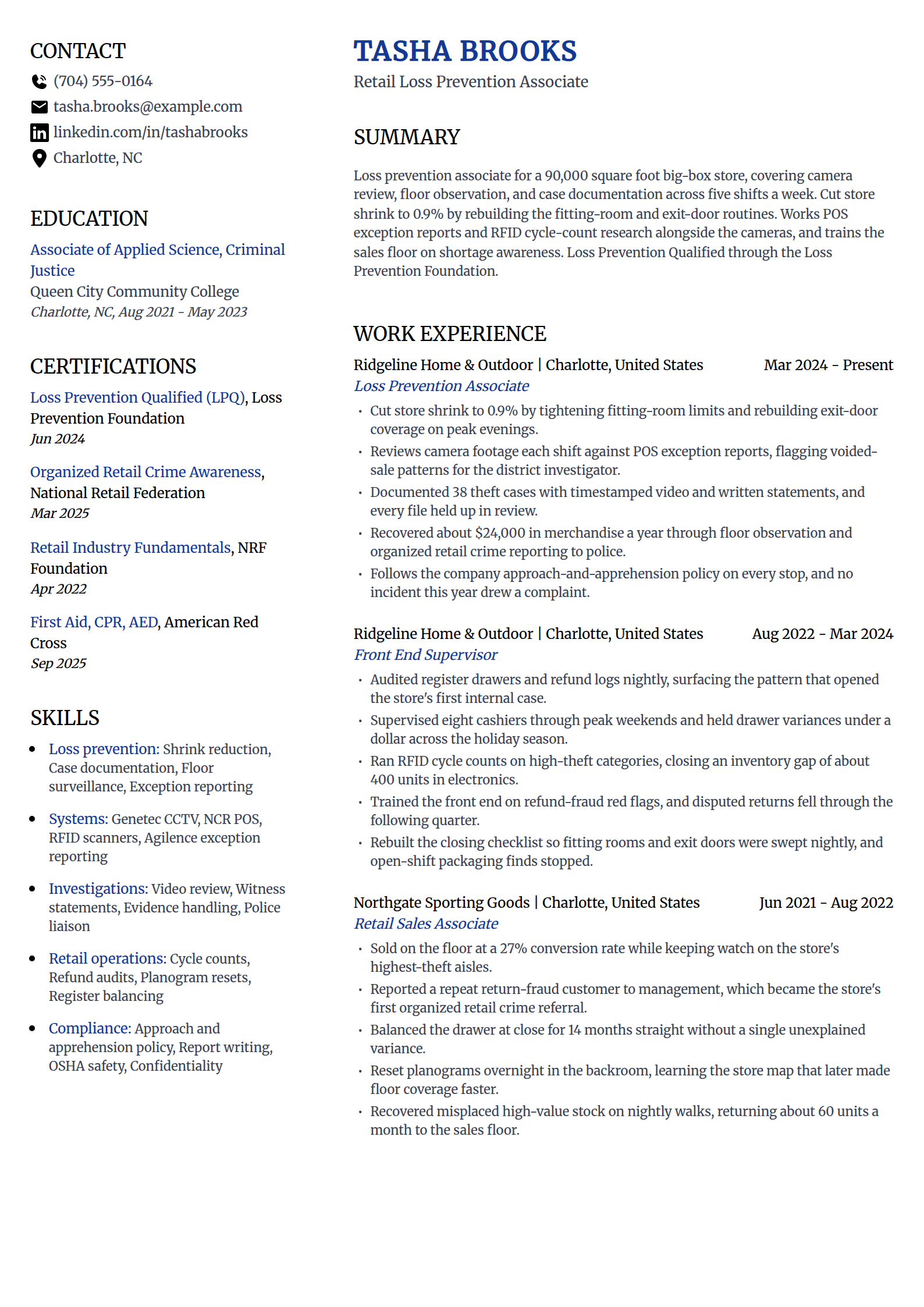
Retail Loss Prevention Associate Resume Template
Why this resume example works?
- Leads with store shrink cut to 0.9%, the single number a loss prevention job is hired and measured on.
- Names Genetec cameras, POS exception reports, and RFID scanners, pairing the surveillance tools with the retail systems on the posting.
- Shows the case work rather than the catch, 38 files built from timestamped video and written statements.
- Keeps every stop inside the company approach-and-apprehension policy, the judgment that separates a hire from a liability.
- Traces a retail path into the role, sales floor to front end supervisor to loss prevention, which is how most stores fill it.
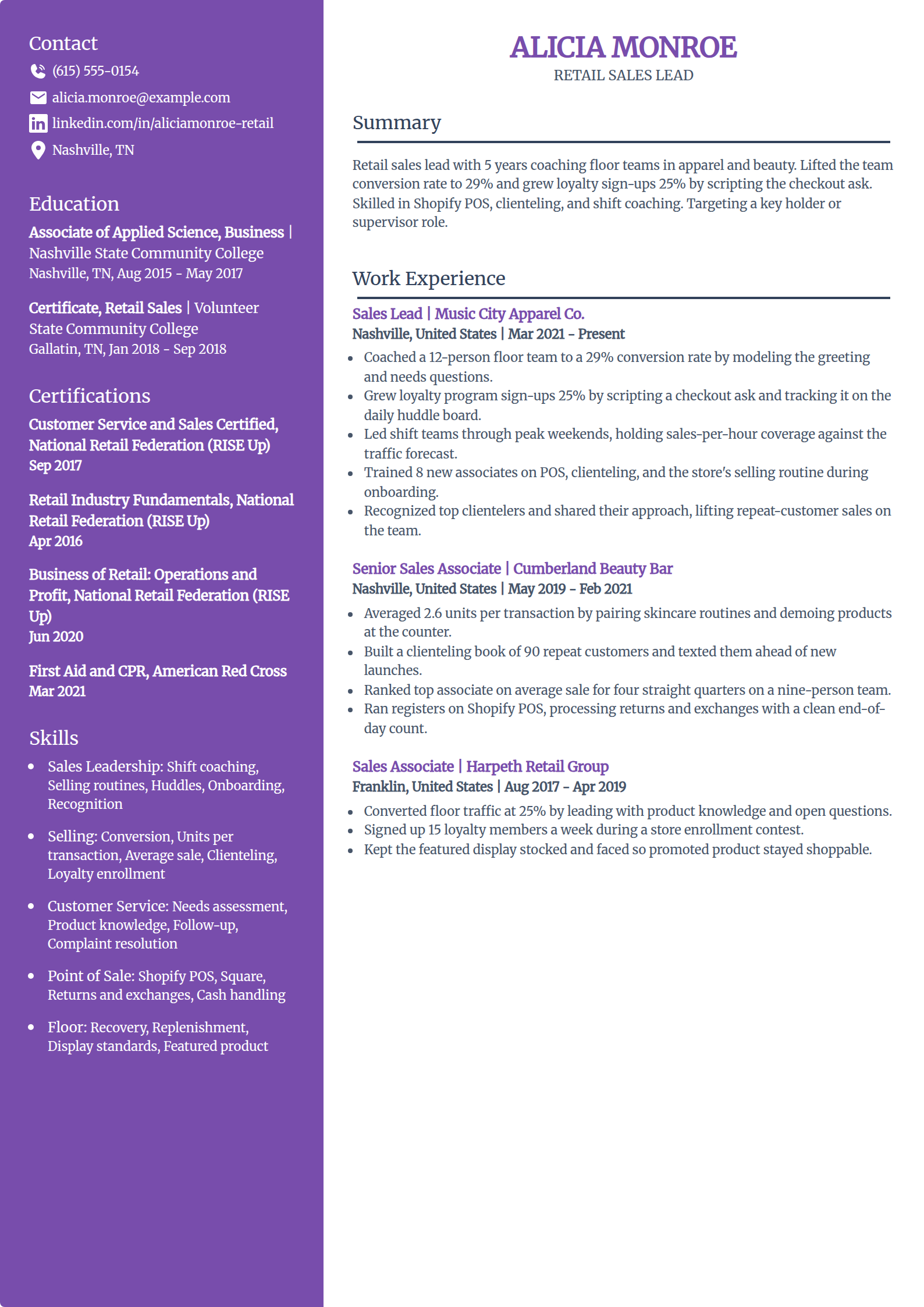
Retail Sales Lead Resume Template
Why this resume example works?
- Leads with a team conversion rate of 29% and loyalty sign-ups up 25%, the results a sales lead coaches toward.
- Shows a checkout ask scripted and tracked on the huddle board, the coaching method behind the number.
- Names Shopify POS and clienteling, the selling systems a lead role expects on the resume.
- Keeps three focused roles so the coaching-and-selling story reads clean, not padded.
- Ties recognition of top clientelers to repeat sales, showing leadership through the team, not just personal numbers.
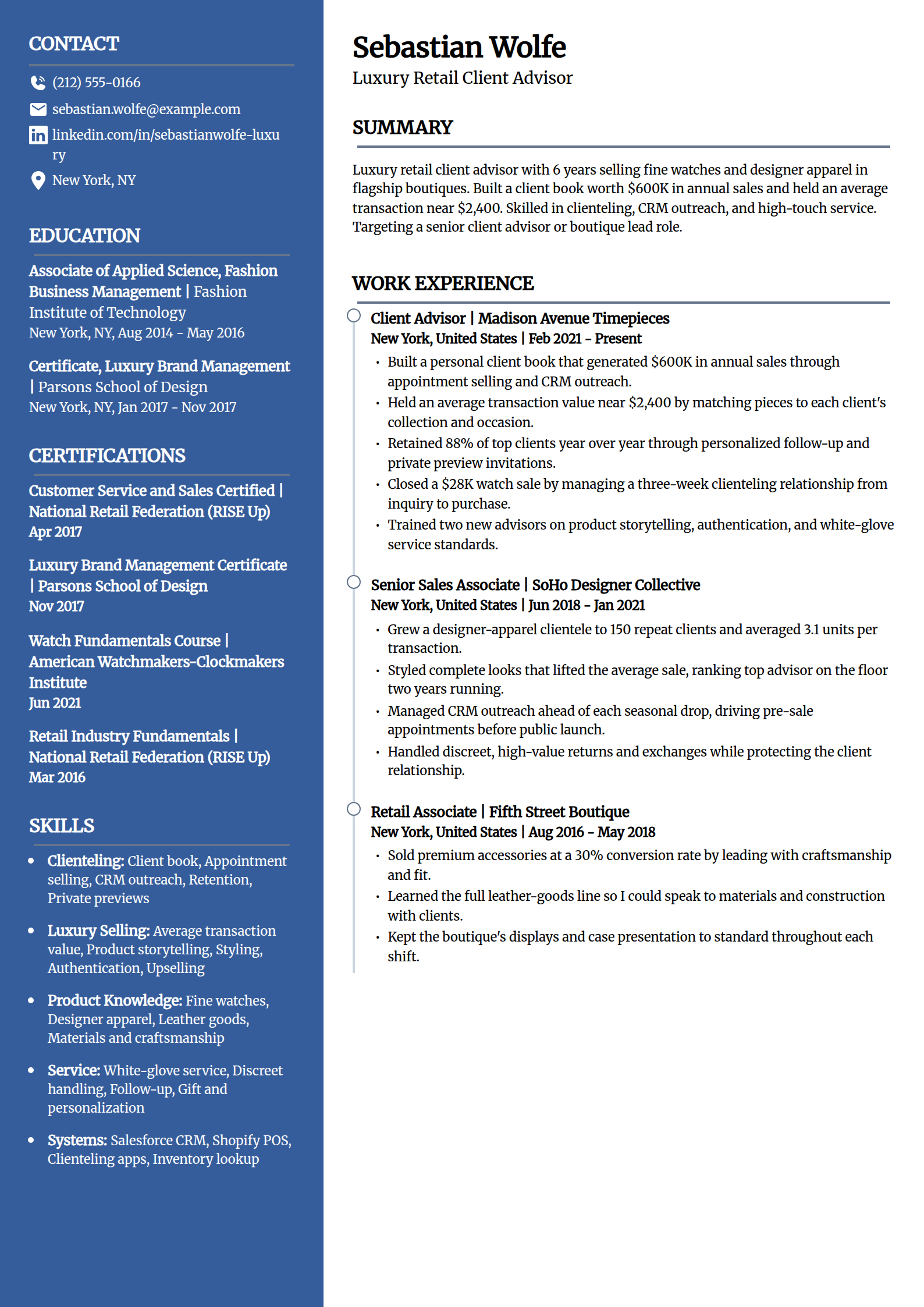
Luxury & Specialty Retail Resume Template
Why this resume example works?
- Leads with a $600K client book and a $2,400 average transaction, the clienteling numbers luxury retail hires on.
- Shows 88% top-client retention through appointment selling and CRM outreach, the high-touch method the role names.
- Names Salesforce CRM, product authentication, and watch fundamentals, the specialty skills a boutique screens for.
- Ties a $28K watch sale to a three-week clienteling relationship, proving the number came from real relationship work.
- Uses a distinctive layout that fits an advisor presenting a premium, personal selling style.
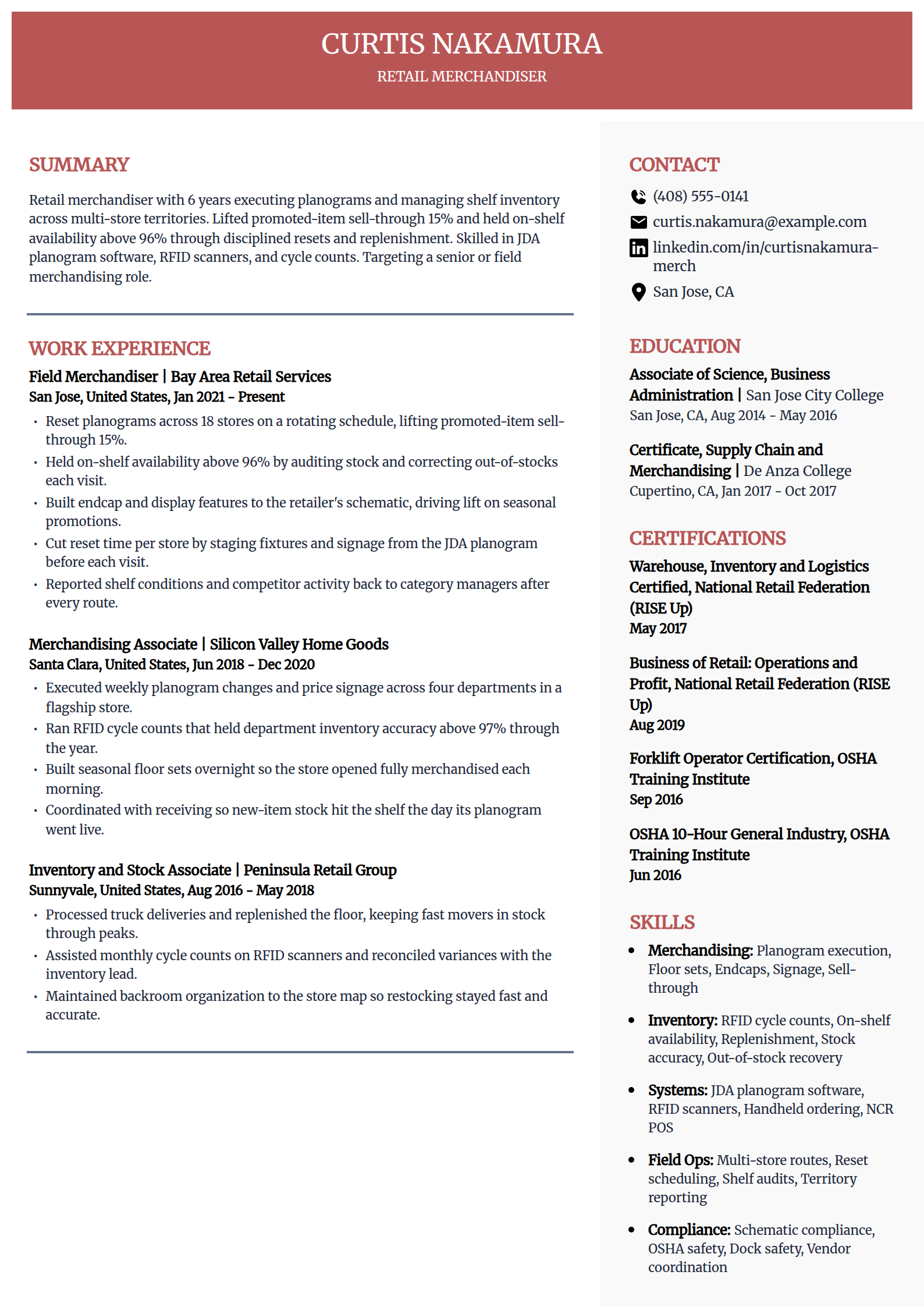
Retail Merchandiser Resume Template
Why this resume example works?
- Leads with promoted-item sell-through up 15% and on-shelf availability above 96%, the metrics a merchandiser owns.
- Shows planogram resets across 18 stores, the multi-store field scope the role is built around.
- Names JDA planogram software, RFID scanners, and schematic compliance, the exact tools on a merchandising posting.
- Ties reset-time savings to staging fixtures from the planogram, so the efficiency reads as a real practice.
- Keeps three roles that trace stock associate to field merchandiser without padding the page.
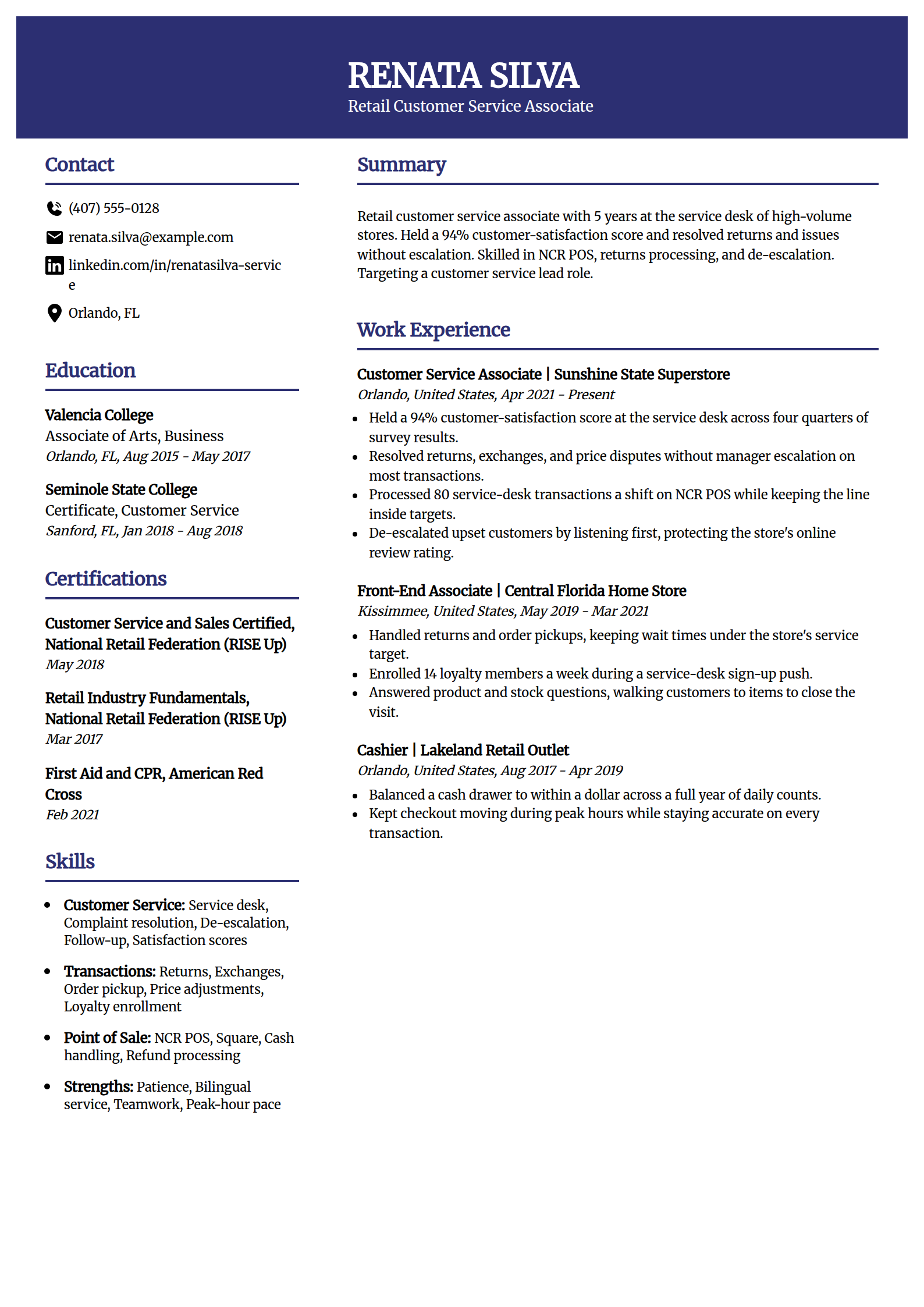
Retail Customer Service Resume Template
Why this resume example works?
- Leads with a 94% customer-satisfaction score, the survey number a service desk is measured on.
- Shows returns, exchanges, and disputes resolved without escalation, the judgment the role is trusted with.
- Names NCR POS and de-escalation, pairing the checkout system with the service skill the posting lists.
- Keeps metrics in scope for a service associate, satisfaction and wait times, never store revenue.
- Uses a roomy layout that keeps the service-desk focus clear across three progressive roles.
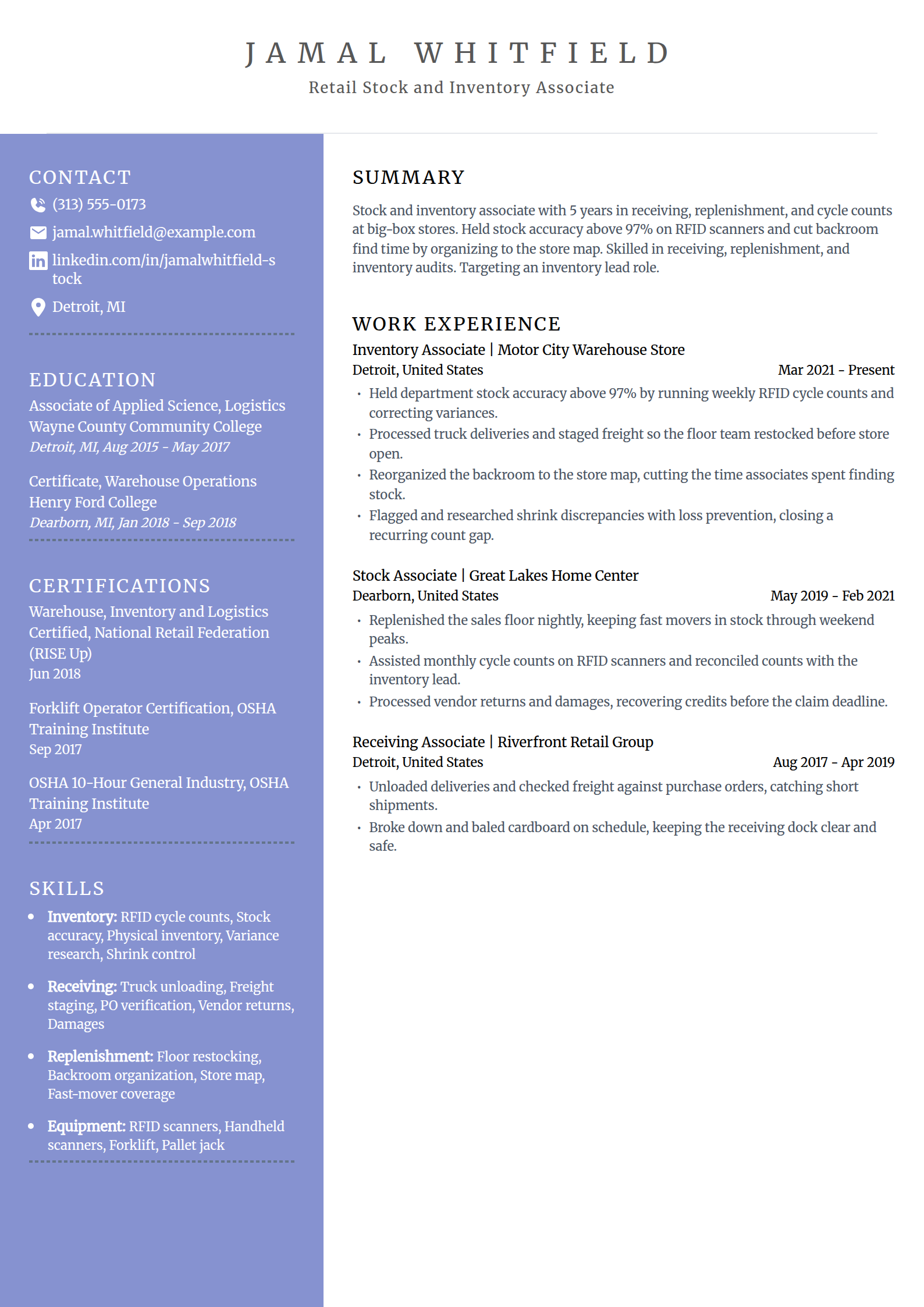
Stock & Inventory Associate Resume Template
Why this resume example works?
- Leads with stock accuracy above 97% on RFID scanners, the number a receiving and inventory role is hired on.
- Shows freight staged before open and a backroom organized to the store map, the throughput the job needs.
- Names cycle counts, vendor returns, and forklift operation, the warehouse skills a stock posting screens for.
- Ties a closed shrink gap to research with loss prevention, proving the count work found a real problem.
- Uses a roomy layout so the receiving, replenishment, and inventory focus reads clearly.
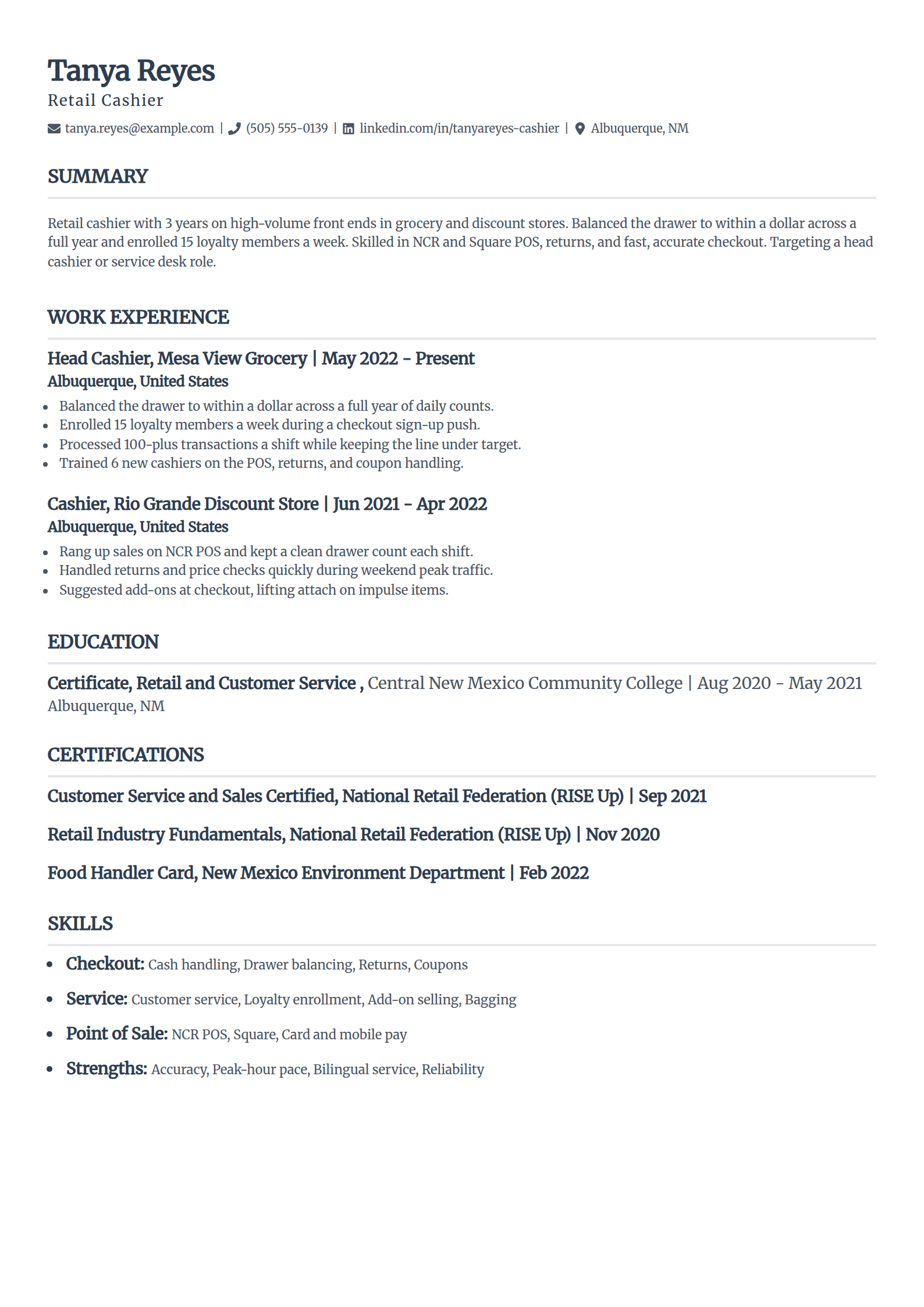
Cashier Resume Template
See 16 cashier resume examples by store type →
Why this resume example works?
- Leads with a drawer balanced to within a dollar across a full year, the accuracy a front end hires on.
- Shows 15 loyalty sign-ups a week and 100-plus transactions a shift, the throughput and sales signal for the role.
- Names NCR and Square POS and coupon handling, the checkout tools a cashier posting lists.
- Keeps modest, level-appropriate numbers, drawer accuracy and attach, never a claim out of scope for a cashier.
- Uses a tight two-entry layout that fits early-career experience on one clean page.
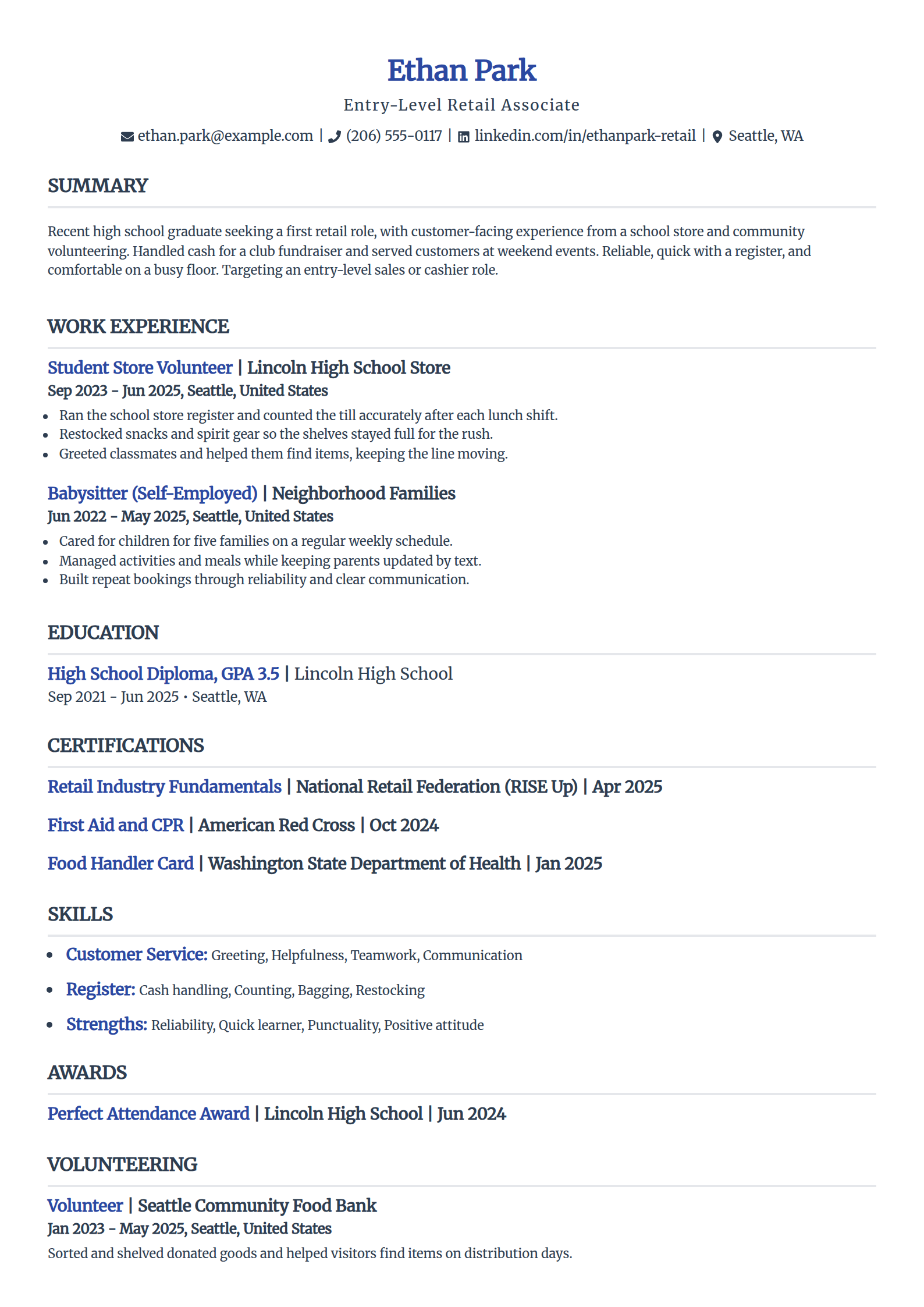
Entry-Level Retail Resume Template
Why this resume example works?
- Turns a school store, babysitting, and a food-bank role into real customer and cash experience with no formal retail job.
- Leads each entry with a verb and keeps the claims honest for a recent graduate, register counts and restocking.
- Adds the NRF Retail Industry Fundamentals credential, a signal that shows initiative before the first job.
- Shows a food-bank volunteering role and a perfect-attendance award, filling the page with reliability signals.
- Keeps a clean one-page layout that a first-time applicant can copy and fill in an afternoon.
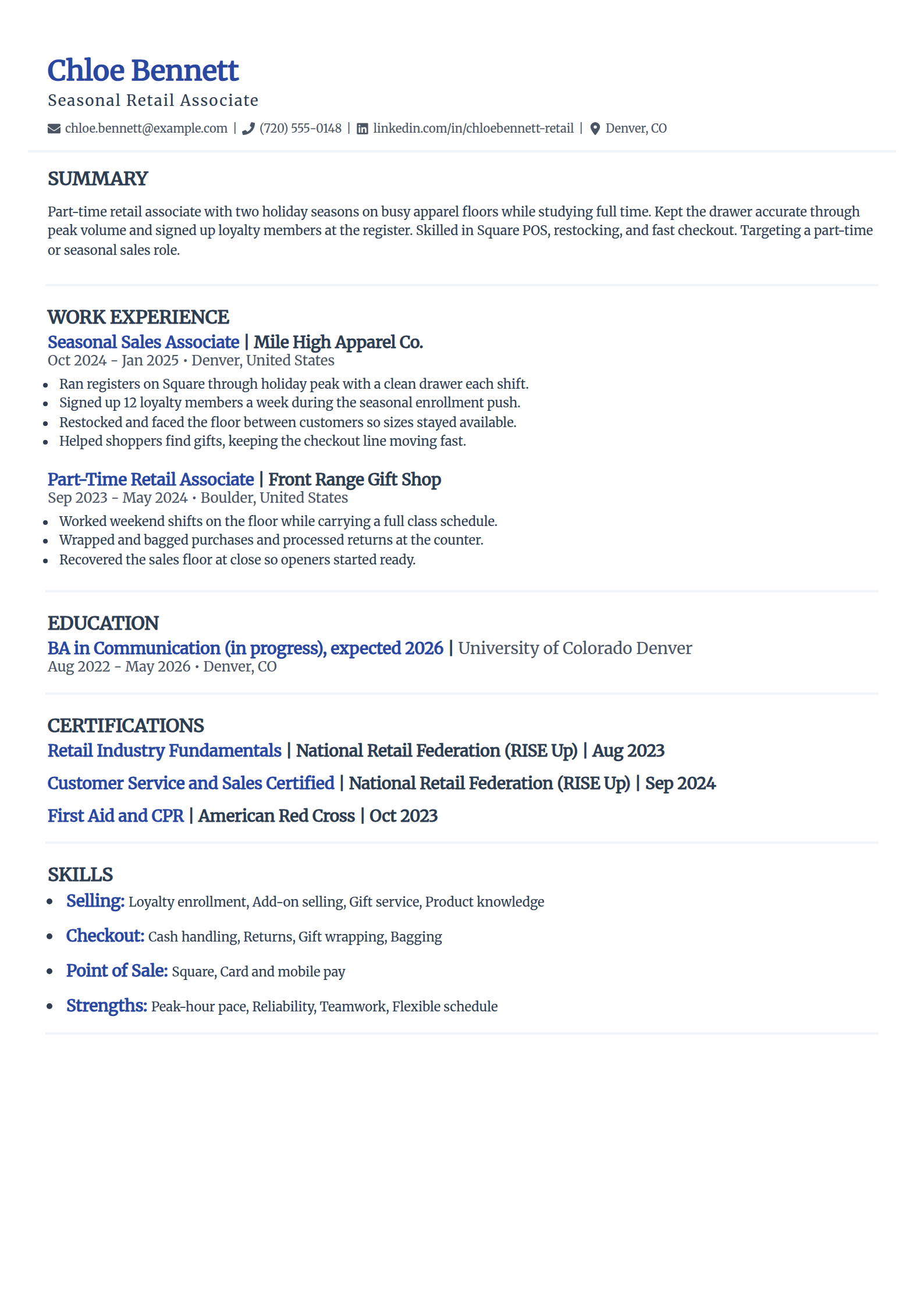
Seasonal & Part-Time Retail Resume Template
Why this resume example works?
- Leads with two holiday seasons and a clean drawer through peak, the reliability seasonal hiring screens for.
- Shows loyalty enrollment and fast checkout during the rush, the volume a seasonal role needs to handle.
- Notes the in-progress degree so a manager sees the school schedule the availability works around.
- Names Square POS and gift service, the checkout and seasonal skills the posting lists.
- Keeps a tight two-entry layout that fits a student's part-time history on one page.
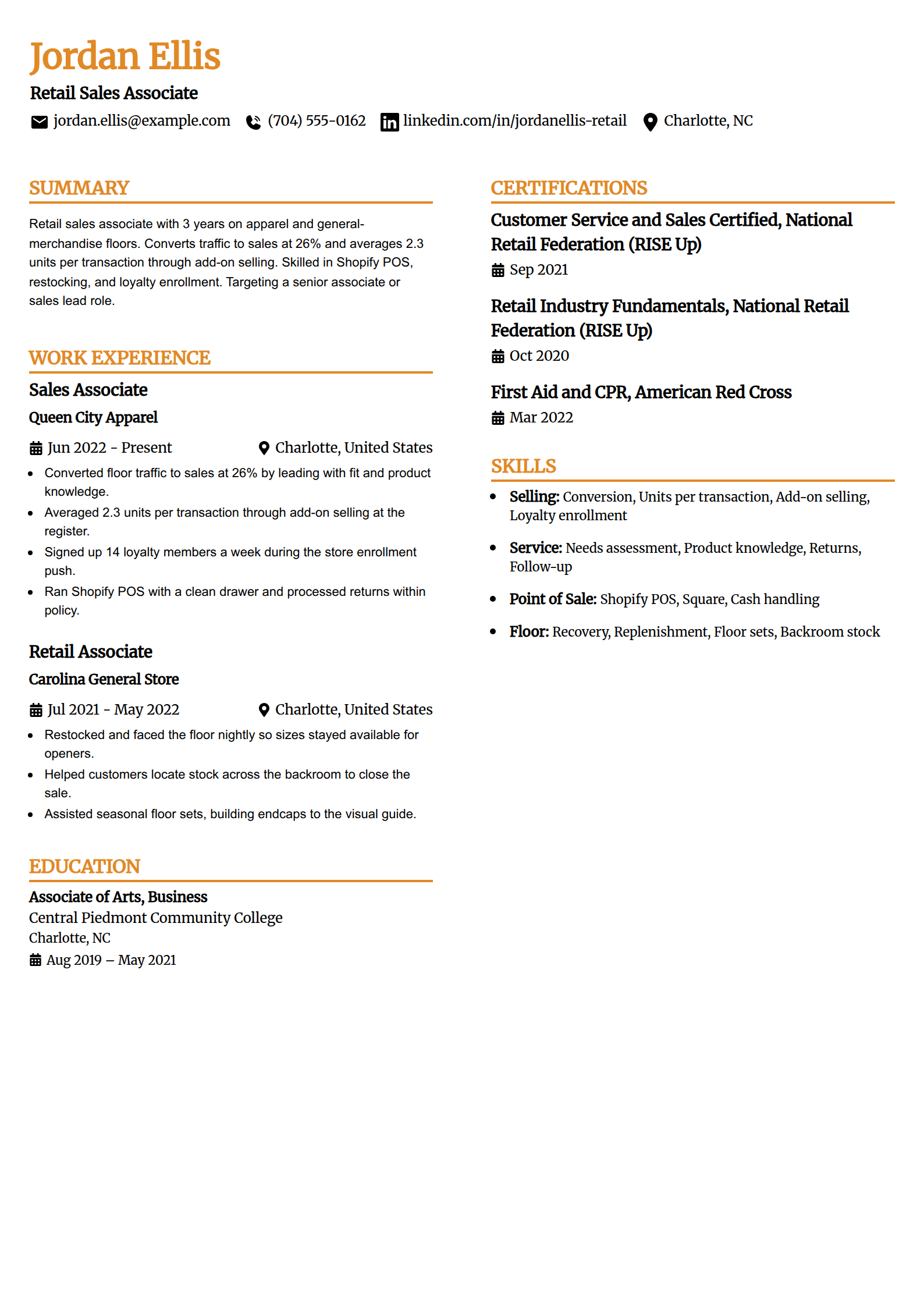
Retail Sales Associate Resume Template
Why this resume example works?
- Leads with a 26% conversion rate and 2.3 units per transaction, the selling KPIs a floor role reports.
- Shows loyalty sign-ups and returns processed within policy, the everyday tasks a hiring manager pictures.
- Names Shopify POS and add-on selling, the systems and skill the posting expects to see.
- Keeps modest, believable numbers that stay in scope for a general associate.
- Uses a clean two-entry layout that fits three years of floor experience on one page.
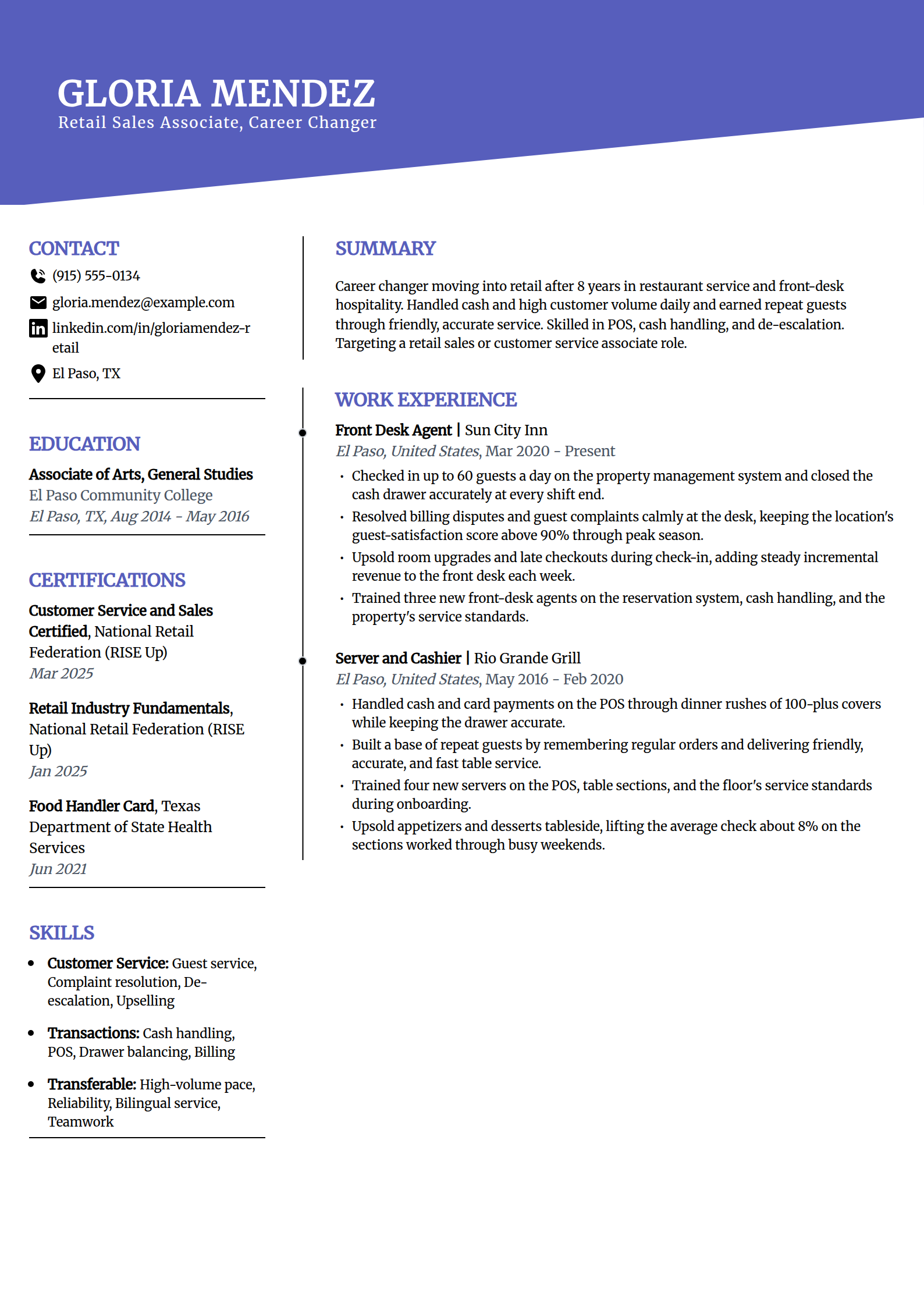
Career-Changer Retail Resume Template
Why this resume example works?
- Frames the move from restaurant and front-desk service into retail, the career-change story stated up front.
- Leads with transferable numbers, cash balanced at every close and up to 60 guests a day, the skills that carry over.
- Names POS, cash handling, and de-escalation, the retail-ready skills a hiring manager matches from another field.
- Adds fresh NRF RISE Up credentials, showing the candidate learned the retail basics before applying.
- Uses a two-column layout that separates the transferable skills from the work history cleanly.
Build your retail resume
Pick a template above and the editor keeps the layout parser-safe while you swap in your own role, POS systems, credentials, and numbers.
Build my resumeHow to write a retail resume in 2026
A retail resume gets read twice: a fast skim by a store or district manager for scope and results, then an ATS keyword match against the posting. These moves satisfy both without padding.
Lead with a summary that names your role, scope, and one number
Write two to three sentences that open with your title, state the store type and team size or traffic you handle, and land on one result that fits your level. A manager leads with sales growth or shrink; an associate leads with conversion or drawer accuracy; a first-timer leads with reliability and a school or volunteer role. For deeper summary help by role, the retail, cashier, merchandiser, and store manager summary pages carry copyable examples.
Retail store manager with 9 years running high-volume apparel stores and teams of up to 45, who grew comparable sales 12% and cut shrink to 0.8% using tighter loss-prevention and cycle-count routines.
Quantify impact with the numbers retail actually tracks
Lead each bullet with a verb, then attach the result. Match the metric to your level so nothing reads out of scope.
- Selling: converted floor traffic at 30%, averaged 2.7 units per transaction, or lifted attach rate on accessories to 34%.
- Front end: balanced the drawer to within a dollar all year, or signed up 15 loyalty members a week.
- Management: grew comparable sales 12%, cut shrink to 0.8%, or held payroll to 9% of sales.
- Inventory: held stock accuracy above 97% on RFID cycle counts, or reset 18 planograms on time.
State your credentials, systems, and product knowledge
Retail screens on the tools you have run and the credentials you hold. Name each one where it is true and keep it near the top.
- POS systems: name the ones you have used, such as NCR, Square, Shopify POS, or Lightspeed, rather than a generic "register".
- Inventory and merchandising: RFID scanners, planograms, cycle counts, and Oracle Retail or JDA where you have used them.
- Retail credentials: the NRF RISE Up certificates (Retail Industry Fundamentals, Customer Service and Sales), Loss Prevention Qualified (LPQ), OSHA, and ServSafe or a food handler card.
- Scheduling and service: Kronos or When I Work, plus the KPIs you own, such as conversion, mystery-shop score, or customer satisfaction.
Fill the page even without a formal retail job
Entry-level, seasonal, and career-change candidates build a full page from experience that is not a retail job yet.
- School and club roles: a school store, a fundraiser till, or a club treasurer position all show cash handling and service.
- Informal work: babysitting, tutoring, or lawn care count as entries and show reliability and repeat customers.
- Volunteering: a food-bank or event role shows you can serve people and follow a routine.
- Transferable jobs: restaurant, hospitality, or call-center work carries POS, cash, and de-escalation straight into retail.
Keep the format ATS-safe and the length tight
Retail resumes get filtered by software before a person reads them, and the field prizes a short, scannable page.
- Keep it to one page for associates, cashiers, and early-career candidates; two pages only for a multi-store or senior manager with the results to fill it.
- Use a single-column or clean two-column layout with standard headings so a parser reads your systems, credentials, and dates in order.
- Put your POS systems, credentials, and a skills block in the top third where a store manager looks first.
- Save as a PDF unless the application asks for Word, and run the draft through the ATS resume checker before you send it.
Common retail resume mistakes
- Claiming a number out of scope for the role. A cashier does not lift store revenue 40%; report drawer accuracy, attach rate, and loyalty sign-ups instead.
- Listing duties instead of results. "Operated the register" is a task; "balanced the drawer to within a dollar all year" is proof.
- Naming a generic "POS system" instead of the tool. Write NCR, Square, Shopify POS, or Lightspeed so the ATS matches the posting.
- Leaving an entry-level page half empty. Fill it with a school store, babysitting, volunteering, or a club role rather than shipping two thin bullets.
- Burying your metrics in a paragraph. Put conversion, units per transaction, shrink, or mystery-shop scores at the front of the bullet where a manager reads first.
Frequently asked questions
What should a retail resume include?
A two to three sentence summary that names your role, store type, and one result; a work section where every bullet leads with a verb and a metric that fits your level; the POS systems you have run, such as NCR, Square, Shopify POS, or Lightspeed; retail credentials like the NRF RISE Up certificates or Loss Prevention Qualified; and your education. Keep it to one page for associates and cashiers, and put your systems and credentials in the top third.
What are good metrics to put on a retail resume?
Use the numbers retail actually tracks, and match them to your level. Associates report conversion rate, units per transaction, average sale, attach rate, loyalty sign-ups, and customer-satisfaction or mystery-shop scores. Cashiers report drawer accuracy and transactions per shift. Managers report comparable sales growth, shrink reduction, staff hired and trained, and payroll as a percent of sales. One credible number per bullet, kept believable for your role.
How do I write a retail resume with no experience?
Build a full page from experience that is not a retail job yet. A school store, a club fundraiser, babysitting, tutoring, or a food-bank volunteer role all show cash handling, service, and reliability. Lead each entry with a verb, add the NRF Retail Industry Fundamentals credential if you can earn it, and list the customer-service strengths a store wants. Keep it to one clean page and let the reliability and initiative carry it.
How long should a retail resume be?
One page for associates, cashiers, supervisors, and early-career candidates. Managers with several years and real store results can use a second page, but only if it earns the space with sales growth, shrink, and team numbers. A store or district manager skims fast, so a tight one-page resume with your strongest metric up front beats a padded two pages.
What POS systems and skills should I list on a retail resume?
Name the POS systems you have actually run, such as NCR, Square, Shopify POS, or Lightspeed, rather than a generic "register". Add the inventory and merchandising tools you have used, like RFID scanners, planograms, and cycle counts, and the KPIs you own, such as conversion, units per transaction, or shrink. Make sure the systems in your skills block also appear in your experience bullets so the ATS and the manager both see them.
How do I write a retail store manager resume?
Lead with your store-level results and team scope. Name your comparable sales growth, shrink rate, staff hired and trained, and payroll as a percent of sales, then list the systems you run, such as NCR POS and Kronos scheduling, and your loss-prevention and merchandising work. Put a Business of Retail or Loss Prevention Qualified credential near the top, and keep the page focused on outcomes rather than a list of daily duties.
More retail resume resources
Build your retail resume
Pick a template above and the editor keeps the layout parser-safe while you swap in your own role, POS systems, credentials, and numbers.