16 Security Guard Resume Examples, Unarmed to Supervisor
- ATS Friendly
- Security Role Specific
- 16 Sub-Role Examples
Start from a layout a security director's screening software can read cleanly, then borrow from a real officer resume in your specialty. Every example below shows a full security guard resume in a named template, with the guard card, systems, and numbers that earn a callback.


540k+ resumes created
Editable security guard resume templates
Each template below is a real security resume laid out in that format. Pick the one that fits your specialty, then swap in your own license, posts, systems, and numbers. Every layout keeps your name, contact details, and dates where an applicant tracking system expects to find them.
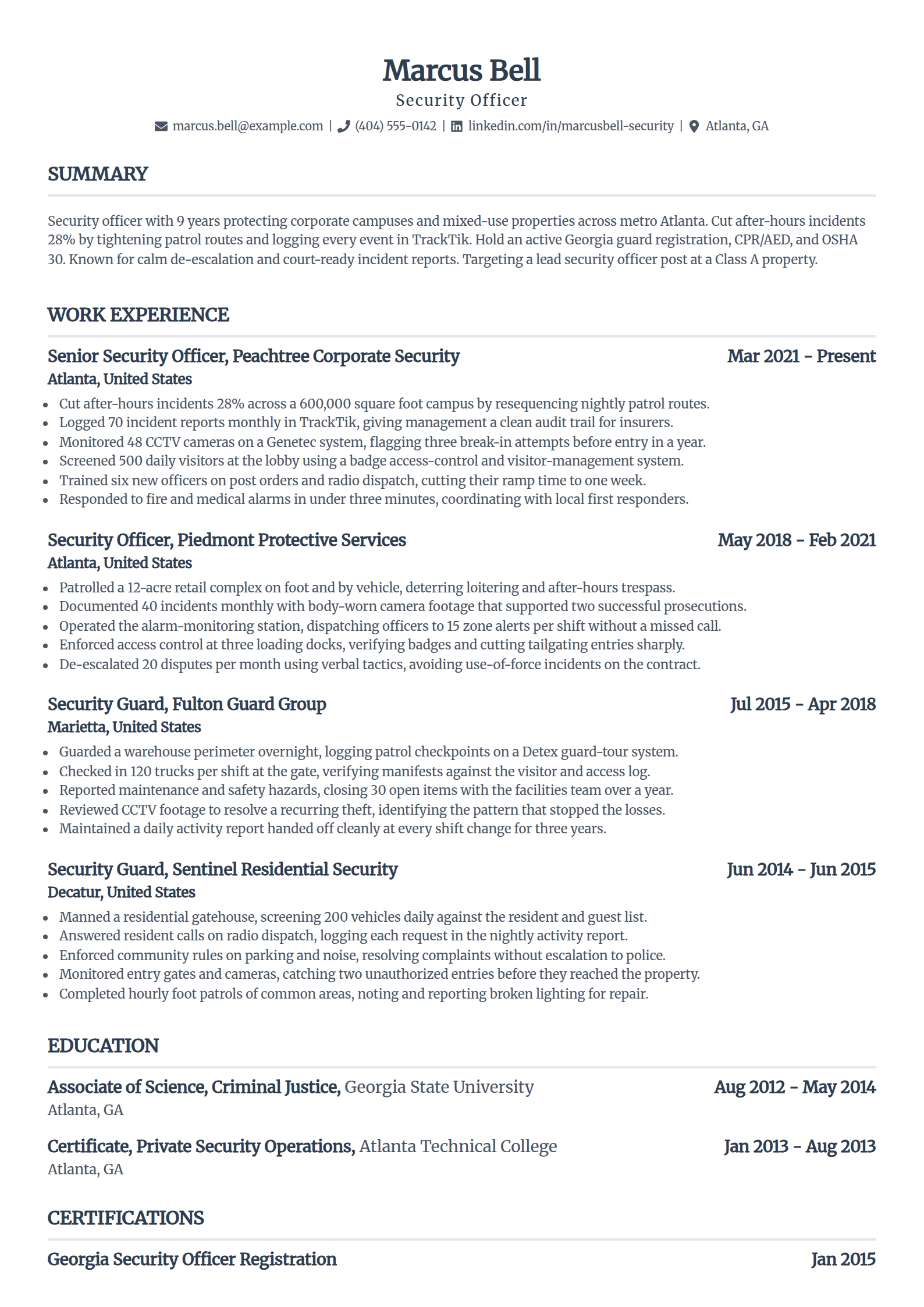
Experienced Security Officer Resume Template
Why this resume example works?
- Names an active Georgia guard registration, CPR/AED, and OSHA 30 up top, the credentials a hiring officer checks first.
- Leads with a result, a 28% drop in after-hours incidents across a 600,000 square foot campus, not a duty.
- Names the real tools: TrackTik reporting, a Genetec CCTV wall of 48 cameras, and a Detex guard-tour system.
- Backs the claims with volume, 70 incident reports a month, so the record reads like real post work.
- Keeps a clean single-column layout a resume parser reads top to bottom without dropping a section.
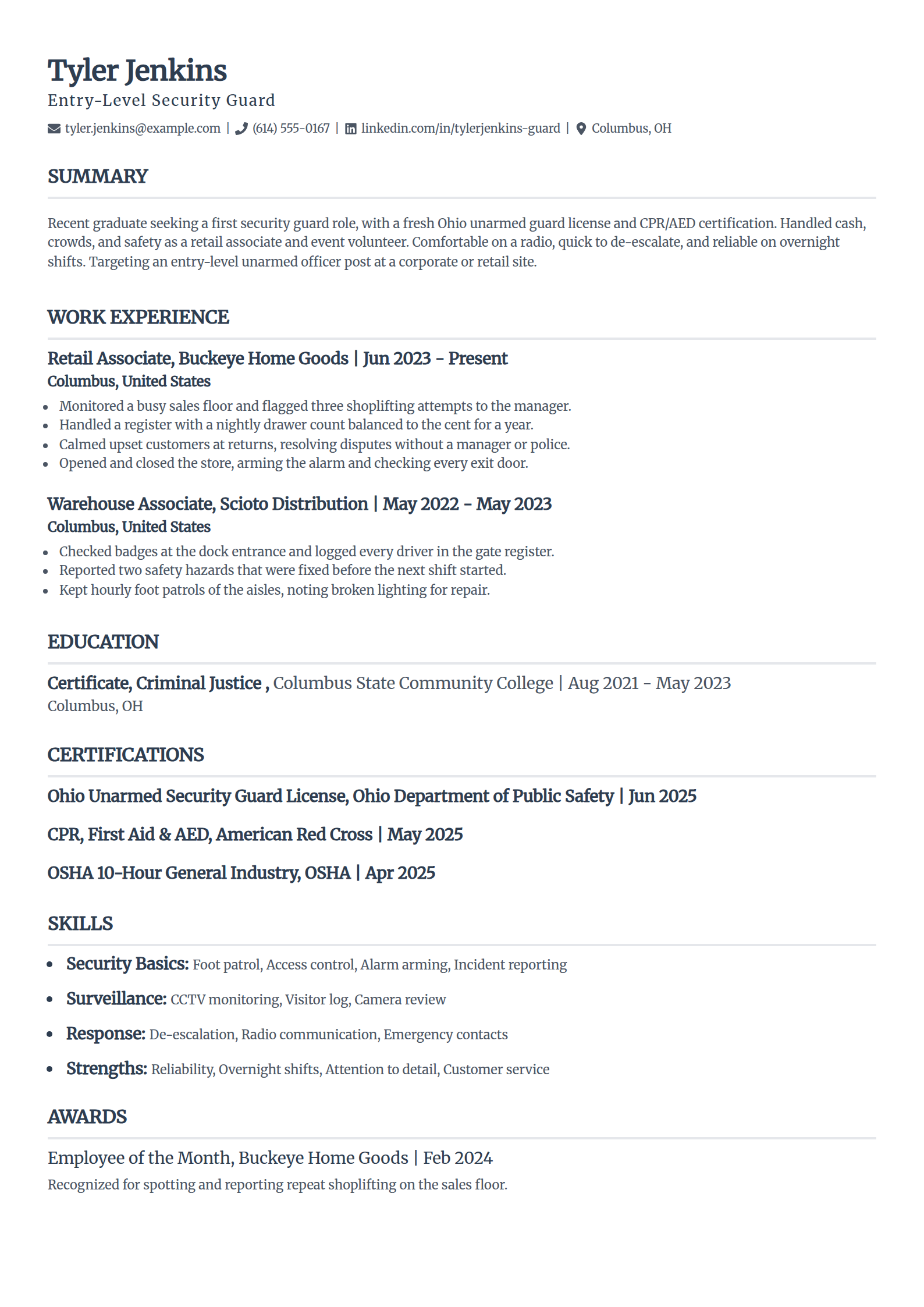
Entry-Level Security Guard Resume Template (No Experience)
Why this resume example works?
- Leads with a fresh Ohio unarmed guard license and CPR/AED, which is exactly what a no-experience post screens for.
- Turns retail and warehouse jobs into security proof, like flagging three shoplifting attempts to the manager.
- Shows transferable habits, arming alarms and running exit checks, that map straight to guard duties.
- Fills a short history with an Employee of the Month award instead of padding thin bullets.
- Uses a compact Classic layout that looks full and professional even without prior security roles.
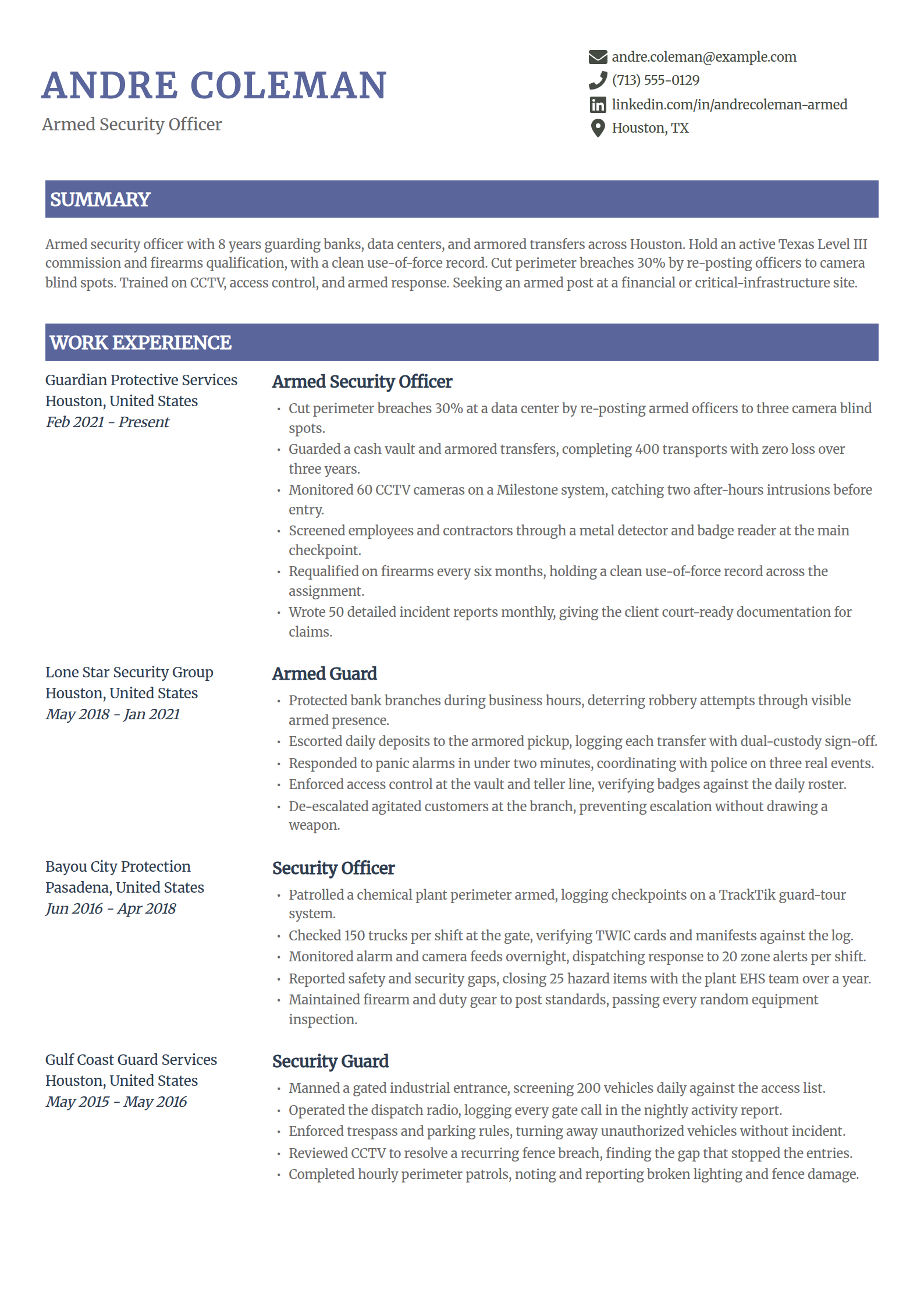
Armed Security Officer Resume Template
Why this resume example works?
- States the Texas Level III commission, License to Carry, and current firearms qualification, the armed-post gate.
- Names a clean use-of-force record, the line a security director looks for before an interview.
- Leads with a 30% cut in perimeter breaches at a data center and 400 armored transfers with zero loss.
- Names real systems: a Milestone CCTV wall of 60 cameras, TWIC verification, and metal-detector screening.
- Keeps the license and firearms status in the header, not buried in a certifications list at the bottom.
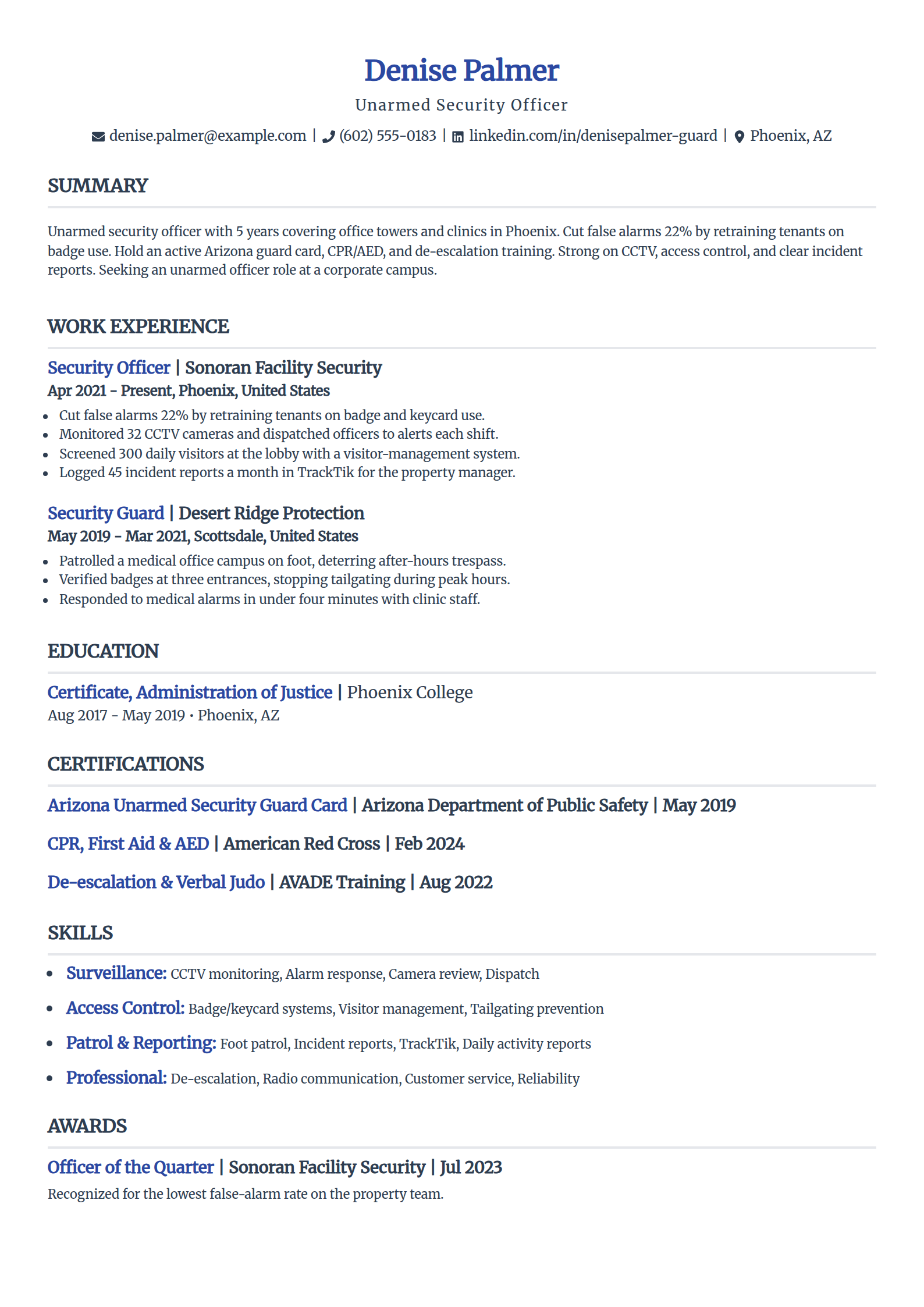
Unarmed Security Officer Resume Template
Why this resume example works?
- Names an active Arizona guard card, CPR/AED, and de-escalation training, the core unarmed-officer credentials.
- Leads with a 22% cut in false alarms after retraining tenants on badge and keycard use.
- Names the tools plainly: 32 CCTV cameras, a visitor-management system, and TrackTik incident logging.
- Adds an Officer of the Quarter award so a two-job history still fills the page and stands out.
- Keeps short, one-line bullets in a Simple layout that parses cleanly and reads fast on a phone.
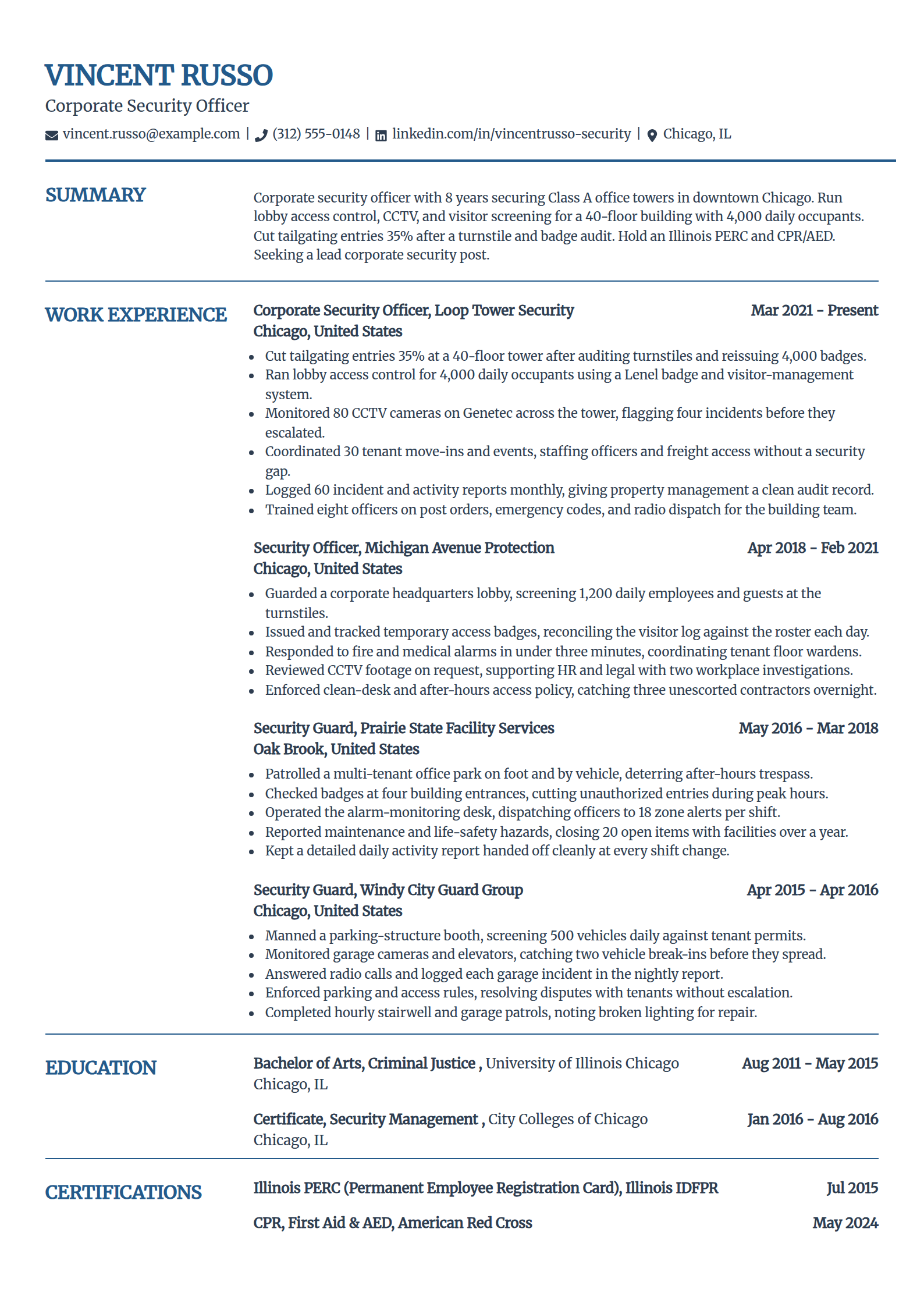
Corporate Security Officer Resume Template
Why this resume example works?
- Names an Illinois PERC, CPR/AED, and a Lenel OnGuard access-control certification, the corporate-lobby stack.
- Leads with a 35% cut in tailgating entries at a 40-floor tower after a turnstile and badge audit.
- Shows scope, access control for 4,000 daily occupants, that tells a manager the candidate can run a lobby.
- Names the exact systems: Lenel badging, a Genetec CCTV wall of 80 cameras, and visitor management.
- Uses a clean Craft layout so the access and reporting details stay readable in an applicant tracking system.
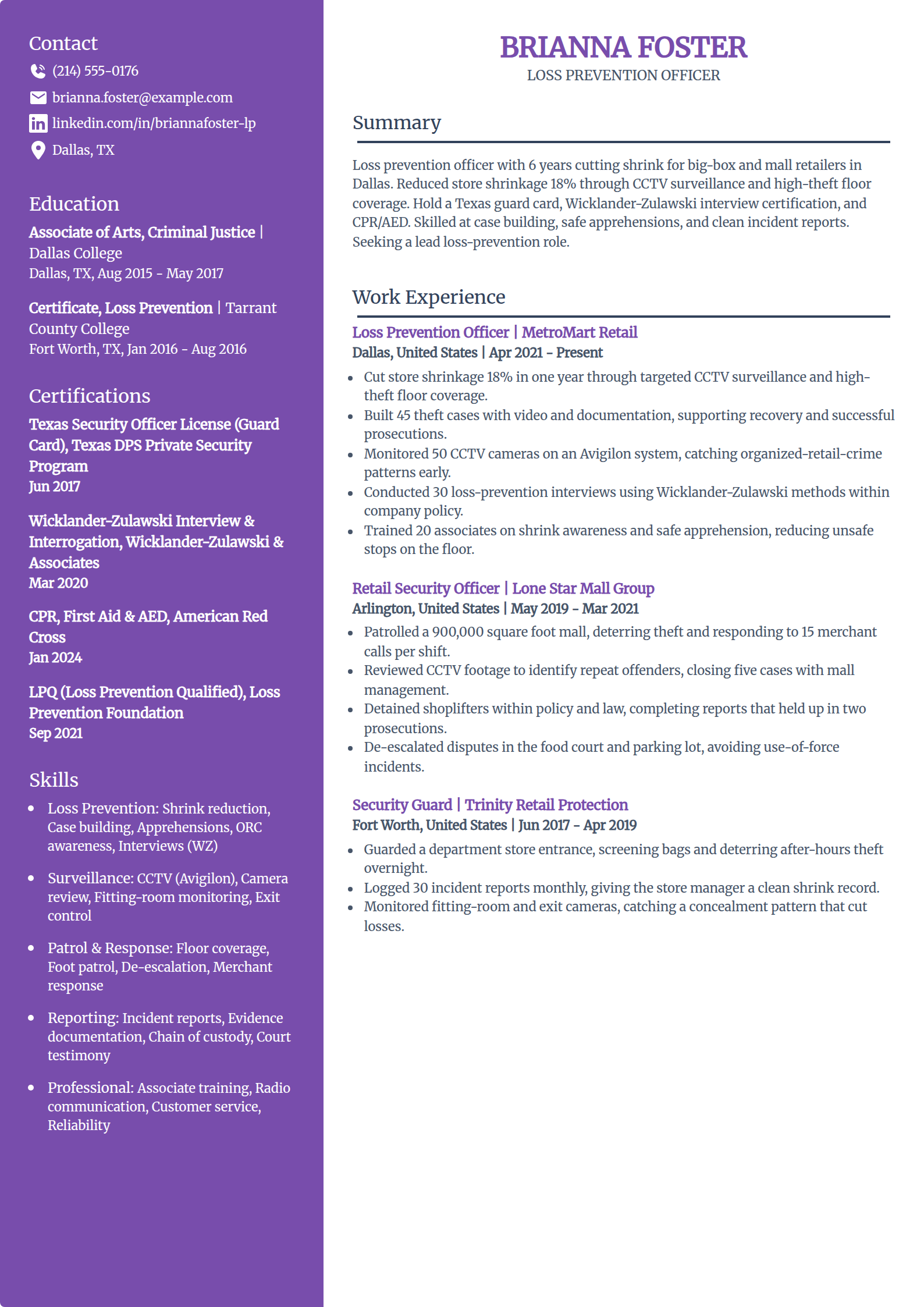
Retail Loss Prevention Officer Resume Template
Why this resume example works?
- Names a Texas guard card, Wicklander-Zulawski interview certification, and LPQ, the loss-prevention credentials.
- Leads with the number the role hires on, an 18% cut in store shrinkage over one year.
- Shows case work, 45 theft cases built with video that supported recovery and prosecutions.
- Names the surveillance tool by hand, an Avigilon CCTV system of 50 cameras, plus fitting-room and exit coverage.
- Frames apprehensions as safe and within policy, the judgment a loss-prevention manager screens for.
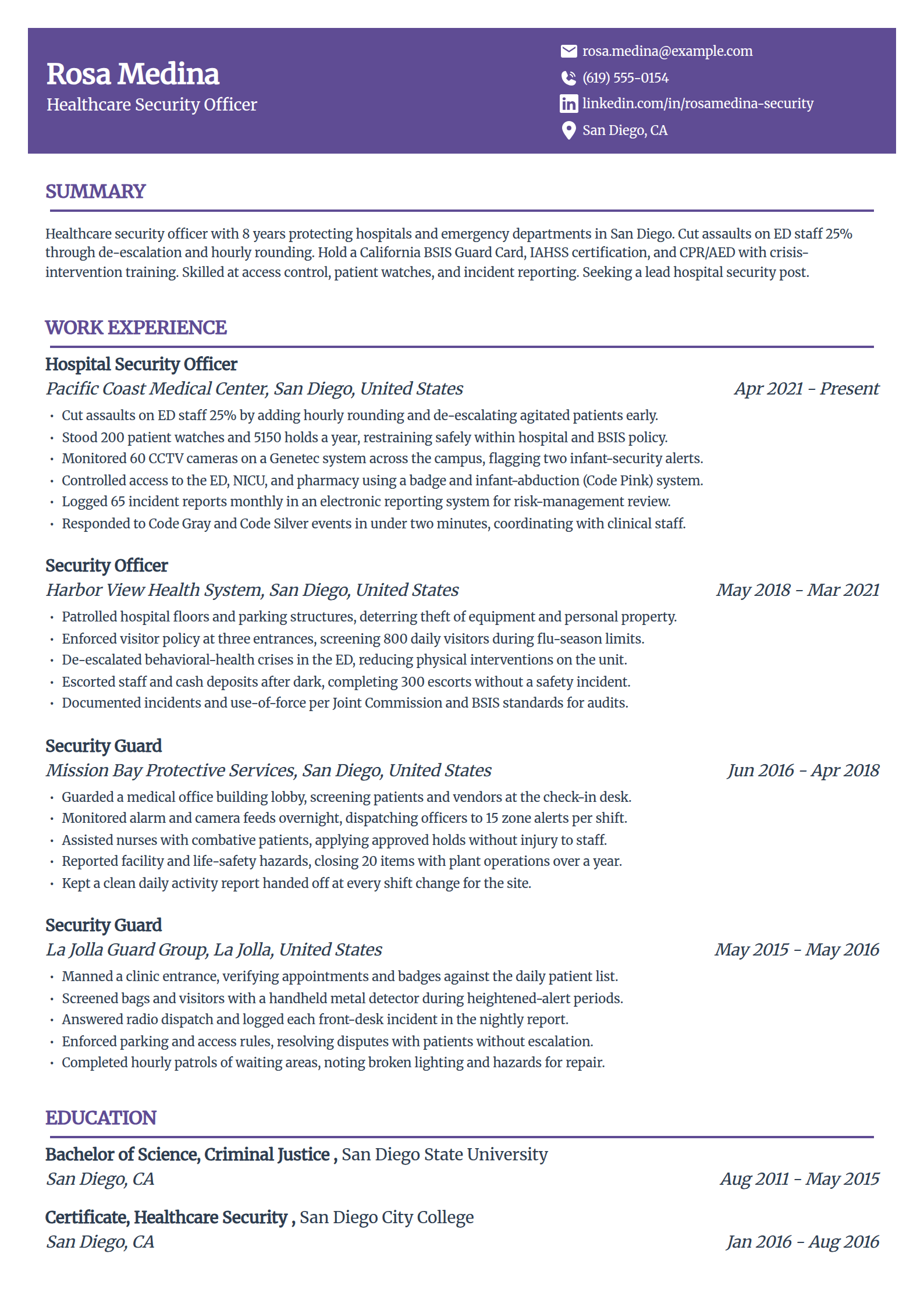
Hospital Security Officer Resume Template
Why this resume example works?
- Names a California BSIS Guard Card, IAHSS certification, and CPI crisis training, the healthcare-security set.
- Leads with a 25% cut in assaults on emergency-department staff through rounding and early de-escalation.
- Shows scope unique to hospitals: 200 patient watches and 5150 holds handled within policy in a year.
- Names the systems: a Genetec CCTV wall of 60 cameras and a Code Pink infant-abduction access setup.
- Ties documentation to Joint Commission and BSIS standards, the compliance a hospital audit checks.
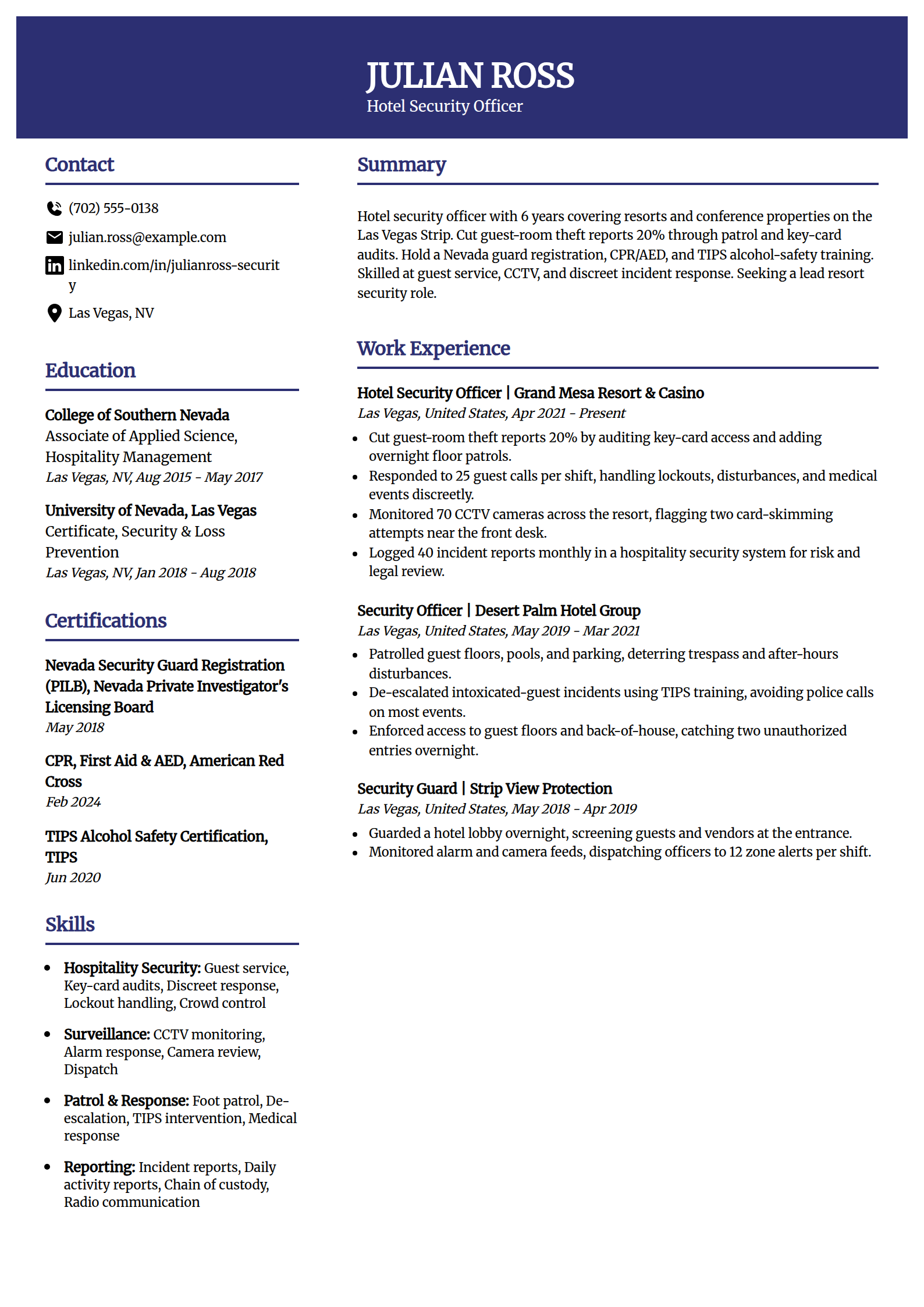
Hotel Security Officer Resume Template
Why this resume example works?
- Names a Nevada guard registration, CPR/AED, and TIPS alcohol-safety training, a real hospitality credential.
- Leads with a 20% cut in guest-room theft reports after a key-card audit and added floor patrols.
- Shows the pace of the job, 25 guest calls a shift covering lockouts, disturbances, and medical events.
- Balances guest service with security, the mix a resort wants, and names a 70-camera CCTV setup.
- Uses a Visionary layout that stays clean while making room for the specialty credentials in the sidebar.
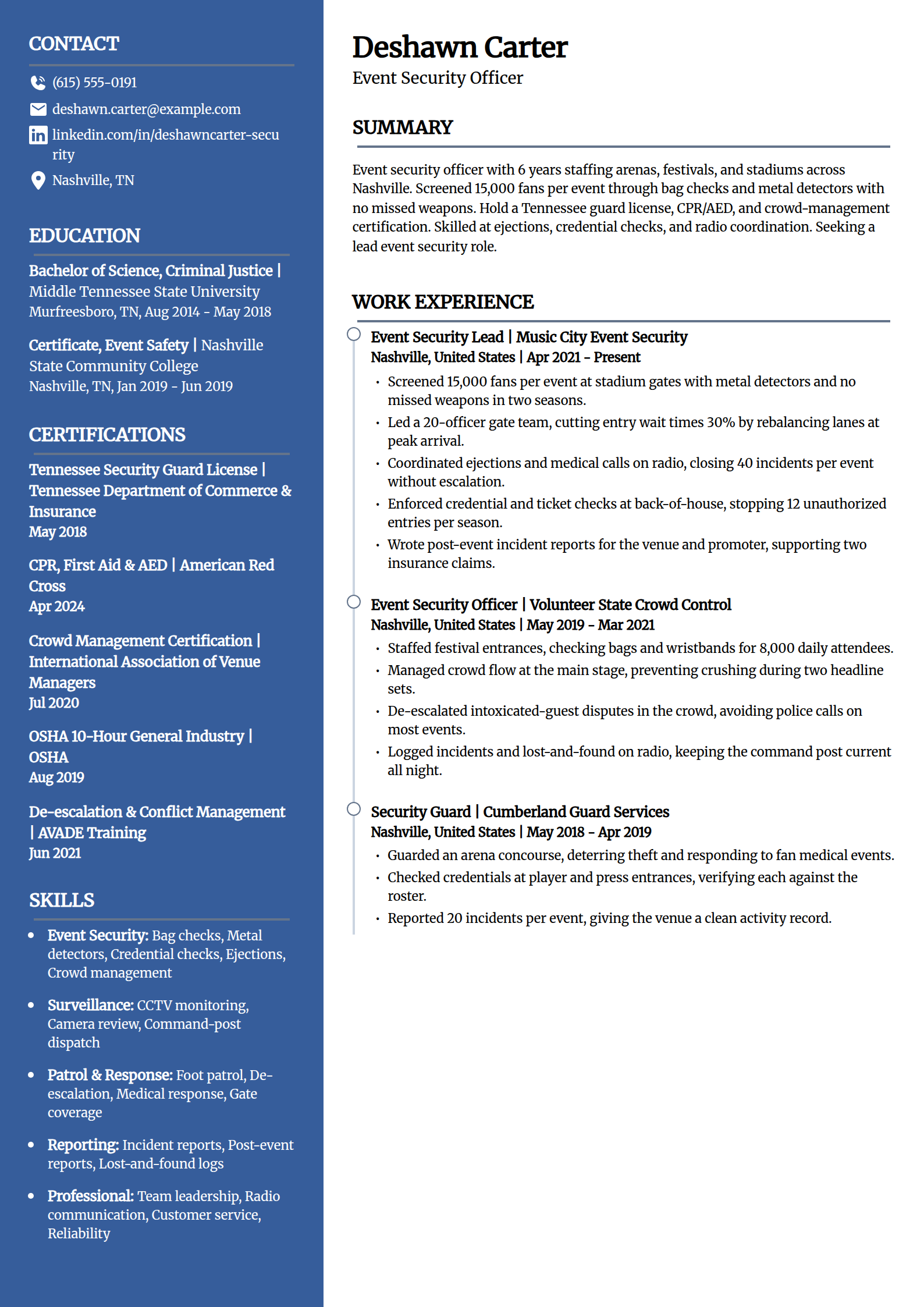
Event & Venue Security Resume Template
Why this resume example works?
- Names a Tennessee guard license, CPR/AED, and an IAVM crowd-management certification, the event-security stack.
- Leads with the screening scale, 15,000 fans an event through metal detectors with no missed weapons.
- Shows leadership, running a 20-officer gate team and cutting entry wait times 30% at peak arrival.
- Names event-specific work: bag checks, credential control, and ejections coordinated on radio.
- Keeps the metrics event-appropriate so nothing reads out of scope for a stadium or festival post.
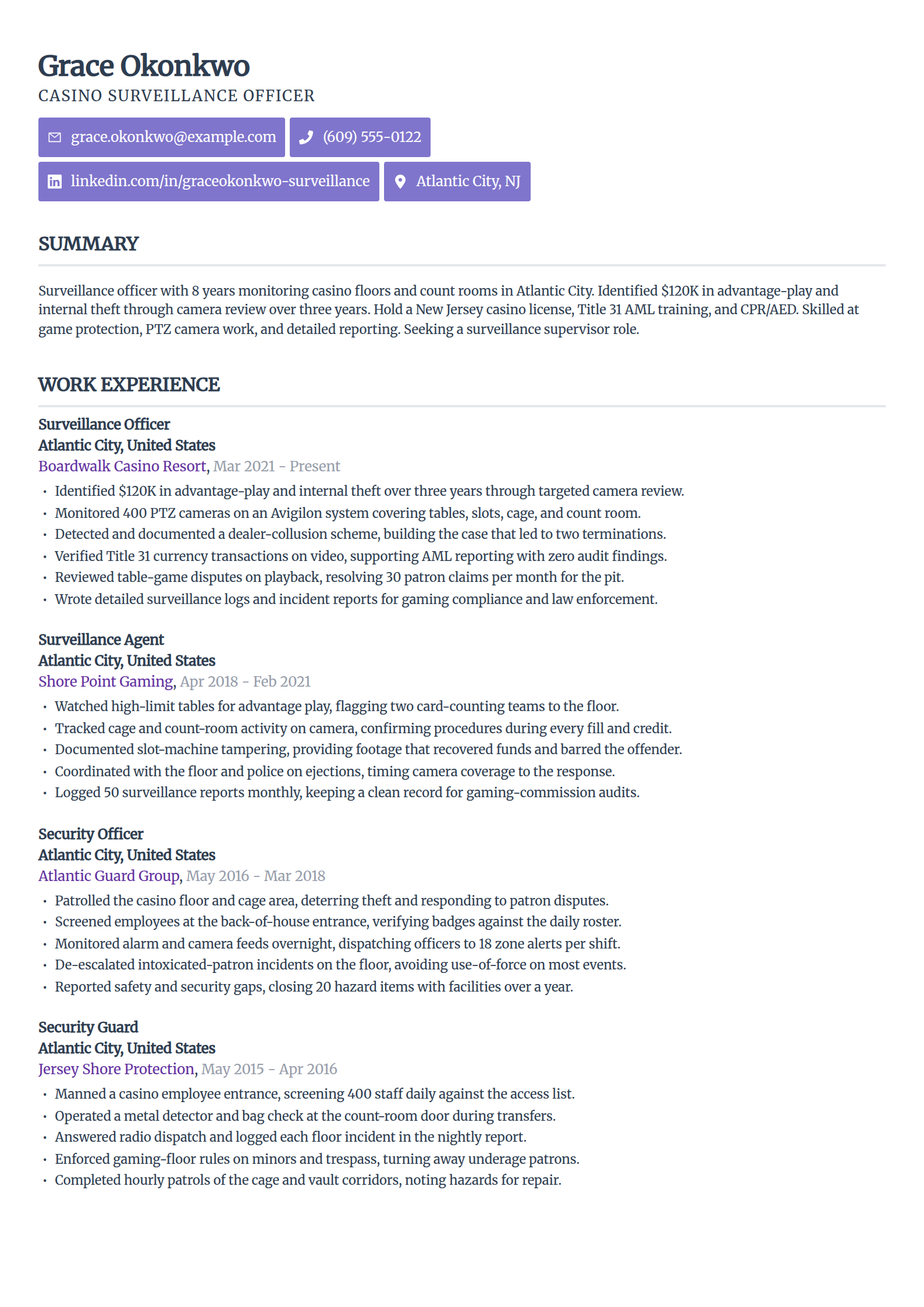
Casino Surveillance Officer Resume Template
Why this resume example works?
- Names a New Jersey casino license and Title 31 AML training, the gaming-floor credentials a pit checks.
- Leads with a real surveillance result, $120K in advantage-play and internal theft identified over three years.
- Shows game-protection depth, a documented dealer-collusion case that led to two terminations.
- Names the tool by hand, an Avigilon system of 400 PTZ cameras across tables, slots, cage, and count room.
- Ties reporting to gaming-commission audits, proving the candidate works to a regulated standard.
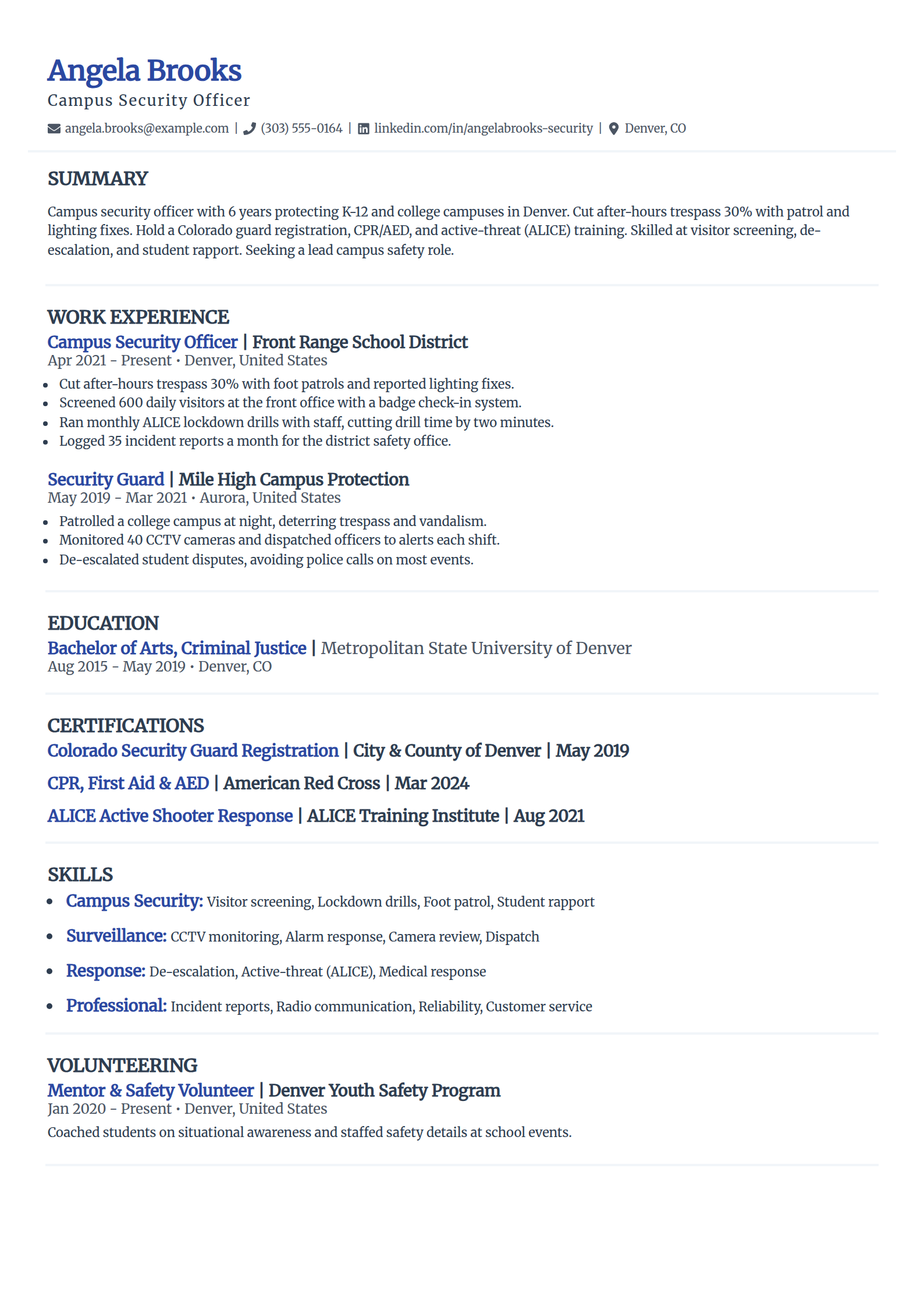
Campus & School Security Officer Resume Template
Why this resume example works?
- Names a Colorado guard registration, CPR/AED, and ALICE active-threat training, the school-safety credentials.
- Leads with a 30% cut in after-hours trespass through foot patrols and reported lighting fixes.
- Shows school-specific work, screening 600 daily visitors and running monthly ALICE lockdown drills.
- Adds volunteer mentoring so the short two-job history still fills the Elegant layout.
- Keeps compact, one-line bullets so the whole record reads at a glance for a district safety office.
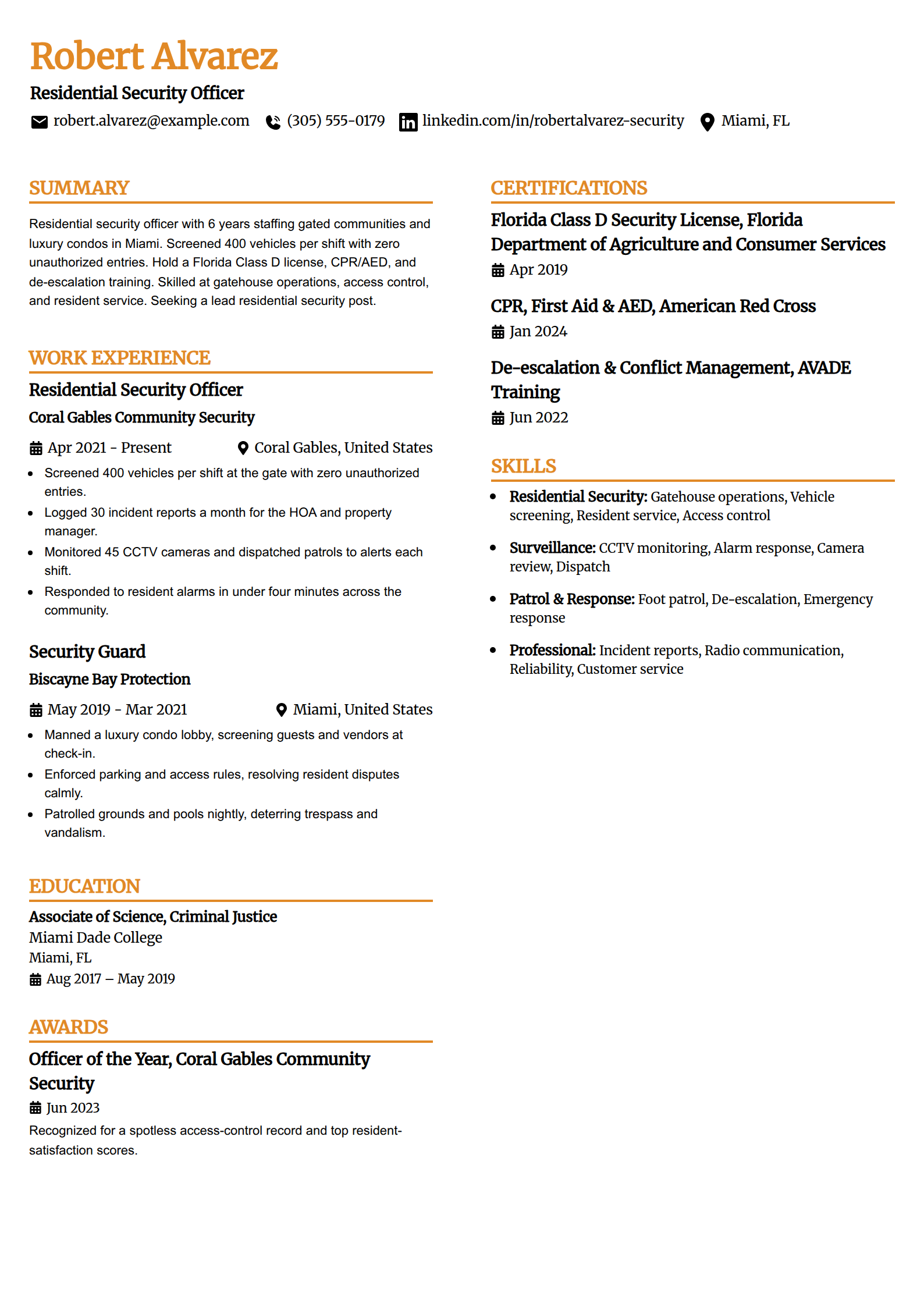
Residential & Gated Community Security Resume Template
Why this resume example works?
- Names a Florida Class D security license, CPR/AED, and de-escalation training, the residential-post credentials.
- Leads with a gatehouse result, 400 vehicles screened per shift with zero unauthorized entries.
- Shows the resident-facing side, calm dispute handling and access control across the community.
- Adds an Officer of the Year award so a two-job history looks full and credible.
- Names the CCTV coverage, 45 cameras, and keeps the layout clean for an HOA or property manager.
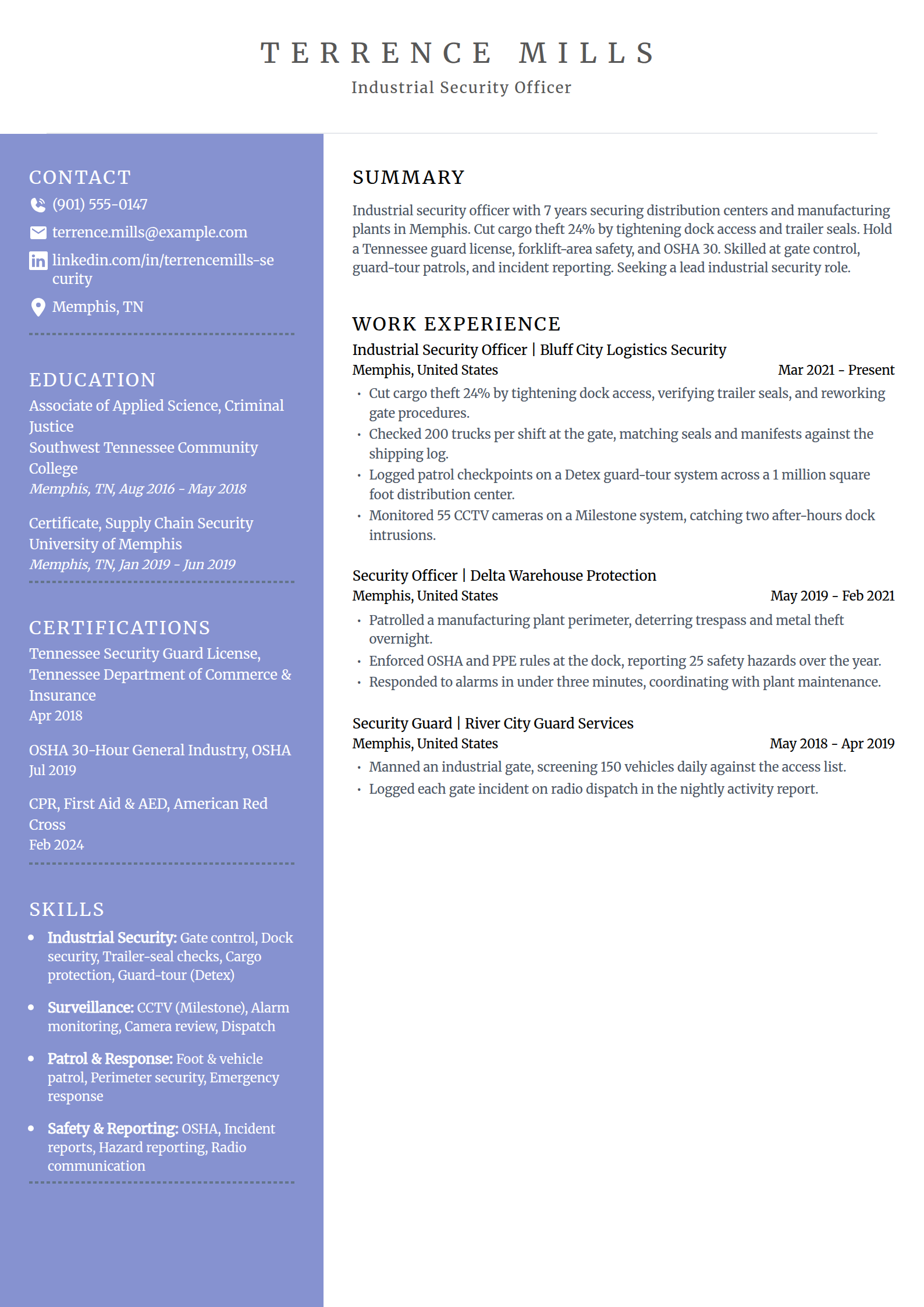
Warehouse & Industrial Security Resume Template
Why this resume example works?
- Names a Tennessee guard license, OSHA 30, and CPR/AED, the industrial-site credentials a plant expects.
- Leads with a 24% cut in cargo theft after tightening dock access and verifying trailer seals.
- Shows the gate scope, 200 trucks a shift matched to seals and manifests against the shipping log.
- Names the systems: a Detex guard-tour across a 1 million square foot center and a 55-camera Milestone wall.
- Keeps OSHA and hazard reporting visible, the safety focus an industrial security post screens for.
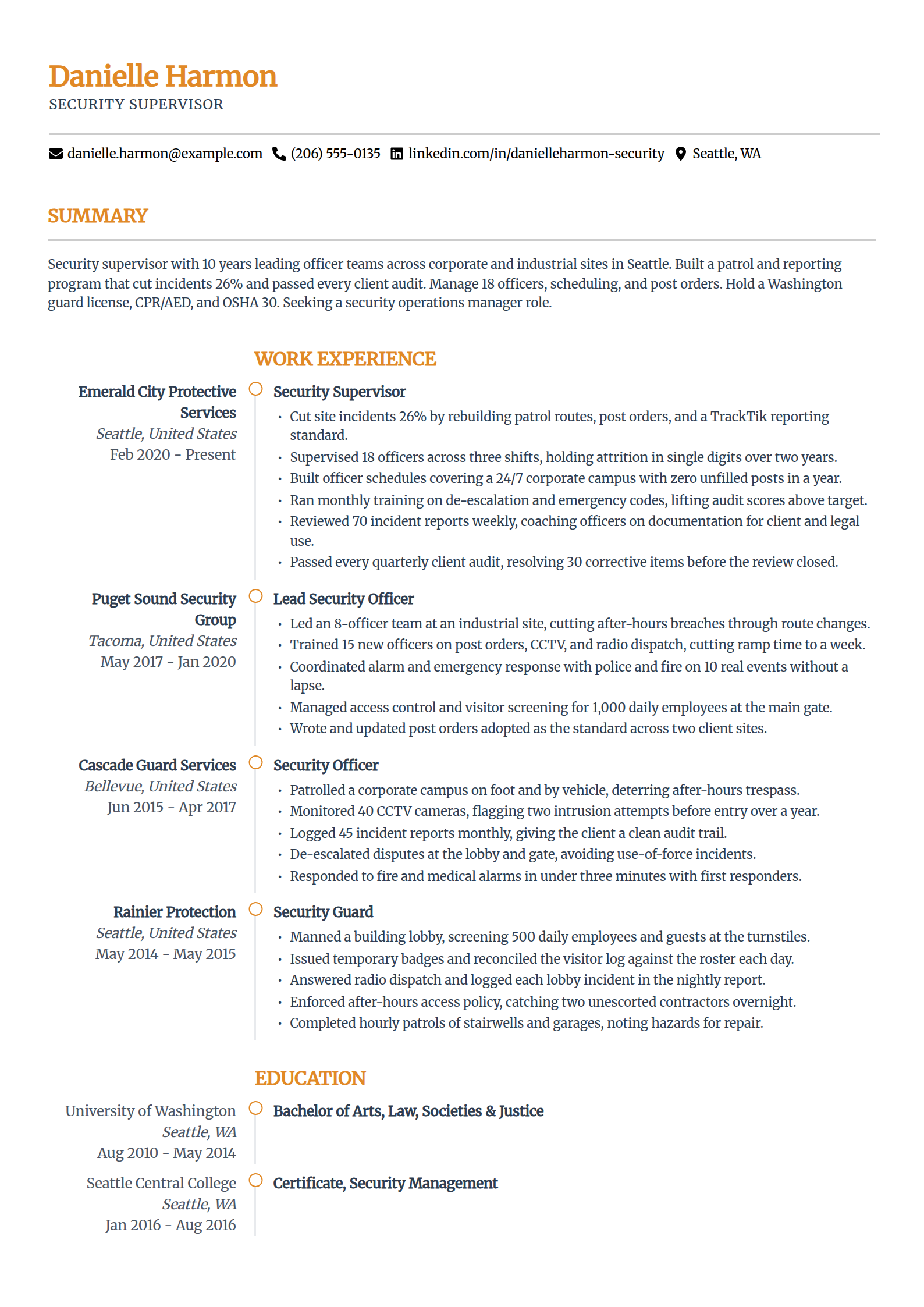
Security Supervisor & Lead Resume Template
Why this resume example works?
- Names a Washington guard license plus the ASIS CPP, the certification that signals a real security leader.
- Leads with a 26% cut in site incidents after rebuilding patrol routes, post orders, and reporting.
- Shows people scope, supervising 18 officers across three shifts with attrition held in single digits.
- Proves reliability, passing every quarterly client audit and clearing 30 corrective items before close.
- Separates leadership from officer work so the supervisory story carries the top of the page.
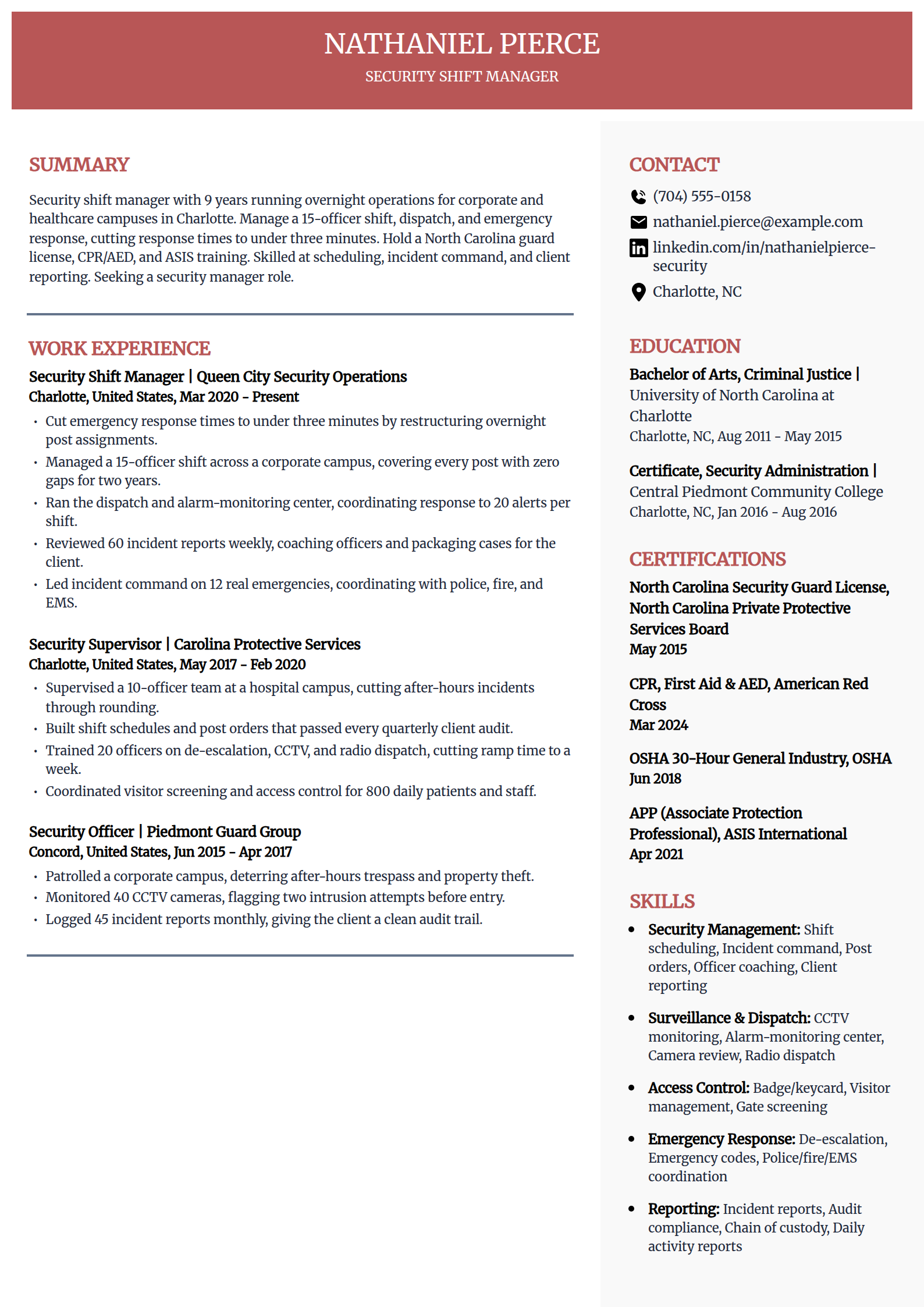
Security Shift Manager Resume Template
Why this resume example works?
- Names a North Carolina guard license and the ASIS APP, pairing field credentials with a management certification.
- Leads with an operations result, cutting emergency response times to under three minutes.
- Shows management scope, a 15-officer shift covered with zero gaps and incident command on 12 emergencies.
- Names the dispatch and alarm-monitoring center work, proving control-room and coordination experience.
- Keeps hands-on officer roles brief so the manager story stays at the top of the Executive layout.
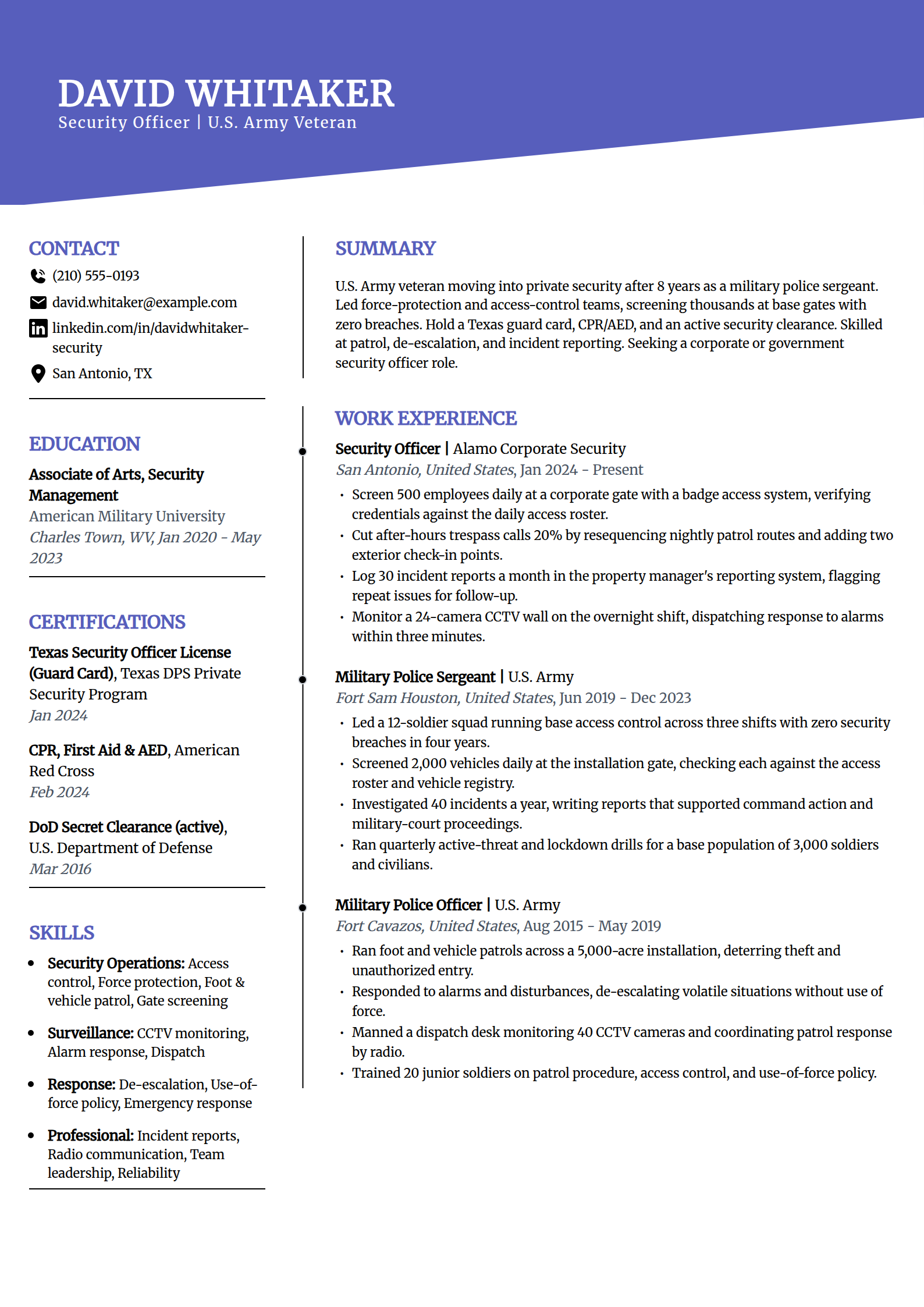
Ex-Military to Security Career-Change Resume Template
Why this resume example works?
- Names a Texas guard card and an active DoD Secret clearance, a credential that opens government and defense posts.
- Reframes eight years as an Army military police sergeant as direct security experience, not unrelated work.
- Leads with transferable scale, screening 2,000 vehicles a day at a base gate with zero breaches.
- Shows leadership, running a 12-soldier access-control squad, that maps to a lead officer role.
- Uses a compact Orbit layout to bridge a new civilian security job with the military record cleanly.
Build your security guard resume
Pick a template above and the editor keeps the layout parser-safe while you swap in your own guard card, posts, systems, and numbers.
Build my resumeHow to write a security guard resume in 2026
A security resume gets read twice: a fast human skim for your license and post history, then an ATS keyword match against the job order. These moves satisfy both without padding.
Open with a summary that names your license, specialty, and one number
Write two to three sentences that lead with your title and the setting you cover, state your guard card or license, and land on one result a hiring officer cares about. No-experience candidates use the same shape with a transferable win in place of years.
Security officer with 9 years on corporate campuses, active Georgia guard registration, who cut after-hours incidents 28% by resequencing nightly patrol routes.
Put your guard card and permits where a screener looks first
In security, the license is a threshold, not a footnote. State it precisely near the top and keep the card number off the page.
- Unarmed: write your state card plainly, such as "BSIS Guard Card, California" or "Illinois PERC", with the status current.
- Armed: name the armed or exposed-firearm permit and your firearms qualification date, and note a clean use-of-force record.
- Specialty: add the credential that gates the post, such as IAHSS for hospitals or Title 31 training for a casino floor.
Quantify impact with the numbers a security post actually tracks
Lead each bullet with a verb, then attach the result. Security work is measurable, so use the metric your setting owns.
- Coverage and volume: patrolled a 600,000 square foot campus, screened 400 vehicles a shift, or logged 70 incident reports a month.
- Prevention: cut after-hours incidents 28%, reduced shrinkage 18%, or dropped false alarms 22% after a specific change.
- Response: answered alarms in under three minutes, or handled 25 guest calls a shift without an escalation.
Name your systems and the surveillance and access-control keywords
An applicant tracking system matches the exact tools the job order lists, so write them out by name where they are true.
- Surveillance: CCTV and video systems by name (Genetec, Avigilon, Milestone), alarm monitoring, and PTZ camera work.
- Access control: badge and keycard systems (Lenel, HID), visitor management, gate screening, and metal detectors.
- Reporting and patrol: incident-reporting and guard-tour software (TrackTik, Silvertrac, Detex), radio dispatch, and body-worn cameras.
Keep the format ATS-safe
Security resumes get filtered by software before a person sees them. A clean single-column layout keeps your data readable.
- Skip tables, icon columns, and text boxes that scramble in a parser, and put a Licenses and Certifications block in the top third.
- Keep your name and contact details in the body, not the header or footer, so nothing is lost.
- Save as a PDF unless the application asks for a Word document, and run the draft through the ATS resume checker before you send it.
Common security guard resume mistakes
- Burying your guard card or armed permit at the bottom. Licensure is a screen; put it in the header or summary with the state and current status.
- Listing duties instead of results. "Watched cameras" is a task; "monitored 48 CCTV cameras and flagged three break-in attempts before entry" is proof.
- Naming a generic "security system" instead of the exact tool. Write Genetec, Avigilon, Lenel, or TrackTik so the ATS matches the job order.
- Leaving a no-experience resume thin. Turn retail, warehouse, military, or volunteer work into security bullets, and add an award or training to fill the page.
- Using a two-column, icon-heavy template that a parser cannot read cleanly, then wondering why the application stalls before a person sees it.
Frequently asked questions
What should a security guard resume include?
A two to three sentence summary that names your setting, guard card, and one result; a work section where every bullet leads with a verb and a number; your licenses and certifications near the top; a skills block that names your surveillance and access-control systems; and your education. Keep it to one page unless you have more than about ten years of posts to show, and put your license in the top third.
How do I write a security guard resume with no experience?
Lead with your state guard card and CPR/AED, then turn transferable work into security proof. A retail associate who flagged shoplifting, a warehouse worker who checked badges at the dock, an event volunteer who staffed gates, and military service all count. Give each one a bullet with a number, and add an award or training so the page looks full. The entry-level example above uses exactly this shape.
Do I put my guard card and license on a security resume, and how?
Yes, near the top, not buried in a list at the bottom. Write the state card plainly, such as "BSIS Guard Card, California" or "Illinois PERC", with the status current, and keep the card number off the resume itself. For an armed post, name your armed or exposed-firearm permit and your firearms qualification date, and add a clean use-of-force record. Specialty roles add the gating credential, such as IAHSS for a hospital.
What skills should I list on a security guard resume?
Name the systems you actually run, not generic terms. List your CCTV and video systems (Genetec, Avigilon, Milestone), access control (badge and keycard systems, visitor management, metal detectors), and reporting and patrol tools (TrackTik, Silvertrac, Detex guard-tour, radio dispatch). Add the human skills a post needs, like de-escalation, report writing, and emergency response, and make sure the systems in your skills block also show up in your bullets.
What is the difference between an armed and unarmed security resume?
The armed resume leads with the extra credentials: the armed or exposed-firearm permit, a current firearms qualification date, and a clean use-of-force record, all near the top. The unarmed resume leans on surveillance, access control, de-escalation, and reporting. Both name the state guard card and quantify posts, but an armed post is a legal threshold, so those permits go where a screener sees them first. Compare the armed and unarmed examples above.
How long should a security guard resume be?
One page for entry-level guards and officers with under about ten years of posts. Two pages are fine for supervisors, shift managers, and officers with a long, varied post history, but only if the second page earns its space with real results. Cut old duty-style bullets and unrelated jobs before you add a page.
More security guard resume resources
Build your security guard resume
Pick a template above and the editor keeps the layout parser-safe while you swap in your own guard card, posts, systems, and numbers.