Retail Manager Resume Examples and Templates by Store Format and Level
- ATS Friendly
- Numbers First
- 17 Manager Examples
A regional lead reads a retail manager resume looking for four numbers before anything else: your comp sales result, your shrink percent, your payroll to sales, and the headcount and volume you ran. Every example below leads with those, then splits by the two things that actually change the job, store format and rung on the ladder, from a shift lead who wants the title to a district manager running eleven stores.


540k+ resumes created
Retail management resume templates for every store format
Each template below is a real retail manager resume laid out in that format, covering assistant, department, store, district and regional roles across big-box, boutique, grocery, luxury, convenience and omnichannel operations. Pick one, then swap in your own volume, headcount and last full-year results. Every layout keeps your store numbers near the top where a regional lead looks first, and parses cleanly for an applicant tracking system on the way in.
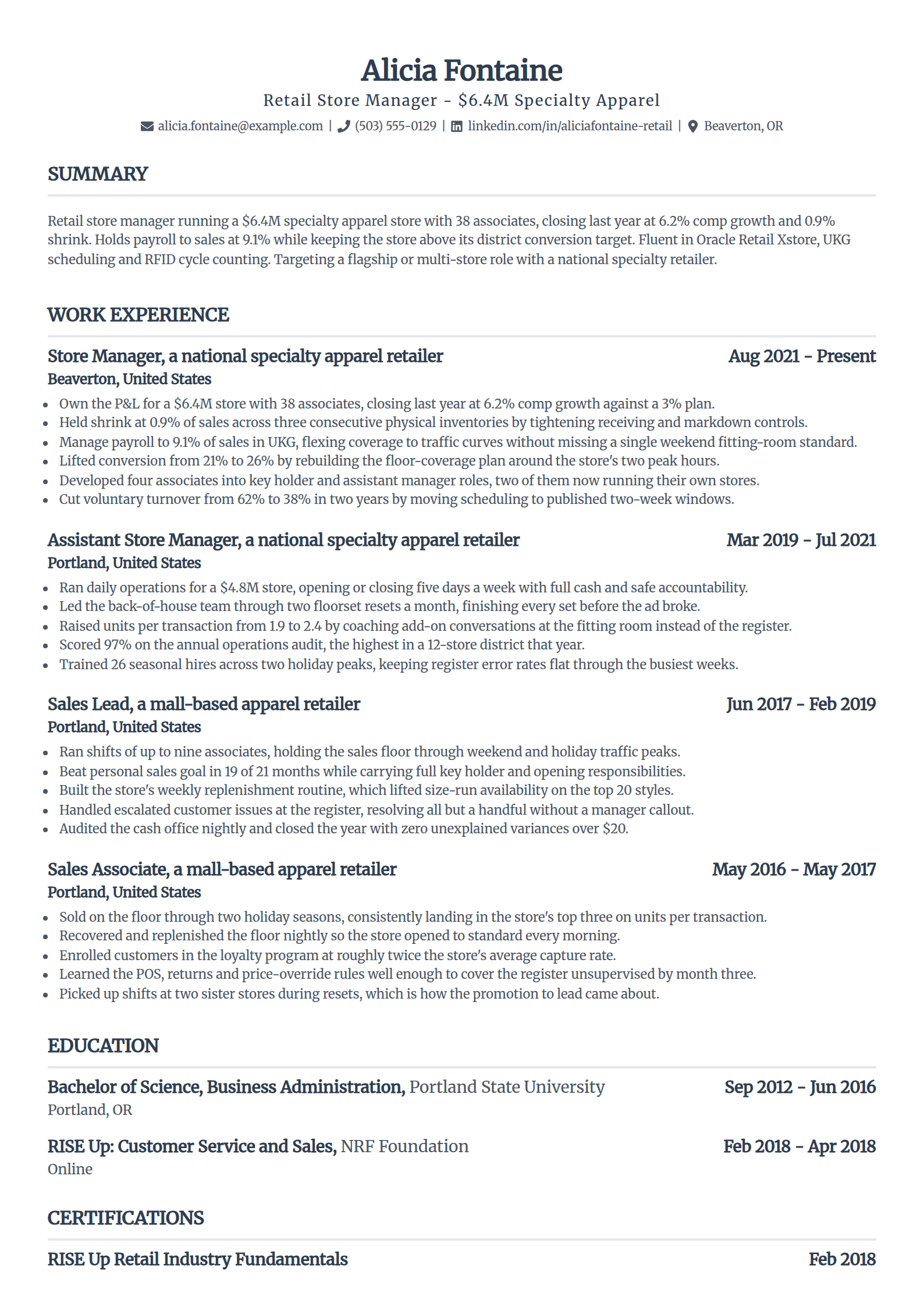
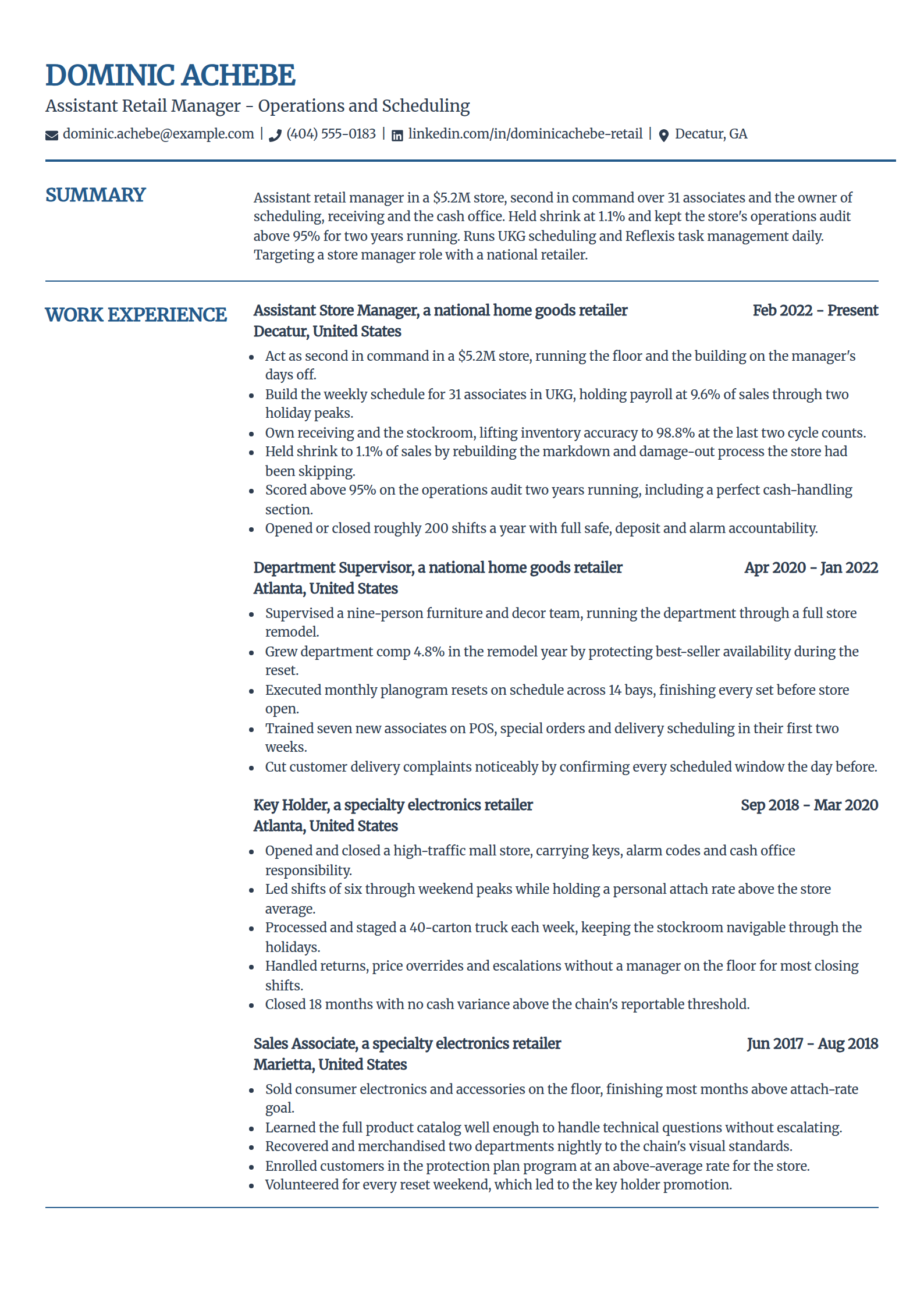
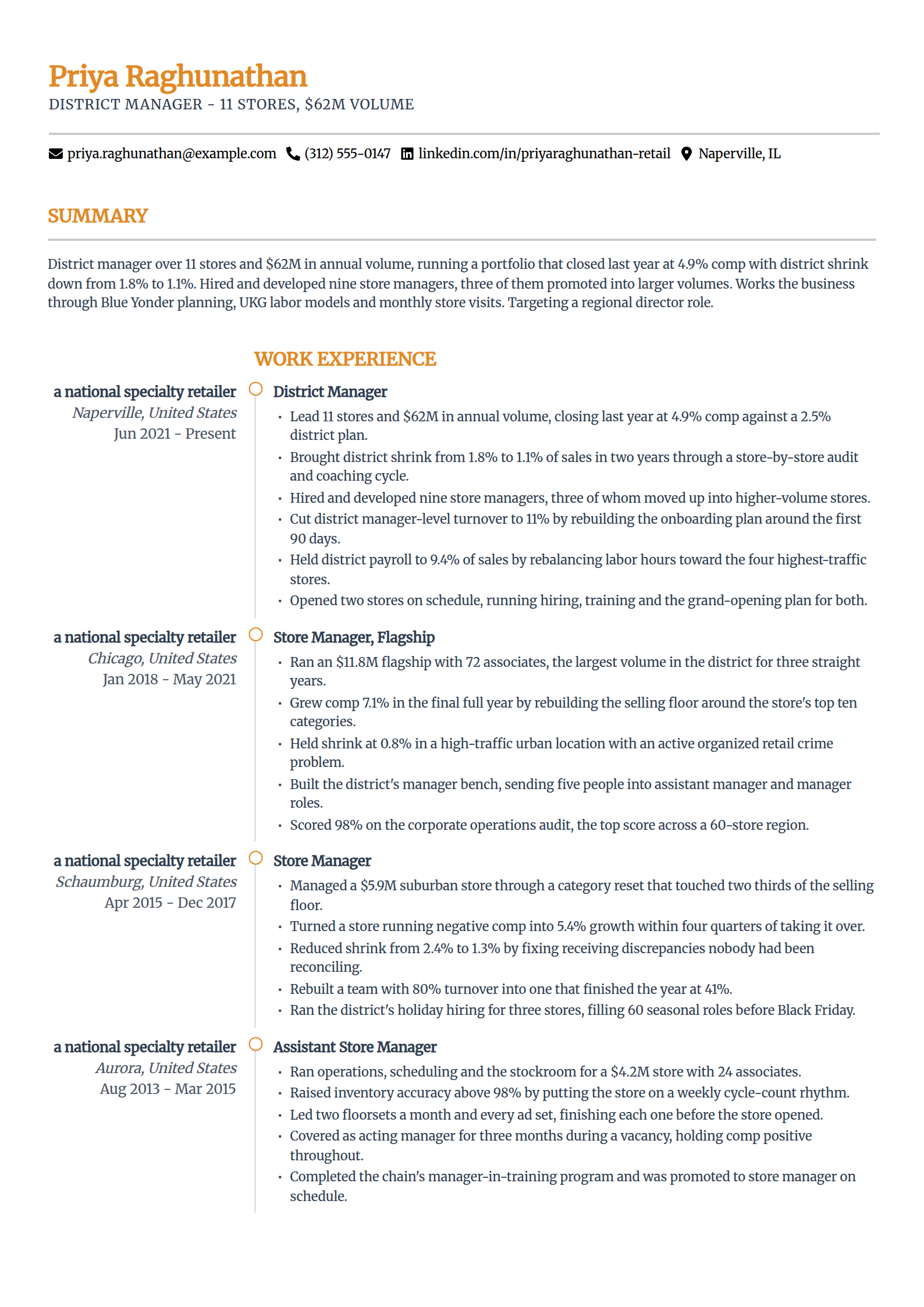
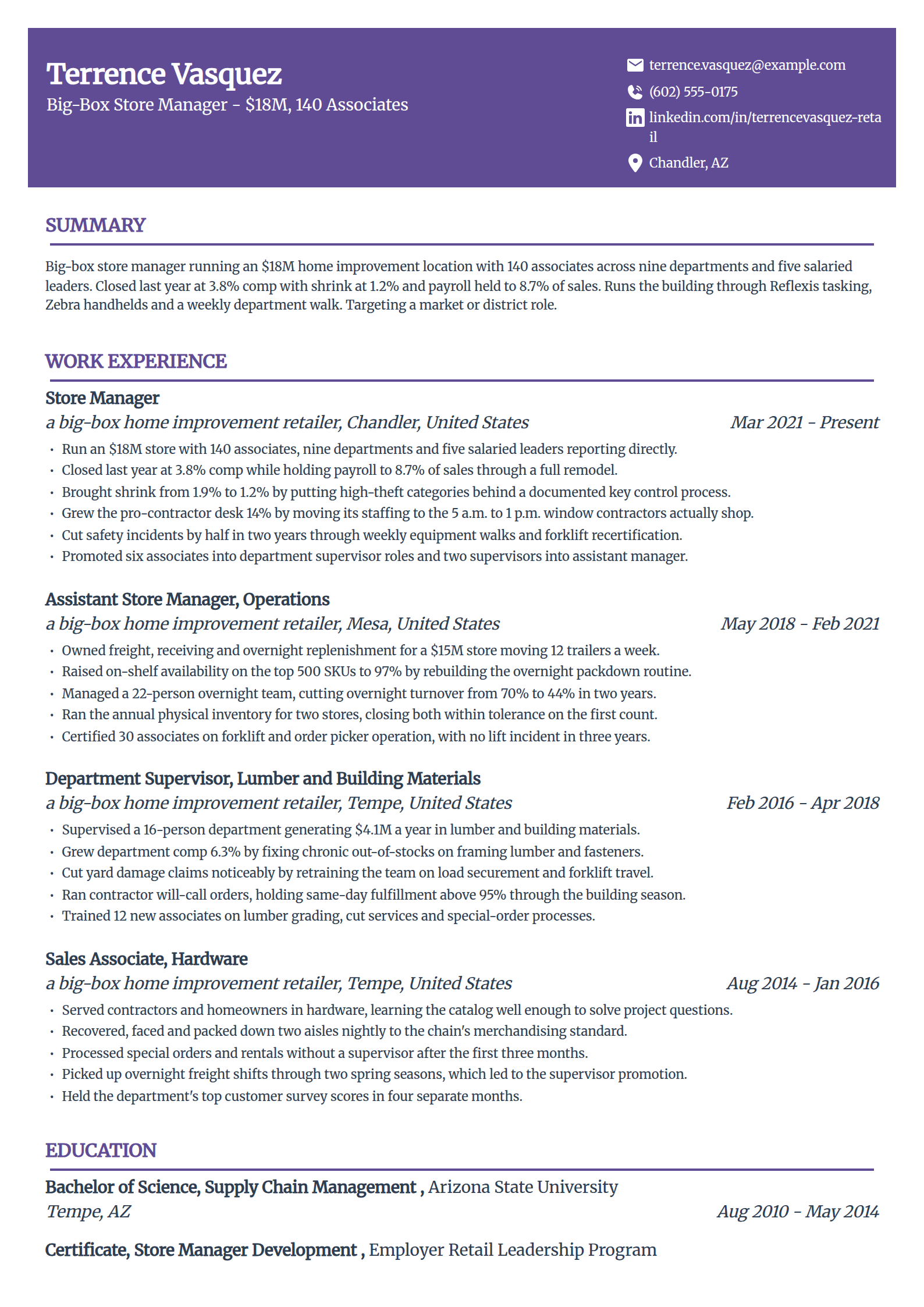
Retail Store Manager Resume Template (Single-Store P&L)
Why this resume example works?
- Opens with the four numbers a regional lead scans for: $6.4M volume, 38 associates, 6.2% comp and 0.9% shrink.
- Shows payroll to sales at 9.1%, the labor number most manager resumes leave out entirely.
- Proves people development in a way a chain can verify, four associates promoted and two now running stores.
- Names the systems a posting lists, Oracle Retail Xstore, UKG scheduling and RFID cycle counting.
- Traces a clean ladder from associate to lead to assistant to manager, which answers the tenure question before it is asked.
Assistant Retail Manager Resume Template
Why this resume example works?
- States the second-in-command scope plainly, running the building on the manager's days off in a $5.2M store.
- Claims the areas an assistant actually owns rather than borrowing the store manager's results: scheduling, receiving and the cash office.
- Carries an operations audit score above 95% for two years, which is the assistant manager's own scorecard.
- Quantifies the stockroom work that usually goes unmeasured, inventory accuracy at 98.8% on the last two counts.
- Names roughly 200 opens and closes a year with safe and alarm accountability, the detail a hiring manager is checking for.
District Manager Resume Template (Multi-Unit)
Why this resume example works?
- Sizes the portfolio in the first line, 11 stores and $62M, because a multi-unit resume is judged on scope before results.
- Leads the shrink story across a portfolio, 1.8% down to 1.1%, not a single store's number.
- Counts the thing district managers are really measured on, nine store managers hired and developed, three promoted.
- Shows the ladder below the district role so the reader can see where the operating instinct came from.
- Includes new store openings, which is the work that separates a district manager from a senior store manager.
Big-Box Store Manager Resume Template
Why this resume example works?
- Names the structure a big-box chain hires for, $18M, 140 associates, nine departments and five salaried leaders.
- Covers the freight and replenishment side that a specialty store manager never touches, 12 trailers a week.
- Puts on-shelf availability on the top 500 SKUs at 97%, a metric only big-box operators use.
- Carries safety as its own result, incidents cut by half with forklift recertification behind it.
- Shows the pro-contractor desk, which is where a home improvement box makes its margin.
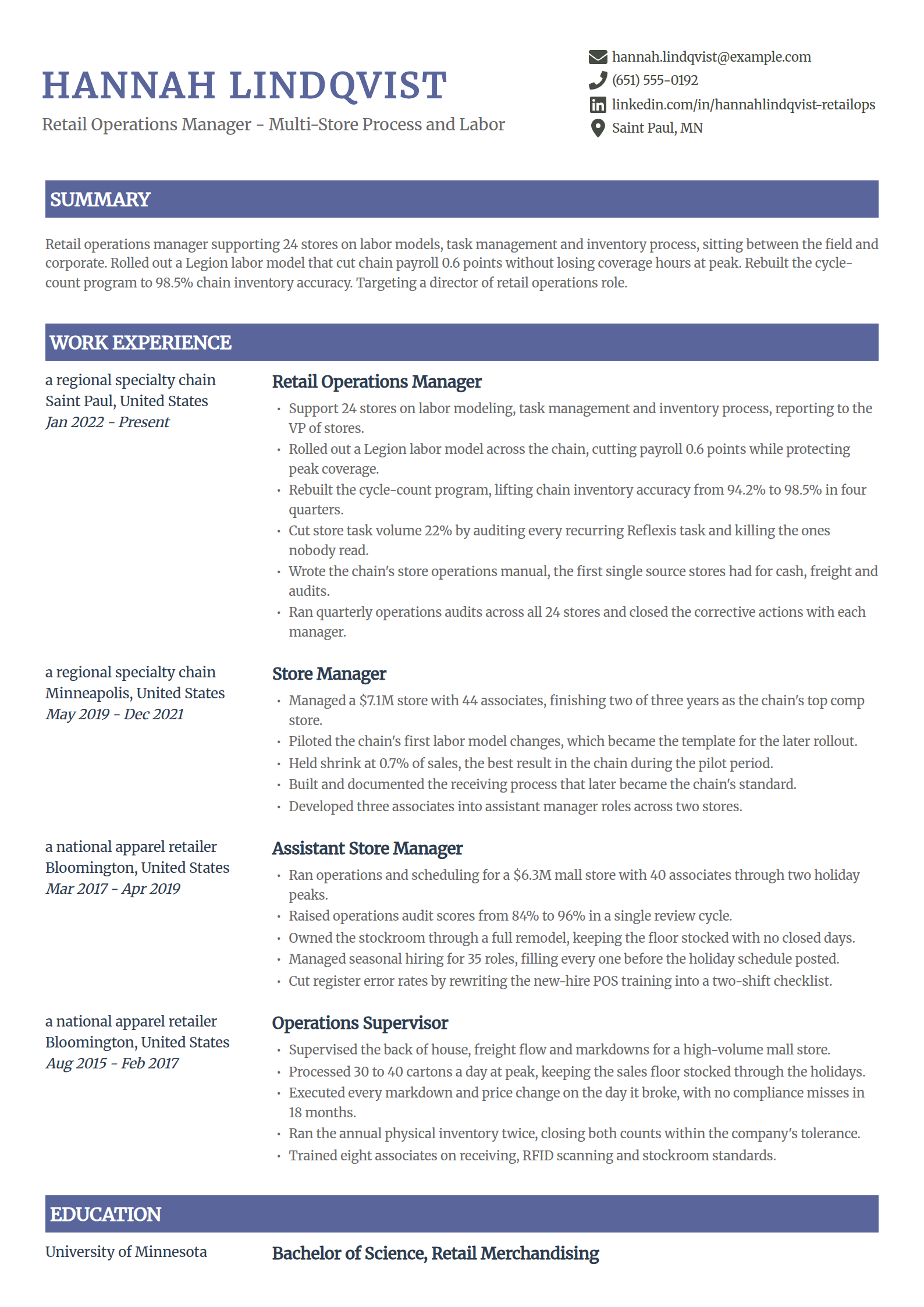
Retail Operations Manager Resume Template (Multi-Store Field Support)
Why this resume example works?
- Places the role correctly, between the field and corporate, supporting 24 stores rather than running one.
- Leads with a chain-level result, a labor model rollout that cut payroll 0.6 points without losing peak coverage.
- Quantifies the unglamorous win an ops manager owns, chain inventory accuracy from 94.2% to 98.5%.
- Includes the store task audit that cut task volume 22%, which is the kind of judgment call this job is hired for.
- Keeps store manager experience visible, since a field-support role has no credibility without it.
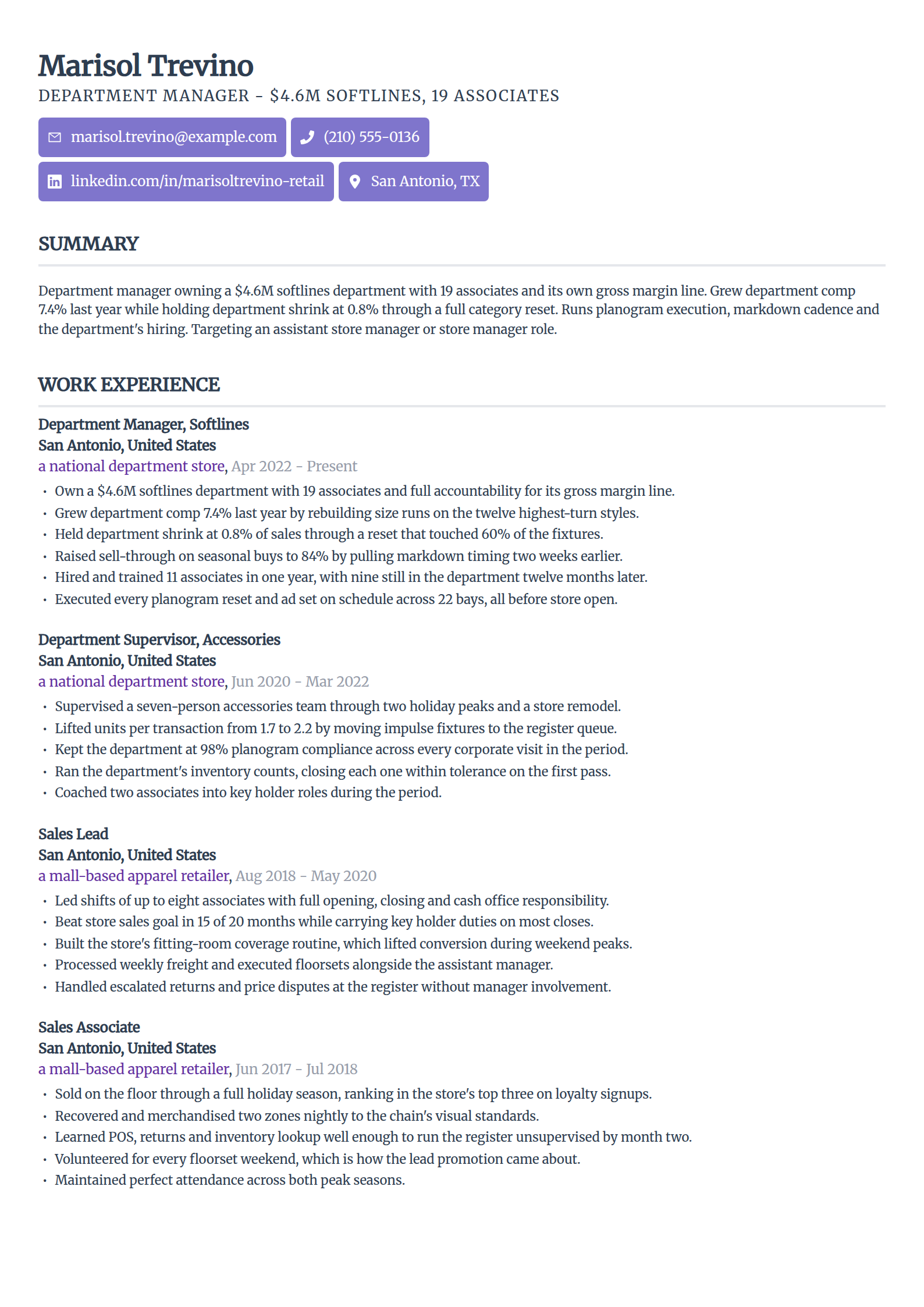
Department Manager Resume Template (Retail)
Why this resume example works?
- Treats the department as a business with its own gross margin line, $4.6M and 19 associates.
- Uses department-level metrics rather than store ones, 7.4% department comp and 84% sell-through on seasonal buys.
- Shows the merchandising discipline the role lives on, every planogram reset and ad set finished before store open.
- Ties markdown timing to a result, pulled two weeks earlier to protect sell-through.
- Gives hiring a retention number, 11 associates hired with nine still there a year later.
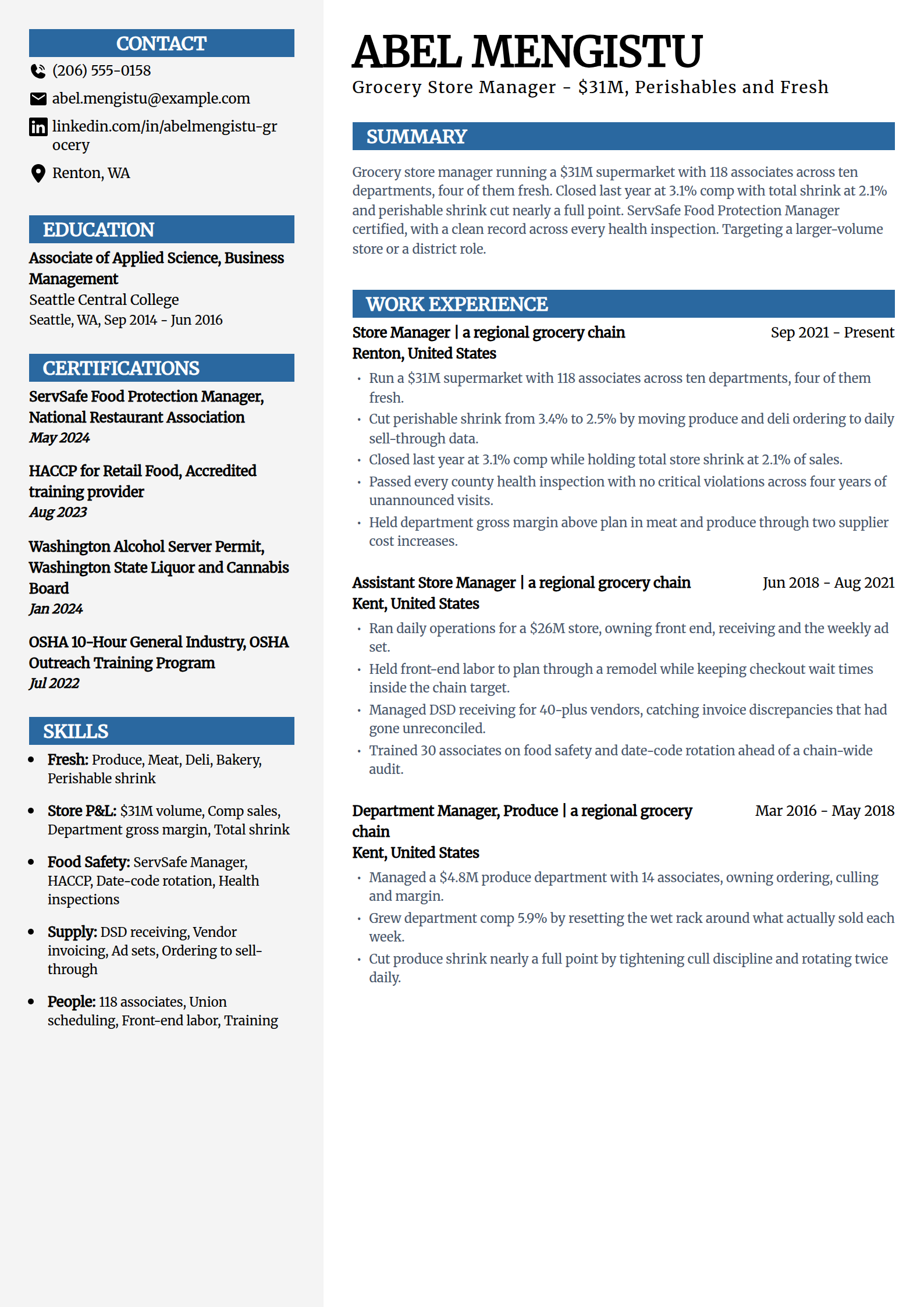
Grocery Store Manager Resume Template
Why this resume example works?
- Splits shrink the way grocery actually does, total store shrink at 2.1% and perishable shrink cut nearly a full point.
- Leads with the food safety record a grocery chain verifies first, no critical violations across four years of inspections.
- Names the credential the job requires by name, ServSafe Food Protection Manager, plus HACCP.
- Covers DSD receiving and vendor invoice reconciliation, which is grocery-specific and usually missing from a resume.
- Shows department gross margin held through supplier cost increases, the number a grocery district manager asks about.
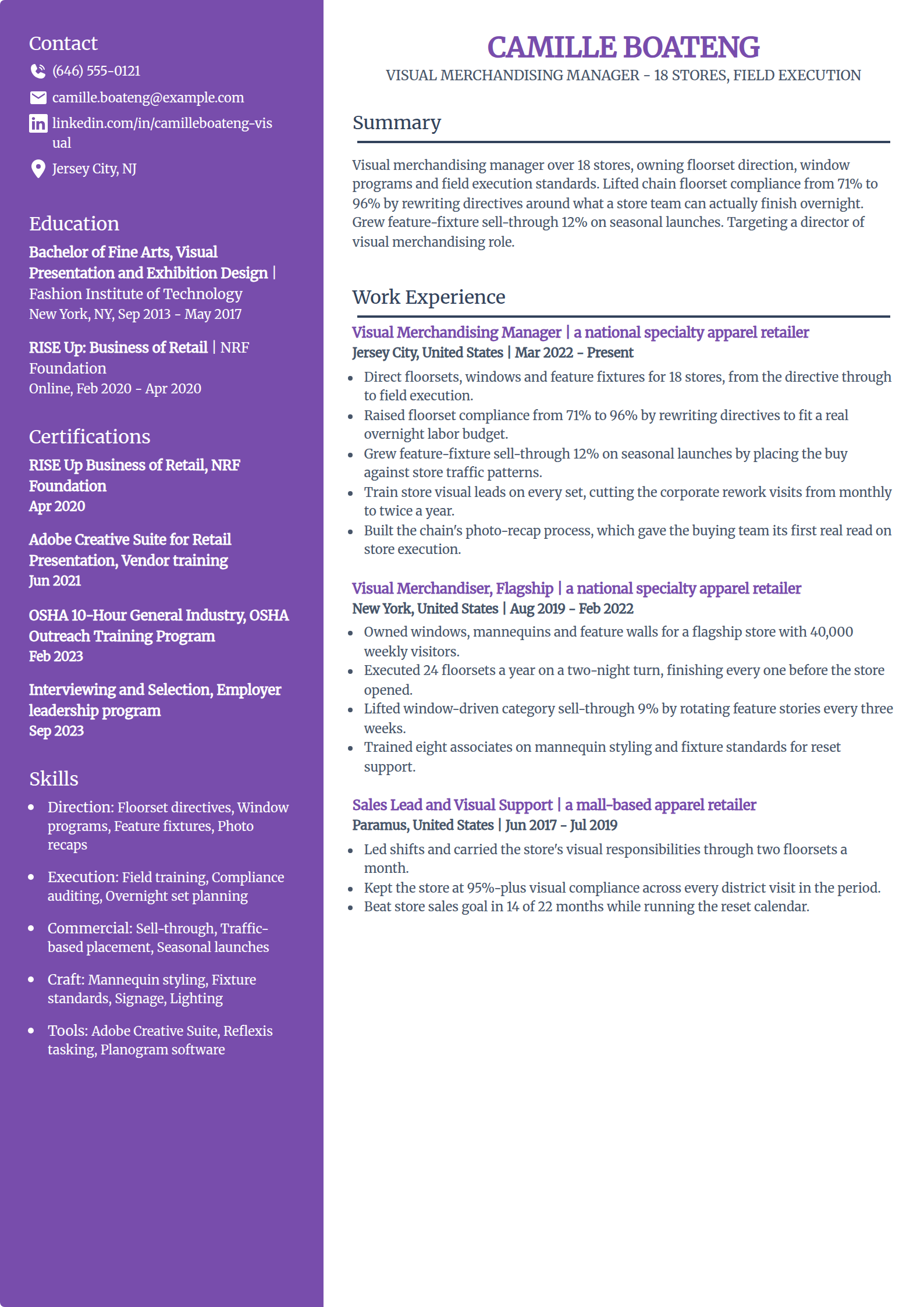
Visual Merchandising Manager Resume Template
Why this resume example works?
- Measures visual work commercially, feature-fixture sell-through up 12% on seasonal launches, not just how the floor looked.
- Leads with the field-execution number the job is really judged on, floorset compliance from 71% to 96%.
- Explains how the compliance jump happened, directives rewritten to fit a real overnight labor budget, which shows operating sense.
- Covers the span a manager owns rather than a stylist, 18 stores of direction plus training.
- Keeps the store-level visual craft on the page so the reader knows the candidate can still build the set.
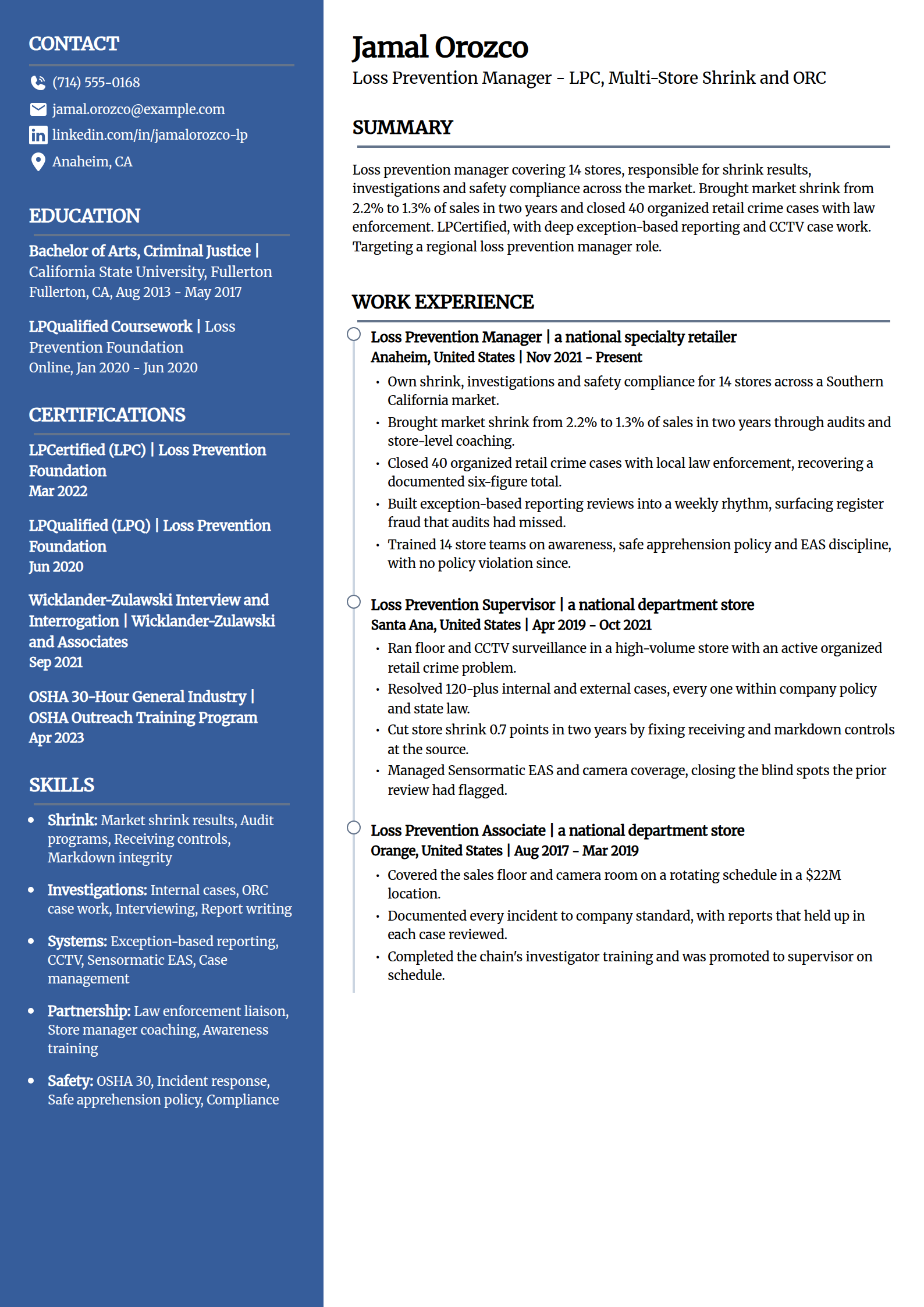
Loss Prevention Manager Resume Template
Why this resume example works?
- Owns a market shrink result rather than a case count, 2.2% down to 1.3% across 14 stores.
- Names the credential the field respects, LPCertified, with LPQualified and interview training behind it.
- Shows organized retail crime work with the law enforcement partnership that makes it credible.
- Includes the systems side, exception-based reporting and CCTV, which is where internal cases actually start.
- States that every case stayed within company policy and state law, which is the first thing this role is screened on.
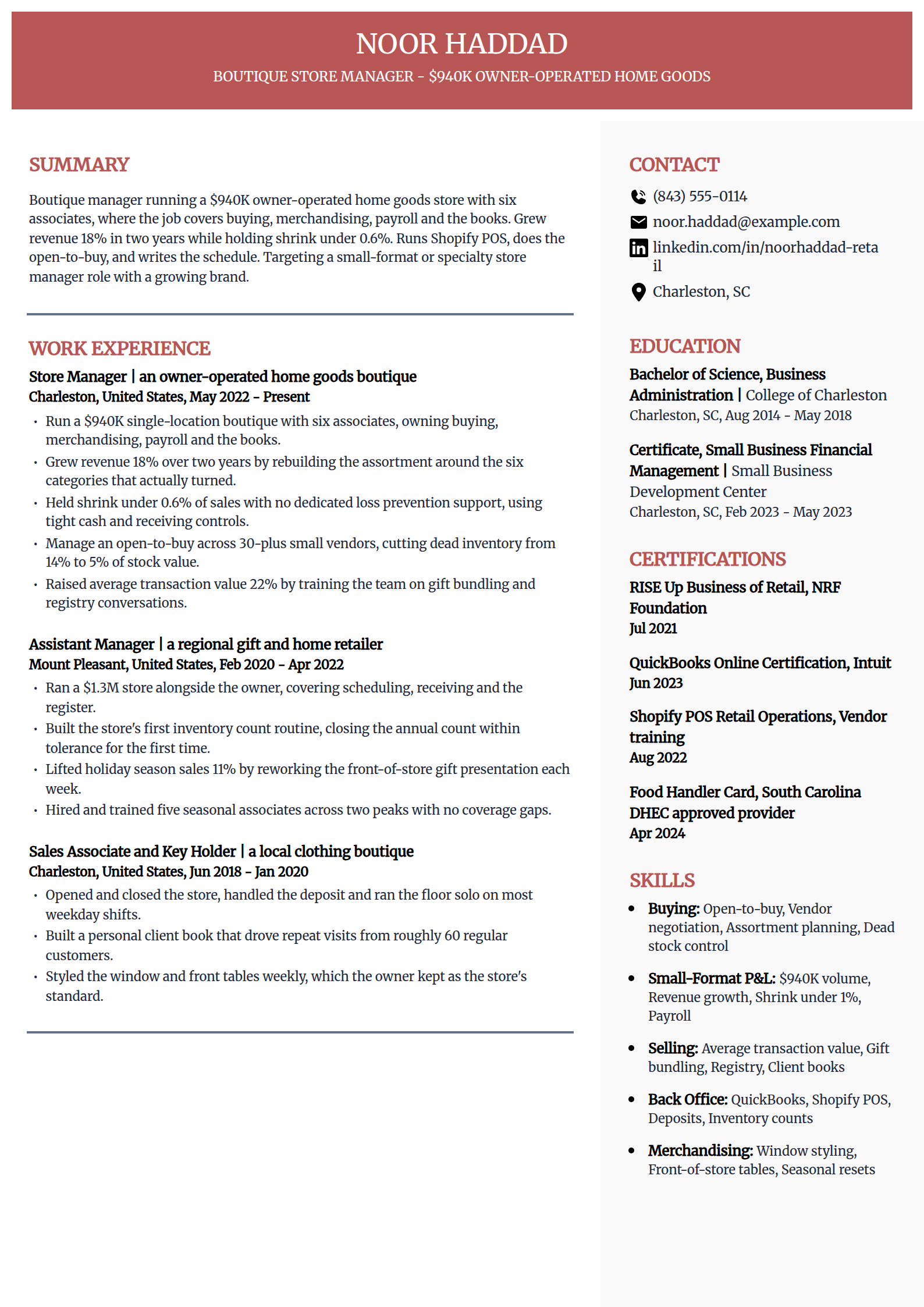
Boutique Store Manager Resume Template (Small Format)
Why this resume example works?
- Right-sizes the numbers instead of inflating them, a $940K store with six associates, which reads as honest.
- Names the jobs a small-format manager actually does that a chain manager never touches: buying, the open-to-buy, and the books.
- Proves the buying skill with a number, dead inventory from 14% down to 5% of stock value.
- Shows shrink held under 0.6% with no loss prevention support, which is a real differentiator for a small-format hire.
- Uses QuickBooks and Shopify POS, the stack an independent retailer runs on.
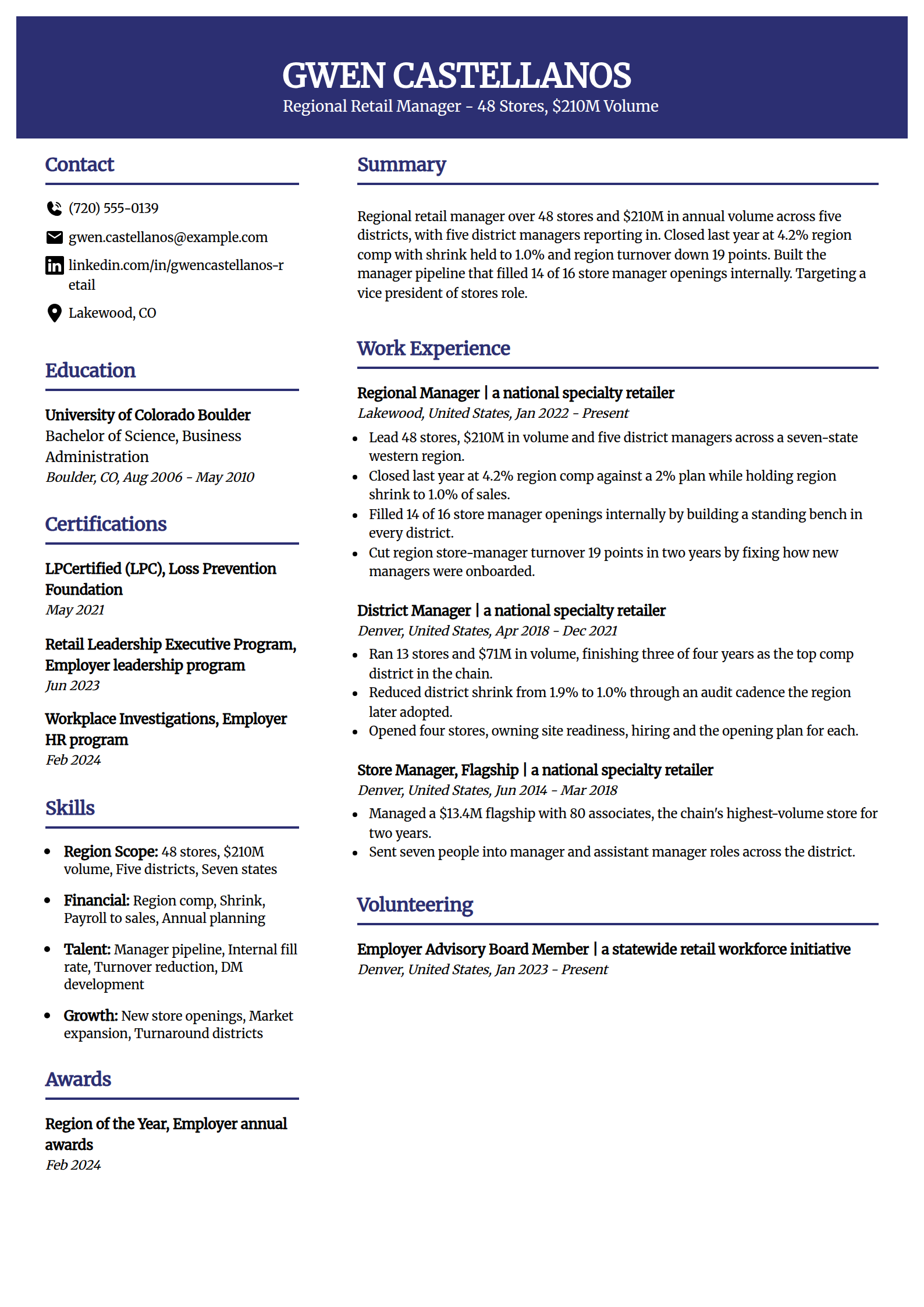
Regional Retail Manager Resume Template
Why this resume example works?
- Opens at the right altitude, 48 stores and $210M across five districts with five district managers reporting in.
- Gives the talent result a regional role is judged on, 14 of 16 store manager openings filled internally.
- Pairs growth with control, 4.2% region comp against a 2% plan while holding shrink to 1.0%.
- Compresses the earlier roles to two or three lines each, which is how a senior resume keeps to one page.
- Shows turnover down 19 points with the cause named, a rebuilt manager onboarding.
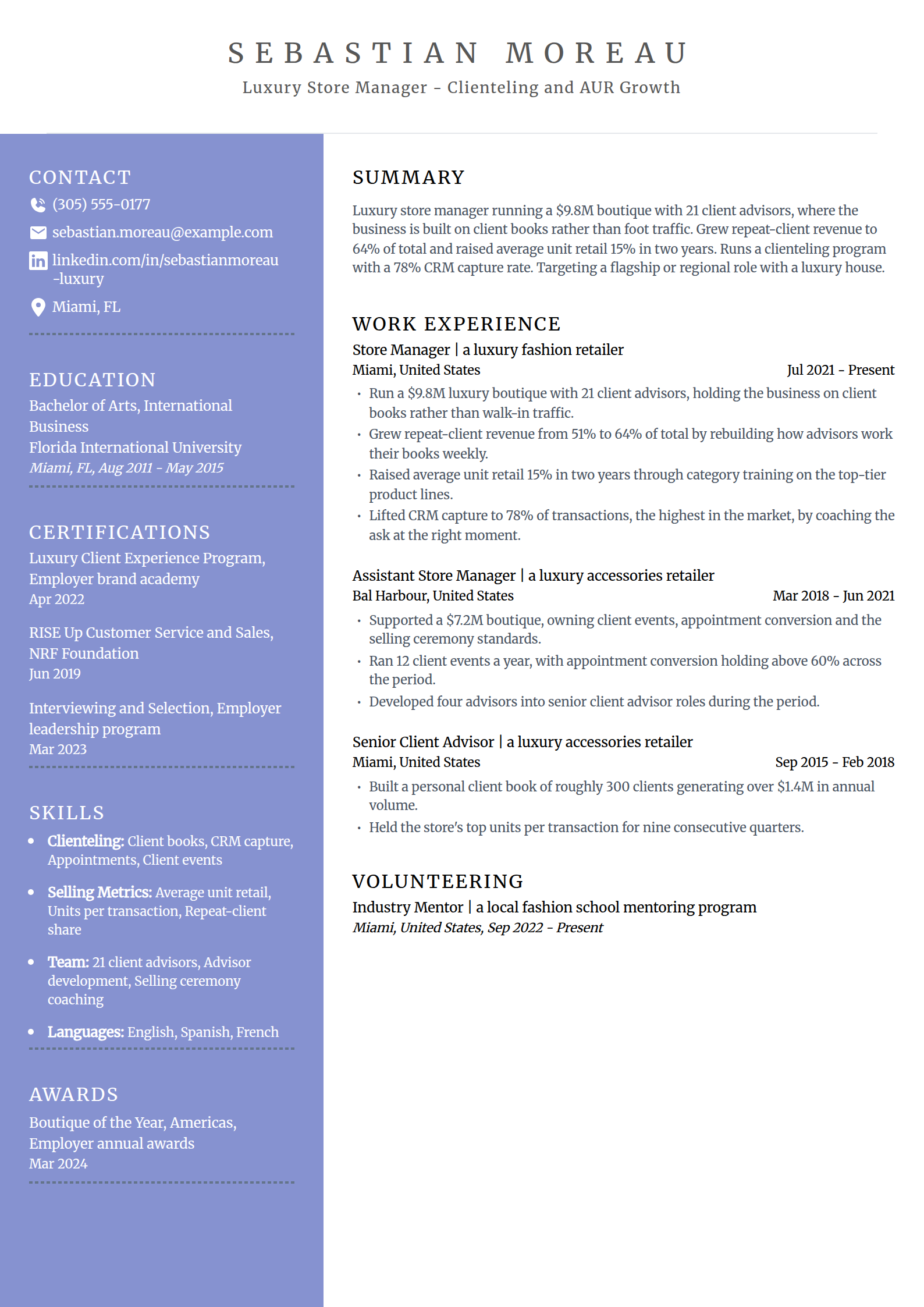
Luxury Store Manager Resume Template
Why this resume example works?
- Uses luxury's own metrics instead of mass-market ones: average unit retail, CRM capture and repeat-client share.
- States the business model up front, built on client books rather than foot traffic, which is what a house wants to read.
- Gives the clienteling result a number, repeat-client revenue from 51% to 64% of total.
- Keeps a personal client book on the page, roughly 300 clients and $1.4M, because luxury hires the book as well as the manager.
- Lists languages, which genuinely matters in a flagship serving international clients.
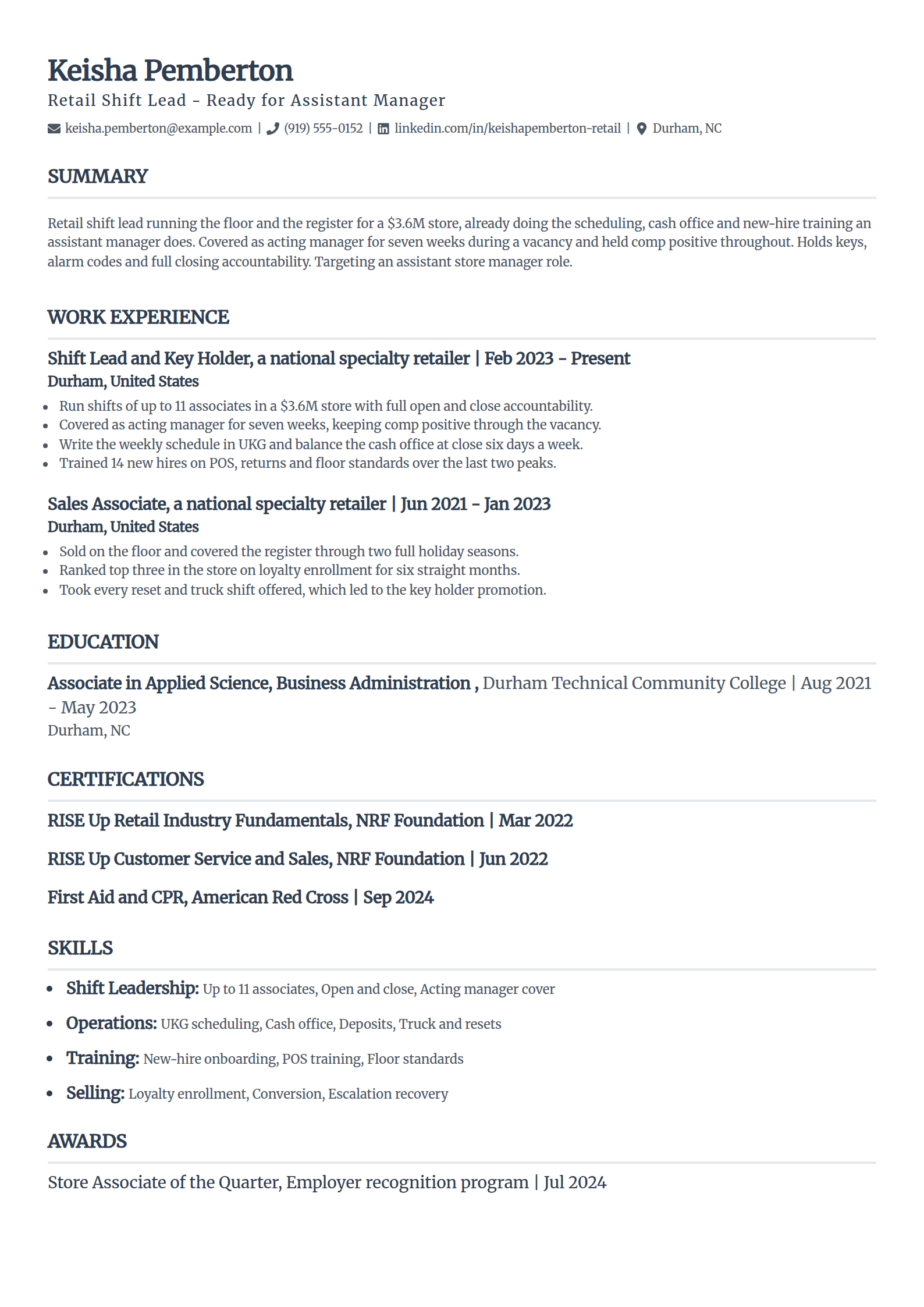
Retail Manager Resume Template (No Management Title Yet)
Why this resume example works?
- Names the management work already being done under a non-management title: scheduling, cash office and new-hire training.
- Leads with the strongest proof available, seven weeks covering as acting manager with comp held positive.
- Keeps the numbers shift-sized and believable, up to 11 associates rather than a store P&L.
- Counts training as a result, 14 new hires through two peaks.
- States the target role in the summary, which is how a hiring manager knows this is a promotion application.
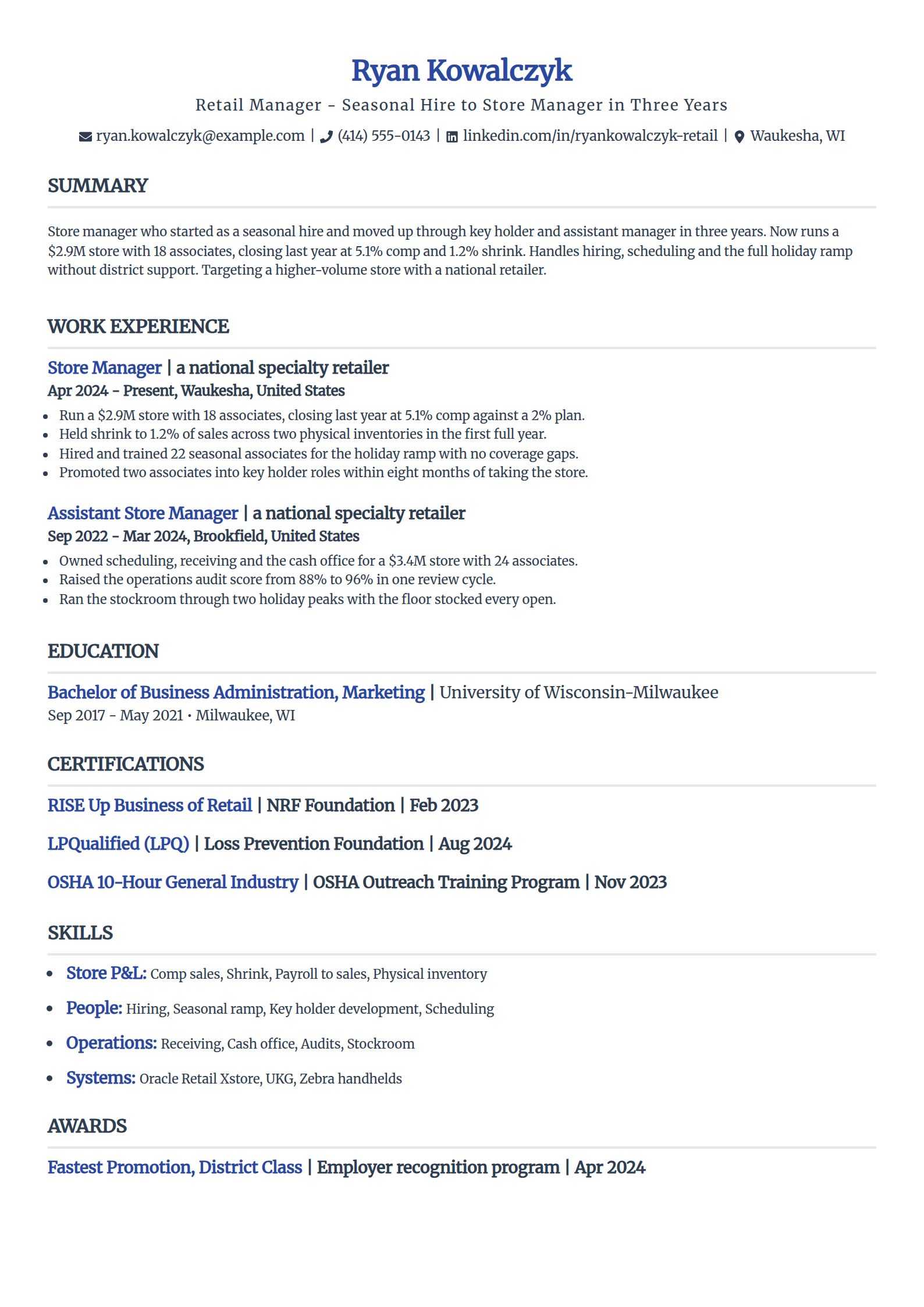
Seasonal Hire to Retail Manager Resume Template
Why this resume example works?
- Makes the promotion path the headline rather than hiding it, seasonal hire to store manager in three years.
- Backs the speed with results at each rung, an audit score from 88% to 96% as an assistant, then 5.1% comp as a manager.
- Keeps the store size honest at $2.9M, which is what a first store manager job actually looks like.
- Shows the holiday ramp in numbers, 22 seasonal associates hired and trained with no coverage gaps.
- Uses a plain, single-column format that keeps a short management history from looking thin.
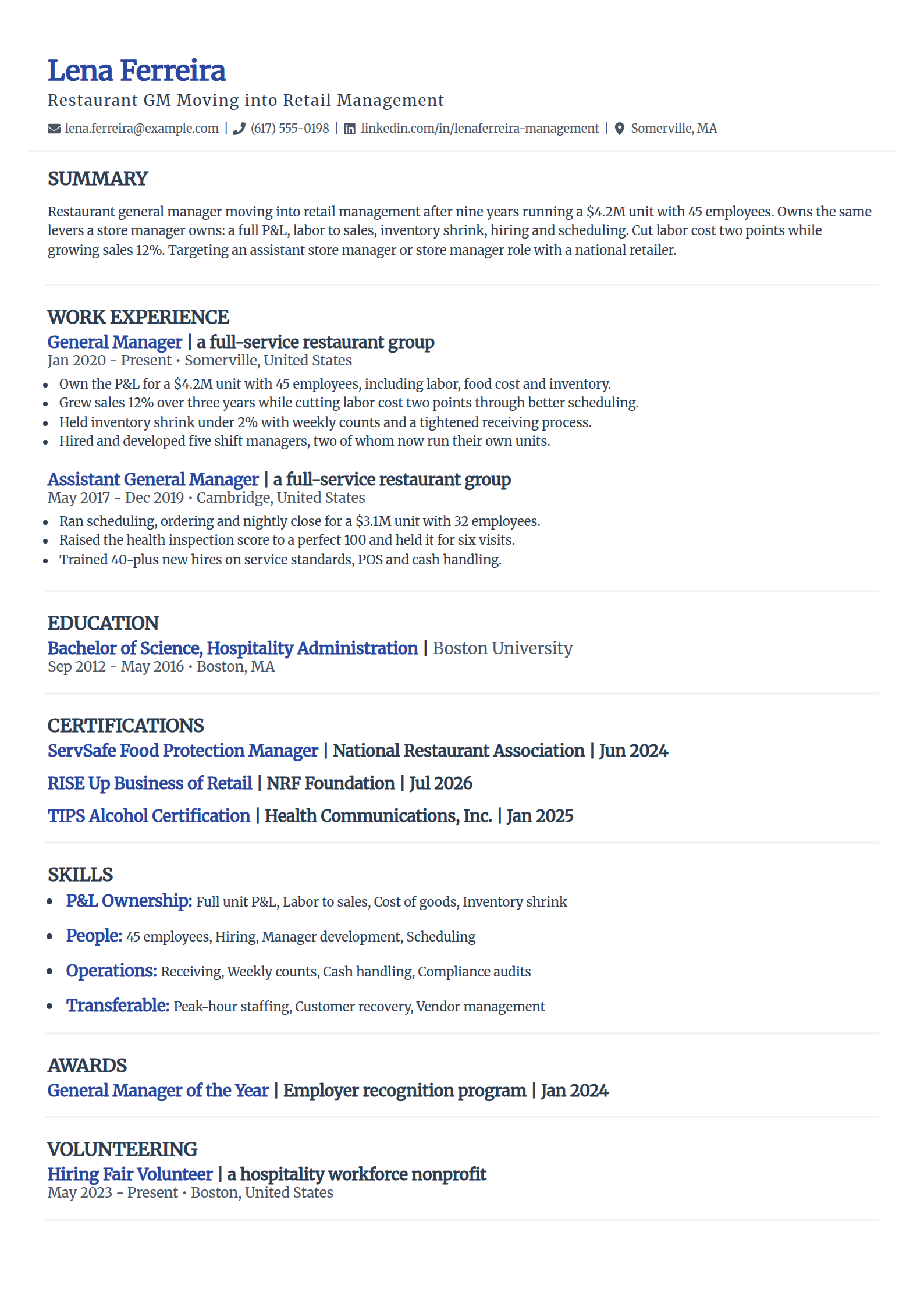
Career Change to Retail Management Resume Template
Why this resume example works?
- Translates restaurant management into retail terms a store hiring manager recognizes: P&L, labor to sales, inventory shrink.
- Proves the levers transfer with numbers, sales up 12% while labor cost came down two points.
- Does not pretend the experience was retail, which is what makes the rest of the resume credible.
- Names a manager-development result, five shift managers developed and two now running units.
- Adds a retail-specific credential in progress, so the application shows commitment rather than a shot in the dark.
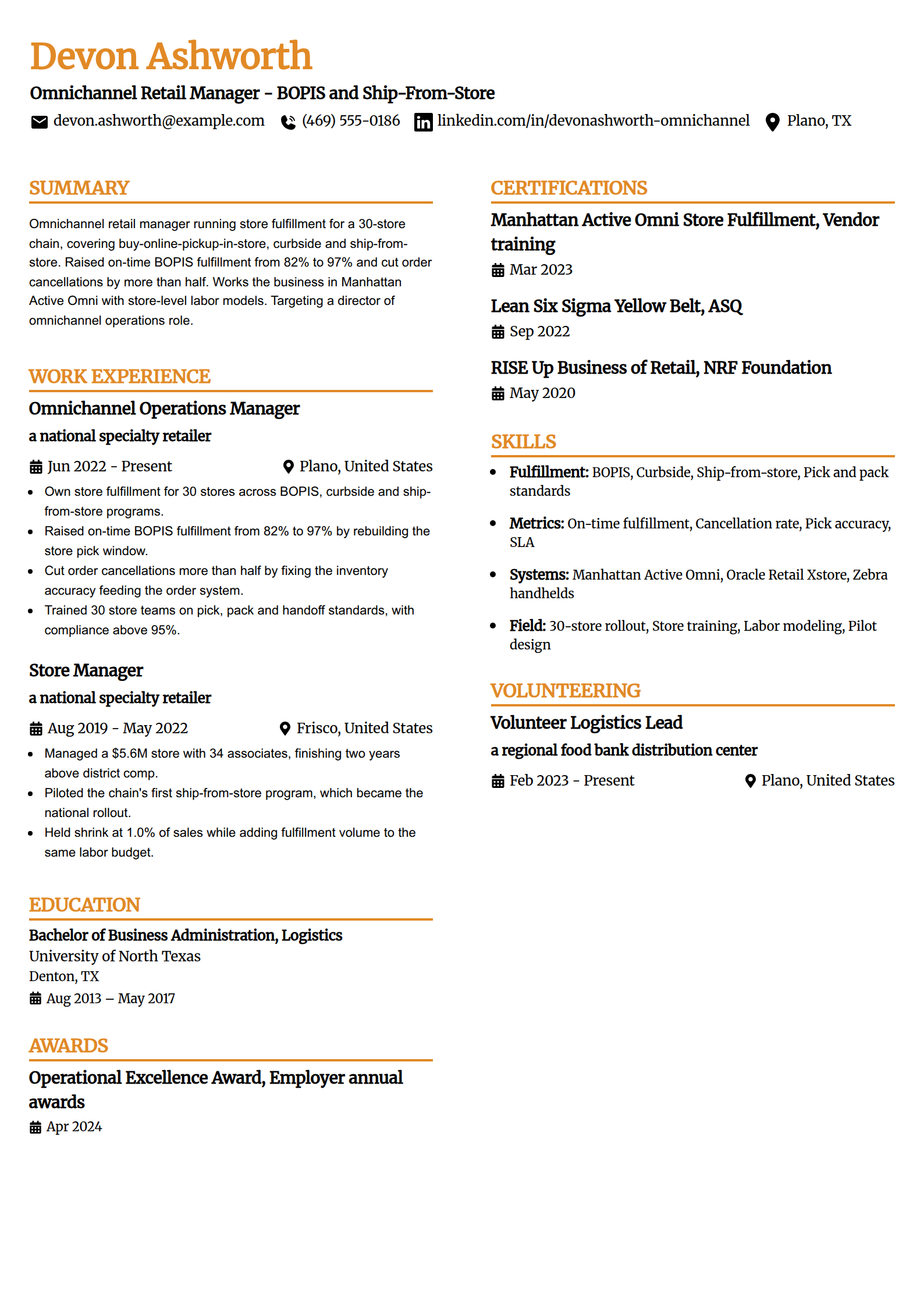
Omnichannel Retail Manager Resume Template
Why this resume example works?
- Uses fulfillment metrics rather than store ones, on-time BOPIS from 82% to 97% across 30 stores.
- Names the root cause behind the second result, inventory accuracy feeding the order system, which shows real diagnosis.
- Covers all three store fulfillment programs by name: pickup, curbside and ship-from-store.
- Names Manhattan Active Omni, the system an omnichannel posting will list.
- Keeps a store manager role on the page, since this job fails without someone who has stood behind the counter.
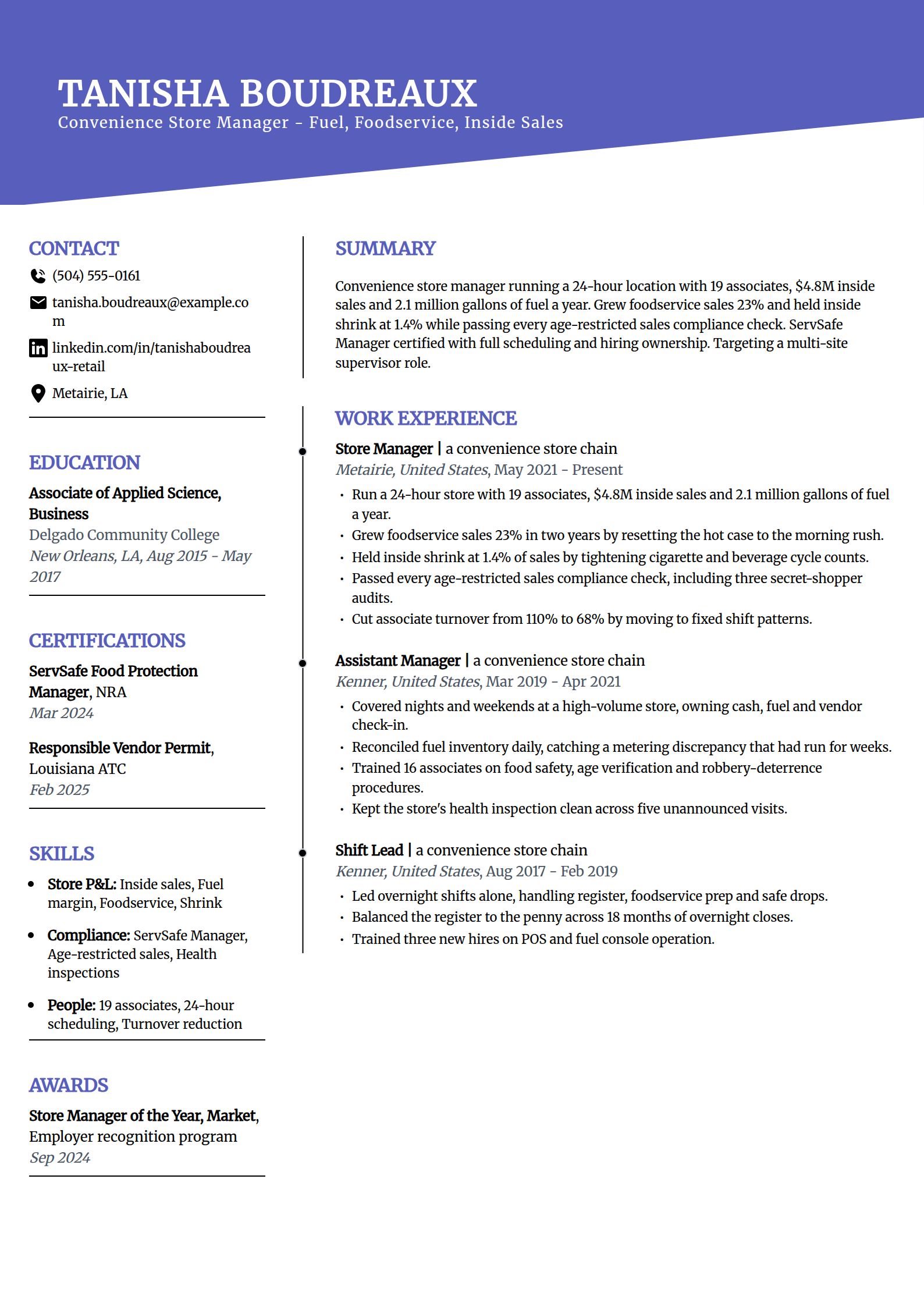
Convenience Store Manager Resume Template
Why this resume example works?
- Sizes the store the way the channel does, $4.8M inside sales alongside 2.1 million gallons of fuel.
- Leads with the compliance record this channel screens hardest on, every age-restricted sales check passed.
- Grows the highest-margin line and says how, foodservice up 23% by resetting the hot case to the morning rush.
- Names a turnover result honestly at convenience-store scale, 110% down to 68%.
- Includes fuel inventory reconciliation, a duty almost no convenience resume remembers to claim.
Build your retail manager resume
Pick a template above and the editor keeps your layout clean and ATS-safe while you swap in your own volume, headcount and store numbers.
Build my resumeHow to write a retail manager resume in 2026
A regional lead reads your first three lines and looks for four numbers: comp sales, shrink, payroll to sales, and the volume and headcount you ran. If they are not there, the rest of the resume is doing work it does not need to do. Lead with them, then make each experience bullet a result with one number behind it, and keep the format plain enough to parse.
Open with volume, headcount and your last full-year result
Three to four sentences. Name the store volume you ran, the number of associates, your last comp result, and your shrink or payroll number. Then name the systems a posting lists and the role you are targeting. If you do not have a management title yet, write an objective instead of a summary, two to three sentences, and still open with the management work you have done rather than the job you want.
Retail store manager running a $6.4M specialty apparel store with 38 associates, closing last year at 6.2% comp growth and 0.9% shrink. Holds payroll to sales at 9.1% while keeping the store above its district conversion target. Fluent in Oracle Retail Xstore, UKG scheduling and RFID cycle counting. Targeting a flagship or multi-store role with a national specialty retailer.
Use the metrics your level is actually measured on
Retail measures everything, so a manager resume without numbers reads as though the candidate never saw a P&L. Use the set that matches your rung, not the biggest number you can find.
- Store level: comp sales growth, shrink as a percent of sales, payroll or labor to sales, conversion, units per transaction, average transaction value, audit scores, turnover and internal promotions.
- Multi-unit: portfolio comp and shrink, store managers hired and developed, internal fill rate, combined volume, and new stores opened.
- Format-specific: perishable shrink and department gross margin in grocery, average unit retail and client-book share in luxury, on-time fulfillment in omnichannel, fuel margin and inside-sales mix in convenience.
- One number per bullet, and keep it level-accurate. A shift lead shows a shift's results, not a store P&L.
Make experience bullets results, not job description lines
Name what changed, attach one number, and say what you did to cause it. That last part is what separates a manager who ran a good store from one who made it good.
- Open with a strong verb like grew, held, cut, promoted, opened or rebuilt, never "Responsible for" or "Oversaw".
- Pair growth with control. "Grew comp 6.2%" is half a sentence; "grew comp 6.2% while holding payroll at 9.1% of sales" is the whole job.
- Say how, briefly. "Lifted conversion from 21% to 26% by rebuilding floor coverage around the store's two peak hours" beats the same number with no method.
- Count people development as a result: associates promoted, turnover reduced, bench built. Chains promote managers who make managers.
Name your systems and credentials
Retail postings list systems by name, and matching that language is the whole of the ATS advice worth giving.
- Point of sale and inventory: Oracle Retail Xstore, NCR or Toshiba, Aptos, Lightspeed, Shopify POS, Zebra handhelds, RFID cycle counting.
- Labor and task: UKG, Kronos, Legion, Reflexis. Say which one you actually build schedules in.
- Credentials that carry weight: Loss Prevention Foundation LPQualified or LPCertified, NRF Foundation RISE Up, ServSafe Food Protection Manager for grocery, foodservice and convenience, and state alcohol server permits where the store sells it.
- If the posting says "comp store sales" or "payroll to sales", use that exact phrasing where it matches what you did.
Formatting and length
One page for store, assistant and department managers. Two pages only once you run multiple units and the second page is portfolio history a regional lead would read.
- Use a single-column layout with standard headings. Heavy graphics and columns make the resume harder to read and harder to parse.
- Put the volume and headcount in the job title line or the first bullet of each role, so the reader does not have to hunt for scope.
- Compress older roles to two or three lines each. A regional manager's associate job needs one line, not five.
- Cut anything that is not a result. A duty list at manager level reads as someone who has never been measured.
Honestly: the title on your resume matters less than the numbers under it
Plenty of retail hiring managers will take a shift lead who ran the schedule, the cash office and the holiday ramp over an assistant manager who only worked the floor, and the resumes that lose are the ones that hide the work because the title was not official. If you covered a vacancy, say how long and what held. If you trained the new hires, count them. The one thing not to do is claim the store's P&L when you did not own it, because that is the first thing a reference check unravels.
Common retail manager resume mistakes
- Leaving out store volume and headcount. "Managed a retail store" tells a regional lead nothing; "$6.4M store, 38 associates" tells them what job you are ready for.
- Listing duties instead of results. Replace "oversaw daily operations" with "closed the year at 6.2% comp while holding payroll to 9.1% of sales".
- Giving growth with no control number beside it. Comp growth bought with payroll and markdowns is not a result, and an experienced reader knows to ask.
- Claiming a P&L you did not own. An assistant manager who lists the store's comp as their own result fails the first reference check; claim scheduling, receiving, audits and the cash office instead, which are genuinely yours.
- Using one resume for every store format. A grocery manager is judged on perishable shrink, a luxury manager on client-book share, an omnichannel manager on fulfillment rates. Reorder your numbers to match the posting.
Frequently asked questions
What should a retail manager resume include?
Four numbers up front: store volume, headcount, your last full-year comp result, and your shrink or payroll to sales figure. Then a summary of three to four sentences carrying those, experience bullets that each state a result with one number and the method behind it, a skills block grouped by P&L, people, operations and systems, and a certifications block if you hold LPQ, LPC, RISE Up or ServSafe. Keep it to one page unless you run multiple units.
How do I write a retail manager resume with no management experience?
Lead with the management work you already do under a non-management title. Scheduling, the cash office, opening and closing, training new hires, covering a manager vacancy and running a holiday ramp are all assistant manager duties, and most shift leads leave them off. Put a number on each one: how many associates on your shift, how many weeks you covered, how many people you trained. Write an objective rather than a summary, two to three sentences, and name the role you are targeting. Do not claim the store's P&L if you did not own it.
What metrics should a retail manager put on a resume?
Comp store sales growth, shrink as a percent of sales, payroll or labor to sales, conversion, units per transaction, average transaction value, operations audit scores, turnover, and associates promoted. Multi-unit roles add portfolio comp and shrink, store managers developed, internal fill rate and new stores opened. Add the format-specific ones your channel uses: perishable shrink in grocery, average unit retail and repeat-client share in luxury, on-time fulfillment in omnichannel, fuel margin in convenience. One number per bullet is plenty.
Should a retail manager resume have a summary or an objective?
A summary if you already manage, an objective if you are moving up from a lead or shift role or changing careers into retail management. A resume carries one or the other, never both. The summary runs three to four sentences and opens with volume, headcount and your last comp result. The objective runs two to three and still opens with what you bring, the management work you have done and the results behind it, then names the role you are targeting. Neither one should open with what you want from the employer.
How long should a retail manager resume be?
One page for assistant, department and store managers, including experienced ones. Two pages once you run multiple units and the second page is portfolio history a regional lead would genuinely read. You will see averages quoted closer to three pages, but that describes what people do, not what works. Compress older roles to two or three lines each and cut anything that is not a result, and almost every manager fits on one page.
What is the difference between a store manager and a district manager resume?
Scope first, then what the numbers measure. A store manager resume is built on one P&L: volume, headcount, comp, shrink, payroll and audit score for that building. A district manager resume is built on a portfolio: number of stores, combined volume, district comp and shrink, and above all the talent results, store managers hired and developed, internal fill rate and turnover. If you are moving from store to district, keep your store results but add anything you did across stores, covering a vacancy, running district hiring, or leading a rollout.
More retail manager resume resources
Build your retail manager resume
Pick a template above and the editor keeps your layout clean and ATS-safe while you swap in your own volume, headcount and store numbers.