Operations Manager Resume Templates, Warehouse to Director of Ops
- ATS Friendly
- Operations Specific
- 18 Real Examples
An operations manager resume gets a fast read, so it has to show the scope you run, the numbers you moved, and the systems you know at a glance. Pick a clean template below, then model your own on a real example built for your track, from a warehouse or sales operation to a plant floor or a multi-site P&L. Every example keeps one credible number per line so a hiring manager trusts it.


540k+ resumes created
Operations manager resume templates, sorted by ops track
Each template below is a real operations manager resume laid out in that format, grouped by industry and experience level. Choose one, then swap in your own scope, metrics, and the systems you run, from SAP and NetSuite to a WMS, Salesforce, or a KPI dashboard. Every layout keeps your name, title, and dates clean so a hiring manager reads your impact at a glance and an applicant tracking system parses it without trouble.
Operations Coordinator Resume Template (Entry-Level)
Why this resume example works?
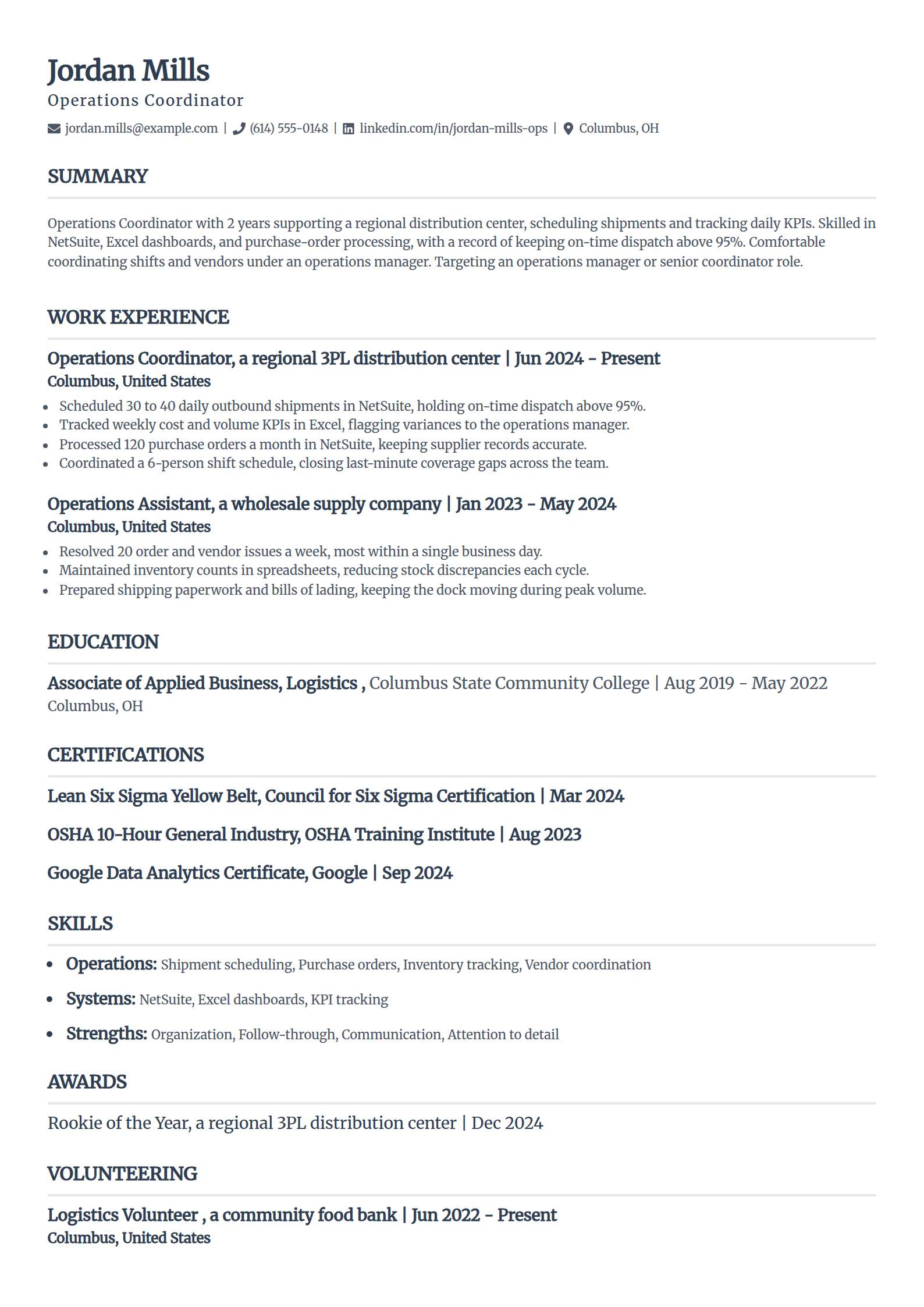
- Written for an entry-level step up, it leads with 2 years supporting a distribution center and on-time dispatch above 95%.
- Keeps numbers modest and level-accurate for a coordinator, like 120 purchase orders a month, not company-wide cost cuts.
- Names the systems a posting screens for, NetSuite and Excel dashboards, as applicant-tracking keywords.
- Shows early leadership honestly, coordinating a 6-person shift schedule rather than claiming manager scope.
- Uses a tight, single-column layout that fills one page cleanly without padding.
Operations Manager Resume Template
Why this resume example works?
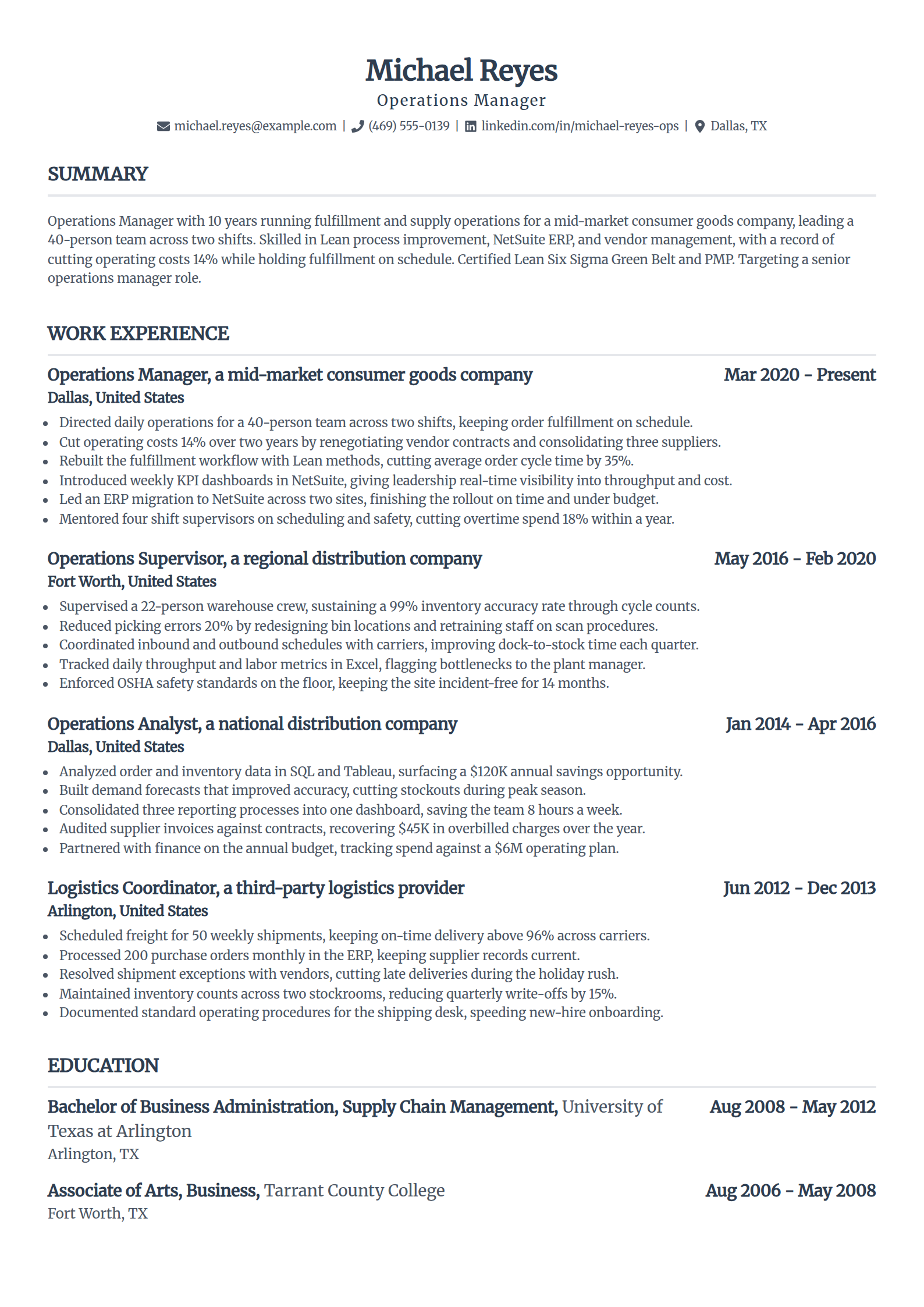
- Opens with a summary that names 10 years, a 40-person team, and a 14% cost cut, the numbers a hiring manager reads first.
- Leads each bullet with a strong verb and one modest number, like cutting order cycle time 35% with Lean methods.
- Names the tools a posting lists, NetSuite ERP, SQL, and Tableau, so the resume matches the job description.
- Backs the record with the credentials operations hiring screens for, Lean Six Sigma Green Belt, PMP, and APICS CPIM.
- Uses a clean single-column layout that carries a full ten-year history on one page.
Senior & Regional Operations Manager Resume Template
Why this resume example works?
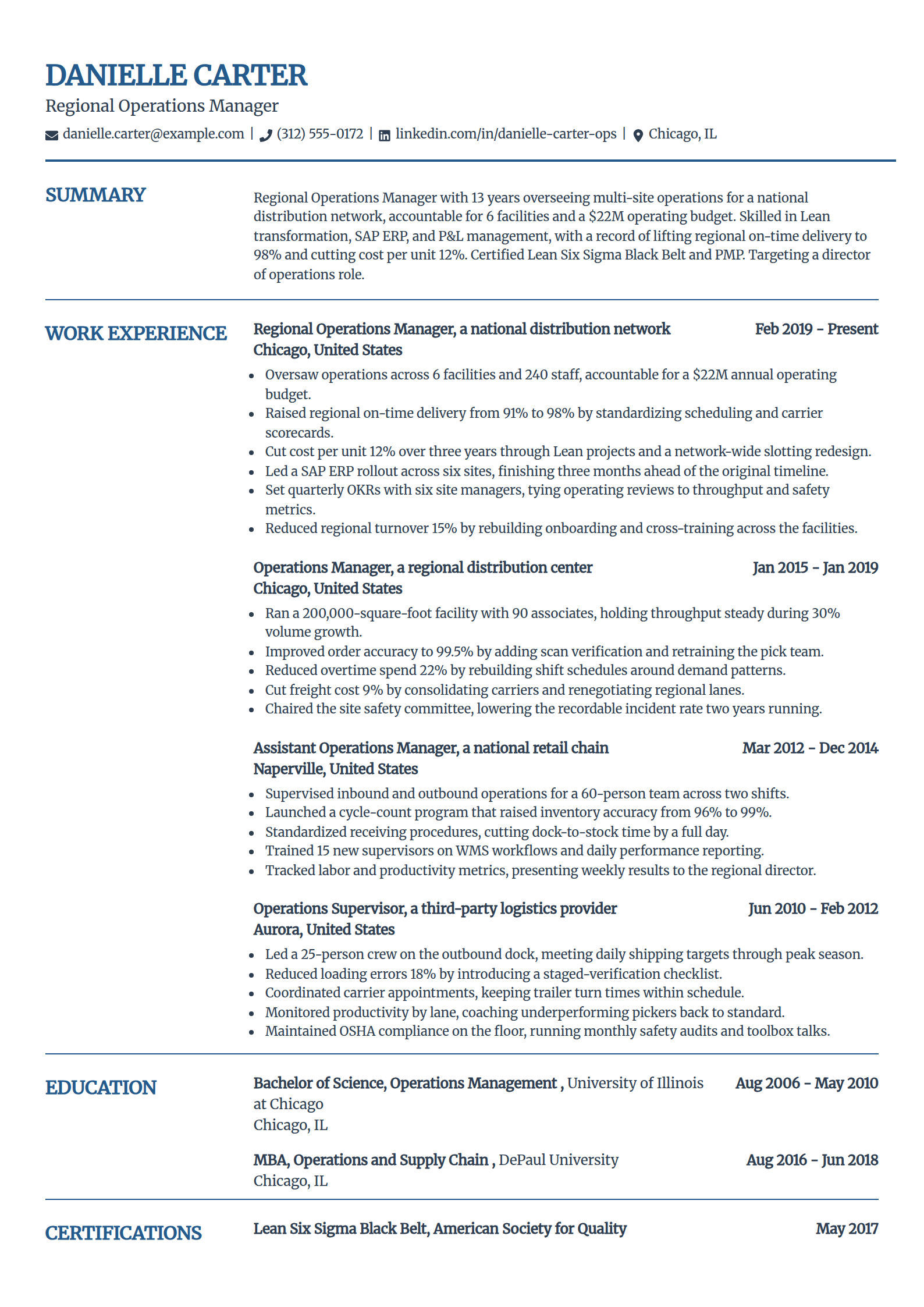
- Leads with multi-site scope, 6 facilities, 240 staff, and a $22M budget, the numbers a regional role hires for.
- Shows outcomes at scale, lifting regional on-time delivery from 91% to 98% by standardizing scheduling.
- Proves cost discipline, cutting cost per unit 12% over three years through Lean projects and a slotting redesign.
- Names the enterprise tools a regional posting expects, SAP ERP, WMS, and Power BI, plus a Black Belt and MBA.
- Uses a modern layout that fits a dense, multi-site history on one clean page.
Business Operations Manager Resume Template
Why this resume example works?
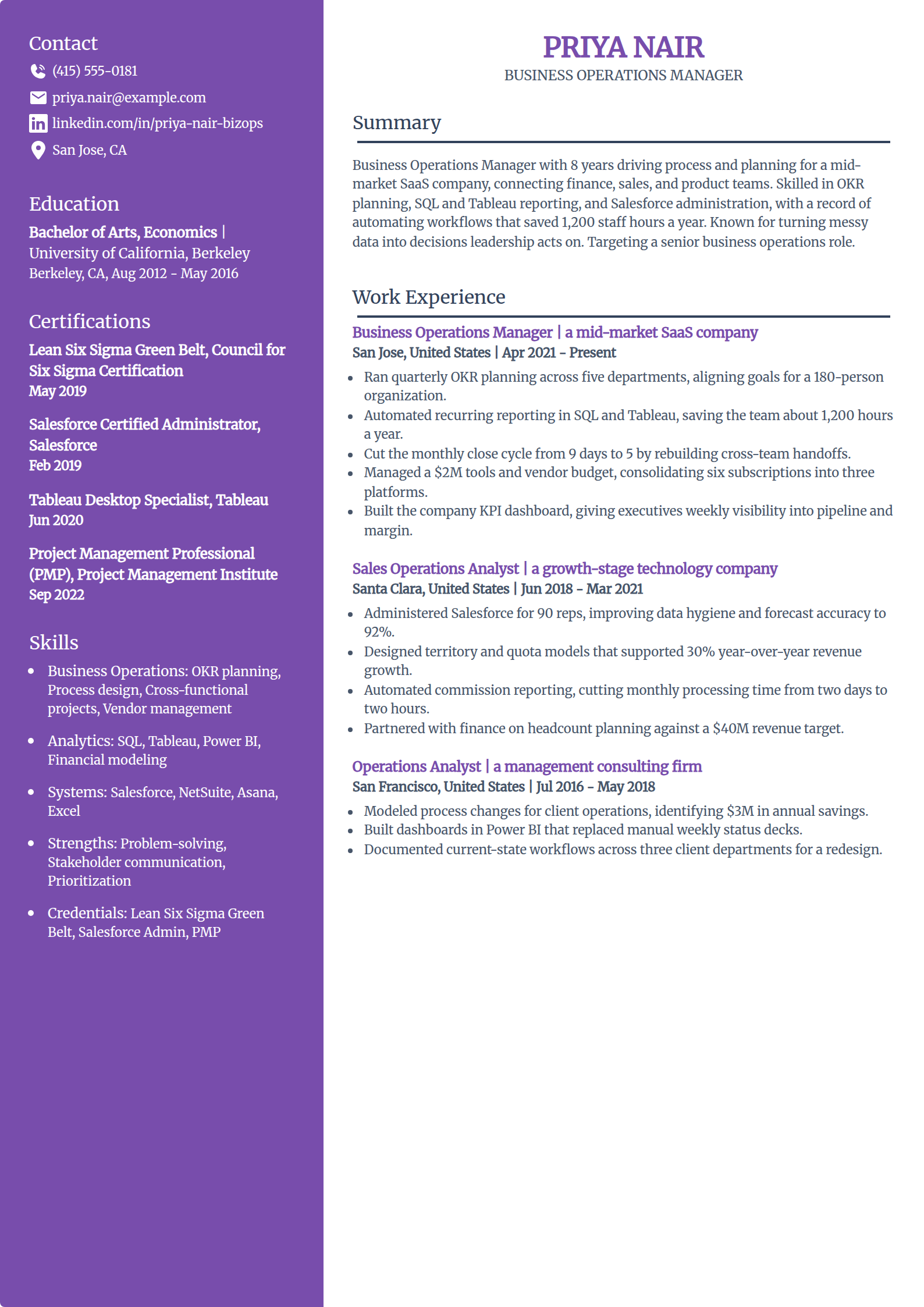
- Frames bizops scope, running OKR planning across five departments for a 180-person organization.
- Shows the impact a SaaS ops team values, automating reporting to save about 1,200 hours a year.
- Names the stack a posting screens for, SQL, Tableau, and Salesforce, tying each to a result.
- Keeps the money story concrete, managing a $2M tools budget and cutting the monthly close to 5 days.
- Uses a Medium layout that fits an eight-year cross-functional record without empty space.
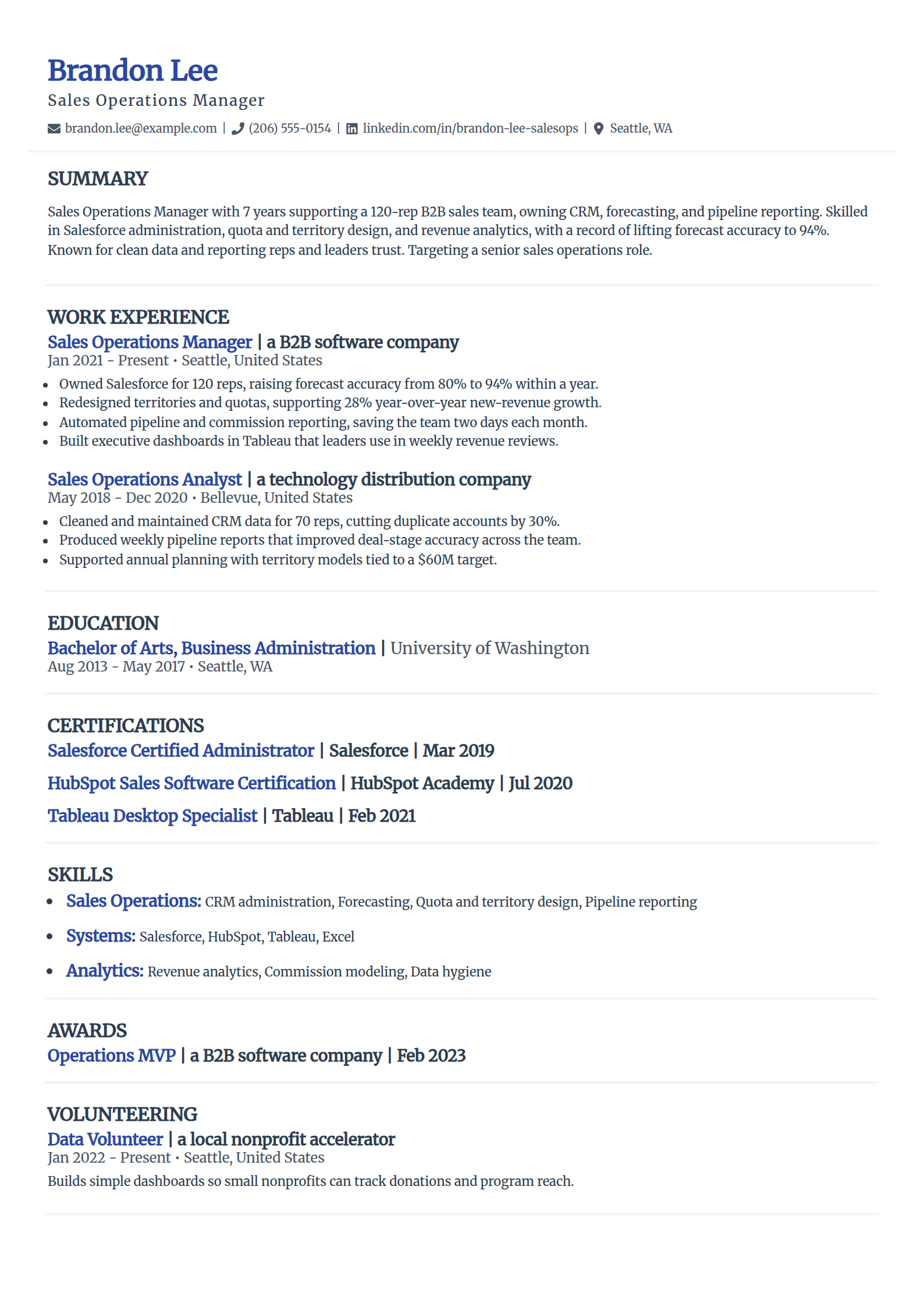
Sales Operations Manager Resume Template
Why this resume example works?
- Opens with sales-ops scope, owning Salesforce for 120 reps and lifting forecast accuracy to 94%.
- Ties process to revenue, redesigning territories and quotas to support 28% new-revenue growth.
- Names the exact tools a sales-ops posting lists, Salesforce, HubSpot, and Tableau.
- Keeps the focus tight on CRM, forecasting, and pipeline reporting rather than padding unrelated work.
- Uses a refined, single-column layout with a filled sidebar so the page reads complete.
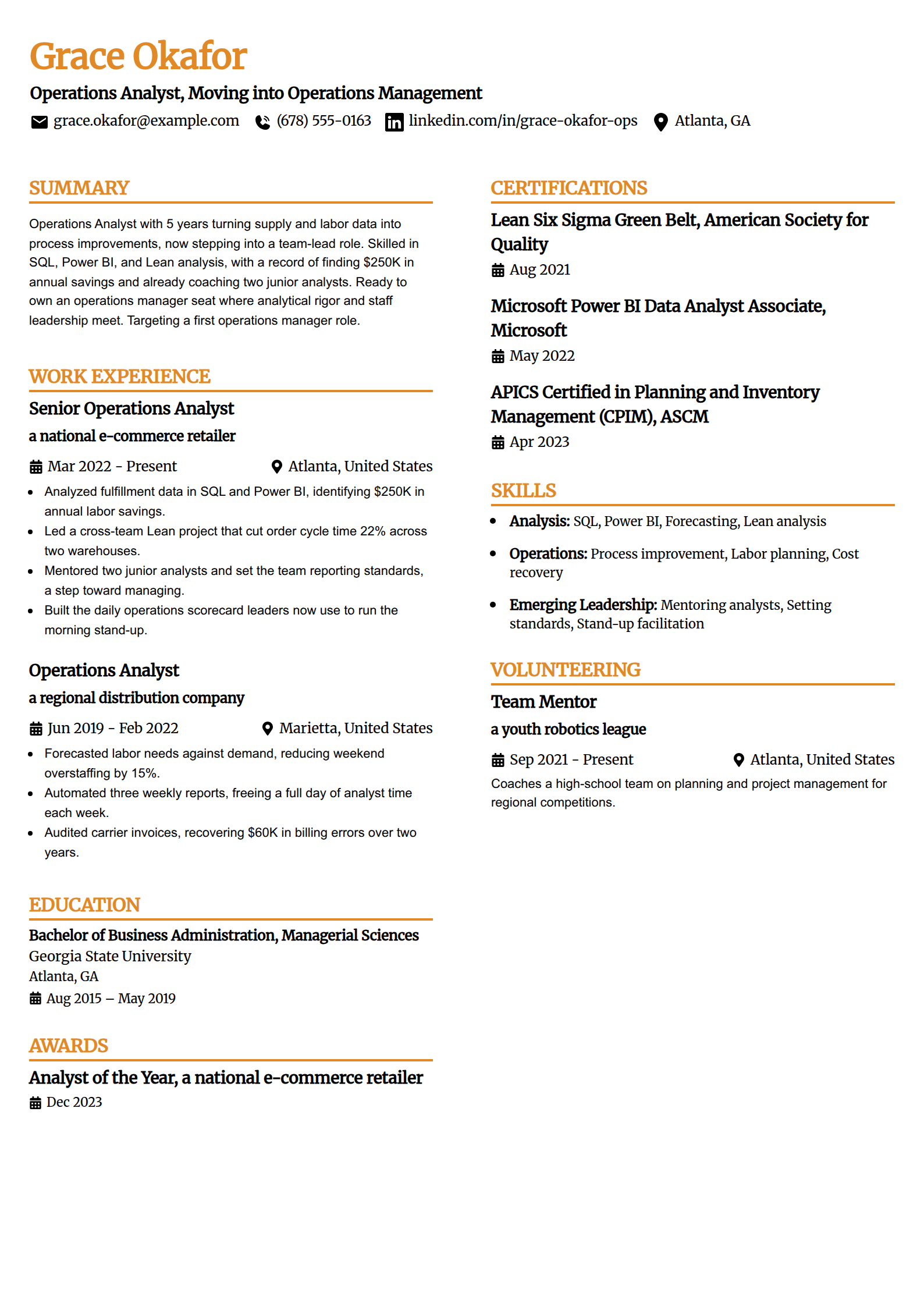
Operations Analyst to Manager Resume Template
Why this resume example works?
- Names the move openly, an analyst stepping into management, and shows early leadership by mentoring two analysts.
- Proves analytical impact, finding $250K in annual savings with SQL and Power BI, the case for the promotion.
- Bridges the gap with a Lean project that cut order cycle time 22% across two warehouses.
- Backs the step up with a Green Belt, a Power BI certification, and APICS CPIM.
- Uses a tight, ATS-safe layout that fits a focused five-year record without empty space.
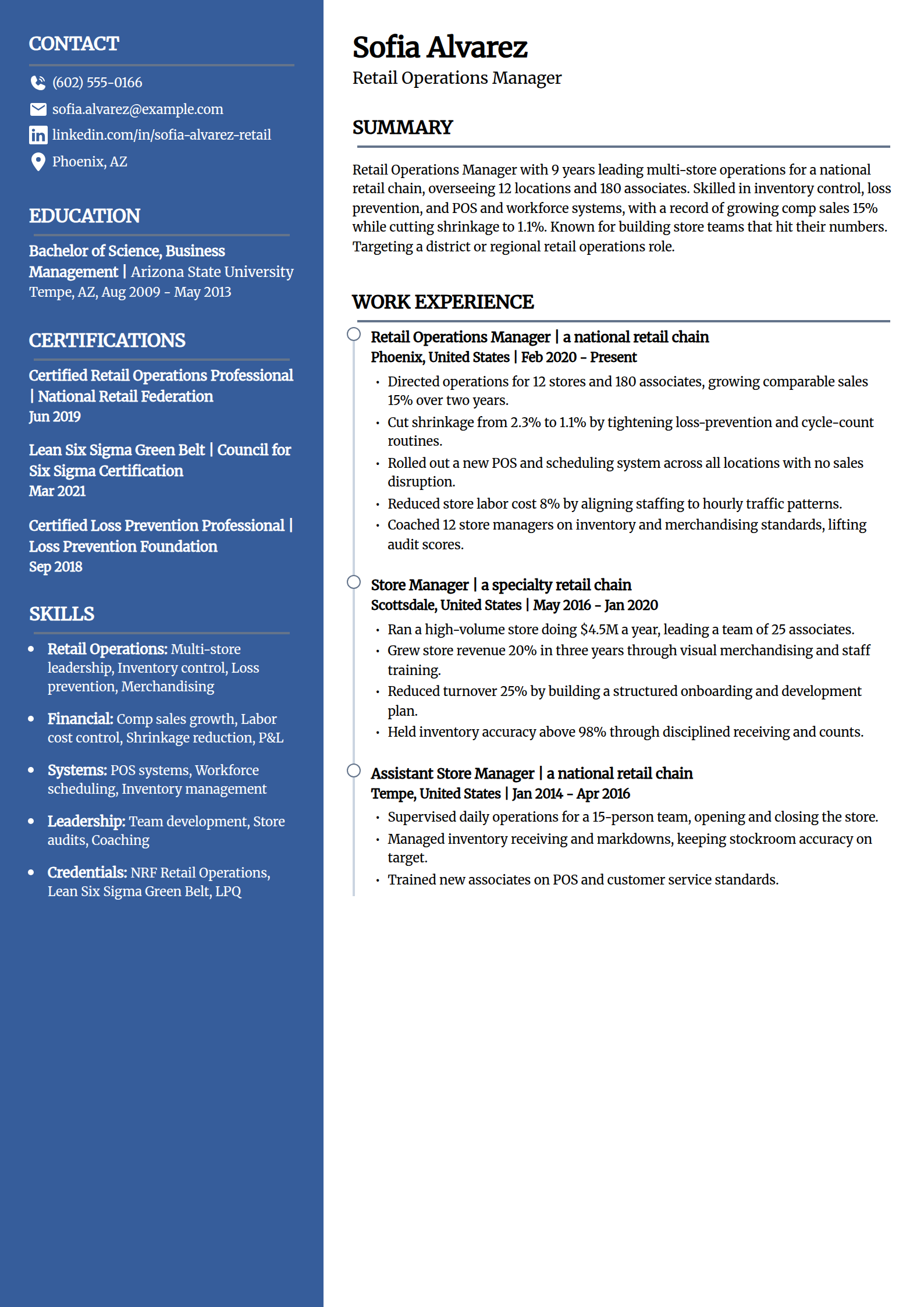
Retail Operations Manager Resume Template
Why this resume example works?
- Leads with retail scope, 12 stores and 180 associates, and comp-sales growth of 15% over two years.
- Shows the metrics retail screens for, cutting shrinkage from 2.3% to 1.1% through loss prevention.
- Keeps numbers store-accurate, an 8% labor-cost cut and a $4.5M store, not inflated corporate figures.
- Names the systems and credentials a retail posting lists, POS, scheduling, and NRF certification.
- Fills a distinctive layout while staying easy for a district manager to skim in one pass.
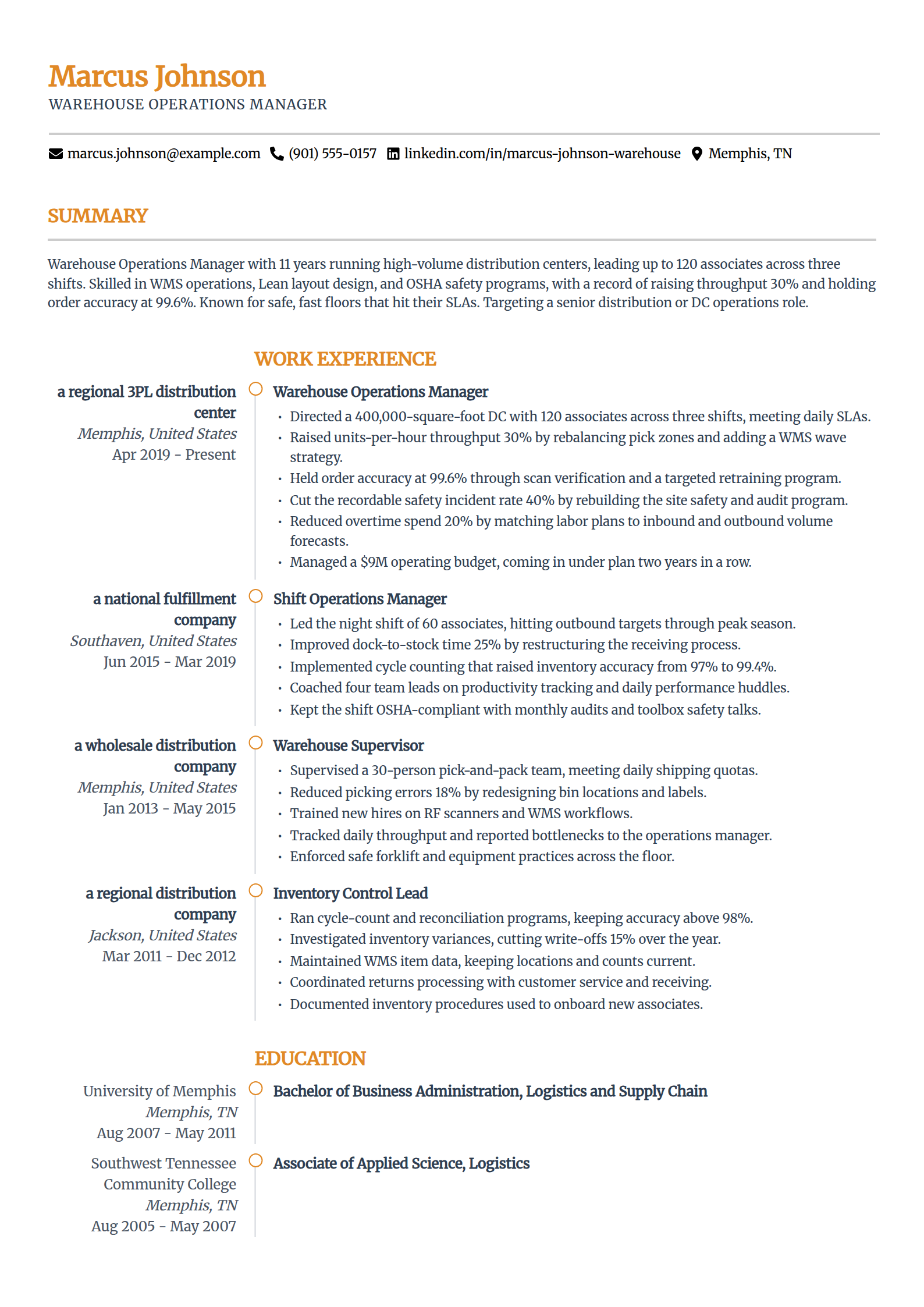
Warehouse Operations Manager Resume Template
Why this resume example works?
- Frames DC scope, a 400,000-square-foot center with 120 associates across three shifts meeting daily SLAs.
- Shows the numbers a warehouse hires for, raising throughput 30% and holding order accuracy at 99.6%.
- Pairs speed with safety, cutting the recordable incident rate 40% by rebuilding the site safety program.
- Names the tools and credentials a posting screens for, WMS, APICS CPIM, OSHA 30, and forklift training.
- Uses a modern two-column layout that carries a deep distribution history on one clean page.
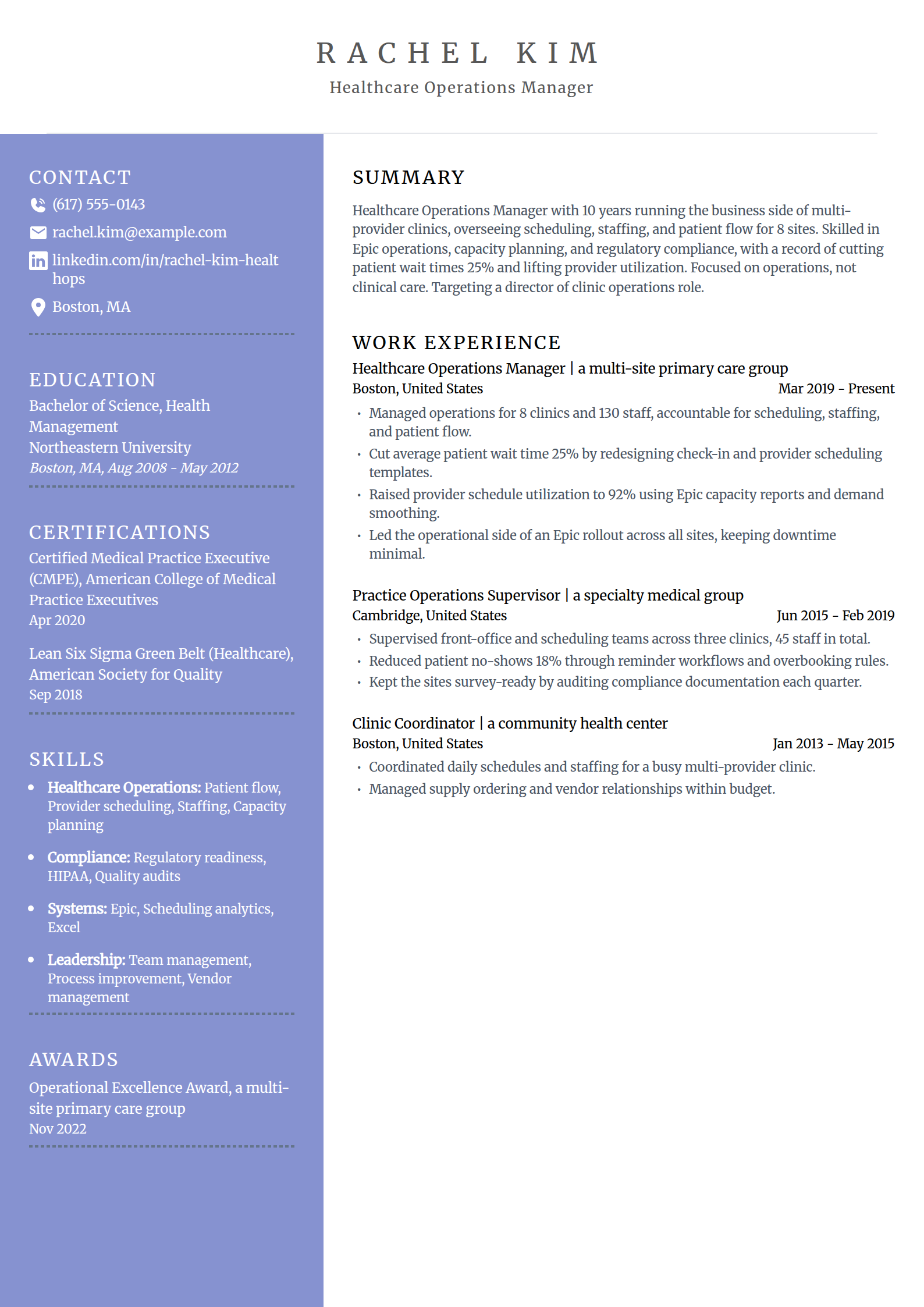
Healthcare Operations Manager Resume Template
Why this resume example works?
- Frames the business side of clinics, 8 sites and 130 staff, and keeps every claim in operations, not clinical, scope.
- Shows the metrics a clinic operations role values, cutting patient wait time 25% by redesigning scheduling.
- Names the systems a health system runs, Epic capacity reports, tied to 92% provider utilization.
- Backs the record with a CMPE and a healthcare Green Belt, the credentials the field screens for.
- Uses a roomy layout with a filled sidebar so a management record still looks complete.
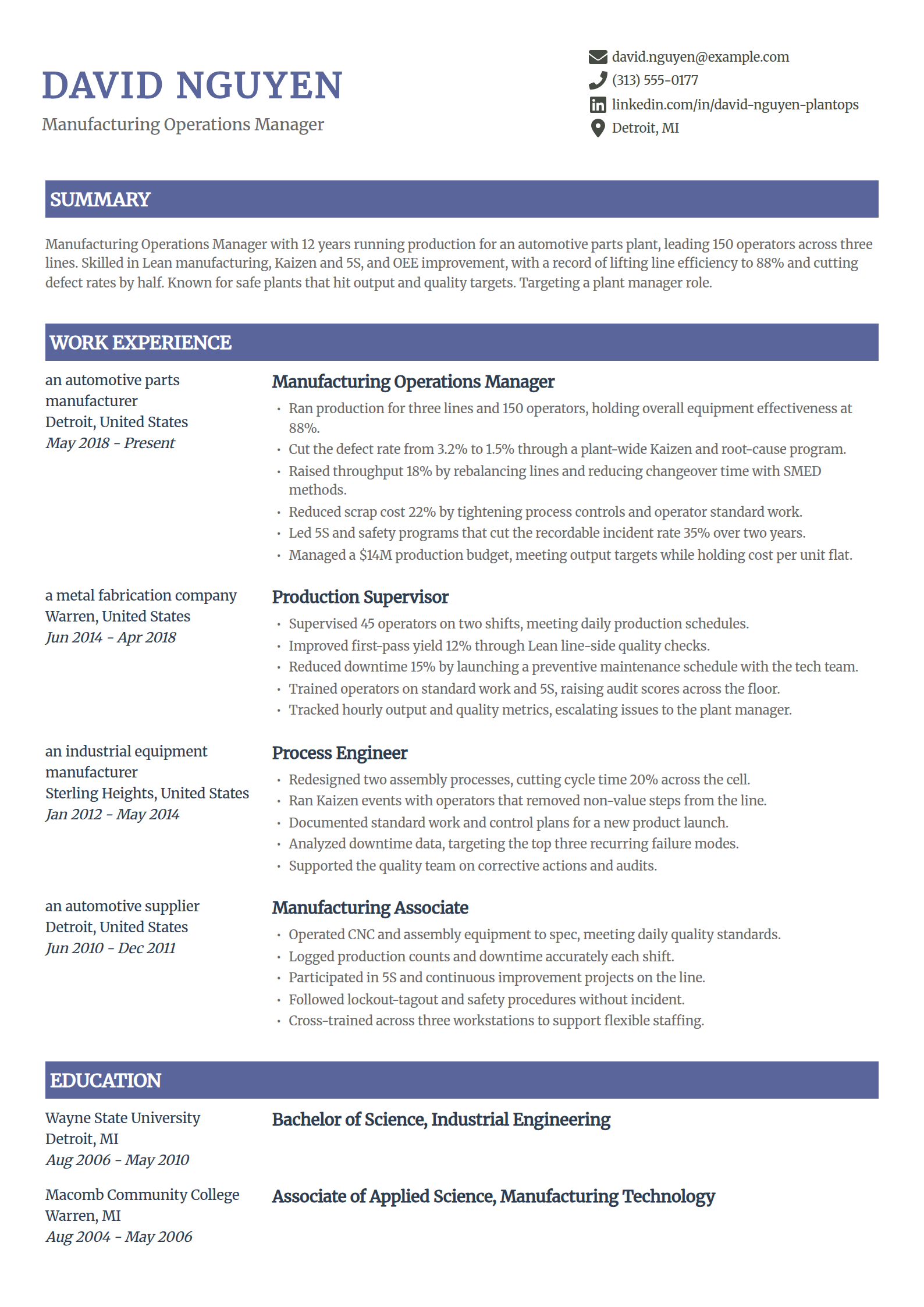
Plant & Manufacturing Operations Manager Resume Template
Why this resume example works?
- Leads with plant scope, three lines and 150 operators, and overall equipment effectiveness held at 88%.
- Shows the quality story a plant hires for, cutting the defect rate from 3.2% to 1.5% through Kaizen.
- Names the methods a manufacturing posting lists, Lean, 5S, SMED, and root-cause analysis.
- Backs the role with a Black Belt, APICS CPIM, OSHA 30, and a Certified Quality Engineer credential.
- Fills a visually rich two-column layout while staying easy to skim in one pass.
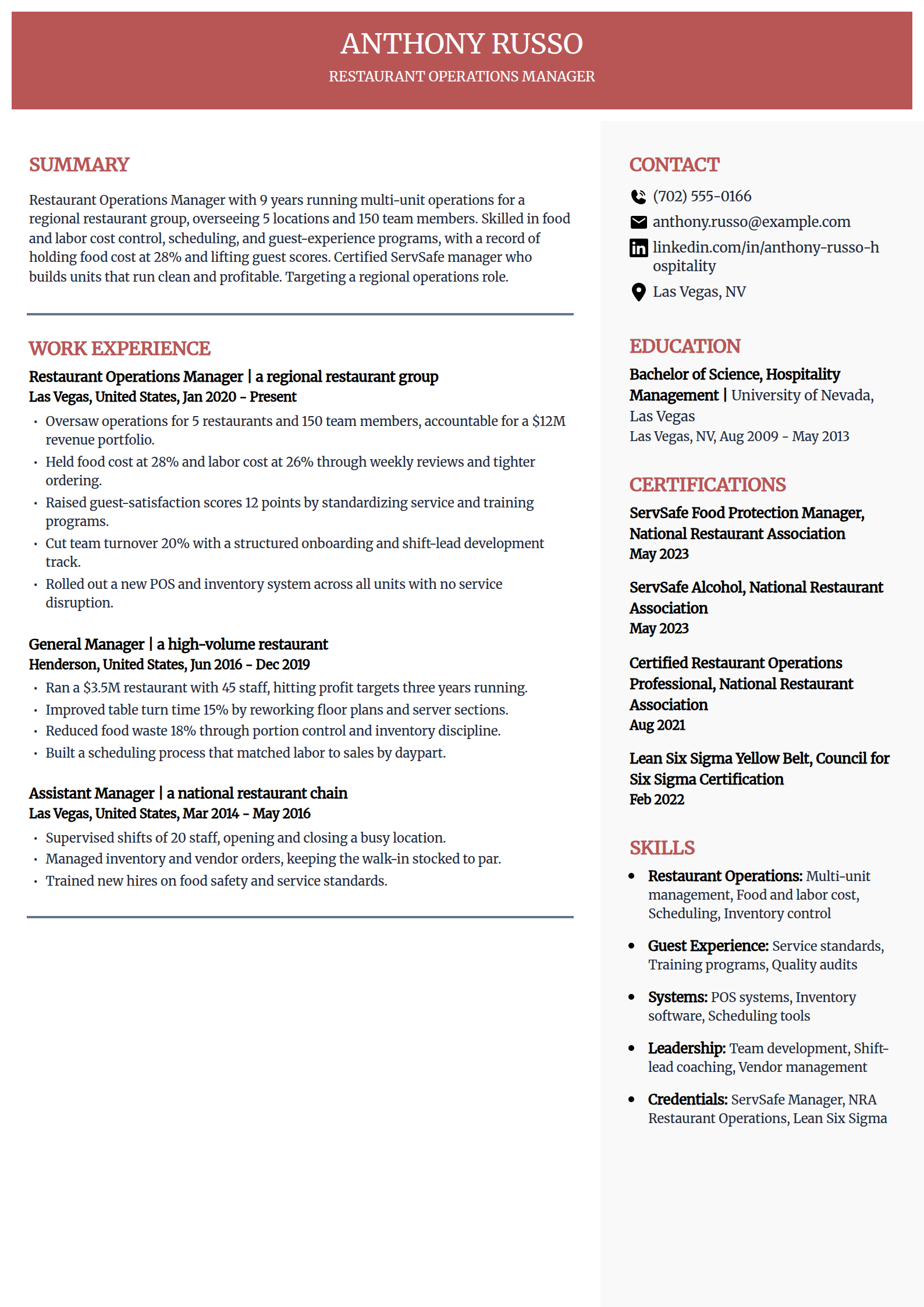
Restaurant & Hospitality Operations Manager Resume Template
Why this resume example works?
- Opens with multi-unit scope, 5 restaurants and 150 team members across a $12M revenue portfolio.
- Shows the numbers a restaurant group tracks, holding food cost at 28% and labor cost at 26%.
- Ties operations to guests, lifting satisfaction scores 12 points by standardizing service and training.
- Names the credentials the field screens for, ServSafe Manager and NRA restaurant operations certification.
- Uses a refined, executive layout that fits a nine-year hospitality record cleanly.
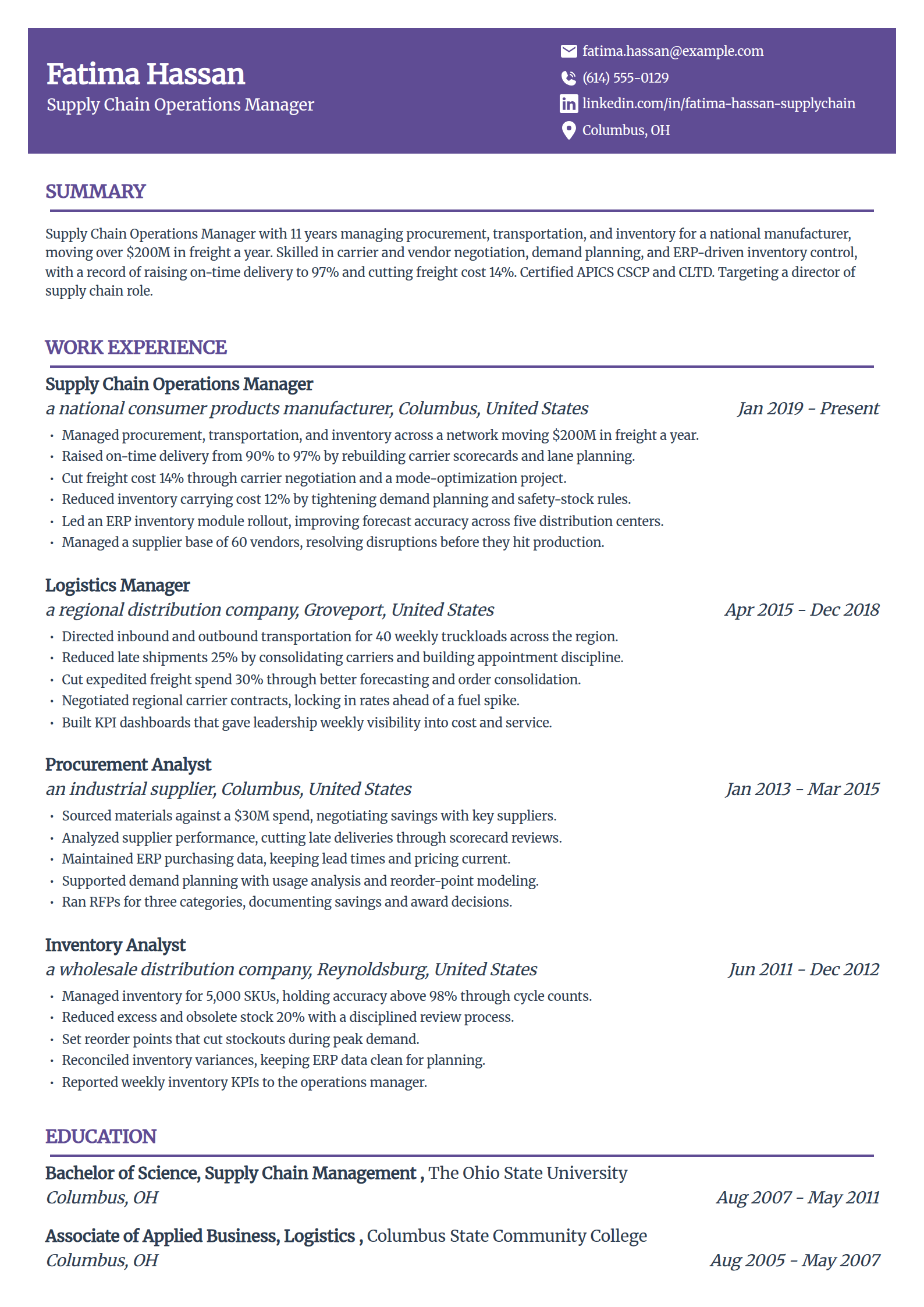
Logistics & Supply Chain Operations Manager Resume Template
Why this resume example works?
- Frames supply-chain scope, moving over $200M in freight a year across procurement, transport, and inventory.
- Shows the metrics the field hires for, raising on-time delivery to 97% and cutting freight cost 14%.
- Proves cost control, reducing inventory carrying cost 12% by tightening demand planning and safety stock.
- Names the credentials a posting screens for, APICS CSCP and CLTD, plus CPSM and SAP.
- Uses a modern layout that carries a busy multi-role supply-chain history on one clean page.
IT & Technical Operations Manager Resume Template
Why this resume example works?
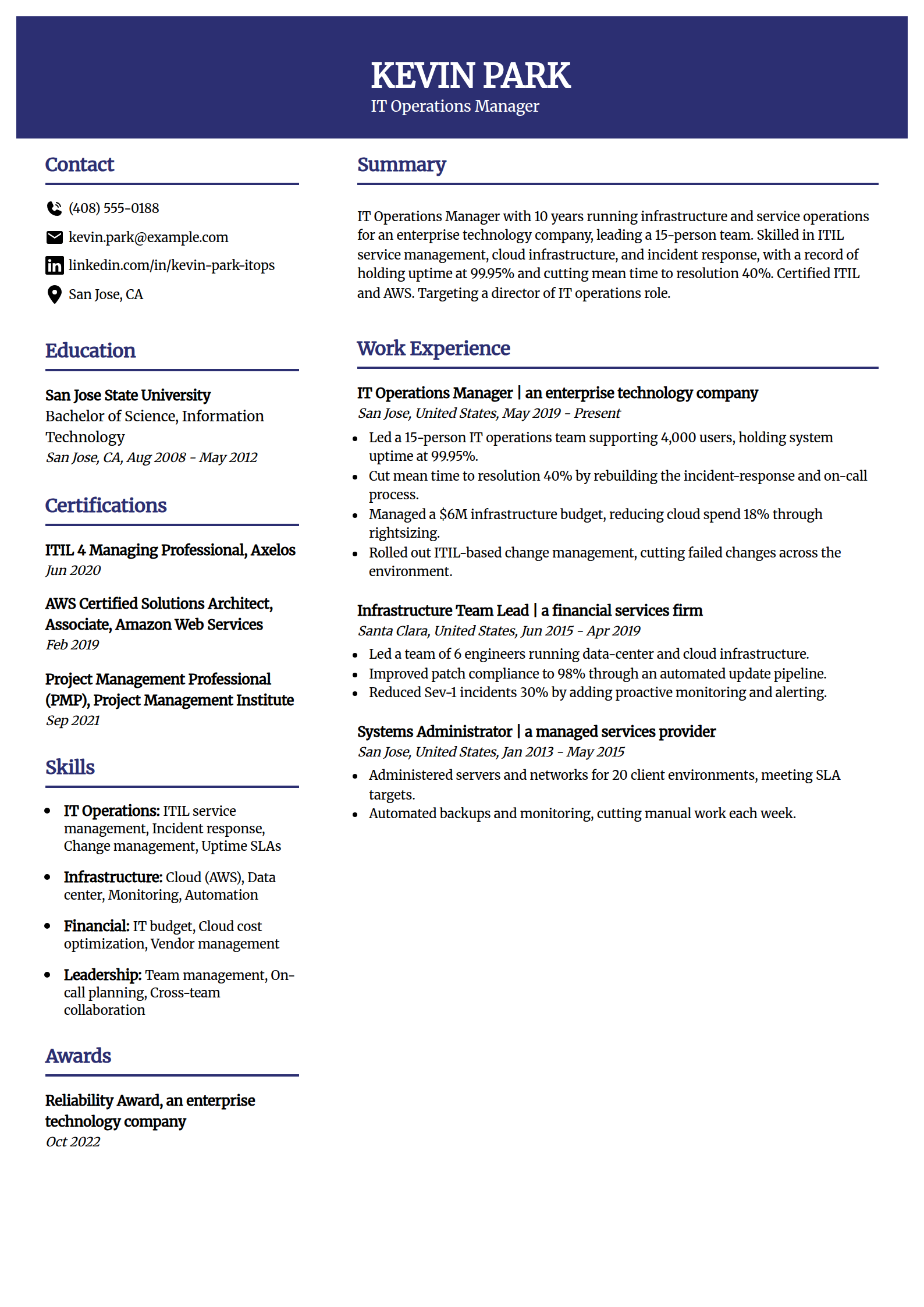
- Leads with IT-ops scope, a 15-person team supporting 4,000 users with system uptime held at 99.95%.
- Shows the metric the field lives by, cutting mean time to resolution 40% by rebuilding incident response.
- Ties operations to cost, managing a $6M infrastructure budget and reducing cloud spend 18%.
- Names the credentials a posting screens for, ITIL Managing Professional, AWS, and PMP.
- Uses a roomy two-column layout with the sidebar filled so the page reads complete.
Director of Operations Resume Template
Why this resume example works?
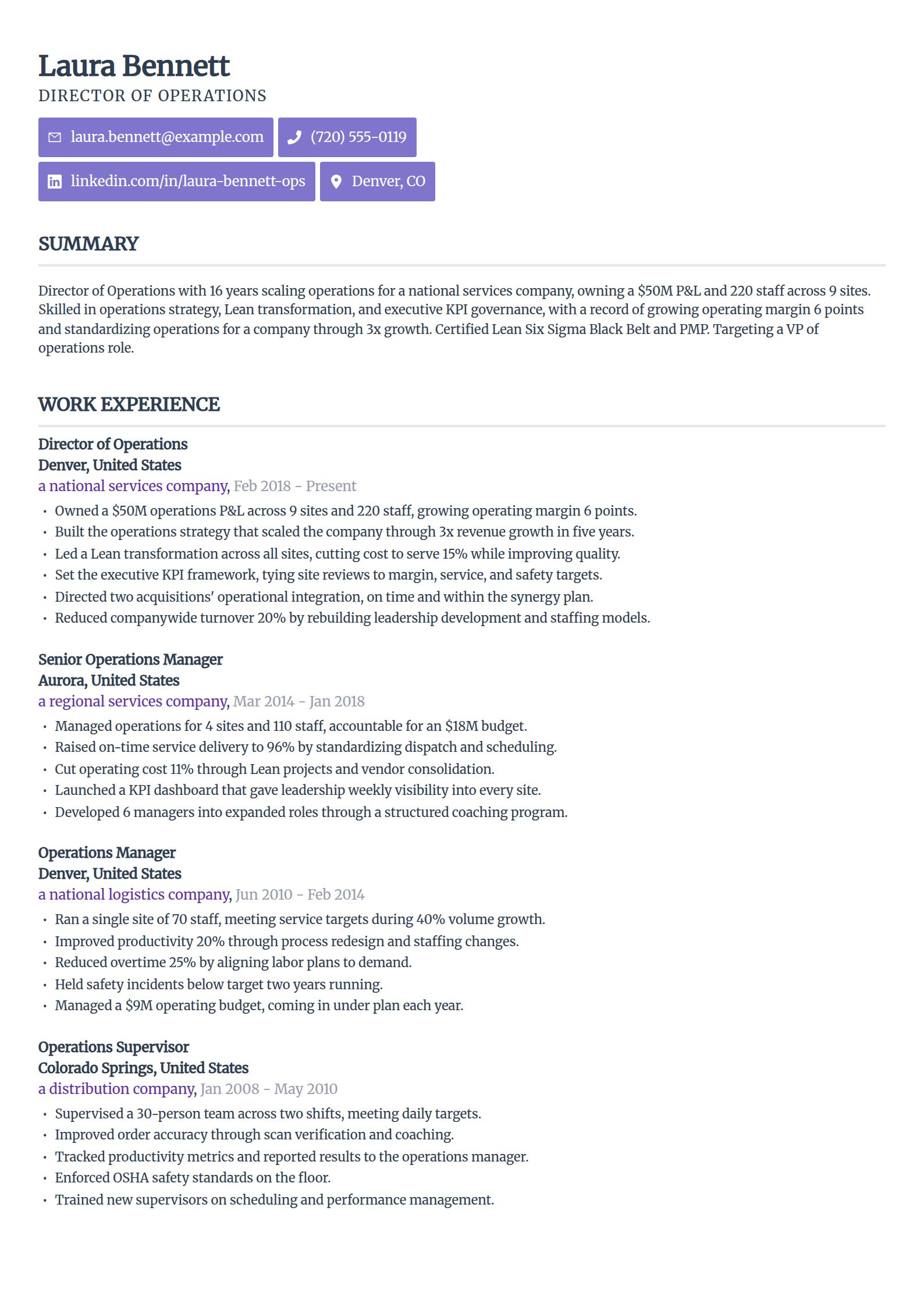
- Opens with executive scope, a $50M P&L, 220 staff, and 9 sites, the scale a director role hires for.
- Shows strategic impact, growing operating margin 6 points and scaling operations through 3x revenue growth.
- Proves breadth an executive owns, leading a Lean transformation and integrating two acquisitions on time.
- Names the credentials leadership screens for, Lean Six Sigma Black Belt, PMP, APICS CSCP, and an MBA.
- Uses a clean, modern layout that carries a 16-year leadership history on one page.
Ecommerce & Fulfillment Operations Manager Resume Template
Why this resume example works?
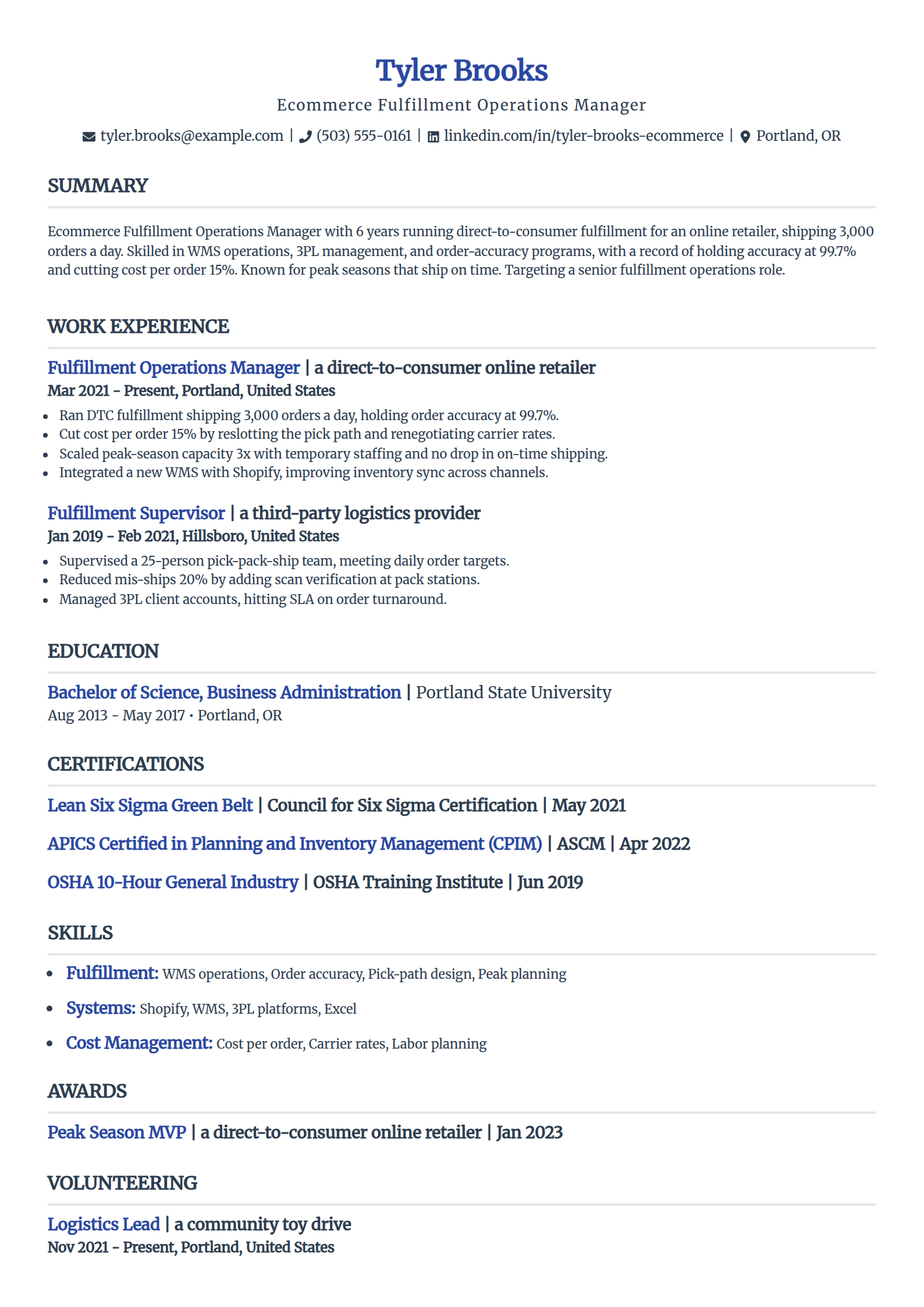
- Frames DTC scope, shipping 3,000 orders a day while holding order accuracy at 99.7%.
- Shows the cost story ecommerce tracks, cutting cost per order 15% by reslotting the pick path.
- Proves peak readiness, scaling capacity 3x with no drop in on-time shipping.
- Names the systems a posting screens for, a WMS integrated with Shopify and 3PL platforms.
- Uses a plain, parser-friendly layout that fits a six-year fulfillment record on one page.
Operations Manager Resume Template for Career Changers
Why this resume example works?
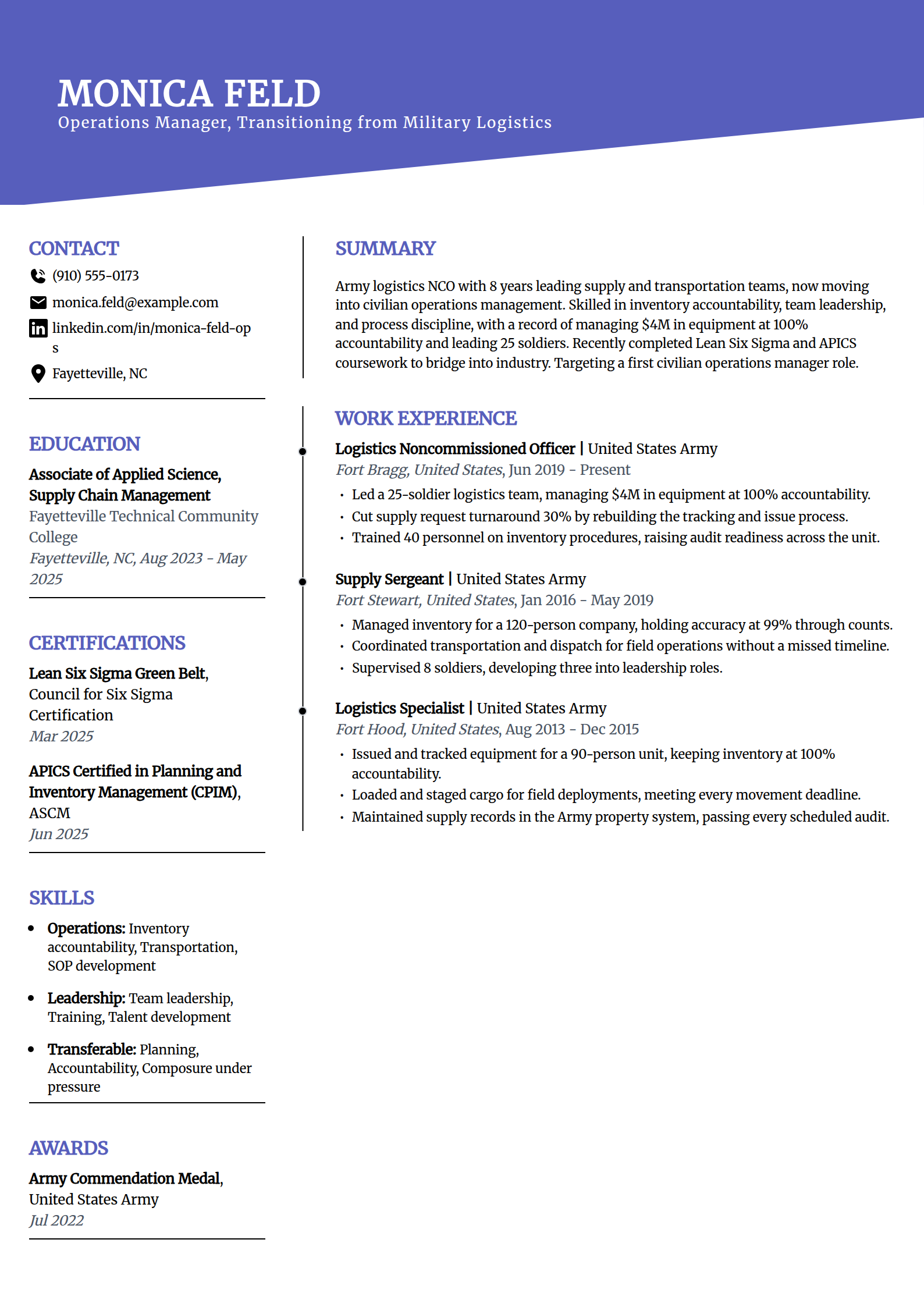
- Names the move openly, a military logistics NCO transitioning into a first civilian operations manager role.
- Reframes service as transferable strength, managing $4M in equipment at 100% accountability and leading 25.
- Bridges into industry honestly with recent Lean Six Sigma and APICS coursework rather than a title not yet held.
- Keeps numbers level-accurate for the move, unit accountability and team size, not corporate cost cuts.
- Lists awards without long descriptions, keeping the two-column layout clean and balanced.
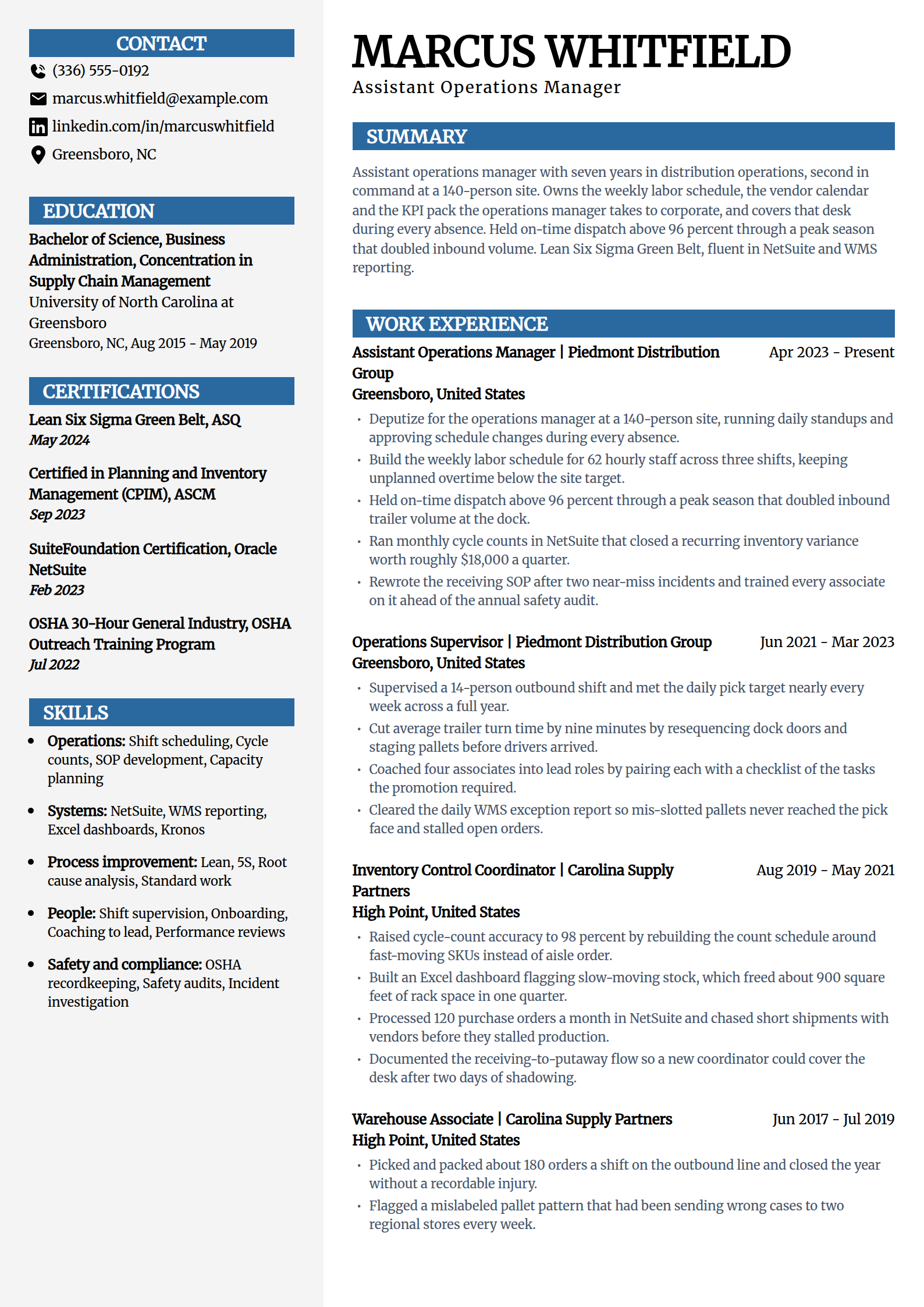
Assistant Operations Manager Resume Template
Why this resume example works?
- Names the job the title actually describes, deputizing for the operations manager at a 140-person site and covering that desk during absences.
- Shows the three things an assistant ops posting asks for, the labor schedule, cycle counts, and the KPI pack that goes to corporate.
- Keeps every number at assistant level, on-time dispatch above 96 percent and an $18,000 inventory variance, never a company-wide cost program.
- Traces a promotion path a hiring manager can follow, from warehouse associate through inventory control and supervisor to assistant manager.
- Names the systems a posting screens for, NetSuite, WMS reporting, and Kronos, alongside a Green Belt and CPIM.
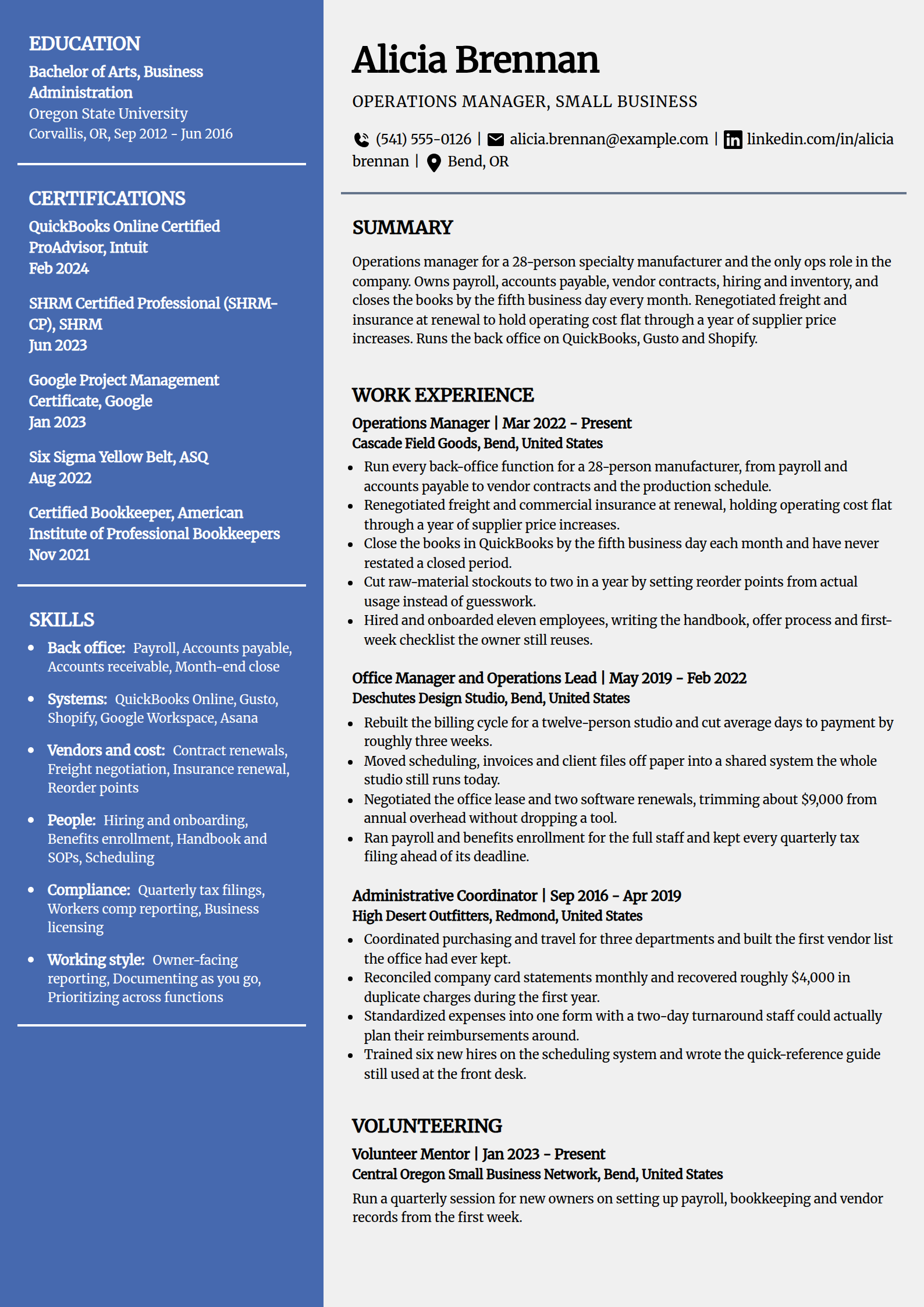
Small-Business Operations Manager Resume Template
Why this resume example works?
- Says the part that defines the job outright, the only operations role at a 28-person company, so nobody reads it as a corporate ops resume.
- Covers the full span one person carries there, payroll, accounts payable, vendor contracts, hiring, and inventory in a single summary.
- Proves reliability with the number an owner cares about, a month-end close by the fifth business day with no restated period.
- Names a small-business stack rather than an ERP, QuickBooks, Gusto, and Shopify, which is what these postings list.
- Keeps wins small and believable, a freight and insurance renewal that held cost flat and stockouts cut to two in a year.
Build your operations manager resume
Pick a template above and the editor keeps your layout clean and ATS-safe while you swap in your own scope, metrics, and the systems you run.
Build my resumeHow to write an operations manager resume in 2026
An operations manager resume is read by someone who checks two things first: the scope you run and the numbers you moved. Lead with your team size, budget or P&L, and the systems you use, then prove your impact with one modest number per bullet: cost cut, on-time delivery, throughput, or cycle time. These moves make yours easy to skim and easy for an applicant tracking system to parse.
Open with a short operations summary
Write three to four sentences that name your years and scope, your strongest number, one or two systems you use, and the role you are targeting. Match the language to your track: a warehouse manager names throughput and a WMS, a sales-ops manager names Salesforce and forecast accuracy. Lead with what you have run, not what you want from the employer.
Operations Manager with 10 years running fulfillment for a mid-market consumer goods company, leading a 40-person team across two shifts. Skilled in Lean process improvement, NetSuite ERP, and vendor management, with a record of cutting operating costs 14% while holding fulfillment on schedule. Certified Lean Six Sigma Green Belt and PMP. Targeting a senior operations manager role.
Lead experience with scope, then a number that proves it
The work an operations resume is hired for is measurable, so name the scope and attach one modest number to each bullet. Open every line with a strong verb, never "Responsible for".
- Scope: state what you ran, like directing a 40-person team across two shifts or a 400,000-square-foot DC.
- Cost: name the lever, such as cutting operating costs 14% by renegotiating vendor contracts.
- Service: use an outcome the role owns, like raising on-time delivery from 91% to 98%.
- Process: tie a method to a result, such as cutting order cycle time 35% with Lean and a slotting redesign.
List the certifications operations hiring screens for
Operations managers are screened on a short list of real credentials, so name them exactly and keep the dates current.
- Lean and quality: Lean Six Sigma Green or Black Belt is the most common ask across manufacturing, warehouse, and bizops.
- Project and program: PMP shows you run initiatives on time and on budget across departments.
- Supply chain: APICS CPIM, CSCP, or CLTD for warehouse, logistics, and supply-chain operations roles.
- Track-specific: ITIL for IT ops, ServSafe for restaurant ops, and OSHA 30 for plant and warehouse floors.
Match your skills to the posting's keywords
An operations skills list should read like the job description. Split it so a hiring manager and a parser both find what they need.
- Operations: process improvement, capacity planning, SOP development, and KPI reporting.
- Methods: Lean, Six Sigma, Kaizen, and 5S, named the way the posting names them.
- Systems: name the stack outright, like SAP, NetSuite, a WMS, Salesforce, Tableau, or Power BI, matching the posting.
- Financial: budget and P&L management, cost reduction, vendor negotiation, and forecasting.
Quantify without inflating (the honest rule)
Operations resumes are full of invented 40% cost cuts, and a sharp hiring manager discounts them on sight. Keep one credible number per bullet, scaled to your level.
- Use one number per bullet, and put a number in at least half your bullets, not every line.
- Scale the number to your role: a coordinator improves a schedule; a director moves margin points and P&L.
- When the exact figure is confidential, use a rate or a range, like on-time delivery above 96% or a mid-single-digit cost cut.
- Tie every number to the method that produced it, so the result reads as yours and not a guess.
Keep it to one clean, ATS-safe page
Companies run applicant tracking systems, so a clean one-page resume is the standard for almost every operations manager below the director level.
- Use a single-column or simple two-column layout with standard headings a parser recognizes.
- Hold it to one page and lead with your most recent role in reverse-chronological order.
- Save as a PDF so the formatting holds, then run it through our ATS resume checker for a quick format and keyword pass.
- Swap the numbers in the templates above for your own scope, metrics, and systems; do not copy them as is.
Common operations manager resume mistakes
- Writing vague duties like "oversaw operations". Say what you ran and what changed: "directed a 40-person team and cut cost 14%".
- Inflating the numbers. A company-wide 40% cost cut on an entry or mid-level resume reads as invented to any operations hiring manager.
- Ignoring your track's language. A warehouse role wants throughput and a WMS; a sales-ops role wants Salesforce and forecast accuracy. Match the posting.
- Listing systems with no context. Tie each one to a result, like automating reporting in Tableau to save 1,200 hours a year.
- Burying scope. Lead each role with team size, budget, or sites so a hiring manager sees what you managed in the first line.
Frequently asked questions
What should an operations manager resume include?
An operations manager resume needs your contact details, a short summary, work history in reverse-chronological order, education, certifications, and a skills list. Lead each role with your scope (team size, budget or P&L, sites or square footage) and prove your impact with one modest number per bullet: cost reduction, on-time delivery, throughput, or cycle time. Name the systems you run, like SAP, NetSuite, a WMS, or Salesforce, and the certifications operations hiring screens for, such as Lean Six Sigma, PMP, or APICS. Keep it to one clean page.
How do I write an operations manager resume with little or no management experience?
Lead with the operations work you have done and the results you can prove, even from a coordinator, analyst, supervisor, or military role. Show early leadership honestly, like coordinating a shift schedule, mentoring analysts, or leading a logistics team, rather than claiming manager scope you have not held. Add the credentials that signal you are ready, such as a Lean Six Sigma Green Belt or APICS CPIM, and use recent coursework to bridge a career change. The operations coordinator, analyst-to-manager, and career-changer examples above show the shape.
What skills and keywords should I put on an operations manager resume?
Split your skills so a hiring manager and a parser both find what they need. Operations: process improvement, capacity planning, SOP development, and KPI reporting. Methods: Lean, Six Sigma, Kaizen, and 5S. Systems: name the stack outright, like SAP, NetSuite, a WMS, Salesforce, Tableau, or Power BI, matching the words in the posting. Financial: budget and P&L management, cost reduction, vendor negotiation, and forecasting. Match your track: warehouse and plant roles want throughput and OSHA, sales ops wants CRM and forecasting, IT ops wants ITIL and uptime.
What certifications help an operations manager resume?
The most common ask is Lean Six Sigma, a Green Belt for most roles and a Black Belt for senior and plant operations. PMP shows you run initiatives on time and on budget. For warehouse, logistics, and supply-chain operations, APICS CPIM, CSCP, or CLTD carry weight. Track-specific credentials matter too: ITIL for IT operations, ServSafe for restaurant operations, and OSHA 30 for plant and warehouse floors. List the exact name and issuer and keep the dates current.
How do I quantify operations impact when I can't share exact numbers?
Use a rate or a range instead of a precise figure you cannot disclose, like holding on-time delivery above 96%, cutting cost by a mid-single-digit percentage, or managing a multi-million-dollar budget. Keep one number per bullet and put a number in at least half your bullets, not every line. Scale each number to your level: a coordinator improves a schedule, a manager moves cost and service metrics, and a director moves margin points and P&L. Always tie the number to the method that produced it so it reads as yours.
How long should an operations manager resume be?
One page for almost every operations manager below the director level, including coordinators and those with under ten years. Lead with your most recent role and keep the scope and results that matter for the job you are targeting, summarizing or dropping older jobs to make room for your strongest numbers and the systems the posting names. Directors and VPs with a long multi-site history and executive scope can run to a second page, but a single skimmable page reads best and parses cleanly.
More operations manager resume resources
Build your operations manager resume
Pick a template above and the editor keeps your layout clean and ATS-safe while you swap in your own scope, metrics, and the systems you run.