Accounting Resume Templates and Examples, AP Clerk to Controller
- ATS Friendly
- Accounting Specific
- 19 Real Examples
A hiring manager scans an accounting resume for two things: the close cycle you own and the numbers you keep clean. Pick a template below, then model your own on a real example built for your seat, from an entry-level clerk to a controller. Every example leads with a shortened close, a reconciliation you own, or an audit you passed, and one modest number you can verify.


540k+ resumes created
Accounting resume templates, sorted by role and level
Each template below is a real accounting resume laid out in that format, grouped by function and seniority. Choose one, then swap in your own close cycle, ledger scope, reconciliations, and the ERP and standards you work in. Every layout keeps your name, title, and dates clean so a hiring manager reads your results in one pass and an applicant tracking system parses it without trouble.
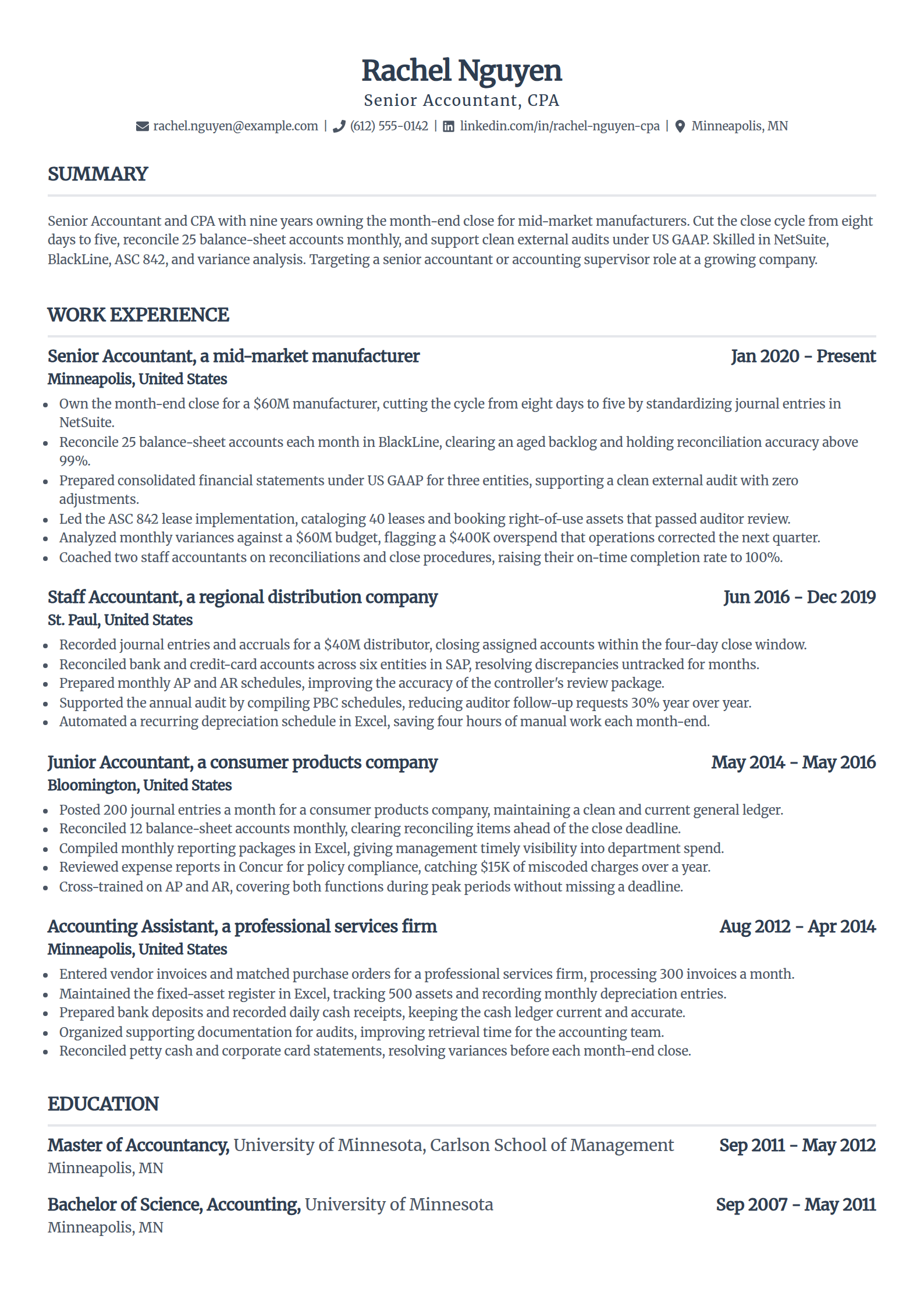
Senior Accountant Resume Template
Why this resume example works?
- Leads with the number a hiring manager reads first, a month-end close cut from eight days to five.
- Shows ownership of 25 balance-sheet reconciliations a month in BlackLine with accuracy held above 99%.
- Names the systems a posting screens for, NetSuite, BlackLine, ASC 842, and variance analysis.
- Backs the CPA with results, so the credential supports a record of clean audits rather than standing alone.
- Uses a clean single-column layout that keeps a nine-year history readable and ATS-safe on one page.
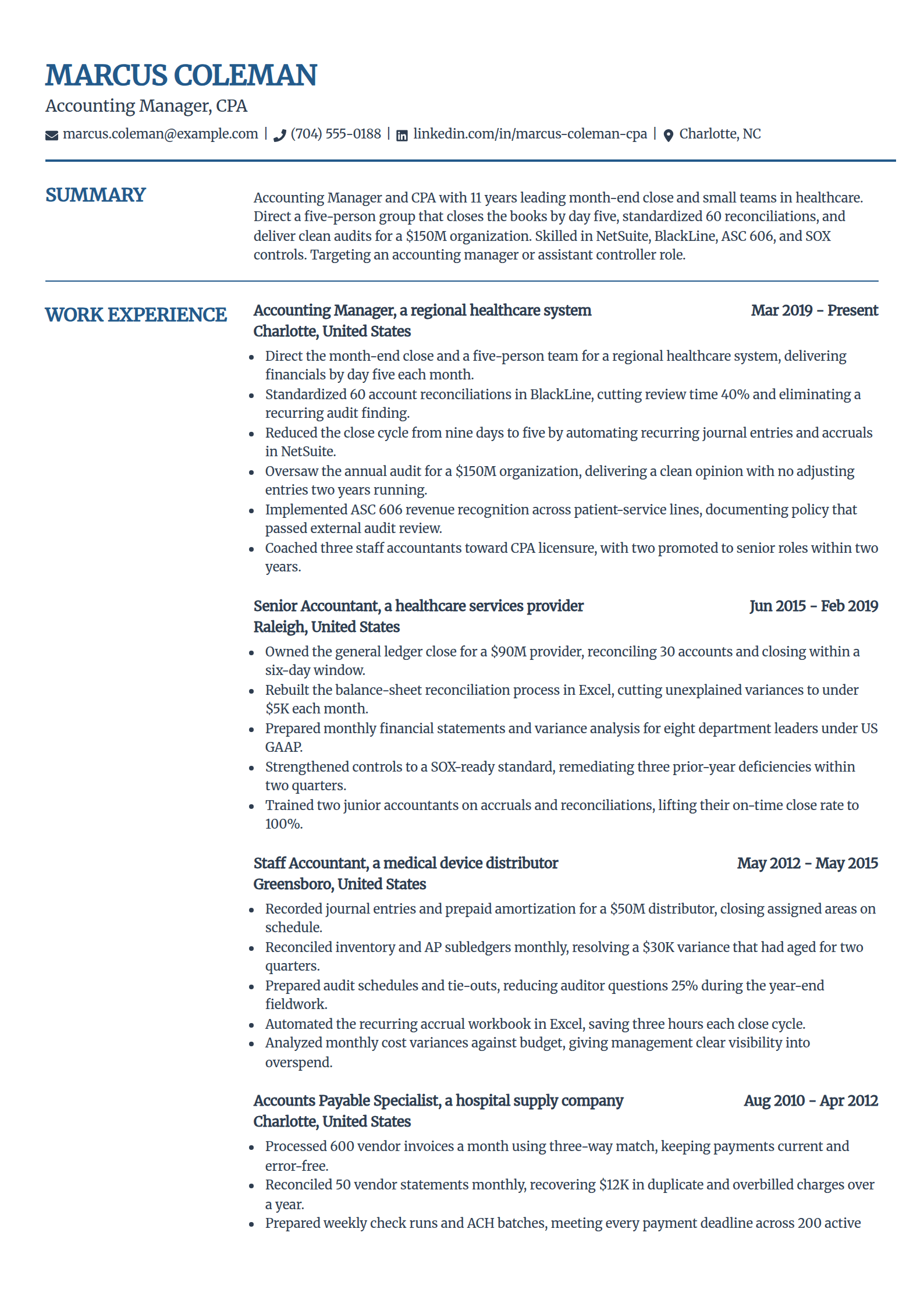
Accounting Manager Resume Template
Why this resume example works?
- Opens with team and close scope, directing a five-person group that closes the books by day five.
- Proves process work, standardizing 60 reconciliations in BlackLine and cutting review time 40%.
- Ties the work to an outcome a manager owns, eliminating a recurring audit finding for a $150M organization.
- Carries the credentials the seat expects, a CPA and CMA, next to SOX and ASC 606 experience.
- Uses a structured two-column layout that separates leadership results from the tools and standards.
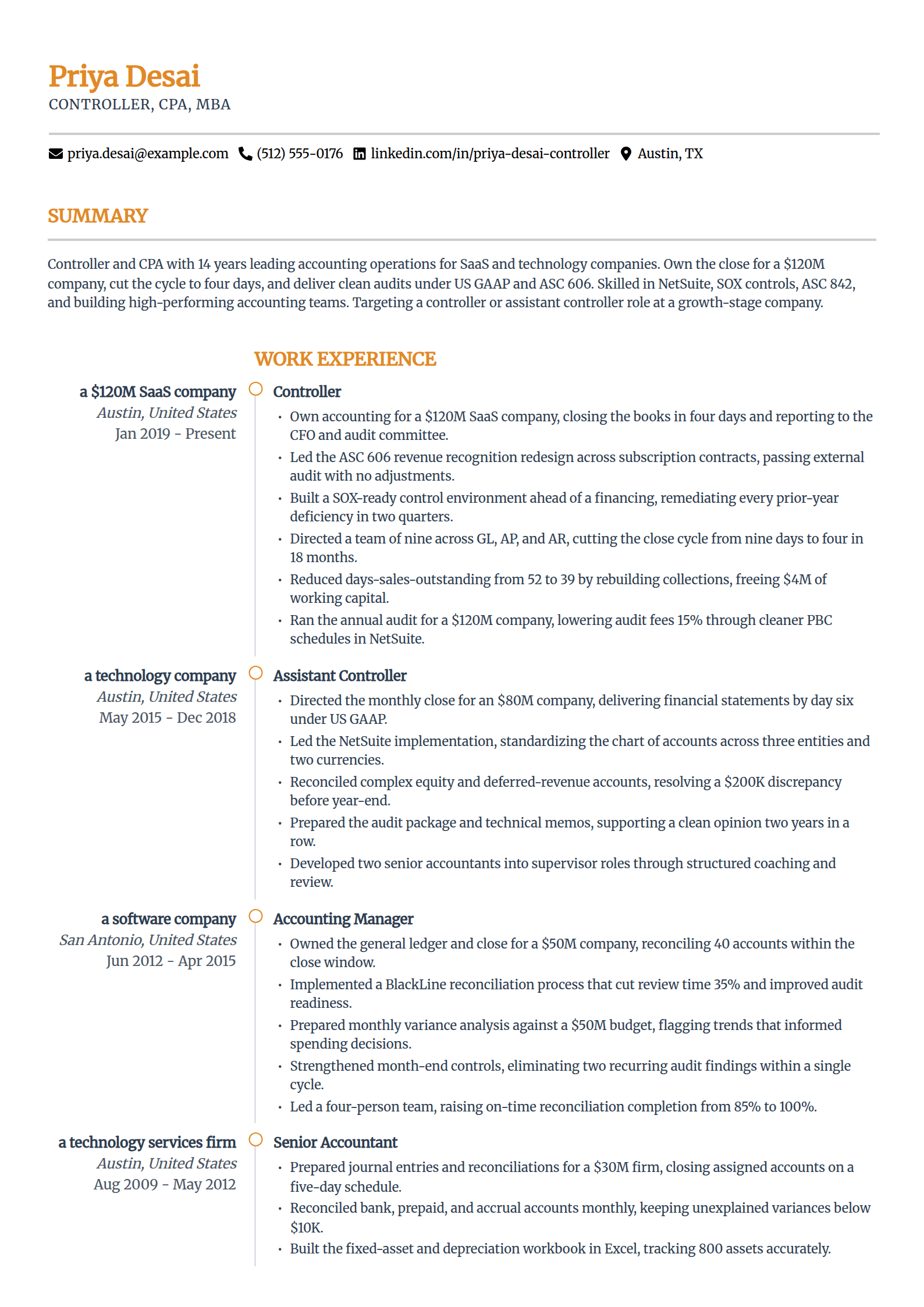
Controller Resume Template
Why this resume example works?
- States the scope a controller is hired for, owning the close for a $120M company in four days.
- Shows technical depth, leading an ASC 606 redesign that passed external audit with no adjustments.
- Quantifies the finance impact, cutting days-sales-outstanding from 52 to 39 and freeing $4M of working capital.
- Presents the full ladder, from senior accountant to controller, so the progression reads clearly.
- Uses a polished layout that carries a CPA, an MBA, and a 14-year record without crowding the page.
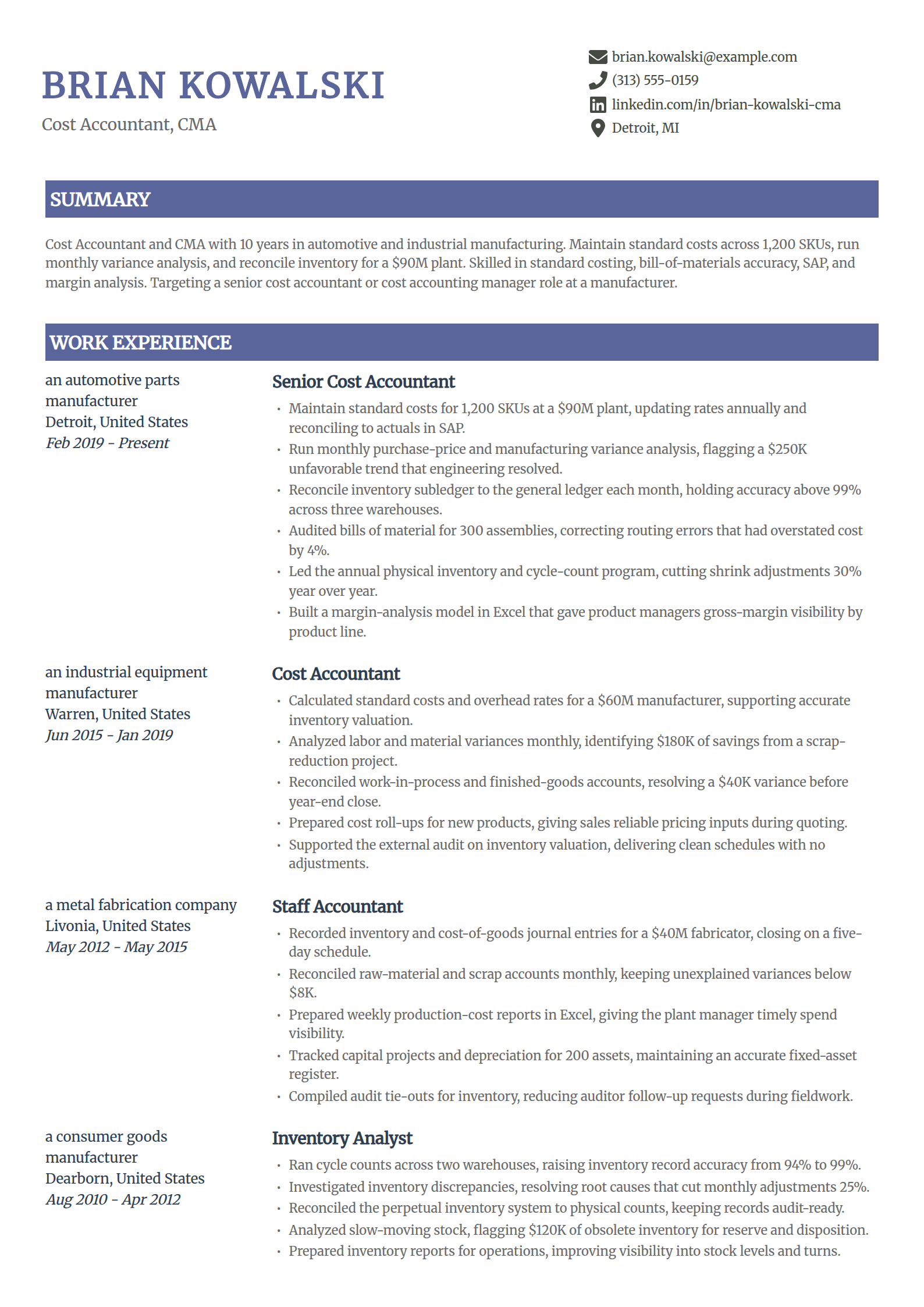
Cost Accountant Resume Template
Why this resume example works?
- Leads with the specialty scope, maintaining standard costs across 1,200 SKUs at a $90M plant in SAP.
- Shows the analysis a manufacturer values, flagging a $250K unfavorable variance that engineering resolved.
- Names the exact tools and methods, standard costing, bill-of-materials accuracy, and margin analysis.
- Carries a CMA and a CPIM, the credentials a cost accounting posting actually lists.
- Uses a modern layout that keeps dense costing detail organized and easy for a parser to read.
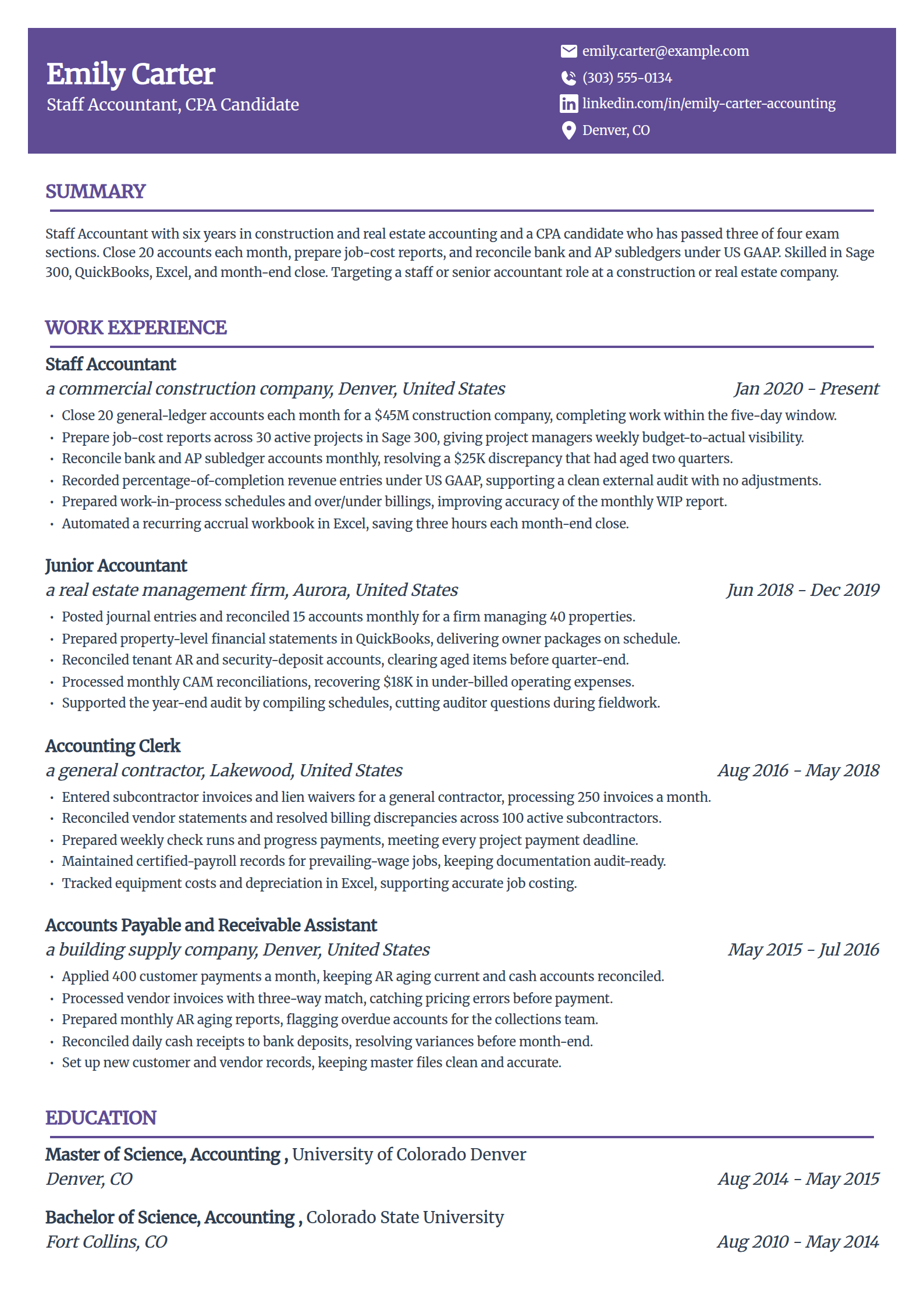
Staff Accountant Resume Template
Why this resume example works?
- Opens with the core staff task, closing 20 general-ledger accounts each month within a five-day window.
- Shows industry-specific value, preparing job-cost reports across 30 projects in Sage 300 for construction.
- States CPA progress precisely, a candidate who has passed three of four exam sections, never overclaiming.
- Names practical tools, Sage 300, QuickBooks, and Excel, that a construction or real estate posting expects.
- Uses a single-column layout that fills one page with real results at the staff level.
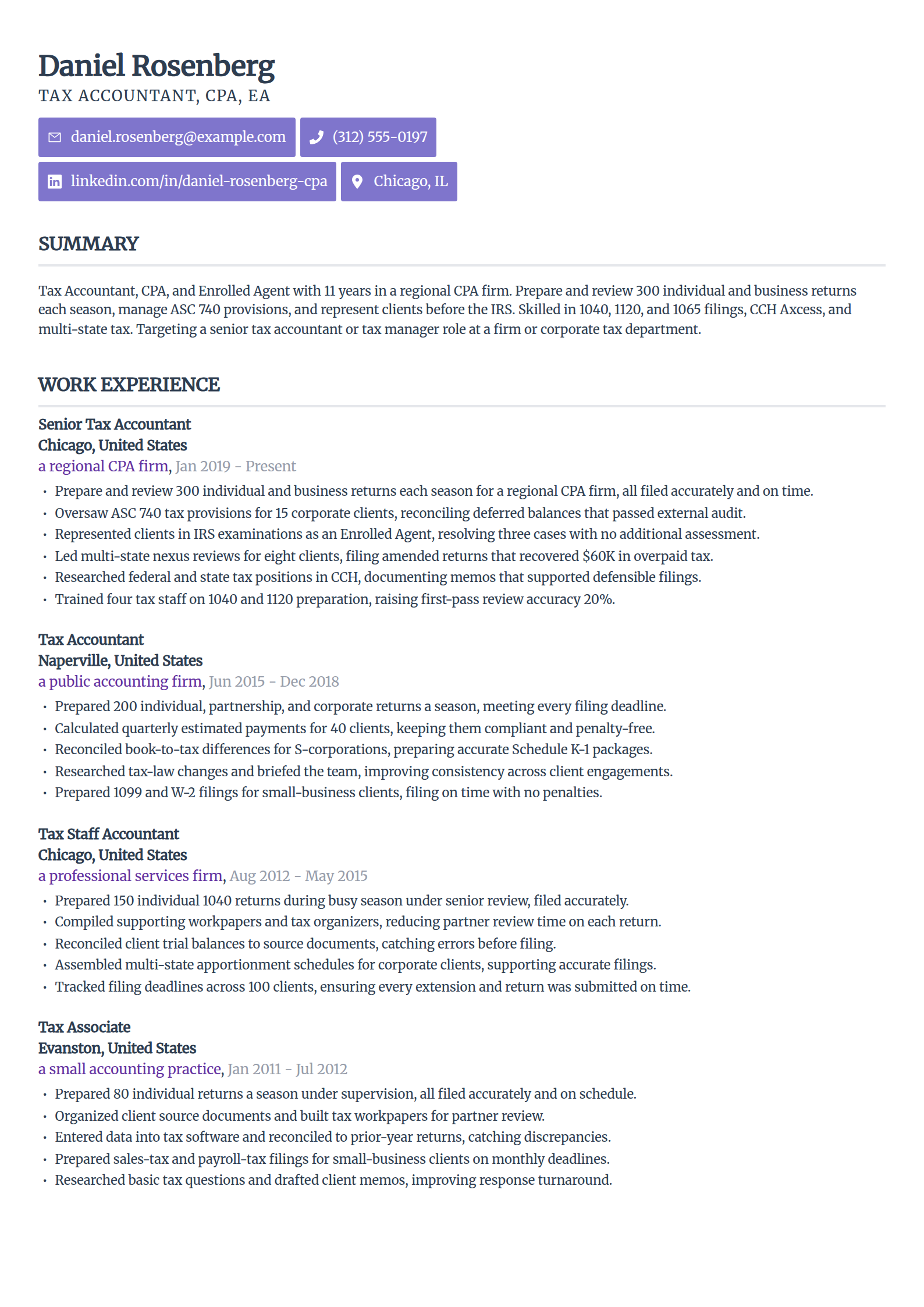
Tax Accountant Resume Template
Why this resume example works?
- Leads with tax volume, preparing and reviewing 300 individual and business returns each season.
- Shows technical range, managing ASC 740 provisions and representing clients before the IRS.
- Names the return types and tools outright, 1040, 1120, and 1065 filings in CCH Axcess with multi-state tax.
- Pairs a CPA with an Enrolled Agent credential, the exact mix a tax posting looks for.
- Uses a clean layout that keeps a specialized tax record scannable and ATS-safe.
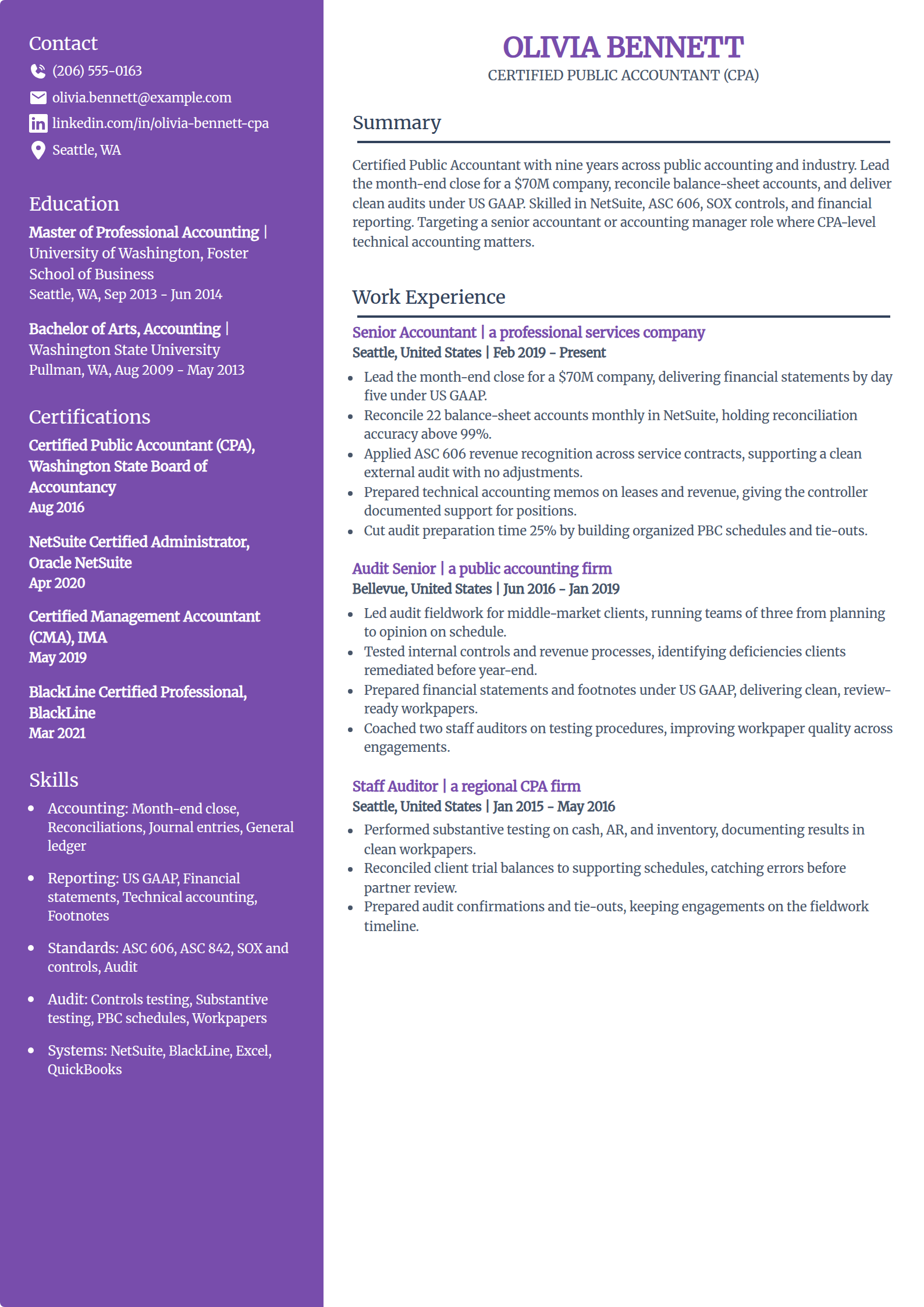
CPA Resume Template
Why this resume example works?
- Puts the license up front and backs it, leading the close for a $70M company by day five under US GAAP.
- Shows CPA-level technical accounting, ASC 606, SOX controls, and financial reporting, not just bookkeeping.
- Quantifies accuracy, reconciling 22 balance-sheet accounts a month in NetSuite above 99% accuracy.
- Spans public accounting and industry, the background a senior or manager posting rewards.
- Uses a modern layout that keeps a credential-led resume clean and easy for a parser to read.
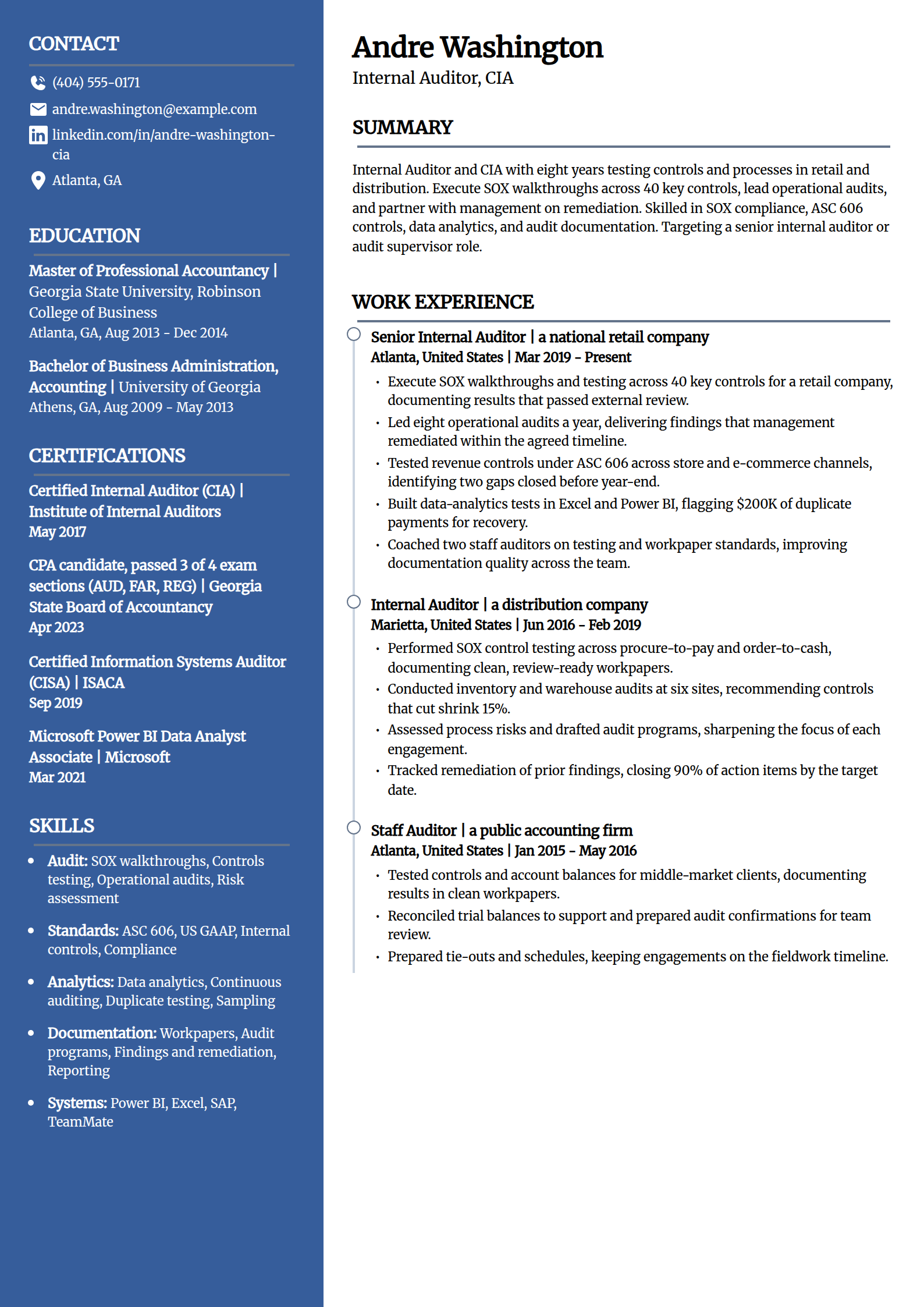
Internal Auditor Resume Template
Why this resume example works?
- Leads with control scope, executing SOX walkthroughs and testing across 40 key controls.
- Shows delivery, leading eight operational audits a year with findings management remediated on time.
- Names audit-specific skills, SOX compliance, ASC 606 controls, data analytics, and documentation.
- Carries a CIA plus a CPA candidate status and a CISA, the credential stack an audit team values.
- Uses a distinctive layout that stays ATS-safe while setting an audit resume apart from a plain list.
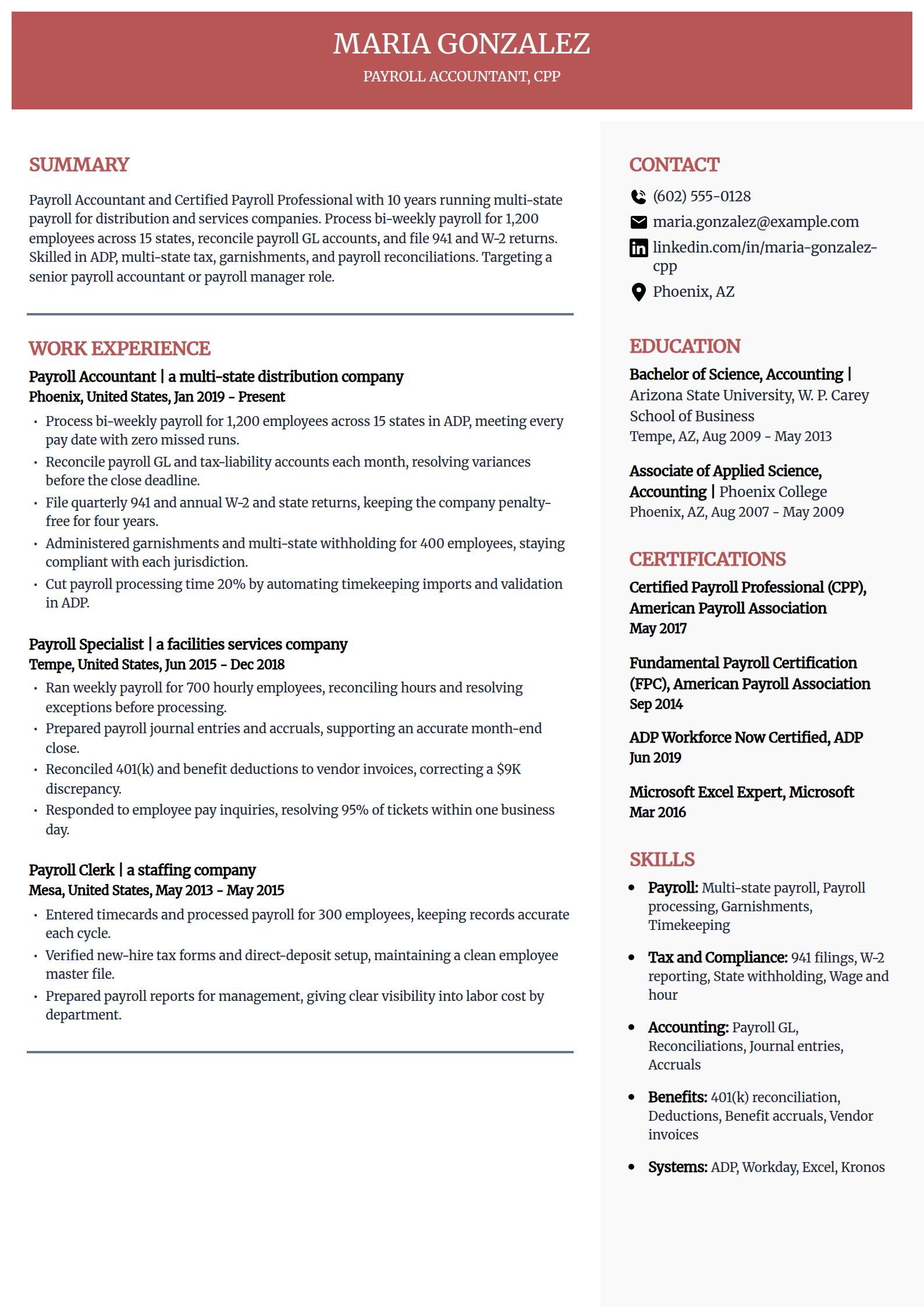
Payroll Accountant Resume Template
Why this resume example works?
- Opens with payroll scope, processing bi-weekly payroll for 1,200 employees across 15 states in ADP.
- Shows the accounting side, reconciling payroll GL and tax-liability accounts before the close deadline.
- Names the specialty work a posting lists, multi-state tax, 941 and W-2 filings, and garnishments.
- Carries a CPP and an FPC, the payroll credentials that separate a specialist from a generalist.
- Uses a two-column layout that keeps compliance detail and systems organized and parser-friendly.
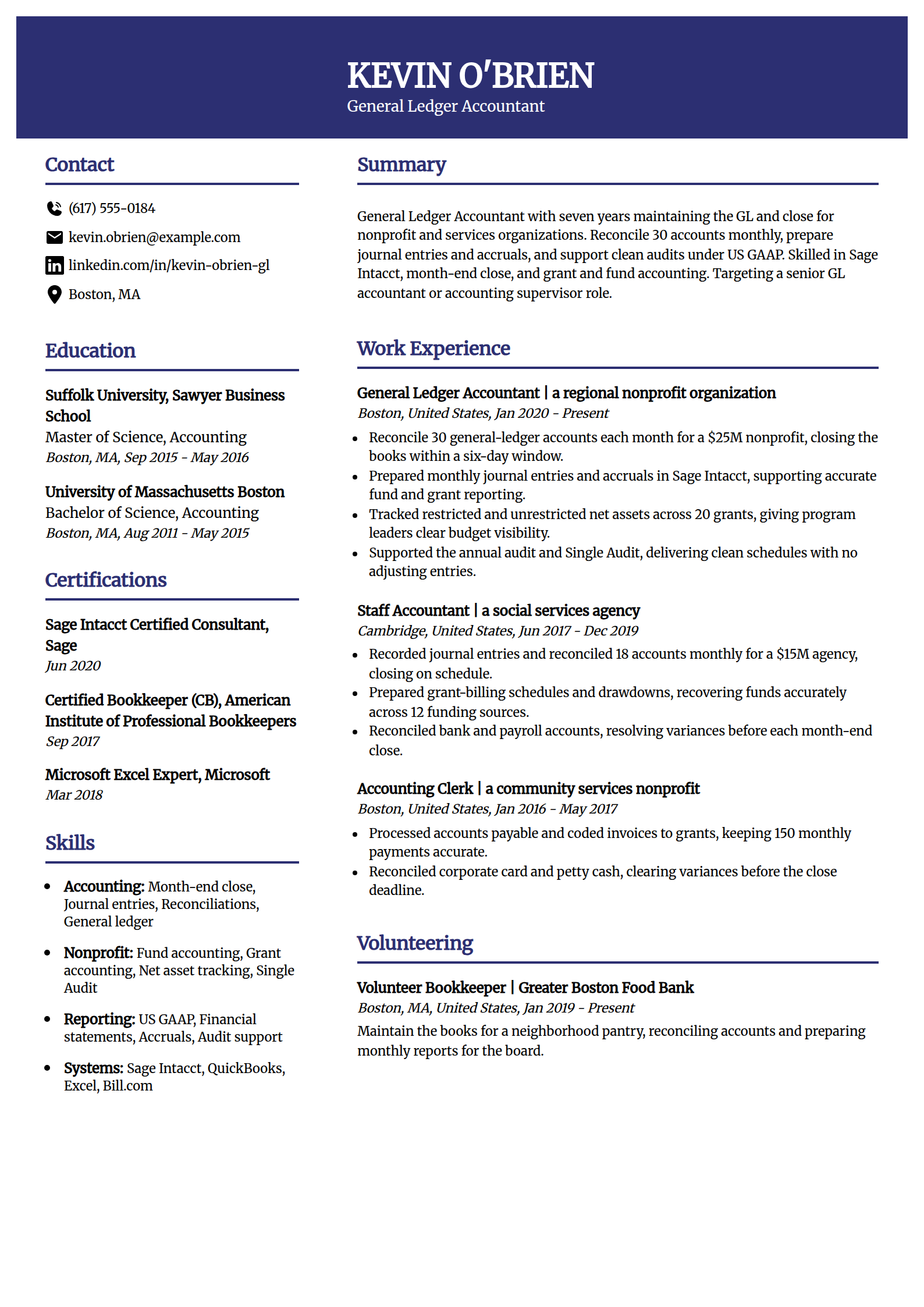
General Ledger Accountant Resume Template
Why this resume example works?
- Leads with GL ownership, reconciling 30 accounts a month and closing a $25M nonprofit in six days.
- Shows sector depth, preparing journal entries and accruals in Sage Intacct for fund and grant reporting.
- Names the niche skills a nonprofit posting expects, fund accounting and grant reporting under US GAAP.
- Keeps the credential honest and relevant, a Sage Intacct consultant and Certified Bookkeeper.
- Uses a spacious layout that keeps a focused GL record clean and easy to skim.
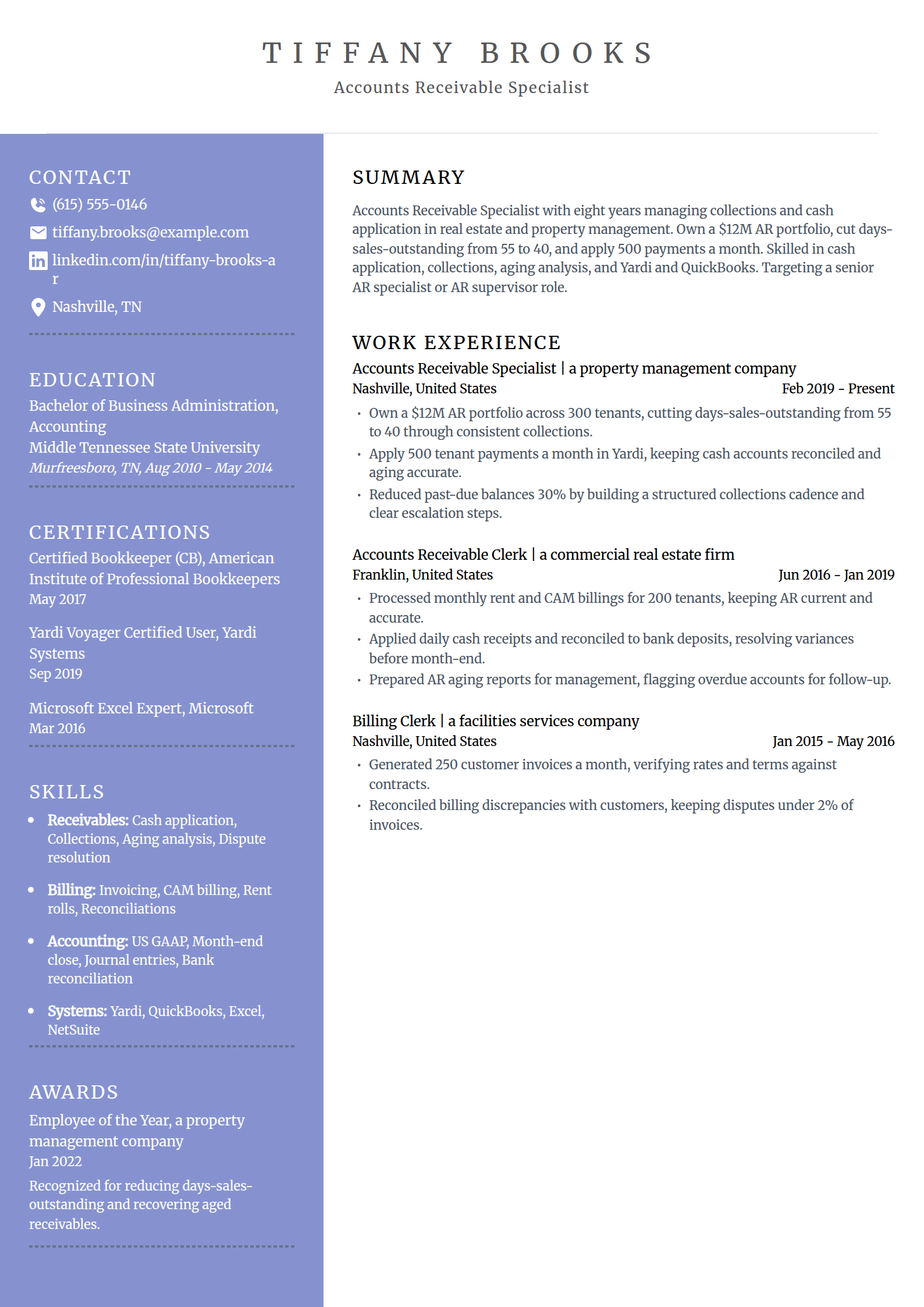
Accounts Receivable Resume Template
Why this resume example works?
- Leads with portfolio scope, owning a $12M AR book and cutting days-sales-outstanding from 55 to 40.
- Shows volume and accuracy, applying 500 tenant payments a month in Yardi with aging kept current.
- Names AR-specific skills, cash application, collections, aging analysis, and dispute resolution.
- Fits the real estate niche, with Yardi and CAM billing the postings in that sector actually name.
- Uses a clean layout that keeps a specialist resume focused and ATS-safe.
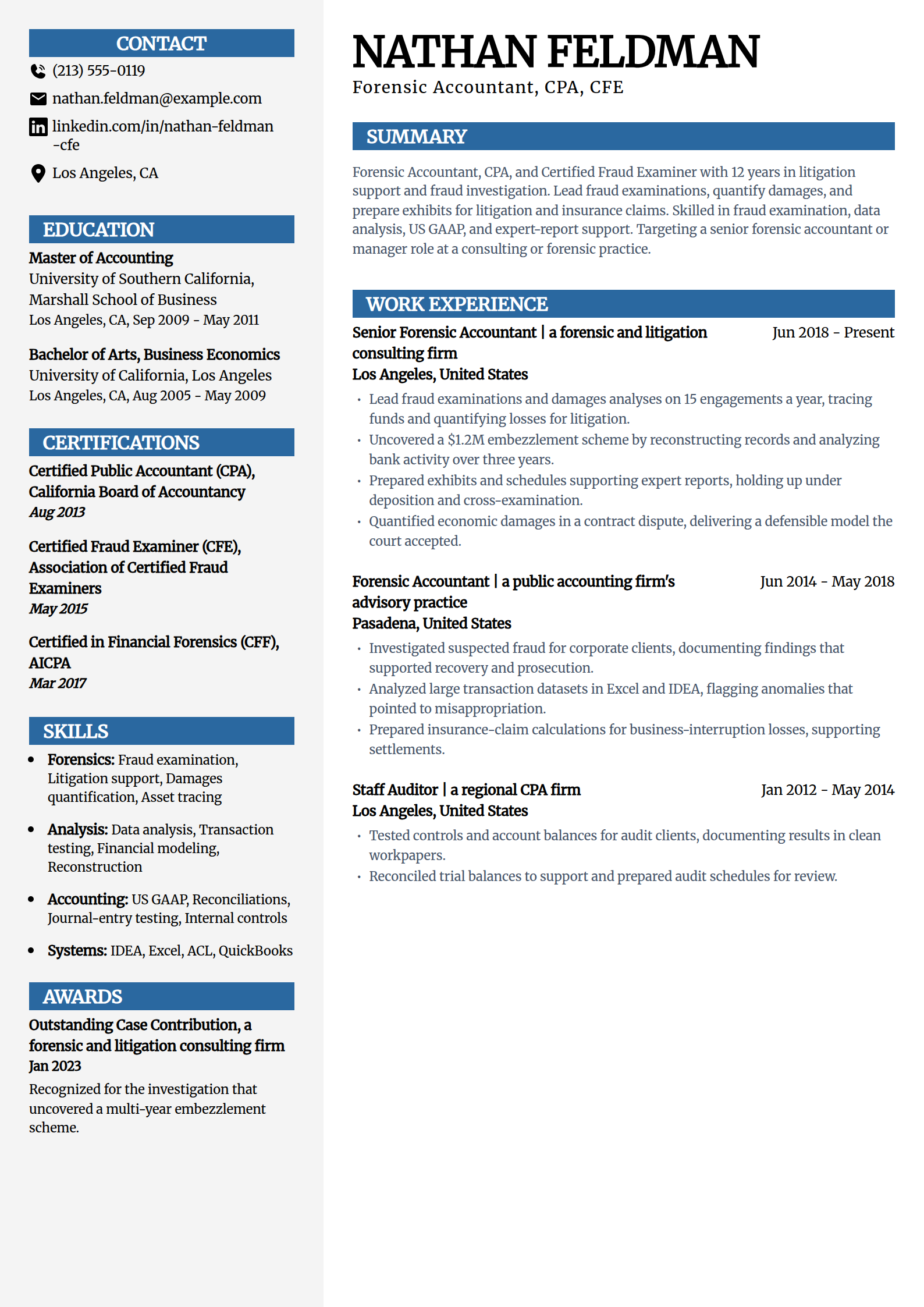
Forensic Accountant Resume Template
Why this resume example works?
- Leads with specialized work, leading fraud examinations and damages analyses on 15 engagements a year.
- Shows a headline result, uncovering a $1.2M embezzlement by reconstructing three years of records.
- Names the field's skills, fraud examination, data analysis, and expert-report support for litigation.
- Carries the exact credential trio, a CPA, a CFE, and a CFF, that a forensic practice looks for.
- Uses a structured layout that keeps investigative detail organized and parser-friendly.
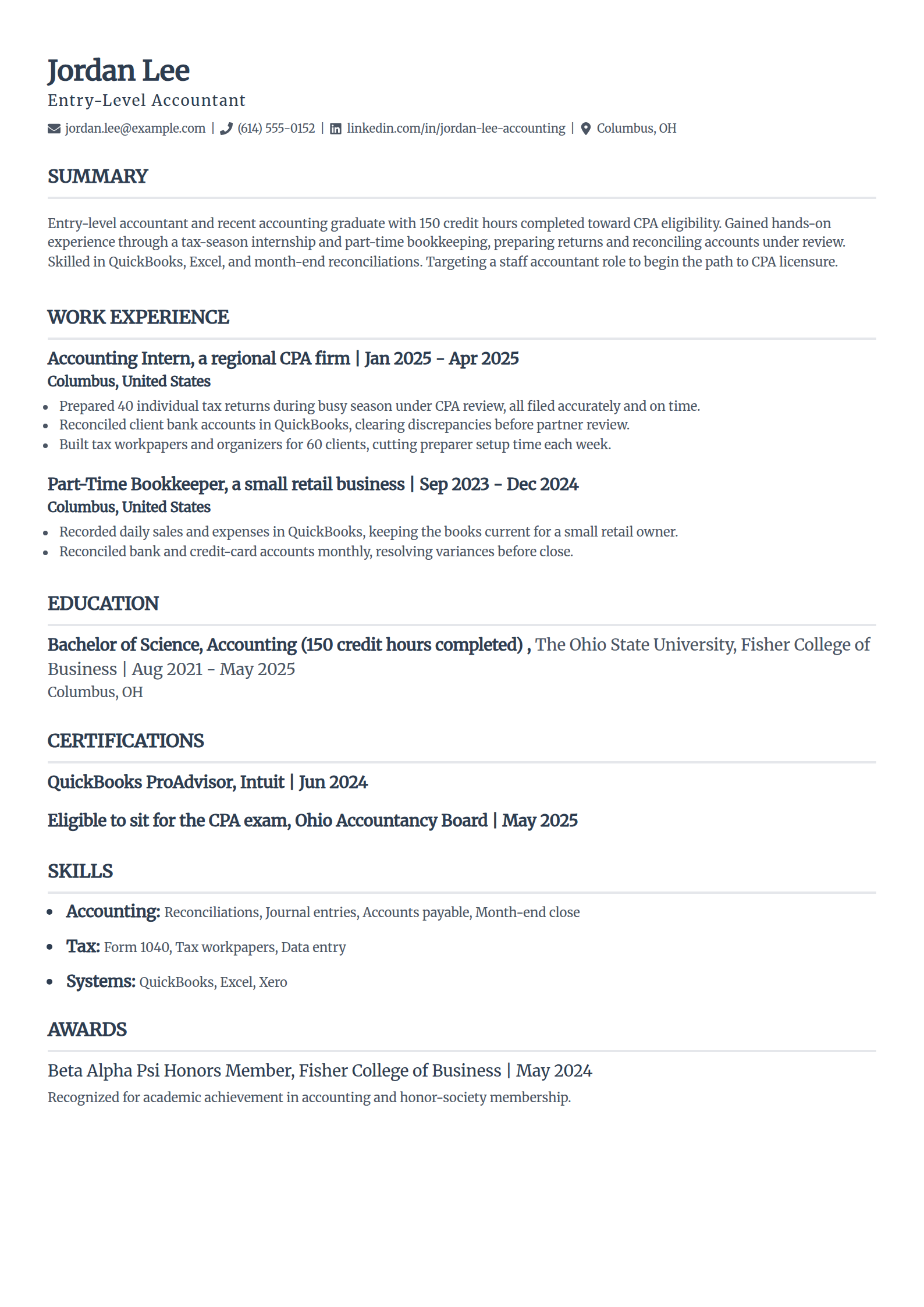
Entry-Level Accountant Resume Template
Why this resume example works?
- Leads with real hands-on work, preparing 40 tax returns under CPA review during a busy-season internship.
- States CPA status honestly for a new grad, 150 credit hours completed and eligible to sit for the exam.
- Shows tool exposure a first job wants, reconciling client accounts in QuickBooks and Excel.
- Fills a strong one-page resume before the first full-time role, internship plus part-time bookkeeping.
- Uses a simple, single-column layout that reads cleanly for an entry-level applicant and passes ATS.
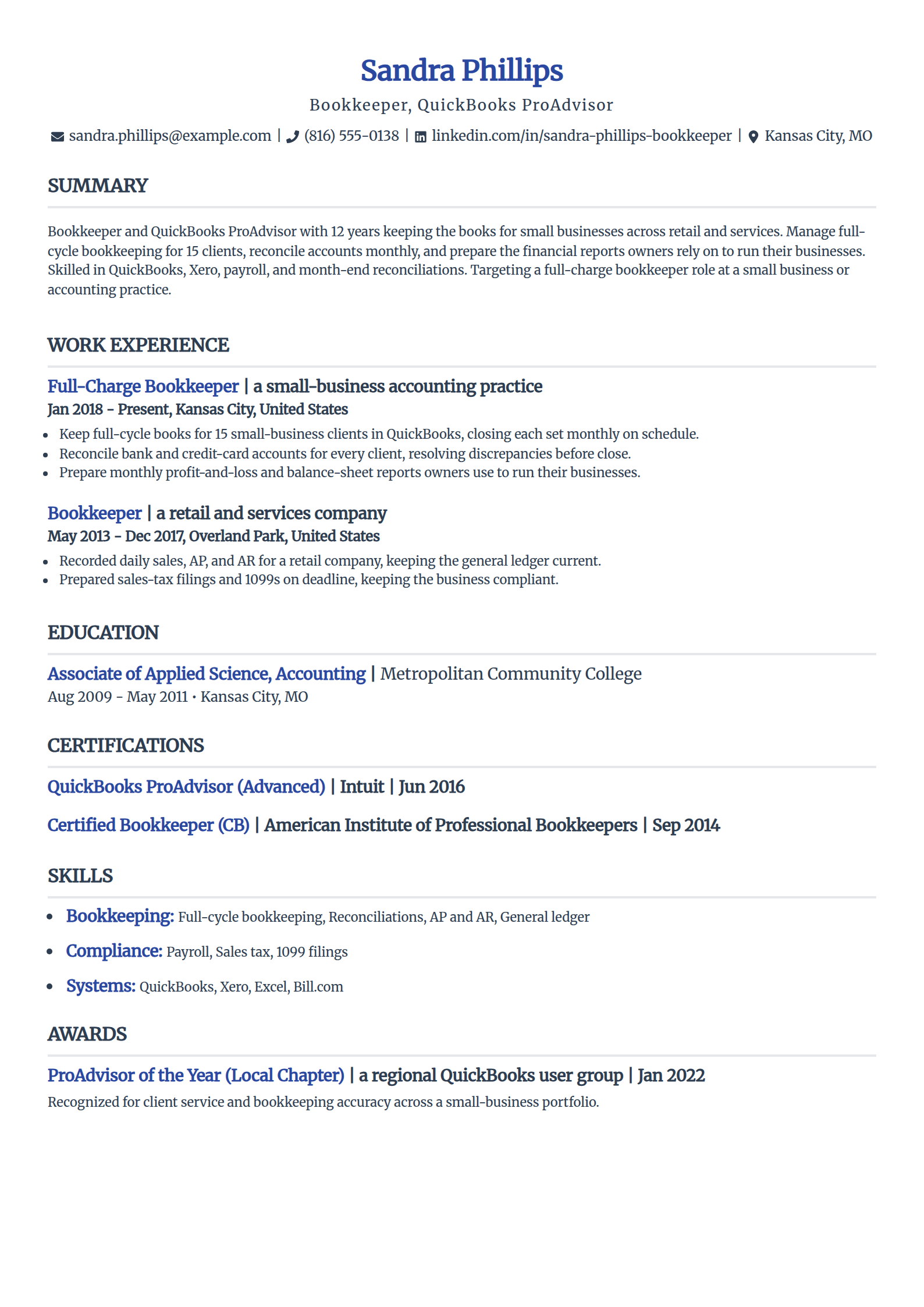
Bookkeeper Resume Template
Why this resume example works?
- Leads with client scope, keeping full-cycle books for 15 small-business clients and closing each monthly.
- Shows the deliverable owners care about, monthly profit-and-loss and balance-sheet reports.
- Names the tools a bookkeeping posting lists, QuickBooks, Xero, and payroll, and a ProAdvisor credential.
- Keeps every line concrete, reconciling bank and credit-card accounts and resolving discrepancies before close.
- Uses a clean, no-frills layout that fits a focused bookkeeping record on one ATS-safe page.
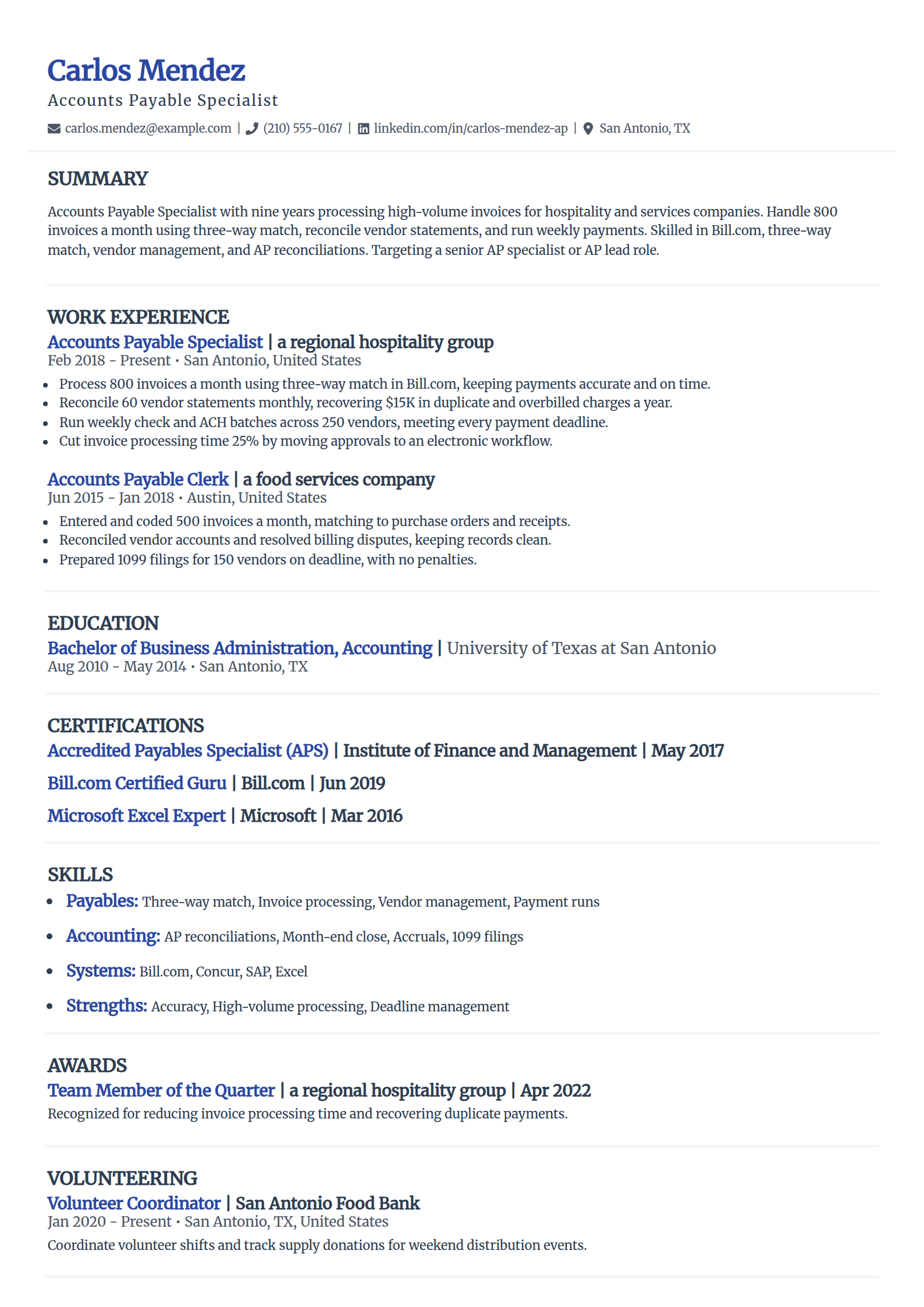
Accounts Payable Resume Template
Why this resume example works?
- Leads with volume and method, processing 800 invoices a month using three-way match in Bill.com.
- Shows a recovery number, reconciling 60 vendor statements and clawing back $15K in overbilled charges a year.
- Names AP-specific skills, three-way match, vendor management, and AP reconciliations.
- Runs weekly check and ACH batches across 250 vendors, the concrete throughput a posting screens for.
- Uses a refined layout that keeps a specialist AP resume clean and easy for a parser to read.
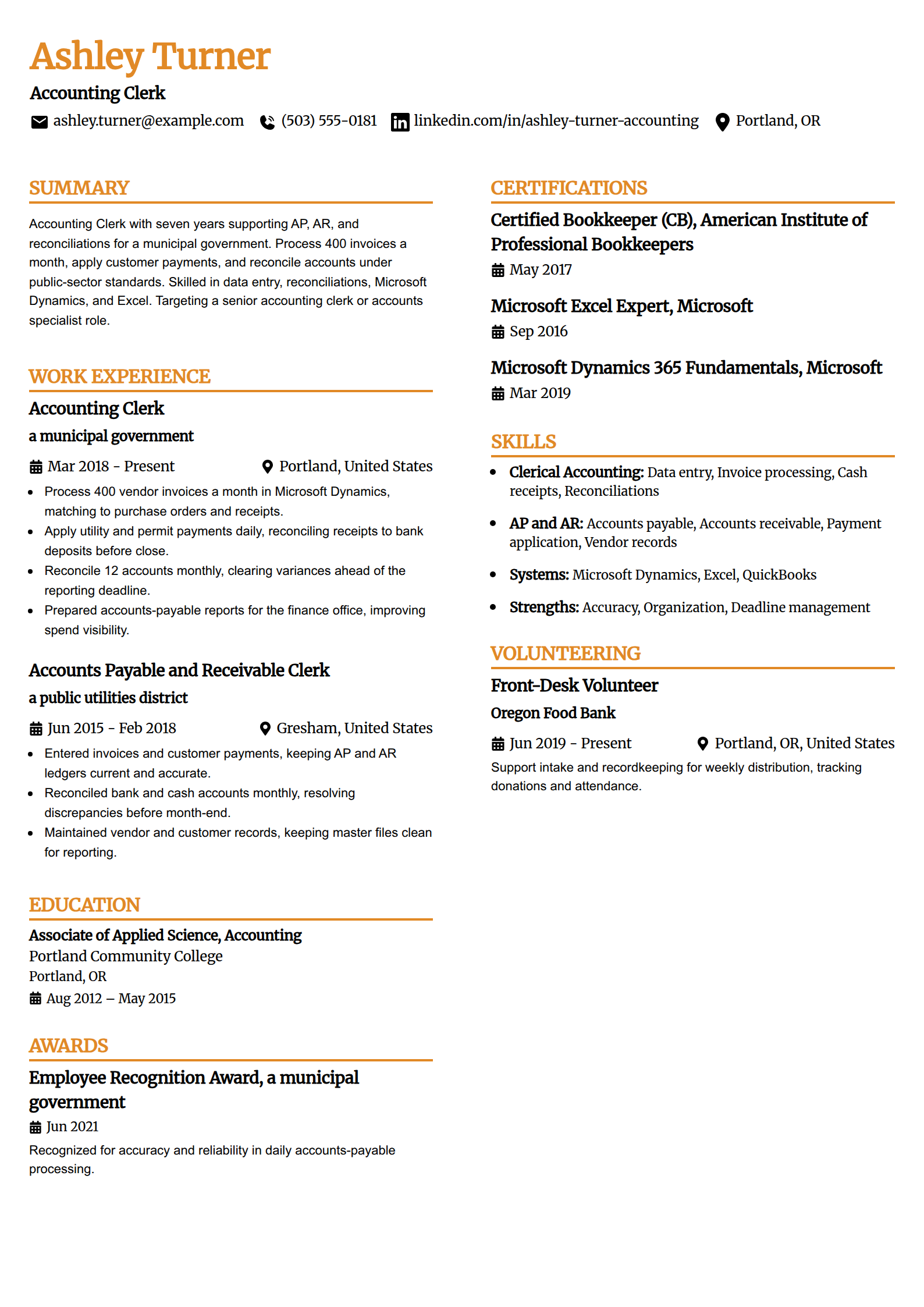
Accounting Clerk Resume Template
Why this resume example works?
- Leads with clerk throughput, processing 400 invoices a month in Microsoft Dynamics matched to POs.
- Shows both sides of the desk, applying daily customer payments and reconciling bank and cash accounts.
- Names practical skills, data entry, reconciliations, Microsoft Dynamics, and Excel.
- Fits the public-sector niche, working invoices and receipts under municipal government standards.
- Uses a polished layout that keeps a support-role resume organized and ATS-safe.
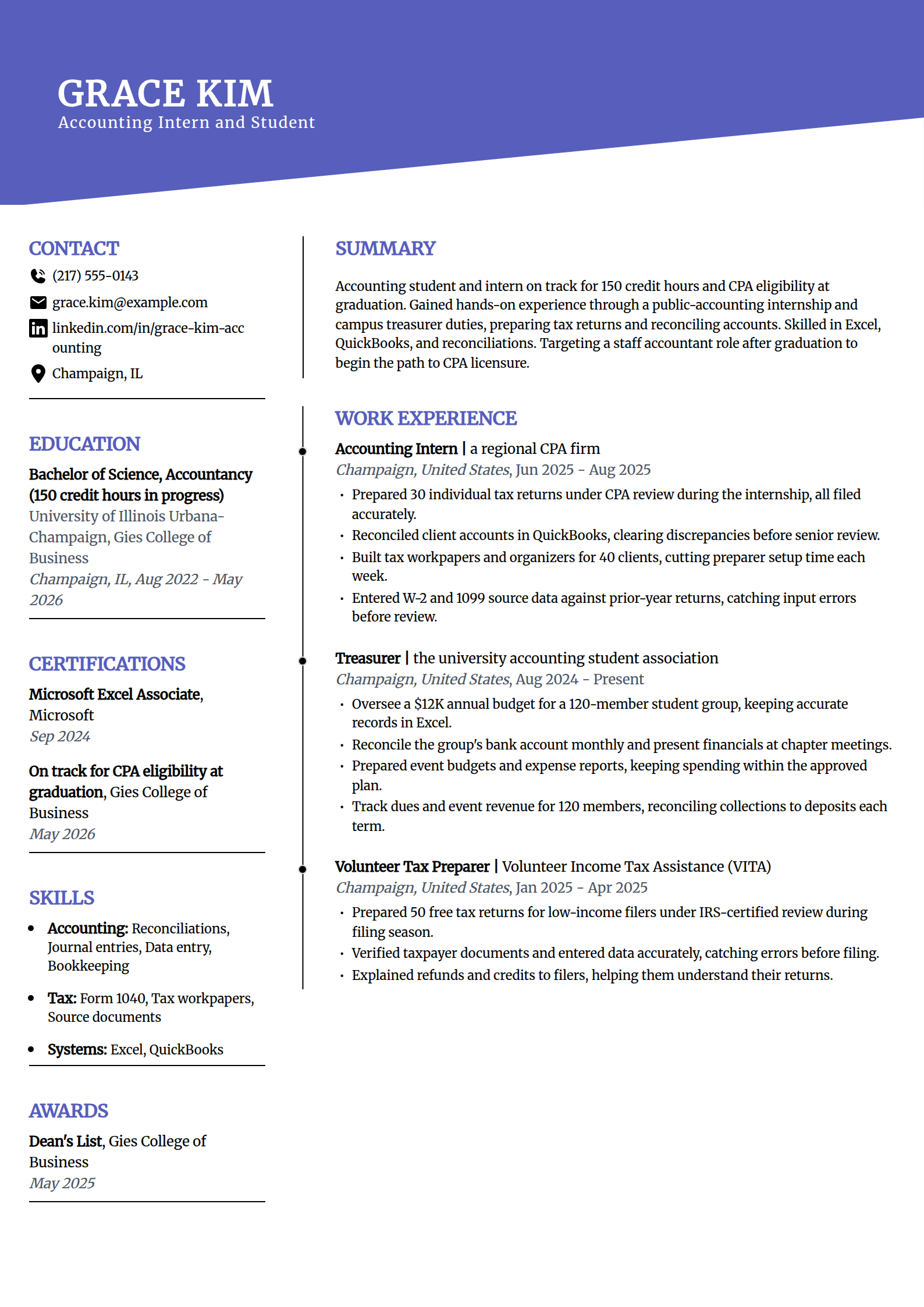
Accounting Intern Resume Template
Why this resume example works?
- Leads with internship work, preparing 30 tax returns under CPA review and reconciling client accounts.
- Shows leadership a student can claim, serving as treasurer and managing a $12K budget for 120 members.
- Adds community proof, preparing 50 free returns as an IRS-certified VITA volunteer during filing season.
- States CPA eligibility honestly, on track for 150 credit hours and eligibility at graduation.
- Uses a visual layout that fills a student page with real experience before the first full-time role.
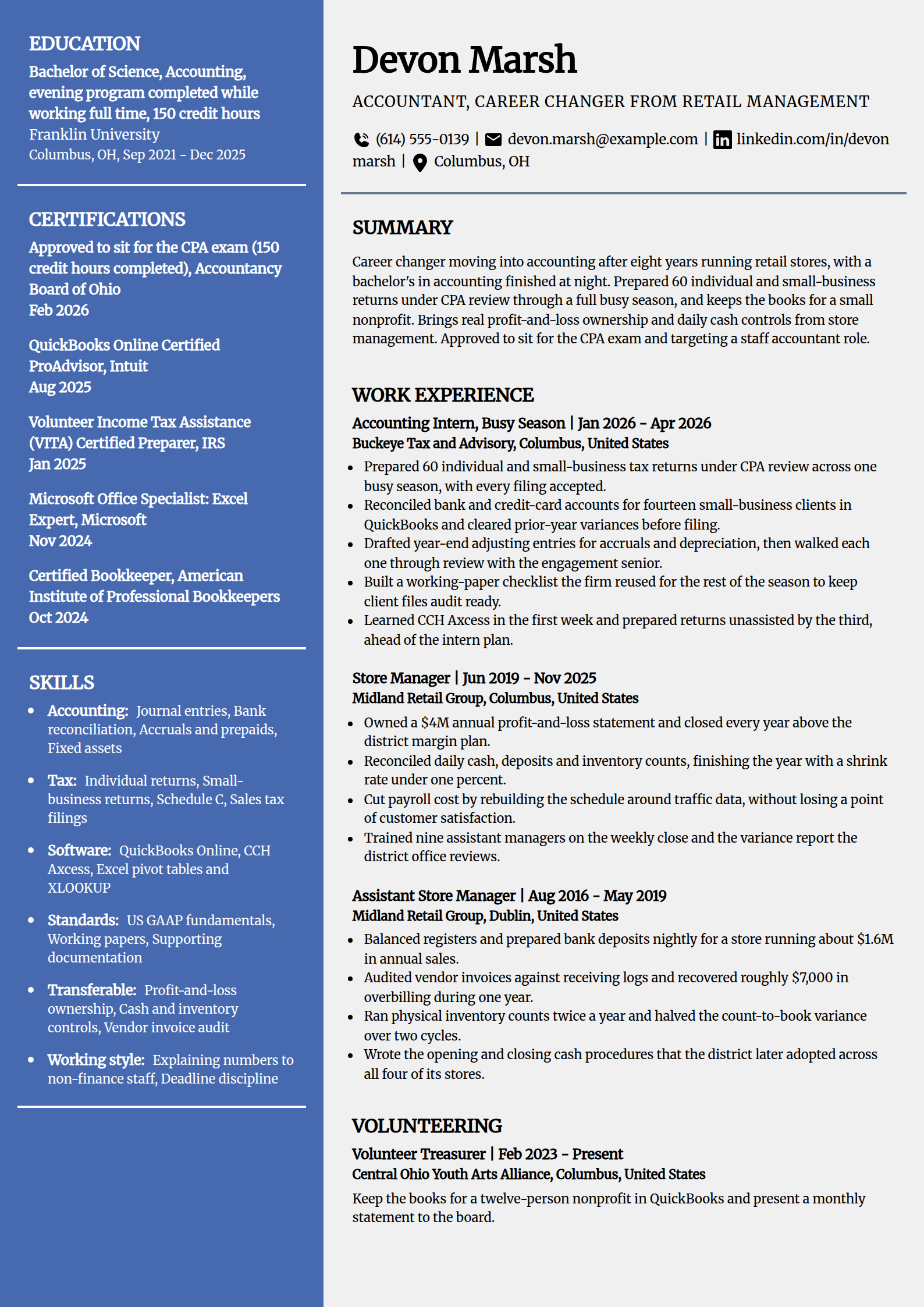
Career Change Accountant Resume Template
Why this resume example works?
- Opens by naming the change rather than hiding it, eight years managing retail stores and an accounting degree finished at night.
- Puts the accounting work first anyway, a full busy season preparing 60 returns under CPA review, so the top of the page is on target.
- Reframes retail history in accounting terms a hiring manager values, a $4M profit-and-loss statement, daily cash reconciliation, and a vendor invoice audit.
- States CPA position exactly, approved to sit with 150 credit hours completed, which is the honest phrasing a firm expects.
- Fills the page without padding by carrying a volunteer treasurer role that keeps real books for a nonprofit.
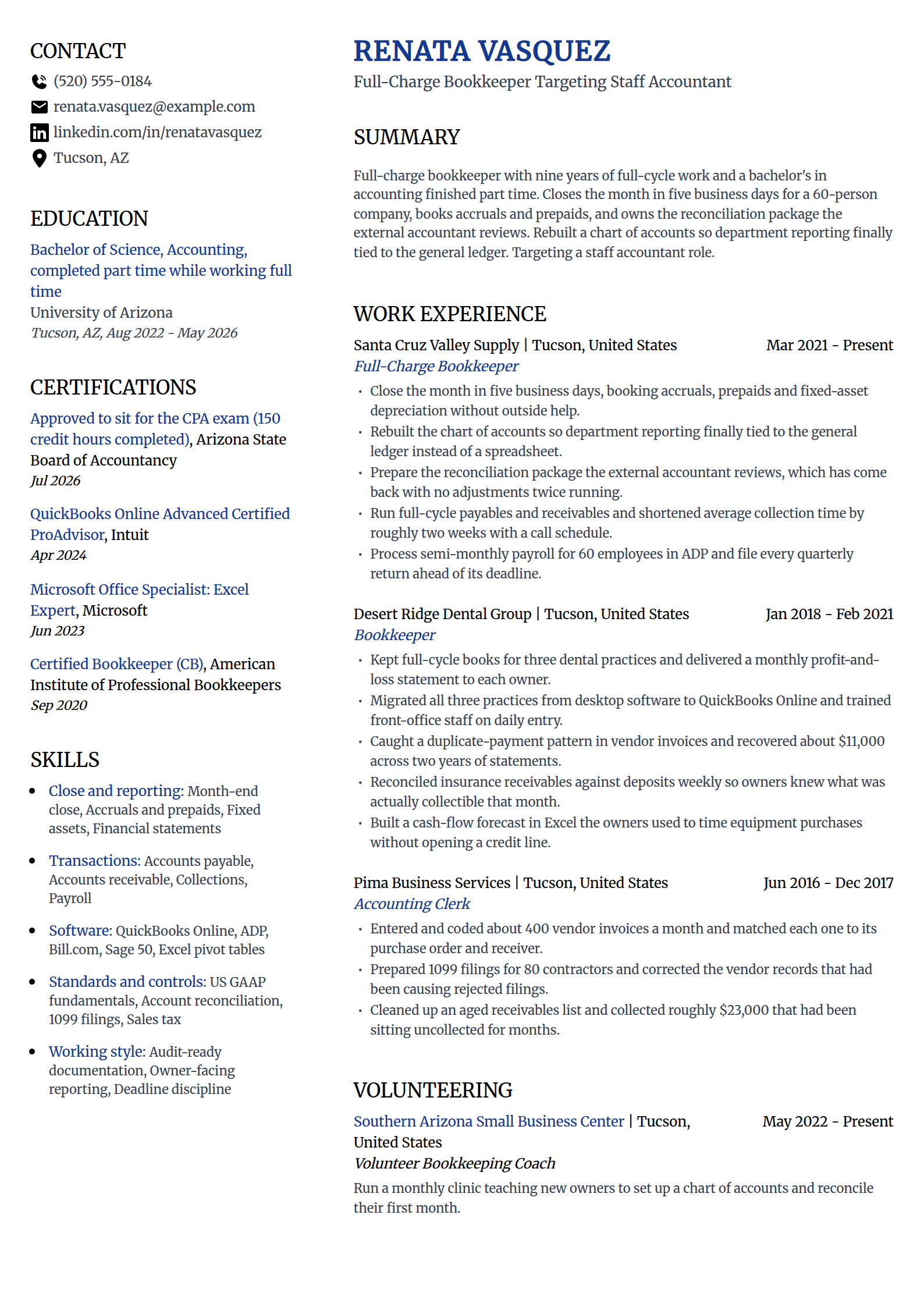
Bookkeeper to Accountant Resume Template
Why this resume example works?
- Says the target out loud in the headline, a full-charge bookkeeper going after a staff accountant seat, so nobody has to guess.
- Translates bookkeeping into accountant vocabulary, a five-day close with accruals, prepaids and depreciation booked without outside help.
- Proves the work survives review, a reconciliation package the external accountant has returned with no adjustments twice running.
- Shows the degree finished part time while working full time, which answers the one question a hiring manager will have.
- Keeps scope honest for the step up, no technical accounting or reporting standards the seat above has not handed over yet.
Build your accounting resume
Pick a template above and the editor keeps your layout clean and ATS-safe while you swap in your own close cycle, reconciliations, ledger scope, and the ERP and standards you work in.
Build my resumeHow to write an accounting resume in 2026
A recruiter reads an accounting resume for accuracy and scope: the ledgers you own, how fast you close them, and whether the numbers hold up in an audit. Lead with the close cycle, the reconciliations, and the ERP you drove, then attach one modest number to each line. These moves make yours easy to skim and easy for an applicant tracking system to parse.
Open with a summary that states your scope and close cycle
Write three to four sentences that name your years and level, the size of the ledgers or portfolio you own, one or two headline results, and the role you are targeting. Say what you closed and reconciled, not what you want from the employer. Put your strongest number, usually a shortened close or a clean audit, in the opening lines.
Senior accountant and CPA with 8 years owning month-end close and reconciliations for a $120M portfolio. Cut the close from ten days to five, cleared three audits with zero restatements, and standardized journal entries in NetSuite. Skilled in GAAP, ASC 606, and variance analysis. Targeting a senior or lead accountant role.
Lead experience with the close, reconciliations, and dollars owned
The work an accounting resume is hired for is measurable, so name it and attach one modest number to each bullet. Open every line with a strong verb, never "Responsible for".
- Close: state the cycle you own and what you cut it to, like a month-end close shortened from ten days to five.
- Reconciliations: name the volume, such as reconciling 40 bank and GL accounts each month with zero variances.
- Dollars: show the scope, like owning a $120M ledger or processing $4M in monthly accounts payable.
- Audit and controls: quantify it, such as clearing three external audits with zero restatements under SOX.
List education, your CPA, and accounting credentials
The degree supports the record, so keep this section tight and match the credential to your track.
- List your BS in Accounting; add an MS in Accounting or Taxation or an MBA if you have one.
- State CPA status precisely: licensed CPA, or a CPA candidate who has passed a set number of the four exam sections.
- Match the credential to the seat: a CMA for cost and management, an EA for tax, a CIA for internal audit.
- Entry-level? Note your 150 credit hours toward CPA eligibility rather than claiming a license you do not hold.
Put your skills in the posting's language
An accounting skills block should read like the job description. Split it so a recruiter and a parser both find what they need.
- Core: GAAP, month-end and year-end close, journal entries, reconciliations, and financial reporting.
- Standards: name the ones you apply, such as ASC 606 for revenue, ASC 842 for leases, and SOX controls.
- Systems: name the ERP outright, like NetSuite, SAP, Oracle, Sage Intacct, QuickBooks, or Workday.
- Analysis: variance analysis, accruals, forecasting, and advanced Excel with PivotTables and lookups.
Keep the format clean and ATS-safe
Most employers run accounting applications through an applicant tracking system, so a clean layout with standard headings is the standard.
- Use a single-column or simple two-column layout with headings a parser recognizes.
- Lead with your most recent role in reverse-chronological order and keep dates clean.
- Save as a PDF so the layout holds, then run it through our ATS resume checker for a format and keyword pass.
- Swap the numbers in the templates above for your own close cycle and ledger scope; do not copy them as is.
Common accounting resume mistakes
- Writing vague duties like "handled the books". Say what changed: "cut month-end close from ten days to five".
- Leaving out the numbers. Close cycle, reconciliations, ledger size, and audit results are what a recruiter scans for first.
- Claiming a CPA you do not hold. State candidate status and the sections you have passed instead, and never say "currently sitting" for an exam.
- Listing every tool but no ERP. Name the system you actually drove, like NetSuite or SAP, near the top.
- Ignoring accuracy signals. A clean audit, zero restatements, or a low error rate proves the trait accounting hires for.
Frequently asked questions
What should an accounting resume include?
An accounting resume needs your contact details, a short summary, a skills block, work history in reverse-chronological order, education, and credentials. Lead each role with the ledgers you own, the close cycle you keep, and the reconciliations you clear, then attach one modest number to each achievement: a shortened close, a clean audit, dollars processed, or an error rate reduced. Name the ERP a posting lists, such as NetSuite, SAP, Oracle, or QuickBooks, and state your CPA status precisely.
How do I write an entry-level accounting resume with no experience?
Lead with your accounting degree, your progress toward CPA eligibility, and the hands-on work you have done, even if it is an internship, a VITA tax-prep volunteer role, or campus treasurer. Name the tools you have used in coursework or an internship, like Excel, QuickBooks, or an ERP, and quantify what you can: returns prepared, transactions posted, or accounts reconciled. The entry-level and intern examples above show how to fill a strong one-page resume before your first full-time role.
What is the best format for an accounting resume?
A reverse-chronological format with a clean single-column or simple two-column layout and standard section headings. This keeps your name, titles, and dates in the order a hiring manager expects and parses cleanly in applicant tracking systems. Open with a short summary that states your scope and close cycle, follow with a skills block, then let your experience carry the resume with quantified achievements. Save it as a PDF so the layout holds.
How do I show CPA status on my resume?
If you are licensed, write "Certified Public Accountant (CPA)" near your name and in your credentials. If you are still testing, write "CPA candidate" and name the sections you have passed, such as "passed 3 of 4 sections (FAR, AUD, REG)". If you only meet the education requirement, note your 150 credit hours toward CPA eligibility. Never write "currently sitting for the CPA", since an exam section is sat once on a scheduled date.
What skills should I put on an accounting resume?
Match the posting first, then cover the core: GAAP, month-end and year-end close, journal entries, reconciliations, and financial reporting. Add the standards you apply, like ASC 606 for revenue or ASC 842 for leases, and SOX controls if you support audits. Name the ERP and tools you actually drove, such as NetSuite, SAP, Oracle, Sage Intacct, QuickBooks, or advanced Excel, rather than listing every tool you have ever opened. The skills that appear in the job description belong near the top.
How long should an accounting resume be?
One page for most accountants through the mid-level, and up to two pages once you reach senior, manager, or controller with a longer record to show. Lead with your most recent roles and strongest numbers, then summarize or drop positions older than about 15 years. A tight, quantified one-page resume beats a padded two-page one, and a recruiter scanning for the close cycle and audit results will find them faster.
More accounting resume resources
Build your accounting resume
Pick a template above and the editor keeps your layout clean and ATS-safe while you swap in your own close cycle, reconciliations, ledger scope, and the ERP and standards you work in.