Construction Project Manager Resume Examples That Lead With Budget and Schedule Numbers
- ATS Friendly
- Sector by Sector
- 17 PM Examples
A construction director reads the top third of your resume looking for two things: the contract value you have carried and how your jobs finished against their contract dates. Every example below puts those first, then splits by the two things that actually change the work, the sector you build in and the rung you are on, from an assistant PM chasing submittals to a senior PM running a $90M portfolio.


540k+ resumes created
Construction project manager resume templates for every sector and rung
Each template below is a real construction project manager resume laid out in that format, covering commercial, residential, multifamily, heavy civil and interiors work from assistant PM up to senior PM. Pick one, then swap in your own contract values, schedule results and change order numbers. Every layout keeps your project list near the top where a director looks first, and parses cleanly for an applicant tracking system on the way in.
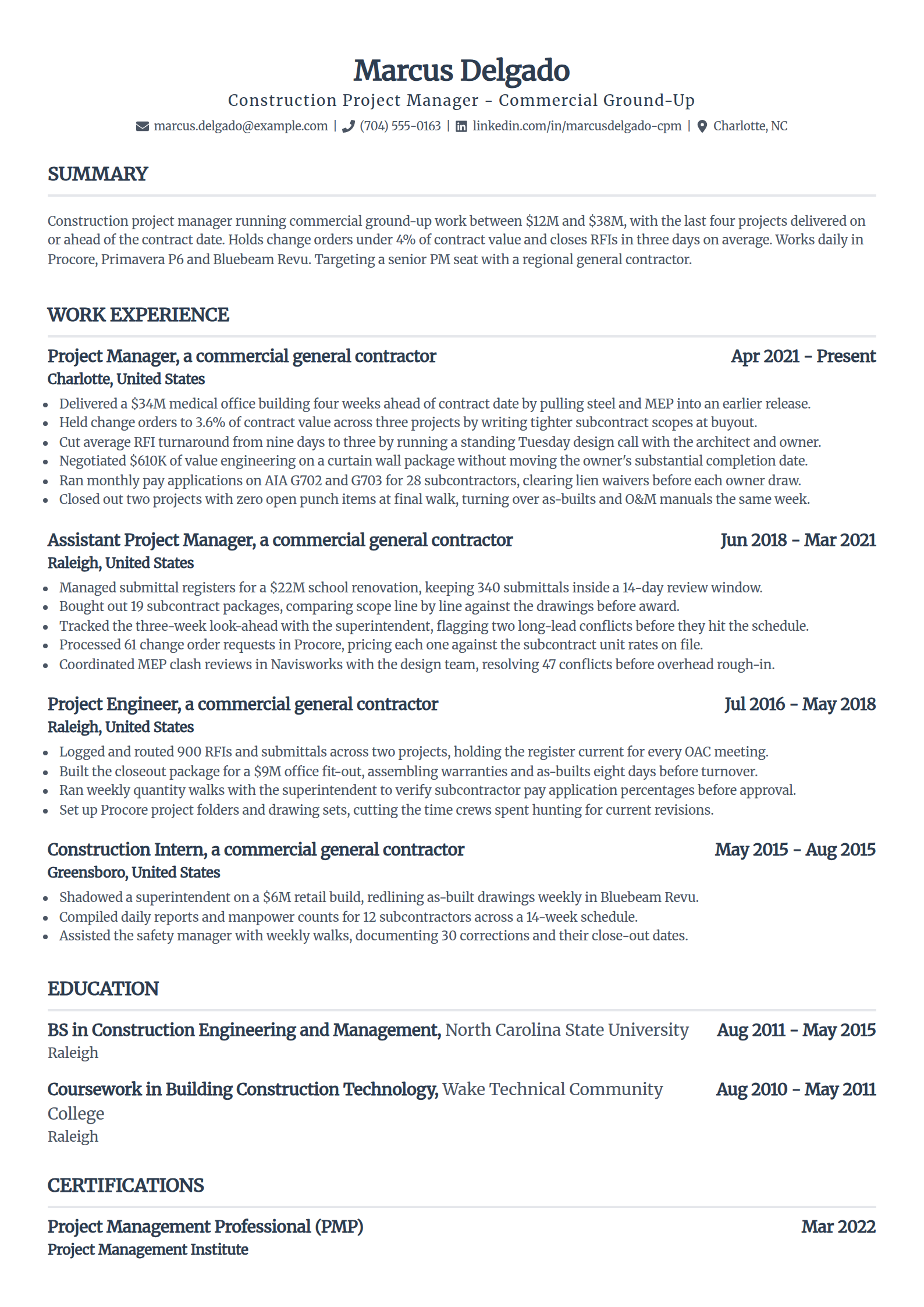
Construction Project Manager Resume Template (Commercial Ground-Up)
Why this resume example works?
- Names the contract value range up front, $12M to $38M, so a director knows in one line what size job this person can carry.
- Pairs a delivery claim with a method: four weeks early because steel and MEP were pulled into an earlier release.
- Gives the change order number, 3.6% of contract value, which is the figure that separates a PM who buys out well from one who does not.
- Shows RFI turnaround dropping from nine days to three, a controllable metric most construction resumes never mention.
- Traces project engineer to assistant PM to PM, which answers the readiness question before an interviewer asks it.
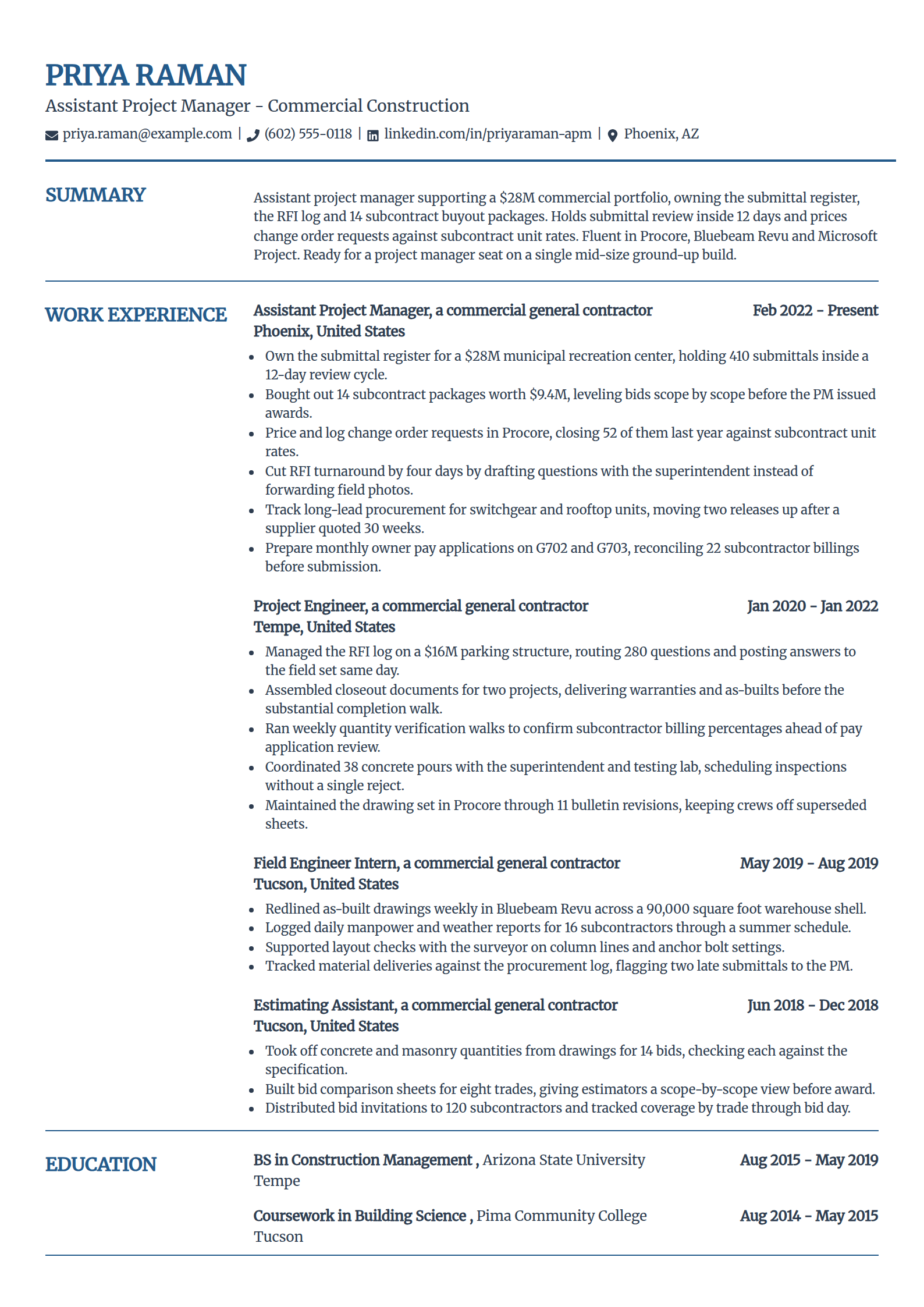
Assistant Project Manager Resume Template (Construction)
Why this resume example works?
- Claims the work an APM actually owns: the submittal register, the RFI log, buyout packages and monthly billing.
- Puts a dollar value on the buyout, $9.4M across 14 packages, instead of claiming the whole project's budget.
- Uses a review-cycle number, 410 submittals inside 12 days, which a general contractor can picture immediately.
- Shows judgment on long-lead procurement by moving two releases after a 30-week switchgear quote.
- Keeps the target modest and credible: a PM seat on one mid-size build, not a portfolio.
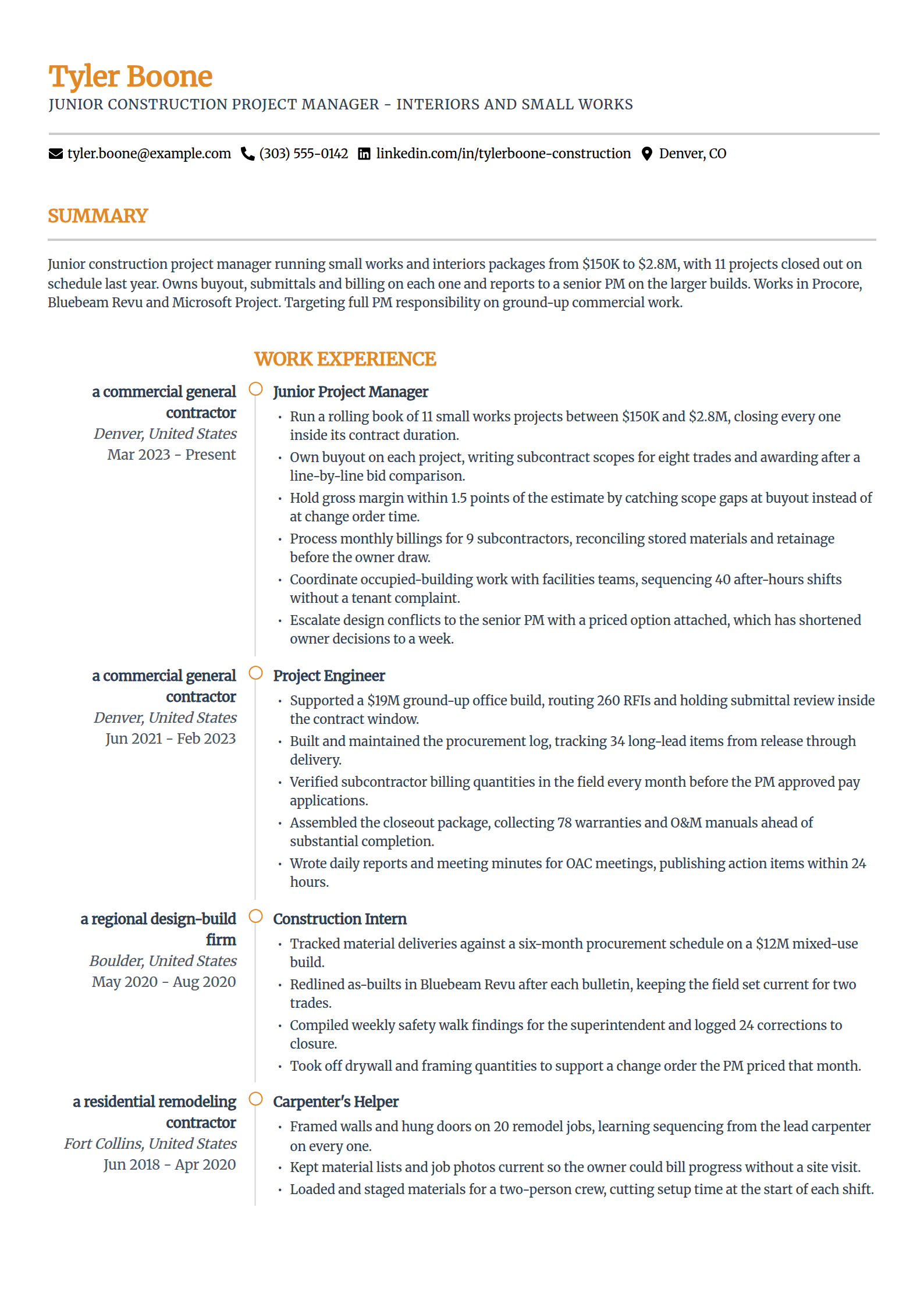
Junior Construction Project Manager Resume Template
Why this resume example works?
- Leads with the book of work a junior PM really runs, 11 small works projects from $150K to $2.8M.
- Shows full ownership on small jobs, buyout through billing, which is what earns a shot at a larger one.
- Gives a margin result, within 1.5 points of estimate, and says where it came from: scope gaps caught at buyout.
- Names the occupied-building work most junior resumes leave out, including 40 after-hours shifts sequenced around tenants.
- Keeps the field background visible so a hiring manager sees someone who has been on the tools as well as in the trailer.
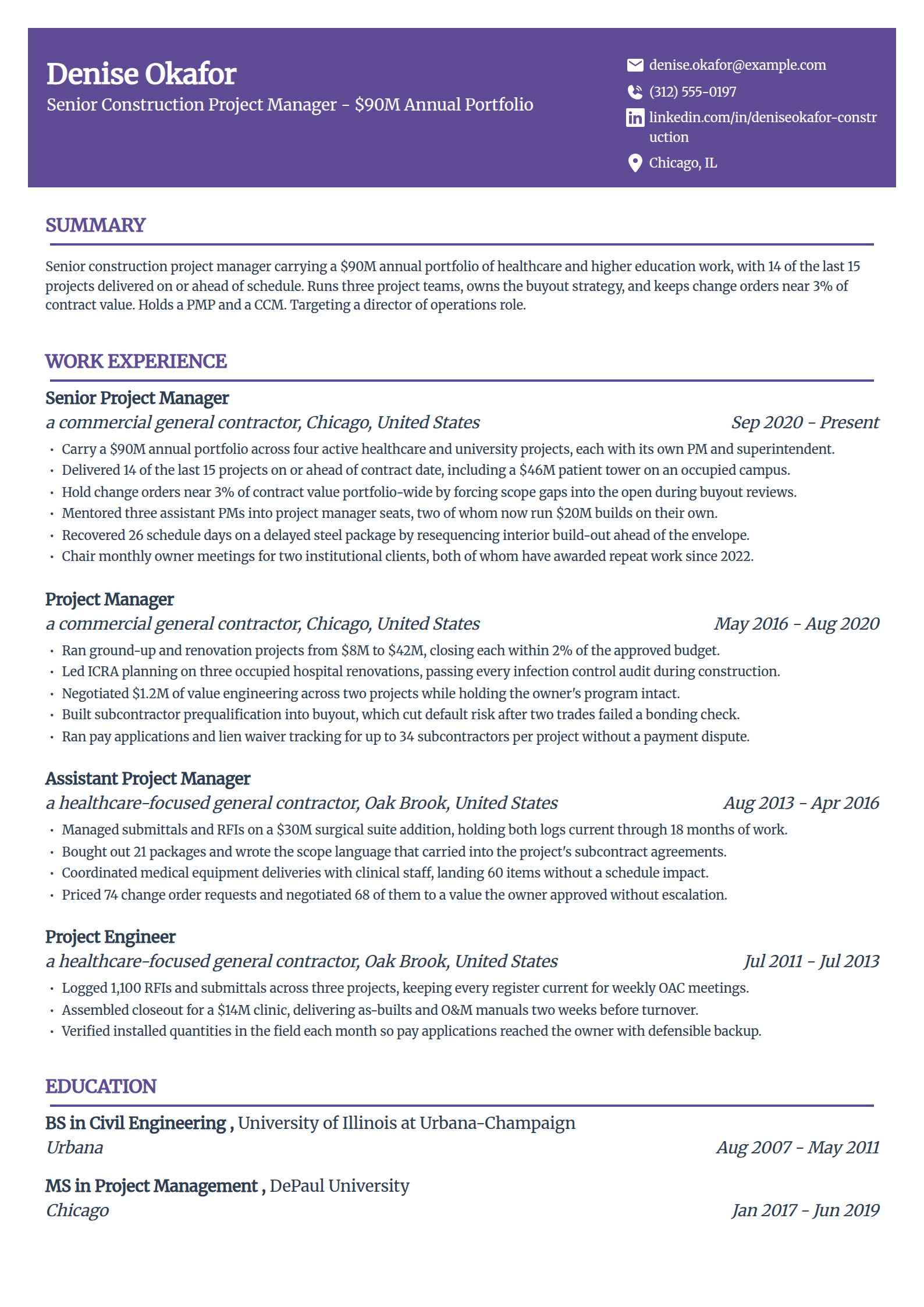
Senior Construction Project Manager Resume Template
Why this resume example works?
- Opens at portfolio scale, a $90M annual book across four active projects, each with its own PM and superintendent.
- Carries a delivery record rather than one good project: 14 of the last 15 finished on or ahead of contract date.
- Counts people development, three assistant PMs promoted, which is how senior candidates prove they can be leaned on.
- Shows schedule recovery, 26 days regained after a steel delay, the skill a director is really buying at this level.
- Names the healthcare-specific work that makes the experience hard to replace, including ICRA planning on occupied campuses.
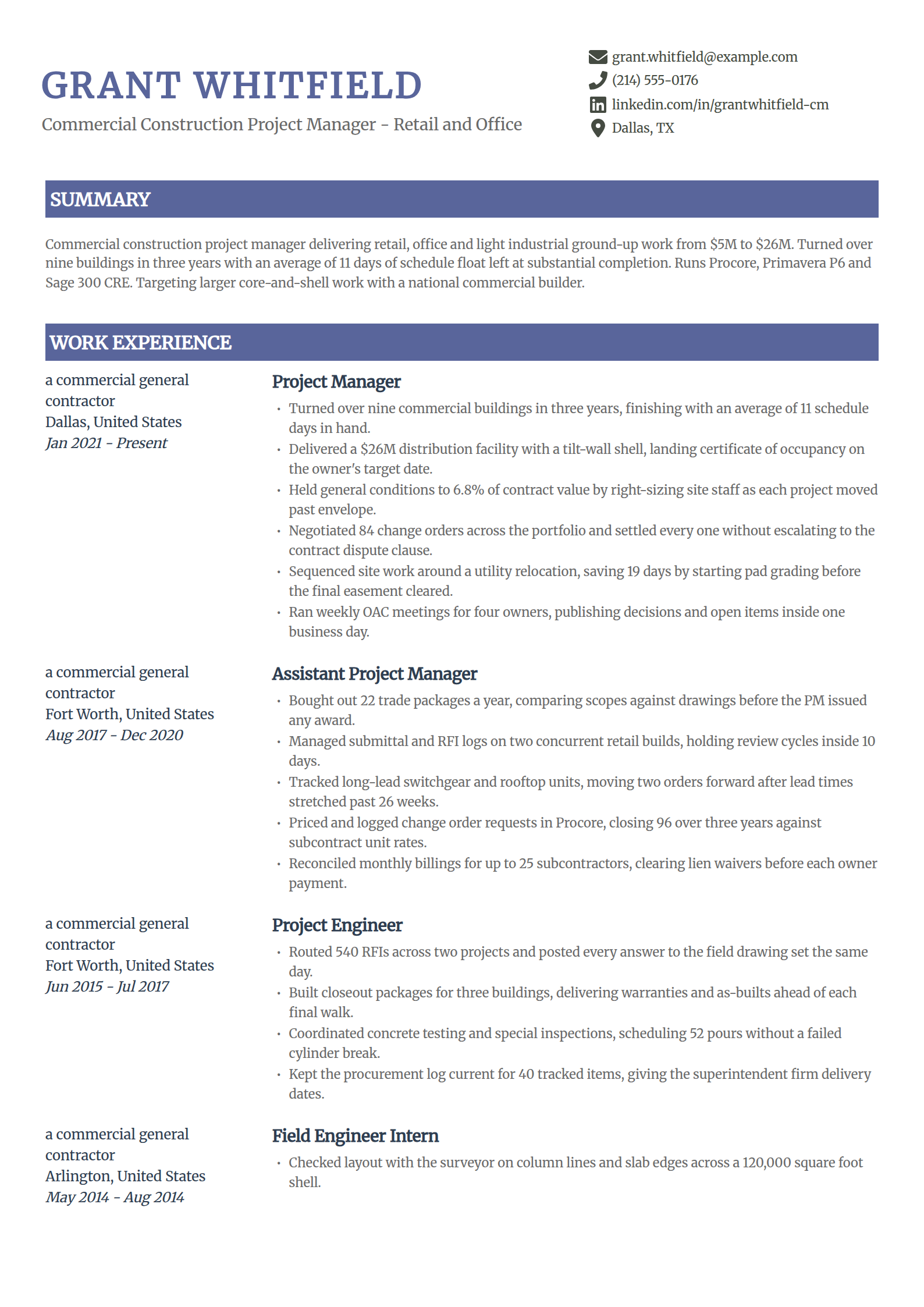
Commercial Construction Project Manager Resume Template
Why this resume example works?
- Counts buildings turned over, nine in three years, which reads faster than a paragraph about responsibilities.
- Uses schedule float left at completion as the delivery metric, an honest number that is hard to fake.
- Reports general conditions at 6.8% of contract value, the cost line commercial builders watch most closely.
- Shows a site-work decision with a number attached: 19 days saved by starting pad grading before the easement cleared.
- Closes 84 change orders without a contract dispute, which tells an owner what working with this PM is like.
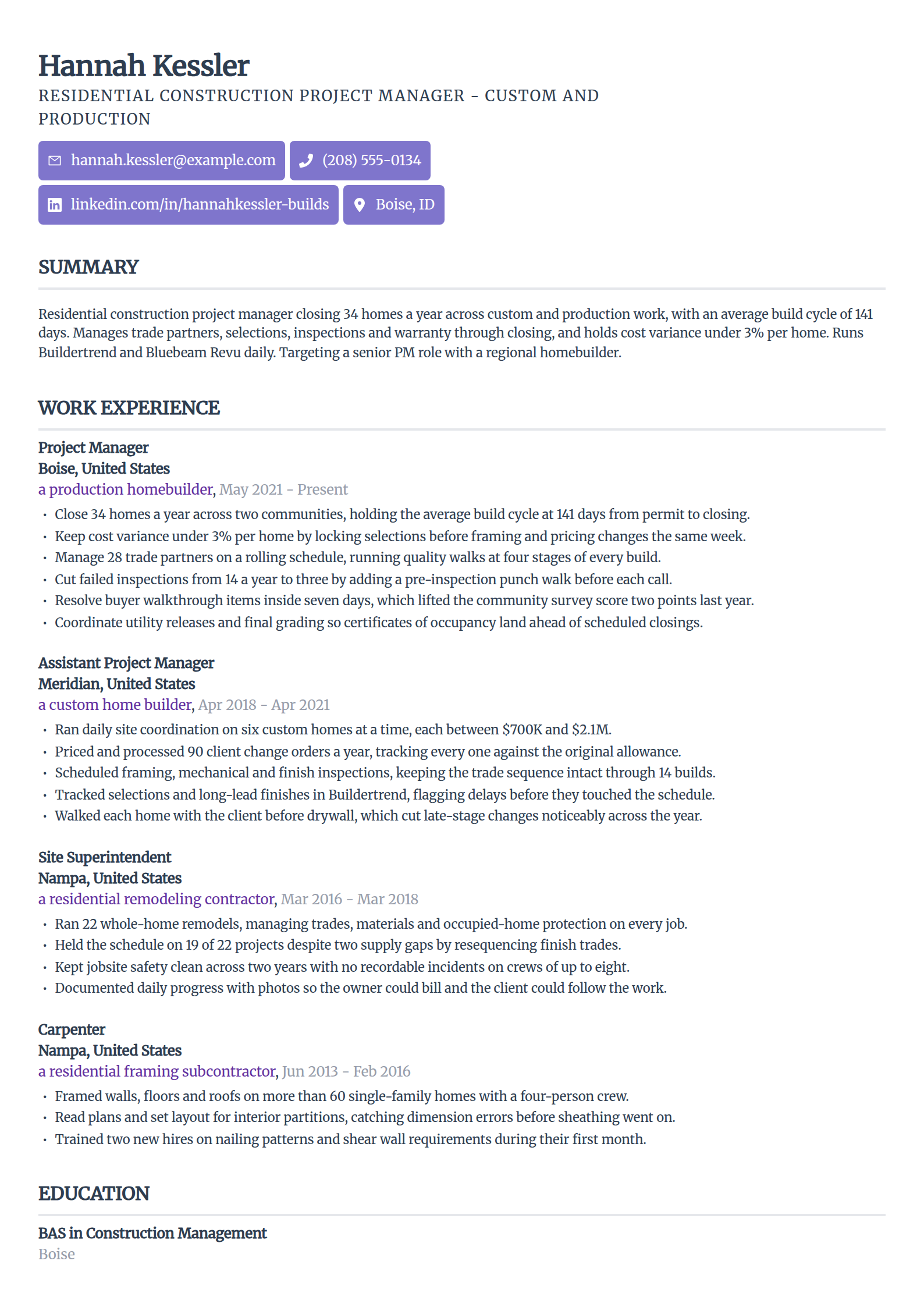
Residential Construction Project Manager Resume Template
Why this resume example works?
- Uses residential numbers, 34 closings a year and a 141-day build cycle, not commercial numbers borrowed from another sector.
- Ties cost variance under 3% to a specific practice: locking selections before framing.
- Turns a quality claim into a result, failed inspections down from 14 a year to three, with the pre-walk that caused it.
- Covers the buyer-facing half of the job, walkthrough items resolved in seven days, which production builders ask about.
- Keeps the carpentry background on the page, because residential PMs are still expected to read a frame.
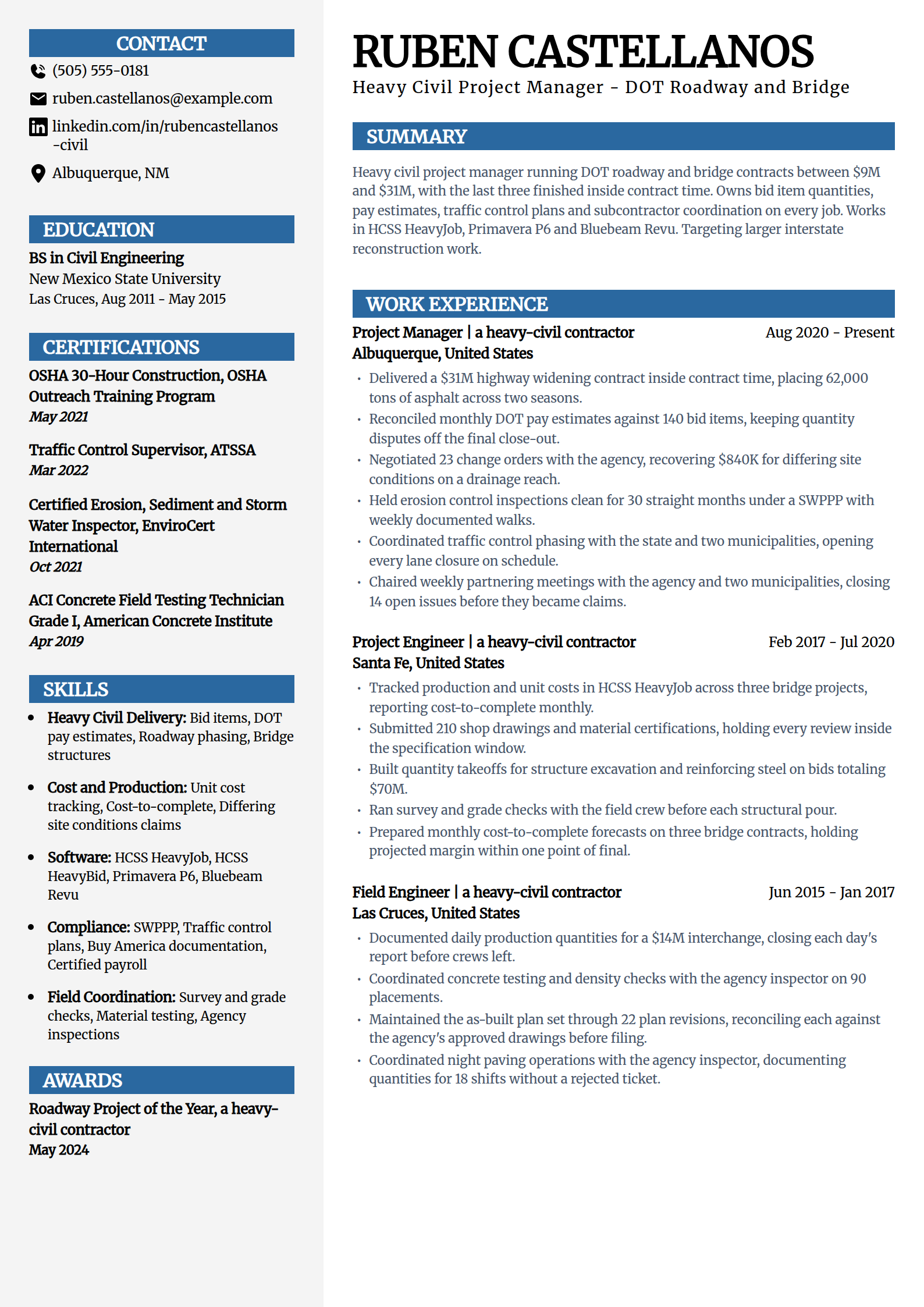
Civil and Infrastructure Project Manager Resume Template (Heavy Highway)
Why this resume example works?
- Speaks the public-contract language a DOT reader expects: bid items, pay estimates, contract time and traffic control phasing.
- Quantifies production the way heavy civil measures it, 62,000 tons of asphalt across two seasons.
- Shows a claim handled properly, $840K recovered for differing site conditions, with the reach it happened on.
- Names the compliance work that keeps a job open, including 30 months of clean erosion control inspections under a SWPPP.
- Lists HCSS HeavyJob and HeavyBid, the systems heavy civil contractors actually screen for.
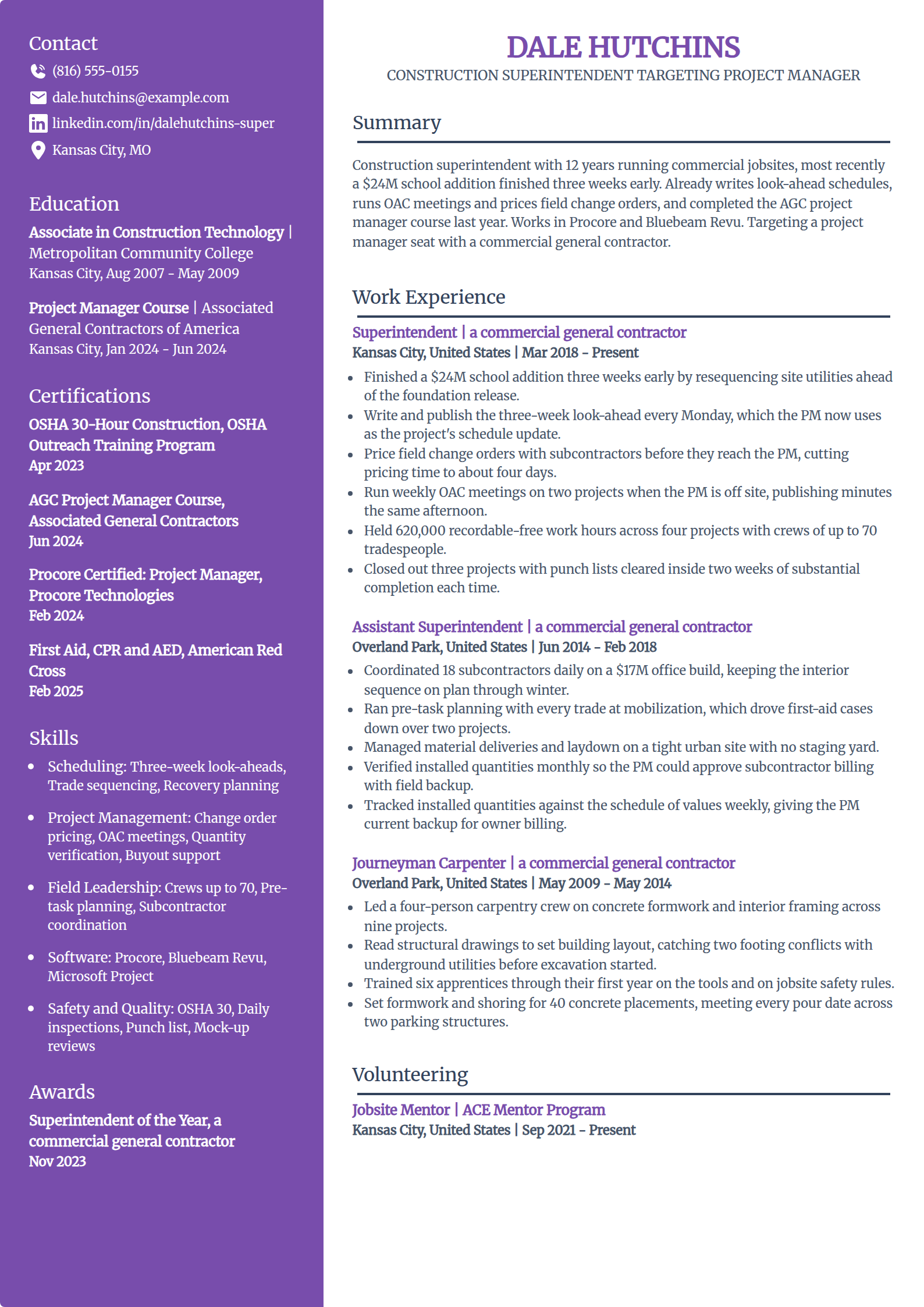
Superintendent to Project Manager Resume Template
Why this resume example works?
- Leads with the PM work already being done under a field title: look-aheads, OAC meetings and change order pricing.
- Proves the schedule claim, three weeks early on a $24M school addition, with the resequencing that produced it.
- Shows the coursework that closes the credibility gap, the AGC project manager course finished last year.
- Keeps the safety record visible, 620,000 recordable-free hours, which is a superintendent's strongest asset.
- Does not claim the contract or the budget, only the work genuinely owned, which is what survives a reference check.
Project Engineer to Project Manager Resume Template
Why this resume example works?
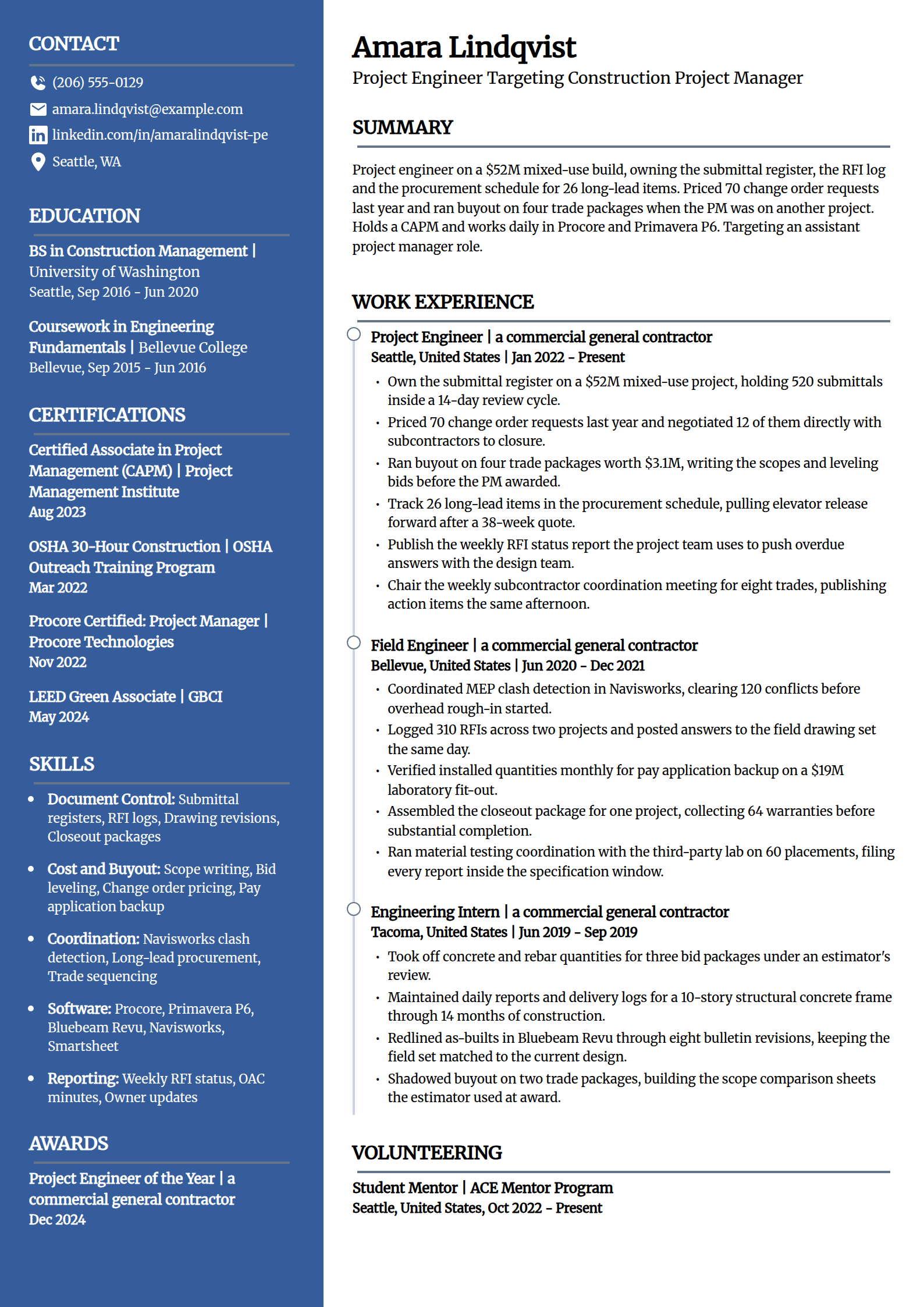
- Shows the step up in plain terms: buyout on four packages worth $3.1M when the PM was on another job.
- Puts a number on the document control most project engineers describe vaguely, 520 submittals inside a 14-day cycle.
- Adds negotiation experience, 12 change orders settled directly with subcontractors, which is the PM skill in question.
- Names the CAPM, the credential that fits this stage better than an early PMP attempt.
- Targets assistant project manager rather than PM, which reads as someone who understands the ladder.
General Contractor Project Manager Resume Template (Self-Perform)
Why this resume example works?
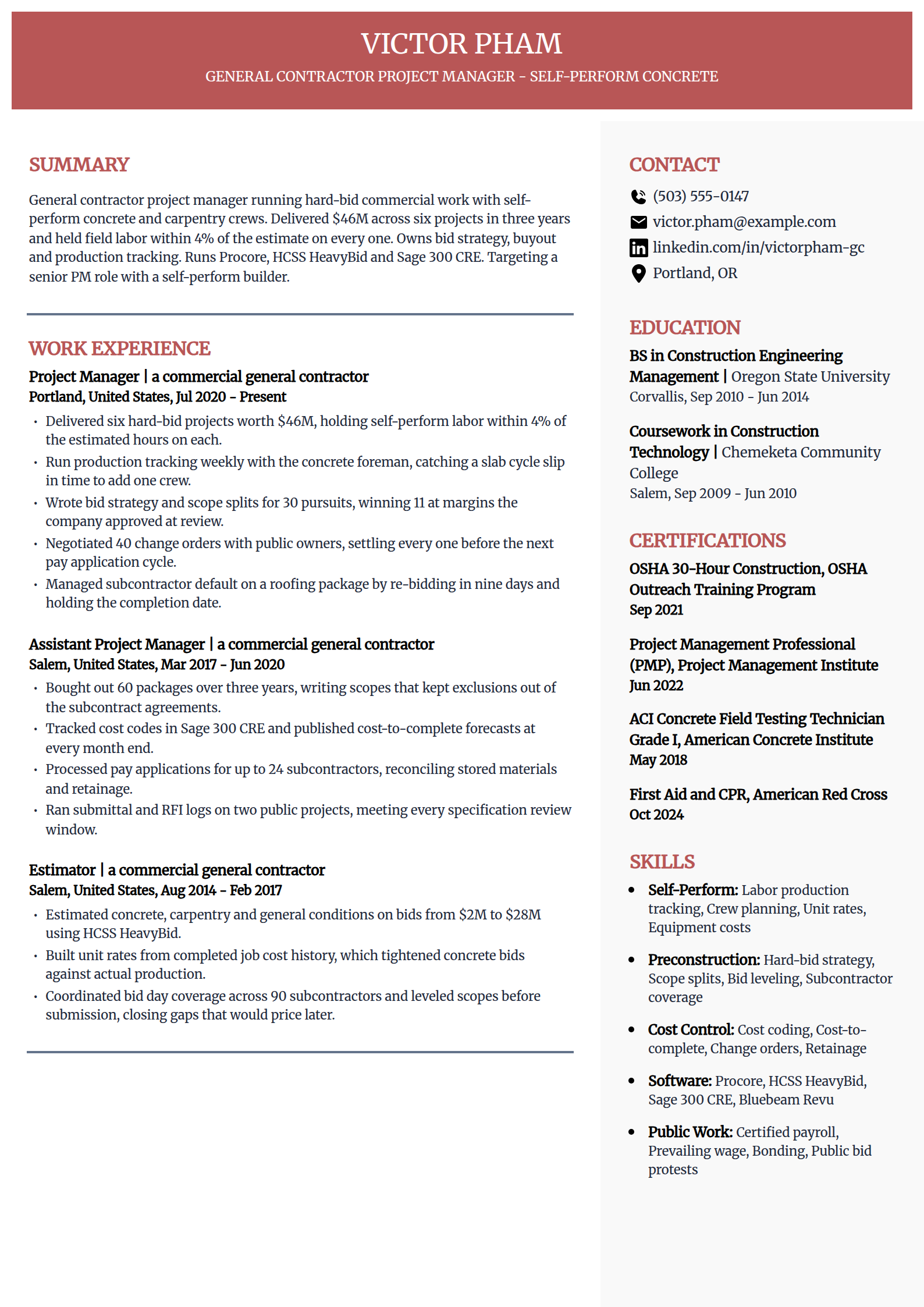
- Names the thing that makes a self-perform PM different: labor held within 4% of the estimated hours.
- Covers the bid side as well as the build side, 30 pursuits priced and 11 won at approved margins.
- Shows a recovery story with a clock on it, a defaulted roofing package re-bid in nine days with the date held.
- Lists public work requirements, certified payroll and prevailing wage, which hard-bid contractors screen for.
- Keeps estimating history on the page, since unit rates built from job cost history are a hiring argument on their own.
Career Change Into Construction Project Management Resume Template
Why this resume example works?
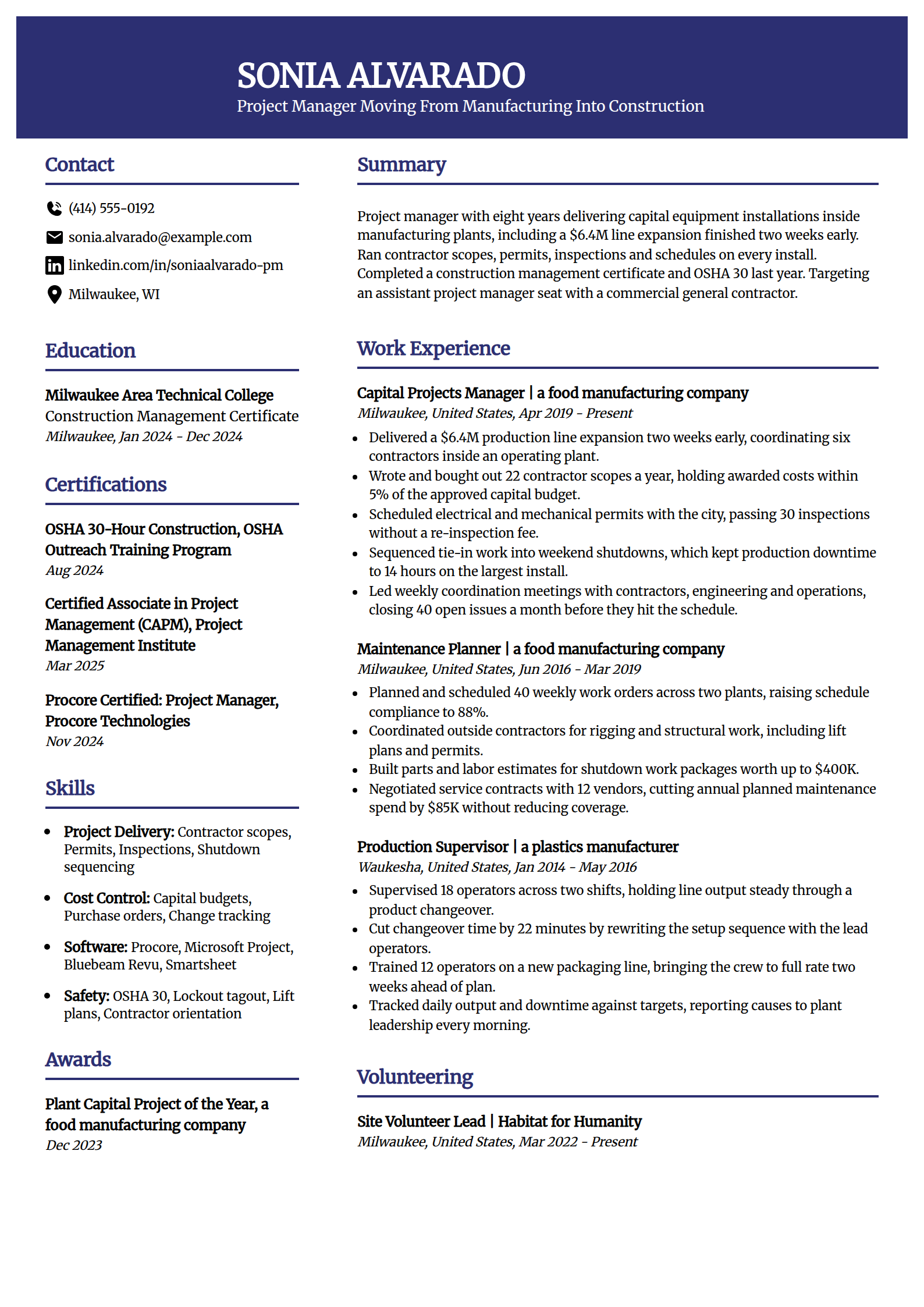
- Translates the old job into construction terms: contractor scopes, permits, inspections and shutdown sequencing.
- Leads with a capital project delivered two weeks early, so the first line is a build result and not a career story.
- Shows the deliberate bridge, a construction management certificate and OSHA 30 completed in the last year.
- Uses a downtime number, 14 hours on the largest tie-in, which reads as real coordination under pressure.
- Asks for assistant project manager, the honest next step, which makes the whole resume more believable.
PMP-Certified Construction Project Manager Resume Template
Why this resume example works?
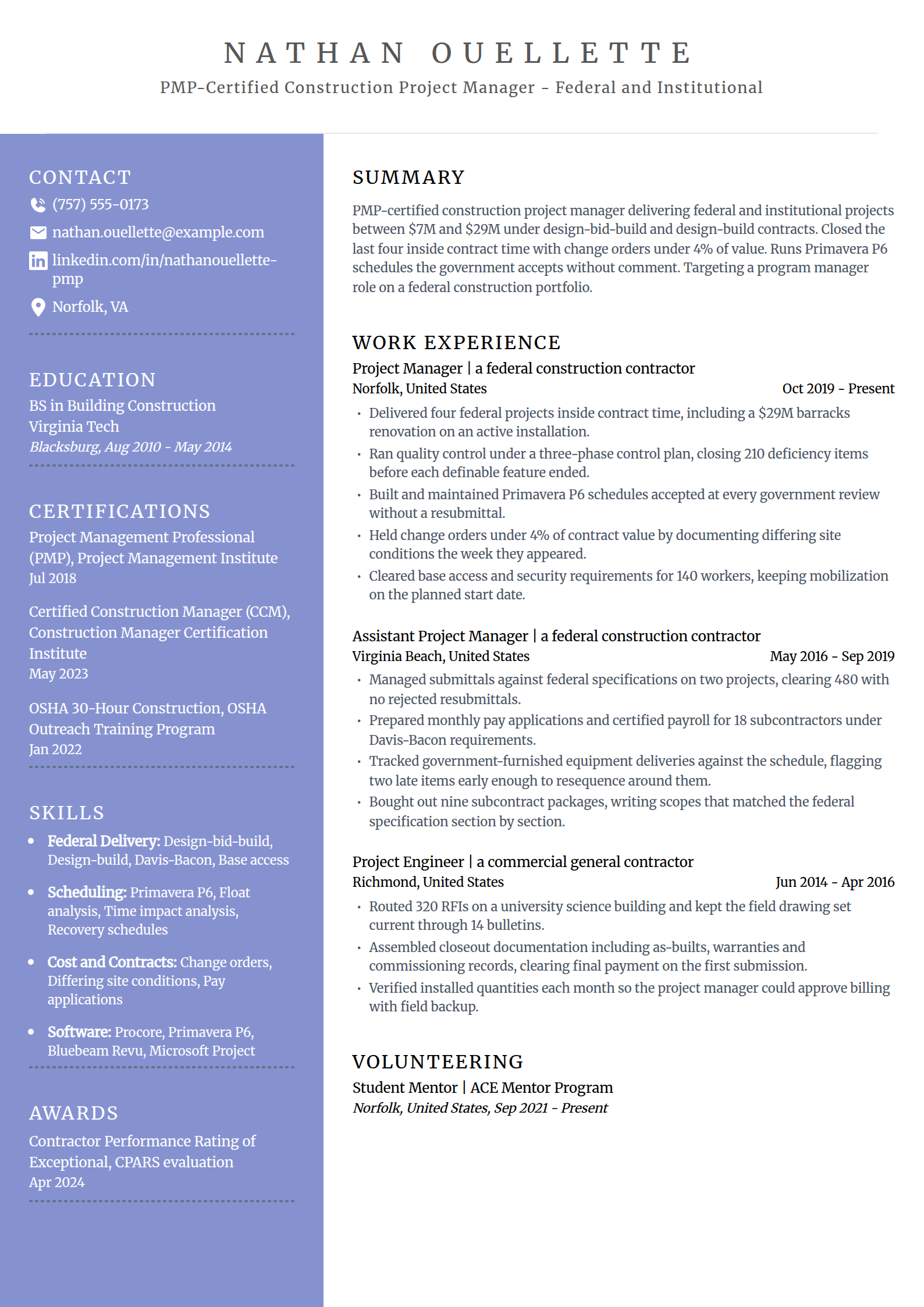
- Puts the PMP and CCM where a screener finds them in two seconds, then backs both with delivery results.
- Shows the schedule credibility a federal owner cares about: P6 schedules accepted with no resubmittal.
- Names the contract vehicles outright, design-bid-build and design-build, instead of saying government experience.
- Includes the administrative work federal jobs live on, certified payroll and Davis-Bacon compliance for 18 subcontractors.
- Uses a base access number, 140 workers cleared, to prove mobilization was managed and not just attended.
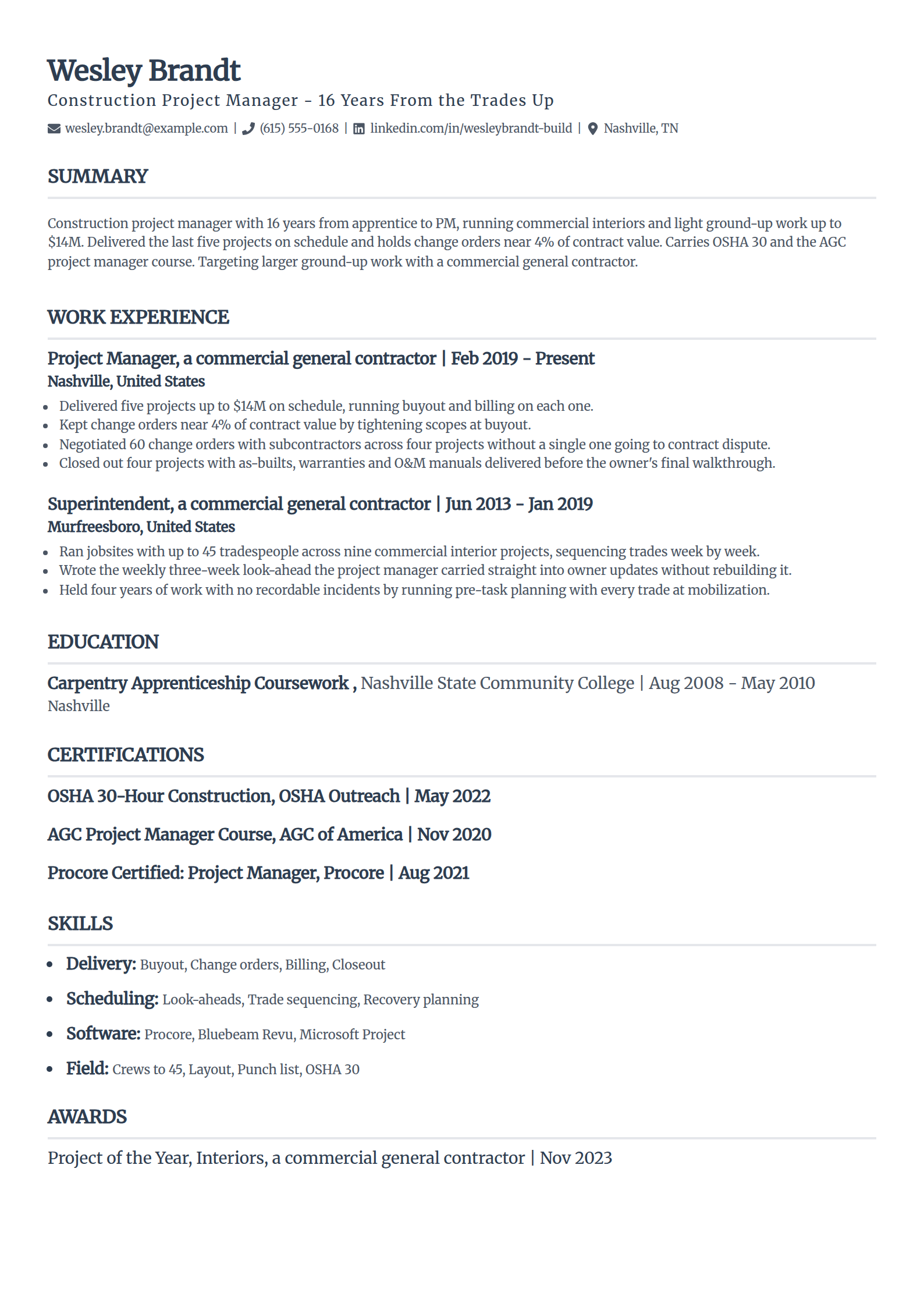
Construction Project Manager Resume Template (No Degree)
Why this resume example works?
- Leads with 16 years from apprentice to PM, which makes the path itself the qualification.
- Keeps the credential line strong with OSHA 30 and the AGC project manager course, so the education section is never the first thing read.
- Shows delivery on five projects up to $14M, enough size to answer the scope question directly.
- States a change order figure near 4% rather than a vague claim about controlling costs.
- Puts the superintendent years to work as evidence of crew leadership, not as filler history.
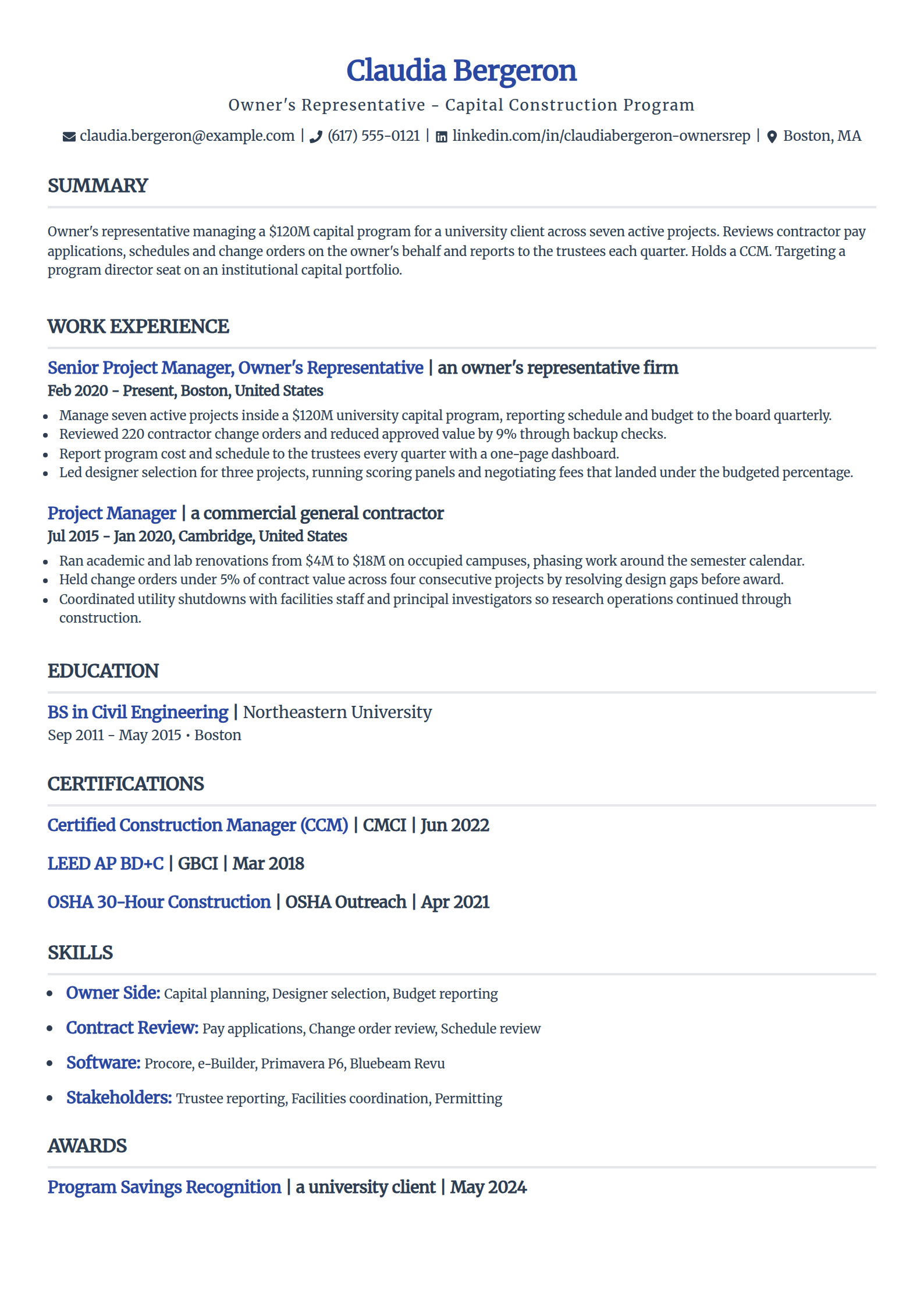
Owner's Representative Resume Template (Client-Side Construction)
Why this resume example works?
- Reframes the job from building to protecting the owner: change orders reviewed, schedules checked, money defended.
- Gives the number that matters on this side of the table, approved change order value reduced by 9% through backup checks.
- Shows program scale, seven active projects inside a $120M capital plan, rather than one project's budget.
- Names governance work a trustee-facing role requires, including quarterly reporting and designer selection panels.
- Keeps contractor-side experience visible, which is what makes an owner's rep hard to argue with in a meeting.
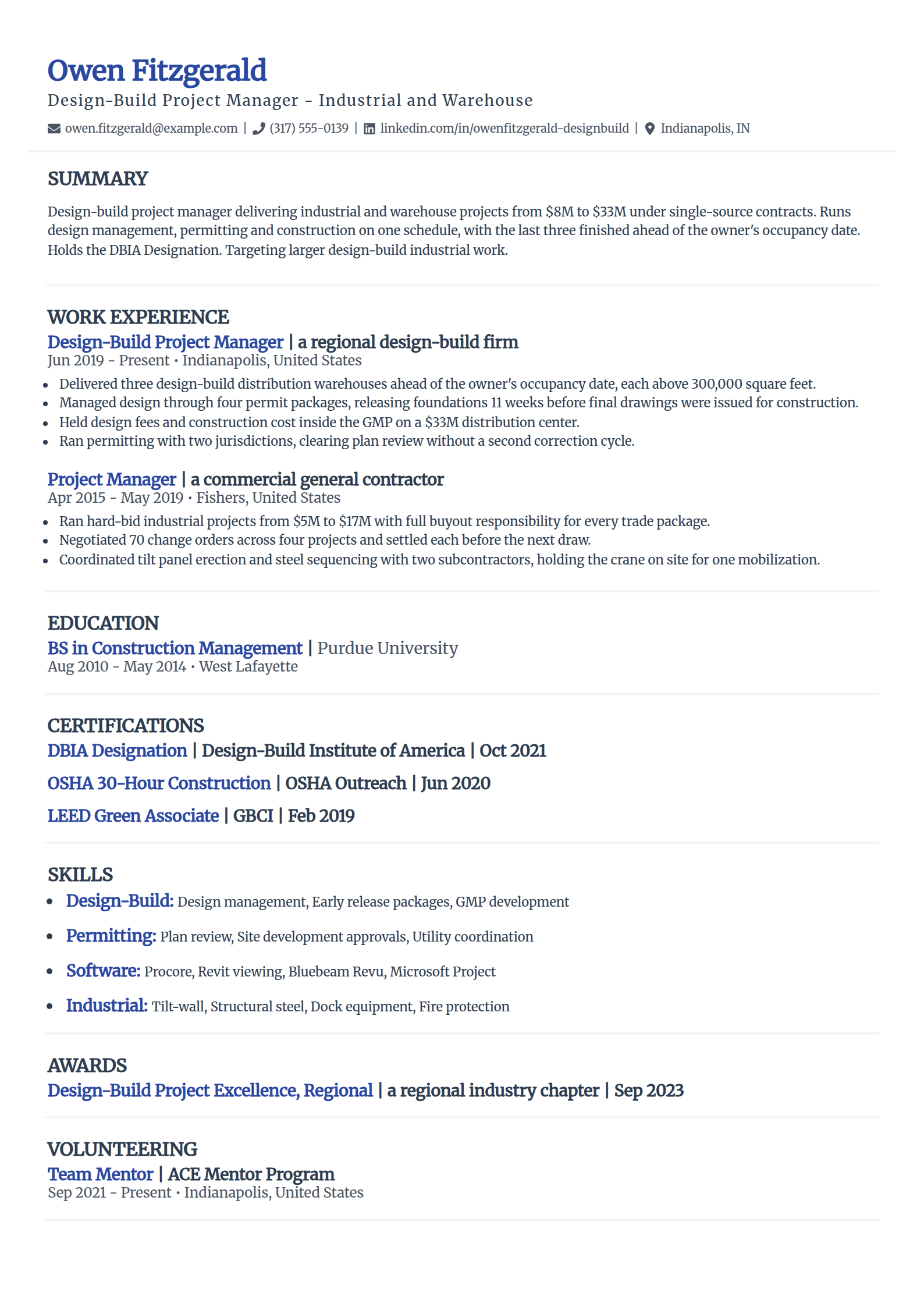
Design-Build Project Manager Resume Template
Why this resume example works?
- Shows the skill design-build actually pays for: releasing foundations 11 weeks before final drawings.
- Carries the DBIA Designation, the credential this delivery method screens on.
- States cost control in GMP terms, design fees and construction held inside the guaranteed price.
- Includes permitting as a managed activity, plan review cleared without a second correction cycle.
- Keeps hard-bid history on the page, so the candidate reads as fluent in both delivery methods.
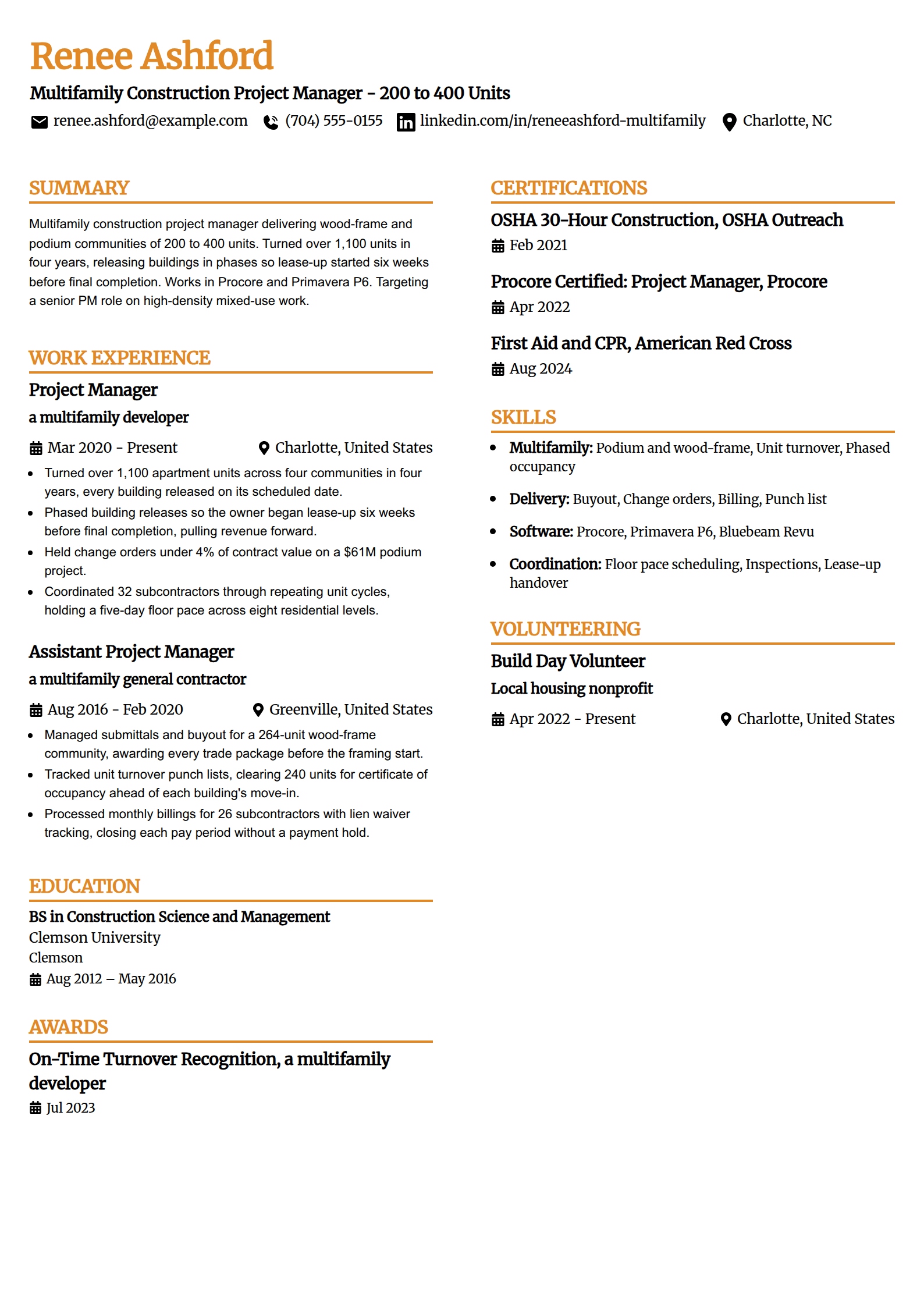
Multifamily Construction Project Manager Resume Template
Why this resume example works?
- Counts units, 1,100 turned over in four years, which is the only scope number multifamily developers use.
- Shows phased occupancy, lease-up starting six weeks before final completion, the result a developer is paying for.
- Names the production rhythm, a five-day floor pace across 32 subcontractors, which proves real repetition experience.
- Keeps a change order percentage attached to a specific project rather than floating across a career.
- Covers the unglamorous close, unit punch lists cleared for certificate of occupancy building by building.
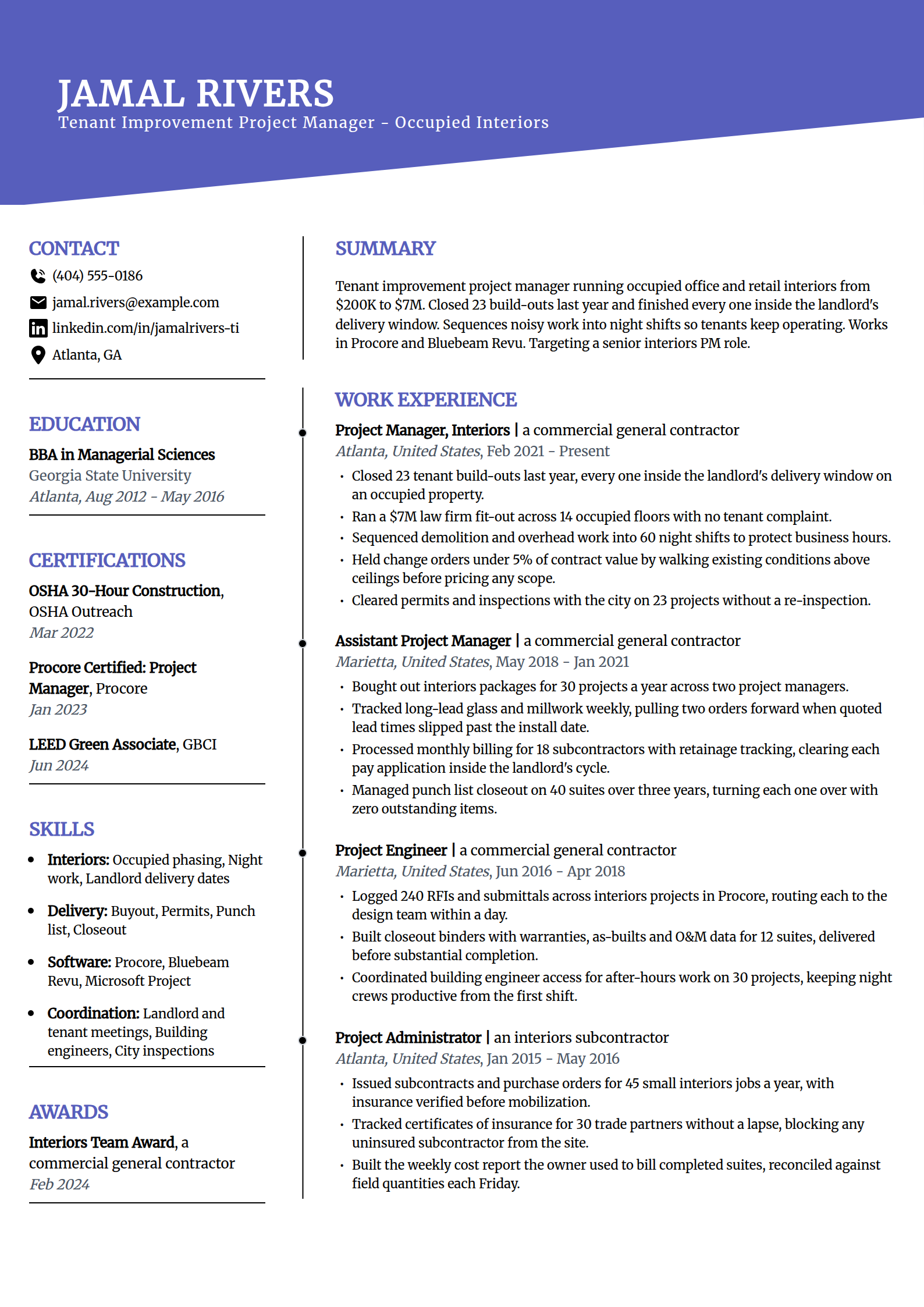
Tenant Improvement Project Manager Resume Template (Occupied Interiors)
Why this resume example works?
- Uses volume as the headline, 23 build-outs closed last year, because interiors work is judged on throughput.
- Shows the landlord relationship in one metric, every project inside the delivery window.
- Names the occupied-space craft, 60 night shifts sequenced so tenants kept working, which general contractors hire for.
- Ties change order control to a real habit: walking existing conditions before pricing the scope.
- Puts permits and inspections on the page, since a re-inspection on an interiors job costs the schedule directly.
Build your construction project manager resume
Pick a template above and the editor keeps your layout clean and ATS-safe while you swap in your own contract values, schedule results and change order numbers.
Build my resumeHow to write a construction project manager resume in 2026
A construction director scans your first three lines for contract value and whether your projects finished on time. If those are not there, nothing further down rescues the page. Put them in the summary, make every experience bullet a result with one number behind it, and keep the format plain enough for an applicant tracking system to read.
Open with contract value, sector and your delivery record
Three to four sentences. Name the size range of the projects you run, the sector you run them in, how they finished against contract dates, and one cost control number such as change orders as a percent of contract value. Then name the software a posting lists and the role you are targeting. If you do not hold a PM title yet, write an objective of two to three sentences instead, and still open with the project work you have done rather than the job you want.
Construction project manager running commercial ground-up work between $12M and $38M, with the last four projects delivered on or ahead of the contract date. Holds change orders under 4% of contract value and closes RFIs in three days on average. Works daily in Procore, Primavera P6 and Bluebeam Revu. Targeting a senior PM seat with a regional general contractor.
Use the numbers your sector is actually measured on
Construction measures everything, and a PM resume without numbers reads as though the candidate never held a budget. Use the set that matches your sector and rung, not the largest figure you can find.
- Every sector: contract value, schedule result against the contract date, change orders as a percent of value, subcontractor count, and safety record.
- Commercial: general conditions as a percent of value, RFI and submittal turnaround, value engineering captured, and certificate of occupancy dates.
- Residential and multifamily: homes or units closed, build cycle in days, cost variance per home, inspection pass rate, and phased occupancy dates.
- Heavy civil: bid item quantities, production per season, pay estimate accuracy, contract time used, and claims recovered for differing site conditions.
- One number per bullet, and keep it level-accurate. An assistant PM shows package values and turnaround, not the project's whole budget.
Make experience bullets results, not scope-of-work lines
Say what changed, attach one number, and name the action that caused it. That last part is what separates a PM who ran a good job from one who made it good.
- Open with a verb like delivered, negotiated, recovered, bought out, resequenced or closed out, never "Responsible for" or "Oversaw".
- Pair the schedule with the cost. "Finished four weeks early" is half the story; finishing early while holding change orders at 3.6% is the whole job.
- Say how, briefly. "Cut RFI turnaround from nine days to three by running a standing design call" beats the same number with no method behind it.
- Count the coordination work: packages bought out, submittals cleared, clashes resolved before rough-in. That is the day job, and most resumes skip it.
Name your software and credentials where a screener sees them
Construction postings list software and certifications by name, and matching that language is the whole of the ATS advice worth giving.
- Project and document control: Procore, Autodesk Build, PlanGrid, Bluebeam Revu, Smartsheet. Say which one you actually run the job in.
- Scheduling: Primavera P6 or Microsoft Project. If you build and update the schedule yourself rather than reading one, say so.
- Cost and accounting: Sage 300 CRE, Viewpoint Vista, HCSS HeavyBid and HeavyJob for heavy civil, Buildertrend for residential.
- Credentials worth their line: PMP, CCM, CAPM, DBIA Designation, LEED AP BD+C, and OSHA 30-Hour Construction, which many postings treat as a filter.
Formatting and length
One page through senior PM. Two pages only when the second page is a project list a director would genuinely read, with value, sector, delivery method and result for each job.
- Use a single-column layout with standard headings. Heavy graphics and side columns make a resume harder to read and harder to parse.
- Put contract value and sector in the job title line or the first bullet of each role so nobody hunts for scope.
- Compress older field roles to two or three lines. A senior PM's carpenter years need one line, not five.
- Add a project list only if it earns space. Ten lines of jobs with values and outcomes beats a second page of duties.
Honestly: the title matters less than the scope you can prove
Plenty of general contractors will take a superintendent who wrote the look-aheads and priced the field changes over a PM who sat between an owner and an estimator without owning either side. If you ran the schedule, say which projects and how they finished. If you bought out packages, give the count and the value. The one thing not to do is claim a contract you did not hold, because the first reference call unravels it, and in an industry this small the call always happens.
Common construction project manager resume mistakes
- Leaving out contract value. "Managed commercial construction projects" tells a director nothing; "$12M to $38M ground-up, four of four on schedule" tells them which jobs to put you on.
- Listing the scope of work instead of results. Replace "oversaw subcontractors and schedules" with "delivered a $34M medical office building four weeks early by pulling steel and MEP into an earlier release".
- Claiming schedule wins with no cost number beside them. Finishing early on the back of change orders is not a win, and an experienced reader knows to ask.
- Claiming a budget you did not own. An assistant PM who lists the project's full contract value as their own result fails the first reference check; claim buyout, submittals, RFI turnaround and billing instead, which are genuinely yours.
- Using one resume for every sector. A heavy civil reader wants bid items and contract time, a multifamily developer wants units and turnover dates, a commercial owner wants general conditions and occupancy. Reorder your numbers to match the posting.
Frequently asked questions
What should a construction project manager resume include?
Contract value and delivery record first: the size range of projects you run, the sector, and how they finished against contract dates. Then a summary of three to four sentences carrying those numbers, experience bullets that each state a result with one number and the method behind it, a skills block split into project controls, cost and contracts, software and field coordination, and a certifications block for PMP, CCM, LEED or OSHA 30. Keep it to one page unless a second page is a real project list.
How do I write a construction project manager resume with no project manager experience?
Lead with the project management work you already do under another title. Superintendents write look-aheads, run OAC meetings and price field changes. Project engineers own submittal registers, RFI logs and procurement schedules. Both are PM duties, and both are usually buried at the bottom of the resume. Put a number on each one: packages bought out, submittals cleared, days recovered. Use an objective of two to three sentences, name the role you are targeting, and do not claim a contract or a budget you did not hold.
What skills and software do construction project managers put on a resume?
Split them so a screener can find what the posting asked for. Project controls: CPM scheduling, three-week look-aheads, cost coding and forecasting. Cost and contracts: buyout, subcontract scope writing, change orders, AIA G702 and G703 pay applications, lien waivers, value engineering. Software: Procore, Autodesk Build or PlanGrid, Bluebeam Revu, Primavera P6, Microsoft Project, and the accounting system you actually use, such as Sage 300 CRE or Viewpoint Vista. Field coordination: OAC meetings, clash reviews, inspections, punch list and closeout.
How long should a construction project manager resume be?
One page through senior project manager. Go to two only when the second page is a project list a director would genuinely read, with value, sector, delivery method and outcome for each job. Compress older field roles to two or three lines and cut anything that is not a result, and most PMs fit on one page comfortably. Length is not the thing being judged. A reader deciding whether you can carry a $30M job wants the contract values and the delivery record, and a second page of duties actively hides them.
Do you need a PMP or CCM on a construction project manager resume?
Neither is required, and both help in specific places. The PMP travels well and shows up as a preference on institutional and federal postings. The CCM, from the Construction Manager Certification Institute, is the one owner's representative and program management firms recognize. For most general contractor roles, OSHA 30 plus a delivery record beats either of them. If a posting names a credential, put it in the top third of the page. If you are working toward one, list it as in progress with the exam date rather than implying you hold it.
What is the difference between a construction superintendent and a project manager resume?
Where the work sits. A superintendent resume is built on the field: crew size, trade sequencing, daily coordination, safety hours, and quality in place. A project manager resume is built on the contract: contract value, buyout, change orders, pay applications, schedule against contract dates, and the owner relationship. If you are moving from super to PM, keep your field record but bring forward the contract-side work you already do, the look-aheads you write, the change orders you price, and the owner meetings you run when the PM is off site.
More construction project manager resume resources
Build your construction project manager resume
Pick a template above and the editor keeps your layout clean and ATS-safe while you swap in your own contract values, schedule results and change order numbers.