Laborer to Foreman: 17 Construction Resume Templates and Examples
- ATS Friendly
- Certification First
- 17 Trades and Levels
A construction worker resume needs four things a contractor checks in about twenty seconds: the trades you can actually work, your OSHA card and any trade certifications, results with real numbers behind them, and the practical side, your own tools and a record of showing up. Every example below is built that way, split by trade and by rung, from a first laborer job with no experience to a foreman running a 28-person crew.


540k+ resumes created
Construction resume templates for every trade on the crew
Each template below is a real construction resume laid out in that format, covering laborer, helper, apprentice, carpenter, framer, concrete, roofing, masonry, drywall, painting, demolition, underground utility, union and foreman work. Pick one, then swap in your own certifications, trades and numbers. Every layout keeps your name, OSHA card and trade experience readable, so a superintendent finds what they need at a glance and an applicant tracking system parses it cleanly. Simple beats decorated here: skip heavy graphics and color blocks, which help nobody on a jobsite hire.
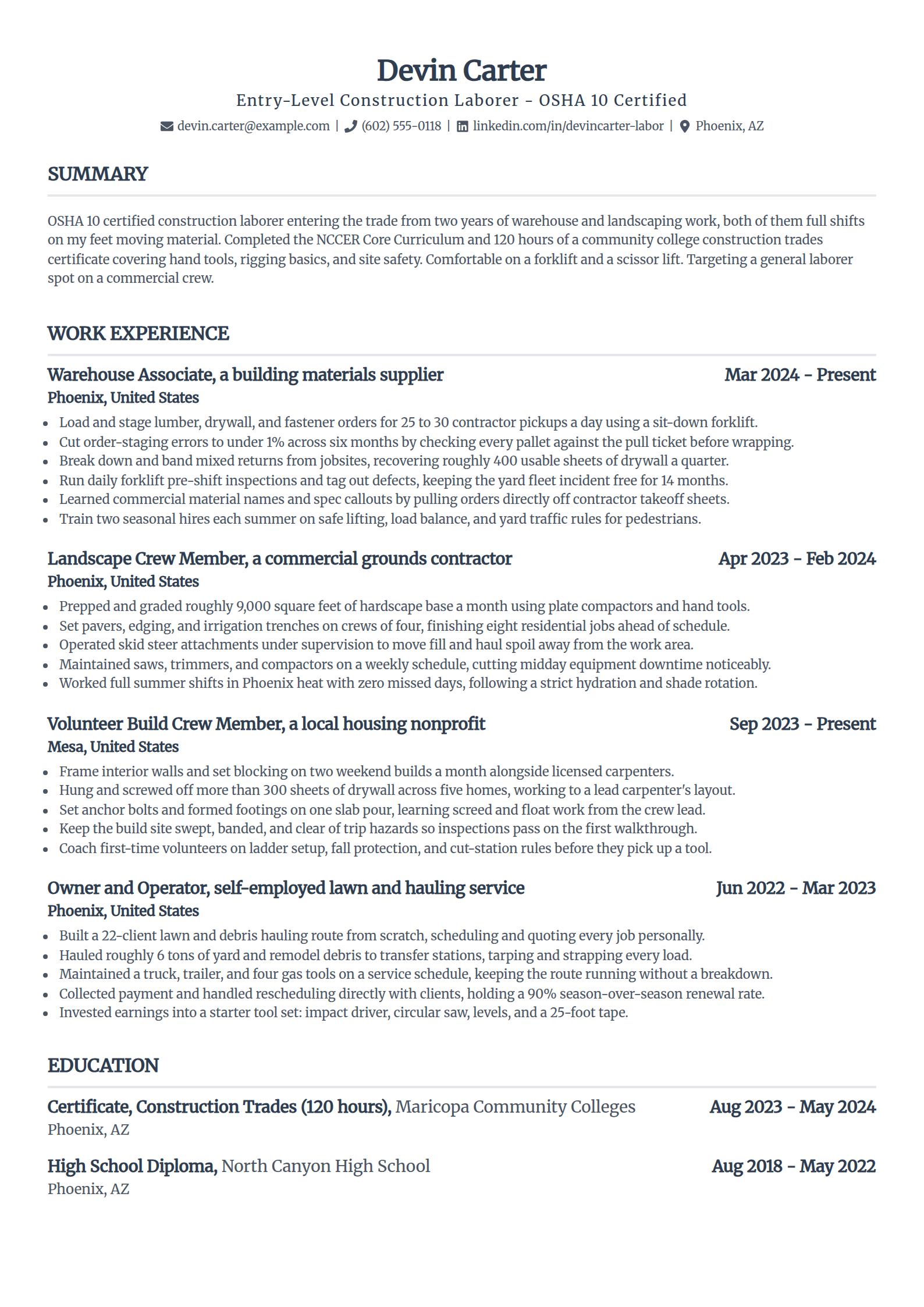
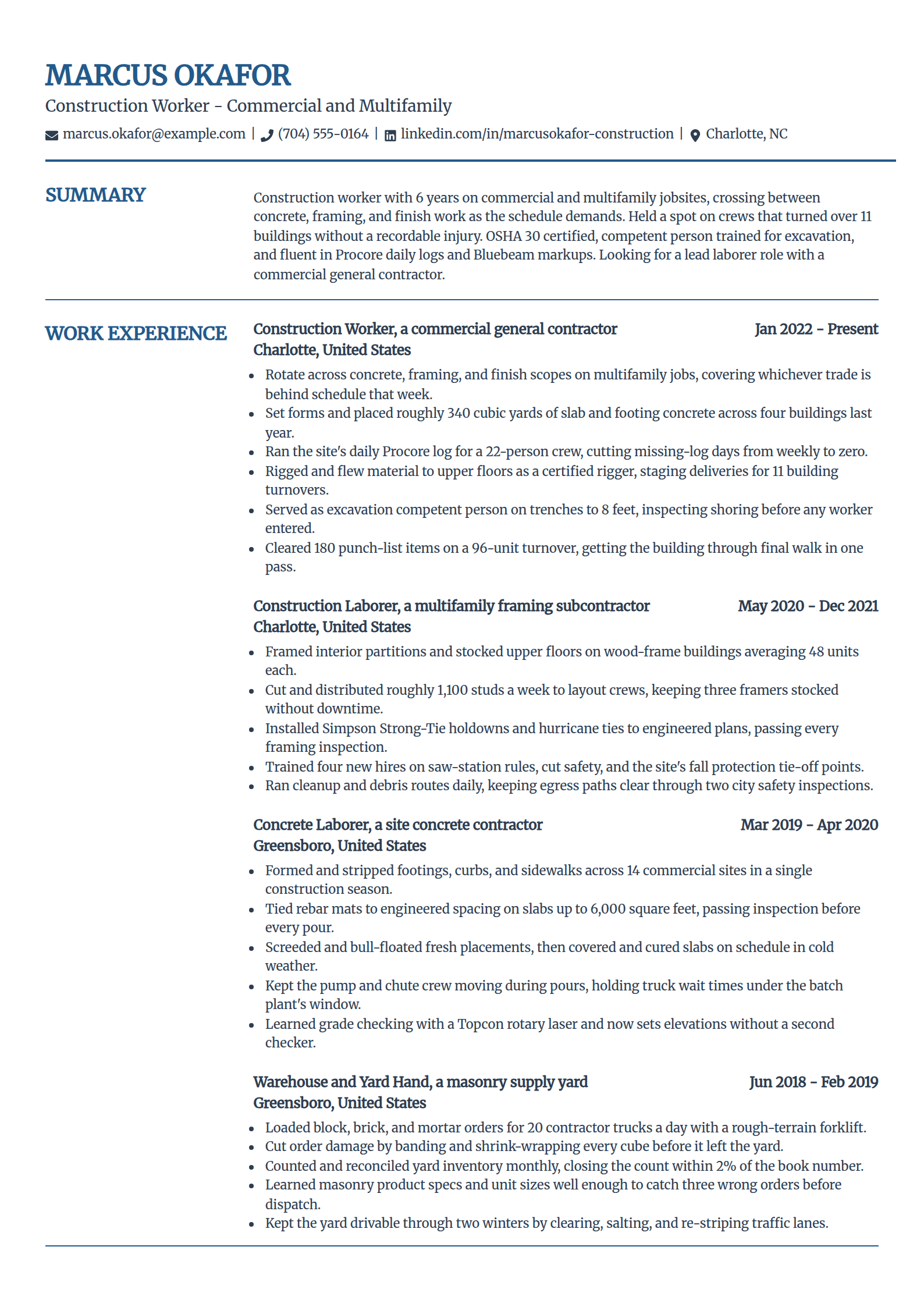
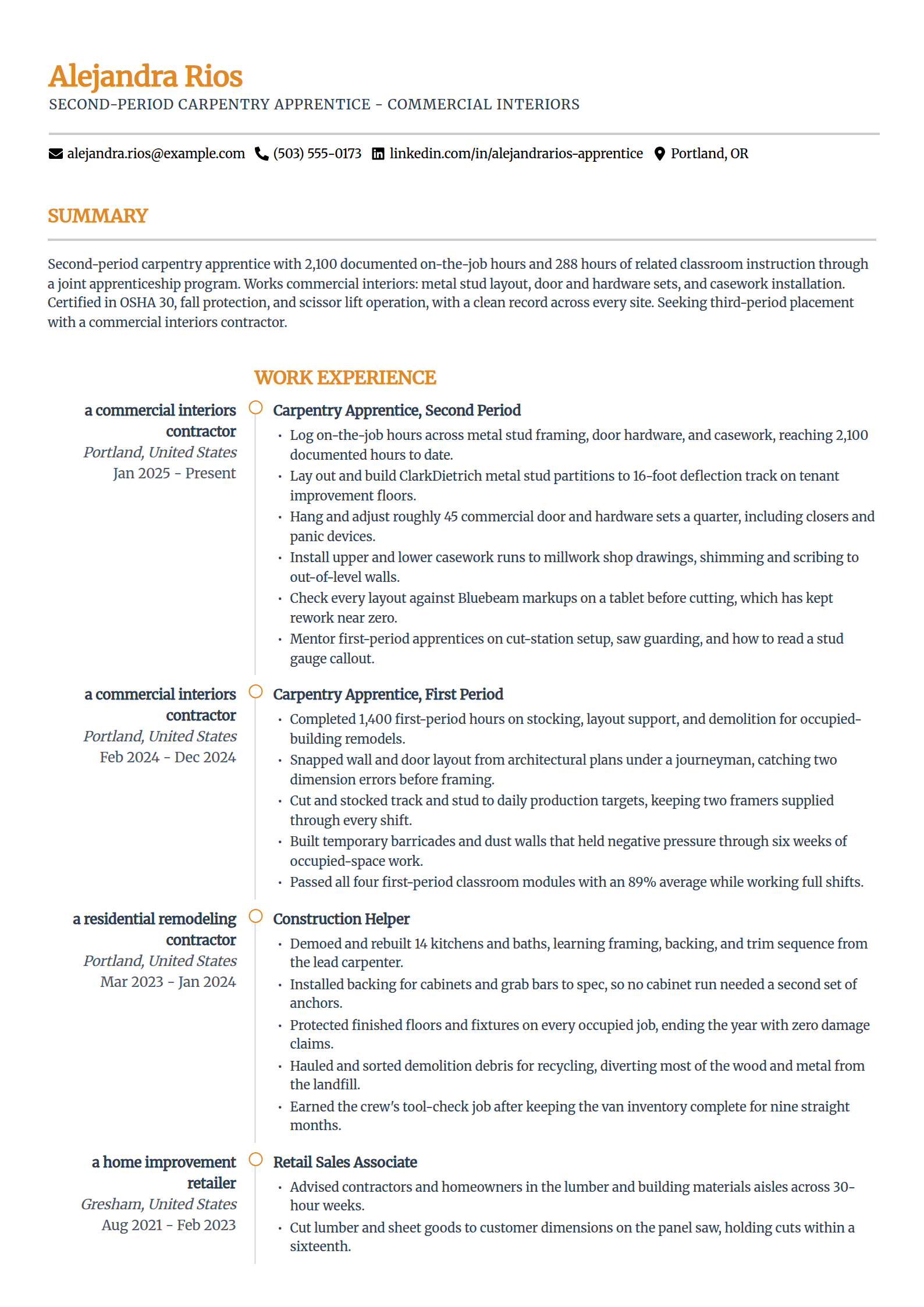
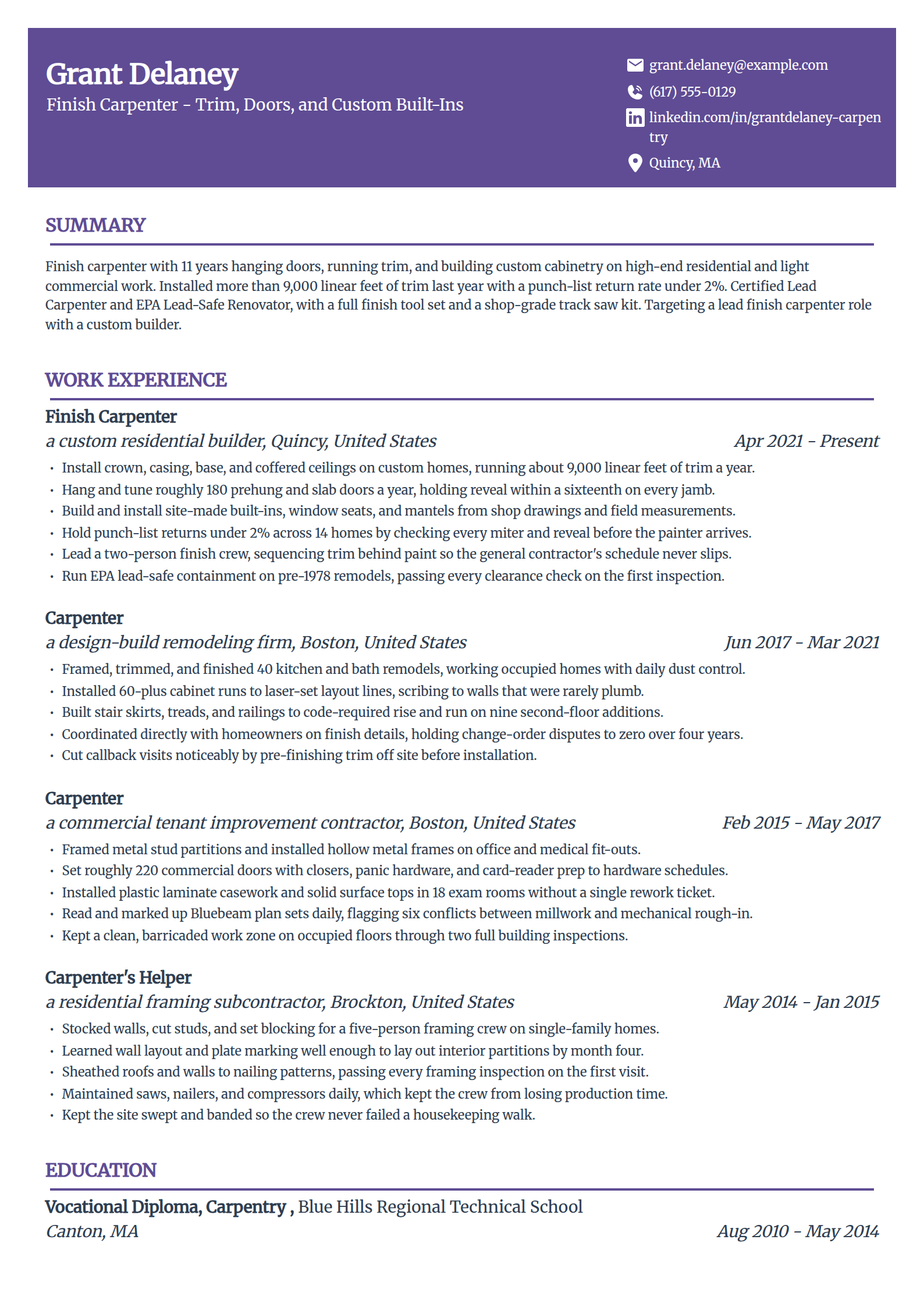
Entry-Level Construction Worker Resume Template (No Experience)
Why this resume example works?
- Says up front what a contractor needs to hear from someone with no construction jobs yet: OSHA 10 certified, NCCER Core done, 120 hours of trade school.
- Uses work that counts as construction-adjacent, warehouse and landscaping, and describes it in jobsite terms like material handling, grading and compactors.
- Turns a volunteer build crew into real experience by naming the tasks, framing interior walls and hanging more than 300 sheets of drywall.
- Shows reliability the way a foreman measures it: zero missed days through a Phoenix summer, and a self-run hauling route with 22 clients.
- Uses a clean, single-column layout an applicant tracking system reads without trouble.
General Construction Worker Resume Template
Why this resume example works?
- Leads with the thing that makes a multi-trade worker valuable: 6 years crossing between concrete, framing and finish work as the schedule demands.
- Backs the range with numbers per trade, roughly 340 cubic yards of concrete placed and 1,100 studs a week cut and distributed.
- Names the credentials a commercial general contractor screens for, OSHA 30, excavation competent person and NCCCO Rigger Level I.
- Shows jobsite software that a superintendent cares about, running the daily Procore log for a 22-person crew.
- Closes on a turnover result anyone in commercial work understands, 180 punch-list items cleared in one pass.
Construction Apprentice Resume Template
Why this resume example works?
- Opens with the two numbers an apprenticeship coordinator verifies, 2,100 documented on-the-job hours and 288 hours of classroom instruction.
- States the period plainly, second period moving to third, so a contractor knows the pay rate and the supervision level before calling.
- Names the actual scopes worked, metal stud layout, door and hardware sets and casework, instead of the vague "assisted journeymen".
- Carries the classroom record where it helps, an 89% average across modules while working full shifts.
- Shows early leadership that reads as real, mentoring first-period apprentices on cut-station setup and stud gauge callouts.
Carpenter Resume Template (Finish and Trim)
Why this resume example works?
- Measures finish work the way finish work is measured, about 9,000 linear feet of trim and 180 doors a year.
- Puts the quality number where a custom builder looks, punch-list returns held under 2% across 14 homes.
- Names the credential that separates a lead from a hand, NARI Certified Lead Carpenter, plus EPA Lead-Safe Renovator for pre-1978 work.
- Lists the tool set, a track saw and shop-grade kit, because plenty of finish postings screen for tools the candidate owns.
- Shows both sides of the trade, custom residential trim and commercial hollow metal doors and casework.
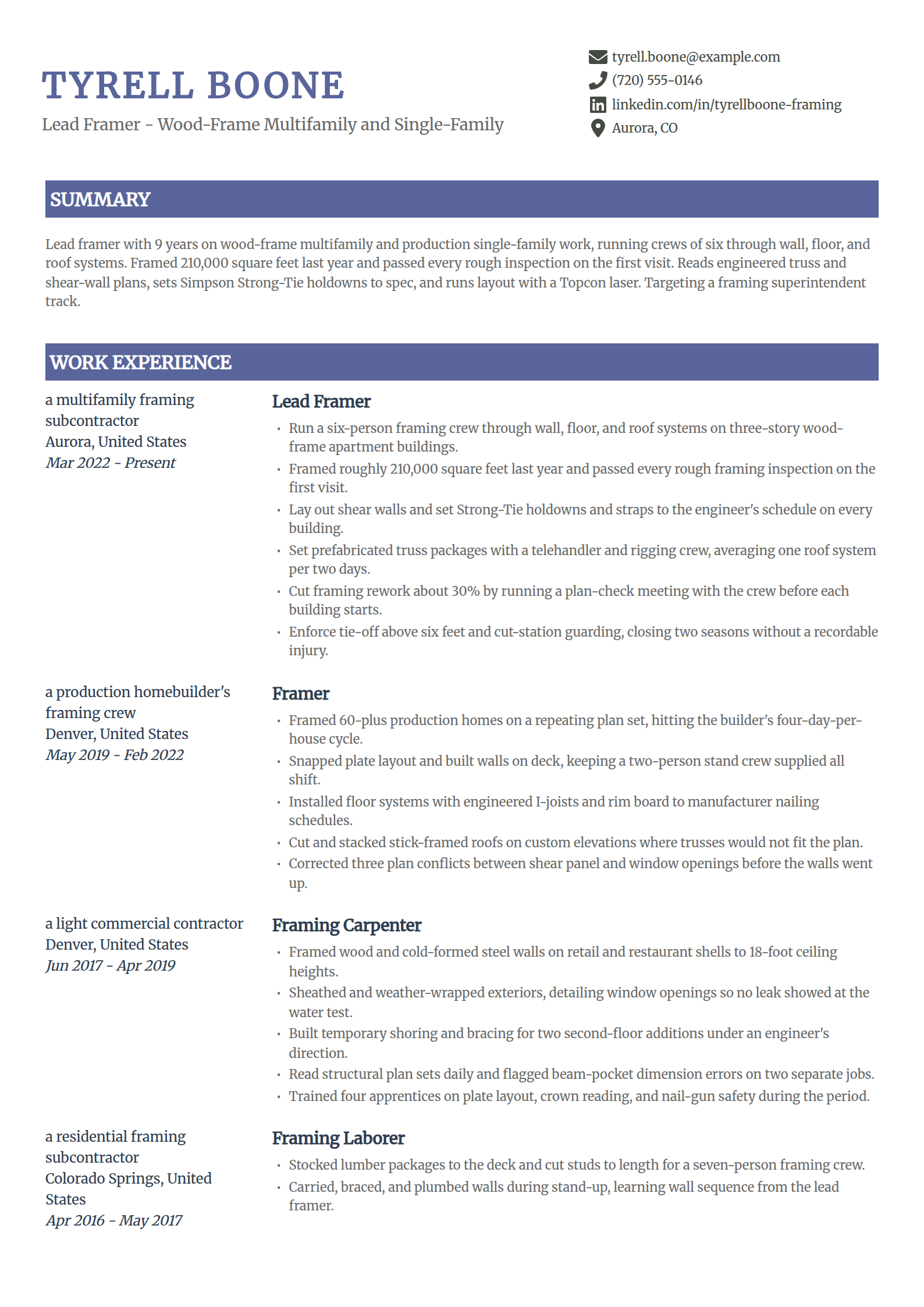
Framer Resume Template (Rough Carpentry)
Why this resume example works?
- Uses the unit framers get paid on, roughly 210,000 square feet framed in a year across three-story wood-frame buildings.
- Leads the inspection record, every rough framing inspection passed on the first visit, which is what a builder's schedule depends on.
- Names structural specifics a superintendent tests you on, shear wall layout and Simpson Strong-Tie holdowns set to the engineer's schedule.
- Shows crew leadership with the detail that proves it, a plan-check meeting before each building that cut rework about 30%.
- Separates production framing from custom and light commercial work, so a hiring contractor can match you to their job type.
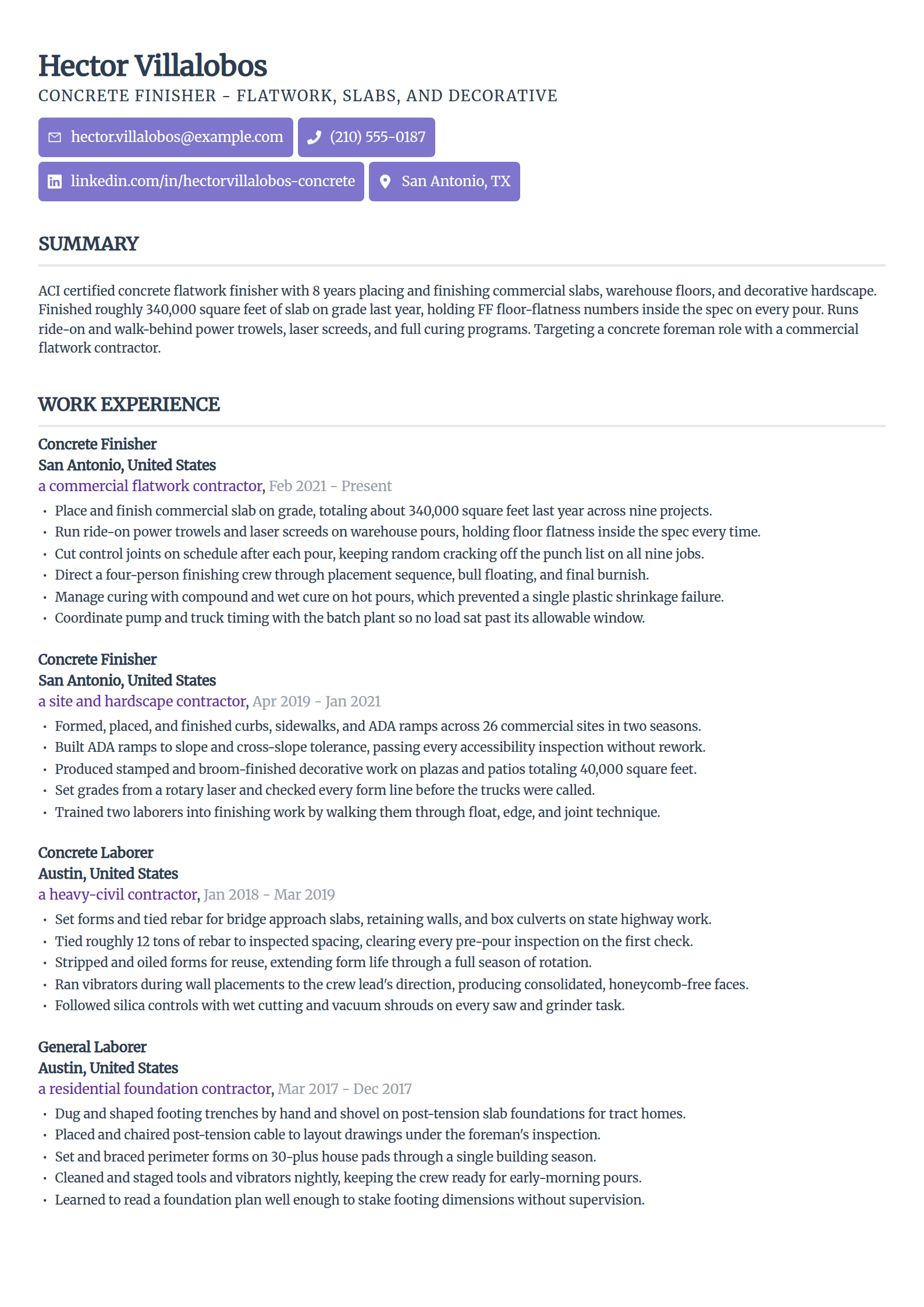
Concrete Finisher Resume Template
Why this resume example works?
- Opens with the certification that matters in flatwork, ACI Concrete Flatwork Finisher, next to 340,000 square feet placed last year.
- Names the quality standard a warehouse spec actually contains, floor flatness held inside the spec on every pour.
- Shows the timing judgment that separates a finisher from a laborer, control joints cut on schedule with no random cracking on nine jobs.
- Covers the decorative side too, stamped and broom finishes across 40,000 square feet of plazas and patios.
- Includes ADA ramp work passing accessibility inspection, which is a frequent source of costly rework.
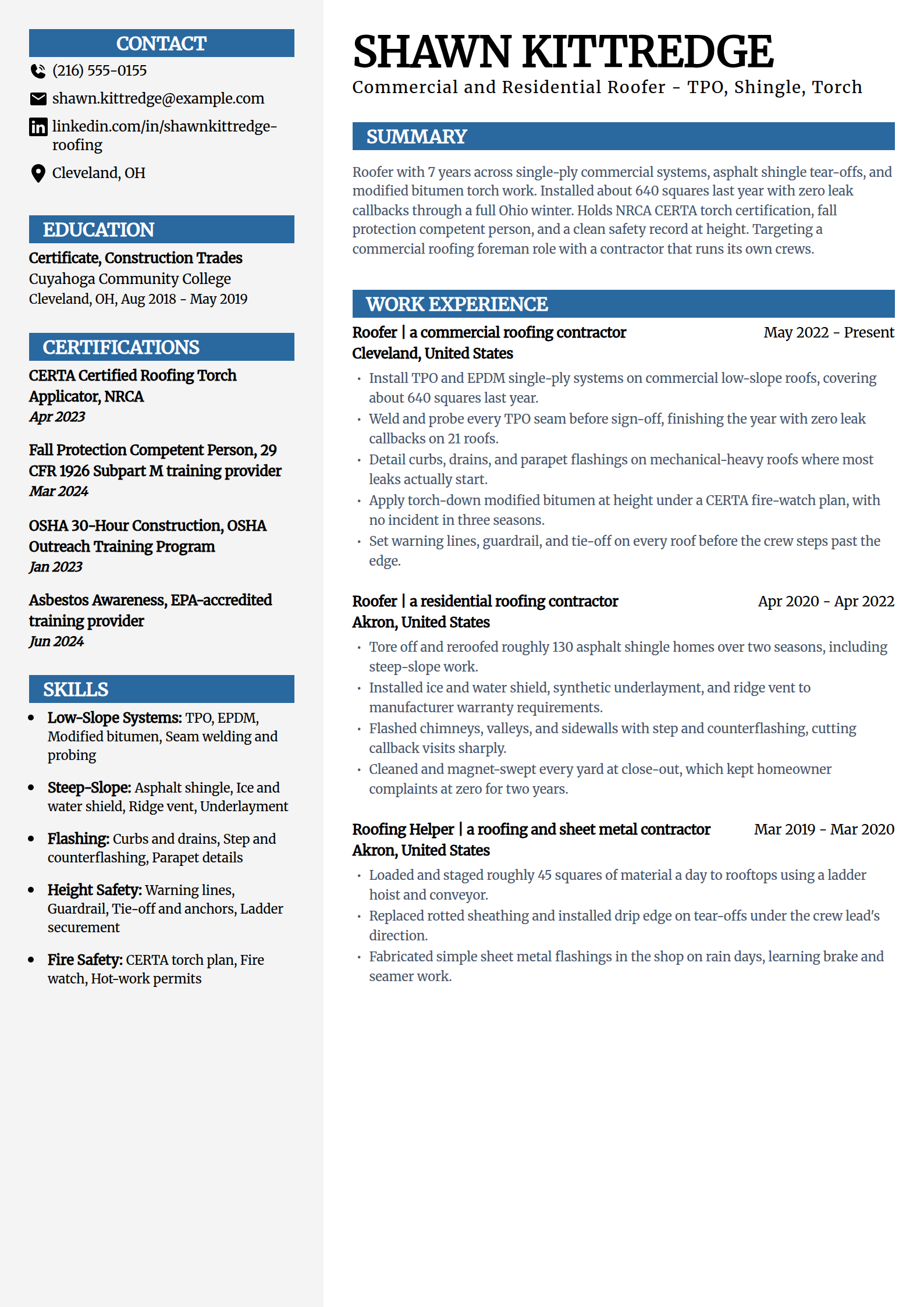
Roofer Resume Template
Why this resume example works?
- Counts in squares, the unit roofing contractors bid in, about 640 installed last year across 21 commercial roofs.
- Puts the result an owner remembers first, zero leak callbacks through a full Ohio winter.
- Names all three system families in one resume, TPO and EPDM single-ply, asphalt shingle, and torch-down modified bitumen.
- Carries the credential a commercial roofer is asked for by name, NRCA CERTA torch certification with a fire-watch plan.
- Details the flashing work where leaks actually start, curbs, drains and parapets, instead of just naming the membrane.
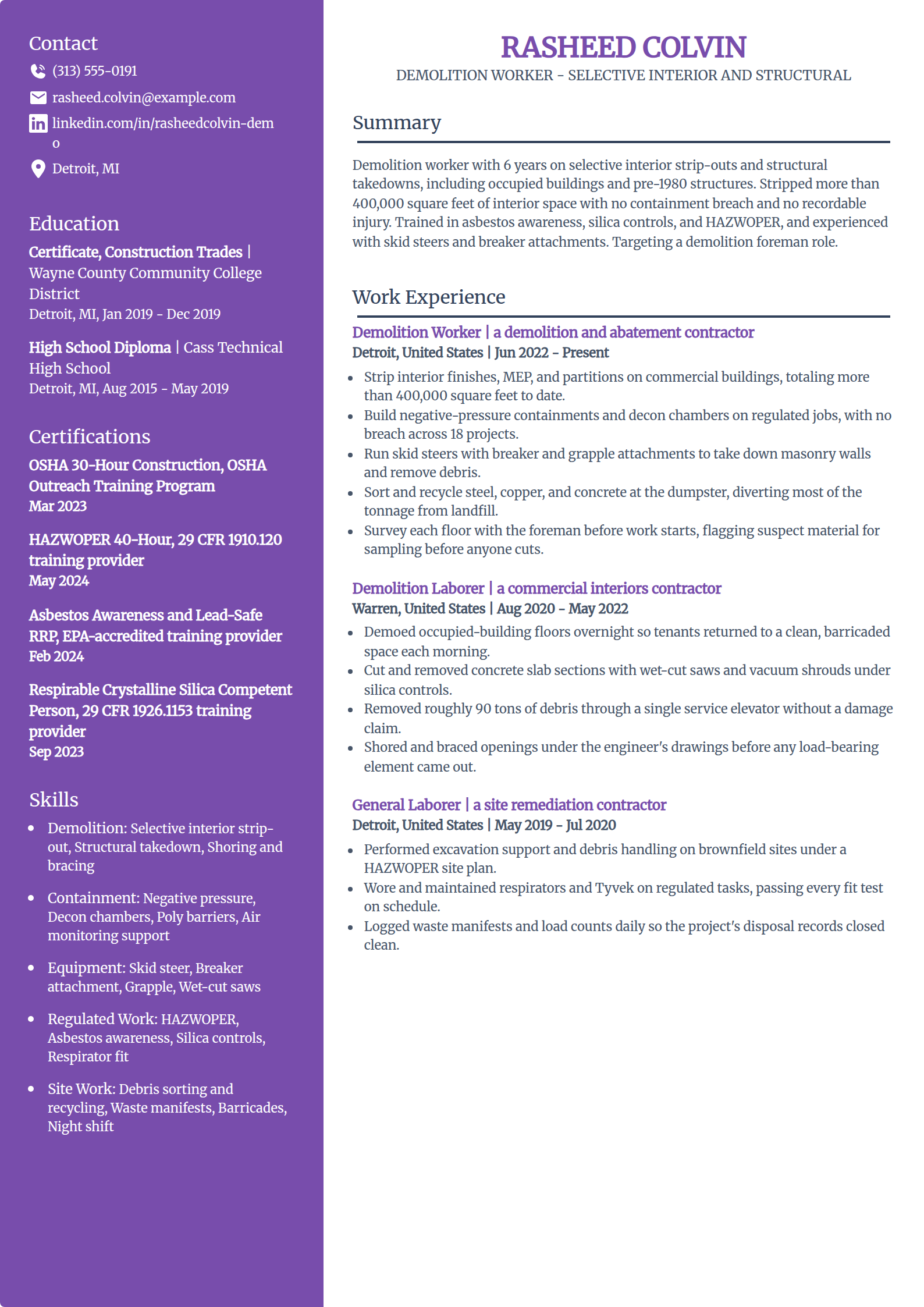
Demolition Worker Resume Template
Why this resume example works?
- Leads with scope and a clean regulatory record, more than 400,000 square feet stripped with no containment breach across 18 projects.
- Names the regulated-work credentials that gate this trade, HAZWOPER 40-hour, asbestos awareness, lead-safe RRP and silica competent person.
- Shows the judgment step a contractor cares about, surveying each floor and flagging suspect material for sampling before anyone cuts.
- Covers occupied-building night work, which is a different skill from open-site demolition and pays accordingly.
- Includes the paperwork side, waste manifests and load counts logged so disposal records close clean.
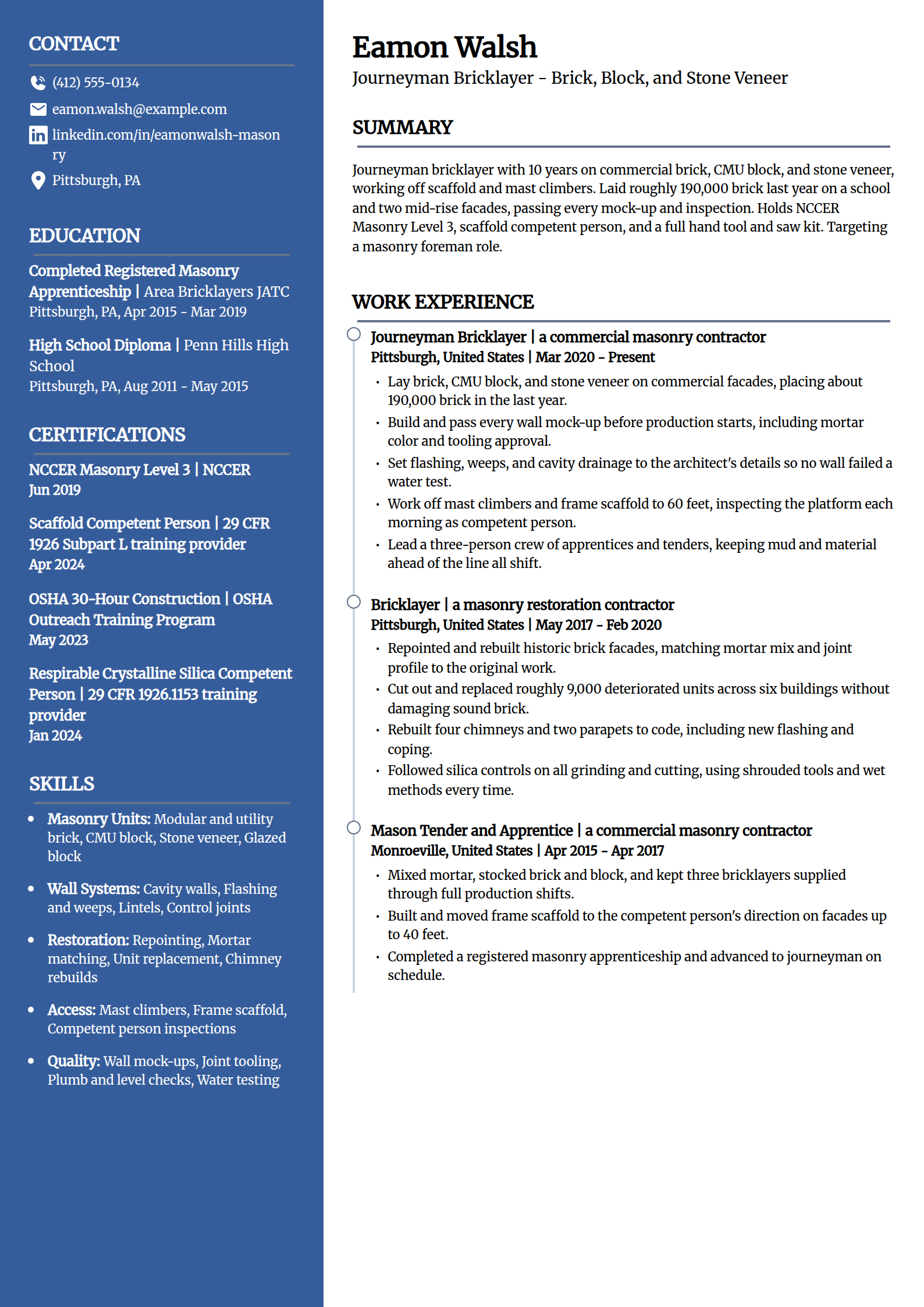
Mason and Bricklayer Resume Template
Why this resume example works?
- Uses the count a masonry contractor estimates from, roughly 190,000 brick laid in a year across a school and two mid-rise facades.
- Puts the quality gate up front, every wall mock-up passed including mortar color and joint tooling approval.
- Names the wall-system details that keep a facade from failing, flashing, weeps and cavity drainage set to the architect's details.
- Shows access competence separately, mast climbers and frame scaffold to 60 feet with competent person inspections.
- Adds restoration range, repointing and matching historic mortar, which widens the jobs this resume can answer.
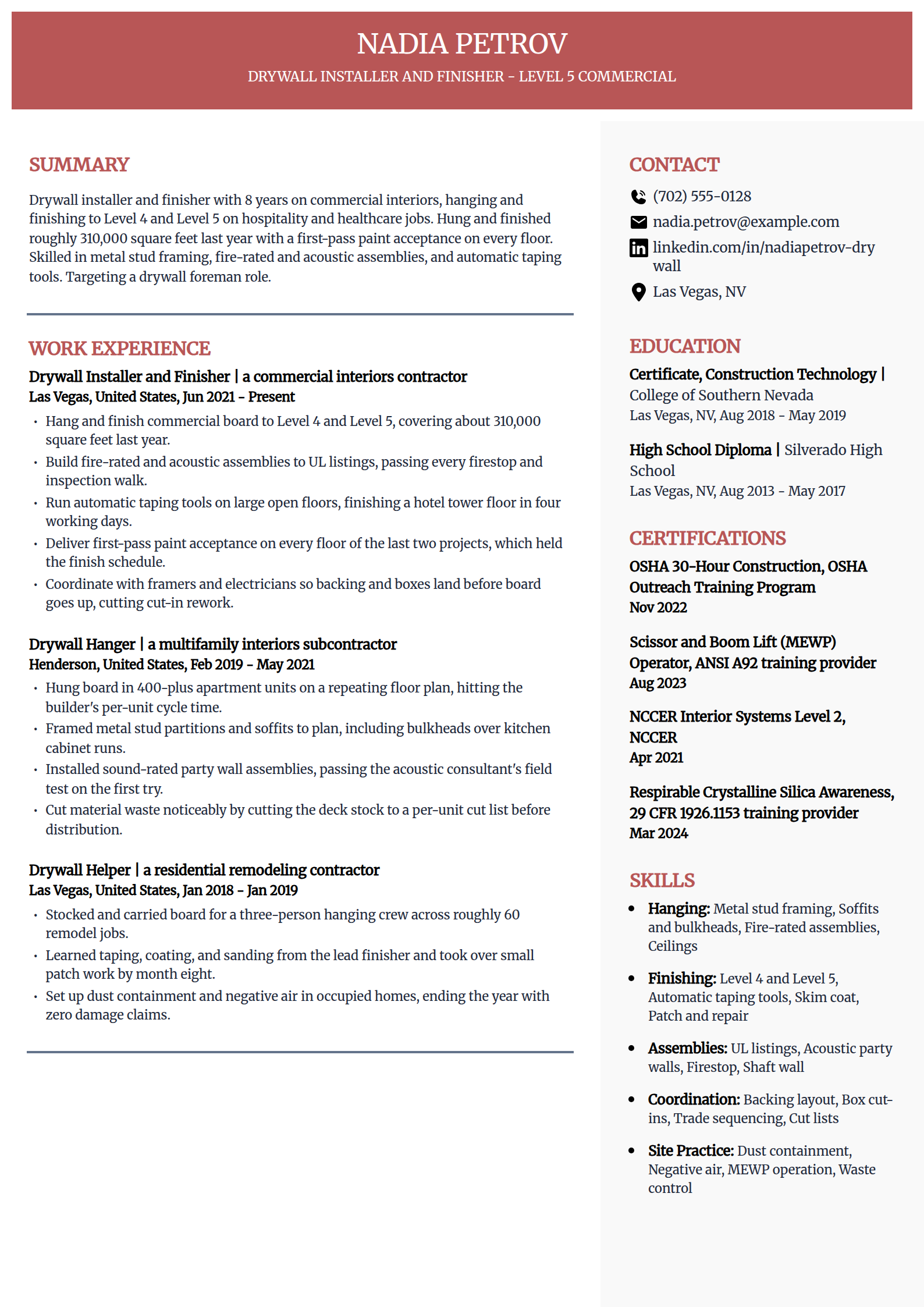
Drywall Installer and Finisher Resume Template
Why this resume example works?
- States the finish levels by name, Level 4 and Level 5, which is the vocabulary a commercial drywall foreman hires on.
- Gives the volume in the right unit, about 310,000 square feet hung and finished last year.
- Leads with the outcome that protects a schedule, first-pass paint acceptance on every floor of the last two projects.
- Names rated assemblies and the listings behind them, fire-rated and acoustic walls built to UL listings.
- Shows the coordination habit that prevents rework, getting backing and boxes placed before board goes up.
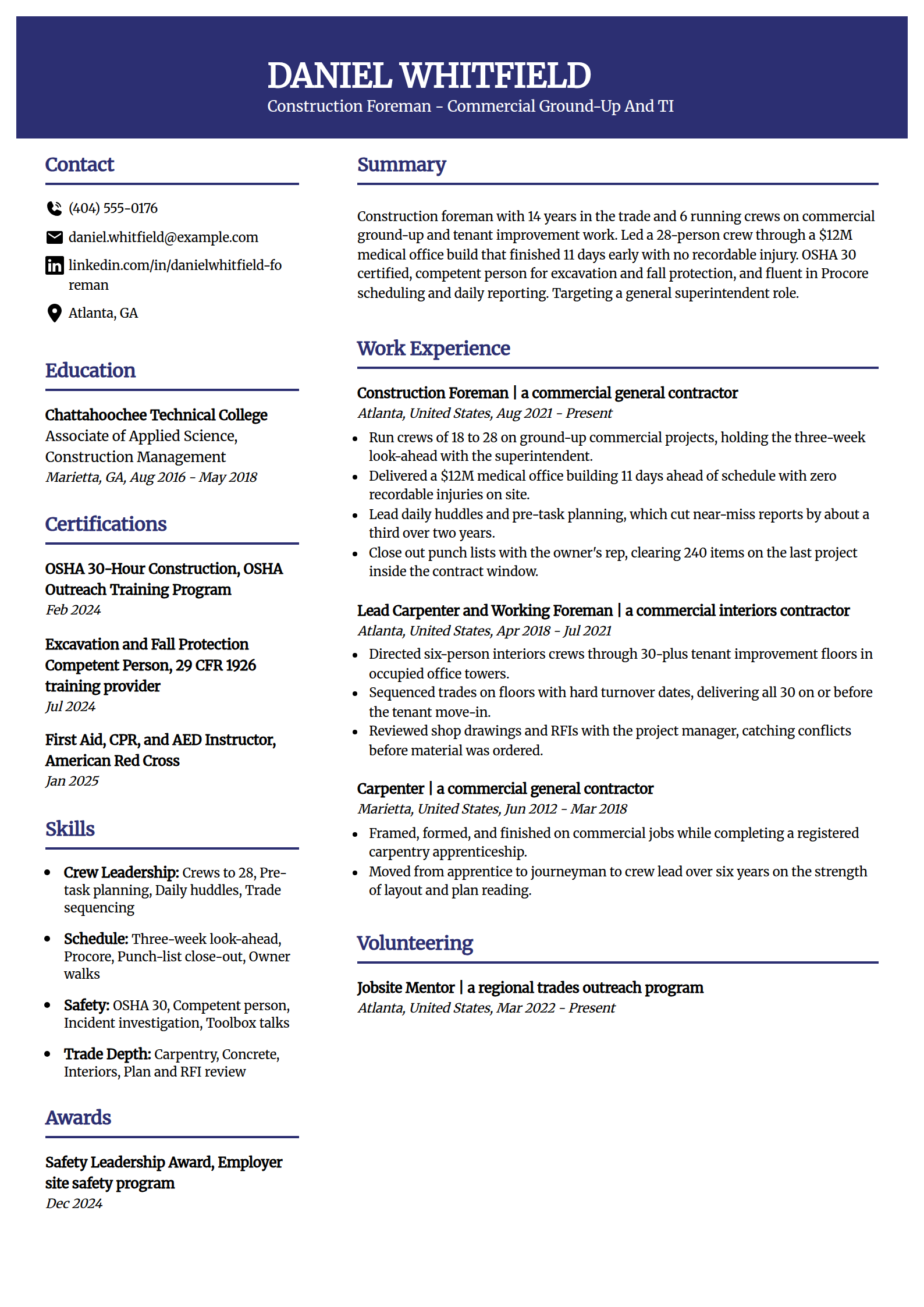
Construction Foreman Resume Template
Why this resume example works?
- Separates total trade time from leadership time, 14 years in the trade and 6 running crews, which is the split a general contractor asks about.
- Pairs the two numbers a superintendent judges a foreman on, a $12M build finished 11 days early with zero recordable injuries.
- Names the planning routines behind the safety record, daily huddles and pre-task planning, not just the outcome.
- Shows schedule ownership in concrete terms, holding the three-week look-ahead and clearing a 240-item punch list in the contract window.
- Keeps the trade history visible so the crew believes the foreman can still do the work.
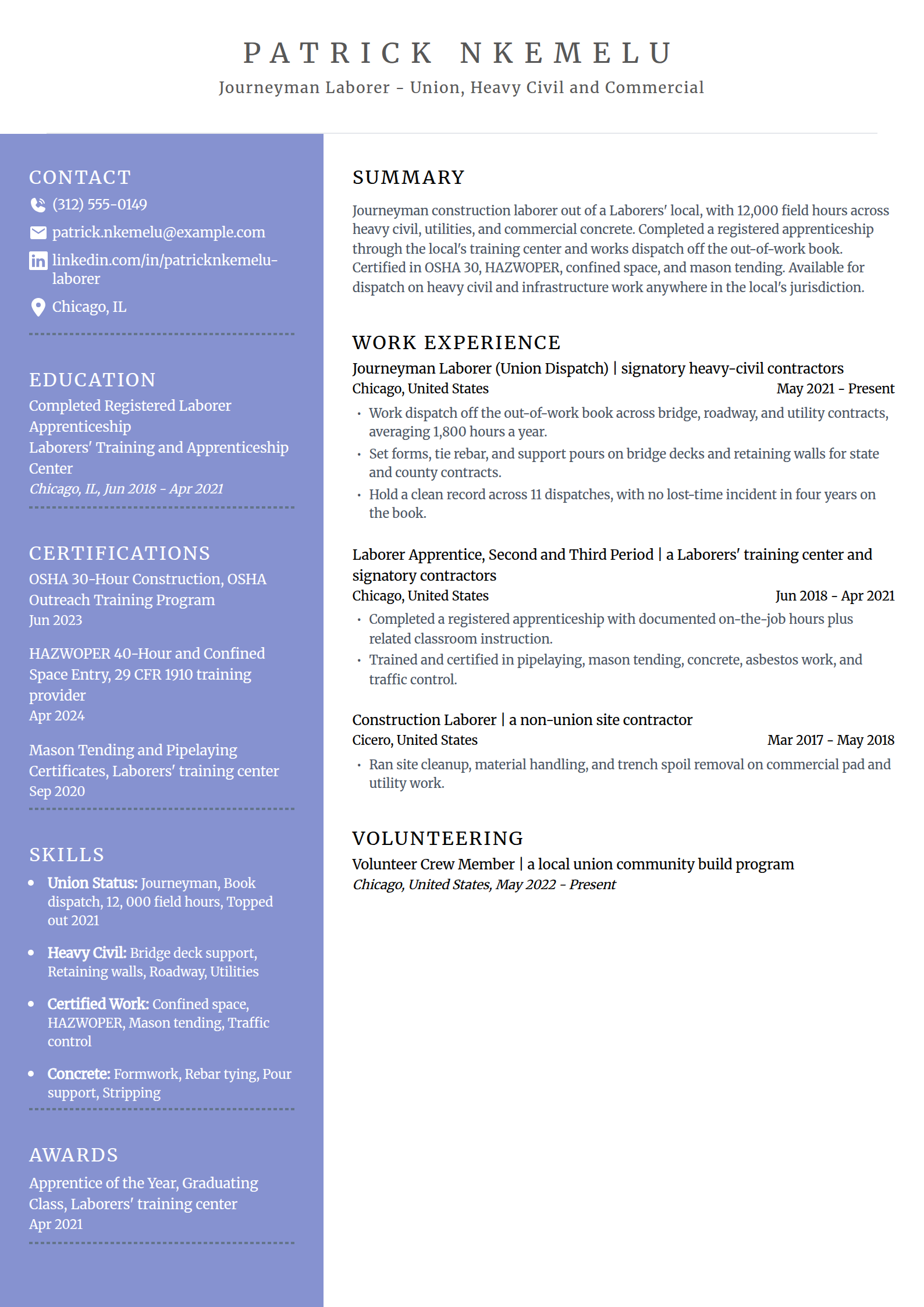
Union Construction Worker Resume Template
Why this resume example works?
- Uses union vocabulary correctly, journeyman status, dispatch off the out-of-work book, and topping out after a registered apprenticeship.
- Counts what a signatory contractor counts, 12,000 field hours and about 1,800 hours a year across dispatches.
- Lists the training-center certificates that decide which calls you can take, confined space, HAZWOPER, mason tending and pipelaying.
- Groups experience by contract type rather than by employer, which is how dispatch work actually looks on paper.
- States availability for dispatch in the local's jurisdiction, the line a hall or contractor needs to see.
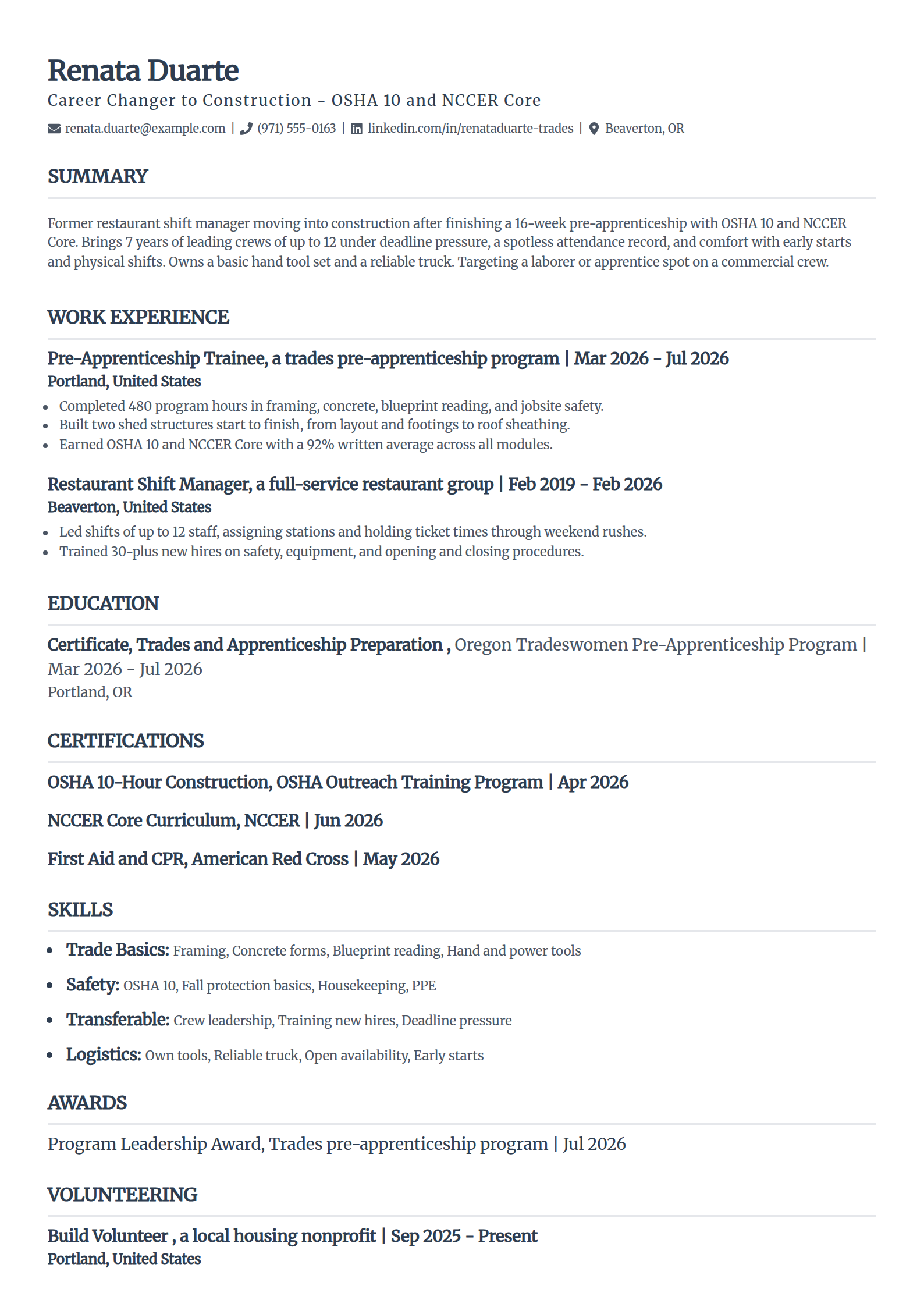
Career Change to Construction Resume Template
Why this resume example works?
- Puts the pre-apprenticeship first as a job, 480 program hours in framing, concrete, blueprint reading and jobsite safety.
- Names finished credentials rather than intentions, OSHA 10 and NCCER Core with a 92% written average.
- Translates the old career honestly, leading shifts of 12 under deadline pressure, without pretending it was construction.
- Answers the two practical questions a foreman asks a career changer, own tools and a reliable truck.
- Uses a plain, single-column format that keeps a short construction history from looking thin.
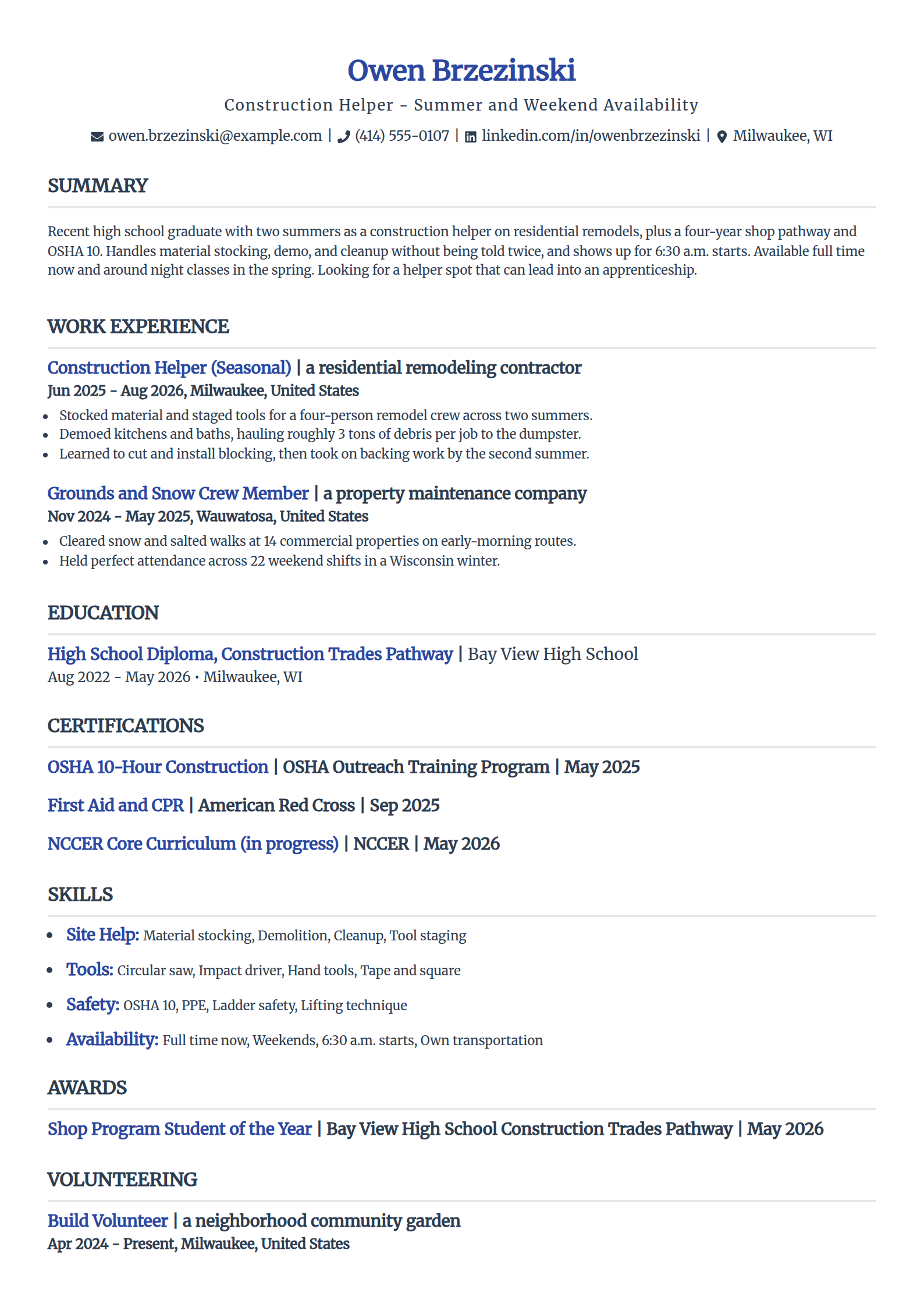
Construction Helper Resume Template (Part-Time and Seasonal)
Why this resume example works?
- Names the job title a small contractor is actually hiring for, helper, instead of reaching for laborer or apprentice.
- Shows two seasons of the same work, which reads as dependable rather than as a one-summer trial.
- Uses helper-scale numbers that stay believable, roughly 3 tons of debris hauled per job.
- Puts availability in a skills block, because for part-time and seasonal work that is a screening question.
- Shows progression within the role, moving from stocking and cleanup to cutting and installing blocking.
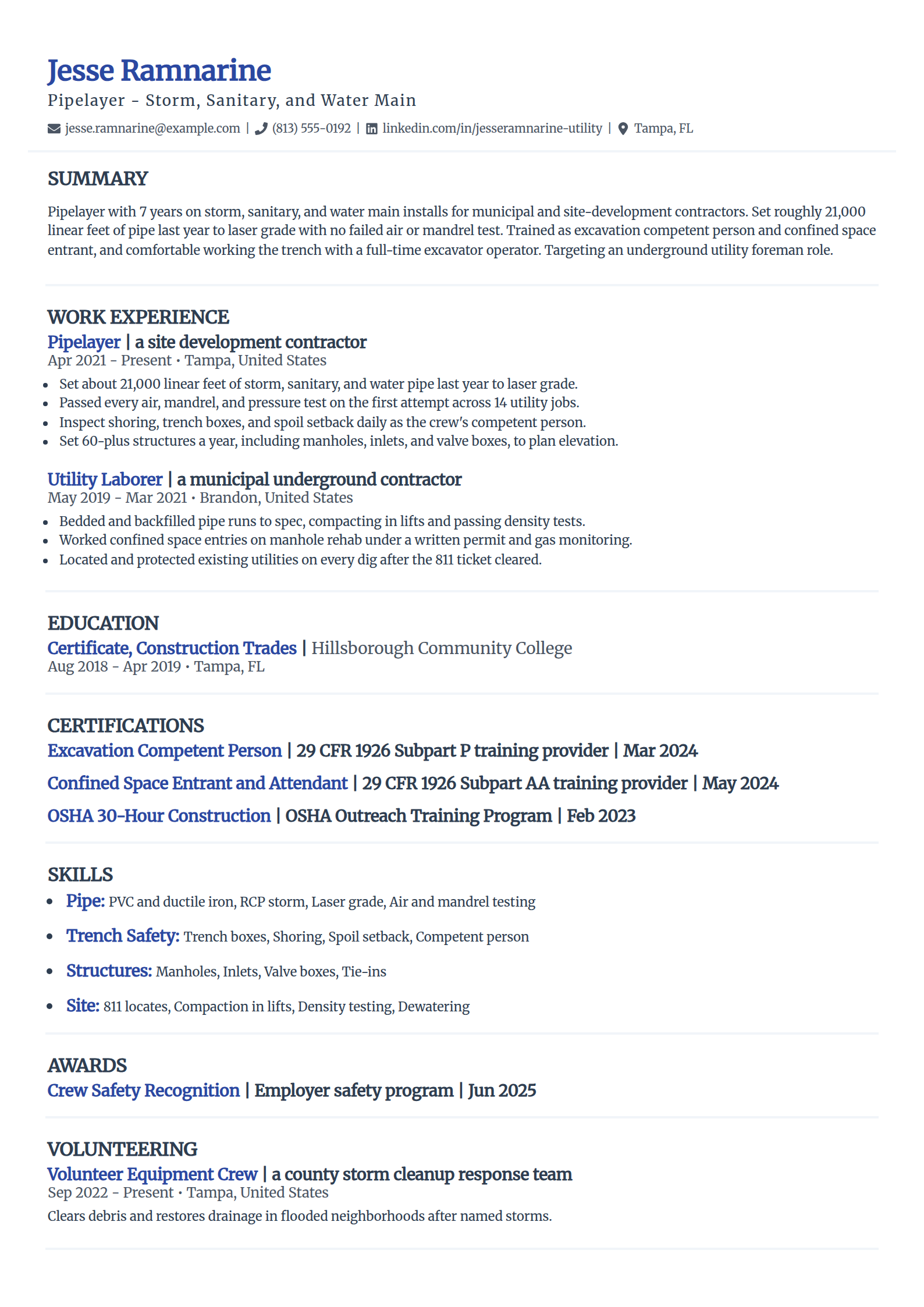
Pipelayer and Underground Utility Resume Template
Why this resume example works?
- Counts in linear feet, the unit underground bids use, about 21,000 feet of storm, sanitary and water pipe last year.
- Leads the test record, every air, mandrel and pressure test passed on the first attempt across 14 jobs.
- Names the trench credential a utility contractor will not hire without, excavation competent person, plus confined space entry.
- Includes structure work separately, 60-plus manholes, inlets and valve boxes set to plan elevation.
- Shows the daily safety habit in specifics, inspecting shoring, trench boxes and spoil setback.
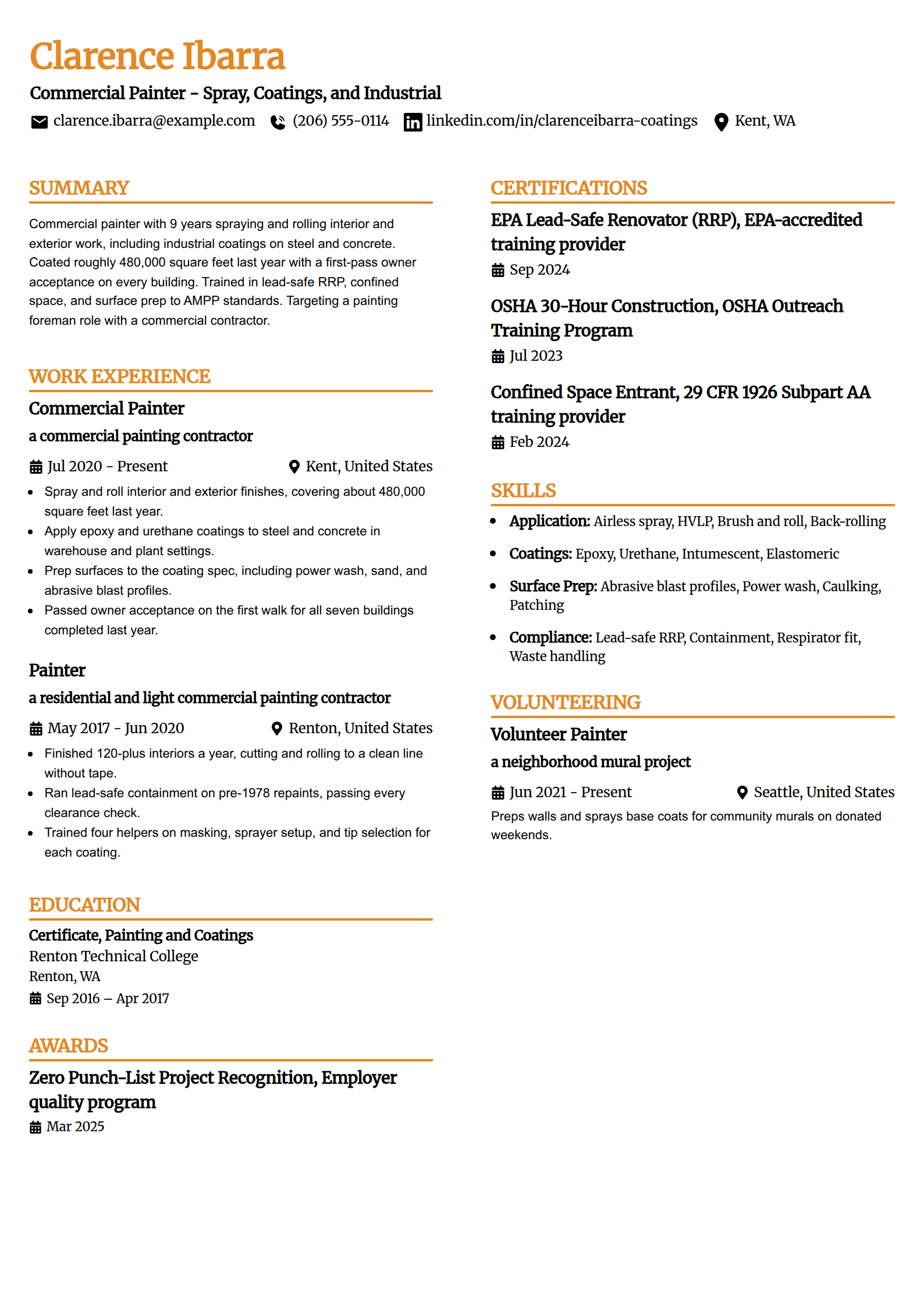
Commercial Painter Resume Template
Why this resume example works?
- Separates commercial and industrial coatings from residential painting, which are different pay grades and different hires.
- Gives square footage in a year, about 480,000, so a contractor can size the candidate against their own jobs.
- Names the coatings by type, epoxy, urethane, intumescent and elastomeric, instead of the generic "paint".
- Shows surface prep as its own skill, abrasive blast profiles and power wash, because that is where coating failures start.
- Carries the compliance credential for repaint work, EPA Lead-Safe Renovator with clearance checks passed.
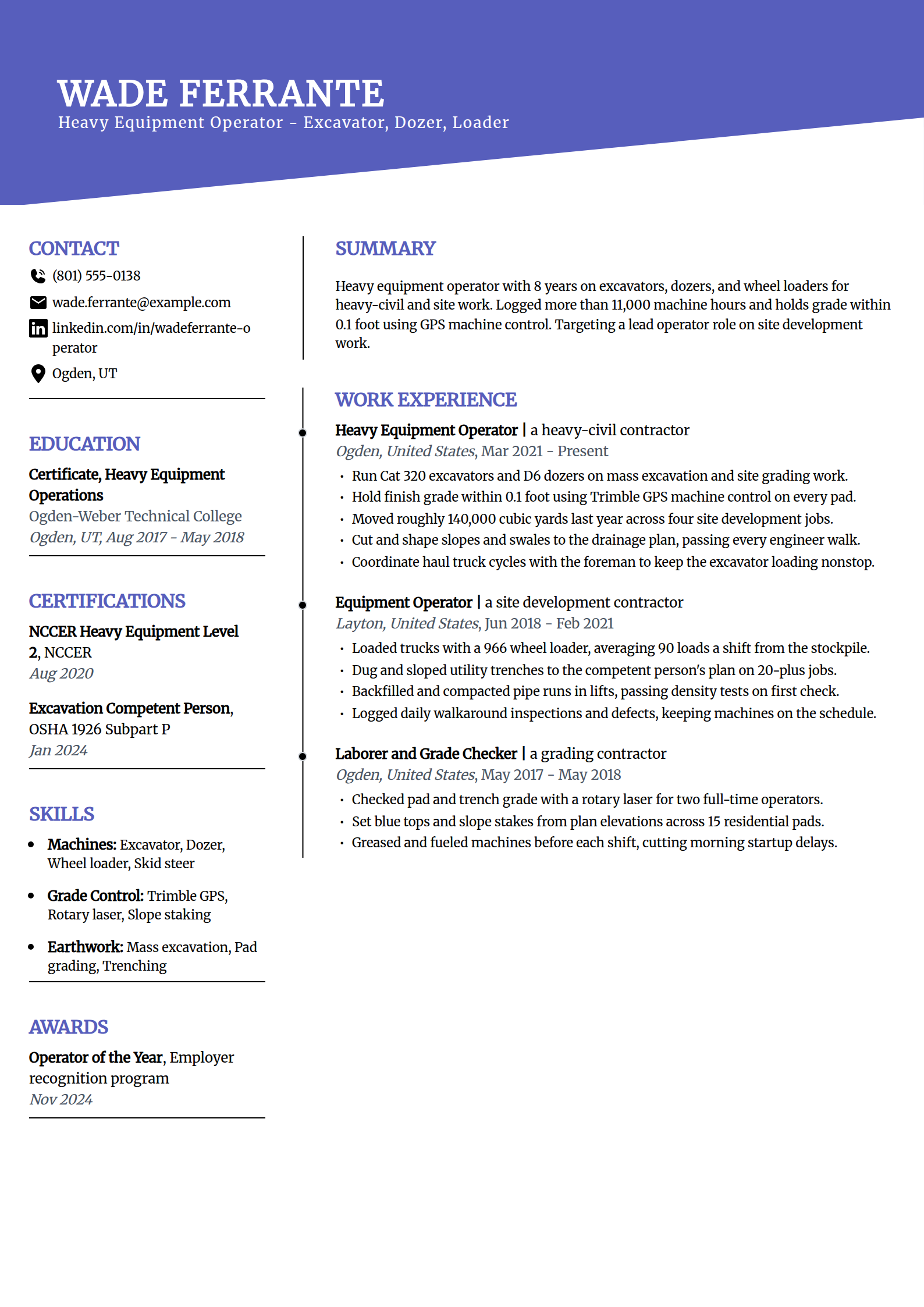
Heavy Equipment Operator Resume Template
See 17 operator examples by machine, forklift to crane →
Why this resume example works?
- Names the machines by model, Cat 320 excavators and D6 dozers, because operator postings are written around specific iron.
- Uses the precision number that gets an operator hired on site work, finish grade held within 0.1 foot on GPS machine control.
- Counts machine hours and cubic yards, the two figures a heavy-civil contractor asks for on the phone.
- Includes the grade-checking job that came before the seat, which shows how the operator learned to read plan elevations.
- If you run machines full time, the operator page linked above goes deeper, with a section per machine type.
Build your construction worker resume
Pick a template above and the editor keeps your layout plain and ATS-safe while you swap in your own trades, certifications and jobsite numbers.
Build my resumeHow to write a construction worker resume in 2026
A superintendent scans a construction resume for four things: which trades you can work, a current OSHA card and the trade certifications a posting lists, what you have actually built, and the practical side, your own tools and reliable transportation. Lead with a short summary that names your trade, your years and your strongest number, then make every bullet a result with one number behind it. Keep the format plain, because decorated templates help nobody on a jobsite hire.
Open with a trade-and-certification summary, or an objective if you are new
Two to three sentences if you are entry-level, three to four if you have paid experience. Name your trade, your years or training hours, your strongest number, the certifications a posting lists, and the job you want. If you have a year or more of paid construction work, write a summary. If you are starting out or changing careers, write an objective that still leads with what you bring, the OSHA card and the training, not with what you want from the employer. You use one or the other, never both.
Journeyman finish carpenter with 11 years hanging doors and running trim on custom residential and light commercial work. Installed more than 9,000 linear feet of trim last year with punch-list returns under 2%. NARI Certified Lead Carpenter and EPA Lead-Safe Renovator, with a full finish tool set. Targeting a lead finish carpenter role with a custom builder.
Make every experience bullet a result with a number
Name the task, the outcome and one number, then the tool or method that produced it. Construction measures everything, so a resume with no numbers reads as untested.
- Use the unit your trade bids in: square feet framed or finished, linear feet of trim or pipe, cubic yards placed, squares of roofing, brick laid, doors hung.
- Open with a strong verb like framed, placed, installed, welded, led or rebuilt, never "Responsible for" or "Helped with".
- Add the safety or quality number a contractor checks: inspections passed on first visit, punch-list items cleared, recordable-free hours, callbacks at zero.
- Keep numbers level-accurate. A helper shows tons hauled and jobs worked; a foreman shows crew size and project value. One number per bullet is plenty.
List your certifications in the order a contractor checks them
Your OSHA card is the first thing verified on most commercial jobs, so it belongs in a named certifications block with dates, not buried in a skills list.
- Safety first: OSHA 10-Hour Construction for laborers and helpers, OSHA 30-Hour once you lead anyone, then fall protection, scaffold, confined space and excavation competent person as your work requires.
- Trade second: NCCER Core and craft levels, ACI Concrete Flatwork Finisher, NRCA CERTA for torch roofing, NARI Certified Lead Carpenter, NCCCO rigger and signalperson.
- Equipment and compliance third: powered industrial truck or telehandler, ANSI A92 aerial and scissor lift, EPA Lead-Safe Renovator, asbestos awareness, ATSSA flagger.
- Put an expired card on the resume with its date and a note that renewal is scheduled. Leaving it off looks worse than showing it lapsed, and never list one you do not hold.
Match skills and keywords to the job posting
Group your skills so a superintendent and a parser both find what they need. List trades and systems you have actually worked, not a keyword dump.
- Group by type: trades and scopes, safety credentials, tools and equipment, plans and field software.
- Name the specifics: Simpson Strong-Tie connectors, ClarkDietrich metal stud, Topcon or Trimble lasers, Procore daily logs, Bluebeam Revu markups.
- If the posting says "blueprint reading" or "competent person", use that exact phrasing where it matches your experience. Matching the posting's wording is the whole of the ATS advice worth giving.
- Say if you own your tools and name the set. Plenty of contractors screen on it, and almost nobody puts it on the resume.
Formatting and length for a jobsite hire
One page for nearly every construction worker, including foremen. Two pages only if you are running multiple crews and the second page is all project history.
- Use a single-column, plain layout with standard headings. Heavy columns, graphics and color blocks make the resume harder to read and harder to parse.
- Put certifications above education once you are past your first year. On a jobsite the card matters more than the diploma.
- List a phone number you actually answer during work hours, because construction hiring happens on the phone, often the same day.
- If you work multiple trades, reorder your bullets so the trade the posting names sits at the top of your most recent job.
Honestly: you may not need a resume at all for some of these jobs
Plenty of residential and small-contractor hiring still runs on a paper application, a referral or a phone call, and a resume will not be asked for. Where a resume does decide things is commercial and industrial work, union apprenticeship intake, anything with a real HR department, and any job you apply to online. If you are walking onto a small residential crew, bring your OSHA card and your tools and be ready to work. If you are applying to a general contractor, a signatory contractor or a job board posting, the resume is the whole first impression, and the examples above are what it should look like.
Common construction worker resume mistakes
- Leaving the OSHA card off, or burying it at the bottom. Name OSHA 10 or 30 in your summary and again in a certifications block with the date, since many commercial jobs will not badge you without it.
- Listing duties instead of results. Replace "framed walls" with "framed roughly 210,000 square feet of wood-frame apartments and passed every rough inspection on the first visit".
- Writing one generic construction resume for every trade. A framer, a finish carpenter and a concrete finisher are different hires; reorder your bullets and skills so the trade the posting names leads the page.
- Claiming numbers that do not fit your level. A helper with a veteran's output fails the sniff test. Entry-level and career-change resumes should show training hours, supervised work and reliability instead.
- Skipping the practical details a foreman screens on: tool ownership and what set, reliable transportation, and a phone number you answer during work hours.
Frequently asked questions
What should a construction worker resume include?
Five things: a two to four sentence summary or objective naming your trade and your strongest number, a certifications block led by your OSHA 10 or 30 card, experience bullets that each state a result with one number behind it, a skills block grouped by trade, safety, tools and plans, and education or apprenticeship hours. Add your tool ownership and reliable transportation, since contractors screen on both and almost nobody lists them. Keep it to one page and one column.
How do I write a construction resume with no experience?
Lead with training instead of jobs. Put OSHA 10, NCCER Core, a pre-apprenticeship or a trade-school certificate at the top with the hours completed, then describe the physical work you have done in jobsite terms: warehouse material handling, landscaping and grading, moving, volunteer builds. Name the tools you have used and the tools you own. Show reliability with something countable, like a season with no missed days. The entry-level and career-change examples above are both built this way.
Should a construction resume have an objective or a summary?
A summary if you have a year or more of paid construction work, an objective if you are entry-level, changing careers or coming back after a gap. A resume carries one or the other, never both. The summary leads with your trade, your years and your strongest number. The objective states the job you are targeting but still opens with what you bring, your OSHA card, your training hours or your transferable work, not with what you want from the employer. Both run two to four sentences.
What certifications should I put on a construction resume?
Start with safety: OSHA 10-Hour Construction for laborers and helpers, OSHA 30-Hour once you supervise anyone, then fall protection, scaffold, confined space and excavation competent person as your work requires. Add your trade credentials next, such as NCCER Core and craft levels, ACI Concrete Flatwork Finisher, NRCA CERTA for torch roofing, or NCCCO rigger and signalperson. Then equipment and compliance cards like aerial lift, telehandler, EPA Lead-Safe Renovator and flagger. List each with its date, and never list one you do not hold.
How long should a construction worker resume be?
One page for nearly everyone in the trade, including experienced journeymen and most foremen. Two pages only if you run multiple crews and the extra page is a project history a general contractor would actually read. Length is not a target to hit: cut older or unrelated jobs so the space goes to the trades and numbers that match the work you want. A one-page resume that names your trade, your card and your results beats a two-page duty list every time.
Do I need a resume to apply for a union apprenticeship?
Usually yes, and a short one is fine. Apprenticeship intake is run by a joint apprenticeship and training committee, and most locals ask for an application plus a resume, a high school transcript or equivalency, and sometimes an aptitude test and interview. Keep it to one page: any physical or hands-on work you have done, your math and shop coursework, a driver's license and reliable transportation, and any safety cards you already hold. Say plainly that you are applying for the apprenticeship, and check the local's application window, since many open only once or twice a year.
More construction worker resume resources
Build your construction worker resume
Pick a template above and the editor keeps your layout plain and ATS-safe while you swap in your own trades, certifications and jobsite numbers.