16 Electrician Resume Templates, Apprentice to Master
- ATS Friendly
- Apprentice to Master
- 16 Trade Examples
Apprentice, journeyman, master, industrial, commercial, residential, solar, or low-voltage, this page has a resume built for your exact license level and specialty. Start from a layout below, then model your own on a real example. Your license, OSHA and NFPA 70E certs, and first-pass inspection record sit where a hiring manager looks first.


540k+ resumes created
Editable electrician resume templates for every license level
Each template below is a real electrician resume laid out in that format, sorted by license level and specialty across industrial, commercial, residential, maintenance, solar, low-voltage, and controls work. Pick one, then swap in your own hours, panels wired, and inspection numbers. Every layout keeps your license, certifications, and impact bullets clean so a hiring manager reads your strongest work at a glance and an applicant tracking system parses it without trouble.
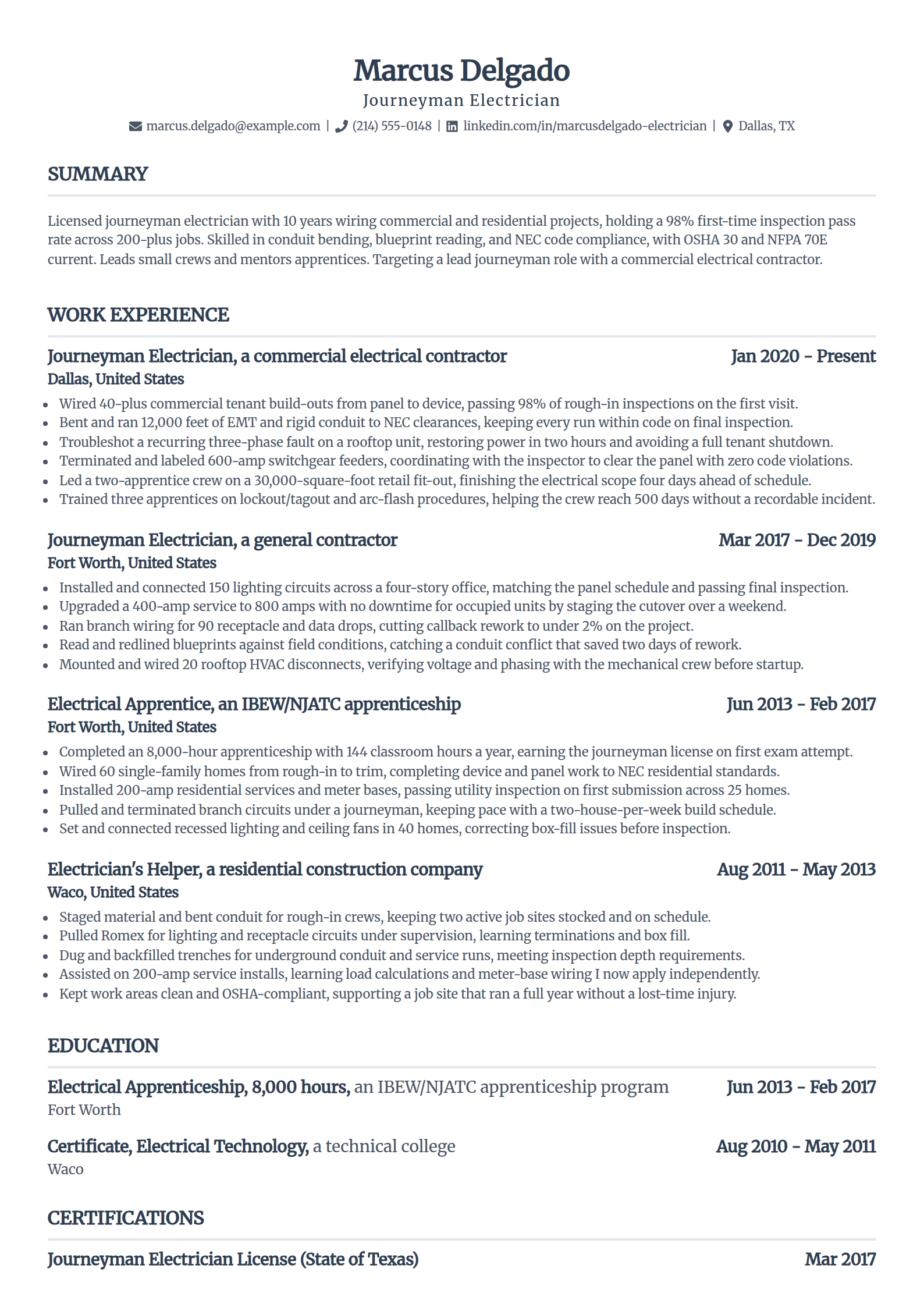
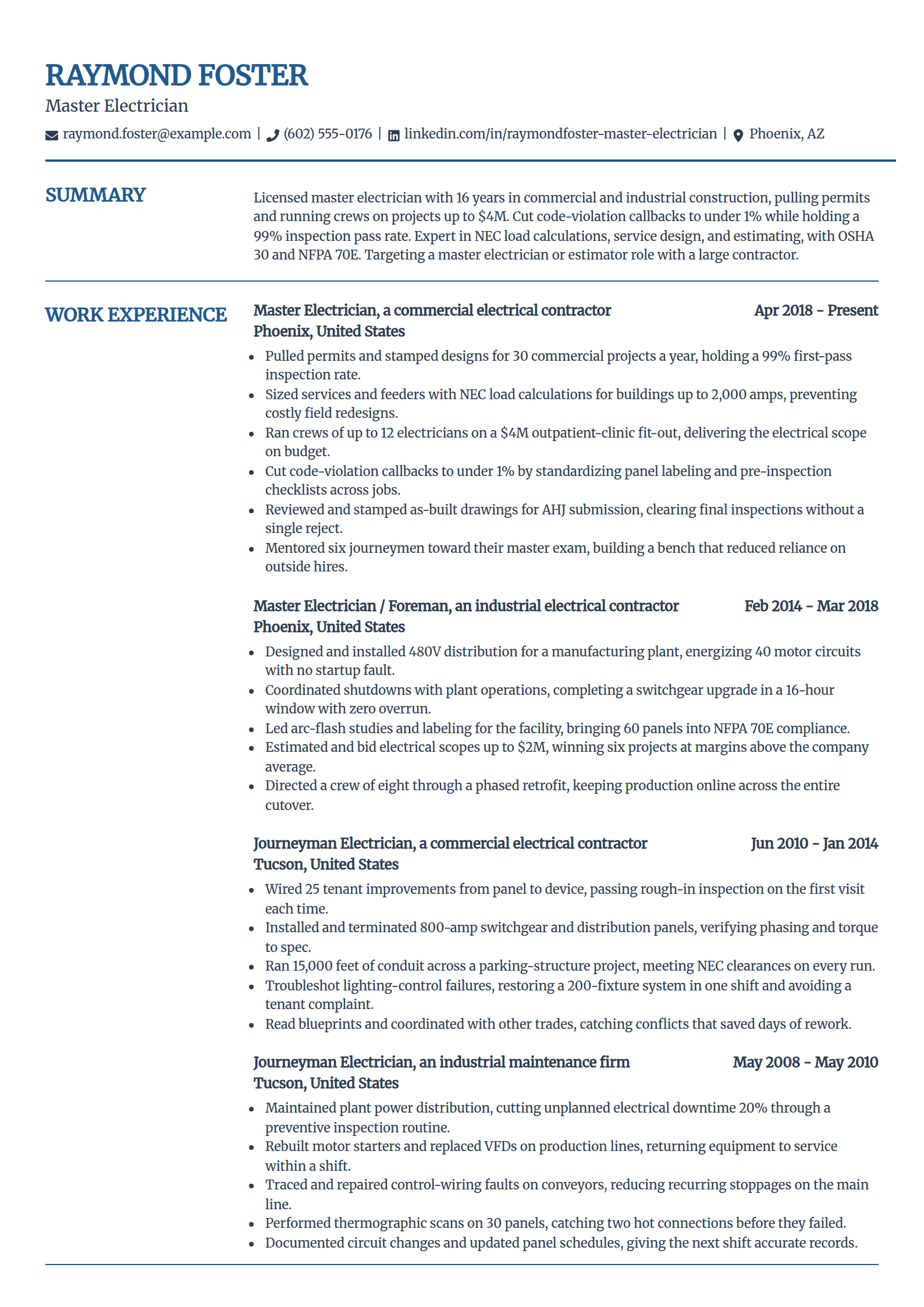
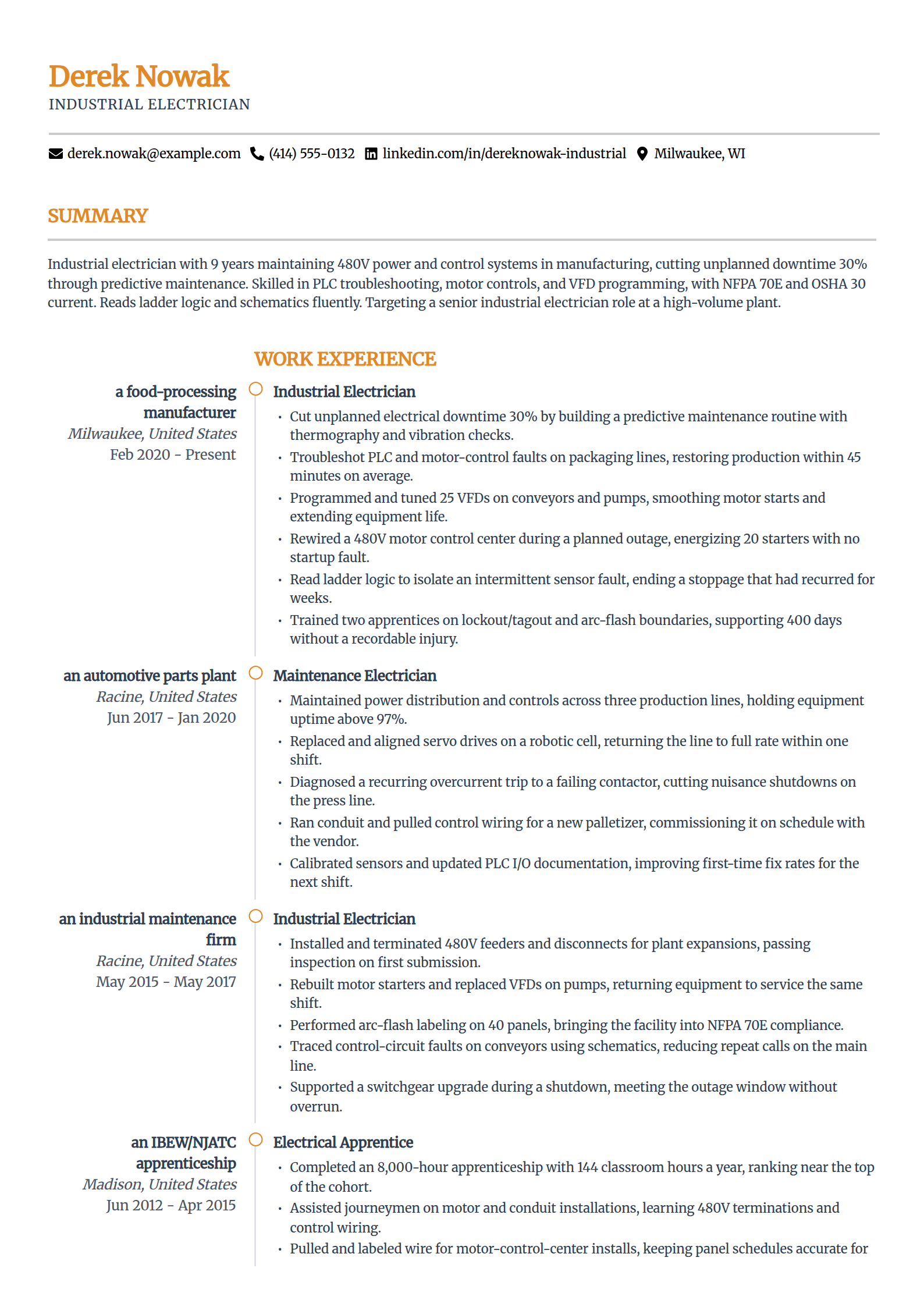
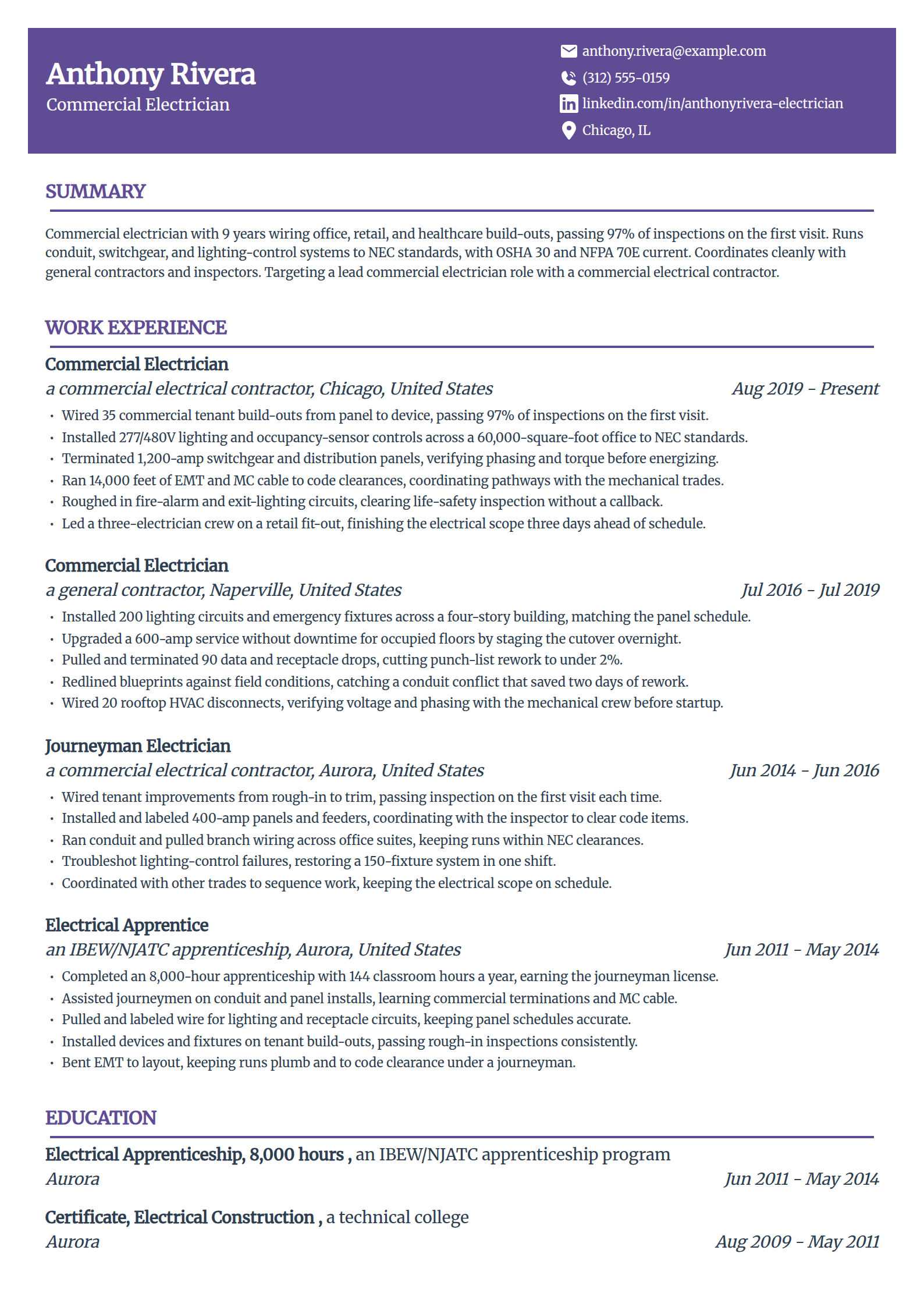
Journeyman Electrician Resume Template
Why this resume example works?
- Opens with the number a contractor hires for, a 98% first-time inspection pass rate across 200-plus jobs.
- Shows the license and safety spine up top: journeyman license, OSHA 30, and current NFPA 70E.
- Attaches one metric to each bullet, like 12,000 feet of conduit run to code or 500 days without a recordable incident.
- Traces a clear ladder from helper to apprentice to journeyman, the story a hiring manager wants to see.
- Uses a clean, single-column layout an applicant tracking system parses without trouble.
Master Electrician Resume Template
Why this resume example works?
- Leads with master-level scope, permits and stamped designs for 30 projects a year at a 99% first-pass inspection rate.
- Shows the design work a master owns, NEC load calculations sizing services up to 2,000 amps.
- Proves crew leadership, running up to 12 electricians on a $4M project delivered on budget.
- Names the credential ladder plainly: master license, journeyman license, OSHA 30, and NFPA 70E.
- Uses a modern layout that carries a dense 16-year record cleanly on one page.
Industrial Electrician Resume Template
Why this resume example works?
- Opens with the metric a plant rewards, unplanned electrical downtime cut 30% through predictive maintenance.
- Shows the controls work a posting screens for, PLC troubleshooting, 25 VFDs tuned, and 480V motor circuits.
- Names ladder logic, motor control centers, and arc-flash labeling in real context, not as a keyword wall.
- Ties safety to a number, two apprentices trained toward 400 days without a recordable injury.
- Uses a modern layout that carries a dense industrial history on one page.
Commercial Electrician Resume Template
Why this resume example works?
- Leads with a 97% first-visit inspection pass rate across 35 commercial build-outs.
- Shows commercial-specific work: 277/480V lighting, 1,200-amp switchgear, and fire-alarm rough-in.
- Proves coordination, staging a 600-amp service cutover overnight with no downtime for occupied floors.
- Names the certs a commercial role lists: journeyman license, OSHA 30, NFPA 70E, and NICET fire alarm.
- Uses a spacious layout that fits a nine-year commercial record without empty space.
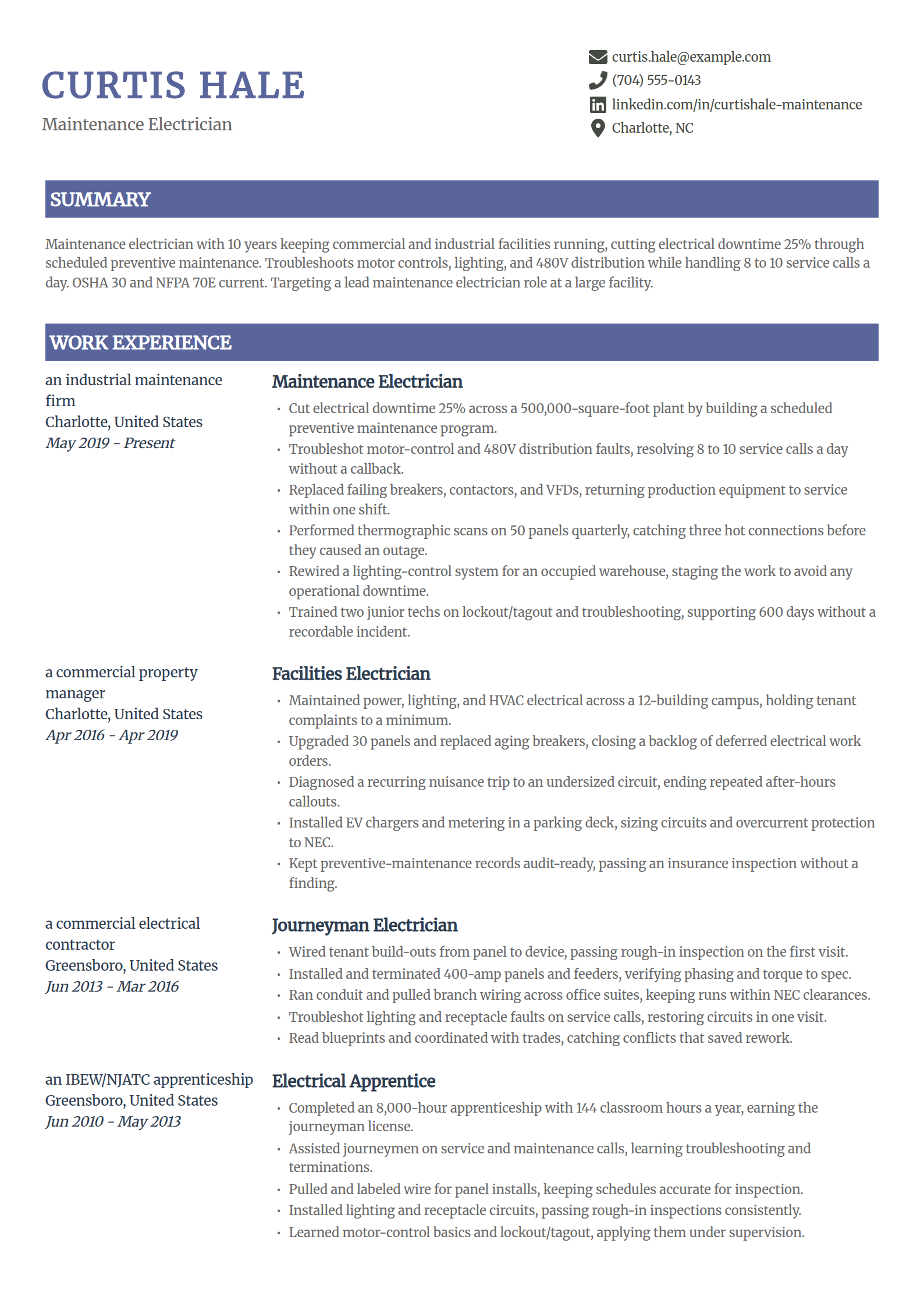
Maintenance Electrician Resume Template
Why this resume example works?
- Opens with the result a facility hires for, electrical downtime cut 25% through scheduled preventive maintenance.
- Shows the daily reality of the job, 8 to 10 service calls a day resolved without a callback.
- Names the troubleshooting range a posting wants: motor controls, 480V distribution, and lighting systems.
- Carries the crossover certs the role often needs, OSHA 30, NFPA 70E, and EPA 608, plus thermography.
- Uses a two-column layout that carries a dense ten-year maintenance record on one page.
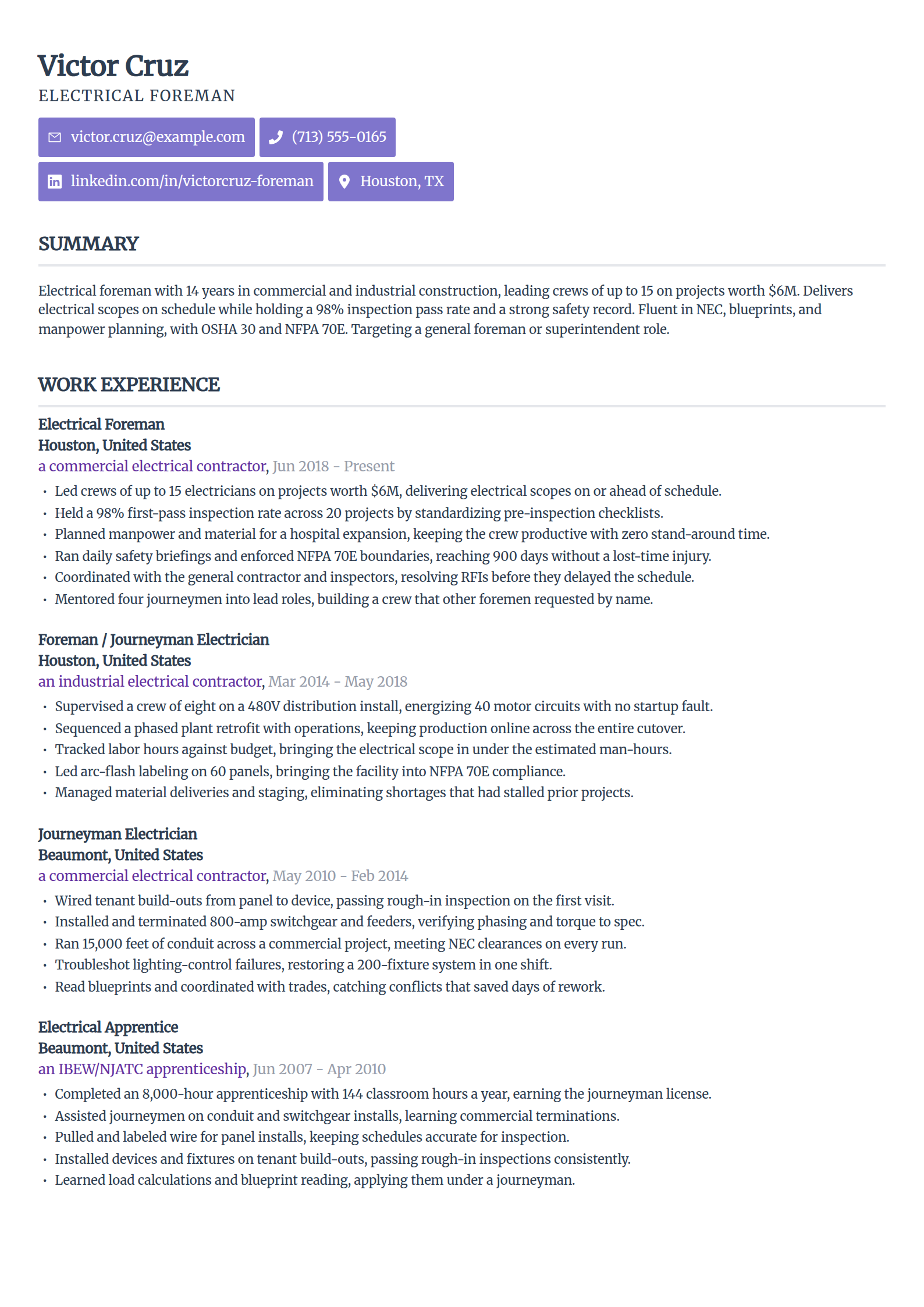
Electrical Foreman Resume Template
Why this resume example works?
- Leads with leadership scope, crews of up to 15 on projects worth $6M delivered on schedule.
- Shows the foreman metrics that matter, a 98% inspection pass rate and 900 days without a lost-time injury.
- Proves planning, manpower and material sequenced so the crew ran with zero stand-around time.
- Names the safety credentials a foreman carries, OSHA 30, OSHA 500 site safety, and NFPA 70E.
- Uses a structured layout that fits a 14-year field-leadership record cleanly on one page.
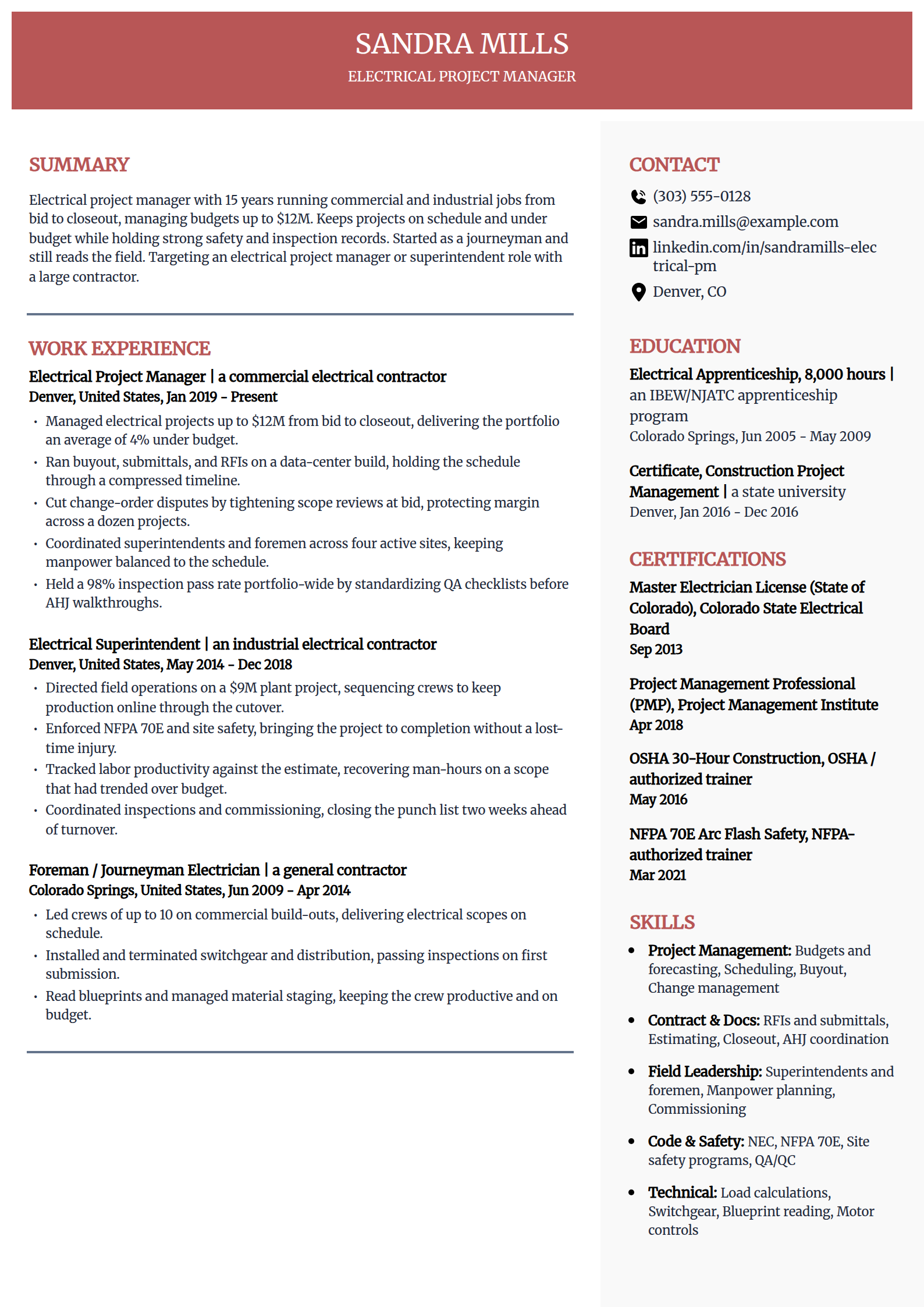
Electrical Project Manager & Superintendent Resume Template
Why this resume example works?
- Leads with budget scope, projects up to $12M delivered an average of 4% under budget.
- Keeps the field thread visible, a master license and a career that started as a journeyman.
- Shows the PM toolkit a posting lists: buyout, RFIs, submittals, and closeout across four active sites.
- Names the credentials that separate an electrical PM, master license, PMP, OSHA 30, and NFPA 70E.
- Uses a refined layout that fits a 15-year management record on one page.
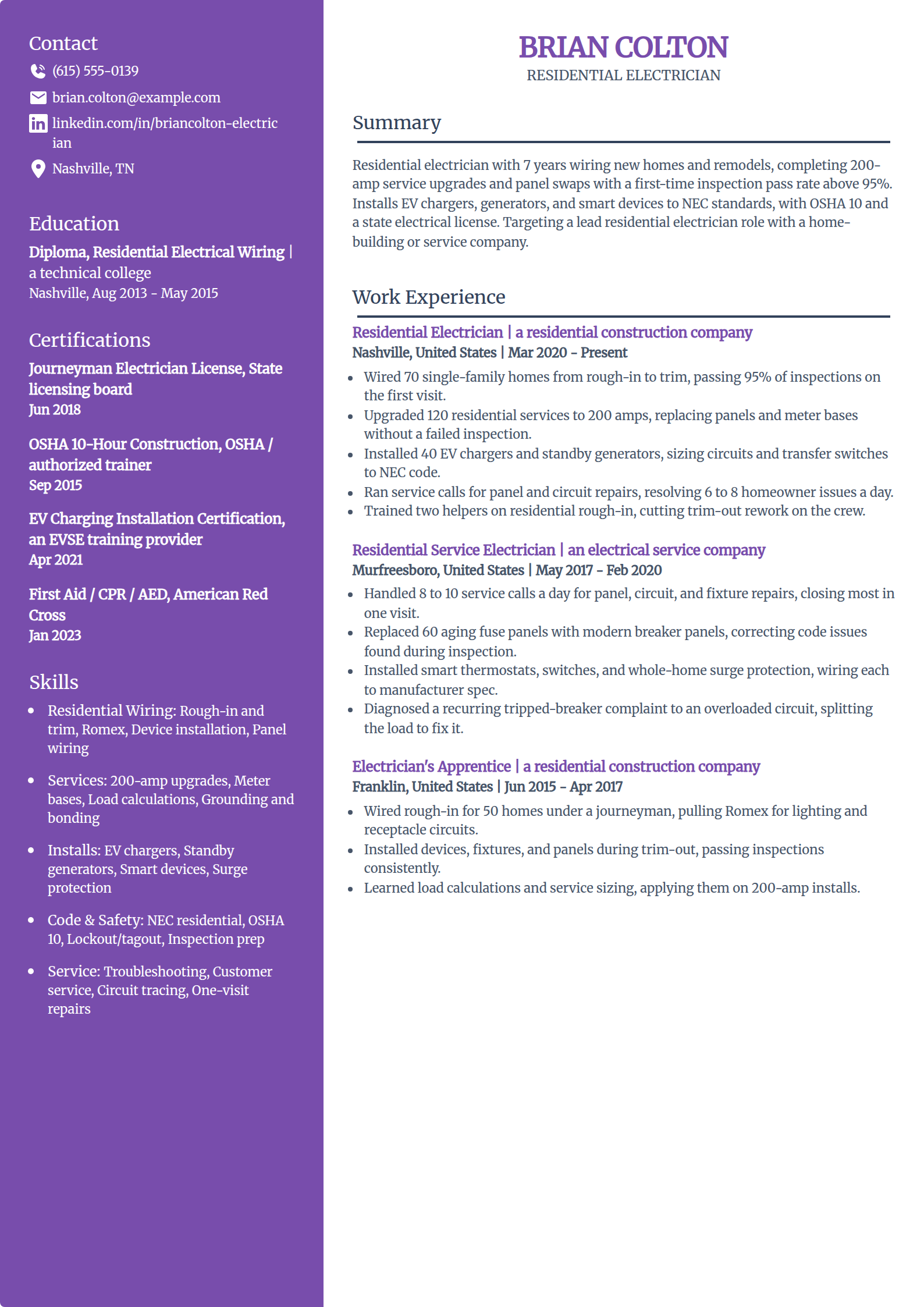
Residential Electrician Resume Template
Why this resume example works?
- Opens with residential impact, 120 service upgrades to 200 amps with no failed inspection.
- Shows the modern work homeowners pay for, 40 EV chargers and standby generators wired to NEC.
- Proves service ability, 6 to 8 homeowner calls a day resolved, most in one visit.
- Names the right certs for the level, journeyman license, OSHA 10, and EV charging installation.
- Uses a Medium layout that fits a seven-year residential record without empty space.
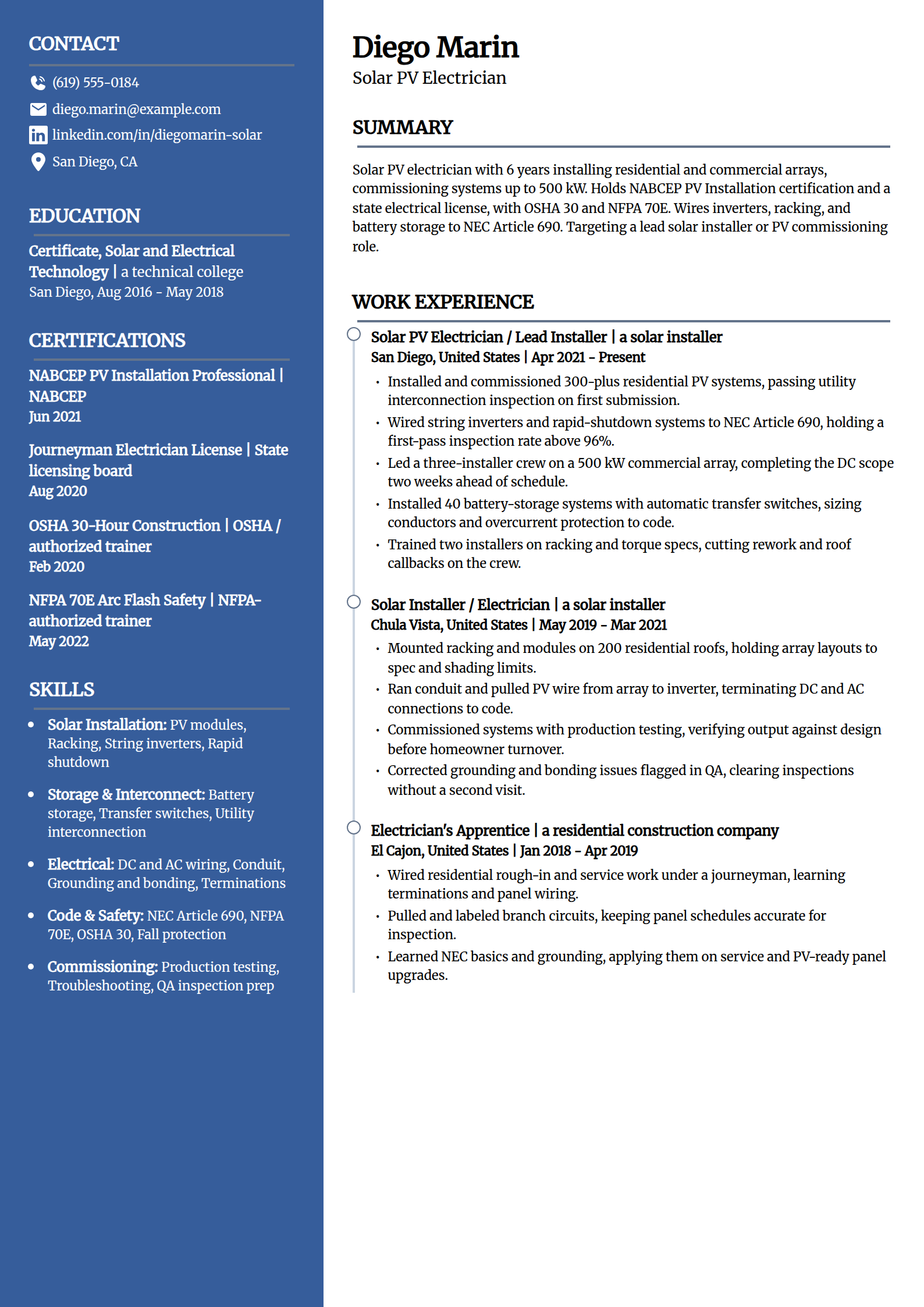
Solar PV & Renewable Electrician Resume Template
Why this resume example works?
- Leads with commissioned scope, 300-plus residential PV systems passing interconnection on first submission.
- Shows a 96% first-pass inspection rate wiring inverters and rapid shutdown to NEC Article 690.
- Names the solar credential a posting requires, NABCEP PV Installation, alongside a journeyman license.
- Keeps storage work concrete, 40 battery systems with transfer switches sized to code.
- Uses a distinctive layout that still reads cleanly for a hiring manager.
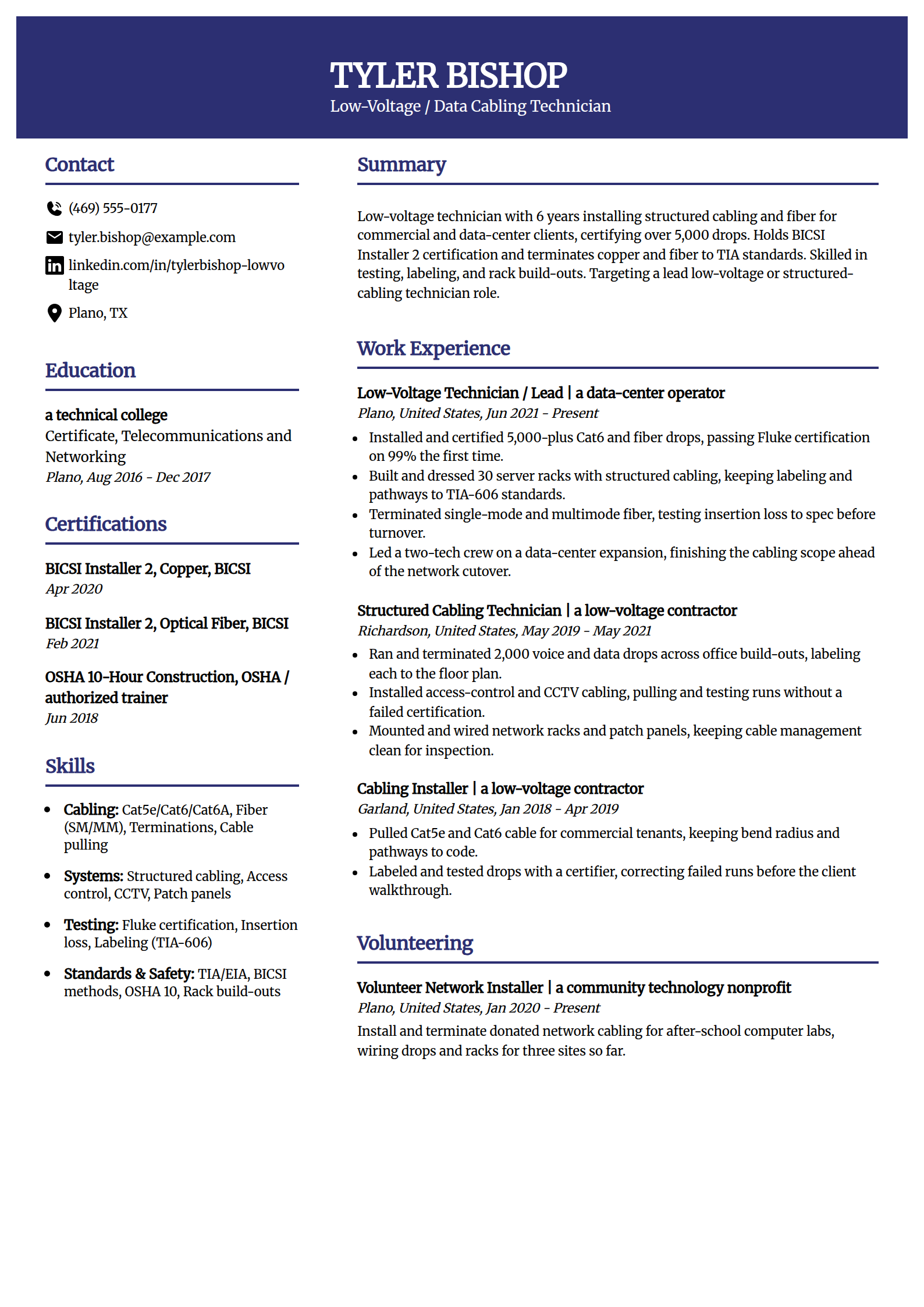
Low-Voltage & Data Cabling Technician Resume Template
Why this resume example works?
- Opens with certified volume, 5,000-plus Cat6 and fiber drops passing Fluke certification 99% of the time.
- Shows the standards a data-center client demands, TIA-606 labeling and dressed structured cabling.
- Names the BICSI Installer 2 copper and fiber credentials a low-voltage posting screens for.
- Covers the full system, access control and CCTV cabling alongside racks and patch panels.
- Uses a roomy layout with a filled sidebar so a focused six-year record still looks complete.
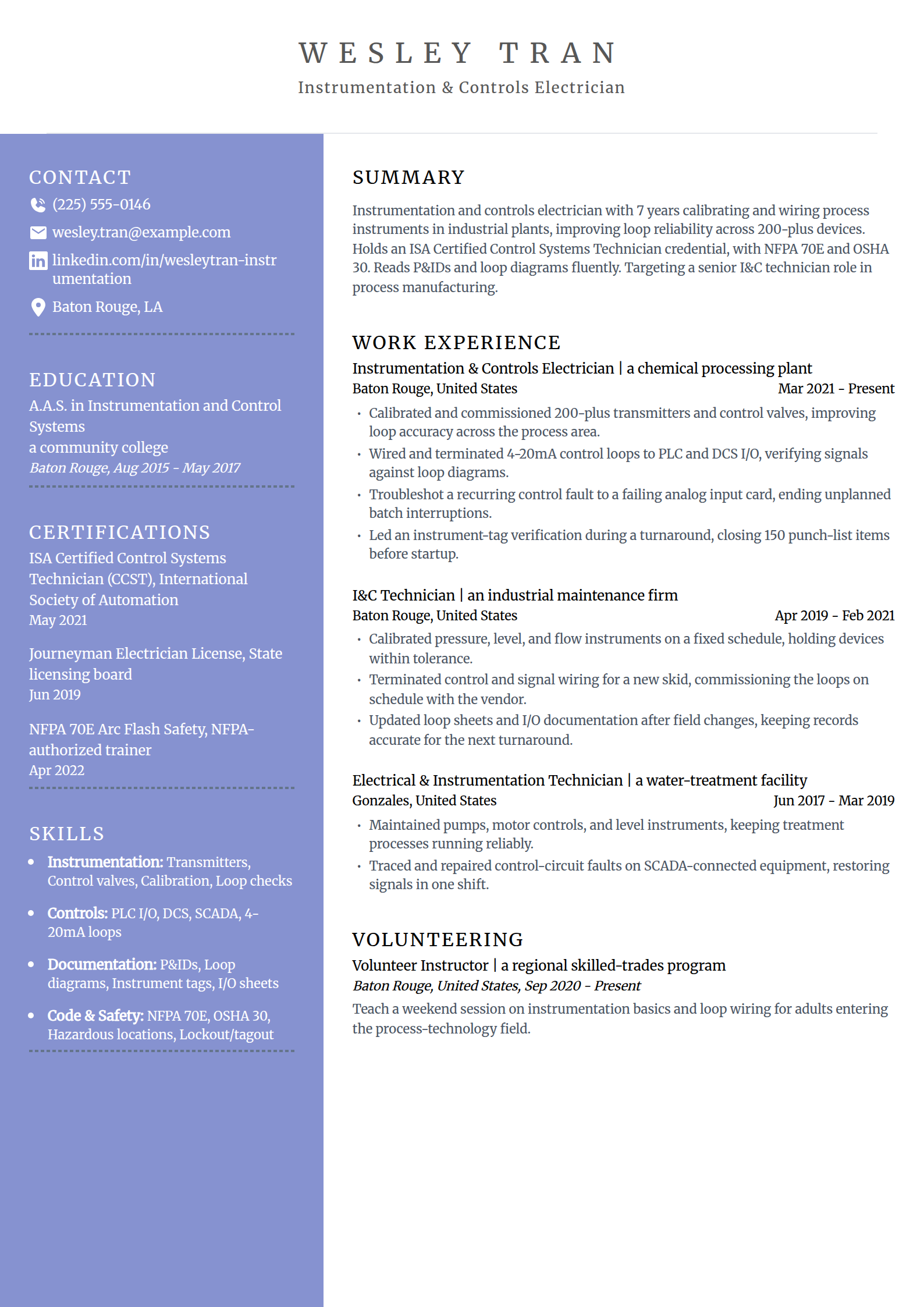
Instrumentation & Controls Electrician Resume Template
Why this resume example works?
- Leads with calibrated scope, 200-plus transmitters and control valves commissioned to improve loop accuracy.
- Shows the controls fluency a plant hires for, 4-20mA loops wired to PLC and DCS I/O against loop diagrams.
- Names the ISA Certified Control Systems Technician credential a process posting looks for.
- Proves turnaround value, a tag verification that closed 150 punch-list items before startup.
- Uses a roomy layout with a filled sidebar so a seven-year I&C record still looks full.
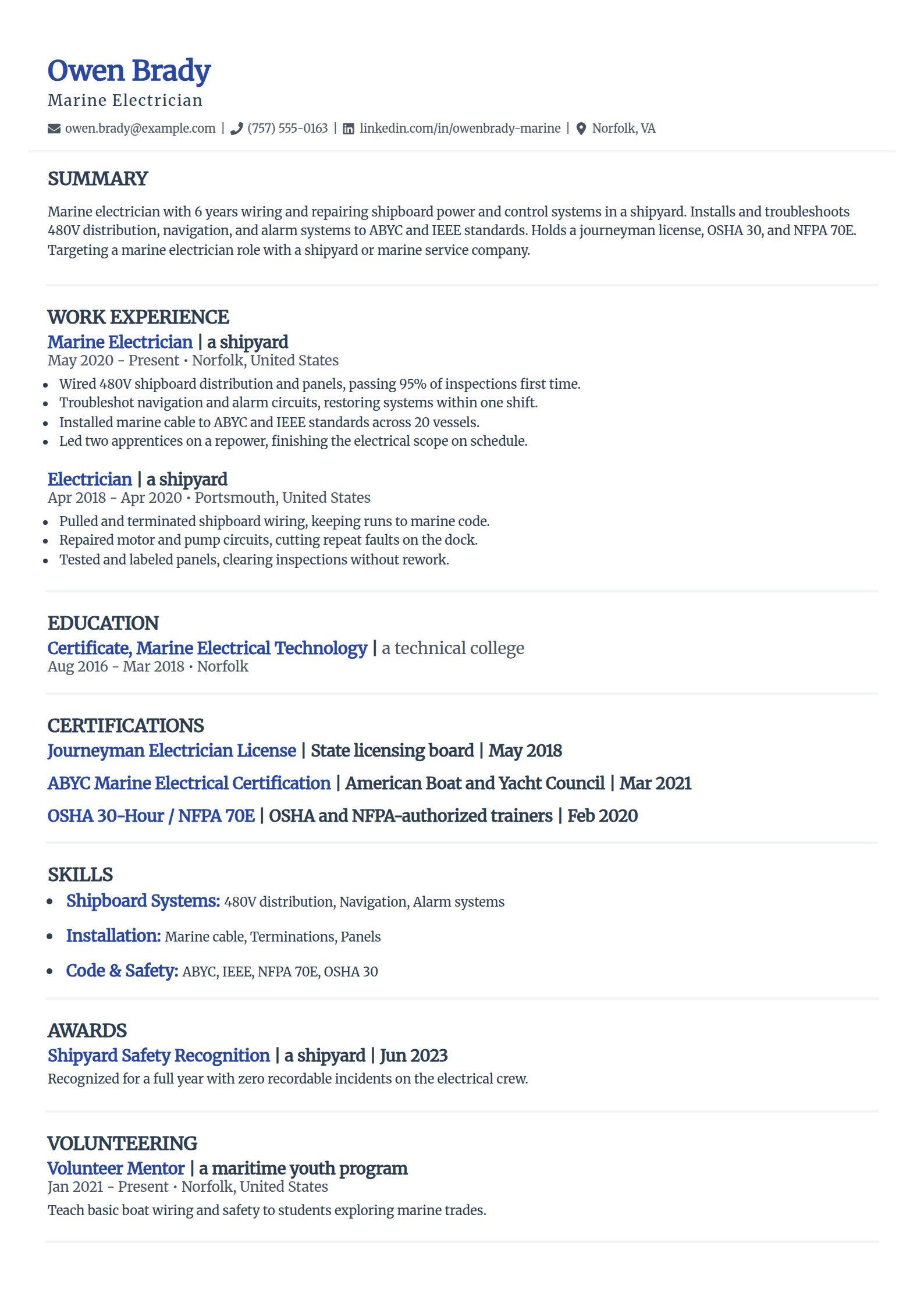
Marine Electrician Resume Template
Why this resume example works?
- Opens with shipboard scope, 480V distribution and panels passing 95% of inspections the first time.
- Shows the marine-specific standards a shipyard wants, ABYC and IEEE wiring across 20 vessels.
- Names the ABYC marine electrical certification alongside a journeyman license, OSHA 30, and NFPA 70E.
- Keeps tight bullets sharp, navigation and alarm circuits restored within one shift.
- Fills a clean single-page layout with a shipyard safety award and a marine-mentoring volunteer role.
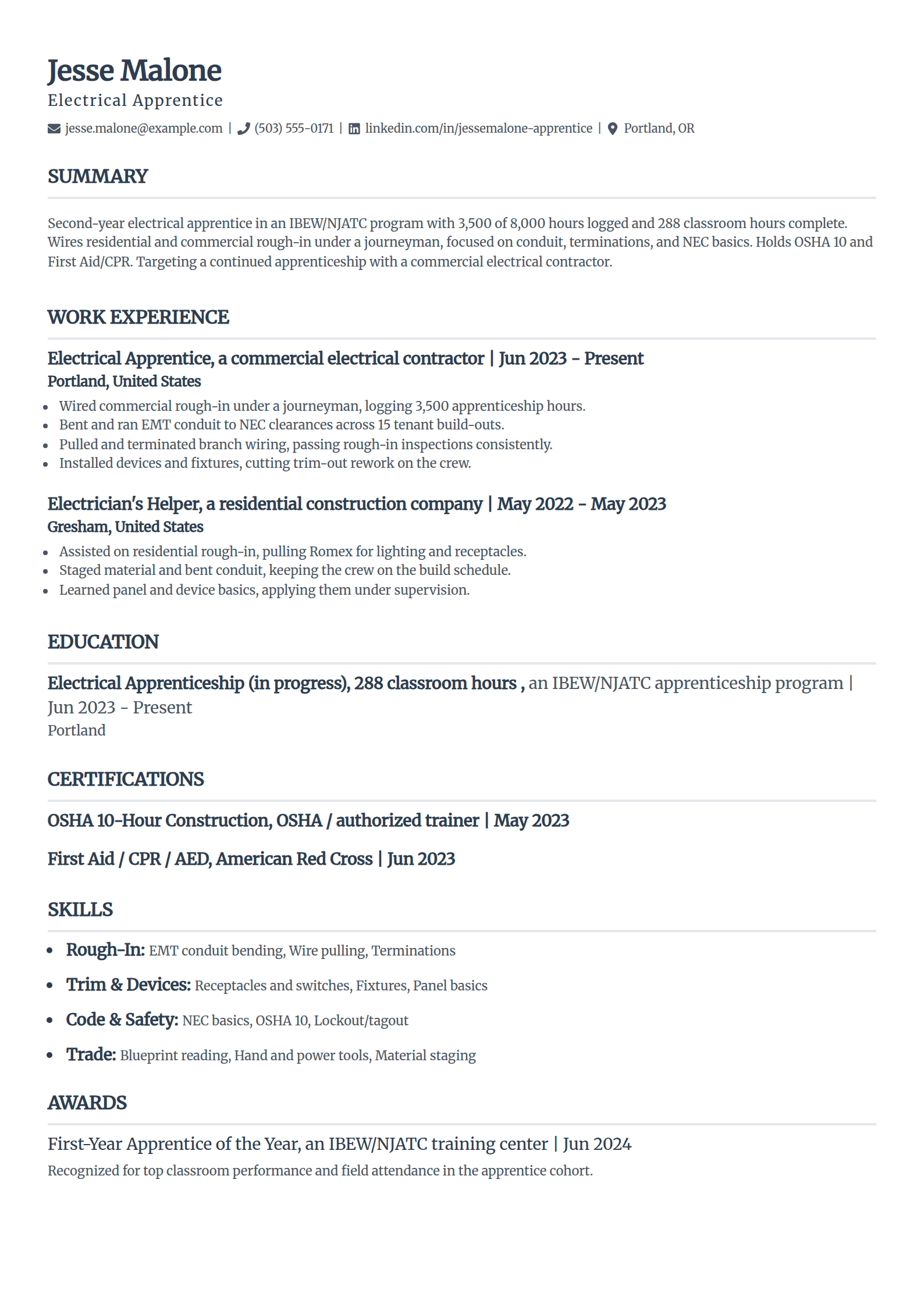
Apprentice Electrician Resume Template
Why this resume example works?
- Written for a second-year apprentice, leading with 3,500 of 8,000 hours and 288 classroom hours logged.
- Uses real apprenticeship work as entries, the right move before a journeyman license exists.
- Keeps each bullet honest and specific, EMT conduit bent to NEC clearances across 15 build-outs.
- Shows the certs an apprentice can hold, OSHA 10, First Aid/CPR, and a scissor-lift card.
- Fills a tight, ATS-safe page with an apprentice-of-the-year award and a Habitat volunteer role.
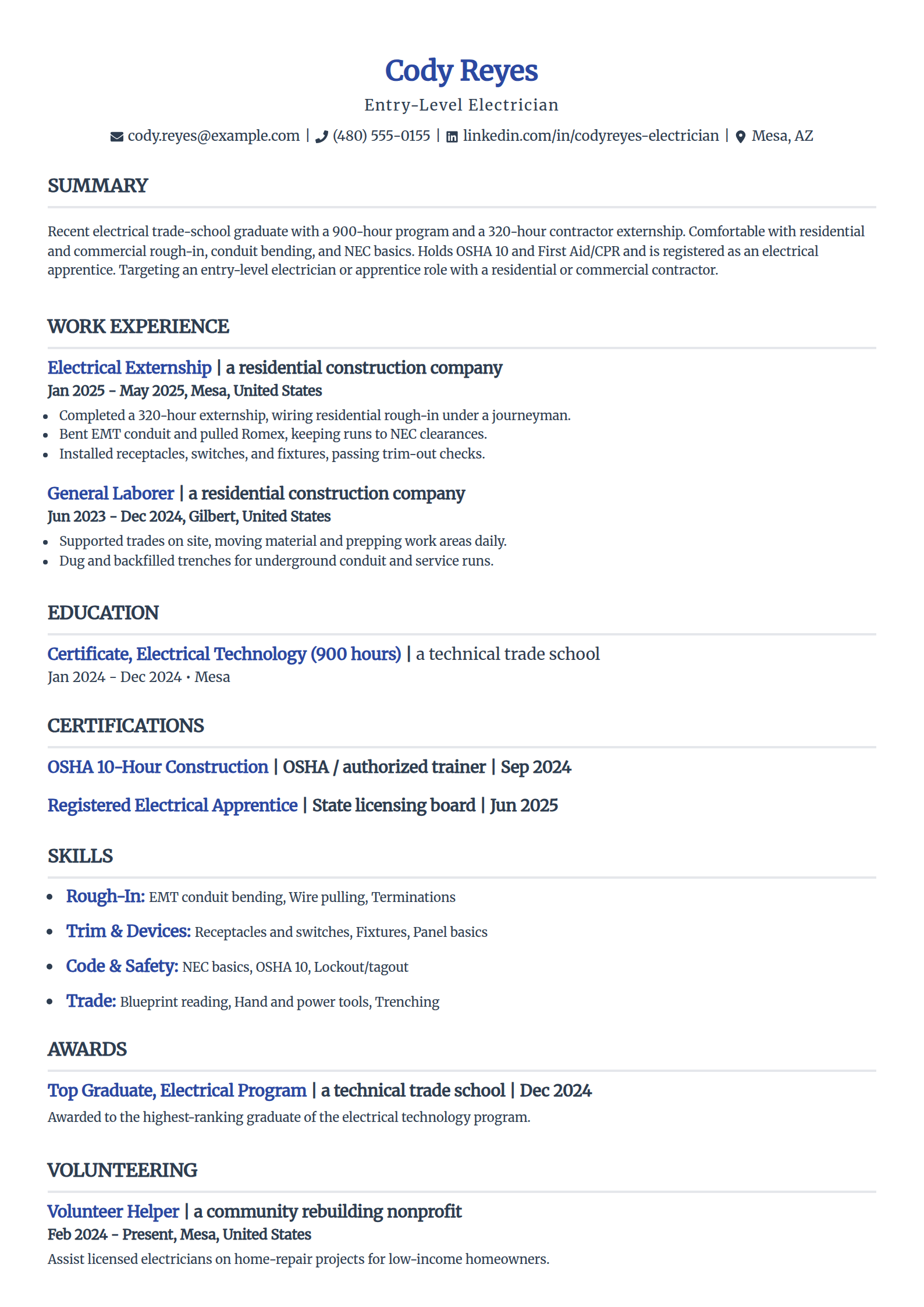
Entry-Level Electrician Resume Template
Why this resume example works?
- Written for a trade-school grad, leading with a 900-hour program and a 320-hour contractor externship.
- Reframes prior general-labor work honestly, trenching for conduit and prepping work areas on site.
- Keeps every bullet real and small, receptacles and fixtures installed and passing trim-out checks.
- Shows the entry credentials a screen wants, OSHA 10, First Aid/CPR, and apprentice registration.
- Fills a plain, ATS-safe page with a top-graduate award instead of invented licensed experience.
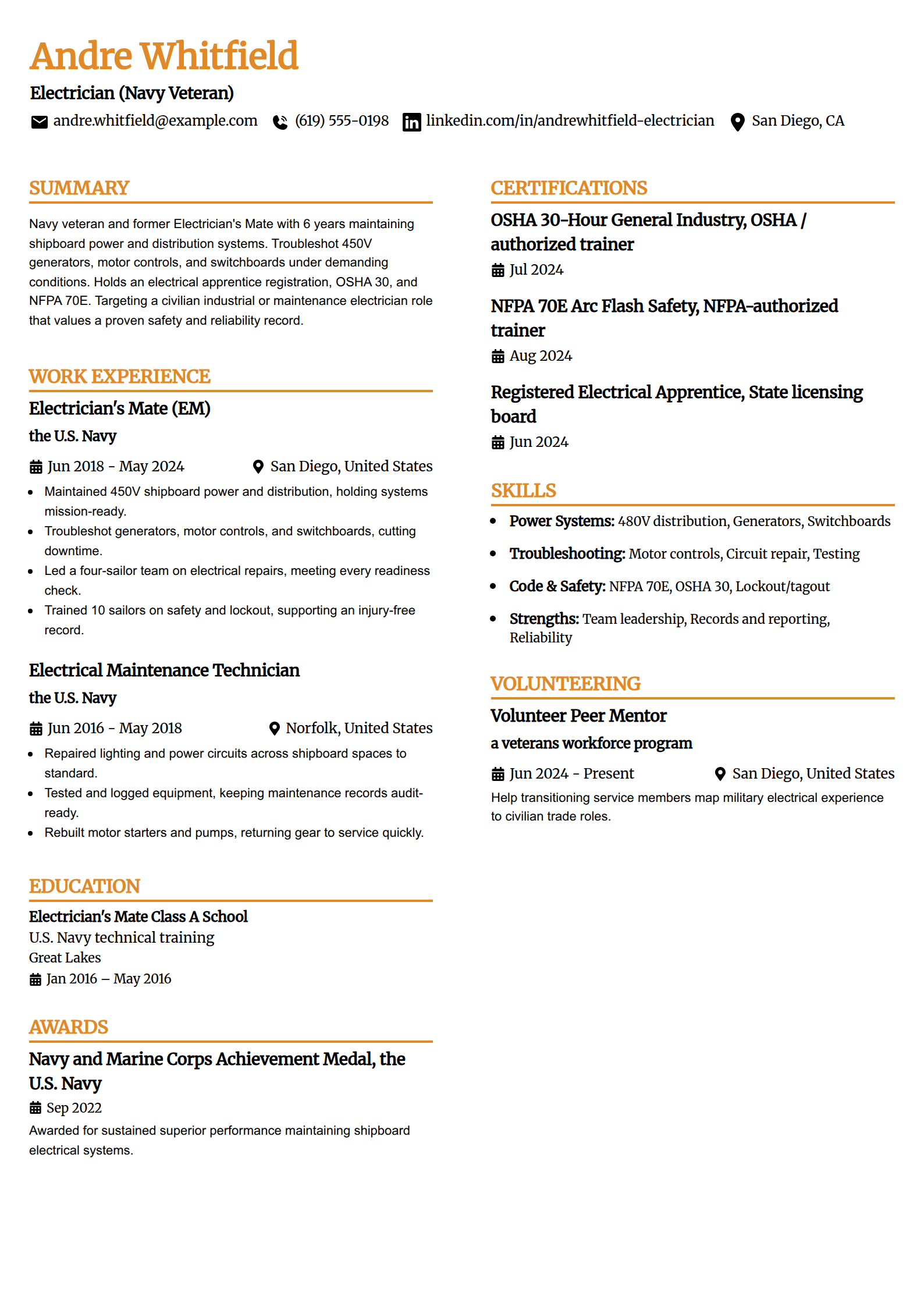
Military-to-Civilian Electrician Resume Template
Why this resume example works?
- Translates a Navy Electrician's Mate rating into civilian terms, 450V shipboard power and distribution.
- Leads with transferable results, generators and switchboards troubleshot to cut downtime.
- Bridges to the trade with the right certs, OSHA 30, NFPA 70E, and a registered apprentice status.
- Shows leadership a plant values, a four-sailor team led to an injury-free maintenance record.
- Fills a tight, ATS-safe page with a Navy achievement medal and a veteran-mentoring volunteer role.
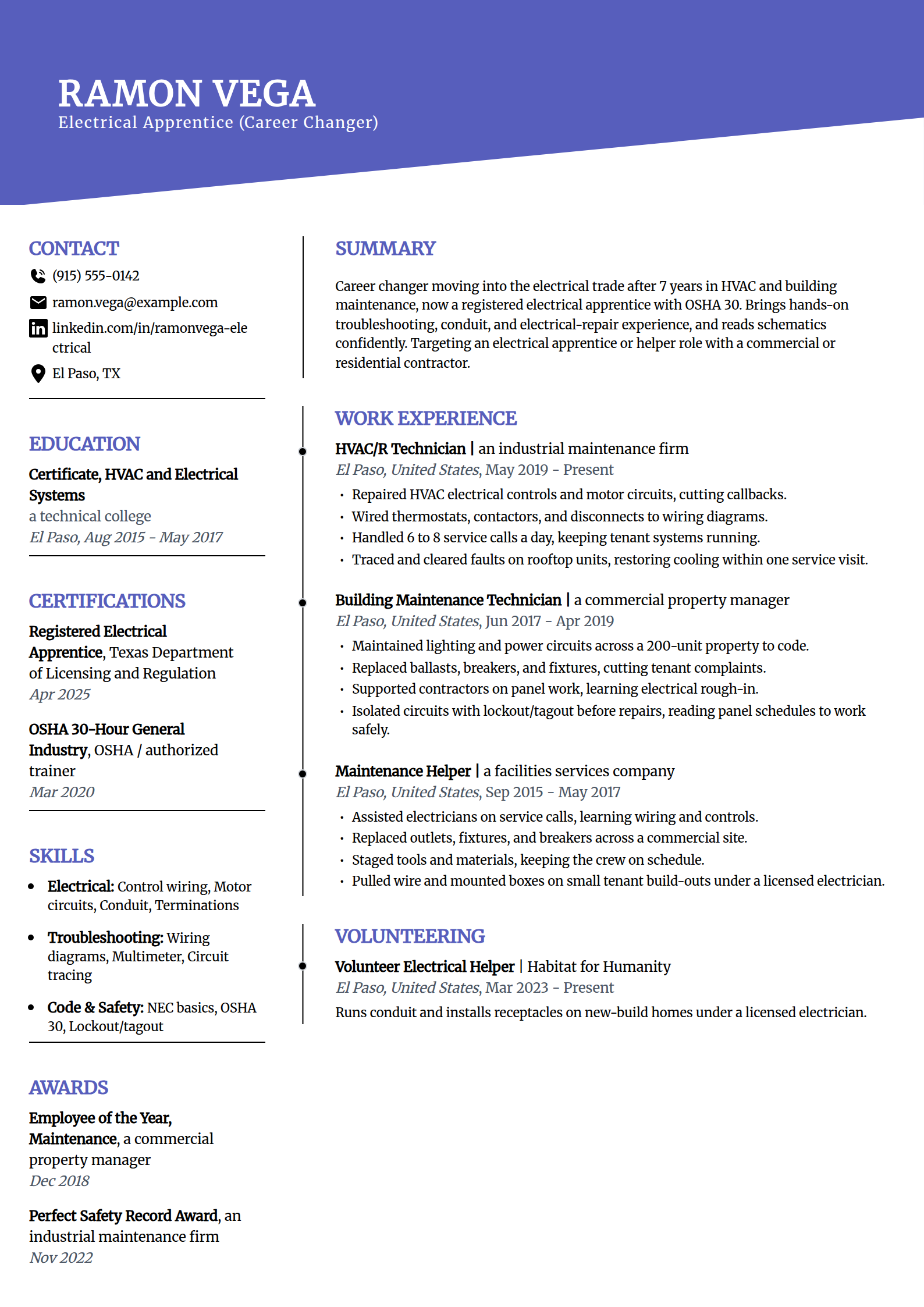
Career-Change Electrician Resume Template
Why this resume example works?
- Names the pivot openly, seven years in HVAC and maintenance now moving into a registered apprenticeship.
- Reframes prior work as an asset, HVAC control wiring and motor circuits troubleshot to diagrams.
- Keeps the electrical thread real, lighting and panel work maintained across a 200-unit property.
- Carries honest credentials, EPA 608, OSHA 30, and apprentice registration, with no invented licensed years.
- Lists awards without long descriptions, keeping the Orbit layout clean and balanced.
Build your electrician resume
Pick a template above and the editor keeps your layout clean and ATS-safe while you swap in your own license level, certifications, and inspection record.
Build my resumeHow to write an electrician resume in 2026
An electrician resume gets scanned fast by someone checking two things: your license level and whether you can prove clean, safe work. Lead with a short summary that names your license and specialty, then make every bullet an accomplishment with a number and the code or tool behind it. Keep the format clean so a parser reads it as easily as a hiring manager does.
Open with a license-first summary
Write three to four sentences that name your license level and years, your strongest number, the certs and systems a posting lists, and the role you are targeting. A journeyman leads with an inspection pass rate; a master leads with permits and load calculations; an apprentice leads with hours logged. Keep it to about 60 words so it never spills past the top of the page.
Licensed journeyman electrician with 10 years wiring commercial and residential projects, holding a 98% first-time inspection pass rate across 200-plus jobs. Skilled in conduit bending, blueprint reading, and NEC compliance, with OSHA 30 and NFPA 70E current. Targeting a lead journeyman role with a commercial electrical contractor.
Make every experience bullet an accomplishment with a number
Name the work, the method, and the result, then attach one credible metric. This is what separates a resume that gets a callback from a list of duties.
- Use electrician metrics: first-pass inspection rate, panels or services wired, feet of conduit, downtime cut, service calls a day, or days without a recordable incident.
- Open with a strong verb like wired, installed, troubleshot, terminated, ran, or commissioned, never "Responsible for".
- Name the code or tool: "terminated 600-amp switchgear feeders and cleared the panel with zero code violations".
- Keep numbers modest and level-accurate: an apprentice logs hours, a master runs a crew of twelve on a multimillion-dollar job.
Put the license ladder and certifications where they belong
The license level is the first thing a contractor checks, so it belongs near the top, not buried in a skills list. Match what you lead with to where you are on the ladder.
- State your exact license: registered apprentice, journeyman, or master, plus the state, since licensing is state by state.
- Apprentices and trade-school grads lead with apprenticeship or program hours and classroom hours logged toward the 8,000-hour standard.
- List the certs a posting names: OSHA 10 or 30, NFPA 70E, NEC familiarity, and specialty credentials like NABCEP for solar, BICSI for low-voltage, or ISA for controls.
- Maintenance and facilities roles value crossover certs like EPA 608; if you are aiming there, the maintenance technician resume summary page shows how to frame that work.
Match skills and keywords to the job posting
A skills block should read like the posting, grouped so a hiring manager and a parser both find what they need. List what you have actually worked with, not a generic dump.
- Group by type: wiring and installation, systems, code and safety, blueprints, and testing.
- Name specific systems and tools: conduit bending, switchgear, 480V distribution, PLCs, VFDs, motor controls, and structured cabling, matched to the role.
- Spell out code and safety terms a scan looks for: NEC, NFPA 70E, arc-flash, lockout/tagout, and grounding and bonding.
- Mirror the posting's exact phrasing where it fits, since that is what the applicant tracking system searches for.
Keep the format clean and ATS-safe
An electrician resume is read by a parser first and a hiring manager second, so a clean layout with standard headings is the safe choice at every level.
- Use a single-column or simple two-column layout with standard headings a parser recognizes; skip heavy graphics and photos.
- Most electricians fit one page; use a second only when a master, foreman, or project manager genuinely needs it.
- Save as a PDF so the formatting holds, then run it through the ATS resume checker for a quick format pass.
- Swap the numbers in the templates above for your own hours, panels, and inspection record; do not copy them as is.
Common electrician resume mistakes
- Burying the license level. Put registered apprentice, journeyman, or master and the state near the top, since it is the first thing a contractor screens for.
- Writing duty lists with no number. Replace "ran conduit and wired panels" with "ran 12,000 feet of conduit to NEC clearances and passed 98% of inspections first time".
- Leaving off safety credentials. OSHA 10 or 30 and NFPA 70E are near-mandatory on many job sites; if you hold them, they belong on the page.
- Hiding the inspection and callback record. A first-pass inspection rate or a low code-violation callback rate is the cleanest proof of quality work, so lead with it.
- Padding a career-change or entry-level resume with fake experience. Reframe prior trade or general-labor work honestly instead; the laborer resume summary page shows how to make hands-on site work count.
Frequently asked questions
How do you write an electrician resume?
Lead with a three-to-four-sentence summary that names your license level, your years and specialty, your strongest number, and the role you are targeting. Under each job, write results-first bullets that open with a strong verb and carry one credible metric, like passing 98% of inspections on the first visit or running 12,000 feet of conduit to code. Put your license, OSHA and NFPA 70E certs near the top, group your skills to match the posting, and keep the whole thing to one clean, ATS-safe page for most levels.
What should an electrician resume include?
The core is a license-first summary, impact bullets with numbers, a grouped skills block, and your license and certifications near the top. Name your exact license level and state, your OSHA 10 or 30 and NFPA 70E status, and NEC familiarity, then add any specialty credentials like NABCEP for solar, BICSI for low-voltage, or ISA for controls. Show the systems you have worked with, from conduit and switchgear to PLCs, VFDs, and motor controls, and prove quality with an inspection pass rate or a low callback rate.
How do you write an electrician resume with no experience?
Lead with what you do have. A trade-school grad leads with program hours and an externship, plus OSHA 10 and apprentice registration; a first-year apprentice leads with apprenticeship and classroom hours logged toward the 8,000-hour standard. A career-changer leads with a registered apprenticeship and reframes prior trade or general-labor work honestly, like HVAC control wiring or site trenching. Real hours and honest, quantified work carry more weight than invented job history, which an interviewer will see through. The apprentice, entry-level, and career-change examples above show the shape.
What is the difference between an apprentice, journeyman, and master electrician resume?
The difference is what you lead with, and it follows the license ladder. An apprentice resume leads with apprenticeship and classroom hours logged and work done under a journeyman, since no license exists yet. A journeyman resume leads with independent work and a first-pass inspection rate, backed by the journeyman license. A master resume leads with permits, NEC load calculations, and crew leadership on larger projects, backed by the master license. Each level states its exact license and state near the top.
What skills and keywords do electrician resumes need?
Match the posting, then name specific skills grouped by type: wiring and installation (conduit bending, terminations, wire pulling), systems (switchgear, 480V distribution, motor controls, VFDs, PLCs), code and safety (NEC, NFPA 70E, arc-flash, lockout/tagout), and blueprints and testing (schematic reading, multimeter, megohmmeter). Add the specialty keywords your track uses, like NABCEP and Article 690 for solar, structured cabling and fiber for low-voltage, or 4-20mA loops for controls. List what you have actually used and can discuss on the job, and mirror the posting's exact phrasing.
How long should an electrician resume be?
One page for most electricians, including apprentices, journeymen, and mid-career tradespeople. Use a second page only when a master electrician, foreman, or electrical project manager has enough relevant projects, crew leadership, or scope to justify it, and never pad to reach it. Whichever length you use, lead with your most recent and most relevant work, keep standard headings, and cut older or unrelated jobs so the space goes to the work that matches the role you want.
More electrician resume resources
Build your electrician resume
Pick a template above and the editor keeps your layout clean and ATS-safe while you swap in your own license level, certifications, and inspection record.