Maintenance Technician Resume Templates by Trade and Experience Level
- ATS Friendly
- Trade-Specific
- 17 Real Examples
An industrial multi-craft tech, an apartment turn specialist, and a controls tech each need a different resume, and this page has one built for your exact trade. Start from a layout below, then model your own on a real example, from a first no-cert job to a lead role. Your certifications, trades, and uptime numbers sit where a maintenance supervisor looks first.


540k+ resumes created
Maintenance technician resume templates for every trade and level
Each template below is a real maintenance technician resume laid out in that format, sorted by experience level and setting across industrial, property, facilities, automotive, field service, and controls work. Pick one, then swap in your own certifications, trades, systems, and uptime numbers. Every layout keeps your name, certifications, and troubleshooting skills readable so a hiring supervisor sees your strongest work at a glance and an applicant tracking system parses it cleanly.
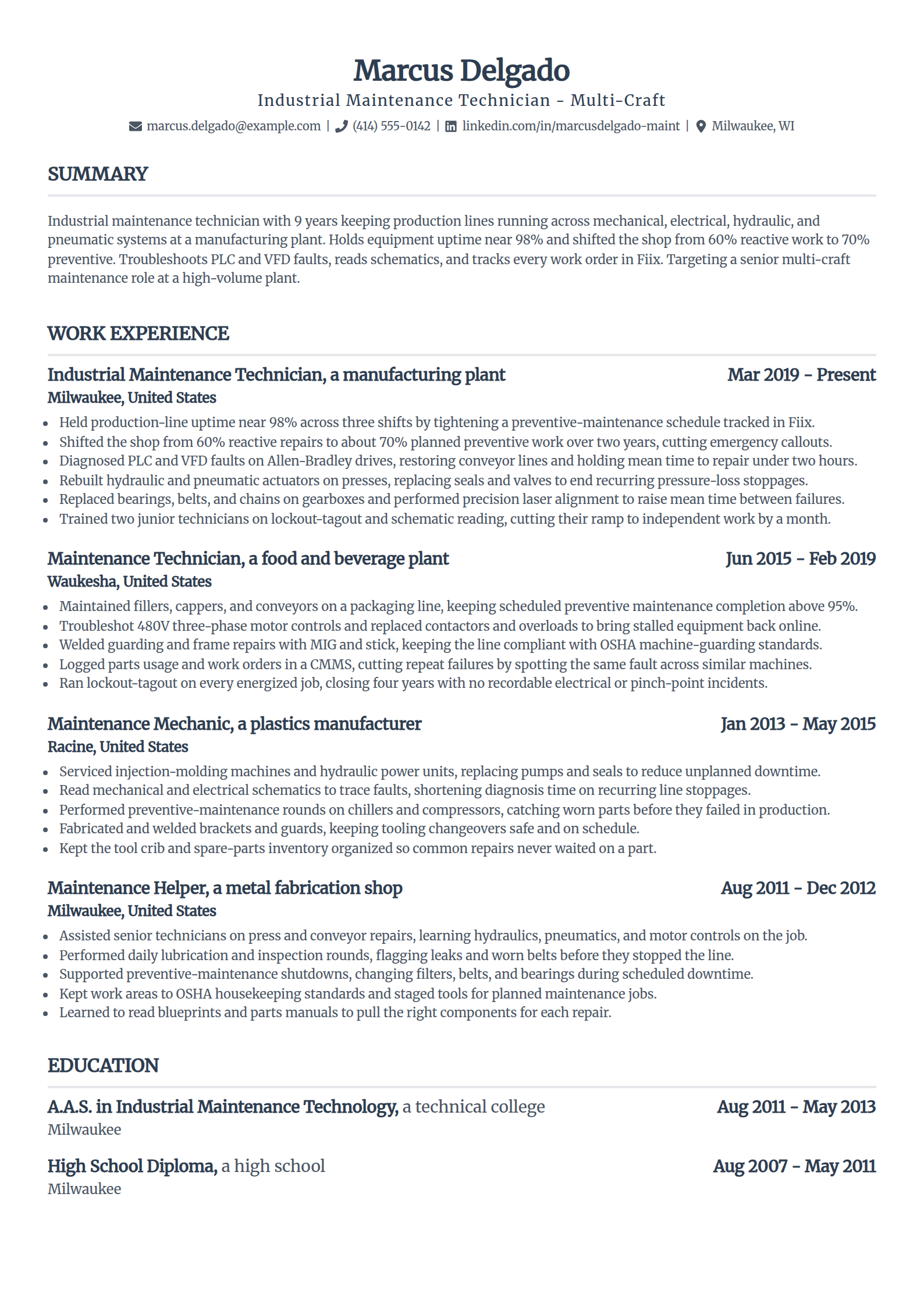
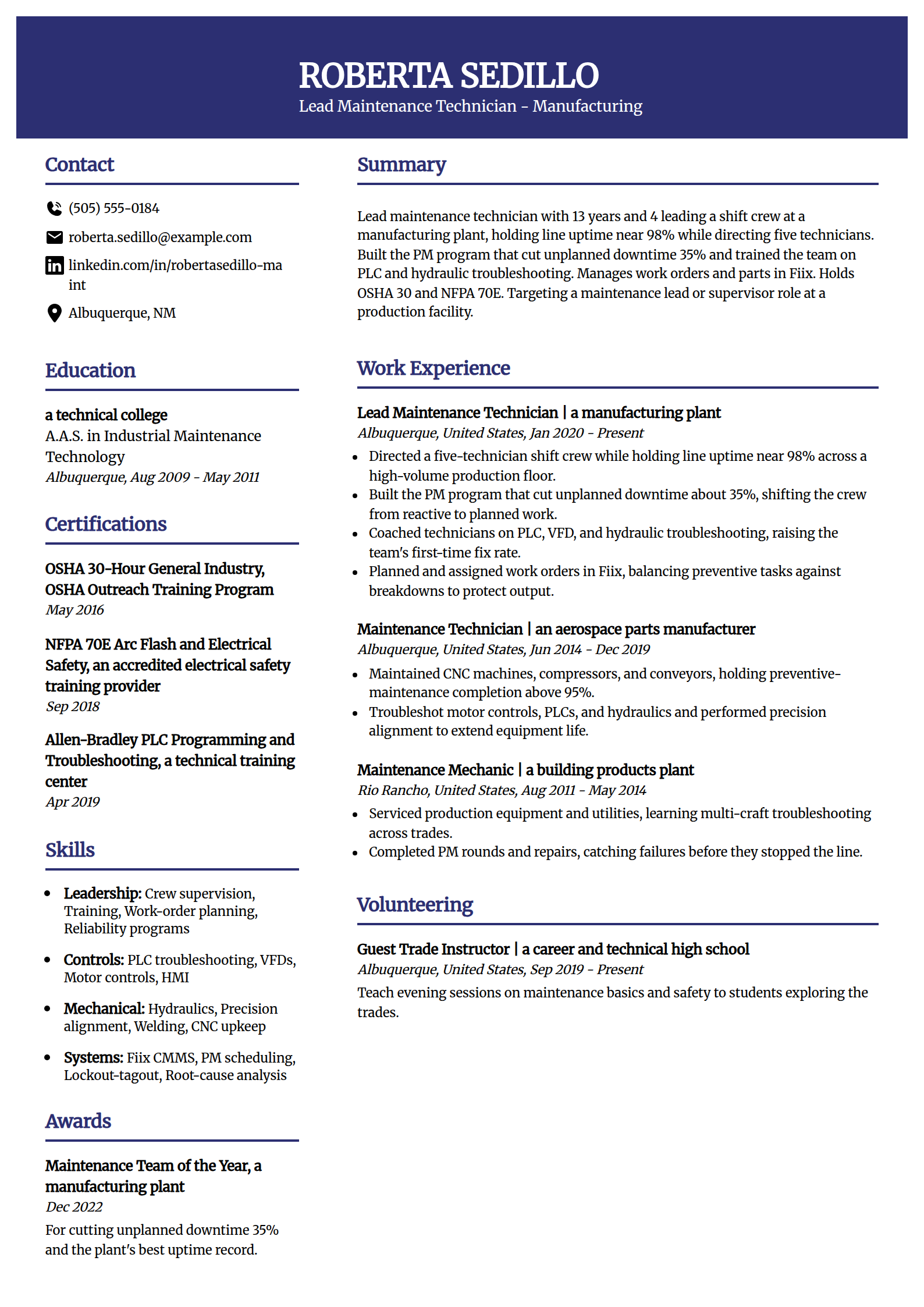
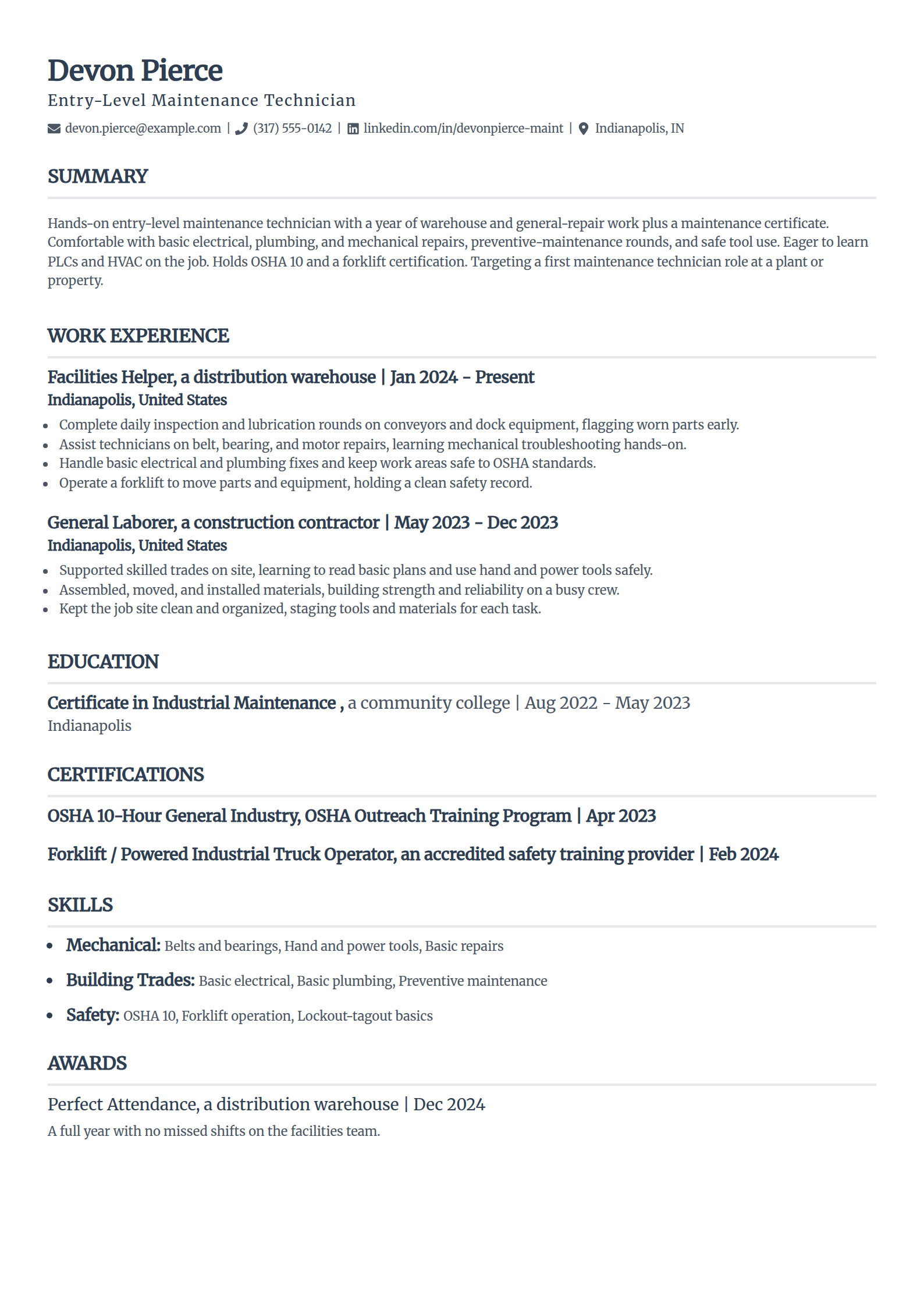
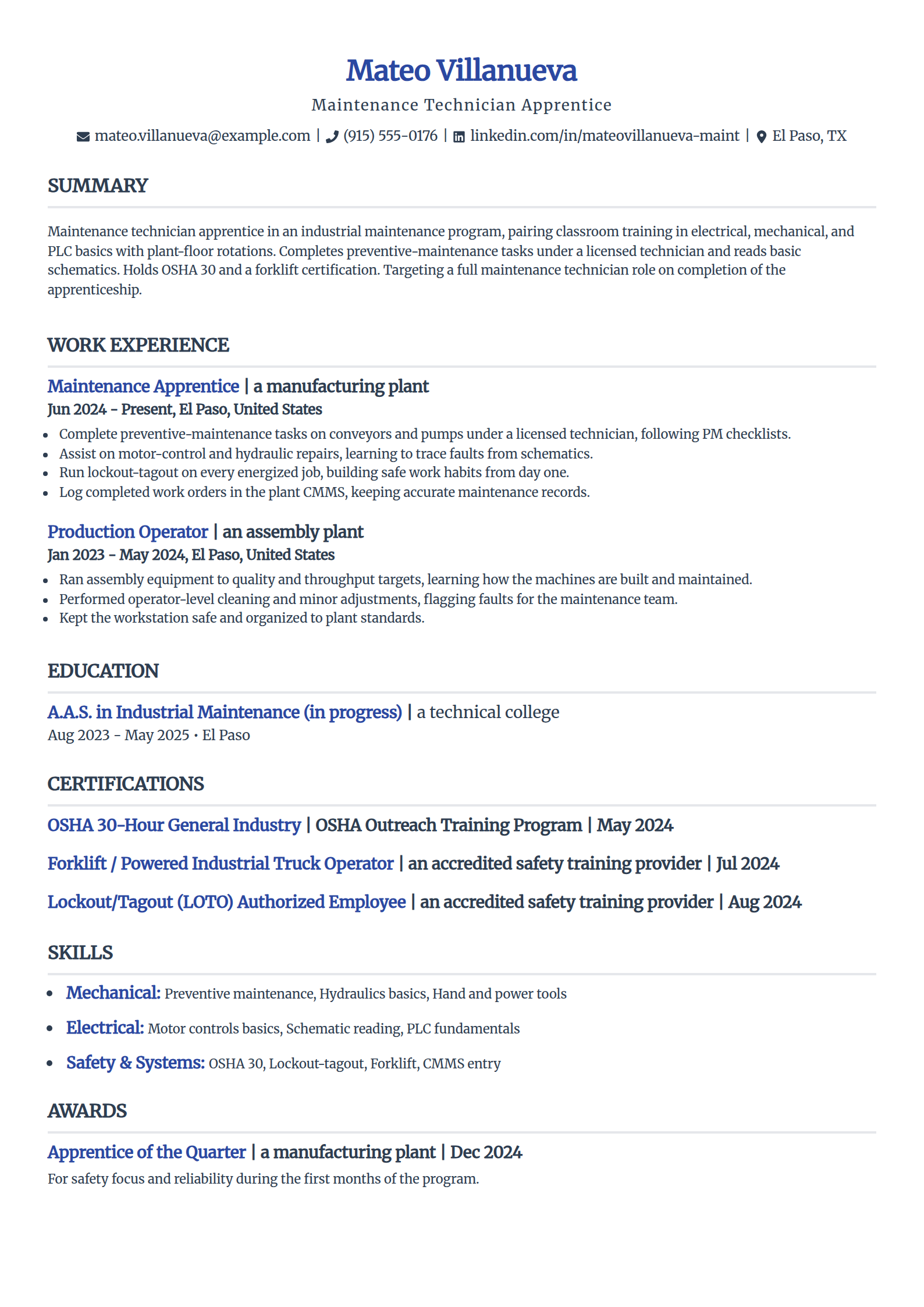
Industrial Maintenance Technician Resume Template
Why this resume example works?
- Opens with a summary that names 9 years, four trades, equipment uptime near 98%, and a shift from reactive to preventive work.
- Shows the multi-craft range a plant wants: mechanical, electrical, hydraulic, pneumatic, plus PLC and VFD troubleshooting.
- Attaches one number to each bullet, like mean time to repair under two hours or a 70% preventive-maintenance mix.
- Names the systems a posting screens for, Fiix CMMS, Allen-Bradley PLCs, and lockout-tagout, in real work context.
- Uses a clean, single-column layout an applicant tracking system reads without trouble.
Lead Maintenance Technician Resume Template
Why this resume example works?
- Leads with 13 years and 4 directing a five-technician shift crew, the depth a lead or supervisor posting wants.
- Shows the results a lead is hired for, a PM program that cut unplanned downtime about 35% and uptime held near 98%.
- Keeps the candidate credible at the bench, coaching technicians on PLC, VFD, and hydraulic troubleshooting.
- Names Fiix work-order planning, OSHA 30, and NFPA 70E, the systems and safety a lead is expected to own.
- Uses a roomy layout with an award and a trade-instructor volunteer role so a leadership record fills the page.
Entry-Level Maintenance Technician Resume Template
Why this resume example works?
- Written for a first maintenance job, leading with a year of hands-on warehouse repair work and a maintenance certificate.
- Uses a facilities-helper and general-laborer role as entries, the right move when full-time maintenance experience is new.
- Keeps every bullet honest, like daily inspection and lubrication rounds and assisting on belt and bearing repairs.
- Names OSHA 10 and a forklift certification, the credentials a first posting checks, and shows eagerness to learn PLCs.
- Fills a tight, ATS-safe page with an attendance award and a community-repair volunteer role instead of padding.
Maintenance Apprentice Resume Template
Why this resume example works?
- Written for an apprentice, leading with an industrial maintenance program that pairs classroom training with floor rotations.
- Uses the apprenticeship and a prior operator role as entries, the honest shape before a full technician job.
- Keeps each bullet real, like completing PM tasks under a licensed technician and running lockout-tagout on every job.
- Names OSHA 30, forklift, and lockout-tagout certifications plus PLC fundamentals, the early credentials that matter.
- Fills a tight, ATS-safe page with an apprentice award and a makerspace volunteer role.
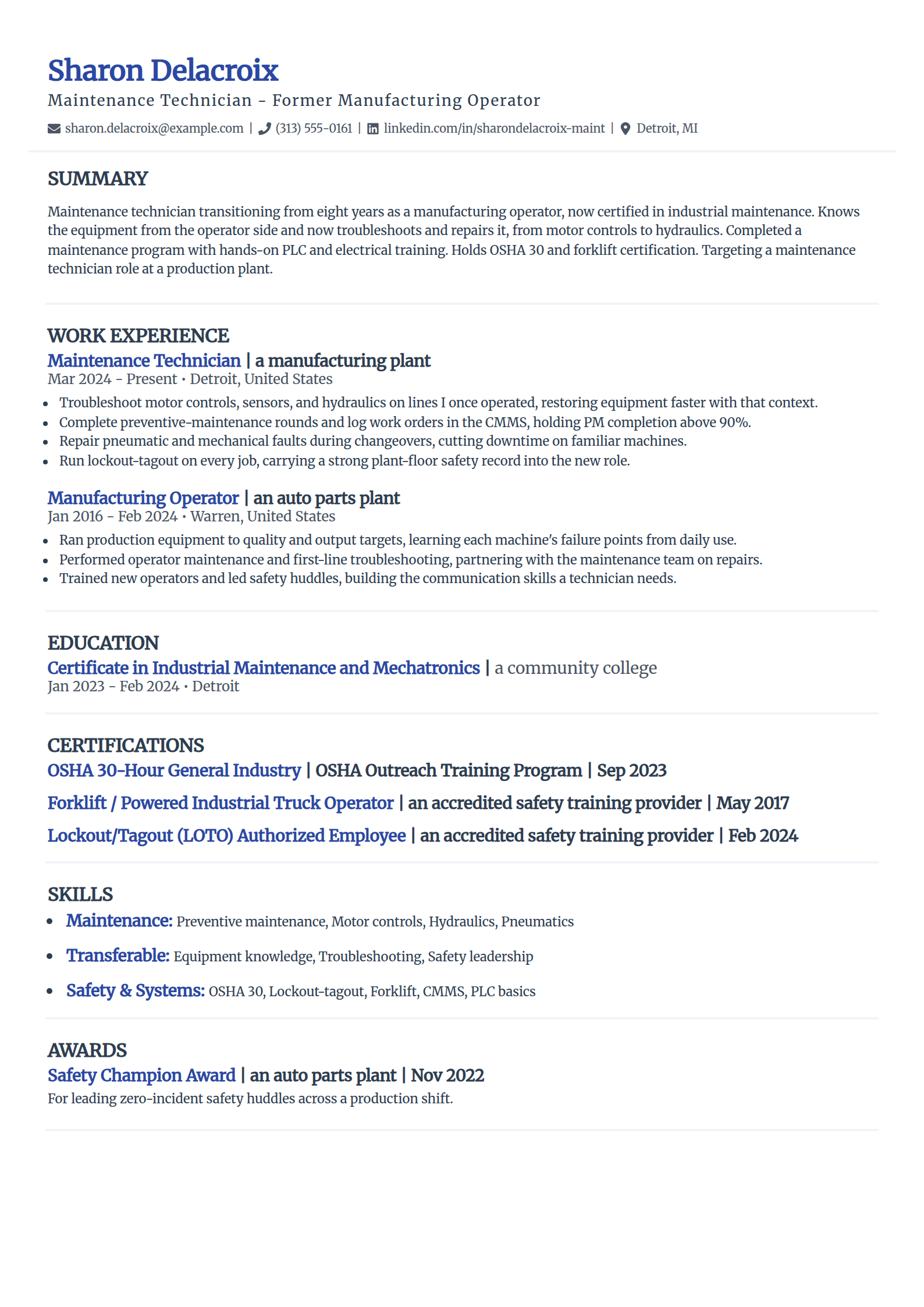
Career-Change Maintenance Resume Template
Why this resume example works?
- Names the switch openly, moving from eight years as a manufacturing operator into a certified maintenance role.
- Reframes prior work as an asset, knowing the equipment's failure points from the operator side speeds the ramp.
- Shows recent proof inside the new role, troubleshooting motor controls and hydraulics and holding PM completion above 90%.
- Keeps the new credentials concrete, a mechatronics certificate, OSHA 30, and lockout-tagout.
- Uses a clean layout with a safety award and a peer-mentor volunteer role so a transition record still looks full.
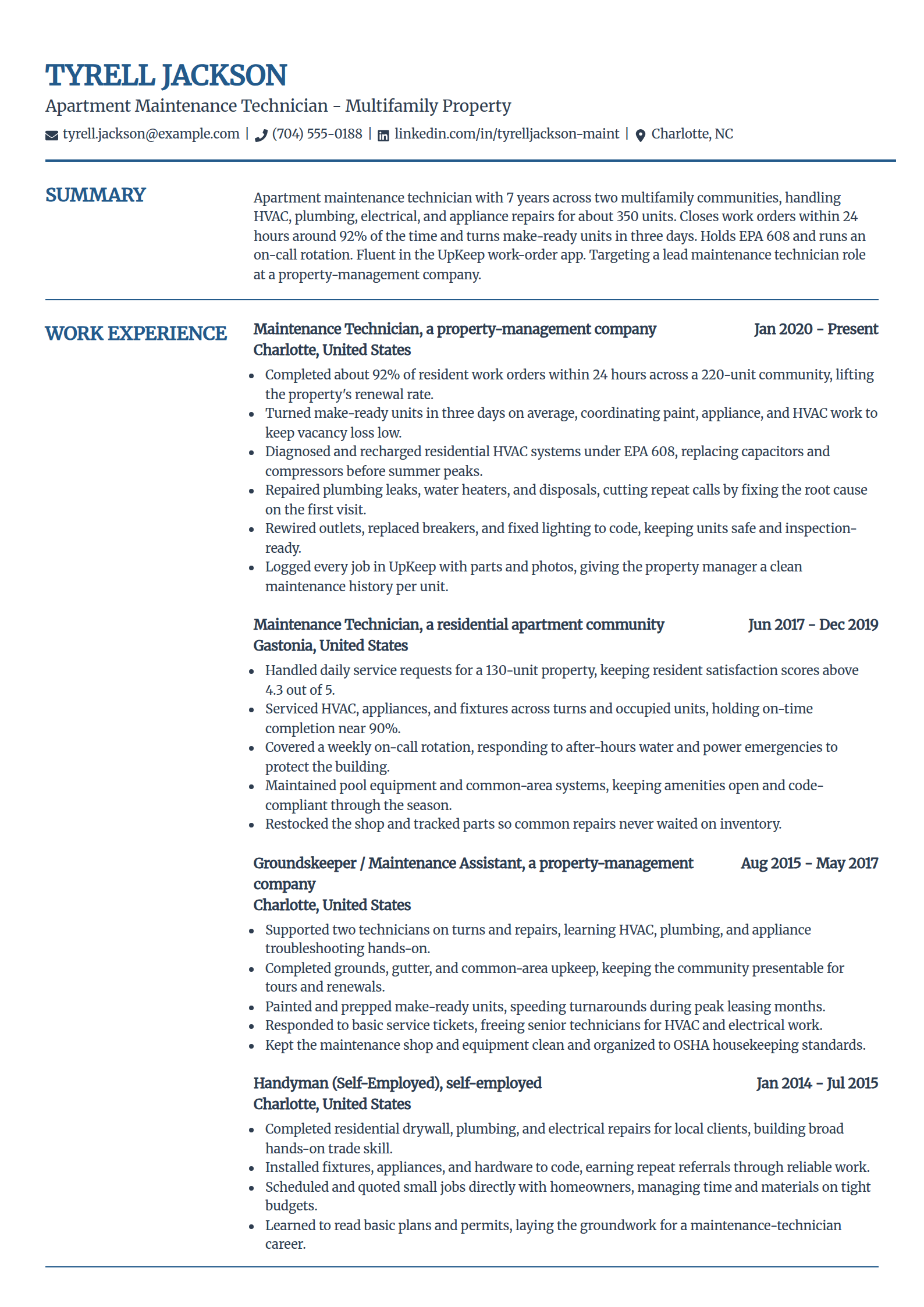
Apartment Maintenance Technician Resume Template
Why this resume example works?
- Leads with the value a property manager wants, closing about 92% of work orders within 24 hours across 220 units.
- Shows the everyday trades a community needs, HVAC under EPA 608, plumbing, electrical, and appliance repairs.
- Keeps results countable, like turning make-ready units in three days and covering a weekly on-call rotation.
- Names UpKeep work orders, EPA 608, and a CAMT credential, the systems and certs a multifamily posting checks.
- Uses a modern layout that carries a full property-maintenance history on one clean page.
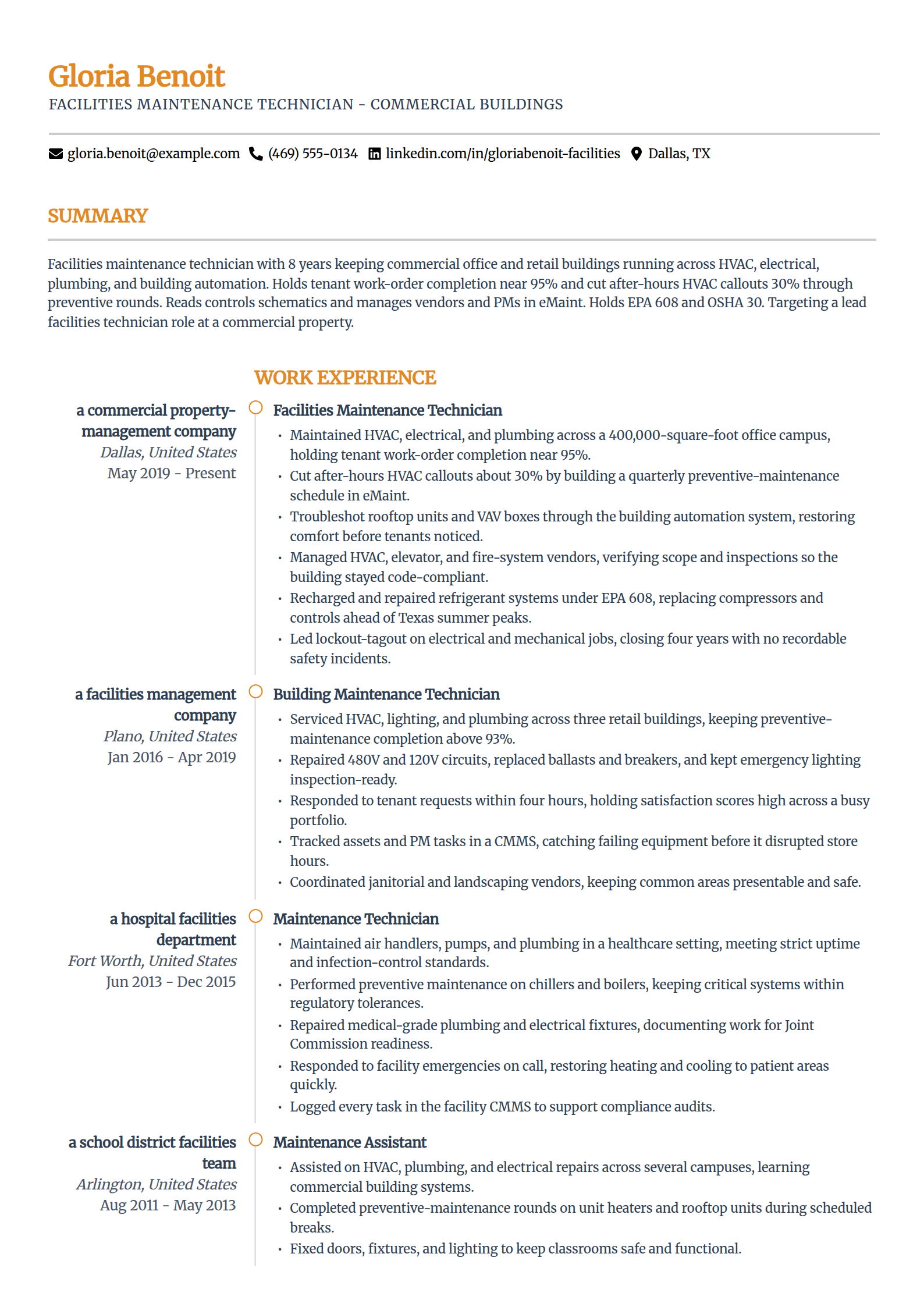
Facilities Maintenance Technician Resume Template
Why this resume example works?
- Opens with commercial-building scope, HVAC, electrical, plumbing, and building automation across a 400,000-square-foot campus.
- Shows the results a property wants, tenant work-order completion near 95% and after-hours HVAC callouts cut 30%.
- Keeps the work honest, managing vendors and inspections so the building stays code-compliant rather than overclaiming.
- Names eMaint PMs, EPA 608, OSHA 30, and building automation, the tools a facilities posting screens for.
- Uses a modern layout that carries a multi-building record cleanly on one page.
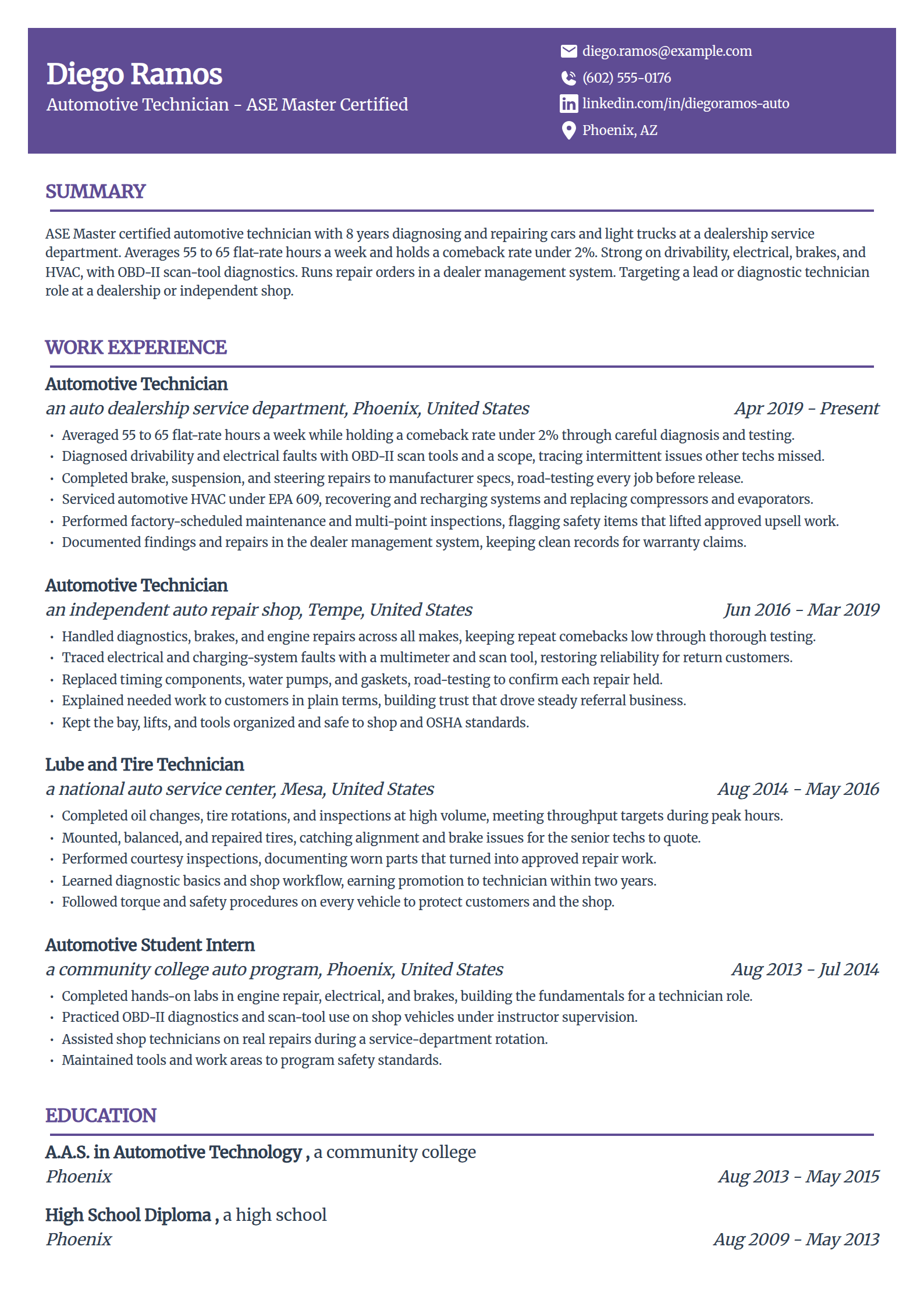
Automotive Technician Resume Template
Why this resume example works?
- Leads with ASE Master certification and 55 to 65 flat-rate hours a week at a dealership, the shape a service posting wants.
- Shows real diagnostic depth, tracing drivability and electrical faults with OBD-II scan tools and a scope.
- Keeps quality visible with a comeback rate under 2% and road-testing every job before release.
- Names EPA 609 A/C work, the dealer management system, and warranty documentation, all in real service context.
- Uses a spacious layout that carries a full automotive record on one page.
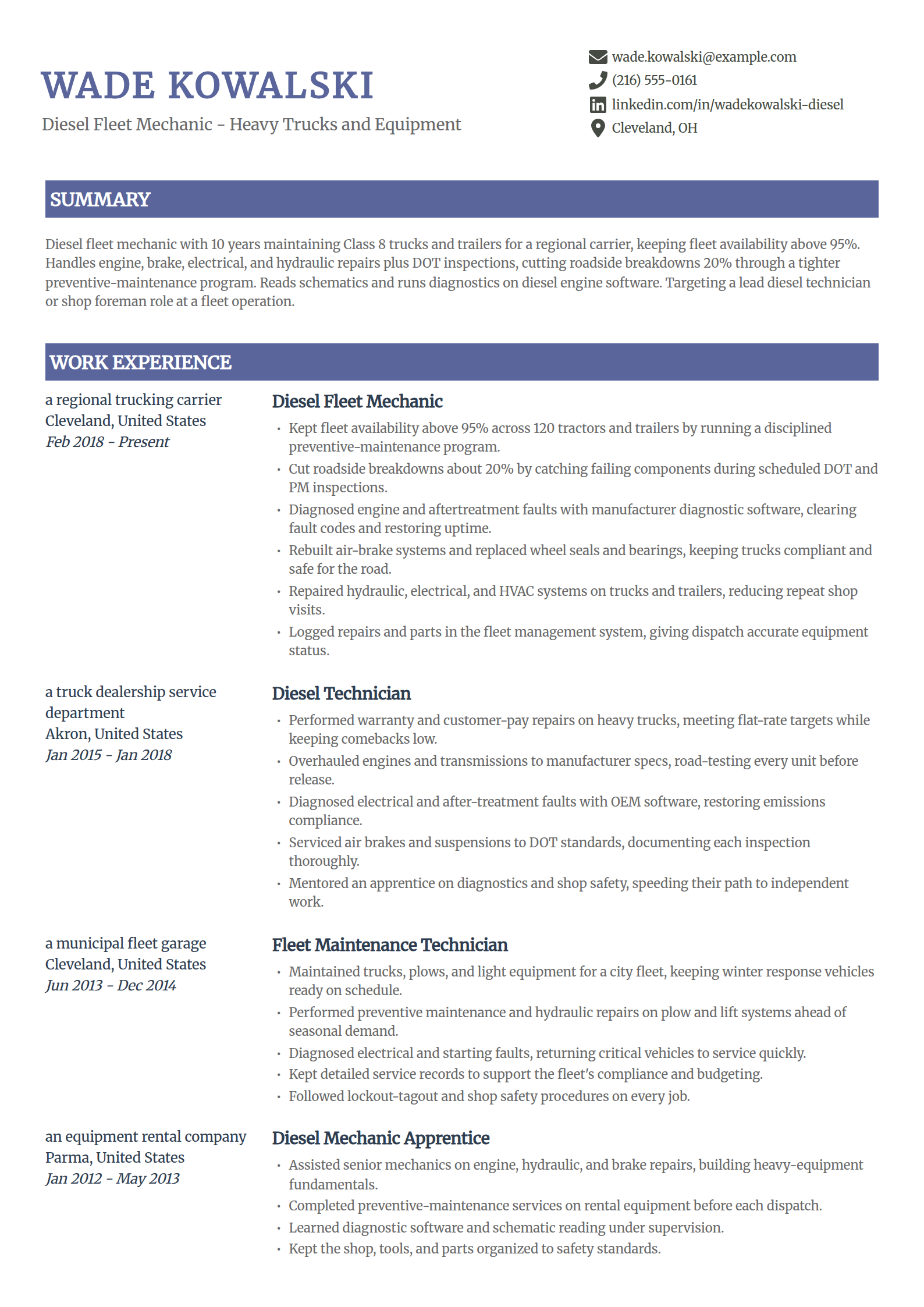
Diesel Fleet Mechanic Resume Template
Why this resume example works?
- Opens with fleet value, keeping availability above 95% across 120 tractors and trailers through a tight PM program.
- Shows the results a carrier wants, roadside breakdowns cut about 20% by catching failures during DOT inspections.
- Keeps the scope real, engine, air-brake, electrical, and hydraulic repairs plus manufacturer diagnostic software.
- Names an ASE T-series master credential, a DOT brake qualification, and a CDL Class A, the certs a fleet checks.
- Uses a modern two-column layout that carries a deep heavy-truck record on one page.
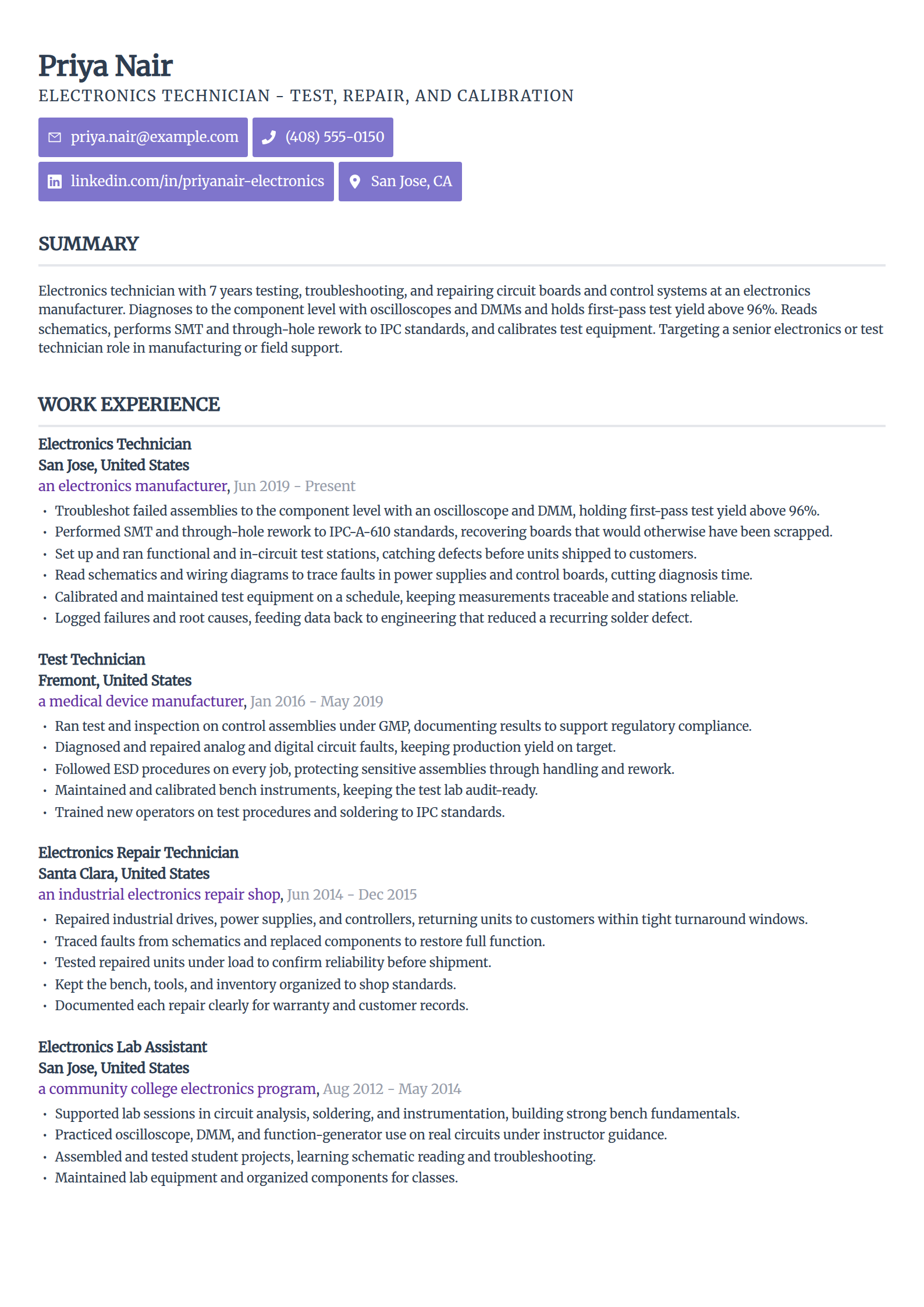
Electronics Technician Resume Template
Why this resume example works?
- Leads with component-level troubleshooting and a first-pass test yield above 96%, the depth a manufacturer wants.
- Shows real bench skill, SMT and through-hole rework to IPC-A-610 standards and functional and in-circuit test setup.
- Keeps the work precise, calibrating test equipment and reading schematics to trace faults in power and control boards.
- Names IPC J-STD-001, ESD control, and GMP records, the standards an electronics or test posting screens for.
- Uses a clean, modern layout that carries a full test-and-repair record on one page.
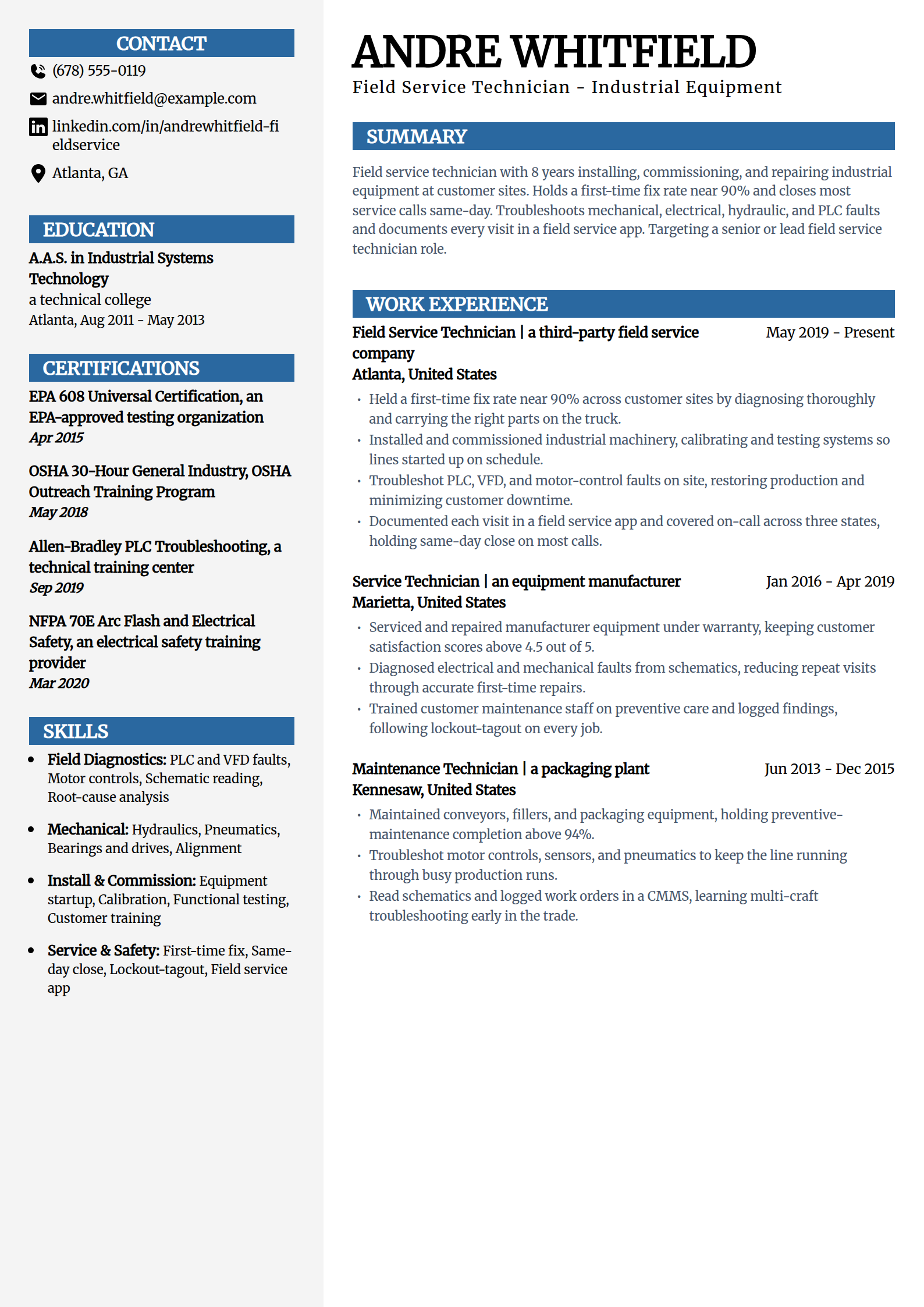
Field Service Technician Resume Template
Why this resume example works?
- Opens with the value a service company wants, a first-time fix rate near 90% and same-day close on most calls.
- Shows the range a field role needs, installing and commissioning equipment plus PLC, VFD, and hydraulic repairs on site.
- Keeps results tied to the customer, satisfaction scores above 4.5 and clear per-visit documentation in a field app.
- Names lockout-tagout, NFPA 70E, and an on-call rotation across three states, the scope a field posting checks.
- Uses a modern two-column layout that carries a varied, multi-site history on one page.
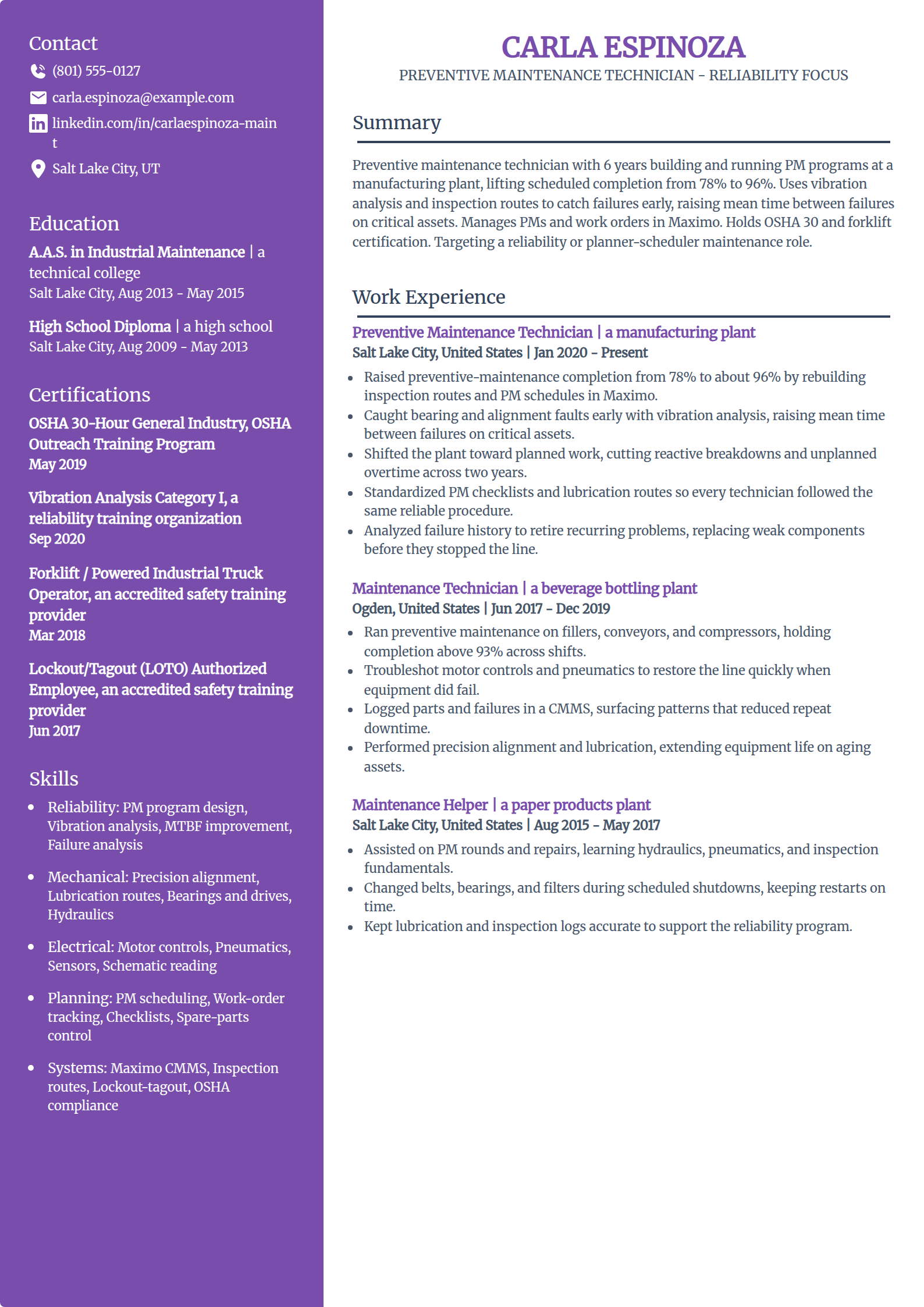
Preventive Maintenance Technician Resume Template
Why this resume example works?
- Leads with reliability, lifting scheduled PM completion from 78% to about 96% by rebuilding routes in Maximo.
- Shows the skill a reliability role rewards, catching bearing and alignment faults early with vibration analysis.
- Keeps the numbers honest, raising mean time between failures on critical assets and cutting reactive breakdowns.
- Names Maximo, vibration analysis Category I, and precision alignment, the tools a planner-track posting wants.
- Uses a Medium layout that carries a reliability-focused record without empty space.
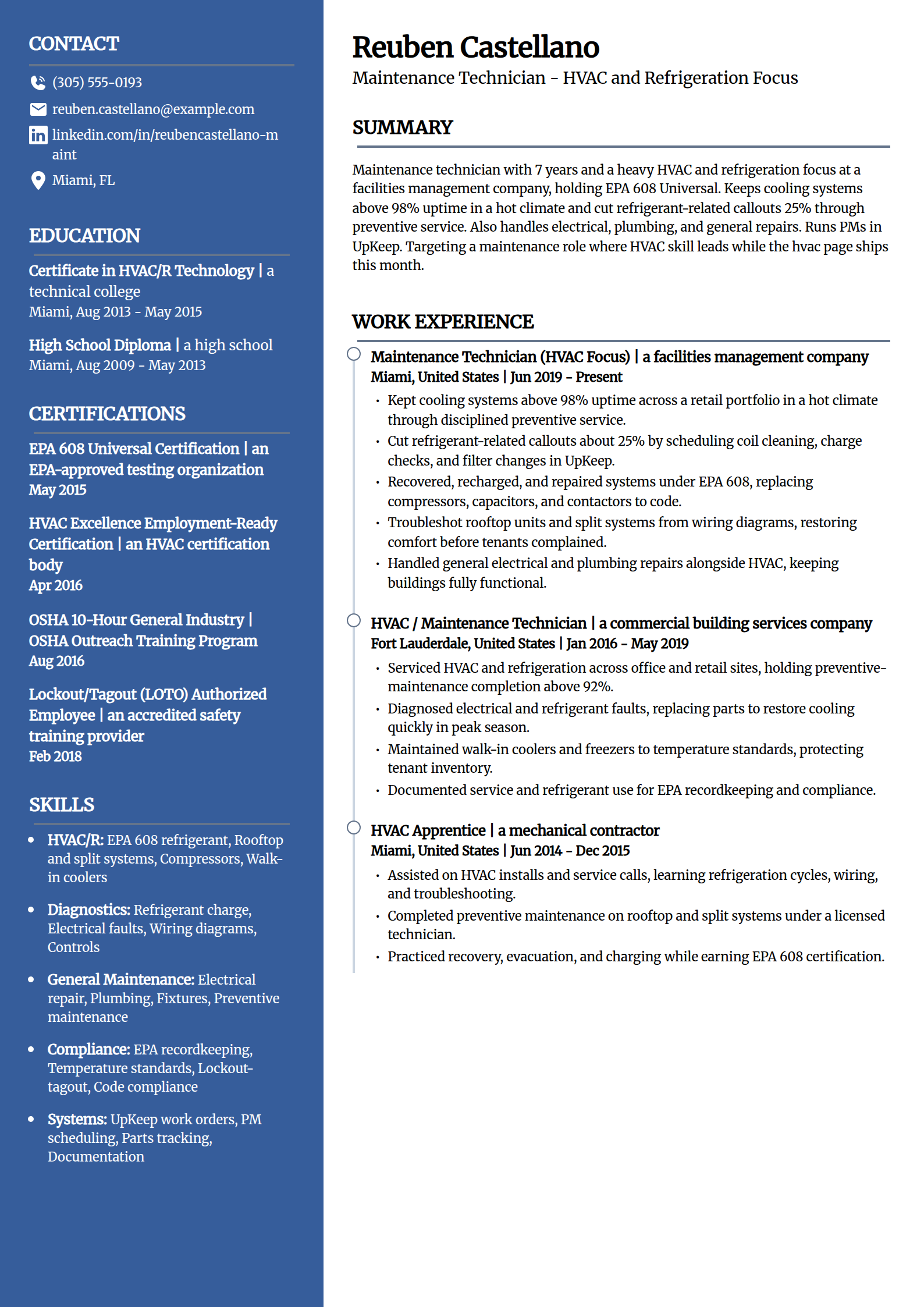
HVAC Maintenance Technician Resume Template
Why this resume example works?
- Opens with an HVAC and refrigeration focus and EPA 608 Universal, keeping cooling systems above 98% uptime.
- Shows the results a hot-climate portfolio wants, refrigerant-related callouts cut 25% through preventive service.
- Keeps the range broad, handling electrical and plumbing alongside HVAC so buildings stay fully functional.
- Names EPA recordkeeping, UpKeep PMs, and walk-in cooler service, the everyday tools of an HVAC-leaning role.
- Uses a distinctive layout that still reads cleanly for a hiring supervisor.
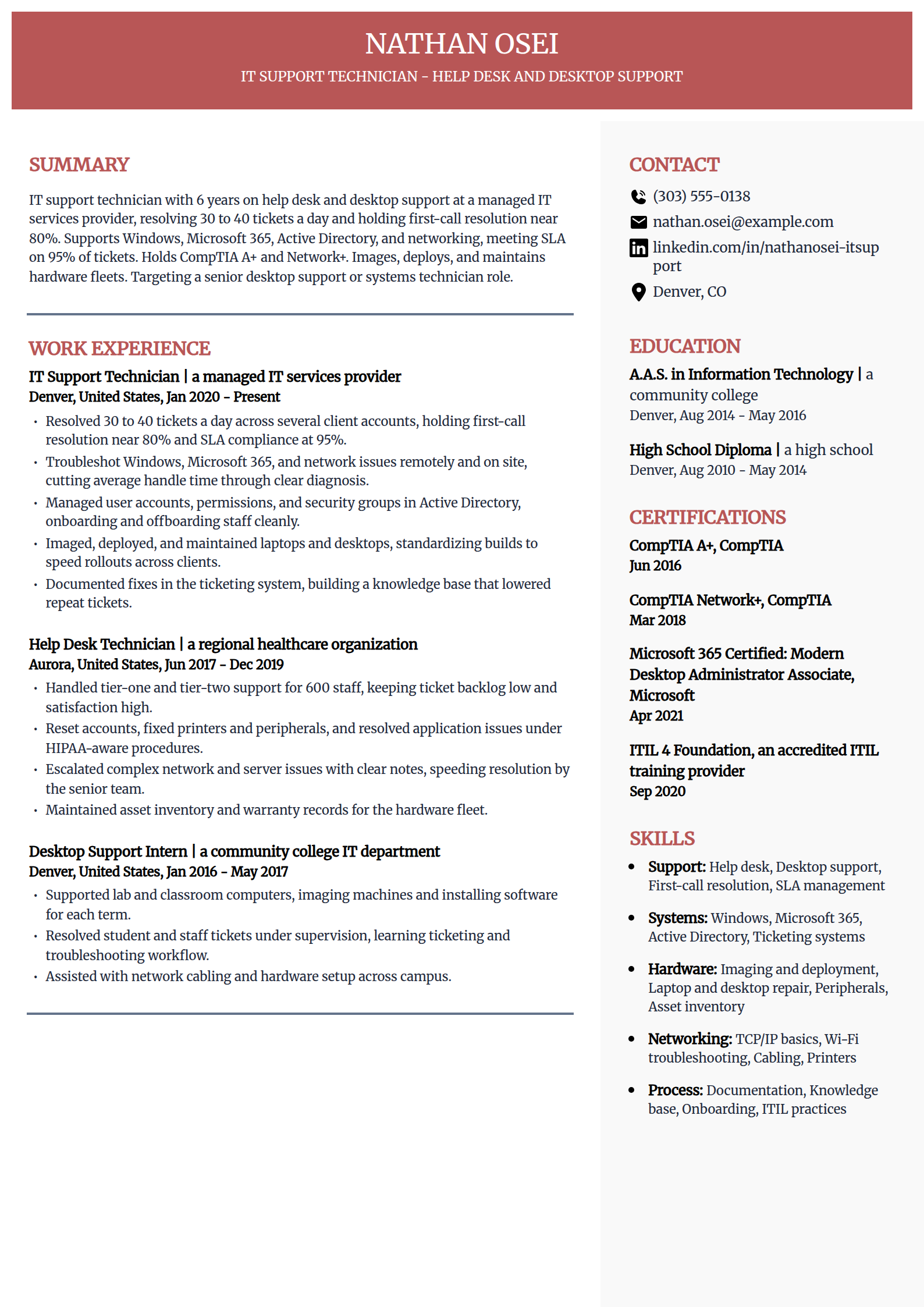
IT Support Technician Resume Template
Why this resume example works?
- Leads with help-desk value, resolving 30 to 40 tickets a day and holding first-call resolution near 80%.
- Shows the systems an IT posting screens for, Windows, Microsoft 365, and Active Directory account management.
- Keeps results countable, SLA compliance at 95% and standardized imaging that speeds hardware rollouts.
- Names CompTIA A+ and Network+, a Microsoft 365 associate cert, and ITIL practices, the credentials a role checks.
- Uses a refined layout that carries a full support record on one page.
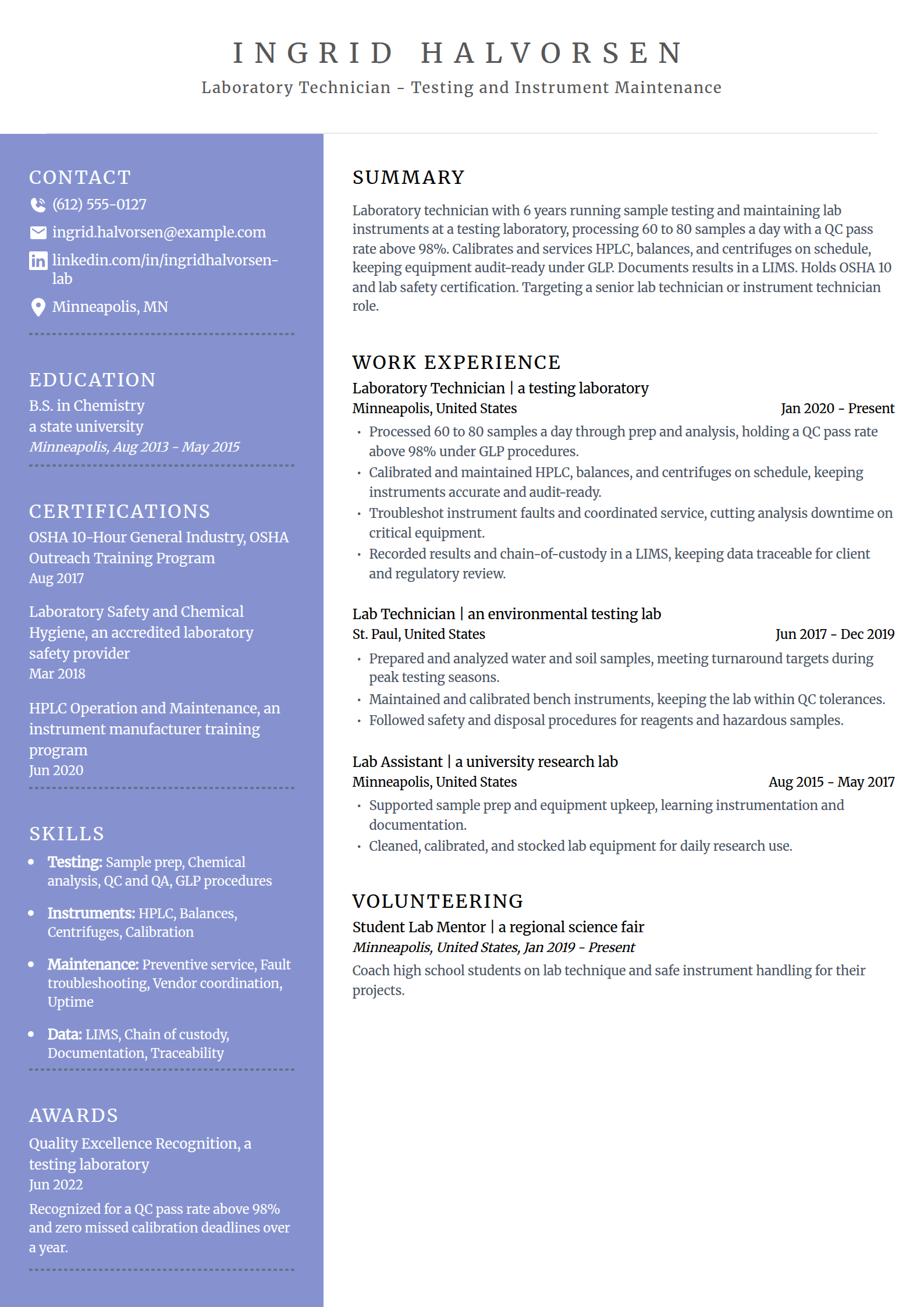
Lab Technician Resume Template
Why this resume example works?
- Opens with lab throughput, processing 60 to 80 samples a day with a QC pass rate above 98% under GLP procedures.
- Shows the instrument skill a lab wants, calibrating and maintaining HPLC, balances, and centrifuges on schedule.
- Keeps the work traceable, recording results and chain-of-custody in a LIMS for client and regulatory review.
- Names OSHA 10, lab-safety training, and HPLC maintenance, the credentials a testing role checks.
- Uses a roomy layout with a quality award and a science-mentor volunteer role so the page stays full.
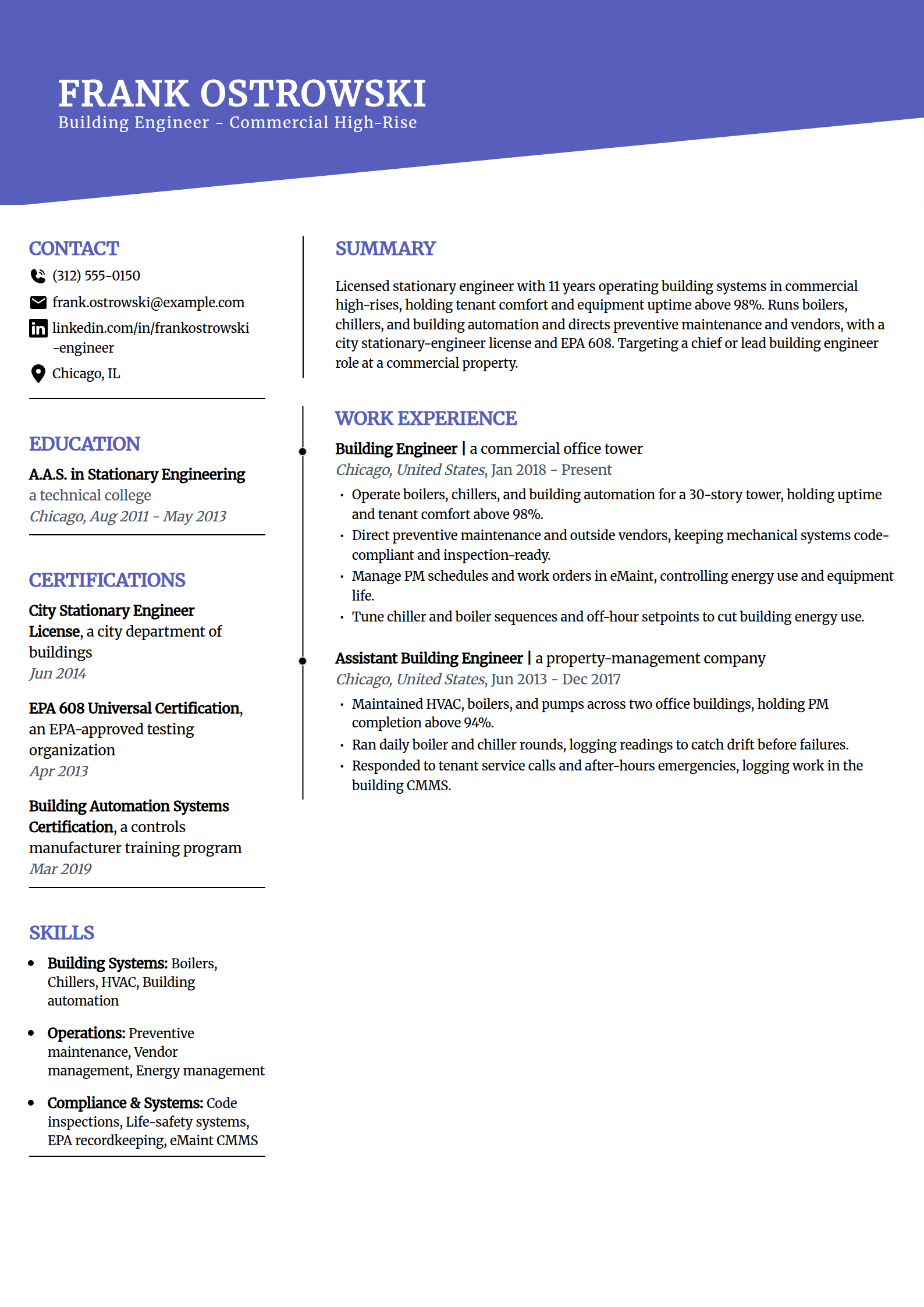
Building Engineer Resume Template
Why this resume example works?
- Leads with a stationary-engineer license and 11 years running boilers, chillers, and automation in a high-rise.
- Shows the results a commercial property wants, tenant comfort and equipment uptime held above 98%.
- Keeps the scope real, directing preventive maintenance and vendors so systems stay code-compliant.
- Names a city stationary-engineer license, EPA 608, and eMaint, the credentials and systems a tower runs.
- Uses a two-column layout with awards so an operations-heavy record fills the page.
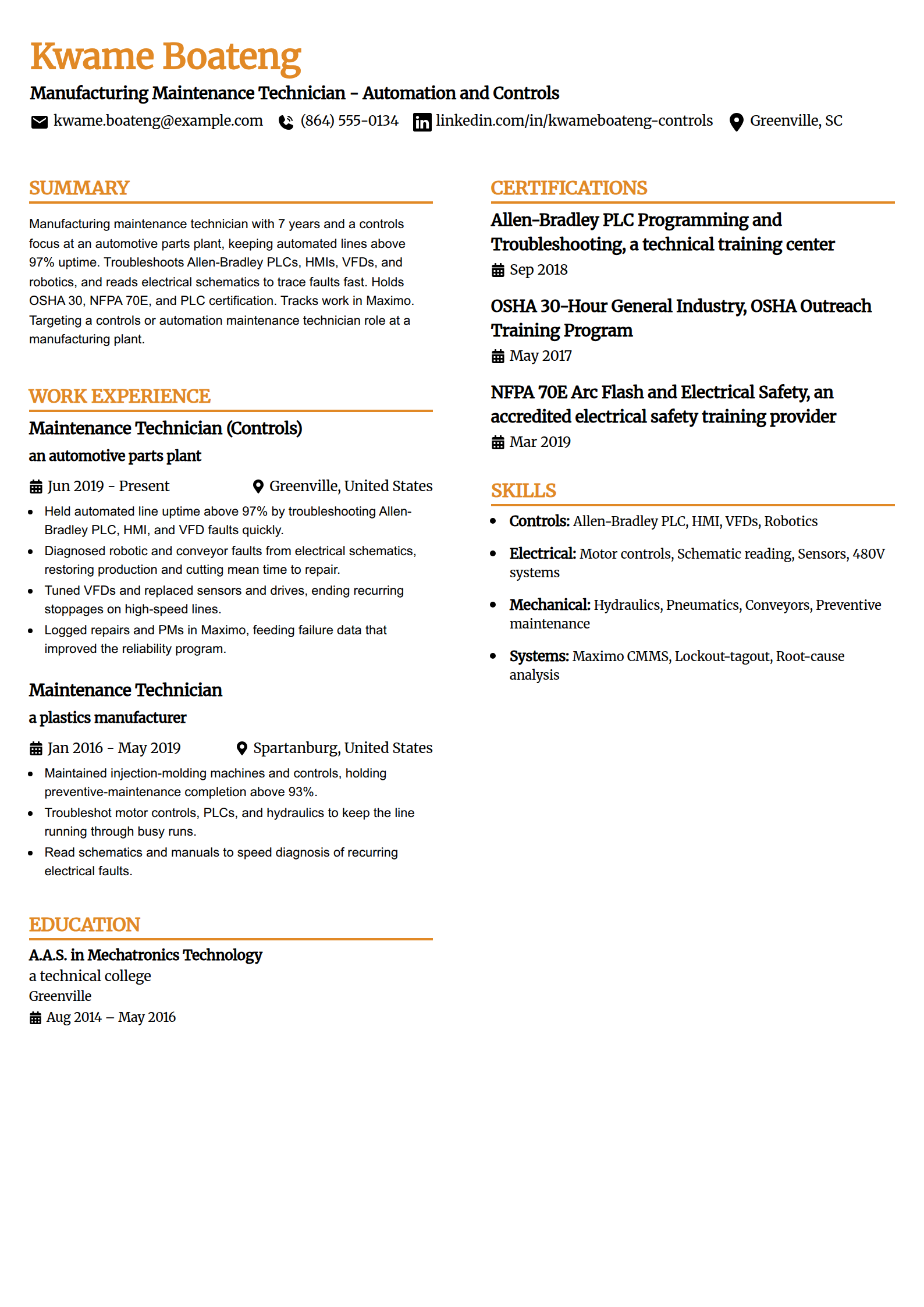
Controls Maintenance Technician Resume Template
Why this resume example works?
- Leads with a controls focus, holding automated line uptime above 97% at an automotive parts plant.
- Shows the skill an automation posting wants, troubleshooting Allen-Bradley PLCs, HMIs, VFDs, and robotics.
- Keeps diagnosis concrete, reading electrical schematics to trace faults and cut mean time to repair.
- Names Maximo, a PLC programming credential, OSHA 30, and NFPA 70E, the systems and safety a controls role checks.
- Uses a tight, ATS-safe layout that keeps a controls record on one clean page.
Build your maintenance technician resume
Pick a template above and the editor keeps your layout clean and ATS-safe while you swap in your own trades, certifications, systems, and uptime numbers.
Build my resumeHow to write a maintenance technician resume in 2026
A maintenance technician resume gets scanned fast by a supervisor looking for two things: which trades you can actually troubleshoot, and whether your safety and equipment certifications are current. Lead with a short summary that names your trades and one uptime number, then make every bullet a real result with a number and the system behind it. Keep the format clean so a parser reads it as easily as a person does.
Open with a trades-and-uptime summary
Write three to four sentences that name your years, the trades you cover, your strongest number, and the role you are targeting. An experienced tech leads with uptime and a preventive-to-reactive ratio; an entry-level tech leads with a certificate, safety training, and hands-on tasks. Keep it to about 60 words so it never spills past the top of the page.
Industrial maintenance technician with 9 years across mechanical, electrical, hydraulic, and pneumatic systems at a manufacturing plant. Holds equipment uptime near 98% and shifted the shop from 60% reactive work to 70% preventive. Troubleshoots PLC and VFD faults, reads schematics, and tracks work orders in Fiix. Targeting a senior multi-craft maintenance role at a high-volume plant.
Write the trades you can troubleshoot, not a duties list (the honest part)
This is where most maintenance resumes go generic. A supervisor is hiring for a troubleshooting range on the exact equipment they run, so name your real trades and be honest about the line between preventive and reactive work.
- Name the systems you actually troubleshoot: mechanical, electrical, HVAC, plumbing, hydraulics, pneumatics, PLC and VFD controls, whichever you can prove.
- Show both sides of the job: preventive maintenance you schedule and complete, and reactive repairs you make when equipment fails. Naming a preventive-to-reactive ratio reads as reliability.
- Do not claim a trade you have only watched. Listing PLC programming with no controls experience is a fast way to fail the phone screen.
- If you are strong in one trade, like HVAC or controls, lead with it and let the general maintenance work support it.
Make every experience bullet a result with a number
Name the equipment, the fault, and the fix, then attach one credible number and the system behind it. Maintenance is measured in uptime and downtime, so keep the numbers honest to a real shop.
- Use maintenance metrics: equipment uptime, PM completion rate, mean time to repair, mean time between failures, work-order close rate, or first-time fix rate.
- Open with a strong verb like troubleshot, rebuilt, replaced, calibrated, or aligned, never "Responsible for" or "Helped with".
- Name the tool or task: "diagnosed PLC and VFD faults on Allen-Bradley drives and restored the conveyor line".
- Keep one number per bullet and aim for a number in about half of them; a wall of percentages reads as invented.
Put your certifications and safety training where they get seen
Maintenance hiring is safety-driven, so a posting checks your certifications first. List them in their own section and never list one you do not hold.
- List the certifications a posting names: EPA 608 for refrigerant work, OSHA 10 or OSHA 30, forklift or powered-industrial-truck, lockout-tagout, and NFPA 70E for electrical work.
- Automotive and diesel roles lead with ASE certifications; IT support leads with CompTIA A+; a building engineer leads with a stationary-engineer license.
- Add PLC, HVAC, or vibration-analysis training where it matches the role, and keep every card current with its date.
- Entry-level techs and apprentices lead with the program, the certificate, and safety training in place of years.
Match skills and keywords to the job posting
A skills block should read like the posting, grouped so a supervisor and a parser both find what they need. List the systems you have actually run, not a generic dump.
- Group by type: mechanical, electrical, controls, HVAC, safety, and maintenance software.
- Name specific systems: Allen-Bradley PLCs, VFDs, and a CMMS by name, like UpKeep, Fiix, eMaint, or Maximo, matched to the role.
- If the posting says "preventive maintenance" or "lockout-tagout", use that exact phrasing where it fits your experience.
- Mirror the posting's language, since that is what the applicant tracking system searches for when it ranks your resume.
Keep the format clean and ATS-safe
A maintenance resume is read by a parser first and a supervisor second, so a clean layout with standard headings is the safe choice at every level.
- Use a single-column or simple two-column layout with standard headings a parser recognizes; skip heavy graphics and photos.
- Keep it to one page; a maintenance resume rarely needs two, even for a lead or building engineer.
- Save as a PDF so the formatting holds, then run it through the ATS resume checker for a quick format and keyword pass.
- Swap the numbers in the templates above for your own uptime, certifications, and systems; do not copy them as is.
Common maintenance technician resume mistakes
- Listing duties instead of results. Lead with what changed, uptime held, downtime cut, or a PM completion rate, not a bulleted job description.
- Claiming trades you cannot troubleshoot. If the resume says PLC programming, a supervisor will ask about it on the phone; list only what you can prove.
- Burying or omitting certifications. EPA 608, OSHA, lockout-tagout, and NFPA 70E belong in a named section with dates, not hidden in a sentence.
- Naming no systems. A resume with no CMMS, no PLC brand, and no equipment reads as generic; name the tools you have actually run.
- One generic resume for every job. Reorder your trades and skills so the work the posting names, industrial, property, automotive, or controls, leads the page.
Frequently asked questions
How do you write a maintenance technician resume?
Lead with a three-to-four-sentence summary that names your years, the trades you cover, your strongest number, and the role you are targeting. Under each job, write results-first bullets that open with a strong verb and carry one credible number, like equipment uptime near 98% or a preventive-maintenance completion rate above 95%. Name the equipment or system behind each result, list your certifications in their own section, and keep the whole thing to one clean, ATS-safe page.
What should a maintenance technician resume include?
A maintenance technician resume includes a trades-and-uptime summary, experience bullets with real numbers, a certification and safety-training section, a grouped skills block, and education. The experience section carries the weight: every bullet should show work you can prove, such as troubleshooting PLC and VFD faults, rebuilding hydraulics, or running preventive maintenance. Name your certifications, like EPA 608, OSHA 30, and lockout-tagout, and list the systems you run, like Allen-Bradley PLCs and a CMMS such as Fiix or Maximo.
How do you write a maintenance technician resume with no experience?
Lead with what you do have. An entry-level candidate leads with a maintenance certificate, safety training like OSHA 10 and forklift, and hands-on tasks from warehouse, laborer, or helper work. An apprentice leads with the program and floor rotations. A career-changer from a production or operator role reframes equipment knowledge that transfers. Your certificate, safety cards, and any hands-on troubleshooting are your strongest early signal. The entry-level, apprentice, and career-change examples above show the shape.
What skills and certifications should a maintenance technician resume have?
Match the posting, then name specific skills and systems grouped by type: mechanical (hydraulics, pneumatics, bearings, alignment), electrical (motor controls, VFDs, schematic reading), controls (PLC and HMI), HVAC, and maintenance software (UpKeep, Fiix, eMaint, Maximo). List the certifications a role names, EPA 608, OSHA 10 or 30, forklift, lockout-tagout, and NFPA 70E, plus ASE for automotive or diesel, CompTIA A+ for IT support, or a stationary-engineer license for a building engineer. List only what you hold, and mirror the posting's exact phrasing.
What is a good objective or summary for a maintenance technician resume?
Use a three-to-four-sentence summary, not a one-line objective, unless you are brand new. Lead with your trades and years, add your strongest number, name the systems and certifications a posting checks, and end with the role you are targeting. For example: maintenance technician with seven years across HVAC, electrical, and plumbing in multifamily and light-industrial sites, PM completion above 95%, EPA 608 and OSHA 30, targeting a lead maintenance role. A new tech swaps years for a certificate and safety training.
How long should a maintenance technician resume be?
One page for most maintenance technicians, including entry-level, apprentices, and experienced multi-craft techs. Use a second page only when a lead, building engineer, or maintenance supervisor has enough relevant projects, crew leadership, or scope to justify it, and never pad to reach it. Whichever length you use, lead with your most recent and most relevant work, keep standard headings, and cut older or unrelated jobs so the space goes to the trades and numbers a supervisor checks first.
More maintenance technician resume resources
Build your maintenance technician resume
Pick a template above and the editor keeps your layout clean and ATS-safe while you swap in your own trades, certifications, systems, and uptime numbers.