16 Warehouse Resume Examples, Forklift to Fulfillment
- ATS Friendly
- Warehouse Specific
- 16 Real Examples
A warehouse resume is scanned fast for three things: your forklift or safety certification, the equipment you run, and numbers that prove you move volume. Pick a clean layout below, then model your own on a real example built for your role, from an order picker to a shift supervisor. Every example names real systems and keeps its metrics believable.


540k+ resumes created
Editable warehouse resume templates
Each template below is a real warehouse resume laid out in that format, sorted by role and experience across the whole warehouse floor. Choose one, then swap in your own equipment, pick rates, certifications, and systems. Every layout keeps your name, forklift or OSHA certification, and dates clean so a hiring manager reads your experience at a glance and an applicant tracking system parses it without trouble.
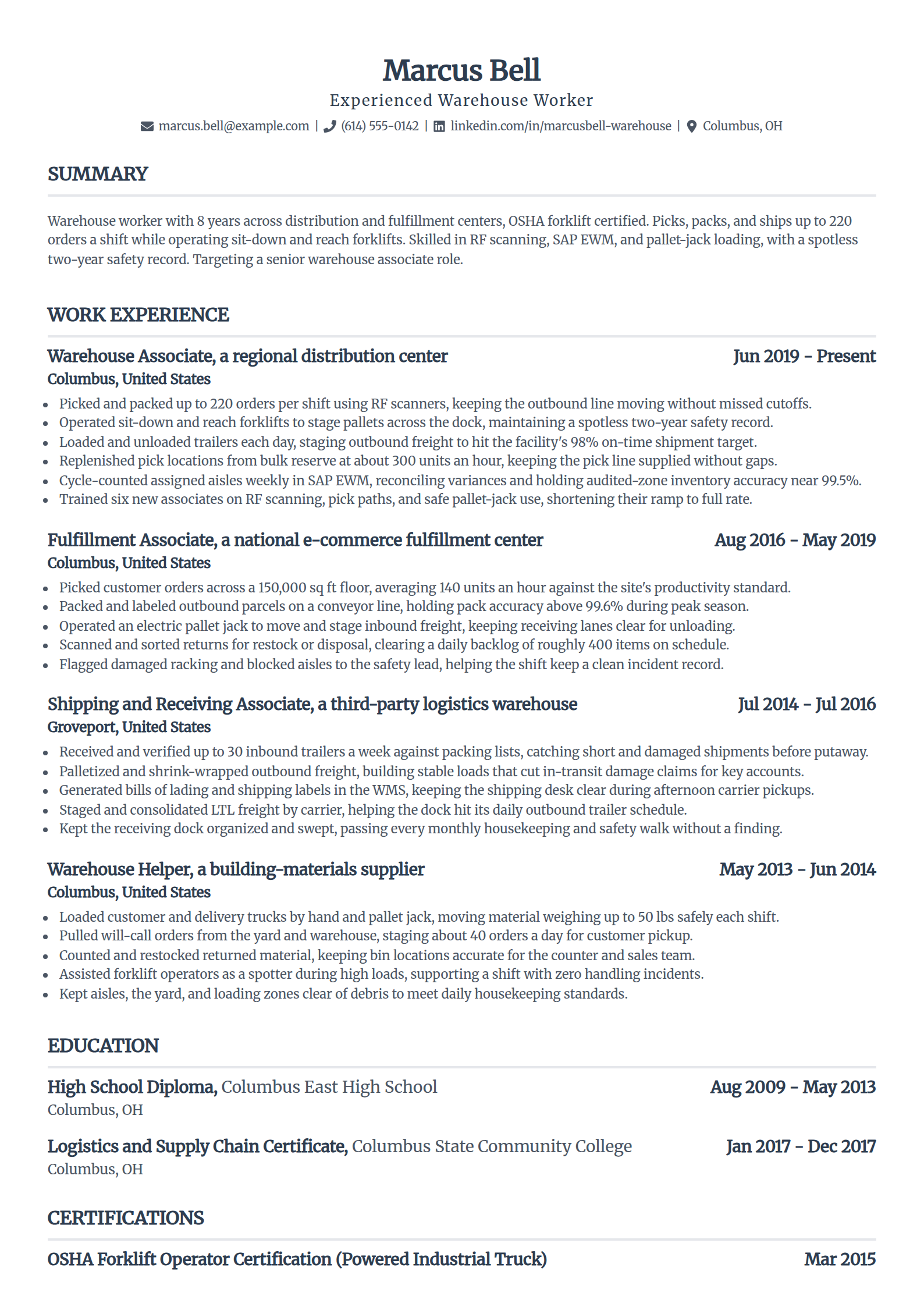
Experienced Warehouse Worker Resume Template
Why this resume example works?
- Opens with a summary that names 8 years, OSHA forklift certification, and up to 220 orders picked per shift.
- Leads each bullet with a strong verb and one credible number, like a 98% on-time shipment target or 99.5% inventory accuracy.
- Names the equipment a floor hires for: sit-down and reach forklifts, an electric pallet jack, and RF scanners.
- Lists SAP EWM and cycle counting as applicant-tracking keywords instead of a vague 'computer skills' line.
- Uses a clean single-column layout that an applicant tracking system parses without trouble.
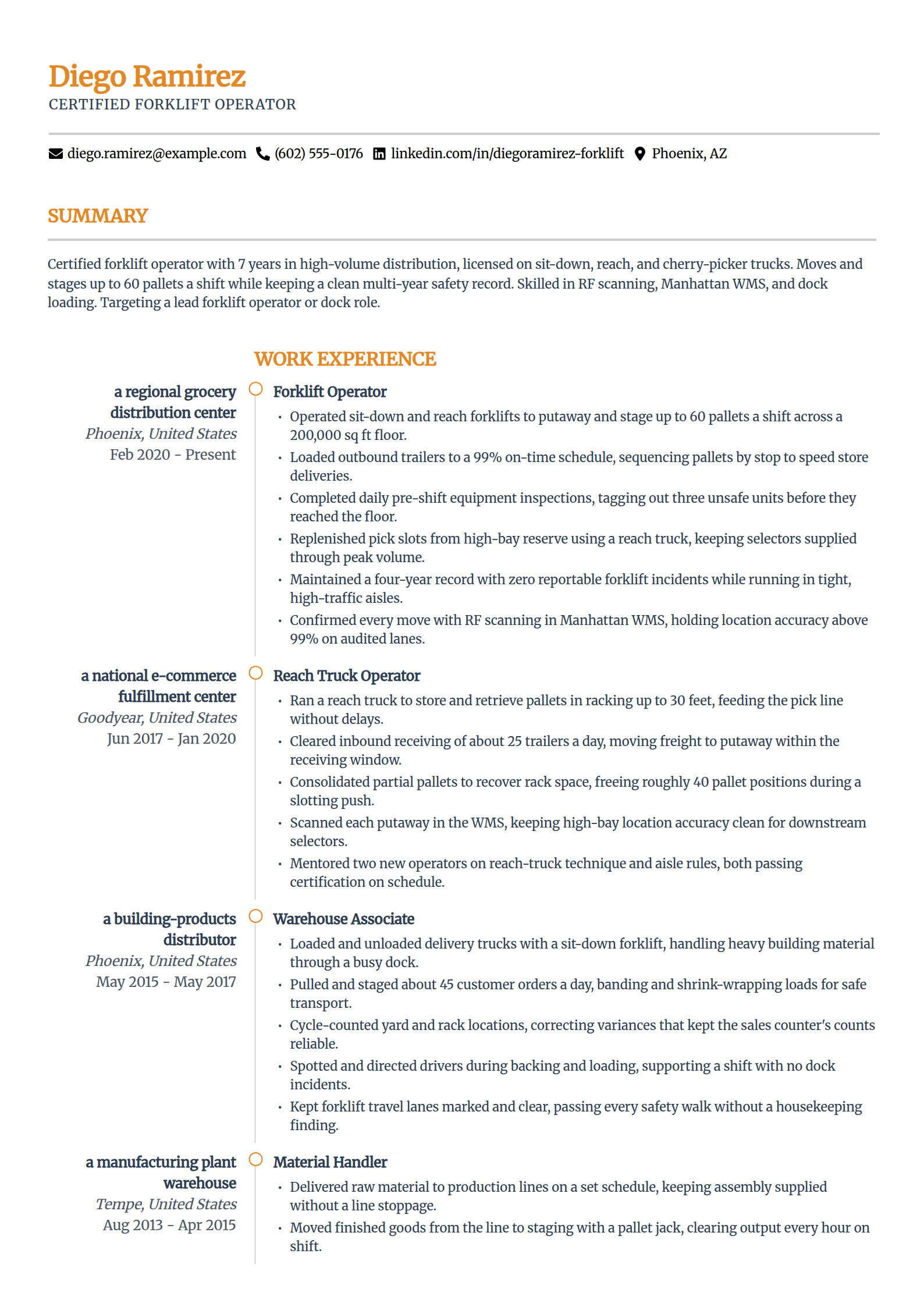
Forklift Operator Resume Template
Why this resume example works?
- Frames a certified operator up front, licensed on sit-down, reach, and cherry-picker trucks across 7 years.
- Puts safety where a warehouse looks first: a four-year record with zero reportable forklift incidents.
- Shows the daily work with one number each, like staging up to 60 pallets a shift or a 99% on-time load rate.
- Names Manhattan WMS and RF scanning so the resume reads like the job posting a recruiter is matching against.
- Uses a modern layout that carries a deep operator history on one clean page.
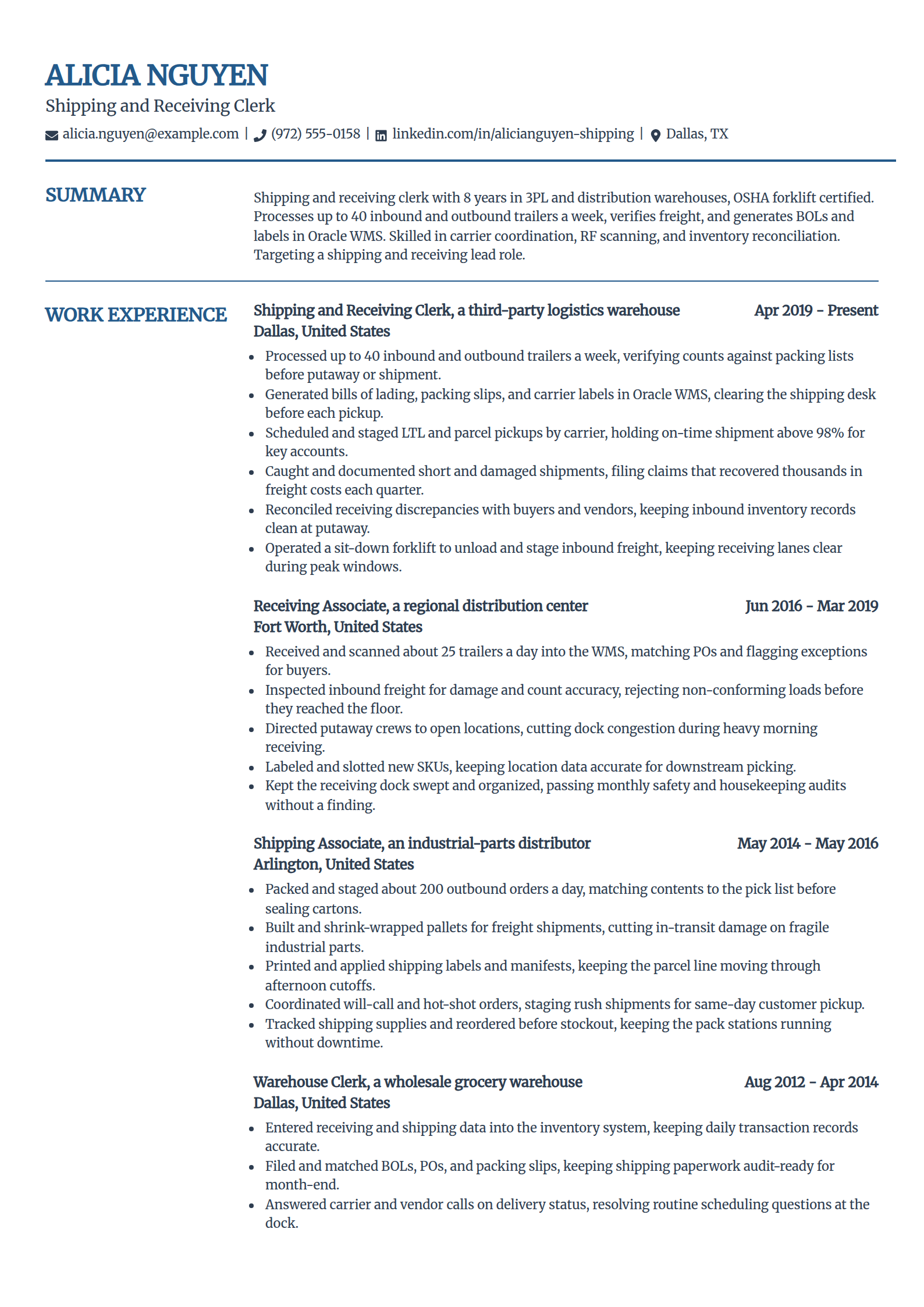
Shipping and Receiving Clerk Resume Template
Why this resume example works?
- Leads with the volume a shipping desk hires for, up to 40 inbound and outbound trailers processed a week.
- Shows accuracy that matters at the dock, holding on-time shipment above 98% for key accounts.
- Names the paperwork and system by name: bills of lading, packing slips, and labels generated in Oracle WMS.
- Attaches one number to most bullets so the experience reads concrete rather than generic.
- Uses a clean layout that fits a full shipping-and-receiving history on one page.
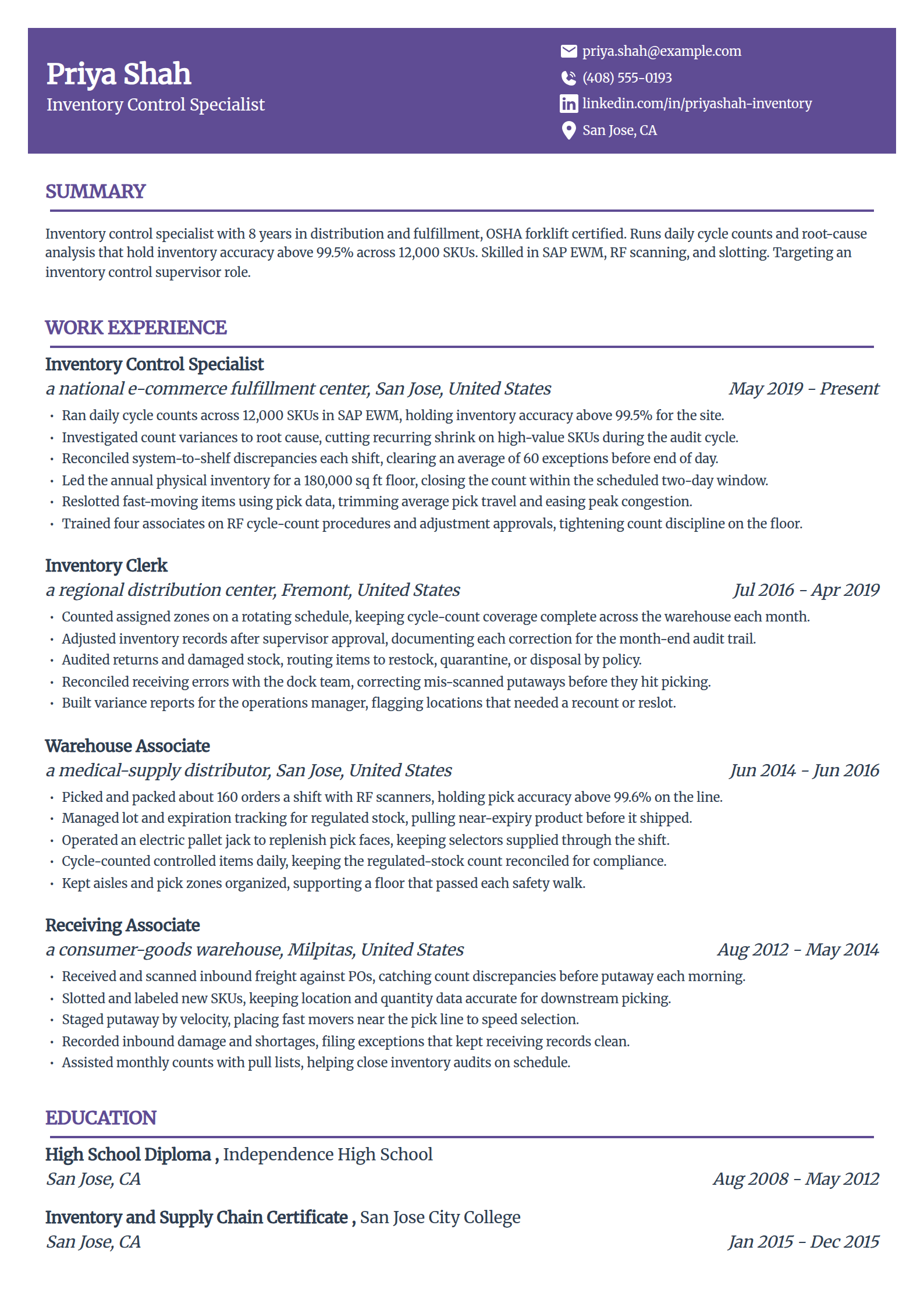
Inventory Control and Cycle Counter Resume Template
Why this resume example works?
- Opens with the result an inventory team wants, holding accuracy above 99.5% across 12,000 SKUs in SAP EWM.
- Shows the actual work: daily cycle counts, root-cause analysis on variances, and a two-day annual physical.
- Keeps each bullet to one modest number so the accuracy claims read as earned rather than inflated.
- Names slotting, RF scanning, and adjustment approvals, the terms a cycle-count posting lists.
- Uses a modern layout that carries a dense inventory record without crowding the page.
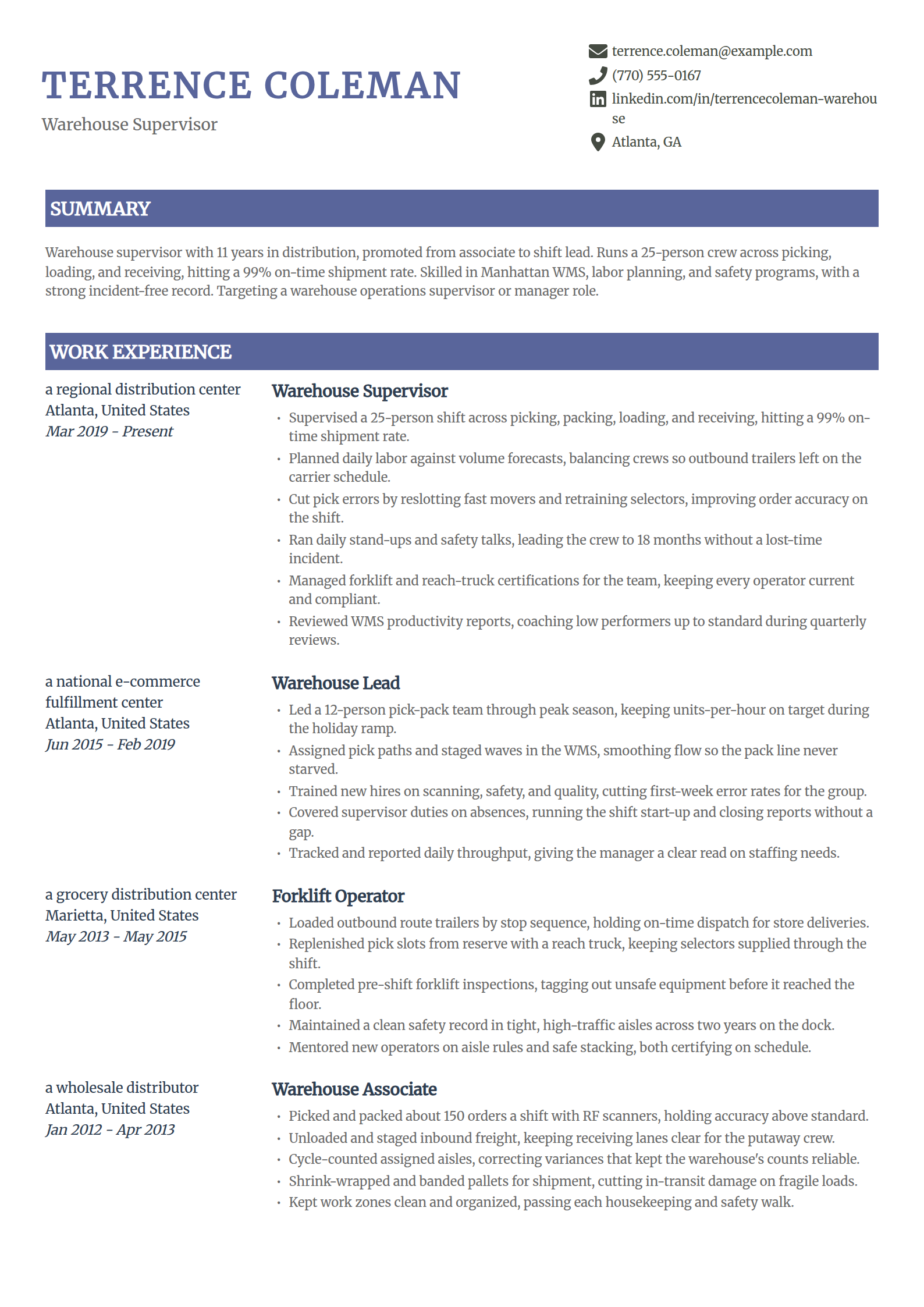
Warehouse Lead and Supervisor Resume Template
Why this resume example works?
- Frames a 25-person shift and a 99% on-time shipment rate, the scope a supervisor is hired to own.
- Turns floor work into leadership: labor planning against forecasts, retraining selectors, and safety talks.
- Backs the promotion story with 18 months without a lost-time incident, a number a plant manager values.
- Names Manhattan WMS productivity reports and OSHA 30 so the resume reads at a supervisor level.
- Fills a visually rich two-column layout while staying easy to skim in one pass.
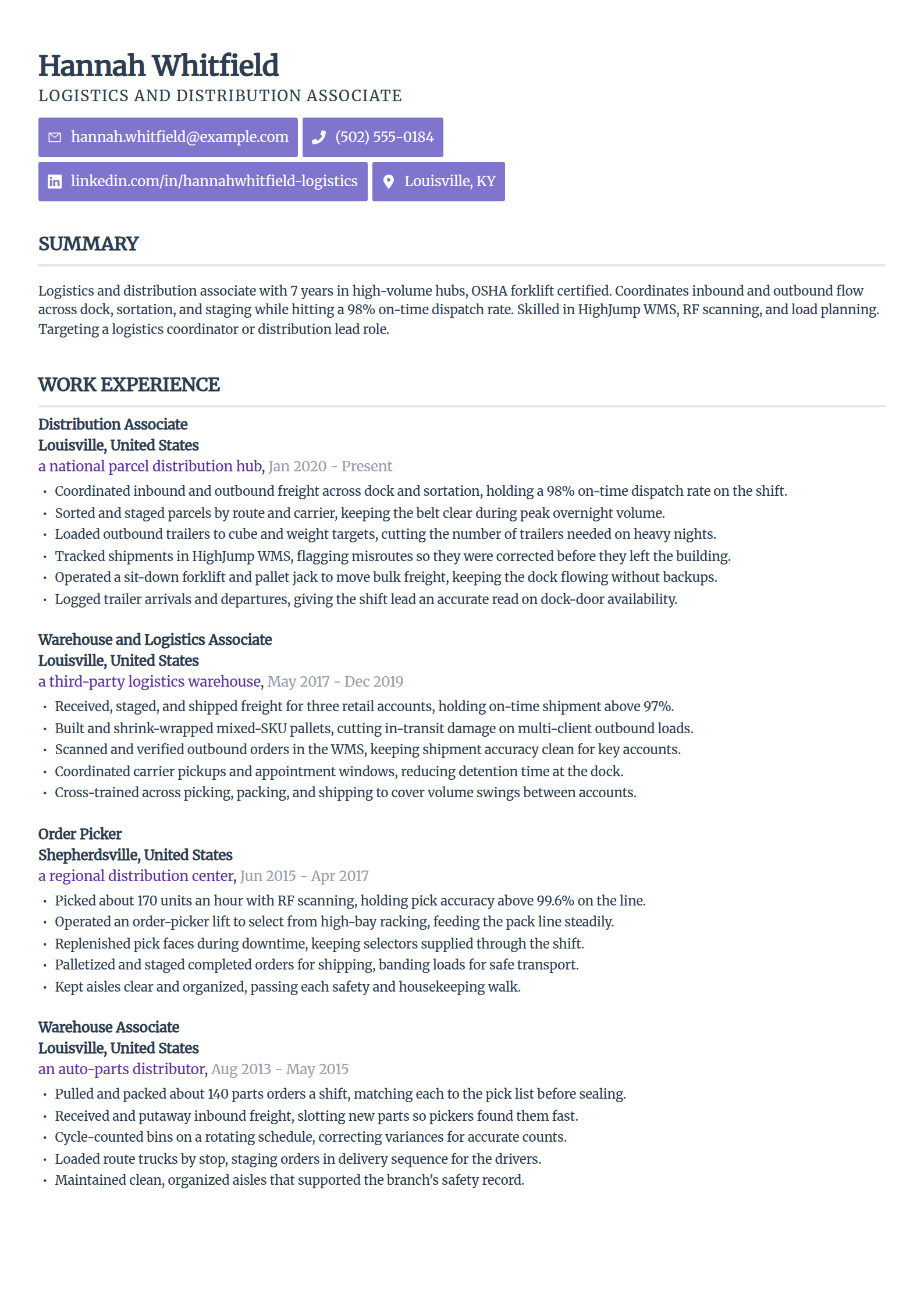
Logistics and Distribution Associate Resume Template
Why this resume example works?
- Leads with hub scope, coordinating inbound and outbound flow at a 98% on-time dispatch rate.
- Shows the logistics work a coordinator role expects: sortation, load planning to cube and weight, and carrier scheduling.
- Names HighJump WMS and RF scanning as keywords instead of a generic 'warehouse experience' line.
- Keeps one number per bullet, like cutting the trailers needed on heavy nights, so the impact reads real.
- Uses a clean, modern layout that carries a dense distribution history on one page.
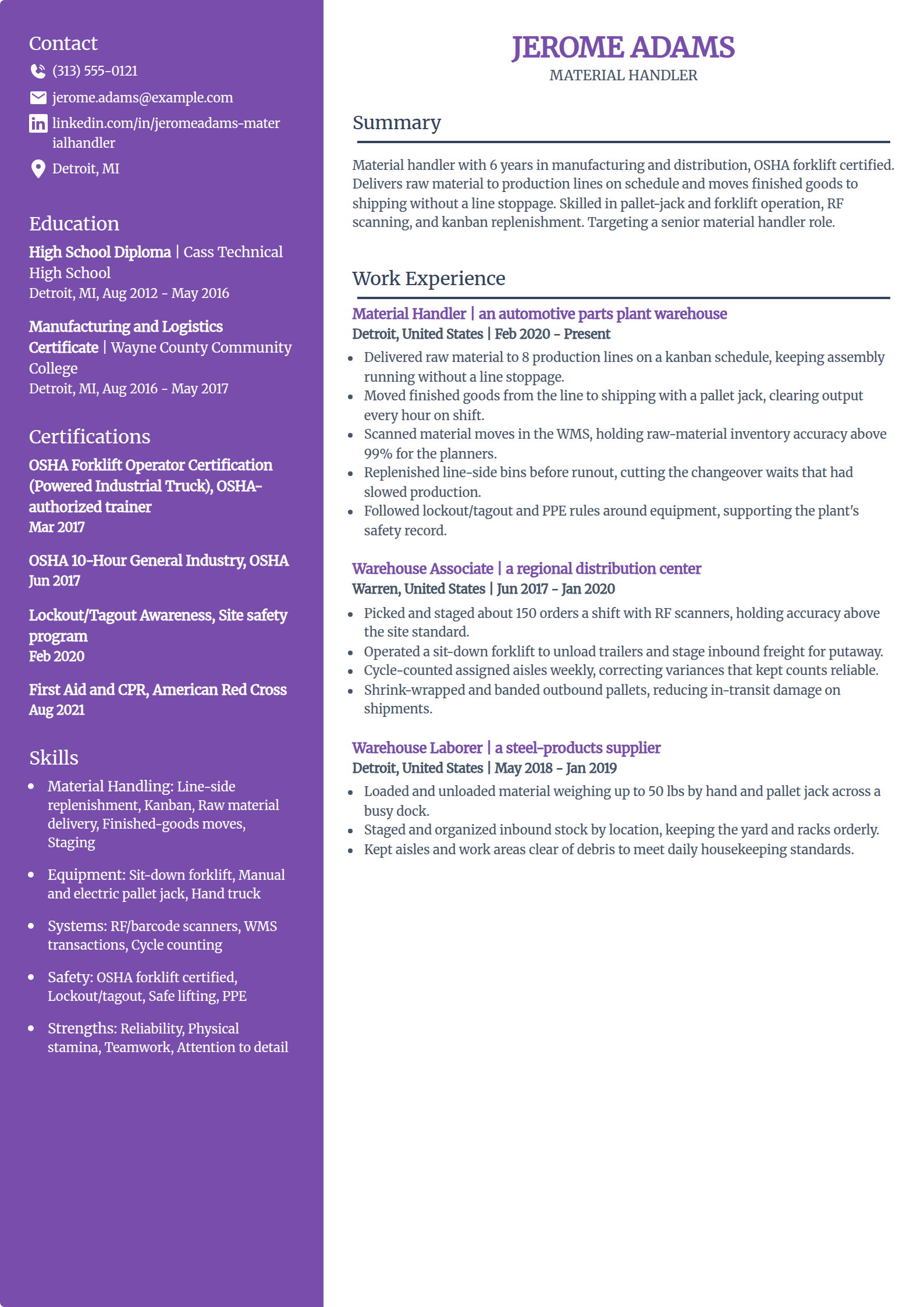
Material Handler Resume Template
Why this resume example works?
- Opens with the core of the job, delivering raw material to 8 production lines on a kanban schedule without a line stoppage.
- Shows the finished-goods side too, clearing line output every hour and holding material accuracy above 99%.
- Names the equipment and safety rules a plant checks: pallet jack, forklift, and lockout/tagout.
- Uses a Medium layout with three focused roles instead of padding a shorter history.
- Keeps every metric modest and believable for a material-handling role.
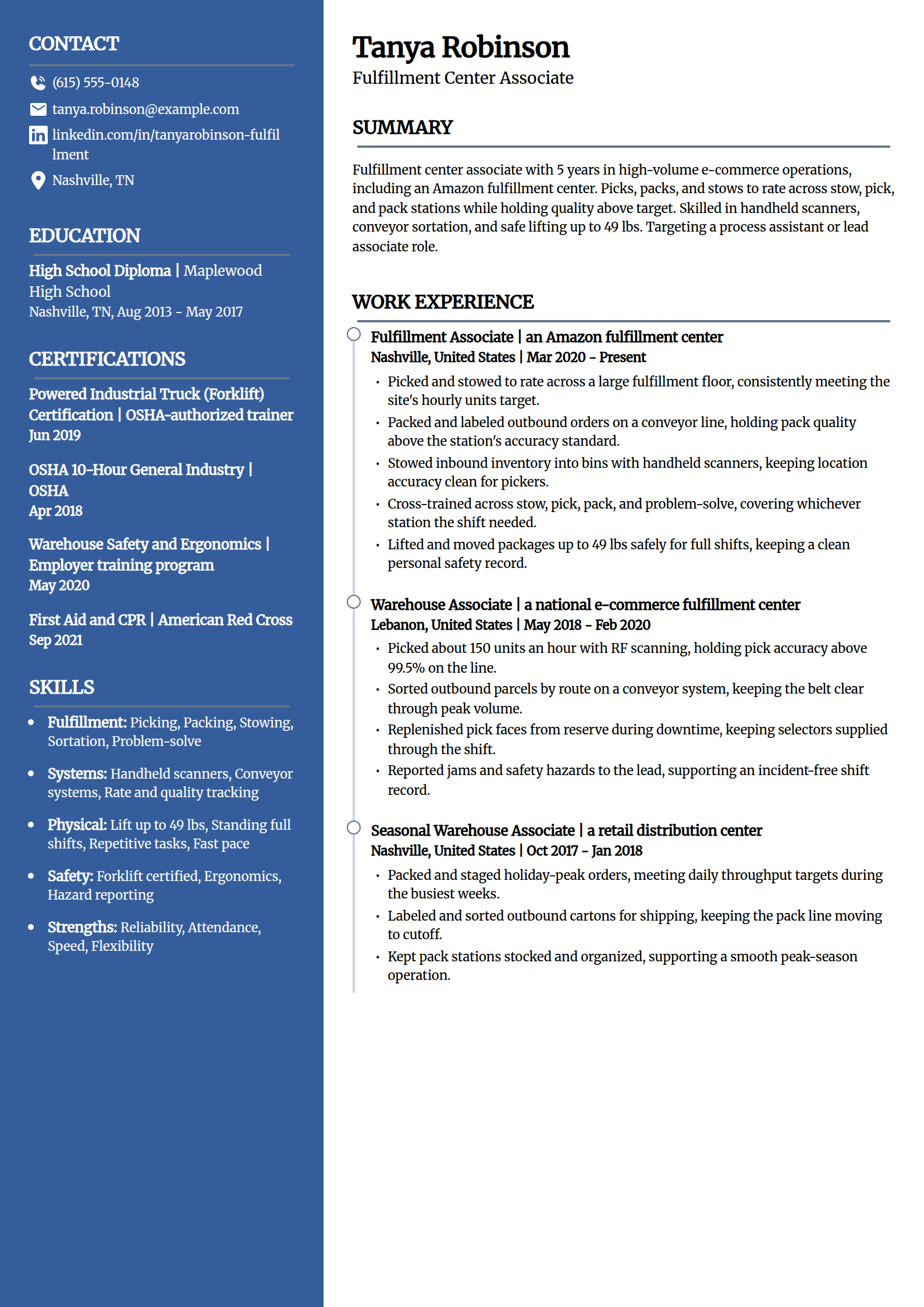
Amazon and Fulfillment Center Resume Template
Why this resume example works?
- Written for high-volume fulfillment, leading with picking and stowing to rate across stow, pick, and pack stations.
- Speaks the language of the floor: handheld scanners, conveyor sortation, and safe lifting up to 49 lbs.
- Shows reliability a fulfillment center screens for, cross-training across stations and a clean safety record.
- Keeps each accuracy and rate claim to one number so the resume reads honest, not inflated.
- Uses a distinctive layout that still reads cleanly for a hiring manager.
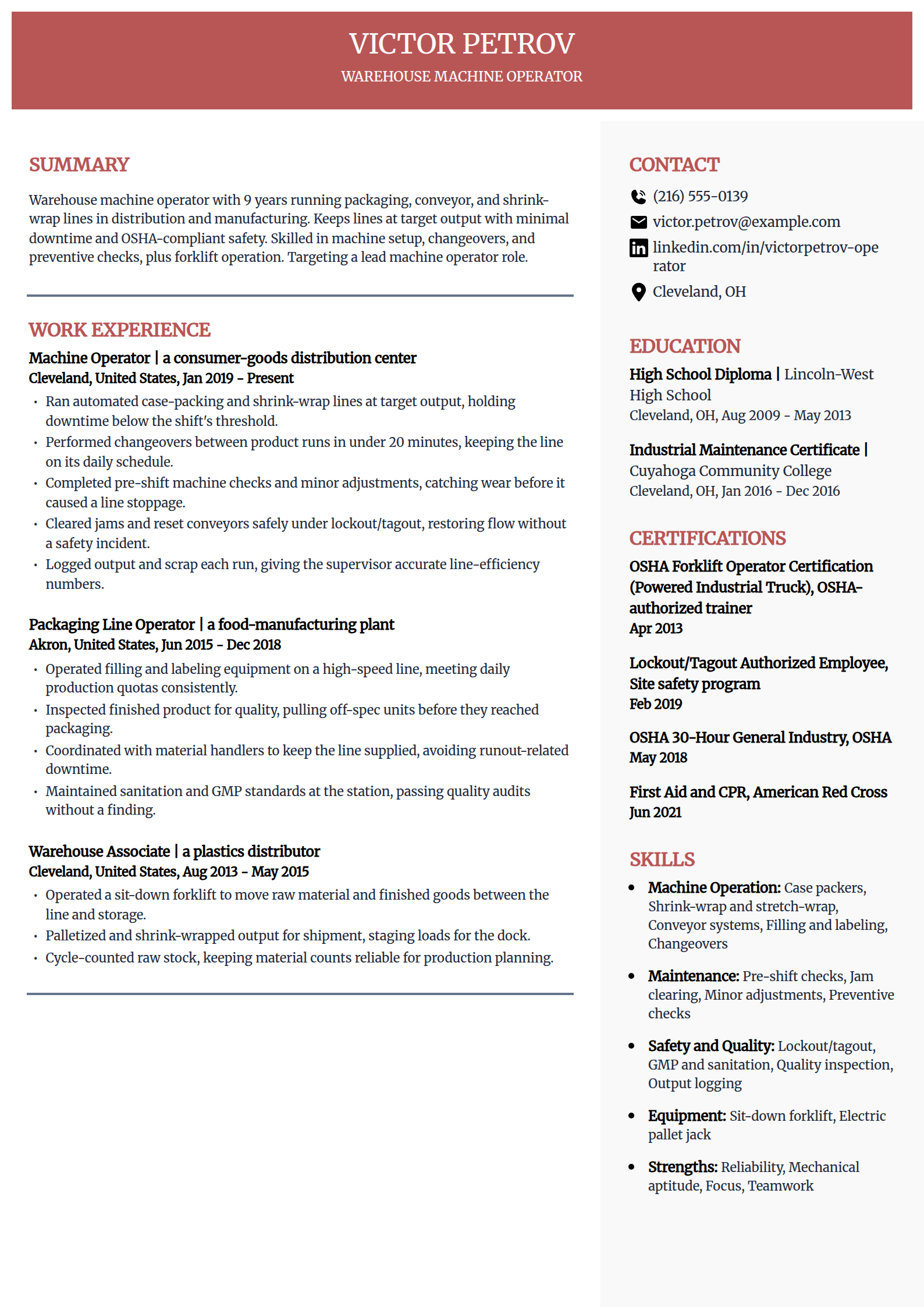
Warehouse Machine Operator Resume Template
Why this resume example works?
- Leads with line scope, running case-packing and shrink-wrap lines at target output with minimal downtime.
- Shows the operator skills a plant needs: changeovers under 20 minutes and safe jam clearing under lockout/tagout.
- Names GMP, pre-shift checks, and output logging so the resume reads like a real production floor.
- Keeps a Medium layout with three focused roles instead of padding a shorter history.
- Uses a refined, executive layout that fits a solid operator record cleanly.
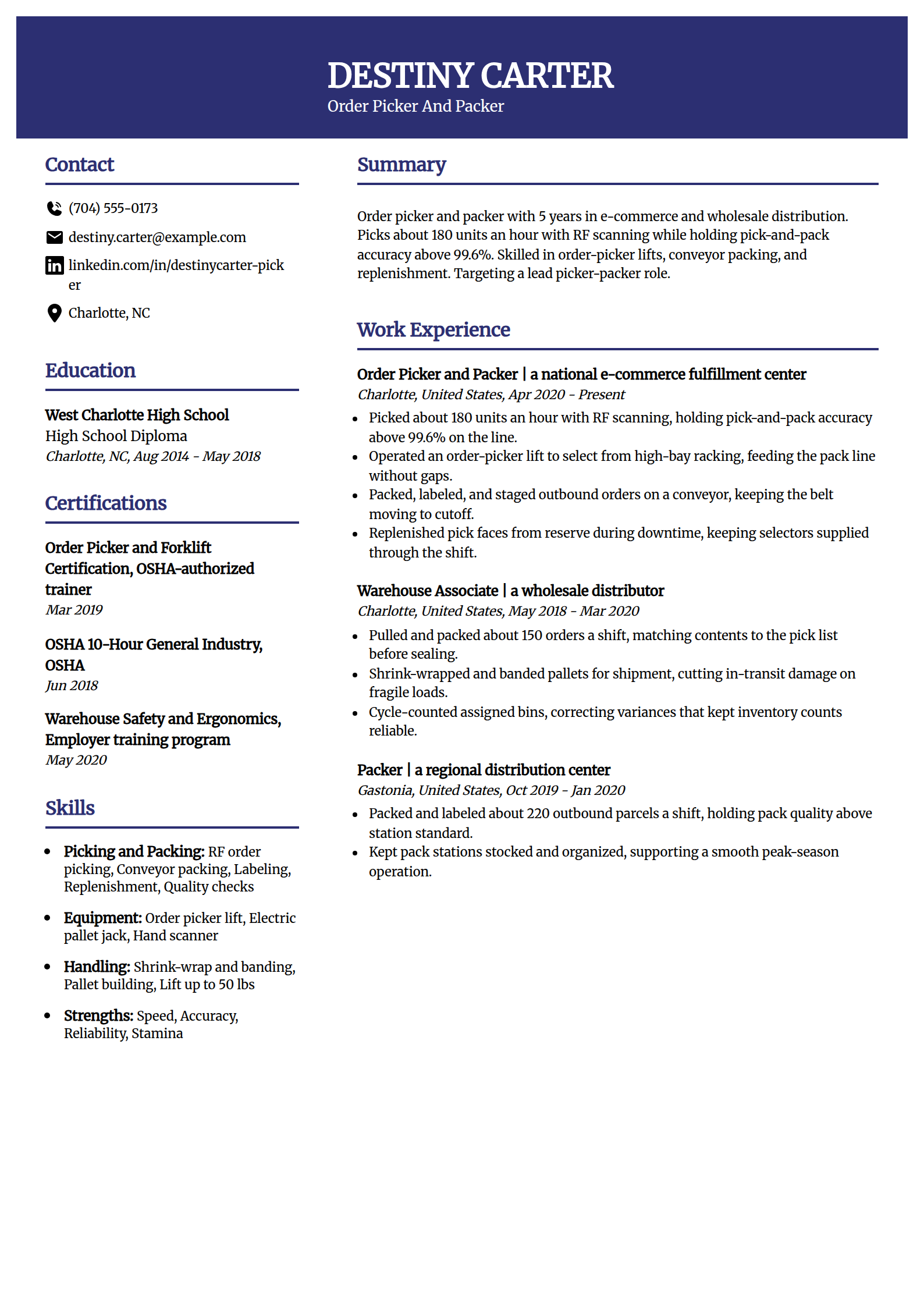
Order Picker and Packer Resume Template
Why this resume example works?
- Opens with the rate that matters, about 180 units an hour with pick-and-pack accuracy above 99.6%.
- Names the equipment a picker role lists: an order-picker lift, conveyor packing, and RF scanning.
- Shows the packing side with shrink-wrap and banding that cut in-transit damage on fragile loads.
- Uses a roomy two-column layout with the sidebar filled so the page reads complete.
- Keeps every metric modest and believable for a picker-packer role.
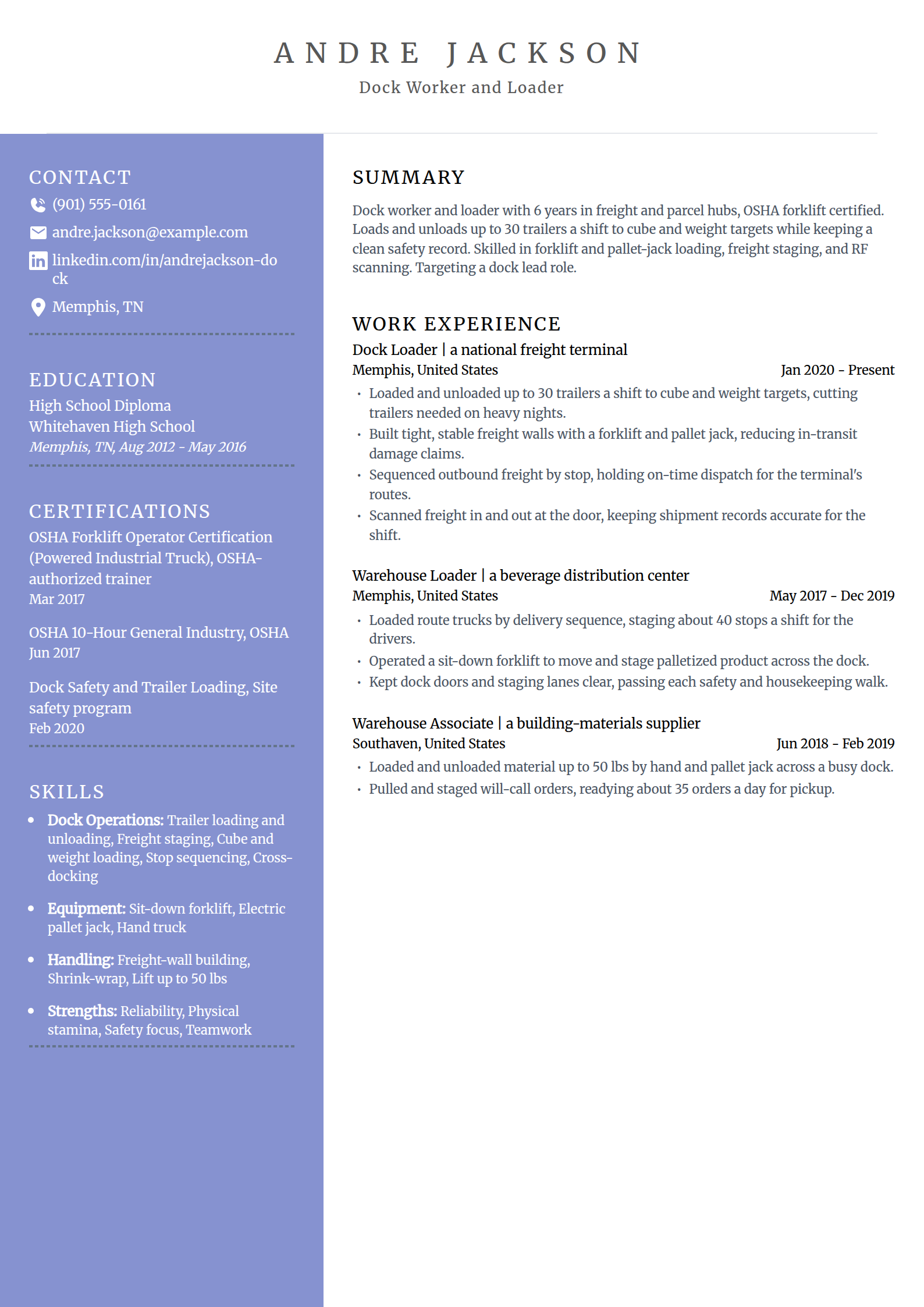
Loader and Dock Worker Resume Template
Why this resume example works?
- Leads with dock scope, loading and unloading up to 30 trailers a shift to cube and weight targets.
- Shows the skill that protects freight, building tight, stable loads that reduce in-transit damage claims.
- Names forklift and pallet-jack loading, stop sequencing, and RF scanning, the daily tools of a dock role.
- States a clean safety record, the first thing a dock supervisor checks on a loader resume.
- Uses a roomy layout with a filled sidebar so a focused record still looks full.
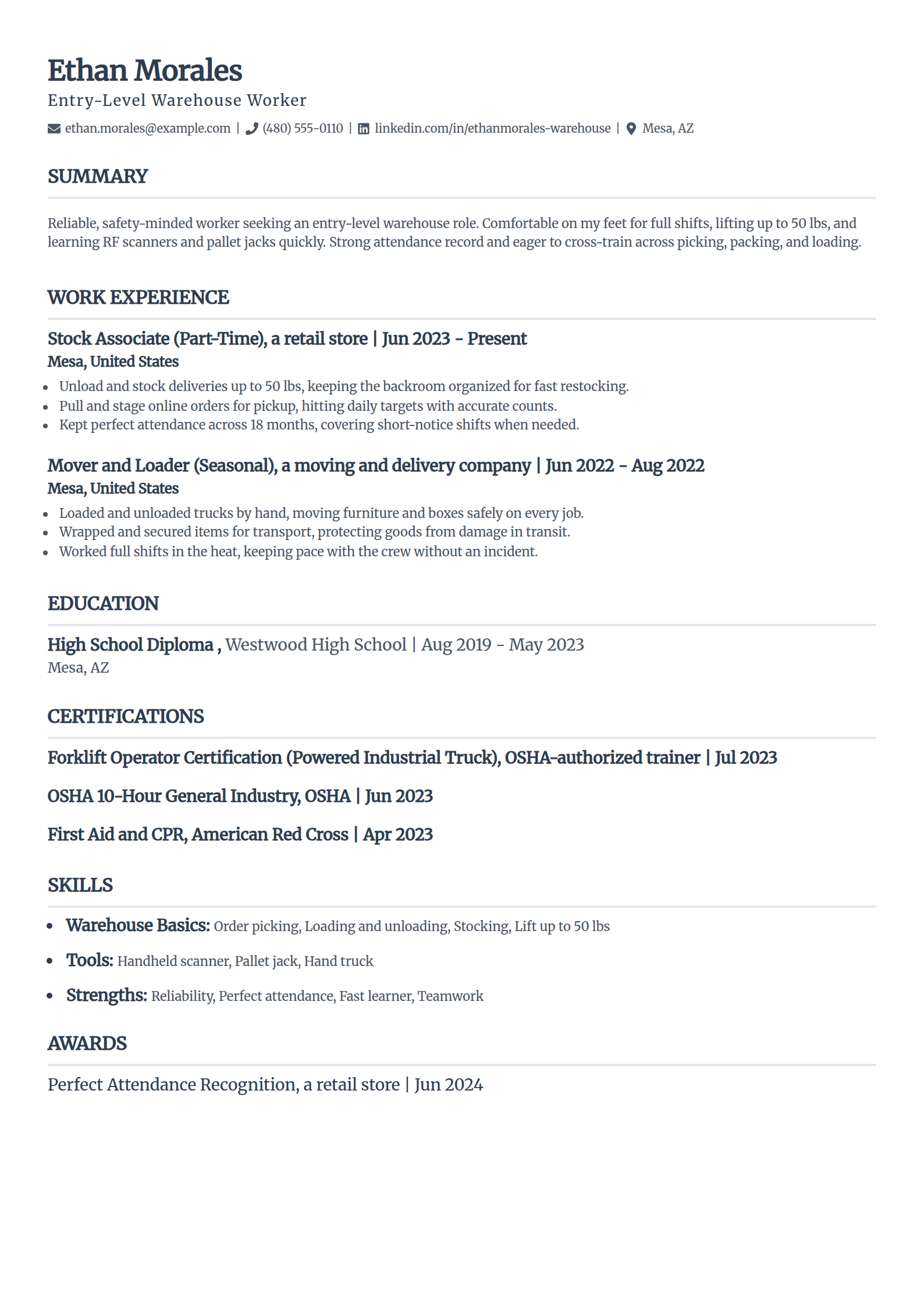
Entry-Level Warehouse Resume Template (No Experience)
Why this resume example works?
- Written for a first warehouse job, leading with reliability, safe lifting up to 50 lbs, and a fresh forklift certification.
- Uses a part-time stock role and a seasonal loading job to show real handling and attendance instead of padding.
- Proves dependability with a concrete detail, perfect attendance across 18 months covering short-notice shifts.
- Lists OSHA 10 and a handheld scanner so an entry resume still carries warehouse keywords.
- Uses a tight, ATS-safe single-column layout that fits a beginner's record without empty space.
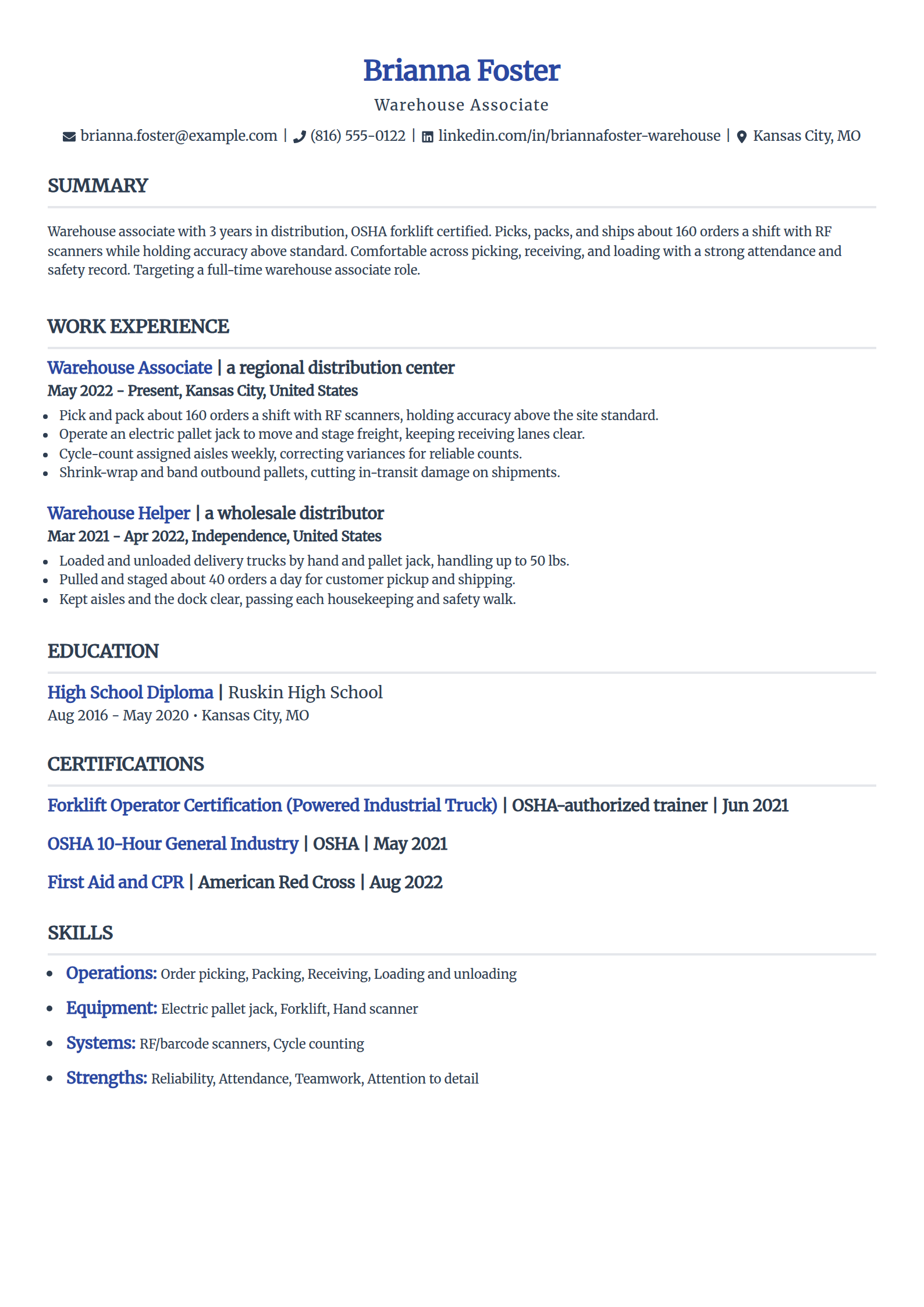
General Warehouse Associate Resume Template
Why this resume example works?
- Written for a versatile associate, leading with picking, packing, and shipping about 160 orders a shift.
- Shows range across the floor: receiving, loading, cycle counting, and electric pallet-jack work.
- Backs it with a forklift certification and a strong attendance and safety record.
- Keeps each bullet to one number so a short, three-year history still reads concrete.
- Uses a plain, ATS-safe layout that keeps the focus on the work.
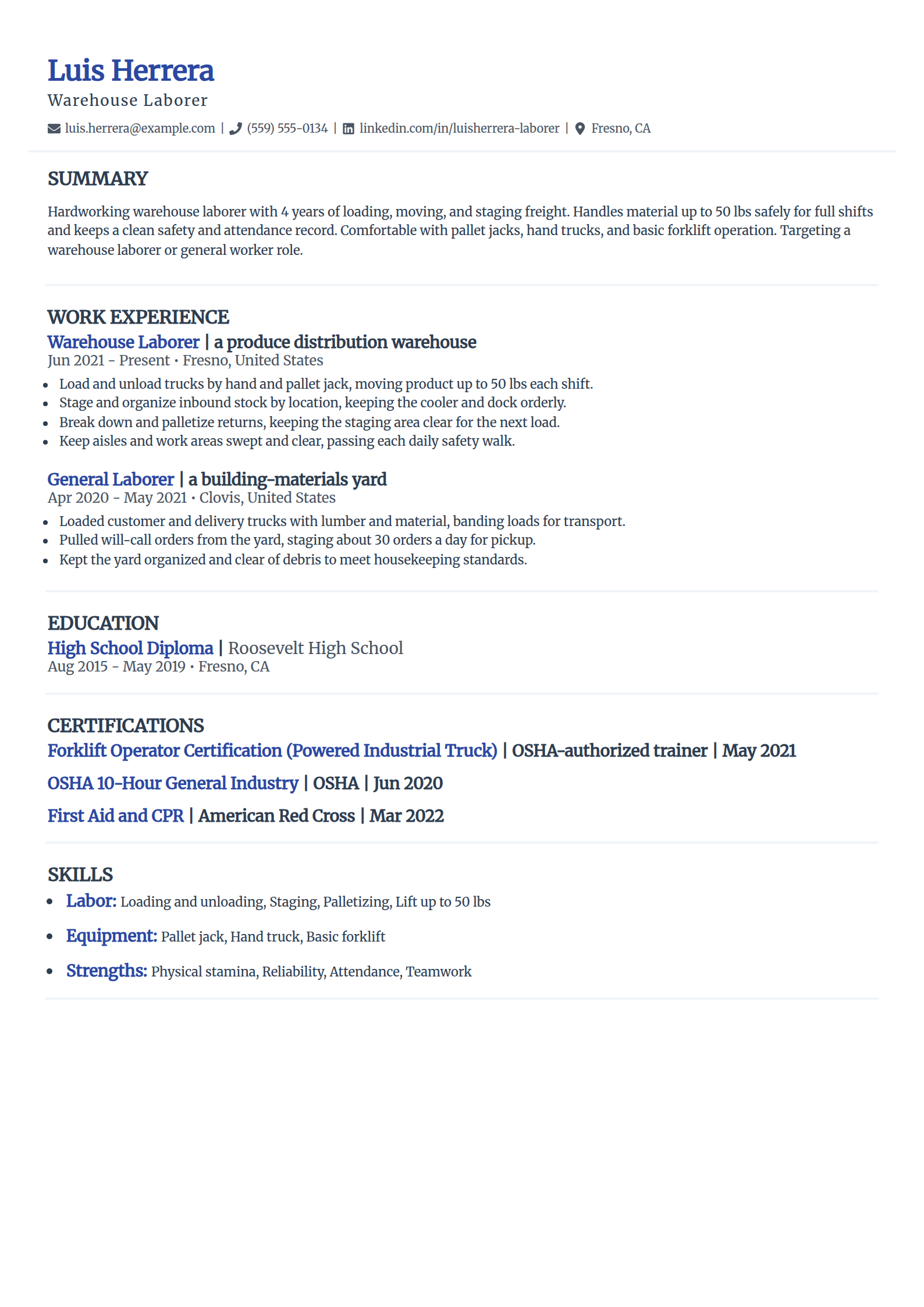
Warehouse Laborer Resume Template
Why this resume example works?
- Written for physical warehouse work, leading with loading, moving, and staging freight up to 50 lbs.
- Shows the reliability a laborer role hires for, a clean safety and attendance record across 4 years.
- Names the basic equipment a posting lists: pallet jack, hand truck, and basic forklift operation.
- Keeps bullets tight and concrete so the resume reads honest rather than padded.
- Uses a refined, uncluttered layout that fits a focused labor history on one clean page.
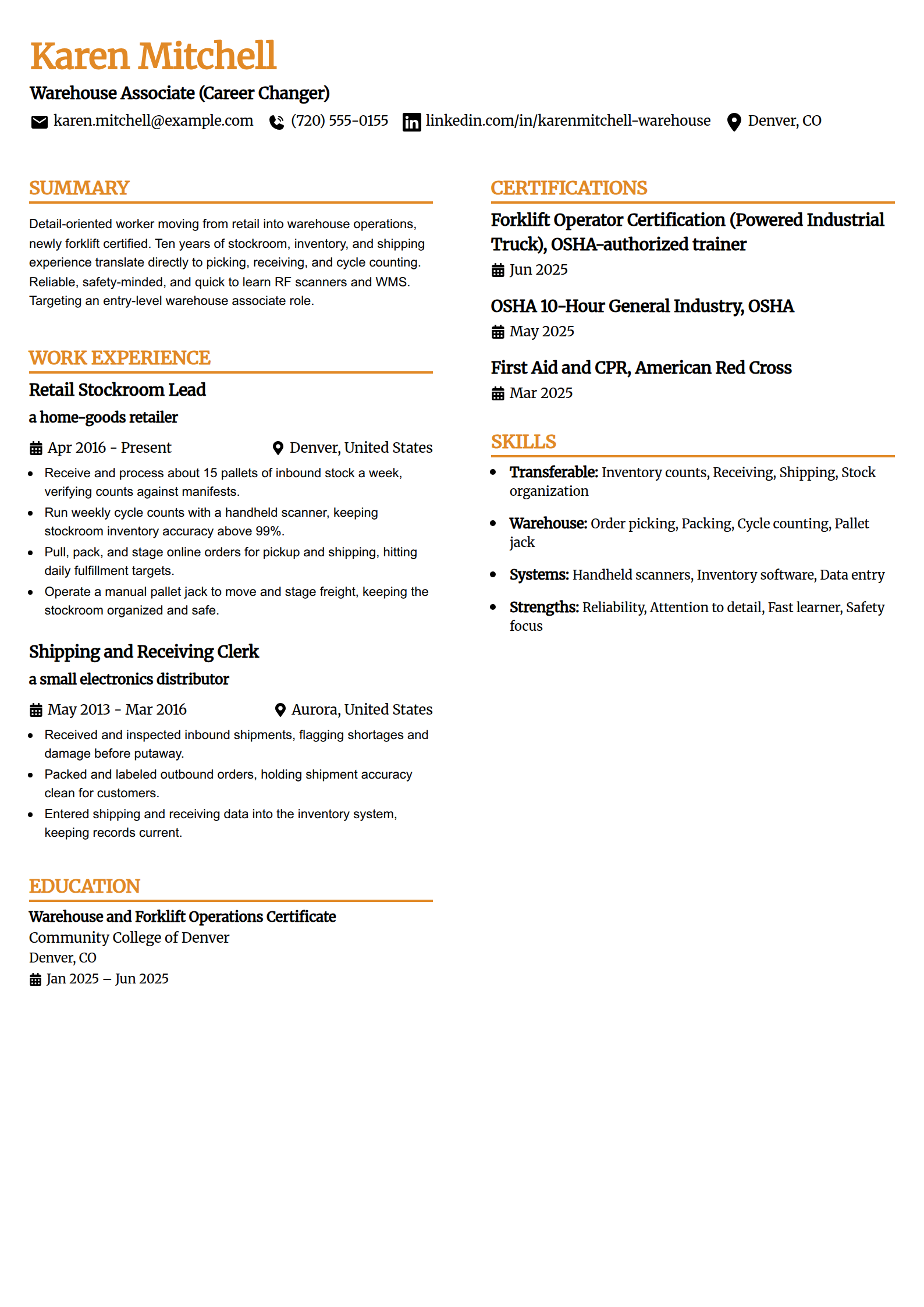
Career-Change Warehouse Resume Template
Why this resume example works?
- Names the change openly and reframes ten years of retail stockroom and shipping work as warehouse-ready skills.
- Pulls the transferable work forward: receiving pallets, weekly cycle counts, and pallet-jack moves.
- Shows recent commitment with a warehouse and forklift operations certificate earned this year.
- Keeps two focused roles tight and readable so the pivot reads intentional, not thin.
- Uses a clean layout that fits a career-change story on one page.
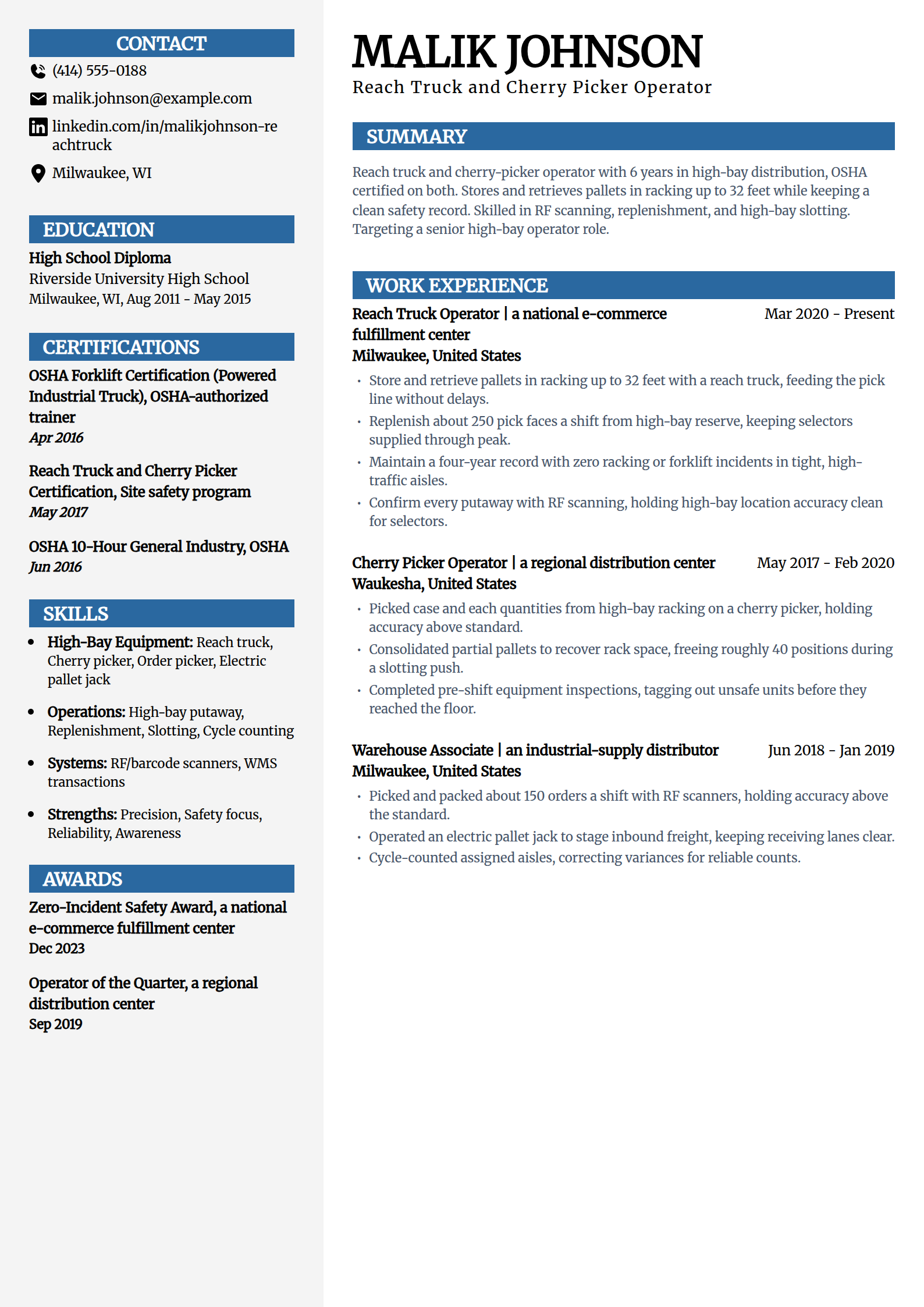
Reach Truck and Cherry Picker Operator Resume Template
Why this resume example works?
- Opens with high-bay scope, storing and retrieving pallets in racking up to 32 feet on a reach truck.
- Puts safety first, a four-year record with zero racking or forklift incidents in tight aisles.
- Shows the replenishment work that feeds a pick line, about 250 pick faces a shift from reserve.
- Fills a visually rich two-column layout, with the sidebar carrying certifications and safety awards.
- Names both machine classes and RF scanning so the resume matches a high-bay job posting.
Build your warehouse resume
Pick a template above and the editor keeps your layout clean and ATS-safe while you swap in your own pick rates, equipment, certifications, and systems.
Build my resumeHow to write a warehouse resume in 2026
A warehouse resume is read fast by someone checking three things: your forklift or safety certification, the equipment you run, and numbers that show you move volume. Lead with your certification and pick or load rate, then prove your experience with modest, believable metrics, one per bullet. These moves make yours easy to skim and easy for an applicant tracking system to parse.
Open with a short warehouse summary
Write three to four sentences, about 50 to 70 words, that name your role and years, your certification, the equipment you run, one strong number, and the role you are targeting. Lead with what you have done, not what you want from the employer. A brand-new worker leads with reliability, safety, and physical ability instead of years.
Warehouse associate with 5 years in distribution, OSHA forklift certified. Picks and packs about 160 orders a shift with RF scanners while holding accuracy above standard. Skilled in reach-truck operation, SAP EWM, and dock loading. Targeting a senior warehouse associate role.
Lead experience with picking, loading, and inventory numbers
The work a warehouse resume is hired for is concrete, so name it and attach one modest number to each bullet. Open every line with a strong verb, never "Responsible for".
- Throughput: state your rate, like picking 180 units an hour or shipping 220 orders a shift with RF scanning.
- Equipment: name what you run, such as staging 60 pallets a shift on a reach truck or loading 30 trailers.
- Accuracy: use a believable percentage, like 99.7% pick accuracy or 99.5% inventory accuracy on audited zones.
- Safety: cite a real record, such as a two-year stretch with zero reportable incidents, the first thing a floor checks.
List your forklift and OSHA certifications clearly
This is the section a warehouse reviewer reads most carefully, so make the credentials easy to find.
- List your forklift certification by its real name: OSHA Powered Industrial Truck (forklift) certification, plus reach-truck or cherry-picker if you hold them.
- Add OSHA 10 or OSHA 30, First Aid and CPR, and any hazmat or equipment training a posting names.
- Put your certification near the top, in the summary or a short line, because many warehouse postings require it to apply.
- No warehouse experience? A high school diploma or GED plus a forklift certificate and OSHA 10 is enough to start; say so plainly.
Match your skills to the posting's keywords
A warehouse skills list should read like the job description. Split it so a hiring manager and a parser both find what they need.
- Equipment: sit-down, reach, cherry-picker, and order-picker forklifts, plus manual and electric pallet jacks.
- Systems: RF and barcode scanners and the WMS you use, named outright, like SAP EWM, Manhattan, Oracle WMS, or HighJump.
- Operations: order picking, packing, shipping and receiving, loading and unloading, replenishment, and cycle counting.
- Safety and reliability: OSHA forklift certified, lockout/tagout, safe lifting up to 50 lbs, attendance, and housekeeping.
Keep it to one clean, ATS-safe page
Distribution centers and 3PLs run applicant tracking systems, so a clean one-page resume is the standard for most warehouse candidates.
- Use a single-column or simple two-column layout with standard headings a parser recognizes.
- Hold it to one page and lead with your most recent role in reverse-chronological order.
- Save as a PDF so the formatting holds, then run it through the ATS resume checker for a quick format pass.
- Swap the numbers in the templates above for your own rates, equipment, and systems; do not copy them as is.
Common warehouse resume mistakes
- Writing vague duties like "handled product". Say what you did: "picked 180 units an hour with RF scanning at 99.6% accuracy".
- Leaving your forklift or OSHA certification off, or burying it at the bottom. Name it and put it near the top, since many postings require it.
- Listing every number you can think of. Keep one credible metric per bullet; a wall of percentages reads as invented.
- Naming no systems. Tie your work to the real tools, like RF scanners and a WMS by name, so the resume matches the posting.
- Running to two pages or using a heavy design with tables and graphics. Keep one clean page a hiring manager and an ATS both read easily.
Frequently asked questions
What should a warehouse worker resume include?
A warehouse resume needs your contact details, a short summary, your certifications, work history in reverse-chronological order, education, and a skills list. Put your forklift or OSHA certification near the top, because many warehouse postings require it to apply. Lead each role with concrete numbers: units picked per hour, orders shipped per shift, pallets loaded, and pick or inventory accuracy. Name the equipment you run and the WMS you use, like RF scanners and SAP EWM. Keep it to one clean page for most candidates.
What skills do you put on a warehouse resume?
Split your skills so a hiring manager and a parser both find them. Equipment: sit-down, reach, cherry-picker, and order-picker forklifts, plus manual and electric pallet jacks. Systems: RF and barcode scanners and your WMS by name, such as SAP EWM, Manhattan, Oracle WMS, or HighJump. Operations: order picking, packing, shipping and receiving, loading and unloading, replenishment, and cycle counting. Safety and reliability: OSHA forklift certified, lockout/tagout, safe lifting up to 50 lbs, attendance, and housekeeping. Match the exact wording the job posting uses.
How do I write a warehouse resume with no experience?
Lead with reliability, safety, and physical ability instead of years. Show any job where you were dependable and on your feet, like retail stocking, moving, delivery, or construction, and pull out the transferable parts: lifting up to 50 lbs, unloading trucks, staging orders, and perfect attendance. A high school diploma or GED plus a forklift certificate and OSHA 10 is enough to start, so list them near the top. Volunteer work that involves sorting or loading counts too. The entry-level and career-changer examples above show the shape.
Do I need a forklift certification on my warehouse resume?
Not for every job, but it helps a lot and many postings require it. If you hold an OSHA Powered Industrial Truck (forklift) certification, list it by its real name near the top, and add reach-truck or cherry-picker certification if you have them. If you do not, you can still apply to plenty of picking, packing, loading, and general-labor roles, and a forklift certification is quick and inexpensive to earn, which strengthens the resume. Never claim a certification you do not hold, since employers verify it before they let you operate equipment.
How do I write an Amazon or fulfillment center resume?
Lead with the language a fulfillment center uses: picking, packing, stowing, and sortation to rate across stations, with quality above the site standard. Show you can lift up to 49 pounds, stand for full shifts, and keep pace, since those are the real requirements. Reliability and attendance matter as much as speed, so include a clean safety record and a willingness to cross-train. Name handheld scanners and conveyor systems. The Amazon and fulfillment center example above follows this shape and keeps every rate and accuracy claim to one believable number.
How long should a warehouse resume be?
One page for most candidates. Associates, operators, pickers, and new workers should keep a single, skimmable page led by their most recent role. A warehouse supervisor or lead with a long record may run to two pages, but never longer. Keep the roles, rates, equipment, and certifications that matter for the job you are targeting, and summarize or drop older, unrelated positions to make room for the numbers a hiring manager checks first.
More warehouse resume resources
Build your warehouse resume
Pick a template above and the editor keeps your layout clean and ATS-safe while you swap in your own pick rates, equipment, certifications, and systems.