Equipment Operator Resume Templates, Forklift to Heavy Equipment
- ATS Friendly
- Certification First
- 17 Real Examples
Forklift, reach truck, excavator, dozer, crane, or CNC machine, this page has a resume built for the exact machine you run. Start from a layout below, then model your own on a real example, from an entry-level warehouse seat to a lead heavy-equipment operator. Your OSHA or NCCCO certification, hours on the machine, and incident-free record sit where a hiring manager looks first.


540k+ resumes created
Equipment operator resume templates for every machine and level
Each template below is a real operator resume laid out in that format, sorted by machine and experience across forklift, reach truck, excavator, dozer, wheel loader, crane, CNC, plant, grader, skid steer, hauler, and paving roles. Pick one, then swap in your own certifications, equipment, hours, and safety record. Every layout keeps your name, OSHA or NCCCO certification, and machine time readable so a hiring manager sees your safety record at a glance and an applicant tracking system parses it cleanly.
Forklift Operator Resume Template
Why this resume example works?
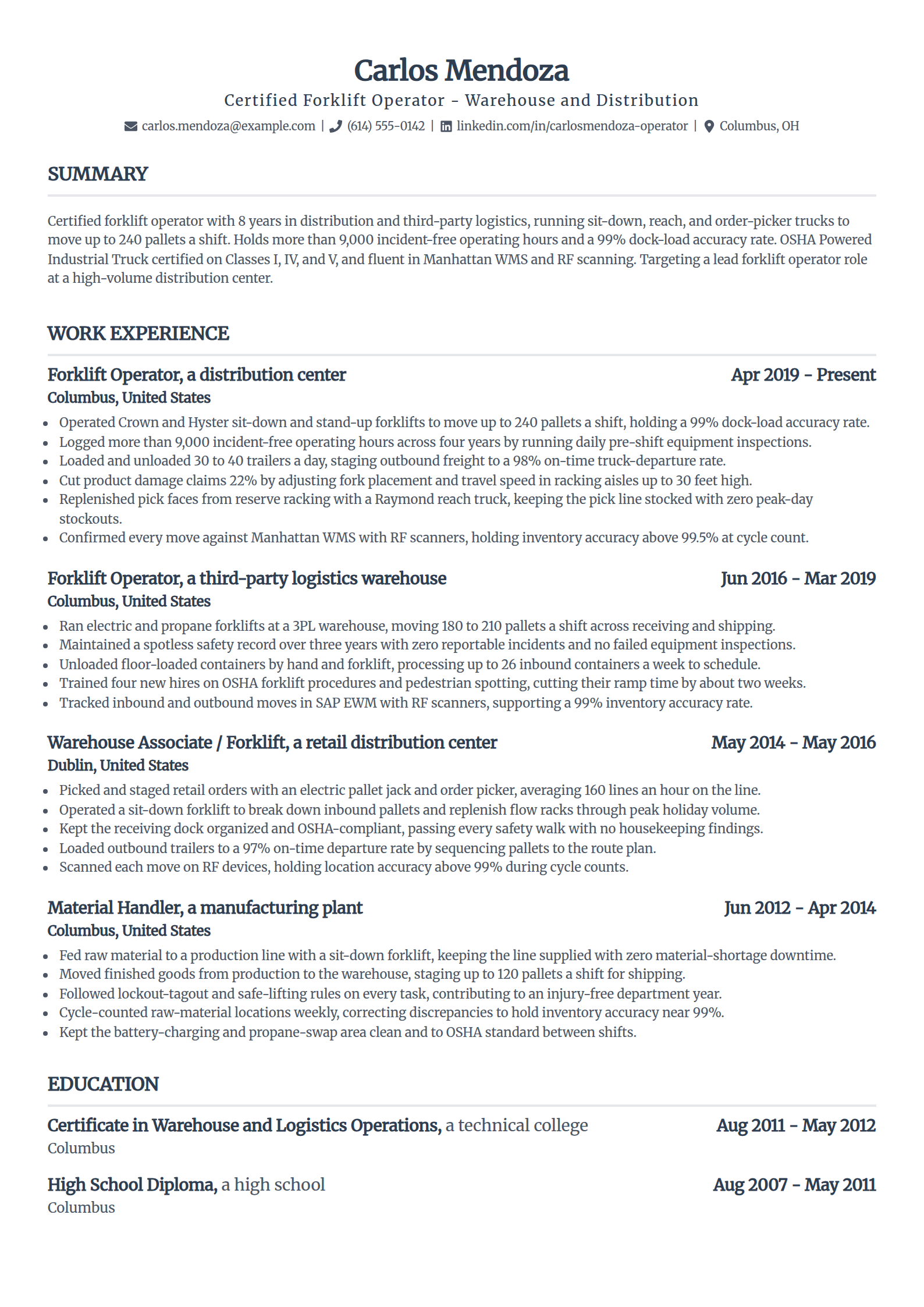
- Opens with a summary that names 8 years, OSHA Powered Industrial Truck certification on Classes I, IV, and V, and up to 240 pallets a shift.
- Puts safety where a warehouse looks first, more than 9,000 incident-free operating hours across four years.
- Names the equipment a floor hires for, Crown and Hyster sit-down and stand-up forklifts, a Raymond reach truck, and RF scanners.
- Ties each result to a number, like a 99% dock-load accuracy rate or damage claims cut 22% in tall racking aisles.
- Uses a clean, single-column layout an applicant tracking system reads without trouble.
Reach-Truck and Order-Picker Resume Template
Why this resume example works?
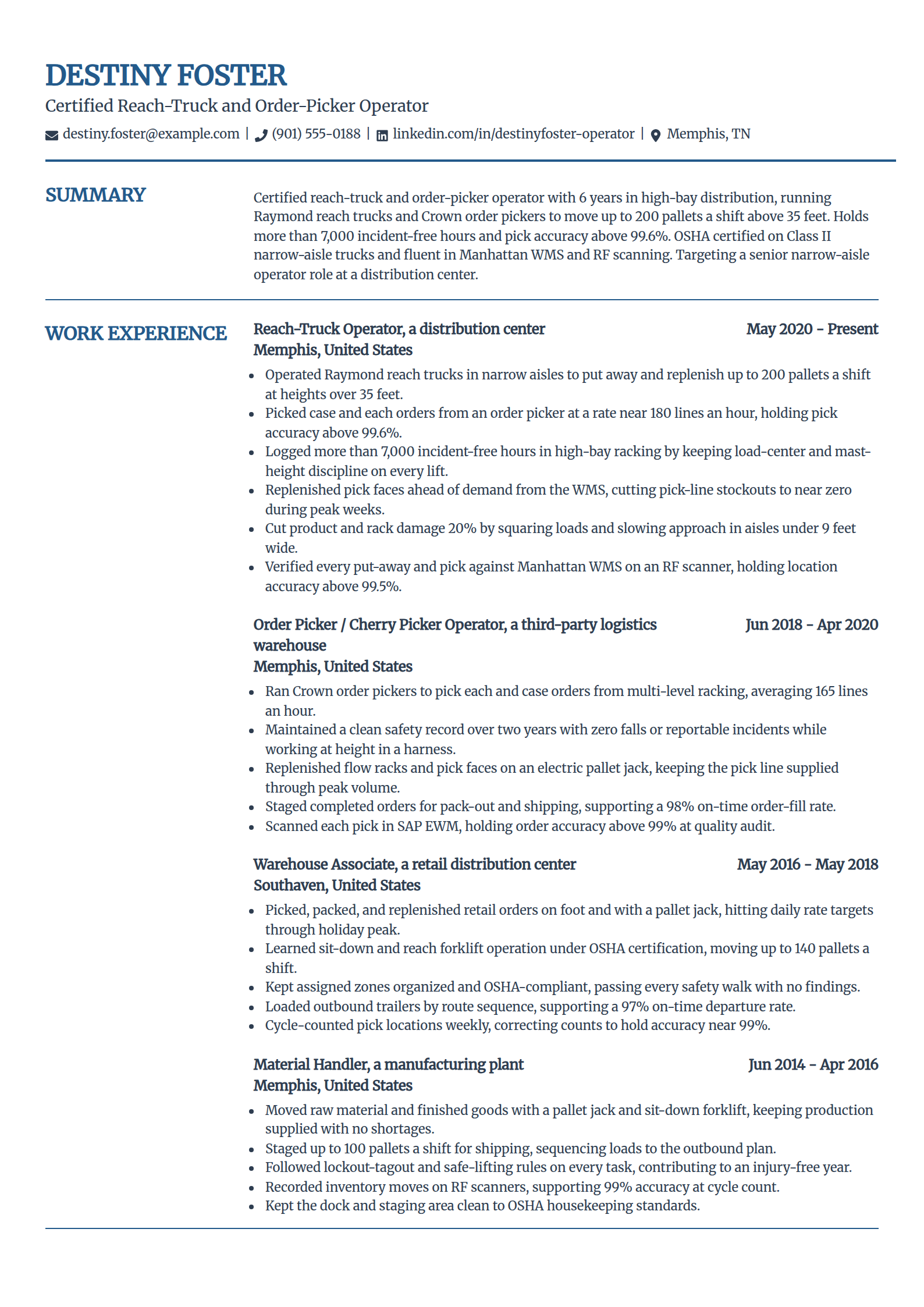
- Leads with narrow-aisle scope, OSHA Class II certified with 7,000 incident-free hours in racking over 35 feet high.
- Shows the pick work a distribution center rewards, near 180 lines an hour at pick accuracy above 99.6%.
- Names Raymond reach trucks, Crown order pickers, fall protection, and Manhattan WMS, the tools a high-bay posting screens for.
- Keeps each result countable, like rack damage cut 20% by squaring loads in aisles under nine feet wide.
- Uses a modern layout that carries a deep narrow-aisle history on one clean page.
Excavator Operator Resume Template
Why this resume example works?
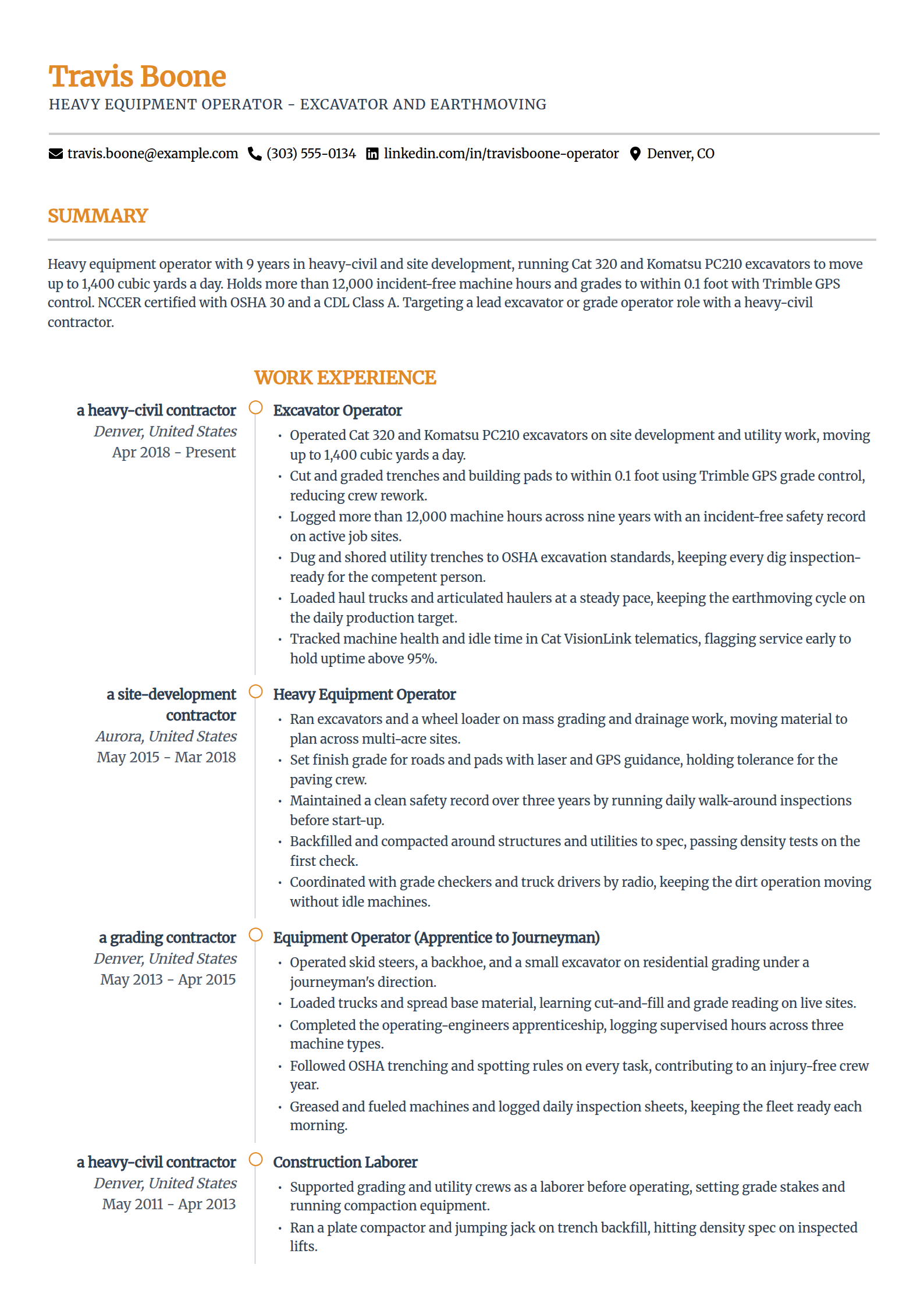
- Opens with the detail a heavy-civil contractor rewards, 9 years on Cat 320 and Komatsu PC210 excavators moving up to 1,400 cubic yards a day.
- Puts safety and precision up front, 12,000 incident-free machine hours and trenches graded to within 0.1 foot on Trimble GPS.
- Shows the compliance a site screens for, digs shored to OSHA excavation standards and kept inspection-ready.
- Names Cat VisionLink telematics, an NCCER certification, OSHA 30, and a CDL Class A a heavy-equipment posting lists.
- Uses a modern layout that still reads cleanly for a hiring manager scanning fast.
Dozer Operator Resume Template
Why this resume example works?
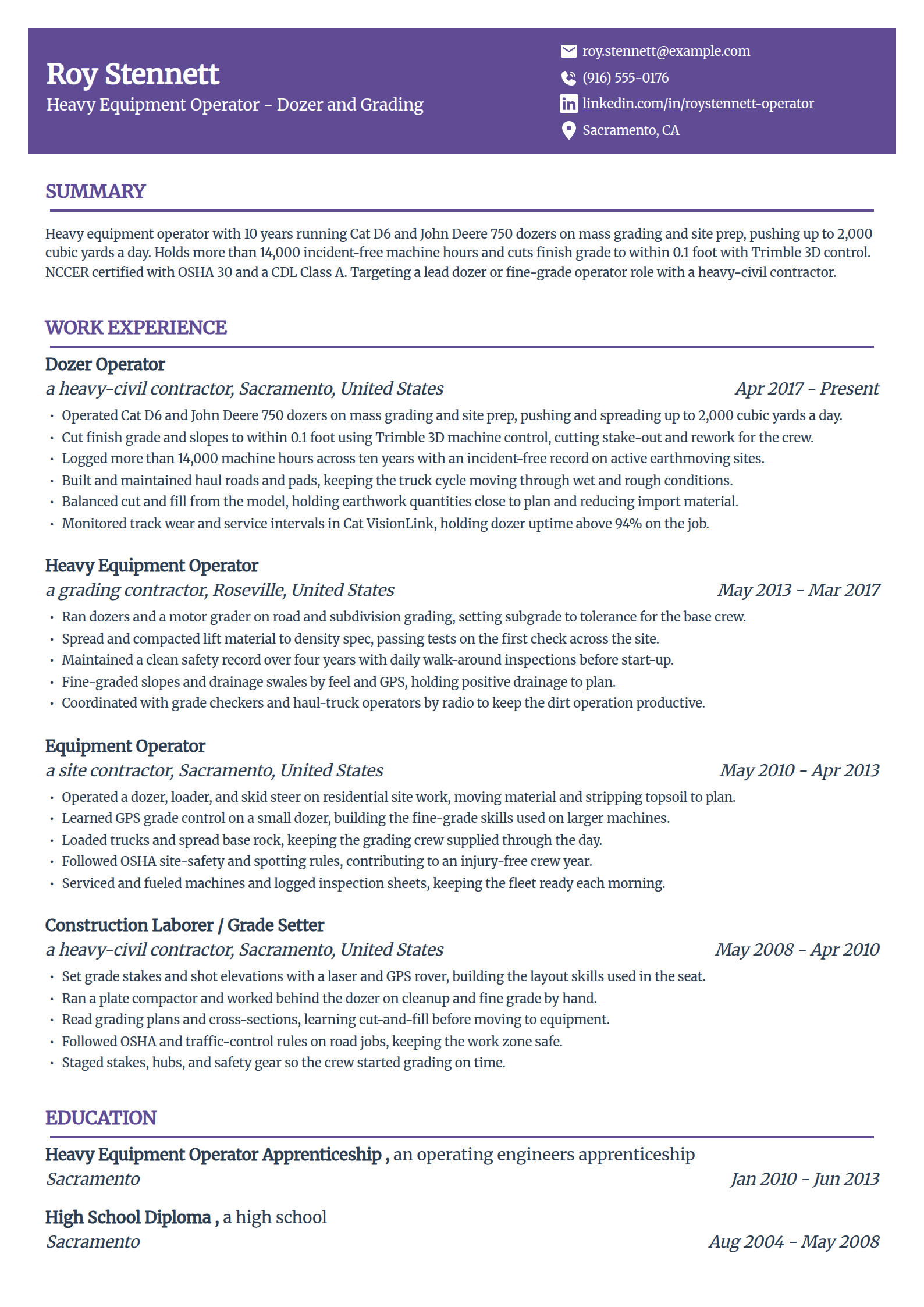
- Leads with the specialty a grading contractor hires for, 10 years on Cat D6 and John Deere 750 dozers pushing up to 2,000 cubic yards a day.
- Shows the skill that matters here, finish grade cut to within 0.1 foot using Trimble 3D machine control.
- Ties results to method, cut and fill balanced from the model to reduce import material and rework.
- Names Cat VisionLink telematics, an NCCER certification, MSHA Part 46, and a CDL Class A a heavy-civil posting screens for.
- Uses a spacious layout that carries a ten-year earthmoving record on one page.
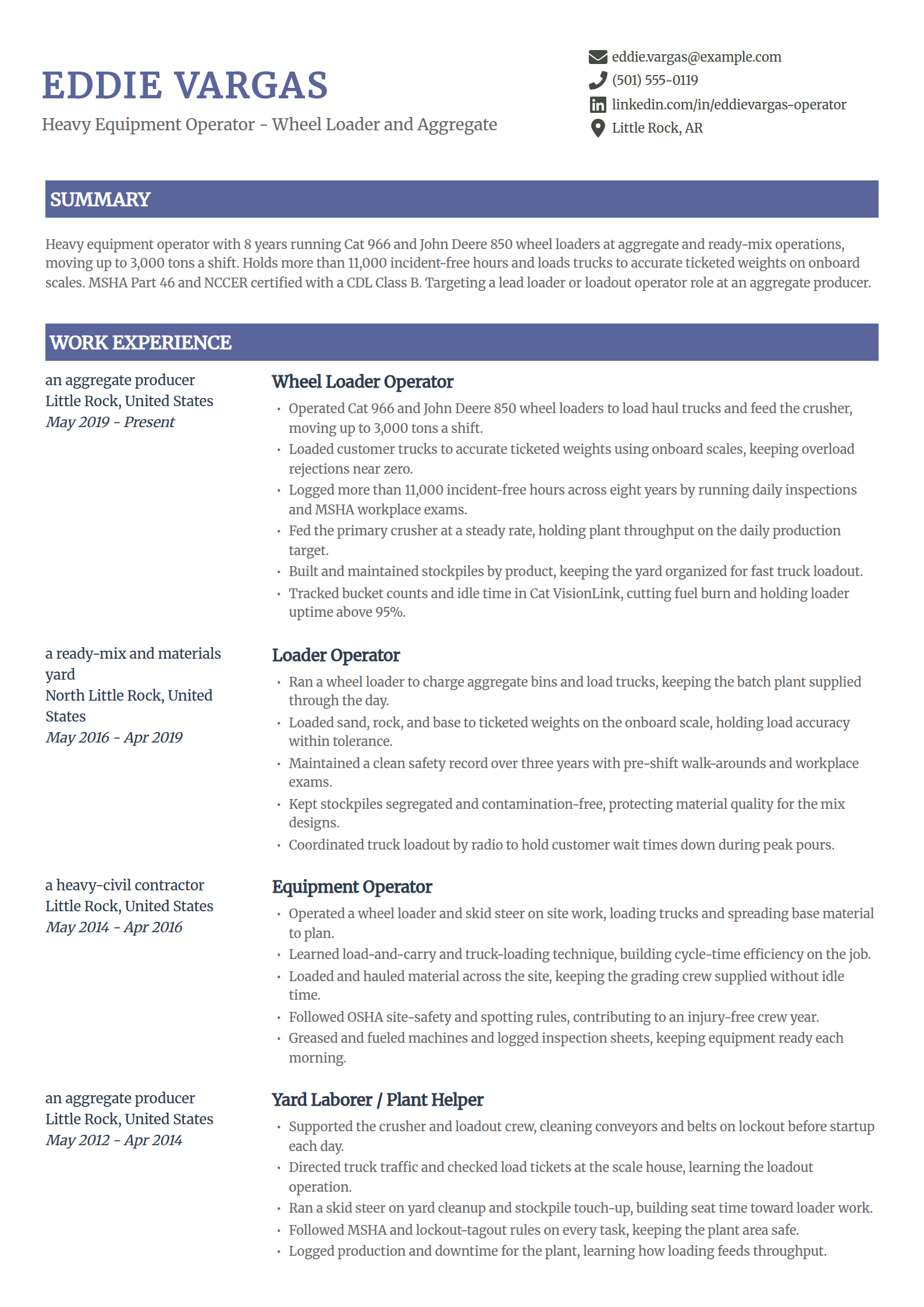
Wheel Loader Operator Resume Template
Why this resume example works?
- Opens with the value an aggregate producer wants, 8 years on Cat 966 and John Deere 850 loaders moving up to 3,000 tons a shift.
- Shows the loadout skill that matters, customer trucks loaded to accurate ticketed weights on onboard scales with overload rejections near zero.
- Puts safety first, 11,000 incident-free hours backed by daily inspections and MSHA workplace exams.
- Names Cat VisionLink, MSHA Part 46, NCCER, and a CDL Class B a materials operation screens for.
- Uses a modern two-column layout that carries a dense aggregate history cleanly on one page.
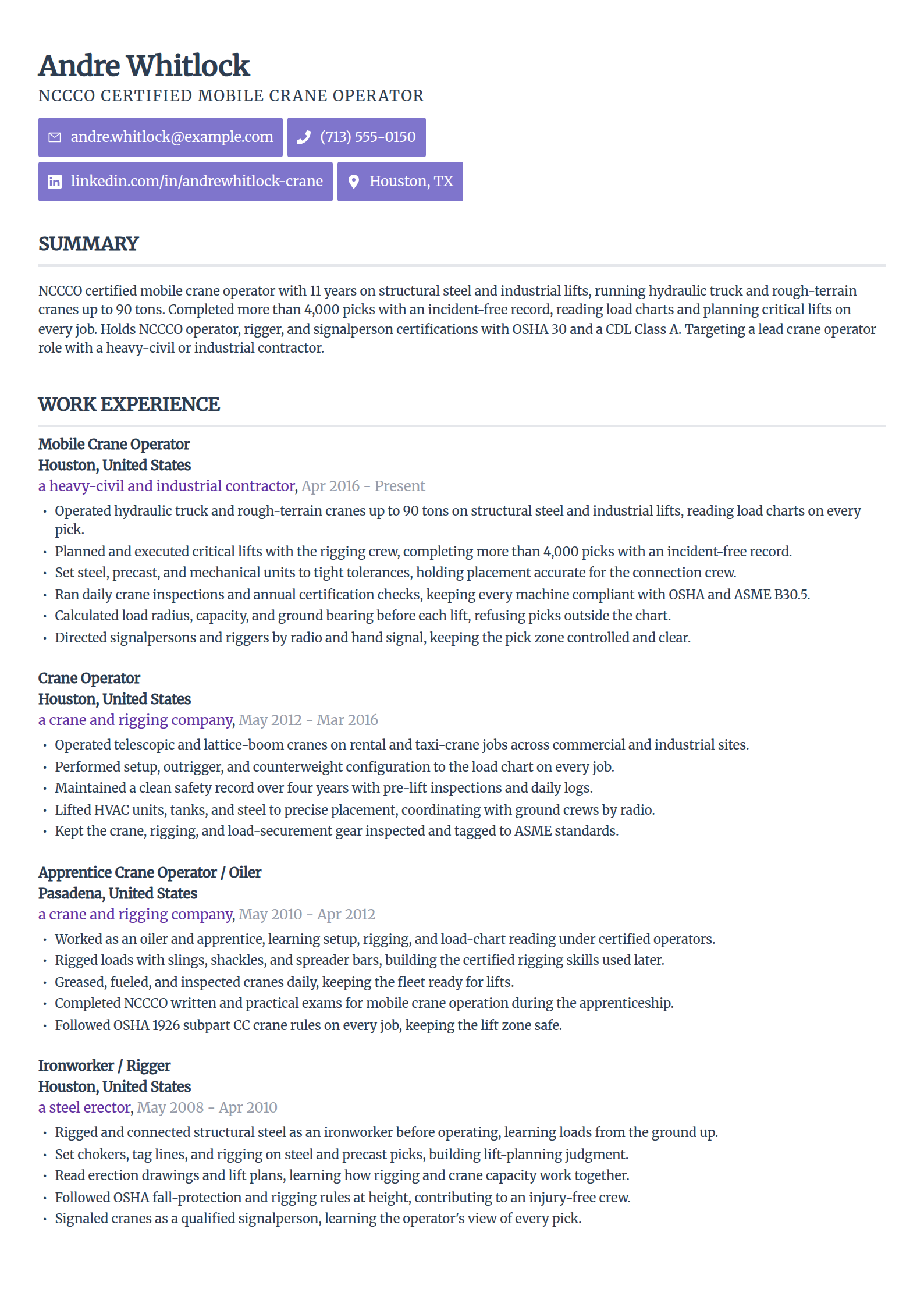
Crane Operator Resume Template
Why this resume example works?
- Leads with the credential a lift job requires, NCCCO mobile crane operator, rigger, and signalperson certifications over 11 years.
- Shows the specialty judgment that matters, more than 4,000 picks up to 90 tons with load charts read on every lift.
- Keeps the work squarely in scope and safe, critical lifts planned with the rigging crew and picks refused outside the chart.
- Names ASME B30.5, OSHA subpart CC, and a CDL Class A a crane and rigging employer expects.
- Uses a clean, modern layout that carries a deep lift history on one page.
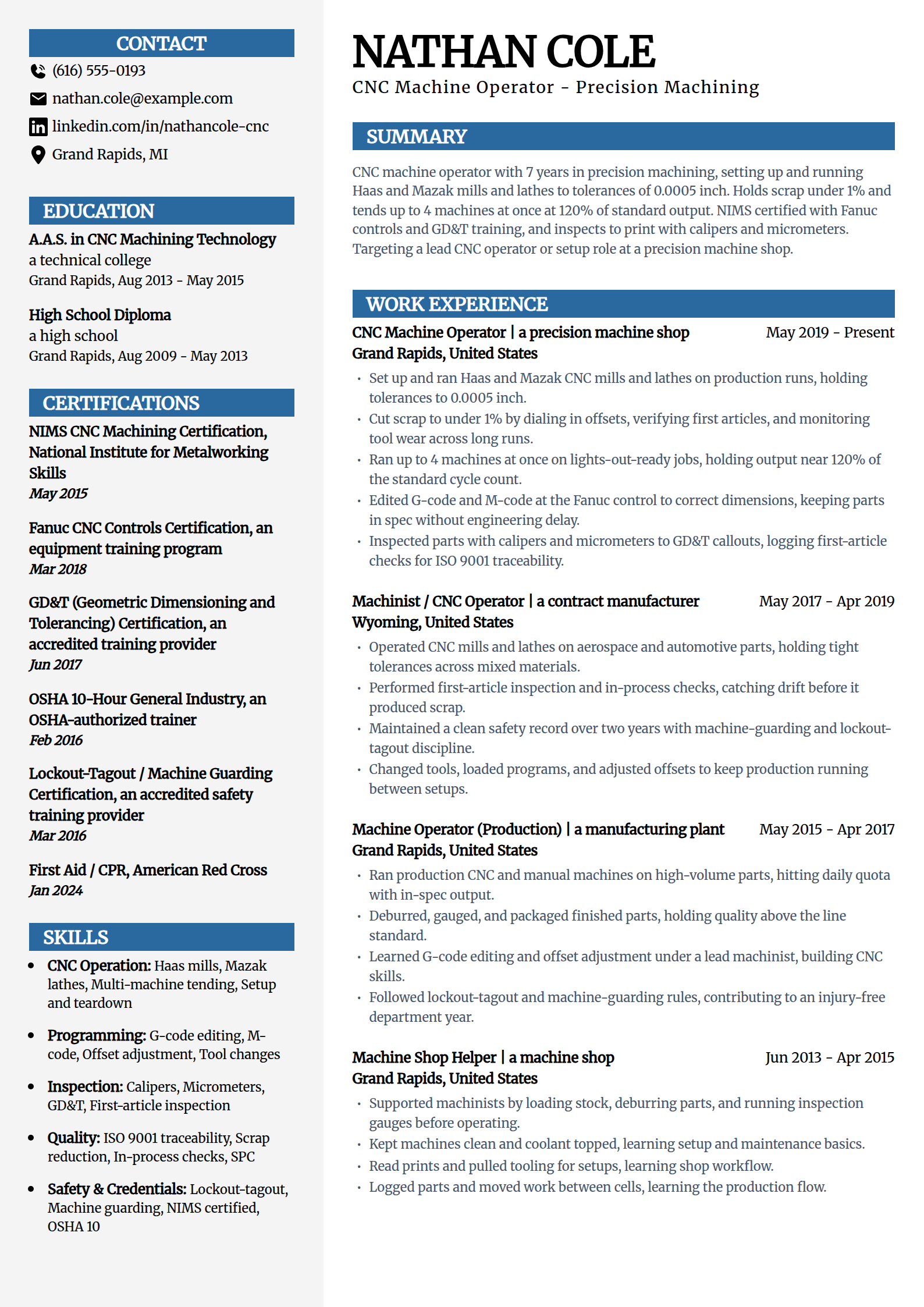
CNC Machine Operator Resume Template
Why this resume example works?
- Opens with the precision a machine shop hires for, 7 years on Haas and Mazak mills and lathes holding tolerances to 0.0005 inch.
- Shows the productivity that matters, up to 4 machines tended at once at 120% of standard output with scrap under 1%.
- Names the real skills a posting screens for, G-code editing at the Fanuc control, GD&T inspection with calipers and micrometers.
- Keeps quality visible, first-article and in-process checks logged for ISO 9001 traceability.
- Uses a modern two-column layout that carries a full machining record on one clean page.
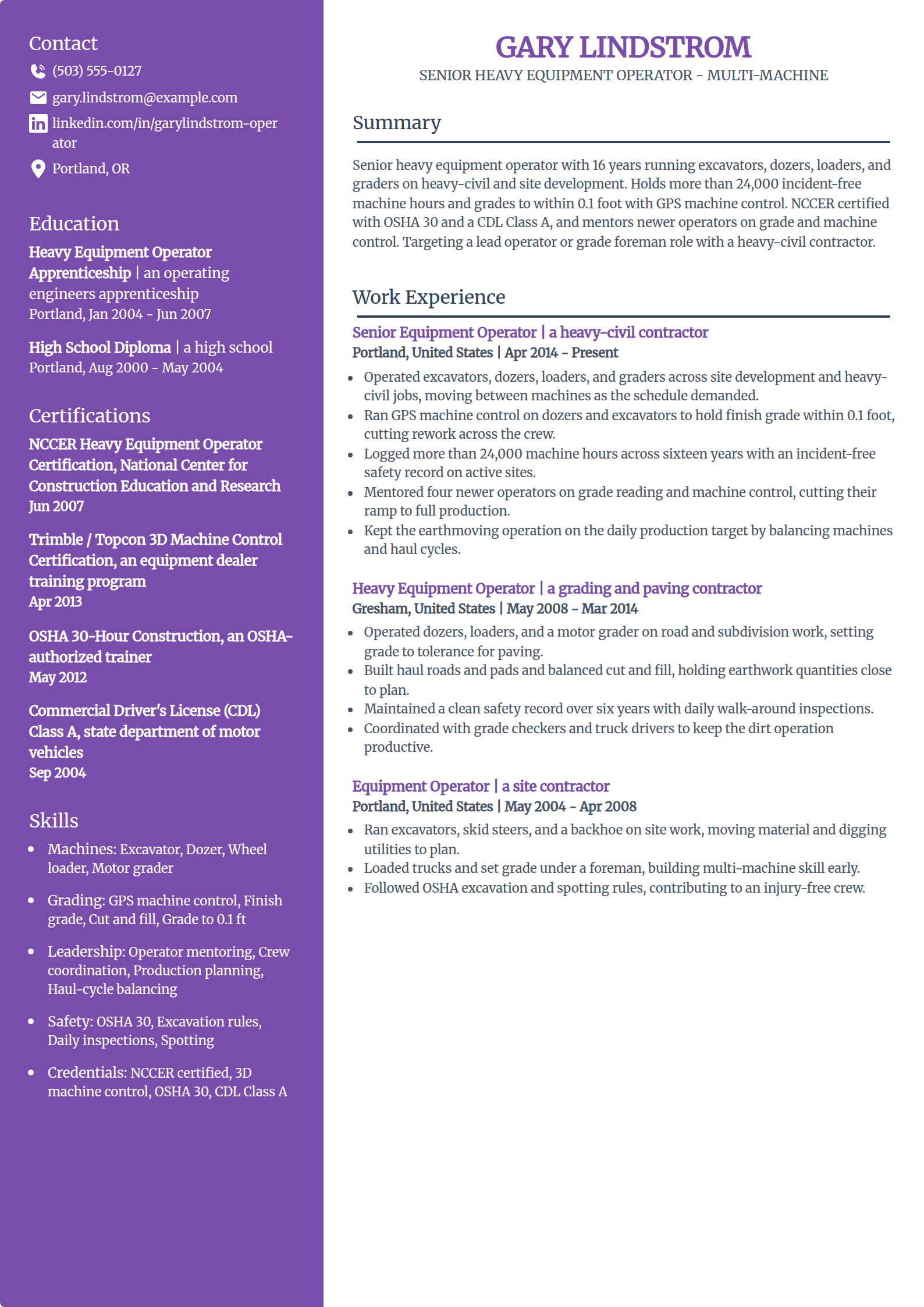
Senior Heavy Equipment Operator Resume Template
Why this resume example works?
- Leads with 16 years across excavators, dozers, loaders, and graders, the depth a senior operator posting wants.
- Shows the mark of a veteran, more than 24,000 incident-free machine hours and finish grade held within 0.1 foot on GPS control.
- Pairs seat time with leadership, mentoring four newer operators on grade reading and machine control.
- Names an NCCER certification, OSHA 30, 3D machine control, and a CDL Class A a heavy-civil contractor screens for.
- Uses a Medium layout that carries a deep multi-machine history without empty space.
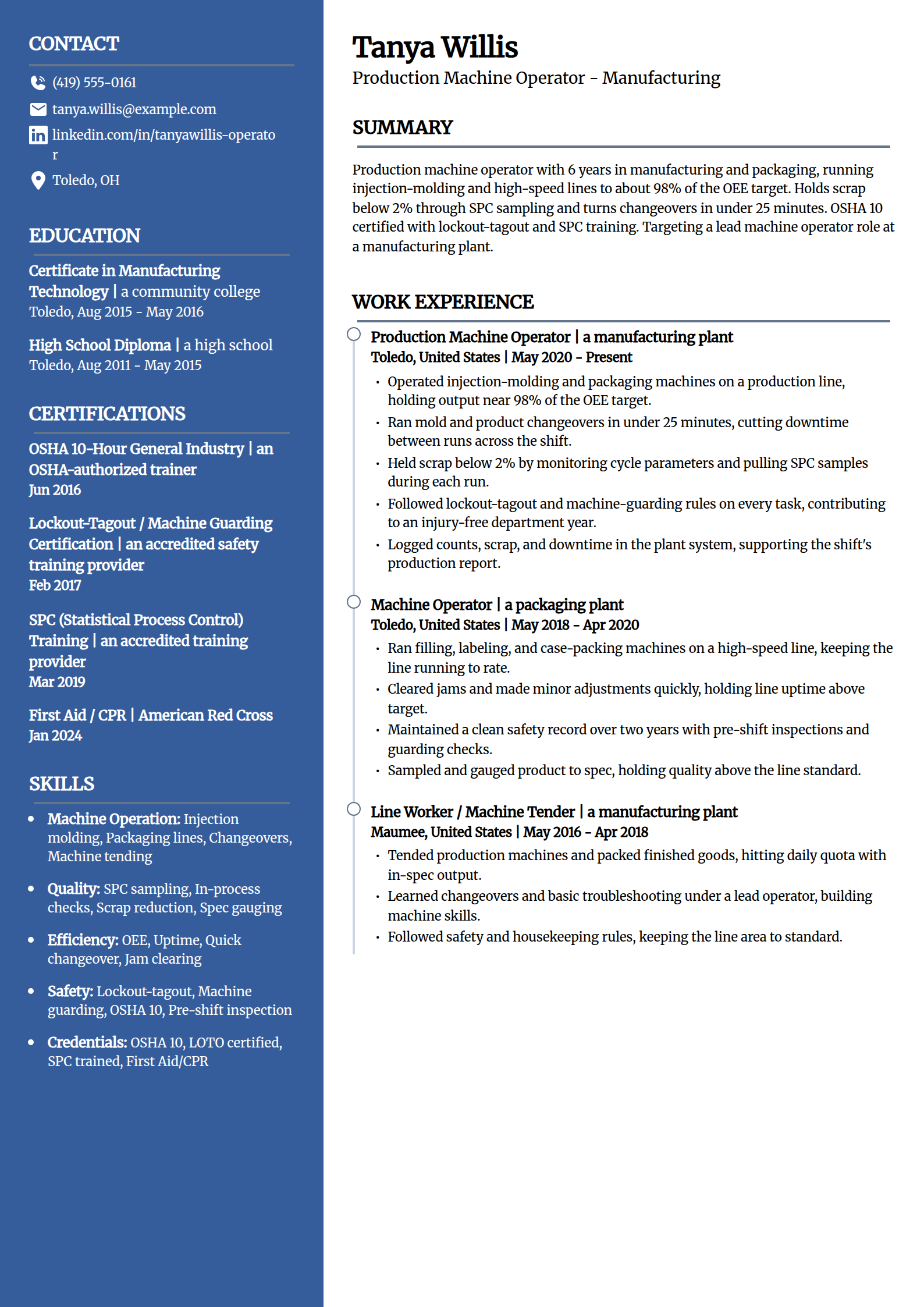
Production Machine Operator Resume Template
Why this resume example works?
- Opens with the detail a plant rewards, 6 years running injection-molding and packaging lines to about 98% of the OEE target.
- Shows the efficiency that matters, changeovers turned in under 25 minutes and scrap held below 2% through SPC sampling.
- Keeps safety visible, an injury-free department year backed by lockout-tagout and machine-guarding discipline.
- Names OSHA 10, SPC training, and lockout-tagout a manufacturing posting screens for.
- Uses a distinctive layout that still reads cleanly for a hiring manager.
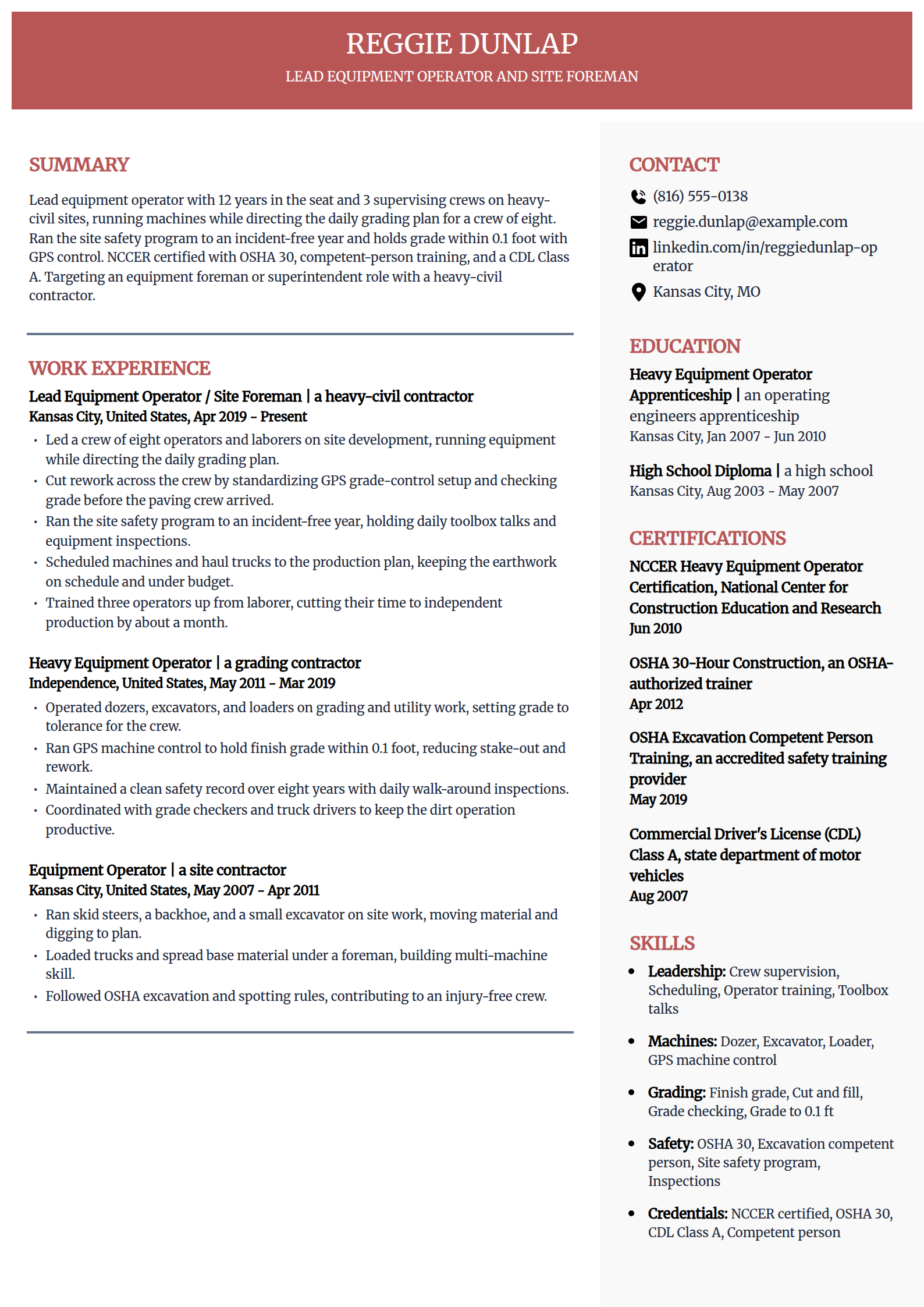
Lead Operator and Site Foreman Resume Template
Why this resume example works?
- Leads with the step up, 12 years in the seat plus 3 running a crew of eight on heavy-civil sites.
- Shows the results a lead is hired for, a site safety program held to an incident-free year and rework cut by standardizing grade setup.
- Keeps the candidate credible at the controls, still running machines while directing the daily grading plan.
- Pairs leadership with training, three operators brought up from laborer to independent production in about a month each.
- Uses a refined layout that carries a twelve-year record with a leadership arc on one page.
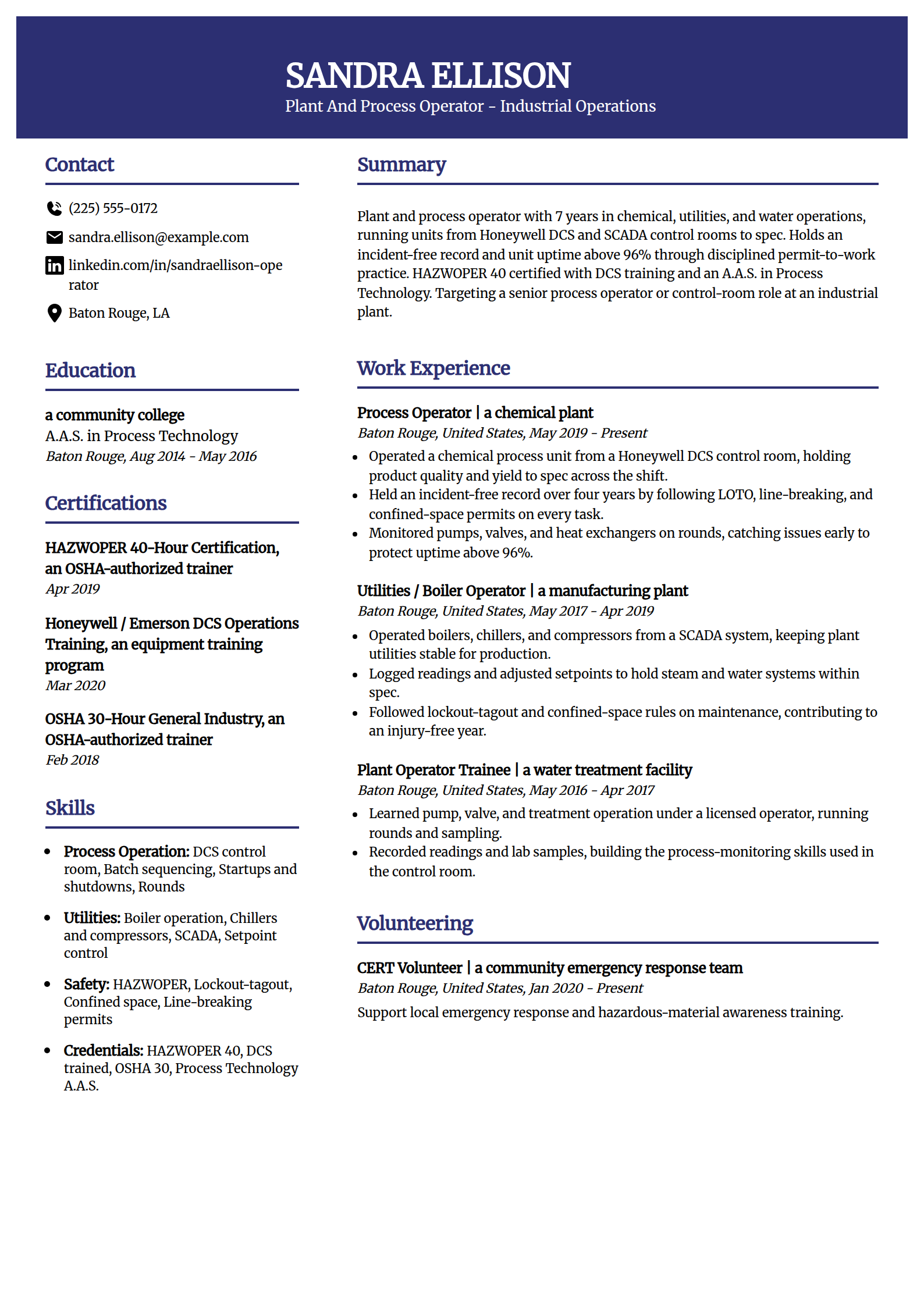
Plant and Process Operator Resume Template
Why this resume example works?
- Opens with the scope an industrial plant wants, 7 years running units from Honeywell DCS and SCADA control rooms to spec.
- Shows the discipline that matters, an incident-free record and unit uptime above 96% through permit-to-work practice.
- Keeps the work honest and safe, startups and shutdowns run to procedure with LOTO, line-breaking, and confined-space permits.
- Names HAZWOPER 40, DCS training, OSHA 30, and a Process Technology A.A.S. a plant posting screens for.
- Keeps the sidebar full with a safe-operator award and a community response role, so the record looks complete.
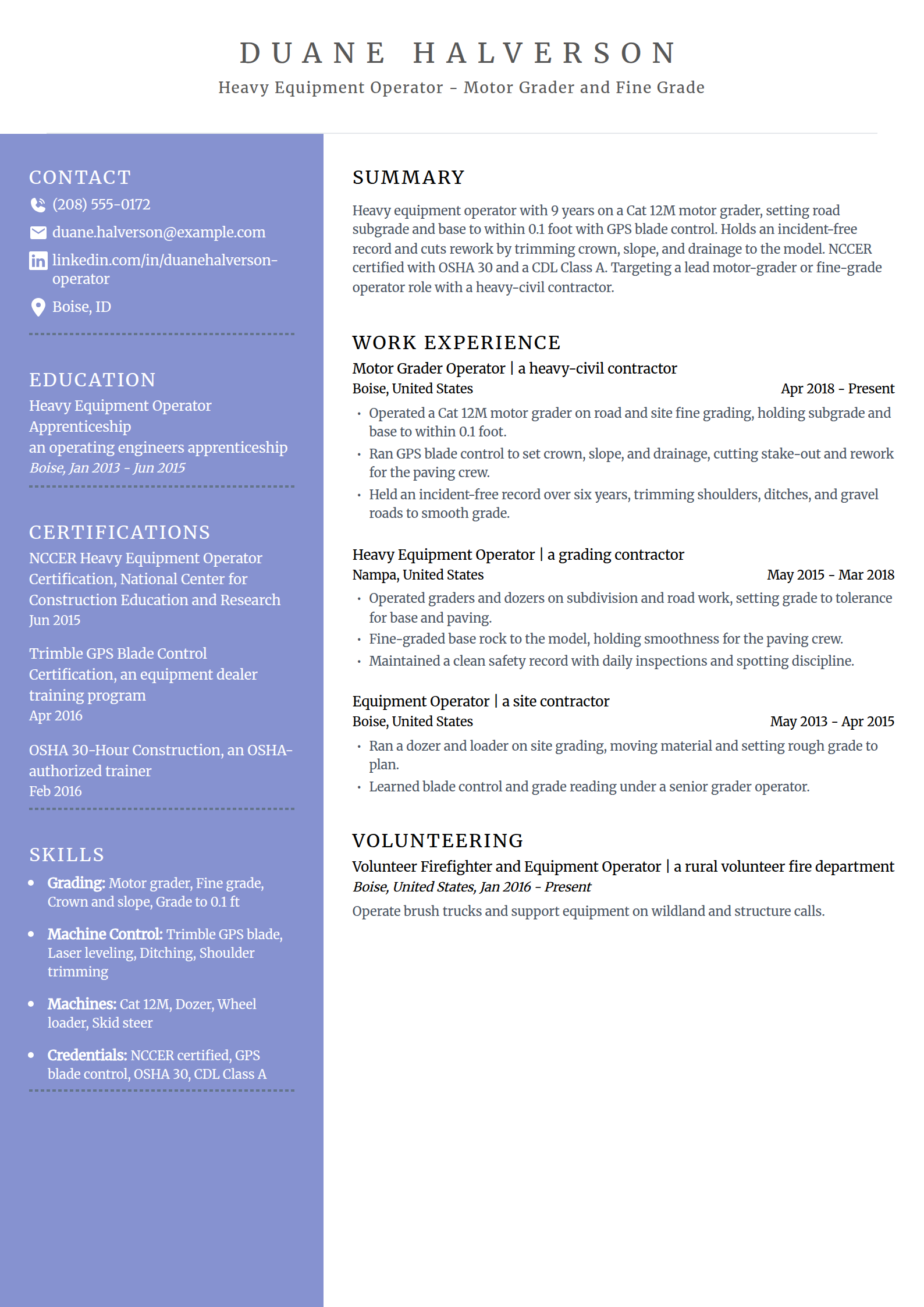
Motor Grader Operator Resume Template
Why this resume example works?
- Leads with the specialty a road contractor hires for, 9 years on a Cat 12M motor grader setting subgrade to within 0.1 foot.
- Shows the skill that matters, crown, slope, and drainage set on GPS blade control to cut stake-out and rework.
- Puts safety first, an incident-free record backed by daily walk-around inspections.
- Names an NCCER certification, GPS blade control, OSHA 30, and a CDL Class A a heavy-civil posting lists.
- Uses a roomy layout with a grade-operator award and a volunteer role so the record fills the page.
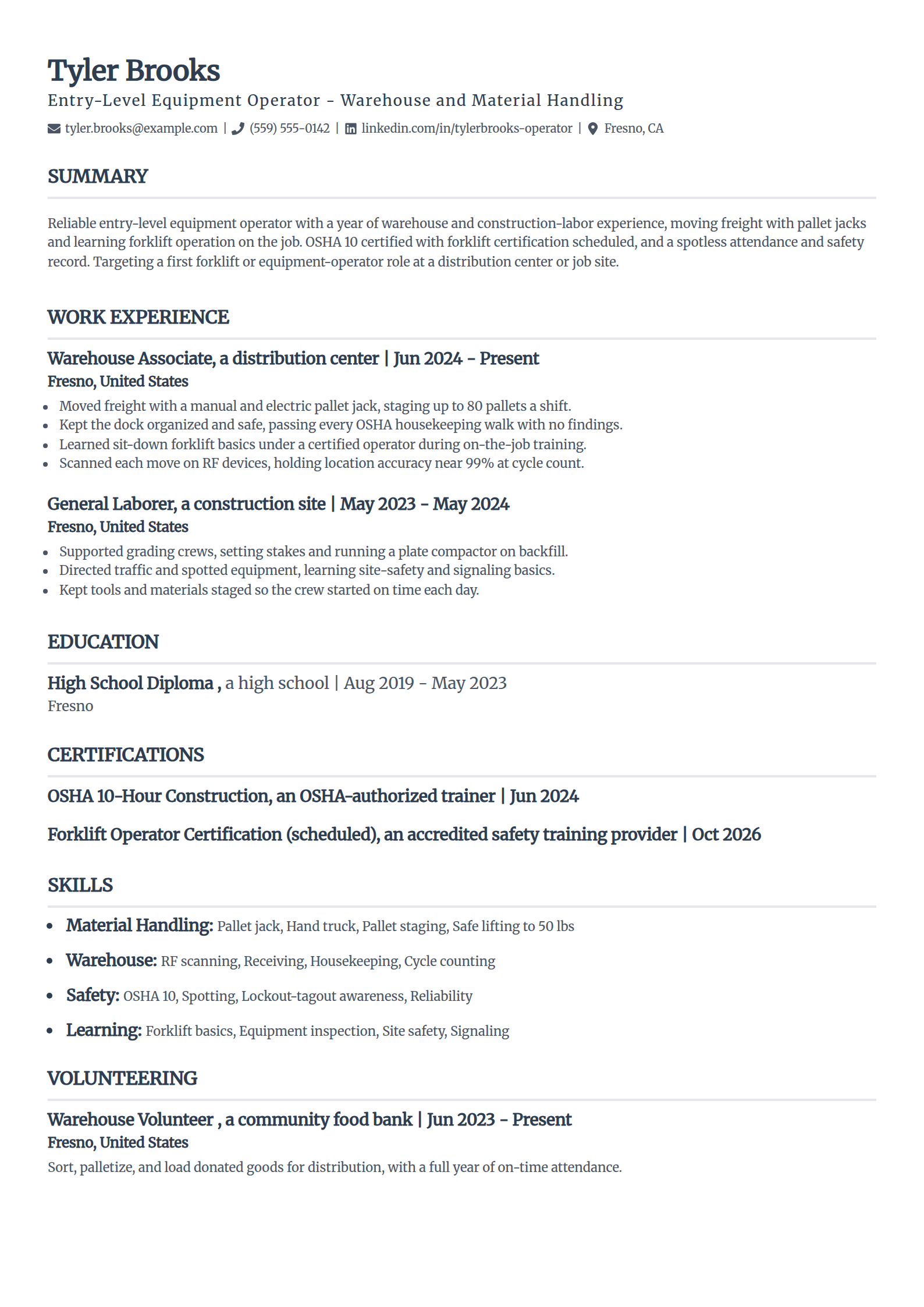
Entry-Level Equipment Operator Resume Template
Why this resume example works?
- Written for a first operator job, leading with reliability, safe lifting, and forklift training on the way, not invented hours.
- Uses warehouse and construction-labor entries, the right move when full operator experience does not exist yet.
- Keeps every bullet honest and small, like staging up to 80 pallets a shift and learning forklift basics under a certified operator.
- Names OSHA 10 and a scheduled forklift certification an entry-level posting screens for.
- Fills a tight, ATS-safe page with a perfect-attendance award and a food-bank volunteer role instead of padding.
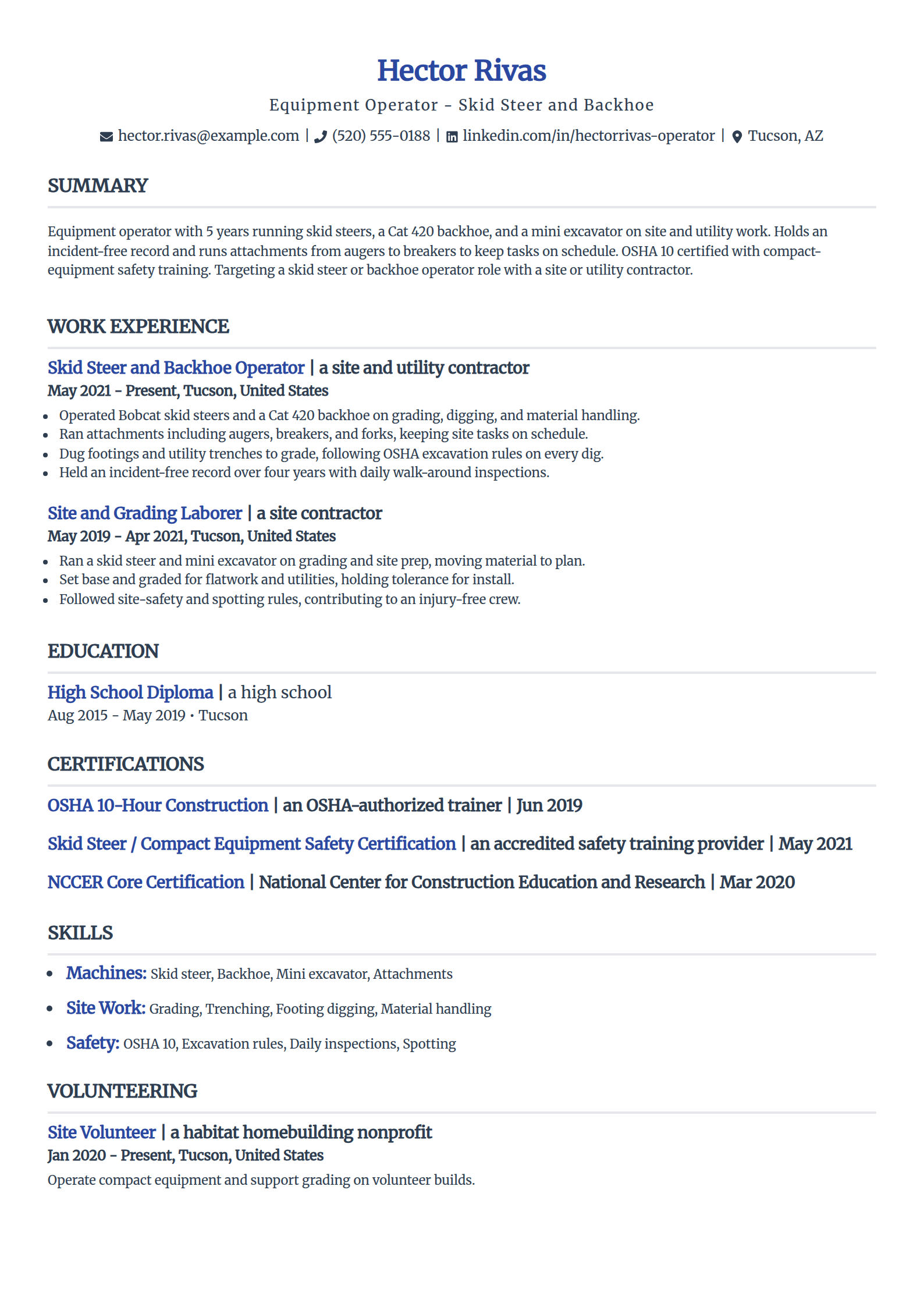
Skid Steer and Backhoe Operator Resume Template
Why this resume example works?
- Written for a compact-equipment operator, leading with 5 years on Bobcat skid steers and a Cat 420 backhoe with a clean record.
- Shows the versatility a site contractor rewards, attachments from augers to breakers run to keep tasks on schedule.
- Keeps results tied to the job, footings and utility trenches dug to grade under OSHA excavation rules.
- Names OSHA 10, compact-equipment safety training, and NCCER Core a utility posting screens for.
- Fills a tight, ATS-safe page with a safe-operator award and a volunteer build role.
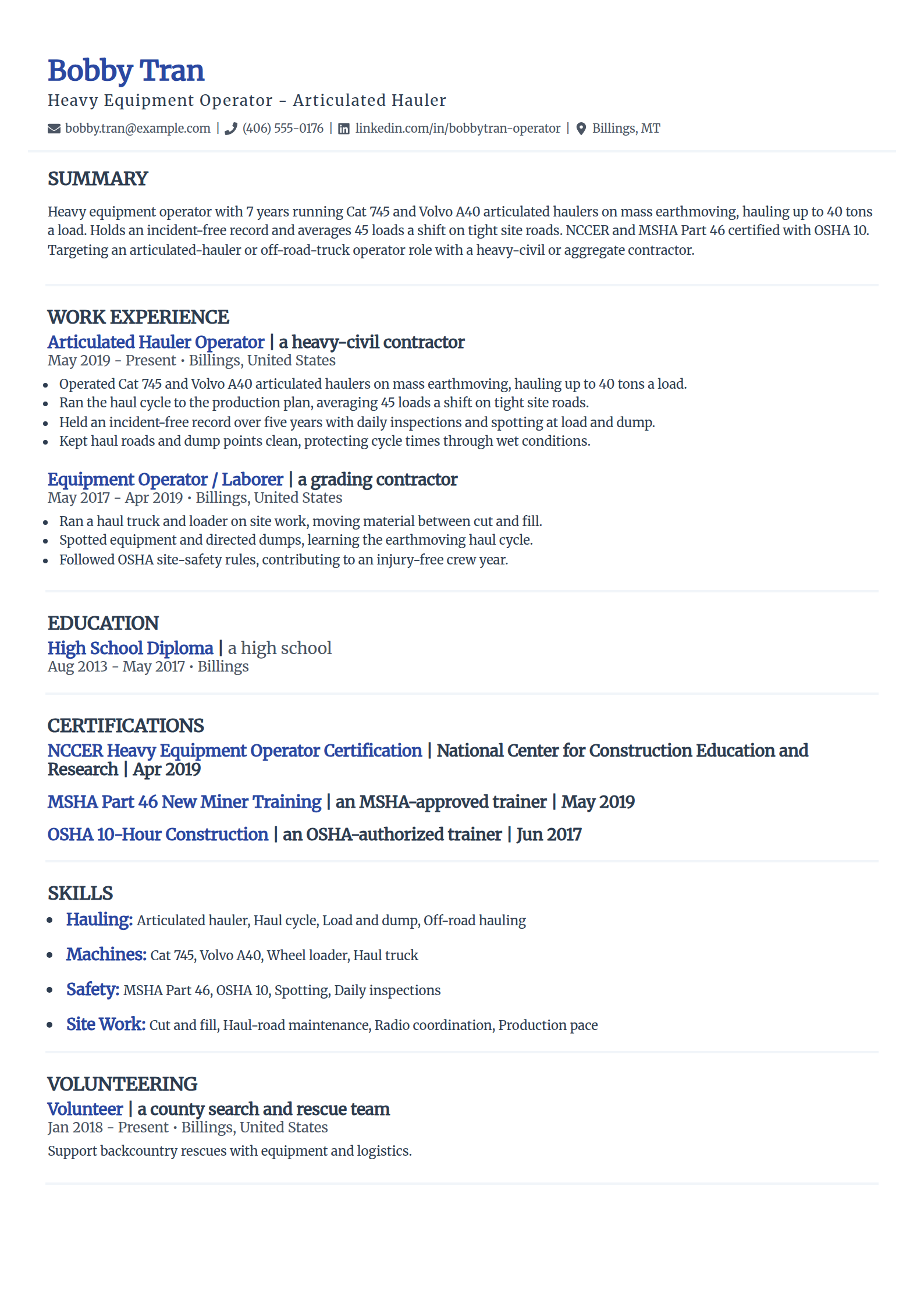
Articulated Hauler Operator Resume Template
Why this resume example works?
- Written for an earthmoving hauler operator, leading with 7 years on Cat 745 and Volvo A40 haulers moving up to 40 tons a load.
- Shows the production a site rewards, about 45 loads a shift kept moving on tight, uneven haul roads.
- Puts safety first, an incident-free record over five years with spotting at load and dump.
- Names MSHA Part 46, NCCER, and OSHA 10 an aggregate or heavy-civil operation screens for.
- Fills a refined, ATS-safe page with a zero-incident award and a search-and-rescue volunteer role.
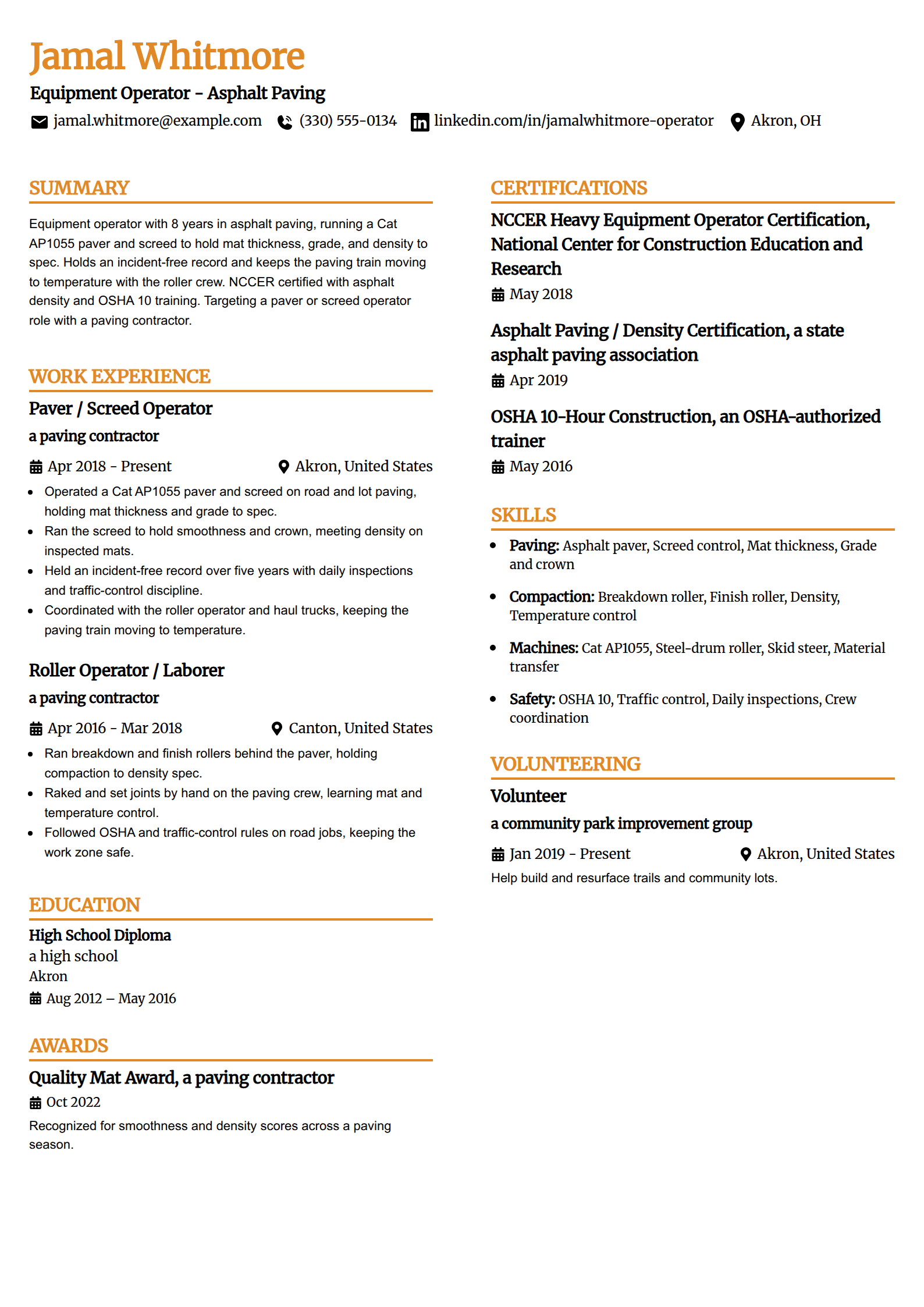
Asphalt Paver Operator Resume Template
Why this resume example works?
- Written for a paving crew, leading with 8 years on a Cat AP1055 paver and screed holding mat thickness and grade to spec.
- Shows the skill a paving contractor hires for, smoothness and crown set at the screed to meet density on inspected mats.
- Keeps results tied to the job, the paving train kept moving to temperature with the roller crew.
- Names an NCCER certification, asphalt density training, and OSHA 10 a paving posting screens for.
- Fills a tight, ATS-safe page with a quality-mat award and a community volunteer role.
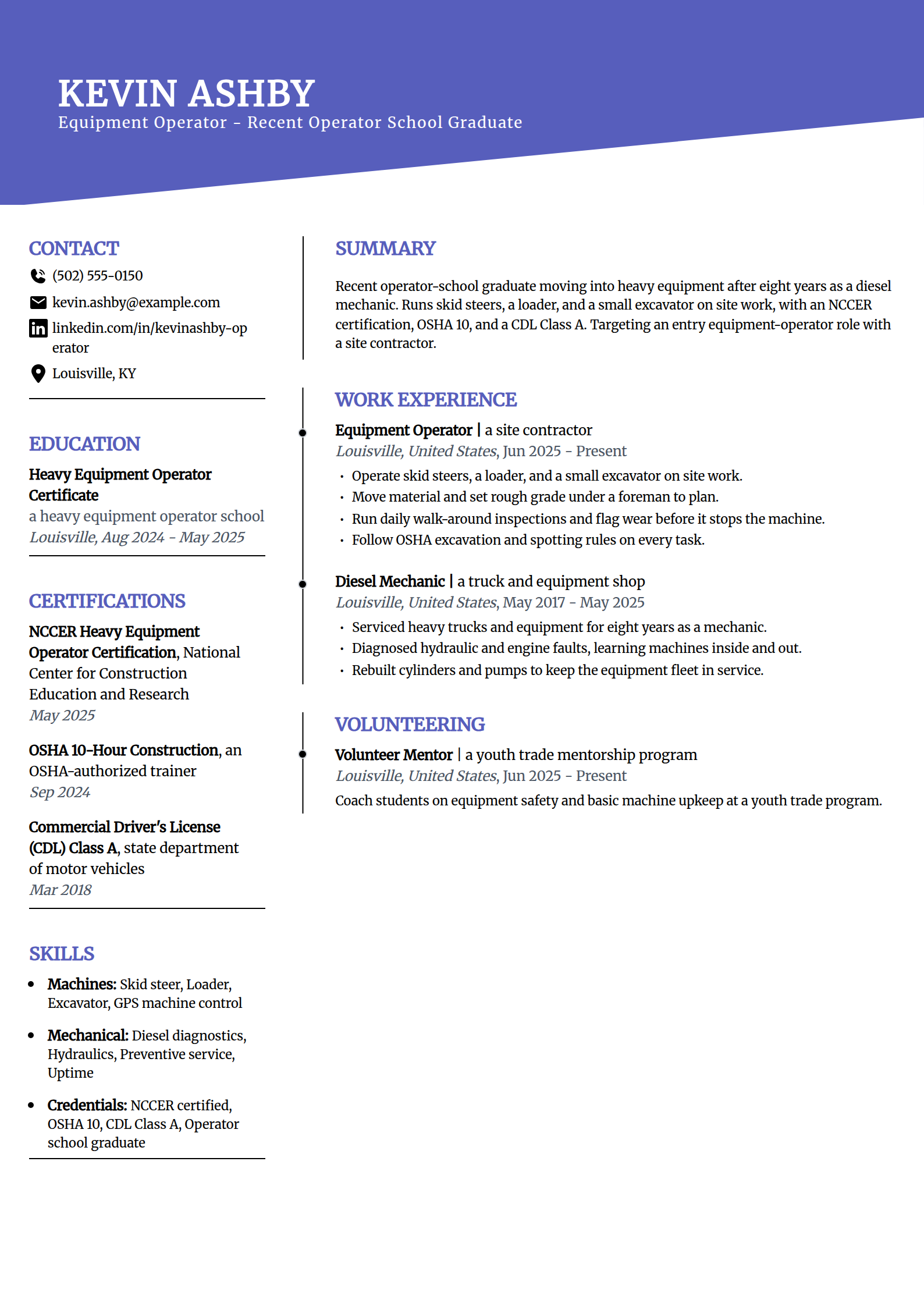
Career-Change Equipment Operator Resume Template
Why this resume example works?
- Names the pivot openly, a recent operator-school graduate after eight years as a diesel mechanic on trucks and equipment.
- Reframes prior work as an asset, hydraulic and engine knowledge that helps an operator read a machine and protect uptime.
- Keeps the new credentials concrete, an NCCER certification, OSHA 10, and a CDL Class A, without overclaiming operator years.
- Shows recent proof, skid steers and a small excavator run on site work under a foreman.
- Keeps a tight, ATS-safe orbit layout, with a trade-mentorship role rounding out a lean career-change page.
Build your equipment operator resume
Pick a template above and the editor keeps your layout clean and ATS-safe while you swap in your own certifications, machine hours, and safety record.
Build my resumeHow to write an equipment operator resume in 2026
A hiring manager scans an operator resume for two things: are you certified for the machine, and is your safety record clean. Lead with a short summary that names your OSHA or NCCCO certification, the machines you run, and your years, then make every bullet a result with one number, like tons moved, incident-free hours, or grade tolerance. Keep the format simple so a parser reads it as easily as a person does.
Open with a certification-and-machine summary
Write three to four sentences that name your certification, the machines you run, your years, your strongest safety number, and the role you are targeting. A forklift operator leads with OSHA class and pallets a shift; a heavy-equipment operator leads with machine hours and grade tolerance. Keep it to about 60 words so it never spills past the top of the page.
Certified forklift operator with 8 years in distribution, running sit-down, reach, and order-picker trucks to move up to 240 pallets a shift. Holds more than 9,000 incident-free hours and a 99% dock-load accuracy rate. OSHA Powered Industrial Truck certified on Classes I, IV, and V, and fluent in Manhattan WMS. Targeting a lead forklift operator role at a distribution center.
Make every experience bullet a result with a number
Name the machine, the task, and the outcome, then attach one credible number and the tool or method behind it. This is what separates a resume that gets a callback from a duty list.
- Use operator metrics: hours on each machine, tons or cubic yards moved, pallets or loads a shift, grade tolerance, uptime, or incident-free hours.
- Open with a strong verb like operated, graded, loaded, hauled, or set, never "Responsible for" or "Helped with".
- Name the machine and tool: "graded pads to within 0.1 foot on a Cat 320 using Trimble GPS control".
- Keep numbers modest and level-accurate: an entry operator shows training and supervised work, a veteran shows machine hours; one number per bullet is plenty.
List your certifications and licenses for the machine
Your certification is the first thing a hiring manager verifies, so put it where it is easy to find and match it to the machine you run.
- Forklift roles: list your OSHA Powered Industrial Truck certification by class (I to VII), plus reach-truck or order-picker if you hold them.
- Crane roles: list your NCCCO mobile crane operator certification by type, plus rigger and signalperson if you hold them.
- Heavy-equipment and site roles: list NCCER, OSHA 10 or 30, MSHA Part 46 for aggregate work, and a CDL Class A or B if the job hauls the machine on the road.
- Entry-level and career-changers lead with training hours, operator school, and any certification in progress, and reframe prior-trade strengths honestly.
Match skills and keywords to the job posting
A skills block should read like the posting, grouped so a hiring manager and a parser both find what they need. List the machines and systems you have actually run, not a generic dump.
- Group by type: certifications, machines (by real model), safety and compliance, and systems or attachments.
- Name specific machines and systems: Cat, John Deere, Komatsu, Crown, Raymond, or Hyster equipment, plus Trimble GPS control, Cat VisionLink, or Manhattan WMS.
- If the posting says "powered industrial truck" or "GPS grade control", use that exact phrasing where it fits your experience.
- Mirror the posting's language, since that is what the applicant tracking system searches for when it ranks your resume.
Keep the format clean and ATS-safe
An operator resume is read by a parser first and a hiring manager second, so a clean layout with standard headings is the safe choice at every level.
- Use a single-column or simple two-column layout with standard headings a parser recognizes; skip heavy graphics and photos.
- Keep it to one page; nearly every operator, from entry-level to lead, fits a strong record on a single page.
- Save as a PDF so the formatting holds, then run it through the ATS resume checker for a quick format and keyword pass.
- Swap the numbers in the templates above for your own machine hours, certifications, and equipment; do not copy them as is.
Common equipment operator resume mistakes
- Leaving your certification off, or burying it at the bottom. Name your OSHA forklift class, NCCCO, or NCCER certification in the summary and a certifications block, since many postings require it.
- Listing duties instead of results. Replace "operated a forklift" with "moved up to 240 pallets a shift with a 99% dock-load accuracy rate over 9,000 incident-free hours".
- Leaving out safety numbers. Operating is measured, so a resume with no incident-free hours, uptime, or clean record reads as untested; add one number per bullet.
- Claiming machine hours you have not run. An entry operator with a veteran hour count fails the sniff test; use training and supervised work that fit your level.
- One generic resume for every machine. Reorder your bullets and skills so the machine the job names, forklift, excavator, crane, or CNC, leads the page.
Frequently asked questions
How do you write an equipment operator resume?
Lead with a three-to-four-sentence summary that names your certification, the machines you run, your years, and the role you are targeting. Under each job, write results-first bullets that open with a strong verb and carry one credible number, like moving up to 240 pallets a shift or grading pads to within 0.1 foot. Name the machine and the system that produced each result, list your OSHA, NCCCO, or NCCER certification in its own block, and keep the whole thing to one clean, ATS-safe page.
What should a heavy equipment operator resume include?
A heavy equipment operator resume includes a certification-first summary, a certifications and licenses block, experience bullets with machine hours and safety numbers, and a skills group matched to the machine. The experience section carries the weight: every bullet should show a result you can prove, such as moving 1,400 cubic yards a day or grading to within 0.1 foot on GPS control. List your NCCER certification, OSHA 10 or 30, MSHA Part 46 for aggregate work, a CDL if the job hauls the machine, and the equipment you run by real model, like a Cat 320 or John Deere 750.
How do you write an operator resume with no experience?
Lead with what you do have. An entry-level operator leads with training, OSHA 10, any certification in progress, and reliable warehouse or labor work, then keeps the numbers honest and small. A career-changer leads with operator school, a new certification, and prior-trade strengths that transfer, like a mechanic's knowledge of the machine. Show supervised work and a clean safety record rather than an invented hour count. The entry-level and career-change examples above show the shape.
What certifications go on a forklift or equipment operator resume?
List the certification that matches your machine. Forklift operators list an OSHA Powered Industrial Truck certification by class (I to VII), plus reach-truck or order-picker if held. Crane operators list an NCCCO mobile crane operator certification by type, plus rigger and signalperson. Heavy-equipment and site operators list NCCER, OSHA 10 or 30, MSHA Part 46 for aggregate work, and a CDL Class A or B if the job hauls the machine on the road. Put them in a named certifications block with dates, and never list one you do not hold.
What skills should you put on an equipment operator resume?
Match the posting, then name specific machines and systems grouped by type: certifications, machines by real model (Cat, John Deere, Komatsu, Crown, Raymond, Hyster), safety and compliance (OSHA, MSHA, lockout-tagout, daily inspections), and systems or attachments (Trimble GPS control, Cat VisionLink, Manhattan WMS, augers, breakers). List what you have actually run and can speak to in an interview, and mirror the posting's exact phrasing, since that is what the applicant tracking system searches for.
How long should an equipment operator resume be?
One page for nearly every operator, including entry-level, experienced, and lead operators. Operators rarely need a second page; a single page keeps your certification, machine hours, and safety record easy to scan. Lead with your most recent and most relevant machine time, keep standard headings, and cut older or unrelated jobs so the space goes to the work that matches the machine you want to run.
More equipment operator resume resources
Build your equipment operator resume
Pick a template above and the editor keeps your layout clean and ATS-safe while you swap in your own certifications, machine hours, and safety record.