Truck Driver Resume Examples, from CDL Grad to Owner-Operator
- ATS Friendly
- CDL Class A & B
- 16 Real Examples
OTR, regional, local, flatbed, tanker, reefer, or dump, this page has a resume built for your exact license and lane. Start from a layout below, then model your own on a real example, from a recent CDL grad to a million-mile veteran. Your endorsements, clean MVR, and safe-mile record sit where a recruiter looks first.


540k+ resumes created
Truck driver resume templates for every CDL class and lane
Each template below is a real truck driver resume laid out in that format, sorted by license and lane across OTR, regional, local, owner-operator, flatbed, tanker, reefer, dry van, dump, box truck, and team driving. Pick one, then swap in your own endorsements, equipment, and safe-mile record. Every layout keeps your CDL class, endorsements, and clean MVR readable so a recruiter sees your safety record at a glance and an applicant tracking system parses it cleanly.
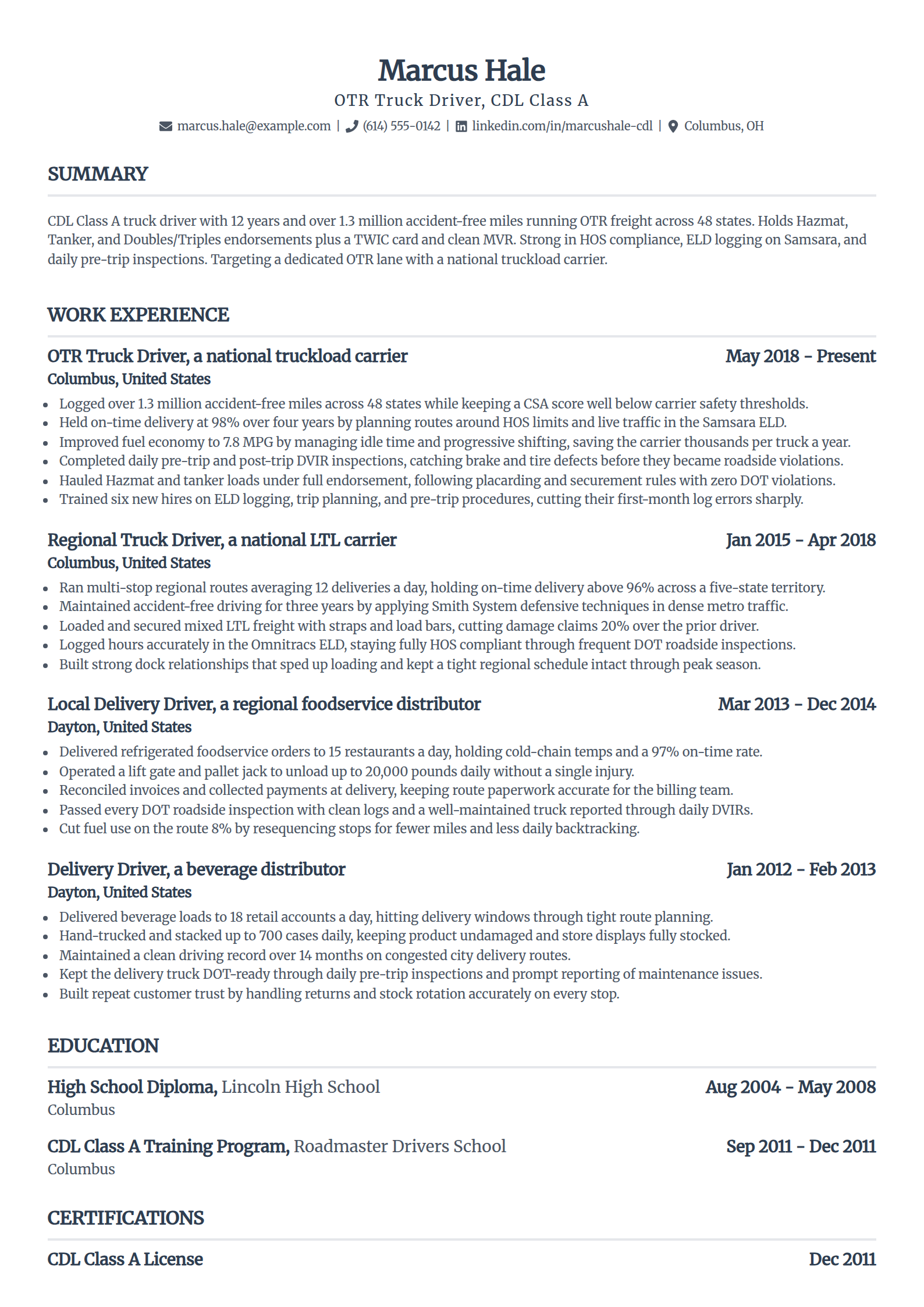
OTR Truck Driver Resume Template
Why this resume example works?
- Opens with a summary that names 12 years, over 1.3 million accident-free miles, and Hazmat, Tanker, and Doubles/Triples endorsements.
- Leads each bullet with a safety or efficiency number, like a 98% on-time rate or fuel economy raised to 7.8 MPG.
- Shows the compliance a carrier screens for: HOS planning, daily pre-trip and post-trip DVIRs, and a low CSA score.
- Names the ELD platforms a posting lists, Samsara and Omnitracs, in real trip-planning context rather than a keyword wall.
- Uses a clean, single-column layout an applicant tracking system reads without trouble.
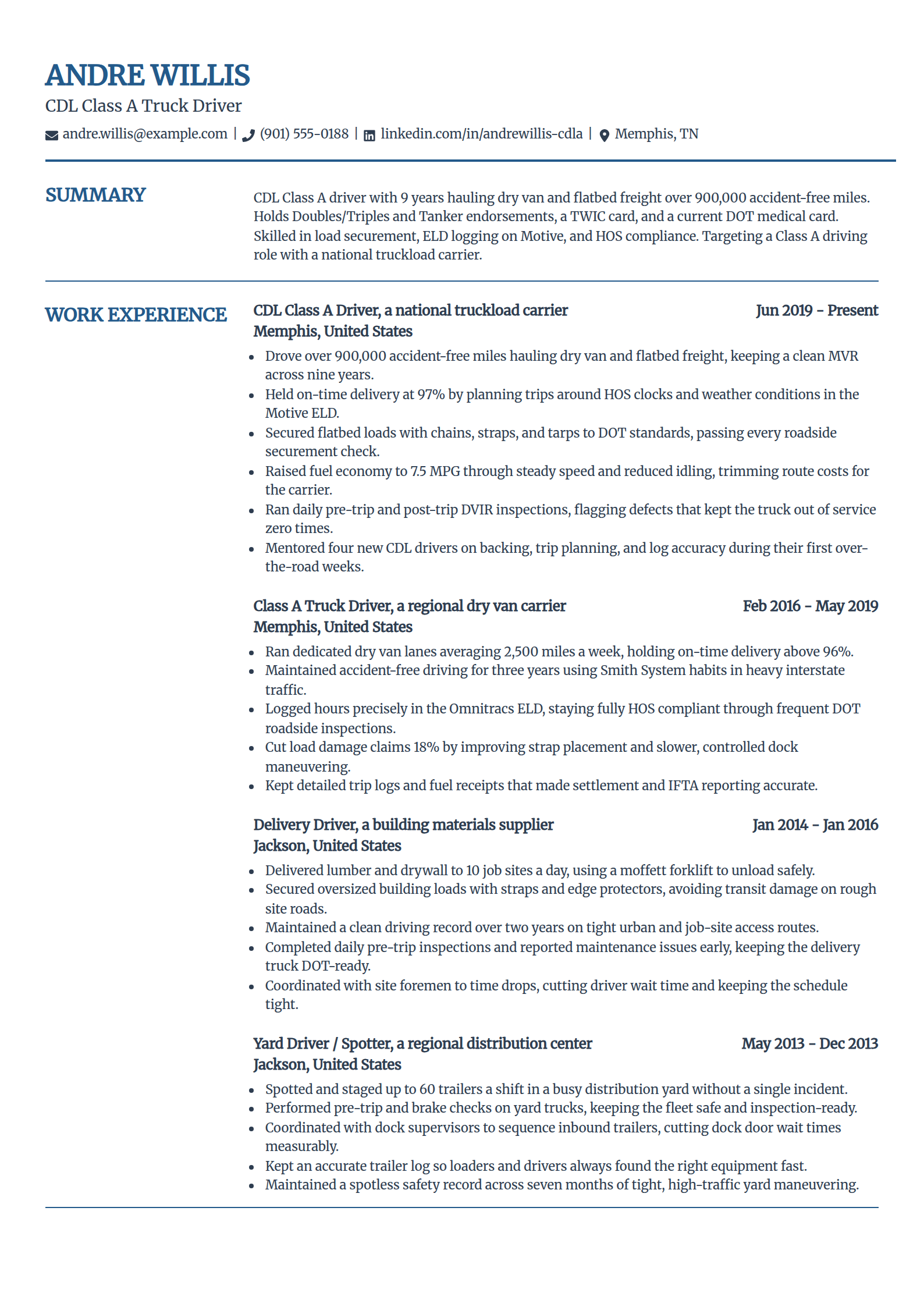
CDL Class A Driver Resume Template
Why this resume example works?
- Leads with a clear CDL Class A identity, 9 years and 900,000 accident-free miles across dry van and flatbed freight.
- Puts the credentials a recruiter checks up top: Doubles/Triples and Tanker endorsements, a TWIC card, and a current DOT medical card.
- Keeps each result countable, like load damage claims cut 18% or fuel economy raised to 7.5 MPG.
- Names the securement work and the Motive and Omnitracs ELDs a Class A posting expects.
- Uses a modern layout that carries a versatile equipment history on one clean page.
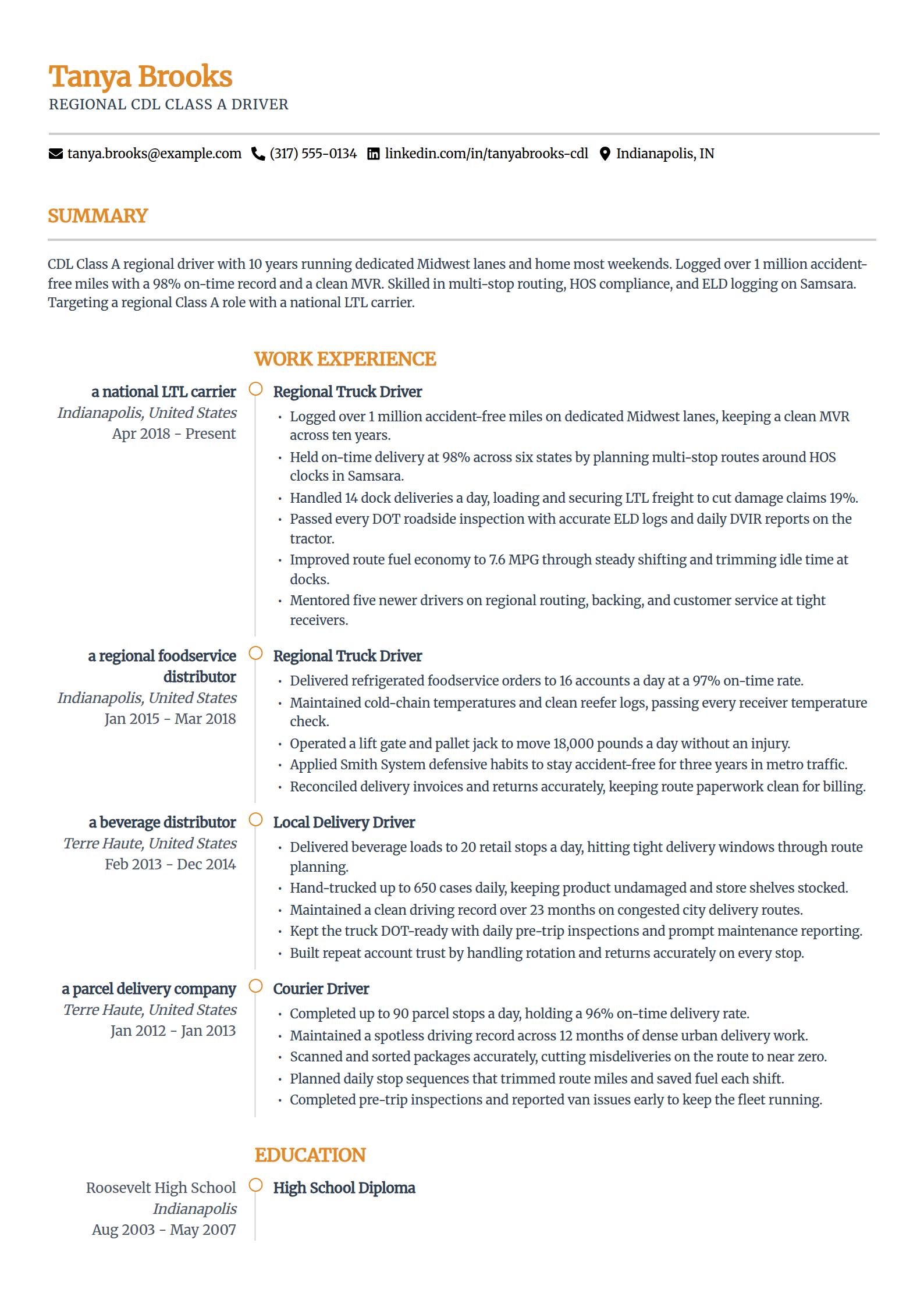
Regional Truck Driver Resume Template
Why this resume example works?
- Opens with the detail a regional role rewards, home most weekends with over 1 million accident-free miles on Midwest lanes.
- Shows multi-stop scope, 14 dock deliveries a day at a 98% on-time rate across a six-state territory.
- Ties results to method, damage claims cut 19% through better loading and fuel economy raised to 7.6 MPG.
- Names the Samsara ELD, HOS planning, and daily DVIRs a regional carrier screens for.
- Uses a modern layout that still reads cleanly for a recruiter scanning fast.
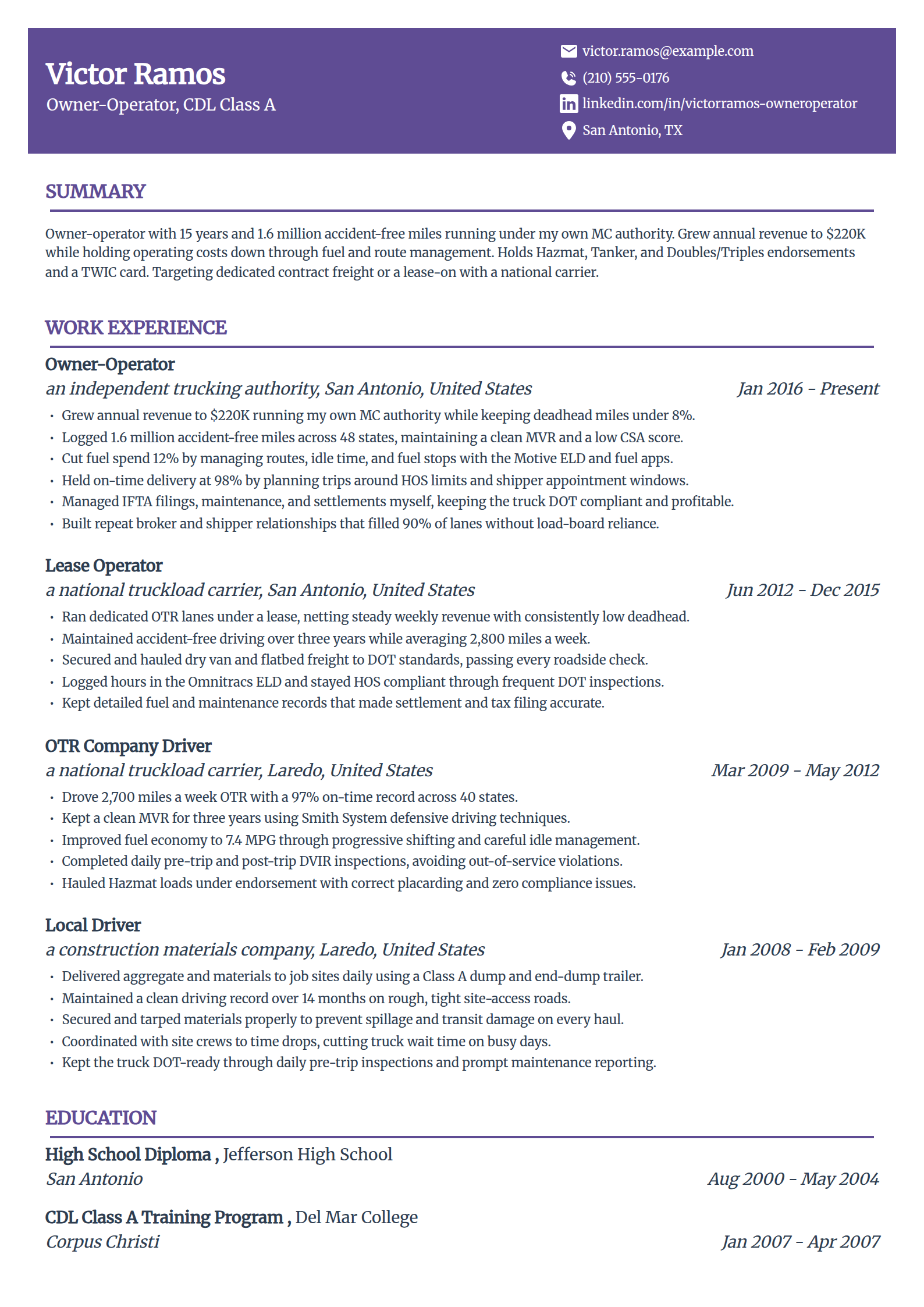
Owner-Operator Resume Template
Why this resume example works?
- Leads with business scope, annual revenue grown to $220K under an independent MC authority with deadhead held under 8%.
- Shows the results a contract or lease-on rewards, 1.6 million accident-free miles and fuel spend cut 12%.
- Pairs driving with running the business, IFTA filings, maintenance, and settlements managed to stay DOT compliant.
- Keeps every number believable for the level, tied to a specific route, cost, or broker relationship.
- Uses a spacious layout that carries a 15-year record on one page.
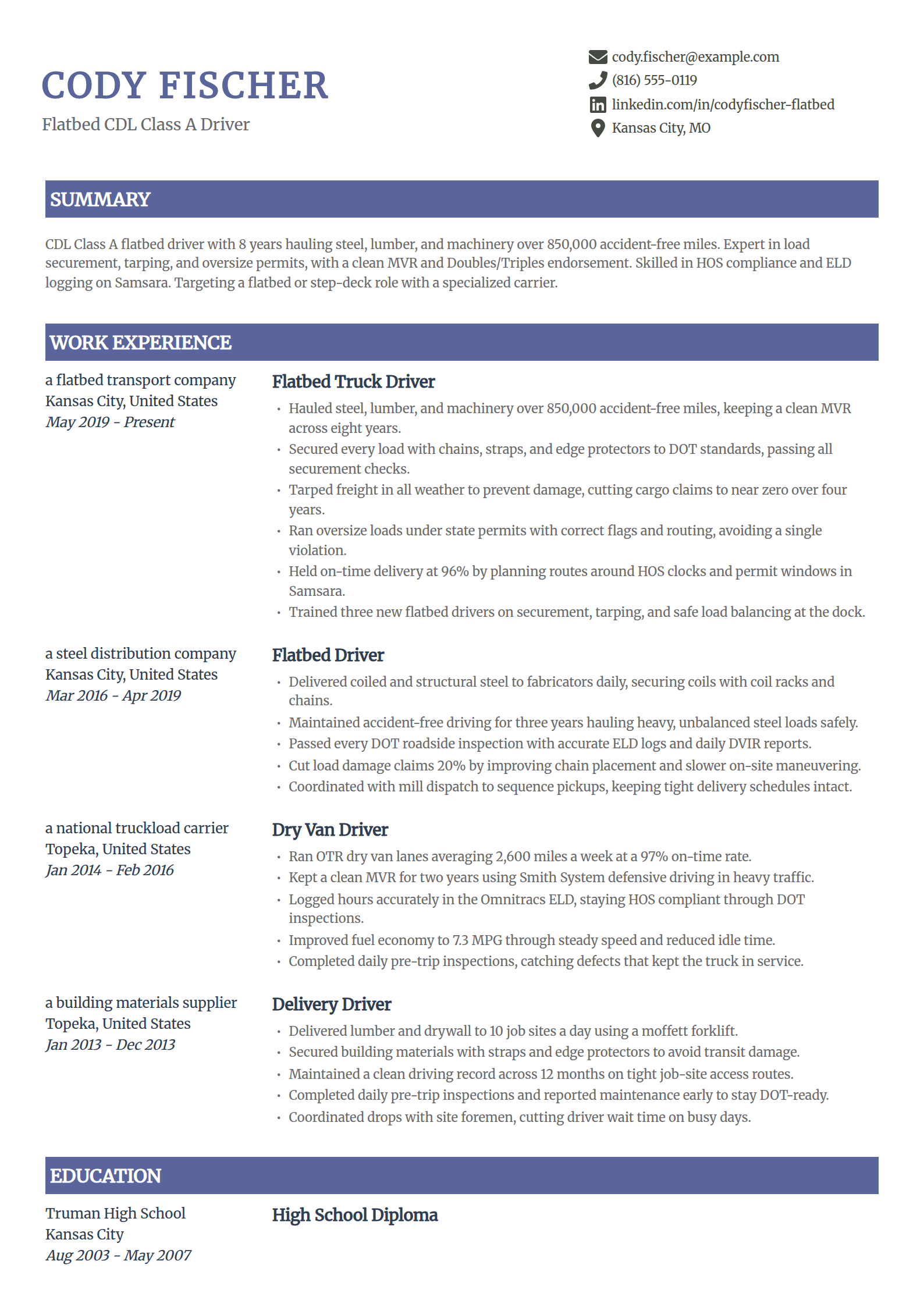
Flatbed Driver Resume Template
Why this resume example works?
- Opens with the specialty a flatbed role hires for, 8 years hauling steel, lumber, and machinery over 850,000 accident-free miles.
- Shows the securement work that matters here, chains, straps, edge protectors, and tarping that cut cargo claims to near zero.
- Names oversize permit handling and the Samsara ELD a specialized carrier screens for.
- Keeps results tied to a task, load damage claims cut 20% through better chain placement.
- Uses a modern layout that carries a dense flatbed history on one page.
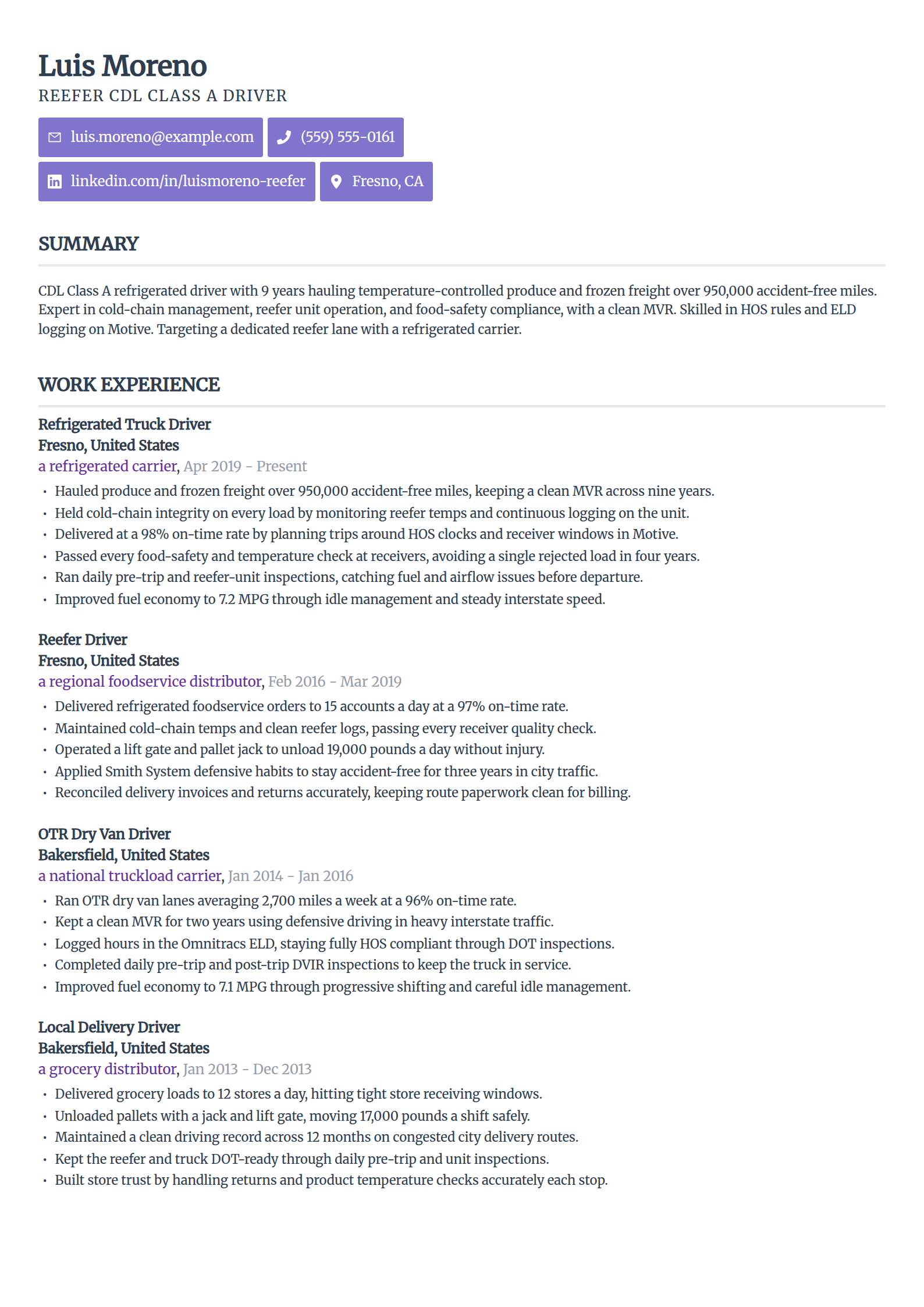
Reefer Truck Driver Resume Template
Why this resume example works?
- Leads with cold-chain scope, 9 years hauling produce and frozen freight over 950,000 accident-free miles.
- Shows the work a reefer role rewards, temperature logging and food-safety checks passed with zero rejected loads in four years.
- Ties delivery to method, a 98% on-time rate from planning trips around HOS clocks and receiver windows in Motive.
- Names reefer-unit inspections and the Motive and Omnitracs ELDs a refrigerated carrier expects.
- Uses a clean, modern layout that carries a deep cold-chain history on one page.
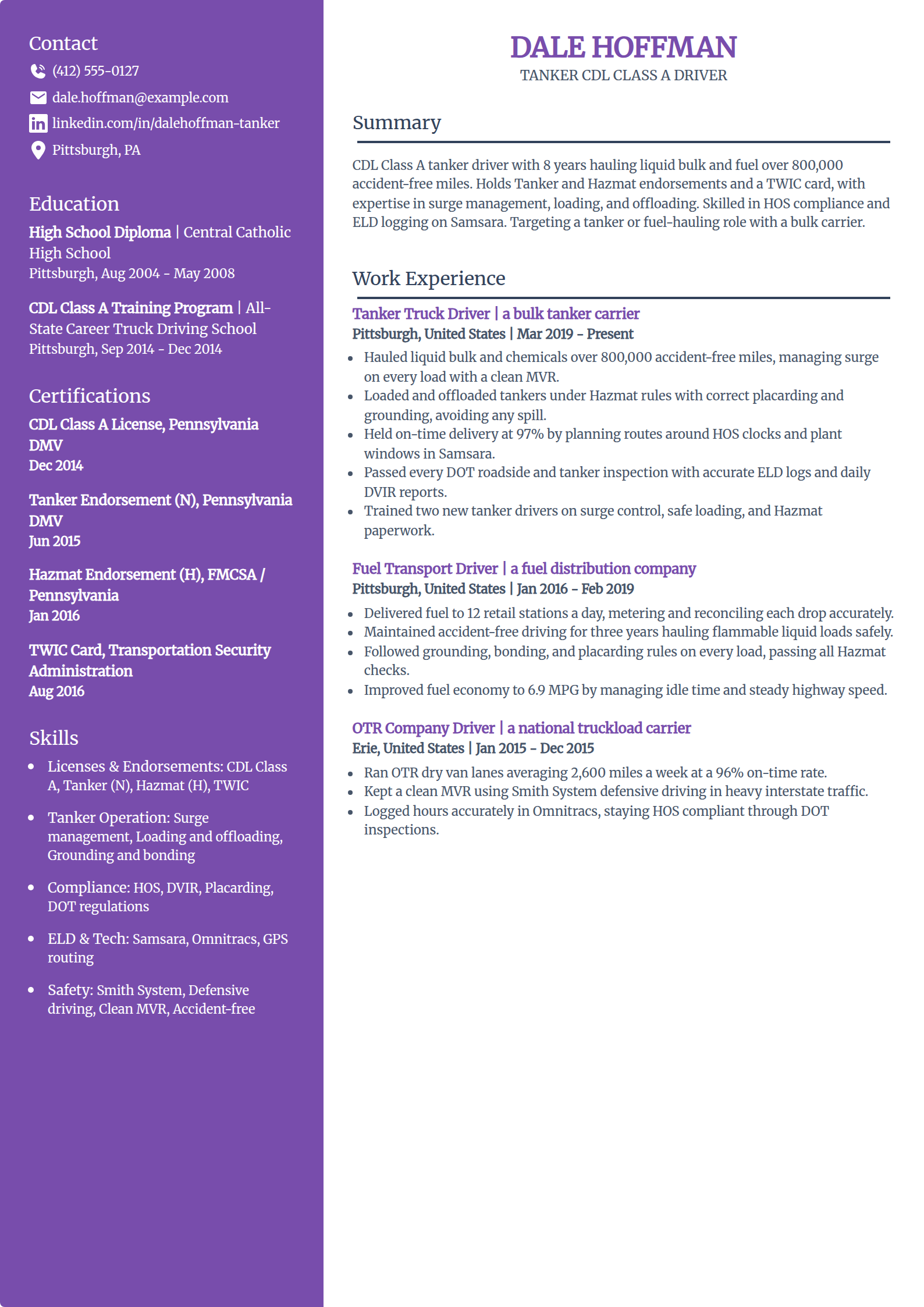
Tanker Driver Resume Template
Why this resume example works?
- Opens with the endorsements a tanker role requires, Tanker and Hazmat, over 800,000 accident-free miles.
- Shows the specialty skill that matters, surge management on every load with correct placarding and grounding.
- Keeps results tied to safety, fuel and chemical loads hauled with zero spills across the record.
- Names the loading, offloading, and Hazmat paperwork a bulk carrier screens for.
- Uses a Medium layout that fits an eight-year tanker record without empty space.
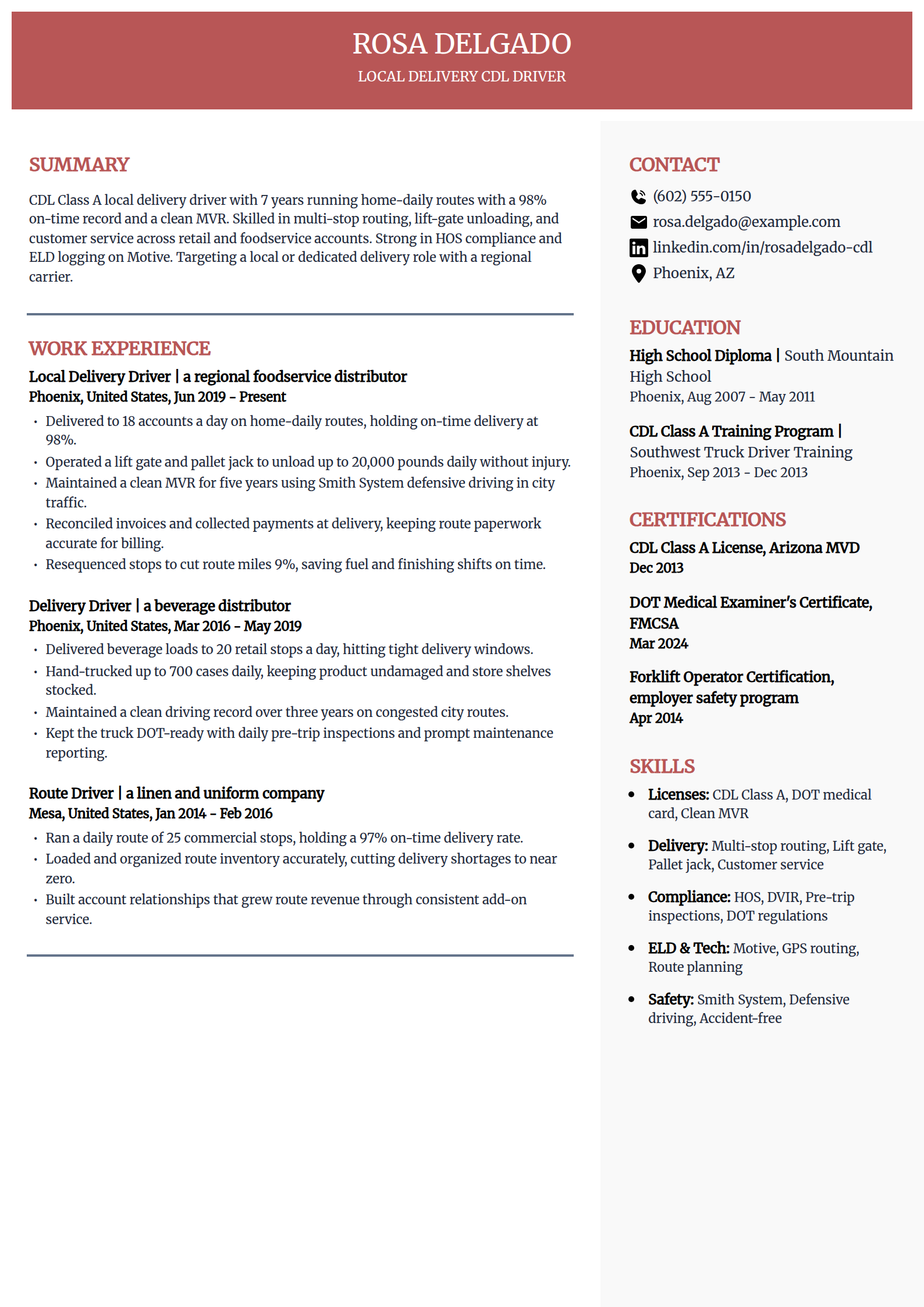
Local Delivery Driver Resume Template
Why this resume example works?
- Opens with the detail a local role rewards, home-daily routes with a 98% on-time record over seven years.
- Shows the physical work honestly, a lift gate and pallet jack used to unload up to 20,000 pounds a day without injury.
- Ties efficiency to method, route miles cut 9% by resequencing stops.
- Names the customer service, invoice reconciliation, and Motive ELD a delivery posting screens for.
- Uses a refined layout that fits a seven-year delivery record cleanly on one page.
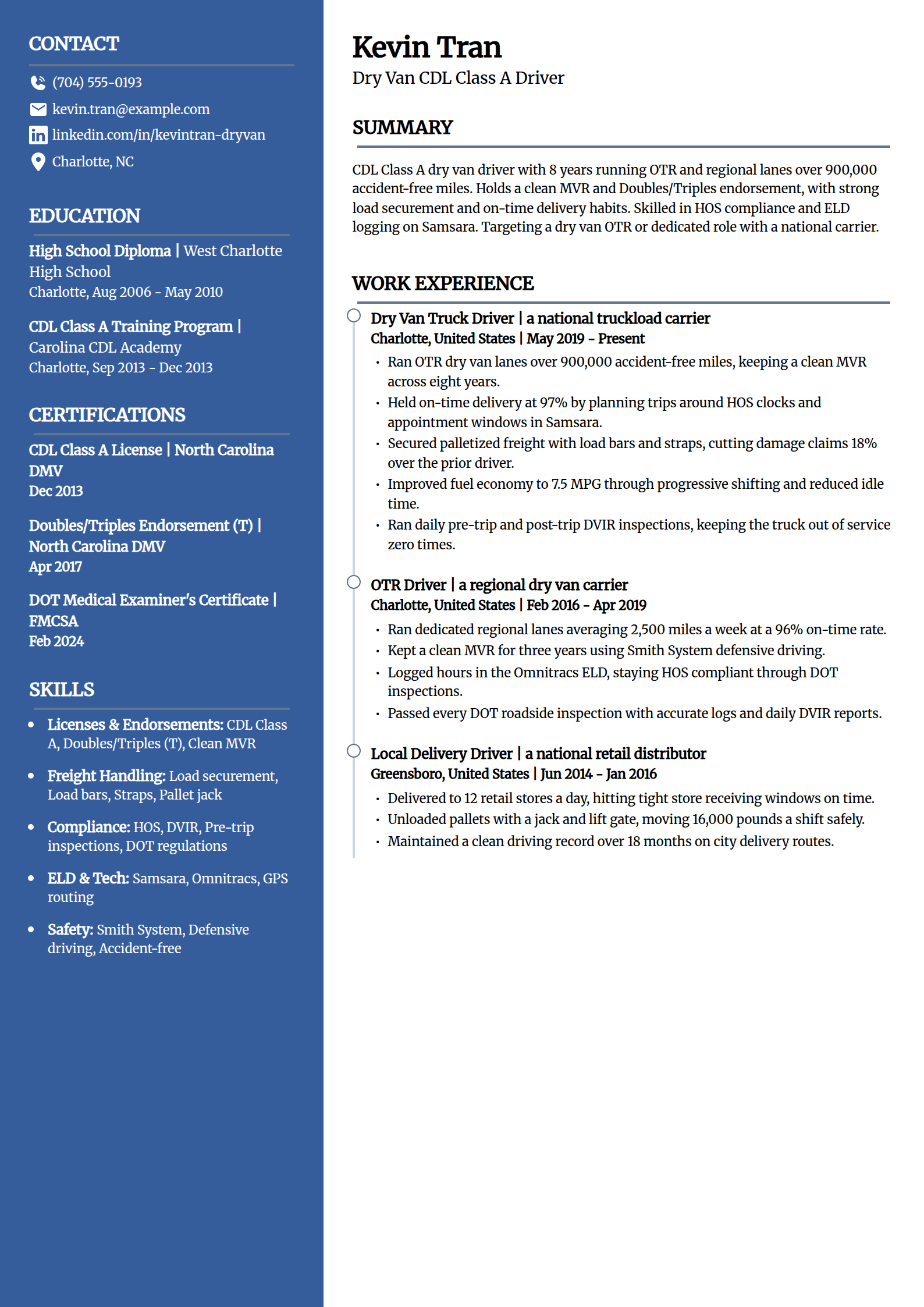
Dry Van Driver Resume Template
Why this resume example works?
- Leads with the lane a dry van role hires for, 8 years and 900,000 accident-free miles on OTR and regional runs.
- Shows load care, palletized freight secured with load bars and straps to cut damage claims 18%.
- Keeps results countable, a 97% on-time rate and fuel economy raised to 7.5 MPG.
- Names the Samsara and Omnitracs ELDs and daily DVIRs a national carrier expects.
- Uses a distinctive layout that still reads cleanly for a recruiter.
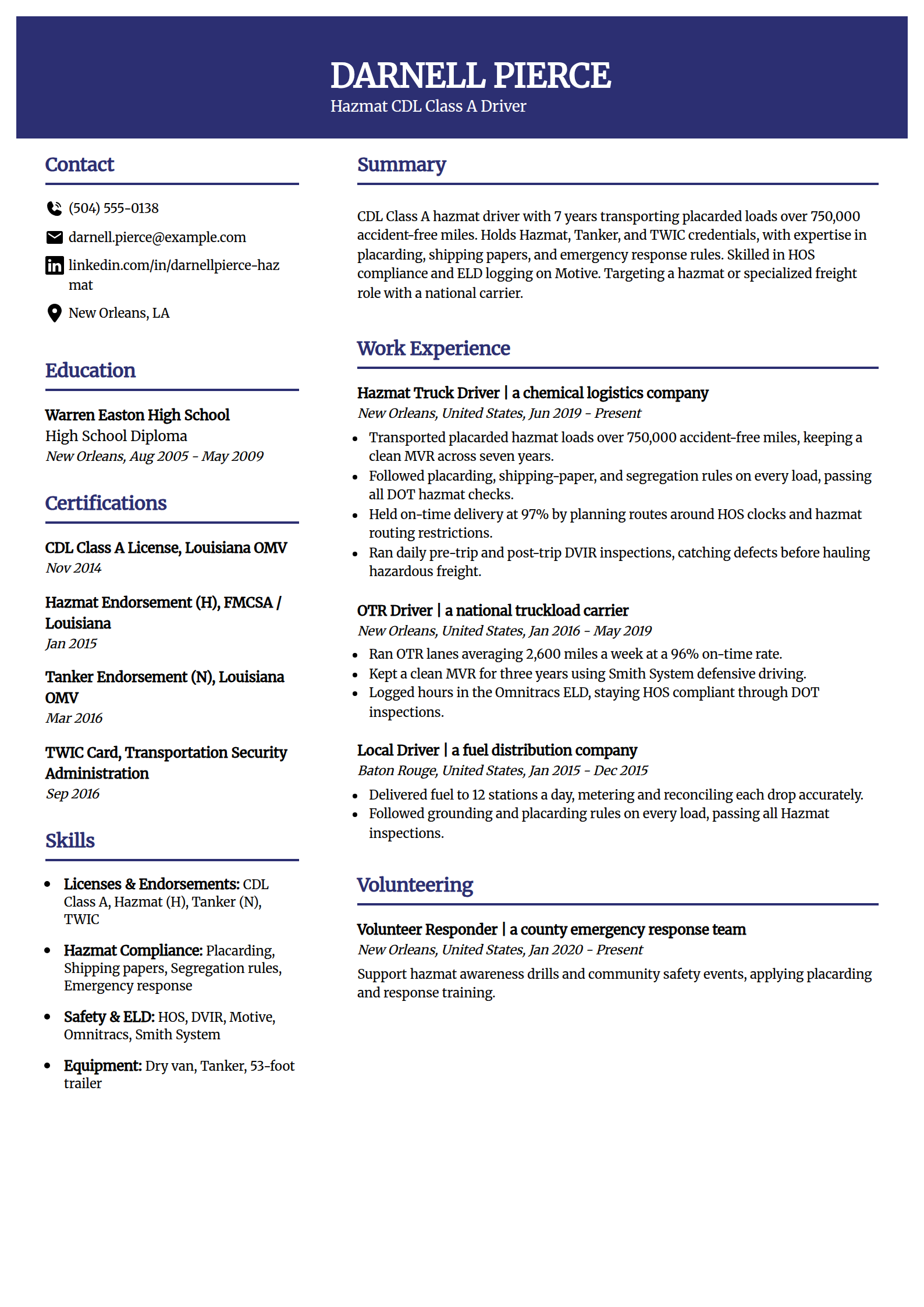
Hazmat Driver Resume Template
Why this resume example works?
- Leads with the credentials a hazmat role requires, Hazmat and Tanker endorsements plus a TWIC card.
- Shows the specialty knowledge that matters, placarding, shipping papers, and segregation rules passed on every DOT check.
- Keeps results tied to safety, 750,000 accident-free miles hauling placarded loads.
- Names hazmat routing restrictions and the Motive ELD a specialized carrier screens for.
- Uses a roomy layout with a volunteer emergency-response role so a seven-year record still looks full.
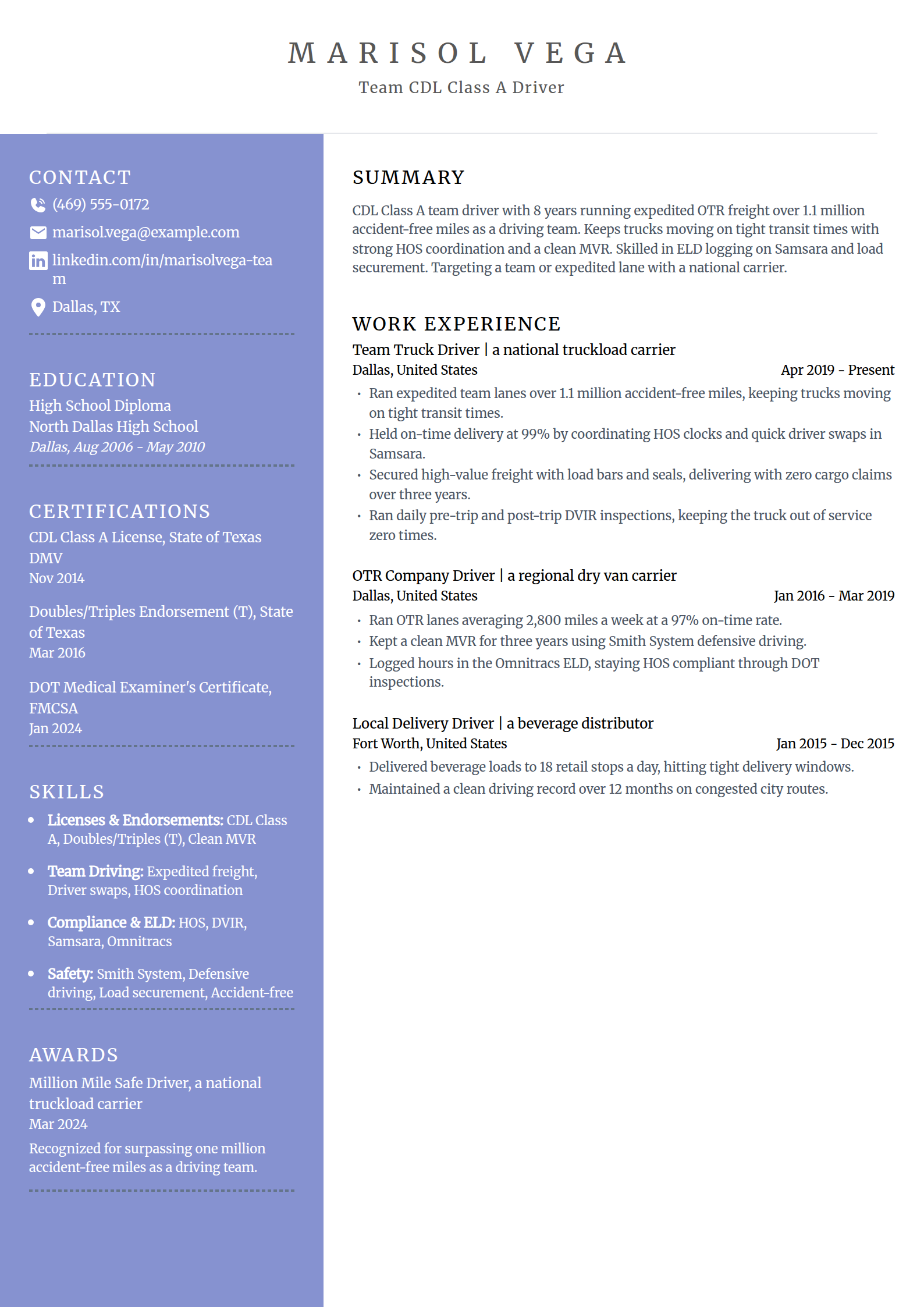
Team Driver Resume Template
Why this resume example works?
- Opens with the strength a team role rewards, 1.1 million accident-free miles keeping trucks moving on tight transit times.
- Shows the coordination that matters here, a 99% on-time rate from synced HOS clocks and quick driver swaps.
- Keeps freight care visible, high-value loads secured with load bars and seals and delivered with zero claims.
- Names the Samsara ELD and Doubles/Triples endorsement an expedited carrier lists.
- Uses a roomy layout with a million-mile safe-driver award so an eight-year record looks complete.
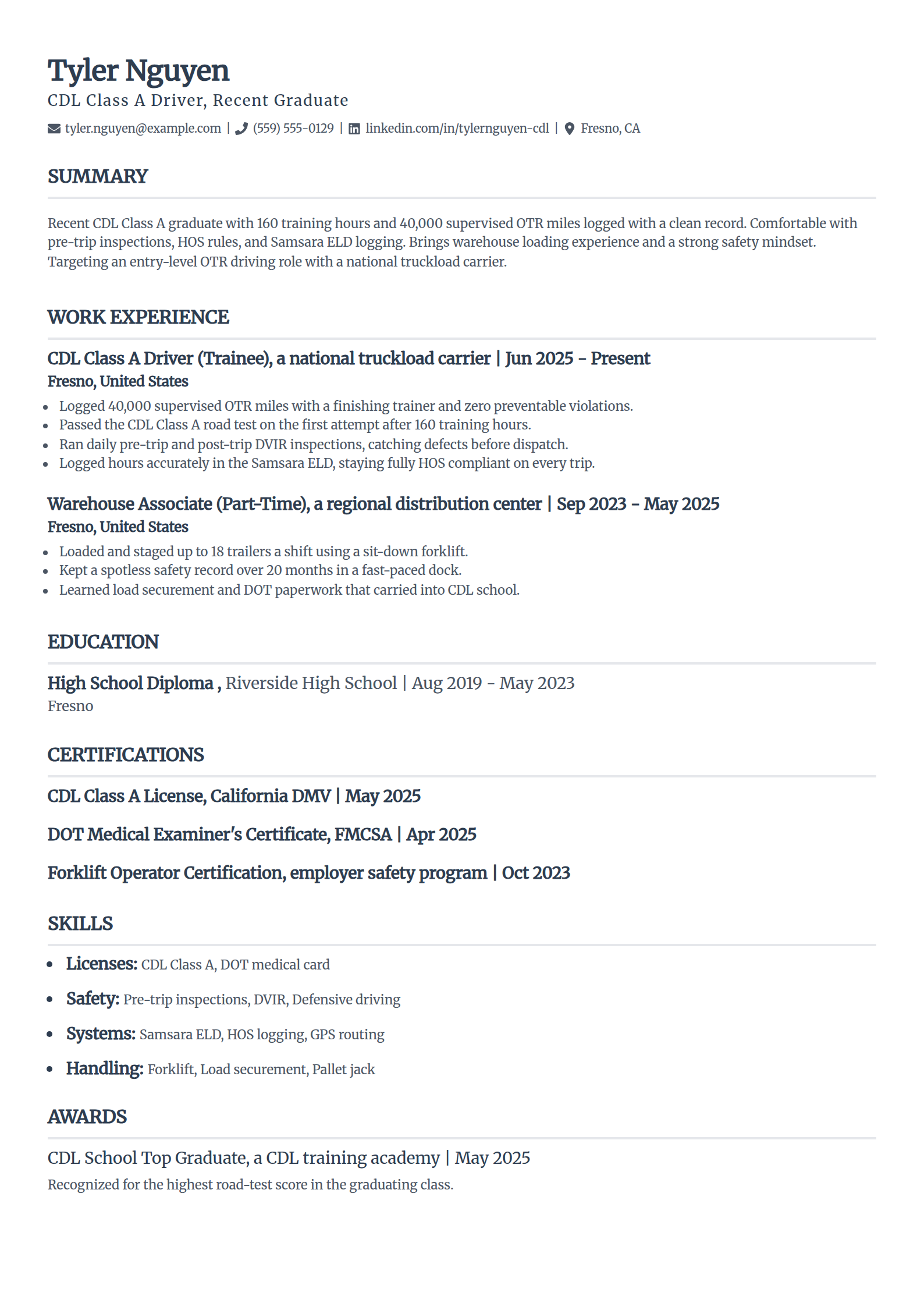
Entry-Level Truck Driver Resume Template
Why this resume example works?
- Written for a recent CDL grad, leading with 160 training hours and 40,000 supervised miles logged with a clean record.
- Uses training miles and warehouse loading as entries, the right move when full over-the-road experience does not exist yet.
- Keeps every bullet honest and small, like a first-attempt road-test pass, not an invented million-mile claim.
- Names the CDL Class A, DOT medical card, and Samsara ELD an entry-level posting screens for.
- Fills a tight, ATS-safe page with a top-graduate award instead of padding.
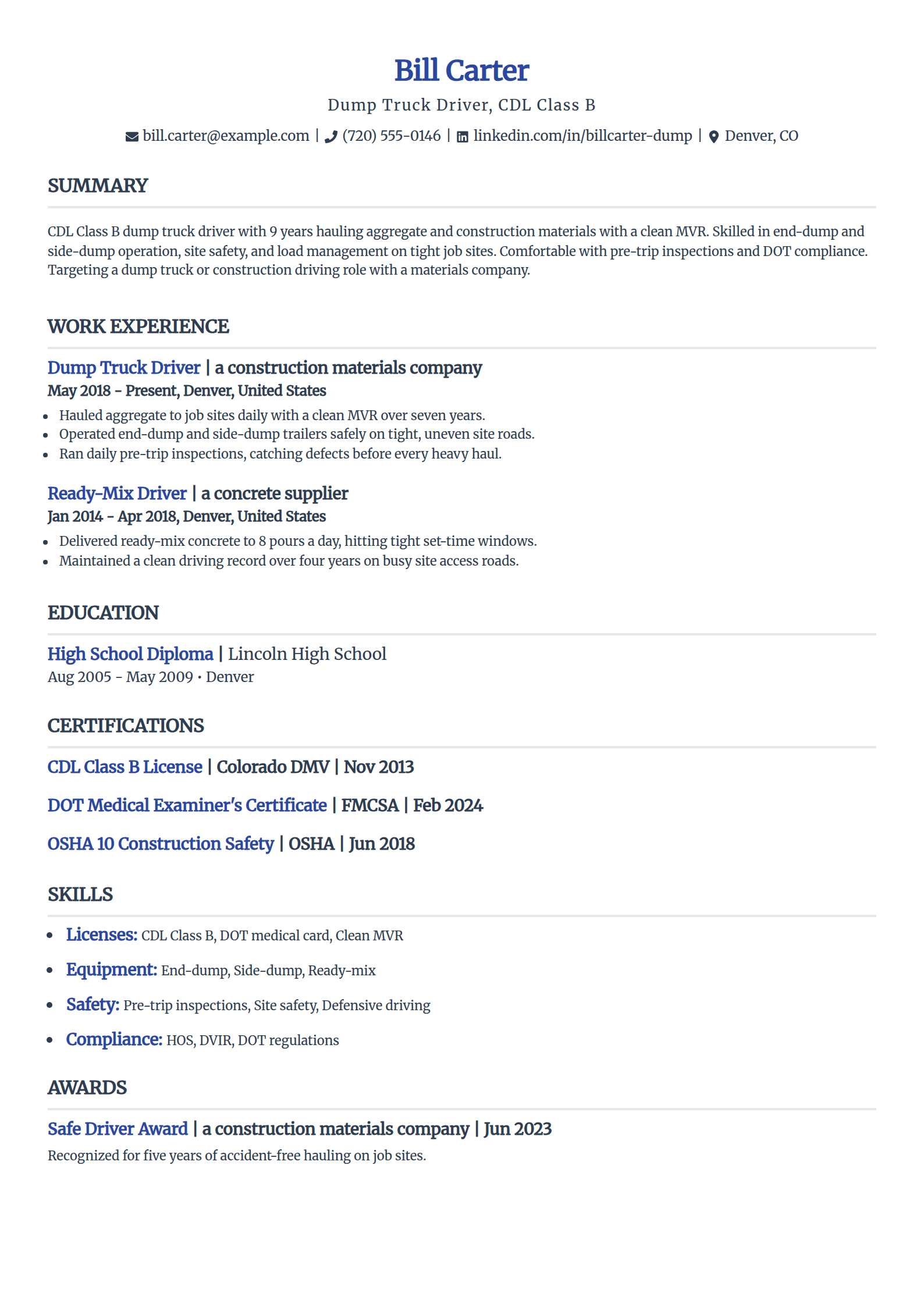
Dump Truck Driver Resume Template
Why this resume example works?
- Written for a Class B driver, leading with 9 years hauling aggregate and construction materials with a clean MVR.
- Shows the equipment a dump role hires for, end-dump and side-dump trailers run safely on tight, uneven site roads.
- Keeps results tied to the job, ready-mix delivered to eight pours a day within set-time windows.
- Names the CDL Class B, OSHA 10 safety card, and daily pre-trip inspections a materials company expects.
- Fills a tight, ATS-safe page with a safe-driver award, keeping the focus on site experience.
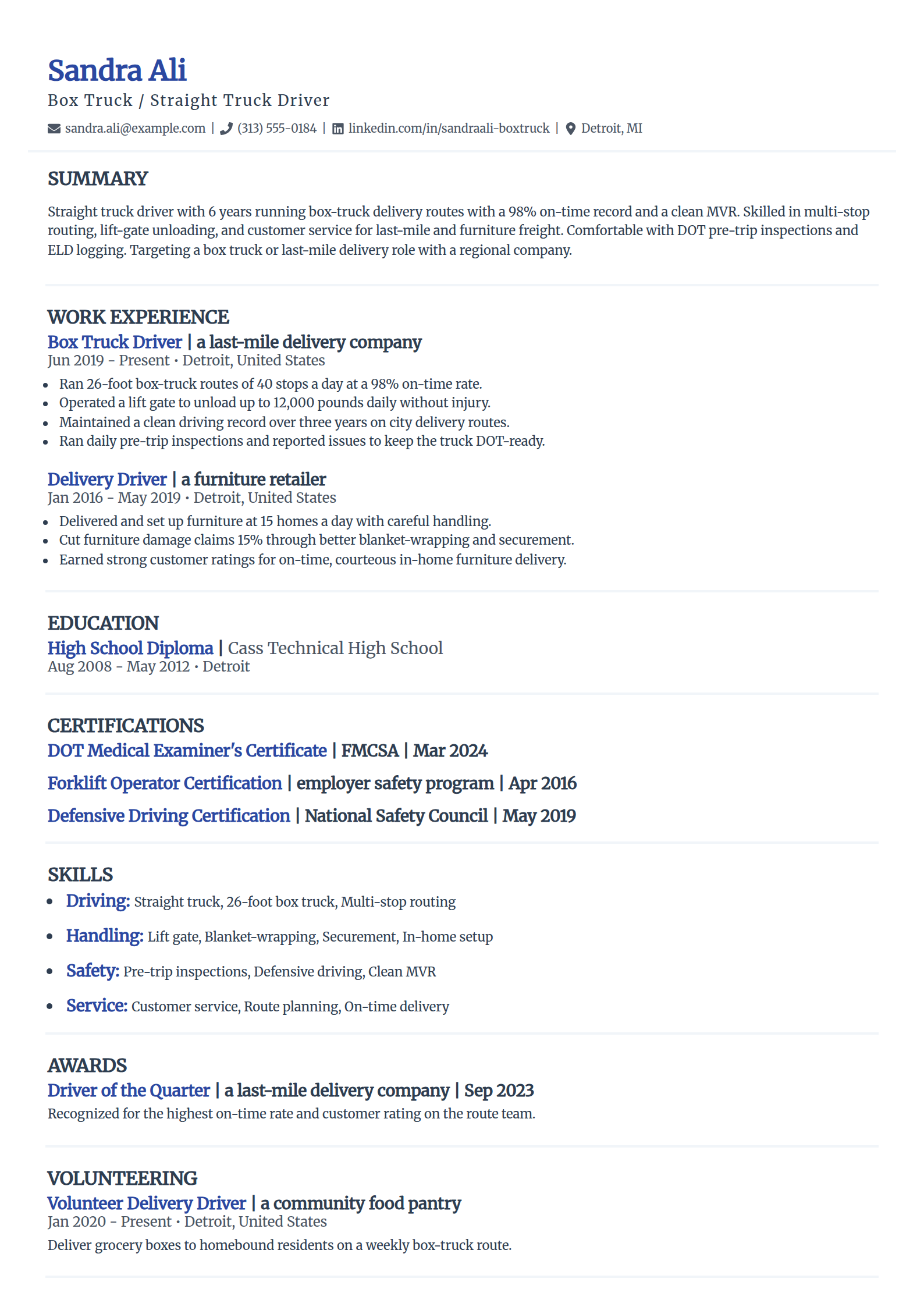
Box Truck Driver Resume Template
Why this resume example works?
- Written for a non-CDL straight-truck driver, leading with a 98% on-time record over six years on 26-foot box-truck routes.
- Shows the work a last-mile role rewards, a lift gate used to unload up to 12,000 pounds a day without injury.
- Keeps results countable, furniture damage claims cut 15% through better blanket-wrapping and securement.
- Names the multi-stop routing, in-home setup, and daily pre-trip inspections a delivery company screens for.
- Fills a refined, ATS-safe page with a driver-of-the-quarter award and a delivery-volunteer role.
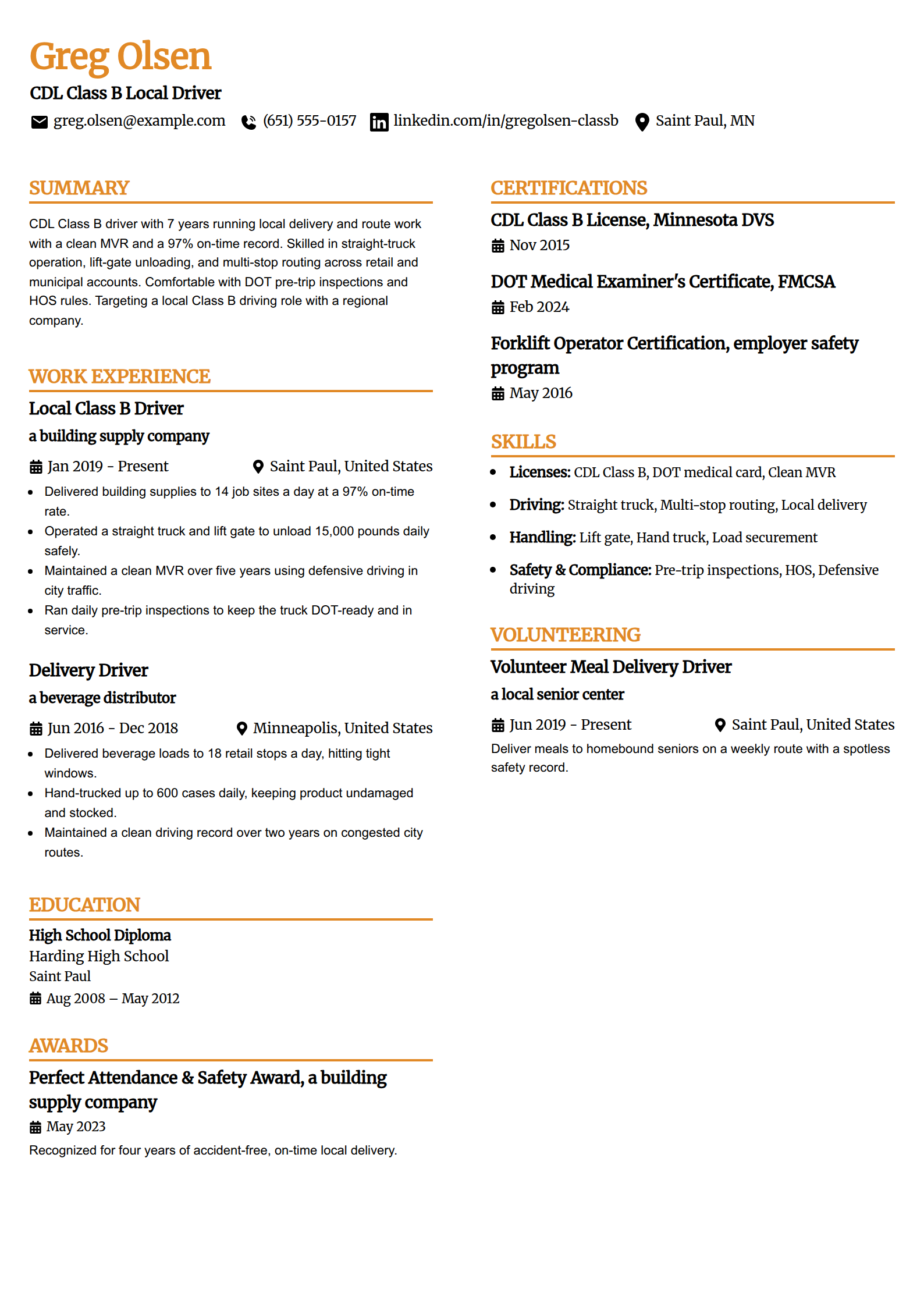
Class B CDL Driver Resume Template
Why this resume example works?
- Written for a CDL Class B driver, leading with 7 years of local delivery at a 97% on-time rate and a clean MVR.
- Shows straight-truck scope, a lift gate used to unload 15,000 pounds a day across retail and municipal accounts.
- Keeps results tied to the role, building supplies delivered to 14 job sites a day.
- Names the CDL Class B, DOT medical card, and daily pre-trip inspections a local employer screens for.
- Fills a tight, ATS-safe page with a safety award and a meal-delivery volunteer role.
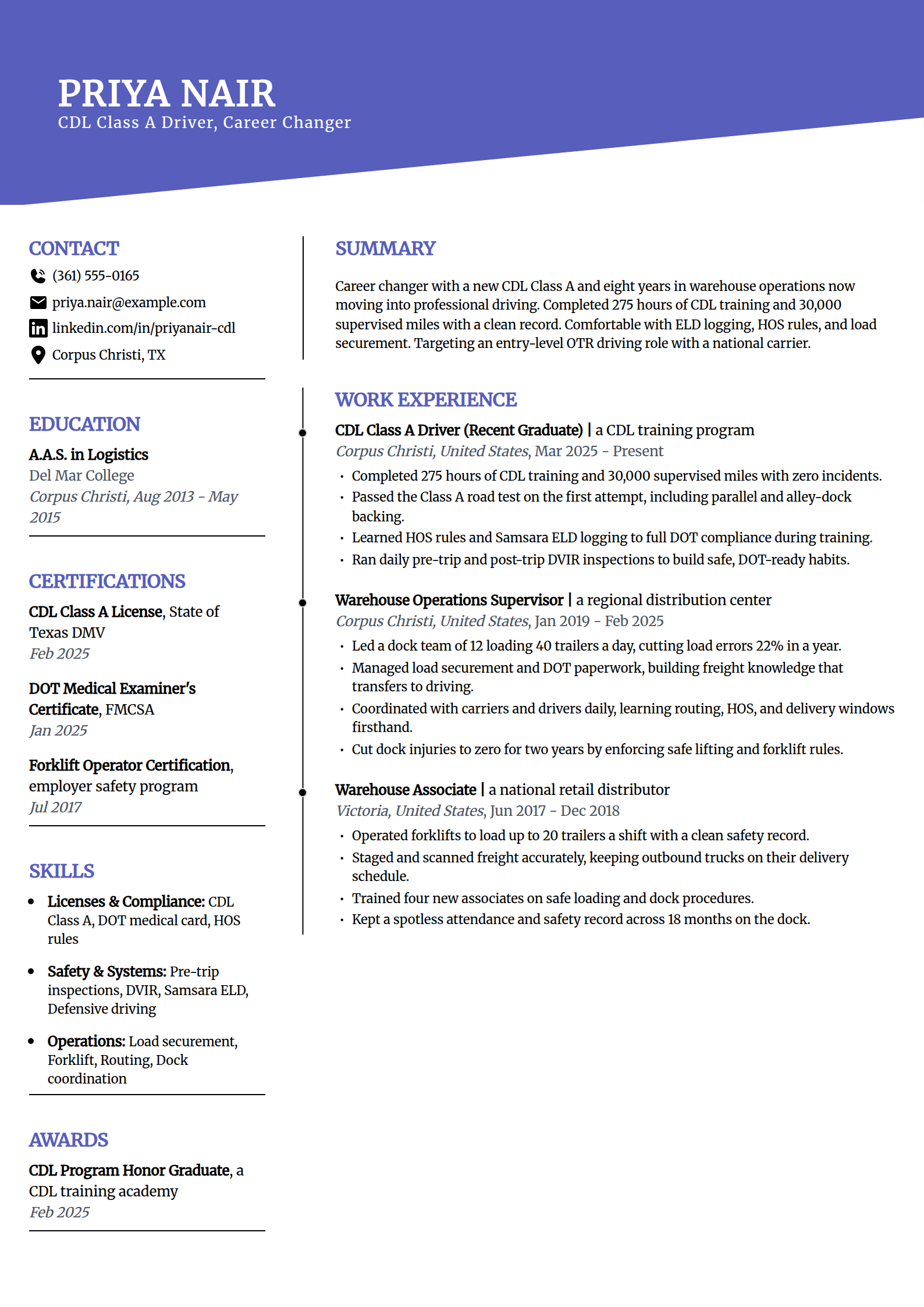
Career-Change Truck Driver Resume Template
Why this resume example works?
- Names the pivot openly, a new CDL Class A after eight years in warehouse operations.
- Shows recent proof, 275 CDL training hours and 30,000 supervised miles completed with zero incidents.
- Reframes prior work as an asset, dock leadership and DOT paperwork that transfer straight to driving.
- Keeps the new credentials concrete, CDL Class A, DOT medical card, and Samsara ELD, without overclaiming years.
- Lists awards without long descriptions, keeping the layout clean and balanced.
Build your truck driver resume
Pick a template above and the editor keeps your layout clean and ATS-safe while you swap in your own miles, endorsements, and equipment.
Build my resumeHow to write a truck driver resume in 2026
A recruiter scans a driver resume for two things: are you licensed and endorsed for the lane, and is your safety record clean. Lead with a short summary that names your CDL class, endorsements, and years, then make every bullet a result with one number, like safe miles, on-time percentage, or fuel economy. Keep the format simple so a parser reads it as easily as a person does.
Open with a license-and-lane summary
Write three to four sentences that name your CDL class and endorsements, your years and lane, your strongest safety number, and the role you are targeting. An OTR driver leads with total accident-free miles; a local driver leads with a home-daily route and on-time record. Keep it to about 60 words so it never spills past the top of the page. Copyable summary text for your exact lane lives on our truck driver resume summary page.
CDL Class A truck driver with 12 years and over 1.3 million accident-free miles running OTR freight across 48 states. Holds Hazmat, Tanker, and Doubles/Triples endorsements plus a TWIC card and clean MVR. Targeting a dedicated OTR lane with a national truckload carrier.
Make every experience bullet a result with a number
Name the load or route, the approach, and the outcome, then attach one credible number and the tool or method that produced it. This is what separates a resume that gets a callback from a duty list.
- Use driver metrics: accident-free miles, on-time delivery percentage, miles per week, fuel economy in MPG, CSA score, or damage claims reduced.
- Open with a strong verb like hauled, logged, delivered, secured, or cut, never "Responsible for" or "Helped with".
- Name the method or tool: "cut damage claims 20% by improving chain placement and slower on-site maneuvering".
- Keep numbers modest and level-accurate: a recent grad shows training miles, an owner-operator shows revenue; one number per bullet is plenty.
Show licenses, endorsements, and certifications for your level
Your CDL and endorsements are the first thing a recruiter verifies, so put them where they are easy to find and match them to the lane.
- List your CDL class up top, then your endorsements by letter: H for hazmat, N for tanker, T for doubles and triples.
- Add the credentials a posting names: a TWIC card for port freight, a current DOT medical card, and a clean MVR.
- Recent grads lead with CDL school, training hours, and supervised miles, then keep any prior loading or warehouse work visible.
- Career-changers show the CDL and DOT medical card plus supervised miles, and reframe prior-industry strengths honestly.
Match skills and keywords to the job posting
A skills block should read like the posting, grouped so a recruiter and a parser both find what they need. List the equipment and systems you have actually run, not a generic dump.
- Group by type: licenses and endorsements, equipment (dry van, flatbed, reefer, tanker, dump), compliance, and safety.
- Name specific systems: the Omnitracs, Samsara, or Motive ELD, plus HOS logging, DVIR, and pre-trip inspections.
- If the posting says "electronic logging device" or "hours of service compliance", use that exact phrasing where it fits.
- Mirror the posting's language, since that is what the applicant tracking system searches for when it ranks your resume.
Keep the format clean and ATS-safe
A driver resume is read by a parser first and a recruiter second, so a clean layout with standard headings is the safe choice at every level.
- Use a single-column or simple two-column layout with standard headings a parser recognizes; skip heavy graphics and photos.
- Keep it to one page; nearly every driver, from recent grad to owner-operator, fits a strong record on a single page.
- Save as a PDF so the formatting holds, then run it through our ATS resume checker for a quick format and keyword pass.
- Swap the numbers in the templates above for your own miles, endorsements, and equipment; do not copy them as is.
Common truck driver resume mistakes
- Burying your CDL and endorsements. A recruiter needs to see your class and endorsement letters in seconds, so put them in the summary and a licenses block, not the last line.
- Listing duties instead of results. Replace "drove a truck" with "logged over 1.3 million accident-free miles across 48 states with a low CSA score".
- Leaving out safety numbers. Driving is measured, so a resume with no accident-free miles, on-time rate, or clean MVR reads as untested; add one number per bullet.
- Claiming miles you have not driven. A recent grad with "a million safe miles" fails the sniff test; use training hours and supervised miles that fit your level.
- Hiding gaps or an old violation instead of framing the recent clean record. Lead with your current clean MVR and safe-mile streak so the strongest signal comes first.
Frequently asked questions
How do you write a truck driver resume?
Lead with a three-to-four-sentence summary that names your CDL class, your endorsements, your years and lane, and the role you are targeting. Under each job, write results-first bullets that open with a strong verb and carry one credible number, like logging over 1.3 million accident-free miles or holding on-time delivery at 98%. Name the equipment and the ELD that produced each result, list your CDL and endorsements in their own block, and keep the whole thing to one clean, ATS-safe page.
What should a CDL truck driver resume include?
A CDL truck driver resume includes a license-first summary, a licenses and endorsements block, experience bullets with safety and efficiency numbers, and a skills group matched to the lane. The experience section carries the weight: every bullet should show a result you can prove, such as a 97% on-time rate or damage claims cut 18%. List your CDL class, your endorsement letters (H, N, T), a current DOT medical card, a clean MVR, and the ELD you run, like Samsara, Omnitracs, or Motive.
How do you write a truck driver resume with no experience?
Lead with what you do have. A recent CDL graduate leads with CDL school, training hours, and supervised training miles, then keeps any warehouse, loading, or delivery work visible. Show a first-attempt road-test pass, your CDL class, and a current DOT medical card as your strongest early signals. Keep the numbers honest and small, like 40,000 supervised miles rather than a million safe miles. The entry-level and career-change examples above show the shape.
What skills should you put on a truck driver resume?
Match the posting, then name specific equipment and systems grouped by type: licenses and endorsements (CDL Class A or B, H, N, T), equipment (dry van, flatbed, reefer, tanker, dump), compliance (HOS, DVIR, pre-trip inspections, DOT regulations), and safety (Smith System, defensive driving, clean MVR). Add the ELD you run, like Omnitracs, Samsara, or Motive. List what you have actually operated and can speak to in an interview, and mirror the posting's exact phrasing, since that is what the applicant tracking system searches for.
How long should a truck driver resume be?
One page for nearly every driver, including recent grads, local and regional drivers, OTR veterans, and owner-operators. Drivers rarely need a second page; a single page keeps your CDL, endorsements, and safe-mile record easy to scan. Lead with your most recent and most relevant driving, keep standard headings, and cut older or unrelated jobs so the space goes to the work that matches the lane you want.
Should you put your CDL and endorsements on your resume?
Yes, and put them where a recruiter finds them fast. Name your CDL class in the summary, then list it again with your endorsement letters in a dedicated licenses block: H for hazmat, N for tanker, T for doubles and triples. Add a current DOT medical card, a TWIC card if you have one, and a clean MVR. These credentials are the first thing a carrier verifies, so leading with them moves your resume forward faster than any single bullet.
More truck driver resume resources
Build your truck driver resume
Pick a template above and the editor keeps your layout clean and ATS-safe while you swap in your own miles, endorsements, and equipment.