Welder Resume Templates and Examples by Process, Code, and Level
- ATS Friendly
- Process-Specific
- 17 Real Examples
A structural welder, a 6G pipe welder, and a TIG aerospace welder each need a different resume, and this page has one built for your exact process and code. Start from a layout below, then model your own on a real example, from a first AWS test to a foreman role. Your certifications, positions, and x-ray pass rate sit where a shop hiring manager looks first.


540k+ resumes created
Welding resume templates for every process and experience level
Each template below is a real welding resume laid out in that format, sorted by process, code, and experience level across structural, pipe, production, TIG, fabrication, pipeline, and inspection work. Pick one, then swap in your own certifications, positions, and x-ray pass rate. Every layout keeps your name, AWS and code credentials, and weld record readable so a shop hiring manager sees your strongest work at a glance and an applicant tracking system parses it cleanly.
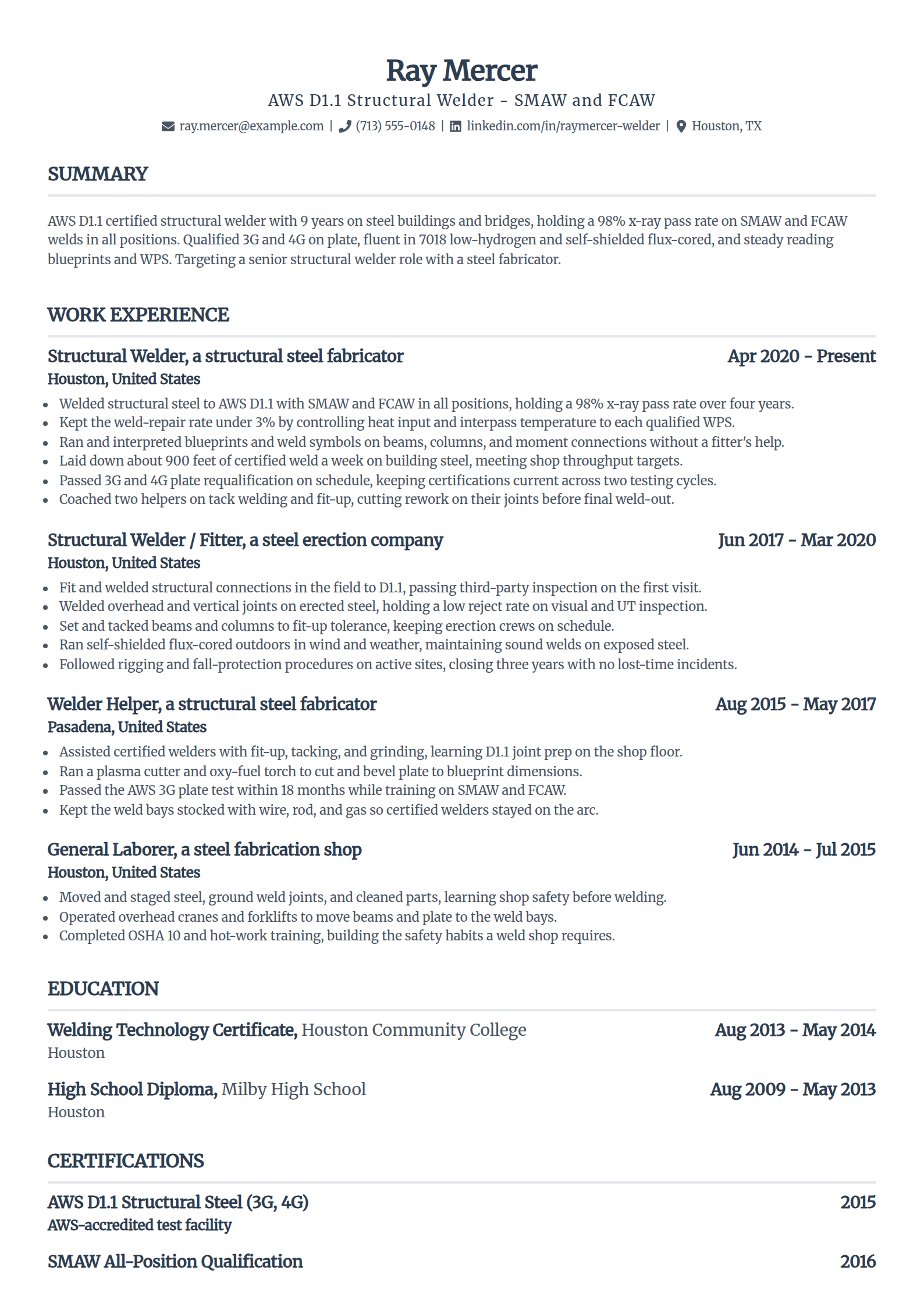
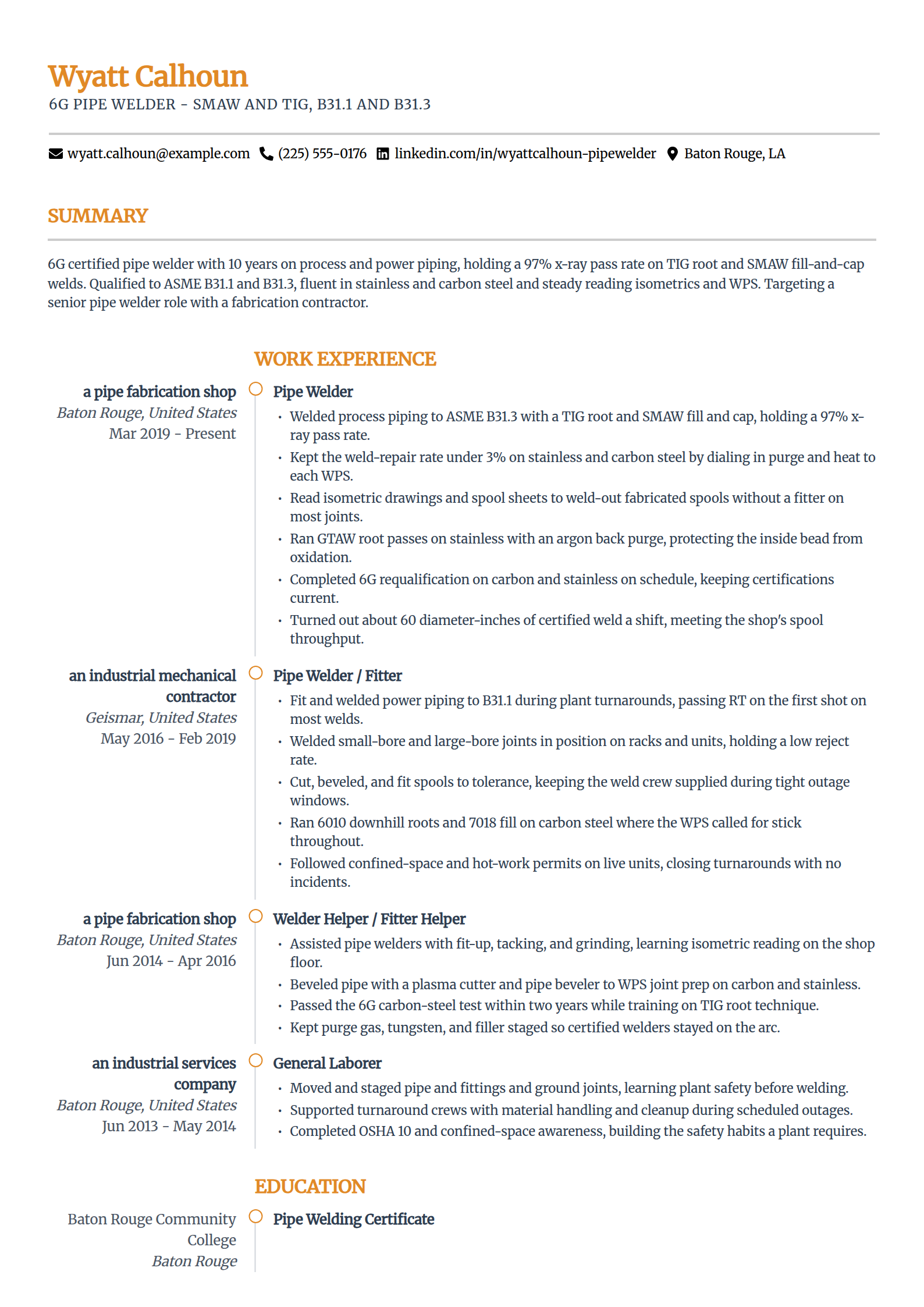
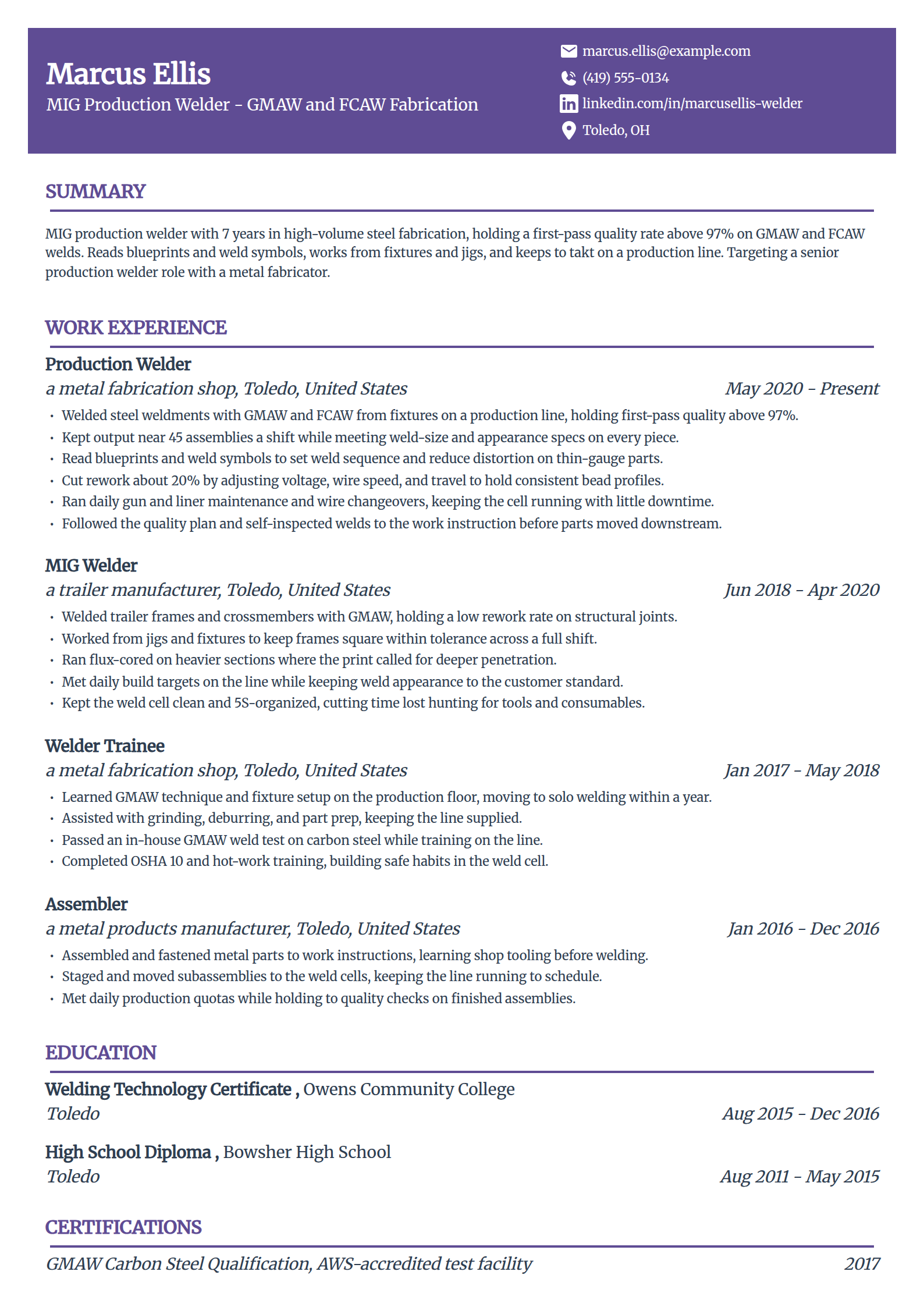
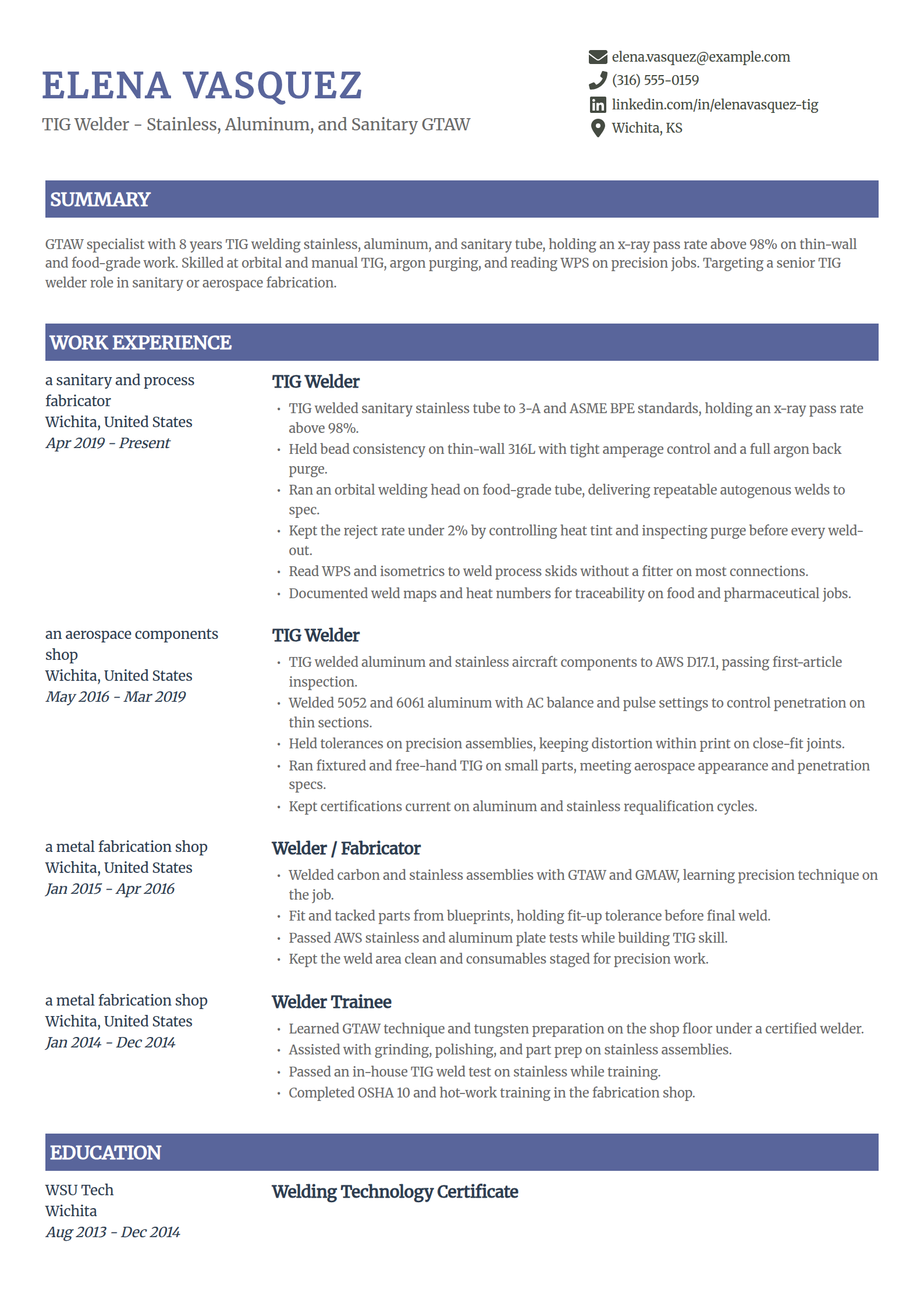
Structural Welder Resume Template
Why this resume example works?
- Opens with a summary that names 9 years, a 98% x-ray pass rate, AWS D1.1, and 3G and 4G plate qualification.
- Attaches one credible number to most bullets, like a weld-repair rate under 3% or 900 feet of certified weld a week.
- Shows the real work a shop screens for, SMAW and FCAW in all positions plus blueprint and weld-symbol reading.
- Names the code and processes a posting lists, D1.1, 7018 low-hydrogen, and self-shielded flux-cored, in real context.
- Uses a clean, single-column layout an applicant tracking system reads without trouble.
6G Pipe Welder Resume Template
Why this resume example works?
- Leads with the credential a pipe shop wants, 6G certification and a 97% x-ray pass rate on TIG root and SMAW fill.
- Shows the code work a posting screens for, ASME B31.3 and B31.1 process and power piping.
- Keeps results countable, like a weld-repair rate under 3% and 60 diameter-inches of certified weld a shift.
- Names GTAW root with an argon back purge, isometric reading, and WPS interpretation, in real work context.
- Uses a modern layout that carries a deep pipe-welding record on one page.
MIG Production Welder Resume Template
Why this resume example works?
- Opens with production value, a first-pass quality rate above 97% on GMAW and FCAW at 45 assemblies a shift.
- Shows the work a line rewards, welding from fixtures and jigs while holding weld-size and appearance specs.
- Keeps results useful, cutting rework about 20% by tuning voltage, wire speed, and travel for consistent beads.
- Names blueprint and weld-symbol reading, weld sequence, and distortion control, the skills a fab shop wants.
- Uses a spacious layout that carries a full production record on one page.
TIG Welder Resume Template
Why this resume example works?
- Leads with precision, an x-ray pass rate above 98% on sanitary stainless and aircraft aluminum GTAW work.
- Shows real TIG depth, orbital welding on food-grade tube and AC balance and pulse control on thin aluminum.
- Keeps the work traceable, documenting weld maps and heat numbers on food and pharmaceutical jobs.
- Names AWS D17.1 aerospace, ASME BPE, and 3-A sanitary standards, the codes a precision shop screens for.
- Uses a modern two-column layout that carries a full precision-welding record on one page.
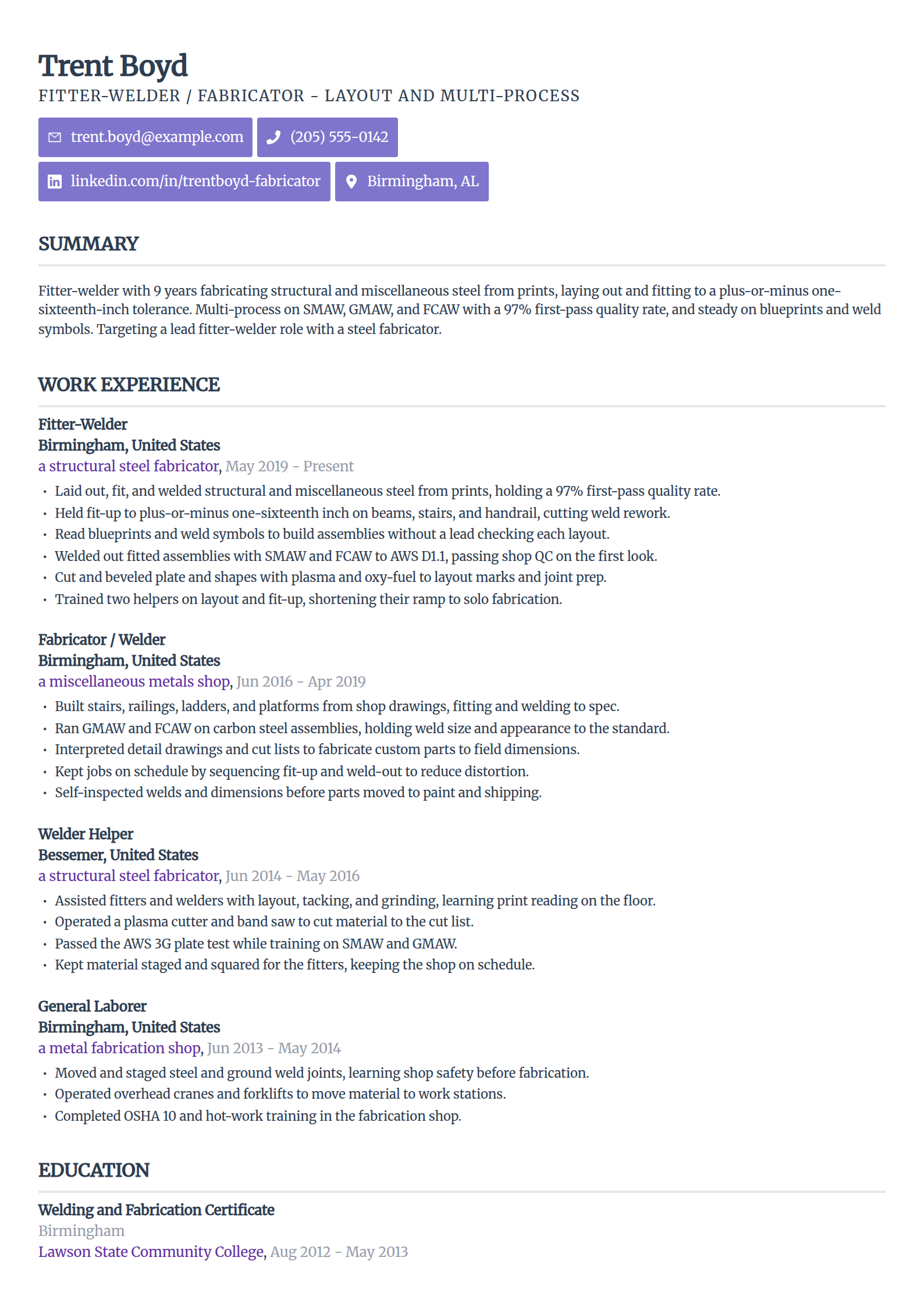
Fitter-Welder Resume Template
Why this resume example works?
- Opens with the outcome a fabricator wants, layout and fit-up to plus-or-minus one-sixteenth inch with a 97% first-pass rate.
- Shows both halves of the job, reading blueprints to lay out and fit, then welding out with SMAW and FCAW to D1.1.
- Keeps results countable, cutting weld rework by holding fit-up tolerance on beams, stairs, and handrail.
- Names plasma and oxy-fuel cutting, weld symbols, and cut lists, the skills a miscellaneous-metals shop screens for.
- Uses a clean, modern layout that carries a full fabrication record on one page.
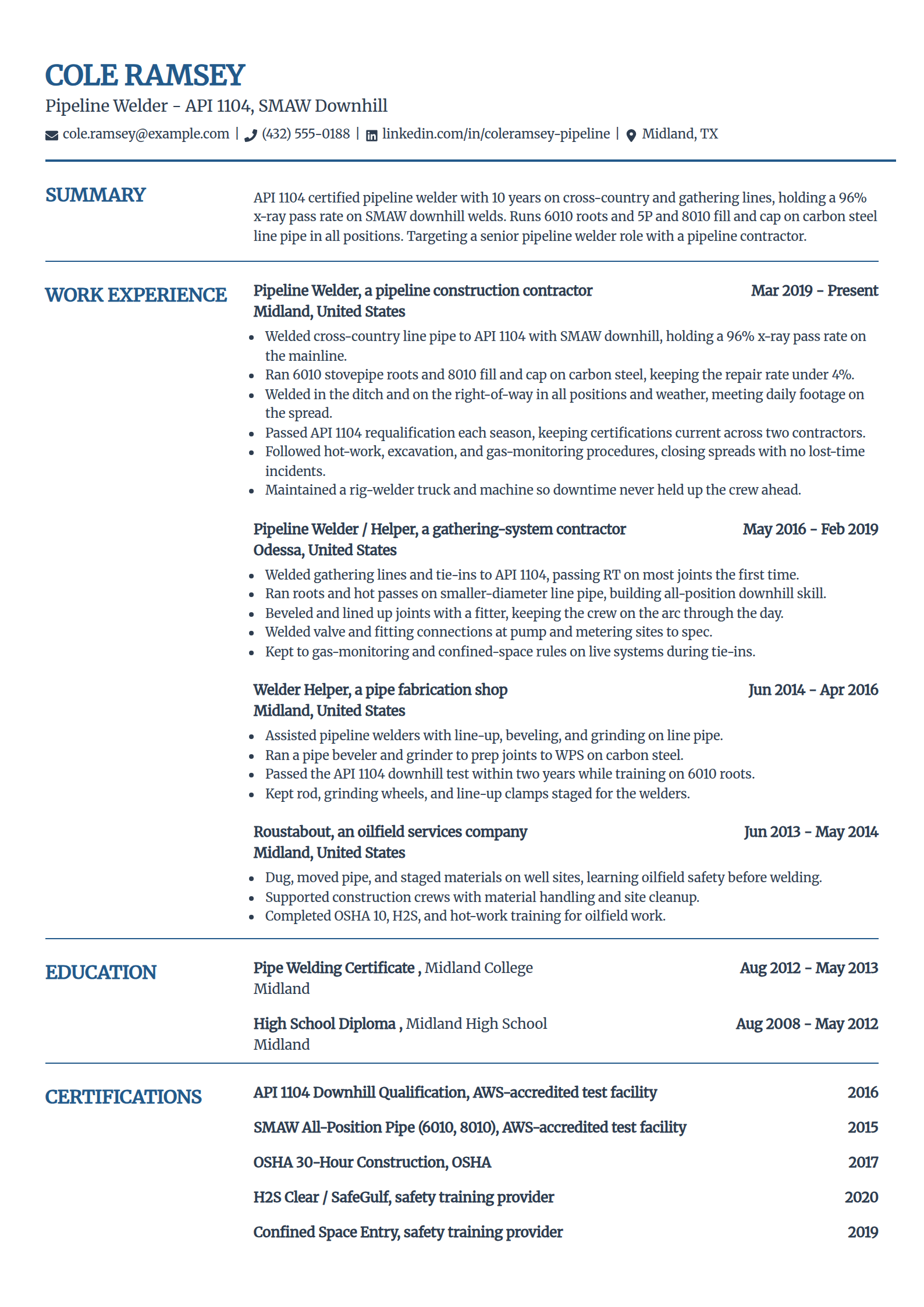
Pipeline Welder Resume Template
Why this resume example works?
- Leads with the credential a pipeline contractor wants, API 1104 certification and a 96% x-ray pass rate on the mainline.
- Shows the process a spread runs, SMAW downhill with 6010 stovepipe roots and 8010 fill and cap on line pipe.
- Keeps results honest, a repair rate under 4% while making daily footage in the ditch and in all weather.
- Names H2S, confined-space, and gas-monitoring training plus a rig-welder truck, the field readiness a spread checks.
- Uses a modern layout that carries a full pipeline record on one page.
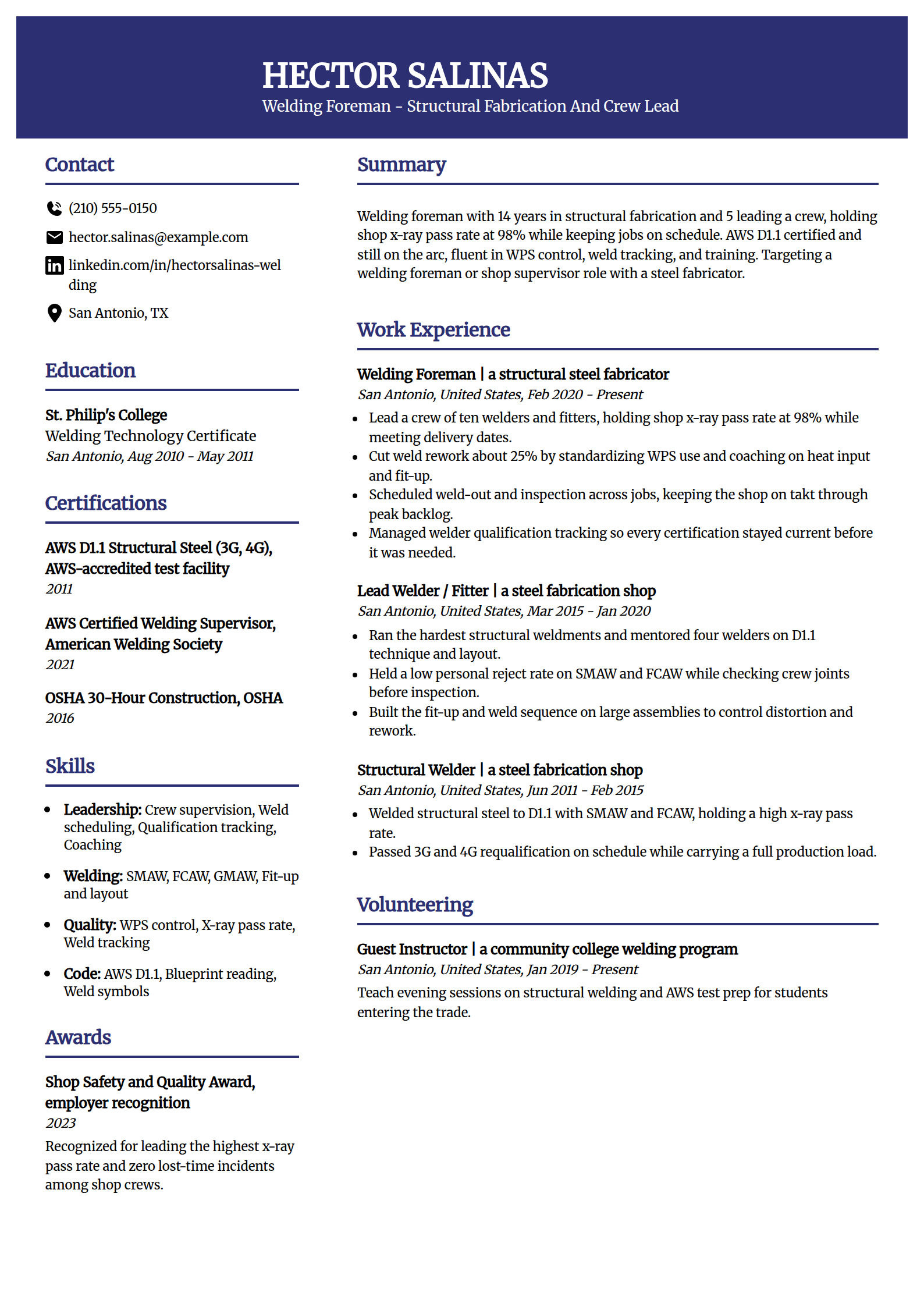
Welding Foreman Resume Template
Why this resume example works?
- Leads with 14 years and 5 leading a crew of ten, holding shop x-ray pass rate at 98%, the depth a foreman posting wants.
- Shows the results a lead is hired for, weld rework cut about 25% by standardizing WPS use and coaching.
- Keeps the candidate credible on the arc, still running the hardest weldments and checking crew joints.
- Names an AWS Certified Welding Supervisor credential and qualification tracking, the systems a foreman owns.
- Uses a roomy layout with an award and a college-instructor volunteer role so a leadership record fills the page.
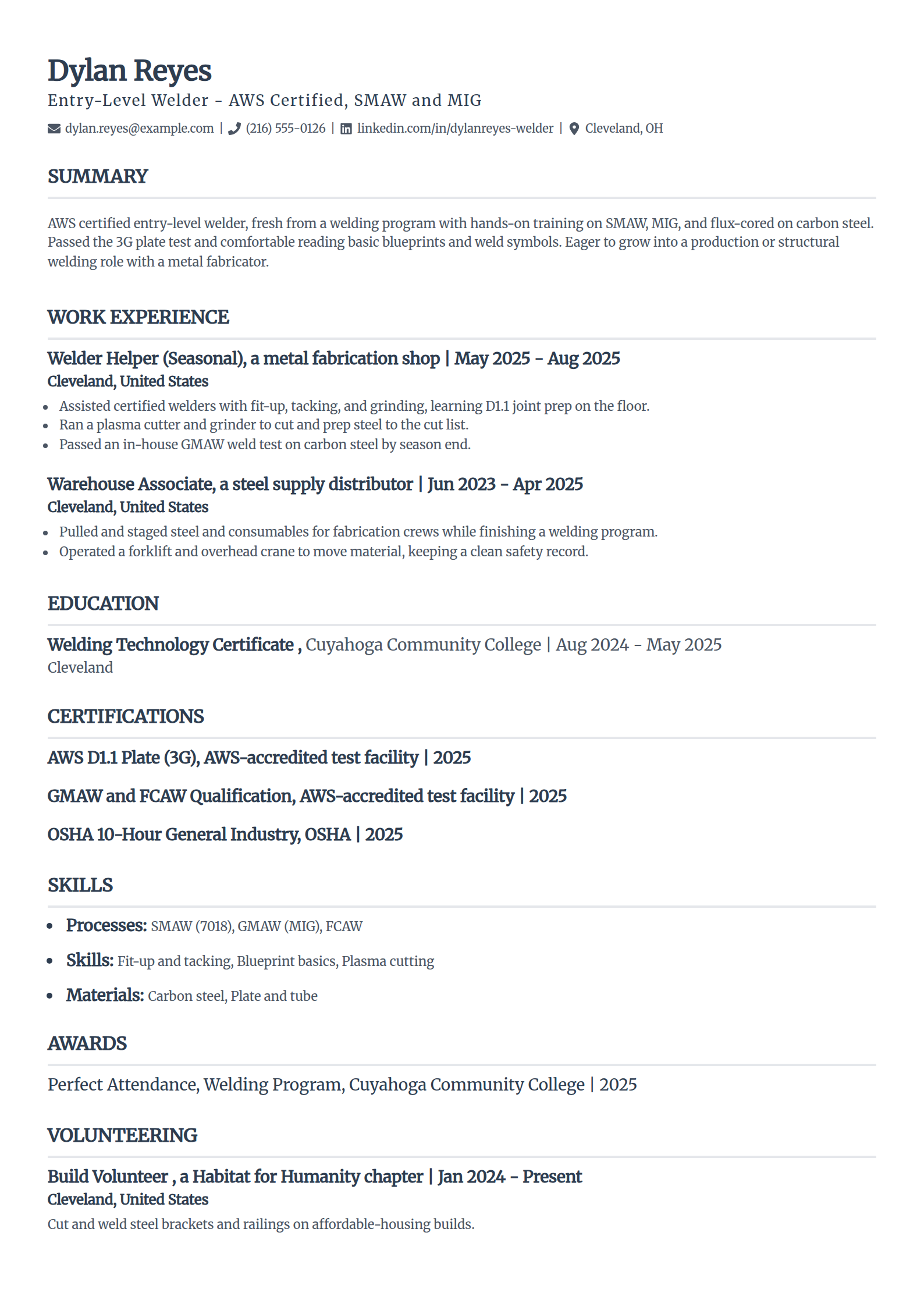
Entry-Level Welder Resume Template
Why this resume example works?
- Written for a first welding job, leading with an AWS 3G plate certification and a welding certificate instead of years.
- Uses a seasonal welder-helper and a warehouse role as entries, the right move when field experience is new.
- Keeps every bullet honest, like assisting with fit-up and tacking and passing an in-house GMAW test.
- Names AWS D1.1 plate, GMAW and FCAW qualification, and OSHA 10, the credentials a first posting checks.
- Fills a tight, ATS-safe page with an attendance award and a Habitat for Humanity volunteer role instead of padding.
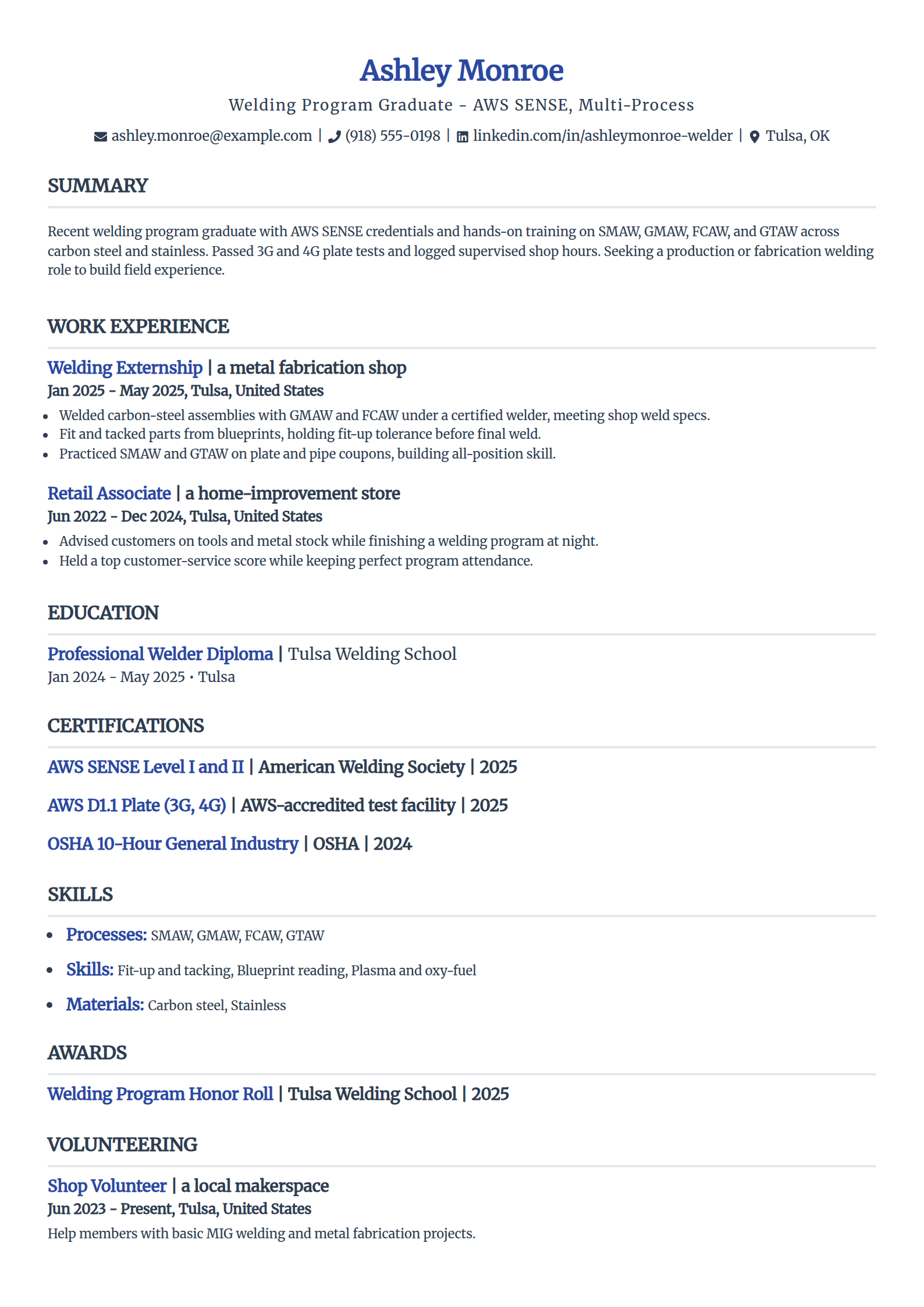
Welding School Graduate Resume Template
Why this resume example works?
- Written for a new graduate, leading with AWS SENSE credentials and 3G and 4G plate tests instead of years.
- Uses a welding externship and a prior retail role as entries, the honest shape before a full welding job.
- Keeps each bullet real, like welding carbon-steel assemblies under a certified welder and practicing SMAW and GTAW.
- Names AWS SENSE Level I and II, AWS D1.1 plate, and OSHA 10, the early credentials a first employer wants.
- Fills a tight, ATS-safe page with a program honor roll and a makerspace volunteer role.
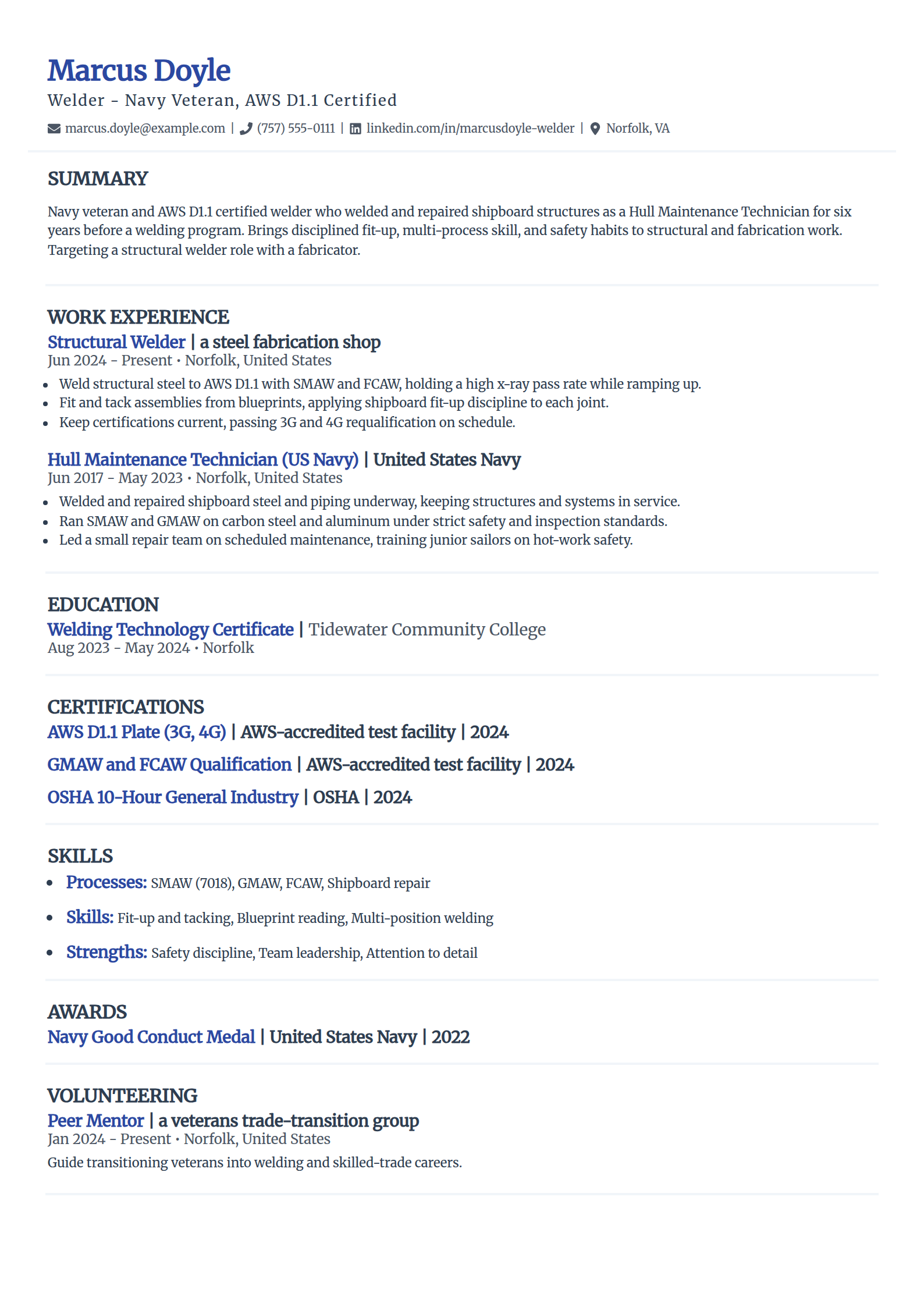
Military-to-Welding Career-Change Resume Template
Why this resume example works?
- Names the switch openly, moving from six years welding shipboard steel as a Navy Hull Maintenance Technician into fabrication.
- Reframes military work as an asset, disciplined fit-up and multi-process skill that transfer straight across.
- Shows recent proof in the new role, welding structural steel to D1.1 with a strong x-ray record while ramping up.
- Keeps the new credentials concrete, AWS D1.1 plate, GMAW and FCAW qualification, and OSHA 10.
- Uses a clean layout with a service medal and a veteran peer-mentor role so a transition record still looks full.
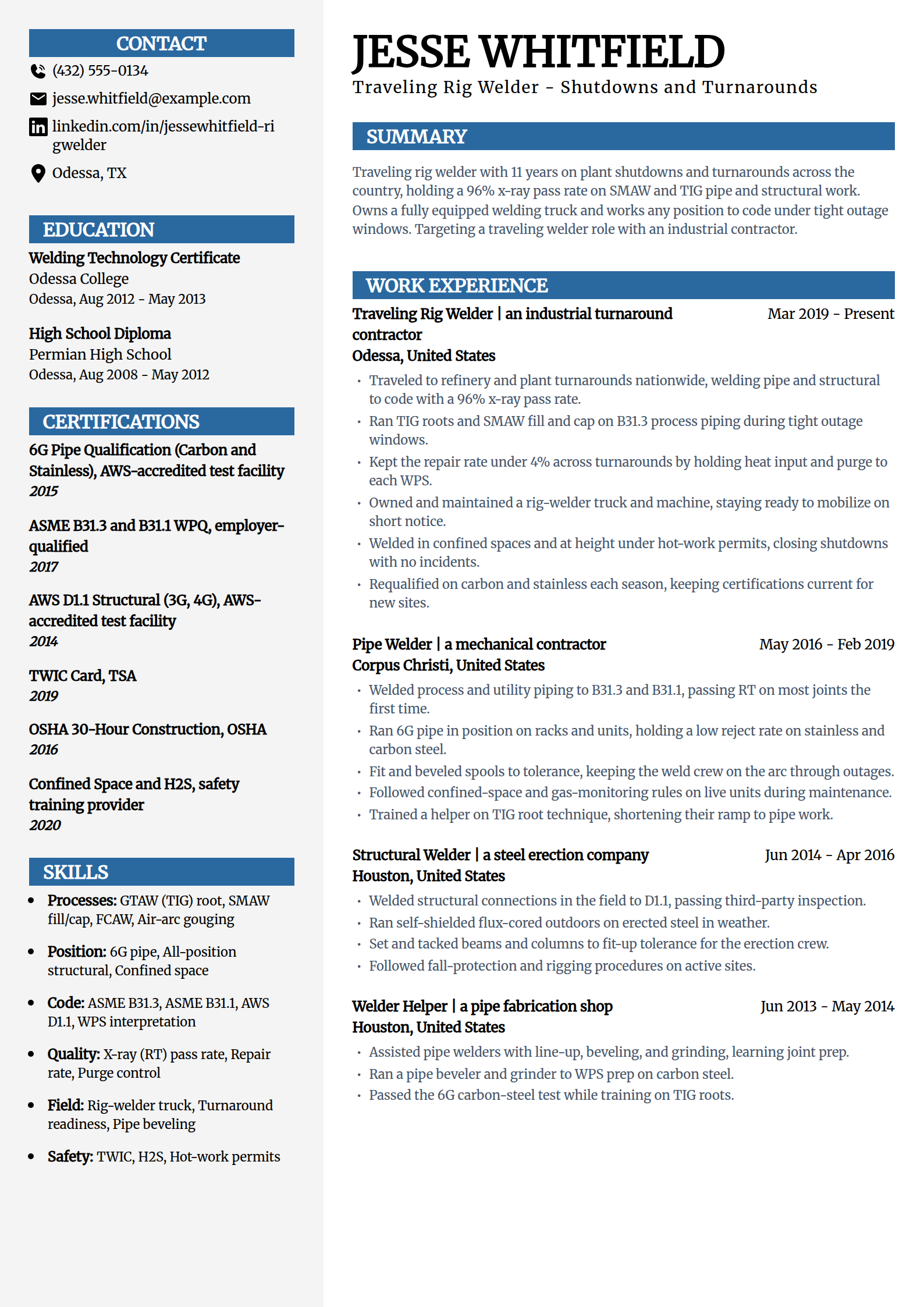
Traveling Rig Welder Resume Template
Why this resume example works?
- Opens with the value a turnaround contractor wants, a 96% x-ray pass rate on pipe and structural across nationwide shutdowns.
- Shows the range a rig welder needs, TIG roots and SMAW fill on B31.3 piping under tight outage windows.
- Keeps results honest, a repair rate under 4% and a fully equipped welding truck ready to mobilize on short notice.
- Names 6G and D1.1 certifications, a TWIC card, and H2S and confined-space training, the field readiness a site checks.
- Uses a modern two-column layout that carries a varied, multi-site record cleanly on one page.
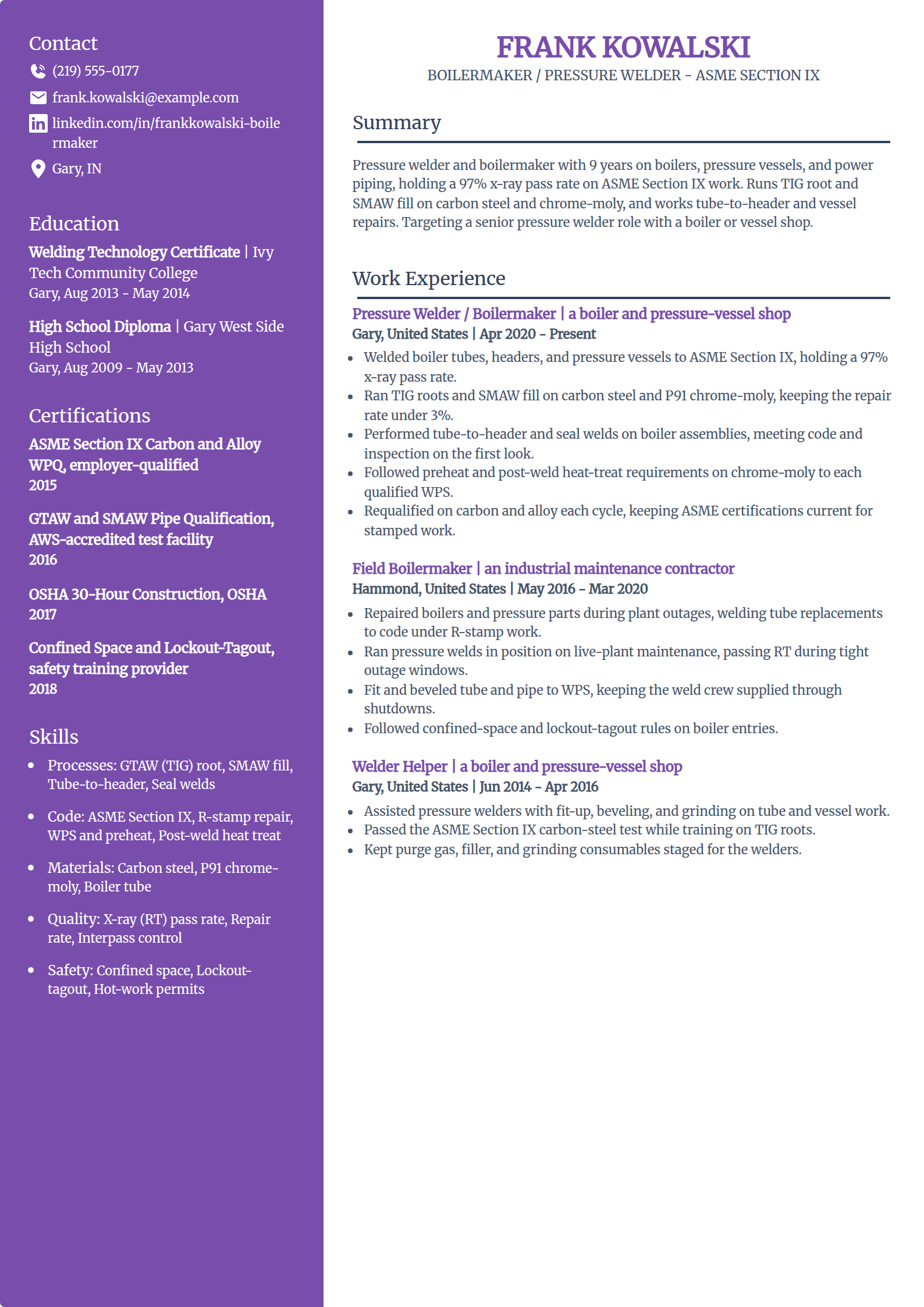
Pressure Welder Resume Template
Why this resume example works?
- Leads with pressure work, boiler tubes and vessels welded to ASME Section IX with a 97% x-ray pass rate.
- Shows the skill a boiler shop rewards, TIG roots and SMAW fill on carbon steel and P91 chrome-moly.
- Keeps the code work precise, following preheat and post-weld heat-treat on alloy to each qualified WPS.
- Names ASME Section IX, R-stamp repair, and confined-space and lockout-tagout training, the credentials a vessel shop checks.
- Uses a Medium layout that carries a full pressure-welding record without empty space.
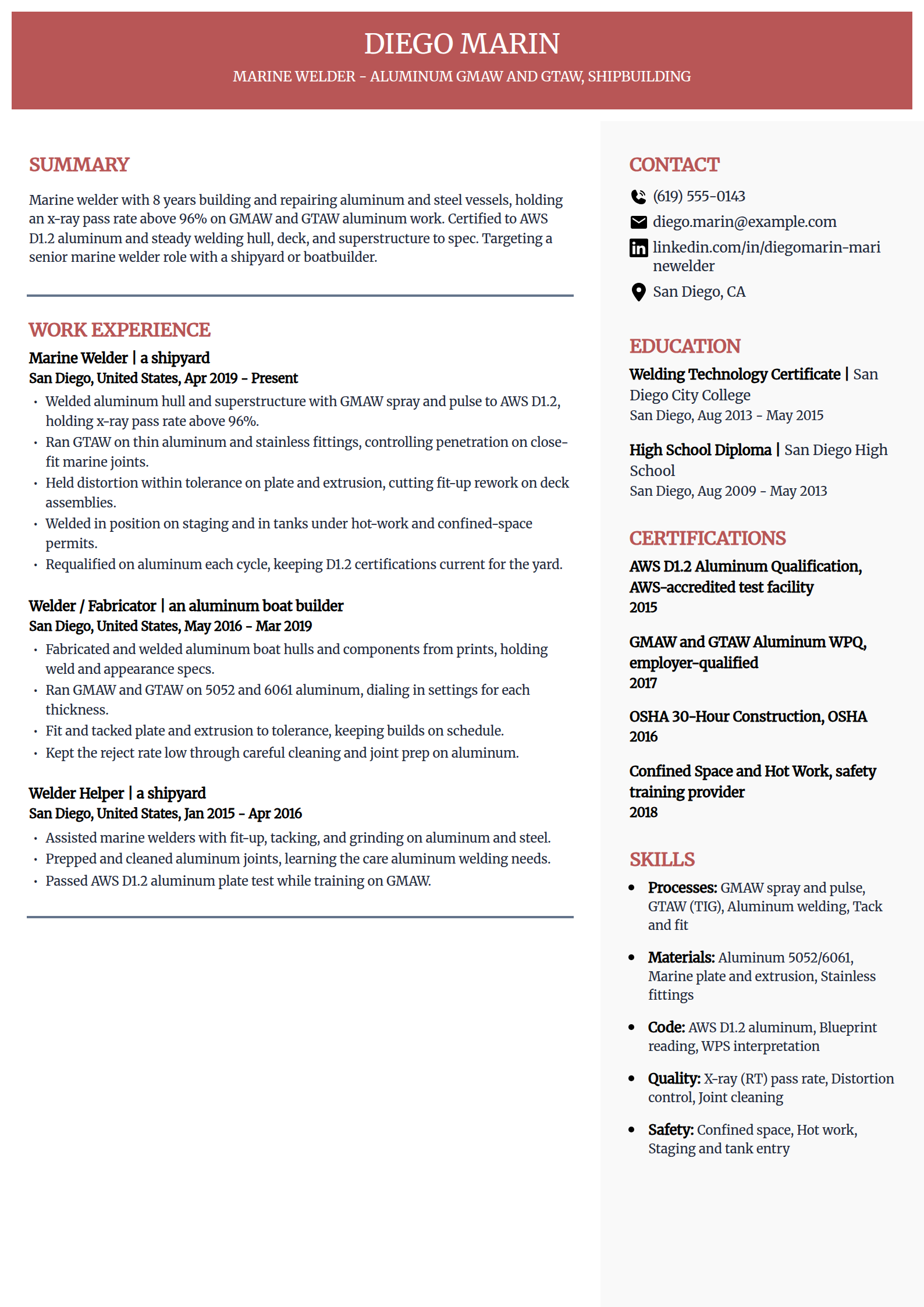
Marine Welder Resume Template
Why this resume example works?
- Opens with marine value, aluminum hull and superstructure welded to AWS D1.2 with an x-ray pass rate above 96%.
- Shows the range a shipyard needs, GMAW spray and pulse on plate and GTAW on thin aluminum and stainless.
- Keeps results honest, holding distortion within tolerance and cutting fit-up rework on deck assemblies.
- Names AWS D1.2 aluminum, GMAW and GTAW qualification, and confined-space training, the credentials a yard checks.
- Uses a refined layout that carries a full marine-welding record on one page.
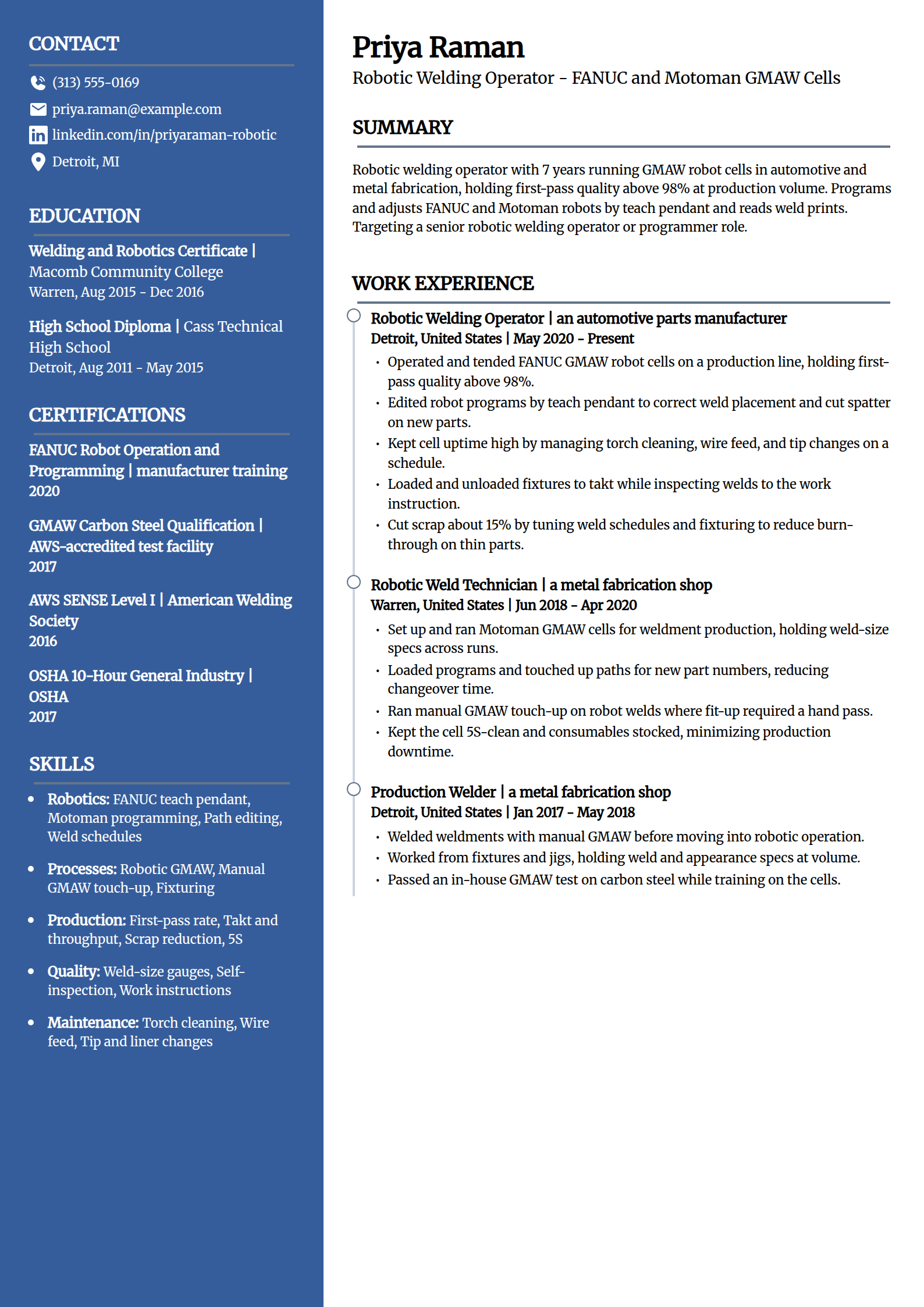
Robotic Welding Operator Resume Template
Why this resume example works?
- Leads with the number a plant rewards, first-pass quality above 98% running FANUC GMAW robot cells at volume.
- Shows real robotic skill, editing programs by teach pendant to correct weld placement and cut spatter.
- Keeps results countable, scrap cut about 15% by tuning weld schedules and fixturing on thin parts.
- Names FANUC and Motoman programming, path editing, and weld schedules, the skills an automation posting wants.
- Uses a distinctive layout that still reads cleanly for a hiring manager.
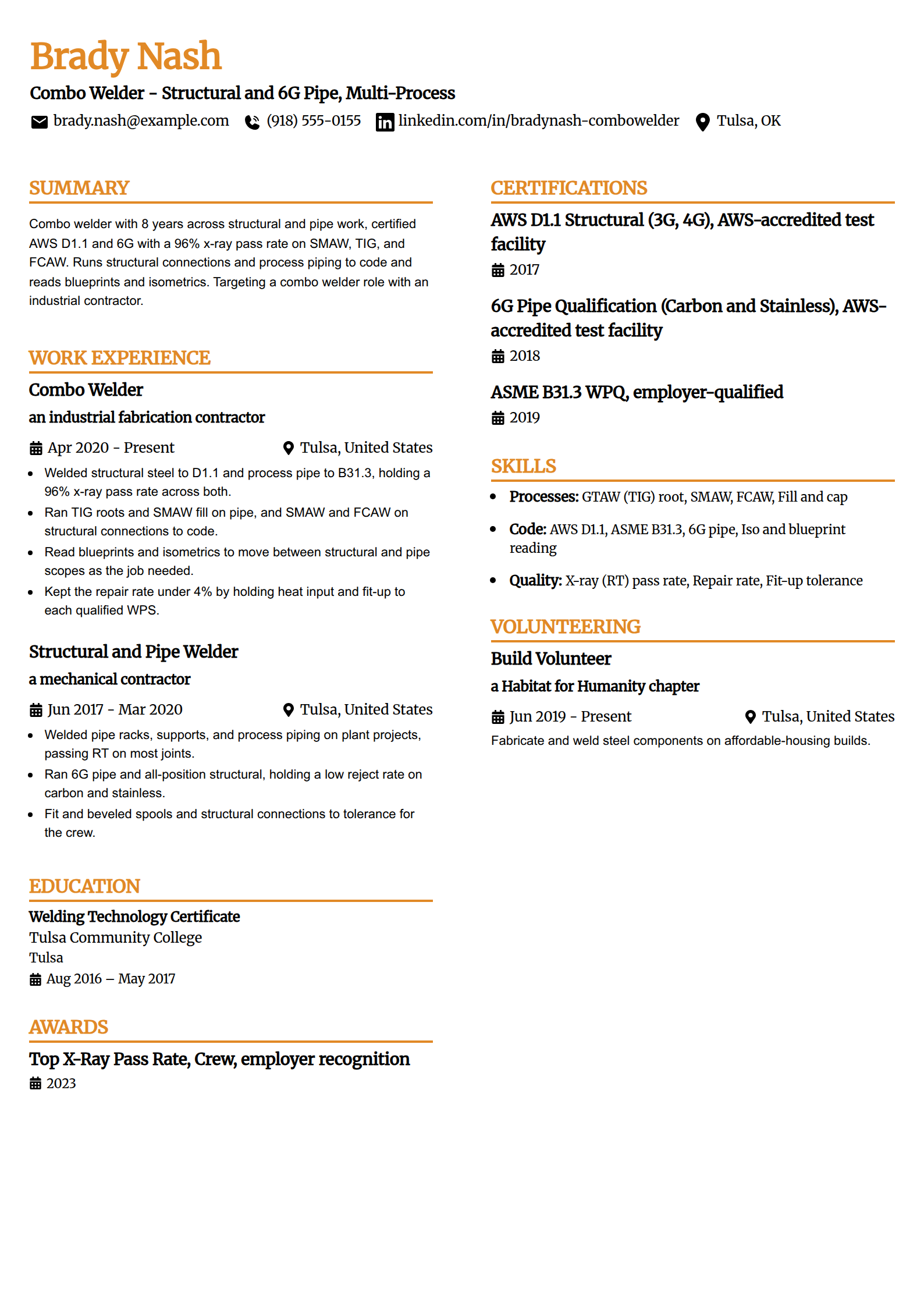
Combo Welder Resume Template
Why this resume example works?
- Leads with range, AWS D1.1 and 6G certifications and a 96% x-ray pass rate across structural and pipe work.
- Shows the flexibility a contractor wants, TIG roots and SMAW fill on pipe plus SMAW and FCAW on structural.
- Keeps results honest, a repair rate under 4% by holding heat input and fit-up to each qualified WPS.
- Names AWS D1.1, ASME B31.3, and isometric and blueprint reading, the credentials a combo role checks.
- Uses a tight, ATS-safe layout that keeps a two-scope record on one clean page.
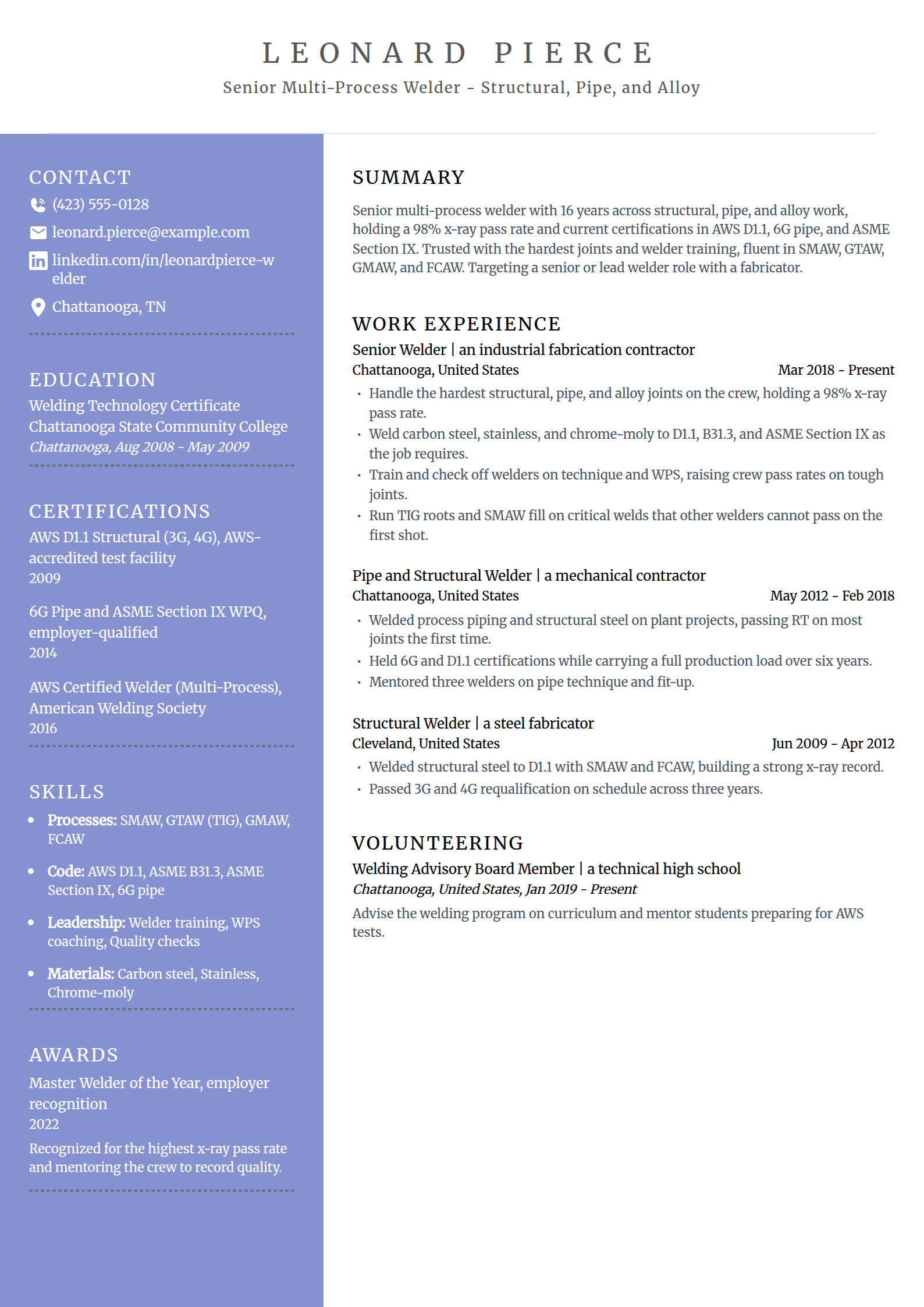
Senior Welder Resume Template
Why this resume example works?
- Leads with depth, 16 years and a 98% x-ray pass rate across structural, pipe, and alloy work.
- Shows what a senior is trusted with, the hardest joints and welder training that raise crew pass rates.
- Keeps the credentials plain, current AWS D1.1, 6G pipe, and ASME Section IX across SMAW, GTAW, GMAW, and FCAW.
- Names carbon steel, stainless, and chrome-moly, the materials a demanding fabricator runs.
- Uses a roomy layout with an award and a technical-school advisory role so a senior record fills the page.
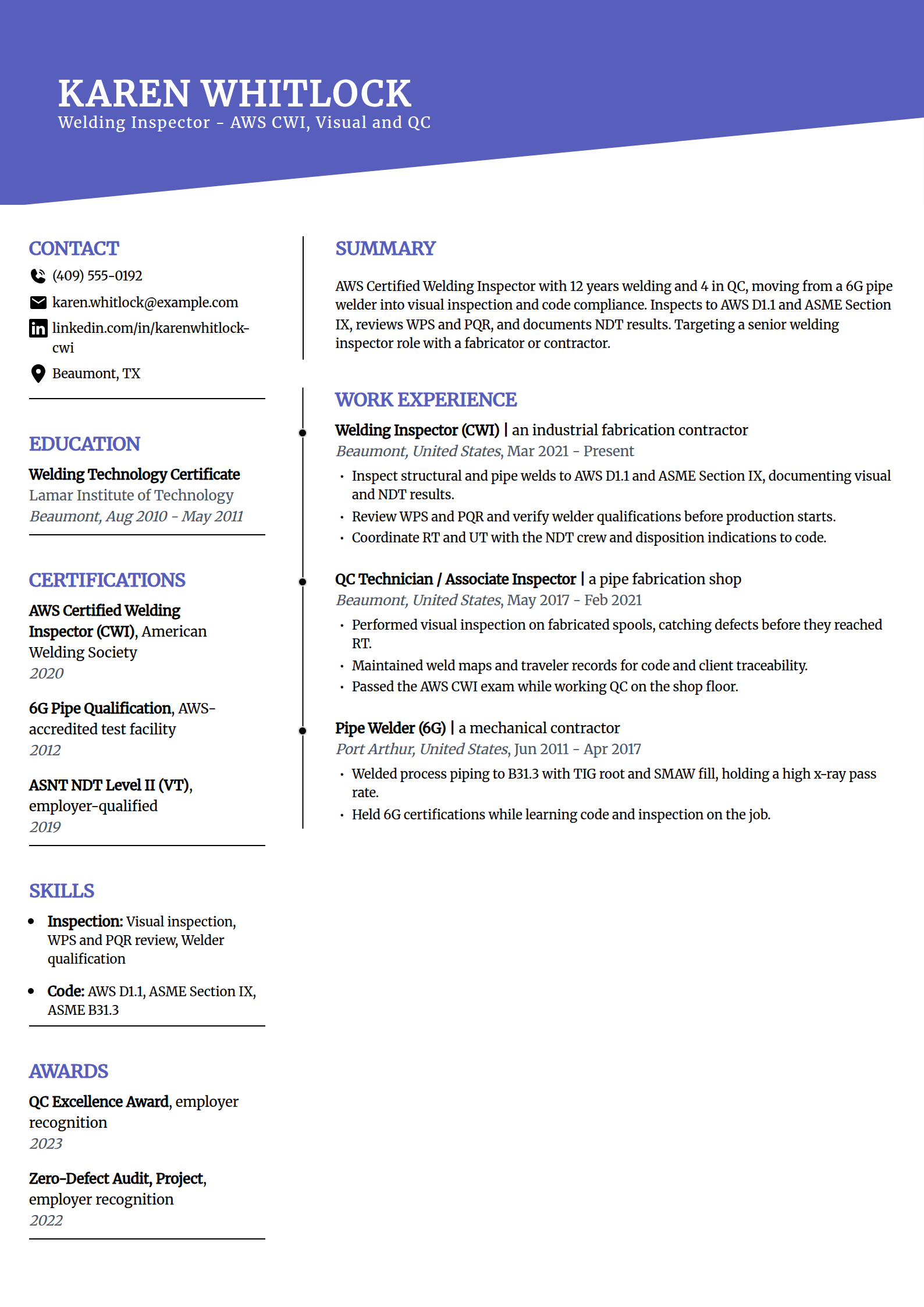
Welding Inspector (CWI) Resume Template
Why this resume example works?
- Leads with the credential a QC role wants, an AWS Certified Welding Inspector who came up from a 6G pipe welder.
- Shows the inspector's core work, reviewing WPS and PQR and verifying welder qualifications before production.
- Keeps the scope real, inspecting to AWS D1.1 and ASME Section IX and coordinating RT and UT with the NDT crew.
- Names the CWI, an ASNT NDT Level II (VT), and the codes an inspection posting screens for.
- Uses a two-column layout with awards so a QC record fills the page.
Build your welding resume
Pick a template above and the editor keeps your layout clean and ATS-safe while you swap in your own processes, certifications, code, and x-ray pass rate.
Build my resumeHow to write a welding resume in 2026
A welding resume gets scanned fast by a shop hiring manager looking for two things: which processes and positions you are certified in, and whether your welds pass inspection. Lead with a short summary that names your process, code, and one x-ray pass rate, then make every bullet a real result with a number and the code behind it. Keep the format clean so a parser reads it as easily as a person does.
Open with a process-and-pass-rate summary
Write three to four sentences that name your years, your processes and positions, your strongest number, and the role you are targeting. An experienced welder leads with an x-ray pass rate and a code like D1.1 or API 1104; an entry-level welder leads with the certificate, the AWS test passed, and hands-on training. Keep it to about 60 words so it never spills past the top of the page.
AWS D1.1 certified structural welder with 9 years on steel buildings and bridges, holding a 98% x-ray pass rate on SMAW and FCAW welds in all positions. Qualified 3G and 4G on plate, fluent in 7018 low-hydrogen and self-shielded flux-cored, and steady reading blueprints and WPS. Targeting a senior structural welder role.
List your certifications and positions, not just "welding" (the honest part)
This is where most welding resumes go generic. A shop hires for a specific process, position, and code, so name your real qualifications and be honest about what you are tested and current on.
- Name the process and position: SMAW 3G and 4G plate, 6G pipe, GTAW on stainless, or API 1104 downhill, whichever you hold.
- State the code you weld to by name: AWS D1.1 structural, ASME Section IX pressure, B31.3 process piping, or API 1104 pipeline.
- Do not claim a certification you have let lapse. Say a qualification is current, or say when you last tested; a shop can pull your continuity.
- If you are strong in one process, like TIG or pipe, lead with it and let the general fabrication work support it.
Make every experience bullet a result with a number
Name the material, the process, and the joint, then attach one credible number and the code behind it. Welding is measured in x-ray pass rates and repair rates, so keep the numbers honest to a real shop.
- Use welding metrics: x-ray or RT pass rate, weld-repair or reject rate, diameter-inches or footage of weld, or fit-up tolerance.
- Open with a strong verb like welded, ran, fit, beveled, or qualified, never "Responsible for" or "Helped with".
- Name the process and material: "ran a TIG root and SMAW fill on B31.3 stainless with an argon back purge".
- Keep one number per bullet and aim for a number in about half of them; a wall of percentages reads as invented.
Put your AWS and code certifications where they get seen
Welding hiring is certification-driven, so a posting checks your quals first. List them in their own section with the position and code, and never list one you do not hold.
- List each certification with its position and code: "AWS D1.1 (3G, 4G)", "6G pipe, carbon and stainless", "API 1104 downhill".
- Add ASME Section IX for pressure work, D1.2 for aluminum, or D17.1 for aerospace where you hold them.
- Inspectors and QC-track welders lead with the AWS CWI and any ASNT NDT levels.
- Entry-level welders and career-changers lead with the AWS test passed, the certificate, and OSHA training in place of years.
Match skills and keywords to the job posting
A skills block should read like the posting, grouped so a shop and a parser both find what they need. List the processes and materials you have actually run, not a generic dump.
- Group by type: processes, positions, code, materials, and quality.
- Name specific processes and materials: GTAW root, SMAW 7018, FCAW, 6G pipe, 316 stainless, and 6061 aluminum, matched to the role.
- If the posting says "D1.1" or "6G", use that exact phrasing where it fits your experience.
- Mirror the posting's language, since that is what the applicant tracking system searches for when it ranks your resume.
Keep the format clean and ATS-safe
A welding resume is read by a parser first and a shop hiring manager second, so a clean layout with standard headings is the safe choice at every level.
- Use a single-column or simple two-column layout with standard headings a parser recognizes; skip heavy graphics and photos.
- Keep it to one page; a welding resume rarely needs two, even for a foreman or senior welder.
- Save as a PDF so the formatting holds, then run it through the ATS resume checker for a quick format and keyword pass.
- Swap the numbers in the templates above for your own pass rates, certifications, and processes; do not copy them as is.
Common welding resume mistakes
- Listing duties instead of results. Lead with what your welds do, an x-ray pass rate, a repair rate, or footage, not a bulleted job description.
- Burying or omitting certifications. Your process, position, and code belong in a named section, not hidden in a sentence.
- Claiming a lapsed or untested qualification. If the resume says 6G, a shop will ask when you last tested; list only current quals or say when you tested.
- Naming no code or material. A resume with no D1.1, no B31.3, and no material reads as generic; name the codes and metals you have run.
- One generic resume for every job. Reorder your processes and code so the work the posting names, structural, pipe, TIG, or pipeline, leads the page.
Frequently asked questions
How do you write a welding resume?
Lead with a three-to-four-sentence summary that names your years, your processes and positions, your strongest number, and the role you are targeting. Under each job, write results-first bullets that open with a strong verb and carry one credible number, like a 98% x-ray pass rate or a weld-repair rate under 3%. Name the process, material, and code behind each result, list your AWS and code certifications in their own section, and keep the whole thing to one clean, ATS-safe page.
What should a welder put on a resume?
A welding resume includes a process-and-pass-rate summary, experience bullets with real numbers, an AWS and code certification section, a grouped skills block, and education. The experience section carries the weight: every bullet should show work you can prove, such as welding B31.3 pipe with a TIG root and SMAW fill or running D1.1 structural in all positions. Name your certifications, like AWS D1.1 (3G, 4G) or 6G pipe, and list the processes and materials you run, like SMAW, GTAW, and 316 stainless.
How do you write a welder resume with no experience?
Lead with what you do have. An entry-level candidate leads with the AWS test passed, a welding certificate, and OSHA training, plus any welder-helper or shop work. A welding-school graduate leads with the program and externship hours. A career-changer, including a veteran from a hull or repair role, reframes welding that transfers. Your AWS test, certificate, and any supervised welding are your strongest early signal. The entry-level, graduate, and military career-change examples above show the shape.
What certifications should be on a welding resume?
List the AWS and code certifications you actually hold, with the position and code: AWS D1.1 structural (3G, 4G), 6G pipe (carbon and stainless), API 1104 for pipeline, ASME Section IX for pressure work, D1.2 for aluminum, or D17.1 for aerospace. Inspectors add the AWS CWI and ASNT NDT levels. List each with a date and note that it is current, and never list a qualification you have let lapse, since a shop can check your welder continuity before hiring.
What does 6G certified mean on a welding resume?
6G is a pipe welding test position where the pipe is fixed at a 45-degree angle and cannot be rotated, so you weld flat, vertical, and overhead in a single pass around the joint. Because it covers every position at once, 6G qualifies you for most other pipe and plate positions and is the benchmark a pipe shop looks for. On a resume, state the material you tested on, such as "6G pipe, carbon and stainless", and the code, like ASME Section IX or B31.3, so a hiring manager knows exactly what you are qualified to weld.
How long should a welding resume be?
One page for most welders, including entry-level, production, and experienced structural and pipe welders. Use a second page only when a foreman, senior welder, or inspector has enough relevant projects, crew leadership, or scope to justify it, and never pad to reach it. Whichever length you use, lead with your most recent and most relevant work, keep standard headings, and cut older or unrelated jobs so the space goes to the certifications, code, and numbers a shop checks first.
More welder resume resources
Build your welding resume
Pick a template above and the editor keeps your layout clean and ATS-safe while you swap in your own processes, certifications, code, and x-ray pass rate.