Supervisor Resume Templates and Examples, First-Line to Senior
- ATS Friendly
- Frontline & Shift Lead
- 16 Real Examples
Warehouse, production, retail, call center, maintenance, security, or a first shift-lead promotion, this page has a resume built for your exact frontline role. Start from a layout below, then model your own on a real example that leads with what a hiring team reads first: the size of the team you run, your safety record, and the throughput or quality numbers you hold. Every example stays at supervisor altitude, the shift and team you own, not a manager's budget you did not.


540k+ resumes created
Supervisor resume templates for every industry and shift
Each template below is a real supervisor resume laid out in that format, sorted by industry and level across warehouse, production, logistics, operations, maintenance, call center, construction, housekeeping, security, sanitation, retail, and food service, plus the step up from individual contributor to first-line lead. Pick one, then swap in your own team size, safety record, throughput or quality numbers, and certifications. Every layout keeps your leadership and results numbers readable so a hiring team sees your scope at a glance and an applicant tracking system parses it cleanly.
Warehouse Supervisor Resume Template
Why this resume example works?
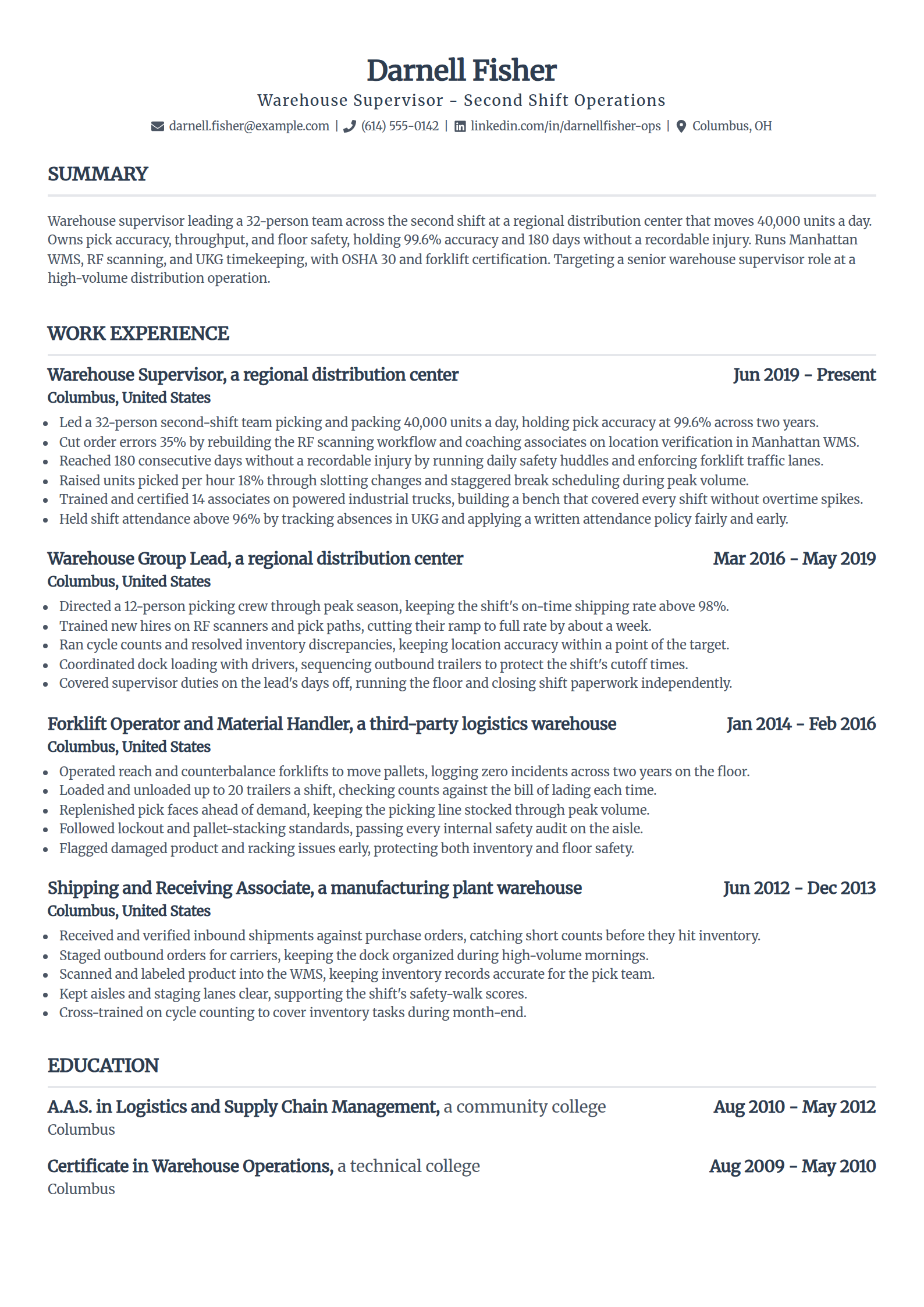
- Opens with frontline scope, a 32-person second-shift team moving 40,000 units a day, not a vague leadership line.
- Carries the two numbers a warehouse role screens for, 99.6% pick accuracy and 180 days without a recordable injury.
- Names the systems a supervisor runs, Manhattan WMS, RF scanning, and UKG timekeeping.
- Shows the credentials up top, OSHA 30 and forklift certification, that clear the first screen.
- Uses a clean, single-column layout an applicant tracking system reads without trouble.
Production / Manufacturing Supervisor Resume Template
Why this resume example works?
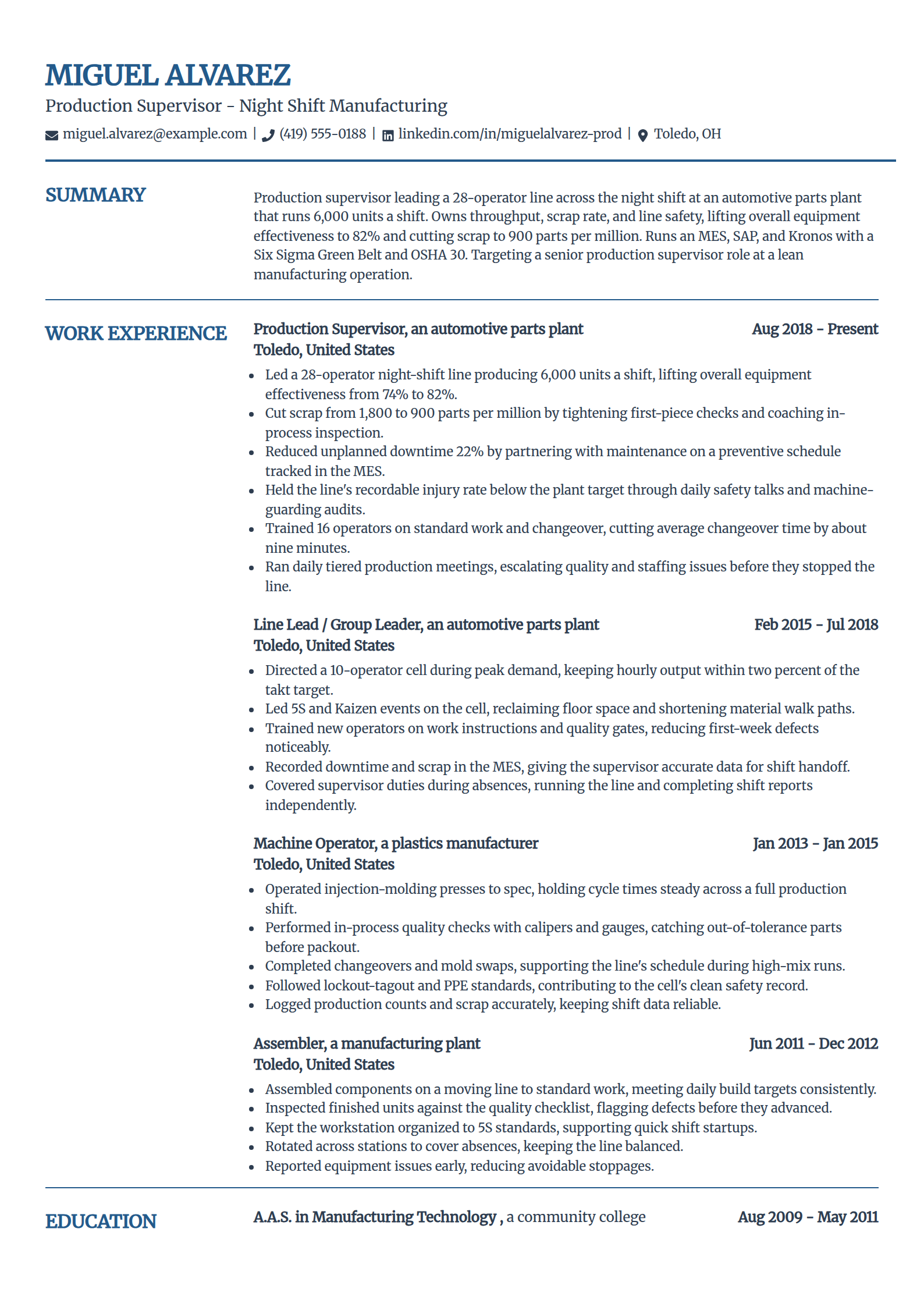
- Leads with the line a production role hires for, a 28-operator night shift running 6,000 units a shift.
- Ties the work to the numbers a plant tracks, overall equipment effectiveness lifted to 82% and scrap cut to 900 PPM.
- Shows the safety ownership a line supervisor carries, daily talks and machine-guarding audits below the plant target.
- Names the manufacturing stack, an MES, SAP, and Kronos, with a Six Sigma Green Belt and OSHA 30.
- Uses a modern layout that carries a dense line-supervision record on one clean page.
Experienced Supervisor Resume Template
Why this resume example works?
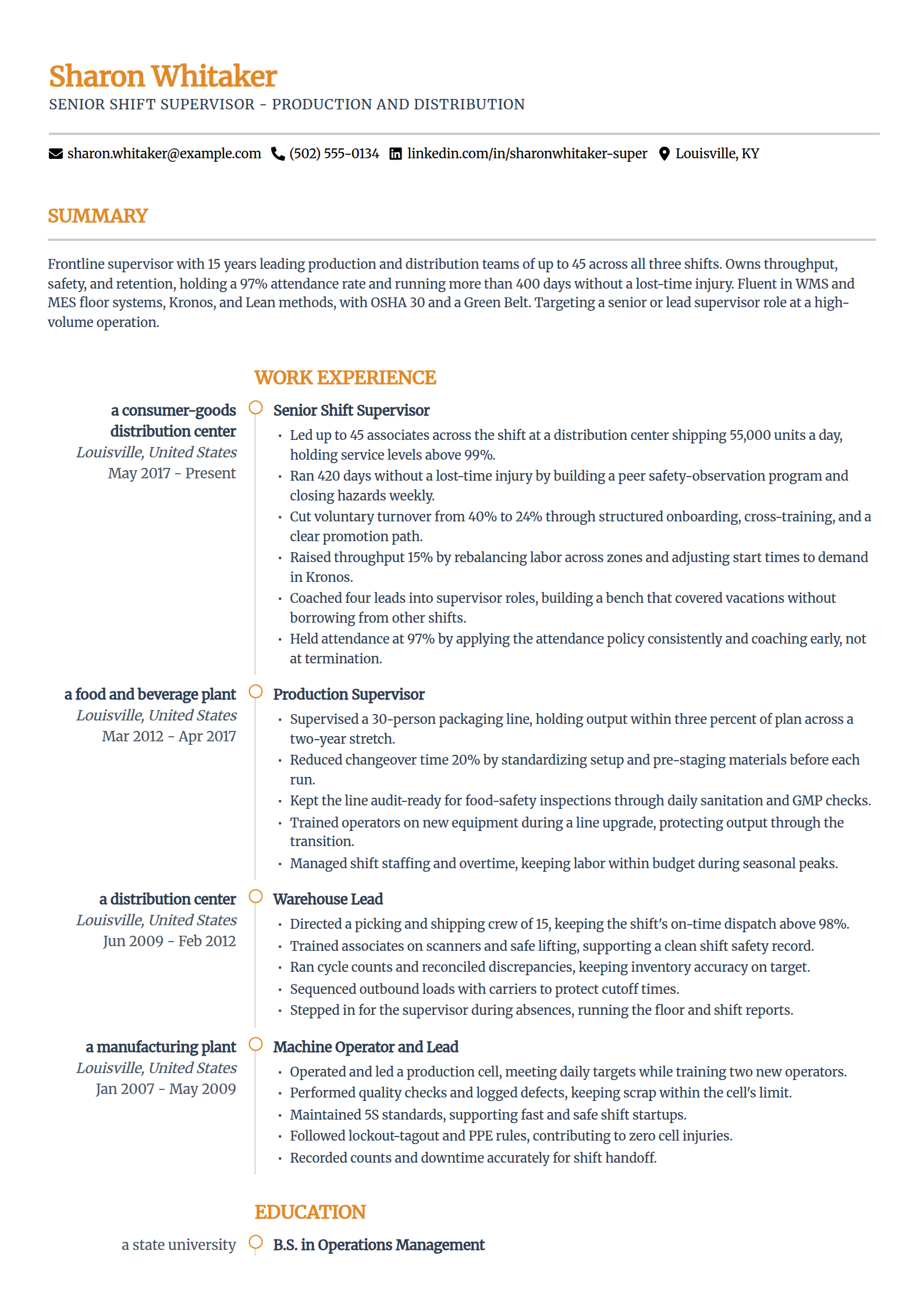
- Opens with 15 years leading production and distribution teams of up to 45 across all three shifts, the depth a senior role wants.
- Carries the numbers a seasoned supervisor owns, a 97% attendance rate and 400-plus days without a lost-time injury.
- Shows the retention work that matters at scale, turnover cut from 40% to 24% and four leads coached into supervisor roles.
- Names the floor systems, a WMS, an MES, and Kronos, so the tools read as real.
- Uses a modern layout that still reads cleanly for a recruiter scanning fast.
Logistics / Distribution Supervisor Resume Template
Why this resume example works?
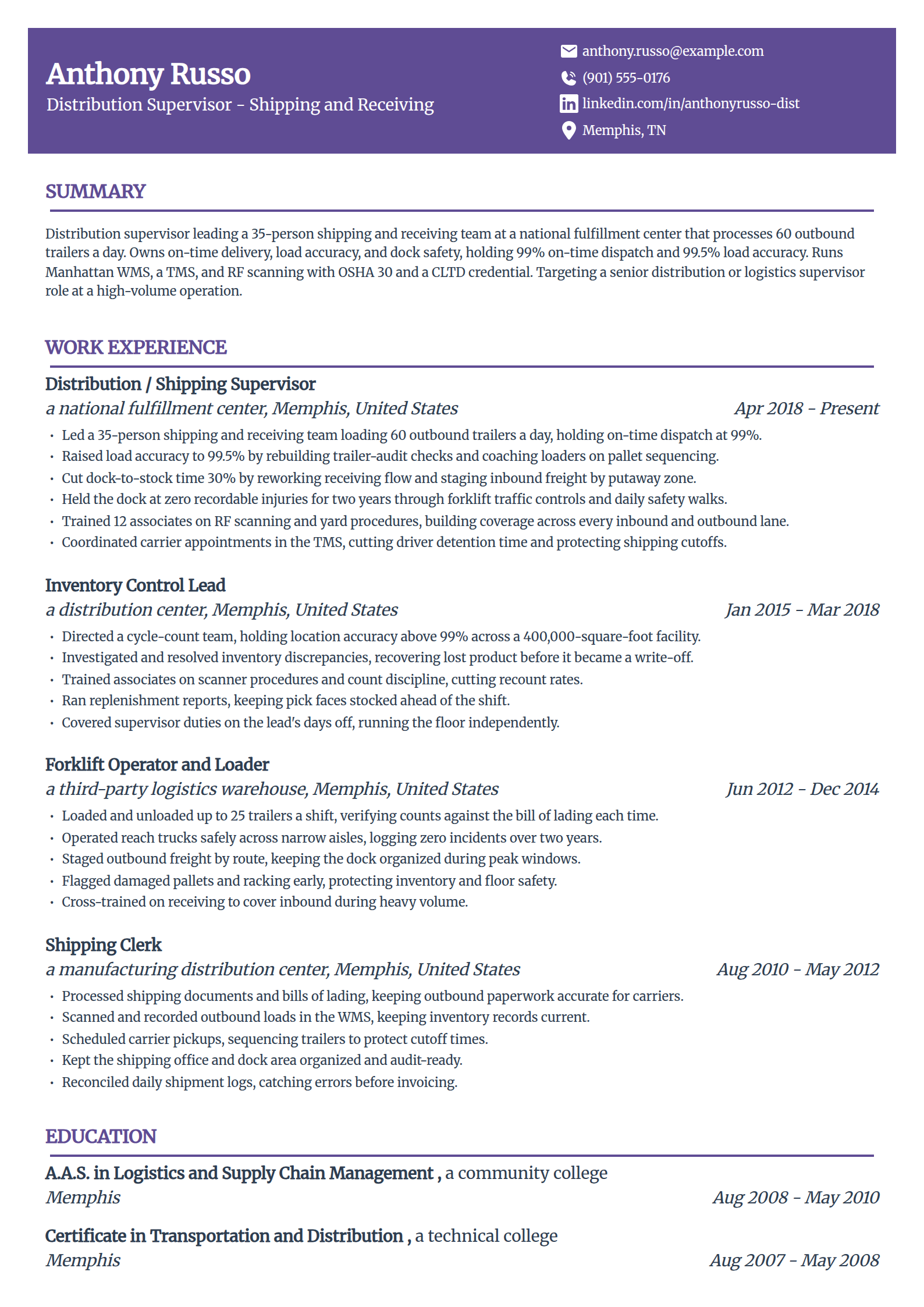
- Leads with the dock a distribution role hires for, a 35-person team loading 60 outbound trailers a day.
- Carries the numbers shipping screens for, 99% on-time dispatch and 99.5% load accuracy.
- Shows the flow work that speeds a dock, dock-to-stock time cut 30% with zero recordable injuries for two years.
- Names the logistics stack, Manhattan WMS, a TMS, and RF scanning, with OSHA 30 and a CLTD credential.
- Uses a spacious layout that carries a dense distribution record on one page.
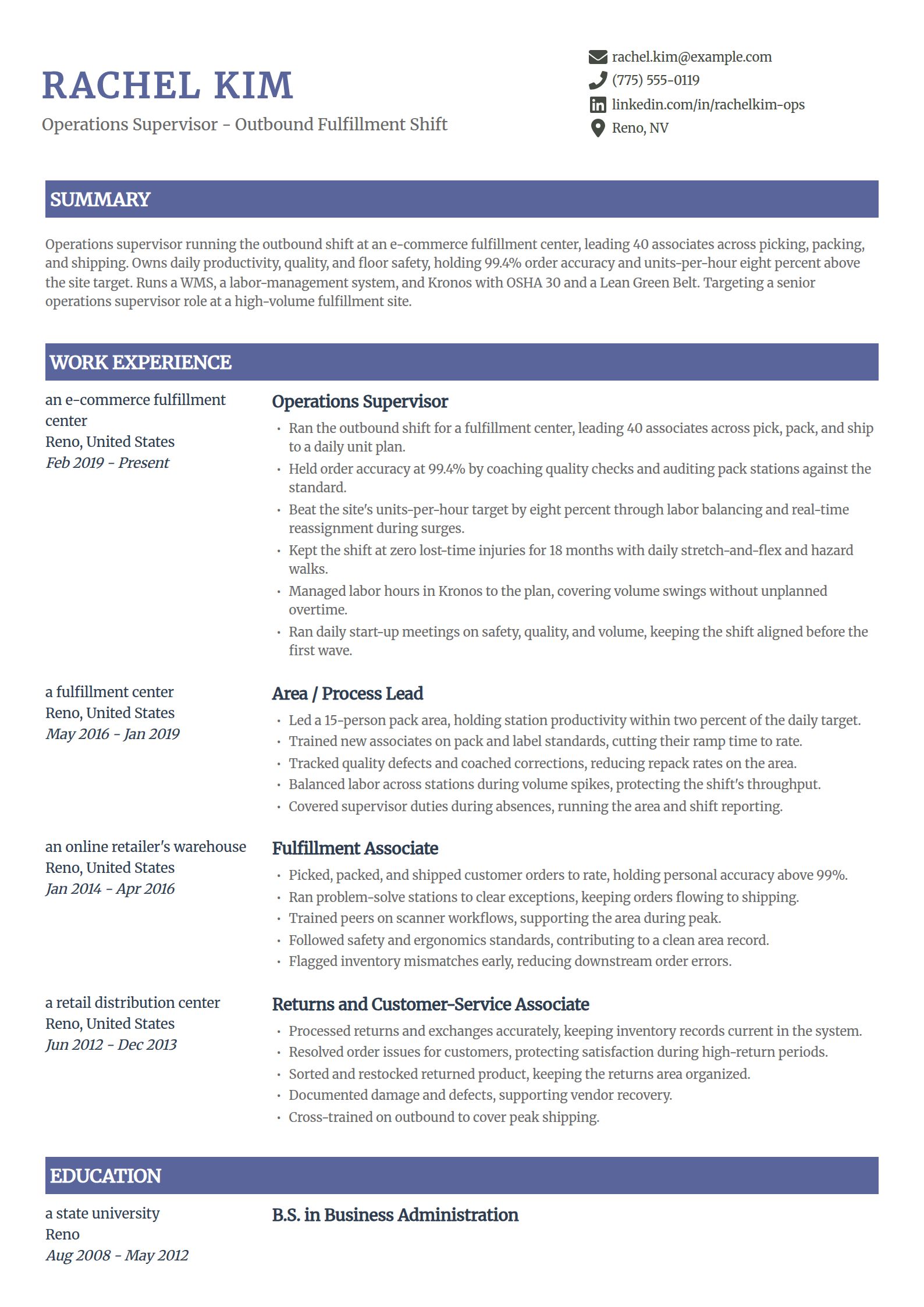
Operations Supervisor Resume Template
Why this resume example works?
- Leads with a frontline operations scope, running the outbound shift for 40 associates across pick, pack, and ship.
- Stays at supervisor altitude, owning the daily plan and floor safety, not a full department budget.
- Carries the numbers an ops role screens for, 99.4% order accuracy and units-per-hour eight percent above the site target.
- Names the systems a shift owns, a WMS, a labor-management system, and Kronos, with a Lean Green Belt and OSHA 30.
- Uses a modern layout that carries a dense fulfillment record on one clean page.
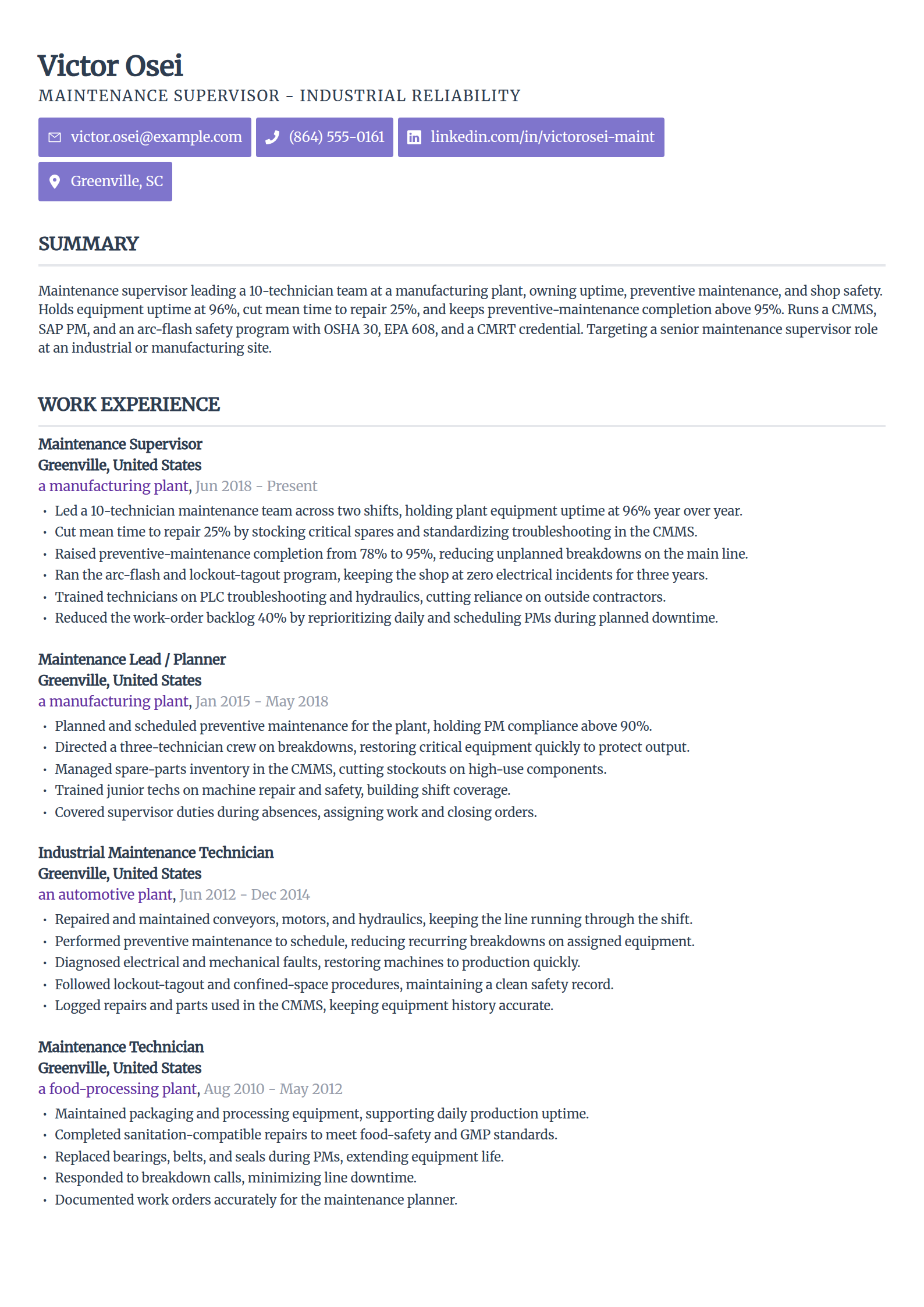
Maintenance Supervisor Resume Template
Why this resume example works?
- Leads with reliability scope, a 10-technician team across two shifts at a manufacturing plant.
- Carries the numbers maintenance is judged on, 96% uptime, mean time to repair cut 25%, and PM completion above 95%.
- Shows the safety program a shop lead runs, arc-flash and lockout-tagout with zero electrical incidents for three years.
- Names the maintenance stack, a CMMS and SAP PM, with OSHA 30, EPA 608, and a CMRT credential.
- Uses a clean, modern layout that carries a dense technical record on one page.
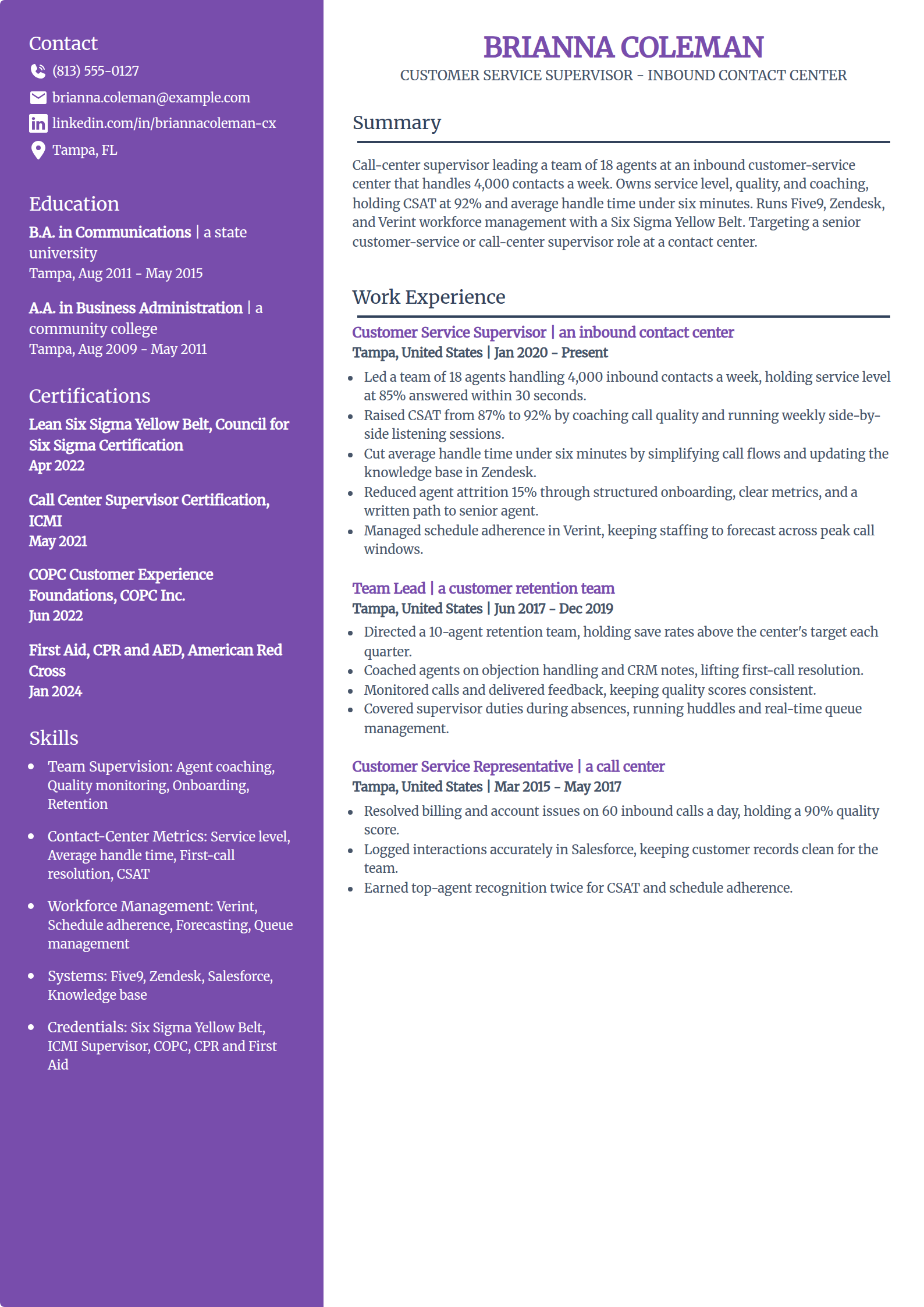
Call-Center / Customer-Service Supervisor Resume Template
Why this resume example works?
- Leads with the team a contact center hires for, 18 agents handling 4,000 inbound contacts a week.
- Carries the metrics a call center screens for, CSAT at 92% and average handle time under six minutes.
- Shows the coaching work that holds a floor together, attrition cut 15% through onboarding and a clear path up.
- Names the contact-center stack, Five9, Zendesk, and Verint workforce management.
- Uses a Medium layout that fits a focused call-center record without empty space.
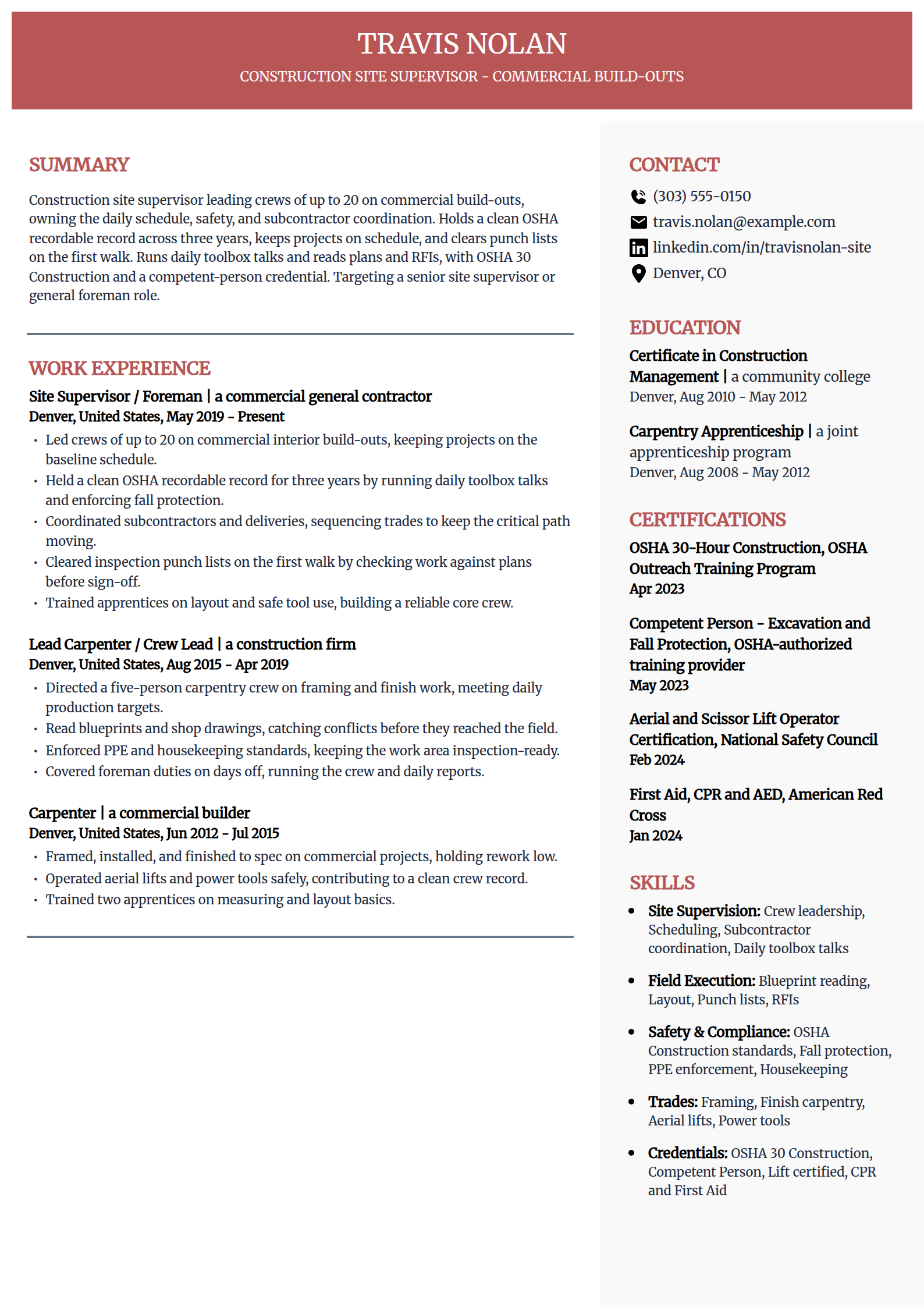
Construction Site Supervisor Resume Template
Why this resume example works?
- Leads with the crew a site role hires for, up to 20 on commercial build-outs, kept on the baseline schedule.
- Carries the record a general contractor screens for, a clean OSHA recordable record across three years.
- Shows the coordination a foreman owns, sequencing trades and clearing punch lists on the first walk.
- Names the field skills a site runs on, blueprint reading and RFIs, with OSHA 30 Construction and a competent-person credential.
- Uses a refined layout that fits a field-supervision record cleanly on one page.
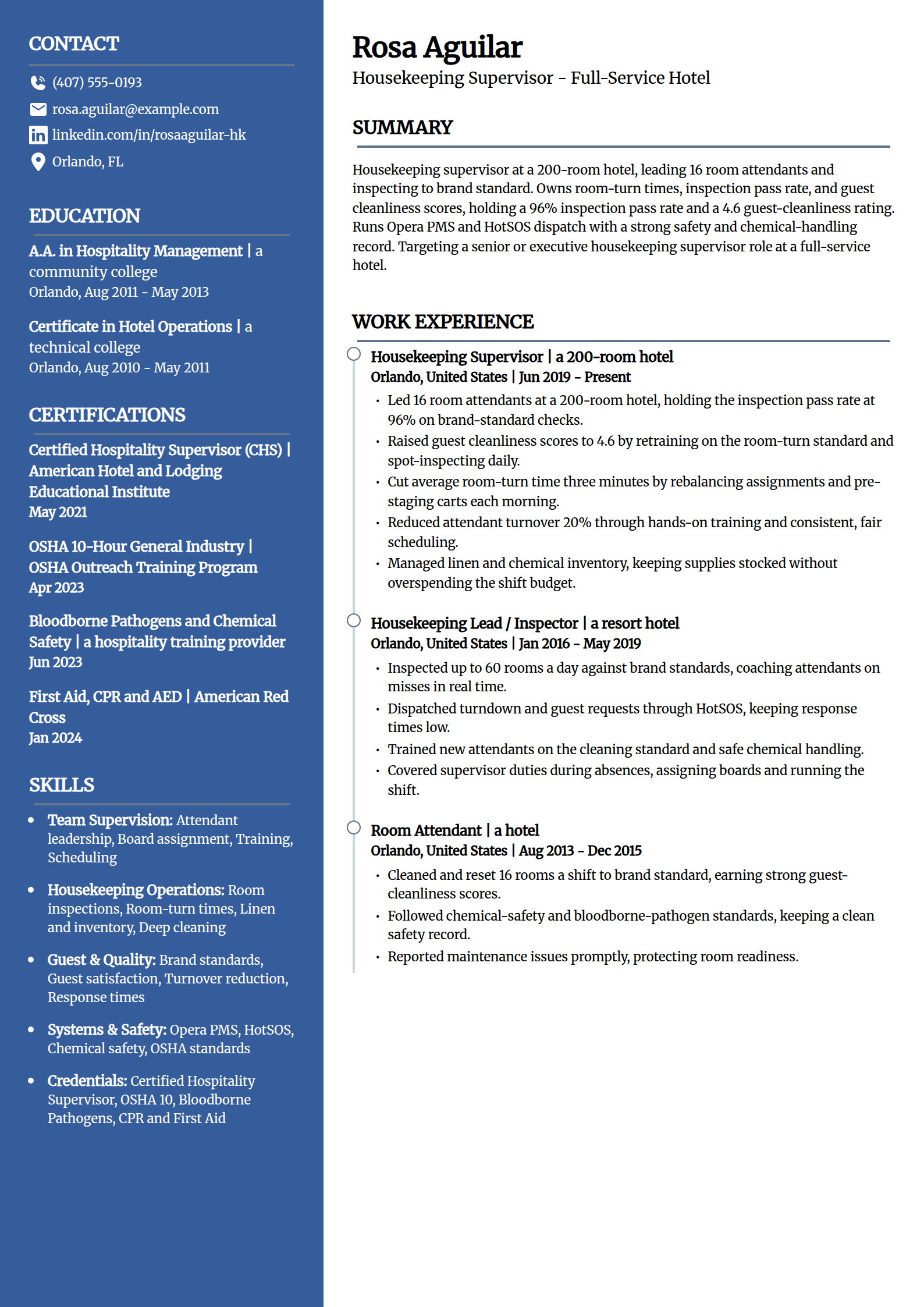
Housekeeping Supervisor Resume Template
Why this resume example works?
- Leads with hotel scope, 16 room attendants at a 200-room hotel inspected to brand standard.
- Carries the numbers a property screens for, a 96% inspection pass rate and a 4.6 guest-cleanliness rating.
- Shows the work that fills a room board, room-turn times cut and attendant turnover down 20%.
- Names the hotel stack, Opera PMS and HotSOS, with a chemical-safety and OSHA record.
- Uses a distinctive layout that still reads cleanly for a recruiter.
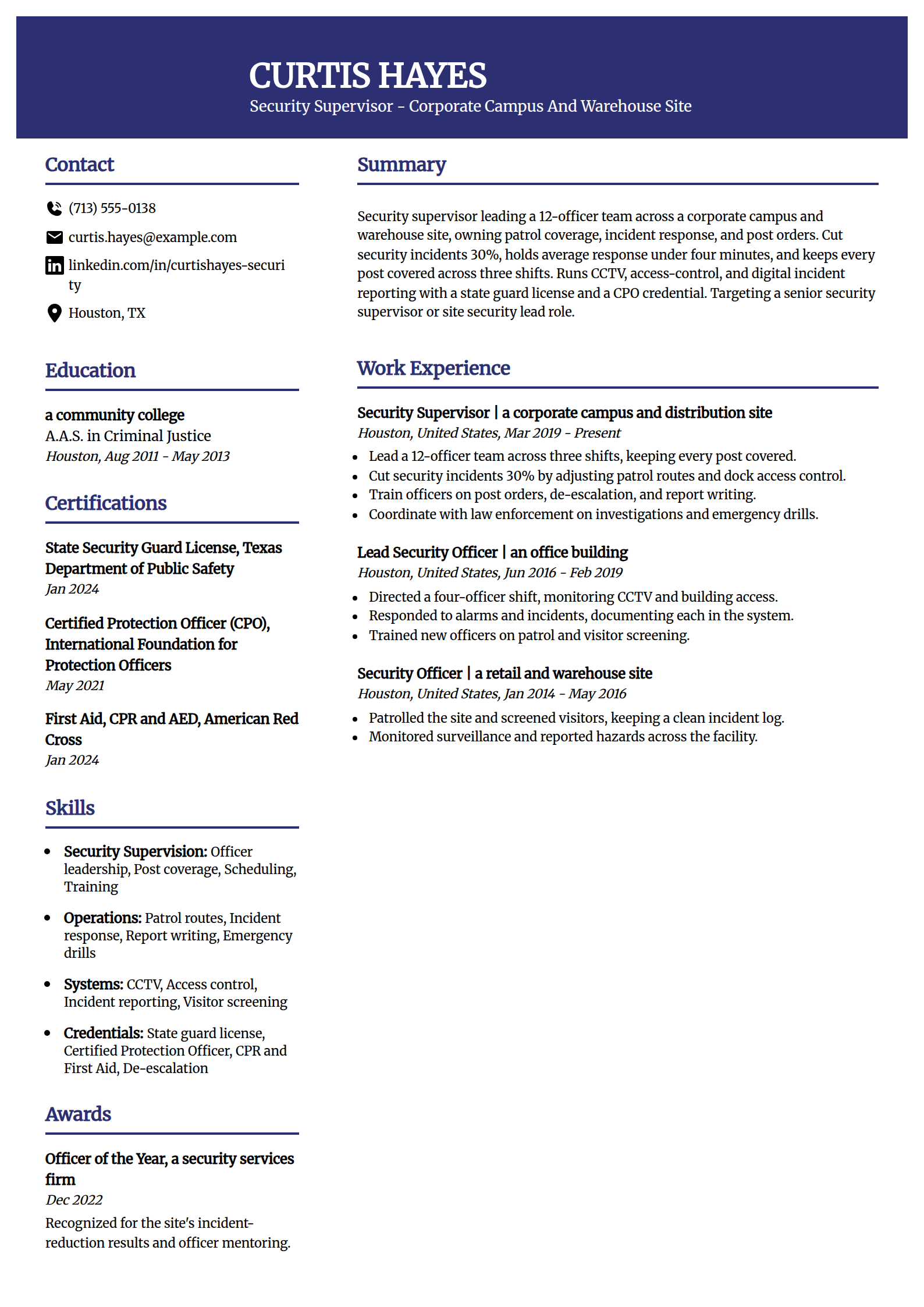
Security Supervisor Resume Template
Why this resume example works?
- Leads with post scope, a 12-officer team across three shifts on a corporate campus and warehouse site.
- Carries the numbers a security role screens for, incidents cut 30% and average response under four minutes.
- Shows the officer development a lead owns, post orders, de-escalation, and report-writing training.
- Names the credentials a post verifies, a state guard license and a Certified Protection Officer credential.
- Uses a roomy layout with a filled sidebar so the record looks complete.
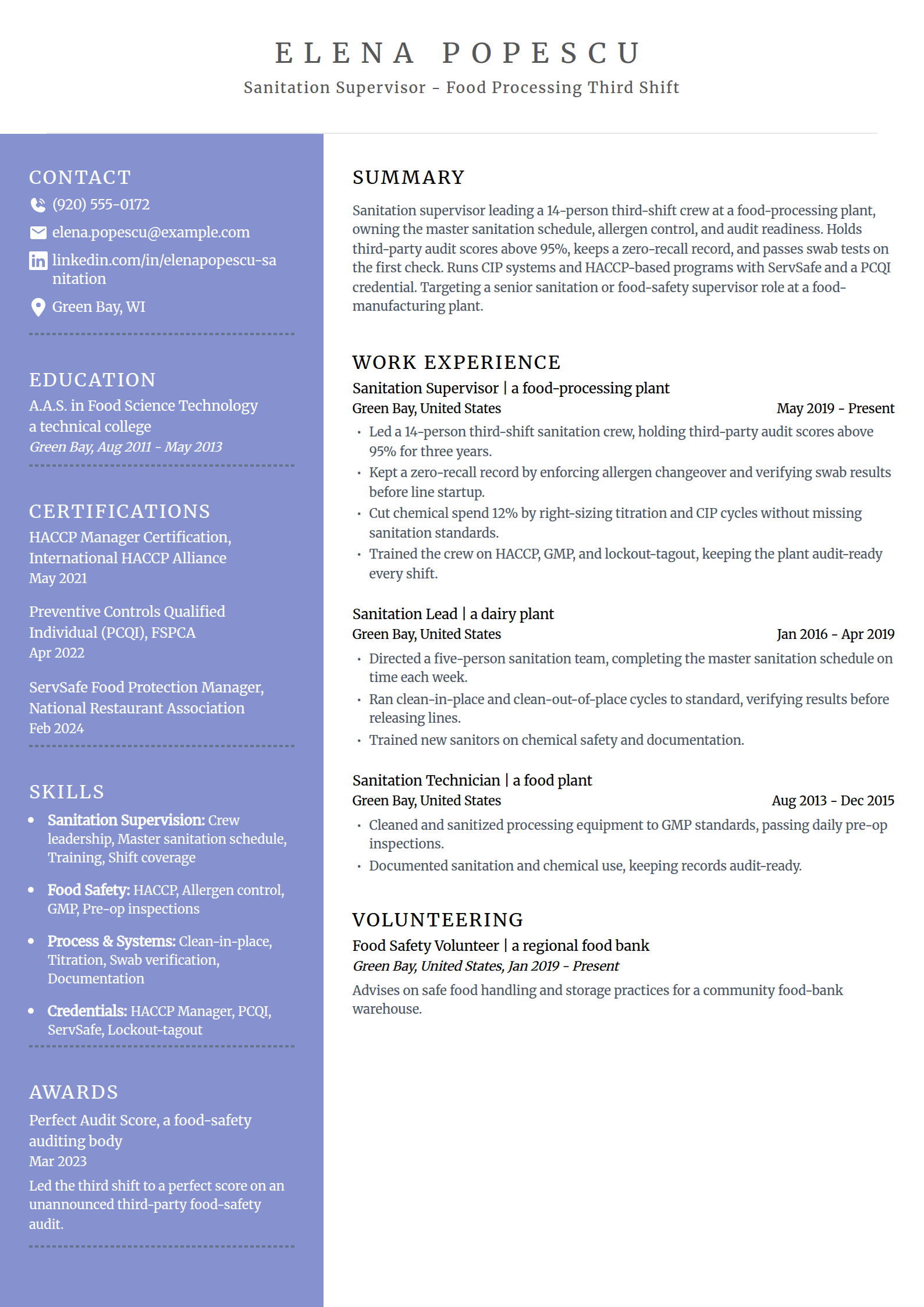
Sanitation Supervisor Resume Template
Why this resume example works?
- Leads with plant scope, a 14-person third-shift crew owning the master sanitation schedule at a food plant.
- Carries the numbers a food-safety role screens for, third-party audit scores above 95% and a zero-recall record.
- Shows the allergen and audit discipline a crew lead owns, swab verification before every line startup.
- Names the food-safety credentials that clear the screen, HACCP, PCQI, and ServSafe.
- Uses a roomy layout with a filled sidebar so a focused record looks complete.
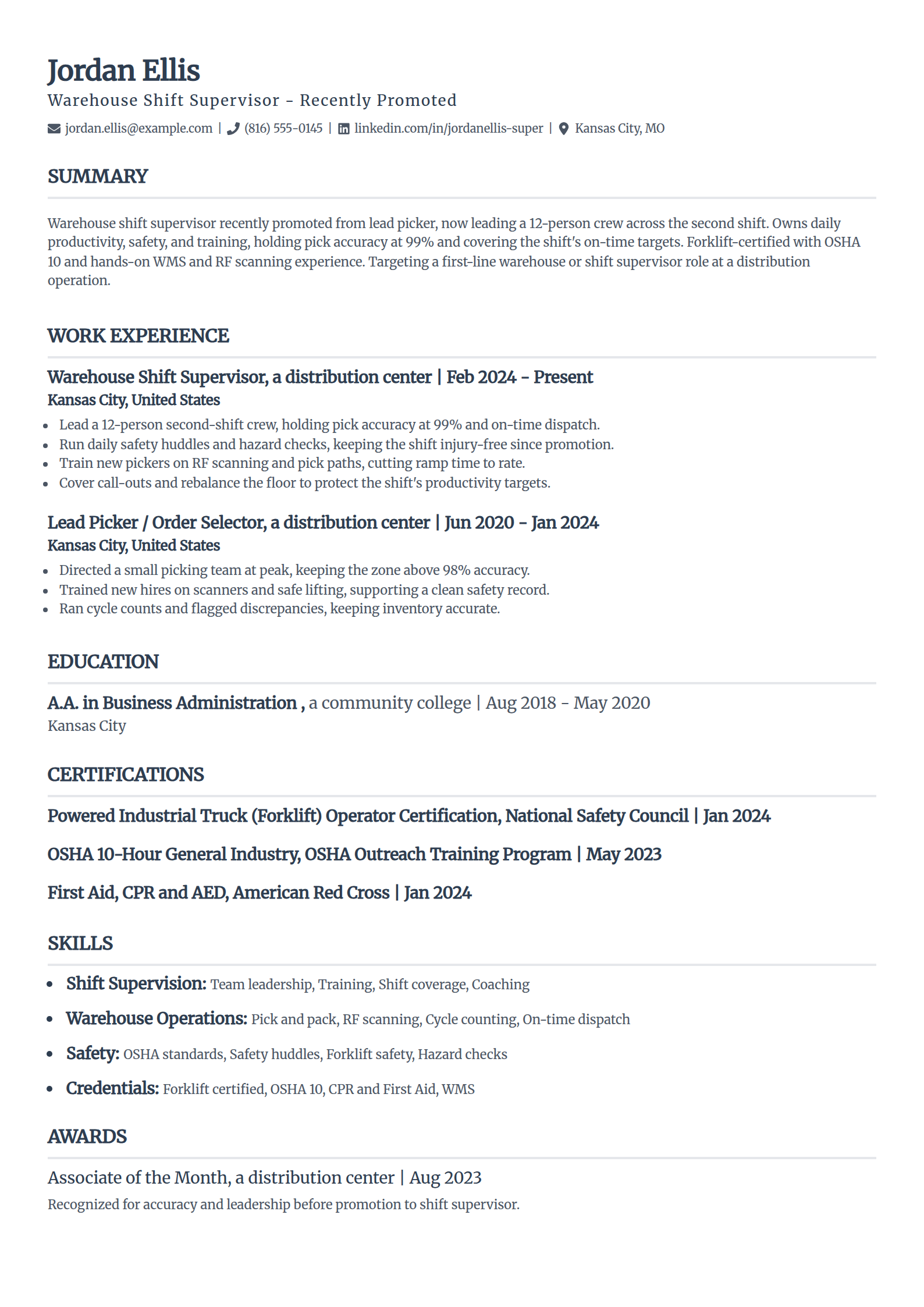
First-Time Supervisor Resume Template
Why this resume example works?
- Written for the promotion, a lead picker just stepped up to run a 12-person second-shift crew.
- Shows both roles so the move up reads, the new supervisor entry above the individual-contributor lead role it grew from.
- Keeps results honest for a first title, pick accuracy at 99% and an injury-free shift since promotion.
- Names the forklift certification and OSHA 10 that back a first supervisor posting.
- Fills a tight, ATS-safe page without padding, the right shape for a first supervisor resume.
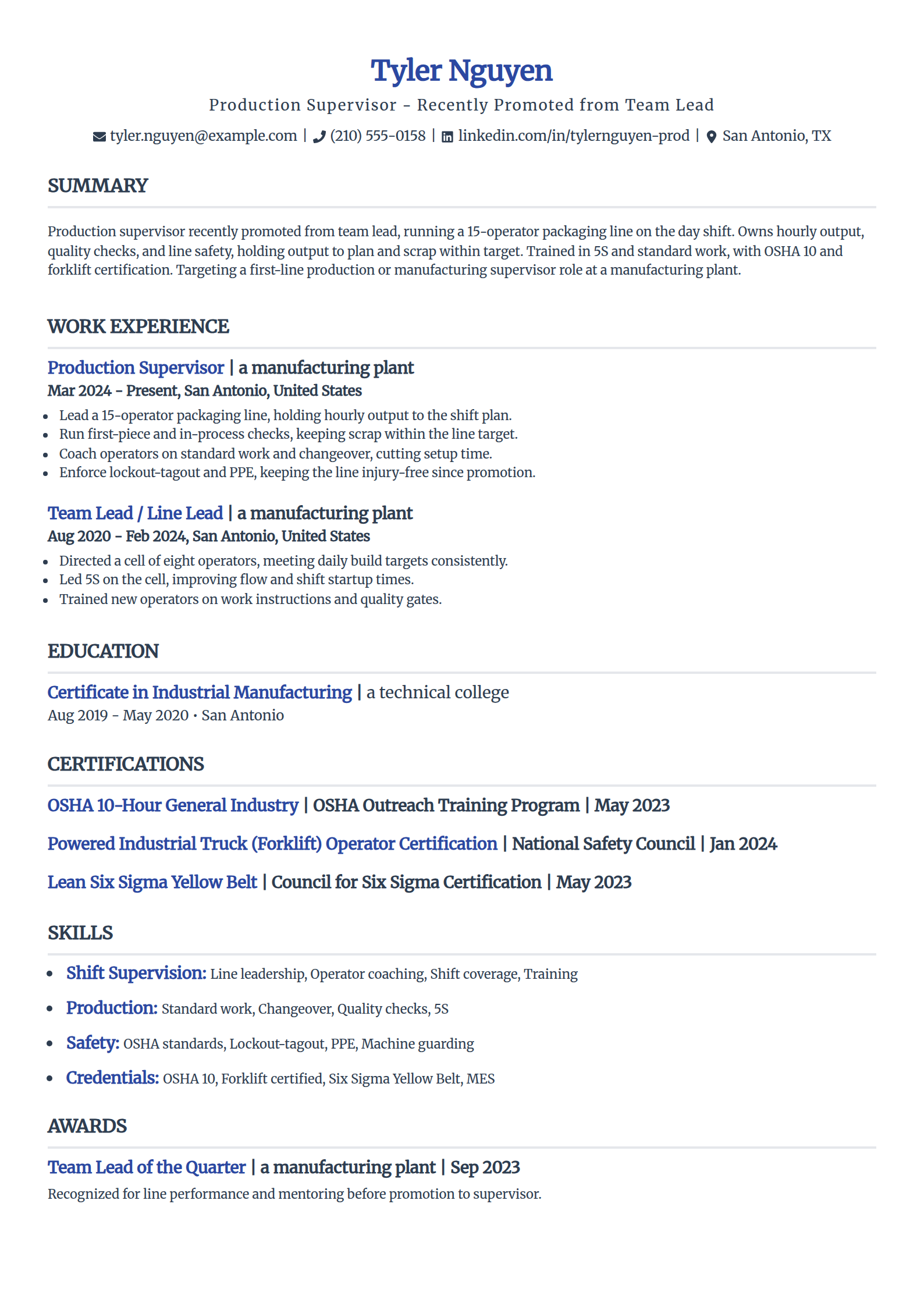
Team Lead to Supervisor Resume Template
Why this resume example works?
- Written for the step up, a team lead just promoted to run a 15-operator packaging line.
- Shows the lead role that earned the promotion right below the new supervisor entry, so the ladder is clear.
- Keeps results level-accurate, hourly output held to plan and scrap within target since promotion.
- Names the OSHA 10, forklift, and Six Sigma Yellow Belt that a first production-supervisor posting checks.
- Fills a tight, ATS-safe page with the shop-floor record a first-line role wants to see.
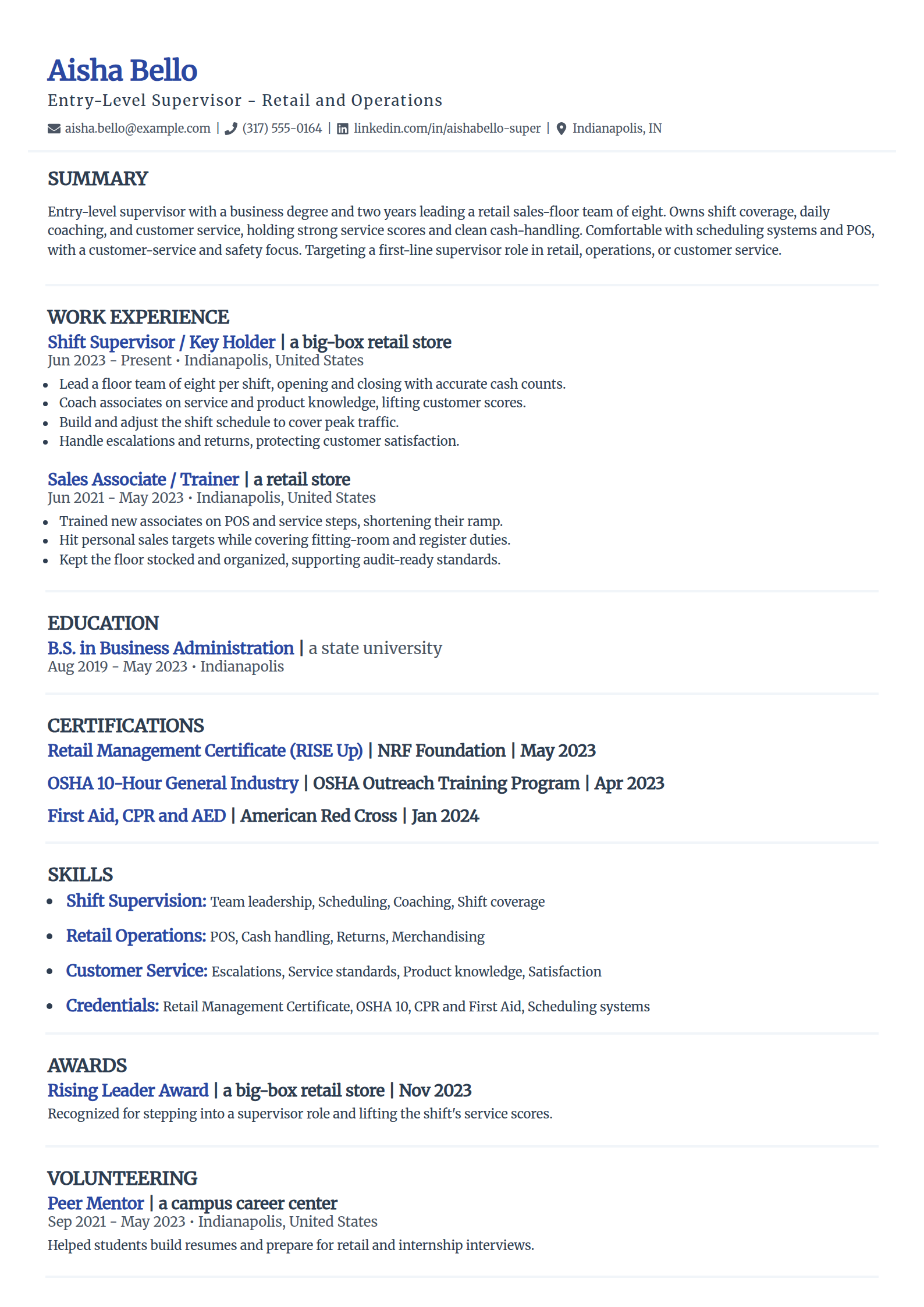
Entry-Level Supervisor Resume Template
Why this resume example works?
- Written for a first supervisor job, leading with a business degree and two years running a sales-floor team of eight.
- Shows the supervisory work already done, opening and closing, scheduling, and coaching associates.
- Keeps the numbers honest for the level, clean cash-handling and strong customer scores.
- Names the credentials that help a new supervisor, a retail management certificate, OSHA 10, and CPR.
- Fills a tight, ATS-safe page with a degree and a real record instead of padding.
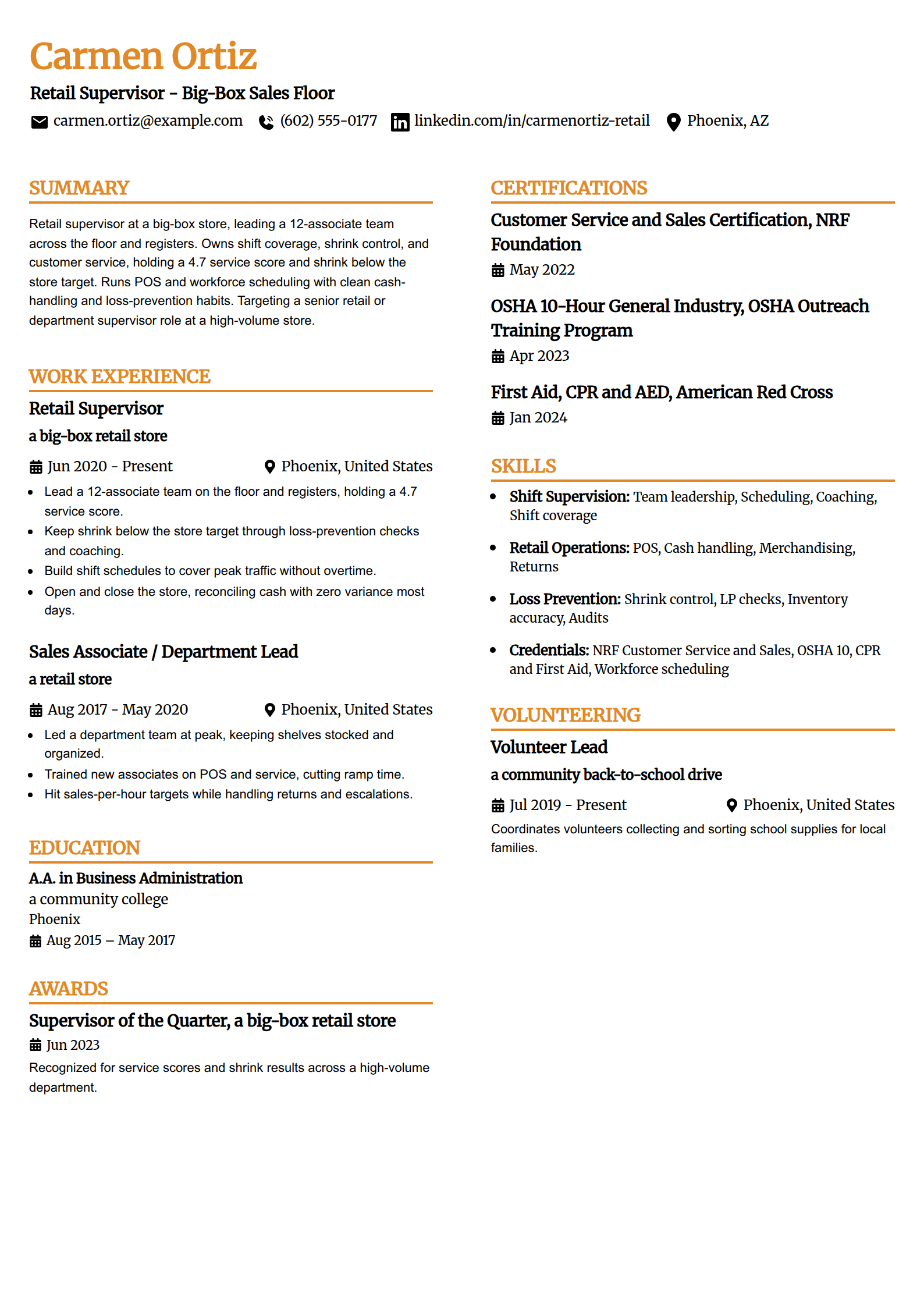
Retail Supervisor Resume Template
Why this resume example works?
- Leads with store scope, a 12-associate team across the floor and registers at a big-box store.
- Carries the numbers retail screens for, a 4.7 service score and shrink below the store target.
- Shows the shift ownership a supervisor holds, scheduling, opening and closing, and clean cash reconciliation.
- Names the tools and credential a floor runs on, POS and workforce scheduling with an NRF certification.
- Fills a tight, ATS-safe page cleanly, the right shape for a retail supervisor resume.
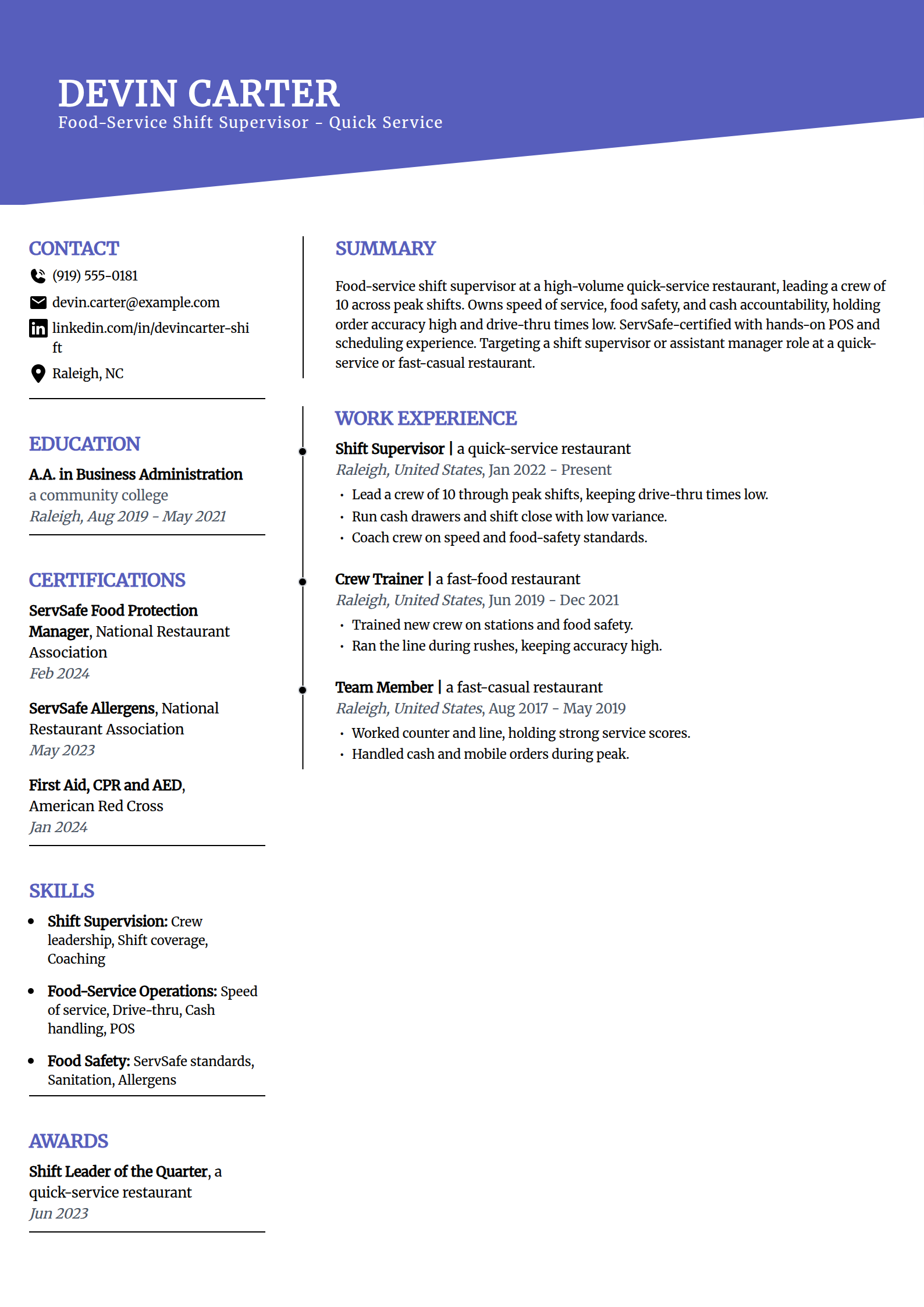
Shift Supervisor (Food Service) Resume Template
Why this resume example works?
- Leads with the shift a quick-service role hires for, a crew of 10 through peak with drive-thru times kept low.
- Shows the accountability a shift lead owns, cash drawers and close with low variance.
- Keeps food safety front and center, ServSafe standards coached every shift.
- Names the ServSafe credentials a food-service posting requires.
- Lists awards without long descriptions, keeping the layout clean and balanced.
Build your supervisor resume
Pick a template above and the editor keeps your layout clean and ATS-safe while you swap in your own team size, safety record, and certifications.
Build my resumeHow to write a supervisor resume in 2026
A hiring team scans a supervisor resume for two things: the size and type of team you run, and whether you can prove results at the frontline. Lead with a short summary that names your industry, your team size and shift, your strongest number, and your certifications, then make every bullet a result with one number, like safety record, throughput, quality rate, or attendance. Keep your scope honest: a supervisor owns a shift, team, or line, not a department budget. Keep the format simple so a parser reads it as easily as a person does.
Open with a team-size-and-numbers summary
Write three to four sentences that name your industry, your team size and shift, your strongest frontline number, your systems, and the supervisor role you are targeting. A warehouse supervisor leads with pick accuracy and safety; a production supervisor leads with throughput and scrap; a call-center supervisor leads with handle time and CSAT. Keep it to about 60 words so it never spills past the top of the page.
Warehouse supervisor leading a 32-person team across the second shift at a regional distribution center that moves 40,000 units a day. Owns pick accuracy, throughput, and floor safety, holding 99.6% accuracy and 180 days without a recordable injury. Runs Manhattan WMS, RF scanning, and UKG timekeeping, with OSHA 30 and forklift certification. Targeting a senior warehouse supervisor role at a high-volume distribution operation.
Make every experience bullet a result with a number
This is what separates a supervisor resume from a frontline-worker resume. Name what you led, the action, and the outcome, then attach one credible number and the method or system that produced it.
- Use the numbers a supervisor owns: team size, safety record (OSHA recordables or days without an incident), throughput or units per hour, quality or defect rate, attendance, and turnover.
- Open with a strong verb like led, ran, cut, raised, trained, or coached, never "Responsible for" or "Helped with".
- Name the method or system: "cut order errors 35% by rebuilding the RF scanning workflow in Manhattan WMS".
- Keep numbers modest and level-accurate: a supervisor shows a shift's results, not company-wide revenue; one number per bullet is plenty.
Decide if you are a supervisor or a manager
This is the honest call most guides skip, and the fastest way to lose a hiring manager is to claim scope you did not own. A supervisor runs a shift, team, or line and carries out the plan; a manager owns a department's budget or P&L and sets it. Frame the resume for the role you actually held.
- Call yourself a supervisor when you led a shift or team, held safety and quality numbers, and executed a plan someone above you set.
- Call yourself a manager only when you owned a department budget or P&L, hired and fired, and set direction; if that is you, the manager resume page fits better.
- Do not inflate a shift lead into P&L language you never touched; a hiring team checks it in the interview and discounts the whole resume when it does not hold.
- If you did both over time, lead with the higher scope but keep each role's bullets true to what you owned there.
Show your certifications and licenses
Your safety and role credentials are among the first things a hiring team verifies, so put them where they are easy to find. Which ones matter depends on your industry.
- Warehouse, distribution, and production: list OSHA 10 or OSHA 30 and a forklift (powered industrial truck) certification; add a Lean Six Sigma belt where it fits.
- Maintenance: name a CMMS, plus credentials like CMRT, EPA 608, and NFPA 70E electrical safety.
- Food service and sanitation: list ServSafe Food Protection Manager, and HACCP or PCQI for a sanitation role.
- Security: list your state guard license and a Certified Protection Officer credential; keep First Aid and CPR current across every industry.
Match skills and keywords to the job posting
A skills block should read like the posting, grouped so a recruiter and a parser both find what they need. List the systems and areas you have actually run, not a generic dump.
- Group by type: shift supervision, operations, safety and compliance, and systems.
- Name the systems you run: a WMS like Manhattan or SAP EWM, an MES, Kronos or UKG, Five9 or Zendesk, or a CMMS, depending on your industry.
- Name your industry outright, warehouse, production, retail, call center, maintenance, security, or food service, since hiring teams filter on it.
- If the posting says "team lead", "shift supervisor", or "safety compliance", use that exact phrasing where it fits, since that is what the applicant tracking system searches for.
Keep the format clean and ATS-safe
A supervisor resume is read by a parser first and a hiring manager second, so a clean layout with standard headings is the safe choice at every level.
- Use a single-column or simple two-column layout with standard headings a parser recognizes; skip heavy graphics and photos.
- Keep it to one page for under about ten years of experience; most supervisors fit a strong record on a single page.
- Save as a PDF so the formatting holds, then run it through our ATS resume checker for a quick format and keyword pass.
- Swap the numbers in the templates above for your own team size, safety record, and certifications; do not copy them as is.
Common supervisor resume mistakes
- Writing it like a manager resume. Claiming department P&L, budgets, or company-wide strategy you did not own reads as inflated; lead with the shift, team, and line you actually ran and the numbers you held there.
- Not stating your team size. "Supervised staff" tells a hiring team nothing; say how many people you led and on which shift, like "led a 32-person second-shift team".
- Leaving out the safety record. Frontline supervisors are judged on safety, so put your OSHA recordables, days without an incident, or TRIR on the page, not just "maintained a safe workplace".
- Skipping the numbers a supervisor owns. Replace "ran daily operations" with "held pick accuracy at 99.6% and units per hour eight percent above target". No numbers means no proof of results.
- Hiding your certifications. OSHA, forklift, ServSafe, or a state guard license often clear the first screen, so list them by your name or in a certifications block, not buried at the bottom.
Frequently asked questions
What should a supervisor put on a resume?
Lead with a three-to-four-sentence summary that names your industry, your team size and shift, your strongest frontline number, and your certifications. Under each job, write results-first bullets that open with a strong verb and carry one credible number, like holding pick accuracy at 99.6% or running 180 days without a recordable injury. Name the systems you ran, list OSHA, forklift, ServSafe, or other certifications in their own block, and keep the whole thing to one clean, ATS-safe page.
What is the difference between a supervisor and a manager resume?
A supervisor runs a shift, team, or line and carries out the plan, so a supervisor resume leads with team size, safety record, throughput, and quality numbers for the shift you owned. A manager owns a department's budget or P&L, hires and sets direction, so a manager resume leads with budget, headcount, and strategy across a department. The honest rule is to frame the resume for the role you actually held: claiming P&L you never owned is the fastest way a hiring team discounts the whole resume. If you managed a department and its budget, the manager resume page fits better.
How do you write a first-time supervisor resume with no supervisor experience?
Lead with what you do have. If you were promoted from an individual-contributor role, show both roles so the move up reads, with the new supervisor entry above the lead or senior role it grew from. Highlight the supervisory work you already did, training new hires, running a shift when the lead was out, owning safety or quality on your line, and treat each as a real experience entry with quantified bullets. Show the certification that clears the first screen, like OSHA 10 or a forklift certification, and keep the scope honest: leading a small crew or a shift, not a department budget. The first-time and team-lead examples above show the shape.
What skills and certifications go on a supervisor resume?
Group skills into shift supervision, operations, safety and compliance, and systems, and name the tools you actually ran, like a WMS, an MES, Kronos or UKG, Five9 or Zendesk, or a CMMS. For certifications, match your industry: OSHA 10 or OSHA 30 and a forklift certification for warehouse, distribution, and production; ServSafe for food service; HACCP or PCQI for sanitation; CMRT, EPA 608, or NFPA 70E for maintenance; a state guard license and CPO for security. Keep First Aid and CPR current across every industry, and add a Lean Six Sigma belt where it fits.
What metrics should a supervisor put on a resume?
Use the numbers that prove frontline results: team size supervised, safety record (OSHA recordables, days without an incident, or TRIR), throughput or units per hour, quality or defect rate, attendance, turnover, and training delivered. Keep them modest and level-accurate, one number per bullet, and tie each to the method that produced it, like holding pick accuracy at 99.6% through a rebuilt scanning workflow. Show a shift's results, not company-wide revenue, since that belongs on a manager resume.
How long should a supervisor resume be?
One page for most supervisors with under about ten years of experience, including first-time supervisors, shift leads, and experienced frontline supervisors. A longer senior or multi-site record can run to two pages, but only when the second page carries results, not filler. Lead with your most recent and highest-scope role, keep standard headings, and cut older or unrelated jobs so the space goes to the work that matches the role you want.
More supervisor resume resources
Build your supervisor resume
Pick a template above and the editor keeps your layout clean and ATS-safe while you swap in your own team size, safety record, and certifications.