Manufacturing Resume Examples for 16 Jobs on the Plant Floor
- ATS Friendly
- Plant Floor Specific
- 16 Real Examples
A manufacturing resume needs five things: a three to four sentence summary naming the equipment you run and the shift you work, experience bullets carrying plant numbers such as units per hour, scrap percent, uptime or changeover minutes, a certifications block with your OSHA card and forklift evaluation, a skills list naming machines and systems outright, and one clean page. The 16 examples below show it done for 16 different plant jobs.


540k+ resumes created
Editable manufacturing resume templates
Each template below is a real plant-floor resume laid out in that format, covering assembly, machining, quality, maintenance-adjacent technician work, supervision and plant leadership. Pick one, then swap in your own machines, rates and certifications. Every layout keeps your name, OSHA card and impact bullets where a hiring manager looks first and where an applicant tracking system can parse them.
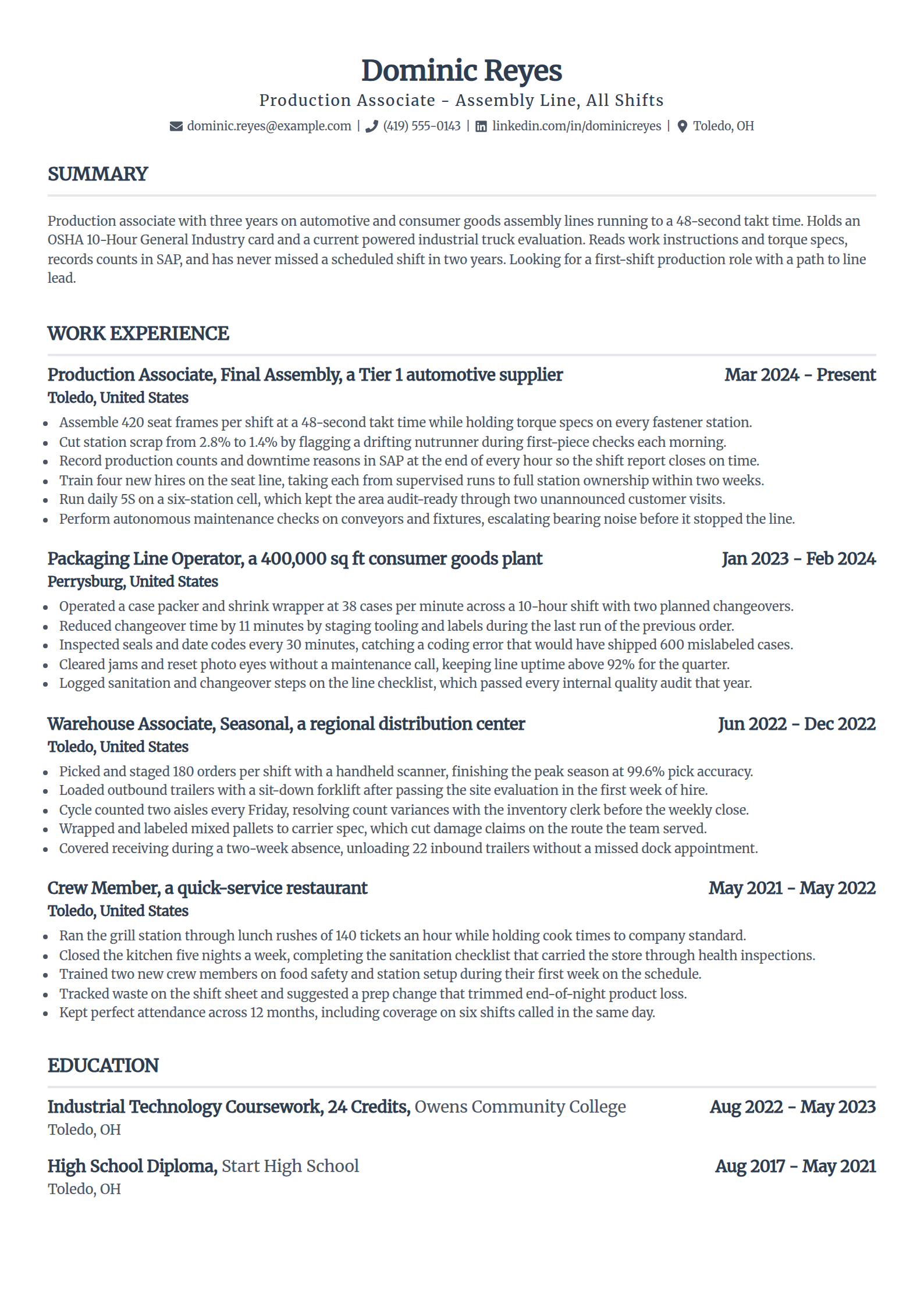
Production Associate Resume Template (Assembly Line)
Why this resume example works?
- Names the takt time in the summary, 48 seconds, which tells a plant hiring manager exactly what pace this person holds.
- Attaches a plant number to the work: scrap cut from 2.8% to 1.4% by catching a drifting nutrunner at first-piece check.
- Puts the OSHA 10 card and the forklift evaluation in the certifications block instead of hiding them in a skills list.
- Says the attendance record out loud, since reliability is what actually decides a production hire on most floors.
- Keeps the restaurant job on the page in three tight lines, which answers the work-history question a sparse resume raises.
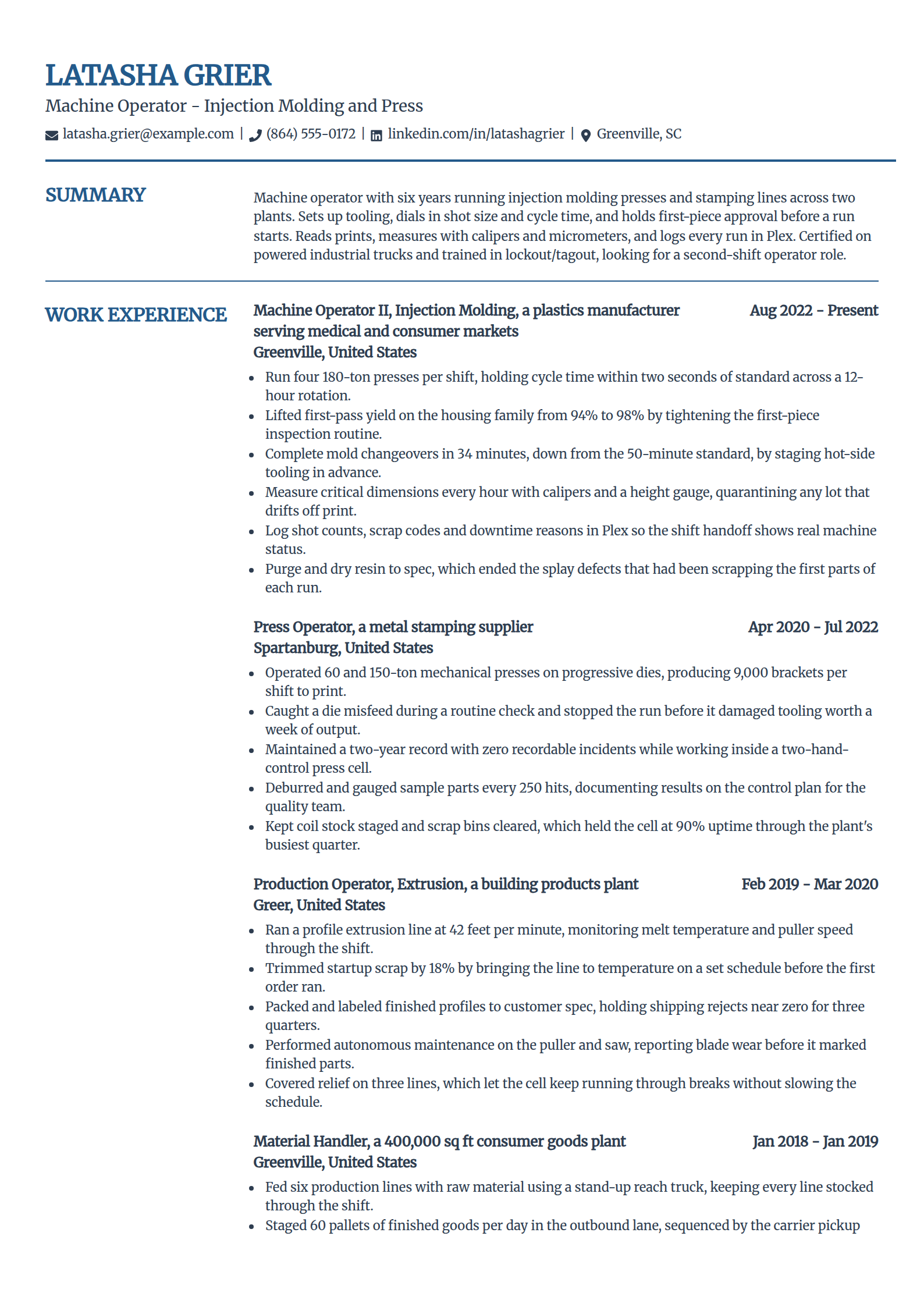
Machine Operator Resume Template
Why this resume example works?
- Leads with the machines by name, 180-ton injection presses and 60 and 150-ton mechanical presses, not with a generic job title.
- Shows setup ownership rather than button-pushing: mold changeovers in 34 minutes against a 50-minute standard.
- Carries a quality number an operator can own, first-pass yield from 94% to 98% on one part family.
- Names the measuring tools and the system of record, calipers, height gauge and Plex, which are posting keywords.
- Builds a clear ladder from material handler to operator II, so the progression reads without the reader doing the math.
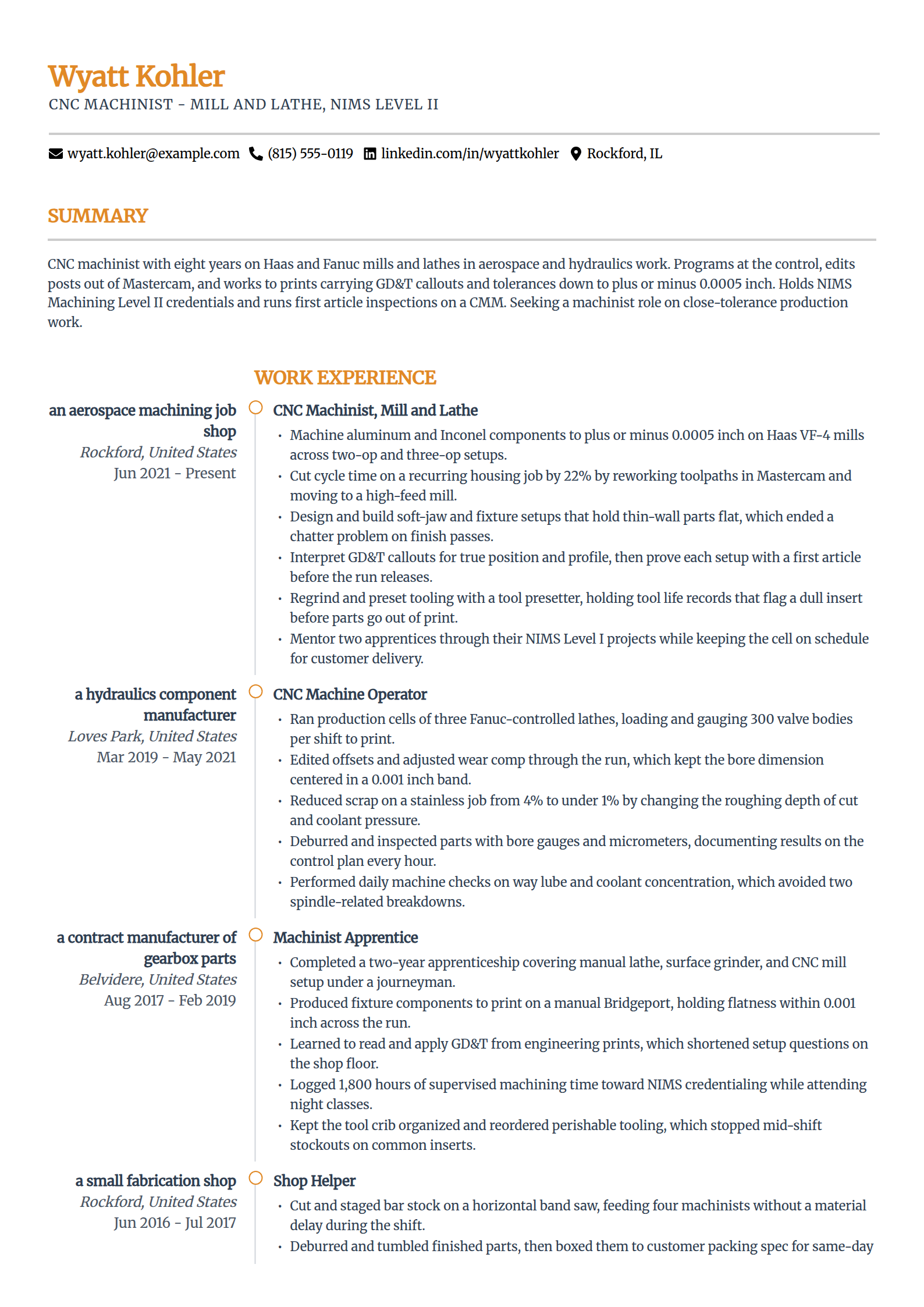
CNC Machinist Resume Template
Why this resume example works?
- States the tolerance the shop can expect, plus or minus 0.0005 inch, which is the number a machining manager screens on.
- Separates programming from operating: edits at the control, posts out of Mastercam, and proves setups with a first article.
- Lists NIMS Machining Level I and II under the issuing body, so the credential is verifiable rather than decorative.
- Names materials and machines together, aluminum and Inconel on Haas VF mills, which matches how job postings are written.
- Shows one improvement with a method attached, 22% off cycle time by reworking toolpaths and moving to a high-feed mill.
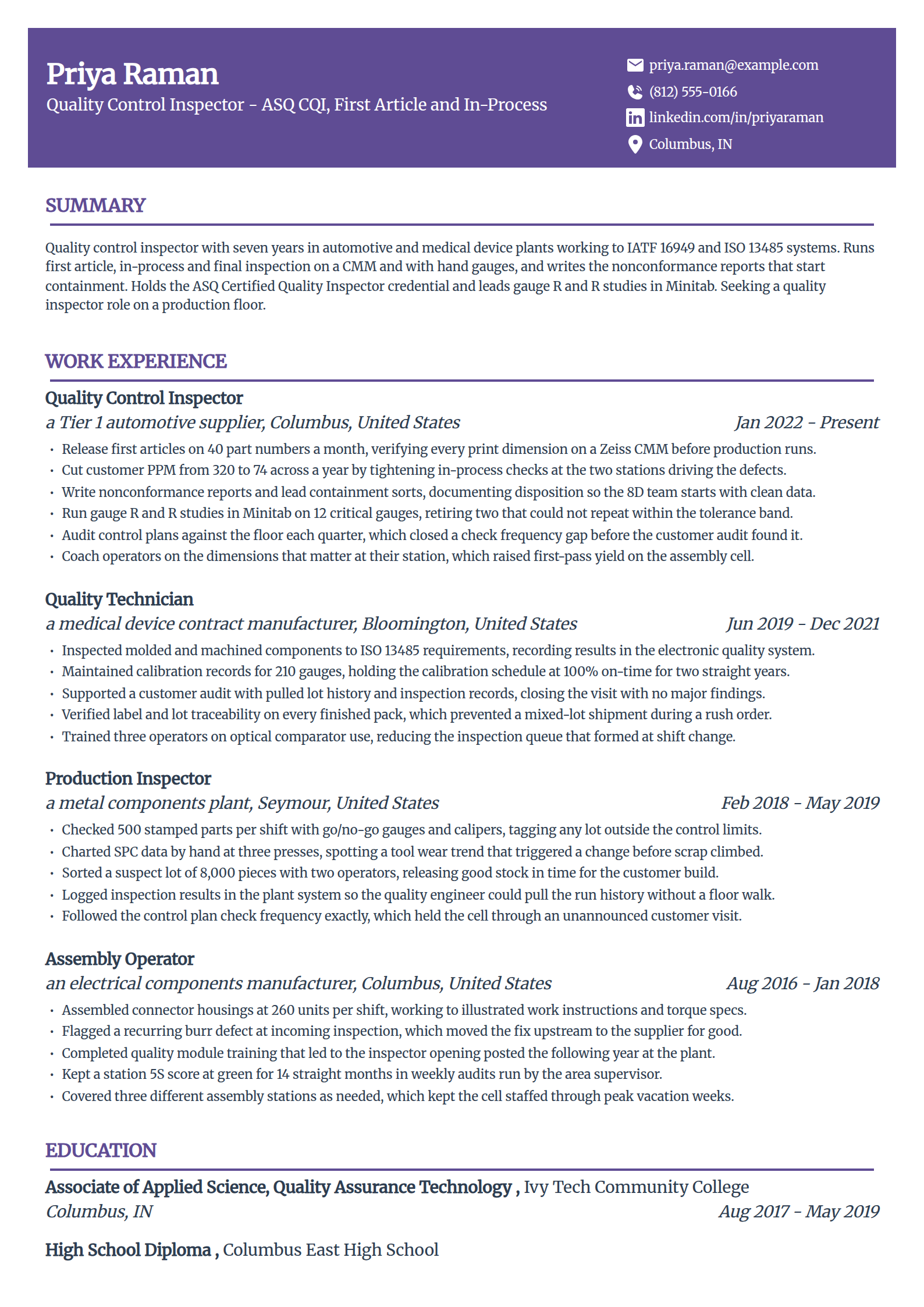
Quality Control Inspector Resume Template
Why this resume example works?
- Opens on the quality systems the plant runs to, IATF 16949 and ISO 13485, which is the first filter for inspector roles.
- Uses the unit a quality manager actually tracks: customer PPM from 320 to 74, not a vague efficiency percentage.
- Splits the inspection types, first article, in-process and final, so a reader knows which part of the job this person owns.
- Names the equipment and the software, Zeiss CMM, optical comparator and Minitab for gauge R and R studies.
- Keeps the credential honest: ASQ Certified Quality Inspector, with the Yellow Belt listed separately rather than inflated.
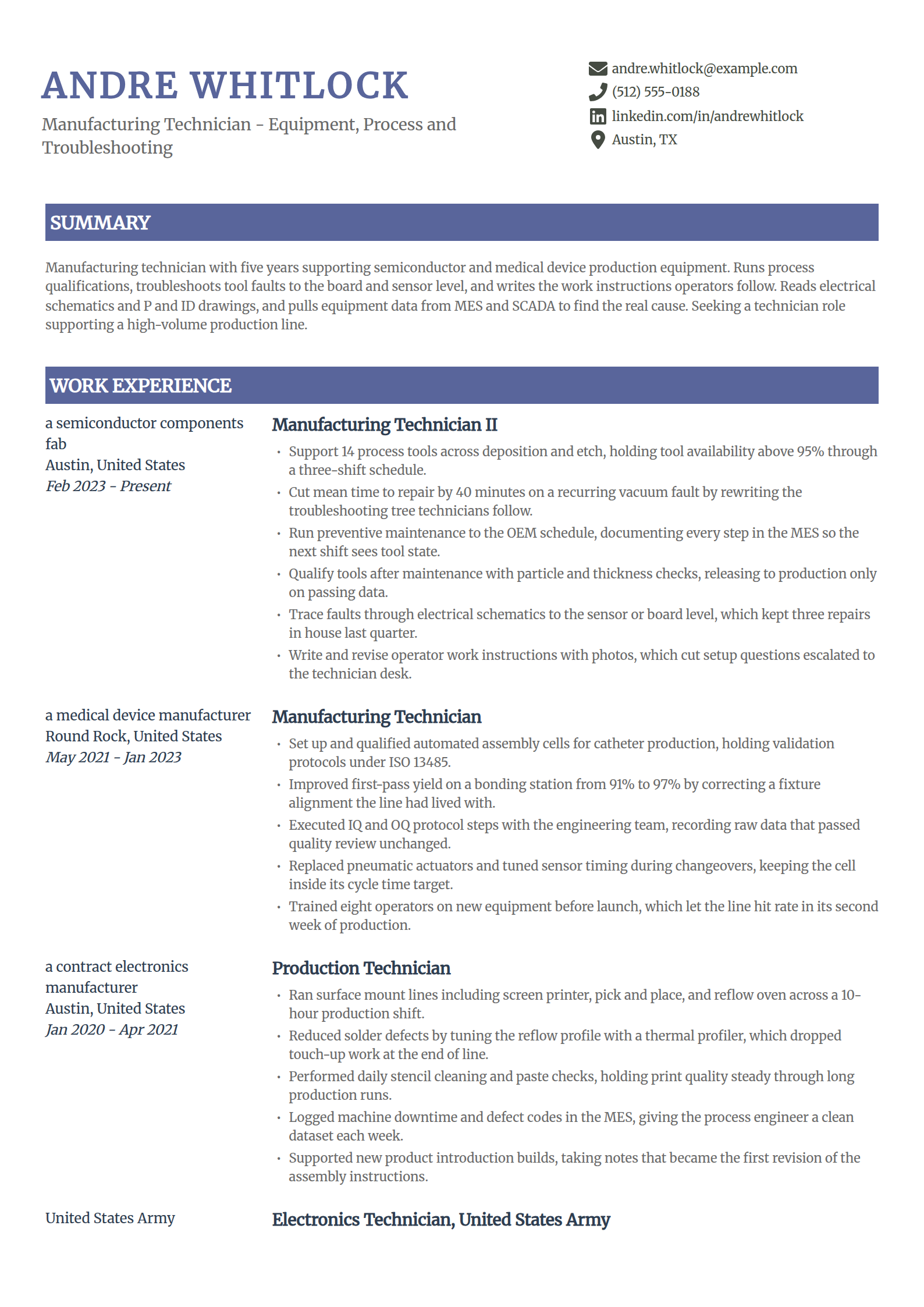
Manufacturing Technician Resume Template
Why this resume example works?
- Frames the job as uptime ownership, tool availability above 95% across 14 process tools on a three-shift schedule.
- Proves troubleshooting depth by naming the level, faults traced through schematics to the sensor or board.
- Shows the documentation side of the role, work instructions and validation protocol steps, which most examples skip.
- Translates military electronics work into plant language without dropping the detail that made it credible.
- Pairs a repair-time number with the fix behind it: 40 minutes off mean time to repair by rewriting the fault tree.
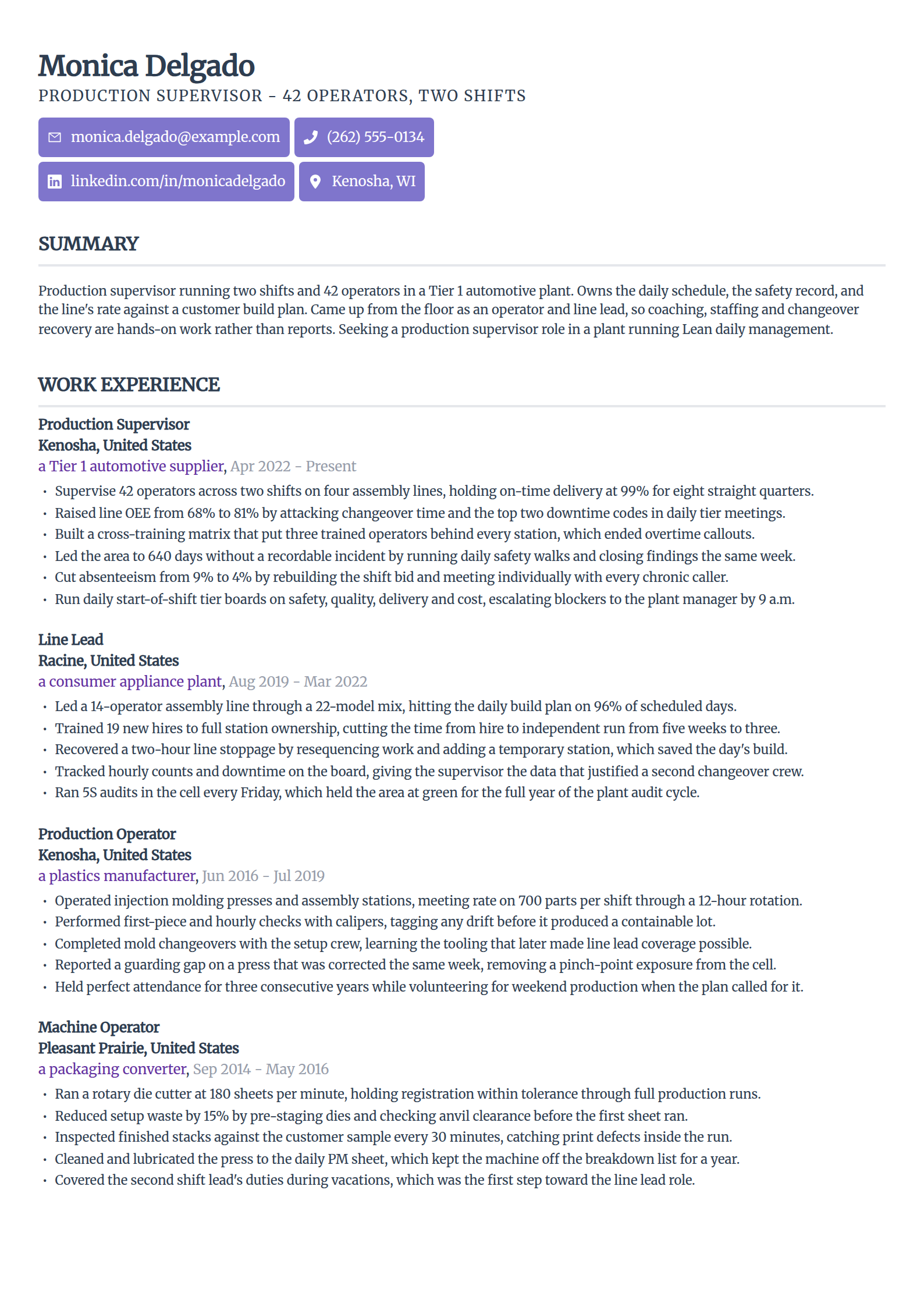
Production Supervisor Resume Template
Why this resume example works?
- Gives the scope in the headline, 42 operators across two shifts, so the reader sizes the job before the first bullet.
- Leads with the metrics a plant manager is graded on: on-time delivery at 99% and OEE from 68% to 81%.
- Shows people work with a number attached, absenteeism from 9% to 4% after rebuilding the shift bid.
- Names the safety record in days without a recordable incident, which is how plants actually report it.
- Traces the path from operator to line lead to supervisor, the promotion story most internal candidates fail to show.
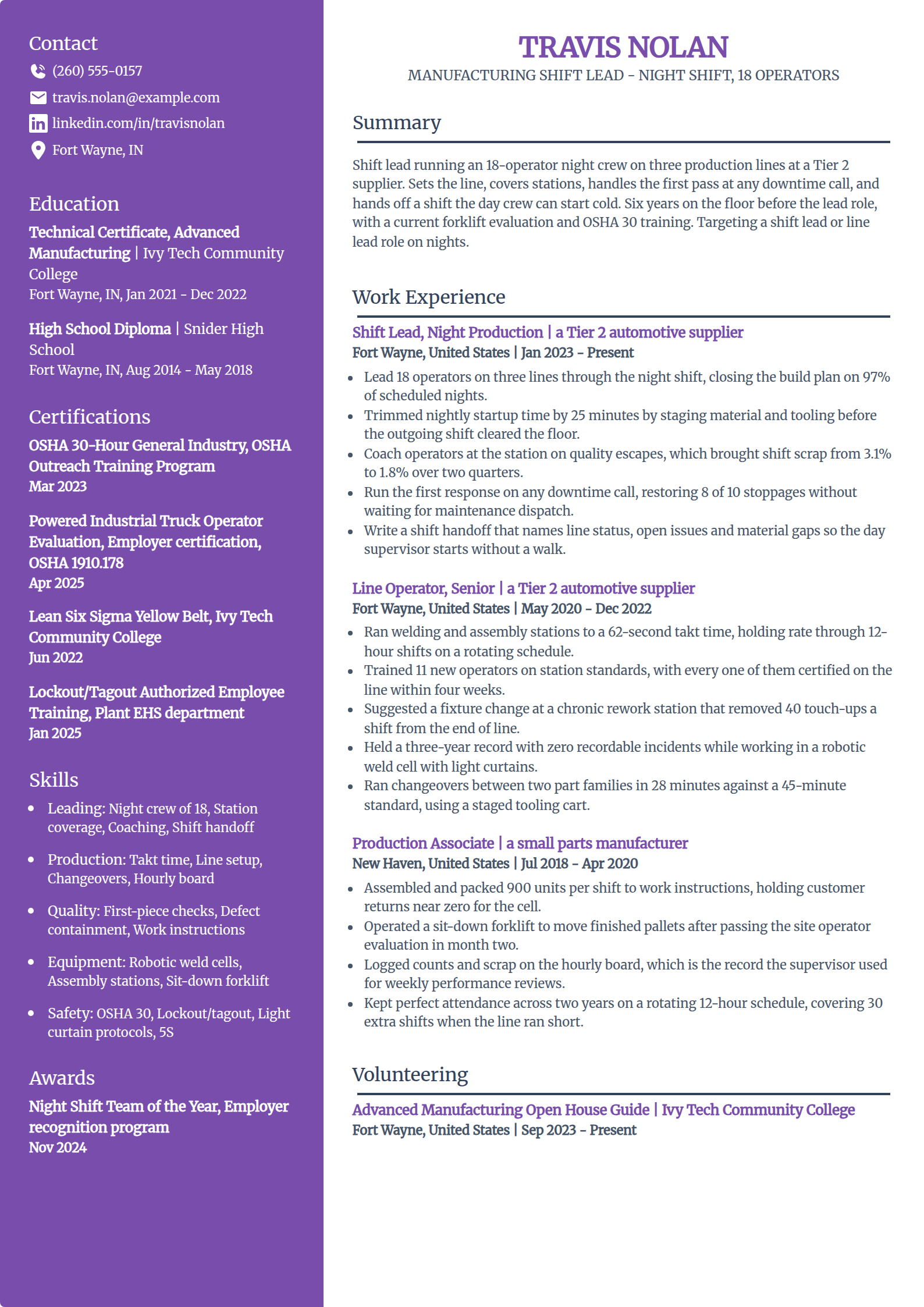
Shift Lead Resume Template (Manufacturing Team Lead)
Why this resume example works?
- Claims the shift in the headline, night shift and 18 operators, which is the detail night-shift postings screen for.
- Keeps the lead scope realistic: first response on downtime calls, not plant-level financial ownership.
- Quantifies the handoff problem it solves, 25 minutes off nightly startup by staging material before the shift change.
- Shows coaching results in quality terms, shift scrap from 3.1% to 1.8% over two quarters.
- Describes the written shift handoff, the single artifact that separates a working lead from a senior operator.
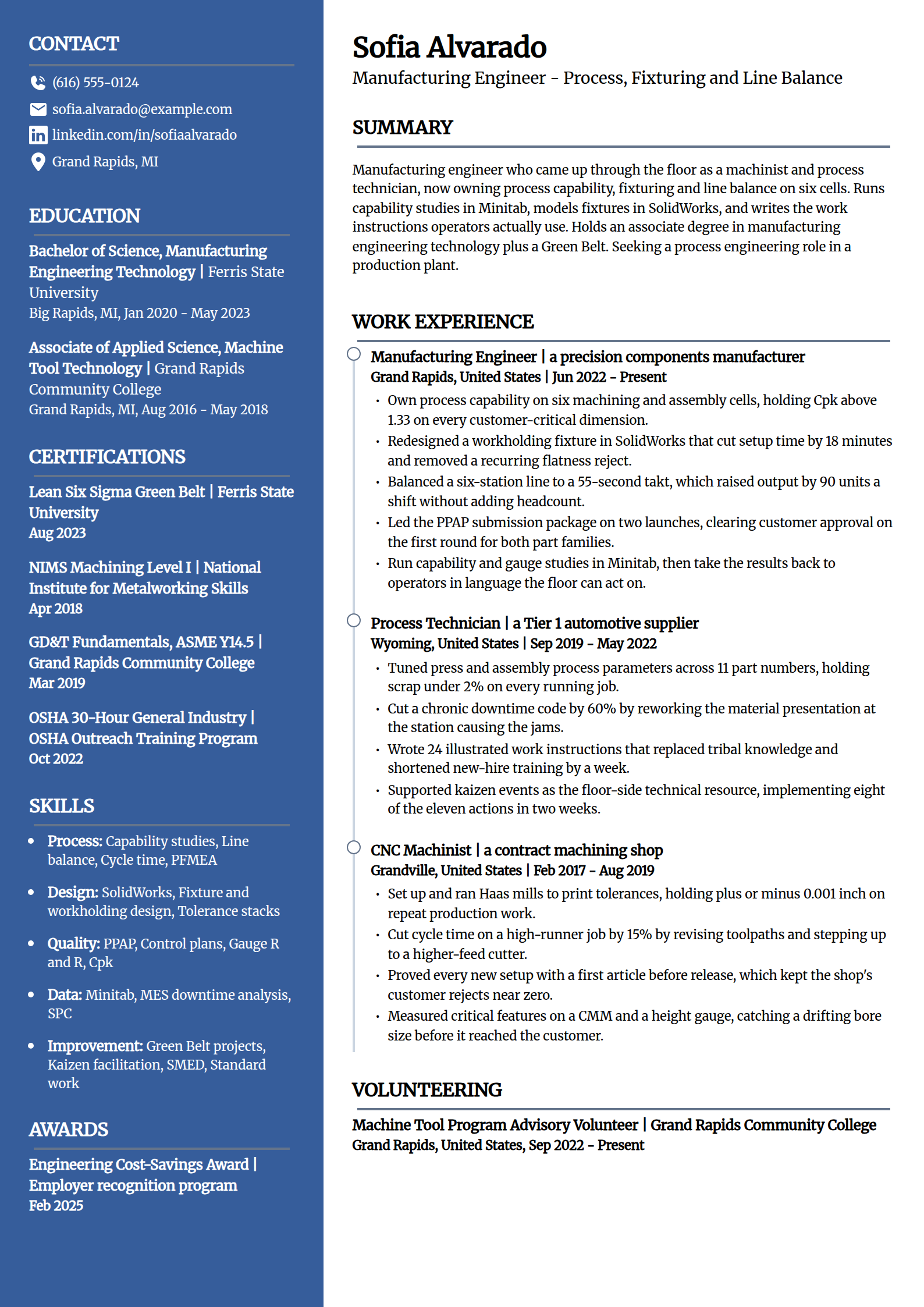
Manufacturing Engineer Resume Template (Up From the Floor)
Why this resume example works?
- Owns the engineering metrics precisely, Cpk above 1.33 on customer-critical dimensions, rather than claiming plant results.
- Shows a fixture redesign with both outcomes attached, 18 minutes off setup and a flatness reject removed.
- Proves the launch side of the job with PPAP submissions cleared on the first round for two part families.
- Keeps the machining and technician history on the page, because a floor-credible engineer is the point of this track.
- Names the toolkit a posting lists, SolidWorks, Minitab, PFMEA and control plans, in the reader's own vocabulary.
Plant Manager Resume Template (Production Manager)
Why this resume example works?
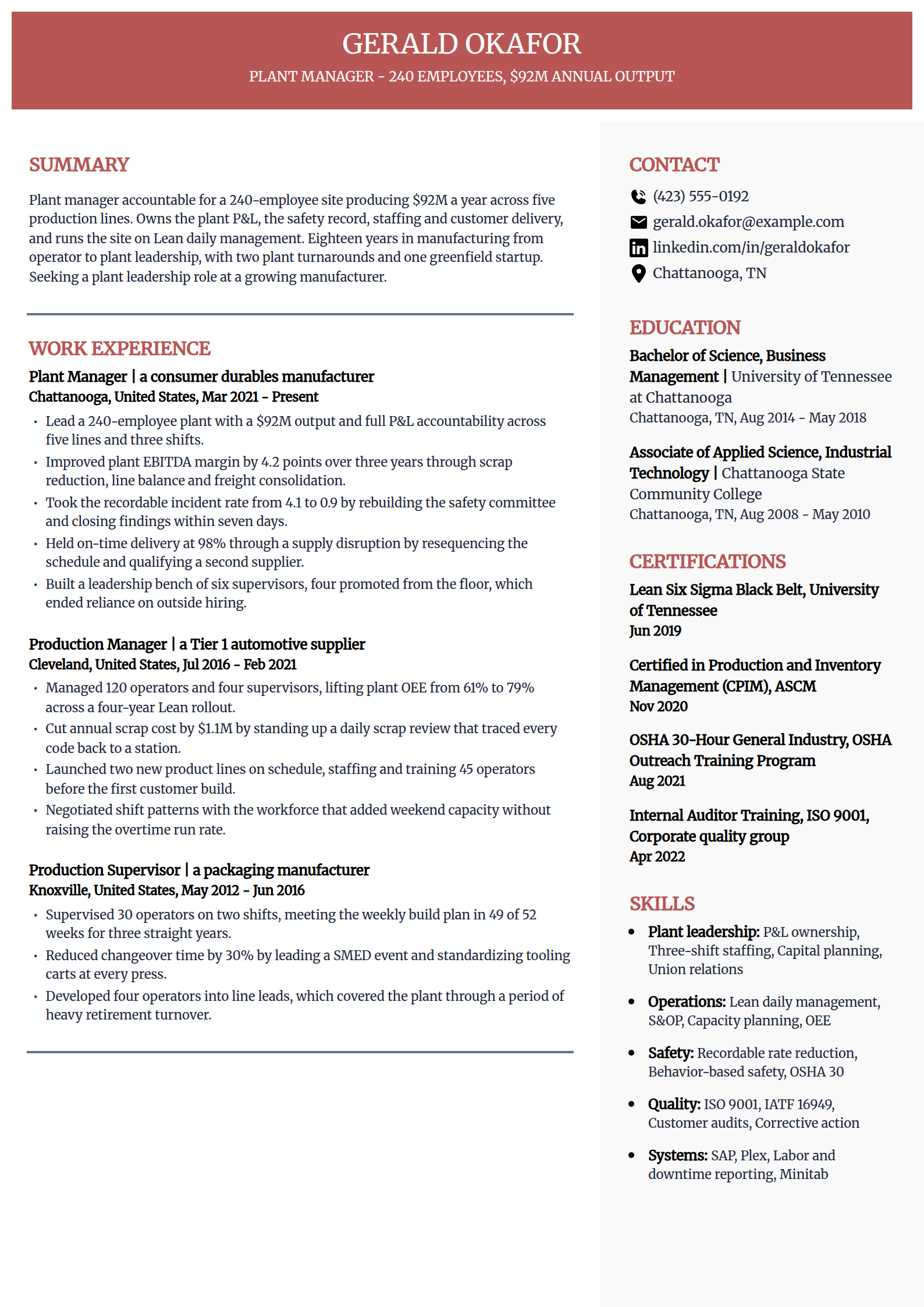
- States the scope a plant leadership search screens on first: 240 employees, five lines, $92M of output, full P&L.
- Reports margin as points, 4.2 points of EBITDA improvement, with the levers named instead of implied.
- Puts the safety record in the language of the role, recordable incident rate from 4.1 to 0.9.
- Counts the bench it built, six supervisors with four promoted from the floor, which is what a site owner is buying.
- Runs the career backward cleanly from plant manager to supervisor, so 18 years reads in a single scan.
Continuous Improvement Resume Template (Lean and Six Sigma)
Why this resume example works?
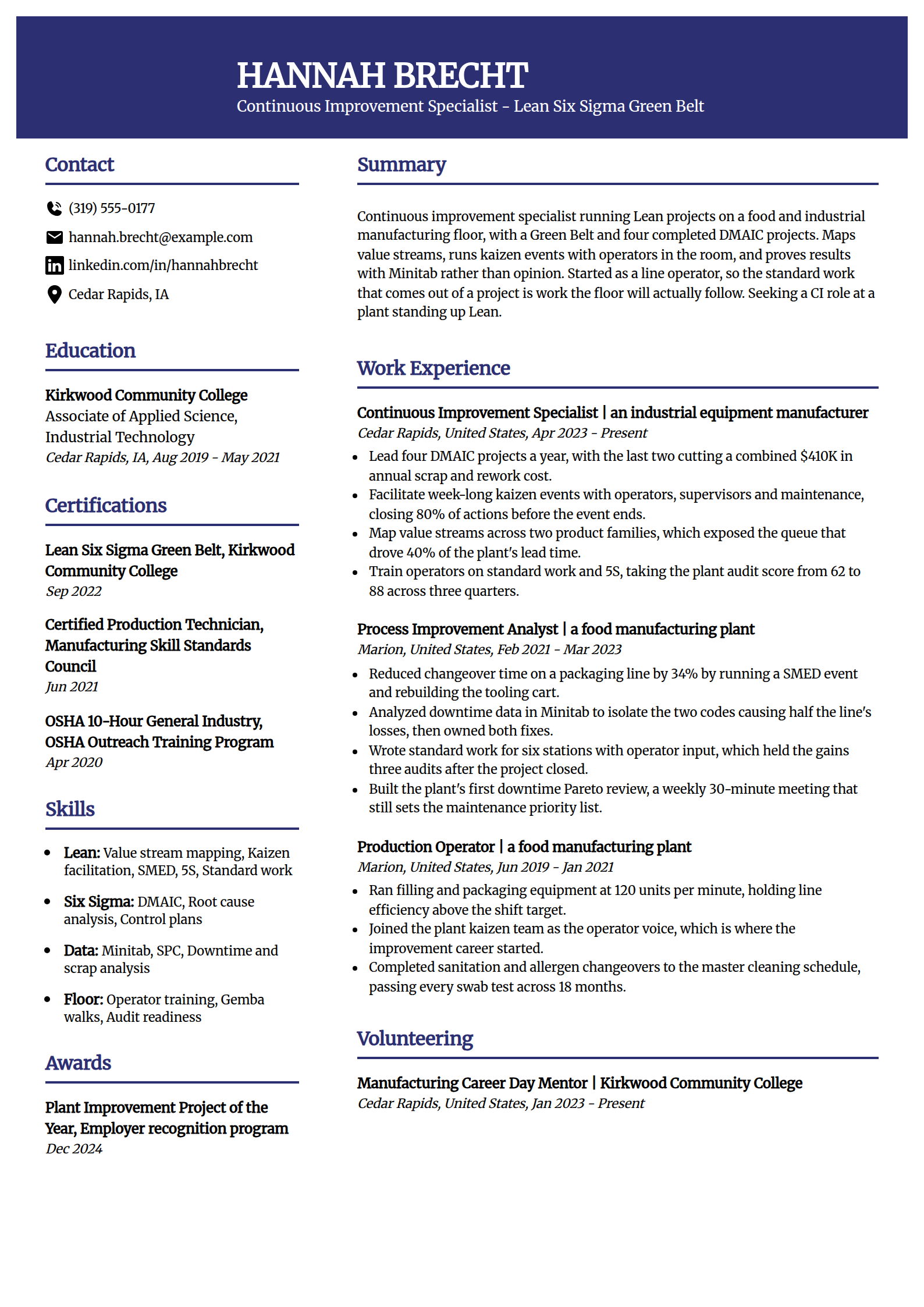
- Counts the projects and the money together, four DMAIC projects a year and $410K of scrap and rework removed.
- Shows the facilitation side of the work, kaizen events closing 80% of actions before the week ends.
- Keeps the operator years on the page, which is what makes standard work stick after the project team leaves.
- Names the belt with its issuing program rather than listing a floating Six Sigma line.
- Ties an audit score to the training behind it, 62 to 88 after operators were trained on standard work and 5S.
Warehouse to Manufacturing Resume Example
Why this resume example works?
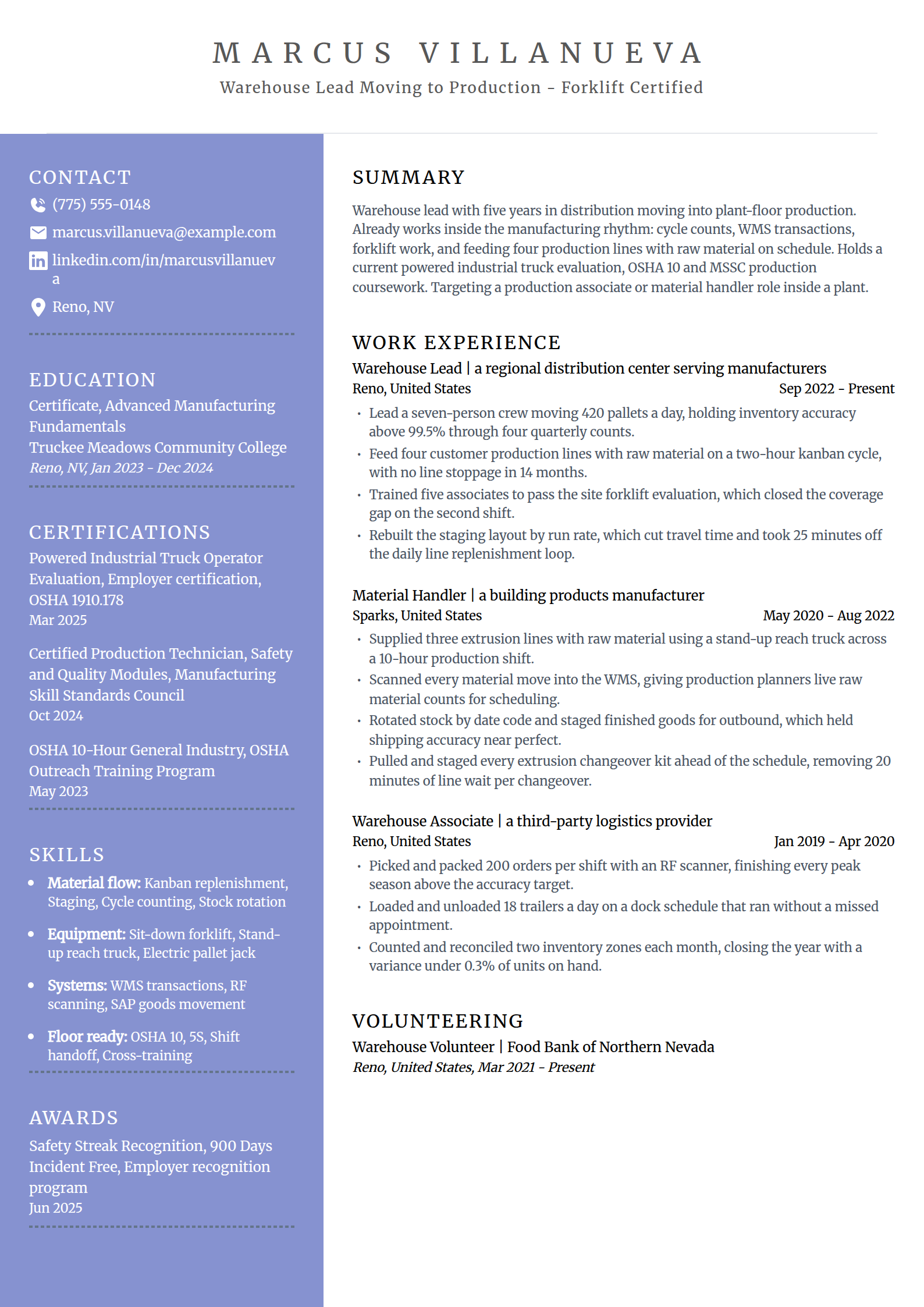
- Says the move in the headline, so a plant reader is not left to guess why a distribution resume is in the stack.
- Picks the warehouse work that already is manufacturing work: kanban replenishment feeding four production lines.
- Adds the credential that closes the gap, MSSC production coursework finished at night while working full time.
- Keeps the forklift evaluation current and dated, which is the practical thing a material-handler posting checks.
- Uses a streak rather than a claim, 14 months with no line stoppage, to prove reliability inside a plant rhythm.
Forklift-Certified Material Handler Resume Template
Why this resume example works?
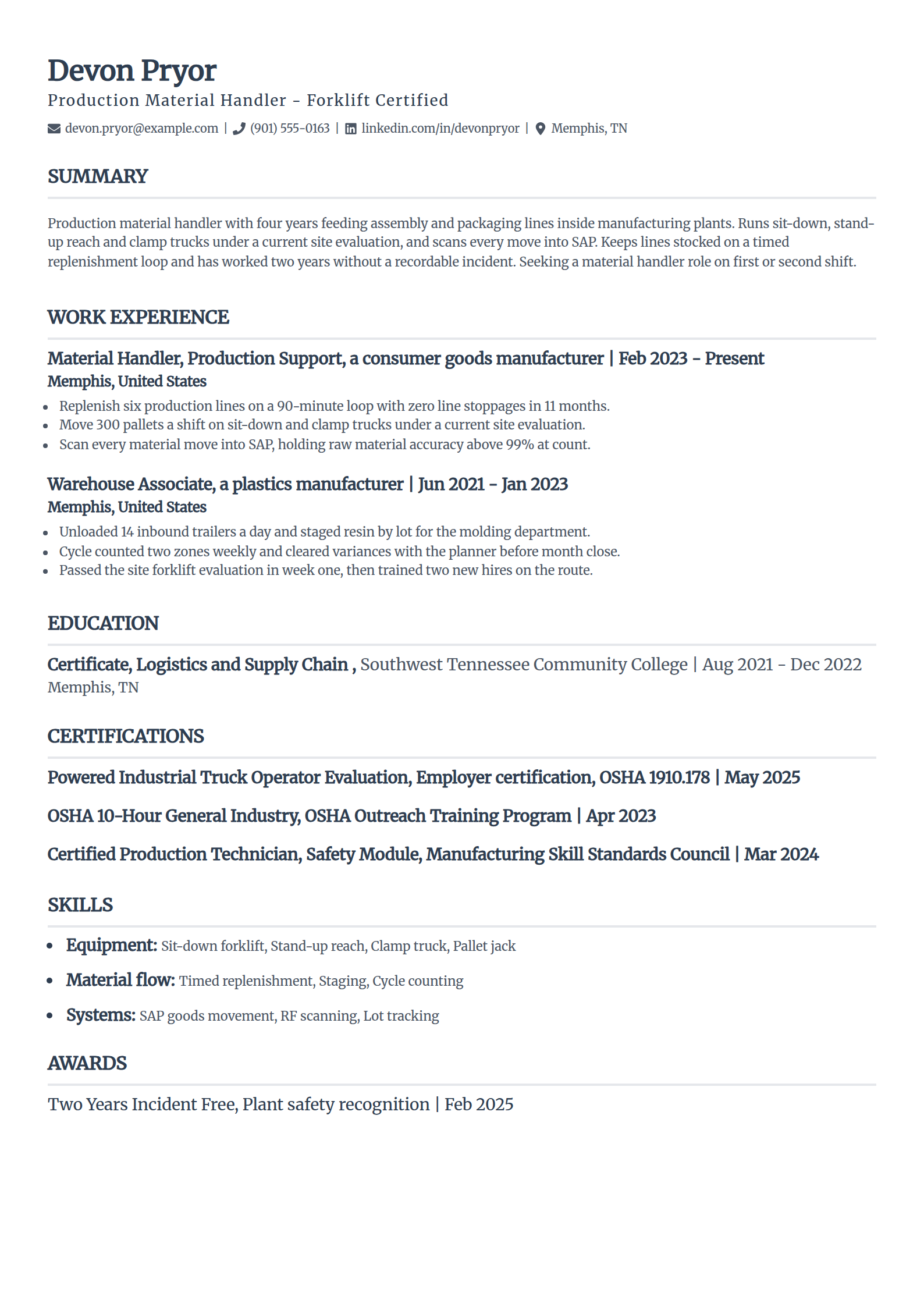
- Names the truck types separately, sit-down, stand-up reach and clamp, because plants hire for the one they run.
- Writes the forklift credential correctly, an employer evaluation under OSHA 1910.178 rather than a portable license.
- Quantifies the replenishment loop, six lines on a 90-minute cycle, which is the job in one line.
- Ties accuracy to the system, SAP scanning holding raw material accuracy above 99% at count.
- Fits a clean single page, which is the right length for a material-handler application read in under a minute.
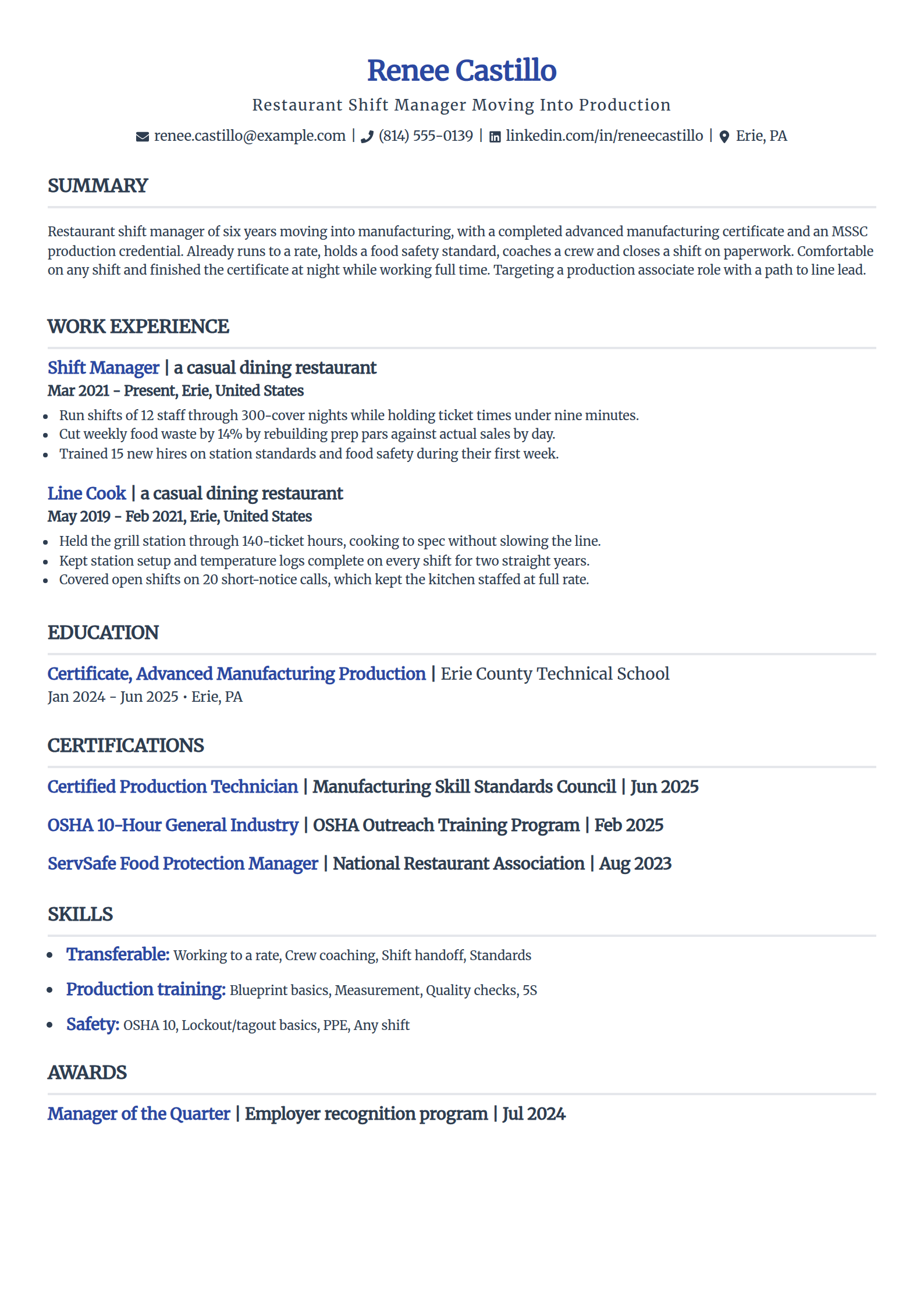
Career Change to Manufacturing Resume Example
Why this resume example works?
- Names the move in the headline so a screener reads the restaurant history as intent rather than a mismatch.
- Translates the old job into plant terms: running to a rate, coaching a crew, and closing a shift on paperwork.
- Puts the new credential first, an MSSC Certified Production Technician earned while working full time.
- Keeps one number per bullet, such as 14% off weekly food waste, so the transfer is evidenced and not asserted.
- States shift availability plainly, which removes the biggest objection to a career changer on a night-shift posting.
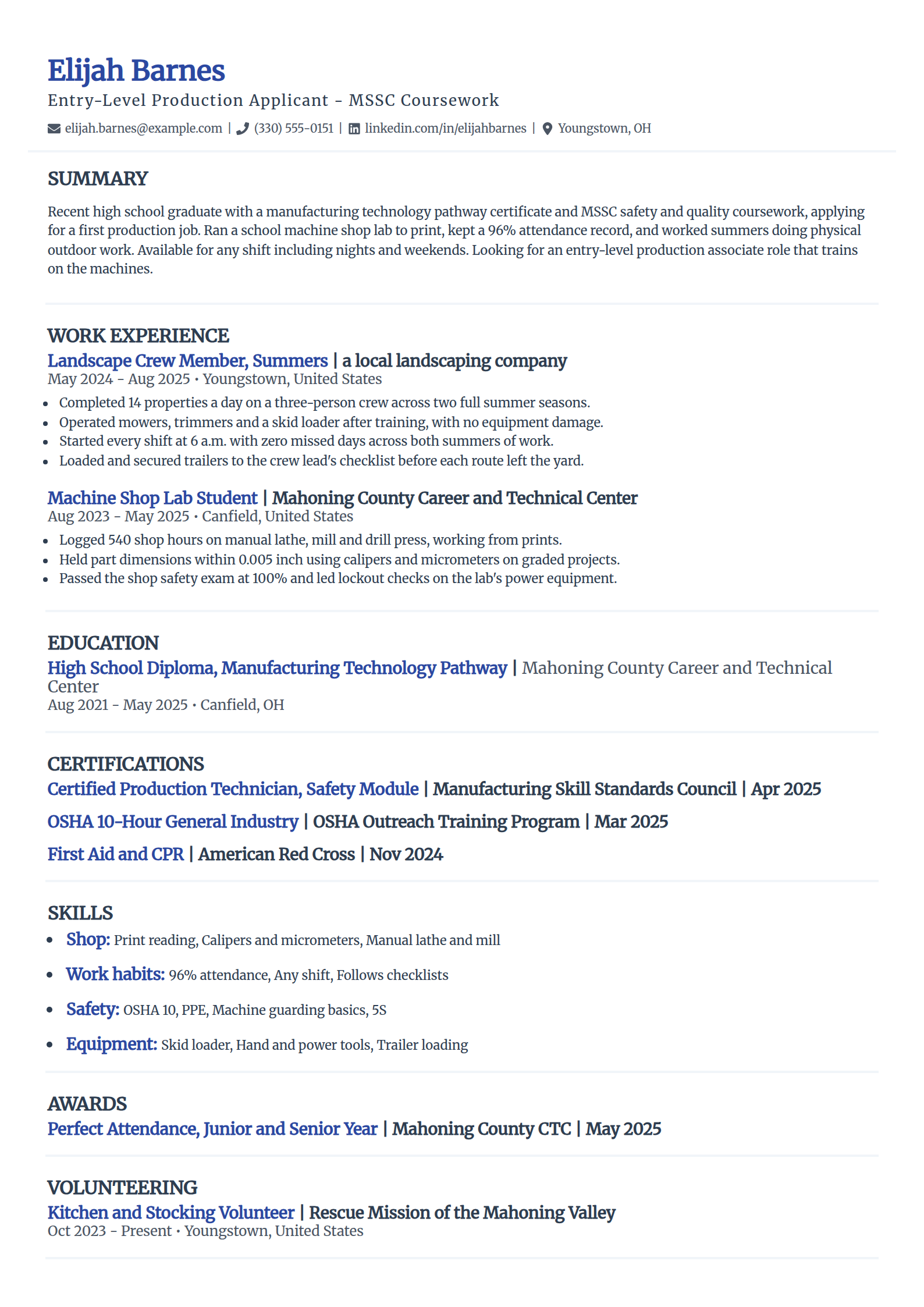
Manufacturing Resume Example With No Experience
Why this resume example works?
- Treats the school machine shop as experience with hours attached, 540 documented shop hours on lathe, mill and drill press.
- Gives a measurable skill instead of an adjective: parts held within 0.005 inch using calipers and micrometers.
- Uses summer landscaping work to answer the reliability question, two seasons with zero missed days.
- Leads the certifications with the OSHA 10 card and MSSC safety module, the two a first-job applicant can actually hold.
- Says any shift, including nights and weekends, which is often the line that gets an entry-level applicant called.
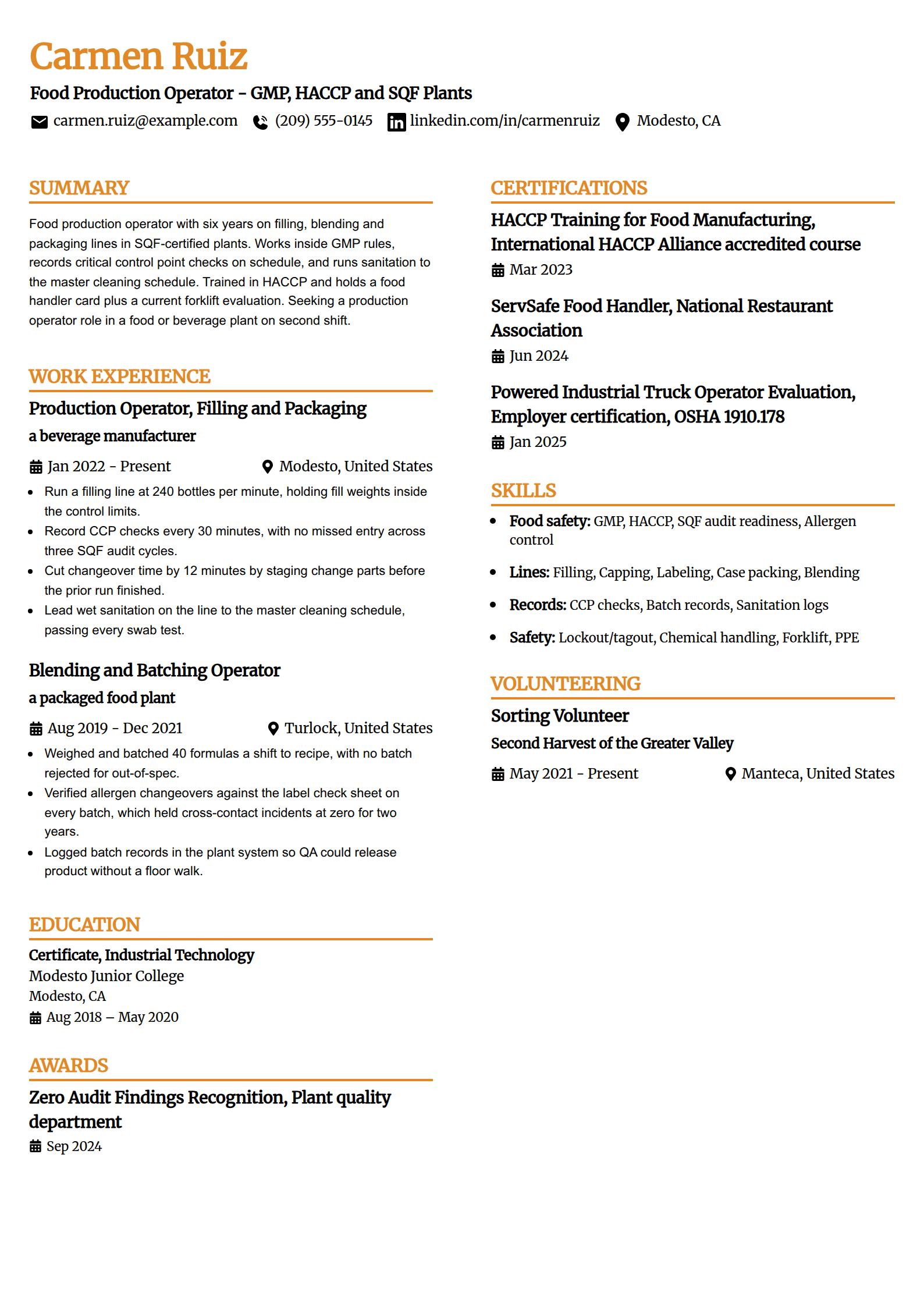
Food Production Resume Template (GMP and HACCP)
Why this resume example works?
- Opens on the standards a food plant is audited against, GMP rules, HACCP training and SQF certification.
- Shows record discipline, CCP checks every 30 minutes with no missed entry across three audit cycles.
- Uses the line's own rate, 240 bottles per minute, instead of a generic production number.
- Names allergen changeover work, which is the task a food-safety manager worries about most on a mixed line.
- Keeps sanitation on the page as real work, wet sanitation to the master cleaning schedule with passing swab tests.
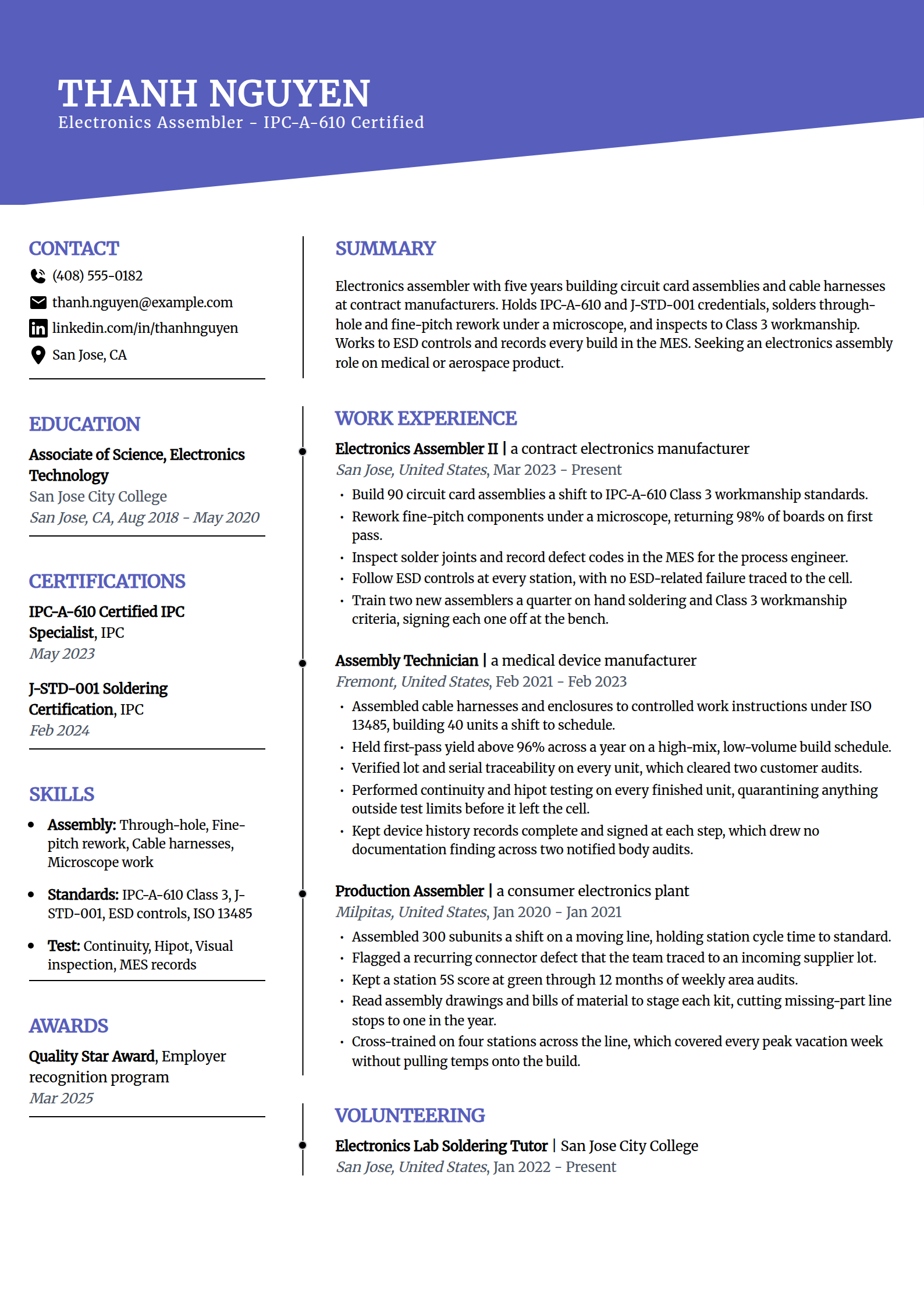
Electronics Assembler Resume Template (IPC-A-610)
Why this resume example works?
- Puts IPC-A-610 in the headline, since contract manufacturers filter on that credential before reading anything else.
- Names the workmanship class, Class 3, which tells a hiring manager the product quality this person is trained for.
- Shows rework skill with a first-pass number, 98% of fine-pitch boards returned on the first attempt.
- Keeps ESD discipline visible, the habit an electronics plant cannot train quickly out of a new hire.
- Lists J-STD-001 alongside IPC-A-610 under the issuing body, so both credentials are checkable.
Build your manufacturing resume
Pick a template above and the editor keeps your layout parser-safe while you swap in your own machines, rates, certifications and shift.
Build my resumeHow to write a manufacturing resume in 2026
Plant hiring is fast. A supervisor or an HR generalist reads your resume between line walks, looking for three answers: can you run what we run, will you show up, and can you work safely. Everything below serves those three answers.
Open with a summary that names your equipment and your shift
Three to four sentences, 50 to 70 words. Say what you run and for how long, give one number that proves output or quality, name your safety credentials, then say what you are applying for. Shift availability belongs here when you are flexible, because it moves you up the stack on a second or third shift posting. Use an objective only when you have no production history at all.
Machine operator with six years running injection molding presses and stamping lines across two plants. Sets up tooling, dials in shot size and cycle time, and holds first-piece approval before a run starts. Reads prints, measures with calipers and micrometers, and logs every run in Plex. Certified on powered industrial trucks and trained in lockout/tagout, looking for a second-shift operator role.
Put a plant number in half your bullets, with its unit attached
"Improved efficiency by 30%" is the most common line on a manufacturing resume and the least useful, because nobody can tell what moved. Use the units your plant reports in, and give one number per bullet so each one stays believable.
- Output: units or cases per hour, parts per shift, takt or cycle time in seconds, line rate in feet or bottles per minute.
- Quality: scrap percent, defects in PPM, first-pass yield, rework hours, customer returns. These are the numbers a quality manager recognizes.
- Uptime: OEE, line availability, downtime minutes, mean time to repair, changeover minutes before and after.
- Delivery and cost: on-time delivery percent, schedule attainment, overtime hours, material cost per unit.
- Safety: days or years without a recordable incident, audit scores, near-miss reports submitted. Say the streak; do not claim a rate you did not own.
List certifications under their real names
Plant HR screens for exact credential names, and vague ones cost you the match. Write each with its issuing body and date, and keep training separate from certification.
- OSHA 10-Hour or 30-Hour General Industry, from the OSHA Outreach Training Program. Write the hours; "OSHA certified" means nothing on its own.
- Forklift: a powered industrial truck operator evaluation is done by an employer under OSHA 1910.178. It is not a portable license, so name the truck classes you were evaluated on.
- Machining: NIMS credentials by level and area, such as NIMS Machining Level I, Measurement and Materials, from the National Institute for Metalworking Skills.
- Quality: ASQ Certified Quality Inspector or Certified Quality Technician, plus your Lean Six Sigma belt with the program that issued it.
- Industry-specific: IPC-A-610 and J-STD-001 from IPC for electronics, HACCP and a food handler card for food plants, MSSC Certified Production Technician for general production.
- Training, listed as training: lockout/tagout, confined space entry, respirator fit testing, forklift refreshers, hazard communication.
Write the skills block out of machines, systems and standards
Match the posting's phrasing. That is the entire honest version of ATS advice for this field, and it works because plant postings name equipment directly.
- Machines and processes: injection molding, stamping presses, CNC mill and lathe, extrusion, case packers, fillers, SMT lines, robotic weld cells.
- Systems: SAP and its PP module, Plex, Epicor, Infor, Oracle, MES, Wonderware or Ignition SCADA, handheld scanners.
- Measurement: calipers, micrometers, height gauges, bore gauges, go/no-go gauges, CMM, optical comparator.
- Standards and systems of record: ISO 9001, IATF 16949, ISO 13485, GMP and HACCP, control plans, SPC and Cpk.
- Improvement and safety: 5S, standard work, SMED, kaizen, TPM and autonomous maintenance, lockout/tagout, PPE compliance.
Formatting and length
One page up to about ten years on the floor. A second page is earned by a supervisory scope or a long technical history, not by longer bullet lists.
- A single-column layout parses cleanest. A simple two-column template that keeps contact, certifications and skills in a side column also works, and the electronics assembler example above uses one.
- Order the page summary, experience, education, certifications, skills. Move certifications above education when a posting names a credential as required.
- Keep each job to three to six bullets, with the most recent role carrying the most.
- Use plain section headings that a parser expects: Work Experience, Education, Certifications, Skills.
- Send a PDF unless the posting asks for a Word file, and name the file with your own name and the role.
Honestly: attendance and shift availability beat polished wording
Most resume advice for this field is written as though plants hire on phrasing. They do not. Turnover on production lines is driven by people who stop showing up, so a supervisor reading your resume is looking for evidence you will be there: a steady work history, a named attendance record, a willingness to take the shift that is actually open. If you have two years of perfect attendance, that single line does more for you than any rewrite of your summary. If your history has gaps, do not hide them behind vague dates. Give the months, keep the entry short, and let the certifications and the numbers carry the rest of the page.
Common manufacturing resume mistakes
- Listing duties instead of output. "Operated machinery per company standards" is a job description sentence. What the machine was, what it produced per shift, and what you changed is a resume sentence.
- Percentages with no unit. "Increased productivity 30%" cannot be checked or pictured. Units per hour, scrap percent, OEE and changeover minutes all can.
- Vague credentials. "OSHA certified" and "Six Sigma" tell a screener nothing. Write OSHA 10-Hour General Industry and name the belt with its issuing program.
- Calling a forklift evaluation a license. It is an employer evaluation under OSHA 1910.178, tied to the site and the truck class, and a plant HR reader knows the difference.
- Leaving off shift availability and attendance. These decide production hires more often than wording does, and a resume that omits them leaves the supervisor's main question unanswered.
Frequently asked questions
What should a manufacturing resume include?
Five things, in this order. A summary of three to four sentences naming the equipment you run, your years on it, one output or quality number, and the shift you can work. An experience section where at least half the bullets carry a plant number with its unit, such as units per hour, scrap percent, OEE or changeover minutes. An education block, kept short. A certifications block with your OSHA card, forklift evaluation and any trade credential under its real name. A skills block naming machines, systems and standards outright. Keep it to one page.
How do you write a manufacturing resume with no experience?
Lead with the closest thing to production work you have done, even if it is a school shop class, a summer job or military service. Give it hours and numbers: 540 documented shop hours, 14 properties a day, parts held within 0.005 inch. Then put the credentials you can earn quickly at the top, an OSHA 10-Hour card and an MSSC Certified Production Technician safety module. Close with shift availability and an attendance record. Do not leave the page half empty to avoid listing non-manufacturing work, because steady work of any kind answers the question a supervisor is asking.
Should a manufacturing resume have an objective or a summary?
A summary, once you have run anything in production. Equipment, rates and certifications are content, and a summary carries content better than a statement of what you want. Keep it to three or four sentences and end it with the role and shift you are targeting. Use an objective only when you have no production history at all, and even then lead with what you bring, such as a shop class, an OSHA card or a forklift evaluation, before naming what you want. Never put both on one resume.
How long should a manufacturing resume be?
One page for most plant-floor applicants, and that covers everything up to roughly ten years on the line. Two pages make sense once you are supervising, running a plant, or carrying a long technical history across many processes and systems. Every example on this page fits one page, including the plant manager with 18 years behind him. If you are running long, cut old jobs to two lines each and delete any bullet without a number or a machine in it.
Which certifications belong on a manufacturing resume?
The ones a plant screens for, written with their issuing bodies. OSHA 10-Hour or 30-Hour General Industry from the OSHA Outreach Training Program. A powered industrial truck operator evaluation under OSHA 1910.178, with the truck classes named. NIMS credentials by level for machining, ASQ Certified Quality Inspector or Quality Technician for inspection, a Lean Six Sigma belt with the program that issued it, IPC-A-610 and J-STD-001 for electronics assembly, HACCP and a food handler card for food plants, and the MSSC Certified Production Technician for general production. List lockout/tagout, confined space and respirator fit testing as training, not as certifications.
What skills should I put on a manufacturing resume?
Name machines, systems and standards, not adjectives. Machines and processes you have run, such as injection molding, stamping, CNC mill and lathe, extrusion, fillers or SMT lines. Systems you record work in, such as SAP, Plex, Epicor or an MES. Measurement tools you use, from calipers and micrometers to a CMM. Quality systems you have worked to, such as ISO 9001, IATF 16949, ISO 13485 or GMP and HACCP. Improvement and safety practices you actually follow, such as 5S, standard work, SMED, TPM and lockout/tagout. Then match the posting's own phrasing where it differs from yours.
More manufacturing resume resources
Build your manufacturing resume
Pick a template above and the editor keeps your layout parser-safe while you swap in your own machines, rates, certifications and shift.