HVAC Resume Templates and Examples by Specialty and Level
- ATS Friendly
- Specialty-Specific
- 17 Real Examples
A residential service tech, a supermarket refrigeration tech, and a controls tech each need a different resume, and this page has one built for your exact specialty. Start from a layout below, then model your own on a real example, from a first EPA 608 job to a master technician role. Your certifications, systems, and fix-rate numbers sit where a service manager looks first.


540k+ resumes created
HVAC resume templates for every specialty and experience level
Each template below is a real HVAC resume laid out in that format, sorted by experience level and specialty across residential service, commercial, refrigeration, controls, install, and the trades in between. Pick one, then swap in your own certifications, systems, and fix-rate numbers. Every layout keeps your name, EPA and NATE credentials, and troubleshooting skills readable so a hiring service manager sees your strongest work at a glance and an applicant tracking system parses it cleanly.
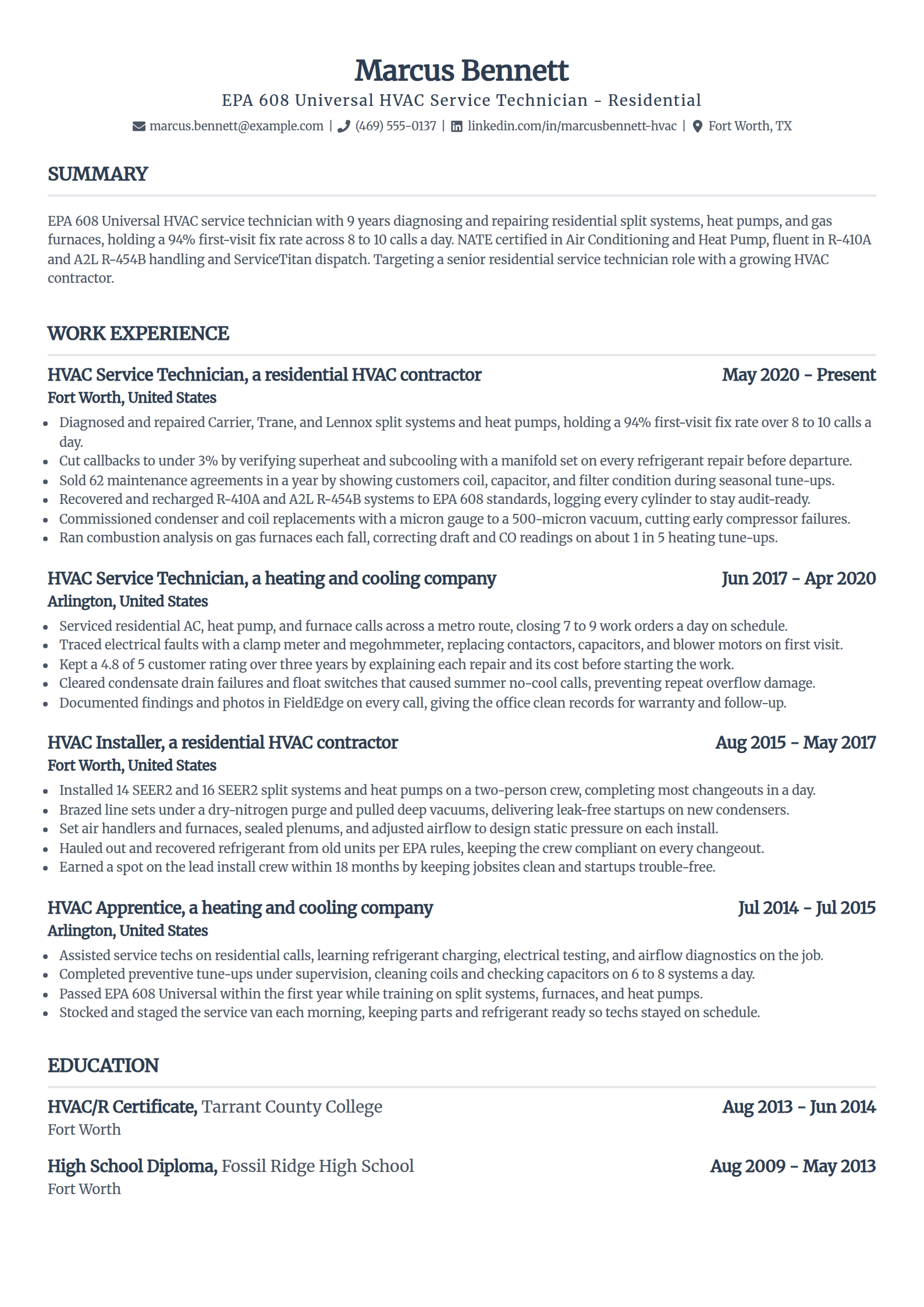
Residential HVAC Service Technician Resume Template
Why this resume example works?
- Opens with a summary that names 9 years, a 94% first-visit fix rate, EPA 608 Universal, and NATE Air Conditioning and Heat Pump.
- Attaches one credible number to most bullets, like callbacks under 3% or 62 maintenance agreements sold in a year.
- Shows the real diagnostic work a service manager screens for: superheat and subcooling, combustion analysis, and electrical testing.
- Names the systems and tools a posting lists, Carrier and Trane split systems, a micron gauge, and ServiceTitan dispatch.
- Uses a clean, single-column layout an applicant tracking system reads without trouble.
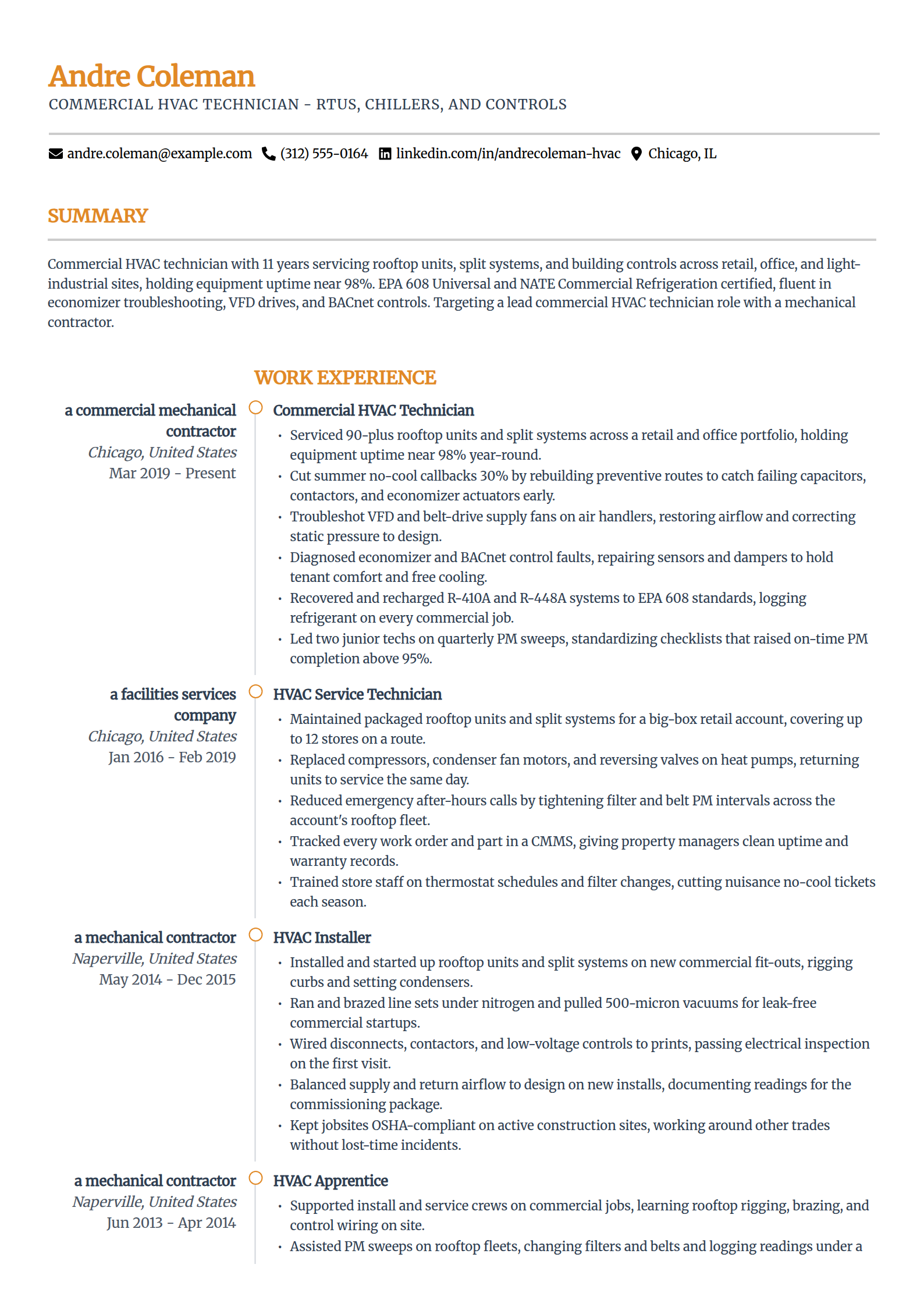
Commercial HVAC Technician Resume Template
Why this resume example works?
- Leads with 11 years and equipment uptime near 98% across a retail and office rooftop portfolio, the scope a commercial posting wants.
- Shows the range a commercial role needs, rooftop units, economizers, VFD supply fans, and BACnet control faults.
- Keeps results countable, like summer no-cool callbacks cut 30% and on-time PM completion above 95%.
- Names EPA 608 Universal, NATE Commercial Refrigeration, R-448A, and BACnet, the credentials and systems a mechanical contractor checks.
- Uses a modern two-column layout that carries a deep commercial record on one page.
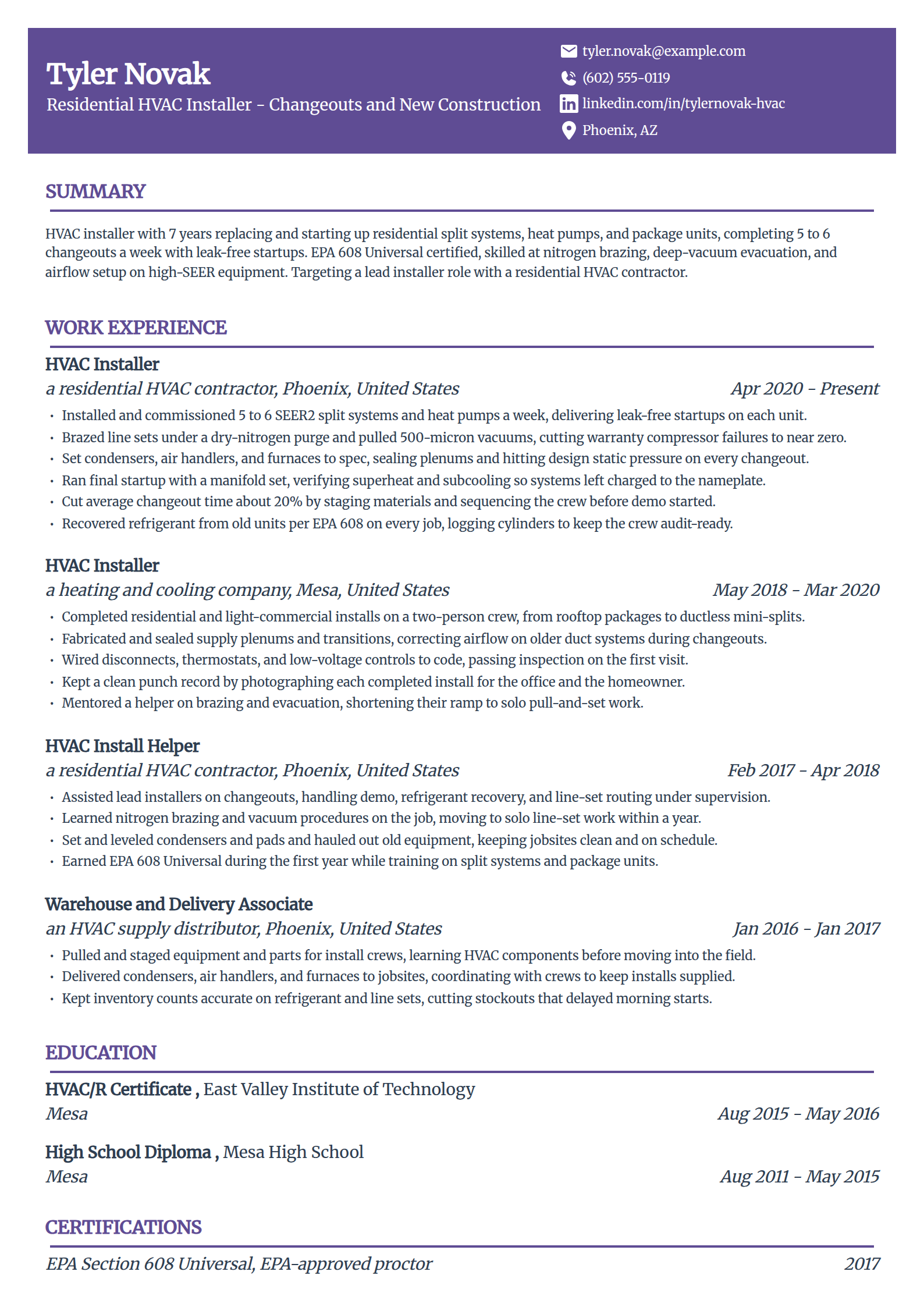
HVAC Installer Resume Template
Why this resume example works?
- Opens with install volume, 5 to 6 SEER2 changeouts a week with leak-free startups, the number an install lead wants.
- Shows the craft a clean install needs, nitrogen brazing, 500-micron vacuums, and airflow set to design static pressure.
- Keeps quality visible, cutting warranty compressor failures to near zero by verifying superheat and subcooling at startup.
- Names EPA 608 recovery on every changeout, the compliance a shop expects on removal and disposal.
- Uses a spacious layout that carries a full install history on one page.
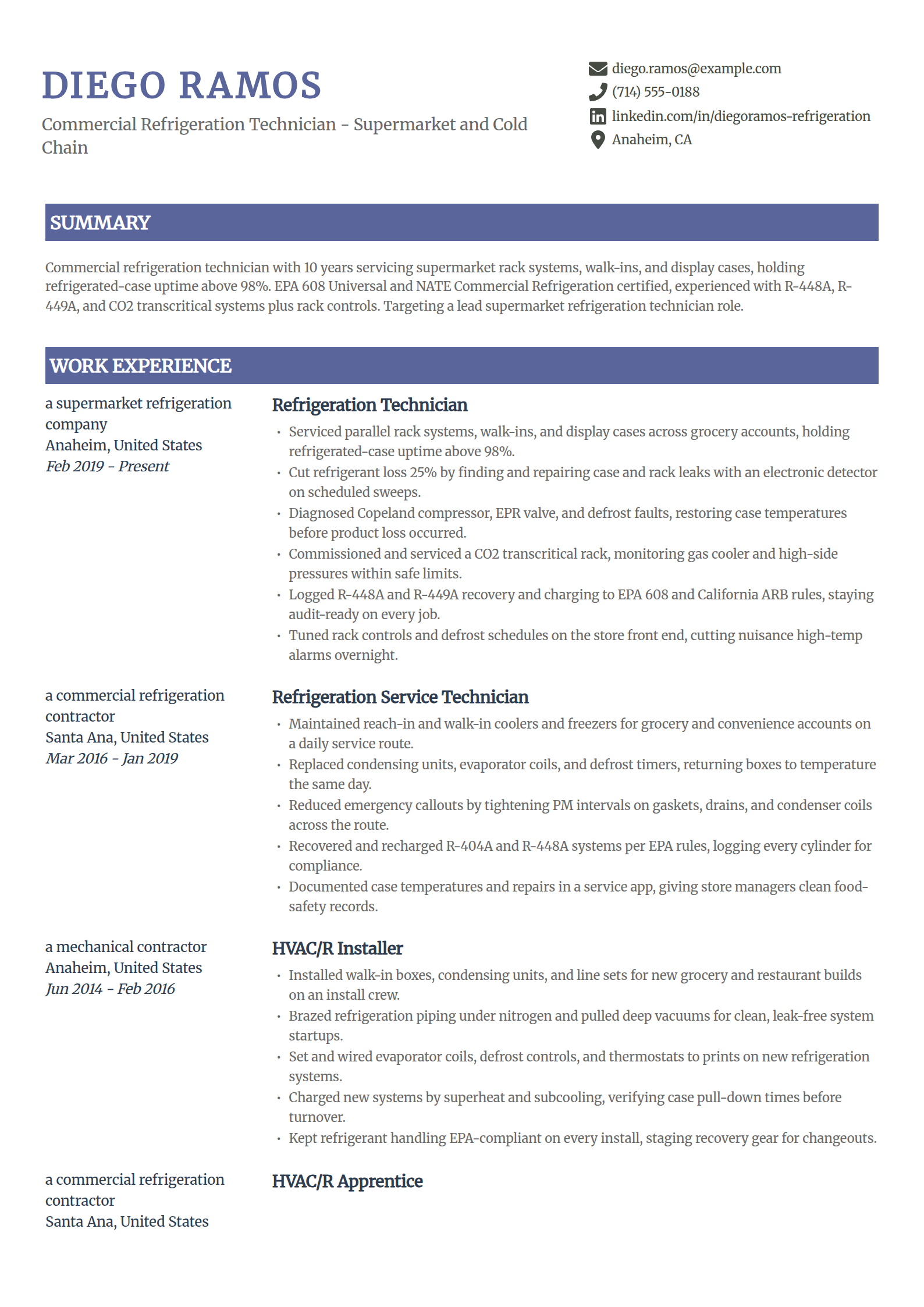
Commercial Refrigeration Technician Resume Template
Why this resume example works?
- Leads with refrigerated-case uptime above 98% across grocery accounts, the reliability a supermarket contractor wants.
- Shows real refrigeration depth, parallel rack systems, Copeland compressors, EPR and defrost valves, and CO2 transcritical.
- Keeps results tied to product, refrigerant loss cut 25% and case temperatures restored before product loss.
- Names R-448A, R-449A, EPA 608 recovery, and California ARB compliance, the certs and rules a refrigeration posting checks.
- Uses a modern two-column layout that carries a deep cold-chain record on one page.
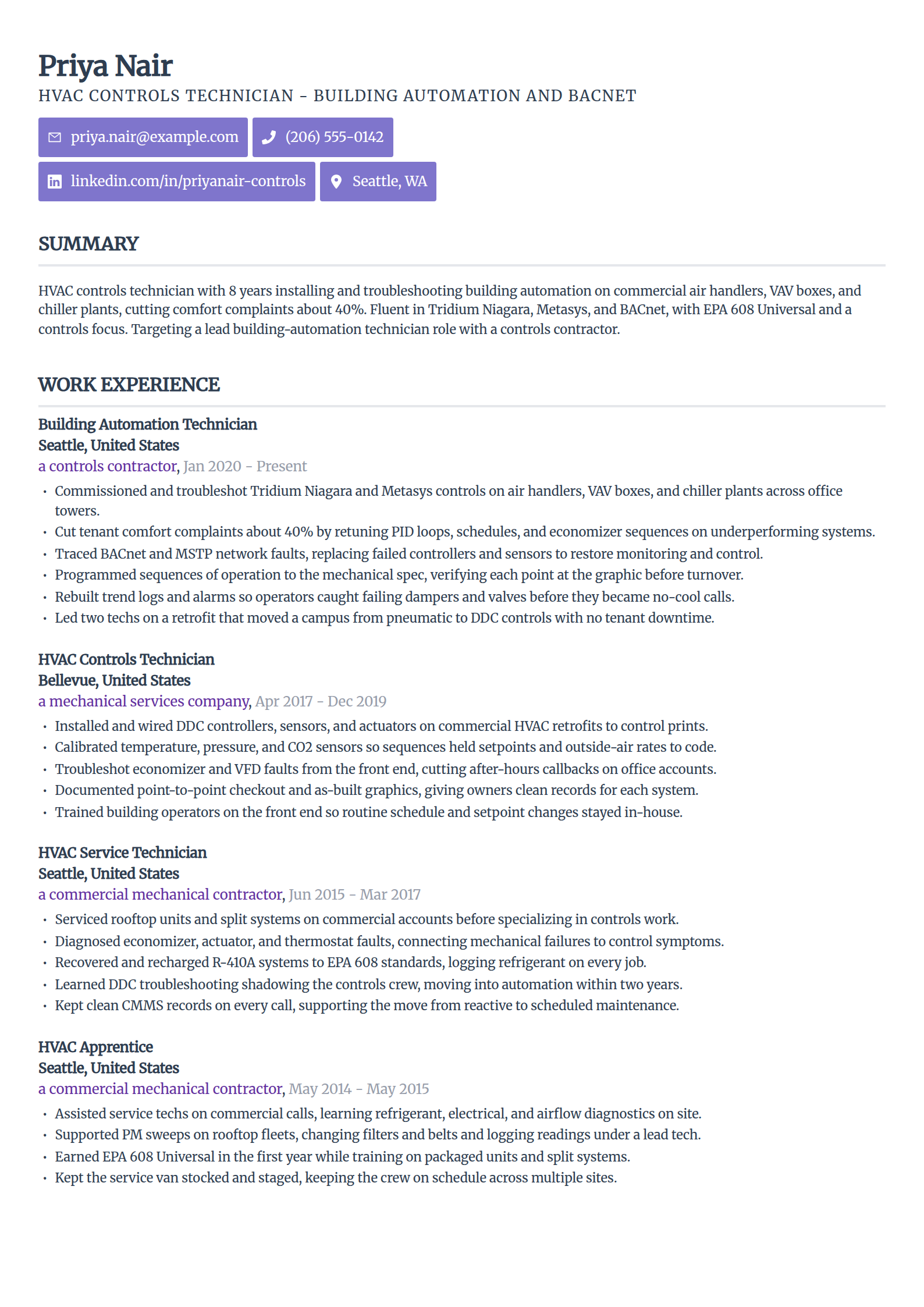
HVAC Controls Technician Resume Template
Why this resume example works?
- Opens with automation scope, Tridium Niagara and Metasys on air handlers, VAV boxes, and chiller plants across office towers.
- Shows the results a controls contractor wants, tenant comfort complaints cut about 40% by retuning loops and sequences.
- Keeps the work precise, tracing BACnet and MSTP faults and programming sequences to the mechanical spec.
- Names Niagara, Metasys, BACnet, and DDC programming, the exact systems a building-automation posting screens for.
- Uses a clean, modern layout that carries a full controls record on one page.
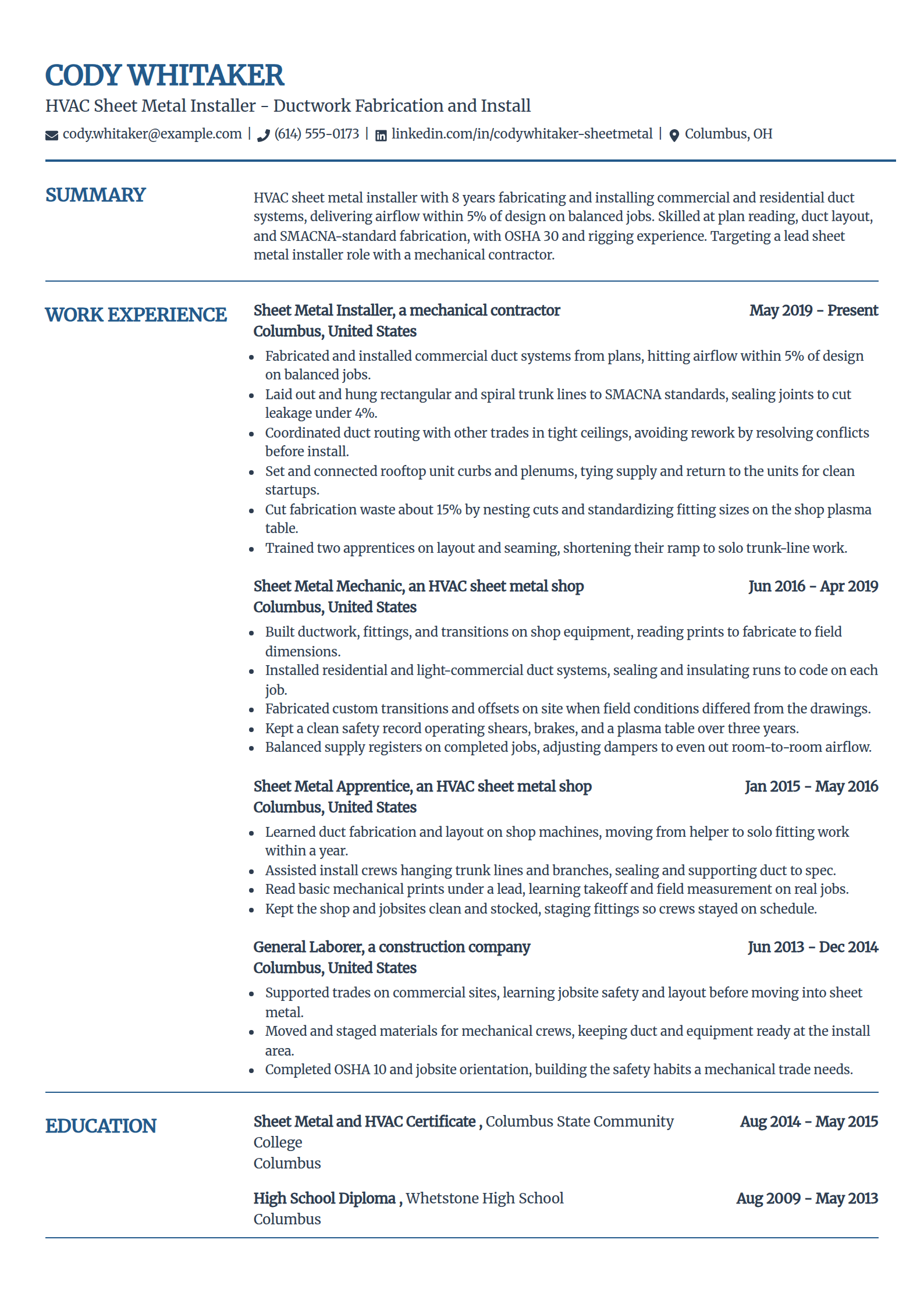
HVAC Sheet Metal Installer Resume Template
Why this resume example works?
- Leads with the outcome a mechanical contractor wants, airflow within 5% of design on balanced jobs.
- Shows the trade a duct role needs, SMACNA fabrication, plasma cutting, and trunk lines sealed to under 4% leakage.
- Keeps results countable, like fabrication waste cut about 15% by nesting cuts and standardizing fittings.
- Names OSHA 30, SMACNA standards, and lift and rigging tickets, the safety credentials a jobsite checks.
- Uses a modern layout that carries a full fabrication and install record on one page.
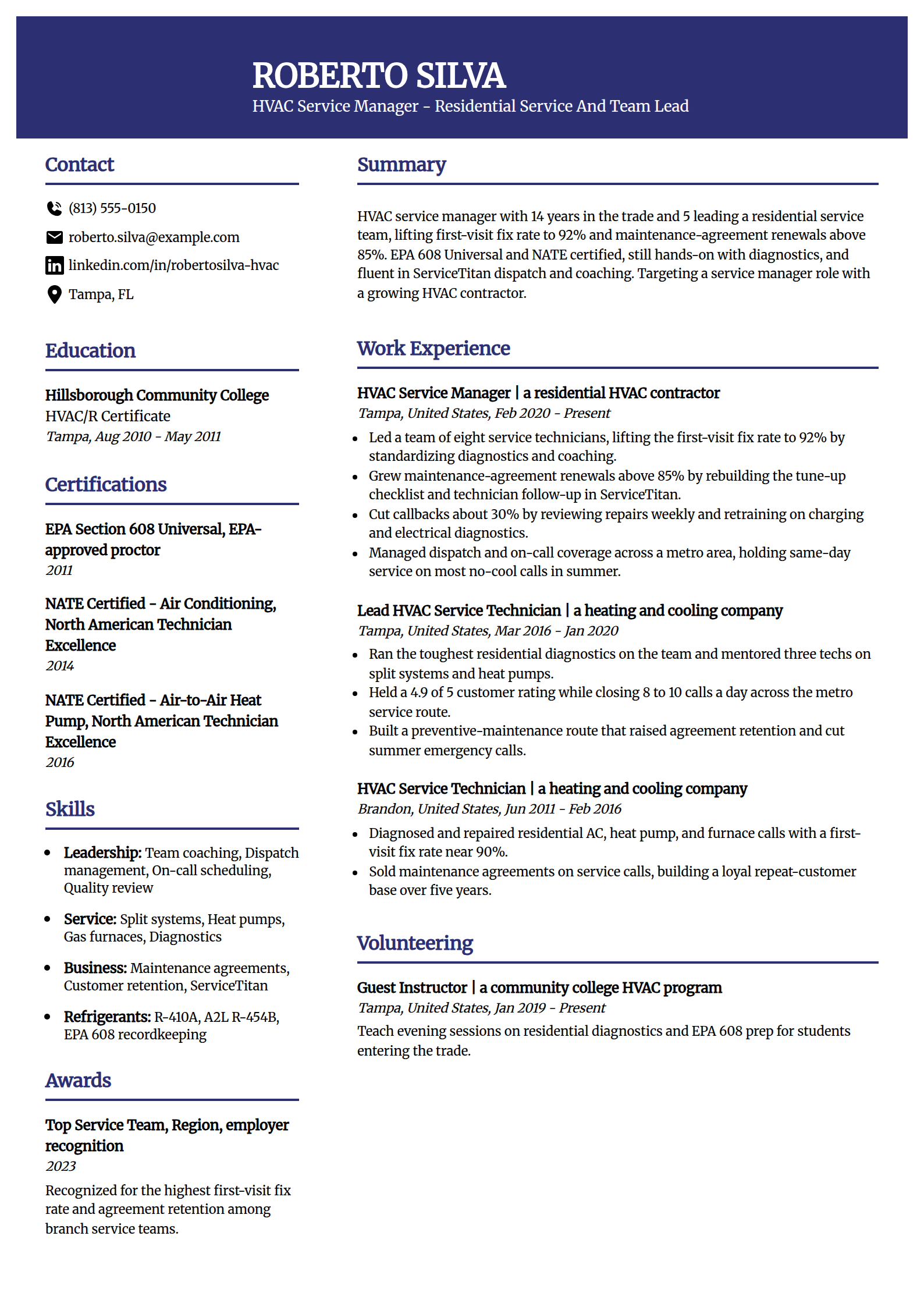
HVAC Service Manager Resume Template
Why this resume example works?
- Leads with 14 years and 5 leading a team of eight, lifting first-visit fix rate to 92%, the depth a manager posting wants.
- Shows the results a lead is hired for, maintenance-agreement renewals above 85% and callbacks cut about 30%.
- Keeps the candidate credible at the bench, coaching techs on split systems, heat pumps, and diagnostics.
- Names ServiceTitan dispatch, EPA 608, and NATE certifications, the systems and credentials a service manager owns.
- Uses a roomy layout with an award and a college-instructor volunteer role so a leadership record fills the page.
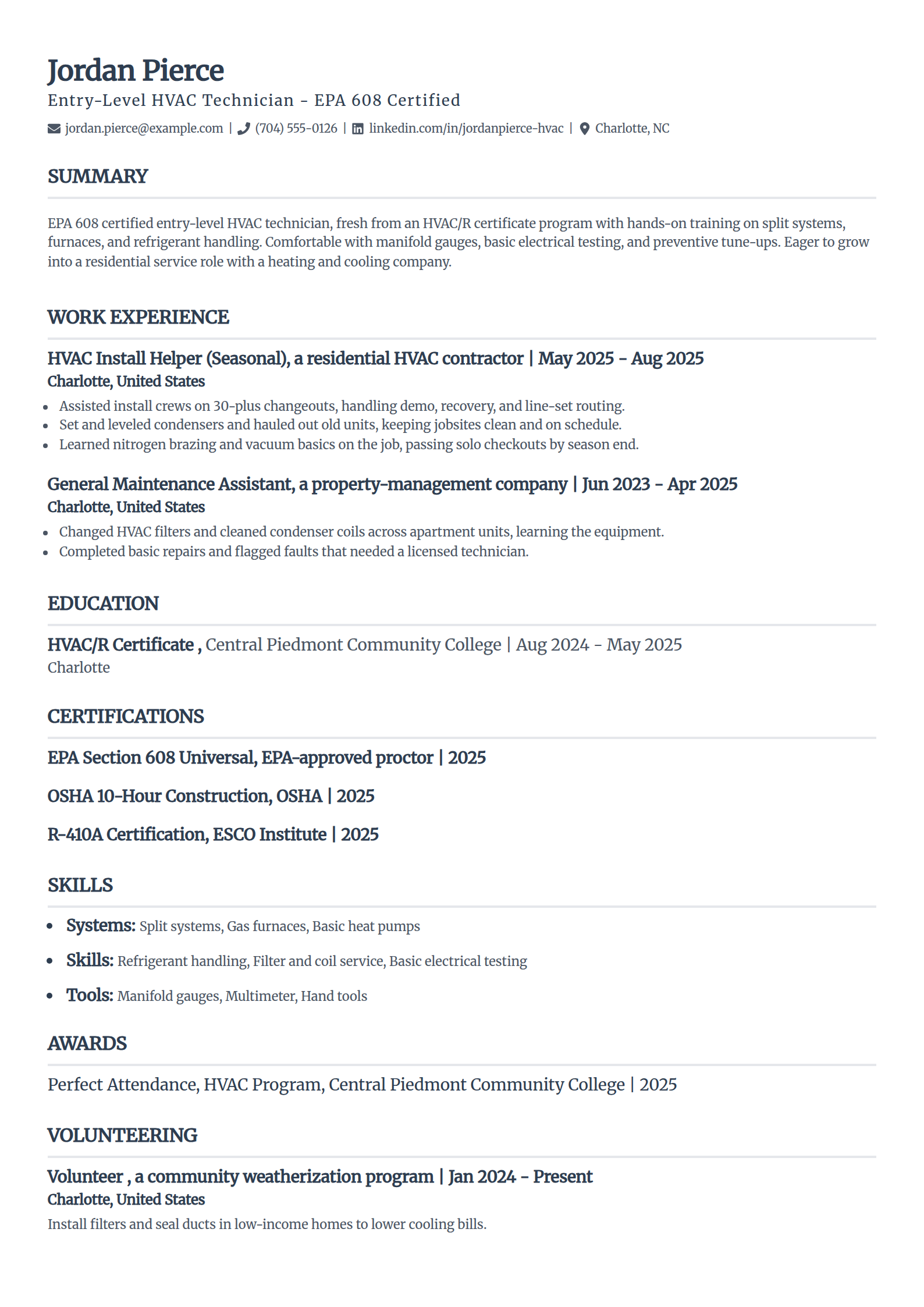
Entry-Level HVAC Resume Template
Why this resume example works?
- Written for a first HVAC job, leading with EPA 608 certification and an HVAC/R certificate instead of years.
- Uses a seasonal install-helper and a maintenance-assistant role as entries, the right move when field experience is new.
- Keeps every bullet honest, like assisting on changeouts and cleaning condenser coils, and shows eagerness to learn.
- Names EPA 608, OSHA 10, and R-410A certification, the credentials a first posting checks on an entry-level tech.
- Fills a tight, ATS-safe page with an attendance award and a weatherization volunteer role instead of padding.
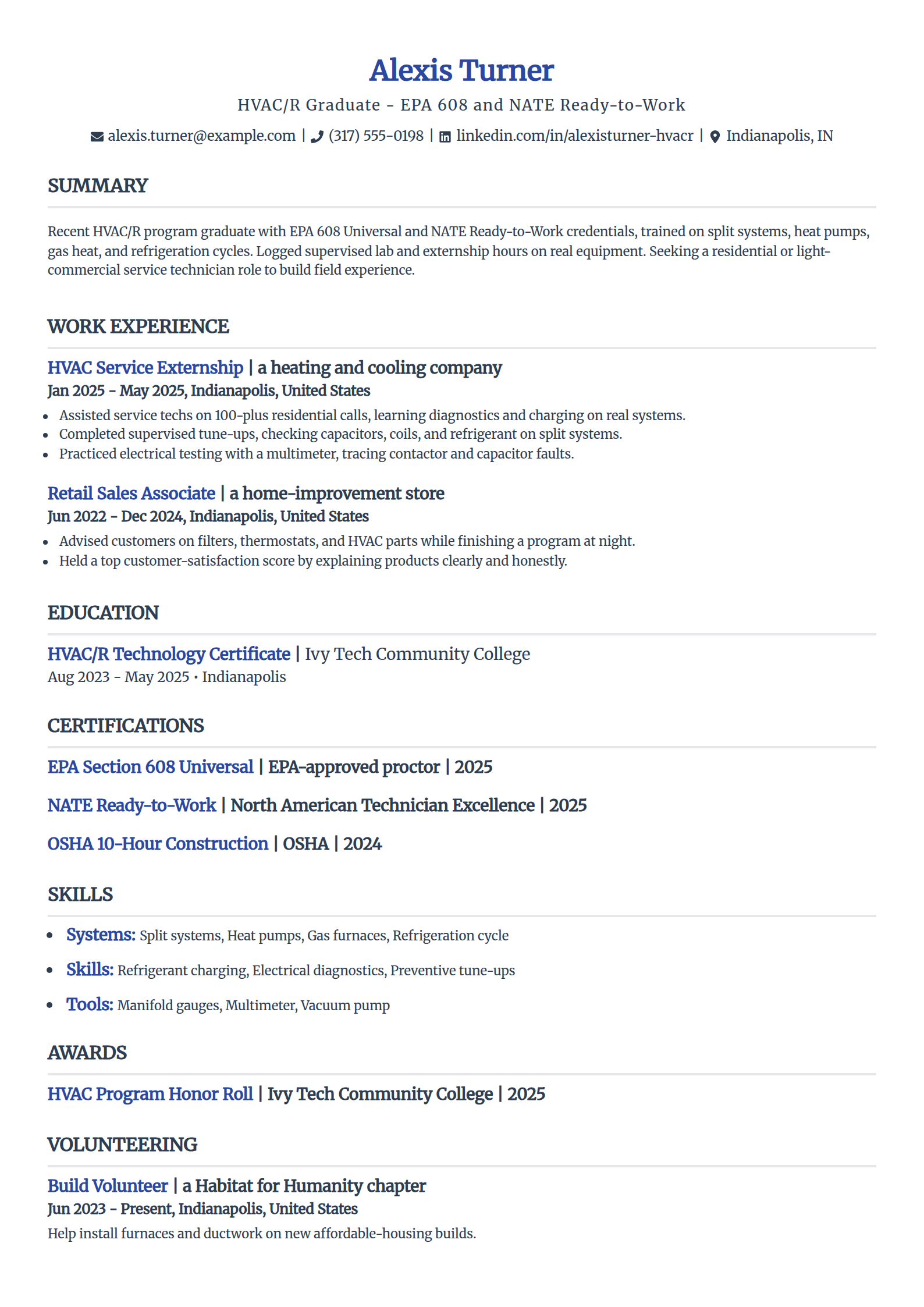
HVAC/R Graduate Resume Template
Why this resume example works?
- Written for a new graduate, leading with EPA 608 and NATE Ready-to-Work plus training on split systems and refrigeration.
- Uses a service externship and a prior retail role as entries, the honest shape before a full technician job.
- Keeps each bullet real, like assisting on 100-plus calls and practicing electrical testing under supervision.
- Names EPA 608 Universal, NATE Ready-to-Work, and OSHA 10, the early credentials a first employer wants to see.
- Fills a tight, ATS-safe page with a program honor roll and a Habitat for Humanity volunteer role.
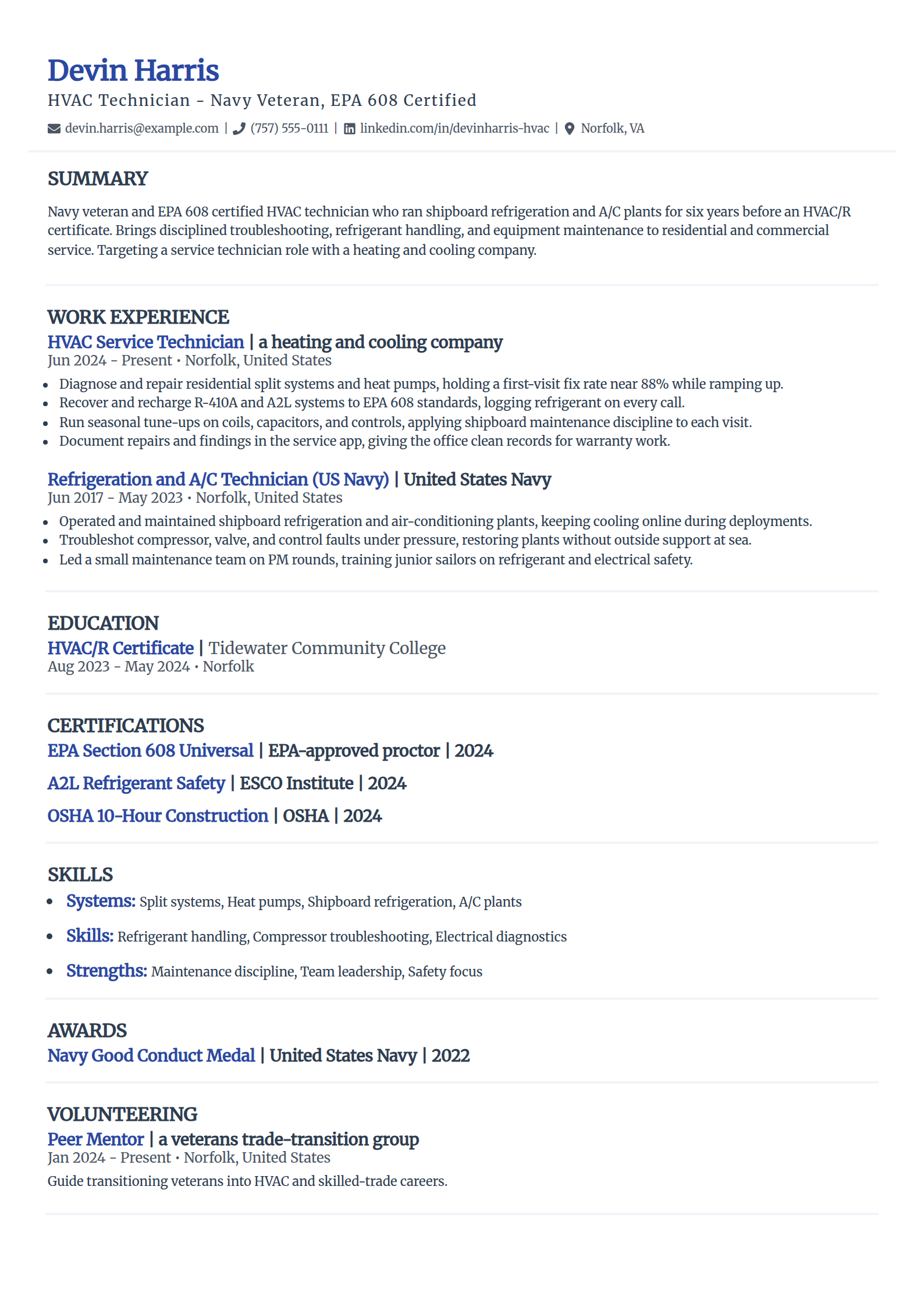
Military-to-HVAC Career-Change Resume Template
Why this resume example works?
- Names the switch openly, moving from six years running shipboard refrigeration and A/C plants into a civilian HVAC role.
- Reframes military work as an asset, disciplined troubleshooting and refrigerant handling that transfer straight across.
- Shows recent proof in the new role, a first-visit fix rate near 88% while ramping up on residential systems.
- Keeps the new credentials concrete, EPA 608 Universal, an HVAC/R certificate, and A2L refrigerant safety.
- Uses a clean layout with a service medal and a veteran peer-mentor role so a transition record still looks full.
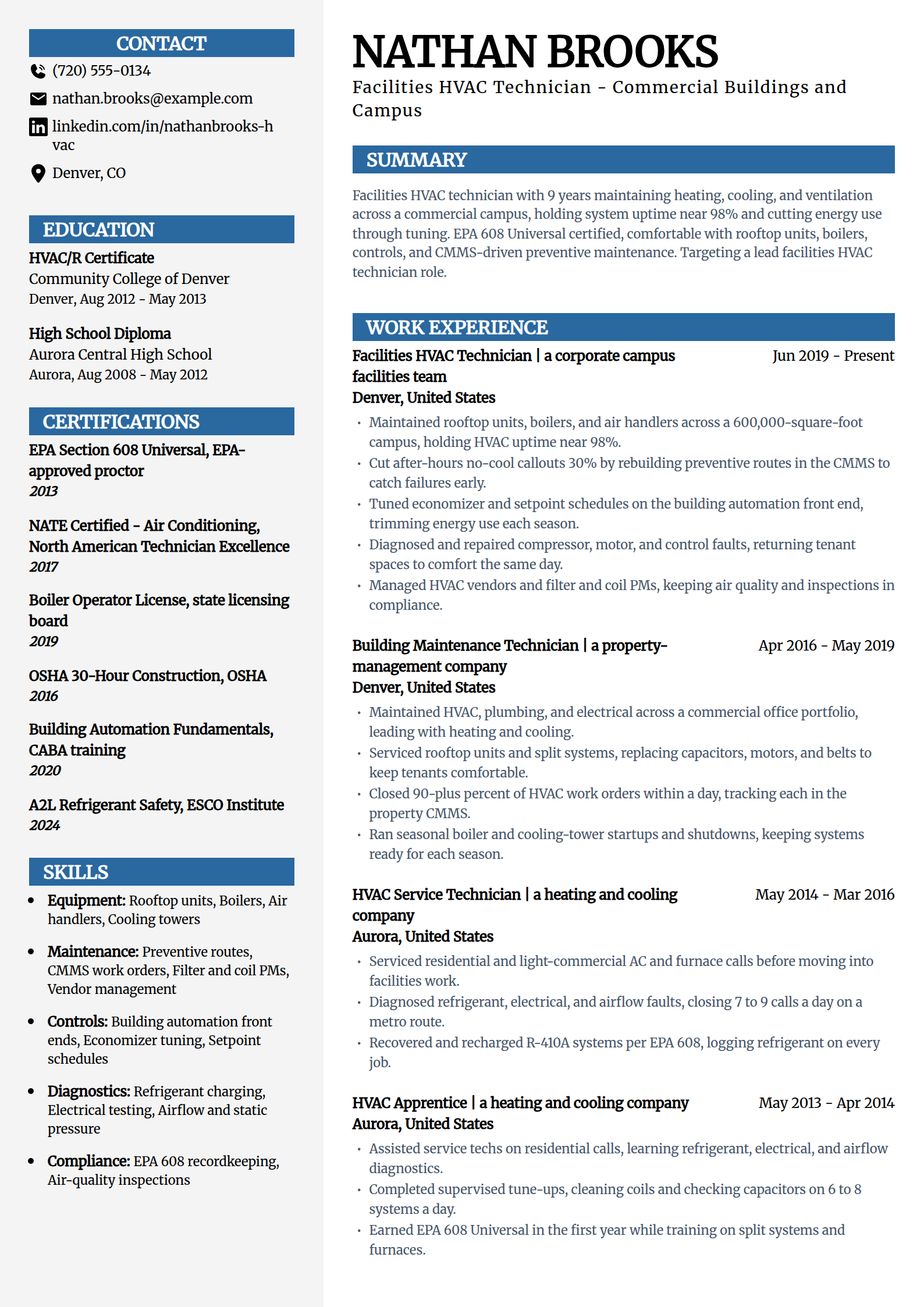
Facilities HVAC Technician Resume Template
Why this resume example works?
- Opens with campus scope, rooftop units, boilers, and air handlers across 600,000 square feet with uptime near 98%.
- Shows the results a property wants, after-hours no-cool callouts cut 30% by rebuilding preventive routes in the CMMS.
- Keeps the work honest, managing vendors and inspections so air quality and compliance hold rather than overclaiming.
- Names a boiler operator license, EPA 608, building automation, and CMMS work orders, the tools a facilities posting screens for.
- Uses a modern two-column layout that carries a multi-building record cleanly on one page.
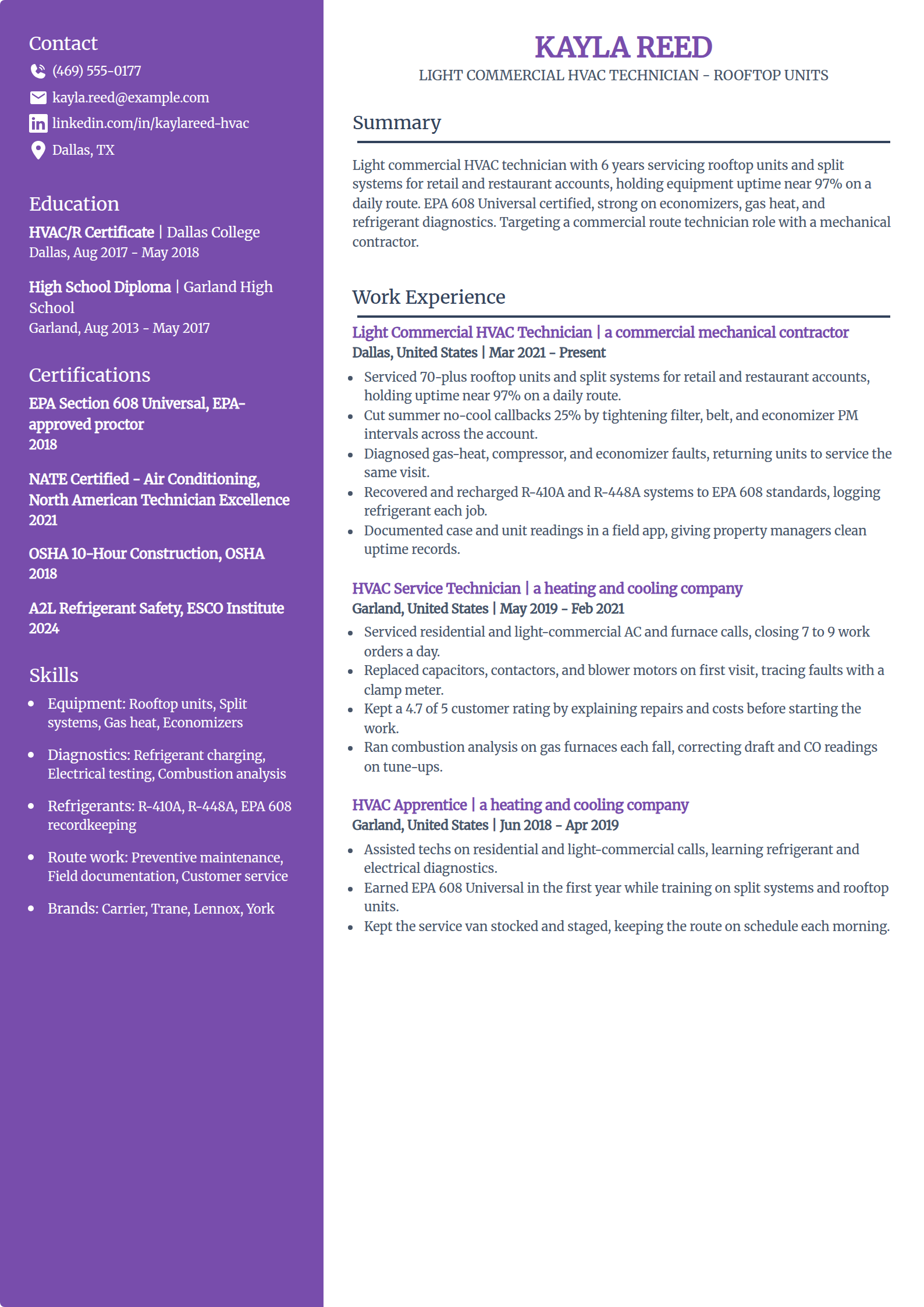
Light Commercial HVAC Resume Template
Why this resume example works?
- Leads with route value, 70-plus rooftop units and split systems held near 97% uptime for retail and restaurant accounts.
- Shows the everyday work a route needs, gas-heat, compressor, and economizer faults closed the same visit.
- Keeps results countable, like summer no-cool callbacks cut 25% by tightening filter and belt PM intervals.
- Names EPA 608, R-410A and R-448A recovery, and combustion analysis, the certs and skills a commercial route checks.
- Uses a Medium layout that carries a full route record without empty space.
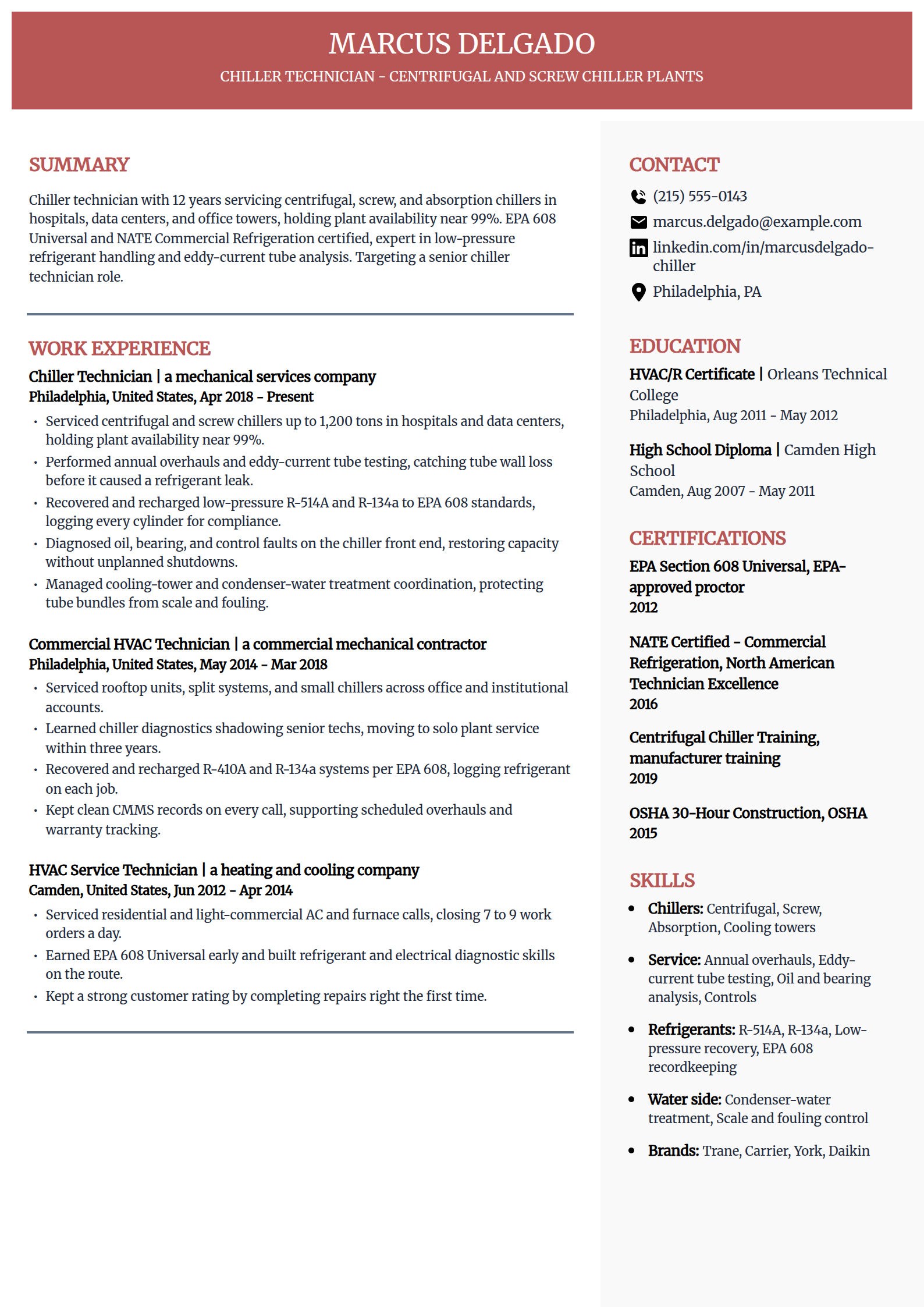
Chiller Technician Resume Template
Why this resume example works?
- Opens with plant value, centrifugal and screw chillers up to 1,200 tons held near 99% availability in hospitals and data centers.
- Shows real chiller depth, annual overhauls, eddy-current tube testing, and low-pressure refrigerant handling.
- Keeps the work precise, catching tube wall loss before a leak and coordinating condenser-water treatment.
- Names EPA 608, NATE Commercial Refrigeration, R-514A, and R-134a, the certs and refrigerants a chiller role checks.
- Uses a refined layout that carries a deep chiller record on one page.
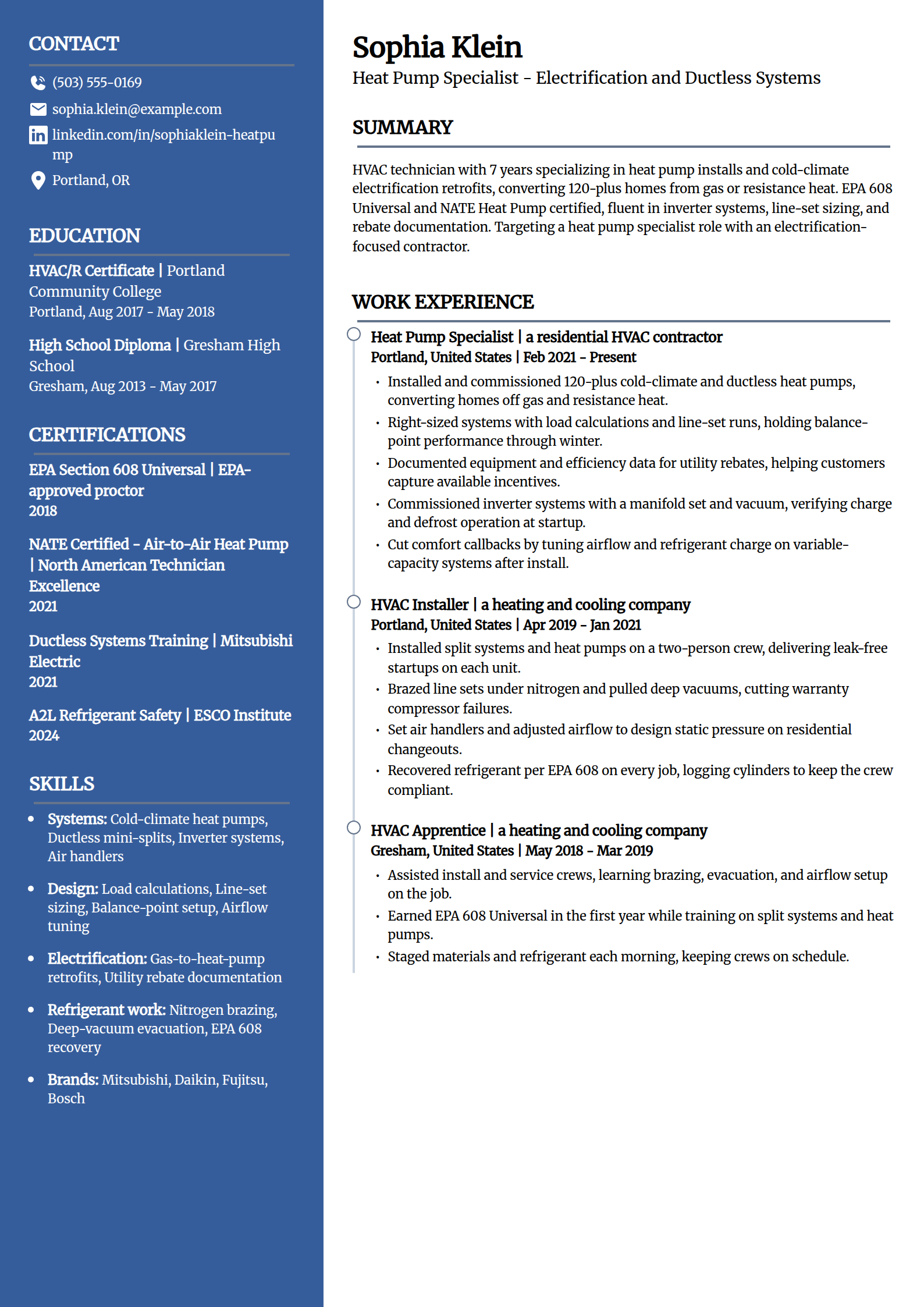
Heat Pump Specialist Resume Template
Why this resume example works?
- Leads with 120-plus cold-climate and ductless heat pumps installed, converting homes off gas and resistance heat.
- Shows the design skill electrification needs, load calculations, line-set sizing, and balance-point performance.
- Keeps results useful to the customer, documenting equipment data so homeowners capture available utility rebates.
- Names EPA 608, NATE Heat Pump, and inverter-system training, the credentials an electrification contractor wants.
- Uses a distinctive layout that still reads cleanly for a hiring service manager.
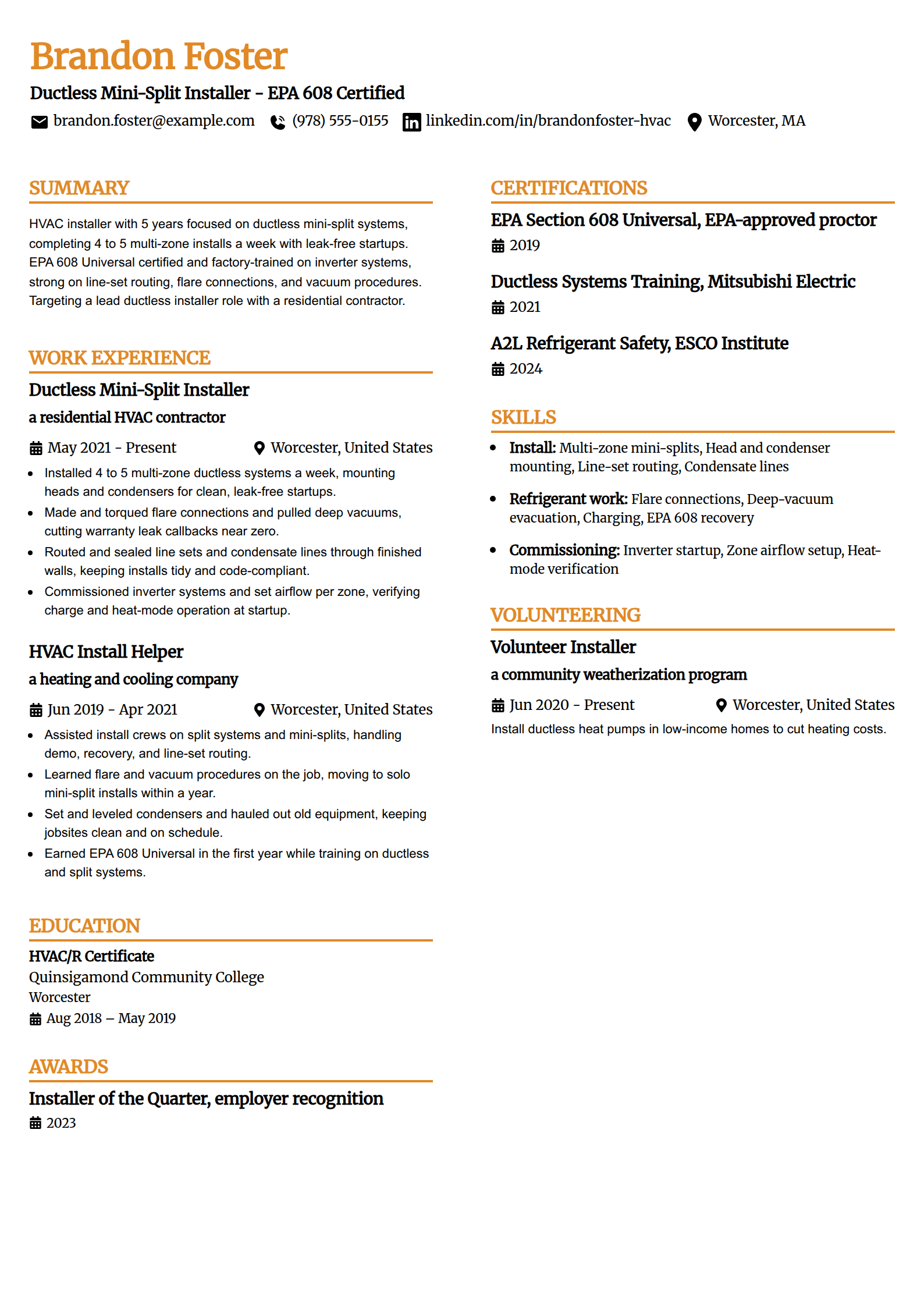
Ductless Mini-Split Installer Resume Template
Why this resume example works?
- Leads with install volume, 4 to 5 multi-zone ductless systems a week with leak-free startups.
- Shows the precision mini-splits need, torqued flare connections, deep vacuums, and clean line-set routing through finished walls.
- Keeps quality visible, cutting warranty leak callbacks near zero by verifying charge and heat-mode at startup.
- Names EPA 608, ductless factory training, and A2L refrigerant safety, the credentials a ductless-focused shop checks.
- Uses a tight, ATS-safe layout that keeps a focused install record on one clean page.
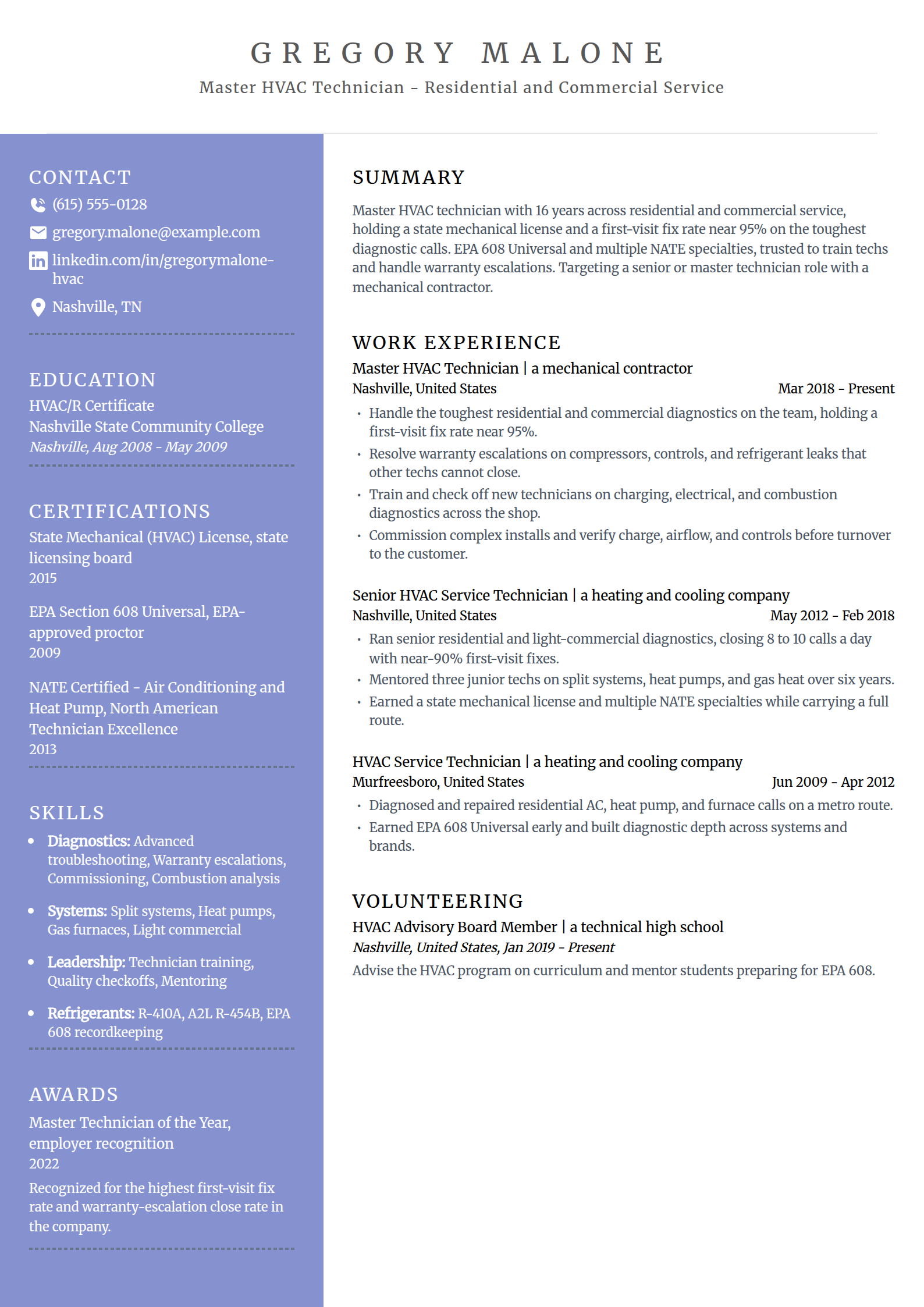
Master HVAC Technician Resume Template
Why this resume example works?
- Leads with a state mechanical license, 16 years, and a first-visit fix rate near 95% on the toughest diagnostic calls.
- Shows what a master is trusted with, warranty escalations on compressors, controls, and refrigerant leaks others cannot close.
- Keeps the leadership credible, training and checking off new technicians on charging and combustion diagnostics.
- Names EPA 608 Universal and multiple NATE specialties, the credential depth a senior posting expects.
- Uses a roomy layout with an award and a technical-school advisory role so a senior record fills the page.
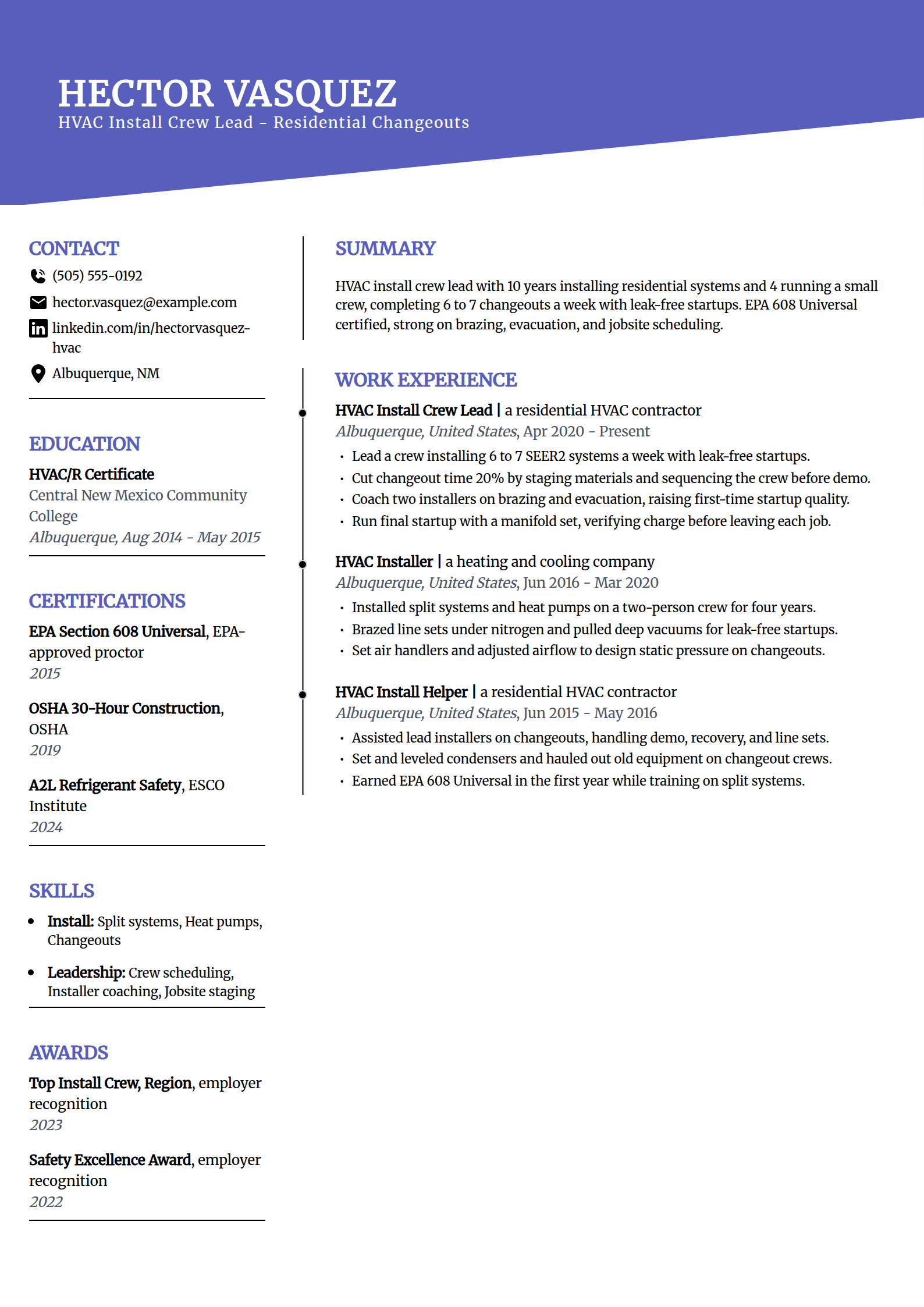
HVAC Install Crew Lead Resume Template
Why this resume example works?
- Leads with crew output, 6 to 7 SEER2 changeouts a week with leak-free startups across a two- to three-person crew.
- Shows the result a foreman is hired for, changeout time cut 20% by staging materials and sequencing the crew.
- Keeps the candidate hands-on, coaching installers on brazing and evacuation and verifying charge at final startup.
- Names EPA 608, OSHA 30, and A2L refrigerant safety, the credentials a lead installer role checks.
- Uses a two-column layout with two awards so a crew-leadership record fills the page.
Build your HVAC resume
Pick a template above and the editor keeps your layout clean and ATS-safe while you swap in your own specialty, certifications, systems, and fix-rate numbers.
Build my resumeHow to write an HVAC resume in 2026
An HVAC resume gets scanned fast by a service manager looking for two things: which systems you can actually troubleshoot, and whether your EPA and safety certifications are current. Lead with a short summary that names your specialty and one fix-rate number, then make every bullet a real result with a number and the system behind it. Keep the format clean so a parser reads it as easily as a person does.
Open with a specialty-and-fix-rate summary
Write three to four sentences that name your years, your specialty, your strongest number, and the role you are targeting. An experienced tech leads with a first-visit fix rate and EPA 608 status; an entry-level tech leads with the certificate, EPA 608, and hands-on tasks. Keep it to about 60 words so it never spills past the top of the page.
EPA 608 Universal HVAC service technician with 9 years on residential split systems, heat pumps, and gas furnaces, holding a 94% first-visit fix rate across 8 to 10 calls a day. NATE certified in Air Conditioning and Heat Pump, fluent in R-410A and A2L R-454B handling and ServiceTitan dispatch. Targeting a senior residential service technician role.
Write the systems you can troubleshoot, not a duties list (the honest part)
This is where most HVAC resumes go generic. A service manager is hiring for a troubleshooting range on the exact equipment they run, so name your real systems and be honest about the line between service and install.
- Name the systems you actually troubleshoot: split systems, heat pumps, gas furnaces, rooftop units, refrigeration, or controls, whichever you can prove.
- Show the diagnostic depth: superheat and subcooling, combustion analysis, static pressure, and electrical testing read as real skill, not a keyword dump.
- Do not claim a specialty you have only watched. Listing chiller or controls work with no plant or BAS experience is a fast way to fail the phone screen.
- If you are strong in one area, like refrigeration or heat pumps, lead with it and let the general service work support it.
Make every experience bullet a result with a number
Name the equipment, the fault, and the fix, then attach one credible number and the system behind it. HVAC work is measured in fix rates, callbacks, and uptime, so keep the numbers honest to a real route or shop.
- Use HVAC metrics: first-visit fix rate, callback rate, calls closed per day, maintenance-agreement sales, or equipment uptime.
- Open with a strong verb like diagnosed, recovered, commissioned, brazed, or calibrated, never "Responsible for" or "Helped with".
- Name the tool or task: "verified superheat and subcooling with a manifold set on every refrigerant repair".
- Keep one number per bullet and aim for a number in about half of them; a wall of percentages reads as invented.
Put your EPA and NATE certifications where they get seen
HVAC hiring is certification-driven, so a posting checks your credentials first. List them in their own section with dates, and never list one you do not hold.
- Lead with EPA Section 608, and name your type: Type I, II, III, or Universal. Universal covers all system types and is the safe default to list.
- Add NATE certifications by specialty where you hold them, like Air Conditioning, Heat Pump, or Commercial Refrigeration, and any state mechanical or journeyman license.
- List A2L refrigerant safety training now that R-454B and R-32 systems are shipping; it signals you are current on low-GWP handling.
- Entry-level techs and career-changers lead with the certificate, EPA 608, and safety training in place of years.
Match skills and keywords to the job posting
A skills block should read like the posting, grouped so a service manager and a parser both find what they need. List the systems and refrigerants you have actually run, not a generic dump.
- Group by type: systems, diagnostics, refrigerants, controls, and software.
- Name specific systems and refrigerants: R-410A, A2L R-454B, R-448A, Carrier and Trane equipment, and a dispatch system like ServiceTitan, matched to the role.
- If the posting says "EPA 608" or "preventive maintenance", use that exact phrasing where it fits your experience.
- Mirror the posting's language, since that is what the applicant tracking system searches for when it ranks your resume.
Keep the format clean and ATS-safe
An HVAC resume is read by a parser first and a service manager second, so a clean layout with standard headings is the safe choice at every level.
- Use a single-column or simple two-column layout with standard headings a parser recognizes; skip heavy graphics and photos.
- Keep it to one page; an HVAC resume rarely needs two, even for a lead or service manager.
- Save as a PDF so the formatting holds, then run it through the ATS resume checker for a quick format and keyword pass.
- Swap the numbers in the templates above for your own fix rates, certifications, and systems; do not copy them as is.
Common HVAC resume mistakes
- Listing duties instead of results. Lead with what changed, a first-visit fix rate, callbacks cut, or uptime held, not a bulleted job description.
- Burying or omitting EPA 608. Your certification type belongs in a named section with a date, not hidden in a sentence or left off entirely.
- Claiming systems you cannot troubleshoot. If the resume says controls or chillers, a service manager will ask on the phone; list only what you can prove.
- Naming no equipment or refrigerants. A resume with no brand, no refrigerant, and no dispatch system reads as generic; name the systems you have actually run.
- One generic resume for every job. Reorder your systems and skills so the work the posting names, residential, commercial, refrigeration, or controls, leads the page.
Frequently asked questions
How do you write an HVAC resume?
Lead with a three-to-four-sentence summary that names your years, your specialty, your strongest number, and the role you are targeting. Under each job, write results-first bullets that open with a strong verb and carry one credible number, like a first-visit fix rate near 94% or 62 maintenance agreements sold. Name the equipment or system behind each result, list your EPA and NATE certifications in their own section, and keep the whole thing to one clean, ATS-safe page.
What should an HVAC technician put on a resume?
An HVAC resume includes a specialty-and-fix-rate summary, experience bullets with real numbers, an EPA and NATE certification section, a grouped skills block, and education. The experience section carries the weight: every bullet should show work you can prove, such as verifying superheat and subcooling, recovering refrigerant to EPA 608, or diagnosing economizer faults. Name your certifications, like EPA 608 Universal and NATE Air Conditioning, and list the systems and refrigerants you run, like split systems, heat pumps, and R-454B.
How do you write an HVAC resume with no experience?
Lead with what you do have. An entry-level candidate leads with EPA 608, an HVAC/R certificate, and safety training like OSHA 10, plus any install-helper or maintenance work. A trade-school graduate leads with the program and externship hours. A career-changer, including a veteran from a refrigeration role, reframes equipment knowledge that transfers. Your certificate, EPA 608, and any hands-on troubleshooting are your strongest early signal. The entry-level, graduate, and military career-change examples above show the shape.
What skills and certifications should an HVAC resume have?
Match the posting, then name specific skills and systems grouped by type: systems (split systems, heat pumps, rooftop units, refrigeration), diagnostics (superheat and subcooling, combustion analysis, electrical testing), refrigerants (R-410A, A2L R-454B, R-448A), controls, and dispatch software. List the certifications a role names, EPA Section 608 by type, NATE by specialty, A2L refrigerant safety, and any state mechanical or journeyman license. List only what you hold, and mirror the posting's exact phrasing.
Do you need EPA 608 certification on an HVAC resume?
Yes. EPA Section 608 is required to buy or handle refrigerant, so a service manager checks for it first and many postings screen it out without it. List it in your certification section with the type you hold: Type I for small appliances, Type II for high-pressure systems like most split systems, Type III for low-pressure chillers, or Universal, which covers all three. If you are still studying for it, say you are scheduled to sit for the EPA 608 exam rather than implying you already hold it.
How long should an HVAC resume be?
One page for most HVAC technicians, including entry-level, apprentices, and experienced service and install techs. Use a second page only when a lead, master technician, or service manager has enough relevant projects, crew leadership, or scope to justify it, and never pad to reach it. Whichever length you use, lead with your most recent and most relevant work, keep standard headings, and cut older or unrelated jobs so the space goes to the systems, certifications, and numbers a service manager checks first.
More hvac resume resources
Build your HVAC resume
Pick a template above and the editor keeps your layout clean and ATS-safe while you swap in your own specialty, certifications, systems, and fix-rate numbers.